The Jewish Brigade: Jewish Brigade Message – September, 1946

“…until the day when the Jewish state will be a fact.”

________________________________________

The impact of the Jewish Brigade was felt even after the war ended; even after the unit ceased to exist as a military organization; even after its soldiers were demobilized, as attested to by an editorial that appeared in at least two Jewish newspapers during the summer of 1946:

One, The Jewish Herald of Allentown, Pennsylvania.

The other, The Jewish News of Detroit, Michigan.  

Though published under slightly different headlines (Allentown: “Jewish Brigade Message: The Farewell Message of the Jewish Brigade on Its Forced Dissolution”; Detroit: “Jewish Brigade’s Farewell to Arms: Only Fighting Unit Under Jewish Flag Is Forced to Dissolve By British Orders”) the body of the editorial was identical in both publications.  The authorship of the text is anonymous, and is ascribed to the “Committee of the Jewish Brigade Group”, while the motivation for the editorial’s publication is attributed (in The Jewish Herald) to a request from the “World Union of Jewish Combatants”, 

The editorial (well, it is an editorial!) doesn’t expound upon or recount the Brigade’s accomplishments, and makes no mention of the name of any soldier or officer.  Instead, the Jewish Brigade is discussed in terms of its impact upon the perception – from within and without – of the Jewish people, and the aspiration for Jewish unity in the context of the events of the Second World War.  There are several direct and obvious allusions to British foreign policy vis-a-vis the Yishuv before and during the Second World War (most telling and pointedly, the line, “The same hand which shut the gates of our country and put obstacles in our path toward a Jewish Fighting Force, now decrees your disbandment.”).  But, the editorial’s authors consciously steered away from actual mention of “Britain”, per se.  Paralleling this – and the editorial’s central point and conclusion – is awareness and message that Jewish inhabitants of the Yishuv who were veterans of military service in either the Brigade itself, or, other British Commonwealth military formations, would have the military training, motivation, confidence, and sense of spirit needed – in the short term – to defend against anti-Jewish violence in the Yishuv, and – in the long term – the imperative to lay the foundation for a defense force in the re-established Jewish nation-state.  

____________________

Here’s the editorial, as it appeared within The Jewish News:

And, here’s the article itself, displaying the insignia of the Jewish Brigade in an image identical to that appearing in The Jewish Chronicle in November of 1944.  

____________________

The full text of the editorial, as it appeared in Allentown’s Jewish Herald in September of 1946:

Jewish Brigade Message

Note: Upon the urgent request of the World Union of Jewish Combatants, we release the following “Farewell Message” of the Jewish Brigade Group.  Upon orders of the British Army, the only fighting Jewish force under a Jewish flag is being dissolved, under circumstances that call for protest, as well as a new proclamation of the role of Jewish soldiers in World War II.  The “Farewell Message of the Jewish Brigade” is a historic document, and is here printed in its full text.

THE FAREWELL MESSAGE OF THE JEWISH BRIGADE ON ITS FORCED DISSOLUTION

The emergence of a Jewish volunteer Force was nourished by two impulses – the rebirth of the Jewish people in its Homeland and the immense catastrophe of the Exile.  It was inspired by the Jewish determination to join, as equals, in the ranks of nations fighting the cruel foe.

The path toward this goal was long and difficult.  After persistent and unceasing efforts by Jewish volunteers, the “Jewish Soldier” came into being.  The desire to join their brothers in exile, the will to fight for them and to rescue them, even at a time when the enemy knocked with his iron fist at the door of Palestine, was a phenomenon of the utmost importance.  This phenomenon fixed the destiny of the Jewish Brigade Group and its mission.

The “Jewish Soldier” had to fight hard in order to acquire the right to face the enemy as a Jew.  Against innumerable official hindrances, he sought to achieve his place on the line of combat.  For years he was denied the right to raise his flag – the flag of the Jewish nation.  At the front, at last, amidst artillery fire, in the slit trenches, and with his dead before him – the Jewish flag rose above Jewish combatants.

Determined and aware, with burning heart impelling him toward the front and his people in Exile – despite the strangling shame of the White Paper – the “Jewish soldier” left his country, crossed the seas, fought and spilled his blood – saving and guarding the honor and freedom of Israel throughout Europe.

The appearance of the Jew as a fighting force was evidence of a momentous change in a world so long accustomed to the sight of the Jew – beaten, weak passive object of human savagery.  The “Jewish Soldier” came charged with fighting spirit – inflaming and dynamic revolt against five years of Jewish suffering, helplessness and unrelieved tragedy.

Through its soldiers, the Yishuv gave new strength to the tragic remnants of Jewry.  They came – the first spokesman of the Yishuv in uniform – bringing the message of “Unity,” “Liquidation of Exile,” “Halutziut,” “Aliya against all odds,” “A Jewish State.”

At their first encounter at the gates of the concentration camps where the shadow of death still hovered, a fraternal blood was forged which no force, within or without, can break.  Out of this moving encounter was revealed the will to live of Israel’s remnants.  Like the steel skeleton of a house burned to the ground, they were drawn to that most precious “will to live” and guarded it.

On this day of separation from the remnants of Israel among whom and for whom we have been living these days in Europe, we send this parting word: “Do not accept any form of exile – any renewed prospect of extermination.  Stand firm against the new concentration camps. Be strong to beat your way toward a free life in our Homeland.  Raise the banner of Jewish revolt in Europe.”

To the soldiers returning to the Homeland: “Brothers-in-arms we have been and shall be.  That fraternity will continue to beat forever in our hearts.  May it always bind us together – united in our constructive effort, united in our struggle.”

With this alliance of blood, woven on the battlefield and seven times sanctified in the face of Israel’s distress, we turn to the Yishuv of Palestine and its Youth, calling for greater unity, for firm and continued guard.  You who return to the Homeland, return to a battlefield.  All that you have seen and felt among the ruins of our people, you will add to the scales, as precious weight, in the decisive struggle of the Yishuv.  The sight and memory of graves and camps in Germany will permit you no rest.  In your hearts, as in the body of our people, is a wound still bleeding, with blood being spilt, despite the “liberation,” while awaiting Freedom.

We had not power enough to complete the formation of a Jewish army.  We succeeded only in laying its foundations.  The fate of the Jewish Brigade mirrors the destiny of our people.  The same hand which shut the gates of our country and put obstacles in our path toward a Jewish Fighting Force, now decrees your disbandment.

But the vision of a Jewish Army remains alive.  The voluntary enlistment of thousands of Jewish men and women, their proud appearance as Jews in uniform, their participation in the fight of the world against the common enemy, their heroism and sacrifice, and at last, the raising of the Jewish flag as a fighting banner in Europe – all this still lives in our hearts, and will continue to live in the hearts of this generation of Jews, until the day when the Jewish Army will be a reality, until the day when the Jewish state will be a fact.

With the entire Jewish people, we are filled with deep indignation by the organized pogrom against the Yishuv – Israel’s last hope.  The aim of this bloody attack is clear – to leave us defenseless, to break the backbone of our nation, to make a new ghetto of our country.  Thousands of Jewish soldiers are today returning to Palestine, greeted by the sight of burning homes and villages, smashed by tanks, while the terror of the Government is spread thru-out the land and thousands of our brothers, including members of the Jewish Agency Executive, are arrested and tortured in concentration camps.

The Jewish soldiers who fought for Jewish rebirth in a new world, will never accept this situation.  And while the banner of the Brigade is still raised in Europe – the banner of combat, vengeance and liberation – we stand fast and swear to carry the standard to our land!  OUR MISSION IS NOT YET FULFILLED!

– Committee of the Jewish Brigade Group

The Jewish Brigade: A Day With the Jewish Brigade – On Occupation in the City of Tornai, by Georges Blumberg – Aufbau, September 7, 1945

“But they know that they fought for a scattered but living people and a sunny land waiting for them.”

____________________

An the same day of publication as the article “Jüdische Brigade begleitet Palästina-Reisende” (“Jewish Brigade Accompanies Palestine Travelers”) – September 7, 1945 – Aufbau published a much lengthier piece by Georges Blumberg about Jewish Brigade soldiers then stationed in the Belgian city of Tournai.  Rather than focus on the experiences of Brigade members during wartime, the author instead presented several brief, somewhat enigmatic (yet all the more fascinating for the details that were left out) semi-biographical vignettes about Brigade soldiers, with a seeming focus on officers.  These comprised glimpses into their life histories with glimpses into their professional and educational backgrounds, and, their thoughts what they shared in common as Jews, despite their often vastly different life experiences and educational backgrounds.  Blumberg concludes his article with thoughts about the future of the Jewish people, in the (then) Yishuv, which would – not yet known in 1945 – in three years become the nation-state of Israel.

________________________________________

Ein Tag mit der Jüdischen Brigade
Als Besatzung in der belgischen Stadt Tournai

Tournai in Belgien ist ein ziemlich grosser Ort, gerade gegenüber der französischen Grenze.  Es hat alles, was man von einer Stadt in diesem Teil der Welt erwartet: ein Viertel, das von der Luftwaffe 1940 in Grund und Boden geblitzt wurde, eine Eisenbahnstation, die durch die Bombardierungen der Alliierten 1944 in Trümmer gelegt wurde, Fabriken, eine schöne, alte Kathedrale und Kasernen.

Vor dem Krieg war es die Garnison eines belgischen Regimentes; jetzt ist ein Bataillon der Jüdischen Brigade hier einquartiert.  Der grösste Teil der Brigade ist bereits weiter nach Holland marschiert.  Daher sieht man nur wenige Soldaten auf den verlassenen Strassen.  Wir treffen einen — einen kleinen Burschen.  Er scheint gefeiert zu haben und singt aus voller Kehle ein russisches Lied “Moyi dieti zadurieli” (Meine Kinder sind verrückt geworden).  “Warum?”, fragen wir ihn.  Zuerst scheint er überrascht, von einem “Amerikaner” auf Russisch angesprochen zu werden, aber etwas Jiddisch und Hebräisch helfen weiter.  Er entschuldigt sich: “ich habe ein bisschen getrunken!…  “ und er zeigt eine Flasche Branntwein, die er unter der Jacke seiner Uniform versteckt hatte.  “Weisst Du, meine ganze Familie ist in Polen geblieben.  Ich war auch in Polen, war Soldat in der polnischen Armee.  1939 wurden wir von den Russen gefangen genommen und in ein Kriegsgefangenenlager in Sibirien geschickt.” “War’s dort schlimm?” — “Na, gut kann’s doch nicht sein.” — “Aber ,sie bist Du nach Palästina und in die Brigade gekommen?” — “Frag’ lieber nicht.” — Wir fragten also nicht.

Wir gehen zusammen weiter zum Roten Kreuz Club.  Zwei jüdische Militärpolizisten sitzen dort und sehen sehr amtlich aus.  Nein, sie glauben nicht, dass die neue englische Regierung die Palästina-Politik ändern wird.  Aber sie sind nicht dazu aufgelegt, Politik zu diskutieren.  Am meisten interessiert sie, was mit der Brigade geschehen wird.  Jezt werden sie nach Holland geschickt, um SS-Gefangene zu bewachen — es scheint aber, dass sie gerade so gern wieder nach Hause gehen würden.  Sie sind Soldaten, wie alle anderen.

“Die Juden kommen!”

Tournai bei Nacht hat naturlich mit Paris bei Nacht gar kein Aehnlichkeit, Aber unsere Soldaten haben doch Rendezvous mit der Mädchen, sie tanzen und scheine mit der lokalen Bevölkerung sehr gut auszukommen.  “Wir denken ja alle gleich über die Deutschen,” sagt einer.

Als die Brigade auf ihrem Weg von Italien nach Belgien durch Deutschland fuhr, waren ihre Last wagen mit Aufschriften bemalt. “Die Juden kommen – kein Volk, kein Führer, kein Reich.”

“Heute ist V-J Tag”, sagt junger Leutnant.  “Du weisst doch dass das heisst ‘Victory for the Jews’”.  — “Du meinst ‘Victory over the Jews’, entgegnet ein alterer Captain.  Das reicht aber nicht, um eine politische Diskussion anzuregen.  Hier gibt es keine politischen Diskussionen; es ist eine Offiziers-Messe, wie alle anderen Offiziers-Messen, mit Witzen Kartenspielen, Getränken und Fachsimpelei.  Einige sehen sehr englisch aus, und die meisten Palästinenser sehen überhaupt nicht jüdisch aus.  Man muss sich mit Gewalt daran erinnern, dass die um den Tisch sitzenden Männer in Wien, Warschau, Prag, Wilna und Jerusalem geboren wurden.  Ein paar sind in Palästina geboren, einige kamen als kleine Jungen aus Russland und Polen dorthin, einige wenige wanderten erst kurz vor dem Kriege ein.  Aber alle sprechen das gleiche fliessende Hebräisch, auch Englisch, Jiddisch und oft Russisch.  Es bleibt also kein Zweifel, dass die ganze Gesellschaft jüdisch ist.

Manche haben ein leichtes Leben gehabt; sie waren in Europa, um Medizin oder Technik zu studieren.  Einige haben in Palästina das abenteuerreiche, arbeitsschwere aber doch sorgenlose Leben des freien Immigranten geführt.  Sie waren nacheinander Turnlehrer, Zeitungsverkäufer, Kellner, Metzger, Bäcker und Kerzen dreher.  Sie haben in Steinbrüchen und im Strassenbau gearbeitet.  Jetzt sind sie Offiziere, und dazu noch sehr typische.  Die Soldaten grüssen sie stramm, und schneidig erwidern sie den Gruss.

Jüdische Kanonen

Einer zeigt mir die Baracken.  “Hast Du schon einmal eine jüdische Kanone gesehen?”  Sie haben hier wirklich die Fünfundzwanzig-Pfünder von der Brigade-Artillerie, gerade in einer Reihe aufgestellt, sauber, zugedeckt.  Sie haben auch eine koschere Küche für die 57 Mann im Bataillon, die auf koscheres Essen bestehen.  Aber die Langeweile beim Schälen die koscheren Kartoffeln ist der im anstossenden unkoscheren Raum sehr ähnlich.  Wir fragen, ob und wie die koscher Essenden sich von den anderen unterscheiden.  ‘‘Die Orthodoxen kämpfen noch fanatischer”, sagt unser Offizier.

Soldaten kommen mit verschiedenen Anliegen.  Natürlich sagen sie “Adoni” statt “Sir”, aber wie sie stramm stehen und worüber sie reden — alles hat ganz gewöhnlich militärischen Charakter.

Die jüdische Brigade ist nicht rein palästinensisch.  Sie hat eine kleine Beimischung von englischen Offizieren und Soldaten.  Der da muss auch ein Engländer sein.  Er ist über sechs Fuss gross, ist rothaarig und -häutig, mit riesigem Kopf, Händen und Füssen.  Er sieht massiger aus als der Jeep, den er lenkt und seine Kehllaute hören sich kaledonisch an.  Er wohnt in Glasgow und wurde in Irland geboren.  Wie er in die Brigade gekommen ist?  “Achtunddreissig Jahre lang versuchte ich, in die englische Marine hineinzukommen — sie wollten mich nicht haben, weil meine Eltern Russen sind.  Mein Name ist Goldie.  Ian Goldie.  Ian bedeutet Israel”.  Das ist also unser Schotte!

Einer der Offiziere sieht sehr jüdisch aus.  Und gerade er hat die aller-englischste Aussprache.  Er ist englischer Jude — Zionist.  Ich frage ihn, was er für Nachkriegs-Pläne hat.  “Zurückgehen in mein Rechtsanwaltsbüro in London”, ist die Antwort.

Hoffnung auf eine jüdische Armee

Keiner der Offiziere der Brigade nahm das Wort “Zionismus” auch nur in den Mund.  Sie haben über die letzte zionistisch – politische Entwicklung keine Kommentare zu geben.  Palästina ist ihr Land und das Land aller Juden; das ist eine Selbstverständlichkeit.  Was sie interessiert, sind nicht politische Probleme, sondern die Probleme des täglichen Lebens: wie man Arbeit und Heimstätten für die zurückkehrenden Soldaten in Palästina schaffen kann.  Ein paar hoffen, in der Armee bleiben zu können, d. h. wenn es eine Jüdische Armee geben wird.  Sie vor trauen darauf, dass die Männer der Brigade zusammenhalten und ihre Probleme gemeinsam lösen werden.

Die Jüdische Brigade zieht weiter nach Holland.  Dort wird sie zwischen der Nordsee und der Zuydersee stationiert sein, “be malkhut ale yam Arpalli” (im Bereich des nebel dräuenden Meeres), wie ein hebräischer Dichter sagt.  Das ist ungefähr so weit, wie ein Ort in Europa von Palästina nur entfernt sein kann, und in einem Land, in dem nur ein Jude unter zehn am Leben blieb.  Aber sie wissen, dass sie für ein verstreutes, aber lebendiges Volk und für ein sonniges Land, das auf sie wartet, gekämpft haben.

Georges Blumberg

____________________

A Day With the Jewish Brigade
On Occupation in the Belgian City of Tournai

Aufbau
September 7, 1945

Tournai in Belgium is a pretty big place, just opposite the French border.  It has everything one expects of a city in this part of the world: a quarter that was flattened by the German Air Force in 1940, a railroad station that was shattered by the Allied bombing in 1944, factories, one beautiful old cathedral, and barracks.

Before the war it was the garrison of a Belgian regiment; now a battalion of the Jewish Brigade is quartered here.  Most of the brigade has already marched on to Holland.  Therefore, only a few soldiers can be seen on the deserted streets.  We meet one – a small guy.  He seems to have celebrated and sings out of his throat a Russian song “Moyi dieti zadurieli” (My children have gone crazy).  “Why?”  We ask him.  At first he seems surprised to be addressed by an “American” in Russian, but some Yiddish and Hebrew continue to help.  He apologizes: “I had a bit of a drink!…” and he shows a bottle of brandy, which he had hidden under the jacket of his uniform.  “You know, my whole family stayed in Poland.  I was also in Poland; was a soldier in the Polish army.  In 1939 we were captured by the Russians and sent to a POW camp in Siberia.”  “Was it bad there?”  –  “Well, well, it can not be.” — “But you came to Palestine and the brigade?”  –  “Do not ask.”  –  So we did not ask.

We continue together to the Red Cross Club.  Two Jewish military police sit there and look very official.  No, they do not believe that the new British government will change the Palestine policy.  But they are not inclined to discuss politics.  They are most interested in what’s going to happen to the brigade. Now they are sent to Holland to guard S.S. prisoners – but it seems that they would love to go home.  They are soldiers, like everyone else.

“The Jews Are Coming!”

Tournai at night, of course, has no resemblance to Paris at night, but our soldiers have rendezvous with the girls, they dance and seem to get along very well with the local population.  “We all think the same about the Germans,” says one.

When the brigade was driving through Germany on their way from Italy to Belgium, their trucks were painted with inscriptions.  “The Jews are coming – no people, no leaders, no empires.”

“Today is V-J day,” says the young lieutenant.  “You know that means Victory for the Jews.”  “You mean Victory over the Jews,” replies an older Captain.  But that’s not enough to stimulate political discussion.  There are no political discussions here; it’s an officer’s mess like all other officer fairs, with jokes playing cards, drinks and shop talk.  Some look very English, and most Palestinians do not look Jewish at all.  It is necessary to remember by force that the men sitting around the table were born in Vienna, Warsaw, Prague, Vilna and Jerusalem.  A few were born in Palestine, some came there as little boys from Russia and Poland, a few immigrated shortly before the war.  But all speak the same flowing Hebrew, also English, Yiddish and often Russian.  So there is no doubt that the whole society is Jewish.

Some have had an easy life; they were in Europe to study medicine or technology.  Some have led the adventurous, hard-working but carefree life of the free immigrant in Palestine.  They were successively gymnastic teachers, newspaper sellers, waiters, butchers, bakers, and candle makers.  They worked in quarries and in road construction.  Now they are officers, and very typical.  The soldiers greet them tightly, and they swiftly reciprocate the greeting.

Jewish Cannon

One shows me the barracks.  “Have you ever seen a Jewish cannon?”  They’ve really set up the Twenty-Five Pounders of the Brigade Artillery, straight in a row, clean, covered.  They also have a kosher kitchen for the 57 men in the battalion who insist on kosher food.  But the boredom when peeling the kosher potatoes is very similar to that in the adjoining non-kosher room.  We ask if and how kosher people are different from others.  “The Orthodox are fighting even more fanatically,” says our officer.

Soldiers come with different concerns.  Of course, they say “Adoni” instead of “sir”, but how they stand and talk about what they are talking about – everything is usually of a military nature.

The Jewish Brigade is not purely Palestinian.  It has a little admixture of English officers and soldiers.  One must be an Englishman.  He is over six feet tall, red-haired and -skinned, with a huge head, hands and feet.  He looks more massive than the jeep he steers and his jeers sound Caledonian.  He lives in Glasgow and was born in Ireland.  How did he get into the brigade?  “For thirty-eight years I tried to get into the British Navy – they did not want me because my parents are Russians.  My name is Goldie.  Ian Goldie.  Ian means Israel.”  So that’s our Scot!

One of the officers looks very Jewish.  And he has the most English-speaking pronunciation.  He is an English Jew – Zionist.  I ask him what he has for post-war plans.  “Going back to my law office in London” is the answer.

Hope for a Jewish army

None of the officers of the brigade even took the word “Zionism” into their mouths.  They do not have to comment on the last Zionist political development.  Palestine is their land and the land of all Jews; that is a matter of course.  What interests them are not political problems but the problems of daily life: how to create work and homes for the returning soldiers in Palestine.  Some hope to stay in the army, i.e. if there will be a Jewish army.  They trust that the men of the brigade will stick together and solve their problems together.

The Jewish Brigade moves on to Holland.  There it will be stationed between the North Sea and the Zuiderzee, “be malkhut ale yam Arpalli” (in the area of the mist-drenched sea), as a Hebrew poet says.  This is about as far as a place in Europe can be removed from Palestine, and in a country where only one Jew under ten remained alive.  But they know that they fought for a scattered but living people and a sunny land waiting for them.

Georges Blumberg

The Jewish Brigade: Images of Unknown Soldiers

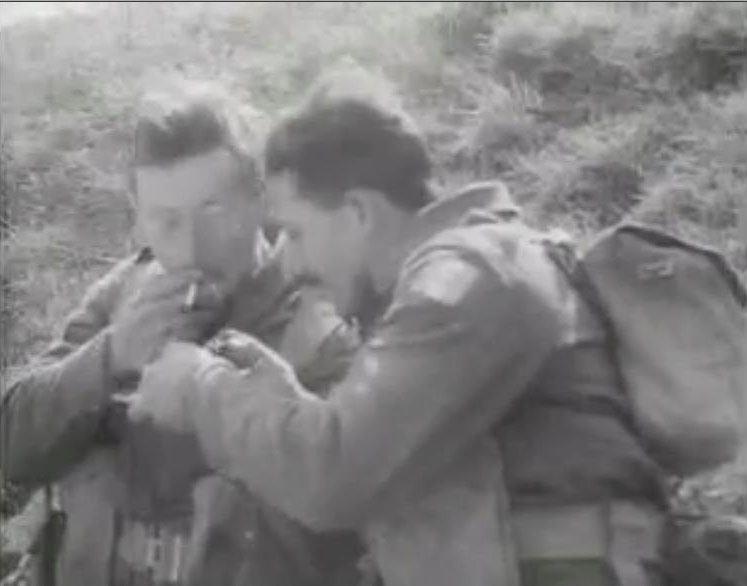
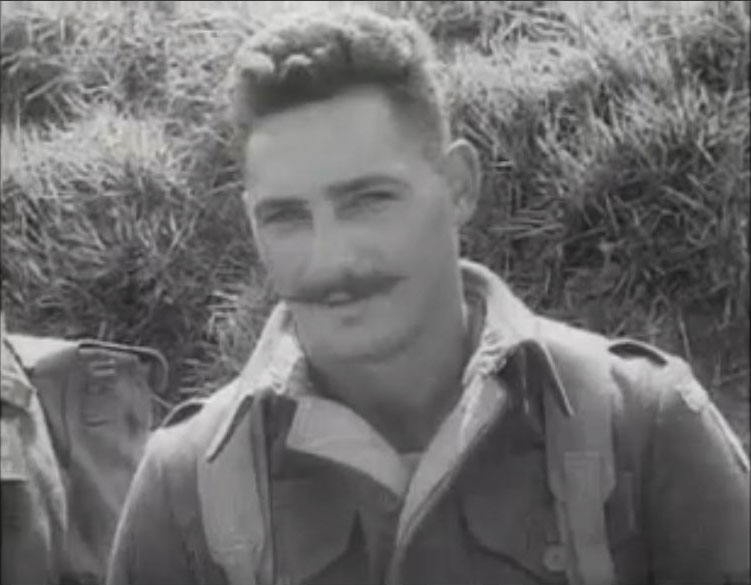
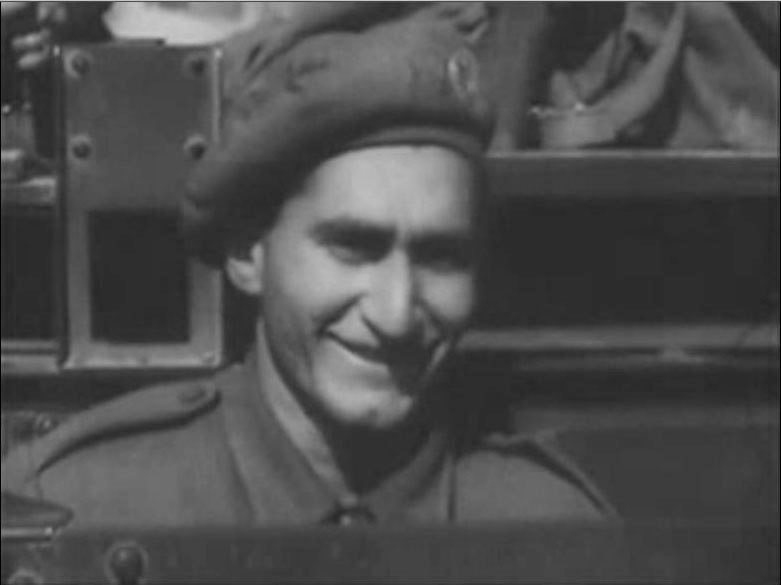
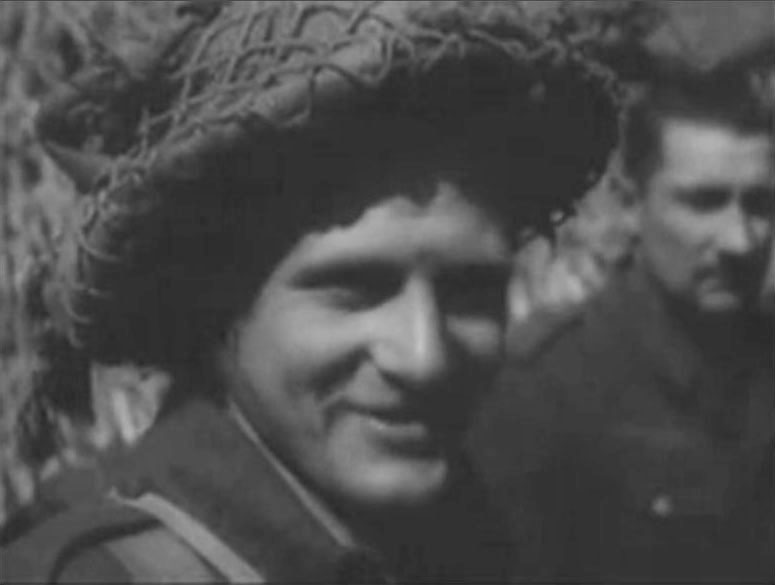
So, here are some images of soldiers of the Jewish Brigade.  There are doubtless many (many) yet-unknown photos of Brigade soldiers in private collections, let alone historical archives in Israel, England, Italy, the United States, and other nations.  However, motion pictures of Jewish Brigade soldiers in training and battle, at rest and religious services, and honoring fallen comrades, can be viewed in at least four videos.  (Perhaps there are others?)  These films comprise the following:

Jewish Infantry Brigade of the British 8th Army – Faenza area, Italy, March 27 – 29, 1945 (duration 7:59; 240 x 320 pixels)
Additional information: 
Department of Defense.  Department of the Army.  Office of the Chief Signal Officer.
(09/18/1947 – 02/28/1964)
ARC Identifier 17581 / Local Identifier 111-ADC-3778 1945
Uploaded to Archive.org 4/24/10
Via NARA – The United States National Archives and Records Administration

____________________

Road to Liberty – Based on the Story of the Jewish Brigade Group (duration 10:54; 240 x 320 pixels)
Additional information:

Produced 1946
Alexander Films [S.A.] Production; Written and Commentated by Norman Lourie
Photography by Sascha Alexander
Music Arranged by De Wolfe
Via The Spielberg Jewish Film Archive at University of Jerusalem

____________________

Jewish Infantry Brigade of British 8th Army 220663-02 (duration 9:29; 360 x 480 pixels)
Additional information:

Jewish Infantry Brigade of British 8th Army, 23-28 Mar 1945
Information on opening slate: CM Tischler, Jewish Infantry Brigade, 28 Mar 1945.
Via Footage Farm

____________________

Jewish Brigade – Brigade juive (duration 5:04; 240 x 320 pixels)
via Alex H’s Video Channel at Daily Motion 

________________________________________

Having viewed all these productions, the two best films in terms (in publicly available digital format, at least) are “Road to Liberty”, and, “Jewish Brigade – Brigade juive”.  Between these two videos I’ve identified four sequences which feature images of Brigade soldiers to their best advantage, in terms of lighting, focus, and primarily, subject matter.  (I know this is a subjective call, but I think I’ve made a good judgement here!)  These comprise: 1) A group of soldiers near Faenza, Italy, on March 27-29, 1945, 2) Soldiers guarding German POWs somewhere in Italy, presumably in April, 1945, 3) A group of soldiers applying camouflage face-paint, probably prior to a patrol, and 4) Soldiers attending a Seder during the late afternoon of March 28, 1945.

And so…  Twenty-one screen-grabs captured from “Road to Liberty”, and, “Jewish Brigade – Brigade juive”, arranged in order of the four sequences listed above, are shown below.  Each image includes the URL of the relevant video (“Road to Liberty” is at YouTube, while “Jewish Brigade – Brigade juive” is at Vimeo), and, the elapsed time in the video where the image can be found.  Since the same scenes appear in both videos, I’ve taken the best screen-grab, regardless of whether the image is from “Road to Liberty” or “Jewish Brigade – Brigade juive”.

And, so…  Other than the quite self-evident fact that all these men were members of the Jewish Brigade; were infantrymen, I know absolutely nothing about them.  The films do not include audio, and, written information about the men – in terms of stills of hand-held placards or close-ups of documents – is absent.  And so, the men’s fates are unknown.

Were any of these men killed in action?  I don’t know.

Were any of them men wounded?  I have no idea.

Did any receive military awards?  Of this I have no knowledge.

What became of them after 1945?  This is unknown.

If any of these soldiers were from the Yishuv (I’m certain more than a few were), did they participate in Israel’s war of Survival in 1948, let alone in 1956, 1967, or 1973?  No idea, but for this question, I think the answer would be yes, at least through 1973.

Postwar, did any of them ever write or record anything about their experiences, for publication, for their families, or simply for posterity – “for the record”? 

I don’t know.  But, I hope so.


________________________________________

Sharing a light.

(Jewish Brigade – Brigade juive / Alex H / 2007) at 1:49

__________

(Jewish Brigade – Brigade juive / Alex H / 2007) at 1:51

__________

(The Spielberg Jewish Film Archive – Road to Liberty / Hebrew University of Jerusalem / March 25, 2010) at 6:14

____________________

Laughing at something.

(Jewish Brigade – Brigade juive / Alex H / 2007) at 2:00

____________________

Attention diverted.

(Jewish Brigade – Brigade juive / Alex H / 2007) at 2:14

____________________

Helmet off for a moment.

(The Spielberg Jewish Film Archive – Road to Liberty / Hebrew University of Jerusalem / March 25, 2010) at 6:17

____________________

Looking at the photographer. (I)

(The Spielberg Jewish Film Archive – Road to Liberty / Hebrew University of Jerusalem / March 25, 2010) at 6:15

____________________

Looking at the photographer.  (II)

(The Spielberg Jewish Film Archive – Road to Liberty / Hebrew University of Jerusalem / March 25, 2010) – at 6:15

____________________

Driving a Bren Gun Carrier.

(Jewish Brigade – Brigade juive / Alex H / 2007) – at 4:14

____________________

Taking a pause after battle.

(Jewish Brigade – Brigade juive / Alex H / 2007) – at 00:28

____________________

Taking a break after battle.

(Jewish Brigade – Brigade juive / Alex H / 2007) – at 00:32

____________________

Guarding German POWs. – I

(The Spielberg Jewish Film Archive – Road to Liberty / Hebrew University of Jerusalem / March 25, 2010) – at 7:50 Narration: “This Jewish guard was himself once in a German camp.”

__________

Guarding German POWs. – II

(Jewish Brigade – Brigade juive / Alex H / 2007) – at 4:29

__________

Guarding German POWs. – III

(Jewish Brigade – Brigade juive / Alex H / 2007) – at 4:29

__________

Guarding German POWs. – IV

(Jewish Brigade – Brigade juive / Alex H / 2007) – at 4:42

__________

Guarding German POWs. – V

(Jewish Brigade – Brigade juive / Alex H / 2007) at 4:56

____________________

Camouflage (before a patrol?)

(The Spielberg Jewish Film Archive – Road to Liberty / Hebrew University of Jerusalem / March 25, 2010) at 7:00

__________

(The Spielberg Jewish Film Archive – Road to Liberty / Hebrew University of Jerusalem / March 25, 2010) at 7:03

__________

(The Spielberg Jewish Film Archive – Road to Liberty / Hebrew University of Jerusalem / March 25, 2010) at 7:05

__________

(The Spielberg Jewish Film Archive – Road to Liberty / Hebrew University of Jerusalem / March 25, 2010) at 7:07

____________________

At Pesach, 1945

(Jewish Brigade – Brigade juive / Alex H / 2007) at 2:59

_________________________________________

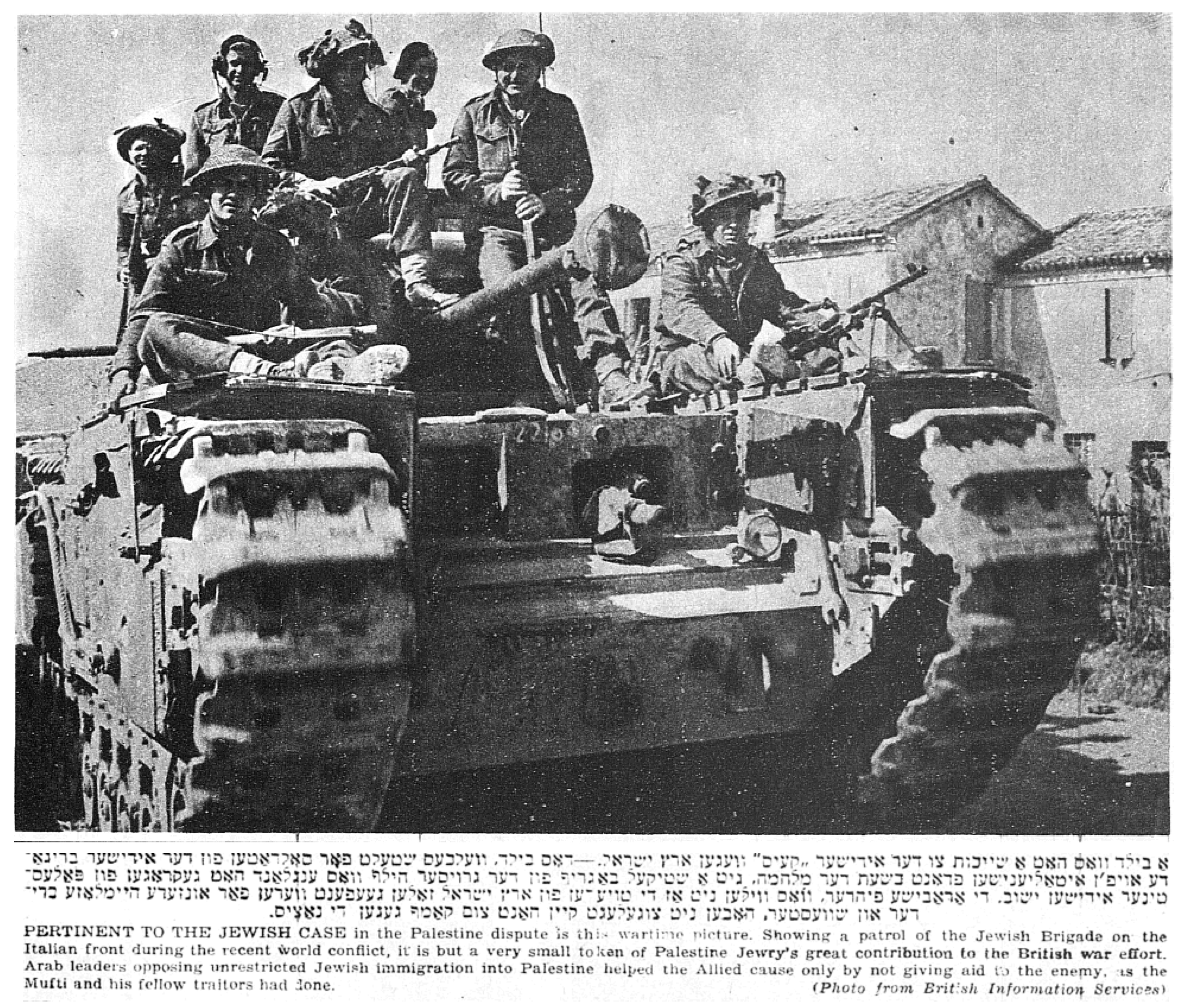
Another still, but not from a movie:  This photograph, showing Jewish Brigade troops riding atop a Churchill tank on March 14, 1945, appeared in the photo section of the Forvarts on November 11, 1945.  

Typical of pictures in the photo section of the Forvarts, the caption appeared in Yiddish and English, with the latter given below:

“PERTINENT TO THE JEWISH CASE in the Palestine dispute is this wartime picture.  Showing a patrol of the Jewish Brigade on the Italian front during the recent world conflict, it is but a very small token of Palestine Jewry’s great contribution to the British war effort.  Arab leaders opposing unrestricted Jewish immigration into Palestine helped the Allied cause only by not giving aid to the enemy, as the Mufti [Haj Amin al-Husseini] and his fellow traitors had done.  (Photo from British Information Services).”

And, the original image appears below…

THE BRITISH ARMY IN ITALY 1945 (NA 23041) ‘A’ Company, 1st Battalion of the Jewish Brigade ride on a Churchill tank in the Mezzano-Alfonsine sector, 14 March 1945. Copyright: © IWM. Original Source: http://www.iwm.org.uk/collections/item/object/205204759

Bibliography and Filmography

Books…

Chamberlain, Peter, and Ellis, Chris, British and American Tanks of World War II, Arco Publishing Company, Inc., New York, N.Y., 1975

Lifshitz, Jacob (יעקב, ליפשיץ), The Book of the Jewish Brigade: The History of the Jewish Brigade Fighting and Rescuing [in] the Diaspora (Sefer ha-Brigadah ha-Yehudit: ḳorot ha-ḥaṭivah ha-Yehudit ha-loḥemet ṿeha-matsilah et ha–golah ((גולהה קורות החטיבה היהודית הלוחמת והמצילה אתספר הבריגדה היהודית)), Shim’oni (שמעוני), Tel-Aviv, 1950

Morris, Henry, Edited by Gerald Smith, We Will Remember Them – A Record of the Jews Who Died in the Armed Forces of the Crown 1939 – 1945, Brassey’s, United Kingdom, London, 1989

Morris, Henry, Edited by Hilary Halter, We Will Remember Them – A Record of the Jews Who Died in the Armed Forces of the Crown 1939 – 1945 – An Addendum, AJEX, United Kingdom, London, 1994

…and Films

Jewish Infantry Brigade of the British 8th Army – Faenza area, Italy, March 27 – 29, 1945 (duration 7:59)
Department of Defense. Department of the Army.  
Office of the Chief Signal Officer.
(09/18/1947 – 02/28/1964)
ARC Identifier 17581 / Local Identifier 111-ADC-3778 1945
Uploaded 4/24/10
National Archives and Records Administration

Road to Liberty – Based on the Story of the Jewish Brigade Group (duration 10:54)
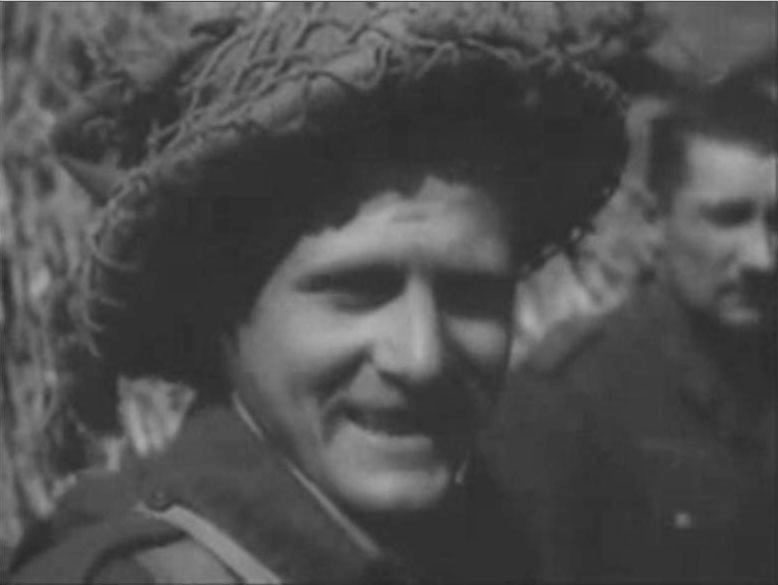
1946

Alexander Films [S.A.] Production; Written and Commentated by Norman Lourie
Photography by Sascha Alexander
Music Arranged by De Wolfe
The Spielberg Jewish Film Archive at University of Jerusalem

Jewish Infantry Brigade of British 8th Army 220663-02 (duration 9:29)
Footage Farm

(WWII – 1945, Italy:  Jewish Infantry Brigade of British 8th Army, 23-28 March 1945)
Slate in English: C.M. Tischler, Jewish Infantry Brigade, 28 March 1945.
12:06:36  Close-Up door of back of truck, stenciled:  COMD 81. Caution Right Hand Drive.  w/ Star of David on right.  MLS w/ officers talking beside table in wooded area looking at maps, rear of truck from previous shot on right.  2 men out w/ maps on boards, put down on table & inspect.
12:07:18  Low angle, British Brigadier General Ernest Benjamin on left w/ monocle, smokes & looks at board,  wearing Star of David patch talking w/ two others w/ Jewish Infantry Brigade patches.
12:07:55  High angle, jeep driving up mountain road, stop & the three officers get out w/ maps, look at terrain & maps.  Tilt up tall mountain range. 
12:08:55  Medium Close-Up 2 officers, Close-Up Gen. Benjamin & insignia w/ Star of David. 
12:09:13  Soldiers loading & firing from camouflaged artillery battery into mountains.  Medium Close-Up Sergeant draws Star of David on shell case.  Gun fired, loading & fired again.
12:10:43  Slate in Hebrew & English.  C.M. Tischler, Jewish Infantry Brigade, 24 March 1945.
12:11:01  Armored convoy of motorcycles, tracked vehicles & trucks carrying waving troops past olive grove & house.  Trucks w/ troops up & past, V for Victory signs.  Stars of David on truck bumpers.  Soldier on sentry duty by flag-pole.  Flag has Star of David.  Close-Ups Star of David on military vehicles.
12:14:51  Slate in English:  C.M. Tischler, Jewish Infantry Brigade, 23 March 1945/  Two soldiers past war graves in cemetery.  Sign:  Plot 4 Jewish Burials.  Two men walk among graves w/ Star of David markers.  Close-Up marker for M. Zilberberg, Jewish Bn. Palestine Regiment, 20 March 1945, killed in action.

Jewish Brigade – Brigade juive (duration 5:04)
Alex H’s Video Channel at Daily Motion

d’archives rares de la brigade juive en Europe
La Brigade juive était une unité combattante dans la 8e armée britannique composée de volontaires juifs de Palestine qui combattit durant la Seconde Guerre mondiale aux côtés des Alliés contre les puissances de l’Axe.les sioniste on combattu le fascisme et le nazime et les force vichy au coté des alliés dans l’armée anglaise…pendant que la “legion arabe” du grand mufti de jerusalem, composé exclusivement de volontaires, combattaient dans les rang la SS musulmane Handschar, sous l’uniforme nazi…

“Rare archives of the Jewish brigade in Europe.”
“The Jewish Brigade was a fighting unit in the British 8th Army made up of Jewish volunteers from Palestine that fought in WWII alongside the Allies against the Axis powers.  Zionists fought against fascism and the Nazim and the Vichy forces. alongside the allies in the English army … while the “Arab legion” of the Grand Mufti of Jerusalem, composed exclusively of volunteers, fought in the ranks the Muslim SS Handschar, in Nazi uniform …”

The Jewish Brigade: Jewish Brigade Accompanies Palestine Travelers – Aufbau, September 7, 1945

On the last day of August in 1945, the JTA – the Jewish Telegraphic Agency – issued a News Bulletin which carried a news item detailing the postwar work of members of the Jewish Brigade in conveying Jewish refugees from Europe to the Yishuv, and, South America.  This occurred in cooperation with Allied authorities in Brussels, the American Jewish Joint Distribution Committee (otherwise known as the Joint or JDC, the Jewish Agency, and HIAS (Hebrew Immigrant Aid Society).  (HIAS, now a 501(c)(3), has changed dramatically in ethos since 1945 – as explained here and here – now in 2021 being a “Jewish” organization in title only.)

Just a week later, on September 7, 1945, a shortened German-language version of JTA’s press release was published in Aufbau.  A transcript of the news item is given below, followed by the  and then, an English-language translation of that item.  

The article is reflective of the postwar transformation of the Jewish Brigade’s role, from one of warfare, to that – unofficially but effectively – of rescue, relief, and reconstruction of the Jewish future. 

________________________________________

Trucks of Jewish Brigade Bring Jews from Belgium to France for Palestine Sailing

JTA Daily News Bulletin

Volume XII, No. 200, Friday, August 31, 1945

Twenty trucks of the Jewish Brigade, led by Major T. Kaspi, arrived here today from Brussels with more than 200 Jews from Belgium who were liberated from camps in Germany and who are planning to sail from Marseille for Palestine.

The steamer on which the liberated Jews will travel will also carry about 300 other Jews to Palestine, including 360 from Switzerland, 204 from France and about 200 from various camps in Germany and from an UNRRA camp at Philippeville, Algeria.  Allied military authorities in Brussels made it possible for the Jewish Brigade to bring the Jews from Belgium to Paris where they will stay in the Hotel Lutetia, maintained by the French Ministry for Repatriated Deportees, until they leave for Marseille from where they will sail on September 2nd.

The Hias-Ica [a misprint – should read “HIAS-ICA”] office here today reports that the very complicated arrangements for the departure of the approximately 1,000 Jewish emigrants were made by the Hias-Ica [sic] in cooperation with the French, American and British authorities and with the aid of the Joint Distribution Committee and the Jewish Agency for Palestine.  Thanks to the sympathetic cooperation of the French authorities, every emigrant will receive en route to Marseille hot beverages and a sufficient quantity of food without ration cards.

(A small group of Jewish survivors has left Marseille on the first French boat to sail directly from France to South America since the country’s liberation, according to a cable received today from Paris by Ilja Dijour, executive secretary of the HIAS-ICA headquarters in New York.)

____________________

Here’s the German-language summary of the item, as it appeared in Aufbau…

Jüdische Brigade begleitet Palästina-Reisende

In Paris sind unter Führung von Major T. Kaspi zwanzig Lastwagen der Jüdischen Brigade aus Brüssel eingetroffen, die über 200 Juden aus Belgien — ehemalige Insassen deutscher Konzentrationslager — nach Frankreich brachten.  Diese sollen von Marseille nach Palästina ausreisen.  Ihr Dampfer nimmt ferner rund 800 Juden mit, davon 360 aus der Schweiz, 240 aus Frankreich und etwa 200 Juden aus verschiedenen deutschen Lagern und dem UNRRA-Lager Philippeville in Algerien.

Die alliierten Militärbehörden in Brüssel ermöglichten es der Jüdischen Brigade, die Juden von Belgien nach Paris zu transportieren, wo sie einstweilen im Hotel Lutetia untergebracht wurden, das dem französischen Ministerium für die Gefangenen, Deportierten und Repatriierten untersteht.  Ihre Abreise von Marseille war für den 2. September vorgesehen.  Das hiesige Büro der HIAS berichtet, dass sie die langwierigen Verhandlungen für den Abtransport der rund 1000 jüdischen Palästina – Emigranten im Zusammenwirken mit dem Joint und französischen, amerikanischen und britischen Behörden, erfolgreich zum Abschluss bringen konnte.

__________________

…and, an English-language translation:

Jewish Brigade Accompanies Palestine Travelers

Under the leadership of Major T. Kaspi, twenty lorries of the Jewish Brigade from Brussels arrived in Paris, bringing more than 200 Jews from Belgium – former inmates of German concentration camps – to France.  These are to leave Marseille for Palestine.  Their steamer also carries around 800 Jews, including 360 from Switzerland, 240 from France and about 200 Jews from various German camps and the UNRRA Philippeville camp in Algeria.

The Allied military authorities in Brussels enabled the Jewish Brigade to transport the Jews from Belgium to Paris, where they were temporarily housed in the Hotel Lutetia, which reports to the French Ministry of Prisoners, Deportees and Repatriates.  Her departure from Marseille was scheduled for 2 September.  The local HIAS office reported that it was able to successfully conclude the lengthy negotiations for the removal of the approximately 1,000 Jewish Palestinians – emigrants in cooperation with the Joint and French, American and British authorities.

The Jewish Brigade: With the Jewish Brigade to Austria, by PFC Hans Lichtwitz – Aufbau, June 15, 1945

“Die Juden kommen!”
“The Jews are coming!”

____________________

“Kamerad, hast du vielleicht eiene Zigarette?”
“Ich bin kein Kamerad, ich bin ein Jude.”

“Comrade, do you have a cigarette?”
“I’m not a comrade, I’m a Jew.”

____________________

It is Erev Shabbat – the Jewish refugees have invited us to a celebration.
The rabbi of the brigade has come and brought a sefer Torah.
We are six soldiers of the brigade and two Jewish soldiers of the English garrison.
The tables are covered in white.
During prayer, most of them break out in a shattering sob.
You can not believe it:
a Jewish officer prays,
Jewish soldiers in their midst,
they themselves free.

________________________________________

On June 15, 1945, Aufbau published the second of Pfc Hans Lichtwitz’s articles about the experiences and impressions of Jewish Brigade soldiers just before, and shortly after, the end of the Second World War in Europe.  The author’s photo, from Aufbau’s October 19, 1945 issue, is seen below. 

Unser Mitarbeiter Pvt. Hans Lichtwitz von der Jüdischen Brigade

Das Bild zeigt Pvt. Lichtwitz bei einem Besuch im Displaced Persons-Lager in Oberammergau

_____

Our employee Pvt. Hans Lichtwitz from the Jewish Brigade
The picture shows Pvt. Lichtwitz during a visit to the Displaced Persons camp in Oberammergau

________________________________________

In this substantive and meaningful piece of reporting (filed from Klagenfurt, Austria), Lichtwitz focuses on post-surrender encounters – typically of a very brief yet emotionally laden and highly symbolic nature – with members of the S.S., Wermacht, and civilians in southern Austria and northern Italy.  There’s a very revealing and psychologically astute account of Lichtwitz’s encounter with the Austrian crew of a railroad train, during which – and probably long after – he pondered just what, exactly, these men did during the war.  (He didn’t ask; they didn’t say.)  Then a description of the scale and nature of physical devastation caused by the war, and, the movement of masses of people of different nationalities (refugees, former prisoners of war, and liberated slave laborers) through that city.  (To home?  To where?)  The final six paragraphs of the article – smartly saved ’til the article’s end, for a fitting kind of literary denouement – center around the Brigade’s encounter with 120 Jewish refugees in the former concentration camp at Admont, near Klagenfurt, and the celebration of Erev Shabbat by soldiers and survivors. 

The article ends with the singing of the Hatikva.

Or, does it begin?  

____________________

Paralleling the post about Lichtwitz’s Aufbau article of May 4, 1945, this post likewise includes a transcript of the article’s original German text, followed by an English-language translation.  

Mit der “Jüdischen
Brigade” nach Oesterreich
Von Pfc. HANS LICHTWITZ

Klagenfurt, im Juni.

Die Wochen der Erholung und Entspannung nach dem Verlassen der Frontlinie sind zu Ende.  Die “Jewish Brigade” ist in Bewegung.  Der lange Zug, Automobile, Kanonen, Panzerwagen, fährt durch die Städte, die noch vor kurzem im Feindesgebiet lagen.  Ueber die Strassen Norditaliens flutet eine grosse Völkerwanderung: unendliche Kolonnen befreiter Arbeiter und Kriegsgefangener aller Nationen, in die sich der endlose Zug deutscher Kriegsgefangener mischt.  Ihr aller Weg führt nach dem Süden — und zu gleicher Zeit und auf denselben Strecken begibt sich der gewaltige Tross der VIII Armee nach dem Norden.

An uns vorbei werden grosse SS-Abteilungen in die Gefangenschaft geführt.  Das Zusammentreffen mit dem langen Convoy der Jewish Brigade mag für sie ein besonderes Erlebnis gewesen sein.  Unsere Autos sind mit blau-weissen Fahnen und dem Mögen Dovid geschmückt.  An den Seiten prangen grosse Anschriften

“Die Juden kommen!”

und alle möglichen Naziparolen mit umgekehrten Vergleichen.  Wie kläglich sehen diese “Herren der Welt’’ von gestern heute aus!  Diese erste Begegnung mit ihnen — die natürlich alles eher als ruhig zuging — erregt jeden Einzelnen vou uns so sehr, dass wir gar nicht richtig die herrliche Gebirgslandschaft geniessen, durch die die Fahrt gebt.

Und dann, nach einigen Tagen, kommt der grosse Moment, an den wir so oft gedacht, der uns so sehr beschäftigt hat, auf den wir seit Jahren warten: das Betreten des ehemaligen Dritten Reiches.  Ich fahre als Wache auf der Lokomotive eines Zuges, der Material für die Besatzungsarmee führt.  In Tarvis werden Maschine und Zugspersonal gewechselt; österreichische Lokomotivführer und Heizer sind nun meine Gesellschaft.  Ihr erster Blick fällt auf den Mögen Dovid an meiner Uniform, dann streifen mich ihre Augen verlegen.  Kein Gruss wird gewechselt.  Einige Male versuchen sie während der Fahrt ein Gespräch zu beginnen — ich antworte nicht.  Nicht allein, weil es Eisenhower verboten hat — ich kann einfach nicht mit ihnen sprechen.  Weiss Gott, was das für Menschen sind, die so abgearbeitet und schlecht aussehen; weiss Gott, was sie von Hitler und während Hitler gewesen sind.  Aber das grosse Fragezeichen, das jeden Menschen, dem wir von nun an begegnen, umschwebt, lässt die Möglichkeit, ja Wahrscheinlich keit zu: auch er hat in dieser oder jener Form mitgekan.

Am Bahnhof in Klagenfurt, von dem nur ein einziger Schutthaufen übriggeblieben ist, wendet sich ein deutscher Kriegsgefangener bettelnd an mich: “Kamerad, hast du vielleicht eiene Zigarette?”

“Ich bin kein Kamerad, ich bin ein Jude.”

Der Weg in die Stadt führt durch völlig zerstörte Viertel.  Die Strassen sind tief aufgerissen.  Nur schmale Gebsteige sind freigelegt.  Auch im Zentrum der Stadt sind viele Spuren der alliierten Bombardements zu sehen.  Die Nazis haben krampfhaft versucht, aus dieser Zerstörung Propagand – Kapital zu schlagen.  Sie haben an den stehengebliebenen Hauswänden Plakate angebracht: “Das ist der Sozialismus unserer Befreier.”

“We werden unsere Befreier empfangen mit Revolvern und Granaten”.  An den Anschlagsäulen prangen noch die Plakate, die zu einer Massenkundgebung der NSDAP am 20 April N. J. unter der Parole “Adolf Hitler führt zum Siege” einladen.  Der grosste Teil der letzten amtlichen Verlautbarungen wendet sich gegen Zweifler und Pessimisten.

In den Hauptstrassen räumen deutsche Kriegsgefangene unter Bewachung den Schutt auf.  Verdutzt blicken sie auf uns.  Es ist zum ersten Mal seit vielen Monaten, dass wir leichten Herzens durch diese Trümmerwelt schreiten.  Bisher hatte in Italien der Anblick der Zerstörung und der verstörten Menschen irgendeine Stelle des Mitgefühls in uns wachgerufen.  Nun schweigen unsere Herzen kalt, alle Gefühle sind erloschen.

In der Stadt herrscht ein Tohuwabohu, an das sich Auge und Ohr nur schwer gewöhnen können.  Tag und Nacht strömen aus Süddeutschland und Oesterreich zehntausende fremder Arbeiter hierher — Ukrainer, Polen, Tschechen, Italiener, Jugoslawen; französische Ex-Gefangene kommen in grosser Zahl aus der von den Russen okkupierten Zone die Reste der deutschen Armee, die sich Alexander ergeben hat, kampieren noch in der Umgebung; deutsche Flüchtlinge aus dem russischen Teil Oesterreichs, jugoslawische Michaillowic – Flüchtlinge — das alles drängt sich hier zusammen.  Dazu, die Okkupations-Armee — ein buntes, verändertes Bild, bis Ordnung in der Stadt wird, aufrechterhalten durch britische Militär – Polizei, die städtische Polizei — in deutschen Uniformen mit einer weissen Armbinde “Allied Military Government Civil Police” und durch das “Oesterreichische Freikorps”, politische Flüchtlinge, die auf Seite Titos gekämpft hatten — in deutschen Uniformen mit rot-weissroter Armbinde.

Die meisten Geschäfte sind entweder zerstört oder geschlossen.  Im grössten Kaffeehaus der Stadt ist die NAAFI, das Soldaten-Restaurant, untergebracht.  Kärntner Kellnerinnen und Kellner servieren mit Dienstbeflissenheit und Zuvorkommenheit; eine österreichische Kapelle musiziert, der Primgeiger wirft, wirklich werhende Blicke nach allen Seiten.

Die einheimische Bevölkerung ist — und dieser Eindruck verstärkt sich, je mehr man durch die Strassen und Gässchen streift und beobachtet, was rings um einen vorgeht — von einer Freundlichkeit, die bis zur schrankenlosen Anbiederung geht.  Man hatte eine Distanziertheit zur Besatzungs-Armee erwartet, und nun werden die fremden Soldaten wie vornehme Sommerfrischler am Wörther-See behandelt.

Die VIII. Armee gibt eine deutsche Tageszeitung “Kärntner Nachrichten” und eine Wandzeitung heraus, die nicht nur verbreitet, sondern auch gelesen werden.  Diese Menschen sind gewohnt Obrigkeiten blind anzuerkennen.  Gestern haben sie mit der gleichen Aufmerksamkeit die Nazipresse gelesen.  Was in ihrem Inneren vorgeht, weiss man natürlich nicht.  Aber jüdische Flüchtlinge, die sich schon lange unter ihnen als ausländische “nichtjüdische” Arbeiter bewegten, erzählen uns, dass der Glaube an den Nationalsozialismus zusammengebrochen ist.  An seine Stelle sind Angst und Neugierde getreten.  Die Klagenfurter betrachten es als ein Glück, in die englische Zone geraten und vorläufig vom Tito-Alhdruck befreit zu sein.  Ihr Hauptinteresse konzentriert sich auf die Lebensmittelversorgung.  Alles ist sehr knapp, und ein Hungerwinter steht bevor.

Wir haben in Klagenfurt 120 Juden des Konzentrationslagers Admont gefunden.  Als sie uns auf der Strasse zum ersten Mal sahen, blieben sie wie versteinert stehen: Soldaten mit dem Mögen Dovid!  Sie hatten vorher keine Ahnung von unserer Existenz.  Noch vor zwei Wochen waren sie im Konzentrationslager unter SS-Behandlung.  Am 5 Mai erhielt der Lagerkommandant den Befehl, sämtliche Juden zu erschiessen.  Aber einige SS-Offiziere weigerten sich angesichts des britischen Vormarsches diesen Befehl auszuführen.  Man brachte die Juden am nächsten Tage nach Klagenfurt und überliess sie in dem dort herrschenden Chaos ihrem Schicksal.  Sie stammen fast durchweg aus Ungarn und Karpatho-Russland.

Auch von anderen Seiten tauchen Juden auf, die hier lange Zeit mit gefälschten Dokumenten als Nichtjuden gelobt haben.  Von ihnen erfahren wir von zahlreichen ähnlichen Fällen aus anderen Orten Kärnten und Tirols.

Unsere Hilfe beginnt sogleich.  Vom Tage der “Entdeckung” an gibt es für sie kein quälendes Ernährungsproblem mehr, wie bei den anderen Flüchtlingen.  Listen werden angelegt und weitergeleitet.  Sie spüren genau, sie sind nicht mehr verloren.

Zu Dritt begeben wir Soldaten uns auf die Suche nach der einstigen Synagoge.  In einer ganz zerbombten Gegend finden wir sie.  Das einzige Haus in der Platzgasse, das noch das Aussehen eines Hauses hat.  Aber das Innere ist zerstört und verschmutzt.  An der Saaldecke sind noch hebräische Aufschriften zu lesen, die anscheinend von den Nazis, die hier ihre “Volkswohlfahrtsstelle” und später ein Flüchtlingsasyl unterhalten hatten, als Kuriosum belassen worden waren.  Auch diese Synagoge wird von den Nazis gereinigt werden.  Aber in keinem von uns erwacht der Wunsch, hier wieder eine jüdische Kehilla zu sehen.  Es wäre eine Illusion, wenn irgendjemand glauben sollte, hier oder an einem anderen Platze in Deutschland Wiedersehen mit alten Zeiten, mit einstigen Lebensbedingungen und den Menschen von anno dazumal feiern zu können.

Es ist Erew Schabbat — die jüdischen Flüchtlinge haben uns zu einer Feier eingeladen.  Der Rabbiner der Brigade ist gekommen und hat eine Sefer Thora mitgebracht.  Wir sind sechs Soldaten der Brigade und zwei jüdische Soldaten von der englischen Garnison.  Die Tische sind weiss gedeckt.  Während des Gebetes brechen die meisten in ein erschütterndes Schluchzen aus.  Sie können es nicht fassen: ein jüdischer Offizier betet vor, jüdische Soldaten in ihrer Mitte, sie selbst frei.

Wir singen die Hatikvah.  Wie oft haben wir sie in diesem Jahre bei den verschiedensten Anlässen gesungen: Am 2. November, als uns die Schiffe nach Europa brachten, am Tage bevor wir uns in die Frontlinie begaben, am Grabe unserer Gefallenen, beim Dankgottes dienst am V-Tage.  Aber diesmal ist es ein besonderes Erlebnis.  “Die Hoffnung”, an die sich diese Menschen in sehr finsteren Momenten geklammert haben, ist Erfüllung geworden.  Sie ist nach ihrem Zusammentreffen mit uns gross und grösser geworden.  Immer kleiner wird die Zahl der Weinenden.  Die Blicke hellen sich auf und sie stehen nun, während wir die Hymne unseres Volkes singen, so gerade und aufrecht wie wir.

____________________

With the “Jewish Brigade” to Austria
By PFC HANS LICHTWITZ

Klagenfurt, in June.

The weeks of rest and relaxation after leaving the front line are over.  The “Jewish Brigade” is on the move.  The long procession, automobiles, cannon, armored cars, drive through the cities that were recently in enemy territory.  A great migration of peoples flows over the streets of northern Italy: endless columns of liberated workers and prisoners of war of all nations into which the endless train of German prisoners of war mingles.  All their roads lead to the south – and at the same time and on the same routes, the mighty unit of the 8th Army moves to the north.

Past us, large S.S. units are being led into captivity.  The encounter with the long convoy of the Jewish Brigade may have been a special experience for them.  Our cars are adorned with blue and white flags and Shield of David.  On the sides, big addresses stand out

“The Jews are coming!”

and all kinds of Nazi polls with inverse comparisons.  How miserable these yesterday’s “Men of the World” look today!  This first encounter with them – which, of course, everything was rather quiet – arouses in every single one of us so much that we do not really enjoy the beautiful mountain scenery through which the journey goes.

And then, after a few days, comes the great moment we so often thought of, which has been so busy for us that we have been waiting for years: entering the former Third Reich.  As a guard, I drive on the locomotive of a train carrying material for the occupation army.  In Tarvis [probably Tarvisio, Italy], the machine and train crew are changed; Austrian locomotive drivers and stokers are now my company.  Their first glimpse of the Shield of David on my uniform, then my eyes wander in embarrassment.  No greeting will be exchanged.  Some times they try to start a conversation while driving – I do not answer.  Not only because it has been banned by Eisenhower – I just can not talk to them.  God knows what kind of people they are, who work so well and look bad; God knows, what they got from Hitler during Hitler’s [rule].  But the big question mark, which embraces every person we meet from now on, allows the possibility, indeed the probability, that he also participated in one form or another.

At the train station in Klagenfurt, of which only a single pile of rubble is left, a German prisoner of war turns to me begging: “Comrade, do you have a cigarette?”

“I’m not a comrade, I’m a Jew.”

The way into the city leads through completely destroyed quarters.  The streets are torn open.  Only narrow platforms are exposed.  Also in the center of the city are many traces of the Allied bombardment.  The Nazis have been desperately trying to capitalize on this destruction of propaganda.  They have placed posters on the left wall of the house: “This is the socialism of our liberators.”

“We will receive our liberators with revolvers and grenades.”  On the advertising columns are still the posters that invite to a mass rally of the NSDAP on 20 April under the slogan “Adolf Hitler leads to victory”.  Most of the latest official statements are directed against doubters and pessimists.

In the main streets German prisoners of war clean up the rubble under guard.  They look at us in surprise.  It is the first time in many months that we pass through this world of debris with a light heart.  So far, in Italy, the sight of destruction and disturbed people has evoked some place of compassion in us.  Now our hearts are silent cold, all feelings are gone.

There is a hustle and bustle in the city that is hard to get used to.  Day and night, tens of thousands of foreign workers pour out of southern Germany and Austria – Ukrainians, Poles, Czechs, Italians, Yugoslavs; French ex-prisoners come in large numbers out of the zone occupied by the Russians.  The remains of the German army, which has surrendered to Alexander, are still camping in the area; German refugees from the Russian part of Austria, Yugoslav Michailowicz refugees – all this is crowded together here.  In addition, the Occupation Army – a colorful, altered image, until order in the city is maintained by British military police, the city police – in German uniforms with a white armband “Allied Military Government Civil Police” and by the “Austrian Free Corps”, political refugees who had fought on the side of Tito – in German uniforms with red and white armbands.

Most shops are either destroyed or closed.  The largest coffee house in the city houses the NAAFI [Naval, Army, and Air Force Institutes], the soldier’s restaurant.  Carinthian waitresses and waiters serve with service and courtesy; an Austrian band plays music, [the lader] genuinely making glances appear on all sides.

The native population is – and this impression intensifies, the more one wanders through the streets and alleyways and observes what is going on around one – from a friendliness that goes as far as a boundless approach.  They had expected a detachment from the occupation army, and now the foreign soldiers are being treated like noble summer visitors to Lake Wörthersee.

The 8th Army publishes a German newspaper “Carinthian News” and a wall newspaper, which are not only distributed but also read.  These people are used to blindly accepting authorities.  Yesterday they read the Nazi press with the same attention.  Of course you do not know what’s going on inside.  But Jewish refugees, who have long been among them as foreign “non-Jewish” workers, tell us that the belief in National Socialism has collapsed.  In its place fear and curiosity have entered.  The people of Klagenfurt consider it a stroke of luck to enter the English zone and for the time being to be exempted from Tito-Alhdruck [?].  Their main interest is the supply of food.  Everything is very close, and a winter of hunger is imminent.

We found 120 Jews of the concentration camp Admont in Klagenfurt.  [See this excellent image (copyrighted; oh well!…) from the Simon Wiesenthal Center Library and Archives.]  When they saw us on the street for the first time, they stopped dead in their tracks: Soldiers with the Shield of David!  They had no idea about our existence before.  Only two weeks ago they were in the concentration camp under S.S. handling.  On May 5, the camp commandant was ordered to shoot all the Jews.  But some S.S. officers refused to carry out this order in the face of the British advance.  The Jews were brought to Klagenfurt the next day, leaving them to their fate in the chaos that prevailed there.  They are almost all from Hungary and Karpatho-Russia.

From other sources, too, Jews appear who have long praised non-Jews for using fake documents.  From them we learn from numerous similar cases from other places in Carinthia and Tyrol.

Our help starts immediately.  From the day of the “discovery” there is no longer a nagging food problem for them, as with the other refugees.  Lists are created and forwarded.  They feel exactly, they are no longer lost.

On the third, we soldiers go in search of the former synagogue.  In a completely bombed area we find it.  The only house in Platzgasse that still has the look of a house.  But the interior is destroyed and polluted.  On the ceiling Hebrew inscriptions are still to be read, which had apparently been left as a curiosity by the Nazis, who had maintained here their “public welfare center” and later a refugee asylum.  This synagogue will also be cleaned by the Nazis.  But none of us wished to see a Jewish Kehilla here again.  It would be an illusion if anyone believed that they could celebrate a reunion with old times, with former living conditions and the people of yesteryear, here or in another place in Germany.

It is Erev Shabbat – the Jewish refugees have invited us to a celebration.  The rabbi of the brigade has come and brought a sefer Torah.  We are six soldiers of the brigade and two Jewish soldiers of the English garrison.  The tables are covered in white.  During prayer, most of them break out in a shattering sob.  You can not believe it: a Jewish officer prays, Jewish soldiers in their midst, they themselves free.

We sing the Hatikva.  How many times have we sung it at various occasions this year?  On the 2nd of November, when the ships brought us to Europe, the day before we went to the front line, at the graves of our dead, at the Thanksgiving service on the V-day.  But this time it’s a special experience.  “The hope” to which these people have clung in very dark moments has become fulfilled.  It has become great and greater after meeting us.  The number of crying people is getting smaller and smaller.  The eyes brighten and they stand, as we sing the hymn of our people, as straight and upright as we are.

The Jewish Brigade: Our Boys From the Jewish Brigade Write to Aufbau – September 7, 1945

All of you remind me that our small and poor nation must be and will be united till our big hope is realized – Erez  [Eretz Yisrael]. – Pte. G. Levy.

____________________

September 7, 1945.  Four months having transpired since the Germany’s defeat (albeit the war with Japan only ended on September 2), Aufbau took the unusual step of publishing an English-language news items comprised of letters from four soldiers of the Jewish Brigade.  However, as indicated by the article’s sub-title, these represent only a small sample of the “dozens” of letters received by the newspaper, the commonality among them being allusion to and sincere acknowledgement for a “parcel” – contents not indicated; one wonders what was included! – presumably sent by the newspaper to  Brigade soldiers. 

In the final letter, a Private Levy mentions having left home and family in Poland, followed by a literary ellipsis (“…”), indicating that Aufbau’s editors thought it necessary to leave the remainder of the sentence unpublished.  Which makes one wonder, in 2021, about the unknown parts of the Private’s story. 

As far as the Private’s hope for unity in the Jewish nation, well, in 2021, that is a goal yet unattained.   

But, it is a noble; hopeful; aspiration.     

________________________________________

Our Boys from the Jewish
Brigade Write to “Aufbau”

Following are excerpts from dozens of letters which
“Aufbau” received from Palestinian soldiers serving with
the Jewish Brigade.

After coming back from a hard convoy trip for over hundreds of off miles through North Italy to Austria, I found your parcel…  I wish to express my thanks in my own name as well aa in the name of my comrades who were very happy to receive your parcels but, owing to a lack of knowledge of the English language, are unable to thank you themselves.  More than all the contents of your package even we appreciate the great thing you are doing.  It helps us to get that certain feeling of satisfaction, which has been missing as long as we were aware of the fact that only a lot of our comrades received parcels and gifts from their relatives.  It is hard to express the feelings of a soldier far away from his home (if he’s got any at all), but you really gave those unlucky ones who are all alone a feeling that they are not forgotten in a certain way.  Though the sender is unknown us and no relative of ours, we appreciate your gift as if it had been sent from home.

Is it possible to obtain your newspaper for a few of our German-speaking men?

Sgt. S. Ben-Tuvi.

I wish to thank you for the parcel I received last week in the name of the “Aufbau.”  It was much more to me than a parcel – a concrete sign of Jewish fellowship throughout the world.

Your paper is well known to us all as a brave fighter for Zionism and the defense of Jewish honor everywhere.

Moreover, you gave me double pleasure because I had something to give to our dear brothers which we saved from various concentration camps in Germany.  There is also a good number of rescued children, all orphans.  They passed through five and a half years of war, through camps like Auschwitz, Buchenwald and Dachau, where their parents were murdered.

Everyone of us knows that it is our greatest duty to give all help possible and the only one that is really constructive.  We are disposed to do everything to bring them home, to the only Jewish home in the world.  I also thank you in the name of those children to whom your parcels brought the feeling that they are not alone and forgotten.

Pte. J. Schelasnitzki.

We want to thank your organization most heartily for the great surprise of your parcels which have reached us yesterday.  Not only the parcels but also the good thoughts which prompted and accompanied them caused great joy.

May we add that we think ‘Our Boys’ Club” is a great idea, proving again the complete unity between Jews wherever they may be.

Hoping that we can thank you personally some day, we are,

Pte. Benno Katz
Pte. E. Growald

I was very pleased with your kind parcel It came as a great surprise, as l haven’t received any gift since I joined the Army and left my house and family in Poland…  It is of great importance to a Jewish soldier to have friends somewhere.  All of you remind me that our small and poor nation must be and will be united till our big hope is realized Erez.

Pte. G. Levy.

The Jewish Brigade: With the Jewish Brigade On the Front, by PFC Hans Lichtwitz – Aufbau, May 4, 1945

“…the hundreds of thousands of Jewish soldiers in the armies of the allies remain mostly anonymous as Jews.”

Among the 37 articles published in Aufbau concerning the Jewish Brigade were four authored by PFC Hans Lichtwitz, whose photo – from Aufbau’s October 19, 1945 issue – is seen below.  

Unser Mitarbeiter Pvt. Hans Lichtwitz von der Jüdischen Brigade
Das Bild zeigt Pvt. Lichtwitz bei einem Besuch im Displaced Persons-Lager in Oberammergau

_____

Our employee Pvt. Hans Lichtwitz from the Jewish Brigade
The picture shows Pvt. Lichtwitz during a visit to the Displaced Persons camp in Oberammergau

________________________________________

The first of Lichwitz’s articles was published on May 4 of that year, only four days before the end of the war in Europe.  In this simple and short piece, the author discusses the unit’s reputation in the Italian theater, despite its relatively small size, and, the sense of duty, moral urgency, and high level of morale that characterized the fighting spirit of its soldiers.

This post includes a transcript of the article’s original German text, followed by an English-language translation.  

Mit der Jüdsichen Brigade
An der Front

“Ihr seid von der Jewish Brigade?  Ja, wir haben schon von euch gehört” — wo immer man auch in Italien mit Soldaten der Aliierten zusammentrifft, beginnt das Gespräch mit einer ähnlichen Wendung.

Woher kommt es, dass die Brigade so bekannt ist?  Liegt das an einer besonderen Publizität, die ihr mangels anderer Sensationen zuteil wurde?  Gewiss nicht!  Unser Einzug in die Frontlinie fiel in die Zeit der grossen Offensive im Westen und des beginnenden Zusammenklappens in Deutschland — die Zeitungen hatten wahrlich genug andere Sensationen.  Oder hat die Brigade besondere Bravourstücke aufgeführt, wodurch sie für die alten Frontkämpfer an Attraktivkraft gewann?  Auch das nicht.  Wir sind in einem verhältnismässig kleinen Frontabschnitt eingesetzt worden und haben keine aussergewöhnlichen Aufgaben zugewiesen bekommen.  Die Brigade hat sie mit Eifer, Ernst und einem Tempo erfüllt, die allerdings den militärischen Fachleuten, die Greenhorns an der Front immer skeptisch betrachten, Respekt eingeflösst hat.

Aber ich glaube, es ist etwas anderes, das die Soldaten der Jewish Brigade mit einem Schlage in den Augen ihrer Verbündeten gleichwertig erscheinen liess.  Was an diesen Neulingen im Frontgebiet auffiel, war ein besonders ausgeprägter “spirit”, ein Kampfgeist und eine Frontbeflissenheit, die nicht alltäglich sind.  Dieser jüdische Soldat bildet einen schreienden Gegensatz zu seinem Prototyp in der antisemitischen Propaganda, die nicht erst seit Hitler als seine markanteste Eigenschaft die Drückebergerei von jeglicher Frontarbeit in tausenderlei Variationen nachzuweisen versucht hat.  (Dass gerade das Gegenteil davon wahr ist, war nicht immer so evident, da die hunderttausende jüdischen Soldaten in den Armeen der Verbündeten als Juden meist anonym bleiben.)

Das Aussergewöhnliche in diesem Falle beginnt schon mit der Freiwilligkeit unseres Militärdienstes.  Kein Gesetz, kein Staat hat diese Soldaten in die Uniform gezwungen, sie sind aus freien Stucken gekommen.  An der ganzen Front gibt es nichts derartiges.  Aber sie haben es nicht bei der Freiwilligkeit allein bewenden lassen.  Sie wollen auch unbedingt an aktiven Kampfhandlungen teilnehmen.  Sie wollen zur Front.  Und es gibt eine Reihe kleiner Episoden aus ihrem Leben die sich sehr schnell herumgesprochen haben.  Als die Brigade vor ihrer Ueberfahrt nach Europa reorganisiert wurde, haben viele in ihren Reihen, die wegen Ueberschreitung der für Infanterie-Soldaten üblichen Altersgrenze nicht mitgenommen werden sollten, dagegen einen verzweifelten Kampf geführt.  Kopfschütteln und Staunen hatte damals unter den nichtjüdischen Soldaten der Fall jenes Soldaten hervorgerufen, der einige Tage in Hungerstreik getreten war, bis er seinen Willen, zur Front mitgenommen zu werden, durchsetzte Das Gleiche hat sich nach Abschluss der Ausbildung in Italien wiederholt.  Wieder gab es Soldaten, die aus Gesundheitsgründen zurückgeschickt werden sollten und die kein Mittel unversucht liessen – um zur Front zu gelangen.

Als die Brigade ihre erste Stellung an der Front bezogen hatte, ereignete sich der folgende kleine Vorfall in einem Spital hinter der Front.  Einem Soldaten der Brigade, der wegen einer kleinen Augenbeschwerde dorthin zur Konsultation geschickt worden war, wurde vom Arzt nach der Untersuchung mitgeteilt, er müsste zwei Wochen im Spital behandelt werden.  Daraufhin erhielt der Arzt die ihn nicht wenig verblüffende Antwort: “Das ist ausgeschlossen, ich muss noch heute zu meiner Kompanie zurück”.  Der Arzt glaubte nicht richtig verstanden zu haben und liess durch den Dolmetscher fragen, warum er denn nicht im Spital bleiben wolle.  “Meine Kompanie ist in der vordersten Linie und wir brauchen jeden Mann.  Ich muss unbedingt zurück.”  Der Arzt unterbrach daraufhin für einige Minuten seine Arbeit, begab sich in den Warteraum und erzählte den Vorfall der grossen Zahl Patienten aller Nationen.  “Und das ist nicht der erste Fall von dieser Brigade!”

Die Soldaten der Jewish Brigade haben ein ganz unübliches militärisches Vergehen erfunden: “Desertion zur Front’”.  Sie versuchen mit allen Mitteln die Uebergangsperiode nach der Entlassung aus dem Spital und der Rückkehr zur Truppe abzukürzen.  Einer meiner Freunde ersuchte seinen schottischen Bettnachbar im Spital um einen Rat, wie er es erreichen könnte, sobald als möglich, ohne erst in ein Transit-Camp gebracht werden, zu seiner Kompanie zurückkehren zu können.  “Ich verstehe Euch jüdische Soldaten wirklich nicht”, antwortete der erstaunte Schotte.  “Ihr Juden wisst doch immer so gut Bescheid im Leben!  Hier geht es gerade um das Gegenteil: wie man es erreichen kann, solange als möglich sich im Transit-Camp herumzudrehen.  Und Ihr wollt direkt zurück!”

Zu den gefährlichsten Nacht-Patrouillen ins Gebiet des Feindes meldeten sich immer viel mehr Freiwillige als erforderlich waren.

Man könnte noch eine ganze Anzahl ähnlicher Beispiele anführen.  Ihre Summe ergibt dann das Bild einer Einheit, vor der man im Frontgebiet Respekt hat.  Und das ist wohl auch die Lösung des Rätsels der grossen Publizität ringsum die Jewish Brigade.

______________________________

With the Jewish Brigade
On the Front

“You are from the Jewish Brigade?  Yes, we have already heard of you “- wherever you meet Italian soldiers in Italy, the conversation begins with a similar twist.

Where does it come from that the brigade is so well known?  Is that due to a special publicity that it was given for lack of other sensations?  Certainly not!  Our entry into the front line coincided with the time of the great offensive in the West and the beginning of collapse in Germany – the newspapers really had enough other sensations.  Or did the brigade perform special bravura pieces, which made it attractive for the old front fighters?  Not even that.  We have been deployed in a relatively small front section and have not been assigned any extraordinary tasks.  The brigade has filled them with zeal, and an earnest pace, but it has given respect to the military professionals who are always skeptical about Greenhorns at the front.

But I believe it is something else that made the soldiers of the Jewish Brigade equal in the eyes of their allies.  What was striking about these newcomers in the front area was a particularly pronounced “spirit”; a fighting spirit and a frontal zeal that are not commonplace.  This Jewish soldier is a blatant antithesis to his prototype in anti-Semitic propaganda, which has not tried to prove the thwarting of any front-line work in thousands of variations, not only since Hitler’s most salient feature.  (That just the opposite of this is true was not always so evident, as the hundreds of thousands of Jewish soldiers in the armies of the allies remain mostly anonymous as Jews.)

The extraordinary in this case begins with the voluntary nature of our military service.  No law, no state forced these soldiers into the uniform, they came from free parts.  There is nothing like that on the whole front.  But they did not leave voluntarily alone.  They also want to participate in active combat.  They want to go to the front.  And there are a number of little episodes from its life that got around very quickly.  When the brigade was reorganized before its passage to Europe, many in its ranks, who should not be taken for exceeding the age limit for infantry soldiers, led a desperate struggle.  The shaking of the head and the astonishment of the non-Jewish soldiers was caused by the case of the soldier who had been on hunger strike for a few days, until his intention to take him to the front was repeated.  The same thing happened after completing his training in Italy.  Again, there were soldiers who should be sent back for health reasons and who left no stone unturned – to get to the front. 

When the brigade had taken up their first position at the front, the following little incident occurred in a hospital behind the front.  One of the brigade’s soldiers, who had been sent there for consultation for a small eye-complaint, was told by the doctor after the examination that he needed to be treated at the hospital for two weeks.  The doctor then received the answer, not a little surprising: “That’s impossible, I have to return to my company today.”  The doctor did not think he had understood correctly and asked the interpreter why he did not want to stay in the hospital.  “My company is in the front line and we need every man.  I have to go back.”  The doctor then interrupted his work for a few minutes, went into the waiting room and told the incident of the large number of patients of all nations.”  And that is not the first case from this brigade!”

The soldiers of the Jewish Brigade have invented a very unusual military offense: “Desertion to the Front”.  They try by all means to shorten the transition period after discharge from hospital and return to the troop.  One of my friends asked his Scottish bed neighbor at the hospital for some advice on how he could get back to his company as soon as possible without being taken to a transit camp.  “I really do not understand you Jewish soldiers,” the astonished Scot answered.  “You Jews are always so well-informed in life!  This is about the opposite: how to achieve a turn-around as long as possible in the transit camp.  And you want to go right back!”

For the most dangerous night patrols in the enemy’s area, there were always more volunteers than required.

One could cite a number of similar examples.  Their sum then gives the picture of a unit in front of which one has respect in the front area.  And that is probably the solution to the mystery of the great publicity surrounding the Jewish Brigade.

The Jewish Brigade: The Jewish Brigade at War – The Palestine Post, April 13, 1945

Less than one more before the end of the Second World War in Europe, the Palestine Post – today the Jerusalem Post – published news editor Ted R. Lurie’s account of his meeting with members of the Jewish Brigade.  Though the location of his encounter with the Brigade’s members at the unit’s headquarters is not specified, it obviously occurred somewhere on the front lines in Italy. 

Probably for security reasons, only three names are mentioned in the article: newly-married Signals Officer Robert Grossman whose wife then resided in Rome, and, two men who had just recently become casualties: “Zilberger” (actually, Zilberberg) – killed in action, and, Goldring – missing in action; both respectively mentioned in brief accounts of their final, and, last known, military actions. 

For Zilberberg, Lurie’s report is entirely accurate. 

For Goldring?  Lurie’s report concludes on a highly inaccurate note.  While Lurie wrote, “Another of the same fraternity, a man called Goldring, stayed behind to help a wounded soldier when the remainder of his patrol withdrew.  The soldier died and his body was brought in next morning, but Goldring was not found so it was assumed that he had been taken prisoner.  But not he; he lived in hiding in no-man’s land for two days, crawling around by night until he got back safely to carry on,” his final statement was completely incorrect.  Uszer Goldring never returned from battle, and was never seen again. 

In 2021, his fate is still unknown. 

To shed further and more complete light on Zilberger and Goldring’s stories, I’ve included excerpts from Jacob Lifshitz’s chronicle of the Jewish Brigade (published in 1950), appropriately entitled The Book of the Jewish Brigade: The History of the Jewish Brigade Fighting and Rescuing [in] the Diaspora (Sefer ha-Brigadah ha-Yehudit: ḳorot ha-ḥaṭivah ha-Yehudit ha-loḥemet ṿeha-matsilah et ha–golah).  These excerpts comprise the book’s original Hebrew text, followed by English-language translations, as well as portraits of the two soldiers.  These accounts are representative of much of the content of Lifshitz’s book, which comprises biographical profiles and portraits of fallen members of the Brigade.     

And so, Lurie’s article…

________________________________________   

“I’m Killing Germans” Is Captain’s Message

By T.R. Lurie

Palestine Post War Correspondent

Palestine Post, April 13, 1945

JEWISH BRIGADE GROUP H.Q. – To kill Germans and still more Germans is the aim of every man-jack in the Jewish Brigade Group.

That is the first impression one gathers from talking to men in the line who have already been at grips with the enemy.  These men have fired their tommies, and hurled their grenades and mortars and have fired their twenty-five pounders at some of Hitler’s picked troops.  The forces attacking them are some of the best soldiers of the Wehrmacht – and our men have the satisfaction of knowing that their fire has not been ineffectual.

One tall ginger-haired captain who heard I was from Jerusalem asked me to telephone to his wife when I got back.  “What message do you want to send her?” I asked.

“Just tell her I’m doing what I’ve wanted to do for so long.  I’m killing Germans.”  Then he went on to tell me that that was the best message of greetings he could send, as her parents had been murdered in Poland.

Ahead of Schedule

The only criticism one has been able to hear about the men of the Brigade – praise of course, has been hearty and well-earned, too – has been over-keenness.  “In the Army,” a staff officer told me, it’s important to do things a hundred per cent, not 125 per cent.”  But the men have succeeded in doing more than a good job.  For example, they went into the line a month ahead of the date called for on their training schedule.  They have replaced other units who were hardened and seasoned.  And they take it all in their stride.

Seeing these lads in their dugouts or back of the line in their bivvies, one wonders of what stuff heroes are made.  In one battalion I heard high praise of one of their officers for the courage he displayed one night under fire.  He is not a company or a platoon commander, but the unit’s Signals Officer, and his job is to maintain contact between the units and with the various headquarters by telephone and wireless.

It sounds cushy enough, but he did not join up to sit back in a safe area and do a base job.  So with the first chance he got, he went out with a patrol carrying his phone line as far forward as he could.

It was one of the stickiest night encounters so far, and the officer back at headquarters was not a little worried when for over two hours he had no contact with the patrol or the Signals Officer.  Then with the earphones glued to his ear lobes he heard the faintest of voices calling his name.

Contact had been re-established, and the men were crawling back bringing their wounded with them, but knowing that they had given the enemy at least as much as they had taken.  The name of the officer is Robert Grossman, and he was married in Rome a few weeks ago to a Palestinian A.T.S. serving there.  On a blitz-trip back to Rome the other day I looked her up to tell her how her newly-wed husband was getting on.  She asked me to take her regards to him when I went back north, and added: “Tell him to carry on ‘Hazak veamatz’ – “Be strong and of good courage.”

Medal for Barber

In the Second Battalion it was the man who was the soldiers’ Cantor and barber who was among the first to display outstanding valour.  He was a stretcher-bearer and risked his life over and over again during a night skirmish doing his job.

The next morning his name was put up for a Military Medal.  A couple of hours later he was shot dead by a sniper as he went into no-man’s land with a red Cross flag in his hand to bring back a wounded man.

His name is Zilberger.

Another of the same fraternity, a man called Goldring, stayed behind to help a wounded soldier when the remainder of his patrol withdrew.  The soldier died and his body was brought in next morning, but Goldring was not found so it was assumed that he had been taken prisoner.  But not he; he lived in hiding in no-man’s land for two days, crawling around by night until he got back safely to carry on.

________________________________________ 

From The Book of the Jewish Brigade, the story of “Zilberberg”:  Private Moshek Josif Zilberberg. 

First in Hebrew, and then in English.

PAL/15435 משה זילברברג

(See also this…)

נפל ביום ו’ בניסן תש”ה, 20 במארס 1945

Friday, April 20, 1945 / Yom Shishi, 7th Iyar, 5705

– .ת. נ. צ. ב. ה –

ביום 19 במארס 1945, ה’ בניסן תש”ה ערכה פלוגתו (פלוגה ג’ של הגדוד השני) התקפה גלויה על האויב במטרה להגיע עד התעלה, שמאחוריה נתבצרו הגרמנים.  משה הוציא באלונקות את חבריו הפצועים משדה הקרב, פעם אחר פעם, מתוך סיכון-נפש תחת מטר כדורים והפצצות.  עם תום המערכה נשאר מרצונו הטוב בשדה וחיכה לאחרוני השבים כדי להראות להם את המעבר הנוח והבטוח ביותר לשוב בו.  באותו ערב אמר לחבר: ,,כנראה שאני מחוסן בפני כדירים, כי יצאתי היום שלם ממטר כדורים,,.  המיגיור האנגלי, מפקד פלוגתו, הביע באותו ערב הערכה לאומץ-לבו של משה והמליץ להעניק לו אות-הצטיינות.  למחרת היום, ב-20 במארס, כשחידשה פלוגתו את ההתקפה על האויב, חידש גם הוא את מעשי גבורתו ורץ גלוי לעיני האויב מפצוע לפצוע, כשדגל צלב האדום בידו.  אחד החיילים נפצע ונאנק, ו על אף אזהרות חבריו שלא להסתכן, יצא להגיש לו עזרה.  בו ברגע פגע בו כדור אויב והרגו במקום, ודגל הצלב האדום בידו.  אחרי מותו נתכבד באות ההצטיינות הצבאי

נולד בשנת , עם פרוץ מלחמת-העולם הראשונה, בפלונסק שבפולניה להורים דתיים, קיבל חינוך דתי ולמד בישיבה, ויחד עם זה מעורה היה בתנועת-נוער ציונות מימי ילדותו.  בגיל 18 היה בין מייסדי פלוגות ההכשרה בנאדבורנה (גליציה).  בשנת 1935 עלה לארץ ועבד כפועל.  כשפרצו המאורעות בארץ בשנת 1936 היה פעיל בשורות הבטחון.  בשנים 1938-1939 עבד כנוטר.  פעם בעמדו על משמרתו ביער להגן על אחת הנקודות עם עוד חבר מחברין, הותקפו על-ידי כנופיה ערבית והחבר נפל מת ומשה שנפצע קשה המשיך לירות עד שהדף את המתקיפים ואחר כך הרכיב את חברו על כתפיו והביאו אל המושבה.  אותו פצע כמעט הטרידו מן העולם והרופאים אמרו נואש לחיין ,אך הוא חפץ חיים היה ובשארית כוחותיו נלחם במוות ויוכל לו.  כאשר החלים ציינו כולם את הדבר כנס ופלא.  לאחר שהבריא חזר לנוטרות.  כשקמה תנועת הגיוס ל,,באפס,, התגייס ואמר לאשתו: ,,נולדתי בתקופת מלחמה ואני מוכרח להילחם,,.  באוקטוכר 1944 עבר יחד עם גדודו לחי”ל. 

ספר וחזן ונושא-אלונקות היה בחטיבה, ובכל המקצועות האלה נצטיין הן מבחינת הידיעה והן מבחינת המסירות.  כספר היה חביב על כל החיילים והקצינים.  בהיותו בעל קול ערב ומוכשר, היה עובר לפני התיבה כחזן קבוע בבית-הכנסת של הגדוד השני והיה מנעים את התפילות לפני קהל החיילים.  כל אנשי הגדוד השני זטכרים לו לטוכה את התפילות, שעוך בימים הנוראים ובמועדיה לפי המנגינות המסורתיות.  ביחוד נחקקה בזכרונם תפילת ,,כל נדרי,, בליל הכיפורים תש”ה במדבר המערבי בין בנגזי לדרנה תחת כיפת השמים, בשעת מסעם מתחותם הישנה אל-עבייר ליד בנגזי לבורג-אל-ערב, מקום רכוז החטיבה (לעיל פרק’ סעיף ב’).  במשך שירותו בצבא שמר על קשרים עם המסורת ועם החיילים הדתיים.  עם אירגונו של הגרעין הדתי להתישבות נצטרף אליו.  כנושא-אלונקות בז היה לפגזי האויב וצעד בגלוי לחבוש פצועים נקובי-כדורים, זבידם ומחוסרי-הכרה, לחוקם ולעודדם.  ולא חלילה מפני שמאס בחיים התנהג כך, להיפך, חפץ חיים היה, כאמור, אלא לנקום רצה מידי הגרמנום אם דם משפחתו ודם בית ישראל, שנשפך בפולנוה, כדכריו במכתבו לביתו מיום 10 במארס 1945: ,,ביד חזקה ובזרוע נטויה נלך קדימה עד נצחוננו הגמור על אויבינו,,.  והיות והוא עצמו לא היה לוחם, רצה להציל לוחמום, שיוכלו הם להרוג ולהשמיד את צוררי היהודים, גם טוב-לבו הביאהו להקרבת עצמו. 

לבו ניבא לו את מותו.  בשעת ביקורו האחרון בביתו אמר לרעיתו: ,,הקריירה שלי כבר נגמרה,,. כן הביע את חרדתו לגורלו במכתביו האחרונים מקווי החזית.  נזכרהו כאחד מבני-העם האלמונים והצנועים, שקידש במותו את גבורת ישראל. 

__________

Moshek Josif Zilberberg PAL/15435 

He fell on Friday, March 20, 1945

On March 19, 1945, the fifth of Nisan 5705, his company (Company C of the Second Battalion) made an open attack on the enemy in order to reach the canal (Fosso Vetro), behind which the Germans were fortified.  Moshe retrieved his wounded comrades from the battlefield on stretchers, time and time again, under mental danger beneath a barrage of bullets and bombs.  At the end of the campaign he remained of his own free will in the field and waited for the last of the returnees, to show them the easiest and safe passage to return.  That evening he said to a friend: “Apparently I am vaccinated against bullets, because I remained out of the “rain” for a whole day.”  The English major, the commander of his company, that evening expressed appreciation for Moshe’s courage and recommended that he be awarded the Medal of Excellence.  The next day, on March 20, when his company resumed its attack on the enemy, he also resumed his heroic deeds and ran openly in front of the enemy from wounded to wounded, with the Red Cross flag in his hand.  One of the soldiers was wounded and groaned, and despite warnings from his comrades not to take the risk, went out to help him.  At that moment an enemy bullet hit him and killed on the spot, with the Red Cross flag in his hand.  After his death we will be honored with the Medal of Merit [Military Medal; M.M.]

Born in the same year, with the outbreak of World War I, in Płońsk, Poland, to religious parents, he received a religious education and studied in a yeshiva, and at the same time he was involved in the Zionist youth movement from his childhood.  At the age of 18 he was one of the founders of the training companies in Nadborna (Galicia).  In 1935 he immigrated to Israel and worked as a laborer.  When the events in the country broke out in 1936, he was active in the security ranks.  In the years 1938-1939 he worked as a notary.  Once standing on his guard in the woods to defend one of the points with another friend of theirs, they were attacked by an Arab gang and the friend fell dead, and Moshe who was badly wounded continued to shoot until he repelled the attackers and then mounted his friend on his shoulders and brought him to the colony.  The same wound was almost took him from the world and the doctors said his life was desperate, but he wanted to live and with the rest of his strength he fought death.  When he recovered, everyone mentioned the conversation with wonder.  After recovering he returned to Notre Dame.  When the recruitment movement for “Buffs” arose, he enlisted and said to his wife: “I was born in a time of war and I have to fight.”  In October 1944, he moved with his battalion to the army.

Sefer and Hazan and a member of stretcher-bearers in the division, and in all these professions he would excel both in terms of knowledge and dedication.  As a sefer he was a favorite of all the soldiers and officers.  Having a deep voice and being talented, he would pass in front of the ark as a regular cantor in the synagogue of the Second Battalion and would recite the prayers in front of the soldiers.  All the members of the second battalion remember the prayers for him, which are sung during the days of awe and times according to the traditional melodies.  In particular, the prayer “Kol Nidre” was engraved in their memory on the night of Yom Kippur 5755 in the western desert between Benghazi and Darna in the open air, during their journey from their old stretch of al-Abiyar near Benghazi to Burg-al-Arab.  During his service in the army he maintained ties with tradition and with religious soldiers. With the organization of the religious nucleus for settlement, he will join it.  As the subject of stretcher-bearers he was to the enemy shells and openly marched to carry the bullet-ridden and unconscious wounded; to arm and encourage them.  And, not God forbid, because he was tired of life behaving like this, on the contrary, Hefetz Chaim was, as mentioned, but seeking revenge from the Germans for the blood of his family and the blood of Beit Yisrael, spilled in Poland, as he wrote in his letter to his home dated March 10, 1945: “On our enemies …”  And since he himself was not a warrior, he wanted to save warriors, so that they could kill and destroy the oppressors of the Jews; even his kindness led him to sacrifice himself.

His heart foretold his death.  During his last visit to his home, he told his wife: “My career is over”.  He also expressed his anxiety about his fate in his recent letters from the front lines.  He is remembered as one of the anonymous and humble people who consecrated the heroism of Israel in his death.

____________________

A member of the 2nd Battalion of the Jewish Infantry Brigade Group, Private Moshek J. Zilberberg is buried at the Ravenna War Cemetery in Piangipane, Ravenna, Italy (Grave IV, A, 2).  His name appeared (as “Moshe Silberberg”) in casualty lists published in the Palestine Post on April 2 and 13, 1945, and can be found on pages 178 and 263 of volume I of Henry Morris We Will Remember Them – A Record of the Jews Who Died in the Armed Forces of the Crown 1939 – 1945.  

____________________

And, the story – at least, what was known as of 1950 – of “Goldring”: Private Uszer Goldring. 

As for Zilberger, Hebrew then English.

Uszer Goldring PAL/16323

(See also this…)

נעדר בליל יז’ בניסן תש”ה, 31 במארס 1945

Saturday, March 31, 1945 / 17 Nisan, 5705

– .ת. נ. צ. ב. ה –

משמר בן 12 חיילים מפלוגתו (פלוגה א’ גדוד א’), בפיקוד הסרג’נט לייזר ז”ל, התקיף באותו ערב בית-עמדה אחד בשם “דמפסי” על-יד פוגאנאנא בעמק הסנין.  מטר-אש קטלני מ”שמייסר” ומספר גדול של רימוני-יד ניתכו עליהם ממרחק קטן, ואחד הרימונים פגע בלייזר.  הוא צעק: “נפצעתי, הגישו עזרה ראשונה”.  וגולדרינג הושיטה לו מיד.  לייזר פקד לסגת וממלא מקומו מילא את פקודתו.  אך גולדרינג לא רצה להיפרד מלייזר ועמד לעורתו עד הרגע האחרון.  דבר זה נתגלה בשעה שהמשמר נתרחק מן הבית בתשעים מטר.  החיילים לחזור ולהביאם, אבל מחמת ריבוי הפצועים לא היו מוכשרים להליכה וחזרו לעמדתם.  כעבור זמן-מה יצא משמר לוחם בן 15 אנשים בפיקודו של קצין לחפש את שני הנעדרים ולהביאם אתם.  אבל אלה תעו בדרך והיו מוכרחים לחזור.  עם אור הבוקר הוציאו נושאי אלונקות את לייזר מת, ואילו גולדרינג לא נמצא ועקבותיו לא נודעו עד היום.  אולי בידי הגרמנים והם לקחוהר אתם?  אנו קיווינו שנשבה ונשאר בחיים, אבל עד עתה לא נתקבלה כל ידיעה עליו. 

בן 31 אב לשני ילדים.  לא היה חייב גיוס לפי צו המוסדות.  אבל מצפונו הניעו להתנדב בין הראשונים.  השקיע מרץ רב בעסקנות הצבורית שבין החיילים.  חיוד תמיד בפניו, שקט בתנועותיו וקסם באישיותו.  כשפגע פגז באנשי מחלקתו בתוך הקווים, הגיש הוא את העזרה הראשונה והרגיע את הפצועים.  ביחוד הצטיין ביחסו החברי בשעת פעולות של פאטרול.  אז כל חיוך וכל מלה טובה מרגיעים והוא היה איש ההומור העדין והאופי החזק כאחד. 

__________

PAL/16323 אשר גולדרינג

He was missing on the night of 17 Nissan, March 31, 1945.

A 12-man guard from his company (Company A, 1st Battalion), under the command of the late Sergeant Leiser [Sgt. Shuli Leiser, PAL/17637], attacked a post office “Dempsey” that evening called near Fuganana in the Senin Valley.  A deadly barrage of fire from “Schmeisers” [MP-40 submachine guns] and a large number of hand grenades were fired at them from a short distance, and one of the grenades hit Leiser.  He shouted: “I’ve been injured; first aid.”  And Goldring gave it to him at once.  Leiser ordered a retreat and his deputy fulfilled his order.  But Goldring did not want to part with Leiser and stood alongside him until the last minute.  This was discovered as the guard moved ninety feet away from the house.  The soldiers returned to fetch them, but due to the large number of wounded, they were not able to walk and returned to their position.  Some time later, a 15-man combat guard under the command of an officer set out to search for the two missing and return with them.  But they got lost along the way and had to go back.  At dawn the stretcher-bearers removed the dead Leiser, while Goldring was not found and his traces are not known to this day.  Maybe [he was] in the hands of the Germans and they took him with them?  We had hoped him to have [him] been captured and left alive, but so far no information has been received about him.

A 31 year old father of two children.  Did not have to be recruited by order of the institutions.  But his conscience motivated him to be among the first to volunteer.  He invested a great deal of energy in public activity among the soldiers.  A sharpness always in his face; quiet in his movements and charm in his personality.  When a shell hit members of his platoon inside the lines, he rendered first aid and reassured the wounded.  He especially excelled in his friendly attitude during patrol operations.  So his every smile and every good word was soothing and he was a man of gentle humor and strong character alike.

____________________

Sergeant Shuli Leiser, a member of the 1st Battalion of the Jewish Brigade, is – like Moshek Zilberberg – buried at the Ravenna War Cemetery in Piangipane, Ravenna, Italy (Grave IV, A, 8).  His name appeared in a casualty list published in the Palestine Post (as S. Leiser) on April 27, 1945, and can be found on pages 118 and 250 of volume I of We Will Remember Them – A Record of the Jews Who Died in the Armed Forces of the Crown 1939 – 1945 (as Shuli Leizer).  

Shuli Leiser PAL/17637

(See also this…)

– .ת. נ. צ. ב. ה –

____________________

Born in 1910, Private Uszer Goldring has no known grave, his name being commemorated on Panel 13 of the Cassino Memorial at Frosinone, Italy.  His name appeared (as “U. Goldyring”) in casualty lists published in the Palestine Post on April 13 and 27, 1945, in Haaretz on April 27, and on page 244 of We Will Remember Them (as “Asher Goldring”).  His parents were David and Sara, while his wife Chana lived at Ra’anana.  

Haaretz, April 27, 1945.  Uszer Goldring’s name appears in a casualty list on the paper’s last page: page 8.

The casualty list, with Goldring’s name in the right column, bottom line (see “16323”). 

Unlike casualty lists published in the Jewish press in England or the United States (say, for example, in The Jewish Chronicle or Jewish Exponent), or the general press (such as casualty lists published in The New York Times and other American newspapers, which were based on information provided by the War Department) Casualty Lists in both the Palestine Post and Haaretz in the wartime Yishuv never included next-of-kin or residential information.  

What happened to Uszer Goldring?  

On April 20, 1945, The Jewish Exponent (Philadelphia) published an article by Jewish Telegraphic Agency correspondent Pat Frank entitled “Jewish Brigade Battles Germans in Hand-to-Hand Battle on Italian Front”.  Frank’s article concludes with the following paragraph, which in light of Goldring’s biography as presented above obviously pertains to the missing medic:  “As of several days ago, the Jewish Brigade had lost only one prisoner since they have been in action.  He was a first-aid man who accompanied a patrol into the German lines, and remained when the patrol withdrew to care for a wounded comrade.  When the Brigade advanced the next day, they found that the wounded man had died and the first-aid man had disappeared, and, presumably, been captured.”

Notably, Uszer Goldring was unwounded when last seen, and his body (if he had been killed) was not located after Allied troops advanced through the immediate area of battle, I think fully validating the supposition that he was indeed captured.  Based on the identities of the German units encountered over time by the Brigade, Private Goldring may have been taken captive by the 4. Fallschirmjäger-Division (German 4th Parachute Division), a German division which may have been involved in the Pedescala Massacre at Veneto, Italy, from April 30 to May 2, 1945, during which 63 civilians were murdered.

Having been from the Yishuv and having served in a military unit affiliated with and under operational control of the British military, the most relevant source of information about Pvt. Goldring’s fate might be his Casualty File, which would be roughly analogous to an American WW II Individual Deceased Personnel File.  That is, assuming that an investigation into his fate was conducted in the first place.  (As to the location of any hypothetical Casualty File, I have no idea.)  Regardless, such a document would probably reveal little beyond what has already been recounted in this post.   

To the best of my knowledge, nothing further has been learned about Private Goldring’s fate in the seventy-six years since April of 1945. 

It is my belief that he rests in an unknown grave, somewhere in Italy.  

References

Lifshitz, Jacob (יעקב, ליפשיץ), The Book of the Jewish Brigade: The History of the Jewish Brigade Fighting and Rescuing [in] the Diaspora (Sefer ha-Brigadah ha-Yehudit: ḳorot ha-ḥaṭivah ha-Yehudit ha-loḥemet ṿeha-matsilah et ha–golah ((גולהה קורות החטיבה היהודית הלוחמת והמצילה אתספר הבריגדה היהודית)), Shim’oni (שמעוני), Tel-Aviv, 1950

Here’s the book’s cover art:

____________________

Morris, Henry, Edited by Gerald Smith, We Will Remember Them – A Record of the Jews Who Died in the Armed Forces of the Crown 1939 – 1945, Volume I, Brassey’s, United Kingdom, London, 1989

Soldiers from New York: Jewish Soldiers in The New York Times, in World War Two: PFC Warren W. Jacobs (May 22, 1945)

This post marks a return to an ongoing theme (one of several) at this blog: A survey of Jewish military service during the Second World War, based upon obituaries for Second World War Jewish military casualties from the New York Metropolitan area, which appeared in The New York Times, particularly during 1945. 

Given the demographic characteristics of American Jews during the mid-twentieth century, it was perhaps inevitable that a vast amount of information about the military service of American Jews during that war would be presented in the Times.  Yet, given the ideology and identity – such as it was, is, and continues to be – of the owners and editors of the Times regarding the perception of the Jewish people as a people – an ethnos – the subject of a vast amount of academic and popular literature, the most outstanding example being Laurel Leff’s Buried By The Times, virtually no Second World War era news item in the Times touching upon the military service of Jewish soldiers, ever placed the latter within the larger context of the collective survival of the Jewish people.  (Well, truth be told, one did, in language as tangential as it was guarded.  But, that will be the subject of a future post.)

Given the tenor of the times and the nature of the Times – and by any stretch of the imagination not only the Times! – it would probably have been futile to have expected otherwise.

So…  Having thus far covered surnames commencing with the letters “A” though “H”, this post is centered upon Private First Class Warren W. Jacobs of the United States Army Air Force, whose death was reported upon in the Times on May 31, 1945. 

Notably, given that there is no Missing Air Crew Report pertaining to him, information about the circumstances of his death is probably limited to the historical records of the 11th Bomb Squadron.

Bronx Radio Operator Killed on China Flight

May 31, 1945

Pfc. Warren W. Jacobs, son of Mr. and Mrs. Dave Jacobs of 1694 Clay Avenue, the Bronx, was killed in action over China on May 22, his parents have been notified.  A member of the Eleventh Combat Squadron of the Tenth Air Force, he had 725 flying hours to his credit.

Private Jacobs, 24 years old, had received the Distinguished Flying Cross with two Oak Leaf clusters and the Air Medal with three clusters.  He was a radio operator in a B-29 [sic].

The soldier was a graduate of DeWitt Clinton High School and left Long Island University to join the armed forces.  He was studying to be an engineer.  In addition to his parents he is survived by a sister, Mrs. Edward Flegler of Yonkers.

Warren Jacobs’ portrait in the Times.

 __________________________

Contemporary view of 1694 Clay Ave., the Bronx, the wartime residence of the Jacobs family.

 __________________________

Jacobs, Warren W. (Zeev bar David), PFC, 32425076, Radio Operator, Distinguished Flying Cross, Air Medal, 5 Oak Leaf Clusters, Purple Heart
United States Army Air Force, 10th Air Force, 341st Bomb Group, 11th Bomb Squadron
Born 5/2/21
Mr. Dave Jacobs (father), 1694 Clay Ave., Bronx, N.Y.
Mrs. Edward Fliegler (sister), Yonkers, N.Y.
No Missing Air Crew Report; Circumstances unknown
Bayside Cemetery, Ozone Park, N.Y.
Casualty List 5/31/45
The New York Times (Obituary Section) 5/22/46, 5/22/48
American Jews in World War II – 351

Matzeva of PFC Jacobs (Zeev bar David), from FindAGrave contributor ntatap.

 __________________________

______________________________

Other Jewish military casualties on May 22, 1945 (10 Sivan 5705), include the following…

Killed in Action

– .ת. נ. צ. ב. ה –
תהא

נפשו
צרורה
בצרור
החיים

United States Army Air Force

The end of the war in Europe did not mean the end of the war.  S/Sgt. Leonard Orloff and T/Sgt. Marvin Schaefer, both members of the Pacific-based 5th Air Force of the United States Army Air Force, were lost during combat missions in Pacific Theater, albeit not immediately and specifically due to enemy action.

As recorded in John Alcorn’s The Jolly Rogers, “The heavy operational schedule was plagued by a distressing series of losses.  …a similar tragedy occurred when the 319th B-24L of Lt. Roy E. Hurd failed to gain altitude after takeoff from Mindoro.  The right wing was seen to hit the water, and the stricken craft burst into flames as it smashed into the water.  Two injured crewmen survived, [2 Lt.] Lt. Hershell Miller [0-700513], the co-pilot, and T/Sgt. Lawrence Cote [11070352], the radio operator.”

And, as recorded in the diary of 90th Bomb Group pilot Lt. Merle B. Winne, “22 May 1945 Today we were assigned to go to Kiirun Formosa carrying 5- 1000 lb. Demos.  Due to weather however, we could not reach the target.  We used our second alternate of military barracks and installations at Toshien Formosa.  Due to a C-1 failure in our lead ship, we had to make two runs over the target getting very light flak both times.  We flew #3 in the #3 squadron. Joe flew the run.  On take off here at the field before daylight, Lt. Hurd and his crew crashed into the sea just off the end of the runway.  The Co-pilot and one gunner were saved after the ship exploded.  The Co-pilot was unscratched but the gunner had a broken back.  I was pallbearer today for the three bodies that were recovered.”

Orloff, Leonard R., S/Sgt., 33789646, Gunner, Air Medal, Purple Heart
90th Bomb Group, 319th Bomb Squadron
Born 1921
Mr. and Mrs. Aaron [?-1/11/41] and Rose [1895-5/6/68] Orloff (parents), 2138 Arch St., Philadelphia, Pa.
Mr. Albert P. Orloff (brother), 710 Brown St., Philadelphia, Pa.
MACR 15378, Aircraft B-24L 44-41552, Pilot 1 Lt. Roy E. Hurd, 10 crew members – 2 survivors
Golden Gate National Cemetery, San Bruno, Ca. – Section B, Grave 373; Buried 11/3/48
Philadelphia Inquirer 6/16/45
Philadelphia Bulletin 6/16/45
American Jews in World War II – 542

Born in 1917, Hershell L. Miller died in 1972, and is buried at Fort Logan National Cemetery, in Denver.  Born in 1922, Lawrence R. Cote died in 1993 and is buried at Atascadero, California.

______________________________

The crew roster for B-24 44-41552 and information about the aircraft’s loss on the mission of May 22, 1945, appear in this “first” page of MACR 15378. 

______________________________

The Philippine archipelago.  San Jose Airfield, then the base of the 90th Bomb Group, is located at the southern tip of Mindoro Island, which is located just to the left of the center of this (Goggle) map view. 

______________________________

A large-scale view of the location of San Jose Airfield (now San Jose Airport)…

______________________________

…and, an equivalently oriented satellite view of the above map, with the single runway of San Jose Airfield (now San Jose Airport) readily visible in the center of the image. 

______________________________

Akin to Private Jacobs, no Missing Air Crew Report actually exists for the loss of T/Sgt. Schaefer’s aircraft, albeit like many airmen, an index card was filed in his name and incorporated within the MACR name card index. 

Information about the incident instead comes from a variety of links at the website of The Flying Circus – the 380th Bomb Group.  By consulting the Group’s abbreviated roster of personnel and list of aircraft by serial numbers, his plane was identified as B-24L 44-42487.  Piloted by Harry B. Trimble, the bomber was abandoned 35 miles off coast of Mindoro, in the Philippine archipelago, after a strike against Kiirun Stores on Formosa.  The crew’s bombardier – 2 Lt. Ralph J. Walsh, from Denver, Colorado – was also killed (buried at Manila American Cemetery, Fort Bonifacio, Manila, Philippines), while the other crew members were presumably rescued and survived.

Schaefer, Marvin, T/Sgt., 15133790, Flight Engineer, Air Medal, 2 Oak Leaf Clusters, Purple Heart, 35 missions
380th Bomb Group, 529th Bomb Squadron
Born 1921
Mr. and Mrs. Harry N. [?-8/16/66] and Sophia [?-2/9/87] Schaefer (parents), 17725 Crestland Road, Cleveland, Oh.
Capt. Leonard Schaefer and Ruth Jean Schaefer (brother and sister)
Tablets of the Missing at Manila American Cemetery, Manila, Philippines
Cleveland Press & Plain Dealer, June 14 & 15, 1945
American Jews in World War II – 498

Though the actual composition of Schaefer’s crew is uncertain, based on records at the Flying Circus website, the men p r o b a b l y were:

Definite crew members
Trimble, Harry B., Pilot / Aircraft Commander, 0-421379 (also in Harry E. Rollings, Jr.’s, Crew)

Walsh, Ralph Joseph, 2 Lt., Bombardier, 0-696289 (also in Henry H. Day’s Crew)

Probable crew members
Steil, Robert J., Pilot / Aircraft Commander, T-764600 / 0-2024055

Lowell, Joseph F., Navigator, 0-807261
Richards, George W., III, Flight Engineer, 13107493
Rinoldo, Anthony C., Flight Engineer, 32934641
Warzecha, Stanley J., Gunner, 36861232
Smart, George J., Gunner, 36308822
Fox, George W., 15118322, Gunner / Photographer (also in other crews)

Possible crew member
Melton, Thomas I., Bombardier, 0-731176

______________________________

An in-flight view of the actual aircraft flown by the Trimble crew on May 22, 1945 (though the date of the image is unknown): Un-nicknamed B-24L 44-42487, from the Robert Chandler collection. 

______________________________

Casualties in other theaters of war

Cohen, Ephraim, Driver, T/183391, Mentioned in Despatches, Gazette 7/19/45
England, Royal Army Service Corps
Born 1917
Mr. P. Cohen (father), Newcastle-on-Tyne, England
Died on active service
Udine War Cemetery, Udine, Italy – III,B,1
The Jewish Chronicle 7/13/45
We Will Remember Them – A Record of the Jews Who Died in the Armed Forces of the Crown 1939 – 1945 – 74
We Will Remember Them – A Record of the Jews Who Died in the Armed Forces of the Crown 1939 – 1945 – An Addendum – 61

Gash
, Robert W., PFC, 36219819, Purple Heart, in Luzon, Philippines

United States Army, 40th Infantry Division, 160th Infantry Regiment, Headquarters Company, 1st Battalion
Born 9/27/19
Mrs. Rose W. Gash (mother), 1812 East Belleview Place, Milwaukee, Wi.
Temple Menorah Ever-Rest Cemetery, Milwaukee, Wi. – SEBA,L13,G6
American Jews in World War II – 584

Greenberg, Jerome H., Sgt., 36579605
United States Army, 106th Infantry Division, 424th Infantry Regiment
Non-Battle, in Germany
Born 1918
Mrs. Anne R. Greenberg (wife), 9360 Genesee St., Detroit, Mi.
Mr. Herman H. Greenberg (father)
Graduate of Detroit College of Law
Machpelah Cemetery, Ferndale, Mi. – Section Z, Lot 15, Grave 439D; Buried 1/5/49
WW II Honoree page by Mrs. Anne Radner, daughter
The Jewish News (Detroit) 6/8/45
American Jews in World War II – 191

Photograph of Sergeant Greenberg at the WW II Honoree page created by his daughter, Anna Radner

______________________________

Koslovitz, Mattathiahu, Cpl., PAL/17467
Yishuv, Jewish Brigade Group, Palestine Regiment, 1st Battalion
Caserta War Cemetery, Italy – V,B,14
Name in Commonwealth War Graves Commission database is “Kozlowicz, M.”
We Will Remember Them – A Record of the Jews Who Died in the Armed Forces of the Crown 1939 – 1945 – 249 (as “Koslovitz, Mattathiahu”)
The Book of the Jewish Brigade: The History of the Jewish Brigade Fighting and Rescuing [in] the Diaspora (Sefer ha-Brigadah ha-Yehudit: ḳorot ha-ḥaṭivah ha-Yehudit ha-loḥemet ṿeha-matsilah et ha-golah ((גולהה קורות החטיבה היהודית הלוחמת והמצילה אתספר הבריגדה היהודית)) – 292

Portrait of Corporal Koslovitz from The Book of the Jewish Brigade: The History of the Jewish Brigade Fighting and Rescuing [in] the Diaspora

Biography, in Hebrew, of Corporal Koslovitz in The Book of the Jewish Brigade: The History of the Jewish Brigade Fighting and Rescuing [in] the Diaspora

Translation of the above…

Corporal Koslovitz Mattathiahu – God rest his soul

Died on 6th of Sivan 22.5.1945

He was hit in the chest by a shell as his regiment (the First Regiment) passed the Senio River.  His wound seemed slight: he was moved from one military hospital to another, recovered, and managed to walk.  But when he underwent surgery on 22.5.1945, he died suddenly during the operation.

He came to Israel as a child.  He went to elementary school and later to the “Max Fine” professional school and was also occupied in youth jobs.  He enlisted into the No. 20 infantry unit and like thousands of his comrades, tolerated inaction and guard duty.  When the Jewish Brigade was formed, and especially during the training period in Fuji [sic] he was happy and proud of himself.  He would say: “we have a real army”.  He was promoted to the rank of Corporal at the front line for his dedication and diligence.

Even as a child he was diligent and loved working, and was also loyal and dedicated to his friends and ideals.  He was loved by his friends in his platoon for his kindness, good spirit, cheerfulness, friendly attitude and willingness to help.  At the front line he demonstrated courage and willingness to do any job.  In the many letters he sent to his friends from the hospitals he was in, he expressed his desire to go back to the front lines.

______________________________

Miedzinski, Hersz, Pvt. (Germany, Saxony, Forstgen (During Operation Brand Berlin)) (Died of wounds?)
Poland, Polish People’s Army, 5th Infantry Division
Born Ukraine, Zloczow (d. Tarnopol); 9/28/18
Mr. Majer Miedzinski (father)
Place of burial unknown
Jewish Military Casualties in the Polish Armies in World War II: I – Jewish Soldiers and Officers of the Polish People’s Army Killed and Missing in Action 1943-1945 – 49

Sierczyk, Daniel, Sergeant Major (Poland, Janow), Died of wounds
Poland, Polish People’s Army, Infantry Officer’s School
Born Chelm, Lubelskie, Poland, 5/16/25
Mr. Jakub Sierczyk (father)
Biala Street Community Cemetery, Lublin, Poland
Jewish Military Casualties in the Polish Armies in World War II: IV – Jewish Officers, Prisoners-of-War, Murdered in Katyn Crime; Jewish Military Casualties in the Polish Resistance Movement, An Addendum – 103

Yonis, Ralph (Rafael bar Rachmim), Pvt., 11131585, Purple Heart, in Mindanao, Philippines
United States Army, 24th Infantry Division, 21st Infantry Regiment
Born 1926
Mr. and Mrs. Rachamim [8/9/90-10/11/63] and Sophie (Pappos) [5/15/00-10/15/60] Yonis (parents), 133 Main St., Peabody, Ma.
John, Samuel, and Sara (brothers and sister)
Buried at Sons of Jacob Cemetery, Danvers, Ma.
Casualty List 6/26/45
American Jews in World War II – 185

Matzeva of Private Yonis, from FindAGrave contributor Pamela Filbotte-Hollabaugh

______________________________

Wounded in Action

Epstein, Albert, Pvt., Purple Heart, in Luzon, Philippines
United States Army
Born 1926
Mr. Michael Epstein (father), 103 Durfor St., Philadelphia, Pa.
The Jewish Exponent 7/6/45
Philadelphia Bulletin 6/26/45
Philadelphia Record 6/26/45
American Jews in World War II – 519

Rubin, Irving Thomas, PFC, 896700, Purple Heart
United States Marine Corps, 6th Marine Division, 4th Marine Regiment, 1st Battalion, B Company
Born 1918
Mrs. Lydia B. Rubin (wife), 283 Beach St. (or) 94 Walnut Ave., Revere, Ma.
American Jews in World War II – 177

Silver, Solomon Saul, PFC, 502669, Purple Heart
United States Marine Corps, 1st Marine Division, 1st Marine Regiment, 1st Battalion, C Company
Mr. Abraham Silver (father), 471 Neptune Ave., Brooklyn, N.Y.
Mrs. Thelma S. Brown (sister)
WW II Memorial Honoree Page
Casualty List 7/13/45
American Jews in World War II – 443

References

Alcorn, John S., The Jolly Rogers – History of the 90th Bomb Group During World War II, Historical Aviation Album, Temple City, Ca., 1981
Dublin, Louis I., and Kohs, Samuel C., American Jews in World War II – The Story of 550,000 Fighters for Freedom, The Dial Press, New York, N.Y., 1947

Lifshitz, Jacob (יעקב, ליפשיץ), The Book of the Jewish Brigade: The History of the Jewish Brigade Fighting and Rescuing [in] the Diaspora (Sefer ha-Brigadah ha-Yehudit: ḳorot ha-ḥaṭivah ha-Yehudit ha-loḥemet ṿeha-matsilah et ha–golah ((גולהה קורות החטיבה היהודית הלוחמת והמצילה אתספר הבריגדה היהודית)), Shim’oni (שמעוני), Tel-Aviv, 1950

Meirtchak, Benjamin, Jewish Military Casualties in the Polish Armies in World War II: I – Jewish Soldiers and Officers of the Polish People’s Army Killed and Missing in Action 1943-1945, World Federation of Jewish Fighters Partisans and Camp Inmates: Association of Jewish War Veterans of the Polish Armies in Israel, Tel Aviv, Israel, 1994

Meirtchak, Benjamin, Jewish Military Casualties in the Polish Armies in World War II: IV – Jewish Officers, Prisoners-of-War, Murdered in Katyn Crime; Jewish Military Casualties in the Polish Resistance Movement; An Addendum, World Federation of Jewish Fighters Partisans and Camp Inmates: Association of Jewish War Veterans of the Polish Armies in Israel, Tel Aviv, Israel, 1997

Morris, Henry, Edited by Gerald Smith, We Will Remember Them – A Record of the Jews Who Died in the Armed Forces of the Crown 1939 – 1945, Brassey’s, United Kingdom, London, 1989

Morris, Henry, Edited by Hilary Halter, We Will Remember Them – A Record of the Jews Who Died in the Armed Forces of the Crown 1939 – 1945 – An Addendum, AJEX, United Kingdom, London, 1994

McGuire Airdrome / McGuire Airfield (San Jose Airport), at Pacific Wrecks

1 Lt. Roy E Hurd, at FindAGrave

Diary of Merle B. Winne, at 90th Bomb Group

Plus, special thanks to Ari for help with the Hebrew-to-English translation.