Pacific Pesach: The Guam Haggadah – V (References)

References

Books

Finkelstein, Noah and Sadie G., Memorial Album – Dedicated to the Boys of the 20th Air Force, Noah and Sadie G. Finkelstein, Los Angeles, Ca., 1951

Herbert, Kevin, Maximum Effort: The B-29s Against Japan, Sunflower University Press, Manhattan, Ks., 1983

Izawa, Yasuho; Holmes, Tony; Laurier, Jim, J2M Raiden and N1K1/2 Shiden/Shiden-Kai Aces (Aircraft of the Aces), Osprey Publishing, Oxford, England, 2016

Kaufman, Isidor, American Jews in World War II – The Story of 550,000 Fighters for Freedom – Volume I, The Dial Press, New York, N.Y., 1947

Marshall, Chester, and Stallings, Scotty, The Global Twentieth – An Anthology of the 20th AF in WW II – Volume II, Marshall Publishers, Memphis, Tn., 1987

Newman, Irving S., ETA Target 1400 Hours, or Hi Ma, I’m Home, 1945 (unpublished manuscript)

Tanakh – A New Translation of The Holy Scriptures – According to the Traditional Hebrew Text, The Jewish Publication Society, Philadelphia, 1985

The Chumash – The Stone Edition – The ArtScroll Series, Mesorah Publications, Ltd., Brooklyn, N.Y., 1997

Magazines

Mapping Japan for the Bombers, Popular Mechanics, December, 1945, pp. 24-25

Newspapers

(No author), The Jewish Post (Indiana), May 3, 1946 (Brief note concerning Chaplain Cedarbaum’s anticipated creation of a book about Jews in the 20th Air Force.)

Clark B. Bassett, Jr. – The Evening News, North Tonawanda, N.Y., June 6, 1945; December 1, 1948; December 27, 1948; November 2, 1982

Jewish Concept of Freedom

Commentary on Parshas Metzora, by Rabbi Dovid Zauderer, at http://www.ourvillageshul.com/single-post/2016/04/15/Zmail-Parshas-Metzora

Commentary on “Freedom”, by Rabbi Benjamin Blech, at http://virtualjerusalem.com/holidays.php?option=com_content&view=article&id=3266:freedom-without-limits&catid=56:passover&Itemid=3266

Military Units

949th Engineer Aviation Topographic Company guidon, at http://www.usmilitariaforum.com/forums/index.php?/topic/194394-949th-engineer-aviation-topographic-co-enola-gay/

949th Engineer Aviation Topographic Company organization within 20th Air Force, at http://www.cbi-history.com/part_xv.html\

Pesach and Haggadot

The Haggadah, at AISH website, at http://www.aish.com/h/pes/h/Haggadah-An-Introduction.html

The Haggadah, at Chabad website, at http://www.chabad.org/holidays/passover/pesach_cdo/aid/1735/jewish/The-Haggadah.htm

The Haggadah, at Ohr Somayach website, at http://ohr.edu/ask_db/ask_main.php/188/Q2/

The New Haggadah

Rabbi Mordechai Kaplan, at https://en.wikipedia.org/wiki/Mordecai_Kaplan.

The New Haggadah, at phy6.org/outreach/Haggadah/Haggadah notes.rtf

Crew of B-29 42-93953

B-29 42-93953, Missing Air Crew Report 14364

B-29 42-93953, at http://aomorikuushuu.jpn.org/B29-42-93953.html

Fate of Crew of B-29 42-93953, Case File 36-305, concerning B-29 #42-93953 (No Nickname), Crash at Miyazaki-ken, Nobeeka city on 5 May, 1945

Web Sites and Other Information

Go Down Moses, at https://en.wikipedia.org/wiki/Go_Down_Moses.

Guide to the Papers of David Cedarbaum (1903-1987), undated, 1944-1951, 1955, 1959, 1989 (bulk 1944-1946), at http://findingaids.cjh.org/?pID=1358852

Jewish servicemen and women celebrate Passover, at https://www.flickr.com/photos/center_for_jewish_history/

Navy Nurse Corps Insignia, at http://www.blitzkriegbaby.de/nnc/nnc3.htm.

Greenspan, Marvin J., Cpl., USAAF, NARA Records Group 331, Investigation Report 1834

Greenspan, Marvin J., Cpl., USAAF, War Crimes Trial Record 296

Kronick, Archer S., biography at http://www.findagrave.com/
Pacific Pesach – The Guam Haggadah – IV (Major David I. Cedarbaum, Rabbi)

Is one picture is worth a thousand words?  – Well…?  Maybe.

Is one picture is worth a memory? – Hmmm…?  Definitely.

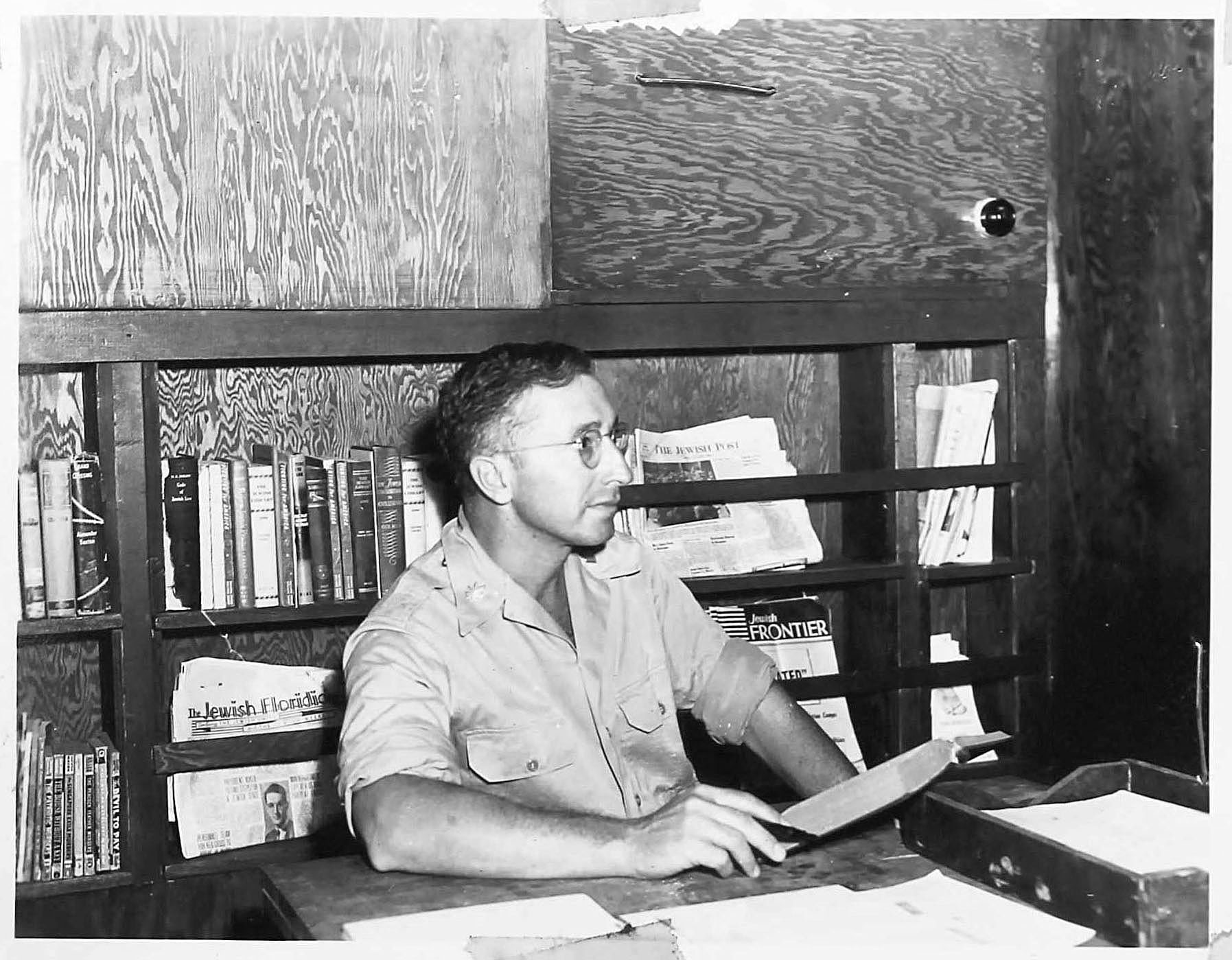
Given Major Cedarbaum’s efforts on behalf of the Jewish servicemen on Guam, it is more than fitting to present an image of the Major, himself.  The picture below, from his Jewish Welfare Board Chaplaincy Record (available at Ancestry.com) is a fitting denouement to the prior posts covering Pesach on Guam in 1945.* 

Intriguingly, due to the quality of the photo, which clearly shows two newspapers in the Rabbi’s library, the image can be approximately dated.

At the left is The Jewish Floridian, of July 13, 1945.  (This newspaper is available in digital format at the Florida Digital Newspaper Library of the University of Florida George A. Smathers Library, via the Florida Jewish Newspaper Project.)

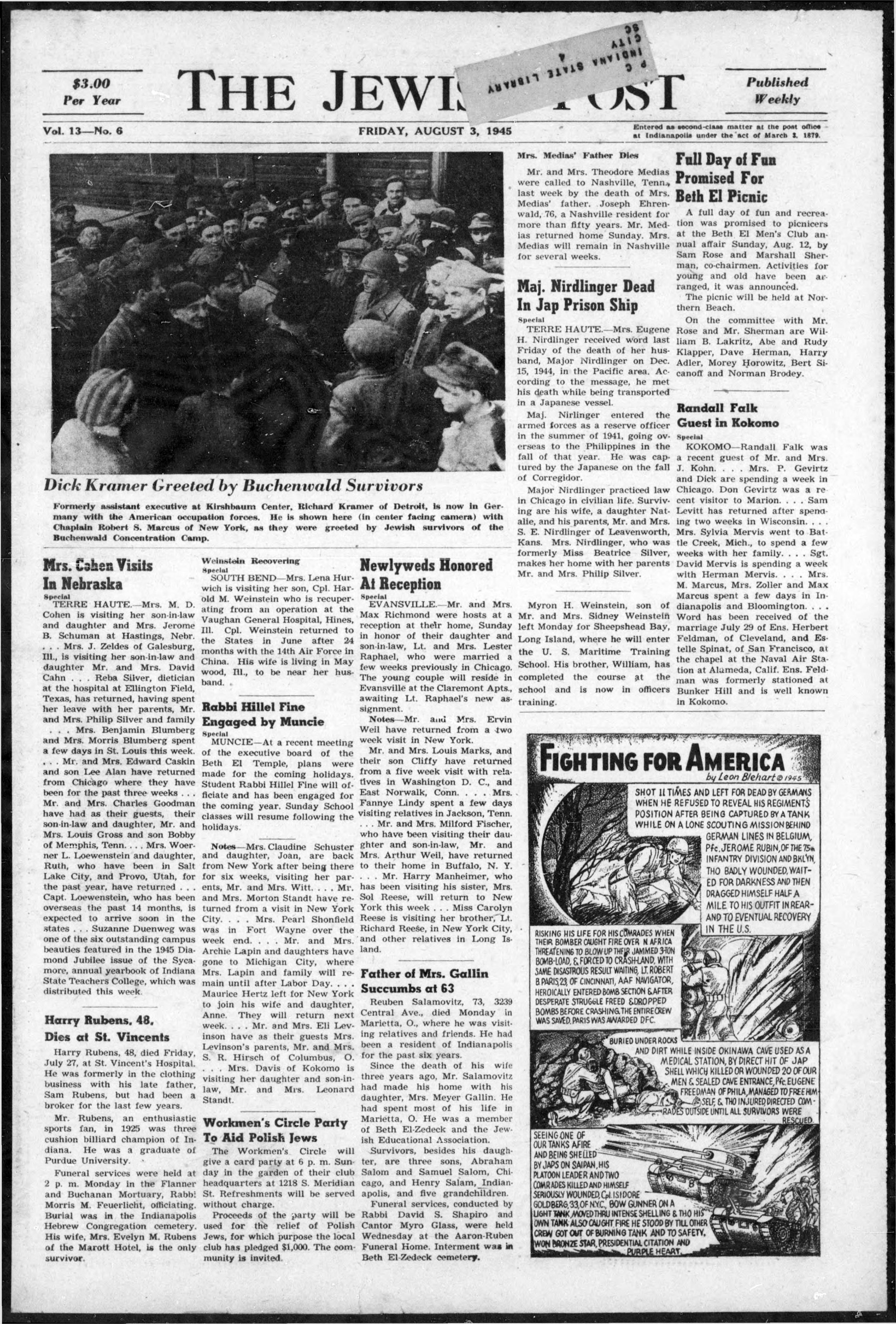
At the right is The Jewish Post, of August 3, 1945.  (The Post is available in digital format at the website for the – appropriately enough, Jewish Post – of the Indiana Historic Newspaper Program.)

Digital images of the first page of each newspaper are presented below.

Given that Major Cedarbaum was stationed on Guam between March and October of 1945, this suggests that the photo was taken in mid to late August of that year.

Major David Isadore Cedarbaum, Rabbi, ASN 0-529289

The Jewish Floridian, July 13, 1945

The Jewish Post, August 3, 1945

____________________

And, a possible segue for a future blog post… 

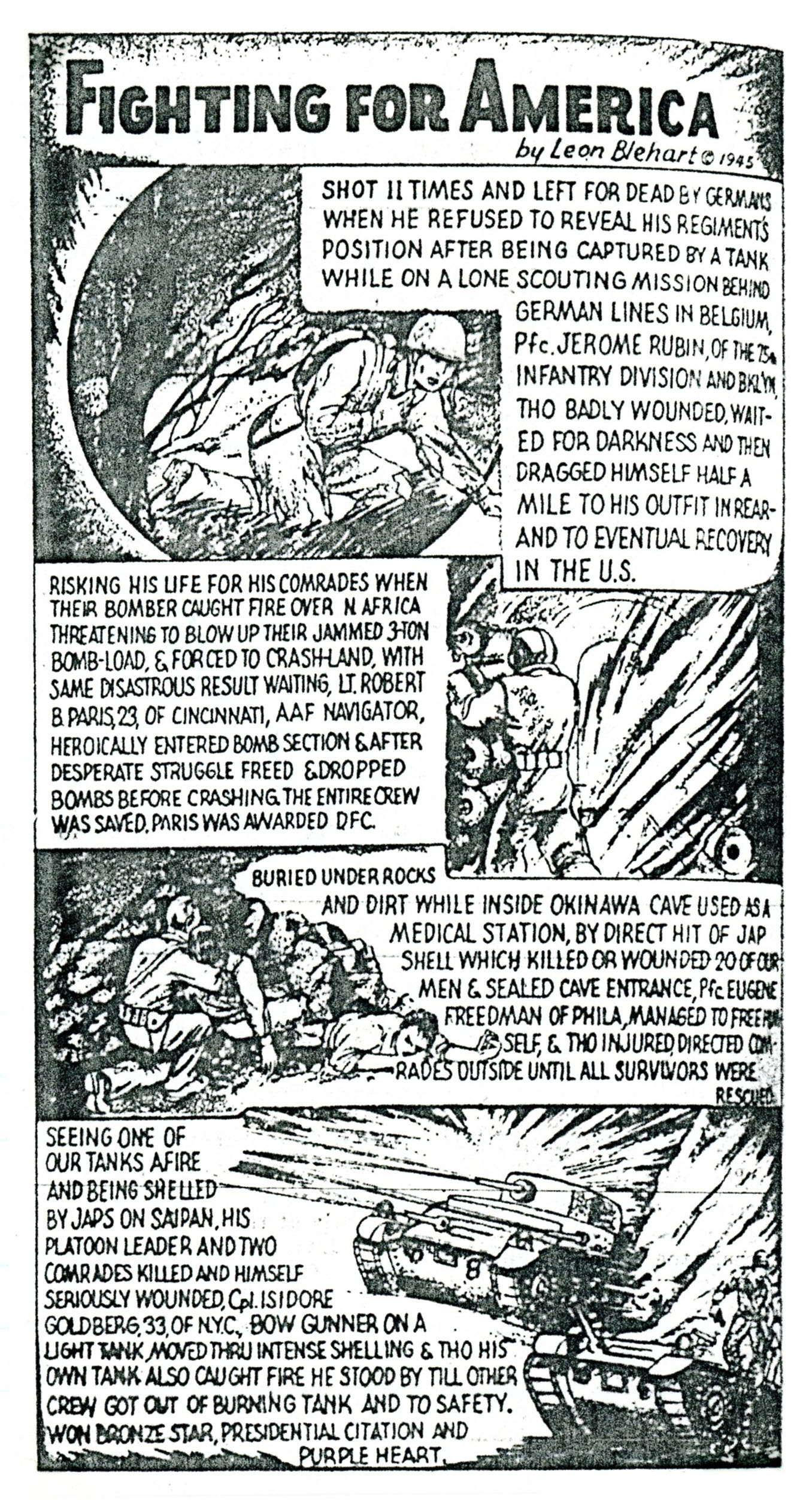
…of particular note in The Post is the item “Fighting For America”, by artist Leon Blehart.  Fighting for America was issued by the Jewish Welfare Board and depicted – through cartoon vignettes – actions (sometimes involving wounds, or worse) by Jewish servicemen which resulted in military awards.  The series appeared from (at least?) – May through October of 1945.  The sketches in each release presented actions by four to five soldiers, from all branches of the American military. 

This “Fighting for America” item in The Jewish Post of August 3, 1945, appeared in The Jewish Exponent (Philadelphia) on the same day, and is shown below:

The actions depicted in the first two, and fourth vignettes, pertain to the following servicemen:

PFC Jerome Rubin, 75th Infantry Division; Incident occurred January 18, 1945; Mother (?), Marion Rubin, of 5502 14th Ave., Brooklyn, N.Y.; In Casualty List published in New York Times on 3/17/45; Story reported in Chicago Jewish Chronicle 8/10/45

1 Lt. Robert Burton Paris, 342nd Bomb Squadron, 97th Bomb Group, 12th Air Force; From Memphis

“Cpl. Isidore Goldberg” is probably Pvt. Isidore Goldberg; Father Ben Goldberg, of 1311 Grant Ave., New York, N.Y.; In Casualty List published in New York Times on 9/10/44

Pacific Pesach: The Guam Haggadah – II

0-haggadah-000-2_edited-1Title Page: SEDER IN THE MARIANAS – PASSOVER – 5705 – 1945

0-haggadah-00_edited-1Acknowledgements and Officiating Chaplains

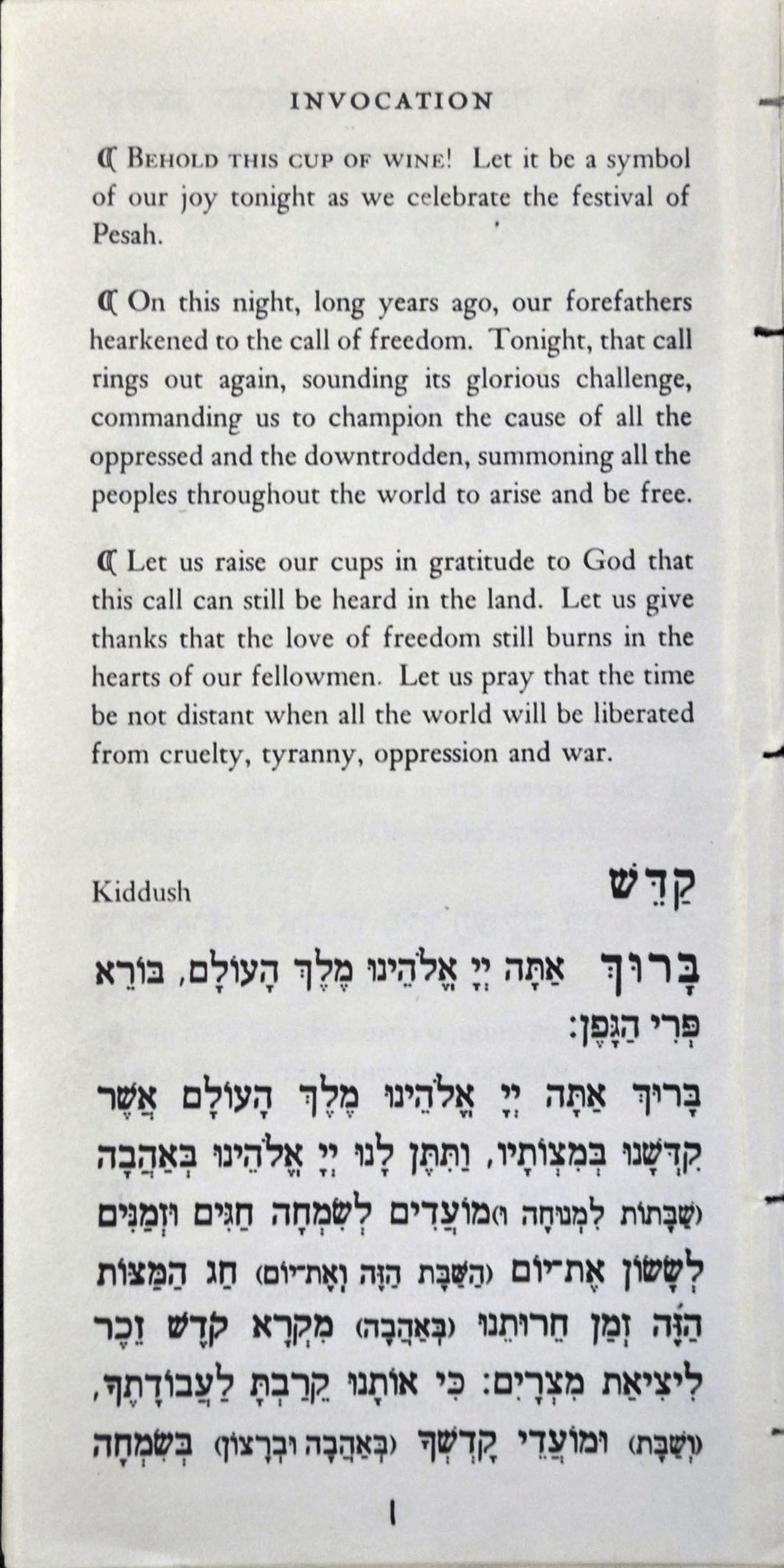
0-haggadah-01_edited-1Page 1: Kiddush Blessing

0-haggadah-02_edited-1Page 2: Kiddush Blessing (continued); Blessing over Greens (Parsley); Dividing the Matzah (Among 2,700 servicemen, who was the lucky Private First Class who found the afikomen?!)

0-haggadah-03_edited-1

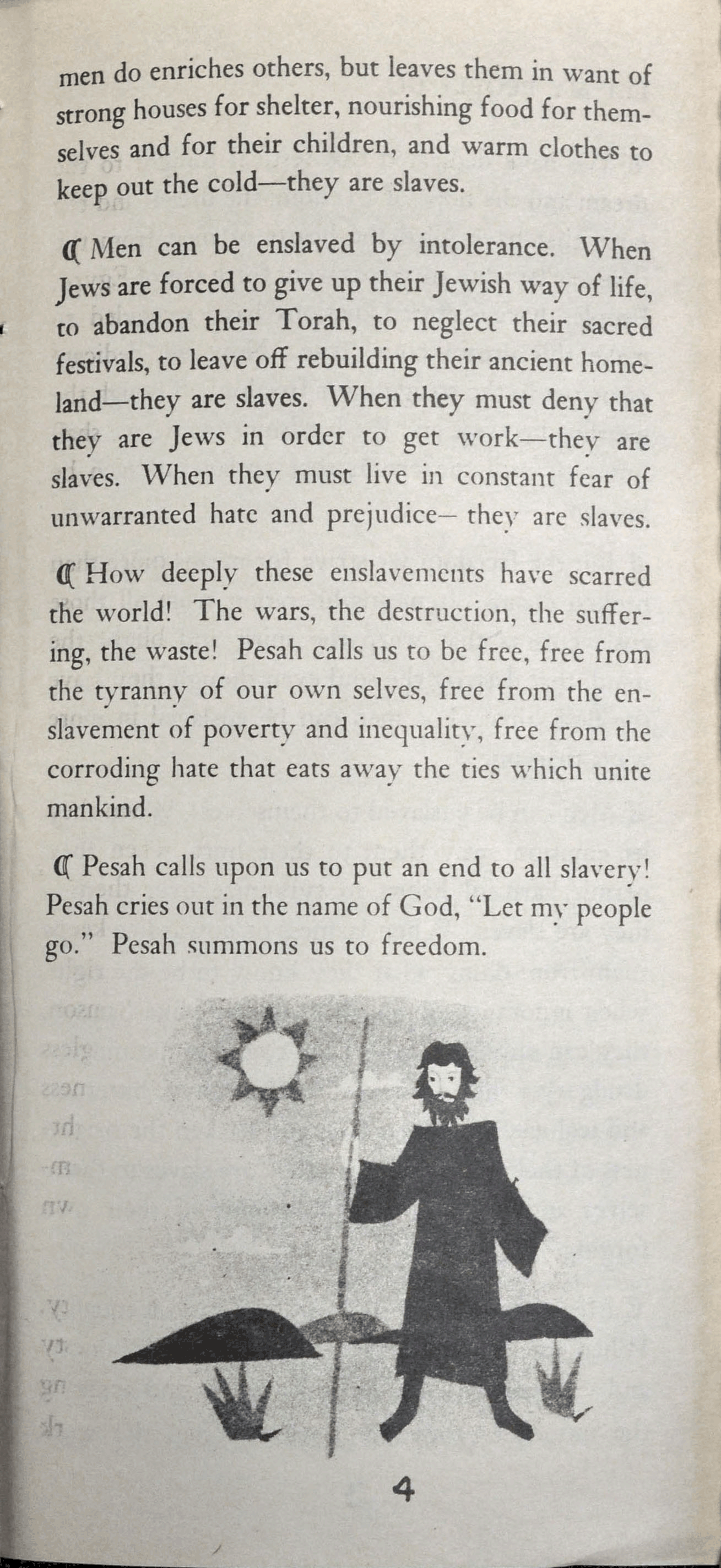
     Page 3: A noteworthy section of the Guam Haggadah – an uneasy if not irresolvable balance between particularism and universalism – is found under the heading “Let My People Go”.

     The text obviously, pointedly, and directly address Jewish peoplehood, Zionism (albeit without that word), and a sense of collective pride, through the text, “Men can be enslaved by intolerance.  When Jews are forced to give up their Jewish way of life, to abandon their Torah, to neglect their sacred festivals, to leave off rebuilding their ancient homeland – they are slaves.  When they must deny that they are Jews in order to get work – they are slaves.  When they must live in constant fear of unwarranted hate and prejudice – they are slaves.”

     The thrust of that text is curiously counterweighted by setting Pesach in the form of a generalized yearning for “freedom”, but “freedom” defined as an individual, if not philosophical, if not universalistic value of the Enlightenment – rather than a particularistic and covenantal concept – set in the frame of the war effort of the United States, and the Allies, in general.  

     This is evident in such statements as, “Peoples have suffered, nations have struggled to make this dream come true.  Now we dedicate ourselves to the struggle for freedom.”  “It means liberation from ail those enslavements that warp the spirit and blight the mind, that destroy the soul even though they leave the flesh alive. For men can be enslaved in more ways than one.”  “Pesach calls us to be free, free from the tyranny of our own selves, free from the enslavement of poverty and inequality, free from the corroding hate that eats away the ties which unite mankind.”  “Pesach calls upon us to put an end to all slavery!  Pesach cries out in the name of God, “Let my people go.”  Pesach summons us to freedom.”

     Though I do not have access to the 1942 edition of Rabbi Kaplan’s New Haggadah, I wonder if this text – perhaps reflective of the hopes, aspirations, and ambivalence pervasive among early and mid twentieth century American Jewry (and still today?…) – is derived from that work.   

0-haggadah-04_edited-1Page 4: “Let My People Go” (continued); Art depicting Moshe Rabbenu in the wilderness

0-haggadah-05_edited-1Page 5: “Go Down Moses”; Art depicting Moses and Aaron confronting Pharaoh

0-haggadah-06_edited-1Page 6: Presentation of Matzah; The Four Questions

0-haggadah-07_edited-1Page 7: The Four Questions (continued); Pesach narrative

0-haggadah-08_edited-3

Page 8: Pesach Narrative (continued)

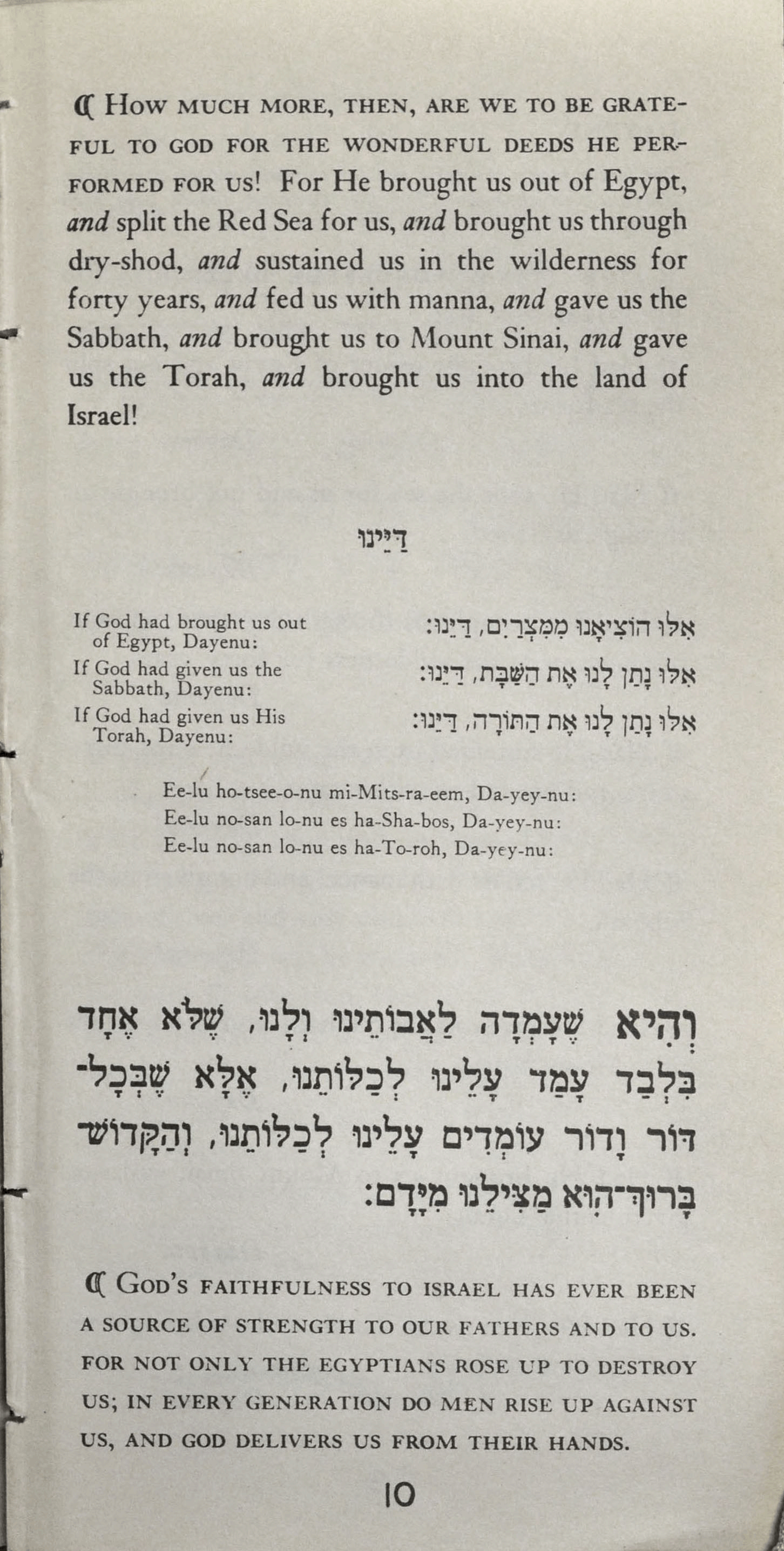
0-haggadah-09_edited-3Page 9: Dayenu!

0-haggadah-10_edited-1Page 10: Dayenu (continued); “In every generation do men rise up against us, and God delivers us from their hands.”

0-haggadah-11_edited-2Page 11: Display of Symbols of Pesach (Shankbone and Matzah)

0-haggadah-12_edited-2Page 12: Display of Symbols of Pesach (maror (bitter herbs))

0-haggadah-13Page 13: Call to Hallel; Hymn “Praise the Lord”

0-haggadah-14_edited-3Page 14: Benediction over Matzah; Blessing over Bitter Herbs

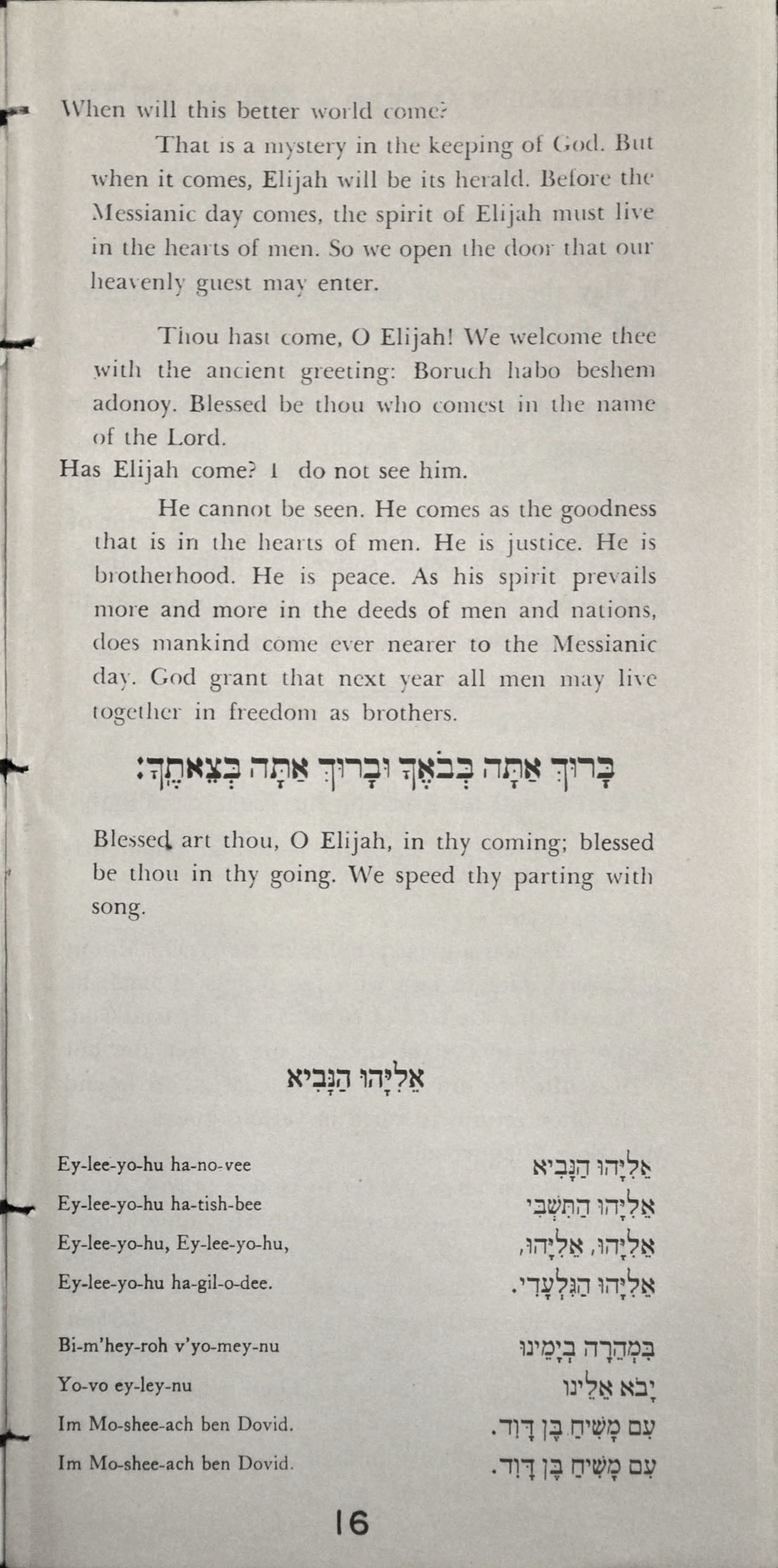
0-haggadah-15_edited-2Page 15: The Pesach Meal is Served; Opening the Door for Elijah

0-haggadah-16_edited-1Page 16: Opening the Door for Elijah (continued); Eliyahu Hanavi

0-haggadah-17_edited-1Page 17: Closing Benediction; Singing of America

0-haggadah-18_edited-1Back Cover: Printed by 949th Engineer Aviation Topographic Company

     Your PDF version of the Guam Haggadah can be found here.

Pacific Pesach: The Guam Haggadah – I

     Pesach – Passover – is the most universally observed festival of the Jewish people – regardless of the nature of one’s religious beliefs, level of observance, or political affiliation.

     Though Pesach certainly carries a festive air, the holiday is far more than merely “a holiday”; at least, as such days are understood in the conventional sense of the term. 

     Pesach commemorates – even as it celebrates – the origin of the Jews as a distinct people sharing a national ethos and identity, through the form of a vivid historical narrative suffused with overtones, messages, and commentary – some subtle; some direct – about their identity, ideals, and relationship to God. 

     While it is obviously true that a central message of Pesach is the moral and practical imperative of freedom from slavery – whether that slavery be physical, intellectual, psychological, or spiritual – the core of the celebration extends beyond “freedom” per se, as a philosophical concept and legal actuality.  For, pure and unalloyed “freedom”, if not carefully guarded and consciously guided, can in time revert back into a form of slavery. 

      In a fuller sense, the message of Pesach is not simply “Let my people go!”, but, “Let My people go that they may worship me in the wilderness.”  (Exodus, 7:16) *

     The Haggadah – an example of which is the subject of this post – is the central text that serves as both a narrative and guide for the Pesach Seder.  Though Haggadot are centered around the central and ordered sequence of elements that comprise the Pesach Seder, the actual text and physical appearance of “a” Haggadah is not solidly fixed.  Even the most cursory Internet search for the term “Haggadah” reveals a myriad of images of the text – some simple; some elaborate.  Thus, with each new iteration of the Haggadah, its wide variety of forms, formats, and styles are reflective of the cultural conditions and historical forces influencing the long and continuing history of the Jewish people, shedding light on the mindset, values, and beliefs of the community or organization which published the text.  In that sense, each new publication can be a sociological, cultural, artistic, and linguistic “window” upon the past.  Such is so with the Guam Haggadah. 

____________________

     The document presented in this post – “Haggadah – Seder in the Marianas : Passover 5705-1945” – is one such example.  This Haggadah was published for and used by Jewish soldiers, airmen, and sailors stationed on the Island of Guam – the southernmost island of the Marianas archipelago, in the western part of the North Pacific Ocean – for Pesach services in March of 1945. 

     One might aptly call it the “Guam Haggadah.”

     This Haggadah – in remarkably good condition – is among the holdings of the Dorot Jewish Division of the New York Public Library.

     The three men whose names appear on page two of the text – David I. Cedarbaum (Army), and, Philip Lipis and Elihu Rickle (both Navy) – were chaplains serving Jewish military personnel on Guam. 

     As indicated by the notation on the last page, the text was printed by the 20th Air Force’s 949th Aviation Engineer Topographical Company. 

     The text of the Guam Haggadah is derived from the revised edition of The New Haggadah, edited by Rabbi Mordechai Kaplan and published by Behrman’s Jewish Book House in 1942.  The literary descendant of Kaplan’s 1942 Haggadah exists today as The New American Haggadah, and is available at Berhman’s House.   

     Mention of the Guam Haggadah is made in “Volume I” of the two-volume 1947 publication American Jews in World War II.  In an extensive account of Chaplain Cedarbaum’s service with the 20th Air Force (in a chapter entitled “They Delivered the Atom”) it is stated that, “He had hardly reached his new post when he found himself involved, along with Navy chaplain Philip Lipis, in the organization of an ambitious Passover service on Guam, the first ever held in that part of the Pacific.  The ancient Seder services were celebrated on March 28, simultaneously in two large mess halls.

     “Twenty-seven hundred soldiers and sailors attended.  The Hebrew Haggadah they used had been printed on the Island by 20th AF presses.  No doubt to all of them it was the most impressive service of their lives.”

     At least one photograph from the Seder is available on the Internet. 

     At the flickr Photostream of the Center for Jewish History (CJH), an image from the David Cedarbaum papers shows, “Jewish servicemen and women celebrate[ing] Passover together by eating matzo.  A caption next to the photo notes that the woman pictured is one of only seven Jewish women stationed in Guam.”  The woman in question is an Ensign in the Navy Nurse Corps.  Copies of the Guam Haggadah can be seen on the table before both her, and, the happily distracted (!) serviceman to her left.

Jewish Servicemen and Women Celebrate Passover (Center for Jewish History)     The next post will show the individual pages of the Guam Haggadah.

* Alternatively, “Send out My people that they may serve Me in the Wilderness.”