[Update: Created in November of 2020, this post has been updated to reflect information provided by Andrew Garcia, pertaining to the P-38 that serves as a backdrop for the image of Major Joel and Capt. Joseph Myers, Jr. The picture can be seen towards the (very) bottom of the post.]
Part III: On Course
Now in command of the 38th Fighter Squadron, Milton’s promotion to Major was announced in the Richmond Times-Dispatch, on February 2, 1943.
MAJOR AT 23 – Milton Joel (above) son of Mr. and Mrs. Joseph Joel, 5 Greenway Lane, is believed to be one of the army’s youngest majors. He completed his civilian pilot’s course at the University of Richmond in 1939 after attending the University of Virginia. He later trained at Tuscaloosa Field, Ala. He was commissioned a second lieutenant in May, 1941, promoted to first lieutenant in February, 1942, and a captain in June. He is now commanding officer of a fighter squadron at Pendleton Field, Ore.
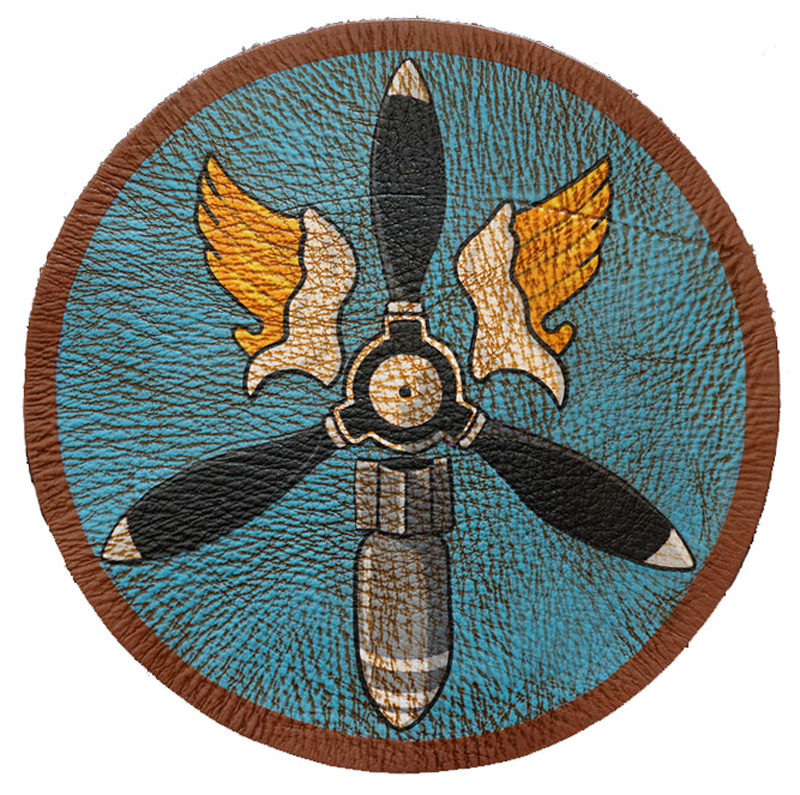
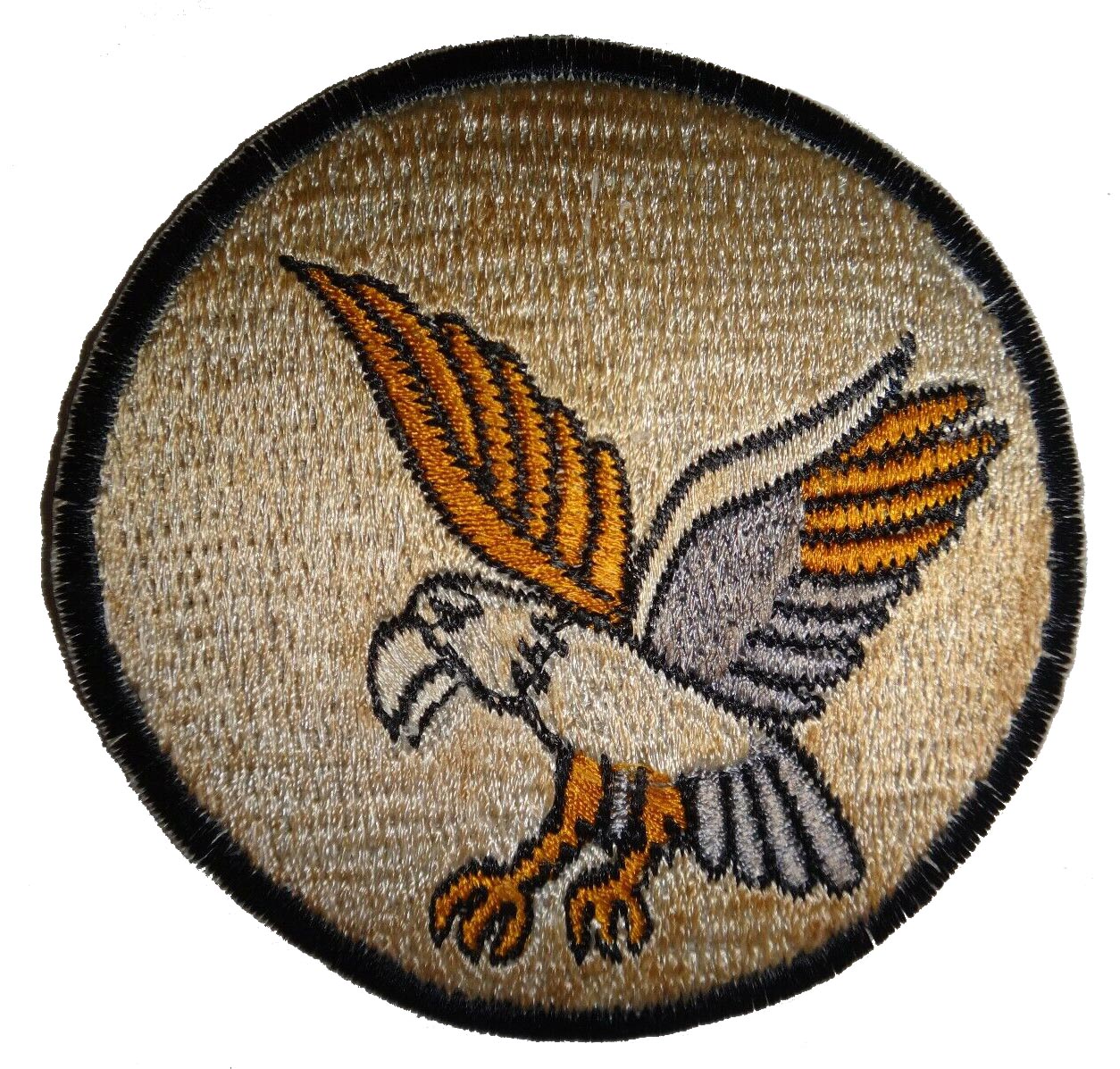
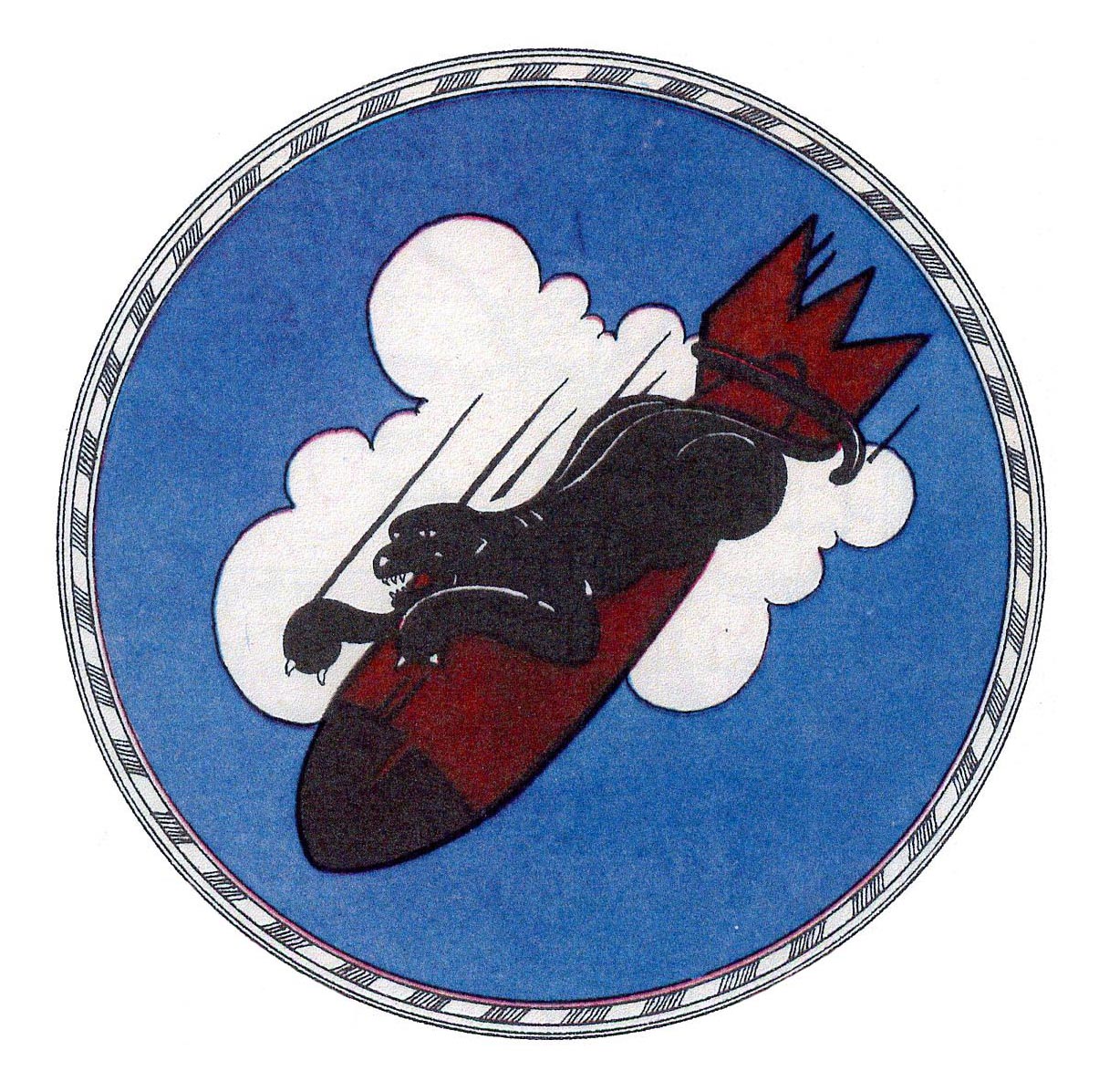
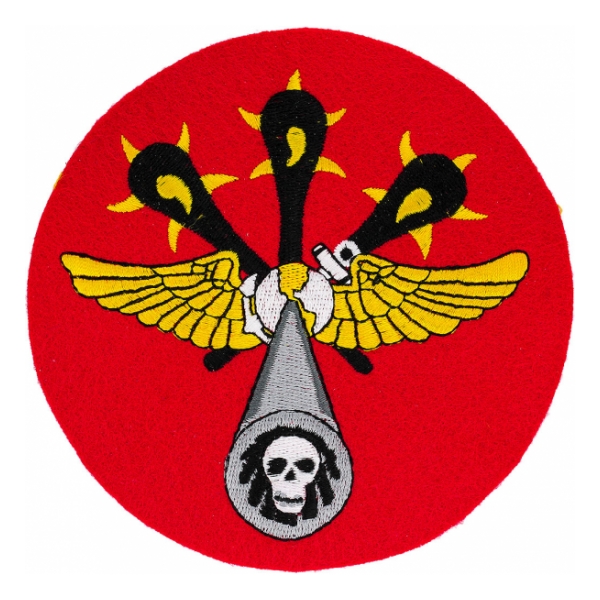
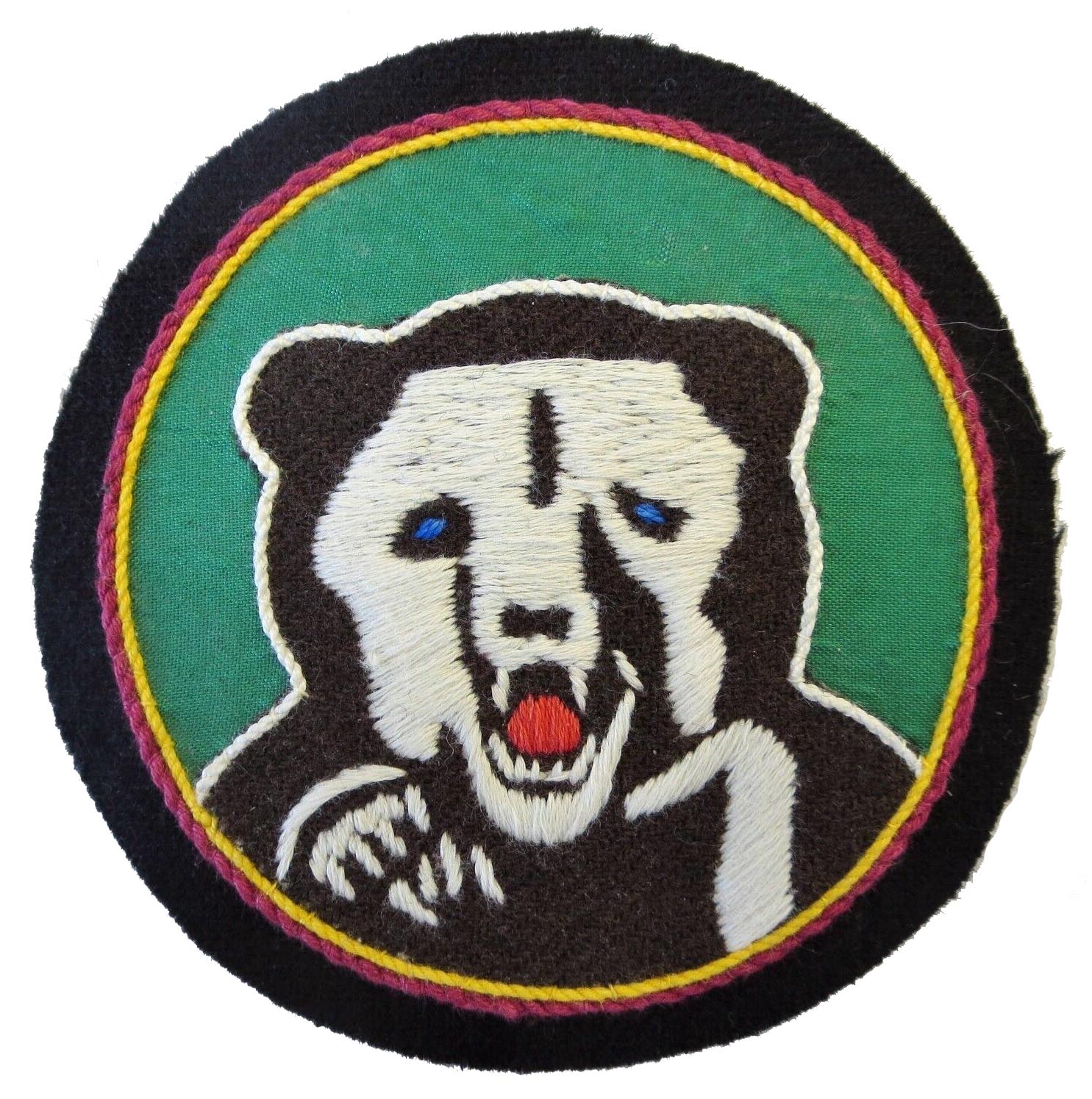
Flying-battle-axe emblem of the 38th Fighter Squadron, digital…
…and physical, as a patch, available from EBay seller EZ.Collect. (Not a “plug” – I simply found this image via duckduckgo!)
________________________________________
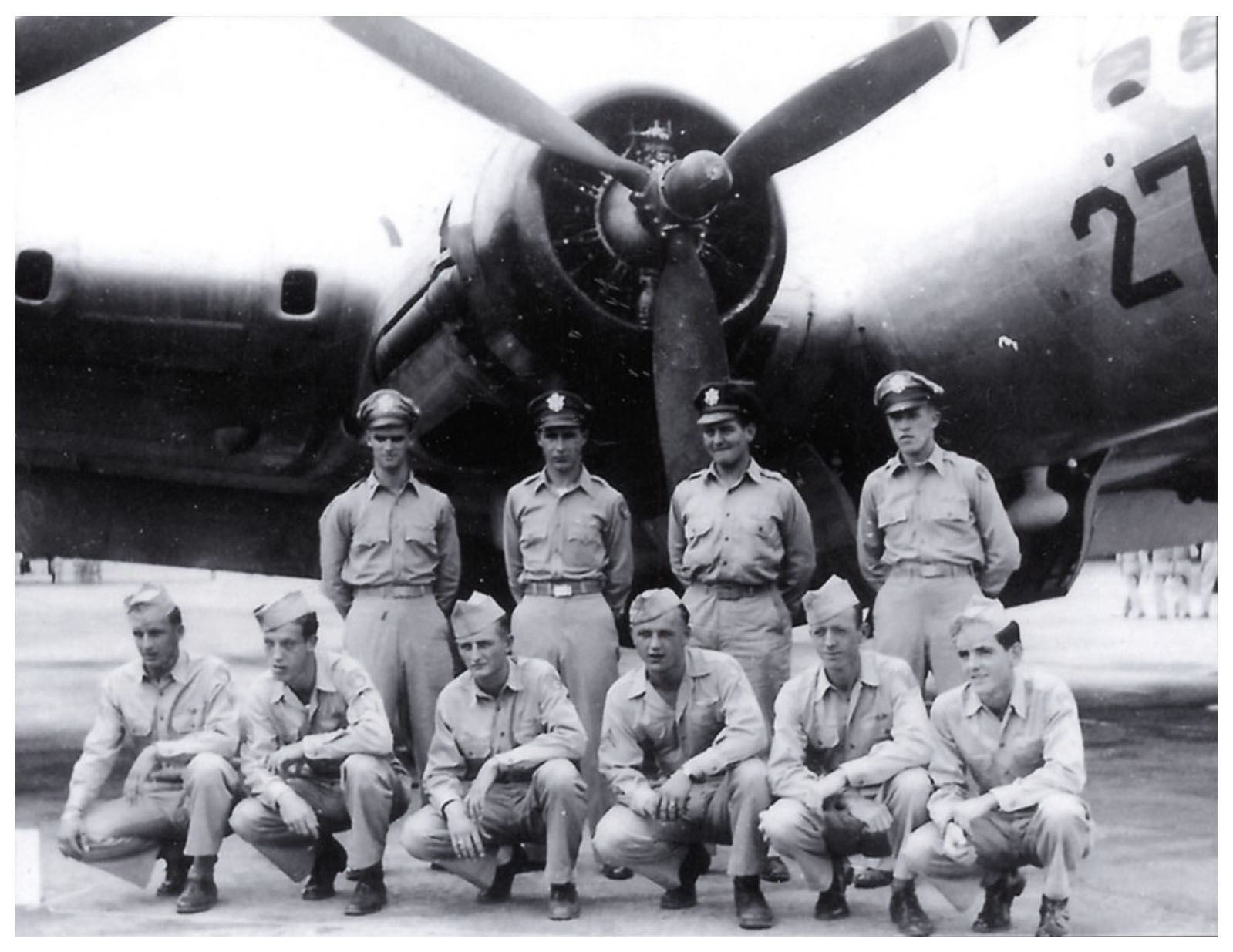
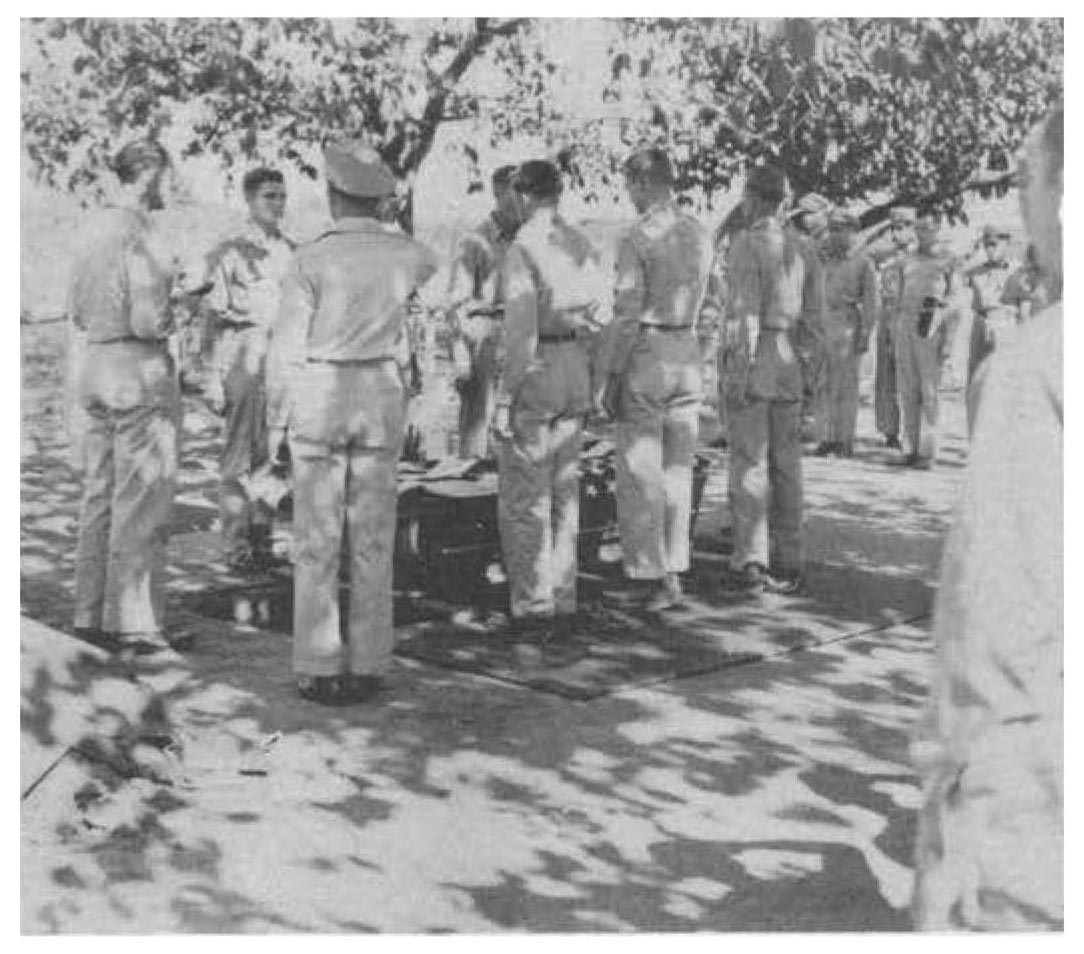
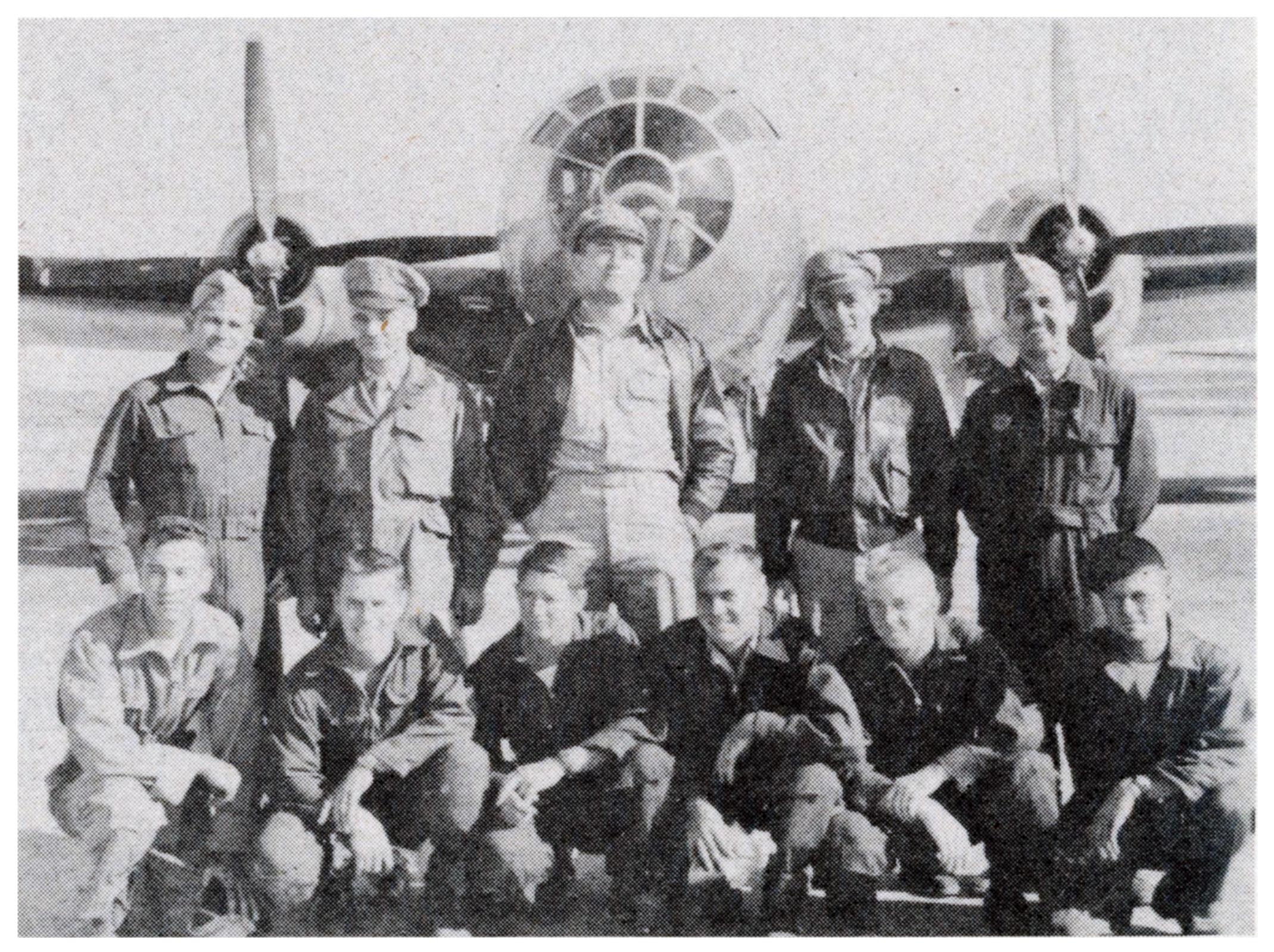
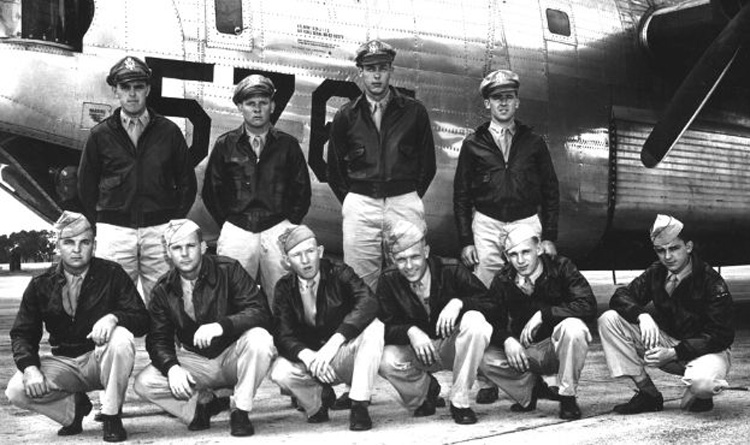
Three and a half months after taking command of the 38th Fighter Squadron, on February 19, 1943, Milton and several of his squadron’s pilots gathered for this group photograph, under what seems (?) to have been an overcast sky.
Interestingly, at least four pilots in the rear row (thus all perhaps in the rear row?) were members of the 27th Fighter Squadron (Milton’s former squadron) and attained aerial victories in the Mediterranean Theater.
Though this image is present in the squadron’s historical records (specifically, in AFHRA Microfilm Roll AO 136) inquiries to the National Archives revealed that it’s absent from the WW II U.S. Army Air Force Photo Collection. Thus, it seems to have remained at squadron level, never having been bureaucratically passed “upwards” to any higher organizational level.
From a technical point of view, the photograph clearly illustrates the counter-rotating propellers used in all P-38 Lightnings commencing with the XP-38, with the exception of 22 of the 143 P-38s which had been ordered by the Royal Air Force as Lightning Mark 1s. As such, viewed from the “front”, it can be seen that the propellers rotate outwards, away from the aircraft’s central gondola and toward the wings.
Another point: It appears that the aircraft’s nose has been painted, perhaps as a form of squadron identification.
…and includes the pilots’ surnames – and their surnames only. However, this clue enables identification of most of these men. They are:
Front row, left to right (All members of the 38th Fighter Squadron)
Wyche, Wilton E., 0-729407 Ayers, Jerry H., 0-659441 Leinweber, Gerald F., 0-659473 Joel, Milton, 0-416308 (KIA 11/29/43 – MACR 1429 – P-38H 42-67020; No Luftgaukommando Report) Hancock, James H., 0-659122 “Meyer” (Myers?), Joseph, Jr., 0-659166 Leve, Morris, 0-791127 (KIA 1/31/44 – MACR 2110 – P-38J 42-67768; Luftgaukommando Report AV 641/44)
Rear row, left to right (The four identified men were members of the 27th Fighter Squadron)
Ellerbee Conn, David M., 0-732171 Meikle, James B. Connors Dickie Crane, Edwin R., 0-728980 McIntosh, Robert L., 0-802054 Harris Smoot Hammond Purvis
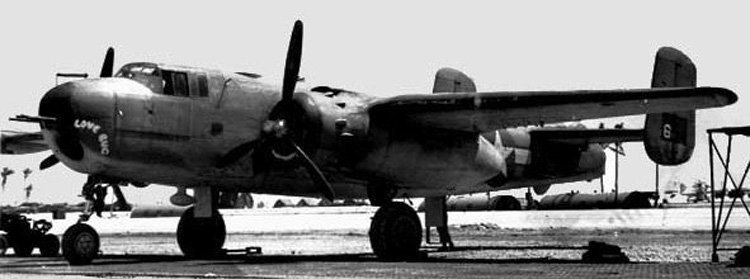
Here’s another 38th Fighter Squadron photo, from Robert M. Littlefield’s Double Nickel, Double Trouble. Taken on June 4, 1943 at McChord Field, Washington, these seven men comprise the original squadron commanders of the 38th Fighter Squadron, and, the four officers heading the 55th Fighter Group. Akin to the preceding photograph, an inquiry to NARA revealed that this photograph is absent from the WW II U.S. Army Air Force Photo Collection. Also paralleling the above photo, this P-38’s nose (the plane is a P-38G-15) has been painted – probably – in white or yellow, and bears a (plane-in-squadron?) identification number. Unusually for a stateside warplane, this aircraft bears nose art. This takes the form of Walt Disney’s “Thumper” holding a machine gun, and the appropos nickname “WABBIT”. (Albeit no relation to Elmer Fudd…)
The men are…
…left to right:
Major Richard W. (“R. Dick”) Busching, 0-427516, Commanding Officer of the 338th Fighter Squadron Major Milton Joel, 0-416308, Commanding Officer of the 38th Fighter Squadron Wendell Kelly, Group Operations Officer Colonel Frank A. James, Commanding Officer of the 55th Fighter Group Lt. Colonel Jack S. Jenkins, 0-22606, Group Executive Officer George Crowell, Group Operation Officer Major Dallas W. (“Spider”) Webb, Commanding Officer of the 343rd Fighter Squadron
________________________________________
This third image, from the collection of 38th Fighter Squadron pilot (and only survivor among the four 38th Fighter Squadron pilots shot down on November 29, 1943 – but we’ll get to that in a subsequent post) John J. Carroll, was taken on July 20, 1943. From The American Air Museum in Britain (image UPL 40377) the photo shows the original members of the 38th Fighter Squadron sent to England in late summer of 1943. (This picture also appears in Double Nickel, Double Trouble.)
Paralleling the above pictures, this photograph is absent from the WW II U.S. Army Air Force Photo Collection. The text on the image as published in Double Nickel, Double Trouble (but not visible on this web image) states:
Shipman, Mark K., 0-431166 Wyche, Wilton E., 0-729407 Ayers, Jerry H., 0-659441 “Meyers” (Myers?), Joseph, Jr., 0-659166 Joel, Milton, 0-416308 (KIA 11/29/43 – MACR 1429 – P-38H 42-67020; No Luftgaukommando Report) Meyer, Robert J. Leinweber, Gerald F., 0-659473 Hancock, James H., 0-659122 Unknown
Rear, left to right
Albino, Albert A., 0-743330 (KIA 11/29/43 – MACR 1428 – P-38H 42-67051; Luftgaukommando Report J 307?) Fisher, D., (“David D.”), (T-1046) (KIA 1/31/44 – MACR 2106 – P-38J 42-67757; Luftgaukommando Report Unknown) Brown, Gerald, 0-740139 Unknown Kreft, Willard L., 0-740219 Erickson, Wilton G., 0-748934 (KIA 12/1/43 – MACR 1430 – P-38H 42-67033; Luftgaukommando Report Unknown) Erickson, Robert E., 0-743324 Gillette, Hugh E., 2 Lt., 0-740169 (KIA 10/18/43 – MACR 1040 – P-38H 42-66719; No Luftgaukommando Report) Steiner, Delorn L., 0-740297 (KIA 1/31/44 – MACR 2105 – P-38J 42-67711; Luftgaukommando Report Unknown) Fisher, (Paul, Jr.), (0-740149) Peters, Edward F., 0-746168 Peters, Allen R., 0-743368 Carroll, John J., 0-743313 (POW 11/29/43 – MACR 1431 – P-38H 42-67090; Luftgaukommando Report Unknown) Unknown Garvin, James M., 0-740164 (KIA 11/29/43 – MACR 1427 – P-38H 42-67046; Luftgaukommando Reports J 338 and AV 513 / 44) Forsblad, Richard W., 0-740153 Des Voignes, Clair W., 0-743425 (KIA 7/13/44 – MACR 6709, 6717 – P-38J 42-28279; Luftgaukommando Report J 1635)
________________________________________
The 55th Fighter Group departed McChord Field, Washington, for England on 23 August 1943. The Group reached Camp Kilmer, New Jersey, on August 27, remaining there until September 4, when the Group boarded the H.M.T. Orion (a 24,000 ton ocean liner launched in 1934) in New York Harbor, the burned-out wreck of the SS Normandie – renamed the USS Lafayette – visible nearby. The Orion departed the next day, reaching its English base at Nuthampstead on September 14. Milton’s diary verifies these dates and locations.
In this image (U.S. Navy National Museum of Naval Aviation photo No. 2009.006.096) a Coast Guard J4F Widgeon flies near the wreckage of the Lafayette, with the Empire State Building faintly visible in the distance. This area is probably the location of the Orion’s departure for England.
________________________________________
During this hectic interval, Milton kept a diary covering the 18-day trans-Atlantic journey, in which he recorded observations and impressions of people, places, and events, noting the controlled chaos associated with the rapid movement of his squadron and group to a foreign shores. Specifically mentioned (albeit not including first names!) are pilots Willard L. Kreft, Gerald F. Leinweber, Mark K. Shipman, Albert A. Albino, Colonel Frank A. James, and ground officers Octavian R. Tuckerman (Ordnance), and Arthur S. Weinberger (Personnel).
The first two pages of Milton’s diary are shown below, followed by a transcript of all diary entries. Milton’s penmanship was not (!) the best, so the text includes some “gaps” (thus [“_____”]). But, enough of his writing is legible such that the sequence of events, his impressions of people (one observation of human behavior is quite frank by the standards of the 1940s) and sense of activity emerge from the document’s pages, as do his pride in his squadron.
Aug 23-1943 En Route Paine Field to NY P of E
This first entry in the daily record of events and sidelights of my participation in the action toward victory is made with the hope that it will not suffer the ignominity of becoming merely another bit of evidence of slovenly performance & tasks undertaken. At 08:30 AM left Mukilteo Washington in command of the 38th Fighter Squadron. Everyone eager and straining at the bit just as I am. Feel sure we can do a good job of it since I know we are better in a hundred ways than any outfit that has previously left the cont. for foreign duty both in efficiency and spirit. Wish Elaine could have been there to see us off but that would have been an anticlimax. Then too make it a first not to see her after the men were placed incommunicado. What’s good enough for them is good enough for me.
Aug 24 ’43
Trip so far completely uneventful, train shakes so cannot write.
Aug 25th ’43 No change. All serene.
All the men really on the ball – violent bridge game constantly in progress involving _____ _____ [Willard L.] Kreft & [Gerald F.] Leinweber. They have screamed themselves hoarse. Particularly Leinweber now sounds like a fog horn. Sporadic poker games continue on. [Mark K.] Shipman is like a kid just bubbles over with enthusiasm. He wrangled a ride on the engine & stayed there some four or five hours.
Aug 26th Everyone thoroughly encrusted in soot.
We look like miners not soldiers. [Albert A.] Albino & his _____ _____ _____ _____. Shipman worried about poker games _____ as though we should see that pilots learn to take care of their money. Losses haven’t been heavy. _____ (_____) & I talk him out of it. Is indignant when we try to explain that paternalism should not be carried that far. Am proud as pink over the conduct & appearance of the outfit at exercise time at stop by the wayside. Even though they are grimy they are sharp. Leinweber spends waking hour looking for a spoon from his mess kit – 200 pounds of almost _____ _____.
Aug 27th Camp Kilmer, N.J.
– arrived here at 08:05 from then on it was nit & tuck – nip a breath & tuck it away to last for an hour or two when you may or may not be able to catch another. Was met at the station with everything but the brass band. I.F. a billeting officer, a supply officer, a medical man, a rail transportation man & truck transport man and two or three others for good measure. We whisked the men off the train & marched them off to their barracks. I stayed behind with _____ (Exec. Off) & went through the train with a rail officer & train Rep. & a Pullman Rep. to check for damage. There was none. Dashed madly to new quarters while the rain started to pour. Have a piece of paper shoved at me telling me that I and the whole staff report at 9:00 AM for instruction – Do not have time to even wash off the weeks soot & grime or change clothes.
We report, Larry (_____) S-2, _____ S-1, Shipman S-3 & _____ S-4 & I _____ _____ officer _____ who gives us 2 hours instruction & a thousand sheets of paper (S.O.P. – Standard Operating Procedures).
We receive a schedule for the day which is a killer. Return to barracks Four & officers are just settling down. Tuckerman & Weinberger have just returned with the baggage detail & the baggage and it is all stowed away in our building – Rush away to lunch. Return & going to quit as too tired to continue.
Sept 1 Have decided that war is hell.
If the battling will be as rough as the getting to it. We’ve had at least 6 countermanding orders on our load list, we pack them then unpack. Then pack. Then unpack. That’s the way it goes. Everyone is beginning to get thoroughly disgusted but that’s the way they said it would be.
This camp is tremendous place thousands & 10’s of thousands of men pour through here each week. They are practically re-equipped. It’s amazing really. We had a meeting today and there were at least 300 unit commanders and adjutants. This is going to be a tremendous deal, but big rumors are rampant. Morale however is getting very low. Pilots like a bunch of race horses. They’re tense & at each others throats practically. Mainly due to hanging around with nothing to do & hangovers, everyone having gone to New York last night & night before. I went in. Had a big lobster dinner & a fried chicken but was too tired to stay late.
Sept 14 Haven’t had a moment to do more than write a few words to Elaine.
Left Camp Kilmer on the 4th in the morning for Embarkation. Our B-4 bags & packs were so damned heavy don’t know how we made it. Rode the train to ferry & thence off the harbor to the pier and boarded H.M.T. Orion. Saw the Normandie still lying serenely on her side like some tired old man refusing to get up & go to work. As soon as all the men were aboard I managed to drag my raincoat, briefcase, blanket roll, mussette bag, gas mask, pistol, web belt and canteen aboard half carrying & half falling over my B-4 bag to my stateroom. This was pleasantly surprised by a Staff Sergeant Symanoff who brought me four letters from Elaine. She had a hunch – the _____ _____ _____ that I would come to New York and had contacted Gene Symanoff who worked in the port. That was to prove the greatest treat to date aboard this tub.
No sooner did I get on board ship then was I summoned to Col. James’ [Frank James] room – where I found a great stir & dither. I was informed that I was to be Deck Commander of “E” Deck, which at this time didn’t seem so bad. Was soon to find out just what a rough deal it really turned out to be. Col. James was the senior line officer slated to come aboard and was then made troop commander. We were informed that there had never previously been American troops board ship and in addition there were 2000 more of them than the British had ever conceived of placing aboard. I.E. We had 7000 troops placed helter skelter on the ship and no one with us had ever had any experience of either handling troops aboard ship or _____ _____ any permanent _____. Men had been loaded helter skelter like sardines thrown into the can and then lid forced down. There were not even any set instructions orders or the like. This looks like the goddamnedest mess the brass hats could dream up & was. Went below & found my deck was “double loaded” I.E. 1500 men eat & sleep below deck & 1500 sleep & two above on another deck for 24 hours. All eat below in double shifts of 2 sittings each man shifting the _____ _____ for each of the 2 meals and again in the middle of the day. At night there wasn’t room either below or above to move an inch without stepping on someone’s face 1/2 _____ staying below slept on mattresses on the floor and tables the other half in hammocks. Those above decks slept on blankets on hard decks rain or shine – oh rough – To add to it all compartments on all decks had to pass through my deck to go to & from the galley also the twice daily canteen details also went through all the latrines for EMs aboard ship were also located _____. At meal times shift it looked like 42nd & Broadway on New Year’s Eve. How we ever got any organization is still a mystery to me.
To add to it all men consisted of the raunchiest crew I had ever seen. A larger proportion was criminals most of whom had 2 to 3 court martials against them some of whom even brought on board by armed guard. It was utter chaos. For first 3 days there was utter chaos and it took some days to eliminate the confusion. Many groups had one unexperienced 2nd Lt. in command who had just picked them up the day before. There was a group of 80 officers all _____ aboard who much like the men here were as motley as Joseph’s Coat and had an equivalent record. We found the total officers straight aboard to be 700 including eighty very recently commissioned and very eager nurses. These turned out to be as big a problem the 2nd Lts went after them like hound-dogs after a bitch in heat. I believe most of these girls were actually in heat because it seemed they were very cooperative. Ended up by picking a staff from the staff of the squadron & assigning each squadron officer a job with the men. Had about 150 officers assigned me and to other deck commander and took them down into Compartment Commanders and watch officers so that officer would be with the men 24 hours a day.
Morale for the first four days was the lowest I’ve ever seen it. The confusion was unimaginable. At meal time the corridor looked like 42nd & Broadway on New Year Eve. Only thing that made it satisfactory were boat drills weren’t always went over in first order.
There is a Moving Picture version of a British Colonel aboard as permanent Liaison Officer. Had been troop C.O. for two years aboard same ship. Knows every knook and cranny. Knows every argument that comes up with ships company before it comes up. Without his help this tub would have sunk in this chaos. He is one of the shrewdest men I have ever met & just as humorous. Whenever an argument in Staff Meeting is going the wrong way he can draw a red herring through the conversation so fast that it makes your head swim or tell some fantastic typical statement. “Ships officers are dead from 2 PM til’ four. If you attempted to wake one up the ruddy funnel will fall off.”
Took about seven days to get things afoot so that trip became very pleasant U.S.O. shows helped immensely. Billy Gilbert the Hollywood _____ artist is aboard with a troop and his shows have done wonders for morale. After the first three days the men’s spirits raised and remained amazingly high considering the hardships of sleeping in stinking holds & open but cold decks.
No excitement yet other than an incident the seventh night out. A Swedish ship blasted through the entire convoy at perpendicular courses & all ships had to make a sweeping torn to avoid her she was completely lighted & must have completely silhouetted us also made sub contact at the same time & depth charges were dropped well over the place which sit up a “ruddy din”.
About 1/3 of the men were thoroughly sick the second & third day out when it got fairly rough out water has been like a mild pond ever since.
Units were so spilt up _____ Lord knows how we will debark them. Tuckerman has been made garbage disposal officer and has taken a hell of a beating. Trash & garbage has to be disposed of only at a _____ _____ prior to black out to prevent causing a trail so it’s a hell of a job. Carroll is official announcer on P.A. system and as _____ that an official ____ for everyone aboard when he announces _____ time. Typical crack “Dumping time tonight will be at _ _ o’clock. Stick out your cans for the scrounger man. Tuckerman the garbage man.”
Cards & crap games fill every deck & latrine. Officers and men at it 24 hours a day. One EM cleared $ 1300 one day. Some even have set up boards with numbers on them carnival fashion & have this game in the canteen.
________________________________________
The 55th Fighter Group, the first P-38 equipped 8th Air Force Fighter Group to enter combat with the Luftwaffe, moved to Wormingford, England, on April 16, 1944.
________________________________________
During the 55th’s movement to England Milton managed to send a single V-Mail letter to his parents in Richmond, in which he commented on the hectic nature of the Group’s inter-continental journey, a sea-food dinner in Manhattan, and expressed pride in his wife, Elaine.
In light of Milton’s then as-yet-unknown future, the letter closes with the unintentionally (or not?…) prophetic statement, “It will probably be some time until you hear from me again so don’t worry. This is my real opportunity. Think of it in that light. I’m really on my way home in a way that this is what I had to get under my belt before I could do that.”
Mr. and Mrs. Joseph Joel
1119 Hull Street
Richmond, 21, Va.
Milton Joel, Major AC
38 Fighter Sq 55th Fighter Group
APO #4833 c/o Postmaster New York
Sept. 3, 1943
Dear Folks,
Have been here “somewhere” in New Jersey. Have never had such an exasperating or busy few days in my life. It’s just like recruit camp all over again. Quite an experience. We’ve been held incommunicado so didn’t have time to call anyone in N.Y. Managed to get in one evening long enough for a lobster and a drink. Wonderful to eat Eastern sea food again.
Elaine is in L.A. Got a letter from her yesterday. She’s done a swell job of taking care of our affairs and getting home. Her attitude about this whole thing, I tried to give you a hint about two weeks ago but you couldn’t catch on evidently.
Did Elaine send you some pictures that we took? I’m proud of them particularly the ones taken in the house. Got a swell letter from Elaine’s father. Our two weeks of living together you know showed Elaine to be every thing that I thought her to be plus a great deal.
It will probably be some time until you hear from me again so don’t worry. This is my real opportunity. Think of it in that light. I’m really on my way home in a way that this is what I had to get under my belt before I could do that. Don’t send any thing until I ask for it. Use “V” mail.
Love to all Milton
________________________________________
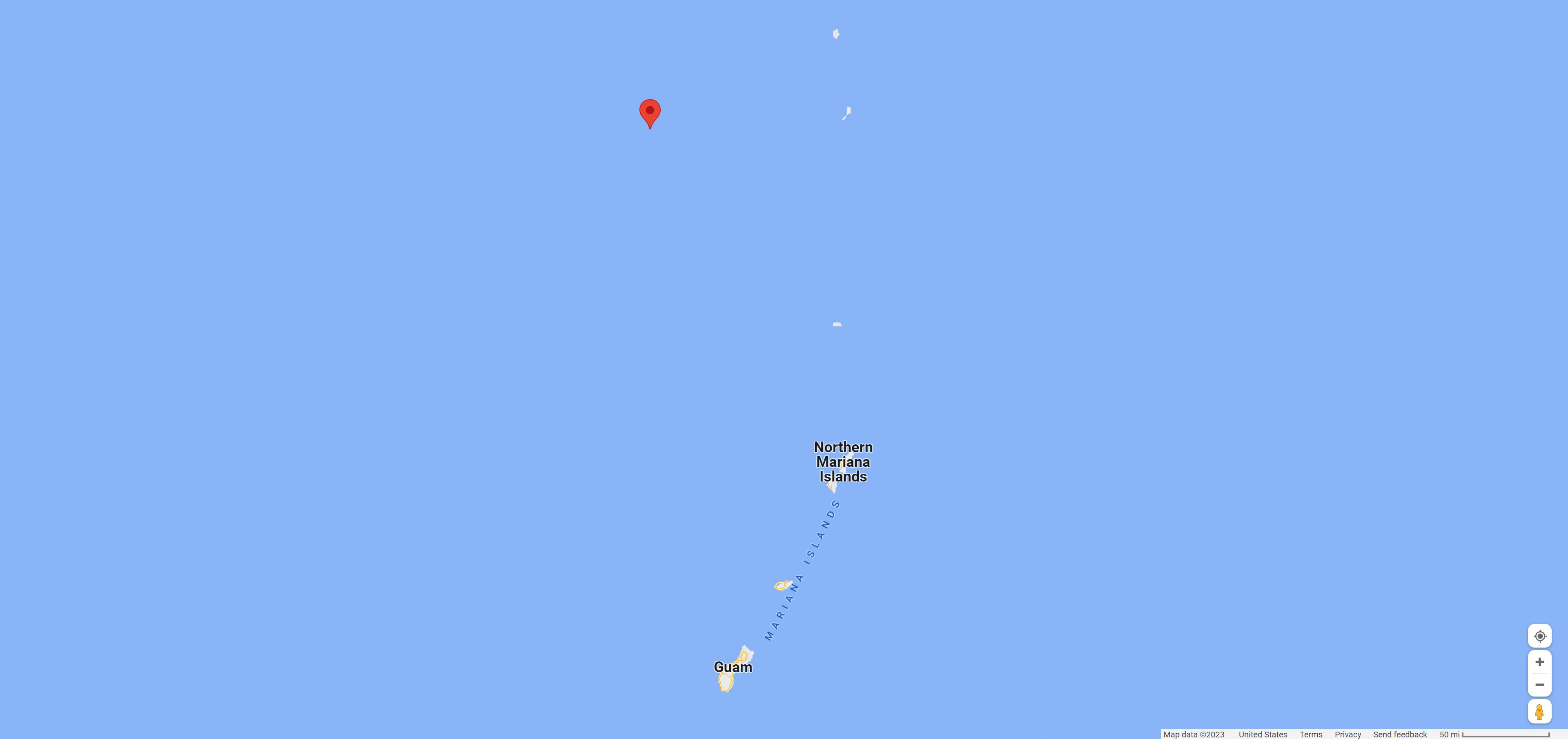
This Oogle map below shows the location of Nuthampstead (indicated by Oogle’s emblematic red pointer) in relation to London.
This British Government Royal Ordnance Survey aerial photo shows Nuthampstead Airfield as it appeared on July 9, 1946. Annotations on the photo are from Roger Freeman’s 1978 Airfields Of The Eighth, Then And Now. The original image has been photoshopifically “rotated” from its original orientation such that the north arrow points “up”. As such, the orientation of the airfield is congruent with the area as seen in the contemporary Oogle Earth photo, below.
Here’s a contemporary Oogle air photo view of the area of Nuthampstead airfield and its surrounding terrain. Practically all the land upon which the air base was situated has been turned over to agricultural use.
________________________________________
Newly arrived at Nuthampstead, the 55th Fighter Group’s Commanders are visited by Major General William E. Kepner (far left), then head of the Eighth Fighter Command.
To General Kepner’s own left in the photo (left to right) are:
Col. Frank B. James Lt. Col. Jack S. Jenkins, 0-22606 Major Dallas W. Webb Major Milton Joel, 0-416308 Major Richard W. (Dick) Busching, 0-427516
Though I don’t recall the specific source of this image as used “here” in this post, this picture can also be viewed at the 55th Fighter Group website. It also appeared in print in the October, 1997, issue of Wings magazine (V 7, N 5, p. 13), where it’s noted as having been part of Jack Jenkins’ photo collection, from which the names above are taken. There, Milton’s name is incorrectly listed as “Walton”. Wings mentions that General Kepner, then in his 50s “…flew his personal P-47D everywhere, including an occasional sortie into combat. Kepner was a strong and successful commander.”
________________________________________
The following Army Air Force photographs, taken some time between the 55th Fighter Group’s arrival at Nuthampstead in September of 1943, and November 29, 1943 (that sad day will be covered in detail in subsequent posts…) may be well known to those with an interest in the history of Eighth Air Force fighter operations, and, the P-38 Lightning. But, for those newly acquainted with this story:
First, image A1 79829 AC / A14144 1A. The photo caption states:
“Flight leaders of the 38th Fighter Squadron, based at Nuthampstead, England, gather for an informal briefing by Major Milton Joel of Richmond, Virginia just before a mission over enemy territory. They are, left to right: 1st Lt. James Hancock of Sebring, Fla., 1st Lt. Gerald Leinweber of Houston, Texas, 1st Lt. Joseph Myers of Canton, Ohio, and 1st Lt. Jerry Ayers of Shelbyville, Tenn.”
Obviously posed (Lt. Ayers and Major Joel have wry smiles) it’s still a great photo. Notice that Lt. Hancock and Major Joel are – gadzooks! – smoking! (In the world of 2020, how … er … uh … um … ironically, dare I say “refreshing ”… as it were?)
Second, image: B1 79830AC / A14145 1A.
The caption?
“Lt. Albert A. Albino of Aberdeen, Wash., and Lt. John J. Carroll of Detroit, Mich., both members of the 38th Fighter Squadron stationed at Nuthampstead, England, discuss the map of a future target in the squadron pilot room.”
Like the above image, this photo is almost certainly posed, but it’s still an excellent study. While Lt. Albino wears a classic leather flight jacket, it looks as if Lt. Carroll sports a home-made (?) sweater.
By day’s end on November 29, 1943, Lt. Albino would no longer be among the living, and Lt. Carroll would be a prisoner of war.
________________________________________
After Major Joel failed to return from the mission of November 29, Captain Mark K. Shipman of Fresno, California, took command of the 38th, until replaced in that role by Capt. Joseph Myers.
This image, from The American Air Museum in Britain, shows Captain Shipman in front of his personal P-38, 42-67080, “Skylark IV”, “CG * S”. This photograph appears on page 93 of Roger Freeman’s The Mighty Eighth, albeit in cropped form, and transposed (a mirror-image) from the actual print. Major Shipman was officially credited with 2.5 aerial victories: One in North Africa, and two in Europe.
This image of the aircraft and ground crew was photographed by Sgt. Robert T. Sand, who not-so-coincidentally completed Skylark IV’s nose art. Note that the 20mm cannon has been removed from the plane’s nose.
The below article about Major Shipman appeared in the Pittsburgh Press on February 6, 1943, and pertains to his experience on January 23, 1943, while he was serving as a lieutenant in the 48th Fighter Squadron of the 14th Fighter Group. Accounts of this mission, in which the 48th lost six pilots – of whom Lt. Shipman turned out to be the sole survivor – can be found at emedals.com and Rob Brown’s RAF 112 Squadron.org.
U.S. Flier Walks 2 Days Through Italian Positions
Pilot’s Clothes Stolen, So He Wraps Feet in Rags; Brings Back Valuable Information
By the United Press
ALLIED HEADQUARTERS, North Africa. Feb. 6 – For two days Lt. Mark K. Shipman, 22, Fresno, Cal., wandered over desert and mountains, his feet bound with shreds of his uniform, but when he finally reached an American outpost he brought with him valuable reconnaissance information.
The lieutenant told about his experience today.
His Lightning fighter plane was shot down on the morning of Jan 23 when he left formation to help a comrade fighting a cluster of Messerschmitts. Lieut. Shipman said he made a belly landing.
“The ship was practically undamaged,” he said. “I ran about 40 yards away because I knew the Messerschmitts would strafe me. Three of them riddled the plane with three dives. Then I went back to it and took out a helmet, canteen and pistol and started hiking for the mountains.”
Clothes Stolen
Lieut. Shipman said all his clothes except his trousers and undershirt were stolen from him, although he managed to retain a wedding ring and Crucifix which were presents from his wife. (The dispatch did not say who did the looting.)
“I found I couldn’t walk in my bare feet,” Lieut. Shipman continued. “So I cut off my trousers below the knees and wrapped the cloth around my feet. I walked over a mountain knowing by the sun I was traveling toward the American lines. I found a narrow dirt road and started making better time but my feet were getting sore.
Fixes Crude Bed
“So I took off mv trousers and managed to cut off more cloth above the knees, which I added to the strips I already had tied about, my feet. I turned off the trail and went over to a creek bed and fixed a crude bed in a hole. I got kind of warm and rested.
“After a while the moon came up and I got out and started down the creek bed. About 10 o’clock I passed what I believed were some Italian tents and snaked along silently, finally getting into the open.
“I ran along a dirt road for a while and was hiding in a ditch when a motorcyclist came along. He was Italian. I decided it was safer to keep off the road. My feet were so sore I could scarcely stand so I made a sort of fox hole about a hundred yards from the road.
Crosses Road
“When daylight came I positively identified other passing vehicles as Italian. I crossed the road and crept along, finally reaching three Italian road blocks. I took off my white cotton undershirt so I wouldn’t be conspicuous.
“By that time I was getting desperate and I decided on a break. I got into ravines and at times I saw Italian sentries on both sides. After I sneaked along for about five miles I didn’t see any more Italians. About 5 p.m. I approached an American outpost. They recognized me.”
________________________________________
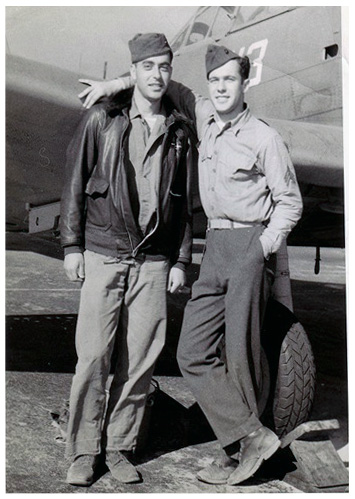
Capt. Joseph Myers, Jr. and Major Joel stand before a P-38. The date and location of the image are unknown. Thanks to information from Andrew Garcia in November of 2023, I’ve been able to correlate the four-digit Lockheed Aircraft Company factory production number “1526” on the fighter’s nose to its Army Air Force serial: The aircraft is P-38H 42-67015. Being that this aircraft isn’t listed at the Aviation Archeology database and there is no Missing Air Crew Report for it, it seems that it survived the war, I assume to be turned into aluminum siding or pots & pans after 1945. (Photo c/o Harold Winston)
Another image of Capt. Myers, this time in front of his personal aircraft, P-38J 42-67685 “Journey’s End’ / “CG * O”, with ground crew members Sergeants K.P. Bartozeck and J. D. “Dee Dee” Durnin. The image presumably dates from very late 1943, as “Journey’s End” was destroyed during a single-engine crash-landing on January 4, 1944.
This image shows Lt. Col. Joseph Myers, seated in a P-51D Mustang, to which the 55th Fighter Group began converting in July, 1944. He commanded the 38th Fighter Squadron between February 10 and April 22 of that year. This image is from the collection of Dave Jewell.
Maloney, Edwatd T., Lockheed P-38 “Lightning”, Aero Publishers, Inc., Fallbrook, Ca., 1968 (The book includes a table correlating Lockheed Aircraft Company serials to Army Air Force serials.)
Many posts at TheyWereSoldiers specifically pertain to the military service of Jewish soldiers in the Second World War. Inevitably, one of the themes that follows is the experience of Jewish prisoners of war in the European and Mediterranean Theaters of War, given the nature, ideology, and aims of Germany during that conflict. Such posts as…
… focus on this topic directly, while many of my other posts – particularly those specifically covering Jewish military casualties in WW II, some of which mention American POWs at Berga-am-Elster, Germany – touch upon this in passing.
What of the experience of Jewish servicemen captured in combat against Japan, whether in the Pacific, or, the CBI (China-Burma-India) Theaters of War? In the United States armed forces, the total number of Jewish military personnel captured in the Pacific Theater – soldiers, Marines, and sailors captured during the war’s opening months during the fall of Corregidor and Bataan, and later on, aviators in the Army Air Force, Navy, and Marine Corps – was vastly fewer than those captured by Germany, Italy, Hungary, Rumania, and Bulgaria. This is an indirect reflection of the greater magnitude of the Allied war effort against Germany and its European allies, relative to that against Japan.
Based on my investigation of a very wide variety of documents and sources, I’ve determined that a total of 686 Allied aviators – from the air arms of all Allied nations – survived Japanese captivity. (See this post, albeit the numbers therein need revising…) This number indirectly reflects several factors inherent to the Pacific air war, and over all, indicates the hauntingly low probability of an Allied flier – once captured – actually surviving Japanese captivity through and specifically beyond Emperor Hirohito’s announcement on August 15, 1945 of Japan’s surrender.
Of the thirty-five Jewish aviators captured by the Japanese during combat missions from among all branches of the American armed forces between 1942 and August 7, 1945 (…information about the latter date here…), First Lieutenant Henry Irving Wood (0-789035), was one of the nineteen who survived the war. A fighter pilot, he was shot down on October 1, 1943 during a bomber escort mission to Haiphong, French Indochina, a regular destination for American combat aircraft in a war that that began some two decades later.
Though I mentioned his name some five years ago (2018) in a post about the experiences of 1 Lt. William S. Lyons – Revenge of the Tiger – only very recently did I discover that there has long existed a complete account of his experiences. This comprises a full chapter – a revealing chapter – in Wanda Cornelius’ and Thayne R. Short’s 1980 book DING HAO – America’s Air War in China -1937-1945. As described by Short in the book’s introduction, “Of dramatic importance was Henry I. Wood, who chose Wanda and me to reveal his 36-year-old secret by walking into the 1978 [November 18, to be specific] reunion of the Seventy-fifth in Nashville, Tennessee, when everybody had thought him dead in flames over war-torn China in 1944. An entire chapter tells his story.” Here, the by-1978 civilian Henry I. Wood relates the events of his last mission, his capture, imprisonment, mistreatment, and eventual return to American military control.
Lt. Wood’s story is presented in full, below. It begins with a portrait (from DING HAO) of him sitting in his P-40, and is accompanied by maps, images of Missing Air Crew Reports, and, War Crimes Case File Index Cards from NARA Records Group 153 (Records of the Judge Advocate General’s Office) which pertain to postwar depositions or reports about his experiences. In these, Lt. Wood mentions the names of several American (and one Chinese) military personnel, and these are accompanied – in dark red text, like this – by insertions giving the full names and serial numbers of these people.
I have absolutely no idea if the account in DING HAO was written by Mr. Wood and provided to Cornelius and Short, or, if it’s a transcription of either a cassette recording (this was in the ancient, pre-digital world 1978, after all) or a one-on-one interview. Such information isn’t given in the book.
What about Henry I. Wood, the person? He was born on July 11, 1918, in Jacksonville, Florida, the son of Isadore Raymond (1883-1945) and Josephine Harris (Hughes) (1890-1979) Wood, and had two brothers, one of whom was Bernard Bear Wood (10/6/21-12/26/85). The family’s wartime address was 2217 Herschel Street, in Jacksonville. His paternal grandmother was Adaline Silverberg Wood.
Information about his MIA status appeared in the Jacksonville Commentator on October 21, 1943, and in an official Casualty List released by the War Department on November 5 of that year. His name does appear in American Jews in World War II; it’s on page 86.
His loss in combat is covered in Missing Air Crew Report 759, which indicates that he was missing in P-40K 42-46250.
Henry Irving Wood died on October 28, 1986. I have no information about his postwar life, or, his place of burial.
Isadore and Bernard were two of Isadore and Josephine Wood’s three sons. Their third son, RM 2C David Robert Wood (5519400), born on Oct. 6, 1921, did not survive the Second World War. A crew member of the USS Albacore (SS-218), commanded by Lt. Cdr. Hugh Raynor Rimmer, he was one of eighty-five men killed when their submarine struck a mine and sank on November 7, 1944, just off Cape Esan (east of Hakodate), Hokkaido, Japan. (See also…) There were no survivors. His name is memorialized on the Tablets of the Missing at the Honolulu Memorial in Hawaii.
Henry I. Wood was one of eight 23rd Fighter Group pilots who survived as POWs. The names of the seven others are listed below, along with their serial numbers, squadrons, date of capture, type of aircraft flown upon their “last” mission (and when known, the aircraft serial number and pertinent MACR number), the location of the POW camp where they were interned, and, their state of residence. Of those USAAF Fighter Groups from among whom men survived as POWs of the Japanese, only the 311th Fighter Group had more men who returned from Japanese captivity, with ten POWs surviving the war. And so, the names:
Lucia, Raymond W., 1 Lt., 0-427755 74th Fighter Squadron POW 3/19/43; P-40; No MACR Omori Headquarters (Ofuna) – From Glendale, New York Reported in News Media 4/12/1943
Pike, Harry M., Lt. Col., 0-024110 Headquarters Squadron POW 9/15/43; P-40; MACR 15584 Omori Headquarters (Ofuna) – From Westbury, New York Reported in News Media 10/19/1943
Neither the War Crimes Case Files nor Wood’s story in DING HAO make any reference to the implications of his being a Jew, in terms of his experiences as a POW, probably because there simply weren’t any, this almost certainly never having been focus of interest by his captors to begin with. Of course, this would presume a nominal awareness on their part about Jews and Judaism beforehand, which I doubt was manifest in the rank and file of the Japanese military at that time.
Admittedly conjecture on my part…! I think that during the 1930s, while there was likely some familiarity with Christianity among the Japanese people, knowledge about Jews was essentially limited to the very few who were members of economic or social elites residing in the United States as college or university students, or, military attaches and diplomatic personnel. In that context and setting, any awareness that emerged “about” Jews would probably have been a sort-of-caricature derived from popular culture, rather than a result of direct interpersonal interactions.
This was a definite aspect of what befell Second Lieutenant Joseph Finkenstein (0-730433), a fighter pilot in the 339th Fighter Squadron of the 347th Fighter Group, 13th Air Force. Born in Denver on April 20, 1921, he was the only son of Frank Israel (9/27/88-2/4/66) and Dora R. (Goalstone / Udelson) (10/29/92-1/9/67) Finkenstein, and the half-brother Joe Louis and Rita Pellish, Dora’s children from a prior marriage. The family resided at 718 ½ South Ridgeley Drive in Los Angeles.
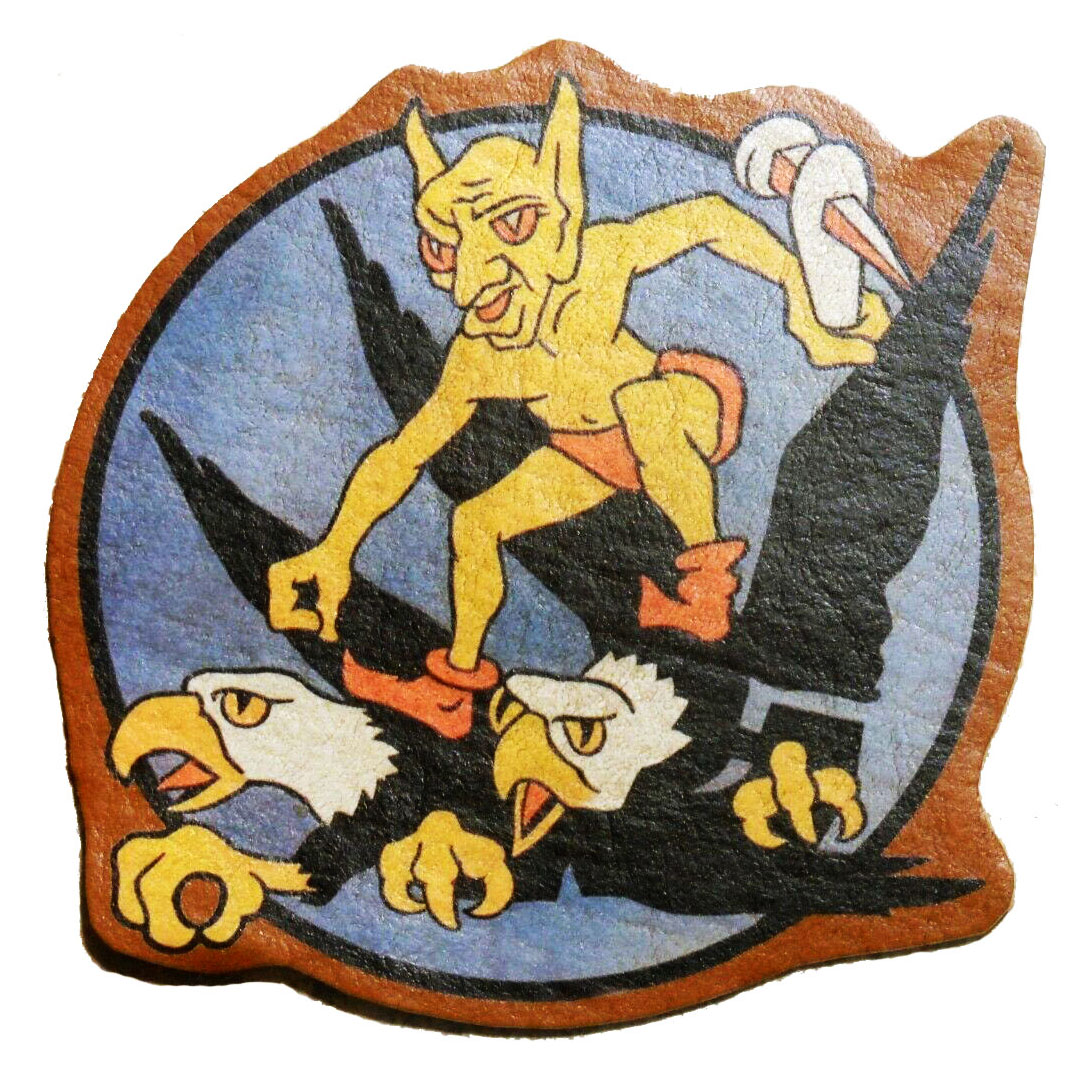
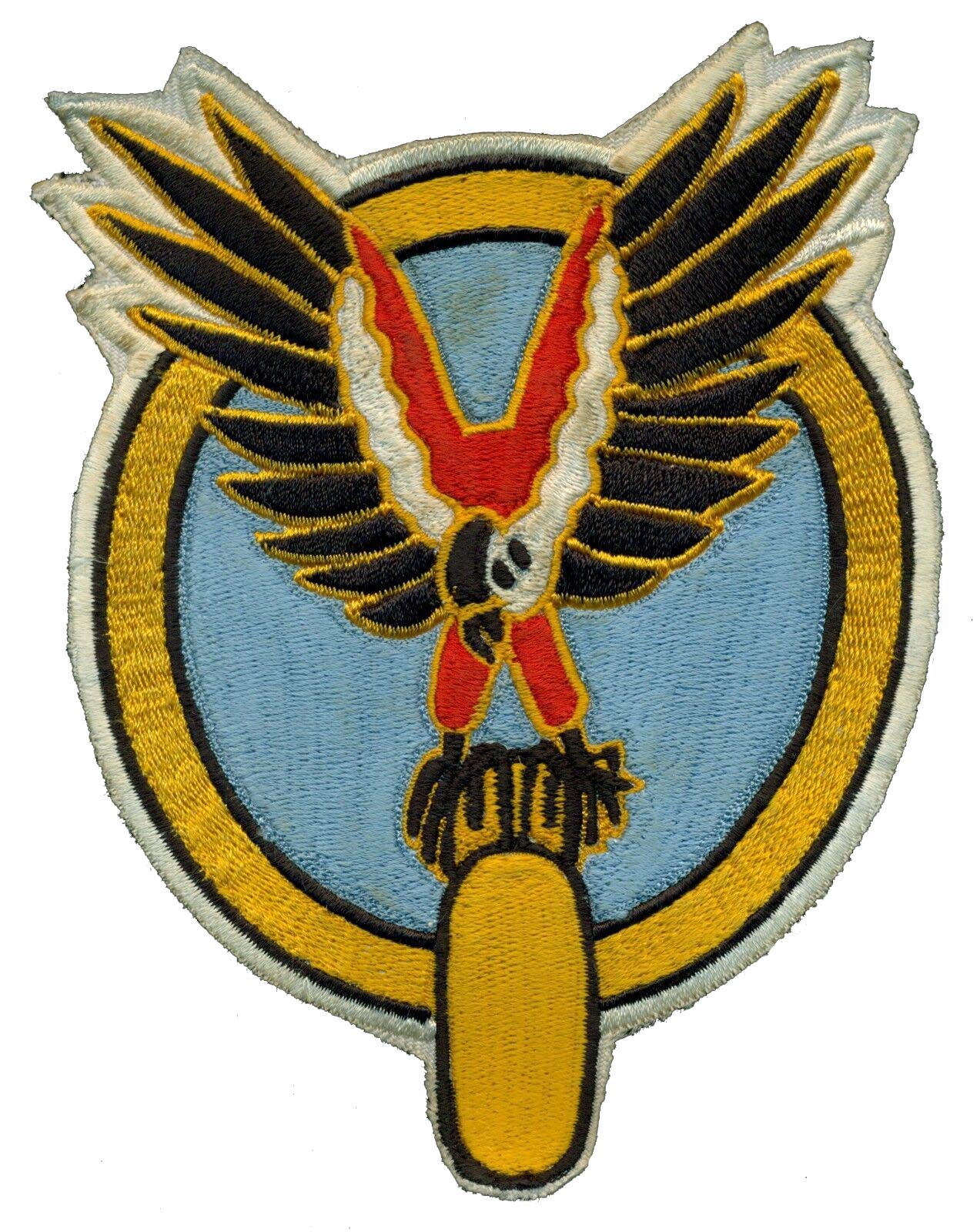
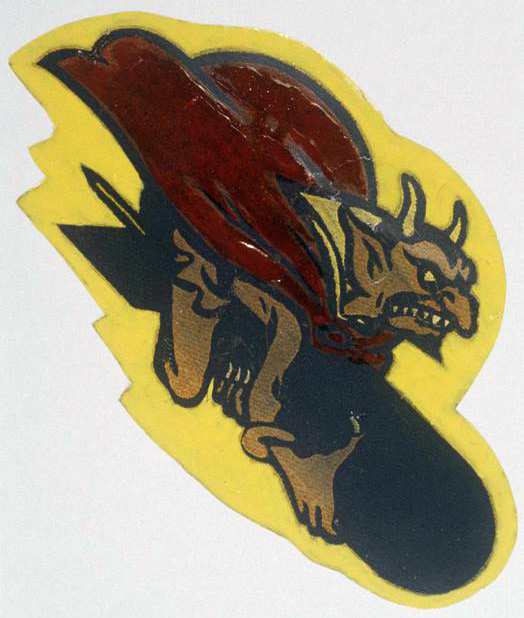
The insignia of the 339th Fighter Squadron insignia, from a2jacketpatches.
✡ ✡
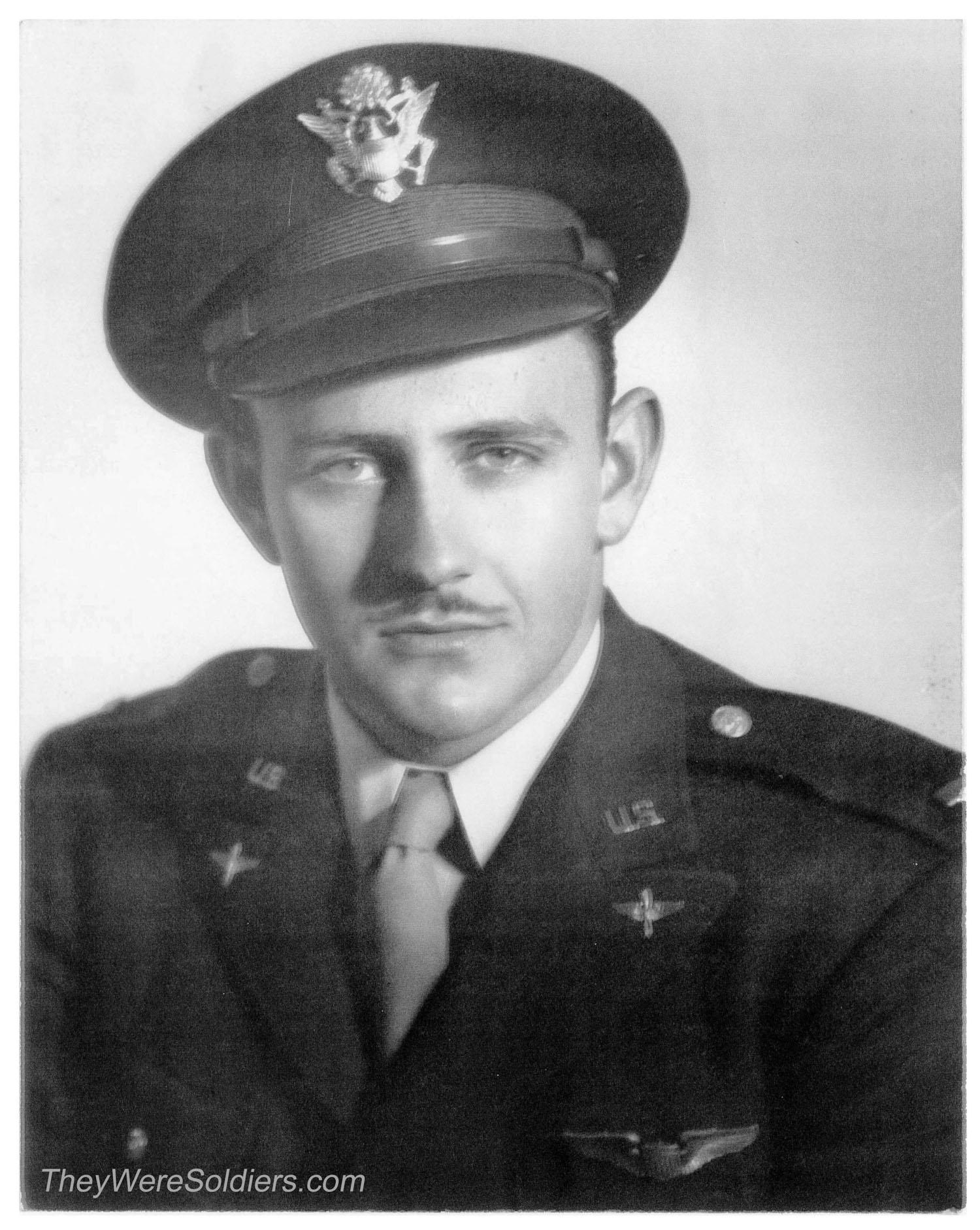
These two photos of Lt. Finkenstein are via Rita Pellish Diamond. First, his graduation portrait…
…and second, here he’s standing on the wing of a PT-17 Stearman (probably 41-8959) during Primary Training. If I have the serial correct, based on the Aviation Archeology database, the photo may have been taken in 1942, at Ocala, Florida.
– .ת.נ.צ.ב.ה. – …Tehé Nafshó Tzrurá Bitzrór Haḥayím May his soul be bound up in the bond of everlasting life.
✡ ✡
Joseph Finkenstein did not survive the war. He was missing in action on his eighth combat mission, during the “Saint Valentine’s Day Massacre” of February 14, 1943, in P-38G squadron number “21”. Though the MACR covering his loss (#585), his IDPF (Individual Deceased Personnel File), and, NARA Records Group 153 are devoid of any information about his ultimate fate, a Japanese propaganda broadcast transmitted to the American West Coast on November 24, 1943, and recorded by the Foreign Broadcast Intelligence Service (NARA Records Group 262) – the text of which was never incorporated into his IDPF – definitively confirms that he was captured.
The text of the broadcast, almost certainly abstracted from a transcript of his interrogation, reveals that his interrogator (or interrogators?) took particular note of Finkenstein having been a Jew, with Joseph’s residence in Los Angeles implying that the interrogator (a member of the Japanese military? – the Kempei Tai?) subscribed to antisemitic caricatures about Jews prevailing in the American entertainment media, likely from pre-war residence in the West Coast.
Joseph Finkenstein’s name appears in a War Department Casualty List that was issued to the news media on March 11, 1943, and also in the records of the National Jewish Welfare Board, but most definitely not in the 1947 compilation American Jews in World War II. The records of the American Battle Monuments Commission – which indicate that his name is commemorated on the Tablets of the Missing at Manila American Cemetery – note that he was awarded the Air Medal and Purple Heart.
Though Joseph Finkenstein’s fate will never be known among men, based on the general location where he was lost, I believe that he was imprisoned at Shortland Island. Later, he may well have been transported to Rabaul, New Britain, the latter being the location where 2 Lt. Wellman H. Huey – also of the 339th; also lost on February 14, 1943; who also never returned – is definitely known to have been held captive.
Here’s Lt. Huey’s Class 42-I graduation portrait, from the United States National Archives collection “Photographic Prints of Air Cadets and Officers, Air Crew, and Notables in the History of Aviation – NARA RG 18-PU”.
The body of literature pertaining to the experience of Jewish POWs of the Japanese is – unsurprisingly – extraordinarily small, but what does exist is utterly compelling. I know of four books in this limited genre. They are:
I’m sure that there exist other yet-unpublished manuscripts, collections of letters, and diaries, but whether these will reach publication by now, nearly eight decades after the war’s end, is problematic.
Also problematic is the question of whether, in the “fundamentally transformed” America of 2023, there remains – and will remain? – an interest in history.
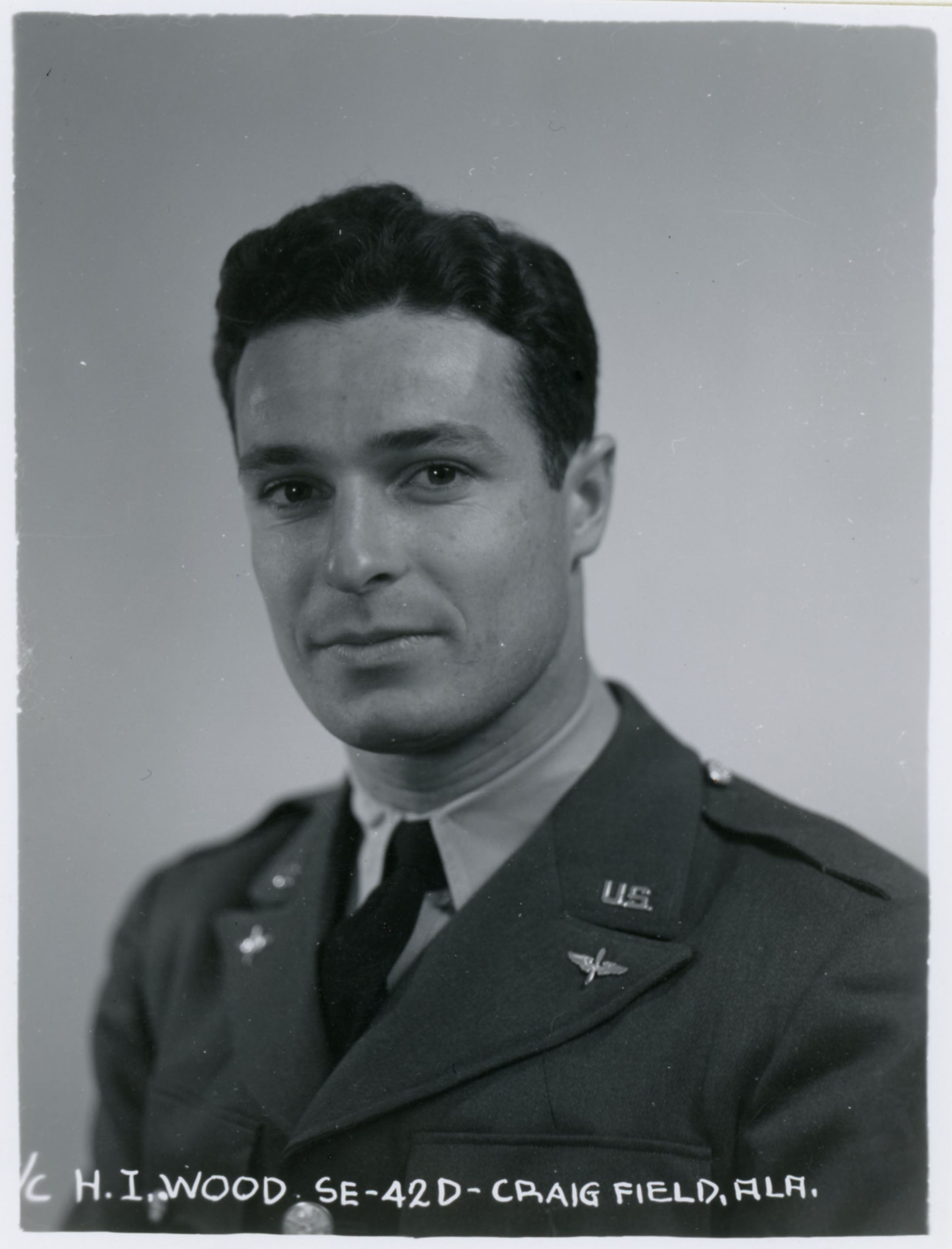
Here’s his Craig Field (Alabama) graduation portrait, also from the Photographic Prints of Air Cadets and Officers, Air Crew, and Notables in the History of Aviation – NARA RG 18-PU. (Specifically, Box 102.)
xx
And now, his story from DING HAO…
Introduction
Of dramatic importance was Henry I. Wood, who chose Wanda and me to reveal his 36-year-old secret by walking into the 1978 reunion of the Seventy-fifth in Nashville, Tennessee, when everybody had thought him dead in flames over war-torn China in 1944. An entire chapter tells his story.
Lt. Henry I. Wood, Prisoner of War
Lt. Wood, in the cockpit of what is presumably his “personal” P-40 Warhawk, at the 23rd Fighter Group’s base at Kweilin, China
Insignia of the CBI (China-Burma-India) Theater, which appears on the left shoulder of Lt. Wood’s jacket.
On October 1, 1943, sixteen P-40s of the Seventy-fifth escorted bombers over Haiphong. Over the target the bombers made direct hits on installations and upon completing their runs turned the formation for home. Suddenly enemy Zeroes struck and in the battle, four Zeroes crashed to destruction. Lt. Henry I. Wood, pilot of one of the P-40s, disappeared in the brief interval of fighting. So read the record of that fateful day. The men believed Wood to be gone forever since he did not return to base. He arrived in China early in March of that year, a few days before the Fourteenth Air Force was activated. This was his thirtieth mission. He had downed a bomber the previous June or July in combat. Years afterward, Wood recalled all that had happened to him after he was shot down on October 1, 1943.
The October 1 mission had been postponed three separate limes due to bad weather, and finally, instead of taking off during the morning, we took off shortly after noon. The mission was uneventful until we got over the target at Haiphong when the B-24s dropped their bombs. I had been scheduled to lead the right rear flight and Don Brookfield [1 Lt. Donald S. Brookfield, 0-430778, 75th FS, 23rd FG, 4 victories], who already had orders to go home, elected to go with us. He took the flight and I look the echelon as the clement leader. Of the eighteen fighters who were doing the escort, two didn’t join up. One was my wingman and one was Brookfield’s. So I flew wingman for Brookfield and only two of us were guarding the right rear. We were at about twenty-one thousand feet and the bombers at twenty thousand when we went over the target.
After the bombers dropped their bombs and turned northeast, instead of heading back to base, Brookfield for some reason kept staying over the target. But at twenty thousand feet we couldn’t see much but smoke, so we got quite a bit behind the main formation, about one and a half miles behind to be precise. Antiaircraft fire was hitting us all around. I took a severe hit from “AA” fire and was picking up my microphone to call Brookfield, when we were hopped by about thirty fighters. Brookfield peeled off to the left and I peeled off to the right. I dove down approximately five thousand feet, picking up considerable speed, and turned up into the last part of the bomber formation.
The last Zero had left the fighters and had gone to the bombers and it began a half roll through the tail bombers. And as I pulled up to the loop, one of the Zeroes came out in front of me, and I fired my guns. He still hadn’t dropped his bamboo wing tanks, and he flamed immediately. I flew within fifty feet of him and saw his wing disintegrating as he went down. My own engine seemed to quit but I didn’t think much of it, because often in a high angle of attack and after firing six .50s, the airplane tends to stall out. So it didn’t immediately dawn on me that it had stopped. I just nosed over to pick up airspeed, and then I realized that I didn’t have a working engine.
The antiaircraft fire had hit the tail section of my airplane. At that time the P-40’s control surfaces were fabric, but the rest was metal. I could see most all of my right aileron and most all of my right elevator. The rudder was pretty badly damaged, and I didn’t have good control of the aircraft. I leveled off and looked around to see if anybody was following me.
Then I dropped down to see if there were any more Zeroes. I couldn’t jump because I knew they would shoot at me in midair. Next I tried everything I could think of to get the airplane engine going again, but I couldn’t get it to come to life. I turned off and on all of the switches, even doing the ridiculous thing of turning off and on the gun switch.
I theorized that I had taken a hit earlier from the “ack ack” or possibly from the fighter that first fired at me, before pulling away when I dove. It must have nicked the gas line and when I fired my guns, the vibration shook it where it wouldn’t feed.
Many years later Wood learned about a similar incident from another Seventy-Fifth Fighter Squadron member, Charlie Olsen [1 Lt. Charles J. Olsen, 0-789937, 1 victory]. Olsen said that his plane engine once quit and restarted at twenty-five hundred feet, and when he got it back to the base they found several aircraft with belly tanks full of some sort of green slime. The belly tanks had been shipped over from the United States and were not properly cleaned out before being put to use. The slime moved up to the carburetor and caused the engine to cut out. Therefore, Wood came to the conclusion that perhaps it was green slime which killed his engine rather than a hit in the carburetor.
I got low to about eleven hundred feet as indicated, and I knew I was near a small village northeast of Hanoi, probably about thirty miles from the city. And I jumped. What I did to make sure my plane was destroyed was to trim it up nose heavy, crouch down in the seat, and when I was ready to go, I was in a stooping position. I just pushed the stick forward. In theory, if you did that you would do a back flip out of the airplane. I didn’t do a back flip. I did sort of an angle flip over the side. I used to dive in high school, so I just tipped my body naturally, instinctively, and it is a good thing that I did because as I turned and went by the horizontal stabilizer, it was just about two inches in front of my nose. And my feet just cleared the vertical stabilizer. As soon as I realized I was clear of the airplane, I counted two and pulled the ripcord. It is a good thing I pulled it when I did because I was almost too low to jump. I was in some low foothills, and I fell backward, forward, and backward again and on my back swing, or my third one, I hit the ground.
A wind caught the chute dragging me until it collapsed up the hill about fifty feet. My face was scratched a little. I disengaged the chute. This was about 4:30 in the afternoon and there was still considerable daylight in Indochina at the time. So I took the chute down the hill with me into a rice paddy, because I knew I was too deep into enemy territory.
Missing Air Crew Report 759
Lt. Wood was flying on my wing when the bombers went into their run. I last saw him when the escort made a turn following the bombers from the target. Major Brady (B-24, Flight Commander) states that he saw a P-40 and a zero make a head-on pass; the zero exploded and the P-40 went straight down smoking badly. This was probably Lt. Wood. Other bomber crews reported a pilot parachuting from a P-40 shortly after leaving the target.
DONALD S. BROOKFIELD, 1ST Lt., Air Corps
From Carl Molesworth’s book 23rd Fighter Group – ‘Chenault’s Sharks’ , this painting by Jim Laurier – of Lt. James L. Lee’s P-40M number 179 in late summer of 1943 – is a representative view of a 75th Fighter Squadron Warhawk during the time-frame of Lt. Wood’s service in the squadron. Note that the squadron insignia appears on the fin, over the painted-out serial number. Unfortunately, MACR doesn’t list the side number of the aircraft Lt. Wood was flying on his last mission.
I got into the paddy and laid down between the growing rice there. In about twenty minutes I could see activity come into the rice paddy, coolies, natives, and later men in uniform. I just laid real still and several times within twenty or thirty feet of me they would come by, but they didn’t see me. The parachute was wadded down beside me in the water. After dark, about nine o’clock, I decided I could move. I got up cautiously. My parachute was soaked but there was a little fishing paraphernalia in there, and I took it out along with a machete, some C-rations, and a chocolate bar from the pack. I look them with me toward the little village I had seen as I was coming down in the parachute. About a quarter until ten, I came to the edge of this village, which was a compound composed of mud huts arranged in a circle. I worked my way all around the wall until I came to the entrance. Entering, I saw several people standing by a fire. Immediately a dog began to bark. And I said in Chinese, “I am your very good friend.” I was hoping I was anyway.
And as I started over to these natives at the fireplace, there was an elderly man of about sixty there. He held up his hands to indicate to the rest of them to be quiet, and I walked over to him, reaching for my little booklet called a pointee-talkee. I turned my leather jacket inside out to show I had a Chinese-American flag, and I pointed to the place in the book which said I was an American pilot, to help me, that my government would pay him well. This happened the day after payday and I had a good bit of Chinese yen which I did not know was any good to them or not, but I pulled it out anyway. I gave it to him indicating that be would get much more if he could hide me and work me back into China.
He apparently knew no English but motioned to me, indicating that things were all right and took me into one of the little mud huts. They gave me some cold boiled water and scrambled eggs. I was sitting on the floor by a little table eating the eggs and drinking the water when something caused me to be apprehensive. It was a noise, a kind of dull thud. It was probably a rifle butt striking the side of the mud hut. What had happened to me was that a platoon of Japanese soldiers led by a lieutenant and a noncom who could speak some English had come to the village. They had been brought there by the people I had talked to. I had asked for the Chinese guerillas. They had sent for the Japanese troops instead.
The locals were probably too scared to hide me because they were afraid they would be killed if they were caught. I indicated from the book for them to hide me. They took me to the next room, but there wasn’t any real place to hide because there wasn’t anything there besides thatch rugs on the floor and a small table in the corner. I held up a couple of these rugs over me in the corner. Then suddenly, the room lit up and I could hear these gruff voices which I presumed were saying “hands up” in Japanese. I didn’t move. Somebody snatched the rug. I stood up with my hands up.
I was not treated rough initially, surprisingly enough, as I had been led to expect I would be. They did take my jacket off and search me thoroughly, and the one which could speak some English said, “Never mind. Never mind.”
He took me to the other room where I had been eating and motioned for me to finish. I had suddenly lost my appetite. In fact I was so confused (and even though I had fairly good intelligence – later I graduated with honors from college) by being treated nice, that I asked them through the pointee-talkee what Chinese troops were doing in this area? And there was an uproar – a sound of laughter when one of them read it to the others. Finally the tall one who kept saying. “Never mind. Never mind,” said, “Ha. Ha. You think we Chinese. We Japanese.”
It was a big joke to them, but not to me. They then tied my hands behind my back and put some of the troops in front of me. They had cattails which had been dumped in kerosene which were lit and we started traipsing through the rice paddies, with troops in front and back of me. And it was pretty slippery trying to walk through the rice fields and every once in a while I would start to go down. I was afraid that somebody would shoot me in the back thinking I was trying to escape. I had no such ideas at the time, being in the middle of a bunch of Jap soldiers.
After about forty-five minutes or an hour we reached a road where they sent up some flares and indicated to me to sit down. While we were sitting there one of the soldiers took the chocolate bar they had taken from me and offered me some. And I said thank you to him. They all laughed. They thought it was funny since they had taken me prisoner and confiscated my food and here I was thanking them for offering me something to eat. In about thirty minutes, a big truck came down the road and we all piled into it. It had an open bed with low sides. I stood in the middle with the rest of them hovering around me. My hands were still tied. We came to a compound which was apparently a troop training area because there was a number of barracks. I was taken inside one of the buildings with an extremely mean-looking Japanese. The only other Japanese I had seen like him was when I had shot down a bomber on another mission and flew almost into the nose of his plane before I cut under it. And I could see the pilot’s face there. I had apparently killed the copilot and the pilot was just staring at me through the canopy.
This mean-looking fellow had on a kimono, not a uniform, and he apparently was the man in charge. I found out the next morning he was a captain, and he was definitely in charge of the outfit. The man glared at me, and through one of his subordinates, he told me to answer his questions or he would cut off my head.
And I nodded my still intact head that I understood. He then asked me what my rank was and I told him first lieutenant. He then asked me how many planes were in my formation. I said to ask one of his pilots who was up there on the mission. He must not have liked my answer because he became even more enraged. And he had someone tie my hands behind my back, to the back of the chair and my feet to the runner of the chair. Then he took out some paper towels and took his own neck and wiped it and removed his sabre from its sheath, indicating to me that he was going to cut my bead off.
He then had someone tell me to answer his questions and I nodded that I understood and be asked the same questions again. I told him that I did not have to answer questions of this nature. He then ordered his soldiers to carry me outside where there was a big bonfire. They set the chair down with me in it, and at that moment I was convinced I was going to be killed.
I had always been told that one’s life flashed before you if you were going to die. Mine didn’t flash before me. But I had already done some thinking along these lines during the afternoon. I had been very apprehensive. Then I went to the compound and met the natives, and I got a glimmer of hope that they were going to hide me.
And I thought, “This is going to be rough on my mother as she has six boys in service, and I am going to be the first to go.” And the last thing I thought about as he started to bring down the sword was how I used to have to wring chickens in the neck, and my mother plucked them afterwards when I was a kid. I could see me squirming around with the reflexes going and I thought to myself, “I’m not going to give him the satisfaction of seeing me squirm.’’ So all I could think of was to stick my neck way back as far as possible so he could have a good clean whack.
Down came the sabre, stopping just an inch above my neck. He did that twice and then he said something in Japanese and untied my legs. He untied my hands from the chair but left them tied behind my back, took me over to a tree, tied my hands to the tree, and wound the rope around my whole body and the tree.
He apparently gave them instructions, “Ready! Aim! Fire!” in Japanese because they all brought their rifles up to bear and they all clicked on empty magazines. He did that twice. Then it began to dawn upon me that he was apparently just trying to scare me, that they were stiff wanting the information or I would already be dead.
They took me to a guard compound or jail and put me on the floor and took off all my clothes except my shorts. My hands were tied behind my back and hands tied to my feet. They laid me on the concrete floor and put a hard bag of cement under my head. I would have been much more comfortable lying flat. And then they proceeded to beat me with long sticks which looked like broom handles. Some of the officers took off their boots and began beating me too. And I lapsed into unconsciousness. Several hours later, I awakened and all of them had gone.
NARA Records Group 153 Case File 56-41 (August, 1946)
1st Lt. Henry Irving Wood states that he received a beating following his capture at Luc Nahm, Indo China, by a roving detail of Jap soldiers, but does not know their names or any unit designation.
This document, from NARA, is a summation of Case Files 56-41 (above), and both 58-132 and 61-47 (see both below), and is based on an interview of Lt. Wood that occurred at Letterman General Hospital in San Francisco on October 9, 1945. Due to the circumstances and nature of his treatment by the Japanese, as well as the near-impossibility of specifically identifying any of his captors, let alone locating them postwar, further investigation was fruitless.
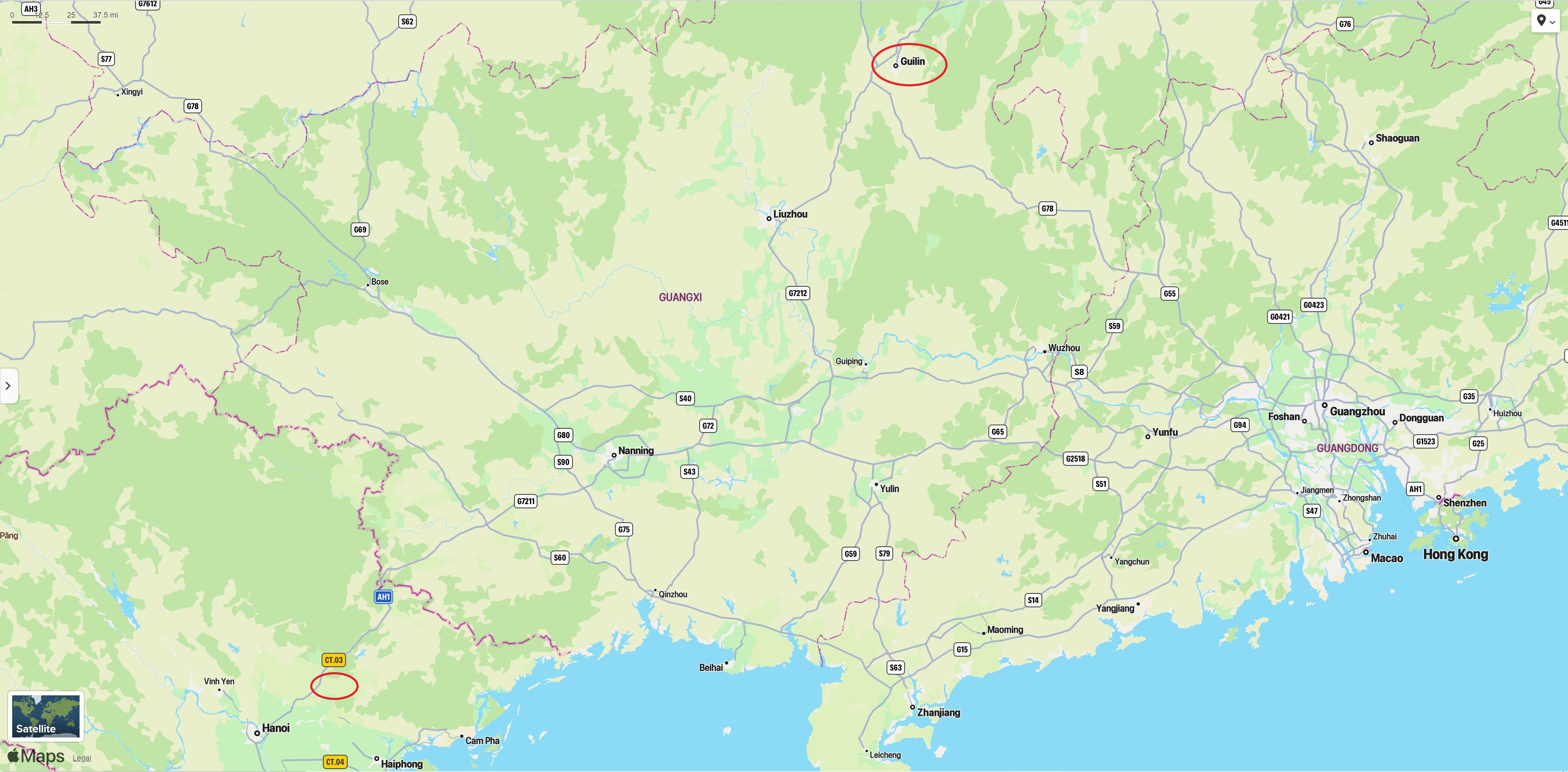
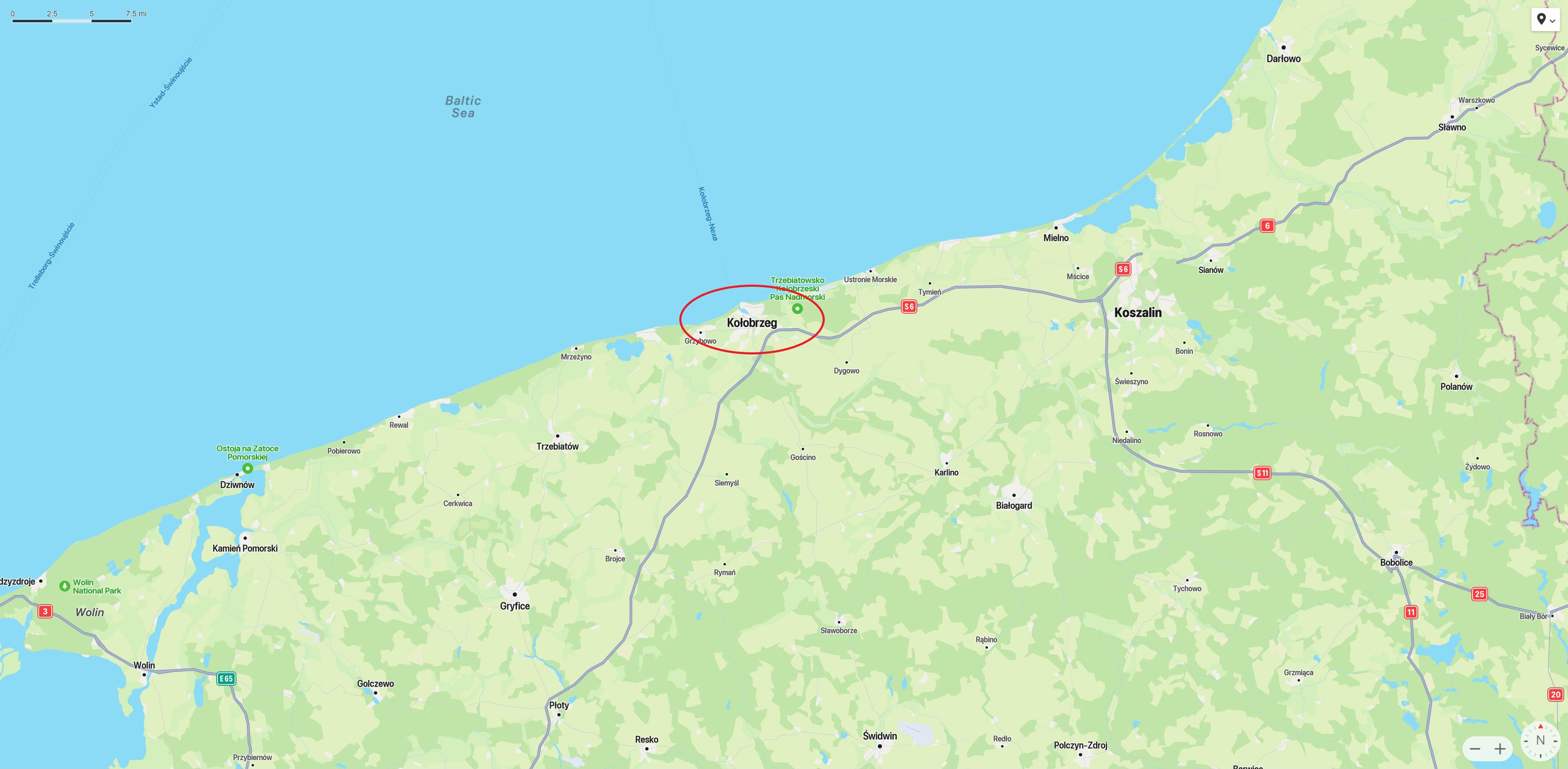
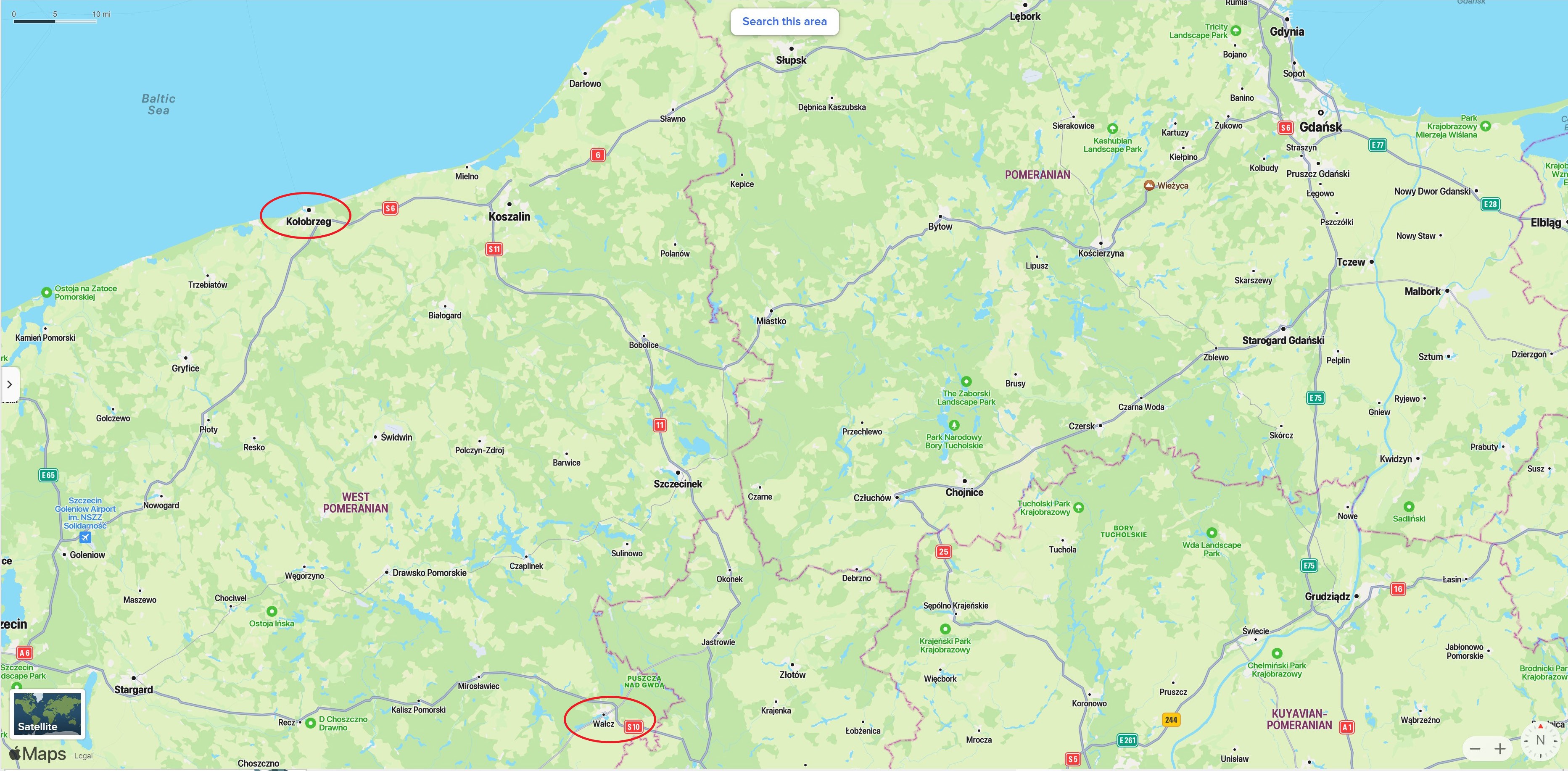
This map shows the location of “Luc Nahm” (actually, Luc Nam) then French Indo China, and now, Vietnam…
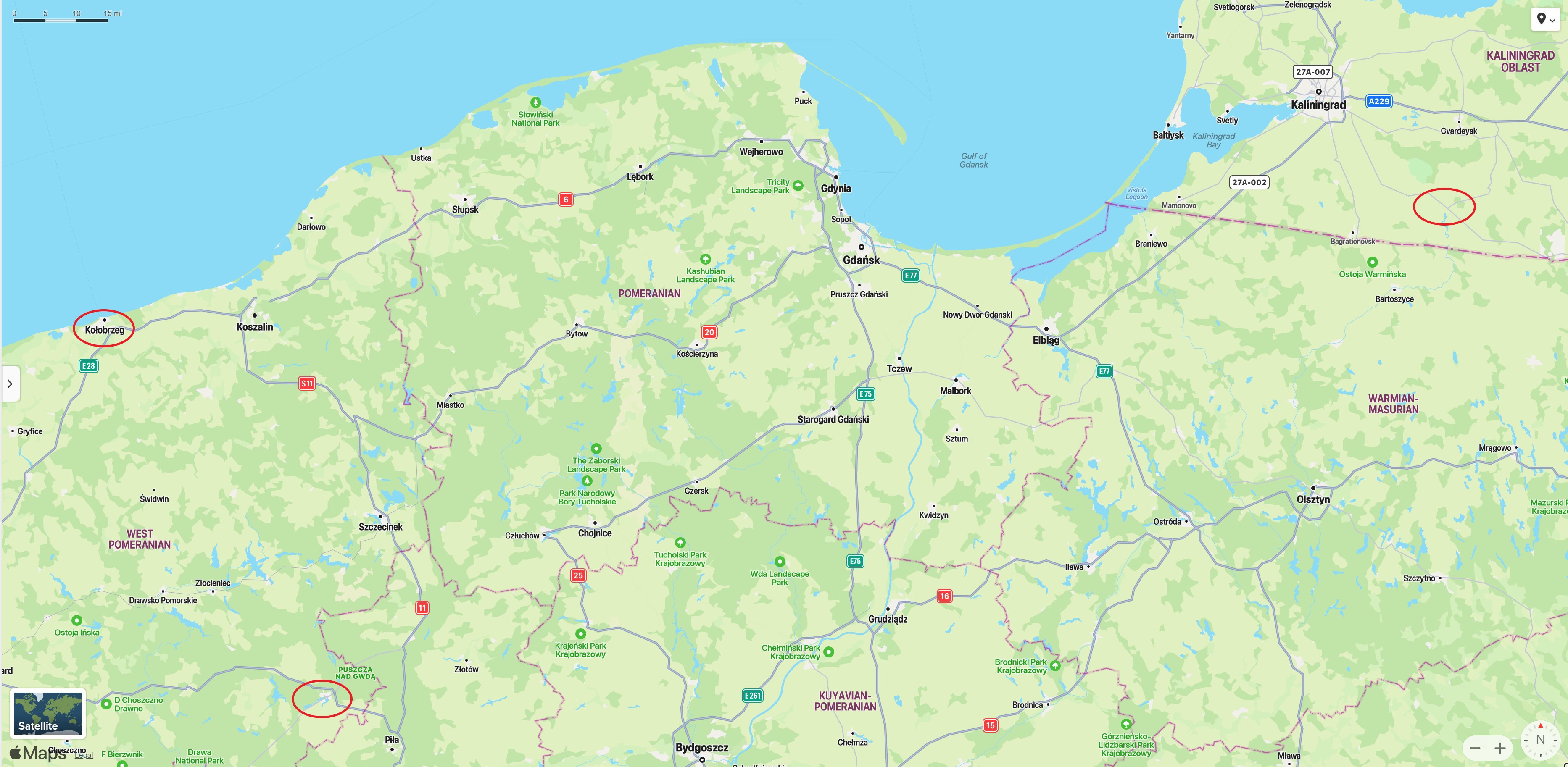
…while this map, at a smaller scale than above, shows Luc Nahm to the southwest, and Guilin (Kweilin) China – the 23rd Fighter Group’s base during the time frame of Lt. Wood’s service – to the northeast.
In this guard compound the guards were sitting along a bench with a noncom in charge, and one of them had apparently brought some incense because I had been bitten badly by mosquitoes and didn’t realize it until I came into consciousness. As my awareness came back and the mosquitoes were still chewing on me, that was really the worst part so far because I couldn’t scratch the bites.
Shortly before dawn, I noted the noncom in charge kept reading a big heavy book, which was probably a Japanese-English dictionary. He came over to me showing a little paper with writing on it. Looking at it he said, “You are very brave man. My maundy you go to New York.” My maundy is a Chinese term meaning “later.” Why a Japanese would use a Chinese word, I don’t know. But that is what he said.
I had never heard of a prisoner being expatriated from Japan so I was very skeptical of what be said. And then a humorous thing happened. Just as he finished saying the words, the paper still in his hand, an officer walked in and the Japanese soldier jumped to attention. He said something which sounded like Jejugius and presented arms, even though they were indoors. And I could see what he had in his hand was carefully camouflaged so that the officer could not see it. I am sure he would have caught hell if indeed he had written there what he said to me and somebody bad seen it.
The next morning about ten o’clock, my uniform was given back to me and I was told to dress and put the jacket on with the flag outside. I was paraded in front of a large formation of Japanese troops while the captain in charge was speaking lo them. I didn’t know what he was saying about me.
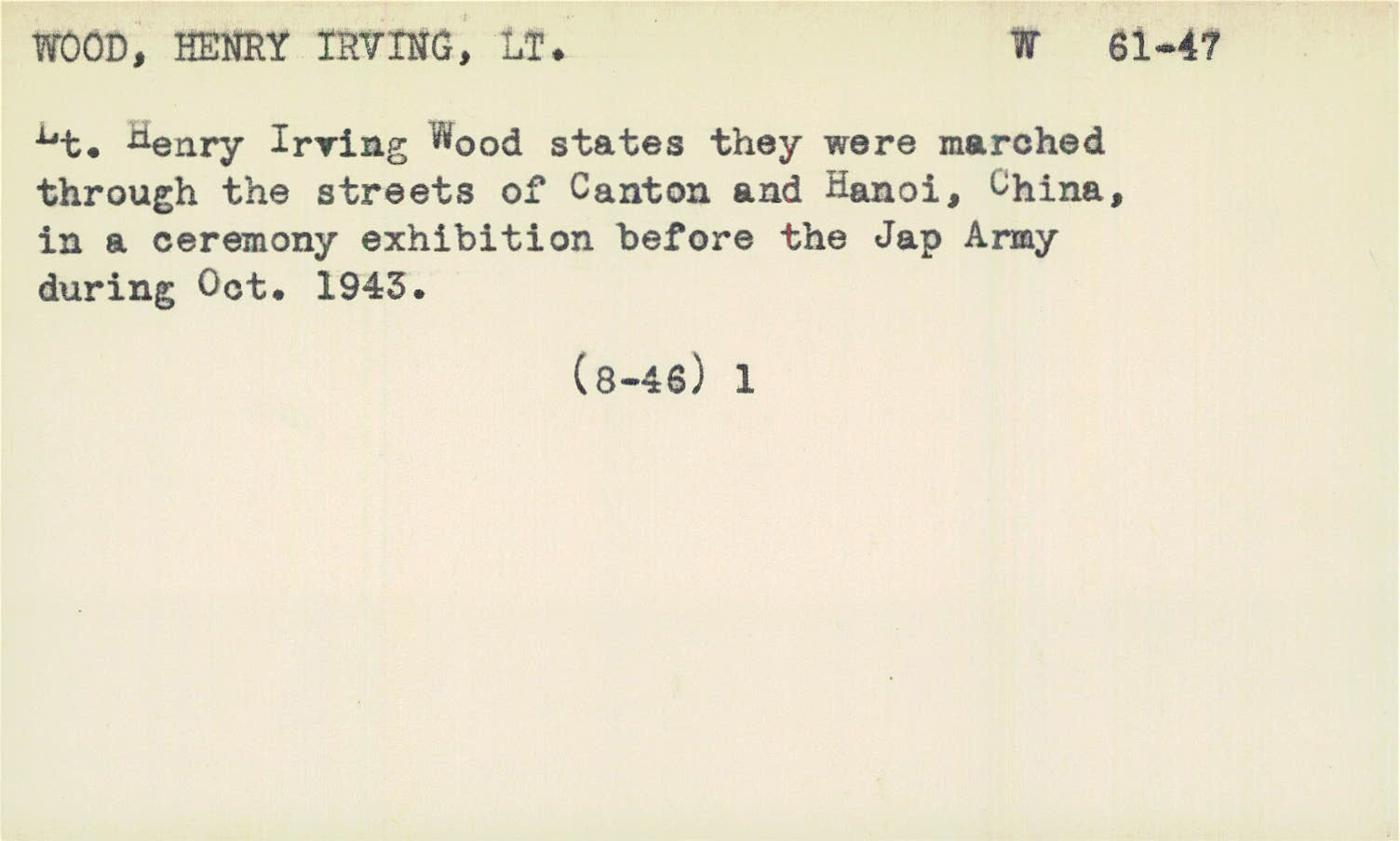
NARA Records Group 153 Case File 61-67 (August, 1946)
Lt. Henry Irving Wood states they were marched through the streets of Canton and Hanoi, China, in a ceremony exhibition before the Jap Army during Oct. 1943.
Later in the afternoon I was put in a truck again and taken to Hanoi. I recognized the town when we got there to the suburbs because there were a good many signs in French and English which the Japanese had not obliterated. I was taken to a beautiful occidental type building in the heart of Hanoi, led inside, and the ropes were taken off my hands. Shortly later. I was seated in a nice dining hall with china and silverware.
A very nicely dressed man in Western style clothing, a Japanese, came in speaking with an Oxford accent and told me he was sorry I had been mistreated the night before and wished to assure me this was not the Japanese’ nature. But I should realize that there was a war going on and sometimes troops from the field got upset. He said I would be treated well in the future, and he just wanted to talk to me a little. He didn’t often get a chance to talk with an American. I didn’t believe that.
It turned out that his name was Ariaa and he was the Japanese premier for French Indochina at the time. It became obvious in a very short time with him trying to converse with me, that he was trying to discuss military information with me through seemingly irrelevant conversation. First he asked me where I was born. Where did I live? Did I have brothers and sisters? Apparently these questions were innocuous.
Then he said, “How did you like the place you were flying out of in China? Where was that?”
Of course I refused to answer the questions. And I told him in a nice manner that I didn’t mind talking with him, but there were things of obvious military significance and he must realize it. After he understood he wasn’t making any headway, he apologized, said he had to leave and that I would be served a nice meal right at the table I was sitting at. And again he apologized for the behavior of the Japanese. As he left the room other Japanese came into another door and immediately tied me up and hustled me down to a basement where they had made some cells by taking a large room and segregating them with four-by-fours from the floor to ceiling with an inch space between each board. They stripped me of all my clothes except my shorts, made me get down through a little door like an animal cage into one of the cells where there were four native Vietnamese, I presume. They indicated for me to sit on the floor like the others were doing with knees crossed and with my hands folded across my knees. So I sat there for a while and naturally that got tiring, so I leaned back and when I did, I was yelled at in Japanese, and a long thin stick came through the bars and I was knocked in the bead.
So I learned that I was supposed to be sitting and not lying down. I was kept in this room for five days without food. I was allowed to have water twice a day. They got us up in the morning and put us to bed at six at night and allowed us water and took us to the ben jo as they called it, which was the bathroom, consisting of a little slit in the floor.
At the end of the fifth day, they brought me a big fish head which was supposed to be a delicacy in that area. I still wasn’t hungry enough to cat a fish head, but later on during my incarceration, I would have gladly eaten it.
The next morning after offering me the fish head in the middle of the morning, they took me out of the cell and into a room where there were a number of Japanese in a big ring on the floor and others sitting behind them in chairs. And that is where they started pressuring me in earnest about intelligence. I let them know that all I would tell them was my rank, name, and serial number. They tried to talk me into the information by being innocuous in their questioning like Ariaa had done. They felt that if I talked they would get their information. After they questioned me about an hour and a half, they put me back into the cell. That afternoon about three o’clock, they took me out again and told me that I had to talk. They were tired of talking to me in this manner, and they expected me to answer the questions. When I refused to answer, they locked the windows. There was this little device I called a windlass. They put wires on your wrists and put it around your finger and tightened it gradually, pulling the finger back until it broke. They didn’t break my finger but it was very painful. And they also took a hammer and you can still see the scars on my hand where they broke the bones. This went on for several days, and after the second day, they initiated a new procedure where they had a ladder which was inclined at about a forty-five-degree angle to the wall. Then they tied me to the ladder with my head low, and they put water-laden heavy towels over my face where I would choke and gasp and eventually pass out. Then they would bring me to and ask the questions again. This went on for about three weeks.
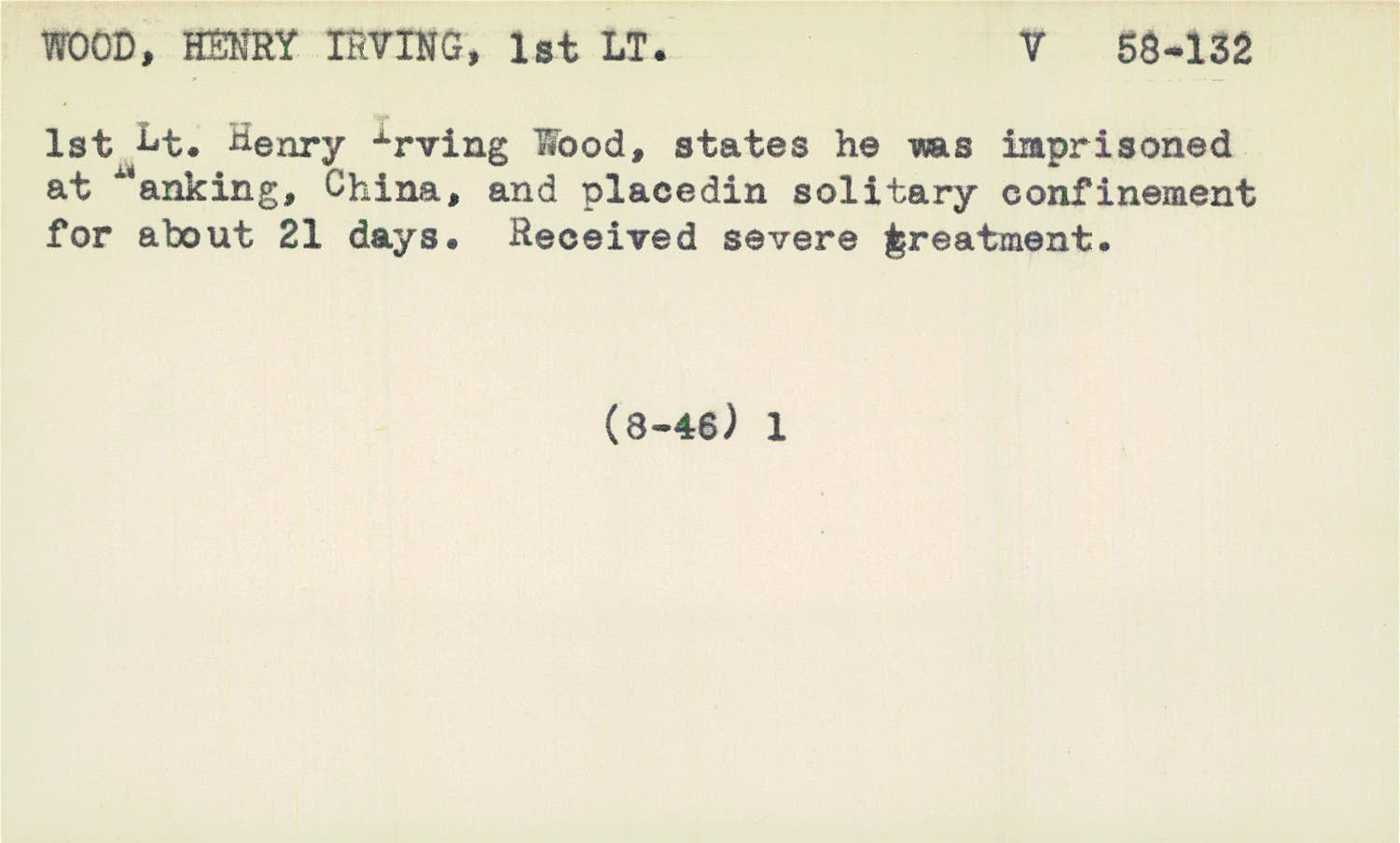
NARA Records Group 153 Case File 58-132 (August, 1946)
1st Lt. Henry Irving Wood, states he was imprisoned at Nanking, China, and placed in solitary confinement for about 21 days. Received severe treatment.
Then they took me to an airfield where I had been on an escort mission a time or two when the B-24s had bombed them. While I was at the airfield up in a high room, but not in a control tower, there was an air raid alarm. Everybody became very excited and they were bustling me out of the building and into a truck. There were a number of trucks trying to leave the field with troops on them. No pilots were trying to take off because they apparently felt that the American planes were imminent which they were. They had not received the alarm in time. But there was a road which paralleled the runway. And as we were leaving I looked up and I could see the B-24s at a high altitude and barely make out the fighters with them.
I knew that the bombs bad already been dropped and were on their way and sure enough in a matter of seconds, the bombs were dropping all around us. I had extremely mixed feelings – I was hoping that they would blast the hell out of the Japanese, but I sure didn’t want to get hit It was a real terrifying feeling to be in that situation. We continued on down the highway for several miles, got into ditches on the side of the road, and stayed there for an hour. Then we got back into the trucks and went back to the airfield. Unfortunately the bombing had not been accurate, almost all of the bombs had gone off parallel to the runway about three hundred yards from the road we had traveled. A couple of the bombs had hit the field, and one bad hit a large hangar where a number of airplanes were housed, and there was considerable damage to the planes as I could see fires still burning. I could see the damaged airplanes.
Later on during the day I was put on this airplane, a Lockheed Lodestar, along with some Japanese passengers, and there were four guards with rifles and bayonets accompanying me and a Japanese captain in charge of the troops. In the course of the flight it was very pleasant. This particular officer was very courteous, and he indicated he understood English but he could not speak it well though he could write it. He showed me pictures of his children and said he had been away from home five years. He made no attempt to interrogate me for information. He also offered me some of his chow because they apparently didn’t have any box lunch for me on the plane. He gave me some cheese and a sandwich and I could tell from the course of the sun that we were flying along the southern China coast over towards Taiwan. And sure enough we landed on the island.
For the first time in several weeks I had an enjoyable couple of hours, apparently while the plane was being refueled. I got to lie outside in the open on the grass near the runway. It was a beautiful sunny day and in no way was the captain in charge attempting to hamper me. I had come through some pretty difficult times in the course of the flight, from a mental condition. Several times I felt that I might have had the opportunity to get out of the seat in a hurry, run up to the front of the plane. There was a “stepover” in the Lodestar which was approximately two and a half feet high, separating the cockpit from the area for the passengers. I kept thinking that if I could realty get up there and grab bold of the pilot’s wheel, I could spin that plane in with everybody on board and accomplish something besides being a prisoner.
I could never bring myself to do it, but I would have never reached the cockpit if I had tried. I’d have been stabbed in the back or shot. But I bad some real tough times worrying whether I should try or not. I had been in excellent health at the time I went down. My main activity in Kunming – I wasn’t a gambler or a player of bridge – was working out with weights and doing a little running and push-ups and reading a good many books. My health was good at age twenty-five and I was in top physical condition before my capture. My health had not deteriorated rapidly in their hands. After the first five days I had a fair diet with rice in the morning with some sort of Chinese vegetables and the same thing in the evening. I was getting an adequate diet even though it wasn’t the most palatable one.
We eventually landed again, and I ascertained that I was in Nanking. What made me realize that was I was again in solitary but not made to sit on the floor this time. I was allowed to walk around all I wanted to. The room was approximately eleven feet long and five feet wide, so I paced up and down that room most of the day. It was right near the entrance of a large compound, and I could see into a large courtyard.
The second day I was there a big black car came up with general’s flags on it and a man got out. I am sure it was the man they called “The Tiger of the Orient.” He was the Japanese general in charge of that area. He simply came over and looked at me through the bars, didn’t say anything, looked at me for about thirty seconds, and turned around and walked away.
Again I stayed in this cell for approximately three weeks because I was making marks with my fingernails on the wooden bars, four-by-fours, but wider spaces between them than the ones before, about two and a half inches. One day they came in and said I would be moved that day. They had not tried to interrogate me at all in Nanking and this morning they told me why they had stopped questioning me.
They told me they had captured a Chinese pilot named Chen [2 Lt. Ping-Ching Chen – Survived as POW] who was in my unit and that he had been badly wounded and they had been able to get all the information they wanted. And I found out later that what they said was true because I was taken to a prison camp with him and he said he had been wounded – his leg bad been broken and he was shot in the arm. Apparently under the severe mistreatment he had and the painful conditions, be told them things they wanted to know.
Missing Air Crew Report 759
Lt. Chen was flying on my wing when the formation left the target area. He remained in his position for approximately fifteen (15) minutes. When my flight turned back to protect two straggling bombers, Lt. Chen was missing.
THOMAS W. COTTON, 1st Lt., Air Corps
From Nanking we traveled to Shanghai where I was put into a large prison camp. At that time, it held Italian prisoners from a ship that had been scuttled in the harbor at Shanghai. It also contained some civilians from Wake Island, Marines from Wake Island, and the North China Embassy Guard. It was a well-formed prison camp, and I simply was put into a cell by myself for approximately one week and then released with the general prisoners. I remained in this camp from December of 1943 until late May 1945.
Other than two bad personal experiences in the long stay at the prison camp, it was not particularly bad other than the lack of communication with the outside, poor diet, and very little recreation. We normally worked nine days and then were off one day.
My first bad experience was when I was asked to work by Maj. Luther Brown [Major Luther A. Brown, 0-3815, POW Dec. 8, 1941], who was a Marine major acting as executive officer for Colonel Ashhurst [Colonel William A. Ashurst, 0-000028, POW Dec. 8, 1941], who was the senior American officer in charge of the camp. Brown had ordered me to go to work in a garden with other Americans which stood within the compound. I told him I didn’t feel like I or any other prisoner should work.
He attempted to reason with me, saying that he was in charge and this work was not of any particular help to the Japanese. It helped get us our own food and was of some value. It was up to him to make a decision like that, and it was not up to me as an individual to decline or accept.
I still felt it was my own individual decision and I told him so. He went over to a Japanese noncom named Neasaki [Lt. Myasaki], who was in charge of this particular detail. Neasaki walked up to another prisoner who had a shovel, grabbed it, and hit me on the side of the head with it as hard as he could. It knocked me to the ground. I was stunned. And when I got back up Major Brown told me he was sorry, but if I didn’t work, I would get similar treatment. That was my first experience with any collaboration by an American with the Japanese. I later found out that within a small group there was considerable collaboration.
NARA Records Group 153 Case File 58-108 (January, 1946)
1st Lt. Henry Irving Wood states on or about 10 Nov 1943, while a PsW at the Shanghai War Prison Camp, he was engaged in a detail of hauling dirt within the camp compound area. Lt. Myasaki seized the shovel which he was working with and struck him a heavy blow in the face; he then turned and struck 2nd Lt. Robert E. Greeley, M.C., also in the face. Myasaki was involved in torture treatments, such as water treatment, breaking fingers with a windlass contraption and numerous beatings. Col. Otera was Jap commanding officer.
In fact volumes of information on it were filled out in Manila at the end of the war, but nothing was done by the psychiatrists or attorneys. They felt that a lot of what we said, due to living under such bad conditions for such a long time and to our mental health, was imagined. But that wasn’t so. It wasn’t until the Korean War that they realized that we were brainwashed and that there were Americans who collaborated with the enemy after they became prisoners.
I decided I had better go to work, that I didn’t want to get whacked anymore since I was a lone individual in the crowd. Life was bearable except for the dairy drudgery of going out to work on days when it was cold and sleeping in a building that wasn’t heated and observing some American prisoners, including Major Brown, sleeping on innerspring mattresses with big trunks full of canned food from the Marine ship stores which they had been able to salvage in Peking. They were treated differently from the rest of the prisoners too. The reason why they were being treated differently, I found out, was they surrendered lo the enemy. You can’t blame them for surrendering. They were the embassy guards when the war broke out, and these people were the ones who had been fraternizing with the locals on a daily basis, the Japanese who occupied Peking at the lime. And as the embassy guards, they were good friends with them, drank with them, danced with them, fraternized with them, and the Japanese gave them twenty-four hours to surrender. For doing this, they were rewarded. There was no attempt to dispose of the military hardware they had, which consisted of guns and bayonets and food. Anyway, whatever arrangements were made, the former guards kept their personal clothing, watches, trunk loads of food, and it was shipped from Peking to the prison camp in Shanghai. Their goods were maintained in a separate warehouse, and they were allowed to use it and no one else.
I found out that before I came to the camp, the Wake Island Marines, the ones that defended Wake Island, were put into the camp and Major Brown would not allow them to associate with the Peking Marines. Here was a group of Marines who had been undergoing harsh mental treatment and some of whom were wounded, and they weren’t even allowed to associate with other Marines, who were the former embassy guards. It took months before Major Devereaux, who after the war became a brigadier general, was able to resolve the situation with Major Brown and get him to share some of the clothes with the other prisoners.
Besides Brown, there must have been between sixty and eighty people from the embassy guard, including several officers, a number of captains who enjoyed the favors. Major Brown allowed everybody from the former guard better treatment than the rest. It may not have been the others’ nature to take advantage of the situation while fellow Americans were deprived, but Colonel Ashhurst apparently made the decision and Major Brown implemented it because Ashhurst said he was a sick man and put his executive officer in charge. Finally Devereaux apparently overcame the situation. He had been the commander at Wake Island.
Otherwise there was just minor ill-treatment when they would call a shakedown, like trying to find out why so much electricity was being used at the camp. Some of the men had been taken to town to build a rifle range on “front days.” They called it Mt. Fuji, but it was just a hill. On a “front day” the Japanese would take us and mistreat us, telling us that there were severe conditions on the front. We were well protected, so we should be mistreated because our [sic] comrades were having a rough day at the front. There was a song we made up. “With a front day every day out of nine / They run a short load (we’d push cars up this hill and we’d push a light load if we thought the Japanese weren’t watching) / Then Yaza day is a day of rest / Yaza day … Yaza day. …”
Eventually, in May of 1945, treatment wasn’t as harsh as usual and we received two Red Cross boxes.
Then Colonel Otaru, who was the Japanese commander at the camp, indicated we would be moved. We were transported in boxcars from Shanghai beginning in late May of 1945, on up through Manchuria down through Korea to Pusan on the southern tip, where we were put into a large encampment with one water spigot for the entire camp.
We were kept in the camp mostly out in the open for four days, and we didn’t know what we were waiting for. But apparently they were waiting to put us on a ship to take us up by rail to Hokkaido, the northern island, where they had in mind to put us to work in the mines. It was a real rough trip, and the only time any prisoners escaped en route was a time when five escaped by cutting barbed wires late at night. We were separated in two ends of the boxcar with barbed wire, and in the center of the car was the Japanese guard. There was a small window in each end with wire over it. They were able to cut the wire by putting a little commode there and placing a blanket up for a screen and fooling the guard by making him think they were just going to the bathroom there. And they were able to work the barbed wire loose and five slipped out into the night before they were discovered.
Then we left Pusan on a ship. We were crowded into the hold where we stood up. I don’t know how many hours we were on there. But it must have been between thirty-six and seventy-two hours on board, and there was no room between the bodies. Then we were moved across the Tsushima Straits, into Japan proper onto Honshu island, put on small Japanese railroad cars, eighty to a hundred of us on each car, lying on the floor, under the seats, on the seats, up in the baggage baskets. They had heavy opaque screens over the windows so you couldn’t see what was going on outside. But we were so tightly packed in there that there were several places we cut the screens and could see the vast devastation of the countryside that the B-29s had wrought It was just at ground level for blocks on end close to the railroad tracks. In one place we saw hundreds of railroad cars which had been destroyed. And every now and then there was a B-29 raid and we would huddle up in the cars in some subterranean chamber. They were really trying to protect us at that time.
We finally reached the island of Hokkaido, the northern island and were taken to a small mining town called Ashamitzabetsu. At that time they separated the officers and the civilians and the airmen for the first time. I felt they were trying to protect us and give us more consideration than they ever had before, or they wouldn’t have done that.
So on the third day they ordered us to go to the mines and I refused to go. I was the only one out of eighty-three of us (among them were Marines, an orderly, two Navy medics, and several enlisted men who had been put in with the officers). Brown was still in charge of the camp. I refused to go out. I was ordered to stand at attention by the Japanese this time. Brown finally lost all of his friends he had in the move, and he had been mistreated several times himself for the first time since his incarceration. So I stood at attention all day long, from when they first went out at seven o’clock in the morning, and I was still standing at attention when they returned at five o’clock in the afternoon.
They ate and I was still at attention at ten o’clock that night. Every time I moved, and I couldn’t help but move, I was beaten by a particular guard standing over me at the lime. He hit me with a rifle butt
But I must have accomplished something by my tenacity at that late stage in July of 1945 because the next day, instead of standing at attention again, and instead of taking me out to the mines, they put me lo work at a pookey party. Pookey was a plant very much like an elephant ear, edible if you did a lot of boiling. I was taken out with several Japanese and two other Americans, and we went out to the forest. There were streams and low mountains, and it was beautiful country. There we cut pookey. It was carried back to camp and boiled for our food. And for the rest of the time I went on pookey parties, and they made me the rice cook for the camp. So I never did work in the mines with the rest of the prisoners.
On August 14, the commandant of the camp, the first lieutenant did not come to the camp. No one was taken out to work. No one was taken out to pookey parties, and we realized something must be going on. Three days later some lieutenant colonel whom we had never seen before came in and told us the story that the Americans had some horrendous bombs but the Japanese would never surrender. They also kidded us about being cowards for surrendering and said the Japanese would always commit hari-kari before surrendering
But the Japanese people as a whole had given in due to the horrendous weapons, he said. And we were to wait there and see what was going to happen to us. Well, I didn’t want to wait, even though I was urged by Colonel Ashhurst and Major Brown, whom I had no use for, to wait and see what would happen. I felt we should be fed better and have better care, and I talked another officer, Lieutenant Rouse, into leaving with me. We simply walked out of the camp.
We ignored the guards who hollered something to us and kept walking. They didn’t do anything. We went down to the center of the little town to the railroad station and kept saying, “Sapporo! Sapporo!”
We ended up on a railroad train car, were transferred to another one and onto a third, and by the time we got to Sapporo on the third train, there was a Japanese noncom who spoke very good English and who asked us why we left camp. We told him we understood there were some American Air Force officers in Sapporo and we wanted to be taken to them. And sure enough, we were taken to a place where there were eleven men under Maj. Don Quigley, who turned out to be a squad commander of the Seventy-Fifth Fighter Squadron of which I bad been a member. He came to China after I did and became squad commander before he was shot down. For the next few days, we lived like kings. Quigley got on the ball and got us on tours of the farms, universities, and even a small group to church. Instead of being treated like prisoners, we were treated like tourists. And we had plenty to eat, eggs, all sorts of vegetables, good meat, things we had been told earlier weren’t available. I was real glad that I had the nerve to walk out of camp along with Lieutenant Rouse, who was a bomber pilot. [1 Lt. Richard R. Rouse, 0-735669. Member of 11th Bomb Squadron, 341st Bomb Group, 14th Air Force, captured November 11, 1943, during mission to Yochow, China, in B-25G 42-64757. Aircraft shot down by anti-aircraft fire and crashed with all six crew members surviving. Five of the six eventually survived war as POWs, being interned at Shanghai POW Camp. Loss covered in MACR 1106.]
After a few days, one of the Japanese soldiers said the Americans would be coming in and they would be dropping supplies first and for us to go out and mark an area where they could drop them. And they did. They dropped big fifty-five-gallon drums from parachutes with clothes and food in them. We had good food, good shoes, and uniforms again.
But some unfortunate things happened, too. I remember when I was in the Shanghai camp there was an enlisted man, a Marine who was always in good humor even though in terrible health. He almost died several times. A Captain White, a Marine non-flying officer, had marked the drop for the camp where this Marine was, and he didn’t make the people stay far enough from the area. And this sick Marine and two others were standing close to where the drum came in. The parachute slipped off it, and it killed all three of them standing together. This man had been captured at the outbreak of the war, the first day of the war, and he was killed by one of our own air drops at the end of it.
Several days later we were taken to an airfield where Americans had flown in some DC-3s and some P-51s. And we were flown to the Philippines. Army Air Corps men were flown to the Philippines and the Navy-Marines were flown to Guam. We arrived at the Philippines September 12, 1945. There we were plainly told after we revealed all of the tales of the Shanghai prison camp personnel, not to talk about it again. We were interrogated several days by psychiatrists and by American attorneys, who were members of the armed forces and civilians, and we had to sign statements that we would not relate any of this when we got home or else we could not be taken home before we were cleared.
They didn’t want any of this information in the newspapers. And they didn’t want to believe us, and they didn’t want us knocking any other Americans. It was all right to tell about any atrocities of the Japanese, but with Americans we were supposed to show our patriotism. Luther Brown had gone through the Naval Academy and was promoted to colonel before he retired. And nothing was ever done to him. They wouldn’t believe that an American officer would do what he did. He was such a party boy at Shanghai that he had become real stout, but after getting in prison camp, he decided to take care of himself, and he slept in a private room with an innerspring mattress and worked out with weights.
“On November 10, 1943, as a co-pilot on a low altitude mission over Yochow, China, Alton and a crew of 5 others were shot down and captured by Japanese and held in a Chinese prison camp for 10 days. Because of the treatment the Chinese received, Alton and the crew were grateful to be Americans! The six American prisoners were taken down the Yangtze River by boat at which time the Americans bombed the boat, not knowing Americans were on board; 2 of the 6 member crew escaped the boat—one drowned and one was picked up by a fishing boat and returned to the Japanese who had to move the prisoners to another boat to continue down river. They were interred at the Allied Prisoner of War Camp at Shanghai, China. Later the Japanese transferred Alton and his remaining crew with 1000 to 1100 other prisoners of war packed in rail cars through Manchuria to Korea and then in the hull of a boat crossing the Sea of Japan from China to the Northern Island of Japan, Okido.”
Navigator-Bombardier: Walsh, George T., 2 Lt., 0-741817 (Missouri)
20 P-40s and P-38 escorting 22 B-24s pounded Haiphong warehouses and harbour. Some 40 Japanese interceptor rose to meet them in an air battle lasting some 40 minutes. 30 Japanese aircraft were claimed to be shot down (!) for the loss of three P-40s.
2nd Lieutenant Chen Ping-Ching from 75th FS, 23rd FG, was shot down at 15:30 over Haiphong and he bailed out of P-40 42-45906 (MACR 758). 1st Lieutenant Thomas Cotton reported:
“Lt. Chen was flying on my wing when the formation left the target area. He remained in his position for approximately fifteen (15) minute. When my flight turned back to protect two straggling bombers, Lt. Chen was missing.”
1st Lieutenant Henry L. Wood (0-789035) from 75th FS, 23rd FG, was also shot down at 15:30 over Haiphong in P-40K-1 42-46250 and was missing (MACR 759). 1st Lieutenant Donald Brookfield reported:
“Lt. Wood was flying on my wing when the bombers went into their run. I last saw him when the escort made a turn following the bombers from the target. Major Brady (B-24, Flight Commander) states that he saw a P-40 and a zero make a head-on pass; the zero exploded and the P-40 went straight down smoking badly. This was probably Lt. Wood. Other bomber crews reported a pilot parachuting from a P-40 shortly after leaving the target.”
The third P-40 crashed-landed and the pilot, Wang Te-Min, was killed. [Sharks Over China: Lt. Te-Min Wang, CAF, Oct. 1, 1943, “KIFA engine trouble; en route to Haiphong; P-40”]
2nd Lieutenant Akihiko Nishidome (NCO79) of the 25th Sentai and Sergeant Major Yasuo Hasegawa (NCO86) of the 33rd Sentai were killed over Haiphong.
Other References – Books
Cornelius, Wanda, and Short, Thayne, DING HAO – America’s Air War in China – 1937-1945, Pelican Publishing Company, Greta, La., 1980
Jackson, Daniel, Fallen Tiger: The Fate of American’s Missing Airmen in China, Master’s Thesis presented to Faculty of Department of history, Sam Houston State University, Huntsville, Tx., December, 2017
Molesworth, Carl, Sharks over China: The 23rd Fighter Group in World War II, Castle, Edison, N.J., 2001
Molesworth, Carl, 23rd Fighter Group – ‘Chenault’s Sharks’ (Aviation Elite Units 31), Osprey Publishing, Oxford, England, 2009
Within my ongoing series of posts about the military service of Jews in the Second World War, a frequent thread – specifically for events in 1945 – has been reference to the six reference works created by the late Benjamin Meirtchak, covering Jews in the armed forces of Poland. Published in Tel-Aviv between 1995 and 2003, Meirtchak’s books encompass virtually every facet of Jewish military service – and Jewish casualties – in Poland’s armed forces, ranging from men who were officers, members of the Polish Resistance, service in the Polish armed forces in exile, POWs captured in the German campaign of late 1939, and, the over 400 Jewish officers murdered during the Katyn Massacre in April and May of 1940.
While Mr. Meirtchak’s works are as invaluable as they are unique, perhaps inevitably – due to the sheer number of names involved – the information within them is typically limited to a man’s name, rank, military unit (that is, for men who served in infantry and armor) year and place of birth, father’s name, and for those men killed in action or who were murdered as POWs – date of death, and if known, place of burial.
However, there are some men in Meirtchak’s books whose stories – by absence of substantive information – are enigmatic.
Broch, Aleksander, WO, in Poland, at Zachodniopomorskie, Kolobrzeg Born Sosnowiec, Poland, 1923 Mr. Stanislaw Broch (father) Kolobrzeg Military Cemetery, Kolobrzeg, Poland Jewish Military Casualties in the Polish Armies in World War II: Vol I, p 73
This is how the record for WO Broch appears in Volume II of Jewish Military Casualties in the Polish Armies in World War II, in a format and content consistent with other biographical entries…
…while here’s the book’s cover, the plain appearance of which is identical to that of Volumes I, III, and IV.
I’d long assumed that Broch’s story would remain unknown, but fortunately, that supposition has been proven to be incorrect. The answer to the puzzle was discovered in a very unanticipated source: The database of Yad Vashem, the Holocaust Remembrance Center of the nation of Israel.
Though the central focus of Yad Vashem is upon the fate of the civilian Jews of Europe and North Africa during the Shoah, the Center’s archives, which are a historical repository as much as a museum (and far more than a simple museum, at that) comprise a tremendous variety of artifacts, documents, and photographs, that – hailing from the late 30s through the mid-40s – encompass a wide variety of facets of Jewish life, as a civilization, during that time period
In this sense, Yad Vashem possesses a trove of material relating to the military service of Jews in the Allied armed forces during the Second World War, which is accessible – akin to records directly pertaining to the Shoah – by entering search terms in the dark blue banner atop the Center’s home page. Though the website’s search engine isn’t designed to allow the “Advanced Searches” typical of other digitized archives and repositories, the search records, once returned, can be displayed by order of Relevancy, person’s Name, Photos, the names of Righteous (Among the Nations), Testimonies, Movies and Books, and, Artifacts. Simultaneously, search results can be filtered by Subject, Source, Rescue Mode, Religion, Profession, Collection, and Language, these seven fields being displayed within the web page’s left sidebar. Examples are show below…
✡ ✡
Here’s Yad Vashem’s home page. The search field occupies the horizontal dark blue banner at the top of the page. Clicking on the small magnifying glass symbol at the right end of the banner transforms it into a search box with text stating “Type and press enter…”
…and here are the 120,652 results generated (in November of 2023) by typing “Jewish Soldiers”. As can be seen under “Refine and Filter” in the left sidebar, and, record types listed horizontally, results are filtered after searching.
Here are the total “hits” returned for a variety of searches pertaining to Jews in the military in WW II:
An impressive and moving example of the nature of Yad Vashem’s holdings, and, the website’s design and ease directly relate to my June, 2021 post “The Jewish Brigade at War – The Palestine Post, April 13, 1945”, which includes biographical information about Private Asher (Uszer) Goldring [גולדרינג אשר] (PAL/16323). Presumably captured by the Germans after a night-time battle in the Senin Valley of Italy on March 31, 1945, he was never seen again. Seventy-eight years later, he is the only fallen member of the Jewish Brigade whose body has never been found.
Yad Vashem possesses an enormous trove of documents about Asher, as described in this catalog entry: “Letters related to Asher Goldring, born in Konstantinov, Poland in 1910, and other documentation related to him, his wife Hana (Schmuckler) Goldring, born in Strlishche, Poland in 1910, and their family members, dated 1938-1948”. The full entry states: “Letters sent to Hana Goldring, regarding the fate of her husband Asher, who made aliya to Eretz Israel as a pioneer and enlisted in the Jewish Brigade. Included in the letters is notification by the British Ministry of War, dated 13/01/1948, that the soldier Asher Goldring was killed in action; letters sent to Asher and Hana Goldring in the British Mandate for Palestine by their families in Poland in 1938; letters sent by Asher Goldring to his wife Hana while in service as a soldier in the Jewish Brigade, written during 13/01-31/03/1945; poems; a newspaper; drawings by Asher Goldring”.
Comprised of over 200 items (!), a perusal of these documents reveals the magnitude of the Center’s efforts in processing documents for public access: The quality of the scans is really excellent. (I’d like to translate them, as they embody a story that merits telling. But, they’re all in Hebrew. Oh … well.)
A few other examples of Yad Vashem’s records about the military service of Jews in World War Two include documents pertaining to…
Semion Yakovlevich Krivosheev (Il-2 Shturmovik aerial gunner in 810th Attack Aviation Regiment, 225th Attack Aviation Division, 15th Air Army, Soviet Air Force, who, having been shot down and captured on July 18, 1944, was one of the extraordinarily few Russian Jewish aviators to have survived the war as a POW of the Germans.) Possible future post. (Who knows?)
“Testimony of Miroslav Sigut… (Born in Dobratice, Czechoslovakia, 1917, regarding his experiences in Krakow, as a French Foreign Legion soldier in France and as a Czechoslovakian Army soldier in England.” Includes comments about Squadron Leader Otto Smik of No. 312 and (later) 127 Squadrons, RAF.)
Those just scratch the surface, of the surface. (Of, the surface.)
Another document about Broch is the “Page of Testimony” that was filed in his memory by his father Stanislaus (Shmuel Barukh), on July 8, 1955, while the latter was residing in Israel. The aforementioned web page for this document incorrectly lists Aleksander’s date of death as “13/3/1945” and status as “murdered”.
And then… I remembered my post pertaining to the events of March 15, 1945.
And then… I duck-duck-goed “Aleksander Broch”, and was once again startled: A biography of the pilot by Wojciech Zmyślony appears at Polish Air Force.pl, along with Broch’s portrait. Zmyślony’s account being invaluable and unavailable elsewhere, I thought it merited presentation “here”, to make the story relevant to a wider audience.
To that end, a the translation of follows below. This is followed by two documents about Broch at from Yad Vashem, which are alluded to in Mr. Zmyślony’s list of references.
One document is the article “Wings over Kołobrzeg – Memories of the fights of Polish pilots”, published in Polska Zbrojna (Armed Poland) on March 18, 1947, while the other is a letter by chaplain M. Rodzai to W/O Broch’s father Stanislaw. For the purposes of this post, the English-language translation of each document appears first, and then, a transcript of the document in the original. (Well, as best as I could transcribe them!)
Accompanying the Polska Zbrojna article are four maps showing locations of places mentioned in Mr. Zmyślony’s story, and, the Polska Zbrojna article itself.
– .ת.נ.צ.ב.ה. – …Tehé Nafshó Tzrurá Bitzrór Haḥayím May his soul be bound up in the bond of everlasting life.
Aleksander Broch was born on February 9, 1923 in Przemyśl. His parents were Jews from Warsaw: his father, Samuel Broch, earned his living as a merchant, and his mother, Perla Lea née Pillersdorf, took care of the house. Later, Samuel changed his name to Stanisław, and returned to its original Hebrew form – Szmuel – after emigrating to Israel after the war. The mother later also Hebrewized her name to Pnina. Aleksander, still as a child (at the age of 10 or earlier), moved with his family to Sosnowiec. There he attended a primary school, and then the Jewish Co-educational Gymnasium of doctor Henryk Liberman. The Brochs – parents, Aleksander and his younger sister – lived in a tenement house at the market square in Sosnowiec. The friendship between two later aviators of the 1st Fighter Aviation Regiment “Warszawa”, raised in Sosnowiec, dates from this period: Broch and Kazimierz Rutenberg, a year younger than him.
When in September 1939 the Third Reich invaded Poland, the Brochs fled east. After the September Campaign, they had no reason to return to Sosnowiec, incorporated by Hitler’s decree into the Third Reich. Choosing between two evils, they stayed in Lviv, occupied by the Soviet Union, where at least they did not have to fear Nazi persecution on the basis of their nationality. It is not known what Aleksander Broch did in Lwów; he probably attended school. Less than two years later, he was once again forced to flee from the Germans, when on June 22, 1941, Germany attacked the USSR. Persuaded by his father, he decided to go deep into Russia. When Lviv was occupied by Wehrmacht troops on June 30, the 18-year-old boy was already somewhere else. He was not imprisoned or repressed and presumably worked in kolkhozes. For unknown reasons, he failed to join the Polish Army, formed from July 1941 under the orders of General Władysław Anders (perhaps he was rejected as a Jew). This army finally left the Soviet Union in September 1942, also taking tens of thousands of civilians with it.
After the Polish troops were moved to Persia (i.e. today’s Iran), repressions were intensified against the Polish citizens remaining in the USSR, imposing, among other things, Soviet citizenship and making it impossible to leave Soviet territories. So Broch decided to get to the Polish Armed Forces in the West on his own. He hoped to reach British-controlled India by way of Afghanistan. He failed to implement this idea. He crossed the border of Afghanistan, but was injured by wild animals there and turned back west to the Turkmen Soviet Socialist Republic.
A few months after the departure of General Anders’ troops to Persia, the formation of the Polish Army began once again. Commanded by General Zygmunt Berling, who was loyal to the Soviets, it was soon to go to the front in accordance with Stalin’s plans. In response to the recruitment to the army, Broch volunteered in the first months of 1943 at the recruitment commission in the city of Jolotan, in the Marian district, on the edge of the Karakum desert. Like all recruits, he was sent to Sielce nad Oką, about 30 km north-west of Ryazan, where the 1st Infantry Division of Tadeusz Kosciuszko. To reach his destination, Broch had to cover a distance of nearly 4,000 kilometers. During the journey he made with a couple of companions, he got rid of the rest of his possessions, replacing, among others, clothes for salt, which he managed to sell at a large profit elsewhere, where it was considered a luxury item. This provided him with the funds needed to reach his destination.
In Sielce, Broch initially joined the infantry. There, he unexpectedly met a friend from his youth, Kazimierz Rutenberg. Their paths parted again, but this time for a short time: Rutenberg was assigned to the anti-tank artillery, and Broch (who could ride a motorcycle) was assigned to the communications service in the 1st Tank Regiment. When the air force recruitment was announced in Sielce, both Broch and Rutenberg applied. After a successful medical examinations, at the beginning of August 1943 they were transferred to the nearby Grigoriewskoje, where the Air Squadron of the 1st Infantry Division named after Tadeusz Kosciuszko. On August 20, the Polish squadron was expanded to a full-time regiment, and on October 6, 1943, it officially adopted the name: 1st Fighter Aviation Regiment “Warszawa”.
In Grigorievskoye, students began pilot training in difficult conditions. The pace was very fast – training (including theory) in the field of basic pilotage and fighter specialization was planned for only ten months. Theoretical lectures were conducted in Russian, and the list of subjects included: air navigation, airframe construction, engine construction, theory of flight, aerial shooting, aviation tactics, radio communication and parachute training. After theory, it was time for practice. Basic pilotage was trained on light UT-2 training aircraft. The next step was training on twin-steered Yak-7Vs (similar in construction to the target fighter on which the pilots of “Warszawa” were to fly), and finally launching and training in air combat, shooting and aerobatics on the Yak-1b.
On May 28, 1944, Broch was promoted to ensign, which was the first officer rank in the Polish People’s Army. In August 1944, the regiment was moved to the Gostomel airport near Kiev (now the airport of the capital of Ukraine), and at the beginning of June 1944 to the village of Dys near Lublin. It was the regiment’s first airport in Poland. In Dysa, several more experienced pilots joined the unit, and on August 18, 1944, the planes flew to Zadybie Stary, from which combat flights finally began. When the regiment left for the front, Broch was assigned to the position of the pilot of the 2nd squadron.
On August 23, 1944, the pilots of the 1st Regiment were baptized by fire. Broch had to wait nearly a month for his first combat assignment. On September 19, his plane took off from Zadybie Stary together with five other Yaks to cover eight Il-2s from the 611th Air Assault Regiment, attacking targets in the area of the south-eastern outskirts of Warsaw. The next flight, exactly 10 days later, consisted in the escort of a single Il-2 reconnaissance over the left-bank Warsaw by a pair of Yaks. On this assignment, Broch used his on-board weapons the enemy for the first time, firing at ground targets. It was one of the few tasks that the pilots of the 1st Regiment could perform over the insurgent capital… Unfortunately, it was already dying at the time, as providing effective help to the insurgents was definitely prevented by Stalin’s cynical decisions.
Broch performed another task on October 15, escorting with three other Yaks a group of six Il-2s attacking targets in the area of Nowodwory, Winnica and Jabłonna. During this flight, Focke-Wulf 190s were spotted flying in the distance, but no combat took place. A similar flight – an escort of a pair of Il-2s for reconnaissance of the Poniatów-Suchocin-Jabłonna-Legionowo area – Broch made on October 27, firing again on the ground targets he encountered. On November 8, he flew for reconnaissance north of Warsaw, in the area of Jabłonna, Modlin and Olszewnica. Two Messerschmitt 109s were encountered in the air, but there was no combat as the fighters moved away. Broch, however, dived and strafed the ground targets he spotted. On 20, 22 and 25 November, he flew for visual reconnaissance, respectively: Jabłonna-Nowy Dwór-Leszna-Grądowa, Jabłonna-Nasielska-Kroczewa-Leszna-Warszawy-Błonia and Mokotów-Grodziska-Błonia-Piaseczno. During the second of these flights, he attacked air defense positions, and during the third – German motor vehicles. It was Broch’s last combat task in 1944. The longer break was related to the stopping of the front near Warsaw on the Vistula River.
Broch completed the next three tasks only in 1945, on January 19-20, after the capture of Warsaw. The first was to cover the parade of the 1st Polish Army, which marched along the ruined Aleje Jerozolimskie. Broch flew in a formation of six planes, led by the regiment commander, Lt. Col. Ivan Taldykin. On the same day, he flew to the air cover of his own troops in the area of Warsaw-Błonie and crossing the Vistula north of Warsaw. The next day he conducted another patrol over the capital itself.
After this series of tasks, the regiment again had a break in combat tasks. At that time, it was moved to the Sanniki airport near Gostynin, and then to Bydgoszcz, from where flights were started to support the 1st Army of the Polish Army fighting to break the Pomeranian Wall. On February 20, Broch was covering a pair of Il-2s flying towards Złocieniec. At the local railway station, four trains without steam locomotives were spotted. Broch dived and strafed both the trains and the station. Five days later, he flew for visual and photographic reconnaissance of railway traffic in the area of Szczecinek, Grzmiaca, Barwice, Połczyn Zdrój and Czaplinek. During the task, he attacked trains at Dalęcino and Grzmiąc stations, and two cars near Czaplinek, which were damaged. On February 27, he performed a similar task in the area of Drawsko Pomorskie and Złocieniec. And this time he shot at the train at the station in Złocieniec, defended by a battery of anti-aircraft guns.
On March 1, Broch completed the last mission from Sanniki, escorting eight Il-2s to the Wierzchów area. He himself also used on-board weapons, attacking infantry in the trenches near Żabin. Two days later, the 1st Regiment was moved to the recently captured Mirosławiec airport, from which the unit took part in further flights to support the 1st Polish Army fighting to capture Kołobrzeg. From there, on March 11, 1945, Broch flew in the cover of four Il-2s over “Festung Kolberg”, i.e. stubbornly defended by Wehrmacht troops (including navy and air force) and Waffen SS Kołobrzeg. The ground guidance station warned that Focke-Wulfs might appear in the air, but the pilots saw no sign of enemy aircraft.
On March 15, 1945, Broch took off at 11:20 at the controls of Yak-9M No. 81[serial number 3315381, via ARMA HOBBY News Blog]as side [wingman] to second lieutenant Vsevolod Bobrowski. It was his 17th combat flight and – as it turned out – the last. The task of the pair was to patrol the skies over Kołobrzeg in order to provide cover for Il-2 Shturmoviks, which were to attack ground targets. Over the coast, Broch separated from Bobrowski and disappeared. His leader circled for a long time looking for the wingman, returning to base on the last of the fuel after 2 hours and 45 minutes of flight. To this day, it is not clear what happened to the pilot. For years, it was reported in the literature that he was lost in the waves of the Baltic Sea, which, however, is not true, because his body was found and buried.
Photo from the collection of Mr. Kazimierz Rutenberg Documents from the Registry Office in Przemyśl Documents from the Yad Vashem Institute in Jerusalem Bulzacki Z., Logbook of flights and combat and reconnaissance reports of the 1st Regiment “Warszawa”, b.w., Poznań 1976 Sławiński K., The First Hunter, Publishing House MON, Warsaw 1980
✡ ✡
This representative image of Yak-1B fighters (not the Yak-9 which was piloted by Ensign Broch, though the general appearance is very similar) of “Warszawa” is from “Four Fours” at Arma Hobby’s News Blog. Caption: “Jak-1b No 4, 1 eskadra (squadron) of the 1 Regiment piloted by chor. pil. Edward Chromy. In the background is the aeroplane No 13 from 2 eskadra. Artwork by Marcin Górecki.”
Here’s a translation of Polska Zbrojna’s 1947 article about Broch’s last mission. The translation is followed by four maps, a transcript of the article in Polish, and then, an image of the article.
Wings over Kołobrzeg Memories of the Fights of Polish Pilots
Armed Poland March 18, 1947
For half an hour now, Bobrowski and Broch have been cruising over the rough waves, looking for enemy sea transports heading for Kolobrzeg, which is besieged by the First Army. Strong winds and driving winds carrying fog make patrolling difficult. At times the world becomes completely dark with clouds floating low over the horizon. The sea is empty. Don’t see any movement on it. Pilots’ eyes, accustomed to the brightness of the landscape, become tired and tired from constant looking. Second after second, builds into a long rosary of minutes. No; no change. Suddenly, Broch’s hawk-like gaze notices, beneath the dark, blurred horizon, several black, monotonous lines swinging on the perpetually wavering waves.
– Transport! – he shouts over the radio to Bobrowski. In an instant, he notices the barely visible ships. There’s three of them. In the depths of the water, near the ships, the spindly shapes of two submarines escorting the transport glide. Direction: Kolobrzeg.
And now let’s get to work, until they are spotted, until they can take a closer look at the German transports, until the on-board artillery responds. They made their way through the fog and rain and went two stones [?] down, straight towards the steamships. – One larger one with a characteristic bulge in the hull – a tanker; two smaller ones, full of equipment and combat reinforcements, filled to the decks – he calculates quickly. Bobrowski and pulls the [control] stick slightly so as not to fall into the ship’s large, smoking stack. And Broch is already playing with his “machines” [machine guns] on the decks; on the sides, on the stacks – a hurricane is breaking through the sky after the Germans who were not expecting an attack. A few more series – a faint flash down below.
The fire smolders for a while; twitches awkwardly. Will it go off? [Will it explode?] As if in response, a terrible shock shook the air; the air heaved and vibrated with smoke and fire. It’s getting hot. The middle ship carrying gasoline disappeared from the sea surface. It sank into the depths. Only in the place where the ship was swinging in front of the waves in the waves, the sea was strangely luminous, full of long spots burning with luxuriant flame. A strange and terrible, unforgettable image of the burning sea.
That’s enough for today! – Bobrowski shouts with joy and, under heavy fire from the artillery of the remaining ships [?], they return to the shore to submit a report to the command.
Sending shturmoviks now! – he says to Broch, strangely unenthusiastic about the success he has just achieved. Bobrowski, concerned about his friend’s silence, exhorts on the radio:
Did the eagle become so silent as if he had drunk German gasoline? But Broch is silent. Only after a while, when they reach the coast, his voice is heard in the host’s headphones: Listen, if something happens to me, write home to [?] parents, okay?
Bobrowski suffers. He thinks for a moment; his thoughts come together. Then he bursts out: Whatever comes to mind, don’t stop the _____! – and listen to the _____. But Broch is silent.
The weather is deteriorating with every moment. Immediately after passing the coastal strip, they fall into such fog that they lose themselves completely. Conscious, attentive to everything, the patrol commander takes a sharp 180-degree turn, trying to turn around and avoid the fog sideways. Broch flies on. Bobrowski, terrified by his friend’s absence, constantly calls on him to change course like he did. The pilot hears him, faintly at first, but he does not respond. And the fog grows and then disappears. Just a moment and you won’t be able to turn back. When this difficult moment passes, Broch is gone.
This is Bobrowski… This is Bobrowski… I’m going to pick up… – Broch… Broch… Where are you? – a dramatic question flies into space. Out of nowhere, as if out of this world, the answer comes back.
No, I can’t see! I don’t know where I am! Light!…
Keep to the seashore! – advises the concerned friend, because in the meantime he is losing his orientation, unable to find any point of support on the ground covered with spring snow. Not a single river down there, but full of ash-covered railway junctions and forests. Forest everywhere. Minute by minute passes. Broch no longer responds to the radio signal at all.
Apparently he went over the sea – Bobrowski thought and, afraid of the tentacles of fog that were covering him more and more and unable to determine exactly where he was – he was heading south.
After ten minutes of flight in difficult weather conditions, he suddenly jumped out of the clouds over a German city, next to which there was a lake. Following the characteristic, broken shoreline of the lake, which he knew from the flight routes in this area, he realized that he was over Walcz, located at the intersection of large roads, 30 km away from the home airport in Frydland [Pravdinsk].
After reporting to the headquarters of the unit and reporting on the flight, attack aircraft of the 3rd Assault Aviation Regiment accompanied by fighters were immediately sent over Kolobrzeg. They destroyed the German sea transport, which sank at the very entrance of the port.
And Broch? He left his combat flight for Poland on Saturday, March 15, 1945, and did not return. And the Baltic Sea jealously guards its secrets.
Five days later, after this combat flight, Kolobrzeg fell and was captured by the soldiers of the First Polish Army.
K. Gozdziewki, second lieutenant
The Baltic Sea relative to Poland, Russia, Latvia, Sweden, Denmark, and Germany, with Kolobrzeg in the map’s lower center.
A “close-up” of Kolobrzeg and nearby Polish coastline.
Kolobrzeg, showing Walcz to the south-southeast.
Kolobrzeg, with Walcz denoted by the circle to the south-southeast, and the location of Frydland (Pravdinsk), southeast of Kaliningrad, to the east. Though the Polska Zbrojna article indicates that the latter two locations are 30 kilometers from one another, in reality, they’re much (much) farther apart.
Skrzydła nad Kołobrzegiem Wspomnienia z walk polskich pilotów
Polska Zbrojna March 18, 1947
Już od pól godziny kraża Bobrowski i Broch nad wzburzonymi falami w poszukiwaniu nieprzyjacielskich transportów morskich dażacych do oblężonego przez l Armie – Kolobrzegu. Silny wiatr i zacinajacy, niosacy ze soba mgle wiatr ultrudniaja patrolowanie. Chwilami na świecie robi sie zupelnie ciemno od sunacych nisko nad horzyontem – chmur. Morze jest puste. Nie wiadę na nim zadnego ruchu. Oczy pilotów przyzwyczajene od zrólany krajobrazow nuża sie i mecza od ciaglego wypatrywania. Sekunda uplywa za sekunda narastajac w dlugi różaniec minut. Nie, żadnej zmainy. Nagle sokoli wrzok Brocha sposlrzega hen pod ciemna, zamazana linia horyzontu kilka czarnych, jednostajnych kresek rozhuśtanych na wieczystej chwiejbie fal.
– Transport! – krzyczy przez radio do Bobrowskiego. Ten w jednej chwili dostrzega, ledwie widocżene statki. Jest ich trzy. W glebi wody, w poblizu statków suna wrzecionowete ksztnity dwóch lodzi podwodnych eskortujacych transport. Kiorunek: Kolobrzeg.
A teraz do dziela, póki ich nie spostrzezono, póki moga przyjrzeć sie dokladniej, z bliska, niemieckim transportowcom, poki nie odezwie sie artyleria pokladowa. Przerżneli sie przez mgly i deszcz i poszli jak dwa kamienie w dól, prosto na sunace parowce. – Jeden wiekszy z charakterystycznym wybrzuszeniem kadluba – cysterna, dwa mniejsze, pelne sprzetu i posilków bojowych, zapelnione aż po pklady – oblicza szybko. Bobrowski i sciaga lekko drazek na siebie azeby nie wpakować sie na wielki, dymiacy komin statku. A Broch już gra ze swoich „maszynek“ po pokladach; po burtach, po kominach – przewala sie pak nuragan po niesposdziewajacych sie ataku szwabach. Jeszece kilka serii – nikly blysk w dole.
Ogień tli sie chwile, pelza niezdarnie drga. Zgaśnie? Jakby w ódpowiedzi powietrzem targa potworny wstrzas powietme laluje i drga od dymu j zara. Robi sie goraco. Środkowy statek wiozacy benzyne – znikl z powierzchni morza. Zapadl sie w glab. Tylko na mieiscu, gdzie przedtyni huśtal sie w przyplywach fal statek, morze bylo dziwnie świetliste, pelne dlustych plam palacych sie bujnyn piomieniem. Dziwny i straszny, mezapomnlany obraz palacego sie morza.
Na dzisiaj wyzarczy! – wrzeszczy z radoni Bobrowski i pod silnym obstnalem artyleril pozostalych okreów zawracajo do brzegu, ażeb zlożyć raport dowództwu.
Zaraz wyśla szurmowców! – mówi do Brocha, dóry dziwnie nie entuzjazmuje sie odniesionym przed chwila sukcesem. Bobrowski zaniepokoony milczeniem kolegi nalega przez radio:
Cos tak zamilkl ragle jakbyś napil sie benzyny nienieckiej? Lecz Broch milczy. Dopiero po chwili, gdy dolatuja uż do wybrzeża odzywa sie jego glos w sluchawkach prowadzicego: Sluchajl Gdyby _e ze mna cós stalo napisz do domu, do rodżicow, dobrze?
Bobrowski cierpnie. Chwile zastanawia sie, zbiena myśli. Po tym wybucha: Co_i_do glowy przyszlo nie zawrazaj gitary! – i nadsluchuje pinie. Lecz Broch milczy.
Pogoda psuje sie z każda chwila Zaraz po minec u pasa nadbrzeznego wpadaja w takamgle, że traca siebie z oezu zupelnie Przytomny baczny n wszystko dowodea patrolu kiadze sie w ostry skreto 180 st. próbujac zawrócić i ominać mgle bokiem. Broch leci dalej. Bobrowski przerażony nieobecnościa kolegi nawoluje go bez przerwy, ażeby zmienil tak jak i on kurs. Pilot sluszy go, wptawdzie slabo, ale slyszy i nie odpowida. A mgla rośnie, poteż nieje. Jeszcze chwila i nie bedzie można już zawrocic. Gdy mija ta ciezka chwila, Broche nie ma.
Ja Bobrowski… ja Bobrowski… przechodze na odbiór… – Broch… Broch… gdzie jesteś? – leci w przestrzeń dramatyezne pytanie. Skadś z daieka, jakby juz nie z tego świata wraca odpowiedż.
Nie nie widze! Nie wiem, gdzie jestem! Bladze!
Trzymaj sie brzegu morskiego morza! – radzi zatroskany kolega, bo w miedzyczasie sam traci orientacje, nie mogac znależć na zasnutej wiosenna sazruga ziemi żadnego punktu oparcia. Ani jednej rzeki, tam w dole, pelno zato popiatanych wezlów kolejowych i lasy. Wszedzie las. Mija minuta za minuta. Broch nie odpowiada juz wcale na sygnal radia.
Widocznie poszedi nad morze – mysil Bobrowski i rainiac sie przed zalewajacymi go coraz bardziej mackami mgly i nie mogac ustalić dokladnie gdzie sie znajudje – bierze kurs na poludnie.
Po dziesieciu minutach lotu w cieżkich warunkach atmosferycznych wyskoczyi nagle z chmur nad jakims miastem niemieckim, obok ktorego znajdowalo sie jezioro. Po charakterystycznej, lamanej linii brzegow jeziora, ktore znat z poprze laieb przelotow w tym rejonie uzmyslowil sobie, że znajduje sie nad Walczem leżacym na skrzyzowaniu wielkich dróg w odlegiośei 30 km. od [błąd!]macierzystgo iotniska we Frydladzie[Pravdinsk].
Po zameldowaniu sie w sztabie jednosiki i zadniu relacji z lotu, wyslano natychmiast nad Kolobrzeg szturmowce 3 Pulku Lotnictwa Szturmowego w asyśnie mysliwców. Dokonaly one dziela zniszczenia niemieckiego transportu morskiego, który zatonal u samego wejścia portu.
A Broch? Wylecial do swego lotu bojovego dla Polski w sebote dnia 15 marca 1945 r. i nie wrócil. A Baltyk strzeże zazdrośnie swoich tajemnic.
W pieć dni póżniej po tym locie bojowym padl Kolobrzeg zdobyty przez żolnierzy I Armi W.P.
K. Gożdziewki, ppor.
The article, from Yad Vashem…
✡ ✡
Here’s Chaplain Rozdai’s letter to Aleksander father Stanislaus…
For Citizen Stanislaw Broch
in Sosnowiec, 20 Targowa Street
According to the letter of the 1st Fighter Aviation Regiment No. 898/I of August 10, 1945 I will inform you that the son of the citizen, ensign pilot Broch Aleksander, took an active part in the fight against the Germans in the 1st Belarusian Front and on March 15, 1945, he flew on reconnaissance and disappeared without a trace.
At the same time, I am enclosing a certificate attesting to the amount of monthly salaries received by warrant officer Aleksander, issued by Lieutenant Myśliwski.
1 enclosure
Supplementary District Commandant
M. RODZAI Chaplain
…and, the document in the original Polish.
Do
Ob. [Obywatel] Brocha Stanisława
w Sosnowcu, ul. [ulica] Targowa 20
Zgndnie z pismem l Pulku Lotnictwa Myśliwskiego Nr 898/I z dnia 10 sierpnia 1945 Pr. zawiadsmiem, że syn Obywatela chorazy pilot Broch Aleksander brał czynny udział w walce z Niemcami na l-szym Białoruskim Froncie i w dniu 15 marca 1945 r. poleciał na wywiad i przepad ł ben wieści.
Równocześnie przesyłam w załaczeniu zaświadczenie atwierd za jace wysokość pobiernayc_ poborów miesioczynch przez chor. proc__ Aleksandra, wystawione przez l p. Letn-Myśliwskiego.
1 zał. [załącznik]
Rejenowy Komedant Uzupełnienie
M. RODZAI
Kaplian
The original document, from Yad Vashem…
One reference…
Meirtchak, Benjamin, Jewish Military Casualties in the Polish Armies in World War II: I – Jewish Soldiers and Officers of the Polish People’s Army Killed and Missing in Action 1943-1945, World Federation of Jewish Fighters Partisans and Camp Inmates: Association of Jewish War Veterans of the Polish Armies in Israel, Tel Aviv, Israel, 1994
“Seguing” from the posts covering Jewish military casualties of February 25, 1945, in the ground forces of the Allies, United States Navy, and United States Marine Corps, this third post pertains to Jewish members of the United States Army Air Force….
______________________________
For those who lost their lives on this date… Sunday, February 25, 1945 / Adar 13, 5705 – .ת.נ.צ.ב.ה. – …Tehé Nafshó Tzrurá Bitzrór Haḥayím May his soul be bound up in the bond of everlasting life.
Diamond, Carl Hershman, Sgt., 32900336, Radio Operator Killed in Action Aircraft: B-26C 41-34952 “Ginny Lou / Anahuac Lion“ – “YU * Q”; Pilot: 2 Lt. Richard N. Brown; 6 crew members – no survivors MACR 12733; Luftgaukommando Report KU 3759 Germany, Koln (20 km SW); Lechenich (3 km NW) Born Brooklyn, N.Y. 3/15/24 Mr. and Mrs. Morris (10/15/87-9/74) and Anna (Wikitsky) (1887-?) Diamond (parents), 501 Wyona St., Brooklyn, N.Y. Mrs. Rose (Diamond) Glasser (sister); Sidney Glasser (brother in law) Place of burial unknown American Jews in World War II – Not Listed
Ginny Lou / Anahuac Lion received a direct hit by flak in its left engine during a mission to “Germany” (that’s exactly how the destination is listed in MACR 12733) after crossing the “bomb line”. The engine and port main fuel tank burst into flames, with bombardier Ernest Pierucci salvoeing the aircraft’s bomb-load a moment later. The plane turned off on its left wing, going downward into a slow spin while on fire. None of the bomber’s crew were able to escape from the aircraft, which exploded on impact.
According to Luftgaukommando Report KU 3769, Ginny Lou / Anahuac Lion crashed 3 km northwest of Lehenich, 10 km west of Bruehl, 20 km southwest of Koln. Very little remained of the aircraft.
Sergeant Diamond has been an enigma. His name is absent from American Jews in World War II, and similarly, doesn’t appear in any casualty list covering the New York Metropolitan area. His family could only be identified via Ancestry.com, based on the name and address of his sister as listed in the next-of-kin sheet in MACR 12733. Unlike his five fellow crewmen, his place of burial – I suppose somewhere in the environs of New York City? – is unknown.
“Ginny Lou” herself – or perhaps another B-26 with the same nickname? – can be seen in this official Army Air Force photograph (75310AC / A2771) taken at Meeks Field, Iceland, while en route to England, on May 27, 1943. The aircraft is in the very center of the image, where it’s among several Marauders under care of the 2nd Service Group.
15th Air Force
301st Bomb Group, 352nd Bomb Squadron
“Navigator – reported by bombardier as in ship with parachute on.”
Bernstein, Robert, 2 Lt., 0-2071497, Navigator, Air Medal, Purple Heart Killed in Action Aircraft: B-17G 43-38505; Pilot 1 Lt. Ralph W. Steuve; 10 crew members – 3 survivors MACR 12474; Luftgaukommando Reports KSU 2928 (only one page) and ME 2928 (unavailable via NARA.com) Born Brooklyn, N.Y. 5/6/22 Mrs. Alice C. Bernstein (wife), 1515 47th St., Brooklyn, N.Y. Mr. and Mrs. Harry “Henry S.” (6/7/92-11/21/63) and Anna (Halperin) (1901-8/67) Bernstein (parents) Mrs. Marilyn Davis and Mr. Richard Bernstein (sister and brother) Beth David Cemetery, Elmont, L.I., N.Y. – Section 1, Block 3, Bernstein Family Circle (corner of Sunset and Brandeis Avenues); Buried 10/17/48 Casualty List 2/24/46 New York Times Obituary Section 10/16/48, 10/17/48 American Jews in World War II – 276
During a mission to marshalling yards at Linz, Austria, un-nicknamed Flying Fortress 43-38505 – while over the target – was struck by flak directly in its #4 (right outboard) engine and wing a few seconds before bomb release. Lt. Ralph Steuve pulled the bomber out of the 301st’s formation by dropping back and down, and moved off to the right, as flames streamed from the damaged engine to the trailing edge of the wing.
After clearing the formation, the burning plane began a gentle turn to the right. By the time the bomber had made a 180-degree turn, two men were seen to have bailed out from the plane. Shortly afterwards the right wing exploded, and the plane began to spin, burning as it fell, by which time it had fallen 2,000 feet below the 301st’s other B-17s. The plane was last seen to be spinning downwards, a moment before 1 o’clock in the afternoon, through a clear and cloudless Austrian sky.
Of the bomber’s ten crewmen there emerged three survivors:
Co-Pilot – Varns, William E., 2 Lt. (New Haven, Ct.) Bombardier – Koch, William Eaton, 1 Lt. (Elmhurst, Il.) Flight Engineer – Bernard, Albert Silvo, T/Sgt. (Chandler, Az.)
Luftgaukommando Report KSU / ME 2928 is vague about the location of the plane’s loss, only stating that the bomber crashed at “Linz / Danube”. Of the three survivors, the only crew member to have returned a Casualty Questionnaire to the Army was the co-pilot, Lt. Varns. His report verified the observations of eyewitnesses in the 301st’s formation, simply stating that the plane blew up over Linz (over the edge of the Danube River) and that of the nine other men on the plane, only the bombardier and flight engineer actually bailed out. Presumably, they were the two men seen parachuting as the bomber turned away from the formation. As for Lt. Varns himself, he wrote, “The ship blew up, and I fell free.”
Otherwise, he stated that:
Pilot – in seat when ship blew – no parachute on. Navigator – reported by bombardier as in ship with parachute on. Engineer salvoed bombs and bailed out when I got out of co-pilot seat (over)
The ship sustained 2 to 4 direct hits and was burning badly in the cockpit. The bombs were salvoed after leaving formation while we were in a fairly steep dive. When the pilot switched on the C1 [autopilot; see more about the use of the C-1 at Archive.org]I was thrown violently to the floor of the cockpit and the next instant I was free of the ship. Though I did not have my leg straps fastened I did not fall out of my parachute leading me to believe there was not much pull on my arms and that I must have been falling very slowly when the ‘chute opened. If this is correct I must have been slowed by an explosion and would also lead to the fact that the ship blew up pulling out of the dive. The pilot, ball turret gunner, and tail gunner were not wearing ‘chutes. I saw only one parachute coming down and that proved to be the engineer. I did not see the plane but saw much debris around me i.e. engine cowlings, part of tail identified.
An image of Lt. Varns’ Casualty Questionnaire appears below. (The extremely poor quality of the Fold3 image, replete with scratches on microfiche, is plainly obvious. And rather typical.)
“It is hard for anyone to imagine what really did happen. The explosion was terrific and it all happened so fast. It is a miracle that any of us came through it alive, and also so hard to understand just why three swell fellows had to give their lives.”
(This image of the 721st Bomb Squadron insignia is via Pinterest.)
Gordon, Seymour, 2 Lt., 0-776980, Bombardier, Air Medal, Purple Heart, 7 missions Killed in Action Aircraft: B-24J 44-41188 “35”; Pilot 1 Lt. Jeremiah P. O’Sullivan; 12 crew members – 9 survivors MACR 12510; Luftgaukommando Report ME 2926 Born New York, N.Y. 3/9/20 Mrs. Shirley Frances Gordon (wife), 1144 Vista St., Los Angeles, Ca. Mr. and Mrs. Max and Gertrude Gordon (parents), 2450 72nd St., New York, N.Y. Also 2441 St. Paul St., Baltimore, Maryland Tablets of the Missing at Epinal American Cemetery, Epinal, France American Jews in World War II – Not Listed
Another aircraft lost during a mission to the Linz marshalling yards…
B-24J Liberator 44-41188, squadron number “35”, received a direct flak hit in the nose just before “bombs away”. The aircraft slid back within the formation, seemingly almost out of control, but Lieutenant O’Sullivan managed to regain control of the plane and peeled away to the left of the 450th Bomb Group’s formation. A large hole had been blown in the left side of the aircraft’s nose section, immediately behind the nose turret and extending from the floor to roof of the fuselage, but the bomber’s four engines were still operating and the plane remained controllable.
Nine of the bomber’s twelve crew members parachuted from the damaged plane after the bomb load was dropped. All these men landed safely, were captured, and survived the war as POWs.
According to Luftgaukommando Report ME 2926 (just a single sheet of paper – that’s all there is) the plane crashed – like above-mentioned B-17G 43-38505 – in the very ambiguous location of “Linz / Danube”. The three crew members in the nose – bombardier 2 Lt. Seymour Gordon, navigator 2 Lt. Frank Alfred Johnstone, and nose gunner Sgt. Kenneth Olen Dean – were killed instantly. According to statements by T/Sgt. Eugene M. Winner (one of the bomber’s gunners) in his postwar Casualty Questionnaire, a German soldier – a member of the Luftwaffe – showed Lt. O’Sullivan the three men’s dog-tags, and reported that 44-41188 crashed into a mountainside near the crew’s place of capture, possibly in the vicinity of Styer, Austria. However, of the three casualties, only Sgt. Dean actually has a place of burial. Gordon and Johnstone are both commemorated on the Tablets of the Missing at Epinal American Cemetery and Memorial in France.
This image, via Roy Heim, shows Sgt. Dean and – probably – five other members of the O’Sullivan crew, the crew’s four officers possibly in the group. The photo is from Kenneth Dean’s biographical profile at FindAGrave.
The events of February 25, 1945, are described in this letter from Charles L. Smith, co-pilot of “35“, to Mrs. Myrl Irene Dean, mother of nose-gunner Kenneth Olean Dean. The letter, also via Roy Heim, is from the 450th Bomb Group Memorial Association Website.
1400 Morton Street, Apt. B Lafayette, Indiana January 21st, 1947
Dear Mrs. Dean:
I received your letter last week. The reason I haven’t written you before now is because I thought it might be a little easier for you if I didn’t write. I would like to keep in contact with you, and certainly want you to feel free to write me at any time you feel you would like to write.
I, too, cannot understand why the army would move Kenneth’s body ever five hundred miles when there must he thousands of our boys in cemeteries in Austria and Germany.
We had an extra engineer and a cameraman along the day we were shot down, and as I was not positive which one of the engineers was in the top turret at the time, I immediately wrote a letter to our regular engineer Carmen Labetti [Sgt. Carmine J. Labetti]. You probably remember Kenneth mentioning “Lab” in his letters home. I received a special delivery airmail from “Lab” today, and he confirmed my belief that he was in the top turret. It was Labetti who I had check on the men in the nose. He too says that the turret was still hanging on the nose of the plane. There were only the four of us (pilot, myself, the extra engineer and Labetti) on the flight deck and the rest of the crew that escaped with their lives were in the waist of the ship behind the bomb bays. The boys in the waist and the tail bailed out the escape hatch in the waist and never came to the forward part of the plane. To another plane in the formation I imagine it did look as though the nose was blown off as that is where the shell exploded and pieces of metal, glass, equipment, maps, etc. tore out of the nose section. Others in the formation couldn’t have had more than a momentary view of our ship, as we sliced across the top of our formation and were left behind immediately.
It is hard for anyone to imagine what really did happen. The explosion was terrific and it all happened so fast. It is a miracle that any of us came through it alive, and also so hard to understand just why three swell fellows had to give their lives. It may help a little to know that the boys were probably busy watching for the bombs to be released, and they never knew what happened or suffered any pain.
I was the last man to be picked up by the Germans, and that evening when I joined the rest of the crew, a German guard showed us Kenneth’s dog tags. Labetti also remembers seeing Kenneth’s dog tags. I also asked “Lab” about Kenneth’s crash bracelet, but he didn’t mention anything about it in his letter. I would imagine that Kenneth was wearing it, if it didn’t come home with his other belongings.
Mrs. Dean, Kenneth didn’t join my crew until about the middle of our training at March Field and the pictures I took in Italy were not returned to me, so I thought perhaps you might have a negative from which I could have a picture of Kenneth made.
I have been out of the army for ever a year and a half now. I tried going back to college (Purdue University), but that didn’t work out too well.
However, my wife, little boy and I are still living here in Lafayette, and I am now working at the Packard Garage here. My little boy is two years old and he really keeps things lively at home.
I hope I have answered all your questions, and again — we’d like to hear from you.
Labetti’s address is:
1169 Bay Street Staten Island, 5, New York
if you would like to write him.
sincerely yours,
Charles Smith
The document below is the single sheet comprising ME 2926, which lists the full names of eight of the plane’s crew members, and, partial to complete names for Gordon, Johnstone, and Dean. Despite Gordon and Johnstone being listed on the Tablets of the Missing at Epinal American Cemetery, this document suggests that German investigators at the very least discovered the men’s dog-tags, leading to the possibility that their remains might (might) be buried in that cemetery as unknowns…
20th Air Force
497th Bomb Group, 871st Bomb Squadron
Even the most cursory review of WW II military aviation history will reveal the significant proportion of aircraft and aircrew losses that were not directly attributable to enemy action. Such was the case for the loss of two B-29 Superfortresses of the 497th Bomb Group’s 871st Bomb Squadron, during the February 25th mission to urban areas in Tokyo.
As recorded in Missing Air Crew Reports 12721 and 12722 (the two documents are effectively interchangeable, given the nature of the incident) the two bombers were approaching the Assembly Point of the 73rd Bomb Wing when the unnicknamed airplane A square 45 (42-24808 with 12 airmen aboard, piloted by 1 Lt. Jack S. Barnes) pulled into formation above A square 44 (42-63431 with a crew of 11, piloted by 1 Lt. Austin R. Keith and otherwise known as Ponderous Peg). At an altitude of 1600 feet, the two bombers collided; it was impossible to determine which aircraft moved improperly. A square 44 broke apart, while A square 45 entered a ninety-degree bank with both inboard engines dead, and descended to the sea.
A third B-29 (A square 51) remained in the area, searching the crash location of A square 45 at very low altitude for any signs of life. Nothing was seen except for floating oxygen bottles, two inflated crew life rafts, and a single-man life raft.
This photograph of Ponderous Peg (62609AC – A38499) was taken in on Saipan in November of 1944.
Evidently, the aircraft’s nose art was revised subsequent to November of 1944, as seen in this photo.
Here’s a view of Ponderous Peg from another perspective. In this image from the Athey Family, A square 45’s tail is barely visible in the middle of the left-center window of the bombardier’s station … it’s just to the left of the propeller on the #4 engine of the B-29 directly ahead.
As noted in the MACR, weather conditions at the time of the accident were “ceiling and visibility unlimited”. Though the cause of the accident will never be known (well, among men), I’d suggest that it was a case of distraction or complacency, and if so the latter ironically because of the ideal weather conditions.
The bombardier of Lt. Barnes’ aircraft was 2 Lt. Roland Sheriff (0-928781), who was born in Manhattan on March 12, 1922. The son of Barney (4/4/93-11/12/70) and Violet (Hutt) (8/2/01-11/76) Sheriff, and brother of Sonya, the family resided at 86 Concord Ave. in White Plains, New York, and possibly had a connection to Essex County, Massachusetts. Given that Lt. Sheriff received the Air Medal and Purple Heart, the flight of February 25, 1945 was probably his fifth to ninth combat mission.
This is the only image of Roland Sheriff I’ve been able to locate. He appears at lower right, in this photograph published in the Mount Vernon Daily Argus on October 27, 1942. Notably, he was first interested in becoming a naval aviator.
In a pattern (for lack of a better word!) seen many times before, Lt. Sheriff’s name is absent from American Jews in World War II, though news items about him did appear in the Mount Vernon Daily Argus on 10/27/42 and 3/3/45, and Yonkers Herald Statesman on 3/3/45 and 3/31/45. His name is commemorated at the Tablets of the Missing, at the Honolulu Memorial, in Honolulu, Hawaii. (Curiously, the MACR name index card for Lt. Sheriff states “No MACR”, however, the MACR for this crew – #12721 – obviously, very much exists.)
______________________________
____________________
______________________________
Whether as prisoners of war, internees, or evaders, the following men returned…
8th Air Force
92nd Bomb Group, 327th Bomb Squadron
As reported in MACR 12719, B-17G Flying Fortress 43-39026 (Reba Jane / UX * L) lost two engines to flak and caught fire during a mission to Munich. The bomber’s crew of nine survived by parachuting from their damaged plane. They all survived as POWs and returned to the United States a few months later.
Luftgaukommando Report KU 3760 provides a substantive report about the crew’s capture, the identification of their bomber (or, what was left of it?!), and the determination of the squadron and group to which men and plane were assigned. The report sheds a little insight onto the German perspective of obtaining military intelligence from captured airmen, paying an ironic tribute to three of Reba Jane’s crewmen – co-pilot Lt. Shabsin, flight engineer S/Sgt. Major, and gunner Sgt. Bruin – for their refusal to reveal information to their captors. As stated in the “Angaben über Gefangennahme von feindlichen Luftwaffenangehörigen” (Report on Capture of Members of Enemy Air Forces) form for Lt. Shabsin, “Nähere Angaben wurden von dem Kgf. [Kriegsgefangen] verweigert.” – “More specific information was refused by the prisoner of war.”
Here’s a translation of a page in Luftgaukommando Report KU 3760:
Subject: Preliminary interrogation of S/Sgt. Anthony, Radio operator, who parachuted from a B 17 G of the 92nd Bomb-Group, 327th Bombardment Squadron, stationed in Podington, 25 . February 1945 at midday.
Crew: 2nd Lt. Chase – Pilot – missing [2 Lt. Frank J. Chase] 2nd Lt. Shabsin – Co-pilot – prisoner [2 Lt. Edward Shabsin] 2ns Lt. Shumaker – Navigator – prisoner [2 Lt. Donald E. Shumaker] S/Sgt. Major – Mechanic – prisoner [S/Sgt. Roydon D. Major] S/Sgt. Anthony – Radio operator – prisoner [Sgt. Rudolph A. Anthony] S/Sgt. Bastian – gunner – prisoner [S/Sgt. Raymond C. Bastian] Sgt. Kellam, Jr. – gunner – prisoner [Sgt. William F. Kellam, Jr.] Sgt. Johnson – gunner – prisoner [Sgt. Victor L. Johnson] Sgt. Bruin – gunner – prisoner[Sgt. Stanley M. Bruin]
According to reports made by the population 11 or 12 parachutes were observed, whereas the plane flew on by itself, was then shot down by American fighters and crashed near Erolsheim, 15 km. NW of Memmingen. The crew had already parachuted near Kempten.
The Squadron:
According to the report of Airbase Kaufbauren the plane’s identifications are : a blue L without frame on the tail, L-star U X / and the manufacturer’s number 339026 above the L on tail. (on fuselage)
Interrogated prisoner gave the same manufacturer’s number …026, but claimed the letter on the tail-unit to be : B in triangle; his unit is 92nd Bomb Group, 337th Bomb-Squadron in Podington. The 40th Group Baker (“Foxhole”), which appears in the records he claimed not to know anything of.
The order to bail out had been given because fire broke out in the engines from no apparent reasons.
The remainder of the crew, to judge by first impressions, seemed to be very well trained in resisting intelligence operations. Shabsin, Major and Bruin will probably not be suitable for transfer to Evaluation Point West.
And… Here’s the actual page in question:
And, what of 2 Lt. Edward Shabsin, otherwise “0-828552”?
Born in Chicago on January 25, 1921, he was the son of George (7/1/92-10/7/70) and Belle (Wolf) (5/14/95-11/1/74) Shabsin, the family residing at 3355 Potomac Ave. in that city. The bomber’s co-pilot, he received the Air Medal, suggesting that the mission of February 25 was his fifth to tenth combat flight. He passed away on April 13, 1993, and is buried at Greenwood Memorial Park, in San Diego, Ca. His name does appear in American Jews in World War II – specifically, on page 116. Otherwise and obvious by this account, he was most definitely a POW, but – not uncommonly for men captured in the European Theater towards the end of the war – the POW camp in which he was interned is unknown.
351st Bomb Group, 509th Bomb Squadron
The loss of Torchy Tess / RQ * V, a B-17G Flying Fortress of the 351st Bomb Group’s 509th Bomb Squadron, is covered in Missing Air Crew Report 12728, and in very great detail on pages 67 through 69 in Volume II of Hans-Heiri Stapfer’s Strangers In a Strange Land. Struck by flak during a mission to Munich (the crew’s second mission), the bomber, 43-37854, was last seen at 7,000 feet near Lake Constance, Switzerland, being escorted by three fighters.
As revealed in flight engineer Sgt. Clinton O. Norby’s account, flak severely damaged the left side of the fuselage, particularly the pilot’s windows, flight controls, and instruments, placing the burden of flying the aircraft on the co-pilot, 2 Lt. Harold V. Gividen. The explosion had also wounded the nose gunner and navigator. The escorting fighter planes turned out to be Swiss aircraft, as denoted by their white-cross-on-red-square national insignia.
The aircraft gradually descended as it flew onwards, with Norby recollecting, “…I could see that we were going to crash, and not on a flat piece of ground. … I looked at the air speed and it was indicating 140 mph. This surprised me as we usually cruised at 130 mph indicating. Three things came to my mind: this was going to be a bad crash, we still had over 1,000 gallons of gas onboard, and I was worried about fire.”
By the time the aircraft impacted, the engines had stopped running, the only noise coming from the aircraft hitting treetops. As the aircraft slowed, the last tree it hit, “…was a very large one and we hit on the left side of the plane, wrapped around it and stopped.” The front of the aircraft had been demolished, with pilot Abplanalp having been killed in the crash. The seven other crew members survived, with the co-pilot, navigator, and two waist gunners, wounded by flak or injured in the landing, being taken to a hospital in Lucerne.
This mission was the first or second combat flight of the plane’s radio operator, Sergeant Paul Levinson (16168993). The son of Benjamin G. and Jennie (Golden) Levinson and brother of Elaine, his family’s home address was 5959 Kenmore Ave., Chicago, though another address may have been 3143 Wilson Ave. in the same city. His name appears on page 378 of American Jews in World War II, which – by the lack of any other information – suggests (?) that he received no medals or awards. Born in Chicago on April 23, 1923, he passed away on March 7, 2007.
351st Bomb Group, 508th Bomb Squadron
No Missing Air Crew Report exists for B-17G 42-97843 of the 351st Bomb Group’s 508th Bomb Squadron. This is because the bomber (YB * C), which lost two engines to flak during a mission to Munich, and then a third after leaving that target, landed on its remaining engine at a French fighter airfield at Lunéville, with its co-pilot – Carl Stahl – seriously wounded in his right foot and leg by flak. Thus, neither the plane nor crew were missing for the 48-hour time period allotted before a MACR would be filed.
Also wounded, though the specifics are unknown, was the plane’s bombardier, 2 Lt. Norman Rosenblatt (0-1304955), who was awarded the Air Medal and one Oak Leaf Cluster, and of course the Purple Heart. This was his 19th combat mission. The husband of Rosalind Rosenblatt of 87 Woodruff Ave., Brooklyn, his name can be found on page 418 of American Jews in World War II, while this incident is noted on pages 67 and 130 of A Chronicle of the 351st Bomb Group (H). A review of the MACR name index reveals the notation “No MACR” on the file card bearing his name.
Other known crew members were YB * C’s pilot, 1 Lt. Robert A. Sandel, navigator 1 Lt. Edward H.L. Clarac, Jr. (also wounded: “A fragment of a German 88mm shell nicked Ed’s neck and tore through his throat mike, putting a hole in his scarf and tearing thru his B-10 jacket.”), and tail gunner Arthur Kemp.
486th Bomb Group, 835th Bomb Squadron
(This reproduction of the 835th Bomb Squadron’s strange yet colorful insignia was created by EBay seller abqMetal.)
Though a Missing Air Crew Report – # 12578 – was certainly filed for B-17G 43-38648 H8 * H of the 486th Bomb Group’s 835th Bomb Squadron, unfortunately, the document is not accessible through NARA. (So, what else is new? I can only surmise – ? – that this MACR – as copied in digital format from microfiche masters – is one of the many Missing Air Crew Reports, created by Fold3 which are of such abysmal quality as to be barely readable, or, completely illegible (out of focus, contrast ridiculously low or high, and heavily adorned with damage, scratches, and smudges that obscure individual frames of the MACR), to the point of being inaccessible when searching through NARA’s online catalog.)
Fortunately, the story of the loss of this crew and plane can be reconstructed from other sources. These include the American Air Museum in Britain, Jing Zhou’s B-17 Bomber Flying Fortress – The Queen of The Skies, Luftgaukommando Report KU 3738, and the 486th Bomb Group Association’s website. The latter reveals that during the Group’s mission to Neuberg, Germany, the aircraft, piloted by 1 Lt. William C. Wiley, “…suffered a flak hit in the right wing, leaving a gaping hole. The aircraft’s right inboard engine was feathered and no gasoline was getting to the #3 engine, which was feathered and #4 was smoking. The aircraft was losing altitude and falling behind the formation. Lt. Wiley managed to make a wheels up landing near Altstödten, Germany.” The entire crew was captured and eventually returned to the United States.
In terms of photos, Lt. Wiley can be seen here, while five of the crew’s six enlisted men can be seen here. The crew list, below, has been reconstructed from data at the 486th Bomb Group’s website and the Luftgaukommando Report. The formation plan for the mission is available here.
Pilot – 1 Lt. William C. Wiley Co-Pilot – 2 Lt. Donald J. Demerath Navigator – F/O Demetrios G. Maurides Gunner (Nose) – S/Sgt. Clarence M. Baugh Flight Engineer – T/Sgt. Curtis L. Jessen Radio Operator – S/Sgt. Donald Wilbur Brown Gunner (Ball Turret) – S/Sgt. Keith G. Splude Gunner (Waist) – S/Sgt. George Rubin Gunner (Tail) – S/Sgt. James B. Manford
There are two great photos of H8 * H….
This image, at the 486th Bombardment Group website, shows the aircraft in flight, viewed from above, with contrails behind. This image is via George Rubin.
Here’s a high-resolution close-up of the same photo, via the American Air Museum in Britain. (Image UPL 37758.) Clearly visible is the red and blue chevron on the plane’s right wing.
This image, also at the 486th Bomb Group website, via George Rubin, shows H8 * H, draped by German soldiers with foliage for concealment from Allied fighters (good luck with that, given the yellow tail, triple-yellow striped fuselage, and color chevron on the starboard wing!) after its crash-landing.
Luftgaukommando Report 3738 is remarkably comprehensive in its description of the condition, examination, and recovery of H8 * H. The report states that the aircraft made an emergency landing 2 kilometers south of Sonthofen / Allgäu at 1255 hours.
This Oogle map shows Sonthofen relative to Munich and the Swiss border. The city is directly south of Kempten, which is in the center of the map. The mountaintops south of these cities probably correspond to those seen at the left center of the above photo, in the distance beyond the B-17. If so, this would indicate that the plane was heading south when it landed, suggesting that the crew had hoped to reach Switzerland.
xxxxxxxxxxx
Oogling in, we can see Sonthofen, and, Burgberg im Allgäu in the map’s center. The probably crash-landing location is denoted by the red circle.
A map view at an even larger scale reveals the area – the Iller River valley – in greater detail.
S/Sgt. George Rubin (32991833) was born in Brooklyn on May 7, 1925, the son of Dr. and Mrs. William and Rita Rubin, of 240 Utica Ave. The recipient of the Air Medal with three Oak Leaf Clusters (thus suggesting he completed between fifteen and twenty combat missions), and Purple Heart, his name can be found on page 423 of American Jews in World War II.
12th Air Force
340th Bomb Group, 489th Bomb Squadron
(Via Pinterest, and I think (?) designed by PzD501 and featured at TeePublic, here’s the insignia of the 489th Bomb Squadron. For those with a bent towards literature and science fiction, this is the military unit in which Walter M. Miller, Jr., author of the acclaimed novel A Canticle for Liebowitz, served as a radio operator.)
Bubbies / 9G, a B-25J Mitchell that officially went by the serial number 43-4062, was shot down by anti-aircraft fire during a mission to Vipiteno, Italy. As described in MACR 12707, the aircraft, piloted by 1 Lt. Gayle C. Gearheart and leading an element of three 489th Bomb Squadron Mitchells, was seen by 2 Lt. Charles Huber, Jr. (piloting a B-25 in the number three position) was seen to be throwing fuel or oil from its port engine, which seemed to quit, and then was feathered. When last seen, Bubbies was heading up a valley under escort by two fighters, apparently under control and maintaining its altitude. Lt. Gearheart informed Lt. Huber that he was, “okay, and not to stay with him”.
Fortunately, the entire crew survived. As reported by 2 Lt. Wendell H. Beverly (co-pilot), Sgt. Harold Schoenholtz (radio operator / gunner), and Sgt. Albert D. Taylor (tail gunner) in their postwar Casualty Questionnaires, the aircraft was crash-landed in the vicinity of “Glurn”, “Glurns”, or “Glorenza”, Italy, while Luftgaukommando Report ME 2923 lists 9G as having landed 200 meters northwest of “Graun” at 13:25 hours. I believe this is in the Italian Tyrol.
The pilots must have made an excellent landing, for the report states that the plane was only 10% damaged, and gives an extremely detailed breakdown of the aircraft’s radio equipment, as well as emergency equipment such as parachutes (obviously not used!), life jackets and life rafts, and flares. The report also verifies Lt. Huber’s observation of 9G’s battle damage, a translation of the document stating, “Fuselage slightly damaged by bullets. Propellers spoilt by bending. Condition of the landing gear cannot be seen, because the belly landing was made with retracted landing gear. Left motor slightly damaged by bullets, which caused its loss during the flight.”
As is typical for airmen and soldiers captured in 1945, there’s no specific information, directly via the National Archives, identifying the POW camps to which the crew members were sent. However, this is answered in Sgt. Schoenholtz’s Casualty Questionnaire, which reveals that at least some (perhaps all?) of the crew were interned at Nuremberg by late March, and then at Moosburg, where they were liberated.
As for Sgt. Schoenholtz (32976723), he was born in Manhattan on August 6, 1918 to Dr. and Mrs. Adolph Israel (4/1/80-8/21/45) and Jane (Liebowitz) (1891-?) Schoenholtz, who during the war resided at 3204 Rochambeau Ave., in the Bronx. His sister was Gertrude Evelyn (“Eve” / “Gotel Chava”?) (4/19/14-11/8/91). Akin to other airmen listed in this (and many other) posts, his name never appeared in American Jews in World War II. He passed away on April 16, 2017.
By the way, though the MACR lists 9G’s nickname as “BUVVIES”, it’s actually “Bubbies”, as seen in this photo of Bubbies’ nose art, via the American Air Museum in England.
451st Bomb Group, 727th Bomb Squadron
(The unit insignia of the 727th Bomb Squadron is colorful and symbolic: Two airmen sit atop a winged boxcar, one firing a machine gun, the other flying the contraption, or, dropping bombs. This example, an original patch, is from US Wars Patches.)
2 Lt. Albert “Buddy” Sokol (0-2001534), a navigator, was one of the few survivors of B-24J 42-52054, an aircraft of the 727th Bomb Squadron, 451st Bomb Group.
The husband of Pauline “Polly” (Kaplan) Sokol (9/17/23-3/31/15), of 309 South 19th St., Bessemer, Alabama, he was born in Birmingham on November 4, 1923. His parents were Isadore “Issie” (8/2/95-1/1/53) and Elisa (Yosovich) (2/28/99-1/29/62) Sokol, whose wartime address (residential or business – I don’t know which) was listed as 2105 Clarendon Ave. (or 2nd Ave.) also in Bessemer. The recipient of the Air Medal with one Oak Leaf Cluster and Purple Heart, his name appears on page 36 of American Jews in World War II. He passed away on December 10, 2008 and is buried at Elmwood Cemetery in Birmingham. Akin to other servicemen captured in the European Theater by this point in the war, the POW camp where he was interned isn’t known.
The loss (over Linz) of 42-52054, piloted by 2 Lt. David N. Compton, is covered in Missing Air Crew Report 12472, in a statement by 2 Lt. Philip K. Pohl. Lt. Pohl reported that, “…when the formation was over Linz, Austria, at 1323 hours, and just before “bombs away”, a burst of flak struck [Lt. Compton’s] ship in the bomb-bays. Almost at the same time, he dropped his bombs. A fire spread from the wings back, and the plane slid away from the formation, losing altitude in a glide. It was still under control when I last saw it. It has been reported that four (4) chutes were seen to open, and that the plane was last seen at an altitude of about 10,000 feet.”
The reports were correct: There were four survivors from the 10 crewmen aboard the un-nicknamed Liberator. Besides Lt. Sokol, the other three men were:
Right waist gunner – Sullivan, John W., Sgt. – Lynn, Ma. Nose gunner – Rhoades, Lawrence J., Sgt. – Greenville, Oh. Special radio (intercept) operator – Felderhoff, Alfred, S/Sgt. – Philadelphia, Pa.
The identification of the crew is covered in sparse detail in Luftgaukommando Report KSU / ME 2925, which simply indicates that Lt. Compton’s Liberator exploded in mid-air over in the vicinity of Linz.
Otherwise, the Missing Air Crew Report is enigmatic, for – coincidentally or not – it’s entirely absent of any correspondence or completed Casualty Questionnaires from Felderhoff, Rhoades, Sokol, and Sullivan.
Perhaps there was little that they could say.
Perhaps there was little that they wanted to say.
15th Air Force
459th Bomb Group, 758th Bomb Squadron
(This image of a replica patch of the 758th Bomb Squadron is from SdcRX4’s flickr page.)
One of my earliest posts, concerning the Prisoner of War experiences of 1 Lt. (and postwar Rabbi) Leonard Winograd of the 376th Bomb Group, mentions the remarkable coincidence of another 15th Air Force navigator by exactly the same name, who – too – was shot down during a combat mission. This “other” Leonard Winograd had a rather different experience in occupied Europe: With his entire crew, he was able to evade capture and return to military control.
“This” Leonard Winograd (0-2066090), a Second Lieutenant, served in the 758th Bomb Squadron of the 459th Bomb Group. Like other 15th Air Force bombers lost this day, his aircraft didn’t return from a mission to Linz, Austria. As reported by Captain David R. Crockett in MACR 12360, Lowry’s aircraft, B-24J (probably un-nicknamed) 42-51382, piloted by 2 Lt. Lionel L. Lowry, Jr., failed to rally with the rest of the 459th after the Group dropped its bombs over the target, amidst heavy and accurate flak. The aircraft was seen to be slowly losing altitude, and, “…seemingly “floating” towards the ground,” apparently under control. The plane was last seen about 5 miles north of Linz. Other than this statement, a very generic map showing the plane’s last plotted location, and a standard data crew and aircraft data form typical of other late-war 15th Air Force MACRs, the report is absent of other documents. However, the penciled-in “RTD” notation by the name of each of the bomber’s ten crewman, and the lack of a corresponding Luftgaukommando Report, very strongly implies that the entire crew evaded capture.
How? With who assisting? I don’t know, but I suppose a relevant account exists, somewhere.
As for Lt. Winograd, he was born in New York State on December 15, 1924 to Morris (5/20/95-10/74) and Miriam “Minnie” (Shrybman) (3/23/98-6/87) Winograd, of 106 Laburnum Crescent in the city of Rochester. His brother Solomon served as a Private in the Army. Though his missing in action and returned-to-duty status was reported upon in the Rochester Times Union on 4/18/45 and 4/19/45 respectively, his name (like that of so very many other servicemen) is absent from American Jews in World War II.
Rochester Times-Union, April 18, 1945…
…same newspaper, April 19.
Leonard Winograd passed away on May 10, 1987, and is buried in a city known as Palo Alto, in a land once thought of as California. But, it’s a different California now.
Another Incident; Eyewitness to the loss of B-17
15th Air Force
463rd Bomb Group, 773rd Bomb Squadron
(This example of the 773rd Bomb Squadron insignia was found at US Wings.)
Togglier (enlisted bombardier) T/Sgt. Bernard Feldman (12063820) was one of three eyewitnesses to the loss of B-17G 43-38488, an aircraft of the 463rd Bomb Group’s 773rd Bomb Squadron, which was covered in Missing Air Crew Report 12468.
Piloted by 1 Lt. Donald U. Bissonnette and 2 Lt. Ralph W. Bender, nine members of the un-nicknamed bomber’s crew of ten ultimately survived the loss of their aircraft, during a mission to (…once again…) Linz, Austria. The crew parachuted from 2,000 feet near (as described by Lt. Bissonnette) Tetnang, Germany, or (as described by navigator 1 Lt. William C. Bister) 10 miles east of Lake Constance, landed uninjured, and were captured.
Luftgaukommando Report KSU 2921 includes an English-language transcript of a (not-too-voluntary?!) statement by right waist gunner S/Sgt. Israel R. Phillips, who evaded capture for a brief while until he was arrested in Lindau. Then, he escaped, only to be re-arrested in Sustenau. Here’s his statement…
S T A T E M E N T
S/Sgt. of the U S A Air Force, Phillips R. Israel, A S No. 38452531 A. S.W. born: 24 February 1924 in Texas made the following statement:
Sunday 25 February 1945 we flew into German territory with a 4 engined bomber. (Crew of 10 men.) We were forced to make an emergency landing because of a motor defect, caused by the German Air Defence. I am unable to name the area where we landed, however, it was not very far away from the Swiss border. Without caring for my other mates of the crew, I left the machine immediately after the landing and went away alone.
By means of a compass and a map I went by foot to Lindau where I was arrested by a Police-man. After a short interrogation a guard of the Army was ordered to bring me away, I didn’t know where.
Again I tried to escape and ran away from the sentries, reached Sustenau, from where I intended to cross the border. In Sustenau I was arrested a second time, carefully examined and escorted by two guards to the “Markt Pengau”. At my first arrest in Lindau the compass, and maps and the amount of $48.00 was taken away from me.
N i e d e r s c h r i f t
S / Sgt. der U.S.A. Luftwaffe, P h i l l i p s R. I s r a e l, Armee Nr. 38462531 A.S.W. geb. am 24.2.1925 in Texas, gibt folgendes an.
Am Sonntag den 25.2.1945 flogen wir (10 Mann Besatzung) mit einin 4 motorigen Bomber in das Reichsgebiet ein. Infolge eines Motordefektes, durch einen Treffer der deutschen Abwehr waren wir gezwungen eine Notlandung vorzunehmen. Die Gegend wo wir landeten, weiss ich nicht zu nennen, allenfalls aber nicht sehr weit von der Schweizer Grenze enrfernt. Ohne mich um meine anderen Kamerdan der Besatzung zu kümmern, verliess ich sofort nach der Landung die Maschiene und entfernte mich allein. Mittels eines Kompasses und einer Karte ging ich zu Fuss bis nach Lindau wo ich durch ein Polizeiorgan verhaftet wurde. Nach einen kurzen Verhör, hatte ein Wehrmachtsposten den Befehl mich wegzubringen, wohin ist mir unbekannt. Abermals versuchte ich zu entkommen und lief den Posten davon, kam bis nach Lustenau, von we aus ich über die Grenze wollte. In Lustenau wurde ich neuerlich festgenommen, eigehend verhört und in Begleitung zweier Posten nach Markt Pongau überstellt. Kompass und Karte, sowie ein Betrag von Dolars 48, – wuden mir bei der ersten Festnahme in Lindau abgenommen.
… and here’s the original German document…
Left waist gunner S/Sgt. Leonard A. Strong never returned. As found in documentation at FindAGrave, and, described by William Bister in his Casualty Questionnaire, the sergeant was with his fellow crewmen when the group was being taken to an interrogation center “just north of Frankfurt on Main”, on March 1, 1945. Just after the ten men A.M. were taken to a German Red Cross center in Brucksal, a few blocks from the city’s railroad station. About two in the afternoon, bombs began to fall upon the station, with the crew making for the building’s cellar. The building received a direct hit, and then another bomb struck just outside, blowing in a wall, and causing many casualties among German soldiers already in the basement. The crew searched for Strong among the debris but could not find him, and were forced to abandon their search upon the arrival of another wave of bombers. Sergeant Strong remains missing, and is commemorated at the Hutchinson Eastside Cemetery, in Hutchinson, Kansas.
Though NARA’s Enlistment Record database confirms that T/Sgt. Feldman was born in New York State in 1920 and resided in Brooklyn, other information about him is unknown. His name may (?) be found on page 307 of American Jews in World War II, but this is uncertain. (A middle initial would help, but in his case, it’s lacking.)
Dublin, Louis I., and Kohs, Samuel C., American Jews in World War II – The Story of 550,000 Fighters for Freedom, The Dial Press, New York, N.Y., 1947
Harbour, Ken, and Harris, Peter, A Chronicle of the 351st Bomb Group (H), 1942-1945, B. Kennedy, St. Petersburg, Fl., 1980
Stapfer, Hans-Heiri, and Künzle, Gino, Strangers in a Strange Land Vol. II Escape to Neutrality, Squadron/Signal Publications, Inc., Carrollton, Tx., 1992
Two of the articles pertain to Wilhelm Frankl, one of which reveals that the German Jewish aviator had a younger brother living in Vienna. To these I’ve included some images from Heinz Nowarra’s 1967 biography of Frankl, The Jew With the Blue Max. (I picked up Nowarra’s book at the Smithsonian some years ago.)
Though there exist compilations of aerial victories and losses for the World War One air arms of the Allies (specifically covering the British Commonwealth, France, and the United States) and Germany (albeit solely comprising aviators’ names, not information about their aircraft), I don’t know if any such works have ever been compiled pertaining to the K.u.K. Luftfahrtruppen.
The articles appear in the same format as my other posts about the Wochenschrift: The English-language translation first, followed by a verbatim transcript of the article in German (in blue), then an image of the article as it appeared in the newspaper, concluding with an image of the entire page in which the news item appeared.
The Death of the Austrian Aviator Rosenthal
April 2, 1915
Issue Number 14, Page 3
The Lemberg newspapers, which appeared under Russian censorship, reported the death of the aviator Rosenthal as follows: Rosenthal came to Zolkiew during a reconnaissance flight and noticed that a Russian aviator was billeted in a house. He began bombing the house, but did no damage. When the Russian aviator recognized the enemy, he took off, and now a bitter duel with guns developed between the two aviators in the air. The result of this peculiar duel was that the Russian pilot, fatally wounded, fell to the ground with his aircraft and in the crash dragged Rosenthal’s plane with him. The Russian plane, which was of French manufacture, landed almost unharmed, while the Austrian plane was a veritable heap of rubble, from which the plane was pulled out, still alive but badly injured. Rosenthal suffered a fracture of the spine and passed away after a few minutes. Reporting on the Austrian pilot’s tragic end, Russian newspapers praised his boldness and heroism.
Der Tod des österreichischen Fliegers Rosenthal
Die unter russischer Zensur erscheinenden Lemberger Zeitungen brachten über den Tod des Fliegers Rosenthal folgende Darstellung: Rosenthal kam während eines Erkundungsfluges nach Zolkiew und bemerkte, dass in einem Hause ein russischer Flieger einquartiert war. Er begann das Haus mit Bomben zu belegen, die aber keinen Schaden anrichteten. Als der russiche Flieger den Gegner erkannte, stieg er auf, und nun entwickelte sich in den Lüften zwischen den beiden Fliegern ein Revolverzweikampf von grosser Erbitterung. Das Ergebnis dieses eigenartigen Duells war, dass der russiche Flieger, tötlich getroffen, mit seinem Apparat zu Boden stürzte und im Absturze das Flugzug Rosenthals mit sich riss. Das russiche Flugzeug, das französisches Fabrikat war, gelangte fast unversehrt zu Boden, das österreichische bildete dagegen einen wahren Trümmerhaufen, unter dem man den Flieger noch lebend, aber schwerverletzt hervorzog. Rosenthal hatte einen Bruch der Wirbelsäule erlitten und verschied nach wenigen Minuten. In den Berichten über das tragische Ende des österreichischen Piloten hoben die russischen Zeitungen dessen Kühnheit und Heldenmut anerkennend hervor.
The Hero of F-10
April 9, 1915
Issue Number 15, Page 5
“Egyenlösseg” reports: Corporal Ludwig Helfer, motor driver at Z. Flugpark, is the hero of the “F. 10”. “F 10” is an army flying machine on which Oberleutnant Osvath flew up from Rszeczow with Corporal Helfer on March 4 to bring mail and orders to Przemysl. After four hours of flight, they arrived at the besieged fortress. The lieutenant took orders and mail and they flew back. In Skala, the first lieutenant was directing the plane to land when a Russian patrol suddenly appeared and saw the “F. 10” under fire. The two pilots defended themselves with their pistols, but a bullet hit the gasoline reservoir 10 meters up and the machine exploded and crashed to the ground. An Austro-Hungarian patrol, which had meanwhile arrived, drove out the Cossacks and hurried to help the inmates of the flying machine. Lieutenant Osvath lay lifeless under the rubble. Ludwig Helfer, with four bullets in his body, was still fully conscious and with the last effort handed over the post and command of our patrol. After that he lost consciousness. In the Jaroslau hospital, where he has been cared for ever since, he received the second class silver medal for bravery.
Der Held des F. 10
“Egyenlösseg” berichtet: Korporal Ludwig Helfer, Motorführer beim Z. Flugpark, ist der Held des “F. 10”. “F 10” ist eine Flugmaschine unserer Armee, auf welcher Oberleutnant Osvath mit Korporal Helfer am 4 März von Rszeczow aufflog, um Post und Befehle nach Przemysl zu bringen. Nach vierstündigem Flug langten sie in der belagerten Festung an. Der Oberleutnant übernahm Befehle und Post und sie flogen zurück. In Skala dirigierte der Oberleutant die Maschine zur Landung, als eine plötzlich aufgetauchte russische Patrouille die abwärts sausende “F. 10” unter Feuer nahm. Die beiden Piloten verteidigten sich mit ihren Pistolen, eine Kugel traf jedoch in 10 Meter Höhe das Benzinreservoir und die Maschine explodierte und stürzte zu Boden. Eine inzwischen eingetroffene österreichisch-ungarisch Patrouille vertrieb die Kosaken und eilte den Insassen der Flugmaschine zu Hilfe. Oberleutnant Osvath lag leblos unter den Trümmern. Ludwig Helfer war mit vier Kugeln im Leibe noch bie Bewusztsein ünd übergab mit letzter Kraftanstrengung Post und Befehl unserer Patrouille. Hierauf verlor er das Bewusztsein. Im Jaroslauer Spitale, wo er seitdem gepflegt wird, erhielt er die silberne Tapferkeitsmedaille zweiter Klasse.
Field Pilot Lieutenant Mandl
April 7, 1916
Issue Number 15, Page 5
The “Fremdenblatt” (March 30, 1916) is asked by a higher active officer to publish the following obituary for Field Pilot Lieutenant Hans Mandl, who died in Görz: “The relentless Grim Reaper has demanded a new, noble sacrifice. The name Hans Mandl has a good reputation far beyond the borders of our homeland, as this young human life was full of duty and heroism. The achievements that he accomplished for the emperor and the empire are marked with golden pencils in the history of the fifth weapon, which played such a prominent role in the world war. Hans Mandl! All those whom knew, valued, and loved you are shaken, the only thing left to us is the memory of your amiable personality, but we will faithfully preserve it. Countless friends mourn at your grave; the air fleet, who lost one of their noblest; the whole fatherland, which you so dearly loved and so ardently defended!”
Feldpilot Oberleutnant Mandl
Von einem höheren aktiven Offizier wird das “Fremdenblatt” (30. Marz 1916) um Veröffentlichung folgenden Nachrufes für den bei Görz gefallenen Feldpiloten Oberleutnant Hans Mandl gebeten: “Der unerbittliche Sensenmann hat ein neues, edles Opfer gefordert. Weit über die Gaue unserer Heimat hinaus hat der Name Hans Mandl einen guten Klang, war doch dieses junge Menschenleben vollausgefüllt von Pflichterfüllung und Heldentum. Die Leistungen, die er für Kaiser und Reich vollbrachte, sind mit goldenen Griffel in der Geschichte der am Weltkriege so hervorragend beteiligten fünfsten Waffe eingezeichnet. Hans Mandl! Alle, die wir dich kannten, schätzten und liebten, sind erschüttert, uns bleibt nur die Erinnerung an deine liebenswürdige Persönlichkeit, die aber wollen wir treulich bewahren. An deinem Grabe trauern zahllose Freunde, die Luftflotte, die einen ihrer Vornehmsten verloren, das ganze von dir so heiss geliebte und heiss verteidigte Vaterland!”
The following brief sketch of Lieutenant Mandl’s life and military service isn’t from Dr. Bloch’s Öesterreishische Wochenschrift, instead having been published in the 1916 edition of the German aviation journal Flugsport. I found the text and image via Oogle Books.
Aviation Illustrated Technical Journal for the Whole of Aviation
Oskar Ursinus – Frankfurt am Main
1916
Field pilot Lieutenant Hans Mandl is killed. Field pilot Hans Mandl, first lieutenant in Fortress Artillery Regiment No. 4, died a hero’s death in a flight near Gorizia. Mandl, who was only 29 years old, was one of the best and most efficient Austrian pilots. In 1912 he was assigned to the Air Corps, passed the field pilot’s examination on February 24, 1913 and then worked as a flight instructor in Wiener-Neustadt until the outbreak of war. On August 24, 1913, Mandl, who was still a lieutenant at the time, made the flight from Wiener-Neustadt via Graz to Ljubljana. This was the second crossing of the Pemmering in an airplane and the first flight over this long distance, which Mandl flew in three and a half hours at an average speed of over a hundred kilometers. For his outstanding service in the war he was awarded the Order of the Iron Crown, third class, and recently the Signum laudis.
Flugsport Illustriert-Technische Zeitschrift fur das Gesamte Flugwesen von Oskar Ursinus – Frankfurt am Main
Feldpilot Oberleutnant Hans Mandl gefallen. Feldpilot Hans Mandl, Oberleutnant im Festungsartillerieregiment Nr. 4, hat bei einem Fluge in der Nahe von Görz den Heldentod gefunden. Mandl, der erst im 29. Lebensjahre stand, war einer der besten und tüchtigsten Österreichischen Flieger. Im Jahre 1912 liess er sich dem Fliegerkorps zuteilen, legte am 24. Februar 1913 die Prüfung als Feldpilot ab und war dann bis zum Ausbruch des Krieges als Fluglehrer in Wiener-Neustadt tätig. Am 24. August 1913 hatte Mandl, damals noch Leutnant, den Flug von Wiener-Neustadt über Graz nach Laibach gemacht. Es war dies die zweite Ueberquerung des Pemmerings im Flugzeug und der erste Flug über diese weite Strecke, welche Mandl in dreieinhalb Stunden mit einer Durchschnittsgeschwindigkeit von über hundert Kilometer durchflog. Für seine hervorragenden Leistungen im Kriege wurde er durch die Verleihung des Ordens der Eisernen Krone dritter Klasse und kürzlich durch die Verleihung des Signum laudis ausgezeichnet.
Here’s the cover of Flugsport’s 1916 edition…
______________________________
Lieutenant Mandl crashed to earth east of Gorizia, Italy, near the source (head) of the Lijak Stream, within present-day Slovenia, during an interregnum between the fifth and sixth Battles of the Isonzo. In this air photo, the head of the Lijak Stream appears near the very center of the image. The stream itself flows to the southwest, and can be seen – as a narrow and irregular strip of vegetation – just to the right (east) of a small airstrip in the lower left center of the image.
Zooming out, you can see the Lijak Stream’s head near the right edge of the image. The stream itself (farmland to the right and forest to the left) flows south-southwest, and is crossed by highway 444. The white line running north-northeast to west-southwest in the left side of the image is the national border between Slovenia to the east and Italy to the west. The cities of Nova Gorica and Gorizia are respectively situated on opposite sides of the border.
This map, at the same scale as the above photo, shows the geography of Gorizia and Nova Gorica.
At an even smaller scale, this map shows the border between Italy and Slovenia. The two above-mentioned cities are situated near the center of the map.
Five images of the spot where Lt. Mandl crashed, and, a plaque in his memory mounted upon on a rock wall at the site, can be viewed at Mihel Spomemnik’s August, 2005 post at Pro Hereditate 1915-1917 (“avstroogrskemu pilotu nadporočniku Hansu Mandlu” [“Austro-Hungarian pilot Lieutenant Hans Mandel”]). As described at the post, “Tekstovni opis V bližini izvira potoka Lijak stoji večja skala, na kateri je pritrjena napisna plošča, postavljena v spomim na sestreljenega avstroogrskega pilota Hansa Mandla.” (“Near the source of the stream Lijak there is a larger rock, on which is attached an inscription plaque, erected in memory of the downed Austrian pilot Hans Mandel.”)
The monument bears this inscription:
He stormed in front of the enemies on March 30, 1916 Kaiserliche und Königliche First Lieutenant HANS MANDL Knight of the Iron Cross III Class Cross of Military Merit – Old Reward Files In 1914, 1915 and 1916 Austria’s best flyer. ——————————— Dedicated by Flying (?) 19
Original German text:
Hier stürmte vor dem
Feinde am 30. März 1916
der k. u. k. Oberlt
HANS MANDL
Ritter des E.K.III Kl.
M. V. K. A. B. A.
In den Jahren 1914,15 u. 16
Östr. bester Flieger.
——————————–
gew. von der Fliegerad. 19
As described below by Harald D. Groller in St. Radegund. A Styrian health resort and its history, Lieutenant Mandl is buried at the Sankt Radegund Cemetery. The municipality of St. Radegund (for Sankt Radegund (English: Saint Radegund)) is in the district of Braunau am Inn in the Austrian state of Upper Austria. The cemetery itself is located at Braunau am Inn, Braunau am Inn Bezirk.
“Anyone who knows the St. Radegund cemetery a little better will perhaps have noticed one of the most peculiar gravestones in the country: it is that of the brothers Dr. Viktor Mandl, judge in Fürstenfeld, who had already fallen in November 1914 in Galicia, and Lieutenant Colonel Hans Mandl, who fell in March 1916 in the southern theater of war. Both dead were sons of the St. Radegund spa director at the time.
As the gravestone makes it easy to guess, Hans Mandl was one of the flying aces of his time. In 1913 he became the second Austrian to fly over the Semmering and he was the pilot of the first Austrian long-distance flight from Vienna to Ljubljana, although this triumph was diminished by the fact that the plane burned down on the return flight. Hans Mandl was also the first Austrian pilot to fly one – and then several – loops, thereby writing sports history. In the years 1914 to 1916 the best Austrian pilot, he crashed on March 21, 1916 on the Isonzo front near Gorizia and died.”
____________________
Wer den St. Radegunder Friedhof etwas näher kennt, dem wird vielleicht schon einer der eigenartigsten Grabsteine des Landes aufgefallen sein: Es handelt sich um jenen der Brüder Dr. Viktor Mandl, Richter in Fürstenfeld, der bereits im November 1914 in Galizien gefallen war, und des Oberstleutnants Hans Mandl, gefallen im März 1916 am südlichen Kriegsschauplatz. Beide Gefallenen waren Söhne des damaligen St. Radegunder Kurdirektors.
Wie der Grabstein unschwer erahnen lässt, handelt es sich bei Hans Mandl um eines der Fliegerasse seiner Zeit. Ihm gelang es 1913 als zweitem Österreicher, den Semmering zu überfliegen, und er war der Pilot des ersten österreichischen Langstreckenfluges von Wien nach Laibach, wobei dieser Triumph dadurch geschmälert wurde, dass das Flugzeug beim Start zum Rückflug abbrannte. Hans Mandl war auch der erste österreichische Pilot, der einen – und gleich darauf mehrere – Loopings flog und damit Sportgeschichte schrieb. In den Jahren 1914 bis 1916 bester österreichischer Flieger, stürzte er am 21. März 1916 an der Isonzofront bei Görz ab und kam dabei ums Leben.
Harald Groller’s article includes a photograph of the eagle-headed monument erected at the grave of the Mandl brothers, as shown in this 2017 photo by HLK / Meinhard Brunner. The fact that Hans Mandls’ death in combat was reported upon in Dr. Bloch’s Öesterreishische Wochenschrift, yet he and his brother were buried in a Christian cemetery, suggests that the though the family were Jews, by the advent of the First World War the family’s ties to or affiliation with the Jewish community – whether in terms of religion, history, community, kinship, or simple feeling – had attenuated to the point of dissolution.
…and so I wonder: Will an as-yet-unknown film director, years or decades from 2023 – if movies continue to exist – make a parallel, non-saccharin, non-Spielbergian visual chronicle about the Jews of the United States, viewed through the multi-generational chronicle of a single family’s history?
This article pertains to Vizefeldwebel Frankl’s shooting down of BE2c 4109 of No. 7 Squadron. On an Artillery Registration Flight, the aircraft departed at 2:10 P.M. and was shot down in flames, crashing at Ploegsteert Wood. 2 Lt. Edward G. Ryckman and 2 Lt. John R. Dennistoun were both killed.
Wilhelm Frankl
May 19, 1916
Issue Number 20, Page 6
The daily report of the German Supreme Army Command reported on 6 May:
South of Varneton, on May 4th, Vice Sergeant Frankl shot down an English biplane, knocking out his fourth enemy aircraft. His majesty has expressed his appreciation for the achievements of the able aviator by promotion to officer.
Pilot William Frankl has previously been awarded the Iron Cross I and 2 Class.
Wilhelm Frankl
Der Tagesbericht der deutschen Obersten Heeresleitung berichtete am 6 Mai: Südlich von Varneton hat Vizefeldwebel Frankl am 4 Mai eine englischen Doppeldecker abgeschossen und damit sein viertes feindliches Flugzeug ausser Gefecht gesetzt. Seine Mjestät hat seiner Anerkennung für die Leistungen des tüchtigen Fliegers durch die Beförderung zum Offizier Ausdruck verliehen. Flugzeugführer Wilhelm Frankl wurde bereits früher mit den Eisernen Kreuze I und 2 Klasse ausgezeichnet.
There appear to have been two picture postcards created with formal portraits of Wilhelm Frankel. One of these cards bears an image of Frankl standing before an Albatross while wearing a heavy coat, bearing the date “31.1.1917” in large script at the bottom of the card.
Photographic postcard depicting the Jewish-German pilot Wilhelm Frankl, hand-signed by him. Berlin: W. Sanke, [1916 or 1917].
In the picture, Frankl is seen in the uniform of the German Air Force, wearing the Pour le Mérite decoration on his neck and the Iron Cross on his chest. The postcard is signed at lower recto by Frankl (W. Frankl) and inscribed on verso. Appearing alongside the addressee’s address is a stamp of the fourth squadron of the German Air Force.
Wilhelm Frankl (1893-1917) is considered the most famed Jewish fighter pilot of World War I. He started studying aviation immediately after graduating from school and in 1913 earned pilot’s license number 49. With the outbreak of World War I, he was recruited to the fourth squadron (Jagdstaffel 4) of the German Air Force and quickly proved to be a brilliant fighter pilot (he is credited with 20 aerial victories throughout the war, three of them on the same day). For his successes, Frankl was awarded the highest order of merit of the German army – the Pour le Mérite and the Iron Cross. On April 8, 1917, during a series of daring combat maneuvers, his aircraft began falling apart in the air and Frankl fell to his death. He was 23 when he died.
Due to his untimely death, Frankl’s signatures are extremely rare.
Approx. 8.5X14.5 cm. Good condition.
(This isn’t a “plug” for Kedem. Rather, I always try to provide links and citations to the sources of the images in my posts, regardless of the source!)
The following three pictures are among the nineteen illustrations in Heinz J. Nowarra’s 1967 biography of Wilhelm Frankl, The Jew With The Blue Max. The three pictures are accompanied by their original captions.
“Oberleutnant Buddecke, leader of Jasta 4, and Frankl at Vaux.”
____________________
“Lt. Frankl testing the Pfalx D Vi.”
____________________
“The first new Albatross D III sent to Jasta 4 at Hivry-Circourt. January, 1917.”
Lieutenant Wilhelm Frankl
August 18, 1916
Issue Number 33, Page 4
Lieutenant Wilhelm Frankl, who was awarded the Order Pour le Merite by Kaiser Wilhelm in recognition of his outstanding achievements as a flying officer after his participation in the successful air battles south of Baupaume on August 9, is a Hamburger and is 22 years old. The youngest knight of the order Pour le merit had distinguished himself as a sportsman and especially as an aviator even before the beginning of the war. He had volunteered for military service, aspired to be assigned to the airship department and passed his pilot’s exam with distinction. His activities during the war began as a vice sergeant; he had already shot down half a dozen enemy aircraft in aerial combat and had been promoted to lieutenant and awarded the Iron Cross, first and second class. The number of enemy planes he has neutralized has now reached eight. Lieutenant Wilhelm Frankl is no stranger to Vienna. Both in aeronautical circles and in society, to which he occasionally repeated. Visits to his brother in Vienna found connections; the bold young aviator is well known. His brother is the head of the business building on the corner of Kärntnerstrasse and Schwangasse, which deals in Persian and antique carpets. Hermann Frankl also enlisted at the beginning of the war, but was then released from military service. He and those around him follow his younger brother’s activities as a pilot with understandable interest.
Leutnant Wilhelm Frankl
Leutnant Wilhelm Frankl, der in Anerkennung seiner hervorragenden Leistungen als Fliegeroffizier nach seiner Beteiligung an den erfolgreichen Luftkämpfen südlich von Baupaume am 9 August vom Kaiser Wilhelm mit dem Orden Pour le merite ausgezeichnet wurde, ist ein Hamburger und steht im 22 Lebensjahre. Der jüngste Ritter des Ordens Pour le merit hat sich schon vor Beginn des Krieges als Sportsmann und namentlich als Flieger hervorgetan. Er hatte sich freiwillig zum Militärdienste gemeldet, strebte seine Zuteilung zur Luftschifferabteilung an und legte das Piloteneramen mit Auszeichnung ab. Als Vizefeldwebel begann seine Tätigkeit im Kriege, ein halbes Dutzend feindliche Flugzeuge hatte er bereits im Luftkampfe abgeschossen und war zum Leutnant befordert und mit dem Eisernen Kreuz erster und zweiter klasse ausgezeichnet worden. Nunmehr hat die Zahl der von ihm unschädlich gemachten feindlichen Flugzeuge die Ziffer acht erreicht. Leutnant Wilhelm Frankl ist in Wien nicht fremd. Sowohl in den aeronautischen Kreisen als auch in der Gesellschaft, zu der er gelegentlich wiederholter. Besuche bei seinem Bruder in Wien Beziechungen fand, ist der kühne junge Flieger bekannt. Sein Bruder ist der Chef des an der Ecke der Kärntnerstrasse und der Schwangasse befindlichen Geschäftshauses, der mit persischen und antiken Teppichen Handel treibt. Auch Hermann Frankl war zu Beginn des Krieges eingerückt, wurde aber dann aus dem Kriegsdienste entlassen. Er sowie seine Umgebung verfolgen mit begreiflichem Interesse die Tätigkeit des jüngeren Bruders als Flieger.
Flyer – Lance Corporal Robert Fried
December 29, 1916
Issue Number 51, page 6
Robert Fried from Budapest is a well-known motor and two-wheeled biker; who won the first prize in various races. In the Ljubljana Military Bicycle Race he won the prize honored by Honvedminister [Royal Hungarian Army National Defense Minister] Baron Samuel Hazai. The first mobilization met him as an active soldier of a Vienna air force regiment. He came to the Serbian theater of war, where he performed successful reconnaissance services. From there he came to the Italian theater of war, took part in the bombardment of the Italian cities. Then he was transferred to the Russian front, carried out here also successful enlightenment, for which he was awarded by the German Emperor with the Iron Cross second class. Now he is proposed for promotion and distinction. As “Egyenloseg” reports, Fried’s three brothers are still on different fronts, where they have already distinguished themselves.
Flieger-Gefreiter Robert Fried
Robert Fried aus Budapest ist ein bekannter Motor- und Zweirad-Wettfahrer; der in verschiedenen Wettfahrten den ersten Preis gewann. In dem Laibacher Militär-Fahrrad-Wettfahren gewann er den vom Honvedminister Baron Samuel Hazai gewidmeten Preis. Die erste Mobilisierung traf ihn als aktiven Soldaten eines Wiener Fliegerregiments. Er kam auf den serbischen Kriegsschauplatz, wo er erfolgreiche Ausklärungsdienste leistete. Von dort kam er auf den italianischen Kriegsschauplatz, hat an der Bombardierung der italianischen Städte teilgenommen. Dann wurde er an die russische Front versezt, führte auch hier erfolgreiche Aufklärungen durch, wofür er vom deutschen Kaiser mit dem Eisernen Kreuz zweiter Klasse ausgezeichnet wurde. Jetzt ist er zur Beförderung und Auszeichnung vorgeschlagen. Wie “Egyenloseg” berichtet, sind noch drei Brüder des Fried an verschiedenen Fronten, wo sie sich bereits ausgezciehnet haben.
A Little Bit of Flying
May 18, 1917
Issue Number 19, Page 9
Lieutenant Rosin from Freiburg i. B., the son of the local Geh. Council Prof. Dr. Rosin, a Jew, was awarded the Iron Cross, First Class, in the air arm for excellence in aerial combat. The war correspondent of the “Frankfurter Zeitung” tells about the reason for this: “On the same night as Laon was hit with bombs, a German plane received the order to drop a load of 500 kilograms of dynamite on an important traffic point behind the enemy front. He rose, seeking his target but unable to explore in the rising mist, he flew back to catch a better hour. Above Laon he saw detonation points from anti-aircraft guns in the air and soon discovered the French squadron in question. Then an idea occurs to him: carefully he hangs on the squadron’s tail and follows it unnoticed in the darkness over the enemy line. He’s confident that people will take him for a keen Frenchman, and I think he was. It wasn’t long before he saw the landing lights from the French airdrome below. The pilots of the squadron went gliding to the ground and our plane was the last to prepare for it. With strange awkwardness he steered quite close over the hangar, dropped his load from a very short distance, maybe only 50 meters, jerked up the controls and disappeared into the night. The explosive charge, fitted with a 60-second timer, detonated precisely and with terrible effect.”
Ein Fliegerstückchen
Leutnant Rosin aus Freiburg i. B., der Sohn des dortigen Geh. Rats Prof. Dr. Rosin, ein Jude, wurde bei einer Fliegertruppe wegen herrvoragender Leistungen im Luftkampf mit dem eisernen Kreuz erster Klasse ausgezeichnet. Ueber die Veranlassung hiezu erzählt der Kriegsberichterstatter der “Frankfurter Zeitung”: “In derselben Nacht als Laon mit Bomben heimgesucht wurde, erhielt ein deutscher Flieger den Auftrag, eine Ladung von 500 Kilogramm Dynamit auf einen wichtigen Verkehrspunkt hinter der feindlichen Front abzuwverfen. Er stieg auf, suchte sein Ziel, konnte es aber im aufstiegenen Nebel nicht erkunden und flog zurück, um eine bessere Stunde wahrzunehmen. Ueber der Höhe von Laon sah er Sprengpunkte von Abwehrgeschützen in der Luft und entdeckte auch alsbald das betroffene franzüsische Geschwader. Da kommt ihm ein Gedanke: vorsichtig hängt er sich dem Geschwader an den Schwanz und folgt ihm unbemerkt in der Dunkelheit über die feindliche Linie. Er vertraut darauf, dass man ihn für einen ausgepichten Franzosen halten werde, und so war es wohl auch. Nicht lange, so sah er unter sich die Landungsfeuer des französischen Flughafens. Die Piloten des Geschwaders gingen im Gleitflug zur Erde und als letzter schickte sich auch unser Flieger scheinbar dazu an. Er steurte in sonderbaren Ungeschick recht nahe über die Flugzeugschuppen hin, liess-aus geringster Entfernung, 50 Meter vielleicht nur, seine Ladung fallen, riss die Steuerung hoch und entschwand in der Nacht. Die Sprengladung, mit 60 Sekunden-Zeitzünder versehen, krepierte genau und mit furchtbarer Wirkung.”
Aviation Officers
June 29, 1917
Issue Number 25, Pages 410-411 (Issue pages 6-7)
At the. 13d. M. the first lieutenant in the Radetzky Hussars Maximilian Bardach Edler v. Shlumberg fell from a height of 150 meters and died instantly. Lieutenant v. Bardach son of the deceased hussar major Wolf Bardach Edlen v. Shlumberg, was mustered from the Maerisch-Weisskirchen cavalry cadet school at the age of 18. Since the outbreak of war he fought almost continuously in various theaters of war and was awarded twice for brave behavior in front of the enemy, in 1914 with the signum laudis and in 1916 with the military cross of merit. On May 15, 1917, after voluntarily reporting, he was sent to the Air Officers’ School, where he died just before completing his training. The body was found on 15 d. M. was transferred to Vienna with all military honors, with the participation of his superiors, comrades and the civilian population. In the air, aviators circling the funeral procession gave the last escort to their dead comrade. The burial in Vienna took place on Sunday, 17 d. M., in the central cemetery (Isr. department) in all silence, only in the presence of the closest relatives, the former cavalry division officer of the deceased, FML Baron Peteani, the deputations of the Count Radetzky Hussar Regiment and the Air Officers School as well as some comrades and friends, in one of Heroes’ grave dedicated to the Israelite religious community. Lieutenant Maximilian Bardach Edler v. Shlumberg was well known in sports circles as a successful cavalryman, had won prizes as a jumper at various cavalry events, and was extremely popular for his cheerfulness, camaraderie, and friendliness.
Herr Fritz Steiner, lieutenant in an air company, owner of the signum laudis with the swords and the silver medal for bravery first class, found his death in the air on March 20th, 24 years old, in the northern theater of war.
Fliegeroffiziere
Am. 13 d. M. ist der Oberleutnant bei den Radetzky-Husaren Maximilian Bardach Edler v. Shlumberg aus einer Höhe von 150 Meter abgestürzt und sofort tot liegen geblieben. Oberleutnant v. Bardach Sohn des verstorbenen, 1866 mit der goldenen Tapferkeitsmedaille auszgezeichneten Husarenmajors Wolf Bardach Edlen v. Shlumberg, wurde mit 18 Jahren aus der Kavalleriekadettenschule Mährisch-Weisskirchen ausgmustert. Seit Kriegsausbruch kämpfte er fast ununterbrochen auf verschiedenen Kriegsschauplätzen und wurde für tapferes Verhalten vor dem Feinde zweimal, 1914 mit dem Signum laudis, 1916 mit dem Militär-verdienstkreuze ausgezeichnet. Am 15 Mai 1917 wurde er nach freiwilliger Meldung in die Fliegeroffiszierschule kommandiert, wo ihm knapp vor Beendigung seiner Ausbildung der Fleigertod ereilte. Die Leiche wurde am 15 d. M. mit allen militärischen Ehren unter grosser Beteiligung seiner Vorgesetzten, Kameraden und der Zivilbevölkerung nach Wien überführt. In den Lüften gaben Flieger, den Trauerzug umkreisend, ihrem toten Kameraden das letzte Geleite. Die Beisetzung in Wien erfolgte Sonntag, den 17 d. M., auf dem Zentralfriedhofe (isr. Abteilung) in aller Stille, bloss in Anwesenheit der engsten Angehörigen, des ehemaligen Kavalleriedivisionnärs des Verstorbenen, FML Baron Peteani, der Abordnungen des Husarenregiments Graf Radetzky und der Fliegeroffizierschule sowie einiger Kamerden und Freunde, in einem von der israelitischen Kultusgemeinde gewidmeten Heldengrabe. Oberleutnant Maximilian Bardach Edler v. Shlumberg war in Sportkreisen als erfolgreicher herrenreiter sehr bekannt, hatte bei verschiedenen kavalleristischen Veranstaltungen als Preisspringer Preise erworben und war wegen seines Frohsinnes, seiner Kameradschaftlichkeit und Liebenswurdigkeit ausserordentlich beliebt.
Herr Fritz Steiner, Leutnant bei einer Fliegerkompagnie, Besitzer des Signum laudis mit den Schwertern und der silbernen Tapferkeitsmedaille erster Klasse, fand am 20 d M, 24 Jahre alt, auf dem nördlichen Kriegsschauplatz den Tod in den Lüften.
Tenth Award of a Jewish Aviation Lieutenant
July 20, 1917
Issue Number 28, Page 456 (Issue page 4)
Flight Lieutenant Hermann Back, son of the late Smichow Rabbi Dr. S. Back has received the Iron Cross First Class for excellence in the Asian theater of war as the tenth war award.
Zehnte Auszeichnung eines jüdischen Flieger-Oberleutnants
Fliegeroberleutnant Hermann Back, Sohn des verstorbenen Smichower Rabbiners Dr. S. Back, hat für hervorragende Fliegerleistungen auf dem asiatischen Kriegsschauplatz als zehnte Kriegsauszeichnung das eiserne Kreuz erster Klasse erhalten.
Heroic Death of a Jewish Aviator
August 16, 1918
Issue Number 32, Page 5
We are written from Gloggnitz:
The family of the board of directors of our busy southern railway station, Herr Imperial Council Anton Zinner, has suffered a heavy and bitter loss. At the youthful age of only 23 years, the hopeful, elder of the two sons, Lieutenant Karl Zinner, died a heroic death as a pilot on the south-west front after being severely wounded in an air battle on 6th March. After graduating from middle school in Wiener-Neustadt, where he was one of the most diligent and attentive students of the religion professor Landau, Lieutenant Karl Zinner immediately enlisted for military service and volunteered as an officer for the air force. He held the Military Merit Cross, the Signum laudis, the silver and bronze medals for bravery and the Karl Troop Cross. Now the terrible fate of war has abruptly torn him from his deeply mourning family and from the fatherland, for the glory of which he fought heroically. The young officer will have an honorable place in the hero book of the Austro-Hungarian army alongside the numerous other Jewish sons of heroes whom we can draw the attention of our hateful opponents to.
Heldentod eines judischen Fliegersoffiziers
Aus Gloggnitz wird uns geschrieben:
Einen schweren und herben Verlust hat die Familie des Vorstandes unserer verkehrsreichen Südbahnstation, Herrn kaiserl. Rates Anton Zinner, erlitten. Im jugendlichen Alter von nur 23 Jahren hat der hoffnungsvolle, ältere der zwei Söhne, Herr Leutnant Karl Zinner, an der Südwestfront nach schwerer Verwundung im Luftkampfe am 6 d M. den Heldentod als Flieger gefunden. Leutnant Karl Zinner ist nach Absolvierung der Mittelschule in Wiener-Neustadt, wo er einer der fleissigisten und aufmerksamsten Schüler des Religionsprofessors Landau war, sofort zur militärischen Dienstleistung eingerückt und meldete sich als Offizier freiwillig zur Fliegertruppe. Er besass das Militärverdienstkreuz, das Signum laudis, die silberne und bronzene Tapferkeitsmedaille und das Karl-Truppenkreuz. Nun hat ihn das grause Kriegsgeschick seiner tieftrauernden Familie und dem Vaterlande, für dessen Ruhm er heldenhaft kämpfte, jäh entrissen. Der junge Offizier wird im Heldenbuche der österreichisch-ungarischen Armee neben den zahlreichen anderen jüdsichen Heldensöhnen, auf die wir unsere hasserfüllten Gegner aufmertsam machen können, einen ehrenvollen Platz einnehmen.
Otherwise…
Some Books…
Bailey, Frank W., and Coney, Christopher, The French Air Service War Chronology 1914-1918, Grub Street, London, England, 2001
Henshaw, Trevor, The Sky Their Battlefield – Air Fighting and The Complete List of Allied Air Casualties From Enemy Action in The First War, Grub Street, London, England, 1995
Nowarra, Heinz J., The Jew With The Blue Max, John W. Caler, Sun Valley, Ca., 1967
Hans Mandl …
… Pro Hereditate 1915-1917 (“avstroogrskemu pilotu nadporočniku Hansu Mandlu” [“Austro-Hungarian pilot Lieutenant Hans Mandel”]), by Mihel Spomenik, August, 2005
Harald D. Groller, Hans Mandl. In: Bernhard A. Reismann / Harald D. Groller (Hgg.), St. Radegund. Ein steirischer Kurort und seine Geschichte, Bd. 2 (St. Radegund 2016), 287–289, hier 287f. [Groller, Harald D., “Hans Mandl”, In: Bernhard A. Reismann / Harald D. Groller (eds.), St. Radegund. A Styrian health resort and its history, vol. 2 (St. Radegund 2016), 287-289, here 287f.]
Reismann, Bernhard A., “Der Erste Weltkrieg im Schöcklland”, (in) Mitteilungen der Korrespondentinnen und Korrespondenten der Historischen Landeskommission für Steiermark, Robert F. Hausmann im Auftrag der Historischen Landeskommission für Steiermark [“The First World War in Schöcklland”, (in) Communications of correspondents and correspondents of National Historical Commission for Styria“, Published by Robert F Hausman on behalf of the Historical State Commission for Styria], Graz, Austria, 2017 (p. 55)
… Haaretz (“In Germany, a Fight to Preserve the Grave of a Jewish Flying Ace Erased by the Nazis”, by Ofer Aderet, Feb. 28, 2021) ((yeah, yeah; I know it’s Haaretz, but still, this is worthwhile…))
… Kedem Auction House (“Postcard Hand-Signed by Pilot Wilhelm Frankl – The Jewish Flying Ace of the German Air Force – World War I”)
… flickr (“Voisin Canon (SFA number V.991) was shot down by Leutnant Frankl on 10 January 1916 near Woumen (Belgium).”)
“…I now know that my job in this world is not yet done…”
“As I said at the beginning of this somewhat long winded narrative my object in writing this story is that you may be able to inform their people and the story itself brings out how well they all did their job even when faced with death and how they actually gave their lives doing their duty.”
____________________
Men write for different reasons. Some, to communicate the driest of information, whether vocationally or professionally. in the most nominal sense. Some, to express feelings and emotions that form a natural bond with friends, lovers, family, and even the larger world. Some, to accurately and minutely record their life experiences – whether mundane or unprecedented; to create compelling works of fiction; to describe the world in verse, all with the aim of placing their words before the public for recognition, and (if so favored by lady fortune…?) compensation.
And, there are some, for reasons perhaps arising from happenstance, who are compelled to write simply to place their memories – even of events brief and fleeting – before the world, not for themselves, but for the sake of human memory.
__________
The Canadian Jewish Congress’ 1948 two-volume compilation of biographies of Canadian Jewish soldiers (straightforward title! : Canadian Jews in World War II) is comprised of two volumes, one pertaining to servicemen who received decorations for military service, and the other for servicemen who died during the war, whether through action with enemy forces, in training, accidentally, or other circumstances. Generally, the biographical profiles of the many soldiers covered in these two volumes comprise nominal biographical information about a soldier and his family, his prewar war, and naturally, the events surrounding his military service. The majority of the biographies are accompanied by photographic portraits (half-tone, naturally – we’re talking late 1940s technology, after all!) which lend a sense of reality to these accounts and carry them beyond a dry and rote recitation of mere historical “data”. Overall, the Canadian Jewish Congress did magnificent work in the creation of these two works, taking them to a level of detail vastly beyond that from the nominal state-by-state lists of soldiers’ names in American Jews in World War Two. (Though in fairness, the body of documents the Canadian Jewish Congress had to work with was orders of magnitude less than the number of records held by the American National Jewish Welfare Board.)
Though I’ve extensively reviewed Canadian Jews in World War II in an ongoing effort to identify Jewish military casualties in WW II, recently (how recently? – I’ve no idea!) another source of information about Canadian WW II military casualties (specifically, servicemen who died during the war) has become available. These are Casualty Files for Canadian WW II personnel, which have been made available through Ancestry.com. These documents are of enormous value in terms of genealogy and military history. Though they have no exact analogue – “data-wise” – in terms of the design of American military records, they might be considered as being a composite of the information carried in Attestation Papers for soldiers in the armed forces of the British Commonwealth, plus – from the American perspective – Individual Deceased Personnel Files, and (in the case of aviators) Missing Air Crew Reports. Some of the Casualty files include photographic portraits; a few (for example, for Flying Officer Philip Bosloy, a ferry pilot missing over Nova Scotia on February 24, 1943) include newspaper articles; many include correspondence – whether handwritten original or transcribed – by family, friends, comrades, and others.
Which leads to the impetus for this post: My search for records concerning Flight Sergeant Albert Abraham Margolis (R/60404) of the Royal Canadian Air Force.
Here’s his biographical profile from Volume II (page 48) of Canadian Jews in World War II. Though the information in his biography is nominally complete, additional details comprise his date of birth: July 29, 1914; his parents’ full names: “Benjamin Max” and “Tillie (Russuck) Margolis”; the report of his “Missing” status in The Jewish Chronicle:October 16, 1942; the memorialization of his name: on Column 420 of the Singapore Memorial, in Singapore.
This document’s from his Casualty File: It’s an Interview Report of the kind typically compiled for applicants seeking service as air crew members in the RCAF. Note the fields for “Sports” (first), followed by “Appearance”, “Dress”, “Intelligence”, and “Personality”; and especially, the “Summary” section at the bottom of the form. Albert A. Margolis is described therein in these terms: “Applicant is a heavy-built, muscular type, of satisfactory appearance. Slow manner and personality. Good average intelligence, limited flying experience but very keen.”
As suggested by Albert Margolis’ Interview Report, comments in the Summary Section are frank and direct. In terms of Jews who applied for service in the RCAF, Interview Reports are a window upon the perception of Jews in the Canadian military (and probably not just the Canadian military) in the social and cultural context of Canadian society the early 1940s. Of the comments in Interview Report Summary Sections in the seventy-odd Casualty Files (available via Ancestry.com) I’ve reviewed for Jewish members of the RCAF, most simply focus on those attributes – intelligence, personal rapport, attitude, bearing, enthusiasm, and participation in individual or team sports (that’s a big one) – that would reflect upon most any applicant’s suitability as an air crew (read: team) member, which in effect are pertinent to most any military leadership position. A few Interview Reports definitely allude to an applicant being Jewish, typically in a word or two that accompanies more extensive commentary – whether negative or positive (and sometimes, very positive) – about to an applicant’s suitability for service in the RCA. Other Interview Reports, like that of Albert Margolis’, do not, at all.
____________________
F/Sgt. Officer Margolis’ biographical profile in Volume II of Canadian Jews in World War Two is absent of specific information about the mission on which he was missing. However, though I don’t presently have access to Squadron Summaries or Squadron Records for No. 62 Squadron, this question is largely – albeit not completely – answered by information in Margolis’ Casualty File: He was the observer of an aircraft that was shot down during an attack against Japanese shipping in the harbor adjacent to Akyab, Burma, on September 9, 1942.
First, let’s start with a copy of a letter sent from the Royal Canadian Air Force Casualties Office to Abraham’s mother Tillie in mid-February of 1943:
2152
12th February 1943
C7/CAN/R.60404
Dear Madam,
With reference to the letter from this department dated 16th October 1942, I am directed to inform you, with deep regret, that all efforts to trace your son, No. CAN/R.60404 Flight Sergeant Albert Abraham MARGOLIS, Royal Canadian Air Force, have proved unavailing.
The aircraft of which your son was the Observer took off from base at 10.20 a.m. on 9th September 1942, in conjunction with other aircraft, to carry out an attack against enemy shipping in the harbour at Akyab, Burma. Enemy aircraft were encountered over the target area and your son’s aircraft was seen to break away from the formation, losing height. Your son’s aircraft failed to return to base and nothing further has been heard of him.
In view of the lapse of time, it is felt that there can now be little hope of his being alive, but action to presume that he has lost his life will not be taken until at least six months from the date on which he was reported missing. Such action will then be for official purposes only, and you will be duly informed.
Meanwhile I am to assure you, with the sincere sympathy of the department, that all possible enquiries will continue to be made.
I am, Dear Madam, Your obedient Servant,
for Royal Canadian Air Force Casualties Officer, for Air Officer Commanding-in-Chief R.C.A.F. Overseas.
Mrs. H. Margolis, 604 Centre Street, Calgary, Alberta, CANADA.MH.
____________________
Here’s an Apple Map of the location of Akyab (now known as Sittwe), showing its position on the western coast of Myanmar. The city “…is the capital of Rakhine State, and located on an estuarial island created at the confluence of the Kaladan, Mayu, and Lay Mro rivers where they empty into the Bay of Bengal.” The Bay of Bengal lies to the west, while to the northwest and out of map view, is Bangladesh, which during the year in question – 1942 – would have been part of Colonial India.
____________________
This 1:7500 scale map of Akyab, produced in December, 1944, shows the city’s location at the confluence of the three rivers, with its waterfront “facing” east. The map, “A town map of Akyab (Sittwe)”, from the National Library of Australia, can be found at COPP (Combined Operations Pilotage Parties) Survey. As stated in the legend, this map – a first edition of December, 1944 – was drafted based on aerial photographs taken in November of that year. Designated “HIND 1036 AKYAB”, the map was “compiled, draw and printed by Survey Directorate, Main Headquarters, ALFSEA.” (Australian Land Forces South East Asia?)
____________________
Further information about F/Sgt. Margolis’ fate would wait until August of 1945, when his sister, Miss E. Pearlman, of Regina, Saskatchewan, received a letter from the Royal Canadian Air Force Casualties Office. This revealed that a certain “Pilot Officer White” was the sole survivor of the mission, with Margolis and White’s fellow crewmen (P/O George O. Maughan and Sgt. Neil McNeil) having been killed, the three men’s casualty status now having been changed to “missing believed killed”. This revelation was based on an account of the mission clandestinely written by F/O White while he was a prisoner of war of the Japanese, in Rangoon. Tragically, he was killed in an Allied air raid on November 29, 1943. Miraculously, the document was preserved. Postwar, the document was sent to F/O White’s wife, who in turn forwarded it – I presume a copy and not the original – to the overseas headquarters of the Royal Canadian Air Force Casualties Office. A transcribed copy of the story was then sent to F/Sgt. Margolis’ family (as well as, I’m sure, the families of Maughan and McNeil). And so, almost four years after the fact, the crew’s fate was known.
Here’s the Casualty Office’s letter to Miss Pearlman…
OTTAWA, Canada, 14th August, 1945.
Miss E. Pearlman, 2330 Rose Street, Regina Saskatchewan
Dear Miss Pearlman:
It is with deep regret that I must confirm our recent telegram informing you that Flight Sergeant Albert Abraham Margolis, previously reported missing on Active Service, is now reported “missing believed killed”.
A complete report which was written by Pilot Officer White, the captain of Flight Sergeant Margolis’s crew, prior to his death in a Rangoon jail as a result of an air raid, was received by his wife and forwarded to our Overseas Headquarters who passed it to us. This report states that Flight Sergeant Margolis, Pilot Officer Maugham [sic] and Sergeant McNeil, two members of the crew who were not of the Royal Canadian Air Force, lost their lives when their aircraft crashed. In view of this information Flight Sergeant Margolis is now reported “missing believed killed”.
I am deeply sorry that this information is so distressing and extend to you my deep and heartfelt sympathy.
Yours sincerely, R.C.A.F. Casualty Officer, for Chief of the Air Staff.
____________________
…and here’s a transcript of F/O White’s story. Interspersed between paragraphs are images of the Lockheed Hudson bomber, and, a video showing Hudsons on a training mission in England, in 1940.
White’s words:
Ever since I have been here I have had the desire to put some of my thoughts down on paper, and I am now going to endeavour to do this and the method I have decided on is to put it in the form of a letter.
Whether this letter will ever reach its destination or not has yet to be decided but as the writing of it will give me a lot of pleasure and help to pass away the seemingly endless days, I shall persevere. It will undoubtedly appear disjointed for I am often assailed with many and troublesome thoughts and in any case all thoughts when diagnosed are pretty disjointed, so I must ask you to bear with me and try to understand the ideas or expressions I am going to attempt to convey.
The first thing I wish to write about is quite apart from the rest of this letter and it is the circumstances in which I became a prisoner and the rest of my crew lost their lives. My reason for writing this is that in the event of my not surviving my present circumstances and this comes into your possession you may be able to trace their families and put their minds at rest as to their fate.
First I shall give you their names and addresses as I know them –
Observer – Canadian No. R.60404, Flight Sergeant Albert Asher [Abraham] Margolis Central Square, Calgary, Alberta, Canada.
Wireless Operator – R.A.F. No. 110880, Sergeant Neil McNeil – Glasgow.[CWGC: Son of Daniel and Mary McNeil, of Croftfoot]
Air Gunner – Flight Sergeant George Oliver Maugham [sic – should be “Maughan”], D.F.M. [CWGC: Son of Mr. and Mrs. J. G. Maughan, of Darlington, Co. Durham.]
We were engaged on a bombing raid on Akyab a port on the western coast of Burma about 200 miles south of the Indian Border and flying in formations of three at a height of approximately 2000 ft. There was quite a lot of clouds about and unexpectedly we flew into one of these and I became separated from the other two machines in the formation and when we got out of the cloud I saw them a short distance ahead of me and it was then that our troubles began. I opened the engines to catch up with the other planes but the port motor instead of increasing its speed started coughing and cutting and no matter what I did it kept gradually dying away.
____________________
This illustration, “box art” for Classic Airframes Hudson Mk. III/IV/V/VI/PBO-1 1/48 plastic model (kit #449) is a very nice depiction of a Hudson in flight. The aircraft shown is Mk I Hudson A16-25 of No. 1 “Malaya” Squadron of the Royal Australian Air Force. According to ADF Serials, this plane was lost at 2100 hours on May 7, 1941 over the Straights of Johore, during searchlight practice. The crew comprised F/Lt. A.R. Stevenson, F/O A.H. Brewin and F/O G.D. Robinson, Sgt. F.S. Gildea (403286) and Cpl. A.T. Thompson (2399).
____________________
In the midst of this Mac’s (McNeil) voice came through to me on the telephone saying that there were two fighters up above us and were closing into attack. Mac was in the rear gun turret and immediately following this I heard the crackle of Mac firing his guns. Mac never spoke again. I again opened the motors and the port engine by this time was more or less useless and started twisting and turning the plane in order to dodge the Jap fighters. One of them came belting down in a dive on my starboard side and pulled up underneath me and a burst of cannon fire from its guns rocked the plane from one side to the other. The starboard motor was hit and stopped dead and burst into flames. Other cannon shells burst inside the plane and in the matter of seconds the whole of the front of the plane was a mass of flames and a choking white smoke. The smoke was so dense and hard to breathe that in order to see where we were going and also to breath I was forced to hang out of the window and at the same time to try and keep control over the plane which was a pretty difficult job.
Even had I wanted to control the plane by the instruments I could not as they also had been hit and in any case the smoke was so thick that it was impossible to see them. All this had happened in a matter of a very few seconds and all the time I could hear Mac firing his guns, altho, as I said he never spoke again. As the Jap fighters continued to attack us and, by this time the plane was almost beyond control, and we were diving at the ground at a terrific speed. Immediately after we were first hit “Happy” (Margolis, the Observer) came rushing back from his position in the nose with blood streaming down his face, he had been hit by shrapnel and started combating the fire with extinguishers and kept fighting the flames in the terrific heat and choking smoke until we crashed and when I got his body out later he was still grasping a fire extinguisher In his hand. Simultaneously George (Maugham) who was operating the wireless immediately commenced a message to air base telling them of our plight and advising them of the rough position of where we would crash. One of the last things I remember was the sound of George transmitting continuous S.O.S. and then we crashed. My own part was a frantic endeavour to try and control the plane and as both motors had gone and the plane on fire I quickly realized that a crash was inevitable and my only chance was to try and make a crash landing. As I said the smoke in the plane was choking and blinding and all I could achieve was to poke my head out of the window, get a very rough idea where we were going. I could not see very much even so, as I was nearly blinded by the smoke and then come back in and try and get the plane out of a dive it had got into.
____________________
Digressing once more… From World War Photos, here’s a great in-flight view of Hudson Mk. I VX * C P5120 of No. 206 Squadron RAF.
____________________
A third digression!… From British Pathé movie channel, this video – appropriately titled “Hudson Bombers (1940)” – coincidentally shows aircraft of No. 206 Squadron, identifiable as such because of the squadron code “VX” visible on an aircraft at 5:08, probably at Bircham Newton. Close-up views of the bulbous Boulton Paul Type C turret and aircraft interior clearly reveal the conditions in which Hudson crews “went to work”.
____________________
On the last occasion, I looked out I caught a sudden glimpse of the ground rushing up to meet us and I just had time to get my head inside and shout through the telephone to the others to hang on and to make a last attempt to get the plane out of the dive, which was successful and we then hit the ground with a terrific crash and I remember no more. Events after this I cannot bring myself to write about, the result was that “Happy” and George were killed instantly and Mac died in my arms a couple of hours later. That I did not lose my life is nothing short of a miracle and although I was pretty badly cracked up I do not think that I have any permanent disability and am firmly of the conviction that it was not God’s will for me to die then. Then and again later have I faced death and very narrowly escaped and I now know that my job in this world is not yet done and as I have in these times of peril and of course at other times resorted to prayers and these have been answered so whatever my ultimate fate is to be I know that it will be His will and that He is with me.
As I said at the beginning of this somewhat long winded narrative my object in writing this story is that you may be able to inform their people and the story itself brings out how well they all did their job even when faced with death and how they actually gave their lives doing their duty. The three of them were the best friends any man could ever have and the fact that I who was the only one who could even attempt to avoid this catastrophe, should have been the only one to survive makes me feel responsible for their lives and wonder whether I did my part as well as they. My conscience is quite clear but nevertheless, there are times when I wonder.
This is the transcript of F/O White’s story as found within in F/Sgt. Margolis’ Casualty File. Note the handwritten notation at the bottom of the first page: “Original sent to next-of-kin per S/L Westman [sic].” So, the original document remained in possession of F/O White’s widow.
____________________
Though I don’t have the Squadron Records or Squadron Summaries for No. 62 Squadron, it’s obvious from F/O White’s words that Hudson IV “T” AE523 was shot down by Japanese fighters. He doesn’t specify the type of Japanese aircraft involved, but I think, given the location and time-frame (Burma; late 1942) the enemy planes would have been Nakajima Ki.43 Hayabusa (“Peregrine Falcon”; Allied reporting name “Oscar”) aircraft, of the 1st, 11th, 50th, 64th, 77th … or … 204th Burma-based Sentais. For purposes of illustration, this image, from Richard M. Bueschel’s Nakajima Ki.43 Hayabusa I-III in Japanese Army Air Force * RTAF * CAF * IPSF Service shows the camouflage schemes worn by such aircraft in Burma and Thailand from 1941 through 1944.
By late 1947, the Research and Enquiry Service (of the Royal Canadian Air Force? – Royal Air Force?) had located the wreckage of Hudson AE523. The aircraft had crashed in hills on the opposite bank of the Kaladan River, near Tatmaw village, which by direction is northeast of Sittwe. However, the burial place of P/O Maughan, F/Sgt. Margolis, and Sgt. McNeil could not be located and remains unknown. This information was conveyed to Tillie Margolis, and I assume the families of Maughan and McNeil, in a letter dated December 10, close to six years after the crew’s last mission. Here it is:
R60404 (RO)
OTTAWA, Canada, December 10th, 1947.
Mrs. Tillie Margolis 604 Centre St., Calgary, Alta.
Dear Mrs. Margolis:
It is with regret that I must renew your grief by again referring to your son, Warrant Officer Class II Albert Abraham Margolis, but you will wish to know of a communication which was received from our missing Research and Enquiry Service.
The report states that the wreckage of your son’s aircraft was located near the snail village of Tatmaw, a few miles northeast of Akyab, Burma. The exact location of the crash as given on the report is 20° 13′ north, 93° 01′ east. Although the villagers believed that three of the crew had been buried, an intensive search failed to reveal any graves.
Pilot Officer White, who survived the crash only to lose his life later whilst a prisoner-of-war in Japanese hands, is buried in the British Military Cemetery at Rangoon.
Permanent commemoration to the memory of all the gallant airmen who lost their lives in our fight for freedom will be carried out as soon as details are complete and conditions permit. Unhappily, the task of preparing and erecting permanent memorials to our Fallen is a very great one and it will be some time before all of the work can be completed, but notification of your son’s permanent commemoration will be sent to you when the information becomes available.
I realise that this is an extremely distressing letter, and that it is quite impossible to convey this information to you in any manner which will not add to the heartaches of you and the members of your family, and I am keenly aware that nothing I may say will lessen your great sorrow, but I would like to express my deepest sympathy in the irreparable loss of your gallant son.
Yours sincerely, R.C.A.F. Casualty Officer for Chief of the Air Staff
FFF: JIF
____________________
This succession of a single (Apple) map and a few air photos, at larger and larger scales as you move “down” this post, shows what I believe is the approximate location of the crash of Hudson AE523.
First, the map below shows Sittwe (Akyab), atthe confluence of the Kaladan, Mayu, and Lay Mro rivers. The Hudson’s crash location is designated by the red circle, which is centered upon latitude and longitude coordinates given in the letter of 10 December 1947. Given that coordinates are listed with figures for “degrees” and “minutes” but not “seconds”, one can conclude that the aircraft came to earth within an area no more precise than the length of the lowest unit of measurement: a minute. At the latitude and longitude specified in the letter, a minute of latitude is about 1.85 km, while a minute of latitude is about 1.75 km. (This is based on the “Length Of A Degree Of Latitude And Longitude Calculator” at CGSNetwork.com.) Given this level of uncertainty, if the center of the Hudson’s crash location is taken as 20° 13′ north, 93° 01′ east, then the aircraft came to earth somewhere – somewhere – within an area of 3.22 square kilometers around this point.
This air photo – at the scale as the above image – reveals that the bomber crashed within hilly terrain, rather than the flat terrain of the flood plain.
Even closer. The range of hills is very prominent at this scale. Tatmaw village lies within the western edge of the circle.
Here’s a much closer view. Tatmaw village immediately stands out as the array of five rows of evenly-spaced buildings (individual homes?), adjacent to cultivated land on the left. Most of the area where AE523 crashed is obviously hilly and uninhabited terrain to the east of the village.
The position of 20° 13′ north 93° 01′ east lies at the center of this image. The rugged nature of this terrain is suggested by the presence of only two man-made structures, which are in the middle of the image. Otherwise, ridges and stream channels are prominent across the landscape.
____________________
Here are additional map and aerial photo views of contemporary Sittwe (Akyab), at successively smaller scales, as you move “down” this post.
This map reveals that the city is serviced by an airport with a single runway, though I don’t know if, in 1942, any airfield even existed in the area in the first place. Wharfs have unsurprisingly expanded since 1944, and extensive residential development has occurred to the west.
This air photo view, at the same scale as the above map, gives a clearer impression of the extent of the city’s growth.
Zooming out reveals the city’s setting within the Bay of Bengal…
…while this map shows the rather sparse interior of Myanmar (Burma) to the east. (Well, at least at this map scale!)
____________________
This portrait of Flying Officer Kenneth McKellar White, at his FindAGrave biographical profile, is via researcher Digger.
As revealed in the letters of August, 1945, and December, 1947, F/O White survived the crash of AE523 and the loss of his crew, only to die a little over one year later, when the Rangoon POW camp was struck by bombs dropped by 10th Air Force B-24s during a raid against the Botataung docks at Rangoon. From a variety of internet sources, it’s revealed that White and seven other POWs (three Americans and four British) took shelter in a slit-trench which collapsed upon them, probably from the concussion of bombs which struck in or near the camp.
The seven other men were:
Americans
10th Air Force, 7th Bomb Group, 88th Bomb Squadron
Captured June 4, 1942 Aircraft: B-17E; Pilot: Capt. Frank D. Sharp; eight men in crew.
One crewman (Pvt. Francis J. Teehan) was killed aboard the aircraft. Five were captured, of whom (see below) three killed while POWs. Two others survived captivity, while the pilot and co-pilot evaded capture and returned to duty.
Flower, Albert, Sgt., 919720, RAFVR Jackson, Gordon Henry, W/O, 1284578, RAFVR Captured April 18, 1942, Hudson III V9221; Four men in crew One crew member (Sgt. John R. Frehner) killed in aircraft; one other (Sgt. Percy W.G. Hall) survived as a POW
F/O White, Sergeants Manser and Flower, W/O Jackson, and Pvt. Martin are buried at Collective Grave 6,E,1-6 at the Rangoon War Cemetery in Myanmar. Though Flying Officer White’s Attestation Papers and Casualty file (at the National Archives of Australia) have not been scanned as of this post – June, 2023 – the CWGC reveals that his wife was Liliane Yvonne White, of Lindfield, New South Wales, and his parents, Stanley McKellar White and Florence Amy White, information which can also be found at his biographical profile at FindAGrave.
What’s also revealed at FindAGrave is that F/O White’s brother (and only sibling?) Captain Captain Stanley Boyd McKellar White, NX70920, also lost his life in the Second World War, but under circumstances – it they can so be described – horrifically worse than those of his younger brother. Captured on February 2, 1942 during the fall of Ambon, it was only discovered after the war’s end that he was among some 300 Australian and Dutch POWs who were executed (murdered) within that same month during what became known as the Laha Massacre. His grave is listed as plot 23,D,4 at the Ambon War Cemetery, in Indonesia. He was twenty-six years old.
Captain Stanley White was a physician before the war, having attained his medical degree at Sydney University. His biography can be found at Tasmanian War Casualties, which features this photograph – probably from May of 1940 – of the Captain with his (then) new wife, Christine (Dickey) White, at an immeasurably happier time.
____________________
Eighty-one years have transpired since the loss of Hudson AE523.
Though the precise location of the aircraft’s crash site is unknown, assuming any wreckage still exists (if so, probably by now limited to corroded remnants of engines and landing gear) and hasn’t been removed by the inhabitants of Tatmaw village for salvage or household use, these small fragments of the plane can probably only be located by consulting native lore (is there any?), or, through a helicopter-borne aerial magnetometer survey.
But, the point is moot. There is no incentive for this, and it will not happen.
Much more importantly, as for the burial location of Flying Sergeant Margolis, Pilot Officer Maughan, and Sergeant McNeil … taking into account the remote location of the crash; given the area’s subtropical to tropical geography and vegetation; in light of the Japanese attitude towards Allied military casualties; considering the probable absence, loss, or destruction of Japanese records about the crash (assuming records were even kept to begin with) … that, too, will probably never be known among men.
Time has moved on, and the men, or to be more specific, the memories of these men, and even those who knew and remembered them personally, have passed into history.
But, is the point moot?
I find it remarkable that Flight Officer White made the attempt at leaving a written record about his final mission; let alone that the record was preserved; let alone that the record survived to be returned to his wife, and in the course of time, made publicly available. But, there does seem to have been more to the original document: The typed transcript as found in F/Sgt. Margolis’ Casualty File very strongly suggests that this text was only part of a much lengthier document that may have only been intended for F/O White’s wife or family. Specifically note the statement, “The first thing I wish to write about is quite apart from the rest of this letter…” Thus, due to its private nature, the entire document never became incorporated into RAF or RCAF records, Casualty Files for F/Sgt. Margolis, P/O Maughan, and Sgt. McNeil, or eventually the “public record”.
Unfortunately, information about specifically how his account was created and preserved – in terms of writing materials, ink, the mechanics of how and where within the Rangoon POW camp the letter was hidden and concealed, and under whose auspices the document was preserved until the war’s end – is unknown.
In practical terms, the most impressive fact about the letter’s creation is simply the extraordinary risk F/O White was taking in the eventuality (which never came to pass) that the letter would be discovered by the Japanese. Though I’m unable to cite references corroborating this supposition, it’s my anecdotal understanding that the discovery by the Japanese of written information recorded by a POW, even about the most innocuous, mundane, entirely “un”-military topic, would eventuate in extraordinarily severe punishment. (Being euphemistic, there…) Considering the level of intelligence and sensitivity displayed in the letter, certainly F/O White was perceptive and realistic enough to appreciate the risk he was taking by making a written record of his experiences.
Finally, one cannot help but wonder if he had an intuition – whether from rational calculation, intuition, or otherwise – that he would not survive the war. Regardless, it is clear that for F/O White, remembering the past was of greater priority than the safety of the present.
Perhaps the point was not moot, after all. The past was remembered.
Abella, Irving, and Troper, Harold, None Is Too Many – Canada and the Jews of Europe 1933-1948, Random House, New York, N.Y., 1983
Bueschel, Richard M., Nakajima Ki.43 Hayabusa I-III in Japanese Army Air Force * RTAF * CAF * IPSF Service, Arco Publishing Company, Inc., New York, N.Y., 1970
Canadian Jews in World War II– Part II: Casualties, Canadian Jewish Congress, Montreal, Quebec, Canada, 1948
The prior post having covered Jewish military casualties on February 25, 1945 (Adar 13, 5705) in the ground forces of the United States Army and other Allied nations, “this” post moves to the Pacific Theater of War, and focuses on Jewish servicemen in the United States Marine Corps, and, United States Navy.
______________________________
United States Marine Corps
The thirteen Marines whose names are listed below – whether wounded or killed in action – were all casualties during the Battle of Iwo Jima.
3rd Marine Division
(This reproduction of the 3rd Marine Division shoulder patch is by WW II Impressions.)
Jastrow, Mylon Louis, PFC, 438815, Purple Heart 9th Marine Regiment, 2nd Battalion, Headquarters Company Died of wounds (.ת.נ.צ.ב.ה. / Tehé Nafshó Tzrurá Bitzrór Haḥayím) Born Chicago, Il. 6/14/25 Mr. and Mrs. Isidore Louis (1/10/91-9/68) and Frances (Ephraim) (1/9/95-9/9/56) Jastrow (parents) 7050 South East End Ave., Chicago, Il. National Memorial Cemetery of the Pacific, Honolulu, Hawaii – Section N, Grave 325 American Jews in World War II – 104
This photo of PFC Jastrow’s matzeva is by FindAGrave researcher Jeff Hall, who, in May of 2017 after a four-year effort, created “…virtual cemeteries for all American Ground Forces casualties during WWII.” The image shown here comes from Mr. Hall’s project to photograph headstones for all “…WW2 dead at the National Memorial Cemetery of the Pacific (Punchbowl) in Honolulu.” Few headstone photos existed for this cemetery before 2008.
Lowe, Leonard, PFC, 395271, BSM, Purple Heart 12th Marine Regiment, 2nd Battalion, D Battery Wounded in Action Born Ohio 2/26/20 – Died 4/24/97 Mr. and Mrs. Michael and Bertha Lowe (parents); Florence (sister), 9607 Garfield Ave., Cleveland, Oh. American Jews in World War II – 494
Newman, Irving, Cpl., 474277, Purple Heart, 1 Oak Leaf Cluster 21st Marine Regiment, 1st Battalion, Headquarters Company Wounded in Action (wounded previously at Guam; approximately 8/1/44) Born Brooklyn, N.Y. 12/15/22 – Died 2001 Mrs. Gladys Newman (wife), 223 E. 96th St., Brooklyn, N.Y. Mr. and Mrs. Harry and Kate (Schneiderman) Newman (parents), 223 E. 96th St., Brooklyn, N.Y. Casualty Lists 9/28/44, 5/14/45 American Jews in World War II – 400
4th Marine Division
(This example of the 4th Marine Division shoulder patch comes from TTMilitaria.)
Abrams, Leon Joseph, Cpl., 808008, Fire Team Leader, Purple Heart 24th Marine Regiment, 1st Battalion, A Company Killed in Action (.ת.נ.צ.ב.ה. / Tehé Nafshó Tzrurá Bitzrór Haḥayím) Born New Bedford, N.Y. 9/4/20 Mr. and Mrs. Samuel and Esther Abrams (parents), 27 Ryan St., New Bedford, Ma. Annette C. and Herbert Abrams (sister and brother) Plainville Cemetery, New Bedford, Ma. – Tifereth Israel, Row B, Lot 43 American Jews in World War II – Not Listed
Becker, William (Zeev bar David), PFC, 859148, Purple Heart 24th Marine Regiment, 1st Battalion, A Company Wounded in Action Born Denver, Co. 9/18/24 – Died 9/2/80 Mr. and Mrs. David (1876-9/18/31) and Minnie C. (1890-2/8/48) Becker (parents), 1100 Laurence St., Denver, Co. Golden Hill Cemetery, Lakewood, Co. – Plot 18 American Jews in World War II – 58
Birnbaum, Seymour, Cpl., 863240, Purple Heart 4th Engineer Battalion, B Company Killed in Action(.ת.נ.צ.ב.ה. / Tehé Nafshó Tzrurá Bitzrór Haḥayím) Born Brooklyn, N.Y. 5/12/24 Mr. and Mrs. Louis and Flora Birnbaum (parents); Morris and Ruth (brother and sister), 371 S. 5th St., Brooklyn, N.Y. Casualty List 5/31/45 Place of Burial Unknown American Jews in World War II – 278
David, Matthew, PhM3C, 8128880, Purple Heart 23rd Marine Regiment Killed in Action (.ת.נ.צ.ב.ה. / Tehé Nafshó Tzrurá Bitzrór Haḥayím) Born New York, N.Y. 6/16/23 Mr. and Mrs. Morris (7/10/81-6/23/34) and Sarah / Sabra (Naphtali) (8/10/96-5/16/77) David (parents) Anna (sister) (4/11/27-12/11/95) 850 Bryant Ave., New York, N.Y. Another address… 1056 Fox St., Bronx, N.Y. Mount Carmel Cemetery, Glendale, N.Y. – Section 5, Block J, Lot 525, Grave 1 Casualty List 4/28/45 American Jews in World War II – 295
Galperin, Hyman, PhM2C, 2247056, Purple Heart Attached to 4th Marine Division Wounded in Action Born New York, N.Y. 12/25/24 – Died 6/6/08 Mr. Joseph Galperin (father), 24-17 Ditmars Ave., Astoria, Long Island City, N.Y. Cedar Park Cemetery, Paramus, N.J. American Jews in World War II – 317
Gershen, Irvin Jack, 1 Lt., 0-18848, Purple Heart 24th Marine Regiment, 3rd Battalion, I Company Wounded in Action Born Elizabeth, N.J. 7/23/20 – Died 12/27/76 Mr. and Mrs. Jacob (Jack) (Gershenowitz) (12/1/96-1/21/68) and Libby (Lillie) (Sherman) (8/11/00-11/19/99) Gershen (parents) 104 Lake Drive, Allenhurst, N.J. U.S. Marine Corps History Division – Casualty Card Database gives date as 2/26/45 Fold3.com WW II War Diaries: USS Knox 19 (I-3-24-4) COMRANSDIV 44 30 American Jews in World War II – Not Listed
Rozner, James Howard (Yaakov Heersh bar Ben Tzion), Cpl., 329608, Purple Heart 25th Marine Regiment, 3rd Battalion, L Company Killed in Action (.ת.נ.צ.ב.ה. / Tehé Nafshó Tzrurá Bitzrór Haḥayím) (wounded previously; approximately 6/26/44) Born McKeesport, Pa. 6/4/16 Mr. and Mrs. Ben and Esther Rozner (parents), R.D. #1, Washington, Pa. Beth Israel Cemetery, Washington County, Pa. Navy Department Casualty Release 8/26/44 U.S. Marine Corps History Division – Casualty Card Database has only one entry – for 2/25/45 American Jews in World War II – 547
Jessica Dulis took this picture of Corporal Rozner’s mazteva.
5th Marine Division
(From Fitzkee Militaria comes this 5th Marine Division shoulder patch.)
Lauer, Julius Howard, PFC, 958064, Purple Heart 26th Marine Regiment, 3rd Battalion, G Company Wounded in Action Born Chicago, Il. 6/9/18 – Died 9/17/00 Mrs. Geraldine J. (Grinberg) Lauer (wife) (12/20/17-2/11/82), 3001 Paseo St., Kansas City, Mo. Mr. and Mrs. Meyer (7/97-?) and Sarah (Margolis) (1899-?) Lauer (parents) (Or … was father Joseph Lauer?) 4225 West Roosevelt Road, Chicago, Il. American Jews in World War II – 107, 213
Remis, Isadore Harold, Pvt., 523506, Purple Heart 27th Marine Regiment, 2nd Battalion, E Company Wounded in Action Born Kansas City, Mo. 5/15/26 – Died 8/20/04 Mr. and Mrs. Abe (3/4/02-6/18/66) and Fannie (Plutzik) (12/3/06-3/18/59) Remis (parents), 2124 East 38th St., Kansas City, Mo. American Jews in World War II – 215
Siegal, Norman Abraham, Pvt., 931139, Bronze Star Medal, Purple Heart 5th Engineer Battalion, Headquarters and Service Company Wounded in Action Born Chicago, Il. 12/26/11 – Died 11/51 Mrs. Sylvia (Vitz) Siegal (wife) (10/26/13-6/28/81), 5946 West Washington Blvd. / 6842 Clyde Ave., Chicago, Il. Mr. and Mrs. Jacob and Lena (Kessler) Siegal (parents) Draft Card lists name as “Norman A… (initial only) Siegal” American Jews in World War II – 116 United States Navy
______________________________
United States Navy
Fighter Squadron VF-12
(Via Wikipedia, here’s the insignia of VF-12 from 1943 through 1945.)
On February 25, 1945, among the nine F6F-5 Hellcat fighters of Navy Fighter Squadron VF-12 on the USS Randolph, which embarked on a fighter sweep mission to airfields in the Tokyo Bay area was the aircraft (Bureau Number 72329) piloted by Lt. JG Norman Wesley Sandler (0-113013),of Des Moines, Iowa…
______________________________
Norman W. Sandler’s portrait from the 1938 yearbook of Roosevelt High School (via Ancestry.com)
…armed with HVAR rockets instead of bombs, the planes struck hangars at the Hokoda Airfield, and, a radar station at Iso Saki, east of the Mawatari airfield.
As described in the Squadron’s Aircraft Action Report, adverse weather hindered planned operations during the mission: “Cloud cover was 1/10 throughout the mission, lowering to 3000-foot base at Mawatari airfield.” No Japanese planes were observed to be airborne, few were found on the ground, and no anti-aircraft fire was seen, the latter making the loss of Ensign Sandler – based on information in the Aircraft Action Report – a mystery.
Lt. JG Sandler’s wingman Ensign J.M. Finley, who’d followed Sandler into a diving attack on Hyakurigahara Airfield, had just pulled out of his dive when he noticed Sandler’s Hellcat tumbling “like a belly tank” toward the ground. The aircraft’s tail was detached, and was about 150 feet behind, above, and to the left of the fuselage of Sandler’s fighter. After turning to avoid the detached tail section, Ensign Finley noted an aircraft burning in a location where the main body of Sandler’s F6F would have struck the earth, though he didn’t actually see Sandler’s fighter crash. Finley specifically noted that Sandler’s dive angle was not excessive, with (visual) evidence suggesting that Sandler’s tail section was lost during or immediately after the Ensign’s pull-out. Sandler was not seen to have parachuted from his Hellcat.
____________________
If I have my geography correct (!), think the former Hyakurigahara Airfield, the wartime base of the Hyakurihara Naval Air Group, is the site of the present Ibaraki Airport – 茨城空港 / Hyakuri Air Base: specific location Shimoyoshikage, Shirakawa-mura (Ogawa-cho), Higashiibaraki-gun, Ibaraki-ken.
This map shows the present Ibaraki Airport – 茨城空港 / Hyakuri Air Base (circled in red) in relation to Tokyo.
This closer look shows the facility itself, with the civilian airport to the west of the paired runways and the air base to the east.
Same scene, different view: An air photo of the above.
____________________
Though I’m not aware of F6F losses being associated with structural failure of the aircraft’s tail section (for example, an early problem in the history of the Hawker Typhoon), in this case the possibility can’t be dismissed, particularly given the absence of anti-aircraft fire.
______________________________
A VF-12 Hellcat on the flight deck of the USS Randolph in 1945.
__________
This image, “box art” for Eduard’s 1/48 plastic model of the late F6F “Dash 5” Hellcat (kit number 8224), a nice depiction of a pair of VF-12 Hellcats in action over Japan, clearly displays the squadron’s horizontal white-stripe fin and rudder, white ailerons, and, plane-in-squadron number on fuselage side and cowling.
__________
From Fighters – Forum Maquettes Avions & Helicos, this photo shows the “real” #32 and other VF-12 Hellcats on the deck of the Randolph. Unfortunately, VF-12’s Aircraft Action Report doesn’t list the individual plane-in-squadron number of Lt. JG Sandler’s missing Hellcat, only the plane’s Bureau Number. (The original source of this picture isn’t listed, though I suppose it’s an official US Navy photo.)
______________________________
A review of Aviation Archeology’s database and FindAGrave reveal that Ensign Finley was shot down on April 8, 1945 (in F6F-5 72295) during an attack against Wan Airfield on Kikai Shima. Parachuting at sea, he drifted in his life raft for five days before being rescued by a PBM. His survival was the subject of an article in Air-Sea Rescue Bulletin No. 128 (of June 12, 1945; see page 28), published by the Coast Guard’s Air-Sea Rescue Agency.
______________________________
Born in Des Moines on December 20, 1919, Norman W. Sandler was the son of Nathan (1/28/96-12/3/62) and Belle (Klimosky) (3/6/96-12/19/84) Sandler, of 909 Polk Boulevard. He was the husband of Geraldine (Krum) Sandler (later Wolk) (11/29/23-5/20/04) and father of Karen Blair. The recipient of the Distinguished Flying Cross, Air Medal, 1 Oak Leaf Cluster, and Purple Heart, his name can be found on page 127 of American Jews in World War II.
Lt. JG Sandler’s name appeared in Casualty Lists released on 3/10/45 and 3/15/46. On December 19, 1948, Lt. JG Sandler was buried at Glendale Jewish Cemetery in Des Moines. This image of his matzeva was taken by Katie Lou, who researches cemeteries and memorials in Polk County, Iowa.
References
Books
Dublin, Louis I., and Kohs, Samuel C., American Jews in World War II – The Story of 550,000 Fighters for Freedom, The Dial Press, New York, N.Y., 1947
Combat Connected Naval Casualties, World War II, by States: U.S. Navy, Marine Corps, Coast Guard, United States Navy Office of Public Information Casualty Section, Washington, D.C., 1946
Sites on the Web
National Diet Library Digital Collection of Japan, Aircraft Action Report No. VF12#12 1945/02/25 : Report No. 2-d(53): USS Randolph, USSBS Index Section 7 (文書名:Records of the U.S. Strategic Bombing Survey ; Entry 55, Security-Classified Carrier-Based Navy and Marine Corps Aircraft Action Reports, 1944-1945 = 米国戦略爆撃調査団文書 ; 海軍・海兵隊艦載機戦闘報告書) (課係名等:Intelligence Branch ; Library and Target Data Division) (シリーズ名:Aircraft action reports (carrier-based aircraft))
Fukubayashi, Toru, Allied Aircraft and Airmen Lost over the Japanese Mainland During WW II, at POW Research Japan
Fukubayashi, Toru, Allied Aircraft and Airmen Lost over the Japanese Mainland During WW II, Records for Tobu (Kanto and Koshinetsu) Army District, at POW Research Japan
This is the second of two posts concerning Jewish military casualties in the Second World War, specifically on January 14, 1945.
But, some brief words of explanation…
The “first” post, “Soldiers from New York: Jewish Soldiers in The New York Times, in World War Two: Captain Arthur H. Bijur – January 14, 1945 [“New and improved…!” – Part I]”, focuses on Jewish servicemen in the armed forces of the Allies who served in the ground forces of the Allied armed forces, and, as aviators in a variety of military units. By design, that post isn’t complete: It’s absent of information about Jewish aviators in the United States Eighth Air Force who were casualties – two killed in action; five prisoners of war – on that January Tuesday seventy-eight years ago. Due to the sheer abundance of information about the Eighth Air Force and its air war against the Third Reich, their stories appear in this very lengthy post.
Well, all my posts are lengthy.
(!)
______________________________
Sgt. Fred Leiner – .ת.נ.צ.ב.ה. – …Tehé Nafshó Tzrurá Bitzrór Haḥayím … May his soul be bound up in the bond of everlasting life. 1st Air Division, 8th Air Force, 381st Bomb Group, 535th Bomb Squadron
The insignia of the 535th Bomb Squadron…
During a mission to Rodenkirchen (a southern borough of the city of Cologne, Germany), the 381st Bomb Group’s 535th Bomb Squadron endured the loss of a single aircraft: B-17G 42-97313, MS * N, nicknamed “THE COLUMBUS MISS” / Egg Haid and piloted by 2 Lt. Mead K. Robuck. According to Missing Air Crew Report 11763, the aircraft was last sighted flying in the 381st’s formation at 24,800 feet. The group received meager to accurate and continuous following (anti-aircraft) fire, but unlike the 8th Air Force’s 3rd Air Division – about which far more below – didn’t come under attack by Luftwaffe fighters. However, “THE COLUMBUS MISS” was seen to have received a flak hit in its #3 (starboard inboard) engine, and when last seen was reportedly under control. (Flak similarly accounted for the only other 1st Air Division B-17 lost on January 14: Aircraft 43-38911, OR * P, Bull Session, of the 91st Bomb Group’s 323rd Bomb Squadron, during that Group’s mission to Koln. Piloted by 2 Lt. William E. Meyer, the aircraft crashed at Wengerrohr, Germany, with only one survivor of its crew of nine: bombardier 2 Lt. James D. Buescher.)
The crew of “The COLUMBUS MISS” consisted of:
Pilot: Robuck, Mead K., 2 Lt. – Returned Co-Pilot: Scarsdale, James W., 2 Lt. – Returned Navigator: O’Brien, Raymond J., 2 Lt. – Returned Flight Engineer: Sewell, Michael A., T/Sgt. – Returned Radio Operator: Dicero, Joseph, S/Sgt. – Returned Gunner (Ball Turret): Shott, Richard L., S/Sgt. – KIA Gunner (Waist): Lavalle, Robert A.P., S/Sgt. – Returned Gunner (Tail): Leiner, Fred, Sgt. – KIA
Photographed on May 30, 1944, here’s “THE COLUMBUS MISS”, in Army Air Force Photo B-65831AC / A46333.
Filed six days later, on January 20, MACR 11763 reported that, “All men on the aircraft believed to have bailed out after the aircraft had been hit by flak over the battle area. The men bailed out at approximately 50-14 N, 05-46E. On this day, it was possible for the chutes to fall either in German lines or American lines.”
As of January 23, Lt. Robuck and six of his eight crew men – his co-pilot, navigator, bombardier, radio operator, flight engineer and waist gunner – had been accounted for. Based on consolidated statements by Lt. Robuck, navigator 2 Lt. Raymond J. Brien, and togglier S/Sgt. James C. Adkins, the 381st’s S-2 (Intelligence) Officer reported that the entire crew was believed to have bailed out over the battle area, at approximately 50-14 N, 05-64 E, concluding with the ambiguous statement, “On this day, it was possible for the chutes to fall either in German lines of American lines.”
With this, the MACR carries no further information about the two missing sergeants, their “Current Status” (current as of 1/23/45, that is) having been reported as “MIA”. The Report’s likewise absent of next-of-kin and residential address for the missing men. Or anything else, for that matter.
The report suggests that at least one of the missing men – and maybe both? – descended into German lines, which – would suggest that the men were taken prisoner, implying – given that they eventually known to have been killed in action – that they did not survive capture. But, this turns out not to have been the so.
In reality, as suggested in postwar correspondence by Lieutenants Robuck and Brien, and Sergeant Adkins – see below – and solidly confirmed in other documents in Sergeant Shott’s Individual Deceased Personnel File, neither man ever left the bomber, the wreckage of which was found north of Warempage, Belgium, ½ mile north of Les Failles (approximate position 50-08 N, 05-38 E). The IDPF reveals that bodies of both men were found near their crashed B-17.
The probable crash location of “THE COLUMBUS MISS” is denoted by the smallredcircle in the center of this Oogle map. Though not visible here, Bastogne is only a few miles south.
What happened, actually? Both men were seen, uninjured, in the plane’s rear fuselage as other crewmen exited the damaged bomber, Sgt. Shott standing near his just-vacated ball turret, and Sgt. Leiner crawling out of his tail gun position. It seems that the two gunners succumbed to anoxia and never left the “THE COLUMBUS MISS”.
Here’s postwar correspondence from Mead K. Robuck, Raymond J. O’Brien, and James C. Adkins, concerning the two missing crewmen.
First, O’Brien’s letter of November, 1945
27 Walnut Street
Rutherford, N. J.
November 22, 1945
Lt. Col. John T. Burns Officer in Charge Status Review and Determination Section Washington, D. C.
Dear Sir:
Subject: Casualty Information No 4975. The following is in answer to your request of the 14th of November:
A. Type of damage to plane. 1. We received a hit from what we believe to have been a 105 mm. anticraft gun. The shell seems to have gone off slightly in front of the number three engine nacelle. This hit set both wings and the nose on fire and put numerous holes in the forward part of the ship. As far as I have been able to determine, there was no damage to the tail or ball turret. The plane exploded when it hit the ground or was very low. I was able to see the plane most of the way down when I was in my parachute.
B. Personal knowledge. 1. I did not personally see anything of the two men mentioned.
C. Information received from others. 1. Staff Sgt. Robert LaValle, who was flying as waist gunner, told me the following: Before he left the aircraft, Sgt. Shott was out of the ball turret and was on oxygen and had his parachute. Sgt. Liener [sic] was crawling out of the tail compartment and did not have his oxygen mask connected or have his parachute. Sgt. Dicero, radio operator, also said Sgt. Shott was out of the ball turret. The men on the ground had varying ideas as to the number of chutes. The maximum was six and three were some reports of one chute that did not open. The other crews reported up to six chutes, however, seven men were known to have parachuted safely.
D. Location of Incident. 1. We were approximately five miles southeast of Hauffalize. The plane was estimated by ground troops to have crashed in or very close to the British zone of operations.
E. Additional information. 1. I have heard from men in my group that movies were shown of our plane going down in which our ship is recognizable. If these actually exist, they may be of some help.
This is all the knowledge I have on the subject. Any points not clear, I shall be glad to elaborate upon request.
Very truly yours
/s/ R.J. O’Brien, Jr. 1st Lt. ACAUS (Inactive)
__________
Second, Adkins’ letter of December, 1945
EATON MANUFACTURING COMPANY CLEVELAND, OHIO
COPY
December 3, 1945
Edward F. Witsell Major General
Acting The Adjutant General of the Army
RE: AGPC-S 704
Dear Sir:
In your letter of November 28th, you asked me to give you certain information on Staff Sergeant Richard L. Shott, 15401567 and Sergeant Fred Leiner, 11058059.
1. Type of damage to the plane: The #3 engine was blown out by flak, oxygen and communications entirely ruined, plane was thrown out of control and vibrated furiously, both wings were aflame.
2. Personal knowledge: I was sitting in the nose compartment of our B 17 G. The last thing I remember was the Ball Turret gunner saying that he saw flak at 12 o’clock low. The crew didn’t have flak suits on because we were in friendly territory. All of a sudden I felt my oxygen mask tighten. The first thing I did was reach for my parachute as the plane was thrown out of control. I turned around and saw the Navigator crawling towards the escape door. At this time the copilot baled out, after the co-pilot, the Navigator and then I baled out. I couldn’t move my head as I was caught in my parachute. I saw two chutes below me and the plane in flames.
3. Hearsay information: The radioman was the first to realize the extent of the damage. He noticed by glancing out the side window the plane was in flames and he ran through the radio room and waist to the escape door. He had his parachute on. As he ran through the waist he noticed the Ball Turret was up and the gunner was reaching for his parachute. He noticed too, the tail gunner was crawling from his compartment to the waist. The tail gunner didn’t have his parachute in his compartment and had to crawl to the waist to get it.
At this time, the radioman passed out from lack of oxygen. The waist gunner who already had his chute on said he knows the ball gunner had his chute on too. He didn’t know about the tail gunner’s condition. The waist gunner pushed the radioman out of the plane and fell out after him. They do not know if the ball gunner and tail gunner still had enough oxygen to get out of the plane or not, but we are certain that the pilot was in the plane much longer than this and he did not pass out from lack of oxygen. The crew believes the pilot was the last man to leave the ship. Reports from paratroopers who picked me up were that they saw eight parachutes come down. I wouldn’t call this correct because every person I talked to seemed to have a different number as to the chutes that came down.
I was watching the instruments so I know the altitude of the plane was 27,000 feet, air speed was 160 mph. We baled out over Bertogne, Belgium, which was liberated an hour before the time we baled out, so that some of the crew fell on the enemy’s side and some on our side.
I believe that definite information can be received from our waist gunner, Robert Lavalle, who was on the crew at the time of the accident. This seems to be all I can remember and hope that it is of some help.
Respectfully yours,
James C. Adkins 19311 Arrowhead Cleveland, Ohio
__________
Third, Adkins’ letter of April, 1946
SPQYG 293 86865 (neuville-en-Condroz) Belgium
April 5, 1946
The Quartermaster General Memorial Division Washington 25, D. C.
Dear Sir:
In reply to your letter of April 1st, I am enclosing a letter I had written on December 3, 1945 to the Acting Adjutant General of the Army.
Have you definitely identified the plane that crashed in the vicinity of Les Tailles, Belgium, as the one that belonged to our crew. I landed approximately one mile from the spot you mentioned and know nothing about the landing of Sgt. Fred Leiner, 11058059, and Richard L. Shott, S/Sgt., 15401567. I don’t even know if they were killed in the plane crash, or if they were taken prisoners. For all I know they may even be alive somewhere in Europe.
Have you been able to identify these two as the two men that died in the crash, or have you found two men and can’t identify them? Have you definite evidence that Fred Leiner and Richard Shott are dead or is their case still opened as being missing. I would appreciate any definite information you can give me, as I would like to know just what did happen to these two.
If there is anything more I can do please let me know.
Respectfully yours,
James C. Adkins 19311 Arrowhead Cleveland 19, Ohio
JCA:jh
__________
Finally, Robuck’s letter later that same month.
26 April 1946
THE QUARTERMASTER GENERAL Washington 25, D. C.
Dear Sir:
This letter is in reply to your letter dated 8 April 1946 and in reference to SPQYG 293 86865 Neuville-en-Condroz, Belgium.
I am unable to furnish many facts and circumstances relative to the death and burial of the following:
Leiner, Fred, Sgt., 11058059 Shott, Richard L., S/Sgt., 15401567
I know of no identification marks or features other than those of height, weight, and color, which you will have in your records.
I was pilot of the B-17G in which the two above named men were also flying. S/Sgt. Richard L. Shott was the ball turret gunner and Sgt. Fred Leiner was the tail gunner. We had just leveled off at 25,000 feet on a course of about 130 degrees when we were hit with a burst of flak in or near the number three engine. This nacelle burst into flames immediately, spreading later to the wing. The position of the plane was near Houffalize, Belgium when hit. The plane started to circle to the right. Those men bailing out first landed near Bastogne. Sgt. Sewell, the engineer, and myself stayed in the plane longer and in doing so landed along the northern edge of the German “Bulge.” I landed about one quarter of a mile southwest of Samree, Belgium.
The plane was on auto-pilot and continued to circle slightly. Men on the ground with whom I talked, said it seemed to be under control until it crashed into the ground. The bomb load of six 1000 pound RDX bombs was still in the plane.
Robert A. Lavelle, the waist gunner, was the last person to see these two men. Sergeants Leiner and Shott were both standing in the waist section as he left the plane. As far as I know it is unknown whether they bailed out or remained in the plane.
It is still unknown to me whether the plane was found and identified after it crashed. If the plane was found and identified, I would greatly appreciate any information regarding its position and findings that you could release.
These facts are given as I can best remember them. I will be glad to furnish any additional information that you may desire. I sincerely hope that this may help in some way to lead to other information.
Sincerely yours, Mead K. Robuck
__________
Listed on page 169 of American Jews in World War II, and page 442 of Gerald Astor’s The Mighty Eighth, Sgt. Fred Leiner (11058059), born in Brooklyn on September 8, 1924, was the son of Benjamin (7/12/96-9/84) and Lena (Lea) (Herscher) (12/12/97-1/7/63) Leiner, of 37 Columbia Street, in Wooster, Massachusetts. He’s buried at Plot A, Row 8, Grave 24, of the Netherlands American Cemetery, in Margraten, Netherlands. His military awards of the Air Medal and Purple Heart suggest that he completed between five and ten combat missions.
From Ancestry.com, this portrait of Fred Leiner is his graduation portrait from the 1942 Wooster Classical High School Yearbook.
Perhaps inevitably, given the tactics and technology of aerial combat of the Second World War, let alone the global conflict’s duration – there were numerous occasions during the war when Allied air forces experienced strikingly if not staggeringly high combat losses. Among the most well known occasions, at least in terms of popular knowledge (and these are only three examples of – alas – very many) are the Ploesti Mission of August 1, 1943, the Schweinfurt-Regensburg mission of August 17, 1943, and the Royal Air Force’s mission to Nuremburg on the evening of March 30-31, 1944. However, in terms of the United States Army Air Force, there were frequent instances when relatively smaller numbers of aircraft were lost, but … which still eventuated in the annihilation of entire combat squadrons or even the majority of aircraft within a single Combat Group. Examples include the 455th Bomb Group’s mission to the Mosobierbaum Oil Refinery in Austria on June 26, 1944, the 483rd Bomb Group’s mission to Memmingen, Germany, on July 18, 1944; the 2nd Bomb Group’s mission to the Privosier Oil Refinery, at Moravska Ostrava, Czechoslovakia, on August 29, 1944, and the 491st Bomb Group’s mission to Misburg, Germany, on November 26, 1944.
A similar event occurred on January 14, 1945, when the 8th Air Force lost sixteen B-17s among four different 3rd Air Division bombardment Groups during a strike against German petroleum targets. Among the sixteen planes were nine aircraft of the 390th Bomb Group, including all seven from the Group’s 568th Bomb Squadron. In terms of events and tactics, the Group’s debacle on this January Tuesday shares strong similarities with the loss of sixteen B-24s during the above-mentioned Misburg mission. The central parallels are the “lost” squadron having first become spatially separated from other squadrons in its Group, and made vulnerable by this separation from the collective firepower of its brother squadrons, drawing attacks by Luftwaffe fighter aircraft. Or, as described by Roger Freeman in The Mighty Eighth:
On January 14th a force of over 600 heavies engaged in the Eighth’s first large scale strategic mission since the Ardennes emergency. With a bright clear day promised the operational planners turned to their first priority, oil, sending part of the 2nd and all the 3rd Division to refineries and storage sites in Northwest Germany. A strong force of Mustangs cossetted the bombers, anticipating that the combination of a fine day and an oil target would bring the Luftwaffe to battle. The Mustangs, however, managed to deflect the majority of enemy fighters before they reached the bombers.
North-west of Berlin the escort for the head of the 3rd Division column surprised a whole Geschwader preparing for a “company front” assault. About a score of FW-190s, with a few Me-262s and Me-109s covering them, managed to get to the 95th Group, making single head-on passes which brought them no successes. Fortress gunners claimed five of the enemy and those of the 100th Group claimed eight in a similar fruitless attack by the same, or a similar, enemy force a little later. The third group of the Fortress wing, the 390th, was not so fortunate. Its low squadron, comprised of only eight aircraft, was lagging due to supercharger trouble in their leading aircraft. When the Luftwaffe appeared on the scene, this unit was flying some 2000 ft below and behind the rest of the group, presenting the obvious choice of target. The German fighters showed signs of inexperience, for they attacked mostly in pairs from the rear, without any apparent coordination and often opening fire at maximum range; it took them the best part of half an hour to dispatch the eight B-17s and one other from the main formation. The 390th gunners claimed a score and were allowed 14. For the Group it was their unluckiest day, the highest losses on a single mission and, incidentally, the last sustained assault by a Luftwaffe formation on a single Eighty AF heavy bomber unit.
The mission is described in more detail at the 390th Memorial Museum Foundation: “January 14, 2022 – On This Day in History – Derben, Germany: Jan. 14, 1945 – Mission 243”. (For sources of information of this section, see “390th Bomb Group Works Cited” in References, at bottom of post.)
370 B-17s & 331 P-51s from the Third Bombardment Division set out from England with orders to attack oil facilities in the cities of Derben & Magdeburg in eastern Germany.
While the underground oil storage facilities in Derben were considered low priority targets, General Carl A. Spaatz, commander of U.S. Strategic Air Forces in Europe, insisted that these targets of seemingly little value needed to be hit, saying, “The output of oil products has been reduced to the point where German reserves are now critical. Your task is to defeat his desperate attempts to rebuild the industry and renew his reserves. Your success will limit Germany’s offensive strength on every front, both on the ground and in the air, and contribute immensely to ultimate victory.”
The 390th Bomb Group initially assigned 37 aircraft to participate in the attack on Derben. The planes were split into 3 combat squadrons under the command of Major Robert W. McHenry, Captain Jerome J. Howe, & Lieutenant John W. Bone, Jr. respectively.
The aircrews expected it to be a routine mission. The facilities in Derben were not particularly important and thus were not likely to be heavily defended. The men had not seen a single German fighter for months.
The first planes started taking off from Framlingham at 7:40 AM, with the last one leaving the runway at 8:29 AM. Problems started appearing almost immediately when 3 failed to take off due to mechanical issues.
One by one, 7 other planes were forced to turn around and head back to England after they started experiencing mechanical issues. 3 were able to reach enemy territory before they were forced to abort the mission. They dropped their bombs on any targets of opportunity that lay within their flight path as they made their way back to England.
The crews of those 10 planes ended up being the lucky ones.
Five minutes before the remaining 27 planes reached the target area, they were swarmed by around a hundred German FW 190s and Me 109s. Despite having a fighter escort, the thirty-minute firefight that ensued inflicted a heavy toll on the bombers – all 8 [actually, 7] planes from “C” squadron [568th], plus 1 [actually, 2] from “B” squadron [571st], were shot down. No one could recall the particulars surrounding their loss – they were likely too occupied with staying alive themselves.
Not since 1943, when the Luftwaffe was at the peak of its power, had the 390th Bomb Group suffered such heavy casualties. And even then, their losses had never been this high. It was the bloodiest mission the 390th Bomb Group had ever flown, eclipsing even the notorious Münster raid on October 10, 1943.
Compared to the vicious firefight that had transpired, the actual bombing run was completely uneventful. Though smoke plumes caused by the bombing runs of preceding Bomb Groups made it difficult for the 390th’s surviving planes to assess the results of their own attack, they also did not have to wade through a field of flak fire while doing so.
During the return to England, one of the surviving planes, the “Songoon” 43-37565 [FC*N, 571st Bomb Squadron], was forced to divert to RAF Woodbridge because the damage it had sustained during the fighter attack had proven too severe for it to make it back to Framlingham. It was only after the ground crew at Woodbridge worked through the night to make the “Songoon” airworthy again that the plane finally completed its journey.
The planes that were still able to make it back touched down between 3:02 and 3:42 PM. The crew of “The Great McGinty”43-38663 [CC*M, 569th Bomb Squadron] fired red flares into the air to signal that there were wounded men aboard. The crew of aircraft 44-6812 [CC*G, 569th Bomb Squadron] came out carrying the corpse of their top turret gunner.
13 planes had been damaged, with 2 reporting that their gunners had accidentally shot their own aircraft in their desperate attempts to ward off their attackers.
The 8th Air Force initially dispatched 1,771 planes into Germany that day. 38 of them never returned. Subsequent casualty reports listed 188 men as dead, wounded, or missing. It was a horrifying reminder that while Hitler’s Third Reich was on its last legs, the war was still not over.
Jagdgeschwader 7 – 1 victory Jagdgeschwader 77 – 1 victory Jagdgeschwader 300 – 11 victories (7 victory claims were by pilots of the 8th Staffel) Jagdgeschwader 301 – 2 victories
Each Luftwaffe aerial victory against a B-17 was claimed by a single pilot, thus, no enemy pilot claimed multiple victories over B-17s.
In turn, a review of MACRs for all B-17s lost this day reveals that there were in actuality eleven B-17s lost to enemy aircraft, comprising all nine 390th Bomb Group losses, and, two aircraft from the 838th Bomb Squadron of the 487th Bomb Group. Five B-17s were lost to anti-aircraft fire, comprising two planes from the 34th Bomb Group, one each from the 91st and 381st Bomb Groups [including 42-97313, mentioned above], and, one plane from the 493rd. A mid-air collision was responsible for the two other losses: A pair of B-17s from the 487th Bomb Group’s 838th Bomb Squadron.
This Oogle map shows the location of Derben relative to Berlin. A formerly independent municipality, in September 2001 it merged with the six municipalities of Bergzow, Ferchland, Güsen, Hohenseeden, Parey and Zerben to form the larger municipality of Elbe-Parey, which in 2021 had a population of about 6350.
Oogling in more closely reveals Derben’s street layout. As is more evident in the images below, the target of the 8th Air Force’s January 14 mission – underground petroleum storage tanks – was not located in the town itself, but instead in the undeveloped (and still so today) wooded area adjacent to the eastern edge of the municipality…
…which is revealed below, in an air photo at the same scale as the above map. Currently, the area – designated the Crosstreke Ferchland – is a location for motocross racing, evident by the numerous trails (designated in gray) through the area.
Likely photographed by an automatic bomb-strike camera, Army Air Force Photo 55871AC / A21154 shows the oil storage tank area near Derben at the beginning or in the midst of the 8th Air Force’s attack. This and the subsequent photo have been rotated, via Photoshop, such that they conform to geographic north, as in the maps above.
Also – presumably – photographed from the automatic camera of a higher aircraft, this Army Air Force photo (56022AC / A21155) shows a 390th Bomb Group B-17G – notice the square-J on the plane’s starboard wing? – flying north-northwest over the Elbe River. Due to the dispersal of smoke and debris from bomb explosions – obscuring a wider area than in the image above – this photo was probably taken subsequent to picture 55871AC. While the municipality of Derben appears to be undamaged, it looks (?) as if some bombs have fallen onto the uninhabited land to the west of the municipality, which would account for the billowing cloud of smoke rising into the sky from that location.
______________________________
________________________________________
______________________________
T/Sgt. Moe Hut – .ת.נ.צ.ב.ה. – …Tehé Nafshó Tzrurá Bitzrór Haḥayím … May his soul be bound up in the bond of everlasting life. 3rd Air Division, 8th Air Force, 34th Bomb Group, 7th Bomb Squadron
This image of the 7th Bomb Squadron’s insignia is via ebay seller ez.collect.
The 34th Bomb Group lost two 7th Bomb Squadron B-17s during its mission to oil storage facilities at Derben (though both MACRs list the target as “Brandenberg”), both to flak. Aircraft 43-38419, R2 * E, Miss Betsy, piloted by 2 Lt. Jacob T. Raver, crashed at Eggenstadt, Germany after a direct hit blew off most of its starboard wing, with only two crewmen – S/Sgts. Erwin W. Hanken (ball turret gunner) and Clayton Ervin (nose gunner) – surviving.
B-17G 44-8263, R2 * Y, Ol Buddy (assigned to the 7th Bomb Squadron on August 30, 1944) piloted by 1 Lt. Leslie C. Carter, experienced a nearly identical fate. According to MACR 11565, a flak burst in the plane’s right wing tore off the outer wing panel adjacent to the outboard engine nacelle, leaving only about a foot and a half of aileron. The plane rose slightly and veered into a nearly vertical bank to the right, and then went into a right spiral, which ultimately developed into a steep right spin. Luftgaukommando Report KU 3582 relates that the bomber, shot down by 2./Mar. Flak 224, crashed inland from the western coast of the state of Schleswig-Holstein, 3 kilometers southeast of Hastedt, along the road to Eggstedt.
This Oogle map shows the probable crash location of Ol’ Buddy.
Only one survivor emerged from the nine crewmen aboard the bomber: He was S/Sgt. Cleveland J. Romero, Jr., the tail gunner, who parachuted from an altitude of 25,000 feet over the German coast, near the Frisian Islands. (See also…)
S/Sgt. Romero’s responses to Casualty Questionnaires in MACR 11565 were generally and inevitably similar from crewman to crewman. For example, in writing of ball turret gunner S/Sgt. Robert C. Belh, he stated, “All I know is that he didn’t have time to get out of the ball turret because the ship went down fast and in a tight spin. And that is one of the hardest spots on a ship to get out of in an emergency. All of my crew had plenty of confidence in the ship and pilot and would have waited until the last minute to bail out which may have been one reason why they didn’t get out in time.” (Sgt. Belh is buried in a collective grave with Lieutenants Carter, Koch (co-pilot), and Russell (navigator) at Zachary Taylor National Cemetery.)
Within the crew of Ol Buddy was T/Sgt. Moe Hut (12145645), the plane’s flight engineer. Writing of him, S/Sgt. Romero stated, “He was the engineer and I know he wouldn’t bail out if there would have been someone left in the ship. He went down with the ship as the others did. I’m sure he didn’t have time to get his parachute on because the ship went down very fast and in a tight spin.”
Born in the Bronx on February 4, 1923, Moe Hut’s wife was Ruth S. Hut, of 1659 Dahill Road in Brooklyn, and his parents Max (1890-7/6/50) and Gussie (1890-1978), of 8678 Bay Parkway, in Brooklyn, N.Y. Though his name appears on page 349 of American Jews in World War II, which notes that he only received the Purple Heart – suggesting that he completed less than five combat missions – it never appeared in any Casualty List for the New York metropolitan area. He was buried at Long Island National Cemetery (Section H, Grave 11517) in Farmingdale, New York, on June 6, 1950, but no obituary ever appeared in his name.
Sgt. Hut’s sixty-year-old father passed away exactly one month later, and is buried at Washington Cemetery in Brooklyn. Gussie lived until the age of eighty-eight, and is buried alongside her husband.
______________________________
______________________________
Moving to the 390th Bomb Group – the Group which suffered the most 8th Air Force losses this day – a summary of information about the Group’s B-17 losses follows. Data appears in the following format:
1) Aircraft serial number, aircraft squadron code letters, aircraft nickname, pilot’s name, fate of crew 2) Crash location 3) Missing Air Crew Report number, and, Luftgaukommando Report number
568th Bomb Squadron
Unlike most pictures of unit insignia featured at this blog, this image of the insignia of the 568th Bomb Squadron didn’t come from the Internet. Instead, this emblem was scanned from Albert E. Milliken’s 1947 book The Story of the 390th Bombardment Group (H).
42-31744, BI * A, Little Butch II, 1 Lt. Walter R. Wiegand, 9 crew members – 5 survivors 37 kilometers south of Neuruppin // 2 kilometers northwest of Goerne / 6 kilometers west of Friesack 11720, KU 3572 42-102677, BI * R / Mississippi Mission, 1 Lt. Gerald W. Johnston, 10 crew members – 5 survivors 3 kilometers east of “Garlitz” or “Garnitz” / 18 kilometers north of Brandenburg 11725, KU 3569
42-102956, BI * K / Doc’s Flying Circus, 1 Lt. Paul Goodrich, 9 crew members – 7 survivors 2 kilometers south of “Vietznitz” or “Vietnitz” / 3 kilometers south-southeast of Friesack 11726, KU 3570 43-38337, BI * N, Cloud Hopper, 1 Lt. Robert R. Richter, 9 crew members – 3 survivors 35 kilometers west-southwest of Neuruppin, near village of Dreetz (“Wolfsplan”) 11721, KU 3575
43-38526, BI * Z, Star Duster, 1 Lt. Louis F. Niebergall, 9 crew members – 6 survivors 27 kilometers southwest of Neuruppin 11722, KU 3567
44-6480, BI * E, 1 Lt. Daniel R. Thumlert, 9 crew members – 2 survivors On Landstrasse (street) Ketzin, 3 kilometers from Ketzin / 13 kilometers south of Neuen 11826, KU 3561 44-8426, BI * G, 1 Lt. Alvin J. Morman, 9 crew members – 5 survivors 3.5 kilometers west of Wachow / 20 kilometers northeast of Brandenburg 11719, KU 3561
571st Bomb Squadron
Also from The Story of the 390th Bombardment Group (H) is this image of the 571st Bomb Squadron’s emblem.
42-102673, FC * B, Good-O Yank, 1 Lt. Joseph W. Lewis, 9 crew members, 4 survivors 2 kilometers northwest of Goerne / 6 kilometers west of Friesack 11724, KU 3574 43-38665, FC * Z, Queen of the Skies, 2 Lt. Emory R. Hanneke, 10 crew members – 1 survivor 40 kilometers southwest or west of Neuruppin / at “Bartschendorf” 11723, KU 3575
The picture of Queen of the Skies is American Air Museum in Britain photo UPL 30452, contributed by Lucy May.
______________________________
______________________________
F/O Jerome Joseph Katzman 3rd Air Division, 8th Air Force, 390th Bomb Group, 571st Bomb Squadron
Tuesday I go on “Flak leave” to a “Flak house.” Flak is the stuff the Germans pop up at us. After 20 missions or so they send us there for a week’s rest. I need it. The war ain’t over yet over here.
Only four men survived the loss of B-17G 42-102673, Good-O Yank: co-pilot 2 Lt. Mike Klemenok, navigator F/O Jerome J. Katzman, togglier S/Sgt. Robert L. Battleson, and flight engineer S/Sgt. Kenneth E. Huber.
Also from the American Air Museum in Britain is this image of Good-O Yank, photo FRE 8214, I think from the Roger Freeman collection. Interestingly, the chin turret bears two nicknames: “BARBE – BETTE“.
As described by Lt. Klemenok in a Casualty Questionnaire in MACR 11724, Lt. Lewis was last seen in the pilot’s seat carrying on his duties as aircraft commander. “At the time of attack the controls were turned over to the co-pilot while the pilot (Lt. Lewis) attempted to establish contact with lead ship of formation. It was found necessary to leave formation, due to wing fire extending to bomb load. Every attempt was made to extinguish flames. Being in command of the ship at that instant, the order to bail out was given. The pilot then took over with the intention of leaving by way of waist door and check the crew in so doing. Upon leaving the aircraft it was noticed that flames had already extended to just behind the flight deck and a glimpse while falling showed that the ship was a ball of flame. It is believed the aircraft was demolished by explosion.”
As evidenced by the fact that no survivors emerged from the aft section of the aircraft, Lt. Klemenok mentioned that the rear portion of the aircraft received the brunt of enemy attacks, being severely riddled by 20mm cannon fire, with flames from Good-O Yank’s fuel tanks extending to the bomb bay, in which the bomb salvo mechanism was inoperable.
The four survivors bailed out through the bomber’s nose hatch, the flight engineer last. All the while, Lt. Lewis was seen steadying the aircraft to enable the escape of his crew.
The aircraft exploded moments later.
F/O Katzman’s postwar report was far more succinct:“Did not leave sqdn formation. Sqdn. stayed with leader (Major McHenry) who straggled whole sqdn. All shot down.”
This image of Joseph Lewis’ crew is via the 390th Memorial Museum. Crewmens’ names are listed below the photo.
Rear, left to right:
Pilot: Lewis, Joseph W., 1 Lt. – KIA Co-Pilot: Klemenok, Mike, 2 Lt. – Survived Navigator (Mickey): In photo: Keelan, James E. (Not in this crew on January 14 mission) Navigator: Not in photo: Katzman, Jerome J., F/O – Survived Bombardier: In photo: Drusch, Edward W. – (Not in this crew on January 14 mission) Togglier: Not in photo: Battleson, Robert L., S/Sgt. – Survived
Front, left to right:
Flight Engineer: Huber, Kenneth E., S/Sgt. – Survived Radio Operator: Ruane, John V., Sgt. – KIA Gunner (Ball Turret): In photo: McGowen (Not a crew member) (Not in this crew on January 14 mission) Gunner (Ball Turret): Morrison, Earl Y., Sgt. – KIA Gunner (Waist): Koralewski, John J., Sgt. – KIA Gunner (Tail): Porcher, John W., III, Sgt. – KIA
Listed on page 359 of American Jews in World War II, F/O Jerome Joseph Katzman (T-129325) was imprisoned at Stalag 3A (Luckenwalde, Germany), his name appearing in a list of liberated POWs published on June 5, 1945. Born in Utica, New York, on September 27, 1918, he was the son of Nathan (1883-8/9/52) and Jennie (Cohen) (12/25/92-10/17/77) Katzman of 157 Pleasant Street, and brother of George and Morris. The recipient of the Air Medal with two Oak Leaf Clusters and Purple Heart, he completed 21 combat missions. He passed away on April 14, 2000.
The Ellen Freeman Bodow Family Tree at Ancestry.com features several fascinating documents and images pertaining to Jerome Katzman’s family and military service.
Though undated, this photo of the Katzman family – with Jerome at the upper right – evidently was taken prior to his departure for England.
In this picture, the Oak Leaf Clusters attached to Jerome’s ribbons reveal that the portrait was taken after his return from Europe.
The Ellen Freeman Bodow Family Tree also includes scans of a letter written by Jerome to his family on January 7, 1945 (he mistakenly lists the year as 1944), exactly one week before he was captured. The letter, addressed to a Freeman family in Utica (I don’t know the relationship), reveals a man with a direct sense of humor, whose writing was marked by frankness and brevity. I especially like the line, “Tuesday I go on “Flak leave” to a “Flak house.” Flak is the stuff the Germans pop up at us. After 20 missions or so they send us there for a week’s rest. I need it. The war ain’t over yet over here.” And, the enigmatic,“Was down to London last week again. Quite a town. I’m beginning to know quite a few people there & enjoy it immensely.”
The letter appears below, in a single composite image…
The letter…
Mr. & Mrs. L. Freeman
232 South St.
Utica, N.Y.
U.S.A.
7 Jan 44
Dear ole people & 3 kids,
Finally got time & ambitious enough at the same instant to set down & scribble a billet deaux. (?) Things here is much the same.
I got your package. Thanks a lot but I don’t like prunes & various. The whiskey was good but low in quantity. 1 qt. Bourbon would be really welcome. So I’ll make this a formal request for Cheese, Crackers & a jar of Mustard & etc. The Bourbon is the etc. Package it well & ship to me. I’ll sure appreciate it. Oh yeah, don’t put a return address on it so if the Postal Authorities get hip you can get fined for it.
Tuesday I go on “Flak leave” to a “Flak house.” Flak is the stuff the Germans pop up at us. After 20 missions or so they send us there for a weeks’ rest. I need it. The war ain’t over yet over here.
How about a little local gossip. I ain’t had nothin’ but Ellen Francis & Sue Lou in all the letters I get. Nor have I heard from Goldy. Will you please send me his address. Look Flo please do me a favor. I’ve told Mom a dozen times but it don’t do no good.
My address is:
F/O Me 571st Bmb. Sqdn. – 390th Bmb Gp. APO 559, c/o Postmaster, N.Y.C., N.Y.
Please get it straight.
Was down to London last week again. Quite a town. I’m beginning to know quite a few people there & enjoy it immensely. Of course it costs pounds ($4.00 per pound). So 25 £ ain’t hay. It’s $100.00 bucks but what the hell. I’ve even been writing checks on my acct. back home. Oh well. That’s what it’s for. Might as well enjoy it.
I heard from Harold & Cissy & will answer them shortly.
England as usual is cold & wet. Central heating is a stove in the center of the room. You freeze to death here.
Not much else to write so will close with love to the kids.
Take care of yourselves.
Love Jerry
______________________________
______________________________
2 Lt. Erwin M. Lutzer 3rd Air Division, 8th Air Force, 390th Bomb Group, 568th Bomb Squadron
Unlike Good-O Yank, most of the crew of Doc’s Flying Circus survived the shoot-down of their B-17. In a way perhaps representative of casualties aboard most of the 390th Bomb Group’s lost B-17s, pilot 1 Lt. Paul Goodrich and tail gunner S/Sgt. Leonard A. Losch never actually left the aircraft. Perhaps the former was wounded, or, he remained in the plane to ensure his crew were able to escape. The latter, because he was killed during attacks directed towards the rear of his aircraft by German fighters.
As reported by co-pilot 1 Lt. Raymond E. Thomas, Lt. Goodrich, ”… stood on [bomb-bay] catwalk and handed him [Lt. Goodrich] his parachute. I have no reason for his not leaving the ship unless he was wounded & didn’t know it. After I left the ship, I watch[ed] it fly in a fairly normal manner until I lost sight of it for reason or other,” while S/Sgt. Losch, “…called me over interphone & told me FW 190’s were coming in on the tail. The interphone was shot out right after that. (Found in aircraft.)” Unlike other 390th Bomb Group B-17 losses this day, Doc’s Flying Circus seems (?) not to have exploded in mid-air, instead crashing to earth relatively intact.
Otherwise, the seven survivors all safely parachuted from their B-17.
The navigator of Doc’s Flying Circus – 2 Lt. Erwin M. Lutzer (0-719973) – born in Richmond Hill, New York, on May 28, 1924, was the son of Harry Lutzer, who lived at 118-65 Metropolitan Ave., in Kew Gardens, New York. Shot down on his 28th mission, he was imprisoned at Stalag 7A in (Moosburg). Historical references about him comprise the appearance of his name in a Casualty List (specifically listing liberated POWs) published on June 20, 1945, and, brief articles in the Long Island Daily Press on November 3, 1944 (and June 20), and Long Island Star-Journal on April 12, 1945. American Jews in World War II, in which his name is recorded on page 385, lists his awards as the Air Medal and two Oak Leaf Clusters. He died on November 9, 1988.
This image of Paul Goodrich’s crew is via the 390th Memorial Museum. Crewmens’ names are listed below the photo.
Rear, left to right:
Flight Engineer: Thomas, Jim K., T/Sgt. – Survived Gunner (Waist): In photo: Irwin, J. (Not in this crew on January 14 mission) Radio Operator: Zadzora, George J., T/Sgt. – Survived Gunner (Waist): Spence, Ralph K., S/Sgt. – Survived Gunner (Ball Turret): Horan, James M., S/Sgt. – Survived Gunner (Tail): Losch, Leonard A., S/Sgt. – KIA
Front, left to right:
Pilot: Goodrich, Paul, 1 Lt. – KIA Co-Pilot: Thomas, Raymond E., 1 Lt. – Survived Navigator: In photo: Nording, William L. (Not in this crew on January 14 mission) Navigator: Not in photo: Lutzer, Erwin M., 2 Lt. – Survived Bombardier: In photo: Shipplett, Wallace B. (Not in this crew on January 14 mission; KIA in Little Butch II) Togglier: Not in photo: Piston, Frank H., Jr., S/Sgt. –Survived
______________________________
______________________________
T/Sgt. Martin Schwartz 3rd Air Division, 8th Air Force, 390th Bomb Group, 568th Bomb Squadron
Paralleling the fate of Good-O Yank, only half the crew of Little Butch II survived the loss of their B-17, amidst the most extreme circumstances possible: None of the crew actually exited the bomber through its escape hatches, for the plane exploded in mid-air, literally blowing the men into space, upon which the survivors – at least, those men able to do so – were able to deploy their parachutes. Perhaps this explains the fact that MACR 11720 only includes responses to Casualty Questionnaires by two of the plane’s five survivors: flight engineer T/Sgt. William L. Bongard, and waist gunner Sgt. Carl F. Packer.
As described by T/Sgt. Bongard, the pilot, 1 Lt. Walter R. Wiegand, “Did not have a chance to bail out.” Last seen on the bomber’s flight deck, he was pinned in the plane and could not escape before the aircraft exploded. His last words were, “Prepare to bail out. Let’s leave it men, too much fire.” And also for co-pilot 1 Lt. Herbert O. Bracht, who like Lt. Wiegand was uninjured. T/Sgt. Bongard assisted the lieutenant in opening the bomber’s nose entry hatch, but the two were evidently (also) pinned in the aircraft until it exploded. Likewise for 1 Lt. Wallace B. Shipplett, Good-O Yank’s bombardier. As reported to the sergeant by navigator 1 Lt. James R. Blaire, Shipplett, like Bracht, was, “Pinned in plane and could not get out. Aircraft exploded. As for the fate of S/Sgt. Noble E. Barker, the bomber’s tail gunner, who suffered the same fate as Sgt. Losch of Doc’s Flying Circus. His last words were, “Bandits at six o’clock, let’s get em boys.”
Also via the 390th Memorial Museum is this picture of Walter Wiegand’s crew. The names of the men of Little Butch II are listed below…
Rear, left to right:
Co-Pilot: Bracht, Herbert O., 1 Lt. – KIA Currie, S. (Training; not assigned to 390th BG) Pilot: Wiegand, Walter R., 1 Lt. – KIA Morley, E. (Training; not assigned to 390th BG) Navigator: Not in Photo: Blaire, James R., 1 Lt. – Survived Bombardier: Not in Photo: Shipplett, Wallace B., 1 Lt. – KIA (In crew photo of Doc’s Flying Circus)
Front, left to right:
Gunner (Tail): Barker, Noble E., S/Sgt. – KIA Radio Operator: Schwartz, Martin, T/Sgt. – Survived Gunner (Ball Turret): Richardson, Kenneth G., S/Sgt. – Survived Togglier: Piston, Frank H., Jr., S/Sgt. – Survived (In crew of Doc’s Flying Circus on January 14 mission) Flight Engineer: Bongard, William L., T/Sgt. – Survived Gunner (Waist); Packer, Carl F., Sgt. – Survived
Among Little Butch II’s five survivors was the bomber’s radio operator, T/Sgt. Martin Schwartz (12147520), whose name appears on page 435 of American Jews in World War II. As clearly revealed in a hospital admission form in Luftgaukommando Report KU 3572 – in the original German document as well as its English-language translation – Sgt. Schwartz was severely injured by fire from attacking German fighters (he was struck in his left elbow by a machine gun bullet), and also – presumably – by the very explosion which enabled his survival. Hospitalized at Garrison Hospital 101 at Neuruppin on January 16, the document was “signed off” by a “Colonel Gruenwald”, a physician and the facility’s chief medical officer, whose signature is at the bottom of the form…
A fascinating document in this Luftgaukommando Report is a “Registration Form”, a one-sheet document formatted to record information revealed by any English-speaking POW from the American and Commonwealth air forces unwary enough to disclose classified information to his German captors. About a third of the Registration Form is comprised of fields for biographical information about a POW, with the remaining two-thirds pertaining to a flier’s history of military service, with a detailed focus on the circumstances under which he was shot down and captured, and, the composition of his crew. Though the Form’s title and labels are all in English (grammatically correct English, at that!) at the very bottom of the form, there’s a strange twist: A line of diminutive text stating, “S 6064 / 44 Heidelberger Gutenberg-Druckerei GmbH. X. 44”, which I think translates as,“S 6064 / 44 Heidelberger, Gutenberg Printing Limited – October 44”. In this, it’s startling that text revealing the form’s publication in Germany, implying its true purpose, would be visible on the document!
Here’s Sgt. Schwartz’s Registration Form…
If you look closely (very closely!), you’ll see that the only information he revealed comprises the following:
SurnameSchwartz Date of Arrival 1.2.45 First and Middle NamesMartin Rank T/Sgt. Serial-Number 12147520 Position R/O When and where bornAug 11, 1922 Married (implying yes or no) no Children (implying yes or no) no Civilian occupation Student (radio engineer) Forced Down: Date14 Jan 45 Time afternoon Place central Germany Captured Date 15 Jan 45 Timeafternoon Placesame By civilians Type of AircraftB-17
What is evident is that Sgt. Schwartz didn’t fill out the form himself: his answers were presumably spoken, and then transcribed by his German interrogator, a Feldwebel Telten. How do we know this? The style of handwriting is identical among all data fields, and, both number 7s – in the Sergeant’s serial number “12147520”, and in “B-17”, are European style sevens, featuring a horizontal bar through the number. Sgt. Schwartz only revealed information that was obviously known to the Germans. And so, he was described by Telten as an, “Unsympathischer, ironisch grinsender, militarischer Angaben _____gender mensch. – “Unpleasant, ironically grinning man. Refuses to give military accounts.”
This characterization appears as a handwritten notation on the rear of the Registration Form, as seen below:
From Luftgaukommando Report KU 3572, this “Angabe über Gefangennahne von feindlichen Luftwaffenangehörigen” (“Information on the capture of enemy air force members”) form records Sgt. Schwartz’s capture at 1:30 P.M. near Friesack on January 14. The upper data fields note the crash of Little Butch II 37 kilometers south of Neuruppin.
This document lists the items Sgt. Schwartz was carrying – or wearing … in the case of his dog-tags – upon his capture. (Something tells me that he never got anything back.) A German transcription and English-language translation of the document are given below.
Neuruppin, den 16.1.1945
Verzeichnie
des persönlichen Eigentums des t./Sgt. Martin S c h w a t r z
Martin Schwartz was born in Brooklyn on August 11, 1922 to Harry and Yetta (Felsher) Schwartz, at 705 Saratoga Avenue. Eventually interned at the Hohe Mark Hospital, his name appeared in a Casualty List (listing the names of liberated POWs) published on June 19, 1945, and, on page 450 of the Story of the 390th Bomb Group. The recipient of the Air Medal with one Oak Leaf Cluster and Purple Heart, he flew 29 combat missions. His name appeared in a list of liberated POWs published in The New York Post (and TheNew York Times) on June 16, 1945, as seen below.
Sgt. Schwartz (subsequent to 1945, I suppose just “Martin Schwartz”?!) passed away in Fort Lauderdale, Florida, on January 23, 2000. And so, unfortunately, I never had the opportunity to contact and possibly interview him about his wartime experiences. (Then again, given the commonality of this name – and no middle initial – in a nation of over three hundred million people, how could he ever have been located?!).
______________________________
______________________________
1 Lt. Jack Aaron Simon 3rd Air Division, 8th Air Force, 390th Bomb Group, 568th Bomb Squadron
The accounts of the losses of THE COLUMBUS MISS / Egg Haid,Ol Buddy, Good-O Yank, and Little Butch II are derived from statements by surviving crewmen from those aircraft, or, eyewitness reports by aviators in nearby planes. However, the case of un-nicknamed Flying Fortress BI * G (44-8426) is very different, for the story of the aircraft’s loss – below – comes directly from a Casualty Questionnaire completed by one of the bomber’s surviving crewmen, First Lieutenant Jack Aaron Simon (0-466826), the plane’s navigator. In terms of historical records, Jack Simon’s story is representative of what can be found in a very small number of Missing Air Crew Reports, which are significant in featuring extremely detailed write-ups, through which a surviving crew member will relate the events of a mission – a crew’s final mission – in a detailed, story-like fashion.
And so, here’s a verbatim transcript of Jack Simon’s story. (What’s particularly sad about the tale is the fact that Lieutenants Morman and Vevle, the aircraft’s pilot and co-pilot, were still alive and entirely uninjured at the moment when Lt. Simon left the aircraft via the forward escape hatch…)
This Oogle map shows BI * G’s probable crash site…
On January 14, 1945, in an operational flight over Germany, our plane was part of a squadron attacked by a large force of enemy fighters. Shortly after the initial assaults, the interphone having been made inoperative immediately, the engineer was observed abandoning the ship. Learning by signals that we were going down, the toggelier was alerted and preparation made to leave also. At the time of the communicating with the engineer who was at the escape hatch near the nose, the copilot, Lt. Vevle, was observed standing in the escape hatch behind the engineer. With the engineer gone, I entered the escape hatch and stood up beside Lt. Vevle and verified by signs that we were going down (wing fire not visible from nose) and that he and the pilot, Lt. Morman were alright. With that information, I left the ship. The toggelier, Sgt. Springborn, leaving the ship only seconds later apparently, states than no one was standing in the escape hatch, and though from his position he could not be sure, he does not believe there was anyone in the pilots compartment. (From personal conversations later.) The engineer also verified at the time of his leaving the ship the pilot and co-pilot were uninjured. When I bailed out, I landed a few kilometers southeast of the small town of Freysach (spelling?) Germany. It is my understanding that Sgt. Manfredini, Sgt. Springborn, and Sgt. Barton all landed within a few miles radius.
The following paragraph is further Information gleaned from conversations with Sgt. James F. Stieg, the lower turret gunner. Despite the visible fire, he remained at his position in the turret until he was wounded in the leg. He crawled out of his turret and found the bodies of Sgt. Leon Cousineau and Sgt. Robert Hehr waist gunner and radio operator respectively, lying in the waist. He made an effort to revive both, but found that both had apparently been instantly killed. Manning a waist gun against fighters which continued to attack, until wounded again, he then tried to get out the waist escape hatch, but was unable to get the door off, because the emergency release would not operate. He estimates this action consumed approximately fifteen minutes which is substantiated by the fact that he landed near Potsdam. Being unable to get out, and in a weakened condition, he endeavored to protect himself from flames then entering the fuselage when the ship blew up, hurling him into space where he was able to parachute to safety. Because of the erratic flight of the aircraft, he assumes that the ship was flying out of control. Although he did not go forward of the radio room, he feels that there was no one in the pilot’s compartment.
The only additional information was obtained from the German colonel who interrogated me, who for some unexplainable reason called me in just before my release from the interrogation center to inform me of the disposition of my crew. According to his statement, the bodies of Lt. Vevle, Lt. Morman, Sgt. Cousineau and Sgt. Hehr were found in the airplane. The others were accounted for as prisoners of war except for Sgt. Stieg, regarding whose whereabouts he was uninformed. At that time, it was later learned from Sgt. Stieg, he was in a hospital in Berlin. It is possible that a more exact position of where the aircraft crashed may be obtained from Sgt. Stieg.
As above, the 390th Memorial Museum is the source of this photo: The crew of Alvin Morman. The names of the airmen of BI * G follow…
Rear, left to right:
Flight Engineer: Manfredini, Mario J., T/Sgt. – Survived Radio Operator: Hehr, Robert G., T/Sgt. – KIA Gunner (Waist): Cousineau, Leon J., S/Sgt. – KIA Gunner (Ball Turret): Stieg, James F., S/Sgt. – Survived Unknown Gunner (Tail): Barton, Samuel W., S/Sgt. – Survived
Front, left to right:
Pilot: Morman, Alvin J., 1 Lt. – KIA Co-Pilot: Vevle, Floyd Martin, 1 Lt. – KIA Navigator: Simon, Jack A., 1 Lt. – Survived Togglier: In photo: Senseny, Eugene F. (Not in this crew on January 14 mission) Togglier: Not in photo: Springborn, Robert C., Sgt. – Survived
Born in Champaign, Illinois, on June 17, 1919, Lt. Simon, who completed 27 missions, was awarded the Air Medal and three Oak Leaf Clusters. Imprisoned at Stalag 7A, his name appears on page 117 of American Jews in World War II, and, page 448 of the Story of the 390th Bomb Group. The son of Abraham (12/24/88-10/7/64) and Lenore Sarah (Levy) (5/29/95-4/6/84) Simon, and brother of Harold and Robert, his family resided at 502 West Oregon Street, in Urbana.
Though the specific date on which Jack Simon wrote his account of the fate of BI * G for the Army Air Force is unknown (well, let’s assume it was in the latter half of 1945, or, 1946), it was almost certainly preceded by similar document of much greater scope and detail. This was Jack’s essay Four Months A Prisoner of War in 1945, which was composed on July 25, 1945, after his return to Urbana. Vastly expanding on his write-up for the MACR, Four Months encompasses (very briefly) events preceding the shoot-down of the Morman crew, the events of the Derben mission, his capture and interrogation, his imprisonment at Nuremberg, a forced march to Moosburg near the war’s end, his liberation, returning to Urbana, and in closing, reflections on the past from the very (very) short vantage point of the summer of 1945.
One of the closing paragraphs is speculation on the fate of his pilot and co-pilot. Namely, “…I heard from Gene Senseny, our bombardier who had not flown with us the day we went down. He had completed his missions, had come home and was discharged soon after reassignment. I had hoped to see him while I was home, but haven’t gotten to yet. As for the other boys, three of the families received notice of killed in action, but Vevle the co pilot wasn’t reported. I’ve held out hope for a miracle here, but time is an enemy in that regard. I am convinced that Floyd Vevle and Alvin Morman [pilot] gave their lives in an attempt to assure the safety of the remainder of the crew. Because of a failure of the alarm system and the interphone, I think Floyd may have attempted to warn the boys in the rear part of the ship while Alvin remained at the control. Both had their chutes on before I knew we were going down. Yet, the toggelier reported no one in the hatchway when he went out. On this assumption, I’m making an effort to get them some recognition for their act. They were wonderful boys, and so selfless, that I know they could not have done any differently.”
____________________
The Second World War eventuated in great tragedy for the Vevle family. Prior to Floyd Vevle’s death on January 14, 1945, his twin brother, 1 Lt. Lloyd Oliver Vevle – remarkably, also a B-17 co-pilot in the 8th Air Force – was killed on September 28, 1944 while serving in the 545th Bomb Squadron of the 384th Bomb Group. A crew member of 1 Lt. James J. Brodie in B-17G 42-31222 (Lazy Daisy), his aircraft was involved in a mid-air collision with B-17G 43-37822 of the 544th Bomb Squadron, piloted by 1 Lt. John O. Buslee. Of the eighteen men aboard the two aircraft, there emerged four survivors: Three from Brodie’s bomber (navigator 2 Lt. George M. Hawkins, Jr., and gunners Sergeants Alfred F. Miller and Harry A. Liniger) and a single man from Buslee’s (waist gunner S/Sgt. George Edwin Farrar).
Writer Cindy Farrar Bryan, George Farrar’s daughter, has done extraordinarily thorough research about her father’s military experiences (particularly focusing on the mission of September 28, 1944) in the larger context of researching her family’s history. Her work can be found at The Arrowhead Club, with her chronicle of the lives of the Vevle brothers appearing at The Vevle Twins.
The Vevle brothers had one surviving sibling: Rudolph Bernhardt Vevle, born in 1912, who died in 2000.
____________________
Subsequent to his return to Urbana, Jack Simons returned to his career as a geologist, having acquired a Bachelor’s degree in the subject from the University of Illinois in 1941, and a Master’s Degree by 1946. He served as Chief of the Illinois Geological Survey from 1975 through 1982, when he retired for health reasons. He passed away at the age of seventy-six on December 17, 2005.
Four Months remained unpublished during his lifetime, and was only made publicly available in 2007, one year after his passing. As related in the document’s Preface, he “…gave Paul DuMontelle [Senior Geologist Emeritus at the Illinois Geologic Survey] a typed copy of his story several years before he passed away, but being the gentleman that he was, he did not share this wartime story with his colleagues, which inspired this printing.” Now in 2023, the document remains available through the HathiTrust.
The following five illustrations are from Four Months.
Here’s a list of the Morman crew’s combat missions from October 7, 1944 through January 14, 1945, as compiled by Jack Simon in 1987…
“Jack Simon (center) with his pals, his pilot and co-pilot,” Lieutenants Morman (left?) and Vevle (right?)…
“Jack Simon and three crew members dressed and ready for high-altitude cold.”…
“Jack Simon’s identity paper as a prisoner of war.”…
“A letter home on POW supplied paper. In his letters, Jack Simon refers to the family of Dr. Gilbert H. Cady, who was at the time the Head of the Illinois State Geological Survey’s Coal Section and who lived next door to the Simon family on Oregon Street in Urbana.”
The text of the letter appears below…
Dearest folks, It has been a couple of weeks since I lasty wrote, and we are now becoming somewhat accustomed to the life of a “Kriegsfangener.” I’m in good health and am getting along O.K. I hope you didn’t have to wait too long to find out I was a P.O.W. We are all anxious for the war to end so that we can get home but are getting along pretty well in the meantime. God bless the International Red Cross for what they are doing and for what they have done. We are settled in a camp now and are able to settle down to some kind of daily routine. I know several other boys here and occasionally bump into one that I know from the States. Feb. 17, 1944
We’ll hope the war is over perhaps by the time this reaches you, but if by chance it won’t, send a food parcel with Nestles Hot Chocolate, Soluble coffee, concentrated chocolate (Hershey dime store variety) and ready mix preparations. Love to all and fondest regards to the Cady’s.
Flight Officer Israel Mayo Larkin (Latkowitch) 3rd Air Division, 8th Air Force, 487th Bomb Group, 838th Bomb Squadron
The burgomeister ordered a search and compelled me to undress myself. He then forced me to stand at attention while numerous telephone calls were being made and I was questioned separately about each article of my personal effects. They wanted to find my papers. They asked me for my papers. I told them I had no papers. They insisted I had papers and they took apart my emergency medical kit and asked me to explain that. The search disclosed a Jewish bible which I was carrying. I was asked if it belonged to me and I answered “Yes” and it caused a mild sensation. The burgomeister asked me why I had come back to Germany, didn’t I know what they did to the Jews…
Jack Simons’ Four Months a Prisoner of War in 1945 carries the following enigmatic passage, “Around midnight, however, we were taken downstairs, searched again and the more fortunate ones received most of their clothing back although mine was all gone by the time I got there. It was some relief to be in the hands of the army, but though I had received no roughing up by nature of my religious origins, one of the boys whose name and face were not very inconspicuous, had been pushed around a bit and spat on, but what the military would do remained to be seen. Most of the way through, we were so much more fortunate than a great many of the boys that I’ve talked to that I almost hesitate to recount it, but it is simply explainable I think, in that it all depends who gets their hands on you.”
Given the ambiguity of Simons’ account, it’s impossible to identify the man, “…whose name and face were not very inconspicuous…” He could have been F/O Katzman, Lt. Lutzer, or Sgt. Schwartz. Indeed, he may not have been Jewish at all. But, there was one man shot down on the Derben mission, whose experiences upon being captured were vastly worse than those endured by Simons’ anonymous airman. That aviator was Flight Officer Mayo Israel Larkin (Latkowitch) (T-132318), the navigator of B-17G Our Baby of the 487th Bomb Group’s 838th Bomb Squadron.
Pilot: Moser, James L., 2 Lt. Co-Pilot: Summerlin, Conrad P., 2 Lt. Navigator: Larkin, Mayo I., F/O Bombardier: Kenney, Lt. Paul E., 2 Lt.
Rear, order unknown:
Flight Engineer: Flanery, Coy L., Sgt. Radio Operator: Leo, Orland D., Sgt. Gunner (Ball Turret): Ketcham, Robert L., Sgt. Gunner (Waist) Weisman, Kenneth W., Sgt. Gunner (Tail): Sahlstrom, Hubert R., Sgt.
The four 487th Bomb Group B-17s lost on January 14, 1945, comprised:
42-98013, 2C * M, 1 Lt. Clement J. Kochczynski, 9 crew members – 4 survivors Near Wentschau, 33 kilometers east southeast of Lueneburg 11734, KU 3571
43-38002, Our Baby, 2 Lt. James L. Moser, 9 crew members – all survived (F/O Larkin’s plane) Village of Rhode (border of village into church), 9.5 kilometers northwest of Air Base Helmstedt 11733, KU 3562
43-37933, 4F * C, Yankee Maid, 2 Lt. Harry T. Nyland, 9 crew members – 8 survivors Between Redefin and Gross Krams, 12 kilometers south of Hagenow 11732, KU 3560
44-8563, 1 Lt. Omar D. Stemple, 11 crew members – 9 survivors Near Gutenpaaren, 26 kilometers northwest of Brandenburg 11731, KU 3559
Two of these bombers were lost due to a mid-air collision. 2C * M (42-98013), as described in MACR 11734, was assumed to have collided with Yankee Maid (43-37933), then peeled off to the “right” to head northwest, with its rudder knocked off and dorsal turret damaged. Initially seen to maintain its altitude while remaining under control, 2C * M eventually exploded with the loss of four crewmen. This was the crew’s first combat mission, and the 36th for pilot Clement Kochczynski (he’d already completed his assigned tour of missions) who did not survive.
However… In reality, 2C * M struck Our Baby (43-38002), the crew of which was forced to parachute. As reported by Larkin after the war,“At bombs away an aircraft on my left contacted my aircraft shearing major portion of left wing and empianage. [sic] We were forced to leave the plane by chute [at 27,000’]. / Pilot, Co-Pilot, Eng., Nav., Bomb., R.O. bailed out open bomb bay, W.G., Ball Turret & Tail bailed out waist door. Plane had major battle damage at time of bomb run.”
Our Baby probably crashed at the location designated by the red oval.
Lt. Stemple’s 44-8563 was shot down by enemy planes, leaving nine survivors.
As for 43-37933, Yankee Maid, Lt. Nyland wrote after the war that his parents received an incorrect account of his bomber’s loss, which listed the wrong target, and, attributed his plane’s loss to the above-mentioned mid-air collision. In reality, Yankee Maid lost its #4 engine, fell out of the 487th’s formation, and was attacked by six Me-109s, of which four were claimed by the bomber’s gunners.
Very many of my posts have touched upon the subject of the experiences of prisoners of war, “in general” – a perennial aspect of military conflict, and, the fate of Jewish prisoners of war in captivity of Nazi Germany, “in particular” – a situation unique to the Second World War.
The case of Flight Officer Larkin exemplified the potential dangers of the latter. Immediately upon being identified as a Jew he was subject to physical and psychological mistreatment by his captors. This commenced upon his arrival at the German town of Helmstedt, continued the same day at Halberstadt, reached its worst culmination in Magdeburg on January 15, and only ceased when – in the company of five other American POWs; fellow crew members from Our Baby – he departed the latter city for Frankfurt am Main. Though he was no longer singled out for mistreatment while enroute to the latter destination, the group was subjected to a civilian’s verbal harangue with an explicitly intended threat of murder, which, given the apathy and open agreement of their guards, might have happened if not for the fortuitous arrival of a streetcar. (A very similar experience was endured by S/Sgt. Theodore L. Solomon (Satmary) of the 815th Bomb Squadron, 483rd Bomb Group, ball turret gunner of the B-17 Bunky, after having been shot down on July 18, 1944.) Eventually arriving at Stalag 3A (Luckenwalde), F/O Larkin remained at that camp until his liberation by Russian troops, reaching American lines on May 6, 1945.
Flight Officer Larkin was interviewed about his experiences on July 20, 1945, at the Headquarters of the First Service Command, 808 Commonwealth Avenue, in Boston, by special agent Edward M. Conley of the Security and Intelligence Corps, his answers having been recorded by Vince A. Creeden, a civilian employee of the First Service Command’s Intelligence Division. Though agent Conley’s line of questioning was extremely thorough and very perceptive, unsurprisingly (well, to the best of my knowledge) nothing further eventuated from the information provided by Flight Officer Larkin, in the way of investigation or identification of the civilians or military personnel responsible for his mistreatment. I would think that this was because he simply never knew (and never could have learned) the identities of his captors at Helmstedt, Halberstadt, and Magdeburg, though I’m certain records of these mens’ identities still exist… Much more pragmatically, during the first Cold War these cities fell into the Soviet Zone of occupation and eventually were part of the German Democratic Republic. Of equal and ironic pragmatism (?!), the totality of his experience didn‘t reach the gravity of other war crimes.
Finally and simply, Mayo Larkin endured and came through his experiences to have a successful and productive postwar life.
Here are some excerpts from F/O Larkin’s interrogation by Agent Conley, as recorded in Judge Advocate General’s Office Case Files 12-1975, 12-1976, and 12-1977 of NARA Records Group RG 153.
At Helmstedt…
I was captured by the Volksturm and was marched through the town of Helmstadt. I was escorted by civilians. One civilian struck me with his bicycle. I was taken to the burgomeister and searched. The search disclosed a Jewish bible among my possessions, which served as motivation for mistreatment. I was beaten by the burgomeister; that is, struck on the head causing a fracture of the nose, black eyes and bleeding. I was held during this time by two German soldiers who, I believe, were SS men. My clothing was removed and I was compelled to travel in underwear and stockings from this point.
The burgomeister ordered a search and compelled me to undress myself. He then forced me to stand at attention while numerous telephone calls were being made and I was questioned separately about each article of my personal effects. They wanted to find my papers. They asked me for my papers. I told them I had no papers. They insisted I had papers and they took apart my emergency medical kit and asked me to explain that. The search disclosed a Jewish bible which I was carrying. I was asked if it belonged to me and I answered “Yes” and it caused a mild sensation. The burgomeister asked me why I had come back to Germany, didn’t I know what they did to the Jews, and he insisted that I could speak German, and I told him I did not understand German. The burgomeister got up from behind his desk, came over to me and struck me and two guards held me while he did it.
At Halberstadt…
Q. Where were you taken? A. I was put in an automobile and driven to Halberstadt, about an hour’s ride, and taken to what I believe was the Gestapo headquarters. A. He exchanged greetings with the usual Hitler salute and informed the person sitting behind one of the four desks that I was a Jew and made quite a joke out of it, and he also brought greetings from the burgomeister of Helmstadt with the additional comment that they should take care of me because I was a Jew. Q. How did the guard know that you were a Jew? A. I carried a Jewish bible on my person when I was captured and it was found by the burgomeister when I was searched in Helmstadt. The guard was told by the burgomeister, when he came to transport me to Halberstadt, that I was a Jew and that the information should be carried to the next source.
At Magdeburg…
A. He was sort of half sitting and standing on the corner of a desk and he got up and said, “I am tired of wasting time with you. I have lost my patience with you. Have you ever heard of the Gestapo?” I answered, “No.” He then said, “Do you know what the Gestapo means?” I said, “No,” and then he shouted, “Gestapo! Gestapo! Dick Tracy! Dick Tracy!” and I couldn’t help smile, and, when I smiled, he became infuriated and began to beat me. Q. With what did he beat you? A. His fists. Q. How many times did he strike you? A. About three or four times, twice on the back of the head behind my ear. Q. Were the blows painful? A. No, they merely stunned me. Q. Did you sustain any injuries as a result of his beating? A. I couldn’t distinguish this particular injury from those I had received before. It all seemed continuous. Q. What other mistreatment did he subject you to? A. He drew his pistol and placed it between my eyes and said something to the effect that, if you don’t know what the Gestapo means, maybe this will show you – – something similar to that only he was saying it to the other Germans in the room. “If he doesn’t know what the Gestapo is, when he sees this, he will know.” He pulled the trigger and the pistol failed to fire as it apparently was not cocked. Then he cocked the pistol and, as he did so, I heard a round go into the chamber. I then pleaded for time in an attempt to stall, telling him I was so confused, excited, weak, and tired that I couldn’t think clearly and would tell him all he wanted to know if he would just wait until tomorrow morning. He then placed the pistol back in its holster and conferred with the other Germans in the room and I was then taken back to my cell. Early the following morning I was taken from my cell; some of my crew were picked up and we were taken to a train station to board transportation for Frankfurt am Main.
At Frankfurt am Main train station…
He said that we were murderers; that we bombed civilians; that we killed women and children. He shouted, “Look at what you have done to these homes,” because we were standing in the center of the city. He turned to the civilians around and said that we ought to be hung and turned back to us and, shaking his cane, said that the Germans didn’t kill prisoners of war. He shouted, “Your Army is not worth a — I cannot recall the words he used — all you know how to do is to bomb; you don’t fight like soldiers; you wait two or three months; you will see what will be; in the last war, we quit at ten minutes of twelve; this war we will begin at ten minutes after twelve.” Then he turned back to the crowd and continued his harangue.
From Luftgaukommando Report KU 3562, this “Angaben über Gefangennahne von feindlichen Luftwaffenangehörigen” (“Information on the capture of enemy air force members”) – different in format from that for Sgt. Schwartz – records F/O Larkin’s capture at 2:30 P.M. near Rhode on January 14. The upper data fields note the crash of Our Baby at 1:30 P.M. on the same day, 9 ½ kilometers northwest of that town. In the upper right of the form, a detail-oriented member of the Luftwaffe penciled in the identifying letter of the 487th Bomb Group (“P“), Our Baby’s serial number (“338002“), and the aircraft’s individual plane-in-squadron identifying letter (“C“).
Mayo Israel Larkin was born in Allston, Massachusetts, on July 25, 1916, the son of Julius and Francis (Szathmary) (8/5/90-5/15/66) Latkowitch, of 75 Aldie Street, in Allston. This is his portrait from the 1938 class yearbook of the Massachusetts College of Art and Design, via Ancestry.com.
Like so very many of the American Jewish WW II soldiers mentioned at this blog, his name never appeared in American Jews in World War II. An architect postwar (partner in the firm Larkin & Glassman Associates and member of the Boston Society of Architects) he was married to Martha (Goorno) Larkin (7/1/17-1/9/01) and passed away on June 16, 2011. He’s buried next to his wife at Sharon Memorial Park, in Massachusetts.
Astor, Gerald, The Mighty Eighth: The Air War in Europe as Told by the Men Who Fought It, Dell Publishing, New York, N.Y., 1997
Dublin, Louis I., and Kohs, Samuel C., American Jews in World War II – The Story of 550,000 Fighters for Freedom, The Dial Press, New York, N.Y., 1947
Freeman, Roger A., The Mighty Eighth – A History of the U.S. 8th Army Air Force, Doubleday and Company, Inc., New York, N.Y., 1970
Freeman, Roger A., The B-17 Flying Fortress Story – Design – Production – History, Arms & Armour Press, London, England, 1998
Milliken, Albert E. (editor), The Story of the 390th Bombardment Group (H), N.Y., 1947
Richarz, Wilbert H., Perry, Richard H., and Robinson, William J., The 390th Bomb Group Anthology – Volume I, 390th Memorial Museum Foundation Inc., P.O. Box 15087, Tuscon, Az., 1983
Richarz, Wilbert H., Perry, Richard H., and Robinson, William J., The 390th Bomb Group Anthology – Volume II, 390th Memorial Museum Foundation Inc., P.O. Box 15087, Tuscon, Az., 1985
NARA Records Group 153 (Records of the Office of the Judge Advocate General), Case Files 12-1975, 12-1976, 12-1977 12-1975: In the matter of the beating of Flight Officer Mayo Israel Larkin, USAAF, by the German burgomeister at Helmstedt, Germany, 14 January 1945. 12-1976: In the matter of the beating by German officials of Flight Officer Mayo Israel Larkin, USAAF, at Halberstadt, Germany, 14 January 1945. 12-1977: In the matter of the beating by German officials of Flight Officer Mayo Israel Larkin, USAAF, at Magdeburg, Germany, 14 January 1945.
Websites
Wayne’s Journal – A life of a B-25 tail gunner with the 42nd Bombardment Group in the South Pacific – January 14, 1945
Tempest V Performance – Combat Reports (Includes four Reports for January 14, 1945)
390th Memorial Museum Foundation – Database (390th Memorial Museum’s Research Portal)
-and-
390th Bomb Group Works Cited
The Story of the 390th Bombardment Group (Paducah: Turner Publishing Company, 1947), 65-66. “390th Bomb Group: History of Aircraft Assigned.” Unpublished manuscript. 390th Memorial Museum. Joseph A. Moller Library. “390th Bomb Group Tower Log: November 22, 1944 – June 27, 1945.” Unpublished manuscript. 390th Memorial Museum. Joseph A. Moller Library. “Mission – No. 243, Target – Derben, Germany, Date – 14 January 1945.” Mission Reports Part I, MISSION_REPORTS_03, file no. 1266-1267. Digital Repositories. 390th Memorial Museum. Joseph A. Moller Library.
My blog posts visit the past with an eye upon the present, and, this post is no different.
Created in May of 2017 (six years ago … was it that long?!) as part of my ongoing series about Jewish military service and Jewish military casualties in the Second World War, based on articles in The New York Times, it’s now up for a “rewrite”.
The impetus for this post is the Times’ news item of February 11, 1945, about Captain Arthur Henry Bijur of Long Branch, New Jersey. A member of the 43rd Signal Company of the 43rd Infantry Division, he was killed in action on January 14, 1945, near Rosario, Luzon, in the Philippines. Awarded the Purple Heart and Silver Star, his citation for the latter medal was published in the Times on August 22 of the same year, while news about his death in combat appeared in the Daily Record (of Long Branch) on February 13.
Born in Manhattan on February 14, 1919, Captain Bijur’s parents were Nathan Isaac (7/2/75-12/7/69) and Eugenie (Blum) Bijur (4/1/86-2/80); his brothers were Herbert and Lt. William Bijur; his sister was Mrs. Jean Weiss. The National World War Two Memorial Registry includes entries in his honor by Dr. John Wolf (his friend), and, classmate John Liebmann.
This portrait of Captain Bijur is via FindAGrave contributor and Vietnam veteran THR.
Captain Bijur is buried at the Manila American Cemetery, in the Philippines (Plot A, Row 9, Grave 104).
As you can read in the transcript of his obituary, Captain Bijur seems not to have had any direct residential or vocational connection to either Manhattan in particular or the New York Metropolitan area in general. As such, the impetus for the Times news coverage of his death may have been his association with Brown University, and, the Horace Mann School. Well…just an idea.
So, here’s the article of February 11…
Word Received of Death in Action in Philippines
Capt. Arthur Henry Bijur, who served in the Army Signal Corps, was killed in action on Luzon in the Philippines on Jan. 14, according to word from the War Department received Friday by his parents, Mr. and Mrs. Nathan I. Bijur of Long Branch, N.J. He would have been 26 years old on Feb. 14.
Born in New York City, Captain Bijur was an outstanding athlete at the Horace Mann School, winning four major letters. He later attended Brown University, where he was captain of the soccer team. He was graduated from the university in 1941 and enlisted in the Army shortly afterwards.
In March, 1942, he was appointed a second lieutenant and in August was shipped to the Pacific, where he took part in the Munda campaign, and the invasion of New Guinea and the Philippines. Captain Bijur was the recipient of two citations.
In addition to his parents, he is survived by two brothers, Herbert Bijur and Lieut. William Bijur; and a sister, Mrs. Joseph D. Weiss.
This image shows page 30 of The New York Times of February 11, 1945, with Captain Bijur’s obituary at the upper left, set within that day’s War Department (Army, only) Casualty List, which was limited to coverage of the New York Metropolitan area, northern New Jersey, and Connecticut.
____________________
And, here’s his award citation…
POSTHUMOUS AWARD
Silver Star for Captain Bijur of Army Signal Corps
The Silver Star Medal has been awarded posthumously to Capt. Arthur H. Bijur, 242 Bath Avenue, Long Branch, N.J., of the Army Signal Corps for gallantry in action against the Japanese on Luzon. He lost his life when he crawled out of his foxhole to warn his men that enemy fire would soon run through their area. He was killed by an enemy shell shortly after his last warning was given.
Captain Bijur’s citation praises his “keen devotion to duty, loyal consideration for his men and great courage.” He was overseas for thirty-four months with the Forty-Third Division and was in action at Guadalcanal, in the Northern Solomons, in New Guinea and on Luzon.
A memorial plaque honoring Captain Bijur – seen in this image by FindAGrave contributor RPark – can be found at Beth Olom Cemetery, in Ridgewood, Queens, New York.
____________________
Paralleling my other posts about Jewish servicemen who were the subject of news coverage by The New York Times, here’s biographical information about some (not all…) other Jewish servicemen who were casualties on the same January day in 1945. Actually, there’s such a massive amount of information available about the events of this day that another post will cover Jewish aviators in the Eighth Air Force, particularly focusing on the 390th Bomb Group, the entirety of one squadron of which was shot down during the Group’s mission to Derben, Germany.
________________________________________
For those who lost their lives on this date… Sunday, January 14, 1945 / Tevet 29, 5705 – .ת.נ.צ.ב.ה. – …Tehé Nafshó Tzrurá Bitzrór Haḥayím May his soul be bound up in the bond of everlasting life.
________________________________________
United States Army
Killed in Action
Benenson, Irving, T/5, 32195917, Bronze Star Medal, Purple Heart, Casualty at Vielsalm, Belgium 3rd Armored Division, 32nd Armored Regiment Casualty List 3/14/45 Born Brantville, Ma., 2/1/17 Mrs. Lillian Benenson (wife), 1659 President St., Brooklyn, N.Y. Mr. and Mrs. Reuben / Ruben J. (2/1/87-1963) and Ray (4/14/90-7/68) Benenson [Witkoff] (parents)), 1767 Union St., Brooklyn, N.Y. Oscar Benenson (brother) Zachary Taylor National Cemetery, Louisville, Ky. – E, 268 (Collective grave with T/5 Dee E. Hobbs) American Jews in World War II – 273
____________________
Chernoff, Alvin S., PFC, 32408380, Purple Heart; Casualty in Belgium (Died of wounds) 11th Armored Division, 55th Armored Infantry Battalion Born New York, N.Y., 1/14/14 Mr. and Mrs. Herbert Louis (5/2/83-7/63) and Florence Rosalind (Danielovich) (4/15/95-9/28/35) Chernoff (parents), 115 W. 86th St., New York, N.Y. Luxembourg American Cemetery, Luxembourg City, Luxembourg – Plot G, Row 11, Grave 19 Casualty List 3/12/45 American Jews in World War II – Not listed
This photo of PFC Chernoff is via FindAGrave contributor pjammetje.
____________________
Coslite, Milton G., S/Sgt., 31051962, Purple Heart 11th Armored Division, 55th Armored Infantry Battalion; Casualty in Belgium Born New York, N.Y., 12/17/18 Mrs. Eva Ginsberg (mother), 2168 63rd St., Brooklyn, N.Y. Luxembourg American Cemetery, Luxembourg City, Luxembourg – Plot C, Row 2, Grave 18 Casualty List 3/13/45 American Jews in World War II – 294
This photo of S/Sgt. Coslite is via FindAGrave contributor Andrew.
____________________
Elpern, Ivan Isadore, 1 Lt., 0-385676, Purple Heart; Casualty in Belgium 6th Armored Division, 50th Armored Infantry Battalion Born Uniontown, Pa., 3/8/17 Mr. and Mrs. Lewis Herman (3/3/86-1/4/41) and Margaret (Goldstone) (4/2/93-6/20/64) Elpern (parents), 101 Central Square, Pittsburgh, Pa. Melvin H. Elpern (brother); Marvin Fortman (cousin) Enlisted 1935 The official Casualty List of the 6th Armored Division (NARA Records Group 407), and Lt. Elpern’s 293 File list his military organization as “6th Armored Division, 50th Armored Infantry Battalion”, but his matzeva displays organization as “28th Infantry Division, 110th Infantry Regiment – 2/17/41-7/19/42” Temple Emanuel Cemetery, Greensburg, Pa. – Section B, Row 25, Lot 2; Buried 12/20/48 Jewish Criterion (Pittsburgh) 9/7/45 The Pittsburgh Press 12/19/48 American Jews in World War II – 518
Ivan’s Elpern’s portrait – below – was published in Pittsburgh’s Jewish Criterion on September 7, 1945, in an extremely detailed – and quite accurate – article commemorating Jewish servicemen from the Pittsburgh metropolitan area who were killed or died during the just-ended war. The article carries brief biographical profiles, and photographs, of 83 servicemen, and lists the names of 32 other servicemen for whom information and images – at the time of publication – were missing. In terms of individual attention, communal memory, and foresight, the Criterion’s effort was as admirable as it was remarkable, for not all Jewish periodicals published such retrospectives.
____________________
Haberer, Martin, Pvt., 32962210, Purple Heart 101st Airborne Division, 327th Glider Infantry Regiment Born Heidelberg, Germany, 2/5/25 Mr. and Mrs. Max and Laura (Wertheimer) Haberer (parents), 3810 Broadway, Apt. 4-A, / 550 West 158th St., New York, N.Y. Long Island National Cemetery, Farmingdale, N.Y. – Section J, Grave 15963 Casualty List 3/13/45 Aufbau 2/16/45 American Jews in World War II – 339
____________________
Levine, Alfred, Pvt., 39015817, Purple Heart 26th Infantry Division, 101st Infantry Regiment Born Los Angeles, Ca., 9/3/16 Mr. and Mrs. Jacob (Zusmanovich) (11/15/80-5/1/71) and Ida S. (5/15/82-7/8/67) Levine (parents), 1427 Levonia Ave., Los Angeles, Ca. Luxembourg American Cemetery, Luxembourg City, Luxembourg – Plot H, Row 5, Grave 12 Casualty List 3/1/45 American Jews in World War II – 48
____________________
Rindsberg, Walter Josef, Pvt., 42071539, Purple Heart 84th Infantry Division, 335th Infantry Regiment Born Germany, 9/20/25 Mr. and Mrs. Harry (Heinreich) (6/22/87-8/39) and Irma (Himmelreich) (12/12/99-2/94) Rindsberg (parents), 44 Bennett Ave., New York, N.Y. Henri-Chapelle American Cemetery, Henri-Chapelle, Belgium – Plot D, Row 7, Grave 8 Casualty List 3/8/45 Aufbau 2/2/45, 2/16/45 American Jews in World War II – 413
____________________
Yusin, Irving, Pvt., 13153939, Purple Heart 11th Armored Division, 21st Armored Infantry Battalion Born New York, N.Y., 4/1/22 Mrs. Celia Yusin (mother), 2853 Barker Ave., New York, N.Y. Wellwood Cemetery, East Farmingdale, N.Y. Casualty List 3/14/45 American Jews in World War II – 476
This image of Private Yusin’s Purple Heart is via FindAGrave contributor John Mercurio.
____________________
On September 20, 1946, the Jewish Criterion published a moving and affecting article by Helen Kantzler entitled “Double Gold Stars”, which reported upon families of American Jewish soldiers who had lost two (and in one case, all three) sons in military service during the Second World War. Aside from the completion and existence of such a story so shortly after the war’s end, was Ms. Kanlster’s level of detail and accuracy, her story probably having been based on information acquired by the National Jewish Welfare Board, and, her own dogged research.
Among the numerous families discussed in her article was that of Max (1873-1/2/29) and Rose (Sankofsky) (1878-9/10/55) Zion, of 3738 East 139th St., in Cleveland, Ohio. Their sons, PFC Morris Jack Zion(35289875) and Aviation Radio Technician 1st Class Joseph Manuel Zion (6153983), both born in Cleveland, were lost within the space of the same January week in 1945. The family also included twin brothers Harry and Robert, and sisters Tillie, Mrs. Mildred Hershman, and Mrs. Sara (Zion) Oriti. Morris and Joseph were members of the approximately fifty American Jewish families who lost both sons during the Second World War. (The Liebfeld family of Milwaukee lost all three sons: Morris (USMC), Samuel (Army Air Force), and Sigmund (also Army Air Force), the latter on a domestic non-combat flight in October of 1945. The brothers are buried at Chesed Shel Emeth Cemetery, in Saint Paul.)
Along with Helen Kantzler’s Jewish Criterion article, the brothers’ names appeared in the Cleveland Press & Plain Dealer on February 2, and can be found on page 504 of American Jews in World War II.
PFC Zion, a member of the 330th Infantry Regiment, 83rd Infantry Division, was born in Cleveland on January 30, 1912. He died of wounds on January 14, 1945, at the age of 33. (Yes, 33.) He’s buried at Henri-Chapelle American Cemetery, at Henri-Chapelle, Belgium, at Plot D, Row 13, Grave 12.
This portrait of Morris is via FindAGrave contributor Patti Johnson, a Volunteer Researcher studying the WW II Army Air Force’s Mediterranean-based 57th Bomb Wing.
Joseph’s picture, displayed below, is also via Patti Johnson.
Born in Cleveland on August 15, 1908, Joseph Manuel was serving in the Navy when he hitched a ride on a JM-1 Marauder (the Navy and Marine Corps version of the Martin B-26 Marauder) of Naval Squadron VJ-16, the tow target and utility services for the Atlantic Fleet in the Florida and Caribbean areas, in January 1945 based at Miami. The bomber, Bureau Number 66724, piloted by Lt. Raymond Paul Mara, Jr. and carrying seven other crew and passengers, crashed at sea 15 miles west of San Juan, Puerto Rico, not long after take-off, from what was suggested to have been engine failure. However, the definitive cause of the bomber’s loss – given the absence of survivors, lack of recovered debris, and nature of 1940s technology – probably could never have been definitively established.
Here are two images of JMs, whose simple overall chrome yellow paint schemes lend them the appearance of winged bananas. It’s my understanding that all JMs were finished similarly, or at least those serving as target tugs.
These two image of JM-1 Marauders are from the flickriver photo collection of torinodave72.
While Joseph Manuel Zion has no grave, his name does appear in the Tablets of the Missing at the East Coast Memorial, in Manhattan.
____________________
Prisoners of War
Private Jack Bornkind (Yakov bar Nachum)(16150444), a member of 1st Battalion, B Company, 274th Infantry Regiment, 70th Infantry Division, was captured on January 14, 1945 and interned as a POW at Stalag 9B, in Bad Orb, Germany. He was one of the 350 American POWs sent from that POW camp to the Berga am Elster slave labor camp as part of Arbeitskommando [labor detail] 625.
The image below, scanned from a paper photocopy, shows the last of the 44 pages comprising the “master” list of the 350 POWs sent to Berga, with six names comprising the final entries. From top to bottom, this page carries the names of Pvt. Alexander Weisberg (survived), Pvt. David Goldin (also survived), PFC Morton D. Brimberg (survived as well; surname changed to “Brooks” partially due to postwar experiences with antisemitism in academia), followed by the names of PFC Stanley Rubenstein, Sgt. Seymour Millstone, and finally Jack Bornkind.
Data fields include the soldier’s German-assigned POW number, surname, first name, date of birth, parent’s surnames, residential address and name of “contact”, Army serial number, and place/date of capture. Ironically, neither the soldier’s religion nor ethnicity are present.
Private Bornkind himself was one of the 76 soldiers who died as a result of their imprisonment at Berga. Of this number, twenty-six men died from the appalling conditions at the camp (one of whom – Pvt. Morton Goldstein – was murdered by camp commander Erwin Metz on March 20, 1945, after an escape attempt), while the remaining fifty succumbed to the forced march of POWs away from the camp, which commenced on April 6. Of these fifty, Jack Bornkind died on the morning of April 23 in the company of a few fellow POWs (among whom was PFC Gerald M. Daub) literally minutes before the group was liberated by either the 11th Armored Division or 90th Infantry Division. Pvt. Bornkind was the very last fatality “of” Berga while the war was still ongoing. Private Aaron Teddy Rosenberg, who survived the ordeal and seemed to have returned to health, took ill not long after his return to the United States, and passed away in his home state of Florida on June 27, 1945, a little over two months after his liberation.
Born in Flint Michigan, on January 31, 1924, Jack Bornkind’s parents were Nathan N. (12/25/79-9/17/52) and Rachel (Handelsman) (1888-7/17/61) Bornkind of 731 East Dartmouth Road, Flint, Michigan, while his sisters and brothers were Bessie, Celia, Hildah, Josephine, Llecca, Louis, and Sarah. He was buried at Beth Olem Cemetery in Hamtramack (Section 3, Plot 344-5) on January 9, 1949, an event mentioned in the Detroit Jewish Chronicle on January 14 of that year. His name can be found on page 188 of American Jews in World War II.
Information about what befell the 350 men assigned to Arbetiskommando [labor detail] 625 is readily available, both in book format and, at numerous websites. (See the 2005 books Soldiers and Slaves : American POWs Trapped by the Nazis’ Final Gamble, by Roger Cohen and Michael Prichard, and, Given Up For Dead : American GIs in the Nazi Concentration Camp at Berga, by Flint Whitlock, and, Charles Guggenheim’s documentary, Berga: Soldiers of Another War.) What’s especially appalling about the story, aside from the brutal treatment of the POWs per se, was how bureaucratic apathy in combination with rapidly changing political alliances in the context of the (first) Cold War rapidly and directly affected, hindered, and ultimately negated efforts to secure justice for the POWs and their families.
The following two images of Jack Bornkind are from the Leibowitz Family Tree at Ancestry.com.
The academic setting of this colorized picture – looks like a college campus, doesn’t it? – together with Private Bornkind’s uniform, suggests that the picture was taken while he was serving in ROTC, or, assigned to the ASTP (Army Specialized Training Program).
This picture is a little more straightforward: In the Army, Private Bornkind is wearing the shoulder sleeve insignia of the Army Service Forces.
This image of Jack Bornkind’s matzeva is via FindAGrave contributor TraceyS.
____________________
Lippin, Robert, PFC, 32974463 26th Infantry Division, 328th Infantry Regiment Stalag 12A (Limburg an der Lahn) Born Boston, Ma., 6/7/23; Died 6/17/84 Mr. Bernard B. and Lillian (Scholl) Lippin (parents), Joseph (brother), 8020 Bay Parkway, Brooklyn, 14, N.Y. NARA RG 242, 190/16/01/01, Entry 279, Box 41. # 96673 American Jews in World War II – Not listed
Though I don’t have a photographic portrait of Robert Lippin, this image of his German Personalkarte, from Records Group 242 in the United States National Archives, will suffice. Though Personalkarte forms include a specific “field” for a prisoner of war’s photograph on the sheet’s left center, the majority of such cards in RG 242 are absent of such images. I think this is reflective of the very large number of American POWs captured during the Ardennes Offensive, and the consequent challenge in “processing” – informationally, that is – such a large number of men. As I recall from examining the original document, the reverse was absent of any notations. Otherwise, I would’ve scanned it.
____________________
Wounded in Action
Alper, Eugene, Pvt., 37642240, Purple Heart; Wounded in Germany Born St. Louis, Mo., 9/7/25; Died 2/19/17 Mr. and Mrs. Nathan (1/12/88-9/67) and Annie (Shoenfeld) (1880-2/58) Alper (parents), 738 Interdrive, University City, St. Louis, Mo. Saint Louis Post Dispatch 2/21/45 American Jews in World War II – 207
Hershfield, Jesse Louis, PFC, 33810667, Purple Heart; Wounded in France Born Albany, N.Y., 3/12/20; Died 4/26/09 Mrs. Lillian (Mantz) Hershfield (wife) Rachelle (daughter), / / 3320 W. Cumberland St. / Philadelphia, Pa. Philadelphia addresses also 2323 North 33rd St. and 3345 Indian Queen Lane, Mrs. Anna Hershfield (mother), 3112 Ridge Ave., Philadelphia, Pa. NJWB card incorrectly gives surname as “Hershfeld” The Jewish Exponent 2/23/45, 3/9/45 Philadelphia Inquirer 2/13/45 Philadelphia Record 2/13/45 American Jews in World War II – 528
____________________
Another Incident…
Schrag, Emil, PFC, 31336965, Medical Corps, Bronze Star Medal 30th Infantry Division, 120th Infantry Regiment Born Baden, Germany, 11/9/24; Died 10/9/03 Mrs. Hilde Dorothee (Schrag) Heimann (sister), New York, N.Y. Mr. and Mrs. Siegfried (5/19/82-?) and Lena Friedericks (Kahn) (7/27/97-6/74) Schrag (parents), 510 W. 184th St., Bridgeport, Ct. Mr. Eugene Kahn (friend), 260 Maplewood Ave., Bridgeport, Ct. Aufbau 2/9/45, 5/4/45 American Jews in World War II – Not Listed
According to Aufbau, Private Schrag was involved in some kind of incident in Germany on January 14, but the details are unknown. He returned to Military Control by April 12.
____________________
United States Army Air Force
Captain Sanford Saul Fineman
2115th Army Air Force Base Unit (Continental United States)
The loss of an RB-24E liberator (the “R” prefix indicating an aircraft utilized for aerial gunnery training) in Alabama on the evening of January 14, 1945, is representative of the near-daily loss of aircraft and airmen on missions – training and otherwise – that did not involve contact with the enemy.
Piloted by Captain Sanford Saul Fineman (Shmuel bar Yaacov Faynman; ASN 0-796353), the aircraft – assigned to the 2115th Army Air Force Base Unit – took off from Courtland Army Airfield, Courtland, Alabama, at 2100 on a routine night training mission. The aircraft, 42-7113, entered the traffic pattern and Captain Fineman radioed the tower for permission to make a touch-and-go landing. He was told to stay in the pattern because of numerous aircraft on end of runway waiting for takeoff, Captain Fineman acknowledging and going around. There were no further communications between the pilot and the tower, and a few moments later, the bomber stalled and crashed in a turn to the left, one mile east of Town Creek, Alabama. There were no survivors.
A veteran of service in the 66th Bomb Squadron of the 44th Bomb Group, Captain Fineman previously received the Distinguished Flying Cross, Air Medal, and five Oak Leaf Clusters. While serving in the 66th, he’s documented as having been a witness to the loss of B-24J 42-99996 (QK * I), piloted by 2 Lt. William M. Richardson (from which there were no survivors) during the 44th Bomb Group’s mission to Langenhagen Airdrome, Germany on April 8, 1944, during which the 44th Bomb Group lost eleven B-24s. The plane’s loss is covered by Missing Air Crew Report 3763, which, due to the chaotic and intense nature of the air battle, simply states, “…that aircraft #996 apparently was hit by enemy aircraft at 1345 hours in the vicinity of Salzwedel and was seen to go down. No chutes were observed. At least five airplanes were lost within the three minutes near 1345 hours from one pass by enemy planes, as described by survivors from the other crews lost.”
The son of Jacob (1/1/84-5/21/29) and Annie (Garfinkle) Fineman (later Harriet) (4/15/85-1/24/50) of 77 Camp Street, Providence, Rhode Island, Sanford Fineman was born on March 25, 1921. He’s buried at Lincoln Park Cemetery, Warwick, R.I. (Section 5C, Lot 1, Left side of Newman Avenue). His name appears on page 562 of American Jews in World War II.
These images of Captain Fineman’s two matzevot are from FindAGrave contributor ddjohnsonri. This image shows Sanford’s simple individual matzeva….
…while in this group matzeva for the Fineman family Captain Fineman’s Hebrew name appears as the first four words on the second line of text. The full English language translation is:
A sweet flower of a boy plucked as a half open bloom. Shmuel bar Yaacov Feinman died 1st of Shvat 5705 – May his soul be bound up in the bond of eternal life. His dear mother, daughter of good people, Hannah Feinman bat Itshak Isaak died 6th of Shvat 5710 – May her soul be bound up in the bond of eternal life.
____________________
1 Lt. Mitchell Earl Nussman
9th Air Force, 323rd Bomb Group, 453rd Bomb Squadron
During a mission to a communication center southeast of St. Vith, Belgium, B-26C Marauder 42-107588, the un-nicknamed VT * R, of the 453rd Bomb Squadron, 323rd Bomb Group, 9th Air Force, was lost due to anti-aircraft fire near St. Vith, as reported in Missing Air Crew Report 11926. The entire crew of seven parachuted from their bomber, but only four men survived: Three were captured and sent to POW camps, the pilot managed to return to Allied military control, and three others (navigator, flight engineer Smith, and aerial gunner) never returned. The Missing Air Crew Report contains no definitive information about the circumstances of their deaths.
Pilot: Adams, Robert H., Capt. – Survived (Killed in a flying accident in Germany on 8/16/45) Co-Pilot / Gee Navigator: Yosick, Jerome S., 1 Lt. – KIA (probably last seen by radio operator Pippin as they were descending in parachutes) Navigator: Burnett, George P., Jr., Capt. – Survived (POW)
Bombardier: Anderson, Warren W., Capt. – Survived (POW) Flight Engineer: Smith, Virgil, T/Sgt. – KIA (last seen attempting to reach American lines in vicinity of Bovigny or Houffalize, Belgium, on 1/18/45) Radio Operator: Pippin, Jack W., T/Sgt. – Survived (POW) Gunner: Prejean, Louis H., S/Sgt. – KIA (last seen attempting to reach American lines in vicinity of Bovigny or Houffalize, Belgium, on 1/18/45)
Anderson, Prejean, and Smith were captured immediately after landing, upon which they were stripped of personal possessions and identification. Taken by their captors in an easterly direction, they managed to escape at 2200 hours the same day: 1/14/45. They then traveled by foot for three days and nights in a westerly direction in attempt to reach American lines. On the evening of 1/17, after reaching a point about 1 ½ miles from American lines, the little group stopped to rest in a foxhole. (By this time, they’d had no food for three days.) At 0430 hours morning of 1/18, shelling by Americans or Germans commenced. Anderson was wounded in the right thigh by artillery fire and could travel no further, and was left to remain in care of a Belgian farmer. Prejean and Smith went on in an attempt to reach American lines. They were never seen again.
Anderson was recaptured by the Germans on 1/19/45 and taken to Germany, where he survived as a POW. The names of all crew members except for Smith and Prejean – even including Capt. Adams – can be found in Luftgaukommando Report KU1268A. (I believe the “A” suffix in Luftgaukommando Reports designates reports covering crews known to have been incompletely accounted for at the time the document was filed, or, for which men were confirmed to have evaded capture.)
A witness to the loss of VT * R was 1 Lt. Mitchel EarlNussman (0-755398), a bomber pilot, whose name appears on page 248 of American Jews in World War II, which indicates that he was awarded theDistinguished Flying Cross, Air Medal, and 12 Oak Leaf Clusters. (His surname is incorrectly listed as “Mussman” at the American Air Museum in Britain’s photo of 42-107588.) He was the husband of Phyllis J. (Tirk) Nussman, of 203 Park Drive, Brookline, Massachusetts, and the son of Jacob (5/21/84-1951) and Minnie (Wolpert) (3/13/94-11/10/56) Nussman, of 389 Bates St., Phillipsburg, New Jersey. Born in Warren (Alpha), New Jersey on September 29, 1921, he passed away on December 7, 1989.
An image of Lt. Nussman’s eyewitness account of the loss of VT * R in MACR 11926 appears below, followed by a transcript of the document:
16 January 1945
CERTIFICATE
The following is a statement by 1st Lt. Mitchell E. Nussman, 0-755398, concerning action taking place on 14 January 1945.
I was flying number three position on the lead ship, number 42-107588, flown by Captain Robert H. Adams. We were proceeding as scheduled to the target at approximately thirteen thousand (13,000) feet when we were encountered by flak. Evasive action was taken by the lead ship, and as his bombay doors opened, we settled down for our bombing run.
Approximately two minutes before time over target, the lead ship released its bomb load. At this time, I saw no outward damage on lead ship. It appeared to be under control and intact. Immediately after the bombs left the ship, I saw three figures bail out and pass from view. These three figures appeared from the rear of the bombay.
Note: Staff Sergeant Michael Dobra, flying as Tail Gunner on my crew, saw those figures pass him, and saw four parachutes open and float earthward.
The lead ship then veered off to the right and dove. At first it appeared out of control, but it then leveled out and flew straight. I followed the snip as it continued out of the flak area, and noticed my compass beading which read zero degrees North. The ship took a definite course for some time and seemed to be well under control. During this time we remained about a quarter of a mile from the distressed ship. I attempted to contact the aircraft by radio, but received no reply.
About six to seven minutes after bombs away, another figure left the ship.
Note: Technical Sergeant C.J. Schmitt noted the time as being 1326 hours and altitude as seven thousand one hundred (7,100) feet.
His parachute opened and the ship started a diving turn to the right.
Note: Both Technical Sergeant Schmitt and Staff Sergeant Dobra saw the ship complete a one hundred eighty (180) degree turn and crash. It exploded and flame burst from the wreckage.
After taking approximate location, we flew back to Base.
Mitchell E. Nussman MITCHELL E. NUSSMAN,
1st Lt., Air Corps,
Pilot.
____________________
Staff Sergeant Harold Schwartz
13th Air Force, 5th Bomb Group, 72nd Bomb Squadron
This image of the 72nd Bomb Squadron insignia is via US Wars Patches.
A casualty in the 72nd Bomb Squadron of the 13th Air Force’s 5th Bomb Group (the “Bomber Barons”) was Staff Sergeant Harold Schwartz (33190448), who was killed during a combat mission over North Maluku, Indonesia. However, being that a Missing Air Crew Report was not actually filed for him (the MACR name index card simply carries the enigmatic notation “No MACR”), the circumstances are – for the moment – unknown, though it can be assumed that he was a radio operator or aerial gunner.
The son of Dr. Martin Schwartz (2/2/93-12/8/41) and Mollie (Spigel) Schwartz (1899-4/18/25), and step-son of Rebecca B. Schwartz, his wartime address was 5420 Connecticut Ave., NW, in Washington, D.C. Born in D.C. on July 12, 1919, he is buried at the Manila American Cemetery, Manila, Philippines (Plot D, Row 8, Grave 162). His name appears on page 80 of American Jews in World War II, with the notation that he was awarded the Air Medal, one Oak Leaf Cluster and Purple Heart, suggesting that he completed between five and ten combat missions.
____________________
Private Edwin G. Elefant
S/Sgt. Morris Backer
20th Air Force, 40th Bomb Group, 44th Bomb Squadron
This image shows a reproduction of the 44th Bomb Squadron’s insignia, via CHMetalcrafts’ ebay store.
The names of Aviation Radio Technician 1st Class Joseph Manuel Zion and Captain Sanford Saul Fineman – lost in rather routine, non-combat circumstances – have been mentioned above. Testifying to the inherently dangerous nature of military activity unrelated to enemy action are two more names: Private Edwin G. Elefant and S/Sgt. Morris Backer, both members of the 44th Bomb Squadron, the former among the nine men killed and the latter among eighteen men injured during an accident that befell the 40th Bomb Group on January 14. Detailed and comprehensive information about this incident, which involved repetitively loading, unloading, and reloading bombs from B-29 bombers at Chakulia, India, can be found in two issues of the 40th Bomb Group Association’s publication Memories: issue 4, and, issue 18.
Rather than “copy and paste” the content of these publications here (there’s a lot there), this introduction and one account will suffice:
Perhaps no event in the history of the 40th Bomb Group is more widely remembered by our members than the tragic bomb-unloading accident in Chakulia, India, on January 14, 1945. Many of us lost friends; we knew a few who laid their lives on the line to help others. The event is seared into our memories as one that shows the best and the worst of war. The accident occurred about noon when a weary armament crew was unloading dangerous M-47 cluster bombs from B-29 42-24582 [“Little Clambert” / “S”] in the 44th Bomb Squadron.
Neil W. Wemple was appointed Commander of the 44th Squadron on January 11, 1945, three days before the tragic accident. His observations (written 1982):
My beginning as a new Squadron Commander was highly ignominious and inglorious to say the least. Within three days of my appointment as Commander, the squadron had suffered what was to be the worst one-day disaster of its history from the standpoint of B-29s destroyed, and worse yet it was self inflicted.
It happened like this: We had been ordered to prepare for a bombing mission, possibly the one that was to take place January 17 against Formosa, first staging through our forward base near Chengtu, China, known as A-1. An operations order from higher HQ called for 500-pound fragmentation bombs. The operations officer, Major Eigenmann, directed this loading and it was done. Then we received an operations order amendment to change the bomb loading to 500-pound general purpose demolition bombs; we did this. Soon afterward we received another amendment to down load the demos and reload the frags again.
By now we were definitely wearing out the bombs and, worse than that, the men. After we reloaded the frags, guess what. You guessed it. We were ordered to down load the frags and reload the demos! At this point the Armament Officer, Capt. Redler, came in to see me. He protested, saying his men were very tired. Much conversation ensued with the Operations Officer also present. In the end Capt. Redler was ordered to make the fourth change in bomb loading. Otherwise the planes would not be ready in time for the forthcoming mission. He departed disappointed, tired, exasperated. The downloading of the frag bombs began. All of this uploading and downloading of bombs brings to light the incompetence and inefficiency of higher HQ. Unfortunately this was recognized only belatedly and a limitation was eventually placed upon the number of load changes within a given period of time.
That same day I was attending to squadron administrative duties at the squadron headquarters and orderly room when I heard what I knew to be a muffled, but large and ominous, explosion. It seemed to come from the B-29 parking area. I ran to my jeep, jumped in and drove fast to the flight line. As I arrived it seemed that a major conflagration of several B-29s was in progress, and it was in my squadron area! Additional explosions had occurred as I was driving to the area. Everything was in total disorder. B-29s were on fire, and some explosions occurred after my arrival. People were running around in all directions. I did not arrive in time to see or assist in the rescue of the first victims. Fire trucks were fighting the fires, but as I remember there were not many ambulances remaining on the scene. From there on it was a matter of fighting fires, mopping up and, the sad and worst part, the hospital visits and writing those letters of condolence to next of kin.
These images of the bomb loading accident at Chakulia are from 40th Bombardment Group: A Pictorial Record.
From the Al Schutte collection at the 40th Bomb Group Association, this image shows the wrecked tail section of B-29 42-24582 “Little Clambert”, the only recognizable portion of the aircraft remaining after the explosions. In the background is the still intact B-29 42-63394“Last Resort” / “R”, so badly damaged as to have been written off after the accident.
Two more images from 40th Bombardment Group: A Pictorial Record: The upper photo shows an unexploded fragmentation bomb, while the lower image shows a funeral for one of the nine fatalities of January 14.
This portrait of Cp. Schumacher is via FindAGrave contributor DB6654.
(Fr. Bartholomew Adler, chaplain of the 40th Group, was on the line immediately after the explosion. His account (written 1982): “Cpl. Aloysius M. Schumacher was quite a man. Later that dreadful Sunday afternoon I found him at the Base Hospital, clutching his stomach where he had been struck by shrapnel, telling the medics to take care of another buddy of his, Pvt. Edwin Elefant, whom he considered was more seriously wounded than he. Pvt. Elefant died later that night. Cpl. Schumacher died the next day.” [Actually, 1/22/45])
Though Pvt. Elefant (32785359) survived the initial explosion, he died of injuries the evening of the 14th, two days before his 21st birthday. The son of Nathan (12/25/88-10/21/67) and Anna (4/8/99-2/14/82) Elefant, his family resided at 1516 Carroll St., in Brooklyn. Born on January 16, 1924, he is buried at Mount Hebron Cemetery, in Flushing, N.Y. (Block 4, Reference 1, Section A-C, Line 11L, Grave 3). His name can be found on page 302 of American Jews in World War II.
Among the wounded survivors of the explosion was Staff Sergeant Morris Backer (11050380), who received the Soldier’s Medal, among the nine men awarded for their actions that day. His citation reads: “When a bomb explosion occurred in the aircraft on which he was working, [42-24582] S/Sgt. Backer, with no thought for his personal safety, immediately attempted to rescue those who had been seriously injured. He was successful in removing a seriously injured man who was lying alongside the rear bomb bay, where the explosion took place. He removed the injured man beyond the tail of the aircraft and remained with him until a stretcher bearer arrived and helped carry him to an adjacent ambulance. During this time a series of explosions of gas tanks, bombs and ammunition occurred and S/Sgt. Backer was wounded in the left thigh.”
The only son of Jacob (1888-5/6/59) and Ida (1890-10/18/45) Backer (his sisters were Anne, Celia, Pauline, and Tilly) of 141 Homestead Street, Roxbury, Massachusetts, Sgt. Backer was born in that state on December 28, 1919. He passed away on May 4, 2011, and is buried at the Independent Pride of Boston Cemetery, in West Roxbury. His name is absent from American Jews in World War II.
____________________
1 Lt. Jack Robert Ehrenberg
20th Air Force, 497th Bomb Group, 869th Bomb Squadron
This image of the 869th Bomb Squadron insignia was found at Pinterest.
Several (many?!) of my posts include information about airmen who served as crew members of the Boeing B-29 Superfortress very heavy bomber, typically in the case of men who were lost of combat missions.
However, among these men are a tiny few who survived the loss of their aircraft, whether as POWs of the Japanese (2 Lt. Irving S. Newman), or, over the vast expanses of the Pacific Ocean, the latter by parachuting from mortally damaged aircraft (such as F/OAldywn W. Fields), or, after their bombers were ditched (such as Capt. Bertram G. Lynch). Another man who survived the ditching of his B-29 was Jack Ehrenberg, a crew member of the B-29 Pacific Union. Of the eleven men aboard this aircraft, only four survived; of the four, one man was captured on a subsequent combat mission, and murdered while a prisoner of war, less than one month before the war’s end.
A navigator, 1 Lt. Jack Robert Ehrenberg (0-793992) and his crew were members of the 869th Bomb Squadron of the 497th Bomb Group. His wife was Norma Constance (Loeb) Ehrenberg, who resided at 250 Passaic Ave., in Passaic, New Jersey. Jack’s parents were Michael (1886-?) and Anna (Saltz) (9/20/87-1976) Ehrenberg, at 462 Brook Ave.; also Passaic. Born in a place called Brooklyn on November 30, 1917, Jack passed away on May 12, 2005. Listed on page 231 of American Jews in World War II, he was awarded the Distinguished Flying Cross, Air Medal with three Oak Leaf Clusters (suggesting that he completed between 15 and 20 combat missions), and, Purple Heart. His name also appeared in War Department news releases on September 10, 1943, and March 22, 1945.
The incident in question – the loss of Pacific Union (42-24595, “A square 2”) – is covered in Missing Air Crew Report 11221, which, like some other MACRs pertaining to B-29 ditchings (at least, those of the 73rd Bomb Wing) and eventuated in the survival and rescue of crew members, incorporates a detailed report about the events behind and circumstances of the plane’s ditching, the escape of survivors from the plane, aspects of their survival and rescue, their suggestions for other crews faced with such situations in the future, and, comments and criticisms specifically pertaining to the loss of their plane, and, their crew’s actions. The report concludes with a really (really!) lengthy distribution list.
____________________
Before 42-24595 became the Pacific Union – notice the absence of nose art in this image? – the aircraft was photographed while flying near Mount Fuji, in the company of other 497th Bomb Group B-29s. This photo is from the 869th Bomb Squadron Scrapbook, via the 497th Bomb Group B-29 Memorial website, which contains histories of all 869th BS B-29s. There, the image appears on page 35, where it’s appropriately titled “A-2 Over Fujiyama”.
____________________
This image of December 5, 1944, showing the Pacific Union’s nose art, is from WorldWarPhotos.
____________________
What happened?
The bomber, en-route with the 497th Bomb Group to Nagoya, experienced heavy smoke of unknown origin coming from its #3 engine. When it became apparent that the aircraft couldn’t continue the mission, Captain Leonard Cox dropped out of the 497th’s formation and began a return to Saipan. After it was decided that it would be necessary to ditch the bomber, the aircraft’s bombs were toggled out individually, exploding as they struck the sea. The bomber by this time having descended to 900 feet, its wings and fuselage were struck by fragments from the bombs, and, a fire developed in the #3 engine and right wheel well. The fire could not be extinguished, and spread rapidly.
But at this point, there was insufficient time for the crew to prepare for ditching.
All emergency exits were jettisoned from the front crew compartment, and, the men in that section of the fuselage braced themselves for the impending impact with the sea – some as best they could; some not well enough. Lt. Erenberg remained at his crew position, and leaning over his desk, padded his abdomen with his parachute, at the same time giving the plane’s course, position, and ground speed to the radio operator, though he never knew if this information was actually transmitted. The men in the rear fuselage received no communication concerning the planned ditching and so were not braced properly for impact. In any event, they were forced to crowd against the port side of the fuselage, since the starboard side was too hot as a result of the fire, with the right gunner’s sighting blister becoming enveloped in flames, and flames also present in the rear unpressurized section of the fuselage.
The aircraft struck the sea at an estimated speed of 140 mph, impacting tail first. Afterwards, Lt. Erenberg stated that he believed an explosion occurred in the mid-wing section at about the moment Pacific Union hit the water. He then lost consciousness and – subsequently unaware of how he actually escaped – had no memory of any event until he found himself floating in the sea, still strapped to his seat.
These three Oogle Maps show the approximate location of the Pacific Union’s Central Pacific ditching (17-58 N, 144-03E) at successively larger scales. The Northern Marianas were approximately 216 miles to the southeast, while Agrihan Island (unlabeled, best visible in the lowermost map) is about 108 miles to the east. Very much water, very little land.
Moving closer…
…and closer.
After the bomber’s motion stopped, it was realized that the ditched aircraft had broken in two, and what remained of the front fuselage was engulfed in flames. The four crewmen in the rear fuselage exited through the escape hatch in what remained of the rear unpressurized section, bringing with them two one-man life rafts. This action was both miraculous and very smartly planned, for the bomber’s two multi-place life rafts (stored in compartments in the upper section of the mid-fuselage), with full provisions and survival gear, were lost or destroyed in the ditching.
All survivors were burned as they swam away from the wreckage, with S/Sgt. George E. Wright and Lt. Erenberg suffering multiple lacerations, and the Lieutenant also having multiple fractures in both hands. The radar operator, S/Sgt. William W. Roberts, also escaped from the tail section, but was seen only once and could not be rescued in time. S/Sgt. William P. Stovall (probably the least severely injured, based on his 1996 obituary) secured the two one-man life rafts, placing Sgt. Lawrence W. Beecroft in one and S/Sgt. Wright in another, eventually – with very great difficulty – lashing the two rafts together. Though the MACR is ambiguous on this point, it seems (?) that S/Sgt. Stovall and the other crewmen somehow placed Lt. Erenberg in (or upon?) the two rafts, with Stovall and Beecroft administering first aid as best they could to the navigator and right gunner, with the limited medical supplies on hand.
The two rafts were first spotted by Lt. Colonel Douglas C. Northrop (killed in action April 27, 1945, uponbailing out over Agrihan Island), Squadron Commander of the 877th Bomb Squadron, who circled the rafts until the arrival of a “Dumbo” air-sea rescue B-17G. The Dumbo dropped a raft and emergency equipment, but the raft was faulty and could not be inflated (? – !) and as a result, the survivors couldn’t retrieve most of the survival gear. Nevertheless, the Dumbo circled the men until about 1830K, when a destroyer arrived and rescued the four men. They had been in the water for over twelve hours.
Further information about the loss of Pacific Union can be found in the essay The Ditching of Lt. McGregor’s B-29 Crew – 23 January 1945, where it’s stated, “… Capt. L.L. Cox and crew of A Square 2, 869 Squadron had to abort the mission less than an hour out of Saipan, due to a malfunctioning engine. As Cox left the loose formation to return to base, he dropped down about 300 feet and salvoed his bombs. It was established later that the bombardier had apparently pulled the pins on the bombs before takeoff; consequently they went off when they hit the water. Since Cox’s ship was directly above the explosions, the bomb blasts caused the aircraft to crash. All but 4 members were killed and when those four were rescued, two were so badly injured and burned that they were returned to the U.S. immediately. This incident was included as part of the 73rd Bomb Wing debriefing after that mission, and directive was published warning all bombardiers not to pull the pins on the bombs until an altitude of at least 5000 feet had been reached.”
Notably, the MACR gives the B-29s altitude at the moment when it was struck by fragments from its own bombs as 900 feet, versus 300 feet in McGregor’s account. Similarly, the MACR doesn’t make any reference to the bombs having been armed prior to being jettisoned. The crewmen returned to the United States for medical treatment were Jack Ehrenberg and almost certainly George E. Wright.
You can download and read a verbatim transcript of the report about the crew’s ditching here.
A photo of the Cox crew can be found at the FindAGrave biographical profile of William P. Stovall, one of the Pacific Union’s four survivors. The image was uploaded by Sam Pennartz, who has contributed much biographical information about veterans and military casualties to FindAGrave, and, the National WW II Memorial. The men’s names are listed below the photo.
Here’s the same photo, as printed in a halftone format in The Long Haul: The Story of the 497th Bomb Group (VH). Like all crew photos in that book, the only text associated with the image is the crew commander’s name, all other crewmen being anonymous. Then again, even the identity of the crew commander (front row? back row? far left? kneeling? far right?) isn’t actually specified for any image.
Prior to being assigned to the 497th Bomb Group, Captain Cox was a First Lieutenant in the 324th Bomb Squadron of the 91st Bomb Group (8th Air Force), in which he piloted B-17F 42-29921, Oklahoma Okie. The picture showing Lt. Cox and Okie is Army Air Force photograph 79288AC / A12688, and was taken at Bassingbourne, England, on June 16, 1943.
William P. Stovall, born in 1918, died in 1996 at the age of 77. According to his obituary in The Independent-Record (of Helena, Montana) of March 3 1996, he was the only crew member of the Pacific Union who was uninjured in the plane’s ditching; he ultimately completed approximately 25 missions.
Sgt. Beecroft was infinitely less fortunate. Eventually having recovered from his injuries, he resumed combat flying. Almost six months later, he was shot down during the Osaka mission of June 1, 1945, while flying in the crew of 1 Lt. Franklin W. Crowe aboard B-29 42-65348 (A square 16). Seven of the plane’s eleven crew members were killed in the bomber’s crash (at the foot of Mount Sanjogadake, in the Omine Mountains, Tenkawa-mura, Yoshino-gun, Nara-ken), and four were captured. The latter were Sgt. Beecroft, Central Fire Control Gunner M/Sgt. Alvin R. Hart, Bombardier 1 Lt. Harrison K. Wittee, and Radar Operator S/Sgt. Russell W. Strong. As immediately evident from biographical information at FindAGrave, as well as Doug’s extensive research and documentation concerning the 497th Bomb Group, and, 73rd Bomb Wing aviators who were captured by the Japanese, none of the four survived: They were murdered before the war’s end.
Though not the immediate subject of this post, the awful fate of those four survivors of A square 16 pertains to the larger topic of the fate of Allied POWs of the Japanese in general, and the that of Allied aviators in Japanese captivity, in particular. There’s an enormous (perhaps incalculably large?) body of historical information and literature on this topic, in print, on the Internet, in historical repositories such as the United States National Archives, and certainly in unpublished format among the personal records and memorabilia of the descendants of WW II servicemen. Suffice to say that while several hundred Allied aviator POWs did survive Japanese captivity, a very significant proportion of men who were initially captured and could have survived, did not.
This portrait of Sgt. Beecroft – as a Corporal – is by FindAGrave contributor William Duffy.
____________________
Lieutenant (JG) Milton Harold Thuna
United States Navy, Patrol Bomber Squadron VPB-110
Paralleling the loss of Captain Fineman and Private Elefant in incidents unrelated to enemy activity, Navy Lieutenant (JG) Milton Harold Thuna (0-145553), a co-pilot, was killed in yet another non-combat aviation accident. The incident involved a PB4Y-1 Liberator (Bureau Number 63944) of Patrol Bomber Squadron 110 (VPB-110) in North Africa.
This image (via pinterest) is a very good representative view of a PB4Y-1.
As described at VPNavy.com (from on November 22, 2001) the aircraft , “…took off from Marrakech, French Morocco, on a ferry flight to Dakar, Senegal. No radio contact was made by plane after leaving vicinity of Marrakech Airport. At about 0900 GMT, Arab natives saw the plane break through the overcast at 2000 ft, in a shallow normal glide in vicinity of Tazmint, French Morocco. Witnesses reported the engines were not functioning properly. Shortly after becoming visible, the plane was seen to catch fire and explode, detaching pieces of the aircraft. It was seen to go out of control immediately following the explosion. Examination of the wreckage at the scene of the crash showed that the portion of the port wing outboard of the aileron became detached in the air, landing three-hundred yards from the main body of the wreck. It was also found that the plane’s rudders and vertical tail surfaces became detached in the air, being found in an area approximately three-hundred yards from the main body of the wreck.”
Besides Lt. Thuna, the bomber’s crew comprised:
Pilot: Lt Ralph David Spalding, Jr. Ensign Milo Junior Jones AOM 2C James Thomas Hagedorn ARM 2C Norman H. Lowrey ARM 1C F.W. Riffe AOM 3C Robert W. Baker AMMF 3C Frank Andrew Lutz AMM 2C Milford Dewitt Merritt ARM 3C E.M. Lingar AOM(T) 3C William E. Burns
Born in Brooklyn, New York on March 22, 1918, Lt. Thuna was the son of Helena Mendelsohn (11/9/88-11/13/74), who resided a 106-24 97th Street in Ozone Park. The origin of his surname is unknown. Perhaps it was that of his father, who I’ve thus far been unable to identify. The lieutenant is buried with six of his fellow crew members at Arlington National Cemetery, in Grave 16, Section 15. News articles about Lt. Thuna appeared in The Leader-Observer on 5/21/42, 3/11/43, 3/25/43, The New York Sun on 2/19/45, and The Record 2/22/45, while his name can be found on page 461 of American Jews in World War II.
____________________
Soviet Union / U.S.S.R. (C.C.C.Р.) Red Army [РККА (Рабоче-крестьянская Красная армия)]
Bargman, Solomon Semenovich (Баргман, Соломон Семенович), Guards Junior Lieutenant (Гвардии Младший Лейтенант) Machine Gun Platoon Commander (Командир Пулеметного Взвода) 16th Guards Mechanized Brigade Born 1924 Killed in Action
Gofman, Aleksandr Volfovich (Гофман, Александр Вольфович), Sergeant (Сержант) Armor (Radio Operator – Gunner) (Радист-Пулеметчик) – T-34 68th Tank Brigade Born 1924, city of Korets, Rovenskiy Raion Killed in Action Buried in Poland
Kofman, Shalim Shavelevich (Кофман, Шальим Шавельевич), Lieutenant (Лейтенант) Rifle Company Commander (Командир Стрелковой Роты) 449th Rifle Regiment, 144th Rifle Division Killed in Action Born 1909
Layzer, Peresh Yakovlevich (Лайзер, Переш Яковлевич), Private (Рядовой) Armor (Miner) (Минер) 32nd Tank Brigade Born 1914, Struzhenskiy Raion Died of wounds (умер от ран) at Mobile Surgical Field Hospital 492 (Хирурический Полевой Подвижной Госпиталь 492) Buried in Hungary
Lev, Naum Aronovich (Лев, Наум Аронович), Captain (Капитан) Chief, 1st Headquarters Staff (Начальник 1 Отделения Штаба) 5th Mountain Rifle Brigade Born 1918 Killed in Action
Matskin, Volf Abramovich (Мацкин, Вольф Абрамович) Senior Lieutenant (Старший Лейтенант) Rifle Platoon Commander (Командир Стрелкового Взвода) 314th Rifle Regiment, 46th Rifle Division Born 1912 Killed in Action
Mikheylis, Yooriy Aleksandrovich (Михейлис, Юрий Александрович), Senior Lieutenant (Старший Лейтенант) Machine Gun Company Commander (Командир Роты Автоматчиков) 216th Guards Rifle Regiment, 79th Guards Rifle Division Killed in Action Born 1924 Nirkis, Meer Ayzikovich (Ниркис, Меер Айзикович) Lieutenant (Лейтенант) Rifle Platoon Commander (Командир Стрелкового Взвода) 1210th Rifle Regiment, 362nd Rifle Division Born 1916 Killed in Action Presman, Semen Alekseevich (Пресман, Семен Алексеевич) Junior Lieutenant (Младший Лейтенант) Rifle Platoon Commander (Командир Стрелкового Взвода) 717th Rifle Regiment, 170th Rifle Division Born 1922 Killed in Action Segelman, Moisey Abramovich (Сегельман, Моисей Абрамович), Guards Major (Гвардии Майор) Deputy Chief of Staff, also, Chief of Headquarters Operational Intelligence (Заместитель Начальника Штаба он-же Начальник Оперативного Разведывательного Отдела Штаба) 2nd Guards Motorized Assault Engineer-Sapper Brigade Born 1917, city of Tomsk Killed in Action Buried in Lithuania
Shlafman, Girgoriy Khaskelevich (Шлафман, Григорий Хаскелевич), Guards Lieutenant (Гвардии Лейтенант) Machine Gun Platoon Commander (Командир Пулеметного Взвода) 265th Guards Rifle Regiment, 86th Guards Rifle Division Killed in Action Born 1924 Shmidberg, Arkadiy Nikolaevich (Шмидберг, Аркадий Николаевич), Guards Senior Sergeant (Гвардии Старший Сержант) Armor (Gun Charger) (Заряжающий) – T-34 213th Autonomous Tank Brigade Born 1910, city of Tulya Killed in Action Buried in East Prussia
Slutsker, Abram Lazarevich (Слуцкер, Абрам Лазаревич), Lieutenant (Лейтенант) Machine Gun Platoon Commander (Командир Пулеметного Взвода) 187th Guards Rifle Regiment, 47th Guards Rifle Division Died of Wounds Born 1925
Tsap, Abram Lvovich (Цап, Абрам Львович), Captain (Капитан) Political Agitator (Агитатор) 216th Guards Rifle Regiment, 79th Guards Rifle Division, 8th Guards Army Killed in Action Born 1902 Vanshteyn / Vaynshteyn, Veniamin Abramovich (Ванштейн/ Вайнштейн, Вениамин Абрамович), Lieutenant (Лейтенант) Rifle Platoon Commander (Командир Стрелкового Взвода) 291st Rifle Regiment, 63rd Rifle Division Born 1904 Killed in Action Yakuboshvili, Lev Mototeevich (Якубошвили, Лев Мототеевич), Senior Sergeant (Старший Сержант) Armor (Gun Commander) (Командир Орудия) – T-34 213th Autonomous Tank Brigade Born 1925, city of Baku Killed in Action Buried in East Prussia
____________________
Canada
Flight Officer Joseph Klatman
Royal Canadian Air Force, Number 1666 Heavy Conversion Unit
Flight Officer Joseph Klatman (J/39890), a navigator serving in No. 1666 Heavy Conversion Unit, Royal Air Force, was lost with his six fellow crewmen (all members of the RCAF) when their bomber, Lancaster I HK756, piloted by eighteen year old Flight Officer Victor Robert Adams, vanished during a “Sweepstake” mission on the evening of January 14-15, 1945. As described on page 156 of W.R. Chorley’s Bomber Command Losses (covering Heavy Conversion Units, and, Miscellaneous Units), the aircraft, took off, “…from Wombleton as part of a force of one hundred and twenty-six aircraft, drawn from the training units, ordered to sweep across the North Sea in the hope of luring the Luftwaffe into the air. Lost without trace.”
This document, from F/O Klatman’s Service File, found in “World War II Records and Service Files of War Dead (Canada), 1939-1947”, at Ancestry.com (not a plug; just stating the source), dated September 30, 1947, summarizes the extent of information available concerning the loss of Lancaster HK756: In effect and reality, none … whether in 1947 or 2023.
Bomber Command Losses notes that, “…F/O Adams RCAF was amongst the youngest bomber pilots to lose his life in the Second World War.” His RCAF Service File reveals that he was born in England on May 23, 1925.
Akin to all crew members of HK756, a letter verifying their son’s missing in action status was sent to F/O Klatman’s next of kin – in this case, his parents – by Squadron Leader Lewington at RCAF Station Wombleton. (Spelling uncertain.)
Born in Blati, Romania, on August 13, 1923, Joseph was the son of Samuel (1892-9/8/70) and Tuba “Toby” (Tipleatsky / Teplitzky) (1895-5/8/33) Klatman, and brother of Pearl, the family residing at 23 Brunswick Ave. in Toronto, Ontario. His civilian occupation prior to entering the RCAF was “shipper”.
These two photographic portraits of F/O Klatman are also present in his Service File. A review of Service Files shows that such images are typically – but not always! – found in Service Files for aviators, but rarely in Files for non-commissioned officers.
The upper photo was taken on February 17, 1943, but the lower photo is undated.
F/O Klatman’s name is commemorated on Panel 279 of the Runnymede Memorial, in Surrey, England, while his biography is found on page 40 of Part II of Canadian Jews in World War Two.
On the ground…
Private Leo Smith (Shomomenko)
Loyal Edmonton Regiment
Born in Gomel, Belarus, on September 21, 1918; a cleaner and presser in civilian life, Private Leo Smith (original surname Shomomenko), M/11468, died of wounds in Italy while serving in the Loyal Edmonton Regiment. He and his wife, Columba Gallina Smith (7/20/18-9/09), resided at 1117-5th Ave., in Calgary, Alberta, with their daughter Sylvia Susan, who was born on January 28, 1940. His parents were Abraham (12/10/98-5/8/91) and Rose (Kagansky) (7/17/99-9/21/82) Smith, his brother Allan, and his sisters Mary Gofsky and Pauline (a.k.a. “Polly”).
Pvt. Smith is buried at the Argenta Gap War Cemetery, at Ferrara, Italy (IV,E,12). His very brief biography appears on page 73 of Part II of Canadian Jews in World War Two.
Private Smith’s biographical profile at FindAGrave.com includes a transcript of a news article from The Calgary Herald of January 25, 1945, which concludes upon the statement, “A short time ago, Pte. Smith had cabled home that he was due to receive leave and expected to be home for the first time in nearly five years,” paralleling Canadian Jews in World War Two, which states, “A veteran of four and one-half years overseas, he was killed a few days before he was scheduled to return home on leave.” Neither the newspaper article nor Canadian Jews in World War Two could have elaborated upon the impetus for Pvt. Smith’s anticipated return to Canada, for this information was unknown to the public. However, with the passage of time, the advent of the internet, and the accessibility of World War II Records and Service Files of Canadian War Dead at Ancestry.com, more – much more, about a family during wartime – is revealed.
It turns out that Private Smith requested leave to visit his family, the result of a letter from his sister Polly of November 7, 1944. The original letter – probably having been returned to Pvt. Smith – is absent from the File, a verbatim transcript taking its place. Therein, Polly succinctly, frankly, and compellingly describes the effects of Leo’s absence upon his mother, daughter, and wife, notably (this is as revealing as it’s unsurprising, given the passage of almost five years of military service) intimating that her brother’s long absence had affected his marriage to Columba, suggesting that their marriage may have been under strain prior to his enlistment in the army. The letter is persuasive, poignant (very poignant), and powerful, and seems to have been compelling enough for the Canadian military to grant leave to Private Smith.
In a war of innumerable tragedies and countless ironies (but is that not so of all wars?), his return to his wife and family – to have taken place in early in 1945 – would never happen.
Time has passed. Private Smith’s parents, Abraham and Rose, passed away in 1991 and 1982, respectively; his wife Columba Smith in 2009. His daughter Sylvia Susan, four years old when her aunt Polly composed the letter to her father, would now in the year 2023 be eighty-three years old.
Here’s an image of the letter, from his Service File, followed by a transcript:
Nov 7/44 1610 – Scotland St. Calgary
Dear Leo:
We received your air-mail letter to-day and I was sure happy to hear from you.
Leo dear, you must come home, there’s so much you must know. Mother is very ill and many a morning she can’t get out of bed. The doctor’s in the city don’t know what is wrong with her. She has been to every doctor and there is no cure, so we do not know how long she will hold out. The only thing she wants now is to see you home again and if you were to try to come home, she would have something to live for. But now she has nothing. She says for you to try to come home as soon as you can.
Sylvia does not quit talking about you every day and is waiting for the day her daddy is coming home. Edna’s husband is coming home this week and Betty Anne doesn’t quit talking about him and Sylvia wants to know when her daddy is coming home.
It is true of course that Columba has gone through very much but the only thing stopping her from telling you to come back is her pride. But she’s told me she still loves you. Leo, you just have to come back home and as soon as possible. Mother won’t last much longer if she hasn’t get to see you soon. For Mother’s and Dad’s and Sylvia’s sake you must come home. Leo dear, please try your hardest.
You may think these are big words for a little girl but I’m more grown up than Mary.
I am leaving for New York to the University June the end of June and hope to see you before I leave because I hardly know you. Please try to come home soon as I can’t stand seeing Mother going to pieces.
Love, Polly
Mother sends all her love to you
Certified this is a true copy of a letter dated 7 Nov 44 received by the petitioner from his sister, Polly, 1610 Scotland St., Calgary Alta.
Burkett, Prentice “Mick”, The Unofficial History of the 499th Bomb Group (VH), Historical Aviation Album, Temple City, Ca., 1981
Chorley, W.R., Royal Air Force Bomber Command Losses – Heavy Conversion Units and Miscellaneous Units, 1939-1947 (Volume 8), Midland Publishing, Hinckley, England, 2003
Dublin, Louis I., and Kohs, Samuel C., American Jews in World War II – The Story of 550,000 Fighters for Freedom, The Dial Press, New York, N.Y., 1947
Lundy, Will, 44th Bomb Group Roll of Honor and Casualties, 1987, 2004 (via Green Harbor Publications)
Mireles, Anthony J., Fatal Army Air Forces Aviation Accidents in the United States, 1941-1945 – Volume 3: August 1944 – December 1945, McFarland & Company Inc., Publishers, Jefferson, N.C., 2006
Morris, Henry, Edited by Gerald Smith, We Will Remember Them – A Record of the Jews Who Died in the Armed Forces of the Crown 1939 – 1945, Brassey’s, United Kingdom, London, 1989
Swanborough, Gordon, and Bowers, Peter M., United States Navy Aircraft Since 1911, Funk & Wagnals, New York, N.Y., 1968
Canadian Jews in World War II – Part II: Casualties, Canadian Jewish Congress, Montreal, Quebec, Canada, 1948
The Long Haul : The Story of the 497th Bomb Group (VH), Newsfoto Pub. Co., San Angelo, Tx., 1947
40th Bombardment Group: A pictorial record of events, places, and people in India, China and Tinian from April 1944 through October 1945. Included are a few aerial views of Nippon, Singapore, Formosa and other exotic, far-off places, Newsfoto Pub. Co., San Angelo, Tx., 1945 (via Bangor Public Library)
Acknowledgment
Special thanks to Ari Dale for her translation of the inscription on Captain Sanford S. Fineman’s matzeva: “Thanks, Ari!”
Websites
The B-26 Marauder in US Navy and Marine Corps Service, at B26.com
It’s time that I returned to the “Times”. The New York Times, that is…
And so, here’s the latest post in my ongoing series covering the military service and participation of Jewish soldiers during the Second World War, based on news items published in The New York Times through the duration of that global conflict.
As such, this is (~ about ~) my fortieth post in the series.
Otherwise, a different angle: It’s my third post about Jewish-servicemen-in-The-New-York-Times – who, though they were the subjects of news articles published on different calendar days … in this case, Sgt. David Snider on March 4, 1945, and, Second Lieutenant Maurice David Kraus on March 8 of that same year … lost their lives on the same day: Tuesday, February 6, 1945. (Shevat 23, 5705) The prior two posts in this regard concerned Second Lieutenant Arthur Chasen and Sergeant Alfred R. Friedlander (December 23, 1944), and, Captain Paul Kamen, PFC Donald R. Lindheim, and PFC Arthur N. Sloan (April 20, 1945).
This post is unusual from another angle: Sergeant Snider was a Marine. Thus far, my only posts concerning Jews in the Marine Corps pertain to WW II Captain Howard K. Goodman, and, PFC Richard E. Marks, who served in Vietnam.
As before, this retrospective follows the same general format of my other “Jewish-soldiers-in-The-New-York-Times” posts. However, being that there’s such an abundance of information about the events of “this” day – February 6 of ’45 – I’m presenting information about these soldiers in two posts.
“This” post covers aviators.
A second post pertains to soldiers who served in the ground forces of the Allied Armies.
May his soul be bound up in the bond of everlasting life.
________________________________________
Second Lieutenant Maurice David Kraus
United States Army Air Force
5th Air Force
5th Air Service Area Command
On Thursday, March 8, 1945, the following news item appeared in The New York Times:
Bomber Navigator Dead After a Crash on Leyte
The War Department has notified Mrs. Mary Braunstein Kraus of 482 Fort Washington Avenue that her son, Second Lieut. Maurice D. Kraus, 22 years old, a bomber navigator in the Army Air Forces, was killed Feb. 6 on Leyte in an accidental airplane crash. Lieutenant Kraus had flown thirty-one missions in the Southwest Pacific.
Born in New York City, Lieutenant Kraus was graduates from Townsend Harris High School and was a student at City College in 1942 when he joined the Army. He had been overseas since 1943.
In addition to his mother he leaves his father, Abraham Kraus, who is in the millinery and novelty business, and a sister, Miss Jean Kraus, both of the Fort Washington Avenue address. Miss Kraus is a Barnard College student.
Lieutenant Maurice David Kraus, whose name appears on page 368 of American Jews in World War II, was awarded the Air Medal and Purple Heart. Born in New York City on July 18, 1922, he graduated in Selman Field Class 43-08 (August of 1943) with serial number 0-805172.
Oddly, an account of the incident on Tacloban even now – in 2023 – is more conjecture than conclusion.
How so?
The Missing Air Crew Report (MACR) index name card filed for Lt. Kraus’ bears no MACR number.
The AAIR (Aviation Archeological Investigation and Research) database for 1945 is absent of any record – assuming such even existed – pertaining to a February 6, 1945 plane crash at Tacloban, or, Leyte Island.
Lt. Kraus’ IDPF (Individual Deceased Personnel File), which records his father’s business address as “Kraus Import Company, 15 West 38th St., Room 907, New York, 18, N.Y.”) lists his military unit as the 5th Air Service Area Command of the 5th Air Force, but is devoid of specific information about the Tacloban incident.
The unit history of the 5th Air Service Area Command, on AFHRA Microfilm Reel A7368, is remarkably vague about the February 6, 1945 plane crash, the Command’s history for February of 1945 (on frame 620, to be specific) stating, “A Depot #2 C-47 airplane loaded with priority freight and one passenger, crashed on takeoff at Tacloban Airstrip. All persons were killed and the plane was completely demolished.”
Thus, the mystery.
However, some rather circuitous research suggests that the plane’s pilot may (…may…) have been 2 Lt. Ralph C. Stava of Douglas, Nebraska, who was assigned to the 43rd Service Squadron of the 12th Air Depot Group. Quoting the news article “Lt. RALPH STAVA REPORTED KILLED” at Lt. Stava’s FindAGrave biographical profile (based on articles in the Omaha World Herald and Plattsmouth Journal):
“Edward F. Stava, Douglas, has been advised that his son, Second Lieutenant RALPH C. STAVA, was killed in a plane crash in the Leyte area of the Philippines February 6, 1945. This message was received here in the Plattsmouth Journal office Friday by the Kenneth McCarthy family.
“Born in Plattsmouth, Lieutenant Stava graduated from Plattsmouth High School in 1940 and attended Tarkio, Missouri College prior to going into the service. He entered the military shortly after the outbreak of the war and received his training in the south until graduation.
“Lieutenant Stava received his silver wings and was commissioned a Second Lieutenant status at the Marfa, Texas, AAF advanced two-engine pilot school. He was assigned to Gardner Field, Taft, California.
“Lieutenant Stava was sent to the Pacific area early last summer and has since been in action in that part of the war zone. He had been overseas seven months.”
Much like the IDPF for Lt. Kraus’, the IDPF for Lt. Stava has no specifics about the accident of February 6, 1945, whether in terms of technical information about the C-47, a list of the plane’s crew and passengers, or extracts from a report about the accident.
And so, the mystery remains.
Lt. Kraus, whose name appeared in an official casualty list published on March 8, 1945, and in the “In Memoriam” Section of the Times on February 10, 1946, is buried at Mount Hope Cemetery, in Hastings, New York.
This series of Mapple Apps Apple Maps, of larger and larger scale as you scroll down the page, show the location of the current Daniel Z. Romualdez Airport (formerly Tacloban Airfield) on Leyte Island, in the Philippines.
This first map shows Tacloban and Leyte Island in relation to other major islands of the Philippines.
Moving in closer, we see Tacloban relative to Leyte Island on the west, Samar Island on the east (separated by San Juanico Strait), and San Pedro Bay to the South.
And, a closer map view of the airport itself. Note that there is a single runway, oriented almost exactly north-south…
… which can be seen more clearly in this aerial (or satellite?) photo.
Approximately eighty years old, this photo (U.S. National Naval Aviation Museum photo 2001.294.006) show the Tacloban airfield in late 1944. In this image, the view is looking directly south along the eastern coast of Leyte Island, with San Pablo Bay to the left (west).
The man who may have been the pilot of the unidentified C-47: Lt. Ralph C. Stava. This image, via FindAGrave contributor Loren Bender, is from Stava’s FindAGrave biographical profile. The winged propeller cap insignia indicates that the photo was taken when he was an aviation cadet.
______________________________
Sergeant David Snider
United States Marine Corps
Bombing Squadron VMB-613
(Here’s the (un)official insignia of VMB-613, as designed by First Lieutenant James R. Edmunds III. As described at the squadron association’s website, “This … squadron insignia was set on a circular red background. Centered on the background were Naval Aviator wings with a globe and anchor. Above the wings were three maces. The main feature was a 75mm cannon tube with a skull in the muzzle, proudly denoting VMB-613’s unique status as only Marine Bombing Squadron to utilize the cannon-armed PBJ-1H in combat.”)
Sgt. David Snider, Marine Corps, of 1981 Eightieth Street, Brooklyn, was killed Feb. 6 in the Central Pacific theatre, according to word received here yesterday. His age was 20.
Born in New York, he was graduated from Erasmus Hall High School and entered the Marine Corps in 1942.
He leaves a widow, Lenore; his parents, Mr. and Mrs. Isidore Snider; two brothers, Corp. Samuel Snider, Marine Corps, and Leon Snider, and a sister, Mrs. Ruth Barst.
Sgt. Snider was married, his wife, Lenore, residing at 1981 80th Street in Brooklyn. Interestingly – well, this was the United States of nearly-eight decades ago! – Lenore’s family lived “just down the street” from the Sniders, who resided at 2019 80th Street. David’s parents were Isidore (4/3/89-5/29/52) and Baseva (Sophia or Sophie) (Melamed / Blumberg) (9/10/89-9/21/71) Snider; his brothers Samuel and Leon, and his sister Ruth Barst. He was reburied at Riverside Cemetery in Rochelle Park, New Jersey on July 6, 1949.
His name appeared in a Casualty List published on 2/27/45, and can also be found on page 448 of American Jews in World War II, which notes that he was awarded the Purple Heart.
A photographer in Marine Corps bomber squadron VMSB-613 (a unit of Marine Air Group 31 of the 4th Marine Air Wing), Sergeant Snider (805866) was one of six men aboard PBJ-1H Mitchell #35275 – plane-in-squadron number “6”, otherwise known as the LOVE BUG – which was shot down by anti-aircraft fire during a bombing mission to Airstrip #2 on Ponape (Pohnpei) Island, “…one of the Senyavin Islands which are part of the larger Caroline Islands group,” an archipelago of small islands in the western Pacific Ocean.
Piloted by 1 Lt. William John Love (0-23765) from Vineland, Kansas (whose surname inspired the bomber’s nickname), the plane’s other crewmen comprised:
Given the plethora of information about the LOVE BUG and her crew, rather than rewrite the crew’s entire story, I’ll instead present excerpts from PacificWrecks and VMB-613. Of particular and ironic note is the fact that Lt. William J. Love’s brother, 1 Lt. Robert E. Love, was also a pilot in VMB-613, the brothers and their crews – William J. Love’s “Crew No. 2”, and Robert E. Love’s “Crew No. 1” – alternately flying the LOVE BUG.
First, from Pacific Wrecks, quoting VMB-613 veteran Robert Yanacek
“Here is an interesting story, told to me by one of Bob Love’s radio-gunners, Lloyd McDaniel. Bill Love and his crew were not scheduled for the fateful raid. Bob Love and his crew were supposed to have been on the raid. Lloyd told me that at about dusk on February 5th, a Japanese sub was sighted. VMB-613 dispatched one aircraft to investigate. That aircraft was the “Love Bug” flown by Bob Love and his crew. The patrolled the area for a number of hours but couldn’t locate anything. The headed back to Eniwetok and did not land until after midnight. Because the arrived back so late, it was decided that they would not fly the strike on Ponape. Bill Love and his crew were then assigned to the mission. Bill Love and his crew left Eniwetok at 9AM in the “Love Bug” never to return. As Bob Love and his crew awoke on Eniwetok about noon, word came over the radio that there had been some problems.
Wartime History
On February 6, 1945 at 9:00am took off from Enewetak Airfield (Stickell Field) piloted by 1st Lt. William J. Love with Crew No. 2 armed with four 500 pound bombs on a strike mission against Palikir Airfield (Airfield No. 2) on Ponape Island. This formation included six PBJ Mitchells flying in three sections in pairs at an altitude of 8,000′. This PBJ was flying as the lead plane in the third section.
Over Ponape Island were thunderstorms and the PBJs had to change their planned attack. The first section found a hole in the weather and made a violent turn to get over the target but the second aircraft was not able to release its bombs. The second section was able to make a better approach and flew the length of the target and claimed several bomb hits but the second plane had three bombs hang up.
When the third section attacked, it swung wide to the left then circled to the right to attack Palikir Airfield (Airfield No. 2) from another angle. Over the target, medium and light anti-aircraft fire was intense. During the bombing run, this PBJ was hit by anti-aircraft fire in the bottom of the fuselage that entered the nose section fire from “a small gun atop Dolen Pahniepw” (Dolen Palikir) and crashed and burned on impact at Palikir. Soon after the crash one of the bombs still aboard exploded.
Second, VMB-613 has an extremely detailed account of the PBJ’s loss…
This comprises a transcript of the Aircraft Action Report, an account of exploration and research of the crash site in the early 2000s (two decades ago already…?!) by Stan Gajda, Richard D. Williams and Russell French, their efforts to definitively establish the fate and burial location of Sgt. Snider, and, a retrospective of the 60th anniversary memorial service (February 6, 2005) for the crew, in which the airmen were commemorated by Ambassador Suzanne K. Hale. Particularly valuable and moving are the many (very many!) photographs of the crash location and surviving fragments of 35275 (at least, the little that still remained as of 2001 and 2005) by Stan Gajda and Dick Williams.
Third, here’s an excerpt of the Aircraft Action Report from the website of VMB-613’s Association website:
Bombing Airstrip #2, Ponape Island
“The tail gunner of the first plane of the last section saw the right wing of the last plane collapse immediately outboard of the engine nacelle just as the pilot completed a wide turn and leveled out for his approach. The plane crashed just short of the runway exploding on impact with the ground and burning violently. In the opinion of the tail gunner no bombs had been dropped by this plane and no heavy A/A fire was observed although light and medium flak was intense. No cause for the collapse of the wing has been established. It is believed that all personnel aboard were killed in the crash and also that classified material carried in the plane would have been destroyed by the fire preventing its compromise.”
It’s my understanding that the LOVE BUG was VMB-613’s only aircraft lost to enemy action during WW II. The squadron’s only other combat fatality also occurred on the February 6 mission: Pvt. William M. Farley, serving as a navigator, was killed by a fragment from one of the 500-pound bombs dropped from his own aircraft, during the strike against airfield #2. Unfortunately, the Bureau Number of his PBJ is not listed.
Relevant information and photos can be accessed at the following VMB-613 Association web pages:
Aircraft Action Report PONAPE CRASH-SITE: PAGE 1 – 20 photos (map and 19 photos of crash site) PONAPE CRASH-SITE: PAGE 2 – 20 photos (fragments of wreckage discovered in early 2000s) PONAPE CRASH-SITE: PAGE 3 – 8 photos (fragments of aircraft wreckage, Sgt. Snider’s matzeva and dog-tag, collective grave marker for the bomber’s other five crew members, and, a contemporary (early 2000s) photo of Susan (Stone) Clare, Lt. Stone’s daughter, who was two months old at the time of her father’s death.)
You can also view several images of Tory Mucaro’s 1/72 model of the LOVE BUG (web page from 2006) at Hyperscale.com.
Here’s the LOVE BUG in an image from the biographical profile of co-pilot 1 Lt. Thomas W. Stone, via FindAGrave contributor John T. Chiarella. Note that the only personal marking is the nickname itself, nose art being absent. Other VMB-613 Mitchell nicknames, all similarly painted along the muzzle port of the plane’s 75mm cannon, included, “…8-Ball, Betty Lou, Bung-Ho!, Fireball, Flaming Fury, Green Weenie, Ladders Up, Long Gone, Marlene, Miss-Carriage, and Pregnant Annie.”
This in-flight digital depiction of the LOVE BUG in flight is among five such images of the plane at WarThunder.com. These images clearly illustrates the camouflage and markings of VMB-613’s Mitchells: “…the three-tone color scheme adopted by the U.S. Navy in March of 1944 – sea blue, intermediate sea blue, and white. An unusual feature of this color scheme was that the sea blue on the upper surfaces was carried over onto the leading edges of the lower surfaces of the wing and horizontal stabilizer. The squadron number for each aircraft was stenciled in large white numbers within a dark-colored rectangular box below the aircraft’s Bureau Number on the vertical stabilizer. The purpose of this dark-colored rectangular box was simply to obliterate the original two-digit aircraft numbers used stateside while the squadron was training.”
Though not actually visible at the scale of this map, Ponape Island, the site of the LOVE BUG’s loss in combat, as one of the Caroline islands, would be “within” the location designated by the red oval.
Oogling in much (much) closer onto Ponape (Pohnpei) Island, Airstrip #2 is located near Palikir, in the island’s northwest.
Even closer: The LOVE BUG crashed at the location indicated by Oogle’s emblematic red pointer. In this 2022 CNES air (or is it satellite?) photo, it can be seen that Airstrip #2 has been replaced by a road, and, what appears to be a cluster of houses.
This topographic map of the LOVE BUG’s crash site, at a slightly larger scale than the preceding Oogle image, is via VMB-613 website. It can be seen that Lt. Love’s bomber crashed into a hillside due north of the northeast corner of the airstrip.
From the Voith Family Tree at Ancestry.com, this image, presumably from the late 20s or early 30s, shows David’s parents Isidor and Sophie, with (left to right) brother Leon, sister Ruth, Davey (David) himself, and brother Sam in front.
Another Voith Family Tree image. This photo, evidently sent by Sgt. Snider to his family, is captioned: “A. L. Brasington Florida A. P. Petko : Penna. J. L. Packard – Calif R. L. Stehman, Penna. F. J. Dudzik Illinois & Your One & only Davy”. Further research revealed that these men are:
Albert L. Brasington (Florida) Andrew P. Petko (Pennsylvania) James L. Packard (California) Robert L. Stehman (Pennsylvania) Frank J. Dudzik (Illinois) … and … David Snider, having a bite in lower right.
David (right) and his brother Samuel. I’m not certain of the source of this image; it may be VMB-613.com.
David married the (almost literally) “girl next door”…
This 2022 Oogle Street View shows the former Snider home, at 2019 80th Street in Brooklyn.
Some home, different perspective: The view has been rotated to the left, showing the intersection of 80th Street and 20th Ave, with 1981 80th Street just to the right of the traffic light. Not much of a walk between houses, eh?
And so, we arrive at 1981 80th St., the home of Lenore – David’s wife. A “deep dive” into Ancestry.com revealed that Lenore – who may also have gone by the names Lenora or Leonora – was actually Lenore Ehrlich. Born on December 25, 1923, her father was David Levine; her sister Mary; her brother Alvin. She and David were married on May 9, 1944 in Brooklyn, their all-too-brief marriage spanning just a little over nine months.
From VMB-613 (specifically, “TRANSFER TO MCAF NEWPORT: PAGE 1“), this Marine Corps photo (from the David Snider Collection, c/o the Manning Brothers) is captioned, “REMMEL PARK: First Lieutenant Francis S. Manning, Sergeant David Snider, and an unidentified VMB-613 member enjoy an outing at Remmel Park in Newport along with their wives.” The obvious conclusion is that the lady to David’s left is his wife and at-one-time girl next door, Lenore.
Lt. Love and his four crew members were buried at Jefferson Barracks National Cemetery in Saint Louis, on June 10, 1949. This photo of the crew’s collective grave, at the FindAGrave biographical profile of Sgt. John R. Schwaller, is via FindAGrave contributor Jami.
Sgt. David Snider’s dog-tag: As described at VMB-613, “Immediately following the end of World War II, a number of squadron members went to Ponape in search of the crew of MB-6 that had been lost over the island on February 6, 1945. One squadron member recovered a dog tag from the body of Sergeant David Snider and brought it back to Kwajalein where it was given to Dave’s friend, Corporal Herbert E. Schwartz. [Served in Ordnance section of VMB-613.] Corporal Schwartz had hoped to return the dog tag to Sergeant Snider’s wife upon his return to the United States, however he was unable to locate her. Photograph: Marine Bombing Squadron Six-Thirteen (Courtesy of Herbert E. Schwartz)”
Here’s a last image from the Voith Family Tree: Sergeant David Snider’s matzeva, at Riverside Cemetery, in Rochelle Park, New Jersey.
______________________________
Flight Officer Stanley Louis Dietel
8th Air Force
509th Bomb Squadron, 351st Bomb Group
(Here’s the insignia of the 509th Bomb Squadron, as embroidered upon an A-2 flight jacket once worn by John R. Bluford of the 351st Bomb Group. The jacket was auctioned through invaluable.com on December 15, 2020. As shown in images at invaluable’s website, the insignia seems (?!) to have been sewn upon the jacket in an incorrect orientation. I’ve thus Photoshopped (rotated) the image to depict the insignia as designed, such that the bomb is pointing downwards to the left.)
Thus for the Pacific Theatre.
Now, on the world’s other side: The European Theater.
What’s striking on February 6, 1945, is that the majority of casualties this day, except for the men who were captured, occurred in incidents that did not involve direct and immediate contact with the enemy.
In the case of the 351st Bomb Group, after a mission to Targets of Opportunity at Eisfelde, Germany, a mid-air collision occurred between two B-17s of the 509th Bomb Squadron, claiming the lives of nineteen airmen. While circling the Group’s base at Polebrook, Northamptonshire, un-named B-17G 43-38080 (DS * Q), piloted by 1 Lt. Edward R. Ashton, was struck from underneath by B-17G 43-37595 (“RQ * O”) piloted by 2 Lt. Reinhold W. Vergen (thus that plane’s nickname: Vergen’s Virgins) while circling the base, tearing off the right wing of 38080. (“Clouds were down to 200 feet over the base when the planes returned, making landing difficult.”) Both aircraft crashed in a field near Lutton, east of Polebrook, with no survivors.
Lists of the crews of 43-38080 and 43-37595 can be found here.
Among the nine men aboard Vergen’s Virgins was bombardier Flight Officer Stanley Louis Dietel (T-129652), from New Brunswick, New Jersey. The son of Jacob (1885-1940) and Sarah (Ellenswig) Dietel (12/25/84-1958) of 191 Sanford Street – he also had six sisters – he was born in Highland Park on November 15, 1924.
Though a Missing Air Crew Report name index file card was created for F/O Dietel, no MACR was actually compiled for this incident.
F/O Dietel’s name appeared in a Casualty List published on March 15, 1945, and can be found on pages 230 and 231 of American Jews in World War II. He received the Purple Heart and Air Medal, the 351st Bomb Group website indicating that the sortie of February 6 was his tenth mission.
F/O Dietel is buried in Grave 14, Row 7, Plot F, of the Cambridge American Cemetery.
This composite image shows Stanley Dietel as he appeared in the 1943 (left) and 1945 editions of the Highland Park High School yearbook. The 1945 image is available via the Barwick Family Tree at Ancestry.com, and, Stanley Dietel’s biographical profile at FindAGrave.
This was unexpected. While reviewing F/O Dietel’s FindAGrave biographical profile, I discovered that his matzeva is a crucifix (as seen in this photograph by Skip Farrow) in accordance instructions in his Headstone Inscription and Interment Record, which lists his mother as his next of kin.
Both of his National Jewish Welfare Board Bureau of War Records biographical information cards verify that he was a Jew, his name also appearing on pages 230 and 231 of American Jews in World War II.
Though extraordinarily rare in terms of WW II casualties in the American military, this is not entirely unprecedented, as exemplified by the story of General Maurice Rose. Though I have no plans to access F/O Dietel’s Individual Deceased Personnel File, perhaps the explanation could be found amidst correspondence in that document.
There’s a detailed and moving account concerning 2 Lt. Morton H. Feingold (0-838396), a co-pilot in the 549th Bomb Squadron of the 8th Air Force’s 385th Bomb Group, by Ron McInnis, his crew’s tail gunner, at IanMcinnis.com, under the title “Flying Backwards in ‘44”.
Mr. McInnis’ story reveals that during the February 6 mission to Chemnitz, Germany, after having bombed the target, the 385th Bomb Group temporarily became lost due to a combination of headwinds and jamming of aircraft navigational gear by the Germans. The formation leader thus decided to descend to 12,000’ while still over Germany, the squadron (and group?) eventually breaking into clear weather directly over the city of Cologne.
The Luftwaffe anti-aircraft gunners were ready: Flak, visually aimed, was fired directly into the 385th’s formation.
Struck by flak as Lt. Feingold piloted Miss Fortune (43-38118; XA * K) – he and aircraft commander Lt. Jerome Stiel alternated this task on combat missions – the aircraft suddenly went into a climb verging on a stall. After Lt. Stiel recovered control of the aircraft, it was discovered that Morton had been struck in his right kidney by a large piece of flak. No other crew members were injured.
Lt. Stiel immediately contacted Ninth Air Force Command, informing them of a medical emergency, and was directed to land at Florennes, Belgium. Lt. Feingold was removed from his seat by Miss Fortune’s navigator and bombardier and then given morphine, the crew’s flight engineer taking over as co-pilot. With a remarkable job of piloting Miss Fortune during an extremely challenging landing involving – which necessitated avoiding a parked B-17 and a bellied-in C-47 – Lt. Stiel brought his B-17 to a temporary and rapid halt as medics removed Lt. Feingold from the airplane, even as he avoided yet another B-17 making an emergency landing.
Taken to a hospital in Charleroi, Lt. Feingold passed away two days later. His injuries were too severe for survival.
Like Flight Officer Dietel, a MACR name index cards exists for Lt. Feingold, albeit with the notation “No MACR #”.
The son of Abraham and Rose Feingold and brother of Thelma, Lt. Feingold’s family resided at 3933 Gladys Street in Chicago, where he was born on April 15, 1924. Buried at Glen Oak Cemetery, Hillside, Illinois, on May 31, 1949, his name appears on page 98 of American Jews in World War II, which records that he received the Air Medal and Purple Heart. News about his death in combat appeared in The Chicagoan on July 11, 1946, while notice of his burial appeared in the Chicago Tribune on May 29, 1949.
You can read Ron McInnis’ account of the February 6 mission here, and with links to all five sections of his writings here.
This image of Miss Fortune / XA * K, is from B17FlyingFortress.de, via 385th Bomb Group.com. Given that the aircraft’s landing gear has been lowered and it’s dropping packages at minimal altitude, it would seem that it’s engaged in a food dropping mission over the Netherlands in late April of 1945, as described on page 230 of Roger Freeman’s The Mighty Eighth. Particularly noticeable is the distinctive late-war red checkerboard tail marking of the 385th Bomb Group.
Here’s Miss Fortune on the nose of 43-38118. This image is from the website of the 385th Bomb Group Association. According to Roger Freeman’s The B-17 Flying Fortress Story, this aircraft survived the war and ended up at Kingman, Arizona, by late November of 1945.
______________________________
Flight Officer Edwin London
8th Air Force
857th Bomb Squadron, 492nd Bomb Group
(Maurer and Maurer’s Combat Squadrons of the Air Force, World War II, states that the 857th Bomb Squadron had no squadron emblem. However, Battlefield.Store on EBay, describes this insignia as the emblem of the 857th.)
A non-combat incident claimed the crew of B-24H Liberator Gunga Din (41-29505) of the 492nd Bomb Group’s 857th Bomb Squadron.
The aircraft, manned by 2 Lt. Charles H. Edwards with his crew of eight, crashed during a night training mission at Lyon-Bron Airfield, France, during an attempted emergency landing on three engines.
Among the plane’s crew was bombardier F/O Edwin London (T-128655). Born in Manhattan on Oct. 9, 1923, he was the son of Louis and Sophia London, of 2483 Davidson Ave., in the Bronx. (Also at 138 Remsen St., in Brooklyn?)
Paralleling F/O Dietel, though a Missing Air Crew Report name index file card was created for F/O London, the card is absent of a MACR Number, implying that no such document was filed to report on Gunga-Din’s loss.
F/O London’s name appears on page 383 of American Jews in World War II, but this entry is absent of a notation indicating the receipt of a Purple Heart or any other award, suggesting that the Edwards crew had flown fewer than five – or perhaps no? – actual combat missions prior to the accident February 6.
F/O London is buried at King Solomon Memorial Park in Clifton, New Jersey.
Edwards, Charles H. – 2 Lt. – Pilot – 0-719592 Burt, Merrill A. – 2 Lt. – Co-Pilot – 0-2062978 London, Edwin – F/O – Bombardier – T-128655 Roy, Gerard L. – 2 Lt. – Navigator – 0-2065189
Front, left to right
Matthews, James D. – Sgt. – Flight Engineer – 38506486 Mellotte, James O. – Sgt. – Radio Operator – 14136535 Stuckey, John T. – Sgt. – Gunner – 38389577 Boren, Mose C., Jr. – Sgt. – Gunner – 19106534 Cathers, Allan W. – Sgt. – Gunner – 42072365 Wolfersberger, R.G., Jr. – Sgt. – Gunner – 36466780
______________________________
______________________________
Some Came Back
Among the Jewish airmen who were casualties during combat missions on February 6, 1945, six men were captured; all in Europe. All returned to the United States after the war’s end in Europe. Four of these men served in the 8th Air Force, and two in the Italian-based 12th Air Force.
On a mission to Weisbaden, Germany, Lady Satan, B-17G 42-97175 (9Z * C) of the 728th Bomb Squadron, 452nd Bomb Group, commanded by 2 Lt. James L. Bayless, was struck by flak, setting the plane’s right inboard (#3) engine afire. As reported in Missing Air Crew Report 12240, “Shortly afterwards the engine fell off and the fire went out. Four chutes were seen from the A/C at 49-52 N, 07-49 E (by Gee Fix) at 1248 hours and then the A/C, losing altitude in a glide, disappeared into the clouds still under control.”
Eight of the bomber’s nine crew members survived as prisoners of war: Four men parachuted, and four rode Lady Satan to a crash-landing.
It turned out that the flak burst which destroyed the #3 engine also struck co-pilot 2 Lt. Harold E. McComb, almost severing his right leg below the knee. Unable to bail out or assist in flying the aircraft, he placed a tourniquet around his leg and remained in Lady Satan’s nose compartment, while uninjured navigator Lt. Harold Brod and wounded togglier Sgt. John Young moved to the bomber’s waist. From then on, Lt. Bayless alone piloted the badly damaged bomber.
According to Luftgaukommando Report KU 3649, at 1310 hours, Lady Satan made an “emergency landing” near Simmern, “behind” Dhaun, 1 km north of Kirn-Soberheim Street.
Placed in an ambulance and taken with Sgt. Young to a hospital in the city of Kirn, Lt. McComb was given a blood transfusion from the wounded togglier, his lower leg being amputated. However, he died during the evening.
As for those who parachuted from the B-17? Postwar, radio operator Sgt. Hubert Salyer reported that, “We left formation almost immediately. Shortly after leaving the formation (approximately 2-4 minutes) I bailed out of plane on orders from pilot. I was captured when I hit the ground, a small village named Deutschild. Two other crew members were also picked up here with me. I understand from Alexander Jacobs, the waist gunner on our crew, that he was captured at Bad Kreuznach, Germany.”
Navigator 2 Lt. Harold Brod (0-2065036) was born in Manhattan on June 27, 1924. His parents were Louis and Rose, of 718 Brunswick Ave. in Elizabeth, New Jersey, and (earlier?) 111 Benjamin Street, in Cranford, New Jersey.
Like the other six survivors of Lady Satan, Lt. Brod and Sgt. Jacobs spent the rest of the war as POWs, though the camps in which they were interned are unknown. Neither man’s name appears in American Jews in World War II, though Sgt. Jacobs’ name appeared in a list of liberated POWs in a Casualty List published on June 10, 1945.
The nose art of Lady Satan, from FindAGrave contributor and historian Jaap Vermeer.
This image, also via Jaap Vermeer, is from the FindAGrave page for 2 Lt. James L. Bayless, Sr. Though the image lacks a caption, one of the two doughnut-enjoying officers in the photo is presumably Lt. Bayless, who died in 1982.
The documents preserved in Luftgaukommando Reports can be as informative as they are striking. In this case, Luftgaukommando Report KU 3649, which covers the identification of Lady Satan, and, the identification and “processing” of her crew, includes the crew roster shown below, which – being in English – was not compiled by German intelligence!
I’d suggest two origins for this document. 1) It was created after the crew was formed, during training in the United States, 2) It was drafted just before the crew’s departure from the United States to England. In either case, it probably represents the Bayless crew as originally formed. The reason being, that Lieutenants John R. Jekutis and Maurice L. Waterson, Sr. were not aboard the aircraft when it was shot down, and Germans Intelligence was able to identity Lt. McComb and Sgt. Young as filling in for those two men’s crew positions, as evident in the notations in red in the left margin.
In any event, though it’s my understanding that flight crews were never supposed to carry personal documents, family correspondence, photos, memorabilia, or trinkets – whether military or civilian – on combat missions, a perusal of Luftgaukommando Reports reveals that this rule was often honored in the breach. Ironically, this can make a perusal of these documents surprising, moving, and (at times) haunting.
As shown here.
The document below, from KU 3649, is an “Angaben über Gefangennahme eines Angehörigen der feindlichen Luftwaffe” (Information about the capture of a member of the enemy air force) form for Lt. Brod.
Note that Lady Satan is (correctly) recorded as having “Notgelandet” (made an emergency landing), and Lt. Brod is stated to have “Verweigert Aussage des Geburtsdatums und letzten Wohnortes” (Refused to state date of birth and last place of residence.)
Also note… The diminutive but not-necessarily-innocuous “H” penciled to the right of Lt. Brod’s name and serial number.
Here’s Lt. Brod’s Casualty Questionnaire from MACR 12240. Note that Lt. Bayless landed the plane while alone in the cockpit, Lt. McComb (after having been given morphine) having been placed in the nose, while Sgt. Young (also wounded) and Lt. Brod remained in the waist.
And, below is the “Angaben über Gefangennahme eines Angehörigen der feindlichen Luftwaffe” form for Sgt. Jacobs.
The document correctly records that the Sergeant “Mit Fallschirm abgesprungen” (Jumped out with a parachute.)
Unlike the form for Lt. Brod, that for Sgt. Jacobs – despite the fact that both men’s dog-tags were stamped with the letter “H” – lacks a notation about the Sergeant’s being a Jew. However, comments about his physical description are penciled in the upper right corner.
Ironically; sadly, Lt. Brod, once again “Harold Brod”, twelve years later encountered what is known in literature, myth, and legend as an “appointment in Samarra”. To quote an example from the Talmud (Tractate Sukkah 53a):
Johanan stated, A man’s feet are responsible for him; they lead him to the place where he is wanted.
There were once two Cushites who attended on Solomon, and these were Elihoreph and Ahyah, the sons of Shisha, scribes, of Solomon. One day Solomon observed that the Angel of Death was sad. ‘Why’, he said to him, ‘art thou sad?’ — ‘Because’, he answered him, ‘they have demanded from me the two Cushites who sit here’. [Solomon thereupon] gave them in charge of the spirits and sent them to the district of Luz. When, however, they reached the district of Luz they died. On the following day, he observed that the Angel of Death was in cheerful spirits. ‘Why’, he said to him, ‘art thou cheerful?’ — ‘To the place’, the other replied, ‘where they expected them from me, thither didst thou send them!’ Solomon thereupon uttered the saying, ‘A man’s feet are responsible for him; they lead him to the place where he is wanted.’
As an executive (import-export manager) of the United Stated Plywood Corporation of Los Angeles, he was killed in a plane crash at Bulog Village, Batangas Province, Luzon, on October 11, 1957, while aboard a civilian aircraft whose four other passengers included Carlos P. Romulo, Jr., eldest son of Brigadier General Carlos Romulo. The aircraft was piloted by Paul Irving “Pappy” Gunn, famed WW II aviator and – at the time, as owner of the plane – General Manager of the Philippine Air Development Company. Strangely, while the Wikipedia entry for Pappy Gunn indicates that the plane crashed in a storm, a United Press news story dated October 11 states that the unidentified twin-engine aircraft exploded in mid-air, while an Associated Press story filed on the same day states that the aircraft ran out of fuel. (What?! Very strange.)
Though I’ve not been able to find any images of Harold Brod, his FindAGrave biographical profile includes this newspaper photo – probably from 1957 or ’58 – showing Beth L. Brod, his widow, donating a check to Columbia University in honor of her late husband. The text accompanying the image follows:
“ACCEPTING a check from Mrs. Harold Brod, center, for a scholarship in honor of her late husband, to be known as the Harold Brod Memorial Room at Columbia University, Grayson Kirk, president of Columbia, is pictured above, right, as Dean Lawrence H. Chamberlain looks on. The endowed scholarship room in a Columbia dormitory will be awarded annually to a deserving student at the college, who must maintain regular scholarship standards. The first award will be made in the fall. Mrs. Brod is the former Beth Drexler [Beth L. Drexler] of Larchmont, whose husband was killed Oct. 11, 1957, when the plane in which he was returning home from a business trip to Mindanao exploded 50 miles south of the Philippines. Mrs. Brod was awaiting him in Hong Kong and the couple, married in November, 1956, [Nov. 4, 1956] had planned a round-the-world trip. The five passengers in the plane, including Carlos P. Romulo, Jr., were all killed. Members of the class of 1947 at Columbia of which Mr. Brod was president, have also formed a Harold Brod Scholarship Committee to contribute to the scholarship established by Mrs. Brod. The thirty-three-year-old Mr. Brod was import-export manager for U.S. Plywood at the time of his death.”
Sgt. Alexander Jacobs (12178235), the bomber’s waist gunner, was reported in Luftgaukommando Report KU 3649 (Luftgaukommando Reports can be rather detailed!)) as having been captured at 1257 hours on Bad Kreuznach-Hackenheim Street. The son of Rubin (11/7/90-10/27/41) and Rose (Katz) (1887-4/6/75) Jacobs, his family’s residence was 2720 Grand Concourse, in the Bronx. Born in Manhattan like Lt. Brod – on February 11, 1923 – he passed away at the young age of 45 in June of 1968.
______________________________
Sergeant Martin Howard Rubin
8th Air Force
330th Bomb Squadron, 93rd Bomb Group
(The emblem of the 330th Bomb Squadron, from abqmetal’s ebay store.)
Staff Sergeant Martin Howard Rubin (32896697) was also captured on February 6.
A nose gunner in the 330th Bomb Squadron of the 8th Air Force’s 93rd Bomb Group, his B-24J Liberator 42-50505 (AG * E), Gremlin’s Roost, was shot down by flak during a mission to Magdeburg, Germany. Piloted by 1 Lt. Howard E. Jennings, seven of the bomber’s nine crewmen survived the loss of their aircraft, with waist gunners S/Sgt. Arthur S. Humphreys, and S/Sgt. Vance K. Jeffers being killed in action.
As reported in Missing Air Crew Report 12355, the aircraft left the 93rd’s formation 15 miles south of Alkmar, Holland.
According to German records (specifically, Luftgaukommando Report AV 1908/45) Gremlin’s Roost crashed 2 km north of Akersloot.
S/Sgt. William R. Barton and 2 Lt. Billie J. Holmes, respectively, describe the bomber’s loss in these accounts from MACR 12355:
On mission 6 February 1945 I was flying tail gunner in ship #880/S. After we had crossed the Dutch coast I heard over the interphone that #42-50505/E had been hit and was going down. At this time I saw 505/E make a right turn away from the main formation. The ship then straighten(ed) out and I saw three chutes come out. After flying straight for a few moments the ship started a steep climb and about ten seconds before the ship turned over on its back I saw one man come out of the bomb-bay. On the way down the ship blew up into three or four pieces all of which were on fire. I then watch(ed) one chute hit the water about three or four hundred yards from the coast, and another two chutes I saw land on the beach. I also saw the ship hit the ground about two minutes before the first chute hit.
On mission 6 February 1945 I was flying co-pilot in ship 880/S. As we were crossing the Dutch coast I saw ship #42-50505/E receive a direct hit behind #2 engine, the ship must have received hits on the flight deck, for at the time flares started shooting out of the ship. After the flares went off flames started coming out of the bomb-bay, then the ship turned away from the formation to the right. After a few moments it started climbing and I saw three chutes come out. After this we turned a little and this obstructed my view. At the end of the ship’s steep climb I saw the ship roll over on its back and start down. After 505/E had fallen about six thousand feet (approximately 10,000 feet off of the ground) it blew up into three or four pieces, all of which were on fire. At this point the entire formation made a turn to the left and here I lost sight of the ship.
Sergeants Barton’s and Lt. Holmes’ statements report that only three to four crew members escaped the mortally damaged bomber. However, Casualty Questionnaires in the Missing Air Crew Report suggest that S/Sgt. Vance K. Jeffers, left waist gunner, though mortally wounded by flak, was able to successfully parachute from the damaged plane. After landing, he walked several yards to the home of a Dutch family, in whose presence he died. S/Sgt. Arthur S. Humphrey, the right waist gunner, was killed aboard the aircraft and never left the plane.
Luftgaukommando Report KU 3672 contains a small plethora of documents that were in Sgt. Rubin’s possession when he was captured. As listed in the report, these include:
Booklet AAF Form No. 206 2 pages of immunization register 3 self-photos 2 receipts numbered 1993 and 1994 1 green card 1 N.C.O. Club card 1 identification card Card 1 Bicycle Permit A-2323 and card authorizing transfer of bicycle Slip of paper regarding spectacle prescription data Calendar paper slips cut from newspaper
As for Sergeant Rubin, his mother Sarah lived at 68-35 Burns Street, in Forest Hills, New York. MACR 12355 reports that he completed 27 missions. His capture was reported in the Long Island Star Journal on April 19, 1945, while his name appeared in a list of liberated POWs published on June 22 of that year. His name – like other names reported for February 6, 1945 – is absent from American Jews in World War II, while the POW camp in which he was interned is similarly unknown.
Born in Brooklyn on September 26, 1924, he died on January 11, 1999.
Three photographs as one: This is a composite image of the three Escape and Evasion portraits carried by Sgt. Martin Rubin, found in Luftgaukommando Report KU 3672. Though such pictures are present in many Luftgaukommando Reports (well, at least it seemed (?!) that way when I reviewed the original physical reports at NARA, at least based on a cursory examination of the documents), only a miniscule number of these images bear an airman’s name. In such cases, as in the center image of Sgt. Rubin, his name was presumably written by a German investigator.
Among the many personal documents carried by Sgt. Rubin is this civilian personal identification card, from the Pioneer Suspender Company of Philadelphia.
______________________________
Sergeant Jacob Zuckerman
8th Air Force
849th Bomb Squadron, 490th Bomb Group
(The colorful nose art of B-17G 43-37894, BIG POISON, of the 849th Bomb Squadron, via the American Air Museum in Britain.According to InchHighGuy, the artist was Master Sergeant Jay D. Cowan and the photographer Captain Arnold Delmonico. (Perhaps the original image was Kodachrome?)
Another mid-air collision during the Chemnitz mission … this incident involving aircraft of the 388th and 490th Bomb Groups.
B-17G 43-37806, Miss Fortune, of the 561st Bomb Squadron, 388th Bomb Group, piloted by Lt. George Thompson, collided over England with B-17G 43-37894, Big Poison, of the 849th Bomb Squadron, 490th Bomb Group, piloted by Lt. John W. Hedgecock.
Miss Fortune crashed in the vicinity of Wicken, Cambridgeshire. Of the bomber’s nine crewmen, 1 Lt. Robert A. Wettersten was killed.
Big Poison crashed in the vicinity of Prickwillow, Suffolk, killing two civilians on the ground, along with ball turret gunner Sgt. Edward T. Tijan. The rest of the bomber’s crew parachuted to safety.
In Big Poison’s crew was Togglier Sergeant Jacob Zuckerman (32179227). The son of Rose Zuckerman, of 3150 Rochambeau Ave. in Manhattan, his name appears on page 478 of American Jews in World War II. He received the Air Medal.
______________________________
Second Lieutenant William Stanley Schoenfeld
Sergeant Hymie Mehlman
8th Air Force
850th Bomb Squadron, 490th Bomb Group
(EBay seller spsw1967 offers remarkably realistic, detailed, hand-painted reproductions of the insignia of USAAF, AVG, and USMC WW II combat squadrons, among which is this nice example of the 850th Bomb Squadron’s flak-evading mutt.)
Other combat losses not involving enemy action…
During the above-mentioned mission to Chemnitz, a mid-air collision occurred between two B-17G Flying Fortresses of the 490th Bomb Group’s 850th Bomb Squadron: Aircraft 43-38699, and 43-38167 (Lucky Strike), collided at an altitude of 17,000 feet, in the vicinity of Mittersheim, Moselle, France.
From B-17G 43-38699, piloted by 1 Lt. Marshall C. Dunn, there emerged three survivors: The bomber’s radio operator (S/Sgt. George A. Naifeh), and two gunners (S/Sgts. Dean R. Smith and Osvil F. Johnston). The crew (list from France – Crashes 39-45) comprised:
Pilot: Dunn – KIA Co-Pilot: 2 Lt. Jack O. Philley – KIA Navigator: 2 Lt. Helmer O. Baland – KIA Togglier: S/Sgt. Donald B. Mayew – KIA Togglier: S/Sgt. Edward J. Mulvihill – KIA Flight Engineer: T/Sgt. Clarence H. McKinney – KIA Radio Operator: S/Sgt. Osvil F. Johnston – Survived Gunner: S/Sgt. Fred H. Horton – KIA Gunner: S/Sgt. Dean R. Smith – Survived Gunner: S/Sgt. George A. Naifeh – Survived
From Lucky Strike, piloted by 1 Lt. William Seymour Schoenfeld, there emerged four survivors, who presumably survived by parachuting from their B-17: Lt. Schoenfeld himself, 2 Lt. Raymond D. Schar (one of two co-pilots aboard the plane), flight engineer (Sgt. Frank M. Alexander, Jr.), and a gunner (Sgt. Irwin H. Wrampe). The crew (list also from France – Crashes 39-45) consisted of:
Pilot: Schoenfeld – Survived Co-Pilot: Lt. Jack R. Owen – KIA Co-Pilot: 2 Lt. Raymond D. Schar – Survived Navigator: 2 Lt. Garry I. Leonard – KIA Bombardier: F/O Bradell – KIA Flight Engineer: Sgt. Frank M. Alexander, Jr. – Survived Radio Operator: Mehlman – KIA Gunner: Cpl. Drayton P. Mannies – KIA Gunner: Sgt. Irwin H. Wrampe – Survived
Lt. Schoenfeld and his radio operator, Sgt. Hymie Mehlman, are most definitely listed in American Jews in World War II: The former on page 433, with the notation that he received the Air Medal and Purple Heart, and the latter on page 49, with the notation that he received the Purple Heart.
Lt. Schoenfeld (0-694266) was the husband of Charlotte Schoenfeld, and the son of Abraham and Antoinette (Weiss) Schoenfeld, of 4515 12th Ave., Brooklyn, where he was born on January 3, 1921 – just over a hundred and two years ago. He passed away on November 27, 2002. His name can be found on page 433 of American Jews in World War II, with the notation that he received the Air Medal and Purple Heart.
Cpl. Hymie Mehlman (19181734) was born in Manhattan on June 1, 1923. His parents were Charles (8/15/96-3/26/66) and Dora (Appelbaum) (4/30/96-2/1/79) Mehlman, and his sister Shirley Ann (5/12/30-12/12/06), who resided at 3546 Whiteside Street in Los Angeles. His brother Jacob (“Jack”) Bernard Mehlman (7/2/21-5/24/18) possibly lived at 2032 Palm Grove, also in L.A.
Cpl. Mehlman married Miriam Frances (Licker), of 801 North Mott Street, Los Angeles, on September 14, 1944 in California. The couple had one child, Bruce Raymond, who was born on June 28, 1945, almost five months after his father’s death; Bruce Raymond passed away on January 1, 2009.
Cpl. Mehlman, whose name appears on page 49 of American Jews in World War II, was awarded the Purple Heart, and is buried at Hollywood Forever Cemetery in Los Angeles.
In the image below, published on page 43 of Rank’n File – The Spirit of 44-D! (the class 44-D graduation album of the Rankin Aeronautical Academy at Tulare, California – via Army Air Forces Collection – Historical Documents from World War II), Cpl. Mehlman – at the time of the photo, Aviation Cadet Mehlman – stands at far left. Given his status as an Cadet, it would seem that he became a radio operator after having “washed out” of pilot training.
The other men – all members are Squadron C – are, left to right:
H.A. Oliver J.J. Mehlhoff E.E. Mecker W.A. Majors R.H. McMillen At rear center in cap and scarf stands Instructor Bertram
______________________________
Second Lieutenant David Kames (Kaminkowitz)
8th Air Force
860th Bomb Squadron, 493rd Bomb Group
(From “100 Missions” (1945), here’s the emblem of the 493rd Bomb Group.)
(Though Maurer and Maurer’s Combat Squadrons of the Air Force, World War II, indicates that the 860th Bomb Squadron had no squadron emblem, Battlefield.Store on EBay, describes this insignia as the emblem of the 860th Bomb Squadron.)
A few of my prior posts mentioning Jewish airmen in the 8th and 15th Air Forces recounted incidents in which their aircraft, on missions to Germany, landed behind Soviet lines in Eastern Europe, due to fuel exhaustion and / or combat damage, with their crews eventually returning American military control. At least one such incident occurred on February 6, when un-nicknamed B-17G 43-38593 of the 493rd Bomb Group’s 860th Bomb Squadron, piloted by 2 Lt. Warren P. Whitson, Jr., with his eight crewmen, disappeared during the mission to Chemnitz.
As recorded in Missing Air Crew Report 12235, “Very little is known as to the whereabouts of A/C 593. At 1145 hours or approximately one half hour after target time, Lt. Whitson, pilot of A/C/ 593 radioed that he was proceeding to Russia. Later, at 1330, a message from 3D Air Division instructed Lt. Whitson to proceed to Motala (58 32 N, 15 02 E) in Sweden. Last position of A/X ascertained from radio message. – No further information on A/C 593 is available at this time.”
Whitson, Warren P., Jr. – 2 Lt. – Pilot Morrow, Charles H., Jr. – 2 Lt. – Co-Pilot Kames, David – 2 Lt. – Navigator Flesher, Robert A. – 2 Lt. – Bombardier McClure, Ronald W. – Sgt. – Flight Engineer Magee, Robert S. – Sgt. – Radio Operator Justice, Ora G. – Sgt. – Gunner (Ball Turret) Kelly, Robey J. – Sgt. – Gunner (Waist) Dyrud, Kenneth M. – Sgt. – Gunner (Tail)
Lt. Whiton’s crew resumed flying combat missions, only to be shot down by an Me-109 in B-17G 43-39070 (S) on the April 7, 1945 mission to Gustrow, as reported in MACR 13890. They were fortunate once again, for the entire crew survived, all returning to military control from mid-April to early May. With their date of return to American military control listed, they were:
Whitson, Warren P., Jr. – 2 Lt. – Pilot – 5/2/45 Morrow, Charles H., Jr. – 2 Lt. – Co-Pilot – 5/5/45 Kames, David – 2 Lt. – Navigator – 5/2/45 Flesher, Robert A. – 2 Lt. – Bombardier – 5/1/45 Rinaldi, Carmen C. – T/Sgt. – Flight Engineer – 5/2/45 Magee, Robert S. – Sgt. – Radio Operator – 4/15/45 Long, James C. – S/Sgt. – Gunner (Ball Turret) – 4/15/45 Belsinger, Robert H. – Sgt. – Gunner (Waist) – 4/15/45 Gardner, Thomas T. – S/Sgt. – Gunner (Tail) – 4/15/45 Meyers, James W. – Sgt. – Radio Countermeasures – 4/15/45
It can be seen that the officers (pilot, co-pilot, navigator, and bombardier), and radio operator (Magee), were identical on both missions.
Among Lt. Whitson’s crew was 2 Lt. David Kames (0-2060303), the bomber’s navigator. The location of the POW camp (camps?) where he spent the European war’s final month is unknown, but based on postwar reports by fellow crewmen, it seems that the men – who returned to Allied control from one week to nearly a month after having been shot down – were never at any once location for a truly lengthy interval.
Research via Ancestry.com revealed that David Kames was born on Feb. 17, 1919 – as David Kaminkowitz – to Philip and Luba (Kartt) Kaminkowitz. He retained that surname through October of 1940, when he signed his Draft Registration Card – and was thereafter known, in military and civilian life – as David Kames, under which name he married Martha Siegel (later his wife, “Molly”?) in 1941. The couple’s wartime address was 5908 20th Ave., in a place called Brooklyn.
David Kames passed away on April 15, 1996. Continuing with the theme of Jewish-soldiers’-names-not-present-in-the-1947-compilation-American Jews in World War II, his name is likewise absent from that volume.
As “David Kaminkowitz”, here’s David Kames’ portrait – via Ancestry.com – in the 1936 edition of the Erasmus Hall High School yearbook
Taken on January 4, 1945, here’s a portrait of the Whitson crew, with Lt. Whitson standing far left. Going by his facial features in the portrait above, it looks as if Lt. Kames is standing at far right, in the rear row. (USAAF photo B-62290AC – A10478)
This picture was taken on April 6, 1945, one day before the Whitson crew was shot down on the Gustrow mission. Once again going by “looks”, I believe Lt. Kames is fourth from left. The airman standing third from left is wearing a ushanka (ушанка) – the universally-recognized Russian fur cap – probably a souvenir of the crew’s sojourn in Soviet territory after the mission of February 6. Lt. Warren P. Whitson stands at far right as the crew collectively contemplates someone’s “short snorter“. (USAAF photo 62301AC – A10513)
From the American Air Museum in Britain, this image shows B-17s of the 860th Bomb Squadron, with 43-39070 – S – flown by the Whitson crew of April 7 – in foreground. Nicely visible are the red wing and tail stripes of the 493rd. (Photo UPL36820.)
In terms of information about this crew’s missions of February 6 and April 7, Missing Air Crew Reports 12235 and 13890 – which respectively cover those two dates – are confusing in organization, as most of the documentation for both MACRs pertain to the April 7 mission. This includes transcripts of the Group Intelligence Officer’s interviews of Lieutenants Flesher and Morrow. These accounts are fascinating in recounting the highly varied (extraordinarily dangerous and threatening, or, rather indifferent to ostensibly benign) attitudes of German military personnel and civilians towards Allied POWs just before the war’s end, and, the chaos and disorder prevailing in that country at the time. One interesting facet of Lt. Flesher’s account: Knowledge about the 493rd Bomb Group (down to aircraft serial numbers!) available to the Germans.
Transcripts of these transcripts follow below:
Lieutenant Morrow:
INTERROGATION OF CHARLES H. MORROW, 2nd Lt, AC, 0-775970, 860th BOMB SQUADRON, ESCAPED PRISONER OF WAR.
On the 7th of April I was flying as co-Pilot with Lt. Whitson and crew on a mission to Gustrov, Germany. The formation was attacked by enemy fighters about three minutes before the I.P. I saw only one ME 109. The bomb bay of our aircraft was set on fire after an attack from 6 o’clock high by this plane. The A/C was flown out of formation and the bombs jettisoned. Shortly after this, the oxygen system caught fire and the bail out order was given. It is believed that the engineer, S/Sgt Carmen Rinaldi, was the first to jump. There were 10 men on the plane. However, only 9 chutes were seen and Rinaldi has not been accounted for at this date.
I landed in the vicinity of Neustadt. A civilian farmer was waiting for me when I landed. My left shoulder was fractured and I had a little difficulty in getting out of the harness. The farmer did not help, but rather threatened me. He started me off down a road, and about a mile along, I saw Lt Whitson who was in the custody of several civilian guards. They took us to a farm house, where we met Lt David Kames. A Luftwaffe captain came in and we were taken to an Airdrome at Neustadt where we were put in separate cells. It was 36 hours before we were fed or given medical attention. After this interval, we were given some bread and margarine. We stayed at this base for seven days. Since we were hungry, we asked the major in charge if we couldn’t be sent to a regular P/W camp. He agreed, and shortly thereafter, we were sent to the railroad station, but no train arrived. So we waited by the road for motor transport. None came. The two guards in charge agreed to send us to a nearby political camp where forty RAF and US flyers were being held. Again there was little to eat. Staying overnight at Beuerline, we moved the next day to a small village. For five days we were kept in a barn. Here, Red Cross packages ware given to us. After 5 days, the little group started on the road again, heading north toward Lubeck. Marches were about 25 miles a day. We finally wound up at Lebenz, about 40 miles southeast of Lubeck. We were all in fairly bad physical condition. The guards were rather brutal in urging the party along and appeared to be quite disgusted with the whole proceedings. There were roughly three guards to each man. The party, which started out composed of 43 men, arrived at Lebenz with some 60 officers and enlisted men; RAF, US and Canadians.
The evening of the arrival, the German major in charge of us, told Major Polleson, a US pilot of B-24s, that he was disgusted with us and was going to leave us where we were to be over run and picked up by the advancing British. Four German guards, volunteers, were left with us. The following morning, British tanks came in. Several British soldiers took over the German guards.
From there on in, the British took care of me as well as the other Allied P/Ws.
The Germans interrogated me the first night at Beuerline, asking for my name, rank, age and position on crew. Also if I was married, number of children, what part of the US I was from, my wife’s address. I refused to answer these latter questions, although my wallet which was taken from me, contained all the required information and also L 62. The interrogator asked about my bomb group and our assigned target. The interrogator was an officer and was not harsh or brutal during interrogation. He did not threaten, although he couldn’t understand why I didn’t answer all of his questions. No medical attention was given to me by the Germans who claimed facilities and attendants were not available because of many German wounded.
Lieutenant Flesher:
INTERROGATION OF ROBERT A. FLESHER, 2nd Lt., A.C., ESCAPED PRISONER OF WAR.
The assigned target for our Group was Gustrov, Germany, about; 85 miles Northwest of Berlin. The data was April 7, 1945.
Just after leaving the I.P. and while on the bomb run an ME 109, attacked our aircraft from five o’clock high. Our aircraft was hit in the bomb bay, probably by incendiary bullets; at any rate a fire was started in the bomb bay. We dropped out of formation, jettisoned our bombs (incendiary and G.P.), and exhausted both of our fire extinguishers. The fire continued to spread and it became evident that we could not put it out. After it appeared that the plane would explode at any minute the pilot gave the signal to bail out. I was the last one to bail out, and prior to leaving the plane I made an examination of the other positions to make sure that everyone had left. When it came my turn to leave the plane, the escape hatch had developed a malfunction and I was unable to get it open. My escape was made by diving through the bomb bay doors which were burning furiously; the metal was red hot. My face, ears and nose were burned, which necessitated medical treatment later.
My landing was made near Rastow, a small German town. Upon landing I was told that nine chutes had been observed coming from our plane. I was immediately gathered in by four German civilians who searched me for a gun and then took me into town to get the burgomaster. The burgomaster then marched me to the Wehrmacht headquarters, which was in a thick forest beautifully camouflaged.
S/Sgt. Thomas T. Gardner, tail gunner in our plane, and I were first taken before an officer who appeared to be the Commanding Officer and who became highly indignant at the burgomaster for bringing us there. He took the position that we should have been shot upon reaching the ground, as it appeared that our jettisoned bombs had hit a German school house, killing a number of German children. We were then stripped of our clothing and taken outside to be shot. At this time some Nazi official put in his appearance, asked us if we were Canadians, and when it developed that we were Americans he ordered the other Germans to give us back our clothes. We were than blindfolded, marched down the road a mile or so and put on a hay wagon where we were taken to a house which was used as a radio station. After spending the night in separate cells, we were taker back to the Headquarters, and then taken to the Deutsche Luftwaffe on a bus where we were treated extremely well, being fed roast beef, lettuce and other palatable articles of food. Some of the German airmen talked to me, were very friendly, in a low state of morale and ware extremely bitter against the Nazi party and against the S.S. troops. Since this was not an interrogation center and since they made no effort to get any information from me, it was my own impression that this was no “come on” gag, but was sincere.
That night were taken by train to Stendal, which is a Stalag interrogation center for airmen. I stayed there for four days and three nights in solitary confinement. We were fed two cups of soup and a piece of black bread per day.
On the fourth day, I was taken before a German Major for interrogation. He asked me my name, rank and serial number which I disclosed. He then attempted to get other information, such as my Group number, my Mother’s name, what air force I belonged to, name of our assigned target with I.P., whether it was an all-out effort on the part of the air force. I refused to answer these questions. He then stated that this was a mere routine examination and that he already knew the answers to the questions which he had propounded. He then reached in his desk and pulled out a paper with a picture of a B-17 with the 493rd Group markings, the number of our aircraft and our call number. After this he pulled out a book, turned to the page that was for the 493rd Bomb Group and showed me the number of all of our planes with call numbers, the names of most of the pilots and the squadron commanders. It is interesting to note that Major Sianis, former CO of the 862nd was not listed. He also had the name of Lt. Col. Fitzgerald. He then asked me how it was that Col. Helton was not with the 493rd Group any more. The interrogator then indicated on the map the route which we had taken, giving timings of fighter rendezvous, time of takeoff etc. He gave no indication as to where he obtained his Information, and the amount which he had at his finger tips was amazing. The interrogator was very friendly, offered me cigarettes and was respectful at all times.
After interrogation I was taken back to the cell for more solitary confinement. Colonel Crawford of the 446th Bomb Group made arrangements that night with a German Lieutenant interrogator for our escape. The Interrogator gave Col. Crawford the key to our cells, and that night we took off, 29 Americans and one R.A.F. navigator from England. The German Lieutenant and one German Sgt. went with us where we stayed at a barn for two days waiting on the approaching Americans. During this time the two Germans guarded us and prevented other Germans from detecting us, the understanding being that when the Americans rescued us we would take care of these two Germans and see that they were decently taken care of.
On April 13th we saw an advancing column in the distance but were unable to determine whether it was friendly or enemy. When an FW 190 flew overhead and was fired upon by these troops we knew that it was one of our columns. We were them rescued by the 5th Armored Division and the two Germans were later turned over to American forces with instruction that they should receive fair treatment.
______________________________
Sergeant Isidore Ifshin
Sergeant Norman Babe Lubinsky
12th Air Force
447th Bomb Squadron, 321st Bomb Group
(Via the 57th Bomb Wing, here’s the insignia of the 447th Bomb Squadron, from Vintage Leather Jackets.)
Moving south to Italian latitudes, Sergeants Isidore “Sonny” Ifshin and Norman Babe Lubinsky, both members of the 321st Bomb Group’s 447th Bomb Squadron, were captured after their B-25 Mitchell bombers were shot down by anti-aircraft fire during a mission to the Roverto Railroad Station.
Sergeant Ifshin (32821301), the flight engineer of B-25J 43-36240 (MAYBE) was among the bomber’s five survivors, all of whom escaped by parachuting from their damaged plane, which was piloted by 1 Lt. Earl H. Remmel (completed 67 missions) 2 Lt. Leslie J. Speer (completed 15 missions), neither of whom survived.
The pilots managed to keep their damaged B-25 under control long enough to give their crew a chance to escape, but were unable to leave the spinning and broken aircraft before it crashed into mountains below. Both men were killed when MAYBE crashed at Pannone, as reported in Luftgaukommando Report ME 2783.
As described by S/Sgt. Robert Cubbage in Missing Air Crew Report 12134, “I saw a ship after his right engine was feathered and it was sliding off to the left losing altitude. Four parachutes opened out of the ship. The plane then went into an inverted spin, tail down, to crash about half way up the side of a mountain at north end of Lake Gorda.
One of the chutes floated over the mountain peak and into the valley toward Roverto. The other three men went down on the side of the peak.”
2 Lt. John B. Allendorph reported, “I saw the ship go into a spin and almost immediately one chute opened behind it. Then I very short order, two more left the plane. It fell for a good length of time then two more chutes appeared, very close together. I didn’t see the plane hit although I watched it until I lost it against the mountainside. I am positive that there were five parachutes that came from the plane.”
Bombardier Lt. Darrel, in his postwar Casualty Questionnaires for Lieutenants Remmel and Speer, reported that, “Plane was very badly damaged by flak. Lt. Remmel managed to keep it from going out of control as long as possible but as we were preparing to leave, tail section and left wing broke up and plane went into spin.” “1st Lt. Harlan Tulley and T/Sgt. Isidore Ifshin [bailed out] from front hatch, T/Sgt. Bernard Guild and Sgt. Albert Barrett [bailed out] from rear hatch. All men bailed out immediately upon receiving order from 1st Lt. Earl Remmel, pilot.” Lt. Darrel also reported that Lt. Remmel, “Ordered all crew members to leave ship. Said he would hold it as steady as possible. … He told me he was not wounded just before I bailed out.” At the same time, Lt. Speer, “Was helping pilot hold ship while crew members bailed out,” and, “climbing from co-pilot’s seat preparing to bail out.”
Sgt. Ifshin was captured at 1500 hours, 3 kilometers north of Pannone, near Rovereto, by “3./SS Police-Regiment Schlanders”. According to notes at the Ifshin Batterman Family Tree at Ancestry.com, “Sonny bailed out and landed in a tree. … The Italians spotted him in the tree & had him jump to the ground, then turned him over to the Germans. He injured his ankle upon jumping from the tree, and was forced to march from Italy to Germany in the snow. … He had flown 60 missions.”
Sgt. Ifshin was eventually interned at Stalag 7A (Moosburg).
His parents were Morris (5/1/96-3/18/82) and Jacha “Yetta” (Kaplan) (9/15/00-6/25/82) Ifshin, his family residing at 500 Southern Boulevard. Born in Manhattan on September 8, 1924, he passed away on December 15, 2017.
His name – a repeating pattern here?! – is absent from American Jews in World War II.
A wedding portrait of Irving’s parents Jacha and Morris. This image, and the related photos that follow, are all from the Ifshin Batterman Family Tree at Ancestry.com.
Irving Ifshin, presumably photographed in the United States.
In this composite image, the photo on the left shows Irving Ifshin during training at Miami Beach, while the right image shows Irving and his mother Yetta in front of the family’s candy shop … at 500 Southern Boulevard in the Bronx?
MAYBE, at the 321st Bomb Group’s base in Corsica. The plane is a natural-metal (un-camouflage-painted) aircraft. Unfortunately, the plane’s individual identification letter – painted on the outer surface of its fins and rudders – isn’t visible in this picture.
As the bomber’s flight engineer, one of Sgt. Ifshin’s responsibilities would have been to have manned the aircraft’s upper gun turret, next to which he’s sitting in this photo.
Here’s most of the crew of MAYBE: At least four of the men in this photo were aboard the aircraft on the mission of February 6.
T/Sgt. Harold R. Bauer (not aboard MAYBE on the February 6 mission) T/Sgt. Ifshin – Survived T/Sgt. Bernard Robert Guild? (Radio Operator) – Survived
This image, via FindAGrave contributor Patti Johnson, shows pilot Lt. Remmel as an Aviation Cadet. His FindAGrave biographical profile is here. Given that he’s listed in the Missing Air Crew Report as a Lieutenant, while his tombstone indicates his rank as Captain, I suppose the latter rank was a posthumous promotion.
This composite image of Co-Pilot 2 Lt. Leslie Thomas Speer is comprised of photos via FindAGrave contributors patootie (left photo), and, PRINCESSBARBI (right photo). The left image of Lt. Speer is from Army Air Forces Training Command 1943 Walnut Ridge, Arkansas – Class 43-E (May, 1943), while the newspaper article on the right, probably from March or April of 1945, reports on his (then) “Missing in Action” status. There are actually two FindAGrave commemorative pages for Lt. Speer: Here, and here.
______________________________
447th Bomb Squadron, 321st Bomb Group
A bombardier, Sgt. Norman Babe Lubinsky (39577232) and his crew in un-nicknamed B-25J 43-27730 – piloted by 1 Lt. Jackson R. Didson – had a more benign fate than the men of Maybe: 43-27730’s entire crew survived by parachuting. According to Luftgaukommando Report ME 2784, their bomber, shot down by Anti-Aircraft Battalion 454, crashed 3 kilometers west of Schio (south-east of Roverto … or … 7 ½ kilometers east of Roverto, at Piazza.
As one of three 447th Bomb Squadron B-25s lost on February 6, there was a degree of ambiguity in terms of a report of the planes’ loss, as reflected by Operations Officer Captain J. Maurice Wiginton in Missing Air Crew Report 12131. Namely, “Inasmuch as there were three aircraft involved (the entire lead element) and there occurred confusion and dispersion of the aircraft that followed, due to the loss of the lead element, it becomes difficult to disseminate all reports of returning crews. No one observer can give a complete sequence of happenings regarding each or all three aircraft in distress.
In light of the above, it is reasonable to conclude that the following did happen to plane 730: At approximately bomb-release point, the plane was hit by flak and immediately fell out of formation and dived to about 7000 feet. As the plane was in a dive two parachutes were seen to leave the plane. The plane leveled out and at about 7000 feet and one engine was feathered.
The last that anyone saw of it, it seemed to be under control and going west, just north of Lake Gorda. The formation tried to contact him by radio but failed.
The third 447th Bomb Squadron loss on February 6 was B-25J 43-27542, Superstitious Aloysius. Piloted by 1 Lt. Carl W. Cahoon, the plane’s entire crew of 6 survived, as reported in MACR 12133 and Luftgaukommando Report ME 2782.
The son of Paul I. (1/24/82-2/16/60) and Lena L. (Gordon) (12/15/85-1960) Lubinsky and brother of Louis and Sam, Norman Lubinsky and his family resided at 130 West Colton Ave., in Loma Linda, California. Born in Los Angeles on March 30, 1919, he passed away at the age of 93 on April 19, 2012. Though his name appeared in a list of liberated POWs published on June 12, 1945, his POW camp is unknown, and his name is absent (once again) from American Jews in World War II.
About a month before becoming a prisoner of war (and having his name recorded in Missing Air Crew Report 12131), Sgt. Lubinsky’s statement concerning the loss of a B-25 was recorded in MACR 11713.
Specifically, “On the mission on January 18th I was Bombardier on the plane flying on Lt. Murchland’s left wing. Just after coming off the target it was obvious that Lt. Murchland’s plane was in trouble. The first thing that I saw leave the ship looked like a bomb, but it was a delayed jump and the chute opened at about 1000 feet. In just a few seconds another came out and opened, and then two more blossomed out. Then it seemed a minute before the last man that I saw jump came out, and his chute opened immediately. While the last man that I saw jump was floating to the ground that the ship went into an 86 degree bank, made a right turn, and dived onto the bank of the river (Adige).”
There were four survivors from the six crewmen aboard this aircraft, B-25J 43-4069, piloted by 1 Lt. Robert K. Murchland. The identification and recovery of the aircraft and crew is covered in Luftgaukommando Report ME 2735.
______________________________
Leading Aircraftman Woolf “Willie” Nerden
England
Royal Air Force Volunteer Reserve
Number 140 Wing
In the Royal Air Force, Leading Aircraftman Woolf “Willie” Nerden (1440455), of No. 140 Wing Royal Air Force, was killed in the crash of Dakota III (C-47) KG630, piloted by W/O Peter M. Oleinikoff. The aircraft struck a hill at South Downs Folkington, East Sussex, in bad weather, eventuating in the loss of all 23 crew and passengers.
Born in Poplar, London, in 1921, he was the son of John and Hannah (Hirsch) Nerden, and brother of Joseph and Phillip, all of 2 British Street, Bow, London, E3. Buried at East Ham (Marlow Road) Jewish Cemetery, Essex, England (at Block U, Grave 29), the inscription on his Matzeva states, “Deeply mourned by parents – Brothers and relatives – Remembered by all”.
Notice of his death appeared in The Jewish Chronicle on March 2, 1945, while his name is recorded on page 218 of Volume I of Henry Morris’ We Will Remember Them.
You can read much more about his life, and the accident that claimed the crew and passengers of KG630, at Cathie Hewitt’s magisterial website Remembering the Jews of WW2. (Which incidentally features biographical records of Jews in the Merchant Navy and Royal Navy.)
This image of LAC Nerden’s matzeva is by FindAGrave contributor Mike Ganly.
______________________________
Matelot Radio (Aerial Wireless Operator / Gunner) Sylvain Isaac Boucris
France
Aéronautique Navale en Grande-Bretagne (A.N.G.B.)
Forces Navales Françaises Libres (F.N.F.L.)
Number 4 Wireless School, Medley, England
To conclude, yet another non-combat accident.
Matelot Radio (Aerial Wireless Operator / Gunner) Sylvain Isaac Boucris, assigned to No. 4 Wireless School, Medley, England / F.N.F.L. (Forces Navales Françaises Libres) – (Aeronautique Navale), of the aéronautique navale en Grande-Bretagne (ANGB), was killed in the crash of a Percival Proctor III (LZ595) during flight training over England. The aircraft – piloted by F/Sgt. Christian Henry Gerner – crashed at Oswestry, Shropshire.
Born in Mahdia, Tunisia, on February 28, 1925, Matelot Radio Boucris’ place of burial is unknown. His name appears on page 109 of the rare volume Livre d’Or et de Sang.
This image of Matelot Radio Sylvain Isaac Boucris is from page 109 of Livre d’Or et de Sang. His family origins and place of burial are unknown.
I was very (very!) fortunate to access and scan the first (and only) edition of Livre d’Or et de Sang. This copy is from the University of Toronto.
Exactly four months after the crash of Proctor LZ595, pilot F/Sgt. Christian Henry Gerner’s father, Chris H. Gerner, sent the following letter to Officer Commanding, Records, Department of Air, in Melbourne, requesting information about the accident that claimed the life of his son and Matelot Boucris… The letter was found in F/Sgt. Gerner’s Casualty File, via the National Archives of Australia.
Here’s a nice video of a Proctor in flight – “Percival Proctor and Mew Gulls – Shuttleworth Vintage Airshow” – circa October of 2022, at the YouTube channel of Patrick Clear.
References
Four Books
Dublin, Louis I., and Kohs, Samuel C., American Jews in World War II – The Story of 550,000 Fighters for Freedom, The Dial Press, New York, N.Y., 1947
Freeman, Roger A., The Mighty Eighth – Units, Men and Machines (A History of the US 8th Army Air Force), Doubleday and Company, Inc., Garden City, N.Y., 1970
Freeman, Roger A., The B-17 Flying Fortress Story: Design – Production – History, Arms & Armour Press, London, England, 1998
Morris, Henry, Edited by Gerald Smith, We Will Remember Them – A Record of the Jews Who Died in the Armed Forces of the Crown 1939 – 1945, Brassey’s, United Kingdom, London, 1989
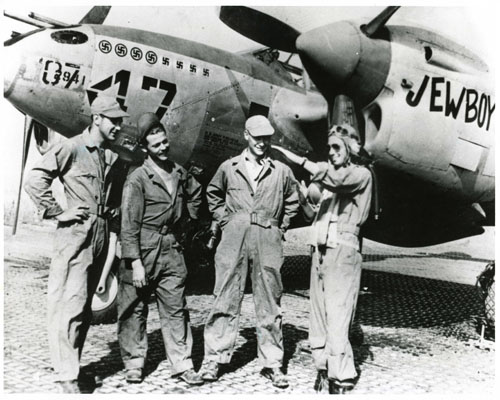
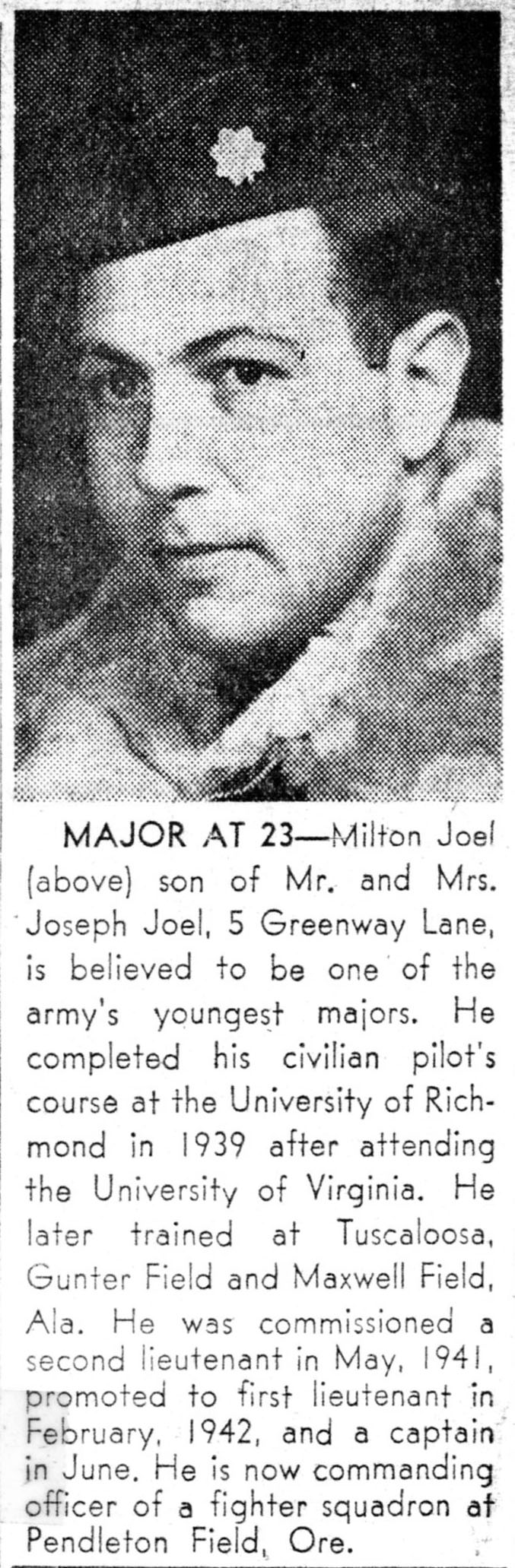 MAJOR AT 23 – Milton Joel (above) son of Mr. and Mrs. Joseph Joel, 5 Greenway Lane, is believed to be one of the army’s youngest majors. He completed his civilian pilot’s course at the University of Richmond in 1939 after attending the University of Virginia. He later trained at Tuscaloosa Field, Ala. He was commissioned a second lieutenant in May, 1941, promoted to first lieutenant in February, 1942, and a captain in June. He is now commanding officer of a fighter squadron at Pendleton Field, Ore.
 …and physical, as a patch, available from EBay seller EZ.Collect. (Not a “plug” – I simply found this image via duckduckgo!)
 ________________________________________
 Interestingly, at least four pilots in the rear row (thus all perhaps in the rear row?) were members of the 27th Fighter Squadron (Milton’s former squadron) and attained aerial victories in the Mediterranean Theater.
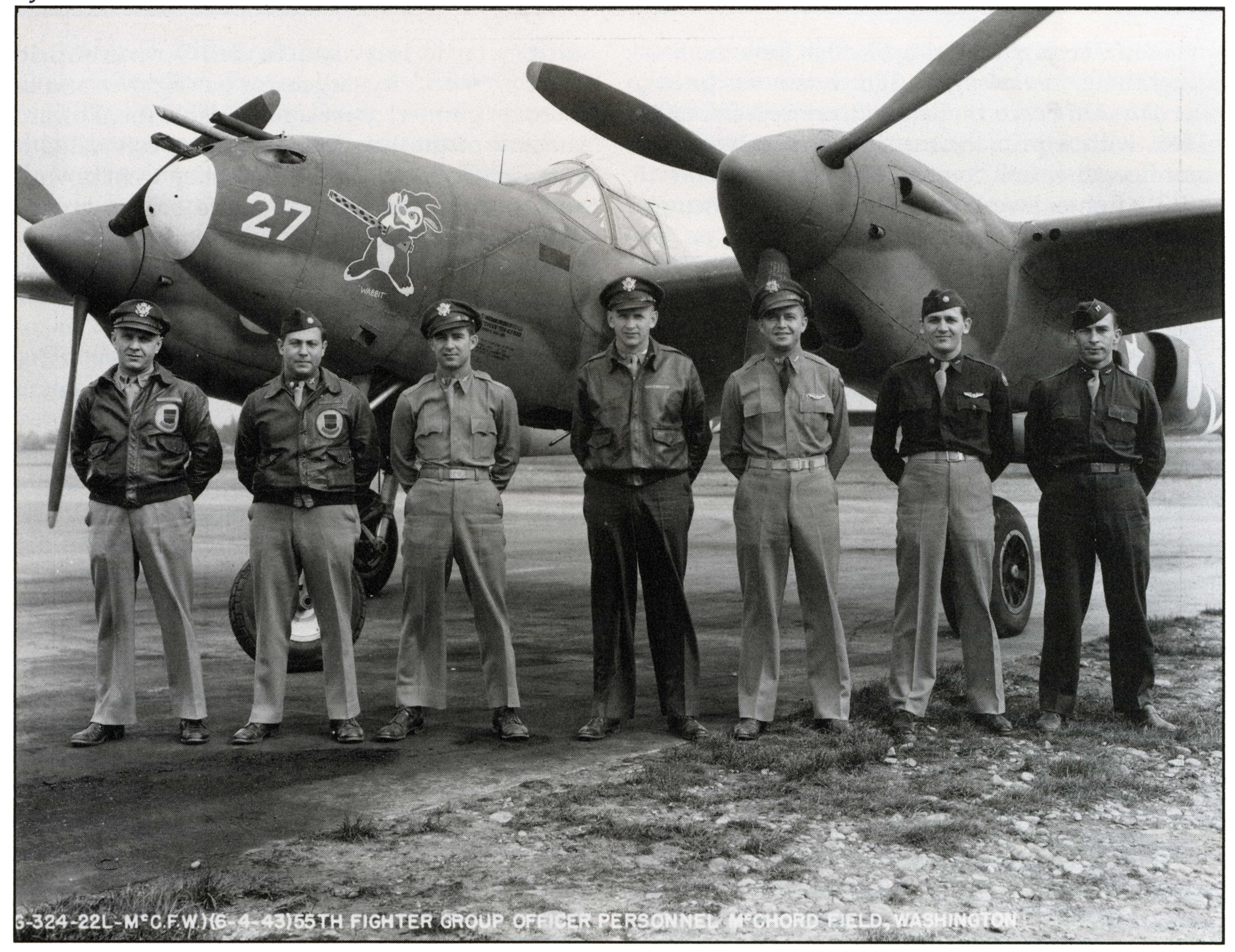 The men are…
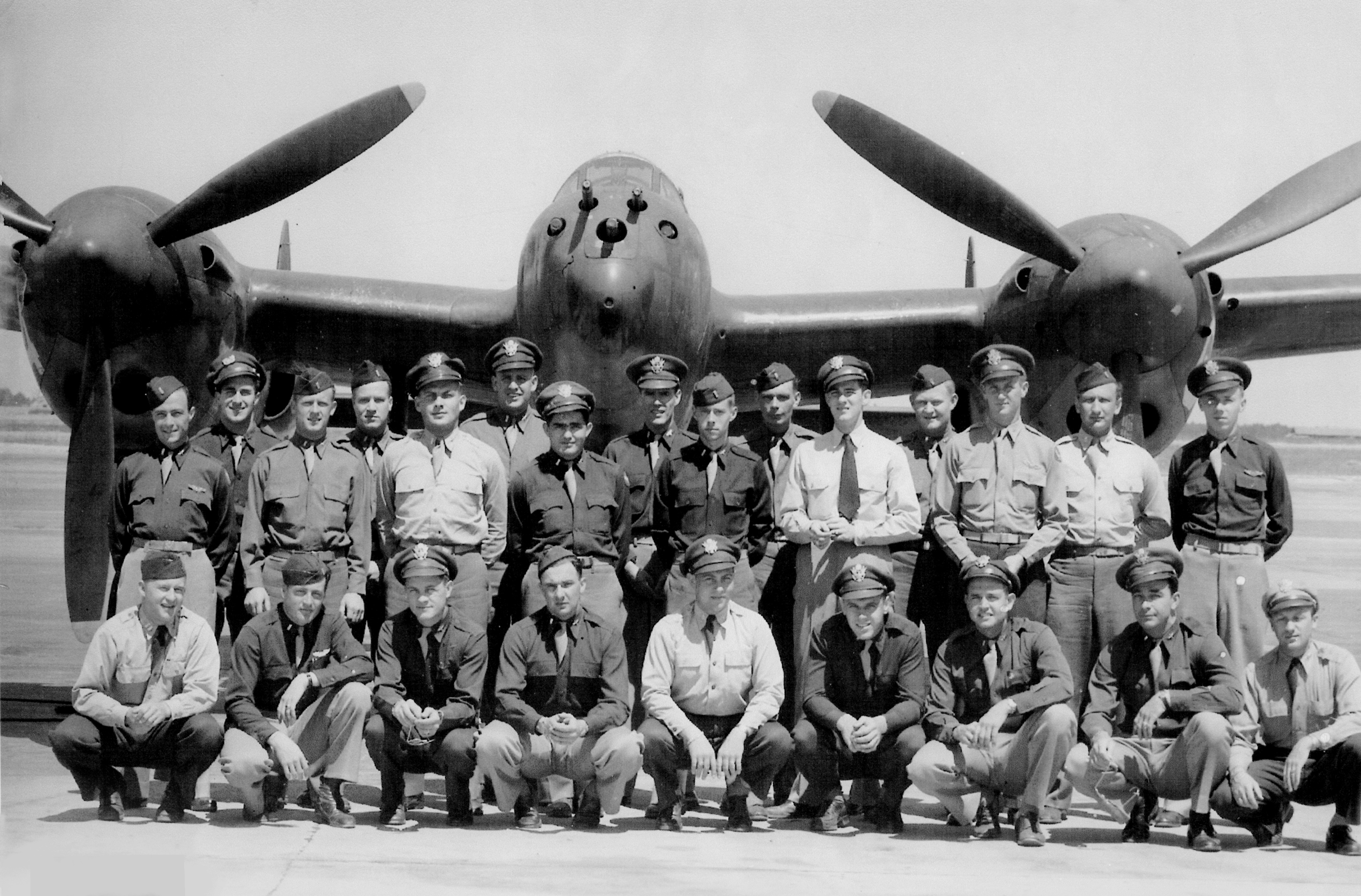 Paralleling the above pictures, this photograph is absent from the WW II U.S. Army Air Force Photo Collection. The text on the image as published in Double Nickel, Double Trouble (but not visible on this web image) states:
 In this image () a Coast Guard J4F Widgeon flies near the wreckage of the Lafayette, with the Empire State Building faintly visible in the distance. This area is probably the location of the Orion’s departure for England.
 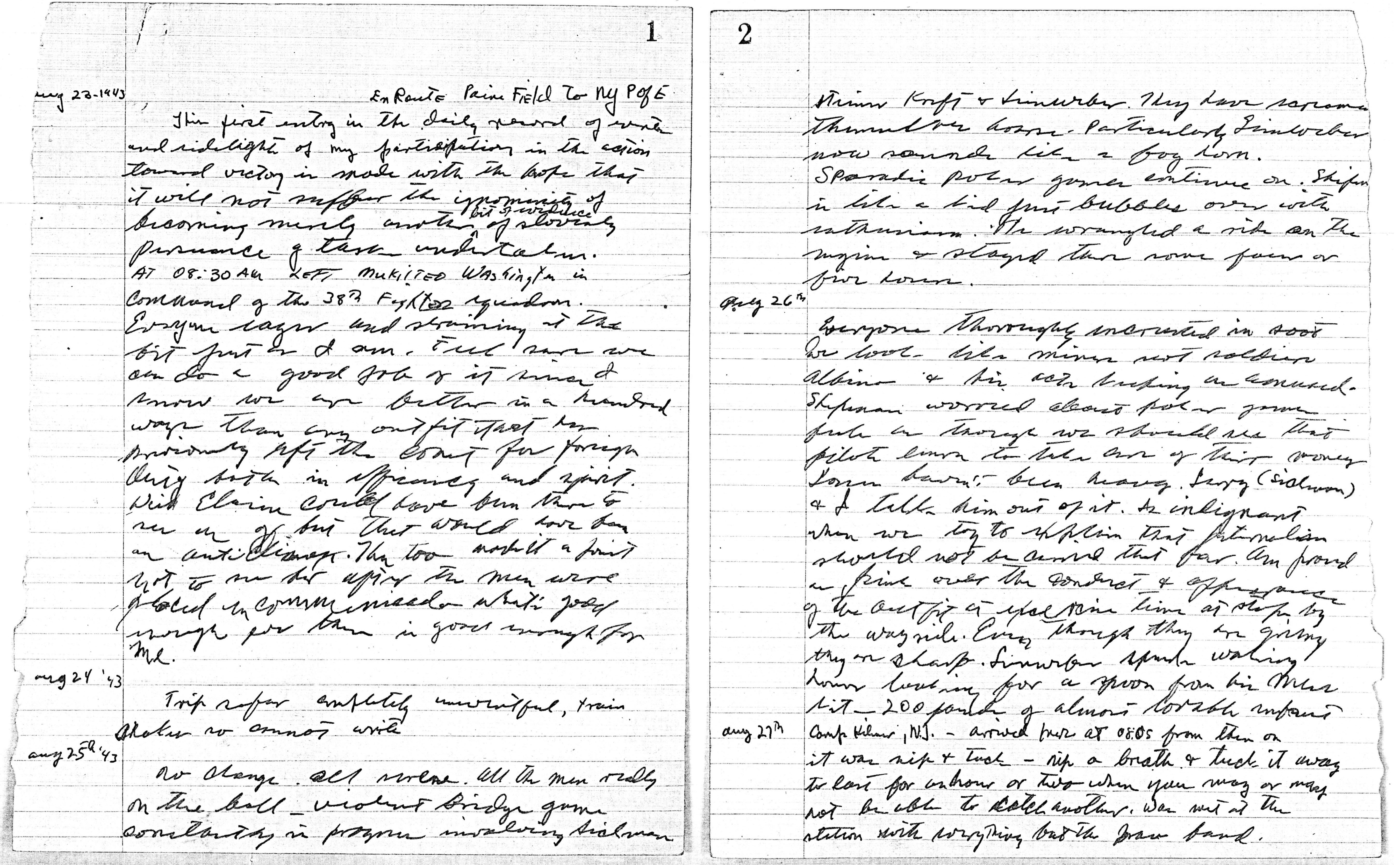 Aug 23-1943 En Route Paine Field to NY P of E
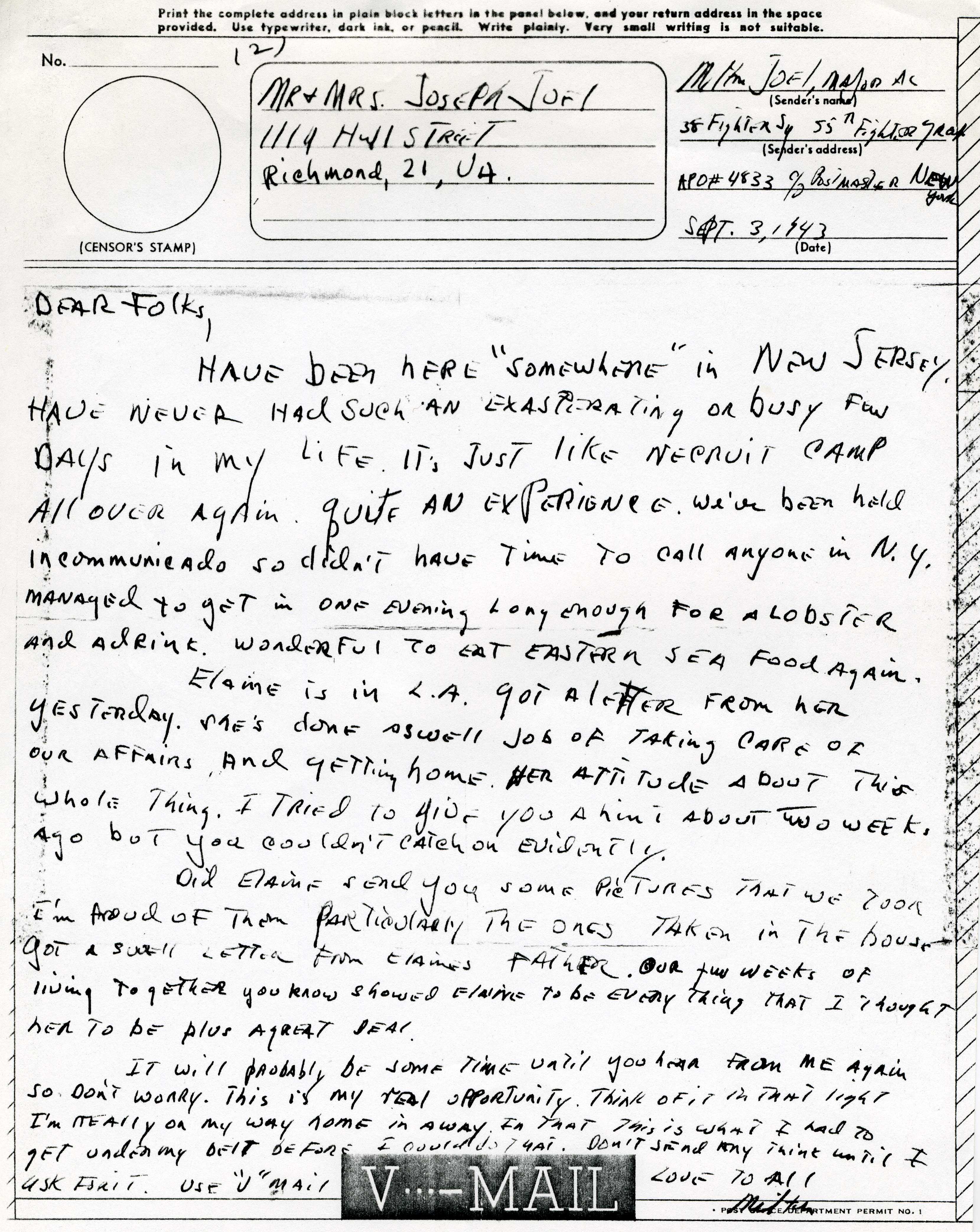 Mr. and Mrs. Joseph Joel
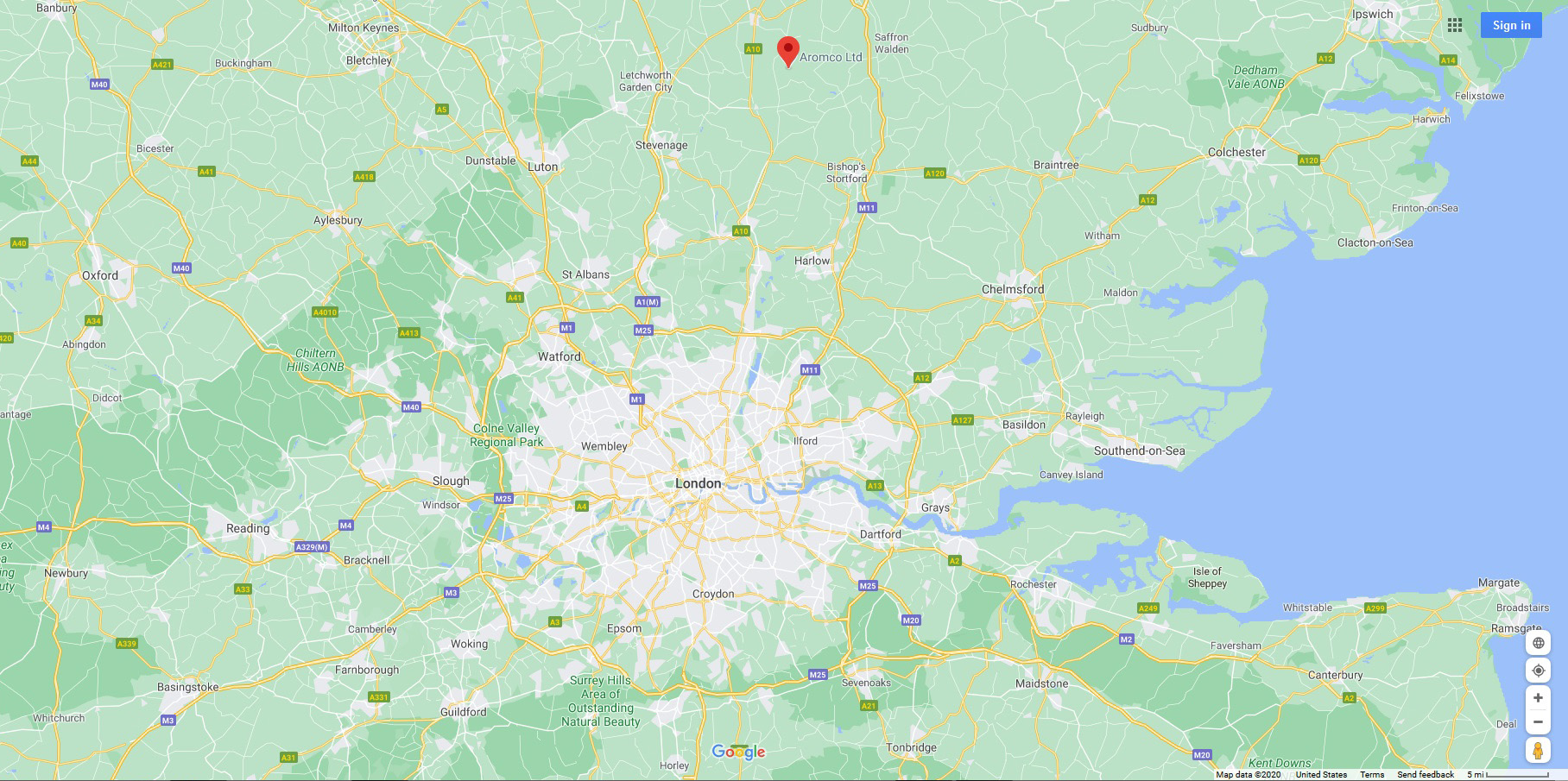 This British Government Royal Ordnance Survey aerial photo shows Nuthampstead Airfield as it appeared on July 9, 1946. Annotations on the photo are from Roger Freeman’s 1978 Airfields Of The Eighth, Then And Now. The original image has been photoshopifically “rotated” from its original orientation such that the north arrow points “up”. As such, the orientation of the airfield is congruent with the area as seen in the contemporary Oogle Earth photo, below.
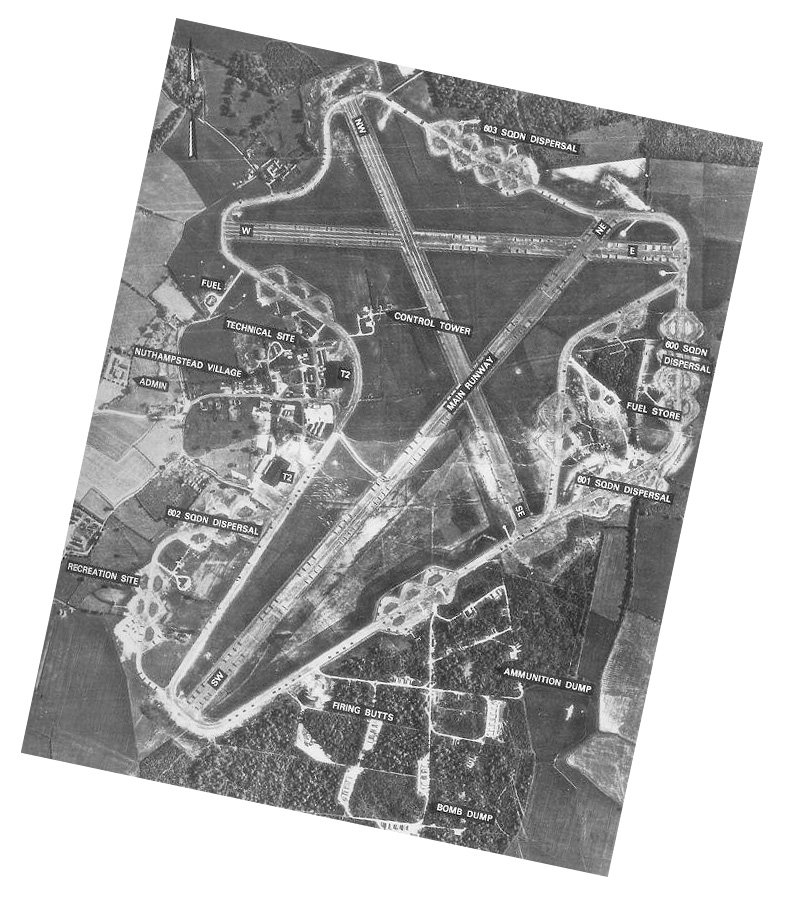 Here’s a contemporary Oogle air photo view of the area of Nuthampstead airfield and its surrounding terrain. Practically all the land upon which the air base was situated has been turned over to agricultural use.
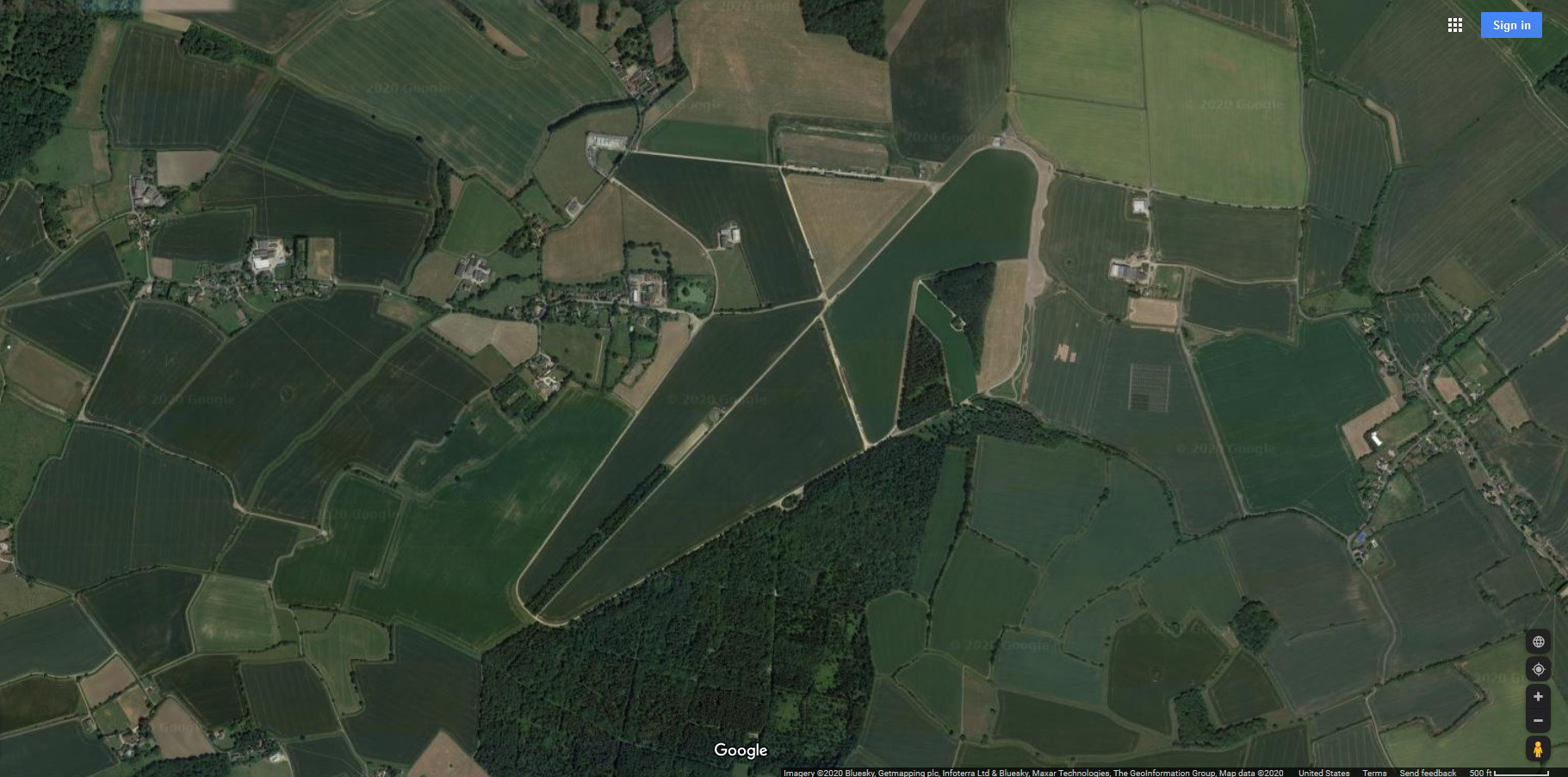 ________________________________________
 To General Kepner’s own left in the photo (left to right) are:
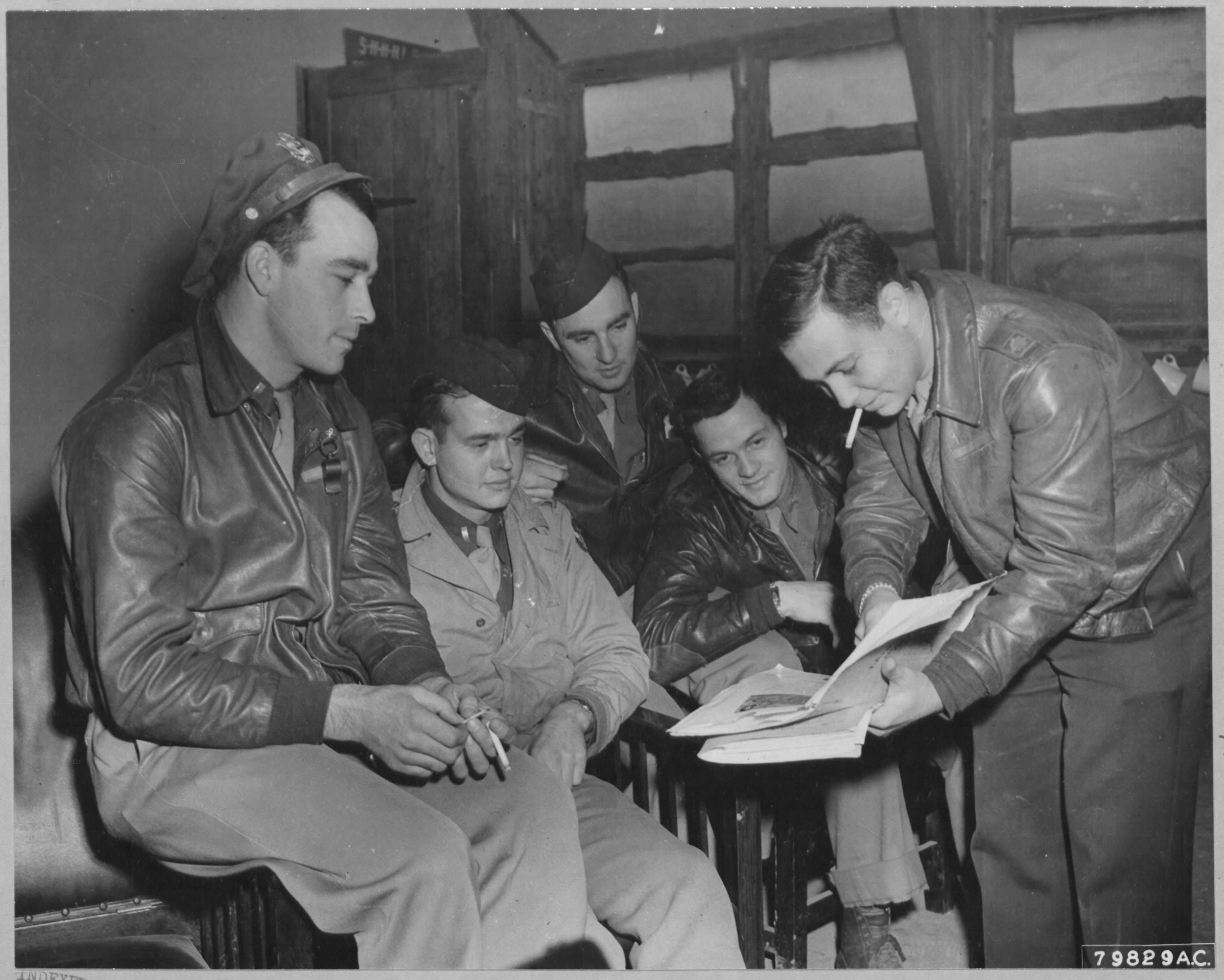 Second, image: B1 79830AC / A14145 1A.
 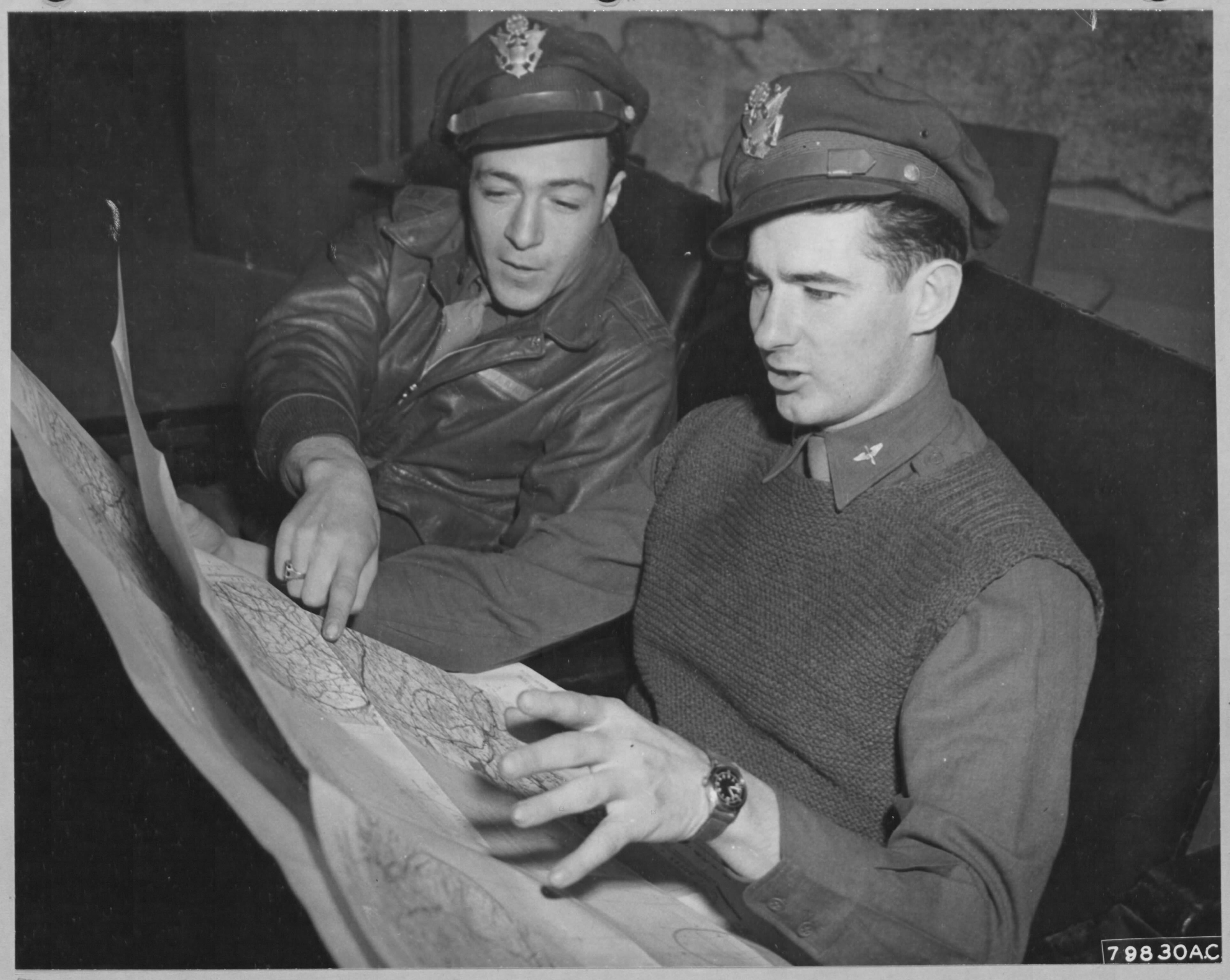 ________________________________________
 This image, from The American Air Museum in Britain, shows Captain Shipman in front of his personal P-38, 42-67080, “Skylark IV”, “CG * S”. This photograph appears on page 93 of Roger Freeman’s The Mighty Eighth, albeit in cropped form, and transposed (a mirror-image) from the actual print. Major Shipman was officially credited with 2.5 aerial victories: One in North Africa, and two in Europe.
 This image of the aircraft and ground crew was photographed by Sgt. Robert T. Sand, who not-so-coincidentally completed Skylark IV’s nose art. Note that the 20mm cannon has been removed from the plane’s nose.
 The below article about Major Shipman appeared in the Pittsburgh Press on February 6, 1943, and pertains to his experience on January 23, 1943, while he was serving as a lieutenant in the 48th Fighter Squadron of the 14th Fighter Group. Accounts of this mission, in which the 48th lost six pilots – of whom Lt. Shipman turned out to be the sole survivor – can be found at emedals.com and Rob Brown’s RAF 112 Squadron.org.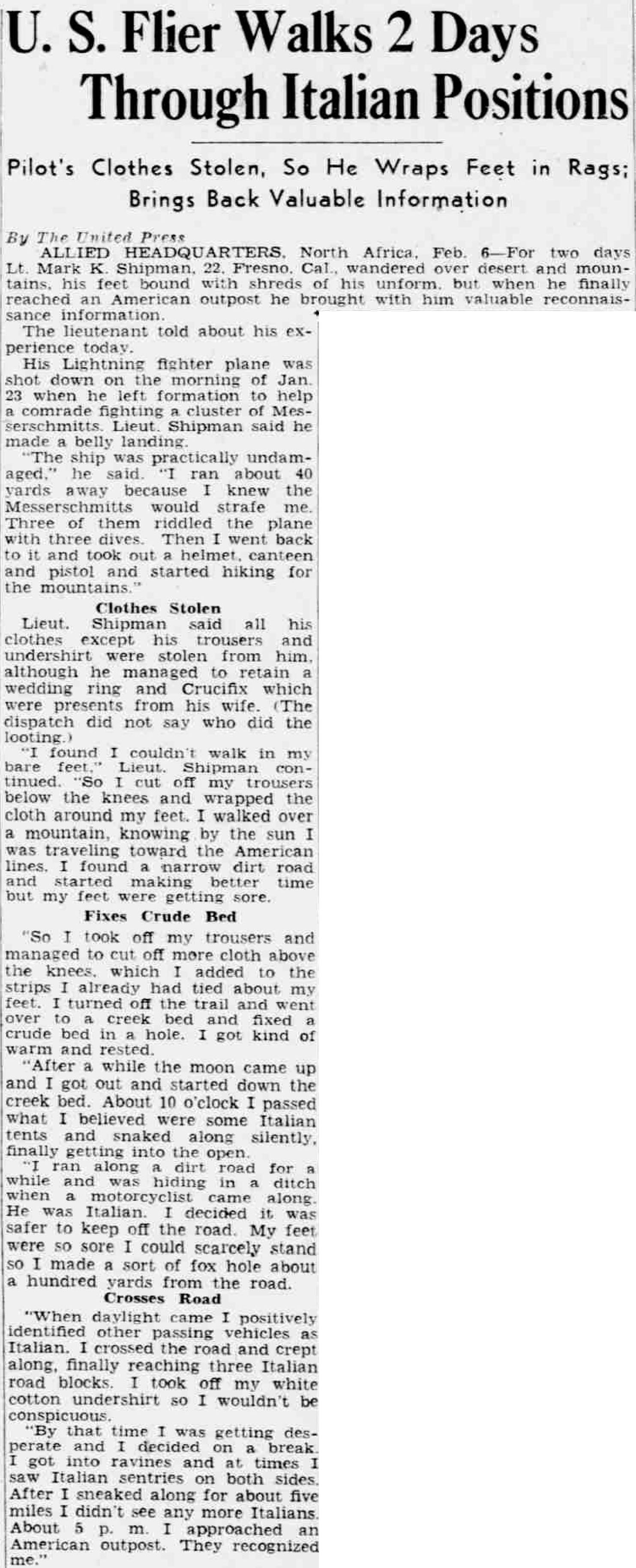
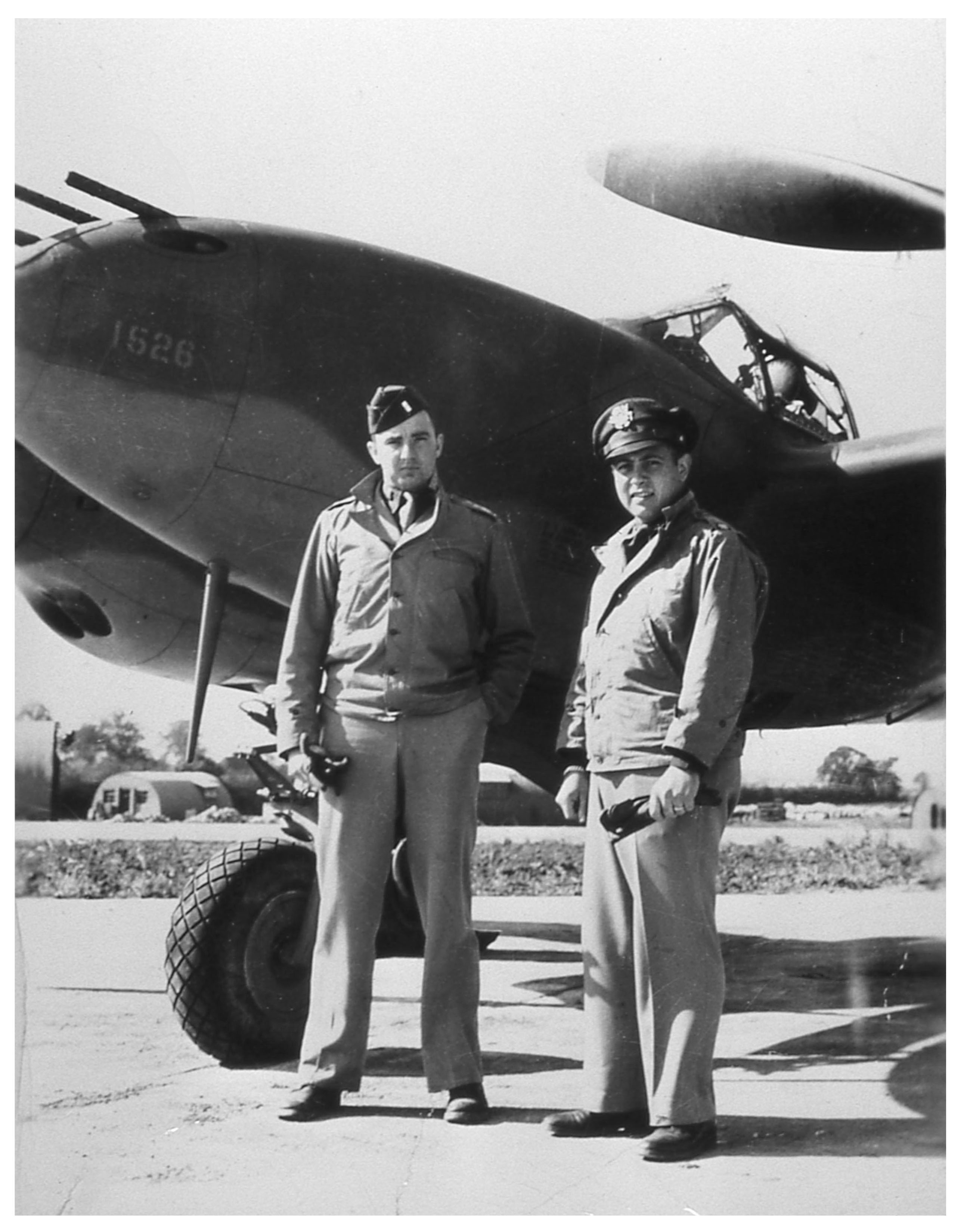 Another image of Capt. Myers, this time in front of his personal aircraft, P-38J 42-67685 “Journey’s End’ / “CG * O”, with ground crew members Sergeants K.P. Bartozeck and J. D. “Dee Dee” Durnin. The image presumably dates from very late 1943, as “Journey’s End” was destroyed during a single-engine crash-landing on January 4, 1944.
 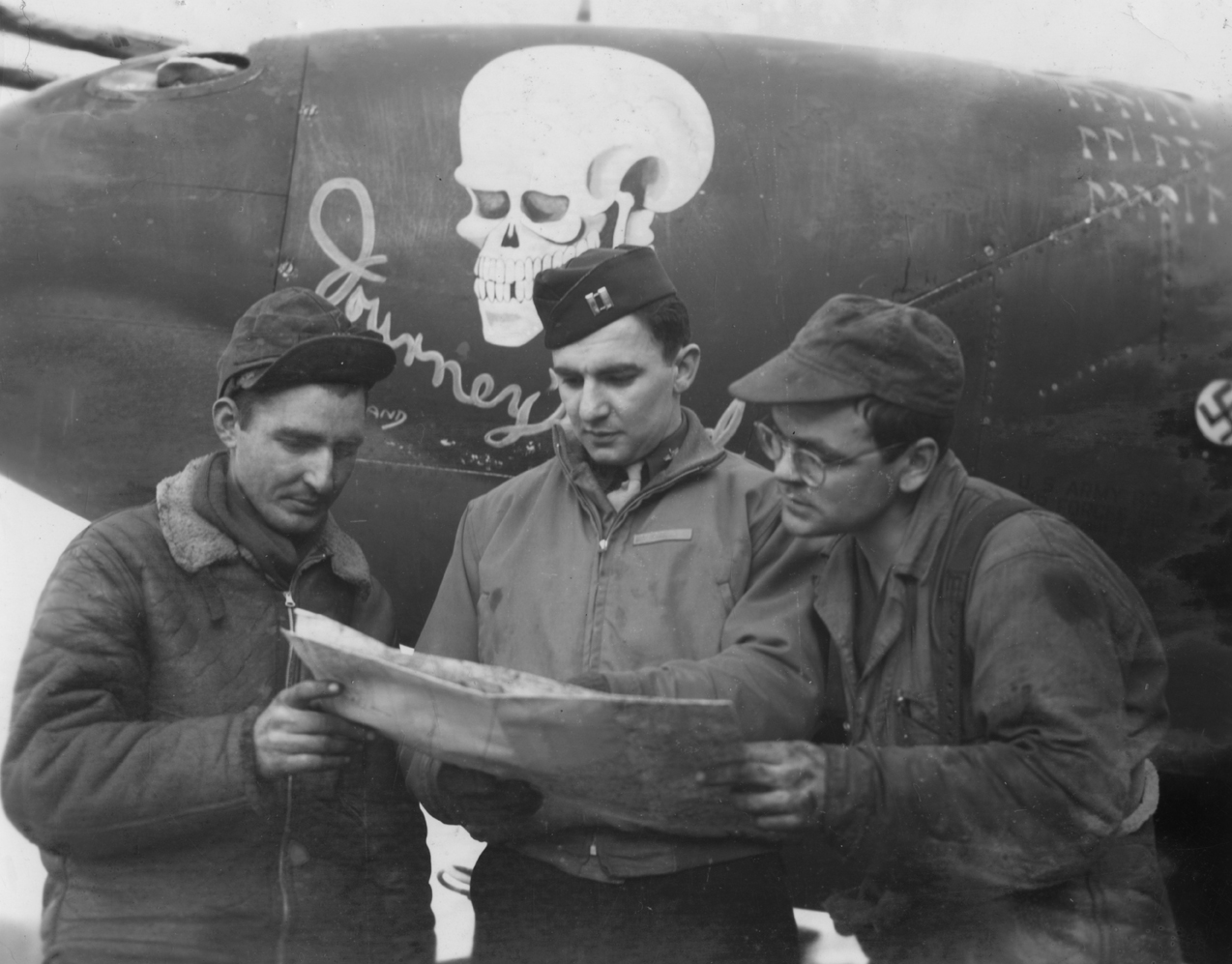 This image shows Lt. Col. Joseph Myers, seated in a P-51D Mustang, to which the 55th Fighter Group began converting in July, 1944. He commanded the 38th Fighter Squadron between February 10 and April 22 of that year. This image is from the collection of Dave Jewell.
 ________________________________________