Reading – whether fiction or non-fiction – is a journey to places real or imagined. Some literary destinations are both, particularly those in the genre of alternate history. In the overlapping realms of science fiction, and, speculative fiction, this is exemplified by Philip K. Dick’s The Man in The High Castle (see also…) and Cyril M. Kornbluth’s 1957 novella Two Dooms (…also see). Both tales, set in a post-1945 America, occur in a world where the Third Reich and Imperial Japan have defeated the Allies, and, the United States is geographically divided into zones of occupation controlled by the two victorious Axis powers.
______________________________
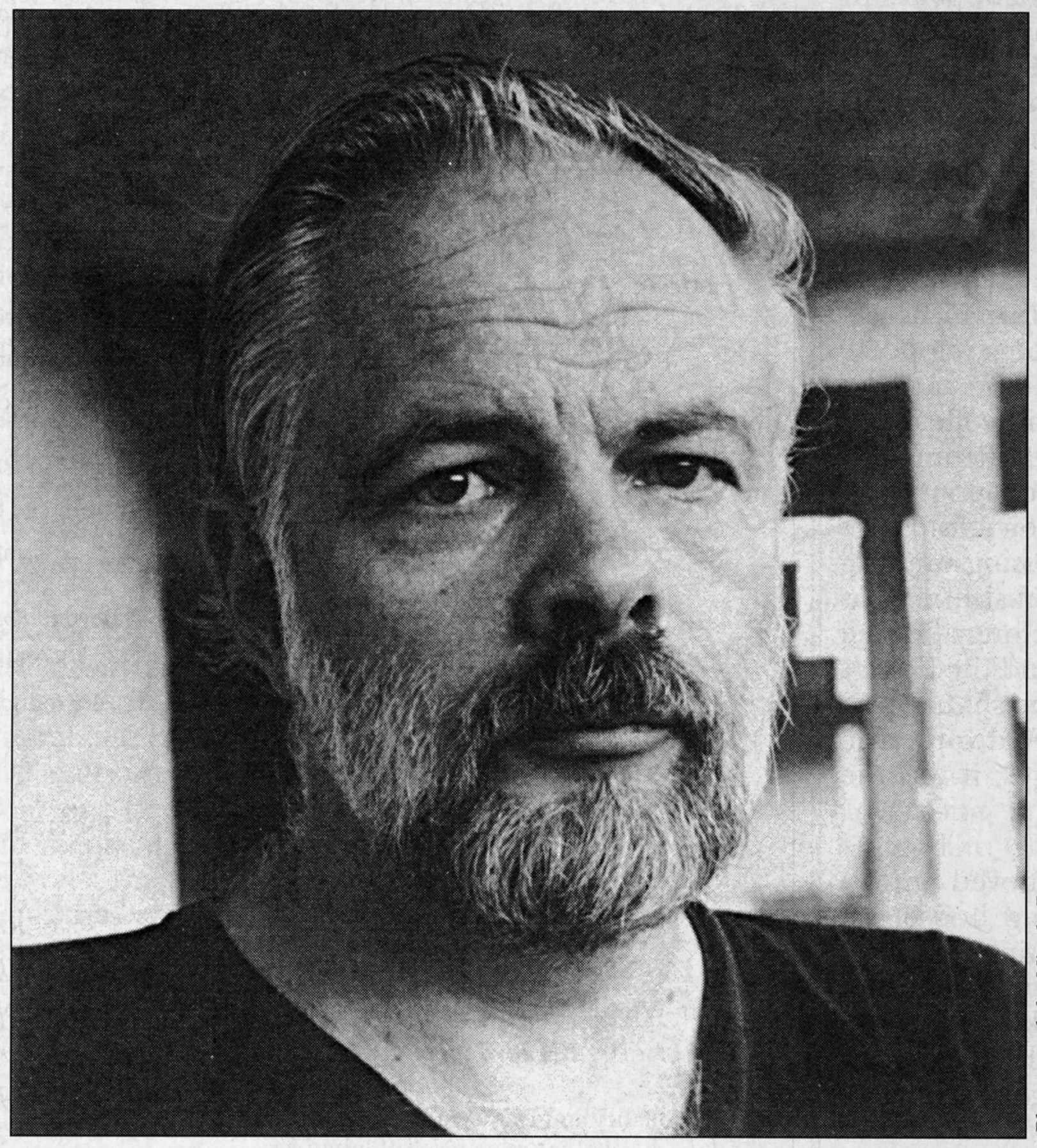
Photograph of Philip K. Dick by Nicole Panter, in Alexander Star’s article “The God in the Trash: A Review of the Works of Philip K. Dick“, in The New Republic, December 6, 1993
______________________________
The foundation of these two works, and the myriad of other tales in this genre – regardless of geographic or temporal setting – is that either a single and distinct event, or, the unanticipated confluence of a series of ostensibly unrelated events, has eventuated in history flowing along a river of time different – dramatically or subtly; humorously or horrifically – from that of the world we know.
______________________________
Cyril M. Kornbluth, 1939 (Photo by Robert A. Madle, from cover of His Share of Glory – The Complete Short Science Fiction of C. M. Kornbluth (1997), Edited by Timothy P. Szczesuil)

______________________________
This world.
The world in which you’re reading this blog post, at this point in time.
(Right here.)
(Right now.)
Given the staggering impact of the Second World War – whether ideologically, demographically, technologically, or bureaucratically; an impact that is continuing today, in 2023 – it’s not surprising that that near-eight-decade-old conflict would be the setting for writers as skilled and perceptive as Dick and Kornbluth, however different they were in life experience, world-view, and literary style.
However, what about the First World War as a springboard for a tale of alternate history?
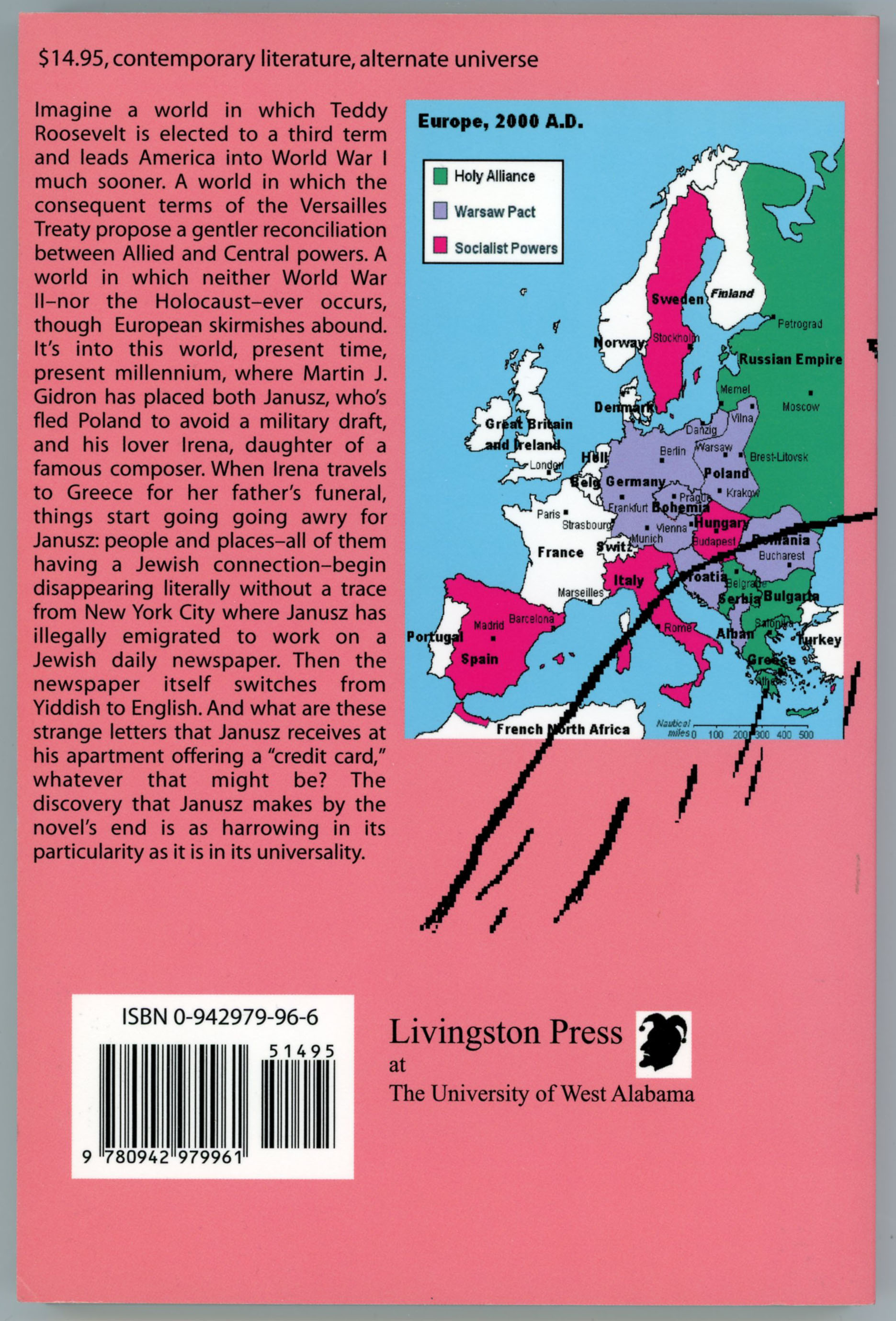
An example published in the year 2000 is Martin J. Girdon’s The Severed Wing. In his novel, Mr. Gidron has imagined a world where the First World War ended with an outcome stunningly different than that of “our” world”: The Russian monarchy was never overthrown; Imperial Russia was never transformed into the Soviet Union; Communism never wreaked horror across the world; there was never a Shoah. And with all, there was never a Second World War. (Mr. Gidron discusses such details in detail in his closing “Author’s Note,” paralleling Leo Tolstoy’s afterword to War and Peace.) And yet, while the world created by Mr. Gidron is dramatically unlike ours, it is still a world most human: a world of military alliances, geopolitical conflict, and unrelenting social and economic uncertainty, as exemplified in the life and fate of its protagonists, Janusz and Irena.
While I won’t present any “spoilers” in this post, suffice to say that the novel is very well-written and the plot smartly and well-conceived. A particularly eerie aspect of Gidron’s novel is the way in which, through a succession of events of steadily and (as we know…) irrevocably greater impact, the world of The Severed Wing is supplanted with and completely replaced by our world. The novel’s notable difference from The Man in The High Castle and Two Dooms is the near-absence of a science-fiction ambience, though one could justifiably include the book in that literary genre. In this, I think it’s close in tone to Ward Moor’s brilliantly executed Bring the Jubilee – (ohhh, has that novel long-deserved a feature film or mini-series!!!) about a world in which the Confederacy won the Civil War, in indirectly posing questions about the nature of free will, destiny, and fate.
______________________________
Portrait of Ward Moore, from his FindAGrave biographical profile, by contributor RPD2

______________________________
Otherwise, by nature and intention, Jewish history and Jewish destiny (I suppose the destiny of the Jews will be revealed in time, but “that” time will never be our time) are entirely and intentionally central to The Severed Wing, unlike Dick’s or Kornbluth’s works.
In all this, I cannot say that I “l i k e d” the conclusion of The Severed Wing – I did not – but I did appreciate it. (Well, if I restricted my reading to books about bouncing bunny rabbits with winsome eyes, I wouldn’t be reading much of anything!)
So, here are the novel’s front and read covers. (For your consideration.)

______________________________
______________________________
I read The Severed Wing in the early 2000s.
About a decade and a half later, amidst reviewing, examining, and otherwise-looking-at issues of the Jewish Frontier at the Dorot Jewish Division of the New York Public library, I discovered works of a vastly different sort of writer, written in an altogether different sort of context, that – by virtue of their timing – immediately; eerily reminded me of Gidron’s novel. The context? The journal Jewish Frontier (on 35mm microfilm, remember that?!). The writer? Jacob Lestschinsky.
As described in his biographical profile at YIVO and Wikipedia, Lestschinsky (8/26/76-3/22/66) was a historian and sociologist specializing in Jewish demography and economic history. He lived in Ukraine, Switzerland, Poland, Germany, Czechoslovakia, Latvia, and Poland once more, before – was it prescience, luck, or something else? – moving to the united States in 1938, where he lived until going on aliyah in 1959. As an academic and journalist who lived during an era and in a world of enormous and perhaps inescapable political and social turbulence, Lestschinsky had a complex professional life, which included working for ORT (The Society for Handicraft and Agricultural Work among the Jews of Russia (Obshchestvo Remeslennago i Zemledelecheskago Truda Sredi Evreev v Rossii), helping to organize the Fareynikte Yidishe Sotsialistishe Arbeter Partey (United Jewish Socialist Party), working as a correspondent for the Forverts, being a founding member of the YIVO Institute for Jewish Research, editing Bleter far yidisher demografye, statistik, un ekonomik in the mid-1920s, and throughout his career, writing for Jewish newspapers and periodicals.
In terms of Lestschinsky’s scholarship, Gennadiy Estraikh, in Science in Context (2007) notes the former as having been the author of over 35 academic papers, while a search of the Jewish Telegraphic Agency’s database yields 53 “hits” listing Lestschinky’s name in news items published between 1926 and 1966. At the Center for Jewish History, his “Correspondence with individuals and institutions” comprises about 1,800 letters.
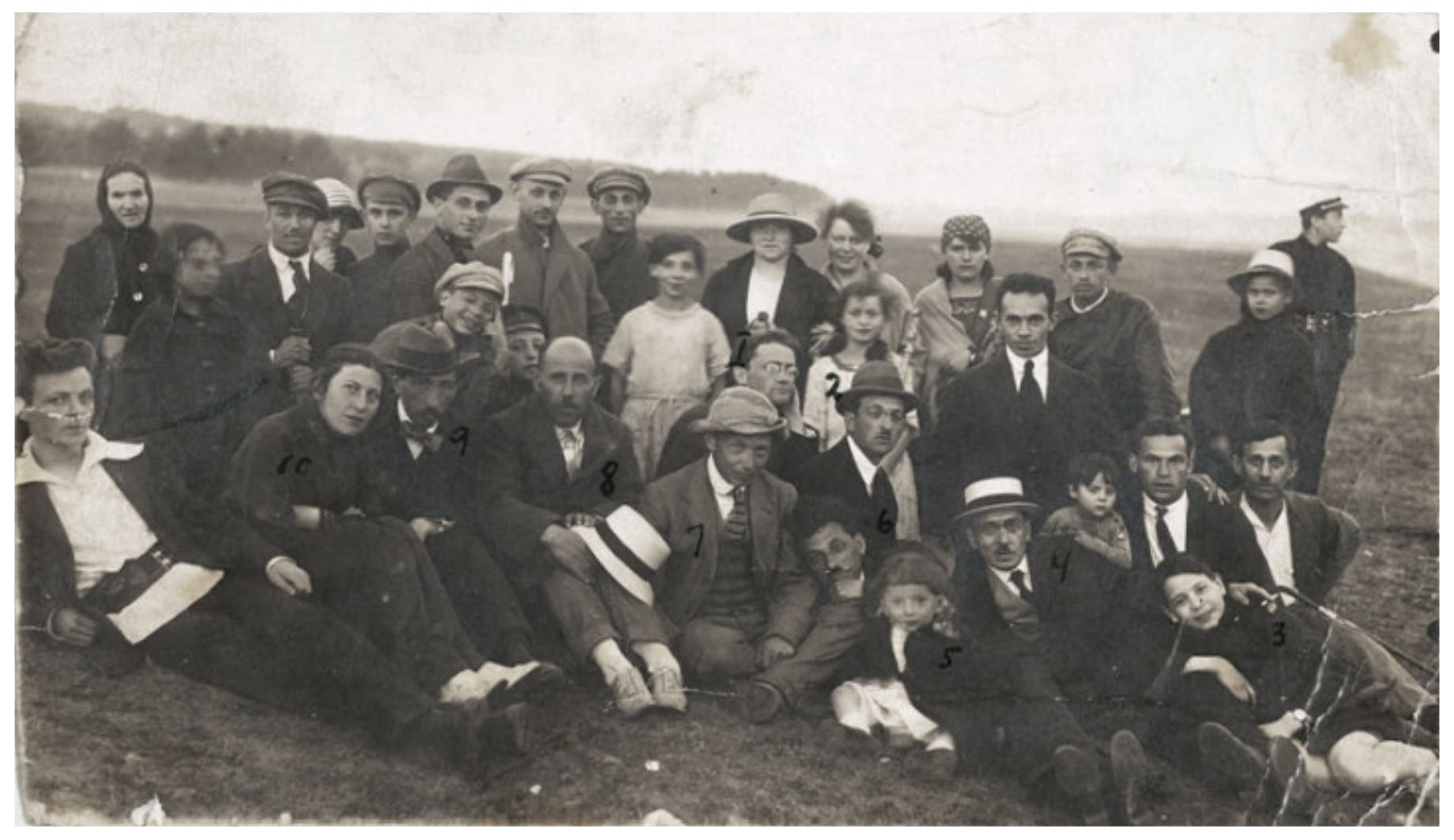
I’ve had no success in finding his photographic portrait, but his biography at YIVO includes three images in which he appears with other intellectuals, writers, and YIVO members. I’ve taken the liberty of editing (“Photoshop-Elementing”, that is) these images, which are shown below, accompanied by YIVO’s captions:
__________
“Jakob Lestschinsky (second from right), historian Simon Dubnow (center), Meyer Abraham Halevy from Bucharest (left), and other delegates to the YIVO Conference pose at the grave of Tsemaḥ Szabad, a physician, leader of the Folkist party, and founder of YIVO, Vilna, 1935.”

__________
“A gathering of Jewish intellectuals in Kulautuva, Lithuania, 1920 or 1921. Those identified in the photograph include journalist Reuven Tsarfat (2, in fedora); Bal-Makhshoves (4, wearing white boater); Dovid Bergelson (6, on ground with his head on his neighbor’s knee), his wife (10, seated, second from left), and son (5, small child to Bergelson’s left); Zelig Kalmanovitch (7, with striped tie, center); Jakob Lestschinsky (8, to Kalmanovitch’s right); and Nokhem Shtif (9, to the left of Bergelson’s wife).”
__________
“Shmuel Niger (second from right, hand-numbered “3”), his brother, the writer Daniel Tsharni (second from left, “2”), scholar Jakob Lestschinsky (left, “1”), and others, on a trip to the Alps, ca. 1920s. Photograph by M. Aschwarden.”

__________
Lestschinsky’s writings in the Jewish Frontier, all penned while he resided in the United States, pertain to the same topics as his scholarly work: They profile life in the Jewish communities of Eastern Europe in vocational / professional, economic, and demographic terms, effectively capturing a late 1930s sociological snapshot of the world Eastern European Jewry … only one year before the commencement of the Second World War. Though entirely substantive, direct, and grimly unflinching in content, and characterized by statistics and quantitative information, the quality of Lestschinsky’s writing is excellent, and comports well with the serious but not-necessarily-too-academic tone of the Jewish Frontier.
Four of these items were published as a series from June through September of 1938, each installment pertaining to a different Eastern European region or country. These titles comprise:
The Jews of Central Europe – June, 1938
The Fate of Six Million – July, 1938
Jews in Baltic Lands – August, 1938
In Fascist Rumania – September, 1938
A fifth item, published five months before the war’s September beginning, specifically describes conditions experienced (well, a more apt word would be endured) by Jewish students in Polish academic institutions. The appropriate title:
Terror in Polish Universities – April, 1939
Lestschinsky’s sixth and last item in the Jewish Frontier pertains to the Jews of the Soviet Union, but – the Second World War having ended three years previously – covers Jewish life in the Soviet Union during the early years of the (first?!) Cold War. Paralleling the refreshing, anti-Communist, anti-leftist ethos of the Jewish Frontier from the mid-1930s through the early 1950s, Lestschinsky, too, has a deeply skeptical and worried (in retrospect, more than validly so) view of the future of Jewish life in the Soviet Union. The title:
Jewish Expressions in the U.S.S.R. – December, 1948
And so, my next bunch of posts will be comprised of Lestschinsky’s Jewish Frontier articles, one article per post, verbatim.
The one conclusion that can be drawn from the articles, especially those from 1938, is that even if the river of time had traversed an altogether different and infinitely more benign course, Eastern European Jewry – in a collective sense; as it existed under conditions prevailing in the 1930s – would have intentionally and steadily reduced to an abject, irrecoverable level of penury and social degradation. Lestschinsky proposed no explicit answers to this awful predicament, but he didn’t need to: The very publication of his articles in a publication unapologetically devoted to Zionism was his answer.
________________________________________
________________________________________
In the meantime, here are some sort-of-randomly chosen news articles about, or mentioning, Jacob Lestschinsky, several found via FultonHistory. They’re chronologically arranged, and illustrate how his scholarship appeared in both the general and Jewish news media, as opposed to specialized, professional, and academic venues.
The central and haunting take-away in terms of raw numbers is how relatively little total Jewish numbers have changed across a century’s span.
Then again, what will historians of the future (if there are historians in the future) write of the world of 2023; the world as a whole; the Jewish world?
I won’t broach that question.
Oh. Seems I just did.
Whether for good, ill, or neither, perhaps it is best that the future remains unknown to man.
Some articles…
________________________________________
________________________________________
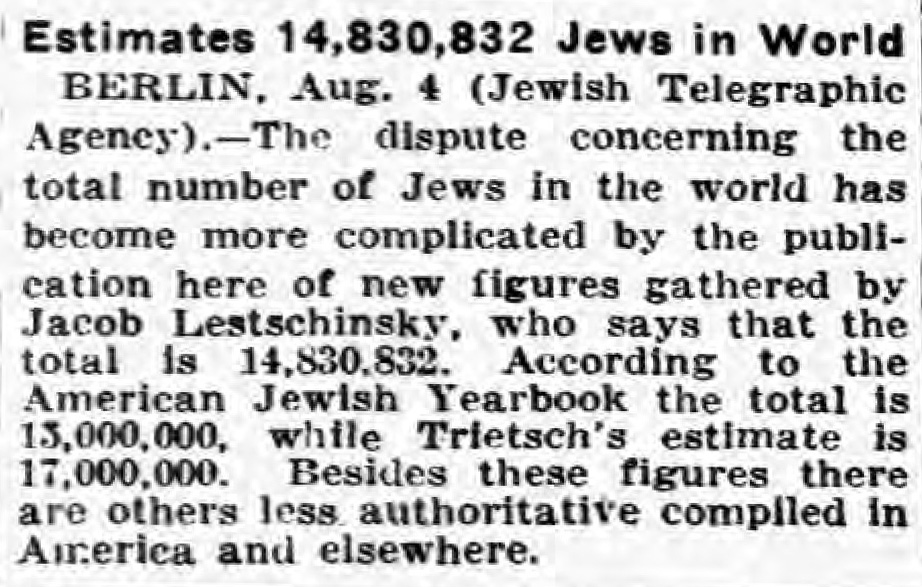
Estimates 14,830,832 Jews in World
The New York Times
August 7, 1925
BERLIN, Aug. 4 (Jewish Telegraphic Agency). – The dispute concerning the total number of Jews in the world has become more complicated by the publication here of new figures gathered by Jacob Lestschinsky, who says that the total is 14,830,832. According to the American Jewish Yearbook the total is 13,000,000, while Trietsch’s estimate is 17,000,000. Besides these figures there are others less authoritative compiled in America and elsewhere.

______________________________

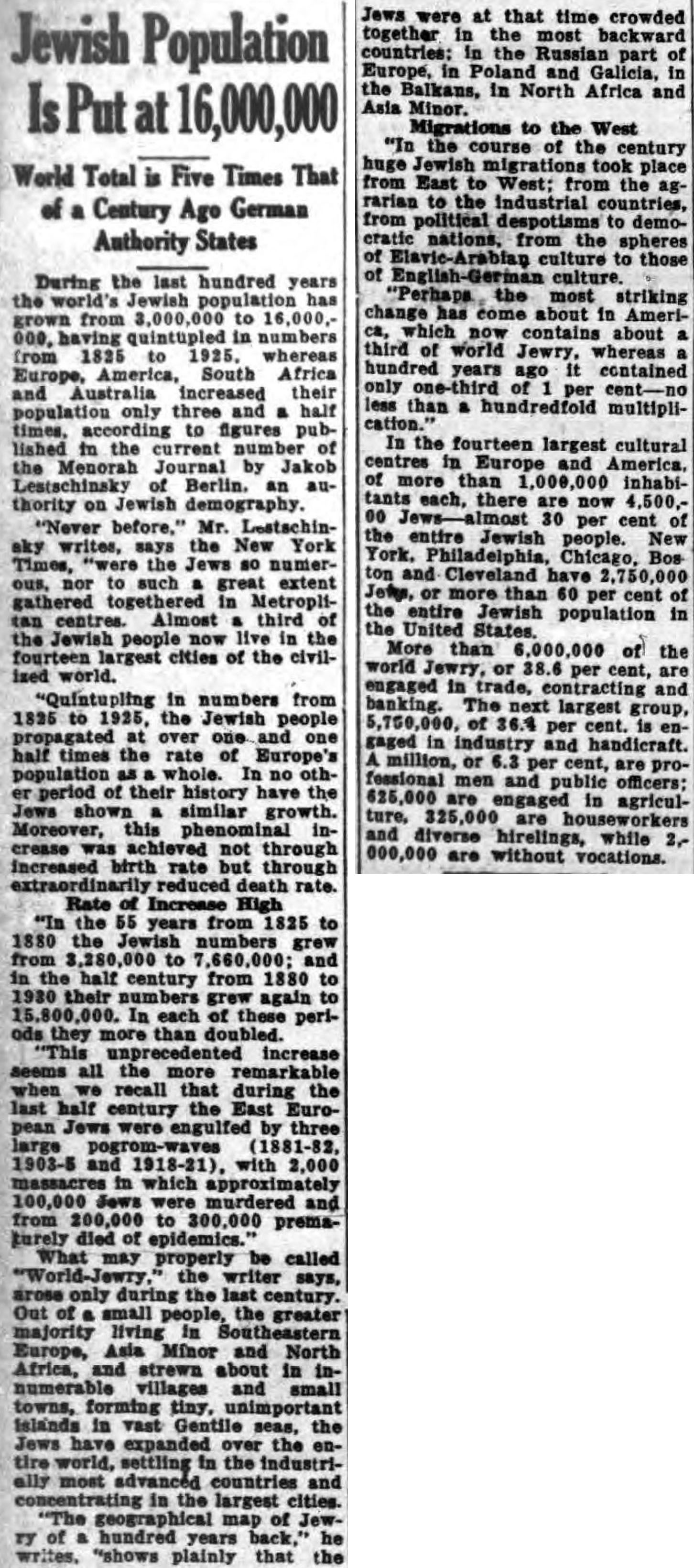
Jewish Population Is Put at 16,000,000
World Total is Five Times That
of a Century Ago German
Authority States
The Evening Leader (Corning, N.Y.)
November 1, 1932
During the last hundred years the world’s Jewish population has grown from 3,000,000 to 16,000,000, having quintupled in numbers from 1825 to 1925, whereas Europe, America, South Africa and Australia increased their population only three and a half times, according to figures published in the current number of the Menorah Journal by Jakob Lestschinsky of Berlin, an authority on Jewish demography.
“Never before,” Mr. Lestschinsky writes, says the New York Times, “were the Jews so numerous, nor to such a great extent gathered together in Metropolitan centres. Almost a third of the Jewish people now live in the fourteen largest cities of the civilized world.
“Quintupling in numbers from 1825 to 1925, the Jewish people propagated at over one and one half times the rate of Europe’s population as a whole. In no other period of their history have the Jews shown a similar growth. Moreover, this phenomenal increase was achieved not through Increased birth rate but through extraordinarily reduced death rata.
Rate of Increase High
“In the 55 years from 1825 to 1880 the Jewish numbers grew from 3,280,000 to 7,660,000; and in the halt century from 1880 to 1930 their numbers grow again to 15,800,000. In each of these periods they mora than doubled.
“This unprecedented increase seems all the mora remarkable when we recall that during the last half century the East European Jews were engulfed by three large pogrom-waves (1881-82, 1903-5 and 1918-21), with 2,000 massacres in which approximately 100,000 Jews were murdered and from 200,000 to 300,000 prematurely died of epidemics.”
What may properly be called “World-Jewry,” the writer says, arose only during the last century. Out of a small people, the greater majority living in Southeastern Europe, Asia Minor and North Africa, and strewn about in innumerable villages and small towns, forming tiny, unimportant islands in vast Gentile seas, the Jews have expanded over the entire world, settling in the industrially most advanced countries and concentrating in the largest cities.
“The geographical map of Jewry of a hundred years back,” he writes, “shows plainly that the Jews warn at that time crowded together in the most backward countries: In the Russian part of Europe, in Poland and Galicia, in the Balkans, in North Africa and Asia Minor.
Migrations to the West
“In the course of the century huge Jewish migrations took place from East to West; from the agrarian to the Industrial countries, from political despotisms to democratic nations, from the spheres of Slavic-Arabian culture to those of English-German culture.
“Perhaps the most striking change has come about in America, which now contains about a third of world Jewry, whereas a hundred years ago it contained only one-third of 1 per cent – no less than a hundredfold multiplication.”
In the fourteen largest cultural centres in Europe and America, of more than 1,000,000 inhabitants each, there are now 4,500,000 Jews – almost 20 per cent of the entire Jewish people. New York, Philadelphia, Chicago, Boston and Cleveland have 2,750,000 Jews, or more than 80 per cent of the entire Jewish population in the United States.
More than 6,000,000 of the world Jewry, or 38.6 per cent, are engaged in trade, contracting and banking. The next largest group, 5,750,000, of 36.4 per cent, is engaged in Industry and handicraft. A million, or 6.3 per cent, are professional men and public officers: 625,000 are engaged in agriculture, 325,000 are houseworkers and diverse hirelings, while 2,000,000 are without vocations.
______________________________
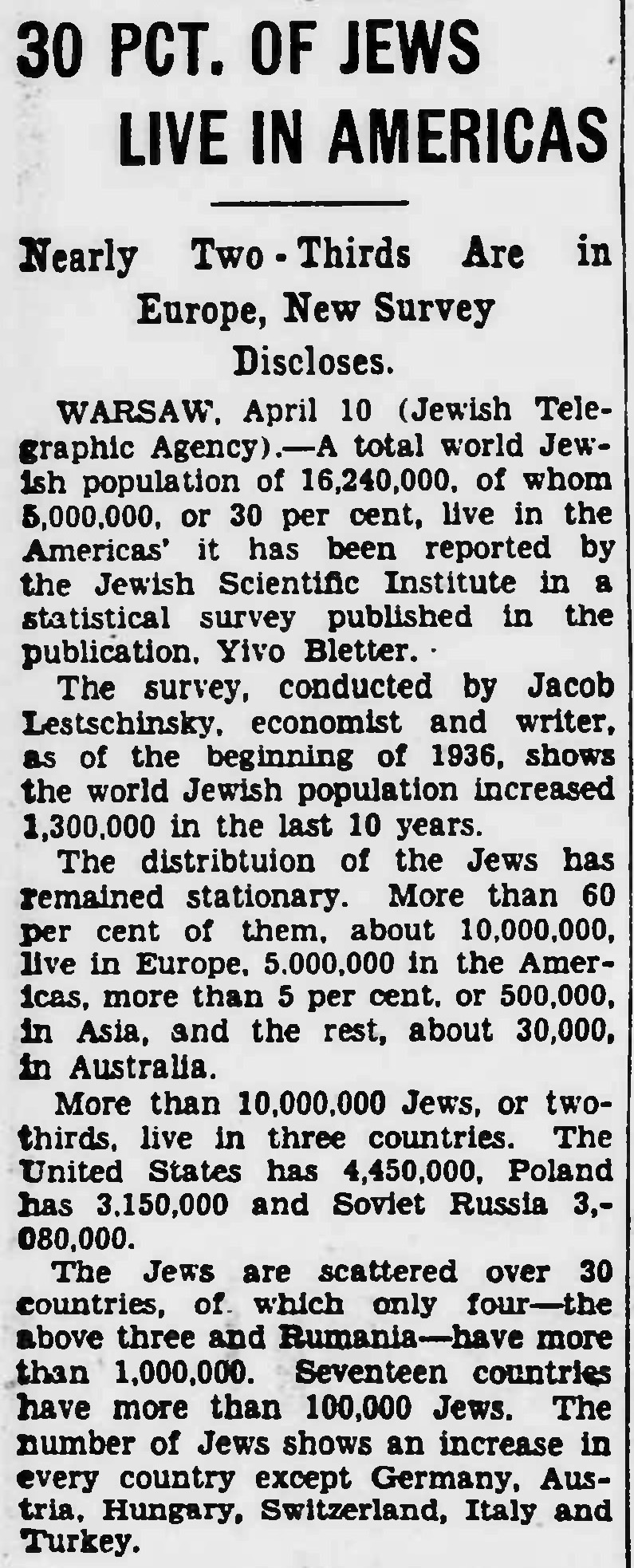
30 PCT. OF JEWS LIVE IN AMERICAS
Nearly Two-Thirds Are in Europe, New Survey Discloses.
The Evening Star (Washington, D.C.)
April 10, 1936
WARSAW, April 10 (Jewish Telegraphic Agency). – A total world Jewish population of 16,240,000 of whom 5,000,000, or 30 per cent, live in the Americas it has been reported by the Jewish Scientific Institute in a statistical survey published in the publication, Yivo Bletter.
The survey, conducted by Jacob Lestschinsky, economist and writer, as of the beginning of 1936, shows the world Jewish population increased 1,300,000 in the last 10 years.
The distribution of the Jews has remained stationary. More than 60 per cent of them, about 10,000,000, live in Europe, 5,000,000 In the Americas, more than 5 per cent, or 500,000, in Asia, and the rest, about 30,000, in Australia.
More than 10,000,000 Jews, or two-thirds, live in three countries. The United States has 4,450,000, Poland has 3,150,000 and Soviet Russia 3,080,000.
The Jews are scattered over 30 countries, of. which only four – the above three and Rumania – have more than 1,000,000. Seventeen countries have more than 100,000 Jews. The number of Jews shows an increase in every country except Germany, Austria, Hungary, Switzerland, Italy and Turkey.

______________________________
Jewish Population
The Southern Jewish Weekly
June 6, 1952
The figures indicating the Jewish population in various sections of the world, released last week by the World Jewish Congress, are substantially similar to those made available earlier in the year in the American Jewish Year Book for 5712, published jointly by the American Jewish Committee and the Jewish Publication Society.
The present study, made by Dr. Jacob Lestschinsky, statistician and demographer, shows that “wars and anti-Jewish terror in Europe, the birth of Israel and other factors led to the migration of more than 4,000,000 Jews since the turn of the century, thus changing the entire Jewish demographic picture.”
Coming closer home, the United States is given a Jewish population of five million; Argentina, 400,000; Canada, 200,000; Brazil, 120,000; with the Jewish population in other eighteen Latin-American countries estimated at 150,000.
Of especial significance, Dr. Lestschinsky points out is the “remarkably swift growth of the Jewish community in the Holy Land, where the Jewish population has increased forty-fold in the last fifty years, rising from 35,000 in 1900 to 1,400,000 at the end of 1951.” One shudders to contemplate what might have happened to a preponderant majority of these 1,400,000 men, women and children had Israel not been eager, even though not prepared, to receive them. This may not come within the purview of the statistician; it must not be overlooked by those who read his figures.
In Europe, that is, with the exception of the Jewish groups behind the Iron Curtain, there are only two major Jewish communities – Britain with a Jewish population of 400,000, and France with a Jewish population of 240,000.
All of which furnishes an interesting picture of world Jewry today.


______________________________
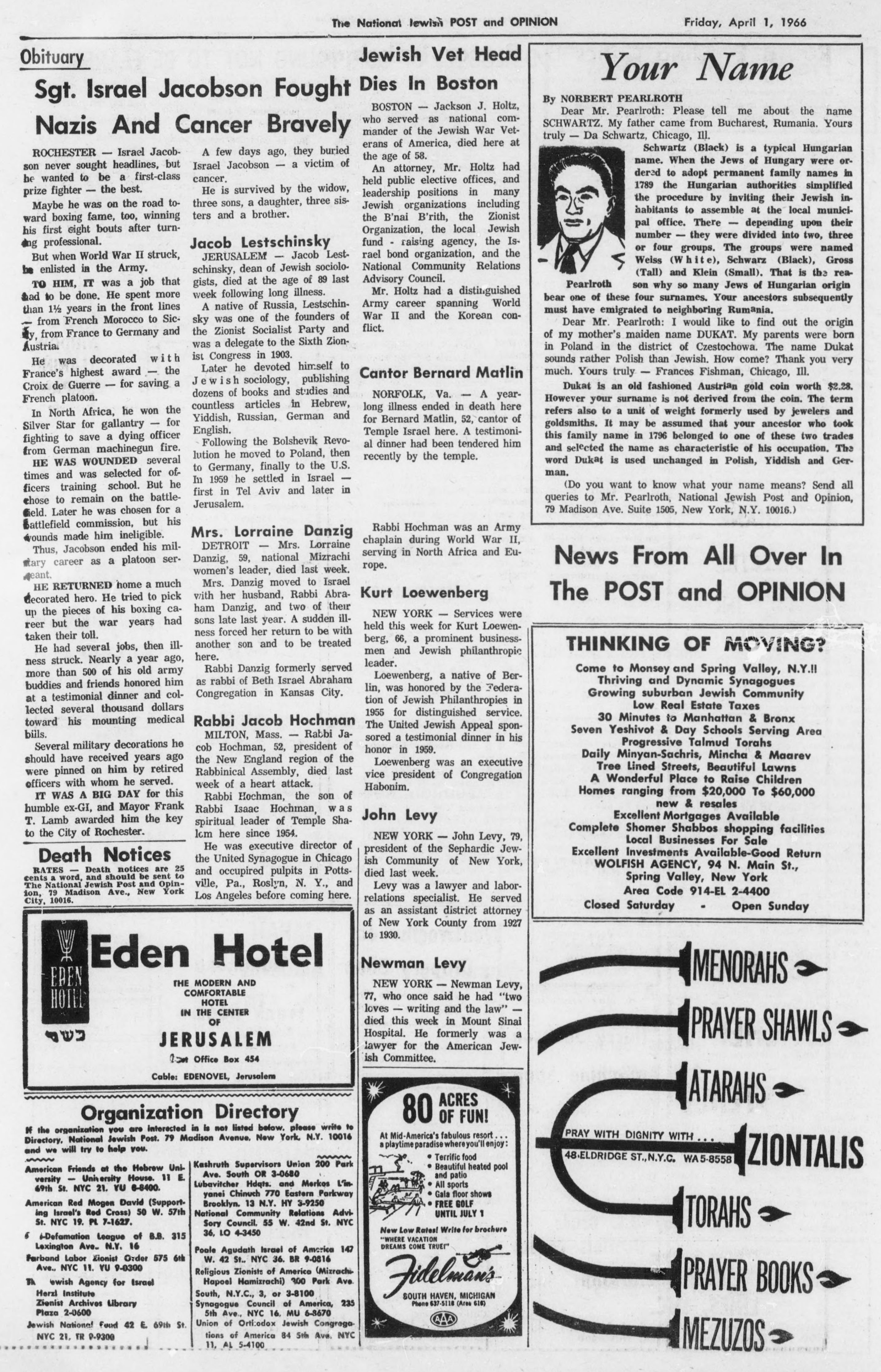
This April, 1966 issue of The National Jewish Post and Opinion (of Indiana) is interesting on two counts.
First, it mentions Jacob Lestschinsky’s passing in Jerusalem.
Second, it carries an obituary for and tribute to a man whose life took a far different path: Israel Jacobson of Rochester, New York, who at the young age of forty-four (young even in 1966) passed away only a week before Lestschinsky. Though Jewish affairs in upstate New York would ostensibly have little relevance to Jewish life in Indiana, it turns out that Israel Jacobson, as T/Sgt. Israel Jacobson (12017570), heavily decorated for military service as an infantryman in the North African campaign, was the subject of several articles in Rochester and Buffalo newspapers in mid-1965. These related his belated receipt of military awards, and (perhaps because he’d been a boxer before entering the military) his struggle with cancer.
A member of E Company, 18th Infantry Regiment, 1st Infantry Division, Israel Jacobson was the son of Rabbi Harry Jacobson, of 60 Baden Street, in Rochester. Born in Poland on November 2, 1921, he passed away on March 20, 1966, and is buried at Britton Road Cemetery, in Rochester. His name appears on page 351 of American Jews in WW II, which records that he received the Silver Star with one Oak Leaf Cluster, Bronze Star, and Purple Heart (he was wounded in mid-February of 1943) with one Oak Leaf Cluster. His wartime story was noted in The American Hebrew (6/11/43), Chicago Jewish Chronicle (5/28/43), and Rochester Times Union (3/26/43, 8/24/43, 7/11/45), while postwar, news articles about him appeared in the Buffalo Courier-Express, Rochester Democrat and Chronicle, and Jamestown Post-Journal.
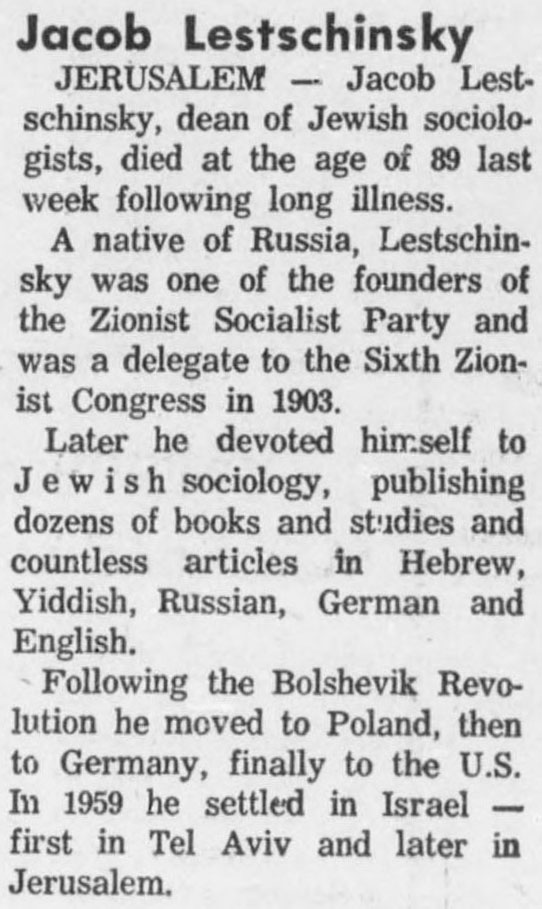
Jacob Lestschinsky
National Jewish Post and Opinion
April 1, 1966
JERUSALEM – Jacob Lestschinsky, dean of Jewish sociologists, died at the age of 89 last week following long illness.
A native of Russia, Lestschinsky was one of the founders of the Zionist Socialist Party and was a delegate to the Sixth Zionist Congress in 1903.
Later he devoted himself to Jewish sociology, publishing dozens of books and studies and countless articles in Hebrew, Yiddish, Russian, German and English.
Following the Bolshevik Revolution he moved to Poland, then to Germany, finally to the U.S. In 1959 he settled in Israel – first in Tel Aviv and later in Jerusalem.
__________
RABBI’S SON ENTERS PRO PRIZE RING
The Wave (Rockaway Beach), July 11, 1946
After five years in uniform, ex-Army tech sergeant Israel Jacobson, the fighting son of a Rochester, N.Y., rabbi, has laid aside his carbine, and henceforth will restrict his fighting qualities to the professional prize ring as a Long Island’s bid for featherweight honors among the paid to punch brigade.
Twice overseas and twice wounded, “Battling Jacobson” as he has been dubbed by Long Island fight fans, participated in five major campaigns and two invasions. He holds several Army awards including the Croix de Guerre, Silver Star Medal, Bronze Star Medal, New York State Conspicuous Service Cross, and the Purple Heart with Oak Leaf Cluster.
Wisely enough, Jacobson, now a resident of Queens, has placed his fistic destiny in the hands of Irwin Goldie, internationally known fight manager and former G.I. who managed Billy Conn’s overseas tour and promoted service boxing tournaments in London, Paris and Rome.
Sgt. Jacobson’s story travelled from Rochester to Long Island. Here’s an article from The Wave (Rockaway Beach) from July 11, 1946:

__________
______________________________
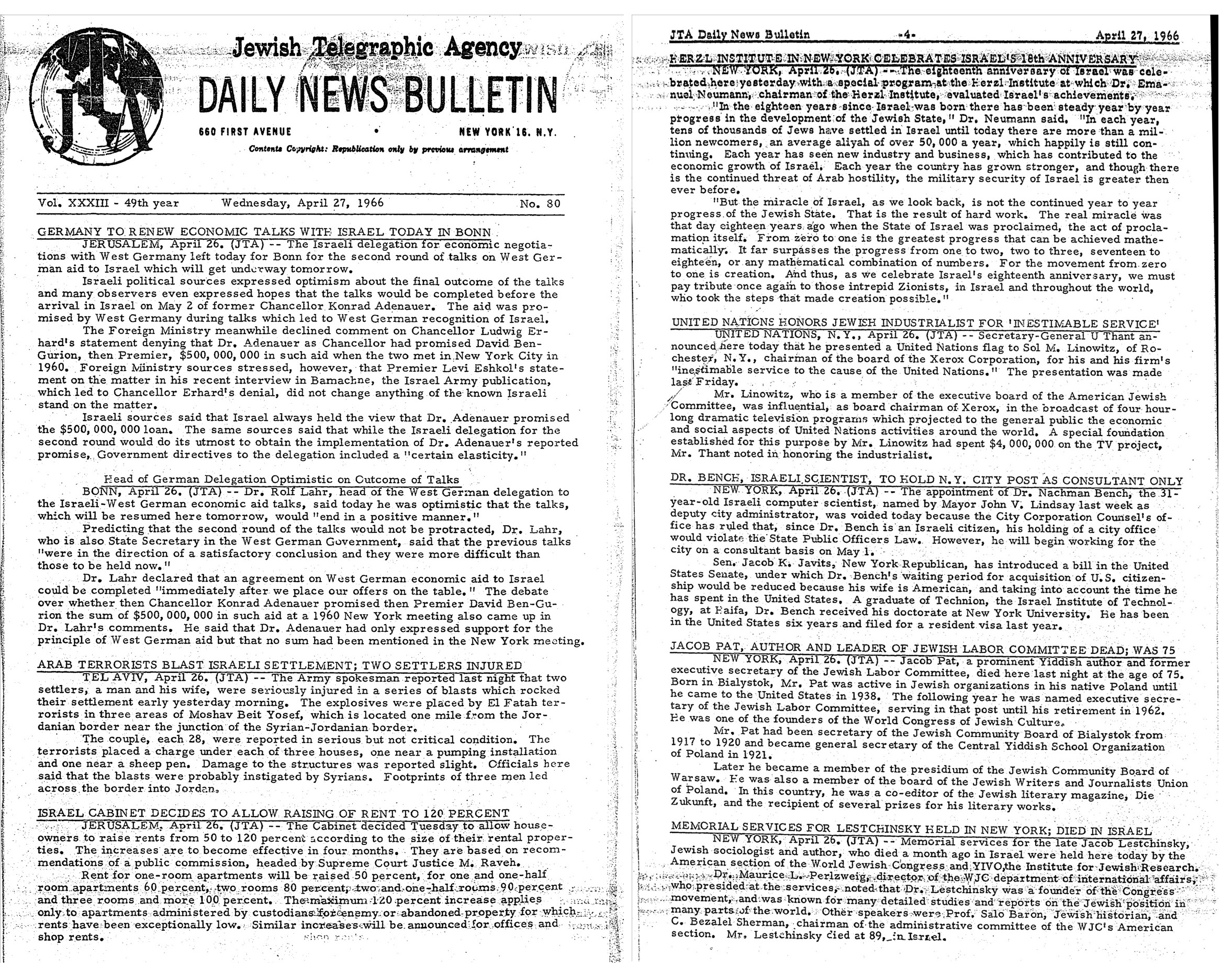
MEMORIAL SERVICES FOR LESTCHlNSKY HELD IN NEW YORK; DIED IN ISRAEL
Jewish Telegraphic Agency
April 27, 1966
NEW YORK, April 26. (JTA) — Memorial services for the late Jacob Lestchinsky, Jewish sociologist and author, who died a month ago in Israel were held here today by the American section of the World Jewish Congress and YIVO, the Institute for Jewish Research. Dr Maurice L. Perlzweig, director of the WJC department of international affairs, who presided at the services, noted that Dr. Lestchinsky was a founder of the Congress movement, and was known for many detailed studies and reports on the Jewish position in many parts of the world. Other speakers were Prof. Salo Baron, Jewish historian, and C. Bezalel Sherman, chairman of the administrative committee of the WJC American section. Mr. Lestchinsky died at 89, in Israel.

________________________________________
________________________________________
For Your Further Enlightenment and Distraction…
Jacob Lestschinsky, at…
… The YIVO Encyclopedia of Jews in Eastern Europe
… National Library of Israel (Catalog records of books, archives, articles, and miscellaneous items)
… Center for Jewish History (Jacob Lestschinsky’s Correspondence with individuals and institutions, comprising about 1,800 letters)
World Jewish Population by Country, at…
Estraikh, Gennadiy, Jacob Lestschinsky: A Yiddishist Dreamer and Social Scientist, Science in Context, V 20, N 2, 2007, pp. 215-237. (Bibliography lists over 35 works by Lestschinsky)