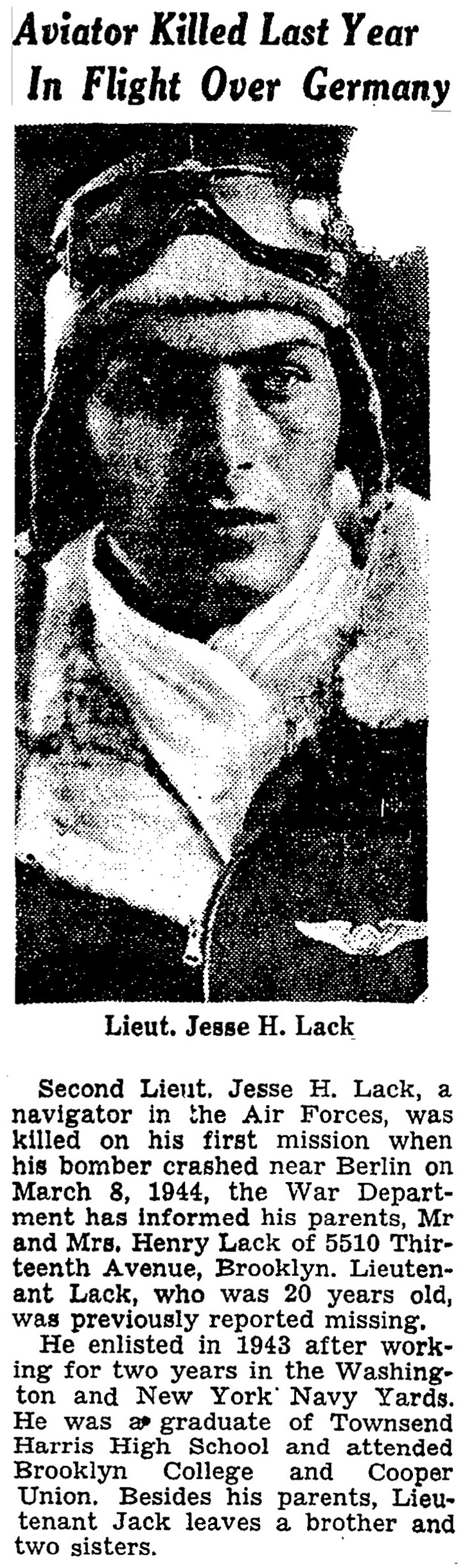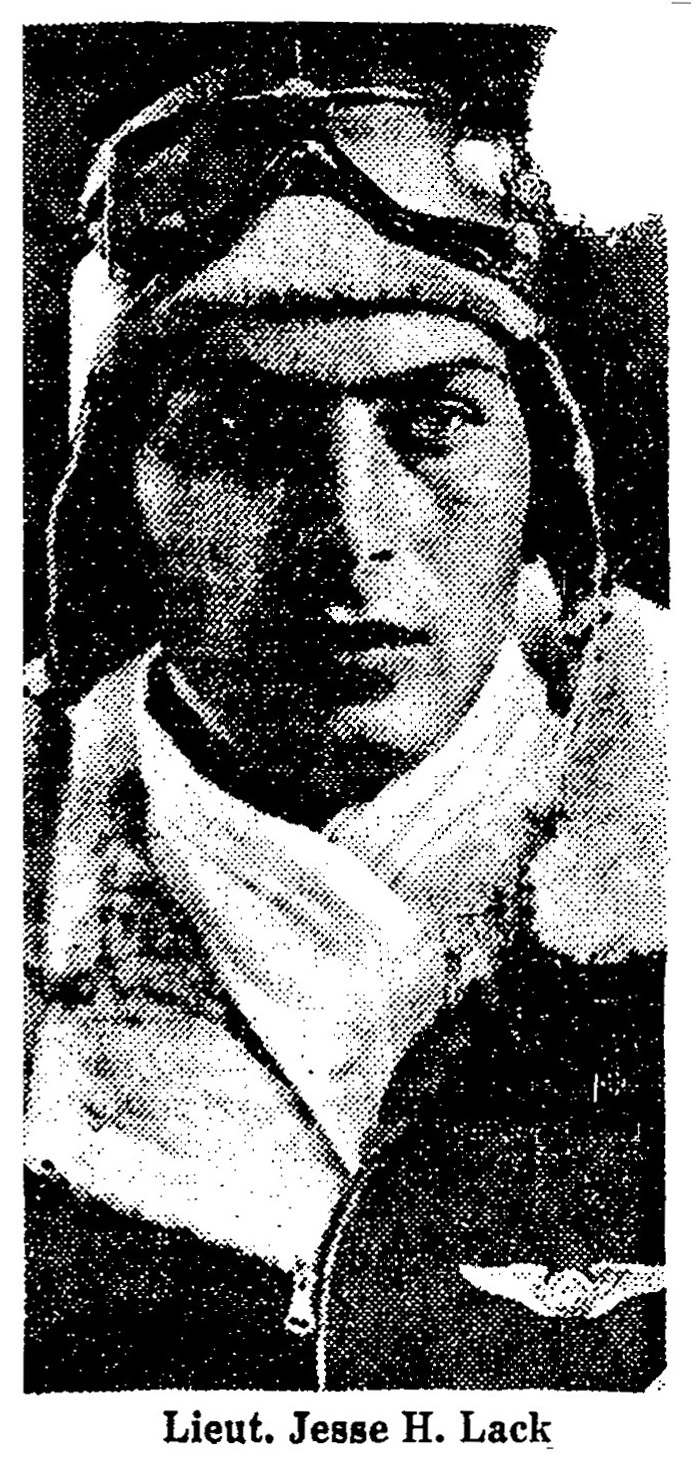
Soldiers from New York: Jewish Soldiers in The New York Times, in World War Two: March 8, 1944 (In the Air…) … Spitfire and Mustang, Goldberg and Rothenberg: The Forking Path of History

In 1941, the Argentinian writer Jorge Luis Borges completed the short story “El jardín de senderos que se bifurcan”, known in English and later appearing in the August, 1948 issue of Ellery Queen’s Mystery Magazine as “The Garden of Forking Paths.  His book, “uncannily foreshadows contemporary cosmological theories of the ‘multiverse’, in particular the ‘Many Worlds’ interpretation of quantum mechanics,” which has now become very much a staple feature and plot device of popular culture and fiction, let alone a field of study in the disciplines of quantum mechanics, theoretical physics, and philosophy.  At the center of Borges’ short story, which may have been inspired by the works of science fiction writer Olaf Stapledon, is yet another novel – the multiple drafts of various chapters of which actually comprise a single work, in which infinitely forking futures are described.  This novel-within-a-novel is thus “an enormous riddle, or parable, whose theme is time”.  

Thus for fiction.  As for fact?  In 1944, three years after the publication of the original version of Borges’ story, on the eighth of March, two Jewish fighter pilots – one American and the other British – were shot down over Western Europe.  For them, that date represented a very real forking path, one from which the trajectories of their lives irrevocably diverged:  One survived; the other did not.

“May your fondest dreams comes true. – (signed) Danny”…
“…her pride is her fighter-pilot brother…”

Second Lieutenant Daniel S. Rothenberg (0-687399), born in Manhattan on September 25, 1923, was the son of Elliott (6/11/90-10/67) and Adelaide (1890-4/6/66) (Greenberg) Rothenberg, his family residing at 985 Teaneck Road in Teaneck, New Jersey.  Their home – an apartment building – still stands in 2024, as seen in this Oogle street view….
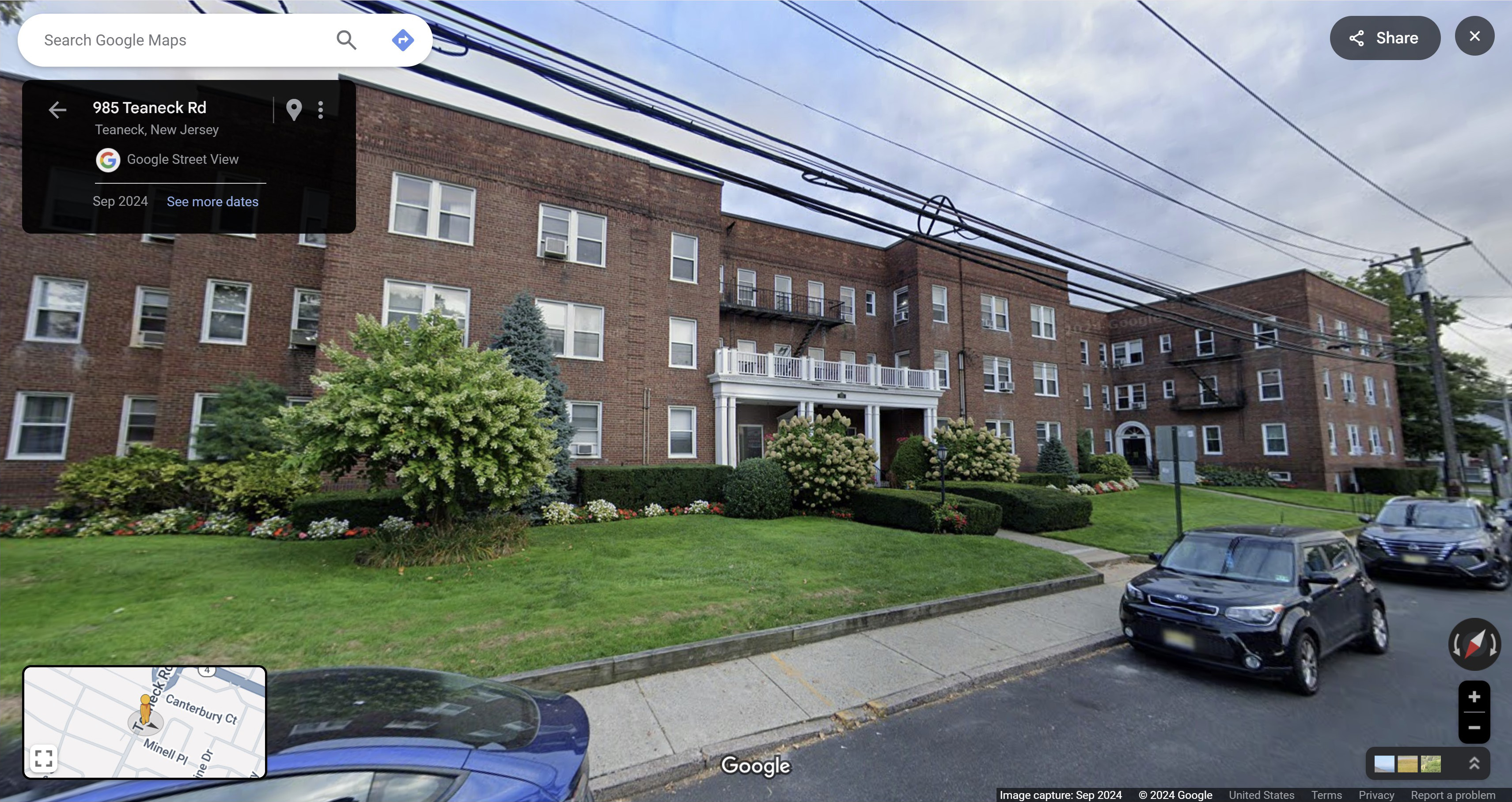
…while this map shows Teaneck, relative to other locales in northern New Jersey, and, the New York Metropolitan area:

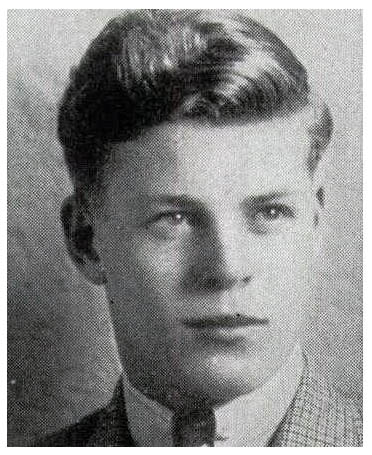
Daniel’s siblings were Hilda (10/16/14-2/22/00), Leon (4/10/09-2/67), Marian (11/8/10-10/20/99), Murray (6/23/13-4/3/85), and Ruth Eunice (3/16/26-11/27/22).  His photograph, taken a few years before he became Lieutenant Daniel Rothenberg, can be found via Ancestry.com in Teaneck High School’s Class of 1940 yearbook.  The specific copy of the yearbook in which his portrait is found includes the dedication, one of several penned for the book’s now-unknown and now-forgotten donor, “May your fondest dreams comes true.  Danny”…

Here’s his portrait.

(“Then I reflected that all things happen to a man
in the precise instant of now.” – Hsi P’eng)

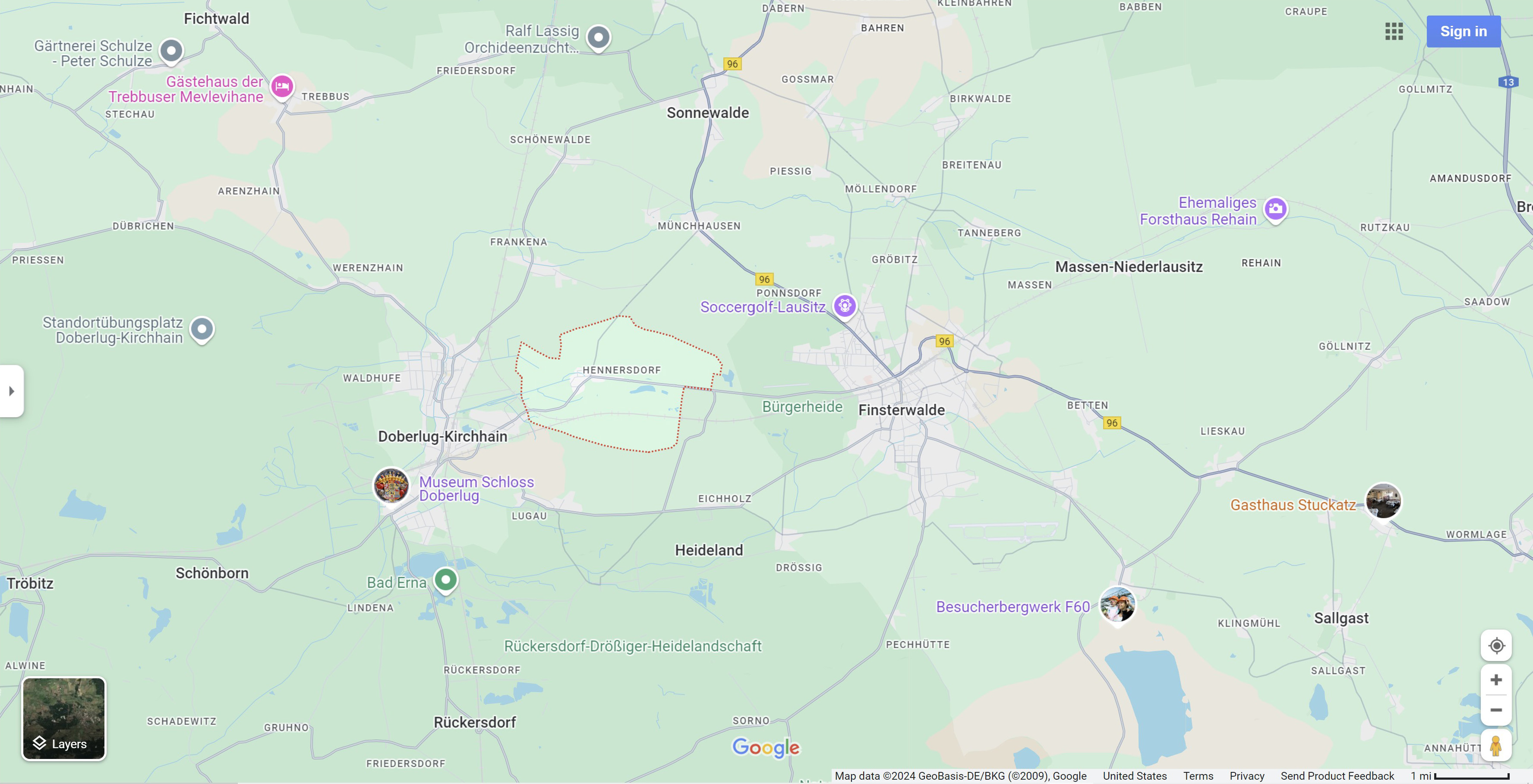
A member of the 357th Fighter Squadron of the 355th Fighter Group (8th Air Force), that day assigned to his squadron’s “Green Flight”, Lt. Rothenberg’s Mustang, P-51B 43-6989 otherwise known as OS * Q, was shot down while on a “Ramrod” mission over Germany.  (Ramrod is a term loosely used to denote a fighter sweep over an area preceding the arrival of heavy bombers, in order to draw enemy aircraft into combat and cumulatively degrade enemy fighter effectiveness.  See Mission4Today and CodeNamesInfo for more information.)

As described in Missing Air Crew Report 3056 by eyewitness and flight leader 1 Lt. Frederick W. Kelley:

As we made R/V with the bombers, Green flight jumped a bogie which turned out to be an FW-190.  He dove for the ground and number three man overran him and number four man got in a burst which hit his left wing.  The FW-190 turned into Lieutenant Rothenberg who was flying number two and evidently hit the pilot, as he rolled over on his back at about fifty feet and dove into the ground and exploded.  I passed over the remains which were scattered over the field, and there is no doubt that he was instantly killed.  Later on the 190 was destroyed by Lieutenant Norman.

~~~~~~~~~~~~~~~~~~~~

This image of P-51B Mustang 43-6886 OS * E, eventually known as Myrt / Kay, provides a good representative view of a 357th Fighter Squadron P-51 in early 1944.  This particular aircraft, piloted by 2 Lt. Harwood M. Harrell, was one of six 355th Fighter Group P-51s lost on June 7, 1944.  Its loss is covered in MACR 5507 and Luftgaukommando Reports J 1354 and J 1451.  Lt. Harrell survived.  (Photo UPL16547 from the American Air Museum in Britain.) 

~~~~~~~~~~~~~~~~~~~~

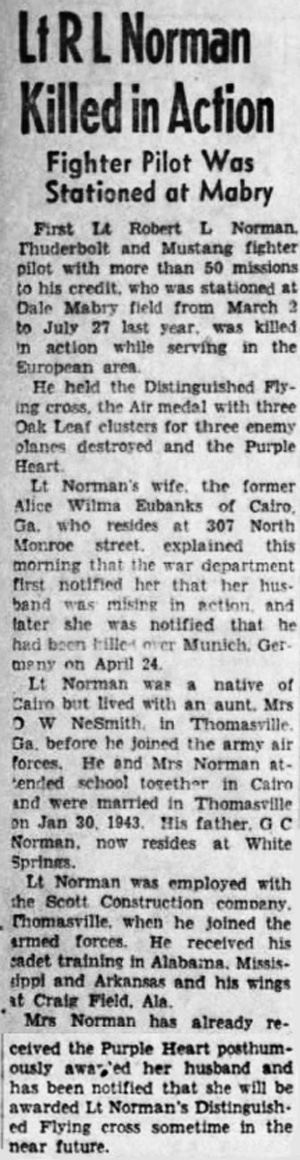
USAF Credits for the Destruction of Enemy Aircraft reveals a little more information about “Norman” and Frederick W. Kelley.  The former was 1 Lt. Robert Lee Norman (0-797697), the FW-190 he shot down being his sole confirmed victory.  Alas, Lieutenant Norman in turn was shot down and killed on April 24, 1944, while flying P-51B 42-106433, OS * R; see MACR 4320.  This article, from FindAGrave contributor TLHGraves, appeared in the Tallahassee Democrat on November 3, 1944.  
First Lieutenant Kelley (0-795972), who eventually became Captain Kelley, survived the war with two aerial victories.   

Here’s the supposed location map of Lt. Rothenberg’s loss, as reported in Missing Air Crew Report 3056.    

Though the above map indicates that Lt. Rothenberg crashed in the vicinity of Dummer Lake, in actuality, his aircraft was shot down 2 kilometers west of Hagenburg, or, 9 kilometers west of Wunstorf, towns which are directly south and southeast (respectively) of Steinhuder Meer, as shown in the map below.  
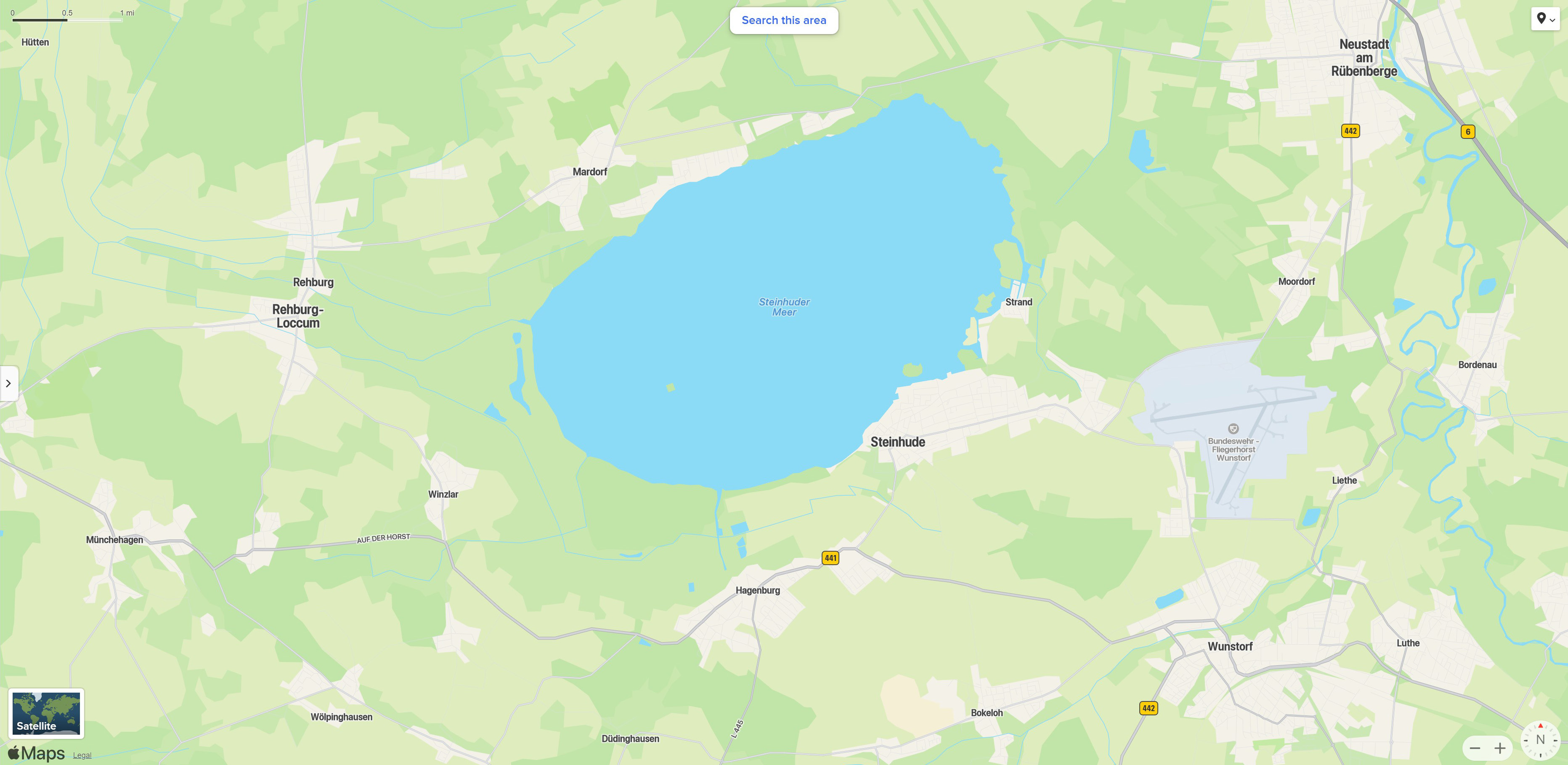
Identifying this crash location was a slightly involved process.  This entailed correlating Missing Air Crew Reports for the four P-51s lost over Europe on March 8, to 1) Mustang losses which were reported in Luftgaukommando Reports reported in the “master” list (…as it were…) of these German documents … in NARA Records Group 242, and, 2) within relevant “Mustang-MACRs” for this date, any Luftgaukommando Reports referenced or included (of course, in translation).  In terms of the latter, it turns out that MACRs for the following three pilots do include references to Luftgaukommando Reports, each such report having been filed under a different Luftgaukommando Report format (i.e., six-digit-number, AV Report, and, J Report).  

Edner, Selden R., Lt. Col., 4th Fighter Group, Headquarters Squadron
P-51B 43-6442 – survived; MACR 2838; Report 120808-120809

Gambill, William W., 1 Lt., 357th Fighter Group, 363rd Fighter Squadron
P-51B 42-103041, B6 * F / Speedball Alice – survived, but died while POW at Stalag Luft III on March 23; MACR 2944; Report AV 969 / 44

Ullo, Neil F., 2 Lt., 363rd Fighter Group, 380th Fighter Squadron
P-51B 43-6932 – survived; MACR 2575; Report J 657

But…  While MACR 3056 is absent of a reference to a Luftgaukommando report, the aforementioned “master” list of Luftgaukommando Reports contains an entry for Report J 683, which perfectly correlates to the time and location of Daniel Rothenberg’s loss.  However, this report is not accessible via NARA … probably because the document no longer exists, for as discussed in my series of posts about Major Milton Joel (shot down on November 29, 1943) it seems that low-number “J” and “KU” Luftgaukommando Reports did not survive the war to eventually be incorporated into Records Group 242.  

Anyway, the reason for the error in the reported location of P-51B 43-6989’s crash – in MACR 3056 – is evident from the map below: Dummer Lake and Steinhuder Meer, while separated by an east-west distance of over forty miles, lie at practically the same latitude, both are situated in or near rural or forested areas, both are elongated in a north-south direction, and finally, both are – sort of & kind of – roughly the same size.  
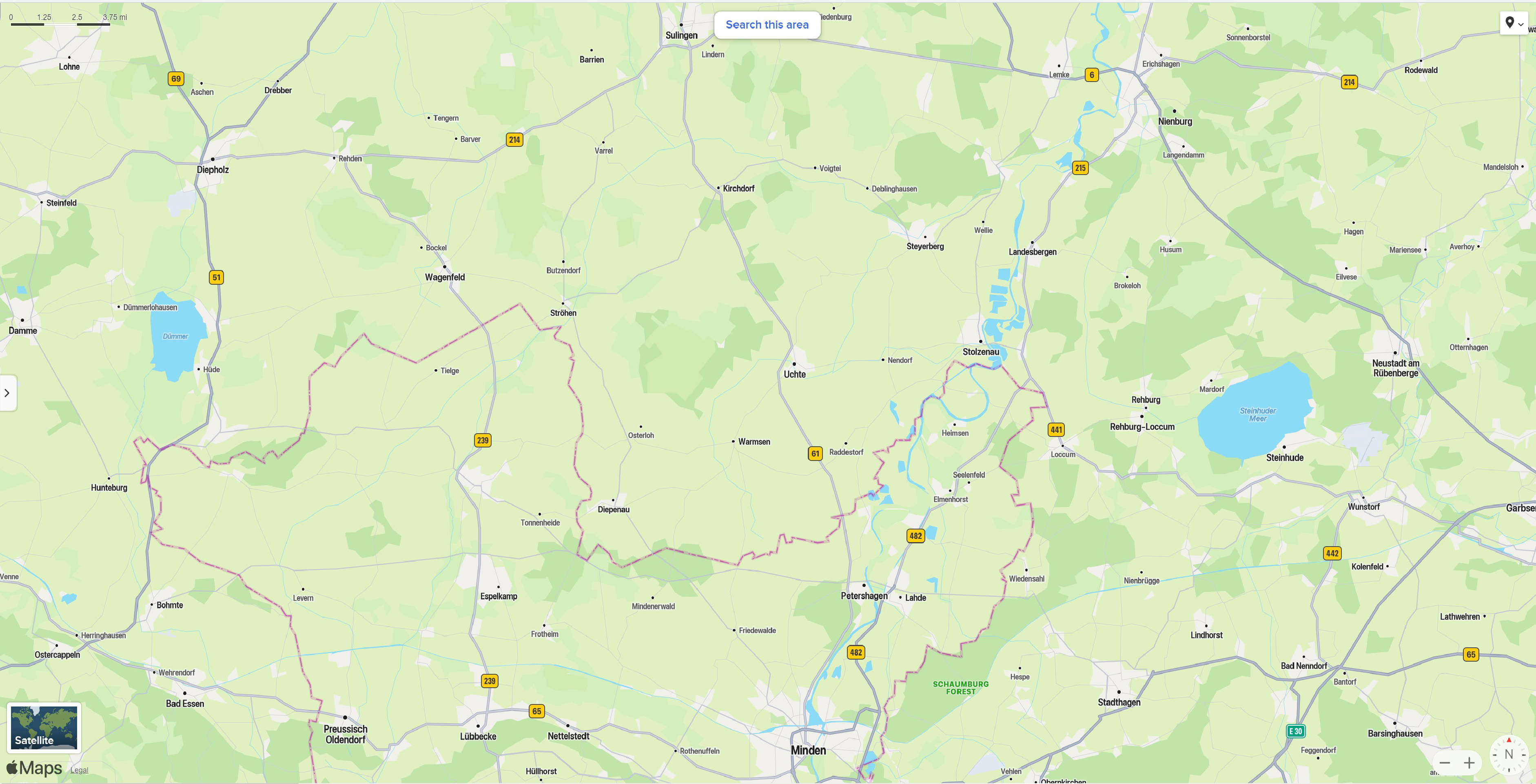
This map shows the general geographic setting of Dummer Lake and Steinhuder Meer.  They’re equidistant south from Bremen, and equidistant north from Bielefeld.
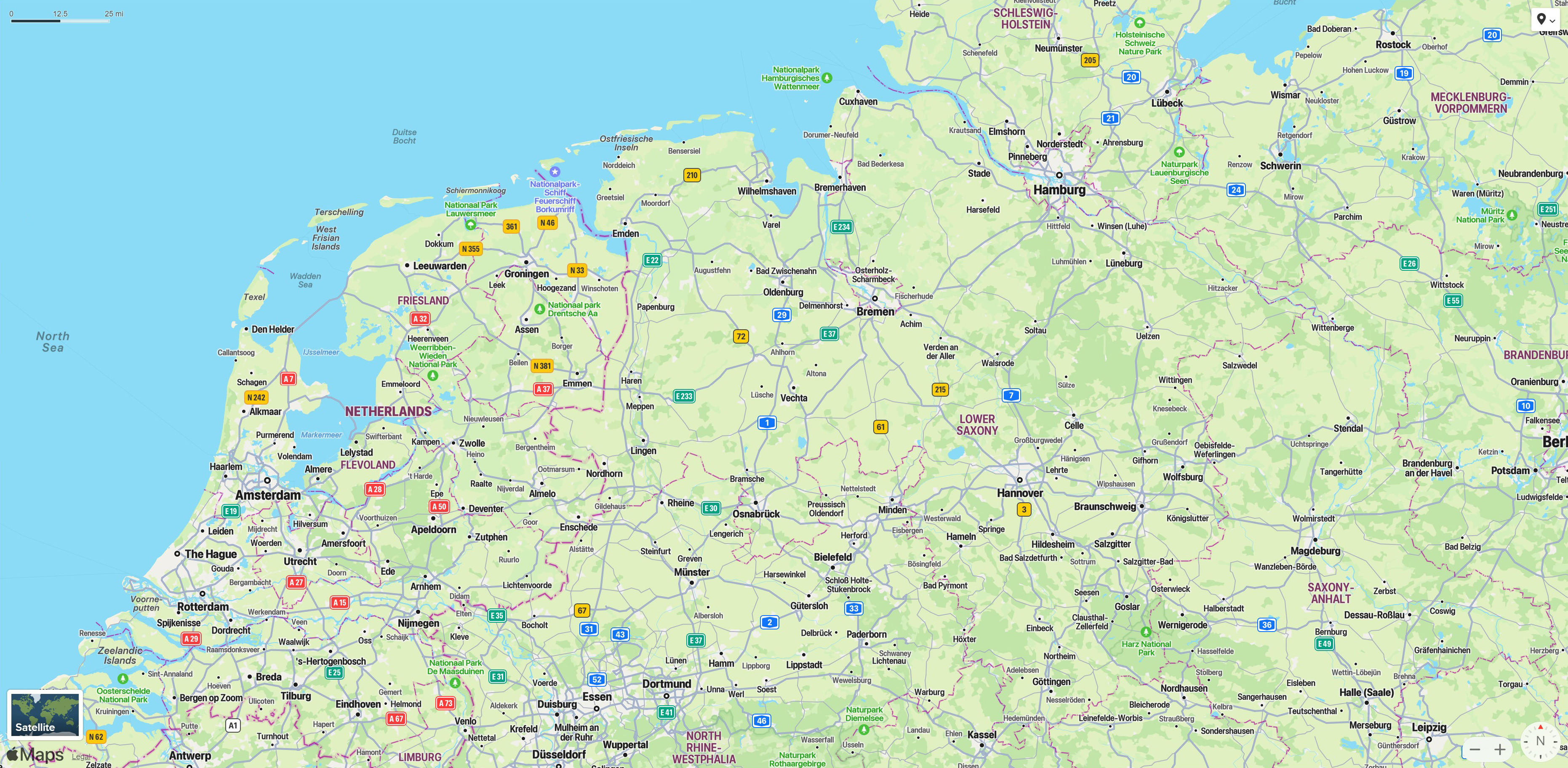
All the above information about the location of Lt. Rothenberg’s loss in Luftgaukommando Report J 683 precisely correlates back to an enemy pilot who – himself shot down and killed only seconds after shooting down Lt. Rothenberg, as recounted in MACR 3056 – turns out to have been a member of 9./JG 11, flying FW-190A-7 Werk # 340045: Feldwebel Herman Hoess.  (See Aircrew Remembered.)  

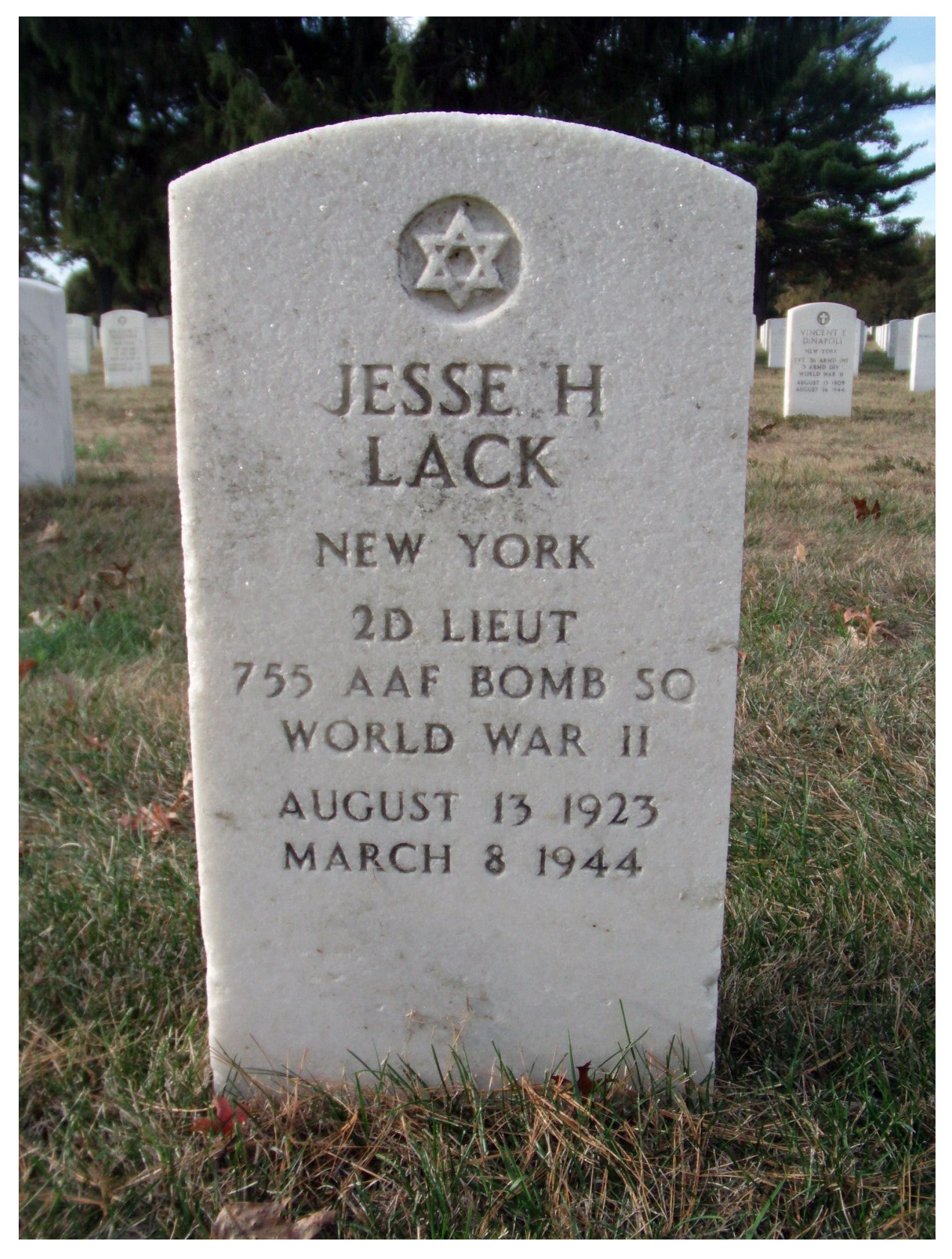
Over five years after his death, on May 16, 1949, Lt. Rothenberg was buried at Long Island National Cemetery in Farmingdale, N.Y.  (Specifically, at Section J, Grave 16094, as seen in this photo by FindAGrave contributor GLENN.)  While his name appeared in Casualty Lists published in 1944 on April 23 (Missing in Action) and June 3 (Killed in Action), like so very (very) many other American Jewish military casualties (or decorated servicemen) of the Second World War, his name never appeared in the 1947 compilation American Jews in World War II

The reason is  suggested by his matzeva: It’s absent of absence of a religious symbol.    

Though, according to the Roster of US WW II Dead (available via Ancestry) Daniel indicated his religious preference as Christian, his Interment Record features the word “none in the “Religious Emblem” section, which I suppose reflected this wishes of his parents, obviously his closest surviving next of kin.  

The uncertainty about Daniel’s religious identification and affiliation is evident even earlier, as seen in the biographical information card filed for for him by the National Jewish Welfare Board (NJWB).  This card was only one of many (many (many)) such cards generated as part of the NJWB’s wartime attempt to identify, record, and preserve historical information Jewish servicemen and military casualties. 

~~~~~~~~~~

It’s my understanding and interpretation that families known or presumed to be Jewish were contacted (via phone? via mail? via personal visit?) by volunteer representatives of the NJWB to the above end, the names of such workers and the dates of contact attempts having been recorded in the “Worker Consulted” data field of the card.  Going by the data on the card, the NJWB reached out to the Rothenberg family on three dates: June 2, July 26, and October 12 of 1944, based on the initial release of a War Department Casualty List on June 2. 

The “blank” rectangle at the left of the card suggests that the Rothenberg family never responded to the NJWB, or, provided no definitive information about their son.  The reason for this silence is not indicated.  (You can read much more about the NJWB’s WW II biographical index cards at Ancestry.com.)  

There’s most definitively information about volunteer worker listed on the card.  He was Rabbi Samuel Geffen, concerning whom information is available at the Center for Jewish History (CJH) and New York Times.  Born in 1907, he passed away in 2002.  Here’s his bio from the CJH:

Rabbi Samuel Geffen, born Febuary 17, 1907 in New York, NY, was the rabbi for the Jewish Center of Forest Hills West for many years.  Prior to his ordination in 1942, Geffen was a concert violinist and lawyer.  He served most his career at the Jewish Center of Forest Hills, from 1948 until his retirement in 1993.  Rabbi Geffen was married to Ruth Lenore Rosenfeld, with whom he had one son, Peter Geffen.  During his time at Forest Hills West, Rabbi Geffen taught for many years at the Hebrew school in addition to his role as a congregational and spiritual leader.  Rabbi Geffen died March 15, 2002 in New York, NY.

And from The New York Times, on March 19, 2002:

GEFFEN-Rabbi Samuel.  The entire Abraham Joshua Heschel School community mourns the passing of our beloved founder Peter Geffen’s revered father, Rabbi Samuel Geffen.  Rabbi Geffen was an exceptionally talented man, who was a concert violinist and lawyer before becoming a Rabbi.  He was the devoted spiritual leader for over 40 years of the Jewish Center of Forest Hills West.  We send our heartfelt sympathy to his wife Ruth (Rosenfield), son Peter, daughter-in-law Susie Kessler and grandchildren Jonah, David and Nessa who will greatly miss this kind, gentle, caring soul.  Shira Nadich Levin President, Board of Trustees Roanna Shorofsky, Director Abraham Joshua Heschel School

GEFFEN-Rabbi Samuel. We mourn with profound sorrow the passing of our beloved colleague.  Ordained in 1942, he served most of his career, from 1948 until his retirement, as rabbi of the Jewish Center of Forest Hills.  We extend our deepest condolences to his wife, Ruth; son, Peter; brother, Dr. Abraham; sisters, Bessie Wilensky and Helen Ziff; and nephews, our collegues, Rabbi David Geffen and Ben Ravid and to all who were touched through his rabbinate.  Rabbi Reuven Hammer, Pres. Rabbi Joel H. Meyers, Exec. VP The Rabbinical Assembly

~~~~~~~~~~

Why was Daniel’s matzeva “silent”?  To answer this question, we have to delve into the history and genealogy of the Rothenberg family.  The probable answer provides a window – in equal measures enlightening and disillusioning – upon the self-perception and “place” of the Jews of the United States in the mid-twentieth-century history, as reflected through the experiences of one family, among very many.  

First, Daniel’s Draft Card identifies his mother as Adelaide.  
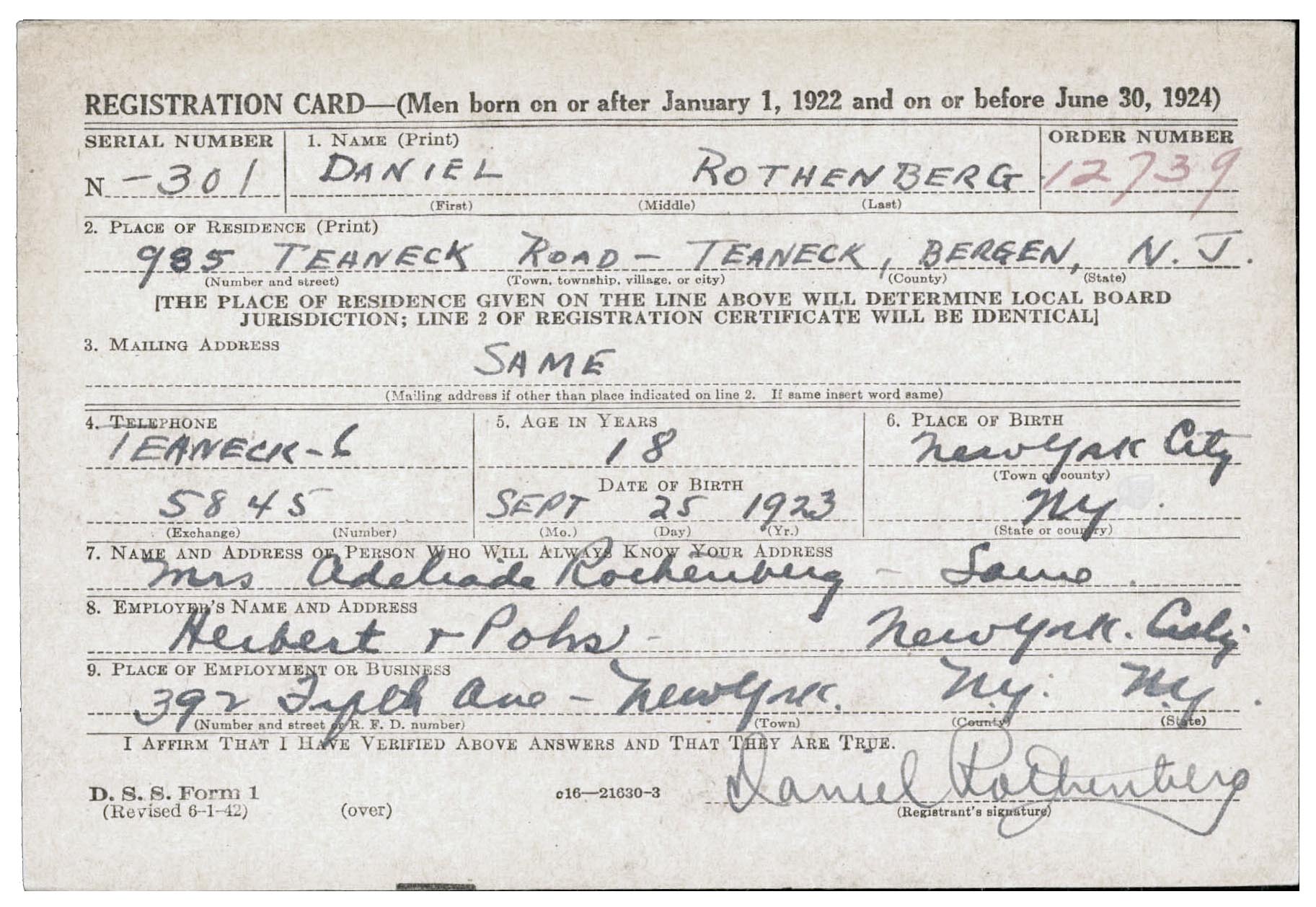
Second, census records for 1910 reveal that Elliot and Adelaide were born in Russia and spoke English.  Such records for 1920 are different:  They indicate that Elliot was born in Russia and Adelaide in Rumania, both husband and wife speaking Yiddish.  For 1940, census records once again differ:  Adelaide is again recorded as having been born in Rumania, but, Elliot is now born in New York state.  

Third, Elliott’s World War I Draft Card (dated 1917) lists his occupation as “Salesman” .  This is sort-of consistent with census records.  1910 lists him as a druggist; 1920 as a wholesale drug salesman; 1940 as a retail store salesman.  

Moving to the Cohoes American of October, 25, 1935, this notice concerns Elliot’s trade-marking of a product called “KISS-LAX”, whatever that was.  (All kind of inferences come to mind, but there are no references to the product in Internet-land.)  Perhaps a 1930s version of Chap-Stick? 

There’s a solid degree of information about Daniel’s older bother, Murray.  Here’s his name in a record of marriage to Bernice L. Glover, dated March 16, 1936, in the records of the Chelsea Presbyterian Church…

…and, here’s his draft card:
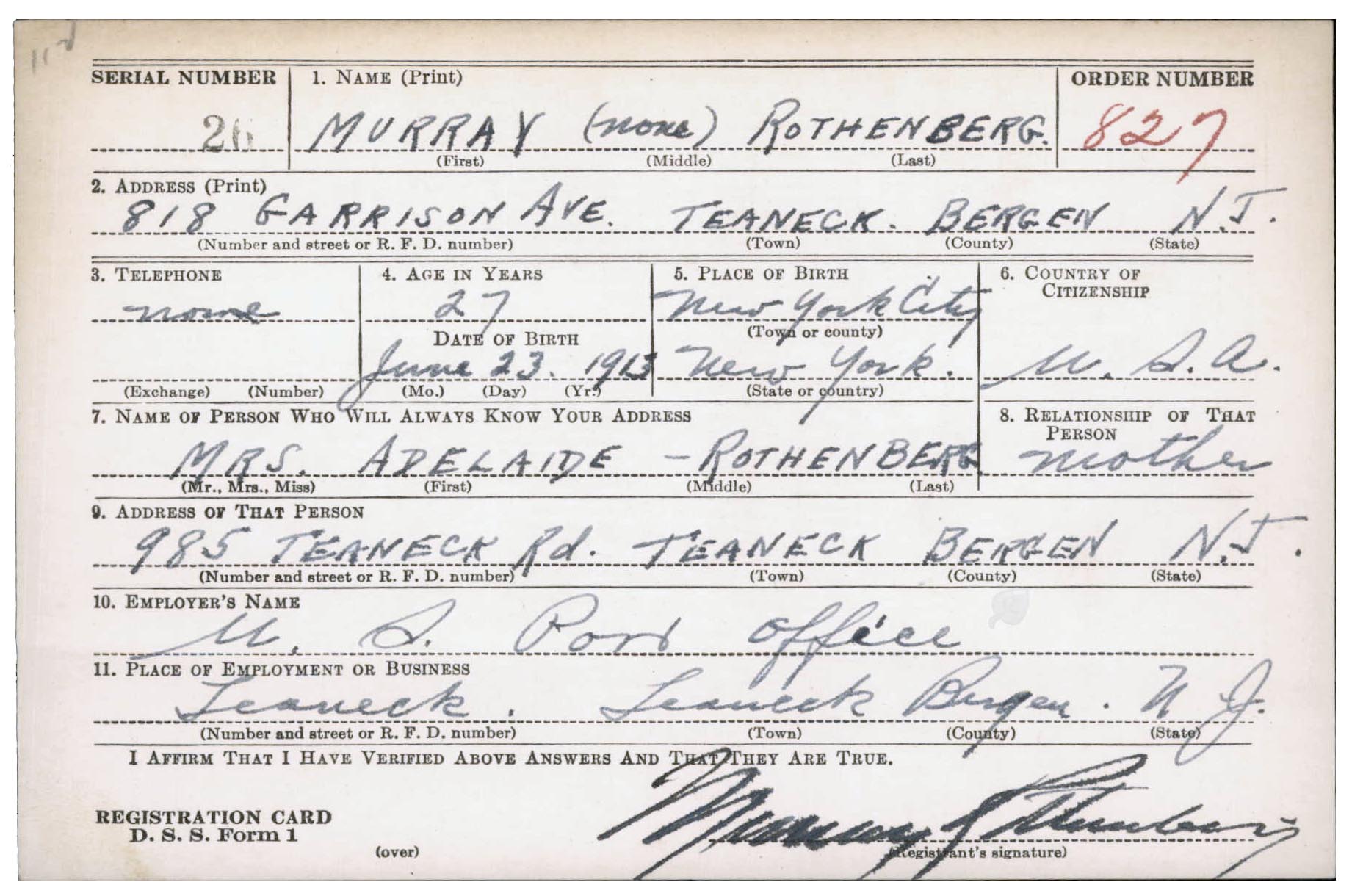
More about Murray, a most multifaceted man:  He was a boxer and wrestler, and during the Second World War, taught self-defense to soldiers, as described in this article from The Bergen Evening Record on September 3, 1943 (via Classic Wrestling Articles).

Ex-Diamond Gloves Champ Will Meet Chief Bamba Tabu In Bout; He’s Now Head Of War Plant Guards

The amazing Murray Rothenberg, ex-Teaneck gridder, former Bergen Evening Record Diamond Gloves champ, judo teacher to soldiers, car salesman, chief of a defense plant police staff, and just about everything else you can think of, branches out into new fields to conquer tonight.

The amazing Murray makes his debut here as a professional wrestler on the card at Columbia Park, North Bergen.

Bergen County has never known another sports figure quite like the husky, scowling Murray Rothenberg. No matter what branch of sports – or in any other of the numerous things – which Murray tried, he always managed to make good.

WRESTLED BEFORE

Usually, in the process, he worked up a widespread dislike for himself among the fans, the sort of thing which helped pack followers of the Diamond Gloves into arenas in the hope that they’d see him get his block knocked off. He never did – he invariably won.

Actually, tonight’s go at Columbia Park won’t be Murray’s first taste of professional wrestling. About 8 or 9 years ago, he went on a tour of the South and had a half dozen or so bouts. Just like in everything else, he won.

Tonight’s mat engagement, however, is his first near home. He’s slated to oppose Chief Bamba Tabu on the card which Promoter Ralph Mondt presents at Columbia Park. The headline attraction is between Jack Wentworth, the Canadian Hercules, and Chief Thunderbird.

Murray, who played football with Teaneck High School early in his athletic career, later was a star in semi-professional football. He boxed a lot as an amateur and even had a few professional engagements.

Still as a high school student, he entered the Record’s Diamond Gloves. He was one of the original Bergen County amateur fistic champs, winning the 160-pound title in the first tournament staged by the Record. He broke his hand in the finals, back in September, 1933, but still came up with a win for the middleweight crown.

Of late, Rothenberg has been working in a defense plant. He is chief of the police guards. Just to keep in trim and to keep his hand in, he drills soldiers in a nearby barracks in the art of judo.

As mentioned in the above article, Murray was most definitely in the automotive business, as attested to by three newspaper items.  First is a blurb from the Brooklyn Eagle of November 16, 1950, concerning an 11:00 (AM or PM?) radio program on WARD:  “Why Worry – See Murray”…

… second, an advertisement for Murray’s Motors published in the Auburn Citizen-Advertiser on December 13, 1962.

…and third, a help-wanted advertisement for auto mechanics in The Journal News of May 14, 1973.

As for Ruth, here’s her portrait in the 1944 Teaneck High School yearbook.  (Via Ancestry.com)  Daniel was on her mind: “…her pride is her fighter-pilot brother…”

~~~~~~~~~~

Now we come to the Second World War, and after.  Other than the appearance of Daniel’s name in the above-mentioned Casualty Lists, this article, from The Bergen Evening Record of March 26, 1944 (via the Johnson Public Library of Hackensack) is evidently the only news item that exists about his wartime service. 

Missing

ROTHENBERG, Second Lieutenant Daniel, 20, son of Mr. and Mrs. Elliot Rothenberg, 985 Teaneck Road, Teaneck.  (European area.).

Second Lieutenant Daniel Rothenberg, 20, pilot of a P-47 Thunderbolt, has been reported missing in action, according to a War Department telegram received by his parents, Mr. and Mrs. Elliott Rothenberg, 985 Teaneck Road, Teaneck.

The parents, who declared they refuse to believe any harm has come to their son, said the telegram listed a mission over Germany on February 24 as his last known flight.  Rothenberg volunteered for the Air Force in September, 1942, after one year as an honor student at John Marshal School of Law in Jersey City.  He has been overseas, based in England, with the Eighth Air Force, for the past 5 months.

“Daniel is resourceful and always was intelligent.  We are sure he is safe,” his father said.  The father now is employed by Saunders Jewelers on Main Street, Hackensack.  Some years ago he operated Elliott’s Drug Store in Hackensack.

The missing pilot’s brother is Murray, once a middleweight champion fighter in the Bergen Evening Record diamond gloves contest.  His younger brother, Daniel; only 5 feet tall never was athletically inclined, according to his parents.

XXX

Forty one years later, following Murray’s April 1985 passing, this letter – a tribute by his sister Ruth (Rothenberg) Eby – appeared the same month in the New Jersey newspaper The Record.  The letter was found in the Cetola Family Tree at Ancestry.com.  The text follows:

A tribute to Murray Rothenberg

Sports Editor, The Record,

There must be many Murray Rothenberg fans left in North Jersey. He was a legendary sports hero for three decades in the Thirties, was a football player for Teaneck High School, and he went on to a semipro team, the Red Devils. He was also a Diamond Glove boxing champ. In the Fifties, became famous to television fans as a pro wrestler. Dennis James, the TV sportscaster, used to love to use “Why worry, see Murray!” – the slogan for Rothenberg’s used-car lot in Little Ferry.

There are many sides to Murray that perhaps his sports fans might not know. He had to champion his birthright; anti-Semitism was rampant in his day as an athlete in Teaneck. He had to scrap his way up, often fighting neighborhood bullies.

Murray became a favorite of a Record sports columnist, the late Al Del Greco, who wrote often of Murray’s style and exploits.  But during World War II, there was a block of time that remained secret until years later. Murray’s judo expertise was used to train special forces, and he was sent on several secret overseas missions to bring “someone” back.  So ingrained was his commitment to secrecy that he never gave out details.

After the war there were some dark years for Murray, but he finally overcame a drinking problem by his complete involvement with Alcoholics Anonymous, and he devoted himself to helping others get what he called “Good, orderly direction”.

Murray passed away this month in Florida, but he left a legacy – a legacy of being a true champion. His sports fans might only remember the games, but there are many others who will cherish the memory of a man who left his mark on their lives.

RUTH EBY
(Murray’s kid sister)
Haworth

As for Elliot and Adelaide, they passed on some years earlier: Adelaide on April 6, 1966, and Elliot on October 13, 1967.  Here are their obituaries, from The Bergen Record on (respectively) April 7, 1966, and October 13, 1967:

ROTHENBERG – Adelaide (nee Greenberg) at Hackensack, N.J., on Wednesday April 6, 1966 of 995 Teaneck Road, Teaneck.  Beloved wife of Elliott.  Devoted mother of Leon, Murray, Mrs. Marion Dintenfast, Mrs. Hilda Weltman and Mrs. Ruth Eby, also surviving 13 grandchildren and 8 great grandchildren.  Sister of Samuel Greenberg.  Christian Science Memorial Service at the Eckert Funeral Home, corner of Main and Poplar Streets, Ridgefield Park, on Thursday, April 7 and _ P.M.  Commitment at the convenience of the family.  In lieu of flowers kindly make contributions to your favorite charity.

Elliot Rothenberg

Englewood – Elliot Rothenberg, 77, of 240 East Palisade Avenue, a retired jeweler, died this morning at the Tenafly Nursing Home.

He had lived in Teaneck for 45 years.

He is survived by a son Murray of Miami, Fla.; three daughters, Mrs. Marian Dintenfast of Philadelphia, Pa.; Mrs. Hilda Weltman of Englewood, and Mrs. Harold Eby of Haworth; 13 grandchildren and eight great-grandchildren.

Taking the history of the Rothenberg family as a whole, particularly in light of Ruth’s letter, and, the obituaries of Elliot and Adelaide, there is – to use a 2025-ish word – very much to “unpack” “between the lines” of these writings.  

First, neither parents’ obituary makes any allusion to their youngest son, Daniel. 

Second, Ruth’s tribute to Murray, though it mentions her brother’s wartime activity with great pride, is entirely absent of any reference to Daniel’s military service and death in combat, though she obviously felt identification with and admiration for him during her late adolescence. 

Third, Ruth refers to Murray’s having participated in, “several secret overseas missions to bring “someone” back.  So ingrained was his commitment to secrecy that he never gave out details.”  In my opinion, this was a “bubbe meise” – a tall-tale; a grandiose biographical embellishment – invented by and heard from her brother in the context of his postwar struggles with alcoholism; a story she accepted and believed in good faith and good will.  I seriously doubt he ever left the United States during the war years.

Fourth, it’s most interesting – and intellectually refreshing – that Ruth had the candor to mention antisemitism having been “rampant” in Teaneck during the twenties and thirties.  One can’t understand the present unless one perceives the past as it really was, rather than through a mindset fogged by the comforting mists of hagiography, a central example of which is the highly over-rated cinematic oeuvre of Steven Spielberg.  (But, that’s another topic…)

Fifth, the “elephant in the foyer” can be found in Adelaide’s obituary: She had a Christian Science Memorial Service upon her passing, her obituary suggesting that she was not interred in a Jewish cemetery.  (As for Elliot?  His place of burial is unknown.)  Which fact leads much further: Adelaide’s involvement with Christian Science was long-lasting and very deep, beginning at least when she was in her early forties and lasting the rest of her life.  She authored 29 articles pertaining to Christian Science in the three decades between August of 1933 and January of 1963 (oddly, none between December of 1941 and December of 1945), these having been published in The Christian Science Journal, Christian Science Sentinel, Der Herold der Christlichen Wissenschaft, Le Héraut de la Science Chrétienne, and, O Arauto da Ciência Cristã.  Absolutely none of these articles (going by the titles, at least) make any reference or allusion – of even the vaguest and most tangential sort – to recent or ongoing events, let alone the situation and fate of the Jews of Europe during the 30s and 40s.

In light of this glimpse of the Rothenberg family’s history, Daniel’s religious preference as a Christian, the complete absence of any religious symbol on his matzeva, whether Jewish or Christian, was more inevitable than it was surprising.  How could he have declared himself otherwise, given the constellation of factors surrounding his youth and upbringing?  Which, in turn, leads to curiosity about how the course of his mother’s life led her to become an adherent of Christian Science, and, the implications of her decision for her family.  A definitive answer to this will never be known – all the “dramatis personae” having since passed on – but one can speculate.  

First, it’s notable that Daniel’s mother, having been born in Rumania in 1890; a woman whose native tongue was Yiddish, went by the very name of Adelaide, which is actually a, “…feminine given name from the English form of a Germanic given name, from the Old High German Adalheidis, meaning “noble natured”, rather than a female name of Yiddish or Hebrew derivation.  (…such as, and, such as…)  Though it’s impossible to trace her ancestry farther back than the 1910 Census, this suggests that “Adelaide” was actually a name she adopted coincident with or some time after her arrival and naturalization in the United States, her original name (perhaps it was Aidel, Adele, or Ada) being lost and now forever untraceable, as is the history of her family in Eastern Europe.

Second, the reason for her adoption of Christian Science could be attributable to any of the small myriad of factors that have not infrequently led more than a few Jews – ever since the advent of Jewish political emancipation a few short centuries ago and continuing undiminished now; even during the days of the Roman Empire; even during the pinnacle of Hellenism; to “fundamentally transform” their identity and persona in a direction assumed to be more acceptable – socially, intellectually, vocationally, and otherwise – to that of the prevailing culture.  (Well, in their own eyes.)  Given Ruth’s comment about the antisemitism experienced by her brother in Teaneck (which reflected an era and setting far wider than Teaneck, the state of New Jersey, or the Middle Atlantic States), perhaps Adelaide – regardless of her residence in that city or any other urban center, simply wanted to jettison an identity to conform to and become part of the larger society.  Or, on a much simpler level, perhaps the social and political currents that relentlessly buffeted the lives of all men and women amidst the turbulence of the late 1800s through the early 1900s (but, is life not always turbulent?), the Jewish people particularly among them, left her unmoored from or even unacquainted with a solid sense of Jewish identity and “Yiddishkeit” – other than a vapid, vestigial and atrophying sense of ethnicity – the void in her soul being replenished by the mores and religion of the surrounding culture. 

~~~~~~~~~~

In this story, I’m reminded of Stephen J. Dubner’s 1998 book, Turbulent Souls: A Catholic Son’s Return To His Jewish Family, here described at GoodReads:

Two years ago, Stephen J. Dubner wrote a cover story for The New York Times Magazine called Choosing My Religion.  It became one of the most widely discussed articles in the magazine’s history.  Turbulent Souls, the book that grew out of that article, is an intimate memoir of a man in search of a Jewish heritage he never knew he had.  It is also a loving portrait of his parents.

Stephen Dubner’s family was as Catholic as they come.  His devout parents attended mass at every opportunity and named their eight children after saints.  Stephen, the youngest child, became an altar boy, studied the catechism, and learned the traditional rituals of the Church — never suspecting that the religion he embraced was not his by blood.

Turbulent Souls is Dubner’s personal account of his family; tumultuous journey from Judaism to Catholicism — and in his own case, back to Judaism — and the effects, some tragic, some comic, of those spiritual transformations.  His parents were Jews, born in Brooklyn to immigrant parents, but — independent of each other and, indeed, before they met — each converted to Christianity, only to be shunned by their families.  After their marriage, they closed the door on Judaism so firmly that their children had no inkling that their background was far different from what it seemed: They didn’t know, for instance, that their mother had a first cousin named Ethel Rosenberg, who was executed for treason in one of the most controversial cases of the cold war era.

Stephen Dubner’s is a story about discovery: of relatives he never knew existed, of family history he’d never learned, and of a faith he’d never thought of as his own and, in fact, knew nothing about.  It’s a fascinating, thoughtful, and thought-provoking exploration of a subject of intense interest to spiritually minded men and women everywhere.

~~~~~~~~~~

One also thinks of Lieutenant General Victor H. Krulak, whose early life is chronicled in Chapter 1 – “Once Upon a Time” – in Robert Coram’s biography Brute: The Life of Victor Krulak, U.S. Marine.  In the same way that the Rothenberg family was contacted by the National Jewish Welfare Board (NJWB) as part of the organization’s effort to identity Jewish servicemen and record their accomplishments, so was then Lt. Col. Krulak (or his wife, Amy Chandler Krulak), after his actions at Choiseul Island, in the Solomon Islands, from late October through early November of 1943.

Was he a Jew?  The answer, as documented in Brute and other sources, like his NJWB information card … below … was: No. 

Perhaps – and perhaps as in the case of Daniel Rothenberg? – this facet of the future General’s life was prefigured for him by a small constellation of major decisions made by his family years before his birth; let alone before he entered the United States Naval Academy.  For, as recounted in Brute, his father Morris, “…was a secular Jew, and his desire for assimilation was so strong that Victor never received any religious instruction, never attended synagogue, and, as far as can be determined, never had a bar mitzvah.  In this way, Morris paved the way for his son later to minimize his Jewish background.”  This chain of the unintended … or quietly intended? ,,, consequences of the actions of one generation upon another, is discussed at great depth in Todd M. Endelman’s Radical Assimilation in English Jewish History, 1656-1945, the conclusions of which are highly pertinent to the history of the Jews of the United States.  In a different vein, the late Barry Rubin’s Assimilation and Its Discontents, which observes intergenerational acculturation, assimilation, and the loss of memory across a much wider time frame, is particularly focused on the Jews of the United States in the nineteenth and twentieth centuries.  

Continuing in 2007, after being shown his family genealogy, Krulak’s choice of words was revealing in that when he talked about his parents, he could not force himself to utter the words “Jew,” “Jewish”, or “Yiddish.”  “My father never talked of his spirituality.  It was always about hard work.  My father was a very serious man.  He was very quiet about his background, about everything, almost silent.  I learned from him that life is serious, that sometimes you have only one choice.  My father always talked of my future.”  
He paused and added, “I would hope that this book not dwell on my father’s spirituality, but rather his lessons of hard work.”
If he and his father never discussed their religion, what of importance did they discuss?
“He told me, ‘You will be short, and you will be bald. But you don’t have to be fat.’ ”
There was but one addition: “He told me the way to get along with a new acquaintance is to express genuine interest in the day-to-day affairs of the other person.”
And that is all Victor Krulak would say about his parents.

~~~~~~~~~~

“As I saw some Germans in the neighborhood, I decided to lie in a ditch until dusk.  I actually stayed till 2200 hrs.”

The path of Squadron Leader David Goldberg (J/4242) on March 8, 1944 led to an outcome infinitely different from that of Lieutenant Daniel Rothenberg.  The son of Harry and Sophia L. Goldberg, who resided at 28 Kent Street in Hamilton, Ontario, David was born in that city on March 20, 1917. 

A member of the Spitfire-equipped No. 403 Squadron (Royal Canadian Air Force), David was shot down during an afternoon Ranger mission.  (Ranger: A “freelance flights over enemy territory by units of any size, to occupy and tire enemy fighters.”, from Wikipedia, based on John D.R. Rawlings’ Fighter Squadrons of the RAF and their Aircraft, published by Macdonald and Jane’s Publishers Ltd.).  Struck by flak at St.-Andre-de-l’Eure, he crash landed his aircraft (Spitfire Mk IX MJ356) and evaded capture, returning to England on May 6.   

(“I leave to the various futures (and not to all) my garden of forking paths.”
 – Ts’ui Pen, Governor of Yunan)

 As recounted in the ORB (Operations Record Book) of No. 403 Squadron, via the RCAF Association, “Two shows and 28 non-operational sorties were flown today.  We were escort wing on the morning do and this afternoon we carried out an eight man Ranger.  No enemy aircraft were seen.  On the Ranger, we lost two pilots, F/O J.H. Ballantyne DFM and F/L D. Goldberg, our adjutant.  F/O Preston’s aircraft was severely damaged by flak but he managed to land at Friston.  F/O Ballantyne’s aircraft [Spitfire MJ876] was seen to hit the ground and explode and very little hope is held for him.  He has been posted as missing believed to be killed.  F/L Goldberg reported that he was going to attempt a crash landing.  He has been posted as missing but we all are hoping that he will be walking back to see us one of these days.  F/O Foster was posted to 53 OTU wef today.”

Awarded the Distinguished Flying Cross, S/L Goldberg’s name can be found on pages 35 and 124, of volumes I and II, respectively, of Canadian Jews in World War II.  David passed away on September 17, 2006, and is buried at Woodland Cemetery in Hamilton.  Other than these nominal genealogical and historical facts, I have no further information about his subsequent military service and postwar life.  His portrait, below, is from Canadian Jews in World War II… 

XXXX
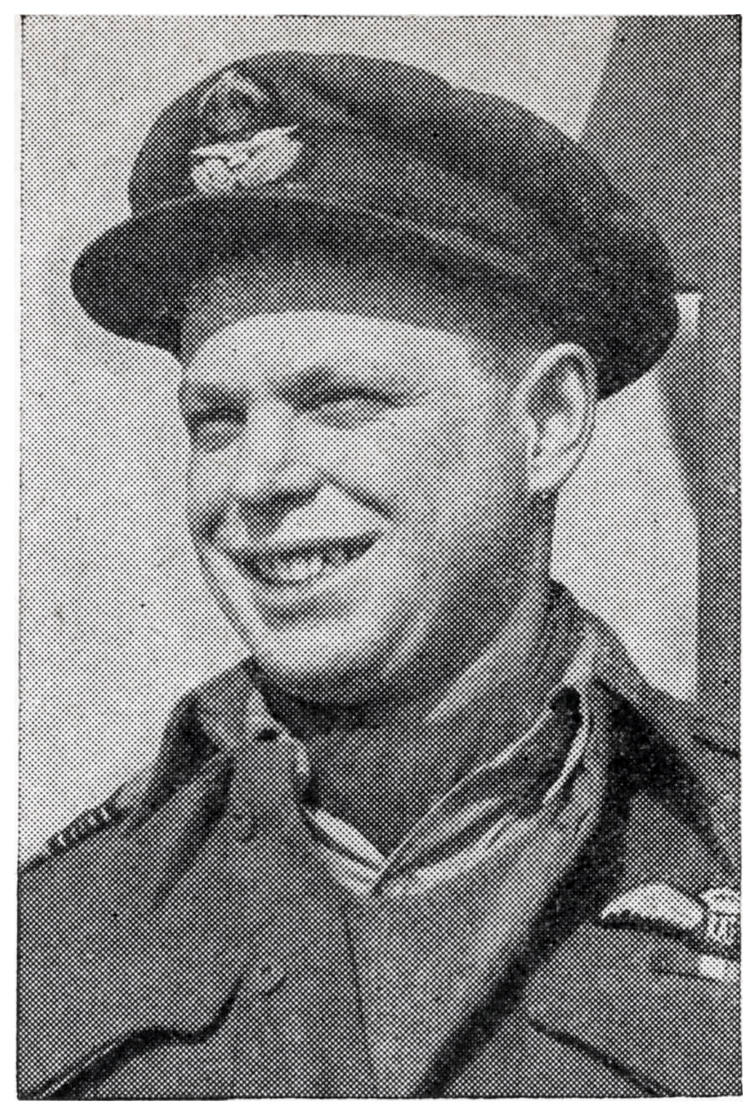
…while this image (via canada.ca) shows the wolf’s head emblem of No. 403 Squadron…

…and this is a depiction of a Spitfire of No 403 Squadron from DCS (Digital Combat Simulator).   

Here’s a transcript of S/L Goldberg’s succinct Escape and Evasion Report, M.I.9/S/P.G.(-)1910, obtained from the The National Archives(You know, the one in Kew, not the one in College Park.)

Left:     GIBRALTAR, 5 May 1944. Arrived: U.K., 6 May 1944.

I was pilot of a Spitfire aircraft which left FRISTON on 8 Mar 44 at 1600 hrs. to carry out a low-level sweep round PARIS.  On the outward journey when somewhere South of EVREUX (N.W. EUROPE, 1:250,000, Sheet 7, R 16) I was hit by Flak and tried to crash land, but crashed about 3 kms. S.W. of CHAMPIGNY-la-FUTELAYE (R 2850) at about 1630 hrs.

I found myself in the aircraft upside-down.  I managed to get out, but had to leave my parachute and harness in the machine, which was smouldering.

I immediately started to run towards a clearing, throwing off my mae west into the trees.  I went in a Northerly direction, gradually heading West until I reached a forest.  As I saw some Germans in the neighborhood, I decided to lie in a ditch until dusk.  I actually stayed till 2200 hrs.

I then started to move West, and walked till 0530 hrs (9 Mar) when I again lay low in a forest, in which I stayed until 2130 hrs.  I then continued for another hour, when I saw a farmhouse and, having looked into the window, decided to enter and make my identity known.  I was given food and shelter for the night.  My host went out and returned in a couple of hours looking pleased with himself, but told me nothing that night.  I was kept here and given food and shelter all next day (10 Mar), and at about 1800 hrs. four men turned up.

From this point my journey was arranged for me.

More information about S/L Goldberg’s subsequent experience, involving a trek over the Pyrenees Mountains in the company of other Allied airmen, can be found at Aircrew Remembered, in the story of the Evasion and Escape of S/Sgt. Isaac Lowell Creason.  A member of the 449th Bomb Squadron, 322nd Bomb Group and a crew member of 1 Lt. Samuel A. Walker, Creason’s B-26B (41-31948) was shot down by flak on January 14, 1944.  You can read the original account of Creason’s experience in E&A Report 616.  The MACR covering the plane’s loss (#1748) is, like many low-number MACRs (and not a few higher-numbered Reports in that set of records) essentially useless(Thank you so much, Fold3!)

The following set of maps and air photos, at successively larger scales, show the likely location of S/L Goldberg’s crash.  

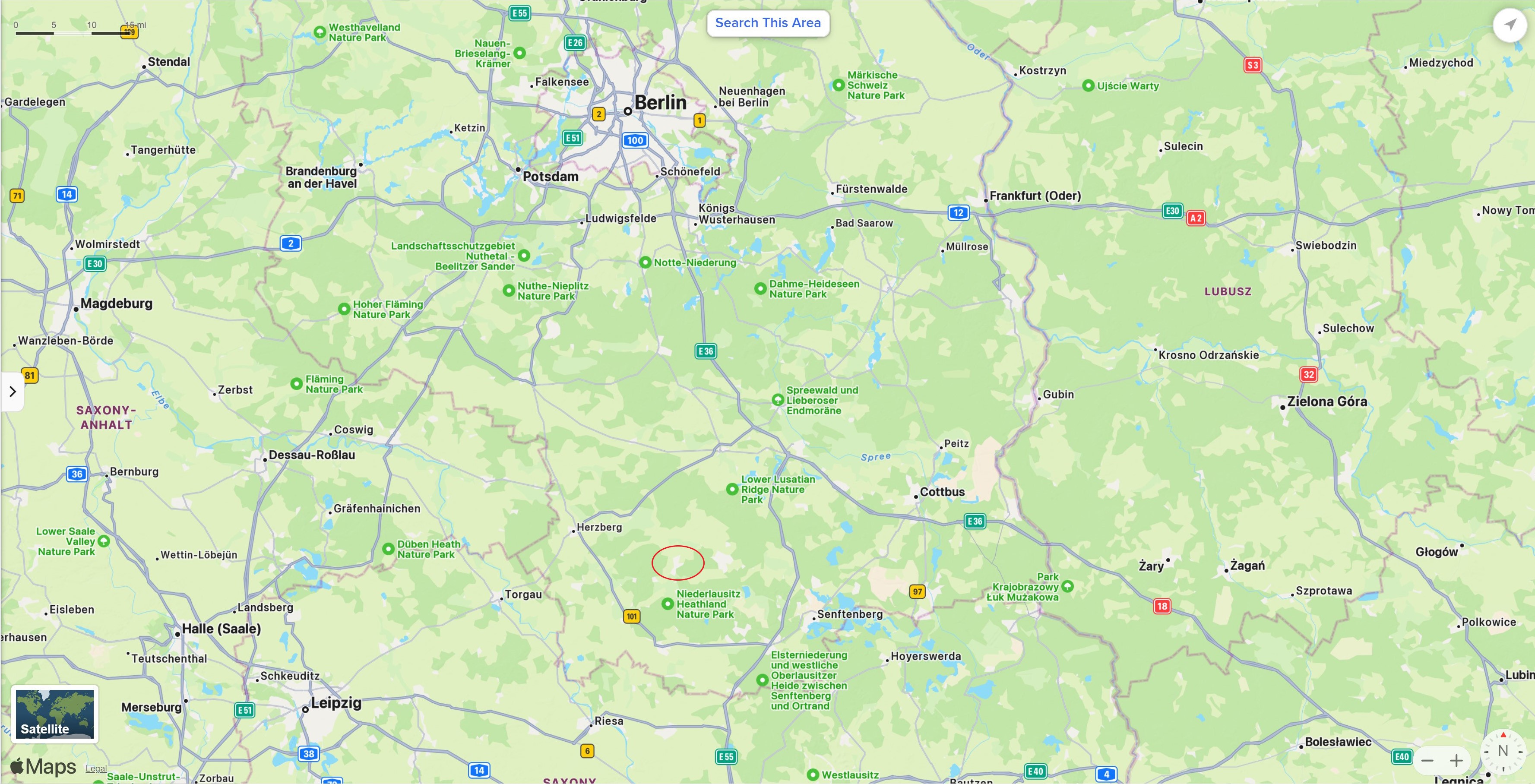
First, this map sets S/L Goldberg’s crash in a regional context.  The crash location, denoted by the red circle, is about 48 miles due west of the center of Paris.

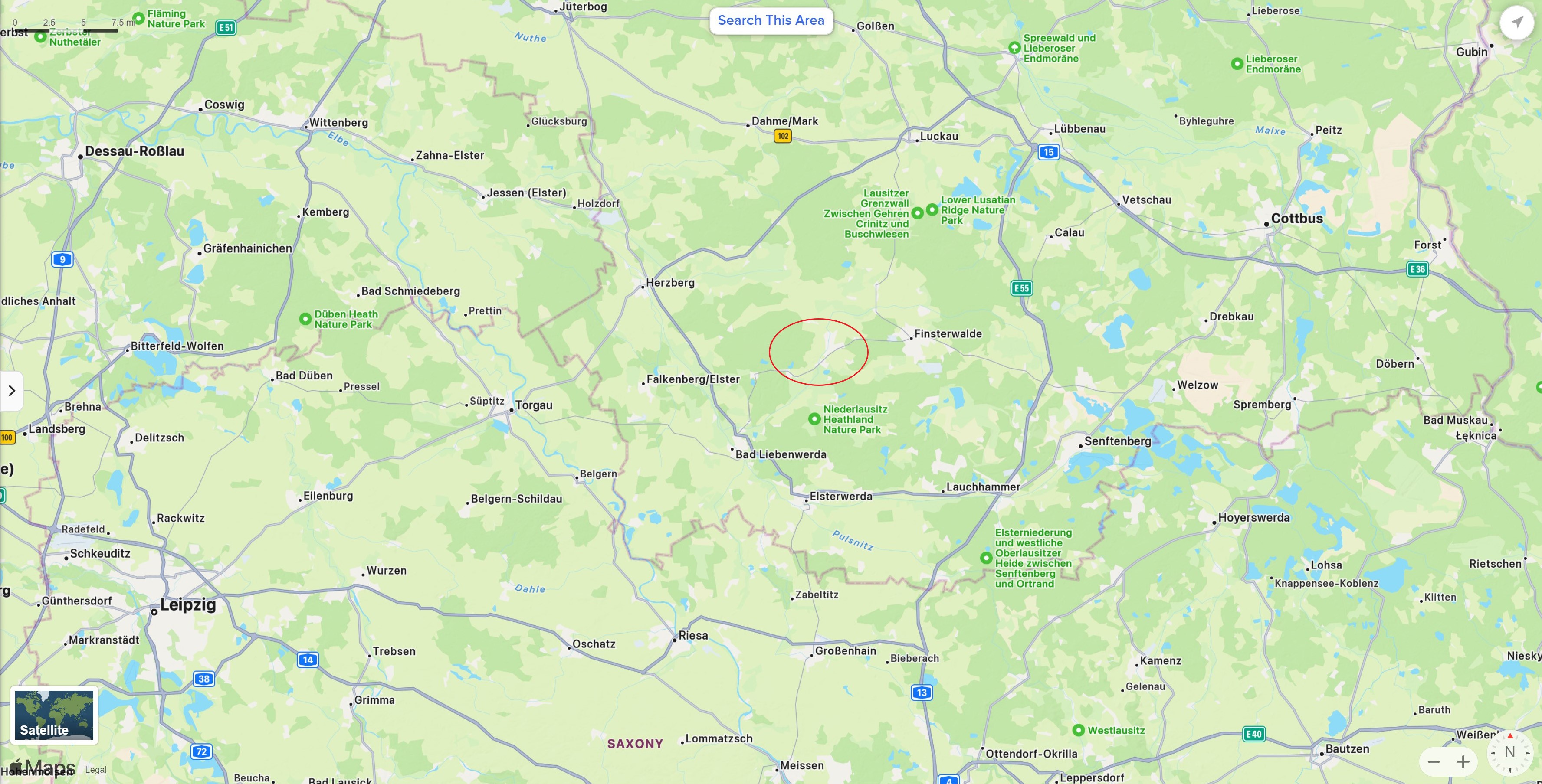
This map shows the approximate location of S/L Goldberg’s crash, based on his E&A Report: southwest of Champigny-la-Futelaye.
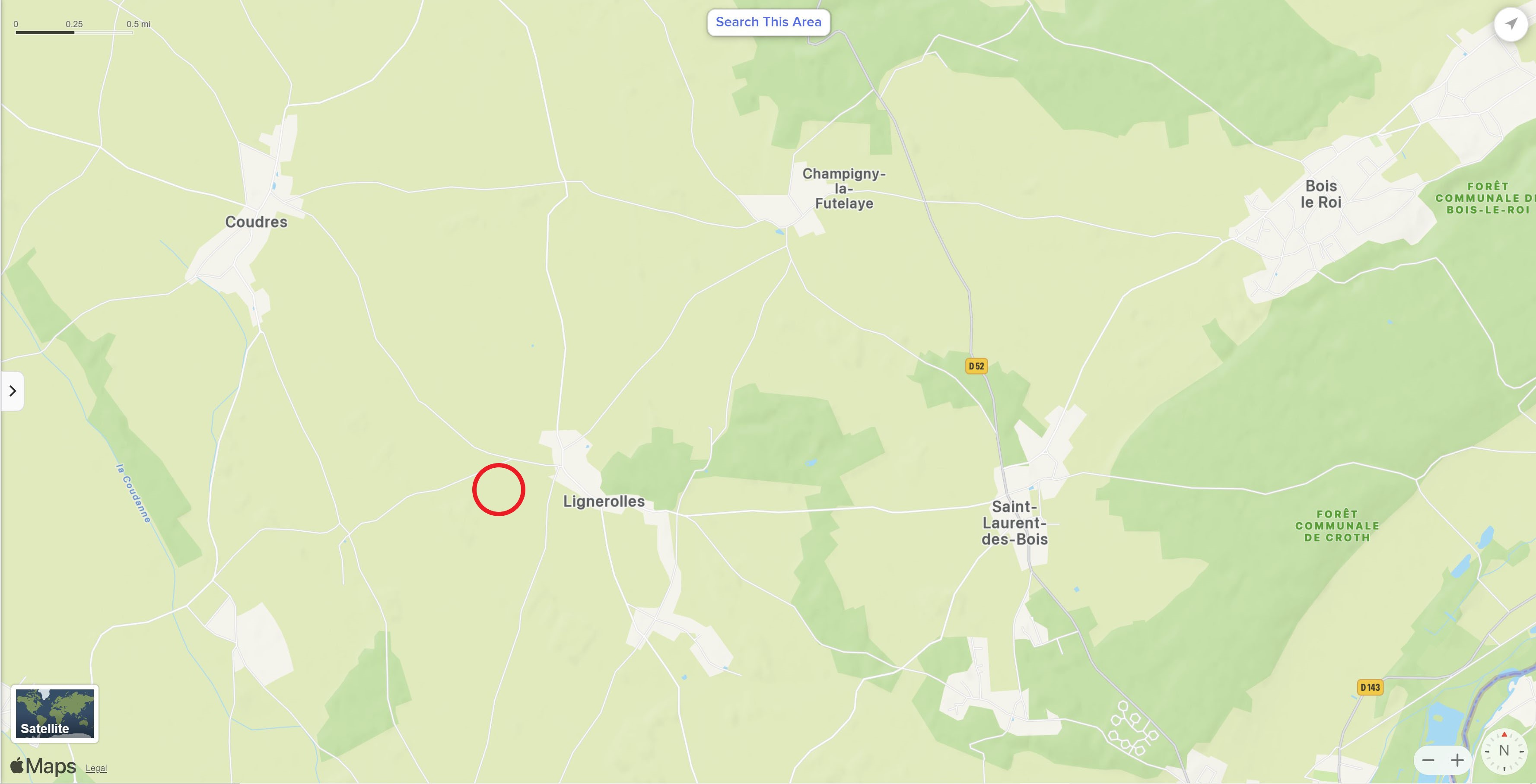
Here’s an air photo view of the above map at the same scale.  The probable crash site is in farmland just west of Lignerolles.  This seems to be somewhat inconsistent with S/L Goldberg’s account of running towards a clearing (farmland is already pretty “clear”!), but still, this is the geographic “best fit” given his mention of coming to earth southwest of Champigny-la-Futelaye.
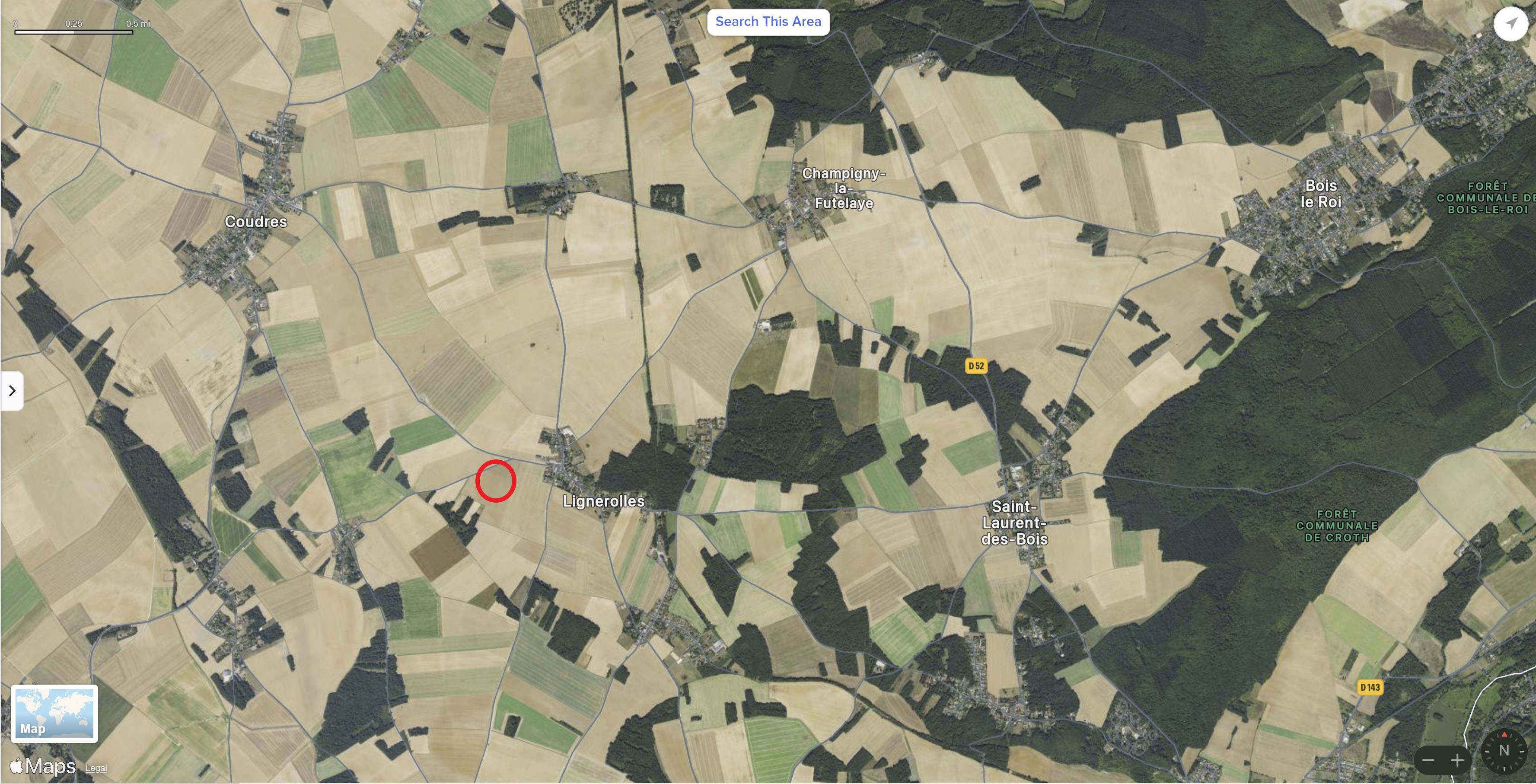
Here’s an even closer view of the above location.  Does anything remain of his Spitfire eighty years later…?

Of David Goldberg’s life subsequent to the Second World War, I have no knowledge.

Books

Borges, Jorge Luis, “The Garden of Forking Paths”, Ellery Queen’s Mystery Magazine, August, 1948, pp. 101-110 (translated by Anthony Boucher)

Coram, Robert, Brute: The Life of Victor Krulak, U.S. Marine, Little, Brown and Co., New York, N.Y., 2010

Dublin, Louis I., and Kohs, Samuel C., American Jews in World War II – The Story of 550,000 Fighters for Freedom, The Dial Press, New York, N.Y., 1947

Endelman, Todd M., Radical Assimilation in English Jewish History 1656-1945, Indiana University Press, Bloomington, In., 1990

Franks, Norman L.R., Royal Air Force Fighter Command Losses of the Second World War – Volume 3: Operational Losses: Aircraft and Crews 1944-1945 (Incorporating Air Defence Great Britain and 2nd TAF), Midland Publishing, Leicester, Great Britain, 2000

Rubin, Barry, Assimilation and Its Discontents, Times Books (Random House), New York, N.Y., 1995

Canadian Jews in World War II – Part I: Decorations, Canadian Jewish Congress, Montreal, Quebec, Canada, 1947

Canadian Jews in World War II – Part II: Casualties, Canadian Jewish Congress, Montreal, Quebec, Canada, 1948

USAF Credits for the Destruction of Enemy Aircraft, World War II, Albert F. Simpson Historical Research Center, Air University, Office of Air Force History, Headquarters, USAF, 1978

One Article (just one)

Rothenberg, Adelaide, “The Cement of a Higher Humanity”, The Christian Science Journal, October 1, 1949, V 67, N 10

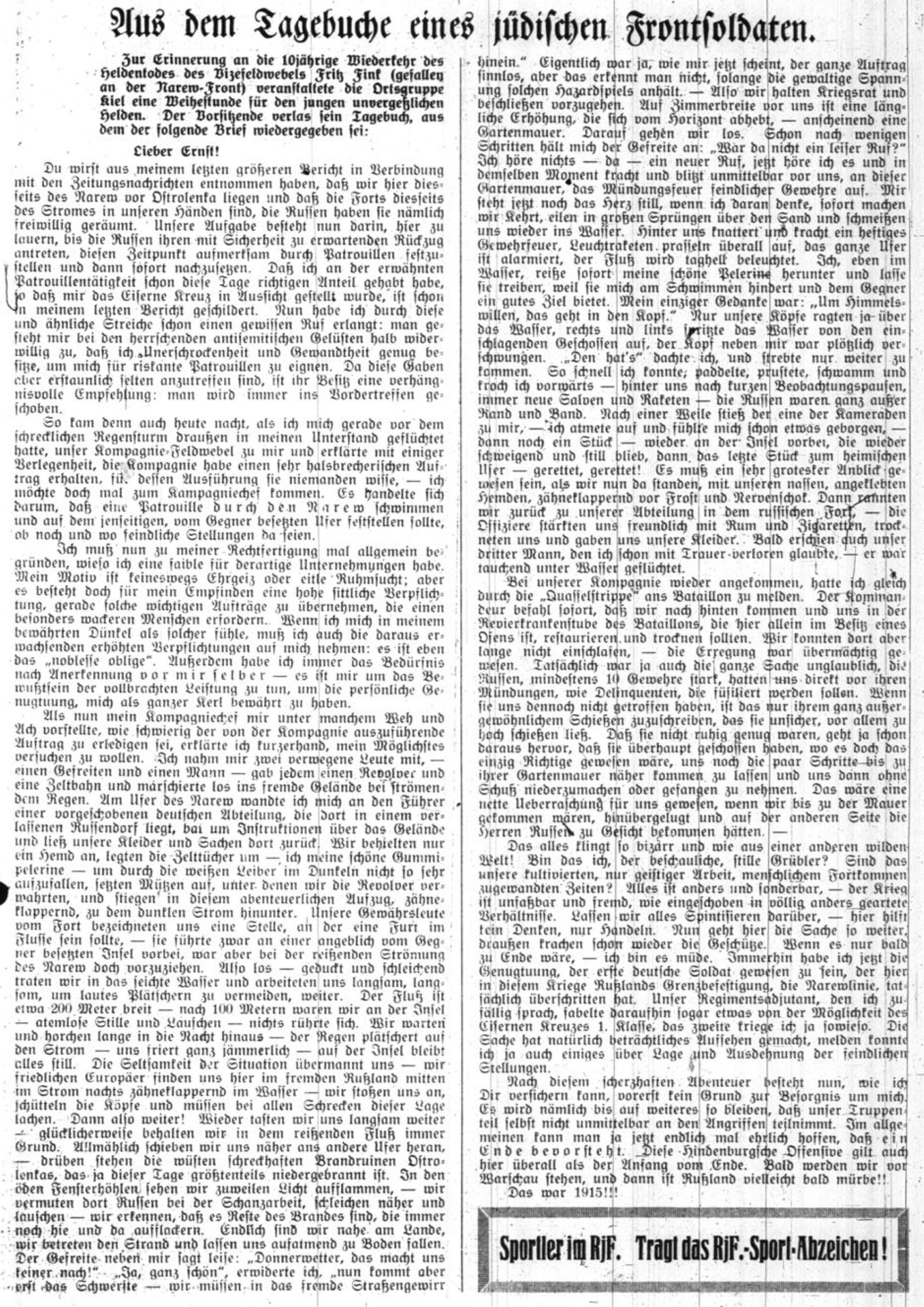
The Shield of Memory – Articles from “Der Schild”, Journal of the Reich Federation of Jewish Front-Line Soldiers: January 11, 1926 – “The Jewish Landwehr Officers at Waterloo”

This 1926 article from Der Schild is very much off the pixelated-track of this blog’s content, for it pertains to the Battle of Waterloo, and specifically, the role of Jewish officers in the Prussian Landwehr during that pivotal battle. 

As such, the article is reflective of the newspaper’s value in covering the experience of Jews in the military well removed from the context of the First World War.  Ironically, the thrust of the article is to disprove an assertion that appeared in the German-Jewish periodical Sulamith, to the effect that “55 Prussian officer of the Jewish faith were killed at Waterloo.”  Based on information presented by the article’s anonymous author, this was not so: As of 1915, “Neither a complete list of Prussian soldiers who died in the Battle of Waterloo nor any other source has been found.  This is evidently a misunderstanding or a printing error in the magazine “Sulamith”, possibly caused by the fact that Lord Wellington spoke in the English House of Lords on August 1, 1933 of 15 officers of the Jewish faith who served in the Battle of Waterloo.” 

It turns out that Der Schild takes this supposed statement by Lord Wellington out of context, for, as reported in the Jewish Chronicle in 2015, the comment about 15 Jewish officers under Wellington’s command was actually spoken by a peer in Parliament, who supported the Jewish Civil Disabilities Bill of 1833, and passage of which Lord \Wellington was adamantly against.  

In any event, the article’s unknown author then segues into a brief discussion of the military service of German Jews subsequent to 1804; in early decades of the nineteenth century.  The conclusion of this 1926 article ends with an ironic note, remarking on Silberstein’s earlier comment in Sulamith, expressing, “…the hope that after the World War there will not be a similar relapse into hatred and lack of culture.  This hope was deceptive.”

Well, if it was deceptive in 1926, perhaps it is still deceptive in 2025. 

Will it always be so, for a nation that stands alone? 

Perhaps.  Perhaps not.  Perhaps both.  

The Jewish Landwehr Officers at Waterloo

The Shield
January 11, 1926
Number 2

In No. 35 of the “Schild”, Horwitz reports on a note in an old volume of the magazine “Sulamith”, according to which 55 Prussian Landwehr officers of the Jewish faith were killed at Waterloo. The improbability of this number is immediately apparent. It is hardly conceivable that just a few years after the edict of March 11, 1812 opened the way for Prussian Jews to join the army, there should already have been so many Jewish officers that no fewer than 55 of their ranks could have been killed in battle. This figure also clearly does not agree with the general casualty figures. In total, 7,000 men of the Prussian troops were put out of action at Waterloo (Richter: History of the Wars of Liberation, Berlin 1890, Volume 4, page 304; Jager: World History, Bielefeld-Leipzig 1899, Volume 4, page 350). I was unable to determine how many officers are included in this number from the sources available to me. If one assumes that the ratio was the same as with the British and Hanoverians, where 600 officers were among 14-15,000 out of action (Richter: ibid.), it would turn out that the Prussian army lost around 300 officers at Waterloo. This number would therefore include those killed and wounded. If one also assumes that around 33 percent – a very high percentage! – were killed, one would arrive at the conclusion that around 100 officers remained on the battlefield. It is simply not conceivable that there were around 55 Jewish Landwehr officers among 100 officers of the active ranks and the Landwehr. Of course, there are many possible sources of error in this calculation. It is obvious that the number 55 cannot be correct.

But there is no need for this probability calculation. One of the leading authorities in the field of Jewish history, Professor Dr. Brann, conducted an investigation into the accuracy of the numerical information published in the magazine “Sulamith” and elsewhere in the “Monthly Journal for the History and Science of Judaism”, year 1915, volume 59, page 131, and he came to the conclusion that the number is incorrect. Neither a complete list of Prussian soldiers who died in the Battle of Waterloo nor any other source has been found. This is evidently a misunderstanding or a printing error in the magazine “Sulamith”, possibly caused by the fact that Lord Wellington spoke in the English House of Lords on August 1, 1933 of 15 officers of the Jewish faith who served in the Battle of Waterloo. (Brann, op. cit., page 240.) It seems necessary to clarify this. The article in the “The Shield” could lead to corresponding claims being made in the defensive. But nothing would be more dangerous than that. Every false statement is damaging. We do not need to use dubious or at least insufficiently provable means; there are enough clear facts at our disposal that can be supported with evidence at any time, which demonstrate the military performance of the Jews in the older and more recent past. This is especially true of the wars of liberation. The volume of the “Monthly Magazine” cited above alone offers a wealth of factual information.

The State Chancellor Prince von Hardenberg wrote on January 4, 1915: “The history of our last war against France has already shown that the Jews have become worthy of the state that has taken them into its fold through their loyal devotion. The young men of the Jewish faith have been comrades in arms of their Christian fellow citizens and have shown [?] examples of true heroism and the most praiseworthy contempt for the dangers of war, just as the other Jewish inhabitants, especially the women, joined the Christians in every kind of sacrifice. (Silberstein, op. cit., page 99.)

“The most shameful thing
was that after the end of the wars of liberation,
only those Jewish fighters who had not been promoted
were called up for militia exercises,
while those who had been appointed officers in the field
were not called up,
and were forced to leave the army
in order to wean Christians off the sight of a Jewish commander.”

According to the Rabinett files in the Schwerin main archive, it has been established, particularly on the basis of letters from pastors, that the Mecklenburg peasants only volunteered for the army in small numbers, whereas the Jews made up the largest contingent of volunteers (op. cit., page 100). Admittedly, our comrades did not receive the gratitude of their fatherland and their homeland even then. It is significant that the small Mecklenburg town of Gnoien, when a Jew was among the first four volunteers, approached the Duke, asking that promotion to officer should be made without distinction of birth and religion and only on the basis of suitability; but that the same magistrate who expressed this in 1813 went so far as to refuse to admit a freedom fighter as a citizen in 1817 because he was Jewish. The same man who was one of the first to enlist in the army in 1813 could not be admitted to the merchant company of the town of Wolgast in 1830 unless he was baptized. (ibid., pages 96, 106.) The most shameful thing was that after the end of the wars of liberation, only those Jewish fighters who had not been promoted were called up for militia exercises, while those who had been appointed officers in the field were not called up, and were forced to leave the army in order to wean Christians off the sight of a Jewish commander.

“”So after 1813 – the setback after 1870 is well known,”
and then expresses the hope that after the World War
there will not be a similar relapse into hatred and lack of culture.
This hope was deceptive.”

Silberstein’s essay, written in 1915, follows this description with the words: “So after 1813 – the setback after 1870 is well known,” and then expresses the hope that after the World War there will not be a similar relapse into hatred and lack of culture. This hope was deceptive.

But we are aware that we have done our duty, just like our fellow believers in the wars of liberation. For even if 55 Jewish Landwehr officers did not fall at Waterloo, one thing is certain: that, as was generally the case in the Wars of Liberation, many Jewish warriors and Jewish officers fought in surprisingly large numbers in that battle (ibid., p. 240).

Die jüdischen Landwehroffiziere bei Waterloo.

Der Schild
Januar 11, 1926
Nummer 2

In Nr. 35 des “Schild” berichtet Horwitz von einer Notiz in einem alten Band der Zeitschrift „Sulamith“, nach der bei Waterloo 55 preussische Landwehroffiziere jüdischen Glaubens gefallen seien. Die Unwahrscheinlichkeit dieser Zahl drängt sich sofort auf. Es ist kaum denkbar, dass es wenige Jahre, nachdem das Edikt vom 11. März 1812 den preussischen Juden den Weg ins Heer geöffnet hatte, bereits so viele jüdische Offiziere gegeben haben sollte, dass aus ihren Reihen in einer Schlacht nicht weniger als 55 gefallen sein könnten. Auch mit den allgemeinen Verluftziffern stimmt die Angabe offensichtlich nicht überein. Insgesamt wurden bei Waterloo von den preussischen Truppen 7000 Mann ausser Gefecht gesetzt (Richter: Geschichte der Befreiungskriege, Berlin 1890, Band 4, Seite 304; Jager: Weltgeschichte, Bielefeld-Leipzig 1899, Band 4, Seite 350). Wieviel Offiziere in dieser Zahl enthalten sind, konnte ich aus den mir zur Verfügung stehenden Quellen nicht feststellen. Wenn man annimmt, dass der Verhältnis das gleiche gewesen sei, wie bei den Briten und Hannoveranern, bei denen sich unter 14-15 000 ausser Gefecht gesetzten 600 Offiziere befanden (Richtr: a.a.O.), so wurde sich ergeben, dass das preussische Heer bei Waterloo etwa 300 Offiziere verloren hätte. Diese Zahl würde also Gefallene und Verwundete in such begreifen. Nimmt man weiter an, etwa 33 Prozent – ein sehr hoher Hundertsatz! – wäre gefallen, so würde man dazu gelangen, dass etwa 100 Offiziere auf dem Schlachtfeld gebleiben seien. Dass unter 100 Offizieren des aktiven Standes und der Landwehr etwa 55 jüdische Landwehroffiziere gewesen seien, ist schlechterdings nicht denkbar. Gewiss sind bei dieser Berechnung mancherlei Fehlerquellen denkbar. Dass aber die Zahl 55 nicht stimmen kann, ergibt sich wohl ohne weiteres.

Es bedarf aber gar nicht dieser Wahrscheinlichkeitsberechnung. Einer der ersten Autoritäten auf dem Gebiete der jüdischen Geschichte, Professor Dr. Brann, hat in der „Monatsschrift für Geschichte und Wissenschaft des Judentums“, Jahrg. 1915, Bd. 59, Seite 131, eine Untersuchung über die Richtigkeit jener zahlenmässigen Angabe, die in der Zeitschrift „Sulamith“ und anderwärts veröffentlicht war, angestellt und er ist zu dem Ergebnis gelangt, dass die Zahl nicht stimmt. Es hat sich weder überhaupt eine preussische Gesamtliste der in der Schlacht bei Waterloo gefallenen Krieger noch eine sonstige Quelle feststellen lassen. Offenbar handelt es sich um ein Missverständnis oder einen Druckfehler in der Zeitschrift „Sulamith“, möglicherweise mit veranlasst dadurch, dass Lord Wellington am 1. August 1933 im englischen Oberhaus von 15 Offizieren jüdischen Glaubens, die in der Schlacht bei Waterloo gedient haben, gesprochen hat. (Brann a.a.O. Seite 240.) Dies klarzustellen, schient erforderlich Der Aufsatz im „Schild“ könnte dazu führen, dass entsprechende Behauptungen im Abwehrkampf aufgestellt werden. Nichts aber wäre gefährlicher als das. Jede falsche Angabe schadet. Wir haben es ja auch nicht notwendig, zweifelhafter oder doch nicht genügend beweisbarer Behelfe uns zu bedienen; es stehen genügend klar zu Tage liegende und jederzeit mit Beweis zu vertretende Tatsachen uns zur Verfügung, die die soldatische Bewährung der Juden in älterer und jüngerer Vergangenheit dartun. Dies gilt insbesondere auch von den Freiheitskriegen. Allein der angeführte Band der „Monatsschrift“ bietet eine Fülle von tatsächlichen Angaben.

So hat der Staatskanzler Fürst von Hardenberg am 4. Januar 1915 geschrieben: „Auch die Geschichte unseres letzten Krieges wider Frankreich bereits erwiesen, dass die Juden des Staates, der sie in seinen Schoss aufgenommen, durch treue Anhänglichkeit würdig geworden. Die jungen Männer jüdischen Glaubens sind die Waffengefährten ihrer christlichen Mitbürger gewesen und wir haben unser ihnen Beispiele des wahren Heldenmutes und der rühmlichsten Verachtung der Kriegsgefahren auszuweisen, so wie die übrigen jüdischen Einwohner, namentlich auch die Frauen, in Aufopferung jeder Art den Christen sich anschlossen. (Silberstein a.a.O., Seite 99.)

Nach den Rabinettsakten im Schweriner Hauptarchiv ist, insbesondere auf Grund von Briefen von Pfarrern, festgestellt, dass die Mecklenburger Bauern sich nur in geringen Umfange zum Heere meldeten, dagegen die Juden das grösste Kontingent der Freiwilligen stellten (a.a.O., Seite 100). Freilich: Der Dank des Vaterlandes und ihrer Heimatstätte ist auch damals unseren Kameraden nicht geworden. Es ist bezeichnend, dass die kleine mecklenburgische Stadt Gnoien, als sich unter den 4 ersten Freiwilligen ein Jude befand, bei dem Herzog vorstellig wurde, es möge die Beförderung zum Offizier ohne Unterschied der Geburt und Religion nur mit Rücksicht auf die Eignung erfolgen; dass aber dann der gleiche Magistrat, der dies 1813 zum Ausdruck gebracht, bereits im Jahre 1817 soweit ging, einem Freiheitskampfer die Aufnahme als Bürger zu verweigern, weil er Jude war. Auch konnte der gleiche Mann, der im Jahre 1813 sich mit als erster zu den Fahnen gemeldet hatte, noch im Jahre 1830 keine Aufnahme in die Kaufmannskompagnie der Stadt Wolgast erlangen, wenn er sich nicht der Taufe unterwarf. (a.a.O., Seite 96, 106.) Das schmählichste war wohl, das man nach Abschuss der Freiheitskriege nur diejenigen jüdischen Kämpfer zu Landwehrübungen einberief, die nicht befördert worden waren, dagegen von einer Einberufung der im Felde zu Offizieren ernannten, absah, ja sie zwang, aus dem Heere auszuscheiden, um die Christen von dem Anblick eines jüdischen Befehlshabers zu entwöhnen.

Der im Jahre 1915 geschriebene Aufsatz von Silberstein setzt nach dieser Schilderung die Worte: „So nach 1813 – der Rückschlag nach 1870 ist bekannt“, um dann der Hoffnung Ausdruck zu geben, dass nach dem Weltkriege ein gleiches Zurückfallen in Hass und Unkultur nicht erfolgen wird. Diese Hoffnung hat getrogen.

Das Bewusstsein aber haben wir, unsere Pflicht getan zu haben, wie unsere Glaubensgenossen in den Freiheitskriegen. Denn wenn auch nicht 55 jüdische Landwehroffiziere bei Waterloo gefallen sind, das steht fest: Dass, wie allgemein in den Freiheitskriegen viele jüdische Krieger, jüdische Offiziere in überraschend grosser Anzahl in jener Schlacht mitgekämpft haben (a.a.O., S. 240).

Here’s an overview of how to access Der Schild at Goethe University, excerpted from my post “Infantry Against Tanks: A German Jewish Soldier at Cambrai, November, 1917“, of September 9, 2017.  (It certainly seems to have come in handy, just over seven years later!)

“Stories and depictions of World War One combat, composed both during and after the “Great War”, are abundantly available in print and on the web. 

“A fascinating source of such accounts – but even moreso a source particularly; poignantly ironic – is the newspaper Der Schild, which was published by the association of German-Jewish war veterans, the “Reichsbundes Jüdischer Frontsoldaten”, from January of 1922 through late 1938, the latter date paralleling the disbandment of the RjF.  Der Schild is available as 35mm microfilm at the Dorot Jewish Division of the New York Public Library, and in digital format through Goethe University Frankfurt am Main.  

“The screen-shot below shows the Goethe University’s catalog entry for Der Schild, which allows for immediate and direct access of the library’s holdings of the newspaper.  All years of the publication, with the exception of 1924, are available; all as PDFs. 

“Of equal (greater?!) importance, accessing digital holdings is as simple as it is intuitive (and easy, too!)  In effect and intent, this is a very well designed website!  This is shown through this screen-shot, presenting holdings of Der Schild for 1933. 

“The total digitized holdings of Der Schild in the Goethe University’s collection comprise approximately 530 issues.  “Gaps” do exist, with 1922 comprising only four issues (9, 10, 13, and 14) and 1923 comprising three issues (14, 15, and 17).  However, holdings for all years commencing with 1925 are – I believe – complete, through the final issue (number 44, published November 4, 1938).

“Not unexpectedly, Der Schild’s content sheds fascinating and retrospectively haunting light on Jewish life in Germany during the 1920s and 1930s; on Jewish genealogy; on the military service of German Jews (not only in the First World War but the Franco-Prussian War as well), often focusing on Jewish religious services at “the Front”, rather than “combat”, per se (see the issue of April 3, 1936, with its cover article “Pesach vor Verdun”); on occasion about Jewish military service in the Allied nations during “The Great War”(1); on Jewish history, literature, and religion; on Jewish life and Jewish news outside of Germany.

“There is much to be explored.”

References

Bund jüdischer Soldaten (YouTube Channel)

Der Schild (digital version) (at Goethe University Frankfurt website)

Reichsbund jüdischer Frontsoldaten (at Wikipedia)

Vaterländischer Bund jüdischer Frontsoldaten (Patriotic Union of Jewish Front-Line Soldiers”) 

Soldiers from New York: Jewish Soldiers in The New York Times, in World War Two: March 8, 1944: The Last Parachute – 2 Lt. Jacob Moskowitz and 2 Lt. Theodore J. MacDonald

“Mac, why did you give me your parachute?”
Despite his illness and weakness he replied in a firm voice,
“I was your commander – that’s what I had to do.”

~~~~~~~~~~~~~~~~~~~~~~~~~~~~~~

Flying Fortress “Sleepy Time Gal” (“yellow M”) goes down over Germany, March 8, 1944…

(From a painting accompanying Jeremy P. Amick’s due of California Democrat article’s “Veteran recounts story of becoming prisoner of war in World War II” – about the WW II experiences of T/Sgt. Wilbur C. Rowden – in April, 2021.)

~~~~~~~~~~~~~~~~~~~~~~~~~~~~~~

In 1988 and 1992, Squadron / Signal Publications, Inc., published two volumes authored by Hans-Heiri Stapfer and illustrated by Don Greer about the fate of American warplanes operated by the 8th, 9th, 12th, and 15th Air Forces (and to a minor extent the Royal Air Force and French Air Force) lost during combat missions over Axis-controlled North Africa and Europe during the Second World War.  At first thought, given the centrality of WW II as a subject of historical inquiry, this isn’t necessarily an unusual topic, per se.  However, Stapfer’s two books do remain truly unusual in covering a subject that previously hadn’t been addressed too deeply, if at all.  That is – on one hand – he addressed the fate of American warplanes that – captured in flying condition, were impressed into Luftwaffe service, or relatively intact but no longer airworthy, were the subject of technical analysis and salvage.  On the other hand, he focused on American military aircraft that landed in Switzerland. 

The respective titles of the books – Strangers In A Strange Land (see below), and, Strangers In A Strange Land Vol. II – Escape to Neutrality – are quite apropos.  Here’s the cover of book I:

When I first learned of these publications, I thought the titles were very clever, and inspired by science fiction author Robert Heinlein’s similarly titled 1961 novel – which has a very controversial and complex social and literary legacy – Stranger In a Strange Land.  Given that the two books were aimed at overlapping audiences of aviation history enthusiasts, military historians, and devotees of scale aircraft modelling – and that these interests (particularly the plastic modelling part, at least a few decades ago!) – are for some enthusiasts on a cultural continuum which has included wargaming, and, the realms of science fiction and fantasy, the title seemed like a well-inspired choice which revealed an intuitive understanding of the books’ likely audience.  Certainly this was so for myself, given my own longstanding interest in science fiction, even if, ironically Robert Heinlein – though utterly central to the literary and cultural history of science fiction, and a superb prose stylist (I’m not at all talking about the philosophy which was the basis for his later (ugh!) fiction – has never been one of my favorite authors in the genre.  (Like Philip K. Dick, Cordwainer Smith, Catherine L. Moore, Cyril M. Kornbluth, Alfred Elton “A.E.” van Vogt, Jack Williamson, Ward Moore, Poul Anderson, and – “sometimes yes, sometimes no” – Jack Vance and Robert Sheckley.  Among others.  Robert Heinlein, Isaac Asimov, and Arthur C. Clarke?  Not so much.  But, that’s getting too “off-topic” for this blog.)

However, it was only upon writing this post that I discovered that Heinlein wasn’t the originator of the phrase.  It originates from the Tanach, and can be found in verse 22 of Chapter 2 of the book of Shemot (otherwise known as Exodus), where it’s spoken by Moses to his wife, Zipporah.  Specifically:

(21) Moses consented to stay with the man, and he gave his daughter Zipporah to Moses. כאוַיּ֥וֹאֶל משֶׁ֖ה לָשֶׁ֣בֶת אֶת־הָאִ֑ישׁ וַיִּתֵּ֛ן אֶת־צִפֹּרָ֥ה בִתּ֖וֹ לְמשֶֽׁה:
(22) She bore a son, and he named him Gershom, for he said, “I was a stranger in a foreign land.” כבוַתֵּ֣לֶד בֵּ֔ן וַיִּקְרָ֥א אֶת־שְׁמ֖וֹ גֵּֽרְשֹׁ֑ם כִּ֣י אָמַ֔ר גֵּ֣ר הָיִ֔יתִי בְּאֶ֖רֶץ נָכְרִיָּֽה:

~~~~~~~~~~~~~~~~~~~~~~~~~~~~~~

One of the B-17s described in volume I of Strangers In A Strange Land – in a chapter entitled “The Boys From Rochester” – is B-17G 42-38211, of the 731st Bomb Squadron, 452nd Bomb Group, 8th Air Force, piloted by 2 Lt. Theodore J. MacDonald. 

~~~~~~~~~~~~~~~~~~~~

The insignia of the 8th Air Force.  (You knew that already!!)

This example of the insignia of the 452nd Bomb Group is from the American Air Museum in Britain.  “Labor ad Futurum” is Latin for “Work for the Future”.  (image FRE 5186) …

…while this is the insignia of the 731st Bomb Squadron, from Eastman Leather Clothing.com.

~~~~~~~~~~~~~~~~~~~~

Perhaps better known by its nickname “Sleepy Time Gal” and vastly less well known by its squadron identification letter “M“, the plane’s loss is covered in Missing Air Crew Report 3183 and Luftgaukommando Report KU 1160.  The aircraft was attacked and severely damaged by Me-109s, with every crew member except the pilot bailing out – of course, by definition with the intention of parachuting – but only seven of these men ultimately survived. 

The very few Casualty Questionnaires in the MACR reveal a lack of information about how Lieutenants Godsey and Harris were killed, only revealing that the pair of officers bailed out prior to the other seven crewmen.  Searching the National Archives holdings reveals a complete absence of Case Files or any other documents (in Records Group 153) relating to postwar investigations as to the cause of their deaths.  Oddly, Nienburg was in the British Occupation Zone during the (first?!?) Cold War, which by nature would not have impeded such efforts, completely unlike attempts to determine the fates of missing American and British airmen in the Soviet Occupation Zone.

Otherwise, the co-pilot’s and bombardier’s dog-tags are present in Luftgaukommando Report KU 1160.  But, there’s no need to display images of their tags here.  I do note that Strangers states, “The co-pilot John T. Godsey and bombardier Anton L. Harris were reportedly killed by rifle fire from the ground while still in their parachutes.“]

With Lt. Moskowitz’s parachute having been shredded in the attacks by the Me-109s, Lt. Macdonald gave the navigator his own undamaged parachute.  Then, he single-pilotedly belly-landed the damaged Fortress at Nienburg on the Weser (river), albeit the Luftgaukommando Report is ambiguous about the precise location where the bomber came to a halt. 

MACR 3193’s anonymous description of the bomber’s loss is nominal, but accurate:  “Aircraft 42-38211, at 1300 hours, was hit by enemy fighters.  Peeled off with two other aircraft, under control, seemingly attempting to throw off ME 109s. Was observed to have dropped bombs and lower gear. No. 2 engine burning. No chutes. – Nienburg.”

The bomber’s crew is listed below.  Co-pilot John Godsey and bombardier Anton Harris, who were uninjured when they left the bomber, were reportedly shot while descending in their parachutes, though I don’t know if this incident was investigated postwar by the Judge Advocate General’s Office.  Given the inevitable passage of time, the eight survivors have by now passed on, the last having been (above-mentioned) waist gunner Wilbur C. Rowden, who died in 2024, not long before his 101st birthday.  

Pilot: MacDonald, Theodore J., 2 Lt., 0-745133 (1924-3/14/89)
Co-Pilot: Godsey, John Thomas, 2 Lt., 0-754421 (Born 11/28/18, Richmond, Va.) – Shot while descending in parachute?
Navigator: Moskowitz, Jacob, 2 Lt., 0-691786 (9/26/22-5/5/01)
Bombardier: Harris, Anton Ludwig, 2 Lt., 0-746885 (Born 8/22/16, Salmon, Id.) – Shot while descending in parachute?
Flight Engineer: Cline, Mearl Irvin, T/Sgt., 37284833 (12/7/21-4/10/08)
Radio Operator: Batdorf, Charles Robert, T/Sgt., 13152314 (2/11/24-7/19/07)
Gunner (Ball Turret): Valigura, William J., S/Sgt., 18231698 (9/29/17-4/16/47)
Gunner (Right Waist): Rowden, Wilbur Clarence, T/Sgt., 37409569 (4/24/23-2/13/24)
Gunner (Left Waist): Dowell, Wendell E., S/Sgt., 16162010 (6/13/24-12/29/06)
Gunner (Tail): Allen, Robert L., S/Sgt., 31253844

~~~~~~~~~~~~~~~~~~~~~~~~~~~~~~

As appropriately hinted by the chapter title in Strangers In A Strange Land, the bomber’s pilot, Lt. MacDonald, was from the upstate New York City of Rochester.  News of his Missing in Action status (obtained via the Central Library of Rochester & Monroe County), appeared in the Rochester Democrat & Chronicle on March 31: 

Pilot of Fortress Missing in Action

Second Lt. Theodore J. McDonald, 20, son of Vincent L. McDonald, 59 Vassar St., was reported missing in action during a Mar. 8 raid over Germany, according to a telegram received by his father.

The Flying Fortress pilot write his last letter Mar. 6 and mentioned that he had been in a raid Mar. 4.  He asked his friends not to worry and commented that his ship “Sleepy Time Gal” would see the men through, as she always had.  He was reported mssing after his fourth mission.

Lieutenant McDonald, who enlisted February, 1942 received his wings and commission May 20, 1942 and went overseas in January, 1943.

A graduate of Monroe High School, he worked for several summers as gold caddy at Oak Hill Country Club.  At the time of his enlistment he was employed by the Camera Works.  His brother, Cpl. Robert J., 23, is stationed in Africa.

XXX

These two images of the quite intact Sleepy Time Gal after her crash-landing near Nienburg, are via Jing Zhou’s B17FlyingFortress.de website.  The photographs also appear in Strangers In A Strange Land (pages 62 and 63) where they’re credited to Willy Radinger.  According to the captions in the book, the pictures show Luftwaffe personnel from Hannover-Wuntsdorf examining the wreck prior to its salvage; damage incurred during the crash-landing rendered it unflyable.  

This Oogle map shows the location of Nienburg (unlabeled at this scale; it’s just below the very center of the map) relative to Hannover and Bremen.  It’s in Lower Saxony and reached by Highway 6.  

This larger-scale map shows the town itself.  Its small size is apparent by the scale bar at upper left.  

~~~~~~~~~~~~~~~~~~~~~~~~~~~~~~

Unlike many of the American WW II servicemen chronicled at this blog, Sleepy Time Gal’s navigator, 2 Lt. Jacob “Jack” Moskowitz (0-691786) was indeed recorded in American Jews in World War II, appearing on page 397, where it’s noted that he was awarded the Purple Heart.  (Thus, the absence of an Air Medal and associated Oak Leaf Clusters suggested he completed less than five combat missions.)  The husband of Irene E. Moskowitz, who resided at 148 Parkside Avenue, in Brooklyn, I’ve been unable to identify the names of his parents, but their address seems to have been 145 West 130th Street n Manhattan – specifically, in Harlem; a “brownstone” apartment still standing today.  Jack was interned at Stalag Luft 1 (North Compound 1) at Barth, Germany, and was presumably among the few hundred Jewish POWs at that camp who the Germans segregated from their fellow inmates in mid-January of 1945 (during the same week as the segregation of Jewish POWs at Stalag 9B (Bad Orb), as a precursor to an eventuality that – thankfully – never came to pass…  (But, that is another story.)  He died on May 5, 2001, and is buried at Calverton National Cemetery, in Calverton, N.Y.

~~~~~~~~~~~~~~~~~~~~~~~~~~~~~~

That was in 1944 through 1945.  Fifty-five years later, in late 2000, two entries appeared in the Stalag Luft I Guestbook (now only accessible via the Wayback Machine), one by (long since civilian) Jack Moskowitz himself, and another in reply by Jake Simonitsch, who knew the latter from the same Barracks in the Stalag’s North Compound.  Here are the entries:

Name: JACK MOSKOWITZ
Homepage: 863 SKYLINE DR.
Hometown: CORAM NY-11727
Sent: 11:32 AM – 9/25 2000
INTERESTED TO HEAR FROM ANYONE FROM NO.COMPOUND 1 ALSO FROM THE JEWISH BARRACKS. WAS IN TED MACDONALDS CREW- 452 B.G.–731 SQUADRON. I’M A MEMBER OF 452 B.G. ASSOC.

Name: Jake M. Simonitsch
Hometown: Independence, MO 64055-2091
Sent: 11:37 PM – 10/29 2000
George Lesko put me up to this search. This is a great Luft I web site. My POW # was “Stalag Luft I #3555” Moskowitz was in my room, Barracks 2, North Compound.

A half-year later, on August 15, 2001 (going by the Wayback Machine), Jack Moskowitz’s story of his capture and captivity appeared on the Stalag Luft I website.  Fortunately still accessible today, here it is, below:

Honor Bound
by Jack Moskowitz

2nd Lt. Jacob Jack  Moskowitz
Bretton Woods, NY
452nd Bomb Group – Navigator

Stalag Luft I –  North I, barracks 1 and later segregated from the general population and assigned to the Jewish barracks.

After the war Jack spent 32 years in the bakery business and after retiring from that worked for the I.R.S. for ten years.  He has been married to his beautiful wife Irene for 56 years and they have two great sons and two wonderful daughters in law and four lovely grandchildren.  Jack recently passed away.  He and his wife, Irene, had done a great deal of traveling (foreign) and spent their winters in Florida.

In September 1943, as a newly commissioned 2nd Lt. Navigator, I was assigned to the 452nd Bomb Group at Moses Lake Washington.  This was a new group being formed for service in the 8th Air Force, and I was attached to a crew headed by Lt. Theodore MacDonald.

“I’ll call you Murph,” MacDonald said when we met.

“OK”, I replied,  “I’ll call you Mac.”   We had quite a lot in common and quickly established a rapport.  He was from Rochester, New York, and I was from Brooklyn.  Both of us had lost our mothers at an early age and had left college to enlist in the Air Corps.

During our three-month training period, our friendship grew.  With the New Year in 1944, our group was sent to England and we began flying bombing missions against Germany.  Losses were heavy at that time.  Our commanding Officer was shot down on the group’s first mission.

On our crew’s eighth mission, a daylight raid on Berlin, we were in the lead squadron and were attacked over Hanover by German “Focke Wulfe” fighter planes.  Our bomber was struck repeatedly from nose to tail.  Two engines were knocked out of commission.  I was in the nose of the plane and was hit several times in my right leg.  My parachute was shredded by the cannon fire.  MacDonald was ringing the “Bail Out” bell, ordering us to evacuate the plane.

I yelled to him over the intercom, “Mac, I have no chute!”

“Come up here and take mine!” he said without hesitation.  “Get out now!”

He was my superior and I did as I was instructed.  I took the chute, went to the hatch, and after the bombardier and copilot had evacuated the plane, I too jumped.

Fortunately for me, after scraping through trees, I landed in the midst of a Luftwaffe anti-aircraft battery.  I was immediately taken prisoner and placed in a small cell at an air base.  Miserable hours went by, as I sat alone in the dark, pondering the fate of MacDonald who I’d left in the disabled airplane.  I knew the man had saved my life, and possibly sacrificed his own in the process.  I just hoped and prayed he had made it, and I resolved to do everything I could do to discover what had happened to him.

After what seemed like forever, I heard footsteps approaching my cell.  The door opened and two German guards appeared.  Standing between them was none other than Lieutenant Ted MacDonald, looking a little the worse for wear, but otherwise unharmed.

We grinned at each other and I breathed a long sigh of relief.  When the guards left, Mac told me he had managed to crash-land the plane but hadn’t got far before being captured.

Soon we were sent to Stalag Luft I prison camp for air corps personnel.  My wounded leg festered and swelled and I became feverish.  MacDonald, noticing this called Colonel Hancke, the camp doctor, who was a British officer.  He had me transferred to the POW hospital for treatment.  I was there for a month.

Liberated by our allies at the war’s end, Ted and I both returned to civilian life.  Over the years we maintained our friendship.  Our sons went to college near Rochester, and two of his daughters came to New York City.  We celebrated weddings and Bar Mitzvahs jointly.

In early 1992, disturbed at not having received our customary Christmas card, I called Rochester and spoke to Ted’s wife, Patricia.  She told me that Ted was suffering from terminal cancer and didn’t have too long to live.  In March my wife Irene and I flew to Rochester to see them.  Ted was fading rapidly.

There was a question that I felt I had to ask him.  It had haunted me for all these years, though strangely, I had never mentioned it before, not even in the POW camp.  At his bedside, in a moment when I was alone with him, I finally asked, “Mac, why did you give me your parachute?”

Despite his illness and weakness he replied in a firm voice, “I was your commander – that’s what I had to do.”

I just nodded and gripped his hand.  I think I’d already known what his answer would be.  The reply was so typical of him.  Faithful to his country.  Faithful to his comrades.

Two days later, Patricia called to tell us Ted had passed away.  “He had held on for so long.  It was as if he was just waiting to see you first,” Patricia told me.

That didn’t surprise me either.  The bond of friendship tempered by the fire of combat is one of the strongest ties men can have.  Mac and I had that connection.  And always will.

The essay is followed by a picture of the North Compound I kitchen crew: “Jack is the one kneeling in the lower left hand corner of the photo.  His friend Ted MacDonald is the 7th from the left.  Sid Wohlman the adjutant to the senior allied officer is second from the right.”

~~~~~~~~~~~~~~~~~~~~~~~~~~~~~~

Going back in time to the city of Rochester in 1945, a brief account of Lt. MacDonald’s actions on the March 8 mission appeared in the September 27 issue of the Rochester Democrat & Chronicle.

City Airman’s Heroism Told In Award Bid

How a Rochester pilot saved the life of his navigator was revealed yesterday when the pilot, Lt. Theodore J. McDonald, 22 Pioneer St., was recommended for the Distinguished Flying according to the Associated Press.

The recommendation was made by the navigator, Lt. Jacob Moskowitz of Brooklyn.  He said that in action over Europe, his parachute was destroyed and he was wounded when enemy fighters crippled the Yank bomber.  He said the pilot, unaware of the navigator’s condition, ordered the crew to bail out.

When he discovered the situation, he ordered Moskowitz to take his own chute and jump while McDonald remained with the plane and managed to crash land it safely.

~~~~~~~~~~~~~~~~~~~~~~~~~~~~~~

Concluding the account of Sleepy Time Gal in Strangers In A Strange Land is a passage about Lt. MacDonald’s encounter with a former resident of Rochester, a certain Walter Hanemann, who figures centrally in Strangers, and, “who left Rochester in the late 1930s,” to return to Germany, who in time became a Luftwaffe interrogator at Oberursel.  This aspect of Lt. MacDonald’s time as a POW, and far more about his wartime experiences, appeared in the Democrat & Chronicle a decade-and-a-half after the war’s end in a lengthy and detailed 1959 article by Bill Beeney which is accompanied by a few photographs from MacDonald’s memorabilia.  This article, which parallels and corroborates the chronicle of Sleepy Time Gal and her crew as presented in Strangers, is presented verbatim below, which my added comments in brown font, like this.  

Nazi from Rochester!
Ted MacDonald Could Hardly Believe His Eyes When He First Recognized His German Captor

April 12, 1959

A Strange, True War Story Now Told for First Time

WAR IS A FERTILE breeding ground for strange and unusual stories.  Some don’t find their way into print until several years later.  Like this one.  It is one of the most amazing stories to come out of World War II.

It begins properly on the morning of March 8, 1944.  Theodore J. MacDonald is at the controls of a B-17 as it takes off from its base in England on one of the first Allied daylight bombing raids on Berlin.

Today Ted MacDonald is a smiling, handsome, 35-year-old father of five, manager of advertising sales for the Hammer Lithograph Corp. at 425 Exchange St.

He and his wife, the former Pat Culhane, live at 19 Arlington Dr., Pittsford, and life follows a reasonably predictable routine.  As predictable as can be expected in a family with five youngsters – John, 12; Marguerite, 9; Theodore, 7; Patricia, 19 months, and Martin, born exactly eight days ago – April 4, 1959.

On that March Wednesday in 1944, however, he was 1st Lieutenant MacDonald, first pilot of “Sleepy Time Gal,” one of the Flying Fortresses in the 731st Squadron of the 452nd Bomb Group, 8th Air Force.

“WE GOT IT over Dummer Lake, just outside Hanover,” MacDonald says.  Every detail of the experience is still sharp and clear in his mind.  It wasn’t the sort of thing one forgets.

“The Germans put up a heavy concentration of flak there.  This was our third crack at daylight bombing of Berlin in five days.  The Messerschmitts – 109s and 110s – got us right at noon.  My plane was at the highest level of the stack formation.  We were vulnerable.  It was my fourth mission.  [Strangers In A Strange Land says this was the entire crew’s fifth mission.  Regardless, fourth or fifth mission, this explains Moskowitz’s sole award having been the Purple Heart.  None of the crew made it to five missions, and, the Air Medal.]

“The Nazi fighters tried a new tactic, something we’d never seen before.  They flew at us in formation.  On the first pass they hit one of my engines and blew a chunk off the tail.  You couldn’t figure which plane was shooting at you.  All you could see were the ‘lights’ blinking at you, and you picked out a plane you figured was shooting and trained your guns on him.  We must have selected the wrong plane.  Somebody got us.

“That first pass knocked us out of our formation and we couldn’t catch up.  It also started a couple of fires.  It was rugged going.  Then the Messerschmitts made their second pass.  This time they hit another engine, started a fire in the bomb bay and one in the nose.  I ordered everyone to ball out.”

10 in Crew, Only 9 Chutes, So Pilot Rides Her Down
EASIER SAID than done, as it turned out, because the fire in the nose had destroyed the parachutes of the bombardier and navigator.  A B-17 carried only one spare ‘chute, so the 10-man crew was still one ‘chute short.

MacDonald ordered the bombardier to take the spare parachute, and he gave his own to the navigator.  “Then I rode her down alone.”

He says this calmly, in retrospect, as though it were an everyday occurrence and one that suggested no alternative.  “What else could I do” he asks in some puzzlement.  For this act of heroism, MacDonald was awarded the Distinguished Flying Cross.

“A pair of 109s rode me down, staying on each wing like an escort.  I kept the plane in a vertical dive almost all the way, to keep the flames snuffed out.  Strangely enough, it was the calmest moment I’ve ever lived.  I figured: “I’m going to go, but it’s not a bad way at that.”

* * *

TED MACDONALD was a happy-go-lucky 20-year-old.

The son of Vincent MacDonald, he lived at 59 Vassar St. and had graduated from Monroe High School, worked for several summers as a caddy at Oak Hill Country Club.  When he enlisted in February, 1942, he was working at Camera Works, hoping to save enough money so that he could attend Clarkson Institute of Technology.

“I spotted a sort of broad, marshy area – remember, like where we used to hunt pussy willows when we were kids, up at the end of South Clinton Avenue? – and tried to set down there.  I had to pull up at the last second to clear some high tension wires.  When I hit, I was going between 190 and 200 miles per hour, and I decided to get out of that airplane as fast as I could.  I had just started to climb out when she exploded.  It sent me flying – maybe 75 or 100 feet away, and I lay there unconscious for about four hours.”  [In light of the Sleepy Time Gal having been verified by photographs as having remained intact and undamaged by fire or explosion, I can only conjecture that Lt. MacDonald’s brave and almost self-sacrificing act – while thankfully entirely successful – must have also been a traumatic and emotional experience for him.  One that he eventually; honestly, grew to believe occurred far differently than it actually transpired.]  

German Soldier Finds Him, Takes Him to a Tavern

LT. MAC DONALD was found by a German soldier who was on leave and was walking his dog.  The German marched him to a small town nearby.  The townspeople, subject to recent bombings, were not happy to see an American flyer.  They indicated their displeasure to such an extent that it looked as though MacDonald would be summarily dispatched.  The German soldier who found him swung the tide the other way.

“He took me into a tavern and locked the door.  Then he and the tavern owner bought me a cold beer.

“At sundown a little guy in a green uniform, with one of those spiked helmets on his head, came along on a motor hike.  He ordered me to climb in, and took me across the German countryside to a jail near a canal somewhere.  I was still in a state of shock after that plane crash. [See comments above.]

“I stayed in the jail overnight; the next day a woman cooked me some pig hocks and sauerkraut and mashed potatoes.  It was the last good food I was to eat for a long, long time.

“The next night a truck took me to a camp outside Hanover.  They made me hand over everything I had in my pockets, of course.  I had a pair of rosary beads that had belonged to my mother.  The Nazi picked them up, sneered, spat at them and threw them onto the ground.  I went for him.  It was a fight that didn’t last long.  I lost.”

THE NEXT day MacDonald was taken to the Hanover railroad station and, with a group of prisoners-of-war, herded aboard a train, bound for Dulag Luft No. 1, an interrogation center, at Oberursel.

“We were pretty tense on that train.  We sweated out a bombing raid.  We were suspicious and tired and trying to remember that there might be spies planted among us.  Name, rank, serial number – that was all we wanted to remember.  We were very edgy.”

At Essen the train stopped and some German officers boarded.

“A guy in a Nazi uniform, with staff sergeant stripes, came walking down the aisle.  I could see him from a distance he looked vaguely familiar.  All of a sudden I heard him shout: ‘Anyone here from Rochester, New York?’

“You can imagine what a shock it was.  I looked again and was sure I recognized him.  He came up to me and said: ‘You’re from Rochester, aren’t you?’

“I said; ‘No,’ and turned away as though I didn’t know him.

* * *

‘Don’t You Remember Me?’  Asks the German Sergeant

“HE SAID: ‘Sure you are.  You’re one of the MacDonald kids.  You used to live on Vassar St.  Don’t you remember me? – I’m The Flying Dutchman.’

“I said: ‘You’re daffy.  I don’t know you …  But I sure did.  I remembered him He used to hang around the corner at Park Avenue and Berkeley Street with the boys, and around lead’s garage at Winston Place,

He got to be an airplane pilot, and was a skywriter for a while.

“He said to me: ‘I know you, MacDonald.  I used to live over Tommy Hatpin’s barber shop in Park Avenue.  Does Rabin still run the delicatessen? Does Frank Snelgrove still have the Atlantic station at the corner of Park and Berkeley?  How’s George Huss – do you ever see him?’“

Understandably, MacDonald was “shook up” by this flurry of reminiscing – on a prisoner-of-war train deep in Nazi Germany.

He listened as Walter Hanemann continued to bombard him with neighborhood talk.  And he learned that Hanemann, who had left Rochester and the United States in the late 1930s to return to his native Germany via South America, had joined the Luftwaffe.  He had flown Stuka dive bombers on the Polish front, and was now on a rest leave but was being used as an interrogator because of his intimate knowledge of the States.

“Get smart, MacDonald,” he said at one point.  “We’re going to win this war easily.  Come on and join Hitler’s air force like I did.”  To such talk MacDonald was as chilly as an iceberg.  Before the train ride was over, Hanemann said: “I’ll be back In Rochester before you will, kid.”

* * *

AT THE INTERROGATION center In Oberusel, MacDonald was placed in a compartment 6 feet long by 3 feet wide and given “the heat treatment.”  The temperature was between 95 and 105 degrees, the lights were left on 24 hours a day.  He was confined thusly for 10 days.
He was Interrogated by Hanemann and others.  He stuck to the “Name, rank and serial number” rules.  Then he was given “the cold treatment.”  He was placed in a dank, damp unlighted compartment for seven days, subject to questioning at all hours.

Finally they herded him into a box ear and removed him to Stalag No. 1 on the Baltic Sea.  He was there 14 months before the war ended and he returned to the United States and Rochester.

* * *

An Unexpected Meeting In the Candy Shop

NOW THE SCENE shifts:

It is Armistice Day, Nov. 11, 1948.  Civilian Theodore J. MacDonald had spent the last three years going to the University of Pennsylvania’s Wharton School of Business.

“I was going to attend an Armistice Day dinner at St Margaret Mary’s that night.  Rep. Ken Keating was the speaker of the evening.  George McAvoy’s wife, Ruth, was in the hospital, and my wife was going to visit her so I stopped in Bob Byrel’s candy shop at 623 Park Ave. to buy a box of candy.

“All of a sudden the door opened and in walks this guy: Walter Hanemann!”

“He said; ‘Hello there, MacDonald, how’s everything?  I didn’t get back to Rochester before you did, but I’m not far behind you.’

“I was stunned.  Here was the same guy who had been wearing a Nazi air force uniform, questioning me in a prisoner-of-war camp, talking about coming back to Rochester as though we’d both been away on in overnight Boy Scout camping trip.  I’ll tell you, I was real shook up.  I made a grab for him because we had some things to settle, but he took off.

“I found out that he was here on business for his father-in-law or his father.  Selling machines or something like that.  When I went to the dinner, I told Keating about the incident.  How in the devil could the guy get back in this country so soon after the war like that?

“That’s all there is to the story.”

* * *

FRANK SNELGROVE, now a radio operator for the Rochester Police Bureau, remembered Hanemann “only vaguely.”

But George Huss, who is with the city’s Department of Public Works, was quick to recall not only The Flying Dutchman” but the incident in the candy store.  Hanemann was visiting him at the time.

“He used to work for me from 1929 to 1932 when I ran a garage at 1691 Bait Ave., said Huss.  “He was just sort of a helper, but he wanted to learn the business.  He married a Rochester girl, and they had a daughter.

“I don’t know exactly how be got back here so fast after the war, but he was selling machines or tools – knives, forks and barber shears, I think.  His father was rich.  He owned a machine company in Frankfurt, and his mother had money, too.  They had a summer home in Switzerland, I recall.

“After he dropped In to visit me that time in 1948, he went to Patterson, N.J., the last I heard and then returned to Germany.”

Read Bill Beeney’s THE HOMETOWNER column every Monday and Friday morning.

[Here’s the original article, which occupies most of an entire page.  Note that it includes two pictures from MacDonald’s “collection”, and an illustration imagining the meeting between MacDonald and Walter Hanemann.]

[A closer view of the article.]

FORTRESS CREWMEN – Lt. Theodore J. MacDonald of Rochester, pilot, is at left in this war-time picture taken in England before bomber was shot down over Berlin and MacDonald met up with old “friend”.

[Considering that the image displayed “here” was originally a black & white print, then a halftone newspaper photo, and now lots of pixels, it’s held up well over the decades.]  

MacDonald as Prisoner of War

[The German abbreviation below MacDonald’s picture, and German-issued POW number 3526 beneath, immediately reveal this image to have been attached to his “Personalkarte”.  “Kgf.Lg.d.Lw.I” is an abbreviation forKriegsgefangenen Lager der Luftwaffe I“.]

REMEMBERS – Ted MacDonald looks over war pictures as he recalls strange story of Nazi from Rochester.

“Don’t you remember me?” asked the German.

~~~~~~~~~~~~~~~~~~~~~~~~~~~~~~

[But wait, there’s more…  Almost two weeks later, on April 27, a Democrat & Chronicle by Bill Beeney presented Walter Hanemann’s story, as reported by the man’s anonymous daughter, and, Ted MacDonald’s own daughter, in detail.]

~~~~~~~~~~~

“Everyone in a German uniform wasn’t a Nazi.
My father was on the opposite tide in the war, sure,
but through no fault of his own.”

~~~~~

“But then, 89 million other German loathed the Nazis, too,
and I can’t to this day figure out where all the people came from
that stood beneath Hitler’s balcony and cheered.”

~~~~~~~~~~~

MacDonald Story (Con’t.)

The Hometowner by Bill Beeney

“THE FLYING DUTCHMAN’S” daughter – and an Associated Press reporter in Seattle – cleared up a puzzling point: How did Walter Hanemann, the former Rochesterian who was in the Luftwaffe, get back to Rochester so soon after the war?

The daughter had read the story of Ted MacDonald’s World War II experience, meeting Hanemann in Germany in 1944 and encountering him again, shortly after the war, in a Park Avenue candy shop. She wanted to “straighten some things out.”  MacDonald is advertising sales manager for Hammer Lithograph Corp. and lives in Arlington Drive, Pittsford.

We knew that Hanemann’s daughter still lived in Rochester, but deliberately omitted mentioning her name and address.  She is married and has a daughter.

Then, two days ago, Jack Koehler of the AP’s Seattle Bureau brought the picture into sharper focus with a letter.  He had seen the story because it was on the opposite side of a page containing a story Koehler had written about the Central Intelligence Agency.  Someone sent him the page.

* * *

SAID Walter Hanemann’s daughter: “The way my father got back to the U.S. so fast after the war was because the FBI brought him here to work for them.”  What sort of “work,” we wondered?

“He testified in some cases involving American soldiers who were charged with being AWOL.”

“Don’t forget,” she said. “Everyone in a German uniform wasn’t a Nazi.  My father was on the opposite tide in the war, sure, but through no fault of his own.  His father died in 1937.  There was a matter of inheritance, and my father went back to Germany from Rochester in 1938.  My mother and I joined him later.  Twenty days after we arrived, war broke out.  My father was a German citizen and he was drafted.  He had no choice.

“He wasn’t an ogre, by any means.  He was a trim, slim, neat man, about 5 feet 8 1/2, 135 pounds, and quick tempered.  I remember one time he brought an American and a British flier home from Dulag Luft (the interrogation center).  One of them gave me his talisman, a rag doll he carried in his bomber.  The other gave me a handmade figure; it was a combination of Paul Bunyan and Popeye the Sailor.

“Just before the end of the war, my father and two other German soldiers rounded up 20 American prisoners and took them to the American lines.  They surrendered themselves to the Americans, too.  My father was sent to a prison camp in England.”
FROM JACK KOEHLER came this information which Ted MacDonald’s 12 year old daughter, Karen, can add to her store of lore about her dad’s astonishing wartime experience:

“I met Hanemann in Frankfurt, Germany, in the summer of 1950.  I was working for the U.S. Air Force Counter Intelligence Corps then, and Hanemann had just returned to Germany from the United States.

“Shortly after the war, the U.S. Department of Justice charged a high-ranking U.S. Air Force officer with high treason for his conduct at the Oberursel interrogation ramp.  This officer, against whom the charges were eventually dismissed, was alleged to have worked with the German interrogators in persuading fellow POWs to tell all.’

“Hanemann, who worked with this particular American officer, was brought to the U.S. as a Justice Department witness against the Air Force officer.  I don’t know how long he was over here, but I do know that he was allowed to travel freely.  Hanemann tried his best to remain In the States, but he was returned when he served his purpose a witness.

“When I met Hanemann, he was out of a job and appeared to be completely lost in Germany.  He lived in one room and I believe the only money he had was what he had saved from his Justice Department fees.  His speech and mannerism were completely American and, I must admit in all fairness, he was an amiable and friendly feller – but then, he wasn’t my interrogator in a Nazi POW camp, either.

“Hanemann told me he came to Germany in 1939 to settle the estate of his father who had died and left him a machine company.  When he stepped off the boat at Bremen, he said, he was met by German officials who welcomed him home and into the Luftwaffe.  Hanemann said he resisted being drafted and told the Germans they couldn’t do it because he had already taken out his first papers for U.S. citizenship.  They didn’t agree, he related, and before he knew it he found himself in a Stuka, diving at Polish towns.  [Serious, or embellishment?]  He said he was blinded by a flak shell in Poland and sent to Oberursel to recuperate.

“Hanemann said he sat out the war at the Interrelation center, waiting for the day he could return to the States.  He claimed he never made any serious attempts to extract Information from Allied fliers, and loathed the Nazis, for what they had done to him.  But then, 89 million other German loathed the Nazis, too, and I can’t to this day figure out where all the people came from that stood beneath Hitler’s balcony and cheered.

“I don’t know what happened to Hanemann after our 1950 meeting.  When I saw him last, he was still looking for a job.  The wealth of his father certainly wasn’t doing him any good then.  His machine company, I believe, was reduced to rubble by Allied bombers.”

~~~~~~~~~~~~~~~~~~~~~~~~~~~~~~

[Though Jack Moskowitz’s essay states that Ted MacDonald died in 1992, he actually passed away (at an undeservedly young age) in 1989, as revealed in his obituary, which was published in the Democrat & Chronicle on March 17, 1989.  Not uncommon for many men of his generation, his service and experiences in the Second World War were very central to his life.  I don’t know his place of burial, but I assume it’s in the Rochester area, his own father having passed away in July of 1968.]

T.J. McDonald, Printing Exec

Rochester Democrat & Chronicle
March 17, 1989

Theodore J. McDonald, president of IPS/MacDonald Printing Co., died of cancer Tuesday at his Rochester home.  He was 65.

Born in Rochester, Mr. MacDonald graduated from the former Monroe High School in 1941.  He worked for a short time for Eastman Kodak Co.

The day Japan attacked Pearl Harbor – Dec. 7, 1941 – he enlisted in the U.S. Army Air Corps and was piloting a Flying Fortress at 18.

On March 8, 1944, he was shot down over Germany during a daylight bombing raid.

“The first engine and the inboard motors were gone,” he recalled in a 1945 interview.  “I ordered the men to bail out.  The navigator’s parachute had been hit, so I gave him mine.  I drove the plane straight down and landed in a swamp.  I then climbed through the co-pilot’s window.  As soon as I was out, the ship blew up.

“Four hours later I regained consciousness and a German dog was licking my face,” he said.  “I was then taken into custody.”

He was in a German prison camp from March 1944 until June 1945.

He was later awarded the Distinguished Flying Cross.

About two years ago, a Swiss doctoral student researching downed World War II aircraft [obviously, Hans-Heiri Stapfer] tracked down Mr. MacDonald and sent him pictures of Sleepy Time Gal, his crashed B-17, said Mr. MacDonald’s son, Theodore J. MacDonald Jr., of St. Louis.

When a man is a pilot and he gives his parachute to his bombardier, I think that is quite remarkable,” said Charles Kenning, of Pittsford, a former B-24 pilot and a longtime friend of Mr. MacDonald.

“I’ve heard hundreds of stories but I think what he did was extremely heroic and commendable,” Kenning said.

xxx

References

A. Book

Dublin, Louis I., and Kohs, Samuel C., American Jews in World War II – The Story of 550,000 Fighters for Freedom, The Dial Press, New York, N.Y., 1947

A. Nother Book

Stapfer, Hans-Heiri, Strangers in a Strange Land, Squadron / Signal Publications, Inc., Carrollton, Tx., 1988

The Shield of Memory – Articles from “Der Schild”, Journal of the Reich Federation of Jewish Front-Line Soldiers: January 4, 1926 – “From the diary of a Jewish front-line soldier”

My overview of Der Schild revealed that the newspaper’s content encompassed a very wide variety of material, much of this, particularly in the latter years of the publication history, completely unrelated to Jewish military history.  However, given the publication’s raison d’être, much of its content by comprises items about the service of Jews in the German military, encompassing veterans’ post-WW I reminiscences, and, excerpts of diaries and correspondence, as well as historical studies – done at a high level, for a non-academic periodical, albeit without footnotes! – about Jewish military service, a few of these articles even pertaining to the Franco-Prussian War.  Though items about these topics appeared throughout the paper’s history, my review of the periodical suggested (…?…) that with the ascension  of Adolf Hitler (יִמַּח שְׁמוֹ) to power in 1933, Der Schild made a subtle and gradual shift, in retrospect born of inevitability, towards content – news articles, essays, editorials – focused less on German Jewish military history in particular, and more towards worldwide Jewish news – from Western and Eastern Europe, the Americas, and the Yishuv – in general, or, to Jewish history. 

It’d be most enlightening to make a statistical survey of the newspaper’s content throughout its sixteen-year existence, to see how this reflects the currents of thought of German Jewry – well, at least that of German Jewish veterans and members of the RJF – throughout these years.  But, that project is vastly beyond the scope of this blog, so I leave the endeavor for the Ph.D. thesis of an enterprising and as-yet unknown doctoral candidate in Jewish history.

Well, this post is neither abstract nor academic.  Instead, here I present one of the very many above-mentioned excerpts of letters from a Jewish soldier in the German army in the “Great War”.  

On January 4, 1926, Der Schild published a letter from Vizefeldwebel (platoon senior non-commissioned officer) Fritz Friedrich Fink, to one “Ernst” – the latter unidentified, but probably Fritz’s brother or friend – concerning the former’s experience leading two soldiers during a reconnaissance patrol on the Narew Front.  Though the date of this event is not given, it presumably occurred between 19 July and 3 August of 1915 in what is present-day Poland.  More than a detailed description of the events of the patrol itself (the events of the letter only transpired over a single evening) are Fritz’s honest reflections on his motivation for this hazardous duty, which include (he starts right-off-the-bat with this one) antisemitism (at least, indirectly), a sense of moral obligation, the desire to prove himself (in his own eyes, at least) and what I perceive as an unarticulated but genuine inclination towards adventure, even if hazardous adventure.  The article closes on the so-very-ironic note of an anticipation of a German victory in the East in 1915.

Equally ironic and especially sad, in light of Fritz’s closing thoughts, was his subsequent fate.  A member of 37. Division147. Infanterieregiment, 3. Bataillon, 9. Kompanie, he was killed in action on August 18, 1915, shortly after the close of the Narew Offensive.  Born in Hamburg on August 11, 1889, the son of Emmanuel and Mary (Wertheimer) Fink, his name appeared in Verlustmeldung (Casualty Message) 335, and can be found on page 370 of Die Jüdischen Gefallenen Des Deutschen Heeres, Deutschen Marine Und Der Deutschen Schutztruppen

His place of burial, perhaps in a forgotten, or now-destroyed or overgrown Jewish cemetery somewhere in Poland, is unknown.

This post presents Frizt’s letter as published in Der Schild, followed by an English-language translation, and then the original text in German.

From the diary of a Jewish front-line soldier.

The Shield
January 4, 1926

“… in the face of the prevailing anti-Semitic sentiments,
I am admitted, half reluctantly,
to have enough courage and agility to be suitable for risky patrols.
But since these gifts are surprisingly rare, possessing them is a fatal recommendation:
you are always pushed to the front.”

To commemorate the 10th anniversary of the heroic death of Sergeant Fritz Fink (killed on the Narew front), the Kiel local group held a ceremony for the unforgettable young hero. The chairman read his diary, from which the following letter is reproduced:

Dear Ernst!

You will have gathered from my last major account in connection with newspaper reports that we are here on this side of the Narew in front of Ostrolenka and that the forts on this side of the river are in our hands, because the Russians have voluntarily evacuated them. Our task now is to lie in wait here until the Russians begin their retreat, which is certain, to determine this point carefully through patrols and then to pursue them immediately. The fact that I have already played a real part in the patrolling activities mentioned in these days, so that I have been promised the Iron Cross, has already been described in my last account. Now I have already gained a certain reputation through these and similar pranks: in the face of the prevailing anti-Semitic sentiments, I am admitted, half reluctantly, to have enough courage and agility to be suitable for risky patrols. But since these gifts are surprisingly rare, possessing them is a fatal recommendation: you are always pushed to the front.

“… the company had received a very dangerous assignment,
for which they knew no one to carry out…”

So tonight, when I had just taken refuge in my shelter outside from the terrible rainstorm, our company sergeant came to me and explained with some embarrassment that the company had received a very dangerous assignment, for which they knew no one to carry out – I would like to go to the company commander. It was about a patrol swimming across the Narew and finding out on the other bank, occupied by the enemy, whether there were any enemy positions and where they were.

“My motive is by no means ambition or vain desire for fame;
but I do feel that there is a high moral obligation
to take on such important assignments that require a particularly brave person.”

To justify myself, I must now explain in general terms why I have a weakness for such undertakings. My motive is by no means ambition or vain desire for fame; but I do feel that there is a high moral obligation to take on such important assignments that require a particularly brave person. If I feel myself to be such in my proven conceit, I must also accept the increased obligations that arise from it: it is simply the “noblesse oblige”. In addition, I always have the need for self-recognition – I am concerned with the awareness of the achievement I have made, with the personal satisfaction of having proven myself as a real man.

“The strangeness of the situation overwhelms us –
we peaceful Europeans find ourselves here in the middle of the river in foreign Russia at night,
teeth chattering in the water –
we bump into each other,
shake our heads and have to laugh at all the horror of this situation. “

When my company commander explained to me, with much moaning and sighing, how difficult the company’s task would be, I simply declared that I would do my best. I took two daring men with me – a Private and a man – gave each of them a revolver and a tarpaulin and marched off into the unfamiliar terrain in the pouring rain. On the banks of the Narew I turned to the leader of an advanced German detachment stationed in a deserted Russian village, asked for instructions about the terrain and left our clothes and belongings there. We kept only one shirt on, put on the tarpaulins – I mean beautiful rubber capes – so that our white bodies would not be too conspicuous in the dark, put on caps under which we kept the revolvers, and climbed down to the dark river in this adventurous outfit, chattering our teeth. Our informants from the fort indicated a place where there was supposed to be a ford in the river – it led past an island supposedly occupied by the enemy, but was preferable given the rapid current of the Narew. So off we went – crouching and creeping, we entered the shallow water and worked our way slowly, slowly, to avoid loud splashing. The river is about 200 meters wide – after 100 meters we were at the island – breathless silence and listening – nothing moved. We wait and listen for a long time into the night – the rain splashes on the river – we freeze miserably – everything on the island remains quiet. The strangeness of the situation overwhelms us – we peaceful Europeans find ourselves here in the middle of the river in foreign Russia at night, teeth chattering in the water – we bump into each other, shake our heads and have to laugh at all the horror of this situation. So we carry on! Again we slowly feel our way forward – fortunately we always keep our footing in the rushing river. Gradually we move closer to the other bank – over there are the desolate, terrible burnt-out ruins of Ostrolenka, which has mostly burned down in recent days. We occasionally see lights flickering in the desolate window recesses – we suspect Russians there at work digging trenches, creep closer and listen – we realize there are remnants of the fire that are still flaring up here and there. Finally we are close to land, we step onto the beach and let ourselves fall to the ground with a sigh of relief. The private next to me says quietly: “Wow, no one can do that like us!” “Yes, very well,” I replied, “but now comes the hardest part – we have to go into the strange maze of streets.” Actually, as it seems to me now, the whole mission was pointless, but you don’t realize that as long as the tremendous tension of such a gamble continues. So we hold a council of war and decide to advance. A long elevation, as wide as a room in front of us, stands out from the horizon – apparently a garden wall. We set off towards it. After just a few steps the private stops me: “Wasn’t there a faint call?” I hear nothing – there – another call, now I hear it and at the same moment the muzzle flash of enemy rifles crackles and flashes directly in front of us, on this garden wall. My heart still stops when I think about it, we immediately turn around, run in big leaps across the sand and throw ourselves back into the water. Behind us there is a crackle and crash of rifle fire, flares explode everywhere, the whole bank is alarmed, the river is lit up as bright as day. I, just in the water, immediately rip off my beautiful cape and let it float because it prevents me from swimming and offers the enemy a good target. My only thought was: “For heaven’s sake, this is going to get in my head.” Only our heads were above the water, the water splashed up to the right and left from the impact of the projectiles, the head next to me had suddenly disappeared. “That’s him,” I thought, and just tried to keep going. I paddled, snorted, swam and crawled forward as fast as I could – behind us, after short pauses to observe, more and more salvos and rockets – the Russians were completely out of control. After a while, one of my comrades joined me – I breathed a sigh of relief and felt somewhat safe – then a little further – past the island again, which remained silent and still again, then the last stretch to the home shore – saved, saved! It must have been a very grotesque sight as we stood there with our wet, stuck-together shirts, our teeth chattering from the cold and nervous shock. Then we ran back to our detachment in the Russian fort – the officers kindly refreshed us with rum and cigarettes, dried us and gave us our clothes. Soon our third man appeared, whom I thought was already lost – he was diving under water.

When I got back to our company, I had to report to the battalion straight away through the “chatty boy”. The commander immediately ordered us to go to the back and get some rest and dry off in the battalion’s infirmary, which is the only one in the possession of a stove. We couldn’t sleep there for a long time – the excitement was overwhelming. In fact, the whole thing was unbelievable. The Russians, at least 10 rifles strong, had us right in front of their muzzles, like delinquents who were about to be shot. If they still didn’t hit us, it can only be put down to their very unusual shooting, which made them uncertain and above all shoot too high. The fact that they weren’t calm enough is already evident from the fact that they shot at all, when the only right thing to do would have been to let us come a few steps closer to their garden wall and then kill us without firing a shot or take us prisoner. It would have been a nice surprise for us if we had got to the wall, looked over and seen the Russians on the other side. –

It all sounds so bizarre and like it’s from another wild world! Is that me, the contemplative, quiet thinker? Are these our cultivated times, devoted only to intellectual work and human progress? Everything is different and strange – the war is incomprehensible and alien, as if inserted into completely different circumstances. Let’s stop speculating about it – thinking is no use here, only action. Now things are going on like this here, the guns are blaring outside again. If only it would end soon – I’m tired of it. At least I now have the satisfaction of having been the first German soldier to actually cross Russia’s border fortifications, the Narew Line, in this war. Our regimental adjutant, whom I happened to speak to, even started talking about the possibility of an Iron Cross 1st Class, and I’m getting the second one anyway. The whole thing caused quite a stir, of course, and I was able to report a lot about the location and extent of the enemy positions.

“This Hindenburg offensive is also seen everywhere here as the beginning of the end.
We will soon be standing in front of Warsaw, and then Russia may soon be worn down!”

After this humorous adventure, I can assure you that there is no reason for me to be worried for the time being. For the time being, our unit will not be taking part in the attacks. In general, we can now finally hope that an end is near. This Hindenburg offensive is also seen everywhere here as the beginning of the end. We will soon be standing in front of Warsaw, and then Russia may soon be worn down!

That was 1915!!!

And so, the article in the original German…

Aus dem Tagebuche eines jüdischen Frontsoldaten.

Der Schild
4. Januar 1926

Zur Erinnerung an die 10jährige Wiederkehr des Heldentodes des Vizefeldwebels Fritz Fink (gefallen an der Narew-Front) veranstaltete die Ortsgruppe Kiel eine Weihestunde für den jungen unvergesslichen Helden. Der Vorsitzende verlas sein Tagebuch, aus dem der folgende Brief wiedergegeben sei:

Lieber Ernst!

Du wirst aus meinem letzten grösseren Bericht in Verbindung mit den Zeitungsnachrichten entnommen haben, dass wir hier diesseits des Narew vor Ostrolenka liegen und dass die Forts diesseits des Stromes in unseren Händen sind, die Russen haben sie nämlich freiwillig geräumt. Unsere Aufgabe besteht nun darin, hier zu lauern, bis die Russen ihren mit Sicherheit zu erwartenden Rückzug antreten, diesen Zeitpunkt aufmerksam durch Patrouillen festzustellen und dann sofort nachzusetzen. Dass ich an der erwähnten Patrouillentätigkeit schon diese Tage richtigen Anteil gehabt habe, so dass mir das Eiserne Kreuz in Aussicht gestellt wurde, ist schon in meinem letzten Bericht geschildert. Nun habe ich durch diese und ähnliche Streiche schon einen gewissen Ruf erlangt: man gesteht mir bei den herrschenden antisemitischen Gelüsten halb widerwillig zu, dass ich Unerschrockenheit und Gewandtheit genug besitze, um mich für riskante Patrouillen zu eignen. Da diese Gaben aber erstaunlich selten anzutreffen sind, ist ihr Besitz eine verhängnisvolle Empfehlung: man wird immer ins Vordertreffen geschoben.

So kam denn auch heute nacht, als ich mich gerade vor dem schrecklichen Regensturm draussen in meinen Unterstand geflüchtet hatte, unser Kompagnie-Feldwebel zur mir und erklärte mit einiger Verlegenheit, die Kompagnie habe einen sehr halsbrecherischen Auftrag erhalten, für dessen Ausführung sie niemanden wissse, – ich möchte doch mal zum Kompagniechef kommen. Es handelte sich darum, dass eine Patrouille durch den Narew schwimmen und auf dem jenseitigen, vom Gegner besetzten Ufer feststellen sollte, ob noch und wo feindliche Stellungen da seien.

Ich muss nun zu meiner Rechtfertigung mal allgemein begründen, wieso ich eine faible für derartige Unternehmungen habe. Mein Motiv ist keineswegs Ehrgeiz oder eitle Ruhmsucht; aber es besteht doch für mein Empfinden eine hohe sittliche Verpflichtung, gerade solche wichtigen Aufträge zu übernehmen, die einen besonders wackeren Menschen erfordern. Wenn ich mich in meinem bewährten Dünkel als solcher fühle, muss ich auch die daraus erwachsenden erhölten Verpflichtungen auf mich nehmen: es ist eben das „noblesse oblige“. Ausserdem habe ich immer das Bedürfnis nach Anerkennung vor mir selber – es ist mir um das Bewusstsein der vollbrachten Leistung zu tun, um die persönliche Genugtuung, mich als ganzer Kerl bewährt zu haben.

Als nun mein Kompagniechef mir unter manchem Weh und Ach vorstellte, wie schwierig der von der Kompagnie auszuführende Auftrag zu erledigen sei, erklärte ich kurzerhand, mein Möglichstes versuchen zu wollen. Ich nahm mir zwei verwegene Leute mit, – einen Gefreiten und einen Mann – gab jedem einen Revolver und eine Zeltbahn und marschierte los ins fremde Gelände bei strömendem Regen. Am Ufer des Narew wandte ich mich an den Führer einer vorgeschobenen deutschen Abteilung, die dort in einem verlassenen Russendorf liegt, bat um Instruktionen über das Gelände und liess unsere Kleider und Sachen dort zurück. Wir behielten nur ein Hemd an, legten die Zelttücher um – ich meine schöne Gummipelerine – um durch die weissen Leiber im Dunkeln nicht so sehr aufzufallen, setzten Mützen auf, unter denen wir die Revolver verwahrten, und stiegen in diesem abenteuerlichen Aufzug, zähneklappernd, zu dem dunklen Strom hinunter. Unsere Gewährsleute vom Fort bezeichneten und eine Stelle, an der eine Furt im Flusse sein sollte, – sie führte zwar an einer angeblich vom Gegner besetzten Insel vorbei, war aber bei der reissenden Strömung des Narew doch vorzuziehen. Also los – geduckt und schleichend traten wir in das seichte Wasser und arbeiteten uns langsam, langsam, um lautes Plätschern zu vermeiden, weiter. Der Fluss ist etwa 200 Meter breit – nach 100 Metern waren wir an der Insel – atemlose Stille und Lauschen – nichts rührte sich. Wir warten und horchen lange in die Nacht hinaus – der Regen plätschert auf den Strom – uns friert ganz jämmerlich – auf der Insel bleibt alles still. Die Seltsamkeit der Situation übermannt uns – wir friedlichen Europäer finden uns hier im fremden Russland mitten im Strom nachts zähneklappernd im Wasser – wir stossen uns an, schütteln die Kopfe und müssen bei allen Schrecken dieser Lage lachen. Dann also weiter! Wieder tasten wir uns langsam weiter – glücklicherweise behalten wir in dem reissenden Fluss immer Grund. Allmählich schieben wir uns näher ans andere Ufer heran, – drüben stehen die wüsten schreckhaften Brandruinen Ostrolenkas, das ja dieser Tage grösstenteils niedergebrannt ist. In den öden Fensterhöhlen sehen wir zuweilen Licht aufflammen, – wir vermuten dort Russen bei der Schanzarbeit, schleichen näher und lauschen – wir erkennen, dass es Reste des Brandes sind, die immer noch die und da aufflakern. Endlich sind war nahe am Lande, wir betreten den Strand und lassen uns aufatmend zu Boden fallen. Der Gefreite neben mir sagt leise: „Donnerwetter, das macht uns keiner nach!“ „Ja, ganz schön“, erwiderte ich, „nun kommt aber orst das Schwerste – wir müssen in das fremde Strassengewirr hinein.“ Eigentlich war ja, wir mir jetzt scheint, der ganze Auftrag sinnlos, aber das erkennt man nicht, solange die gewaltige Spannung solchen Hazardspiels anhält. – Also wir halten Kriegsrat und beschliessen vorzugehen. Auf Zimmerbreite vor uns it eine längliche Erhöhung, die sich vom Horizont abhebt, – anscheined eine Gartenmauer. Darauf gehen wir los. Schon nach wenigen Schritten hält mich der Gefreite an: „War da nicht ein leiser Ruf?“ Ich höre nichts – da – ein neuer Ruf, jetzt höre ich es und in demselben Moment kracht und blitzt unmittelbar vor uns, an dieser Gartenmauer, das Mündungsfeuer feindlicher Gewehre auf. Mir steht jetzt noch das Herz still, wenn ich daran denke, sofort machen wir Kehrt, eilen in grossen Sprüngen über den Sand und schmeissen uns wieder ins Wasser. Hinter uns knattert und kracht ein heftiges Gewehrfeuer, Leuchtraketen prasseln überall auf, das ganze Ufer ist alarmiert, der Fluss wird taghell beleuchtet. Ich, eben im Wasser, reisse sofort meine schüne Pelerine herunter und lasse sie treiben, weil sie mich am Schwimmen hindert und dem Gegner ein gutes Ziel bietet. Mein einziger Gedanke war: „Um Himmelswillen, das geht in den Kopf.“ Nur unsere Köpfe ragten ja über das Wasser, rechts und links spritzte das Wasser von den einschlagenden Geschossen auf, der Kopt neben mir war plötzlich verschwungen. „Den hat’s“ drachte ich, und strebte nur weiter zu kommen. So schnell ich konnte, paddelte, prustete, schwamm und kroch ich vorwärts – hinter uns nach kurzen Beobachtungspausen, immer neue Salven und Raketen – die Russen waren ganz ausser Kand und Band. Nach einer Weile stiess der eine der Kameraden zu mir, – ich atmete auf und fühlte mich schon etwas geborgen, – dann noch ein Stück – wieder an der Insel vorbei, die wieder schweigend und still blieb, dann das letzte Stück zum heimischen Ufer – gerettet, gerettet! Es muss ein sehr grotesker Anblick gewesen sein, als wir nun da standen, mit unseren nassen, angeklebten Hemden, zähneklappernd vor Frost und Nervenschok. Dann rannten wir zurück zu unserer Abteilung in dem russischen Fort, – die Offiziere stärkten uns freundlich mit Rum und Zigaretten, trockneten uns und gaben uns unsere Kleider. Bald erschien auch unser dritter Mann, den ich schon mit Trauer-verloren glaubte, – er war tauchend unter Wasser geflüchtet.

Bei unserer Kompagnie wieder angekommen, hatte ich gleich durch die „Quasselstrippe“ ans Bataillon zu melden. Der Kommandeur befehl sofort, dass wir nach hinter kommen und uns in der Revierkrankenstube des Bataillons, die hier allein im Besitz eines Ofens ist, restaurieren und trocknen sollten. Wir konnten dort aber lange nicht einschlafen, – die Erregung war übermächtig gewesen. Tatächlich war ja auch die ganze Sache unglaublich, die Russen, mindestens 10 Gewehre stark, hatten uns direkt vor ihren Mündungen, wie Delinquenten, die füsiliert werden sollen. Wenn sie uns dennoch nicht getroffen haben, ist das nur ihrem ganz aussergewöhnlichem Schiessen zuzuschreiben, das sie unsicher, vor allem zu hoch schiessen liess. Dass sie nicht ruhig genug waren, geht ja schon daraus hervor, dass sie überhaupt geschossen haben, wo es doch das einzig Richtige gewesen wäre, uns noch die paar Schritte bis zu ihrer Gartenmauer näher kommen zu lassen und uns dann ohne Schuss niederzumachen oder gefangen zu nehmen. Das wäre eine nette Ueberraschung für uns gewesen, wenn wir bis zu der Mauer gekommen wären, hinübergelugt und auf der anderen Seite die Herren Russen zu Gesicht bekommen hätten. –

Das alles klingt so bizarr und wie aus einer anderen wilden Welt! Bin das ich, der beschauliche, stille Grübler? Sind das unsere kultivierten, nur geistiger Arbeit, menschlichem Fortkommen zugewandten Zeiten? Alles ist anders und sonderbar, – der Krieg ist unfassbar und fremd, wie eingeschoben in völlig anders geartete Verhältnisse. Lassen wir alles Spintisieren darüber, – hier hilft kein Denken, nur Handeln. Nun geht hier die Sache so weiter, draussen krachen schon wieder die Geschütze. Wenn es nur bald zu Ende wäre, – ich bin es müde. Immerhin habe ich jetzt die Genugtuung, der erste deutsche Soldat gewesen zu sein, der hier in diesem Kriege Russlands Grenzbefestigung, die Narewlinie, tatsächlich überschritten hat. Unser Regimentsadjutant, den ich zufällig sprach, fabelte daraufhin sogar etwas von der Möglichkeit des Eisernen Kreuzes 1. Klasse, das zweite kriege ich ja sowieso. Die Sache hat natürlich beträchtliches Aufsehen gemacht, melden konnte ich ja auch einiges über Lage und Ausdehnung der feindlichen Stellungen.

Nach diesem scherzhaften Abenteur besteht nun, wie ich Dir versichern kann, vorerst kein Grund zur Besorgnis um mich. Es wird nämlich bis auf weiteres so bleiben, dass unser Truppenteil selbst nicht unmittelbar an den Angriffen teilnimmt. Im allgemeinen kann man ja jetzt endlich mal ehrlich hoffen, dass ein Ende bevor steht. Diese Hindenburgsche Offensive gilt auch hier überall als der Anfang vom Ende. Bald werden wir vor Warschau stehen, und dann ist Russland vielleicht bald mürbe!

Das war 1915!!!

Here’s an overview of how to access Der Schild at Goethe University, excerpted from my post “Infantry Against Tanks: A German Jewish Soldier at Cambrai, November, 1917“, of September 9, 2017.  (It certainly seems to have come in handy, just over seven years later!)

“Stories and depictions of World War One combat, composed both during and after the “Great War”, are abundantly available in print and on the web. 

“A fascinating source of such accounts – but even moreso a source particularly; poignantly ironic – is the newspaper Der Schild, which was published by the association of German-Jewish war veterans, the “Reichsbundes Jüdischer Frontsoldaten”, from January of 1922 through late 1938, the latter date paralleling the disbandment of the RjF.  Der Schild is available as 35mm microfilm at the Dorot Jewish Division of the New York Public Library, and in digital format through Goethe University Frankfurt am Main.  

“The screen-shot below shows the Goethe University’s catalog entry for Der Schild, which allows for immediate and direct access of the library’s holdings of the newspaper.  All years of the publication, with the exception of 1924, are available; all as PDFs. 

“Of equal (greater?!) importance, accessing digital holdings is as simple as it is intuitive (and easy, too!)  In effect and intent, this is a very well designed website!  This is shown through this screen-shot, presenting holdings of Der Schild for 1933. 

“The total digitized holdings of Der Schild in the Goethe University’s collection comprise approximately 530 issues.  “Gaps” do exist, with 1922 comprising only four issues (9, 10, 13, and 14) and 1923 comprising three issues (14, 15, and 17).  However, holdings for all years commencing with 1925 are – I believe – complete, through the final issue (number 44, published November 4, 1938).

“Not unexpectedly, Der Schild’s content sheds fascinating and retrospectively haunting light on Jewish life in Germany during the 1920s and 1930s; on Jewish genealogy; on the military service of German Jews (not only in the First World War but the Franco-Prussian War as well), often focusing on Jewish religious services at “the Front”, rather than “combat”, per se (see the issue of April 3, 1936, with its cover article “Pesach vor Verdun”); on occasion about Jewish military service in the Allied nations during “The Great War”(1); on Jewish history, literature, and religion; on Jewish life and Jewish news outside of Germany.

“There is much to be explored.”

References

Bund jüdischer Soldaten (YouTube Channel)

Der Schild (digital version) (at Goethe University Frankfurt website)

Die Jüdischen Gefallenen Des Deutschen Heeres, Deutschen Marine Und Der Deutschen Schutztruppen 1914-1918 – Ein Gedenkbuch, Reichsbund Jüdischer Frontsoldaten, Forward by Dr. Leo Löwenstein, Berlin, Germany, 1932

Reichsbund jüdischer Frontsoldaten (at Wikipedia)

Vaterländischer Bund jüdischer Frontsoldaten (Patriotic Union of Jewish Front-Line Soldiers”)

The Shield of Memory – Articles from “Der Schild”, Journal of the Reich Federation of Jewish Front-Line Soldiers: January, 1925 – “American Judaism in the Year 2000”

Many of my recent posts having centered around Jewish military service in the Second World War, I though I’d travel back in time to the First World War (in strange and appropriate irony sometimes known as “The Great War”) and bring to you items from the official newspaper of the “Reichsbundes Jüdischer Frontsoldaten” – the  “Reich Federation of Jewish Front-Line Soldiers” – Der Schild (The Shield).  I explored Der Schild in digital format via Goethe University of Frankfurt am Main about ten years ago, downloading every issue of the publication in PDF format.  My goal?  To identify articles, editorials, essays, and letters that appeared – based on a cursory glance at both title and text (that’s all I could go by, given that I don’t speak German!) to be significant or unusual, and therefore worthy of translation into English.  Of which, I found many.  Very, very (did I say very?!) many, of which “this” post – about the future envisioned of the Jews of the United States in the year 2000 – is the first example.  Wth more to follow. 

Entitled “Amerikas Judentum im Jahre 2000” – “American Judaism in the Year 2000”, the essay appeared in the first issue of Der Schild published in 1925; appropriately, in January. 

Here’s an image of the essay as it appears in Der Schild.  It’s in Fraktur font, like many items in the newspaper, particularly those published during its early years.  If you look closely at the end of the final paragraph, you’ll see that the author was a certain “L.W.”

Here’s L.W.’s essay in translation.  Typical of the nature of predictions, the article’s conclusions are arrived at based on the assumption that conditions in the present will persist unchanged and unchangeable into the future, which is tragically ironic given what would transpire in Germany – and beyond – only eight short years later.  Otherwise, the author’s estimate of an American Jewish population of eight million by the year 2000 would prove to be far too optimistic, given that the Jewish population of the United States was 5,828,000 in 1992 and 6,544,000 in 2009.  Even in the recently-ended year of 2024 the American Jewish population of 7,698,840 was still about 300,000 short of the article’s year-2000 prediction. (See References at bottom of this post.)  Otherwise, the essay’s characterization of Eastern European Jewry is a curious mixture of condescension and arrogance, while in its description of the sometime belief that each generation has a tendency to perceive itself as the “last”, it shows insight into human nature in general, and Jewish history in particular.

Here’s the article…

American Judaism in the Year 2000
A review in an American magazine

The Shield
January, 1925

“By the year 2000, if current immigration restrictions remain in place,
the number of Jews in America will have risen to about 8 million,
of whom only about 6% will be foreign-born.”

In the magazine “The American Hebrew,” Rabbi Dr. Julian Morgenstern examines the future of Judaism in America.  He asks precisely what the situation will be for American Judaism in the year 2000.  In his opinion, if one wants to answer the question in the positive sense, this requires twofold trust: trust in Judaism, and in America.  Morgenstern assumes that the new laws regulating immigration to the United States will have a significant impact on the future of Judaism.  Over the last 10 years, 2.5 million Jews have immigrated to America.  Over the next 40 years, the influx will be less than a million.  For him, this leads to the following figures: there are currently about 3.5 million Jews living in America, of whom about 85% were born abroad.  In the next generation, around 1950, the number of Jews in America will be about 5 million, of whom only 20% will be born abroad.  By the year 2000, if current immigration restrictions remain in place, the number of Jews in America will have risen to about 8 million, of whom only about 6% will be foreign-born.

The influx of foreign Jews to America has, over the past 40 years, added ever new forces to the Jewish community there.  If this increase in numbers and culture had not occurred, then, in Morgenstern’s view, Judaism in America would either have died out or would be on the verge of extinction.  Many of the Jews living there have given up their faith and become more and more detached from the old customs.  In return, they have taken the new paths of their new homeland and thereby weakened Judaism, so that it might have perished with these representatives.  It was only the influence of the foreign influx of Jewish human material that has kept Judaism in America alive.  But, as Morgenstern points out, we must not draw the wrong conclusions from this fact.  For it is not only the Jewish immigrant in America who is irresistibly influenced by his new environment.  It is also quite irrelevant to which country the stream of immigration flows.  In Argentina, Australia, South Africa, England, Canada, and even in Palestine, the Jewish immigrant makes himself dependent on his new environment in the same way and must do so.  How quickly the process of assimilation takes place depends on the degree of superiority that the new culture has over the old, and this is a variable factor.  It is simply a historical law to which not only the Jews but immigrants of all races and peoples are and have been subject at all times.

Even if one completely disregards immigration, the internal culture of a country and a people is also a factor that is constantly changing.  Culture cannot stand still, but must develop, and the lives of individuals or peoples who come under the influence of such a cultural change must change and develop with the change.  It follows that Judaism must also develop with American culture, and that this is an inevitable process, apart from immigration.  The question that Dr. Morgenstern ______ is now whether Judaism will _____ remain Judaism despite these changes.  The _____ _____ influence of the most diverse cultures has been maintained and developed and has shown that it has been able to preserve its own character despite all the changes over the years and centuries.  Of course, Judaism in David’s time was different from the Judaism of Deutero-Isaiah.

The influence of Persian and Greek culture and philosophy has in turn had a strong material impact on Judaism.  The Judaism of the Talmud cannot be compared with the Judaism of today in the western countries.  Judaism is a living religion that is still developing, but not a science of the past that has been shut down for all time and that could now be regenerated but not actively developed.

“Only in Eastern Europe,
where Judaism suffered from a stagnant culture of its surroundings and from persecution and oppression,
have outdated customs remained the norm,
while in all other countries Judaism has undergone the same development into modern culture as its surroundings.”

 ~~~~~~~~~~

“Precisely as a result of the rapid development from generation to generation,
parents have always had the feeling that true Judaism was dying out with them,
and this process has, as I have said,
repeated itself from generation to generation
because the older generation could no longer keep up with the younger.”

Only in Eastern Europe, where Judaism suffered from a stagnant culture of its surroundings and from persecution and oppression, have outdated customs remained the norm, while in all other countries Judaism has undergone the same development into modern culture as its surroundings.  As soon as the restrictions are lifted, the vitality of Judaism reveals itself through its productive work, especially in the intellectual field.  Now that the shackles of Tsarism have been removed from Russian Jewry, a lively development is noticeable there too.  It is not Judaism, which had to vegetate for a long time, that is dead; it is only the ghetto that has come to an end, while Judaism, on the contrary, has awakened from its medieval slumber.  Morgenstern notices the same process in America.  Judaism there is not dying out either.  And when hasty prophets speak of Judaism being dead and forgotten in America by the year 2000, Morgenstern takes a completely different view.  Such pessimistic prophecies have always existed among the Jewish people.  Precisely as a result of the rapid development from generation to generation, parents have always had the feeling that true Judaism was dying out with them, and this process has, as I have said, repeated itself from generation to generation because the older generation could no longer keep up with the younger.  By the year 2000, only today’s Judaism will have died out to make way for a new, more vibrant one.  But by then, an American Jewry will have developed from the Jewish elements of all nations that have come to America, which, in its capacity as American citizens, will make its essential contribution to the development of American culture.  Despite the complaints of the older generation, Morgenstern sees no reason to fear a decline in specifically Jewish interests.  He says that the reason for this is that over 100 students have enrolled at the Jewish College for the coming year to study rabbinical studies, a number that has never been reached before.  The activity of the Jewish element is also making itself felt in other areas of social work and organization.  Morgenstern explains that, of course, one cannot know today what the situation will be for Judaism in the year 2000, because one also does not know under what conditions other nations will then be living.  But it is also unnecessary to rack one’s brains over how the future will shape itself in detail.  He stresses only one thing: in the year 2000 or 3000 or 4000, as long as America is a free, progressive state, American Jewry will live and prosper, for the benefit of the country in which it lives and works.  L.W.

And so, the article in the original German…

Amerikas Judentum im Jahre 2000
Ein Rückblick in einer amerikanischen Zeitschrift

Der Schild
Januar, 1925

In der Zeitschrift „The American Hebrew“ beschäftigt sich der Rabbiner Dr. Julian Morgenstern mit der Zukunft des Judentums in Amerika.  Er stellt seine Frage präzise, wie es im Jahre 2000 um das amerikanische Judentum bestellt sein wird.  Wenn man die Frage in positivem Sinne beantworten wolle, so erfordere dies nach seiner Ansicht ein doppeltes Vertrauen: Vertrauen sowohl zu dem Judentum, wie zu Amerika.  Morgenstern geht davon aus, dass die neuen Gesetze über die Regelung der Einwanderung in die Vereinigten Staaten von wesentlichem Einfluss hät die Zukunft des Judentums sein werden.  Während der letzten 10 Jahre sind 2 ½ Millionen Juden in Amerika eingewandert.  Während der kommenden 40 Jahre wird der Zustrom weniger als eine Million betragen.  Daraus ergeben sich für ihn folgende Zahlen: zur Zeit leben in Amerika etwa 3 ½ Millionen Juden, von denen ungefähr 85% im Ausland geboren sind.  In der nächsten Generation, etwa 1950, wird die Zahl der Juden in Amerika ungeführ 5 Millionen betragen, von denen nur noch 20% im Ausland geboren sein werden.  Bis zum Jahre 2000 wird die Anzahl der Juden in Amerika auf etwa 8 Millionen gestiegen sein, von denen nur etwa 6& im Ausland geboren sind, sofern die jetzigen Einwanderungsbeschränkungen erhalten bleiben.

Der Zustrom ausländischer Juden nach Amerika hat während der letzten 40 Jahre das dortige Judentum durch immer neue Kräfte ergänzt.  Wäre dieser Zuwachs zahlenmässig und kulturell ausgeblieben, so würde das Judentum in Amerika, nach Morgensterns Ansicht, entweder ausgestorben sein oder auf dem Aussterbe-Etat stehen.  Viele der dort ansässigen Juden haben ihren Glauben aufgegeben und sich mehr und mehr von den alten Sitten losgelöst.  Sie haben dafür die neuen Wege ihrer neuen Heimat eingeschlagen und damit das Judentum geschwächt, so dass es mit diesen Repräsentanten möglicherweise hätte untergehen müssen.  Es war nur der Einfluss des ausländischen Zustroms an jüdischem Menschenmaterial, der das Judentum in Amerika erhalten hat.  Aber aus dieser Tatsache darf man, wie Morgenstern hervorhebt, keine falschen Schlüsse ziehen.  Denn nicht nur der jüdische Einwanderer unterliegt in Amerika unwiderstehlich dem Einfluss seiner neuen Umgebung.  Es ist auch ganz gleichgültig, in welches Land der Strom der Einwanderung such ergiesst.  In Argentinien, Australien, Südafrika, England, Kanada und sogar in Palästina macht sich der jüdische Einwanderer in gleicher Weise von seiner neuen Umgebung abhängig und muss es machen.  Wie schnell der Assimilierungsprozess vor sich geht, hängt von der Grösse der Uebermacht ab, die die neue Kultur über die alte hat, und das ist eine variable Grösse.  Es handelt sich hierbei einfach um ein historische Gesetz, dem nicht nur die Juden, sondern die Einwanderer aller Rassen und Völker unterworfen sind und zu allen Zeiten unterworfen waren.

Selbst wenn man ganz und gar von der Einwanderung absieht, ist die interne Kultur eines Landes und eines Volkes auch eine Grösse, die sich ununterbrochen verändert.  Die Kultur kann nicht still stehen, sondern muss sich entwickeln, und das Leben der einzelnen Personen oder der Völker, die unter den Einfluss eines solchen Kulturwechsels kommen, muss sich mit dem Wechsel verändern und entwickeln.  Daraus ergibt sich, dass auch das Judentum mit der amerikanischen Kultur sich entwickeln muss, und dass es sich dabei, abgesehen von der Einwanderung, um einen unvermeidlichen Prozess handelt.  Die Frage, die Dr. Morgenstern ______, ist nun die, ob das Judentum trotz dieser Veränderung ein Judentum _____ bleibt.  Das _____ _____ Einwirkung der verschiedensten Kulturen erhalten und entwickelt und hat den Beweis erbracht, dass es trotz aller Veränderungen im Laufe der Jahre und Jahrhunderte doch seine Eigenart bewahren konnte.  Natürlich ist das Judentum zur Zeit Davids – ein anderes gewesen, als schon das Judentum des Deutero-Iesaias.  Die Einwirkung der persischen und griechischen Kultur und Philosophie hat das Judentum wiederum materiell stark beinflusst.  Das Judentum des Talmud kann mit dem heutigen Judentum in den westlichen Ländern nicht verglichen werden.  Denn das Judentum ist eine lebendige, in der Entwicklung Befindliche Religion, aber nicht eine für alle Zeiten abgeschossene Wissenschaft der Vergangenheit, die nu regenerieten aber sich nicht aktiv hätte entwickeln können.

Nur in Osteuropa, wo das Judentum unter einer stagnierenden Kultur seiner Umgebung und unter Verfolgung und Unterdrückung zu leiden hatte, haben sich veraltete Sitten als Norm gehalten, während in allen anderen Ländern das Judentum die gleiche Entwicklung zur modernen Kultur durchgemacht hat, wie seine Umgebung.  Sobald die Beschränkungen aufgehoben sind, offenbart sich die Lebenskraft des Judentums durch seine produktive Arbeit, namentlich auf geistigen Gebiet.  Jetzt, nachdem die Fesseln des Zarismus von dem russischen Judentum genommen sind, macht sich auch dort eine lebendige Entwicklung bemerkbar.  Nicht das Judentum, das lange vegetieren musste, ist tot, sondern nur das Ghetto hat sein Ende gefunden, während das Judentum im Gegenteil von seinem mittelalterlichen Schlummer erwacht ist.  In Amerika bemerkt Morgenstern den gleichen Prozess.  Auch dort befindet sich das Judentum nicht im Absterben.  Und wenn voreilige Propheten davon sprechen, dass das Judentum im Jahre 2000 in Amerika gestorben und vergessen sein werde, so ist Morgenstern völlig anderer Ansicht  Solche pessimistischen Prophezeiungen hat es zu allen Zeiten bei dem jüdischen Volke gegeben.  Gerade infolge der schnellen Entwicklung von Generationen zu Generationen haben die Eltern immer das Gefühl gehabt, dass mit ihnen das wahre Judentum ausstirbt, und dieser Vorgang hat sich, wie gesagt, von Generation zu Generation widerholt, weil die ältere Generation mit der jüngeren nicht mehr mitkam.  Es wird eben bis zum Jahre 2000 nur das Judentum von heute gestorben sein, um einem neuen, lebenskräftigeren Platz zu machen.  Aber aus den jüdischen Elementen aller Nationen, die nach Amerika gekommen sind, wird sich bis dahin ein amerikanisches Judentum entwickelt haben, das in seiner Eigenschaft als amerikanischer Bürger seinen wesentlichen Beitrag für den Aufbau der amerikanischen Kultur leisten wird.  Aber trotz der Klage der älteren Generation sieht Morgenstern keinen Grund, um einen Rückgang der spezifisch jüdischen Interessen zu befürchten.  Als Grund dafür fuhrt er an, dass sich an dem Jüdischen College für das kommende Jahr über 100 Studenten für die Rabbinatswissenschaft immatrikuliert haben, eine Zahl, die noch nie erreicht worden ist.  Auch auf anderen Gebieten sozialer Arbeit und Organisation macht sich die Aktivität des jüdischen Elements intensiv bemerkbar.  Morgenstern erklärt, das man natürlich heute nicht wissen könne, wie es im Jahre 2000 um das Judentum bestellt sein werde, weil man ebenso wenig weiss, unter welchen Bedingungen andere Nationen dann leben werden.  Aber es sei auch unnötig, sich die Köpfe darüber zu zerbrechen, wie die Zukunft im Einzelnen sich gestalten werde.  Nur eines betont er: im Jahre 2000 oder 3000 oder 4000, solange Amerika ein freier, fortschrittlicher Staat ist, wird auch das amerikanische Judentum leben und gedeihen, für den Rutzen des Landes, in dem es lebt und arbeitet.  L.W.

Here’s an overview of how to access Der Schild at Goethe University, excerpted from my post “Infantry Against Tanks: A German Jewish Soldier at Cambrai, November, 1917“, of September 9, 2017.  (It certainly seems to have come in handy, even seven years after it was written!)

“Stories and depictions of World War One combat, composed both during and after the “Great War”, are abundantly available in print and on the web. 

“A fascinating source of such accounts – but even moreso a source particularly; poignantly ironic – is the newspaper Der Schild, which was published by the association of German-Jewish war veterans, the “Reichsbundes Jüdischer Frontsoldaten”, from January of 1922 through late 1938, the latter date paralleling the disbandment of the RjF.  Der Schild is available as 35mm microfilm at the Dorot Jewish Division of the New York Public Library, and in digital format through Goethe University Frankfurt am Main.  

“The screen-shot below shows the Goethe University’s catalog entry for Der Schild, which allows for immediate and direct access of the library’s holdings of the newspaper.  All years of the publication, with the exception of 1924, are available; all as PDFs. 

“Of equal (greater?!) importance, accessing digital holdings is as simple as it is intuitive (and easy, too!)  In effect and intent, this is a very well designed website!  This is shown through this screen-shot, presenting holdings of Der Schild for 1933. 

“The total digitized holdings of Der Schild in the Goethe University’s collection comprise approximately 530 issues.  “Gaps” do exist, with 1922 comprising only four issues (9, 10, 13, and 14) and 1923 comprising three issues (14, 15, and 17).  However, holdings for all years commencing with 1925 are – I believe – complete, through the final issue (number 44, published November 4, 1938).

“Not unexpectedly, Der Schild’s content sheds fascinating and retrospectively haunting light on Jewish life in Germany during the 1920s and 1930s; on Jewish genealogy; on the military service of German Jews (not only in the First World War but the Franco-Prussian War as well), often focusing on Jewish religious services at “the Front”, rather than “combat”, per se (see the issue of April 3, 1936, with its cover article “Pesach vor Verdun”); on occasion about Jewish military service in the Allied nations during “The Great War”(1); on Jewish history, literature, and religion; on Jewish life and Jewish news outside of Germany.

“There is much to be explored.”

References

Bund jüdischer Soldaten (YouTube Channel)

Der Schild (digital version) (at Goethe University Frankfurt website)

Reichsbund jüdischer Frontsoldaten (at Wikipedia)

Vaterländischer Bund jüdischer Frontsoldaten (Patriotic Union of Jewish Front-Line Soldiers”)

Population figures for American Jews are based on information at the Jewish Virtual Library, therein based on combining: (A) Core Population – Jews born to Jewish parents or converted to Judaism; (B) Other Persons of Jewish Parentage; and (C) Respective non-Jewish households members. 


Soldiers from New York: Jewish Soldiers in The New York Times, in World War Two: March 8, 1944 (In the Air…) – First Mission … Last Mission: Second Lieutenant Jesse H. Lack

As part of my series of posts about the military service of Jewish soldiers in the Second World War – with a focus on military casualties, and, soldiers who participated in or experienced significant and memorable events – my most recent set of posts covered military actions on land, sea, and in the air on March 19, 1945.  The basis of that post, like the many that have preceded it, was the appearance of biographical information about a soldier in The New York Times.  (In this case First Lieutenant Charles Blum, on March 19.)  Continuing on the same basis, “this” post is the first of several pertaining to events a little over one year earlier – on March 8, 1944 – and is based on a news item about 2 Lt. Jesse Herbert Lack of the United States Army Air Force, whose obituary appeared in The New York Times on September 6, 1945, four days after the Second World War formally ended, the war in Europe having ended on May 8 (May 9 for the Russian Federation) of that year.

Here’s Lt. Lack’s all-too-brief obituary, which reflects the brevity of his life…

Aviator Killed Last Year In Flight Over Germany

Second Lieut. Jesse H. Lack, a navigator in the Air Forces, was killed on his first mission when his bomber crashed near Berlin on March 8, 1944, the War Department has informed his parents, Mr. and Mrs. Henry Lack of 5510 Thirteenth Avenue, Brooklyn.  Lieutenant Lack, who was 20 years old, was previously reported missing.

He enlisted in 1943 after working for two years in the Washington and New York Navy Yards.  He was a graduate of Townsend Harris High School and attended Brooklyn College and Cooper Union.  Besides his parents, Lieutenant Lack leaves a brother and two sisters.

The image accompanying the obituary shows Lt. Lack wearing a clean-and-relatively-new scarf and navigator’s wings pinned to his leather flying jacket, suggesting that this portrait was taken upon his commission as a second lieutenant.  

Born in the New York borough of Brooklyn on August 13, 1923, 2 Lt. Jessie Herbert Lack (0-694883) was the son of Harry and Yetta Lack and the brother of Vivienne, Phyllis, and Arthur, the family residing at 5510 13th Ave.  His name appeared in a War Department Casualty List under the category of “Missing in Action” published on April 21, 1944.  His name subsequently appeared in the news media only one more time: in the above-mentioned Times article of September 6, 1945.  Given that the mission of March 8, 1944, was his first, last, and only combat sortie, he was thus ineligible for the Air Medal (which required the completion of five combat missions) or Distinguished Flying Cross, his sole award being the Purple Heart.  Subsequent to the war years, his name appeared in the “In Memoriam” section of the Times on May 15, 1949, and can also be found in Volume II (on page 370) of the 1947 compilation American Jews in World War Two.      

The following three images show the contemporary (as in 2024) appearance of 5510 13th Ave. in Brooklyn.  It’s in the Borough Park area, one of the largest and most prominent centers of Jewish life outside of Israel.  The first two images are from Apartments.com, and the last image, showing the building’s entrance, is a “zoomed” Oogle Street View.  

“If these halls could talk…”

“…if these walls could talk.”

Here’s a close-up of the building’s entrance: A gateway to the past. (Does the past still exist?)

Lt. Lack was buried at Long Island National Cemetery (Section J, Grave 15344), in Farmingdale on May 16, 1949.  His simple government-provided matzeva, photographed by FindAGrave contributor GLENN, appears below.    

Lt. Lack was assigned to Crew 66 – the crew of 2 Lt. John David “Jack” Adamson of the 458th Bomb Group’s 755th Bomb Squadron, presumably as part of the Group’s original contingent – the other squadrons having been the 752nd, 753rd, and 754th – the Group itself having been activated at Wendover Field, Utah, on July 1, 1943:  As described at 458thBG.com (from July 6, 2004, and now only accessible via the Wayback Machine?), “The Adamson crew trained with the group in Tonopah, Nevada in the fall of 1943 and proceeded to England in January 1944.  Unlike the majority of the aircrews, Adamson and his crew were sent from Morrison Field in Florida to New York, reporting to the North Atlantic Wing ATC.  From there they traveled via the North Atlantic Ferry Route with several other 458th air and ground personnel.  The crew was shot down on their first combat mission, the 8AF’s second raid on Berlin.”

Here’s the insignia of the 755th Bomb Squadron: A B-24 Liberator stands alongside a bomb.  Nonchalantly.  

(This image is via invaluable.com.)

For the March 8 mission the Adamson crew were assigned to the apparently un-nicknamed B-24H Liberator 41-28720, squadron code “J3 * N“.  Of the ten men who boarded the aircraft that morning only five would return, as documented in Missing Air Crew Report 3345, and, German Luftgaukommando Report KU 1174.  The bomber’s crew is listed below, the survivors comprising the co-pilot, flight engineer, radio operator, ball turret gunner, and left waist gunner.  

Pilot: Adamson, John David “Jack”, 2 Lt., 0-739644 (Born 8/1/20)
Co-Pilot: Berrio, John Joseph, 2 Lt., 0-810994 – Survived (5/14/20-10/4/97)
Navigator: Lack, Jesse Herbert, 2 Lt., 0-694883
Bombardier: Daskam, Charles Sylvester, F/O, T-122613 (Born 7/3/21)
Flight Engineer: Moe, Elmer Peder, S/Sgt., 19146147 – Survived (9/30/19-3/19/08)
Radio Operator: Tamburello, Jake Joseph, T/Sgt., 6663411 – Survived (5/29/15-2/23/90)
Gunner (Ball Turret): Rabideau, Harold Clarence “Pete”, Sgt., 12035281 – Survived (10/11/22-11/6/13)
Gunner (Right Waist): Lowman, Willard Lafayette, Sgt., 14092318 (Born 12/18/21)
Gunner (Left Waist): Forbes, Henry J., Sgt., 36441369 – Survived
Gunner (Tail): Freeman, Billy L. (William Lynn), Sgt., 38269438 (Born 1921)

While there appear to be no existing or available photos of the crew as a group – officers and NCOs together – an image contributed by Chris Adamson to the 458th Bomb Group website shows Lt. Adamson and the three other men who were most likely Lieutenants Lack and Berrio, and F/O Daskam: “Crew 66”.  In the photo, Lt. John Adamson is definitely 2nd from left.  For the other men, comparing faces to names from the available photos of F/O Daskam and Lt. Lack (really, just one photo of each) suggests – assuming that the other three men in the picture actually are Lt. Adamson’s fellow officers – that F/O Daskam is at left, Lt. Lack is standing at rear, and Lt. Berrio (for whom no photo is available) is sitting at right.

This portrait of Lt. Adamson, at Ancestry.com, was uploaded by AFCsearch on December 27, 2016.

This portrait of F/O Daskam is via FindAGrave contributor Richard Weston.

This portrait of S/Sgt. Moe, one of the five survivors of J3 * N, was uploaded to Ancestry.com by Wendy Zenz on August 30, 2016.
xxx

Sgt. Willard Lowman didn’t survive the mission.  This picture is via FindAGrave contributor Jerry Low.

Missing Air Crew 3345 comprises 46 pages, but ironically, it’s completely absent of eyewitness accounts by other members of the 458th, simply listing the cause of the bomber’s loss as “unknown” … albeit 2 Lt. Nelson R. Stewart is listed as a eyewitness.  In any event, postwar, four of the five survivors (Berrio, Moe, Rabideau, and Tamburello) submitted Casualty Questionnaires to the Army pertaining to the fate of their crew members, as part of the the military’s massive postwar effort to definitively ascertain the fates of fallen and missing members of the Army Air Force.  While their communications naturally vary greatly in length and detail, they form a sufficient enough “picture” to reveal what befell the Liberator and its crew. 

But…  Before presenting excerpts from these documents, perhaps it’s best to begin with this interview of (former sergeant and ball turret gunner) Harold C. Rabideau, conducted on April 24, 2003 by the New York State Military Museum.  As recorded in the crew list above, Mr. Rabideau passed away a decade after this interview, in late 2013.  

Reaching back in time, here are three articles about Sgt. Rabideau from the Malone Evening Telegram.  They successively cover his missing in action status, confirmation of having been captured and interned as a POW, and finally, his liberation.  The articles are via the FultonHistory website.  

March 29, 1944: Missing

May 15, 1944: Prisoner of War

May 21, 1945: To Return

The 458th Bomb Group website – specifically the profile of Lt. Adamson and his crew – includes transcripts of statements by three crew members (T/Sgt. Tamburello, Lt. Berrio, and S/Sgt. More) which appear in Missing Air Crew Report 3345.  “Take-aways” from the statements includes: 1) J3 * N was damaged by flak, losing its #4 and then #2 engines.  Lt. Adamson attempted to return to England at low altitude, for which Lt. Lack gave him a course.  Though a radio call was made for fighter support, none arrived, and the disabled bomber was then repeatedly attacked by enemy fighters very at close range, with the survivors baling out at low altitude.  This attack probably killed Lt. Lack and F/O Daskam, who were in the bomber’s nose.  It seems sadly evident that Lt. Adamson – until that point unharmed – also attempted to parachute, but was killed when his parachute snagged on the Liberator’s tail. 

Here excerpts from the three men’s statements.  Obvious from the accounts of Sergeants Moe and Tamburello is the fact that Lt. Lack’s father engaged in correspondence with the survivors to ascertain the fate of his son, concerning which T/Sgt. Tamburello was highly circumspect.  

2 Lt. John J. Berrio… (Co-Pilot)

Lt. Berrio’s statement is unassociated with a Casualty Questionnaire.  Rather, given the condition and appearance of this one-page document (even as very poorly digitized and scratched microfiche), it appears to have been associated with separate documentation – included in MACR 3345 – about Lt. Lack’s fate, specifically because it’s headed “Berrio States”, and includes the names of the other four survivors.  Here it is, in its entirety:  

We were hit by “flak” near Hannover *** the oil pressure on No. 4 engine began to drop *** near Berlin the turbo on No. 2 engine went out and we were forced to salvo our bomb load *** fighter protection was called for but they never came.  The enemy fighters (ME 210s, I believe) picked us up and made numerous attacks to our tail and waists.  When the plane caught fire *** Lt. Adamson told me to give the order to bail out. *** When  I left the plane, Lt. Adamson was standing with his parachute on.  The plane crashed about 200 feet from where I landed and there was one chute wrapped around the tail. *** The crash took placed on the outskirts of Finsterwalde, Germany.

As we were leaving the formation I called Lt. Lack and asked for the course back to England.  He gave me a course. *** I heard him talk to F/O Daskam *** I called later, while we were under attack, but they never answered.

This statement appears in Lt. Berrio’s Casualty Questionnaire…

The plane was below 1,000 feet when I bailed out and crashed nearby.  There was one parachute wrapped around the tail, but I was unable to investigate as I was taken prisoner immediately by the Germans, and they would not permit me to go to the plane.  I presumed the chute to be that of Lt. Adamson.

“The plane was burning badly while in the air, but it was extinguished when it crashed.”

According to Sgt. Forbes, Sgt. Freeman was hit in the first attack.

T/Sgt. Jake J. Tamburello… (Radio Operator)

Casualty Questionnaire…

When I was captured I was taken to the point where our craft hit the ground. I saw a parachute entangled around the left horizontal and vertical stabilizer. It seemed as though this chute had been opened too soon and the wearer apparently carried down with falling aircraft.

I was informed by the Germans that four of my crew members were dead in the aircraft. (This was when we were at the scene of the crash). They also told me one member was taken to a hospital. Later that evening, while in prison at Fensterwalde Air Base (sounded like a twin engine base to me from aircraft engines) the Germans informed us (four other crew members and I) that the man taken to the hospital had died.

Having limited speaking knowledge of the German language I was able to learn that the above mentioned town was approximately twenty kilometers northeast of Berlin.

I recall no other information, either facts or hearsay.

Individual Casualty Questionnaire regarding Lt. Lack…

I gave Lt. Lack’s family no information whatsoever.  I was in no position to do so, for I knew nothing of him.  I felt that if I were to give them information incorrectly it would do more harm than good.  It was not my position, nor duty to inform them of this tragedy.

S/Sgt. Elmer P. Moe… (Flight Engineer)

Though undated, it seems that S/Sgt. Moe’s letter was composed in 1946, as it references a letter received from Lt. Lack’s father “last July”, implying the summer of 1945.  Detailed, completely Frank, and sensitively written, it’s remarkable that the statement – as it appears in MACR 3345 – was composed from memory.  Then again, perhaps some things are indelible.  

The following is in reply to P.S. on letter I received today concerning information I gave to the family of Jesse H. Lack.  May vary slightly as this is from memory only.

Last July I received a letter from Mr. Henry Lack in which he stated that he had received rumors that his son was still alive and asked if I could help him get straightened out on the events that took place so he could have a little more to work on.  Here is the bulk of my reply:

“I am sorry to hear you are still in doubt as to your son’s fate and this is to prevent you from holding any false hopes.  I too had some hope that your son was okay, but have given it up as we would surely have heard for sure by now.  I did not tell this before as we had orders it would add confusion etc.  Also that you would be properly notified by War Dept. and I have given them several written reports on this.  Therefore this is meant only for your information and not to be repeated as it may add to trouble and confusion.

On March 8 our target was Berlin.  Your son was in the nav. comp. in the nose and the bomb. was in the nose turret.  They could not be seen by any other of the crew and their only means of communication was by interphone.  Bailout signal was to be given over interphone and by alarm bells located at the various plane compartments.  One bell being near your son.  We went through scattered flak and one turbo supercharger went out which cut our power from one engine and near the target the oil pressure on another went out.  We could not keep altitude and so decided to hit the deck where we would get more power from the engine with the turbo out and try to make it home.  The pilot called for a compass heading, got it and soon we were jumped by fighters.  One made a pass or rather three passes at us from the rear knocking out tail turret and left waist gun.  On last pass, after tail and left waist guns were quiet, he got in close and gave us about a three second burst that set us on fire and must have put several hundred holes in our plane.  All this time he was too low for me to get a shot at but believe ball gunner at least hit him.  My gunsight went out so I switched to other filament and took a shot at him as he pulled up to our left, but he turned away and by this time gasoline was burning from a large hole in our left wing, our interphone was out and the radio operator was getting up and motioned down and so I snapped on my chute and followed him out as the copilot was right behind me.  To get to your son one of us would have had to crawl on hands and knees and then may have hindered their exit as they had an escape hatch in the nose too.  In this case there was absolutely no time as I hit the ground before my chute had fully slowed me up.  I was captured even before I could my chute off and the Germans would not let us any nearer to the plane.  As the country was quite thickly settled there was little chance anyone got away and if they were picked up I am quite sure they would have come to the same place as we were.  Or if they were injured, they would have gone to hospital and you would have heard through the Red Cross.  If they did not get out of the plane they must have met death instantly.  Surely if your son was alive, he would be home now or have let you know where he is.  That is about all I know that could clear up any false rumors you may have heard.  I think he did not get out in time. 

Despite the comprehensive coverage of J3 * N’s loss in the Missing Air Crew Report and Luftgaukommando Report, the precise location of the plane’s crash is hard to determine.  FlightSafety lists the location as “4 km north-east of Doberlug-Kirchhain”, while Luftgaukommando Repoet KU 1174 lists two locations: “200 m vom Ostausgang nördlich Hennersdorf / n.b. Kirchhain Strasse Hennersdorf” (“200 m from the east exit north of Hennersdorf / n.b. Kirchhain Street Hennersdorf”), and, “ostausgang des Dorfes Hennersdorf bei Kirchhain, 200 m nördlich der Strasse” (“east exit of the village Hennersdorf near Kirchhain, 200 m north of the road”).

This map shows this general area relative to Berlin and Leipzig…   

…while this larger scale view shows the setting in the context of Leipzig and Cottbus…

…and finally, this map shows the locations of Finsterwalde, and, Doberlug-Kirchhain.

More blog posts about March 8, 1944, will follow…  

Two References

Dublin, Louis I., and Kohs, Samuel C., American Jews in World War II – The Story of 550,000 Fighters for Freedom, The Dial Press, New York, N.Y., 1947

Freeman, Roger, The Mighty Eighth: Units, Men and Machines, Doubleday and Company, Inc., New York, N.Y., 1970

Words Worth Watching: Malice or Incompetence?  Knaves or Rogues?  Or, both?

From New Discourses….

James Lindsay discusses “Don’t Mistake Malice For Incompetence” February 6, 2025

A frequent topic of discussion at TheNewNeo (formerly NeoNeocon).  The answer?  Not uncommonly, both!

Words Worth Watching: Gadi Taub – “How Woke Ideology is Destroying the West”

From Visegrad34’s YouTube channel…

…worth 30 minutes of your time!

(Okay, make that 32 minutes and 9 seconds.)

“Stefan Tompson sits down with historian, author, screenwriter, and political commentator Gadi Taub for a deep dive into the ideological battles shaping the West. They discuss the rise of identity politics, the erosion of traditional values, the impact of progressivism, the role of religion, and the future of nationhood in an era of radical individualism. Is the West in decline, or is there hope for a cultural revival?”


The Last Words of a Missing Man: The Letters of Private Asher Goldring, PAL/16323, March, 1945

“…he lived completely in his deeds,
and when they were over nothing of him remains –
nothing but words, precisely.”
(“Iron”, from The Periodic Table, by Primo Levi, 1984)

Private Asher Goldring, PAL/16323, הי״ד
(Photo via Museum of the Jewish Soldier in World War 2)

There are innumerable casualties of the Second World War for whom there by now remains very little in the way of memory, other than a letter or two, a sepia-toned portrait, or vague anecdotes and tenuous recollections … typically recollections of recollections … shared by descendants and other distant family members, recollections which only vaguely capture the essence of a fallen soldier’s character.  One such example is that of Major Milton Joel of the United States Army Air Force who was missing in action on November 29, 1943.  His only surviving correspondence is a single V-Mail letter and several pages of diary entries, all his other writings having been destroyed or lost in the eight decades since 1943.  However, on rare occasion, even some eighty-odd years “after the fact”, there are missing soldiers whose presence in the world is solidly attested to – even now – by the words they left behind. 

One such man was, and is, Private Asher Goldring (PAL/16323) of the Jewish Brigade of the “palestine” Regiment. 

I learned about Pvt. Goldring in an ongoing project of identifying military casualties (killed, wounded, missing, prisoners of war, etc.) among Jewish soldiers who served in the armed forces of the Allies during the Second World War.  In terms of soldiers from the Yishuv, the primary sources I consulted were:

1) Yoav Gelber’s Jewish Palestinian Volunteering in the British Army During the Second World War – Volume IV – Jewish Volunteers in British Forces (1984),

2) Jacob Lifshitz’s The Book of the Jewish Brigade: The History of the Jewish Brigade Fighting and Rescuing [in] the Diaspora (Sefer ha-Brigadah ha-Yehudit: ḳorot ha-ḥaṭivah ha-Yehudit ha-loḥemet ṿeha-matsilah et hagolah) from 1950,

…and…

3) Henry Morris’ two-volume compilation of the names of Jewish soldiers of the British Commonwealth who fell during the Second World War, We Will Remember Them (volume I and II, the latter co-authored with Hilary Halter), published respectively in 1989 and 1994. 

These three works, combined with Casualty Lists published in The Palestine Post, Haaretz, and The Jewish Chronicle,  plus biographical records accessible through the Commonwealth War Graves Commission database, enabled a compilation of the names and biographical information pertaining to the thirty-seven fallen soldiers of the Jewish Brigade.

As this exploration progressed, the information I found attained a level far beyond nominal military information (“names and serial numbers”), for it entailed learning about the engagements in which the Brigade participated, particularly so for the three men of the Brigade who had been listed as “Missing”.  They were:

Moshe Shiefer (משה שיפר), Pvt., 38478, Yitzchak Sima (יצחק סימא), Pvt., 38081, Moshe Ernest Wadel (משה-ארנסט ואדל), Pvt., 38479, and, Asher (or Usher / Uszer) Goldring (אשר גולדרינג), Pvt., PAL/16323.  Of the four, Shiefer, Sima, and Wadel were eventually found, and interred at the Ravenna War Cemetery.

Though eventually deemed killed, the definitive nature of Asher Goldring’s fate has never actually been ascertained.  This was unknown in 1945 and it remains so today, nearly eighty years later after the evening of March 31 – April 1, 1945.  You can learn more about this event at my blog posts:

The Jewish Brigade at War – The Palestine Post, April 13, 1945

and

The Jewish Brigade: The Fallen.

Unlike Major Milton Joel, Asher’s memory is preserved in a trove of documents created during and after his military service.  These can be accessed at the website of Yad Vashem, as described in my post about fighter pilot Ensign Aleksandr Broch, of the Polish People’s Army’s  1st Fighter Aviation Regiment “Warszawa”

The material comprises: “Letters related to Asher Goldring, born in Konstantinov, Poland in 1910, and other documentation related to him, his wife Hana (Schmuckler) Goldring, born in Strlishche, Poland in 1910, and their family members, dated 1938-1948”, while the documents are fully described as: “Letters sent to Hana Goldring, regarding the fate of her husband Asher, who made aliya to Eretz Israel as a pioneer and enlisted in the Jewish Brigade.  Included in the letters is notification by the British Ministry of War, dated 13/01/1948, that the soldier Asher Goldring was killed in action; letters sent to Asher and Hana Goldring in the British Mandate for Palestine by their families in Poland in 1938; letters sent by Asher Goldring to his wife Hana while in service as a soldier in the Jewish Brigade, written during 13/01-31/03/1945; poems; a newspaper; drawings by Asher Goldring”.

Comprised of over 220 images, a perusal of these documents reveals the magnitude of Yad Vashem’s efforts in making such material available to the public:  The resolution of the scans is high; their quality excellent.  More importantly, in light of Yad Vashem’s catalog description of these items, and, upon perusing these documents, it struck me that there was – is – something truly special here: A man’s character is evident through the words he expresses, the words he writes, and (sometimes!) even the words he receive from others.  In that light, I thought it worthy of learning what Asher Goldring wrote to his family during the last month of his life.  And, sharing that with you.

To that end, the text of the 39 sheets comprising Asher’s correspondence during March of 1945 were transcribed.  This effort, by Mr. Vladimir Yurist, about whose skills (and contact information) you can read more in the Acknowledgements, was central and instrumental to the creation of this post.  Some of the letters were translated to English by Vladimir, and others through Google.  The Google translations involved many iterations for each letter until, grammatically, culturally, and subjectively (and even dare-I-say intuitively?) sensible English-language versions ultimately emerged. 

Thank you Vladimir!

(As you can see below, this post is – alas! – unfortunately absent of the transcribed Hebrew text of Asher’s letters.  The reason for this lies in practicality: I made several drafts of “this” post comprising the text of Asher’s letters in English and Hebrew.  However, though text in Hebrew can easily be formatted in Microsoft Word to correctly appear right-to-left, text in this orientation immediately flips to a left-to-right format in WordPress, when a blog’s default language setting is English.  Paralleling this, there don’t seem to be any WordPress Plugins designed to enable correctly oriented Hebrew and English … both … in the same blog post.  Thus, not wanting to induce vertigo in any Hebrew-speaking readers, I’ve reluctantly decided to eschew Hebrew text, in this post.  For now.)

But, getting back to the topic at hand…  Who was Private Asher Goldring, PAL/16323? 

He was born in Poland in 1910, the son of Haim David and Sara Goldring, and brother of Hava Rubinsztejn, Mordechay, Freidel, and Shmuel.  The husband of Chana (Schmuckler) Goldring, his daughter was Jezreela, whose name I suppose was inspired by that of the Jezreel Valley of northern Israel, and his son Yoram, whose name I (equally suppose?) was inspired by that of King Jeroham / Joram, the fifth kind of Judah.  In his letters, Asher refers to his son by the name Yerimika: in effect, “little Yoram”.

Izkor.il presents the following “picture” of Asher’s life, here translated from the Hebrew and slightly edited:

Born … to a devout Hasidic family, distant from Zionism and pioneerism.  At the age of seventeen [1927] he left home, went to pioneer training, and his parents reconciled with him only before his immigration to Eretz Israel.  He immigrated to Eretz Israel with his wife, whom he met while working on establishing branches and training kibbutzim of “Hechaluts” in 1932 , and the two joined Kibbutz HaKovesh, later Ramat HaKovesh.  In 1937 they moved to the Ra’anana settlement, where they built their home.  He became involved in the life of the settlement and his activity there was particularly felt in the development of auxiliary farms in the workers’ neighborhoods and in the agricultural production that was beginning there at that time.

After the outbreak of World War II, in 1941 he enlisted in the British Army and was assigned to Company 14 of the Infantry Unit (the “Buffs”), which formed the basis of the “National Israeli Battalion” and later the Jewish Brigade (the Army).  In his unit, in addition to the training and guard duties assigned to him, he devoted himself to social and cultural activity among his brothers in arms.  The “Nafi” (Shekm) that was under his management in the unit served as a kind of committee house for the soldiers and a focus for ideological agitation. 

His kibbutz and the Ra’anana Workers’ Council published a booklet in his memory, containing comments from friends about his character and work.  His name was also immortalized in the book “The Jewish Brigade .”  A residential neighborhood for discharged soldiers that was established after the war is named after him – “Asher Neighborhood.”

Asher (as “Uszer”) is commemorated at the Cassino Memorial, Italy, on Panel 13, Column 234 (Syria / Lebanon).

With that, what about the events of Asher’s last battle? 

First, excerpted from my post of June 4, 2021, “The Jewish Brigade at War – The Palestine Post, April 13, 1945”:

On April 20, 1945, The Jewish Exponent (Philadelphia) published an article by Jewish Telegraphic Agency correspondent Pat Frank entitled “Jewish Brigade Battles Germans in Hand-to-Hand Battle on Italian Front”.  Frank’s article concludes with the following paragraph, which in light of Goldring’s biography as presented above obviously pertains to the missing medic:  “As of several days ago, the Jewish Brigade had lost only one prisoner since they have been in action.  He was a first-aid man who accompanied a patrol into the German lines, and remained when the patrol withdrew to care for a wounded comrade.  When the Brigade advanced the next day, they found that the wounded man had died and the first-aid man had disappeared, and, presumably, been captured.”

Second and In much greater detail, here’s an excerpt from Jacob Lifshitz’s The Book of the Jewish Brigade: 

~ ~ ~ ~ ~ ~ ~ ~ ~ ~ ~ ~

But first!  Here’s the front cover of my copy of The Book of the Jewish Brigade.  A little wore for wear, but the symbolism is highly evocative.  

~ ~ ~ ~ ~ ~ ~ ~ ~ ~ ~ ~

On the night of March 31, 1945, 17th of Nisan 5755, a platoon from the First Battalion went out on duty and separated into small groups in different directions . The groups were to meet in the field two hours later. Half an hour later, as one of the groups approached a house occupied by the Germans, [when] only a few meters away from the house, grenades were thrown from inside the house, and large fragments of them hit the backs of Aryeh Shechter and Yosef Shneur, of blessed memory, concussing their hearts and rendering them unconscious on the spot, without them even having time to utter a word. The groups met in the field and continued their duty all night, entrenched themselves around the house, near which their comrades had fallen a few hours earlier, staring into the darkness and ambushing the enemy. The next day, on April 1st, in the afternoon, the group was again sent to the same house, to get ahead of the Nazi ambushers. That evening, at 11 o’clock, the group was replaced. Another group returned to their regular positions. On the way back, the enemy attacked them with mortars and covered the entire area they were moving in with fire, and every minute the boys clung to the ground. When they reached their positions, there were handshakes for those who remained and heartache for those who were absent.

That night, the night of March 31, a second guard of twelve soldiers from Company A under the command of the late Sergeant Leizer set out to ambush the enemy near Poganana in the Sanyo Valley. The guard advanced through “no man’s land” to a post called “Dempsey’s.” Leizer left his comrades behind and, accompanied by one soldier, went to inspect the house and found it apparently empty. As a result of the report on the inspection, the guard continued to advance toward the house, feeling certain that this time they had outrun the enemy and surprised him. But they had advanced a few steps and a deadly shower of fire from a “Schmeisser” and a large number of hand grenades were hurled upon them from a distance of about ten meters. Nine Germans were hiding in the same house, whom the searchers did not notice. For a brief moment, there was confusion, which came from surprise, and the boys fell to the ground and froze. A grenade hit Leizer and he shouted: “I’m wounded, give first aid,” and Private Goldring administered it to him. The soldiers asked Leizer whether to retreat, but he ordered to carry on, taking control of the situation, gave orders: “Flank on the right! Submachine gun – fire! Sergeant N. Command the squad!” and raised a mighty shout in his loud, clear voice, “A-z-r-a!”, so that it could be heard at the front position. The guard took up positions and began to fire in the direction of the enemy (1), but the enemy continued to rain fire. The new commander, Sergeant N., was disconcerted and danger was expected for the entire squad. At the signal of Kimchi, he turned on the radio, took command and ordered a retreat with the aid of the machine gun, and the comrades retreated to the trench about ninety meters away. There it was discovered that Sergeant Leizer and Goldring were missing. Goldring did not want to say goodbye to Leizer, and tried to help him until the last moment. The boys wanted to return and bring them with them, but due to the large number of wounded, they were not fit to walk and returned to their position. An order was immediately given to that company, and from it a fighting guard of 15 soldiers under the command of an officer set out to search for the two missing men and bring them with them, but they lost their way in the darkness of the night and had to return. On their way back, they entered a minefield, stepped on mines, and several were injured. Sergeant Michael (Martin) Levy was killed on the spot and Shlomo Shreyar was seriously wounded and died later. It was necessary to return. Only at dawn did stretcher bearers from the First Battalion remove the dead Leizer, while Goldring’s whereabouts are unknown to this day. It is not known whether he was captured or killed. Kimchi received a medal of distinction for his courage. M.M. [Military Medal]

The night of March 31 was a bloody one for the First Battalion: five dead, one missing, and ten wounded.

(1) Of the nine Nazis who were in the house, only three were seen fleeing, and it is assumed that they suffered six casualties. At dawn, the enemy set up a smoke screen to cover the removal of his dead from the house.

The other soldiers mentioned in the above account are:

“Leizer”: Leizer, Shuli, Sgt., 17637
“Kimchi”: Kimchi / Kimchy, Aharon Ben, Pvt., PAL/38518
“Levy”: Levy, Michael (Martin), Sgt., 15160
“Schechter”: Shechter, Aryeh (Liona), Pvt., 17225
“Shneur“: Schneur / Sznejer, Yoseh Chaim / J.C.H., Cpl., 16789
“Shreyar”: Schreer, Schlomo, Pvt., 16727 (Died of wounds 4/2/45)

To the best of my knowledge, nothing further has been learned about Private Goldring’s fate in the eighty years since 1945.  

What may have happened to him?

Based on the above account (albeit there do seem to be abundant “official” postwar documents at Yad Vashem, in Hebrew) he was unwounded when last seen, and his body – if he had been killed in action – let alone his “kit”, equipment, or weapon, were not located after Allied troops advanced through the immediate area of battle.  It is the absence of all these that strongly suggests he was captured.  If so – and I believe this was so – given the identities of the German units encountered over time by the Brigade, he may have been taken captive by members of the 4. Fallschirmjäger-Division (German 4th Parachute Division), a Luftwaffe formation which may have been involved in the Pedescala Massacre at Veneto, Italy, from April 30 to May 2, 1945, during which 63 civilians were murdered.  

Having been from the Yishuv and having served in a military unit ultimately under auspices of the British military, perhaps there is a Casualty File – a set of records roughly analogous to an American WW II Individual Deceased Personnel File – for Asher, which might include documents speculating about his fate.  That is, assuming that a full investigation into his fate, specifically involving identifying and questioning German POWs who were members of the units that opposed the Brigade from March 1 through April 1, was even conducted in the first place.  As to the location of Casualty Files for Yishuv WW II soldiers, I have no idea.

In a larger sense, as suggested in my post of May, 2021 concerning Corporal Jack Bartman of the United States Army Air Force, “…though I cannot cite specific references, I’m under the general impression (I can’t cite any references) that the investigation, prosecution, and punishment of war crimes in Italy – whether committed by the Wehrmacht, SS, or Italian Fascists; whether against Allied POWs, civilians (Jews and non-Jews both), or Partisans – did not have the organizational support, drive, and publicity that initially characterized the pursuit of justice for war crimes in the Western European and Pacific theaters of war…  Even if the effort in those theaters was eventually undermined and superseded through bureaucratic apathy, realpolitik, and economic interests.  (For more on this disillusioning story read Tom Bower’s Blind Eye to Murder – Britain, America and the Purging of Nazi Germany – a Pledge Betrayed.)

~ ~ ~ ~ ~ ~ ~ ~ ~ ~ ~ ~

In a vastly different vein, what do Private Goldring’s letters reveal about Asher Goldring, the father; the husband; the man?

Having read a very great amount of correspondence of WW II servicemen, a general impression that comes across is the degree – of course with significant exceptions – to which soldiers (and sailors, and airmen) when communicating with family, focus upon facets of their experiences that are entirely unrelated to war, politics, and ideology.  Instead, their letters are centered upon aspects of life that, while ostensibly mundane, are in reality at the vital center of all mens’ lives and therefore central to their emotional, intellectual, and moral endurance … and thus a spiritual bulwark in the face of death and injury: Family relationships and family dynamics, the conveniences (and inconveniences) of their living conditions, friends and comrades, food, and, diversions from the reality of war.  Certainly this is entirely true of Asher’s letters.  But, in a few of his writings, there is even more.

Whether due to his age (he was, after all, 31 years old), marriage, being a father twice over, or his youthful transformation from being a Hasidic Jew to an (ostensibly secular) Zionist pioneer … I think that dual identity is particularly important … or an highly unusual level of intellectual and spiritual depth, Asher’s letters manifest an awareness of his part in the long and continuing scope of Jewish history: The present is seen through the template of the past, and the cycle of Jewish festivals (specifically Purim and Pesach) is the prism through which he perceives his participation in the war against his generation’s Amalekites.  This is especially so in his letters of March 4 and March 11.  

But, before we come to the letters, here are a few photographs:

~ ~ ~ ~ ~ ~ ~ ~ ~ ~ ~ ~

Taken in Ra’anana in 1944, this is probably the last family picture of the Goldring family: Hannah, Asher, Jezreela, and Yoram.  (image from Moreshet Ra’anana.)

~ ~ ~ ~ ~ ~ ~ ~ ~ ~ ~ ~

Hannah, Jezreela, and Asher, also in 1944; also in Ra’anana.  (Image from Facebook.)

~ ~ ~ ~ ~ ~ ~ ~ ~ ~ ~ ~

Asher and a very young Jezreela. (Via Facebook.)

~ ~ ~ ~ ~ ~ ~ ~ ~ ~ ~ ~

Another portrait of Asher.  (Also from Facebook, though this image can be found at Izkor.il in very low resolution.)

~ ~ ~ ~ ~ ~ ~ ~ ~ ~ ~ ~

Also from Moreshset Ra’anana, this image shows Asher and two comrades.  The Hebrew caption approximately translates to: “[unit] 815 soldiers on home leave – 2nd World War, early 1940s.  From right to left – Shimon Rochberger, Asher Goldring and Pesach Monman.”

~ ~ ~ ~ ~ ~ ~ ~ ~ ~ ~ ~

Shoulder flash of the Jewish Brigade Group

~ ~ ~ ~ ~ ~ ~ ~ ~ ~ ~ ~

And now, the letters:

March 4, 1945 (Adar 19, 5705) – to Hannah

“…but the Jews have been given the possibility of fighting and saving their lives,
and fulfilling the ancient commandment:
“He who comes to kill you – arise early and kill him”.
And that is the only way the Jews were saved and smote their enemies,
and only after that did salvation come to Israel.”

4.3 Sunday

Hello my Dear!

I remember a time when I didn’t know the day of the week, and so hours could pass by without knowing.  I remember a time when a friend asked me on the day of rest whether it was Shabbat.  In that case it was a Tuesday, and that could just have been exactly a day of rest.  That is how the festival of Purim passed for me, although the saying is that Purim is not a festival and fever is not a disease, but I, who contracted cholera, know that Purim is also a festival.  And I have always taken this holiday seriously: first of all it is interesting, because we have very few happy festivals, and furthermore it is a festival of victory over Haman.  And when else has a victory over Haman been as necessary, and needed as in these days?   There has never been a period in which there have been so many Hamans, so many oppressors.  Who have not only decreed to destroy [and] to kill, but have also actually killed and destroyed, and Hamans of another kind who did not permit those who succeeded in saving themselves – to do so.

And like them – so today, the decree has not been revoked, but the Jews have been given the possibility of fighting and saving their lives, and fulfilling the ancient commandment: “He who comes to kill you – arise early and kill him”.  And that is the only way the Jews were saved and smote their enemies, and only after that did salvation come to Israel.  A new period of glory was halted due to the Hamans and their sons, and “Korish” [Cyrus] came into the world and halted a temple for Israel.  All this requires that that first Jews will fight and overcome their enemies.  The Purim of banquet will be the Purim of that time – Jews fighting their enemies.  We shall surely overcome them and we shall surely be redeemed, and the house of Israel will rise speedily.

Goodbye and write.
Kisses to all.
Father.

The use of the phrase “fever is not a disease” amidst mention of Purim does not emerge from the winds of chance, and reveals Asher’s familiarity with the literature of the Haskalah.  The phrase appears in Y.L. (Yitskhok Leybush) Peretz’s “Kol Kitvei Peretz” Volume 5, Mashal vedimayon … the date of which I don’t know! … as described by Prof. Rabbi Wendy Zierler of Hebrew Union College, in her TheTorah.com essay, “The Enduring Value of “These Days of Purim”. 

On pondering her translation of Peretz’s words about Purim, it seems that Peretz wrote of the holiday in words of deep skepticism, going, “…so far as to deem Purim a “fever” – at best, an occasion to “dance on the grave of former national glory”.  The Rabbi’s translation of Mashal vedimayon follows.  You be the judge.  (Why do Peretz’s words remind me of Chaim Nachman Bialik’s 1904 In The City of Slaughter?)

Purim is no holiday.
Fever is no illness.

There is no reason to envy one who trembles with fever,
and even less so, to envy a people whose holiday is Purim.

Not because the salvation doesn’t come from the hands of a man.
Miracles aren’t required – –
one can use suspenders to hold up one’s pants.
And there’s no shame in a Deborah, a Yael, or a Judith.

To Esther we owe thanks for the first victory won not against, but under,
foreign rule.

Purim is the anniversary of the first “protected Jews,”
the first who were close to the sovereign,
the first disclosing of a secret,
and the first “making of a bed” for a king.

Purim is a joyous day for beggars, klezmer musicians, masqueraders …
and for the nation like them!

Dance on strange beds, wretched soul,
on the grave of your former glory – drink and forget, if you can!

~ ~ ~ ~ ~ ~ ~ ~ ~ ~ ~ ~

March 6, 1945 (Adar 21, 5705) – to Jezreela

6.3.45

Hello dear!

Yesterday I did not write nor did I think that I would be able to write today.  And here I am writing.  Although I thought about speech because the last few nights sleep is not normal and it’s desirable to have a little speech during the day.  But the noise is too great.  There are some people who don’t mind all of this with a blanket over their head, and sleep.  The day after tomorrow and I will do the same.  For now I can’t.  I’ve been lying down for an hour and can’t fall asleep.

In the meantime, good news has arrived and steals the possibility of sleep, and therefore there’s time to write and the daily order of things doesn’t change.  So time passes without having much to write or tell.  I guess you have a lot to tell and I have a lot to tell, I’m just waiting for that time, I hope it’s very close and in the meantime, peace and kisses, write a lot.

Father

~ ~ ~ ~ ~ ~ ~ ~ ~ ~ ~ ~

March 8, 1945 (Adar 23, 5705) – to Hannah

8.3.45 Thursday

Hello dear Hannah!

Last night I received one of the rarest letters I will write in which there is a little about what is going on with you. And records about your situation, I start from the end.  A drop to remove one worry from you. Hannah, I’m not tired of reading your letter and no matter how it was raised, I understand that you are tired of writing because otherwise I would have asked you to write longer letters for the conversation and how much I already miss conversation with you, the much longer it will last.

It seems to me that the winter you are passing through was not a week of peace and quiet, but troubles on top of troubles, one has not yet passed and the other is already coming.

An illness on top of the last one – you can call it the period of illnesses – I hope that the worst was already in the past and now spring has come and a real spring has come for us also.

And most importantly health; I hope Hannah that you will continue to write me letters like this and longer ones that give me more details about what is going on at home, and do it without considering whether the news is good or not.  I will also try to write you a little about what is happening with me of course as much as possible, because you know that I am very limited not only in writing but sometimes there is also a picture that is not allowed to be sent.

And I want to pass the censorship law, and if I tell you just a few things about what should not be written, you will immediately see that there is almost nothing left that is allowed.

It is forbidden to write where I am, of course; it is forbidden to write what I do and where I live; if I travel; it is forbidden to write that I am traveling to a certain or unknown place, or even that I am at a wedding; it is forbidden where I am to send [notice of] a wedding that is being promoted, and more is forbidden, forbidden, and forbidden – and here you will understand how difficult it is to write about my life and within the limits of what is allowed.  I will tell you that we relatively live very well both in terms of housing and food, society, etc. and for the sake of illustration I will point out a few things to you.

For example, lately I’ve been drinking a lot of wine, don’t think of me as a renter [?], but it’s simply instead of water, because it’s sometimes in short supply.  I mean there’s no shortage of water for bathing and for any other use, only for drinking, and then as you know, par navet eats ma’an loosberlit – while on the road, they drink wine instead of water, and there’s no shortage at all.  From all kinds of sweet and sour and shock [?] we have a new discovery – apple wine.  And it is not at all intoxicating and very tasty.  From that alone you could have already learned that a paradise really dipping in wine is here.

But it’s still not bad.  Here, for example, now with evening twilight, I’m sitting together with a fairly large group of friends in the center of a room.  A fire is burning by us in the fireplace, and it both warms and spreads light throughout the room; the darkness is thick.

Some of them write letters, some play cards and some engage in small talk.  And so everyone finds work according to their wishes.  Today I did a little helping with the cook.  I was taken care of by friends who think I know how to arrange spicy things.  They think because of my excellence as a comedian.  That’s why I made noodles for dinner today and they were very successful, and in this my situation is even worse because I already have an order for tomorrow.  So from here see that everything is fine, just one detail that is not completely fine yet.

And if it was possible to take off my shoes a little at night, I already miss that a lot, but I hope that in a day or two we will forget that too.  I hope all this gives you an idea of ​​what my day is like.

Hannah I am writing this letter in breaks and this is already after the third break and I hope to finish it.  In the meantime I received a package.  I think this is the package you wrote me about although it is also from Egypt by Sephora.  In a package a knife, chocolate biscuits and cigarettes.  I thank you very much and of course all the company that are with me.  Thank you in any case.  Hannah believe me that I am the one who doesn’t lack anything and it’s a shame on your money.  I understand your good and faithful will as if I received the best packages.

Be at peace and kisses with love

~ ~ ~ ~ ~ ~ ~ ~ ~ ~ ~ ~

March 10, 1945 (Adar 25, 5705) – to Hannah

CMF 10.3.45 Saturday

Hello, my dear.

Although you have not yet received the continuation of your promised letter, I have received something that is also important to me.

Hannah I will confess to you.  And I hope you forgive me.  And you will not see in this any breach of trust.

You know I’m very worried about the condition of your hand.  And I always doubted whether you were telling me the whole truth.  And that too with good intentions, you don’t want to put me in a bad mood while I can’t help you.  But I want to know the whole truth about the condition of the hand; what should be done and if we do everything necessary.  I therefore wrote a letter to Dr. Buchstein and asked him for details about the situation.  And today I received a friendly reply from him and I am also sure that he is telling me the whole truth as far as he knows it.

According to his letter, he had a special conversation with Dr. Gottfried about the situation and what kind of healing you should receive.  He assures me that there is no fear and the hand will return to its strength as it was before.  It is true that it requires prolonged treatment.  But it will suffice.  The treatment is radiotherapy.

Hannah, you will surely forgive me for that, because even if I had been at home, I would have had the permission to go to the doctor and ask about your condition, out of fear that the patient is not told the whole truth.  That’s why I did it in a letter and since the answer is very reassuring I also want to share it with you.  Although it’s hard, Hannah, don’t worry, and Hannah, everything will be back together without any worries.  You know I trust doctors more than feelings.

Nothing has happened with me.  The fireplace spreads heat and also some smoke.  In the bunk room some of the company are snoring in a deep sleep, and some delve into the card game and immerse themselves in it with all their senses.  Their eyes are shiny and their faces are sweaty.  They do not notice what is happening around them.  Outside, the sun was approaching sunset, it was a spring day and a cool wind was blowing.  I spent the whole day on guard and most of my time is occupied with various thoughts, while cracking seeds which also belong to our loot and are here in whole sacks.  And that’s how the days and nights pass. 

Hannah in the previous letter I forgot to answer your question.  The menorah costs together with the shipment about a lira and a half in Eretz Israel money.

Peace be with you and write.

Kisses to all of you from Father.

~ ~ ~ ~ ~ ~ ~ ~ ~ ~ ~ ~

March 11, 1945 (Adar 26, 5705) – to Hannah

“After all, we all know what they did to our families. 
And each of us has known for a long time
that he was orphaned from his entire family,
and if anyone is left alive, it is almost a miracle. 
After all, it’s as if he has been resurrected.”

11.3.45 Sunday

Hello dear!

Hannah, I understand your mood after reading Riva’s letter.  It’s really terrible and awful.  But we have to perceive the situation differently.  After all, we all know what they did to our families.  And each of us has known for a long time that he was orphaned from his entire family, and if anyone is left alive, it is almost a miracle.  After all, it’s as if he has been resurrected.  Indeed, Hannah, I always told you and I repeat it this time as well.  Let’s not lose all hope and let’s not weep for everyone, although the destruction is general.  But there are still remnants left and we must also have some left from our families.

And now the day has already passed, Sonia is alive, Riva is alive.  Hannah I say there is still hope.  Only now have these places been released and only now are they starting to be retaken from the forests, from countries of refuge, from all kinds of remote places, and rejected corners where the people who drowned in the sea of murders hid.  And so Hannah, we will accept everyone who appears before us with joy as if he were born again, and we hope that our family will continue to grow in survivors.  And for our part, we will do everything to help them.

Of course, the best help would have been if we could have brought them to Israel, for now there are no possibilities for that.  You know that regarding Sonia I wrote to the agency and the answer was negative; they sent her a package.  Here again I received a letter from the agency in which they inform about the package they will send, I am attaching the letter to you.  We will also include Riva in our treatment.

There is nothing new with me.  Beautiful days, probably summer is just around the corner.  The good news is there is hope.  The big summer is coming…

I wrote a letter to Jezreela, I touched a little on the painful question, although according to you it doesn’t help much, but it seems to me that despite everything I have to write.

Peace to you and peace to the Bartov Lezvi family and all who seek peace

Kisses to you all dear

~ ~ ~ ~ ~ ~ ~ ~ ~ ~ ~ ~

March 12, 1945 (Adar 27 5705) – to Hannah

12.3.45 Monday

Dear Hannah!

Good and bad are very abstract terms.  It is hard to judge a situation without comparing it with another.  More correctly, when a person lives a normal life, he doesn’t even feel the good in everything he does, or in every free movement he makes.  When a person is closed in a place for even a very limited time, then he begins to feel how good freedom is. How good is freedom, how good is movement.  For instance, when did I know how to appreciate the (?) of a bed – it is a simple, natural and ordinary (?) thing.  A person sleeps in a bed; how is it possible I shall get special enjoyment?  Only now (?) I have been living by mistake.  To sleep in a bed is (?) and now I am enjoying such luxury (?) springs and alone in a bed.  (?) Can you understand (?) that it is possible.  (?) It is a little hard to fall asleep (?) that disturbed my sleep. (?)  And one of the things (?) goes.  Hannah, if, God forbid, I had to sleep in a bed (?) with a frame with white sheets and a blanket, clothes that are warm and a little dirty outfit (?) and instead…  I am afraid I would not be able to fall asleep.  That’s how it is, Hannah, don’t think that previously it was very bad, but now this is relatively even better.  Only one thing is bad.  For a few days now I have not sent the children pictures, and I have nothing to send you, and there is no possibility here to obtain anything here worth a penny.  I’m very sorry, but that will also pass quickly.  Because the days of spring are beautiful.  Especially when there is much rest, we engage in all kinds of games.  I have become a sportsman again – playing netball, and other sports, so that the time will pass quickly.

Well, enough talking about my Paradise.  Soon you will start to be jealous of me.  For a few days now I have received no letters.  A number of letters have accumulated with me and they will arrive together.

Goodbye to you and to all our friends.

Kisses to all.
Yours with love,
Asher

~ ~ ~ ~ ~ ~ ~ ~ ~ ~ ~ ~

March 14, 1945 (Adar 29, 5705) – to Jezreela

14.3.1945 Wednesday

Hello my dear girl!

Yesterday I wrote you a letter and was indignant that I had not received any letter from you for a long time.  I ask your forgiveness for my unjust indignation.  Today I learned about your attack.  I hope it heals quickly and goes away completely and doesn’t come back again.

Then also write me a letter for you and for Yerimika as usual.  I stopped sending the pictures because I can’t get any more.  These days also pass quickly and again I will send you some things, and in the meantime I will send you something new.  I found a collection of symbols [stamps?] from all Italian cities.

I collected them and not all of them are in good condition.  But I think you will like it.  I have a set of 264 of them, and among them are also beautiful ones.  I might find more

Well, my child, be healthy, it’s time for you to be healthier too.  I hope this will be the last attack.

Hello to all your friends and especially to Miriam, give kisses to Yerimika [little Yoram] and mother for me.

Kisses to you

Father

~ ~ ~ ~ ~ ~ ~ ~ ~ ~ ~ ~

March 17, 1945 (Nisan 3, 5705) – to Jezreela and Hannah

17.3.45 Shabbat Evening

Good week dear!

This day I received a letter from the Giladi family, there is nothing special about it. The main writer, Esther, also gives [news?] from Yoram and Jezreela and you also.  “Only saw Hannah at home but we were not there long due to lack of time.”

Nothing has been changed for me during the week, Jezreela.  Yesterday I sent you some landscape photos again.  I got them by accident and glad I had something to send you.  Why haven’t I received letters for almost a week now?

Hannah, my letter is not some kind of anthem, but because there is no telegram soon, in this I am giving you an example of how you can write a letter even when there is no time

Peace and kisses to you all

From father

~ ~ ~ ~ ~ ~ ~ ~ ~ ~ ~ ~

March 19, 1945 (Nisan 5, 5705) – to Hannah

19.3.45 Monday

Hello dear!

Hannah – for nothing – I resented the fact that I don’t receive letters.  It wasn’t you.  The blame is probably a delay in the mail; the letter before the last one was from the 8th to the newest and last from the 10th, the difference was only two days.  For me; it was a difference of days in receiving them.

Yesterday I received a letter from Gershon.  There is nothing new in the letter.  He again sent me a package for Passover.  This is what he writes in the letter.  It is very unpleasant for me that he sends packages so often.  If only I could also send him something.  Maybe I’ll write to him not to send a “rope” for his money.

Hannah, we’re not such bad students.  But there is no end to learning… you know that the more you learn the more the need to learn grows.  And life itself is only a lesson and it is the best lesson.  [?]

[?]  In relation to Jezreela, I also imagine that it would be very good if it were possible that on days off, such as school, you could visit Kitor, although I understand that you have enough things to do.  In any case, it would be advisable to take an interest in it as soon as possible and find out all the places and details, what are the special difficulties, and let me know about it.  Maybe I too can participate in whatever it is, whether with advice or actual help; of course you also need to ask her opinion on that.  I think it’s important that she agrees, especially if it’s in the company of children.  In any case, you should show interest and as soon as possible. 

I don’t have anything special that serves the matter of the war, and wait for the final day in faith.  I also believe in the Moshiach; that this time the end is near and maybe even closer than one thinks.

And be safe and warm kisses to you all

Goodbye children.

Father

~ ~ ~ ~ ~ ~ ~ ~ ~ ~ ~ ~

March 22, 1945 (Nisan 8, 5705) – to Hannah

22.3.45 Thursday

Dear Hannah, hello!

I didn’t write yesterday, because during the day I traveled to the nearby city and returned late at night.  On my way back I found a package containing a knife, shaving cream, a brush and razors and handkerchiefs, all good things and I thank you very much.  I just don’t know where to put them because I have a very serious space limitation / problem.

Hannah, I measure your desire to send packages according to my wishes and it seems to me that I enjoy when I only have the option of sending you something more that you enjoy, while receiving the things.  And also in your reply I wrote to you about two weeks ago, I received a package which sender’s address was Tzfora’s and it contained chocolate and goodies.  And here is a package again today, plenty of packages and my satchel is full.

I won’t say more than that because I can’t prohibit the shipment to you…  But consider this, Gershon also sends.

And now that I’ve traveled it’s an opportunity for me although I won’t be able to write much either about the place or the places I visited, although I didn’t visit that much either because there was nothing there.

Only one thing that I am very happy with again:  I have a lot of pictures for the children and two of them are larger.  Maybe you would like to hang one on the wall in front of Yerimika [little Yoram].

And the second is where you will determine a few other things all for the children, and I hope that the children will enjoy and be happy about the things, so I am already starting to enjoy them.

I searched all over this city to get something more substantial for you and I’m very sorry I got nothing.  And so I also asked you to be content with pictures…  I still hope that maybe by Passover I will be able to get something and if not you will have a happy holiday without it.

Today for me it’s Wednesday.  A package from home had pictures of the children and I divided them according to the scenes and according to the times to send them.  In addition to this, my friends in Israel also receive a package and it also contains a lot of chocolate; of course I enjoy it too.  And in addition to all these.

I once told you in one of my letters about a fellow who is in the class with me, and I am a letter writer for him.  I already told you about him.  He is an excellent, kind-hearted boy and now all kinds of trouble have fallen.  He is one of the refugees.  Only his education is very limited and that is why I write the letters; in particular, each letter is difficult.  For example, he has an uncle who writes despite Keshet [?] with many commas, of course I answer letters with those and the uncle is very happy to receive his letters.  And lately some romance has developed between him and a girl from there.  I may be guilty of this because I write the letters.

And here is the last case, a few months before his enlistment he was in the Ramat Hasharon group and he really wanted to write to them, so he had trouble as usual.  So I helped him and wrote a letter that I also liked.  What did the people of Ramat Hasharon do?  In their letterhead they printed his letter with a special emphasis and of course with his signature and started to come up with material for him and ask him to continue writing.  And the guy’s eyes are beaming with joy and of course I am keeping a secret only a few know because they saw when I wrote.

For many others it’s a surprise…  In the morning the fellow greets me with joy and desires to be with me in his joy.

Hannah, maybe these things are not of interest to you, I just wanted to draw the type of common man for you, who with all his heart is a prisoner of the help you give him, and his friendship is a loyal friendship.

And now Hannah means that I’m already writing nonsense.  As you can see I write numbers at the top of my letters; continue them so that you know if everyone is therefore progressing and accepted.  If there is a missing number between the letters, you will know that it is a package or pictures or something similar, because this is also included in my number, even if it doesn’t have the number written on it.

And finally, my dear, I’m trying to prepare myself and you that we probably won’t see each other again this Passover.  And I’m sure this is the last holiday of our loneliness and therefore we will make an effort, to help overcome with strength…

Although it is difficult.  Because I miss you so much…

Hello warm kisses
Yours with love

xxxxx

~ ~ ~ ~ ~ ~ ~ ~ ~ ~ ~ ~

March 25, 1945 (Nisan 11, 5705) – to Hannah

“The passing days are about history.”
~ ~ ~ ~ ~ ~ ~
“I just finished reading a small book called Karl – and Anna,
although it refers to the previous war,
it is very typical of this war as well. 
And so I’m a little “under the influence”.”

25.3.45 Sunday

Dear Hannah, Hello!

There are a few moments at my disposal when writing is possible, which means that the mail will go, so I will hurry and write a few words because I didn’t write yesterday either for the same reason.

The passing days are about history.  In the days when we meet together we will have a lot to tell.  But now, in their present time, they are of great interest. The days are not easy either, but it all passes quickly.  The best news is getting better and better in a few more days and it will be good.

How are you dear?  Has it really been a long time since I received any letter that are usually in the mail?

Anyway, Hannah, my dear, don’t worry, everything is fine.  The main thing is to keep writing letters because at this moment this is the most important thing.  The main thing is that there is no shortage.

Hannah, don’t be surprised that there are sometimes differences in writing in terms of content, form and writing.  It all depends on the conditions on the spot and a little on the state of the power…  I want you to understand this very well.

I just finished reading a small book called Karl – and Anna, although it refers to the previous war, it is very typical of this war as well.  And so I’m a little “under the influence”.

Hello and many, many kisses

Yours with love

Asher

The “small book” Asher is referring to is Leonhard Frank’s Karl and Anna.  Though first published in Berlin in 1926, its plot is best understood from the Internet Movie Database summary of its 1947 film adaptation “Desire Me”, which – otherwise identical in terms of protagonists and plot? – was actually set during and after the Second World War. 

Namely, “Released from a POW camp at the end of WW2, a French soldier tricks the wife of a fellow POW into believing her husband was killed by the Germans and seduces the grieving woman, but the ‘dead’ husband eventually returns home.”  Similarly, as described at IMDB by Ron Kerrigan, “Shortly after WWII, flashbacks tell the story of Marise, her husband Paul, and Jean, who was imprisoned with Paul in a German camp. While attempting to escape from the camp, Paul is shot, and Jean goes to see Marise, confirming the news she already had gotten about Paul’s death. Jean has fallen in love with Marise through the stories Paul told him and wants to stay with her in the seaside town in Brittany, where Paul owned a small business.”

The late-forties film adaptation, entitled “Desire Me”, was directed by Jack Conway, George Cukor, Mervyn Le Roy, and Victor Saville (all uncredited!), and starred Greer Garson, Robert Mitchum, and Richard Hart.  (Read more here.)  

You can view the full movie at ok.ru/video, while you can read the book at the Internet Archive.  

Was the inspiration for Frank’s book the (true) story of the French peasant Martin Guerre?  Were the tale of Martin Guerre, and “Desire Me”, influences upon Sébastien Japrisot in the writing of “A Very Long Engagement“?

Certainly the particular edition of Karl and Anna read by Asher read will never be known, but given that even as of 2025 the novel hasn’t been translated into Hebrew, the obvious conclusion is that Asher was already sufficiently fluent in either English or German to have read and appreciated the text.  WorldCat reveals that the first British edition appears to have been published in London in 1930.  

Here’s the first American edition, published by Brentano’s in New York, in 1929.  This copy is from Between the Covers-Rare Books, Inc., in Gloucester City, New Jersey, via ABE Books.

This edition, via Badger Books of Woollahra, New South Wales, Australia, was published by G.P. Putnam’s Sons in New York in 1930.

~ ~ ~ ~ ~ ~ ~ ~ ~ ~ ~ ~

March 26, 1945 (Nisan 12, 5705) – to Hannah

26.3.45 Monday

Dear Hannah, Hello!

The weather is somewhat rainy, so I slept well today instead of last night, because at night sleep is difficult… but it’s good that you can sleep during the day.  For every human being practicing rising early [?] are the first days.  And you get used to that passing, and everything passing. 

Hannah, I asked you not to worry because everything is fine and will be fine.  And if they also preach different lines, and there will be those who are confident, how many, then there will also be those who will cry.  Don’t be among the crying, remember the sun, you wait for me and I will return… and in a few days I will also write more details about my life.  

All around me now everything is blooming – trees covered with white blossoms; the whole field is green and wildflowers of all colors decorate the green carpet the difference is big….  

Therefore, hello to you and all the best

Warm kisses from father.

~ ~ ~ ~ ~ ~ ~ ~ ~ ~ ~ ~

March 28, 1945 (Nisan 14, 5705) – to Hannah

“Hannah, I’ll tell you the truth, before I sat down to write,
I thought I would write,
and write without limit about everything –
about my feelings and the past in recent times,
but as such, my tongue has unfortunately turned the pen from emotional writing about feelings,
so we will postpone the writing for another time
and for now, Happy Holidays to you,
don’t think too much, Hannah, everything will be fine,
that’s it.”

28.3.45 Wednesday

Hello dear!

Today is Passover Eve.  And it’s a bit difficult for me to write…  It’s close to noon.  I’ve already managed to rest a few hours from the night before so my mind is clear.  The weather has also improved and it’s really nice outside, the sun warms a pleasant spring temperature.  I am in a rift.  All around me orchards and vineyards rise and fall on the mountain slopes.  And at their feet is spread a green carpet of winter grains and patches of grass.  In order to list their names of the ones decorated with an abundance of flowers, I need the help of Jezreela.  Under one of the trees that is completely covered with white blossoms and gives off a pungent smell, my desk is lined with ammunition boxes.  And one of the boxes also serves as a bench for me.  The weather and the surrounding nature give off a smell until you completely forget what’s around you, and sometimes you won’t even hear the noise of the cannon or the explosion of the bombs. whose sound is heard quite often.

And how clear the contrast is here, everything around me is abundant with heat, everything blooms, and grows, and everything is determined to enjoy the beauty of nature, and in contrast to all this beyond here, mankind sows and scatters destructive tools, bringing death to the trees of Lebanon and to man.  Sending his final venom, despite his knowledge of his last dying days, this predatory and crazy animal on the brink of its miscarriage has not yet surrendered!  But the bitter storm is getting closer and in that there is a bit of speculation until Germany is destroyed, every additional German killed, every additional destruction means a little bit of peace, and in that there is a bit of speculation.  Hannah, although today I will write of the events at the front, it turned out that it is no longer new for you.  In my opinion it was already in all the country’s newspapers and perhaps in special and great moral deceptions.  I have time for it in bold letters because it is very simple.

Everyone gets used to it and you can also get used to the fact that bombs are falling all around and you are quietly doing your work.  The period since we came to Italy has been a very interesting and rainy period since the days of the confederacy and the whole page up to the front.  I will also try in one of the letters to write to you these impressions of the places of recuperation [?] I was in until I arrived at the front and I hope that by the time you receive this letter I will already be far from the front again or that I won’t be at all anymore Front In any case, not everything is dark here either. Feeling pretty good no fear and a good melee.

And the main thing is that there is also a sense of anticipation when you see that a German was killed or captured and [I can] describe to you how much pleasure it is when you see a group of Germans from the master race compared to how miserable they are..

There are also humorous things that will surely enter Jewish folklore.  Imagine that one of our friends entered a German position and the Germans were running like moles with their heads stuck in the ground in fear.  And the fellow shouts out loud, “Pigs!  Jews here!”  Of course in their language.  But those who stand up raise their hands and one begins to plead: “I’m not a Nazi, I’m an Austrian social democrat”, that’s how the master race who come for their wages surrender at the front…

We’ll settle for the front this time, it’s finally already Passover, is it already the holiday of Herut [freedom] and the Redemption, and we also feel the characteristic of the holiday, and this prompted my friend to think that we’ll sleep with him, and he’s making sure to gather around a small group that follows him, and he’s even an organizing order, and we already have unleavened bread for all seven days, and I’ll also be forced to eat unleavened bread.  Because there will be no bread we also have wine that I got from Eretz and instead of food every day of the week we drink Italian wine. Tonight we will drink Eretz-Israeli wine and remember that Herut [freedom] is today.

Hannah, I’ll tell you the truth, before I sat down to write, I thought I would write, and write without limit about everything – about my feelings and the past in recent times, but as such, my tongue has unfortunately turned the pen from emotional writing about feelings, so we will postpone the writing for another time and for now, Happy Holidays to you, don’t think too much, Hannah, everything will be fine, that’s it.

My Passover is a release from slavery to wait a few more days until everything is over.  A new light will shine on us all.

Peace be upon you and happy holidays

Kisses to all

From father

~ ~ ~ ~ ~ ~ ~ ~ ~ ~ ~ ~

March 30, 1945 (Nisan 16, 5705) – to Hannah

30.3.45

Hello dear!

Hannah, I understand, for your sake, that even on a day when there is no possible respite, I try to give a sign of life, but I ask that if you do not receive letters for several days, do not worry because it is not always possible to write

Hello and all the best

Kisses to everyone from Father

~ ~ ~ ~ ~ ~ ~ ~ ~ ~ ~ ~

March 31, 1945 (Nisan 17, 5705) – to Hannah

31.3.45 Saturday

Hello, my dear Hannah,

My letters have been very short lately.

There are times when even though the moment is full of things[ events], you still have no option to cancel them.  And I will tell you the truth, that writing is very difficult for me.  However, know that I feel absolutely fine and physically and mentally healthy.  I try to write to inform you of my well-being.  I am going to sleep in the rear to rest a little. 

There is hope that the state of affairs will progress.  As in my prior days, we will have to move forward more, so in the meantime the whole thing will be over.  Half of Germany is already occupied and the full occupation is being completed.

Hannah don’t, worry keep writing often, kisses to all of you.

Yours with personal love

~ ~ ~ ~ ~ ~ ~ ~ ~ ~ ~ ~

Unknown Date – to Hannah

My Dear,

After a long break I received your letter today with Yerimika’s [little Yoram’s] paintings.  I had really waited for much too long.  All the time I suspected the postal service.  However, when I received the letter it was from the 19th, and the letter before that was from the 10th, it was too long a time, especially for now.  My dear, you write that you know everything.  I suppose that everything you know is the truth….  And I hear your heartbeats in the nights.  I hear them well, although not always quietly.  But, my dear, don’t worry.  Time is already measured in days.  Very soon, a little more effort and I shall return home, and everything will return to normal.

Hannah, your last letter is all good.  I pray that it will continue thus.  Are you all really feeling well, and does your hand no longer hurt?  Or is there also a little desire to give me only good news?  I, at any rate, am very happy with the letter. 

Hannah, again I repeat my old request, you understand the value of the letter, make a little more effort and write to me more often.  With me there is nothing new.  Whatever you read in the newspaper – don’t take too much notice.  The noise will be great for sure….  And you should further know that everything they write has already passed a long time ago.  They never write about the present.  Accept things with simplicity, because everything will be good.  I am now also in a new “palace”, in a family room.  My partner is one of the members whom I mention a few times in my letters, the one for whom I write the letters.  This room was probably a stable or cowshed in the past, it is hard to say with certainty, because here in Italy, in the farmers’ houses, all the houses are built so that the house, the stable and the cowshed are built together.   Although they are large houses, with two floors, the building is of bricks. The living rooms are mostly on the upper floor and the lower floors are the farm quarters.  Therefore, I am also on the lower floor.  And I have a special chamber, with two beds and a small hole which serves as the entrance.  If you remember the farmers’ houses in Poland, each house had such a hole underneath the oven for the chickens, usually for laying eggs.  In our vicinity they would call it a “kotleh”, and don’t ask again how the horse could get into such a hole?  Because, once a upon a time it was different, and now it has been adapted to the needs of “people”, and there I feel not bad, although it is always dark there, but that also has an advantage, because at night I am not also in my Lidze, as I call it in my language.  Except during the day and then it is good that it is dark.  It is more comfortable to sleep, and anyway I have installed a small lamp made out of a little metal tin.  With a wick, which gives both light and smoke, and that’s not bad… What can I tell you, I even installed a small cabinet for books in this room.  As for the beds that we have, we would really be able to take them into any decent house.  So that everything is OK but for a single small disturbance that remains, and certainly today, I shall get rid of that as well.  Before I came into my room the chimney from the kitchen was aimed into there.  Although smoke is a good thing.  But it was a little too thick.  So, I blocked the chimney.  But some smoke still gets in.  We shall fix that as well.

Well, Hanny, as you will read in my letter, I continue to laugh, and that is a good sign.   So you may also learn from me and don’t worry.  Yesterday, together with your letter, I also received a letter from Josef ???, but it was only a copy of a letter sent to you.  From that I learn that you wrote to him, as it is a letter of reply.  In Yiddish they say: Pashtonkene fish geges on kun ba’aya nite geaht.  [You eat stinky fish and you don’t have a bad night.]  But don’t worry, soon we shall be free without any favors and without any releases.  By the way, what did you write to me?  I also received letters from Janshly / Minshly [?] and Zippora Reichman.  But here some kind of mishap occurred.  She seems to have written letters to a guy named Jacob, and she mixed up the letters.  Before sundown, I examined the letters twice, until I was convinced that the letter, that is, it is his correct address, and the letter starts with “Dear Jacob”, and of course all the contents are not for me…

Because I think you write everything, even a little more…

So, again, my dear Hannale [little Hannah], enjoy a good and happy festival.  When it becomes possible to write about everything I shall also write to you happy things.

Goodbye, and warm kisses.

Regards to neighbours and friends.

Yours with love.

Asher

Comment: Though Asher’s letters are obviously in Hebrew, the aphorism “Pashtonkene fish geges on kun ba’aya nite geaht.” (You eat stinky fish and you don’t have a bad night.) is in Yiddish. This appears to be a play on the saying: “Ate stinky fish and thrown out of the city.” (My thanks to Naomi, Yiddish translator par excellence, for the translation!)

~ ~ ~ ~ ~ ~ ~ ~ ~ ~ ~ ~

Unknown Date – letter fragment – to Hannah

That it will not be difficult in any case must be careful.  And I am ready to testify that it is possible to live in a house that is not “whitewashed”, and [with] all the plastering.   Try to keep the renovations and improvements to the one that I will return to.  And I hope it will be soon.

You may get the impression that I am always at rest, because at another time it is impossible to write.  Or rather, it is forbidden to write.  Life here is pretty good; my goodness at “home” so it is tidy.  And one of the main things is to have a bit of a blanket, but it’s not difficult either.

The days are very beautiful.  The [?] has begun and these are the signs of spring.  Also an old shower and plenty of wine so there is no need for drinking water.  All the same Hannah, don’t worry, I’m ready at any moment for any enjoyment, and to end the war…

Hannah, what’s up with my family?  You don’t receive any letters from them?  And what about Yantel and Tischel; there used to be a letter during the days of your illnesses and in this matter.  I also answered her and since then I have not received anything from them.  I also answered the letter to the Giladi family, is Shmuel still continuing with the recruitment process?

Hannah In one of the letters you reveal your negative relationship to [?] Brigade.  You need to change your relationship, because for our benefit I think that the brigade will be there even after the days of the war.  This is what I think will be, not me.   Therefore there should be others.  It’s hard for us, but we need to mobilize.

Greetings to all our friends and to all who ask for our peace

Kisses to you all

Yours with love
Father

~ ~ ~ ~ ~ ~ ~ ~ ~ ~ ~ ~

Newspaper Article – September, 2001 (5761)

The following news article, translated from the (I think) “Israel Revealed” Facebook page, is from a September, 2001 issue of the “New Direction” newspaper.  It presents a very brief overview of Asher’s life, beginning with the return of the veterans of the Jewish Brigade to Israel in 1945, Asher obviously not among them.

The Asher Neighborhood – named after Asher Goldring

By: Leah Klein

Many of us from Ra’anana remember that day when Ra’anana celebrated the return of the Israeli soldiers who served in the British army and the brigade.  The residents and school children gathered in the center of the settlement – near the Great Synagogue and watched every car that came from the east of the settlement.  When the soldiers came, the meetings were excited.  Flowers, hugs, crying and joy.  We children ran through everyone.  The only one who did not return was Asher Goldring.

Jezreela – Asher’s daughter, who lives in Ra’anana with her family members, says that in the newspaper “Davar” news appeared during her father’s service about a brave and heroic soldier – Asher Goldring – who remained in the field alone and after three days returned to the base.  Clearly in the newspaper organization they learned that the name was wrong and that it was Asher Goldring – and he was missing.

On the day the soldiers returned, mother told her, “Don’t go, he won’t come back.”  But she joined all the revelers with hope in her heart.

Asher (1910-1945) was born in Poland to a Hasidic family.  He studied in a classroom and in a yeshiva and at the age of 17 was infected with the Zionist virus.  He secretly left his father’s house and joined the “Pioneers”.  In training he met his future wife – Hannah.  They immigrated to Israel and settled in Kibbutz Ramat-HaKobesh and in 1937 they moved to Ra’anana, joining public activity in the working institutions.  He worked to improve the conditions of the workers and thought about building a special company in the working land of Israel.  He established the cooperative store in the colony and managed it, according to his friends, with all his heart.

During World War II, he enlisted in the British Army, even though the conscription duty did not apply to him (age 31 + 2 children).  He was the living spirit of his unit and fought to establish the Jewish Brigade.  In his words of persuasion, he said, “We must volunteer for the Hebrew regiments.  The married will form the nucleus of the leadership [?] and the example for the unmarried who must be drafted.  The Nazi beast, conquering country after country, preys on nation after nation.  The Jewish people long for help and we do not listen to it.  Do we close our ears to this call?  What will we say to our children who will ask us ‘Where were you in those days, and what did you help your fellow Jews who were taken to the gas chambers?’  Our answer should be one and only – the mobilization of the Hebrew battalions.”

Thus he continued to recruit many people.  When the Jewish Brigade was established, he immediately joined the brigade and went to fight on the Italian front.  Shortly before the end of the war he fell in battle.

In the booklet published in his memory, his friends describe a man who was always a pioneer.  Demands greatness and fulfills greatness.  [?]  A man of faith and purity, the living spirit at all parties and events.  A man taller than you and above all the people.

The letters he left behind are written in fluent Hebrew and are full of Zionism and love of the homeland.

Upon their return from the war, his friends established the “Asher neighborhood” in his memory.

~ ~ ~ ~ ~ ~ ~ ~ ~ ~ ~ ~

These four maps, from large to smaller scales, show the location of the Asher neighborhood (“Shikun Asher”) in Ra’anana, and then the city itself within the larger context of the geography of Israel and the Levant.  

The Asher neighborhood…

Ra’anana, in relation to Herzliya and Kfar Sava…  

Ra’anana, halfway between Tel-Aviv and Netanya…

At this scale, you can’t see it anymore.  But, it’s still there.  

~ ~ ~ ~ ~ ~ ~ ~ ~ ~ ~ ~

Uploaded on May 15, 2014 to Uri Manos’ YouTube Channel, this video, “The Asher Neighborhood – Childhood View” (“שכונת אשר נוף ילדות“), presents a very brief biography of Asher commencing at @ 1:45, and then chronicles the history of the Asher Neighborhood, as part of the city of Ra’anana, through the eyes and memories of its residents.  The translation of the descriptive text below the video is:

“Asher neighborhood.  An isolated island during the days of the Raanana colony.
Its graduates embrace and miss each other.”
(שכונת אשר. אי מבודד בימי המושבה רעננה. בוגריה מתרפקים ומתגעגעים)

~ ~ ~ ~ ~ ~ ~ ~ ~ ~ ~ ~

“For every deed God will bring to judgment
– for every hidden thing,
whether good or bad.”
Kohelet (Ecclesiastes) – 12:14

~ ~ ~ ~ ~ ~ ~ ~ ~ ~ ~ ~

An Acknowledgement

I would like to express my appreciation to Vladimir Yurist for his fine transcription and translation work.  With over three decades of translation experience in fields such as aerospace, communications training, and medicine, Vladimir’s working languages comprise Russian, English, Spanish, and Hebrew.  His clients have included Israel Airspace Industries, Elbit Systems, Plasan, Marcom, and others.  He can be contacted at  tralenator@gmail.com

References

Author Leonhard Frank, at…

Wikipedia

GoodReads

Ra’anana, at…

Wikipedia

Municipal Website

Nefesh B’Nefesh

Tripadvisor

Jehoram of Judah, at…

Wikipedia

Books, Books, Books!

Bower, Tom, Blind Eye to Murder – Britain, America and the Purging of Nazi Germany – A Pledge Betrayed, Granada Publishing Limited, Herts, England, 1981

“Gelber 1984” – Gelber, Yoav, Jewish Palestinian Volunteering in the British Army During the Second World War – Volume IV – Jewish Volunteers in British Forces, World War II, Yav Izhak Ben-Zvi Publications, Jerusalem, Israel, 1984

Levi, Primo, The Periodic Table, Schocken Books, New York, N.Y., 1984

Lifshitz, Jacob (יעקב, ליפשיץ), The Book of the Jewish Brigade: The History of the Jewish Brigade Fighting and Rescuing [in] the Diaspora (Sefer ha-Brigadah ha-Yehudit: ḳorot ha-ḥaṭivah ha-Yehudit ha-loḥemet ṿeha-matsilah et hagolah ((גולהה קורות החטיבה היהודית הלוחמת והמצילה אתספר הבריגדה היהודית)), Shim’oni (שמעוני), Tel-Aviv, Israel, 1950

“We Will Remember Them I” – Morris, Henry, Edited by Gerald Smith, We Will Remember Them – A Record of the Jews Who Died in the Armed Forces of the Crown 1939 – 1945, Brassey’s, London, England, 1989

“We Will Remember Them II” – Morris, Henry, Edited by Hilary Halter, We Will Remember Them – A Record of the Jews Who Died in the Armed Forces of the Crown 1939 – 1945 – An Addendum, AJEX, London, England, 1994

Prisoners of War – Armies and Other Land Forces of The British Empire, 1939-1945 (“All Lists Corrected Generally Up to 30th March 1945), J.B. Hayward & Son, in Association with The Imperial War Museum Department of Printed Books, Polstead, Suffolk, England, 1990 (First published in 1945 by His Majesty’s Stationary Office)