Many of my recent posts having centered around Jewish military service in the Second World War, I though I’d travel back in time to the First World War (in strange and appropriate irony sometimes known as “The Great War”) and bring to you items from the official newspaper of the “Reichsbundes Jüdischer Frontsoldaten” – the “Reich Federation of Jewish Front-Line Soldiers” – Der Schild (The Shield). I explored Der Schild in digital format via Goethe University of Frankfurt am Main about ten years ago, downloading every issue of the publication in PDF format. My goal? To identify articles, editorials, essays, and letters that appeared – based on a cursory glance at both title and text (that’s all I could go by, given that I don’t speak German!) to be significant or unusual, and therefore worthy of translation into English. Of which, I found many. Very, very (did I say very?!) many, of which “this” post – about the future envisioned of the Jews of the United States in the year 2000 – is the first example. Wth more to follow.
Entitled “Amerikas Judentum im Jahre 2000” – “American Judaism in the Year 2000”, the essay appeared in the first issue of Der Schild published in 1925; appropriately, in January.
Here’s an image of the essay as it appears in Der Schild. It’s in Fraktur font, like many items in the newspaper, particularly those published during its early years. If you look closely at the end of the final paragraph, you’ll see that the author was a certain “L.W.”
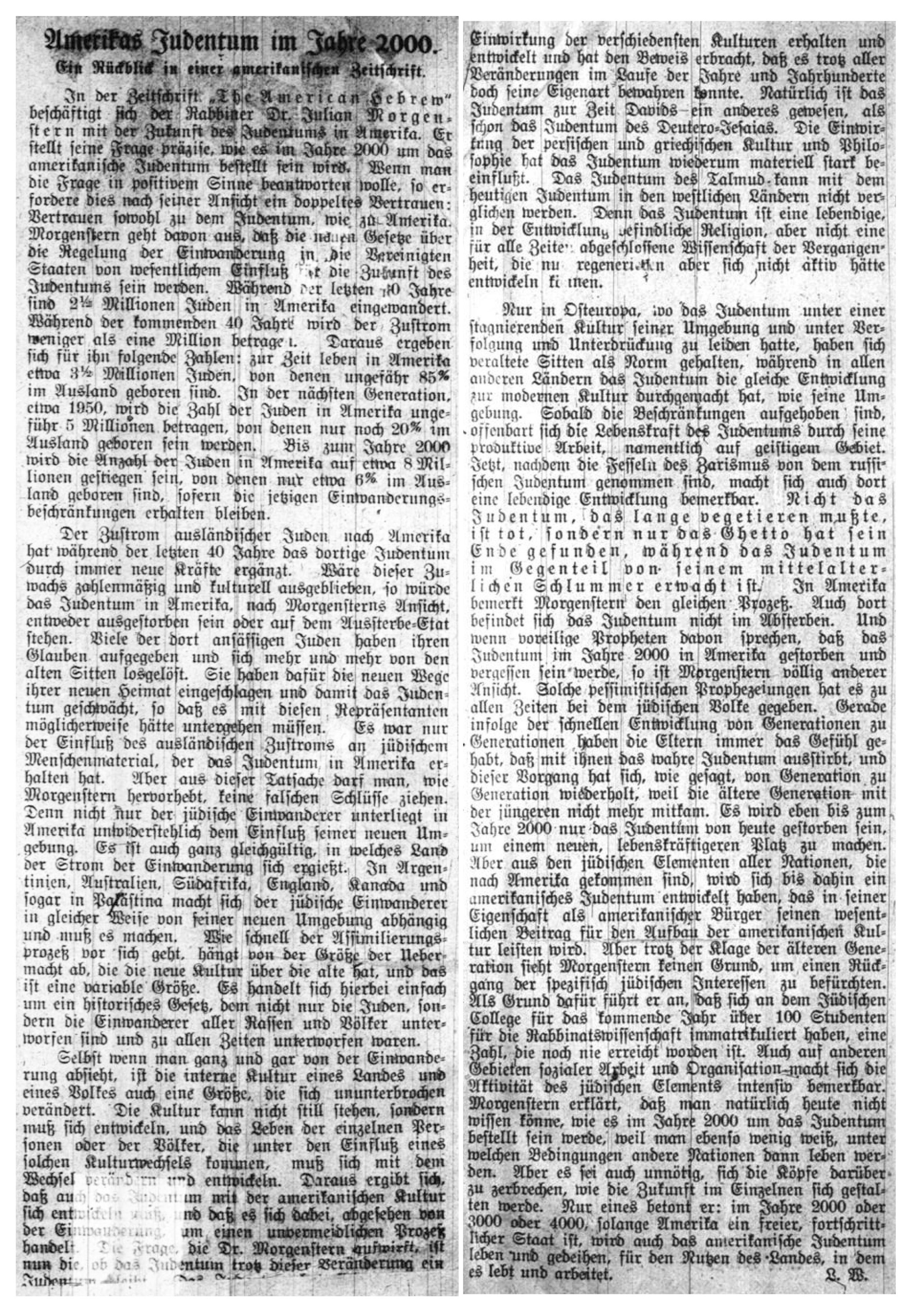
Here’s L.W.’s essay in translation. Typical of the nature of predictions, the article’s conclusions are arrived at based on the assumption that conditions in the present will persist unchanged and unchangeable into the future, which is tragically ironic given what would transpire in Germany – and beyond – only eight short years later. Otherwise, the author’s estimate of an American Jewish population of eight million by the year 2000 would prove to be far too optimistic, given that the Jewish population of the United States was 5,828,000 in 1992 and 6,544,000 in 2009. Even in the recently-ended year of 2024 the American Jewish population of 7,698,840 was still about 300,000 short of the article’s year-2000 prediction. (See References at bottom of this post.) Otherwise, the essay’s characterization of Eastern European Jewry is a curious mixture of condescension and arrogance, while in its description of the sometime belief that each generation has a tendency to perceive itself as the “last”, it shows insight into human nature in general, and Jewish history in particular.
Here’s the article…
American Judaism in the Year 2000
A review in an American magazine
The Shield
January, 1925
“By the year 2000, if current immigration restrictions remain in place,
the number of Jews in America will have risen to about 8 million,
of whom only about 6% will be foreign-born.”
In the magazine “The American Hebrew,” Rabbi Dr. Julian Morgenstern examines the future of Judaism in America. He asks precisely what the situation will be for American Judaism in the year 2000. In his opinion, if one wants to answer the question in the positive sense, this requires twofold trust: trust in Judaism, and in America. Morgenstern assumes that the new laws regulating immigration to the United States will have a significant impact on the future of Judaism. Over the last 10 years, 2.5 million Jews have immigrated to America. Over the next 40 years, the influx will be less than a million. For him, this leads to the following figures: there are currently about 3.5 million Jews living in America, of whom about 85% were born abroad. In the next generation, around 1950, the number of Jews in America will be about 5 million, of whom only 20% will be born abroad. By the year 2000, if current immigration restrictions remain in place, the number of Jews in America will have risen to about 8 million, of whom only about 6% will be foreign-born.
The influx of foreign Jews to America has, over the past 40 years, added ever new forces to the Jewish community there. If this increase in numbers and culture had not occurred, then, in Morgenstern’s view, Judaism in America would either have died out or would be on the verge of extinction. Many of the Jews living there have given up their faith and become more and more detached from the old customs. In return, they have taken the new paths of their new homeland and thereby weakened Judaism, so that it might have perished with these representatives. It was only the influence of the foreign influx of Jewish human material that has kept Judaism in America alive. But, as Morgenstern points out, we must not draw the wrong conclusions from this fact. For it is not only the Jewish immigrant in America who is irresistibly influenced by his new environment. It is also quite irrelevant to which country the stream of immigration flows. In Argentina, Australia, South Africa, England, Canada, and even in Palestine, the Jewish immigrant makes himself dependent on his new environment in the same way and must do so. How quickly the process of assimilation takes place depends on the degree of superiority that the new culture has over the old, and this is a variable factor. It is simply a historical law to which not only the Jews but immigrants of all races and peoples are and have been subject at all times.
Even if one completely disregards immigration, the internal culture of a country and a people is also a factor that is constantly changing. Culture cannot stand still, but must develop, and the lives of individuals or peoples who come under the influence of such a cultural change must change and develop with the change. It follows that Judaism must also develop with American culture, and that this is an inevitable process, apart from immigration. The question that Dr. Morgenstern ______ is now whether Judaism will _____ remain Judaism despite these changes. The _____ _____ influence of the most diverse cultures has been maintained and developed and has shown that it has been able to preserve its own character despite all the changes over the years and centuries. Of course, Judaism in David’s time was different from the Judaism of Deutero-Isaiah.
The influence of Persian and Greek culture and philosophy has in turn had a strong material impact on Judaism. The Judaism of the Talmud cannot be compared with the Judaism of today in the western countries. Judaism is a living religion that is still developing, but not a science of the past that has been shut down for all time and that could now be regenerated but not actively developed.
“Only in Eastern Europe,
where Judaism suffered from a stagnant culture of its surroundings and from persecution and oppression,
have outdated customs remained the norm,
while in all other countries Judaism has undergone the same development into modern culture as its surroundings.”
~~~~~~~~~~
“Precisely as a result of the rapid development from generation to generation,
parents have always had the feeling that true Judaism was dying out with them,
and this process has, as I have said,
repeated itself from generation to generation
because the older generation could no longer keep up with the younger.”
Only in Eastern Europe, where Judaism suffered from a stagnant culture of its surroundings and from persecution and oppression, have outdated customs remained the norm, while in all other countries Judaism has undergone the same development into modern culture as its surroundings. As soon as the restrictions are lifted, the vitality of Judaism reveals itself through its productive work, especially in the intellectual field. Now that the shackles of Tsarism have been removed from Russian Jewry, a lively development is noticeable there too. It is not Judaism, which had to vegetate for a long time, that is dead; it is only the ghetto that has come to an end, while Judaism, on the contrary, has awakened from its medieval slumber. Morgenstern notices the same process in America. Judaism there is not dying out either. And when hasty prophets speak of Judaism being dead and forgotten in America by the year 2000, Morgenstern takes a completely different view. Such pessimistic prophecies have always existed among the Jewish people. Precisely as a result of the rapid development from generation to generation, parents have always had the feeling that true Judaism was dying out with them, and this process has, as I have said, repeated itself from generation to generation because the older generation could no longer keep up with the younger. By the year 2000, only today’s Judaism will have died out to make way for a new, more vibrant one. But by then, an American Jewry will have developed from the Jewish elements of all nations that have come to America, which, in its capacity as American citizens, will make its essential contribution to the development of American culture. Despite the complaints of the older generation, Morgenstern sees no reason to fear a decline in specifically Jewish interests. He says that the reason for this is that over 100 students have enrolled at the Jewish College for the coming year to study rabbinical studies, a number that has never been reached before. The activity of the Jewish element is also making itself felt in other areas of social work and organization. Morgenstern explains that, of course, one cannot know today what the situation will be for Judaism in the year 2000, because one also does not know under what conditions other nations will then be living. But it is also unnecessary to rack one’s brains over how the future will shape itself in detail. He stresses only one thing: in the year 2000 or 3000 or 4000, as long as America is a free, progressive state, American Jewry will live and prosper, for the benefit of the country in which it lives and works. L.W.

And so, the article in the original German…
Amerikas Judentum im Jahre 2000
Ein Rückblick in einer amerikanischen Zeitschrift
Der Schild
Januar, 1925
In der Zeitschrift „The American Hebrew“ beschäftigt sich der Rabbiner Dr. Julian Morgenstern mit der Zukunft des Judentums in Amerika. Er stellt seine Frage präzise, wie es im Jahre 2000 um das amerikanische Judentum bestellt sein wird. Wenn man die Frage in positivem Sinne beantworten wolle, so erfordere dies nach seiner Ansicht ein doppeltes Vertrauen: Vertrauen sowohl zu dem Judentum, wie zu Amerika. Morgenstern geht davon aus, dass die neuen Gesetze über die Regelung der Einwanderung in die Vereinigten Staaten von wesentlichem Einfluss hät die Zukunft des Judentums sein werden. Während der letzten 10 Jahre sind 2 ½ Millionen Juden in Amerika eingewandert. Während der kommenden 40 Jahre wird der Zustrom weniger als eine Million betragen. Daraus ergeben sich für ihn folgende Zahlen: zur Zeit leben in Amerika etwa 3 ½ Millionen Juden, von denen ungefähr 85% im Ausland geboren sind. In der nächsten Generation, etwa 1950, wird die Zahl der Juden in Amerika ungeführ 5 Millionen betragen, von denen nur noch 20% im Ausland geboren sein werden. Bis zum Jahre 2000 wird die Anzahl der Juden in Amerika auf etwa 8 Millionen gestiegen sein, von denen nur etwa 6& im Ausland geboren sind, sofern die jetzigen Einwanderungsbeschränkungen erhalten bleiben.
Der Zustrom ausländischer Juden nach Amerika hat während der letzten 40 Jahre das dortige Judentum durch immer neue Kräfte ergänzt. Wäre dieser Zuwachs zahlenmässig und kulturell ausgeblieben, so würde das Judentum in Amerika, nach Morgensterns Ansicht, entweder ausgestorben sein oder auf dem Aussterbe-Etat stehen. Viele der dort ansässigen Juden haben ihren Glauben aufgegeben und sich mehr und mehr von den alten Sitten losgelöst. Sie haben dafür die neuen Wege ihrer neuen Heimat eingeschlagen und damit das Judentum geschwächt, so dass es mit diesen Repräsentanten möglicherweise hätte untergehen müssen. Es war nur der Einfluss des ausländischen Zustroms an jüdischem Menschenmaterial, der das Judentum in Amerika erhalten hat. Aber aus dieser Tatsache darf man, wie Morgenstern hervorhebt, keine falschen Schlüsse ziehen. Denn nicht nur der jüdische Einwanderer unterliegt in Amerika unwiderstehlich dem Einfluss seiner neuen Umgebung. Es ist auch ganz gleichgültig, in welches Land der Strom der Einwanderung such ergiesst. In Argentinien, Australien, Südafrika, England, Kanada und sogar in Palästina macht sich der jüdische Einwanderer in gleicher Weise von seiner neuen Umgebung abhängig und muss es machen. Wie schnell der Assimilierungsprozess vor sich geht, hängt von der Grösse der Uebermacht ab, die die neue Kultur über die alte hat, und das ist eine variable Grösse. Es handelt sich hierbei einfach um ein historische Gesetz, dem nicht nur die Juden, sondern die Einwanderer aller Rassen und Völker unterworfen sind und zu allen Zeiten unterworfen waren.
Selbst wenn man ganz und gar von der Einwanderung absieht, ist die interne Kultur eines Landes und eines Volkes auch eine Grösse, die sich ununterbrochen verändert. Die Kultur kann nicht still stehen, sondern muss sich entwickeln, und das Leben der einzelnen Personen oder der Völker, die unter den Einfluss eines solchen Kulturwechsels kommen, muss sich mit dem Wechsel verändern und entwickeln. Daraus ergibt sich, dass auch das Judentum mit der amerikanischen Kultur sich entwickeln muss, und dass es sich dabei, abgesehen von der Einwanderung, um einen unvermeidlichen Prozess handelt. Die Frage, die Dr. Morgenstern ______, ist nun die, ob das Judentum trotz dieser Veränderung ein Judentum _____ bleibt. Das _____ _____ Einwirkung der verschiedensten Kulturen erhalten und entwickelt und hat den Beweis erbracht, dass es trotz aller Veränderungen im Laufe der Jahre und Jahrhunderte doch seine Eigenart bewahren konnte. Natürlich ist das Judentum zur Zeit Davids – ein anderes gewesen, als schon das Judentum des Deutero-Iesaias. Die Einwirkung der persischen und griechischen Kultur und Philosophie hat das Judentum wiederum materiell stark beinflusst. Das Judentum des Talmud kann mit dem heutigen Judentum in den westlichen Ländern nicht verglichen werden. Denn das Judentum ist eine lebendige, in der Entwicklung Befindliche Religion, aber nicht eine für alle Zeiten abgeschossene Wissenschaft der Vergangenheit, die nu regenerieten aber sich nicht aktiv hätte entwickeln können.
Nur in Osteuropa, wo das Judentum unter einer stagnierenden Kultur seiner Umgebung und unter Verfolgung und Unterdrückung zu leiden hatte, haben sich veraltete Sitten als Norm gehalten, während in allen anderen Ländern das Judentum die gleiche Entwicklung zur modernen Kultur durchgemacht hat, wie seine Umgebung. Sobald die Beschränkungen aufgehoben sind, offenbart sich die Lebenskraft des Judentums durch seine produktive Arbeit, namentlich auf geistigen Gebiet. Jetzt, nachdem die Fesseln des Zarismus von dem russischen Judentum genommen sind, macht sich auch dort eine lebendige Entwicklung bemerkbar. Nicht das Judentum, das lange vegetieren musste, ist tot, sondern nur das Ghetto hat sein Ende gefunden, während das Judentum im Gegenteil von seinem mittelalterlichen Schlummer erwacht ist. In Amerika bemerkt Morgenstern den gleichen Prozess. Auch dort befindet sich das Judentum nicht im Absterben. Und wenn voreilige Propheten davon sprechen, dass das Judentum im Jahre 2000 in Amerika gestorben und vergessen sein werde, so ist Morgenstern völlig anderer Ansicht Solche pessimistischen Prophezeiungen hat es zu allen Zeiten bei dem jüdischen Volke gegeben. Gerade infolge der schnellen Entwicklung von Generationen zu Generationen haben die Eltern immer das Gefühl gehabt, dass mit ihnen das wahre Judentum ausstirbt, und dieser Vorgang hat sich, wie gesagt, von Generation zu Generation widerholt, weil die ältere Generation mit der jüngeren nicht mehr mitkam. Es wird eben bis zum Jahre 2000 nur das Judentum von heute gestorben sein, um einem neuen, lebenskräftigeren Platz zu machen. Aber aus den jüdischen Elementen aller Nationen, die nach Amerika gekommen sind, wird sich bis dahin ein amerikanisches Judentum entwickelt haben, das in seiner Eigenschaft als amerikanischer Bürger seinen wesentlichen Beitrag für den Aufbau der amerikanischen Kultur leisten wird. Aber trotz der Klage der älteren Generation sieht Morgenstern keinen Grund, um einen Rückgang der spezifisch jüdischen Interessen zu befürchten. Als Grund dafür fuhrt er an, dass sich an dem Jüdischen College für das kommende Jahr über 100 Studenten für die Rabbinatswissenschaft immatrikuliert haben, eine Zahl, die noch nie erreicht worden ist. Auch auf anderen Gebieten sozialer Arbeit und Organisation macht sich die Aktivität des jüdischen Elements intensiv bemerkbar. Morgenstern erklärt, das man natürlich heute nicht wissen könne, wie es im Jahre 2000 um das Judentum bestellt sein werde, weil man ebenso wenig weiss, unter welchen Bedingungen andere Nationen dann leben werden. Aber es sei auch unnötig, sich die Köpfe darüber zu zerbrechen, wie die Zukunft im Einzelnen sich gestalten werde. Nur eines betont er: im Jahre 2000 oder 3000 oder 4000, solange Amerika ein freier, fortschrittlicher Staat ist, wird auch das amerikanische Judentum leben und gedeihen, für den Rutzen des Landes, in dem es lebt und arbeitet. L.W.
Here’s an overview of how to access Der Schild at Goethe University, excerpted from my post “Infantry Against Tanks: A German Jewish Soldier at Cambrai, November, 1917“, of September 9, 2017. (It certainly seems to have come in handy, even seven years after it was written!)
“Stories and depictions of World War One combat, composed both during and after the “Great War”, are abundantly available in print and on the web.
“A fascinating source of such accounts – but even moreso a source particularly; poignantly ironic – is the newspaper Der Schild, which was published by the association of German-Jewish war veterans, the “Reichsbundes Jüdischer Frontsoldaten”, from January of 1922 through late 1938, the latter date paralleling the disbandment of the RjF. Der Schild is available as 35mm microfilm at the Dorot Jewish Division of the New York Public Library, and in digital format through Goethe University Frankfurt am Main.
“The screen-shot below shows the Goethe University’s catalog entry for Der Schild, which allows for immediate and direct access of the library’s holdings of the newspaper. All years of the publication, with the exception of 1924, are available; all as PDFs.
 “Of equal (greater?!) importance, accessing digital holdings is as simple as it is intuitive (and easy, too!) In effect and intent, this is a very well designed website! This is shown through this screen-shot, presenting holdings of Der Schild for 1933.
 “The total digitized holdings of Der Schild in the Goethe University’s collection comprise approximately 530 issues. “Gaps” do exist, with 1922 comprising only four issues (9, 10, 13, and 14) and 1923 comprising three issues (14, 15, and 17). However, holdings for all years commencing with 1925 are – I believe – complete, through the final issue (number 44, published November 4, 1938).
“Not unexpectedly, Der Schild’s content sheds fascinating and retrospectively haunting light on Jewish life in Germany during the 1920s and 1930s; on Jewish genealogy; on the military service of German Jews (not only in the First World War but the Franco-Prussian War as well), often focusing on Jewish religious services at “the Front”, rather than “combat”, per se (see the issue of April 3, 1936, with its cover article “Pesach vor Verdun”); on occasion about Jewish military service in the Allied nations during “The Great War”(1); on Jewish history, literature, and religion; on Jewish life and Jewish news outside of Germany.
“There is much to be explored.”
References
Bund jüdischer Soldaten (YouTube Channel)
Der Schild (digital version) (at Goethe University Frankfurt website)
Reichsbund jüdischer Frontsoldaten (at Wikipedia)
Vaterländischer Bund jüdischer Frontsoldaten (Patriotic Union of Jewish Front-Line Soldiers”)
Population figures for American Jews are based on information at the Jewish Virtual Library, therein based on combining: (A) Core Population – Jews born to Jewish parents or converted to Judaism; (B) Other Persons of Jewish Parentage; and (C) Respective non-Jewish households members.
