My overview of Der Schild revealed that the newspaper’s content encompassed a very wide variety of material, much of this, particularly in the latter years of the publication history, completely unrelated to Jewish military history. However, given the publication’s raison d’être, much of its content by comprises items about the service of Jews in the German military, encompassing veterans’ post-WW I reminiscences, and, excerpts of diaries and correspondence, as well as historical studies – done at a high level, for a non-academic periodical, albeit without footnotes! – about Jewish military service, a few of these articles even pertaining to the Franco-Prussian War. Though items about these topics appeared throughout the paper’s history, my review of the periodical suggested (…?…) that with the ascension of Adolf Hitler (יִמַּח שְׁמוֹ) to power in 1933, Der Schild made a subtle and gradual shift, in retrospect born of inevitability, towards content – news articles, essays, editorials – focused less on German Jewish military history in particular, and more towards worldwide Jewish news – from Western and Eastern Europe, the Americas, and the Yishuv – in general, or, to Jewish history.
It’d be most enlightening to make a statistical survey of the newspaper’s content throughout its sixteen-year existence, to see how this reflects the currents of thought of German Jewry – well, at least that of German Jewish veterans and members of the RJF – throughout these years. But, that project is vastly beyond the scope of this blog, so I leave the endeavor for the Ph.D. thesis of an enterprising and as-yet unknown doctoral candidate in Jewish history.
Well, this post is neither abstract nor academic. Instead, here I present one of the very many above-mentioned excerpts of letters from a Jewish soldier in the German army in the “Great War”.
On January 4, 1926, Der Schild published a letter from Vizefeldwebel (platoon senior non-commissioned officer) Fritz Friedrich Fink, to one “Ernst” – the latter unidentified, but probably Fritz’s brother or friend – concerning the former’s experience leading two soldiers during a reconnaissance patrol on the Narew Front. Though the date of this event is not given, it presumably occurred between 19 July and 3 August of 1915 in what is present-day Poland. More than a detailed description of the events of the patrol itself (the events of the letter only transpired over a single evening) are Fritz’s honest reflections on his motivation for this hazardous duty, which include (he starts right-off-the-bat with this one) antisemitism (at least, indirectly), a sense of moral obligation, the desire to prove himself (in his own eyes, at least) and what I perceive as an unarticulated but genuine inclination towards adventure, even if hazardous adventure. The article closes on the so-very-ironic note of an anticipation of a German victory in the East in 1915.
Equally ironic and especially sad, in light of Fritz’s closing thoughts, was his subsequent fate. A member of 37. Division, 147. Infanterieregiment, 3. Bataillon, 9. Kompanie, he was killed in action on August 18, 1915, shortly after the close of the Narew Offensive. Born in Hamburg on August 11, 1889, the son of Emmanuel and Mary (Wertheimer) Fink, his name appeared in Verlustmeldung (Casualty Message) 335, and can be found on page 370 of Die Jüdischen Gefallenen Des Deutschen Heeres, Deutschen Marine Und Der Deutschen Schutztruppen.
His place of burial, perhaps in a forgotten, or now-destroyed or overgrown Jewish cemetery somewhere in Poland, is unknown.
This post presents Frizt’s letter as published in Der Schild, followed by an English-language translation, and then the original text in German.
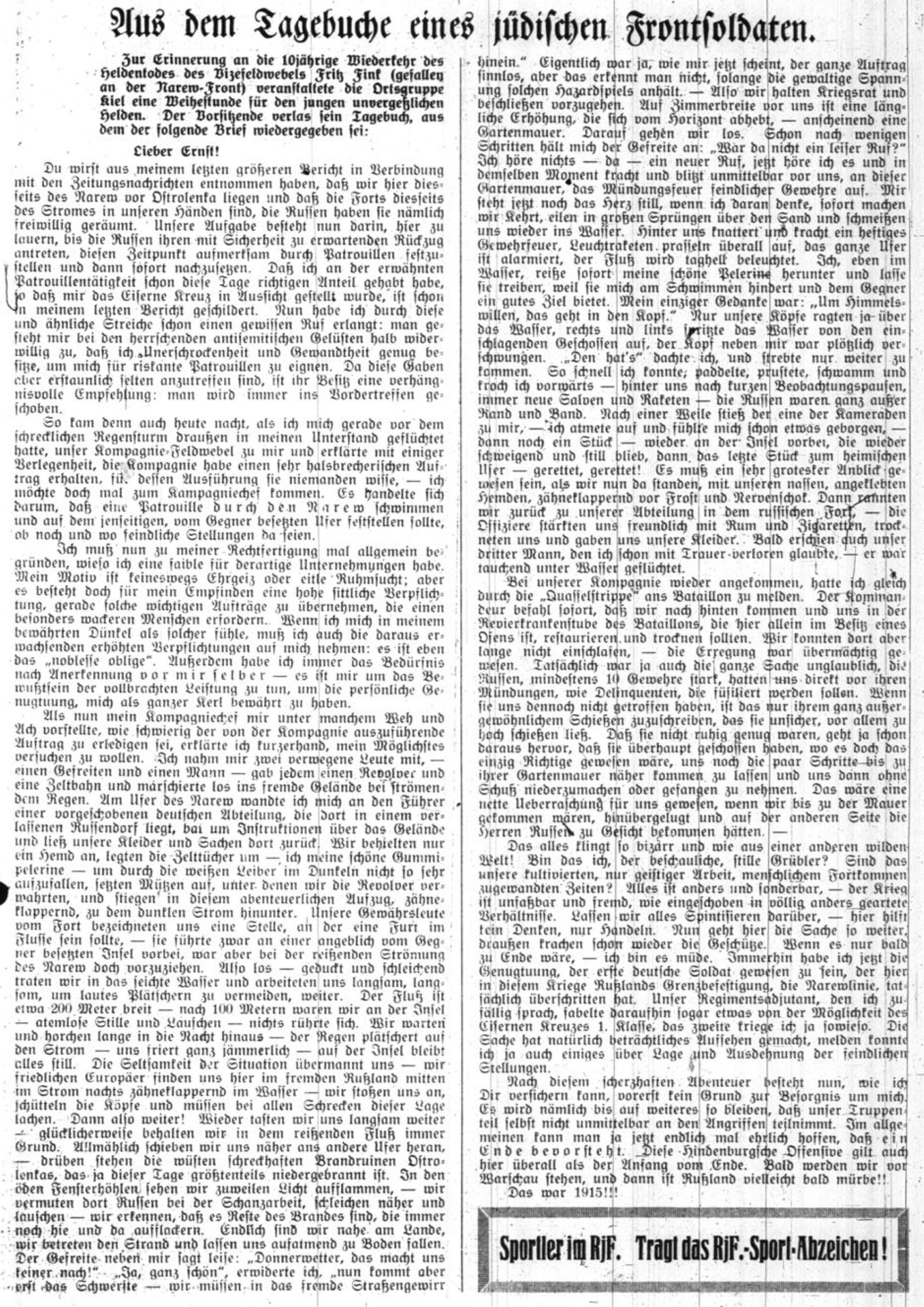
From the diary of a Jewish front-line soldier.
The Shield
January 4, 1926
“… in the face of the prevailing anti-Semitic sentiments,
I am admitted, half reluctantly,
to have enough courage and agility to be suitable for risky patrols.
But since these gifts are surprisingly rare, possessing them is a fatal recommendation:
you are always pushed to the front.”
To commemorate the 10th anniversary of the heroic death of Sergeant Fritz Fink (killed on the Narew front), the Kiel local group held a ceremony for the unforgettable young hero. The chairman read his diary, from which the following letter is reproduced:
Dear Ernst!
You will have gathered from my last major account in connection with newspaper reports that we are here on this side of the Narew in front of Ostrolenka and that the forts on this side of the river are in our hands, because the Russians have voluntarily evacuated them. Our task now is to lie in wait here until the Russians begin their retreat, which is certain, to determine this point carefully through patrols and then to pursue them immediately. The fact that I have already played a real part in the patrolling activities mentioned in these days, so that I have been promised the Iron Cross, has already been described in my last account. Now I have already gained a certain reputation through these and similar pranks: in the face of the prevailing anti-Semitic sentiments, I am admitted, half reluctantly, to have enough courage and agility to be suitable for risky patrols. But since these gifts are surprisingly rare, possessing them is a fatal recommendation: you are always pushed to the front.
“… the company had received a very dangerous assignment,
for which they knew no one to carry out…”
So tonight, when I had just taken refuge in my shelter outside from the terrible rainstorm, our company sergeant came to me and explained with some embarrassment that the company had received a very dangerous assignment, for which they knew no one to carry out – I would like to go to the company commander. It was about a patrol swimming across the Narew and finding out on the other bank, occupied by the enemy, whether there were any enemy positions and where they were.
“My motive is by no means ambition or vain desire for fame;
but I do feel that there is a high moral obligation
to take on such important assignments that require a particularly brave person.”
To justify myself, I must now explain in general terms why I have a weakness for such undertakings. My motive is by no means ambition or vain desire for fame; but I do feel that there is a high moral obligation to take on such important assignments that require a particularly brave person. If I feel myself to be such in my proven conceit, I must also accept the increased obligations that arise from it: it is simply the “noblesse oblige”. In addition, I always have the need for self-recognition – I am concerned with the awareness of the achievement I have made, with the personal satisfaction of having proven myself as a real man.
“The strangeness of the situation overwhelms us –
we peaceful Europeans find ourselves here in the middle of the river in foreign Russia at night,
teeth chattering in the water –
we bump into each other,
shake our heads and have to laugh at all the horror of this situation. “
When my company commander explained to me, with much moaning and sighing, how difficult the company’s task would be, I simply declared that I would do my best. I took two daring men with me – a Private and a man – gave each of them a revolver and a tarpaulin and marched off into the unfamiliar terrain in the pouring rain. On the banks of the Narew I turned to the leader of an advanced German detachment stationed in a deserted Russian village, asked for instructions about the terrain and left our clothes and belongings there. We kept only one shirt on, put on the tarpaulins – I mean beautiful rubber capes – so that our white bodies would not be too conspicuous in the dark, put on caps under which we kept the revolvers, and climbed down to the dark river in this adventurous outfit, chattering our teeth. Our informants from the fort indicated a place where there was supposed to be a ford in the river – it led past an island supposedly occupied by the enemy, but was preferable given the rapid current of the Narew. So off we went – crouching and creeping, we entered the shallow water and worked our way slowly, slowly, to avoid loud splashing. The river is about 200 meters wide – after 100 meters we were at the island – breathless silence and listening – nothing moved. We wait and listen for a long time into the night – the rain splashes on the river – we freeze miserably – everything on the island remains quiet. The strangeness of the situation overwhelms us – we peaceful Europeans find ourselves here in the middle of the river in foreign Russia at night, teeth chattering in the water – we bump into each other, shake our heads and have to laugh at all the horror of this situation. So we carry on! Again we slowly feel our way forward – fortunately we always keep our footing in the rushing river. Gradually we move closer to the other bank – over there are the desolate, terrible burnt-out ruins of Ostrolenka, which has mostly burned down in recent days. We occasionally see lights flickering in the desolate window recesses – we suspect Russians there at work digging trenches, creep closer and listen – we realize there are remnants of the fire that are still flaring up here and there. Finally we are close to land, we step onto the beach and let ourselves fall to the ground with a sigh of relief. The private next to me says quietly: “Wow, no one can do that like us!” “Yes, very well,” I replied, “but now comes the hardest part – we have to go into the strange maze of streets.” Actually, as it seems to me now, the whole mission was pointless, but you don’t realize that as long as the tremendous tension of such a gamble continues. So we hold a council of war and decide to advance. A long elevation, as wide as a room in front of us, stands out from the horizon – apparently a garden wall. We set off towards it. After just a few steps the private stops me: “Wasn’t there a faint call?” I hear nothing – there – another call, now I hear it and at the same moment the muzzle flash of enemy rifles crackles and flashes directly in front of us, on this garden wall. My heart still stops when I think about it, we immediately turn around, run in big leaps across the sand and throw ourselves back into the water. Behind us there is a crackle and crash of rifle fire, flares explode everywhere, the whole bank is alarmed, the river is lit up as bright as day. I, just in the water, immediately rip off my beautiful cape and let it float because it prevents me from swimming and offers the enemy a good target. My only thought was: “For heaven’s sake, this is going to get in my head.” Only our heads were above the water, the water splashed up to the right and left from the impact of the projectiles, the head next to me had suddenly disappeared. “That’s him,” I thought, and just tried to keep going. I paddled, snorted, swam and crawled forward as fast as I could – behind us, after short pauses to observe, more and more salvos and rockets – the Russians were completely out of control. After a while, one of my comrades joined me – I breathed a sigh of relief and felt somewhat safe – then a little further – past the island again, which remained silent and still again, then the last stretch to the home shore – saved, saved! It must have been a very grotesque sight as we stood there with our wet, stuck-together shirts, our teeth chattering from the cold and nervous shock. Then we ran back to our detachment in the Russian fort – the officers kindly refreshed us with rum and cigarettes, dried us and gave us our clothes. Soon our third man appeared, whom I thought was already lost – he was diving under water.
When I got back to our company, I had to report to the battalion straight away through the “chatty boy”. The commander immediately ordered us to go to the back and get some rest and dry off in the battalion’s infirmary, which is the only one in the possession of a stove. We couldn’t sleep there for a long time – the excitement was overwhelming. In fact, the whole thing was unbelievable. The Russians, at least 10 rifles strong, had us right in front of their muzzles, like delinquents who were about to be shot. If they still didn’t hit us, it can only be put down to their very unusual shooting, which made them uncertain and above all shoot too high. The fact that they weren’t calm enough is already evident from the fact that they shot at all, when the only right thing to do would have been to let us come a few steps closer to their garden wall and then kill us without firing a shot or take us prisoner. It would have been a nice surprise for us if we had got to the wall, looked over and seen the Russians on the other side. –
It all sounds so bizarre and like it’s from another wild world! Is that me, the contemplative, quiet thinker? Are these our cultivated times, devoted only to intellectual work and human progress? Everything is different and strange – the war is incomprehensible and alien, as if inserted into completely different circumstances. Let’s stop speculating about it – thinking is no use here, only action. Now things are going on like this here, the guns are blaring outside again. If only it would end soon – I’m tired of it. At least I now have the satisfaction of having been the first German soldier to actually cross Russia’s border fortifications, the Narew Line, in this war. Our regimental adjutant, whom I happened to speak to, even started talking about the possibility of an Iron Cross 1st Class, and I’m getting the second one anyway. The whole thing caused quite a stir, of course, and I was able to report a lot about the location and extent of the enemy positions.
“This Hindenburg offensive is also seen everywhere here as the beginning of the end.
We will soon be standing in front of Warsaw, and then Russia may soon be worn down!”
After this humorous adventure, I can assure you that there is no reason for me to be worried for the time being. For the time being, our unit will not be taking part in the attacks. In general, we can now finally hope that an end is near. This Hindenburg offensive is also seen everywhere here as the beginning of the end. We will soon be standing in front of Warsaw, and then Russia may soon be worn down!
That was 1915!!!
And so, the article in the original German…

Aus dem Tagebuche eines jüdischen Frontsoldaten.
Der Schild
4. Januar 1926
Zur Erinnerung an die 10jährige Wiederkehr des Heldentodes des Vizefeldwebels Fritz Fink (gefallen an der Narew-Front) veranstaltete die Ortsgruppe Kiel eine Weihestunde für den jungen unvergesslichen Helden. Der Vorsitzende verlas sein Tagebuch, aus dem der folgende Brief wiedergegeben sei:
Lieber Ernst!
Du wirst aus meinem letzten grösseren Bericht in Verbindung mit den Zeitungsnachrichten entnommen haben, dass wir hier diesseits des Narew vor Ostrolenka liegen und dass die Forts diesseits des Stromes in unseren Händen sind, die Russen haben sie nämlich freiwillig geräumt. Unsere Aufgabe besteht nun darin, hier zu lauern, bis die Russen ihren mit Sicherheit zu erwartenden Rückzug antreten, diesen Zeitpunkt aufmerksam durch Patrouillen festzustellen und dann sofort nachzusetzen. Dass ich an der erwähnten Patrouillentätigkeit schon diese Tage richtigen Anteil gehabt habe, so dass mir das Eiserne Kreuz in Aussicht gestellt wurde, ist schon in meinem letzten Bericht geschildert. Nun habe ich durch diese und ähnliche Streiche schon einen gewissen Ruf erlangt: man gesteht mir bei den herrschenden antisemitischen Gelüsten halb widerwillig zu, dass ich Unerschrockenheit und Gewandtheit genug besitze, um mich für riskante Patrouillen zu eignen. Da diese Gaben aber erstaunlich selten anzutreffen sind, ist ihr Besitz eine verhängnisvolle Empfehlung: man wird immer ins Vordertreffen geschoben.
So kam denn auch heute nacht, als ich mich gerade vor dem schrecklichen Regensturm draussen in meinen Unterstand geflüchtet hatte, unser Kompagnie-Feldwebel zur mir und erklärte mit einiger Verlegenheit, die Kompagnie habe einen sehr halsbrecherischen Auftrag erhalten, für dessen Ausführung sie niemanden wissse, – ich möchte doch mal zum Kompagniechef kommen. Es handelte sich darum, dass eine Patrouille durch den Narew schwimmen und auf dem jenseitigen, vom Gegner besetzten Ufer feststellen sollte, ob noch und wo feindliche Stellungen da seien.
Ich muss nun zu meiner Rechtfertigung mal allgemein begründen, wieso ich eine faible für derartige Unternehmungen habe. Mein Motiv ist keineswegs Ehrgeiz oder eitle Ruhmsucht; aber es besteht doch für mein Empfinden eine hohe sittliche Verpflichtung, gerade solche wichtigen Aufträge zu übernehmen, die einen besonders wackeren Menschen erfordern. Wenn ich mich in meinem bewährten Dünkel als solcher fühle, muss ich auch die daraus erwachsenden erhölten Verpflichtungen auf mich nehmen: es ist eben das „noblesse oblige“. Ausserdem habe ich immer das Bedürfnis nach Anerkennung vor mir selber – es ist mir um das Bewusstsein der vollbrachten Leistung zu tun, um die persönliche Genugtuung, mich als ganzer Kerl bewährt zu haben.
Als nun mein Kompagniechef mir unter manchem Weh und Ach vorstellte, wie schwierig der von der Kompagnie auszuführende Auftrag zu erledigen sei, erklärte ich kurzerhand, mein Möglichstes versuchen zu wollen. Ich nahm mir zwei verwegene Leute mit, – einen Gefreiten und einen Mann – gab jedem einen Revolver und eine Zeltbahn und marschierte los ins fremde Gelände bei strömendem Regen. Am Ufer des Narew wandte ich mich an den Führer einer vorgeschobenen deutschen Abteilung, die dort in einem verlassenen Russendorf liegt, bat um Instruktionen über das Gelände und liess unsere Kleider und Sachen dort zurück. Wir behielten nur ein Hemd an, legten die Zelttücher um – ich meine schöne Gummipelerine – um durch die weissen Leiber im Dunkeln nicht so sehr aufzufallen, setzten Mützen auf, unter denen wir die Revolver verwahrten, und stiegen in diesem abenteuerlichen Aufzug, zähneklappernd, zu dem dunklen Strom hinunter. Unsere Gewährsleute vom Fort bezeichneten und eine Stelle, an der eine Furt im Flusse sein sollte, – sie führte zwar an einer angeblich vom Gegner besetzten Insel vorbei, war aber bei der reissenden Strömung des Narew doch vorzuziehen. Also los – geduckt und schleichend traten wir in das seichte Wasser und arbeiteten uns langsam, langsam, um lautes Plätschern zu vermeiden, weiter. Der Fluss ist etwa 200 Meter breit – nach 100 Metern waren wir an der Insel – atemlose Stille und Lauschen – nichts rührte sich. Wir warten und horchen lange in die Nacht hinaus – der Regen plätschert auf den Strom – uns friert ganz jämmerlich – auf der Insel bleibt alles still. Die Seltsamkeit der Situation übermannt uns – wir friedlichen Europäer finden uns hier im fremden Russland mitten im Strom nachts zähneklappernd im Wasser – wir stossen uns an, schütteln die Kopfe und müssen bei allen Schrecken dieser Lage lachen. Dann also weiter! Wieder tasten wir uns langsam weiter – glücklicherweise behalten wir in dem reissenden Fluss immer Grund. Allmählich schieben wir uns näher ans andere Ufer heran, – drüben stehen die wüsten schreckhaften Brandruinen Ostrolenkas, das ja dieser Tage grösstenteils niedergebrannt ist. In den öden Fensterhöhlen sehen wir zuweilen Licht aufflammen, – wir vermuten dort Russen bei der Schanzarbeit, schleichen näher und lauschen – wir erkennen, dass es Reste des Brandes sind, die immer noch die und da aufflakern. Endlich sind war nahe am Lande, wir betreten den Strand und lassen uns aufatmend zu Boden fallen. Der Gefreite neben mir sagt leise: „Donnerwetter, das macht uns keiner nach!“ „Ja, ganz schön“, erwiderte ich, „nun kommt aber orst das Schwerste – wir müssen in das fremde Strassengewirr hinein.“ Eigentlich war ja, wir mir jetzt scheint, der ganze Auftrag sinnlos, aber das erkennt man nicht, solange die gewaltige Spannung solchen Hazardspiels anhält. – Also wir halten Kriegsrat und beschliessen vorzugehen. Auf Zimmerbreite vor uns it eine längliche Erhöhung, die sich vom Horizont abhebt, – anscheined eine Gartenmauer. Darauf gehen wir los. Schon nach wenigen Schritten hält mich der Gefreite an: „War da nicht ein leiser Ruf?“ Ich höre nichts – da – ein neuer Ruf, jetzt höre ich es und in demselben Moment kracht und blitzt unmittelbar vor uns, an dieser Gartenmauer, das Mündungsfeuer feindlicher Gewehre auf. Mir steht jetzt noch das Herz still, wenn ich daran denke, sofort machen wir Kehrt, eilen in grossen Sprüngen über den Sand und schmeissen uns wieder ins Wasser. Hinter uns knattert und kracht ein heftiges Gewehrfeuer, Leuchtraketen prasseln überall auf, das ganze Ufer ist alarmiert, der Fluss wird taghell beleuchtet. Ich, eben im Wasser, reisse sofort meine schüne Pelerine herunter und lasse sie treiben, weil sie mich am Schwimmen hindert und dem Gegner ein gutes Ziel bietet. Mein einziger Gedanke war: „Um Himmelswillen, das geht in den Kopf.“ Nur unsere Köpfe ragten ja über das Wasser, rechts und links spritzte das Wasser von den einschlagenden Geschossen auf, der Kopt neben mir war plötzlich verschwungen. „Den hat’s“ drachte ich, und strebte nur weiter zu kommen. So schnell ich konnte, paddelte, prustete, schwamm und kroch ich vorwärts – hinter uns nach kurzen Beobachtungspausen, immer neue Salven und Raketen – die Russen waren ganz ausser Kand und Band. Nach einer Weile stiess der eine der Kameraden zu mir, – ich atmete auf und fühlte mich schon etwas geborgen, – dann noch ein Stück – wieder an der Insel vorbei, die wieder schweigend und still blieb, dann das letzte Stück zum heimischen Ufer – gerettet, gerettet! Es muss ein sehr grotesker Anblick gewesen sein, als wir nun da standen, mit unseren nassen, angeklebten Hemden, zähneklappernd vor Frost und Nervenschok. Dann rannten wir zurück zu unserer Abteilung in dem russischen Fort, – die Offiziere stärkten uns freundlich mit Rum und Zigaretten, trockneten uns und gaben uns unsere Kleider. Bald erschien auch unser dritter Mann, den ich schon mit Trauer-verloren glaubte, – er war tauchend unter Wasser geflüchtet.
Bei unserer Kompagnie wieder angekommen, hatte ich gleich durch die „Quasselstrippe“ ans Bataillon zu melden. Der Kommandeur befehl sofort, dass wir nach hinter kommen und uns in der Revierkrankenstube des Bataillons, die hier allein im Besitz eines Ofens ist, restaurieren und trocknen sollten. Wir konnten dort aber lange nicht einschlafen, – die Erregung war übermächtig gewesen. Tatächlich war ja auch die ganze Sache unglaublich, die Russen, mindestens 10 Gewehre stark, hatten uns direkt vor ihren Mündungen, wie Delinquenten, die füsiliert werden sollen. Wenn sie uns dennoch nicht getroffen haben, ist das nur ihrem ganz aussergewöhnlichem Schiessen zuzuschreiben, das sie unsicher, vor allem zu hoch schiessen liess. Dass sie nicht ruhig genug waren, geht ja schon daraus hervor, dass sie überhaupt geschossen haben, wo es doch das einzig Richtige gewesen wäre, uns noch die paar Schritte bis zu ihrer Gartenmauer näher kommen zu lassen und uns dann ohne Schuss niederzumachen oder gefangen zu nehmen. Das wäre eine nette Ueberraschung für uns gewesen, wenn wir bis zu der Mauer gekommen wären, hinübergelugt und auf der anderen Seite die Herren Russen zu Gesicht bekommen hätten. –
Das alles klingt so bizarr und wie aus einer anderen wilden Welt! Bin das ich, der beschauliche, stille Grübler? Sind das unsere kultivierten, nur geistiger Arbeit, menschlichem Fortkommen zugewandten Zeiten? Alles ist anders und sonderbar, – der Krieg ist unfassbar und fremd, wie eingeschoben in völlig anders geartete Verhältnisse. Lassen wir alles Spintisieren darüber, – hier hilft kein Denken, nur Handeln. Nun geht hier die Sache so weiter, draussen krachen schon wieder die Geschütze. Wenn es nur bald zu Ende wäre, – ich bin es müde. Immerhin habe ich jetzt die Genugtuung, der erste deutsche Soldat gewesen zu sein, der hier in diesem Kriege Russlands Grenzbefestigung, die Narewlinie, tatsächlich überschritten hat. Unser Regimentsadjutant, den ich zufällig sprach, fabelte daraufhin sogar etwas von der Möglichkeit des Eisernen Kreuzes 1. Klasse, das zweite kriege ich ja sowieso. Die Sache hat natürlich beträchtliches Aufsehen gemacht, melden konnte ich ja auch einiges über Lage und Ausdehnung der feindlichen Stellungen.
Nach diesem scherzhaften Abenteur besteht nun, wie ich Dir versichern kann, vorerst kein Grund zur Besorgnis um mich. Es wird nämlich bis auf weiteres so bleiben, dass unser Truppenteil selbst nicht unmittelbar an den Angriffen teilnimmt. Im allgemeinen kann man ja jetzt endlich mal ehrlich hoffen, dass ein Ende bevor steht. Diese Hindenburgsche Offensive gilt auch hier überall als der Anfang vom Ende. Bald werden wir vor Warschau stehen, und dann ist Russland vielleicht bald mürbe!
Das war 1915!!!
Here’s an overview of how to access Der Schild at Goethe University, excerpted from my post “Infantry Against Tanks: A German Jewish Soldier at Cambrai, November, 1917“, of September 9, 2017. (It certainly seems to have come in handy, just over seven years later!)
“Stories and depictions of World War One combat, composed both during and after the “Great War”, are abundantly available in print and on the web.
“A fascinating source of such accounts – but even moreso a source particularly; poignantly ironic – is the newspaper Der Schild, which was published by the association of German-Jewish war veterans, the “Reichsbundes Jüdischer Frontsoldaten”, from January of 1922 through late 1938, the latter date paralleling the disbandment of the RjF. Der Schild is available as 35mm microfilm at the Dorot Jewish Division of the New York Public Library, and in digital format through Goethe University Frankfurt am Main.
“The screen-shot below shows the Goethe University’s catalog entry for Der Schild, which allows for immediate and direct access of the library’s holdings of the newspaper. All years of the publication, with the exception of 1924, are available; all as PDFs.
 “Of equal (greater?!) importance, accessing digital holdings is as simple as it is intuitive (and easy, too!) In effect and intent, this is a very well designed website! This is shown through this screen-shot, presenting holdings of Der Schild for 1933.
 “The total digitized holdings of Der Schild in the Goethe University’s collection comprise approximately 530 issues. “Gaps” do exist, with 1922 comprising only four issues (9, 10, 13, and 14) and 1923 comprising three issues (14, 15, and 17). However, holdings for all years commencing with 1925 are – I believe – complete, through the final issue (number 44, published November 4, 1938).
“Not unexpectedly, Der Schild’s content sheds fascinating and retrospectively haunting light on Jewish life in Germany during the 1920s and 1930s; on Jewish genealogy; on the military service of German Jews (not only in the First World War but the Franco-Prussian War as well), often focusing on Jewish religious services at “the Front”, rather than “combat”, per se (see the issue of April 3, 1936, with its cover article “Pesach vor Verdun”); on occasion about Jewish military service in the Allied nations during “The Great War”(1); on Jewish history, literature, and religion; on Jewish life and Jewish news outside of Germany.
“There is much to be explored.”
References
Bund jüdischer Soldaten (YouTube Channel)
Der Schild (digital version) (at Goethe University Frankfurt website)
Die Jüdischen Gefallenen Des Deutschen Heeres, Deutschen Marine Und Der Deutschen Schutztruppen 1914-1918 – Ein Gedenkbuch, Reichsbund Jüdischer Frontsoldaten, Forward by Dr. Leo Löwenstein, Berlin, Germany, 1932
Reichsbund jüdischer Frontsoldaten (at Wikipedia)
Vaterländischer Bund jüdischer Frontsoldaten (Patriotic Union of Jewish Front-Line Soldiers”)