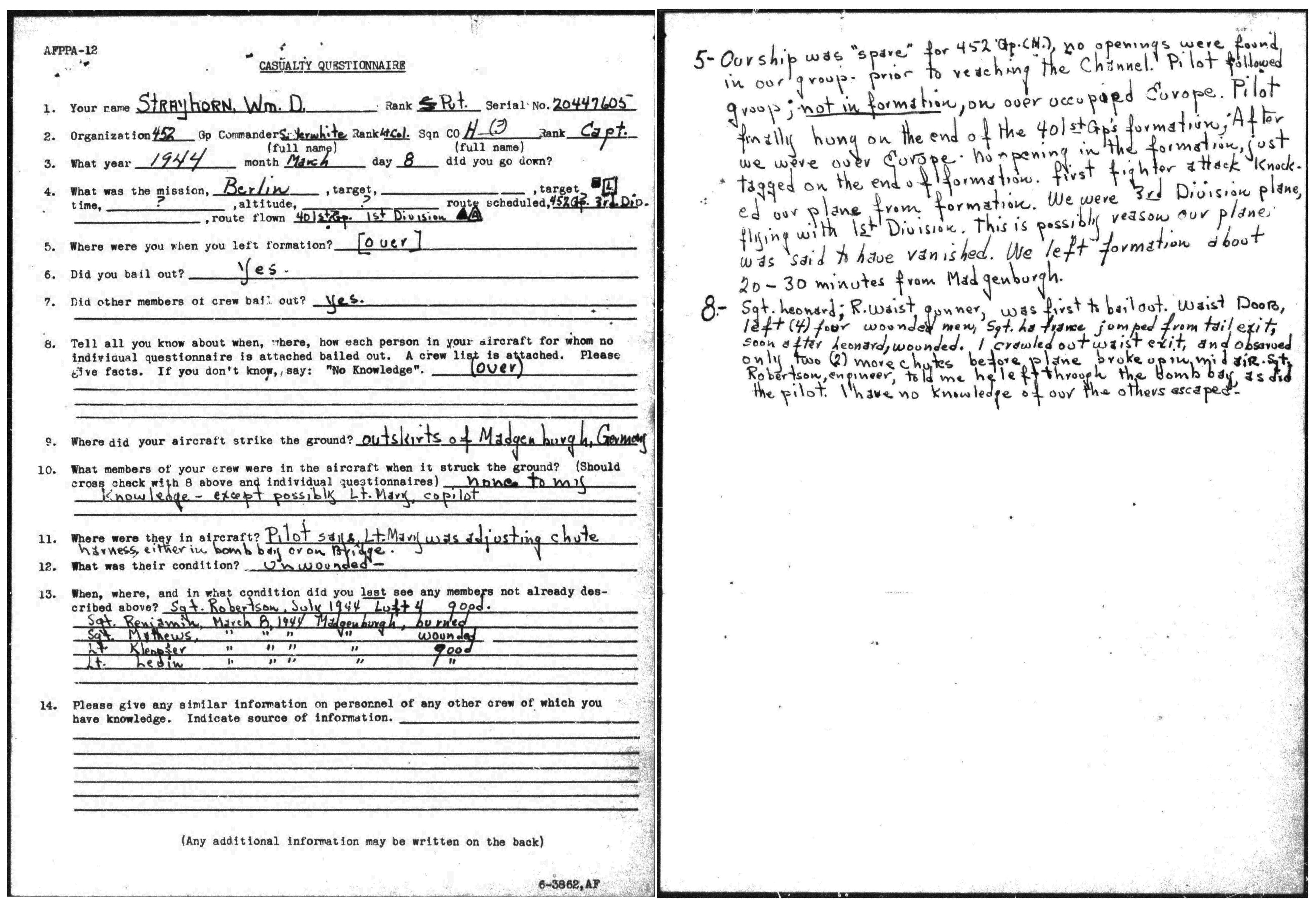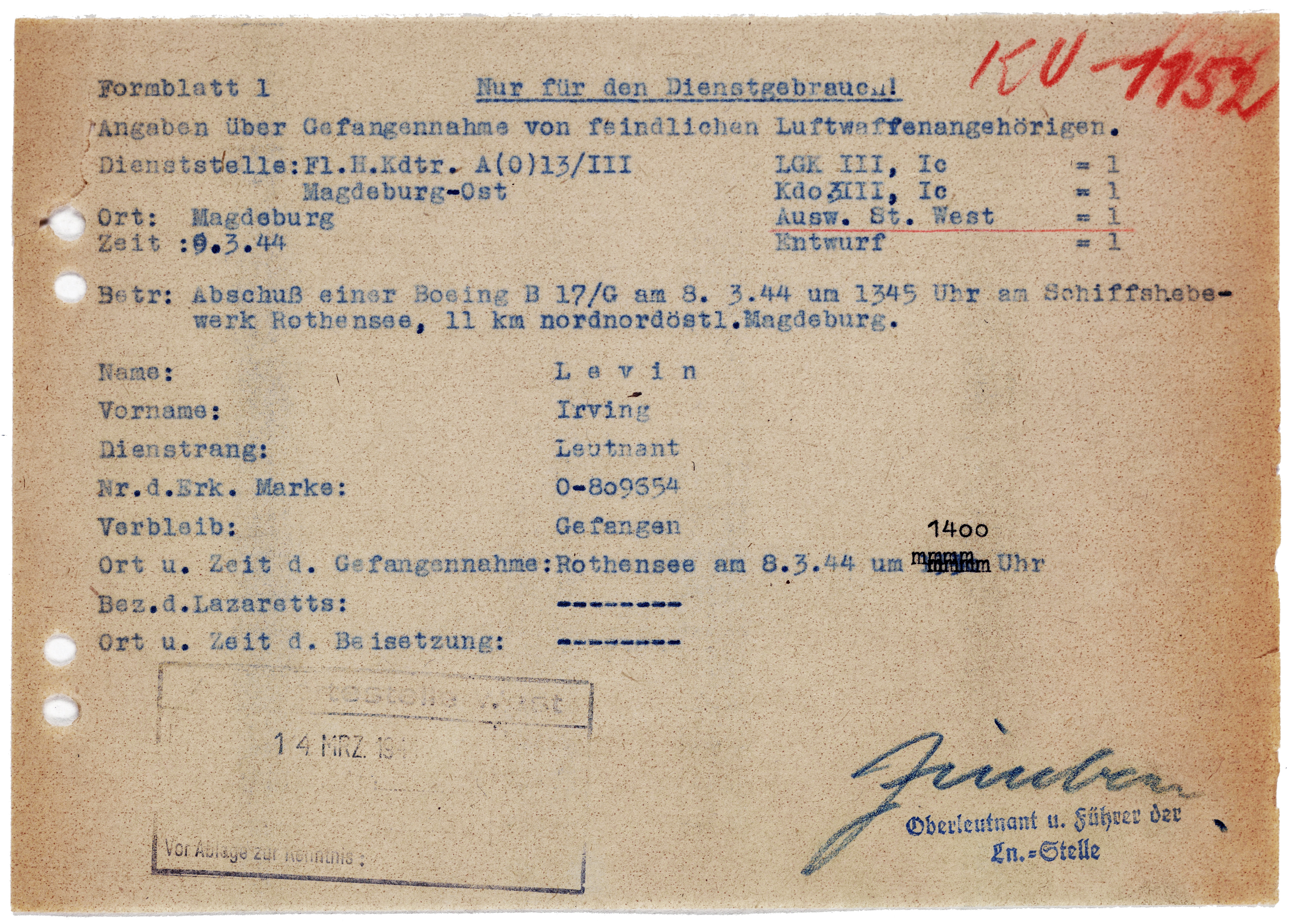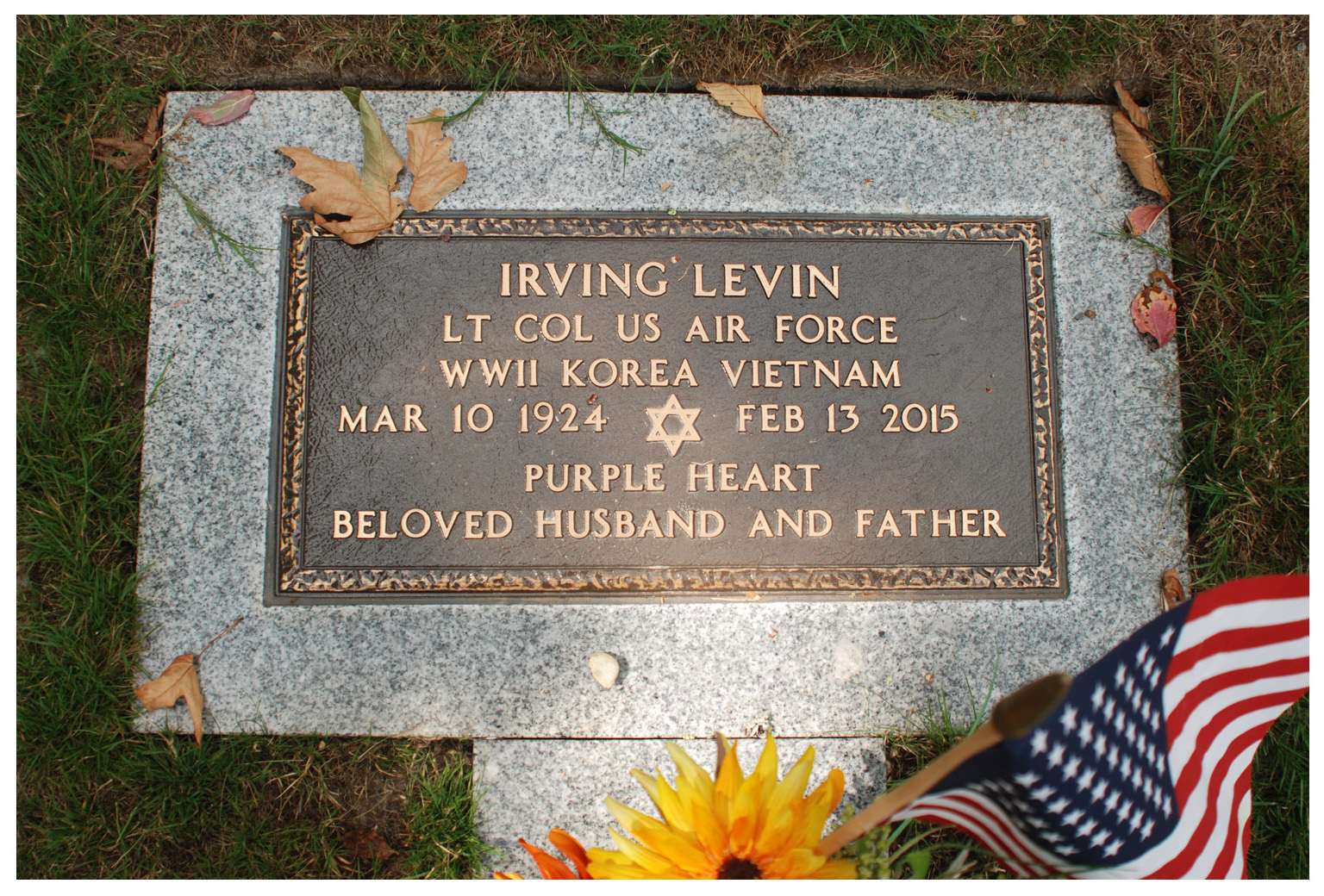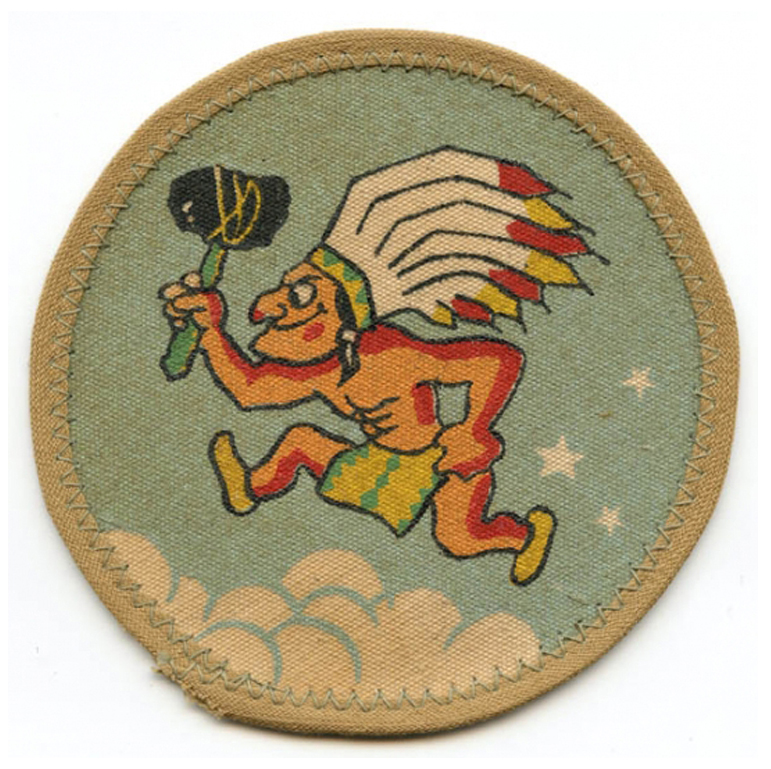
Soldiers from New York: Jewish Soldiers in The New York Times, in World War Two: March 19, 1945 (In the Air…) [Updated Post…]

Update…!  Created ages ago (well, actually just July 16, 2024) this post mentions Sergeant Julius Manson of the 484th Bomb Squadron, 505th Bomb Group, who survived the ditching of his B-29 on March 19, 1945.  Sgt. Manson and six other airmen lost their lives when their B-29 disappeared in the Pacific Ocean during a flight to the United States on October 10, 1945.  Though this incident is covered in Missing Air Crew Report 14951, the digital version of that document is unavailable via Fold 3, while there’s no record of this event in the historical records of the 484th Bomb Squadron.  As such, except for that of the pilot, the names of the other six crewmen on that B-29 (44-70122) are absent in the “original” version of this post.

I’ve been able to identify these men using the ABMC database.  Their names appear below, in dark red font, like “this”. … Scroll on down…

______________________________

He was one of the seven crewmen aboard B-29 44-70122, which – piloted by 2 Lt. Bernard J. Benson, Jr. – crashed in the Pacific Ocean on October 10, 1945, one of at least thirteen B-29s lost after hostilities with Japan ended. The loss of this 484th Bomb Squadron aircraft is covered in MACR 14951, which – like more than a few MACRs digitized by Fold3 – is (* ahem *) unavailable via NARA.

B-29 disappeared in a flight

As part of my ongoing series of posts about Jewish soldiers who were the subjects of news coverage by The New York Times during the Second World War, “this” post relates stories of Jews who served in the air forces of the WW II Allies, specifically pertaining to events on March 19, 1945.  As you’ll see, some of these men survived, and others did not.

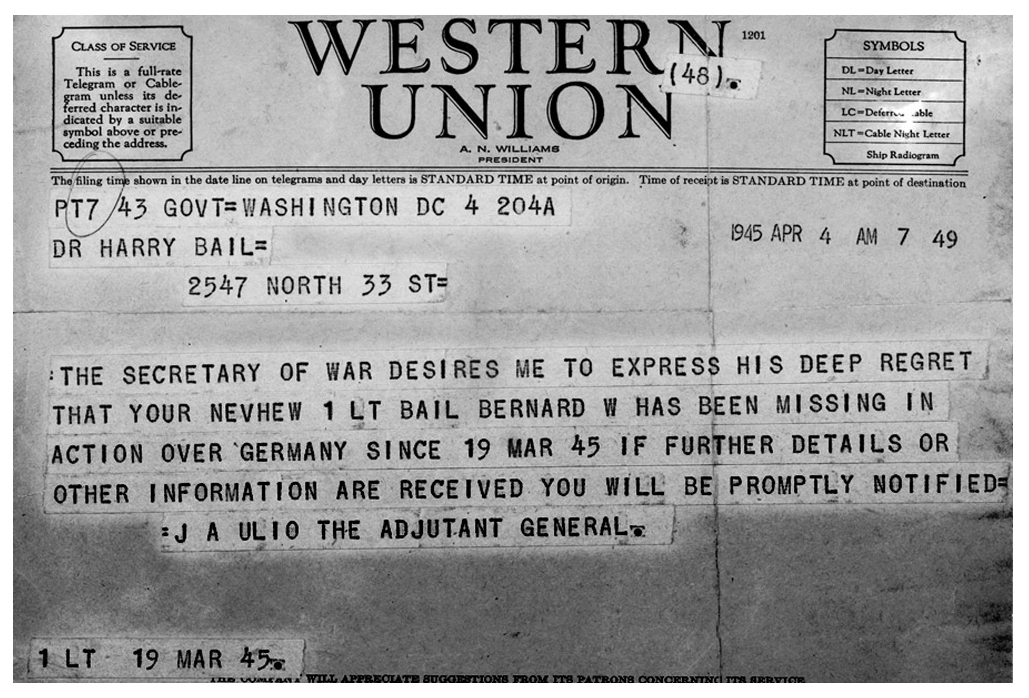
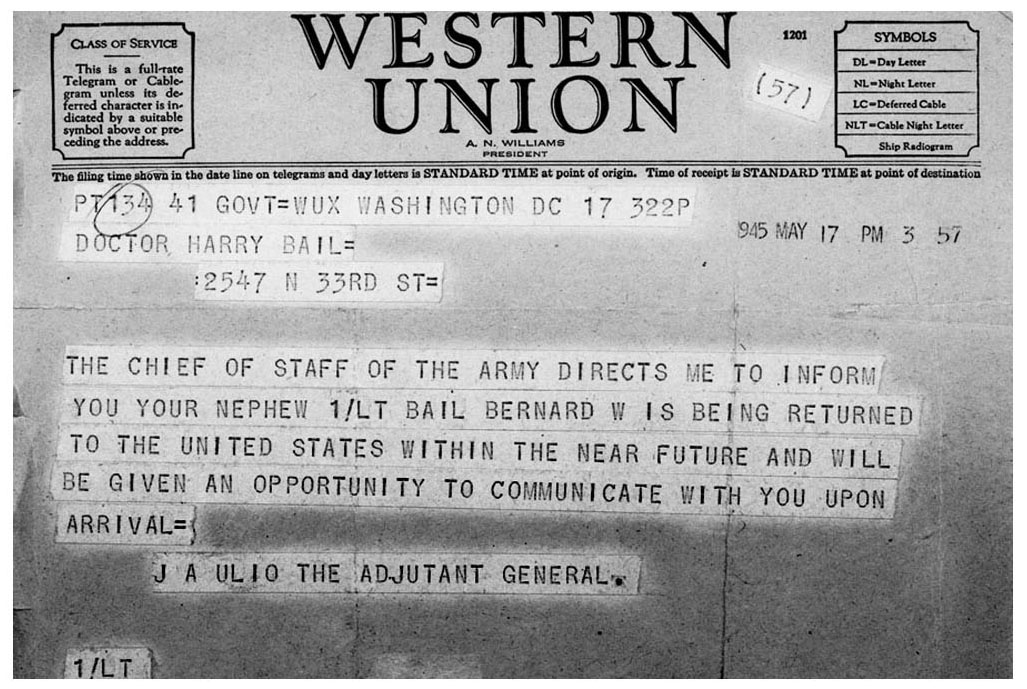
I’ll have additional blog posts about Jewish aviators involved in military actions on this day, all of a quite lengthy and detailed nature.  These will pertain to  1 Lt. Bernard W. Bail, 1 Lt. Nathan Margolies, and three flyers in the USAAF’s 417th Bomb Group, F/O Samuel Harmell, S/Sgt. Jerome W. Rosoff, and S/Sgt. Seymour Weinbeg.  

But, for now…

For those who lost their lives on this date…
Monday, March 19, 1945 / 5 Nisan 5705
– .ת.נ.צ.ב.ה. –
…Tehé Nafshó Tzrurá Bitzrór Haḥayím
May his soul be bound up in the bond of everlasting life.

United States Army Air Force

8th Air Force

452nd Bomb Group
730th Bomb Squadron

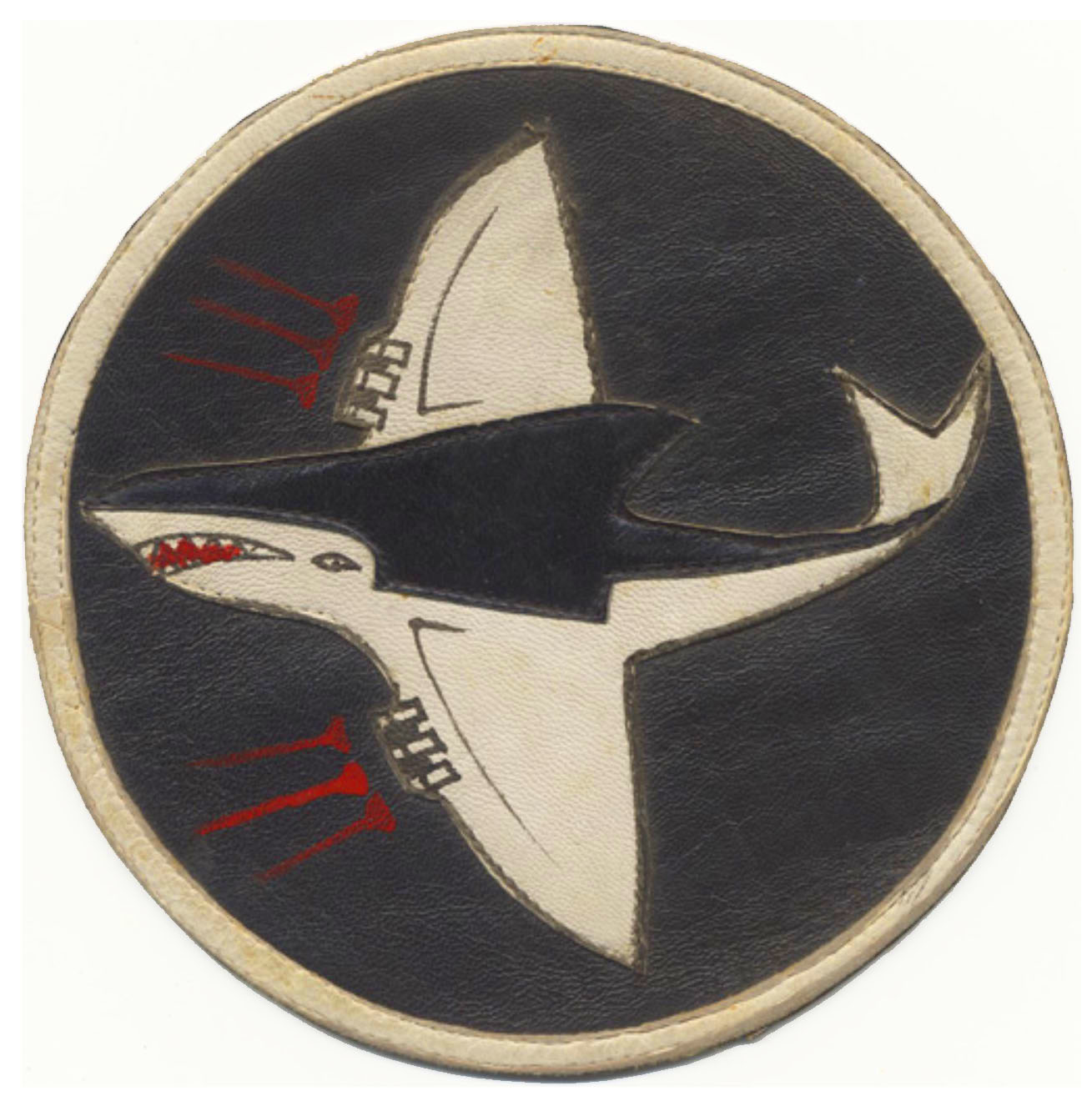
From the Roger Freeman collection at the American Air Museum in England is this example of the 730th Bomb Squadron insignia. 

Here is a parallel:  F/O Arthur Burstein (T-132844) and 2 Lt. Marvin Rosen (0-2068473) were both navigators in the 452nd Bomb Group’s 730th Bomb Squadron.  Their aircraft – B-17G Flying Fortresses – were shot down by Me-262 jet fighters during a mission to Zwickau, Germany, crashing near that city, and both were taken captive.  Both men were interned in POW camps – the specific locations of which are unknown – and like their fellow crewmen, both returned to the United States after the war’s end.

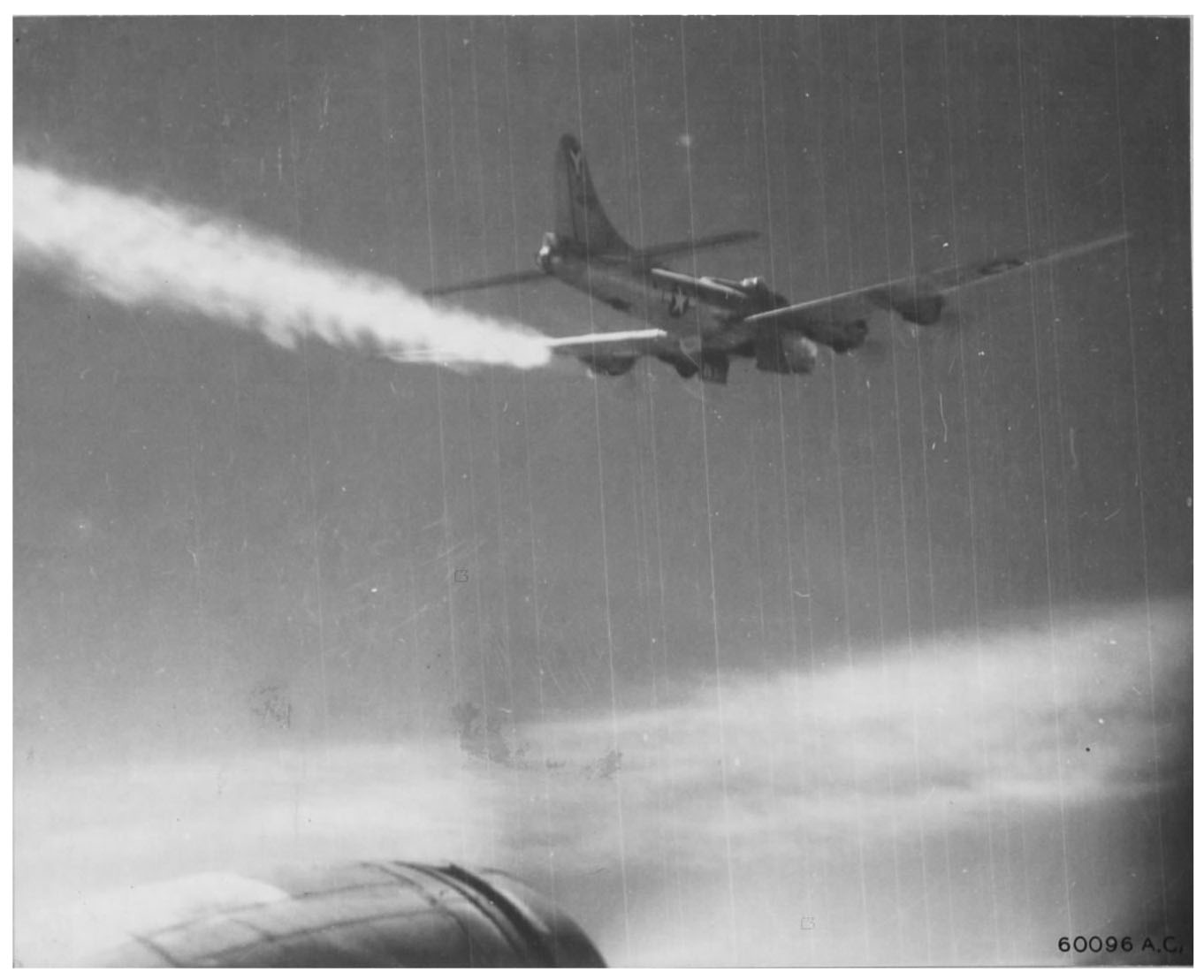
Burstein was one of the ten airmen aboard aircraft 43-38368 – “M”, otherwise known as “Daisy Mae”, piloted 2 Lt. Victor L. Ettredge, from which the entire crew survived.  As reported in MACT 13562 (it’s a short one; only five pages long), Daisy Mae was struck by fire from the Me-262s just before bombs away.  The aircraft left the formation with its right wing aflame and was not seen again.  Between one and two crew members were seen parachuting from the plane.  (Which would suggest that the entire crew survived by parachuting from the damaged aircraft.) 

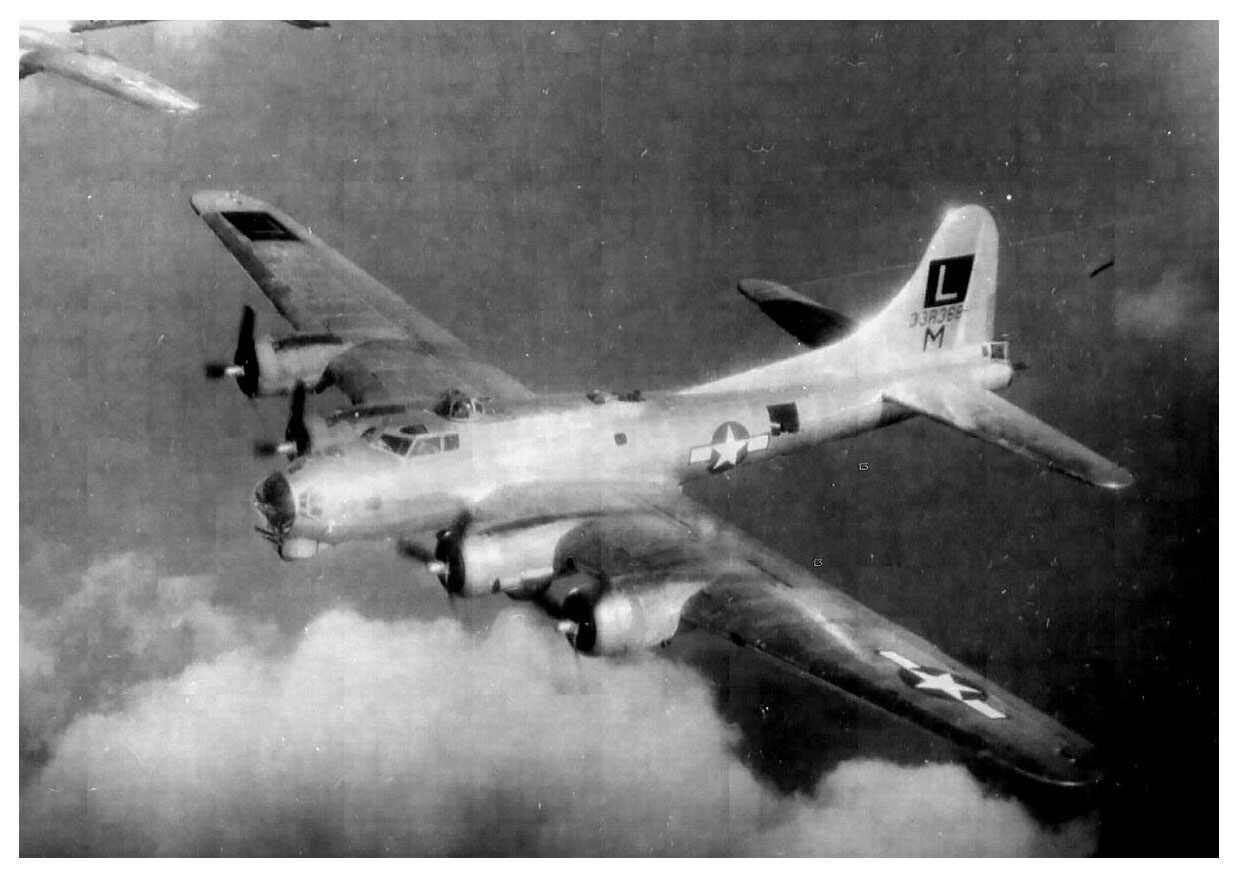
This photo of Daisy Mae is American Air Museum in Britain image UPL45784.
Rosen was aboard 43-37542, otherwise known as “Smokey Liz II”, piloted by 2 Lt. William C. Caldwell.  As reported in MACR 13561, this B-17 was also hit by cannon fire from the jet fighters, and then peeled off to the right with its left wing and one engine aflame.  Two parachutes emerged from the bomber, and it was again attacked by an Me-262.  Lt. Caldwell then radioed that he had two engines out and was heading for Soviet occupied territory, with his co-pilot – 2 Lt. Walter A. Miller – wounded. 

Postwar Casualty Questionnaires in the MACR – one filed by Lt. Rosen, and the other by a unknown crew member in the rear of the aircraft – reveal that ball turret gunner S/Sgt. John S. Unsworth, Jr., was instantly killed when a cannon shell struck his turret, and waist gunner Sgt. David L. Spillman, though uninjured, failed to deploy his parachute after bailing out, probably due to anoxia from leaving his aircraft at an altitude above 10,000 feet.  Co-pilot Miller was in reality uninjured, but was still in the cockpit and about to bail out – following his flight engineer – when the bomber exploded.

Otherwise, the MACR lists the specific calendar dates when the seven survivors of “Smokey Liz II” returned to military control after liberation from POW camps.  For Lt. Rosen, this occurred on April 29, forty days after the March 19 mission.

F/O Burstein was son of David and Ann B. Burstein, of 198 Cross Street in Malden, Massachusetts, and was born in that city on March 9, 1923.  Later promoted to the rank of Second Lieutenant (0-2015029), his name is absent from American Jews in World War II.    

Information about Lt. Rosen is far more substantial.  He was the husband of Theresa J. Rosen of 713 1/2 North 8th Street in Philadelphia, and, the son of Abraham Rosen of 5144 North 9th St. and Regina (Weiss) Rosen of 1717 Nedro Ave., both of which are also Philadelphia addresses.  His name appeared in the Jewish Exponent on May 4, 1945, the Philadelphia Inquirer on April 21, and the Philadelphia Record on April 28.  Page 546 of American Jews in World War II notes that he received the Air Medal, indicating the completion of between five and nine combat missions. Born in Philadelphia on May 17, 1925, he passed away at the unfairly young age of forty on July 22, 1965.  He’s buried in Arlington National Cemetery in Section 37, Grave 4747.

452nd Bomb Group
729th Bomb Squadron

This example of the 729th Bomb Squadron insignia, item FRE5188, is also from Roger Freeman collection at the American Air Museum in England.
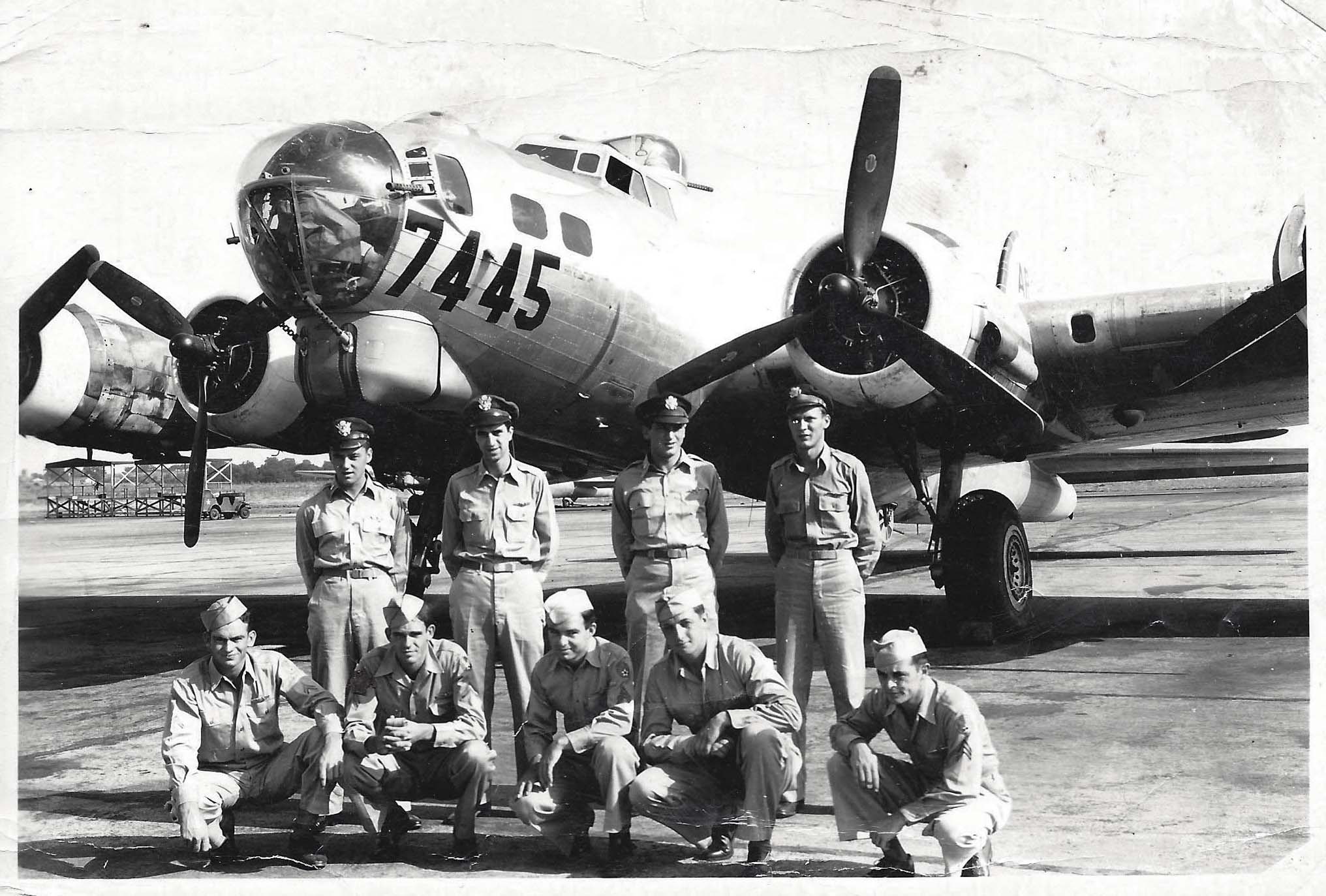
Aboard the 729th Bomb Squadron’s B-17G 42-97901, otherwise known as “Helena”, three crewmen were wounded: flight engineer Jim Rohrer, radio operator John Owens, and co-pilot Stanley G. Elkins.  The aircraft, piloted by Lt. Richard J. Koprowicz (later “Kopro“), force landed behind Soviet lines at Radomsko, Poland, and was salvaged on March 28.  Lt. Koprowicz and his eight crew members remained with a Russian Commandant in what had previously been a Gestapo quarters.  On March 29, the crew flew aboard a C-47 (or a Soviet Lisunov-2?) to Poltava, where they remained until May, eventually returning to Deopham Green on May 15.  No MACR was filed pertaining to the loss of Helena.

According to the American Air Museum in Britain, the timing of this event resulted in Lt. Koprowicz and his waist gunner Mountford Griffith completing a total of two missions by the war’s end.  For the rest of the crew, the March 19 mission was their first, last, and only mission.

2 Lt. Stanley Garfield Elkins (0-757166) was the husband of Isabel G. Elkins and father of Pamela, 2522 Kensington Ave., Philadelphia, and, the son of Minnie Elkins, who lived at 353 Fairfield Avenue in the adjacent suburb of Upper Darby.  His name appeared in a Casualty List published on April 26, and can also be found on page 518 of American Jews in World War II.  Born in Philadelphia on August 8, 1921, he died on January 20, 1993, and is buried at Indiantown Gap National Cemetery in Annville, Pa.

Along with Daisy Mae, Helena, and Smokey Lizz II, the 452nd lost two other B-17s on the Zwickau mission, albeit in such circumstances that no MACRs were filed for these incidents.  43-38231, “Try’n Get It, piloted by Warren Knox (with nine crewmen), force-landed on a farm near Poznan.  43-38205, “Bouncing Babay, piloted by a pilot surnamed “Daniel”, force-landed at Maastricht Airfield in Belgium.  There were no fatalities or injuries among the crewmen of these two planes.

~~~~~~~~~~~~~~~~~~~~~~~~~~~~~~~~~~~~~~~~

96th Bomb Group
339th Bomb Squadron

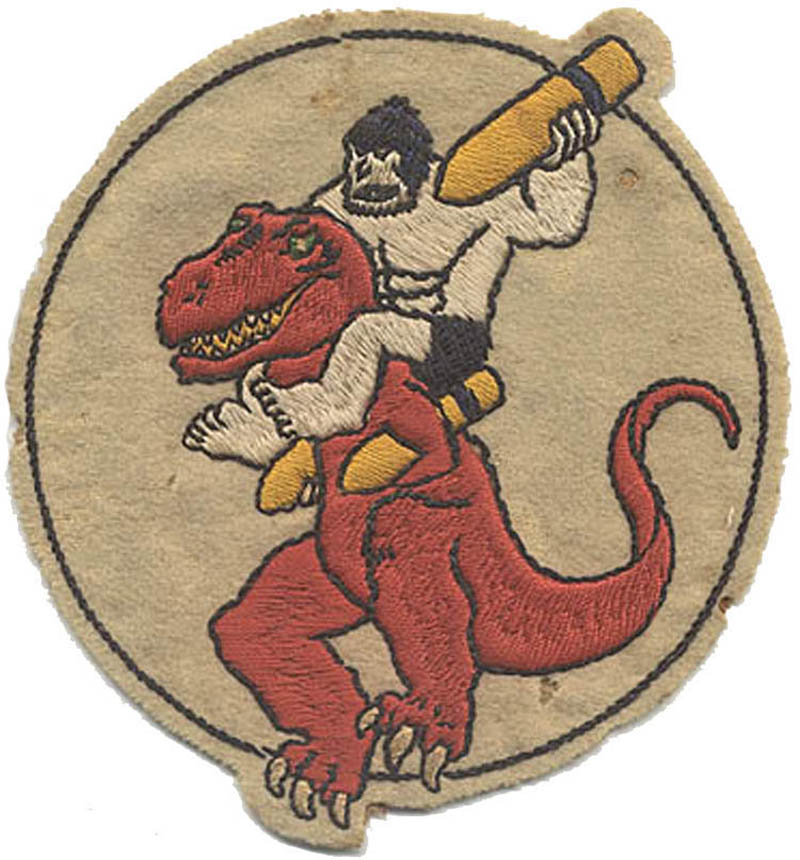
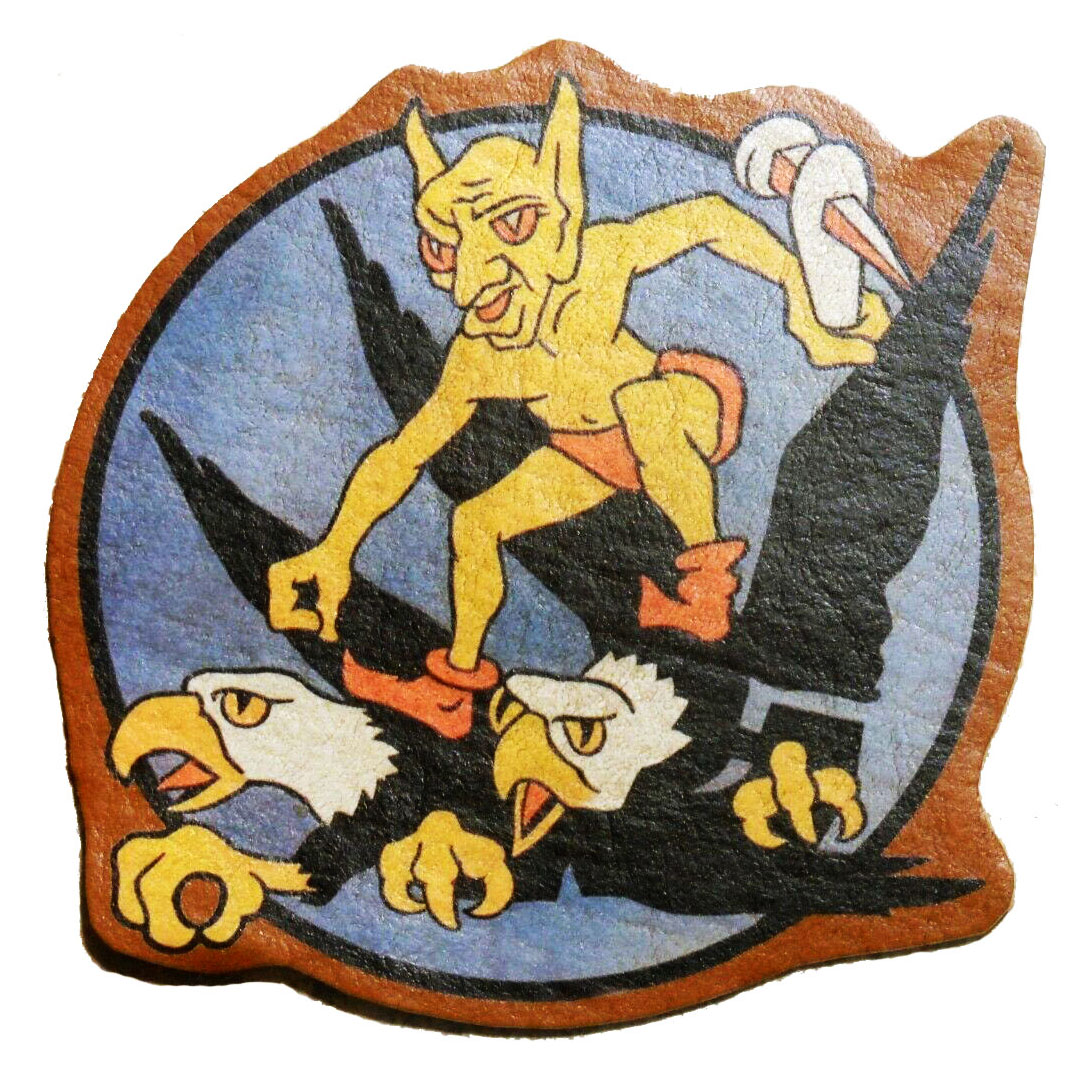
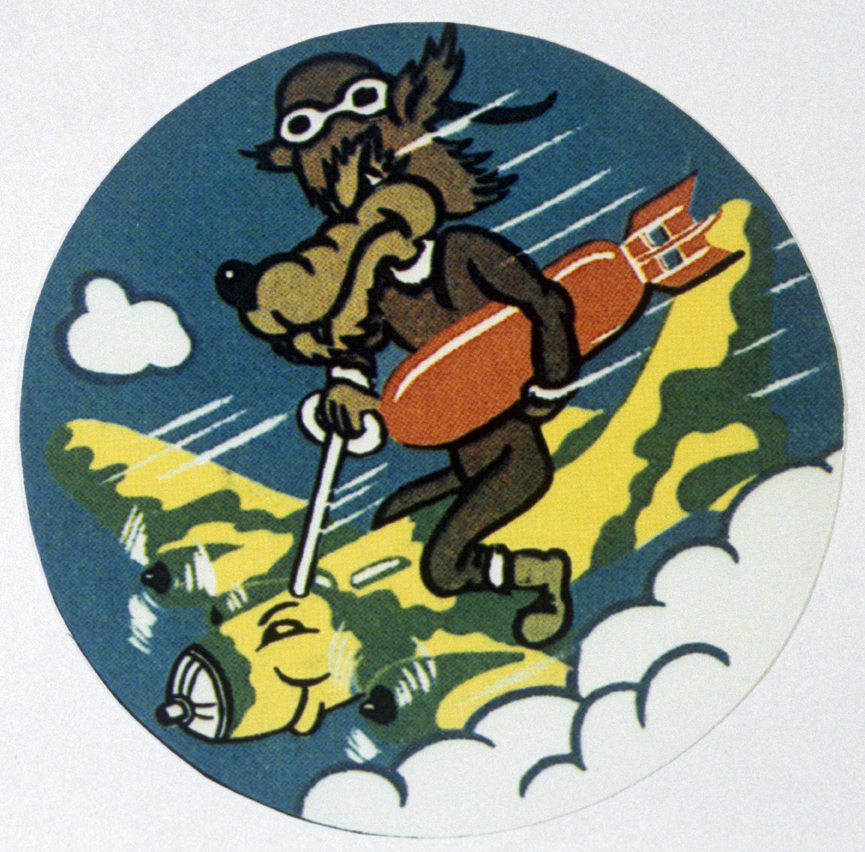
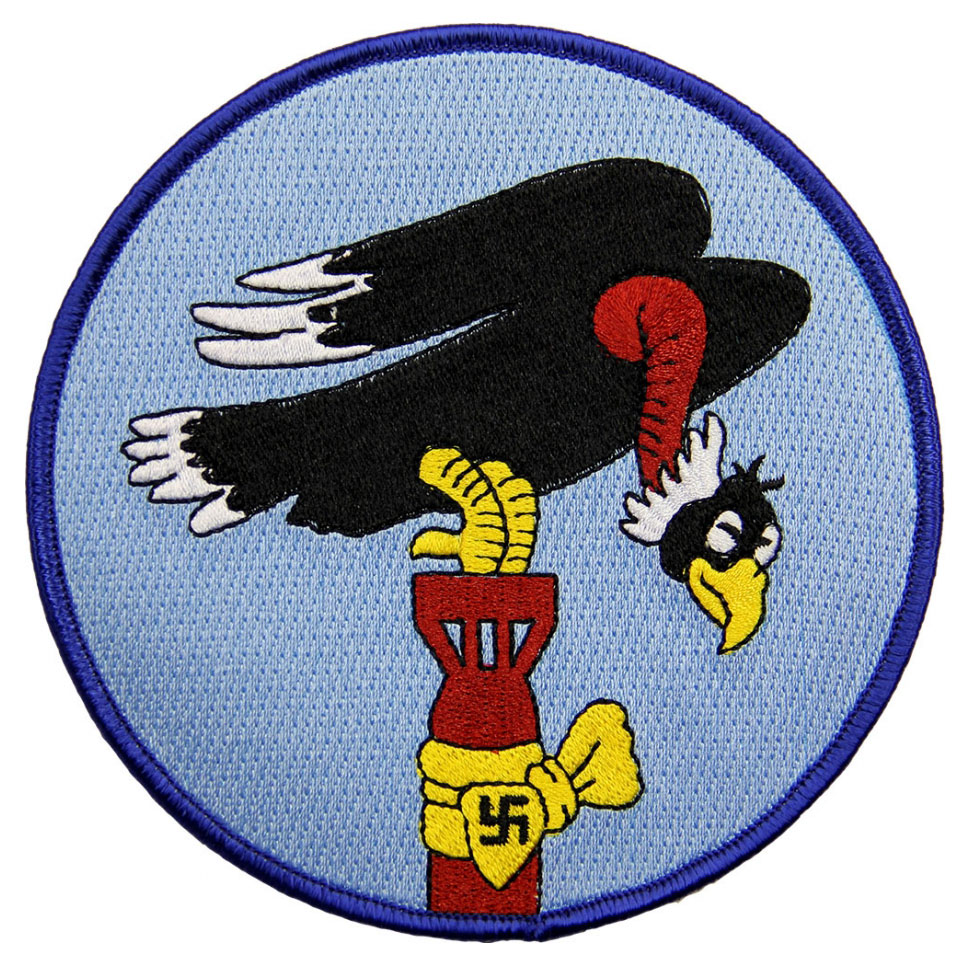
This example of the 339th Bomb Squadron insignia was found at RedBubble.

“I had made so many missions with _____ and the rest of the crew,
that it was just like losing one of your own family.”
(T/Sgt. Steele M. Roberts)

Like most of his fellow crew members on his 25th mission, T/Sgt. Herbert Jack Rotfeld (16135148) was the radio operator aboard B-17G 44-8704 during the 96th Bomb Group’s mission to Ruhland, Germany.   The un-nicknamed Flying Fortress was leading either the 339th Bomb Squadron (in particular) or the 96th Bomb Group (in general) when, at 24,000 feet – its bomb-load not yet having been released due to weather conditions – it was struck by flak and its right wing began to burn.  Pilot Captain Francis M. Jones and copilot 1 Lt. David L. Thomas pulled the B-17 away from the 96th to the right, and either they or bombardier 1 Lt. George M. Vandruff jettisoned their bombs. 

The aircraft then went into a spin, and upon descending to 16,000 feet, broke apart.

Of the ten men aboard the plane (the aircraft being an H2X equipped B-17 it had a radome in place of the ball turret, and thus a radar operator in place of the ball turret gunner) only two succeeded in escaping: Navigator 1 Lt. Harold O. Brown and flight engineer T/Sgt. Steele M. Roberts, whose crew positions were both in the forward fuselage.  As reported by Lt. Brown in his postwar Casualty Questionnaire, “Sgt. Roberts flying as top gunner was [the] first one aware of our peril and after being certain he could no longer assist pilot, dove to catwalk under pilot compartment, released door, and jumped,” to be followed by Brown himself. 

~~~~~~~~~~~~~~~~~~~~

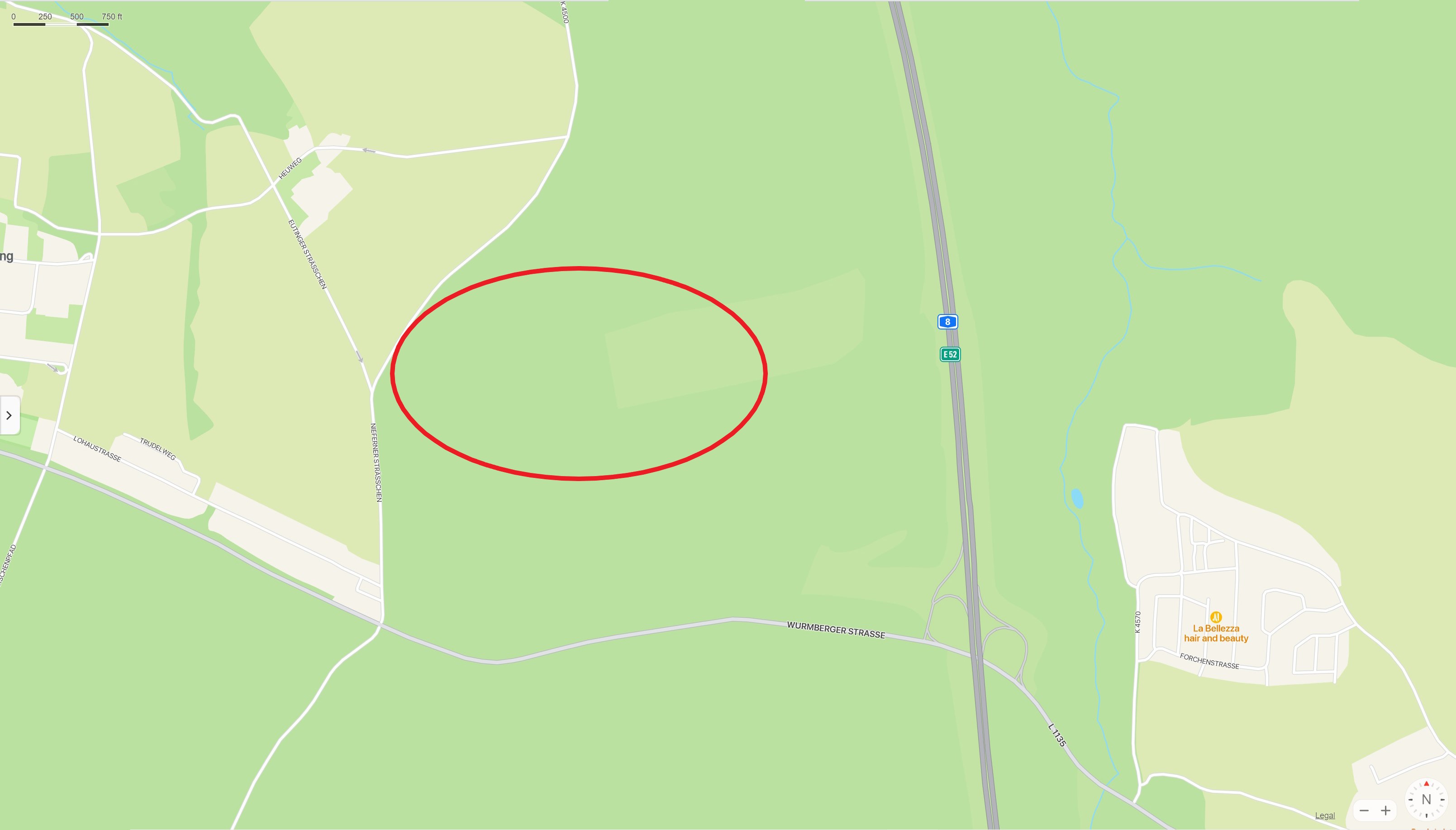
The location of the incident is listed in the MACR as 51-37 N, 13-33 E, but the aircraft actually fell to earth east of that location, crashing 500 meters northeast of the German village of Wormlage.  

In this Oogle view, Worlmage lies just to the right, and down a little, from the center of the map, about halfway between Cottbus and Dresden.  It’s indicated by the set of red dots just to the west of highway 13.

This is a map view of Wormlage at a vastly larger scale…

…while this is an air photo (or satellite?) view of the village at the same scale as above.

~~~~~~~~~~~~~~~~~~~~

The bomber’s crew comprised:

Command Pilot – Barkalow, Lyman David, Capt., 0-802517
Pilot – Jones, Francis Maurice, Capt., 0-764688
Co-Pilot – Thomas, David L., 1 Lt., 0-713570
Navigator – Brown, Howard O., 1 Lt., 0-2062638 – Survived (jumped second from forward escape hatch)
Bombardier – Vandruff, George Martin, 1 Lt., 0-776834
Mickey Operator – Spiess, Joseph Dominic, 1 Lt., 0-733323
Flight Engineer – Roberts, Steele M., T/Sgt., 33288642 – Survived (jumped first from forward escape hatch)
Radio Operator – Rotfeld, Herbert Jack, T/Sgt., 16135148
Gunner (Waist) – Zajicek, Martin T., S/Sgt., 36698781
Gunner (Tail?) – Fagan, Dale Eugene, S/Sgt., 37539473

~~~~~~~~~~~~~~~~~~~~

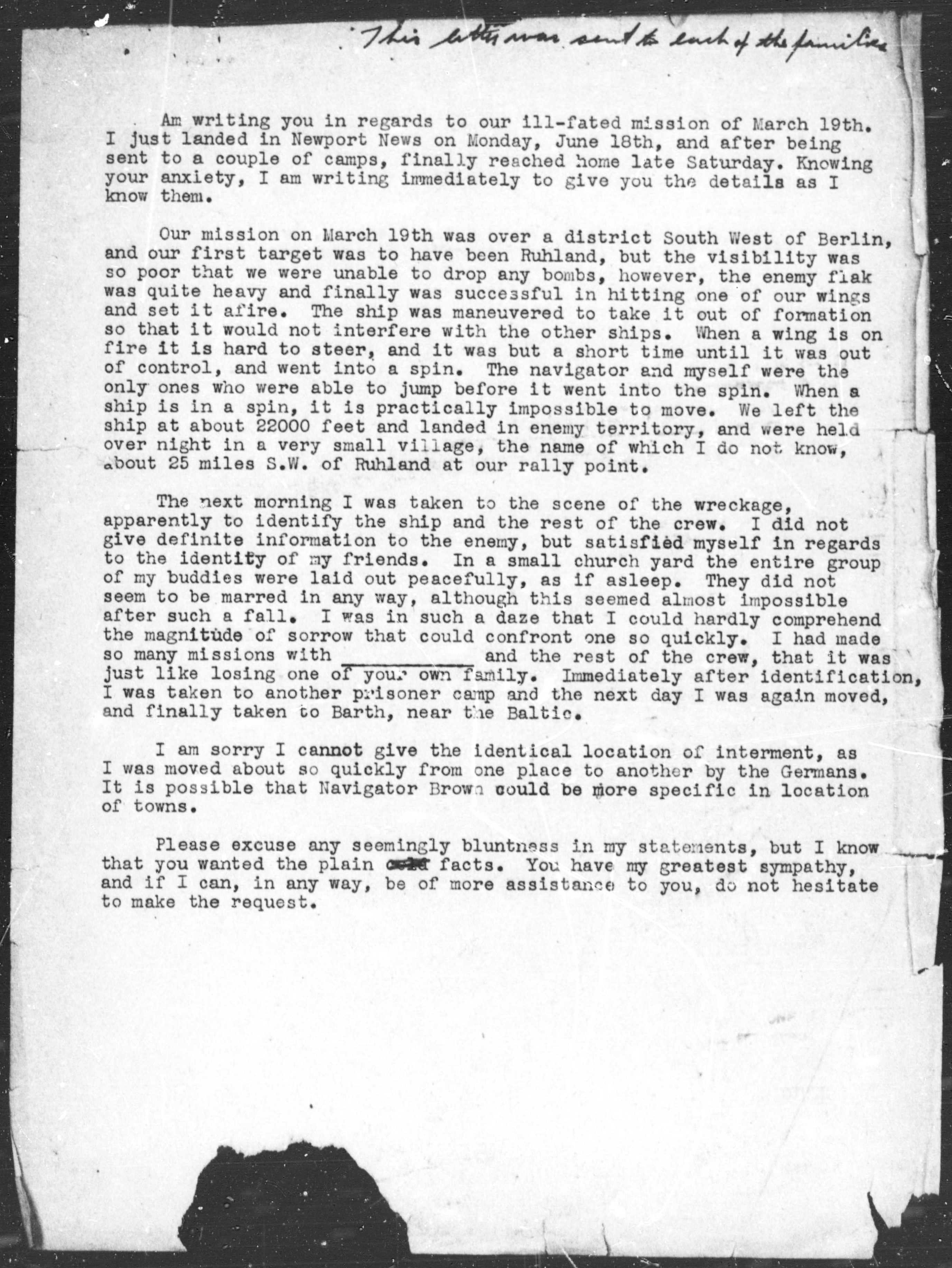
Sgt. Roberts returned to his home in Pittsburgh on June 23, 1945, and on that date or very shortly after, sent the following letter to the families of his eight fallen fellow crew members.  The very immediacy of the document … “I just landed in Newport News on Monday … (and) finally reached home late Saturday” … says a great deal about Sgt. Roberts and this crew, while its contents shows a striking degree of tact and sensitivity.  Truly, this man was an excellent writer.  Sgt. Roberts sent a copy of his letter to the Army Air Force in response to their inquiry about his crew, the document then being incorporated into MACR 13571. 

That’s how you’ve come to read it here, nearly eight decades later. 

Here it is: 

This letter was sent to each of the families.

Am writing you in regards to our ill-fated mission of March 19th.  I just landed in Newport News on Monday, June 18th, and after being sent to a couple of camps, finally reached home late Saturday.  Knowing your anxiety, I am writing immediately to give you the details as I know them.

Our mission on March 19th was over a district South West of Berlin, and our first target was to have been Ruhland, but the visibility was so poor that we were unable to drop any bombs, however, the enemy flak was quite heavy and finally was successful in hitting one of our wings and set it afire.  The ship was maneuvered to take it out of formation so that it would not interfere with the other ships.  When a wing is on fire it is hard to steer, and went into a spin.  The navigator and myself were the only ones who were able to jump before it went into the spin.  When a ship is in a spin, it is practically impossible to move.  We left the ship at about 22000 feet and landed in enemy territory, and were held over night in a very small village, the name of which I do not know, about 25 miles S.W. of Ruhland at our rally point.

The next morning I was taken to the scene of the wreckage, apparently to identify the ship and the rest of the crew.  I did not give definite information to the enemy, but satisfied myself in regards to the identity of my friends.  In a small church yard the entire group of my buddies were laid out peacefully, as is asleep.  They did not seem to be married in any way, although this seemed impossible after such a fall.  I was in such a daze that I could hardly comprehend the magnitude of sorrow that could confront one so quickly.  I had made so many missions with [space for crew member’s name] and the rest of the crew, that it was just like losing one of your own family.  Immediately after identification, I was taken to another prisoner camp and the next day I was again moved, and finally taken to Barth, near the Baltic.

I am sorry I cannot give the detailed location of interment, as I was moved about so quickly from one place to another by the Germans.  It is possible that Navigator Brown could be more specific in location of towns.

Please excuse any seemingly bluntness in my statements, but I know that you wanted the plain facts.  You have my greatest sympathy, and if I can, in any way, be of more assistance to you, do not hesitate to make the request.

Sgt. Steele Roberts’ letter, as found in MACR 13571:
~~~~~~~~~~~~~~~~~~~~

T/Sgt. Rotfeld was the son of Morris and Gertrude Rotfeld, the family living at 3625 West Leland Ave. in Chicago, while his brother Isidor lived at 300 South Hamlin Street in the same city.  He was born in Chicago on November 16, 1922.  The recipient of the Air Medal with three Oak Leaf Clusters and Purple Heart, his name can be found on page 114 of American Jews in World War II.

He is buried at Plot A, Row 7, Grave 4 in the Ardennes American Cemetery in Neupre, Belgium, but his burial – specifically in his case on August 4, 1953 – and that of the rest of his fallen crew members) only occurred over nine years after the mission of March 19.  This is largely attributable to Wormlage having been within the postwar Soviet occupation zone of Germany in the context of the first (?!) Cold War, which presented huge challenges for the American Graves Registration Command.  Evidence of this can be seen in the following letter of 1948, from Sergeant Rotfeld’s Individual Deceased Personnel File:

~~~~~~~~~~~~~~~~~~~~

(Germany M-52) 4214

BERLIN DETACHMENT (PROV)
FIRST FIELD COMMAND
AMERICAN GRAVES REGISTRATION COMMAND
EUROPEAN AREA
BERLIN, GERMANY

19 Oct 1948

NARRATIVE OF INVESTIGATION
SENFTENBERG (N-52/A-34)

At 0930 hrs, 19 Oct 1948, the undersigned with Sgt. Altman, a Soviet escort officer from Kalrshorst and a Soviet Major with a German civilian interpreter from the Kommandantura [“military government headquarters; especially a Russian or interallied headquarters in a European city subsequent to World War II”] called on Burgomeister Hans Weiss in his office in Senftenberg.  We had asked to be taken to the Standesamt [“German civil registration office, which is responsible for recording births, marriages, and deaths.”] to check the Kreis [“primary administrative subdivision higher than a Gemeinde (municipality)”] records but were refused this request.

The head of the Standesamt, Max Beschoff, was summoned.  He brought no records with him but he was sure that, as far as his records were concerned, all Americans who had been buried in cemeteries in his Kreis were disinterred and taken away by American troops.  He did, however, say that his records were incomplete because Allied deceased had been buried in Kreis cemeteries and cemetery officials had neglected to furnish the Standesamt with information of all burials, especially during the latter part of 1944 and the early part of 1945.

The Soviets were not cooperative.  The Burgomeister’s words were carefully checked by them.  He was told that he could help us in a quiet sort of way but that there could be no Bekamtmachungen [public notice] or any inquiries that would attract public attention.  It appeared that the Burgeomeister wanted to help us but could do nothing under restriction for he said: that our stay in his Kreis was too short to accomplish our mission; and that people or officials summoned before us would not talk.  He said that he would quietly canvass his entire Kreis and that he felt sure that in two weeks he would be able to give us the exact location of any isolated graves in his area.

Accordingly all the pertinent facts in cases in Calau, Drebkau and Gr. Raaschen were given to him.

A report should be received from him in about three weeks.

PAUL M. CLARK
Lt. Col. FA
Commanding

~~~~~~~~~~~~~~~~~~~~

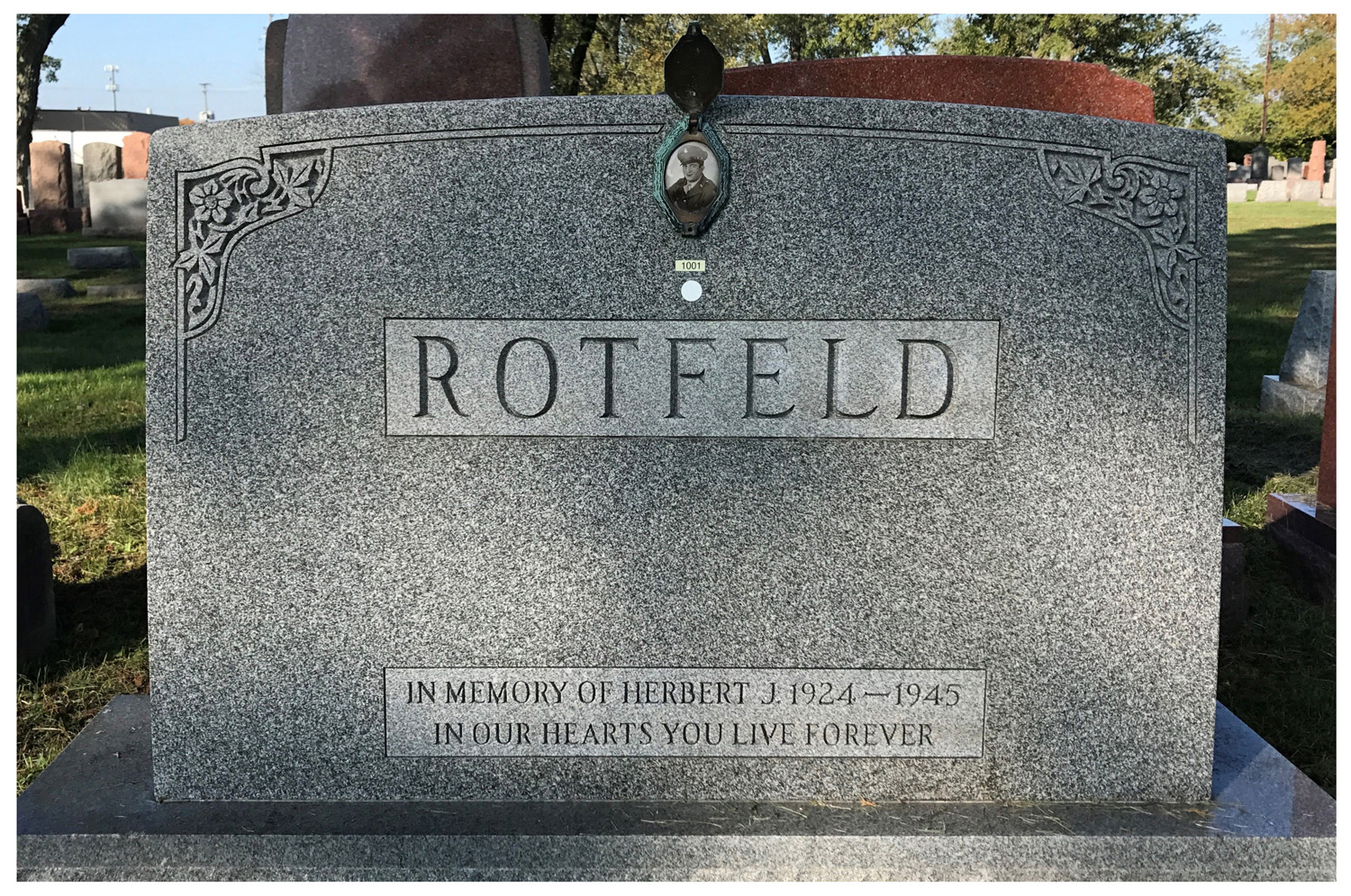
Here’s Sgt. Rotfeld’s portrait, as it appears in a ceramic plaque affixed to the top of his commemorative matzeva, at Waldheim Cemetery in Chicago.  The incorporation of ceramic photographs of deceased family members upon tombstones seems to have been a not infrequent practice from the 20s through the 40s.  (Photo by Johanna.)

Here’s the matzeva itself, also as photographed by Johanna

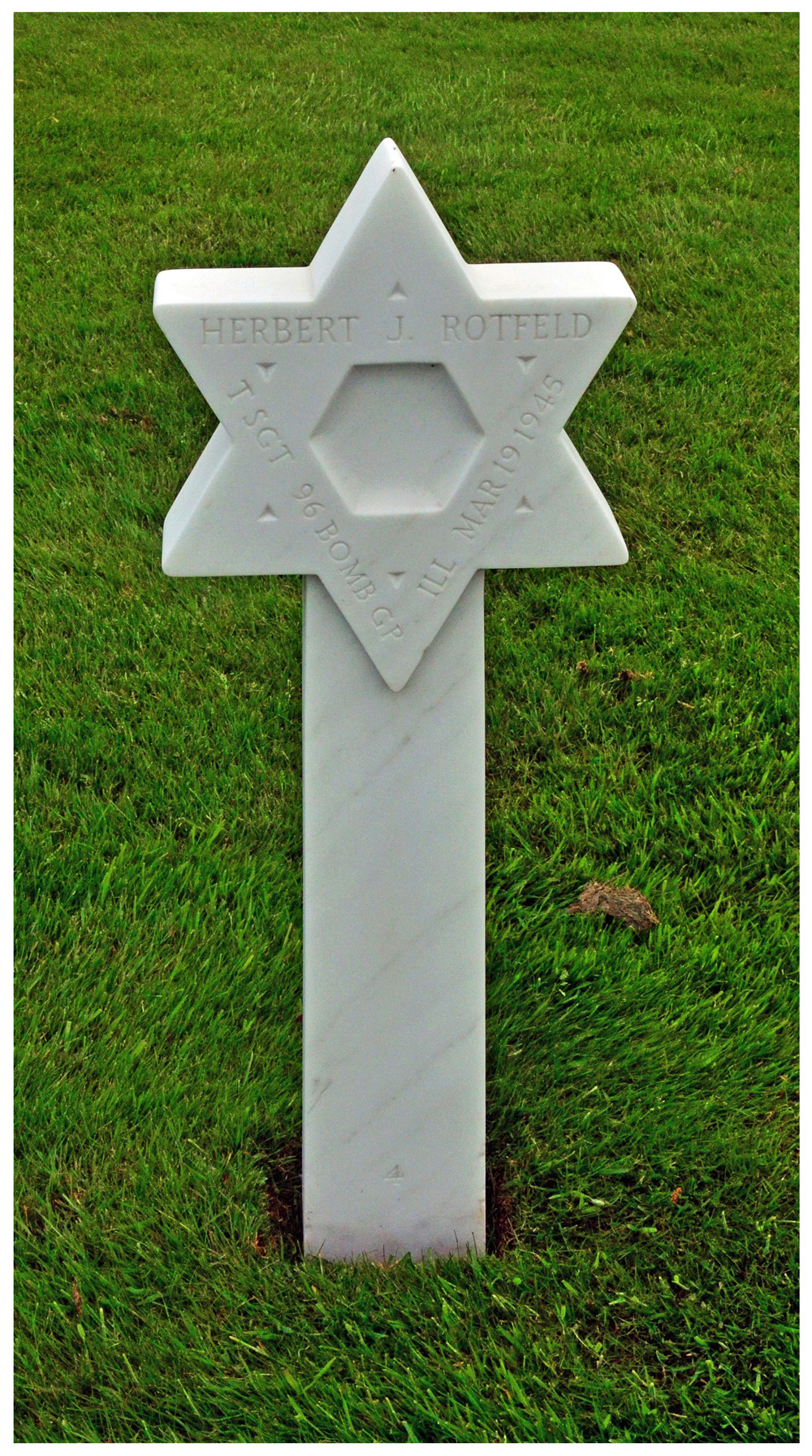
This is Sgt. Rotfeld’s actual matzeva at the Ardennes American Cemetery, as photographed by David L. Gray.

XXXXX
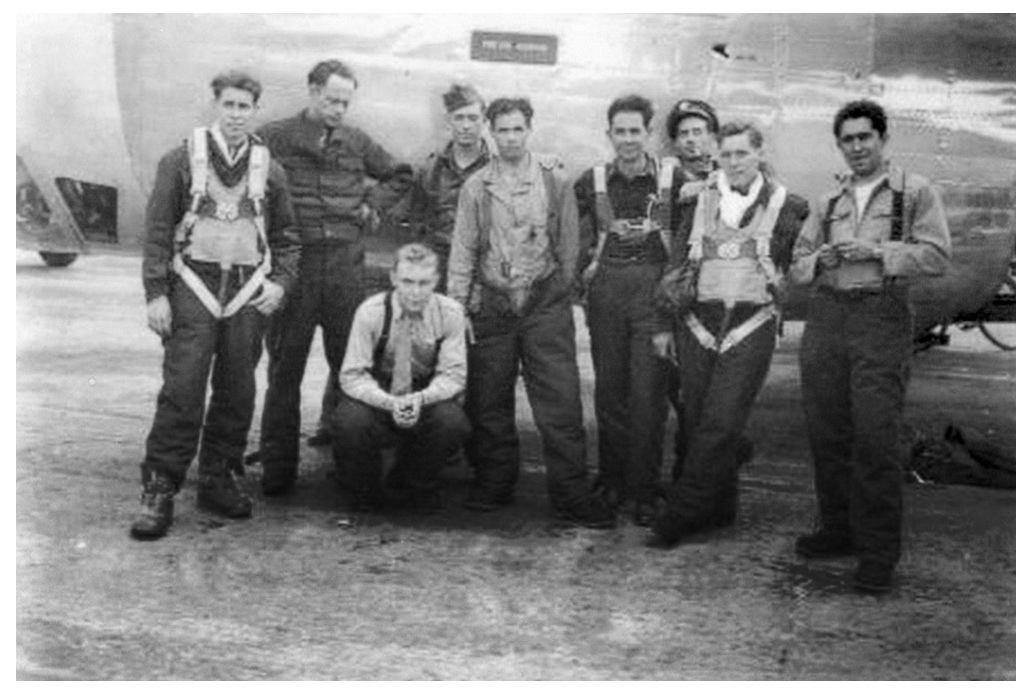
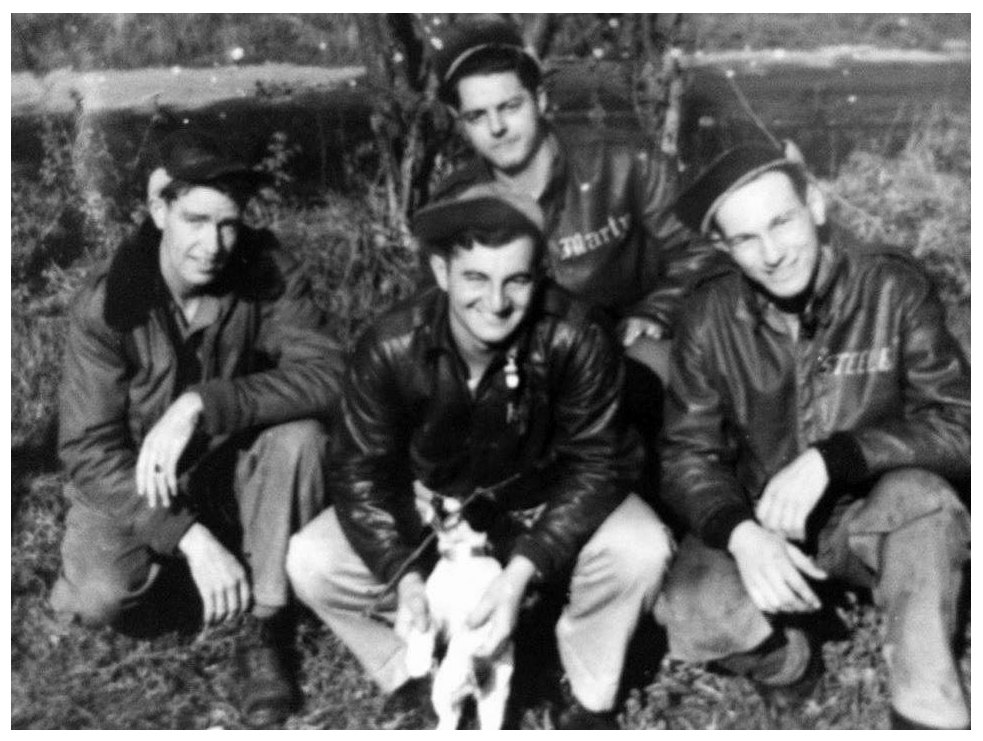
This is photograph UPL 32744 via the American Air Museum in Britain.  Waist gunner S/Sgt. Martin J. Zajicek is at center rear, while T/Sgt. Steele M. Roberts is at right.  If these four men were the four non-commissioned officers aboard 44-8704 on her final mission (as listed in the MACR), then the airman at far left may be S/Sgt. Dale E. Fagan, and the man in the center T/Sgt. Herbert J. Rotfeld, especially given his esemblance to the portrait in the photo attached to the matzeva in Chicago.  (Just an idea, but I think an idea reliable.)
~~~~~~~~~~~~~~~~~~~~

According to Ancestry.com, Steele M. Roberts was born in Pittsburgh on September 25, 1921, to J.L. and Olive M. Roberts, his address as listed on his draft card as having been 8139 Forbes Street in that city.  He passed away on February 11, 2000, and apparently (at least, going by FindAGrave.com) has no place of burial, for he was cremated.  

~~~~~~~~~~~~~~~~~~~~~~~~~~~~~~~~~~~~~~~~

384th Bomb Group
547th Bomb Squadron
Second Lieutenant Herbert Seymour Geller (Hayyim Shlema bar Yaakov), 2 Lt., 0-2062494, was the son of “Jack” Jacob (4/22/00-2/4/90) and Ruth (Weinberg) (5/8/01-2/17/89) Geller, and brother of Harvey Don Geller (1/12/28-8/5/89), who resided at 18051 Greenlawn St., Detroit, Michigan.  He was born in Detroit on March 23, 1923, and – as a B-17 Flying Fortress co-pilot – was killed on an operational mission on March 19, 1945, only four days short of his twenty-second birthday.

While serving aboard B-17G 43-39035 (“SO * F“), piloted by 2 Lt. Robert S. Griffin, his aircraft crashed into Reigate Hill, Surrey, England, while returning to the 384th’s base at Graton Underwood, Northamptonshire, from a mission to the Braunkhole-Benzin Synthetic Oil Plant at Bohlen, Germany, in an accident attributable to bad weather.  

These photos, by FindAGrave contributor Dijo, show the, “Clearing in the trees at Reigate Hill, Surrey, England, created by the crash on 19.3.1945.  A permanent reminder of their sacrifice.”…
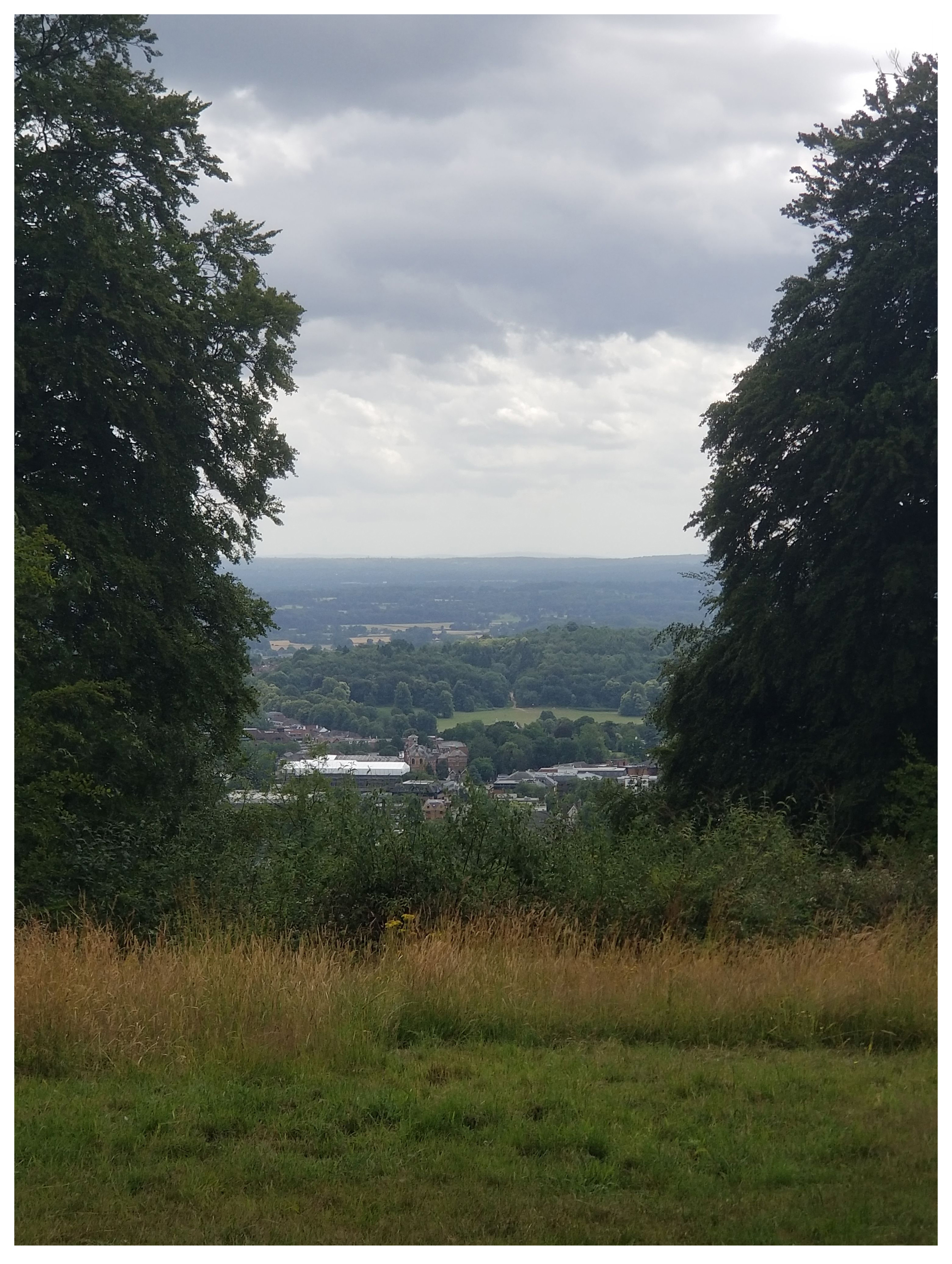
… and, added by the National Trust, a “Memorial Plaque at the site of the aircrash.”

The Crew?

Pilot: Griffin, Robert Stanley, 2 Lt., 0-779854, San Diego, Ca. / Carson City, Nv.
Co-Pilot: Geller, Herbert S., 2 Lt., 0-2062494, Detroit, Mi.
Navigator: Runyon, Royal Arthur, 2 Lt., 0-806554, Keokuk, Ia.
Togglier: Jeffrey, Donald Walter, Sgt., 35900479, Des Moines, Ia.
Flight Engineer: Marshall, Robert Freeman, Sgt., 16116799, Racine, Wi.
Radio Operator: Phillips, Philip J., Jr., Sgt., 12225719, Highland Park, N.J.
Gunner (Ball Turret); Irons, William Randolph, Sgt., 6874192, N.J.
Gunner (Waist?): Hickey, Thomas J., Sgt., 12032033
Gunner (Tail): Manbeck, Robert Franklin, S/Sgt., 37202047, Moran, Ks.

As is immediately evident from the plaque, none of the nine men aboard Griffin’s bomber survived.  The incident is extensively covered at the Wings Museum’s on-line memorial to the crew – “B-17G Tail Number 43-39035” – which features two images of the crew, one seemingly in training, and the other in the snowy winter of 1944-1945 at Grafton Underwood.  Though the Museum’s story states that the crew are all buried in England, certainly Lieutenants Griffin and Geller are buried in the United States, with Geller resting alongside his parents and brother at Section L, Row 6, Lot 29, Grave 316D in Machpelah Cemetery, at Ferndale, Michigan.

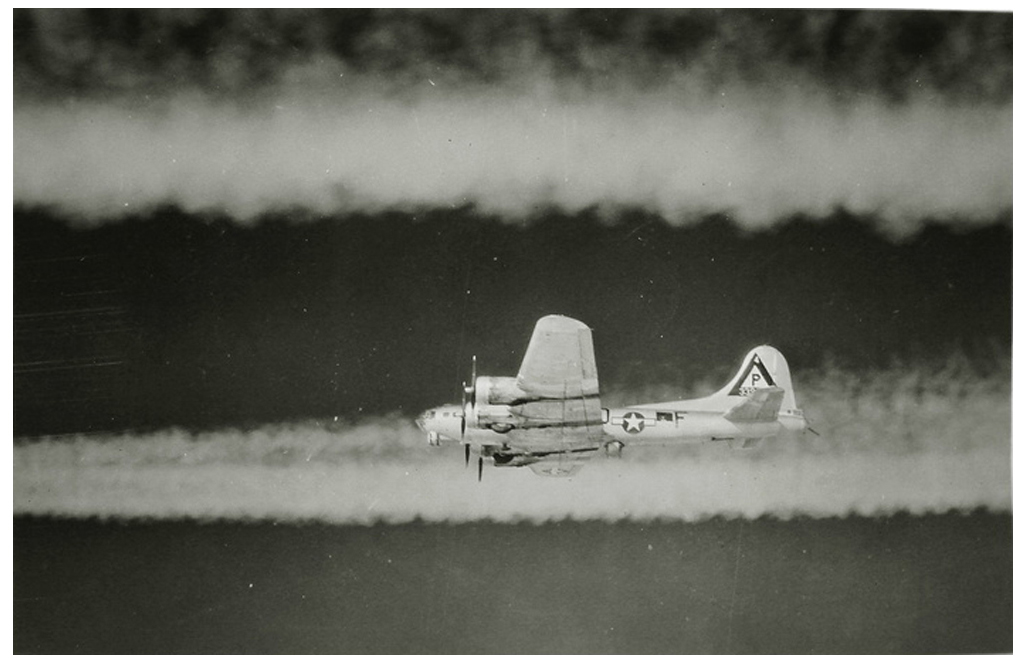
Regarding the un-nicknamed “SO * F“, the 384th Bomb Group website, an astonishingly comprehensive repository of information about the Group, its men, and planes, has – remarkably – two photos of the B-17 in flight, in a brilliantly contrailed sky.  Here they are…

…while the history of the plane is available here...

…and the Griffin crew’s biography is here

…and you can read the Accident Report for “SO * F’s” final mission (“45-3-19-521”) here

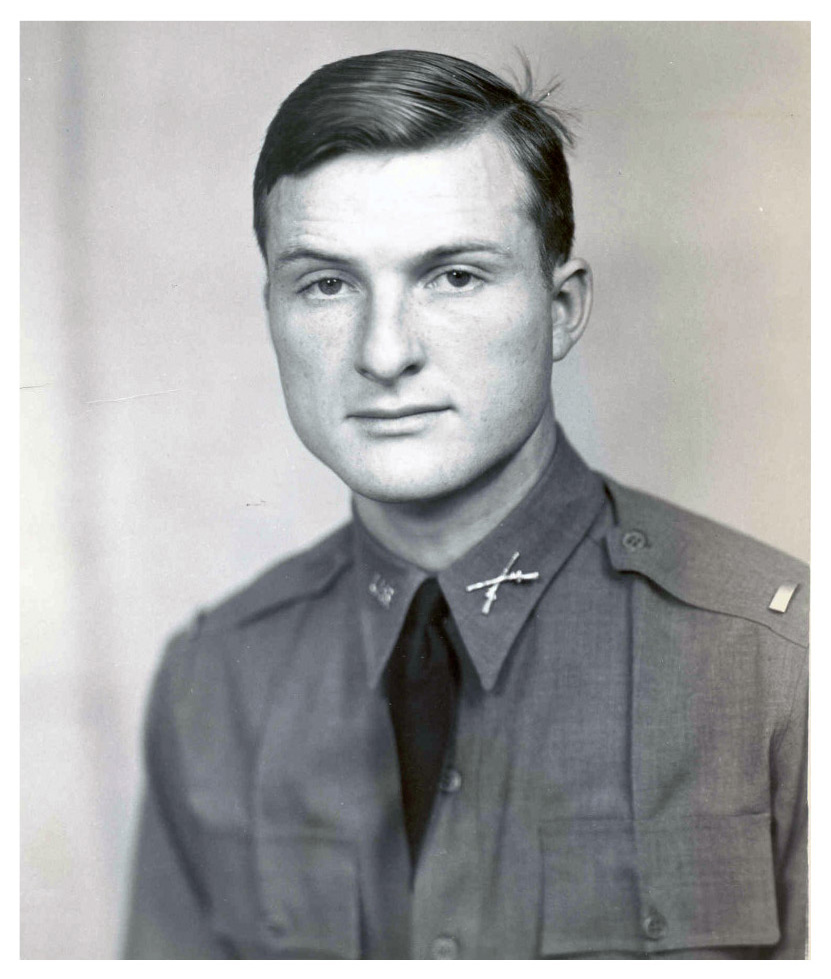
In a “pattern” that has been seen before, and will be seen again, Lt. Geller’s name is absent from American Jews in World War II.  This colorized image of the lieutenant is by FindAGrave contributor James McIsaac.

~~~~~~~~~~~~~~~~~~~~~~~~~~~~~~~~~~~~~~~~

15th Air Force

98th Bomb Group
343rd Bomb Squadron

Having thus far presented numerous (several? many? a lot?) of posts recounting the service of Jews in the WW II Army Air Force (and, Royal Air Force, and, Royal Canadian Air Force, and, other WW II Allied air forces), what is apparent is the not uncommon circumstance in which – at least for aircraft with several crew members, such as bombers – multiple crewmen on the same aircraft were Jews.  In the overwhelming majority of such cases I think this was attributable to simple chance.  But…  An 8th Air Force veteran shot down on the Schweinfurt Regensburg mission of August 17, 1943, suggested to me that he surmised – but could never prove – that his 381st Bomb Group crew’s composition (co-pilot, navigator, and bombardier having been Jews) was not at all product of happenstance.  Well.  Be that as it may,  the loss of B-24H Liberator 42-94998 (otherwise known as “white I“; truly otherwise known as “Hell’s Belles“) of the 98th Bomb Group’s 343rd Bomb Squadron on March 19, 1945, exemplifies this situation to an intriguing degree.

Missing during the 98th’s mission to Landshut, Germany (erroneously listed in MACR 13068 as in Austria), the plane’s pilot, 1 Lt. Donald B. Tennant, radioed at 1400 hours that, “…he had 2 engines feathered and was going to try and make Switzerland.  He had called for fighter escort.  His altitude was 14,000′ and the coordinates were 47 59 N, 13 39 E.”

The plane was not seen again.  It never reached Switzerland, but its entire crew of eleven survived, as revealed in postwar Casualty Questionnaires in the Missing Air Crew Report.  In an Instagram post by spartan_warrior.24 on May 6, 2023, pertaining to an Air Medal awarded to Flight Engineer Cpl. George C. Hennington, “All 11 crew members aboard the aircraft bailed out and survived, they were all taken POW on March 19th 1945 and were held at Stalag VIIA in Moosburg, Bavaria.  The POW camp was liberated on April 29th 1945 by the 14th Armored Division.”

It seems that through a combination of timing – this was less than two months before the war in Europe ended – and remarkably good happenstance – the entire crew survived, with only one airman (Cpl. Robert V. Wolff) having been injured in the bailout – only the vaguest information is available about where the crew actually landed, and, the plane fell to earth.  (There’s no Luftgaukommando Report.)  All the men bailed out from the waist escape-hatch except for the pilots, who exited via the bomb-bay.  The location of the bailout is given as the Austrian town of “Kirching”, “Kirchino”, and “Kirsching”, none of which can be found via either Oogle or Duck-Duck-Go, the closest match being “Kirchberg an der Pielach”, east-southeast of Linz.  Viewing the totality of information, perhaps the best guess is that the plane and crew landed (in very different ways) in a mountain valley halfway between Salzburg and Wels, or, 30 km southeast of Linz.  

This map shows the relative locations of Salzburg, Wels, and Linz.  Whatever small fragments of 42-94998 that still survive are here.  Somewhere.

Here’s the crew:

Pilot – Tennant, Donald Brooks, 2 Lt. 
Co-Pilot – Canetti, Isaac B., 2 Lt.
Navigator – Gillespie, Arthur R., 2 Lt. 
Bombardier – Marino, Philip A., 2 Lt.
Flight Engineer – Hennington, George C., Cpl. 
Flight Engineer – Berger, Sam, T/Sgt.
Radio Operator – Richardson, Almon P., Cpl. 
Gunner (Dorsal) – Yaffe, William J., Cpl. 
Gunner (Nose) – Woods, Robert K., Cpl.
Gunner – Rapp, Alex, Cpl. 
Gunner (Tail) – Wolff, Robert V., Cpl.

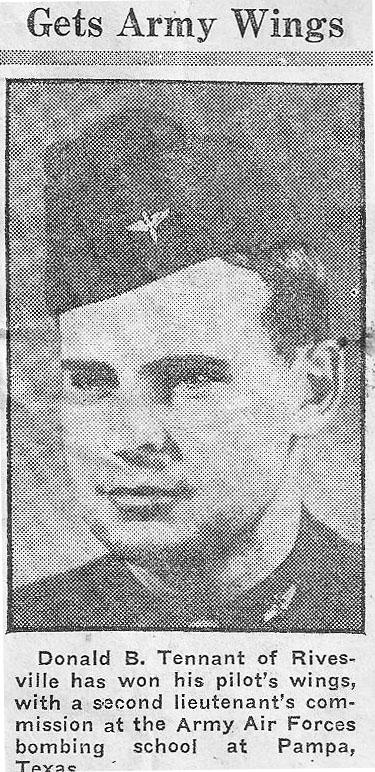
This image of Lt. Tennant is from FindAGrave contributor Sylvia Sine Whittaker 
The Jewish members of the crew included co-pilot 2 Lt. Isaac S. Canetti, flight engineer Cpl. William Jerry Yaffe, and gunners T/Sgt. Sam Berger and Cpl. Alex Rapp.  Though technically they’d be “casualties” by virtue of their MIA / POW status, by virtue of the fact that they were neither wounded nor injured, their names never appeared in the 1947 compilation American Jews in World War II … though strangely, the National Jewish Welfare Board was aware of Rapp’s military service.

Genealogical and other information about these men follows:

Canetti, Isaac S., 2 Lt., 0-2001884, Co-Pilot
Mr. and Mrs. Samuel and Esther Canetti (parents), 1309 Avenue U, Brooklyn, N.Y.
Mr. Jack S. Canetti (brother), 1317 East 15th St., Brooklyn, N.Y.
Born New York, N.Y., 8/29/23 – Died 5/13/04
Casualty List 4/19/45
American Jews in World War II – Not Listed

Yaffe, William Jerry, Cpl., 33796476, Flight Engineer
Mr. and Mrs. David (11/19/93-3/74) and Jeanette (1899-1964) Yaffe (parents), 6106 Washington Ave., Philadelphia, Pa.
Born Philadelphia, Pa., 11/15/24 – Died Florida, 5/29/15
Jewish Exponent 4/20/45, 6/8/45
Philadelphia Inquirer 5/26/45
Philadelphia Record 4/11/45, 5/26/45
American Jews in World War II – Not Listed

Berger, Sam, T/Sgt., 32973643, Gunner
Mr. and Mrs. Isaac (4/18/95-12/20/73) and Rose (Frankel) (6/23/95-7/24/75) Berger (parents), 317 East 178th St., New York, N.Y.
Born Bronx, N.Y., 1/26/25 – Died Turnbull, Ct., 4/15/04
American Jews in World War II – Not Listed

Rapp, Alex, Cpl., 32975594, Gunner
Mr. and Mrs. Leon and Gussie (Duchan) Rapp (parents), 1732 Nostrand Ave., Brooklyn, N.Y.
Born Brooklyn, N.Y., 5/14/20 – Died 10/1/83
Casualty List 4/19/45
American Jews in World War II – Not Listed

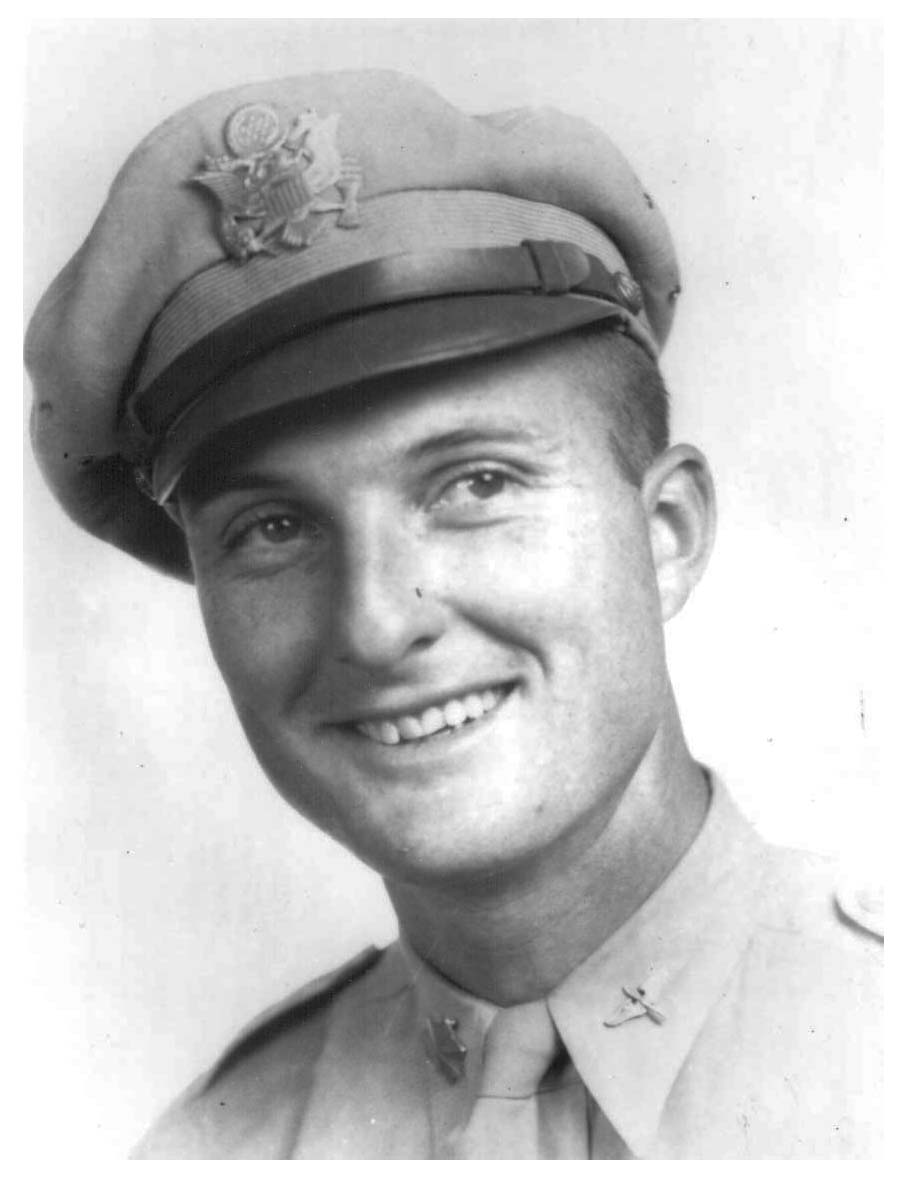
According to the Missing Air Crew Report, the March 19 mission was actually the eleven mens’ first and only mission as a crew, thus, no photograph of the men as a group would have existed.  But, there are pictures of one crew member: Lt. Canetti.  These come by way of Robin Canetti, his daughter.  (Thank you, Robin!)  This is her father in a pose quite formal…

… while this image shows Lt. Canetti and a mostly unknown crew – not his original crew; perhaps in Italy with the 98th Bomb Group? – time and location unknown. 

Lt. Canetti stands second from right in rear row, with Jess Bowling (in the middle) to his right.  The only other man to whom a name can be attached is second from left in the front row: Wallace Pomerantz.  Given the mens’ attire and positions within the photo, and Lt. Canetti’s presence in the rear row, the four (from the right) in the rear are presumably officers, with the the crew’s flight engineer to their right, while the five men in the front row are probably non-commissioned officers: gunners and radio operator.

~~~~~~~~~~~~~~~~~~~~~~~~~~~~~~~~~~~~~~~~

20th Air Force

505th Bomb Group
484th Bomb Squadron

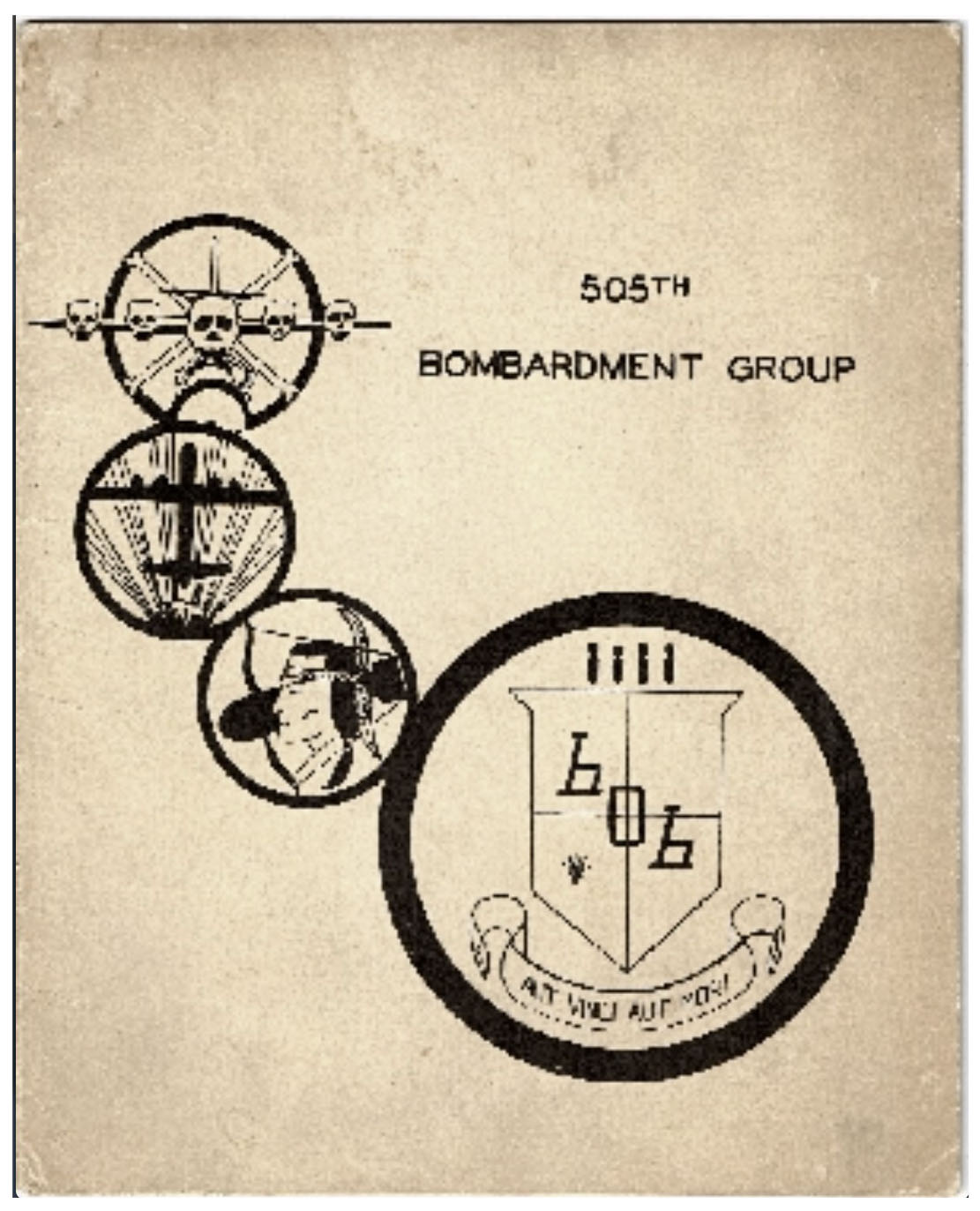
According to Combat Squadrons of the Air Force, there exists no insignia for the 484th Bomb Squadron.  Of this I am doubtful:: At RW Military Books, this history of the 505th Bomb Group displays what are apparently emblems for the group and its three component squadrons.  It seems that these insignia were never incorporated into Army Air Force records.
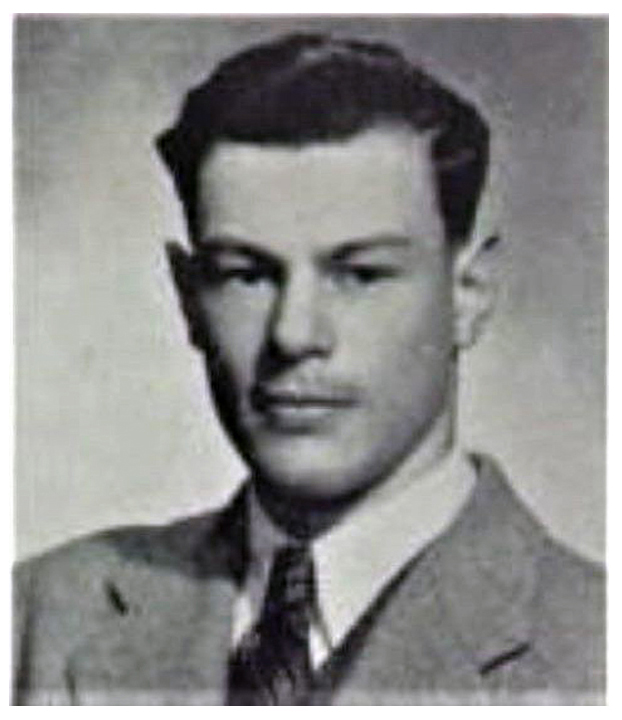
Sergeant Julius Manson (12100796), the son of Morris and Gertrude Manson, was born in New Jersey in 1926.  He resided with his parents, and sisters Helen and Phyllis, at 57 Elm Street in Morristown.

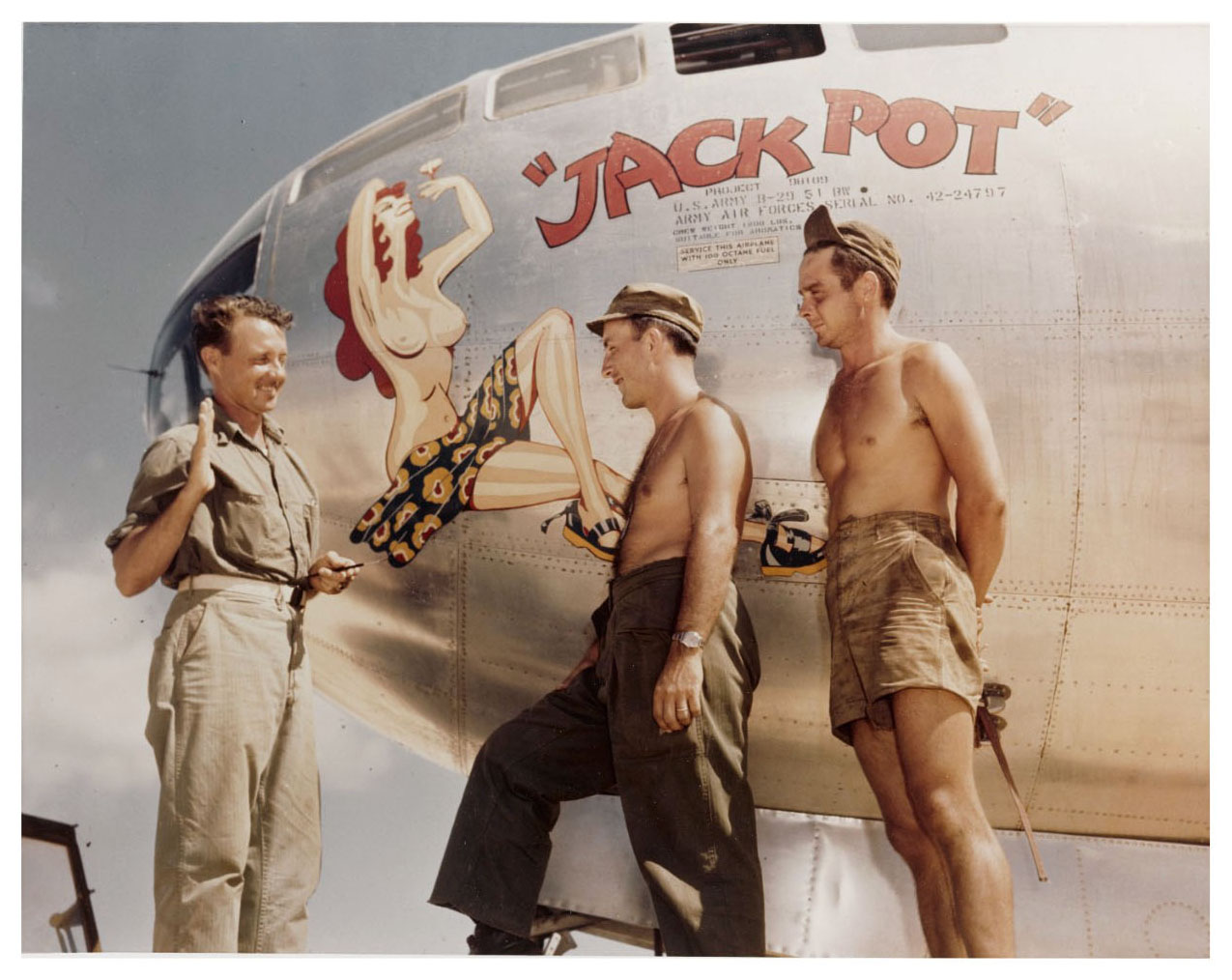
A tail gunner in the 505th Bomb Group’s 484th Bomb Squadron, he was a crew member aboard B-29 42-24797, “K triangle 36“, much better known as “JACK POT”.  The aircraft, piloted by 1 Lt. (later Colonel) Warren C. Shipp, was ditched 80 miles west of Iwo Jima on March 19, 1945, while returning from a mission to Nagoya, due to flak damage to three of its four engines.  Due to a remarkable combination of skill, training, and luck, no members of the crew were seriously injured, all returning to combat duty.  MACR 13694, which covers this incident, was presumably filed due to the crew technically being “missing” during the 48-hour time period between March 19, and their return to the 505th on March 21.  Sgt. Manson’s very temporary “Missing in Action” status probably accounts tor the appearance of his name in a Casualty List published on April 24, 1945.  

While MACR 13694 is straightforward and very brief in its description of the experience of Lt. Shipp’s crew, the historical records of the 505th Bomb Group, which are available on AFHRA (Air Force Historical Research Agency) Microfilm Roll / PDF B0675, include numerous very (very) detailed reports – some with sketches – covering the experiences of 505th crews who had survived ditching in the Pacific: some with outcomes akin to that of the Shipp crew, and others with outcomes tragic and far, far worse.

Here’s the crew:

Pilot: Warren C. Shipp, 1 Lt.
Co-Pilot: Don La Mallette, 2 Lt.
Navigator: Norman E. Shaw, 2 Lt.
Bombardier: William T. Smith, 2 Lt.
Radio Operator: William W. Tufts, Sgt.
Flight Engineer: Melvin G. Smith, 2 Lt.
Radar Operator: Finis Saunders, S/Sgt.
Gunner (Central Fire Control): Ernest B. Fairweather, Pvt.
Gunner (Right Blister): none
Gunner (Left Blister): Louis Molnar, Sgt.
Gunner (Tail): Julius Manson, Sgt.

The aircraft was ditched at 27-02N, 140-32 E, as shown in this Oogle map:

To give you an idea of the nature of such reports, here are excerpts from the ditching report for the Shipp crew and JACK POT:

Prior to Ditching:

While over the target the airplane was picked up by approximately 35 searchlights and although violent evasive action was taken, 50 seconds before bombs away a direct hit was suffered on number 2 engine which caused it to immediately burst into flames.
The engine was successfully feathered and no sooner were the flames put out than number 3 engine was hit and it proceeded to run away at an estimated 6000 to 7000 RPM. Power was reduced to 2300 RPM and 22 inches to keep number 3 engine running. At this time the turn was made off the target in the prescribed manner with the airplane diving to 5000 ft. to maintain an air speed of 160 MPH.
Upon leaving landfall celestial navigation was used to determine position before Loran was out, radar was of little value in that area, and DR was useless because of wavering instruments. With an IAS of 165 MPH the APC climbed to 7500 ft. to clearer weather and then set his course for Iwo Jima.
At approximately 0600 when about 200 miles north of the island number 1 engine lost 60 gallons of oil in ten minutes and started wind-milling at 2175 RPM.
With flight instruments lost, number 1 engine windmilling, number 2 engine feathered, number 3 engine giving limited power, and number 4 engine pulling 2500 RPM and 40 inches it appeared as though ditching were inevitable and after an unsuccessful attempt to start number 2 engine, distress signal procedures were instituted and the crew ordered to prepare for ditching.

Ditching – Airplane:

A let down was made through the undercast to 3000 feet at 500 to 600 feet per minute. The airplane was leveled out just above the water. The APC cut the power, pulled the nose up and stalled in at 95 MPH. (Estimated weight of airplane was 91,000 pounds and with full flaps stall speed was 95 MPH.)
The nose did not go under the water and only one impact was felt which was not too severe. No side deceleration was felt.
Although the airplane sank in 12 minutes water entered comparatively slow. The first man out reported 4” of water on the floor in the forward compartment and, the last man out reported water up to his shoulder.
The airplane broke in the radar room and as wave action took effect the tail broke off and sank. Other damaged to the airplane reported by the crew were the bomb-bay doors torn off at impact, skin was torn from the flaps and the propellers were curled.

The report includes two small diagrams depicting the effects of the ditching upon 42-24797.  This one shows how the tail snapped off at the radar room.

Survival:

With the two seven man rafts (E-2) and the one individual raft (C-2) tied together the APC gave orders not to drink water or eat food for 48 hours. It was estimated that enough food and water was on board to last for 10 to 12 days. The navigator checked the drift course, and assisted in bailing water from the raft. He cleaned the emergency equipment, repacked it, and arranged a tarpaulin to protect the men from the constant spray.
The majority of the survivors were sick for the first few hours in the raft because they had swallowed so much sea water. They were constantly soaked to the skin by sea spray and although the water was warm the men were chilled by the cold winds. Ingenuity played its part when the crew had modified the C-1 vest to include a cellophane individual gas cover, M-1 which they used effectively to protect themselves from the weather.
Nine men wore the C-1 survival vest and experienced no difficulty in getting out of the airplane with them.
The Radar Corner Reflector type MX138A was installed in the raft and although the pip was observed on the Dumbo’s scope from a distance of a mile and half, the initial contact with the raft was made visually by use of flares.

Rescue:

When the survivors had been in the rafts from about 2 hours, seven or eight B-29s passed overhead but they were too high to see the rafts. _____ on B-29s flying north passed over at approximately 1000 feet and all attempts to contact them with signal mirrors failed. A constant vigil was maintained all that night.
The co-pilot and bombardier were on watch while the other men were under the tarpaulin when the Navy PBY was first sighted to the East of the rafts at about 1600 on the second day. The A.P.C. fired two flares which attracted the PBY from a distance of 5 miles.
Because there was no sun the signal mirrors were not used and the smoke bombs would not operate.
At 1645 a B-29 arrived on the scene and dropped survival equipment as did the Dumbo. However, because the rafts were drifting faster than the sustenance kits the kits never were retrieved.
As the first PBY and B-29 left, a relief PBY arrived on station and remained until the Destroyer Gatling arrived at 2100.
Contact was maintained by boxing the rafts with smoke bombs and by the use of sea marker. As darkness approached flares were dropped constantly and a floating light which was a part of the life raft equipment proved invaluable in maintaining contact. It was reported by the destroyer that the light was seen from a distance of eight miles.
The survivors were in the raft from 0635 on the 18th of March until 2100 on the 19th of March or approximately 38 hours, when they were rescued by the Destroyer Gatling. The crew was high in their praise of Naval efficiency in the manner of conducting the rescue.

On a level involving bureaucracy rather than military aviation (!), what’s particularly striking about these reports are the huge distribution lists appended to every document. 

Here’s the distribution list in the report for 42-24797.  (That’s lots of copies.  Bureaucracy gone wild.)

DISTRIBUTION:

1 – Chief of Staff.
1 – Deputy Chief of Staff, Operations and Training.
1 – Deputy chief of Staff, Supply and Maintenance.
20 – A-2 (for separate distribution; 2 copies to Wing Historical Officer).
10 – Medical Section (for separate distribution).
15 – Wing Personal Equipment Officer.
1 – Statistical section.
1 – Communications Officer.
1 – Each Commanding Officer, each Bomb Group.
6 – Each Group Personal Equipment Officer.
1 – A-4 Maintenance.
1 – Reports Section.

INFORMATION COPIES TO –

30 – Commanding General, XXI B.C.
1 – Chief of Naval Operations, OP-16-V, Navy Dept., Washington, D.C.
1 – Commander Forward Areas, Central Pacific (Airmail).
1 – Commander Air Force, Pacific Fleet (Airmail).
1 – Commander in Chief, Pacific Fleet (Airmail).
3 – Commanding Officer, Air Sea Rescue Unit, NAB Saipan.
3 – Commanding Officer, Marianas Surface patrol and Escort Groups, Saipan.
40 – each, 3rd Photo, 73, 314, 315, 316 Wings.
1 – Air Sea Rescue (CC&R), Washington, D.C.
1 – Air Sea Rescue & Personal Equipment Section, Wright Field, Dayton, Ohio.
1 – Capt. L.B. Carroll, Hqs., AAFPOA, APO 234 (Electronics Section)
20 – Commanding General, XX Air Force, Wash., D.C.
10 – Hqs., 2AF (21 Colorado Sprgs., Colo.).
2 – Air Surgeon Office, Wash., D.C.
5 – AAFTAC, Orlando. Fla.
1 – Commander 3rd Fleet, Fleet Post Office.
1 – Chief of Staff, XX Air Force, Wash., D.C.
1 – Commanding General, VII Fighter Command, APO 86, c/o PM, San Francisco, Calif.
6 – Deputy Commander, XX AF, AAFPOA, APO 953, c/o PM, San Fran., Calif.

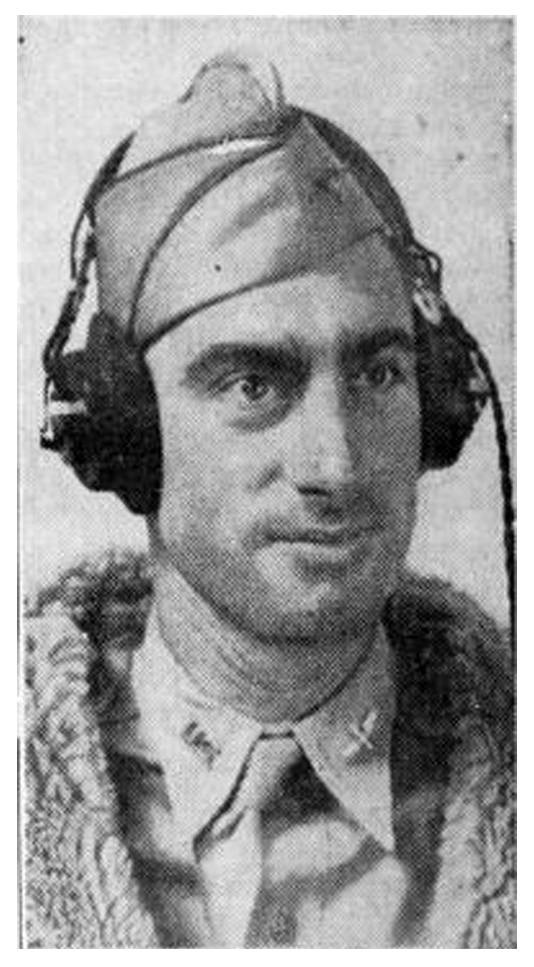
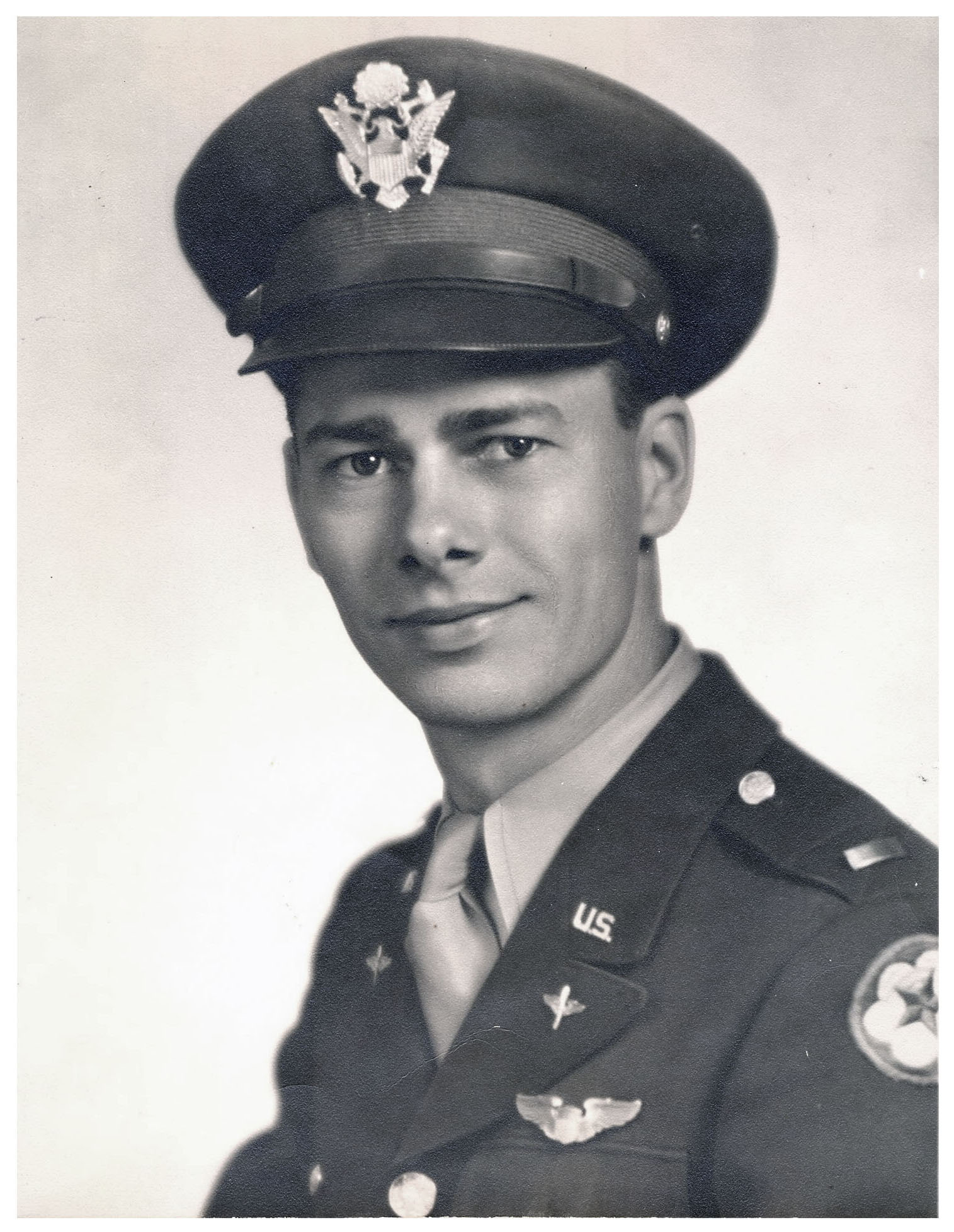
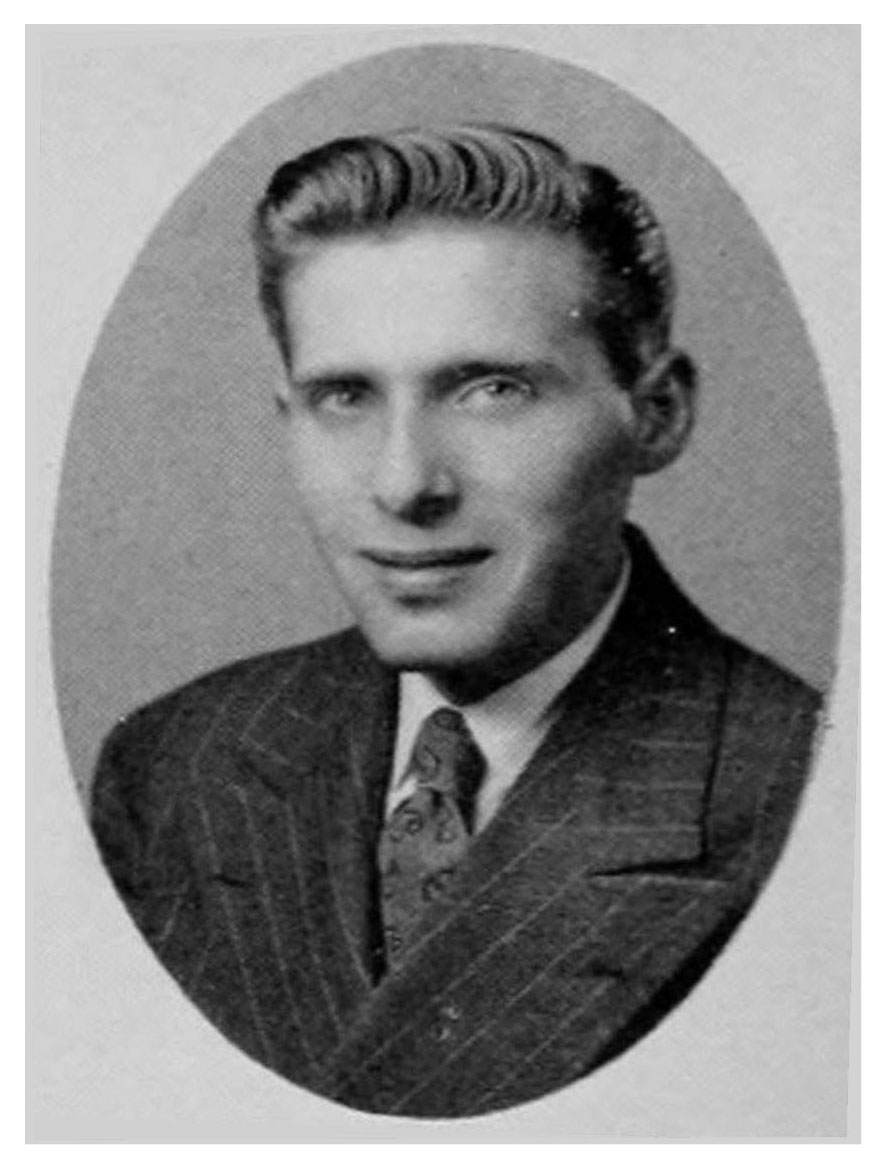
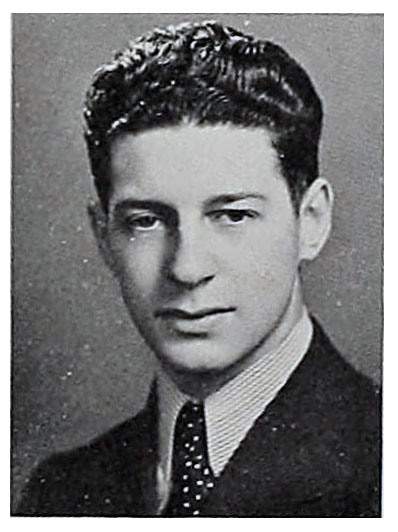
This portrait of Sgt. Manson, as he appeared in the 1943 edition of the Morristown High School Yearbook, is via Sam Pennartz (at FindAGrave)
The picture of “JACK POT” is from world war photos

This photo of “JACK POT” (along with other images of this aircraft, as well as other B-29s, like Slick’s Chicks) can be viewed at Jesse Bowers’ JustACarGuy’s blog.  The caption: “Painter 1/C Edmund D. Wright, USNR, completed cartoon decoration of the plane, with nickname “Jackpot” and turns it over to Army air corps corporals Eugene H. Rees (center) and Marion V. Lewis (right), at Tinian, 1944-45.  Wright was a member of the Navy 107th Seabee battalion which sponsored the plane and adopted its crew.”  According to the Naval History and Heritage Command, the picture is NARA Catalog Number 80-G-K-2980.  Another image of the bomber’s nose art is available at WorthPoint.  The number of photographs of this B-29 suggest that (unsurprisingly) it was a rather popular aircraft, for an obvious reason.  
Sergeant Manson survived the war, but in a tragic irony, he never returned.  

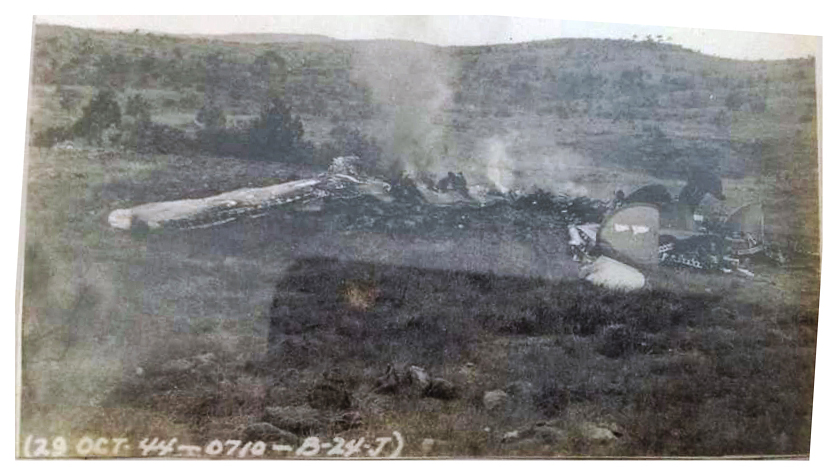
He was one of the seven crewmen aboard B-29 44-70122, which – piloted by 2 Lt. Bernard J. Benson, Jr. – crashed in the Pacific Ocean on October 10, 1945, one of at least thirteen B-29s lost after hostilities with Japan ended.  The loss of this 484th Bomb Squadron aircraft is covered in MACR 14951, which – like more than a few MACRs digitized by Fold3 – is (* ahem *) unavailable via NARA.

Based on records available through the ABMC, these were the other men aboard B-29 44-70122:

Benson, Bernard J., Jr., 2 Lt., 0-715696, N.Y. – Pilot
Perillo, Joseph Stephen, F/O, T-64196, N.Y. – Co-Pilot
Patterson, William W., 2 Lt., 0-557866, N.Y.
Vergos, William, 2 Lt., 0-2084089, N.Y.
Heicken, Eugene L., Sgt., 35892071, In. – Radio Operator
Langer, George R. „Sonny“, Jr., Sgt., 19093183, Id. – Gunner

The recipient of the Distinguished Flying Cross, Air Medal with two Oak Leaf Clusters and Purple Heart, Sgt. Manson is commemorated upon the Tablets of the Missing at the Honolulu Memorial, Honolulu, Hawaii.  His name can be found on page 245 of American Jews in World War II.

~~~~~~~~~~~~~~~~~~~~~~~~~~~~~~~~~~~~~~~~

Air Transport Command
India China Division (formerly India China Wing)

This example of the Air Transport Command insignia is from the National Air and Space Museum.

This contemporary reproduction of the ICWATC insignia is from FiveStarLeather.

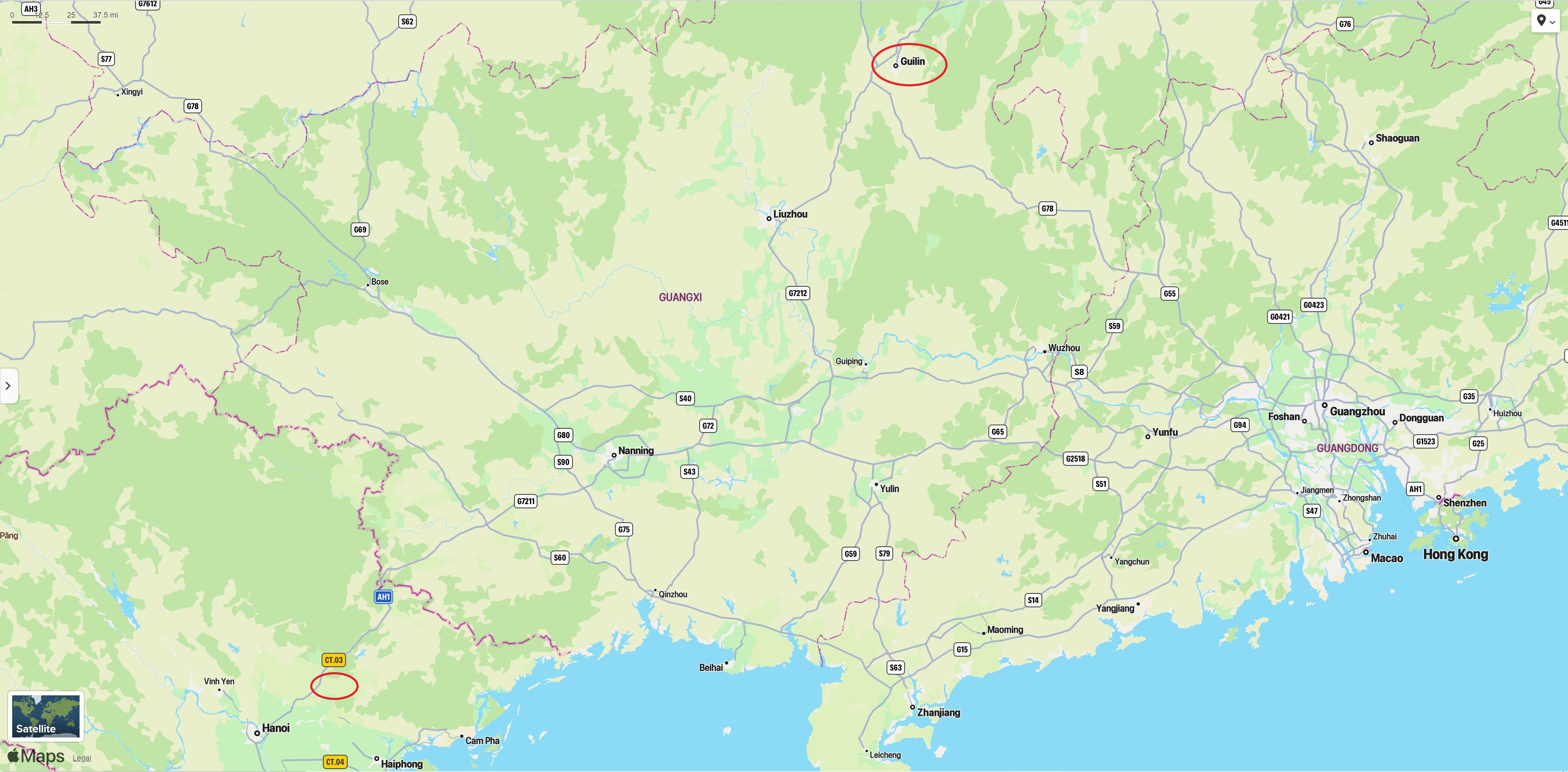
There’s a pattern here, a pattern evident in many – most? – all? – of my prior posts about Second World War military casualties, particularly those involving aviation:  Akin to the stories of 2 Lt. Herbert S. Geller and Sgt. Julius Mason, and as will be seen “below” for F/Sgt. Saul David Lazarus of the Royal Air Force, are other men who were were involved in events that did not at all – directly – entail combat with the enemy.  Such is the case of six Air Transport Command aircraft which were lost in the China-Burma-India Theater on March 19, 1945. 

Of the six planes, Missing Air Crew Reports (from which the three following accounts are taken) were filed for two C-46As (43-47114 & 41-24716) and one B-24D (42-41253)), while Accident Reports were probably (?) filed for the those C-46s, as well as two C-47s and a C-109, the losses of the latter three planes not having been covered in MACRs.     

Of the total of ten airmen aboard the C-46s and B-24, all six C-46 crewmen survived, by parachuting.  The entire B-24 crew was lost.

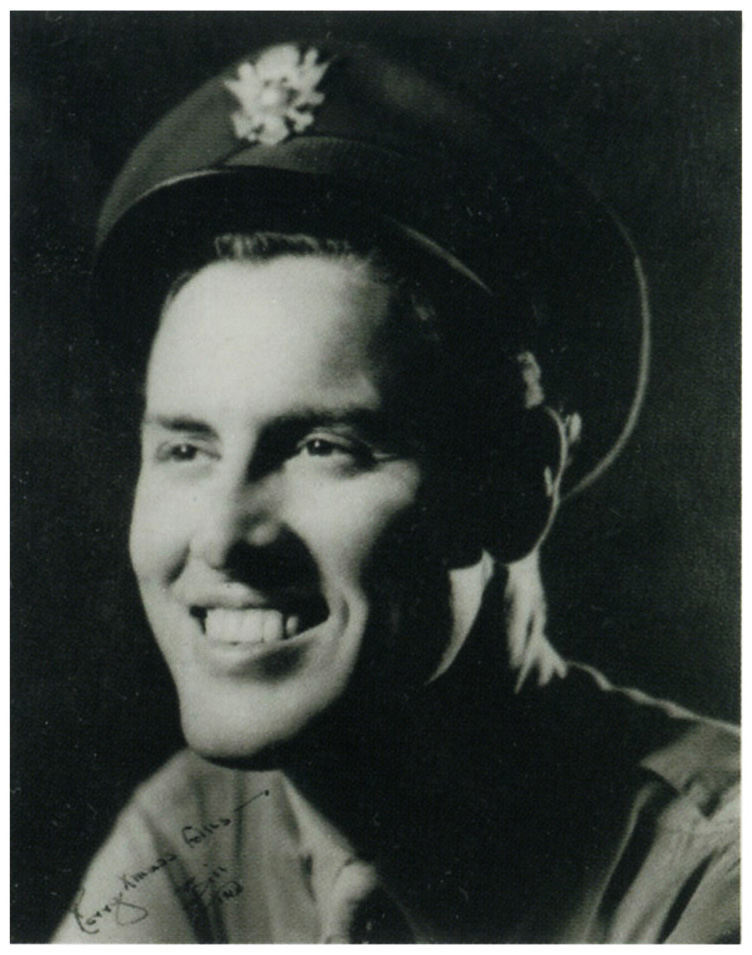
In compiling these three accounts, of particular importance have been the historical records of the 1352nd Army Air Force Base Unit – India-China Detachment, which can be found in AFHRA microfilm roll / PDF A0159.  The records of this unit, whose central mission was search and rescue, are astonishingly detailed by both wartime and even contemporary (as in 2024) standards, and might be deemed a kind of aviation archeology in “real-time”, for they include very detailed information about the search for and especially the identification of missing aircraft and airmen.  This includes aircraft serial numbers, the specific location (as much as could have been determined given the technology of 1944 and 1945) of losses, descriptions of the condition of aircraft wreckage, and most importantly, the names, serial numbers, and fates of missing airmen.  A few entries even cover the identification, description, and examination of crashed Japanese twin-engine bombers.  Central to the 1352nd’s activities was Lieutenant William F. Diebold, whose wartime memoirs were transformed into the book Hell Is So Green: Search and Rescue Over The Hump In World War II, edited by Richard Matthews and published in 2012.  A man of great physical courage with a love for adventure, Diebold – the veteran; the man; the person – was a very descriptive, perceptive, and sensitive writer.  Alas, perhaps deeply affected by his war experiences, he had a very turbulent if not deeply unhappy postwar life, and, born in 1917, passed away in his late 40s, in 1965.  His portrait, below, is from the dust jacket of Hell is So Green.         
As for the lost C-46s and B-24, they were operated by the 1330th and 1333rd Army Air Force Base Units.   

1330th Army Air Force Base Unit (7th Bomb Group)

On a cargo mission from Jorhat, India, to Chengking (Chungking) China, B-24D 42-41253 was last contacted by radio at 2200Z.  At the time, weather conditions were reported as “600 ft. – Overcast 300 ft., scattered clouds, 3 miles visibility with rain shower.  Light turbulence.”  

Missing Air Crew Report 13130 and the records of the 1352nd AAFBU contain parallel information about the aircraft’s loss, the latter source being particularly detailed. 

The MACR reports, “Aircraft #42-41253, B-24 type, was located through native reports of a crash approximately five miles west of the village of Shakchi, India, in the Naga hills.  Distance from Jorhat, India is sixty miles on a heading of 125 degrees.” 

The 1352nd’s records state that, “The aircraft struck the side of a ridge at about 4,500’ feet altitude while flying a heading of between 220o and 250o degrees.”  …  Aircraft having trouble, and was returning to Jorhat, in contact with Jorhat tower, last contact at 2200 at 10,500 ft.  Aircraft crashed into side of a ridge at about 4,500 feet, 20 miles ENE of Mokokchung, and 5 miles W of Shakchi, India. 

At the time MACR was compiled, the aircraft was believed to have been lost as a result of “Mechanical Trouble and Weather.”  Given the fate of the crew and condition of the wreckage, the specific cause was – and will forever be – unknown:  None of the aircraft’s four crew members survived. 

The crew were:
Pilot: Armoska, Raymond M., Capt. 0-724666, Sterling, Il.
Co-Pilot: Gilliam, Bryan R., F/O, T-223731, Columbia, Tn.
Radio Operator: Schipior, Seymour, PFC, 32886005, Brooklyn, N.Y.
Flight Engineer: Paruck, Frank G., Sgt., 16142902, Chicago, Il.

Capt. Armoska and F/O Gilliam are buried in a common grave at Zachary Taylor National Cemetery, Louisville, Ky. (Section E, Grave 31) while Armoska’s name is also commemorated upon the Monument to Aviation Martyrs Nanjing Memorial, Nanjing, China.  Sgt. Paruck is buried at Rock Island National Cemetery, Rock Island, Il. (Section D, Grave 316).

Private Schipior (Shlema Zalman bar Yehiel Meer ha Levi) is buried at Beth David Cemetery, in Elmont, N.Y.  Born in Brooklyn on July 23, 1924, he was the son of Herman and Pearl, and brother of Nately and Scharlet.  The family resided at 375 Pulaski Ave (possibly 794 Levis Ave.) Brooklyn.  His name can be found on page 430 of American Jews in World War II.
7th Bombardment Group / Wing 1918-1995, pp. 247-248
The Aluminum Trail, p. 382
(Data from AFHRA Microfilm Roll A0159, Frame 620)

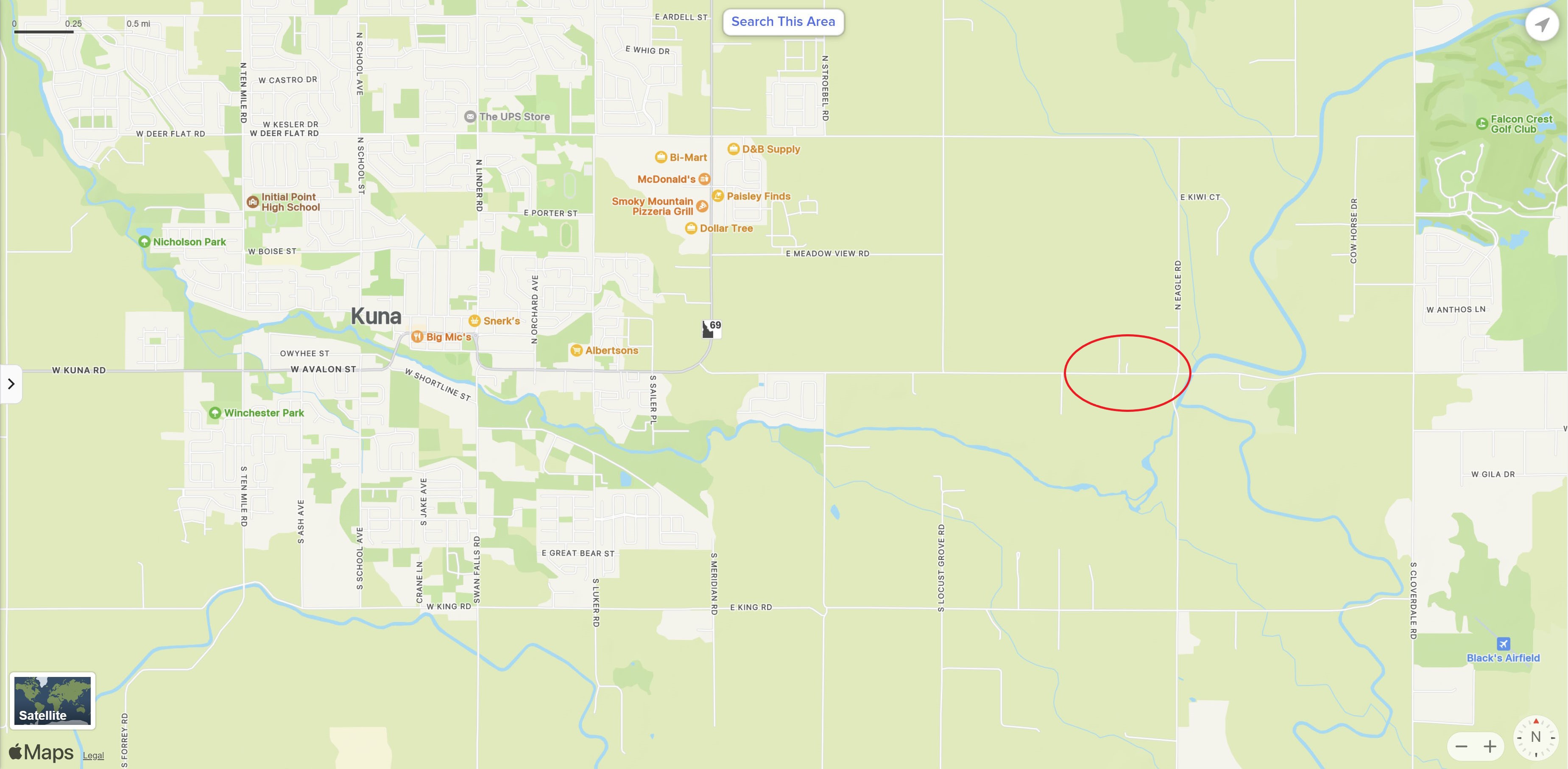
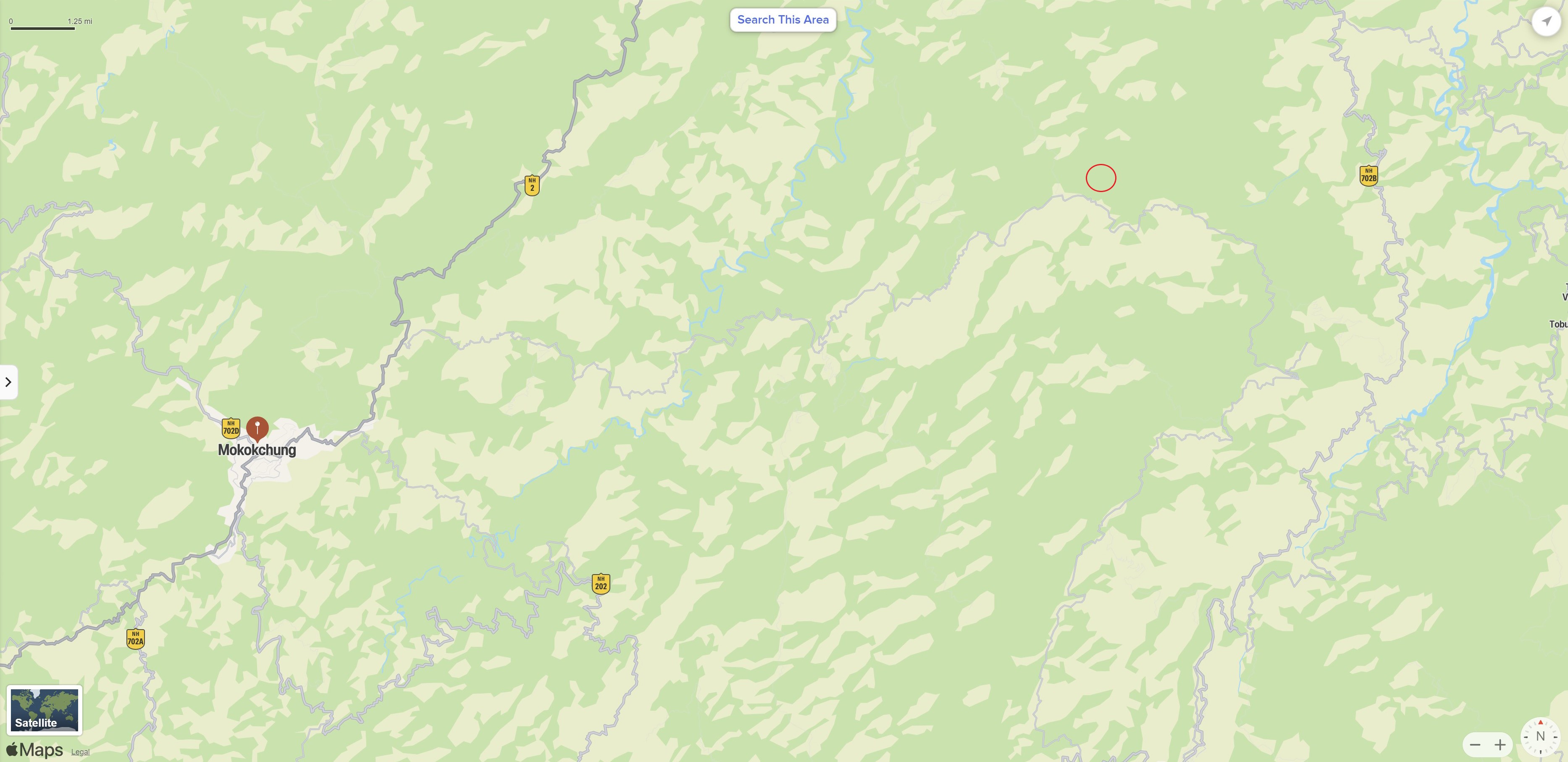
The red circle on the map below shows the approximate crash location of 42-41253: 5 miles west of the village or town of Shakchi, which itself is situated on this map at the “NH 702B” road symbol.  Unsurprisingly, this region remains sparsely inhabited today, 79 years later.
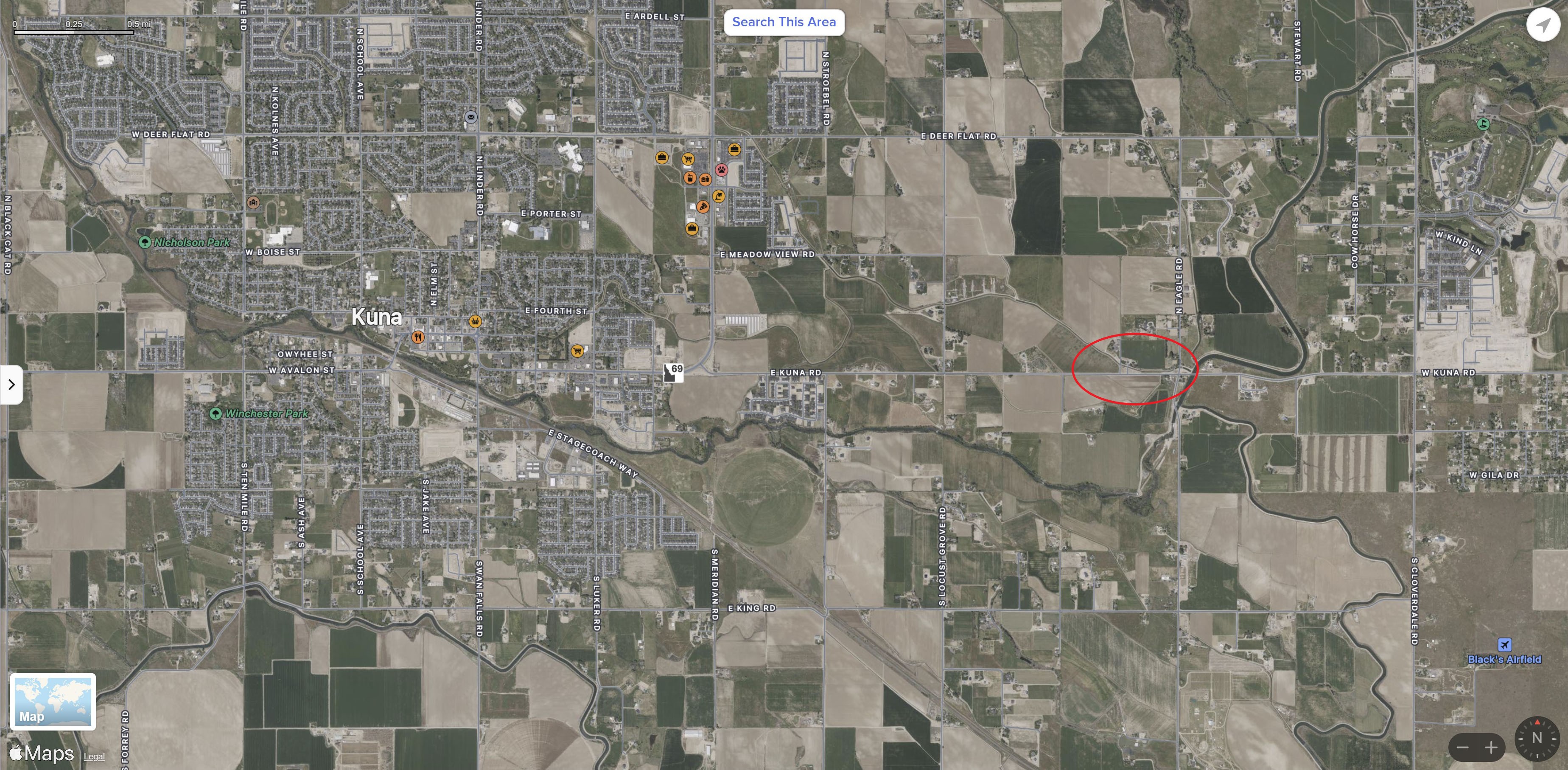
Here’s an air photo view of the above area, with the crash location again designated by a red circle.  A very rugged landscape.
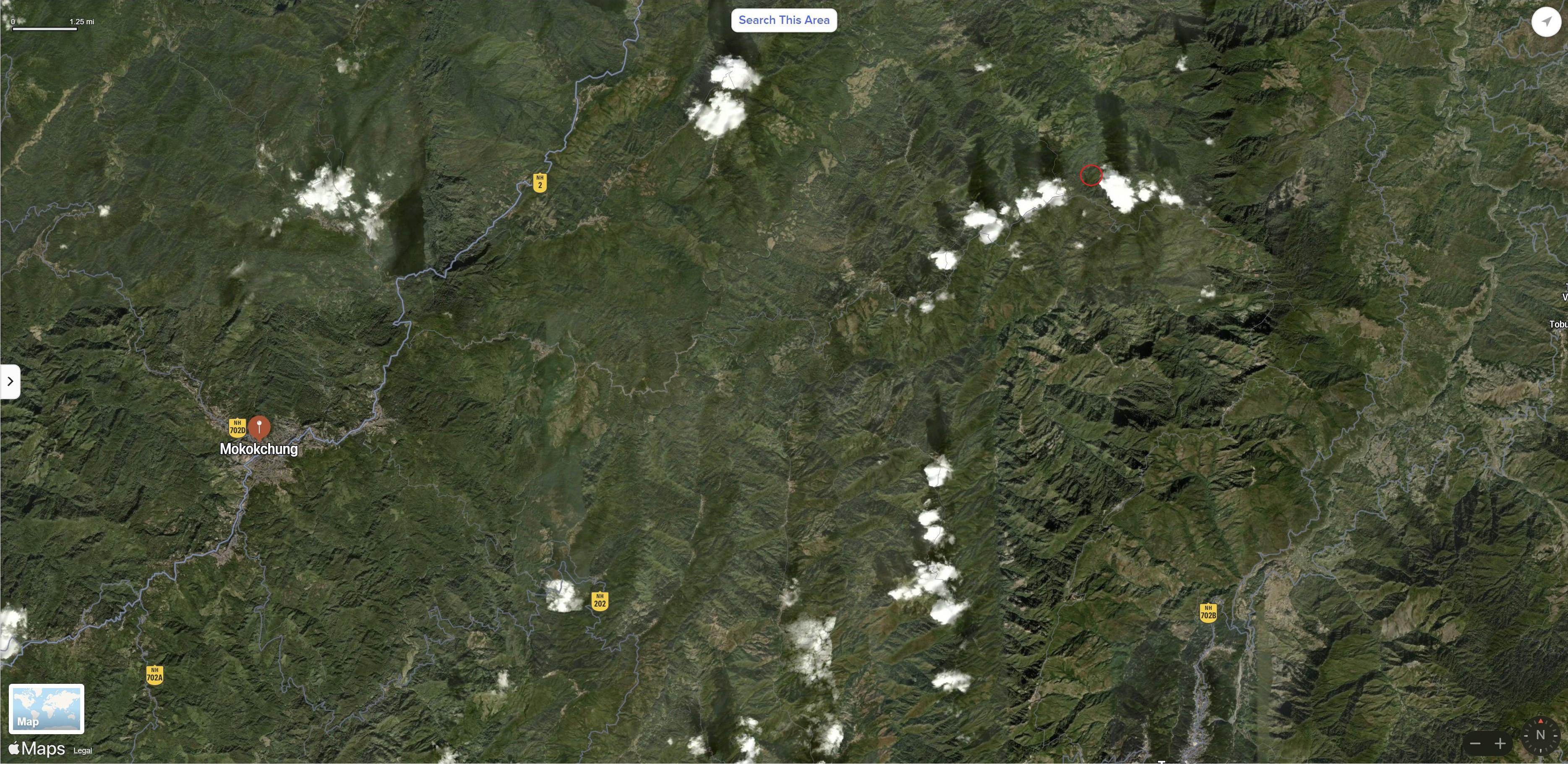
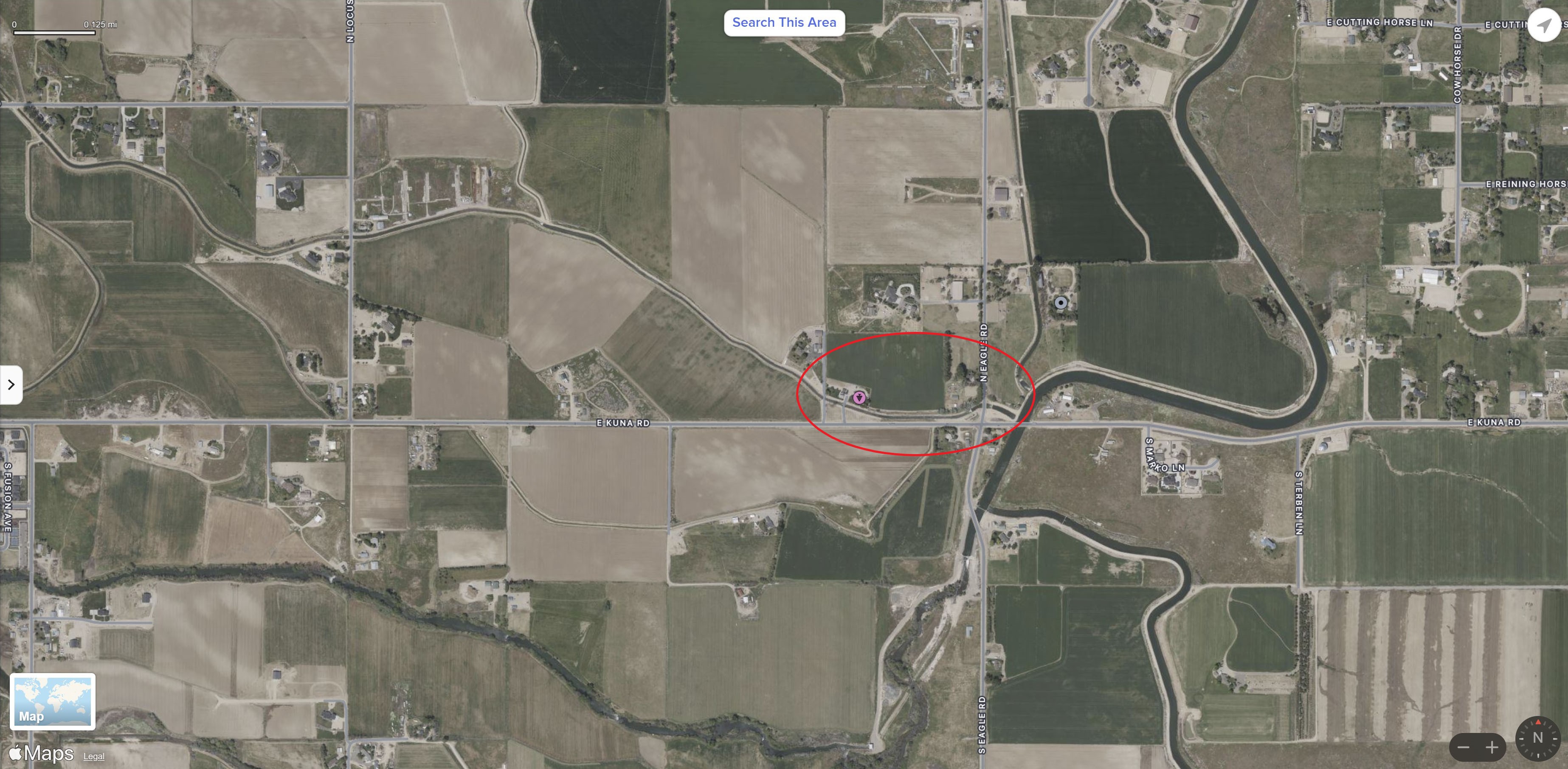
With this photo, we’ve zoomed in close enough for Shakchi (at the right center of the map, as “Sakshi”) to be vaguely visible.  The ridge into which 42-41253 crashed can clearly be seen.

A even closer view.  The scale bar at upper left showing a distance of 0.25 miles.  The terrain clearly suggests the difficulty of the search, rescue, and recovery of missing air crews.

1333rd Army Air Force Base Unit

PFC Morris Louis “Merny” Paster (12020499) was a radio operator aboard C-46A 41-24746, which went missing on a cargo flight between Chabua, India, and Kunming, China.  Neither document gives a specific explanation for the aircraft’s loss, the MACR simply attributing the reason to “Weather of Mechanical Failure”. 

Missing Air Crew Report 13171 is entirely absent of information about what befell the plane and crew, but does reveal that PFC Paster, his pilot (1 Lt. John J. Magurany, 0-802594) and co-pilot F/O William N. Hanahan (T-130416) all returned to military control.  The two uninjured officers reached Chabua on March 22, while PFC Paster, hospitalized at Shingbwyiang with minor injuries, returned to duty at the 1333rd by March 24. 

The 1352nd’s records reveal more about the loss of the aircraft and the return of its crew: Specifically listed as being on a flight from Tingkawk Sakan to Dergaon, the men parachuted 18 miles from Nawsing village, 260 degrees from Shingbwiyang.  The crew “…made it a point to jump in rapid succession in order to be near each other on the ground.”  Private Paster, “Walked into Shingbwiyang after spending one night with natives, and [was] hospitalized at there with minor injuries, returning on 3/24/45.  Pilot and co-pilot were located by a ground party from 1352nd AAFBU and returned to unit on March 22.”

Like so very many American Jewish soldiers mentioned in my previous posts, PFC Paster’s name never appeared in American Jews in World War II, presumably because he simply neither received any military awards, nor was he specifically injured (or worse) in the first place.  Born in Bukovina, Bulgaria on November 2, 1917, the twenty-seven year old airman resided with his mother Bertha (Tenenbaum) Paster at 744 Dumont Ave. in Brooklyn.  Twenty-three years ago, he passed into history in the way of all men: He died on November 28, 2001, and is buried at Mount Zion Cemetery in Queens, New York.

(Data from AFHRA Microfilm Roll A0159, Frames 618-619)

This map shows 41-24746’s last reported position: 2 miles south of Shingbwyiang, Burma…
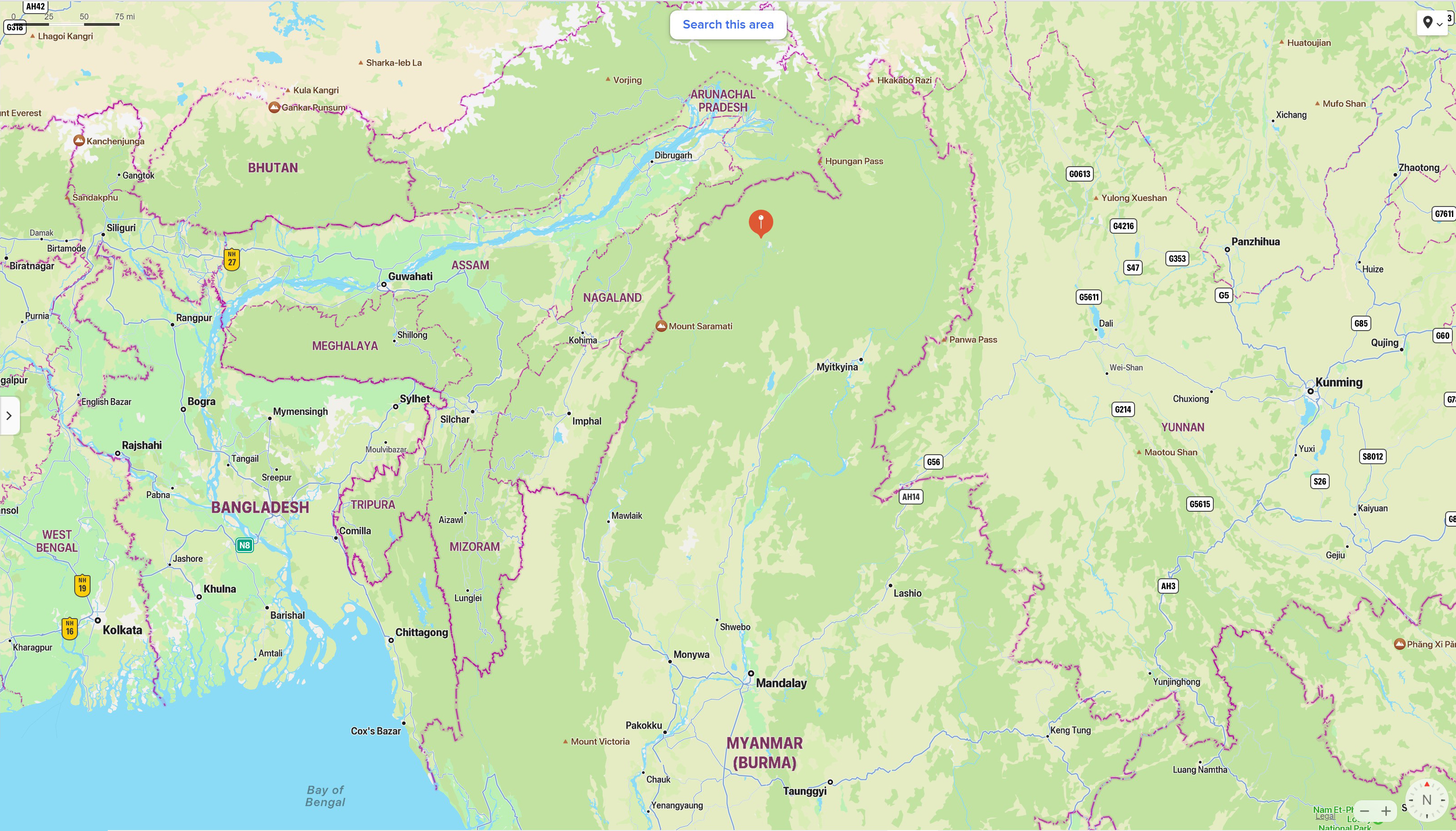
…while this air photo (at a slightly larger scale) reveals the rugged nature of the surrounding terrain.

The crew of the other 1333rd AAFBU C-46 lost on March 19 – 43-47114 – had an experience similar to that of 41-24746.  Though MACR offers no real information about the aircraft’s loss other than the general explanation “Mechanical Failure”, the 1352nd’s records reveal what actually happened.  On a flight from Chabua to Kunming, a Mayday call was sent, “…stating that one engine was out and they were losing altitude.  Crew parachuted 15 miles west of Yunglung, China, led into Tengchung on 27th, and evacuated on 28th March.”  The aircraft’s crash location is listed as 25-14 N, 98-51 E, which is in the flood plain of the Salween (Nu Jiang) River. 

The aircraft was piloted by 1 Lt. Stanley W. Zancho, 0-508455, who, “…was a retired captain from Pan American World Airways.  He served in the Army Air Corps from 1942 to 1946. and was awarded the Distinguished Flying Cross, the Air Medal and the Soldier’s Medal.”  The co-pilot was 2 Lt. D.T. Spinkle (0-781440) and the radio operator Sgt. M.B. Rothchild (15097139).  Probably because the crew was recovered after just over one week and their “Missing” status therefore resolved, the MACR is very perfunctory – at best – and doesn’t list the full names of the crewmen. 

Sgt. Rothchild’s surname is uncertain.  He’s listed in the MACR as “M. Rothchild Jr.”, but this name is crossed out and followed by the name “Rothschild”, while the records of the 1352nd AAFBU list his name as “M.B. Rothchild”.  If the latter is correct, this man was very likely “Marvin B. Rothchild” (2/7/10-7/19/17) who’s buried at King David Memorial Park, in Bucks County, Pa.  Like Morris Paster, his name is absent from American Jews in World War II

(Data from AFHRA Microfilm Roll A0159, Frame 620)

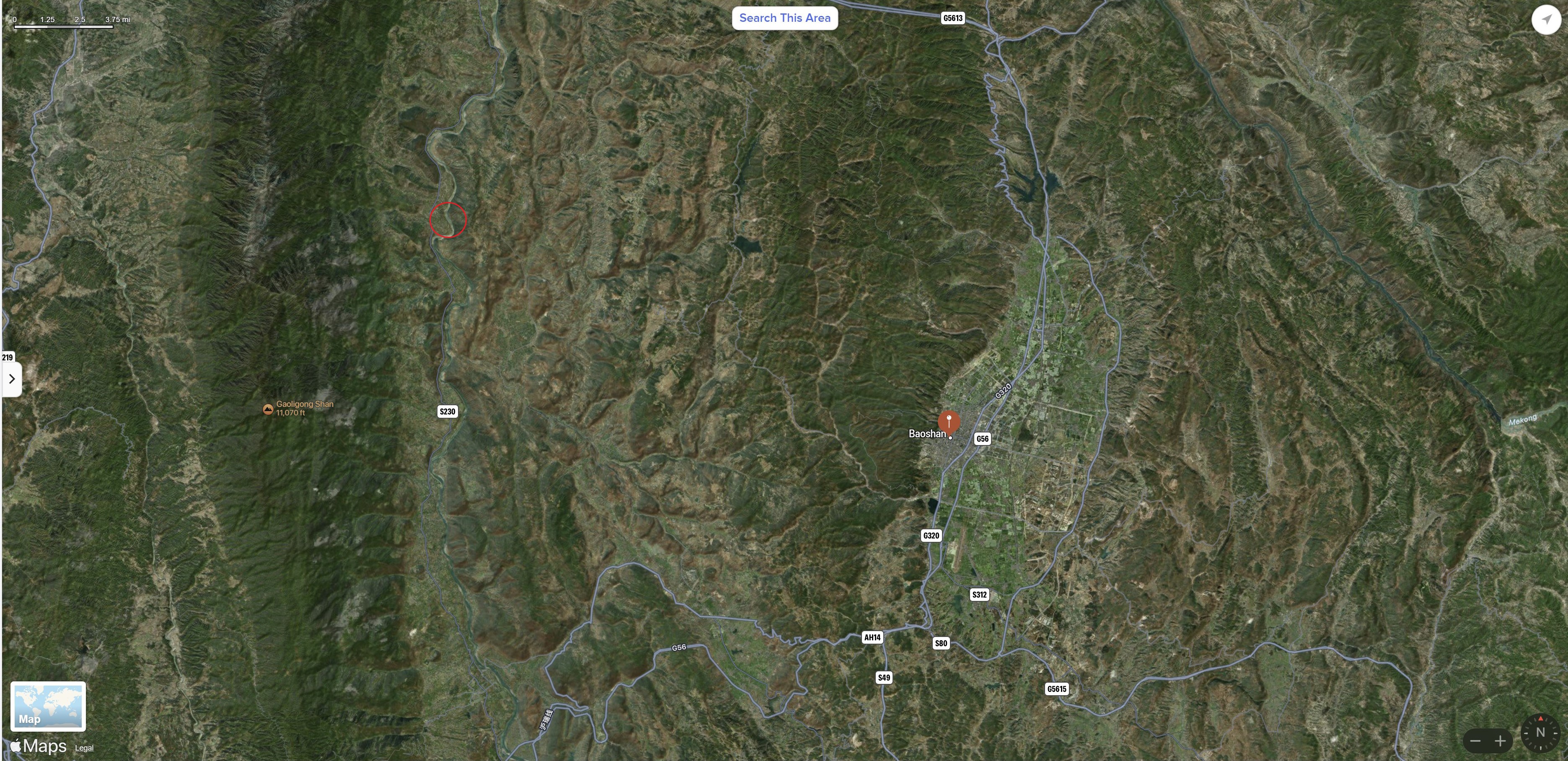
The red circle on this map – the location of which was generated by inputting the coordinates of 43-47114’s loss (25-14 N, 98-51 E) into Oogle Maps’ latitude-longitude locator – reveals the location of the transport’s crash to have been northwest of Baoshan, on the bank of the Salween (Nu Jiang) River.  

An air photo view of the same area.  This terrain is not flat!

Let’s have a closer map view…
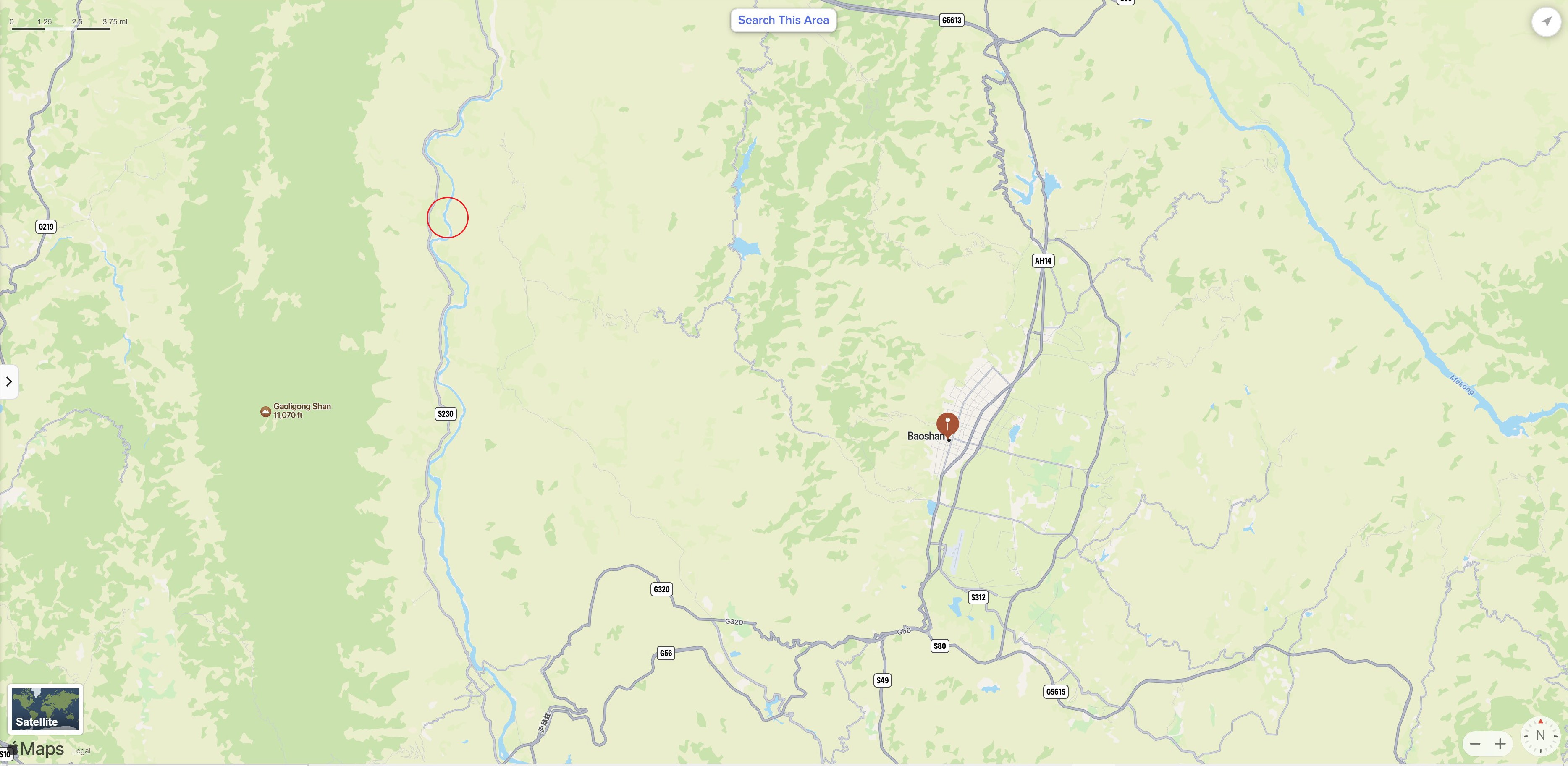
…and, a closer air photo view.  Again, an abundance of mountains, hills, and ridges.
~~~~~~~~~~~~~~~~~~~~~~~~~~~~~~~~~~~~~~~~

While the aviators mentioned in this and related “March 19, 1945”-type blog posts served in bombers or transport aircraft, two other men, both fighter pilots, need be mentioned for the events of this long-forgotten Monday.  They are Lieutenant Efim Aronovich Rukhovets of the Soviet Union’s Military Air Forces (VVS), and Flight Sergeant Saul David Lazarus of the Royal Air Force.  Neither survived: Rukhovets was shot down, and Lazarus was lost during a practice mission. 

U.S.S.R. (C.C.C.Р.)
Military Air Forces – VVS
(Военно-воздушные cилы России – ВВС)

Born in Minsk on February 22, 1921, Lieutenant (Лейтенант) Efim Aronovich Rukhovets (Ефим Аронович Руховец) was the husband of Vera Aleksandrovna, who resided in House (Building) 39 on Nakhichevanskaya Street, in Rostov-on-Don.

A member of the 848th Fighter Aviation Regiment of the 6th Air Army (848 Истребительного Авиационного Полка, 6-я Воздушная Армия) Rukhovets was shot down by anti-aircraft fire while while flying an La-5 fighter (…see also…) on his 46th mission, while attacking anti-aircraft positions during an escort of Il-2 Shturmoviks to a place called “Okhodosh”, which is probably near Lake Balaton.  He’s buried only a few kilometers from where he (literally) fell to earth: In the Roman Catholic Cemetery at Patka, just northeast of Székesfehérvár, in Fejér County (specifically 2nd row, grave 2).  

The following document – an English-language translation of Lt. Rukhovets’ posthumous award citation of the “Order of the Second World War” – covers his military service as a whole, including information about his aerial victory on March 17, and, his final mission of March 19. 

Comrade Rukhovets especially distinguished himself in March 1945 during a period of our aviation’s intense combat work, which contributed to the defeat of the German tank group southwest of Budapest.  He showed great skill in performing combat missions to escort attack and reconnaissance aircraft.  Tactically competently maneuvering in the air always provided reliable cover for attack aircraft.

A difficult situation arose on March 17, 1945.  Together with the leading pilot, Rukhovets covered an Il-2 group.  This group was attacked by 5 ME-109s in an unequal air battle that ensued; when a threatening position was created for his leader, one ME-109 went onto the [leader’s] tail, Rukhovets quickly flew up to him from right behind and knocked him down from a pitch-up from a distance of 40 meters.  The ME-109 rolled over, caught fire and crashed 2-3 km south of Mokha.

In total, during the Second World War, he made 46 successful sorties and shot down one ME-109.

On March 19, 1945, he died heroically while protecting attack aircraft from enemy anti-aircraft fire.  In the Okhodosh area, an enemy anti-aircraft battery always interfered with the work of our aircraft.  Rukhovets dived on it and suppressed it with dropped bombs.  But his plane caught fire from anti-aircraft fire.  Unable to save the craft and himself, he directed the burning plane onto the road and crashed into a column of enemy tanks moving along it.

FOR THE PERFORMANCE OF 46 SUCCESSFUL COMBAT FLIGHTS AND THE DESTRUCTION OF ONE ME-109 WORTHY OF A GOVERNMENT AWARD –
ORDER OF THE SECOND WORLD WAR – POSTHUMOUS

COMMANDER 848 IAP MAJOR / [STEPAN ILYICH] PRUSAKOV /

April 10, 1945.

The following three maps show the assumed area of Lieutenant Rukhovets’ final mission, and, place of burial. 

Though Okhodosh – wherever or whatever that is – cannot be identified either through Oogle or Duck-Duck-Go, the towns of Lepseny and Enying – the general vicinity where Lt. Rukhovets was shot down – are very much extant.  They’re situated just inland from the northeast corner of Lake Balaton, near the contemporary M7 Motorway.

In the next map – zooming out and moving to the northeast – the northeastern part of Lake Balaton is still visible, while at the upper center we can see the approximate crash location of the Me-109 claimed by Lt. Rukhovets on March 17 (black circle), and the location of his place of burial (red circle): Just a few ironic miles northeast of Moha, at the Patka Catholic cemetery.    

Zooming much further out, this map provides a view of Lepseny, Enying, Moha, and Patka (the latter two north of Székesfehérvár) in relation to Budapest. 

~~~~~~~~~~~~~~~~~~~~~~~~~~~~~~~~~~~~~~~~

Another example of a Soviet WW II-era military award citation can be found at my brother blog (WordsEnvisioned), in a post pertaining to writer and novelist Vasiliy Semenovich Grossman – perhaps best known for his magisterial epic Life and Fate – within a post illustrating “The Years of War”.  The latter book is a 1946 compilation of Grossman’s wartime reporting, published in English by the Soviet Union’s Foreign Languages Publishing House

The post includes images of Grossman’s award citation for the Order of the Red Star, and, text of the citation in Russian, with English translation. 

The blog also includes Grossman’s (ironically brief – in light of his posthumous fame) obituary from The New York Times of September 18, 1964 and three reviews of Life and Fate.  These reviews are paralleled by three reviews of Grossman’s somewhat political, perhaps philosophical, tangentially mystical semi-stream-of-consciousness short novel, Forever Flowing, which – far more than in length alone – is vastly different in style and structure from Life and Fate

As you’ll find mentioned in some of the reviews, and as discussed elsewhere, Grossman’s wartime prominence eventually availed him little, for after the war he grew increasingly disillusioned by the Soviet system.  Central to his transformation – and the increasing importance of his identity as a Jew – were the suppression of the Black Book of Soviet Jewry, his reflections on the collectivization that led to the Holdomor (which is clearly addressed in several passages in Forever Flowing), and the political repression inherent to the Soviet system, which he personally experienced in the form of confiscation of the manuscript (and much, much more) of Life and Fate.  In all, the primary and parallel themes to his his body of work – themes which were not exclusive of other aspects of life – proved to be the imperative of human freedom (even moreso when repressed), and, the centrality of his identity as a Jew.  

Here are the posts:

Obituary

The New York Times, September 18, 1964

“Life and Fate” – Book Reviews

Life and Fate”, The New York Times, November 22, 1985
Life and Fate”, December 19, 1985
Life and Fate” (1987 Harper & Row Edition, with cover by Christopher Zacharow), The New York Times, March 9, 1986

“Forever Flowing” – Book Reviews

Forever Flowing”, The New York Times, March 26, 1972
Forever Flowing”, The New York Times, April 1, 1972
Forever Flowing”, February 23, 1973

Forever Flowing – Cover Art

“Forever Flowing”, by Vasily Grossman – 1970 (1986) [Christopher Zacharow]

(Okay…  Yes, I know, I know!  The topic is entirely unrelated to Jewish aviators in WW II, but in the far indirect context of that topic, I thought it worthy of mention.  Sometimes, there’s virtue in inconsistency.  

And now, this post shall conclude with a brief biography of one last Jewish aviator: Saul David Lazarus.)

~~~~~~~~~~~~~~~~~~~~~~~~~~~~~~~~~~~~~~~~

British Commonwealth
Royal Air Force
No. 322 (Dutch) Squadron

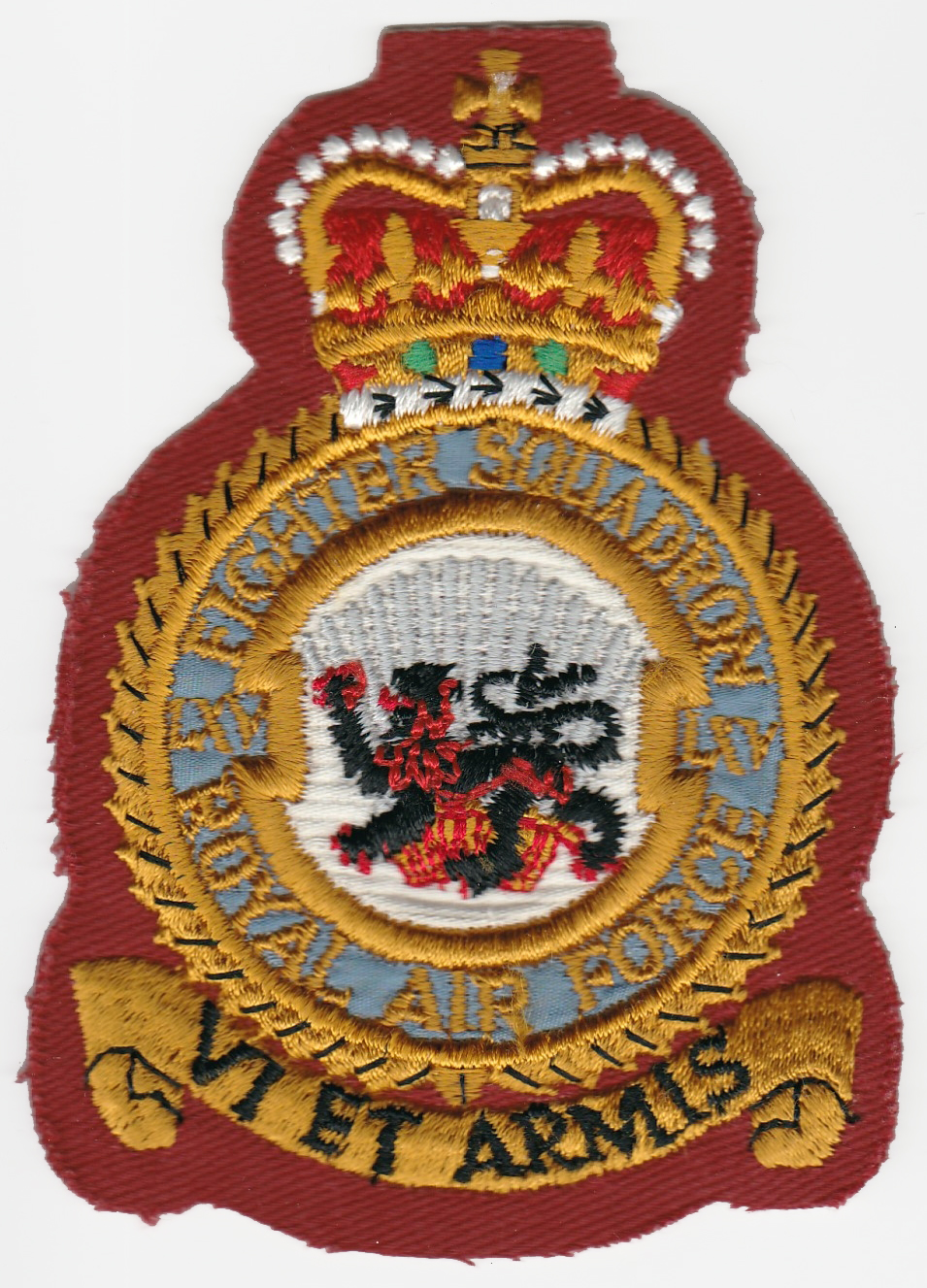
This version of No. 322 Squadron’s coat-of-arms is from Leeuwarden Air Base Squadrons (Squadrons Vliegbasis Leeuwarden).
As described at Remembering the Jews of WW 2, F/Sgt. (1437557) Saul David Lazarus (Shaul bar Rav Avraham Yakov), RAFVR, a member of No. 322 (Dutch) Squadron, was on a, “Bombing practice from airfield B.85 Schijndel in Netherlands.  He flew to the target area but even though his plane was too close to the target he dived to the ground to drop his bomb.  He released the bomb but because of the steep angle the bomb ended up between the aircraft propellers and exploded in mid-air killing Saul instantly.”  This parallels information at All Spitfire Pilots, which in its entry for F/Sgt. Lazarus’ Spitfire LFXVI (serial RR205) states: “Form 540 – No operational flying but some practice bombing at the range, during which one of the Squadron’s new pilots, F/SGT LAZARUS, was killed in the Spitfire RR.205.  The machine was seen to explode in the air the pilot being killed instantaneously.  Even though F/SGT LAZARUS had only been with us a few days, he had made himself very popular with the pilots and groundcrew.”  As described at Aviation Safety, the accident occurred at the Achterdijk-Kruisstraat Road, Rosmalen, Noord-Brabant, in the Netherlands.

This Oogle map shows Rosmalen, with Kruisstraat to the east-northeast.  RR205 presumably crashed somewhere between.

F/Sgt. Lazarus was the son of Abraham (1886-2/8/48) and Fanny (Cosovski) Lazarus, and brother of Joseph and May, his family residing at 22 Tetlow Lane, Salford, 7, Lancashire.  He is buried in plot 13,B,4 at Bergen-op-Zoom War Cemetery, Noord-Brabant, Netherlands.  Born in Salford, Manchester, on June 8, 1921, his name appeared in The Jewish Chronicle on March 30 and June 22, 1945.

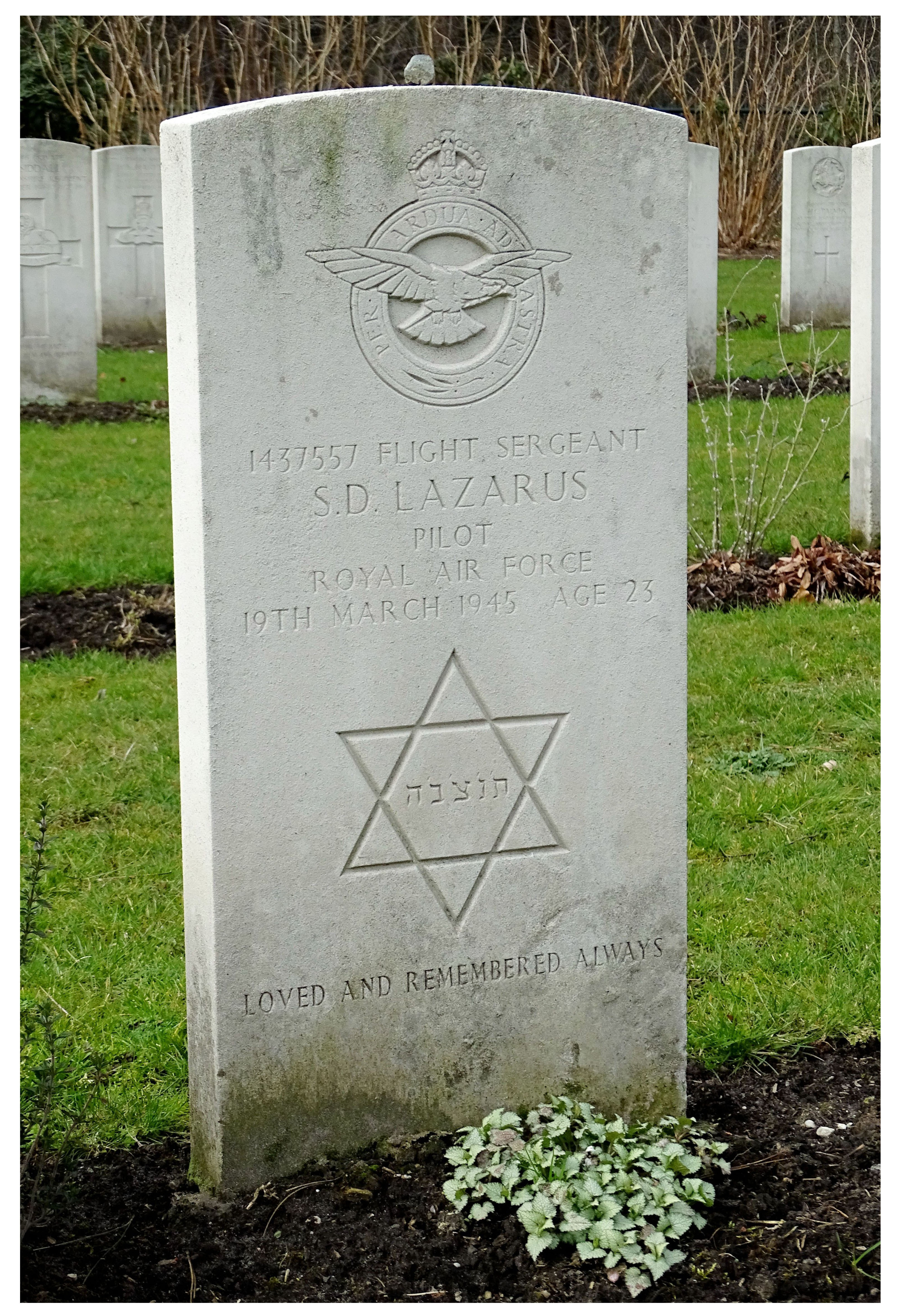
This image of F/Sgt. Lazarus’ matzeva is by FindAGrave contributor John Kirk …
… while this picture of a commemorative plaque in memory of F/Sgt. Lazarus, at the Lazarus family memorial (Failsworth Jewish Cemetery, Manchester) is by Bob the Greenacre Cat.

The inscription on the right states: A TOKEN OF LOVE FROM MOTHER JOE MAE BELLA AND CLAIRE.

Though there’s no specific photograph of Spitfire RR205, the aircraft would have born markings and camouflage identical to Spitfire XVI TD322 – squadron code “3W” – as depicted by in the illustration below, from Flightsim.to:
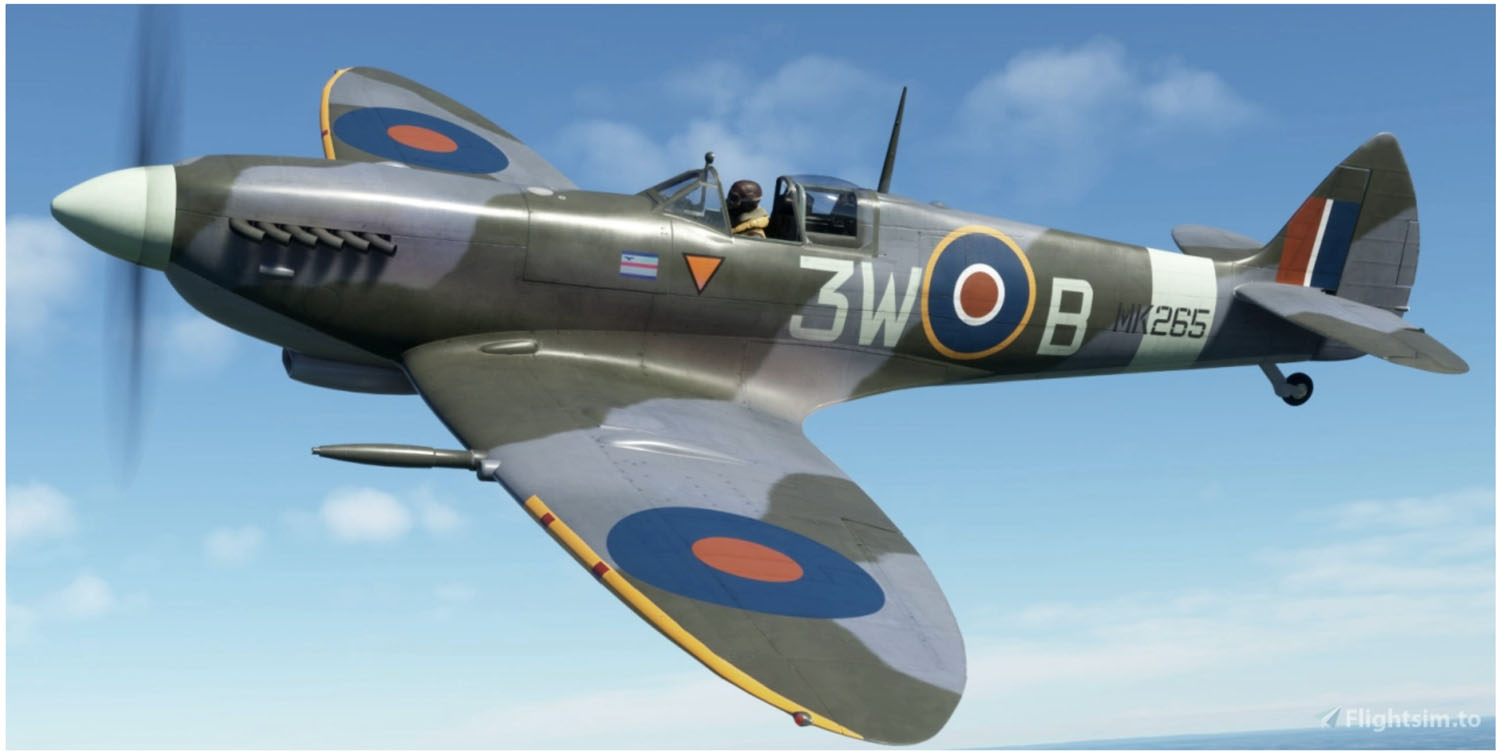
The aircraft, “…had the Dutch orange inverted triangle painted beneath its port windscreen quarter light.  It also had nose art on the port engine cowling of the squadron mascot, Polly Grey, a red-tailed grey parrot, perched on a hand with the thumb raised.”

Specifically being an XVI Spitfire, RR205 was probably identical in design and outline to Czechoslovakian ace Otto Smik’s RR227, an early model “high-back” version of the Mark XVI Spitfire, which is shown below.
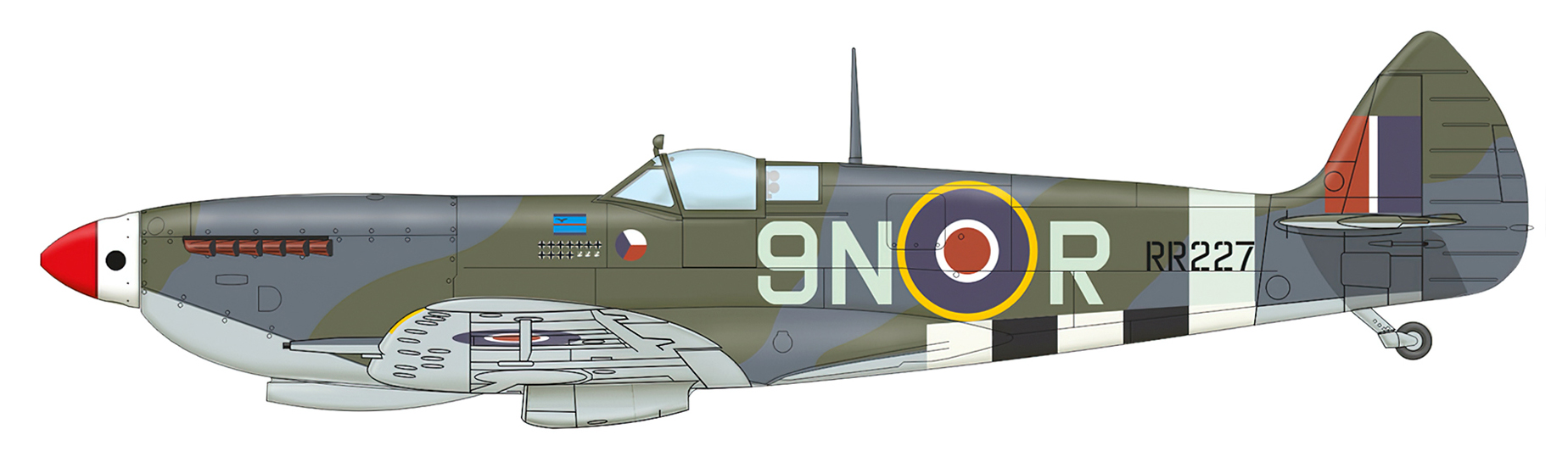
To conclude, from the Nederlands Instituut voor Militaire Historie, No. 322 Squadron Spitfires in 1945

~~~~~~~~~~~~~~~~~~~~~~~~~~~~~~~~~~~~~~~~

And so, we leave the skies of March 19, 1945.

References

Books

Dorr, Robert F., 7th Bombardment Group / Wing 1918-1995, Turner Publishing Company, Paducah, Ky., 1996

Dublin, Louis I., and Kohs, Samuel C., American Jews in World War II – The Story of 550,000 Fighters for Freedom, The Dial Press, New York, N.Y., 1947

Morris, Henry, Edited by Gerald Smith, We Will Remember Them – A Record of the Jews Who Died in the Armed Forces of the Crown 1939 – 1945 – Volume I, Brassey’s, London, England, 1989 (“WWRT I”)

Morris, Henry, Edited by Hilary Halter, We Will Remember Them – A Record of the Jews Who Died in the Armed Forces of the Crown 1939 – 1945 – Volume II – An Addendum, AJEX, London, England, 1994 (“WWRT II”)

Quinn, Chick Marrs, The Aluminum Trail – How & Where They Died – China-Burma-India World War II 1942-1945, Chick Marrs Quinn, 1989

Scutts, Jerry, Spitfire in Action, Squadron / Signal Publications, Carrollton, Tx., 1980

Magazines

Geiger, Geo John, Red Star Ascending – The Story of WW II Soviet Russia’s Premier and Last Piston-Engined Interceptor and Air Superiority Fighter, the Lavochkin LaGG!, Airpower, November, 1984, V 14, N 6, pp. 10-21, 50-54

No author, LaGG-3 – Lavochkin’s Timber Termagant, Air International, January, 1981, V 20, N 1, pp. 23-30, 41-43 (The La-5’s progenitor…)

No author, Last of the Wartime Lavochkins, Air International, November, 1976, V 11, N 5, pp. 241-247 (…the La-5’s successor.)

7/16/24 – 94

Soldiers from New York: Jewish Soldiers in The New York Times, in World War Two: March 8, 1944 (In the Air…)

My recent posts about Jewish military casualties and participation in World War Two have been centered upon the date of March 8, 1944, based on a news article in The New York Times that reported on the death in combat – on that date – of Second Lieutenant Jesse H. Lack, a navigator who served in the 8th Air Forces’ 458th Bomb Group.  Other posts related to that date present biographical information about Jacob “Jack” Moskowitz of the 452nd Bomb Group, and Milton W. Stern of the 381st Bomb Group, who became prisoners of war of the Germans under dramatically different circumstances, spending the remainder of the war as inadvertent “guests” of their captors in Stalag Luft I.  And, Second Lieutenant Daniel S. Rothenberg and Squadron Leader David A. Goldberg, fighter pilots in the United States Army Air Force, and, Royal Canadian Air Force, respectively. 

Another post pertaining to this date – of much greater brevity – pertains to Jewish soldiers in the ground forces of the Allies  

And so, we now come to this “last” (for now?) post related to Jewish military service on March 8, 1944:  Following the same general format as I’ve previously established, here are biographical profiles (and sometimes even more) about other Jewish aviators in the Allied armed forces who were casualties or otherwise on this day.  Some did not return.  Others, did.   

Their names and very brief stories follow…

For those who lost their lives on this date…
Wednesday, March 8, 1944 / 14 Adar 5704
– .ת.נ.צ.ב.ה. –
…Tehé Nafshó Tzrurá Bitzrór Haḥayím
May his soul be bound up in the bond of everlasting life.

~~~~~~~~~~~~~~~~~~~~~~~~~~~~~~

United States Army Air Force

8th Air Force

~~~~~~~~~~~~~~~~~~~~

~~~~~~~~~~~~~~~~~~~

Sgt. Emanuel Bromberg, 13153157, Riverside, N.J. – Prisoner of War

This is the insignia of the 92nd Bomb Group, via the American Air Museum in Britain (image FRE 5075)…

…and, from Flying Tiger Antiques, this is the emblem of the 327th Bomb Squadron.

B-17G Flying Fortress 42-31772 of the 92nd Bomb Group’s 407th Bomb Squadron, during the Group’s mission to Berlin, was last reported – albeit not definitely – turning away from the 92nd’s formation and jettisoning its bombs. piloted by 2 Lt. Walter F. Payne, the bomber’s last position doesn’t seem (?) to have been marked upon the map included in Missing Air Crew Report 2995, which documents the plane’s loss.  (At least, going by Fold3’s fuzzily-scanned-microfiche version available via the National Archives.)  However, the MACR’s main data sheet lists the coordinates where the plane was last seen as 53-00 N, 13-40 E … about 45 miles north-northeast of Berlin.  According to the American Air Museum in Britain, the plane crashed near Templin, which is 40 miles (almost) due north of the German capital city.  That’s the only record of the aircraft’s fate, as Luftgaukommando Report KU 1191 only comprises a solitary dog-tag: That of right waist gunner S/Sgt. Thomas M. Farrell, Jr.  Paralleling this, Missing Air Crew Report 2995 simply includes a transcript of the information embossed onto S/Sgt. Farrell’s dog-tag. 

This map shows the location of Templin, relative to Berlin.

As for the B-17s squadron code letter and nickname (if any), these are unknown.

Pilot: Payne, Walter E., 2 Lt., 0-679112 – Piedmont, S.C.
Co-Pilot: Quarter, Gerald L., 2 Lt., 0-687633 – Tuscon, Az.
Navigator: McDowell, William, Jr., 2 Lt., 0-691774 – Niagara Falls, N.Y.
Bombardier: Jenkins, Edward T., 2 Lt., 0-682547 – Summerville, S.C.
Flight Engineer: Rawlings, Vernon Keith, S/Sgt., 38183480 – Wanette, Ok.
Radio Operator: Bannow, Thomas E., S/Sgt., 16154468 – Marinette, Wi.
Gunner (Ball Turret): Hallam, Arthur E., Sgt., 11111800 – Providence, R.I.
Gunner (Right Waist): Farrell, Thomas M., Jr., S/Sgt., 15116362 – Denver, Co.
Gunner (Left Waist): Bromberg, Emanuel, Sgt., 13153157 – Riverside, N.J.
Gunner (Tail): Phipps, Harvey., Jr., Sgt., 35580341 – Indianapolis, In.

Sergeant Emanuel Bromberg, the bomber’s left waist gunner, was born in Riverhead (Long Island), New York, on July 23, 1923.  The son of Joseph and Ada Bromberg, his family resided at 225 Pavillion Ave. in Riverside, New Jersey, though an additional address was 550 Cinnaminson Ave. in Palmyra (also-New-Jersey).  He was imprisoned at Stalag Luft IV, and like all his fellow crewmen, eventually returned to the United States.  

His name appeared in the Philadelphia Inquirer on April 29 (in the Philadelphia Record on that date and May 12) and June 8, 1944, and in a list of liberated POWs published on May 14, 1945.  His name can also be found on page 228 of American Jews in World War II, accompanied by the notation that he received the Purple Heart, albeit with no mention of the Air Medal or Oak Leaf Clusters.  Thus, he’d flown less than five combat missions prior to being shot down.    

He died on July 31, 2007, just after his 84th birthday, and is buried at Arlington National Cemetery: Section 64, Site 5260.  He evidently made the military a career, as his matzeva lists service in Korea and Vietnam, retiring at the rank of CWO4 (Chief Warrant Officer Grade CW-4).  

This image of CWO4 Bromberg’s matzeva is by FindAGrave contributor Ricky Woods.

~~~~~~~~~~~~~~~~~~~

2 Lt. Homer Previn Landau, 0-809644, Pittsburgh, Pa. – Killed in Action

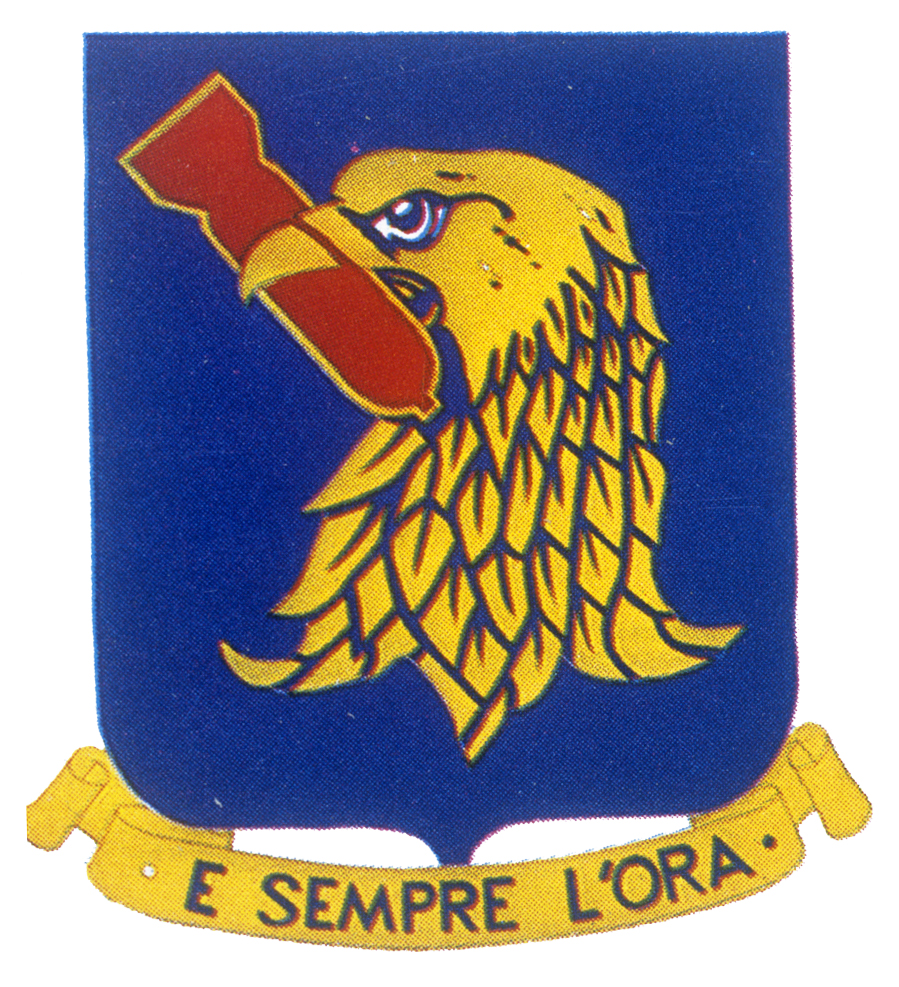
The motto of the 96th Bomb Group, “E Sempre l’Ora”, means “And Always Now”.  This image of the group’s insignia is from the American Air Museum in Britain (“FRE 5092”)…  

…while this depiction of a winged snake carrying a bomb, the insignia of the 339th Bomb Squadron, is from RedBubble.com.

While information about United States Army Air Force WW II combat casualties might initially be thought of in terms of Missing Air Crew Reports, there were, alas, many circumstances throughout the war for which that set of records was neither bureaucratically “filed” nor informationally relevant.  The death of 2 Lt. Homer Previn Landau (0-809644), a navigator assigned to the 339th Bomb Squadron of the 96th Bomb Group, is one such instance.  His aircraft, B-17G Flying Fortress 42-31657 (otherwise known as “Wildfire II” / “QJ *S“), returned to its base at Snetterton, England, despite being damaged by a 20mm shells fired by attacking German fighters.  Lt. Landau, struck by one of these projectiles, did not survive his injuries.  He is buried at the Cambridge American Cemetery in England, at Plot F Row 6 Grave 94. 

Born in Pittsburgh, Pa., on October 27, 1915, at the age of 29 he was notably older that most of his fellow combat flyers.  He was the son of Saul Albert (4/15/89-11/3/51) and Bessie (Previn) (10/26/92-?) Landau, his family residing at 6558 Bartlett Street in the city of his birth.  A news article about his death was published in the Pittsburgh Press on April 3, 1944, and his name (only his name, and nothing more) can be found in the September 7, 1945, issue of Pittsburgh’s Jewish Criterion, which commemorated Jews from that city who were killed in the (by then) just-concluded-war.  His name also appears on Page 534 of Volume II of American Jews in World War II, which records that he received the Purple Heart, Air Medal, and one Oak Leaf Cluster, thus indicating that he completed between 5 and 10 combat missions.  

~~~~~~~~~~~~~~~~~~~~

T/Sgt. George B. Silverman, 31153017 – Portland, Me.
T/Sgt. Milton Scharf, 12188872 – Brooklyn, N.Y.
Prisoners of War

This image of the insignia of the 100th Bomb Group was uploaded to WW 2 History Fandom by Fargo84.

…while this image of the emblem of the 315st Bomb Squadron was found at EBay Australia.

The entire crew of First Lieutenant Norman Lester Chapman survived the loss of their bomber during the 100th Bomb Group’s mission to Berlin.  There are three brief accounts in Missing Air Crew Report 3032 describing the loss of their plane, B-17G 42-40056, otherwise and perhaps better known as “Holy Terror III” (or was it “Katie’s Boys“?).  Two follow:

First…  “Lt. Chapman feathered one engine, then unfeathered it near Dumer Lake at about 1240 hours.  He continued the formation, although straggling, to the I.P. where three enemy fighters attacked him.  Our escort went down and picked him up.  His A/C was under control when last seen.”

Second…  “Lt. Chapman, flying lead, 2nd element, high squadron, lagged at 1357 hours near 51-50 N 10-54 E.  No. 1 engine was feathered and then unfeathered.”

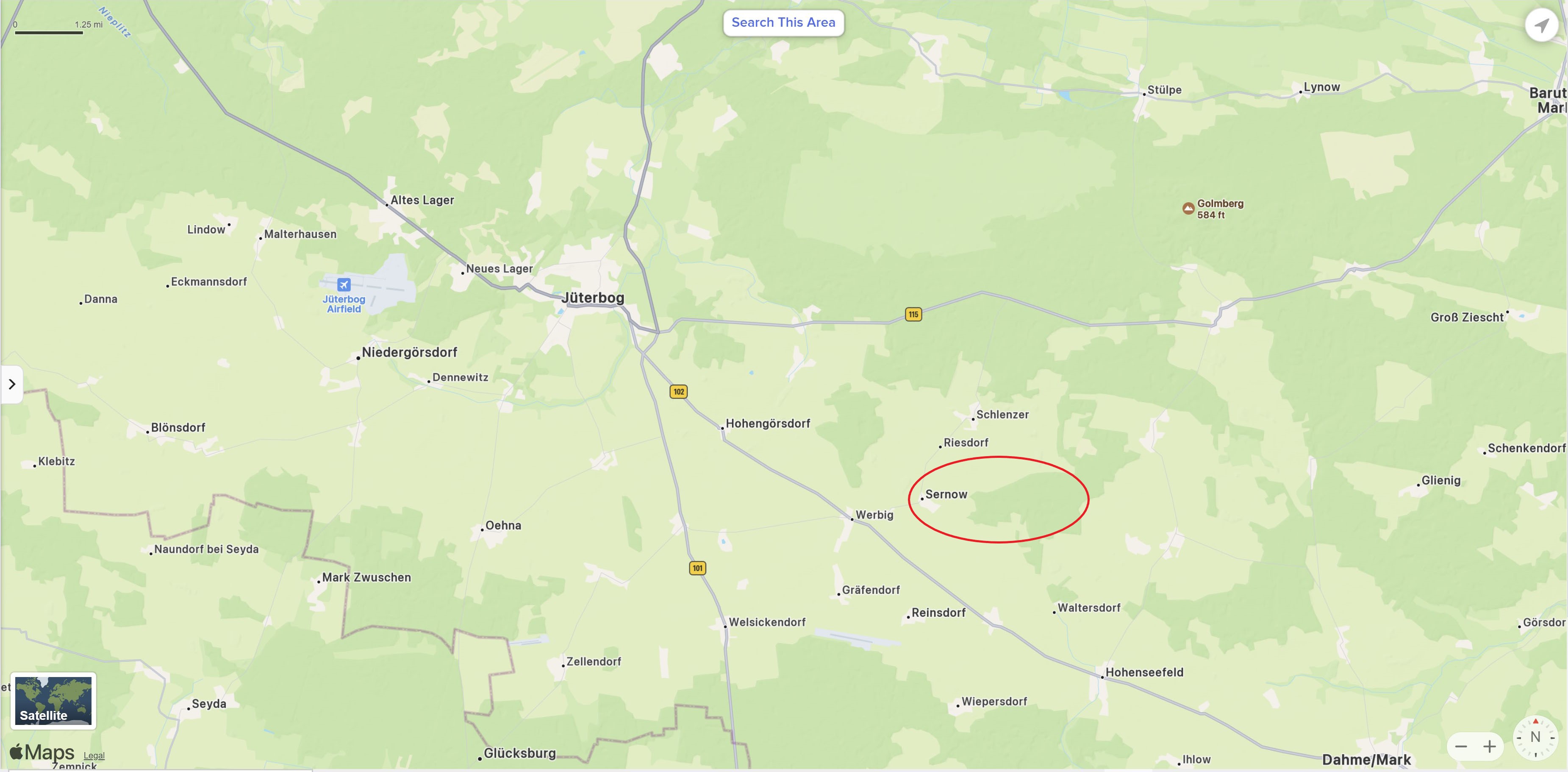
Like many (definitely not all) MACRs for USAAF aircraft lost in the European Theater of War, MACR 3032 includes a translation from the relevant Luftgaukommando Report – in this case, KU 1153 – which pinpoints the location where the B-17 crashed: 9.5 kilometers east-south-east of Jueterbog in the Sernower heath, or, 1 kilometer “south of the field path Froehden-Schlenzer”.  Time: 1345 hours.  There wasn’t much left of the B-17; it’s described as 95% burnt out, albeit this Luftgaukommando Report’s description of the bomber’s wreckage is extremely detailed, comprising two pages of technical information. 

This map shows the location of Sernow (thus, the “Sernower Heath” would be nearby?) relative to Juterbog.  As to the “field path Froehden-Schlenzer””, I have no idea.

Given the final condition of the aircraft yet the fortunate survival of its entire crew, all the men presumably parachuted from the plane.  The crew was comprised of:

Pilot: Chapman, Norman Lester, 1 Lt., 0-746292 – Hillsborough (Hillsborough), N.H. (11/11/18-12/18/98)
Co-Pilot: Ellis, Rex Monroe, 2 Lt., 0-752187 – Ks. (2/2/20-1/16/03)
Navigator: Lindbom, Glenn G., 2 Lt., 0-809659 – Ishpeming, Mi.
Bombardier: Clark, Wilson D., 2 Lt., 0-750274 – Seattle, Wa.
Flight Engineer: Silverman, George B., T/Sgt., 31153017 – Portland, Me.
Radio Operator: Scharf, Milton, T/Sgt., 12188872 – Brooklyn, N.Y.
Gunner (Ball Turret): Hutchings, Durward E., S/Sgt., 12171577 – Hudson, N.Y.
Gunner (Right Waist): Yzenas, Frank A., S/Sgt., 12161945 – Dickson City, Pa.
Gunner (Left Waist): Hill, Leon Earnest, S/Sgt., 38273822 – Ok. (11/25/09-11/1/93)
Gunner (Tail): Dobbs, George E., S/Sgt., 39406131 – Sacramento, Ca.

Like every man in the crew, Technical Sergeant’s Milton Scharf and George Barnett Silverman survived the war as POWs; the former at Stalag Luft IV (Gross-Tychow), and the latter at Stalag Luft III and subsequently Stalag VIIA (Moosburg).

T/Sgt. Milton Scharf, the plane’s radio operator, born in Brooklyn on December 29, 1922, was the son of Nathan and Evelyn Scharf, his family residing at 8909 Avenue B in that borough.  His name appears on page 428 of American Jews in World War Two, which records that he received the Air Medal and two Oak Leaf Clusters.  In the news media (in the fleeting era when the United States actually had what passed for an actual news media), his name appeared in War Department Casualty Lists published on 4/29/44, 5/19/44, and 6/6/45, the last being a list of liberated POWs.  He died on November 21, 2004, and is buried in Pflugerville, Texas.

As evident in many of my prior posts, the names of many American Jewish WW II servicemen, whether decorated or casualties, never appeared in the 1947 compilation American Jews in World War II.  George Barnett Silverman (31153017), the bomber’s flight engineer, is one such example; his name is absent from that volume  Born in South Portland, Maine, on September 9, 1921, he was the son of William S. (5/30/76-12/14/62) and Harriet (Israelon) (1898-9/29/40) Silverman, his family residing at 335 Cumberland Street in Portland.  He was the husband of Marge L. (Kelley) Silverman (9/4/22-3/3/06), whose wartime address was 95 Smith Street in Portland.  Mr. Silverman passed away on July 2, 1991, and is buried alongside his wife at Evergreen Cemetery in Portland.  He was (at least) awarded the Air Medal, as indicated by the following article from the Portland Press-Herald of February 15, 1944.

~~~~~~~~~~~~~~~~~~~~

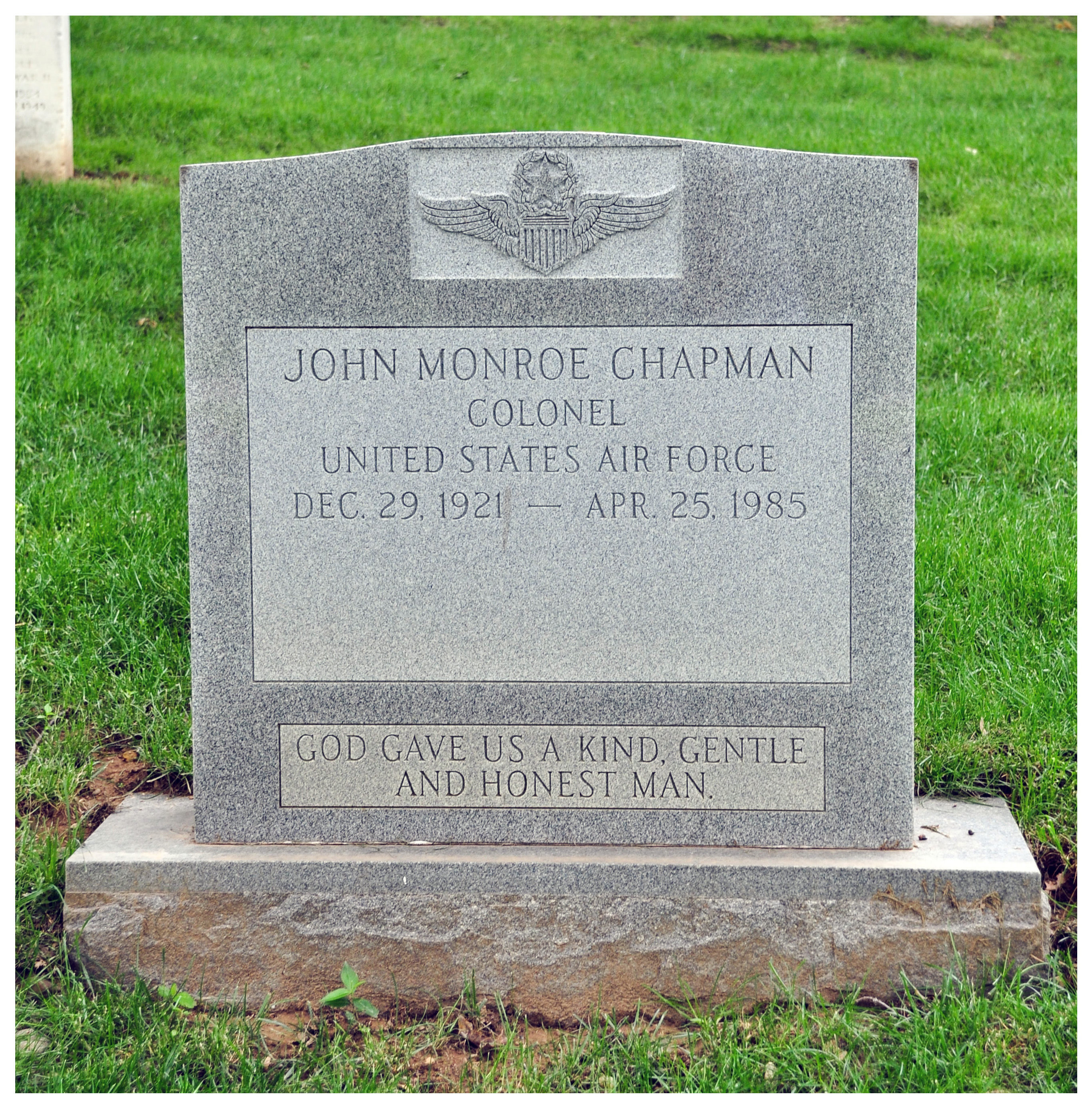
2 Lt. John Monroe Chapman, Jr., 2 Lt., 0-678165, Birmingham, Al. – Prisoner of War

We’ve just encountered First Lieutenant Norman Lester Chapman.  Another “Chapman” who became a prisoner of war on March 8, 1944, was Second Lieutenant John M. Chapman, Jr. (0-678165), a co-pilot in the 303rd Bomb Group’s 360th Bomb Squadron.

The emblem of the 303rd Bomb Group’s 360th Bomb Squadron.  It’s image UPL 14815 from the American Air Museum in Britain.

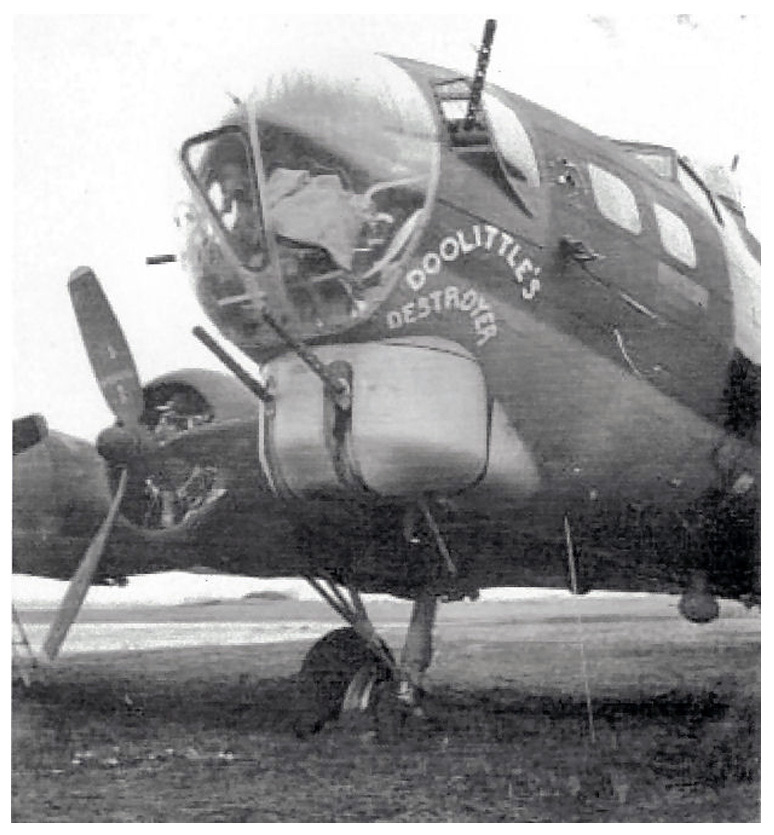
During the 303rd Bomb Group’s mission to Berlin, B-17G 42-31471, “DOOLITTLE’S DESTROYER“, was – according to Missing Air Crew Report 2908 – last seen “apparently under control” but descending very rapidly in the vicinity of Brandenburg, Germany.  Luftgaukommando Report KU 1156 gives four locations for the plane’s crash: 1) “…north of Althaldonsleben, 20 kilometers northwest of Magdeburg”, 2) “Near the ships elevator yard at Rothensee”, 3) “2 kilometers northeast of Magdeburg”, and 4) “2 kilometers southeast of Neu Haldensleben”.

This map shows the general location of Rothensee, a district of Magdeburg.  This is also the crash location of B-17G 42-97525 “Invictus” of the 452nd Bomb Group (see below).

This image of DOOLITTLE’S DESTROYER (“stuck in the mud”) is from the 303rd Bomb Group (c/o the Richard A. Lund Family).

Identical to Lt. Chapman’s crew, the ten men aboard 42-31471 also safely parachuted and survived as POWs.  They were:   

Pilot: McGrath, Leo B., 2 Lt., 0-738444 – Oxnard, Ca.
Co-Pilot: Chapman, John Monroe, Jr., 2 Lt., 0-678165 – Birmingham, Al.
Navigator: Volk, Anthony D., 2 Lt., 0-676183 – Philadelphia, Pa. (5/13/20-2/16/19)
Bombardier: Klasnick, Joseph S., S/Sgt., 13040917 – Pittsburgh, Pa. (4/14/16-11/1/78)
Flight Engineer: Green, Jack E., S/Sgt., 18129763 – Muskogee, Ok.
Radio Operator: Bonn, Charles J., S/Sgt., 12092994 – Union City, N.J. (2/7/23-4/19/97)
Gunner (Ball Turret): Mayfield, James E., S/Sgt., 34397454 – Elrod, Al.
Gunner (Right Waist): Hosso, Harry V., S/Sgt., 15323137 – Martins Ferry, Oh. (1/7/22-3/28/10)
Gunner (Left Waist): Tharp, Wallace L., S/Sgt., 6574982 – Colorado Springs, Ca. (8/21/21/-1/21/15)
Gunner (Tail): Laible, Gilbert N., S/Sgt., 19146806 – Fallbrook, Ca.

As for Lieutenant Chapman?  He was born in Birmingham, Alabama, on December 29, 1921, the son of John Monroe (Sr.) and Allene R. Chapman, who resided at 3809 12th Court South in that city; his siblings were Donald and Ruth.  He was interned in North Compound 1 of Stalag Luft I.  Though he was identified by the National Jewish Welfare Board as being a Jew – in the organization’s quest to chronicle Jewish military service, and, provide religious and spiritual fellowship as well as practical aid to Jewish servicemen in all theaters of war – and was recorded as such in the NJWB’s files (which denote the award of the Air Medal and two Oak Leaf Clusters), his name never appeared in American Jews in World War II.  He died at the age of 63 on April 25, 1985, and like CWO4 Bromberg, also made the military a career: He is buried in Arlington National Cemetery (Section 8, Site 161-LH), his matzeva listing his rank as Colonel and bearing the symbol of a Command Pilot Badge.

This image of the matzeva of Colonel John M. Chapmani, Jr., is by FindAGrave contributor John Evans.

~~~~~~~~~~~~~~~~~~~~

2 Lt. Alfred Hano, 0-679504, New York, N.Y. – Killed in Action
Sgt. Louis Markson, 32738252, Jeffersonville, N.Y. – Prisoner of War

This is the emblem of the 388th Bomb Group – “Fortress for Freedom” – from US Wars Patches….

…and this is the emblem of the 560th Bomb Squadron.  

The fate of the ten airmen aboard B-17G 42-37819 (alias “Jimmy Lee” / “P“) of the 388th Bomb Group’s 560th Bomb Squadron was, alas, unlike that of the Chapman and McGrath crews:  Only six members of the crew survived.  Missing Air Crew Report 3087 includes only one terse observation of the bomber’s loss:  “A/C #819 flying second element lead of the low squadron dove out of formation as a result of e/a attacks.  4 chutes in the area at the time could not be definitely identified as having come from this A/C.”  However, the master roster of Luftgaukommando Reports (this one being KU 1182) lists the plane’s crash location as Heppenhorst-Mieste, near Gardelegen, while the single translated sheet from KU 1182 in the MACR lists the location as “Mieste (Miester forest), 25 kilometers northwest of airfield Helmstedt”.

These two maps show the location of Mieste relative to Gardelegen.

Here’s a closer view…

Of course, more important than the plane was the crew within it, whose names are listed below.  As can be seen, six of the ten – all NCOs – survived.  The crew comprised:

Pilot: Tobias, Leonard Travis “Toby”, 1 Lt., 0-799506 – Montgomery, Al. – (10/3/21) KIA
Co-Pilot: Yurkutat, Walter Edward, 2 Lt., 0-747941 – Newark, N.J. – (3/27/20) KIA
Navigator: Gotha, Herbert Joseph, 2 Lt., 0-808037 – Paxton, Ma. – (7/27/20) KIA
Bombardier: Hano, Alfred, 2 Lt., 0-679504 – New York, N.Y. – KIA
Flight Engineer: Eldridge, Raymond W., T/Sgt., 32490041 – Hoosic Falls (?), N.Y.
Radio Operator: McIntyre, Neal W., Jr., T/Sgt., 14140622 – Fitzgerald, Ga.
Gunner (Ball Turret): Albers, Frederick R., S/Sgt., 32507698 – N.Y.
Gunner (Right Waist): Pikor, Joseph, Jr., S/Sgt., 33301162 – Pa. (1921-12/10/60)
Gunner (Left Waist): Markson, Louis, Sgt., 32738252 – Jeffersonville, N.Y. (4/20/17-11/12/04)
Gunner (Tail): Filipowski, John J., S/Sgt., 33292846 – Braddock, Pa. (5/29/21-8/14/04)

Though no single Casualty Questionnaire returned to the Army by the any of the six survivors recounts the entirety of the bomber’s loss in comprehensive, complete, essay-like detail, the brief records that do exist reveal that the bomber broke in half at the radio room while under attack by German fighters – structural damage? – explosion? – both? – with the men in the rear (even the ball turret gunner) parachuting from the tail section, and the flight engineer from the front.  Lieutenants Tobias and Yurkutat were – alas – trapped in their seats … and were seen in the wreckage of the nose section afterwards.  What happened to Lieutenants Hano and Gotha will by now, in 2024, doubtless never really be known.  Hano definitely left the plane – his body was seen near the wreckage by survivors – but how he died is unknown.  It was suggested that his parachute failed, or he was killed after landing under unknown circumstances, as Sgt. McIntrye heard a shot nearby upon reached the ground.  As reported in the MACR, there is no real information about what happened to Lieutenant Gotha.

Or, as described by Sergeant Markson (whose Casualty Questionnaire appears below this quote):

The plane broke or blew up at the radio room.  I was thrown out of plane. 
The reason for my answer of No Knowledge [for Casualty Questionnaires] is the I had flown with the crew on my first mission.  After I was taken prisoner and sent to interrogation camp and then to permanent camp in Germany I met up with

Fred Albers (EM)
Joseph Pikor (EM)
John Filopowski [sic] (EM)
“ McIntyre (EM)

What happened to the remainder of the crew is unknown to me.  The above mentioned men could probably give more information than I for they had been together longer.

xxxxx

Born in Jeffersonville, New York, on May 20, 1917, Sergeant Louis Markson (Hebrew name Eliezer ben Yisrael) was the son of Irving (5/5/92-?) and Lillian (Davis) (9/10/85-11/26/67) Markson (originally “Markowsky”), and the brother of Philip, his family residing in that upstate village which is northwest of Monticello.   His name appeared in the Sullivan County Record on March 30 and April 27 of 1944, and, the Hancock Herald on April 6 and May 4 of that same year, but, not in American Jews in World War II.  Like Sgt. Bromberg, he spent the remainder of the war at Stalag Luft IV.  He passed away at the age of 87 on November 12, 2004, and is buried at Temple Sinai Cemetery in Circleville, N.Y., a hamlet southeast of Monticello.  

These images of his matzeva, and, military grave marker, are by FindAGrave contributor Suzanne.

Lieutenant Hano, born in Manhattan on October 8, 1918, was the son of Alfred Barnard Hano, Sr. (6/30/90-5/15/67) and Clara (Millhauser) Hano (9/8/90-12/9/53), who resided at 124 East 24th St., in Manhattan.  He was married; his wife was Beth Marguerite (Singer) Hano (12/24/24-4/16/94) the couple residing at 170 West 74th St. in New York City.  He’s buried at Temple Israel Cemetery (Mount Hope Cemetery), Hastings-on-Hudson, N.Y., his biography at FindAGrave having much (albeit not exactly) the same information as appearing in this blog post.  His name appeared in a Casualty List published in The New York Times on April 23, 1944, and can also be found on page 341 of American Jews in World War II, which lists him as having received the Air Medal with three Oak Leaf Clusters, and (of course) the Purple Heart.

Pilot: Tobias, Leonard Travis “Toby”, 1 Lt., 0-799506 – Montgomery, Al. – (10/3/21) KIA
Co-Pilot: Yurkutat, Walter Edward, 2 Lt., 0-747941 – Newark, N.J. – (3/27/20) KIA
Navigator: Gotha, Herbert Joseph, 2 Lt., 0-808037 – Paxton, Ma. – (7/27/20) KIA
Bombardier: Hano, Alfred, 2 Lt., 0-679504 – New York, N.Y. – KIA
Flight Engineer: Eldridge, Raymond W., T/Sgt., 32490041 – Hoosic Falls (?), N.Y.
Radio Operator: McIntyre, Neal W., Jr., T/Sgt., 14140622 – Fitzgerald, Ga.
Gunner (Ball Turret): Albers, Frederick R., S/Sgt., 32507698 – N.Y.
Gunner (Right Waist): Pikor, Joseph, Jr., S/Sgt., 33301162 – Pa. (1921-12/10/60)
Gunner (Left Waist): Markson, Louis, Sgt., 32738252 – Jeffersonville, N.Y. (4/20/17-11/12/04)
Gunner (Tail): Filipowski, John J., S/Sgt., 33292846 – Braddock, Pa. (5/29/21-8/14/04)

~~~~~~~~~~~~~~~~~~~~

2 Lt. Irving Levin, 0-809654, Brooklyn, N.Y. – Prisoner of War

“Labor Ad Futurum” – “Work for the Future”: The emblem of the 452nd Bomb Group, via … the American Air Museum in Britain

…and the emblem of the 730th Bomb Squadron, also from the AAMiB

Like the other Flying Fortress losses described on this page, the fate of aircraft 42-97525 “Invictus” of the 452nd Bomb Group’s 730th Bomb Squadron – piloted by 1 Lt. Frank S. Stephens – also entailed uncertainty and ambiguity; at least, as recorded in Missing Air Crew Report 3195.  This is limited to the anonymous statement: “No information concerning loss of this aircraft has been reported.”  The reason for the apparent mystery behind the bomber’s loss is revealed in the postwar Casualty Questionnaire filled out by (former) left waist gunner, William D. Strayhorn:

Our ship was “spare” for 452 Gp. (H.) no openings were found in our group prior to reaching the Channel.  Pilot followed group; not in formation, on over occupied Europe.  Pilot finally hung on the end of the 401st Gp’s formation; After we were over Europe – no opening in the formation, just tagged on the end of formation.  First fighter attack knocked our plane from formation.  We were 3rd Division plane, flying with 1st Division.  This is possible reason our plane, was said to have vanished.  We left formation about 20 – 30 minutes from Madgenburgh.  [sic]

Sgt. Leonard, R. Waist gunner, was first to bail out.  Waist Door left (4) four wounded men, Sgt. LaFrance jumped from tail exit, only two (2) more chutes before plane broke up in mid air.  Sgt. Robertson, engineer, told me he left through the bomb bay, as did the pilot.  I have no knowledge of ou [sic] the others escaped.

According to English-language translations from Luftgaukommando Report KU 1152 within this MACR, Invictus crashed “Near the ships elevator yard at Rothensee, 11 km north-northeast / 11 km northeast of Magdeburg.” 

This map shows the general location of Rothensee, which is also the crash location of B-17G 42-31471 “DOOLITTLE’S DESTROYER” of the 303rd Bomb Group (see above).

The plane’s crew comprised:

Pilot: Stephens, Frank S., 1 Lt., 0-746455 – Tulsa, Ok.
Co-Pilot: Mary, William Henry “Bill”, Jr., 2 Lt., 0-751749 – Knoxville, Tn. – (Born 6/21/20) KIA
Navigator: Levin, Irving, 2 Lt., 0-809654 – Brooklyn, N.Y.
Bombardier: Kloepfer, Leon Ralph, 2 Lt., 0-747023 – Los Angeles, Ca.
Flight Engineer: Robertson, Benjamin W., S/Sgt., 13066222 – Plymouth, N.C. (1/21/23-12/16/97)
Radio Operator: Benjamin, Floyd Thomas, S/Sgt., 19170290 – Portland, Or. (10/13/24-2/7/02)
Gunner (Ball Turret): Matthews, Earl F., S/Sgt., 15066165 – Ky.
Gunner (Right Waist): Leonard, James F., Sgt., 3334282 – Philadelphia, Pa.
Gunner (Left Waist): Strayhorn, William David, Pvt., 20447605 – Wilmington, N.C. (3/13/21-1/7/94)
Gunner (Tail): LaFrance, Joseph F., Sgt., 11007294 – New Bedford, Ma. (1/17/21-3/22/08)

Though his name appears on a “Report of Capture of members of enemy air forces” sheet within the Luftgaukommando Report, Casualty Questionnaires in the MACR (only a few crewmen completed and returned these documents) offer no definitive information about the sole casualty among the crew, co-pilot 2 Lt. William H. Mary.  The general impression seems to have been that he was believed to be leaving the aircraft at the same time as the pilot, and may have been wounded by still-attacking fighters and unable to leave the aircraft, which – as described by William Strayhorn – broke apart in mid-air, with the bombs still aboard.   In any event, the search for Lt. Mary was recorded as SD Case 5763.Lorraine  Postwar, he was buried at the American Cemetery and Memorial in Lorraine, France, while a commemorative stone in his honor was emplaced between the tombstones of his parents at Knoxville, Tn.

The plane’s navigator, 2 Lt. Irving Levin, was born – probably in New York – on March 10, 1924, to Ben (4/25/92-3/31/44) and Mamie (Seplowitz) (1/99-11/15/81) Levin; he had a sister, Leah (12/19/29-12/29/13).  The family possibly resided at 2373 85th Street, in Brooklyn.  Contemporary records also list a relative or friend as a Mr. Jack Betts, of 2019 80th St., Brooklyn, N.Y.

Lt. Levin was imprisoned at Stalag Luft III and Stalag VIIA.  His name can be found on page 376 of American Jews in World War II, which records that he received the Bronze Star and Purple Heart, thus indicating that he completed less than five combat missions, and, was wounded.  His name also appeared in a Casualty List (of liberated POWs) published on June 10, 1945.

Here’s the document (the only such document) in Luftgaukommando Report KU 1152 pertaining to his capture: an “Angaben über Gefangennahme von feindlichen Luftwaffenangehörigen.  (Nur für den Dienstgebrauch!)” form.  That is, “Information on capture of enemy air force personnel.” (For official use only!)”

Continuing a pattern unknown to me when I started work on this post, it was discovered that Lt. Levin – like Sgt. Bromberg and Lt. Chapman – despite the impact of having been shot down and made a prisoner of war – nonetheless made military service a postwar career, which is described at his FindAGrave biographical profile.  He passed away on February 13, 2015, and is buried at Arlington National Cemetery. 

This portrait, provided to FindAGrave by Mark Schreiner, shows him postwar…

…while this image (via Mary D) shows his matzeva at Hillside Cemetery, Issaquah, Washington.

~~~~~~~~~~~~~~~~~~~~

Sgt. Manfred “Manny” Stein, 13122870, Glendale, N.Y. – Wounded in Action

Though the Group emblem of the 466th Bomb Group seems to be unavailable via the Internet, the 785th Squadron’s insignia is, via the American Air Museum in Britain.  Here it is: 

Somewhat paralleling the profile of Lt. Landau (at the “top” of this post) – well, in terms of “information”, there’s no Missing Air Crew Report pertaining to Sergeant Manfred “Manny” Stein (13122870), precisely because – having been wounded – he and his crew safely returned to the 466th Bomb Group’s base at Attlebridge, England.  (There might be information about him in historical records of the 785th Bomb Squadron, but I haven’t checked.  He was identified as having been a member of the 785th via the American Air Museum in Britain.)

As described in a news article in the Long Island Star Journal of May 23, 1944 (he was earlier mentioned in that newspaper on October 7, 1943), the sergeant – a waist gunner – was severely wounded when he was struck in his left ankle by shrapnel from a cannon shell.  His name also appeared (without elaboration) in Casualty Lists published in the Ridgewood Times on 5/26/44, and Long Island Daily Press on 5/23/44.  Here’s the latter (via FultonHistory.com), followed by a transcript:

Stein, Aerial Gunner, Hit by Nazi Bullet

Sergeant Manfred Stein, 22-year-old aerial gunner, of Glendale, was wounded in the ankle when a German plane fired at his Liberator.

“One plane that we didn’t see started to fire at us,” he wrote to his mother, Mrs. Bertha Stein of 65-02 Catalpha Avenue.  “A shell hit the plane and exploded.  Several pieces of shrapnel entered my ankle.”

Unaware that his family had been notified of his injuries received on March 8 over Germany, the winner of the Air Medal and Purple Heart had not mentioned them in his letters home.

Sergeant Stein was born in the Bronx and attended Newtown High School and National Youth Administration Aviation Mechanics School in Maine.  Before entering the service in September, 1942, he was employed as an aviation mechanic in Middletown, Pa.

After his training in Columbus, Ohio, and New Mexico, he went overseas in February of this year.  His sisters, Mrs. Solomon Bromberg and Beatrice Stein, live with his mother in Glendale.

Born in the Bronx on November 19, 1921, he was the son of William (4/17/82-5/13/33) and Bertha Jenny (Loeb) (7/20/84-7/13/77) Stein.   His name appears on page 454 of American Jews in World War II, which records him as having been awarded the Air Medal and Purple Heart.  You can learn even more about his life at Legacy.com.    

He passed away on January 6, 2014, and is buried at Middletown Cemetery, Middletown, Pennsylvania.    

~~~~~~~~~~~~~~~~~~~~~~~~~~~~~~

9th Air Force

~~~~~~~~~~~~~~~~~~~~

Sgt. Harry Bear, 33104592, Philadelphia, Pa. – Killed Non-Battle

I can’t find an example of the insignia of the 387th Bomb Group, but…

…here’s the insignia of the 556th Bomb Squadron, from Flying Tiger Antiques.

Some years back, in March of 2009 (seems “just yesterday” … a world nearly unrecognizable from the hindsight of 2024) I was browsing through military and aviation magazines on display at a Borders Books and Music.  (Remember Borders, a p h y s i c a l book and music store?)  By chance; by luck, I came across the most recent issue of Key.Aero’s FlyPast magazine, the cover of which displayed an image of a restored (early version?) B-26 Marauder in flight.  “A B-26 on the cover.  Must be something about the B-26 inside.”  And so there was.  Within, on pages 40 through 45, appeared the article “‘Double Trouble’s’ Destiny” by Alan F. Crouchman.  I flipped through the pages, illustrated with a variety photos of 387th Bomb Group B-26s, air crews, and personnel. some undoubtedly from private collections.  A particular, full-size-page image stood out: a picture credited to the Army Air Force, of a Sergeant Harry Bear kissing a rabbit’s foot.  Then, I remembered:  I knew that name, H a r r y  B e a r.  I came across it before: while reviewing wartime issues of the Philadelphia Inquirer, in 35mm microfilm…

First, an article about Harry Bear was published on April 20, 1944, as the “lead” article in a Casualty List released that day…

“Page 1”

The article…

Death Cheats Flier of Furlough

With only one more combat mission to go before his furlough, Sergeant Harry Bear, engineer-gunner on the Marauder “Doghouse II,” took off from a Ninth Air Force Medium Bomber Station March 8 on a sortie over enemy territory – and failed to come back.

In a War Department telegram received by his mother, Mrs. Rose Bear, 5352 Jackson St., Sergeant Bear was reported to have been killed in action over Europe.

The 24-year-old airman was holder of the Distinguished Flying Cross and the Air Medal with five Oak Leaf Clusters “for conspicuous gallantry.”

A graduate of Overbrook High School, he worked at the Philadelphia Navy Yard prior to his enlistment.

…his portrait, probably sent from England to the Baer family, or snipped from a crew photo…

…and, the August 1, 1948 issue of the Inquirer, in a very brief funeral announcement.  

Born in Philadelphia on May 23, 1920, Sergeant Harry Bear (33104592) was the son of Frank Harry (7/15/89-12/22/84) and Rose (Ludfinski) (2/12/98-1/17/71) Bear, and the brother of Edith (1925-12/24/10) and Sally (1923-10/03).  The family resided at 5352 (5253?) Jackson Street or (?) 1210 South 49th Street in that city.  Along with the two news items above, his name appeared in a brief obituary published in the Jewish Exponent on August 6, 1948.  However, unlike some of the airmen mentioned in this post, his name did appear in American Jews in World War II: it’s on page 510, with mention of his having been awarded the Distinguished Flying Cross, Air Medal, five Oak Leaf Clusters, and Purple Heart. 

When I checked the name index to the Missing Air Crew Reports, I found that the index card for Sgt. Bear bore no MACR number.  Thus, no MACR covering the incident in which he was killed, was ever filed.  However, unlike the vast majority of MACR name index cards, this one is specific, for it bears a calendar date in the notation: “KIA March 8, 1944 EA” – which corroborated the Inquirer news article.  It was only some years later, with the advent of the 387th Bomb Group’s website, that the story of Sgt. Bear and his fellow crew members was revealed: There was a mid-air collision between two B-26s over the Group’s base at Chipping Ongar, England, involving the loss of Bear’s B-26, “DOUBLE TROUBLE” (B-26B 41-31684, otherwise known as “FW * A”), and the fortunate survival of the other (damaged) B-26 … “Itsy-Bitsy” (B-26B 41-31679, “FW * K“), which was so badly damaged as to eventuate in its salvage, albeit its entre crew survived.  

The crew of DOUBLE TROUBLE…

Pilot: Sargent, Edward Doyle, 1 Lt., 0-662675 – 11/7/17, Richland County, Oh.
Co-Pilot: Ogden, Donald Lloyd, 2 Lt., 0-672859 – 9/10/20, Gaylord, Mi.
Bombardier / Navigator: Levi, Alexander W. – 0-732868 (Member of 557th Bomb Squadron)
Flight Engineer: Simoski, Joseph E., S/Sgt. – 11018324 – Middlesex County, Ma.
Radio Operator: Nordlohne, Robert Alexander, T/Sgt., 35453740 – 8/25/18, Covington, Ky.
Gunner: Bear, Harry, S/Sgt.

The (partial) crew of Itsy-Bitsy…

Pilot: Ayer, Sam, 2 Lt.
Co-Pilot: Bartley, Houston N., 1 Lt.
Bombardier: Leonard, Ray E., 2 Lt.

Alan Crouchman’s FlyPast article about the 387th includes a very detailed account of the loss of DOUBLE TROUBLE, which, given the specificity therein, is probably based on the Accident Report filed for the mid-air collision of the two Marauders.  Here’s an excerpt from his article:

Tragedy over base

Operations flown by the B-26s during the winter period of 1943-1944 were mainly against the V-weapon sites, with DOUBLE TROUBLE flying 19 missions to these heavily defended targets out of the 29 completed between returning to combat and March 7, 1944.

The second, and fatal, incident occurred on March 8, 1944, on what would have been its 48th mission to attack the enemy airfield at Soesterberg.  Four aircraft of the 48 scheduled failed to take-off due to mechanical difficulties.

Destiny was to dictate that DOUBLE TROUBLE met its fate before the formation had left the vicinity of its home base.  Her last mission was undertaken by pilot 1 Lt. Ed Sargent and crew but because his normal bombardier was sick, a stand-in, 1st Lt. Alex Levi, of the 557th BS, was tasked to fly at the last minute.

Of the 44 aircraft to become airborne, ‘684 was the 42nd, almost at the very rear of the formation – following in line was 41-31679 ‘FW * KItsy Bitsy (flying its 58th mission) piloted by 2nd Lt. Sam Ayer, who had recently arrived with the 556th and was being checked out by experienced pilot 1st Lt. Houston Bentley as co-pilot.

The leader, Captain Rollin Childress, began his take-off run at 09:07 with the rest of the formation departing at 20-second intervals.  All began forming up over the airfield.

It is thought that after the take-off and turning onto the downward leg to formate on their flight leader both DOUBLE TROUBLE and Itsy Bitsy entered low cloud and in so doing ‘TROUBLE climbed up and hit the underside of ‘Bitsy without either pilot seeing each other.

Quickly jettisoning bomb load of ten 300-pound GP bombs, Ed Sargent tried to make for the airfield, but the collision had sliced a foot off each propeller blade.  Lacking sufficient power, ‘TROUBLE came down almost vertically, crashing on the edge of Chipping Ongar at the rear of Rockhills Farm, killing all the crew members instantly.

The damage to Itsy Bitsy, while severe, was not catastrophic.  Controlling bomber 2 Lt. Sam Ayer, sent the co-pilot, 1st Lt. Houston Bartley, to investigate.  He found the aft bomb bay caved in, the catwalk broken, and the left-hand rudder cable severed, as well as both engine nacelles badly smashed about.

They flew to the English Channel to jettison their bombs.  Over the sea they found that because the forward bomb bay doors were bent, the bombs would not release normally or by salvo.  In the end they could only be dropped manually by the bombardier, 2 Lt. Ray E. Leonard, using a screwdriver to individually release each one.

With the bombs gone, Sam returned to Chipping Ongar where a long approach was made and the undercarriage lowered.  The indicators showed that the gear was not locked, although a visual inspection appeared to to it so be down normally.  Not wanting to put a strain on the aircraft by going around again, a landing was made.

Touching down at 10:30, the pilots cut the switches and mixture controls and as the aircraft slowed, the port main undercarriage began to retract.  With the propeller and rear fuselage scraping the ground, the B-26 exited the left-hand side of the runway and slid for a further 50 yards before coming to a halt.  The crew quickly vacated the aircraft, without further injury.

This map shows the location of the 387th Bomb Group’s base at Chipping Ongar (that’s the official location, but in reality the base was adjacent to the village and civil parish of Fyfield), in the district of Essex.  It’s about halfway between Colchester and London.  

Zooming in, here’s the location of the base relative to Fyfield.  First, this map view…

…and now a (very contemporary) air photo view at the same scale.  

Moving in even closer, the base’s former location is indicated by the hourglass-pattern of agricultural land in the center of the photo.  As you can see by comparing this image with the wartime air photo below, hardstands, taxiways, and runways no longer exist, though the locations of the main and southeast-northwest runways are indicated by the intersecting boundaries of the lighter and darker-toned crop patterns.

Taken in June of 1947, this photograph of the former base can be found at Essex Balloons.  

Sgt. Bear is buried at Mount Sinai Cemetery in Philadelphia; specifically at Section 10B, Lot 1753, Grave 4.  Here’s an image of his military matzeva (photo by Danielle) which appears in his FIndAGrave biographical profile.

Given that the photograph of Sgt. Bear in FlyPast (on page 41, to be specific) is credited to the Army Air Force, I contacted the United States National Archives to see if the picture could be found in the USAAF WW II Photo Collection.  But, it’s not there.  Similarly, a search of the historical records of the 556th Bomb Squadron and 387th Bomb Group (obtained from the Air Force Historical Research Agency; on film rolls A0643, and B0407 + B0410, respectively) revealed no such image.  The conclusion:  It is (or was) part of a private photo collection.  

Since the original image was unavailable, the next best thing was to adapt and modify the half-tone version printed in FlyPast, in order to create a version that would simulate appearance of the original picture.  That’s what you see below.  This was done via Photoshop Elements, with three goals in mind: 1) Remove all superimposed text and photo, 2) adjust lighting and contrast, and 3) drastically reduce the sepia tone of the image … as printed in the magazine.  (Only later did it become apparent that he’s standing next to the propeller of the starboard engine.)

Here’s the result…

…and, here’s the FlyPast original:

~~~~~~~~~~~~~~~~~~~~

1 Lt. Alexander William Levi, 0-732868, San Bernardino, Ca. – Killed Non-Battle

The emblem is the insignia of the 557th Bomb Squadron – “Keller’s Killers” – via the American Air Museum in Britain (image FRE 5047).  

First Lieutenant Alexander William Levi (0-732868), was born in Manhattan on October 14, 1915 to Arthur E. and Viola Levi, who (during the Second World War) resided at 1042 Western Ave. in San Bernardino, California.  His name appears on page 48 of American Jews in World War II, which indicates that he received the Distinguished Flying Cross, Air Medal, 7 Oak Leaf Clusters (thus implying that he completed between 35 and 39 missions), and Purple Heart.  He’s buried at Cambridge American Cemetery, at Plot E, Row 6, Grave 25.  

His FindAGrave biographical profile includes images of two 557th Bomb Squadron crews in which served, or at least was temporarily assigned, one of which was that of squadron commander Keller.

Alan Crouchman’s article concludes:

Tribute to a stand-in

An entry in the 557th’s “B” Flight diary, maintained by the colleagues of 1st Lt. Alex Levi, read, “We lost Al today.  He was killed in a crash on the edge of the post at about 10am, when the formation was assembling for a bombing mission to Soesterberg airfield, Holland.

“It would have been his 40th mission.  Scheduled at the last minute to ride with a pilot of another squadron, he declined to ground himself for the day to avoid the duty, much as he disliked it.

“Take-off was at 09:20.  The plane in which Al was riding climbed up under and into another ship while joining the formation on the downward leg after take-off.  Still below 1000 ft, the plane crashed almost immediately after the collision, and death was undoubtedly instantaneous for all aboard.

“We packed his things this afternoon – we’ll get over it, and go on as he would.  But not today.  The hut isn’t the same.  Nothing is.  Al was really OK with us.  To a swell guy, “Godspeed.”

This photo of Lt. Levi was contributed to FindAGrave by Astrid.

…while these two images are via Joel Frampton Gilbert. Captions are from the images themselves, which were both edited and “niced up” for this blog post via Photoshop.

Lt. Sullivan and crew, left to right:
Front; Lt. Sullivan, Lt. Kelahan, Lt. Levi
Rear: Sgt. Lariscy, Sgt. Badnin, Sgt. Juergens, Sgt. Locurto

Major Keller’s crew, left to right:
Major Keller, Lt. Schill, Lt. Levi, Lt. Hornbarger, Sgt. Miller, Sgt. Schroeder, Sgt. Foreman

~~~~~~~~~~~~~~~~~~~~~~~~~~~~~~

Capt. Jack Eugene Gellman, 0-800704, Niagara Falls, N.Y. – Another Incident…

12th Air Force

The insignia of the 340th Bomb Group, from WorldWarPatches….

…and the emblem of the 487th Bomb Squadron, from Spreadshirt.com.

Captain Jack Eugene Gellman (0-800704) a B-25 Mitchell Navigator / Bombardier, was born in the Bronx on October 2, 1914, to Benjamin (3/21/83-9/11/51) and Annette (7/15/86-3/25/58) Gellman.  His family later resided at 601 Niagara Street and 442 Sixth Street in Niagara Falls, N.Y.  His wife was Elizabeth (Bloom) Gellman (4/3/15-2/14/99), her wartime residential address having been 1510 Parker St., Columbia, South Carolina.  A member of the 487th Bomb Squadron of the 12th Air Force’s 340th Bomb Group, his wartime service earned him the Distinguished Flying Cross, Air Medal, 4 Oak Leaf Clusters, and Soldier’s Medal.  

Like other men listed in this post, and so many, many more men mentioned in my prior posts, his name is absent from American Jews in World War II.  However, he was the subject of news articles that appeared in the Niagara Falls Gazette on March 6 and May 27, 1944, and in a crew photo photo published in the same newspaper on October 21, 1943.  

He passed away on November 23, 1999, and is buried at Beth Israel Cemetery, in Lewiston, N.Y., his matzeva revealing his Hebrew name to have been “Yakov bar David Baer”.  

Fortunately, he was neither injured, wounded, or captured during his military service, nor (as far as I know) did he have ever to take to parachute to abandon a damaged aircraft.  However, the two aforementioned Niagara Falls Gazette articles point to noteable incidents during his military service, the “latter” of which occurred on March 8, 1944, during a mission to Orte, Italy.  On that date, his quick action prevented the flames from a magnesium flare, which ignited while his B-25 was airborne, from at least damaging and potentially doing vastly worse to his aircraft.  The date of this incident was verified at 57th Bomb Wing by reviewing the 487th Bomb Squadron’s list of missions, which specifically lists Orte as being the target on March 8, 1944.  

~~~~~~~~~~

But first (!), two photos of then Lieutenant Gellman and his crew. 

This image, showing the crew in front of a B-25 nicknamed “Eileen“, was found in the (PDF version of) the 487th Bomb Squadron history for October, 1943, also at 57th Bomb Wing…  

Caption: L to R: 2nd Lieutenant Arthur Hover, Jack E. Gellman, R.E. Pirnie, Sgt. E. K. Rabon & S/Sgt. R.K. Clarkson, in front of Mitchell bomber of 487th B.S., 340 B.Gp.  Lt Hover holds DFC.

~~~~~~~~~~

…and this is the image from the Niagara Falls Gazette of October 21, 1943 (via Fulton History).  Though of very poor quality (it’s a half-tone image converted to 35mm microfilm, then scanned, and finally retouched to the maximum extent possible via Photoshop) certainly the caption is still helpful.  The B-25 serving as a backdrop appears to have a two-word nickname, the first word being “FLYIN’“, and the second completely illegible.  

“SOMEWHERE IN SICLY” – The crew of a Mitchell bomber, prior to taking off for a flight over enemy territory includes two men from Niagara Falls.  In the group, left to right are: standing, Sergeant Elmer Rabon, gunner, of Alabama; Lieutenant Jack Gellman, navigator-bombardier, of this city; Lieutenant Robert Pirnie, co-pilot, of Missouri; Lieut. Arthur Hover, pilot, Missouri; kneeling, Technical Sergeant Robert Purey, radioman-gunner, also of this city.

Lieutenant Gellman is the son of Mr. and Mrs. Benjamin Gellman of Sixth street, and Technical Sergeant Furey is the son of Mr. and Mrs. John P. Furey, of Seventy-seventh street.  Both local men have received the Air Medal.

~~~~~~~~~~

And now, the two articles…

Falls Officer Quickly Makes “Bomb-sight,” Hits Target
The Niagara Falls Gazette
March 6, 1944

Allied war workers are turning out finished bombsights in record time these days but they’ve got to go even faster to beat the time of Lieutenant Jack E. Gellman, navigator-bombardier with the “Avengers,” a medium bombardment group in Italy.

Flying to a target on the Eighth Army’s front In Italy recently in a Mitchell bomber that did not carry a bomb-sight, Lieutenant Gellman, son of Mr. and Mrs. Benjamin Gellman, of 442 Sixth street, this city, rigged up one with a pencil and a piece of cord and then, when the target “swam into sight,” toggled out his bombs. Observers said that his squadron’s bomb pattern was the best one laid down in the 38-plane formation.

“I was just lucky that the bombs, dropped as accurately as they did,” the lieutenant said. “One of the fellows who was lagging behind in our box helped the pattern a lot by holding his bombs longer than usual.”

Lieutenant Robert M. Pirnie, of Sacramento, Calif., pilot of the plane, was flying a wing position when the formation leader was forced to drop out shortly after the takeoff.

“Do you think you can take over this formation?” Pirnie asked Ge!lman.

“We haven’t got a bomb-sight,” was the answer.

“Can you make one?” the pilot then asked.

Lieutenant Gellman could and did. He quickly sketched in a few graduated lines on the plexiglass nose of the bomber, established a dropping angle and completed the “bomb-sight” by stretching a piece of Inter-phone cord at right angles to the vertical line on the glass.

“As we came up on the target I wanted to turn back,” Gellman, stated. “I could see the artillery flashing below and I knew our troops were close to the target area, but then Flight Officer Curtis P. Keough, of Lake Park, Minn., the co-pilot gave me the okay sign, so I crawled back into the nose and dropped them.”

Other members of the crew included Staff Sergeant Raymond K. Clarkson, of Danville, Ky., the radio operator, and Sergeant Elmer E. Rabon, of Webb, Ala., the gunner.

Lieutenant Gellman’s wife, Mrs. Elizabeth R. Gellman, resides at 1S10 Parker Street, Columbia, S.C.

~~~~~~~~~~~~~~~~~~~~

Falls Air Officer Successfully Battles Fire in Plane in Flight
Niagara Falls Gazette
May 27, 1944

Niagara Falls people have received long and minute instructions on how to handle magnesium bombs when they flare up on the ground but what does one do when a magnesium fire is started In a plane? Just ask Captain Jack E. Gellman, of 442 Sixth street. It happened to him.

One day in March, when his formation was returning from bombing Orte, Italy, a pistol loaded with a signal flare, dropped to the floor and sprayed the navigator’s and bombardier’s compartments with white hot magnesium. It burned with such heat that in a fraction of a second parts of the plane itself were burning and melting.

Cool, calm and collected, he reached for the fire extinguisher and started to spray the flames. When they were out to the navigator’s compartment, he turned his efforts to the direction of his trapped companion In the nose of the ship. Pushing himself through the hot crawlway which connected the two compartments, he was seared and scorched, out he managed to hand the extinguisher to the bombardier.

The Ill-fated craft returned to base with but relatively slight damage. Investigation showed that the fire had already partially severed the control cables but that was quickly repaired. The men were patched up and in several days the crew and plane were in the air again.

Captain Gellman received the Soldier’s Medal for this action. With that ribbon, he displays the Air Medal with four Oak Leaf Clusters, the Middle East Area of War Ribbon with two campaign stars, the Distinguished Flying Cross, the Coastal Patrol ribbon and the Before Pearl Harbor ribbon.

“What I really would like to have is an ex-serviceman’s ribbon on a blue serge suit,” he said wistfully, “and hope that I get It quick.”

He carries with him a “short snorter,” composed of 19 different kinds of money. Although he has been through 26 countries and has flown over about 50, he has only that number because many countries now use American money.

On the front of this collection are the autographs of many of his friends with whom he has been overseas. The names of Senator James Mead and comedian Jack Benny are proudly displayed.

The backs of the bills bear a record of the 65 missions on which he has been. Names of cities In the Balkans, Italy and Germany appear many times. On occasion he has had to parachute to the ground or be in his plane, “The Spirit of Niagara Falls,” when it belly-landed.

We fellows to the Air force really admire the boys on the ground,” he said. They have all the hard work, hand-to-hand fighting, the light of blood and death, while we sit up in a plane, relatively far from all that.”

He had nothing but praise for the work of the Red Cross. “They have an uncanny way of appearing just when a soldier needs food, relaxation and companionship,” he said. “The Naples Red Cross center is just like the corner of Broadway and Forty-second street to New York – if one stays there long enough, he can meet all his friends. And believe me. you didn’t have to stay there long.”

He spoke of the food in the army, saying that when the men first got to the Mediterranean theater of war the food wasn’t any too good, but it rapidly grew better. “For a while.” he said, “we were allowed only one coke a week, which was unusual.

“The eggs that the army had were only the dehydrated, powdered kind and soon when we had a day off we would take a plane and fly two or three thousand miles to Cairo, Egypt or Colubra, Africa, for several hundred eggs. They were put in the bomb bay and when the plane came back nearly everyone was out on the field, praying that the ship would land gently.
“Fresh milk could be bad in Malta and we would fly there for a taste of that wonderful liquid.”

Coming back to the States, he was in “war-weary,” a plane that had been In many encounters and was being returned to the states for rejuvenation.
Captain Gellman stated that he was rather anxious to return for the simple reason that “I want to help get this thing over as soon as possible so that I can come home without thinking that I shall ever have to go back.”

~~~~~~~~~~~~~~~~~~~~~~~~~~~~~~

2 Lt. Nathan Shapiro, 0-695541, Dorchester, Ma. – Parachuted to Safety… (once)

As already evident from many of my prior blog posts – let alone innumerable accounts of aviation history elsewhere – military aviation even not involving contact with the enemy inherently carried an element of risk and danger, as well chronicled by works such as Anthony Mireles three-volume trilogy covering fatal Army Air Force accidents in the continental United States during the Second World War, let alone Aviation Archeology’s massive database.

One such incident, involving the loss of a B-24 Liberator, transpired on March 8, 1944.  To quote from pages 716-717 of Volume 2 of Mireles’ Fatal Army Air Force Aviation Accidents in the United States, 1941-1945:

At 0050 MWT, a Consolidated B-24E crashed three miles east of Kuna, Idaho, killing three crewmembers.  Six crewmembers were ale to parachute to safety and were uninjured.  The airplane took off from Gowen Field, Boise, Idaho, on a routine bombing mission.  The B-24 climbed to about 20,000 feet and flew on to the bombing range, but was unable to bomb because of a layer of clouds over the target area. The airplane was unable to established radio contact with the range or with local ground control.  The airplane descended to about 12,000 feet over Gowen Field and was able to establish radio contact with Boise Control Tower only.  The Boise tower was able to relay messages between the airplane and Gowen Field.  The airplane was ordered to fly to range #3 and bomb at 8,500 feet.  The pilot descended to 8,500 feet and then began experiencing trouble with the number three engine.  The pilot was unable to correct the problem or feather the propeller.  The pilot ordered the crew to stand by to abandon ship.  The number three engine began to vibrate badly and the airplane became difficult to control so the pilot ordered the crew to bail out.  The pilot was satisfied that the crew had left the ship as he bailed out.

Assigned to the 29th Combat Crew Training Squadron, the crew of the aircraft in question, B-24E 41-28514, piloted by 2 Lt. Robert Preston Aldridge, comprised:

Pilot: Aldridge, Robert Preston, 2 Lt.
Co-Pilot: Whitman, Stanley E., 2 Lt.
Navigator: Maher, William T., 2 Lt. – Killed
Bombardier Instructor: Haley, Edmond Milton, 2 Lt.
Bombardier: Shapiro, Nathan, 2 Lt.
Flight Engineer: Boreson, Albert J., S/Sgt.
Radio Operator: Shade, Robert L., S/Sgt.
Gunner: Ford, Walter E.J., Sgt. – Killed
Gunner: Scales, Danny D., Sgt. – Killed

The incident is covered in Army Air Force Accident Report 44-3-8-1.

(This is the first blog post where I’m including maps of a WW II crash location inside the United States.)

Here’s the location of Kuna relative to Nampa, Meridien, and Boise.  B-24E 41-28514’s approximate crash location is indicated by the red oval.

A larger-scale map of the area.  The crash location as shown here is based on calculation of the distance from the center of Kuna.

Here’s an air photo view of the above area, at the same scale.  It would seem that 41-28514 fell to earth in agricultural land.  

And, a closer (very close) view.

And then…

2 Lt. Nathan Shapiro, 0-695541, Dorchester, Ma. – Parachuted to Safety… (twice)

14th Air Force

~~~~~~~~~~~~~~~~~~~~

The 373rd Bomb Squadron’s insignia, from A2 Jacket Patches.

Over seven months later, on October 29, 1944, after having been assigned to the 373rd Bomb Squadron of 308th Bomb Group (14th Air Force) Lt. Aldridge’s crew was involved in another incident which involved the bail-out of his crew.  As described at FlightSafety, “Climbing through the undercast, the plane went out of control.  All crew members bailed out except for pilot Aldridge.”  The incident, which occurred at Luliang, China, is also covered in the high-number postwar Missing Air Crew Report # 15526, which (but of course – thanks soooo much, Fold3!) is unavailable via the National Archives online catalog.     

The aircraft in question was “ZOOT CHUTE”, B-24J 42-73320.  The aircraft appears in Army Air Force photo 69034AC – A2189, seen below.  (The names of the men in this photo are unknown.)

This photo, from Everything B-24, shows the post-crash remnants of ZOOT CHUTE.

Lt. Aldridge is buried at the National Memorial Cemetery of the Pacific in Honolulu (Plot P 465).  His portrait (via Adriana), which accompanies his FindAGrave biographical profile, is below:

Second Lieutenant Nathan Shapiro (0-695541), Aldridge’s bombardier, was born in Boston, Massachusetts, on June 19, 1924, the son of Jacob and Jennie Shapiro who lived at 129 Callender Street in Dorchester.  His name appears on page 179 of American Jews in World War II, which lists him as having been awarded the Purple Heart.

This Apple Map (I vastly prefer Apple Maps to Google maps) shows the location of Luliang, relative to Beijing.

This map shows the location of Luliang Airport, relative to the city of Luliang itself, which is at the bottom center of the image.  I don’t know if – but I am assuming that – this airport occupies the same location as the 308th Bomb Group’s base in WW II. 

This air photo view shows, at the same scale as the above map, the rugged nature of the surrounding terrain.

Finally, a close view of the Luliang Airport, this image making the forbidding nature of the terrain even more obvious.

~~~~~~~~~~~~~~~~~~~~

U.S.S.R. (C.C.C.Р.)
Military Air Forces – VVS
(Военно-воздушные cилы России – ВВС)

Junior Lieutenant Vladimir Yakovlevich Yookhvit – Prisoner of War
(Младший Лейтенант Владимир Яковлевич Юхвит)

Completed 64 combat missions
2nd Air Army, 227th Attack Aviation Division, 687th Attack Aviation Regiment
(2 Воздушная Армия, 227 Штурмовой Авиационной Дивизии, 637 Штурмового Авиационного Полка)
As Pilot [Летчик)…  On 12/13/43, crash-landed as result of attack by Me-109
As Senior Pilot (Летчик Старшии)…  On 3/8/44 – shot down by anti-aircraft artillery in vicinity of Vinnitsa, Ukraine, with Aerial Gunner Senior Sergeant Mikhail Pavlovich Tretyakov.  Both survived as prisoners of war at Stalag Luftwaffe 2, Lodz, Poland
Born 7/28/22, Chelyablinsk Oblast

Parents: Yakov and Anna Yookhvit, city of Sverdlovsk, Tolmacheva Street, Building 4

~~~~~~~~~~~~~~~~~~~~

Four Books

Doherty, Robert E., and Ward, Geoffrey D., Snetterton Falcons : The 96th Bomb Group In World War II, Taylor Publishing Company, Dallas, Texas, 1989

Dublin, Louis I., and Kohs, Samuel C., American Jews in World War II – The Story of 550,000 Fighters for Freedom, The Dial Press, New York, N.Y., 1947

Maryanovskiy, M.F., Pivovarova, N.A., Sobol, I.S. (editors), Memorial Book of Jewish Soldiers Who Died in Battles Against Nazism – 1941-1945 – Volume I [Surnames beginning with А (A), Б (B), В (V), Г (G), Д (D), Е (E), Ж (Zh), З (Z), И (I)]Union of Jewish War Invalids and Veterans, Moscow, Russian Federation, 1994

Mireles, Anthony J., Fatal Army Air Force Aviation Accidents in the United States, 1941-1945 – Volume 2: July, 1943-July, 1944, McFarland & Company, Inc., Publishers, Jefferson, N.C., 2006

Here’s a Magazine

Crouchman, Alan F., ‘Double Trouble’s’ Destiny’, Flypast, March, 2009, pp. 40-45

Soldiers from New York: Jewish Soldiers in The New York Times, in World War Two: Navigating Survival: 2 Lt. Milton W. Stern, United States Army Air Force – Evasion in Belgium, March-July, 1944

2 Lt. Milton Wallace Stern, a navigator in the 532nd Bomb Squadron of the 381st Bomb Group, was shot down on March 8, 1944, during the 8th Air Force’s mission to the ball-bearing works at Erkner, a town on the southeastern edge of Berlin.  Parachuting to earth with his nine fellow crewmen, he evaded capture until May 27, 1944, when he was apprehended by the Gestapo.  Temporarily interned with his fellow evadees in Saint Leonard Prison, Liege, Belgium, he was eventually imprisoned at Stalag Luft I, and like all his fellow crew members, survived the war.

You can read an extensive and detailed (and extensive) account of his wartime experiences, along with excerpts of an interview I conducted with him in 1993 here, in the post Soldiers from New York: Jewish Soldiers in The New York Times, in World War Two: March 8, 1944 (In the Air…) – Navigating Survival: Milton W. Stern.

“This” post, however, is an French-to-English translation of an account of Milton’s temporary evasion from German capture, written by Philippe Connart, Michel Dricot, Edouard Renière, and Victor Schutters, from The Comet Network, which was last updated on June 24, 2022.

But first, some introductory photographs…  

~~~~~~~~~~

Milton’s wartime portrait.

Milton at his home in northern new Jersey, photographed October 21, 1993.  (From a 35mm Kodachrome slide.)

~~~~~~~~~~

Here begins the translation of the story from The Comet Network:

Boeing B-17G-25-DL Flying Fortress, serial number 42-38029, VE-M

Shot down by an Me109 fighter during a mission to Erkner, near Berlin, on 8 March 1944
Crashed around 16:00 at 11 Bathmenseweg in Oude Molen (Lettele), 1 km from the road from Deventer to Holten, (Overijssel) Netherlands
Duration of evasion: 2 ½ months
Arrested: Liège, 27 May 1944

Additional information:

MACR 3002 Crew Loss Report.

RAMP [Recovered American Military Personnel] Report signed on May 31, 1945.

The B-17, on its first mission, took off from Ridgewell and was hit by flak as it approached Berlin.  The No. 1 fuel tank was on fire and the aircraft was reported as having been seen with its bomb bays open and the No. 3 engine feathered.  The belly gunner confirmed this, adding that the No. 4 engine had lost pressure and that the B-17 had lost contact with the rest of the formation.  The MACR reported it as last seen south of Berlin, turning back to return to base.  According to Sgt. Kinney, belly gunner, the aircraft was then attacked by three German fighters, one of which was shot down by a gunner on board the B-17, one of the other two giving it the coup de grâce.

Lt.  Pirtle’s Crew

Standing, left to right:
George W. Cassody, mechanic; James W. Warren, right gunner; James C. Estep Jr., left gunner; Robert W. Burrows, radio operator; William L. Bull, rear gunner; William C. Kinney, belly gunner.

Front, left to right:
pilot Thomas A.  Pirtle; his regular co-pilot (name unknown, who was not aboard 42-38029 on the mission and had been replaced by Paul Schlintz); Milton W. Stern, navigator; and Harry F. Cooper, bombardier.

Positions and names determined by James Warren in December 2016.

The Fortress losing too much altitude, the pilot, 2nd Lt Thomas A.  Pirtle, gave the order to evacuate it as it approached Deventer in the Netherlands.  Pilot Pirtle broke his leg landing in a field and was immediately taken prisoner.  His co-pilot 2nd Lt Paul H. Schlintz, managed to escape, helped by Dutch and Belgian Resistance fighters, but was denounced and arrested on June 16 in Antwerp, where he was interned in the Begijnenstraat Prison before being sent to a camp in Germany.  Bombardier 2nd Lt Harry F. Cooper and ventral gunner Sgt William C. Kinney, having landed near Laren, about 15 km southeast of the crash site, were the only ones to succeed in their escape.  Cooper was released in early September in Liège and returned to England on 15 September 1944 (Escape Report E&E 2110).  Kinney, who had also gone to Belgium, remained hidden in the Neeroeteren region of Belgian Limburg and was released on 22 September by troops of the 4th Canadian Armoured Brigade (returned to England on 24 September 1944 – E&E 2272).

All jumped from an altitude of less than 300 meters.  In addition to Milton Stern, James Warren, Robert Burrows, George Cassody, James Estep and William Bull initially managed to escape before being arrested.

Milton Stern lands in a tree and is quickly surrounded by a crowd of civilians.  He is advised not to stay there, as German soldiers are probably looking for him.  The civilians take care to hide his parachute and Stern first heads towards the column of smoke which he believes indicates the place where his plane crashed.  Changing his mind, he prefers to move away from it and goes to hide in a nearby ditch.

Shortly afterwards, a young Dutchman named JANSEN helped him hide in a haystack in the middle of a field.  The young man returned around 9:00 p.m. with bread, coffee and golf trousers.  In his haste, he forgot to give Stern the coat that was meant for him, which remained in the second pannier of the bike.  JANSEN told him that he had to stay hidden there for a few days while the Germans continued to look for him.

The next morning (March 9), after a very cold night, Stern starts walking along a watercourse (presumably the Overijssels-Kanaal), towards Belgium.  In the evening, he approaches a farm where he is given something to eat.  The farmer’s son sets off on his bike and brings back another young man, Don, who speaks very good English.  After questioning Stern for a few minutes, Don picks him up on his bike and takes him to Deventer, where he is installed in the room that Don was renting there.  Don goes to see another contact and returns around 23:00, informing Stern that he should stay hidden there for a few days, adding, however, that the landlady of the place was afraid of the consequences.

So it was that the next day at dawn (March 10), Stern accompanied Don back to the farm.  He was given blankets and took shelter in the barn.  The farmer’s 13-year-old daughter brought him breakfast and a basin of hot water to soak his feet in.  He remained in his shelter until the morning of Saturday, March 11.

Don reappears, Stern is given the farmer’s son’s bicycle and they ride together towards Deventer.  They arrive at a house where Stern meets three other Americans: S/Sgt. Maurice Hargrove, Walter Kendall and John Zolner.

A new guide, “Pierre”, gives them railway tickets and the airmen head towards the station, each following the other at a certain distance.  On the train, they split into groups of two, and into different compartments.  They had been advised to play deaf and mute in case of questioning.  They get off at Echt station, near the Belgian border, where they meet men who take them home.

At 8:00 p.m., after eating, shaving and washing, they set off for Maastricht in a car that also included two Frenchmen who had escaped from a prison camp.  In Maastricht, under a full moon and with German sentries patrolling the border area, they crossed the Meuse in a small boat.  In his RAMP report, Stern only states that he made the crossing on March 11 in the company of a Dutch policeman living in Echt, with whom he had stayed…

On the other side, in Belgium, a farmer, André, is waiting for them to walk them to his farm.  The journey takes them about two hours.  They stay on this farm for six days, hidden during the day in a barn, at night in a room in the main building.

On the fifth day, around March 16, another guide, Jules, arrived with five of Stern’s teammates: Burrows, Bull, Cassody, Estep and Warren.  The airmen were informed that they were to be evacuated, two at a time, by small plane.  It was decided that Stern and Burrows, who had sprained his ankle while landing, would leave first, so that Burrows could be treated quickly.  The group was taken that night to a manor that belonged to a French nobleman, an airman during the 14-18 war.  [This was “La Clairière” in Rekem-Lanaken, owned at the time by Stéphane de Bissy and Germaine Moreau de Bellaing] They slept in a small wood at the back in a shelter built underground and hidden by branches.  There they met two Yugoslavs who had also escaped from a camp: Stretsko Pajantitch, a pilot officer, and Voja Jovanovitch, a bombardier/mechanic.

The next day, Saturday 18 March, “they” (we assume that this is just Stern and Burrows, as reports and accounts often use “we” without further details…) are taken to Hasselt by tram by the daughter of the owner of the manor, Monique de BISSY, 21, who takes them to 17 Thonissenlaan to the home of Florent BIERNAUX and his wife Olympe, née DOBY.  This is where they can take their first hot bath.  They are served a real meal and given Belgian identity cards.

On Monday 20 March at 5:00 in the morning, “they” (Stern and Burrows alone) were driven to the station by Mrs. BIERNAUX, who accompanied them to Liège where a man and a woman were to meet them.  As this couple did not show up, Mrs. BIERNAUX made a few phone calls before leading the group to a café.  The couple finally arrived an hour later and Mrs. BIERNAUX said goodbye to them.  The group, led by their new guides, walked for two hours through the streets of Liège, trying to avoid German patrols.  They even had to hide for 45 minutes in a church to escape soldiers who were apparently following them.  They finally arrived at a large house, which turned out to be the headquarters of the local resistance.  It was there that they were separated from the two Yugoslavs whom they would never see again.  They were introduced to “Joseph”, the head of the network, and Stern and Burrows were taken to another house where they had supper.  This “Joseph”, Stern does not specify, is in fact Joseph DRION from Liège, head of the DRION Group which organizes the accommodation and travel of escaped airmen in the Liège region.

Later that evening, the daughter of the house, Flora, drives Stern and Burrows to another house across town.  They are the guests of an elderly couple who will put them up for “about two weeks.”

One evening, Flora came to tell them that they could be evacuated to Switzerland in the following days.  In the meantime, she took them to Grâce-Berleur, where they were housed by two ladies, both aged 75, one widowed, the other single, who looked after them “very carefully”.  The plan to have them go to Switzerland fell through, as one of the two planned guides was tired from his previous expedition, the other was ill.  [The activity report of the Joseph DRION Group, from Liège, also mentions that Stern and Burrows were handed over by Miss Monique de BISSY to Léon CHRISTIAENS, 58 Rue du Hoyoux in Herstal-Liège.]

They then stayed with another family in Grâce-Berleur.  Stern believes he remembers that the father made and sold ice cream and that he had two daughters, Jeanine, about 15 years old and Victorine, 19 years old.  Stern’s RAMP report specifies that these were the VAN LESSENs in Grâce-Berleur, with whom he stayed for 3 weeks in April 1944… [The list of Belgian Helpers includes Georges VAN LESSEN and Marie MATRICHE at 13 Rue de l’Hôtel Communal, which is in fact on the territory of Grâce-Hollogne, very close to Grâce-Berleur.]  He does not mention Burrows in this part of his report, but his teammate also stayed there, for 2 weeks.

On April 20, Stern and Burrows were taken back to Liège itself, where they stayed in a large abandoned building, which appeared to them to have been an inn or a hotel: there were 25 to 30 rooms, on three or four floors.  The concierge, “small and charming”, served them good meals, which they ate in the company of a lieutenant in the Belgian Army, living in Namur, who was also hiding from the Germans.  One day, during a roundup, the three escapees had to hide in an attic where they heard the little lady joking with the German soldiers in order to divert their attention.  During their stay, Liège suffered its first bombing (on May 1), the target being the railway installations.  Having seen the approach of the B-24s from the top of their room on the top floor, they ran down the stairs to take refuge in the cellar.  Several other bombings on the city during this month of May delay the continuation of their trip and Stern, unable to bear it any longer, asks to meet “Joseph” (DRION) at his headquarters.  It is there that Stern and Burrows see their other teammates again as well as two other American airmen: 2nd Lt. George G. Wedd Jr. and Sgt. Floyd A. Franchini, respectively co-pilot and gunner on board the B-17 42-39801 (94th Bomb Group / 332nd Bomb Squadron) shot down on March 4, 1944.  [B-17G, “XM * B”, “Double Trouble II” / “NORTHERN QUEEN”, Pilot 2 Lt. Julius O. Blake, 10 crew members, 9 survivors; MACR 2978, Lufgaukommando Report KU 1063]  They will also be arrested in Liège on May 27.

It was decided that Wedd, Franchini, Burrows and Stern would leave by train for Switzerland early the next morning.  Unfortunately, a new bombing raid in the evening and the destruction of railway lines and bridges made this journey impossible.  A landing on the Channel coast seemed imminent, so they resigned themselves and decided to wait for their release.  In his RAMP report, Stern mentions that during April and May 1944, it was “Mr. MONNICE”, from Liège, who served as his guide in his movements from hiding place to hiding place.  [The list of Belgian Helpers includes Maurice MONISSE at 24 Rue des Airs in Liège.]

On May 11, a man, Joseph “Gophard” (Stern’s RAMP report mentions Joseph Goffard), led Stern and Burrows to another hiding place, at the home of Mr. and Mrs. Jean and Virginie TITS and their two children, Dorine, 16, and Joseph, 17 or 18.  Their house, at 38 Rue des Anglais, surrounded by a psychiatric institution, a hospital, and a long wall, was located on the same hill as the Citadel of Liège.  Out of sight, Stern and Burrows were able to enjoy the large garden with the children.

Around May 20, the two airmen were warned of the arrival of a German patrol searching the houses in the neighborhood.  Frans CAUBERGH, who worked at the neighboring asylum, brought them to his workplace and ordered them to act crazy like the other residents.  They acted very well because the patrol noticed nothing and left the establishment after its search.

On the morning of Saturday 27 May 1944, Stern was awakened at the TITS by noises on the floor below and heard footsteps running in the stairwell.  German soldiers burst into his room and he was arrested.  Amid shouts of “Jew!  Jew!  Jew!”, he was hit on the head and face and collapsed.  Afterwards, he was allowed to get dressed and was pushed down the stairs to find Burrows on the ground floor where he was chained with him to a radiator.  The Gestapo also arrested Mrs. TITS and her two children, Jean TITS, her husband, having managed to escape by jumping over a wall.  (Stern would visit him in Liège in May 1945 after his release).  Burrows’ RAMP report mentions that these arrests were due to a denunciation by a person whose name he has forgotten [it must be Antoine Everts, from Montegnée-lez-Liège, Belgian traitor and agent of the GFP – Geheime Feld Polizei] and who had brought the Gestapo to this address].  Milton Stern’s RAMP report, however, indicates that it was Joseph Goffard, mentioned above, who arrived at the TITS with the Gestapo 2 weeks after his arrival at their place; that this Goffard was very well treated in the Liège Prison where he was with him and that this man received additional food rations and was not beaten like others in the members of the DRION Group also interned there.  Stern indicates that Joseph DRION, head of the organization, was arrested at the same time as him.  This does not mean at the same place.  The activity report of the DRION Group mentions the arrest on the same day of Jean and Virginie TITS.

Driven by truck to a Gestapo headquarters in Liège, Stern and Burrows met other airmen there: Bull, Cassody, Estep and Warren from their crew, as well as Wedd and Franchini mentioned above.  Also there were two American airmen they had not yet met: Captain Gerald D. Binks (Command Pilot of B-17 42-30280 shot down on February 21, 1944) and Lt. Everett G. Ehrman (pilot of B-24 42-52175 shot down on March 8, 1944).  Denounced by a double agent, “Joseph” (Joseph DRION) and about fifty men and women from his network were also there.  The traitor had told the Germans that Stern was Jewish and he was not spared by his torturers: unlike his fellow prisoners, Stern was not allowed to sit on a bench, but was chained for twelve hours to a radiator in the waiting room of the building, beaten from time to time on the head and shoulders and made to endure verbal attacks related to his status as a “Jew”.

The airmen were taken to the Saint Léonard prison, where Bull, Cassody, Estep, Wedd and Stern found themselves in the same cell.  On Tuesday 30 May, they were separated and each of them was placed in a cell with 3 or 4 Belgian patriots.  Confined in this small space, sleeping on the floor, generally poorly fed, except once a week when the meal prepared by the “Winter Rescue” arrived.  The Germans could no longer stand the insults of one of the prisoners in the cell, the resistance fighter Roger VAN EVERCOREN, about 25 years old, so they took him away one day for interrogation.  When they brought him back, he was unconscious after having been whipped and beaten and could not move or speak for two days.

Around 3:00 a.m. on June 6, Stern and nine other Americans and 200 to 300 Belgians were transferred by truck from the Saint Leonard prison to the Citadel of Liège, the place where the Germans usually executed resistance fighters.  Fortunately, they were not shot, but simply separated from each other.  Stern was put in solitary confinement in the cellars where he remained for 30 days, living only on bread and water, sleeping on the stone floor of his cell, questioned several times to find out how and by whom he had been brought from Holten to Liège.

On July 15, 1944, the day of his 21st birthday, fourteen Belgian patriots, including a priest, Father André, were shot in the courtyard of the Citadel.  Stern was brought to this courtyard and threatened with the same fate if he did not reveal the identity of his helpers.  He said nothing and five days later (July 20) he and his fellow airmen were informed that they were going to be transferred to a prisoner of war camp in Germany.

On July 21 they passed through the Luftwaffe headquarters in Brussels where they stayed for a few days before beginning their journey to the Luftwaffe interrogation center in Oberursel near Frankfurt.

~~~~~~~~~~

Here’s an image of a fragment of Milton’s POW Personalkarte, the image at one time available via the Library of Congress Veteran’s Project.

~~~~~~~~~~

Stern was then interned at Stalag Luft 1 in Barth, where he arrived on July 29, 1944.

On January 18, 1945, Stern and other Jewish airmen were transferred from the camp’s North 2 Compound to the “Jewish Barracks” (Block 111, Room 16) in Section North 1.  Stalag Luft 1 was liberated by Russian troops on May 1, 1945, and, like the other American prisoners, Stern was flown first to France, then to England, and finally returned by ship to the United States.

Curiously, he is mentioned on an EVA list in February 44…

Soldiers from New York: Jewish Soldiers in The New York Times, in World War Two: March 8, 1944 (In the Air…) – Navigating Survival: 2 Lt. Milton W. Stern

Numerous posts at this blog pertain to or directly focus on the topic of Jewish prisoners of war.  Perhaps this is an inevitability, given that a focus of this blog has (thus far…) been on events in the European and Mediterranean Theatres during the Second World War, in the context of the war against the Third Reich. 

In this regard, here are some prior posts that focus directly or (in)directly pertain to the experiences of Jewish servicemen in German captivity.  Many other names could be added from the European and Pacific (particularly the Pacific) theaters of war, but this will suffice for now.  The abbreviation “zt”l” following the names of some of these servicemen is an abbreviation representing the Hebrew phrase “zekher tzadik livrakhah” (זכר צדיק לברכה), which can be translated as “May the memory of this righteous one be a blessing”.  The abbreviation is used – for the purpose of this post – to symbolically denote that the so-designated airman or soldier did not survive capture or captivity.  But could have.

Europe
United States Army Air Force

Cpl. Jack Bartman – ז״ל

F/O Mayo Israel Larkin

1 Lt. Leonard Winograd

United States Army (ground forces)

S/Sgt. Walter Bonne

2 Lt. Norman Fruman

Jewish Brigade (from the Yishuv – pre-1948 Israel)

Private Y.M. El-Jo’an

Private Asher / Uszer Goldring – ז״ל

Pacific
United States Army Air Force

2 Lt. Wallace Franklin Kaufman ז״ל

1 Lt. Henry Irving Wood, and, 2 Lt. Joseph Finkenstein ז״ל

2 Lt. Milton Zack

First World War
Australian Imperial Forces

Pvt. Henry Lamert Thomas, 2466 (parts one and two)

As discussed and explained by Johanna Jacques in her 2021 article in Social & Legal Studies (and as verified by my investigation of various archival records (MACRs, Luftgaukommando Reports, United States War Department lists of MIAs and returned POWs, Casualty Lists in the American and British news media, and many more sources…) the majority – not all – but the majority of the 60,000-odd Jewish servicemen of the Western WW II Allies taken captive by the Axis in Europe – from the armed forces of the United States, the British Commonwealth, France, and Greece – did live to see the war’s end, and, a return to civilian life.  For example, see Yorai Linenberg’s article “German Captors, Jewish POWs: Segregation of American and British Jewish POWs in German Captivity in the Second World War” at Holocaust and Genocide Studies and his video “Jewish soldiers, Nazi captors – what was it like to be a Jewish POW in a Nazi camp?“, the Sydney Jewish Museum, “Pride and Peril: Jewish American POWs in Europe” at the National WW 2 Museum.      

This was entirely unlike the fate of Jewish members of the Soviet and Polish armed forces who fell into Axis captivity, the great majority of whom – perhaps 85% for Soviet Jewish soldiers – did not survive the war.  In that regard, the horrific circumstances of the captivity and fate of all Soviet POWs – in general – is described in TIK’s video of July 29, 2019 (which, substantive, detailed and referenced like all TIK’s videos, addresses the subject of Soviet Jewish POWs), and also at the Bundesarchiv, Yad Vashem, Wikipedia, and United States Holocaust Memorial Museum

Of course, the above “just scratches the surface” of these topics… 

But for now, back to the “West”, and March 8, 1944:  “This” post directly pertains to Mr. Linenberg’s journal article and video, for it relates the story of Milton Wallace Stern, a member of the United States Army Air Force imprisoned at Stalag Luft 1 at Barth, Germany.  He was one of about 300 Jewish airmen imprisoned at that POW camp; there were about 350 Jewish POWs at Stalag Luft III (Sagan).  As such, this post addresses the events surrounding the segregation of Jewish POWs at Barth in January of 1945.

And, much more…

~~~~~~~~~~~~~~~~~~~~~~~~~~~~~~~~~~~~~~~~

Second Lieutenant Milton Wallace Stern (0-814431), born in Buffalo, N.Y. on July 15, 1923, was the son of Max and Natalie (Schainack / Sheynak) Stern, his family residing at 450 Clifford Avenue in the nearby city of Rochester.  At the time, he was engaged to the woman who’d become his future wife: Marjorie P. Laffer, of 11 Loomis Street, also in Rochester.  His “Missing in Action” status was reported in a Casualty List released on April 29, 1944, he was reported as a POW in a news release on October 21, and his name appeared in a list of liberated POWs published on June 11, 1945.  Accordingly, news items carrying his name appeared in the Rochester Daily Record on 7/13/45, and, Rochester Times-Union on 4/1/44, 8/17/44, 8/21/44, and 5/24/45, and Rochester Daily Record on July 13, 1945.  Otherwise, his name can be found on page 455 of American Jews in World War II, which indicates that he received the Air Medal (albeit the March eighth mission was his third and not fifth sortie) and Purple Heart.

Milton served as a navigator in the crew of 2 Lt. Thomas A. Pirtle, the crew having been assigned to the 532nd Bomb Squadron of the 381st Bomb Group, 8th Air Force.  As explained in greater detail below, the entire crew parachuted from their plane – damaged by German fighters – while en-route back to England.  Nine of the ten attempted to evade capture (Lt. Pirtle was unable to do so due to a broken leg), but, all were eventually apprehended (Milton on May 27) except for the bombardier and ball turret gunner, who both evaded capture.  Milton was eventually imprisoned in North Compound 2 of Stalag Luft 1 (at Barth, Germany), and like the other seven POWs and two evadees in his crew, survived the war, to return to the United States in 1945.  

~~~~~~~~~~

Philippe Connart, Michel Dricot, Edouard Renière, and Victor Schutters of The Comet Network have written a detailed account of Milton’s temporary evasion from German capture, last updated on June 24, 2022.  I’ve translated the French text to English, which you can read here.

~~~~~~~~~~

Following below are an account of Milton’s shoot-down and capture; transcripts of documents and articles that he either shared with me, or, which had been uploaded and at one time accessible (…alas, it seems no longer…) to the Library of Congress Veteran’s History Project; and, excerpts from my interview with Milton.  

~~~~~~~~~~~~~~~~~~~~~~~~~~~~~~~~~~~~~~~~

To begin with, here’s the insignia of the 8th Air Force…

…while this is an image of the insignia of the 381st Bomb Group, via PopularPatches.com

…and this is an image of the insignia of the 532nd Bomb Squadron, from USWarsPatches.com.

~~~~~~~~~~~~~~~~~~~~~~~~~~~~~~~~~~~~~~~~

Milton Stern’s wartime portrait.

Here’s a composite image of Rochester Times-Union news articles published on (left to right) April 1, August 17, and May 24, 1944.  Note that the latter two articles include Lt. Stern’s portrait, as seen above.

On October 21, 1993, I visited and interviewed Mr. Stern at his home in northern New Jersey, a transcript of part of our lengthy conversation comprising much of the latter portion of this (typically for me) very lengthy post.  This image was scanned from a 35mm Kodachrome slide.  (Remember Kodachrome?)

~~~~~~~~~~~~~~~~~~~~~~~~~~~~~~~~~~~~~~~~

Shot down over The Netherlands…

Eyewitness account of loss of B-17G 42-38029, from Missing Air Crew Report 3002…

532ND BOMBARDMENT SQUADRON (H)
381ST BOMBARDMENT GROUP (H)

10 March 1944

SUBJECT: Missing Airplane on Combat Mission
TO: Whom It May Concern

At 1400 Lt. Pirtle started dropping behind.  He had #3 engine feathered and it looked like his bomb bay doors were open.  At 1410 he was about ½ mile behind the formation.  He then turned around and headed for home.  When I last saw him, he was heading west with four P-51s above him.

Mark Schneider, 0-673738
1st Lt., Air Corps.

~~~~~~~~~~

Milton’s recollection of his last mission, from his 1993 interview…

If you want to hear a little about the mission…  The first part of it was the same as all the other missions.  You get up there, and you start in formation.  We were flying with contrails, first of all.  I think probably around 22; 23,000 feet.  I don’t remember.  We were coming to the IP…Initial Point, where you turn towards the target…
Incidentally, there another thing:  To go from the Initial Point, on to the bomb-run, and the bombardier takes over the plane, and the plane stays straight and level with no evasive action, again, the bravest thing that anybody could possibly do.  Especially with those contrails.  Because, all they had to do was sight on the contrails, and then they had you.
At any rate, we lost an engine to flak.  And, we were up near the front of the formation.  Of the entire formation, I guess.  I think we were flying composite with the 91st that day.  At any rate, we lost an engine, and with three engines…you’re in a deep penetration…if you increase the what we called “inches of mercury”, I know that you used more fuel with three engines, than you do with four.  In order to keep up the speed.  And fly formation and all that stuff.
So, we kept dropping back from one group to another, because you didn’t want to be alone.  We kept dropping back from one group to another, and finally there wasn’t anybody to drop back to.  We were alone in the sky; all alone up there at twenty-odd-thousand feet.

~~~~~

Was this before you had dropped your bombs?
Yeah.  And, I don’t know how he made the decision, but the pilot decided that we would dive for the tree-tops, to avoid radar, and head back on our own.  Which wasn’t a bad idea.  We did that.  We dove.  The next thing you knew, we were flying at tree-top level.
Was it a steep dive?
Oh yeah.  Oh yeah.  As steep as you could in a B-17, without tearing off the wings.
And, during the trip down I computed a course for home.  And we started back across Germany, at tree-top level.  Now, the bombardier’s up there with the chin turret, and I’m on the sides with guns.  The top gunner’s there, and the ball turret gunner’s there, and the other guys, and you get a lot of targets of opportunity.  We went down, remember, to avoid radar.  To avoid detection.  So, like stupid asses, we starting shooting up everything in sight.  We shot up locomotives, we shot up an airfield, we dropped our bombs on a factory!  We were having a great old time.  We really enjoyed ourselves!  At ground level!
Did you shoot the gun yourself?
Oh yeah!  To hell with the books!  So we were shooting it up, but it was stupid!
Because you attracted attention?
Attracted?  I’ll say we attracted attention!
We finally had made our way over to Holland, and I had just got on the intercom, and I reported to the rest of the crew, “Hey fellows!  We’re in Holland.  We’ll soon be over the North Sea and on our way home!”
“Hooray!”
No sooner…  Cheers had hardly stopped; we were attacked by three Messerschmitts.  They followed us.  One made a pass…came in from the rear, and we’re still down at ground level…  He came in from the rear, and the tail gunner got a shot at him.  He pulled up, and the top turret gunner got a shot at him, and the radio gunner got a shot at him.  And, he came up in front, and even the bombardier, I think, got a shot at him, and he just blew up.
The other two sat out there, and they were shooting twenty millimeter cannon shells at us.  One blew off the nose; the whole plexiglass nose was gone.
Was the bombardier hurt?
No.
And, the right wing was burning.  I didn’t know it; we didn’t know it, because the flames are going back.  We’re up ahead of that.  But then we get the call from the pilot, “Prepare to abandon ship!”  But we’re at tree-top level.
So, he pulled up…he said, “I’m going to climb.”  He climbed to about 500 feet, and then he rang the bell.  And, there’s a nose hatch, and I pulled that open.  Remember, I’m twenty years old, and I’m thinking about my poor sick mother at home, whom I had never had a letter from, by the way.  Never got a letter from the time I left in January.  It hadn’t caught up with me.  And, from nobody.  From my girlfriend or anybody.  And, I thought, “Gee, it’s going to be a long time before they hear what the hell happened…”  That was what was going through my mind.  And I’m sitting there, and I’m debating.  You know, I let myself down.  Instead of rolling out of the hatch, I let myself down.  I was holding on by my fingers, here.  And my body was going “this way” (horizontally with the wind), and the bombardier wanted to get out!  The plane was on fire!  He’s stamping on my fingers, “Get out you bastard, get out!  Let go!”
So I did.
I must say this, though.  The day before we got shot down, we had guy who came around the base, who was shot down in France.  At 20,000 feet he bailed out, and did a delayed fall.  And he told us all…  He stressed, “Delay opening of your chute!”  Well he didn’t mean from 500 feet!  So, in the adrenaline packed body, I’m floating out there in free space, and I see the next man out and the chute open up.  I said, “Holy shit!”  I pulled my ripcord…a little bit farblunget(Farblunget or farblondjet (פארבלאנדזשעט) is a Yiddish adjective that aptly describes the state of aimless wandering, or being hopelessly lost and unsure where to turn next.)  I pulled the ripcord, and I remember seeing the little chute open up; the little pilot chute.

When you were shot down, what kind of thoughts were going through your head?  Were you thinking in detail about bailing out, or was it mostly automatic?
Well, we knew it was time to bail out.  The plane was burning.  We were in the nose.  We had to bail out.  It was just that moment of indecision, when, “Should I let go, or shouldn’t I let go?!”  And I told this story…  Like I say, I can laugh at myself.  Always thinking how the bombardier stood over me, and I never got hold of him again.  He was tramping on my fingers, telling me to get the hell out.  So he could get out!  I don’t blame him.
But…  That’s why they send young people to war.  …who wants to do that now?  Even a little older than we were; I mean, than I was then, would have made it more difficult.  You had to be young, and…
Gung-ho?
…gung-ho, and brainwashable.  But I’ll tell you.  I have letters in there that I wrote to my wife…my girlfriend at the time…in which…while I was in Cadets…and I said, “My fondest wish…my greatest desire, of all time, was to be in the first wave of airplanes to go over Berlin.”

And I hit a tree.  I don’t think I was in the air more than ten seconds!  It was like the flash of an eye.  I caught on a tree.  It was March of ’44, and it was cold, and the tree was brittle, and the branches kept breaking, and I dropped to the ground.
So you didn’t get snagged in the tree?
I didn’t get snagged.  I hit the tree pretty hard.  I remember hitting it with my back, pretty hard.  But I landed on the ground, and there’s a bunch of Dutch people around me.  And they said, “Go!  Quick, go!  The Germans are coming.”
So I started off across the field.  I left my chute there.  I started off across the field, and I jumped into a ditch.  I happened to look back, and I saw the big, black smoke coming from where the plane crashed.

~~~~~~~~~~

According to the verliesregister (loss register) at Studiegroep Luchtoorlog 1939-1945, 42-38029 (a.k.a. “VE * M”) “crashed near the Oude Molen (Old Mill), Deventer to Holten Road, near Lettele, OverIjssel Province.”

Scanned at NARA in College Park in August of 2009, this image, from Luftgaukommando Report KU 1170, shows the crash site of “VE * M”.  The location is consistent with the location as given at Studiegroep Luchtoorlog 1939-1945, and actually, probably the source of that data.  As can clearly be seen, the aircraft completely disintegrated on impact and left a substantial crater in the Dutch earth.  This is the only photograph in KU 1170, probably because there wasn’t much left of 42-38029 to begin with.  

Contemporary (2024) Oogle satellite images show that the area is still largely agricultural, so perhaps some pieces of the plane still remain, albeit a few feet below the surface, awaiting discovery by someone with a metal detector, persistence, and patience.  

This Oogle map shows the general location of the crash site:  About halfway between Appeldoorn and Enschede, near Highway A1…

…while this much smaller scale map zooms in on Oude Molen, the crash probably having occurred somewhere within the red oval. 

~~~~~~~~~~

Here’s an image of the Pirtle crew, with the names of the crewmen listed below.  As noted in the caption, only two men succeeded in evading capture:  Ball turret gunner William Kinney and bombardier Harry Cooper.

Rear, left to right

Flight Engineer: S/Sgt. George W. Cassody – 18192553 – Evaded, then POW (Arrested Belgium 5/27/44)
Gunner (Right Waist): S/Sgt. James W. Warren – 14163587 – Evaded, then POW (Arrested Belgium 5/27/44)
Gunner (Left Waist): Sgt. James C. Estep, Jr. – 35622610 – Evaded, then POW (Arrested Belgium 5/27/44) {2/29/24-2011)
Radio Operator: S/Sgt. Robert W. Burrows – 36732722 – Evaded, then POW (Arrested Belgium 5/27/44)
Gunner (Tail): Sgt. William L. Bull – 32747053 – Evaded, then POW (Arrested Belgium 5/27/44) (9/25/22-3/28/88)
Gunner (Ball Turret): Sgt. William C. Kinney – 39375359 – Successfully Evaded (Liberated in Limburg, in the Neeroeteren region of Belgium; Escape & Evasion Report 2272)

Front, left to right

Pilot: 2 Lt. Thomas Alexander Pirtle 0-805976 – POW (9/10/16-3/22/02)
Co-Pilot: Lt. John Allenberg (Not on March 8th mission)
(Not in Photo: Co-Pilot – 2 Lt. Paul H. Schlintz 0-813070 – Evaded, then POW (Arrested Belgium 6/16/44))
Navigator: 2 Lt. Milton W. Stern – 0-814431 – Evaded, then POW (Arrested Belgium 5/27/44)
Bombardier: 2 Lt. Harry F. Cooper – 0-754890 – Successfully Evaded (Liberated in Liege; Escape & Evasion Report 2110)

~~~~~~~~~~~~~~~~~~~~~~~~~~~~~~~~~~~~~~~~

Newspaper Article from 1991…

Published in Hi Mach in October of 1991, this article, by Kristi Hacker (SSI Public Affairs) covers the history and experiences of the Pirtle crew, primarily through the memories of left waist gunner James C. Estep, Jr., right waist gunner James W. Warren, and, Milton.  The article was provided to me by Milton.

Two errors: First, VE * M was shot down on March 8 and not July 25.  Second, there is absolutely no evidence that tens of thousands of American POWs were liberated from German captivity by the Red Army and then taken to the Soviet Union, to disappear without trace the Gulag.  It is not praising Stalin or Communism to assert that this simply never happened.  On the other hand, that at least some – a few – American airmen who were lost during Cold War (the first Cold War?!) reconnaissance and surveillance missions did disappear into the Gulag is certainly possible.   

On to the article…

The Days of the 381st…

AEDC recently hosted a tour for a group of POWs from World War II history.  Five members of the 381st Squadron of RAF Ridgewell in England were reunited for the first time since July 25, 1944 – the day their B-17 Bomber was shot down over Holten, Holland.  The group stayed with James and Mary Alice Warren of TuIIahoma.  Warren, an Army Air Force Staff Sergeant during the war, and a former AEDC [Arkansas Economic Development Commission?] employee, brought the group for a tour of the Center.  While touring, they shared stories of their WWII experiences.

On their third and final mission together, the crew was in route to bomb the Erkner ball-bearing Plant in Berlin.  Their plane began experiencing trouble with one engine.  About 30 minutes from their target, the second engine was knocked out by flak.  “With our bomb load, we couldn’t keep up with the formation, so we ‘hit-the-deck’ – we flew at treetop level because the enemy’s heavy guns couldn’t reach us there,” said Warren.  “But we flew right over a German airfield, so it wasn’t long before they were in the air with us.”

There were three German fighters, Messerschmitt Me-109s, tailing the B-17 crew.  The crew shot down one enemy plane, but the firepower from the other two Me-109s overcame the B-17.  Their plane went down beginning an experience the group has never forgotten.

One of the pilots, Thomas Pirtle of Nashville, Tenn., suffered a broken leg in the crash and was taken to a German hospital.  With help from the Dutch Underground, two crew members remained free in Holland until the end of the war.  The remainder of the crew evaded capture for three months.

The crew stayed with different families throughout Holland, moving at night with help from the Underground.  Posing as dates of the crew, females in the Underground guided the men, on bicycles, about 10 miles each night to a different house.  The Germans, however, had established a reward system which ended their journey to freedom.  The Germans agreed to pay 25,000 francs and release a family member from a concentration camp for turning in an Allied flyer.  The remaining crew members were turned over to the Gestapo in Liege, Belgium.

According to Warren, they were held in a civilian prison in Liege for one to two months.  “We were interrogated for several days by the Gestapo.  They scared us to death, but they never harmed us,” said Warren.  “We were there until the Allies invaded Normandy on June 6, 1944.”

The officers and enlisted members were then split up and taken to Dulag Luft, the German transition and interrogation center where captured British and American airmen were taken before being assigned to permanent camps.  There they encountered a greater level of interrogation.

“They knew more about us than we knew,” said Warren.  “They knew the mission we were on, the number on the airplane and all kinds of information about the crew.  All they wanted was for me to sign a piece of paper verifying this information.  Of course, I couldn’t do that.  I could only give them my name, rank and serial number.  And that’s when they scared me.  Because I was in civilian clothes, they accused me of being a spy.  That really shakes you up.  I showed them my dog tags, but they continued to interrogate us three of four more times.  They finally sent us on to the prison camps.”

Warren and James Estep were taken to Stalag Luft 4 in Prussia.  The navigator, Milton Stern, was taken to Stalag Luft 1, the permanent officer’s camp.  Pilot Thomas Pirtle was taken to Stalag Luft 3, after his release from the German hospital.  The crew, except for Warren and Estep, remained in those camps until the end of the war when their camps were liberated.

Warren recalls his experience at Stalag Luft 4.  “We arrived the day after an air raid on the camp had killed a commandant’s family.  When we got off the train, there were guards with dogs and fixed bayonets as far as you could see.  They told us it was five miles to the camp and we had to run the entire way.  We were really weak by this point.  We had ridden in cattle cars for days.

“After we started running, one of the guards jumped in front of us with his bayonet causing us to fall all over each other.  And when we fell, the guards stuck us with those bayonets until we bled.

“We found out later it wasn’t more than a half-mile to the camp.  They lied to us so we would get rid of the Red Cross bags we had been given, which contained soap, a towel, razor and so on.  We knew we couldn’t run five miles carrying a suitcase, so we left them on the side of the road.  The civilians were running off with them as fast as they could pick them up.”

According to Warren, food was scarce.  “They gave you enough to keep you alive, but you were hungry all of the time.”  Aside from the barley cereal the men were given about once a week, two men shared a Red Cross parcel, containing butter, crackers, raisins, cigarettes, coffee and canned beef.  “The guards made us eat the meat as soon as the cans were opened,” Warren continued.  “We had to line them up when we were finished for the guards to count.  They wanted to make sure we couldn’t save food for escape purposes.”

Warren and Estep remained at Stalag Luft 4 until February 1945.  They were told they were being transferred to another prison.  Hot meals were promised to the men after a three to four day journey.  But they never found those hot meals, nor did they see another camp.  Instead, they walked nearly 800 miles until the war’s end in May.

Warren recalls, “The young troops were fighting on the front lines, so elderly men, who were more concerned with being at home with their families, were in charge of us.  They told us we could escape at any time and they would not shoot at us or anything.  But they warned us that the area was saturated with SS troops and we all knew they took no prisoners; they just killed people.  It was safer in numbers, so we chose to stay for that reason.”

But freedom soon prevailed when the British surrounded the area.  They used any transportation possible – wagons, horses, etc. – to make the 40-mile trek to the Elbe River, where they crossed to Western territory.  “It was over, “ said Warren.  “All that mattered then was just to get home.”

From Brussels, Belgium, the troops were divided according to the part of the nation they were from and flown home.  The Air Force flew them out to prevent the men from being sent to Russia.  According to Milton Stern, a crew member from New Jersey, “About 20,000-25,000 American POWs who were liberated and taken to Russia were never heard from again.”

The crew’s first reunion since the war will probably be their last.  The group spent several days laughing and reminiscing about their days with the 381st Squadron [sic], but have not planned another reunion.  As the days of the war helped write the pages of history, so too have the memories of these former POWs.

~~~~~~~~~~~~~~~~~~~~

Milton’s PTSD Claim…

Originally accessible via the Library of Congress, here’s Milton’s decades-delayed Disability Claim for PTSD.    

I believe my disability rating for Post Traumatic Stress Disorder should be raised from the 10% I am now receiving, and I further believe I should be given a rating for arthritis.  If you will please bear with me I will attempt to show why.

I was a navigator on a B-17 with the 381st Bomb Group on March 8, 1944.  The mission was Berlin.  “Big B”!  We had also gone to Berlin on March 3rd and March 6th.  These were the first, second, and third daylight raids on Berlin.  The flak was very heavy all the way in!  Enemy fighters were out in full force.  We were hit by flak before we got to the I.P. and we had to feather one engine.  With three engines we could not keep up with the group.  We kept dropping back from one group to another, until we were all alone, a sitting duck for enemy fighters!  At this point the pilot decided to dive to the deck (tree-top leve) to avoid radar, and we did, successfully almost to the North Sea.  Then we were attacked by two Me-109s.  One was destroyed on his first pass.  The other managed to blow off our plexiglass nose (where I was stationed) and set our right wing and another engine on fire!  We were about 50 to 100 feet from the ground at this point.  The pilot gave the order to abandon ship and started to climb so we could bail out.  Our altitude was between 100-1000 feet when we jumped.  I only remember the pilot-chute opening and a sudden shock, and intense pain.  I had hit a tree!  I felt excruciating pain in my back from my waist up, so much so that I guess I momentarily blacked out.  The branches kept snapping as I came down, so I must have hit very hard.  That collision with the tree was probably the beginning of the arthritis I now have in my lower back, which limits my activities to the extent that when I bend over a table doing something for a few minutes I cannot straighten up without pushing on the table!  Also if I get into a squatting position to do something.  I cannot get up without pulling myself up on something.

In the rush and danger of the moment, and because I was so young and in excellent condition from the rigors of aviation cadet physical training, I was able to get away from there and hid in a ditch.  A short time later a young Dutch boy helped me to hide in a haystack in the middle of a field.  He left me there and returned that evening after curfew with a sandwich, coffee and a pair of “knickers”.  He said I could have to hide there in the haystack for three or four days until the Germans stopped searching for our crew.  That night I almost froze to death.  Early the next morning I began walking in a southerly direction, mainly to get some circulation and warmth into my feet, which had suffered frostbite.  I made contact with members of the underground later that evening, about fifteen miles from where I had come down.  After many, many experiences and near capture I finally made my way to Liege, Belgium, where I managed to evade capture a total of eighty days.  On May 27th, after going through a dozen or so bombings by both the 8th and 9th Air Forces, who were destroying bridges, roads, and marshalling yards, all transportation before the invasion, I was captured by the Gestapo!  They were informed of my presence by the double agent who had placed me in the last home I was hiding in.  He also told them that I was a Jew, so when I was awakened that morning with several machine guns in my face, and heard the words, “Araus!  Araus!” the first thing I got was a beating by the Gestapo officer in charge.  I was punched about the face and head and kicked in the stomach and buttocks.  When he was through punching and kicking and shouting at me, I was allowed to get dressed.  My radio man, Bob Burrows, and I were chained together and were lined up with the members of the family, who were also captured.  We had always heard that if they were caught we would all be shot, and it sure looked like that was going to happen when they marched us out into the yard.  After several minutes, we were taken out front and loaded into a large police type black van.  When we arrived at Gestapo Headquarters, there were eight other Americans there who had been arrested at the same time, including four more of my crew.  While all the rest were allowed to sit on a bench, I was kept with my hands tightly manacled behind my back and chained to a radiator in the waiting room.  I was kept this way for about 12 hours.  During that time the Gestapo officer would often come up to me and pound on the head and shoulders, pull my hair and say “This Jew is for me!”  I recently received a letter from one of the crew who reminded me of the incident.

On the morning of June 6th (D-Day) we were moved from the St. Leonard’s Prison in the city of Liege to the “Citadel” a fortress on a plateau of a small mountain in the center of Liege.  This was where the Gestapo usually executed civilians they captured who were in the Resistance.  The move was made in the wee hours of the morning and we were taken off the trucks just as dawn was breaking.  There were soldiers with bayonets and others behind machine gun emplacements.  There were ten of us Americans (all in civilian clothes) and 200-300 Belgians and we were all sure that we were about to be shot!  Fortunately we were not…  We were separated and I was put in solitary confinement where I stayed foe thirty days on bread and water.  During the almost two months that I was in Gestapo prisons I slept on cold damp hard stone or marble floors.  I was repeatedly interrogated about many things, especially how I had been moved from Holten, Holland to Liege, Belgium.  On July 15, 1944 fourteen Belgian patriots, one of them a priest, Father Andre, were taken into the courtyard and were executed one at a time, by firing squad.  I was also taken into the courtyard and made to witness all fourteen, with the prison commandant threatening I would be next if I did not tell him the answers to his questions!  It happened to be my 21st birthday and I’ll never, never forget it.  Now almost 46 years later, I still wake up in a cold sweat, sometimes even screaming after one of these nightmares.  Of course, after that sleep is impossible…

This was apparently a last ditch attempt, because five days later we began our trip to Dulag Luft at Oberursel, Germany.  I spent fifty-four days in the hands of the Gestapo, a curly headed Jewish boy in civilian clothes, no dog tags, never knowing what terrors tomorrow would bring, or indeed, if there would be a tomorrow.

After Christmas of 1944 Red Cross Parcels at Stalag Luft I were few and far between.  Four men would hare one parcel and finally in February there were no more.  From then on we existed on German rations, i.e., a dish of dehydrated vegetables and a lot of water once a day.  We were allotted one loaf of “sawdust” bread per man per week, and ersatz tea or coffee.  We all lost a great deal of weight and strength.  I was already very thin from my Gestapo days so I didn’t have much to spare.

On January 17, 1945, almost all of the Jewish officers were segregated into one block in North Compound I.  The “gen” as it was called, was that we were going to be moved out of there to a concentration camp and probably would have wound up in a furnace or a ditch covered with lime.  However at that point the Russians were not that far away, thank god, and we were never found.  Since, the barracks was locked at night including the wooden shutters, we feared that one night we would be set afire!  This also is very prominent in my dreams.

So from the time I was shot down till the end of the war, it was stress, worry, fear, uncertainty, and live for the day.  To say nothing about hunger, cold, privation, and STRESS.

~~~~~~~~~~~~~~~~~~~~

A Newspaper article from 1991…

Milton also provided me with this article by Jean Levine from (New Jersey) Sunday Star-Ledger of September 29, 1991.  Note that the article mentions the monthly meetings of Milton’s Ex-POW support group.  Milton mentions this topic in one of the interview excerpts “further down” this post, which concludes upon a bitterly disillusioning realization.

Ex-POW helps others get ‘home from the war’

WW II flier belongs to support group

For Milton W. Stern of Edison, the nightmares of a half-century ago never seem to end.

The 68-year-old former prisoner of war vividly recalls when he was forced to witness the firing-squad execution of 14 Belgian patriots, including a priest, who had fought the Nazis during World War II.

He wants the U.S. government not to forget the plight of ex-POWs, some of whom have never received any disability pensions.

“Once you’ve been a POW, your life is never the same.  I used to beat myself up for having had one job after another – something which never had afflicted me before the war,” the commander of Garden State Chapter 1 of the American Ex-Prisoners of War said, adding that he had 25 jobs in 40 years after the war.

“But after joining this group about 10 years ago, Stern continued, “I learned that this is a common aftermath of being a POW, as are recurring flashbacks, bad dreams and night sweats.  It is something that never seems to diminish for the average man who’s experienced this kind of situation.”

His 200-member group, one of five chapters in New Jersey, is fighting for the rights of ex-POWs.

“When you meet other POWs, you feel they are brothers under the skin.  There are 70,000 of us in the country and about 2,000 in the state.  What we’ve been through is hard for most people to understand, unless they’ve been there themselves,” said Stern, a widower with three grown children.

After the Iran hostage affair in 1981, World War II POWs began to see that they had been neglected by the Veterans Administration, he added.  “Very few were getting any sort of disability payments.  In Canada, all POWs since the Second World War have gotten 50 percent of disability.  In the U.S., a POW getting disability checks will receive about $400 monthly.  It’s very little money when you think of the price they’ve paid for their country.  Very few are getting anything at all compared to Canadian veterans.”

Stern’s non-profit group generally meets four times a year at different locations throughout New Jersey.  He also attends monthly meetings of a POW support group conducted at the Veterans Administration Medical Center In Lyons.

“About 30 to 40 POWs attend those sessions (at the VA).  Most of those who attend belong to our chapter, and the majority of us live in Middlesex County for some reason,” he said.  “We discuss how we can help each other.”

Started in the mid-’50s as largely a social group, Garden State Chapter 1 disbanded for 15 years before being reformed again a decade ago, Stern said.

“The initial organization was seen as a way to swap war stories,” he explained.  “When it re-formed, the focus was different.  Our current motto is to help other POWs who can’t help themselves.

“We are still recruiting and we require that prospective members be former POWs.  Although perhaps most of our membership consists of World War II veterans, even those who’ve been POWs during the Persian Gulf crisis are eligible.  We serve as an emotional support group and help them to fill out VA application forms for disability.”

A Buffalo, N.Y., native who grew up in Rochester, N.Y., Stern went to work after high school at Bausch and Lomb, a producer of optical equipment and later a manufacturer of Navy rangefinders.

“Rangefinders were these 60-foot-long, telescope-like instruments for naval weapons,” the retired salesman said.  “The company made them for the defense industry.”

In October 1942, Stern enlisted.  After basic training at Selfridge, Mich., he applied for aviation cadet training and was sent to the Army Air Corps Classification Center in Nashville, Tenn., where he took tests to become a navigator.

“I received navigator training at Selman Field in Monroe, La.  Next I went to the Pyote Rattlesnake Army Air Base in Texas, where I spent five months receiving final training,” he recalled.  “Then we were shipped to Goose Bay, Labrador, before landing in Prestwick, Scotland.  That’s where we were assigned to our various groups.

“I was assigned to the 38th Bomb Group Base, which was part of the 8th Air Force at Ridgewell, England, near Cambridge.  We went out on the first, second and third daylight bombing raids over Berlin.  The Americans bombed during the day and the British at night.”

It was during one of those raids that the 10-man crew, including Stern, aboard a B-17 heavy bomber was shot down by the Germans in March 1944.

The plane was hit by flak, the exploding shell fragments from German anti-aircraft guns.  “It knocked out our right outboard engine” he said.  “There were four engines on the plane-two on each side.  We gradually lost power and got behind the 38th Bomb Group with which we flew in formation.  We were all alone and crippled in the sky.”

The lone American bomber was a vulnerable target, according to Stern.

“In order to dodge German radar, our plane had to dive to treetop level.  We had four officers – a pilot, co-pilot, navigator and bombardier and six crewmen, one of whom functioned as a radioman and the rest as gunners,” he recalled.

“We managed to get back as far as Holland and very close to the North Sea near England,” he said.  “Then we were jumped by two German Messerschmitts.  We still managed to fly at treetop level before we shot one of those enemy planes down.  But the second set our right wing afire and our aircraft’s Plexiglas nose, where I was sitting.”

After the crippled craft’s pilot gave the order to bail out at 500 feet, Stern’s parachute hit a tree.  Although dazed, he was virtually unhurt when he landed.

“The Dutch were sympathetic to the Allied forces,” he said.  “They told us to run. I left my parachute in a ditch and began to run.  A Dutch boy of about 20 offered to help.  He hid me in a haystack in the middle of a field near Holten, Holland,” Stern said.

Joining the Maquis, a combined Dutch-Belgian freedom movement, Stern was moved to Liege, Belgium, with the underground and lived with several families in that small town.

“The underground was supposed to move us every few weeks to keep us ahead of the Nazis.  We were scheduled to be taken by guides to neutral Switzerland and then returned to England,” he said.  “We never got to Switzerland because the Allied forces were bombing roads, bridges, railroads, telephone and telegraph lines.  Everything was bombed, so nothing moved.”

On May 27, 1944, Stern was captured by the Nazis, who had been informed of his whereabouts by a Belgian double agent.

“The Germans entered the home of a family who was hiding my radioman and me,” Stern said.  “I was badly beaten because the double agent had told the Nazis I was Jewish.  I spent two months in a Gestapo prison in Liege.  Most of it was in solitary confinement with only bread and water.”

On July 15, his birthday, Stern was forced to watch the execution of the 14 Belgian patriots.  It is a memory that haunts him still.

Less than a week later, he and several other prisoners were moved to Stalag Luft I in northern Germany, a prisoner-of-war camp for fliers, most of whom were officers.

“There were 9,000 American prisoners there,” he related.  “I was reported as missing in action, and my family didn’t know of my whereabouts until September 1944, when the Red Cross notified the Air Force and my family got word from the War Department by way of telegram.

“At first, we got food packages from the Red Cross, but, because the railroads had been bombed out, the Germans said they had trouble getting the packages to us.  We received less and less and finally nothing.”

The daily fare for the prisoners consisted of dehydrated vegetables, to which water was added to make soup, and heavy bread made mainly of sawdust.

“We’d toasted it, which made it less vile than if you ate it raw,” Stem said.  “Occasionally, the Germans would toss us a head of cabbage from the fields nearby.”

On May 1, 1945, the POW camp was liberated by the Russians.

“There were as many as 25,000 American POWs liberated by the Russians and taken back to the Soviet Union with the promise they would leave from that country and return to the U.S.,” Stern said.  “The same thing would have happened to us if our commanding officer, Col. Hubert Zemke, had agreed to their proposal.  He refused to let us go.  He called in the 8th Air Force to fly us out of Germany.

“But those other American POWs weren’t so fortunate.  In reality, they were kidnaped.  To this day, no one knows what happened to them.  It is widely believed that they were imprisoned behind the Iron Curtain to train Russians how to pass as Americans for spy purposes.  But this is only a theory.”

Stern and his fellow POWs were flown to Rheims, France, and then to U.S. Camp Lucky Strike in Normandy, where they “fattened up” before going home.

“It was a camp for returning POWs,” Stern said.  “There were up to 100,000 of us there.  Because of malnutrition, most of us had lost a lot of weight.  Before the war, I weighed 150 and my weight had plummeted to 110 pounds.”

Three weeks after his discharge, Stern married Marjorie Laffer, his childhood sweetheart, whom he had dated since he was 16.  They moved to Elizabeth from Rochester with their three children in 1961, when he got an opportunity to work with a relative managing a furniture storage warehouse.  Stern’s wife died last year, and he said he is slowly getting his life back to normal.

“I took her death very hard because we had a happy marriage,” he said.  “But life goes on.  Now I fill my time helping others.”

Anyone wanting to join Garden State Chapter 1 can contact Stern at (908) 754-5969 after Sept. 30.

~~~~~~~~~~~~~~~~~~~~~~~~~~~~~~~~~~~~~~~~

Interview Excerpts…

Now we’ve come to excerpts from my interview with Milton on October 21, 1993.  But first, here’s an image of a fragment of Milton’s POW Personalkarte, the image at one time available via the Library of Congress Veteran’s Project.

First, let’s start with a central facet of this post: Milton’s comments on the implications of being a Jewish POW of the Germans…

Being Jewish, did you ever worry about that possibility?  The implications of having “H” on your dog-tags?
No, I didn’t, really.  I don’t think I did.  We were invincible.  We weren’t going to get shot down.

Guys really had that mindset?
In spite of seeing everybody getting shot down.  Our actual chances of getting through at that time were next to nothing.
What was your quota at that time?
Twenty-five missions, but…but the average number of missions for a crew at that time, was about five.  It had been lower, ever before.  In “Big Week”, it was even lower; before the
P-51s got over there.  It had been lower.
The amount of deaths and losses in the Eighth Air Force is…one of my friends told me about 47,000 Americans.  (Wrong.)
In spite of all that, people figured, “We’re going to make it!”?
Today, after having gone through what I went through, and seeing guys come into camp…prison camp…with 25; 30 missions, because it was raised later on…and seeing how nervous and how bloody they were, what we now call PTSD, I have only the greatest admiration for the guys that went on flying, day after day after day.  Because, it’s like the “Charge of the Light Brigade”.  How they could do it, day after day!  I’m so happy that I got shot down on my third mission!  I…I think it was just the bravest thing that anybody could have done.  Was to fly a tour over there.  I mean, to finish a tour…! 

Being captured by the Gestapo…

Eventually, we were taken out and five of us were put into one room.  One cell.  Not a cell with bars, but a cell with a steel door.  We were left together for a day or two.  And then they took us…well, I don’t know about the rest of them…but they took me out, and put me in a room with several Belgians.  Ostensibly, as far as I know, they were all good people.  They were…I have a problem; certain words will leave my mind…they were like saboteurs.  They worked against the Germans.  They were people that took care of people like me, and so forth.
I was with them for a while.  Some of them were taken out and beaten within an inch of their lives.  Interrogated.  Tortured.  I was taken out, and questioned by a…
We were now in a prison in Belgium, called Saint Leonard’s.  A prison in the center of town.  Not the Gestapo Headquarters anymore, to another prison.
They transferred everybody out?
Yeah.  And, on the night of June 6…I guess it was during the night…two o’clock in the morning, they suddenly turned on the lights, opened the doors, and said, “Raus!”  We got onto these great big trucks.  Big vans.  Everybody.  The whole prison.  Civilians, as well as us guys.  And they pushed us in there so tight, that if your hands were up in the air, that’s where they stayed!  You couldn’t get them down.  If your hands were down, they stayed there.
At any rate, we got in this truck.  There was a couple of truckloads, and there must have been two hundred people in the damn truck.  We realized where they were going:  They were going up this circular road, up to the Citadel.  And we had always heard, while we were in this prison, that the Citadel was where they did their executions.  So again, we thought we’d had it.  Everybody.  The civilians were yelling the same thing, you know?  Those people were crying and shouting and you know.  It was a pretty horrible thing.  And this is two or three o’clock in the morning.
And when we got up there, and they opened the doors of the truck to let us out…  You’ve seen movies; I know you must have seen movies like this:  But there were gun emplacements…
machine gun emplacements…there were soldiers with their bayonets drawn.  It’s a gray dawn.  It was the most scary thing.  I mean, you thought, “Oh my God!”
It really fit that stereotypical image you see on movies?
Yeah.  Yeah.  And again, we thought we were going to be taken out and thrown in a lime pit, or something.
You were with your crew and these Belgian civilians?
Yeah.
Now they took us into a great, big room.  Great, big room.  And seemingly forgot about us for a while.  We didn’t get anything to eat for a couple days.  Remember, the Invasion’s going on.

There are no Case Files about this incident in the Records of the Judge Advocate General’s Office (Records Group 153) at the National Archives.  On a very different note, a review of Milton’s POW diary (like other records mentioned in this post, once but no longer accessible via the Library of Congress) reveals absolutely no entries about this incident.  Perhaps Milton’s epistolary silence in that personal chronicle is entirely understandable, given that the diary entries were made – of course – while he was a POW.

The execution murder of fifteen Belgian anti-Nazi patriots…

I was taken, and put in solitary confinement.  I don’t know what happened to the rest of the guys.  At that time, I didn’t have any idea whether they were all in solitary, or whether they were with other people.  But I was taken…  From June 6 on, I was put in solitary confinement for the rest of my time at that prison.
How long was that?
We got out of there on July 25.

You were in solitary?
Yeah.  Not only that, but my birthday is July 15.  On that day, I was taken out…  And, I was interrogated constantly.  They wanted to know how I got from Holland, where they knew I was shot down, by the way…they knew more things about me than I knew about me.  They knew my girlfriend’s name.  They knew my father’s name; what he did.  My mother’s name.  They knew my colonel’s name at the base.  They knew whose crew I was on.  They knew everything.  Through newspaper clippings.

But, they were interrogating me.  They wanted to know how I got from Holland to Belgium.  They wanted to get everybody in the Underground.  So, they were interrogating me almost on a daily basis.
On July 15, they took me out early in the morning.  Out into the courtyard.  And, they brought out fourteen Belgian patriots.
And one at a time, they executed them by firing squad.
In front of you?
In front of me.  Happened to be my birthday.  Just happened to be my 21st birthday.

But, after every execution…I was standing next to the commandant of the prison…he would give me a nudge and say, “You’re next if you don’t tell me what I want to know.”
So…I didn’t, and five days later I think they gave up on the whole bunch of us.  From what I’ve heard later on, the other ones weren’t subjected to it.  It was only the “Jewboy”.

Did the other guys verify this for you?
In fact, they don’t believe me!  But, at any rate, that’s what happened.  One of the guys they shot was a Priest.

Do you know the names of any of those people?
No.  The Priest was “Father Andre”, that’s all I know about him.  But, the other people were not part of the Underground unit that we were captured with.  They had been there for some time.  Saboteurs, I’d suspect.

~~~~~~~~~~~~~~~~~~~~

When Milton related this horrific story to me in 1993, I felt uncertainty (not skepticism) about his account.  A brief chain of correspondence starting with an inquiry to the Belgian Embassy eventually brought a clear and more-than-informative response about this event from Colonel Staff Brevet Holder Head of Department, Centre for Historical Documentation, Belgian Armed Forces – M. Paulissen (Kolonel Stafbrevethouder Diensthoofd, Centrum voor Historische Documentatie, Belgische Krijgsmacht), to whom I offer highly belated and symbolic thanks (ahem (!) three decades later). 

The information Colonel Paulissen provided to me confirms in my eyes Milton’s story of his experience on his 21st birthday, the most telling “clue” being the number of resistance fighters who were murdered: Milton stated 14; the actual number was 16, I think a more than coincidentally close match, given the passage of time.  Photographs of the sixteen, provided to me by Colonel Paulissen (I composited the individual pictures into a single image) appear below.  The names of the men (and their dates of birth and capture, and, reason for arrest) appear below the composite, each set of five names successively corresponding to each of the above rows of images, reading left to right.  

Marcel-Dieudonne Bawin – July 2, 1910 – May 10, 1944 – Resistance
Emile E. Becco – Nov. 24, 1894 – March 23, 1944 – Resistance
Charles-Henri Coppens – Dec. 14, 1920 – Resistance
Alfred Devos – Oct. 27, 1902 – Dec. 27, 1943 – Anti-German Propaganda and Sabotage
Richard F. Ghaye – April 8, 1922 – May 10, 1944 – Resistance

Miguel Gonzalez – July 8, 1912 – March 21, 1944 – Resistance
Michel Jonkers – Aug. 8, 1909 – Resistance
Gaspard J.G. Lehonge – June 16, 1896 – May 10, 1944 – Sabotage
Charles-Francois Louchez – Nov. 25, 1921 – July 13, 1944 – Resistance
Desire H. Malpas – June 26, 1907 – May 10, 1944 – Sabotage

Joseph Mortroux – Feb, 8, 1912 – March 18, 1944 – Resistance
Victor Mousset – June 24, 1906 – June 30, 1944 – Resistance
Leon Nizet – Sept. 1, 1923 – May 10, 1944 – Resistance
Joseph Saelens – Aug. 27, 1920 – July 14, 1944 – Resistance – Attempted Escape
Maurice Snyers – Dec. 7, 1922 – June 12, 1944 – Resistance

Richard Thomas – March 9, 1923 – May 10, 1944 – Resistance

…Not pictured…

Joseph Bertrand – June 16, 1923 – Resistance
Marcel Caudron -Dec. 30, 1898 – Resistance

These two sketches show where the sixteen, and others, were executed murdered by firing squad.

~~~~~~~~~~~~~~~~~~~~

In the context of Milton’s experience at Prison Saint-Léonard, it’s appropriate here to mention the fate of the Jews of Belgium during the Shoah.  As described at Yad Vashem, “66,000 Jews were living in Belgium when the country was occupied by the Germans in May 1940.  Only 10% of them had Belgian citizenship, the rest were immigrants and refugees.  When the deportations to the death camps in the east began in summer 1942 the foreign Jews were deported first, and only a year later were those with Belgian citizenship rounded up.  When the fate of the deported Jews became known, there was a certain change from the relative indifference to the German anti-Jewish policy that had prevailed in the early years of occupation.  This enabled many Jews to go into hiding.  At the same time, like in other countries, there was collaboration and denunciation of hiding Jews.  An important role in rescue work was played by the church and the Communist underground, as well as the Jews’ organized self-help via the Comité de Défence des Juifs, established in the summer of 1942, which was assisted by non-Jews.  28,000 Jews from Belgium perished in the Holocaust.”

~~~~~~~~~~~~~~~~~~~~

Moving from the utter darkness of one prison to the ambivalent and eventual (relative) safety of another, here is a moment of prisoner of war humor related by Milton…  (In the following two accounts, the surnames of other POWs at Stalag Luft I are presented in dark red boldface text, like this.  Brief biographical information about these men follows these passages.)  

Murray Brownstein, and a fellow from Tallahassee, Florida…I can’t think of his first name…he went under the nickname of “Studs”…Studs Atkinson…    They were both in our tent.  One day the Germans brought in a bowl of some kind of fish.  Smelt, or something like herring.  Some kind of herring, and they were kind of slippery.  Slimy.
I refused.  You know, you think you can eat almost anything, but at that time I was still…I refused them.  And everybody else in our tent refused them.  Brownstein…I think he was from the Bronx, or Brooklyn…his father had a smoke-house, and he was used to eating smoked fish, and herring and all that kind of stuff.  So he sat down at the table with the bowl in front of him, and started eating.  Well, Stud Atkinson…  You remember the Popeye cartoons?  You remember the guy that always used to fight with Popeye?  Bluto.  This guy looked just like Bluto.
Did he have a beard too?
Yep.  He had a scruffy beard, and big arms.  Big guy.  Black hair.  Looked just like Bluto.  I used to call him Bluto.  And, he always said he wanted his, “Fair share.”  So he didn’t like herring, but he sat down opposite Morris Brownstein…“Brownie”, called him…and Brownie would eat one of these herrings, and he would eat one.  Brownie ate one, he would eat one.  This went on for a while, and pretty soon…!…pretty soon, Studs got up, ran out of the tent, and threw up!  And he came back in and he sat down, and he started eating again!  He wanted his, “Fair share”!  He was a sick man that night!

Never forget it.  In fact, Studs’ name turned up in the POW Bulletin a while back, as a new member.  And I called him.  And I reminded him of it! 

The dramatis personae mentioned above are:

“Brownstein”: 2 Lt. Morris Brownstein, 0-765604, Bombardier
342nd Bob Squadron, 97th Bomb Group, 15th Air Force
Shot down 7/19/44
B-17G 42-102918, “Idiot’s Delight”, piloted by 1 Lt. William W. Williams; 11 crew members – 6 survivors
MACR 6688; Luftgaukommando Report ME 1651
Brooklyn, N.Y.
AJWWII – 285

“Atkinson”: 2 Lt. Vernon Castle Atkinson, 0-705214, Co-Pilot
601st Bomb Squadron, 398th Bomb Group, 8th Air Force
Shot down 7/8/44
B-17G 42-102445, “3O * B”, piloted by 2 Lt. George F. Wilson, Jr., 9 crew members – 8 survivors (Wilson KIA)
MACR 7217, Luftgaukommando Report KU 2455
Tallahassee, Fl.

References to the segregation of the Jewish POWs at Stalag Luft I (Barth) can be found on the Internet, and, in print.  Here’s Milton’s recollection of that event…

“On January 18, we of the Jewish Faith were ordered to move to North I Compound, where we were to be segregated into one barrack.”

Could you describe the events of the segregation?
Well, there really wasn’t a lot of…a lot of…nothing leading up to it.  All of a sudden, one morning, they came, and they said, “You’re to report to barracks,”…I forgot the barracks number… “barracks so-and-so, in North One.”  And I think when I got there I found out that everybody was Jewish.

Who told you that you had to report, the Germans or the Americans?
Germans.

Did they say, “All Jews,” or did they read your names off a list?
I think they read your names off.  I really don’t remember.  I can’t pin that down.  But, when we got there, everybody was Jewish.  There may have been one or two non-Jews in there.  And also there were some Jews that weren’t…picked.

Sonny Elliott.  He was a real outgoing, flamboyant guy.
Does the name Peckerar mean anything?  I was in Atlantic City with him, after we came home.  He used to chew razor blades!  Used to do that, you know, as a … a feat.  I think glass, too.  I don’t know how the hell he did it.
Was the barrack surrounded by barbed-wire?
No.  No.  Just part of the camp.
And you were free to come and go during the day?
Oh yeah.
Was there any talk among the Jewish POWs of, “What does this all mean?”
Well, in my story that I put together, I said that the “Gen”…the English called it the “Poop”…was the “Gen”…was that we were going to be taken out to a concentration camp, and eventually done away with.  But I felt that…that…at the time, the Russians started their Spring Offensive.  They had been camped, I think, on the Oder River.  They started their Spring Offensive, and the Germans saw the handwriting on the wall, and decided…  In my story, I said, “They left us ‘religiously alone’”.  A kind of play on words.  But I wrote that, when I was 21 years old!  “Religiously alone.”
At one point in my speech that I give, I say, “From here I’m going to quote directly from my diary”, because the events started happening pretty quickly, and it’s kind of history, you know.  I always got a lot of interest at that point.
Was there any reaction on the part of the Gentile prisoners when they segregated anybody?  From the commanders of the camp?
I really don’t know.  I have heard stories about other camps, where everybody stepped forward…  You know, when they said, “All Jews step forward!”, everybody stepped forward.  I’ve heard that.  I don’t know.  Maybe it happened.  Maybe it didn’t.
Jerry Alperin…he was in my room.  Adelman I think I remember.  Melvin Brown I remember.  Maury Brownstein…  I could tell you some stories about him!  Martin Burstein…he’s the one that’s a dentist, I think.  There was a Don Epstein.
We had a guy by the name of Captain Margolian, another Jew.  He was supposed to have been the first ace of the war, although I did not see his name in the listing of aces.  While we were there, it was understood that he had five kills, and he was shot down in Africa.  A little short guy.  Jerry Gilbert.

Who are the nine dramatis personae mentioned above?

“Elliott” (a.k.a. “Sonny Eliot”): 2 Lt. Marvin Elliott Schlossberg, 0-672878, Bomber Pilot
577th Bomb Squadron, 392nd Bomb Group, 8th Air Force
Shot down 2/24/44
B-24J 42-100344, “W+“, 10 crew members – all survived
MACR 2951
Detroit, Mi.
AJWWII – not listed

Here’s Sonny Elliot very much postwar, in a video from April 19, 2008 at Michael Collins‘ YouTube channel: “Sonny Eliot on 50 Years in Broadcasting“.  (66 comments)

“Peckerar”: S/Sgt. Irving Milton Peckerar, 12151681, Ball Turret Gunner
546th Bomb Squadron, 384th Bomb Group, 8th Air Force
Shot down 10/11/44
B-17G 42-97948, “BK * U” / “Hell on Wings”, piloted by 1 Lt. John W. Peterson, 10 crew members – all survived
MACR 9479, Luftgaukommando Report KU 3170
Brooklyn, N.Y.
AJWWII – 404

“Jerry Alperin”: 2 Lt. Jerome Alperin, 0-1320377, Bombardier
562nd Bomb Squadron, 388th Bomb Group, 8th Air Force
Shot down 7/8/44
B-17G 42-31802, “M” / “Gyndia”, piloted by 1 Lt. Samuel J. Fisher, 10 crew members – 3 survivors
MACR 7361, Luftgaukommando Report KU 2683
Chicago, Il.
AJWWII – 92

“Adelman”: 2 Lt. Melvin Arnold Adelman, 0-723255, Navigator
764th Bomb Squadron, 461st Bomb Group, 15th Air Force
Shot down (wounded) 7/25/44
B-24H 42-52459, “8” / “Winona Belle”, piloted by 2 Lt. Wray M. Stitch, 10 crew members – 5 survivors
MACR 11978, Luftfgaukommando Report ME 1711
Chicago, Il.
AJWWII – 92

“Melvin Brown”: 2 Lt. Melvin Albert Brown, 0-716340, Navigator
358th Bomb Squadron, 303rd Bomb Group, 8th Air Force
Shot down 7/19/44
B-17G 42-31584, “VK * C”, piloted by 2 Lt. Marvin S. Boyce, 9 crew members – 5 survivors
MACR 7415, Luftgaukommando Report KU 2559
Chicago, Il.
AJWWII – 95

“Martin Burstein”: 2 Lt. Martin Burstein, 0-819487, Co-Pilot
422nd Bomb Squadron, 305th Bomb Group, 8th Air Force
Shot down 12/5/44
B-17G 43-37827, “JJ * L”, piloted by 1 Lt. Richard N. Pounds, 9 crew members – 8 survivors
MACR 11043, Luftgaukommando Report KU 3434
Brooklyn, N.Y.
AJWWII – not listed

“Don Epstein”: 2 Lt. Donald Martin Epstein, 0-814884, Bomber Pilot
555th Bomb Squadron, 386th Bomb Group, 9th Air Force
Shot down 7/12/44
B-26B 41-31794, “YA * D” / “Sparta”, 6 crew members – all survived
MACR 7045, Luftgaukommando Report KU 2472
Chicago, Il.
AJWWII – 97

“Captain Margolian”: Captain Leon B. Margolian (see more here)

“Jerry Gilbert”: 2 Lt. Jerome J. Gilbert, 0-723057, Navigator
569th Bomb Squadron, 390th Bomb Group, 8th Air Force
Shot down 9/10/44 (Dusseldorf mission)
B-17G 42-97577, “CC * E”, piloted by 2 Lt. Thomas H. Markward, 9 crew members – 2 survivors
MACR 8914, Luftgaukommando Report KU 2938
Chicago, Il.
AJWWII – not listed

Did the war change Milton’s religious beliefs?

Did your experiences during or after the war change your opinions about religion or God, whatever they may have been, one way or another?
No.  I was an agnostic before, and I was an agnostic during, and I was an agnostic afterwards.  Still.  I have a healthy respect for people who can believe, without question.  However, I can’t.  And, I also feel that if there is a God, He is not a very just God.  Putting people through what He put them through.

Did the implications and effects of the war (really) change opinions about the Jewish people?

…The only thing is, I recently joined the JWV (Jewish War Veterans) within the last couple years, because I felt it was time to stand up and be counted as a Jew.   Not religiously, but as a Jew.  And, when we have our…   Since I’ve become commander, you know, at these things sometimes they have a benediction before the meeting.  Everybody takes their hat off?   I leave my hat on.
And I’ve been told, you know, “You aren’t respectful.”  I say, “When you’re wearing Tefellin, Jews pray with their hat on.”

So I…I…I…and just a couple of weeks ago, I brought up the fact that about these…   Cemetery up there in North Jersey that was (desecrated) with swastikas.  “Hitler was right!”  It’s a Jewish cemetery.  And I brought it up in a therapy session.  That, “It’s terrible, here after fifty years, we’ve got it again, still going on.”  And, one of my buddies…  He thinks of himself as being very “knowledgeable” about a lot of things…  And he did make some money, earlier on; quite a lot of it.  He says, “Milt,” he says, “don’t you know why people don’t like Jews?”
“No.  Tell me why people don’t like Jews.”
“Because it’s their attitude!  Look at how they…  In Hollywood, where they make movies about the Germans and the Nazis…  And they want to grab the media, and the banks…”
And this is one of your POW “buddies”?
This is a POW buddy.  He’s very helpful along other lines because he’s very knowledgeable about the benefits, and so forth.  And he said, “Your attitude…”

So then I started telling about one of the…  Right here in South Huntington, where we went to the diner (for lunch today)…  The superintendent is a very nice guy.  The superintendent of schools, when they had the Holocaust curriculum.   A nice guy.  And I said, “What was done in South Huntington should be done in the other schools, all over the country.”
“People don’t want that shoved down their throats!”
This guy?
Yeah.  My buddy.  “People” don’t want it, not “he” don’t want it.  “People” don’t want it.
And then I found out…  One of the guys…  Another guy in that group…it’s only a small group; about eleven people…another guy got up and walked out during this “conflagration”.  Almost a conflagration.
And the next week…  I said something again about it.  He says, “There you go again!”  Another guy.  Also a ex-POW.
Was this the guy who walked out the previous time?
Yeah.  The guy who walked out was a … flier.  And he says, “I don’t want to hear any talk about politics or religion!”

“This ain’t religion!  This is what we’re living through.”  And I explained the week before, that it should be in the history books, because it’s history.  It’s part of history.  People shouldn’t make the same mistakes again.
So I…I…I just couldn’t believe that guys would talk like that.  And I don’t think that I’m going to be part of that therapy class any more.
Because of that?
Well, I felt I wasn’t…I’m not doing any good there.  Maybe I should…  I’m not going to shut up, but…  It’s…it’s really a sad, sad thing. 

~~~~~~~~~~~~~~~~~~~~

Milton Stern passed away on December 3, 2007, a little over fourteen years after our meeting.  

Here are Four References

A Book…

Dublin, Louis I., and Kohs, Samuel C., American Jews in World War II – The Story of 550,000 Fighters for Freedom, The Dial Press, New York, N.Y., 1947

An Article…

Jacques, Johanna, A ‘Most Astonishing’ Circumstance: The Survival of Jewish POWs in German War Captivity During the Second World War, Social & Legal Studies, V 30 (3), 2021, pp. 362-383

Milton Wallace Stern, at…

The American Air Museum in Britain

EvasionComete: “Personne capturée durant son évasion [Person Captured During Escape] Milton Wallace STERN / O-814431″, researched and written by Philippe Connart, Michel Dricot, Edouard Renière, and Victor Schutters (June 24, 2022)

Soldiers from New York: Jewish Soldiers in The New York Times, in World War Two: March 8, 1944: The Last Parachute – 2 Lt. Jacob Moskowitz and 2 Lt. Theodore J. MacDonald

“Mac, why did you give me your parachute?”
Despite his illness and weakness he replied in a firm voice,
“I was your commander – that’s what I had to do.”

~~~~~~~~~~~~~~~~~~~~~~~~~~~~~~

Flying Fortress “Sleepy Time Gal” (“yellow M”) goes down over Germany, March 8, 1944…

(From a painting accompanying Jeremy P. Amick’s due of California Democrat article’s “Veteran recounts story of becoming prisoner of war in World War II” – about the WW II experiences of T/Sgt. Wilbur C. Rowden – in April, 2021.)

~~~~~~~~~~~~~~~~~~~~~~~~~~~~~~

In 1988 and 1992, Squadron / Signal Publications, Inc., published two volumes authored by Hans-Heiri Stapfer and illustrated by Don Greer about the fate of American warplanes operated by the 8th, 9th, 12th, and 15th Air Forces (and to a minor extent the Royal Air Force and French Air Force) lost during combat missions over Axis-controlled North Africa and Europe during the Second World War.  At first thought, given the centrality of WW II as a subject of historical inquiry, this isn’t necessarily an unusual topic, per se.  However, Stapfer’s two books do remain truly unusual in covering a subject that previously hadn’t been addressed too deeply, if at all.  That is – on one hand – he addressed the fate of American warplanes that – captured in flying condition, were impressed into Luftwaffe service, or relatively intact but no longer airworthy, were the subject of technical analysis and salvage.  On the other hand, he focused on American military aircraft that landed in Switzerland. 

The respective titles of the books – Strangers In A Strange Land (see below), and, Strangers In A Strange Land Vol. II – Escape to Neutrality – are quite apropos.  Here’s the cover of book I:

When I first learned of these publications, I thought the titles were very clever, and inspired by science fiction author Robert Heinlein’s similarly titled 1961 novel – which has a very controversial and complex social and literary legacy – Stranger In a Strange Land.  Given that the two books were aimed at overlapping audiences of aviation history enthusiasts, military historians, and devotees of scale aircraft modelling – and that these interests (particularly the plastic modelling part, at least a few decades ago!) – are for some enthusiasts on a cultural continuum which has included wargaming, and, the realms of science fiction and fantasy, the title seemed like a well-inspired choice which revealed an intuitive understanding of the books’ likely audience.  Certainly this was so for myself, given my own longstanding interest in science fiction, even if, ironically Robert Heinlein – though utterly central to the literary and cultural history of science fiction, and a superb prose stylist (I’m not at all talking about the philosophy which was the basis for his later (ugh!) fiction – has never been one of my favorite authors in the genre.  (Like Philip K. Dick, Cordwainer Smith, Catherine L. Moore, Cyril M. Kornbluth, Alfred Elton “A.E.” van Vogt, Jack Williamson, Ward Moore, Poul Anderson, and – “sometimes yes, sometimes no” – Jack Vance and Robert Sheckley.  Among others.  Robert Heinlein, Isaac Asimov, and Arthur C. Clarke?  Not so much.  But, that’s getting too “off-topic” for this blog.)

However, it was only upon writing this post that I discovered that Heinlein wasn’t the originator of the phrase.  It originates from the Tanach, and can be found in verse 22 of Chapter 2 of the book of Shemot (otherwise known as Exodus), where it’s spoken by Moses to his wife, Zipporah.  Specifically:

(21) Moses consented to stay with the man, and he gave his daughter Zipporah to Moses. כאוַיּ֥וֹאֶל משֶׁ֖ה לָשֶׁ֣בֶת אֶת־הָאִ֑ישׁ וַיִּתֵּ֛ן אֶת־צִפֹּרָ֥ה בִתּ֖וֹ לְמשֶֽׁה:
(22) She bore a son, and he named him Gershom, for he said, “I was a stranger in a foreign land.” כבוַתֵּ֣לֶד בֵּ֔ן וַיִּקְרָ֥א אֶת־שְׁמ֖וֹ גֵּֽרְשֹׁ֑ם כִּ֣י אָמַ֔ר גֵּ֣ר הָיִ֔יתִי בְּאֶ֖רֶץ נָכְרִיָּֽה:

~~~~~~~~~~~~~~~~~~~~~~~~~~~~~~

One of the B-17s described in volume I of Strangers In A Strange Land – in a chapter entitled “The Boys From Rochester” – is B-17G 42-38211, of the 731st Bomb Squadron, 452nd Bomb Group, 8th Air Force, piloted by 2 Lt. Theodore J. MacDonald. 

~~~~~~~~~~~~~~~~~~~~

The insignia of the 8th Air Force.  (You knew that already!!)

This example of the insignia of the 452nd Bomb Group is from the American Air Museum in Britain.  “Labor ad Futurum” is Latin for “Work for the Future”.  (image FRE 5186) …

…while this is the insignia of the 731st Bomb Squadron, from Eastman Leather Clothing.com.

~~~~~~~~~~~~~~~~~~~~

Perhaps better known by its nickname “Sleepy Time Gal” and vastly less well known by its squadron identification letter “M“, the plane’s loss is covered in Missing Air Crew Report 3183 and Luftgaukommando Report KU 1160.  The aircraft was attacked and severely damaged by Me-109s, with every crew member except the pilot bailing out – of course, by definition with the intention of parachuting – but only seven of these men ultimately survived. 

The very few Casualty Questionnaires in the MACR reveal a lack of information about how Lieutenants Godsey and Harris were killed, only revealing that the pair of officers bailed out prior to the other seven crewmen.  Searching the National Archives holdings reveals a complete absence of Case Files or any other documents (in Records Group 153) relating to postwar investigations as to the cause of their deaths.  Oddly, Nienburg was in the British Occupation Zone during the (first?!?) Cold War, which by nature would not have impeded such efforts, completely unlike attempts to determine the fates of missing American and British airmen in the Soviet Occupation Zone.

Otherwise, the co-pilot’s and bombardier’s dog-tags are present in Luftgaukommando Report KU 1160.  But, there’s no need to display images of their tags here.  I do note that Strangers states, “The co-pilot John T. Godsey and bombardier Anton L. Harris were reportedly killed by rifle fire from the ground while still in their parachutes.“]

With Lt. Moskowitz’s parachute having been shredded in the attacks by the Me-109s, Lt. Macdonald gave the navigator his own undamaged parachute.  Then, he single-pilotedly belly-landed the damaged Fortress at Nienburg on the Weser (river), albeit the Luftgaukommando Report is ambiguous about the precise location where the bomber came to a halt. 

MACR 3193’s anonymous description of the bomber’s loss is nominal, but accurate:  “Aircraft 42-38211, at 1300 hours, was hit by enemy fighters.  Peeled off with two other aircraft, under control, seemingly attempting to throw off ME 109s. Was observed to have dropped bombs and lower gear. No. 2 engine burning. No chutes. – Nienburg.”

The bomber’s crew is listed below.  Co-pilot John Godsey and bombardier Anton Harris, who were uninjured when they left the bomber, were reportedly shot while descending in their parachutes, though I don’t know if this incident was investigated postwar by the Judge Advocate General’s Office.  Given the inevitable passage of time, the eight survivors have by now passed on, the last having been (above-mentioned) waist gunner Wilbur C. Rowden, who died in 2024, not long before his 101st birthday.  

Pilot: MacDonald, Theodore J., 2 Lt., 0-745133 (1924-3/14/89)
Co-Pilot: Godsey, John Thomas, 2 Lt., 0-754421 (Born 11/28/18, Richmond, Va.) – Shot while descending in parachute?
Navigator: Moskowitz, Jacob, 2 Lt., 0-691786 (9/26/22-5/5/01)
Bombardier: Harris, Anton Ludwig, 2 Lt., 0-746885 (Born 8/22/16, Salmon, Id.) – Shot while descending in parachute?
Flight Engineer: Cline, Mearl Irvin, T/Sgt., 37284833 (12/7/21-4/10/08)
Radio Operator: Batdorf, Charles Robert, T/Sgt., 13152314 (2/11/24-7/19/07)
Gunner (Ball Turret): Valigura, William J., S/Sgt., 18231698 (9/29/17-4/16/47)
Gunner (Right Waist): Rowden, Wilbur Clarence, T/Sgt., 37409569 (4/24/23-2/13/24)
Gunner (Left Waist): Dowell, Wendell E., S/Sgt., 16162010 (6/13/24-12/29/06)
Gunner (Tail): Allen, Robert L., S/Sgt., 31253844

~~~~~~~~~~~~~~~~~~~~~~~~~~~~~~

As appropriately hinted by the chapter title in Strangers In A Strange Land, the bomber’s pilot, Lt. MacDonald, was from the upstate New York City of Rochester.  News of his Missing in Action status (obtained via the Central Library of Rochester & Monroe County), appeared in the Rochester Democrat & Chronicle on March 31: 

Pilot of Fortress Missing in Action

Second Lt. Theodore J. McDonald, 20, son of Vincent L. McDonald, 59 Vassar St., was reported missing in action during a Mar. 8 raid over Germany, according to a telegram received by his father.

The Flying Fortress pilot write his last letter Mar. 6 and mentioned that he had been in a raid Mar. 4.  He asked his friends not to worry and commented that his ship “Sleepy Time Gal” would see the men through, as she always had.  He was reported mssing after his fourth mission.

Lieutenant McDonald, who enlisted February, 1942 received his wings and commission May 20, 1942 and went overseas in January, 1943.

A graduate of Monroe High School, he worked for several summers as gold caddy at Oak Hill Country Club.  At the time of his enlistment he was employed by the Camera Works.  His brother, Cpl. Robert J., 23, is stationed in Africa.

XXX

These two images of the quite intact Sleepy Time Gal after her crash-landing near Nienburg, are via Jing Zhou’s B17FlyingFortress.de website.  The photographs also appear in Strangers In A Strange Land (pages 62 and 63) where they’re credited to Willy Radinger.  According to the captions in the book, the pictures show Luftwaffe personnel from Hannover-Wuntsdorf examining the wreck prior to its salvage; damage incurred during the crash-landing rendered it unflyable.  

This Oogle map shows the location of Nienburg (unlabeled at this scale; it’s just below the very center of the map) relative to Hannover and Bremen.  It’s in Lower Saxony and reached by Highway 6.  

This larger-scale map shows the town itself.  Its small size is apparent by the scale bar at upper left.  

~~~~~~~~~~~~~~~~~~~~~~~~~~~~~~

Unlike many of the American WW II servicemen chronicled at this blog, Sleepy Time Gal’s navigator, 2 Lt. Jacob “Jack” Moskowitz (0-691786) was indeed recorded in American Jews in World War II, appearing on page 397, where it’s noted that he was awarded the Purple Heart.  (Thus, the absence of an Air Medal and associated Oak Leaf Clusters suggested he completed less than five combat missions.)  The husband of Irene E. Moskowitz, who resided at 148 Parkside Avenue, in Brooklyn, I’ve been unable to identify the names of his parents, but their address seems to have been 145 West 130th Street n Manhattan – specifically, in Harlem; a “brownstone” apartment still standing today.  Jack was interned at Stalag Luft 1 (North Compound 1) at Barth, Germany, and was presumably among the few hundred Jewish POWs at that camp who the Germans segregated from their fellow inmates in mid-January of 1945 (during the same week as the segregation of Jewish POWs at Stalag 9B (Bad Orb), as a precursor to an eventuality that – thankfully – never came to pass…  (But, that is another story.)  He died on May 5, 2001, and is buried at Calverton National Cemetery, in Calverton, N.Y.

~~~~~~~~~~~~~~~~~~~~~~~~~~~~~~

That was in 1944 through 1945.  Fifty-five years later, in late 2000, two entries appeared in the Stalag Luft I Guestbook (now only accessible via the Wayback Machine), one by (long since civilian) Jack Moskowitz himself, and another in reply by Jake Simonitsch, who knew the latter from the same Barracks in the Stalag’s North Compound.  Here are the entries:

Name: JACK MOSKOWITZ
Homepage: 863 SKYLINE DR.
Hometown: CORAM NY-11727
Sent: 11:32 AM – 9/25 2000
INTERESTED TO HEAR FROM ANYONE FROM NO.COMPOUND 1 ALSO FROM THE JEWISH BARRACKS. WAS IN TED MACDONALDS CREW- 452 B.G.–731 SQUADRON. I’M A MEMBER OF 452 B.G. ASSOC.

Name: Jake M. Simonitsch
Hometown: Independence, MO 64055-2091
Sent: 11:37 PM – 10/29 2000
George Lesko put me up to this search. This is a great Luft I web site. My POW # was “Stalag Luft I #3555” Moskowitz was in my room, Barracks 2, North Compound.

A half-year later, on August 15, 2001 (going by the Wayback Machine), Jack Moskowitz’s story of his capture and captivity appeared on the Stalag Luft I website.  Fortunately still accessible today, here it is, below:

Honor Bound
by Jack Moskowitz

2nd Lt. Jacob Jack  Moskowitz
Bretton Woods, NY
452nd Bomb Group – Navigator

Stalag Luft I –  North I, barracks 1 and later segregated from the general population and assigned to the Jewish barracks.

After the war Jack spent 32 years in the bakery business and after retiring from that worked for the I.R.S. for ten years.  He has been married to his beautiful wife Irene for 56 years and they have two great sons and two wonderful daughters in law and four lovely grandchildren.  Jack recently passed away.  He and his wife, Irene, had done a great deal of traveling (foreign) and spent their winters in Florida.

In September 1943, as a newly commissioned 2nd Lt. Navigator, I was assigned to the 452nd Bomb Group at Moses Lake Washington.  This was a new group being formed for service in the 8th Air Force, and I was attached to a crew headed by Lt. Theodore MacDonald.

“I’ll call you Murph,” MacDonald said when we met.

“OK”, I replied,  “I’ll call you Mac.”   We had quite a lot in common and quickly established a rapport.  He was from Rochester, New York, and I was from Brooklyn.  Both of us had lost our mothers at an early age and had left college to enlist in the Air Corps.

During our three-month training period, our friendship grew.  With the New Year in 1944, our group was sent to England and we began flying bombing missions against Germany.  Losses were heavy at that time.  Our commanding Officer was shot down on the group’s first mission.

On our crew’s eighth mission, a daylight raid on Berlin, we were in the lead squadron and were attacked over Hanover by German “Focke Wulfe” fighter planes.  Our bomber was struck repeatedly from nose to tail.  Two engines were knocked out of commission.  I was in the nose of the plane and was hit several times in my right leg.  My parachute was shredded by the cannon fire.  MacDonald was ringing the “Bail Out” bell, ordering us to evacuate the plane.

I yelled to him over the intercom, “Mac, I have no chute!”

“Come up here and take mine!” he said without hesitation.  “Get out now!”

He was my superior and I did as I was instructed.  I took the chute, went to the hatch, and after the bombardier and copilot had evacuated the plane, I too jumped.

Fortunately for me, after scraping through trees, I landed in the midst of a Luftwaffe anti-aircraft battery.  I was immediately taken prisoner and placed in a small cell at an air base.  Miserable hours went by, as I sat alone in the dark, pondering the fate of MacDonald who I’d left in the disabled airplane.  I knew the man had saved my life, and possibly sacrificed his own in the process.  I just hoped and prayed he had made it, and I resolved to do everything I could do to discover what had happened to him.

After what seemed like forever, I heard footsteps approaching my cell.  The door opened and two German guards appeared.  Standing between them was none other than Lieutenant Ted MacDonald, looking a little the worse for wear, but otherwise unharmed.

We grinned at each other and I breathed a long sigh of relief.  When the guards left, Mac told me he had managed to crash-land the plane but hadn’t got far before being captured.

Soon we were sent to Stalag Luft I prison camp for air corps personnel.  My wounded leg festered and swelled and I became feverish.  MacDonald, noticing this called Colonel Hancke, the camp doctor, who was a British officer.  He had me transferred to the POW hospital for treatment.  I was there for a month.

Liberated by our allies at the war’s end, Ted and I both returned to civilian life.  Over the years we maintained our friendship.  Our sons went to college near Rochester, and two of his daughters came to New York City.  We celebrated weddings and Bar Mitzvahs jointly.

In early 1992, disturbed at not having received our customary Christmas card, I called Rochester and spoke to Ted’s wife, Patricia.  She told me that Ted was suffering from terminal cancer and didn’t have too long to live.  In March my wife Irene and I flew to Rochester to see them.  Ted was fading rapidly.

There was a question that I felt I had to ask him.  It had haunted me for all these years, though strangely, I had never mentioned it before, not even in the POW camp.  At his bedside, in a moment when I was alone with him, I finally asked, “Mac, why did you give me your parachute?”

Despite his illness and weakness he replied in a firm voice, “I was your commander – that’s what I had to do.”

I just nodded and gripped his hand.  I think I’d already known what his answer would be.  The reply was so typical of him.  Faithful to his country.  Faithful to his comrades.

Two days later, Patricia called to tell us Ted had passed away.  “He had held on for so long.  It was as if he was just waiting to see you first,” Patricia told me.

That didn’t surprise me either.  The bond of friendship tempered by the fire of combat is one of the strongest ties men can have.  Mac and I had that connection.  And always will.

The essay is followed by a picture of the North Compound I kitchen crew: “Jack is the one kneeling in the lower left hand corner of the photo.  His friend Ted MacDonald is the 7th from the left.  Sid Wohlman the adjutant to the senior allied officer is second from the right.”

~~~~~~~~~~~~~~~~~~~~~~~~~~~~~~

Going back in time to the city of Rochester in 1945, a brief account of Lt. MacDonald’s actions on the March 8 mission appeared in the September 27 issue of the Rochester Democrat & Chronicle.

City Airman’s Heroism Told In Award Bid

How a Rochester pilot saved the life of his navigator was revealed yesterday when the pilot, Lt. Theodore J. McDonald, 22 Pioneer St., was recommended for the Distinguished Flying according to the Associated Press.

The recommendation was made by the navigator, Lt. Jacob Moskowitz of Brooklyn.  He said that in action over Europe, his parachute was destroyed and he was wounded when enemy fighters crippled the Yank bomber.  He said the pilot, unaware of the navigator’s condition, ordered the crew to bail out.

When he discovered the situation, he ordered Moskowitz to take his own chute and jump while McDonald remained with the plane and managed to crash land it safely.

~~~~~~~~~~~~~~~~~~~~~~~~~~~~~~

Concluding the account of Sleepy Time Gal in Strangers In A Strange Land is a passage about Lt. MacDonald’s encounter with a former resident of Rochester, a certain Walter Hanemann, who figures centrally in Strangers, and, “who left Rochester in the late 1930s,” to return to Germany, who in time became a Luftwaffe interrogator at Oberursel.  This aspect of Lt. MacDonald’s time as a POW, and far more about his wartime experiences, appeared in the Democrat & Chronicle a decade-and-a-half after the war’s end in a lengthy and detailed 1959 article by Bill Beeney which is accompanied by a few photographs from MacDonald’s memorabilia.  This article, which parallels and corroborates the chronicle of Sleepy Time Gal and her crew as presented in Strangers, is presented verbatim below, which my added comments in brown font, like this.  

Nazi from Rochester!
Ted MacDonald Could Hardly Believe His Eyes When He First Recognized His German Captor

April 12, 1959

A Strange, True War Story Now Told for First Time

WAR IS A FERTILE breeding ground for strange and unusual stories.  Some don’t find their way into print until several years later.  Like this one.  It is one of the most amazing stories to come out of World War II.

It begins properly on the morning of March 8, 1944.  Theodore J. MacDonald is at the controls of a B-17 as it takes off from its base in England on one of the first Allied daylight bombing raids on Berlin.

Today Ted MacDonald is a smiling, handsome, 35-year-old father of five, manager of advertising sales for the Hammer Lithograph Corp. at 425 Exchange St.

He and his wife, the former Pat Culhane, live at 19 Arlington Dr., Pittsford, and life follows a reasonably predictable routine.  As predictable as can be expected in a family with five youngsters – John, 12; Marguerite, 9; Theodore, 7; Patricia, 19 months, and Martin, born exactly eight days ago – April 4, 1959.

On that March Wednesday in 1944, however, he was 1st Lieutenant MacDonald, first pilot of “Sleepy Time Gal,” one of the Flying Fortresses in the 731st Squadron of the 452nd Bomb Group, 8th Air Force.

“WE GOT IT over Dummer Lake, just outside Hanover,” MacDonald says.  Every detail of the experience is still sharp and clear in his mind.  It wasn’t the sort of thing one forgets.

“The Germans put up a heavy concentration of flak there.  This was our third crack at daylight bombing of Berlin in five days.  The Messerschmitts – 109s and 110s – got us right at noon.  My plane was at the highest level of the stack formation.  We were vulnerable.  It was my fourth mission.  [Strangers In A Strange Land says this was the entire crew’s fifth mission.  Regardless, fourth or fifth mission, this explains Moskowitz’s sole award having been the Purple Heart.  None of the crew made it to five missions, and, the Air Medal.]

“The Nazi fighters tried a new tactic, something we’d never seen before.  They flew at us in formation.  On the first pass they hit one of my engines and blew a chunk off the tail.  You couldn’t figure which plane was shooting at you.  All you could see were the ‘lights’ blinking at you, and you picked out a plane you figured was shooting and trained your guns on him.  We must have selected the wrong plane.  Somebody got us.

“That first pass knocked us out of our formation and we couldn’t catch up.  It also started a couple of fires.  It was rugged going.  Then the Messerschmitts made their second pass.  This time they hit another engine, started a fire in the bomb bay and one in the nose.  I ordered everyone to ball out.”

10 in Crew, Only 9 Chutes, So Pilot Rides Her Down

EASIER SAID than done, as it turned out, because the fire in the nose had destroyed the parachutes of the bombardier and navigator.  A B-17 carried only one spare ‘chute, so the 10-man crew was still one ‘chute short.

MacDonald ordered the bombardier to take the spare parachute, and he gave his own to the navigator.  “Then I rode her down alone.”

He says this calmly, in retrospect, as though it were an everyday occurrence and one that suggested no alternative.  “What else could I do” he asks in some puzzlement.  For this act of heroism, MacDonald was awarded the Distinguished Flying Cross.

“A pair of 109s rode me down, staying on each wing like an escort.  I kept the plane in a vertical dive almost all the way, to keep the flames snuffed out.  Strangely enough, it was the calmest moment I’ve ever lived.  I figured: “I’m going to go, but it’s not a bad way at that.”

* * *

TED MACDONALD was a happy-go-lucky 20-year-old.

The son of Vincent MacDonald, he lived at 59 Vassar St. and had graduated from Monroe High School, worked for several summers as a caddy at Oak Hill Country Club.  When he enlisted in February, 1942, he was working at Camera Works, hoping to save enough money so that he could attend Clarkson Institute of Technology.

“I spotted a sort of broad, marshy area – remember, like where we used to hunt pussy willows when we were kids, up at the end of South Clinton Avenue? – and tried to set down there.  I had to pull up at the last second to clear some high tension wires.  When I hit, I was going between 190 and 200 miles per hour, and I decided to get out of that airplane as fast as I could.  I had just started to climb out when she exploded.  It sent me flying – maybe 75 or 100 feet away, and I lay there unconscious for about four hours.”  [In light of the Sleepy Time Gal having been verified by photographs as having remained intact and undamaged by fire or explosion, I can only conjecture that Lt. MacDonald’s brave and almost self-sacrificing act – while thankfully entirely successful – must have also been a traumatic and emotional experience for him.  One that he eventually; honestly, grew to believe occurred far differently than it actually transpired.]  

German Soldier Finds Him, Takes Him to a Tavern

LT. MAC DONALD was found by a German soldier who was on leave and was walking his dog.  The German marched him to a small town nearby.  The townspeople, subject to recent bombings, were not happy to see an American flyer.  They indicated their displeasure to such an extent that it looked as though MacDonald would be summarily dispatched.  The German soldier who found him swung the tide the other way.

“He took me into a tavern and locked the door.  Then he and the tavern owner bought me a cold beer.

“At sundown a little guy in a green uniform, with one of those spiked helmets on his head, came along on a motor hike.  He ordered me to climb in, and took me across the German countryside to a jail near a canal somewhere.  I was still in a state of shock after that plane crash. [See comments above.]

“I stayed in the jail overnight; the next day a woman cooked me some pig hocks and sauerkraut and mashed potatoes.  It was the last good food I was to eat for a long, long time.

“The next night a truck took me to a camp outside Hanover.  They made me hand over everything I had in my pockets, of course.  I had a pair of rosary beads that had belonged to my mother.  The Nazi picked them up, sneered, spat at them and threw them onto the ground.  I went for him.  It was a fight that didn’t last long.  I lost.”

THE NEXT day MacDonald was taken to the Hanover railroad station and, with a group of prisoners-of-war, herded aboard a train, bound for Dulag Luft No. 1, an interrogation center, at Oberursel.

“We were pretty tense on that train.  We sweated out a bombing raid.  We were suspicious and tired and trying to remember that there might be spies planted among us.  Name, rank, serial number – that was all we wanted to remember.  We were very edgy.”

At Essen the train stopped and some German officers boarded.

“A guy in a Nazi uniform, with staff sergeant stripes, came walking down the aisle.  I could see him from a distance he looked vaguely familiar.  All of a sudden I heard him shout: ‘Anyone here from Rochester, New York?’

“You can imagine what a shock it was.  I looked again and was sure I recognized him.  He came up to me and said: ‘You’re from Rochester, aren’t you?’

“I said; ‘No,’ and turned away as though I didn’t know him.

* * *

‘Don’t You Remember Me?’  Asks the German Sergeant

“HE SAID: ‘Sure you are.  You’re one of the MacDonald kids.  You used to live on Vassar St.  Don’t you remember me? – I’m The Flying Dutchman.’

“I said: ‘You’re daffy.  I don’t know you …  But I sure did.  I remembered him He used to hang around the corner at Park Avenue and Berkeley Street with the boys, and around lead’s garage at Winston Place,

He got to be an airplane pilot, and was a skywriter for a while.

“He said to me: ‘I know you, MacDonald.  I used to live over Tommy Hatpin’s barber shop in Park Avenue.  Does Rabin still run the delicatessen? Does Frank Snelgrove still have the Atlantic station at the corner of Park and Berkeley?  How’s George Huss – do you ever see him?’“

Understandably, MacDonald was “shook up” by this flurry of reminiscing – on a prisoner-of-war train deep in Nazi Germany.

He listened as Walter Hanemann continued to bombard him with neighborhood talk.  And he learned that Hanemann, who had left Rochester and the United States in the late 1930s to return to his native Germany via South America, had joined the Luftwaffe.  He had flown Stuka dive bombers on the Polish front, and was now on a rest leave but was being used as an interrogator because of his intimate knowledge of the States.

“Get smart, MacDonald,” he said at one point.  “We’re going to win this war easily.  Come on and join Hitler’s air force like I did.”  To such talk MacDonald was as chilly as an iceberg.  Before the train ride was over, Hanemann said: “I’ll be back In Rochester before you will, kid.”

* * *

AT THE INTERROGATION center In Oberusel, MacDonald was placed in a compartment 6 feet long by 3 feet wide and given “the heat treatment.”  The temperature was between 95 and 105 degrees, the lights were left on 24 hours a day.  He was confined thusly for 10 days.

He was Interrogated by Hanemann and others.  He stuck to the “Name, rank and serial number” rules.  Then he was given “the cold treatment.”  He was placed in a dank, damp unlighted compartment for seven days, subject to questioning at all hours.

Finally they herded him into a box ear and removed him to Stalag No. 1 on the Baltic Sea.  He was there 14 months before the war ended and he returned to the United States and Rochester.

* * *

An Unexpected Meeting In the Candy Shop

NOW THE SCENE shifts:

It is Armistice Day, Nov. 11, 1948.  Civilian Theodore J. MacDonald had spent the last three years going to the University of Pennsylvania’s Wharton School of Business.

“I was going to attend an Armistice Day dinner at St Margaret Mary’s that night.  Rep. Ken Keating was the speaker of the evening.  George McAvoy’s wife, Ruth, was in the hospital, and my wife was going to visit her so I stopped in Bob Byrel’s candy shop at 623 Park Ave. to buy a box of candy.

“All of a sudden the door opened and in walks this guy: Walter Hanemann!”

“He said; ‘Hello there, MacDonald, how’s everything?  I didn’t get back to Rochester before you did, but I’m not far behind you.’

“I was stunned.  Here was the same guy who had been wearing a Nazi air force uniform, questioning me in a prisoner-of-war camp, talking about coming back to Rochester as though we’d both been away on in overnight Boy Scout camping trip.  I’ll tell you, I was real shook up.  I made a grab for him because we had some things to settle, but he took off.

“I found out that he was here on business for his father-in-law or his father.  Selling machines or something like that.  When I went to the dinner, I told Keating about the incident.  How in the devil could the guy get back in this country so soon after the war like that?

“That’s all there is to the story.”

* * *

FRANK SNELGROVE, now a radio operator for the Rochester Police Bureau, remembered Hanemann “only vaguely.”

But George Huss, who is with the city’s Department of Public Works, was quick to recall not only The Flying Dutchman” but the incident in the candy store.  Hanemann was visiting him at the time.

“He used to work for me from 1929 to 1932 when I ran a garage at 1691 Bait Ave., said Huss.  “He was just sort of a helper, but he wanted to learn the business.  He married a Rochester girl, and they had a daughter.

“I don’t know exactly how be got back here so fast after the war, but he was selling machines or tools – knives, forks and barber shears, I think.  His father was rich.  He owned a machine company in Frankfurt, and his mother had money, too.  They had a summer home in Switzerland, I recall.

“After he dropped In to visit me that time in 1948, he went to Patterson, N.J., the last I heard and then returned to Germany.”

Read Bill Beeney’s THE HOMETOWNER column every Monday and Friday morning.

[Here’s the original article, which occupies most of an entire page.  Note that it includes two pictures from MacDonald’s “collection”, and an illustration imagining the meeting between MacDonald and Walter Hanemann.]

[A closer view of the article.]

FORTRESS CREWMEN – Lt. Theodore J. MacDonald of Rochester, pilot, is at left in this war-time picture taken in England before bomber was shot down over Berlin and MacDonald met up with old “friend”.

[Considering that the image displayed “here” was originally a black & white print, then a halftone newspaper photo, and now lots of pixels, it’s held up well over the decades.]  

MacDonald as Prisoner of War

[The German abbreviation below MacDonald’s picture, and German-issued POW number 3526 beneath, immediately reveal this image to have been attached to his “Personalkarte”.  “Kgf.Lg.d.Lw.I” is an abbreviation forKriegsgefangenen Lager der Luftwaffe I“.]

REMEMBERS – Ted MacDonald looks over war pictures as he recalls strange story of Nazi from Rochester.

“Don’t you remember me?” asked the German.

~~~~~~~~~~~~~~~~~~~~~~~~~~~~~~

[But wait, there’s more…  Almost two weeks later, on April 27, a Democrat & Chronicle by Bill Beeney presented Walter Hanemann’s story, as reported by the man’s anonymous daughter, and, Ted MacDonald’s own daughter, in detail.]

~~~~~~~~~~~

“Everyone in a German uniform wasn’t a Nazi.
My father was on the opposite tide in the war, sure,
but through no fault of his own.”

~~~~~

“But then, 89 million other German loathed the Nazis, too,
and I can’t to this day figure out where all the people came from
that stood beneath Hitler’s balcony and cheered.”

~~~~~~~~~~~

MacDonald Story (Con’t.)

The Hometowner by Bill Beeney

“THE FLYING DUTCHMAN’S” daughter – and an Associated Press reporter in Seattle – cleared up a puzzling point: How did Walter Hanemann, the former Rochesterian who was in the Luftwaffe, get back to Rochester so soon after the war?

The daughter had read the story of Ted MacDonald’s World War II experience, meeting Hanemann in Germany in 1944 and encountering him again, shortly after the war, in a Park Avenue candy shop. She wanted to “straighten some things out.”  MacDonald is advertising sales manager for Hammer Lithograph Corp. and lives in Arlington Drive, Pittsford.

We knew that Hanemann’s daughter still lived in Rochester, but deliberately omitted mentioning her name and address.  She is married and has a daughter.

Then, two days ago, Jack Koehler of the AP’s Seattle Bureau brought the picture into sharper focus with a letter.  He had seen the story because it was on the opposite side of a page containing a story Koehler had written about the Central Intelligence Agency.  Someone sent him the page.

* * *

SAID Walter Hanemann’s daughter: “The way my father got back to the U.S. so fast after the war was because the FBI brought him here to work for them.”  What sort of “work,” we wondered?

“He testified in some cases involving American soldiers who were charged with being AWOL.”

“Don’t forget,” she said. “Everyone in a German uniform wasn’t a Nazi.  My father was on the opposite tide in the war, sure, but through no fault of his own.  His father died in 1937.  There was a matter of inheritance, and my father went back to Germany from Rochester in 1938.  My mother and I joined him later.  Twenty days after we arrived, war broke out.  My father was a German citizen and he was drafted.  He had no choice.

“He wasn’t an ogre, by any means.  He was a trim, slim, neat man, about 5 feet 8 1/2, 135 pounds, and quick tempered.  I remember one time he brought an American and a British flier home from Dulag Luft (the interrogation center).  One of them gave me his talisman, a rag doll he carried in his bomber.  The other gave me a handmade figure; it was a combination of Paul Bunyan and Popeye the Sailor.

“Just before the end of the war, my father and two other German soldiers rounded up 20 American prisoners and took them to the American lines.  They surrendered themselves to the Americans, too.  My father was sent to a prison camp in England.”

FROM JACK KOEHLER came this information which Ted MacDonald’s 12 year old daughter, Karen, can add to her store of lore about her dad’s astonishing wartime experience:

“I met Hanemann in Frankfurt, Germany, in the summer of 1950.  I was working for the U.S. Air Force Counter Intelligence Corps then, and Hanemann had just returned to Germany from the United States.

“Shortly after the war, the U.S. Department of Justice charged a high-ranking U.S. Air Force officer with high treason for his conduct at the Oberursel interrogation ramp.  This officer, against whom the charges were eventually dismissed, was alleged to have worked with the German interrogators in persuading fellow POWs to tell all.’

“Hanemann, who worked with this particular American officer, was brought to the U.S. as a Justice Department witness against the Air Force officer.  I don’t know how long he was over here, but I do know that he was allowed to travel freely.  Hanemann tried his best to remain In the States, but he was returned when he served his purpose a witness.

“When I met Hanemann, he was out of a job and appeared to be completely lost in Germany.  He lived in one room and I believe the only money he had was what he had saved from his Justice Department fees.  His speech and mannerism were completely American and, I must admit in all fairness, he was an amiable and friendly feller – but then, he wasn’t my interrogator in a Nazi POW camp, either.

“Hanemann told me he came to Germany in 1939 to settle the estate of his father who had died and left him a machine company.  When he stepped off the boat at Bremen, he said, he was met by German officials who welcomed him home and into the Luftwaffe.  Hanemann said he resisted being drafted and told the Germans they couldn’t do it because he had already taken out his first papers for U.S. citizenship.  They didn’t agree, he related, and before he knew it he found himself in a Stuka, diving at Polish towns.  [Serious, or embellishment?]  He said he was blinded by a flak shell in Poland and sent to Oberursel to recuperate.

“Hanemann said he sat out the war at the Interrelation center, waiting for the day he could return to the States.  He claimed he never made any serious attempts to extract Information from Allied fliers, and loathed the Nazis, for what they had done to him.  But then, 89 million other German loathed the Nazis, too, and I can’t to this day figure out where all the people came from that stood beneath Hitler’s balcony and cheered.

“I don’t know what happened to Hanemann after our 1950 meeting.  When I saw him last, he was still looking for a job.  The wealth of his father certainly wasn’t doing him any good then.  His machine company, I believe, was reduced to rubble by Allied bombers.”

~~~~~~~~~~~~~~~~~~~~~~~~~~~~~~

[Though Jack Moskowitz’s essay states that Ted MacDonald died in 1992, he actually passed away (at an undeservedly young age) in 1989, as revealed in his obituary, which was published in the Democrat & Chronicle on March 17, 1989.  Not uncommon for many men of his generation, his service and experiences in the Second World War were very central to his life.  I don’t know his place of burial, but I assume it’s in the Rochester area, his own father having passed away in July of 1968.]

T.J. McDonald, Printing Exec

Rochester Democrat & Chronicle
March 17, 1989

Theodore J. McDonald, president of IPS/MacDonald Printing Co., died of cancer Tuesday at his Rochester home.  He was 65.

Born in Rochester, Mr. MacDonald graduated from the former Monroe High School in 1941.  He worked for a short time for Eastman Kodak Co.

The day Japan attacked Pearl Harbor – Dec. 7, 1941 – he enlisted in the U.S. Army Air Corps and was piloting a Flying Fortress at 18.

On March 8, 1944, he was shot down over Germany during a daylight bombing raid.

“The first engine and the inboard motors were gone,” he recalled in a 1945 interview.  “I ordered the men to bail out.  The navigator’s parachute had been hit, so I gave him mine.  I drove the plane straight down and landed in a swamp.  I then climbed through the co-pilot’s window.  As soon as I was out, the ship blew up.

“Four hours later I regained consciousness and a German dog was licking my face,” he said.  “I was then taken into custody.”

He was in a German prison camp from March 1944 until June 1945.

He was later awarded the Distinguished Flying Cross.

About two years ago, a Swiss doctoral student researching downed World War II aircraft [obviously, Hans-Heiri Stapfer] tracked down Mr. MacDonald and sent him pictures of Sleepy Time Gal, his crashed B-17, said Mr. MacDonald’s son, Theodore J. MacDonald Jr., of St. Louis.

When a man is a pilot and he gives his parachute to his bombardier, I think that is quite remarkable,” said Charles Kenning, of Pittsford, a former B-24 pilot and a longtime friend of Mr. MacDonald.

“I’ve heard hundreds of stories but I think what he did was extremely heroic and commendable,” Kenning said.

xxx

References

A. Book

Dublin, Louis I., and Kohs, Samuel C., American Jews in World War II – The Story of 550,000 Fighters for Freedom, The Dial Press, New York, N.Y., 1947

A. Nother Book

Stapfer, Hans-Heiri, Strangers in a Strange Land, Squadron / Signal Publications, Inc., Carrollton, Tx., 1988

The Last Words of a Missing Man: The Letters of Private Asher Goldring, PAL/16323, March, 1945

“…he lived completely in his deeds,
and when they were over nothing of him remains –
nothing but words, precisely.”
(“Iron”, from The Periodic Table, by Primo Levi, 1984)

Private Asher Goldring, PAL/16323, הי״ד
(Photo via Museum of the Jewish Soldier in World War 2)

There are innumerable casualties of the Second World War for whom there by now remains very little in the way of memory, other than a letter or two, a sepia-toned portrait, or vague anecdotes and tenuous recollections … typically recollections of recollections … shared by descendants and other distant family members, recollections which only vaguely capture the essence of a fallen soldier’s character.  One such example is that of Major Milton Joel of the United States Army Air Force who was missing in action on November 29, 1943.  His only surviving correspondence is a single V-Mail letter and several pages of diary entries, all his other writings having been destroyed or lost in the eight decades since 1943.  However, on rare occasion, even some eighty-odd years “after the fact”, there are missing soldiers whose presence in the world is solidly attested to – even now – by the words they left behind. 

One such man was, and is, Private Asher Goldring (PAL/16323) of the Jewish Brigade of the “palestine” Regiment. 

I learned about Pvt. Goldring in an ongoing project of identifying military casualties (killed, wounded, missing, prisoners of war, etc.) among Jewish soldiers who served in the armed forces of the Allies during the Second World War.  In terms of soldiers from the Yishuv, the primary sources I consulted were:

1) Yoav Gelber’s Jewish Palestinian Volunteering in the British Army During the Second World War – Volume IV – Jewish Volunteers in British Forces (1984),

2) Jacob Lifshitz’s The Book of the Jewish Brigade: The History of the Jewish Brigade Fighting and Rescuing [in] the Diaspora (Sefer ha-Brigadah ha-Yehudit: ḳorot ha-ḥaṭivah ha-Yehudit ha-loḥemet ṿeha-matsilah et hagolah) from 1950,

…and…

3) Henry Morris’ two-volume compilation of the names of Jewish soldiers of the British Commonwealth who fell during the Second World War, We Will Remember Them (volume I and II, the latter co-authored with Hilary Halter), published respectively in 1989 and 1994. 

These three works, combined with Casualty Lists published in The Palestine Post, Haaretz, and The Jewish Chronicle,  plus biographical records accessible through the Commonwealth War Graves Commission database, enabled a compilation of the names and biographical information pertaining to the thirty-seven fallen soldiers of the Jewish Brigade.

As this exploration progressed, the information I found attained a level far beyond nominal military information (“names and serial numbers”), for it entailed learning about the engagements in which the Brigade participated, particularly so for the three men of the Brigade who had been listed as “Missing”.  They were:

Moshe Shiefer (משה שיפר), Pvt., 38478, Yitzchak Sima (יצחק סימא), Pvt., 38081, Moshe Ernest Wadel (משה-ארנסט ואדל), Pvt., 38479, and, Asher (or Usher / Uszer) Goldring (אשר גולדרינג), Pvt., PAL/16323.  Of the four, Shiefer, Sima, and Wadel were eventually found, and interred at the Ravenna War Cemetery.

Though eventually deemed killed, the definitive nature of Asher Goldring’s fate has never actually been ascertained.  This was unknown in 1945 and it remains so today, nearly eighty years later after the evening of March 31 – April 1, 1945.  You can learn more about this event at my blog posts:

The Jewish Brigade at War – The Palestine Post, April 13, 1945

and

The Jewish Brigade: The Fallen.

Unlike Major Milton Joel, Asher’s memory is preserved in a trove of documents created during and after his military service.  These can be accessed at the website of Yad Vashem, as described in my post about fighter pilot Ensign Aleksandr Broch, of the Polish People’s Army’s  1st Fighter Aviation Regiment “Warszawa”

The material comprises: “Letters related to Asher Goldring, born in Konstantinov, Poland in 1910, and other documentation related to him, his wife Hana (Schmuckler) Goldring, born in Strlishche, Poland in 1910, and their family members, dated 1938-1948”, while the documents are fully described as: “Letters sent to Hana Goldring, regarding the fate of her husband Asher, who made aliya to Eretz Israel as a pioneer and enlisted in the Jewish Brigade.  Included in the letters is notification by the British Ministry of War, dated 13/01/1948, that the soldier Asher Goldring was killed in action; letters sent to Asher and Hana Goldring in the British Mandate for Palestine by their families in Poland in 1938; letters sent by Asher Goldring to his wife Hana while in service as a soldier in the Jewish Brigade, written during 13/01-31/03/1945; poems; a newspaper; drawings by Asher Goldring”.

Comprised of over 220 images, a perusal of these documents reveals the magnitude of Yad Vashem’s efforts in making such material available to the public:  The resolution of the scans is high; their quality excellent.  More importantly, in light of Yad Vashem’s catalog description of these items, and, upon perusing these documents, it struck me that there was – is – something truly special here: A man’s character is evident through the words he expresses, the words he writes, and (sometimes!) even the words he receive from others.  In that light, I thought it worthy of learning what Asher Goldring wrote to his family during the last month of his life.  And, sharing that with you.

To that end, the text of the 39 sheets comprising Asher’s correspondence during March of 1945 were transcribed.  This effort, by Mr. Vladimir Yurist, about whose skills (and contact information) you can read more in the Acknowledgements, was central and instrumental to the creation of this post.  Some of the letters were translated to English by Vladimir, and others through Google.  The Google translations involved many iterations for each letter until, grammatically, culturally, and subjectively (and even dare-I-say intuitively?) sensible English-language versions ultimately emerged. 

Thank you Vladimir!

(As you can see below, this post is – alas! – unfortunately absent of the transcribed Hebrew text of Asher’s letters.  The reason for this lies in practicality: I made several drafts of “this” post comprising the text of Asher’s letters in English and Hebrew.  However, though text in Hebrew can easily be formatted in Microsoft Word to correctly appear right-to-left, text in this orientation immediately flips to a left-to-right format in WordPress, when a blog’s default language setting is English.  Paralleling this, there don’t seem to be any WordPress Plugins designed to enable correctly oriented Hebrew and English … both … in the same blog post.  Thus, not wanting to induce vertigo in any Hebrew-speaking readers, I’ve reluctantly decided to eschew Hebrew text, in this post.  For now.)

But, getting back to the topic at hand…  Who was Private Asher Goldring, PAL/16323? 

He was born in Poland in 1910, the son of Haim David and Sara Goldring, and brother of Hava Rubinsztejn, Mordechay, Freidel, and Shmuel.  The husband of Chana (Schmuckler) Goldring, his daughter was Jezreela, whose name I suppose was inspired by that of the Jezreel Valley of northern Israel, and his son Yoram, whose name I (equally suppose?) was inspired by that of King Jeroham / Joram, the fifth kind of Judah.  In his letters, Asher refers to his son by the name Yerimika: in effect, “little Yoram”.

Izkor.il presents the following “picture” of Asher’s life, here translated from the Hebrew and slightly edited:

Born … to a devout Hasidic family, distant from Zionism and pioneerism.  At the age of seventeen [1927] he left home, went to pioneer training, and his parents reconciled with him only before his immigration to Eretz Israel.  He immigrated to Eretz Israel with his wife, whom he met while working on establishing branches and training kibbutzim of “Hechaluts” in 1932 , and the two joined Kibbutz HaKovesh, later Ramat HaKovesh.  In 1937 they moved to the Ra’anana settlement, where they built their home.  He became involved in the life of the settlement and his activity there was particularly felt in the development of auxiliary farms in the workers’ neighborhoods and in the agricultural production that was beginning there at that time.

After the outbreak of World War II, in 1941 he enlisted in the British Army and was assigned to Company 14 of the Infantry Unit (the “Buffs”), which formed the basis of the “National Israeli Battalion” and later the Jewish Brigade (the Army).  In his unit, in addition to the training and guard duties assigned to him, he devoted himself to social and cultural activity among his brothers in arms.  The “Nafi” (Shekm) that was under his management in the unit served as a kind of committee house for the soldiers and a focus for ideological agitation. 

His kibbutz and the Ra’anana Workers’ Council published a booklet in his memory, containing comments from friends about his character and work.  His name was also immortalized in the book “The Jewish Brigade .”  A residential neighborhood for discharged soldiers that was established after the war is named after him – “Asher Neighborhood.”

Asher (as “Uszer”) is commemorated at the Cassino Memorial, Italy, on Panel 13, Column 234 (Syria / Lebanon).

With that, what about the events of Asher’s last battle? 

First, excerpted from my post of June 4, 2021, “The Jewish Brigade at War – The Palestine Post, April 13, 1945”:

On April 20, 1945, The Jewish Exponent (Philadelphia) published an article by Jewish Telegraphic Agency correspondent Pat Frank entitled “Jewish Brigade Battles Germans in Hand-to-Hand Battle on Italian Front”.  Frank’s article concludes with the following paragraph, which in light of Goldring’s biography as presented above obviously pertains to the missing medic:  “As of several days ago, the Jewish Brigade had lost only one prisoner since they have been in action.  He was a first-aid man who accompanied a patrol into the German lines, and remained when the patrol withdrew to care for a wounded comrade.  When the Brigade advanced the next day, they found that the wounded man had died and the first-aid man had disappeared, and, presumably, been captured.”

Second and In much greater detail, here’s an excerpt from Jacob Lifshitz’s The Book of the Jewish Brigade: 

~ ~ ~ ~ ~ ~ ~ ~ ~ ~ ~ ~

But first!  Here’s the front cover of my copy of The Book of the Jewish Brigade.  A little wore for wear, but the symbolism is highly evocative.  

~ ~ ~ ~ ~ ~ ~ ~ ~ ~ ~ ~

On the night of March 31, 1945, 17th of Nisan 5755, a platoon from the First Battalion went out on duty and separated into small groups in different directions . The groups were to meet in the field two hours later. Half an hour later, as one of the groups approached a house occupied by the Germans, [when] only a few meters away from the house, grenades were thrown from inside the house, and large fragments of them hit the backs of Aryeh Shechter and Yosef Shneur, of blessed memory, concussing their hearts and rendering them unconscious on the spot, without them even having time to utter a word. The groups met in the field and continued their duty all night, entrenched themselves around the house, near which their comrades had fallen a few hours earlier, staring into the darkness and ambushing the enemy. The next day, on April 1st, in the afternoon, the group was again sent to the same house, to get ahead of the Nazi ambushers. That evening, at 11 o’clock, the group was replaced. Another group returned to their regular positions. On the way back, the enemy attacked them with mortars and covered the entire area they were moving in with fire, and every minute the boys clung to the ground. When they reached their positions, there were handshakes for those who remained and heartache for those who were absent.

That night, the night of March 31, a second guard of twelve soldiers from Company A under the command of the late Sergeant Leizer set out to ambush the enemy near Poganana in the Sanyo Valley. The guard advanced through “no man’s land” to a post called “Dempsey’s.” Leizer left his comrades behind and, accompanied by one soldier, went to inspect the house and found it apparently empty. As a result of the report on the inspection, the guard continued to advance toward the house, feeling certain that this time they had outrun the enemy and surprised him. But they had advanced a few steps and a deadly shower of fire from a “Schmeisser” and a large number of hand grenades were hurled upon them from a distance of about ten meters. Nine Germans were hiding in the same house, whom the searchers did not notice. For a brief moment, there was confusion, which came from surprise, and the boys fell to the ground and froze. A grenade hit Leizer and he shouted: “I’m wounded, give first aid,” and Private Goldring administered it to him. The soldiers asked Leizer whether to retreat, but he ordered to carry on, taking control of the situation, gave orders: “Flank on the right! Submachine gun – fire! Sergeant N. Command the squad!” and raised a mighty shout in his loud, clear voice, “A-z-r-a!”, so that it could be heard at the front position. The guard took up positions and began to fire in the direction of the enemy (1), but the enemy continued to rain fire. The new commander, Sergeant N., was disconcerted and danger was expected for the entire squad. At the signal of Kimchi, he turned on the radio, took command and ordered a retreat with the aid of the machine gun, and the comrades retreated to the trench about ninety meters away. There it was discovered that Sergeant Leizer and Goldring were missing. Goldring did not want to say goodbye to Leizer, and tried to help him until the last moment. The boys wanted to return and bring them with them, but due to the large number of wounded, they were not fit to walk and returned to their position. An order was immediately given to that company, and from it a fighting guard of 15 soldiers under the command of an officer set out to search for the two missing men and bring them with them, but they lost their way in the darkness of the night and had to return. On their way back, they entered a minefield, stepped on mines, and several were injured. Sergeant Michael (Martin) Levy was killed on the spot and Shlomo Shreyar was seriously wounded and died later. It was necessary to return. Only at dawn did stretcher bearers from the First Battalion remove the dead Leizer, while Goldring’s whereabouts are unknown to this day. It is not known whether he was captured or killed. Kimchi received a medal of distinction for his courage. M.M. [Military Medal]

The night of March 31 was a bloody one for the First Battalion: five dead, one missing, and ten wounded.

(1) Of the nine Nazis who were in the house, only three were seen fleeing, and it is assumed that they suffered six casualties. At dawn, the enemy set up a smoke screen to cover the removal of his dead from the house.

The other soldiers mentioned in the above account are:

“Leizer”: Leizer, Shuli, Sgt., 17637
“Kimchi”: Kimchi / Kimchy, Aharon Ben, Pvt., PAL/38518
“Levy”: Levy, Michael (Martin), Sgt., 15160
“Schechter”: Shechter, Aryeh (Liona), Pvt., 17225
“Shneur“: Schneur / Sznejer, Yoseh Chaim / J.C.H., Cpl., 16789
“Shreyar”: Schreer, Schlomo, Pvt., 16727 (Died of wounds 4/2/45)

To the best of my knowledge, nothing further has been learned about Private Goldring’s fate in the eighty years since 1945.  

What may have happened to him?

Based on the above account (albeit there do seem to be abundant “official” postwar documents at Yad Vashem, in Hebrew) he was unwounded when last seen, and his body – if he had been killed in action – let alone his “kit”, equipment, or weapon, were not located after Allied troops advanced through the immediate area of battle.  It is the absence of all these that strongly suggests he was captured.  If so – and I believe this was so – given the identities of the German units encountered over time by the Brigade, he may have been taken captive by members of the 4. Fallschirmjäger-Division (German 4th Parachute Division), a Luftwaffe formation which may have been involved in the Pedescala Massacre at Veneto, Italy, from April 30 to May 2, 1945, during which 63 civilians were murdered.  

Having been from the Yishuv and having served in a military unit ultimately under auspices of the British military, perhaps there is a Casualty File – a set of records roughly analogous to an American WW II Individual Deceased Personnel File – for Asher, which might include documents speculating about his fate.  That is, assuming that a full investigation into his fate, specifically involving identifying and questioning German POWs who were members of the units that opposed the Brigade from March 1 through April 1, was even conducted in the first place.  As to the location of Casualty Files for Yishuv WW II soldiers, I have no idea.

In a larger sense, as suggested in my post of May, 2021 concerning Corporal Jack Bartman of the United States Army Air Force, “…though I cannot cite specific references, I’m under the general impression (I can’t cite any references) that the investigation, prosecution, and punishment of war crimes in Italy – whether committed by the Wehrmacht, SS, or Italian Fascists; whether against Allied POWs, civilians (Jews and non-Jews both), or Partisans – did not have the organizational support, drive, and publicity that initially characterized the pursuit of justice for war crimes in the Western European and Pacific theaters of war…  Even if the effort in those theaters was eventually undermined and superseded through bureaucratic apathy, realpolitik, and economic interests.  (For more on this disillusioning story read Tom Bower’s Blind Eye to Murder – Britain, America and the Purging of Nazi Germany – a Pledge Betrayed.)

~ ~ ~ ~ ~ ~ ~ ~ ~ ~ ~ ~

In a vastly different vein, what do Private Goldring’s letters reveal about Asher Goldring, the father; the husband; the man?

Having read a very great amount of correspondence of WW II servicemen, a general impression that comes across is the degree – of course with significant exceptions – to which soldiers (and sailors, and airmen) when communicating with family, focus upon facets of their experiences that are entirely unrelated to war, politics, and ideology.  Instead, their letters are centered upon aspects of life that, while ostensibly mundane, are in reality at the vital center of all mens’ lives and therefore central to their emotional, intellectual, and moral endurance … and thus a spiritual bulwark in the face of death and injury: Family relationships and family dynamics, the conveniences (and inconveniences) of their living conditions, friends and comrades, food, and, diversions from the reality of war.  Certainly this is entirely true of Asher’s letters.  But, in a few of his writings, there is even more.

Whether due to his age (he was, after all, 31 years old), marriage, being a father twice over, or his youthful transformation from being a Hasidic Jew to an (ostensibly secular) Zionist pioneer … I think that dual identity is particularly important … or an highly unusual level of intellectual and spiritual depth, Asher’s letters manifest an awareness of his part in the long and continuing scope of Jewish history: The present is seen through the template of the past, and the cycle of Jewish festivals (specifically Purim and Pesach) is the prism through which he perceives his participation in the war against his generation’s Amalekites.  This is especially so in his letters of March 4 and March 11.  

But, before we come to the letters, here are a few photographs:

~ ~ ~ ~ ~ ~ ~ ~ ~ ~ ~ ~

Taken in Ra’anana in 1944, this is probably the last family picture of the Goldring family: Hannah, Asher, Jezreela, and Yoram.  (image from Moreshet Ra’anana.)

~ ~ ~ ~ ~ ~ ~ ~ ~ ~ ~ ~

Hannah, Jezreela, and Asher, also in 1944; also in Ra’anana.  (Image from Facebook.)

~ ~ ~ ~ ~ ~ ~ ~ ~ ~ ~ ~

Asher and a very young Jezreela. (Via Facebook.)

~ ~ ~ ~ ~ ~ ~ ~ ~ ~ ~ ~

Another portrait of Asher.  (Also from Facebook, though this image can be found at Izkor.il in very low resolution.)

~ ~ ~ ~ ~ ~ ~ ~ ~ ~ ~ ~

Also from Moreshset Ra’anana, this image shows Asher and two comrades.  The Hebrew caption approximately translates to: “[unit] 815 soldiers on home leave – 2nd World War, early 1940s.  From right to left – Shimon Rochberger, Asher Goldring and Pesach Monman.”

~ ~ ~ ~ ~ ~ ~ ~ ~ ~ ~ ~

Shoulder flash of the Jewish Brigade Group

~ ~ ~ ~ ~ ~ ~ ~ ~ ~ ~ ~

And now, the letters:

March 4, 1945 (Adar 19, 5705) – to Hannah

“…but the Jews have been given the possibility of fighting and saving their lives,
and fulfilling the ancient commandment:
“He who comes to kill you – arise early and kill him”.
And that is the only way the Jews were saved and smote their enemies,
and only after that did salvation come to Israel.”

4.3 Sunday

Hello my Dear!

I remember a time when I didn’t know the day of the week, and so hours could pass by without knowing.  I remember a time when a friend asked me on the day of rest whether it was Shabbat.  In that case it was a Tuesday, and that could just have been exactly a day of rest.  That is how the festival of Purim passed for me, although the saying is that Purim is not a festival and fever is not a disease, but I, who contracted cholera, know that Purim is also a festival.  And I have always taken this holiday seriously: first of all it is interesting, because we have very few happy festivals, and furthermore it is a festival of victory over Haman.  And when else has a victory over Haman been as necessary, and needed as in these days?   There has never been a period in which there have been so many Hamans, so many oppressors.  Who have not only decreed to destroy [and] to kill, but have also actually killed and destroyed, and Hamans of another kind who did not permit those who succeeded in saving themselves – to do so.

And like them – so today, the decree has not been revoked, but the Jews have been given the possibility of fighting and saving their lives, and fulfilling the ancient commandment: “He who comes to kill you – arise early and kill him”.  And that is the only way the Jews were saved and smote their enemies, and only after that did salvation come to Israel.  A new period of glory was halted due to the Hamans and their sons, and “Korish” [Cyrus] came into the world and halted a temple for Israel.  All this requires that that first Jews will fight and overcome their enemies.  The Purim of banquet will be the Purim of that time – Jews fighting their enemies.  We shall surely overcome them and we shall surely be redeemed, and the house of Israel will rise speedily.

Goodbye and write.
Kisses to all.
Father.

The use of the phrase “fever is not a disease” amidst mention of Purim does not emerge from the winds of chance, and reveals Asher’s familiarity with the literature of the Haskalah.  The phrase appears in Y.L. (Yitskhok Leybush) Peretz’s “Kol Kitvei Peretz” Volume 5, Mashal vedimayon … the date of which I don’t know! … as described by Prof. Rabbi Wendy Zierler of Hebrew Union College, in her TheTorah.com essay, “The Enduring Value of “These Days of Purim”. 

On pondering her translation of Peretz’s words about Purim, it seems that Peretz wrote of the holiday in words of deep skepticism, going, “…so far as to deem Purim a “fever” – at best, an occasion to “dance on the grave of former national glory”.  The Rabbi’s translation of Mashal vedimayon follows.  You be the judge.  (Why do Peretz’s words remind me of Chaim Nachman Bialik’s 1904 In The City of Slaughter?)

Purim is no holiday.
Fever is no illness.

There is no reason to envy one who trembles with fever,
and even less so, to envy a people whose holiday is Purim.

Not because the salvation doesn’t come from the hands of a man.
Miracles aren’t required – –
one can use suspenders to hold up one’s pants.
And there’s no shame in a Deborah, a Yael, or a Judith.

To Esther we owe thanks for the first victory won not against, but under,
foreign rule.

Purim is the anniversary of the first “protected Jews,”
the first who were close to the sovereign,
the first disclosing of a secret,
and the first “making of a bed” for a king.

Purim is a joyous day for beggars, klezmer musicians, masqueraders …
and for the nation like them!

Dance on strange beds, wretched soul,
on the grave of your former glory – drink and forget, if you can!

~ ~ ~ ~ ~ ~ ~ ~ ~ ~ ~ ~

March 6, 1945 (Adar 21, 5705) – to Jezreela

6.3.45

Hello dear!

Yesterday I did not write nor did I think that I would be able to write today.  And here I am writing.  Although I thought about speech because the last few nights sleep is not normal and it’s desirable to have a little speech during the day.  But the noise is too great.  There are some people who don’t mind all of this with a blanket over their head, and sleep.  The day after tomorrow and I will do the same.  For now I can’t.  I’ve been lying down for an hour and can’t fall asleep.

In the meantime, good news has arrived and steals the possibility of sleep, and therefore there’s time to write and the daily order of things doesn’t change.  So time passes without having much to write or tell.  I guess you have a lot to tell and I have a lot to tell, I’m just waiting for that time, I hope it’s very close and in the meantime, peace and kisses, write a lot.

Father

~ ~ ~ ~ ~ ~ ~ ~ ~ ~ ~ ~

March 8, 1945 (Adar 23, 5705) – to Hannah

8.3.45 Thursday

Hello dear Hannah!

Last night I received one of the rarest letters I will write in which there is a little about what is going on with you. And records about your situation, I start from the end.  A drop to remove one worry from you. Hannah, I’m not tired of reading your letter and no matter how it was raised, I understand that you are tired of writing because otherwise I would have asked you to write longer letters for the conversation and how much I already miss conversation with you, the much longer it will last.

It seems to me that the winter you are passing through was not a week of peace and quiet, but troubles on top of troubles, one has not yet passed and the other is already coming.

An illness on top of the last one – you can call it the period of illnesses – I hope that the worst was already in the past and now spring has come and a real spring has come for us also.

And most importantly health; I hope Hannah that you will continue to write me letters like this and longer ones that give me more details about what is going on at home, and do it without considering whether the news is good or not.  I will also try to write you a little about what is happening with me of course as much as possible, because you know that I am very limited not only in writing but sometimes there is also a picture that is not allowed to be sent.

And I want to pass the censorship law, and if I tell you just a few things about what should not be written, you will immediately see that there is almost nothing left that is allowed.

It is forbidden to write where I am, of course; it is forbidden to write what I do and where I live; if I travel; it is forbidden to write that I am traveling to a certain or unknown place, or even that I am at a wedding; it is forbidden where I am to send [notice of] a wedding that is being promoted, and more is forbidden, forbidden, and forbidden – and here you will understand how difficult it is to write about my life and within the limits of what is allowed.  I will tell you that we relatively live very well both in terms of housing and food, society, etc. and for the sake of illustration I will point out a few things to you.

For example, lately I’ve been drinking a lot of wine, don’t think of me as a renter [?], but it’s simply instead of water, because it’s sometimes in short supply.  I mean there’s no shortage of water for bathing and for any other use, only for drinking, and then as you know, par navet eats ma’an loosberlit – while on the road, they drink wine instead of water, and there’s no shortage at all.  From all kinds of sweet and sour and shock [?] we have a new discovery – apple wine.  And it is not at all intoxicating and very tasty.  From that alone you could have already learned that a paradise really dipping in wine is here.

But it’s still not bad.  Here, for example, now with evening twilight, I’m sitting together with a fairly large group of friends in the center of a room.  A fire is burning by us in the fireplace, and it both warms and spreads light throughout the room; the darkness is thick.

Some of them write letters, some play cards and some engage in small talk.  And so everyone finds work according to their wishes.  Today I did a little helping with the cook.  I was taken care of by friends who think I know how to arrange spicy things.  They think because of my excellence as a comedian.  That’s why I made noodles for dinner today and they were very successful, and in this my situation is even worse because I already have an order for tomorrow.  So from here see that everything is fine, just one detail that is not completely fine yet.

And if it was possible to take off my shoes a little at night, I already miss that a lot, but I hope that in a day or two we will forget that too.  I hope all this gives you an idea of ​​what my day is like.

Hannah I am writing this letter in breaks and this is already after the third break and I hope to finish it.  In the meantime I received a package.  I think this is the package you wrote me about although it is also from Egypt by Sephora.  In a package a knife, chocolate biscuits and cigarettes.  I thank you very much and of course all the company that are with me.  Thank you in any case.  Hannah believe me that I am the one who doesn’t lack anything and it’s a shame on your money.  I understand your good and faithful will as if I received the best packages.

Be at peace and kisses with love

~ ~ ~ ~ ~ ~ ~ ~ ~ ~ ~ ~

March 10, 1945 (Adar 25, 5705) – to Hannah

CMF 10.3.45 Saturday

Hello, my dear.

Although you have not yet received the continuation of your promised letter, I have received something that is also important to me.

Hannah I will confess to you.  And I hope you forgive me.  And you will not see in this any breach of trust.

You know I’m very worried about the condition of your hand.  And I always doubted whether you were telling me the whole truth.  And that too with good intentions, you don’t want to put me in a bad mood while I can’t help you.  But I want to know the whole truth about the condition of the hand; what should be done and if we do everything necessary.  I therefore wrote a letter to Dr. Buchstein and asked him for details about the situation.  And today I received a friendly reply from him and I am also sure that he is telling me the whole truth as far as he knows it.

According to his letter, he had a special conversation with Dr. Gottfried about the situation and what kind of healing you should receive.  He assures me that there is no fear and the hand will return to its strength as it was before.  It is true that it requires prolonged treatment.  But it will suffice.  The treatment is radiotherapy.

Hannah, you will surely forgive me for that, because even if I had been at home, I would have had the permission to go to the doctor and ask about your condition, out of fear that the patient is not told the whole truth.  That’s why I did it in a letter and since the answer is very reassuring I also want to share it with you.  Although it’s hard, Hannah, don’t worry, and Hannah, everything will be back together without any worries.  You know I trust doctors more than feelings.

Nothing has happened with me.  The fireplace spreads heat and also some smoke.  In the bunk room some of the company are snoring in a deep sleep, and some delve into the card game and immerse themselves in it with all their senses.  Their eyes are shiny and their faces are sweaty.  They do not notice what is happening around them.  Outside, the sun was approaching sunset, it was a spring day and a cool wind was blowing.  I spent the whole day on guard and most of my time is occupied with various thoughts, while cracking seeds which also belong to our loot and are here in whole sacks.  And that’s how the days and nights pass. 

Hannah in the previous letter I forgot to answer your question.  The menorah costs together with the shipment about a lira and a half in Eretz Israel money.

Peace be with you and write.

Kisses to all of you from Father.

~ ~ ~ ~ ~ ~ ~ ~ ~ ~ ~ ~

March 11, 1945 (Adar 26, 5705) – to Hannah

“After all, we all know what they did to our families. 
And each of us has known for a long time
that he was orphaned from his entire family,
and if anyone is left alive, it is almost a miracle. 
After all, it’s as if he has been resurrected.”

11.3.45 Sunday

Hello dear!

Hannah, I understand your mood after reading Riva’s letter.  It’s really terrible and awful.  But we have to perceive the situation differently.  After all, we all know what they did to our families.  And each of us has known for a long time that he was orphaned from his entire family, and if anyone is left alive, it is almost a miracle.  After all, it’s as if he has been resurrected.  Indeed, Hannah, I always told you and I repeat it this time as well.  Let’s not lose all hope and let’s not weep for everyone, although the destruction is general.  But there are still remnants left and we must also have some left from our families.

And now the day has already passed, Sonia is alive, Riva is alive.  Hannah I say there is still hope.  Only now have these places been released and only now are they starting to be retaken from the forests, from countries of refuge, from all kinds of remote places, and rejected corners where the people who drowned in the sea of murders hid.  And so Hannah, we will accept everyone who appears before us with joy as if he were born again, and we hope that our family will continue to grow in survivors.  And for our part, we will do everything to help them.

Of course, the best help would have been if we could have brought them to Israel, for now there are no possibilities for that.  You know that regarding Sonia I wrote to the agency and the answer was negative; they sent her a package.  Here again I received a letter from the agency in which they inform about the package they will send, I am attaching the letter to you.  We will also include Riva in our treatment.

There is nothing new with me.  Beautiful days, probably summer is just around the corner.  The good news is there is hope.  The big summer is coming…

I wrote a letter to Jezreela, I touched a little on the painful question, although according to you it doesn’t help much, but it seems to me that despite everything I have to write.

Peace to you and peace to the Bartov Lezvi family and all who seek peace

Kisses to you all dear

~ ~ ~ ~ ~ ~ ~ ~ ~ ~ ~ ~

March 12, 1945 (Adar 27 5705) – to Hannah

12.3.45 Monday

Dear Hannah!

Good and bad are very abstract terms.  It is hard to judge a situation without comparing it with another.  More correctly, when a person lives a normal life, he doesn’t even feel the good in everything he does, or in every free movement he makes.  When a person is closed in a place for even a very limited time, then he begins to feel how good freedom is. How good is freedom, how good is movement.  For instance, when did I know how to appreciate the (?) of a bed – it is a simple, natural and ordinary (?) thing.  A person sleeps in a bed; how is it possible I shall get special enjoyment?  Only now (?) I have been living by mistake.  To sleep in a bed is (?) and now I am enjoying such luxury (?) springs and alone in a bed.  (?) Can you understand (?) that it is possible.  (?) It is a little hard to fall asleep (?) that disturbed my sleep. (?)  And one of the things (?) goes.  Hannah, if, God forbid, I had to sleep in a bed (?) with a frame with white sheets and a blanket, clothes that are warm and a little dirty outfit (?) and instead…  I am afraid I would not be able to fall asleep.  That’s how it is, Hannah, don’t think that previously it was very bad, but now this is relatively even better.  Only one thing is bad.  For a few days now I have not sent the children pictures, and I have nothing to send you, and there is no possibility here to obtain anything here worth a penny.  I’m very sorry, but that will also pass quickly.  Because the days of spring are beautiful.  Especially when there is much rest, we engage in all kinds of games.  I have become a sportsman again – playing netball, and other sports, so that the time will pass quickly.

Well, enough talking about my Paradise.  Soon you will start to be jealous of me.  For a few days now I have received no letters.  A number of letters have accumulated with me and they will arrive together.

Goodbye to you and to all our friends.

Kisses to all.
Yours with love,
Asher

~ ~ ~ ~ ~ ~ ~ ~ ~ ~ ~ ~

March 14, 1945 (Adar 29, 5705) – to Jezreela

14.3.1945 Wednesday

Hello my dear girl!

Yesterday I wrote you a letter and was indignant that I had not received any letter from you for a long time.  I ask your forgiveness for my unjust indignation.  Today I learned about your attack.  I hope it heals quickly and goes away completely and doesn’t come back again.

Then also write me a letter for you and for Yerimika as usual.  I stopped sending the pictures because I can’t get any more.  These days also pass quickly and again I will send you some things, and in the meantime I will send you something new.  I found a collection of symbols [stamps?] from all Italian cities.

I collected them and not all of them are in good condition.  But I think you will like it.  I have a set of 264 of them, and among them are also beautiful ones.  I might find more

Well, my child, be healthy, it’s time for you to be healthier too.  I hope this will be the last attack.

Hello to all your friends and especially to Miriam, give kisses to Yerimika [little Yoram] and mother for me.

Kisses to you

Father

~ ~ ~ ~ ~ ~ ~ ~ ~ ~ ~ ~

March 17, 1945 (Nisan 3, 5705) – to Jezreela and Hannah

17.3.45 Shabbat Evening

Good week dear!

This day I received a letter from the Giladi family, there is nothing special about it. The main writer, Esther, also gives [news?] from Yoram and Jezreela and you also.  “Only saw Hannah at home but we were not there long due to lack of time.”

Nothing has been changed for me during the week, Jezreela.  Yesterday I sent you some landscape photos again.  I got them by accident and glad I had something to send you.  Why haven’t I received letters for almost a week now?

Hannah, my letter is not some kind of anthem, but because there is no telegram soon, in this I am giving you an example of how you can write a letter even when there is no time

Peace and kisses to you all

From father

~ ~ ~ ~ ~ ~ ~ ~ ~ ~ ~ ~

March 19, 1945 (Nisan 5, 5705) – to Hannah

19.3.45 Monday

Hello dear!

Hannah – for nothing – I resented the fact that I don’t receive letters.  It wasn’t you.  The blame is probably a delay in the mail; the letter before the last one was from the 8th to the newest and last from the 10th, the difference was only two days.  For me; it was a difference of days in receiving them.

Yesterday I received a letter from Gershon.  There is nothing new in the letter.  He again sent me a package for Passover.  This is what he writes in the letter.  It is very unpleasant for me that he sends packages so often.  If only I could also send him something.  Maybe I’ll write to him not to send a “rope” for his money.

Hannah, we’re not such bad students.  But there is no end to learning… you know that the more you learn the more the need to learn grows.  And life itself is only a lesson and it is the best lesson.  [?]

[?]  In relation to Jezreela, I also imagine that it would be very good if it were possible that on days off, such as school, you could visit Kitor, although I understand that you have enough things to do.  In any case, it would be advisable to take an interest in it as soon as possible and find out all the places and details, what are the special difficulties, and let me know about it.  Maybe I too can participate in whatever it is, whether with advice or actual help; of course you also need to ask her opinion on that.  I think it’s important that she agrees, especially if it’s in the company of children.  In any case, you should show interest and as soon as possible. 

I don’t have anything special that serves the matter of the war, and wait for the final day in faith.  I also believe in the Moshiach; that this time the end is near and maybe even closer than one thinks.

And be safe and warm kisses to you all

Goodbye children.

Father

~ ~ ~ ~ ~ ~ ~ ~ ~ ~ ~ ~

March 22, 1945 (Nisan 8, 5705) – to Hannah

22.3.45 Thursday

Dear Hannah, hello!

I didn’t write yesterday, because during the day I traveled to the nearby city and returned late at night.  On my way back I found a package containing a knife, shaving cream, a brush and razors and handkerchiefs, all good things and I thank you very much.  I just don’t know where to put them because I have a very serious space limitation / problem.

Hannah, I measure your desire to send packages according to my wishes and it seems to me that I enjoy when I only have the option of sending you something more that you enjoy, while receiving the things.  And also in your reply I wrote to you about two weeks ago, I received a package which sender’s address was Tzfora’s and it contained chocolate and goodies.  And here is a package again today, plenty of packages and my satchel is full.

I won’t say more than that because I can’t prohibit the shipment to you…  But consider this, Gershon also sends.

And now that I’ve traveled it’s an opportunity for me although I won’t be able to write much either about the place or the places I visited, although I didn’t visit that much either because there was nothing there.

Only one thing that I am very happy with again:  I have a lot of pictures for the children and two of them are larger.  Maybe you would like to hang one on the wall in front of Yerimika [little Yoram].

And the second is where you will determine a few other things all for the children, and I hope that the children will enjoy and be happy about the things, so I am already starting to enjoy them.

I searched all over this city to get something more substantial for you and I’m very sorry I got nothing.  And so I also asked you to be content with pictures…  I still hope that maybe by Passover I will be able to get something and if not you will have a happy holiday without it.

Today for me it’s Wednesday.  A package from home had pictures of the children and I divided them according to the scenes and according to the times to send them.  In addition to this, my friends in Israel also receive a package and it also contains a lot of chocolate; of course I enjoy it too.  And in addition to all these.

I once told you in one of my letters about a fellow who is in the class with me, and I am a letter writer for him.  I already told you about him.  He is an excellent, kind-hearted boy and now all kinds of trouble have fallen.  He is one of the refugees.  Only his education is very limited and that is why I write the letters; in particular, each letter is difficult.  For example, he has an uncle who writes despite Keshet [?] with many commas, of course I answer letters with those and the uncle is very happy to receive his letters.  And lately some romance has developed between him and a girl from there.  I may be guilty of this because I write the letters.

And here is the last case, a few months before his enlistment he was in the Ramat Hasharon group and he really wanted to write to them, so he had trouble as usual.  So I helped him and wrote a letter that I also liked.  What did the people of Ramat Hasharon do?  In their letterhead they printed his letter with a special emphasis and of course with his signature and started to come up with material for him and ask him to continue writing.  And the guy’s eyes are beaming with joy and of course I am keeping a secret only a few know because they saw when I wrote.

For many others it’s a surprise…  In the morning the fellow greets me with joy and desires to be with me in his joy.

Hannah, maybe these things are not of interest to you, I just wanted to draw the type of common man for you, who with all his heart is a prisoner of the help you give him, and his friendship is a loyal friendship.

And now Hannah means that I’m already writing nonsense.  As you can see I write numbers at the top of my letters; continue them so that you know if everyone is therefore progressing and accepted.  If there is a missing number between the letters, you will know that it is a package or pictures or something similar, because this is also included in my number, even if it doesn’t have the number written on it.

And finally, my dear, I’m trying to prepare myself and you that we probably won’t see each other again this Passover.  And I’m sure this is the last holiday of our loneliness and therefore we will make an effort, to help overcome with strength…

Although it is difficult.  Because I miss you so much…

Hello warm kisses
Yours with love

xxxxx

~ ~ ~ ~ ~ ~ ~ ~ ~ ~ ~ ~

March 25, 1945 (Nisan 11, 5705) – to Hannah

“The passing days are about history.”
~ ~ ~ ~ ~ ~ ~
“I just finished reading a small book called Karl – and Anna,
although it refers to the previous war,
it is very typical of this war as well. 
And so I’m a little “under the influence”.”

25.3.45 Sunday

Dear Hannah, Hello!

There are a few moments at my disposal when writing is possible, which means that the mail will go, so I will hurry and write a few words because I didn’t write yesterday either for the same reason.

The passing days are about history.  In the days when we meet together we will have a lot to tell.  But now, in their present time, they are of great interest. The days are not easy either, but it all passes quickly.  The best news is getting better and better in a few more days and it will be good.

How are you dear?  Has it really been a long time since I received any letter that are usually in the mail?

Anyway, Hannah, my dear, don’t worry, everything is fine.  The main thing is to keep writing letters because at this moment this is the most important thing.  The main thing is that there is no shortage.

Hannah, don’t be surprised that there are sometimes differences in writing in terms of content, form and writing.  It all depends on the conditions on the spot and a little on the state of the power…  I want you to understand this very well.

I just finished reading a small book called Karl – and Anna, although it refers to the previous war, it is very typical of this war as well.  And so I’m a little “under the influence”.

Hello and many, many kisses

Yours with love

Asher

The “small book” Asher is referring to is Leonhard Frank’s Karl and Anna.  Though first published in Berlin in 1926, its plot is best understood from the Internet Movie Database summary of its 1947 film adaptation “Desire Me”, which – otherwise identical in terms of protagonists and plot? – was actually set during and after the Second World War. 

Namely, “Released from a POW camp at the end of WW2, a French soldier tricks the wife of a fellow POW into believing her husband was killed by the Germans and seduces the grieving woman, but the ‘dead’ husband eventually returns home.”  Similarly, as described at IMDB by Ron Kerrigan, “Shortly after WWII, flashbacks tell the story of Marise, her husband Paul, and Jean, who was imprisoned with Paul in a German camp. While attempting to escape from the camp, Paul is shot, and Jean goes to see Marise, confirming the news she already had gotten about Paul’s death. Jean has fallen in love with Marise through the stories Paul told him and wants to stay with her in the seaside town in Brittany, where Paul owned a small business.”

The late-forties film adaptation, entitled “Desire Me”, was directed by Jack Conway, George Cukor, Mervyn Le Roy, and Victor Saville (all uncredited!), and starred Greer Garson, Robert Mitchum, and Richard Hart.  (Read more here.)  

You can view the full movie at ok.ru/video, while you can read the book at the Internet Archive.  

Was the inspiration for Frank’s book the (true) story of the French peasant Martin Guerre?  Were the tale of Martin Guerre, and “Desire Me”, influences upon Sébastien Japrisot in the writing of “A Very Long Engagement“?

Certainly the particular edition of Karl and Anna read by Asher read will never be known, but given that even as of 2025 the novel hasn’t been translated into Hebrew, the obvious conclusion is that Asher was already sufficiently fluent in either English or German to have read and appreciated the text.  WorldCat reveals that the first British edition appears to have been published in London in 1930.  

Here’s the first American edition, published by Brentano’s in New York, in 1929.  This copy is from Between the Covers-Rare Books, Inc., in Gloucester City, New Jersey, via ABE Books.

This edition, via Badger Books of Woollahra, New South Wales, Australia, was published by G.P. Putnam’s Sons in New York in 1930.

~ ~ ~ ~ ~ ~ ~ ~ ~ ~ ~ ~

March 26, 1945 (Nisan 12, 5705) – to Hannah

26.3.45 Monday

Dear Hannah, Hello!

The weather is somewhat rainy, so I slept well today instead of last night, because at night sleep is difficult… but it’s good that you can sleep during the day.  For every human being practicing rising early [?] are the first days.  And you get used to that passing, and everything passing. 

Hannah, I asked you not to worry because everything is fine and will be fine.  And if they also preach different lines, and there will be those who are confident, how many, then there will also be those who will cry.  Don’t be among the crying, remember the sun, you wait for me and I will return… and in a few days I will also write more details about my life.  

All around me now everything is blooming – trees covered with white blossoms; the whole field is green and wildflowers of all colors decorate the green carpet the difference is big….  

Therefore, hello to you and all the best

Warm kisses from father.

~ ~ ~ ~ ~ ~ ~ ~ ~ ~ ~ ~

March 28, 1945 (Nisan 14, 5705) – to Hannah

“Hannah, I’ll tell you the truth, before I sat down to write,
I thought I would write,
and write without limit about everything –
about my feelings and the past in recent times,
but as such, my tongue has unfortunately turned the pen from emotional writing about feelings,
so we will postpone the writing for another time
and for now, Happy Holidays to you,
don’t think too much, Hannah, everything will be fine,
that’s it.”

28.3.45 Wednesday

Hello dear!

Today is Passover Eve.  And it’s a bit difficult for me to write…  It’s close to noon.  I’ve already managed to rest a few hours from the night before so my mind is clear.  The weather has also improved and it’s really nice outside, the sun warms a pleasant spring temperature.  I am in a rift.  All around me orchards and vineyards rise and fall on the mountain slopes.  And at their feet is spread a green carpet of winter grains and patches of grass.  In order to list their names of the ones decorated with an abundance of flowers, I need the help of Jezreela.  Under one of the trees that is completely covered with white blossoms and gives off a pungent smell, my desk is lined with ammunition boxes.  And one of the boxes also serves as a bench for me.  The weather and the surrounding nature give off a smell until you completely forget what’s around you, and sometimes you won’t even hear the noise of the cannon or the explosion of the bombs. whose sound is heard quite often.

And how clear the contrast is here, everything around me is abundant with heat, everything blooms, and grows, and everything is determined to enjoy the beauty of nature, and in contrast to all this beyond here, mankind sows and scatters destructive tools, bringing death to the trees of Lebanon and to man.  Sending his final venom, despite his knowledge of his last dying days, this predatory and crazy animal on the brink of its miscarriage has not yet surrendered!  But the bitter storm is getting closer and in that there is a bit of speculation until Germany is destroyed, every additional German killed, every additional destruction means a little bit of peace, and in that there is a bit of speculation.  Hannah, although today I will write of the events at the front, it turned out that it is no longer new for you.  In my opinion it was already in all the country’s newspapers and perhaps in special and great moral deceptions.  I have time for it in bold letters because it is very simple.

Everyone gets used to it and you can also get used to the fact that bombs are falling all around and you are quietly doing your work.  The period since we came to Italy has been a very interesting and rainy period since the days of the confederacy and the whole page up to the front.  I will also try in one of the letters to write to you these impressions of the places of recuperation [?] I was in until I arrived at the front and I hope that by the time you receive this letter I will already be far from the front again or that I won’t be at all anymore Front In any case, not everything is dark here either. Feeling pretty good no fear and a good melee.

And the main thing is that there is also a sense of anticipation when you see that a German was killed or captured and [I can] describe to you how much pleasure it is when you see a group of Germans from the master race compared to how miserable they are..

There are also humorous things that will surely enter Jewish folklore.  Imagine that one of our friends entered a German position and the Germans were running like moles with their heads stuck in the ground in fear.  And the fellow shouts out loud, “Pigs!  Jews here!”  Of course in their language.  But those who stand up raise their hands and one begins to plead: “I’m not a Nazi, I’m an Austrian social democrat”, that’s how the master race who come for their wages surrender at the front…

We’ll settle for the front this time, it’s finally already Passover, is it already the holiday of Herut [freedom] and the Redemption, and we also feel the characteristic of the holiday, and this prompted my friend to think that we’ll sleep with him, and he’s making sure to gather around a small group that follows him, and he’s even an organizing order, and we already have unleavened bread for all seven days, and I’ll also be forced to eat unleavened bread.  Because there will be no bread we also have wine that I got from Eretz and instead of food every day of the week we drink Italian wine. Tonight we will drink Eretz-Israeli wine and remember that Herut [freedom] is today.

Hannah, I’ll tell you the truth, before I sat down to write, I thought I would write, and write without limit about everything – about my feelings and the past in recent times, but as such, my tongue has unfortunately turned the pen from emotional writing about feelings, so we will postpone the writing for another time and for now, Happy Holidays to you, don’t think too much, Hannah, everything will be fine, that’s it.

My Passover is a release from slavery to wait a few more days until everything is over.  A new light will shine on us all.

Peace be upon you and happy holidays

Kisses to all

From father

~ ~ ~ ~ ~ ~ ~ ~ ~ ~ ~ ~

March 30, 1945 (Nisan 16, 5705) – to Hannah

30.3.45

Hello dear!

Hannah, I understand, for your sake, that even on a day when there is no possible respite, I try to give a sign of life, but I ask that if you do not receive letters for several days, do not worry because it is not always possible to write

Hello and all the best

Kisses to everyone from Father

~ ~ ~ ~ ~ ~ ~ ~ ~ ~ ~ ~

March 31, 1945 (Nisan 17, 5705) – to Hannah

31.3.45 Saturday

Hello, my dear Hannah,

My letters have been very short lately.

There are times when even though the moment is full of things[ events], you still have no option to cancel them.  And I will tell you the truth, that writing is very difficult for me.  However, know that I feel absolutely fine and physically and mentally healthy.  I try to write to inform you of my well-being.  I am going to sleep in the rear to rest a little. 

There is hope that the state of affairs will progress.  As in my prior days, we will have to move forward more, so in the meantime the whole thing will be over.  Half of Germany is already occupied and the full occupation is being completed.

Hannah don’t, worry keep writing often, kisses to all of you.

Yours with personal love

~ ~ ~ ~ ~ ~ ~ ~ ~ ~ ~ ~

Unknown Date – to Hannah

My Dear,

After a long break I received your letter today with Yerimika’s [little Yoram’s] paintings.  I had really waited for much too long.  All the time I suspected the postal service.  However, when I received the letter it was from the 19th, and the letter before that was from the 10th, it was too long a time, especially for now.  My dear, you write that you know everything.  I suppose that everything you know is the truth….  And I hear your heartbeats in the nights.  I hear them well, although not always quietly.  But, my dear, don’t worry.  Time is already measured in days.  Very soon, a little more effort and I shall return home, and everything will return to normal.

Hannah, your last letter is all good.  I pray that it will continue thus.  Are you all really feeling well, and does your hand no longer hurt?  Or is there also a little desire to give me only good news?  I, at any rate, am very happy with the letter. 

Hannah, again I repeat my old request, you understand the value of the letter, make a little more effort and write to me more often.  With me there is nothing new.  Whatever you read in the newspaper – don’t take too much notice.  The noise will be great for sure….  And you should further know that everything they write has already passed a long time ago.  They never write about the present.  Accept things with simplicity, because everything will be good.  I am now also in a new “palace”, in a family room.  My partner is one of the members whom I mention a few times in my letters, the one for whom I write the letters.  This room was probably a stable or cowshed in the past, it is hard to say with certainty, because here in Italy, in the farmers’ houses, all the houses are built so that the house, the stable and the cowshed are built together.   Although they are large houses, with two floors, the building is of bricks. The living rooms are mostly on the upper floor and the lower floors are the farm quarters.  Therefore, I am also on the lower floor.  And I have a special chamber, with two beds and a small hole which serves as the entrance.  If you remember the farmers’ houses in Poland, each house had such a hole underneath the oven for the chickens, usually for laying eggs.  In our vicinity they would call it a “kotleh”, and don’t ask again how the horse could get into such a hole?  Because, once a upon a time it was different, and now it has been adapted to the needs of “people”, and there I feel not bad, although it is always dark there, but that also has an advantage, because at night I am not also in my Lidze, as I call it in my language.  Except during the day and then it is good that it is dark.  It is more comfortable to sleep, and anyway I have installed a small lamp made out of a little metal tin.  With a wick, which gives both light and smoke, and that’s not bad… What can I tell you, I even installed a small cabinet for books in this room.  As for the beds that we have, we would really be able to take them into any decent house.  So that everything is OK but for a single small disturbance that remains, and certainly today, I shall get rid of that as well.  Before I came into my room the chimney from the kitchen was aimed into there.  Although smoke is a good thing.  But it was a little too thick.  So, I blocked the chimney.  But some smoke still gets in.  We shall fix that as well.

Well, Hanny, as you will read in my letter, I continue to laugh, and that is a good sign.   So you may also learn from me and don’t worry.  Yesterday, together with your letter, I also received a letter from Josef ???, but it was only a copy of a letter sent to you.  From that I learn that you wrote to him, as it is a letter of reply.  In Yiddish they say: Pashtonkene fish geges on kun ba’aya nite geaht.  [You eat stinky fish and you don’t have a bad night.]  But don’t worry, soon we shall be free without any favors and without any releases.  By the way, what did you write to me?  I also received letters from Janshly / Minshly [?] and Zippora Reichman.  But here some kind of mishap occurred.  She seems to have written letters to a guy named Jacob, and she mixed up the letters.  Before sundown, I examined the letters twice, until I was convinced that the letter, that is, it is his correct address, and the letter starts with “Dear Jacob”, and of course all the contents are not for me…

Because I think you write everything, even a little more…

So, again, my dear Hannale [little Hannah], enjoy a good and happy festival.  When it becomes possible to write about everything I shall also write to you happy things.

Goodbye, and warm kisses.

Regards to neighbours and friends.

Yours with love.

Asher

Comment: Though Asher’s letters are obviously in Hebrew, the aphorism “Pashtonkene fish geges on kun ba’aya nite geaht.” (You eat stinky fish and you don’t have a bad night.) is in Yiddish. This appears to be a play on the saying: “Ate stinky fish and thrown out of the city.” (My thanks to Naomi, Yiddish translator par excellence, for the translation!)

~ ~ ~ ~ ~ ~ ~ ~ ~ ~ ~ ~

Unknown Date – letter fragment – to Hannah

That it will not be difficult in any case must be careful.  And I am ready to testify that it is possible to live in a house that is not “whitewashed”, and [with] all the plastering.   Try to keep the renovations and improvements to the one that I will return to.  And I hope it will be soon.

You may get the impression that I am always at rest, because at another time it is impossible to write.  Or rather, it is forbidden to write.  Life here is pretty good; my goodness at “home” so it is tidy.  And one of the main things is to have a bit of a blanket, but it’s not difficult either.

The days are very beautiful.  The [?] has begun and these are the signs of spring.  Also an old shower and plenty of wine so there is no need for drinking water.  All the same Hannah, don’t worry, I’m ready at any moment for any enjoyment, and to end the war…

Hannah, what’s up with my family?  You don’t receive any letters from them?  And what about Yantel and Tischel; there used to be a letter during the days of your illnesses and in this matter.  I also answered her and since then I have not received anything from them.  I also answered the letter to the Giladi family, is Shmuel still continuing with the recruitment process?

Hannah In one of the letters you reveal your negative relationship to [?] Brigade.  You need to change your relationship, because for our benefit I think that the brigade will be there even after the days of the war.  This is what I think will be, not me.   Therefore there should be others.  It’s hard for us, but we need to mobilize.

Greetings to all our friends and to all who ask for our peace

Kisses to you all

Yours with love
Father

~ ~ ~ ~ ~ ~ ~ ~ ~ ~ ~ ~

Newspaper Article – September, 2001 (5761)

The following news article, translated from the (I think) “Israel Revealed” Facebook page, is from a September, 2001 issue of the “New Direction” newspaper.  It presents a very brief overview of Asher’s life, beginning with the return of the veterans of the Jewish Brigade to Israel in 1945, Asher obviously not among them.

The Asher Neighborhood – named after Asher Goldring

By: Leah Klein

Many of us from Ra’anana remember that day when Ra’anana celebrated the return of the Israeli soldiers who served in the British army and the brigade.  The residents and school children gathered in the center of the settlement – near the Great Synagogue and watched every car that came from the east of the settlement.  When the soldiers came, the meetings were excited.  Flowers, hugs, crying and joy.  We children ran through everyone.  The only one who did not return was Asher Goldring.

Jezreela – Asher’s daughter, who lives in Ra’anana with her family members, says that in the newspaper “Davar” news appeared during her father’s service about a brave and heroic soldier – Asher Goldring – who remained in the field alone and after three days returned to the base.  Clearly in the newspaper organization they learned that the name was wrong and that it was Asher Goldring – and he was missing.

On the day the soldiers returned, mother told her, “Don’t go, he won’t come back.”  But she joined all the revelers with hope in her heart.

Asher (1910-1945) was born in Poland to a Hasidic family.  He studied in a classroom and in a yeshiva and at the age of 17 was infected with the Zionist virus.  He secretly left his father’s house and joined the “Pioneers”.  In training he met his future wife – Hannah.  They immigrated to Israel and settled in Kibbutz Ramat-HaKobesh and in 1937 they moved to Ra’anana, joining public activity in the working institutions.  He worked to improve the conditions of the workers and thought about building a special company in the working land of Israel.  He established the cooperative store in the colony and managed it, according to his friends, with all his heart.

During World War II, he enlisted in the British Army, even though the conscription duty did not apply to him (age 31 + 2 children).  He was the living spirit of his unit and fought to establish the Jewish Brigade.  In his words of persuasion, he said, “We must volunteer for the Hebrew regiments.  The married will form the nucleus of the leadership [?] and the example for the unmarried who must be drafted.  The Nazi beast, conquering country after country, preys on nation after nation.  The Jewish people long for help and we do not listen to it.  Do we close our ears to this call?  What will we say to our children who will ask us ‘Where were you in those days, and what did you help your fellow Jews who were taken to the gas chambers?’  Our answer should be one and only – the mobilization of the Hebrew battalions.”

Thus he continued to recruit many people.  When the Jewish Brigade was established, he immediately joined the brigade and went to fight on the Italian front.  Shortly before the end of the war he fell in battle.

In the booklet published in his memory, his friends describe a man who was always a pioneer.  Demands greatness and fulfills greatness.  [?]  A man of faith and purity, the living spirit at all parties and events.  A man taller than you and above all the people.

The letters he left behind are written in fluent Hebrew and are full of Zionism and love of the homeland.

Upon their return from the war, his friends established the “Asher neighborhood” in his memory.

~ ~ ~ ~ ~ ~ ~ ~ ~ ~ ~ ~

These four maps, from large to smaller scales, show the location of the Asher neighborhood (“Shikun Asher”) in Ra’anana, and then the city itself within the larger context of the geography of Israel and the Levant.  

The Asher neighborhood…

Ra’anana, in relation to Herzliya and Kfar Sava…  

Ra’anana, halfway between Tel-Aviv and Netanya…

At this scale, you can’t see it anymore.  But, it’s still there.  

~ ~ ~ ~ ~ ~ ~ ~ ~ ~ ~ ~

Uploaded on May 15, 2014 to Uri Manos’ YouTube Channel, this video, “The Asher Neighborhood – Childhood View” (“שכונת אשר נוף ילדות“), presents a very brief biography of Asher commencing at @ 1:45, and then chronicles the history of the Asher Neighborhood, as part of the city of Ra’anana, through the eyes and memories of its residents.  The translation of the descriptive text below the video is:

“Asher neighborhood.  An isolated island during the days of the Raanana colony.
Its graduates embrace and miss each other.”
(שכונת אשר. אי מבודד בימי המושבה רעננה. בוגריה מתרפקים ומתגעגעים)

~ ~ ~ ~ ~ ~ ~ ~ ~ ~ ~ ~

“For every deed God will bring to judgment
– for every hidden thing,
whether good or bad.”
Kohelet (Ecclesiastes) – 12:14

~ ~ ~ ~ ~ ~ ~ ~ ~ ~ ~ ~

An Acknowledgement

I would like to express my appreciation to Vladimir Yurist for his fine transcription and translation work.  With over three decades of translation experience in fields such as aerospace, communications training, and medicine, Vladimir’s working languages comprise Russian, English, Spanish, and Hebrew.  His clients have included Israel Airspace Industries, Elbit Systems, Plasan, Marcom, and others.  He can be contacted at  tralenator@gmail.com

References

Author Leonhard Frank, at…

Wikipedia

GoodReads

Ra’anana, at…

Wikipedia

Municipal Website

Nefesh B’Nefesh

Tripadvisor

Jehoram of Judah, at…

Wikipedia

Books, Books, Books!

Bower, Tom, Blind Eye to Murder – Britain, America and the Purging of Nazi Germany – A Pledge Betrayed, Granada Publishing Limited, Herts, England, 1981

“Gelber 1984” – Gelber, Yoav, Jewish Palestinian Volunteering in the British Army During the Second World War – Volume IV – Jewish Volunteers in British Forces, World War II, Yav Izhak Ben-Zvi Publications, Jerusalem, Israel, 1984

Levi, Primo, The Periodic Table, Schocken Books, New York, N.Y., 1984

Lifshitz, Jacob (יעקב, ליפשיץ), The Book of the Jewish Brigade: The History of the Jewish Brigade Fighting and Rescuing [in] the Diaspora (Sefer ha-Brigadah ha-Yehudit: ḳorot ha-ḥaṭivah ha-Yehudit ha-loḥemet ṿeha-matsilah et hagolah ((גולהה קורות החטיבה היהודית הלוחמת והמצילה אתספר הבריגדה היהודית)), Shim’oni (שמעוני), Tel-Aviv, Israel, 1950

“We Will Remember Them I” – Morris, Henry, Edited by Gerald Smith, We Will Remember Them – A Record of the Jews Who Died in the Armed Forces of the Crown 1939 – 1945, Brassey’s, London, England, 1989

“We Will Remember Them II” – Morris, Henry, Edited by Hilary Halter, We Will Remember Them – A Record of the Jews Who Died in the Armed Forces of the Crown 1939 – 1945 – An Addendum, AJEX, London, England, 1994

Prisoners of War – Armies and Other Land Forces of The British Empire, 1939-1945 (“All Lists Corrected Generally Up to 30th March 1945), J.B. Hayward & Son, in Association with The Imperial War Museum Department of Printed Books, Polstead, Suffolk, England, 1990 (First published in 1945 by His Majesty’s Stationary Office)

Soldiers from New York: Jewish Soldiers in The New York Times, in World War Two: March 19, 1945 (In the Air… – …Twice Down, Twice Returned)

Every man’s life is a tapestry of stories, the majority mundane, some startling and dramatic; some traumatic and transformative; and a few – on rare occasion – inspiring by the very magnitude of their impact.  Such were the wartime experiences of First Lieutenant Bernard William Bail (0-807964), who served as a radar navigator in the 66th Bomb Squadron of the 8th Air Force’s 44th Bomb Group.

______________________________

…the insignia of the 66th Bomb Squadron (via US Wars Patches)…

______________________________

The son of Abraham (3/10/87-7/6/68) and Lillian “Lily” (Miller) (11/3/95-9/28/89) Bail and brother of Private Paul Bail of 2330 South 6th St., in Philadelphia, he was born in that city on November 18, 1920.  For the purposes of emergency correspondence, his official contact in the United States was his uncle, Dr. Harry Bail, his who resided at 2547 North 33rd St. in the same city. 

The recipient of the Air Medal with three Oak Leaf Clusters and Purple Heart, his name appeared in the Philadelphia Inquirer and Philadelphia Record on May 4 and 3, 1945, respectively.  Though his name can be found on page 509 of American Jews in World War II, oddly, absolutely nothing about him ever appeared in wartime issues of The Jewish Exponent, which was (and is) published in that Pennsylvania city. 

As the radar navigator aboard the 66th Bomb Squadron’s un-nicknamed B-24J Liberator 42-51907 (QK * B+) during the 44th Bomb Group’s March 19, 1945 mission to an Me-262 factory at Neuberg, Germany, Lieutenant Bail was one of the aircraft’s three eventual survivors – from its crew of eleven – after the plane, piloted by 1 Lt. Robert J. Podojil, was shot down by German fighters in the vicinity of Stuttgart, an event covered in Missing Air Crew Report 13574.  The very sparse outline of this story is alluded to in the following article from the Philadelphia Inquirer of May 4, 1945.  The article also makes reference to Lt. Bail having previously bailed out over the English Channel, about which much (…much…(much!)) more follows further “down” this post. 

The text of the article:

Flier Freed From Nazis Survived 3 Plane Crashes

Luck of First Lieutenant Bernard W. Bail, 24-year-old Philadelphia squadron leader, was still running strong March 19 when anti-aircraft fire brought down his B-24 bomber over Germany – his third plunge since D-Day.

“I’m on my way back to my outfit after a month and a day in a German prison camp,” he wrote in a letter received by his parents, Mr. and Mrs. Abraham Bail, of 2330 S. 6th St.

A slight wound – its nature was not disclosed – has won him a Purple Heart to go along with his Air medal, Presidential Citation and other decorations that 16 months overseas service with the Eighth Air Force have earned for him.

Lieutenant Bail, then a bombardier, lost his first plane June 6, 1944, over the English Channel.  On the way into the Continent, his pilot was killed by flak.  The co-pilot took over finished the bombing run, but lost his leg in another shower of fire.

Lieutenant Bail, with the rest of the crew, bailed out, landed in the Channel, and were picked up 13 hours later by a Coast Guard cutter.

Last January Lieutenant Bail’s second plane was peppered with heavy fire in a bombing mission over the retreating Germans.  On its return trip the plane crashed in Western France.

Lieutenant Bail, who has been in the Air Forces for almost three years, is a graduate of South Philadelphia High School and West Chester State Teacher’s College.  A brother, private Paul, 27, was wounded in North Africa and returned to this country.

Here’s the article itself, accompanied by two advertisements that give a random “flavor” of the era…

X

Though Dr. Bail passed away in 2021, his personal website – Bernard W. Bail M.D. – is fortunately still very much “up and running”.  His curriculum vitae includes some images and documents from his wartime service, including the Western Union telegrams informing his uncle of his missing in action status, and then, his imminent return to the United States (dated April 4 and May 17, respectively). 

Here they are:   

Here’s the crew of 42-51907…

Pilot – Podojil, Robert J., 1 Lt. 
Co-Pilot – Ritter, Frederick M., 2 Lt. 
Navigator – Chase, Dudley S., 2 Lt. 
Radar Navigator – Bail, Bernard W., 1 Lt. – Survived (11/18/20-1/26/21)
Bombardier – Crane, Walter W., 2 Lt. 
Flight Engineer – Reichenbach, Theodore H., T/Sgt. 
Radio Operator- Veitch, Max F., T/Sgt. – Survived (9/23/24-12/4/08)
Gunner (Nose) – Clark, William N., Jr., S/Sgt. (See also…)
Gunner (Right Waist) – West, John W., S/Sgt.
Gunner (Left Waist) – Mosevich, Walter F., S/Sgt. – Survived
Gunner (Tail) – Schmitz, Norbert J., S/Sgt. – Died of wounds while POW (See here and here)

An uploaded to Ancestry by Kasie Podojil on August 22, 2023, this photo shows the Podojil crew.  The men aren’t identified, but I’m certain that Lt. Podojil is one of the men in the front row.  Not being a regular member of the crew, Lt. Bail wouldn’t be in the picture.  Close examination of the data block and three digits on the forward fuselage reveal that this plane is B-24J 42-50807, which is solidly confirmed via Aviation Archeology

______________________________

Given the time-frame, though it might be assumed that there’d be an abundance of information about the loss of QK * B+, but strangely there is not.  No Luftgaukommando Report – if there even was one – for this incident survives, and, Jan Safarik’s compilation of Luftwaffe fighter victories against B-24s has no entries for this date.  In the missing Air Crew Report, observations by other airmen in the 66th are equally enigmatic.  The report states: “Very little is known as to exactly what happened to this crew.  On this mission six aircraft were originally carried as “not yet returned”, five of which have returned to base.  All five of these returned aircraft had left the formation after bombing and landed on the Continent, having run short of gas.  At 1503 hours this crew was heard from at a point approximately ten (10 miles southwest of Stuttgart and fifty-five (55) miles east of bombline, at which time the pilot thought he would be able to make it to friendly territory.  At this time he was observed to have two (2) feathered engines.  No further word was heard over VHR and no additional information has been received at this headquarters.” 

Documents in the MACR – a statement made by Sgt. Mosevich in Miami on August 31, 1945, and, Casualty Questionnaires completed by the three survivors – yield a reconstruction of what befell 42-51907 and her crew:  The plane’s #3 engine suffered a loss of power prior to reaching Neuberg due to a loss of oil pressure, with the #1 failing for the same reason after the bomb run.  Lagging behind and unable to maintain formation with the rest of the 44th, Lt. Podojil ordered his crew to jettison the plane’s machine guns, ammunition, and other equipment.  The defenseless bomber was then shot down by German fighters in an attack that must have been as sudden as it was overwhelming, this eventuating in four airmen abandoning the bomber from 15,000.  As Sgt. Mosevich stated in his Casualty Questionnaire form for Lt. Podojil, “The fighter planes attacked us very suddenly, it all seemed to be over in a few seconds.”  In his summary Casualty Questionnaire, he wrote that Sgt. Veitch opened the bomb bay doors through which Veitch and Bail jumped, while Mosevich himself jumped out the port waist window.  How Sgt. Schmitz escaped the plane is not mentioned; I’d assume through the jettisonable lower tail hatch.    

Despite what is reported from other sources (see below…) Sgt. Mosevich saw only three other parachutes in mid-air, and recalled that Clark, Crane, and West didn’t have their parachutes attached when he left the plane.  

The conclusion to be drawn from the MACR is that – with the exception of Sgt. Schmitz – none of the seven other crewmen were able to escape the aircraft. 

This parallel’s Lt. Bail’s statement in 44th Bomb Group Roll of Honor and Casualties: “On my 25th mission our plane was jumped by a couple of ME 109s.  The entire crew, with the exception of four of us, was killed over Germany near Stuttgart.  The tail gunner, S/Sgt. N.J. Schmitz, sustained a leg injury that necessitated amputation of his leg, which I witnessed.  I, myself, was wounded in my head and neck.  The young tail gunner [Schmitz] later died of gangrene.  I was present at his burial in the little town of Goppingen.”

______________________________

Here’s Lt. Bail’s reply to Major W.R Reed of the Air Corps’ Notification Branch, concerning the latter’s inquiry of June, 1945, pertaining to Lt. Ritter (co-pilot) and Sgt. Clark (nose gunner):

Tuesday – Sept 1945

Dear Major Reed,
     I have received your letter asking about Lts. Ritter, Chase, and Crane and Sgts. Reichenbach, West and Clark.
     I have written to various depts. already the fact that all of the above men are dead.
     The mission was on March 19, 1945 to Ingolstadt; we were attacked on the way back by the Luftwaffe.
     The men listed above were unable to get out of the plane, which went down, burning; so it is sure all of them died.
     I have written fully to other departments as I’ve said.  Should you want further information, I shall be glad to answer any questions you may have.
Sincerely
Bernard W. Bail

Lt. Bail’s letter, as it appears in the MACR:

______________________________

Accompanying Sgt. Mosevich’s Casualty Questionnaire forms in the MACR is this very brief summary of his escape from 42-51907:

Additional Inf:
     We were flying on two engines and we had abandoned our guns and ammunition.  Our fighter escort hadn’t arrived.  German fighters attacked suddenly.  When I bailed out the plane seemed to be starting into a spin.  As I floated down I saw a column of smoke coming from the ground.
     The action happened to fast that I didn’t get a chance to survey the conditions in the plane as I bailed out a few seconds after the plane was attacked.
     If I can be of further help please let me know but I have no more information.  Any more, would be pure guess work.
Yours truly,
Walter Mosevich

Sgt. Mosevich’s note, as it appears in the MACR:

______________________________

The FindAGrave biographical profile for Sgt. West is very extensive, and includes an account of the loss of QK * B+ written by Max F. Veitch (long after he war, I guess, and I suppose uploaded in 2018 by Donald Winters?) which corroborates the information in the MACR.

Mr. Veitch wrote: “We became a lead crew and were on our 18th mission when we were shot down over Germany.  We were flying B+ a PFF ship (#42-51907).  We had an 11-man crew on board.  We were on the bomb run when we lost our #3 engine.  After dropping our bombs on the target, we lost our #1 engine and had to leave the formation as we were losing altitude rapidly.

“We called for fighter support, but none came.  Our pilot ordered us to get rid of all the excess weight that we could.  We headed back towards our lines.  I was in the bomb bay throwing out all the excess stuff that I could, when I felt a large explosion and heat coming toward me from the rear of the ship.  I grabbed my chest chute to dive out as the ship started down.  I was able to get only one side hooked, but it carried me down okay.

“As I was floating down, I saw three German Me 109s following the ship down.  I did not see it crash.  I also saw only three other chutes going down on the other side of a river.  I did not know who got out until that night when the German civilians got us together and took us to a town and put us in a small jail cell.

“Our tail gunner’s leg [Schmitz] was shot up from his foot to his knee.  Mosevich, our waist gunner, was shot in the arm and I was hit below the eye and in the hand.  The ‘G’ Navigator, Lt. Bail, had minor injuries.

“After about a week in that jail cell with only a loaf of bread and some water, two German soldiers came and escorted us to the railroad station in Stuggart.  We got on a train and were taken to the town of Goppengen where there were four German hospitals.  Sgt. Schmitz was operated on April 1 , [two weeks later!] 1945 and died shortly afterwards.  He was buried in a cemetery near the hospital.

“We were liberated on 21 April 1945 by the 44th infantry.  Sgt. Mosevich died a few years ago.  As a side note, our navigator, Lt. James Haney, was in the 44th base hospital at that time and did not fly with us on this mission.  Lt. Dudley Chase was his replacement.  It was the first time for Lt. Bail to fly with our crew also.”

The FindAGrave profile also includes the following statement by a Willi Wagner, a civilian lumberjack from Neubaerenthal, which is described as being from “AGRC [American Graves Registration Command] case #4785, Evacuation #1F-1750”.

“On 19 March 1945 while working in the Hagenschiess forest, I observed an American bomber pursued and fired on by three German fighter planes.  Thereupon the planes disappeared.  Several minutes later, however, the bomber returned flying upside down at an altitude of approximately 40 meters only.  As far as I could see a piece of the right wing with one motor had broken off.  When the plane was just over the road leading from Wurmberg to Pforzheim-east I saw one crewmember falling out of the plane.  On visiting the place where he crashed I discovered one deceased American whose parachute had failed to open.   The plane itself continued its flight for approximately 2,000 meters and then crashed into the so-called ‘Hartheimer Rain.’  I heard a strong detonation and saw a dark smoke cloud at the place concerned.

“On the next day I found the charred remains of five or six bodies of the place of crash.  The crewmember who had fallen out of the bomber was buried at the spot where he had crashed by Rudolf Sigricht, former postman and two other men from Neubaerenthal three or four days later as I have learned.

“Nothing is known to me with regard to the burial of the five or six bodies found among the plane wreckage.

“In June 1945 the deceased American who fell out of the plane was disinterred, examined and evacuated on a truck most probably to Pforzheim by a French team.  I believe no identification was possible.”

Rob Fisk, a navigator who flew thirty missions with Howard Hinshaw’s crew, believes that Dudley Chase was killed by German civilians.  Fisk’s son, Bradley Fisk, wrote: “Dudley Chase and my father were good friends at Shipdham.  They had adjacent bunks in the same Quonset hut.  Mrs. Chase would occasionally send cookies.  To keep her son honest she would frost them with a D for Dudley or an R for Robert.  Around the time my father rotated home, he received word that Dudley Chase had been shot down.  Parachutes were seen, and my father held out hope for his friend.  However, after Dad came home, he heard that when that section of Germany was occupied by the Allies, the locals pointed out the location of the graves of several Allied airmen.  One of these turned out to be Dudley Chase…  Dad had heard that Chase had landed safely near another crewmember but that they had separated for safety.  My Mom and Dad were told at Cambridge cemetery [during a 1983 visit] that Chase was captured and killed by civilians.  His body was exhumed after the war and Dad was told that he bore the marks of multiple pitchfork wounds.”

Based on this compilation of information, I believe that there was no war crime:  A search of NARA’s database reveals no name index card in Records Group 153 (Records of the Office of the Judge Advocate General) for Dudley Chase.  Similarly, none of the three survivors mentioned encountering Sergeant Chase after bailing out.    

______________________________

Here’s the map in MACR 13574 showing the last reported position of QK * B+: Somewhere southwest of Stuttgart…

…which corresponds to somewhere between Sindelfingen and Boblingen.

Though the MACR isn’t specific on the point, a clue to the location of QK * B+’s loss lies in lumberjack Wagner’s mention that the bomber crashed into the ‘Hartheimer Rain.’  The closest linguistic match for this phrase is “Hardheimer Hain”, the location of which corresponds to an area between Sindelfingen and Boblingen, as illustrated in this view from MapCarta.  (It’s not on Oogle Maps.)

Here’s how the location appears on an Apple Map…

This v e r y large scale map view (note the 750 foot scale in the upper left!) reveals that this location is in a presently forested area…

…while this air photo view of the same locale – at the same scale – suggests (best as I can tell) that this area became the site of a (long since dismantled) Nike missile installation (?) from the first (?!) Cold War.

_____
__________
____________________
__________
_____

Thus for March 19, 1945, Lt. Bail’s 25th and final mission.

Much more happened to him on June 5, 1944, one day before D-Day.

On that June Monday, as a Second Lieutenant, Lt. Bail parachuted from the badly damaged B-24H 41-28690 (Missouri Sue / “QK * B“) piloted by Captain Louis A. Mazure, during a mission against German coastal defenses near Wimereux, France.  Eleven of the aircraft’s twelve crew members survived – Captain Mazure having been instantly killed by flak – among them Lt. Col Leon R. Vance, Jr., Deputy Group Commander of the 489th Bomb Group, who received the Medal of Honor (the only such award to go to an 8th Air Force B-24 crewmen) for his actions that day, and one of the fourteen 8th Air Force airmen to have received that award.  Lt. Col. Vance has received six “Remembrances” at the National WW II Memorial.   

This photo of the Colonel (a few years before he was a Colonel) is from the Congressional Medal of Honor Society.  The image probably dates from 1939, the year he graduated from West Point, given that he’s wearing lieutenant’s bars and infantry collar devices.  

This undated portrait of the Colonel is from the Air Force Historical Support Division.  He’s now in the Air Corps, as evident by his collar devices.

While there’s no Missing Air Crew Report covering this incident – there didn’t need to be; none of the eleven survivors were missing for more than 48 hours, and Capt. Mazure’s fate was immediately known – there’s much information about the event due to its historical significance.  Rather than recapitulate and repeat each and every detail through my own write-up, this information is presented below, in the way of: 1) An excerpt from Roger Freeman’s 1970 The Mighty Eighth, 2) A transcript of Lt. Col Vance’s 1945 Medal of Honor citation from Wikipedia, 3) A transcript of a 1944 article from The Gary [Indiana] Post-Tribune found at Captain Mazure’s FindAGrave biographical profile, and, 4) The full (and actual) story of the incident from Will Lundy’s 2004 44th Bomb Group Roll of Honor and Casualties.  The latter two sources are particularly revealing. 

There appear to be at first subtle, but then – on contemplation – subtle (?) differences, in terms of the specific chain of events and individual actions that occurred aboard Missouri Sue, that emerge when comparing the Colonel’s Award Citation, to the accounts of the mission as reported in the 1944 newspaper article about Captain Mazure, and, the story in 44th Bomb Group Roll of Honor and Casualties, the latter based on reports by Missouri Sue’s bombardier, navigator, radar navigator (Lt. Bail), radio operator, and left waist gunner. 

For your consideration, I’ve highlighted these incongruities in dark brown text, like this.

The bomber’s crew comprised:

Command Pilot – Vance, Leon R., Jr., Lt. Col. 0-022050 – Severely wounded (See here and here)
Pilot – Mazure, Louis A., Capt. – Killed in Action
Co-Pilot – Carper, Earl L., 2 Lt. (Is this him…?…(1918-1980)) – Bailed out over English Channel; Rescued
Navigator – Kilgore, John R., 2 Lt. – Injured on landing
Radar Navigator – Bail, Bernard W., 2 Lt.
Bombardier – Segal, Milton, 2 Lt. – Concussion
Bombardier – Glickman, Nathaniel, 2 Lt.  (4/18/22-11/15/12)
Flight Engineer – Hoppie, Earl L., T/Sgt. (7/25/22-12/13/90)
Radio Operator – Skufca, Quentin F., T/Sgt. – Severely wounded (5/16-24-1/18/14)
Gunner (Right Waist) – Evans, Davis J., Jr., S/Sgt. – Wounded
Gunner (Left Waist) – Secrist, Harry E., S/Sgt. – Wounded (9/26/15-2/14/01)
Gunner (Tail) – Sallis, Wiley A., S/Sgt. – Wounded

______________________________

Let’s start with The Mighty Eighth (page 144):

On the eve of D-Day when the heavies were pounding coastal defences between the Cherbourg peninsula and the Pas de Calais, the 489th Group was bracketed by flak again.  The lead aircraft took a burst near the right side of the cockpit, killing the co-pilot and practically severing the right foot of the air commander, Lt. Col. Leon R. Vance, who was standing on the flight platform between the pilot’s seats.  Despite this injury Vance ordered the bomber to be kept on its bomb run for fortifications near Wimereaux.  The ailing Liberator, hit in three engines, managed to reach the English coast where Vance ordered the crew to bale out.  Told there was an injured man in the rear, who could not jump, Vance remained alone in the wreckage of the cockpit and by some miraculous effort succeeded in the difficult task of ditching a B-24.  An explosion as the aircraft settled beneath the waves, blew him clear severing his mutilated foot.  Clinging to a piece of wreckage he managed to inflate his life jacket and began to search for the wounded man he believed aboard.  Failing to find anyone he began swimming and was picked up 50 minutes later by a rescue craft.  Vance survived the extraordinary episode.  By the irony of fate, his air evacuation C-54 to the US in late July disappeared without trace on the Iceland-Newfoundland leg.  Leon Vance’s unquestionable courage, skill and self-sacrifice brought him the only Medal of Honor to go to a Liberator crewmen engaged on operations from the UK.

______________________________

Next is Lt. Col. Vance’s Medal of Honor citation, dated January 4, 1945:

For conspicuous gallantry and intrepidity above and beyond the call of duty on 5 June 1944, when he led a Heavy Bombardment Group, in an attack against defended enemy coastal positions in the vicinity of Wimereaux, France.  Approaching the target, his aircraft was hit repeatedly by antiaircraft fire which seriously crippled the ship, killed the pilot, and wounded several members of the crew, including Lt. Col. Vance, whose right foot was practically severed.  In spite of his injury, and with 3 engines lost to the flak, he led his formation over the target, bombing it successfully.  After applying a tourniquet to his leg with the aid of the radar operator, Lt. Col. Vance, realizing that the ship was approaching a stall altitude with the 1 remaining engine failing, struggled to a semi-upright position beside the copilot and took over control of the ship.  Cutting the power and feathering the last engine he put the aircraft in glide sufficiently steep to maintain his airspeed.  Gradually losing altitude, he at last reached the English coast, whereupon he ordered all members of the crew to bail out as he knew they would all safely make land.  But he received a message over the interphone system which led him to believe 1 of the crew members was unable to jump due to injuries; so he made the decision to ditch the ship in the channel, thereby giving this man a chance for life.  To add further to the danger of ditching the ship in his crippled condition, there was a 500-pound bomb hung up in the bomb bay.  Unable to climb into the seat vacated by the copilot, since his foot, hanging on to his leg by a few tendons, had become lodged behind the copilot’s seat, he nevertheless made a successful ditching while lying on the floor using only aileron and elevators for control and the side window of the cockpit for visual reference.  On coming to rest in the water the aircraft commenced to sink rapidly with Lt. Col. Vance pinned in the cockpit by the upper turret which had crashed in during the landing.  As it was settling beneath the waves an explosion occurred which threw Lt. Col. Vance clear of the wreckage.  After clinging to a piece of floating wreckage until he could muster enough strength to inflate his life vest he began searching for the crewmember whom he believed to be aboard.  Failing to find anyone he began swimming and was found approximately 50 minutes later by an Air-Sea Rescue craft.  By his extraordinary flying skill and gallant leadership, despite his grave injury, Lt. Col. Vance led his formation to a successful bombing of the assigned target and returned the crew to a point where they could bail out with safety.  His gallant and valorous decision to ditch the aircraft in order to give the crewmember he believed to be aboard a chance for life exemplifies the highest traditions of the U.S. Armed Forces.

______________________________

Here’s the story as it was reported in The Gary Post-Tribune sixteen days later, in a tribute to Captain Mazure:

Capt. Louis Mazure Dies at Controls of B-24 in Epic Story of Heroism
Gary Flier Hit by Flak Over French Target, Co-Pilot “Pushes” Crippled Plane to Coast

Friday, July 21, 1944

This portrait of Captain Mazure (as a lieutenant) is from his FindAGrave biographical profile, via Elizabeth Rhodes.

Capt. Louis A. Mazure, Froebel high school and Gary college graduate and 28-year-old son of Mrs. Helen Mazure, 110 East 43rd, had been identified today as the pilot of a Liberator bomber who alone among the ship’s complement lost has life June 2 when the plane was riddled with flak and shorn of all its power as it prepared to drop its bombs over a pre-invasion target on the French coast.

The crippled ship was glided all the way back to the English coast by Mazure’s 26-year-old co-pilot, Lieut. Earl L. Carper of 7108 Ingleside, Chicago, under direction of a colonel command pilot whose left foot had been blown off by a shell burst over the target.

Out of deference to the Gary captain’s kin, who had not yet been notified of his death, his name was omitted from an official account of the almost incredible incident released at an 8th air force Liberator station in England a few days after the tragedy.

Family Given Clew

Publication of a fragment of the graphic story in a Chicago newspaper, which named Carper as the co-pilot, gave the Mazure family the clew which led to identification of the Gary captain as the skipper of the ill-fated craft who died at the controls just as his bombardier, Lieut. Milton Segal of Brooklyn, took over the ship for the final run over the target.

In one of his letters home, written in late May, Mazure, who normally piloted Flying Fortress bombers, disclosed he had recently been flying “different types” of four-engine craft, and listed Carper and Segal among the members of his newest crew.

The captain’s brother, Anthony, who lives at 28 Ruth street, Hammond, interviewed the co-pilot’s mother, Mrs. Howard E. Carper, in Chicago, and thereafter said he was convinced that Captain Louis, who had written May 23 that he expected to be back in Gary “soon,” was the pilot of the “Lib” that made history by its motorless escape flight across the English channel.

Held Private License

A former employee of the Gary works electrical maintenance department, Mazure was one of the first CPT graduates turned out by Gary college and the Calumet air service, and had held a private pilot’s license for about two years up to the time of his induction as any army aviation cadet in August 1941.

He won his wings March 18th, 1942, at Mather Field, Calif., and before embarking for overseas served as a gunnery instructor on multi-engine bombers at Las Vegas, NM.  He was promoted to first lieutenant April 17th last year, and to a captaincy early this spring.

He received the air medal and presidential citation for his participation in the first U.S. bomber raid upon the Ploesti oil fields in Romania, and is believed to have logged more than 25 combat missions up to the time he last wrote his mother, May 23.

Ranked as First Chief

He was a squadron operations officer during the early part of his service in England, and was ranked as a flight commander at the time of his death.

A copy of the official version of Captain Mazure’s last flight and of the epic trans-channel escape of the Liberator and its crew after the pilot died from a flak wound in the temple, was obtained by the pilot’s brother from Mrs. Carper.

It disclosed that the crippled bomber finally was “ditched” in the channel just off the English coast channel by the wounded command pilot after everyone had bailed out over English soil at his orders.

Five of the crew were wounded, but Mazure was the only fatality.  The other six men were shaken and bruised, but otherwise uninjured.

“As the Liberator started on its bomb run over coastal France,” said the unidentified author of the official account, “it was subjected to a continuous hail of heavy flak and suffered repeated hits.”

“‘I don’t know at what point each engine got it,’ related Lieutenant Carper, ‘because bursts were getting us right along.’

“Good Boy,” His Last Words

“The bombardier, Lieutenant Segal, was not wearing his flak helmet when the first burst hit the nose of the ship.  He left his bombsight for a second to get it, then returned to his position.  As he bent over his sight a second burst caught the nose, knocking Segal’s helmet from his head.  This time he did not attempt to retrieve it.  Over the interphone he informed the pilot (Mazure) that he was ready to take control for the final run.  “I’ve got the ship,” he said.  “Good boy” replied the pilot.  Those were his last words, for a piece of flak struck him in the temple and killed him instantly.

“With the pilot dead, the Liberator continued over the target and the bombs were released.

“Meanwhile the entire ship was in an uproar.  At approximately the same time the pilot was killed, the command pilot (still unidentified officially) received a hit which blew off his left foot above the ankle.  Lieut B.W. Bail of Philadelphia ripped off his heavy gloves when he saw that the foot had been blown off.  From the first aid kit he removed bandages, a tourniquet and sulpha.

“Quickly applying the tourniquet to the colonel’s knee, he sprinkled sulpha over the wound and bandaged the bleeding stump.  Medical men afterwards credited this action with saving the wounded officer’s life.

4 Others Wounded

“Amid all this confusion, four other crew members had been wounded, the nose of the plane shattered and gasoline was flowing about in streams causing an extreme fire hazard.

“Carper had little chance to see what else was going on in the ship.  He took over as the pilot slumped over the controls and when he heard ‘Bombs away!” swung the nose of the ship toward England.  At this point the command pilot, who had managed to pull himself to his feet, braced himself between the pilots’ seats and leaned over and pulled the throttles, then pushed them back.

“‘No power,” he told Carper.  “Cut all the switches.”

“This Carper did, and they began the long glide back to the British coast.

Dropped 5,000 Feet

“ ‘We dropped 5,000 feet in what seemed a second,’ related Carper.  ‘A B-24 isn’t much of a glider, but we got back over England.  The colonel (command pilot) was the bravest guy I ever saw.  When we got over land, he told all the crew to bail out and then wanted me to try to ditch it.’

“Carper, who had watched the ship lose more and more altitude, wanted the command pilot to bail out but he refused and, instead, ordered Carper to ‘hit the silk’.

“The co-pilot jumped over land, but as they had turned the nose again after the rest of the crew had bailed out, he landed in the channel.  The command pilot sat on the edge of the seat and pulled back on the controls, which was all he could do to ‘ditch’ the big ship.  The Liberator landed on the water and he was thrown clear.  

“In an example of physical stamina that defies explanation, the injured man swam three miles, spending 45 minutes in the icy water, before he was picked up by a rescue boat.

“Meanwhile the other crew members who had bailed out were having plenty of trouble.  Carper became entangled in the shroud lines of his chute and had to struggle desperately to keep afloat.  It was due only to the alertness of a Spitfire pilot who saw the Liberator as it turned back to sea and kept circling it until it crashed that a rescue ship sped out and picked him up in 25 minutes.

“Segal, the bombardier, had jumped over land, but when he pulled the ripcord nothing happened.  Frantically he ripped open the canvas and pulled the silk out by hand, the chute finally blossoming above him.

“Another crew member landed in a minefield and the fact that he broke a leg in the fall and could not move probably saved his life, since a rescue party discovered that he lay within a yard of an antipersonnel mine that would have exploded had he touched it.

“The remainder of the crew made their jumps without incident, although Lieut. Nathaniel Glickman, New York City, wounded in the forehead and arm by flak fragments, complained bitterly because the wind carried him half a mile away from a WAAF camp that he had expected to land in.”

Captain Mazure’s body was not recovered, the crippled Liberator carrying it to the bottom of the channel as it sank after the crash landing.

Other injured crew members were Staff Sergts. Harry E. Secrist, Newark, O., David E. Evans, Jr., Massilon, O., and Wiley A. Sallis, Smithville, Miss.

______________________________

Finally, this complete account of Missouri Sue’s last mission is from Will Lundy’s 44th Bomb Group Roll of Honor and Casualties.  This is comprised of statements – made in the 1980s or 1990s? – by Nathaniel Glickman (bombardier), John R. Kilgore (navigator), Bernard W. Bail (radar navigator), Quentin F. Skufca (radio operator), and Harry E. Secrist (left waist gunner).

Captain Mazure was piloting this aircraft, flying lead for the 489th BG and the 2nd Division. The primary target was reported to be coastal installations at Boulogne-sur-Mer but actually was a V1 Site, Wimereaux, North Boulogne.

Briefing was scheduled for 0400, even though Colonel Vance evidently had been held up and was late.  So the briefing continued with the information that the bombing would be from 22,500 feet and the bomb load would be 10,500 pound GPs.  Stepping away from the map, the officer addressed the bombardiers and stressed the point that should they for any reason fail to drop the bombs on the first run, they were to jettison the load over the English Channel and return to their bases.  No second run was to be made over the target.

The meteorologist added that there would be broken clouds over the coast and should be clear sailing in and out.  Intelligence reported that we could anticipate flak at the French coast and that no enemy fighters were expected so there would be no fighter escort.

Col. Vance arrived at 0830, apologized for his delay, and asked Capt. Mazure to review the information we had received at the briefing.  When he had finished with the flight plan, Lt. Glickman informed him of the instructions regarding the bomb run and the specific order not to make a second run over the target.

Takeoff was at 0900; the mission was rather routine as Lt. Bail, radar-navigator, guided the formation via his radar “Mickey” toward the Pas de Calais sector of French Coast.  As they approached the IP, control of the aircraft was turned over to Lt. Segal, bombardier, for the bomb run.  Lt. Glickman called out the target and then watched for signs of flak and enemy fighters.  There appeared to be flak off to the starboard side but it was of little consequence.

As the target was approached, Lt. Segal ordered the bomb bay doors to be opened, steadied down and then called out “Bombs Away.”  Nothing happened!  Every bomb was still hanging in the bays.  The other aircraft in the formation awaiting our drop, failed to release theirs, too.  Either there had been a malfunction in the bombsight, or the arming release switch on the bombardier’s panel had not been activated.  So nothing happened due, apparently, to some faulty equipment, and no bombs were dropped by any of the aircraft in our formation.

Lt. Glickman added that “We turned off the target and at that time I notified our pilot, Mazure, that we were to head back over the Channel and jettison our bombs according to the briefing instructions.  But Col. Vance countermanded my orders and directed that we make a second run, informing us that he was in command of this flight.”

Departing the immediate area, they flew south, circled and flew parallel to the coastline, at the same altitude and airspeed, but as the enemy gunners had zeroed in on them, the first flak burst exploded off their port wing.  The pilot, Mazure, was killed when shrapnel sliced in under his helmet, and struck him in the head.  Lt. Carper, the co-pilot, immediately took over the controls.  When the next blast hit, it tore through the flight deck, hit Col. Vance (who was standing between the dead pilot and Lt. Carper) and nearly severed his right foot so that it was hanging by a shred.

Lt. Bail gave this report, “Our bomb bay doors were still open and I could see that a couple of bombs were still hung up.  About this same time, the co-pilot Carper, cut off all four engines and switches, fearing that the plane would catch fire and blow up.  He quickly turned our ship for England in a shallow glide.  I then began calling the various members of the crew on interphone and was relieved to learn that no others were badly injured.

“As soon as possible, I managed to get Colonel Vance down to my seat, took off my belt and wound it around his thigh as a makeshift tourniquet to reduce the spurting blood.”

Lt. Glickman continued, “At this same instant my nose turret took a series of bursts that shattered the Plexiglas and cut open my forehead, as well as hitting the base of my spine.  Our plane continued to be hit as we stayed on the bomb run.  My primary concern was the possibility of our bomb bays being hit before the bombs were released.

“The starboard outer engine (#1) had been hit and the propeller was now snapped with the three blades drooping downwards.  The top turret had most of the Plexiglass blown off, part of the right rudder and rudder elevator also had been hit.  Concerned about the previous inability to release our bombs and now approaching the prior drop point again, I called out that I would drop the bombs using my turret release switch that would bypass the bombardier’s panel.  The other bombers following us in our formation unloaded at the same time that I did.

“After I released our bombs, my turret took another hit which not only cut my left hand but blasted off another large portion of the turret Plexiglass.  Looking at my pilotage map I advised Carper of our position and gave him the return heading to England.  The celestial navigator had his equipment, his desk table and charts destroyed and with Bail aiding Vance, I had maps with which to aid the pilot.

“We continued to get hit; the radio room took flak which severely wounded Sgt. Skufca.”  On the flight deck and behind the two pilots and Col. Vance were the two stations for the PFF navigators: Lts. Bail and Kilgore.  John Kilgore added these comments, “As we left the south coast of England, the Germans began to jam my ‘G’ set, as usual, so I looked over at Bail to see if his “Mickey” was operating, but he shrugged his shoulders, ‘No.’  This had been the same conditions as from the other two previous missions.  We turned at our I.P. (Initial Point) and headed north, and as we approached the target, Glickman said he could see our target through the broken clouds.  I assumed that Segal was on the target with his sight.

“At ‘Bombs Away,’ nothing happened!  Vance did order a second run on the target.  Why we didn’t take some sort of evasive action or change in altitude is still a mystery to me.  The second run was uneventful until the bombs were released.  Even then, I don’t recall hearing the crump of ack-ack.  But I do recall, and very vividly, the left side of the plane pressing inwardly against my right arm.  The flak jackets jumped off the flight deck floor, my instrument panel going dead, the sight glasses of the fuel transfer system disintegrating, and raw high-octane gasoline streaming onto the flight deck.  Hoppie, our engineer, literally ‘slithered’ out of the top turret, grabbing what I thought was a flight jacket and trying to stem the flow of gasoline with one hand, turning off the fuel transfer valves with the other.

“About this time Glickman came over the intercom announcing that he had been hit in the head and blood was streaming down over his face so that he could not see.  One of the waist gunners, Secrist, came over the intercom that Skufca had been hit badly in the legs.  As he was calling no one in particular, I answered by telling him of our situation on the flight deck, and asked him and Evans to see about Sallis, our tail gunner, and to assist Skufca out of the plane when the time came.”

“Apparently we had experienced two to three hits or misses – there was no direct hit, for if there were, none of us would be here.  The plane seemed to be ‘sailing’ along on an even keel.  At no time were there any sudden diving, stalling or yawing motions.  I turned to Bail and told him to turn on the I.F.F. (Identification, Friend or Foe) switch was directly above his head, and had a red safety cover over it.  As we had left the formation, and we were approaching the English Coast, we must be identified.

“I got up from my seat and looked into the cockpit area, found Mazure slumped in his harness and his instrument panel was covered in blood.  Carper was in the co-pilot position, doing what all good co-pilots do, trying to keep the plane flying.  I then jumped down into the ‘well’ of the flight deck along side of Hoppie – not that I could assist him in any way, but to be first in line.  Hoppie didn’t need any help as he was a true professional and knew his job well.

“As we were standing there looking down at the water, the doors began to close.  Hoppie grabbed the manual crank to open them again, and I reconnected my intercom, yelled for someone not to close them again.  Apparently the message got through as the doors were never closed again.”  Glickman added, “As we headed towards England, the plane took one last blast that cut the gas lines and forced Carper to cut all the switches to prevent any fire and stopped all three remaining engines as well as the power to my nose turret.  With that action and starting the no-power glide towards England, I heard the bailout bell and someone calling us to bail out.”

S/Sgt. Harry Secrist, left waist gunner, added his recollections of what took place in the rear of the aircraft: “Skuf was hit while still in his radio room and fell out of it into the waist area ahead of us.  He was badly injured and could not stand.  Gasoline was spraying all over us in the waist and Skuf was lying on the waist floor in all of that gasoline.  So I grabbed a spare parachute and put it under his head.  As I stood up, another large burst of flak came through the side of the waist and passed between Skuf and me.  It made a hole in the right side about ten inches wide, then made several holes on the left side where it went out.

“All of the tail assembly was intact, but the left rudder and vertical stabilizer had a lot of holes in them.  Dave opened the hatch door in the floor and was sweeping some of the gasoline out with his foot.

“When we got near the coast of England, I threw the left waist gun out of the window and turned to get Wiley and Dave to help me lift Skuf to the waist window where he could bail out.  But when I turned back from the window, Wiley had Skuf and was going into the bomb bay where they eventually bailed out.  Dave went out the right window and I went out the left.  I fell about a half mile, it seemed, to get rid of the gasoline on me.  We were all soaked with it and wondered about the static electricity when the chutes opened.  I think I was the only one of us who bailed out of the rear area to land in a minefield.

“After I opened my chute, I was about a thousand feet above a large cloud and when I came out of the cloud, there was a barrage balloon under it. I missed it by about 100 feet.  Then, when I got below the balloon, I was drifting toward the cable, but missed it, too, by about 50 feet.  As I got closer to the ground, I saw men running along a dirt road toward me, then came down about 60 to 70 feet from the edge of the cliff next to the Channel, and just a few feet from a fence that ran parallel to the cliff.  My parachute fell across this fence and some barbed wire between the fence and the edge of this cliff.  This barbed wire was about eight feet high.

After releasing my parachute harness and standing up, I started to walk down to the road.  I had taken only a few steps when I understood what the British Sergeant was yelling to me.  He was shouting for me to stand still as there were land mines everywhere.  Help was on the way with maps to guide me through this field!

After spending a most interesting overnight at this remote cannon emplacement unit, Harry Secrist was driven to the huge British airbase at Manston where he was united with Sgts. Evans and Sallis.  None of them were injured in their parachuting.

Lt. Bail continued his recollections. “As our plane neared the English coast, still gliding without power and rapidly descending, I directed the crew to start bailing out.  When only Colonel Vance and I remained, I told Col. Vance that we must now jump as there was no way to land that damaged plane, especially with those bombs hung up in the bay, armed and ready to explode on impact.  Not being a doctor then, I was not fully aware that the Colonel was in shock.  When the Colonel shook his head and said he wouldn’t jump, I knew that there was no way I could drag him to the bomb bay, and assist him out.  I knew, too, that the plane was losing altitude fast, and we didn’t have much time.  I checked his tourniquet, shook his hand and made my plunge through the open bay.

“We bailed out between Ramsgate and Dover in Kent, most of the earlier ones out landing near the water, but on land.  I, being the last to parachute, came down a bit further inland, but not too far away from them.  Lt. Kilgore broke one leg in two places when he hit the ground.

______________________________

This map shows the English Channel / North Sea between Calais and Dover.  Ramsgate is northeast of Dover, on the British coast.

______________________________

Lt. Glickman continued, “I was the last man to bail out inasmuch as I was trapped in the nose turret after it had been shattered by flak and the power to turn it in position for me to fall backward had been cut off.  I was forced to break my way out although I was wounded and hit in several places.  The Air Force Telex indicated that I was blinded by blood and was led to the bomb bay simply was not true.

“When the bailout bell rang, you can imagine the mass exodus!  But now I crawled to the nose wheel area, snapped on my chest chute, and because my legs were useless, crawled through the tunnel under the flight deck to the bomb bay catwalk.  The only men I saw on board at that time on the flight deck were Col. Vance and the dead pilot, Captain Mazure.  In fact, I had to push the bombardier, Milton Segal off the catwalk before I rolled off the catwalk myself.

“I withheld opening of my chute for a time until I was sure no other aircraft was in the vicinity, and also I was very close to the Channel, with the breeze bringing me back over land.  I was lucky in that I landed on the lawn of the Royal Marine Hospital at Deal, on the cliffs of Dover.”

Lt. Bail continued, “When I visited Col. Vance in the hospital, he told me that he had worked himself forward, crawled into the co-pilot’s seat, and turned the aircraft away from that populated area and back out to sea.  Captain Mazure’s body was still in the pilot’s seat so he was forced to get into the co-pilot’s position.  When the ship hit water, the bombs exploded and destroyed the aircraft, somehow not killing the Colonel.  Finding himself still alive and conscious, the Colonel began swimming toward the shore, injured leg and all, until rescued by a ship in that vicinity.  “Later at the hospital, the Colonel told me that he was eager to get back into combat, and would as soon as he recovered.  Most unfortunately, the Colonel was killed when he was being returned to the States and his airplane was lost at sea.  After the war, I was invited to attend the ceremonies when the Colonel’s widow was presented with his Medal of Honor.”

On the 19th of March, 1945, Lt. Bail, with another crew, was shot down over Germany and became a POW.

Lt. Nathaniel Glickman added, “A number of years ago I attended a reunion of our Second Division at the Air Force Academy.  There, I met a co-pilot of one of the Wing crews on our flight who related the following story, which added a new bit of drama to the end of this flight.  He had witnessed the damage to our plane and had counted the number of our crew that had bailed out.  Our plane was still airborne and headed inland, but as you know, was losing altitude.  Someone had contacted the authorities, which, in turn, were concerned that the plane might crash into a built up area and allegedly, gave orders to them to shoot it down.  Just as they turned to follow those instructions, our plane began its very slow turn to the left back towards the Channel where both Segal and I bailed out.  The order, of course, was canceled, when it was noted that the plane was still under control and attempting to turn.  You can imagine my feelings when I heard this story!”

“I, too, visited Col. Vance at his hospital as soon as I was able to get around with a cane.  He informed me that he had submitted my name for the Silver Star which I was informed a month later had been approved.  However, the medal was not given to me until this past May (1986) at a formal dress parade at Vandenberg Air Force Base in California.

“I returned to combat within a month.  I had a sergeant carry the bombsight to the ship and I limped along with a cane during my first few flights.  Later, I was listed as Pilotage Navigator/Bombardier and 66th Squadron’s Lead Bombardier, and completed 19 more missions.”

Only Lts. Bail and Glickman and the two waist gunners flew additional operational missions!  T/Sgt. Skufca was sent to Station 93 Hospital near Oxford for treatment of his shattered ankle and leg wounds.  Skin grafts were necessary, so he remained there for several months.  Eventually he was moved to Station #318 near Norwich while his severed Achilles tendon healed.  On December 18, 1944, he was evacuated to the U.S. for further grafts and treatment.  He never walked normally again.

This mission was the subject of a lengthy article called “Sometimes I Can’t Believe It” in True magazine.  The author was Carl B. Wall.  Wall describes MISSOURI SUE as “a plain, businesslike aircraft…no fancy lettering on its sides…no pictures of pretty girls.”  Wall also tells a story about Vance’s recovery after losing his foot: “During one of the depressed stages, he was crutching along a London street when an eight-year-old boy yelled at him: ‘You’ll never miss it, Yank!’  The kid’s mother came up to me and apologized, says Vance.  Then she explained that he had lost his own foot in the blitz and was getting along fine with an artificial one.  That was the biggest boost I got. Felt a devil of a lot better after that.”

______________________________

Dr. Bail’s curriculum vitae includes two images of his fellow crew members.  While unfortunately the pictures are absent of captions, it’s still possible to identify three men in the photos.  Given that none of his fellow crewmen – with the exception of Lieutenant Glickman and Sergeants Evans and Secrist – continued to fly combat missions after the flight of June 5, 1944, and that Lt. Bail was new to the Podojil crew on March 19, 1945, it can be assumed that this was Lt. Bail’s original crew, and therefore the men who were aboard Missouri Sue on June 5, 1944.

In the picture below, Lt. Bail is third from left, Lt. Segal second from left, and I think (by comparing photos) that Lt. Mazure is at far left.  Therefore, the officer on the right is probably Lt. Carper.

This image shows nine members of Lt. Bail’s crew; was the photo taken by the tenth men – whoever he was?  Lt. Bail is second from right, and Lt. Segal probably third from right, smoking a cigarette.

______________________________

Of the two other Jewish crewmen aboard Missouri Sue, the name of one appeared in American Jews in World War II, and the other, not.

2 Lt. Nathaniel Glickman (0-751902), son of Mrs. Getrude Glickman, was born on April 18, 1922, and resided at 225 East Moshulu Parkway in Brooklyn.  The recipient of the Distinguished Flying Cross, Air Medal with three Oak Leaf Clusters, and Purple Heart, his name appears on page 323 of the above volume.  He passed away on November 15, 2012.

Like very many other American Jewish servicemen who were casualties, or, received military awards, the name of 2 Lt. Milton Segal (0-685854) was not recorded in American Jews in World War II.  However, he was mentioned in passing in the Brooklyn Eagle on August 4, 1943, and, July 14 and November 15 of 1944.  Born in Manhattan on October 7, 1915, he was the son of Solomon and Mollie Segal, and the brother of Fritzi, Joseph, Renee, and Rhonda, the family residing at 8729 14th Avenue in Brooklyn. 

To my surprise, I discovered (via FultonHistory) that by early 1945 he’d become a convalescent patient at the Army Air Force Hospital in Florence, Kentucky (southwest of Cincinnati).  This is revealed in articles published in The Boone County Recorder and Walton Advertiser of March, 1945, which describe an appearance and speech by Lt. Segal and Lt. Leonard A. Charpentier at a Red Cross rally in Florence on February 28, 1945. 

This suggests that although he was not visibly – directly – injured by flak during the downing of Missouri Sue, the concussion from the flak burst that blew the helmet from his head resulted in a long-term injury, the effects of which weren’t immediately apparent after the mission of June 5.  As recorded by Lt. Glickman in his 1986 communication, like most of the crew of June 5, Segal never flew another combat mission.  

Here are the articles from the Recorder:

LARGE CROWRDS ATTEND RALLY
OF RED CROSS HELP AT FLORENCE SCHOOL WEDNESDAY NIGHT, FEBRUARY 28 – FLYERS HEARD ON PROGRAM.

March 1, 1945

Office of Chairman, Boone County, ARC, Feb. 28 – A large crowd is expected to attend the Red Cross rally to be held Wednesday night, February 28, at 7:30 in the Florence school house.  There is no admissions charge, and an interesting program has been planned.

The Boone County school band will furnish music, and a War movie will be shown.

Lt. Milton Segal and Lt. Leonard A. Charpentier, convalescents at the AAF Hospital, Ft. Thomas, will talk about their personal experiences with the Red Cross.  Lt. Segal was a navigator on a B-24 Liberator Bomber, and served with the Eighth Air Force in England.  Lt. Christopher was a P-47 Thunderbolt pilot and served with the Twelfth Air Force in Italy.

____________________

AAF Patients Heard at Meet

March 8, 1945

OF RED CROSS HELD AT FLORENCE WEDNESDAY NIGHT – QUOTA OF $6,800.00 IS SET FOR BOONE COUNTRY

“The Red Cross was in touch with me constantly,” said Lt. Leonard A. Charpentier, when he spoke at the Red Cross Rally Wednesday night, February 28 in the Florence school house.

Lt. Charpentier was a pilot of a P-47 Thunderbolt, stationed in Italy and was shot down in German territory.  The first person he saw when he regained consciousness was a Red Cross worker ready to serve him in any way.   He said, “The Red Cross hasn’t missed a job – they are everywhere helping the service men in many ways.  Naturally, such service must have organization and organization needs funds.  I hope your Drive is a complete success.  It has been a pleasure to speak for the Red Cross, which has done so much for me.”

Lt. Milton Segal, Navigator on a B-24 Bomber, stationed in England, told how the Red Cross stood by him, when he was shot down over the English Channel.  He mentioned the coffee and food the workers always had ready for the men, no matter at what hour they started on a mission.  He emphasized the morale value of the Red Cross to Service men.  He said, “It really makes you feel the folks at home are backing you up.”

He told about the rest camps and clubs maintained by the Red Cross, and said the only place a soldier could really sleep in London was at the Red Cross club.  He told about the good American food and company of American people, and emphasized how important those things are to a soldier overseas.

He stated that he was glad to be able to speak for the Red Cross.  It is a wonderful organization – it can go where no other group can go, and it forms the link with home so essential to a Service Man’s peace of mind.  Both officers had been entertained at the home of Mr. and Mrs. J.B. Heiser.

Lt. Charpentier was 1 Lt. Leonard A. Charpentier, a Thunderbolt pilot in the 86th Fighter Squadron of the 79th Fighter Group, who was seriously wounded, and then captured, when he was shot down by flak on August 29, 1944, near Valence, France in aircraft 42-26376.  The incident is covered in MACR 8384.  Subsequent to WW II he had a long career as a physician.

Via the Army Air Forces Collection, here’s Lt. Segal as he appeared in Bombs Away, the graduation book for Bombardier Class 43-10 at Childress, Texas.  This portrait also appeared (albeit as a miniscule half-tone image) in the Brooklyn Eagle on August 4, 1943. 

A survey of documents and books pertaining to the Allied air forces of WW II reveals several instances where the crews of multi-place – typically, bomber – aircraft included three Jewish aviators (there’s one with four), and many, many more instances – I won’t even bother to tabulate the total number – with two.    

Of these, the case of Missouri Sue is only one example.  

About Lt. Segal’s postwar life I have no knowledge.

______________________________

Missing Air Crew Report 15544 (a post-war “filler” MACR), which covers the July 26, 1944, loss of C-54 42-107470, on which Lt. Col. Vance was a passenger, is a very bare-bones document, by nature due to the absence of information of what befell the plane, its crew, and passengers.  The report lists the crew and passengers by surname, the aircraft have been commanded by Robert W. Funkhouser with the other civilians probably comprising his crew.  Catherine Price was the aircraft’s flight nurse.  Though the document lists the point of departure as Newfoundland and the destination as Meeks Field, this is an obvious error.  As described at Aviation Safety, “The Douglas Skymaster departed the U.K., flying American service personnel back home.  Intermediate stops were planned at Keflavík, Iceland and Stephenville, Canada.  Last radio contact with the flight was three hours after takeoff from Keflavík, when over the North Atlantic Ocean off Greenland.  The aircraft did not arrive at Stephenville and was declared missing.  No trace of the plane was ever found.”

Though nothing about the loss of the C-54 will ever be known among men, I do find it of significance that there’s no record of a distress call from the aircraft (assuming one was broadcast) having been received by airfields or monitoring stations in Iceland, Greenland, Canada, or the United States.  This would suggest a sudden and catastrophic event that permitted neither opportunity nor time to relay a “Mayday” call.  A thorough discussion of the possible reasons for the plane’s loss can be found in the IDPF for passenger PFC Robert C. Bowman, the document suggesting that the loss of this aircraft was under investigation as recently as 2008.  

______________________________

Via Ancestry.com, here’s Bernard Bail’s 1942 graduation portrait from West Chester State Teacher’s College, in Westchester, Pennsylvania, now known as Westchester University…

…while this image, via his curriculum vitae, is his 1952 graduation portrait from Temple University’s School of Medicine.  

One last photo: Dr. Bail later in life, also from his website.

Three Books

Dublin, Louis I., and Kohs, Samuel C., American Jews in World War II – The Story of 550,000 Fighters for Freedom, The Dial Press, New York, N.Y., 1947

Freeman, Roger, The Mighty Eighth – Units, Men and Machines (A History of the US 8th Army Air Force), Doubleday and Company, Inc., Garden City, N.Y., 1970

Lundy, Will, 44th Bomb Group Roll of Honor and Casualties, 1987, 2004 (via Green Harbor Publications)

Soldiers from New York: Jewish Soldiers in The New York Times, in World War Two: November 26, 1944 – II – Revenge of the Tiger (1 Lt. William S. Lyons, 355th FG) [Doubly updated post!]

Update October 13, 2024

It’s now mid-October of 2024, and time once again to ( … drum roll … ) update this post. Reason being, I’ve recently come across three new videos about Bill Lyons and his experiences as a fighter pilot in the Second World War.  The videos are: 1) Greg’s “P-51 Mustang Out-Turned by Fw 190 D-9? Yes, This Happened But…”, 2) Zack’s “Interview with Bill Lyons, WWII Fighter Pilot, 357th Fighter Squadron, 355th Fighter Group”, and 3) Jeff Simon’s “DOGFIGHT OVER GERMANY! WWII Hero Bill Lyons’ Untold Stories of Valor in the P-51 Mustang”.  The videos themselves, and links to their creators’ YouTube channels are presented below. 

Thus far I’ve only been able to view Greg’s video about P-51 versus FW-190D-9 combat, and of course, it’s fascinating and professionally done.  Typical of Greg’s military aviation videos, he approaches topics from multiple vantage points: Those of technology (WW II technology, of course), engineering, aerodynamics, and the influence and implications of these three factors – whether for Allied or Axis aircraft – on military tactics. 

I do look forward to viewing the other two videos.   

* * * * *

Update – June 8, 2024

Covering the experiences of William S. Lyons as a P-51 fighter pilot in the 8th Air Force, this post – created in October of 2018 – has now been updated.  It includes a half-hour-long interview of Bill from Flight Line Media’s YouTube channel, which can be viewed (just scroll down a little) under the heading “Video”.  It’s a great interview; moving, sensitively carried out, and professionally done.  Notably, Bill mentions his cousin Sylvan Feld, about whom you can find information at the “bottom” of this post, along with comments about Sylvan’s brother Monroe, who – as a member of the 450th Bomb Group – was shot down and taken prisoner during a mission to Hungary in 1945.  Enjoy.

______________________________

“God gives luck to somebody, but He needs such a lot of help from you!”

Lieutenant William Stanley Lyons, Steeple Morden, England, mid-August, 1944

__________________________________________________

“Tiger’s Revenge” – Aerial Victory at Magdeburg, Germany, February 9, 1945 (Digital art by Ronnie Olsthoorn; see more below.)

__________________________________________________

As recounted in the previous post, Sunday, November 26, 1944 is notable for the severe losses incurred by the Eighth Air Force – principally the 445th and 491st Bomb Groups. – during its mission to rail viaducts, marshaling yards and oil installations in western Germany. 

However, there’s another aspect of that day which – though it would not assuage the grief of those families whose sons were lost in combat – provides, in a purely military context, a measure of recompense for that day’s losses: The significant number of aerial victories attained by fighter pilots of the Eighth Air Force in combat with the Luftwaffe. 

According to USAF Historical Study No. 85 (USAF Credits for the Destruction of Enemy Aircraft, World War II) for November 26, Eighth Air Force fighter pilots were credited with 122 aerial victories, while elsewhere in Europe the 9th, 12th, and 15th Air Forces were credited with 13 enemy planes destroyed, and in the Southwest Pacific, 6 aerial victories were credited to fighter pilots of the 5th and 13th Air Forces. 

Thus, on November 26, 1944, there were 141 confirmed aerial victories of USAAF fighter groups across all theatres of war.  These are listed by Fighter Groups (and other units) below:

Europe

For the Eighth Air Force, total aerial victories by Group were:

78th Fighter Group – 9 victories (by 6 pilots)
339th Fighter Group – 28 victories (by 17 pilots; the highest scoring USAAF Fighter Group on November 26)
353rd Fighter Group – 3 victories (by 3 pilots)
355th Fighter Group – 21 victories (by 13 pilots)
356th Fighter Group – 22 victories (by 17 pilots)
359th Fighter Group – 1 victory
361st Fighter Group – 23 victories (by 18 pilots)
364th Fighter Group – 9 victories (by 7 pilots)
479th Fighter Group – 1 victory

And also:

2nd Air Division – 4 victories (by 2 pilots)
2nd Bombardment Division – 1 victory

Nine Air Force fighter units (one Group and one Fighter Squadron) were credited with the following aerial victories:

354th Fighter Group – 3 victories (by 1 pilot)

422nd Night Fighter Squadron – 1 victory (1 victory each credited to both pilot and radar operator)

In the Twelfth Air Force:

324th Fighter Group – 1 victory

And, in the Fifteenth Air Force:

14th Fighter Group – 8 victories (by 8 pilots)

Southwest Pacific

In the Fifth Air Force:

35th Fighter Group – 2 victories (by 2 pilots)
49th Fighter Group – 3 victories (by 3 pilots)

And, in the Thirteenth Air Force:

18th Fighter Group – 1 victory

______________________________

Among the Eighth Air Force fighter pilots who shot down German aircraft on November 26, 1944, was First Lieutenant William (“Bill”) Stanley Lyons (0-822214) of the 355th Fighter Group’s 357th Fighter Squadron, who later – on February 9, 1945 – shot down another German fighter for his second aerial victory, ultimately completing 63 combat missions over Europe.  As reported in a letter published by the Brooklyn Eagle on December 28, 1944, under the heading “Over There”:

____________________

Here’s the emblem of the 357th Fighter Squadron.  This image, of a painted-leather original jacket patch from WW II, was found at PicClick.  (I edited the original photo for clarity.)

____________________

Diving from 15,000 feet to tree-top level, 1st Lt. William S. Lyons, of 6733 Ridge Boulevard, Mustang pilot, recently shot down a Messerschmitt 109 to tally his first victory over the Luftwaffe.

“Anybody who thinks the Luftwaffe is a thing of the past should have seen those 200 German fighters we tangled with,” said the lieutenant, recalling the aerial battle over Hanover, during which his group destroyed 22 enemy planes.

“There were about three big formations.  When we first saw them they were preparing to attack the Liberators which our group was escorting.  We intercepted the first wave and kept them off for a while, but there were so many Germans that they finally got to the bombers and hit them pretty hard.

“I managed to get behind one Me-109.  I hit him in the fuselage a few times and smoke began streaming out of the plane.  He tried to turn very tightly and I put another good burst into him.  His wing-tip scraped the ground and he cart-wheeled and crashed.”

The 20-year-old flyer, a graduate of Brooklyn Technical High School, was employed in a defense plant before entering the service in 1942.

Akin to a significant number of American Jewish servicemen who participated in combat during the Second World War, Bill’s name never appeared in the 1947 publication American Jews in World War II.   Regardless, he was awarded the Distinguished Flying Cross, Air Medal, and eight Oak Leaf Clusters. 

Born on June 20, 1924, Bill’s parents were Edward Immanuel and Ethel (Goldstein) Lyons; his wartime residence was 6733 Ridge Boulevard, in Brooklyn. 

With the passage of time, notably commencing in the early 2000s, Bill’s story has become easily; readily; immediately accessible. 

Here are websites where you can learn more about his experiences, and, view images and artistic depictions of his “personal” P-51, Tiger’s Revenge

Interviews

Audio

At Hyperscale, you can listen to Bill’s 10-minute account – recorded in 2006 – of his aerial victory during the Magdeburg mission of February 9, 1945.

Video(s)

Conducted on August 9, 2023, and uploaded to Flight Line Media on May 19, 2024, here is Flight Line Media’s interview of Bill, directed by Andrew Horton, videographer Caleb Stopa, and editor, Shawn Zhen.

* * * * * * * * * *

“The Jewish P-51 Fighter Pilot who Fought the Nazis | #7”

At: Flight Line Media, May 19, 2024. 

* * * * *

“P-51 Mustang Out-Turned by Fw 190 D-9? Yes, This Happened But…”

At: Greg’s Airplanes and Automobiles, June 30, 2024.

* * * * *

“Interview with Bill Lyons, WWII Fighter Pilot, 357th Fighter Squadron, 355th Fighter Group”

At: “Oral Histories With Combat Veterans of America“, March 25, 2024.


* * * * *

“DOGFIGHT OVER GERMANY! WWII Hero Bill Lyons’ Untold Stories of Valor in the P-51 Mustang”

At: Social Flight, August 23, 2024.

* * * * * * * * * *

At the West Point Center for Oral History, you can view a two-hour interview of Bill as he recounts his experiences during the Second World War, in an interview entitled “A Mustang Over Europe”.  Of particular interest is Bill’s presentation and description of two portraits taken during his service in the 357th Fighter Squadron (one of which forms the “header” image for this post), which can be viewed at HistoryNet.

The Texas Flying Legends Museum has a four-minute-long video of Bill’s flight in a two-Seat P-51D, piloted by TFLM pilot Mark Murphy, on September 7, 2013.  The aircraft (actually P-51D 45-11586 / NL51PE) appears in the markings of aircraft 44-13551, Little Horse, of the 353rd Fighter Squadron, 354th Fighter Group, 9th Air Force.

Historical Accounts

LoHud (Long Island Hudson?- Part of the USA Today Network?) features a news item of August 31, 2014: “Honor Flight to fly WWII Vets to D.C. Memorials”, by Richard Liebson, about Bill’s 2014 visit to the National World War II Memorial, U.S. Marine Corps War (Iwo Jima) Memorial and Arlington National Cemetery.  The visit was organized by Hudson Valley Honor Flight.  The article includes eight photos, showing Bill, Bill and his wife Carol, and Frank Kimler of Hudson Valley Honor Flight.

As mentioned above, HistoryNet has Bill’s own well-written account of the November 26, 1944 Misburg mission (“Mustang Pilot’s Mission: A Day in the Life”) derived from a January 15, 2013 article in Aviation History Magazine

The 12 O’Clock High Luftwaffe and Allied Air Forces Discussion Forum includes a discussion about Bill’s aerial Victory of February 9, 1945.  A question:  Could the German plane actually have been long-nose FW-190D (“Dora”) rather than an Me-109?   

At the Library of Congress Veterans History Project, here’s the Biographical Entry for Bill Lyons.

Bill’s Mustang: P-51D-5-NT (Dallas built) 44-11342, “OS * F”, “Tiger’s Revenge”

Bill was assigned his own P-51 on November 29, 1944, after the completion of 129 hours of combat time.  The plane bore the nicknames Tiger’s Revenge and Elaine on its port and starboard cowlings, respectively, the former being a double entendre:  “Tiger” was Bill’s nickname within the 357th Fighter Squadron, while the phrase “Tiger’s Revenge” denoted vengeance on behalf of Bill’s cousin, Major Sylvan Feld, who was killed in France in the summer of 1944.    

Tiger’s Revenge was lost on April 16, 1945, during a strafing attack on Eferding Airdrome, Austria, while being piloted by Captain Joseph E. Lake, of Delaware County, Indiana. 

(Captain Lake was killed.  According to his WW II Honoree Record (created by Martha A. Harris) his fate was only fully determined in 1949.  He was buried at Elm Ridge Memorial Park, Muncie, Indiana, on May 25 of that year.  Information about him can also be found at WW2 Aircraft.Net.  The loss of Captain Lake and Tiger’s Revenge is an example – even in mid-1945 – of an ETO USAAF combat loss for which there is no Missing Aircrew Report.)

Nine beautifully rendered in-flight depictions of Tiger’s Revenge, seen from various vantage points, can be viewed at Sim Outhouse / SOH Combat Flight Center, under the heading “P-51D Tiger’s Revenge”.  In light of copyright concerns, and, uncertainty about the artist’s identity (John Terrell?), rather than display the images “here”, you can view them directly at SIM-Outhouse. 

A color profile of Tiger’s Revenge (by Nick King) can be viewed at Peter Randall’s Little Friends website, the profile being accompanied by two photographs of the actual airplane, all of which you can find at the Little Friends search page.  Readily notable is the immaculate, shiny appearance of the fuselage, testimony to the conscientiousness of the fighter’s ground crew. 

And, yet more…

Some years ago, I had the good fortune to meet and interview Bill “in person”.  The result was a fascinating, enlightening, and moving conversation of about six hours duration, concerning his wartime, pre-war, and post-war experiences. 

You can listen to excerpts from the interview – cumulatively somewhat over an hour long – below.  The excerpts have been subdivided into three sections, with explanatory text and images below each section.   

Akin to the interviews with Irving Newman, Lawrence Levinson, and Phil Goldstein, in my prior blog posts, the interview addresses sociological and psychological aspects of military service, and, philosophical issues, as well as (but of course) military technology and combat.  Likewise, some parts of this interview cover topics perhaps not addressed elsewhere.  (The intermittent vwhirrr – vwhirrr – vwhirrr – (and more vwhirrs!) – sound is from the micro-cassette recorder which was used to record the interview.  (Remember audiotape?!))

Section I

00:00 – 11:08: Bill’s youth in Brooklyn, and the genealogical background of his family; his desire – from adolescence – to become a fighter pilot.  His knowledge, during the 1930s, of events in Europe; the probability of war.
11:22 – 15:40: The relative degrees danger of different types of combat missions (specifically, strafing versus escort). 
15:22 – 22:01: Variations in performance of different aircraft of the same type and model (for example, “P-51D versus P-51D”), and, the quality of aircraft maintenance.  Preparation for combat missions. 

Section II

00:10 – 02:08: Psychologically and sociologically adapting oneself to combat flying, in terms of the individual and the group.
02:24 – 03:17: The personalities of fighter pilots; Bill’s opinion of the 1986 movie Top Gun.
03:35 – 08:49: Given that he was flying combat missions over the Third Reich, Bill’s thoughts about the implications of being captured, and, identified as a Jew.  The concept of courage – what is it?  Human behavior in extreme situations.  “God gives luck to somebody, but He needs such a lot of help from you!”

Commentary and Digression…

A number of Jewish fighter pilots became POWs of the Germans (and a few, of the Japanese) during the Second World War. 

A few names are given below.

Royal Air Force – No. 65 Squadron

Waterman, Philip Fay, Flight Lieutenant, J/15023
Born in Saskatoon, Saskatchewan; 1919
Mr. M. Waterman (father), Leah and Matthew (sister and brother), 2912 West 31st Ave., Vancouver, British Columbia, Canada
Shot Down January 3, 1944
Aircraft: Spitfire IX, MA847
POW at Stalag Luft III; German POW # 1372
Canadian Jews in World War, Part II, p. 133
Royal Air Force Fighter Command Losses of the Second World War, Volume III, p. 11

This example of the No. 65 Squadron crest is from Air Force Collectables, where, dating from the mid-1980s, it’s described as, “RAF Patch 65 Squadron Royal Air Force Crest Patch Shadow For 229 OCU Operational Conversion Unit Tornado F 2 F 3 1986 RAF Chivenor Applique embroidered on twill cut edge 108mm by 77mm four and one quarter inches by three inches.

____________________

Royal Air Force – No. 71 (Eagle) Squadron

Maranz, Nathaniel, Flight Lieutenant, 86617
Born New York, N.Y., January 12, 1919
Dr. Jacob M. and Mrs. Amelia (Schimmel) Maranz (parents), 102 East Fourth St., New York, N.Y.
Shot down by Me-109 of JG 2 or JG 26, on June 21, 1941.  Gunshot wounds in both legs; burned foot.  Picked up by German Air-Sea Rescue.
Aircraft: Hurricane II, Z3461
(Also, shot down and parachuted over England on April 6, 1941; Suffered burns.)
POW at Stalag Luft III, Sagan, Germany; German POW # 1372
Columbia University School of Pharmacy Graduate, Class of 1939
Changed surname to “Marans” by 1957
Died July 29, 2002, at Belvedre Tiburon, California
Jewish Post (Indianapolis) 6/27/41, 7/25/41
Jewish Chronicle 8/1/41, 8/8/41
Long Island Daily Press 9/2/41
New York Sun 3/19/41
New York Times 7/18/41, 9/2/41, 9/3/41
P.M. 8/20/41
Schenectady Gazette 6/24/41
The Knickerbocker News 9/2/41
The Times Record (Troy, N.Y.) 7/18/41
Utica Daily Press 7/18/41
We Will Remember Them, Volume I, p. 214
Behind The Wire, Record # 263
Royal Air Force Fighter Command Losses of the Second World War, Volume I, p. 121

This photo of Nathaniel Maranz is from the Columbia University Yearbook of 1939.

This example of the emblem of RAF No. 71 (Eagle) Squadron was found at the Etsy store TheMilitaryPlace.  It’s a very nice contemporary reproduction of the insignia.  

____________________

South African Air Force – No. 1 Squadron (“The Billy Boys”)

Wayburne, Ellis, Captain, 47508V
Born November 16, 1916
Mr. and Mrs. Meier Gerson and Sonia (Blank) Wayburne [Waigowsky] (parents)
Cyril, Gert, Harry, Issy, Laura, Lea, Mary, and Rose (brothers and sisters)
20 Beelaerts St., Troyeville, Johannesburg, Guateng, South Africa
Shot down September 23, 1944
Aircraft: Spitfire IX, MA313
POW at Stalag Luft II, Sagan, and Stalag IIIA (Luckenwalde)
Eagles Victorious, p. 307
85 Years of South African Air Force, pp. 300, 307
The Story of No. 1 Squadron S.A.A.F., Sometime Known as the Billy Boys, p. 424

Marcia Myerson (wife)

…made Aliyah to Eretz Israel in 1970

This picture of Ellis Wayburne (possibly taken while he was a student pilot) is from The Billy Boys.  It also appears in his autobiography.

Here’s a representative view of a No. 1 Squadron South African Air Force Spitfire, as such aircraft would have appeared in Italy from 1944 through the war’s end.  According to military history enthusiast / modeler / author William S. Marshall, in SAAF WW2 Nose Art (which focuses on markings carried by Hurricanes and Spitfires of Number 1 Squadron) the plane is finished in, …”RAF Ocean Grey /RAF Dark Green with RAF Medium Sea Grey undersides in the typical day fighter scheme used in Italy during 1944/45.”  This particular aircraft is Spitfire Mk VIII JF322, as flown by Lt. Hilton Ackerman.  The illustration, by P.J. van Schalkwyk, is from Winston Brent’s 85 Years of South African Air Force.  Unfortunately, I’ve no idea of the identification letter or nose art (if any?) of Ellis Wayburne’s MA313.      

Here’s the emblem of Number 1 Squadron SAAF, as it appeared on the engine cowlings of the Squadron’s Spitfires.  The example presented here appears in SAAF WW2 Nose Art.

____________________

United States Army Air Force

Korotkin, Louis, 2 Lt., 0-749567, Distinguished Flying Cross, Purple Heart, 10 combat missions
10th Air Force, 80th Fighter Group, 459th Fighter Squadron (The “Twin Tail Dragons”)
Born Brooklyn, New York, June 5, 1919
Mrs. Angelina J. (Sanicola) Korotkin (wife), 97-29 91st St., Ozone Park, N.Y.
Mr. Isidore Bronstein (father), 91-07 101st Ave., Ozone Park, N.Y.
Shot down February 3, 1944; Evaded until February 8, when captured by Japanese patrol; Liberated 4/28/45
Aircraft: P-38H, 42-66981; MACR 2089
POW at Burma #5; Moulmein & Rangoon Jail
Graduated Williams Field, Arizona, 6/22/43
Long Island Daily Press 5/28/45
The Leader-Observer 5/31/45
The Record (Richmond Hill, N.Y.) 5/31/45, 3/1/44, 5/28/45
American Jews in World War Two, p. 366

_____

Here’s a low-resolution photo of Louis Korotkin in Propwash – Class 43-F – Sequoia Field – Visalia, Calif., from Army Air Forces Collection.  This is the only image of Louis Korotkin that seems to exist on (or, via) the Internet.  

_____

Here’s the squadron insignia of the 459th Fighter Squadron, which – given that the unit was equipped with P-38s – quite appropriately depicts the twin engines and central “gondola” of the Lightning as lightning-shooting snakes.

____________________

Willner, Edward A., 2 Lt., 0-671824, Air Medal, Purple Heart
10th Air Force, 311th Fighter Group, 530th Fighter Squadron
Mrs. Lillian (Greenberg) Willner (wife), 2646 Tuxedo St., Detroit, Mi.
Mr. C.R. Willner (father) , Westwoods, Ca.
Shot down November 27, 1943
Aircraft: P-51A, 43-6265; MACR 1213
POW at Burma #5; Moulmein & Rangoon Jail
The Jewish News (Detroit) 6/29/45, 7/6/45
American Jews in World War Two – Not listed

Here are two versions of the squadron insignia of the 530th FS.

This image is via Military Aviation Artifacts

…while this image is from the cover of the book 530th Fighter Squadron – 1942-?, the squadron’s wartime-printed history, once available (alas, no longer: it’s been purchased, but a few pages are still on display!) from Flying Tiger Antiques.

____________________

Wood, Henry Irving, 1 Lt., 0-789035, Air Medal, Purple Heart
14th Air Force, 23rd Fighter Group, 75th Fighter Squadron
Born 1918
Mrs. Josephine (Hughes) Wood (mother), 2217 Herschell St., Jacksonville, Fl.
Shot down October 1, 1943
Aircraft: P-40K, 42-46250; MACR 759
POW at Shanghai POW Camp, Kiangwan, China
Craig Field, Alabama, Class 42-D
Jacksonville Commentator 10/21/43, 11/5/43
American Jews in World War Two, p. 86

Lt. Wood’s portrait is from the United States National Archives collection: “Photographic Prints of Air Cadets and Officers, Air Crew, and Notables in the History of Aviation – NARA RG 18-PU”. (In this case, Box 102.)

This example of the 75th Fighter Squadron insignia is from Flying Tiger Antiques.

____________________

Back to the interview…!

09:06 – 09:41: Did Bill ever discuss the above topic – being a Jewish aviator, flying over Germany – with anyone else?  (No.)  Did he know any other Jewish airmen in the 357th Fighter Squadron?  (Yes.)  One: Lieutenant Jack H. Dressler.
09:38 – 18:27: An encounter with antisemitism (the comments of “Lieutenant X”). 

Commentary and Digression…

The historical records of the 357th Fighter Squadron revealed that Bill’s memory of Lieutenant X’s surname – deleted for the purpose of this blog post – was dead-on accurate.  The man passed away in the mid-1950s.  In any event, the Latin expression: “Res ipsa loquitur,” – “The thing speaks for itself,” is as pertinent as it is sufficient.

As I listened to Bill “then”, and once again while creating this post, I was reminded of Len Giovannitti’s 1957 novel The Prisoners of Combine D, a novel about a group of American prisoners of war in Germany from late 1944 through the war’s end in May, 1945.  Inspired and loosely based upon Giovannitti’s experiences as a POW in Stalag Luft III, a central plot element involves the identification and attempted segregation of Jewish POWs in the camp … which event actually transpired in Stalag Luft I and Stalag 9B (Bad Orb), but not Sagan.  Jewish POWs were not segregated at the latter camp, probably due to a combination of the intervention and policies of the senior allied officers, and, the timing of the forced march of all POWs from that camp, which commenced on the evening of January 27, 1945.

The cover of Bantam Books’ 1959 paperback edition of the novel appears below.  Though the cover artist is unknown and the art itself undramatic, albeit directly relevant to the story, this illustration is – ironically – vastly better than the uninspired, monochrome composition by the strangely over-rated Ben Shahn, which graces the dust jacket of the book’s (hardback) first edition.

The novel’s central characters (Bendel, Fernandez, Kitchener, Lawton, Storch, and Zuckerman) represent individuals of a variety of social, and ethnic backgrounds, while in a literary sense, all are generally “three dimensional” in terms of representing distinct individuals with different personalities. 

The novel pays absolutely no attention to aerial combat, and very little attention to pre-war events, life in the United States, postwar plans, or life – in “general” – elsewhere and elsewhen.  In effect and intention, the novel’s entire “world” – in terms of both time, space, and thought – is confined to the immediacy of the POW camp, and, the psychological impact of being a prisoner of war. 

Not evident – perhaps intentionally so, given the tenor of the 1950s? – from the blurb on the rear cover, the central character turns out to be “Hyman Zuckerman” (I would think refreshingly unrelated to Philip Roth’s “Nathan Zuckerman”!) who is almost certainly a fictional representation of Giovannitti himself. 

As for his military service, Len Giovannitti (ASN 0-811621) was a navigator in the 742nd Bomb Squadron of the 455th Bomb Group, and was one of the seven survivors from B-24H 41-29261 – Gargantua – piloted by 1 Lt. Ralph D. Sensenbrenner, which was shot down during the 15th Air Force’s mission to Vienna on June 26, 1944, his 50th mission.  The plane’s loss is covered in MACR 6404 and Luftgaukommando Report ME 1492. 

The image below shows Giovannitti’s “Angaben über Gefangennahme von Feindlichen Luftwaffenangehörigen” (“Information about capture of enemy air force personnel”) form, from the Luftgaukommando Report.  

In Giovannitti’s semi-autobiographical novel, The Nature of the Beast (1977), the protagonist is named Dante Ebreo.  The name is strikingly symbolic, seemingly derived from “Dante” – as in the name of the renowned poet “Durante degli Alighieri”, author of The Divine Comedy, combined with “Ebreo” – the Italian word for “Jew”.  Within the book, Giovannitti devotes one chapter to his – or is it “Dante Ebreo’s”? – experiences during the Second World War.  Here, he recounts his final mission in great detail (even naming his pilot “Sensebrenner” ), concluding with a few paragraphs which summarize the profound impact of his war experiences in general – and captivity in Germany, in particular – upon his life, within the overall arc of Dante Ebreo’s – or is it Len Giovannitt’s? – story.

Early in the novel, in the context of the fate of the camp’s Jewish POWs, Zuckerman expresses the following thoughts to his friend, Edward Lawton:

Zuckerman: I used to think a pogrom might happen in New York
and I’d get killed.
And now it’s my yardstick, you might say.
Lawton:  How do you mean?
Zuckerman:  I measure people against it.
I say to myself, if a pogrom really did happen
and …(if) people like me were threatened with death,
what would he do, my friend?
Would he fight for me or would he turn away,
a little sick maybe, but turn away.
It’s not really fair, I guess,
because a pogrom would be after me and I’d have to fight,
but I want to know who’s with me and who’s against me
and who’s just going to watch and be sick.

Given Giovannitti’s literary skill, it would have been invaluable if he’d re-visited his wartime experiences in non-fiction format, as did David K. Westheimer, author of Song of the Young Sentry (and Von Ryan’s Express), in his 1992 book Sitting It Out – A World War II POW Memoir.  Unfortunately for history, that book never came to be.  As Len Giovannitti confided to me some years back, a little over three decades after the completion of Prisoners, he no longer had any desire to “re-visit” his Second World War experiences, whether as fiction or fact.  Perhaps his novel – the writing of which spanned four years – was enough.  

Alas.  It would have been interesting… 

Born in April of 1920, Len Giovannitti was a writer and producer / director of television documentaries.  He died in March, 1992.  Like Bill Lyons, his name never appeared in American Jews in World War II.

Perhaps more about Len Giovannitti in a future post.  But in the meantime, here’s a portrait of Len Giovannitti from the jacket of his semi autobiographical novel, The Nature of the Beast.  The image presumably dates from the mid-1970s, given that book’s 1997 publication date.  

______________________________

And so, back to the interview with Bill Lyons…

Section III

00:06 – 0:37: What happened to Jack Dressler?

Commentary…

…as for “Dressler”, Bill’s memory was remarkably accurate: 

“Dressler” was 2 Lt. Jacob (“Jack”) Harry Dressler (0-824608), from 81-21 20th Avenue, in New York.  The son of Morris and Anna (Braunfeld) Dressler (parents), his siblings were Jack, Miriam, and Paul. 

As recorded in the historical records of the 357th Fighter Squadron for March 15, 1945, “Lieutenant Dressler on this mission ran short of gas and was last seen heading toward the Russian lines.  He wasn’t heard for two weeks and was given up as missing in action.  Then on the 30th of March the report came in that he was safe and was on his way back to the squadron.”  (See below.)  The historical records of the 357th Fighter Squadron contain no information about his experiences in Russia, simply noting that he returned by April. 

He was flying P-51D 44-14314 (OS * L), intriguingly nicknamed Sexless Stella / One More Time (what inspired that moniker?!).  (This information is from Peter Randall’s Little Friends.)  There is no MACR for this incident.  The plane was one of at least eleven 8th and 15th Air Force P-51s that landed in the Soviet Union, or behind Soviet lines, between 1944 and 1945, based on data compiled by Martin Kyburz, of Swiss Mustangs.    

Jack Dressler’s name appears on page 299 of American Jews in World War II, with the notation that he received the Air Medal, likely indicating that he completed between 5 and 10 combat missions.  Born in Brooklyn, New York, on April 25, 1923, he died on November 2, 2017.  His portrait, from Legacy, appears below:

00:51 – 02:17: Bill’s attitude towards the Germans, as “people”, and, as opponents in aerial combat. 
02:44 – 07:58: Bill’s interactions with British civilians.  Impressions of Steeple Morden and Letchworth.  Dating a German-Jewish refugee girl – “Elsa” – in Letchworth.
08:11 – 17:38: Shooting down an Me-109 over Magdeburg, Germany, on February 9, 1945.

Commentary…

Here’s the Encounter Report for Bill’s aerial victory:

…and here is Ronnie Olsthoorn’s depiction of Bill’s victory, which appeared in 2007 at Hyperscale, which is accompanied by Bill’s account (audio) of this event. 

Created in 2005, the original work was presented to Bill at the 355th Fighter Group reunion in October of 2005, with A-2 size signed prints (signed by Ronnie Olsthoorn and Bill) then being made available at Digital Aviation Art.  The signed prints have since sold out, but Giclee (fine art digital inkjet prints) seem (?) to still be available through Mr. Olsthoorn’s site

Several qualities contribute to the striking nature of this artwork:  The image is characterized by its unusual perspective – the action is viewed front the front of the aircraft, not the side; the complementary use of light (bright horizon) versus dark (shadows, earth tones, and darkened sky tones towards the top of the image); the degree of detail (details of the data block on the fuselage of the P-51 are visible); and the compositional relationship of the P-51 (foreground) and Me-109 (background). 

“Moroney” is 1 Lt. Edward J. Moroney, Jr. (ASN 0-806496) who attained three confirmed victories while flying in the 357th Fighter Squadron (one on November 2, and two on November 26).  He was from Highland Park, Il., and was killed in the crash of F-84E 50-1209 on June 8, 1951, one of eight F-84E Thunderjets that crashed near Richmond, Indiana, that dayHe is buried at Saint Mary Catholic Cemetery, Lake County, Il.  The news article below, from the Rome Daily Sentinel (New York) of June 11 (via Thomas M. Tryniski’s FultonHistory website)  lists the pilots involved in the accident, as well as their addresses and next of kin:

New York State Digital library

17:38 – 22:48: Shooting down an Me-109 on November 26, 1944.

Commentary…

Here is the encounter report for this aerial victory…

…and here’s a picture of Bill, taken shortly after his return from this mission.  As described by Bill in The West Point Center for Oral History video (1:58:30 – 1:59:35), the picture was taken by Bill’s crew chief using the gun camera from Bill’s Mustang (behind), which had been temporarily removed from the fighter’s wing to capture the image.

“Fred Haviland” is Capt. Fred R. Haviland, Jr., who attained six aerial victories in the 357th Fighter Squadron.

23:10 – 25:53: Encounter with an Me-262 on March 3, 1945.

Commentary and Digression…

Here’s Bill’s Encounter Report for this mission…

Since the (above) digital image – from microfilm – is extremely difficult to read, an image of a transcribed version of this Encounter Report appears below…

…while here is a (400 dpi) scan from Bill’s flight log, covering missions from March 2 through March 19, which mentions the encounter with the Me-262.  Escort to Magdeburg.  – Fight with jets.  –  Damaged one Me-262. – Damn near had him.  – Boresight off, fired with tanks.”  

While some visitors to this post will doubtless be immediately familiar with the Messerschmitt 262 – and thus need no introduction to the aircraft – for those unfamiliar with WW II military aviation, a depiction of the plane is displayed below, for representative purposes.  Notably, this illustration does not depict the specific Me-262 which Bill pursued on March 3, the unit and markings of which are unknown.  Rather, it’s simply a very good; quite evocative picture: the “box art” for Airfix’s 1/72 scale Me-262A-1A (kit A03088), and shows a Schwalbe of KG(J) 54 attacking B-17s of the 351st Bomb Squadron of the 100th Bomb Group on March 18, 1945. 

The B-17 on the right is 1 Lt. Rollie C. King’s 43-37521, (EP * K – Heavenly Daze / Skyway Chariot) not so coincidentally the subject of Airfix’s 1/72 kit A08017, the box art of which is shown below.  The bomber indeed was shot down on March 18, 1945 by Me-262s (with the deaths of three crewmen) though the painting shows the B-17 being shot down by FW-190s.  The loss of Heavenly Daze is described in radio operator S/Sgt. Archie Mathosian’s 1991 letter to 100th BG Association Historian Jim Brown

25:45 – 26:35: Memories of two pilots who were lost on November 26, 1944: 1 Lt. Bernard R.J. Barab and 2 Lt. Charles W. Kelley, killed in a mid-air collision witnessed by Bill.

Commentary…

Biographical information about Bernard R.J. Barab and Charles W. Kelley follows below:

1 Lt. Bernard R.J. Barab, 0-796643, Air Medal, 1 Oak Leaf Cluster, Purple Heart
Mr. and Mrs. Samuel and Mary (Curran) Barab (parents), Thelma and Eileen (sisters), 2 South Bartram Ave. / 927 Atlantic Ave. / 127 Ocean Ave., Atlantic City, N.J.
Mr. Richard L. Barab (cousin)
MACR 11079, P-51D 44-13574; No Luftgaukommando Report?
Name appeared in casualty list published on November 1, 1945
Ardennes American Cemetery, Neupre, Belgium – Plot C, Row 6, Grave 52

Bernard Barab’s name appeared in a Casualty List issued by the War Department on October 31, 1945.   The New York Times published the list on November 1, limiting the names to servicemen from New York, New Jersey, and Connecticut.  Barab’s name appearing under “New Jersey – European Area”. 

2 Lt. Charles W. Kelley, 0-826462 (presumably received Purple Heart; other awards unknown)
Born August 2, 1919
Probably from Hyattsville, Md.
Mrs. Helen Hawk (daughter) (Information from biographical profile at Registry of National WW II Memorial)
MACR 10886, P-51C 42-106910; Luftgaukommando Report J 2624
Mount Bethel United Methodist Church Cemetery, Crimora, Virginia

______________________________

The Tiger’s Cousin: Major Sylvan Feld

.ת.נ.צ.ב.ה.

Ironically, in light of the ready availability of information and photographs concerning the military service of William Lyons, there is relatively – far, if not vastly – less known about his cousin, the man who served as the inspiration for Bill’s military service: Major Sylvan “Sid” Feld.

Among American pilots who flew the famous Spitfire fighter plane while specifically serving in the United States Army Air Force, “Sid” Feld attained the highest number of kills (nine) against German aircraft. 

As recounted by Bill in the West Point Center for Oral History video (from 14:00 – 15:00), along with Bill’s innate interest in aviation, his parallel inspiration to become a fighter pilot was his cousin Sylvan Feld, who was born in Woodhaven, Queens, on August 20, 1918.  

Bill’s first cousin on his mother’s side, Sylvan’s family originated in Bayshore, Long Island, where Sylvan’s father Nathan worked as a driver for Bill’s grandfather, in the dairy business.  Nathan subsequently worked in lumber and construction, where he and Bill’s father Immanuel became “more or less partners” until Immanuel decided to work at Wall Street.  Nathan moved to Lynn, Massachusetts in mid-thirties or late thirties, where he opened a dairy. 

Remembering Sylvan from his childhood in the (then) very rural area of Bayshore, Bill viewed himself as a “little kid” who Sylvan, along with Sylvan’s older brother “Herbie” (Monroe Herbert) and their older sister Evelyn, “sort of took care of me.  Babysat for me.“

However, Bill didn’t actually see Sylvan after the age of six or seven.  (1930 – 1931)  “There was the one letter that he wrote me…  He was just advising me that I’d really like to be a pilot.  He said if you’re going to be in the service, then you’ve got to be an officer, and a pilot, because it’s a terrific life.  The idea was that it was a good life, and a worthwhile one.”

Towards the end of Bill’s teens, while he was working at the Sperry Gyroscope, Sylvan was flying in North Africa.  “I remember a letter from him in which he heard that I was interested in becoming a pilot.  He encouraged me.  He said there was one great job in the service, and since I was eventually going to go into the service, he just assumed that I would be a pilot.” 

The photographic portraits below respectively show Sylvan as a Flight Cadet at Kelly Field, and, his graduation portrait from June of 1942.  They are both found in the National Archives’ collection ” RG 18-PU: “Records of the Army Air Forces” – “Photographic Prints of Air Cadets and Officers, Air Crew, and Notables in the History of Aviation” “.

Both Monroe and Sylvan would eventually serve in the Army Air Force.  Fate was kind to neither, albeit thankfully Monroe did survive the war.

Born on June 23, 1915, in New York, Monroe (“Monroe Herbert” or “Herbie”) enlisted in the Army Air Force in January, 1942, becoming a Sergeant and waist gunner in the 723rd Bomb Squadron of the 450th (Cottontails) Bomb Group.  His aircraft, B-24L 44-50245 “Princess Pat”, piloted by 1 Lt. Murray G. Stowe, was struck by flak down on March 12, 1945, during a mission to the Florisdorf Marshalling Yards, in Austria, the plane’s 10 crewmen parachuting (all with good ‘chutes) went of Lente, Hungary.  Of the bomber’s crewmen, 8 survived as prisoners of war.  Monroe and Sgt. Lawrence Cilestio were beaten so severely by Hungarian soldiers that, upon being reunited with their fellow crewmen, they were unrecognizable. 

Two other crewmen – navigator 2 Lt. Richard H. Van Huisen and gunner S/Sgt. William R. Ahlschlager – landed safely by parachute, but were never seen again.  As of 2018, they remain missing.

Like his cousin William, Monroe’s name never appeared in American Jews in World War II

Born in Woodhaven, New York, on August 20, 1918, Sylvan was commissioned as a Second Lieutenant at Kelly Field, San Antonio, Texas, on February 13, 1942.  He was one of the original pilots of the 4th Fighter Squadron, 52nd Fighter Group, which was originally assigned to the 8th Air Force, and then transferred to North Africa to support the landings there in November of 1942.  He attained his aerial victories (4 Me-109s, 3 FW-190s, and 2 Ju-88s) between March and June of 1943, after which he returned to the United States. 

He was subsequently assigned to the Headquarters Squadron of the 373rd Fighter Group, 9th Air Force, where he served as Operations Officer.  It was in this capacity that he was shot down, near Argentan, France, on August 13, 1944, while flying P-47D Thunderbolt 42-25966 (loss covered in MACR 8584).

The MACR includes only one statement about his loss: A report by 1 Lt. Virgil T. Bolin, Jr., stating, “On 13 August 1944, I was flying Gaysong Red 3 on a dive bombing strafing mission.  I became lost from the first element on a strafing [pair? – run?] and joined Yellow 1 and 2.  A short time later Major Feld called and told me to come North East of Argentan to join him.  I was on my way from Laigle when he called and said he was on fire and was bailing out.  I did not see the plane or his chute.”

Evading the Germans for a few days, Major Feld was eventually captured.  (The details are unknown, and by now, probably will remain unknown.)  Placed with a small group of other captured Allied personnel – aviators and ground troops; British and Canadians – these soldiers had the tragic misfortune to be caught in the midst of a raid by American bombers in the town of Bernay.  Some of the captured servicemen were wounded, and with a sad and terrible irony – for it was his 26th birthday – Sylvan was severely wounded. 

He died the next day at Petit-Quevilly, while the small group of prisoners were being taken to Maromme. 

All this is covered in MACR 8584, which contains correspondence focusing on the search for information about his final fate.  After September of 1944, the trail of information grew cold. 

Sylvan remained missing for a decade and a half.  But, in 1959, during the disinterment and identification of German war dead buried in France, as a step to eventual reinterment in German military cemeteries, German officials discovered an American dog-tag and flying clothing associated with the body of a man identified only as an “unknown German soldier”. 

American authorities were notified, and by November of 1959, after investigation, the remains of the “German soldier” were determined to actually be those of Sylvan.    

He is buried at the Ardennes American Cemetery, at Neupre, Belgium (Plot B, Row 33, Grave 58).  His burial plot appears in the image below, which was provided by the American Battle Monuments Commission. 

 …while this 2013 image is by FindAGrave contributor Doc Wilson.

As for Thunderbolt 42-25966, it’s unknown if this was his personal aircraft, or, a Thunderbolt from one of the 373rd’s three squadrons (410th, 411th, or 412th) which he randomly chose to fly on August 13.  Given the location and circumstances of its loss, it is not (and probably could not have been) covered by a Luftgaukommando Report, while it’s unknown if its exact crash location is noted in Sylvan’s IDPF (Individual Deceased Personnel File); I don’t have a copy of that document.

However, information about Sylvan’s P-47 is found in Daniel Carville’s FranceCrashes website, in the following statement: 

Lieu-dit La Commune – Neuvy-au-Houlme (1,8 km SE) -10 km S de Falaise – (Fouilles réalisées)

Location at the town of Neuvy-au-Houlme (1.8 km southeast) -10 km south of Falaise – (Excavations completed)

(Curiously, in Major Feld’s last radio message, he stated that he was northeast of Argentan, while the location 1.8 km southeast of Neuv-au-Houlme is northwest of Argentan.)

Fouille en 1988 par lAnsa – Recup : moteur – train mitrailleuse Browninq cal 0,50 (SN 1016677) – localisation précise du crash non communiquée

Search in 1988 by ANSA [Association Normand du Souvenir Aérien (“Normandy Air Remembrance Association”)] – Retrieved: engine – 0.50 caliber Browning machine gun (Serial Number 1016677) – precise location of the crash not communicated

Based on the above information, the maps below – shown in order of increasing scale – show the probable location of 42-25966’s crash site.

This map is centered upon the Normandy Region of France.  The Red Google location pointer indicates the location listed above – 1.8 km southeast of Neuvy-au-Houlme; not visible at this scale – which is south of Falaise, in the Calvados Department.

A larger-scale view shows the location of Neuvy-au-Houlme (outlined in red).

Moving in closer, the the probable crash site of Major Feld’s Thunderbolt is denoted by the red oval. 

This image is an air-photo view of the above map.  The probable crash site appears to be located in farmland, denoted as above by a red oval.

The image below shows the data plate that had been attached to the Thunderbolt’s engine.  Information on the plate correlates to the engine type (R-2800-63) and serial number (42-56386) listed in MACR 8584.  The photo originally appeared at Passion Militaria, in an image uploaded by “CED6250” on February 3, 2014, in a sub-forum entitled “le destin tragique du major Sylvan FELD, pilote de P47”) [“The Tragic Fate of Major Sylvan Feld, P-47 Pilot”.

______________________________

Update, December 2022

At ANSA’s website, I recently discovered A.N.S.A.-MAG / Magazine de liaison de l’A.N.S.A. 39/45 for the first third of 1999 (No. 2 1er quadrimestre 1999), which carries information about the location and recovery of the wreckage of Major Feld’s Thunderbolt, specifically, “…a large piece of airframe, a complete landing gear and the engine in its entirety plus many miscellaneous parts.”  The article includes two images of the plane’s Pratt & Whitney R-2800 Double Wasp engine.  (Or to be specific, what’s left of the engine.)  Unfortunately (oh, well…!) the exact geographic coordinates of the crash location of 42-25966 are not listed.  

A transcript and English translation follow:

FOUILLES…

Le P 47 du Major Sylvan FELD

Le P 47 Thunderbolt du Major Sylvan FELD a été abattu le 13 Août 1944 lors de l’attaque de la poche de Falaise.  Il appartenait au 373éme F.G.

Lors d’une attaque de bombardement et mitraillage sur des troupes allemandes au sol emprisonnées dans la poche de Falaise, après avoir effectué une passe de mitraillage , son avion prit feu.  Aucun de ses co-équipiers ne le vit sauter.  Il dût évacuer son avion en parachute et fut capturé en parfaite santé par les allemands.

Le Major FELD, qui était prisonnier des allemands, est mort le 21 Août à 1 heure du matin à Grand-Quevilly, aux chantiers de Normandie, des suites d’une blessure grave reçue à Bernay le 20 Août 1944 lors d’un bombardement américain.  Lorsqu’il est mort, il était inconscient depuis la veille.  Il attendait d’être chargé dans une ambulance allemande au bac de Croisset pour traverser la Seine en compagnie d’un canadien moins sérieusement blessé et d’un officier britannique.

Jean-Pierre NICLOT

Notre ami, Jean-Pierre NICLOT, a fait don, pour notre futur “Mémorial des combats aériens 39/45” d’un nombre impressionnant de pièces de grosse taille provenant de ce P 47 sorti de terre il y a environ 10 ans.

L’ANSA tient à le remercier vivement pour ce geste généreux qui nous va droit au coeur.  Ces superbes pièces seront parfaitement mises en valeur dans le cadre d’un diorama de crash que nous avons prévu de présenter à l’intérieur du Mémorial.

Nous avons récupéré un morceau important de cellule, un train d’atterrissage complet ainsi que le moteur dans son intégralité plus de nombreuses pièces diverses.

Je laisse notre responsable de l’atelier, Roland BENARD, vous conter le rapatriement de ce matériel à notre entrepôt…. vu la taille et le poids des pièces, cela n’a pas été si simple que cela ….

Sylvain DEZELEE

Vérification de l’arrimage après quelques kilomètres de route.

1ère MISSION: Repérage du site

Au cours d’une réunion de Bureau, il fut décidé de répondre rapidement au souhait de notre ami Jean-Pierre NICLOT, membre de l’ANSA Yvelines qui souhaitait offrir de belles pièces aéronautiques pour garnir le futur Musée.  C.A SIMONEAU se propose de prendre contact et le mercredi 21 Octobre, il nous emmena avec Michel DUTHEIL faire l’évaluation quantitative et réfléchir sur le mode opératoire pour manipuler des poids importants sans l’aide de moyens de levage mécanique, (l’emplacement de stockage du moteur ne permettant pas l’emploi d’engin de levage).  Il nous fallait opérer avec le minimum de matériel et un maximum d’efficacité et de sécurité.

2ème MISSION: Traitement de l’objectif

C’est après avoir copieusement rempli le coffre de la 306 de quelques cales de bois, sangles, cordes, une barre à mine, des crics à crémaillère … et j’en passe, malgré un brouillard tenace et frisquet, qu’avec mon ami Michel DUTHEIL, nous nous sommes de nouveau rendus chez J-P NICLOT le mercredi 10 décembre 98.  La principale difficulté concernait le moteur, il était dans une position et un endroit difficiles à manoeuvrer.  A la vue de ce bijou, la tristesse et la froideur du climat furent bien vite oubliées.  Un sentiment d’appréhension nous accompagna quelque temps au début de la manutention de cette pièce de plus de 800 kgs (probablement près de 900 kgs…).  Rapidement, nos réflexes et savoir-faire, héritages de nos métiers antérieurs, nous permirent de faire pivoter, redresser et déplacer sur 5 métrés environ les 900 kg du moteur.  Sans consulter nos montres, nos estomacs nous rappellèrent qu’il fallait “ravitailler”.  Ce “stand-by” effectué dans un “mess” local, en compagnie de l’ami NICLOT et de son comparse, l’ami BERLIOZ, fût bien apprécié.  La reprise des “opérations” fut consacrée à l’élévation de 40 cm du moteur sur son bâti afin de pouvoir reculer une remorque sous celui-ci et, avec le concours de quelques rouleaux …. il n’y aura … ka …pousser!

3ème MISSION: Retour à l’entrepôt

C’est avec une remorque porte-voiture prêtée par Philippe DUTHEIL et tractée par le 4 x 4 du Président, plus un fourgon et toujours accompagné d’un brouillard tenace qu’un “commando ébroïcien” a investi vers 9h le domicile de J-P NICLOT.  Etant donné l’accès très difficle sur le lieu et l’étroitesse du portail, la mise en place de la remorque se fit manuellement, le manque de largeur de la rue empêchant une marche arrière aisée.  L’aide de Nicolas VECCHI assisté de son père fut appréciée pour le “ya ka pousser le moteur sur la remorque”, ce qui ne fut pas une mince affaire.  Ce fut ensuite le chargement d’une jambe de train (mon Dieu que c’était lourd, nous n’étions pas trop de cinq pour la lever!) et d’un bon morceau de structure (ça, c’était encore plus lourd, nous nous y sommes mis à sept pour le bouger… ), tout.ceci fut fermement arrimé.  Quant au fourgon, il fut le bienvenu, car de nombreux accessoires y furent entassés, armement, pales d’hélice, cylindres du moteur, carburateur, pas variable …etc … La camionnette était pleine à mi-hauteur de vestiges.

L’arrimage du matériel ainsi que le chargement du fourgon furent termines pour midi.  Après une halte au “mess local”, le retour s’effectua sans incident et c’est vers 16h environ que le déchargement se fit au dépôt avec le concours de notre hôte et de son chariot élévateur.  Ce téléscopique fut le bienvenu poir vider aisément les presque deux tonnes de matériel posés sur la remorc-e if moteur, le train d’atterissage et le morceau de cellule).

Les mécanos de service vont se faire un plaisir de toiletter ces merveilles endormies.  Il y a vraiment quelque chose de superbe à faire de ces belles pièces, surtout avec le moteur qui est presque complet.

Roland BENARD   Responsable de l’entrepôt

****************************************

EXCAVATIONS…

Major Sylvan FELD’s P-47

The P 47 Thunderbolt of Major Sylvan FELD was shot down on August 13, 1944 during the attack on the Falaise pocket.  It belonged to the 373rd F.G.

During a bombing and strafing attack on German ground troops trapped in the Falaise Pocket, after making a strafing pass, his aircraft caught fire.  None of his teammates saw him jump.  He had to evacuate his plane by parachute and was captured in perfect health by the Germans.

Major FELD, who was a prisoner of the Germans, died on August 21 at 1 a.m. in Grand-Quevilly, at the Normandy shipyards, following a serious injury received at Bernay on August 20, 1944 during an American bombardment.  When he died, he had been unconscious since the day before.  He was waiting to be loaded into a German ambulance at the Croisset ferry to cross the Seine in the company of a less seriously injured Canadian and a British officer.

Jean-Pierre NICLOT

Our friend, Jean-Pierre NICLOT, donated, for our future “39/45 Air Combat Memorial”, an impressive number of large pieces from this P 47 which came out of the ground about 10 years ago.

ANSA would like to thank him warmly for this generous gesture which goes straight to our hearts.  These stunning pieces will be showcased perfectly as part of a crash diorama that we are planning to display inside the Memorial.  We recovered a large piece of airframe, a complete landing gear and the engine in its entirety plus many miscellaneous parts.

I let our workshop manager, Roland BENARD, tell you about the repatriation of this material to our warehouse …. given the size and weight of the parts, it was not that simple…

Sylvain DEZELEE

Checking the stowage after a few kilometers on the road.

1st MISSION: Site scouting

During a Board meeting, it was decided to respond quickly to the wish of our friend Jean-Pierre NICLOT, member of ANSA Yvelines who wanted to offer beautiful aeronautical parts to furnish the future Museum.  C.A SIMONEAU proposes to make contact and on Wednesday, October 21, he took us with Michel DUTHEIL to do the quantitative evaluation and to reflect on the operating mode for handling heavy weights without the aid of mechanical lifting means, (the location engine storage that does not allow the use of lifting gear).  We had to operate with a minimum of equipment and maximum efficiency and safety.

2nd MISSION: Treatment of the objective

It was after copiously filling the trunk of the 306 with a few wooden wedges, straps, ropes, a crowbar, rack jacks… and so on, despite a tenacious and chilly fog, that with my friend Michel DUTHEIL, we went again to J-P NICLOT on Wednesday December 10, 98.  The main difficulty concerned the engine, it was in a difficult position and place to maneuver.  At the sight of this jewel, the sadness and the coldness of the climate were quickly forgotten.  A feeling of apprehension accompanied us for some time at the beginning of the handling of this piece of more than 800 kgs (probably nearly 900 kgs…).  Quickly, our reflexes and know-how, inherited from our previous trades, enabled us to rotate, straighten and move the 900 kg of the engine over approximately 5 meters.  Without consulting our watches, our stomachs reminded us that we had to “refuel”.  This “stand-by” carried out in a local “mess”, in the company of friend NICLOT and his sidekick, friend BERLIOZ, was well appreciated.  The resumption of “operations” was devoted to the elevation of 40 cm of the engine on its frame in order to be able to move a trailer under it and, with the help of a few rollers …. there will be … ka …push!

3rd MISSION: Return to the warehouse

It was with a car carrier loaned by Philippe DUTHEIL and towed by the President’s 4 x 4, plus a van and always accompanied by a stubborn fog that an “Ebroïcien commando” took over the home of J-P NICLOT around 9 a.m.  Given the very difficult access to the site and the narrowness of the gate, the installation of the trailer was done manually, the lack of width of the street preventing easy reversing.  The help of Nicolas VECCHI assisted by his father was appreciated for the “ya ka pushing the engine on the trailer”, which was not an easy task.  It was then the loading of a train leg (my God it was heavy, there were not too many of us to lift it!) and a good piece of structure (that was even heavier, there were seven of us to move it…), everything was firmly secured.  As for the van, it was welcome, because many accessories were piled up there, armament, propeller blades, engine cylinders, carburettor, variable pitch … etc …  The van was full halfway up with remains.

The stowage of the equipment as well as the loading of the van were finished by noon.  After a stop at the “local mess”, the return was made without incident and it was around 4 p.m. that the unloading took place at the depot with the help of our host and his forklift.  This telescopic was welcome to easily empty the almost two tons of material placed on the trailer if engine, the landing gear and the piece of cell).

The service mechanics will be happy to groom these sleeping wonders.  There really is something wonderful to be done with these beautiful pieces, especially with the engine which is almost complete.

Roland BENARD   Warehouse Manager

______________________________

Compared to other WW II USAAF fighter groups, photographic coverage of the 373rd Fighter Group seems to be scanty.  However, ironically, there are two excellent photographs of the specific P-47 (“Gaysong Red Three”, a.k.a. R3 * G) flown by Lt. Bolin when he received Major Feld’s last radio call. 

One of these pictures appears in Kent Rust’s The 9th Air Force in World War II, where it’s listed as an official Army Air Force photo – though it doesn’t seem to be available via Fold3.com.  The plane is seen flying near Mont St. Michel, France.  It’s now a Getty Image, captioned as “Republic P-47D Thunderbolt (42-25845 R3-G) of 410th Fighter Squadron USAAF in flight near Mont St Michael, Normandy, 26 August 1944.  (Photo by Charles E. Brown / Royal Air Force Museum  / Getty Images)”. 

The other image of R3 * G is available at the American Air Museum in England, where it’s captioned, “A P-47 Thunderbolt (R3-G, serial number 42-25845) of the 373rd Fighter Group in flight.  Image stamped on reverse: ‘Charles E Brown.’  [stamp], ‘Passed for publication 7 Sep 1944.’ [stamp] and ‘356662.’ [Censor no.] Printed caption on reverse: ‘P-47 Thunderbolt flying across open country.’”  This picture has been scanned at an extremely high resolution, and zooming in on the photo reveals that the pilot is looking “up” through the canopy towards the photographer. 

Unlike his brother Monroe and cousin Bill, Sylvan’s name does appear in American Jews in World War II: on page 157.  There, his military awards are listed as the Silver Star, Distinguished Flying Cross, Air Medal, 21 Oak Leaf Clusters (suggesting the completion of between 105 and 115 combat missions), and the Purple Heart.

During and after the Second World War, news items about Sylvan Feld appeared in the following publications:
Chicago Jewish Chronicle – 8/13/43
The American Hebrew – 8/13/43
Lynn [Massachusetts] Daily Item – 9/2/43, 11/15/44, 5/20/60

______________________________

The image below, by Chris Davey, is a profile of Sylvan Feld’s Sylvan’s personal Spitfire Vc (ES276, WD * D), which appears in Andrew Thomas’ American Spitfire Aces of World War 2.  Notable is the absence of any distinctive personal markings, except for Feld’s name and victory symbols. 

The aircraft’s markings and camouflage are seen in the image below (artwork by Wojciech Rynkowski?) from the Montex company’s (Wroclaw, Poland) “Masks, decals & markings for Spitfire Mk Vb by Airfix – Product Number K48271 (decals and camouflage information for Spitfires EN794 and ES276)”.

The British Eagle Strike Productions company also produced (in 2006) a decal set covering Major Feld’s Spitfire, and, three other USAAF MTO Spitfires, images of which also illustrate the markings and camouflage of USAAF MTO Spitfires.  These decals are available from the Valka Company, located in the village of Osek nad Bečvou in the Czech Republic. 

I do possess more (but not really that much more) information about Major Sylvan Feld, but the above covers the essentials of his story, so far as those essentials can be known.  Alas, a telephone inquiry to Monroe in the 1990s elicited a firm unwillingness – albeit, it must be stated, an unwillingness respectful and polite – to discuss either his brother’s life or his own military experiences. 

Monroe died in Englewood, Florida, on June 11, 2007, and his sister Evelyn probably passed away in March of 1984.

______________________________

Ironically, more information seems to be available (at that, what little there really is!) about Major Feld’s aircraft; about Major Feld as a military pilot, than about Sylvan Feld as a son, brother, cousin, comrade, and friend.  The final disposition of the correspondence (personal and official), documents, photographs, and memorabilia that he likely accumulated through his three years of military service – assuming that this material has even survived – is unknown.  And, with the passing of his parents, sister, and brother, and members of their generations, recollections of him “as a person” have passed into history – and therefore beyond memory – as well. 

Still, a memory partial, fragmentary, and indirect – for all men, both great and small – are in time remembered incompletely – is better than no memory whatsoever

May this blog post perpetuate his memory, as best it can.

References

Books

Brent, Winston, 85 Years of South African Air Force – 1920-2005 (African Aviation Series No. 13), Freeworld Publications xx, Nelspruit, South Africa, 2005

Dublin, Louis I., and Kohs, Samuel C., American Jews in World War II – The Story of 550,000 Fighters for Freedom – Compiled by the Bureau of War Records of the National Jewish Welfare Board, The Dial Press, New York, N.Y., 1947

Franks, Norman L.R., Royal Air Force Fighter Command Losses of the Second World War, Volume I – Operational Losses: Aircraft and Crews 1939-1941, Midland Publishing, Ltd., Leicester, Great Britain, 1997

Steinberg, Lucien, “The Participation of Jews in the Allied Armies”, Jewish Resistance During the Holocaust, Proceedings of the Conference on manifestations of Jewish Resistance, Yad Vashem, Jerusalem, Israel, 1971, pp. 379-392

Franks, Norman L.R., Royal Air Force Fighter Command Losses of the Second World War, Volume III – Operational Losses: Aircraft and Crews 1944-1945 (Incorporating Air Defence Great Britain and 2nd TAF), Midland Publishing, Ltd., Leicester, Great Britain, 1997

Giovannitti, Len, The Prisoners of Combine D, Bantam Books, New York, N.Y., October, 1957 (Paperback edition January, 1959)

Holmes, Tony, Star-Spangled Spitfires, Pen & Sword Aviaton, Barnsley, South Yorkshire, England, 2017.  (NOOK Book (eBook)), available from Barnes & Noble

Ivie, Tom, and Pudwig, Paul, Spitfires & Yellow Tail Mustangs: The U.S. 52nd Fighter Group in WWII,  Stackpole Books, Mechanicsburg, Pennsylvania, 2013

Martin, Henry J., and Orpen, Neil D., Eagles Victorious: The operations of the South African Forces over the Mediterranean and Europe, in Italy, the Balkans and the Aegean, and from Gibraltar and West Africa, Purnell, Cape Town, South Africa, 1977

Morris, Henry, Edited by Gerald Smith, We Will Remember Them – A Record of the Jews Who Died in the Armed Forces of the Crown 1939 – 1945, Brassey’s, United Kingdom, London, 1989

Rust, Kenn C., The 9th Air Force in World War II, Aero Publishers, Inc., Fallbrook, Ca., 1970

Thomas, Andrew, American Spitfire Aces of World War 2, Osprey Publishing, New York, N.Y., 2007

Vee, Roger, The Story of No. 1 Squadron S.A.A.F., Sometime Known as the Billy Boys, Mercantile Atlas, Cape Town, South Africa, 1952

Wayburne, Ellis, Where There’s a Will, There’s a Way (…And Where There’s a Way, There’s a Wayburne), Israel, 1995 (privately printed)

Wright, Arnold A., Behind The Wire: Stalag Luft III – South Compound, Arnold A. Wright, Printed in Benton, Ar., 1993 (privately printed)

Canadian Jews in World War II – Part II: Casualties, Canadian Jewish Congress, Montreal, Quebec, Canada, 1947

USAF Credits for the Destruction of Enemy Aircraft, World War II, Albert F. Simpson Historical Research Center, Air University, Office of Air Force History, Headquarters, USAF, 1978.

Miscellaneous

357th Fighter Squadron Historical Records – AFHRA Microfilm Roll AO784 (“SQ-FI-357-Hi – SQ-FI-358 Hi”)

P-47 Thunderbolt serial number list (Wikipedia)

P-51 Mustang serial number list (via Joseph F. Baugher’s “USAF USASC-USAAS-USAAC-USAAF-USAF Military Aircraft Serial Numbers–1908 to Present” website)

10/25/18 – 3,962 / 6/8/24 – 4,034

Soldiers from New York: Jewish Soldiers in The New York Times, in World War Two: Eighteen Days from Home: Corporal Jack Bartman, הי״ד, (April 20, 1945) [Doubly updated post… December 31, 2023 and April 23, 2025]

Update II …  Originally crated in May of 2021 and last updated on December 23, 2023, here’s a new (!) update to the story of Corporal Back Bartman, הי״ד, in the way of an informative (and kindly laudatory!) talk-back comment by reader Paul W. 

Paul writes, “With all due respect to the fantastic research, and the love and dedication behind it, there is a small error here.  Regarding Jack Bartman‘s maternal grandfather,  He was almost certainly not a Rabbi.  The term “Rav” On a gravestone is an honorific, roughly equivalent to”Mr.”  This is a very common error that is made with regard to Jewish gravestones, one that I myself made until I found out otherwise during the course of my own genealogical research.  This is, of course, not to take away any honor or respect due to his maternal grandfather, it is just a matter of Setting the record straight for those who do not know about this tradition regarding Jewish gravestones.” 

Thank you, Paul.  Correction duly made in the text of this post.

 ______________________________

Update I …  Created back in May of 2021 (…a world ago, in internet terms; a world ago, in terms of the present moment…), I’ve edited this post to include images of the matzevot (tombstones) of Jack Bartman, and his parents, Morris and Gussie, which appeared on FindAGrave in 2023 and 2021, respectively. 

The post also includes the full text of an article from issue 29 of the publication “der Vinschger”, entitled “Als in Göflan der Bomber „landete”” (“When the Bomber “Landed” in Göflan“), published in the town of Schlanders (and available at https://www.dervinschger.it/de/) in September of 2020, which includes an image of the wreckage of B-17G 44-6861.  I’ve included the article’s original German text and an English-language translation, the latter appearing in dark blue, like this.

The story of the crew’s final flight in 44-6861, as highlighted in the “Als in Göflan der Bomber „landete”” (“When the Bomber “Landed” in Göflan”) specifically mentions the names of three of the bomber’s ten crewmen: pilot 1 Lt. Eugene T. Bissinger, navigator 1 Lt. Manton A. Nations, and, Cpl. Bartman himself.  Therein, Jack Bartman’s fate is recounted in one sentence:  “Einer der abgesprungenen Soldaten, Jack Bartman, wurde von fanatischen Widerstandskämpfern erschossen.”  (“One of the soldiers who jumped [from the] ship, Jack Bartman, was shot by fanatical resistance fighters.”

There’s absolutely no mention that Cpl. Bartman was murdered because he was a Jew.

Likewise, NARA RG 153 War Crimes Case File 16-293-16 specifically states that one or more of the men involved in Cpl. Bartman’s murder – Giovanni (Johann) Weiss, Kurt Gerlitsky (Gerlitzki), and Gottfried Marzoner – were members of the “Landwacht” (Land Watch? Land Guard?), which – putting it mildly – would’ve been the utter antithesis of any Resistance movement.  Likewise, the Burgomeister of Lauregno also participated in Cpl. Bartman’s murder.

Otherwise, Ancestry.com reveals that T/Sgt. Francis Xavier Kelly (son of John F. (or Joseph J.?) and Elizabeth (Gaffney) Kelly) – whose report in MACR 13817 was so instrumental in reconstructing the events surrounding Cpl. Bartman’s fate – was born in Brooklyn on December 2, 1924, and passed away at the age of seventy years on June 13, 1994.    

And so, here’s the revised post…

______________________________

“IT’S EASY TO REALIZE THE ANGUISH THE BOY’S FAMILY MUST BE ENDURING AS A RESULT OF NOT RECEIVING A PROPER STORY OF WHAT HAPPENED TO THEIR SON.

IT’S ALSO NICE TO KNOW THAT SOMEONE IS DEFINITELY INTERESTED IN HELPING THEM BY A THOROUGH INVESTIGATION OF THE CASE.

IN THAT RESPECT, I HOPE THIS INFORMATION WILL BE OF VERY GREAT VALUE TO YOU.

IN FACT, I AM WILLING TO HAVE YOU CALL ON ME AT ANY TIME FOR ANYTHING I MAY HAVE MISSED, FOR I AM VERY EAGER TO BE OF ASSISTANCE.”

– Francis X. Kelly, March 4, 1946

____________________

Corporal Jack Bartman, הי״ד
(Yaakov bar Moshe)
Saturday, September 6, 1924 – Friday, April 20, 1945
(Elul 7 5684 – Iyar 7 5705)
השם יקום דמוHashem yikkom damo

– .ת. נ. צ. ב. ה –

“וְגִלְּתָ֚ה הָאָ֙רֶץ֙ אֶת־דָּמֶ֔יהָ וְלֹֽא־תְכַסֶּ֥ה ע֖וֹד עַל־הֲרוּגֶֽיהָ…”

“…and the land shall reveal its blood and it shall no longer conceal its slain ones.” (Isaiah 26:12)

________________________________________

My recent post – focusing on Captain Paul Kamen, PFC Donald R. Lindheim, and PFC Arthur N. Sloan of the United States Army, as well other Jewish military casualties that occurred less than three weeks before the Second World War’s end – is incomplete, for it lacks a name and story which follows below:  That of Corporal Jack Bartman of the United States Army Air Force.  

An aerial gunner in the Italy-based 15th Air Force, he was captured – unwounded; uninjured – but never experienced the end of the war in Europe eighteen days later, let alone an eventual return to his family: He was murdered by civilians very shortly after being taken captive.  Possibly because, much as could befall most any soldier or aviator – he was captured at the very wrong place; at the very wrong time.  Equally – to an extent that will never be fully known, but whether an extent lesser or greater (and probably much greater) – because he was a Jew.  In a larger sense, his story relates to the predicament of captured Jewish soldiers and airmen in the European Theater during WW II, albeit this varied enormously between Jewish soldiers captured while serving in the armed forces of the United States and British Commonwealth, versus those serving in the armed forces of Poland and the Soviet Union.  

As such, Cpl. Bartman’s murder at the hands of civilians, and the disillusioning postwar outcome (well, there was no real outcome as such) of the postwar investigation into his murder thus merits “this” separate blog post.  

____________________

Jack Bartman (32883370), the son of Morris and Gussie (Needleman) Bortnicker, and the brother of Simon, was born in Manhattan on September 6, 1924, his family eventually residing at 487 Snediker Ave, in Brooklyn.  Originally assigned to the 8th Air Force, he was, “One of hundreds of surplus 8th Air Force gunners who sailed from Glasgow, Scotland, docking at Naples, Italy, for assignment with the 15th Air Force.”  Assigned to the 840th Bomb Squadron of the 483rd Bomb Group, he had no aircrew of his own, filling-in with crews as needed for combat missions.  

____________________

Jack Bartman

Jack Bartman’s Draft Registration Card

This image shows Jack Bartman and his (original?) crew during training at Ardmore, Oklahoma, in July of 1944.  Jack is is the first row, second from right.  The names of the other men are unknown, albeit the four in the rear (as seen in so many similar photos from the war) would have been the pilot, co-pilot, navigator, and bombardier, while the five men in the front row with Jack would have been the flight engineer, radio operator, and other aerial gunners.  On the reverse of the image is the notation “Fonville Studio, Ardmore Oklahoma, July 21, 1944.”

Assigned to the crew of 1 Lt. Eugene T. Bissinger on April 20, 1945, his “un-nicknamed” B-17G Flying Fortress, serial number 44-6861, was shot down during a mission to marshalling yards at Fortezza, Italy (the same target which claimed the crew of 2 Lt. Earle L. Sullivan of the 342nd Bomb Squadron of the 97th Bomb Group, among whom was tail gunner S/Sgt. David Weinstein), his plane’s loss being covered in Missing Air Crew Report (MACR) 13817.

The bomber’s crew that day comprised:

1 Lt. Eugene T. Bissinger – Pilot Prisoner of War at Merano, Italy
2 Lt. Donald W. McGinnis – Co-Pilot – Evaded capture (originally in Parrish crew)
1 Lt. Manton A. Nations – Navigator – Prisoner of War at Merano, Italy (original crew member of Jack Bissinger)
S/Sgt. Lee Hugh Shead – Togglier (enlisted bombardier) – Prisoner of War at Merano, Italy (originally in Urschel crew)
T/Sgt. Willie D. McDaniel – Flight Engineer – Evaded (originally in Urschel crew)
T/Sgt. Francis X. Kelly – Radio Operator – Evaded (originally in Urschel crew)
S/Sgt. Edmund T. Farrell – Gunner (Right Waist) – Evaded (originally in Urschel crew)
S/Sgt. Marvin I. Mattatall – Gunner (Ball Turret) – Evaded (originally in Alford crew)
S/Sgt. Peter A. Filosema – Gunner (Tail Gunner) – Evaded (originally in Urschel crew)

____________________

As shown from the above list, interestingly, Eugene Bissinger’s crew for the April 20 mission was a composite crew, his only “original” crew member – assigned during training at MacDill Field, Florida – having been Manton Nations.  Donald McGinnis was a member of the Thomas E. Parrish crew.  Willie McDaniel, Lee Shead, Francis Kelly, Edmund Farrell, and Peter Filosema had been crew members of George C. Urschel, Jr., while Marvin Mattatal was a member of the William Alford crew.  

The below photo, of George C. Urschel’s crew, includes five men who served in Jack Bissinger’s crew on April 20.  The men are, left to right:

Rear row:

Raymond J. Kosinski – Bombardier (Urschel crew) – POW 4/20/45
Ira Geifer – Co-Pilot (Urschel crew)
George C. Urschel – completed missions
Carl R. Helfenberger – Navigator (Urschel crew) – completed missions

Front row:

Willie D. McDaniel
Francis X. Kelly
Anastasios T. Cokenias – Waist Gunner (Urschel crew) – Completed missions
Peter A. Filosema
Edmund T. Farrell
Lee H. Shead

The loss of B-17G 44-6861 is covered in MACR 13817, the first page of which is shown below…

____________________

What happened to Jack Bartman?  Well, rather than simply display a bunch of images without comment or explanation, what follows is an account based upon information from Casualty Questionnaires in MACR 13817 (by Bissinger, Kelly, Mattatall, McDaniel, Nations, and Shead) and, Case File 16-293-16, the latter from NARA Records Group 153 (Records of the Judge Advocate General of the United States Army).  The latter document covers the investigation into Jack Bartman’s murder, and includes the names of both accused and witnesses, which can be found below.

____________________

And so…

Shortly after noon on April 20, 1945, as the 483rd’s formation rallied off Fortezza for return to its base at Sterparone, Italy, aircraft 44-6861 was struck by flak behind its #1 or #2 engines while flying at an altitude of 27,000 feet.  Some witnesses reported that fuel began to spray from its damaged left wing, while others described flames flaring from under the #1 engine’s supercharger, with smoke – turning from gray to black – trailing behind.

Remarkably, this event was photographed from the radio room or dorsal turret of a nearby B-17, the resulting image becoming Army Air Force photo 60096AC / A22790.  The photo clearly shows Lt. Bissinger’s 44-6861 trailing smoke or fuel from behind its #1 engine.  Close examination of the picture reveals the tail insignia of the damaged plane to be a white “Y” upon a black background, with a lack of any geometric and / or numerical markings beneath the aircraft’s serial number: The markings of the 483rd Bomb Group.  

Caption: “During the raid on the marshalling yards at Fortezza, Italy on April 20, 1945 this Boeing B-17 Flying Fortress of the 15th A.F. was hit by flak and caught fire.  One of the greatest flak gun concentrations was massed in northern Italy before the Germans were beaten back to the Po River.” 

________________________________________

The bomber, fortunately not actually aflame, then dropped back from the 840th Bomb Squadron’s formation.  With the plane skidding and quickly losing altitude, though remaining in level flight, five crewmen parachuted almost immediately, and a further two jumped soon after, all these crewmen exiting the bomber at a location ten to twenty-five miles due west of Fortezza, or, between Fortezza and a point 20 miles southwest of Merano. 

The aircraft was last seen by other members of the 840th Bomb Squadron just south of the town of Stelvia, losing altitude over the Alps in a direction northwest from Fortezza, and then going out of sight in the haze, possibly at an altitude of eight to ten thousand feet. 

________________________________________

Here’s a map of the last reported location of 44-6861, from MACR 13817: Near Stelvio, Italy.

By way of comparison, here’s an Oogle Map photo (air or satellite? – I’m not sure which) of the area in the above map, very roughly at the same scale as the map itself, with Stelvio in the center of the image.  While not apparent from the map, immediately obvious from the image is the mountainous nature of the terrain.  

________________________________________

Digressing…  To give you a better idea of the appearance of 483rd Bomb Group B-17s (the 15th Air Force, let alone other numbered Air Forces of the WW II Army Air Force, having received markedly less attention over the decades following WW II than the 8th Air Force, but that’s getting off-topic…) here are a photo and painting of two different 483rd Bomb Group B-17s.

First, the photo: “Heading for its target, the Vienna Schwechat Oil Refineries in Austria, are bombs from one of the Boeing B-17 Flying Fortresses of the 15th AF that attacked this one of the few remaining sources of oil left to the Hun in Europe, on 7 Feb. 1945”.

The “un-nicknamed” B-17G in this image (Army Air Force Force photo 61599AC / A4991) – aircraft 44-6325, of the 816th Bomb Squadron – would be lost a little over a month later, on March 16, 1945, during a mission to that same target, though no cause of the plane’s loss is given in MACR 13059, which covers the incident.  Piloted by 1 Lt. Homer R. Anderson, the plane crash-landed behind Soviet lines southeast of Lake Balaton, Hungary, with all ten crewmen aboard.  The entire crew – all uninjured in the incident – eventually returned to the United States.  

The image provides an excellent illustration of the relatively plain appearance of 15th Air Force (5th Bomb Wing, to be specific) B-17s, which bore far simpler, far less colorful unit insignia than Flying Fortresses of the 8th Air Force.  Typical of 483rd Bomb Group planes, this aircraft bears a simple star beneath the “Y” symbol carried by all 5th Bomb Wing (15th Air Force) B-17s, and – like other planes of the 483rd Bomb Group – lacks any form of squadron identification.   

________________________________________

Second, the painting:  Here is B-17G 44-6538 “Miss Prissy” of the 817th Bomb Squadron, as depicted by Don Greer in B-17 Flying Fortress in Color (1982).  The image provides an illustration of the red rudders and cowl rings of 483rd Bomb Group B-17s, not evident from the black and white photos above.  

This aircraft, piloted by 1 Lt. Ralph F. Bates, failed to return from a mission to oil refineries at Ruhland, Germany, on March 22, 1945.  Subsequent to an attack by German fighters after bombs-away – which caused the bomber’s right main fuel tank to catch fire – five enlisted personnel (Brennan J., McCauley, Pickard, Piersall, and Thaen) bailed out, to be captured and interned at Stalag Luft I, while the flight engineer (Brewer) remained aboard with the plane’s four officers (Bates, Kallock, Fischer, and Jacobs).  The aircraft eventually landing somewhere behind Russian lines.  Fortunately, all of MISS PRISSY’S ten crew members eventually returned to the United States.  The plane’s loss is covered in MACR 13242.  

________________________________________

Here’s the insignia of the 840th Bombardment Squadron, from the American Air Museum in Britain.

________________________________________

Back to the story…

This was the last that was known of the plane and crew until not long after the war’s end.

It turned out that eight crewmen – not seven – parachuted from the plane, with Lieutenants Bissinger and Nations (the latter in the co-pilot’s seat) remaining in the aircraft.  The two then crash-landed the plane – probably because the plane had descended too low to safely bail out? – with the bomber’s crew members giving different accounts of where it finally came to earth: According to Lt. Bissinger, “in a valley of a mountain 50 to 75 miles S.W. by W. of Fortezza”; according to Lt. Nations, “about 20 miles S.W. of Merano”; according to T/Sgt. McDaniel, “10 miles from Switzerland”; according to S/Sgt. Mattatall, (not a regular member of the Bissinger crew) “20 miles from Fondo Italy.” 

Both men suffered cuts and severe bruises in the landing (and Bissinger a broken left hand) but they were uninjured by flak. 

According to an entry by Manfred Haringer at https://b17flyingfortress.de/, Bissinger and Nations actually crash-landed 44-6861 in the vicinity of the village of Göflan (otherwise known as Covelano or Goldrain), near the town of Schlanders (otherwise known as Silandro) in the Adige river valley, in the South Tyrol.  

Captured, these two officers remained in a German hospital in Merano until the war’s end.  According to Lt. Nations, also at the hospital were “T/Sgt. Kolbe” and “S/Sgt. Mountain” and a second (un-named) Staff Sergeant, the latter I think togglier S/Sgt. Shead.  As for “Kolbe” and “Mountain”, strangely, these names don’t correspond to any American POWs in the European Theater, whether from Army ground forces or Army Air Forces.      

The other casualty in the crew was flight engineer McDaniel, who, hit by flak in the shoulder, arm, and cheek, and an evader, was given medical treatment by “a German woman doctor through Partisan activities”. 

Six other crew members were more fortunate.  According to radio operator Kelly, co-pilot McGinnis, McDaniel, and three aerial gunners (right waist gunner Farrell, ball turret gunner Mattatall, and tail gunner Filosena), evaded capture, probably remaining hidden in the area between Merano, and Göflan, and Schlanders.

____________________

As for Corporal Jack Bartman?  Taken as a whole, the Casualty Questionnaires of his fellow crewmen recount the same appalling event, with Francis Kelly’s account being by far the most detailed.

Eugene Bissinger: “Jack Bartman was brutally beaten by Italian civilians and finally shot by one of them.  The name of the town and the man who did the shooting can be found in the statement of a 2nd Lt. Robert G. Henry 02058804 submitted to Escape Section, of Headquarters Fifteenth Air Force, Bari Italy.”

(2 Lt. Robery G. Henry of Paris, Texas, was the co-pilot of Queen Anne / 53, a B-24H Liberator (42-95458 – see MACR 10937) of the 722nd Bomb Squadron, 450th Bomb Group, piloted by 1 Lt. Louis M. McCumsey, shot down during a mission to the Brenner Pass on December 29, 1944.  Coincidentally, his plane crashed near Laurein (Lauregno).  Nine of his plane’s ten crewmen survived.  Having been an evader, Lt. Henry’s name doesn’t show up in Luftgaukommando Report KSU / ME 2651, which has “gaps” in the data fields where the co-pilot’s and navigator’s (Lt. Halstead) names would appear.  Thus, it would seem that navigator Lt. Halstead also evaded capture.)    

Manton Nations: “Believe to have parachuted safely to ground.  Taken by Italian civilians as prisoner.  His fate was due to their actions.”  Source of information?  “Lt Henry of Texas (Paris Texas) B-24 pilot who spent 6 or 7 mo. with Italian Partisans.  He saw our plane go down.” 

Marvin Mattatall: “I saw him when he bailed out.  He was standing by the waist hatch.”  “He was killed by German civilians.  A civilian by the name of Wisse shot him after being badly beaten by them.”  “The information given below was told to me by several Italian civilians.  A full account of the incident was given by me and others of the crew to an intelligent [sic] officer at Bolzano and 15th A.A.F.H.Q. in Italy.”

Willie McDaniel: “”Any explanation of his fate based in part or wholly on supposition: “Only because he was of Jewish nationality.””

Lee Shead: “…he was captured and beat to death by civilian personel.”  “I saw in the prison camp where I was held a few of his personal belongings and dog-tags.  There was also a report stating that he was killed while resisting arrest.  There was also a map showing his burial place.” 

Due to the detail and comprehensiveness of Kelly’s account, I’ve included images and transcripts of his Casualty Questionnaire, which you can read below. 

Kelly’s report can be summarized as follows:

Like the seven other crewmen who parachuted from 44-6861, Corporal Bartman landed without injury.  This was near the town of Lauregno (more commonly and better known today as Laurein?). 

Laurein am Deutschnonsberg in Südtirol“: Laurein (Lauregno), Italy, in late 2012

An Oogle Air photo of Laurein (Lauregno).  

This Oogle map of the South Tyrol shows the relative locations of Göflan (Covelano / Goldrain), Laurien (Lauregno), and Merano Note Bolzano to the southeast. 

Upon landing, Cpl. Bartman was first encountered by a friendly civilian (name unknown) who intended to help him evade capture.  But, uncertain of the situation, Bartman hesitated, and tragically, the opportunity for evasion was immediately lost: He was captured other civilians, who were led by the Burgomeister and among whom was a certain Giovanni (Johann) Weiss.  

Bartman was disarmed (presumably of his .45 pistol?), and then, he was beaten. 

He was ostensibly to have been taken to the prisoner of war camp at Merano, though – in light of the near-48 kilometer (nearly 30 miles) distance between that town and Lauregno – Kelly does not specify if this was to have been via motor vehicle or (?!) on foot.  

According to Oogle Maps, Merano and Laurein are today connected by roads SP86 and SS238, as shown in the map below.

Assuming that there was ever any real intention about his internment at Merano, the point soon became horribly moot.  En route, civilians beat Corporal Bartman once again.  Then, he was shot in both legs. Unable to continue walking, he was then murdered. 

____________________

Four days later, he buried in the city cemetery of Merano with neither a coffin nor identification.  The location of his intentionally un-named grave was marked by Italian civilians sympathetic to the Allies, reportedly among them the civilian who first encountered and attempted to aid the Corporal.  This man led American authorities to the grave after the war’s end, and Cpl. Bartman’s body was reinterred at the United States Military Cemetery at Mirandola in early June.  More about this can be found in the letter – below – by Arini Adelino of Merano (the letter was incorporated into Corporal Bartman’s Individual Deceased Personnel File – IDPF), to the Allied Military Government.    

To the

Allied Military Government

Merano

Through this I inform you, that on April 24th 1945, 9 o’clock in the morning, the corpse of the American pilot, Jack Bartman, who was killed by a member of the country guard (“Landwacht”) near the Palade Pass, was buried in the city cemetery by order of the German military commando (Platzkommando).

By order of the German political commissioner, Franz Huber, the American soldier was not buried in the heroes cemetery (Heldenfriedhof), but was buried without honors in a simple hole without a casket in the corner of the dishonorable (murders and suicides).

I protested against this and told the political commissioner, that such a treatment was inhuman and unjust, but I could not attain anything, because Mr. Huber said, that the corpse did not deserve anything better, as he defended himself against the him [sic] arresting country guard (Landwacht) and as he was a Jew.

Il. Direttore del Cimitero
Arini Adelino

____________________

Sgt. Kelly received this information while in hiding at two towns – one German, and another Italian – and noted that these reports coincided with stories given to the other evadees in his crew.

Kelly’s civilian informants included:

In Marcena di Rumo (presumably, the Italian town):
An “unknown eyewitness”
                 Elena Torresani

In Proveis (the German town):
                 Johann Pichler

In the Italian towns of, Brez, Fondo, and Marcena di Lanza
                 Unidentified civilians

____________________

Here are images and transcripts of Sergeant Francis X. Kelly’s Casualty Questionnaire, Individual Casualty Questionnaire, and additional correspondence, from MACR 13817.    

Casualty Questionnaire

Your name:
FRANCIS X. KELLY
Rank:
T/SGT.
Did other members of crew bail out?

YES, ALL EXCEPT THE NAVIGATOR AND PILOT BAILED OUT IMMEDIATELY
Tell all you know about when, where, how each person in your aircraft for whom no individual questionnaire is attached bailed out.  A crew list is attached.  Please give facts.  If you don’t know, say: “No knowledge”.
CO-PILOT, ENGINEER, 3 GUNNERS, AND MYSELF (RADIO GUNNER) WERE EVADES AFTER BAILING OUT.  TOGGLIER BAILED OUT AND WAS TAKEN POW.  OTHER GUNNER BAILED OUT SUCCESSFULLY, BUT WAS KILLED BY GERMAN CIVILIANS.
Where did your aircraft strike the ground?

NO KNOWLEDGE
What members of your crew were in the aircraft when it struck the ground?  (Should cross check with 8 above and individual questionnaires.)
PILOT AND NAVIGATOR RODE THE SHIP TO THE GROUND
Where were they in aircraft?
IN PILOT’S AND CO-PILOTS POSITIONS
What was their condition?
NAVIGATOR WAS SLIGHTLY INJURED BY FLAK, PILOT WAS OK, BUT BOTH WERE INJURED BY CRASH.  (BROKEN ARMS FOR EACH.)

Individual Casualty Questionnaire

Did he bail out?
YES
Where?
ABOUT 10 MILES WEST OF BOLZANO, ITALY
Last contact or conversation just prior to or at time of loss of plane:
AT THE SIDE DOOR OF THE PLANE WHILE PREPARING TO BAIL OUT
Was he injured?
NO
Where was he last seen?
I NEVER SAW HIM AFTER LEAVING PLANE
Any hearsay information:
FROM GERMAN AND ITALIAN NATIVES, I WAS FULLY INFORMED OF HIS DEATH.  HE WAS KILLED BY GERMAN CIVILIANS UPON LANDING.  I CAN GIVE DEFINITE NAMES AND PLACES AND WILL TYPE THEM ON BACK OF THIS SHEET.  THESE PEOPLE CAN GIVE FULL DETAILS.  THERE ARE A FEW EYE WITNESS[ES] IN THE TOWNS I WILL MENTION.
Any explanation of his fate based in part or wholly on supposition:

NOT TO MY KNOWLEDGE 
Total number of missions of above crew member:
IT WAS HIS 33RD MISSION

Pages three and four – additional correspondence

Page “three”

(WHEN I LEFT THE SECTION, THE MAN NAMED WEISS WAS BEING HELD UNDER ARREST BY ITALIAN PARTISANS IN THE TOWN OF BREZ.)

ACCORDING TO THE INFORMATION I WAS GIVEN, AND WHICH I CHECKED AS BEST I COULD, CPL. BARTMAN HIT THE GROUND NEAR THE TOWN OF LAUREGNO, AND WAS CAPTURED SOON AFTER BY GERMAN CIVILIANS.  THE CIVILIANS WERE LED BY THE TOWN BURGOMEISTER, AND A CIVILIAN NAMED WEISS, WHO WERE RESPONSIBLE FOR HIS DEATH.  THEY TOOK HIM INTO LAUREGNO AFTER DISARMING AND BEATING HIM.  FROM THERE HE WAS TAKEN TO MERANO WHERE THERE WAS A PW CAMP, BUT EN ROUTE, THE CIVILIANS BEAT CPL. BARTMAN SOME MORE, SHOT HIM IN THE BACK OF EACH LEG AND TRIED TO GET HIM TO CONTINUE TO MARCH.  AT THIS POINT I UNDERSTAND THAT HE WAS UNABLE TO CONTINUE, SO AFTER ANOTHER BEATING, ONE OF THE CIVILIANS PUT A GUN TO HIS HEAD, AND KILLED HIM.  THEN THEY BURIED HIM IN AN UNMARKED GRAVE, BUT SOME ITALIAN SYMPATHIZERS MARKED THE SPOT AND IT SHOULD HAVE BEEN POINTED OUT TO AMERICAN AUTHORITIES WHEN THEY ARRIVED.  I LEFT THE SECTION BEFORE THE AMERICANS ARRIVED, SO I DON’T KNOW IF IT EVER WAS BROUGHT TO ANYONE’S ATTENTION.

THE INFORMATION I RECEIVED WAS GIVEN TO ME IN TWO DIFFERENT TOWNS, ONE GERMAN AND THE OTHER ITALIAN, AND INCIDENTALLY COINCIDES WITH THE STORIES GIVEN BY OTHER MEMBERS OF THE CREW WHO WERE HIDING OUT IN OTHER TOWNS.

IN MARCENA DI RUMO, THERE WAS AN EYEWITNESS BUT I DON’T KNOW HIS NAME.  THE WOMAN WHO HELPED ME WAS NAMED ELENA TORRESANI, AND SHE WOULD BE ABLE TO GIVE INFORMATION ALONG THOSE LINES.  ALSO IN THE TOWN OF PROVEIS (GERMAN), WHERE A MAN NAMED JOHANN PICHLER HELPED ME YOU COULD FIND MORE INFORMATION.  I KNOW NATIVES IN THE TOWNS OF BREZ, FONDO, AND MARCENA DI LANZA ARE FULLY AWARE OF THE FACTS SO I SUGGEST THESE PEOPLE BE APPROACHED.  INCIDENTALLY ALL THESE TOWNS ARE IN NORTH ITALY, ABOUT 25-30 MILES DIRECTLY WEST OF BOLZANO.

THE KILLING OCCURRED ON APRIL 20, 1945.

Francis X. Kelly

Page “four”

March 4, 1946

295 ST JOHNS PLACE
BROOKLYN, NEW YORK

DEAR SIR,

I HOPE I CAN BE OF SOME ASSISTANCE WITH THE ENCLOSED PARTICULARS.  HAVING BEEN ON THE MISSION INVOLVED AND HAVING LIVED IN THE IMMEDIATE VICINITY OF THE SLAYING, I CAN HONESTLY AND DEFINITELY STATE THAT THESE ARE TRUE FACTS I’M PASSING ON, OR AT LEAST AS TRUE AS CAN BE FOUND OUT SO FAR.  PERHAPS MORE INFORMATION CAN BE LOCATED BY LOOKING UP THE WAR CRIMES COMMISSION CASE AGAINST A GERMAN CIVILIAN NAMED WEISS, WHO LIVED IN THE TOWN OF LAUREGNO, SOUTH TIROL, NORTH ITALY.  HE WAS UNDER ARREST IN THE TOWN OF BREZ, NORTH ITALY, HELD BY ITALIAN PARTISANS, TO BE TRIED FOR THE KILLING OF CPL. BARTMAN.

INTELLIGENCE OFFICERS AT BOLZANO, ITALY, AND AT 15TH AF HDQ., BARI, ITALY, HAVE RECEIVED SWORN STATEMENTS FROM THREE OTHER CREW MEMBERS AS WELL AS FROM MYSELF CONCERNING THE CASE.

IT’S EASY TO REALIZE THE ANGUISH THE BOY’S FAMILY MUST BE ENDURING AS A RESULT OF NOT RECEIVING A PROPER STORY OF WHAT HAPPENED TO THEIR SON.  IT’S ALSO NICE TO KNOW THAT SOMEONE IS DEFINITELY INTERESTED IN HELPING THEM BY A THOROUGH INVESTIGATION OF THE CASE.  IN THAT RESPECT, I HOPE THIS INFORMATION WILL BE OF VERY GREAT VALUE TO YOU.  IN FACT, I AM WILLING TO HAVE YOU CALL ON ME AT ANY TIME FOR ANYTHING I MAY HAVE MISSED, FOR I AM VERY EAGER TO BE OF ASSISTANCE.

I WOULD APPRECIATE A REPLY TO LEARN FOR MYSELF WHAT HAS BEEN DONE IN THE NAME OF JUSTICE, AND AGAIN PLACE MYSELF AT YOUR DISPOSITION.

RESPECTFULLY,

Francis X. Kelly

________________________________________

And there the story continued.  That is, at least for a time.

As documented in Case File 16-293-16 of the Judge Advocate General’s Office – documentation for which commenced in mid-June, 1945 – those accused of Jack Bartman’s murder, and witnesses to the event, were identified by May of 1946. 

But, by May 3, 1947, the Case was closed. 

What happened?

Typical of other War Crimes Case Files, much of Case File 16-293-16 is comprised of both relatively boilerplate-ish correspondence about the status and progress of and about the investigation, and more importantly, information – eyewitnesses reports; interrogation transcripts; depositions – concerning the details of the Case itself.  Albeit, the latter information is still nominally present. 

As such, three particular documents stand out: 

First, a letter of March 4, 1946, written to the Army by Jack’s brother Simon.  Note that Simon’s letter was written the same day that Francis Kelly completed his Casualty Questionnaire (above) for the Missing Air Crew Report.  

Second, a Docket Sheet listing the names of both accused and witnesses.  

Those accused were:

Giovanni (Johann) Weiss
Kurt Gerlitsky (Gerlitzki)
Gottfried Marzoner

Gerlitsky / Gerlitzki and Marzoner were in mid-1946 interned at the “339 PW Camp”, location unspecified.  (In Germany?)

The German officer was:

Major Heinemann, accused of refusing Corporal Bartman an honorable burial

Witnesses were:

Adelino Arini
Alois (Luigi) Brugger
Giuseppe Gaiser
Francesco Huber
Luigi Pircher Pancrazi
Federico Segna
…and…
Dr. Veith

Third, the two “final” records in the File, both dated May 3, 1947: 

1) A letter by Theater Judge Advocate Colonel Tom H. Barrett (of the Judge Advocate General’s Department) to the Civil Affairs Division of the War Department, indicating that the case was now “administratively closed”, the reasons being presented in the “next” letter, also by Colonel Barrett…

2) …Colonel Barret’s above-mentioned letter, sent to the Deputy Theater Judge Advocate, 7708 War Crimes Group, USFET. 

The reasons given for closure of the case? 

First, an inability to proceed with further investigation because the accused were by then in Germany, “…most of the accused are either in Germany or in other areas under your jurisdiction [where?] and therefore the investigation cannot be completed in this theater.”

Second, the impending closure of War Crimes investigations by May 1, 1947: “In view of the imminent close-out of this theater and the necessity of terminating the War Crimes investigations on 1 May to permit the completion of cases now ready for trial…”

Third (here, a carefully and diplomatically phrased sense of disillusionment and exasperation emerges from Colonel Barrett’s letter) a reduction in staff to a point that made further investigations of war crimes impracticable: “We will continue to assist to the extent of our ability so long as this office remains in existence even though our staff has been reduced to become almost ineffective.”

And with that, the Case – by all available information – ended. 

Verbatim transcripts of these four documents appear below.  

________________________________________

Here’s Simon’s letter to the Army of March 4, 1946, written after he visited Edmund Farrell (295 Sterling Place) and Francis Kelly (403 Park Place), in Brooklyn.    

COPY                                                       March 4, 1946

Dear Sirs:

Recently I visited the homes of T/Sgt Francis X Kelly and S/Sgt Edmund T. Farrell who were crew members on a Flying Fortress with my brother

) AGPC 201 Bartman Jack (
) MTO 176 Cpl. 32883370 (

who were shot down and their account which they say they gave repeatedly is in wide difference to all communications and versions we have received to date.  As told to me the plane was hit at Bolzano and bailed out.  Jack was fourth to bail out.  He was captured at Lauregno by a civilian called Weiss and the Burgomaster who incited the people.  A friendly civilian was the first to find my brother when he parachuted and he wanted him to go with him but Jack was distrustful and before he realized that he was friendly the others had found him.  Jack gave this fella an airborne ring in token for his trying to be of help.  The others led him up the road between Lana [sic] and Merano.  They shot him in the head and buried him in an unmarked grave.  The civilian that tried to befriend my brother later led the American authorities to the grave location.  At that time I believe it was INS 9 or the 88th Division that did the investigating working with the British.  The key pts. to investigate are at Merano & Bolzano.  The people that know the story are located in town of Marcena de Rumo – Proveis – Lauregno.

He was killed the same day, April 20th.  They all know the story for he was the only American killed there.

I hope this information will be of help.

Sincerely Yours,
Simon Bartman

COPY

________________________________________

This is the Docket Sheet filed on May 3, 1946, listing the names of the accused (Weiss, Gerlitsky / Gerlitzki, and Marzoner), Italian witnesses, and American witnesses, the latter members of Cpl. Bartman’s crew, plus Lt. Henry from the 450th Bomb Group.  

Note the closing comments about the JA (Judge Advocate) of PES (?) and Trial Judge Advocate deeming evidence being insufficient for the case to stand trial, becausethe claim was made that Cpl. Bartman was shot “while trying to escape.”  

This is a statement – reads like something out of film noir, but it’s not fiction – that on occasion (I doubt if the total number has been quantified) can be found in Casualty Questionnaires within Missing Air Crew Reports pertaining to crews of 8th and 15th Air Force bombers.  The statement typically appears in the context of comments, made either offhand or calculatedly by German interrogators or guards to surviving POWs of bomber crews, concerning fellow crewmen who – sometimes unwounded and uninjured when last seen, typically when bailing out – did not survive.  

In the case of “Case 105”, was this statement a reason, or, a rationalization?        

CASE 105
DOCKET SHEET

DATE: 3 May 1946

SOURCE:                                          WD Report 16-293-5
DATE OF REPORT:                          6 Sept. 1945
NATURE OF CRIME:                       Killing of wounded American Airman.

DATE OF CRIME:                             22 April 1945
PLACE OF CRIME:                          near Lauregno, Italy (Lano to Merano)
NAME OF VICTIM(s):                     Corporal Jack BARTMAN, ASN 32883370
NAME(s) OF ACCUSED

Weiss, Giovanni (Johann)
GERLITZKI, Kurt 339 PW Camp
MARZONER, Gottfried 339 PW Camp
Major Heinemann (refusing honorable burial)

NAMES OF WITNESSES

GAISER, Giuseppe
HUBER, Francesco
ARINI, Adelino
BRUGGER, Alois (Luigi)
LUIGI PIRCHER PANCRAZI
SEGNA, Federico
Dr. Veith

American witnesses 483 Bomb Grp.

S/Sgt. Peter A. Filosena
S/Sgt. Ed Farrell
T/Sgt. William McDaniels
T/Sgt. Frank Kelly
2nd Lt. Robert G. Henry
S/Sgt. Lee Shead

STATUS OR DISPOSITION:  JA of PES and Trial Judge Advocate consider evidence insufficient to warrant trial, the principal reason being that the claim is made that Bartman was shot while “trying to escape”.  War Crimes Branch will attempt to convince the legal side that this claim was SOP in Northern Italy and will request a review of this case.

________________________________________

Here’s Colonel Barrett’s statement about the closure of the Case:

HEADQUARTERS
MEDITERRANEAN THEATER OF OPERATIONS
Office of the Theater Judge Advocate
UNITED STATES ARMY
APO 512

File No      :  JA 000.5/WCC # 1053 May 1947

SUBJECT :  War Crimes Case #105.

TO          :     Civil Affairs Division
War Department Special Staff
Washington 25, D.C.
ATTN: War Crimes Branch

1.     Reference War Crimes Case #105.  War Department File: 16-293-5.

2.     Subject War Crimes Case was administratively closed by this section and complete files forwarded to War Crimes Group, USFET for the reason indicated in attached copy of letter of transmittal.

TOM H. BARRETT
Colonel, JAGD
Theater Judge Advocate

THB/bp
Incls: a/s

________________________________________

Here’s Colonel Barrett’s letter of transmittal, detailing reasons for the Case’s closure.  “We will continue to assist to the extent of our ability so long as this office remains in existence even though our staff has been reduced to become almost ineffective.”

File No      :          JA 000.5/WCC #105                                          3 May 1947

SUBJECT  :          Forwarding of War Crimes Case

TO             :          Deputy Theater Judge Advocate
7708 War Crimes Group, USFET
APO 178, U.S. Army

1.            There is forwarded herewith the complete file of this office relative to a case which appears to have been a war crime committed by German personnel against a U.S. Prisoner of War.  Investigation of the case over a long period of time indicates that most of the accused are either in Germany or in other areas under your jurisdiction and therefore the investigation cannot be completed in this theater.

2.            In view of the imminent close-out of this theater and the necessity of terminating the War Crimes investigations on 1 May to permit the completion of cases now ready for trial, this case is forwarded to you for appropriate action in accordance with the War Department policy that you will assume the residual war crimes functions of this theater.  It is believed that this will permit you to review these files and to request information deemed necessary from this area which might not otherwise be obtainable if transmission was not made until after close-out of the theater.

3.            There are in custody in this theater the following named individuals:

Johann WEISS               110 5828
Kurt GERLITSKY         81 SP 199 350 H
Gottfried MARZONER  81 SP 766 01 Pol

Request you advise us at once of the disposition you desire made of the individuals in question, and also that you advise of any further information you may desire from here.  We will continue to assist to the extent of our ability so long as this office remains in existence even though our staff has been reduced to become almost ineffective.

TOM H. BARRETT
Colonel, JAGD
Theater Judge Advocate

THB/bp
Incls: a/s
Cpy to WD Special Staff

________________________________________

Here’s Josef Laner’s article about the fate of 44-6861 and her crew, from der Vinschger, the cover of which appears below:

Als in Göflan der Bomber „landete”

When the Bomber “Landed” in Göflan

Das erste Foto nach der Notlandung des Bombers.  Die herbeigeeilten Menschen wurden vom Südtiroler Ordnungsdienst (SOD) angehalten, auf Distanz zu bleiben, weil vermutet wurde, dass der Bomber explodieren könnte.  Links ist der „Koflerhof” zu sehen, wo ein Flügel des Bombers den Dachfirst des Stadels gerammt hatte, rechts erkennt man die Dorfkirche zum Hl. Martin in Göflan.

The first photo after the bomber’s emergency landing.  The people who rushed to the scene were asked by the South Tyrolean Public Order Service (SOD) to keep their distance because it was suspected that the bomber could explode.  On the left you can see the “Koflerhof”, where a wing of the bomber rammed the roof of the barn, on the right you can see the village church of St. Martin in Göflan.

____________________

The article includes pictures of remnants of 44-6861, which (as of 2020, at least) had long been in the possession of residents of Göflan and Schlanders…

Luis Tumler aus Göflan mit einer Tankhalterung aus einem Flügel des Bombers. (links)

Herbert Tappeiner aus Schlanders mit einem Luft-Hydraulik-Zylinder. (mitte)

Gustav Angerer aus Schlanders (91 Jahre) war zur Zeit der Bruchlandung des Bombers Lehrbub beim Göflaner Schmied und in technischer Hinsicht der wichtigste Augenzeuge. (rechts)  (Er steht neben einer Motorhalterung, wie im Diagramm unten aus der illustrierten Teileaufschlüsselung für die B-17G (USAAF Technical Order 1B-17G-4) dargestellt.)

Luis Tumler from Göflan with a tank mount made from a bomber wing. (left)

Herbert Tappeiner from Schlanders with an air-hydraulic cylinder. (center)

Gustav Angerer from Schlanders (91 years old) was an apprentice at the Göflan blacksmith at the time of the bomber’s crash landing and was the most important eyewitness from a technical point of view. (right)  (He’s standing next to an engine mount, as depicted in the diagram below from the Illustrated Parts Breakdown for the B-17G (USAAF Technical Order 1B-17G-4).


____________________

And so, here’s the article…

Manfred Haringer ist seit 15 Jahren auf Spurensuche.

Zeitzeugen für Film gesucht.

GÖFLAN – Es war der 20. April des Jahres 1945, als in Göflan ein US-Bomber des Typs Boeing B-17G notlandete.  Der 4-motorige Bomber hatte zusammen mit einer US-Bomberformation einen Einsatz im Gebiet von Franzensfeste und am Brenner geflogen, als einer seiner Tanks von der Kugel einer Flugabwehrkanone getroffen wurde.  Gegen Mittag des genannten Tages befand sich der Bomber mit abgeschalteten Motoren im Gleitflug, als es beim „Koflerhof” in Göflan auf einem Acker zur Bruchlandung kam.  Der Pilot und der Navigator wurden schwer verletzt und in das Krankenhaus nach Meran gebracht.  Die weiteren 8 Crew-Mitglieder waren schon vorab mit Fallschirmen abgesprungen, die zwei letzten im Gemeindegebiet von Proveis am Nonsberg.  „Der getroffene US-Bomber wollte die neutrale Schweiz erreichen”, ist Manfred Haringer aus Göflan überzeugt.  Seit rund 15 Jahren befindet er sich auf der Spurensuche im Zusammenhang mit den Geschehnissen rund um die Bomber-Notlandung.  Es ist mittlerweile eine dicke Mappe mit allerlei Dokumenten, Schriftstücken und Aussagen von Zeitzeugen zusammengekommen.  Auch in Proveis und in Gemeinden des Nonstals im Trentino war Haringer unterwegs, um mit Menschen zu sprechen, die seinerzeit mit den abgesprungenen US-Soldaten zu tun hatten bzw.  im Kontakt standen.  Einer der abgesprungenen Soldaten, Jack Bartman, wurde von fanatischen Widerstandskämpfern erschossen.  Sein Leichnam wurde nach Kriegsende in die USA überführt.  Verwandte des Piloten Eugene T. Bissinger, dem es gelungen war, den Bomber in Göflan zusammen mit dem Navigator Nations Manton A. ohne Menschenverluste zu Boden zu bringen, waren im Vorjahr in Göflan.  Der Aufbau von Kontakten zu Verwandten und Nachkommen der US-Crew-Mitglieder ist eines der Ziele, die Haringer verfolgt.  Schon seit längerer Zeit gearbeitet wird außerdem an einem Film, der in Zusammenarbeit mit dem Amateurfilmer Verein Vinschgau entsteht und in dem vor allem Zeitzeugen zu Wort kommen, die die Bruchlandung direkt oder indirekt miterlebt bzw.  beobachtet haben.  Manfred Haringer ist weiterhin auf der Suche von Zeitzeugen.  Solche können sich gerne bei ihm melden und zwar unter Tel. 339 5335534.  Auch eine PowerPoint-Präsentation hat Haringer bereits zusammengestellt.  Darin wird die gesamte Geschichte rund um die Landung nachgezeichnet, und zwar beginnend mit dem Bau der „fliegenden Festungen” in Seattle bis zur Bruchlandung in Göflan und der Zeit danach.  In Göflan sorgte die Bruchlandung damals natürlich für großes Aufsehen.  Alles lief zur Unglücksstelle.  Viele nahmen später Teile des Bomber-Wracks mit nach Hause.  Richard Reiter zum Beispiel, ein versierter Techniker, besorgte sich das Radiosendegerät aus dem Flugzeug.  Für einige Monate konnten im Raum Schlanders seine Programme gehört werden, unter „Radio Stilfser Joch”, dem „Ersten Vinschgauer Radiosender”.  Als Haringer die PowerPoint-Präsentation der Fraktionsverwaltung mit Präsident Erhard Alber an der Spitze zeigte, zeigte sich diese begeistert und froh darüber, dass die Geschichte rund um die Bomber-Notlandung umfassend und bleibend aufbereitet wird und somit der Nachwelt erhalten bleibt.  Auch erste Vorbereitungen für eine Ausstellung sind bereits im Gang.  Für diese Ausstellung zum Bomberabsturz wären Bomber-Relikte bzw.  entwendete Teile davon sehr erwünscht und werden gerne entgegengenommen! An der Stelle, wo die Bruchlandung erfolgte, sollte eine Tafel angebracht werden.  Manfred Haringer wertet seine Bemühungen und Recherchen im Zusammenhang mit dieser Geschichte in erster Linie als eine Art Friedensmission: „Das Wachhalten der Erinnerung an diesen Vorfall soll uns daran erinnern, wie schrecklich j e der Krieg und wie wertvoll der Frie de ist.” Detail am Rande: Für Flugzeuge und das Fliegen hat Manfred Haringer übrigens seit jeher einen „Fimmel”.  Er war 1980 einer der ersten Drachenflieger im Vinschgau.  Erlernt hatte er das Drachenfliegen von seinem um 4 Jahre älteren Bruder Hermann.  Später widmete sich Manfred auch dem Bau von Flugzeug- und Hubschraubermodellen.

And, the English-language translation…

Manfred Haringer has been searching for clues for 15 years.  

Contemporary witnesses wanted for film.

GÖFLAN – It was April 20, 1945, when a US Boeing B-17G bomber made an emergency landing in Göflan.  The 4-engine bomber had been flying a mission in the area of Franzensfeste and Brenner along with a US bomber formation when one of its tanks was hit by a shot from an anti-aircraft gun.  Around noon on the day mentioned, the bomber was gliding with the engines switched off when it crash-landed in a field near the “Koflerhof” in Göflan.  The pilot and the navigator were seriously injured and taken to the hospital in Meran.  The other 8 crew members had already jumped out with parachutes, the last two in the municipality of Proveis on Nonsberg.  “The US bomber that was hit wanted to reach neutral Switzerland,” Manfred Haringer from Göflan is convinced.  For around 15 years he has been searching for clues in connection with the events surrounding the bomber emergency landing.  A thick folder has now been collected with all sorts of documents, papers and statements from contemporary witnesses.  Haringer also traveled to Proveis and communities in the Non Valley in Trentino to talk to people who were involved or in contact with the US soldiers who had jumped ship.  One of the soldiers who jumped [from the] ship, Jack Bartman, was shot by fanatical resistance fighters.  His body was returned to the USA after the end of the war.  Relatives of the pilot Eugene T. Bissinger, who managed to bring the bomber down in Göflan together with the navigator Manton A. Nations without any casualties, were in Göflan the previous year.  Establishing contacts with relatives and descendants of the US crew members is one of Haringer’s goals.  We have also been working on a film for some time now, which is being made in collaboration with the Vinschgau amateur filmmakers’ association and in which contemporary witnesses who directly or indirectly experienced the crash landing will have their say or have observed.  Manfred Haringer is still looking for contemporary witnesses.  They are welcome to contact him on Tel. 339 5335534.  Haringer has also already put together a PowerPoint presentation.  It traces the entire history of the landing, starting with the construction of the “Flying Fortress” in Seattle through the crash landing in Göflan and the period afterwards.  Of course, the crash landing caused a great stir in Göflan at the time.  Everyone ran to the scene of the accident.  Many later took parts of the bomber wreckage home with them.  Richard Reiter, for example, an experienced technician, got the radio transmitter from the plane.  For a few months his programs could be heard in the Silandro area under “Radio Stilfser Joch”, the ” First Vinschgau Radio Station”.  When Haringer showed the PowerPoint presentation to the parliamentary group administration with President Erhard Alber at the helm, they were enthusiastic and happy that the story surrounding the bomber emergency landing was being comprehensively and permanently prepared and thus preserved for posterity.  Initial preparations for an exhibition are already underway.  For this exhibition on the bomber crash, bomber relics or stolen parts of them would be very welcome and would be gladly accepted!  A plaque should be placed at the spot where the crash landing occurred.  Manfred Haringer sees his efforts and research in connection with this story primarily as a kind of peace mission: “Keeping the memory of this incident alive should remind us how terrible war is and how valuable peace is.”  Detail on the side: By the way, Manfred Haringer has always had a passion for airplanes and flying.  In 1980 he was one of the first hang gliders in Vinschgau.  He learned hang gliding from his brother Hermann, who was four years older than him.  Manfred later also devoted himself to building model airplanes and helicopters.

________________________________________

Some observations and thoughts…

First, it’s notable that of the three named accused in the Case File, Weiss went by the first name of both the Italian-sounding “Giovanni” or German-sounding “Johann”, while Gerlitsky / Gerlitzki and Marzoner also had German-sounding first names.  Perhaps – just a thought? – this is no coincidence: a reflection of then demographic composition and political control of the South Tyrol during the Second World War.  (Interestingly, the witnesses all had Italian first names.)  As described in Wikipedia:

“South Tyrol as an administrative entity originated during the First World War.  The Allies promised the area to Italy in the Treaty of London of 1915 as an incentive to enter the war on their side.  Until 1918 it was part of the Austro-Hungarian princely County of Tyrol, but this almost completely German-speaking territory was occupied by Italy at the end of the war in November 1918 and was annexed to the Kingdom of Italy in 1919.  The province as it exists today was created in 1926 after an administrative reorganization of the Kingdom of Italy, and was incorporated together with the province of Trento into the newly created region of Venezia Tridentina (“Trentine Venetia”).

With the rise of Italian Fascism, the new regime made efforts to bring forward the Italianization of South Tyrol.  The German language was banished from public service, German teaching was officially forbidden, and German newspapers were censored (with the exception of the fascistic Alpenzeitung).  The regime also favored immigration from other Italian regions.

The subsequent alliance between Adolf Hitler and Benito Mussolini declared that South Tyrol would not follow the destiny of Austria, which had been annexed to the Third Reich.  Instead the dictators agreed that the German-speaking population be transferred to German-ruled territory or dispersed around Italy, but the outbreak of the Second World War prevented them from fully carrying out their intention.  Every single citizen had the free choice to give up his German cultural identity and stay in fascist Italy, or to leave his homeland and move to Nazi Germany to retain this cultural identity.  The result was that in these difficult times of fascism, the individual South Tyrolean families were divided and separated.

****

In 1943, when the Italian government signed an armistice with the Allies, the region was occupied by Germany, which reorganised it as the Operation Zone of the Alpine Foothills and put it under the administration of Gauleiter Franz Hofer.  The region was de facto annexed to the German Reich (with the addition of the province of Belluno) until the end of the war.  This status ended along with the Nazi regime, and Italian rule was restored in 1945.”

Second, though I cannot cite specific references, I’m under the general impression (?) that the investigation, prosecution, and punishment of war crimes in Italy – whether committed by the Wermacht, SS, or Italian Fascists; whether against Allied POWs, civilians, or Partisans – never had anywhere near the organizational support, focus, drive, and publicity that initially characterized the pursuit of justice for war crimes in the European (as opposed to Mediterranean) and Pacific theaters of war, even if this was eventually undermined and negated through a combination of apathy, Realpolitik of the (first) Cold-War, and economic interests.  (For more on this disillusioning story read Tom Bower’s Blind Eye to Murder – Britain, America and the Purging of Nazi Germany – a Pledge Betrayed.)

Third, the dishonor shown to Cpl. Bartman’s body after his murder.  The denial of an honorable burial, and especially, the refusal to allow any identifying information to be associated with Cpl. Bartman’s body and place of burial, was not only – necessarily – an attempt to conceal his murder.  It was an attempt to obliterate his identity. 

Fourth, I have no information about the subsequent fates of Johann / Giovanni Weiss, Kurt Gerlitsky / Gerlitzki, and Gottfried Marzoner, but it would seem that at least in terms of this case – 16-293-16 – nothing further followed.  Perhaps – perhaps not? – they returned to the villages or towns where they resided.  (If Weiss was a member of the “Landwacht” (Land Watch? Land Guard?), this would suggest that he was physically incapable of, and / or too old for active military service, and thus was performing some kind of auxiliary police duty.  Perhaps in 1945 he was in his 40s, or, older.)  Perhaps – perhaps not? – they lived the remainder of their lives and experienced the fullness of years.  And, the world moved on. 

____________________

Corporal Jack Bartman’s name is listed on page 270 of the 1947 book American Jews in World War II, where he is recorded as having been awarded the Purple Heart, Air Medal, and one Oak Leaf Cluster.  His name also appears in Jacob L. Grimm’s Heroes of the 483rd.  He completed 33 combat missions.

He was buried at Mount Hebron Cemetery in Flushing, New York in November of 1948.  

This image of Jack Bartman’s matzeva is by FindAGrave contributor RJHorowitz…, who described himself in his profile with this inspirational statement: “Although a secular Jew, (I do not keep the Sabbath, kosher, light candles, attend services or give Zedakah as often as I should), I try to honor my ancestors, fellow Jews and my G-d one picture at a time.”

Jack Bartman’s Hebrew name, comprising the three words in the second line of text, is “Yaakov bar Moshe” (Yaakov son of Moshe).  Note that the stone incorporates symbols relating to both American and Jewish history.  An eagle with thirteen stars.  Below: to the left a Magen David, and to the right the winged star symbol of the Army Air Force.

This image of a dedicatory plaque at the base of the matzeva, also photographed by RJHorowitz, bears the text:

VIVIDLY ALIVE
IN THE HEARTS OF
YOUR PARENTS
BROTHERS AND SISTERS

This photo of the matzeva of Jack’s parents, Morris and Gussie, is by FindAGrave contributor MattFlyfisher.  The Hebrew names of Jack’s parents were, respectively, Moshe bar Yitzhak (Moses son of Isaac), and Gilda bat Rav Avraham (Gilda daughter of Rabbi Avraham).  Thus, Jack Bartman’s maternal grandfather was a rabbi(April 23, 2025: As noted by reader Paul W., Jack’s grandfather wasn’t a Rabbi, the term “Rav” simply being an honorific equivalent to “Mister”.)  

____________________ 

And there the past remains. 

It will always remain, even without the memory of man.

________________________________________

Note – Acknowledgement

Just as I was completing this post (!) I came across a discussion of the deaths of four POWs, at the 12 O’Clock High! forum.  This eventually led me to information compiled by researcher Rolland Swank, comprising biographical profiles of the Bissinger crew, maps, a Mission Report, photographs, a description of the crash of 44-6861, images of some of the documents in the IDPF for Jack Bartman, and other documents.  For example, it was within this material that I found the photos of Jack Bartman, his fellow crew members, the aerial photo Bissinger’s damaged B-17 (at the “top’ of the this post), and Arini Adelino’s translated letter of 1945. 

So, I want to express my thanks and appreciation to Rolland for allowing me to use this information: “Thank you.”  

References and Suggested Reading

Books

Birdsall, Steve, B-17 Flying Fortress in Color, Squadron/Signal Publications, Carrollton, Tx., 1986

Bower, Tom, Blind Eye to Murder – Britain, America and the Purging of Nazi Germany – A Pledge Betrayed, Granada Publishing Limited, Herts, England, 1981

Dublin, Louis I., and Kohs, Samuel C., American Jews in World War II – The Story of 550,000 Fighters for Freedom, The Dial Press, New York, N.Y., 1947

Grimm, Jacob L., Heroes of the 483rd: Crew Histories of a Much-Decorated B-17 Bomber Group During World War II, Georgia (?), 483rd Bombardment Group Association, 1997

Rust, Kenn C., Fifteenth Air Force Story, Historical Aviation Album, Temple City, Ca., 1976

United States National Archives (College Park, Maryland)

Records Group 92: Missing Air Crew Report 13817
Records Group 153: Case File 16-293-16

Websites

Axis War Crimes in Italy, at Wikipedia

atlante della stragi naziste e fascisti in italia (“Atlas of the Nazi and Fascist Massacres in Italy”), at http://www.straginazifasciste.it/

South Tyrol, at Wikipedia

South Tyrol, at Traces of Evil – Remaining Nazi Sites in Germany

May 26, 2021 – 463

A Very Long Mission: First Lieutenant Henry Irving Wood, Fighter Pilot, Prisoner of War of the Japanese, 1943-1945

Many posts at TheyWereSoldiers specifically pertain to the military service of Jewish soldiers in the Second World War.  Inevitably, one of the themes that follows is the experience of Jewish prisoners of war in the European and Mediterranean Theaters of War, given the nature, ideology, and aims of Germany during that conflict.  Such posts as…

January 14, 1945 – A Bad Day Over Derben

An Unintended Return:  The Tale of S/Sgt. Walter Bonne, a German-Born Jewish Soldier’s Experiences as a Prisoner of War, in Aufbau, May 18, 1945

Eighteen Days from Home: Corporal Jack Bartman (April 20, 1945)

Double Jeopardy Remembered – The Reminiscences of a Jewish Prisoner of War

The Reconstruction of Memory: Soldiers of Aufbau – Jewish Prisoners of War

The One That Got Away!…  “I Was A Prisoner of War of the Nazis” – “Ich war ein Kriegsgefangener der Nazis,” in Aufbau, October 15, 22, and 29, 1943

… focus on this topic directly, while many of my other posts – particularly those specifically covering Jewish military casualties in WW II, some of which mention American POWs at Berga-am-Elster, Germany – touch upon this in passing.

What of the experience of Jewish servicemen captured in combat against Japan, whether in the Pacific, or, the CBI (China-Burma-India) Theaters of War?  In the United States armed forces, the total number of Jewish military personnel captured in the Pacific Theater – soldiers, Marines, and sailors captured during the war’s opening months during the fall of Corregidor and Bataan, and later on, aviators in the Army Air Force, Navy, and Marine Corps – was vastly fewer than those captured by Germany, Italy, Hungary, Rumania, and Bulgaria.  This is an indirect reflection of the greater magnitude of the Allied war effort against Germany and its European allies, relative to that against Japan.

Based on my investigation of a very wide variety of documents and sources, I’ve determined that a total of 686 Allied aviators – from the air arms of all Allied nations – survived Japanese captivity.  (See this post, albeit the numbers therein need revising…)  This number indirectly reflects several factors inherent to the Pacific air war, and over all, indicates the hauntingly low probability of an Allied flier – once captured – actually surviving Japanese captivity through and specifically beyond Emperor Hirohito’s announcement on August 15, 1945 of Japan’s surrender.

Of the thirty-five Jewish aviators captured by the Japanese during combat missions from among all branches of the American armed forces between 1942 and August 7, 1945 (…information about the latter date here…), First Lieutenant Henry Irving Wood (0-789035), was one of the nineteen who survived the war.  A fighter pilot, he was shot down on October 1, 1943 during a bomber escort mission to Haiphong, French Indochina, a regular destination for American combat aircraft in a war that that began some two decades later. 

Though I mentioned his name some five years ago (2018) in a post about the experiences of 1 Lt. William S. Lyons – Revenge of the Tiger – only very recently did I discover that there has long existed a complete account of his experiences.  This comprises a full chapter – a revealing chapter – in Wanda Cornelius’ and Thayne R. Short’s 1980 book DING HAO – America’s Air War in China -1937-1945.  As described by Short in the book’s introduction, “Of dramatic importance was Henry I. Wood, who chose Wanda and me to reveal his 36-year-old secret by walking into the 1978 [November 18, to be specific] reunion of the Seventy-fifth in Nashville, Tennessee, when everybody had thought him dead in flames over war-torn China in 1944.  An entire chapter tells his story.”  Here, the by-1978 civilian Henry I. Wood relates the events of his last mission, his capture, imprisonment, mistreatment, and eventual return to American military control.

Lt. Wood’s story is presented in full, below.  It begins with a portrait (from DING HAO) of him sitting in his P-40, and is accompanied by maps, images of Missing Air Crew Reports, and, War Crimes Case File Index Cards from NARA Records Group 153 (Records of the Judge Advocate General’s Office) which pertain to postwar depositions or reports about his experiences.  In these, Lt. Wood mentions the names of several American (and one Chinese) military personnel, and these are accompanied in dark red text, like this – by insertions giving the full names and serial numbers of these people. 

I have absolutely no idea if the account in DING HAO was written by Mr. Wood and provided to Cornelius and Short, or, if it’s a transcription of either a cassette recording (this was in the ancient, pre-digital world 1978, after all) or a one-on-one interview.  Such information isn’t given in the book. 

What about Henry I. Wood, the person?  He was born on July 11, 1918, in Jacksonville, Florida, the son of Isadore Raymond (1883-1945) and Josephine Harris (Hughes) (1890-1979) Wood, and had two brothers, one of whom was Bernard Bear Wood (10/6/21-12/26/85).  The family’s wartime address was 2217 Herschel Street, in Jacksonville.  His paternal grandmother was Adaline Silverberg Wood.

Information about his MIA status appeared in the Jacksonville Commentator on October 21, 1943, and in an official Casualty List released by the War Department on November 5 of that year.  His name does appear in American Jews in World War II; it’s on page 86.

His loss in combat is covered in Missing Air Crew Report 759, which indicates that he was missing in P-40K 42-46250. 

Henry Irving Wood died on October 28, 1986.  I have no information about his postwar life, or, his place of burial.

Isadore and Bernard were two of Isadore and Josephine Wood’s three sons.  Their third son, RM 2C David Robert Wood (5519400), born on Oct. 6, 1921, did not survive the Second World War.  A crew member of the USS Albacore (SS-218), commanded by Lt. Cdr. Hugh Raynor Rimmer, he was one of eighty-five men killed when their submarine struck a mine and sank on November 7, 1944, just off Cape Esan (east of Hakodate), Hokkaido, Japan.  (See also…)  There were no survivors.  His name is memorialized on the Tablets of the Missing at the Honolulu Memorial in Hawaii. 

Henry I. Wood was one of eight 23rd Fighter Group pilots who survived as POWs.  The names of the seven others are listed below, along with their serial numbers, squadrons, date of capture, type of aircraft flown upon their “last” mission (and when known, the aircraft serial number and pertinent MACR number), the location of the POW camp where they were interned, and, their state of residence.  Of those USAAF Fighter Groups from among whom men survived as POWs of the Japanese, only the 311th Fighter Group had more men who returned from Japanese captivity, with ten POWs surviving the war.  And so, the names:  

Lucia
, Raymond W., 1 Lt., 0-427755

74th Fighter Squadron
POW 3/19/43; P-40; No MACR
Omori Headquarters (Ofuna) – From Glendale, New York
Reported in News Media 4/12/1943

Pike, Harry M., Lt. Col., 0-024110
Headquarters Squadron
POW 9/15/43; P-40; MACR 15584
Omori Headquarters (Ofuna) – From Westbury, New York
Reported in News Media 10/19/1943

Quigley, Donald L., Maj., 0-432207
74th Fighter Squadron
POW 8/10/44; P-40N 43-23400; MACR 7349
Shanghai POW Camp, Kiawgwan – From Ohio

Bennett, Gordon F., 1 Lt., 0-797926
74th Fighter Squadron
8/29/44; P-40N 42-106318; MACR 8017
Shinjku, Tokyo – From Massachusetts

Thomas, James E., 2 Lt., 0-812174
118th Fighter Squadron
POW 9/4/44; P-40N 43-22800; MACR 8115
Shanghai POW Camp, Kiawgwan – From Kentucky

Taylor, James M., Jr., 2 Lt., 0-817130
75th Fighter Squadron
POW 11/11/44; P-51C 43-24947; MACR 10078
Shanghai POW Camp, Kiawgwan

Parnell, Max L., 2 Lt., 0-686010
118th Fighter Squadron
POW 12/24/44; P-51C 43-24984; MACR 10967
Shinjku, Tokyo – From Georgia

Neither the War Crimes Case Files nor Wood’s story in DING HAO make any reference to the implications of his being a Jew, in terms of his experiences as a POW, probably because there simply weren’t any, this almost certainly never having been focus of interest by his captors to begin with.  Of course, this would presume a nominal awareness on their part about Jews and Judaism beforehand, which I doubt was manifest in the rank and file of the Japanese military at that time. 

Admittedly conjecture on my part…!  I think that during the 1930s, while there was likely some familiarity with Christianity among the Japanese people, knowledge about Jews was essentially limited to the very few who were members of economic or social elites residing in the United States as college or university students, or, military attaches and diplomatic personnel.  In that context and setting, any awareness that emerged “about” Jews would probably have been a sort-of-caricature derived from popular culture, rather than a result of direct interpersonal interactions.

This was a definite aspect of what befell Second Lieutenant Joseph Finkenstein (0-730433), a fighter pilot in the 339th Fighter Squadron of the 347th Fighter Group, 13th Air Force.  Born in Denver on April 20, 1921, he was the only son of Frank Israel (9/27/88-2/4/66) and Dora R. (Goalstone / Udelson) (10/29/92-1/9/67) Finkenstein, and the half-brother Joe Louis and Rita Pellish, Dora’s children from a prior marriage.  The family resided at 718 ½ South Ridgeley Drive in Los Angeles.

The insignia of the 339th Fighter Squadron insignia, from a2jacketpatches.

✡                                 ✡

These two photos of Lt. Finkenstein are via Rita Pellish Diamond.  First, his graduation portrait…

…and second, here he’s standing on the wing of a PT-17 Stearman (probably 41-8959) during Primary Training.  If I have the serial correct, based on the Aviation Archeology database, the photo may have been taken in 1942, at Ocala, Florida.

– .ת.נ.צ.ב.ה. –
…Tehé Nafshó Tzrurá Bitzrór Haḥayím
May his soul be bound up in the bond of everlasting life.

✡                                 ✡

Joseph Finkenstein did not survive the war.  He was missing in action on his eighth combat mission, during the “Saint Valentine’s Day Massacre” of February 14, 1943, in P-38G squadron number “21”.  Though the MACR covering his loss (#585), his IDPF (Individual Deceased Personnel File), and, NARA Records Group 153 are devoid of any information about his ultimate fate, a Japanese propaganda broadcast transmitted to the American West Coast on November 24, 1943, and recorded by the Foreign Broadcast Intelligence Service (NARA Records Group 262) – the text of which was never incorporated into his IDPF – definitively confirms that he was captured. 

The text of the broadcast, almost certainly abstracted from a transcript of his interrogation, reveals that his interrogator (or interrogators?) took particular note of Finkenstein having been a Jew, with Joseph’s residence in Los Angeles implying that the interrogator (a member of the Japanese military? – the Kempei Tai?) subscribed to antisemitic caricatures about Jews prevailing in the American entertainment media, likely from pre-war residence in the West Coast. 

Joseph Finkenstein’s name appears in a War Department Casualty List that was issued to the news media on March 11, 1943, and also in the records of the National Jewish Welfare Board, but most definitely not in the 1947 compilation American Jews in World War II.  The records of the American Battle Monuments Commission – which indicate that his name is commemorated on the Tablets of the Missing at Manila American Cemetery – note that he was awarded the Air Medal and Purple Heart.

Though Joseph Finkenstein’s fate will never be known among men, based on the general location where he was lost, I believe that he was imprisoned at Shortland Island.  Later, he may well have been transported to Rabaul, New Britain, the latter being the location where 2 Lt. Wellman H. Huey – also of the 339th; also lost on February 14, 1943; who also never returned – is definitely known to have been held captive.

Here’s Lt. Huey’s Class 42-I graduation portrait, from the United States National Archives collection “Photographic Prints of Air Cadets and Officers, Air Crew, and Notables in the History of Aviation – NARA RG 18-PU”.

The body of literature pertaining to the experience of Jewish POWs of the Japanese is – unsurprisingly – extraordinarily small, but what does exist is utterly compelling.  I know of four books in this limited genre.  They are:

Barbed-Wire Surgeon, by Alfred A. Weinstein, M.D., MacMillan, 1956

Chaplain on the River Kwai – Story of a Prisoner of War, by Chaim Nussbaum, Shapolsky Publishers, 1988

These two were penned by members of the Army Air Force:

They Can’t Take That Away From Me – The Odyssey of an American POW, by Ralph M. Rentz, Michigan State University Press, 2003

ETA Target 1400 Hours or Hi Ma, I’m Home, by Irving S. Newman, 1946 (unpublished manuscript)

I’m sure that there exist other yet-unpublished manuscripts, collections of letters, and diaries, but whether these will reach publication by now, nearly eight decades after the war’s end, is problematic.

Also problematic is the question of whether, in the “fundamentally transformed” America of 2023, there remains – and will remain? – an interest in history. 

Truly, the past is a very different country. 

And what of the future?

✡                                 ✡

So, onward to Lt. Wood…

Here’s his Craig Field (Alabama) graduation portrait, also from the Photographic Prints of Air Cadets and Officers, Air Crew, and Notables in the History of Aviation – NARA RG 18-PU. (Specifically, Box 102.)

xx

And now, his story from DING HAO

Introduction

Of dramatic importance was Henry I. Wood, who chose Wanda and me to reveal his 36-year-old secret by walking into the 1978 reunion of the Seventy-fifth in Nashville, Tennessee, when everybody had thought him dead in flames over war-torn China in 1944.  An entire chapter tells his story.

Lt. Henry I. Wood, Prisoner of War

Lt. Wood, in the cockpit of what is presumably his “personal” P-40 Warhawk, at the 23rd Fighter Group’s base at Kweilin, China

Insignia of the CBI (China-Burma-India) Theater, which appears on the left shoulder of Lt. Wood’s jacket.

On October 1, 1943, sixteen P-40s of the Seventy-fifth escorted bombers over Haiphong.  Over the target the bombers made direct hits on installations and upon completing their runs turned the formation for home.  Suddenly enemy Zeroes struck and in the battle, four Zeroes crashed to destruction.  Lt. Henry I. Wood, pilot of one of the P-40s, disappeared in the brief interval of fighting.  So read the record of that fateful day.  The men believed Wood to be gone forever since he did not return to base.  He arrived in China early in March of that year, a few days before the Fourteenth Air Force was activated.  This was his thirtieth mission.  He had downed a bomber the previous June or July in combat.  Years afterward, Wood recalled all that had happened to him after he was shot down on October 1, 1943.

This example of the 75th Fighter Squadron insignia is from Flying Tiger Antiques.

The October 1 mission had been postponed three separate limes due to bad weather, and finally, instead of taking off during the morning, we took off shortly after noon.  The mission was uneventful until we got over the target at Haiphong when the B-24s dropped their bombs.  I had been scheduled to lead the right rear flight and Don Brookfield [1 Lt. Donald S. Brookfield, 0-430778, 75th FS, 23rd FG, 4 victories], who already had orders to go home, elected to go with us.  He took the flight and I look the echelon as the clement leader.  Of the eighteen fighters who were doing the escort, two didn’t join up.  One was my wingman and one was Brookfield’s.  So I flew wingman for Brookfield and only two of us were guarding the right rear.  We were at about twenty-one thousand feet and the bombers at twenty thousand when we went over the target.

After the bombers dropped their bombs and turned northeast, instead of heading back to base, Brookfield for some reason kept staying over the target.  But at twenty thousand feet we couldn’t see much but smoke, so we got quite a bit behind the main formation, about one and a half miles behind to be precise.  Antiaircraft fire was hitting us all around.  I took a severe hit from “AA” fire and was picking up my microphone to call Brookfield, when we were hopped by about thirty fighters.  Brookfield peeled off to the left and I peeled off to the right.  I dove down approximately five thousand feet, picking up considerable speed, and turned up into the last part of the bomber formation.

The last Zero had left the fighters and had gone to the bombers and it began a half roll through the tail bombers.  And as I pulled up to the loop, one of the Zeroes came out in front of me, and I fired my guns.  He still hadn’t dropped his bamboo wing tanks, and he flamed immediately.  I flew within fifty feet of him and saw his wing disintegrating as he went down.  My own engine seemed to quit but I didn’t think much of it, because often in a high angle of attack and after firing six .50s, the airplane tends to stall out.  So it didn’t immediately dawn on me that it had stopped.  I just nosed over to pick up airspeed, and then I realized that I didn’t have a working engine.

The antiaircraft fire had hit the tail section of my airplane.  At that time the P-40’s control surfaces were fabric, but the rest was metal.  I could see most all of my right aileron and most all of my right elevator.  The rudder was pretty badly damaged, and I didn’t have good control of the aircraft.  I leveled off and looked around to see if anybody was following me.

Then I dropped down to see if there were any more Zeroes.  I couldn’t jump because I knew they would shoot at me in midair.  Next I tried everything I could think of to get the airplane engine going again, but I couldn’t get it to come to life.  I turned off and on all of the switches, even doing the ridiculous thing of turning off and on the gun switch.

I theorized that I had taken a hit earlier from the “ack ack” or possibly from the fighter that first fired at me, before pulling away when I dove.  It must have nicked the gas line and when I fired my guns, the vibration shook it where it wouldn’t feed.

Many years later Wood learned about a similar incident from another Seventy-Fifth Fighter Squadron member, Charlie Olsen [1 Lt. Charles J. Olsen, 0-789937, 1 victory].  Olsen said that his plane engine once quit and restarted at twenty-five hundred feet, and when he got it back to the base they found several aircraft with belly tanks full of some sort of green slime.  The belly tanks had been shipped over from the United States and were not properly cleaned out before being put to use.  The slime moved up to the carburetor and caused the engine to cut out.  Therefore, Wood came to the conclusion that perhaps it was green slime which killed his engine rather than a hit in the carburetor.

I got low to about eleven hundred feet as indicated, and I knew I was near a small village northeast of Hanoi, probably about thirty miles from the city.  And I jumped.  What I did to make sure my plane was destroyed was to trim it up nose heavy, crouch down in the seat, and when I was ready to go, I was in a stooping position.  I just pushed the stick forward.  In theory, if you did that you would do a back flip out of the airplane.  I didn’t do a back flip.  I did sort of an angle flip over the side.  I used to dive in high school, so I just tipped my body naturally, instinctively, and it is a good thing that I did because as I turned and went by the horizontal stabilizer, it was just about two inches in front of my nose.  And my feet just cleared the vertical stabilizer.  As soon as I realized I was clear of the airplane, I counted two and pulled the ripcord.  It is a good thing I pulled it when I did because I was almost too low to jump.  I was in some low foothills, and I fell backward, forward, and backward again and on my back swing, or my third one, I hit the ground.

A wind caught the chute dragging me until it collapsed up the hill about fifty feet.  My face was scratched a little.  I disengaged the chute.  This was about 4:30 in the afternoon and there was still considerable daylight in Indochina at the time.  So I took the chute down the hill with me into a rice paddy, because I knew I was too deep into enemy territory.

Missing Air Crew Report 759

Lt. Wood was flying on my wing when the bombers went into their run.  I last saw him when the escort made a turn following the bombers from the target.  Major Brady (B-24, Flight Commander) states that he saw a P-40 and a zero make a head-on pass; the zero exploded and the P-40 went straight down smoking badly.  This was probably Lt. Wood.  Other bomber crews reported a pilot parachuting from a P-40 shortly after leaving the target.

DONALD S. BROOKFIELD,
1ST Lt., Air Corps

From Carl Molesworth’s book 23rd Fighter Group – ‘Chenault’s Sharks’ , this painting by Jim Laurier – of Lt. James L. Lee’s P-40M number 179 in late summer of 1943 – is a representative view of a 75th Fighter Squadron Warhawk during the time-frame of Lt. Wood’s service in the squadron.  Note that the squadron insignia appears on the fin, over the painted-out serial number.  Unfortunately, MACR doesn’t list the side number of the aircraft Lt. Wood was flying on his last mission. 

I got into the paddy and laid down between the growing rice there.  In about twenty minutes I could see activity come into the rice paddy, coolies, natives, and later men in uniform.  I just laid real still and several times within twenty or thirty feet of me they would come by, but they didn’t see me.  The parachute was wadded down beside me in the water.  After dark, about nine o’clock, I decided I could move.  I got up cautiously.  My parachute was soaked but there was a little fishing paraphernalia in there, and I took it out along with a machete, some C-rations, and a chocolate bar from the pack.  I look them with me toward the little village I had seen as I was coming down in the parachute.  About a quarter until ten, I came to the edge of this village, which was a compound composed of mud huts arranged in a circle.  I worked my way all around the wall until I came to the entrance.  Entering, I saw several people standing by a fire.  Immediately a dog began to bark.  And I said in Chinese, “I am your very good friend.”  I was hoping I was anyway.

And as I started over to these natives at the fireplace, there was an elderly man of about sixty there.  He held up his hands to indicate to the rest of them to be quiet, and I walked over to him, reaching for my little booklet called a pointee-talkee.  I turned my leather jacket inside out to show I had a Chinese-American flag, and I pointed to the place in the book which said I was an American pilot, to help me, that my government would pay him well.  This happened the day after payday and I had a good bit of Chinese yen which I did not know was any good to them or not, but I pulled it out anyway.  I gave it to him indicating that be would get much more if he could hide me and work me back into China.

He apparently knew no English but motioned to me, indicating that things were all right and took me into one of the little mud huts.  They gave me some cold boiled water and scrambled eggs.  I was sitting on the floor by a little table eating the eggs and drinking the water when something caused me to be apprehensive.  It was a noise, a kind of dull thud.  It was probably a rifle butt striking the side of the mud hut.  What had happened to me was that a platoon of Japanese soldiers led by a lieutenant and a noncom who could speak some English had come to the village.  They had been brought there by the people I had talked to.  I had asked for the Chinese guerillas.  They had sent for the Japanese troops instead.

The locals were probably too scared to hide me because they were afraid they would be killed if they were caught.  I indicated from the book for them to hide me.  They took me to the next room, but there wasn’t any real place to hide because there wasn’t anything there besides thatch rugs on the floor and a small table in the corner.  I held up a couple of these rugs over me in the corner.  Then suddenly, the room lit up and I could hear these gruff voices which I presumed were saying “hands up” in Japanese.  I didn’t move.  Somebody snatched the rug.  I stood up with my hands up.

I was not treated rough initially, surprisingly enough, as I had been led to expect I would be.  They did take my jacket off and search me thoroughly, and the one which could speak some English said, “Never mind.  Never mind.”

He took me to the other room where I had been eating and motioned for me to finish.  I had suddenly lost my appetite.  In fact I was so confused (and even though I had fairly good intelligence – later I graduated with honors from college) by being treated nice, that I asked them through the pointee-talkee what Chinese troops were doing in this area?  And there was an uproar – a sound of laughter when one of them read it to the others.  Finally the tall one who kept saying.  “Never mind.  Never mind,” said, “Ha.  Ha.  You think we Chinese.  We Japanese.”

It was a big joke to them, but not to me.  They then tied my hands behind my back and put some of the troops in front of me.  They had cattails which had been dumped in kerosene which were lit and we started traipsing through the rice paddies, with troops in front and back of me.  And it was pretty slippery trying to walk through the rice fields and every once in a while I would start to go down.  I was afraid that somebody would shoot me in the back thinking I was trying to escape.  I had no such ideas at the time, being in the middle of a bunch of Jap soldiers.

After about forty-five minutes or an hour we reached a road where they sent up some flares and indicated to me to sit down.  While we were sitting there one of the soldiers took the chocolate bar they had taken from me and offered me some.  And I said thank you to him.  They all laughed.  They thought it was funny since they had taken me prisoner and confiscated my food and here I was thanking them for offering me something to eat.  In about thirty minutes, a big truck came down the road and we all piled into it.  It had an open bed with low sides.  I stood in the middle with the rest of them hovering around me.  My hands were still tied.  We came to a compound which was apparently a troop training area because there was a number of barracks.  I was taken inside one of the buildings with an extremely mean-looking Japanese.  The only other Japanese I had seen like him was when I had shot down a bomber on another mission and flew almost into the nose of his plane before I cut under it.  And I could see the pilot’s face there.  I had apparently killed the copilot and the pilot was just staring at me through the canopy.

This mean-looking fellow had on a kimono, not a uniform, and he apparently was the man in charge.  I found out the next morning he was a captain, and he was definitely in charge of the outfit.  The man glared at me, and through one of his subordinates, he told me to answer his questions or he would cut off my head.

And I nodded my still intact head that I understood.  He then asked me what my rank was and I told him first lieutenant.  He then asked me how many planes were in my formation.  I said to ask one of his pilots who was up there on the mission.  He must not have liked my answer because he became even more enraged.  And he had someone tie my hands behind my back, to the back of the chair and my feet to the runner of the chair.  Then he took out some paper towels and took his own neck and wiped it and removed his sabre from its sheath, indicating to me that he was going to cut my bead off.

He then had someone tell me to answer his questions and I nodded that I understood and be asked the same questions again.  I told him that I did not have to answer questions of this nature.  He then ordered his soldiers to carry me outside where there was a big bonfire.  They set the chair down with me in it, and at that moment I was convinced I was going to be killed.

I had always been told that one’s life flashed before you if you were going to die.  Mine didn’t flash before me.  But I had already done some thinking along these lines during the afternoon.  I had been very apprehensive.  Then I went to the compound and met the natives, and I got a glimmer of hope that they were going to hide me.

And I thought, “This is going to be rough on my mother as she has six boys in service, and I am going to be the first to go.”  And the last thing I thought about as he started to bring down the sword was how I used to have to wring chickens in the neck, and my mother plucked them afterwards when I was a kid.  I could see me squirming around with the reflexes going and I thought to myself, “I’m not going to give him the satisfaction of seeing me squirm.’’  So all I could think of was to stick my neck way back as far as possible so he could have a good clean whack.

Down came the sabre, stopping just an inch above my neck.  He did that twice and then he said something in Japanese and untied my legs.  He untied my hands from the chair but left them tied behind my back, took me over to a tree, tied my hands to the tree, and wound the rope around my whole body and the tree.

He apparently gave them instructions, “Ready!  Aim!  Fire!” in Japanese because they all brought their rifles up to bear and they all clicked on empty magazines.  He did that twice.  Then it began to dawn upon me that he was apparently just trying to scare me, that they were stiff wanting the information or I would already be dead.

They took me to a guard compound or jail and put me on the floor and took off all my clothes except my shorts.  My hands were tied behind my back and hands tied to my feet.  They laid me on the concrete floor and put a hard bag of cement under my head.  I would have been much more comfortable lying flat.  And then they proceeded to beat me with long sticks which looked like broom handles.  Some of the officers took off their boots and began beating me too.  And I lapsed into unconsciousness.  Several hours later, I awakened and all of them had gone.

NARA Records Group 153 Case File 56-41 (August, 1946)

1st Lt. Henry Irving Wood states that he received a beating following his capture at Luc Nahm, Indo China, by a roving detail of Jap soldiers, but does not know their names or any unit designation.

This document, from NARA, is a summation of Case Files 56-41 (above), and both 58-132 and 61-47 (see both below), and is based on an interview of Lt. Wood that occurred at Letterman General Hospital in San Francisco on October 9, 1945.  Due to the circumstances and nature of his treatment by the Japanese, as well as the near-impossibility of specifically identifying any of his captors, let alone locating them postwar, further investigation was fruitless.   

This map shows the location of “Luc Nahm” (actually, Luc Nam) then French Indo China, and now, Vietnam…

…while this map, at a smaller scale than above, shows Luc Nahm to the southwest, and Guilin (Kweilin) China – the 23rd Fighter Group’s base during the time frame of Lt. Wood’s service – to the northeast.

In this guard compound the guards were sitting along a bench with a noncom in charge, and one of them had apparently brought some incense because I had been bitten badly by mosquitoes and didn’t realize it until I came into consciousness.  As my awareness came back and the mosquitoes were still chewing on me, that was really the worst part so far because I couldn’t scratch the bites.

Shortly before dawn, I noted the noncom in charge kept reading a big heavy book, which was probably a Japanese-English dictionary.  He came over to me showing a little paper with writing on it.  Looking at it he said, “You are very brave man.  My maundy you go to New York.”  My maundy is a Chinese term meaning “later.”  Why a Japanese would use a Chinese word, I don’t know.  But that is what he said.

I had never heard of a prisoner being expatriated from Japan so I was very skeptical of what be said.  And then a humorous thing happened.  Just as he finished saying the words, the paper still in his hand, an officer walked in and the Japanese soldier jumped to attention.  He said something which sounded like Jejugius and presented arms, even though they were indoors.  And I could see what he had in his hand was carefully camouflaged so that the officer could not see it.  I am sure he would have caught hell if indeed he had written there what he said to me and somebody bad seen it.

The next morning about ten o’clock, my uniform was given back to me and I was told to dress and put the jacket on with the flag outside.  I was paraded in front of a large formation of Japanese troops while the captain in charge was speaking lo them.  I didn’t know what he was saying about me.

NARA Records Group 153 Case File 61-67 (August, 1946)

Lt. Henry Irving Wood states they were marched through the streets of Canton and Hanoi, China, in a ceremony exhibition before the Jap Army during Oct. 1943.

Later in the afternoon I was put in a truck again and taken to Hanoi.  I recognized the town when we got there to the suburbs because there were a good many signs in French and English which the Japanese had not obliterated.  I was taken to a beautiful occidental type building in the heart of Hanoi, led inside, and the ropes were taken off my hands.  Shortly later.  I was seated in a nice dining hall with china and silverware.

A very nicely dressed man in Western style clothing, a Japanese, came in speaking with an Oxford accent and told me he was sorry I had been mistreated the night before and wished to assure me this was not the Japanese’ nature.  But I should realize that there was a war going on and sometimes troops from the field got upset.  He said I would be treated well in the future, and he just wanted to talk to me a little.  He didn’t often get a chance to talk with an American.  I didn’t believe that.

It turned out that his name was Ariaa and he was the Japanese premier for French Indochina at the time.  It became obvious in a very short time with him trying to converse with me, that he was trying to discuss military information with me through seemingly irrelevant conversation.  First he asked me where I was born.  Where did I live?  Did I have brothers and sisters?  Apparently these questions were innocuous.

Then he said, “How did you like the place you were flying out of in China?  Where was that?”

Of course I refused to answer the questions.  And I told him in a nice manner that I didn’t mind talking with him, but there were things of obvious military significance and he must realize it.  After he understood he wasn’t making any headway, he apologized, said he had to leave and that I would be served a nice meal right at the table I was sitting at.  And again he apologized for the behavior of the Japanese.  As he left the room other Japanese came into another door and immediately tied me up and hustled me down to a basement where they had made some cells by taking a large room and segregating them with four-by-fours from the floor to ceiling with an inch space between each board.  They stripped me of all my clothes except my shorts, made me get down through a little door like an animal cage into one of the cells where there were four native Vietnamese, I presume.  They indicated for me to sit on the floor like the others were doing with knees crossed and with my hands folded across my knees.  So I sat there for a while and naturally that got tiring, so I leaned back and when I did, I was yelled at in Japanese, and a long thin stick came through the bars and I was knocked in the bead.

So I learned that I was supposed to be sitting and not lying down.  I was kept in this room for five days without food.  I was allowed to have water twice a day.  They got us up in the morning and put us to bed at six at night and allowed us water and took us to the ben jo as they called it, which was the bathroom, consisting of a little slit in the floor.

At the end of the fifth day, they brought me a big fish head which was supposed to be a delicacy in that area.  I still wasn’t hungry enough to cat a fish head, but later on during my incarceration, I would have gladly eaten it.

The next morning after offering me the fish head in the middle of the morning, they took me out of the cell and into a room where there were a number of Japanese in a big ring on the floor and others sitting behind them in chairs.  And that is where they started pressuring me in earnest about intelligence.  I let them know that all I would tell them was my rank, name, and serial number.  They tried to talk me into the information by being innocuous in their questioning like Ariaa had done.  They felt that if I talked they would get their information.  After they questioned me about an hour and a half, they put me back into the cell.  That afternoon about three o’clock, they took me out again and told me that I had to talk.  They were tired of talking to me in this manner, and they expected me to answer the questions.  When I refused to answer, they locked the windows.  There was this little device I called a windlass.  They put wires on your wrists and put it around your finger and tightened it gradually, pulling the finger back until it broke.  They didn’t break my finger but it was very painful.  And they also took a hammer and you can still see the scars on my hand where they broke the bones.  This went on for several days, and after the second day, they initiated a new procedure where they had a ladder which was inclined at about a forty-five-degree angle to the wall.  Then they tied me to the ladder with my head low, and they put water-laden heavy towels over my face where I would choke and gasp and eventually pass out.  Then they would bring me to and ask the questions again.  This went on for about three weeks.

NARA Records Group 153 Case File 58-132 (August, 1946)

1st Lt. Henry Irving Wood, states he was imprisoned at Nanking, China, and placed in solitary confinement for about 21 days.  Received severe treatment.

Then they took me to an airfield where I had been on an escort mission a time or two when the B-24s had bombed them.  While I was at the airfield up in a high room, but not in a control tower, there was an air raid alarm.  Everybody became very excited and they were bustling me out of the building and into a truck.  There were a number of trucks trying to leave the field with troops on them.  No pilots were trying to take off because they apparently felt that the American planes were imminent which they were.  They had not received the alarm in time.  But there was a road which paralleled the runway.  And as we were leaving I looked up and I could see the B-24s at a high altitude and barely make out the fighters with them.

I knew that the bombs bad already been dropped and were on their way and sure enough in a matter of seconds, the bombs were dropping all around us.  I had extremely mixed feelings – I was hoping that they would blast the hell out of the Japanese, but I sure didn’t want to get hit It was a real terrifying feeling to be in that situation.  We continued on down the highway for several miles, got into ditches on the side of the road, and stayed there for an hour.  Then we got back into the trucks and went back to the airfield.  Unfortunately the bombing had not been accurate, almost all of the bombs had gone off parallel to the runway about three hundred yards from the road we had traveled.  A couple of the bombs had hit the field, and one bad hit a large hangar where a number of airplanes were housed, and there was considerable damage to the planes as I could see fires still burning.  I could see the damaged airplanes.

Later on during the day I was put on this airplane, a Lockheed Lodestar, along with some Japanese passengers, and there were four guards with rifles and bayonets accompanying me and a Japanese captain in charge of the troops.  In the course of the flight it was very pleasant.  This particular officer was very courteous, and he indicated he understood English but he could not speak it well though he could write it.  He showed me pictures of his children and said he had been away from home five years.  He made no attempt to interrogate me for information.  He also offered me some of his chow because they apparently didn’t have any box lunch for me on the plane.  He gave me some cheese and a sandwich and I could tell from the course of the sun that we were flying along the southern China coast over towards Taiwan.  And sure enough we landed on the island.

For the first time in several weeks I had an enjoyable couple of hours, apparently while the plane was being refueled.  I got to lie outside in the open on the grass near the runway.  It was a beautiful sunny day and in no way was the captain in charge attempting to hamper me.  I had come through some pretty difficult times in the course of the flight, from a mental condition.  Several times I felt that I might have had the opportunity to get out of the seat in a hurry, run up to the front of the plane.  There was a “stepover” in the Lodestar which was approximately two and a half feet high, separating the cockpit from the area for the passengers.  I kept thinking that if I could realty get up there and grab bold of the pilot’s wheel, I could spin that plane in with everybody on board and accomplish something besides being a prisoner.

I could never bring myself to do it, but I would have never reached the cockpit if I had tried.  I’d have been stabbed in the back or shot.  But I bad some real tough times worrying whether I should try or not.  I had been in excellent health at the time I went down.  My main activity in Kunming – I wasn’t a gambler or a player of bridge – was working out with weights and doing a little running and push-ups and reading a good many books.  My health was good at age twenty-five and I was in top physical condition before my capture.  My health had not deteriorated rapidly in their hands.  After the first five days I had a fair diet with rice in the morning with some sort of Chinese vegetables and the same thing in the evening.  I was getting an adequate diet even though it wasn’t the most palatable one.

We eventually landed again, and I ascertained that I was in Nanking.  What made me realize that was I was again in solitary but not made to sit on the floor this time.  I was allowed to walk around all I wanted to.  The room was approximately eleven feet long and five feet wide, so I paced up and down that room most of the day.  It was right near the entrance of a large compound, and I could see into a large courtyard.

The second day I was there a big black car came up with general’s flags on it and a man got out.  I am sure it was the man they called “The Tiger of the Orient.”  He was the Japanese general in charge of that area.  He simply came over and looked at me through the bars, didn’t say anything, looked at me for about thirty seconds, and turned around and walked away.

Again I stayed in this cell for approximately three weeks because I was making marks with my fingernails on the wooden bars, four-by-fours, but wider spaces between them than the ones before, about two and a half inches.  One day they came in and said I would be moved that day.  They had not tried to interrogate me at all in Nanking and this morning they told me why they had stopped questioning me.

They told me they had captured a Chinese pilot named Chen [2 Lt. Ping-Ching Chen – Survived as POW] who was in my unit and that he had been badly wounded and they had been able to get all the information they wanted.  And I found out later that what they said was true because I was taken to a prison camp with him and he said he had been wounded – his leg bad been broken and he was shot in the arm.  Apparently under the severe mistreatment he had and the painful conditions, be told them things they wanted to know.

Missing Air Crew Report 759

Lt. Chen was flying on my wing when the formation left the target area. He remained in his position for approximately fifteen (15) minutes. When my flight turned back to protect two straggling bombers, Lt. Chen was missing.

THOMAS W. COTTON,
1st Lt., Air Corps

From Nanking we traveled to Shanghai where I was put into a large prison camp.  At that time, it held Italian prisoners from a ship that had been scuttled in the harbor at Shanghai.  It also contained some civilians from Wake Island, Marines from Wake Island, and the North China Embassy Guard.  It was a well-formed prison camp, and I simply was put into a cell by myself for approximately one week and then released with the general prisoners.  I remained in this camp from December of 1943 until late May 1945.

Other than two bad personal experiences in the long stay at the prison camp, it was not particularly bad other than the lack of communication with the outside, poor diet, and very little recreation.  We normally worked nine days and then were off one day.

My first bad experience was when I was asked to work by Maj. Luther Brown [Major Luther A. Brown, 0-3815, POW Dec. 8, 1941], who was a Marine major acting as executive officer for Colonel Ashhurst [Colonel William A. Ashurst, 0-000028, POW Dec. 8, 1941], who was the senior American officer in charge of the camp.  Brown had ordered me to go to work in a garden with other Americans which stood within the compound.  I told him I didn’t feel like I or any other prisoner should work.

He attempted to reason with me, saying that he was in charge and this work was not of any particular help to the Japanese.  It helped get us our own food and was of some value.  It was up to him to make a decision like that, and it was not up to me as an individual to decline or accept.

I still felt it was my own individual decision and I told him so.  He went over to a Japanese noncom named Neasaki [Lt. Myasaki], who was in charge of this particular detail.  Neasaki walked up to another prisoner who had a shovel, grabbed it, and hit me on the side of the head with it as hard as he could.  It knocked me to the ground.  I was stunned.  And when I got back up Major Brown told me he was sorry, but if I didn’t work, I would get similar treatment.  That was my first experience with any collaboration by an American with the Japanese.  I later found out that within a small group there was considerable collaboration.

NARA Records Group 153 Case File 58-108 (January, 1946)

1st Lt. Henry Irving Wood states on or about 10 Nov 1943, while a PsW at the Shanghai War Prison Camp, he was engaged in a detail of hauling dirt within the camp compound area.  Lt. Myasaki seized the shovel which he was working with and struck him a heavy blow in the face; he then turned and struck 2nd Lt. Robert E. Greeley, M.C., also in the face.  Myasaki was involved in torture treatments, such as water treatment, breaking fingers with a windlass contraption and numerous beatings.  Col. Otera was Jap commanding officer. 

In fact volumes of information on it were filled out in Manila at the end of the war, but nothing was done by the psychiatrists or attorneys.  They felt that a lot of what we said, due to living under such bad conditions for such a long time and to our mental health, was imagined.  But that wasn’t so.  It wasn’t until the Korean War that they realized that we were brainwashed and that there were Americans who collaborated with the enemy after they became prisoners.

I decided I had better go to work, that I didn’t want to get whacked anymore since I was a lone individual in the crowd.  Life was bearable except for the dairy drudgery of going out to work on days when it was cold and sleeping in a building that wasn’t heated and observing some American prisoners, including Major Brown, sleeping on innerspring mattresses with big trunks full of canned food from the Marine ship stores which they had been able to salvage in Peking.  They were treated differently from the rest of the prisoners too.  The reason why they were being treated differently, I found out, was they surrendered lo the enemy.  You can’t blame them for surrendering.  They were the embassy guards when the war broke out, and these people were the ones who had been fraternizing with the locals on a daily basis, the Japanese who occupied Peking at the lime.  And as the embassy guards, they were good friends with them, drank with them, danced with them, fraternized with them, and the Japanese gave them twenty-four hours to surrender.  For doing this, they were rewarded.  There was no attempt to dispose of the military hardware they had, which consisted of guns and bayonets and food.  Anyway, whatever arrangements were made, the former guards kept their personal clothing, watches, trunk loads of food, and it was shipped from Peking to the prison camp in Shanghai.  Their goods were maintained in a separate warehouse, and they were allowed to use it and no one else.

I found out that before I came to the camp, the Wake Island Marines, the ones that defended Wake Island, were put into the camp and Major Brown would not allow them to associate with the Peking Marines.  Here was a group of Marines who had been undergoing harsh mental treatment and some of whom were wounded, and they weren’t even allowed to associate with other Marines, who were the former embassy guards.  It took months before Major Devereaux, who after the war became a brigadier general, was able to resolve the situation with Major Brown and get him to share some of the clothes with the other prisoners.

Besides Brown, there must have been between sixty and eighty people from the embassy guard, including several officers, a number of captains who enjoyed the favors.  Major Brown allowed everybody from the former guard better treatment than the rest.  It may not have been the others’ nature to take advantage of the situation while fellow Americans were deprived, but Colonel Ashhurst apparently made the decision and Major Brown implemented it because Ashhurst said he was a sick man and put his executive officer in charge.  Finally Devereaux apparently overcame the situation.  He had been the commander at Wake Island.

Otherwise there was just minor ill-treatment when they would call a shakedown, like trying to find out why so much electricity was being used at the camp.  Some of the men had been taken to town to build a rifle range on “front days.”  They called it Mt. Fuji, but it was just a hill.  On a “front day” the Japanese would take us and mistreat us, telling us that there were severe conditions on the front.  We were well protected, so we should be mistreated because our [sic] comrades were having a rough day at the front.  There was a song we made up.  “With a front day every day out of nine / They run a short load (we’d push cars up this hill and we’d push a light load if we thought the Japanese weren’t watching) / Then Yaza day is a day of rest / Yaza day …  Yaza day.  …”

Eventually, in May of 1945, treatment wasn’t as harsh as usual and we received two Red Cross boxes.

Then Colonel Otaru, who was the Japanese commander at the camp, indicated we would be moved.  We were transported in boxcars from Shanghai beginning in late May of 1945, on up through Manchuria down through Korea to Pusan on the southern tip, where we were put into a large encampment with one water spigot for the entire camp.

We were kept in the camp mostly out in the open for four days, and we didn’t know what we were waiting for.  But apparently they were waiting to put us on a ship to take us up by rail to Hokkaido, the northern island, where they had in mind to put us to work in the mines.  It was a real rough trip, and the only time any prisoners escaped en route was a time when five escaped by cutting barbed wires late at night.  We were separated in two ends of the boxcar with barbed wire, and in the center of the car was the Japanese guard.  There was a small window in each end with wire over it.  They were able to cut the wire by putting a little commode there and placing a blanket up for a screen and fooling the guard by making him think they were just going to the bathroom there.  And they were able to work the barbed wire loose and five slipped out into the night before they were discovered.

Then we left Pusan on a ship.  We were crowded into the hold where we stood up.  I don’t know how many hours we were on there.  But it must have been between thirty-six and seventy-two hours on board, and there was no room between the bodies.  Then we were moved across the Tsushima Straits, into Japan proper onto Honshu island, put on small Japanese railroad cars, eighty to a hundred of us on each car, lying on the floor, under the seats, on the seats, up in the baggage baskets.  They had heavy opaque screens over the windows so you couldn’t see what was going on outside.  But we were so tightly packed in there that there were several places we cut the screens and could see the vast devastation of the countryside that the B-29s had wrought It was just at ground level for blocks on end close to the railroad tracks.  In one place we saw hundreds of railroad cars which had been destroyed.  And every now and then there was a B-29 raid and we would huddle up in the cars in some subterranean chamber.  They were really trying to protect us at that time.

We finally reached the island of Hokkaido, the northern island and were taken to a small mining town called Ashamitzabetsu.  At that time they separated the officers and the civilians and the airmen for the first time.  I felt they were trying to protect us and give us more consideration than they ever had before, or they wouldn’t have done that.

So on the third day they ordered us to go to the mines and I refused to go.  I was the only one out of eighty-three of us (among them were Marines, an orderly, two Navy medics, and several enlisted men who had been put in with the officers).  Brown was still in charge of the camp.  I refused to go out.  I was ordered to stand at attention by the Japanese this time.  Brown finally lost all of his friends he had in the move, and he had been mistreated several times himself for the first time since his incarceration.  So I stood at attention all day long, from when they first went out at seven o’clock in the morning, and I was still standing at attention when they returned at five o’clock in the afternoon.

They ate and I was still at attention at ten o’clock that night.  Every time I moved, and I couldn’t help but move, I was beaten by a particular guard standing over me at the lime.  He hit me with a rifle butt

But I must have accomplished something by my tenacity at that late stage in July of 1945 because the next day, instead of standing at attention again, and instead of taking me out to the mines, they put me lo work at a pookey party.  Pookey was a plant very much like an elephant ear, edible if you did a lot of boiling.  I was taken out with several Japanese and two other Americans, and we went out to the forest.  There were streams and low mountains, and it was beautiful country.  There we cut pookey.  It was carried back to camp and boiled for our food.  And for the rest of the time I went on pookey parties, and they made me the rice cook for the camp.  So I never did work in the mines with the rest of the prisoners.

On August 14, the commandant of the camp, the first lieutenant did not come to the camp.  No one was taken out to work.  No one was taken out to pookey parties, and we realized something must be going on.  Three days later some lieutenant colonel whom we had never seen before came in and told us the story that the Americans had some horrendous bombs but the Japanese would never surrender.  They also kidded us about being cowards for surrendering and said the Japanese would always commit hari-kari before surrendering

But the Japanese people as a whole had given in due to the horrendous weapons, he said.  And we were to wait there and see what was going to happen to us.  Well, I didn’t want to wait, even though I was urged by Colonel Ashhurst and Major Brown, whom I had no use for, to wait and see what would happen.  I felt we should be fed better and have better care, and I talked another officer, Lieutenant Rouse, into leaving with me.  We simply walked out of the camp.

We ignored the guards who hollered something to us and kept walking.  They didn’t do anything.  We went down to the center of the little town to the railroad station and kept saying, “Sapporo!  Sapporo!”

We ended up on a railroad train car, were transferred to another one and onto a third, and by the time we got to Sapporo on the third train, there was a Japanese noncom who spoke very good English and who asked us why we left camp.  We told him we understood there were some American Air Force officers in Sapporo and we wanted to be taken to them.  And sure enough, we were taken to a place where there were eleven men under Maj. Don Quigley, who turned out to be a squad commander of the Seventy-Fifth Fighter Squadron of which I bad been a member.  He came to China after I did and became squad commander before he was shot down.  For the next few days, we lived like kings.  Quigley got on the ball and got us on tours of the farms, universities, and even a small group to church.  Instead of being treated like prisoners, we were treated like tourists.  And we had plenty to eat, eggs, all sorts of vegetables, good meat, things we had been told earlier weren’t available.  I was real glad that I had the nerve to walk out of camp along with Lieutenant Rouse, who was a bomber pilot.  [1 Lt. Richard R. Rouse, 0-735669.  Member of 11th Bomb Squadron, 341st Bomb Group, 14th Air Force, captured November 11, 1943, during mission to Yochow, China, in B-25G 42-64757.  Aircraft shot down by anti-aircraft fire and crashed with all six crew members surviving.  Five of the six eventually survived war as POWs, being interned at Shanghai POW Camp.  Loss covered in MACR 1106.]

After a few days, one of the Japanese soldiers said the Americans would be coming in and they would be dropping supplies first and for us to go out and mark an area where they could drop them.  And they did.  They dropped big fifty-five-gallon drums from parachutes with clothes and food in them.  We had good food, good shoes, and uniforms again.

But some unfortunate things happened, too.  I remember when I was in the Shanghai camp there was an enlisted man, a Marine who was always in good humor even though in terrible health.  He almost died several times.  A Captain White, a Marine non-flying officer, had marked the drop for the camp where this Marine was, and he didn’t make the people stay far enough from the area.  And this sick Marine and two others were standing close to where the drum came in.  The parachute slipped off it, and it killed all three of them standing together.  This man had been captured at the outbreak of the war, the first day of the war, and he was killed by one of our own air drops at the end of it.

Several days later we were taken to an airfield where Americans had flown in some DC-3s and some P-51s.  And we were flown to the Philippines.  Army Air Corps men were flown to the Philippines and the Navy-Marines were flown to Guam.  We arrived at the Philippines September 12, 1945.  There we were plainly told after we revealed all of the tales of the Shanghai prison camp personnel, not to talk about it again.  We were interrogated several days by psychiatrists and by American attorneys, who were members of the armed forces and civilians, and we had to sign statements that we would not relate any of this when we got home or else we could not be taken home before we were cleared.

They didn’t want any of this information in the newspapers.  And they didn’t want to believe us, and they didn’t want us knocking any other Americans.  It was all right to tell about any atrocities of the Japanese, but with Americans we were supposed to show our patriotism.  Luther Brown had gone through the Naval Academy and was promoted to colonel before he retired.  And nothing was ever done to him.  They wouldn’t believe that an American officer would do what he did.  He was such a party boy at Shanghai that he had become real stout, but after getting in prison camp, he decided to take care of himself, and he slept in a private room with an innerspring mattress and worked out with weights.

I returned to the States October 8, 1945.

Notes

Crew members of B-25G 42-64757

Pilot: Rouse, Richard R., 1 Lt., 0-735669 (California)

Co-Pilot: Townsend, Alton Lloyd, 2 Lt., 0-672253 (Louisiana)

“On November 10, 1943, as a co-pilot on a low altitude mission over Yochow, China, Alton and a crew of 5 others were shot down and captured by Japanese and held in a Chinese prison camp for 10 days.  Because of the treatment the Chinese received, Alton and the crew were grateful to be Americans!  The six American prisoners were taken down the Yangtze River by boat at which time the Americans bombed the boat, not knowing Americans were on board; 2 of the 6 member crew escaped the boat—one drowned and one was picked up by a fishing boat and returned to the Japanese who had to move the prisoners to another boat to continue down river.  They were interred at the Allied Prisoner of War Camp at Shanghai, China.  Later the Japanese transferred Alton and his remaining crew with 1000 to 1100 other prisoners of war packed in rail cars through Manchuria to Korea and then in the hull of a boat crossing the Sea of Japan from China to the Northern Island of Japan, Okido.”

Navigator-Bombardier: Walsh, George T., 2 Lt., 0-741817 (Missouri)

Flight Engineer: Penka, Carl Steven, S/Sgt., 38165009 (New Mexico)

Radio Operator / Gunner: Hogue, Harold Franklin, S/Sgt., 18166447 (Arkansas)

Gunner: O’Brien, David J., Sgt., 32471178 (Died during escape attempt) (New York)

Sino-Japanese air operations on October 1, 1943
from
Sino-Japanese Air War 1937 – 1945 (by Håkan Gustavsson)

20 P-40s and P-38 escorting 22 B-24s pounded Haiphong warehouses and harbour.  Some 40 Japanese interceptor rose to meet them in an air battle lasting some 40 minutes.  30 Japanese aircraft were claimed to be shot down (!) for the loss of three P-40s.

2nd Lieutenant Chen Ping-Ching from 75th FS, 23rd FG, was shot down at 15:30 over Haiphong and he bailed out of P-40 42-45906 (MACR 758).  1st Lieutenant Thomas Cotton reported:

“Lt. Chen was flying on my wing when the formation left the target area.  He remained in his position for approximately fifteen (15) minute.  When my flight turned back to protect two straggling bombers, Lt. Chen was missing.”

1st Lieutenant Henry L. Wood (0-789035) from 75th FS, 23rd FG, was also shot down at 15:30 over Haiphong in P-40K-1 42-46250 and was missing (MACR 759).  1st Lieutenant Donald Brookfield reported:

“Lt. Wood was flying on my wing when the bombers went into their run.  I last saw him when the escort made a turn following the bombers from the target. Major Brady (B-24, Flight Commander) states that he saw a P-40 and a zero make a head-on pass; the zero exploded and the P-40 went straight down smoking badly.  This was probably Lt. Wood.  Other bomber crews reported a pilot parachuting from a P-40 shortly after leaving the target.”

The third P-40 crashed-landed and the pilot, Wang Te-Min, was killed.  [Sharks Over China: Lt. Te-Min Wang, CAF, Oct. 1, 1943, “KIFA engine trouble; en route to Haiphong; P-40”]

2nd Lieutenant Akihiko Nishidome (NCO79) of the 25th Sentai and Sergeant Major Yasuo Hasegawa (NCO86) of the 33rd Sentai were killed over Haiphong.

Other References – Books

Cornelius, Wanda, and Short, Thayne, DING HAO – America’s Air War in China – 1937-1945, Pelican Publishing Company, Greta, La., 1980

Jackson, Daniel, Fallen Tiger: The Fate of American’s Missing Airmen in China, Master’s Thesis presented to Faculty of Department of history, Sam Houston State University, Huntsville, Tx., December, 2017

Molesworth, Carl, Sharks over China: The 23rd Fighter Group in World War II, Castle, Edison, N.J., 2001

Molesworth, Carl, 23rd Fighter Group – ‘Chenault’s Sharks’ (Aviation Elite Units 31), Osprey Publishing, Oxford, England, 2009