Quite different in topic and theme from the posts typically appearing at this blog, History Undone’s (with James Hanson) video, “Operation Downfall: What If The US NEVER Dropped The Atomic Bomb & Invaded Japan?” is a fascinating, well-thought-out, and persuasive exploration of a still-debated and contentious topic. Uploaded on December 6 of this month (it’s December 23 as I type this…) it’s thus far received over 56,000 views.
Highly recommended!
Long a subject of scholarship and polemic, the overlapping topics of the use – or non-use – of atomic weapons against Imperial Japan, and the consequent and inevitable invasion of that nation using “conventional” weapons and tactics, has also, inevitably, been central to works of fiction. Very brief thought brings two such works to mind: Alfred R. Coppel’s The Burning Mountain: A Novel of the Invasion of Japan, and, Cyril M. Kornbluth’s short novel “Two Dooms“, which was published in the July, 1958 issue of Venture Science Fiction; also see GoodReads. The latter is the subject of a discussion at Classics of Science Fiction.
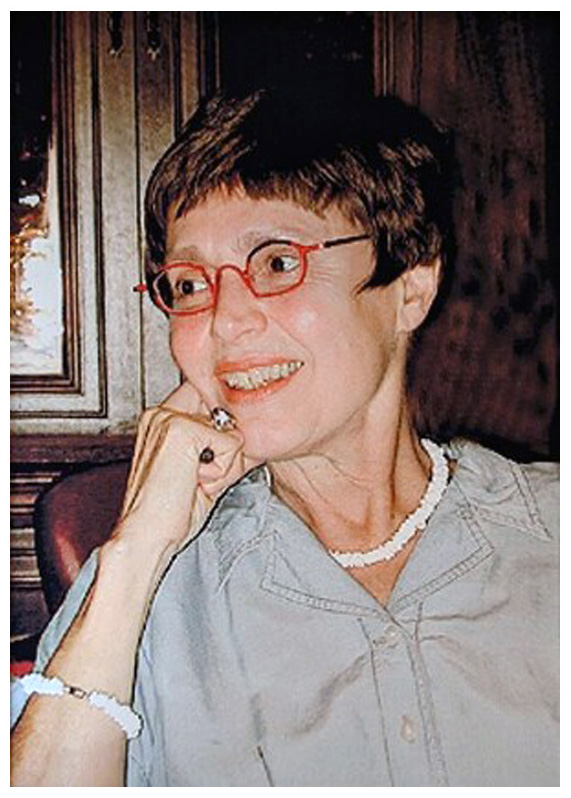
I’d like to dedicate this post to the memory of the late Dr. Ruth R. Pierson, formerly of the University of Toronto, whose 1974 article about theReichsbund Jüdischer Frontsoldaten(the RJF) inThe Leo Baeck Institute Year Bookwas instrumental in my discovery of the two editorials presented below.
~~~~~~~~~~~~~~~~~~~~~~~~~~~~~~
(This photograph below is from Dr. Pierson’s obituary, which appeared in the Toronto Star on October 19, 2024 (…alas; just a month before my writing this post…)
~~~~~~~~~~~~~~~~~~~~~~~~~~~~~~
By its very nature, “this” blog is an exploration of the military service of Jewish soldiers, sailors, and airmen of all areas (well… for airmen obviously since 1914!) in the militaries of all countries, with a primary emphasis – thus far – on the First and Second World Wars. One impetus for the blog has been my curiosity about the military service of Jewish soldiers in the armed forces of the WW II Allies, given the ethos and ultimate aim of the Third Reich regarding the Jewish people. This poses a question: To what extent did Jewish military service during that war impart or reinforce a sense of Jewish identity and historical consciousness among Jewish soldiers who participated in that now nearly-century-gone-by global conflict?
Yet…
Having since moved beyond WW II to explorations of Jewish military service in the “Great War”, let alone (to a thus-far, far lesser extent!) the Viet-Nam war, and, works of fiction as books and film, there arise questions that are more abstract and perhaps philosophical in nature. Namely, what are the basis and ultimate end to any commemoration of Jewish military fallen? Does a soldier having served, been wounded, taken prisoner, or fallen in war … does a recitation of names, dates, military units, and specific details about his military service – actually perpetuate a sense of Jewish peoplehood?
These questions bring to mind skeptical musings about the many works of “apologetic literature” – to the tune of “Great Jews in Sports”, “Great Jews in pick-any-other-field-of-endeavor-or-pop-culture” (rock & roll, acting, art, music, etc., etc., etc.!) produced by Jewish authors in Europe and the Americas from the nineteenth through the mid-twentieth centuries, largely prior to Israel’s 1948 re-establishment, yet still today albeit to a lesser extent today. Has such literature actually been of significance or made a positive impact in terms of the degree to which Jews are seen as equal citizens, whether in the 1930s or this year of 2024?
One of the several animating assumptions – there have been several – behind such literature is that the perception of Jews can be transformed and positively influenced by a presentation of factual information about the contributions of Jews – scientific, military, cultural, social – to the wider world. About this I wonder, for it’s largely based on the belief that attitudes toward Jews are based upon logic and reason. In reality, the perception of Jews – both recognized and unrealized – is “wired” deeply into Western Civilization, emanating from levels distant in time, near-irrevocably resistant to rationality, at perhaps founded at impenetrably deep level of consciousness.
The best and most recent explorations / explanations of this topic are Bernard Harrison’s Blaming the Jews (great book!), and, David Nirenberg’s Anti-Judaism: The Western Tradition. , which I heartily recommend.
But, I digress. (A little.)
I won’t present my own beliefs about these issues “here”, but suffice to sat that I’ve most definitely entertained thoughts about them. Of course, innumerable others have pondered these questions as well. Two such explorations, brief yet provocative, appeared nearly a century ago in Germany. They took the form of essays in the newspapers Der Israelit (The Israelite), and, Jüdische Rundschau (Jewish Review), respectively published in 1931 and 1932. I learned about these short but pithy writings a few decades ago, while researching the military service of Jews in the German armed forces during the First World War. The impetus was Dr. Ruth R. Pierson’s article “Embattled Veterans: The Reichsbund Jüdischer Frontsoldaten”, which was published in the The Leo Baeck Institute Year Book in 1974.
These essays are presented below, first in English, and then in German, translated via Oogle Translate. They approach the above-mentioned questions from perspectives reflective of the publications’ very different editorial stances regarding the nature, place (for lack of a better word … I mean that symbolically!), and perhaps the destiny of German Jews during a period of enormous and rapid social and technological change, and … to put it mildly … extraordinary political and social turbulence: Der Israelit from the standpoint of Orthodox Judaism, and Judische Rundschau from the standpoint of (I think secular) Zionism.
The excerpts are preceded by images of the newspapers’ mastheads, and also include images of the specific pages within these newspapers on which the two essays appeared.
“But is it necessary that we allow ourselves to be lured by the enemy into his blood-soaked territories, follow him into his medieval world of thought, in order to turn death and destruction into an adorable cult to which one cannot offer enough sacrifices?“
Insufficient Dead!…
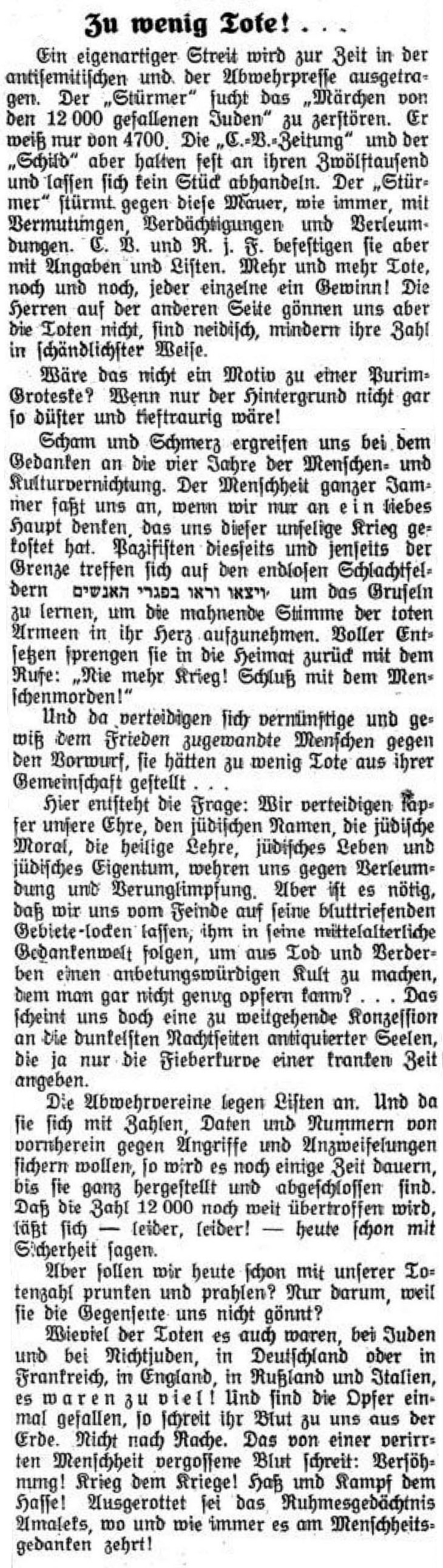
A peculiar argument is currently being waged in the anti-Semitic and Defence press. The “Stürmer” seeks to destroy the “Tale of the 12,000 fallen Jews”. It only knows of 4700. The “C.-V.-Zeitung” [Central-Verein-Zeitung] and the “Schild” stick to their twelve thousand and don’t let them deal with a single piece. The “Stürmer” storms against this wall, as always, with assumptions, suspicions and slanders. The C.V. and R.j.F. but attach them with indications and lists. More and more dead, more and more, every single one a gain! But the gentlemen on the other side don’t begrudge us the dead, they are envious; mouth their number in the most shameful way.
Wouldn’t that be a motif for a Purim-grotesque? If only the background weren’t so gloomy and deeply sad!
Shame and pain seize us at the thought of the four years of human and cultural annihilation. All of mankind’s misery grips us when we only think of a dear head, that this unfortunate war has cost us. Pacifists on both sides of the border meet on the endless battlefields [ ויצאו וראו בפגרי האנשים ] “and they went out and saw the corpses of the people to learn to shudder”, to take the admonishing voice of the dead armies into their hearts. Full of horror, they rush back home with the cry: “No more war! Stop killing people!”
And then reasonable people who are certainly open to peace defend themselves against the accusation that they had not provided enough dead from their community…
Here the question arises: we valiantly defend our honor, the Jewish name, Jewish morality, the sacred doctrine, Jewish life and property, to defend ourselves against slander and defamation. But is it necessary that we allow ourselves to be lured by the enemy into his blood-soaked territories, follow him into his medieval world of thought, in order to turn death and destruction into an adorable cult to which one cannot offer enough sacrifices? … That seems to us to be a too far-reaching concession to the darkest night sides of antiquated souls, who only indicate the fever curve of a sick time.
The defense associations draw up lists. And since they want to protect themselves against attacks and doubts with numbers, dates and numbers from the outset, it will still take some time before they are completely established and concluded. Unfortunately, unfortunately! – said with certainty today.
But should we already today boast and brag about the number of deaths ? Just because the other side doesn’t begrudge us it?
However many of the dead there were, among Jews and non-Jews, in Germany or in France, in England, in Russia and Italy, there were too many! And once the victims have fallen, their blood cries out to us on earth. Not for revenge. The blood shed by a lost humanity cries: Reconciliation! War to war! Hate and fight hate! Amalek’s memory of fame should be eradicated, wherever and however it erodes human thought!
Zu wenig Tote!…
Ein eigenartiger Streit wird zur Zeit in der antisemitischen und der Abwehrpresse ausgetragen. Der “Stürmer” sucht das “Märchen von der 12 000 gefallenen Juden” zu zerstören. Er weiss nur von 4700. Die “C.-V.-Zeitung” und der “Schild” aber halten fest an ihren Zwölftausend und lassen sich kein Stück abhandeln. Der “Stürmer” stürmt gegen diese Mauer, wie immer, mit Vermutungen, Verdächtigungen und Verleumdungen. C.V. und R.j.F. befestigen sie aber mit Angaben und Listen. Mehr und mehr Tote, noch und noch, jeder einzelne ein Gewinn! Die Herren auf der anderen Seite gönnen uns aber die Toten nicht, sind neidisch, mundern ihre Zahl in schändlichster Weise.
Wäre das nicht ein Motiv zu einer Purim-Groteske? Wenn nur der Hintergrund nicht gar so düster und tieftraurig wäre!
Scham und Schmerz ergreifen uns bei dem Gedanken an die vier Jahre der Menschen- und Kulturvernichtung. Der Menschheit ganzer Jammer fasst uns an, wenn wir nur an ein liebes Haupt denken, das uns dieser unselige Krieg gekostet hat. Pazifisten dieseits und jenseits der Grenze treffen sich auf den endlosen Schlachtfeldern ויצאו וראו בפגרי האנשים um das Gruseln zu lernen, um die mahnende Stimme der toten Armeen in ihr Herz aufzunehmen. Voller Entsetzen spregen sie in die Heimat zurück mit dem Rufe: “Nie mehr Krieg! Schluss mit dem Menschenmorden!”
Und da verteidigen sich vernünftige und gewiss dem Frieden zugewandte Menschen gegen den Vorwurf, sie hätten zu wenig Tote aus ihrer Gemeinschaft gestellt…
Hier entsteht die Frage: Wir verteidigen tapfer unsere Ehre, den jüdischen Namen, die jüdische Moral, die heilige Lehre, jüdisches Leben und jüdisches Eigentum, wehren uns gegen Verleumdung und Verunglimpfung. Aber ist es nötig, dass wir uns vom Feinde auf seine bluttriefenden Gebiete-locken lassen, ihm in seine mittelalterliche Gedankenwelt folgen, um aus Tod und Verderben einen anbetungswürdigen Kult zu Machen, dem mann gar nicht genug opfern kann? … Das scheint uns doch eine zu weitgehende Konzession an die dunkelsten Nachtseiten antiquierter Seelen, die ja nur die Fieberkurve einer kranken Zeit angeben.
Die Abwehrvereine legen Listen an. Und da sie sich mit Zahlen, Daten und Nummern von vornherein gegen Angriffe und Anzweifelungen sichern wollen, so wird es noch einige Zeit dauern, bis die ganz hergestellt und abgeschlossen sind. Dass die Zahl 12 000 noch weit übertroffen wird, lässt sich – leider, leider! – heute schon mit Sicherheit sagen.
Aber sollen wir heute schon mit unserer Totenzahl prunken und prahlen? Nur darum, weil sie die Gegenseite uns nicht gönnt?
Wieviel der Toten es auch waren, bei Juden und bei Nichtjuden, in Deutschland oder in Frankreich, in England, in Russland and Italien, es waren zu viel! Und sind die Opfer einmal gefallen, so schreit ihr Blut zu uns aud der Erde. Nicht nach Rache. Das von einer verirrten Menschheit vergossene Blut schreit: Versöhnung! Krieg dem Kriege! Hass und Kampf dem Hasse! Ausgerottet sei das Ruhmesgedächtnis Amaleks, wo und wie immer es am Menschheitsgedanken zehrt!
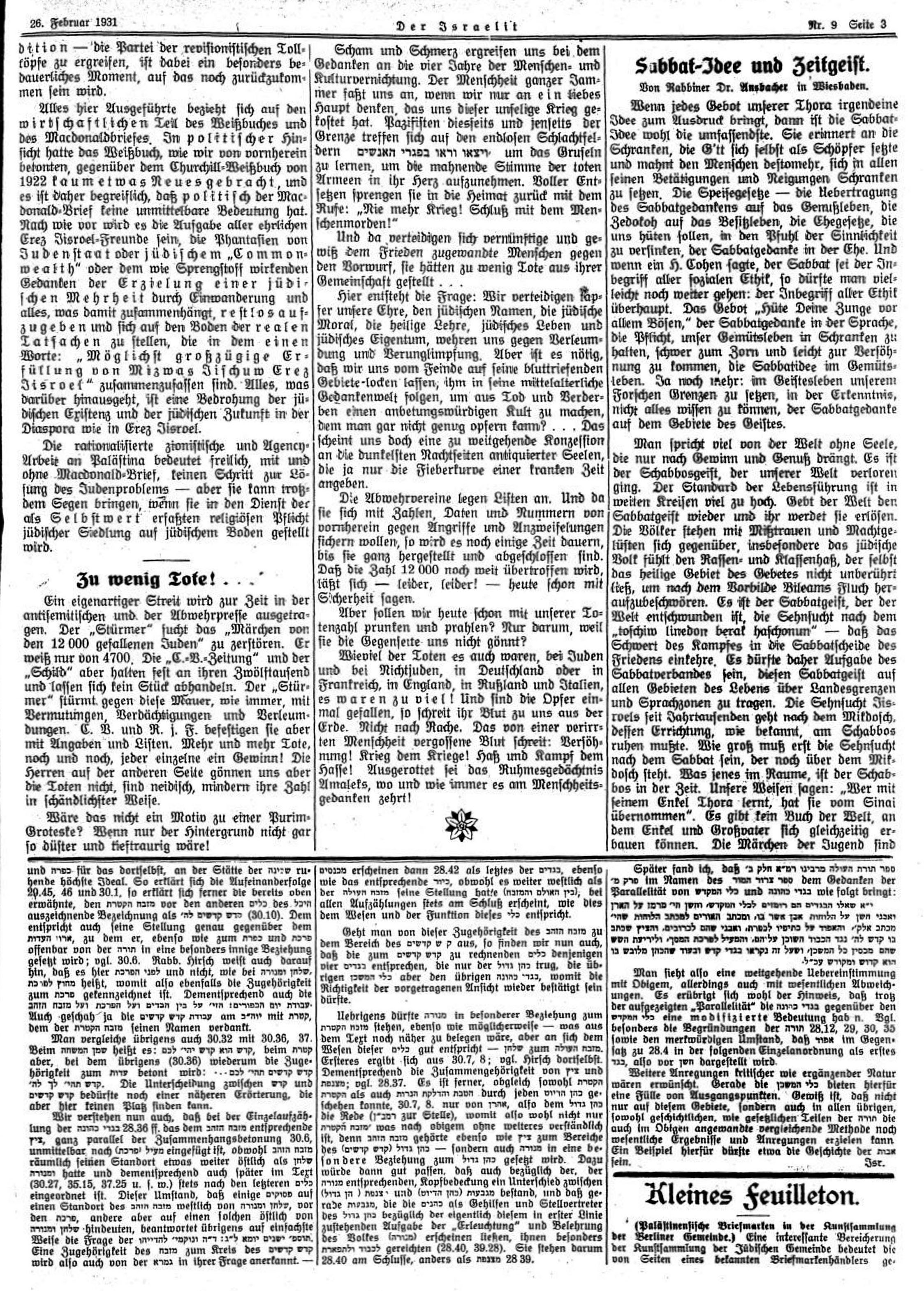
The original editorial…
Here are the first two pages of this issue of Der Israelit. The editorial appears in the first and second columns of page two.
Der Israelit had been published weekly since the spring of 1860. In late autumn 1938 the magazine was banned by the National Socialists. The circulation in October 1934 was 4250 copies. Against the backdrop of increasing secularization, growing assimilation efforts and the profound reform of Jewish ritual and worship since the beginning of the 19th century, Der Israelit was the most important publication organ of German-Jewish Orthodoxy for almost eight decades. Under the leadership of its founder, the renowned rabbi and writer Marcus Lehmann (1831-1890), the tradition-conscious magazine saw itself as a counterweight to the liberal-reform Allgemeine Zeitung des Judentums and its successor, the CV-Zeitung.
Der Israelit was considered by its long-time editor to be a forum for all interests and areas of life of German Jewry, with the most attention being paid to Jewish rituals and cults. After the old edition of the monthly magazine Jeschurun merged with Der Israelit in 1870, Lehmann initiated a Hebrew parallel edition of the paper in 1871 and a Yiddish edition in 1873, which meant that it could also be noticed beyond the borders of the German-speaking area. After Lehmann’s death in 1890, his son Oscar Lehmann (1858-1928) took over the management of the magazine.
Source reference: The graphics in the magazine Der Israelit are partly based on the original templates of the magazine in the German National Library in Leipzig (DNL).
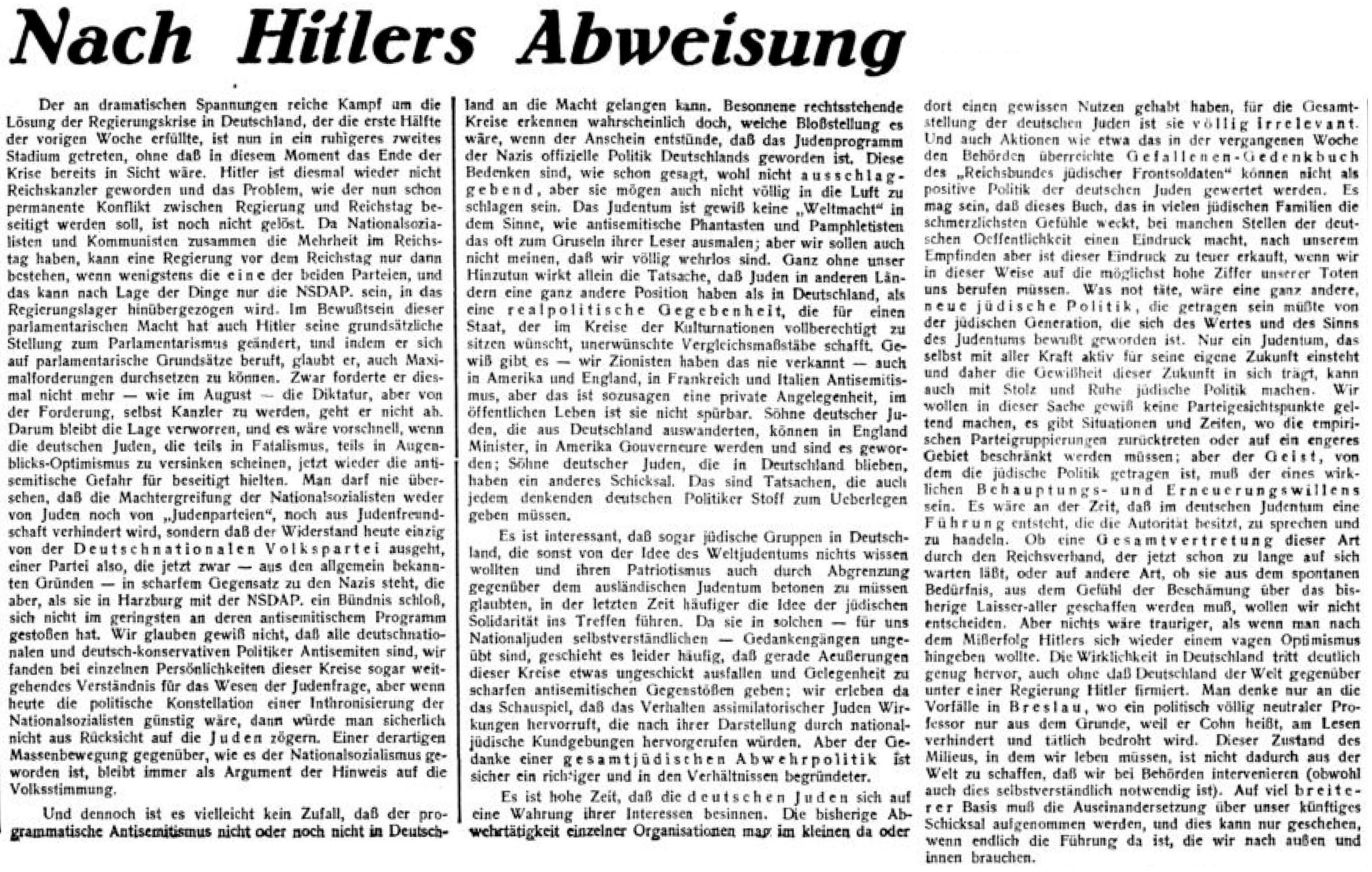
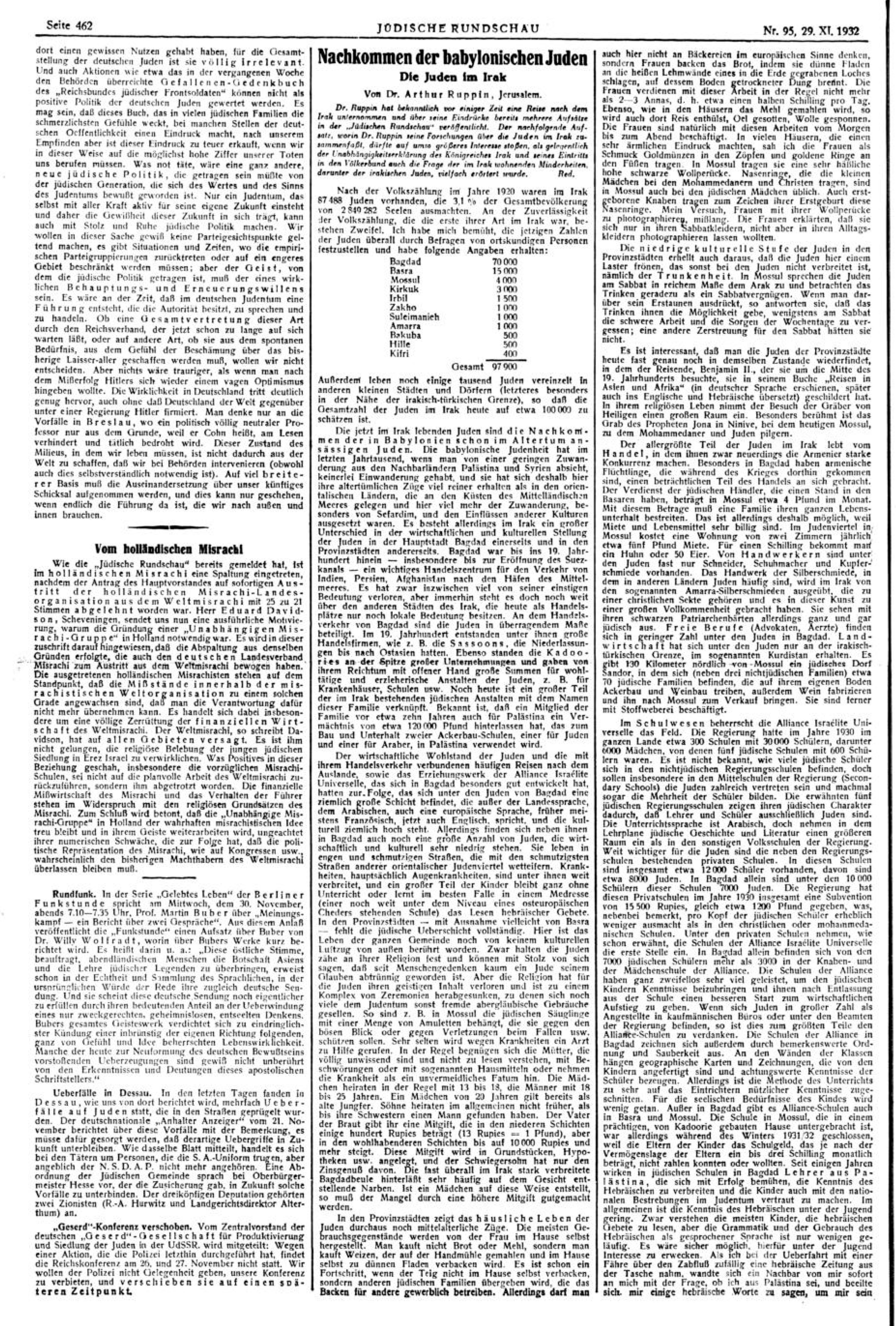
“It may be, that this book, which arouses the most painful feelings in many Jewish families, makes an impression on some parts of the German public, but in our opinion this impression is bought too dearly, if in this way we have to refer to the highest possible number of our dead.”
After Hitler’s Rejection
It is high time that the German Jews remembered to protect their interests. The previous defensive activity of individual organizations may have had a certain benefit here or there, but it is completely irrelevant to the overall position of German Jews. And also actions such as the “Reich Association of Jewish Frontline Soldiers” memorial book of the fallen, which was sent to the authorities last week, cannot be seen as a positive policy of the German Jews. It may be, that this book, which arouses the most painful feelings in many Jewish families, makes an impression on some parts of the German public, but in our opinion this impression is bought too dearly, if in this way we have to refer to the highest possible number of our dead. What is needed would be a completely different, new Jewish policy that would have to be supported by the Jewish generation, which has become aware of the value and meaning of Judaism. Only a Jewry that actively stands up for its own future with all its might and therefore carries the certainty of this future within itself can also pursue Jewish politics with pride and calm. We certainly do not claim any partisan point of view in this matter; there are situations and times when the empirical party groupings take a back seat or have to be restricted to a narrower area; but the spirit on which Jewish politics is based must be that of a real will to assert and renew. It would be time for a leadership to emerge within German Jewry that has the authority to speak and act. We do not want to decide whether a general representation of this kind by the Reich Association, which has been a long time coming, or in some other way, whether it must be created out of spontaneous need, out of the feeling of shame about the previous laissez-faire. But nothing would be sadder than returning to a vague optimism after Hitler’s defeat. The reality in Germany is clear enough, even without Germany reporting to the world under a Hitler government. Just think of the incidents in Breslau, where a politically completely neutral professor was prevented from reading and physically threatened just because his name was Cohn. This state of the milieu in which we have to live cannot be overcome by intervening with the authorities (although this, too, is of course necessary). The discussion about our future destiny has to take place on a much broader basis, and this can only happen if the leadership that we need, both externally and internally, is finally there.
Nach Hitlers Abweisung
Es ist hohe Zeit, dass die deutschen Juden sich auf eine Wahrung ihrer Interessen besinnen. Die bisherige Abwehrtätigkeit einzelner Organisationen mag im kleinen da oder dort einen gewissen Nutzen gehabt haben, für die Gesamtstellung der deutschen Juden ist sie völlig irrelevant. Und auch Aktionen wie etwa das in der vergangenen Woche den behörden überrichte Gefallenen-Gedenkbuch des “Reichsbundes jüdischer Frontsoldaten” können nicht als positive Politik der deutschen Juden gewertet werden. Es mag sein, dass dieses Buch, das in vielen jüdischen Familien die schmerzlichsten Gefühle weckt, bei manchen Stellen der deutschen Oeffentlichkeit einen Eindruck macht, nach unserem Empfinden aber ist dieser Eindruck zu teuer erkauft, wenn wir in dieser Weise auf die möglichst hohe Ziffer unserer Toten uns berufen müssen. Was not täte, wäre eine ganz andere, neue jüdische Politik, die getragen seine müsste von der jüdischen Generation, die sich des Wertes und des Sinns des Judentums bewusst geworden ist. Nur ein Judentum, das selbst mit aller Kraft aktiv für seine eigene Zukunft einsteht und daher die Gewissheit dieser Zukunft in sich trägt, kann auch mit Stolz und Ruhe jüdische Politik machen. Wir vollen in diser Sache gewiss keine Partei gesichtspuntke geltend machen, es gibt Situationen und Zeiten, wo die empirischen Partiegruppierungen zurücktreten oder auf ein engeres Gebiet beschränkt werden müssen; aber der Geist, von dem die jüdische Politik getragen ist, muss der eines wirklichen Behauptungs- und Erneuerungswillens sein. Es wäre an der Zeit, dass im deutschen Judentum eine Führung entsteht, die die Autorität besitzt, zu sprechen un zu handeln. Ob eine Gesamtvertretung dieser Art durch den Reichsverband, der jetzt schon zu lange auf sich warten lässt, oder auf andere Art, ob sie aus dem spontanen Bedürfnis, aus dem Gefühl der Beschämung über das bisherige Laisser-aller geschaffen werden muss, wollen wir nicht entscheiden. Aber nichts wäre trauriger, als wenn man nach dem Misserfolg Hitlers sich wieder einem vagen Optimismus hingeben wollte. Die Wirklichkeit in Deutschland tritt deutlich genug hervor, auch ohne dass Deutschland der welt gegenüber unter einer Regierung Hitler firmiert. Man denke nur an die Vorfälle in Breslau, wo ein politisch völlig neutraler Professor nur aus dem Grunde, weil er Cohn heisst, am Lesen verhindert und tätlich bedroht wird. Dieser Zustand des Milieus, in dem wir leben müssen, ist nicht dadurch aus der Welt zu schaffen, dass wir bei Behörden intervenieren (obwohl auch dies selbstverständlich notwendig ist). Auf viel breiterer Basis muss die Auseinandersetzung über unser künftiges Schicksal aufgenommen werden, und dies kann nur geschehen, wenn endlich die Führung da ist, die wir nach aussen und innen brauchen.
The original editorial…
Here are the first two pages of this issue of Judische Rundschau. The editorial appears in the lower right on page one and continues at the upper left of page two.
Publisher: Heinrich Loewe Changing editors-in-chief: Julius Becker, Felix Abraham, Hugo Hermann, Leo Hermann, Fritz Löwenstein, Hans Klötzel, Robert Weltsch, Hans Bloch and others. Jüdische Rundschau initially appeared once a week, but since 1919 twice a week at three – to four-day intervals. Special issues have been published mainly since 1932. In 1925 and 1936 the Rundschau briefly returned to weekly publication. From 1934 to 1938 Jüdische Rundschau had a circulation of 25,300 to 37,000 copies.
Countless supplements:
Von jüdischer Musik (On Jewish Music) (occasionally attached to the relevant issues) Palästina-Beilage (Palestine Supplement) (occasionally attached to the relevant issues) Jungzionistische Blätter (Young Zionist Paper) Jüdisches Frauenblatt (Jewish Women’s Paper) Zionistisches Frauenblatt (Zionist Women’s Paper) Unterhaltungs-Beilage (Entertainment Supplement) Frauen-Beilage (Women’s Supplement) Musik-Blatt (Music Paper) Palästina-Blatt (Palestine Paper (occasionally attached to the relevant issues)) Wirtschafts-Blatt (Business Paper) Palästina-Wirtschaftsblatt (Palestine Business Paper) occasionally attached to the relevant issues) Literatur-Blatt (Literature Paper) (in later years also occasionally attached directly to the relevant issue of the Judische Rundschau) Sport-Blatt (Sports Paper) (occasionally attached to the relevant issues) Berliner Rundschau (occasionally attached to the relevant issues) Die Jüdische Schule (The Jewish School) (occasionally attached to the relevant issues) Kinder Rundschau (Children’s Review) (occasionally attached to the relevant issues)
Jüdische Rundschau (1902-1938) – which emerged from the Berliner Vereinsboten (1895-1901) and the Israelitische Rundschau (1901-1902) – is, alongside the C.V.-Zeitung, one of the Jewish weekly newspapers with the highest circulation in the German-speaking world. Founded as the official ‘organ of the Zionist Association for Germany’, the magazine aimed, especially among young people, to “clearly and distinctly express the political idea as expressed in the Basel Program of the Zionist Party” and “to create a homeland in Palestine for the Jewish people” (H. Loewe). Zionism is considered the “national bond” that guarantees this program.
As an influential weekly newspaper, Jüdische Rundschau reported on all areas of Jewish life at home and abroad. In this context, the modern, decidedly combative reporting contributed significantly to the politicization of the Jewish press in the German-speaking world.
Due to its commitment to combating increasing anti-Semitism, the magazine was able to increase its circulation to 40,000 copies at the end of the Weimar Republic. After the National Socialists took power, Jüdische Rundschau reduced its Zionist activities in order to report more on the difficult living conditions of Jews in Germany and to provide readers who wanted to emigrate with detailed information about emigration options.
Jüdische Rundschau had to stop publishing after the so-called Reichskristallnacht on November 8, 1938; its successor, the Jüdische Weltrundschau, was published from 1939 to 1949, initially in Switzerland and later in Jerusalem.
~~~~~~~~~~
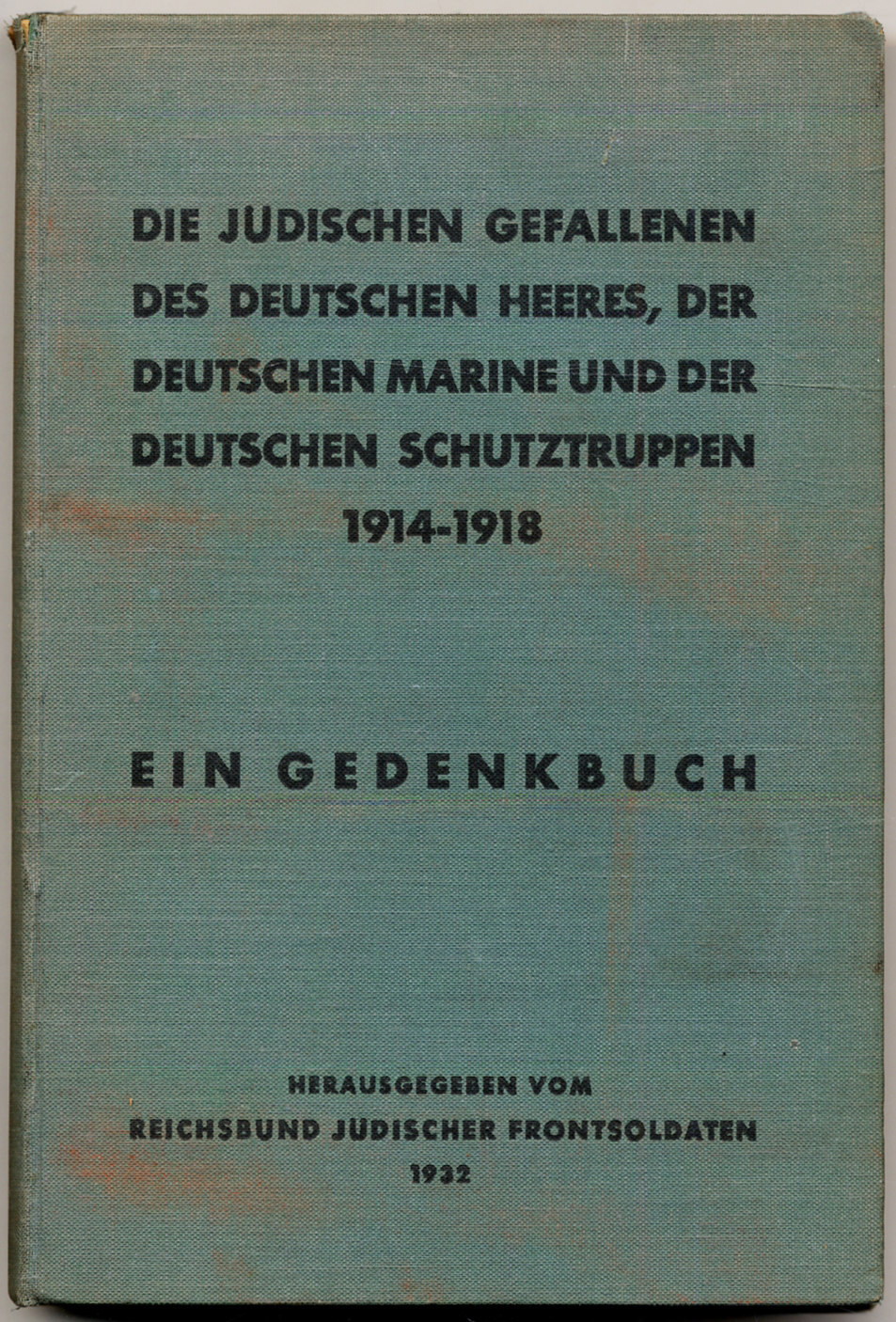
Here’s the entirely simple cover of Die Jüdischen Gefallenen Des Deutschen Heeres, Deutschen Marine Und Der Deutschen Schutztruppen 1914-1918 – Ein Gedenkbuch, Reichsbund Jüdischer Frontsoldaten, forward by Dr. Leo Löwenstein, published in Berlin in 1932 This book has been the primary (I’d say truly central and essential) source of information for my posts about German Jewish WW I military casualties.
~~~~~~~~~~~~~~~~~~~~~~~~~~~~~~
The (original) article of inspiration…
Pierson, Ruth R., Embattled Veterans: The Reichsbund Jüdischer Frontsoldaten, The Leo Baeck Institute Year Book, V 19, N 1, January 1974, pp. 139–154 (https://doi.org/10.1093/leobaeck/19.1.139)
Through the lens of the past, one can discern the present.
And from the vantage of the present, the nature of the past can become clearer.
Case in point, novelist, short story writer, and screenwriter Michael Chabon’s speech at the Hebrew Union College graduation ceremony on May 14, 2018. Akin to the aphorism about a “talking dog” – that far more startling than the poor quality of its speech is the mere fact that it’s even capable of talking at all – the most remarkable aspect of Chabon’s address was that – as much as its very content – it was given in a venue that was (is?) “Jewish”. Truly remarkable in his ignorance of Jewish history in general, let alone the history of the re-established nation state of Israel in particular, the animating ethos of Chabon’s talk can best be understood as the legitimation and praise – if not the moral imperative (in a Kantian sense) – of Jewish self-negation, both individually and collectively.
Here’s Chabon’s speech, which can be found at Rando Namo’s YouTube channel (uploaded May 21, 2018) under the title “Hebrew Union College Graduation Ceremony Clip”.
Michael Chabon’s peroration elicited numerous insightful reactions, impassioned as much as analytical (links are given at the end of this post). Perhaps the best is D.G. Myers’ Michael Chabon’s Imaginary Jews, from the Fall, 2008 issue of the Sewanee Review. Equally telling is Rabbi Ammi (Ammiel) Hirsch’s September 19, 2018 Yom Kippur Sermon: “From the Ghetto”, at Stephen Wise Free Synagogue. …
In these reflections of, and reflecting upon, Chabon’s speech I’m reminded of the lyrics to John Lennon’s 1971 facile Yoko-Ono-inspired-ode to collectivism, and, the jettisoning of human particularism, in favor of the nullifying pleasure of a soporific universalism: “Imagine“. I know I “heard” this song as far back as the early 70s (seriously! … even as a kid I found its airs of grandstanding moral nobility and near-pathological idealism to be disconcerting – though I didn’t know the words “pathological”, “idealism” and “disconcerting” back then!), but it’s true implications weren’t apparent until I viewed the 1984 movie “The Killing Fields”, in which the Lennon / Ono ode accompanies the film’s concluding scenes. It was here, through the cinema, that the banality, utter shallowness of thought, and especially the totalitarian brutality lurking behind the lyrics’ false sweetness was fully crystallized. For naively or intentionally, what this song was extolling was a mechanistic view of reality, the abolition of individual human endeavor, and, the suppression of all national identities, the results of which have been amply evident (and were ongoing even as the song was released in the midst of the (first?!) Cold War!) throughout the twentieth century, to the “tune” of tens of millions dead.
For your consideration, the lyrics follow:
Imagine there’s no heaven It’s easy if you try No hell below us Above us only sky Imagine all the people Living for today… Aha-ah…
Imagine there’s no countries It isn’t hard to do Nothing to kill or die for And no religion, too Imagine all the people Living life in peace… You…
You may say I’m a dreamer But I’m not the only one I hope someday you’ll join us And the world will be as one
Imagine no possessions I wonder if you can No need for greed or hunger A brotherhood of man Imagine all the people Sharing all the world… You…
You may say I’m a dreamer But I’m not the only one I hope someday you’ll join us And the world will live as one.
Then again, I’ve always felt the pop-culture – and not just the pop-culture! – fascination with The Beatles to be perplexing. (Blasphemy, blasphemy!)
Oh. Yes. Getting back to Michael Chabon’s speech…
Thinking about the ideological currents contributing to his thinking, I’m reminded of an essay that appeared on April 13, 1945, a month before the end of the Second World War in Europe, in the Indiana-based The Jewish Post, which is currently published as The Jewish Post and Opinion. Written by Bertram A. Rosenberg and entitled “A Soldier Checks Up on His Buddies to Discover What Kind of Future in Store for U.S. Jewry”, the essay takes the form of a series of vignettes, eleven in number. Through these, Rosenberg relates his observations of the interaction of Jewish soldiers in his unidentified unit with and among Jewish and non-Jewish soldiers and civilians in settings both military and civilian. He also presents comments made by Jewish soldiers – discretely recorded, I would think! – that were expressed in unguarded reflection about their perception of themselves, other Jews, and the political and military situation of the Jewish people “in general” during the war’s final year.
Of central note is the fact that absolutely none of the eleven incidents … musings … conversations (call them what you will) recounted below pertain to antisemitism as directly experienced by these soldiers. Though we have no way of knowing how random, representative,or dramatically selective is this “portrait” (I think it’s truly random), distinct themes emerge from Rosenberg’s essay: The degree to which the identity of these men was derived not through the prism of their own identity, ancestry, and heritage, but instead, from assumptions of how they assume others perceived them. … The degree to which some wish to consciously jettison or escape from any sense of identification with the Jewish people. … The attribution of antisemitism to the behavior of Jews themselves. … The ineffectiveness of educational efforts to impart a sense of Zionism, and, Jewish history. … Juxtaposed against these observations are a small few in which efforts towards a positive, confident, and assured Jewish identity are described. This is particularly so in the last vignette, in which a colonel in the Medical Corp admonishes his men: “We have nothing to apologize for. It is impossible now to elaborate upon two thousand years of religious faith, but enough to say that, you fool nobody, not even yourself, whim you deny your birthright.”
Rosenberg’s conclusion is ambiguous: “I hesitate to enforce an all-inclusive conviction. I am reminded of the story of the blind men, who attempting to describe an elephant, found different points of emphasis and drew pictures in accordance with their sensitivity of experience. I do know that U.S. Jewish youth needs a new, different, more militant type of manhood. Being a Zionist, I know of one such type, possibly all-inclusive.” He closes with words from his brother: “We, the Israelites, need a Jewish-American manhood, that understands its responsibilities, accepts them and perceives the pleasures of our tradition, not solely the difficulties of it.”
Here’s Rosenberg’s essay, which is as relevant in 2024 as it was seventy-nine years ago:
A Soldier Checks Up on His Buddies to Discover What Kind of Future in Store for U.S. Jewry
Bertram A. Rosenberg
The Jewish Post April 13, 1945
ONE Sunday morning I awoke with a mission. I was going to find out, the extent of Jewishness, among my buddies, to learn of their background, Jewish education, awareness of Jewish problems, closeness of Jewish associations, and so on.
“Crazy fool,” strange interlude number one within me spoke. “Crazy fool, leave well enough alone! Leave well enough alone.”
“After all,” strange interlude number two spoke. “After all upon the thoughts of these youth, representative of all sections of the country, will depend the sort of Jewish life that will be led in America. And if you want to have a part in the destiny of your people, you should know the ways of their lives.”
Herewith I wish to assure all aspiring psychiatrists who desire to send me letters of advice and treatment that through the judicious use of non-habit forming opium, laudanum, cocaine, 3.2 per cent beer, intravenous morphine injections, I have cured myself of the delusions of “strange interlude.”
A Tall Assignment
“This is a tall assignment I says to me, so big, so subject to untrue generalities, so unscientific, so devoid of a beginning or an ending, a “rishon or a sof,” that only you would undertake it. You will start from the middle of an ocean, longitude zero, latitude zero, and descend downward, losing air, choking for sense, finding yourself swimming in four directional current, going up, going down, and wondering when the lifeline of common sanity will snap. Being human, thus lacking the fundamental annual sense of good and bad, I went ahead regardless.
In writing of what happened, I decided that I would quote various incidents written down in my black book and let the reader draw his own interpretation of their meaning. As for me, I was definitely swayed by what I had noted. After just a cursory landing on the “island within,” the footprints upon the beach, told me what I wanted to know…
Incident I …
“I feel that there are three hundred and sixty pairs of eyes watching our movements,…”
Our Jewish group of 25 men out of a total assembly of 360, were lined up in military formation, to march over to visit the chaplain. We, the Jews, led the parade, we the twenty five, because our chapel for today was the nearest. A young Jewish soldier alongside me said:
“I feel that there are three hundred and sixty pairs of eyes watching our movements, watching our cadence, watching our smartness, watching … whispering … criticizing … of course this is the super imaginative phantasy of my eighth sense, but it is a concrete disturbance.”
Incident 2 …
“I’m roped in.”
Our group deported from the others and as we awaited entrance to the chapel, one of the Jewish boys hollered out to a pal of his in the Christian columns:
“I’m roped in.”
As an honest, manly extension of this, he might have said:
“Listen, you Christians, I’m not here because I want to be. I’m not one of these Jews. I’m roped in because we were ordered to be here.”
Incident 3 …
“Yep, it’s peculiar, well when my father-in-law dies, I will be free.”
Before going into the chapel, one John Smith explains to all of us:
“Yep, nobody believes I’m Jewish. Why when I was to be married, my father-in-law thought me a “goy.” Yep, it’s peculiar, well when my father-in-law dies, I will be free.”
Incident 4 …
“…when such a thing happens it is best to leave it alone,
to let it go,
to avoid all trouble,
to let the matter drop,
to act as if nothing happened.”
Suddenly one of the boys motions for all of us to assemble in a small circle. We go underground to listen.
“Listen, fellows. I have something to tell you. One of our soldiers in barracks got up today and read a poem, a soldier’s hymn, contents being that the Christians fight while the Jews buy bonds. Fellows, when such a thing happens it is best to leave it alone, to let it go, to avoid all trouble, to let the matter drop, to act as if nothing happened. After all aren’t there many jokes about the Jews we tell ourselves. I know this kid. He even says “Sam Goldberg is his best friend.”
Incident 5 …
“Some of you say that even if you don’t believe in religion, you should attend services to gain the respect of your Christian pals, but what respect have you gained by having your face slapped.”
One of the boys replies:
“Listen, fellows, you guys that say hush-hush this affair are cowards. When that fellow read his poem you had not time to rationalize, to debate the wisest course of action, because this was a stimulus to your emotions, it was a split second affair, and if you hid under your cover, plugged your ears with your fingers, or bent down to tie your shoe lace, or walked out of the room, then you showed physical and menial cowardice. You had no time to think, you had only time for your Jewish conditioned background to activate your reaction. It was as if a hot iron were touched to your hand. The resultant action is based on muscular reflex, conditioned by your experiences with fire and heat. Sure you hid under your covers. Just as you have been hiding ever since you understood you were Jewish. You have no pride in your Judaism. Some of you say that even if you don’t believe in religion, you should attend services to gain the respect of your Christian pals, but what respect have you gained by having your face slapped.”
Incident 6 …
“In fact, it is a shock to learn that twenty five years of Zionist propaganda, of current events of American English articles, of books, has not conclusively reached into the heart of Chicago … outlands of New Jersey … southern Florida hand-clapping Texas … cold Massachusetts.”
After chapel services a discussion initiated by the chaplain was held. The topic chosen was “Regimented Prayer.” From out of nowhere a disturbed soul asks:
“Chaplain, what is a Zion … a Zionism … a Zio –”
The chaplain jumps to the rescue and adds:
“A Zionist”
“Yes, sir.”
“A Zionist is a person who wants the Jews of Europe to find a home in Palestine. Although an American Zionist is one who does not want to go there.”
A second voice says:
“Isn’t a Zionist, one who wants to kick the Arabs out of their land?”
A bright, young man astounds the gathering, Klal Israel, with the important piece of information:
“Pierre Van Paassen’s book, “Days of Our Years,” has the answer to that.”
A third voice says:
“Isn’t Biro-Bijan a Zionist state?”
So it goes, wholesale uninformativeness. It surprises one. In fact, it is a shock to learn that twenty five years of Zionist propaganda, of current events of American English articles, of books, has not conclusively reached into the heart of Chicago … outlands of New Jersey … southern Florida hand-clapping Texas … cold Massachusetts.
Incident 7 …
“See, that’s what I mean.
It is that type of Jew, dirty, begging, conspicuous, that causes anti-Semitism.
I don’t blame the Gentiles.”
Last night three of us Jewish boys went to a show. While on the way, we were cautiously approached and stopped by a bedraggled, hunched over moth-eaten man whose face bore marks of Jewish suffering. At first we intended brushing him aside, but to test my friend’s reactions, I said:
“Let’s buy a paper.”
“All right,” said pal one, “but I have no change. Will a dollar bill do?”
The man nodded, “No.
“’Here’s a dime,” I volunteered. “Let’s give it to him and forget the paper.”
“No, thanks, boys,” the man hastened to say, “I sell papers.”
“Du bist a Yid,” I said in pidgeon Jewish.
“An alte Yid,” he responded.
My friends demanded a halt to the conversation, appearing embarrassed, and cautioning me to speak softly. When we finally were out of earshot, one said:
“See, that’s what I mean. It is that type of Jew, dirty, begging, conspicuous, that causes anti-Semitism. I don’t blame the Gentiles.”
Incident 8 …
“We had gone “over the hill” from GI chow, and were seated in a Jewish restaurant, awaiting the entree of chopped herring. Each of us had been supplied by the observant proprietor with a drip-pan placed snugly against the lower lip, Ubangi style, into which fell the tidal wave of anxious saliva. One of the more daring boys had secured a bottle of Canadian Club, and asked the proprietor whether we could make a toast, the answer being:
“If I can’t see it, can I see it?”
Which translated into good English, means:
“If I can’t see it, can I see it?”
We lifted our glasses to a position Just on the level with our eyes (seeing is believing).
“Rebenishelolam.”
“Rehenishelolam,” I repeated, “what’s that?”
“Oh,” he replied, “that’s the Jewish toast for drinking.”
“Do you know what that means?”
“No,” he answered, “but my grandmother always said it at home.”
“You’re mistaken,” I said, “the word is ‘Lechaiim,’ to health. You were calling upon the Lord’s name.”
Nevertheless, the Canadian Club tasted good. Indeed after awhile we were amazed to find that the proprietor had installed a revolving cuisine. Or so it seemed.
Incident 9 …
“What do you guys want to do, prove this is a Jewish war?”
One day after a very impressive chapel service, during which the chaplain read of the “Heroes of the Battle of the Warsaw Ghetto,” with the tune of the Young Judean version of “Adon Olam” ringing in our ears, we made our way back to our barracks. There my friend found an old harmonica and commenced to give out with all the Palestinian chants he and I knew. Anu Banu Artza, Avinu Malkenu, Hineh Matov … It was not more than three songs and two bars of “Yerushalyium” later, when the section chief, a Jewish lad, cautioned us to quiet. Revolt flared up within us, this Sunday, and we continued.
Again the section chief emerged from his shell, and cautioned:
“What do you guys want to do, prove this is a Jewish war?”
Incident 10 …
“Fine Jewish boys met death with a “Shma Israel” on their lips, and a Mezuzzah in their hands. And here in these very halls…”
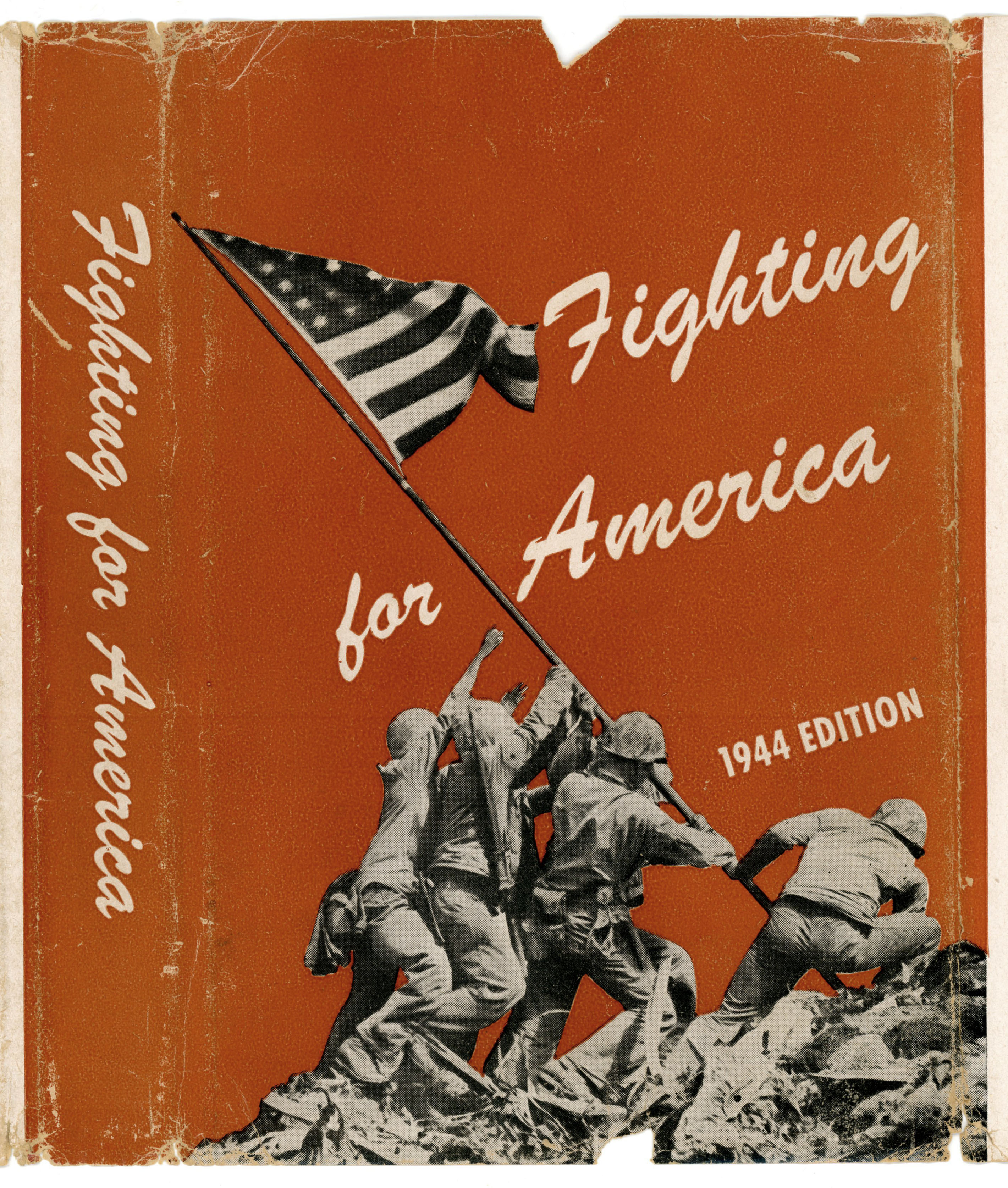
Our camp had a very fine library. Well, this day I walked in intent on securing Ben Hecht’s “Guide to [sic] the Bedevilled,” or Ludwig Lewisohn’s “Breathe Upon These“, or Pierre Van Paassen’s “Forgotten Ally,” when I observed and promptly snatched, or should I say snitched a booklet, “Fighting for America,” put out by the National Jewish Welfare Board.
As I looked through this history of brave fighting Jews and feverishly scoured the “missing in action,” the “died for their country” columns, I was aware of a sniping over my shoulder. A voice inquired:
“May I read it next?”
One day later, the booklet was returned to me with an enclosed note.
“Dear Bert,
I showed this booklet to several Jewish friends of mine and the consensus of opinion was that it is a waste of valuable paper. Why do certain people insist upon separating us Jews into a distinct grouping? This showing of our differences results in special attention to us. We need less of this.”
I venomed. Fine Jewish boys met death with a “Shma Israel” on their lips, and a Mezuzzah in their hands. And here in these very halls…
______________________________
Here are covers of the books referred in the above vignette. They’re all from my library. (Yes, I like books.)
A Guide for the Bedevilled Charles Scribner’s Sons, New York, N.Y., 1944
__________
Breathe Upon These Ludwig Lewisohn Bobbs-Merrill, Indianapolis, In., 1944
__________
The Forgotten Ally Pierre van Paassen The Dial Press, New York, N.Y., 1943
__________
Fighting for America A Record of the Participation of Jewish Men and Women in the Armed Forces During 1944 The National Jewish Welfare Board, New York, N.Y., 1944
______________________________
Incident 11 …
“We have nothing to apologize for.”
At services today, a colonel of the Medical Corps was among the worshippers and was requested by the chaplain to give his greetings. This elderly, handsome, neatly attired officer spoke:
“Fellow Jews, I think that what I have to say will be a Testament of Faith. Mind you I’m not a Holy Roller, but what I have to say, I believe in. Don’t be ashamed of being a Jew. Many of the boys who come to the medical training school are ashamed of being Jews, they try to hide it. As for me, I have always found a great source of spiritual strength in my religion. I have a Jewish home and intend to bring up my little family as Jews. We have nothing to apologize for. It is impossible now to elaborate upon two thousand years of religious faith, but enough to say that, you fool nobody, not even yourself, whim you deny your birthright.”
These are just eleven incidents, but easily multiplied by four score and seven, that like organic pain, are symptoms of unhealthy disturbances in U.S. Jewish life. This is not news. But the Army Express carries one over the broad land, throwing unassortedly man upon man, given the opportunity for a study of altogether different unlocalized human beings from Maine to Florida, from Washington to Texas, from California to New York.
Draws No Conclusions
This, then is my stay of “GI Jacob,” as I found him. From these “Incidents,” can be drawn a pretty fair diagram of Jewish-American youth as Jews. I, for one, am a poor artist. I leave the color, strong lines, weak lines, emphasis of profile, to the Jewish socio-religio experts, who in their own accepted learnings, will draw it out as it affects them.
I hesitate to enforce an all-inclusive conviction. I am reminded of the story of the blind men, who attempting to describe an elephant, found different points of emphasis and drew pictures in accordance with their sensitivity of experience. I do know that U.S. Jewish youth needs a new, different, more militant type of manhood. Being a Zionist, I know of one such type, possibly all-inclusive.
One word then, before I leave, one thought, that my brother so ably writes, from an army camp somewhere in the world:
“We, the Israelites, need a Jewish-American manhood, that understands its responsibilities, accepts them and perceives the pleasures of our tradition, not solely the difficulties of it.”
Here’s the original article as it appeared in The Jewish Post…
Let’s return to 2023 and 2024.
What conclusions can we draw from the intersection of Bertram Rosenberg’s article of 1945 and Michael Chabon’s speech of 2018? The opinions about Jewish identity, and survival, versus the ideology of self-negation that Chabon espoused in his commencement address didn’t solely arise from within his (and I quite eye-rollingly admit, my) generation, or, spontaneously spring from the ideological aether of the late twentieth and early twenty-first centuries. They had already crystallized, and were felt and articulated in different ways decades earlier, having historical antecedents in events and philosophical currents – the impacts of which were perhaps initially unanticipated or unappreciated – that commenced far – centuries? – earlier.
As understood by Bertram Rosenberg’s anonymous Medical Corps colonel, an apology, however intensely felt, passionately articulated, and adroitly acted upon, cannot be the foundation for the the self-understanding of individuals, let alone the continued existence of a people and a nation.
To conclude, two videos:
November 3, 2023: “Pro-Palestinian protesters at 30th Street Station in Philadelphia call for Israel-Hamas ceasefire” (from The Philadelphia Inquirer)
~~~~~~~~~~~~~~~~~~~~~~~~~~~~~~~~~~~~~~~~
July 23, 2024: “Jewish Voices For Peace Hold A Sit-In On Capitol Hill Protesting Prime Minister Netanyahu’s Visit” (from Forbes Breaking News) (A bit of a typo there: Should be “Jewish Voice for Peace”. The organization, Jew-ish in name only, (big emphasis on the “ish” part) is a contemporary incarnation of the former Soviet Union’s Yevsektsiya.)
“plus ça change, plus c’est la même chose”.
Post Script
An ironic and unrelated afterword. Or two. (Or three.)
It’s odd.
Despite my opinions about Chabon’s Hebrew Union College speech and the ideology of his writing (as exemplified in his novel The Yiddish Policeman’s Union), I admit to really (truly!) enjoying the 2012 film John Carter, (based on Edgar Rice Burroughs’ serialized John Carter of Mars; see more at Archive.org) for which Chabon was one of the three screenwriters. Though the film was and continues to be overwhelmingly “panned” and pummeled by many viewers and critics, I felt it was genuinely evocative and strongly representative of science fiction as presented in the pulps of the early twentieth century, examples of which you can find at my brother blog, WordsEnvisioned. Plus, it was lots of fun.