As part of my series of posts about the military service of Jewish soldiers in the Second World War – with a focus on military casualties, and, soldiers who participated in or experienced significant and memorable events – my most recent set of posts covered military actions on land, sea, and in the air on March 19, 1945. The basis of that post, like the many that have preceded it, was the appearance of biographical information about a soldier in The New York Times. (In this case First Lieutenant Charles Blum, on March 19.) Continuing on the same basis, “this” post is the first of several pertaining to events a little over one year earlier – on March 8, 1944 – and is based on a news item about 2 Lt. Jesse Herbert Lack of the United States Army Air Force, whose obituary appeared in The New York Times on September 6, 1945, four days after the Second World War formally ended, the war in Europe having ended on May 8 (May 9 for the Russian Federation) of that year.
Here’s Lt. Lack’s all-too-brief obituary, which reflects the brevity of his life…
Aviator Killed Last Year In Flight Over Germany
Second Lieut. Jesse H. Lack, a navigator in the Air Forces, was killed on his first mission when his bomber crashed near Berlin on March 8, 1944, the War Department has informed his parents, Mr. and Mrs. Henry Lack of 5510 Thirteenth Avenue, Brooklyn. Lieutenant Lack, who was 20 years old, was previously reported missing.
He enlisted in 1943 after working for two years in the Washington and New York Navy Yards. He was a graduate of Townsend Harris High School and attended Brooklyn College and Cooper Union. Besides his parents, Lieutenant Lack leaves a brother and two sisters.
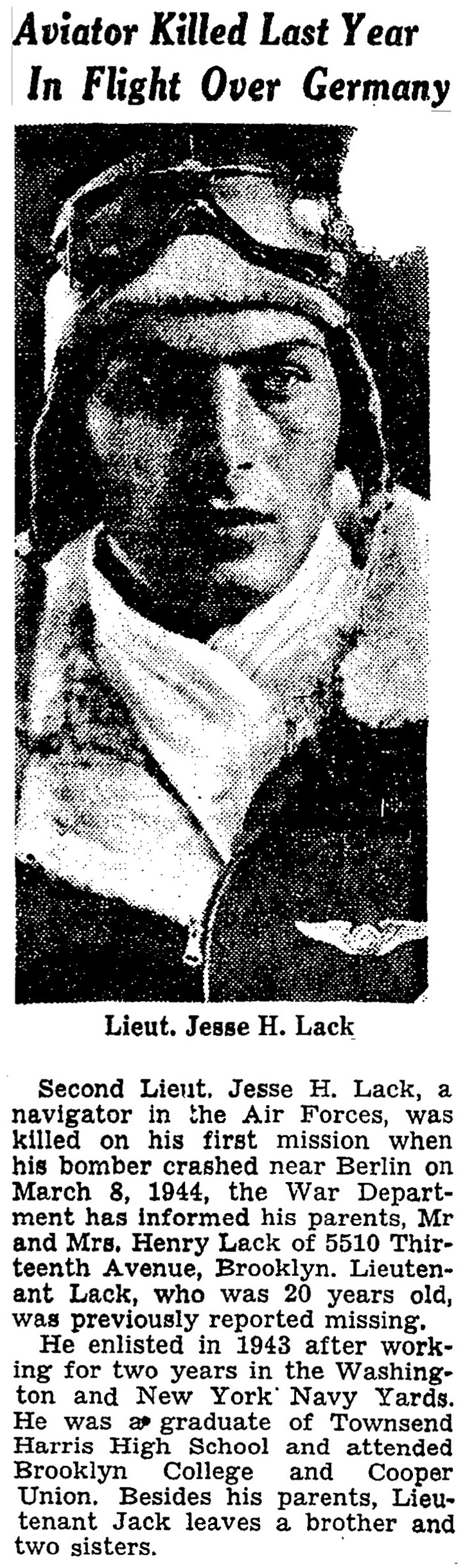
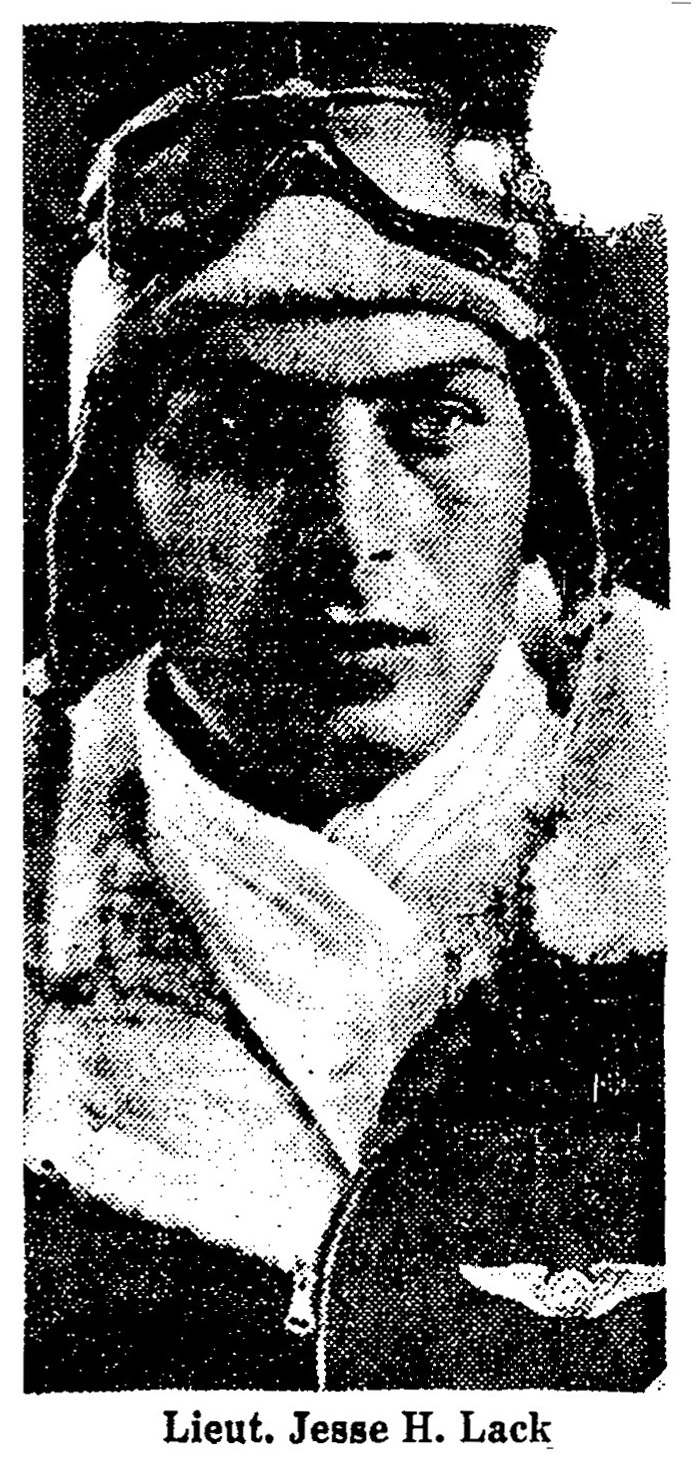
The image accompanying the obituary shows Lt. Lack wearing a clean-and-relatively-new scarf and navigator’s wings pinned to his leather flying jacket, suggesting that this portrait was taken upon his commission as a second lieutenant.
Born in the New York borough of Brooklyn on August 13, 1923, 2 Lt. Jessie Herbert Lack (0-694883) was the son of Harry and Yetta Lack and the brother of Vivienne, Phyllis, and Arthur, the family residing at 5510 13th Ave. His name appeared in a War Department Casualty List under the category of “Missing in Action” published on April 21, 1944. His name subsequently appeared in the news media only one more time: in the above-mentioned Times article of September 6, 1945. Given that the mission of March 8, 1944, was his first, last, and only combat sortie, he was thus ineligible for the Air Medal (which required the completion of five combat missions) or Distinguished Flying Cross, his sole award being the Purple Heart. Subsequent to the war years, his name appeared in the “In Memoriam” section of the Times on May 15, 1949, and can also be found in Volume II (on page 370) of the 1947 compilation American Jews in World War Two.
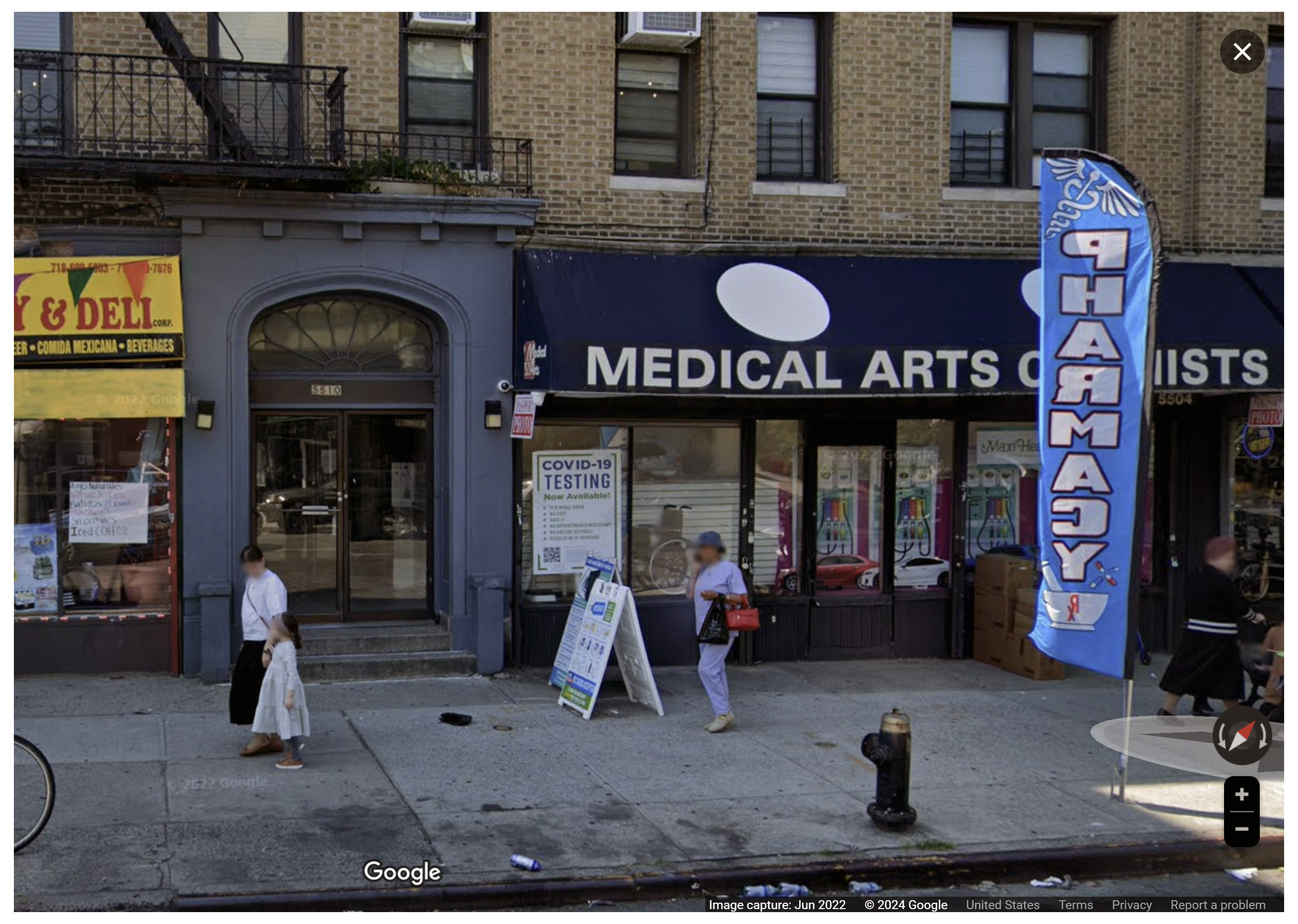
The following three images show the contemporary (as in 2024) appearance of 5510 13th Ave. in Brooklyn. It’s in the Borough Park area, one of the largest and most prominent centers of Jewish life outside of Israel. The first two images are from Apartments.com, and the last image, showing the building’s entrance, is a “zoomed” Oogle Street View.
“If these halls could talk…”
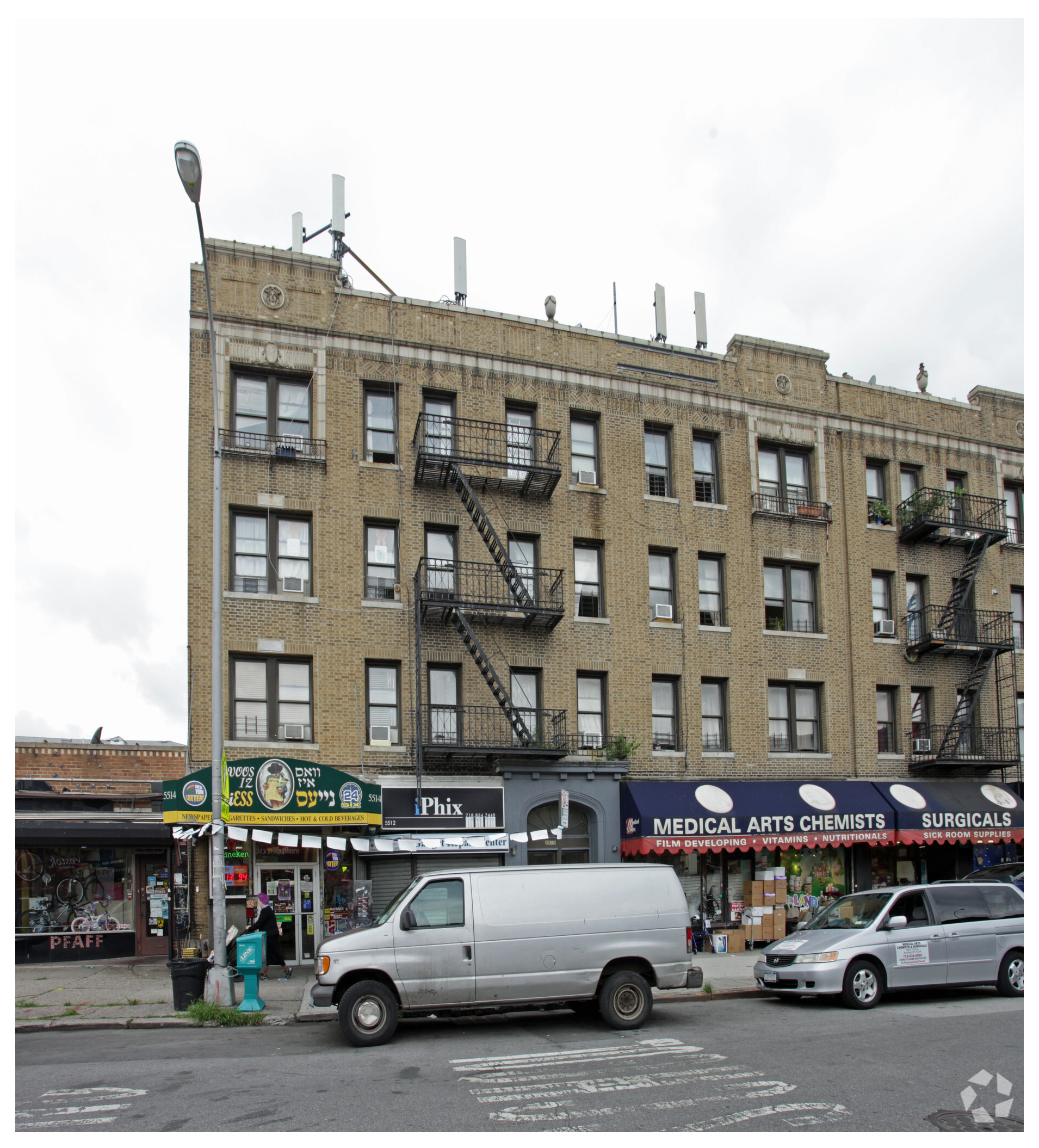
“…if these walls could talk.”
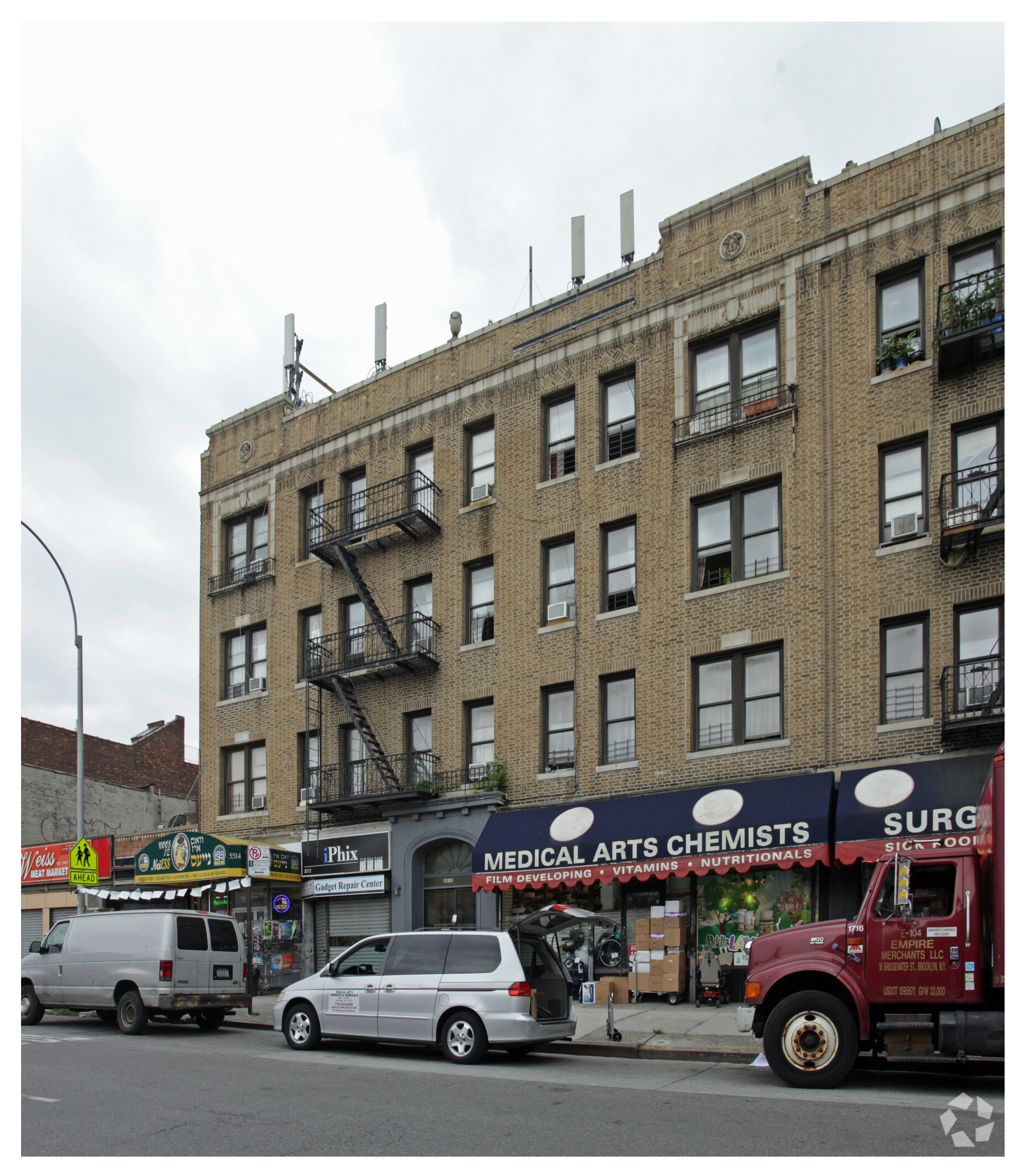
Here’s a close-up of the building’s entrance: A gateway to the past. (Does the past still exist?)
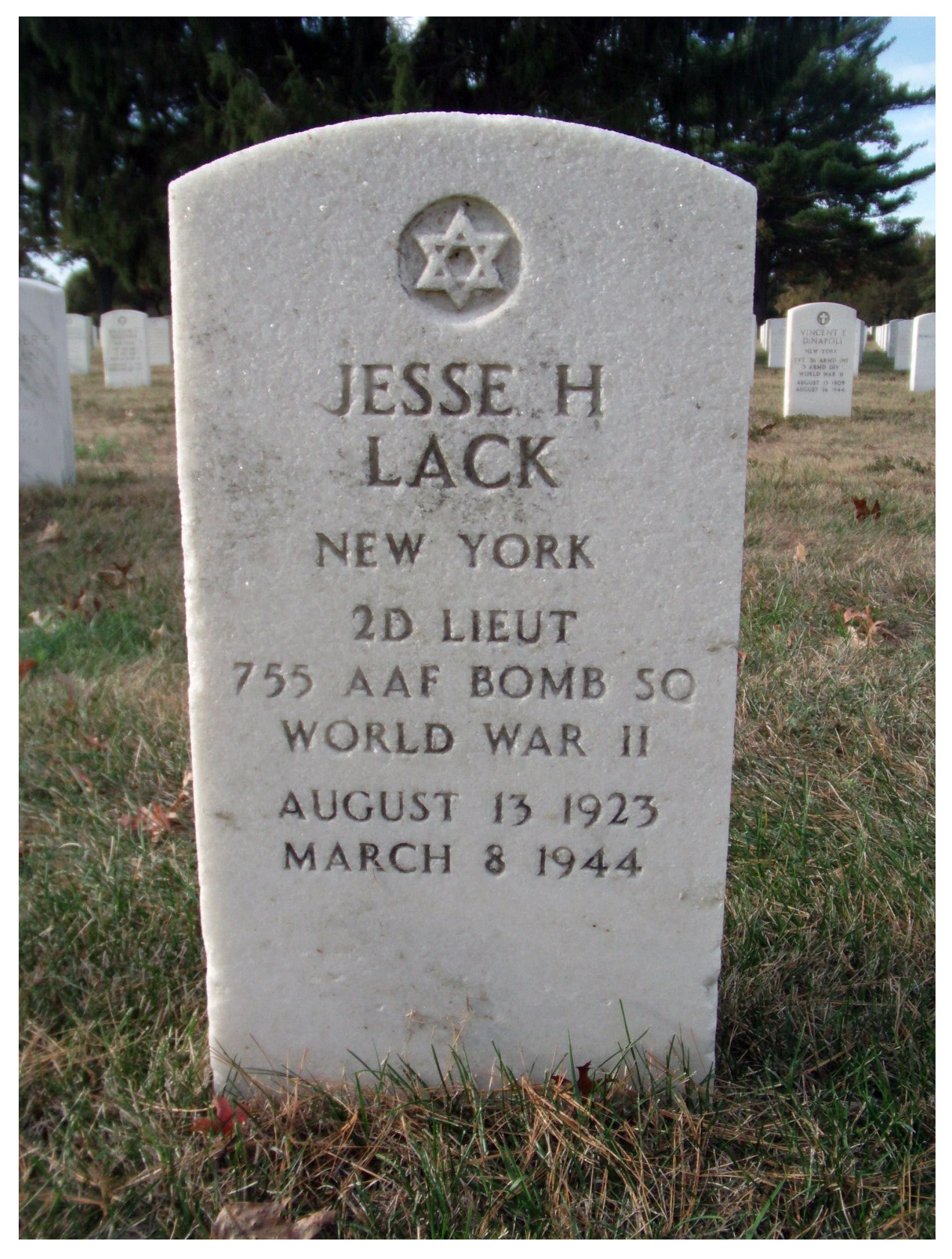
Lt. Lack was buried at Long Island National Cemetery (Section J, Grave 15344), in Farmingdale on May 16, 1949. His simple government-provided matzeva, photographed by FindAGrave contributor GLENN, appears below.
Lt. Lack was assigned to Crew 66 – the crew of 2 Lt. John David “Jack” Adamson of the 458th Bomb Group’s 755th Bomb Squadron, presumably as part of the Group’s original contingent – the other squadrons having been the 752nd, 753rd, and 754th – the Group itself having been activated at Wendover Field, Utah, on July 1, 1943: As described at 458thBG.com (from July 6, 2004, and now only accessible via the Wayback Machine?), “The Adamson crew trained with the group in Tonopah, Nevada in the fall of 1943 and proceeded to England in January 1944. Unlike the majority of the aircrews, Adamson and his crew were sent from Morrison Field in Florida to New York, reporting to the North Atlantic Wing ATC. From there they traveled via the North Atlantic Ferry Route with several other 458th air and ground personnel. The crew was shot down on their first combat mission, the 8AF’s second raid on Berlin.”
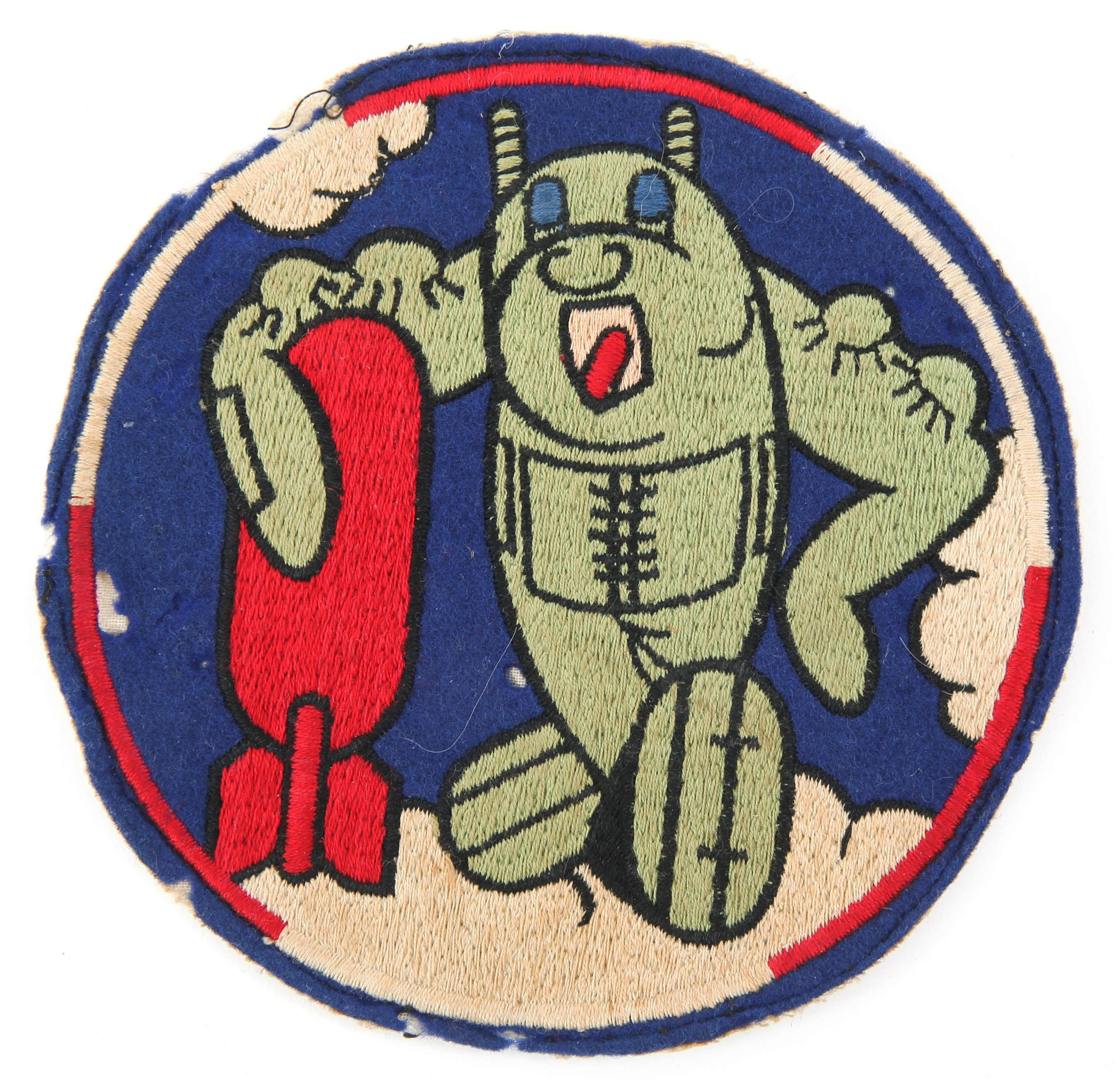
Here’s the insignia of the 755th Bomb Squadron: A B-24 Liberator stands alongside a bomb. Nonchalantly.
(This image is via invaluable.com.)
For the March 8 mission the Adamson crew were assigned to the apparently un-nicknamed B-24H Liberator 41-28720, squadron code “J3 * N“. Of the ten men who boarded the aircraft that morning only five would return, as documented in Missing Air Crew Report 3345, and, German Luftgaukommando Report KU 1174. The bomber’s crew is listed below, the survivors comprising the co-pilot, flight engineer, radio operator, ball turret gunner, and left waist gunner.
Pilot: Adamson, John David “Jack”, 2 Lt., 0-739644 (Born 8/1/20)
Co-Pilot: Berrio, John Joseph, 2 Lt., 0-810994 – Survived (5/14/20-10/4/97)
Navigator: Lack, Jesse Herbert, 2 Lt., 0-694883
Bombardier: Daskam, Charles Sylvester, F/O, T-122613 (Born 7/3/21)
Flight Engineer: Moe, Elmer Peder, S/Sgt., 19146147 – Survived (9/30/19-3/19/08)
Radio Operator: Tamburello, Jake Joseph, T/Sgt., 6663411 – Survived (5/29/15-2/23/90)
Gunner (Ball Turret): Rabideau, Harold Clarence “Pete”, Sgt., 12035281 – Survived (10/11/22-11/6/13)
Gunner (Right Waist): Lowman, Willard Lafayette, Sgt., 14092318 (Born 12/18/21)
Gunner (Left Waist): Forbes, Henry J., Sgt., 36441369 – Survived
Gunner (Tail): Freeman, Billy L. (William Lynn), Sgt., 38269438 (Born 1921)
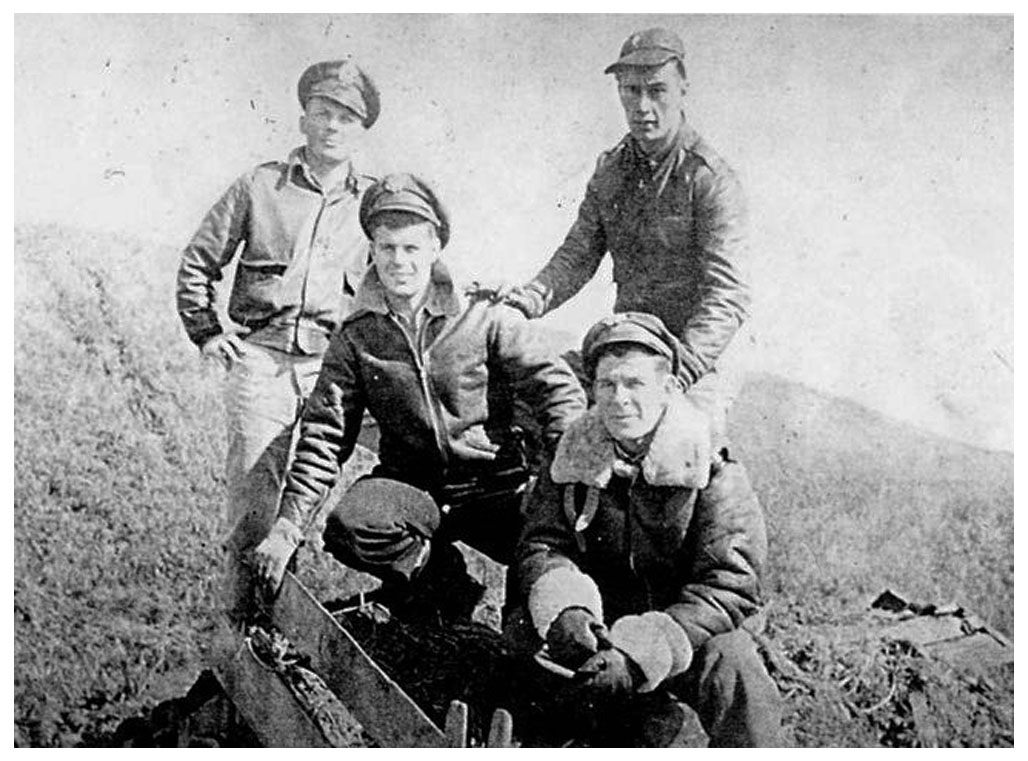
While there appear to be no existing or available photos of the crew as a group – officers and NCOs together – an image contributed by Chris Adamson to the 458th Bomb Group website shows Lt. Adamson and the three other men who were most likely Lieutenants Lack and Berrio, and F/O Daskam: “Crew 66”. In the photo, Lt. John Adamson is definitely 2nd from left. For the other men, comparing faces to names from the available photos of F/O Daskam and Lt. Lack (really, just one photo of each) suggests – assuming that the other three men in the picture actually are Lt. Adamson’s fellow officers – that F/O Daskam is at left, Lt. Lack is standing at rear, and Lt. Berrio (for whom no photo is available) is sitting at right.
This portrait of Lt. Adamson, at Ancestry.com, was uploaded by AFCsearch on December 27, 2016.
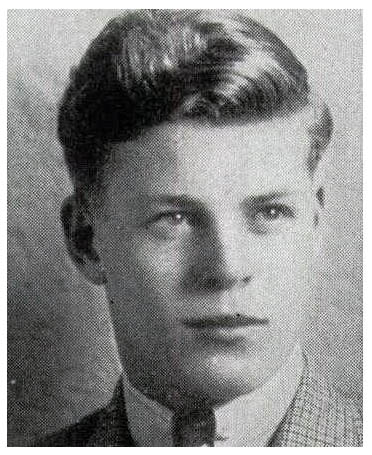
This portrait of F/O Daskam is via FindAGrave contributor Richard Weston.
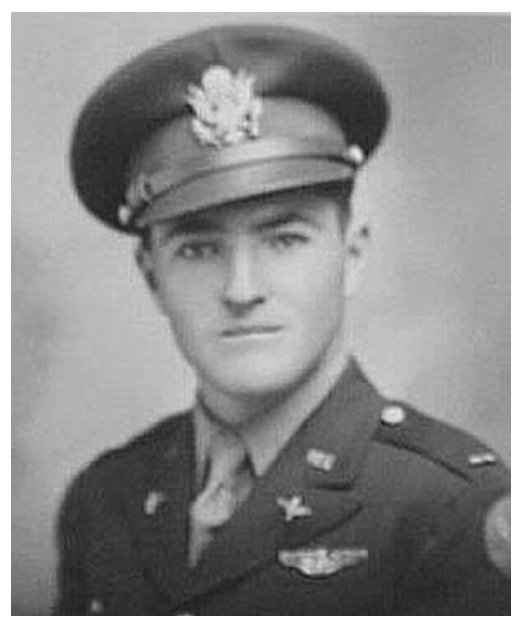
This portrait of S/Sgt. Moe, one of the five survivors of J3 * N, was uploaded to Ancestry.com by Wendy Zenz on August 30, 2016.
xxx
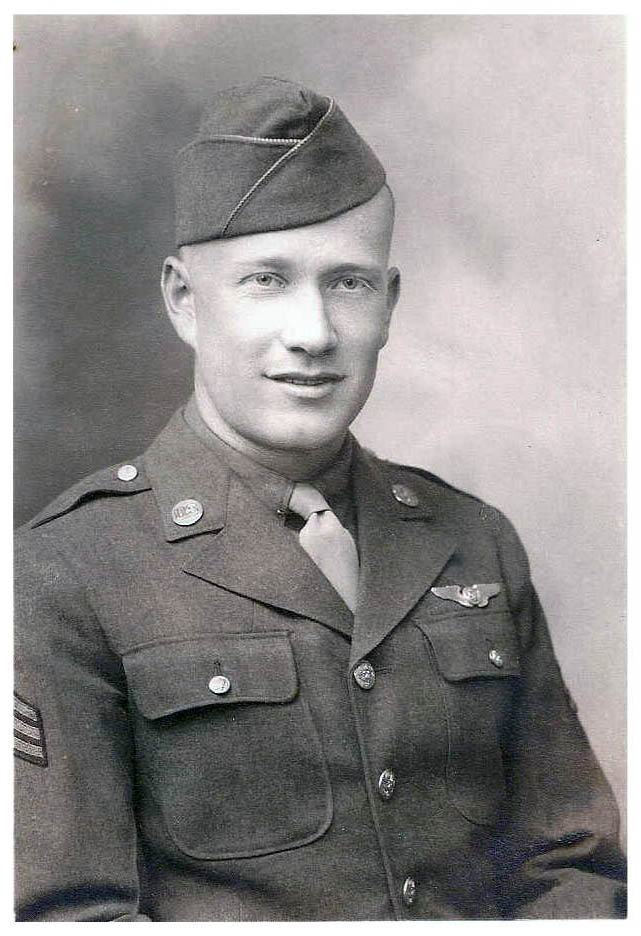
Sgt. Willard Lowman didn’t survive the mission. This picture is via FindAGrave contributor Jerry Low.
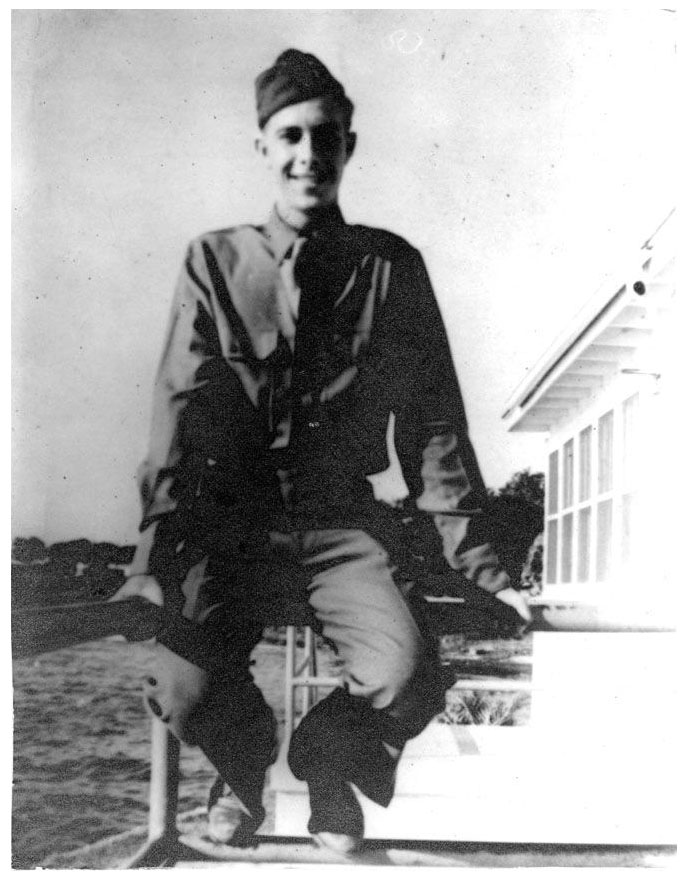
Missing Air Crew 3345 comprises 46 pages, but ironically, it’s completely absent of eyewitness accounts by other members of the 458th, simply listing the cause of the bomber’s loss as “unknown” … albeit 2 Lt. Nelson R. Stewart is listed as a eyewitness. In any event, postwar, four of the five survivors (Berrio, Moe, Rabideau, and Tamburello) submitted Casualty Questionnaires to the Army pertaining to the fate of their crew members, as part of the the military’s massive postwar effort to definitively ascertain the fates of fallen and missing members of the Army Air Force. While their communications naturally vary greatly in length and detail, they form a sufficient enough “picture” to reveal what befell the Liberator and its crew.
But… Before presenting excerpts from these documents, perhaps it’s best to begin with this interview of (former sergeant and ball turret gunner) Harold C. Rabideau, conducted on April 24, 2003 by the New York State Military Museum. As recorded in the crew list above, Mr. Rabideau passed away a decade after this interview, in late 2013.
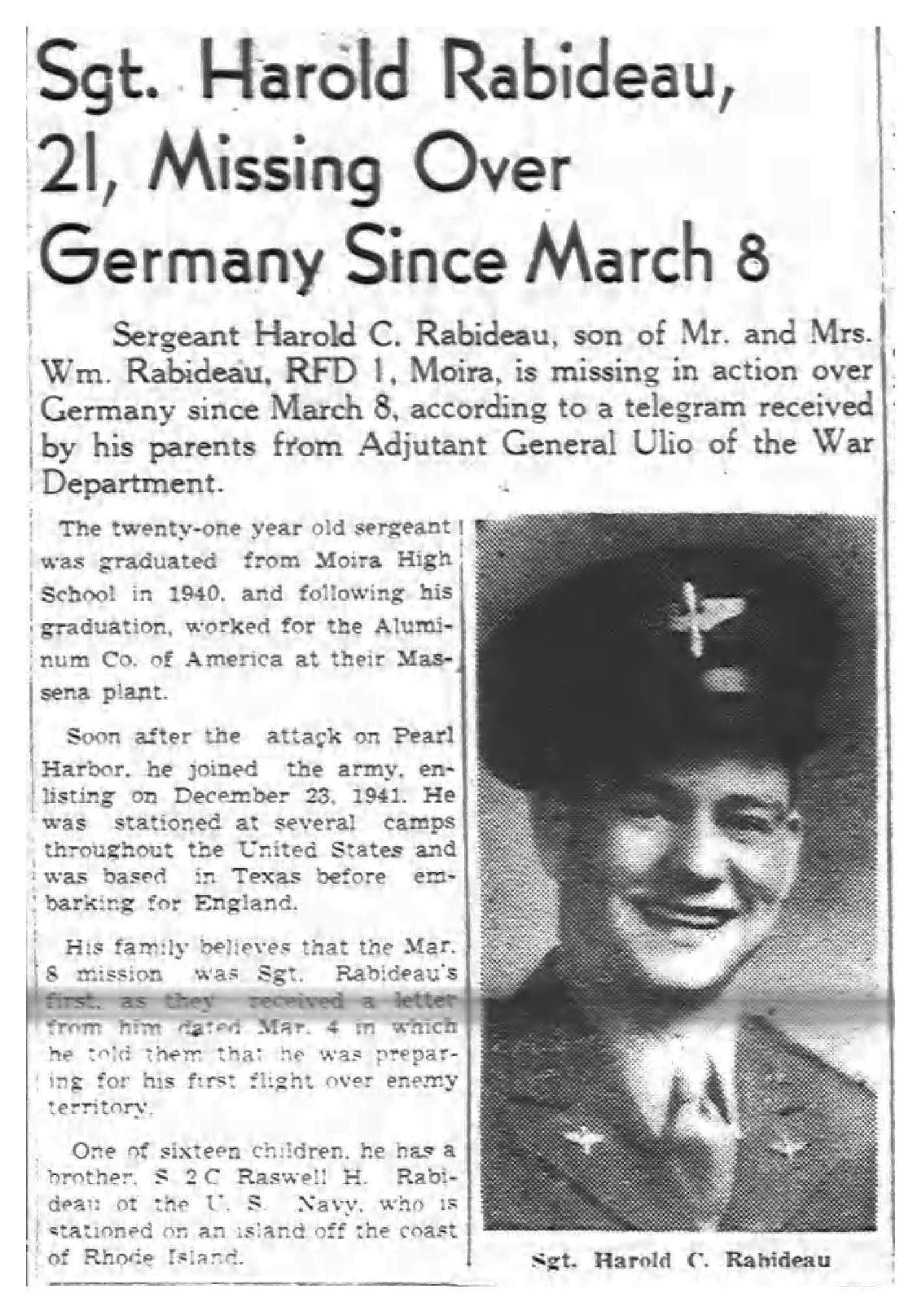
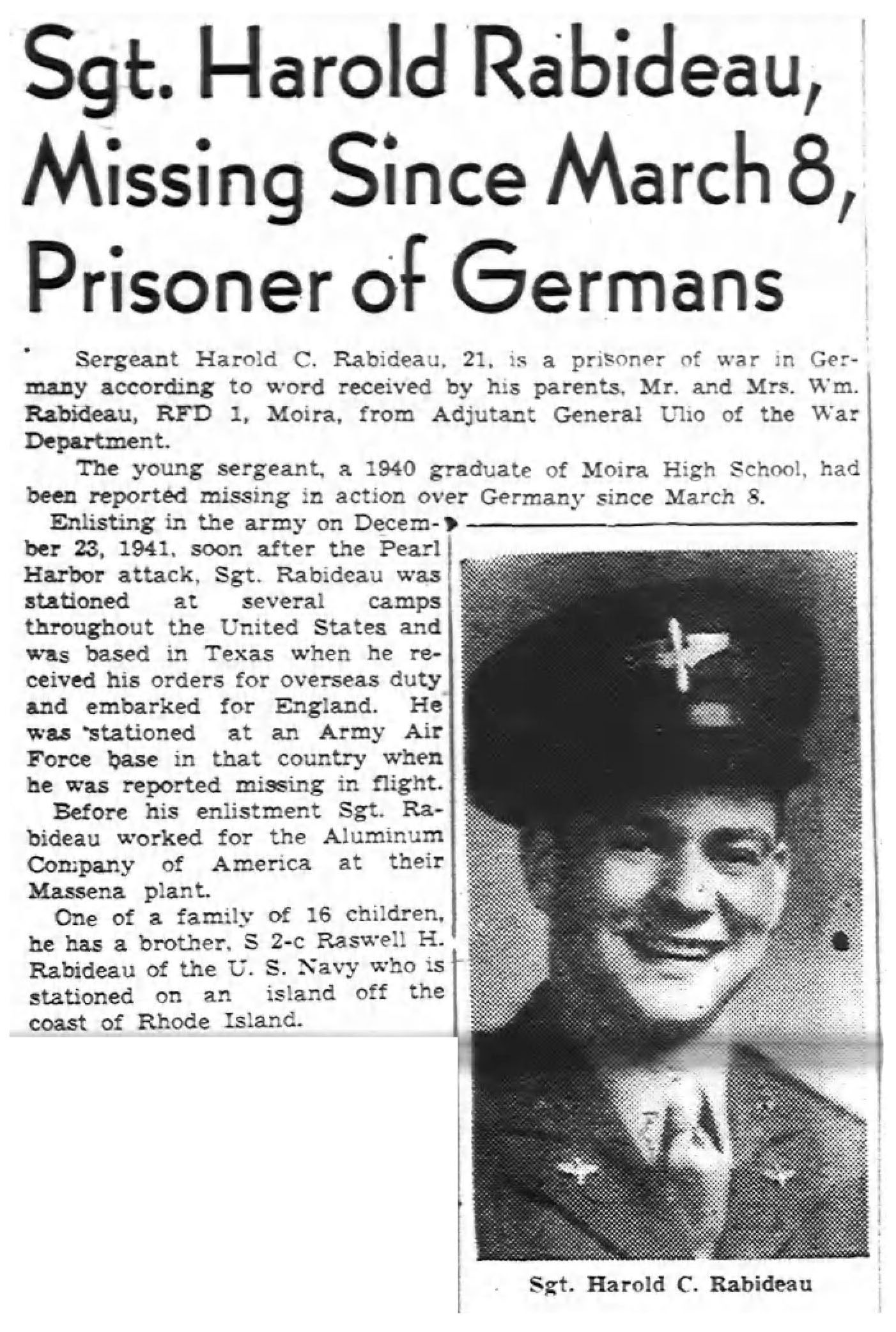
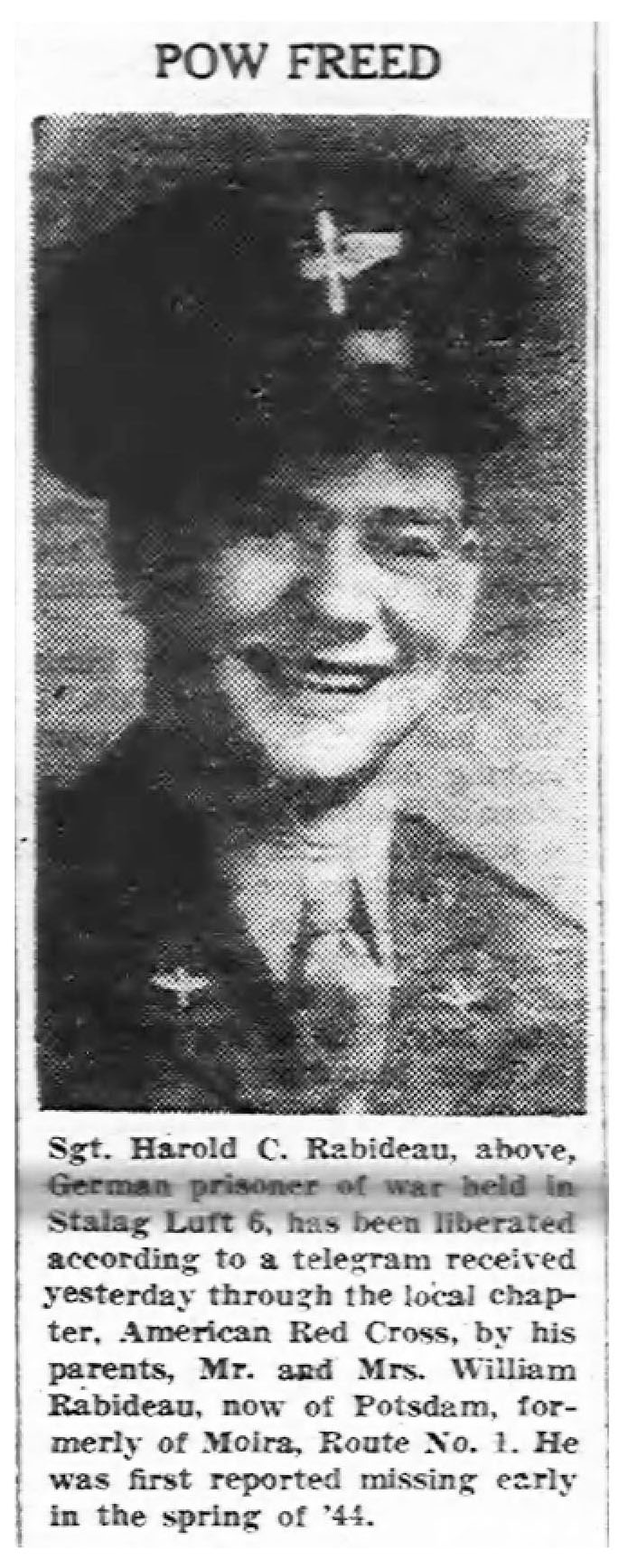
Reaching back in time, here are three articles about Sgt. Rabideau from the Malone Evening Telegram. They successively cover his missing in action status, confirmation of having been captured and interned as a POW, and finally, his liberation. The articles are via the FultonHistory website.
March 29, 1944: Missing
May 15, 1944: Prisoner of War
May 21, 1945: To Return
The 458th Bomb Group website – specifically the profile of Lt. Adamson and his crew – includes transcripts of statements by three crew members (T/Sgt. Tamburello, Lt. Berrio, and S/Sgt. More) which appear in Missing Air Crew Report 3345. “Take-aways” from the statements includes: 1) J3 * N was damaged by flak, losing its #4 and then #2 engines. Lt. Adamson attempted to return to England at low altitude, for which Lt. Lack gave him a course. Though a radio call was made for fighter support, none arrived, and the disabled bomber was then repeatedly attacked by enemy fighters very at close range, with the survivors baling out at low altitude. This attack probably killed Lt. Lack and F/O Daskam, who were in the bomber’s nose. It seems sadly evident that Lt. Adamson – until that point unharmed – also attempted to parachute, but was killed when his parachute snagged on the Liberator’s tail.
Here excerpts from the three men’s statements. Obvious from the accounts of Sergeants Moe and Tamburello is the fact that Lt. Lack’s father engaged in correspondence with the survivors to ascertain the fate of his son, concerning which T/Sgt. Tamburello was highly circumspect.
2 Lt. John J. Berrio… (Co-Pilot)
Lt. Berrio’s statement is unassociated with a Casualty Questionnaire. Rather, given the condition and appearance of this one-page document (even as very poorly digitized and scratched microfiche), it appears to have been associated with separate documentation – included in MACR 3345 – about Lt. Lack’s fate, specifically because it’s headed “Berrio States”, and includes the names of the other four survivors. Here it is, in its entirety:
We were hit by “flak” near Hannover *** the oil pressure on No. 4 engine began to drop *** near Berlin the turbo on No. 2 engine went out and we were forced to salvo our bomb load *** fighter protection was called for but they never came. The enemy fighters (ME 210s, I believe) picked us up and made numerous attacks to our tail and waists. When the plane caught fire *** Lt. Adamson told me to give the order to bail out. *** When I left the plane, Lt. Adamson was standing with his parachute on. The plane crashed about 200 feet from where I landed and there was one chute wrapped around the tail. *** The crash took placed on the outskirts of Finsterwalde, Germany.
As we were leaving the formation I called Lt. Lack and asked for the course back to England. He gave me a course. *** I heard him talk to F/O Daskam *** I called later, while we were under attack, but they never answered.
This statement appears in Lt. Berrio’s Casualty Questionnaire…
The plane was below 1,000 feet when I bailed out and crashed nearby. There was one parachute wrapped around the tail, but I was unable to investigate as I was taken prisoner immediately by the Germans, and they would not permit me to go to the plane. I presumed the chute to be that of Lt. Adamson.
“The plane was burning badly while in the air, but it was extinguished when it crashed.”
According to Sgt. Forbes, Sgt. Freeman was hit in the first attack.
T/Sgt. Jake J. Tamburello… (Radio Operator)
Casualty Questionnaire…
When I was captured I was taken to the point where our craft hit the ground. I saw a parachute entangled around the left horizontal and vertical stabilizer. It seemed as though this chute had been opened too soon and the wearer apparently carried down with falling aircraft.
I was informed by the Germans that four of my crew members were dead in the aircraft. (This was when we were at the scene of the crash). They also told me one member was taken to a hospital. Later that evening, while in prison at Fensterwalde Air Base (sounded like a twin engine base to me from aircraft engines) the Germans informed us (four other crew members and I) that the man taken to the hospital had died.
Having limited speaking knowledge of the German language I was able to learn that the above mentioned town was approximately twenty kilometers northeast of Berlin.
I recall no other information, either facts or hearsay.
Individual Casualty Questionnaire regarding Lt. Lack…
I gave Lt. Lack’s family no information whatsoever. I was in no position to do so, for I knew nothing of him. I felt that if I were to give them information incorrectly it would do more harm than good. It was not my position, nor duty to inform them of this tragedy.
S/Sgt. Elmer P. Moe… (Flight Engineer)
Though undated, it seems that S/Sgt. Moe’s letter was composed in 1946, as it references a letter received from Lt. Lack’s father “last July”, implying the summer of 1945. Detailed, completely Frank, and sensitively written, it’s remarkable that the statement – as it appears in MACR 3345 – was composed from memory. Then again, perhaps some things are indelible.
The following is in reply to P.S. on letter I received today concerning information I gave to the family of Jesse H. Lack. May vary slightly as this is from memory only.
Last July I received a letter from Mr. Henry Lack in which he stated that he had received rumors that his son was still alive and asked if I could help him get straightened out on the events that took place so he could have a little more to work on. Here is the bulk of my reply:
“I am sorry to hear you are still in doubt as to your son’s fate and this is to prevent you from holding any false hopes. I too had some hope that your son was okay, but have given it up as we would surely have heard for sure by now. I did not tell this before as we had orders it would add confusion etc. Also that you would be properly notified by War Dept. and I have given them several written reports on this. Therefore this is meant only for your information and not to be repeated as it may add to trouble and confusion.
On March 8 our target was Berlin. Your son was in the nav. comp. in the nose and the bomb. was in the nose turret. They could not be seen by any other of the crew and their only means of communication was by interphone. Bailout signal was to be given over interphone and by alarm bells located at the various plane compartments. One bell being near your son. We went through scattered flak and one turbo supercharger went out which cut our power from one engine and near the target the oil pressure on another went out. We could not keep altitude and so decided to hit the deck where we would get more power from the engine with the turbo out and try to make it home. The pilot called for a compass heading, got it and soon we were jumped by fighters. One made a pass or rather three passes at us from the rear knocking out tail turret and left waist gun. On last pass, after tail and left waist guns were quiet, he got in close and gave us about a three second burst that set us on fire and must have put several hundred holes in our plane. All this time he was too low for me to get a shot at but believe ball gunner at least hit him. My gunsight went out so I switched to other filament and took a shot at him as he pulled up to our left, but he turned away and by this time gasoline was burning from a large hole in our left wing, our interphone was out and the radio operator was getting up and motioned down and so I snapped on my chute and followed him out as the copilot was right behind me. To get to your son one of us would have had to crawl on hands and knees and then may have hindered their exit as they had an escape hatch in the nose too. In this case there was absolutely no time as I hit the ground before my chute had fully slowed me up. I was captured even before I could my chute off and the Germans would not let us any nearer to the plane. As the country was quite thickly settled there was little chance anyone got away and if they were picked up I am quite sure they would have come to the same place as we were. Or if they were injured, they would have gone to hospital and you would have heard through the Red Cross. If they did not get out of the plane they must have met death instantly. Surely if your son was alive, he would be home now or have let you know where he is. That is about all I know that could clear up any false rumors you may have heard. I think he did not get out in time.
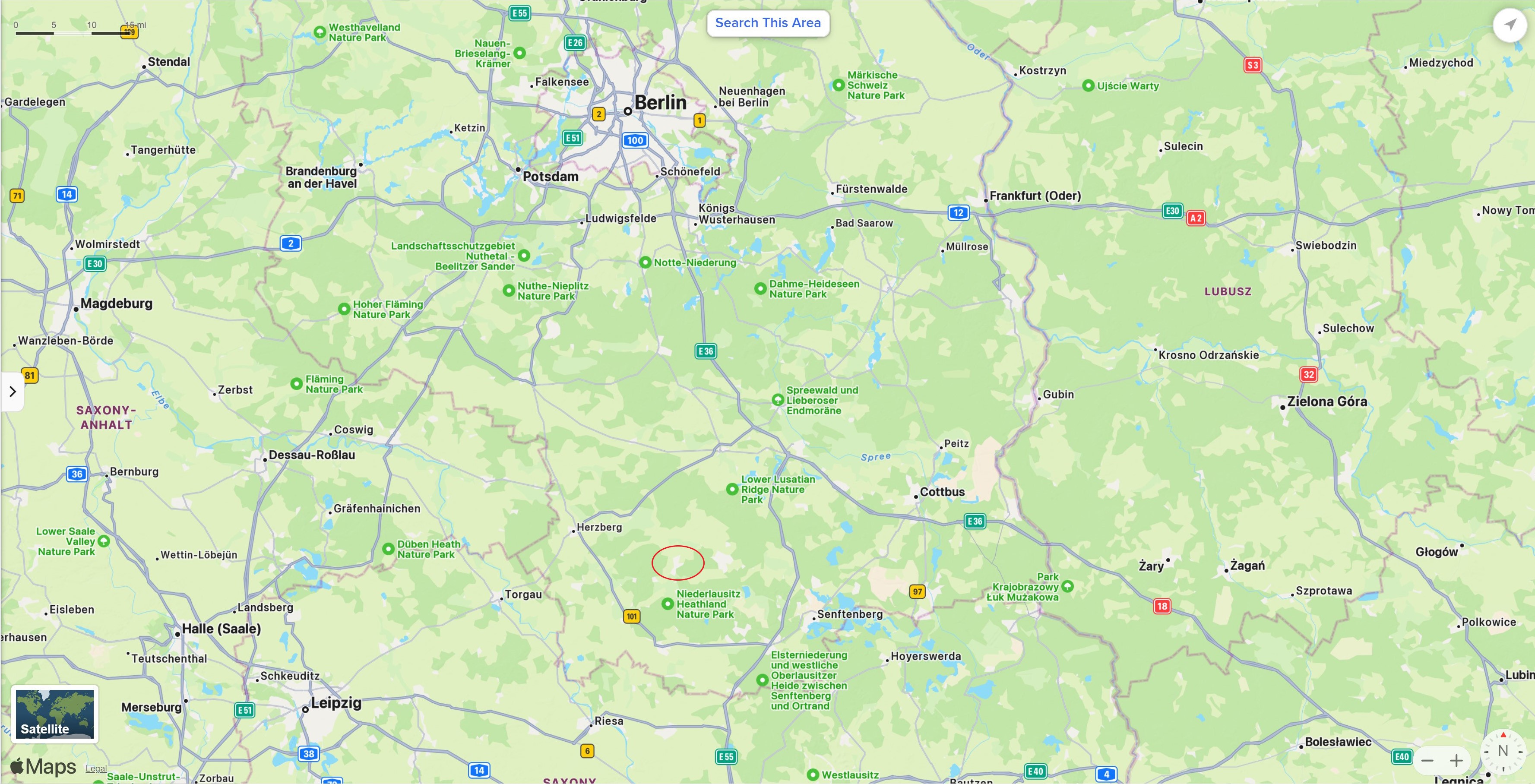
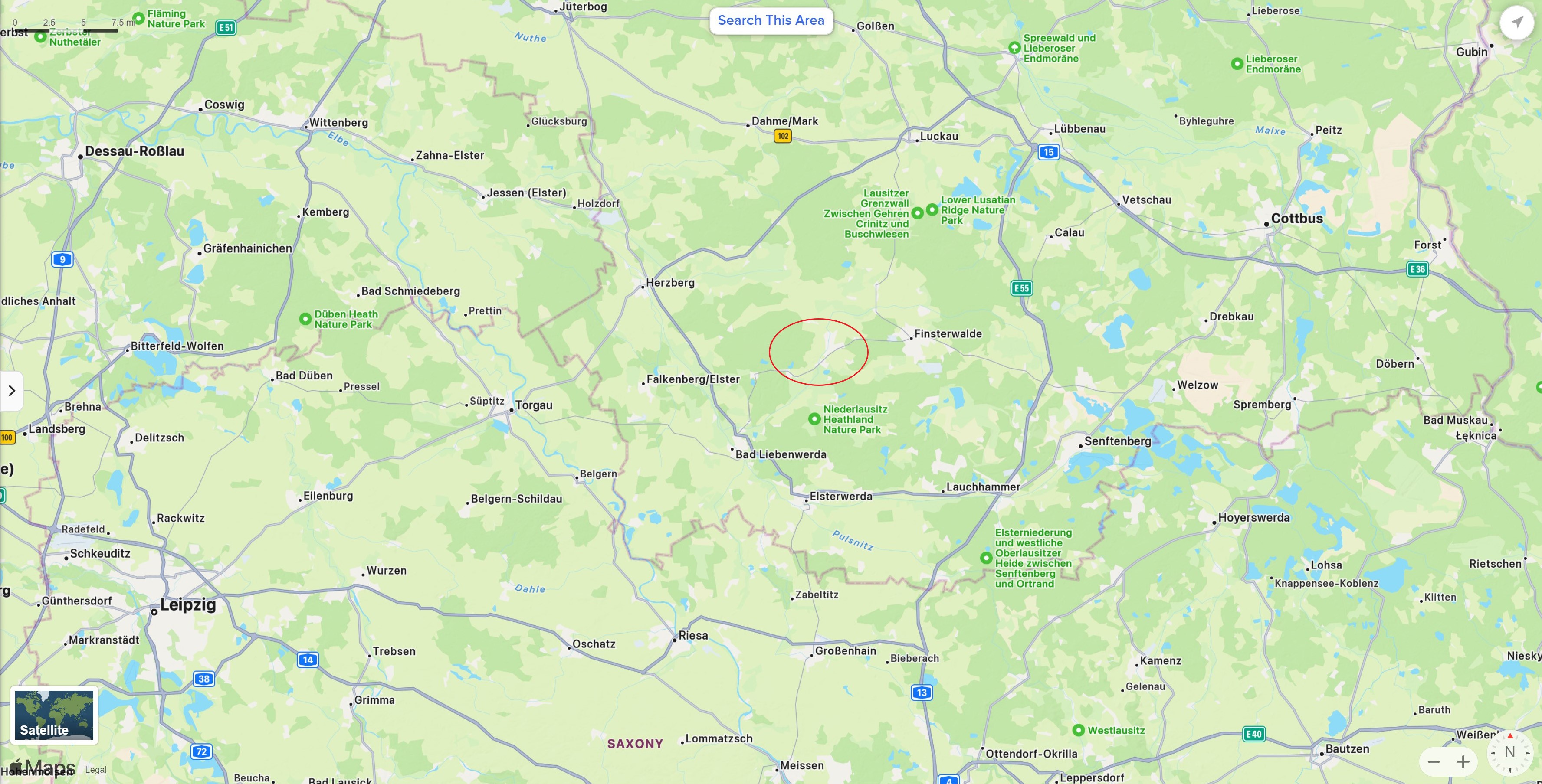
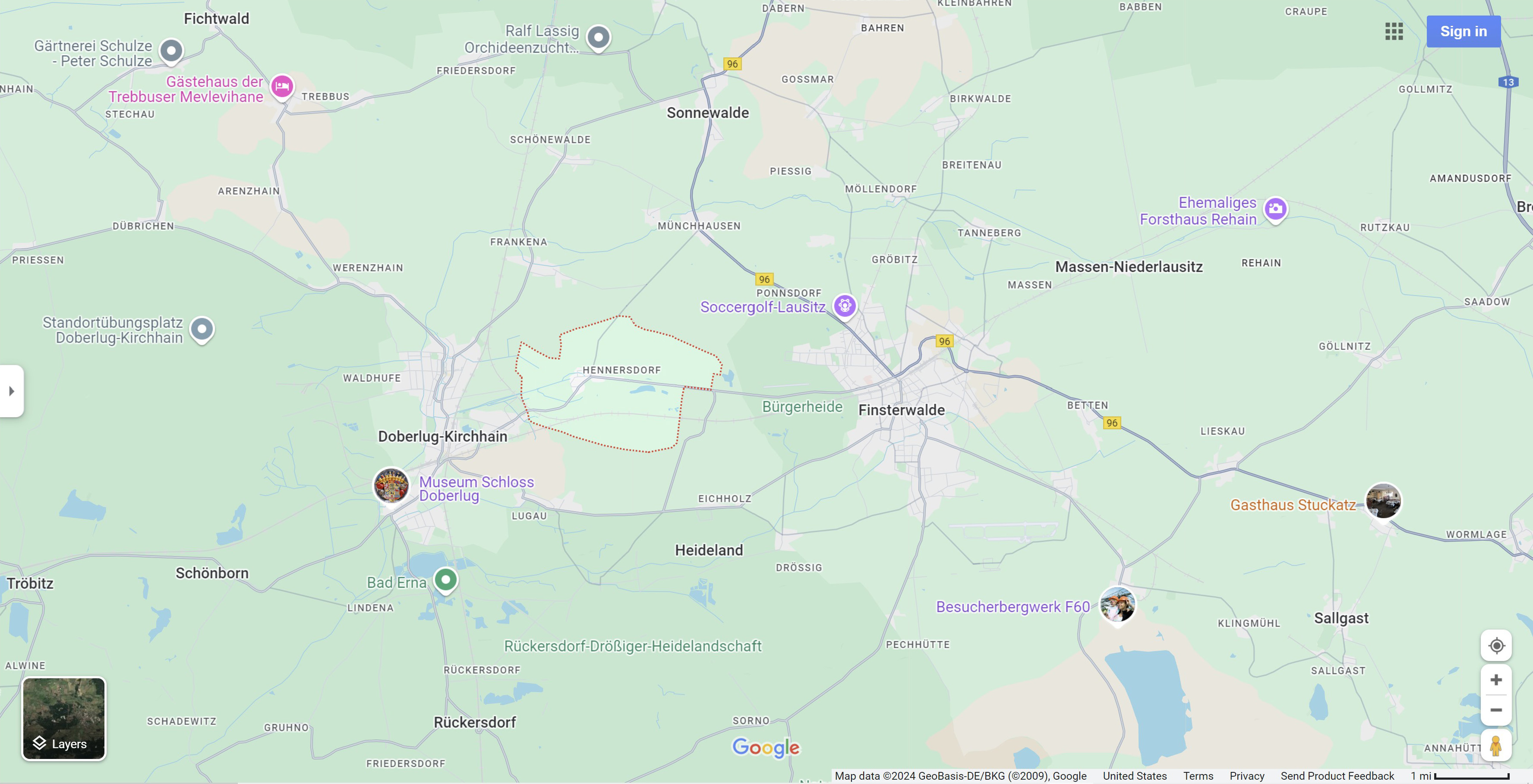
Despite the comprehensive coverage of J3 * N’s loss in the Missing Air Crew Report and Luftgaukommando Report, the precise location of the plane’s crash is hard to determine. FlightSafety lists the location as “4 km north-east of Doberlug-Kirchhain”, while Luftgaukommando Repoet KU 1174 lists two locations: “200 m vom Ostausgang nördlich Hennersdorf / n.b. Kirchhain Strasse Hennersdorf” (“200 m from the east exit north of Hennersdorf / n.b. Kirchhain Street Hennersdorf”), and, “ostausgang des Dorfes Hennersdorf bei Kirchhain, 200 m nördlich der Strasse” (“east exit of the village Hennersdorf near Kirchhain, 200 m north of the road”).
This map shows this general area relative to Berlin and Leipzig…
…while this larger scale view shows the setting in the context of Leipzig and Cottbus…
…and finally, this map shows the locations of Finsterwalde, and, Doberlug-Kirchhain.
More blog posts about March 8, 1944, will follow…
Two References
Dublin, Louis I., and Kohs, Samuel C., American Jews in World War II – The Story of 550,000 Fighters for Freedom, The Dial Press, New York, N.Y., 1947
Freeman, Roger, The Mighty Eighth: Units, Men and Machines, Doubleday and Company, Inc., New York, N.Y., 1970