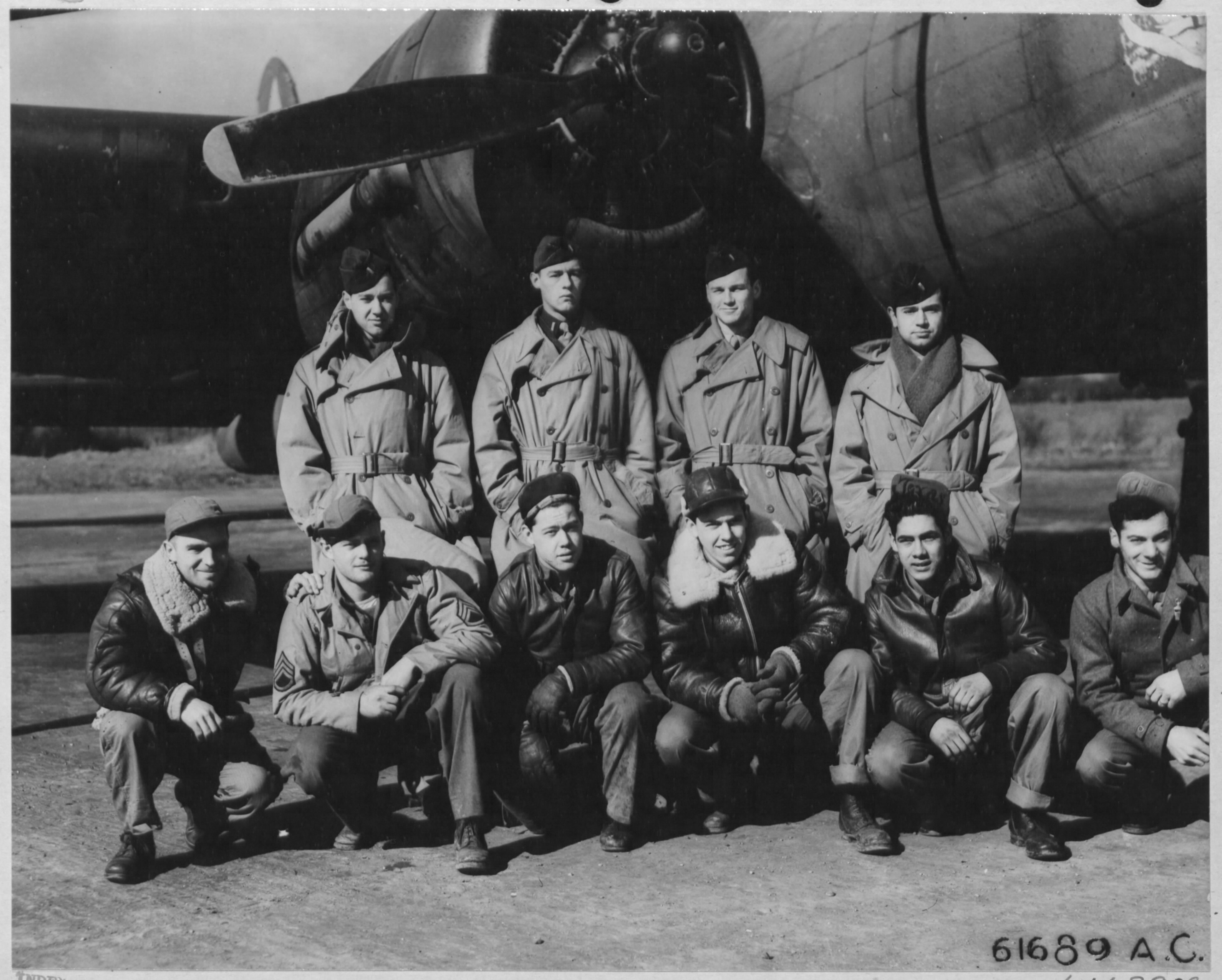
One purpose of this blog has been to present information about the military service of Jews, across a variety of eras, conflicts, and locations, with – well, at least so far, and for the immediate future – an emphasis on Jewish military service during the First and Second World Wars. Accordingly, most of the information and photographs thus far presented have focused upon the military service of Jews in the armed forces of the WW II Allies, and for WW I, both the Allies and Germany.
In terms of the Second World War, the post covering women drivers in Britain’s Auxiliary Territorial Service (the A.T.S.) was derived from and based upon a group of photographs published in Parade – Middle-East Weekly, on February 12, 1944.
But, Parade has far more to offer: One such item is a photo essay that was published in Parade’s issue of April 14, 1945, focusing on Pesach (Passover) services held by soldiers of the Jewish Brigade of the Second World War in late March of 1945.
____________________
Certainly well known in the Jewish press of the Second World War (both within and certainly beyond the English-speaking world) the singular significance of the Jewish Brigade was that – as a military formation, though small in terms of numbers – it manifested and symbolized a necessary and critical step on the path towards Jewish military and ultimately political autonomy, regardless of how tentative such autonomy actually was prior to May of 1948. For in the lives of nations as much as individuals, symbols (that’s why countries have flags) and symbolic actions can be as important as reality, for they can inspire; if not generate; if not perpetuate that reality. And, in a practical sense, postwar, members of the Brigade provided aid – physical, psychological, and spiritual – to survivors of the Shoah.
In terms of the unit’s actual designation, while popularly known as the “Jewish Brigade”, the unit was actually the “Jewish Infantry Brigade Group”, and was a component of the Palestine Regiment.
The Palestine Regiment itself had been formed in August of 1942, and was comprised of separate infantry companies (“Palestine Infantry Companies”) first formed in 1940 from among Arabs and Jews living in Mandatory Palestine, these companies – at that time – having been part of the Royal East Kent Regiment, otherwise known as “The Buffs”.
The Palestine Regiment was reformed in 1944, with the Brigade’s creation being announced on 20 September. The Brigade was comprised of three infantry Battalions (1st, 2nd, and 3rd), and the 200th Field Regiment, the latter a component of the Royal Artillery.
There are a number of interesting and valuable sources of information about the Jewish brigade, ranging from the scholarly to the more “popular”, differing in literary tone, style, and emphasis. Several such works are in English, while I suppose (?!) there are vastly more in Hebrew and Yiddish.
According to Appendix I of Morris Beckman’s The Jewish Brigade, the Jewish Brigade Group suffered the loss of 83 soldiers killed in action or died from wounds, and, 200 wounded. Beckman’s book does not delineate the criteria for the determination of these numbers, but, does mention that they’re based on information provided by the Commonwealth War Graves Commission, the Imperial War Museum, and, information in Jacob Lifshitz’s Sefer ha-Brigadah ha-Yehudit: Korot ha-ḥaṭivah ha-loḥemet ṿeha-matsilah et ha-Golah (Book of the Jewish Brigade / The Story of the Jewish Brigade Fighting and Rescuing the Diaspora) (ספר הבריגדה היהודית קורות החטיבה היהודית הלוחמת והמצילה את הגולה).
The Brigade’s awards are given as follows:
Military Cross – 4 Military Medal – 7 Member of the British Empire – 4 Commander of the British Empire – 1 Order of the British Empire – 2 United States awards – 2 Mentioned in Dispatches – 78
My research, based on the CWGC database, both volumes (1989 and 1994) of Henry Morris’ We Will Remember Them, and Yoav Gelber’s Jewish Palestinian Volunteering in the British Army During the Second World War), show the following losses:
Between April, 1941 and May, 1944: As members of the Palestine Regiment, before the establishment of the Jewish Infantry Brigade Group: 33 soldiers, killed in action and / or died on active service; one soldier (Pvt. Norbert Gabriel, PAL/11574) as a POW in Greece.
Between October 20, 1944, and May 7, 1945: After the actual formation of the Jewish Infantry Brigade Group, during combat in Italy: 40 soldiers.
From May 9, 1945 to November 20, 1946: Postwar, on active service: 19 soldiers.
Just as the date of the photographs is indicated in the article, so is the Brigade’s location: Near the Senio River, in northern Italy. This is described in greater clarity in Beckman’s book:
“On 23 March 1945 178 Company received new orders. They were to move up to the line at once, and again the long convoy, with their men eager for battle, took to the road. Eventually they reached their base at the small village of Brisighella. This was an idyllic spot, on a ridge from which they could look across orchards, olive groves and vineyards sloping down to the south bank of the Senio. Confronting their sector was the crack German 4th Paratroop Division. From their hilltop positions on the north side of the river, the Germans could observe the Brigade, especially during daylight hours, when their snipers and light artillery frequently reminded the more incautious Brigadiers that curiousity killed the cat.”
And with that, here’s Parade’s article…
FRONT LINE PASSOVER
Parade – Middle East Weekly April 14, 1945
“Parade” reporter GEORGE BONNEY and cameraman BELA ZOLA visit the Jewish Brigade during Passover
The Jewish Brigade is in action. They were firmly established on the Eighth Army front while World Jewry celebrated Passover. That their battle inauguration coincided with the age-old custom was, for them, an historical occasion for the word Passover, properly interpreted, means “The Festival of Freedom.”
Up in the line, near the Senio river, the Chaplain said: “We are now in the front line of the fight for freedom. It is an opportunity to avenge our people.”
Circumstances would not allow the full ceremony, but the troops began their eight-day ritual in the best way possible. Alert in their positions they observed the Seder — opening feast—with Palestine wine and Matzot. The Matzot or unleavened bread is essential because it commemorates the exodus of Jews from Egypt when, unable to wait for their bread to rise, they quickly baked flat cakes and fled.
The military authorities were extremely considerate and helpful. Matzot was provided through normal Army channels and, with a special consignment of Palestine wine, was sent up the line by mule train under the cover of darkness. Possible, but he couldn’t be everywhere. Some detachments were obliged to read their own Haggadah, a narration of the Exodus.
We traveled up to a forward position to see the preparations.
Dug in on the banks of the Senio, a mortar detachment prepared their feast with augmented Army rations. They planned to celebrate in the evening but cooked by day, because their derelict strongpoint received enemy attention at night. As a matter of fact, shells lobbed over during the day and their location is fast becoming scarred with yawning holes. Still, they grinned and filled hay box containers to await the appropriate time for the Seder.
In the husk of a farmhouse, barely 1,000 yards from the enemy, we saw an infantry platoon enjoy an Eve of Passover lunch. They ate in relays while some of their number cleaned weapons and the wireless operator, mug in hand, sat listening – intent on his task. Supplies had not caught up with them but, somewhere, somehow, they had gathered tulips and spring bulbs. Perched on the crazily warped window ledge, the flowers added a touch of gaiety to the desolation around them.
The M.O. was later going to take the service. They had set up their position behind a crumbled church. A knocked-out Sherman, relic of a former battle, provided sleeping quarters. With the earth scooped out from underneath and the turret cleared it affords a two-storied residence.
Later we visited a troop of 25-pdr gunners. Arrangements had been made to hold a service between the gun positions, but the rain streamed down, lightning flashed and the crashing of thunder mingled with the gun-fire. Hurriedly everything was moved into the attic of a nearby farmhouse and those of the troop not on duty crowded in to join the festival.
Lighted candles cast eerie shadows on the ancient rafters, but the gathering sang their Palestinian folk-songs with cheerful abandon. True, it was all part of their annual festival, but there was something more to it – determination and tremendous enthusiasm to carry on the fight. Indeed, training was speeded up and the Jewish Brigade entered the line earlier than was originally intended.
Volunteers from British units have transferred and there are representatives from more than 30 nations in the Brigade. Many are orthodox in their religious beliefs and everything is done to respect the Kosher principles. A Shohet (slaughterer) travels with H.Q., and live cattle are dealt with in suitable circumstances. At other times an alternative ration scale is issued, containing among other things, canned fish.
______________________________
“The Jewish Brigade, composed mainly of Palestinians but containing a number of United Kingdom Jews transferred from other units, is in action in Italy. Passover, festival of freedom, is celebrated in front line; Jewish chaplain leads congregation in reading from Haggadah, narration of exodus from Egypt.”
(Though no names are presented among the photo captions with the exception of Brigadier Benjamin, there is a clue to the identity of the officer leading Erev Seder Services: The three pips on his epaulette designate the rank of Captain. Based on Morris Beckman’s The Jewish Brigade, he is either (? – !) Captain Shimon Mazo, or, Captain Leon Shalit, both of whom – as junior chaplains – conducted Seder Night Services, which had been organized by Senior Chaplain Rabbi Bernard M. Caspar.
The very fact that the photo essay has a date associated with it – Pesach of 1945 – enables the determination of the time – let alone the day! – when this image was captured: About 6:35 P.M., Wednesday, March 28, 1945. (The 14th of Nisan, in the year 5705.)
______________________________
“Infantry platoon men off duty east Matzot, unleavened bread, drink Palestine wine, in much shelled farmhouse. Matzot was provided by a British D.I.D.”
(Coincidentally, one of the soldiers in the photo may be identifiable: A box or container of some sort, bent and folded, is prominently located in the right center of the table. Upon the end of this object is the surname “NADLER”. Is “Nadler” the soldier seated at the right center of the photo?)
(“D.I.D.”? – “Detail Issue Depot”)
______________________________
“Platoon signaler remains at his post, keeps contact with troops ever further forward. Platoon have to eat Passover lunch in relays as men come off duty.”
______________________________
“Monocled Brigadier E.F. Benjamin, commanding Jewish Brigade, a Canadian-born regular British Army officer, with some of staff.”
______________________________
“Company commander on way to battle-scarred farmhouse on top of hill keeps carefully to track as land is mined. Heaps of earth on left are dug-outs.”
______________________________
“Cookhouse of mortar detachment is only 1,000 yards from German lines and cook must raise as little smoke as possible or he will attract more enemy shells.”
______________________________
“Men of 25-pdr battery carry on with work. Service was to have been held between gun sites but storm forced men to farmhouse for service and eve of Passover supper.”
______________________________
Just as the date of the photographs is indicated in the article, so is the Brigade’s location: Near the Senio River, in northern Italy. This is described in greater clarity in Beckman’s book:
“On 23 March 1945 178 Company received new orders. They were to move up to the line at once, and again the long convoy, with their men eager for battle, took to the road. Eventually they reached their base at the small village of Brisighella. This was an idyllic spot, on a ridge from which they could look across orchards, olive groves and vineyards sloping down to the south bank of the Senio. Confronting their sector was the crack German 4th Paratroop Division. From their hilltop positions on the north side of the river, the Germans could observe the Brigade, especially during daylight hours, when their snipers and light artillery frequently reminded the more incautious Brigadiers that curiousity killed the cat.”
The series of maps and aerial photographs below – all from Google – show the Brigade’s approximate location at the time the above photographs were taken.
______________________________
______________________________
Northern Italy, showing major cities and highways. Though not visible at this scale, Brisighella is about half-way between Bologna and San Marino.
______________________________
Zooming in for a closer look. The Brigade’s approximate location is denoted by the red circle, to the southwest of Faenza.
______________________________
Closer… This map brings surrounding cities, towns, and roads into greater clarity.
______________________________
And, closer… Brisighella, the location of the Brigade’s headquarters, is denoted by the blue oval, while the probable disposition of the Brigade itself is indicated by the red oval just to the northwest or Errano. Though not labeled on the map, the Senior River (Fiume Senio) winds between Riolo Terme and Ponte del Castello.
______________________________
More detail. The Brigade headquarters and probable location of the Brigade itself are indicated in blue and red, while the Senio River is the very faint, very thin, blue irregular “line” alongside Riolo Terme, Cuffiano, Tebano, and Biancanigo.
______________________________
Here is an air (or satellite?) view of the map displayed above. Farms and cultivated areas are interspersed between hills.
______________________________
The Senior River can be seen as an irregular blue line meandering just south of Riolo Terme, Cuffaino, and Biancanigo, and north of Tebano. German troops would have been situated north of the river.
______________________________
And, an air / satellite view of the above.
______________________________
Finally, a map of 8th Army dispositions in the Imola area (from the 85th Infantry “Custermen” Division) illustrates the location of the Brigade in the context of other Allied military units during the second week of April, 1945. The location of the Brigade is indicated by the red oval.
Thus for Tommy Gould’s life before war: but what came before? This too is a story in its own right, but one that – with the passage of time and absence of records and correspondence – may likely remain only partially known.
As noted in Tommy Gould’s obituary in the Independent, and in more detail in his biographical profile at RN Subs, his father Reuben was killed in action in 1916, when Tommy was only two years old.
This singularly significant “clue” – a first name and surname – is all that is needed to return the following record from the CWGC database:
Reuben Gould
Serjeant GOULD, REUBEN Service Number L/7328
Died 22/07/1916 Aged 35
1st Bn., Queen’s Own (Royal West Kent Regiment)
Husband of Mrs. C.E. Cheeseman (formerly Gould), of 6, Woolcomber Lane, Dover.
So, it was true: Tommy Gould’s father lost his life in the Battle of the Somme. He was among the 141 men of the 1st Battalion, Royal West Kent Regiment who were killed in action, or died of wounds (among an initial total of 391 killed, wounded, and missing) on July 22, 1916, during a series of assaults on the German trenches at High Wood.
A verbatim transcript of the War Diary / Intelligence Summary of the R.W.K.R., 1st Battalion for that day – found within UK WW I War Diaries at Ancestry.com – is presented below. Note that the account concludes with details about casualties among officers, but not – perhaps inevitably, given the staggering number of killed and wounded – among Ordinary Ranks. Which, would have included Serjeant Gould.
This is the “cover” page of the War Diary….
….and this is the “first” page of eight, covering events of July 22, 1916.
During the day orders were received that the 13th Brigade in conjunction with Brigades on right and left was to attack at night Enemy position. As a preliminary operation the Battn. and 14th WARWICKS were to attack and capture trench along road at 10 PM. The main attack was timed to commence at 12:30 AM but was afterwards postponed 1 hour. The attack by the Brigade on our right was not to commence till 3:30 AM. The main objective was the Enemy’s trench which runs almost due EAST from the N part of HIGH WOOD. The Enemy however held an intermediate trench running partly behind and partly along the track running SE from E point of HIGH WOOD. Our front line along the track running SE from S point of HIGH WOOD. The Battn. was ordered to attack this intermediate trench, which was not visible from its own trench as it was some distance beyond the crest of a gently rising slope.
The main idea was that the Battn in conjunction with 14th R War Regt should attack the intermediate trench and consolidate it. When this had been done the 2 / K.O.S. Borderers were to pass over the intermediate trench and attack the main enemy trench in rear. The 15th R. War. Regt was in reserve.
The frontage allotted to the Battn was from the left of the trench at HIGH WOOD to point where enemy trench touched the road, a distance of approximately 400 yards. The 14th R. War Regt being on the right on a frontage of about the same breadth.
Orders to the following effect were issued to the Battn.: The hour fixed for the assault was 10 pm. & at that hour the barrage was to lift. A & B Coy’s were in the front line and were to attack in two waves. They were ordered to leave their own trenches before the barrage lifted and to get as close to the enemy trench as possible so that when the barrage lifted they could dash in. The second waves of these boys were to carry entrenching tools which were to be left as close to the enemy trench as possible before final assault. C Coy were ordered to occupy our original front line at 10 pm and as soon as enemy trench was captured they were to dig a support trench joining up the advance posts already made in front of our line. This Coy was also to join up E corner of HIGH WOOD with the captured trench. O.C. Coy had also to detail a bombing party under an Officer to seize enemy strong point at E corner of HIGH WOOD should such strong point be found to be held by enemy. The existence of this strong point was known of, but the Division on the left guaranteed to deal with it previous to the assault, and it was afterwards stated that we had 2 Vickers Guns in position at the E edge of HIGH WOOD. At the last moment, however, doubt arose as to the situation at this strong point, and in consequence of vagueness and uncertainty that existed, this party was detailed as an extra precaution. D Coy was ordered to occupy our front line trenches as soon as vacated by C Coy but to keep well to the left in order that the 2 / KOSB could use this trench as an assembly trench previous to their attack on main position. 2nd Lt. Dando with bombing party was ordered to accompany the first line on extreme left and investigate a short line of enemy trench which ran at right angles to & on the left of & beyond their front trench. If opposition was met he was to block this trench and wait till 2 / KOSB passed through, when he was to advance and seize it. C & D Coys, in spite of above orders, were to be prepared to support A & B Coys should necessity arise and in that case all work allotted to them was to be left. The position of Battn H.Q. was not to change. Each man carried two Mills Bombs (to form a reserve in captured trench) and an extra bandolier of ammunition. Communication to be by visual signaling (if smoke permitted) and by runner. Covering parties were to be put out directly position was captured. Wire for consolidating captured trench was to be carried up by D Coy. The attack was to be pressed home at all costs.
At the same time as this attack other Divisions were attacking on the left and the 95th Bde. Was to attack DELVILLE WOOD, but the latter operation could not be commenced until we had gained our objective.
A & B Coys left their own trenches at 9.52 pm and advanced without many casualties until arriving near the road on the crest of the hill, when they were met with extremely heavy rifle & M. Gun fire from direction of E corner of HIGH WOOD and enemy trenches N of Wood, but also suffered casualties by shells from our own Artillery falling short. Only two parties of these boys reached the enemy trenches. On the right about 30 men of A Coy reached enemy trench and entered it, but were attacked by the enemy with bombs, as the 14th R. WAR. on their right had failed to reach the trench, and as their own supply of bombs soon ran short they could not maintain their position. All the officers of this Coy. had become casualties. On the left Lt. J.J. SCOTT with 21 men of his Platoon entered the enemy trench and killed some Germans. Lt. SCOTT put out patrols in front, generally consolidated the position for a length of about 40 yds., and held on to it for about 4 hours. The enemy attempted a bombing attack on the left but this was frustrated by Pte. BUTLIN, who, stepping over the enemy bombs before they exploded, threw bombs of his own and drove the enemy back. These were the only two parties to reach enemy’s trench. C & D Coys both went up to reinforce, and later on a part of 2 / KOSB & 2 Coys of 15th R. WAR.R. were sent forward but the latter lost direction. Some reached enemy line but eventually all troops were withdrawn to our original front line. The bombing party of C. Coy, sent against the strong point in HIGH WOOD, found the corner of wood already in occupation by the Brigade on left, but it is believed that it was retaken by enemy. Lt. PEACHEY in command of party was himself wounded. It is however probably that the strong point itself was never reached and was further back from the corner than was supposed. In any case, the majority of the casualties in the Battn. were caused by M. Gun fire from here. Lt. DANDO with his party did not find the isolated trench on the left flank and returned to H.Q. to report the situation. He afterwards went forward again and brought back a further report. Lt. HEALEY, the Adjutant, was sent forward to reorganize parties who were in front of our trenches and bring them back to our original front line. He was, however, wounded when near the German trenches, and could not be brought in. Lt. CALE, Lewis Gun Officer, also reached the German trenches and assisted in reorganising the line.
Eventually some 250 men were collected by Capt. WRIGHT in our original front line.
On our right, 14th R. WAR. R. were met by a sustained fire of bombs & rifle & M.Gun fire, and did not reach the enemy’s trench.
The Casualties amounted to
Officers Killed – Missing – Wounded:14 (See below)
O.R. [Other ranks] Killed – Missing – Wounded377
The individual casualties among officers were as follows: –
A Coy Capt. COBB, W.R. was wounded very early in the fight 2 Lt. FLEMING, J.A. was wounded & missing [CWGC KIA “John Allister”]
2 Lt. CORNFORD, W.D. was missing [CWGC KIA “William Day”]
2 Lt. LEWINSTEIN, H. was killed by a bomb [CWGC “Harry”]
B Coy Capt. BENNETT, C.T. was wounded & missing [CWGC KIA “Charles Tudor”]
Capt. LEATHERDALE, D.R. was missing
2 Lt. FOX, C.J. was killed
C Coy Capt. OGLE, W.M. was wounded Lt. BULLEN, G. was wounded 2 Lt. PEACHEY, G.F. was wounded 2 Lt. CROSS, P.F. was wounded & missing [CWGC KIA “Philip Frank”]
D Coy Lt. BARTLETT, L.A. was missing [CWGC KIA “Lionel”]
2 Lt. GILLETT, F. was killed
H. Qrs. Lt. HEALEY, R.E.H. was wounded & missing [CWGC KIA “Richard Elkanah Hownam”]
Many acts of gallantry were performed, the following being the most conspicuous: –
No. 7725 Corporal GEORGE HATCH.
The Battn. when advancing to the assault of the German trenches, came under very heavy machine gun and shell fire and a large number of men were wounded. As the intensity of the fire did not diminish it was impossible for the stretcher bearers to go out and collect wounded. However Cpl. HATCH, who was in charge of the stretcher bearers, went out by himself, walked about in the open and carried wounded to cover in shell holes. This was done some 200 yards in front of our own lines and within very close range of the enemy machine guns. He afterwards carried back many of the men to our own line. He continued his work with the utmost coolness and disregard for personal safety for about 7 hours and until well after daylight when eventually he was himself wounded. He was under very heavy fire the whole time. He was seen to carry back at least 50 cases, and there is no doubt that he saved the lives of a large number of men.
______________________________
A search of Google Maps for the above-listed “6 Woolcomber Lane, Dover” yielded the following three maps, showing at successively larger scales southeastern England, then Dover, and finally Woolcomber Street (formerly Lane?) in Dover. Notably, while the map shows the nominal and presumably original location of the street, a 2018 aerial view of the same location reveals that none of the dwellings that presumably once existed there remain standing, a parking lot having taken their place.
An effort to find more information about Serjeant Gould’s family revealed the record below, from the 1911 Census of England and Wales. (Thanks, Ancestry.com!) Intriguingly, though there is no entry for Reuben Gould, it appears that Reuben’s wife – Tommy Gould’s mother? – appears as “Christian Elmer [Almer?] Gould, age 26. Christian is the daughter of Maria Mary Anna Irons (58 years old), and the mother of Sidney Robert Gould (age 1/ ½ years; Tommy’s older brother?) and sister of Morris William Irons, age 16 ½.
Being that Tommy Gould was born in 1914, his name by definition would not appear in this Census.
Notably, the document was completed by Maria Irons, who lists, below her signature, the address as 5 (not 6) Woolcomber Lane.
Reuben’s British Army WW I Medal Roll Index Card is presented below…
…and here is the Graves Registration Report for Caterpillar Valley Cemetery, with Reuben’s name appearing second from top. Notable is his designation as a Private (not a Serjeant, as listed in the CWGC record and Medal Roll Index Card), and the fact that his tombstone bears a Crucifix – not a Magen David – which presumably would indicate the religious affiliation he designated upon entering the Army.
If so – it may be so; it certainly seems so – this is reflective of the plethora of anecdotes, news items, and lengthy opinion pieces appearing in The Jewish Chronicle throughout the First World War – written by “ordinary ranks” as well as officers, rabbis, community leaders, intellectuals, and other public figures – pertaining to the decision by some Jewish servicemen to identify their religious affiliation as other than such upon entering the military. This topic was also addressed in the American Jewish Press during America’s involvement in the war.
Every man is an individual, subject to and both the captain and captive of his own strengths and weaknesses; his own fears and hopes; his own life experiences and observations. Such decisions would have been motivated by the same set of conundrums that have confronted the Jewish people ever since the beginning of Jewish emancipation only a few centuries ago: The desire to avoid antisemitism; the natural, universal, perennial human desire to want to smoothly belong to a “group” – any group – be that group military, civilian, or familial – without “rocking the boat”; pure self-interest; and even more than realized, a degree of acculturation and assimilation that would gradually and bear-inevitably have moved the centrality of Jewish identification – in time irrelevant or muted – to the quiet periphery of one’s life and priorities.
Far, far more could be said about this topic. Vastly amounts have already been written. Even in and after 2018, more will follow. But two excellent monographs on the subject – enlightening and disturbing; illuminating and disillusioning; revelatory and astute – are the late Barry Rubin’s Assimilation and Its Discontents (Times Books, 1995) and Radical Assimilation in English-Jewish History 1656-1945, by Todd M. Endelman (Indiana University Press, 1990).
In any event, though Serjeant Gould’s name did not appear in The Jewish Chronicle, or Reverend Michael Adler’s 1922 British Jewry Book of Honour, the names of two other serviceman – 2 Lt. Harry Lewinstein – (listed above) and Pvt. Hyman Rosenthall – did.
In its issue of 11 August 1916, as it did throughout the war, the Chronicle published the most recently available list of the names of Jewish soldiers reported killed, missing, wounded, and injured, or who died in service. Typical of WW I casualty lists presented in that newspaper, soldiers’ names are given in “descending” order by rank, with officers appearing first.
Importantly – exasperatingly, in terms of genealogical research! – throughout the war, the Chronicle rarely published a soldier’s full first (and middle, if any) name, instead using only his initials. I don’t know if this reflected the editorial policy of the Chronicle itself, or, was simply the format of Casualty Lists released by the War Office. In any event, the ambiguity inherent to some names can make the identification of specific, identically-named individuals more than challenging.
So, here is the Chronicle’s casualty list for August 11, showing (for the purposes of this post) only soldiers killed in action.
Genealogical information covering Jewish soldiers killed in action on July 22, 1916 – as well as two Jewish soldiers wounded on that date, Sapper Myer Joseph Isaacs and Gunner Cyril N. Mandelson, both Australians – follows below….
Known Jewish Military Casualties – July 22, 1916
Killed
– .ת.נ.צ.ב.ה. –
Ben Kimoun, Maurice Mouchi, Soldat de 2eme Classe, Armée de Terre, Zouaves, 3eme Regiment de Zouaves Number 11452, Class 1913, Matricule 1881, Recrutement Oran France (Algérie) Born in Oran, Algeria, 10/24/93 Killed by the enemy [Tué a l’ennemi]; France, Meuse, Bras Place of burial unknown l’Univers Israélite 9/28/17 Les Israelites dans l’Armée Francaise – 12 Le Livre d’Or du Judaisme Algérien (1914-1918) – 204
Braver, Max, Soldat de 2eme Classe, Armée de Terre, Infanterie, 352eme Regiment d’Infanterie Number 11135, Class 1915, Matricule 59, Recrutement 3eme Bureau, Seine France (Roumanie) Born in Craiova, Roumania, 12/2/77 Killed by the enemy [Tué a l’ennemi]; France, Somme, Assevillers Necropole Nationale “Lihons”, Lihons, Somme, France – Tombe Individuelle, No. 1685 Les Israelites dans l’Armée Francaise – Not listed Fraenkel, Bruno, Soldat, Deutsches Heer, 49 Infanterie Regiment, 2nd Bataillon, 6 Kompagnie Born May 5, 1884, Berlin, Germany Lived in Eberswalde (Missing) Place of burial unknown Die Jüdischen Gefallenen Des Deutschen Heeres, Deutschen Marine Und Der Deutschen Schutztruppen 1914-1918 – Ein Gedenkbuch – 138
Gros, Arnold, Soldat de 2eme Classe, Armée de Terre, Artillerie, 13eme Regiment d’Artillerie de Campagne Number 13716, Class 1917, Matricule 833, Recrutement 3eme Bureau, Seine France Born at 9eme Arrondissement, Paris, 9/19/97 Killed by the enemy [Tué a l’ennemi]; France, Somme, Mametz Necropole Nationale “La Cote 80”, Etinehem, Somme, France – Tombe Individuelle, No. 750 Les Israelites dans l’Armée Francaise – 38
Jonas, Emil, Soldat, Deutsches Heer, 252 Pioner Kompagnie Born Dec. 12, 1877, Hamburg, Germany Lived in Altona (Missing) Place of burial unknown Die Jüdischen Gefallenen Des Deutschen Heeres, Deutschen Marine Und Der Deutschen Schutztruppen 1914-1918 – Ein Gedenkbuch – 372
Kahn, Nathan, Soldat, Deutsches Heer, 1 Lazarett Trupp, Freiwilliger Krankenpflege Born Jan. 18, 1884, Munchen, Germany Lived in Altenstadt Place of burial unknown Die Jüdischen Gefallenen Des Deutschen Heeres, Deutschen Marine Und Der Deutschen Schutztruppen 1914-1918 – Ein Gedenkbuch – 292
Kronheim, Georg, Soldat, Deutsches Heer, 113 Infanterie Regiment, 2 Bataillon, 5 Kompagnie Mrs. Rosa (Brodek) Kronheim (wife); 1 child, Winsstrasze 4, Berlin, Germany Mr. and Mrs. Nathan and Maria Theresa (Lewinberg) Kronheim (parents), Berlin, Germany Born May 31, 1879, Berlin, Germany Lived in Berlin Judischen Friedhof zu Weissensee, Berlzu, Germany Hank, Sabine, and Simon, Hermann, Bis der Krieg uns lehrt, was der Friede bedeute [Until the War Teaches Us What Peace Means] Hentrich & Hentrich, Teetz, Germany, 2004, 79 Die Jüdischen Gefallenen Des Deutschen Heeres, Deutschen Marine Und Der Deutschen Schutztruppen 1914-1918 – Ein Gedenkbuch – 147
Lazarus, Hans Heinz, Soldat, Deutsches Heer, 223 Reserve Infanterie Regiment, 1 Bataillon, 1 Kompagnie Born April 20, 1894, Munchen, Germany Lived in Berlin (Missing) Place of burial unknown Die Jüdischen Gefallenen Des Deutschen Heeres, Deutschen Marine Und Der Deutschen Schutztruppen 1914-1918 – Ein Gedenkbuch – 292
Lebenstein, Manfred, Soldat, Deutsches Heer, 3 Garde Grenadier Regiment, 3 Bataillon, 12 Kompagnie Born August 3, 1886, Munchen, Germany Lived in Charlottenburg Kriegsgräberstätte in St.Quentin (Frankreich), Block 3, Grab 68 Die Jüdischen Gefallenen Des Deutschen Heeres, Deutschen Marine Und Der Deutschen Schutztruppen 1914-1918 – Ein Gedenkbuch – 292
Levi, Julius, Soldat, Deutsches Heer, 25 Reserve Infanterie Regiment, 2 Bataillon, 7 Kompagnie Born May 21, 1878, Schluchtern, Germany Lived in Kassel Place of burial unknown Die Jüdischen Gefallenen Des Deutschen Heeres, Deutschen Marine Und Der Deutschen Schutztruppen 1914-1918 – Ein Gedenkbuch – 330
Lewinstein, Harry, 2 Lt., British Army, Queen’s Own (Royal West Kent Regiment), 1st Battalion Mr. and Mrs. Lewis and Fanny Lewinstein (parents), 22 Great Windmill St., London, W, England Born London, England, 1889 KIA July 22, 1916 Caterpillar Valley Cemetery, Longueval, Somme, France – XXX,B,7 The Jewish Chronicle 8/11/16 British Jewry Book of Honour – 72
The 2017 Google Maps image below shows the contemporary appearance of the wartime home of the Lewinstein family: 22 Great Windmill Street, London, W., now the location of Soho Radio.
Rosenthall, Hyman, Pvt., 28134, British Army, Northumberland Fusiliers, 16th Battalion Mr. Isaac Rosenthall (father), 44 Grafton St., Leeds, England (also) 42 Whitlock St., Leeds, England Born 1893 KIA July 22, 1916 Blighty Valley Cemetery, Authville Wood, Somme, France – III,E,1 British Jewry Book of Honour – 115
This image of Hyman Rosenthall appeared in The Jewish World (The Jewish Chronicle’s sister publication) on May 2, 1917. The image was recorded from 35mm microfilm – at the Dorot Jewish Division of the New York Public Library – using a digital SLR. (I don’t think The Jewish World has yet been digitized.)
These two soldiers were wounded on July 22, 1916, but survived. Biographical information about them was found by reviewing their digitized Attestation Papers, via the website of the National Archives of Australia.
Isaacs, Myer Joseph, Sapper, 1288, Australian Imperial Forces, 3rd Tunneling Company Wounded in France Mrs. Ruby Isaacs (wife), Mayville, Tupper St., Marrickville, New South Wales, Australia Born Sydney, New South Wales, Australia, 1885 WIA July 22, 1916 British Jewry Book of Honour – 558 Attestation Papers list religion as “Jewish”; Civilian trade: Fitter
Mandelson, Cyril Nathaniel, Gunner, 3972, Australian Imperial Forces, 1st Field Artillery Brigade, Trench Mortar Battery Wounded at Pas de Calais, France Mr. Joseph Mandelson (father), 101 Victoria St., Darlinghurst, New South Wales, Australia Born Sydney, New South Wales, Australia, 1887 WIA July 22, 2916 British Jewry Book of Honour – 561 Attestation Papers list religion as “Jewish”; Civilian trade: Agent; Married: Ruby Jane Hannah Mandelson
Genealogical information about the ten other soldiers whose names appear in the Chronicle’s casualty list – aside from 2 Lt. Levinstein and Pvt. Rosenthall – follows:
Casualty List – The Jewish Chronicle – August 11, 1916
– .ת.נ.צ.ב.ה. –
Baum, Harry Hyman, L/Cpl., 22701, British Army, Border Regiment, 1st Battalion Mr. and Mrs. Nathan and Leah Baum (parents), Stepney, London, England (also) 7 Dempsey St., London, E, England Born 1894 KIA July 3, 1916 Louvencourt Military Cemetery, Somme, France – Plot I, Row D, Grave 2 The Jewish Chronicle 8/11/16 British Jewry Book of Honour – 79
Cohen, John, Rifleman, 5467, British Army, Rifle Brigade, 1st Battalion 86 Boundary St., Shoreditch, London, E, England KIA July 1, 1916 Thiepval Memorial, Somme, France – Pier and Face 16B and 16C The Jewish Chronicle 8/11/16 British Jewry Book of Honour – 84
Davis, J., Rifleman, R/15167, British Army, King’s Royal Rifle Corps, 13th Battalion 42 Vallance Road, London, E, England KIA July 10, 1916 Gordon Dump Cemetery, Ovillers-la-Boisselle, Somme, France – VII,Q,2 The Jewish Chronicle 8/11/16 British Jewry Book of Honour – 87
Gluckman, Samuel, Pvt., 6171, South African Infantry, 3rd Regiment Mr. and Mrs. J. and J. Gluckman (parents), 61 Fortescue Road, Yeoville, Johannesburg, South Africa (also) P.O. Box 66, Vereenigang, South Africa Born 1900 KIA July 9, 1916 Thiepval Memorial, Somme, France – Pier and Face 4C The Jewish Chronicle 8/11/16 British Jewry Book of Honour – 91
Jacobs, Joel, 2 Lt., British Army, Yorkshire Regiment, 5th Battalion Mr. and Mrs. Michael and Pearl Jacobs (parents), Harringay, 52 Walter Road, Swansea, England Born 1895 KIA July 20, 1916 La Laiterie Military Cemetery, Heuvelland, West-Vlaanderen, Belgium – VII,D,13 On Matzeva: “I WAS GUIDED BY THY COUNSEL AND AFTERWARD RECEIVED WITH THY GLORY” The Jewish Chronicle 8/11/16, 7/28/16 (obituary) British Jewry Book of Honour – 71
This picture of Lt. Joel Jacobs appeared in The Jewish World on August 23, 1916. Identical to that of Pvt. Rosenthall, the image was copied from microfilm via a digital SLR. Throughout the First World War, The Jewish World published several hundred portraits of Jewish servicemen of England and the Commonwealth countries, as well as more candid images of life in the military. The quality of these images varies enormously.
Levy, Lewis, Pvt., 18418, British Army, Hampshire Regiment, 1st Battalion Mrs. Sarah Levy (wife); Henry and Evie (children), 104 Eric St., Mile End Road, London, England (also) 132 Bridge St., London, E, England Mrs A. Levy, Mat, John, Mrs. Moss Harris, Mrs. Mark Harris, Mrs. L. Zimmerman, Mrs. R. Simmons, Morris, Kate, and Beck (brothers and sisters) Born 1893 KIA July 1, 1916 Bertrancourt Military Cemetery, Somme, France – Plot I, Row G, Grave 13 On Matzeva: “NOBLY HE ANSWERED HIS DUTY’S CALL” The Jewish Chronicle 8/11/16, 7/14/16 (obituary) British Jewry Book of Honour – 104
Lewis, J., Pvt., 16891, British Army, Somerset Light Infantry, 8th Battalion Mr. and Mrs. Lewis and Leah Lewis (parents), 11 Sandfield Road, Aberavon, Port Talbot, West Glamorgan, Wales Born 1892 KIA June 29, 1916 Norfolk Cemetery, Becordel-Becourt, Somme, France – I,A,81 On Matzeva: “IN LOVING REMEMBRANCE FROM MOTHER, SISTER, BROTHER R.I.P.” The Jewish Chronicle 7/21/16, 8/11/16 British Jewry Book of Honour – 105
Rubin, Jack, Pvt., 4583, South African Infantry, 9th Regiment Mr. and Mrs. Morris and Sarah Rubin (parents), Cape Town, South Africa Born 1894 KIA July 16, 1916 Dar Es Salaam War Cemetery, Tanzania – 2,A,14 On Matzeva: “MAY HIS DEAR SOUL REST IN PEACE” The Jewish Chronicle 8/11/16 British Jewry Book of Honour – 115
Shilling, Harry, Pvt., 2267, British Army, London Regiment, 7th Battalion Mrs. Eva Shilling (wife), 34 Peter St., Hightown, Manchester, England (also) 16 Mount St., London, E2, England Born 1881 KIA May 24, 1916 Aubigny Communal Cemetery Extension, Pas de Calais, France – I,C,24 On Matzeva: “IN LOVING MEMORY OF MY DEAR HUSBAND FROM HIS LOVING WIFE AND CHILDREN” The Jewish Chronicle 8/11/16 British Jewry Book of Honour – 116 British Jewry Book of Honour gives surname as “Schilling”, while CWGC and LJC Casualty List give surname as “Shilling”
Adler, Michael, British Jewry Book of Honour, Caxton Publishing Company, London, England, 1922
Hank, Sabine, and Simon, Hermann, Bis der Krieg uns lehrt, was der Friede bedeute (Until the War Teaches Us What Peace Means) Hentrich & Hentrich, Teetz, Germany, 2004
Die Jüdischen Gefallenen Des Deutschen Heeres, Deutschen Marine Und Der Deutschen Schutztruppen 1914-1918 – Ein Gedenkbuch, Reichsbund Jüdischer Frontsoldaten, Forward by Dr. Leo Löwenstein, Berlin, Germany, 1932 Les Israelites dans l’Armée Française (Israelites [Jews] in the French Army), Angers, 1921 – Avant-Propos de la Deuxième Épreuve [Forward to the Second Edition], Albert Manuel, Paris, Juillet, 1921 – (Réédité par le Cercle de Généalogie juive [Reissued by the Circle for Jewish Genealogy], Paris, 2000)
Le Livre d’Or du Judaisme Algérien (The Gold Book of Algerian Jewry) (1914-1918) (Réédité par le Cercle de Généalogie juive, Paris, 2000) [Avec la collaboration de Georges Teboul et de Jean-Pierre Bernard]
If war is characterized by chance and uncertainty, so too is the “information” that emerges from it, whether concerning strategy, tactics, weapons, economics, social trends, or of equal importance, the “Life and Fate” (intentional literary allusion, there…) of its participants.
For some WW II American servicemen – aviators, specifically – who were “Missing in Action” in the European Theater in 1944, news of their status would reach their families, and then be released to the news media, within roughly a month of their last recorded combat mission. Then, at some point within the next few months, further information – for good or ill – would follow.
For the families of other missing airmen, however, the passage of time would yield only uncertainty, continuing through and beyond the Allied victory in May of 1945: In some cases, only years after the war’s end would there be a definitive determination and confirmation of their final fate.
And, for many men who lost their lives in that conflict, final and definitive news remains pending. Even, in 2018.
An obituary about one missing airman appeared in The New York Times on October 23, 1945: Second Lieutenant Warren Heim. This was the first information about him to be published since he was first reported Missing in Action, in a Casualty List published on March 16, 1944.
Believe Bombardier Died In Action Over Germany
October 23, 1945
Second Lieut. Warren E. Heim, a bombardier of a Flying Fortress, who was previously reported missing over Brunswick, Germany, on Feb. 10, 1944, is now presumed to have been killed on that date, according to word received from the War Department by his mother, Mrs. Milton Heim of the Delmonico Hotel, it was announced yesterday. Twenty-four years old, Lieutenant Heim entered the Army Air Forces in February, 1942, and was attached to the Eighth Air Force.
Born in New York, he was graduated from the Pawling Preparatory School and left Yale University in his sophomore year to enlist. Besides his mother, he leaves a widow, Mrs. Sally Heim; a son, Peter Heim; a sister, Mrs. Julien Field, and his father, all of New York.
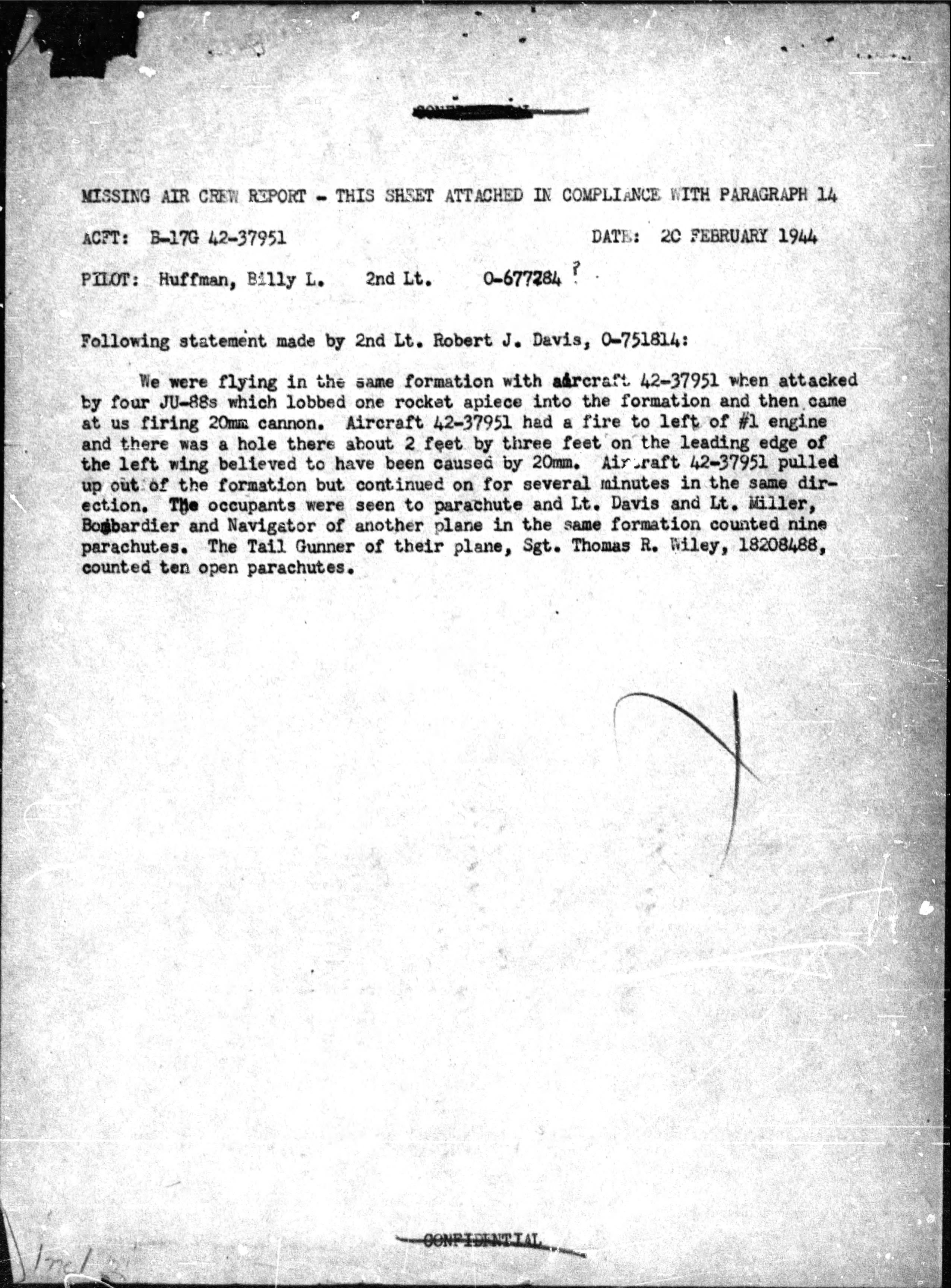
A crew member of B-17G 42-39961 (Bad Check) piloted by 2 Lt. Walter S. Tiska, Lt. Heim’s B-17 was lost in a mid-air collision with a Fortress (B-17G 42-31318) piloted by 2 Lt. Milton Turner. This occurred during the 8th Air Force’s mission to Brunswick on February 10, 1944. Only one crewman – tail gunner Sgt. Lewis T. Haas – survived from among the 10 airmen in Lt. Tiska’s plane. Covered in MACR 2537, and, Luftgaukommando Reports KU 834 and KU 837, Bad Check was an aircraft of the 730th Bomb Squadron of the 452nd Bomb Group, while Lt. Turner’s un-named bomber (in MACR 2536 and Luftgaukommando Report KU 839) was assigned to the 731st Bomb Squadron.
In time, Lt. Heim, serial number 0-736642, was found. He was buried at Plot P, Row 8, Grave 14, at the Netherlands American Cemetery, at Margraten, Holland. His military award of the Purple Heart, listed on page 343 of American Jews in World War II, suggests that he’d completed less than five missions prior to his death.
His family resided at the Delmonico Hotel, at 502 Park Avenue in Manhattan. A 2015 image of this building (now known as Trump Park Avenue) is shown below.
While prior blog posts covering Jewish WW II military casualties reported in the Times encompass – in a very general sense – servicemen from all branches United States armed forces (as well the armed forces of other Allied nations) the date of February 10, 1944 is unusual in that most of the Jewish military personnel who were casualties on that day (at least, those for whom there is documentation) were, like Lt. Heim, aviators in the 8th and 15th Air Forces of the United States Army Air Force.
They include:
2 Lt. Lee Mitchell, ASN 0-691784, son of Alma (Mitchell) Nussbaum, who resided at 110 W. 55th St., New York, N.Y.
Lt. Mitchell was Bad Check’s navigator. He was buried at collective grave 242-244, in section 84 of Jefferson Barracks National Cemetery, in Saint Louis, on October 25, 1950. (See the reference below to S/Sgt. Robert E. Honer.) Akin to Lt. Heim, his name appeared in the Times only once: in a Casualty List published on March 14, 1944. Also akin to Lt. Heim, the book American Jews in World War II, where his name appears on page 282, indicates that his sole military award was the Purple Heart.
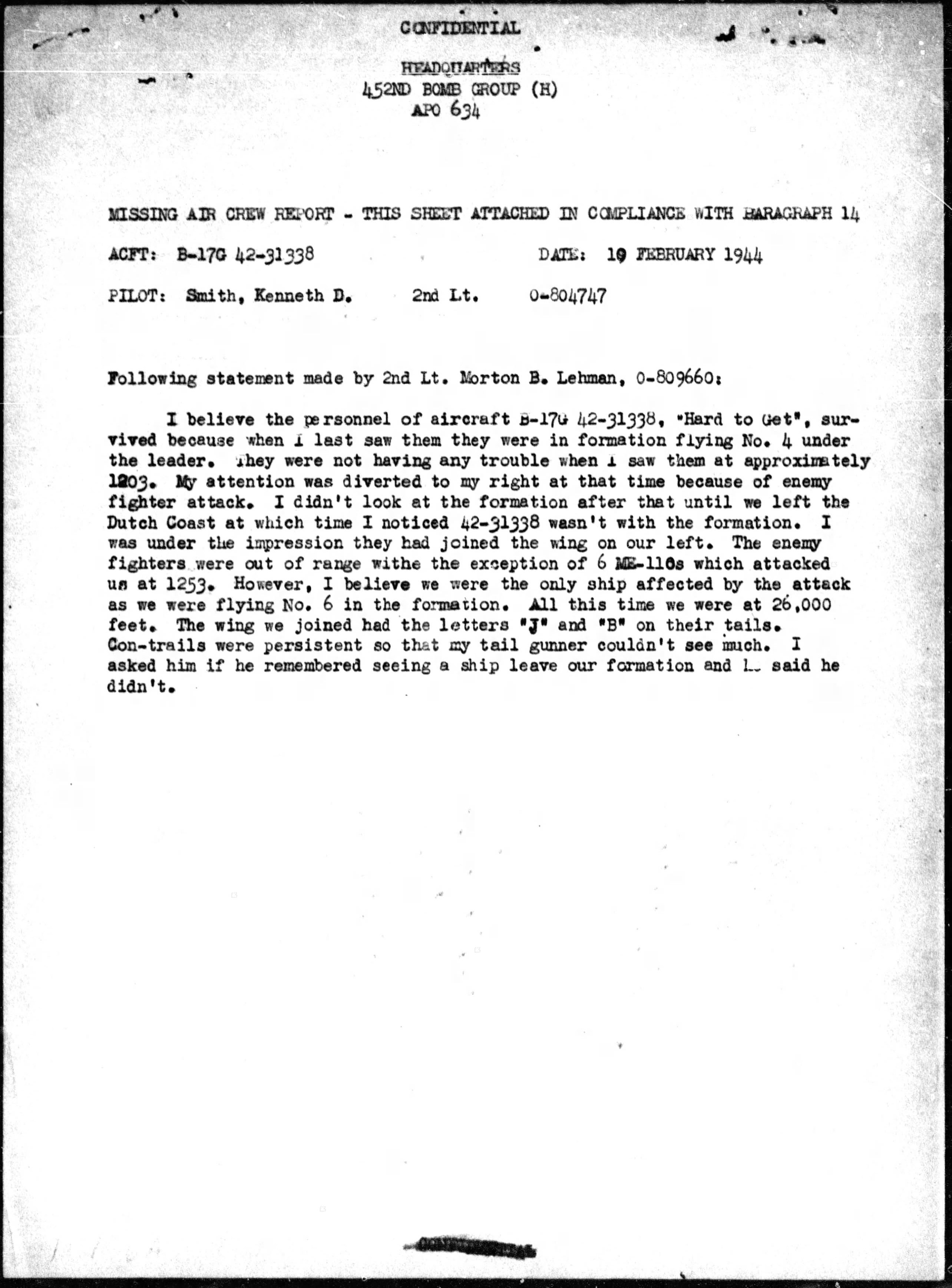
2 Lt. Milton Turner, ASN 0-800249, pilot of above-mentioned B-17G 42-31318.
Captured, Lt. Turner was imprisoned at North Compound 1 of Stalag Luft I, at Barth, Germany, his name appearing in a Casualty List published on April 25, 1944, and, in a list of liberated POWs published on June 21, 1945. Unlike Lieutenants Heim and Mitchell (and like very many other American Jewish WW II military casualties) his name does not appear in American Jews in World War II.
His wife was Sylvia Berne Turner, his two addresses having been listed as Apartment 8A, 250 West 85th St. in New York City, and, 99-71 65th Road in Forest Hills, Long Island.
_______________________
Some other Jewish military casualties on Thursday, February 10, 1944, include the following…
Akin to Bad Check, 1 Lt. Henry Sanford Levine and S/Sgt. Murray Podolsky were crewmen aboard 2 Lt. Clark A. Huddleston’s B-17G 42-31054, Irish Luck (QW * Q) of the 412th Bomb Squadron, 95th Bomb Group, the loss of which reported in MACR 2545 and covered in Luftgaukommando Report 119014.
Nine of the plane’s crew of ten survived; Sergeant Podolsky did not. As reported in the MACR, when crewmen in the rear of the aircraft were about to bail out through plane’s rear entry door, Sgt. Podolsky was killed by shrapnel from either a 20mm cannon shell or aerial rocket that struck the plane’s tail-wheel assembly. He never left the aircraft.
German investigators could not identify him. They listed him as an unknown, for he was not wearing his dog-tags.
Biographical information about both men follows:
Levine, Henry Sanford, 1 Lt., 0-811682, Navigator, Air Medal, Purple Heart, 6 missions Wounded; Prisoner of War at Stalag Luft I, Barth, Germany (South Compound) Born 1916; Died 4/14/84 Mr. and Mrs. Jacob and Rose Levine (parents), 306 Maple St., Syracuse, N.Y. Graduate of Syracuse University College of Law, Class of 1939; Graduated from Selman Field, Monroe, La., 9/43 MACR 2545 Syracuse Herald-Journal 1943, 6/2/44, 7/15/44, 5/20/45, 8/5/45; 3/16/44, 5/17/44, 5/31/45 American Jews in World War II – 377
Podolsky, Murray, S/Sgt., 12181503, Gunner (Right Waist), Air Medal, Purple Heart, 5 missions Mrs. Rose Podolsky (mother), 654 Beck St., Bronx, N.Y. MACR 2545 Ardennes American Cemetery, Neupre, Belgium – Plot C, Row 33, Grave 7 Casualty Lists 3/16/44, 11/19/44 American Jews in World War II – 406
Some years ago, I interviewed some veterans who’d been prisoners of war at Stalag Luft I, with a focus on the implication of being a Jewish Prisoner of War in Germany. Some of these men distinctly remembered Henry Levine, describing him as having been highly educated, and, confidently maintaining a strong Jewish identity even as a POW of the Germans.
The latter quality extended to organizing and leading Jewish religious services.
This is recounted in detail by Bernard B. Levine (a bombardier in the 418th Bomb Squadron of the 100th Bomb Group, shot down and captured on February 4, 1944) at Aaron Elson’s TankBooks. Based on the reference to the Kol Nidre prayer in Mr. Levine’s account, it would seem that Jewish religious services at Stalag Luft I transpired from early 1944 at least through September of 1944, since Kol Nidre that year took place on the evening of September 26 (9 Tishri 5705).
Along with the appearance of his name in Casualty Lists published in the Times (and a list of released POWs published on May 31, 1945), at least four articles about Lt. Levine appeared in the Syracuse Herald-Journal. One of these, an interview on August 5, 1945, recounts Lt. Levine’s experiences in detail, albeit curiously (but not at all unexpectedly, given the nature of that era) not addressing the aspect of having been a Jewish prisoner of war. These articles, found via Fulton History (Thomas M. Tryniski’s website),are presented below, and include Henry Levine’s obituary from April of 1984.
Parents Hear From Levine
Syracuse Herald-Journal
July 2, 1944
Mr. and Mrs. Jacob Levine of 306 Maple Street have received a card from their son, 2d Lt. Henry S. Levine, now a prisoner of war of Germany. The card was written Feb. 19, nine days after Levine was taken prisoner.
The Lieutenant writes he is in the best of health, has plenty of food and “we are treated well. You need not worry about me any more. As soon as I get a permanent address have everybody write often. The Red Cross is wonderful.”
Lt. Levine was first reported missing in action and later was reported as a prisoner. He was captured when his plane went down in Germany.
Lt. Levine was in law practice in Syracuse before joining the Army.
Lt. Henry S. Levine Writes His Parents From Prison Camp
Syracuse Herald-Journal
July 15, 1944
A report on how American officers fare in one German prison camp is given by Lt. Henry S. Levine in two letters to his parents, Mr. and Mrs. Jacob Levine of 306 Maple Street.
In one letter dated March 3 at Kriegie Camp, Lt. Levine wrote he is getting pretty well settled here with a swell bunch of fellows. “Some are boys in my class at Monroe and a few from Syracuse. All the officers of my crew are with me. None of us was injured. We eat well, thanks to Red Cross packages, added to the German ration list. We bake pies, puddings and cakes – good, too.
“We have our own officers with an American colonel, in charge. We have a fine library, a theater, a swing band and a classical orchestra. Almost every day there is a concert or a play. There was a remarkable arts and crafts exhibit today, beautiful creations made from little or nothing. One man has made his own lathe.
Lt. Levine was navigator on a Flying Fortress. He was graduated from the College of Law, Syracuse University in 1938 and was engaged in the practice of law before entering the Army.
Levine Free After Year in Nazi Prison
Syracuse Herald-American
May 20, 1945
A belated Mother’s Day telegram brought inexpressible joy to a Syracuse family yesterday.
The message indicated that the only son of Mr. and Mrs. Jacob Levine, 306 Maple Street, Lt. Henry S. Levine, a prisoner of war in Germany for over a year, has been safely returned to Allied military control. It is the first word the parents have heard since the middle of March when he wrote from Stalag 1 that “all was as well as could be expected.”
Addressed to his mother, Mrs. Rose Levine, the Mother’s Day greeting read:
“All well and safe. My love a greetings on Mother’s Day. Love to all at home, Henry.”
For reasons of military security, the telegram was dated “without origin.”
A graduate of the College of Law, Syracuse University, in 1938, Lt. Levine was associated with the law firm of Andrews, McBride, Parsons & Pomeroy before he enlisted in the air forces in January, 1942. He was graduated from the Selman Field Navigation School at Monroe, La., in September, 1943, and went overseas in December. On his sixth mission over Germany as a Flying Fortress navigator the Syracusan was shot down with the rest of his crew Feb. 10, 1044.
Captive, American Officers Fool Nazi Guards With Disparaging Wise-Cracking
Lt. Henry S. Levine in Syracuse For First Time in Three Years
Syracuse Herald-American
August 5, 1945
“Goon, front.”
No, not a sassy room clerk, but an American prisoner of war letting his fellow internees know a German guard was on hand.
And it was weeks before even the literal-minded English-speaking Nazis caught on to such American disparaging wisecracking. Then “goon” became verboten and penalty for its use was solitary confinement.
BUT SUCH WAS the indefatigable humor of Yank officers, even under trying conditions, that other belittling names were soon substituted.
The dramatic story of 15 months of imprisonment at Stalag Luft No. 1 on the shore of the Baltic was told today by Lt. Henry S. Levine, of 306 Maple St., back in Syracuse for the first time in three years.
An attorney in the S., A. & K. Bldg., Levine, the son of Mr. and Mrs. Jacob Levine, enlisted in the Army Air Forces and was trained as a navigator. In February, 1944, on his sixth mission, he was shot down over in a Flying Fortress over Germany. April 30 the Nazi prison camp where Levine was held was liberated by the Russian. The camp was filled with more than 9,000 A.A.F. officers.
FIRST THING the Syracusan did when he returned home was get a license plate for the family care. Since his parents do not drive, the auto had been idle since the son went to war.
“Funny, but all during my imprisonment, even when I was famished for want of food, I had a strong desire to drive a care again. I could hardly wait, and sometimes, especially in the dark hours of last February and March, I wondered if I’d ever live to drive one again!” the lieutenant exclaimed.
“YOU HAVE no idea how wonderful home looks to a fellow who has been imprisoned. In camp we used to argue about which part of America is most beautiful. And I’ll still take Syracuse,” Levine declared. “When we were liberated, we heard things were tough in the States, what with rationing and so forth. But Syracuse still looks like the land of plenty to me.”
When Levine parachuted out of his Flying Fortress, leaving a dead waist gunner behind, he was badly bruised by the landing. “It was my first jump,” he recalled.
“WE LANDED on a German farm and I believe some of the laborers must have been slave workers for they appeared glad to see Americans. However, we were soon hustled to a railroad station and imprisoned. It was relatively early in the war and we were regarded with curiosity. It is a funny feeling to have people stare at you and poke you, you can imagine.
“Next, we were sent to a reception center at Frankfurt where hot water, food and a toothbrush were most welcome. After being hungry and dirty for almost a week, we sang in the showers.
“But soon we were moved to the Baltic coast and imprisoned. New prisoners were most welcomed for it meant news from the outside world. The officers’ camo was efficiently organized and there was enough activity to keep a man’s mind off his plight, if he tried.
“BUT IT IS no exaggeration to say many of us would have starved if it had not been for Red Cross packages. German food was scarce and miserable. Many men had suffered for lack of dental care.”
On the lighter side, Levine told of the educational courses and recreational programs. “There were teachers for almost any subject a prisoner would wish to study. I went in for languages, adding to my basic knowledge of Russian, which, incidentally, came in handy when Joe Stalin’s men finally liberated us.
“Some fellows even studied engineering. As for entertainment, with camp talent and musical instruments furnished by the International Y.M.C.A., we put on shows that were as good as some I’ve seen on Broadway.
“BUT DESPITE the camp activities, let me assure you, imprisonment under the Nazi was far from fun. The mental strain began to tell on many of us. Men listen to any rumor, the wilder the better. Most of us lost weight. I lost 30 pounds.”
Nazi soldiers were arrogant and unreasonable most of the time, Levine said. Only courtesy shown on their part was so-called military courtesy.
The day the Russians overtook the camp was the equivalent of a Roman holiday. Russians, even more demonstrative than excited Yanks, danced and yelled when they embraced the Americans. The Germans had evacuated the camp in a hurry a few days before.
“IMMEDIATELY, the Russians fed us all the food we wanted,” Levine said. “Cow after cow was slaughtered. But there was so much international red tape to unwind that it was several days before we could leave. Fortunately, my knowledge of Russian enabled me to help unwind some of this tape.
“At last, we were flown to France, and then moved to England. I managed to visit Paris where the GI has taken over completely. Prices are exhorbitant. Champagne is $30 a bottle. The theaters are so crowded that getting tickets is a problem.
“WELL-KNOWN Parisian nightclubs like the Lido and Bal Tabarin are in full swing. Paris suffered little from bombings and the city was as beautiful as ever.
As for England, Levine is not fond of John Bull’s weather, but has great love for the people. To prove his point, he produced snapshots of many English friends, including whole families, whom he met. He passed a month in that country before he was brought home last week by Liberty ship.
“WHAT’S HE going to do on his 75-day leave before reporting to Atlantic City for reassignment?
Play golf. And then play golf some more, because at Stalag Luft No. 1 the authorities didn’t seem to appreciate the sport.
Henry Levine
Eagle Bulletin
April 18, 1984
Henry Levine, 67, of 7173 East Genesee St., Fayetteville, died Saturday, April 14.
Mr. Levine was a life resident of the Syracuse area. He graduated from Syracuse University in 1937 and from its College of Law in 1939. He was an attorney in the Syracuse area for 20 years and most recently worked for the New York State Job Service as a lecturer and senior employment technician.
He was an Army Air Force lieutenant and navigator in the European Theater in 1944 when the airplane in which he was flying was shot down. He spent 15 months in a prisoner of war camp in Barth, Germany.
At that time, Mr. Levine organized and led what is believed to have been the only Jewish congregation in Nazi Germany, translating a Hebrew prayer book from memory. He was an interpreter for the Russian military when the camp, Stalag Luft I, was liberated. He received the Purple Heart with Oak Leaf Cluster and the Air Medal for bravery.
Mr. Levine was a former Democratic committeeman and sought election to the former Onondaga County Board of Supervisors.
He was a member of Onondaga Post 131, Jewish War Veterans, the Air Force Association, and the Syracuse University College of Law Association. He was a former member and past president of Congregation Anshe-Sfard and was a current member of Temple Beth El.
Mr. Levine is survived by three sons, Ronald, Jonathan, and Richard.
Much more information is now available about Henry Levine’s story, though the efforts of Richard and Ronald.
Richard has written a book about his father, entitled The Mogen David of Barth on the Baltic – A True Story, which is described (and includes contact information) at a Facebook page dedicated to his father, and is linked to a companion video, which is set to the melody of the Kol Nidrei prayer. The Cedar Rapids Gazette features an account of Ronald’s 2015 presentation at Temple Judah (in that city) about his father’s experiences.
Ronald, a Grammy Award winning composer and violinist, has created an instrumental composition also entitled The Mogen David of Barth on the Baltic, which forms the background music of a video created together with Richard, the video including images of a two-piece (and therefore unrecognizable by German camp personnel) hand-made wooden Mogen David fashioned by their father specifically for religious services at Barth.
______________________________
During the Second World War, Jewish religious services were apparently held by American Jewish POWs at one other German POW camp. This was at Stalag Luft III, at Sagan Germany, the prisoner-of-war camp well-known (well, maybe no longer in 2018…?) in popular culture and historical fact as the location of “The Great Escape” of March 25, 1944. As indicated by the audio clip below – part of a far lengthier interview of ex-POW Lawrence Levinson – Shabbat services were held in the West Compound of Sagan during mid-1944, but seem to have “petered out” well before the forced evacuation of the camp on January 27, 1945.
The audio comprises the following sections:
1) 0 – 1:25: Thoughts about implications of being a Jewish POW of the Germans; Unsuccessful effort by German authorities to identify and potentially segregate (a la Stalag Luft I, at Barth, and Stalag IXB, at Bad Orb) American Jewish POWs during Winter of 1944-45 – stymied by Colonel Darr H. Alkire.
2) 1:26 – 6:15: Jewish religious services in West Compound of Stalag Luft III.
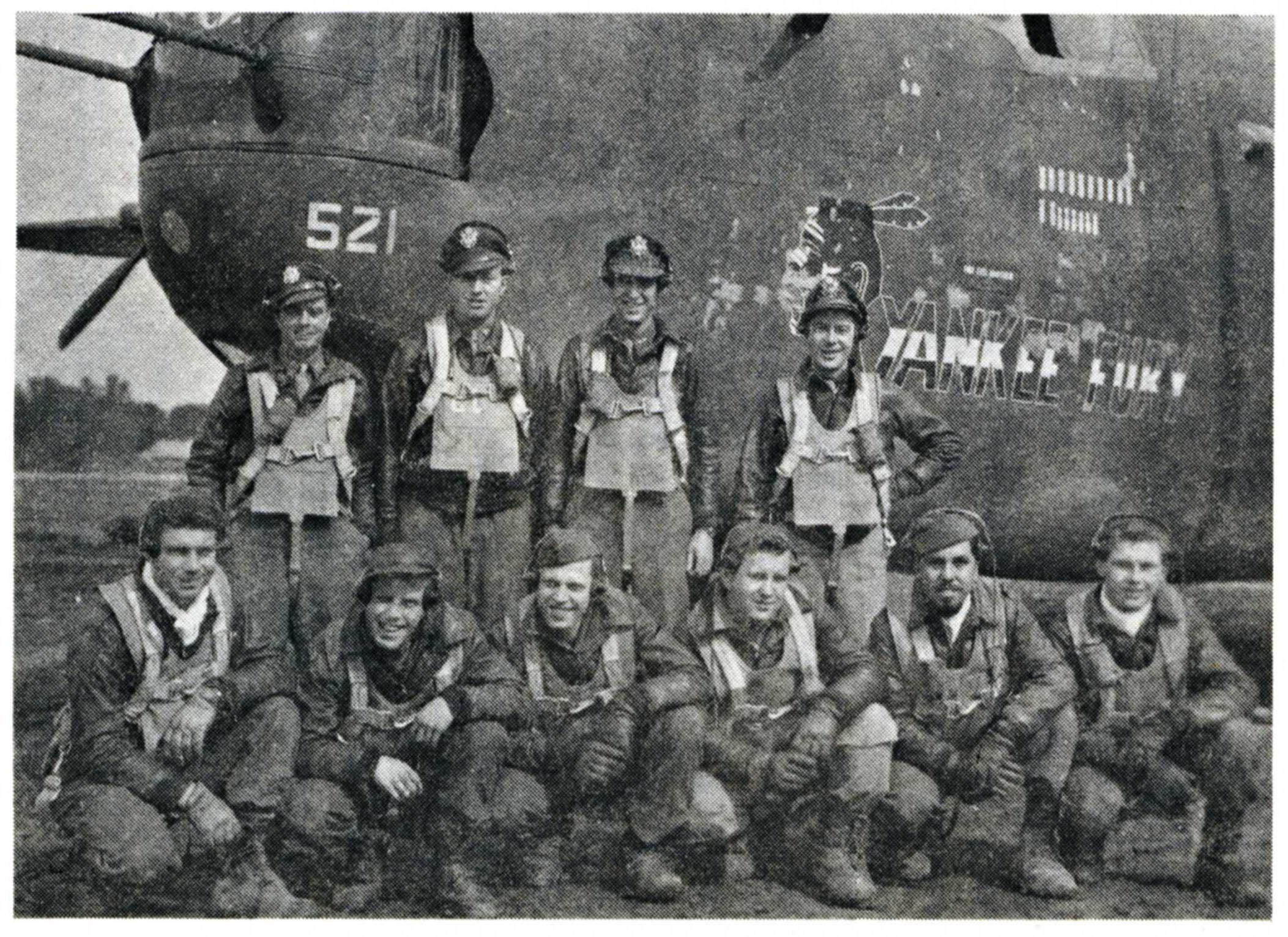
“Larry” Levinson, a navigator in the 721st Bomb Squadron of the 450th “Cottontails” Bomb Group, was captured in central Italy in early May of 1944, having evaded capture for a time after his aircraft (B-24G 42-78189, piloted by 1 Lt. Howard L. Andersen, covered in MACR 4645) was shot down by Me-109s of Jagdgeschwader 53 on April 25, one of seven Cottontail Liberators lost that day. Eight members of his crew survived as POWs. One, Sgt. Byron H. Nelson, of Vinton, Iowa, long interred in Italy as an “unknown”, was finally identified only a few years ago, and buried at Primghar, Iowa in July of 2017. The other casualty was Sgt. John E. White, who was on his first mission. The “Colonel Alkire” mentioned in the interview is Colonel Darr H. Alkire, who, as commander of the 449th Bomb Group, was shot down on January 31, 1944 while piloting Lurchin’ Urchin (B-24H 41-29223, of the 717th Bomb Squadron; see MACR 2403) eventually becoming the senior Allied officer in the West Compound of Stalag Luft III.
A photo of the Andersen crew, at Manduria Italy, some time before April 25, 1944, from Sortie – Fifteenth Air Force (Vol. IV, No. II, 1987).
Rear, left to right:
2 Lt. Joseph F. Henchman – Co-Pilot – POW 2 Lt. Lawrence Levinson – Navigator – POW 1 L. Howard L. Andersen – Pilot – POW 2 Lt. George W. Murray, Jr. – Bombardier – POW
Front, left to right:
S/Sgt. Byron H. Nelson – Nose Gunner (KIA – this was his last scheduled mission) S/Sgt. William J. Ford – Radio Operator – POW S/Sgt. Fred L. Walch – Flight Engineer – POW Sgt. Charles Shafer – Waist Gunner (Not on the crew’s last mission) Sgt. Robert Acosta – Ball Turret Gunner (not on the crew’s last mission; replaced by Sgt. John E. White, who, on his first mission, was KIA) S/Sgt. Edward W. Molenda – Tail Gunner Not pictured is S/Sgt. Raymond F. Welty, who served as Flight Engineer on the last mission, and survived to become a POW
Yankee Fury, B-24H 42-52109, was lost in a mid-air collision over the Mediterranean Sea on March 24, 1944. Piloted by 1 Lt. William E. Whalen, the aircraft collided with B-24H 41-29222 “(Deuces Wild“), piloted by 2 Lt. Elmer J. Hartman. There were no survivors among the twenty men aboard the planes.
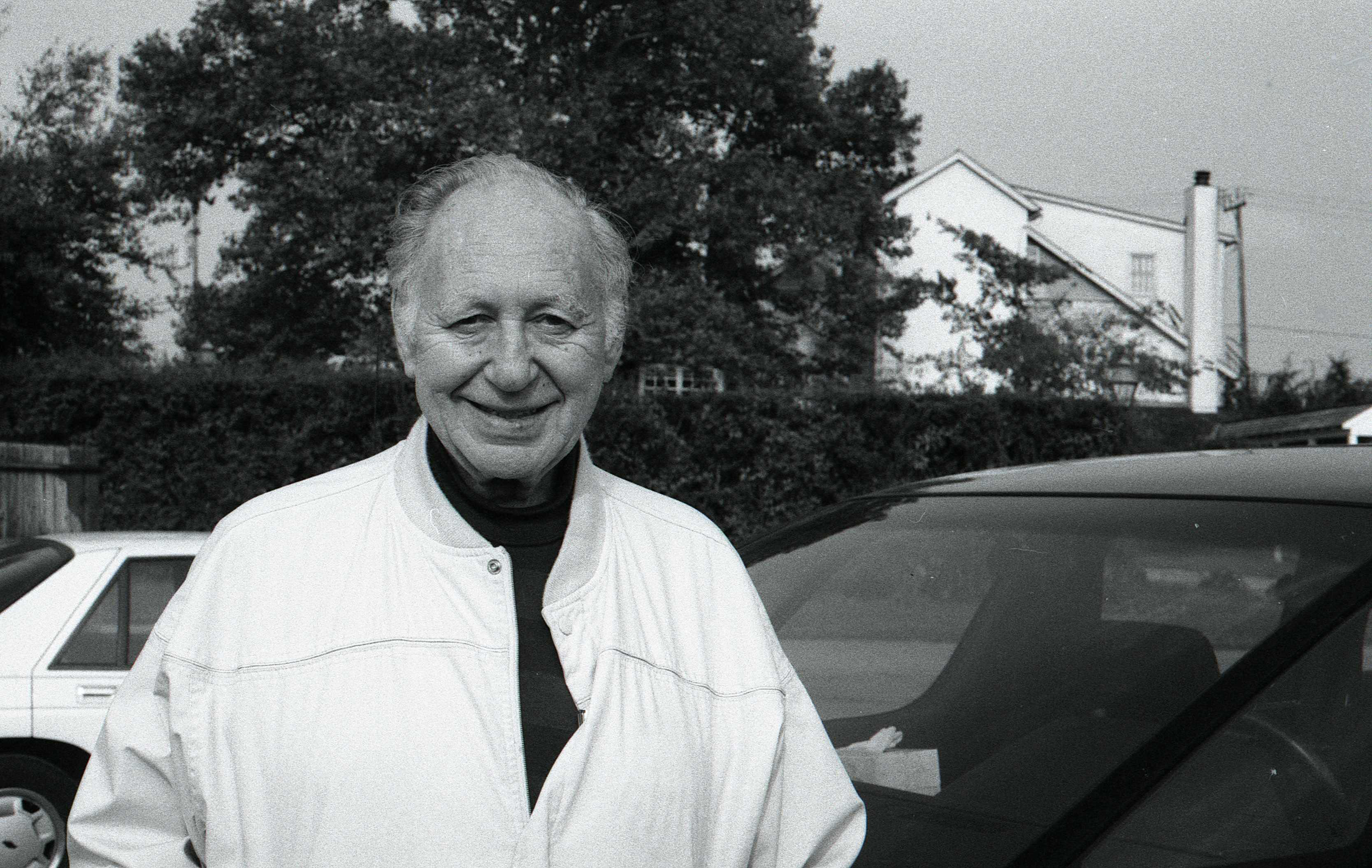
Larry Levinson as a Flight Officer. Boston, 1943.
Larry Levinson, 1990
Other Jewish Prisoners of War on February 10, 1944
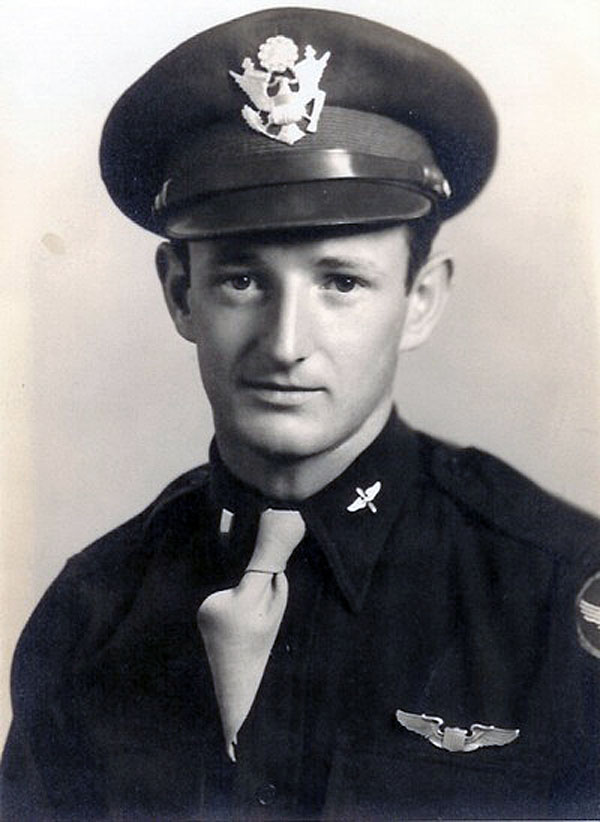
Emanuel “Mac” Magilavy and Harvey B. Greenfield were the pilot and bombardier of B-17G 42-31492, an aircraft of the 413th Bomb Squadron, 96th Bomb Group, 8th Air Force. Nine of the plane’s crew of ten survived the mission; right waist gunner S/Sgt. Robert Eugene Honer, of Los Angeles, was killed. The aircraft’s loss of which is covered in MACR 2374. According to an interview of Mac some years ago, there had been talk among the crew of bestowing the nickname Discoveree on their plane. But, this never actually happened.
Mac and Harvey Greenfield were imprisoned at Stalag Luft I, albeit in separate compounds of the camp.
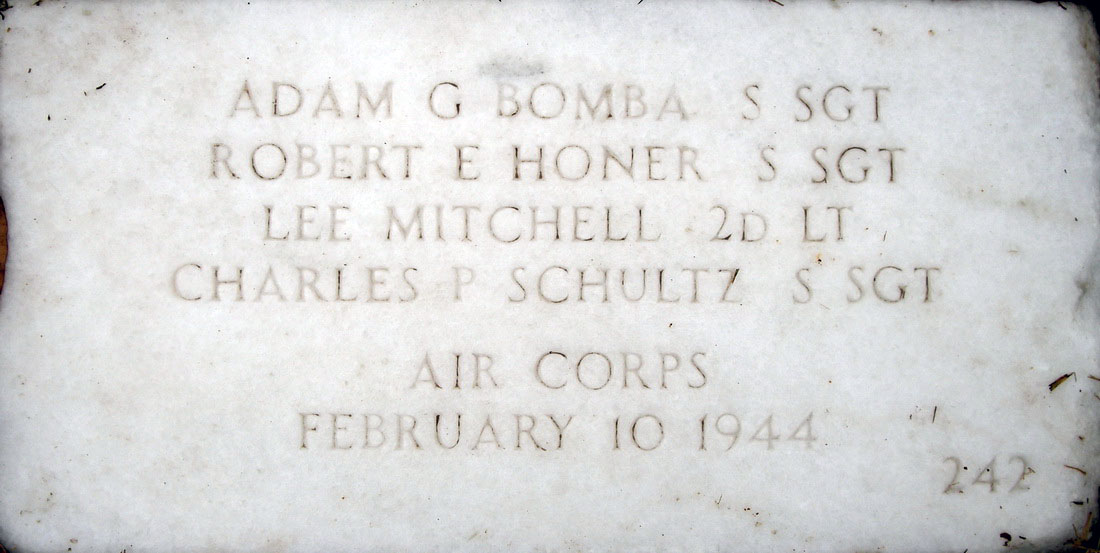
Sgt. Honer is interred in a group burial at Jefferson Barracks National Cemetery with Lt. Lee Mitchell (mentioned above), S/Sgt. Adam G. Bomba, and S/Sgt. Charles P. Schultz, Bomba and Schultz also having been casualties on the February 10 mission.
Greenfield, Harvey Bertram, 2 Lt., 0-749616, Bombardier, Air Medal Prisoner of War at Stalag Luft I, Barth, Germany (North Compound 1) Mrs. Arlene S. Greenfield (wife), 2601 Glenwood Road, Brooklyn, N.Y. MACR 2374 Casualty Lists 3/16/44, 4/27/44 List of Liberated POWs 6/13/45 American Jews in World War II – 335
Magilavy, Emanuel “Mac”, F/O, T-061121, Bomber Pilot, Air Medal, Purple Heart, 9 missions Wounded; Prisoner of War at Stalag Luft I, Barth, Germany (South Compound) Born Akron, Ohio, December 17, 1919 Mrs. Billie I. Magilavy (wife); Mrs. Deborah Seyer (daughter), 219 20th St., Ashland, Ky. Mr. Daniel Isaac and Mrs. Ida Bell (Rutner) Magilavy (parents), 971 Clark St., Akron, Oh. MACR 2374 Casualty List (Liberated POWs) 6/12/45 Snetterton Falcons : The 96th Bomb Group in World War II – 90, 101 American Jews in World War II – 494
“Mac” and his crew are shown in the photograph below:
Rear, left to right
T/Sgt. Clifford Speare (Flight Engineer) T/Sgt. Sidney Earl Porter (Radio Operator) S/Sgt. Robert Eugene Honer (Right Waist Gunner – KIA) S/Sgt. Floyd Jacob “Jake” Gray (Tail Gunner) S/Sgt. John Raymond Shirley (Ball Turret Gunner) S/Sgt. John Donald Cavanaugh (Left Waist Gunner)
Front, left to right
F/O Emanuel “Mac” Magilavy (pilot) 2 Lt. Joseph Conrad Hayes (Co-Pilot) 2 Lt. Peter O’Toole (Navigator) 2 Lt. Harvey B. Greenfield (Bombardier)
A photograph by FindAGrave contributor Eric Kreft, showing the burial marker for Bomba, Honer, Mitchell (mentioned above), and Schultz, at the Jefferson Barracks National Cemetery.
_______________________
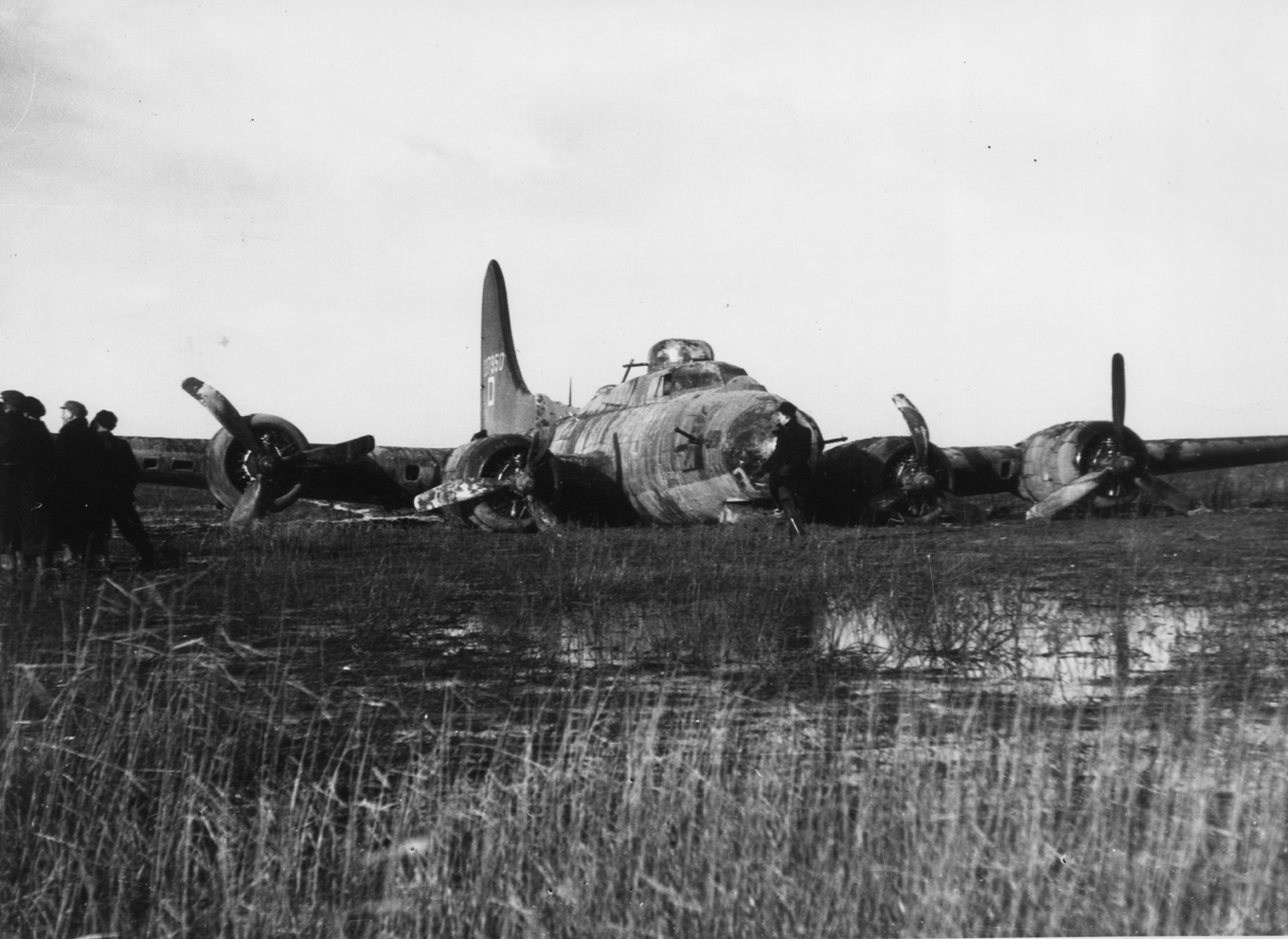
Sergeants David Fineman and Laurence S. Moses were crewmen of an aircraft which – because of the circumstances, location, and documentation of its loss – has been the subject of much print and digital attention: B-17G 42-37950 Dinah Might (9Z * D) of the 728th Bomb Squadron, 452nd Bomb Group. Piloted by 2 Lt. Thomas F. Sharpless, the loss of the plane is covered in MACR 2538 and Luftgaukommando Report KU 841.
The most thorough account of the bomber’s loss is at ZZ Air War. There, it is revealed that Lt. Sharpless belly-landed the plane on a polder near the edge of Lake Ijsselmeer (“Old Zuyder Sea”), the plane coming to rest south of Emmeloord, with all the enlisted men having remained aboard the bomber. The co-pilot (Lt. Cassill – badly wounded), navigator (Lt. Lyons) and bombardier (Lt. Fleischbein) bailed out in the vicinity of Ossenzijl. Lt. Cassill was captured and eventually repatriated, while Lieutenants Lyons and Fleischbein – after evading capture – were eventually taken prisoner, and liberated in April of 1945.
Teunispats presents portraits of each of the bomber’s ten crewmen, and, an image of the unveiling in 2013 of a plaque commemorating the plane and crew. Nopinoorlogstijd features 22 images of the forlorn bomber, the majority of these images being various views of the aircraft – which became a tourist attraction for local civilians and German soldiers – as it appeared over the next four years. These images reveal that the plane soon became a ready source of souvenirs for its many visitors.
One of these pictures – a very well known image – shows the plane as it appeared on the afternoon of February 10, prior to the removal of its machine guns by German soldiers. This image also appears on page 107 of Roger Freeman’s The Mighty Eighth.
Oddly, though Sergeant Fineman’s name appears in American Jews in World War II, this book does not list him as having received the Purple Heart.
Fineman, David, Sgt., 15335552, Gunner (Right Waist) United States Army Air Force, 8th Air Force, 452nd Bomb Group, 728th Bomb Squadron Prisoner of War at Stalag Luft IV, Gross-Tychow, Germany Born in West Virginia December 5, 1922 Mr. and Mrs. Morris and Lena (Weinbren) Fineman (parents), 505 Caroline Ave., Box 14, Chester, W.V. MACR 2538 Casualty List (Liberated POWs) 6/21/45 American Jews in World War II – Not Listed
Moses, Laurence Stanley, S/Sgt., 32503904, Flight Engineer (wounded by fragment from 20mm cannon shell) United States Army Air Force, 8th Air Force, 452nd Bomb Group, 728th Bomb Squadron Prisoner of War at Stalag Luft III, Sagan, Germany (East Compound); then Stalag VIIA, Moosburg, Germany Born June 4, 1921 Mr. Sam S. Moses (father), 577 Liberty St., Newburgh, N.Y. MACR 2538 Casualty Lists 3/14/44, 4/27/44, 5/23/45, List of Liberated POWs 6/20/45 American Jews in World War II – 396
_______________________
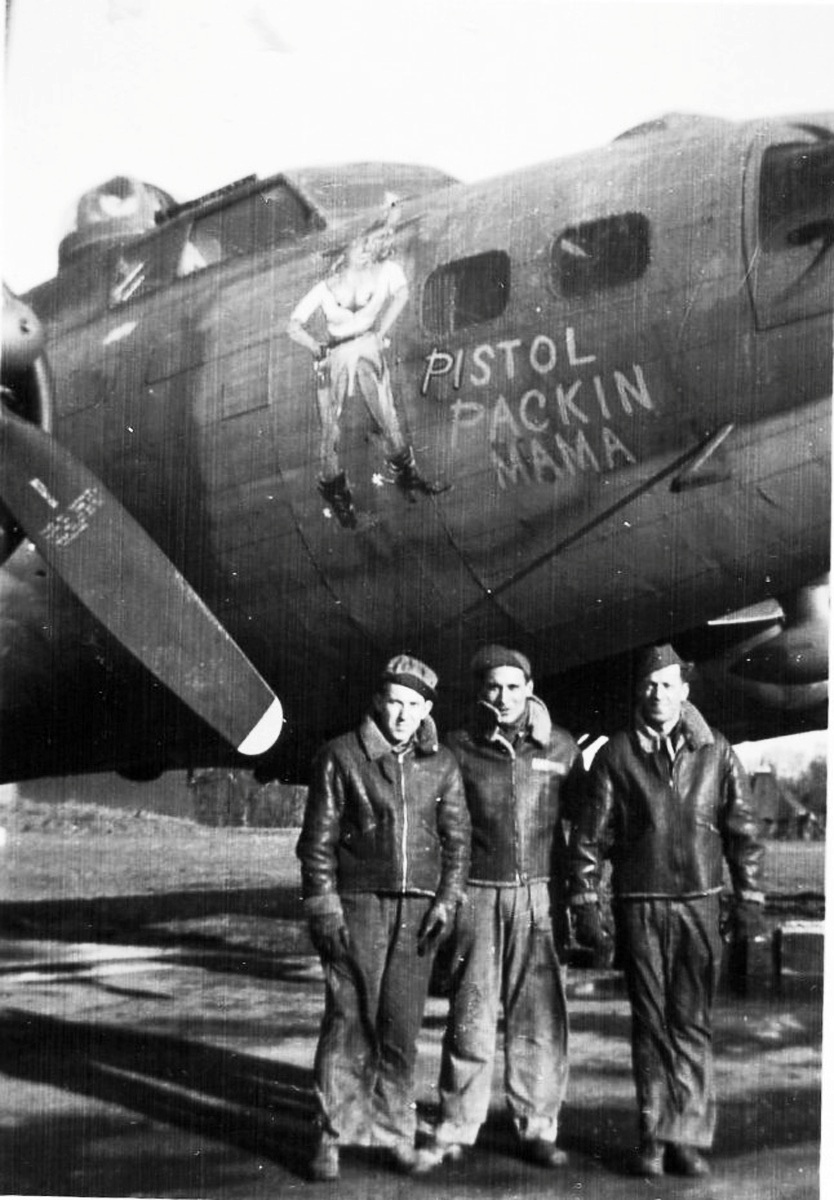
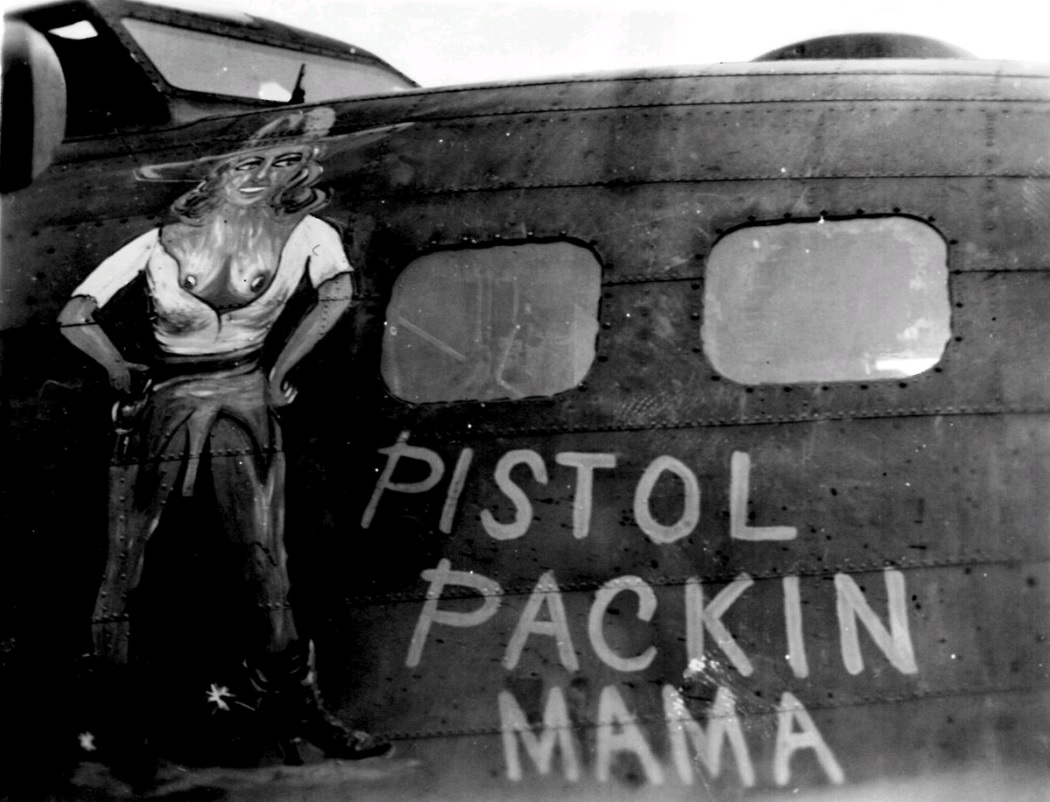
During the Second World War, nearly fifty American heavy bombers were bestowed with variations of the nickname “Pistol Packin’ Mama”, a sobriquet inspired by a song composed by “Al Dexter and His Troopers”, recorded on March 18, 1942, and released by Okeh Records. The song was subsequently recorded by Bing Crosby and the Andrews Sisters on September 27, 1943, and released under the Decca label.
First Lieutenant Sidney Balman was the pilot of one such-named bomber. This was PISTOL PACKIN MAMA (OE * N) – B-17F 42-30609 – of the 334th Bomb Squadron of the 95th Bomb Group. Nine of the plane’s crew of ten survived. Ball turret gunner S/Sgt. John Sliwka was killed in action. The bomber’s loss is covered in MACR 2542 and Luftgaukommando Report KU 849.
Balman, Sidney, 1 Lt., 0-667035, Bomber Pilot, Distinguished Flying Cross, Air Medal, 3 Oak Leaf Clusters, 25 missions United States Army Air Force, 8th Air Force, 95th Bomb Group, 334th Bomb Squadron Prisoner of War at Stalag Luft I, Barth, Germany (North Compound 1) Born 1919 Mr. Max Balman (father), 2343 North Upton Ave., Minneapolis, Mn. Casualty List (Liberated POWs) 6/8/45 The American Hebrew 12/22/44 American Jews in World War II – 199
The aircraft, and some members of Lt. Balman’s crew, can be seen in Army Air Force photo E-59231AC / A9160 (crew names listed by patootie63), while close-ups of the bomber’s nose art, both from the American Air Museum in Britain, are show below that photo.
Rear, Left to Right
S/Sgt. James Ralph Chambers (Right Waist Gunner – POW) (identification uncertain) S/Sgt. Donald William Goucher (Radio Operator – POW) S/Sgt. John Sliwka (Ball Turret Gunner – KIA) Unknown S/Sgt. John Andrew Kurek (Tail Gunner – POW) (identification uncertain) S/Sgt. Joseph Law Doherty (Left Waist Gunner – POW) (identification uncertain)
Front, Left to Right
2 Lt. Robert Edgar Paine (Navigator – POW) 1 Lt. Sidney Balman 1 Lt. John Kenneth Smith (Bombardier – POW) Lt. Wayne W. McIntyre (Bomber pilot – presumably original first pilot of Pistol’ Packin’ Mama; not a member of crew on this mission)
______________________________
Gingold, William Seymour, 2 Lt., 0-804327, Bomber Pilot, 2 to 3 missions United States Army Air Force, 8th Air Force, 94th Bomb Group, 333rd Bomb Squadron Prisoner of War at Stalag Luft I, Barth, Germany (North Compound 1) Born August 6, 1918 Mrs. Ethel S. Gingold (wife), 1628 S. Douglas Ave., Springfield, Il. Jacob Gingold (brother) MACR 2370, Aircraft B-17G 42-31838 (Sack Time Charlie), 10 crew – 7 survivors Casualty List (Liberated POWs) 6/10/45 American Jews in World War II – Not Listed
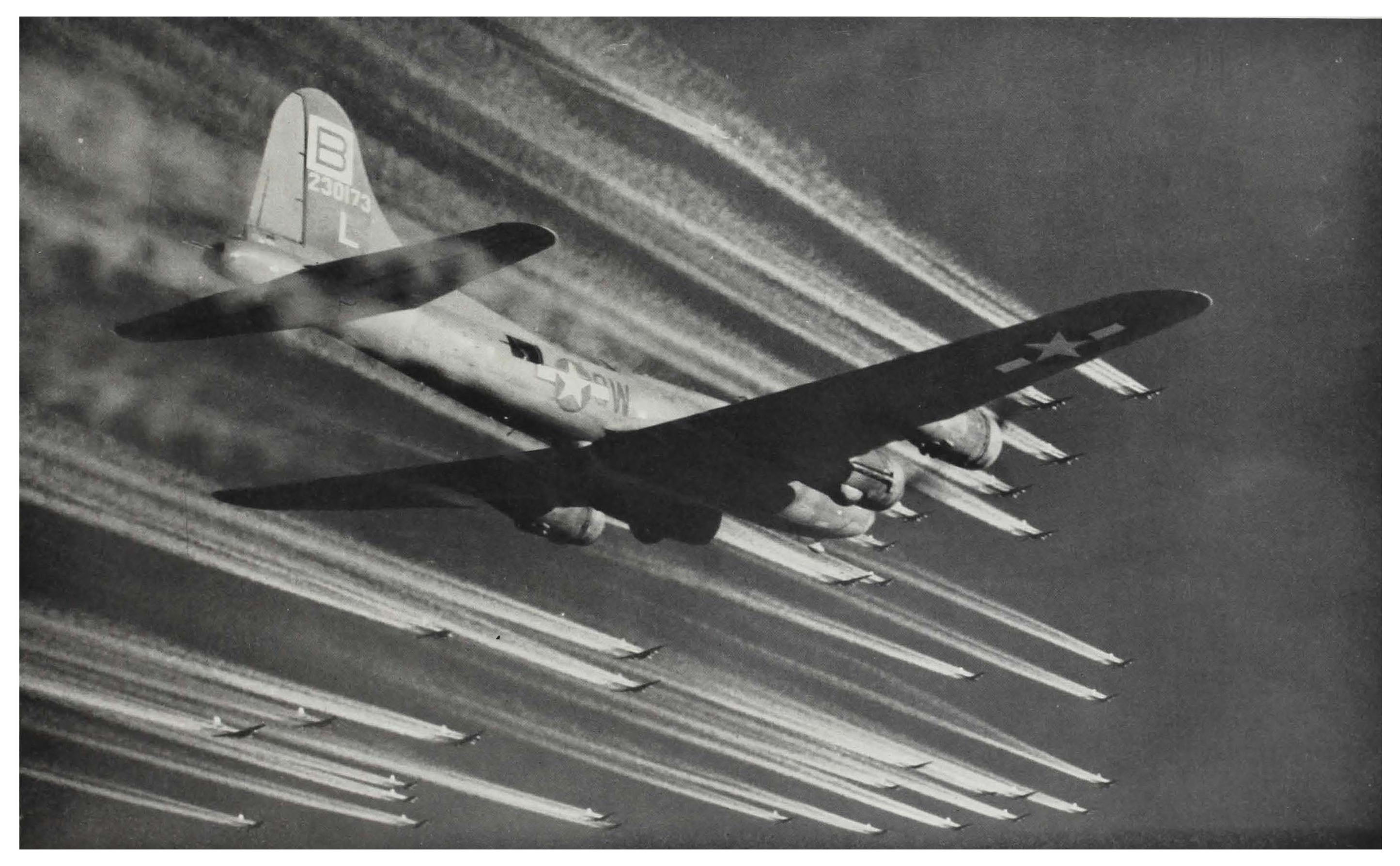
The image was incorporated into the 95th Bomb Group’s unit history “Contrails”, where, reproduced in vastly better clarity than in the original Army Air Force print, the bomber’s serial number and squadron code letter (L) are clearly visible. Originally assigned to the 94th Bomb Group and nicknamed Gorgeous Hussy, the plane was transferred to the 412th Bomb Squadron of the 95th Bomb Group in early June of 1943, where it received the squadron code QW * O and nickname Circe. The plane was then transferred to the 335th Bomb Squadron where it received the individual aircraft letter L, with the 412th’s “QW” seemingly painted over (but still visible) and partially covered by the national insignia.
The plane was piloted by 1 Lt. James S. Pearson, and its loss is covered in MACR 2544 and Luftgaukommando Report KU 838. Of Circe’s crew, seven men survived. Right waist gunner S/Sgt. Michael D. Croker, tail gunner S/Sgt. Jackson O. Hardeman and radio operator T/Sgt. Ralph W. Coyle were killed in action, the latter when he was attempting to open the rear escape door for the two wounded waist gunners.
Malkin, Arnold Lee, 2 Lt., 0-686095, Bombardier, 11 Missions Prisoner of War at Stalag Luft I, Barth, Germany (North Compound 1) Born 7/22/20, Died 9/6/09 Mr. and Mrs. Jacob and Sophia (Rappaport) Malkin (parents), 163 West LaClade Ave., Youngstown, Oh. Mryon (brother), Louise (sister – died as an infant) (Genealogical information from Ancestry.com) Casualty List (Liberated POWs) 6/18/45 American Jews in World War II – Not Listed
http://95thbg.org/j3migr/images/noseart/Circe.jpg
______________________________
Sheinfeld, Philip, S/Sgt., 13153808, Radio Operator United States Army Air Force, 8th Air Force, 100th Bomb Group, 418th Bomb Squadron Prisoner of War at Stalag Luft IV, Gross-Tychow, Germany Mrs. Betty Sheinfeld (mother), 5919 Old York Road, Philadelphia, Pa. MACR 2383, Luftgaukommando Report KU 835, Aircraft B-17F 42-30062 (LD * O, Reilly’s Racehorse) Nine of the plane’s ten crewmen bailed out and survived as POWs. Lt. Scoggins, on his tenth mission, did not survive. List of Liberated POWs 6/14/45 Philadelphia Inquirer and Philadelphia Record 3/23/44 Philadelphia Record 4/16/44 The story of the Century – 167 American Jews in World War II – Not Listed
______________________________
Simon, Samuel Irving, Jr., 2 Lt., 0-801096, Navigator, 18 missions United States Army Air Force, 8th Air Force, 388th Bomb Group, 562nd Bomb Squadron Prisoner of War at Stalag Luft I, Barth, Germany (North Compound 1) Born September 8, 1921 Mrs. Anna D. Simon (mother), 2254 E. Tioga St., Philadelphia, Pa. MACR 2348, Luftgaukommando Report KU 840, Aircraft B-17G 42-31115 (S, Hell’s Belles), 10 crew – 6 survivors Philadelphia Inquirer and Philadelphia Record 3/16/44 and 4/27/44 Casualty List (Liberated POWs) 6/14/45 American Jews in World War II – Not Listed
______________________________
Vilk, Jerome Arthur, S/Sgt., 12144770, Gunner (Tail Gunner), Air Medal, 2 Oak Leaf Clusters, Purple Heart, 13 missions United States Army Air Force, 8th Air Force, 390th Bomb Group, 571st Bomb Squadron Wounded; Prisoner of War at Stalag Luft IV, Gross-Tychow, Germany Born March 22, 1919 Mr. Norman Vilk (father), 652 East 95th St., Brooklyn, N.Y. MACR 2504, Kuftgaukommando Report KU 842, Aircraft B-17G 42-31218 (FC * E, ETO-Itis), Pilot 1 Lt. John G. Burke, 10 crew – 9 survivors Casualty List 3/16/44 List of Liberated POWs 6/19/45 The Story of the 390th Bombardment Group (H) – 467 http://www.390thspace.com American Jews in World War II – 464
______________________________
Zelman, Saul, 2 Lt., 0-741435, Bombardier United States Army Air Force, 8th Air Force, 452nd Bomb Group, 728th Bomb Squadron Prisoner of War at Stalag Luft I, Barth, Germany (North Compound 1) Born 1919 Mr. Louis Zelman (father), 1709 N. Shore Road, Revere, Ma. MACR 2539, Luftgaukommando Report KU 850, Aircraft B-17G 42-3796, Pilot 2 Lt. Hugh E. Noell, Jr., 10 crew – 7 survivors Casualty List (Liberated POWs) 6/20/45 American Jews in World War II – Not Listed
______________________________
– Other Events of February 10, 1944 –
One that Got Away: Escape and Evasion from France
From the crew of B-17G 42-31430, pilot by 1 Lt. John J. Stahl, Jr., seven crew members evaded capture and returned to England. They were 2 Lt. John R. Chernosky (navigator), 2 Lt. George W. Vogle (bombardier), Pvt. John Engstrom (ball turret gunner), S/Sgt. Myron Pogodin (left waist gunner), T/Sgt. Berna L. Johnston (right waist gunner), and S/Sgt. Elbert B. Pyles (tail gunner), and 2 Lt. Julius D. Miller – co-pilot. On April 22, 1944 Lieutenant (later Captain) Stahl attempted to reach Switzerland in company with other evadees (possibly including three of his own crew members), but due to “irregularities in the frontier and lack of a map,” became lost and re-entered France to be captured by a German patrol; he spent the rest of the war as a POW.
According to Lt. Miller’s account (in Escape and Evasion Report 776), he and Lt. Vogle remained together until May 2, when the latter underwent an appendectomy. Lt. Miller reached England on June 11, when he completed his Escape and Evasion Report, a portion of which is transcribed below.
Remarkably, Escape and Evasion Report 776 includes two candid photographs presumably of Lieutenants Miller and Vogle dressed in civilian attire, which Miller carried with him to England. (Unfortunately, there is no caption, so one can’t tell “who is who”.)
Miller, Julius David, 2 Lt., 0-745727, Co-Pilot, 13 missions United States Army Air Force, 8th Air Force, 305th Bomb Group, 366th Bomb Squadron Evaded Capture; Returned to Duty June 11, 1944 Born October 6, 1922 Mrs. Lillie E. Clark (mother), 300 Hampton Ave., Hamtpon, Va. MACR 2428, Aircraft B-17G 42-31430, Pilot 1 Lt. John J. Stahl, Jr., 10 crew – all survived Civilian occupation: Aircraft model-maker (Junior) – Civil Service Casualty List 3/16/44 American Jews in World War II – Not Listed
E&E 736: 2d Lt Julius D. MILLER
We were hit by flak over the target and had to drop out of formation.Over Belgium one engine was about to burst into flame and another was about to go out. A lot of fighters attacked us, and we shot down three. Five of the sergeants bailed out; then I followed the engineer out the nose. I saw one man hit the ground about a kilometer from me; I thought that it was the bombardier. I landed near a farmhouse, picked up my parachute, and ran to the woods. My chute hung up on a barbed wire fence, so I left it there. It could not be seen with all the snow around.
I went through the woods some distance, came to a metal telegraph pole with a German name on it, and thought that I was in Germany. I took out my compass from the escape kit and started SW through the woods. I came to a road and saw a civilian walking towards me. I pretended to be a naturalist juts looking the trees over — not too good a pretense since I was still in flying clothes – and the man paid no attention to me.
I walked on through the fields and woods, saw a small town, and was unable to identify it on my escape map. I could see no Germans in the town, so I thought that I would go in and look for some road signs. I the town I heard some people approaching me and hid behind the corner of a house. Three or four people on bicycles passed. While I was moving away four people came up suddenly from the other direction. They said something to me and I nodded in reply. They walked on.
There was snow on the ground. I could hear people in the house moving dishes and sounding warm and comfortable. I thought that I would not sleep out that night and went to ask them whether I could sleep in their barn. I was taken in and fed. My host took a geography book and showed me where I was.
While I was sitting there to see what happened another man came in. After he discovered who I was he gave me civilian clothes. Soon another man came in; he did not seem convinced that I was an American aviator. After a great deal of questioning and talking he finally seemed satisfied, and –
I was taken to a place from which my journey was arranged.
Compiled by D E EMERSON 1st Lt, AUS
Approved by W STULL HOLT Lt Col, AC Commanding
Appendix B
1. The following information has been obtained from an officer who evaded capture in enemy occupied territory.
2. Further circulation of this information may be made, but in that case it is important not to divulge any details about the source.
Statement of information covering the period from 20 February to 28 May 1944
a. One of informant’s helpers claimed to have gone with another man to the Belgian coast and to have destroyed a radar installation there. It was said to be in two sections, one out in the water and the other on land. Source reported that the installation was designed to indicate the number and tonnage of approaching ships.
b. In April informant saw FW 190’s flying from an airfield near MERU.
c. In April he saw ME and FW’s with belly tanks taking off from an airfield at CREIL.
d. In April informant saw that railway yards at AMIENS, CREIL, and the Gare du Nord (Paris) had been well hit.
e. The Germans are gradually repairing the Renault works along the Seine.
f. Frenchmen complained about an RAF raid which had some factory in or near Paris as its target, claiming that everything had been hit but the factory. There were also complaints of a couple of instances in which Americans had missed the target.
g. At BORDEAUX there seemed to be an FW assembly plant, to judge from the FW parts which informant saw in railway cars.
Appendix D
1. I carried an aids box from which I used only the compass and map. I did not need any other contents because I received help the first day.
2. I carried a red purse. I had to exchange the French money for Belgian money.
3. I carried six passport size photographs, which I used.
4. I was lectured at base on evasion and escape. The lectures were valuable.
5. Suggestions: Try and get – or have – good shoes for crossing the mountains. DO NOT USE SANDALS.
Try to keep one map for yourself in case you should have to go alone — a map of the French and Spanish border.
_______________________
Evading Capture in Italy
While all the above servicemen were members of Bombardment Groups attached to the 8th Air Force, Lieutenants Sidney Morse and Myron Shapiro were members of the 414th Bomb Squadron of the 97th Bomb Group, a combat group of the Italy-based 15th Air Force. During a mission to a road junction at Cecchina, Italy, their aircraft (B-17G 42-31430) was damaged by anti-aircraft fire, causing a fire in the right wing. Realizing the impending danger of an explosion, pilot F/O John L. Brennan turned the aircraft towards land, with his nine crewmen – and finally F/O Brennan himself – parachuting between German and American lines. The crew’s officers all avoided capture, but five of the plane’s six enlisted men (listed below) were captured and spent the remainder of the war in Stalag Luft IV, at Gross-Tychow, Pomerania. Right waist gunner Arthur Dickie evaded capture and returned to Allied control on June 17, 1944.
Prisoners of war
Radio Operator: Frank A. Bealin T/Sgt. Flight Engineer: Leslie I. McKinley T/Sgt. Left Waist Gunner: Thomas P. Smith S/Sgt. Ball Rutter Gunner: Richard C. Hodges S/Sgt. Tail Gunner: John H. Kirkpatrick S/Sgt.
Evaded capture
Right Waist Gunner: Arthur C. Dickie S/Sgt.
The incident is described both MACR 2305, the 414th BS Squadron History in AFHRA Microfilm Roll AO609 (frames 326-333), and, in The Hour Has Come : The 97th Bomb Group in World War II. The account from the latter follows:
#236 Road Junction, Cecchina, Italy 10 Feb. 1944 Flak heavy, intense, accurate. 19 A/C received minor flak damage. 5 men wounded, 2 serious. Two ME-109s encountered, no claims. Bombing altitude 12,500 feet. The M/YD and the stores and buildings received numerous hits. One B-17 missing. The pilot, co-pilot, navigator and bombardier all returned to base after bailing out. Missing enlisted personnel thought to be P.O.W.s.
The following was reported by Pilot J.L. Brennan, Flight Officer, AUS:
On February 10th, 1944, while on a bombing mission to Checchina Road Jet., a/c #489 was on the bomb run at 14,000 feet at 0859 hours. Bombs were away on target, the a/c was functioning O.K., but due to the heavy and concentrated flak there were numerous holes in various areas. The nose was shattered. On the way out after the rally, the right waist gunner called F/O Brennan and reported a fire in the right wing. Looking out, F/O Brennan observed a large hole about the size of a steel helmet midway between number four engine and wingtip on the leading edge. Fire could be seen in the opening. F/O Brennan, realizing the danger of explosion, gave an order to the crew to stand by to bail out.
Seeing he was over the water, F/O Brennan turned the a/c toward two ships off the coast, so rescue could be made for the crew. The bomb bay doors were opened with the salvo switch, the navigator, 1st Lt. Everett Anthony, was first to jump followed by 2nd Lt. Sidney Morse, the bombardier. F/O Brennan, operating the a/c made an 80 degree turn to the left to try to get the a/c over land, preferably the beachhead, so the evacuees would come down on land instead of the water. He told the crew to hold up till we were over land. As the a/c was rapidly approaching the coast somewhere over Lake Di Fogliano, F/O Brennan ordered the crew to jump. Copilot, 2nd Lt. Myron Shapiro, was standing in the bomb bays assisting the enlisted crew out of the aircraft. After the last man was out in the clear, in about 5 seconds, Lt. Shapiro left the a/c. After the last member of the crew was out, F/O Brennan jumped from the a/c.
While F/O Brennan was descending in his chute, the a/c made a 360 degree turn above them and fell off, and as the wing came off the a/c crashed near Littoria, Italy. After F/O Brennan landed in his parachute, he took a bearing and found he was in No Man’s Land about 100 yards from our lines. He took his parachute off and waited about 20 minutes when a patrol of four American soldiers, led by S/Sgt. Alfred E. Hurst, 2nd Co., 3rd Regt., 1st Sp Sv Force, came out through a mine field to take him back to the American lines, located west of Mussolini Canal. He was given food and drink and waited until Lt. Shapiro was brought in. After arriving at American lines, and waiting for some time, no word came from the rest of the crew (enlisted). All the chutes of the gunners and radio operator were seen to open and none of them were injured over the target. They all dropped in the vicinity of the target and it is believed they are P.O.W.
From this point, F/O Brennan and Lt. Shapiro were sent through military channels to the Anzio Beachhead Headquarters, Port CC. Then transportation was provided by LST #200 to Naples. While they were waiting for transportation to Naples, the bombardier, 2nd Lt. Sidney Morse joined them and went on to Naples.
Co-Pilot Myron Shapiro described his landing experience from the above a/c as follows:
After parachuting down and landing, I took my gear off and laid low. At this time, I noticed I was under machine gun fire from an enemy outpost. I noticed a hay stack about 20 feet from me and I crawled on my belly to seek cover from the machine gun fire. About 20 minutes later, four volunteers, American soldiers from 1st SP SV Force, 2nd Co, 3rd Regt, headed by S/Sgt. Biblowitz, Pvt. Baving, Sgt. Baughn and Pvt. Langaskey, crawled out through machine gun fire and air burst (mortar) to rescue me. I noticed a dead German near the hay stack and was scared stiff. At first, I didn’t answer them when they called out “Hey! Yank.” After waiting awhile, I heard them talking in English and on closer observation, I saw they had on uniforms of the American Paratroop Corps. I then realized they were O.K. and came out in the open and they escorted me back to their advanced outpost. And then they took me back to the American lines where I rejoined F/O Brennan. (p. 152)
Biographical information for Lieutenants Morse and Shapiro appears below. Morse, Sidney, 2 Lt., 0-673918, Bombardier, Purple Heart, Distinguished Flying Cross, Air Medal, 9 Oak Leaf Clusters Wounded; Parachuted; Landed between German and American lines; reached safety with aid of American troops Mr. Moe Morse (father), 34-32 83rd St., Jackson Heights, N.Y. (also) 627 Hegeman Ave., Brooklyn, N.Y. Brooklyn Eagle 3/21/43, 3/25/44 American Jews in World War II – Not Listed
Shapiro, Myron, 2 Lt., 0-684065, Co-Pilot, Silver Star, Distinguished Flying Cross, Air Medal, 7 Oak Leaf Clusters, Purple Heart Parachuted; Landed between German and American lines; reached safety with aid of American troops Born 1920 Mrs. Mollie Schiffman (mother), 10 East 53rd St., Brooklyn, N.Y. American Jews in World War II – 439
_______________________
An Enemy Fighter Plane Shot Down
Small, Sherman M., S/Sgt., Tail Gunner, Distinguished Flying Cross, Bronze Star Medal, Air Medal, 3 Oak Leaf Clusters, Purple Heart, 27 missions United States Army Air Force, 8th Air Force, 96th Bomb Group, 339th Bomb Squadron Shot down an enemy fighter while a crewman in B-17G 42-40016 (The Character), Pilot Capt. Chris Wunnenberg Born 1923 Mr. and Mrs. Samuel and Mary Small (parents), 116 Crown St., New Haven, Ct. Snetterton Falcons : The 96th Bomb Group in World War II – 101 American Jews in World War II – 70
______________________________
Witness to the Loss of Another Aircraft
– Killed in Action Ten Days Later –
Lieutenant Morton B. Lehman’s account (see below) of the February tenth loss of 728th Bomb Squadron, 452nd Bomb Group, B-17G 42-31338, piloted by 2 Lt. Kenneth D. Smith, was incorporated into Missing Air Crew Report 2540. Seven members of Lt. Smith’s crew of ten survived. Lt. Lehman’s statement is shown below.
Only ten days later, on February 20, Lt. Lehman was shot down and killed. His aircraft, B-17G 42-37951 (Mavoureen; 9Z * E (MACR 2779)), piloted by 2 Lt. Billy L. Huffman, was attacked by rocket-firing Ju-88s of ZG 26 during a mission to Poznan, Poland (via Denmark). As recounted as Flensted, Lt. Lehman was among the nine crew members who parachuted over the Store Bælt (Great Belt) sea channel in Denmark, only two of whom (left waist gunner Sgt. Thomas E. McDannold and right waist gunner Sgt. George T. Smith) survived. Lt. Lehman and three other crewmen were never found. The body of Lt. Huffman was found at the site of the plane’s crash, “north of Fuglebjerg near Haldagerlille on Sjælland (Sealand)”. A description of the bomber’s loss follows:
Both Lt. Lehman and radio operator Sergeant Samuel M. Fanburg are listed on the Tablets of the Missing at the Cambridge American Cemetery, in Cambridge, England.
Lehman, Morton B., 2 Lt., 0-809650, Navigator, Purple Heart United States Army Air Force, 8th Air Force, 452nd Bomb Group, 728th Bomb Squadron Killed ten days later: February 20, 1944 Mr. Irving Lehman (brother), 136 Sherman Ave., New Haven. Ct. Casualty List 4/4/44 American Jews in World War II – 67
Fanburg, Samuel M., S/Sgt., 14161914, Radio Operator, Air Medal, Purple Heart Mr. Herman Fanburg (father), 110 East 3rd St., Chattanooga, Tn. Born 1924 American Jews in World War II – Not listed
______________________________
Wounded in Action
Block, Harry H., Capt., Wounded at Anzio United States Army, Medical Corps Mrs. Lillyan Block (wife); Barbara (YOB 1937) and Allan (YOB 1940) (children), 1913 67th St., Brooklyn, N.Y. Mr. Joseph A. Block (father); Lt. Louis Block (brother), 4298 Fullerton Ave., Detroit, Mi. The Jewish News (Detroit) 10/20/44 American Jews in World War II – 279
______________________________
Some other Jewish military casualties on Thursday, February 10, 1944, include the following…
Killed in Action – .ת.נ.צ.ב.ה. –
Braude, Moshe, Sgt. U.S.S.R. (Lithuania), Red Army, 16th Lithuanian Rifle Division Killed at Zozenki, Pskov Born 1923 Mr. Zalman Braude (father) Place of burial – unknown Road to Victory – 302
______________________________
Freykman (Фрейкман), Beylya Gershonovna / Gershovna (Бейля Гершоновна / Гершовна)
Senior Lieutenant [Старший Лейтенант], Female Soldier, Commanding Officer – Sanitary (Medical) Company
U.S.S.R., Red Army, 281st Rifle Division, 1064th Rifle Regiment
Born 1921, in Bobruisk
Mrs. V.A. Kratser (aunt), Apartment 37, Building 3, Markelovski Street, Moscow, USSR
Place of burial unknown Memorial Book of Jewish Soldiers Who Died in Battles Against Nazism – 1941-1945 – Volume VI – 360 (Incorrectly gives name as “Фрейнкман, Белла Гершоновна” (“Freynkman, Bella Gershonovna”))
______________________________
Kooshner, Solomon, 2 Lt., 0-1319116, Purple Heart United States Army, 34th Infantry Division, 168th Infantry Regiment, A Company Born 1919 Mr. Benjamin Kooshner (father), 17 Estella St., Dorchester, Ma. War Department News Releases 1/15/44, 4/5/44, 11/14/44 Sicily-Rome American Cemetery, Nettuno, Italy – Plot H, Row 2, Grave 24 American Jews in World War II – 167
______________________________
Розенблюм (Rozenbloom), Борис Григорьевич (Boris Grigorevich), Lieutenant [Лейтенант] Tank Commander (T-70 Tank) 143rd Autonomous Nevelskiy Tank Brigade Missing in action in Vitebsk oblast, Belorussia Born 1923, in Polotsk, Vitesbk, Belorussia Mrs. Margarita (“Rimma”) Ergardovna Puchina (wife) Mr. Grigoriy Mikhaylovich Rozenbloom (father) Buried in Vitebsk oblast Memorial Book of Jewish Soldiers Who Died in Battles Against Nazism – 1941-1945 – Not Listed [Книги Памяти евреев-воинов, павших в боях с нацизхмом в 1941-1945 гг – записей не найдено]
______________________
Шпиллер (Shpiller), Борис Моисеевич (Boris Moiseevich) Lieutenant (Junior) [Младший Лейтенант], Tank Commander 226th Tank Regiment Killed in action in Leningrad oblast Born 1920, in Gozovaya, Kharkov oblast Mr. Moisey Solomonovich Shpiller (father) Place of burial unknown Memorial Book of Jewish Soldiers Who Died in Battles Against Nazism – 1941-1945 – Not Listed [Книги Памяти евреев-воинов, павших в боях с нацизхмом в 1941-1945 гг – записей не найдено]
______________________
Tucker, Harris Abraham (Hebrew name: Asher ben Aharon), 2 Lt., 0-749705, Co-Pilot, Distinguished Flying Cross, Air Medal, 1 Oak Leaf Cluster, Purple Heart, 15 to 16 missions United States Army Air Force, 8th Air Force, 94th Bomb Group, 331st Bomb Squadron Born May 24, 1924 Mr. Herbert Aaron Tucker (father) [7/8/97- 10/27/57], 1515 Carr Ave., Memphis, Tn.; Mrs. Marjorie T. Segal (sister); Robert I. Tucker (brother) MACR 2371, Luftgaukommando Report KU 834, Aircraft B-17G 42-31080 (QE * Y, Hey Moitle), Pilot 2 Lt. Paul A. McWilliams, 10 crew – 5 survivors New Jewish Cemetery (Heska Amuna Cemetery), Knoxville, Tn. American Jews in World War II – 568
Portrait of Harris Tucker at his WW II Memorial Honoree Page, contributed by his sister, Marjorie T. Segal. ______________________________
Wasserstrom, Harold Henry, 2 Lt., 0-744293, Bombardier, Air Medal, 1 Oak Leaf Cluster, Purple Heart, 8 missions United States Army Air Force, 8th Air Force, 388th Bomb Group, 561st Bomb Squadron Mr. Louis Wasserstrom (father), 3288 Woodrow Boulevard, Toledo, Oh. MACR 2347, Aircraft B-17G 42-31336 (H), Pilot 2 Lt. Robert M. Tolles, 10 crew – no survivors Tablets of the Missing at Cambridge American Cemetery, Cambridge, England American Jews in World War II – 568
______________________________
Killed (Non-Combat Aircraft Loss in the United States)
Braff, Michael, Cpl., 32442688, Flight Engineer United States Army Air Force, 668th Navigation Training Group, 340th Navigation Training Squadron Born 1921 Mr. and Mrs. Samuel and Mildred Braff (parents), Pvt. Erwin Braff (brother), 1535 Ocean Ave., Brooklyn, N.Y. Mount Lebanon Cemetery, Glendale, N.Y. – Ind. Minsker Society, Block 101, Section 1, Sub-Section 12, Line 1, Grave 10 No Missing Air Crew Report; Aircraft: Lockheed AT-18 navigational trainer 42-55530, Pilot 1 Lt. Jerome T. Walsh; 7 crew members – no survivors Crashed at George Field, Lawrenceville, Illinois News Item 2/11/44 The New York Times (Obituary Section) 2/14/44 Fatal Army Air Forces Aviation Accidents in the United States, 1941-1945 – Volume 2: July 1943 – July 1944 – 682 American Jews in World War II – 343
References
Books
Carter, Kit C. and Mueller, Robert, Combat Chronology 1941-1945, Center for Air Force History, Washington, D.C., 1991
Doherty, Robert E., and Ward, Geoffrey D., Snetterton Falcons: The 96th Bomb Group in World War II, Taylor Publishing Company, Dallas, Tx., 1996
Dublin, Louis I., and Kohs, Samuel C., American Jews in World War II – The Story of 550,000 Fighters for Freedom, The Dial Press, New York, N.Y., 1947
Freeman, Roger, The Mighty Eighth – A History of the U.S. 8th Army Air Force, Doubleday and Company, Inc., New York, N.Y., 1970
Gulley, Thomas F., The Hour Has Come: The 97th Bomb Group in World War II, Taylor Publishing Company, Dallas, Tx., 1993
Leivers, Dorothy (Editing and Revisions), Road to Victory – Jewish Soldiers of the 16th Lithuanian Division, 1941-1945, Avotaynu, Bergenfield, N.J., 2009
Mireles, Anthony J., Fatal Army Air Forces Aviation Accidents in the United States, 1941-1945 – Volume 2: July 1943 – July 1944, McFarland & Company Inc., Jefferson, North Carolina, 2006
Memorial Book of Jewish Soldiers Who Died in Battles Against Nazism – 1941-1945 – Volume VI [Surnames beginning with Л (L), М (M), Н (N), О (O), П (P), Р (R), С (C), Т (T), У (U), Ф (F), Х (Kh), Ц (Ts), Ч (Ch), Ш (Sh), Щ (Shch), Э (E), Ю (Yoo), Я (Ya)], Maryanovskiy, M.F., Pivovarova, N.A., Sobol, I.S. (editors), Union of Jewish War Invalids and Veterans, Moscow, Russia, 1999
Nilsson, John R., The story of the Century(The Experiences of the 100th bombardment Group from June 1943 to April 1945), (Privately printed?), Beverly Hills, Ca. (?), 1946
The Story of the 390th Bombardment Group (H) (Privately printed for the Men and Officers of the 390th Bombardment Group), 1947
The lives of men are remembered in different ways.
Men can be remembered by their families and descendants; men can be remembered by friends; men are sometimes remembered by chance acquaintances on a “random walk” through life. Some men are remembered through their achievements, and others – regardless of success or failure – by what they attempted to achieve.
Men can also be remembered directly: Through images: paintings, photographs, and (presently) pixels. Through the written word: Through diaries, letters, correspondence, the random odd jotting, and (presently, perhaps permanently, email); usually in words of their own – in words sent.
On occasions rarer, they are remembered indirectly, through in the words of others – in words received.
The subject of this post, World War Two Army Air Force Staff Sergeant Szymon A. Friedman, a resident of Jamaica, New York, was one such man. On his final combat mission – from which only a single member of his crew returned – he carried a letter which, surviving him, had an unusual destiny.
____________________
A portrait (not the best, but it’ll do) of S/Sgt. Szymon A. Friedman, in a front-page article relating news of his death in combat, published in the Long Island Daily Press, October 28, 1944.(Found via Thomas N. Tryniski’s Fulton History website.)
New York State Digital library
____________________
An aerial gunner (a left waist gunner, specifically) in a B-17 Flying Fortress of the 360th Bomb Squadron of the 8th Air Force’s 303rd “Hell’s Angel’s” Bomb Group, Szymon’s aircraft, B-17G 42-107048 (Tangerine, bearing the squadron code PU * M) was shot down by anti-aircraft fire during a mission to a German airdrome at Cambrai / Epinoy, France on June 12, 1944, the Hell’s Angel’s 178th combat mission. The image below, from the American Air Museum in Britain, shows “a” B-17G nicknamed Tangerine, one of several 8th Air Force B-17s so named. Thus, I don’t know if this image is specifically Tangerine of the 360th Bomb Squadron.
Tangerine’s loss, covered in Missing Air Crew Report 5626, was recounted through the combined eyewitness statement of S/Sgt. Charles A. Jamison and Sgt. Francis D. Johnson, flight engineer and tail gunner of Lucky Linda (42-97853), who reported:
On the mission to Cambrai, France, on 12 June 1944, we were the crew of A/C 42-97853 which was flying in #6 position in the high element in the formation. The missing A/C was #2 in the same element. We were in the high group in the 41st “A” Combat Wing. About a minute before bombs away which was 0915 hours, a burst of flak hit the missing A/C between #2 engine and fuselage. Then another burst hit directly in the bomb bay. The entire A/C burst into flames, and it nosed down sharply. The A/C then broke in half near the bomb bay. The left wing came off. We followed it down to about 1000 feet and then lost it. We saw no parachutes come out.
Though Jamison and Johnson did not witness the escape of any crewmen from the falling B-17, there was indeed a proverbial “sole survivor”: S/Sgt. Edward J. Vallee, the plane’s tail gunner, was blown out of the disintegrating aircraft and parachuted to safety. Captured, he spent the remainder of the war as a POW at Stalag 7A, Moosburg, Germany.
______________________________
The three images below are from the Missing Air Crew Report for Tangerine. The first page lists the plane’s crew members and identifying information about the plane, while the latter two sheets, completed by S/Sgt. Vallee after the war’s end and his return from German captivity, indicate – given the nature of his survival from the falling plane – the little he knew about the fate of the aircraft and crew members.
______________________________
Though not exact, the location given for Tangerine’s loss in the Missing Air Crew Report was accurate enough. The aircraft fell to earth a little over two miles northeast of the center of Cambrai, in the vicinity of the commune of Eswars (Nord Department), on the north back of the River Scheldt. There, along Rue de l’Amiral Fleuriais stands a memorial commemorating the nine fallen airmen, also mentioning S/Sgt. Vallee. An image of the monument, by FindAGrave contributor Timothe Loock, appears below:
The first map below, from the Missing Air Crew Report, shows the position of Tangerine’s loss as reported by fellow airmen in the 360th Bomb Squadron. The four subsequent images are Google Maps, at successively larger scales, showing the location where Tangerine fell to earth.
Images (copyrighted) of the memorial are on display at Aérostèles, while the loss of Tangerine is covered by Daniel Carville at France Crashes.
The names, wartime next-of-kin, and places of burial of Tangerine’s ten crewmen are listed below. (The information is derived from MACR 5626, the Eisele and DeWall crew history pages at the 303rd (Hell’s Angels) Bomb Group, the American Battle Monuments Commission, FindAGrave, and Fold3.) Notably, seven of the nine airmen are buried at the Normandy American Cemetery, in Saint Laurent-sur-Mer, France.
The men are:
Pilot: 1 Lt. Roy Eisele Mrs. Beatrice M. Eisele (wife), 3870 Budlong Avenue, Los Angeles, Ca. Normandy American Cemetery, St. Laurent-sur-Mer, France – Plot B, Row 2, Grave 24 Distinguished Flying Cross, Air Medal, 3 Oak Leaf Clusters, Purple Heart – 30 credited missions
Co-Pilot: 2 Lt. Louis F. Girard, Jr. Mr. Louis F. Girard, Sr. (father), Harrisville, W.V. Normandy American Cemetery, St. Laurent-sur-Mer, France – Plot A, Row 18, Grave 38 Distinguished Flying Cross, Air Medal, 3 Oak Leaf Clusters, Purple Heart – 30 credited missions
Navigator: 2 Lt. Murray Schenker Mr. Benjamin Schenker (father), 1890 Crotona Parkway, Brooklyn, N.Y. Normandy American Cemetery, St. Laurent-sur-Mer, France – Plot A, Row 19, Grave 44 Distinguished Flying Cross, Air Medal, 3 Oak Leaf Clusters, Purple Heart – 30 credited missions
Bombardier: 2 Lt. Melvin Gladstone Mr. Maurice Gladstone (father), 108 Elm St., McHenry, Il. Normandy American Cemetery, St. Laurent-sur-Mer, France – Plot B, Row 15, Grave 36 Distinguished Flying Cross, Air Medal, 3 Oak Leaf Clusters, Purple Heart – 28 credited missions
Flight Engineer: T/Sgt. Louis M. Cowley Mr. Louis B. and June Cowley (parents), c/o Oak Park Fire Department, Oak Park, Il. Born June 3, 1921 Forest Home Cemetery, Forest Park, Il. 29 credited missions
Radio Operator: T/Sgt. Ralph Millard Mrs. Anna Millard Green (mother), Route Number Three, Hudson, Oh. Normandy American Cemetery, St. Laurent-sur-Mer, France – Plot B, Row 9, Grave 24 Distinguished Flying Cross, Air Medal, 3 Oak Leaf Clusters, Purple Heart – 29 credited missions
Ball Turret Gunner: S/Sgt. Efrain Longoria Mrs. Natalia Longoria (mother), 204 Chapoy St., Del Rio, Tx. 816 Coke St., Corpus Christi, Tx. (via Fold 3) Born March 12, 1924 (via Fold 3) Fort Sam Houston National Cemetery, San Antonio, Tx. – Section R, Grave 212 – 29 credited missions
Gunner (Right Waist): S/Sgt. Richard L. Bell Mrs. Martha J. Bell (mother), Pemberton, Oh. Normandy American Cemetery, St. Laurent-sur-Mer, France – Plot D, Row 16, Grave 41 Air Medal, 2 Oak Leaf Clusters, Purple Heart 23 credited missions
Tail Gunner: S/Sgt. Edward J. Vallee(Sole Survivor) Mrs. Louise Vallee (mother), 456 Crescent St., Brockton, Ma.
…and…
Gunner (Left Waist): Staff Sergeant Szymon A. Friedman, 32228384 Mr. Saul Friedman (brother), 85-18 150th St., Jamaica, L.I., N.Y. Mrs. Sara Becker (sister); Mr. Morris Friedman (brother) Born Krakow, Poland, 1907 Normandy American Cemetery, St. Laurent-sur-Mer, France – Plot B, Row 12, Grave 40 Distinguished Flying Cross, Air Medal, 3 Oak Leaf Clusters, Purple Heart 27 credited missions
Strikingly, akin to the crew of 38th Bomb Group B-25J Mitchell 43-36201 (described in the post covering Sgt. Ralph Gans) Tangerine’s crew included three Jewish aviators. Aside from S/Sgt. Friedman, they were Lt. Schenker, the navigator, and Lt. Gladstone, the bombardier. Their names appear on pages 429 and 100, respectively, of American Jews in WW II, while Szymon’s name is on page 316.
______________________________
But, it was not only in the Missing Air Crew Report that Tangerine’s loss was recorded. As was typical for United States and British Commonwealth aircraft and airmen lost on combat missions over German-occupied Europe, German investigators examined the wreckage of Tangerine, identified the bomber’s crew, and compiled technical information about the aircraft, paying specific attention to the plane’s markings, engines, propellers, armament, and radio equipment, eventually incorporating this information into a Luftgaukommando Report: Luftgaukommando Report KU 2187.
In this process, German investigators discovered a document which became the subject of special attention: A V-Mail letter sent to S/Sgt. Friedman from his brother Saul, in Jamaica, New York. Though by mid-1944 V-mail was altogether unremarkable – having long since become a ubiquitous, well-publicized, and near-mundane format for communication with American servicemen, of which Axis intelligence services were certainly well aware, something about this V-mail was entirely different:
It was not written in English. It was written in Yiddish.
The letter was sent to Section “IV.3 (S)” at the Headquarters of the “Gestapo Staatspolizeistelle” – the Gestapo – at Lindenstrasse 27 in Frankfurt (Frankfurt am Main), seen below as photographed in 2008 by Wikimedia contributor Karsten 11), within an envelope addressed to a certain “Walter Schmitt”.
And, here is the envelope…
The address – transcribed and translated – follows:
An die
Geheime Staatspolizeistelle Frankfurt am Main z. Hd. von K-A. Walter Schmitt,
Frankfurt am Main, Lindenstr. 27.
To the
Secret State Police Frankfurt am Main Attn. of K-A. Walter Schmitt,
Frankfurt am Main, Lindenstrasse 27.
The V-mail letter was accompanied by a note to the Gestapo, in handwritten and typed text.
And, here is the note…
The text – transcribed and (partially!) translated – follows: Im auswertestelle West in Oberursel übergab __________ fotokopie in hebräischer sprache mit der _____ ___ ___ übersetzung ünd aüch gabe an K-A Walter Schmitt (IV 3 (S.)).
UR
An K-A Walter Schmitt Geheime Staatspolizeistelle Frankfurt / Main Lindenstr. 27.
Auslandsbrief – Prüfstelle Frankfurt am Main Abt(eilung) C / Auswertung
In the evaluation office West in Oberursel handed over __________ photocopy in Hebrew language with the _____ ___ ___ translation and apprenticeship [sic] to K-A Walter Schmitt (IV 3 (S.)).
UR
To K-A Walter Schmitt Secret State Police Frankfurt / Main Lindenstrasse 27.
Foreign Letter – Testing Center Frankfurt am Main Department C / Evaluation
Notice that the handwritten text ends with the abbreviation “IV 3 (S.)” Based on Yad Vashem’s description of the Frankfurt am Main Gestapo, “IV 3 (S.)” probably designated one of the sub-departments of the three main Departments of the Frankfurt am Main Gestapo, Department IV pertaining to “Interrogation of and action against opponents of the regime”.
______________________________
And, so…
Here’s the very subject of “this” post: Saul’s V-Mail letter, written in Jamaica, New York, on June 1, 1944, only 12 days before Szymon’s final mission…
Typical of V-Mail letters, the address of the recipient includes his military unit and APO (Army Post Office) number, but no geographic address. The sender’s address – the address of the Friedman family – is, however, given in full. Note that German investigators wrote the Luftgaukommando Report number (2187) on the letter (in faint red, in the letter’s upper-right corner) a standard practice for captured documents in Luftgaukommando Reports.
______________________________
By the very nature of war, to glean intelligence about Allied force dispositions, technical developments, military morale, and civilian (domestic) economic and social conditions, German investigators translated and scrutinized documents – whether technical manuals, or correspondence – obtained from Allied casualties and POWs. Saul’s letter to Szymon was processed accordingly, albeit with a striking difference: Rather than a simple and direct evaluation of the text by German investigators already fluent in English, this letter needed to be translated from Yiddish to German.
And, here is the Yiddish-to-German translation of the letter, produced at the Gestapo Headquarters. (Note that it was composed as a single block of text.):
Here is a transcription of the German text…
Uebersetzung: Lieber Simon.
Ich habe eigentlich nichte zu schreiben, da ich von Dir keinerlei Nachrichten erhalten habe. Ich weiss ja Du musst jetzt schwer arbeiten nicht allein mit den Handen auch mit dem Kopf; wenn ich daran denke bin ich selbzt davon mitgenommen. Ich hoffe bald Resultate Deiner schweren Arbeit zu schon (zu horen); hoffe num mit jeden Tag Neues hieruber zu erfahren. Ich hoffe auch bald zu horen, ob Du Dich wohl fuhlat und wie es Dir uberhaupt ergeht bei Deiner Tages – oder Nachtarbeit. Im laden ist a angenehmer (luftiger) weil es da nur 80 Grad gege nuber 90 Grad draussen im Freien sind. In der Wohnung ist es gottlob schon, die Bruder lernen fleissig, die Mamma arbeitet auch fleissig und ice wie gewohnlich. So lange wir mit Gottes Milfe gezund sind bin ich zufrieden. Im unserer Familie gibt es sonst waiter nichts Neues. Abi Feder ist schom in New-York. Lieber Simon Du hast schon lange kein 5 pfundiges Paketel verlangt; Du kannst uns doch schreiben wenn Du etwas brauchst wie Taschentucher, Unterwasche und dergl. Wenn Du Zeit hast, schreibe wieder einmal – geht es vielleicht nicht – bin ich such zufriedes donn Du nachat ja eine heilige Arbeit.
Dein Bruder Schmul (Samuel)
Fur die Richtigkeit der sinngemassen Uebersertzung
Auslandsbrief-Prufstelle Frankfurt / M Ffm. 12.7.44
And, here is an English-language translation of the German:
Actually I have nothing to write, because I have not received any news from you. I know you have to work hard now, not only with your hands, but also with your head; when I think about it, I myself have been taken away. I hope soon to hear the results of your hard work; (I) hope to hear new things about it every day. I also hope to hear soon, if you feel well and how you feel at all during your day or night work. In the store (it) is more pleasant (breezy) because (it is) only 80 degrees compared to 90 degrees outside in the open air. In the apartment it is beautiful, the brothers are busy learning, Mother is also diligent and I work as usual. As long as we are energized with God’s help, I am satisfied. Otherwise there is nothing new in our family. Abi Feder is already in New York. Dear Simon you have not demanded a 5-pound parcel for a long time; you can write us if you need something like handkerchiefs, underwear and the like. If you have time, write again – if possible – I’m also satisfied because you’re (pursuing) sacred work.
Your brother Schmul (Samuel)
______________________________
And below, you can read the English-language translation of Saul’s letter, comprising three paragraphs, conforming to the three-paragraph format of the letter.
Dear Shimon,
I really have nothing to write. I have not received a letter from you and I know how hard you need to work now both with your hand and head, and it turns your head around. I want already hope to see the result of your hard work. We’ll all dance when we hear the good news I hope to hear from you from the field (?) and about your daily or nightly work.
And the weather is a lot cooler. It is only 80 degrees today and outside it was 90 degrees. At home, with God’s help it is well. The boys learn diligently mother works diligently also and I [unclear] so long that [unclear] with God’s help, health, I am satisfied and our dear family has no news but uncle [Abi Feder] is already in New York.
Dear Shimon, you have already not long ago received a 5 pound package. If you can write when you have something. [unclear] other wash (laundry) and have a snack (?). When you have time write some words when it is possible, and if not, I will be satisfied with your holy work.
Your brother
Shaul
______________________________
There remains a singular question – which by now is probably unanswerable:
Who was the translator?
None of the correspondence to the Gestapo mentions or alludes to that unknown person. Neither their name nor their initials are given, the acronym “FFm” at the bottom of the German translation simply standing for “Frankfurt am Main”. The only “clue” – a clue so vague as to be more of a supposition than a clue, as such – is that the person was bilingual in Yiddish and German, and fluently so.
Had they been a citizen of Germany? Were they from Poland? Czechoslovakia? Elsewhere in Europe? A scholar? A tradesman? A man? A woman? Had they had – prior to the advent of the Third Reich – a position of leadership in the Jewish community of Frankfurt am Main, or elsewhere in Germany?
Under what kind combination of force, intimidation, compulsion, desperation, and inevitability – whether real or perceived; likely real and perceived – were they at Linzerstrasse 27 in July of 1944?
Did they survive the war?
The answers are unknown.
Known, is that of the ten men who departed Molesworth, England, aboard Tangerine on the morning of June 12, 1944, only one – S/Sgt. Edward J. Vallee – eventually returned.
S/Sgt. Szymon A. Friedman’s name would appear in the Brooklyn Eagle on August 5, 1944; the Long Island Daily Press on July 8, August 5, August 31, and October 28;The New York Times on October 29; finally the Long Island Star-Journal – in a comprehensive list commemorating war dead from Queens, New York – on June 27, 1946. Then, it would come before the public no more.
Like most of his fellow crew members, he is buried in Normandy.
Who was he?
Born in Krakow, Poland in 1907, and arriving in the United States in 1939, at the age of 37 Szymon Friedman was strikingly older than the typical Second World War combat aviator. A very brief account of his life appeared in this new item in the Long Island Daily Press on July 8, 1944, which reported him as missing in action:
Jamaica Polish Refugee Missing
8 Soldiers and Sailors Wounded
A Polish youth who fled to Jamaica when Hitler overran his country is missing in action over Normandy, where he was fighting with the Yanks, his brother reported today upon receipt of a telegram from the War Department.
Sergeant Friedman is 37, and came to this country in 1939. Three years later he was inducted and went to England as a member of a bomber ground crew.
Nine months ago he began to fly but kept the secret from his brother so as not to worry him.
He holds the Air Medal with three clusters.
The Friedmans have a sister Mrs. Sara Becker, who was living in Krakow when they last heard from her, and another brother, Morris, in Calgary, Ontario.
And then, on October 28, the Long Island Daily Press revealed news of his fate. German authorities had evidently reported the fate of Tangerine’s crew’s to the International Red Cross, which then provided this information to American authorities.
FIVE TIMES DECORATED, FLIER DEAD
A Jamaica aerial gunner who held the Distinguished Flying Cross and Air Medal with thee Oak Leaf Clusters is one of 17 Central Queens and Nassau men listed by the War Department today as killed in action.
Sergeant Friedman, aerial gunner on a Flying Fortress, was reported missing in June. Although the place of his death was not disclosed, his family believes he was on a mission over Cambrai, France.
The 37-year-old flier, who had the Distinguished Flying Cross and the Air Medal with three Oak Leaf Clusters, had come to this country from Europe five years ago. He first went overseas in November, 1942.
Before enlisting, he made his home with his brother Saul, a Queens resident for 15 years, and worked in his brother’s grocery store.
As for the unknown translator, so for Szymon: Questions arise for which answers are unknown.
Through what combination of luck and wisdom did he manage to escape Poland – perhaps even after the German invasion of that country – and arrive in the United States during the terrible year of 1939? What befell his sister, Sara Becker? (A search of Yad Vashem’s Central Database of Shoah Victim’s Names yields no record for a woman residing in Krakow, by that name.) What became of Saul?
Above all, did Szymon leave a written record of his own – a diary; letters; random musings – describing his motivation to become an aerial gunner, when he could have remained a ground crew member in vastly greater relative safety?
As some men are remembered through their own writings, and other men are remembered through what others have written about them, the lives of men “in general” – most men, really – are “written” in another fashion: Through their deeds and actions, however great or small. And even if those deeds have passed into history and beyond the memory of man, they will always have existed, regardless.
S/Sgt. Friedman appears in this Army Air Force photograph (C-61688AC / A10211) of the crew of Lt. Hershel R. DeWall, taken on March 2, 1944. Having previously flown two missions with the crew of 2 Lt. Benajah G. Burkitt (killed in a mid-air collision with all his crew on January 5, 1944), he was subsequently assigned to the DeWall crew, which itself was comprised of airmen from other 360th Bomb Squadron crews, before flying with Roy Eisele’s crew.
Left to right, the men are:
Front Row
S/Sgt. Szymon A. Friedman (Gunner – Waist) S/Sgt. Arthur B. Ayers (Ball Turret Gunner) S/Sgt. Lawrence C. Pierson (Togglier) S/Sgt. Harry V. Hosso (Right Waist Gunner (POW)) T/Sgt. Alphonse B. Serwa (Flight Engineer)
Rear Row
S/Sgt. Paul J. Davis (Tail Gunner) Sgt. Charles J. Bonn (Radio Operator (POW)) 2 Lt. John M. Chapman (Co-Pilot) 1 Lt. Hershel R. DeWall (Pilot) 1 Lt. Sylvester J. Becker (Navigator)
______________________________
Army Air Force photo 61689AC / A10212, taken March 4, 1944, shows members of 1 Lt. Roy Eisele’s crew, who were assigned to the 360th Bomb Squadron on February 25, 1944. Of the men in the photo, two – T/Sgt. Joseph A. Czerwonka, who did not fly on the June 12 mission to Cambrai, and tail gunner S/Sgt. Vallee – would survive the war:
The men are, from left to right:
Front Row:
T/Sgt. Louis M. Cowley (Flight Engineer) Sgt. Efrain Longoria (Ball Turret Gunner) S/Sgt. Richard L. Bell (Right Waist Gunner) T/Sgt. Joseph A. Czerwonka (Safely completed first tour of missions; Volunteered for a second tour and flew 59 missions by March 10, 1945) S/Sgt. Edward J. Vallee (Tail Gunner; Sole Survivor of June 12, 1944 mission) S/Sgt. Ralph Millard (Radio Operator)
Rear Row:
1 Lt. Roy Eisele (Pilot) 2 Lt. Louis F. Girard, Jr. (Co-Pilot) 2 Lt. Murray Schenker (Navigator) 2 Lt. Melvin Gladstone (Bombardier)
Luftgaukommando Report KU 2187: United States National Archives, College Park, Maryland, (in) Records Group 242, Shelf Location 190 / 14 / 9-12 / 1-5 ( Entry 1022)
A near-universal and perhaps natural aspect of man’s affairs has been the acknowledgement and recognition of those who embody and exemplify “courage”. Awards granted for this quality have long existed, and, though highly varied in terms of appearance and the criteria for their bestowal, symbolize and represent – whether by name alone, or through recognition in popular culture – a country’s identity and perhaps its very ethos. This is particularly so for military awards, which by definition connote recognition of risk, danger, and the potential for an often irrevocable level sacrifice.
One such award is the United Kingdom’s Victoria Cross, the “highest military decoration awarded for valour ‘in the face of the enemy’ to members of the armed forces.” Instituted in January of 1856, by February, 2015, 1,355 individual had received VCs
During the Second World War, the sole Jewish serviceman to have received this award was Petty Officer Thomas William Gould, Royal Navy, Coxswain of the submarine HMS Thrasher. (During the First World War, five Jews – Capt. Robert Gee, 2 Lt. Leonard Keyzor, Lt. Frank Alexander de Pass (KIA 11/25/14), Cpl. Issy Smith, and Pvt. Jack White – were granted the VC.)
P/O Gould and fellow crewman Lieutenant Peter S.W. Roberts received the VC for their action during a circumstance that – while not necessarily involving immediate and active combat with enemy forces – nevertheless entailed the solid possibility of death, eventuating in the survival of their vessel and fellow crewmen, let alone themselves: They removed two unexploded aerial bombs that had become lodged within their submarine, the removal of one of which necessitated a tortuous and lengthy extraction – in darkness – from within the very narrow confines of the space between the Thrasher’s outer casing and pressure hull.
Given the abundance and ready availability of information about Gould and Roberts’ action, rather than fully recapitulate the story, a well-written account of events aboard the Thrasher in mid-February 1942, from Cranston Military Prints, is presented below:
Thomas William Gould, submariner: born Dover, Kent 28 December 1914; VC 1942; married 1941 Phyllis Eldridge (died 1985; one son); died Peterborough, Cambridgeshire 6 December 2001.
For the longest 40 minutes of his life, Petty Officer Tommy Gould lay on his back clutching an unexploded bomb, while being pulled by his shoulders through the casing of the submarine Thrasher. He was aware throughout this nerve-racking task not only of strange noises emanating from the bomb, but that in the event of an enemy attack the submarine would have to crash-dive and both men would be drowned. For this remarkable feat of courage, along with Lieutenant Peter Roberts, Gould was awarded a Victoria Cross: the only one to be awarded to a Jewish serviceman in the Second World War.
On 16th February 1942, under the command of Lt H.S. Mackenzie, Thrasher sank a supply ship off the north coast of Crete but was immediately attacked by enemy aircraft and heavily depth-charged by the escorting anti-submarine vessels for three and a half hours. Through skillful work by its captain, Thrasher managed to survive the attack but while it was on the surface that night recharging its batteries, an unusual banging noise was heard. This proved to be two bombs, each about three feet long, six inches in diameter and weighing 100 lb, that were lying on the submarine’s casing just in front of the four-inch gun mounting. Roberts and Gould volunteered to remove the bombs. Gould, as Coxswain, was in charge of everything involved with the casing which enclosed a tangle of pipes, wires and other gear. When they reached the first bomb they wrapped it in an old potato sack and tied it with rope. They cautiously manhandled it forward to the bows where they dropped it overboard. As they did so, Thrasher went full astern to get clear. The second bomb proved to be far more difficult. After an examination of the casing the two men found a jagged hole in the metal; inside was the bomb, resting on top of the pressure hull. There was no practical way to recover the bomb through the hole it had made. The only way was through a hinged metal grating trap-door.
Gould was to recall: To get to the bomb we had to wiggle forward through the outer casing. In that confined space there were angle irons to hold the superstructure up, battery ventilators and drop bollards as well. When we got through, I saw that it was another heavy bomb, about 100 lb. Then began a nightmarish journey back through the casing, which at points gave only two feet clearance from the hull: I picked up the bomb and passed it through to Roberts. I then laid on my back with the bomb on my stomach, and held on to it while he laid on his stomach with his head to my head pulling me by my shoulders. It was pitch dark and the bomb was making this ticking noise while the submarine was being buffeted by the waves. Also at the back of their minds was the thought that if the submarine was attacked, the captain would have no option but to dive, the unpressurised casing would fill up with water and the two men would drown. After a grueling 40 minutes they got to the grating. The bomb was then passed up to a sub-lieutenant who was waiting on the forecasing. The bomb was wrapped in sacking and gingerly lowered over the side by ropes. When we knew it was on the surface of the water we let it go, heaving lines as well. Then we ducked and waited for the explosion, but nothing happened – it obviously could not have been primed.
The Thrasher’s combat history (derived from documents at the National Archives, Kew) can be found at UBoatNet, from which details of the events of 16-17 February 1942 are presented below:
16 Feb 1942
HMS Thrasher (Lt. H.S. Mackenzie, RN) makes a torpedo attack on the German merchant Arkadia (1756 GRT, built 1927) off Suda Bay, Crete, Greece. All torpedoes fired however missed their target.
(All times are zone -2) 0413 hours – Sighted three darkened ships bearing 255°, distance 5 nautical miles. Altered course towards. Thrasher is however unable to get into an attack position 0520 hours – Proceeded towards Suda Bay 0730 hours – Dived in position 060°, Cape Drepano distance 11,5 nautical miles 0855 hours – A small 1000 ton merchant ship escorted by a minesweeper or motor launch was sighted bearing 200°, distance 5 nautical miles. Their course was 120 and they had just left Suda Bay. Closed at speed to within 6000 yards. Could not get closed and at the range Lt. MacKenzie did not consider it worth firing torpedoes so the attack was abandoned 0945 hours – Sighted one small patrol vessel in the entrance to Suda Bay 1020 hours – Saw one motor launch approaching from Suda Bay. It passed 2 nautical miles astern and disappeared at about 12 knots in a north-easterly direction 1050 hours – Saw one M.A.S. boat leaving Suda Bay at high speed 1055 hours – The M.A.S. boat stopped about 3000 yards away bearing 240°. Thrasher went deep and retired to the Eastward 1150 hours – Sighted a large two-masted schooner entering Suda Bay 1155 hours – Sighted one merchant vessel bearing 060°. Altered course and started an attack. The merchant ship was about 3000 tons and was deeply laden. Five escorts were seen, one ahead, one on each beam and one on each quarter. Three of the escorts were transmitting on Asdic. Also one or two aircraft were circling overhead 1234 hours – Fired the first of a salvo of four torpedoes from 2000 yards. A few seconds after firing the first torpedo a muffled explosion shook the submarine considerably, probably a bomb dropped by an aircraft. Less than a minute later machine gun bullets were heard striking the water. Almost three minutes after firing the first torpedo a loud distant explosion was hear followed ten seconds later by another. This might have been the torpedoes exploding or depth charges. Thrasher dived to 270 feet and retired to the Northward 1245 hours – The first of a total of 33 depth charges was dropped. Most were too close for comfort. Minor damage was caused 1430 hours – While at periscope depth three A/S vessels were seen to be still hunting. Aircraft were also seen. Thrasher went deep again and continued to retire while reloading the torpedo tubes 1545 hours – Came to periscope depth again. Nothing in sight 1906 hours – Surfaced. (7)
17 Feb 1942
Two bombs were removed from the deck and the casing of HMS Thrasher. These bombs were dropped by an aircraft during the attack on the merchant yesterday.
(all times are zone -2) 0150 hours – Discovered a large hole in the side of the gun platform and one unexploded bomb of about 100 lbs laying on the fore casing just forward of the gun. This bomb had only a small portion of its tail attached to it, preventing it from rolling off the casing 0240 hours – Went to full speed astern and lowered into the water to let go the bomb over the bows. A further examination of the casing revealed another bomb inside the casing lying on the pressure hull just forward of the gun support. This bomb had to be dragged for 20 feet through the casing before it could be get out and dropped over the side at 0330 hours. This was accomplished by first lieutenant Lt. P.S.W. Roberts, RN and petty officer T.W. Gould. They both received the Victoria Cross for this. 0335 hours – Set course towards Cape Matapan 0623 hours – Dived. Closed to within five nautical miles from Cape Matapan and then set course to the Westward 1926 hours – Surfaced. (7)
______________________________
As for the Thrasher herself? She was a T (“Triton”) class diesel-electric submarine, the design of which dated from the 1930s. One of fifty such vessels constructed before and during the Second World War, she was built by Cammell Laird & Co. Limited, of Birkenhead, laid down on November 14, 1939 and launched a little over a year later, on November 28, 1940. Commissioned on May 14, 1941, she survived the war to be scrapped in Wales in March of 1947. She accounted for 20,000 tons of shipping sunk during the Mediterranean Campaign, and, commencing early 1945, a further 20 sailing vessels and coasters in the Pacific Theater.
According to UBoatNet, she had seven commanders from very early 1941 through late 1945: Lt. P.J. Cowell, DSC; Lt. Hugh S. MacKenzie; Lt. Cdr. Arthur R. Hezlet, DSC; Lt. Hugo R.B. Newton, DSC; Lt. Cdr. John W. McCoy, DSC; Lt. Newton (once more); and Lt. Michael F.R. Ainslie, DSO, DSC.
______________________________
Two illustrations of the Thrasher follow.
This color painting of the Thrasher, by John Pettit, appropriately entitled “Thrasher Returning from patrol off Crete in March of 1942”, is available at Cranston Military Prints.
The emblem of the Thrasher, from the submarine’s Wikipedia entry, originally from RN Subs.
(Then) Lieutenant (late Captain, eventually Vice Admiral) Hugh Stirling MacKenzie, commander of the Thrasher from October 12, 1941, through March 3, 1943. Admiral MacKenzie’s oral history, encompassing his military career from 1939 through April of 1945 (in four segments cumulatively totaling approximately two hours) can be accessed at the Imperial War Museum.
The Thrasher ended her eighth war patrol at Alexandria, Egypt, on 5 March, 1942. She remained at that location and Port Said until March 29, when she began her ninth patrol. On March , one day after her arrival at that city, damage incurred by the submarine was photographed by Lieutenant E.E. Allen, RN, with the resulting images showing external views of the rear section of the submarine, her conning tower, and, close-ups of the bomb penetration points. Four of these photographs (all four images being part of the Imperial War Museum’s collection) follow.
Photo A13572 “A wired view showing the hole in the conning tower of HMS Thrasher caused by a bomb which failed to explode after it was dropped from an enemy aircraft.”
Photo A8711 A: Where bomb penetrated the gun platform. A1: The position where the bomb was discovered inside the casing. B: Position where the second unexploded bomb was discovered lying on the casing, with the bomb represented by the tin can. C: Petty Officer Gould, VC, standing in the casing-hatch through which bomb from A1 was dragged.
Photo A8710 The Thrasher’s conning tower. A: Where bomb penetrated the gun platform. A1: The position where the bomb was discovered inside the casing. B: Position where 2nd unexploded bomb was discovered lying on the casing, bomb represented by the tin can. C: Petty Officer Gould, VC, standing in the casing-hatch through which bomb from A1 was dragged.
This web page presents two versions of photo A8710 – of differing contrast – made from the same negative (remember those purely physical things called “photographic negatives”?!).
Photo A13569 The bomb penetration hole in the Thrasher’s conning tower. This was left by the “first” and more easily (well, comparatively easily!) removed of the two bombs.
______________________________
The Thrasher departed Gibraltar for the United Kingdom on 6 December 1942, arriving in Falmouth of the 14th of that month. She departed Falmouth for the submarine base at Portsmouth on the 17th, arriving at the latter on 18 December. The next day, 19 December, she departed Portsmouth for Sheerness, which was reached on 20 December. Between that date and the commencement of her 14th War Patrol on 6 August, 1943, she was located at various stations in the United Kingdom, conducting exercises, and, undergoing modifications to accept the loading and operation of Welman midget submarines.
______________________________
The Thrasher – or, to be more specific, the return of the Thrasher from her 13th War Patrol – appeared in film as well photographs. The submarine was featured in the British Pathé film “H.M. Submarine “Thrasher” (1943)”, and British Movietone News’ “H.M.S. ‘Thrasher’ Home From Triumphs”, both of which are comprised of the same stock, albeit the Pathé film being of far better quality. Though the film is undated, in light of the locations listed above, it was probably taken at Falmouth, Portsmouth, or Sheerness in mid-December of 1942.
Notably, the film includes very brief comments by Lt. MacKenzie, images of P/O Gould, and members of the Thrasher’s crew displaying a pennant denoting the submarine’s victories against enemy shipping, though the only crewmen specifically identified are Lt. MacKenzie and P/O Gould. The two screen captures below show Thrasher crewmen with the sub’s victory pennant.
Another image of members of the Thrasher’s crew, almost certainly taken on the same occasion, can be found at Finding Your Submarine Ancestor. (Could the original of this image have been a photographic “still” shot, rather than a frame from a film?)
And, another image of the crew; again, also probably a “still” shot… At the flickr photostream of lossow.vamp, entitled “HMS Thrasher Crew, Dover, Kent 1944”, this image elicited comments by Ted McBale and thrasherlegacy (Jon Davison):
Ted McBale: “GREAT crew GREAT boat. Saved my father [J. Bale] and some of his pals Agyll and Sutherland Highlanders from Limni Bay Crete on the night of 27/ 28 July sometime after the battle of Crete. Seventy eight souls were saved that night. I believe the Commander at that time was Lieutenant Commander Cowell. Petty Officer Gould became a driving instructor in peace time and sadly had to sell his V.C. to help ends meet. I believe he passed away in 2001. Ted Bale.”
Thrasherlegacy (Jon Davison): “My late father, George Davison is on the right holding the pennant. Knowing his cheeky nature, he is obviously doing ‘something’ with his right hand behind the pennant, to make the two crew smile like that! Dad passed away in 1997. I met some of the crew including PO Tommy Gould at a reunion in Stratford on Thames in the 1990s. Thanks Jon Davison.”
Close observation of the latter photo seems to show Lt. MacKenzie in the center of the image.
And lastly, a screen capture of P/O Gould standing before the Thrasher’s conning tower.
______________________________
Thus for the award; what of the man?
Ironically, though P/O Gould’s award of the VC was briefly noted in The Jewish Chronicle on July 13, 1945, two years earlier, another publication presented him in far more detail. The twenty-nine-year-old Petty Officer and his family were the subject of a photo essay in the March 13, 1943, issue of Parade – Middle East Weekly – Magazine. (Parade was the basis of an earlier blog post about the Auxiliary Territorial Service.)
All ten images from this article are presented below, with (transcribed) captions accompanying each photo.
The one consistent message that emanates from the photos – both intentionally, and naturally – is one of normalcy and continuity: “Life” – A child, family, comradery, and especially peaceful domesticity continue, amidst the challenges and material sacrifices caused by war. The pictures are certainly posed, but do project an air of spontaneity. The location of P/O Gould’s home, let alone other scenes (the local grocer and pub) are not given, but the mention of “St. Albans United Services Club” would suggest that the setting is indeed within that city: Saint Albans, in Hertfordshire.
Front Cover
“Thrasher V.C. Goes Home”: P/O Gould, his wife Phyllis, and their baby son Keith, out for a winter stroll.
1
With his wife, son and wife’s parents, P.O. Gould, V.C., enjoys evening beside the fire.
2
Mummy and daddy play with Keith on the floor; he is having the time of his life. Keith has great selection of toys – woolly animals, bricks, trolley, rattle, duck.
3
Petty Officer Gould waits outside shop. Looks after baby while his wife collects the rations. Baby behaves well when left with Daddy. Shop shows all the familiar signs of peacetime.
This image is intriguing, for the placards within and outside the storefront advertise such items at Keens Pies, De Reszke something-or-other, and Typhoon Tea.
I had absolutely no knowledge of any of these products, and that’s where https://duckduckgo.com came in handy. It turns out that De Reszke was a cigarette brand, memorabilia of which now seems to be collectable, as shown in the image below (from WorthPoint) – displaying a sign seemingly identical, in shape and colors, to the sign before the grocery window.
4
For first time Petty Officer Gould meets his son Keith, aged ten months. Baby appears more interested in the camera; but mummy seems very proud of them both.
5
A talk over old times in the local. P.O. Gould has a pint with Mr. C.F. Edwins, a former sergeant-major of the Bedford Regiment.
6
Members of St. Albans United Services Club for cadets waited for submarine hero to come home to open club, were determined he should perform ceremony. P.O. Gould inspects guard of honour of Sea Cadets.
7
Inside the house too. P.O. Gould helps. Together he and his wife quickly polish off the washing up. Towel seems to indicate that he did the drying.
8
To the man always at home chores may be a bit of a bore, but in the months at sea P.O. Gould dreamed of the time he would be able to do odd jobs about the house. Now he is busy cleaning the windows.
9
He plans ‘Dig for Victory’ campaign and turns over the garden with his wife’s help. Both of them find job a source of merriment. Mrs. Emily Aldridge, P.O. Gould’s mother-in-law, carries baby Keith and looks on. [Notably, the caption gives the maiden name of Tommy’s wife Phyllis as “Aldridge”, not “Eldridge”, as in other references.]
10
The garden fence had needed painting for a long time, but had to wait until Petty Officer Gould had done more important jobs.
______________________________
Thus for the Victoria Cross: what of P/O Gould’s life, after the war?
Brief overviews of Tommy Gould’s post-award, post-war life are presented in his 2001 obituary, and, at Cranston Military Prints, the latter appearing below:
On 29 June 1943 Gould received his Victoria Cross from King George VI who commented, I bet it was cold. Gould’s father, Reuben, was lost in action in 1916 before Tommy was two years old.
Tommy Gould was educated at St James School, Dover, and joined the Royal Navy in 1933 and went into the submarine service three years later. During the war he experienced the horror of being trapped on the ocean floor in the Dutch East Indies as well as being bombed by the RAF off Alexandria. But Gould loved the camaraderie of submarine life and, after being invalided out of the Navy in 1945, maintained an interest in the Navy and with the Jewish community. In 1946 he was in the front row of the Jewish ex-servicemen’s march through London to protest against the government’s policy towards the Jews in Palestine. He became a Lieutenant with the Bromley branch of the Sea Cadets. For many years he was Chief Personnel Manager with Great Universal Stores. He was very proud to have been elected President of the International Submarine Association of Great Britain. He was also an active member of the Victoria and George Cross Association. Gould was a smart, dapper man who in his later years wore an impressive naval beard. His Victoria Cross was sold at Sotheby’s in 1987 for £48,400 and purchased by the Association of Jewish ex-servicemen. He passed away on 6th December 2001.
But, this seems not to have been the full story. As known through the annals of human experience – recounted in books; poetry; cinema; in fiction and non-fiction – there has never been a guaranteed correlation between military valor and “success” – in civilian life. (Then again, “success” is a quality rather subjective…) Perhaps Tommy Gould’s postwar life represented this, for his receipt of the VC may have become an impediment to employment. As recounted at RN Subs and elsewhere, “In May of 1965, Tommy Gould’s name was in the papers again, this time as “a VC on the dole”.
“He had lost his job as personnel manager because of “a clash of personalities” and remarked that he was finding his VC a liability.
“Incredible though it may seem, people in top management seem to shy away from me. I think it might be because they are afraid that a man with such a record could show too much embarrassing initiative. If it is the VC which is frightening people away from me I wish they would forget it. Those days are over.”
This would seem to be consistent with Ted McBale’s above comment – at flickr – that, “Petty Officer Gould became a driving instructor in peace time and sadly had to sell his V.C. to help ends meet.” Unfortunately, the above-mentioned 1965 news item recounting his postwar challenges is unavailable on the Internet. (Thankfully, the panopticon otherwise known as “Google” does not yet control all information. (Yet.)) Even the very title of the publication is unknown. Perhaps that article still exists somewhere; maybe on a roll of 35mm microfilm, in an as yet unknown archive, library, or repository.
Tommy Gould passed away in 2001 at the age of 86. FindAGrave lists his place of burial as the Peterborough Crematorium, in Cambridgeshire.
In the way of all men, his memory now belongs to the ages.
Painting: “HMS Thrasher returning from patrol off Crete in March 1942” – Color Painting by John Pettit (Cranston Military Prints – Item DHM6106Y) (Military Art)
Photograph: “Underway” (Wikimedia Commons – Imperial War Museum (Image 8308-29))
Morris, Henry, and Halter, Hilary, We Will Remember Them – A Record of the Jews Who Died in the Armed Forces of the Crown, 1939-1945: An Addendum, AJEX, London, England, 1994 (Tommy Gould, pp. 90-91)
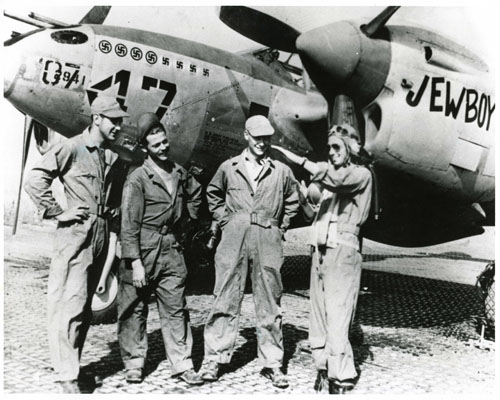
 ______________________________
 ______________________________
 ______________________________
 ______________________________
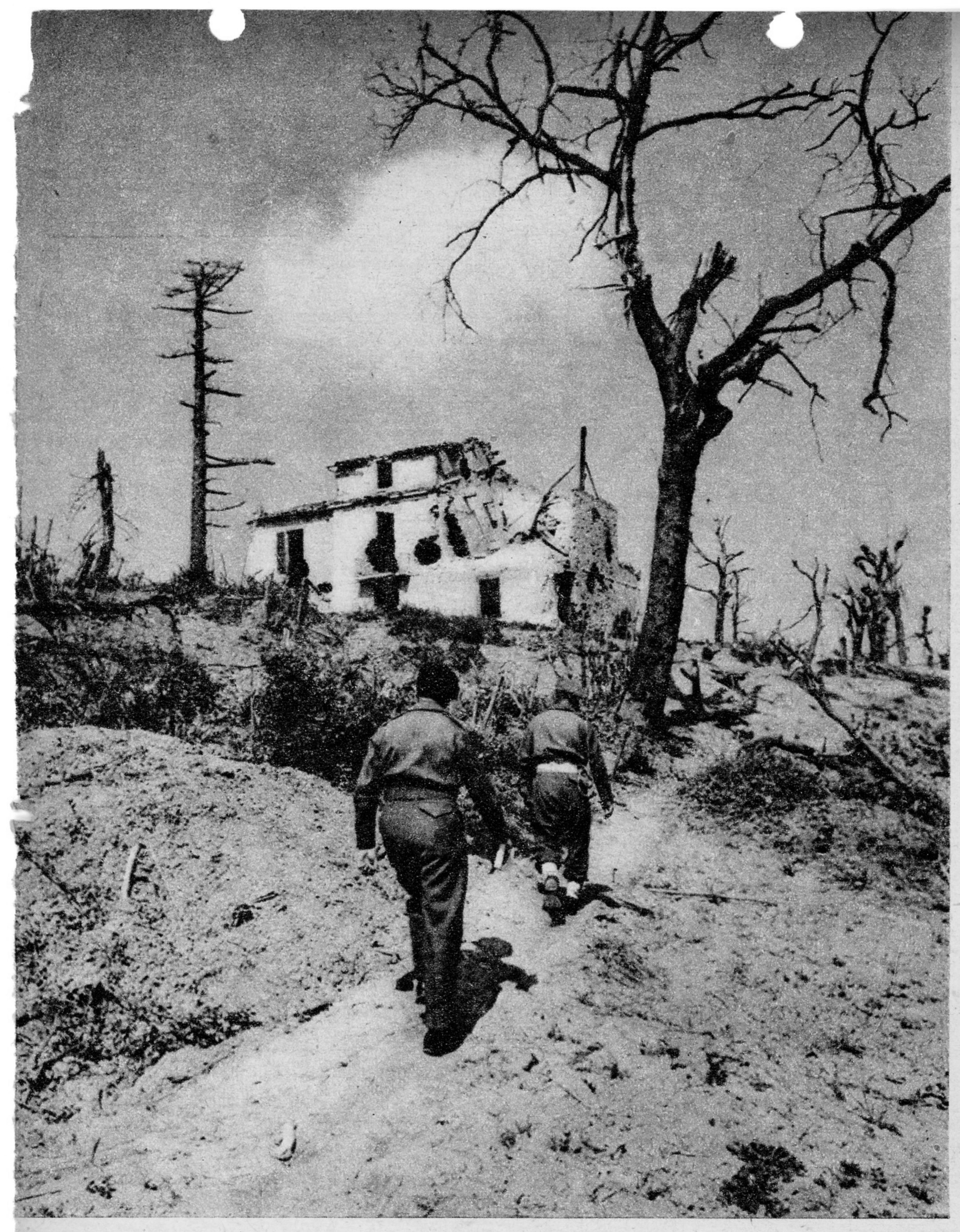 ______________________________
 ______________________________
 ______________________________
 ______________________________
 ______________________________
 ______________________________
 ______________________________
 ______________________________
 ______________________________
 ______________________________
 ______________________________
 References