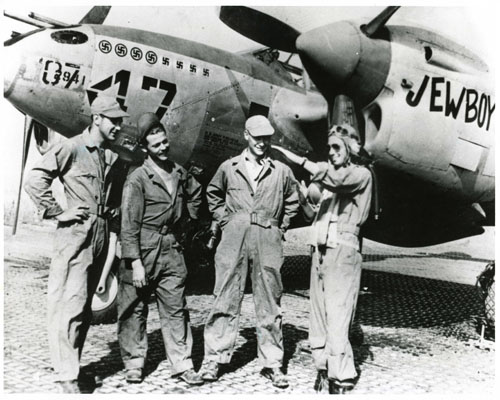
The Invisible Airmen – The Invisible Jews: Captain Seymour M. Malakoff and the Crew of C-47 “Butchski II”, 1944

“…the fact that its entire crew of five are all from New York.”

_______________

Definitions of the phrase “New Yorker”…

… at Wordnik:
“a native or resident of New York (especially of New York City)”


… at Cambridge Dictionary:
“someone from the US city of New York”

“someone from the US state of New York”

…at Collins Dictionary:
1. a.  “of the state of New York”

1. b.  “of the city of New York”
2. a.  “a person born or living in the state of New York”
2. b. ” a person born or living in the city of New York”

______________________________

My prior post, The Invisible Sailor – The Invisible Jew?, concerning Warner Brothers’ 1943 film about the United States submarine service, Destination Tokyo, focuses on a fascinating scene that arrives at the film’s halfway point.  After “Mike”, one of the sub’s crew, is murdered – quite literally stabbed in the back – by a Japanese fighter pilot ostensibly in the act of surrender, the Greek-American sailor “Tin-Can” (played by Dane Clark, actual name Bernard Elliot Zanville) is unwilling and unable to attend the former’s funeral.  Tin-Can’s absence from the ceremony sparks anger and shock from his fellow crew members, who take deep offense at his detached and seemingly passive reaction to the death of a fellow crewman.  Then, with great and increasing intensity, Tin-Can explains the reason for his absence.  He relates how the suffering of his family in German-occupied Greece – particularly the murder of his kindly philosopher uncle – has become the central motivation for his military service, which is a form of patriotism and deeply personal – if not familial and ethnic – revenge against the Axis.  In a story otherwise devoted to action, adventure, drama, and occasional moments of levity (what, with Alan Hale, Sr.!), Tin-Can’s speech grounds the film upon a plane of seriousness and depth.

But, I believe there was a story behind Tin-Can’s story.  As I explain fully in the post, given the ownership of the studio that produced the film, as well as identity of some of the writers, producers, and actors involved in the movie’s creation – let alone the time-frame of the film’s release – I believe that the writers and producers of Destination Tokyo used Tin-Can’s speech as a disguised soliloquy about the fate of of the Jews of Europe.  The proviso being of course, that unapologetically and explicitly drawing attention to the fate of the Jews of Europe in the context of fighting the Axis powers, in a form of popular entertainment created for a nationwide audience, was – in the Hollywood of 1943 – perceived as being anathema, in terms of cultural, social, and professional acceptability.

Anyway, Destination Tokyo was a movie; a story; fiction, in which reality lay behind a cloak of invisibility.  

In the world of life; of fact; of literature and journalism, there are other forms of invisibility; even if unintentional; even if benign.  But, just as in Destination Tokyo, the absence of a fact can “speak” far more loudly and leave a far deeper impression, than if it is mentioned … even if briefly, even if fleetingly, even if in passing.  This will reveal more about the writer, publisher, and tenor of the times, than the story itself.  Such was the case of a news item published in The New York Times in early 1944…  

But first, by way of explanation:

Many of my posts on this blog – an ongoing series as it were?! – focus on the military service of Jewish soldiers during the Second World War.  These are centered around news items about Jewish military casualties from the New York metropolitan area, which were published in The New York Times, in the final two years – 1944 and 1945 – of that global conflict. 

Appearing under the heading “Jewish Soldiers in The New York Times in WW II”, I’ve created about forty such posts as of the completion of “this” post in mid-July of 2023.  As explained more fully at Soldiers from New York: Jewish Soldiers in The New York Times, in World War Two, the now-distant impetus for this effort was my review of every issue (seriously!) of the Times published between late 1940 and 1946 for any news item related to the military service of Jewish soldiers during that time.  (I did this in the 1990s by reviewing the Times on 35mm microfilm.  Lots and lots of microfilm.  Did I say lots?  Lots!The goal of this endeavor was to learn about the experience and thoughts of Jewish soldiers in the Armed forces of the Allies in the context of the Shoah, and, the historical experience of the Jewish people during that awful, complex, and transformative time.

I thought – when I began this research three now-seemingly-distant decades ago – given the Times being a newspaper headquartered in Manhattan, with the New York metro area then being the demographic “center” of Jewish life in the United States, that the newspaper would occasionally feature news items about the implications or aspects of Jewish military service during the war, even if in passing: even if tangentially; even only hesitantly.  Well, was I wrong about that.  Very wrong.  Completely wrong; completely-upending-your-assumptions and jaw-droppingly kind of wrong. 

Certainly news about American Jewish servicemen (and on vanishingly rare occasions, Jewish soldiers in the armies of other Allied nations) appeared in the Times, but this facet … or central aspect? … of their identity was never a focus of the paper’s reporting, assuming it fell into the awareness of the paper’s journalists and editors to begin with.  Well…  Given the history of the Times, the prevailing self-perception of the Jews of America at that time, and, the nature of the times (pun entirely intended), perhaps this was inevitable.  An example of this, from early 1944, follows…

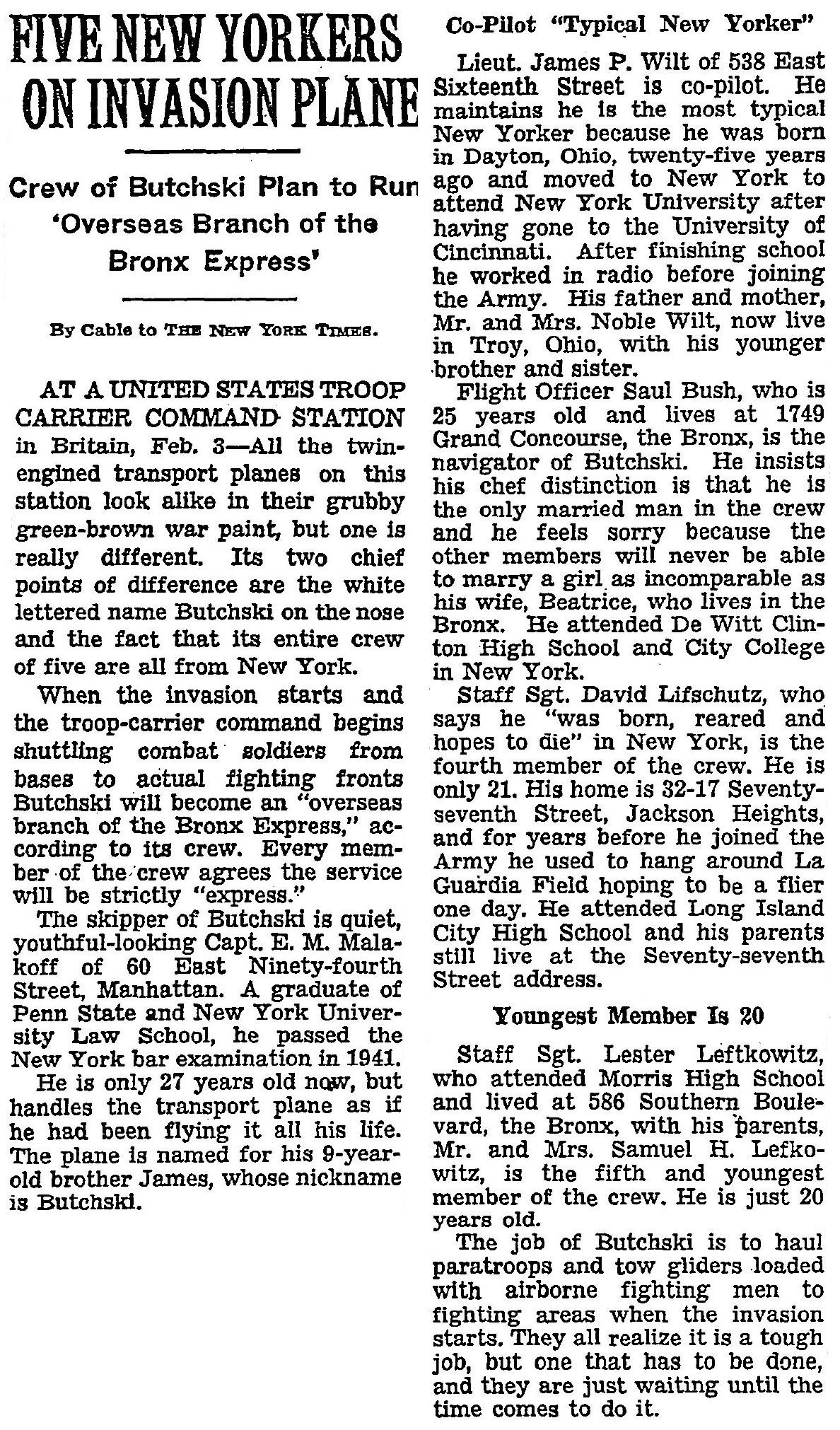
On February 4 of that year, this article, by an anonymous Times correspondent, appear in the first section of the newspaper:

FIVE NEW YORKERS ON INVASION PLANE

Crew of Butchski Plan to Run ‘Overseas Branch of the Bronx Express’

By Cable to THE NEW YORK TIMES.

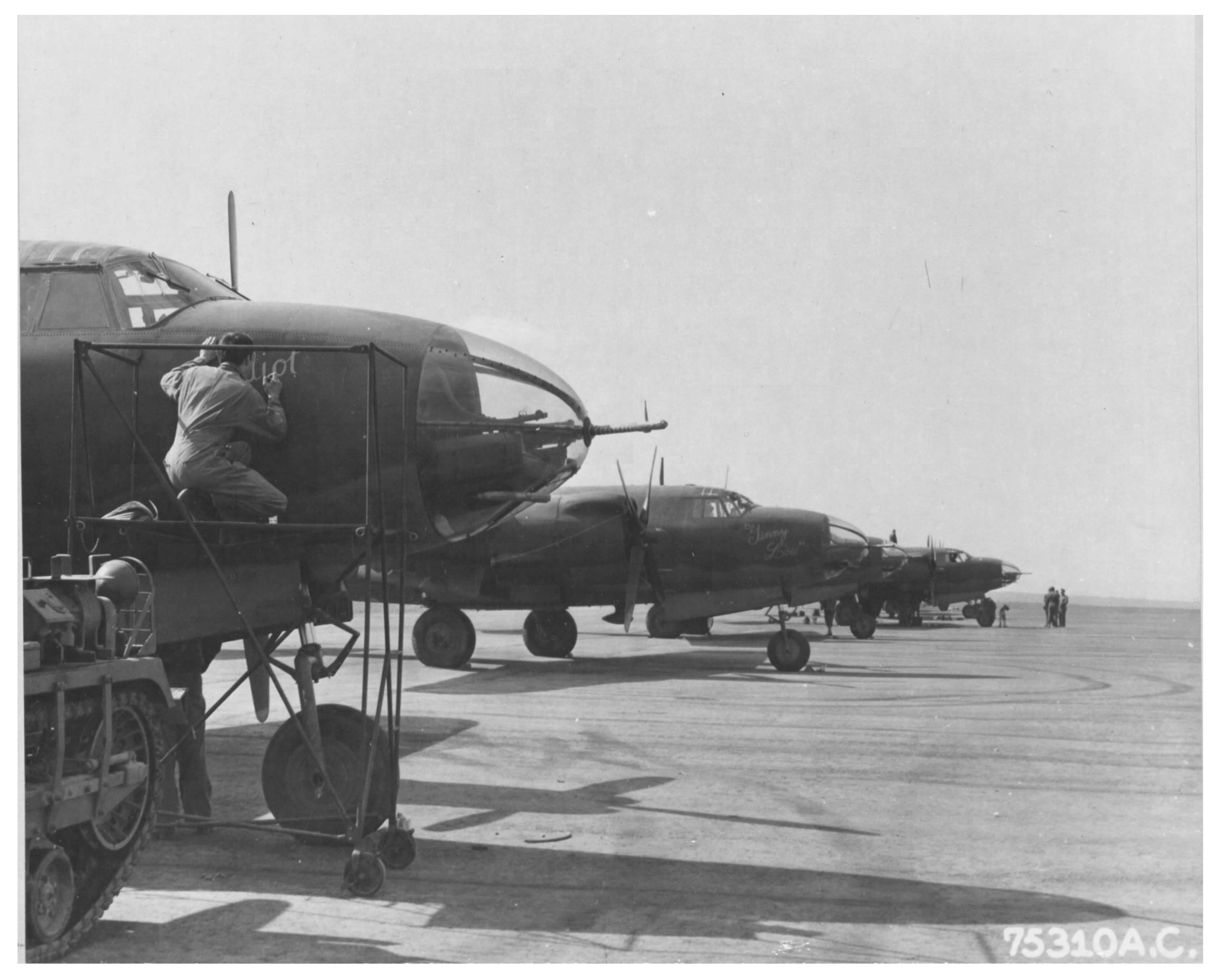
AT A UNITED STATES TROOP CARRIER COMMAND STATION in Britain, Feb. 3 – All the twin-engined transport planes on this station look alike in their grubby green-brown war paint, but one is really different.  Its two chief points of difference are the white lettered name Butchski on the nose and the fact that its entire crew of five are all from New York.

When the invasion starts and the troop-carrier command begins shuttling combat soldiers from bases to actual fighting fronts Butchski will become an “overseas branch of the Bronx Express,” according to its crew.  Every member of the crew agrees the service will be strictly “express.”

The skipper of Butchski is quiet, youthful-looking Capt. E.M. Malakoff of 60 East Ninety-fourth Street, Manhattan.  A graduate of Penn State and New York University Law School, he passed the New York bar examination in 1941.

He is only 27 years old now, but handles the transport plane as if he had been flying it all his life.  The plane is named for his 9-year-old brother James, whose nickname is Butchski.

Co-Pilot “Typical New Yorker”

Lieut. James P. Wilt of 538 East Sixteenth Street is co-pilot.  He maintains he is the most typical New Yorker because he was born in Dayton, Ohio, twenty-five years ago and moved to New York to attend New York University after having gone to the University of Cincinnati.  After finishing school he worked in radio before joining the Army.  His father and mother, Mr. and Mrs. Noble Wilt, now live in Troy, Ohio, with his younger brother and sister.

Flight Officer Saul Bush, who is 25 years old and lives at 1749 Grand Concourse, the Bronx, is the navigator of Butchski.  He insists his chef distinction is that he is the only married man in the crew and he feels sorry because the other members will never be able to marry a girl as incomparable as his wife, Beatrice, who lives in the Bronx.  He attended De Witt Clinton High School and City College in New York.

Staff Sgt. David Lifschutz, who says he “was born, reared and hopes to die” in New York, is the fourth member of the crew.  He is only 21.  His home is 32-17 Seventy-seventh Street, Jackson Heights, and for years before he joined the Army he used to hang around La Guardia Field hoping to be a flier one day.  He attended Long Island City High School and his parents still live at the Seventy-seventh Street address.

Youngest Member Is 20

Staff Sgt. Lester Leftkowitz [sic], who attended Morris High School and lived at 586 Southern Boulevard, the Bronx, with his parents, Mr. and Mrs. Samuel H. Lefkowitz, is the fifth and youngest member of the crew.  He is just 20 years old.

The job of Butchski is to haul paratroops and tow gliders loaded with airborne fighting men to fighting areas when the invasion starts.  They all realize it is a tough job, but one that has to be done, and they are just waiting until the time comes to do it.

Here’s how the article appeared in the paper:
______________________________

Biographical information about each of these men follows below.  (A minor caveat:  “Letfkowitz” is actually “Lefkowitz”.)  As will soon be evident as you scroll through this lengthy post, Captain Malakoff was killed in action, but every member of his crew survived the war.  With the significant caveat, that Staff Sergeant Lifschutz was shot down and taken prisoner of war in late December of 1944, during the Battle of the Bulge.

And so, Butchski’s crew:  

Pilot: Capt. Seymour M. Malakoff, 0-660774, Air Medal, Purple Heart
Mr. and Mrs. Jacob John (3/6/91-6/14/55) and Vera (Ida) (Partman) (7/12/90-11/18/43) Malakoff, 60 East 94th St., New York, N.Y.
James Leonard “Butchski” Malakoff (brother) (6/20/33-7/24/07)
Born New Haven, Ct., 10/24/16
The New York Times 2/4/44, 6/27/44
Casualty List 7/25/44
Forvarts 6/29/44

Co-Pilot: Lieutenant James Philip Wilt
Mr. and Mrs. Walter Noble (5/21/93-1984) and Katherine (Harper) (Folckemer) (1/4/93-12/29/61) Wilt (parents)
Robert N. Wilt (brother) (1/6/30-7/2/60), 234 South Plum St., Troy, Oh.
Wartime residence: 538 East 16th St., New York, N.Y.
Born Dayton, Oh., 4/2/18; Died 12/13/78
Riverside Cemetery, Troy, Oh. – Section 1, North West Corner

Navigator: Flight Officer Saul Bush
Mrs. Beatrice (Rosen) Bush (wife), 1749 Grand Concourse, Bronx, N.Y.
Mr. and Mrs. Alfred and Dora (Stein) Bush (parents), 2101 Morris St., New York, N.Y.
Born New York, N.Y., 6/29/19; Died 10/20/04
American Jews in World War II – Not Listed

Radio Operator: S/Sgt. David Lifschutz, 12147259, Air Medal Three Oak Leaf Clusters, Purple Heart
Mr. and Mrs. Ephraim (“Frank”?) and Claire Lifschutz (parents), 32-17 77th St., Jackson Heights, N.Y.
Born New York, N.Y., 6/3/22
Casualty List 6/13/45
Long Island Star Journal 4/14/45, 6/14/45
American Jews in World War II – 381

Crew Chief: S/Sgt. Lester Lefkowitz (Hersch G’dali bar Shmuel), 12182071
Born Bronx, N.Y., 5/25/23; Died 10/3/00
Mr. and Mrs. Samuel H. and Etta Leftkowitz (parents), 586 Southern Boulevard, Bronx, N.Y.
Mount Ararat Cemetery, East Farmingdale, N.Y.
American Jews in World War II – Not Listed

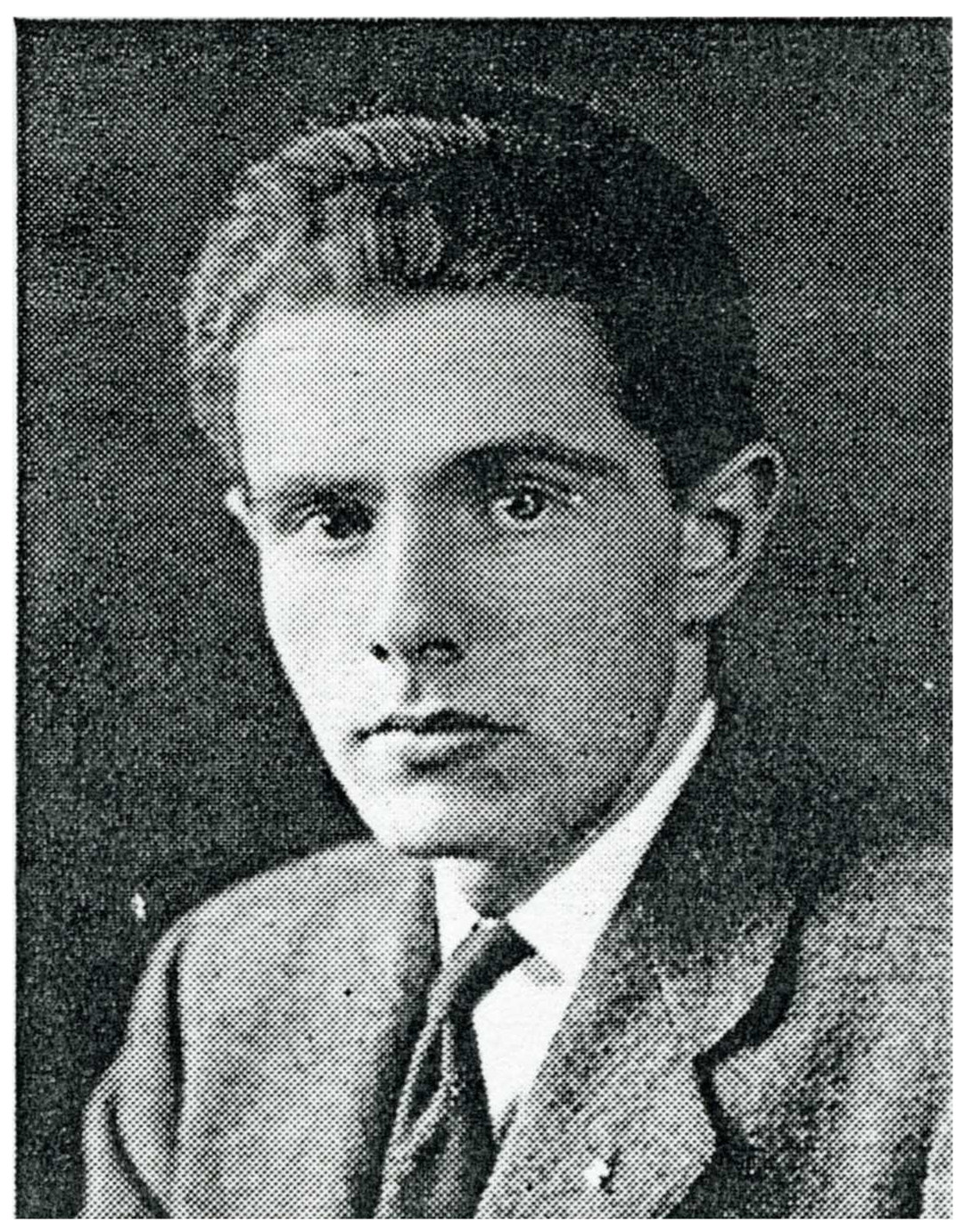
What about Seymour Malakoff? …  He received his pilot wings and was commissioned as a Second Lieutenant on May 20 1942.  His portrait appears below.  Taken when he was aviation cadet, it’s from the United States National Archives, where it’s one image among thousands of similar photos within 105 archival storage boxes encompassing the collection “RECORDS OF THE ARMY AIR FORCES – Photographic Prints of Air Cadets and Officers, Air Crew, and Notables in the History of Aviation”. 

Lt. Malakoff’s portrait, “P-14933”, is in box 57.

(Digression one: The overwhelming majority of these images were taken during the very late 1930s, and early 1940s; with a very small number from WW I and the twenties.  A few civilian flyers (like Amelia Earhart and Anthony Fokker) are also present, along with a few images of famous German WW I aviators.  Most of the portraits are of Flying Cadets, or, men who had just graduated as Second Lieutenants and received their “wings” from Army Air Force pilot, bombardier, and navigator schools.  The majority of the images seem to have been taken from 1941 through 1943, with some from 1944, and a very few thereafter.

Some pictures were taken outdoors, along an airfield flight-line, apparent from background scenery.  Some, with photographic back-drops of aircraft, clouds, or other aviation-related images, were obviously taken in studios.  Other were taken in simple, unadorned, indoor settings.  Some images are printed upon 8 ½” x 11” black & white glossy finish photographic paper, while others, of smaller dimensions, are mounted upon (glued to) heavy 8 ½” x 11” stock.  Typically, information such the date of the photograph, name and rank of subject, and the aviation school where the image was taken is recorded with the image; sometimes on the image itself.

Inevitably, given the coincidence between the timing of their graduation and the time-frame of the Second World War, many of these men were killed in action, while others lost their lives in training or operational accidents.  Similarly, it is notable that there are no photographs of aircrews; only individuals.  Notably, this collection of photographs comprises a limited number of the tens of thousands Army Air Force pilots, bombardiers, navigators who were Aviation Cadets, or were commissioned, during World War Two.)

______________________________

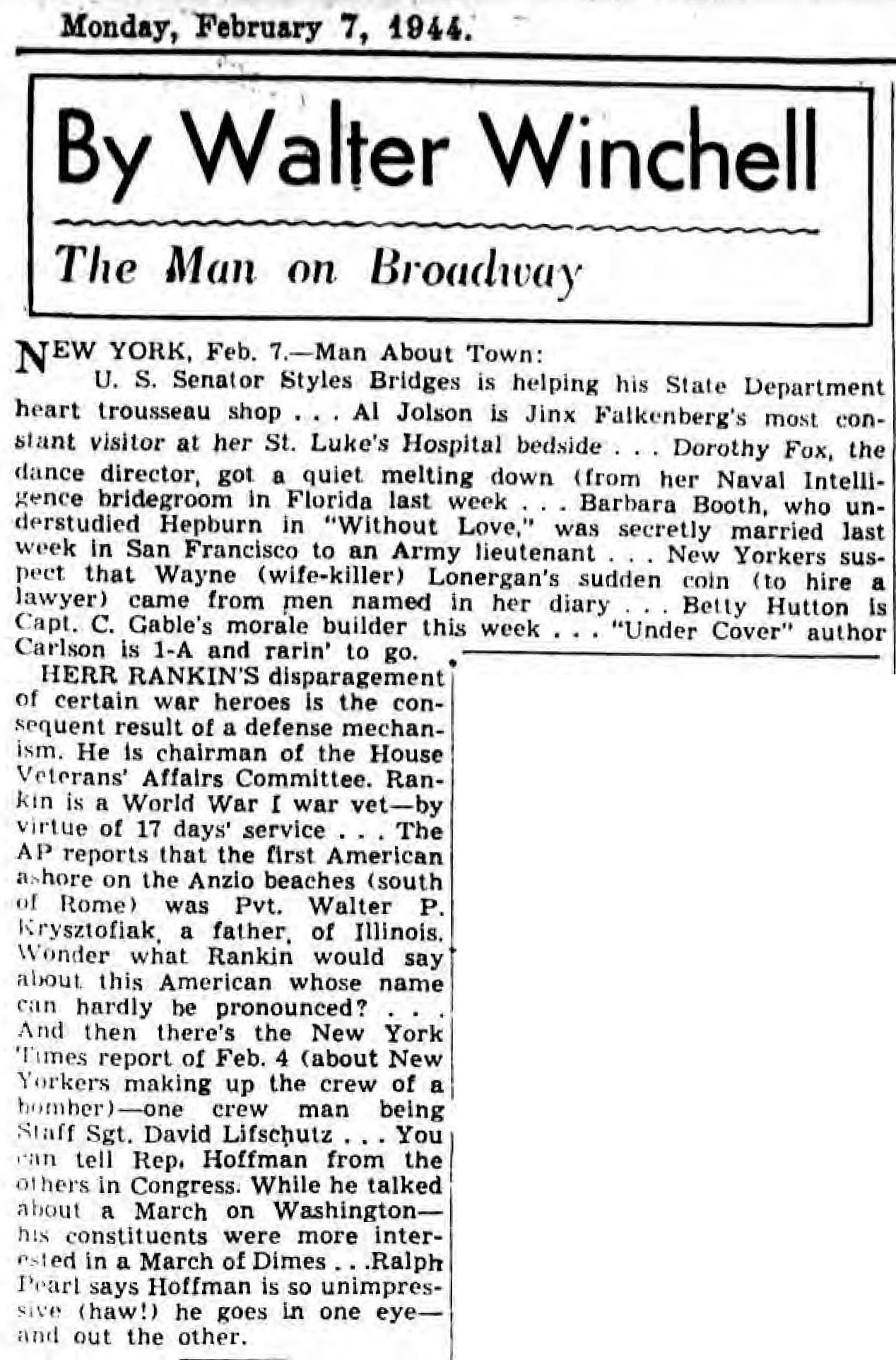
The Times article obviously attracted attention well beyond the confines of Manhattan, for it was referenced in Walter Winchell’s column three days later, in which S/Sgt. Lifschutz was mentioned in reply to comments by Mississippi Senator John E. Rankin concerning the latter’s remarks about the ethnic backgrounds of American servicemen.  Here are the first two paragraph’s from Winchell’s column:

By Walter Winchell

The Man on Broadway

NEW YORK, Feb. 7. – Man About Town:

     U.S. Senator Styles Bridges is helping his State Department heart trousseau shop …  Al Jolson is Jinx Falkenberg’s most constant visitor at her St. Luke’s Hospital bedside…  Dorothy Fox, the dance director, got a quiet melting down (from her Naval Intelligence bridegroom in Florida last week)…  Barbara Booth, who understudied Hepburn in “Without Love,” was secretly married last week in San Francisco to an Army lieutenant…  New Yorkers suspect that Wayne (wife-killer) Lonergan’s sudden coin (to hire a lawyer) came from men named in her diary…  Betty Hutton is Capt. C. Gable’s morale builder this week…  “Under Cover” author Carlson is 1-A and rarin’ to go.

     HERR RANKIN’S disparagement of certain war heroes is the consequent result of a defense mechanism.  He is Chairman of the House Veterans’ Affairs Committee.  Rankin is a World War I war vet – by virtue of 17 days’ service…  The AP reports that the first American ashore on the Anzio beaches (south of Rome) was Pvt. Walter P. Krysztofiak, a father, of Illinois.  Wonder what Rankin would say about this American whose name can hardly be pronounced? …  And then there’s the New York Times report of Feb. 4 (about New Yorkers making up the crew of a bomber) – one crew man being Staff Sgt. David Lifschutz…  You can tell Rep. Hoffman from the others in Congress.  While he talked about a march on Washington – his constituents were more interested in a March of Dimes…  Ralph Pearl says Hoffman is so unimpressive (haw!) he goes in one eye – and out the other.

Here’s how Winchell’s column actually appeared … as published in the Syracuse Herald-Journal:
______________________________

If the Times article of February 4 was (in its own way) enlightening, the following very small news item, published on June 27, three weeks after D-Day, was much sadder:  It reports that Captain Malakoff was missing in action. 

New York Flier Missing

On June 5, Capt. Seymour M. Malakoff of 60 East Ninety-fourth Street, skipper of “Butchski,” a twin-engined transport plane, wrote to his father, J.M. Malakoff, that “everything was fine”.  The next day air-borne troops invaded the coast of France, and Mr. Malakoff said yesterday he had received a War Department telegram saying his son had been reported “missing in action since June 6 over France.”

______________________________

What happened?

Missing Air Crew Report 8409 reveals that Captain Malakoff was the pilot of C-47A 43-30735 (otherwise known as “CK * P” / chalk # 37 / “Butchski II“), of the 75th Troop Carrier Squadron, 435th Troop Carrier Group, 9th Air Force.  His aircraft was one of nineteen 9th Air Force C-47s lost during D-Day (this number based on MACRs covering C-47 losses on June 6), with the 435th losing two other aircraft, both from the 77th Troop Carrier Squadron.  These planes were 42-24077, “IB * J”, piloted by 1 Lt. James J. Hamblin (MACR 7801), and 43-30734, piloted by Captain John H. Schaefers (MACR 8414).  Identical to Captain Malakoff’s “Butchski II” (as will be evident a few paragraphs down…), there were no survivors from the crew of either transport; four men in Lt. Hamblin’s crew, and 5 in Captain Schaefers’. 

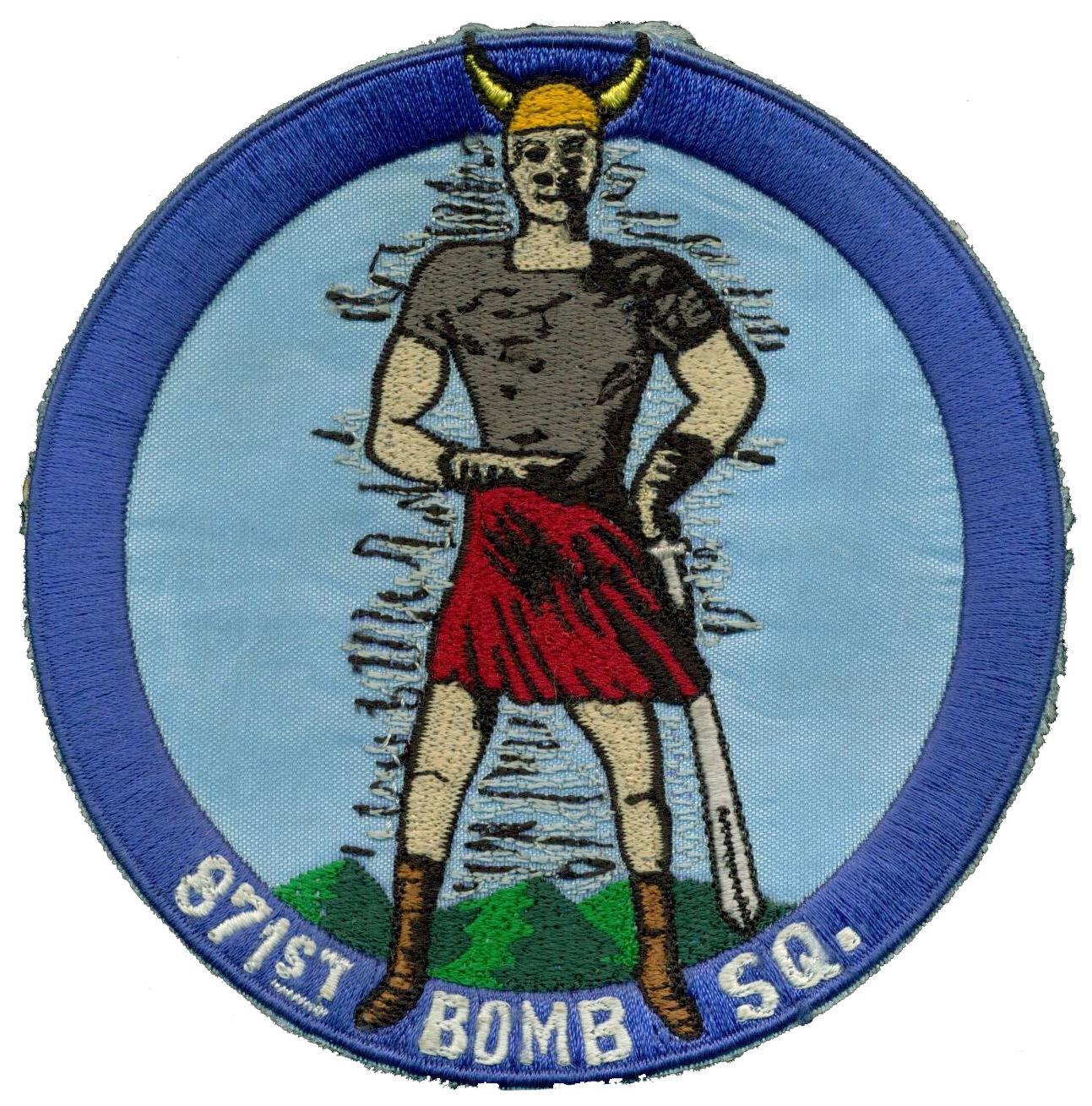
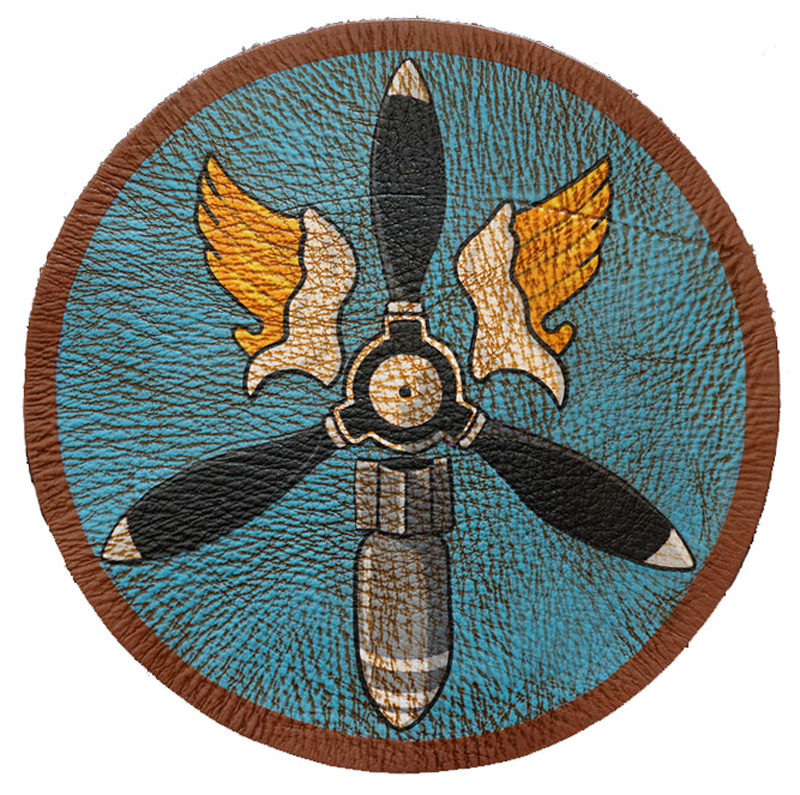
(Digression two: Here’s the insignia of the 75th Troop Carrier Squadron.  (It’s from Ebay seller abqmetal.))

The fate of Butchski II is described in this excerpt from Ian Gardner’s Tonight We Die As Men, the story of the 3rd Battalion, 506th Parachute Infantry Regiment, 101st Airborne Division, encompassing the history of the Battalion’s from its creation through D-Day.  The excerpt describes the loss of the C-47 as seen from the ground.

The two men moved cautiously off along the line of the wall toward a hedge.  A few minutes later they discovered George Rosie hiding under a tree.  He was overjoyed to see them.  They remained hidden in the hedge for a while wondering what they should do.  Suddenly Rosie pointed in the direction of the farmhouse and muttered something through his broken teeth that sounded like, “Jesus Christ.  Look!”

A C-47 had been hit, its port engine was on fire and it was banking sharply to the right.  The men watched as the aircraft leveled out and its paratroopers started to jump.  As the last man left the aircraft it became totally engulfed in flames.  It was then that Gibson, Lee, and Rosie realized that it was heading directly toward them.  They flattened themselves against the ground and the stricken plane tore through power lines and swept 20 ft above their heads before exploding in a ball of flame at Clos des Brohiers.  Just moments later they were surprised to see four men, silhouetted by the inferno, sprinting toward them.  A water-filled ditch briefly interrupted their run, but they waded in and quickly scrambled out.  Watching in amazement, Gibson’s small group could not believe their eyes.  Before them, covered in mud and dripping wet, were Cyrus Swinson, Leo Krebs, Phil Abbey, and Francis Ronzani.  All four had jumped from the same plane as Gibson.  They had been hiding in a field and the burning plane forced them out.

Dr. Barney Ryan had landed in the flooded area close to L’Amont and could see something burning furiously on higher ground nearby.  He had met up with three other men and led them toward the fire.  Ryan recollects, “I couldn’t be sure what was burning at the time but thought it was an aircraft.  We were shot at by figures running around the flames.  As we weren’t supposed to open fire until daybreak we guessed they must be Germans.”  The figures were probably Mongolian soldiers who could see Ryan’s group illuminated in the flames.  Their firing forced Ryan and his men to dive under the water and swim away.

The burning plane had been carrying 18 men from H Co, 501st Bn.  They had been scheduled to jump on Drop Zone C, which was about 3 miles north of the crash site.  All the paratroopers got out safely but unfortunately the plane’s five-man crew perished in the inferno.  The aircraft was piloted by Capt. Malakoff from the 435th Troop Carrier Group’s 75th Troop Carrier Squadron, based at Welford in Berkshire.  It was probably hit shortly after crossing the French coast and fell back in the formation.  Losing altitude and unable to reach the drop zone, the pilot switched on the green light allowing the paratroopers to jump to safety before the plane crashed.

______________________________

Missing Air Crew Report 8409 includes thirteen (!) eyewitness accounts pertaining to the loss of Captain Malakoff’s C-47.  These comprise a total of ten statements from the eighteen paratroopers aboard the plane (all eighteen jumped successfully) and, statements from Captain Paul W. Dahl (C-47 42-92093), and First Lieutenants Charles P. Kearns, Jr. (C-47 42-100675) and Edgar H. Albers, Jr. (C-47 42-92099), fellow pilots in the 75th Troop Carrier Squadron.  Here’s Captain Dahl’s statement:  

I last saw Captain Malakoff as we entered the West Coast of the Cherbourg Peninsula. I was leading the second element of the 4th Squadron.  Captain Malakoff was leading the last squadron directly behind me.  Immediately after crossing the coast we went into an overcast laying over the coast directly on our course.  I turned out to the right a short distance to avoid collision with other ships in the overcast and then resumed course letting down until I broke out beneath the overcast.  If Captain Malakoff had continued straight on course he undoubtedly would have caught up with us out on our left.  A short time after breaking out of the overcast I was fired upon from the ground, guns firing all over the sky.  I saw two ships explode and go down in flames off to our left front about 300 to 500 feet above.  Approximately one-half a minute later I made a left turn into the D.Z. (my navigator recognizing it) and it was about this time I saw a violent explosion directly to our left and then saw the flames engulfing the remnants of the plane as it went down.  I would say this occurred about approximately one mile Northwest of the DZ according to my navigator’s calculations.  The exploding plane was at about the same altitude as we were which was 1000 ft indicated letting down.  I definitely saw tracers going into the explosion.  I had to make a left turn into the DZ because of the previous right turn I made in the overcast which is another fact that might indicate Captain Malakoff’s being off to my left.

I would estimate Captain Malakoff’s speed at 140 to 150 mph the last time I definitely saw him before we entered the overcast.

I was in the overcast approximately few and one half minutes.  We were under fire most of the time after breaking out of the overcast.

______________________________

This statement is by Pvt. Joe L. Cardenas, of (at the time) H Company:

I was the last man in my stick, the last to jump from the plane.  Because of my position near the radio compartment I couldn’t see out but 1 did notice the plane lurch a little possibly from wing hits.  Lt. Hoffmann [1 Lt. John W. Huffman] gave the order to “stand up”, “hook-up”.  The crew chief came out and said that he thought they were coning in south of the DZ.  He told us to hold it up and I passed this word down the line.  He then went back to the pilot.  He came out again and wanted to know why we were in the plane and went back into the pilot’s cabin.  He came out again, rather excited and said “we are coming over the DZ when you get the light.  “Go!  Go!  Go!”  The plane seemed to be OK.  I had no trouble getting out.  I never saw the plane again after I jumped.

______________________________

Missing Air Crew Report 8409 lists C-47 43-30735 as having last been seen west of Etienville, France.  In reality, the plane crashed on the ground of the Frigot Farm, about two miles north-northwest of Carentan.  Several images of Butchski II’s crash site can be seen at TAPA Talk (“Meehan Crash Site“), while Mark Bando has this account at The Carrington News:  

C-47 #43-30735 (pilot Seymour M. Malakoff) belonged to the 75th TCS and was shot down during mission Albany on D-day.  Butchski II came down near Frigot Farm on D-Night, just north of the road that runs straight east toward Basse Addeville [La Basse Addeville] from Dead Man’s Corner.  The plane was carrying the stick of 3rd platoon H/501.  Capt. Seymour Malakoff, pilot, 2nd Lt. Thomas Tucker, co-pilot, 1st Lt. Eugene Gaul, navigator, Sgt. Paul Jacoway flight engineer, S/Sgt. Robert Walsh, radio … were all killed in the crash.  

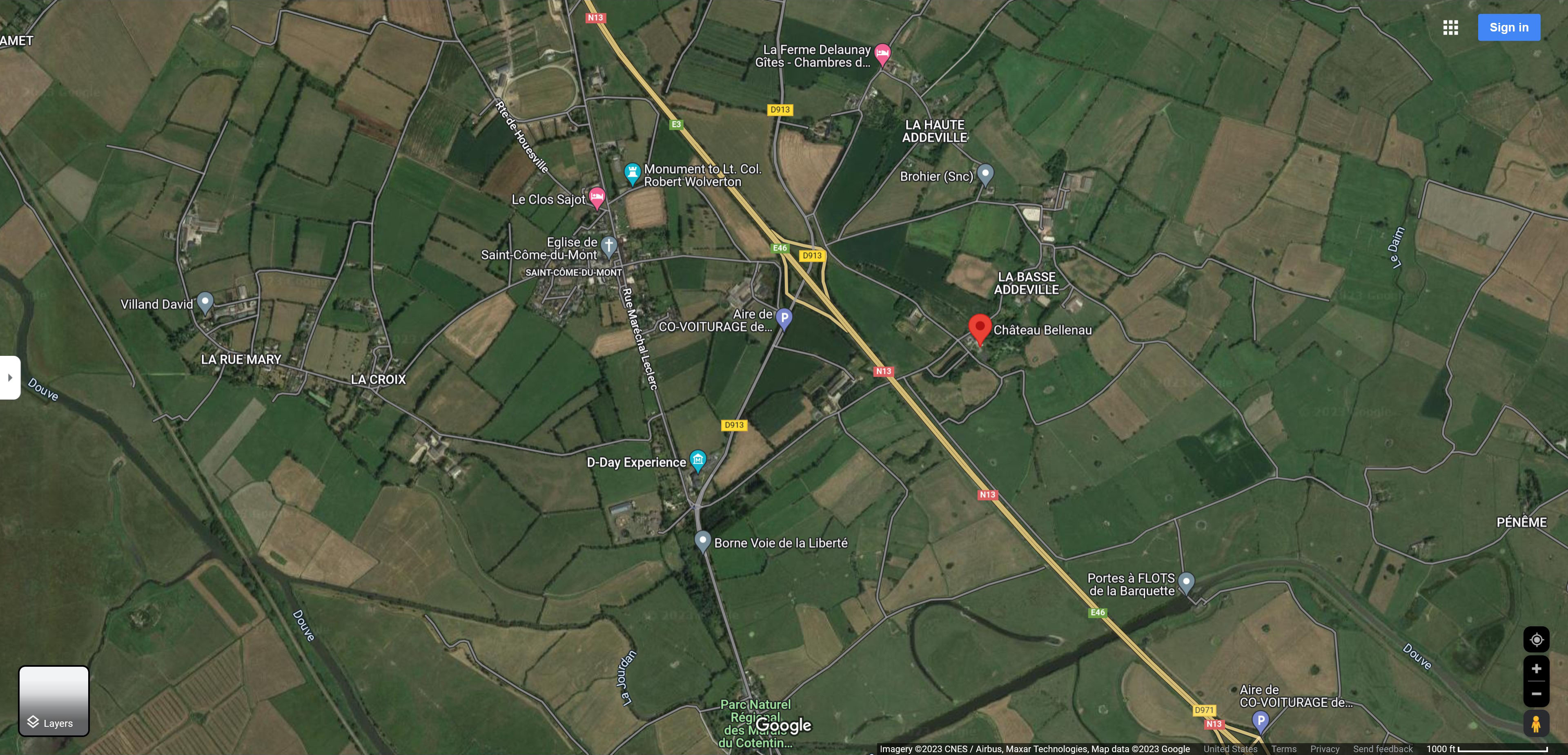
All the troopers on board including Harry Plisevich, Len Morris, Robert Niles, Paul Solea, and Clarence Felt jumped before the ship went in.  Solea’s reserve chute opened accidentally in the plane, causing a four minute delay in jumping.  Due to the cloud banks and ground fire which brought down two other planes of the same serial carrying G/501st personnel [42-24077 and 43-30734], the plane had strayed off-course.  Butchski II was actually hit somewhere south of Carentan and then began a route bringing her NE, on an angle that took her above Addeville.  She then turned back west bound and the occupants of the Frigot farm on the north side of the road just west of the A13 overpass heard it go over their house before she crashed a few fields over.  There was a AA battery on the high ground just north of Chateau Bel Enault [Château Bellenau], which was pumping rounds at the plane as it turned west, losing altitude all the while, one of the troopers [Pvt. Fred J. DiPietro, 15354752?] that jumped was KIA shortly after landing between Baupte and Raffoville, when he knocked on the door of a French farmhouse and a German answered, probably with a pistol in his hand.  From Mark Bando…

These two air photos show the Frigot Farm, which lies at the intersection of D913 and Rue du Bel Esnault, bounded by rows of trees adjacent to each road.  Based on photos at TAPA Talk, the aircraft crashed adjacent to one of the two northwest-southeast oriented rows of trees subdividing the property: the long row in the very center of the image, or, the diminutive row in the farm’s southwest corner. 

This photo, at a smaller scale, shows the setting of the Frigot Farm relative to Château Bellenau, which is just southwest of La Basse Addeville.  
______________________________

Words and maps can only convey so much.  The photo below, also from Gardner’s book (as is the caption), shows the burnt-out wreckage of Captain Malakoff’s C-47 a few days after D-Day.  Little is left of the aircraft except for the fin, an outer portion of one wing, and fragments of bent and burned aluminum.  

“Pvt. Walter Hendrix from E Company 506th stands beside the burnt-out remains of 75th Troop Carrier Squadron C-47 “Butchski II”, which crashed near Frigot Farm on D-Day.  The plane was carrying men from H Company 501st, who all jumped to safety before it crashed.  Unfortunately its crew were not so fortunate and Capt. Seymour Malakoff (pilot), 2 Lt. Thomas Tucker (co-pilot), 1st Lt. Eugene Gaul (navigator), Sgt. Paul Jacoway (flight engineer) and S/Sgt. Robert Walsh (radio operator) all perished in the inferno.  (Forrest Guth picture, Carnetan Historical Center)”
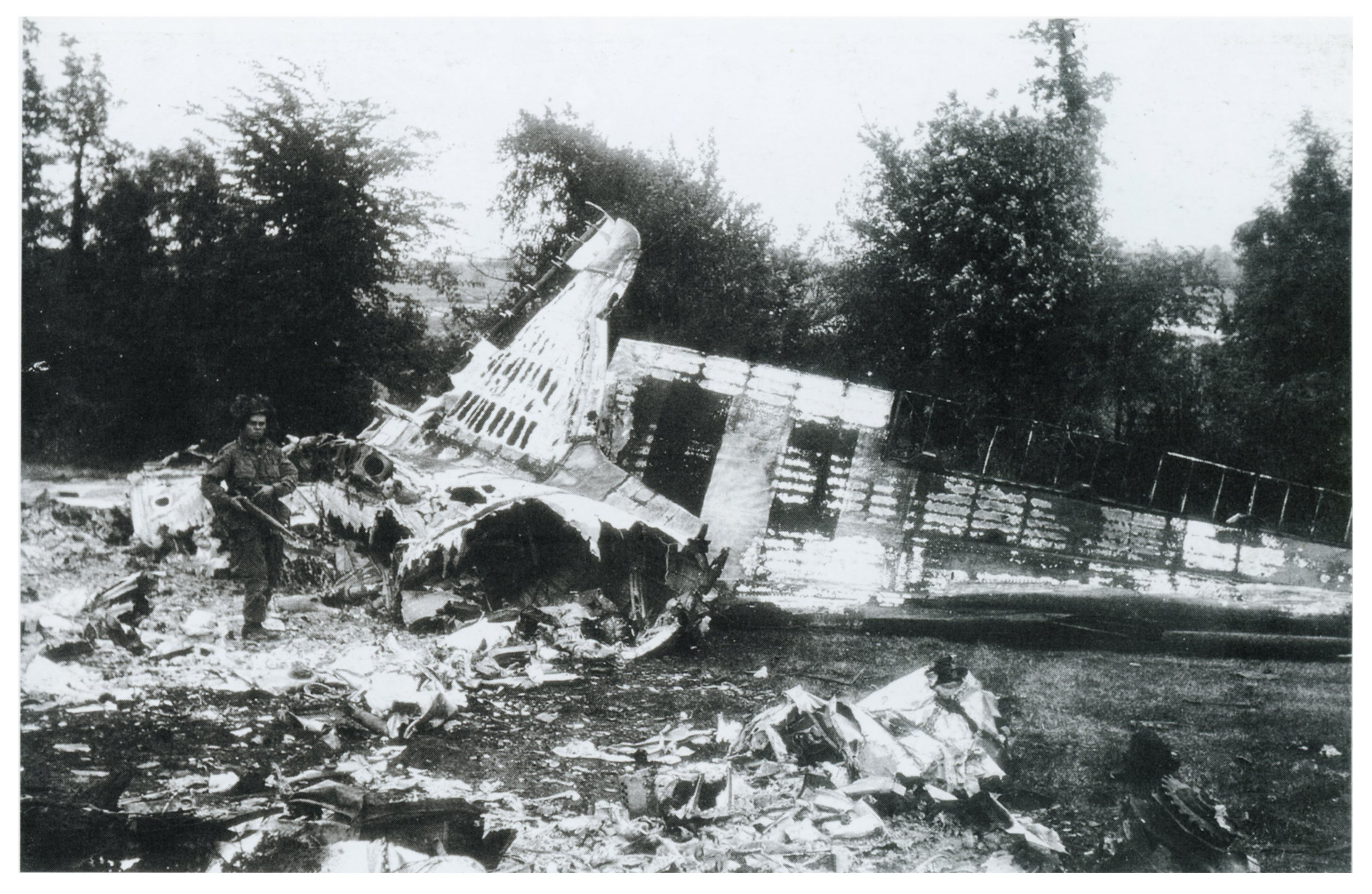
I do find it notable that whereas the Times gives the nickname of Captain Malakoff’s C-47 as “Butchski“, Missing Air Crew Report 8409 and other sources list the aircraft’s name as “Butchski II“.  Whether this reflects an error in the Times’ article, or, the fact that there was an original “Butchski (one)” replaced by a C-47 dubbed “Butchski II” … in the tradition of so many USAAF WW II aircraft … I’ve no idea.   

______________________________

Captain Malakoff’s crew on this mission – their first, last, and only mission – comprised:

Co-Pilot: 2 Lt. Thomas A. Tucker, 0-686291, Buffalo, N.Y. (Born 1918)
Forest Lawn Cemetery, Buffalo, N.Y.

Navigator: 1 Lt. Eugene Edward Gaul, 0-807185, Newark, N.J. (Born 7/4/20)
Long Island National Cemetery, East Farmingdale, N.Y. – Plot H, Grave 7930

Flight Engineer: Sgt. Paul B. Jacoway, 39097783, Fort Smith, Ak. (Born 5/22/18)
Fort Smith National Cemetery, Fort Smith, Ar. – Section 4, Grave 2163

Radio Operator: S/Sgt. Robert Donald “Donny” Walsh, 37397005, Saint Louis, Mo. (Born 4/6/21)
Jefferson Barracks National Cemetery, Lemay, Mo. – Section OPS3, Grave 2307E

I’d suppose that his original crew, as listed in the Times, was broken up as a unit prior to D-Day, and distributed among other crews in the 75th Troop Carrier Squadron.  In any event, as mentioned above, all of Captain Malakoff’s original crewmen survived the war.  

Captain Malakoff is buried at Normandy American Cemetery, St. Laurent-sur-Mer, France, Plot F, Row 18, Grave 18.  Like Flight Officer Bush and Sergeant Lefkowitz, his name is absent from American Jews in World War II.  

______________________________

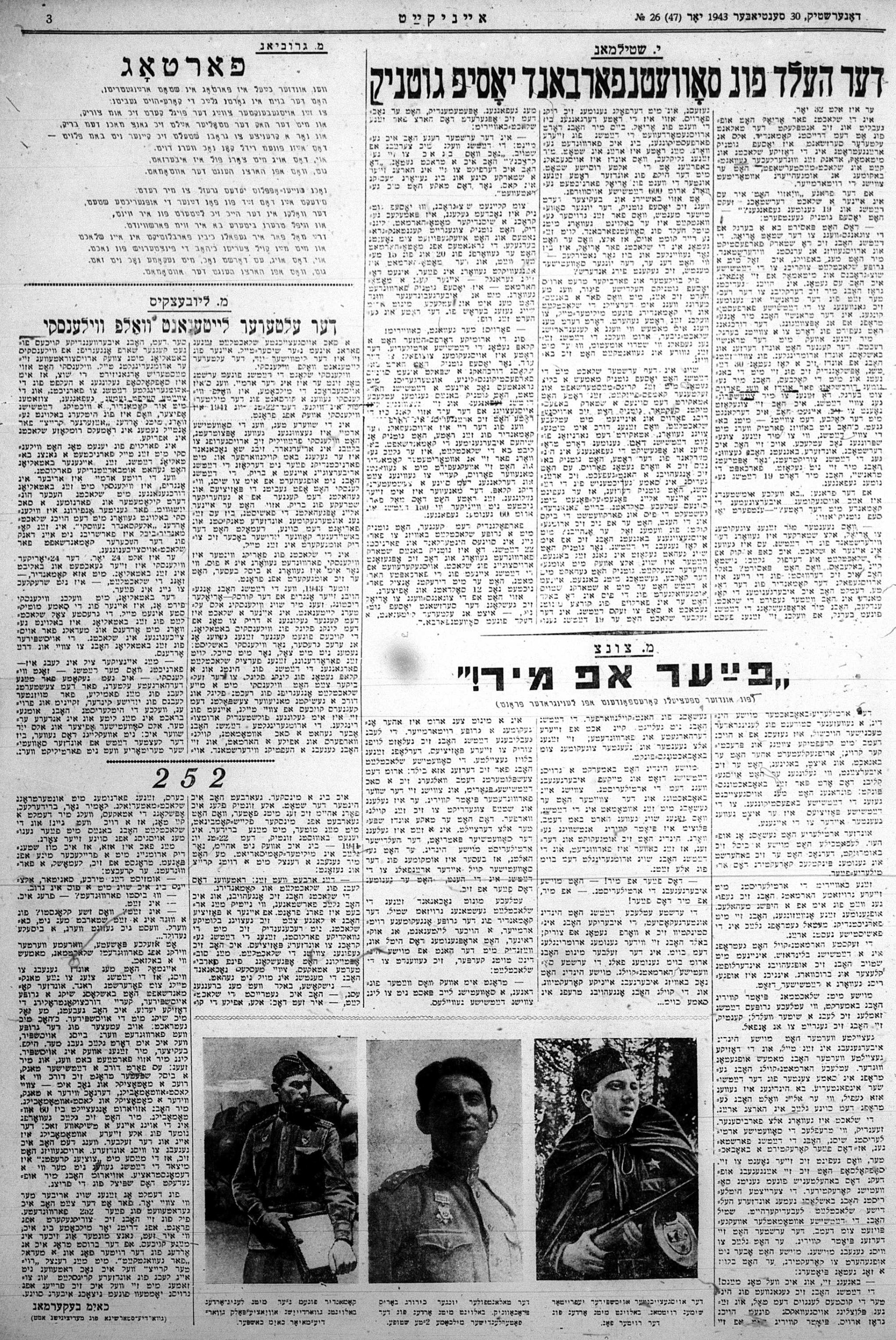
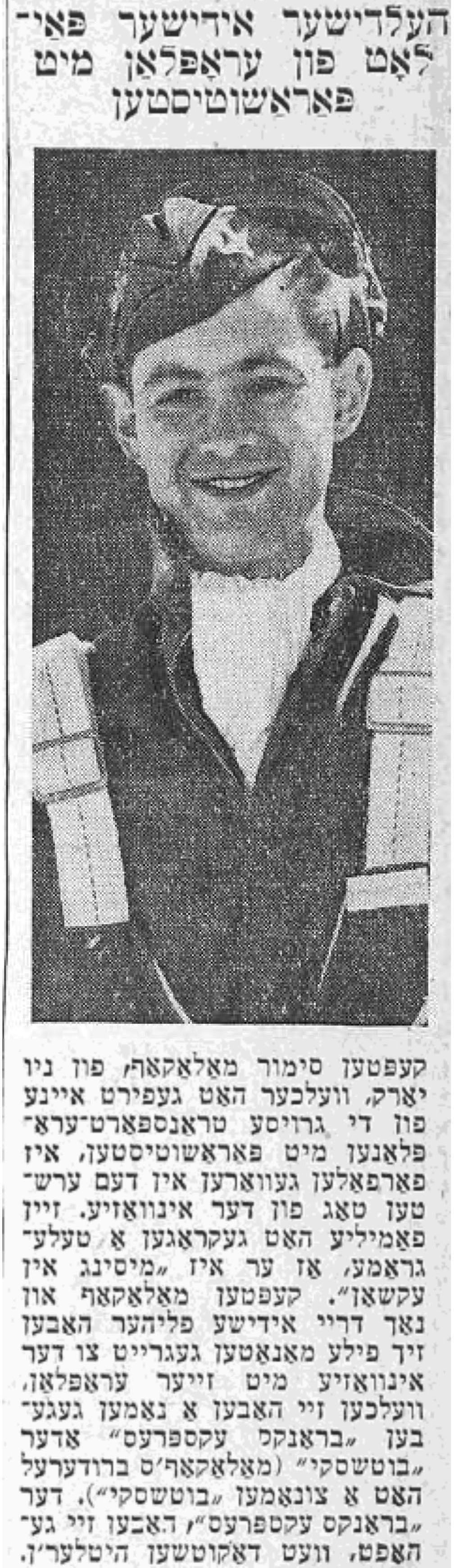
Perhaps inspired by the Times, on June 29 the Forvarts published the following news item about Lieutenant Malakoff.  Given the formal nature of the portrait, what with the fluffy white scarf and jauntily placed cap and headphones, this picture was probably taken during his pilot training in the United States – possibly upon his graduation from pilot training and commissioning as an officer – and before his assignment to the 435th Troop Carrier Group.  I suppose the picture was sent to his parents, who then provided the image to the Forvarts

Though I don’t know Yiddish, I think the approximate translation of the title is rather straightforward: Something to the effect of “Jewish Pilot Flies Airplane with Parachutists”.  The word “Butchski“, phoneticized in Yiddish, definitely appears in the article.  It’s in quotes in the third line from the bottom.   
__________

_______________________

And now, submitted for your consideration:

The elephant in the living room.

…or…

The rhinoceros in the foyer.

_______________________

__________

Getting back to the Times’ article.

Well, yeah. 

Captain Malakoff’s crew were most definitely “New Yorkers” by either residence or birth.  That’s explicitly stated in the Time’s article’s first paragraph.  That all but one of the airmen in the crew were Jews was, however, entirely left unmentioned.  Perhaps this “silence” about the coincidence of four Jewish airmen assigned to the same aircrew, in the European Theater of War, arose because it wasn’t even noticed to begin with.  (That, I seriously doubt.)  Perhaps it was deemed irrelevant.  (That is surely possible.)  Perhaps it was left unmentioned because the story’s anonymous author and editor adhered to and tacitly accepted the Times’ deeply animating ideology which has continued to negate an acceptance of Jewish peoplehood.  (Surely that’s possible too.) 

But still, in the cultural context of the forties and the next few decades (not so much any more),the phrase “New Yorker” was a verbal shorthand that not always, but not uncommonly had a certain Jewish connotation or “ring” to it – on occasion positive; sometimes ambivalent; perhaps neutral; sometimes negative – whether in politics, popular culture, or comedy.

Walter Winchell’s column, published three days after the Times’ story, made mention of David Lifschutz as a way of refuting Congressman John E. Rankin’s statements about American Jews.  But, even accounting for the fact that Winchell was a gossip columnist, something’s clearly “off” with with his article just as much as there is in the Times’ original story.  On a minor point, Butchski was a transport, not a bomber.  On a major point, obviously having combed the article for details, why did Winchell not deign to mention Seymour Malakoff, Saul Bush, and Lester Lefkowitz?  Given the length of his very long column – of which the above image is only a beginning snippet – why the silence about these three men?  Though my knowledge of Winchell’s life only comes from Wikipedia, what stands out from his biography is that despite – or perhaps as a consequence; perhaps as a cause – of his all-too-fleeting fame and social prominence (in a personal life characterized by turbulence and tragedy); despite his father having been a part-time cantor – his only real connection to Judaism and the Jewish people was in his ancestry. 

Plus, the Magen David on his Matzeva.  

Yet, there could be another explanation for the nature of the Times’ article: Perhaps there were aspects of the Times’ reporter’s conversation with the crew of Butchski – then unrecorded and now unknown – that never reached the printed page.  In this, I’m reminded of comments made to me by a Jewish WW II veteran who flew B-17s in the 8th Air Force, several of whose crew members were Jews, and whose brother (a ball turret gunner) and cousin (1st Lieutenant Morris Levesee also…) were killed in action while serving in the 15th and 8th Air Forces, respectively.

As he related in a late 1993 interview:

Me: Can you recall any other Jewish guys who were in your squadron, besides the guys in your crew?
Veteran: Oh yeah. Yeah. We had a…we had a guy; he was a navigator. A fellow by the name of Bill L.  And Bill L.…  Bill L.…  He had worked for the…he worked for the Daily… He had some kind of a job with the Daily News. …  The fact that he had worked for the newspaper, I guess, you know… He was… Let me see, how can I say it? You know, he wanted…he wanted in the worst way, to publicize…the fact… He hung onto my crew…because we had so many Jews.  And he wanted…he wanted to…you know, to throw out a lot of publicity about it and I turned him down, while we were overseas. And I said, “No, no, no. I don’t want to do that.”
The one thing that he did, and it was printed in the Brooklyn Daily Times, or Times Union…I forget what the hell the name of the paper was… He had a picture taken of Irving S. and myself…at the airplane, glancing at a…at a map, and he had written a small article. He and some other guy… I forget what the hell his name was. He was our…he was our PR man. He was also Jewish. And he was the squadron PR man.
And…and they…they had this little article, and they titled it as, “Brooklyn Flak Dodgers”, you know, and he was showing me how we could dodge the flak and all this other bullshit!, but… But it was never printed that way, in the paper. It was just printed…and I have a copy of it…it was printed just as, “Two… You know, as “Two Brooklynites on the Same Crew”. That’s all. Just some little article in the… And I have it someplace. I don’t know where.
And I have that picture, too. I have a copy of the picture.
Me: But he tended to want to socialize with your crew?
Veteran: No, no no no no. No, he didn’t… No, there was…there was no socializing at all. He…the only thing that he wanted to do… He wanted to, you know… I guess, he wanted…he wanted to write, about “this Jewish crew, that were doing ‘this’ and were doing ‘this’ and were doing, you know. And he wanted to…he wanted some sort of notoriety about it, and I didn’t want…I didn’t want it. I said, “No, I don’t care for it.”
I came in…I…I had…I had my brakes shot out on one mission. I had the hydraulic system that was just… My whole hydraulic system went bad, you know, just the…the fluid leaked out. It was shot up? And, I made, what they called…referred to as a…”Stars and Stripes Landing”, using a parachute to…you know, to…to slow me down so that I could…
Me: Out the waist windows or something like that?
Veteran: No no, out the tail. And we used that parachute out the tail, and he wanted to make a big tzimmis [Yiddish for fuss] about it, and I said, “No, I don’t want it Bill.” I said, “I’ll tell you what you do. Write a nice article about my tail gunner, who’s”…what the hell is his name?…P., Henry P.… I said, “Write an article about Henry P.; that P. threw his parachute out the tail, to slow us down so that we didn’t run off the runway.” And that was…that was it.
I didn’t want… I was kind of… You know, I was…superstitious about it, you know.
Me: About the Jewish angle being played up.
Veteran: Well, about any angle… I was superstitious about any kind of, really, publicity. You know, trying to make a…trying to make a hero out of us, you know?
Me: That it would be tempting fate?
Veteran: I think so, yes. That was my feeling.         

__________

_______________________

As mentioned above, the only casualty among Captain Malakoff’s original crewmen would eventually be his radio operator, S/Sgt. David Lifschutz.  Here’s his photo, from the Long Island Star Journal of June 14, 1945.

Remaining in the 75th Troop Carrier Squadron, S/Sgt. Lifschutz was a crew member aboard C-47A 43-48718 (the un-nicknamed CK * A) when, during the re-supply mission to American troops in Bastogne, Belgium on mid-afternoon of December 26, 1944, his plane was shot down by anti-aircraft fire.  Coincidentally; ironically, S/Sgt. Lifschutz’s pilot this day was Captain Paul Warren Dahl, whose eyewitness account (see above) of the loss of Butchski II on D-Day figures so prominently in the Missing Air Crew Report for Captain Malakoff.  

This photo of the Dahl crew, dated June 17, 1944, is from Captain Paul Dahl, 75th TCS, 435th TCG, at Honouring IX Troop Carrier Command

Unfortunately, the only person actually identified in the photo is the Captain himself, at center rear.  This photo of Captain Dahl, from his biography at FindAGrave, was taken while he was a flying cadet.
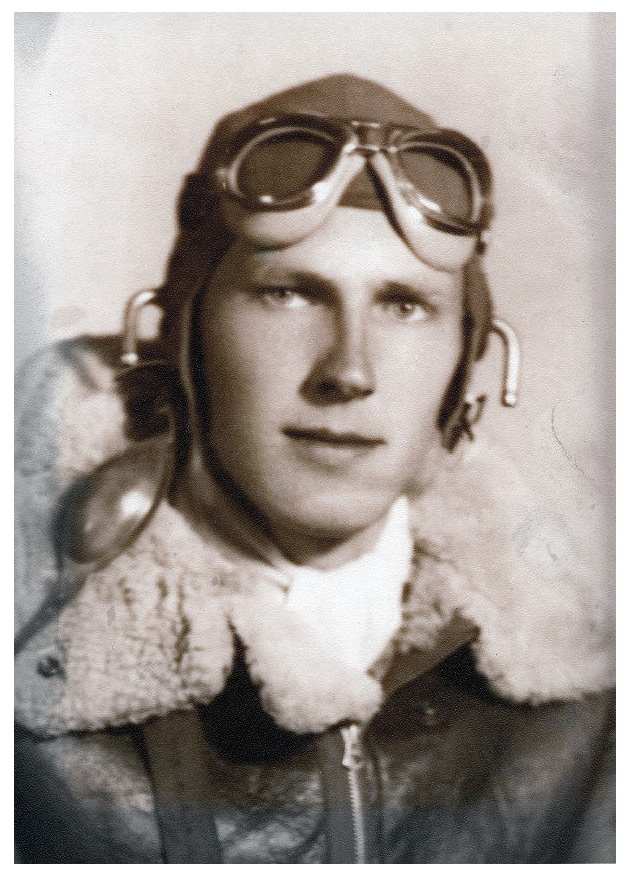
Even if names can’t be correlated to faces, I think it’s possible to attach names to faces based on information in the relevant Missing Air Crew Report, number 11322. 

Along with Captain Dahl and S/Sgt. Lifschutz on the December mission were the following men:

Co-Pilot: 2 Lt. William L. Murtaugh, 0-809998
Navigator: 1 Lt. Zeno Hardy Rose, Jr., 0-807314
Flight Engineer: T/Sgt. George T. Gazarian, 31125533
Passenger: Sgt. John J. Walsh, 36321092, member of 3rd Air Cargo Resupply Squadron

Missing Air Crew Report 11322, covering the loss of this aircraft, includes accounts by three crewmen of a nearby C-47, as well as detailed reports by Captain Dahl and Lt. Murtaugh.  The latter two men, along with Lt. Rose and Sgt. Walsh, landed by parachute in no-man’s-land between German and American forces, but were immediately saved from death or capture by soldiers from the 318th Infantry Regiment of the 80th Infantry Division.  It turned out that Captain Dahl, Lt. Murtaugh, and Sergeant Walsh were wounded either when their plane was struck by anti-aircraft fire, or, injured when they landed by parachute, all having bailing out from an extremely low altitude.  Murtaugh was most seriously hurt, but Navigator Zeno Rose was much more fortunate, emerging from the ordeal unwounded.  

This report about the men’s rescue was filed by the Adjutant of the 435th Troop Carrier Group on January 2, 1945, when the status of the plane’s two other crewmen – S/Sgt. Lifschitz and T/Sgt. Gazarian – was still “Missing in Action”:

2 January 1945.

1st Lt Zeno H Rose, 0807314, 75th Troop Carrier Squadron, this organization, reported “Missing in Action” on “Missing Air Crew Report”, this headquarters, dared 28 December 1944, has returned to this organization.

The following is extracted from interrogation of Lt Rose and is submitted as supplemental to “Missing Air Crew Report”.

“We took off from Station 474 about 1211 BST, 26 December 1944, and flew as the lead ship of the right element of the 75th TC Squadron in the 435th formation.  About two end one half minutes before we reached the DZ at Bastogne, Belgium, we were subjected to enemy fire from both light machine gun and light flak.  Both types of fire were effectively hitting our airplane knocking out the instrument panel on the right side, and at that time, the co-pilot, Lt Murtaugh, was hit by both MG and AA fire that broke his right shoulder or collar bone.  This caused profuse bleeding and severe pain, however, Lt Murtaugh remained at his position and carried on his duties.  At this scene time, the flak burst hit me, although the injury was slight.

Our bundles both in the pararacks and the cabin were ejected over the DZ about 1525 BST.  We made a sharp right turn and were in formation on the ran out when about 2-1/2 minutes from the DZ light flak burst in the cockpit, most probably severing the fuel lines, knocking out the instruments, wounding Captain Dahl and starting fires in the forward part of the airplane.  Captain Dahl rolled the trim tab back checked the power which was already on full, and gave the order and signal for balling out.

I quickly proceeded to the cabin door and saw that the enlisted men had net yet jumped; they seemed to be hesitant possibly because of our altitude.  There was no hesitancy on my part so without further thought, I jumped and was followed by the enlisted men.  (I later learned that the enlisted men were followed by Lt Murtaugh and then Captain Dahl.)  It seemed that we were about three hundred and fifty feet above the ground at that time and my parachute opened instantly.  During my descent to the ground I could hear enemy bullets whizzing past.  I landed near some woods southwest of Bastogne and north of Assenois at approximately P325545, which at that time was between our lines and these of the enemy.  There was a great deal of fire coming toward me so I feinted dead until I could become oriented.

Captain Dahl, Lt Murtaugh and Sgt Walsh landed at a position about 100 yards southeast of my landing near or in the woods and they were picked up by the same organization that joined me.  Captain Dahl had a broken arm, some wounds and lacerations from flak and burns about the nape of his neck; Lt Murtaugh had the broken shoulder, several flak wounds about the face and a sprained ankle, and Sgt Walsh had a broken leg.  All three as well as myself were given medical aid at the Aid Station, then sent to a clearance station, then to a field hospital and then to the 103rd Hospital about forty miles south of Bastogne.

Before departing from the area in which we landed, we were told that the parachute of one of the men had not opened and that in the case of the sixth man, that he had landed closer to the enemy lines and that he had been taken prisoner or had been killed by the enemy.”

Lt Rose interrogated by Captain Clement A. Erb, Intelligence Officer, 75th Troop Carrier squadron, this organization.

The members of this air crew were flying in aircraft C-47A, No. 43-48713, organizations and present status indicated; crew position indicated:

Dahl, Paul W., Captain, 0 401 356, Pilot, 75th TC Sq “SWA”
Murtaugh, William L., 2d Lt., 0 809 998, Co-Pilot, 75th 7C Sq “SWA”
Rose, Zeno H., 1st Lt., 0 807 314, Navigat., 75th TC Sq “RTD”
Gazarian, George T., S/Sgt., 31 125 533, Aer Eng, 75th TC Sq “MIA”
Lifschutz, David., T/Sgt., 12 147 259, Rad Opr., 75th TC Sq “MIA“

Sgt John J. Walsh, 3rd Air Cargo Re-Supply Squadron, was flying on subject aircraft, and was reported as battle casualty by his organization.

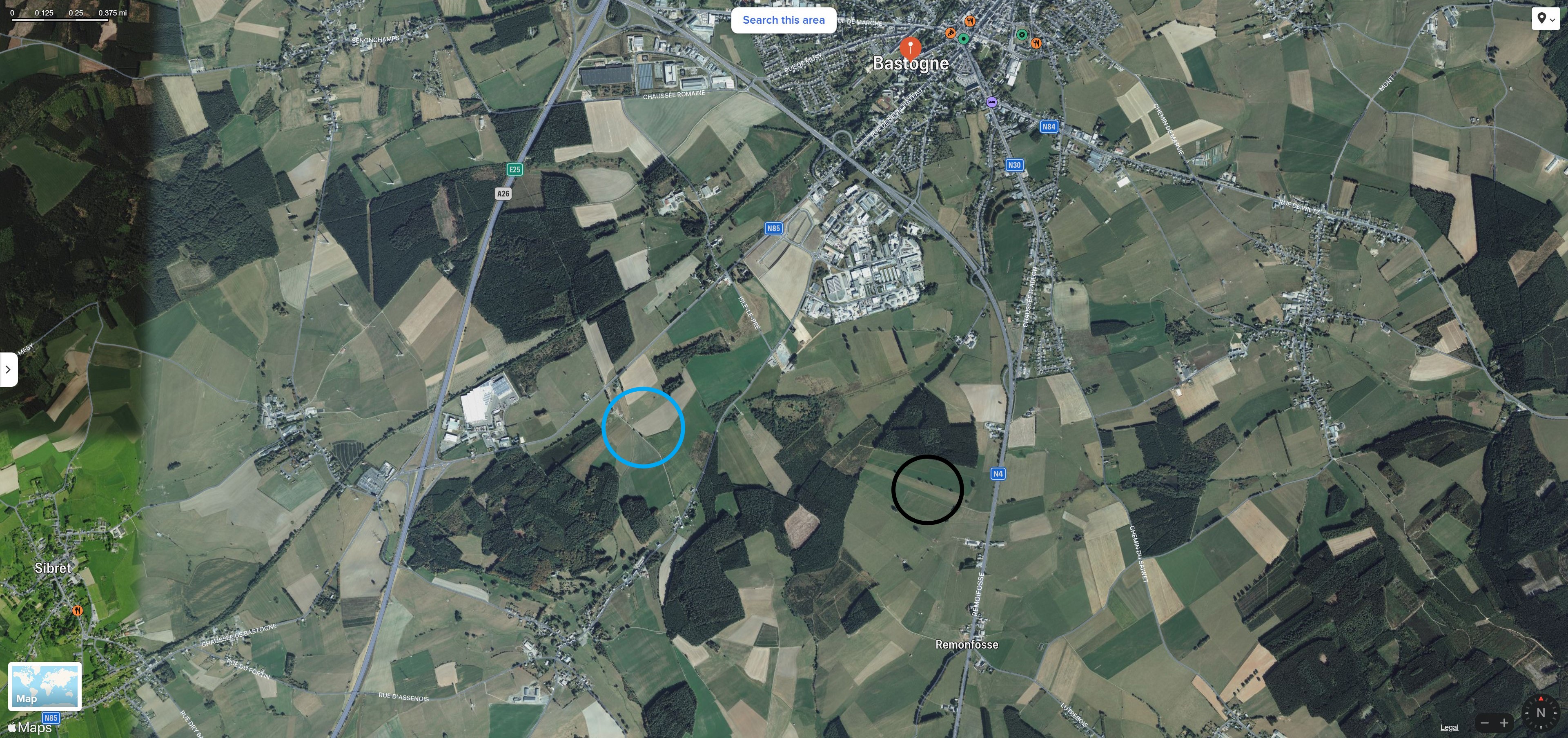
MACR 11322 includes the following map, indicating that the C-47 crashed just west of what is today highway N4, north of Remonfosse and east of Assenois.  

This Apple air photo shows Assenois at lower left center, Remonfosse to the east, and Bastogne to the north.  The blue circle indicates the approximate area where the crew landed by parachute – as suggested by the MACR – while the black circle indicates the (again) approximate crash location of C-47A 43-48718.  
The status of Sergeants Lifschutz and Gazarian, like Captain Dahl on their 9th mission, was uncertain at least through March of 1945.  However, the fate of both Sergeants was established by the war’s end, as revealed in the Individual Casualty Questionnaires as completed by Lt. Rose and incorporated into MACR 11322.  (Rose’s are the only such Questionnaires in the MACR.)  

Sergeant Gazarian (31125533) was killed, either in an unsuccessful parachute jump, or due to ground fire from German troops.  Given that witnesses reported seeing five, and not six, parachutes, the cause was most likely the former.  Born on January 3, 1907, the thirty-seven year old sergeant from Waterbury Ct., is buried at Old Pine Grove Cemetery, Waterbury, Ct.

S/Sgt. Lifschutz was immediately captured on landing, as revealed in Lt. Rose’s Questionnaire.  Given that he and Lt. Rose met one another on May 12, 1945, perhaps he returned to the 75th Troop Carrier Squadron after his liberation, while en route back to the United States. 

The very fact that Lt. Rose was able to record a full list of S/Sgt. Lifschutz’s missions, which were completely identical in date and number to those flown by T/Sgt. Gazarian and Captain Dahl, suggests that Lifschutz, Gazarian, Rose, and Dahl had been members of the same crew commencing with the Normandy invasion.  Thus – following that logic – with the exception of Lt. Murtaugh, for whom the flight of December 26 was his first (and only?) mission – these are the men who appear in the photo of the Dahl crew: Gazarian and Lifschutz in front.      

The POW camp in which S/Sgt. Lifschutz was interned is unknown, but that he was a POW is solidly verified by the standard Luftgaukommando Report form “Meldung über den Abschuss eines US-amerikanischen Flugzueges“(“Report About the Shooting Down of a US Airplane”), in report KU 1214A.  The Report also includes a crew list for C-47 43-48718, which includes Captain Dahl’s serial number.  Oddly, an English-language transcription of this document can be found in MACR 11322, but the original sheet is missing from the actual Luftgaukommando Report.    

(Digressing…  The “A” suffix seems to have been used in Luftgaukommando Reports covering aircraft which had multiple crewmen – as opposed to single-seat fighters – in situations for which some crewmen were known to have evaded capture, or were otherwise unaccounted for, at the time the report was initially filed.)

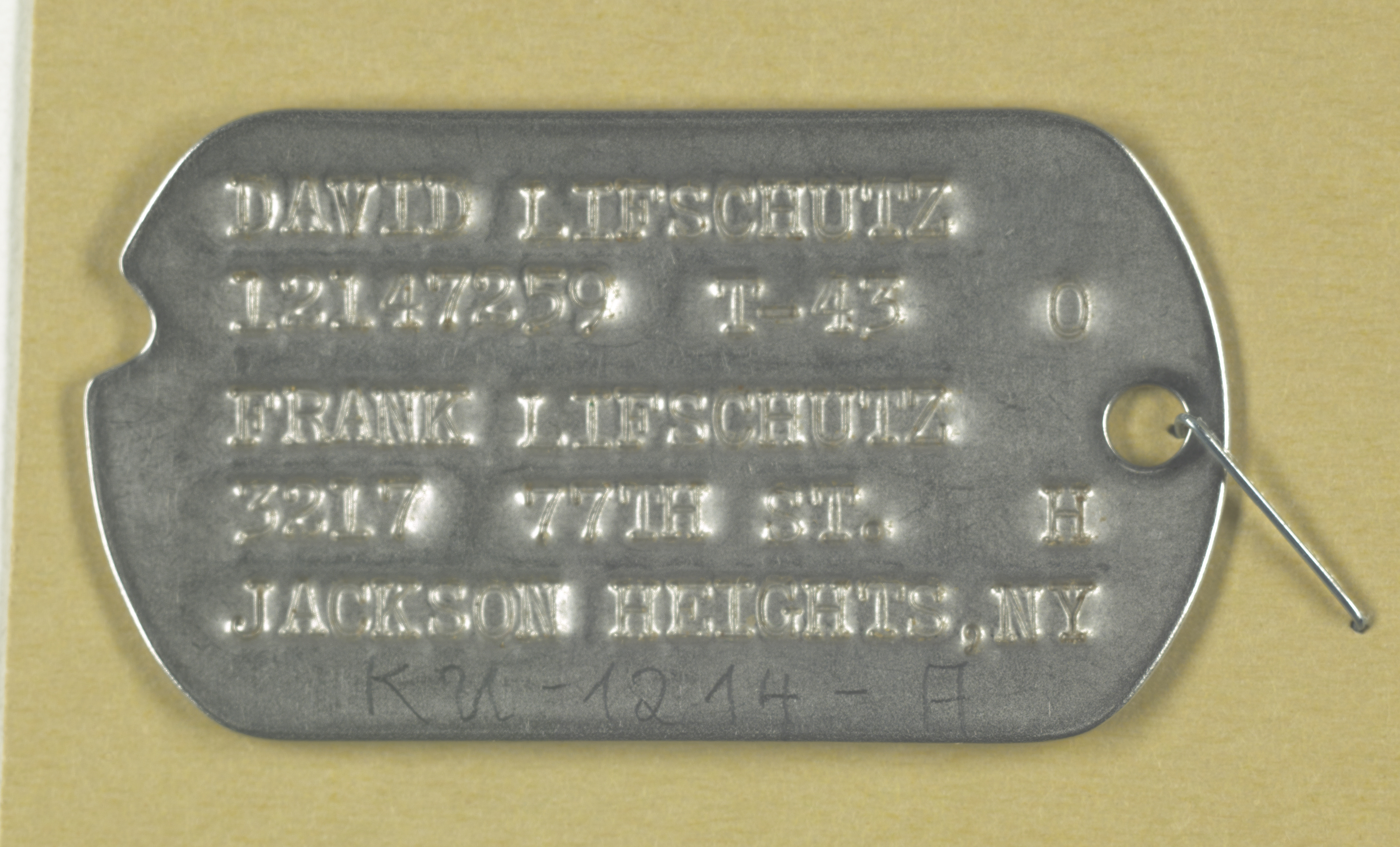
Here’s S/Sgt. Lifschutz’s dog-tag. 

Yes, it bears the letter “H”.
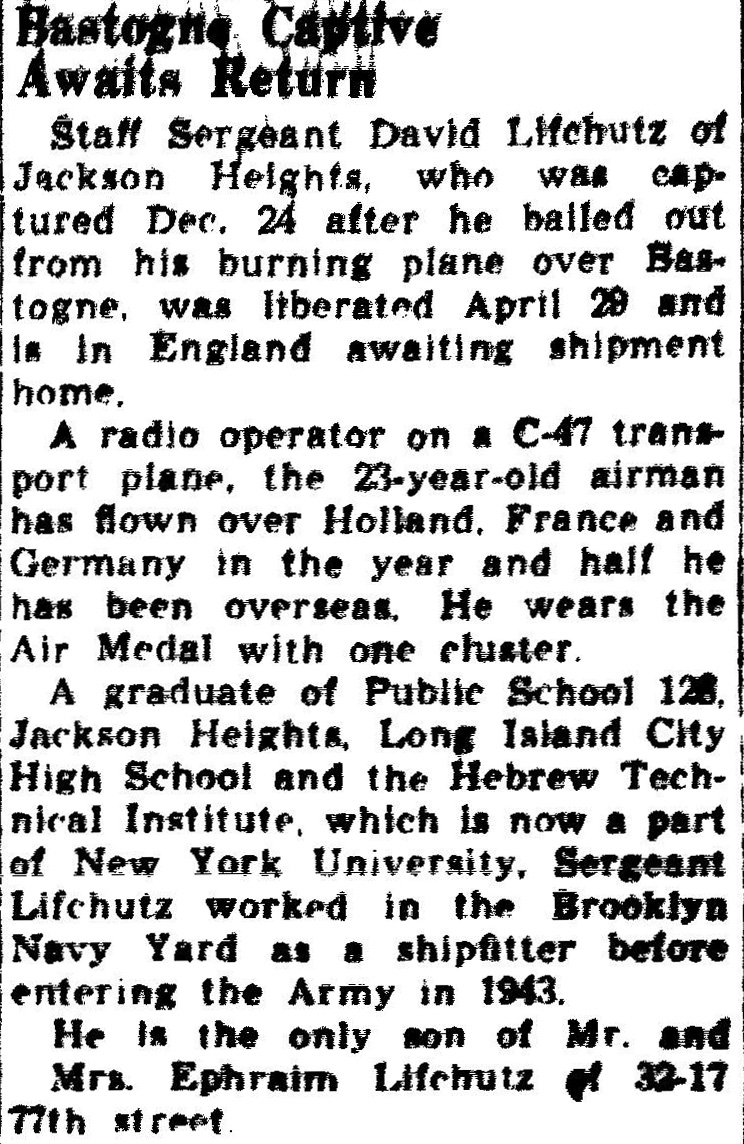
The Long Island Star Journal reported upon the Sergeant’s liberation and impending return in its issue of June 14, 1945, in a brief article which featured his portrait.

Bastogne Captive Awaits Return

Staff Sergeant David Lifchutz of Jackson Heights, who was captured Dec. 24 after he bailed out from his burning plane over Bastogne, was liberated April 29 and is in England awaiting shipment home.

A radio operator on a C-47 transport plane, the 23-yeard-old airman had flown over Holland, France and Germany in the year and a half he had been overseas.  He wears the Air Medal with one cluster.

A graduate of Public School 126, Jackson Heights, Long Island City High School and the Hebrew Technical Institute, which is now a part of New York University, Sergeant Lifchutz worked in the Brooklyn Navy Yard as a shipfitter before entering the Army in 1943.

He is the only son of Mr. and Mrs. Ephraim Lifchutz of 32-17 77th Street.

OOOOOOOO
I don’t know anything at all about the subsequent course of David Lifschutz’s life, but I suppose that given the passage of time, following the way of all men, he has passed into history. 

But, it’s nice to remember a little bit longer.

Two Books.

Dublin, Louis I., and Kohs, Samuel C., American Jews in World War II – The Story of 550,000 Fighters for Freedom, The Dial Press, New York, N.Y., 1947

Gardner, Ian, and Day, Roger, Tonight We Die as Men: The Untold Story of Third Battalion 506 Parachute Infantry Regiment from Toccoa to D-Day, Osprey, Oxford, England, 2010 (see pages 153-155)

Digression Three…

In light of my post about Destination Tokyo, I’m contemplating a post about James Jones’ 1962 novel, The Thin Red Line, which was the basis of the 1964 film by Andrew Marton, and, the 1998 film by Terrence Malik.  I’ve not seen either film (!), but I’m particularly curious about the 1998 version in light of Malick – as touched upon in weirdly brief passing by Peter Biskind at Vanity Fair – having “…changed Stein [Captain Bugger Stein], a Jewish captain, to Staros, an officer of Greek extraction, thereby gutting Jones’s indictment of anti-Semitism in the military, which the novelist had observed close-up in his own company.”  This is in light of the many, many (did I say “many”?!) passages in the novel centered upon Captain Stein, by which Jones, a fantastic writer, with clear and obvious intent explored the officer’s experiences with tremendous perception, depth, and empathy.

So, in 1998, why was Captain Bugger Stein missing in action from The Thin Red Line?

Dr. Bloch’s Öesterreishische Wochenschrift – Life Beyond The Great War

Naturally, innumerable article in the Wochenschrift have little to nothing to do with the Great War itself, instead focusing on varied aspect of Jewish life “in general”.  Here are two such examples, one from 1917 and the other from 1918.  The first article focuses on the Bene Israel of India (albeit not specifically using that term), and the second a place known as Oswiecim, which makes a passing reference to Jewish self-defense.  

The articles appear in the same format as the related posts about the WochenschriftThe English-language translation is first, followed by a verbatim transcript of the article in German (in blue), then an image of the article as it appeared in the newspaper, and finally an image of the entire page in which the news item appeared.  

______________________________
_______________
______________________________

Year 1917

Black Jews in India
February 9, 1917
Issue Number 6, Page 90 (Issue page 10)

It is well known that there are black Jews in Abyssinia.  But also in distant India lives a Jewish tribe with black skin color.  In the farthest reaches of India there lives a tribe of a peculiarity which is such that the most learned minds would have to concern themselves ex officio with its origins.  These are the Jews of Cochin.  Whence the conspicuous color (deep dark, almost black, like that of the Negro); whence the race (pronounced European-Jewish)?  The Holy Scriptures give information.  3,000 years ago, King Solomon repeatedly equipped circuitous coastal voyages for trading purposes to the fabled land of Ophir (near modern-day East Africa).  These each lasted three years.  Some of the participants settled, then wandered on, in these distant lands, founded tribes that had survived through the millennia.  These “black Jews” belong to them, because certain Bible texts speak of them so clearly that their identity can now be considered irreproachable.  At the last of the “Eastern European Reception Evenings”, which the associations created in Berlin hold every Wednesday in the Hotel “Prinz Albrecht” in Berlin for a better acquaintance with our new allies in the east and south-east, the connections were shown in a highly interesting way by Dr. Hermann von Staden, a guest in Cochin on his trip to India.  The black Jewish dignitaries met him in a patriarchal, venerable manner, remarkably friendly in those districts where – the Englishman is to blame! – otherwise the Europeans are extremely suspicious.  The people have their own synagogue in the middle of the Indian kingdom; They feel European, practice their cult according to old rites, course: they have remained the same, although three millennia have passed.  It is significant that, like the most armed elements of the Indian people, their hatred of the British vampire goes to their hearts.  The British also hoarded this beautiful Cochin early on as the “God-willed lord of creation”, if only because it has a beautiful harbor.  But the black Jews, together with their non-religious compatriots, cherish the deepest wish that this war may come to an end as soon as possible, so that the conquerors of India can finally feel the weapons that the peaceful natives taught them early on as masters (for their purposes).  Don’t you know that the frivolous word came from the mouths of the English: “The dead Hindu is the best…”

Of particular interest is the relationship between the black Jewish colony and a white Jewish community that has lived there for a long time.  The black Jews live completely separated from the white ones, hold their services for themselves.  Marriage between black and white Jews is forbidden.  Externally, the difference between the two communities is all the more striking as there are many blond types among the white Jews.  After a long slumber, which it had fallen into since the Portuguese heyday, Cochin has awakened to the growing attention that its port has received, not least through the activities of the Hamburg-America Line and other German shipping companies that go to this remote corner as bearers of culture.

Schwarze Juden in Indien

Schwarze Juden gibt es bekanntlich in Abessynien.  Aber auch im fernen Indien wohnt ein judischer Volksstamm mit schwarzer Hautfarbe.  Im fernsten Indien haust ein Volksstamm von einer Eigenart, die durchaus dazu angetan ist, dass die gelehrtesten Köpfe sich um seine Herkunst ex officio tümmern müssten.  Das sind die Juden von Kotschin.  Woher die auffällige Farbe (tiefdunkel, fast schwarz, wie die des Negers), woher die Rasse (ausgesprochen europäisch-jüdisch)?  Die heilige Schrift erteilt Auskunft.  Vor 3000 Jahren rüstete Konig Salomo zu wiederholtenmalen umständliche Küstenfahrten zu Handelszwecken nach dem sagenhaften Lande Ofir aus (unferent heutigen Ostafrika).  Diese dauerten jede hut ihre drei Jahre.  Manche von ven Teilnehmern siedelten sich, dann weiterwandernd, in diesen fernen Landen an, gründeten Stämme, die sich durch die Jahrtausende zu erhalten mussten.  Zu ihnen gehören diese „schwarzen Juden“, denn bestimmte Bibeltexte sprechen von ihnen so greifbar deutlich, dass ihre Identität jesst als einwandfrei festgestellt erachtet werden kann.  Auf dem letzten der „osteuropäischen Empfangsabende“, die die in Berlin geschaffen Verbande für ein näheres Bekanntwerden mit den uns in Osten und Südosten neu Verbündeten jeden Mittwoch im Hotel „Prinz Albrecht“ zu Berlin abhalten, zeigte in hochinteressanter Weise die Zusammenhänge Dr. Hermann von Staden auf der Gast in Kotschin auf seiner Indienreise gewesen ist.  Patriarchenhaft-ehrwürdig kamen ihm die schwarzen jüdischen Honoratioren entgegen, auffalend fruendlich in jenen Bezirken, wo man – der Englander hat Schuld! – sonst dem Europäer denkbar misstrauisch gegenübersteht.  Die Leute haben ihre eigene Synagogre mitten im Inderreich; sir fleiden sich europaisch, äben ihren Kultus nach altem Ritus aus, kurs: sie sind dieselben geblieben, obwohl drie Jahrtausende darüber verstrichen sind.  Bezeichnend ist, dass ihnen, wie den waffentüchtigsten Elementen des Indervolkes, der Hass gegen den britischen Vampyr bis ins Herzblut geht.  Der Brite hat auch dieses schöne Kotschin, schon weil es einen schönen Hafen hat, früh zeitig als der „von Gott gewollte Herr der Schöpfung“ eingehamstert.  Die schwarzen Juden aber hegen mit den ihnen glaubensfremden Landesgenossen den innigsten Wunsch, dass dieser Krieg baldigst zu Ende gehen möge, damit die Bezwinger Indiens endlich die Waffen zu spüren bekämen, die zu frühren sie die friedlichen Eingeborenen herrenmässig (fur ihre Zwecke) gelehrt haben.  Wissen sie doch, dass aus Engländermunde das frivole Wort-kam: „Der tote Hindu ist der beste…“

Besonders interessant ist das Verhältnis zwischen der schwarzen jüdischen Kolonie und einer auch seit langen Zeiten dort heinrischen weissen jüdischen Gemeinde.  Die schwarzen Juden leben völlig von den weissen getrennt, halten für sich ihre Gottesdienste.  Heirat zwischen schwarzen und weissen Juden ist ausgeschlossen.  Aeusserlich ist der Unterschied zwischen beiden Gemeinden umso auffallender, als unter den weissen Juden sehr viele blonde Typen sind.  Kotschin ist nach langen Schlafe, in den es seit der portugiesischen Blützeit gefallen war, durch die wachsende Beachtung, die sein Hafen fand, erwacht, nicht zum wenigsten durch die Betätigung der Hamburg – Amerika-Linie und anderer deutschen Schifffahrtsgesellschaften, die in diesen weltverlorenen Winkel als Kulturträger kamen.

______________________________
_______________
______________________________

Year 1918

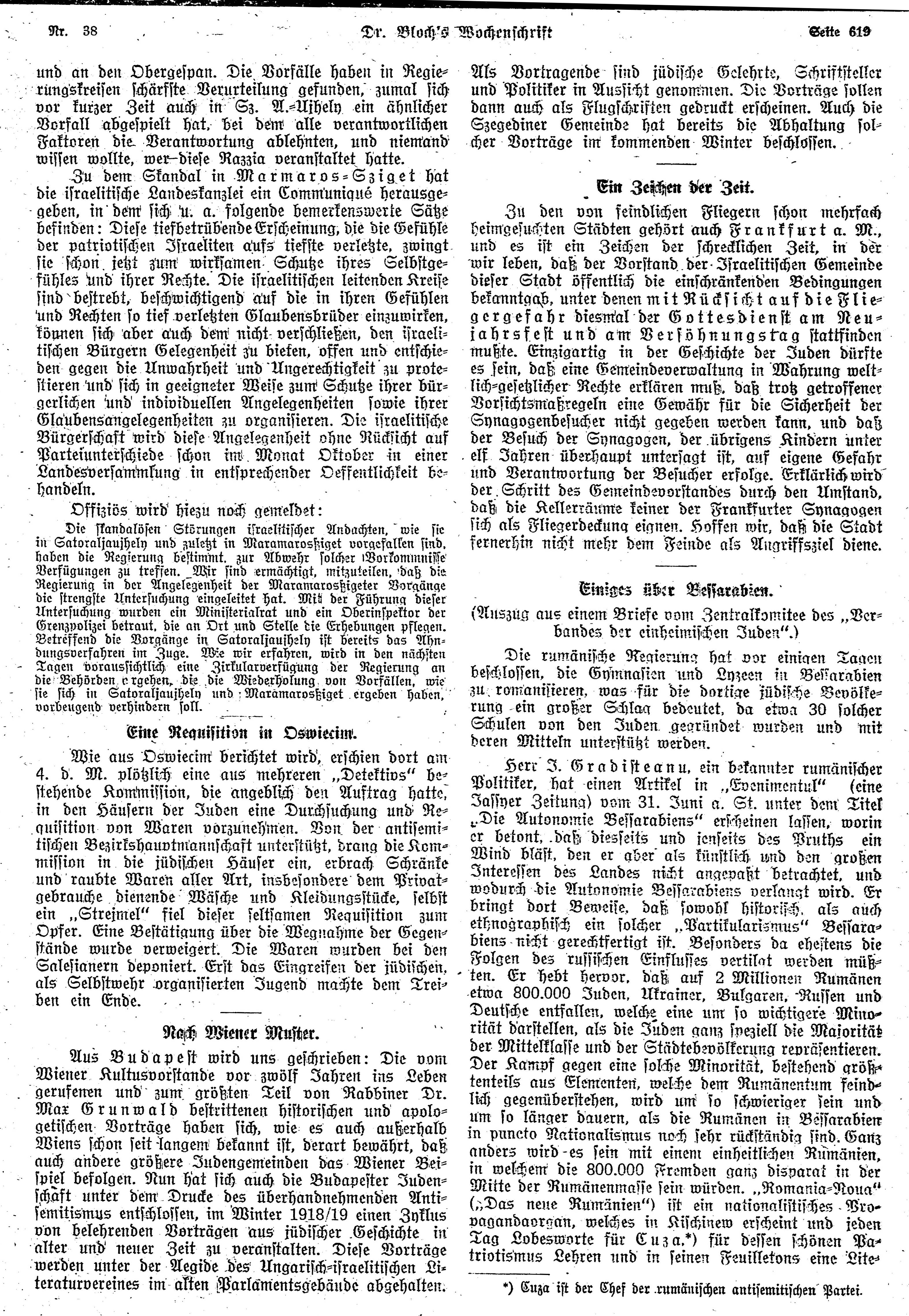
A Requisition in Oswiecim
September 27, 1918
Issue Number 38, Page 619 (Issue page 11)

As reported by Oswiecim, a commission of several “detective” officers suddenly appeared on the 4th d. M., allegedly charged with searching and requisitioning goods in the homes of the Jews.  Supported by the anti-Semitic district headquarters, the commission penetrated Jewish houses, broke cupboards and stole goods of all kinds, especially privately used linen and clothing, even a shtreimel fell victim to this strange requisition.  A confirmation of the removal of the items was denied.  The goods were deposited with the Silesians.  Only the intervention of the Jews, organized as a self-organized youth, made an end of the bustle.

Eine Requisition in Oswiecim

Wie aus Oswiecim berichtet wird, erschien dort am 4 d M. plötzlich eine aus mehreren “Detektivs” bestehende Kommission, die angeblich den Auftrag hatte, in den Häusern der Juden eine Durchsuchung und Requisition von Waren vorzunehmen.  Von der antisemitischen Bezirkshauptmannschaft unterstützt, drang die Kommission in die jüdischen Häuser ein, erbrach Schränke und raubte Waren aller Art, insbesondere dem Privatgebrauche dienende Wäsche und Kleidungstücke, selbst ein “Strejmel” fiel dieser seltsamen Requisition zum Opfer.  Eine Bestätigung uber die Wegnahme der Gegenstände wurde verweigert.  Die Waren wurden bei den Salesianern deponiert.  Erst das Eingreifen der jüdsichen, als Selbstwehr organisierten Jugend machte dem Treiben ein Ende.

A Controversy of Zion: Zionism and Its Foes, in The Jewish Exponent (Philadelphia) VI – January 15, 1943: The “Bogey” of Zionism, by Rabbi Simon Greenberg

A Controversy of Zion – VI

“Rabbi Schachtel claims that he does not know what Zionists mean
when they speak of the “historic homelessness of the Jews.”
Jewish tradition records that there were also some Israelites,
close to the ruling powers in Egypt,
who could not understand why Moses wanted to take them out of that land.
They were quite at home even in Egypt.”

***

“There is also in both articles the expressed or implied fear
that the existence of a Jewish homeland will encourage anti-Semites to persecute us
and force our expulsion from the countries in which we now live.
In that regard there is this simple historic fact to remember.
The absence of a Jewish homeland these 1800 years
never restricted the hands of our persecutors.”

***

“Why some Jews should be ready to join the enemies of their people
in open combat against the hope that has sustained their fathers through 1800 years of persecution
no one will ever be able to fully explain.
The phenomenon belong to those dark mysteries of the human soul
which under the cover of idealism and resounding phraseology
can turn a man to hate against himself, or the nearest of his kind.

The sixth and final of the Jewish Exponent’s series of articles about Zionism, and, Anti-Zionism, among American Rabbis in the early 1940s brings us to an essay by Rabbi Simon Greenberg, the President of the “Philadelphia Zionist Organization” (a local chapter of the Zionist Organization of America?), in response to Rabbi Hyman J. Schachtel’s essay in the Exponent’s prior issue. 

Rabbi Greenberg performs a thorough job of refuting Rabbi Schachtel’s arguments, touching upon issues such as the status of the remaining Jews of Europe subsequent to German’s surrender, and – I think this is important – the way Rabbi Schachtel in his denial of Jewish homelessness in the United States, England, Russia, and Poland (did the Jews of Poland genuinely feel so at home?; were they perceived as such by non-Jewish Poles?) completely and I think calculatedly glosses over the actual pre-WW II status of the Jews of Germany, the countries of Eastern Europe, and, Yemen.  

Then, Rabbi Greenberg discusses the concern, expressed or implied, that the reestablishment of a Jewish nation-state will engender antisemitism and cause the expulsion of Jews from countries in which they live.  His rejoinder is very astute: The absence of a Jewish homeland these 1800 years never restricted the hands of our persecutors. … The treatment we receive at the hands of our fellow citizens will and does depend exclusively upon the degree of humanity and democracy prevailing amongst them and not upon whether there is or is not a place to which they can send us.”

But, the central thrust of his essay addresses an issue touched upon by neither Rabbi Schachtel nor Exponent columnist Al Segal, an issue refreshingly unrelated to the idea the purpose for the re-establishment of a Jewish state would simply to be to provide a refuge for Jews suffering persecution. 

Rabbi Greenberg sees far beyond this, realizing that beyond political security lie aspects of human nature, whether individual or collective, that speak to facets of human experience that cannot be understood in a purely material sense.  Namely: “Hence, even though democracy were to be fully implemented all over the world, they [the Jewish people] would still want one spot where their own cultural and religious traditions would have an opportunity for normal development equal to that which all other spiritual and cultural traditions have in areas where they can claim the majority of the population.”

THE “BOGEY” OF ZIONISM

By RABBI SIMON GREENBERG

The Jewish Exponent
January 15, 1943

EDITOR’S NOTE: – The following article by the President of the Philadelphia Zionist Organization is in reply to an article by Rabbi Hyman J. Schachtel of New York, which appeared in last week’s issue of The Jewish Exponent.  Rabbi Schachtel is a member of the newly formed Council for American Judaism, who stated the position of his group in an article titled, “We Reject Zionism.”  Rabbi Greenberg’s article also contains an answer to last week’s “Plain Talk” column by Al Segal.

The recent activities of the handful of anti-Zionist rabbis and laymen have stirred the deepest passions and profoundest emotions.  It is not easy, therefore, to analyze their arguments of motives with a calm, intellectual objectivity.  But since they insist in pressing their views upon public attention, discussion with them, unfortunate as it may be in this tragic hour of Jewish history, cannot be avoided.

The Jewish Exponent and I presume many other Anglo-Jewish weeklies throughout the country, recently published two statements which attempted further to clarify the position of the anti-Zionist group.  One was written by Rabbi Hyman J. Schachtel, the other by a layman, Al Segal.

The original contribution to the discussion made by Rabbi Schachtel is summarized in the following paragraph:  “If Europe is emancipated, if Europe after the war has a new birth of freedom, there will be no need for artificial lands of refuge for forced migrants.  If Europe and the world are not so emancipated, then there is no refuge anywhere.”  Rabbi Schachtel thus apparently bases his opposition to a Jewish commonwealth on the proposition that no matter what happens the Jews of Europe will or should remain in Europe after the war.  If the Nazis win, Jews have “no refuge anywhere”.  If the Nazis lose “Europe will be emancipated” and there will be no need for Jews to leave it.  Since I cannot imagine a Nazi victory there is no point in discussing the first alternative.  But what will be the situation when the inevitable Nazi defeat occurs?  Zionists, like all democrats, of course, expect the Jews of Europe to have their full citizenship rights restored.  Moreover, Zionists have no desire to see Europe of any other part of the world become “Judenrein”; free of Jews.  If after the war there will be no Jews who will want to leave Europe, and no Jews anywhere else who will want or need to go to Palestine, then the whole problem will of itself be solved.  Certainly no Jewish commonwealth can be established in Palestine, if there are no Jews who want to go to live there.  And surely no Zionist will tolerate the thought that Jews should in any way be forced to migrate to any place.  Zionists were the first to denounce publicly the position taken by the Polish government in the pre-war days that Poland had a “surplus” of one million Jews.  But just as vigorously as we reject a policy of “forced migration”, would we also reject a policy of “forced fixation”.  Is Rabbi Schachtel’s thought that with Europe emancipated no Jew and no European should be permitted to migrate anywhere outside of Europe?  Or is his opinion that with political liberty restored to Europe no European will need or want to leave his native land?  Obviously neither of the two positions can be maintained.  The defeat of the Nazis should mean a world more widely open that ever before for the free flow of men and goods.  And obviously there will be a great outpouring of Europeans who will need and desire the opportunity to find physical and spiritual renewal in other parts of the globe.
In these matters the Zionists, the so-called “romantic dreamers”, attempt to be realists.  They heed the warnings of the best authoritative observers.  There seems to be practical unanimity of opinion that after the war a large percentage of the Jews remaining in Europe will for sociological, psychological, or economic reasons want to and have to find new homes for themselves.  As a matter of fact, many non-Zionist Jewish bodies are engaged even now in looking about for possible countries of immigration for the Jews of post-war Europe.

Rabbi Schachtel claims that he does not know what Zionists mean when they speak of the “historic homelessness of the Jews.”  Jewish tradition records that there were also some Israelites, close to the ruling powers in Egypt, who could not understand why Moses wanted to take them out of that land.  They were quite at home even in Egypt.  “American Jews,” the rabbi says, “are not homeless”.  Every American Zionist will heartily agree with him.  The same is true of the British Jews.  But I wonder whether Dr. Schachtel is on equally safe ground when he speaks of Polish Jews?  Even with minority rights granted them at the end of the last war, and with further constitutional guarantees provided for the Jews of other central and eastern European countries, there was never a year in which there were not four and five times as many Jews from these countries asking for admission to Palestine as were granted the much-sought-for vise!  Homelessness, the rabbi writes, is not “a mystical concept”… derived from an abstract philosophy but from the realty of persecution.  Quite right.  Ask the Jews of Yemen today, or of Poland and Roumania and Germany of yesterday.

We were quite aware in 1918 that a new era of human brotherhood has dawned.  We were sadly disappointed.  I pray fervently and daily that we may not be disappointed this time.  But while my religion teaches me to expect miracles it warns me against depending upon them, or even against expecting them when other avenues of help are available.  Hence through the restoration of equal political rights to the Jews of post-war Europe is the least we expect from the defeat of the Nazis.  I do not feel that we have the right to depend entirely upon that, and to neglect any other possibility which may be available for further securing the future of all or many of these, our grief-stricken brethren.

There is also in both articles the expressed or implied fear that the existence of a Jewish homeland will encourage anti-Semites to persecute us and force our expulsion from the countries in which we now live.  In that regard there is this simple historic fact to remember.  The absence of a Jewish homeland these 1800 years never restricted the hands of our persecutors.  It did not restrain Torquemada in 1492, nor the Czaristic government in the 19th century.  Nor the Nazis in the 20th.  Certainly then the argument that the existence of a Jewish commonwealth will increase Jewish persecution gets no corroboration from Jewish history.  Nor would my self-respect permit me to remain at ease even in America if for a moment I felt that the only reason I am permitted to live here is because my fellow citizens have no place to which to eject me.  Such a thought, I feel, is not merely a deep wound in my own dignity, but a grievous insult to my fellow citizens.  The treatment we receive at the hands of our fellow citizens will and does depend exclusively upon the degree of humanity and democracy prevailing amongst them and not upon whether there is or is not a place to which they can send us.

But there is a kind of “homelessness” which a rabbi in particular should be able to understand, even though he is not physically molested.  Physical and political and even economic security are not the whole sum and substance of life, important as these are.  Henry James and a goodly number of other 19th century American intellectuals did not feel at home in America in the 19th century.  Now, strange as it may appear to Rabbi Schachtel and others, there are some Jews, particularly among the much-harassed Jews of central and eastern Europe, who do not find in political and physical security all that they want in life.  They would, for example, like to speak Hebrew, and to have Hebrew as one of the world’s modern languages.  They want it to be a medium for the expression of a full cultural and spiritual life in every possible way.  There are Jews who would like to have one spot in the world where the Sabbath would have the same status that Sunday has in America, and where Passover, and Rosh Hashanna, and Hanukah fit as normally into the pattern of their lives as Christmas and Easter and Thanksgiving day fit into the normal pattern of our lives here.  There are many Jews who are as deeply concerned for the preservation and the further development of the Hebrew culture and the pattern of life developed in the Torah and in later Rabbinic literature, as they are for the preservation of the physical existence of the Jewish people as such.  Hence, even though democracy were to be fully implemented all over the world, they would still want one spot where their own cultural and religious traditions would have an opportunity for normal development equal to that which all other spiritual and cultural traditions have in areas where they can claim the majority of the population.  Nor does that in any way reflect upon the appreciation of the peoples among whom they live as equal citizens of the state, nor upon their while-hearted loyalty to the democratic government under which they live.  A normal human being’s desire to build his own home after he marries, even though his parents may offer him a part of their spacious home, is not considered a reflection upon his love for or his loyalty to his parents.

From Mr. Segal’s article we gather that the one thing which stirs the darkest forebodings in the minds of the anti-Zionists is the concept “Jewish Commonwealth” or “Jewish State”.  They dread the possibility of being accused of a double allegiance, of being “lumped together” with another political entity in the minds of their fellow citizens.  Let us examine this bogey, “Jewish State” or “Jewish Commonwealth” for a moment.  Do the anti-Zionists have a clear notion of what the concepts imply in the light of the actual situation in Palestine, or the new world conditions which will come after the war?  If they do, I would like to know their opinions.  They would, I am sure, be very helpful.  Mr. Segal and others may be interested in knowing that among Zionists themselves there has never been any unanimity of opinion on the definition of “Jewish State” or “Jewish Commonwealth”.  They only things on which there is unanimity of opinion among Zionists are: (1) Political conditions with Palestine and within the framework of international relations should be established which would make it possible for as many Jews to enter Palestine as freely desire to do so, and as the economic possibilities of the country could maintain.  (2) No artificial obstacles should prevent the Jews from ever becoming the majority population in Palestine.  (3) The Jewish majority in Palestine should have the right to govern itself, it being clearly understood that nothing would ever be done in any way to impair the political, the economic, and the cultural rights of any of the other inhabitants of Palestine.

There are all kinds of plans being worked on for the future political relationship between the Jews and the Arabs of Palestine.  There are schemes for a bi-national State, and plans for an International Commission that might act as the impartial arbitrator to all matters of dispute between the two populations.  No one at present can envision all of the details of the practical implementation either of the Zionist Basle Program, or of the Balfour Declaration.  Much, of course, will depend upon the nature of the international organization which will emerge after the war.  But does it seem fair for Jews in America because of a fear which has no basis in the experiences either of our people or of any other people now to insist that until the end of time the Jews of Palestine, no matter what their number, may never exercise those political powers and rights which any other group in the world, religious or non-religious, has always considered a normal, and inalienable right and privilege?  Is this a dignified and courageous attitude?
Mr. Segal is very explicit in expressing his fear that if there will be a “Jewish State,” the Jews of America will “be counted in, or counted out, as a people who are somehow of another nation and another country”.  Strange that no Irishman in the United States seems to worry because Eire has now practically become independent.  No American Pole fighting for Polish independence, or Czech, or Frenchman has that fear.  Mr. Segal has the same fear that the German Jew once had about being “lumped together” with “Ost Juden,” East European Jews.  What logical basis does Mr. Segal have for his fear that if there will be a self-governing Jewish group in Palestine, American – Jewish loyalty to America will then be under greater suspicion than the loyalty of the Englishman, or Frenchman, or Pole to America?

Moreover, Mr. Segal does not object to Jews building colonies or planting forests in Palestine.  He dreads only the thought that the Jews in Palestine may have the political power necessary to enlarge and develop and protect these forests and colonies.  Mr. Segal seems to imply that if the Jews of Palestine as a community do not have any of the rights and powers usually associated with a state or a commonwealth, they will have the good will and friendship of their neighbors.  Otherwise they will be ever beset by “hostile and resentful elements”.  Does Jewish or general human history bear out the assumption that the friendship of one’s neighbors increases in proportion to one’s weakness and defenseless?

Finally, may I say that what Zionists resent most deeply, and consider nothing less than a vicious traitorous libel, is the implication, as well as the explicit statement made by anti-Zionists, which question the sincerity and the wholeheartedness of a Zionist’s American patriotism.  Such a statement as the following, made by Mr. Segal, is what we have in mind.  He (Mr. Segal) “simply cannot think of any other national allegiance but American.  He is not of Palestine at all.”  With men like the late Justice Louis D. Brandeis, and the present Justice Felix Frankfurter, and Judge Julian W. Mack, and a vast host of other outstanding leaders in American civic and political life, having been so intimately and definitely identified with the Zionist movement, can Mr. Segal and his like still continue to talk even in the vaguest terms of the American Zionist as one who has “other national allegiance but American?”  It might be of interest to know that of all of the charges brought against Mr. Brandeis by his many enemies, when his career was so punctiliously scrutinized before his appointment to the Supreme Court was ratified by the Senate, no one thought of accusing him of a double allegiance because of his Zionism  That form of attack on Zionism, we repeat again, belongs to the meanest and lowest type of libel.
Zionists can very well agree with Rabbi Schachtel, when he says that, “what we want for the Jews after this war is what we want for all the people.  We want a world in which Jews, wherever they may be, are free citizens entitled to the same privileges and subject to the same responsibilities of all other free citizens.  Now one of the rights and privileges enjoyed by free citizens everywhere is to establish their own governments and to govern their own cultural, social and political life.  We want that right for the Jewish community of Palestine, just as surely as the American Czechs want it for the Czechs in Czecho-Slovakia, and the Poles want it for the Poles in Poland.

The governments of the world through the Balfour Declaration and the Palestine Mandate have recognized that by virtue of historic associations and present needs, the Jews have an inherent right to enjoy the privileges of self-government in Palestine.  Why some Jews should be ready to join the enemies of their people in open combat against the hope that has sustained their fathers through 1800 years of persecution no one will ever be able to fully explain.  The phenomenon belong to those dark mysteries of the human soul which under the cover of idealism and resounding phraseology can turn a man to hate against himself, or the nearest of his kind.  Where else are we to look for an explanation of the action of spiritual and lay leaders of a people who in the hour of its direst need seek to crush its fondest hope, and help to close the gates to the one spot on earth which can and does offer immediate refuge to their bruised and beaten bodies.

Life, and Fate, and Life Again – A Biography from the East: Karel BORSKÝ (“Kurt BIHELLER”) of the 1st Czechoslovak Army Corps, 1921-2001

My prior post, presenting the diary of Sergeant Alfred Elsner of the 1st Czechoslovak Brigade, 1st Czechoslovak Army Corps, who died of wounds during the The Second Battle of Kiev in early November of 1943, makes mention of and includes comments by two other Jewish soldiers who served in the same unit.  These men are Dr. Michal Stemmer (Stepanek), who served in a mortar company in the 1st Czechoslovak Independent Brigade, and Karel Borský, a career soldier in the Czech military who changed his name to “Kurt Biheller” after January, 1946, and eventually attained the rank of colonel.

By way of explanation, here’s a passage and photo from that post which touches upon Borský’s service in the Brigade:

“Borsky, in 1943 a Sergeant and deputy commander of the anti-tank company of the 1st field battalion, 1st Brigade, due to his skill in amateur photography – and under the suggestion of Sgt. Jaroslav Procházka – became a photographer for the brigade newspaper Naše vojsko v SSSR (Our Army in the USSR) because until then the Czech unit was dependent for battle photographs on Soviet photojournalists.  The photo below, from Rota Nazdar (“Hello Company”), shows him standing before a T-34 tank (early version, with 76mm gun and “mickey-mouse” appearing turret hatches) prior to the battle for Kiev. 

The caption: “Sergeant Karel Biheller-Borský (May 13, 1921–August 9, 2001), photographer 1. Czechoslovak brigade in the USSR before the attack on Kiev. On November 5, 1943, he was advancing directly in the first line of infantry of the 2nd Field Battalion and while taking documentary pictures of the battles, he was severely wounded by fragments of an artillery shell.  His camera disappeared, so no photograph is known directly from the brigade’s battles near Kiev.”  (Četař Karel Biheller-Borský (13. 5. 1921–9. 8. 2001), fotograf 1. čs. brigády v SSSR před útokem na Kyjev. Dne 5. 11. 1943 postupoval přímo v prvním sledu pěchoty 2. polního praporu a při pořizování dokumentárních snímků z bojů, byl těžce raněn střepinami dělostřeleckého granátu. Jeho fotoaparát zmizel a tak přímo z bojů brigády u Kyjeva není známa žádná fotografie.)”

But, there’s much more to Borský’s story.  This can be found in the 2005 publication Vojenské osobnosti československého odboje. 1939–1945 (Military Personalities of the Czechoslovak Resistance. 1939–1945), which was compiled as a cooperative effort of the Prague and Bratislava Military Historical Institutes, under the auspices of the Ministry of Defense of the Czech Republic – Military Information and Services Agency.  (Well, I think that’s the organizational hierarchy!)  Available in PDF, the near-350-page book is comprised of biographies of soldiers who served in Czechoslovakian military units – ground and air – in service of the Soviet Union and Western Allies during the Second World War, some of whom survived, and others – like Squadron Leader Otto Smik – who did not.  I haven’t counted the number of biographies in the book (!), but suffice to say that given there are 1 to 2 per page, there are very many. 

As a work of historical scholarship the book is superb.  Most of the biographies are accompanied by a photo of the pertinent soldier, and, all include bibliographical references.  The biography is enormous, and, the book also includes an appendix featuring Czech military acronyms and abbreviations.  (Which really helps, if you don’t speak Czech.)

It’s a fascinating book.  Download it.

Here’s the cover…


Karel Borsky / Kurt Biheller’s biography can be found on page 25 of Vojenské osobnosti československého odboje. 1939–1945.  To provide a greater understanding of his military service in the context of the Second Battle of Kiev, as well as the daunting challenges and subsequent successes of his postwar life, I’ve translated the text via Oogle Translate.  This follows below, accompanied by the original Czech text.  

But first (!)…

…here’s a 1984 interview of Borsky / Biheller at Moderni Dějiny (Modern History), entitled “CZ 1939 04 Nisko Karel Borsky”, I believe conducted by or under the supervision of the USC Shoah Foundation.  Though it’s in Czech and absent of translation, I believe it pertains to Czechoslovakian Jewry in April of 1939.  

Borsky / Biheller wrote a book of fiction based on his wartime experiences, entitled Zítra začne obyčejný den (Tomorrow Starts An Ordinary Day).  Published in 1984, it’s available through Antikvariát Avion.  

____________________

So, on to his biography. 

First, the English translation.

Then, the Czech original.

____________________

English

BIHELLER Kurt, BORSKÝ Karel – second lieutenant of infantry in reserve (retired brigadier general), commander of the 2nd infantry company of the 4th infantry battalion of the 3rd Czechoslovak Army separate brigade in the USSR, commander of the command battery of the 5th Corps Artillery Regiment.

* 13/5/1921 Fryštát, today Karviná
† 9/8/2001 Prague

Kurt Biheller (he applied for a name change in January 1946) grew up in the Silesian Free State.  Between 1933 and 1937 he graduated from a four-year grammar school in Ostrava and then two years at a business academy.

The German occupation hit Borský’s family immediately in the first days, when his father Josef, a Russian legionnaire who later died in a concentration camp, was arrested by the Gestapo.  Because of his origin, the 18-year-old Karel was also imprisoned in a concentration camp near the Polish city of Nisko, from where he managed to escape in October 1939, then cross the border and get to Lviv, then occupied by the Soviets.  In this city, he worked as a window-dresser for a chain of several large restaurants until, like many other refugees, he was detained by the NKVD authorities in the spring of 1940 and transported to a labor camp in Parsov (Ivanovsk region).

Here, Russian, Polish, but also Czechoslovak prisoners were so-called building socialism – the Volga-Don Canal – under harsh, even brutal, and often humiliating conditions.  Paradoxically, like several others, Borský and his friend from the Free State, Boris Fingar, were saved from the cruel environment of the camp by the amnesty announced for Polish citizens based on the convention between the Polish foreign government in London and the government of the USSR.  They managed to convince the camp commander that their birthplace, like the whole of Chisinau, now belonged to Poland and therefore they are Polish citizens.  The gate of the camp was therefore opened and the former prisoners were given, in addition to relative freedom, the opportunity to work in Makhachkala, the capital of the Dagestan ASSR, located on the shores of the Caspian Sea.

In Makhachkala, Borský, who was employed in a leather processing factory, learned from a Moscow radio broadcast about the formation of a Czechoslovak military unit in the USSR.  It was January 1942, after a series of administrative procedures, he received the necessary documents and a ticket to Buzuluk.  He left Makhachkala on May 11, 1942.

On June 29, he arrived in Buzuluk in the Urals for conscription.  In the currently forming 1st Czechoslovak separate field battalion was soldier Karel Borský (registration number 866) assigned to the 2nd platoon of the 3rd company.  The platoon was commanded by Captain Oldřich Kvapil and the company Lt. Vladimir Janko.  Understandably, he went through the demanding training of an ordinary soldier and, in addition, as an observer of his platoon, also a gas course.

In March 1943, he took part in the first performance of the Czech Republic soldiers on the Soviet-German front near Kharkiv.  In the battle for Sokolovo, he performed his task as a liaison officer with exemplary courage and in heavy fire penetrated forward positions several times with an important message, for which he received his first award – the Czechoslovak medal for bravery in the face of the enemy.

When in Novochopersk in May 1943, the 1st Czechoslovak Army independent brigade was formed, an officers’ school was set up at the unit, of which Private Borský also became a student, who completed the school with good grades and had so far been promoted to the rank of corporal, as the appointment of all graduates as second lieutenants was negotiated with the Ministers of National Defense in London at length.

Although Borský was now assigned the rank of sergeant as deputy commander of the anti-tank company of the 1st field battalion, armed with anti-tank rifles, his further fate was decided more or less by chance.  In his spare time, he devoted himself to amateur photography and also took several pictures of the life of Czechoslovak soldiers, which caught the attention of the head of the education department of the 1st Brigade, Sgt. Jaroslav Procházka.  He urgently needed a photographer for the brigade newspaper “Our Army in the USSR”, because until then the Czechoslovak unit was dependent on the shots of Soviet photojournalists.  Thanks to Borský, there are images from the training of the artillery section, the first armored vehicles of the tank battalion and especially a very successful photo report from the ceremonial handing over of the battle flag to the 1st Brigade on 12 September and from the parade before the departure of the brigade to the front on 30 September.

When on November 5, 1943, the capital of Ukraine, Kiev, was jointly attacked with the divisions of the 51st Rifle Corps and the 1st Czechoslovak Army independent brigade, he was advancing directly in the first line of infantry of the 2nd Field Battalion, while taking documentary pictures directly from the battles [and] was seriously injured in the back by shrapnel from an exploding artillery shell.  After the operation at the brigade infirmary, which was carried out by the chief physician of the unit, Lt. MD František Engel, he was evacuated to a sanatorium in Kazan (Tatar ASSR), where he recovered from his injuries until January 1944.  At that time, he ended treatment at his own request.  After the battle for Kiev, he was promoted to the rank of company officer and awarded the first Czechslovak 1939 War Cross 1939 (March 13, 1944).

Junior non-commissioed officer Borský did not return to the 1st Czechoslovak brigade, as he was appointed commander of the PT company of the accompanying weapons battalion of the replacement regiment of the Czechoslovak Republic then considered the germ of the 3rd Czechoslovak separate brigades in the USSR.  When the 3rd brigade was actually established in Sadagura, on 5/28 Karel Borský received the rank of Second Lieutenant of Infantry and shortly after he became the commander of the 2nd Company of the 4th Infantry Battalion.  The soldiers of the company mostly came from the ranks of the Volyn Czechs and were almost without exception complete novices.  The next three months were therefore devoted to their training.

In August 1944 in the Polish village of Wjackowice Lt. Borský met Anna Branková, after her mother Češka, whom he married at the beginning of September.  Anna joined the ranks of the 1st Czechoslovak Army army corps and served first with the corps liaison battalion.

On August 8 the Carpathian-Dukel operation began, in the beginning of which both infantry brigades suffered heavy losses, especially in the infantry.  The 2nd company was also not spared, and on September 10 its commander was wounded in the side by a fragment of an artillery shell or a mine, in the area behind Machnówka.

With his injury still unhealed, after three weeks at the turn of September and October, he took command of his company and took part in the advance through the Dukelský pass to Nižné Komarník.  On Czechoslovak territory on October 6 Lt. Borský was hit by three [fragments of] shrapnel from an anti-personnel mine and was again hospitalized in the field hospital in Poljanka, where he also received treatment for his injuries from September.  At Dukla, Karel Borský was nominated for his second Czechoslovak title, the 1939 War Cross.

After his recovery, he was appointed commander of the command battery of the 5th Corps Artillery Regiment, which was just being formed.  He completed the rest of his war journey with the regiment, the unit’s first major action having been the largest combat deployment of the Czech Republic artillerymen in history – a breakthrough in the German defense near the Polish city of Jaslo.  After that, the regiment advanced within the entire 1st Czechoslovak Army Corps through the Váh valley and supported the infantry in heavy battles near Liptovský Mikuláš.  Here, at the beginning of March, he commanded the successful defense of the settlement of Jamník, where the regimental staff was located and where a stronger German detachment penetrated across the front.  It happened in April that the 5th regiment was actively involved in the liberation of Ružomberok, Vrůtek, Strečno and advanced to Žilina and Považská Bystrica, where part of the command battery was seriously threatened by an enemy artillery ambush and Lt. Borský narrowly escaped death.  On May 8 the regiment crossed the Moravian border in the area of Němčice, where its members also celebrated the victorious end of the war.

On May 14 he was promoted to the rank of second lieutenant of infantry in reserve.  During a short visit to his birthplace, he found out that his mother and younger brother were taken to a concentration camp in 1942, so he was the only one of the family to survive the war.

Even the post-war years of 1945-1948 were not peaceful, although Karel Borský was gradually promoted to the rank of Senior Captain.  In 1946, from February to July, he attended a school for educational officers in Prague and graduated with a very good grade.  Educational activities of the clerk, focused especially on the presentation of the fates of the 1st Czechoslovak army corps to soldiers and the public, were then performed in the 2nd military area in Tábor.

At the end of 1948, he was transferred to the 1st military district in Prague and not long afterwards to the Ministers of National Defense.  For another period, as a major, he held the position of military and air attaché in Budapest.  In the spring of 1951, Minister of Defense Doctor of LawAlexejem Čepička dismissed him from his position and fired him from the army.  He only managed to get a job in construction.

In November 1951, he was arrested and imprisoned for several months in pre-trial detention in Prague-Ruzyn and in a temporary military prison in the barracks on Malostranské náměstí.  Although he was not officially informed of any charges, it was clear from the investigators’ questions that they were trying to connect his work in the diplomatic services with the ongoing trial of the “Rudolf Slánský anti-state conspiracy center” and with a similar trial involving László Rajko in Hungary, which took place a little earlier.

In April 1952, Karel Borský was released without any explanation.  He continued to work in the construction industry until October 1, 1956, when, by a decision of the Minister of National Defense Army General Bohumír Lomský, he was again called to active duty.  Lt. Col. Karel Borský then worked several times in the combat training department of the 30th fighter-bomber “Ostrava-Téšín” division in Čáslav.

In 1965 and 1966, thanks to his life experiences, diplomatic tact and language skills, he worked as a member of the Czechoslovak Republic [as an] attaché and later ambassador to the Neutral States Monitoring Commission at the UN in Korea.  He also worked in the foreign relations department at the General Staff.  He retired with the rank of colonel.

Even in the last years of his life, his work pace did not decrease, he continued to work in the Czech Union of Freedom Fighters and Czechoslovak Legionary Community; in both organizations he was elected vice-chairman; he participated substantially in the publication of several commemorative materials on the Czechoslovak Republic. foreign soldiers – e.g. Medallions of the brave, he himself became the author of the autobiographical books “Tomorrow Begins an Ordinary Day” and “Dawn Into Darkness”.

When the rank of brigadier general was restored in the Czech Army, he became one of the first to be awarded with it.

Brigadier General Karel Borský died on August 9, 2001 at the age of 80 after a long illness, with which he bravely fought until his last days.

Honors:

Czechoslovak Medal for Bravery in the Face of the Enemy (13/4/1943), twice Czechoslovak 1939 War Cross (13/3/1944, 1946), Czechoslovak Military Commemorative Medal with USSR label (7/3/1944), Czechoslovak Military Medal for Merit II Grade (1945), medal for victory over Germany, Krzyz Walecznych (1948), Medal of the Czech Republic Commander’s Order of Jan Žižka from Trocnov, Sokol Memorial Medal, Duke Memorial Medal, Memorial Medal for the 20th anniversary of the liberation of the Czechoslovakia.

Works: Tomorrow Begins an Ordinary Day; Dawn Into Darkness.  Co-author of the publication Medallions of the Brave.

Sources: Military Central Archive – Military Historical Archive, Qualification Sheet

Milan Kopecký

________________________________________

Czech

BIHELLER Kurt, BORSKÝ Karel – podporučík pěchoty v záloze (brigádní generál v.v.), velitel 2. pěší roty 4. pěšího praporu 3. čs. samostatné brigády v SSSR, velitel velitelské baterie sborového dělostřeleckého pluku 5

* 13.5.1921 Fryštát, dnes Karviná
† 9.8.2001 Praha

Kurt Biheller (o změnu jména zažádal v lednu 1946) vyrůstal ve slezském Fryštátu.  V letech 1933 až 1937 absolvoval čtyřleté gymnázium v Ostravě a poté dva ročníky obchodní akademie.

Německá okupace zasáhla Borského rodinu ihned v prvních dnech, kdy byl gestapem zatčen jeho otec Josef, ruský legionář, který později zahynul v koncentračním táboře.  Osmnáctiletého Karla pro jeho původ také uvěznili v koncentračním táboře u polského města Nisko, odkud se mu v říjnu 1939 podařilo uprchnout, následně překročit hranice a dostat se do Lvova, tehdy právě obsazeného Sověty.  V tomto městě pracoval jako aranžér pro síť několika velkých restaurací až do té doby, než byl na jaře 1940 podobně jako mnoho dalších uprchlíků zadržen orgány NKVD a odtransportován do pracovního tábora v Parsově (Ivanovská oblast).

Zde ruští, polští, ale i českoslovenští vězni za tvrdých až brutálních, mnohdy i pokořujících podmínek budovali tzv. stavbu socialismu – Volžsko-donský kanál.  Borského i jeho kamaráda z Fryštátu Borise Fingara z krutého prostředí tábora paradoxně, jako několik dalších, zachránila amnestie, vyhlášená pro polské občany na základě úmluvy mezi polskou zahraniční vládou v Londýně a vládou SSSR.  Podařilo se jim totiž přesvědčit velitele tábora, že jejich rodiště, podobně jako celé Těšínsko, nyní patří k Polsku a tudíž jsou polští občané.  Brána lágru se tedy otevřela a bývalí vězni dostali kromě relativní svobody i možnost pracovat v Machačkale, hlavním městě Dagestán-ské ASSR, ležícím na břehu Kaspického moře.

V Machačkale se Borský, který byl zaměstnán v továrně na zpracování kůže, z vysílání moskevského rozhlasu dověděl o formování československé vojenské jednotky v SSSR.  Byl leden 1942. Po řadě administrativních procedur obdržel potřebné doklady a jízdenku do Buzuluku.  Machačkalu opustil 11.5.1942.

29. 6. se dostavil v přiuralském v Buzuluku k odvodu.  V právě se formujícím 1. čs. [československý] samostatném polním praporu byl voj. Karel Borský (evidenční č. 866) zařazen do 2. čety 3. roty.  Četě velel rtm. [Rotmistr] Oldřich Kvapil a rotě npor. Vladimír Janko.  Prodělal pochopitelně náročný výcvik řadového vojáka a kromě toho jako pozorovatel své čety i plynový kurs.

V březnu 1943 ze zúčastnil prvního vystoupení čs. vojáků na sovětsko-německé frontě u Charkova.  V boji o Sokolovo jako spojka plnil svůj úkol s příkladnou odvahou a v husté palbě pronikl několikrát s důležitým hlášením do předsunutých postavení, za což získal své první vyznamenání – čs. medaili Za chrabrost před nepřítelem.

Když v Novochopersku v květnu 1943 vznikala 1. čs. [československý] samostatná brigáda, byla u jednotky zřízena důstojnická škola, jejímž posluchačem se stal i svobodník Borský, který školu dokončil s dobrým prospěchem a byl zatím povýšen do hodnosti desátníka, neboť o jmenování všech absolventů podporučíkem bylo zdlouhavě jednáno s MNO [Ministři národní obrany] v Londýně.

Ačkoli byl nyní Borský v hodnosti četaře zařazen jako zástupce velitele protitankové roty 1. polního praporu, vyzbrojené protitankovými puškami, rozhodla o jeho dalším osudu víceméně náhoda.  Ve volných chvílích se věnoval amatérské fotografii a pořídil i několik snímků ze života československých vojáků, které zaujaly vedoucího oddělení osvěty 1. brigády škpt. Jaroslava Procházku.  Ten naléhavě potřeboval fotografa pro brigádní noviny „Naše vojsko v SSSR”, protože do té doby byla čs. jednotka odkázána na záběry sovětských fotoreportérů.  Díky Borskému se tedy do dnešních dnů dochovaly snímky z výcviku dělostřeleckého oddílu, prvních obrněných vozidel tankového praporu a zejména velice zdařilá fotoreportáž ze slavnostního předání bojové zástavy 1. brigádě dne 12.9. a z přehlídky před odjezdem brigády na frontu 30.9.

Když 5.11.1943 zaútočila společné s divizemi 51. střeleckého sboru i 1. čs. samostatná brigáda na hlavní město Ukrajiny Kyjev, postupoval přímo v prvním sledu pěchoty 2. polního praporu, při pořizování dokumentárních snímků přímo z bojů jej těžce zranily do zad střepiny blízko vybuchnuvšího dělostřeleckého granátu.  Po operaci na brigádní ošetřovně, kterou provedl šéflékař jednotky npor. MUDr. František Engel, byl evakuován do sanatoria v Kazani (Tatarská ASSR), kde se ze zranění zotavoval do ledna 1944.  Tehdy na vlastní žádost léčení ukončil. Po bitvě o Kyjev byl povýšen do hodnosti rotného a vyznamenán prvním Čs. [československý] válečným křížem 1939 (13.3.1944).

K 1. čs. [československý] brigádě se rtn. [Rotný] Borský již nevrátil, neboť byl ustanoven velitelem PT roty u praporu doprovodných zbraní čs. [československý] náhradního pluku, tehdy považovaného za zárodek 3. čs. samostatné brigády v SSSR.  Když v Sadaguře 3. brigáda skutečně vznikla, obdržel 28. 5. Karel Borský hodnost ppor. pěch. [Podporuchik Pěchoty] v zál. a to krátce poté, co se stal velitelem 2. roty 4. pěšího praporu.  Vojáci roty pocházeli většinou z řad Volyňských Čechů a byli téměř bez výjimky úplnými nováčky.  Další tři měsíce byly proto věnovány jejich výcviku.

V srpnu 1944 poznal ppor. Borský v polské obci Wjackowice Annu Brankovou, po matce Češku, s níž se na počátku září oženil.  Anna vstoupila do řad 1. čs. armádního sboru a sloužila nejprve u sborového spojovacího praporu.

8.9. začala Karpatsko-dukelská operace, v jejímž úvodu utrpěly obě pěší brigády velké ztráty zejména na pěchotě.  Také 2. rota nebyla ušetřena, a její velitel byl 10. září v prostoru za Machnówkou raněn do boku střepinou dělostřeleckého granátu nebo miny.

S ještě nedoléčeným zraněním se ujal po třech týdnech na přelomu září a října velení nad svou rotou a zúčastnil se postupu přes Dukelský průsmyk do Nižného Komarníku.  Na československém území 6. 10. ppor. Borského zasáhla třemi střepinami protipěchotní mina a opět byl hospitalizován v polní nemocnic v Poljance, kde si doléčil i zranění ze září.  Na Dukle byl Karel Borský navržen na svůj druhý Čs. válečný kříž 1939.

Po vyléčení byl jmenován velitelem velitelské baterie právě se formujícího sborového dělostřeleckého pluku 5. S plukem absolvoval zbytek své válečné cesty, první velkou akcí jednotky bylo největší bojové nasazení čs. dělostřelců v dějinách – průlom německé obrany u polského města Jaslo.  Poté už pluk postupoval v rámci celého 1. čs. armádního sboru údolím Váhu a podporoval pěchotu v těžkých bojích u Liptovského Mikuláše.  Zde na začátku března velel úspěšné obraně osady Jamník, kde se nalézal štáb pluku a kam pronikl přes frontu silnější německý oddíl. V dubnu se děl. pluk 5 aktivně zapojil do osvobození Ružomberoku, Vrůtek, Strečna a potupoval na Žilinu a Povážskou Bystricu, kde byla část velitelská baterie vážné ohrožena nepřátelským dělostřeleckým přepadem a ppor. Borský o vlásek unikl smrti. 8.5. překročil pluk hranice Moravy v prostoru Němčic, kde jeho příslušníci oslavili i vítězný konec války.

14. 5. je povýšen do hodnosti por.pěch. v zál [podporučík pěchoty v záloze].  Při krátké návštěvě rodiště zjistil, že matka a mladší bratr byli v roce 1942 odvlečeni do koncentračního tábora a tak z celé rodiny přežil válku pouze on jediný.

Ani poválečná léta nebyla nijak klidná, byť byl Karel Borský v letech 1945-1948 postupně povyšován až do hodnosti škpt [Štábní kapitán].  V roce 1946 od února do července navštěvoval školu pro osvětové důstojníky v Praze a zakončil jí s velmi dobrým prospěchem.  Osvětovou činnost referenta, zaměřenou zejména na prezentaci osudů 1. čs. [československý] armádního sboru vojákům i veřejnosti pak vykonával ve 2. vojenské oblasti v Táboře.

Na konci roku 1948 byl přeložen k 1. VO [Vojenská oblasť] v Praze a za nedlouho potom na MNO [Ministři národní obrany].  Po další období již jako major zastával funkci vojenského a leteckého přidělence v Budapešti. N a jaře roku 1951 byl ministrem obrany JUDr. [juris utriusque doctor] Alexejem Čepičkou z funkce odvolán a vyhozen z armády.  Podařilo se mu získat pouze místo ve stavebnictví.

V listopadu 1951 následovalo zatčení a několik měsíců věznění ve vyšetřovací vazbě v Praze-Ruzyni a v provizorní vojenské věznici v kasárnách na Malostranském náměstí.  Přestože mu nebylo oficiálně sděleno žádné obvinění, bylo z otázek vyšetřovatelů zřejmé, že se snaží jeho působení v diplomatických službách spojit s probíhajícím procesem s „protistátním spikleneckým centrem Rudolfa Slánského” a s obdobným procesem okolo osoby László Rajka v Maďarsku, který proběhl o něco dříve.

V dubnu 1952 byl Karel Borský bez jakéhokoli vysvětlení propuštěn.  Pracoval nadále ve stavebnictví až do 1. října 1956, kdy byl z rozhodnutí ministra národní obrany arm.gen. [Armádní generál] Bohumíra Lomského opět povolán do činné služby. Pplk. Karel Borský pak několik pracoval na oddělení bojové přípravy 30. stíhací-bombardovací „Ostravsko-Téšínské” divize v Čáslavi.

V letech 1965 a 1966 působil díky svým životním zkušenostem, diplomatickému taktu a jazykovým schopnostem jako čs. přidělenec a později velvyslanec při Dozorčí komisi neutrálních států při OSN v Koreji. Pracoval i na oddělení zahraničních styků při generálním štábu.  Do důchodu odešel v plukovnické hodnosti.

Ani v posledních letech života se jeho pracovní tempo nesnížilo, pracoval nadále v ČSBS [Český svaz bojovníků za svobodu] a ČsOL [Československá obec legionářská], v obou organizacích byl zvolen místopředsedou, podílel se podstatnou měrou na vydání několika vzpomínkových materiálů na čs. zahraniční vojáky – např. Medailony statečných, sám se stal autorem autobiografických knih „Zítra začne obyčejný den” a „Svítání do tmy”.

Když byla v AČR obnovena hodnost brigádního generála, stal se jedním z prvních, jemuž byla udělena.

Brigádní generál Karel Borský zemřel 9. srpna 2001 ve věku 80 let po dlouhé nemoci, s níž statečně bojoval do posledních dní.

Vyznamenání:

Československá medaile Za chrabrost před nepřítelem (13.4.1943), 2 x Československý válečný křiž 1939 (13.3.1944,1946), Československá vojenská pamětní medaile se štítkem SSSR (7.3. 1944), Československá vojenská medaile Za zásluhy II. st. (1945), medal Za pobedu nad Germanijej, Krzyz Walecznych (1948), Medaile čs. velitelského řádu Jana Žižky z Trocnova, Sokolovská pamětní medaile, Dukelská pamětní medaile, Pamětní medaile k 20. výročí osvobození ČSSR.

Dílo: Zítra začne obyčejný den; Svítání do tmy.  Spoluautor publikace Medailony statečných.

Prameny:

Vojenský ústřední archiv – Vojenský historický archiv”, sb. Kvalifikační listina

Milan Kopecký

______________________________

Regaling You With References!

Websites

1st Czechoslovak Independent Brigade, at…

… CzechPatriots (via Archive.org (“Czechoslovak Military Units in the USSR (1942-1945)”)

1st Czechoslovak Army Corps, at…

… CzechPatriots (via Archive.org (“Czechoslovak Military Units in the USSR (1942-1945)”)

1st Czechoslovak Army Corps in the Soviet Union, at…

… Wikipedia

… ru.Wikipedia

Czechoslovak Independent Tank Brigade in the USSR [československá samostatná TANKOVÁ BRIGADA v SSSR], at…

… Model Forum

General Ludvik Svobda, at…

Karel Borský (Kurt Biheller), at…

… cs.wikipedia (“Karel Borský”)

… Valka.cz (“Biheller, Kurt (Borský, Karel)”)

… Rotanazdar.cz (“Četař Karel Biheller-Borský”)

Michal Štěpánek (Michal Stemmer), at…

… ArmedConflicts (“Stemmer (Štěpánek), Michal”)

… Yad Vashem (“Testimony of Michael Michal Stemmer-Stepanek, regarding his experiences in the Czechoslovakian regiment in the context of the Red Army in Bosoluk, Kiev, Czechoslovakia and Slovakia”)

Central Military Archive of the Czech Republic, at…

… Vuapraha.cz

The Second Battle of Kiev, at…

… Wikipedia

Jewish Soldiers in World War Two, at…

… Yad Vashem (Jewish Soldiers in the Allied Armies)

… Yad Vashem (Jews in the Red Army, 1941-1945)

Yad Vashem Archives, Jerusalem, Israel

Diary of Sergeant Alfred Elsner, Records Group O.59 / 204, File Number O.33 / 204

Expert’s Report Concerning “Factual Report and Documentation: Investigation of Jewish Soldiers in the Czechoslovak Army in the Soviet Union in the Years 1939 – 1945” – Author: Dr. Michal Stemmer – Stepanek; Arranged by: Erich Kulka
Deposited: Yad Vashem Archives, Act No. E / 10-2, 3030/267-e

Books

Kulka, Erich, Jews in Svoboda’s Army in the Soviet Union – Czechoslovak Jewry’s Fight Against the Nazis During World War II, University Press of America, Lanham, Md., 1987

[Vojenské osobnosti československého odboje. 1939–1945.  Vojenský historický ústav Praha.  Vojenský historický ústav Bratislava.  Praha, květen 2005 (Ministerstvo obrany České republiky – Agentura vojenských informací a služeb, 2005 ISBN 80-7278-233-9)]

Military Personalities of the Czechoslovak Resistance. 1939–1945.  Military Historical Institute Prague.  Military Historical Institute Bratislava.  Prague, May 2005 (Ministry of Defense of the Czech Republic – Military Information and Services Agency, 2005 ISBN 80-7278-233-9)

Zide v boji a odboji trojjazycne – Rezistence československých Židů v letech druhé světové války [The Jews in Battle and in The Resistance – The Resistance Efforts of the Czechoslovak Jews during World War II], An exhibition initiated by the Jewish Community in Prague under the leadership of Ing. Tomáš Jelínek, Held by the Association of Jewish Soldiers and Resistance Fighters, Maiselova 18, 110 00 Prague 1; Poprvé byla tato výstava představena v roce 2005 v prostorách Poslanecké sněmovny České republiky [This exhibition was first presented in 2005 in the premises of the Chamber of Deputies of the Czech Republic]

A Journal Article

Binar, Aleš, Participation of Czechoslovaks in The Battle of Kyiv 1943, Military Historical Bulletin (СТОРІНКАМИ ДРУГОЇ СВІТОВОЇ ВІЙНИ), 110-130, V 41, N 3, 2021 (DOI: 10.33099/2707-1383-2021-41-3-110-131 / УДК: 94(477)(-25)(1943))

Dr. Bloch’s Öesterreishische Wochenschrift – Jews in the Allied Armed Forces

Though the Jewish Chronicle, and, the Wochenschrift were published in countries within alliances that were at war with one another, during the early part of the Great War both publications occasionally featured news items about the military service and patriotism of Jews in “the enemy camp”.  Such articles focused on Jews who received significant awards for military services in the armed forces of the opposing country, or, persons involved in unusual or singular military activity.  Though such news items were relatively few in total number and decreased in frequency as the war horribly ground on, the very fact that such articles were even published – to begin with – was I think remarkable, and remarkably unapologetic.  

Four examples of these articles follow.

The first item, published well over a year after the war’s beginning in August of 1914, is a survey of Jews in the British Army.  The second and third articles relate to Major Alfred Dreyfus: His son Peter; Major Esterhazy (Charles Marie Ferdinand Walsin Esterhazy) the actual spy in the Dreyfus Affair; his nephew Emile.  The fourth article, two Jewish aviators in the British armed forces, “Barnato” (Isaak Henry Woolf ‘Jack’ Barnato of the Royal Naval Air Service, and, “Cyril Davis”.  

Like my other posts about the Wochenschrift, the articles below follow the same format of English-language translation first, then verbatim transcript of the article in German (in blue), next an image of the article as it appeared in the newspaper, and finally an image of the entire page in which the news item appeared.  

______________________________
_______________
______________________________

Year  1 9 1 5

Jews in the English Army
October 8, 1915
Issue 40, Page 747 (Issue page 11)

The Copenhagen “Jewish People’s Daily” writes from London: There are over 25,000 Jews in the English army.  This fact is confirmed by Rabbi Herz and Rabbi Adler, who recently returned from the Belgian theater of war, as well as by the British Minister for War.  There are now no fewer than 20,000 Jews at the front and no more than 5,000 Jewish soldiers in the military camps in England itself.  Considering that there are 220,000 Jews in England in all, 10 per cent of the total Jewish population of England is now under arms, a comparatively very large number.  Everywhere it is admitted that the Jews display great patriotism.  They were the first to heed the war call.  On the battlefields they demonstrated the courage to make sacrifices.  “No English soldier has yet shown more bravery and ability than the Jewish,” was the opinion French said publicly.  In the British War Office and everywhere, the devotion and sacrifice of the Jewish soldiers is recognized.  Rabbis Herz and Adler made a special investigation and organized the Jewish soldiers to hold special services for them.  In this way it was determined exactly how many soldiers are serving in the English army.  Among the Jewish soldiers and officers are representatives of all strata of English Jewry, from the richest to the poorest: many sons of rabbis have already fallen.  The Jewish aristocrats, like the Rothschild family and others, sent their sons into the army.  An interesting fact is reported by the well-known Jewish writer Zangwill that 10 percent of the Zouaves (from Algiers) are Jews.

Juden in der englischen Armee

Aus London schreibt man der Kopenhagener “Jüdischen Volkszeitung”: Ueber 25,000 Juden befinden sich in der englischen Armee.  Diese Tatsache wird von Rabbi Herz und Rabbi Adler, die vor kurzen vom belgischen Kriegsschauplatz zurückgekehrt sind, sowie auch vom englischen Kriegsminister bestätigt.  An der Front befinden sich jetzt nicht weniger als 20,000 Juden und in den militärischen Lagern in England selbst nicht mehr als 5,000 jüdsiche Soldaten.  Wenn mann in Betrach zieht, dass es in England im ganzen 220,000 Juden gibt, so stehen jetzt 10 Prozent der gesamten jüdsichen Bevölkerung Englands unter Waffen, eine verhältnismässig sehr grosse Zahl.  Ueberall gibt man zu, dass die Juden grossen Patriotismus an den Tag legen.  Sie waren die ersten, die dem Kriegsruf Folge geleistet haben.  Auf den Schlachtfelderm bewiesen sie feltenen Opfermut.  “Kein englischer Soldat hat bis jetzt mehr Tapferkeit und Fähigkeit bewiesen als der jüdische”, war die Meinung, die French öffentlich sagte.  Im englischen kriegsministerium und überall erkennt man die Ergebenheit und Opferwilligkeit der jüdischen Soldaten an.  Die Rabbis Herz und Adler stellten eine spezielle Untersuchung an und organisierten der jüdischen Soldaten, un für sie spezielle Gottesdienste abzuhalten.  Auf diese Weise wurde genan festgestellt, wie viel Soldaten in der englischen Armee dienen.  Unter den jüdsichen Soldaten und Offizieren befinden sich Vertreter aller Schichten des englischen Judentums, von den reichsten bis zu den ärmsten: viele Söhne von Rabbinern sind schon gefallen.  Die jüdsichen Aristokraten, wie die Familie Rothschild und andere, schickten ihre Sohne in die Armee.  Eine interessante Tatsache meldet der bekannte jüdsiche Schriftsteller Zangwill, dass 10 Prozent der Zuaven (aus Algier) Juden seien.

______________________________
_______________
______________________________

Year  1 9 1 6

Alfred Dreyfus’ Son
May 19, 1916
Issue Number 20, Page 338 (Issue page 6)

The son of the exile from Devil’s Island, Artillery Lieutenant Peter Dreyfus, has been praised for his bravery before Verdun in the Order of the Day.  Especially on the 26th, 27th, and 28th of February, but also in March, as an observation officer in the fiercest enemy fire, he maintained the connection with his battery and secured its own effective fire.  Gustave Herve, who literally prints the words of the daily order in the “Victorie” (Volume 4), remarks: “What joy does that, after so much bitterness, mean for Father Alfred Dreyfus?”  One can only agree with that, because no one in the world will want this late recognition for the officer so terribly abused by French militarism.

Alfred Dreyfus’ Sohn

Der Sohn des Verbannten von der Teufelsinsel, Artillerieleutnant Peter Dreyfus, ist wegen seiner Tapferkeit vor Verdun im Tagesbefehl gelobt worden.  Besonders am 26, 27 und 28 Februar, aber auch im März het er als Beobachtungsoffizier im heftigsten feindlichen Feuer die Verbindung mit seiner Batterie aufrechterhalten und ihr eigenes wirksames Feuer gesichert.  Gustave Herve, der in der “Victorie” (vom. 4) den Wortlaut des Tagesbefehles wörtlich abdruckt, bemerkt dazu: “Welche Freude mag das, nach soviel Bitterkeiten, für den Vater Alfred Dreyfus bedeuten?”  Dem kann man sich nur anschliessen, denn niemand in der Welt wird dem vom französischen Militarismus so furchtbar misshandelten Offizier diese späte Anerkennung missgonnen wollen.  (“Abend” v. 10 Mai)

______________________________
_______________
______________________________

The Dreyfus Affair
June 30, 1916
Issue Number 26, Page 8

The “Cry of Paris” writes: The “holy unity” has also devoured the Dreyfus Affair.  Major Alfred Dreyfus commands artillery in a sector of Paris.  His son Pierre has just been honored for his heroic behavior at Douaumont.  His nephew Emil, the son of Mathieu Dreyfus, fell in the Champagne Battle and received the ribbon of the Legion of Honor.  Colonel Paty de Clam and his sons received the War Cross.  Captain Lauth was promoted to lieutenant colonel and is in Lorraine.  And Esterhazy?  Nobody knows what happened to him.  Is he hiding under a false name?  Is he dead?  Nobody can answer these questions.

(Sous Lieutenant Emile Dreyfus, a member of the 32eme Regiment d’Artillerie de Campagne, died of wounds at Mourmelon-le-Grand, Marne, on October 22, 1915.  He was born at Mulhouse, Haut-Rhin, on May 22, 1891.  His name appears on page 30 of Les Israelites dans l’Armée Française.  The two “Partie À Remplir Par Le Corps” cards pertaining to his casualty status, from the “Morts pour la France de la Première Guerre mondiale” (“Died for France in the First World War”) database, are shown below.)

Affaire Dreyfus

Der “Cri de Paris” schreibt: Die “heilige Einigkeit” hat auch die Dreyfus-Affäre verschlungen.  Major Alfred Dreyfus kommandiert die Artillerie in einem Sektor von Paris.  Sein Sohn Pierre wurde soeben wegen seines heroischen Verhaltens bei Douaumont ausgezeichnet.  Sein Neffe Emil, der Sohn von Mathieu Dreyfus, fiel in der Champagne-Schlacht und erhielt das Band der Ehrenlegion.  Oberst Paty de Clam und seine Söhne erhielten das Kriegskreuz.  Hauptmann Lauth wurde zum Oberstleutnant befördert und steht in Lorhringen.  Und Esterhazy?  Was aus ihm geworden ist, weiss niemand.  Versteckt er sich unter einem falschen Namen?  Ist er tot?  Niemand kann auf diese Fragen eine Antwort geben.


______________________________
_______________
______________________________

English Aviation Officers
June 30, 1916
Issue Number 26, Page 8

As aviation officers, the Jews Barnato and Cyril Davis have distinguished themselves in England.  The “Jewish World” calls them the true “air people.”

Englische Fliegeroffiziere

Als Fliegeroffiziere haben sich in England die Juden Barnato und Cyril Davis ausgezeichnet.  “Jewish World” nennt sie die wahren “Luftmenschen”.

A Book

Les Israelites dans l’Armée Française (Israelites [Jews] in the French Army), Angers, 1921 – Avant-Propos de la Deuxième Épreuve [Forward to the Second Edition], Albert Manuel, Paris, Juillet, 1921 – (Réédité par le Cercle de Généalogie juive [Reissued by the Circle for Jewish Genealogy], Paris, 2006

Soldiers from New York: Jewish Soldiers in The New York Times, in World War Two: February 25, 1945 (In the Air…)

“Seguing” from the posts covering Jewish military casualties of February 25, 1945, in the ground forces of the Allies, United States Navy, and United States Marine Corps, this third post pertains to Jewish members of the United States Army Air Force….

______________________________

For those who lost their lives on this date…
Sunday, February 25, 1945 / Adar 13, 5705
– .ת.נ.צ.ב.ה. –
…Tehé Nafshó Tzrurá Bitzrór Haḥayím
May his soul be bound up in the bond of everlasting life.

______________________________

9th Air Force

323rd Bomb Group, 455th Bomb Squadron

“Sine Alis Volamus” – “We Fly Without Wings”

(Via Military Insignia Products, the emblem of the 455th Bomb Squadron.)

Diamond, Carl Hershman, Sgt., 32900336, Radio Operator
Killed in Action
Aircraft: B-26C 41-34952 “Ginny Lou / Anahuac Lion“ – “YU * Q”; Pilot: 2 Lt. Richard N. Brown; 6 crew members – no survivors
MACR 12733; Luftgaukommando Report KU 3759
Germany, Koln (20 km SW); Lechenich (3 km NW)
Born Brooklyn, N.Y. 3/15/24
Mr. and Mrs. Morris (10/15/87-9/74) and Anna (Wikitsky) (1887-?) Diamond (parents), 501 Wyona St., Brooklyn, N.Y.
Mrs. Rose (Diamond) Glasser (sister); Sidney Glasser (brother in law)
Place of burial unknown
American Jews in World War II – Not Listed

Ginny Lou / Anahuac Lion received a direct hit by flak in its left engine during a mission to “Germany” (that’s exactly how the destination is listed in MACR 12733) after crossing the “bomb line”.  The engine and port main fuel tank burst into flames, with bombardier Ernest Pierucci salvoeing the aircraft’s bomb-load a moment later.  The plane turned off on its left wing, going downward into a slow spin while on fire.  None of the bomber’s crew were able to escape from the aircraft, which exploded on impact.

The B-26’s crew consisted of:

Pilot – Brown, Richard Noyce, 2 Lt.
Co-Pilot – Hoffman, John C., 2 Lt.
Bombardier – Pierucci, Ernest J., 2 Lt.
Radio Operator – Conderman, Rollin J., Sgt.
Flight Engineer – Diamond, Carl, Sgt.
Gunner – Pegues, Robert Alton, Sgt.

According to Luftgaukommando Report KU 3769, Ginny Lou / Anahuac Lion crashed 3 km northwest of Lehenich, 10 km west of Bruehl, 20 km southwest of Koln.  Very little remained of the aircraft.

Sergeant Diamond has been an enigma.  His name is absent from American Jews in World War II, and similarly, doesn’t appear in any casualty list covering the New York Metropolitan area.  His family could only be identified via Ancestry.com, based on the name and address of his sister as listed in the next-of-kin sheet in MACR 12733.  Unlike his five fellow crewmen, his place of burial – I suppose somewhere in the environs of New York City? – is unknown. 

Ginny Lou” herself – or perhaps another B-26 with the same nickname? – can be seen in this official Army Air Force photograph (75310AC / A2771) taken at Meeks Field, Iceland, while en route to England, on May 27, 1943.  The aircraft is in the very center of the image, where it’s among several Marauders under care of the 2nd Service Group.  

15th Air Force

301st Bomb Group, 352nd Bomb Squadron

“Navigator – reported by bombardier as in ship with parachute on.”

Bernstein, Robert, 2 Lt., 0-2071497, Navigator, Air Medal, Purple Heart
Killed in Action
Aircraft: B-17G 43-38505; Pilot 1 Lt. Ralph W. Steuve; 10 crew members – 3 survivors
MACR 12474; Luftgaukommando Reports KSU 2928 (only one page) and ME 2928 (unavailable via NARA.com)
Born Brooklyn, N.Y. 5/6/22

Mrs. Alice C. Bernstein (wife), 1515 47th St., Brooklyn, N.Y.
Mr. and Mrs. Harry “Henry S.” (6/7/92-11/21/63) and Anna (Halperin) (1901-8/67) Bernstein (parents)
Mrs. Marilyn Davis and Mr. Richard Bernstein (sister and brother)
Beth David Cemetery, Elmont, L.I., N.Y. – Section 1, Block 3, Bernstein Family Circle (corner of Sunset and Brandeis Avenues); Buried 10/17/48
Casualty List 2/24/46
New York Times Obituary Section 10/16/48, 10/17/48
American Jews in World War II – 276

During a mission to marshalling yards at Linz, Austria, un-nicknamed Flying Fortress 43-38505 – while over the target – was struck by flak directly in its #4 (right outboard) engine and wing a few seconds before bomb release.  Lt. Ralph Steuve pulled the bomber out of the 301st’s formation by dropping back and down, and moved off to the right, as flames streamed from the damaged engine to the trailing edge of the wing. 

After clearing the formation, the burning plane began a gentle turn to the right.  By the time the bomber had made a 180-degree turn, two men were seen to have bailed out from the plane.  Shortly afterwards the right wing exploded, and the plane began to spin, burning as it fell, by which time it had fallen 2,000 feet below the 301st’s other B-17s.  The plane was last seen to be spinning downwards, a moment before 1 o’clock in the afternoon, through a clear and cloudless Austrian sky.

Of the bomber’s ten crewmen there emerged three survivors:

Co-Pilot – Varns, William E., 2 Lt. (New Haven, Ct.)
Bombardier – Koch, William Eaton, 1 Lt. (Elmhurst, Il.)
Flight Engineer – Bernard, Albert Silvo, T/Sgt. (Chandler, Az.)

Luftgaukommando Report KSU / ME 2928 is vague about the location of the plane’s loss, only stating that the bomber crashed at “Linz / Danube”.  Of the three survivors, the only crew member to have returned a Casualty Questionnaire to the Army was the co-pilot, Lt. Varns.  His report verified the observations of eyewitnesses in the 301st’s formation, simply stating that the plane blew up over Linz (over the edge of the Danube River) and that of the nine other men on the plane, only the bombardier and flight engineer actually bailed out.  Presumably, they were the two men seen parachuting as the bomber turned away from the formation.  As for Lt. Varns himself, he wrote, “The ship blew up, and I fell free.”

Otherwise, he stated that:

Pilot – in seat when ship blew – no parachute on.  Navigator – reported by bombardier as in ship with parachute on.  Engineer salvoed bombs and bailed out when I got out of co-pilot seat (over)

The ship sustained 2 to 4 direct hits and was burning badly in the cockpit.  The bombs were salvoed after leaving formation while we were in a fairly steep dive.  When the pilot switched on the C1 [autopilot; see more about the use of the C-1 at Archive.org] I was thrown violently to the floor of the cockpit and the next instant I was free of the ship.  Though I did not have my leg straps fastened I did not fall out of my parachute leading me to believe there was not much pull on my arms and that I must have been falling very slowly when the ‘chute opened.  If this is correct I must have been slowed by an explosion and would also lead to the fact that the ship blew up pulling out of the dive.  The pilot, ball turret gunner, and tail gunner were not wearing ‘chutes.  I saw only one parachute coming down and that proved to be the engineer.  I did not see the plane but saw much debris around me i.e. engine cowlings, part of tail identified.   

An image of Lt. Varns’ Casualty Questionnaire appears below.  (The extremely poor quality of the Fold3 image, replete with scratches on microfiche, is plainly obvious.  And rather typical.)

It seems that Lt. Varns remained in the postwar Air Force, attaining the rank of captain.  He passed away at the young age of 35, in 1958.  Sgt. Bernard passed away in 1988.

450th Bomb Group, 721st Bomb Squadron

“It is hard for anyone to imagine what really did happen. 
The explosion was terrific and it all happened so fast. 
It is a miracle that any of us came through it alive,
and also so hard to understand just why three swell fellows had to give their lives.”

(This image of the 721st Bomb Squadron insignia is via Pinterest.)

Gordon, Seymour, 2 Lt., 0-776980, Bombardier, Air Medal, Purple Heart, 7 missions
Killed in Action
Aircraft: B-24J 44-41188 “35”; Pilot 1 Lt. Jeremiah P. O’Sullivan; 12 crew members – 9 survivors
MACR 12510; Luftgaukommando Report ME 2926
Born New York, N.Y. 3/9/20
Mrs. Shirley Frances Gordon (wife), 1144 Vista St., Los Angeles, Ca.
Mr. and Mrs. Max and Gertrude Gordon (parents), 2450 72nd St., New York, N.Y.
Also 2441 St. Paul St., Baltimore, Maryland
Tablets of the Missing at Epinal American Cemetery, Epinal, France
American Jews in World War II – Not Listed

Another aircraft lost during a mission to the Linz marshalling yards…

B-24J Liberator 44-41188, squadron number “35”, received a direct flak hit in the nose just before “bombs away”.  The aircraft slid back within the formation, seemingly almost out of control, but Lieutenant O’Sullivan managed to regain control of the plane and peeled away to the left of the 450th Bomb Group’s formation.  A large hole had been blown in the left side of the aircraft’s nose section, immediately behind the nose turret and extending from the floor to roof of the fuselage, but the bomber’s four engines were still operating and the plane remained controllable.

Nine of the bomber’s twelve crew members parachuted from the damaged plane after the bomb load was dropped.  All these men landed safely, were captured, and survived the war as POWs. 

According to Luftgaukommando Report ME 2926 (just a single sheet of paper – that’s all there is) the plane crashed – like above-mentioned B-17G 43-38505 – in the very ambiguous location of “Linz / Danube”.  The three crew members in the nose – bombardier 2 Lt. Seymour Gordon, navigator 2 Lt. Frank Alfred Johnstone, and nose gunner Sgt. Kenneth Olen Dean – were killed instantly.  According to statements by T/Sgt. Eugene M. Winner (one of the bomber’s gunners) in his postwar Casualty Questionnaire, a German soldier – a member of the Luftwaffe – showed Lt. O’Sullivan the three men’s dog-tags, and reported that 44-41188 crashed into a mountainside near the crew’s place of capture, possibly in the vicinity of Styer, Austria.  However, of the three casualties, only Sgt. Dean actually has a place of burial.  Gordon and Johnstone are both commemorated on the Tablets of the Missing at Epinal American Cemetery and Memorial in France. 

This image, via Roy Heim, shows Sgt. Dean and – probably – five other members of the O’Sullivan crew, the crew’s four officers possibly in the group.  The photo is from Kenneth Dean’s biographical profile at FindAGrave.    

The events of February 25, 1945, are described in this letter from Charles L. Smith, co-pilot of “35“, to Mrs. Myrl Irene Dean, mother of nose-gunner Kenneth Olean Dean.  The letter, also via Roy Heim, is from the 450th Bomb Group Memorial Association Website.

1400 Morton Street, Apt. B
Lafayette, Indiana
January 21st, 1947

Dear Mrs. Dean:

I received your letter last week.  The reason I haven’t written you before now is because I thought it might be a little easier for you if I didn’t write.  I would like to keep in contact with you, and certainly want you to feel free to write me at any time you feel you would like to write.

I, too, cannot understand why the army would move Kenneth’s body ever five hundred miles when there must he thousands of our boys in cemeteries in Austria and Germany.

We had an extra engineer and a cameraman along the day we were shot down, and as I was not positive which one of the engineers was in the top turret at the time, I immediately wrote a letter to our regular engineer Carmen Labetti [Sgt. Carmine J. Labetti].  You probably remember Kenneth mentioning “Lab” in his letters home.  I received a special delivery airmail from “Lab” today, and he confirmed my belief that he was in the top turret.  It was Labetti who I had check on the men in the nose.  He too says that the turret was still hanging on the nose of the plane.  There were only the four of us (pilot, myself, the extra engineer and Labetti) on the flight deck and the rest of the crew that escaped with their lives were in the waist of the ship behind the bomb bays.  The boys in the waist and the tail bailed out the escape hatch in the waist and never came to the forward part of the plane.  To another plane in the formation I imagine it did look as though the nose was blown off as that is where the shell exploded and pieces of metal, glass, equipment, maps, etc. tore out of the nose section.  Others in the formation couldn’t have had more than a momentary view of our ship, as we sliced across the top of our formation and were left behind immediately.

It is hard for anyone to imagine what really did happen.  The explosion was terrific and it all happened so fast.  It is a miracle that any of us came through it alive, and also so hard to understand just why three swell fellows had to give their lives.  It may help a little to know that the boys were probably busy watching for the bombs to be released, and they never knew what happened or suffered any pain.

I was the last man to be picked up by the Germans, and that evening when I joined the rest of the crew, a German guard showed us Kenneth’s dog tags.  Labetti also remembers seeing Kenneth’s dog tags.  I also asked “Lab” about Kenneth’s crash bracelet, but he didn’t mention anything about it in his letter.  I would imagine that Kenneth was wearing it, if it didn’t come home with his other belongings.

Mrs. Dean, Kenneth didn’t join my crew until about the middle of our training at March Field and the pictures I took in Italy were not returned to me, so I thought perhaps you might have a negative from which I could have a picture of Kenneth made.

I have been out of the army for ever a year and a half now.  I tried going back to college (Purdue University), but that didn’t work out too well.

However, my wife, little boy and I are still living here in Lafayette, and I am now working at the Packard Garage here.  My little boy is two years old and he really keeps things lively at home.

I hope I have answered all your questions, and again — we’d like to hear from you.

Labetti’s address is:

1169 Bay Street
Staten Island, 5, New York

if you would like to write him.

sincerely yours,

Charles Smith

The document below is the single sheet comprising ME 2926, which lists the full names of eight of the plane’s crew members, and, partial to complete names for Gordon, Johnstone, and Dean.  Despite Gordon and Johnstone being listed on the Tablets of the Missing at Epinal American Cemetery, this document suggests that German investigators at the very least discovered the men’s dog-tags, leading to the possibility that their remains might (might) be buried in that cemetery as unknowns…

20th Air Force

497th Bomb Group, 871st Bomb Squadron

Even the most cursory review of WW II military aviation history will reveal the significant proportion of aircraft and aircrew losses that were not directly attributable to enemy action.  Such was the case for the loss of two B-29 Superfortresses of the 497th Bomb Group’s 871st Bomb Squadron, during the February 25th mission to urban areas in Tokyo. 

As recorded in Missing Air Crew Reports 12721 and 12722 (the two documents are effectively interchangeable, given the nature of the incident) the two bombers were approaching the Assembly Point of the 73rd Bomb Wing when the unnicknamed airplane A square 45 (42-24808 with 12 airmen aboard, piloted by 1 Lt. Jack S. Barnes) pulled into formation above A square 44 (42-63431 with a crew of 11, piloted by 1 Lt. Austin R. Keith and otherwise known as Ponderous Peg).  At an altitude of 1600 feet, the two bombers collided; it was impossible to determine which aircraft moved improperly.  A square 44 broke apart, while A square 45 entered a ninety-degree bank with both inboard engines dead, and descended to the sea.

A third B-29 (A square 51) remained in the area, searching the crash location of A square 45 at very low altitude for any signs of life.  Nothing was seen except for floating oxygen bottles, two inflated crew life rafts, and a single-man life raft. 

This photograph of Ponderous Peg (62609AC – A38499) was taken in on Saipan in November of 1944.  

Evidently, the aircraft’s nose art was revised subsequent to November of 1944, as seen in this photo.

Here’s a view of Ponderous Peg from another perspective.  In this image from the Athey Family, A square 45’s tail is barely visible in the middle of the left-center window of the bombardier’s station … it’s just to the left of the propeller on the #4 engine of the B-29 directly ahead. 

As noted in the MACR, weather conditions at the time of the accident were “ceiling and visibility unlimited”.  Though the cause of the accident will never be known (well, among men), I’d suggest that it was a case of distraction or complacency, and if so the latter ironically because of the ideal weather conditions. 

The bombardier of Lt. Barnes’ aircraft was 2 Lt. Roland Sheriff (0-928781), who was born in Manhattan on March 12, 1922.  The son of Barney (4/4/93-11/12/70) and Violet (Hutt) (8/2/01-11/76) Sheriff, and brother of Sonya, the family resided at 86 Concord Ave. in White Plains, New York, and possibly had a connection to Essex County, Massachusetts.  Given that Lt. Sheriff received the Air Medal and Purple Heart, the flight of February 25, 1945 was probably his fifth to ninth combat mission.

This is the only image of Roland Sheriff I’ve been able to locate.  He appears at lower right, in this photograph published in the Mount Vernon Daily Argus on October 27, 1942.  Notably, he was first interested in becoming a naval aviator.  

In a pattern (for lack of a better word!) seen many times before, Lt. Sheriff’s name is absent from American Jews in World War II, though news items about him did appear in the Mount Vernon Daily Argus on 10/27/42 and 3/3/45, and Yonkers Herald Statesman on 3/3/45 and 3/31/45.  His name is commemorated at the Tablets of the Missing, at the Honolulu Memorial, in Honolulu, Hawaii.  (Curiously, the MACR name index card for Lt. Sheriff states “No MACR”, however, the MACR for this crew – #12721 – obviously, very much exists.)

______________________________

____________________

______________________________

Whether as prisoners of war, internees, or evaders, the following men returned…

8th Air Force

92nd Bomb Group, 327th Bomb Squadron

As reported in MACR 12719, B-17G Flying Fortress 43-39026 (Reba Jane / UX * L) lost two engines to flak and caught fire during a mission to Munich.  The bomber’s crew of nine survived by parachuting from their damaged plane.  They all survived as POWs and returned to the United States a few months later. 

Luftgaukommando Report KU 3760 provides a substantive report about the crew’s capture, the identification of their bomber (or, what was left of it?!), and the determination of the squadron and group to which men and plane were assigned.  The report sheds a little insight onto the German perspective of obtaining military intelligence from captured airmen, paying an ironic tribute to three of Reba Jane’s crewmen – co-pilot Lt. Shabsin, flight engineer S/Sgt. Major, and gunner Sgt. Bruin – for their refusal to reveal information to their captors.  As stated in the “Angaben über Gefangennahme von feindlichen Luftwaffenangehörigen” (Report on Capture of Members of Enemy Air Forces) form for Lt. Shabsin, “Nähere Angaben wurden von dem Kgf. [Kriegsgefangen] verweigert.” – “More specific information was refused by the prisoner of war.”

Here’s a translation of a page in Luftgaukommando Report KU 3760: 

Subject: Preliminary interrogation of S/Sgt. Anthony, Radio operator, who parachuted from a B 17 G of the 92nd Bomb-Group, 327th Bombardment Squadron, stationed in Podington, 25 . February 1945 at midday.

Crew:
2nd Lt. Chase – Pilot – missing [2 Lt. Frank J. Chase]
2nd Lt. Shabsin – Co-pilot – prisoner [2 Lt. Edward Shabsin]
2ns Lt. Shumaker – Navigator – prisoner [2 Lt. Donald E. Shumaker]
S/Sgt. Major – Mechanic – prisoner [S/Sgt. Roydon D. Major]
S/Sgt. Anthony – Radio operator – prisoner [Sgt. Rudolph A. Anthony]
S/Sgt. Bastian – gunner – prisoner [S/Sgt. Raymond C. Bastian]
Sgt. Kellam, Jr. – gunner – prisoner [Sgt. William F. Kellam, Jr.]
Sgt. Johnson – gunner – prisoner [Sgt. Victor L. Johnson]
Sgt. Bruin – gunner – prisoner [Sgt. Stanley M. Bruin]

According to reports made by the population 11 or 12 parachutes were observed, whereas the plane flew on by itself, was then shot down by American fighters and crashed near Erolsheim, 15 km. NW of Memmingen.  The crew had already parachuted near Kempten.

The Squadron:

According to the report of Airbase Kaufbauren the plane’s identifications are : a blue L without frame on the tail, L-star U X / and the manufacturer’s number 339026 above the L on tail.  (on fuselage)

Interrogated prisoner gave the same manufacturer’s number …026, but claimed the letter on the tail-unit to be : B in triangle; his unit is 92nd Bomb Group, 337th Bomb-Squadron in Podington.  The 40th Group Baker (“Foxhole”), which appears in the records he claimed not to know anything of.

The order to bail out had been given because fire broke out in the engines from no apparent reasons.

The remainder of the crew, to judge by first impressions, seemed to be very well trained in resisting intelligence operations.  Shabsin, Major and Bruin will probably not be suitable for transfer to Evaluation Point West.

And…  Here’s the actual page in question:

And, what of 2 Lt. Edward Shabsin, otherwise “0-828552”?

Born in Chicago on January 25, 1921, he was the son of George (7/1/92-10/7/70) and Belle (Wolf) (5/14/95-11/1/74) Shabsin, the family residing at 3355 Potomac Ave. in that city.  The bomber’s co-pilot, he received the Air Medal, suggesting that the mission of February 25 was his fifth to tenth combat flight.  He passed away on April 13, 1993, and is buried at Greenwood Memorial Park, in San Diego, Ca.  His name does appear in American Jews in World War II – specifically, on page 116.  Otherwise and obvious by this account, he was most definitely a POW, but – not uncommonly for men captured in the European Theater towards the end of the war – the POW camp in which he was interned is unknown.

351st Bomb Group, 509th Bomb Squadron

The loss of Torchy Tess / RQ * V, a B-17G Flying Fortress of the 351st Bomb Group’s 509th Bomb Squadron, is covered in Missing Air Crew Report 12728, and in very great detail on pages 67 through 69 in Volume II of Hans-Heiri Stapfer’s Strangers In a Strange Land.  Struck by flak during a mission to Munich (the crew’s second mission), the bomber, 43-37854, was last seen at 7,000 feet near Lake Constance, Switzerland, being escorted by three fighters. 

As revealed in flight engineer Sgt. Clinton O. Norby’s account, flak severely damaged the left side of the fuselage, particularly the pilot’s windows, flight controls, and instruments, placing the burden of flying the aircraft on the co-pilot, 2 Lt. Harold V. Gividen.  The explosion had also wounded the nose gunner and navigator.  The escorting fighter planes turned out to be Swiss aircraft, as denoted by their white-cross-on-red-square national insignia. 

The aircraft gradually descended as it flew onwards, with Norby recollecting, “…I could see that we were going to crash, and not on a flat piece of ground. …  I looked at the air speed and it was indicating 140 mph.  This surprised me as we usually cruised at 130 mph indicating.  Three things came to my mind: this was going to be a bad crash, we still had over 1,000 gallons of gas onboard, and I was worried about fire.”

By the time the aircraft impacted, the engines had stopped running, the only noise coming from the aircraft hitting treetops.  As the aircraft slowed, the last tree it hit, “…was a very large one and we hit on the left side of the plane, wrapped around it and stopped.”  The front of the aircraft had been demolished, with pilot Abplanalp having been killed in the crash.  The seven other crew members survived, with the co-pilot, navigator, and two waist gunners, wounded by flak or injured in the landing, being taken to a hospital in Lucerne.

This mission was the first or second combat flight of the plane’s radio operator, Sergeant Paul Levinson (16168993).  The son of Benjamin G. and Jennie (Golden) Levinson and brother of Elaine, his family’s home address was 5959 Kenmore Ave., Chicago, though another address may have been 3143 Wilson Ave. in the same city.  His name appears on page 378 of American Jews in World War II, which – by the lack of any other information – suggests (?) that he received no medals or awards.  Born in Chicago on April 23, 1923, he passed away on March 7, 2007.   

351st Bomb Group, 508th Bomb Squadron

No Missing Air Crew Report exists for B-17G 42-97843 of the 351st Bomb Group’s 508th Bomb Squadron.  This is because the bomber (YB * C), which lost two engines to flak during a mission to Munich, and then a third after leaving that target, landed on its remaining engine at a French fighter airfield at Lunéville, with its co-pilot – Carl Stahl – seriously wounded in his right foot and leg by flak.  Thus, neither the plane nor crew were missing for the 48-hour time period allotted before a MACR would be filed. 

Also wounded, though the specifics are unknown, was the plane’s bombardier, 2 Lt. Norman Rosenblatt (0-1304955), who was awarded the Air Medal and one Oak Leaf Cluster, and of course the Purple Heart.  This was his 19th combat mission.  The husband of Rosalind Rosenblatt of 87 Woodruff Ave., Brooklyn, his name can be found on page 418 of American Jews in World War II, while this incident is noted on pages 67 and 130 of A Chronicle of the 351st Bomb Group (H).  A review of the MACR name index reveals the notation “No MACR” on the file card bearing his name.  

Other known crew members were YB * C’s pilot, 1 Lt. Robert A. Sandel, navigator 1 Lt. Edward H.L. Clarac, Jr. (also wounded: “A fragment of a German 88mm shell nicked Ed’s neck and tore through his throat mike, putting a hole in his scarf and tearing thru his B-10 jacket.”), and tail gunner Arthur Kemp.

486th Bomb Group, 835th Bomb Squadron

(This reproduction of the 835th Bomb Squadron’s strange yet colorful insignia was created by EBay seller abqMetal.)

Though a Missing Air Crew Report – # 12578 – was certainly filed for B-17G 43-38648 H8 * H of the 486th Bomb Group’s 835th Bomb Squadron, unfortunately, the document is not accessible through NARA (So, what else is new?  I can only surmise – ? – that this MACR – as copied in digital format from microfiche masters – is one of the many Missing Air Crew Reports, created by Fold3 which are of such abysmal quality as to be barely readable, or, completely illegible (out of focus, contrast ridiculously low or high, and heavily adorned with damage, scratches, and smudges that obscure individual frames of the MACR), to the point of being inaccessible when searching through NARA’s online catalog.) 

Fortunately, the story of the loss of this crew and plane can be reconstructed from other sources.  These include the American Air Museum in Britain, Jing Zhou’s B-17 Bomber Flying Fortress – The Queen of The Skies, Luftgaukommando Report KU 3738, and the 486th Bomb Group Association’s website.  The latter reveals that during the Group’s mission to Neuberg, Germany, the aircraft, piloted by 1 Lt. William C. Wiley, “…suffered a flak hit in the right wing, leaving a gaping hole.  The aircraft’s right inboard engine was feathered and no gasoline was getting to the #3 engine, which was feathered and #4 was smoking.  The aircraft was losing altitude and falling behind the formation.  Lt. Wiley managed to make a wheels up landing near Altstödten, Germany.”  The entire crew was captured and eventually returned to the United States. 

In terms of photos, Lt. Wiley can be seen here, while five of the crew’s six enlisted men can be seen here.  The crew list, below, has been reconstructed from data at the 486th Bomb Group’s website and the Luftgaukommando Report.  The formation plan for the mission is available here.  

Pilot – 1 Lt. William C. Wiley
Co-Pilot – 2 Lt. Donald J. Demerath
Navigator – F/O Demetrios G. Maurides
Gunner (Nose) – S/Sgt. Clarence M. Baugh
Flight Engineer – T/Sgt. Curtis L. Jessen
Radio Operator – S/Sgt. Donald Wilbur Brown
Gunner (Ball Turret) – S/Sgt. Keith G. Splude
Gunner (Waist) – S/Sgt. George Rubin
Gunner (Tail) – S/Sgt. James B. Manford

There are two great photos of H8 * H….  

This image, at the 486th Bombardment Group website, shows the aircraft in flight, viewed from above, with contrails behind.  This image is via George Rubin.  

Here’s a high-resolution close-up of the same photo, via the American Air Museum in Britain.  (Image UPL 37758.)  Clearly visible is the red and blue chevron on the plane’s right wing.  

This image, also at the 486th Bomb Group website, via George Rubin, shows H8 * H, draped by German soldiers with foliage for concealment from Allied fighters (good luck with that, given the yellow tail, triple-yellow striped fuselage, and color chevron on the starboard wing!) after its crash-landing. 

Luftgaukommando Report 3738 is remarkably comprehensive in its description of the condition, examination, and recovery of H8 * H.  The report states that the aircraft made an emergency landing 2 kilometers south of Sonthofen / Allgäu at 1255 hours. 

This Oogle map shows Sonthofen relative to Munich and the Swiss border.  The city is directly south of Kempten, which is in the center of the map.  The mountaintops south of these cities probably correspond to those seen at the left center of the above photo, in the distance beyond the B-17.  If so, this would indicate that the plane was heading south when it landed, suggesting that the crew had hoped to reach Switzerland.  

xxxxxxxxxxx

Oogling in, we can see Sonthofen, and, Burgberg im Allgäu in the map’s center.  The probably crash-landing location is denoted by the red circle. 

A map view at an even larger scale reveals the area – the Iller River valley – in greater detail.  

S/Sgt. George Rubin (32991833) was born in Brooklyn on May 7, 1925, the son of Dr. and Mrs. William and Rita Rubin, of 240 Utica Ave.  The recipient of the Air Medal with three Oak Leaf Clusters (thus suggesting he completed between fifteen and twenty combat missions), and Purple Heart, his name can be found on page 423 of American Jews in World War II

12th Air Force

340th Bomb Group, 489th Bomb Squadron

(Via Pinterest, and I think (?) designed by PzD501 and featured at TeePublic, here’s the insignia of the 489th Bomb Squadron.  For those with a bent towards literature and science fiction, this is the military unit in which Walter M. Miller, Jr., author of the acclaimed novel A Canticle for Liebowitz, served as a radio operator.) 

Bubbies / 9G, a B-25J Mitchell that officially went by the serial number 43-4062, was shot down by anti-aircraft fire during a mission to Vipiteno, Italy.  As described in MACR 12707, the aircraft, piloted by 1 Lt. Gayle C. Gearheart and leading an element of three 489th Bomb Squadron Mitchells, was seen by 2 Lt. Charles Huber, Jr. (piloting a B-25 in the number three position) was seen to be throwing fuel or oil from its port engine, which seemed to quit, and then was feathered.  When last seen, Bubbies was heading up a valley under escort by two fighters, apparently under control and maintaining its altitude.  Lt. Gearheart informed Lt. Huber that he was, “okay, and not to stay with him”.

Fortunately, the entire crew survived.  As reported by 2 Lt. Wendell H. Beverly (co-pilot), Sgt. Harold Schoenholtz (radio operator / gunner), and Sgt. Albert D. Taylor (tail gunner) in their postwar Casualty Questionnaires, the aircraft was crash-landed in the vicinity of “Glurn”, “Glurns”, or “Glorenza”, Italy, while Luftgaukommando Report ME 2923 lists 9G as having landed 200 meters northwest of “Graun” at 13:25 hours.  I believe this is in the Italian Tyrol. 

The pilots must have made an excellent landing, for the report states that the plane was only 10% damaged, and gives an extremely detailed breakdown of the aircraft’s radio equipment, as well as emergency equipment such as parachutes (obviously not used!), life jackets and life rafts, and flares.  The report also verifies Lt. Huber’s observation of 9G’s battle damage, a translation of the document stating, “Fuselage slightly damaged by bullets.  Propellers spoilt by bending.  Condition of the landing gear cannot be seen, because the belly landing was made with retracted landing gear.  Left motor slightly damaged by bullets, which caused its loss during the flight.”

As is typical for airmen and soldiers captured in 1945, there’s no specific information, directly via the National Archives, identifying the POW camps to which the crew members were sent.  However, this is answered in Sgt. Schoenholtz’s Casualty Questionnaire, which reveals that at least some (perhaps all?) of the crew were interned at Nuremberg by late March, and then at Moosburg, where they were liberated.

As for Sgt. Schoenholtz (32976723), he was born in Manhattan on August 6, 1918 to Dr. and Mrs. Adolph Israel (4/1/80-8/21/45) and Jane (Liebowitz) (1891-?) Schoenholtz, who during the war resided at 3204 Rochambeau Ave., in the Bronx.  His sister was Gertrude Evelyn (“Eve” / “Gotel Chava”?) (4/19/14-11/8/91).  Akin to other airmen listed in this (and many other) posts, his name never appeared in American Jews in World War II.  He passed away on April 16, 2017. 

By the way, though the MACR lists 9G’s nickname as “BUVVIES”, it’s actually “Bubbies”, as seen in this photo of Bubbies’ nose art, via the American Air Museum in England

451st Bomb Group, 727th Bomb Squadron

(The unit insignia of the 727th Bomb Squadron is colorful and symbolic: Two airmen sit atop a winged boxcar, one firing a machine gun, the other flying the contraption, or, dropping bombs.  This example, an original patch, is from US Wars Patches.)

2 Lt. Albert “Buddy” Sokol (0-2001534), a navigator, was one of the few survivors of B-24J 42-52054, an aircraft of the 727th Bomb Squadron, 451st Bomb Group.

The husband of Pauline “Polly” (Kaplan) Sokol (9/17/23-3/31/15), of 309 South 19th St., Bessemer, Alabama, he was born in Birmingham on November 4, 1923.  His parents were Isadore “Issie” (8/2/95-1/1/53) and Elisa (Yosovich) (2/28/99-1/29/62) Sokol, whose wartime address (residential or business – I don’t know which) was listed as 2105 Clarendon Ave. (or 2nd Ave.) also in Bessemer.  The recipient of the Air Medal with one Oak Leaf Cluster and Purple Heart, his name appears on page 36 of American Jews in World War IIHe passed away on December 10, 2008 and is buried at Elmwood Cemetery in Birmingham.  Akin to other servicemen captured in the European Theater by this point in the war, the POW camp where he was interned isn’t known. 

The loss (over Linz) of 42-52054, piloted by 2 Lt. David N. Compton, is covered in Missing Air Crew Report 12472, in a statement by 2 Lt. Philip K. Pohl.  Lt. Pohl reported that, “…when the formation was over Linz, Austria, at 1323 hours, and just before “bombs away”, a burst of flak struck [Lt. Compton’s] ship in the bomb-bays.  Almost at the same time, he dropped his bombs.  A fire spread from the wings back, and the plane slid away from the formation, losing altitude in a glide.  It was still under control when I last saw it.  It has been reported that four (4) chutes were seen to open, and that the plane was last seen at an altitude of about 10,000 feet.”

The reports were correct: There were four survivors from the 10 crewmen aboard the un-nicknamed Liberator.  Besides Lt. Sokol, the other three men were:

Right waist gunner – Sullivan, John W., Sgt. – Lynn, Ma.
Nose gunner – Rhoades, Lawrence J., Sgt. – Greenville, Oh.
Special radio (intercept) operator – Felderhoff, Alfred, S/Sgt. – Philadelphia, Pa.

The identification of the crew is covered in sparse detail in Luftgaukommando Report KSU / ME 2925, which simply indicates that Lt. Compton’s Liberator exploded in mid-air over in the vicinity of Linz. 

Otherwise, the Missing Air Crew Report is enigmatic, for – coincidentally or not – it’s entirely absent of any correspondence or completed Casualty Questionnaires from Felderhoff, Rhoades, Sokol, and Sullivan. 

Perhaps there was little that they could say.

Perhaps there was little that they wanted to say.

15th Air Force

459th Bomb Group, 758th Bomb Squadron

(This image of a replica patch of the 758th Bomb Squadron is from SdcRX4’s flickr page.)

One of my earliest posts, concerning the Prisoner of War experiences of 1 Lt. (and postwar Rabbi) Leonard Winograd of the 376th Bomb Group, mentions the remarkable coincidence of another 15th Air Force navigator by exactly the same name, who – too – was shot down during a combat mission.  This “other” Leonard Winograd had a rather different experience in occupied Europe:  With his entire crew, he was able to evade capture and return to military control. 

“This” Leonard Winograd (0-2066090), a Second Lieutenant, served in the 758th Bomb Squadron of the 459th Bomb Group.  Like other 15th Air Force bombers lost this day, his aircraft didn’t return from a mission to Linz, Austria.  As reported by Captain David R. Crockett in MACR 12360, Lowry’s aircraft, B-24J (probably un-nicknamed) 42-51382, piloted by 2 Lt. Lionel L. Lowry, Jr., failed to rally with the rest of the 459th after the Group dropped its bombs over the target, amidst heavy and accurate flak.  The aircraft was seen to be slowly losing altitude, and, “…seemingly “floating” towards the ground,” apparently under control.  The plane was last seen about 5 miles north of Linz.  Other than this statement, a very generic map showing the plane’s last plotted location, and a standard data crew and aircraft data form typical of other late-war 15th Air Force MACRs, the report is absent of other documents.  However, the penciled-in “RTD” notation by the name of each of the bomber’s ten crewman, and the lack of a corresponding Luftgaukommando Report, very strongly implies that the entire crew evaded capture. 

How?  With who assisting?  I don’t know, but I suppose a relevant account exists, somewhere.

As for Lt. Winograd, he was born in New York State on December 15, 1924 to Morris (5/20/95-10/74) and Miriam “Minnie” (Shrybman) (3/23/98-6/87) Winograd, of 106 Laburnum Crescent in the city of Rochester.  His brother Solomon served as a Private in the Army.  Though his missing in action and returned-to-duty status was reported upon in the Rochester Times Union on 4/18/45 and 4/19/45 respectively, his name (like that of so very many other servicemen) is absent from American Jews in World War II

Rochester Times-Union, April 18, 1945…

…same newspaper, April 19.

Leonard Winograd passed away on May 10, 1987, and is buried in a city known as Palo Alto, in a land once thought of as California.  But, it’s a different California now.  

Another Incident; Eyewitness to the loss of B-17

15th Air Force

463rd Bomb Group, 773rd Bomb Squadron

(This example of the 773rd Bomb Squadron insignia was found at US Wings.)

Togglier (enlisted bombardier) T/Sgt. Bernard Feldman (12063820) was one of three eyewitnesses to the loss of B-17G 43-38488, an aircraft of the 463rd Bomb Group’s 773rd Bomb Squadron, which was covered in Missing Air Crew Report 12468. 

Piloted by 1 Lt. Donald U. Bissonnette and 2 Lt. Ralph W. Bender, nine members of the un-nicknamed bomber’s crew of ten ultimately survived the loss of their aircraft, during a mission to (…once again…) Linz, Austria.  The crew parachuted from 2,000 feet near (as described by Lt. Bissonnette) Tetnang, Germany, or (as described by navigator 1 Lt. William C. Bister) 10 miles east of Lake Constance, landed uninjured, and were captured. 

Luftgaukommando Report KSU 2921 includes an English-language transcript of a (not-too-voluntary?!) statement by right waist gunner S/Sgt. Israel R. Phillips, who evaded capture for a brief while until he was arrested in Lindau.  Then, he escaped, only to be re-arrested in Sustenau.  Here’s his statement…

S T A T E M E N T

S/Sgt. of the U S A Air Force,
Phillips R. Israel, A S No. 38452531 A. S.W.
born: 24 February 1924 in Texas
made the following statement:

Sunday 25 February 1945 we flew into German territory with a 4 engined bomber.  (Crew of 10 men.)  We were forced to make an emergency landing because of a motor defect, caused by the German Air Defence.  I am unable to name the area where we landed, however, it was not very far away from the Swiss border.  Without caring for my other mates of the crew, I left the machine immediately after the landing and went away alone.

By means of a compass and a map I went by foot to Lindau where I was arrested by a Police-man.  After a short interrogation a guard of the Army was ordered to bring me away, I didn’t know where.

Again I tried to escape and ran away from the sentries, reached Sustenau, from where I intended to cross the border.  In Sustenau I was arrested a second time, carefully examined and escorted by two guards to the “Markt Pengau”.  At my first arrest in Lindau the compass, and maps and the amount of $48.00 was taken away from me.

N i e d e r s c h r i f t

S / Sgt. der U.S.A. Luftwaffe,
P h i l l i p s R. I s r a e l, Armee Nr. 38462531 A.S.W.
geb. am 24.2.1925 in Texas, gibt folgendes an.

Am Sonntag den 25.2.1945 flogen wir (10 Mann Besatzung) mit einin 4 motorigen Bomber in das Reichsgebiet ein.
Infolge eines Motordefektes, durch einen Treffer der deutschen Abwehr waren wir gezwungen eine Notlandung vorzunehmen.
Die Gegend wo wir landeten, weiss ich nicht zu nennen, allenfalls aber nicht sehr weit von der Schweizer Grenze enrfernt.
Ohne mich um meine anderen Kamerdan der Besatzung zu kümmern, verliess ich sofort nach der Landung die Maschiene und entfernte mich allein.
Mittels eines Kompasses und einer Karte ging ich zu Fuss bis nach Lindau wo ich durch ein Polizeiorgan verhaftet wurde.
Nach einen kurzen Verhör, hatte ein Wehrmachtsposten den Befehl mich wegzubringen, wohin ist mir unbekannt.
Abermals versuchte ich zu entkommen und lief den Posten davon, kam bis nach Lustenau, von we aus ich über die Grenze wollte.
In Lustenau wurde ich neuerlich festgenommen, eigehend verhört und in Begleitung zweier Posten nach Markt Pongau überstellt.
Kompass und Karte, sowie ein Betrag von Dolars 48, – wuden mir bei der ersten Festnahme in Lindau abgenommen.

… and here’s the original German document…


Left waist gunner S/Sgt. Leonard A. Strong never returned.  As found in documentation at FindAGrave, and, described by William Bister in his Casualty Questionnaire, the sergeant was with his fellow crewmen when the group was being taken to an interrogation center “just north of Frankfurt on Main”, on March 1, 1945.  Just after the ten men A.M. were taken to a German Red Cross center in Brucksal, a few blocks from the city’s railroad station.  About two in the afternoon, bombs began to fall upon the station, with the crew making for the building’s cellar.  The building received a direct hit, and then another bomb struck just outside, blowing in a wall, and causing many casualties among German soldiers already in the basement.  The crew searched for Strong among the debris but could not find him, and were forced to abandon their search upon the arrival of another wave of bombers.  Sergeant Strong remains missing, and is commemorated at the Hutchinson Eastside Cemetery, in Hutchinson, Kansas.

Though NARA’s Enlistment Record database confirms that T/Sgt. Feldman was born in New York State in 1920 and resided in Brooklyn, other information about him is unknown.  His name may (?) be found on page 307 of American Jews in World War II, but this is uncertain.  (A middle initial would help, but in his case, it’s lacking.) 

T/Sgt. Phillips, who seems to have remained in the postwar Air Force, died at the very young age of 28 in 1953.

References

Dublin, Louis I., and Kohs, Samuel C., American Jews in World War II – The Story of 550,000 Fighters for Freedom, The Dial Press, New York, N.Y., 1947

Harbour, Ken, and Harris, Peter, A Chronicle of the 351st Bomb Group (H), 1942-1945, B. Kennedy, St. Petersburg, Fl., 1980

Stapfer, Hans-Heiri, and Künzle, Gino, Strangers in a Strange Land Vol. II Escape to Neutrality, Squadron/Signal Publications, Inc., Carrollton, Tx., 1992

A Controversy of Zion: Zionism and Its Foes, in The Jewish Exponent (Philadelphia) V – January 8, 1943: We Reject Zionism, by Rabbi Hyman J. Schachtel

A Controversy of Zion – V

“The problem was the denial of fundamental human rights.
It was part and parcel of
the same onrushing forces of darkness
which sent hundreds of thousands of Catholic and Protestant faith out of their homes and countries,
and which finally precipitated the war.”

***

“The followers of Judaism look upon Palestine as the cradle of their faith,
but they regard the world as their domicile,
so that, together will all other God-revering men and women,
they may work out a way of life which shall bring justice and peace to all.
The Jews are essentially a religious community,
whose mission is to lead themselves towards,
and co-operate with others into, the way of righteousness.”

As the fifth of its series of six articles covering the opposition to Zionism – in the context of the late 1942 establishment of the American Council for Judaism, and, opposition to the Council by pro-Zionist Rabbis from across the religious spectrum of the Jews of the United States – on January 8, 1943 the Jewish Exponent granted the Council an opportunity to discuss and elaborate upon its beliefs and aims.  This came in the form of an essay by Rabbi Hyman J. Schachtel, who at the time was Rabbi at Congregation Shaaray Tefila in New York City.  

Rabbi Schachtel’s essay is well-written, sensibly laid out, and, clearly explains the ACJ’s attitude toward pro-Zionist activism, the perception of the place (for lack of a better word) of the Jewish people historically and theologically in Europe in particular and in Western civilization in general, the origin and nature of the unprecedented crisis then facing the Jews of Europe, and, ultimately, the postwar future of the Jewish people.  Yet, regardless of the quality and forcefulness of the Rabbi’s essay in literary and emotional terms – and yes, it is well written – several aspects of it are striking:  They kind of “jump out”, whether “now”, in the hindsight of eighty years, and I’d think even “then”, in early 1943.

First, I find it more than disconcerting that Rabbi Schachtel introduces the essay by describing pro-Zionist activity in terms of being a blitzkrieg.  The word can be understood as an ostensibly neutral term simply pertaining to military tactics – combined arms engaged in a rapid movement and force concentration designed to break through a foes defenses over a changing front, ultimately aimed at a decisive defeat (this is derived from Wikipedia).  But, it’s the very 1943 timing of Schactel’s essay, and the association of the term blitzkrieg with the Wehrmacht in the opening phases of WW II (though the word dates back to the 1920s) that disparages Zionism by indirectly and subtlely associating Jewish nationalism with the worst manifestation of nationalism then prevalent in the West.  (Though of course Nazism was foremost national socialism.)  It’s just one word. 

But, the symbolism of words can carry great weight.  

Of greater import, the essay reveals astonishing naivete and misunderstanding about the existing predicament of the Jews of Germany, and Europe in general, even as the Shoah was ongoing.  Schachtel’s, “…onrushing forces of darkness which sent hundreds of thousands of Catholic and Protestant faith out of their homes and countries,” were emphatically not identical to those prevailing against the Jews of Europe in origin, magnitude, and relentlessness.  To write so – as with other assertions in the essay – reveals a remarkable level of provinciality; a way perceiving the (then) present through the prism of the past, let alone a past that never genuinely existed; or a striking example of denial.

However, the essay is correct in respect of being consistent with the foundations of Reform (and now “Progressive”) Judaism:  Reflective of currents of thought prevailing with the advent of the Enlightenment and, Jewish political emancipation particularly as the latter emerged and spread from Napoleonic France, the Jews are seen – through the window of a kind of christological secularism – as a purely religious body, unmoored from place and time, fated to dissolve – a la Immanuel Kant’s “Euthanasia of Judaism” – into the hoped for and quietly nullifying comfort of a universalist future. 

History has shown differently.

It will continue to do so.

An Anti-Zionist Leader States the Position of His Group
WE REJECT ZIONISM

By RABBI HYMAN J. SCHACHTEL

The Jewish Exponent
January 8, 1943

In recent weeks a group of anti-Zionist Rabbis have formed an organization called the American Council for Judaism, whose purpose is to combat Zionism and to hinder the establishment of a Jewish Commonwealth in Palestine.  An opportunity is here afforded to Rabbi Schachtel of New York, a member of this group, to state its position.  As a background to this article, some sentences from the recent address of former President Herbert Hoover may be in point.  In reviewing the prospects for peace and stability, he said: “Idealism must have a balance wheel of realism – that is, if the day’s work is to be done.  We cannot ignore the wickedness of the human animal and the wickedness of some dynamic forces.  Every realist knows that the dynamic forces of nationalism, of economic interest, of ideologies, of militarism, of imperialism, of fear, hate, revenge and personal ambition have not died out in the world.”

American Jewry is being subjected to a blitzkrieg by the political Zionists.  They fill the press and platform.  They miss no opportunity to try to convince us that we are Jews by race and nationality.  Palestine is our hope and salvation, they insist.  Not until a Jewish State in Palestine is a fact, they declare, will we stop anti-Semitism and end what they call our tragic sense of homelessness.

But the blitzkrieg has failed.  Only fifty thousand are members of the Zionist Organization of America.  Even in this comparatively small number there are many who have given their support to developments in Palestine without by any means subscribing to the Zionist political platform.  Of course this does not stop the zealous political Zionist from making it seem as if this legitimate philanthropic concern embraces a completely defeatist pessimism for the Jews in the postwar world; makes acceptable a concept of mass immigration; approves political objectives unrelated to the strictly humanitarian considerations.

I, for one, differ from political Zionists in their historical appraisal of the Jews in Europe.  True, the last two decades have been bitter ones in some countries, but those decades were only part of a stream of history which in the last century and a half has shown enormous progress in the expansion of freedom.  The development and achievement of the Jews in Europe in the last 150 years are not to be measured only by a recapitulation of their disabilities and advantages.  It is no more accurate to make that stress than it is to describe the history of the Jews in Palestine only in terms of the tensions of the last 20 years, the friction between Arab and Jew, the outbreaks and pogroms against the Jews.  That is not history.  That is a partisan portrait.

There are in particular two points that seem to me to need emphasis.  The first relates to the political Zionist’s lack of faith.  For to maintain that postwar Europe will be eternally and unchangeably hostile to the Jew is to call the objectives of the United Nations so much poppycock and to imply that the world tomorrow will only carry on the evils of the world of yesterday.  It is to accept a barren philosophy of defeatism to believe that while the Axis will be defeated, the Axis ideology will be triumphant.  It is to grant Hitler NOW his victory in making Europe “Judenrein (without Jews)”.

In such a world it appears to me that it is a little naïve to assume that Jews who cannot be safe in Europe can be safe in Palestine.  By what flight of the imagination can we see a world where the climate of public opinion is so hostile to the Jews up to the Eastern Mediterranean as to force his emigration; but from that point on, the climate miraculously changes so as to offer a peaceful home for millions of Jews?

The second point that calls particularly for refutation is the so-called historic homelessness of the Jews which the political Zionist continually stresses.  Here I must confess I don’t know what they mean.  We American Jews are not homeless.  The British Jews fighting valiantly for Britain do not regard themselves as homeless.  Nor do the Russian Jews shedding their blood along the 2,000-mile-front.  Nor do the Polish Jews fighting with their Christian fellow-citizens in the ranks of the Polish army.  If there are Jews who feel homeless, that emotion derives not from an abstract philosophy but from the reality of persecution.  Palestine itself has had within the last 10 years a large increase in its Jewish population.  But it was no mystical concept of homelessness that brought them there.  Quite the contrary; it was lack of democracy, it was fascism that sent thousands of Jews to Palestine from Germany and neighboring countries, just as it sent thousands of them to other parts of the world.  The problem was the denial of fundamental human rights.  It was part and parcel of the same onrushing forces of darkness which sent hundreds of thousands of Catholic and Protestant faith out of their homes and countries, and which finally precipitated the war.

If Europe is emancipated – if Europe after the war has a new birth of freedom, there will be no need for artificial lands of refuge for forced migrants.  And if Europe and the world are not so emancipated then there is refuge nowhere.

The followers of Judaism look upon Palestine as the cradle of their faith, but they regard the world as their domicile, so that, together will all other God-revering men and women, they may work out a way of life which shall bring justice and peace to all.  The Jews are essentially a religious community, whose mission is to lead themselves towards, and co-operate with others into, the way of righteousness.

God bless the Jews who have settled in Palestine.  May they find there, and we shall help them to do so, the fullest development of their religious, economic and cultural aspirations.  After the war we hope that as many Jew who so desire may go to Palestine and there become free Palestinians whose religion is Judaism even as we here are, and shall continue to be, free Americans whose religion is Judaism.  But what we want for Jews after this war is what we want for all people.  We want a world in which Jews, wherever they live, are free citizens entitled to the same privileges and subject to the same responsibilities as all other free citizens.

It is because the majority of American Jews believe in this that they reject Political Zionism.  No amount of paid advertisement in the press with their long list of endorsements by well-meaning, yet misled Christians will change our mind.  Nor will the Zionist spokesmen, who claim to speak for all Jewry, persuade us.

The political Zionists have looked backwards too long.  Let them turn around and see the future: let them open their hearts to confidence and faith that this war of the United Nations will end in the triumph of the Atlantic Charter, and in the reassertion everywhere of the dignity of all human beings.

And to conclude: January 15, 1943: “The “Bogey” of Zionism”, by Rabbi Simon Greenberg

Rabbi Hyman Judah Schachtel, at…

Wikipedia

FindAGrave

Texas State Historical Association

This video, from Howard Mortman’s YouTube channel, shows Rabbi Schachtel at the inauguration of President Lyndon Johnson in 1965.

Stories from a Vanished Empire: Dr. Bloch’s Öesterreishische Wochenschrift – Aviators

The ten articles below comprise all those published by Dr. Bloch’s Oesterreichische Wochenschrift pertaining to the service of Jewish Aviators in the K.u.K. Luftfahrtruppen (Kaiserliche und Königliche Luftfahrtruppen) [Austro-Hungarian Aviation Troops / Imperial and Royal Aviation Troops ], and, the Deutsche Luftstreitkräfte [German Air Force].  

Two of the articles pertain to Wilhelm Frankl, one of which reveals that the German Jewish aviator had a younger brother living in Vienna.  To these I’ve included some images from Heinz Nowarra’s 1967 biography of Frankl, The Jew With the Blue Max(I picked up Nowarra’s book at the Smithsonian some years ago.)  

Though there exist compilations of aerial victories and losses for the World War One air arms of the Allies (specifically covering the British Commonwealth, France, and the United States) and Germany (albeit solely comprising aviators’ names, not information about their aircraft), I don’t know if any such works have ever been compiled pertaining to the K.u.K. Luftfahrtruppen.    

The articles appear in the same format as my other posts about the Wochenschrift: The English-language translation first, followed by a verbatim transcript of the article in German (in blue), then an image of the article as it appeared in the newspaper, concluding with an image of the entire page in which the news item appeared.  

______________________________
_______________
______________________________

Year 1915

The Death of the Austrian Aviator Rosenthal
April 2, 1915
Issue Number 14, Page 3

The Lemberg newspapers, which appeared under Russian censorship, reported the death of the aviator Rosenthal as follows: Rosenthal came to Zolkiew during a reconnaissance flight and noticed that a Russian aviator was billeted in a house.  He began bombing the house, but did no damage.  When the Russian aviator recognized the enemy, he took off, and now a bitter duel with guns developed between the two aviators in the air.  The result of this peculiar duel was that the Russian pilot, fatally wounded, fell to the ground with his aircraft and in the crash dragged Rosenthal’s plane with him.  The Russian plane, which was of French manufacture, landed almost unharmed, while the Austrian plane was a veritable heap of rubble, from which the plane was pulled out, still alive but badly injured.  Rosenthal suffered a fracture of the spine and passed away after a few minutes.  Reporting on the Austrian pilot’s tragic end, Russian newspapers praised his boldness and heroism.

Der Tod des österreichischen Fliegers Rosenthal

Die unter russischer Zensur erscheinenden Lemberger Zeitungen brachten über den Tod des Fliegers Rosenthal folgende Darstellung: Rosenthal kam während eines Erkundungsfluges nach Zolkiew und bemerkte, dass in einem Hause ein russischer Flieger einquartiert war.  Er begann das Haus mit Bomben zu belegen, die aber keinen Schaden anrichteten.  Als der russiche Flieger den Gegner erkannte, stieg er auf, und nun entwickelte sich in den Lüften zwischen den beiden Fliegern ein Revolverzweikampf von grosser Erbitterung.  Das Ergebnis dieses eigenartigen Duells war, dass der russiche Flieger, tötlich getroffen, mit seinem Apparat zu Boden stürzte und im Absturze das Flugzug Rosenthals mit sich riss.  Das russiche Flugzeug, das französisches Fabrikat war, gelangte fast unversehrt zu Boden, das österreichische bildete dagegen einen wahren Trümmerhaufen, unter dem man den Flieger noch lebend, aber schwerverletzt hervorzog.  Rosenthal hatte einen Bruch der Wirbelsäule erlitten und verschied nach wenigen Minuten.  In den Berichten über das tragische Ende des österreichischen Piloten hoben die russischen Zeitungen dessen Kühnheit und Heldenmut anerkennend hervor.

______________________________
_______________
______________________________

The Hero of F-10
April 9, 1915
Issue Number 15, Page 5

“Egyenlösseg” reports: Corporal Ludwig Helfer, motor driver at Z. Flugpark, is the hero of the “F. 10”.  “F 10” is an army flying machine on which Oberleutnant Osvath flew up from Rszeczow with Corporal Helfer on March 4 to bring mail and orders to Przemysl.  After four hours of flight, they arrived at the besieged fortress.  The lieutenant took orders and mail and they flew back.  In Skala, the first lieutenant was directing the plane to land when a Russian patrol suddenly appeared and saw the “F. 10” under fire.  The two pilots defended themselves with their pistols, but a bullet hit the gasoline reservoir 10 meters up and the machine exploded and crashed to the ground.  An Austro-Hungarian patrol, which had meanwhile arrived, drove out the Cossacks and hurried to help the inmates of the flying machine.  Lieutenant Osvath lay lifeless under the rubble.  Ludwig Helfer, with four bullets in his body, was still fully conscious and with the last effort handed over the post and command of our patrol.  After that he lost consciousness.  In the Jaroslau hospital, where he has been cared for ever since, he received the second class silver medal for bravery.

Der Held des F. 10

“Egyenlösseg” berichtet: Korporal Ludwig Helfer, Motorführer beim Z. Flugpark, ist der Held des “F. 10”.  “F 10” ist eine Flugmaschine unserer Armee, auf welcher Oberleutnant Osvath mit Korporal Helfer am 4 März von Rszeczow aufflog, um Post und Befehle nach Przemysl zu bringen.  Nach vierstündigem Flug langten sie in der belagerten Festung an.  Der Oberleutnant übernahm Befehle und Post und sie flogen zurück.  In Skala dirigierte der Oberleutant die Maschine zur Landung, als eine plötzlich aufgetauchte russische Patrouille die abwärts sausende “F. 10” unter Feuer nahm.  Die beiden Piloten verteidigten sich mit ihren Pistolen, eine Kugel traf jedoch in 10 Meter Höhe das Benzinreservoir und die Maschine explodierte und stürzte zu Boden.  Eine inzwischen eingetroffene österreichisch-ungarisch Patrouille vertrieb die Kosaken und eilte den Insassen der Flugmaschine zu Hilfe.  Oberleutnant Osvath lag leblos unter den Trümmern.  Ludwig Helfer war mit vier Kugeln im Leibe noch bie Bewusztsein ünd übergab mit letzter Kraftanstrengung Post und Befehl unserer Patrouille.  Hierauf verlor er das Bewusztsein.  Im Jaroslauer Spitale, wo er seitdem gepflegt wird, erhielt er die silberne Tapferkeitsmedaille zweiter Klasse.

______________________________
_______________
______________________________

Year 1916

Field Pilot Lieutenant Mandl
April 7, 1916
Issue Number 15, Page 5

The “Fremdenblatt” (March 30, 1916) is asked by a higher active officer to publish the following obituary for Field Pilot Lieutenant Hans Mandl, who died in Görz: “The relentless Grim Reaper has demanded a new, noble sacrifice.  The name Hans Mandl has a good reputation far beyond the borders of our homeland, as this young human life was full of duty and heroism.  The achievements that he accomplished for the emperor and the empire are marked with golden pencils in the history of the fifth weapon, which played such a prominent role in the world war.  Hans Mandl!  All those whom knew, valued, and loved you are shaken, the only thing left to us is the memory of your amiable personality, but we will faithfully preserve it.  Countless friends mourn at your grave; the air fleet, who lost one of their noblest; the whole fatherland, which you so dearly loved and so ardently defended!”

Feldpilot Oberleutnant Mandl

Von einem höheren aktiven Offizier wird das “Fremdenblatt” (30. Marz 1916) um Veröffentlichung folgenden Nachrufes für den bei Görz gefallenen Feldpiloten Oberleutnant Hans Mandl gebeten: “Der unerbittliche Sensenmann hat ein neues, edles Opfer gefordert.  Weit über die Gaue unserer Heimat hinaus hat der Name Hans Mandl einen guten Klang, war doch dieses junge Menschenleben vollausgefüllt von Pflichterfüllung und Heldentum.  Die Leistungen, die er für Kaiser und Reich vollbrachte, sind mit goldenen Griffel in der Geschichte der am Weltkriege so hervorragend beteiligten fünfsten Waffe eingezeichnet.  Hans Mandl!  Alle, die wir dich kannten, schätzten und liebten, sind erschüttert, uns bleibt nur die Erinnerung an deine liebenswürdige Persönlichkeit, die aber wollen wir treulich bewahren.  An deinem Grabe trauern zahllose Freunde, die Luftflotte, die einen ihrer Vornehmsten verloren, das ganze von dir so heiss geliebte und heiss verteidigte Vaterland!”

______________________________
_______________
______________________________

The following brief sketch of Lieutenant Mandl’s life and military service isn’t from Dr. Bloch’s Öesterreishische Wochenschrift, instead having been published in the 1916 edition of the German aviation journal Flugsport.  I found the text and image via Oogle Books.  

Aviation
Illustrated Technical Journal for the Whole of Aviation
Oskar Ursinus – Frankfurt am Main
1916

Field pilot Lieutenant Hans Mandl is killed.  Field pilot Hans Mandl, first lieutenant in Fortress Artillery Regiment No. 4, died a hero’s death in a flight near Gorizia.  Mandl, who was only 29 years old, was one of the best and most efficient Austrian pilots.  In 1912 he was assigned to the Air Corps, passed the field pilot’s examination on February 24, 1913 and then worked as a flight instructor in Wiener-Neustadt until the outbreak of war.  On August 24, 1913, Mandl, who was still a lieutenant at the time, made the flight from Wiener-Neustadt via Graz to Ljubljana.  This was the second crossing of the Pemmering in an airplane and the first flight over this long distance, which Mandl flew in three and a half hours at an average speed of over a hundred kilometers.  For his outstanding service in the war he was awarded the Order of the Iron Crown, third class, and recently the Signum laudis.

Flugsport
Illustriert-Technische Zeitschrift fur das Gesamte Flugwesen
von Oskar Ursinus – Frankfurt am Main

Feldpilot Oberleutnant Hans Mandl gefallen.  Feldpilot Hans Mandl, Oberleutnant im Festungsartillerieregiment Nr. 4, hat bei einem Fluge in der Nahe von Görz den Heldentod gefunden.  Mandl, der erst im 29. Lebensjahre stand, war einer der besten und tüchtigsten Österreichischen Flieger.  Im Jahre 1912 liess er sich dem Fliegerkorps zuteilen, legte am 24. Februar 1913 die Prüfung als Feldpilot ab und war dann bis zum Ausbruch des Krieges als Fluglehrer in Wiener-Neustadt tätig.  Am 24. August 1913 hatte Mandl, damals noch Leutnant, den Flug von Wiener-Neustadt über Graz nach Laibach gemacht.  Es war dies die zweite Ueberquerung des Pemmerings im Flugzeug und der erste Flug über diese weite Strecke, welche Mandl in dreieinhalb Stunden mit einer Durchschnittsgeschwindigkeit von über hundert Kilometer durchflog.  Für seine hervorragenden Leistungen im Kriege wurde er durch die Verleihung des Ordens der Eisernen Krone dritter Klasse und kürzlich durch die Verleihung des Signum laudis ausgezeichnet.

Here’s the cover of Flugsport’s 1916 edition

______________________________

Lieutenant Mandl crashed to earth east of Gorizia, Italy, near the source (head) of the Lijak Stream, within present-day Slovenia, during an interregnum between the fifth and sixth Battles of the Isonzo.  In this air photo, the head of the Lijak Stream appears near the very center of the image.  The stream itself flows to the southwest, and can be seen – as a narrow and irregular strip of vegetation – just to the right (east) of a small airstrip in the lower left center of the image.    

Zooming out, you can see the Lijak Stream’s head near the right edge of the image.  The stream itself (farmland to the right and forest to the left) flows south-southwest, and is crossed by highway 444.  The white line running north-northeast to west-southwest in the left side of the image is the national border between Slovenia to the east and Italy to the west.  The cities of Nova Gorica and Gorizia are respectively situated on opposite sides of the border.   

This map, at the same scale as the above photo, shows the geography of Gorizia and Nova Gorica.  

At an even smaller scale, this map shows the border between Italy and Slovenia.  The two above-mentioned cities are situated near the center of the map.  

Five images of the spot where Lt. Mandl crashed, and, a plaque in his memory mounted upon on a rock wall at the site, can be viewed at Mihel Spomemnik’s August, 2005 post at Pro Hereditate 1915-1917 (“avstroogrskemu pilotu nadporočniku Hansu Mandlu” [“Austro-Hungarian pilot Lieutenant Hans Mandel”]).  As described at the post, “Tekstovni opis V bližini izvira potoka Lijak stoji večja skala, na kateri je pritrjena napisna plošča, postavljena v spomim na sestreljenega avstroogrskega pilota Hansa Mandla.”  (“Near the source of the stream Lijak there is a larger rock, on which is attached an inscription plaque, erected in memory of the downed Austrian pilot Hans Mandel.”)

The monument bears this inscription:

He stormed in front of the
enemies on March 30, 1916
Kaiserliche und Königliche First Lieutenant
HANS MANDL
Knight of the Iron Cross III Class 
Cross of Military Merit – Old Reward Files
In 1914, 1915 and 1916
Austria’s best flyer.
———————————
Dedicated by Flying (?) 19

Original German text:

Hier stürmte vor dem
Feinde am 30. März 1916
der k. u. k. Oberlt
HANS MANDL
Ritter des E.K.III Kl.
M. V. K. A. B. A.
In den Jahren 1914,15 u. 16
Östr. bester Flieger.
——————————–
gew. von der Fliegerad. 19

As described below by Harald D. Groller in St. Radegund.  A Styrian health resort and its history, Lieutenant Mandl is buried at the Sankt Radegund Cemetery.  The municipality of St. Radegund (for Sankt Radegund (English: Saint Radegund)) is in the district of Braunau am Inn in the Austrian state of Upper Austria.  The cemetery itself is located at Braunau am Inn, Braunau am Inn Bezirk.

“Anyone who knows the St. Radegund cemetery a little better will perhaps have noticed one of the most peculiar gravestones in the country: it is that of the brothers Dr. Viktor Mandl, judge in Fürstenfeld, who had already fallen in November 1914 in Galicia, and Lieutenant Colonel Hans Mandl, who fell in March 1916 in the southern theater of war.  Both dead were sons of the St. Radegund spa director at the time.

As the gravestone makes it easy to guess, Hans Mandl was one of the flying aces of his time.  In 1913 he became the second Austrian to fly over the Semmering and he was the pilot of the first Austrian long-distance flight from Vienna to Ljubljana, although this triumph was diminished by the fact that the plane burned down on the return flight.  Hans Mandl was also the first Austrian pilot to fly one – and then several – loops, thereby writing sports history.  In the years 1914 to 1916 the best Austrian pilot, he crashed on March 21, 1916 on the Isonzo front near Gorizia and died.”

____________________

Wer den St. Radegunder Friedhof etwas näher kennt, dem wird vielleicht schon einer der eigenartigsten Grabsteine des Landes aufgefallen sein: Es handelt sich um jenen der Brüder Dr. Viktor Mandl, Richter in Fürstenfeld, der bereits im November 1914 in Galizien gefallen war, und des Oberstleutnants Hans Mandl, gefallen im März 1916 am südlichen Kriegsschauplatz.  Beide Gefallenen waren Söhne des damaligen St. Radegunder Kurdirektors.

Wie der Grabstein unschwer erahnen lässt, handelt es sich bei Hans Mandl um eines der Fliegerasse seiner Zeit.  Ihm gelang es 1913 als zweitem Österreicher, den Semmering zu überfliegen, und er war der Pilot des ersten österreichischen Langstreckenfluges von Wien nach Laibach, wobei dieser Triumph dadurch geschmälert wurde, dass das Flugzeug beim Start zum Rückflug abbrannte.  Hans Mandl war auch der erste österreichische Pilot, der einen – und gleich darauf mehrere – Loopings flog und damit Sportgeschichte schrieb.  In den Jahren 1914 bis 1916 bester österreichischer Flieger, stürzte er am 21.  März 1916 an der Isonzofront bei Görz ab und kam dabei ums Leben.

Harald Groller’s article includes a photograph of the eagle-headed monument erected at the grave of the Mandl brothers, as shown in this 2017 photo by HLK / Meinhard Brunner.  The fact that Hans Mandls’ death in combat was reported upon in Dr. Bloch’s Öesterreishische Wochenschrift, yet he and his brother were buried in a Christian cemetery, suggests that the though the family were Jews, by the advent of the First World War the family’s ties to or affiliation with the Jewish community – whether in terms of religion, history, community, kinship, or simple feeling – had attenuated to the point of dissolution.   

In this, I’m so much reminded of the 1999 movie Sunshine, which you can view at ok.ru/video…  

…and so I wonder:  Will an as-yet-unknown film director, years or decades from 2023 – if movies continue to exist – make a parallel, non-saccharin, non-Spielbergian visual chronicle about the Jews of the United States, viewed through the multi-generational chronicle of a single family’s history?

______________________________
_______________
______________________________

This article pertains to Vizefeldwebel Frankl’s shooting down of BE2c 4109 of No. 7 Squadron.  On an Artillery Registration Flight, the aircraft departed at 2:10 P.M. and was shot down in flames, crashing at Ploegsteert Wood.  2 Lt. Edward G. Ryckman and 2 Lt. John R. Dennistoun were both killed.

Wilhelm Frankl
May 19, 1916
Issue Number 20, Page 6

The daily report of the German Supreme Army Command reported on 6 May:
South of Varneton, on May 4th, Vice Sergeant Frankl shot down an English biplane, knocking out his fourth enemy aircraft.  His majesty has expressed his appreciation for the achievements of the able aviator by promotion to officer.
Pilot William Frankl has previously been awarded the Iron Cross I and 2 Class.

Wilhelm Frankl

Der Tagesbericht der deutschen Obersten Heeresleitung berichtete am 6 Mai:
Südlich von Varneton hat Vizefeldwebel Frankl am 4 Mai eine englischen Doppeldecker abgeschossen und damit sein viertes feindliches Flugzeug ausser Gefecht gesetzt.  Seine Mjestät hat seiner Anerkennung für die Leistungen des tüchtigen Fliegers durch die Beförderung zum Offizier Ausdruck verliehen.
Flugzeugführer Wilhelm Frankl wurde bereits früher mit den Eisernen Kreuze I und 2 Klasse ausgezeichnet.

______________________________
_______________
______________________________

There appear to have been two picture postcards created with formal portraits of Wilhelm Frankel.  One of these cards bears an image of Frankl standing before an Albatross while wearing a heavy coat, bearing the date “31.1.1917” in large script at the bottom of the card. 

The “other” postcard of Wilhelm Frankel, shown below, is abundantly available on the internet at many levels of contrast and resolution.  However, this particular, specific example is among the best that I’ve seen of this image.  Available via Kedem Auction House, entitled “Postcard Hand Signed by Pilot Wilhelm Frankl – The Jewish Flying Ace of the German Air Force – World War I“, it’s described there as follows:

Photographic postcard depicting the Jewish-German pilot Wilhelm Frankl, hand-signed by him. Berlin: W. Sanke, [1916 or 1917].

In the picture, Frankl is seen in the uniform of the German Air Force, wearing the Pour le Mérite decoration on his neck and the Iron Cross on his chest. The postcard is signed at lower recto by Frankl (W. Frankl) and inscribed on verso. Appearing alongside the addressee’s address is a stamp of the fourth squadron of the German Air Force.

Wilhelm Frankl (1893-1917) is considered the most famed Jewish fighter pilot of World War I. He started studying aviation immediately after graduating from school and in 1913 earned pilot’s license number 49. With the outbreak of World War I, he was recruited to the fourth squadron (Jagdstaffel 4) of the German Air Force and quickly proved to be a brilliant fighter pilot (he is credited with 20 aerial victories throughout the war, three of them on the same day). For his successes, Frankl was awarded the highest order of merit of the German army – the Pour le Mérite and the Iron Cross. On April 8, 1917, during a series of daring combat maneuvers, his aircraft began falling apart in the air and Frankl fell to his death. He was 23 when he died.

Due to his untimely death, Frankl’s signatures are extremely rare.

Approx. 8.5X14.5 cm. Good condition.

(This isn’t a “plug” for Kedem.  Rather, I always try to provide links and citations to the sources of the images in my posts, regardless of the source!) 

The following three pictures are among the nineteen illustrations in Heinz J. Nowarra’s 1967 biography of Wilhelm Frankl, The Jew With The Blue Max.  The three pictures are accompanied by their original captions.

“Oberleutnant Buddecke, leader of Jasta 4, and Frankl at Vaux.”

____________________

“Lt. Frankl testing the Pfalx D Vi.”

____________________

“The first new Albatross D III sent to Jasta 4 at Hivry-Circourt.  January, 1917.”

____________________

The Jew With The Blue Max, front cover.

______________________________
_______________
______________________________

Lieutenant Wilhelm Frankl
August 18, 1916
Issue Number 33, Page 4

Lieutenant Wilhelm Frankl, who was awarded the Order Pour le Merite by Kaiser Wilhelm in recognition of his outstanding achievements as a flying officer after his participation in the successful air battles south of Baupaume on August 9, is a Hamburger and is 22 years old.  The youngest knight of the order Pour le merit had distinguished himself as a sportsman and especially as an aviator even before the beginning of the war.  He had volunteered for military service, aspired to be assigned to the airship department and passed his pilot’s exam with distinction.  His activities during the war began as a vice sergeant; he had already shot down half a dozen enemy aircraft in aerial combat and had been promoted to lieutenant and awarded the Iron Cross, first and second class.  The number of enemy planes he has neutralized has now reached eight.  Lieutenant Wilhelm Frankl is no stranger to Vienna.  Both in aeronautical circles and in society, to which he occasionally repeated.  Visits to his brother in Vienna found connections; the bold young aviator is well known.  His brother is the head of the business building on the corner of Kärntnerstrasse and Schwangasse, which deals in Persian and antique carpets.  Hermann Frankl also enlisted at the beginning of the war, but was then released from military service.  He and those around him follow his younger brother’s activities as a pilot with understandable interest.

Leutnant Wilhelm Frankl

Leutnant Wilhelm Frankl, der in Anerkennung seiner hervorragenden Leistungen als Fliegeroffizier nach seiner Beteiligung an den erfolgreichen Luftkämpfen südlich von Baupaume am 9 August vom Kaiser Wilhelm mit dem Orden Pour le merite ausgezeichnet wurde, ist ein Hamburger und steht im 22 Lebensjahre.  Der jüngste Ritter des Ordens Pour le merit hat sich schon vor Beginn des Krieges als Sportsmann und namentlich als Flieger hervorgetan.  Er hatte sich freiwillig zum Militärdienste gemeldet, strebte seine Zuteilung zur Luftschifferabteilung an und legte das Piloteneramen mit Auszeichnung ab.  Als Vizefeldwebel begann seine Tätigkeit im Kriege, ein halbes Dutzend feindliche Flugzeuge hatte er bereits im Luftkampfe abgeschossen und war zum Leutnant befordert und mit dem Eisernen Kreuz erster und zweiter klasse ausgezeichnet worden.  Nunmehr hat die Zahl der von ihm unschädlich gemachten feindlichen Flugzeuge die Ziffer acht erreicht.  Leutnant Wilhelm Frankl ist in Wien nicht fremd.  Sowohl in den aeronautischen Kreisen als auch in der Gesellschaft, zu der er gelegentlich wiederholter.  Besuche bei seinem Bruder in Wien Beziechungen fand, ist der kühne junge Flieger bekannt.  Sein Bruder ist der Chef des an der Ecke der Kärntnerstrasse und der Schwangasse befindlichen Geschäftshauses, der mit persischen und antiken Teppichen Handel treibt.  Auch Hermann Frankl war zu Beginn des Krieges eingerückt, wurde aber dann aus dem Kriegsdienste entlassen.  Er sowie seine Umgebung verfolgen mit begreiflichem Interesse die Tätigkeit des jüngeren Bruders als Flieger.

______________________________
_______________
______________________________

Flyer – Lance Corporal Robert Fried
December 29, 1916
Issue Number 51, page 6

Robert Fried from Budapest is a well-known motor and two-wheeled biker; who won the first prize in various races.  In the Ljubljana Military Bicycle Race he won the prize honored by Honvedminister [Royal Hungarian Army National Defense Minister] Baron Samuel Hazai.  The first mobilization met him as an active soldier of a Vienna air force regiment.  He came to the Serbian theater of war, where he performed successful reconnaissance services.  From there he came to the Italian theater of war, took part in the bombardment of the Italian cities.  Then he was transferred to the Russian front, carried out here also successful enlightenment, for which he was awarded by the German Emperor with the Iron Cross second class.  Now he is proposed for promotion and distinction.  As “Egyenloseg” reports, Fried’s three brothers are still on different fronts, where they have already distinguished themselves.

Flieger-Gefreiter Robert Fried

Robert Fried aus Budapest ist ein bekannter Motor- und Zweirad-Wettfahrer; der in verschiedenen Wettfahrten den ersten Preis gewann.  In dem Laibacher Militär-Fahrrad-Wettfahren gewann er den vom Honvedminister Baron Samuel Hazai gewidmeten Preis.  Die erste Mobilisierung traf ihn als aktiven Soldaten eines Wiener Fliegerregiments.  Er kam auf den serbischen Kriegsschauplatz, wo er erfolgreiche Ausklärungsdienste leistete.  Von dort kam er auf den italianischen Kriegsschauplatz, hat an der Bombardierung der italianischen Städte teilgenommen.  Dann wurde er an die russische Front versezt, führte auch hier erfolgreiche Aufklärungen durch, wofür er vom deutschen Kaiser mit dem Eisernen Kreuz zweiter Klasse ausgezeichnet wurde.  Jetzt ist er zur Beförderung und Auszeichnung vorgeschlagen.  Wie “Egyenloseg” berichtet, sind noch drei Brüder des Fried an verschiedenen Fronten, wo sie sich bereits ausgezciehnet haben.

______________________________
_______________
______________________________

Year 1917

A Little Bit of Flying
May 18, 1917
Issue Number 19, Page 9

Lieutenant Rosin from Freiburg i. B., the son of the local Geh. Council Prof. Dr. Rosin, a Jew, was awarded the Iron Cross, First Class, in the air arm for excellence in aerial combat.  The war correspondent of the “Frankfurter Zeitung” tells about the reason for this: “On the same night as Laon was hit with bombs, a German plane received the order to drop a load of 500 kilograms of dynamite on an important traffic point behind the enemy front.  He rose, seeking his target but unable to explore in the rising mist, he flew back to catch a better hour.  Above Laon he saw detonation points from anti-aircraft guns in the air and soon discovered the French squadron in question.  Then an idea occurs to him: carefully he hangs on the squadron’s tail and follows it unnoticed in the darkness over the enemy line.  He’s confident that people will take him for a keen Frenchman, and I think he was.  It wasn’t long before he saw the landing lights from the French airdrome below.  The pilots of the squadron went gliding to the ground and our plane was the last to prepare for it.  With strange awkwardness he steered quite close over the hangar, dropped his load from a very short distance, maybe only 50 meters, jerked up the controls and disappeared into the night.  The explosive charge, fitted with a 60-second timer, detonated precisely and with terrible effect.”

Ein Fliegerstückchen

Leutnant Rosin aus Freiburg i. B., der Sohn des dortigen Geh. Rats Prof. Dr. Rosin, ein Jude, wurde bei einer Fliegertruppe wegen herrvoragender Leistungen im Luftkampf mit dem eisernen Kreuz erster Klasse ausgezeichnet.  Ueber die Veranlassung hiezu erzählt der Kriegsberichterstatter der “Frankfurter Zeitung”: “In derselben Nacht als Laon mit Bomben heimgesucht wurde, erhielt ein deutscher Flieger den Auftrag, eine Ladung von 500 Kilogramm Dynamit auf einen wichtigen Verkehrspunkt hinter der feindlichen Front abzuwverfen.  Er stieg auf, suchte sein Ziel, konnte es aber im aufstiegenen Nebel nicht erkunden und flog zurück, um eine bessere Stunde wahrzunehmen.  Ueber der Höhe von Laon sah er Sprengpunkte von Abwehrgeschützen in der Luft und entdeckte auch alsbald das betroffene franzüsische Geschwader.  Da kommt ihm ein Gedanke: vorsichtig hängt er sich dem Geschwader an den Schwanz und folgt ihm unbemerkt in der Dunkelheit über die feindliche Linie.  Er vertraut darauf, dass man ihn für einen ausgepichten Franzosen halten werde, und so war es wohl auch.  Nicht lange, so sah er unter sich die Landungsfeuer des französischen Flughafens.  Die Piloten des Geschwaders gingen im Gleitflug zur Erde und als letzter schickte sich auch unser Flieger scheinbar dazu an.  Er steurte in sonderbaren Ungeschick recht nahe über die Flugzeugschuppen hin, liess-aus geringster Entfernung, 50 Meter vielleicht nur, seine Ladung fallen, riss die Steuerung hoch und entschwand in der Nacht.  Die Sprengladung, mit 60 Sekunden-Zeitzünder versehen, krepierte genau und mit furchtbarer Wirkung.”

______________________________
_______________
______________________________

Aviation Officers
June 29, 1917
Issue Number 25, Pages 410-411 (Issue pages 6-7)

At the. 13d. M. the first lieutenant in the Radetzky Hussars Maximilian Bardach Edler v. Shlumberg fell from a height of 150 meters and died instantly.  Lieutenant v. Bardach son of the deceased hussar major Wolf Bardach Edlen v. Shlumberg, was mustered from the Maerisch-Weisskirchen cavalry cadet school at the age of 18.  Since the outbreak of war he fought almost continuously in various theaters of war and was awarded twice for brave behavior in front of the enemy, in 1914 with the signum laudis and in 1916 with the military cross of merit.  On May 15, 1917, after voluntarily reporting, he was sent to the Air Officers’ School, where he died just before completing his training.  The body was found on 15 d. M. was transferred to Vienna with all military honors, with the participation of his superiors, comrades and the civilian population.  In the air, aviators circling the funeral procession gave the last escort to their dead comrade.  The burial in Vienna took place on Sunday, 17 d. M., in the central cemetery (Isr. department) in all silence, only in the presence of the closest relatives, the former cavalry division officer of the deceased, FML Baron Peteani, the deputations of the Count Radetzky Hussar Regiment and the Air Officers School as well as some comrades and friends, in one of Heroes’ grave dedicated to the Israelite religious community.  Lieutenant Maximilian Bardach Edler v. Shlumberg was well known in sports circles as a successful cavalryman, had won prizes as a jumper at various cavalry events, and was extremely popular for his cheerfulness, camaraderie, and friendliness.

Herr Fritz Steiner, lieutenant in an air company, owner of the signum laudis with the swords and the silver medal for bravery first class, found his death in the air on March 20th, 24 years old, in the northern theater of war.

Fliegeroffiziere

Am. 13 d. M. ist der Oberleutnant bei den Radetzky-Husaren Maximilian Bardach Edler v. Shlumberg aus einer Höhe von 150 Meter abgestürzt und sofort tot liegen geblieben.  Oberleutnant v. Bardach Sohn des verstorbenen, 1866 mit der goldenen Tapferkeitsmedaille auszgezeichneten Husarenmajors Wolf Bardach Edlen v. Shlumberg, wurde mit 18 Jahren aus der Kavalleriekadettenschule Mährisch-Weisskirchen ausgmustert.  Seit Kriegsausbruch kämpfte er fast ununterbrochen auf verschiedenen Kriegsschauplätzen und wurde für tapferes Verhalten vor dem Feinde zweimal, 1914 mit dem Signum laudis, 1916 mit dem Militär-verdienstkreuze ausgezeichnet.  Am 15 Mai 1917 wurde er nach freiwilliger Meldung in die Fliegeroffiszierschule kommandiert, wo ihm knapp vor Beendigung seiner Ausbildung der Fleigertod ereilte.  Die Leiche wurde am 15 d. M. mit allen militärischen Ehren unter grosser Beteiligung seiner Vorgesetzten, Kameraden und der Zivilbevölkerung nach Wien überführt.  In den Lüften gaben Flieger, den Trauerzug umkreisend, ihrem toten Kameraden das letzte Geleite.  Die Beisetzung in Wien erfolgte Sonntag, den 17 d. M., auf dem Zentralfriedhofe (isr. Abteilung) in aller Stille, bloss in Anwesenheit der engsten Angehörigen, des ehemaligen Kavalleriedivisionnärs des Verstorbenen, FML Baron Peteani, der Abordnungen des Husarenregiments Graf Radetzky und der Fliegeroffizierschule sowie einiger Kamerden und Freunde, in einem von der israelitischen Kultusgemeinde gewidmeten Heldengrabe.  Oberleutnant Maximilian Bardach Edler v. Shlumberg war in Sportkreisen als erfolgreicher herrenreiter sehr bekannt, hatte bei verschiedenen kavalleristischen Veranstaltungen als Preisspringer Preise erworben und war wegen seines Frohsinnes, seiner Kameradschaftlichkeit und Liebenswurdigkeit ausserordentlich beliebt.

Herr Fritz Steiner, Leutnant bei einer Fliegerkompagnie, Besitzer des Signum laudis mit den Schwertern und der silbernen Tapferkeitsmedaille erster Klasse, fand am 20 d M, 24 Jahre alt, auf dem nördlichen Kriegsschauplatz den Tod in den Lüften. 

______________________________
_______________
______________________________

Tenth Award of a Jewish Aviation Lieutenant
July 20, 1917
Issue Number 28, Page 456 (Issue page 4)

Flight Lieutenant Hermann Back, son of the late Smichow Rabbi Dr. S. Back has received the Iron Cross First Class for excellence in the Asian theater of war as the tenth war award.

Zehnte Auszeichnung eines jüdischen Flieger-Oberleutnants

Fliegeroberleutnant Hermann Back, Sohn des verstorbenen Smichower Rabbiners Dr. S. Back, hat für hervorragende Fliegerleistungen auf dem asiatischen Kriegsschauplatz als zehnte Kriegsauszeichnung das eiserne Kreuz erster Klasse erhalten.

______________________________
_______________
______________________________

Year 1918

Heroic Death of a Jewish Aviator
August 16, 1918
Issue Number 32, Page 5

We are written from Gloggnitz:

The family of the board of directors of our busy southern railway station, Herr Imperial Council Anton Zinner, has suffered a heavy and bitter loss.  At the youthful age of only 23 years, the hopeful, elder of the two sons, Lieutenant Karl Zinner, died a heroic death as a pilot on the south-west front after being severely wounded in an air battle on 6th March.  After graduating from middle school in Wiener-Neustadt, where he was one of the most diligent and attentive students of the religion professor Landau, Lieutenant Karl Zinner immediately enlisted for military service and volunteered as an officer for the air force.  He held the Military Merit Cross, the Signum laudis, the silver and bronze medals for bravery and the Karl Troop Cross.  Now the terrible fate of war has abruptly torn him from his deeply mourning family and from the fatherland, for the glory of which he fought heroically.  The young officer will have an honorable place in the hero book of the Austro-Hungarian army alongside the numerous other Jewish sons of heroes whom we can draw the attention of our hateful opponents to.

Heldentod eines judischen Fliegersoffiziers

Aus Gloggnitz wird uns geschrieben:

Einen schweren und herben Verlust hat die Familie des Vorstandes unserer verkehrsreichen Südbahnstation, Herrn kaiserl. Rates Anton Zinner, erlitten.  Im jugendlichen Alter von nur 23 Jahren hat der hoffnungsvolle, ältere der zwei Söhne, Herr Leutnant Karl Zinner, an der Südwestfront nach schwerer Verwundung im Luftkampfe am 6 d M. den Heldentod als Flieger gefunden.  Leutnant Karl Zinner ist nach Absolvierung der Mittelschule in Wiener-Neustadt, wo er einer der fleissigisten und aufmerksamsten Schüler des Religionsprofessors Landau war, sofort zur militärischen Dienstleistung eingerückt und meldete sich als Offizier freiwillig zur Fliegertruppe.  Er besass das Militärverdienstkreuz, das Signum laudis, die silberne und bronzene Tapferkeitsmedaille und das Karl-Truppenkreuz.  Nun hat ihn das grause Kriegsgeschick seiner tieftrauernden Familie und dem Vaterlande, für dessen Ruhm er heldenhaft kämpfte, jäh entrissen.  Der junge Offizier wird im Heldenbuche der österreichisch-ungarischen Armee neben den zahlreichen anderen jüdsichen Heldensöhnen, auf die wir unsere hasserfüllten Gegner aufmertsam machen können, einen ehrenvollen Platz einnehmen.  

Otherwise…

Some Books…

Bailey, Frank W., and Coney, Christopher, The French Air Service War Chronology 1914-1918, Grub Street, London, England, 2001

Henshaw, Trevor, The Sky Their Battlefield – Air Fighting and The Complete List of Allied Air Casualties From Enemy Action in The First War, Grub Street, London, England, 1995

Nowarra, Heinz J., The Jew With The Blue Max, John W. Caler, Sun Valley, Ca., 1967

Hans Mandl 

Pro Hereditate 1915-1917 (“avstroogrskemu pilotu nadporočniku Hansu Mandlu” [“Austro-Hungarian pilot Lieutenant Hans Mandel”]), by Mihel Spomenik, August, 2005

Harald D. Groller, Hans Mandl. In: Bernhard A. Reismann / Harald D. Groller (Hgg.), St. Radegund. Ein steirischer Kurort und seine Geschichte, Bd. 2 (St. Radegund 2016), 287–289, hier 287f. [Groller, Harald D., “Hans Mandl”, In: Bernhard A. Reismann / Harald D. Groller (eds.), St. Radegund.  A Styrian health resort and its history, vol. 2 (St. Radegund 2016), 287-289, here 287f.]

Reismann, Bernhard A., “Der Erste Weltkrieg im Schöcklland”, (in) Mitteilungen der Korrespondentinnen und Korrespondenten der Historischen Landeskommission für Steiermark, Robert F. Hausmann im Auftrag der Historischen Landeskommission für Steiermark [“The First World War in Schöcklland”, (in) Communications of correspondents and correspondents of National Historical Commission for Styria“, Published by Robert F Hausman on behalf of the Historical State Commission for Styria], Graz, Austria, 2017 (p. 55)

Wilhelm Frankl 

The Aerodrome

Wikipedia (yeah, I know it’s Wikipedia, but still!…)

de.Wikipedia (as above!…)

Haaretz (“In Germany, a Fight to Preserve the Grave of a Jewish Flying Ace Erased by the Nazis”, by Ofer Aderet, Feb. 28, 2021) ((yeah, yeah; I know it’s Haaretz, but still, this is worthwhile…))

Kedem Auction House (“Postcard Hand-Signed by Pilot Wilhelm Frankl – The Jewish Flying Ace of the German Air Force – World War I”)

flickr (“Voisin Canon (SFA number V.991) was shot down by Leutnant Frankl on 10 January 1916 near Woumen (Belgium).”)

Brief Memories from a Brief Life: The Combat Diary of Sergeant Alfred Elsner – 1st Czechoslovak Brigade, 1st Czechoslovak Army Corps, during the The Second Battle of Kiev, November, 1943

“The clothes benefited the children,
but I was afraid so nobody would find out that they were bloodstained.
People are jealous today, there could be unnecessary talking in the house. 
I cleaned them to some extent and removed the stains and then sold them straight away. 
You can send something again, but prefer something less soiled. 
You should be a little more careful and at least cut off the yellow stars… 
I’m free for your next package…”

– Letter from a woman in Germany
to her husband in the Wehrmacht
on the Eastern Front, late 1943

______________________________

There are several ways to learn about a soldier’s life.  Photographs provide a vision of – and into – the past.  Documents, whether drawn up by a military unit or a civilian bureaucracy, disclose a man’s place in a organization, and reveal his actions over a span of time.  The kaleidoscopic memories of his descendants, siblings, comrades and friends – each through their own unique and sometimes contradictory set of memories! – shed light on the inevitable complexity of his relationships with other human beings.  But, there’s another, very well known way, through which a man can be understood, and remembered.  At least in part.  At least, for a little while.  And that is through his own writing, whether in the form of letters or a diary. 

It is the latter – for a Jewish soldier who eighty years ago served on the Eastern Front – which follows below.

The soldier’s name?  Albert Elsner.  Born in Ostrava, he served as an infantry Sergeant in the 1st Czechoslovak independent brigade.  Wounded in action on November 6, 1943 during the Soviet Union’s re-taking of Kiev from German forces, he died in a military hospital three days later.

____________________

….The 1st Czechoslovak Independent Brigade in the battle for Kiev….

The 1st Czechoslovak Independent Brigade was formed on May 10, 1943 from “…the remnants of the 1st Czechoslovak Independent Field Battalion and the 1st Czechoslovak Reserve Regiment,” and under the command of Colonel (promoted to General on December 16, 1943) Ludvik Svoboda.  The Brigade was incorporated into the 1st Czechoslovak Army Corps on April 10, 1944, upon which point it became one of the Corps’ four infantry brigades.  (The newly formed 3rd and 4th were also infantry units, while the new 2nd was a paratroop brigade.)  Also then created as part of the Corps were the 1st Czechoslovak independent tank brigade, 1st Czechoslovak independent engineering battalion, and two aviation units: the 1st Czechoslovak independent fighter air regiment, and, 1st Czechoslovak join air division.  As such, both the 1st Czechoslovak Independent Brigade and 1st Czechoslovak Army Corps were military units of the Czechoslovak government-in-exile, fighting under Soviet Command alongside the Red Army. 

____________________

From Czech Patriots, here’s general information about the Brigade during the time of Sergeant Elsner’s late-1943 service, with minor edits for clarity:

Commander: As of June 12, 1943: Colonel Ludvik Svoboda; General as of 12/16/43
Number of Personnel: As of September 30, 1943: 3,517 persons (including 82 women)

National Composition:
Czechs – 563 (16%)
Slovaks – 343 (9.7%)
Rusyns (Rusnaks) – 2,210 (62.8%)
Jews – 204 (5.8%)
Russians – 6
Poles – 5
Latvians – 2
Germans – 2
Hungarians – 13
…and…
“Soviets” (? – !) – 169 (4.8%)

Composition by Rank:
114 officers (including 21 officers of the Red Army)
25 technical-sergeants
3,378 soldiers (including 148 specialists from the Red Army for technical positions, which could not have been filled by Czech specialists)

Under command: 1st Ukrainian Front (Voronezh Front renamed (October 20, 1943) 1st Ukrainian Front under command of General Nikolay F. Vatunin)

Movements in 1943:
May 9 – September 30: Novohopersk
October 13: Voronezh railway – Kursk railway – Lgov railway
October 17: Vorozhba railway – Konotop railway – Bahmach railway – Nezhin railway – Priluki railway
October 23: Petrovka tank battalion – Novy Bykov tank battalion – Kazackoe – Kalita tank battalion – Ljutezh
November 4: Jablonka
November 6: Kiev – Borshchagovka
November 8: Vasilkov
During combat activities around Vasilkov area one group charged Chernahov village (November 9), and second group fought in Komunna Chajka and Petrivka (November 11)
December12: Kiev

____________________

Also from Czech Patriots, here’s a very (very) general overview of the Brigade’s actions during the battle for Kiev, again with edits for clarity:

Czechoslovak unit: 1st Czechoslovak independent brigade; in particular: 1st and 2nd infantry battalions, 1st tank battalion

Allied forces: Soviet 240th (931st Rifle Regiment) and 136th Rifle Divisions

Enemy forces: German 4th Tank Army, VII Corps.  In particular, units of the 75th infantry Division and 7th Tank Division (V. Goncharov – Battle for the Dneiper – 1943)

Brief chronology: Czechoslovaks started the attack at 12:30, after overpass anti-tank group continued combat in Volejkovo area, Syrecks’ barracks and railway-track.  With that on the right side a company of T-34 tanks and 2 [motorized?] rifle platoons captured the “Bolshevik” factory buildings (17:00); on the left a light tank company with T-70M tanks and infantry forced the Germans from the zoo area (18:00), further both tank companies checked the Kiev railway-station (20:00), and saved a bridge from destruction.  At midnight the commander of the Soviet 38th Army Colonel General Moskalenko ordered to continue the attack in order to secure the bridge over the Dneiper River by day-break.  At 02:00 Czechoslovak troops joined the final attack and were the first to reach the Dneiper River.

Kiev was liberated at 6:50 on the morning of November 6.

Czechoslovak casualties: 30 killed, 80 injured, 4 missing, 3 T-34 tanks lightly damaged

Enemy casualties: 630 soldiers killed, 1 Do-217 aircraft destroyed, 4-6 tanks, 2 “Ferdinand” howitzers [The Ferdinand was actually a heavy tank destroyer most notably used in the Battle of Kursk.  Only 91 were manufactured.  Wikipedia has negligible information about the tank destroyer’s post-Kursk use, simply stating that, “The surviving Ferdinands fought various rear-guard actions in 1943 until they were recalled to be modified and overhauled.”], 7 armor vehicles, 4 artillery batteries, 22 bunkers, 31 focuses of resistance, 41 heavy machine guns and 24 light machine guns were destroyed.

____________________

This map, which I believe (?) was originally published in General Ludvik Svoboda’s book От Бузулука до Праги (“Ot Buzuluka do Pragi“) (From Buzuluk to Prague) in Moscow in 1969, illustrates the relative positions of Soviet, Czech, and German forces during the Battle for Kiev.  Consistent with the book’s year and place of publication, place names are in Russian.  You can find this map at the Wikipedia entry for the (second) Battle of Kiev (1943).  

The following map, from “Combats of the 1st Czechoslovak independent brigade – Battle of Kiev (03.-06.11.1943)“, also shows the disposition of Soviet, Czech, and German forces in and around Kiev in early November of 1943, but is adapted from the above map, with drafting by M. Gelbic.  Geographic features are depicted a little differently, and the use of color reveals Soviet / Czech military forces much more clearly than the Soviet map itself.  An interesting take-away from this map – as I interpret it – is that the Soviet offensive occurred from a general southwest to northeast axis, with German forces in Kiev backed against the Dneiper River to the east.  

____________________

Specifically in terms of the relative proportion of Jewish soldiers serving, the 1st Czechoslovak Independent Brigade was – for a time – analogous to the 16th Lithuanian Rifle Division (see also ru.wikipedia), in that a notably high proportion of both units’ personnel were Jews.  This situation arose not (emphatically not) through any ideological affinity for Jewish peoplehood, nationalism or Zionism on the part of the Soviet leadership, but instead – enabled by the intersection of geography, demography, and timing – the straightforward requirement for suitable, proficient, and motivated manpower when national survival was paramount.

Here’s the cover of Dorothy Leivers’ book about the 16th Rifle Division, Road to Victory – Jewish Soldiers of the 16th Lithuanian Division, 1942-1945, published by Avotaynu in 2009.  The book’s a translation and revision of the Hebrew edition, published in Tel-Aviv in 1999 as Haderech el HaNitzachon.  The original edition is in Yiddish, authored by Yakov Shein and Emanuel Vaserdam.  Published in 1995, the title is Der Veg Zum Nitzkhon.    

To be specific, as described at YadVashem and Wikipedia, the 16th Rifle Division (Russian: 16-я стрелковая Литовская Клайпедская Краснознамённая дивизия; romanized: 16-ya strelkovaya Litovskaya Klaypedskaya Krasnoznamonnaya diviziya; Hebrew: דיוויזיית הרובאים הליטאית ה-16; Lithuanian: 16-oji ‘Lietuviškoji’ divizija) was formed in late 1941 when the Soviet Union created ethnic-based divisions.  “The purpose of the divisions was not only military but also political as their members were important for the planned post-war Sovietization of the occupied Baltic states.”  In this framework soldiers assigned to the 16th Lithuanian Rifle Division had to be former citizens of Lithuania (including Jews) and ethnic Lithuanians who were residing on Soviet territory.

Figures for the division’s composition by nationality, as of January 1, 1943, are given by Aron Abramovich within In The Decisive War – The Participation of the Jews of the USSR in the War Against Nazism.  Abramovich’s figures reveal that Jews then comprised 13.3% of the Division’s officers, 21% of its sergeants, and 34.2% of its soldiers, for an overall total of 29%, figures very close to those listed in Wikipedia.  The division’s “composition by nationality” is presented in the table below, which I adapted from the original table (in Russian) in his book:

As described at Wikipedia, “In the first days of the battle [of Alekseyevka, where the Division first entered combat], the 16th Rifle Division withstood the attack of the German 383rd Infantry and 18th Panzer Divisions, that were accompanied by 120 planes.  After suffering serious losses, the Soviet armies eventually emerged victorious.  Between 20 February and 24 March 1943, the division lost 1,169 dead and 3,275 injured men.”  Casualty lists in Road to Victory reveal that nearly 540 of those 1,169 combat deaths were Jews.

By war’s end, twelve soldiers of the division were awarded the title Hero of the Soviet Union, of whom four were Jews, comprising:

Sergeant Kalman Shur (Калманис Маушович Шурас / Калман Моушович Шур)

Private (Gun-Layer; Gunner) Boris Tsindelis (Бори́с (Бе́рел) Изра́илевич Цинделис) – Killed in action

Corporal Girsh Ushpolis (Hirsz Uszpol / Григорий Саульевич Ушполис),

…and, most prominently…

Vulf (Wolf) Vilenskii (Lithuanian: “Volfas / Vulfas Vilenskis“); Russian: Виленскис, Вольфас Лейбович (“Vilenkis, Volfas Leybovich”)), concerning whom information is abundantly available in print and electronic formats.  Here’s one: The biography of Vilenski at Yad Vashem mentions an article by M. Liubetskis, “Der elterer leitenant Volf Vilenski” (Senior Lieutenant Vulf Vilenski), which was published in Eynikayt on September, 30, 1943. 

For all you Yiddish speakers out there (are there any still?!), here’s that same article…

… and here’s the full page on which the article appeared (center left of page):

Briefly digressing, here are close-ups of the three photos at the bottom of the page, with translated captions:

“Commander of the naval guard aviation division Guard Major Khaim Khashper awarded the Order of Lenin.”

“The talented young surgeon Boris Prokhovnik, awarded the Order of the Fatherland War, 2nd Class.”

“The outstanding reconnaissance efreytor Shimen Roytman, awarded the Order of the Red Banner.”

____________________

__________

…..Now, back to the subject at hand: Sergeant Alfred Elsner’s diary…..

__________

____________________

As for the Sergeant himself, unfortunately, I possess no further further information about him.  However, there’s a possibility – however slight! – that a biographical record about him exists at Yad Vashem’s Central Database of Shoah Victims’ Names, which – though not designed specifically as such – includes some records for Jewish soldiers who were killed in action while serving in the Allied armies.  Though not specifically listed therein as a soldier, Yad Vashem has a record (database item “ID 8829252”) for an “Alfred Elsner” born on July 16, 1904, to Mojžiš and Bluma (Windholzova) Elsner, married to Ilona (Kleinová) Elsner, and a resident of Moravska Ostrava.  But, there’s no information about his actual fate during the Second World War. 

That man might be “our’ Sergeant Elsner, or, he might not be.  

Brief excerpts from Sergeant Elsner’s diary can be found on pages 288 and 289 of Erich Kulka’s 1987 book Jews in Svoboda’s Army in the Soviet Union – Czechoslovak Jewry’s Fight Against the Nazis During World War II, which originally appeared in Hebrew in 1977, published by Yad Vashem’s Institute of Contemporary Jewry, and, Moreshet. 

The moving and enigmatic nature of the excerpts sparked my curiosity, and through the archives of Yad Vashem I obtained a copy of the diary, specifically listed in the bibliography of Kulka’s book as “Diary of Sergeant Alfred Elsner, Records Group O.59 / 204, File Number O.33 / 204”.  In actuality, the diary turned out to comprise 14 pages of text within a lengthier document encompassing 144 pages – all in typewritten German – entitled “Tatsachenbericht und Dokumentation: Betiligung der juedischen Soldaten in der tschechoslovakischen Armee in der Sowjetunion in den Jahren 1939 – 1945” or, “Factual Report and Documentation: Investigation of Jewish Soldiers in the Czechoslovak Army in the Soviet Union in the Years 1939 – 1945″, authored by Dr. Michal Stemmer – Stepanek.  

The Elsner diary encompasses the time-frame of 30 September 1943 through November 8 of that year, the latter date one day before his Elsner’s death on November 9 (12th Cheshvan 5704).  Of great importance, you’ll notice that it begins with a preface and ends with a discussion of the document’s literary history.  These sections are by the above-mentioned Michal Stemmer (Stepanek), who served in a mortar company in the 1st Czechoslovak Independent Brigade, also in the Battle of Sokolovo in early March of 1943.  As is revealed in the text, Dr. Stemmer received the diary from Karel Borský, a soldier in the Czech military who changed his name to “Kurt Biheller” after January, 1946, eventually attaining the rank of colonel in the postwar Czech armed forces.

To explain… 

Borsky, in 1943 a Sergeant and deputy commander of the anti-tank company of the 1st field battalion, 1st Brigade, due to his skill in amateur photography – and under the suggestion of Sgt. Jaroslav Procházka – became a photographer for the brigade newspaper Naše vojsko v SSSR (Our Army in the USSR) because until then the Czech unit was dependent for battle photographs on Soviet photojournalists.  The photo below, from Rota Nazdar (“Hello Company”), shows him standing before a T-34 tank (early version, with 76mm gun and “mickey-mouse” appearing turret hatches) prior to the battle for Kiev. 

The caption? “Sergeant Karel Biheller-Borský (May 13, 1921–August 9, 2001), photographer 1. Czechoslovak brigade in the USSR before the attack on Kiev. On November 5, 1943, he was advancing directly in the first line of infantry of the 2nd Field Battalion and while taking documentary pictures of the battles, he was severely wounded by fragments of an artillery shell.  His camera disappeared, so no photograph is known directly from the brigade’s battles near Kiev.”  (Četař Karel Biheller-Borský (13. 5. 1921–9. 8. 2001), fotograf 1. čs. brigády v SSSR před útokem na Kyjev. Dne 5. 11. 1943 postupoval přímo v prvním sledu pěchoty 2. polního praporu a při pořizování dokumentárních snímků z bojů, byl těžce raněn střepinami dělostřeleckého granátu. Jeho fotoaparát zmizel a tak přímo z bojů brigády u Kyjeva není známa žádná fotografie.)

On November 5 1943, during a joint attack of the Soviet 51st Rifle Corps and the 1st Czechoslovak Army independent brigade upon German forces in Kiev, Borsky was advancing directly in the first line of infantry of the 2nd Field Battalion.  While taking documentary pictures of the battle, he was seriously injured in the back by shrapnel from an exploding artillery shell.  Borsky was brought to a field hospital and placed next to Platoon Commander Elsner.  It was through this chain of events that Borsky (also from Ostrava) received Sergeant Elsner’s diary after the latter’s death, as well as the letter to an unknown German soldier, concerning which see the quotation at the top of this post … and more below. 

In time, Borsky gave Elsner’s diary to Dr. Stemmer, who incorporated its text into his “Tatsachenbericht und Dokumentation: Betiligung der juedischen Soldaten in der tschechoslovakischen Armee in der Sowjetunion in den Jahren 1939 – 1945”, which (in the early 1970s?) was transferred to Erich Kulka, and in turn incorporated into the Archives of Yad Vashem (“Act No. E / 10-2, 3030/267-e”).  You can access the Hebrew transcription of the document here.    

Dr. Stemmer’s concluding comments mention that an excerpt from Sergeant Elsner’s diary, with specific mention of himself, and Borsky / Biheller, was published in 1948, on the fifth anniversary of the battle for Kiev, in the official Czech military newspaper Obrana lidu (“The Defense of the People”).  Given that the Soviet Army recaptured Kiev from German forces on the morning of November 6, 1943, and that digitized issues of this newspaper are available at DigitalNiknihovna.cz, I was able to locate the issue of November 6, 1948 (issue 259), which indeed (!) – on its first three pages – indeed commemorates that victory.  The issue is six pages long; here are the first three pages:

I reviewed this issue thoroughly for any mention of the surnames Biheller, Elsner, and Stemmer, but – !?!?!? – I couldn’t find them or any mention of Elsner’s diary.  Likewise, nothing relevant appeared in issue 260 (of November 7), which is 10 pages in length.  For this I can offer no explanation except the passage of time and the uncertainty of human memory.  Dr. Stemmer also mentions that the diary was also published in Obrana Lidu in 1956, but … I haven’t reviewed the issues for that year.  Hey, 52 is a lot…

Which, brings up another and important facet of the lives of Biheller and Stemmer; of the history of the Jews of Czechoslovakian; an event that reflects the ongoing history and future of the Jewish people … “in general”. 

Dr. Stemmer clearly mentions that both he and Biheller, despite their years of dedicated military service, were imprisoned and interrogated by “civilian and military organs” during the “political show trials of the fifties”, and suspended from military service.  Though – timewise – he offers no specifics, I’m certain this occurred in the context of the political and social atmosphere surrounding the November 1952 show-trials of Rudolf Slánský and 13 other high-ranking Communist bureaucrats … who were (via Wikipedia) “…arrested and charged with being Titoists and “Zionists”.  Those tried with Slánský were Bedřich GeminderOtto ŠlingAndré SimoneKarel SvabOtto FischlRudolf MargoliusVladimir ClementisLudvik FrejkaBedřich ReicinArtur LondonEugen Löbl, and Vavro Hajdů.

“Eleven of these men, including Slánský, were hanged at Pankrác Prison in Prague on 3 December, and three (Artur London, Eugen Löbl and Vavro Hajdů) were sentenced to life imprisonment.  The state prosecutor at the trial in Prague was Josef Urválek.”  

Not at all coincidentally, ten of these men were Jews.

As described at Wikipedia

“…the show trials occurred in the context of the February 1948 coup by which the Communist Party of Czechoslovakia took control of the country, which since the end of WW II had enjoyed limited democracy.  The one-party state needed to manufacture enemies from within to justify its own existence.  This paralleled the split between Yugoslavia and the Soviet Union, and, political trials (not necessarily antisemitic, per se) against alleged Titoist and Western imperialist elements in Albania, Bulgaria, and Hungary.  Within the same context was the ostensibly anti-Zionist (in reality antisemitic) campaign which commenced in the Soviet Union subsequent to the reestablishment of Israel in 1948, and, the postwar destruction of the Jewish Anti-Fascist Committee.  

“The trial was orchestrated (and the subsequent terror staged in Czechoslovakia) on the order of Moscow leadership by Soviet advisors, who were invited by Rudolf Slánský and Klement Gottwald, with the help of the Czechoslovak State Security personnel following the László Rajk trial in Budapest in September 1949.  Klement Gottwald, president of Czechoslovakia and leader of the Communist Party, feared being purged and decided to sacrifice Slánský, a longtime collaborator and personal friend, who was the second-in-command of the party.  The others were picked to convey a clear threat to different groups in the state bureaucracy.  A couple of them (Šváb, Reicin) were brutal sadists, conveniently added for a more realistic show.”

Benjamin Ivry’s 2022 article in The Forward, “In the shadow of the Holocaust, a new Kafkaesque nightmare for Jews in Czechoslovakia – 70 years ago, 10 Jews were executed after the antisemitic Slánský trial“, provides a substantive and thought-provoking retrospective on the trial, and especially its impact on the Jews of Czechoslovakia.  I also recommend Helaine Blumenthal’s Communism on Trial: The Slansky Affair and Anti-Semitism in Post-WWII Europe.

In any event, by the mid-50s, Borsky-Biheller and Stemmer-Stepanek were able to resume their lives. 

Stemmer-Stepanek presents a very brief pre-war autobiography in the lengthy “Protocol” (Preface?) of Betiligung der juedischen Soldaten in der tschechoslovakischen Armee in der Sowjetunion in den Jahren 1939 – 1945”.  A translation follows…

My name is Dr. Michael Stemmer Stepanek.  I come from Moravská Ostrava and was born in the family of the Ostravian watchmaker Samuel Stemmer and his wife Regina, née Sandel, on April 26, 1907.  After passing the matriculation examination at the state grammar school in Opava / Troppau /, I began studying law at Charles University in Prague in 1925.  I graduated from the university with distinction.  I then worked for two years as a trainee at the [firm of] Ostrava Advocates Dr. Adolf Loewinger, Dr. Paul Reik and Dr. Max Weber.  A year later I practiced as an aspirant at the district court in Moravská Ostrava.  From 1934 until the Munich Agreement in September 1938 I worked at a Prague university institute, which rigorously prepared students of the law faculty for state examinations.  After the occupation of the Sudeten by Hitler’s-Germany in October 1938, I was dismissed from my post.  I returned from Prague to Moravská Ostrava back to my parents and siblings.  My brother Sale Stemmer, who is 2 years younger, and my sister Nathalie, who is 10 years younger, decided to emigrate to Palestine [sic].  I stayed with my parents in Moravská Ostrava. On March 14, 1939, I witnessed the invasion of Hitler’s army.  In the night of the same day, without saying goodbye to my parents, I fled across the border to Poland, a few hundred meters from the house where I was born.  I never saw my parents again.  They went the way of suffering of the 6 million European Jews who fell into the hands of the Nazi murderers, to a fatal end.

From Yad Vashem, this photo (contributed by Meira Idelstein) shows Michal Stemmer-Stepanek and Ilya Ehrenburg in September of 1945.

Dr. Stemmer-Stepanek evidently made aliyah to Eretz Israel, for in “Tatsachenbericht und Dokumentation: Betiligung der juedischen Soldaten in der tschechoslovakischen Armee in der Sowjetunion in den Jahren 1939 – 1945” he lists his 1970 address as Zahala-Neve Sharret 55/1 in Tel Aviv.

Further information about Biheller will appear in a future post.  For now, here’s an excerpt from his biography at cs.wikipedia:

“In 1946, Kurt Biheller … became an information officer and served in Tábor.  At the end of 1948, he was transferred to Prague and subsequently to the Ministry of National Defense.  He then served as a military and air attaché in Budapest.  In 1951, he was dismissed from his post, fired from the army and arrested.  He was imprisoned and interrogated in the Ruzyne prison and the infamous Domečko.  No charges were brought against him and he was released without reason in April 1952.  He worked in the construction industry and was drafted back into the army in 1956.  He served in Čáslav, then as military attaché and ambassador to the Commission of Neutral States to the United Nations in Korea.  He served the end of his career in the Department of Foreign Relations at the General Staff. He attained the rank of colonel.  In retirement, he became an official of the Czech Union of Freedom Fighters and the Czechoslovak Legionary Community.  He published memoirs and autobiographical books.  After the creation of the Army of the Czech Republic, he was promoted to the rank of brigadier general.  He died after a long illness on August 9, 2001.”

The full document “Tatsachenbericht und Dokumentation: Betiligung der juedischen Soldaten in der tschechoslovakischen Armee in der Sowjetunion in den Jahren 1939 – 1945” is available via Yad Vashem’s database under the item record “Testimony of Michael Michal Stemmer-Stepanek, regarding his experiences in the Czechoslovakian regiment in the context of the Red Army in Bosoluk, Kiev, Czechoslovakia and Slovakia“, where it comprises a total of 201 pages, the first 44 in Hebrew, followed by a Erich Kulka’s 13 page introduction (in German), and Stemmer-Stepanek’s actual 144-page-long text.  Given that Yad Vashem’s database displays digitized documents – if, such as this one, they comprise multiple pages! – in sets of 32 images, this full document (both Hebrew and English text) comprises 7 sets of images, with Elsner’s diary appearing as the last page of set “4”, and the first 12 pages of set “5”.  

____________________

__________

____________________

I’m currently working on a translation of “Tatsachenbericht und Dokumentation: Betiligung der juedischen Soldaten in der tschechoslovakischen Armee in der Sowjetunion in den Jahren 1939 – 1945”.  (!)  

If I get the thing completed (!?!), maybe I’ll post it…  (!!)

Some day.  (!!!)

____________________

__________

____________________

…..And so, on to the translated diary of a forgotten soldier…..

Here’s Sergeant Elsner’s diary, and, Michael Stemmer-Stepanek’s comments.  I’ve organized the text such that for each day’s entry, the English-language translation appears first, followed by the German-language version in dark blue, both languages in (this) big Merriweather font.  The comments of Michael Stemmer-Stepanek, are in (this) smaller Arial font.

Here we go.

ON THE RIGHT SHORE OF THE DNEIPER

According to Operation Plan Number 1, our Czechoslovak Brigade was to go to the front in 8 individual transports from 30 September to 3 October 1943.  The final station was only known to the commanders.  The soldiers only knew, that they were driving to the Dnieper.

Our mortar company left Novochopjorsk on 1 October with the transport of the 2nd Battalion.  The trip from Novochopjorsk to the unloading station at Prikuly lasted 12 days…

From Prikuly we marched to the Dnieper on foot.  150 kilometers in two days!  We set up camp in dense, tall spruce forests on the left bank of the powerful Ukrainian stream.  Small huts, probably made up of thin spruce trunks, covered with shrubs and foliage, and a home for the next few days.  In the night from the 22nd to the 23rd of October we crossed the river over a pontoon bridge.

At 8 o’clock in the morning of 3 November 1943, a beautiful sunny day, the attack on Kiev begins.  At 2 o’clock in the afternoon our company crossed the railway line on the outskirts of the city.  The entire night we fought bitter battles with desperately fighting units of the Waffen SS.  In the morning hours of 6 November 1943, the Russian tank divisions, together with tanks and infantry units of the 1st Independent Czechoslovak Brigade of the USSR under the command of Colonel Ludvik Svoboda, freed the capital of Ukraine – Kiev.  The Soviet government valued the combat operations of the Czechoslovak brigade very highly.  It awarded orders and medals to 42 officers – among whom were almost all the Jewish commanders, 64 non-commissioned officers and 29 private soldiers.  The President of the Czechoslovak Republic honored 41 members of the brigade who sacrificed their lives in the battle for Kiev with the “Czechoslovak War Cross 1939” – “In Memoriam”.  There are among them Jewish soldiers, Dr. Oskar Bachrich, Corporal Leo Heller, Corporal Jan Fischer, Corporal Jan Hausner, Lieutenant and battery commander Erwin Falter … other Jewish non-commissioned officers and also the young platoon commander Alfred Elsner from Ostrava …

From day one, when he boarded the military train in Novochopjorsk, platoon commander Elsner kept a diary until one day after the liberation of Kiev, when the relentless death of a soldier tore the quill from his hand.

I have before me the small thin booklet.  It is already yellowed; torn at the corners; I carried it in the field bag the long fight way from the Dnieper to Prague, an expensive legacy of my young countryman, combat companion and friend.  The writing has already heavily faded; at times I can only compile words and sentences from the individual letters with great effort.  I quote the short diary as a shocking literal confession of a young Czechoslovak Jew to freedom; to the love of life.  A commitment of the indomitable will to fight against tyranny. – [Dr. Michael Stemmer (Stepanek)]

AM RECHTEN UFER DES DNEJPR

Laut Operationsplan Nummer 1 sollte unsere tschechoslovakische Brigade in 8 Einzeltransporten in den Tagen vom 30 September bis 3 Oktober 1943 an die Front fahren.  Die Endstation kannten nur die Kommandanten.  Die Soldaten wussten nur, dass sie zum Dnejpr fahren.

Unsere Granatwerferkompanie verliess Novochopjorsk am 1 Oktober mit dem Transport des 2 Bataillons.  Die Fahrt von Novochopjorsk in die Ausladestation Prikuly dauerte 12 Tage…

Von Prikuly marschierten wir bis zum Dnejpr zu Fuss. 150 Kilometer in zwi Tagen!  In dichten, hohen Fichtenwaeldern an linkin Ufer des maechtigen ukrainischen Stromes schlagen wir under Feldlager auf.  Kleine Huetten, notduerftig zusammengesimmert aus duennen Fichtenstaemmen, bedeckt nit Reisern und Laub sing undser Heim fuer die naechsten Tage.  In der Nacht vom 22 auf den 23 Oktober ueberschreiten wir ueber eine Pontonbruecke den Strom.

Um 8 Uhr Frueh des 3 November 1943, einem schoenen sonnigen Tag, beginnt der Angriff auf Kiew.  Gegen 2 Uhr Nachmittag ueberquert unsere Kompanie die Eisenbahnlinie am Rande der Stadt.  Die ganze Nacht fuehren wir erbitterte Kaempfe mit verzweifelt sich wehrenden Einheiten der Waffen SS.  In den Morgenstunden des 6 November 1943 befreiten die russischen Panzerdivisionen zusammen mit Panzer und Infanterieeinheiten der 1 selbstaendigen tschechoslowakischen Brigade in der UDSSR unter dem Befehl von Oberst Ludvik Svoboda die Hauptstadt der Ukraine – Kiew.  Die Sowjetregierung wertete die Kampfhandlungen der tschechoslowakischen Brigade sehr hoch.  Sie zeichnete 42 Offiziere – unter denen sich fast alle juedischen Kommandanten befanden, 64 Unteroffiziere und 29 einfache Soldaten met orden und Medaillen aus.  Der President der Tschechoslowakischen Republik zeichnete mit dem “Tschechoslowakischen Kriegskreuz 1939” “in memoriam” 41 Angehorige der Brigade aus, die im Kampf um Kiew ihr Leben geopfert haben.  Es sind unter ihnen die juedischen Soldaten, Dr. Oskar Bachrich, der Gefreite Leo Heller, der Gefreite Jan Fischer, der Korporal Jan Hausner, der Leutnant und Batteriekommandant Erwin Falter…weitere juedische Unteroffiziere und auch der junge Zugsfuehrer Alfred Elsner aus Ostrau…

Vom ersten Tag an, de er in Novochopjorsk den Militaerzug bestieg fuehrte Zugsfuehrer Elsner ein Tagebuch bis einen Tag nach der Befreiung von Kiew, als ihm der unerbittliche Soldatentod die Feder aus der Hand riss. 

Iche habe vor mir das kleine duenne Heftchen.  Es ist schon vergilbt, an den Ecken zerfranst, ich trug es in der Feldtasche den langen Kampfweg von Dnjepr bis Prag, ein teures Vermachtnis meines jungen Landmannes, Kampfgefaehrten und Freundes.  Die Schrift ist schon stark verblasst, zeitweise kann ich nur mit groesster Anstrengung aus den einzelnen Buchstaben Worte und Saetze zusammenstellen.  Ich zitiere das kurze Tagebuch woertlichen erschuetterndes Bekenntnis eines jungen tschechoslowakischen Juden zur Freiheit, zur Liebe zum Leben.  Ein Bekenntnis des unbeugsamen Willens gegen die Tyrannei zu kaempfen. 

September

30     Thursday

On to the west!
Morning – the last defile in the city of Novochopjorsk.
Preparation for departure.
15.45 hours – the 1st Field Battalion begins.
16.00 – Moving off to the station.
24.00 – Departure of our military train.  We introduce supervisory service – KOPL / Heavy machine guns and assault guns / In each wagon two light machine guns.  A continuous observation service on the locomotive – telephone connection.  We sing, peel potatoes, carry water to the kitchen, we eat and dream.

30     Donnerstag

Auf nach Westen! 
Vormittag – das letzte Defillee in der Stadt Novochopjorsk.
Vorbereitung zur Abfahrt.
15.45 Uhr – Antritt des 1. Feldbataillons.
16.00 – Abmarsch auf den Bahnhof.
24.00 – Abfahrt unseres Militaerzuges.  Wir fuehren Aufsichtsdienst ein – KOPL / Schwere Maschinengewehre und Sturmgeschuetze / In jedem Waggon zwei leichte Maschinengewehre.  Einen staendigen Beobachtungsdienst auf der Lokomotive – Telephonverbindung.  Wir singen, schaelen Kartoffel, tragen Wasser in die Kueche, wir essen und träumen. 

October

1     Friday

We drive all night and all day [to] Abramavka – first station -.  Here the soldiers Blaha and Mortin are left behind.  They went to get water … but they caught up with us in a Russian military train in Skalovka station …  Rain and sunshine alternate.

1     Freitag

Wir fahren die ganze Nacht und den ganzen Tag Abramavka – erste Station -.  Hier bleiben die Soldaten Blaha und Mortin zurueck.  Sie gingen Wasser holen…  aber sie holten uns mit einem russischen Militaerzug in der Station Skalovka ein…  Regen und Sonnenschein wechselt. 

2     Saturday

24.00 hours.  Everywhere traces of strong bombardment and destruction can be seen.
6.00 hours departure.

2     Samstag

24.00 Uhr.  Ueberall sind Spuren starken Bombardierens und von Vernichtung zu sehen. 
6.00 Uhr Abfahrt. 

3     Sunday

Station “Kostomyj”.  We are still standing.  Stricter security measures against air strikes.  I issue [an] order, prohibiting leaving the wagons.  It is … It is a nice, sunny day.  Departure at 02.00 hours.  We are already in the Kursk district.  The education officers work diligently to dispel boredom from the soldiers.  They distribute handwritten front newspapers; magazines, among us.  In all cars musicians play on …

3     Sonntag

Station “Kostomyj”.  Wir stehen noch immer.  Verschaerfte Sicherheitsmassnahmen gegen Luftangriffe.  Ich gebe Anordnungen heraus, Verbote die Waggone zu verlassen.  Es ist…  Es ist ein schoener, sonniger Tag.  Abfahrt um 02.00 Uhr.  Wir sind schon im Bezirk Kursk.  Die Erziehungsoffiziere arbeiten fleissig, um den Soldaten die Langweile zu vertreiben.  Sie verteilen unter uns Frontzeitungen, Zeitschriften, die mit der Hand geschrieben sind, Nachrichten.  In allen Waggonen spielen Musikanten auf… 

8     Friday

We arrived in the area where in July the Red Army opened the counter-offensive and began its successful advance to the west.  We stand in the station Karenowo all night.  My train has guard duty against airstrikes.  Departure.  Gunfire was heard at night.  The mood of the soldiers has improved significantly as they hear the news that the Red Army has passed the Dneiper in battle.  Along the railway line are long rows of boxes of German ammunition. In the terrain we recognize the network of German and Russian barbed wire …

8     Freitag

Wir kamen in die Gegend an, in der im Juli die Rote Armee die Gegenoffensive eroeffnete und ihren erfolgreichen Vormarsch nach dem Westen begann.  Wir stehen die ganze Nacht in der Station Karenowo.  Mein Zug hat Wachdienst gegen Luftangriffe.  Abfahrt.  In der Nacht war Geschuetzfeuer zu hoeren.  Die Stimmung der Soldaten hat sich bedeutend gebessert, als sie die Nachricht erfahren, dass die Rote Armee den Dnjeper im Kampf ueberschritten hat.  Entlang der Eisenbahnlinie liegen lange Reihen von Kisten mit deutscher Munition.  Im Terrain erkennen wir das Geflecht deutscher und russischer Drahtverhaue…

9     Saturday

Vorozda – a bigger station – shot to pieces.  We stand from midnight.  A military train from our brigade has caught up with us.  In the night a “Fritz” flew.  There was also another military train of our brigade.  The music is playing again.  Departure at 13.00 hours.  The stations we pass through are bombed out …

9     Samstag

Vorozda – ein groessere Station – zerschossen.  Wir stehen von Mitternacht.  Es hat uns ein Militaerzug unserer Brigade eingeholt.  In Nacht flog ein “Fritz”.  Es kam auch noch ein weiterer Militaerzug unserer Brigade an. Die Musik spielt wieder.  Abfahrt um 13.00 Uhr. Die Stationen, die wir durchfahren, sind aus bombardiert…

10     Sunday

We continue our journey with smaller stays.  We are preparing to take out the wagon …

12.00 hours – Bachmac.  The brigade takes in an urn a little earth of the battlefield on which the Czech legionnaires fought against the Germans 25 years ago.  The urn with the historical earth is destined for the monument of the unknown soldier in Prague …  At 23.00 hours – alarm.  A German Messerschmitt has attacked one of our military trains in the station, not even 500 meters away from our train … with 8 bombs he hit a car.  8 to 10 soldiers were killed …

10     Sonntag

Wir setzen unsere Fahrt mit kleineren Aufenthalten fort.  Wir bereiten uns zum Auswaggonieren vor…

12.00 Uhr – Bachmac.  Die Brigade nimmt in eine Urne ein wenig Erde des Schlachtfeldes mit, auf dem vor 25 Jahren die tschechischen Legionaere gegen die Deutschen gekaempft haben.  Die Urne mit der historischen Erde ist fuer das Denkmal des Unbekannten Soldaten in Prag bestimmt…  Um 23.00 Uhr – Alarm.  Ein deutscher Messerschmitt hat einen unserer Militaerzuege in der Station ueberfallen, nicht ganze 500 Meter von unserem Zuge entfernt…  mit 8 Bomben traf er einen Waggon.  Dabei wurden 8 bis 10 Soldaten getoetet…

At this point, the entry in the diary of platoon commander Elsner does not coincide with the historical reality.  This inaccuracy can be explained by the fact that the train driver did not mark every day entered in his diary, which consisted of loose, not stapled sheets, with the correct date, or even left out a few days altogether.  It follows logically, that platoon commander Elsner, in the military hospital to which he was transported after his severe wound, endeavored to supplement the missing pages from his memory. – [Dr. Michael Stemmer (Stepanek)]

The bombing of the German aircraft on the Czechoslovak military train did not take place on Sunday October 10, 1943, but on Tuesday the 12th October.  By a direct hit in a four-axle wagon of the 2nd Battery, the Jewish battery commander Engineer Lieutenant Erwin Falter from Orlova near Ostrava, 8 NCOs and 30 soldiers were killed.  Through the same direct hit, three NCOs and six other soldiers were mortally wounded in the adjacent wagons of the 1st and 3rd batteries.  The total losses of the 1st Czechoslovak firefighting division on 12th October 1943 – 1 officer, 12 non-commissioned officers / of which 5 Jews / and 37 soldiers / of which 11 Jews /.

An dieser Stelle stimmt die Eintragung im Tagebuch von Zugsfuehrer Elsner nicht mit der historischen Wirklichkeit ueberein.  Diese Ungenauigkeit ist mit der Begruendung zu erklaeren, dass der Zugsfuehrer nicht jeden, in seinem, aus losen, nicht zusammengehefteten Blaettern bestehenden Tagebuch eingetragenen Tag, mit dem richtigen Datum bezeichnete, oder sogar einige Tage ueberhaupt ausliess.  Es ergibt sich die logische Schlussfolgerung, dass Zugsfuehrer Elsner sich bemuehte, im Militaerspital, in das er nach seiner schweren Verwundung ueberfuehrt wurde, die fehlenden Blaetter aus seinem Gedaechtnis zu ergaenzen.

Der Bombenangriff des deutschen Flugzeuges auf den tschechoslowakischen Militaerzug erfolgte naemlich nicht am Sonntag den 10.Oktober 1943, sondern am Dienstag den 12.Oktober.  Durch einen Volltreffer in einen vierachsigen Waggon der 2.Batterie wurde der juedische Batteriekommandant Ing. Leutnant Erwin Falter aus Orlova bei Ostrava, 8 Unteroffiziere und 30 Soldaten getoetet.  Durch denselben Volltreffer wurden in den benachbarten Waggonen der 1. und 3. Batterie 3 Unteroffiziere und 6 weitere Soldaten toedlich verwundet.  Die Gesamtverluste der 1.tschechoslowakischen Geschuetzdivision betrugen am 12.Oktober 1943 – 1 Offizier, 12 Unteroffiziere / davon 5 Juden / und 37 Soldaten / davon 11 Juden /. 

11     Monday

Five more alarms were announced.  Then a group of our soldiers helped to dispose of the wreckage of the wagons and repair the ruined railway line.  At 6.00 hours we drove out of the station.  At 9:00 am we arrived in Prikuly.  Also this station was like the rest burned down to the ground.  The city was otherwise unscathed.  Near the train station we saw a lot of airfields …  On our way we are accompanied by Russian planes of the most modern types.  What a joy a man feels, if he feels safe through their wings.  We marched for 26 kilometers into the village of P.  The inhabitants believed for a moment that we were Germans, but afterwards they welcomed us …  The Germans withdrew from this village only three weeks ago.

11     Montag

Noch fuenfmal wurde Alarm verkuendet.  Dann half eine Gruppe unserer Soldaten die Truemmer der Waggone zu beseitigen und die zerstoerte Eisenbahnlinie wieder in Stand zu setzen.  Um 6.00 Uhr fuhren wir aus der Station heraus.  Gegen 9.00 Uhr kamen wir nach Prikuly.  Auch diese Station war wie die uebrigen ausgebrannt bis auf die Grundmauern.  Die Stadt blieb sonst unversehrt.  In der Naehe des Bahnhofes sahen wir viele Flugplaetze…  Auf unseren weiteren Weg begleiten uns russische Flugzeuge der modernsten Typen.  Was fuer eine Freude empfindet ein Mensch, wenn er sich durch ihre Fluegel gesichert fuehlt.  Wir marschierten gegen 26 Kilometer in das Dorf P. Die Einwohner glaubten im ersten Moment, dase wir Deutsche seien, aber nachber nahmen sie uns lieb auf…  Aus diesen Dorf haben sich die Deutschen erst vor drei Wochen zurueckgezogen. 

13     Wednesday

At 9.00 hours departure from P-Nova Alexejowkraet; foot care; lunch.   On the way we meet a guard soldier of the 25th Soviet Division, which was our neighbor in the struggle for Sokolovo.  The men from the liberated Russian cities and villages submit themselves to the Assent Commissions.  In the evening dusk we reach the village Kozacka.  Three soldiers are quartered in a little house, we rest comfortably.  After a long time a warm meal again, after we have so much longing …

13     Mittwoch

Um 9.00 Uhr Abmarsch aus P-Nova Alexejowkraet, Fusspflege, Mittagessen.  Auf dem weiteren Wege begegnen wir einem Gard-soldaten der 25.sowjetischen Division, die unser Nachbar im Kampf um Sokolovo war.  Die Maenner aus den befreiten russischen Staedten und Doerfern stellen sich den Assentkommissionen.  In der Abend daemmerung erreichen wir das Dorf Kozacka.  Je drei Soldaten werden in einem Hauschen ein-quartiert, wir ruhen uns bequem aus.  Nach langer Zeit wieder einmal ein warmes Essen, nachdem wir schon so starke Sehnsuckt haben…

15     Friday

I sleep in a different place than last night.  Daily program: Weapons cleaning …

Italy is at war with Germans.  In the afternoon we receive instructions for the employment of the crew, for alertness and further security measures.  In the evening there is the thunder of cannon and the drone of aircraft engines in the distance.

15     Freitag

Ich schlafe auf einem anderen Ort, als vorige Nacht.  Tagesprogramm:  Waffenreinigung…

Italien hat Deutschen den Krieg.  Nachmittag erhalten wir Instruktionen feur die Beschaeftigung der Mannschaft, fuer Alarmbereitschaft und weitere Sicherheitsmassnahmen.  Am Abend ist in der Weite gedaempfter Kanonendonner und Droehnen von Flugzeugemotoren zu heeren…

16     Saturday

I take on the duties of the supervisory officer of our district.

Two NCOs and a soldier got drunk at night.  The corporal was demoted, all were put into the kitchen …

We have already been allowed to write letters …  In the evening, at 21 hours 20 minutes, the alarm is announced.  I am still in the service of the supervisory officer.  It gets around that two German saboteurs were caught with a radio station.  Some German planes have allegedly landed on Russian airfields …

16     Samstag

Ich uebernehme den Dienst des Aufsichtsoffziers unseres Quartieres.

In der Nacht haben sich zwei Unteroffiziere und ein Soldat betrunken.  Der Korporal wurde degradiert, alle wurden ins Kitchen gesteckt…

Es ist uns schon erlaubt worden Briefe zu schreiben…  Am abend, um 21. Uhr 20 Minuten wird Alarm verkuendet.  Ich bin noch immer im Dienst des Aufsichtoffiziers.  Es spricht sich herum, dass zwei deutsche Diversanten ausgeruestet mit einer Funkstation gefangen wurden.  Einige deutsche Flugzeuge sind angeblich auf russischen Flugplaetzen gelandet…

17     Sunday

I have morning service.  In the afternoon, with the company commanders, I carry out a reconnoitering of the terrain.  In the evening, the company is having fun.  We sing Russian, Czech and Slovak songs with Russian girls …

I am very tired after the service; I would like to sleep.  But in the evening many young girls came to our house.  There also came our battalion commander, Staff Captain Kholl.  We chatted happily until late into the night.

17     Sonntag

Ich habe vormittag Dienst.  Nachmittag fuehre ich mit den Kompaniekommandenten eine Rekognoszierung  des Terraines durch.  Am Abend geht es bei der Kompanie lustig zu.  Mit den russischen Maedchen singen wir russische, tschechische und slowakische Lieder…

Ich bin nach dem Dienst sehr muede, ich moechte gerne schlafen.  Aber am Abend kamen in unser Häuschen viele junge Maedchen.  Es kam auch unser Bataillonskommandant, Stabskapitaen Kholl.  Wir unterhielten uns froehlich bis spaet in die Nacht. 

18     Monday

We are recommencing reconnoitering of the terrain.  At 10 hours comes the order to pack.  The battalion prepares to march off …

At 15.15 hours departure …  The girls accompany us far after the village …

18     Montag

Wir fuehren von neuem eine Rekogniszierung des Terrains durch.  Um 10.Uhr kommt der Befehl zum Packen.  Das Bataillon bereitet sich zum Abmarsch vor…

Um 15.15 Uhr Abmarsch…  Die Maedchen begleiten uns weit hinter das Dorf…

22     Friday

Today four men returned to our train …

Departure at 15.00 hours …  At midnight we set up quarters in the forest.  At night, there are fiery flashes of exploding shells and bombs …  At 10.20 hours our company jumps over a pontoon bridge to the Dnieper …

22     Freitag

Heute kehrten zu unserem Zug vier Mann zurueck…

Abmarsch um 15.00 Uhr…  Um Mitternacht schlagen wir im Wald Quartier auf.  In der Nacht sind feurige Blitze explodierender Granaten und Bomben zu sehen…  Um 10.20 Uhr uebreschreitet unsere Kompanie ueber eine Pontonbruecke den Dnjeper…

27     Wednesday

The mortars of our brigade / 2nd Platoon of my Company, Commander, Second Lieutenant Herrman Steinberg – note of Dr. Michael Stemmerbegan a successful action against the Hitler soldiers.  Strong enemy artillery fire at night.  The first strong frost begins.  In the canteen this morning there was ice instead of tea.

27     Mittwoch

Die Granatwerfer unserer Brigade / der 2.Zug meiner Kompanie, Komandant, Unterleutnant Herrman Steinberg – Annerkung Dr.St.M. – begannen eine erfolgreiche Aktion gegen die Hitlersoldaten.  In der Nacht starkes feindliches Artilleriefeuer.  Es beginnen die ersten starken Froste.  In der feldflasche war heute morgen statt Tee Eis. 

28     Thursday

We are constantly in the reserve of a Soviet division.  We practice close combat in wooded terrain.  In the evening, the artistic ensemble of the Ukrainian Front gave a concert in our bunkers.  The bunker in which the actors, singers and dancers performed is close to the German positions …  During the entire duration of the concert, mutual artillery and mortar fire …

We are very impatient.  Not far from our positions, the Russians fight with the Nazis in the first line.  When do we intervene in the fight?  Why should we, the Czechoslovak soldiers, stay in the reserve in the fight for Kiev?

28     Donnerstag

Wir sind staendig in der Reserve einer sowjetischen Division.  Wir ueben Nahkampf im bewaldeten Terrain.  Am Abend gab das kuenstlerische Ensemble der Ukrainischen Front in unseren Bunkern ein Konzert.  Der Bunker, in dem die Schauspieler, Saenger und Taenzer auftraten, ist nahe den deutschen Stellungen…  Waehrend der ganzen Dauer des Konzertes hielt gegenseitiges Artillerie und Granatwerferfeuer an…

Wir sind schon sehr ungeduldig.  Nicht weit von unseren Stellungen kaempfen die Russen mit den Nazis in der ersten Linie.  Wann greifen wir in den kampf ein?  Warum sollen gerade wir, die tschechoslowakischen Soldaten im Kampf um Kiew in der Reserve bleiben?

31     Sunday

Occupation: Assault units practice battle in the forest.  The Russians bring more and more guns, grenade launchers, “Katyushas” and ammunition in the front line.  Rumors are spreading that two German spies, dressed in Russian uniforms, were caught in the section of our battalion …

31     Sonntag

Beschaeftigung: Angriffsabteilungen ueben Kampf im Walde.  Die Russen bringen immer mehr Geschuetze, Granatwerfer, “Katjuschas” und Munition in die erste Linie.  Es werden Geruechte verbreitet, dass im Abschnitt unseres Bataillons zwei deutsche Spione, angezogen in russische Uniformen, gefangen wurden…

November

2     Tuesday

Activity: advance through the forest, fight for a settlement.  We are watching German aircraft, dive-bomb ground targets and cover them with machine-gun fire.  In the afternoon German planes bombard the firing positions of our battalion.  Our aircraft defense has its hands full of work.

2     Dienstag

Beschaeftigung: Vormarsch durch den Wald, Kampf um eine Siedlung.  Wir beobachten deutsche Flugzeuge, die im Sturzflug auf Erdziele Bomben werfen und sie mit Maschinengewehrfeuer belegen.  Nachmittag bombardieren deutsche Flugzeuge die Feuerstellungen unseres Bataillons.  Unsere Flugzeugabwehr hat volle Haende Arbeit.

3     Wednesday

At 7 hours combat readiness is announced.  At 8 hours the artillery preparation begins.  The decisive attack on Kiev begins.  It thunders and roars from all sides … and the political officer to the squad …  At 9 hours moving off to the defensive positions.

3     Mittwoch

Um 7 Uhr frueh wird Kampfbereitschaft verkuendet.  Um 8.Uhr beginnt die Artillerievorbereitung.  Es beginnt der entscheidende Angriff auf Kiew.  Es donnert und droehnt von allen Seiten… und der politische Offizier zur Mannschaft…  Um 9.Uhr Abmarsch in die Verteidigungspositionen.

4     Thursday

The whole night we go through defense lines from which the Germans have withdrawn the day before.  Everywhere Soviet tanks, guns and “Katyushas” have been through passages developed by Soviet pioneers in densely forested areas.  The forests are full of corpses of German soldiers.  We “hurry” ourselves and at the same time we prepare for the attack.  We are only a few meters from the first front line …

Intensified security service …

An enormous multitude of Russian soldiers, equipped with modern weapons.  We are supposedly only 5 kilometers away from Kiev …

Enemy mortars explode around our defenses …

4     Donnerstag

Die ganze Nacht gehen wir durch Verteigungslinien vor, aus denen sich die Deutschen einen Tag vorher zurueckgezogen haben.  Ueberall sind sowjetischen Panzern, Geschuetzen und “Katjuschas” von sowjetischen Pionieren Durchgaenge durch dichtbewaldetes Gebeit ausgebaut worden.  Die Waelder sind voll von Leichen deutscher Soldaten.  Wir “igeln” uns ein und gleichzeitig bereiten wir ins zum Zngriff vor.  Wir sind nur einige wenige Meter von der ersten Frontlinie entfernt…

Verstaerkter Wachdienst…

Eine ungeheure Menge russicher Soldaten, ausgeruestet mit modernen Waffen.  Wir sind angeblich nur noch 5 Kilometer von Kiew entfernt…

Rings um unsere Verteidigungsstelllung explodieren feindliche Granaten…

5     Friday

“Katyushas” are firing at the Germans.  Our mortars participate in the fire.  Scout troops of our brigade penetrate deep into the German positions …  Soviet “Shturmoviks” [see wikipedia, and, ru.wikipedia] fly over the German positions.  The Germans unleashed a hurricane of anti-defense fire against them.  Our heads are ringing from the thunder of the cannon.

At 11 hours moving off …

We attack in the direction of – Kiev.  Our battalion forms the reserve of the 1st Czechoslovak Brigade.  Everything: automobiles; guns; tanks; people, swim in a powerful stream – everything moves forward.  Enemy mortars fall into our ranks.  However, we continue to penetrate.  Already we have made the first line …  We storm forward inexorably … ”

In this phase of the attack on Kiev I am only a few meters away from Platoon Commander Elsner.  Covered by our tanks, our company rushes in inexorably with its train.  Towards evening we stop on a hill in front of the city.  In front of our eyes, there is a wide view of the valley, where the city lies, surrounded by dark swirling smoke.  We descend into the valley and march to the city.  On the streets we see bodies of Hitler’s soldiers; shattered and charred German tanks.

Platoon Commander Elsner stops in front of an automobile of the German army post office.  Its engine is still working; out of the broken window protrudes a frozen hand, holding out a leather bag.  Elsner opens the cabin door and the body of a German soldier falls on the ground.  From the shot-through canteen on the belt black steaming coffee slowly flows out.  Elsner opens the bag and letters drop out of it.  They are from Germany.  “What do German women write to their men and sons at the front?”, says the young train leader.  He opens a letter and reads its contents.  He reads a long time – then he silently hands it to me.  The letter contains only a few sentences.  I quote them literally: _____ mistakes …  [Dr. Michael Stemmer (Stepanek)]

“The clothes benefited the children, but I was afraid so nobody would find out that they were bloodstained.  People are jealous today, there could be unnecessary talking in the house.  I cleaned them to some extent and removed the stains and then sold them straight away.  You can send something again, but prefer something less soiled.  You should be a little more careful and at least cut off the yellow stars…  I’m free for your next package…”

Suddenly I feel a burning pain in my knee.  I fall to the ground; I try to sit up, it cannot be …  My soldiers put me on a wagon of the mortar company of Lieutenant Bedrich and with other wounded soldiers they took me to our field hospital …  From there we are evacuated into the hinterland … What a pity; how would I like to be with my boys in Kiev …

5     Freitag

“Katjuschas” feuern auf die Deutschen.  Unsere Granatwerfer beteiligen sich an dem Feuer.  Spaehtruppen unserer Brigade dringen tief in die deutschen Stellungen ein…  Sowjetische “Sturmowiky” fliegen ueber die deutchen Stellungen.  Die Deutschen entfesselten gegen sie einen Uragan [ouragan – Fr.] von Abwehrgeschuetzfeuer.  Es droehnt [dröhnt] uns der Kopf von dem Kannonengebruell.

Um 11.Uhr Abmarsch…

Wir greifen in der Richtung – Kiew – an. Unser Bataillon bildet die Reserve der 1.tschechoslowakischen Brigade.  Alles, Automobile, Geschuetze, Panzer, Menschen schwimmen in einem maechtigem Strom – alles bewegt sich nach vorn.  In unsere Reihen fallen feindliche Granaten.  Wir dringen jedoch weiter vor.  Schon haben wir die erste Linie uebreschritten…  Wir stuermen unaufhaltsam vorwaerts…”

In dieser Phase des Angriffes auf Kiew bin ich nur einige wenige Meter von Zugsfuehrer Elsner entfernt.  Gedeckt durch unsere Panzer, stuermt unsere Kompanie mit seinem Zug unaufhaltsam vor.  Gegen Abend machen wir auf einem Huegel vor der Stadt halt.  Vor unseren Augen bietet sich ein weiter Ausblick in das Tal, wo die Stadt liegt, eingehuellt in dunkle Rauchschwenden.  Wir steigen ins Tal nieder und marschieren zur Stadt.  Auf den Strassen sehen wir Leichen von Hitersoldaten, zerschossene und verkohlte deutsche Panzer.

Zugsfuehrer Elsner bleibt vor dem Automobil der deutschen Feldpost stehen.  Sein Motor arbeitet noch, aus dem zerbrochenen Fenster ragt eine erstarrte Hand, eine Ledertasche haltend, heraus.  Elsner oeffnet die Kabinentuer und der Koerper eines deutschen Soldaten faellt auf die Erde.  Aus der durchschossenen Feldflasche am Riemen fliesst langsam schwarzen dampfender Kaffe heraus.  Elsner oeffnet die Tasche und es fallen aus ihr Briefe heraus.  Sie sind aus Deutschland.  “Was schreiben deutsche Frauen ihren Maennern und Soehnen an die Front?”, sagt der junge Zugsfuehrer.  Er macht einen Brief auf und liest seinen Inhalt.  Er liest lange – dann reicht er mir ihn schweigend.  Der Brief enthaelt nur einige Saetze.  Ich zitiere sie woertlich: ___en Fehlern…

“Die Kleider sind den Kindern zu gute gekommen, aber ich bekam Angst, damit niemand daraufkommt, dass es Blutflecken waren.  Die Menschen sind heute neidisch, es koennte im Hause zu unnoetigen Rederei en kommen.  Ich habe sie einigermassen gereinigt und die Flecken beseitigt und dann lieber gleich verkauft.  Du kannst wieder etwas schicken, aber lieber etwas weiniger verschmutztes.  Du solltest etwas vorsichtiger sein und wenigstens die gelben Stern abtrennen…  Ich freie mich auf dein naechstes Pakett…”

Ploetzlich fuehle ich einen brennenden Schmerz im Knie.  Ich falle zur Erde, versuche mich aufzurichten, es geht nicht…  Meine Soldaten legten mich auf einen Wagon der Granatwerferkompanie von Unterleutnant Bedrich und mit anderen verwundeten Soldaten brachten sie mich in unser Feldlazarett…  Von dort werden wir ins Hinterland evakuiert… Schade, wie gerne waere ich mit meinen Jungen in Kiew…

6     Saturday

I am in the field hospital …

6     Samstag

Ich bin im Feldlazarett…

7     Sunday

I am in the field hospital …

7     Sonntag

Ich bin im Feldlazarett…

8     Monday

I’m in the field hospital … The letter I took from the German soldier in Kiev has been given to platoon commander Karel Biheller.  He should send it to the editors of our front newspaper.  Too bad, that I see so poorly …  I cannot read the paper … maybe the letter has already appeared …?

Here ended the diary of Platoon Commander Elsner.  He could not continue it.  He succumbed to his serious injuries. – [Dr. Michael Stemmer (Stepanek)]

8     Montag

Ich bin im Feldlazarett…  Den Brief, den ich dem deutschen Soldaten in Kiew abgenommen habe, habe Zugsfuehrer Karel Biheller gegeben.  Er soll ihn die Redaktion unserer Frontzeitung schicken.  Schade, dass ich so schlecht sehe…ich kann die Zeitung nicht lessen…  vielleicht ist der Brief schon erschienen…?

Hier endete das Tagebuch des Zugsfuehrer Elsner.  Er konnte es nicht weiter fuehren.  Er erlag seinen schweren Verletzungen.

Platoon Commander Karel Biheller, a young Jewish tradesman from Ostrava, was wounded in my dugout on the first day of the attack on Kiev by a German shell.  While he was brought to the field hospital with severe injuries, where he was lying next to Platoon Commander Elsner, I got off with some abrasions …  The letter, that Elsner had taken in my presence from the dead German soldier in Kiev, Karel Biheller gave me in liberated Prague after the war.  I have published it with an excerpt from the diary of Platoon Commander Elsner in the central organ of the Czechoslovakian People’s Army “Obrana lidu” on the occasion of the fifth anniversary of the battle for Kiev.  This article displayed me and Karel Biheller; at the time I was a senior officer of the Czechoslovak army, in the period of the political show trials of the fifties; the accusation “Zionist propaganda”; interrogation by civilian and military security organs – temporary, short imprisonment, suspension of active military service for me – and Karel Biheller, the mediator of the letter of the Nazi soldier killed in the fight for Kiev, a long-term imprisonment …

Only after my and Colonel Karel Biheller’s rehabilitation in 1956 was the diary of platoon commander Elsner allowed to be published again in the Czechoslovak army press. – [Dr. Michael Stemmer (Stepanek)]

Zugsfuehrer Karel Biheller, ein junger  juedischer Handelsangestellter aus Ostrava, wurde in meinen Schuetzengraben am ersten Tage des Angriffes auf Kiew von einer deutschen Granate verwundet.  Waehrend er mit schweren Verletzungen in das Feldlazarett ueberfuehrt wurde, wo er neben Zugsfuehrer Elsner zu liegen kam, kam ich mit einigen Hautabschuerfungen davon…  Den Brief, den Elsner in meiner Gegenwart des toten deutschen Soldaten in Kiew abgenommen hatte, gab mir Karel Biheller nach den Krieg im befreiten Prag.  Ich habe ihn mit einen Auszug aus dem Tagebuch von Zugsfuehrer Elsner im Zentralorgan der tschechoslowakischen Volksarmee “Obrana lidu” anlaesslich des 5 Jahrestages Kampfes um Kiew veroeffentlicht.  Dieser Artikel trug mir und Karel Biheller, damals such schon wie ich ein hoher Offizier der tschechoslowakischen Armee, in der Zeit der politischen Schauprozesse der fuenfziger Jahre den Vorwurf “Zionistischer Propaganda”, Verhoere durch zivile und militaerische Sicherheitsorgane – mir zur zeitweilige, kurze Inhaftierun, Suspendierung vom aktiven Militaerdienst – und Karel Biheller, dem Vermittler des Briefes des nazistischen, im Kampf um Kiew getoeteten Soldaten, eine langjaehrige Kerkerhaft ein…

Erst nach meiner und Oberst Karel Bihellers im Jahre 1956 erfolgten Rehabilitierung, durfte das Tagebuch von Zugsfuehrer Elsner wiederum in der tschechoslowakischen Armeepresse veröffentlicht werden.

_________________________

References, references, references!

Websites

1st Czechoslovak Independent Brigade, at…

CzechPatriots (via Archive.org (“Czechoslovak Military Units in the USSR (1942-1945)”)

1st Czechoslovak Army Corps, at…

CzechPatriots (via Archive.org (“Czechoslovak Military Units in the USSR (1942-1945)”)

1st Czechoslovak Army Corps in the Soviet Union, at…

Wikipedia

ru.Wikipedia

Czechoslovak Independent Tank Brigade in the USSR [československá samostatná TANKOVÁ BRIGADA v SSSR], at…

Model Forum

Ludvik Svobda, at…

Ludvík Svoboda.cz

Ludvík Svoboda.cz (via Archive.org; “Ludvík Svoboda – army general – president of Czechoslovakia 1968 – 1975”)

Karel Borský (Kurt Biheller), at…

cs.wikipedia (“Karel Borský”)

Valka.cz (“Biheller, Kurt (Borský, Karel)”)

Rotanazdar.cz (“Četař Karel Biheller-Borský”)

Michael (Michael) Stemmer-Štěpánek, at…

ArmedConflicts (“Stemmer (Štěpánek), Michal”)

Yad Vashem (“Testimony of Michael Michael Stemmer-Stepanek, regarding his experiences in the Czechoslovakian regiment in the context of the Red Army in Bosoluk, Kiev, Czechoslovakia and Slovakia”, specifically, pages 19 through 23)

Central Military Archive of the Czech Republic, at…

Vuapraha.cz

Obrana lidu (Newspaper “The Defense of the People; ISSN 0231-6218), at…

DigitalNiknihovna.cz

The Second Battle of Kiev, at…

Wikipedia

Jewish Soldiers in World War Two, at…

Yad Vashem (Jewish Soldiers in the Allied Armies)

Yad Vashem (Jews in the Red Army, 1941-1945)

Yad Vashem Archives, Jerusalem, Israel

Diary of Sergeant Alfred Elsner, Records Group O.59 / 204, File Number O.33 / 204

Expert’s Report Concerning “Factual Report and Documentation: Investigation of Jewish Soldiers in the Czechoslovak Army in the Soviet Union in the Years 1939 – 1945” – Author: Dr. Michael Stemmer – Stepanek; Arranged by: Erich Kulka
Deposited: Yad Vashem Archives, Act No. E / 10-2, 3030/267-e

Books

Абрамович, Арон (Abramovich, Aron), В Решающей Войне : Участие и Роль Евреев СССР в Войне Против Нацизма (In the Decisive War : The Participation and Role of the Jews of the USSR in the War Against Nazism), Тель-Авив, Израиль (Tel-Aviv, Israel), 1982 (OCLC 10304647)

Gilbert, Martin, Atlas of Jewish History, Dorset Press, 1976

Kulka, Erich, Jews in Svoboda’s Army in the Soviet Union – Czechoslovak Jewry’s Fight Against the Nazis During World War II, University Press of America, Lanham, Md., 1987

Leivers, Dorothy, Road to Victory – Jewish Soldiers of the 16th Lithuanian Division, Avotaynu, Bergenfield, N.J., 2009

Свобода, Людвик [Svoboda, Ludvik], От Бузулука до Праги [Ot Buzuluka do Pragi / From Buzuluk to Prague], Воениздат, Moskva [Voenizdat, Moskva / Military Publishing House, Moscow] 1969 [OCLC 5330613; Translated from Czech]

[Vojenské osobnosti československého odboje. 1939–1945.  Vojenský historický ústav Praha.  Vojenský historický ústav Bratislava.  Praha, květen 2005 (Ministerstvo obrany České republiky – Agentura vojenských informací a služeb, 2005 ISBN 80-7278-233-9)]

Military Personalities of the Czechoslovak Resistance. 1939–1945.  Military Historical Institute Prague.  Military Historical Institute Bratislava.  Prague, May 2005 (Ministry of Defense of the Czech Republic – Military Information and Services Agency, 2005 ISBN 80-7278-233-9)

Zide v boji a odboji trojjazycne – Rezistence československých Židů v letech druhé světové války [The Jews in Battle and in The Resistance – The Resistance Efforts of the Czechoslovak Jews during World War II], An exhibition initiated by the Jewish Community in Prague under the leadership of Ing. Tomáš Jelínek, Held by the Association of Jewish Soldiers and Resistance Fighters, Maiselova 18, 110 00 Prague 1; Poprvé byla tato výstava představena v roce 2005 v prostorách Poslanecké sněmovny České republiky [This exhibition was first presented in 2005 in the premises of the Chamber of Deputies of the Czech Republic]

Journal Articles

Binar, Aleš, Participation of Czechoslovaks in The Battle of Kyiv 1943, Military Historical Bulletin (СТОРІНКАМИ ДРУГОЇ СВІТОВОЇ ВІЙНИ), 110-130, V 41, N 3, 2021 (DOI: 10.33099/2707-1383-2021-41-3-110-131 / УДК: 94(477)(-25)(1943))

Gitelman, Zvi, “Why They Fought: What Soviet Jewish Soldiers Saw and How It Is Remembered”, NCEER [National Council for Eurasian and East European Research Working Paper] Contract Number: 824-03g, September 21, 2011

A Controversy of Zion: Zionism and Its Foes, in The Jewish Exponent (Philadelphia) IV – December 18, 1942: 36 Local Rabbis Support Jewish Home in Palestine

A Controversy of Zion – IV

“Following an Allied victory,
the Jews of Europe,
we are confident,
will be restored to their political rights and to equality of citizenship.

But they possessed these rights after the last war
and yet the past twenty-five years have witnessed
a rapid and appalling deterioration in their position.”

* * * * * * * * * *

“Nationalism as such,
whether it be English, French, American or Jewish,
is not in itself evil.”

“The prophets of Israel looked forward to the time
not when all national entities would be obliterated,
but when all nations would walk in the light of the Lord,
live by His law and learn war no more.”
______________________________

Paralleling the letter of the Zionist Organization of America’s President concerning anti-Zionism, published in the December 18, 1942 issue of The Jewish Exponent, the newspaper on the same date published a statement drafted by hundreds of Rabbis representing the three primary branches of Judaism in the United States, supporting the restoration of a Jewish national home in what was then called “palestine”.  Though the article doesn’t specify the total number of signatories, mention is made that 36 Rabbis specifically from Philadelphia, and, 14 others from the city’s general metropolitan area and nearby suburbs, affixed their signatures to the document.  

Though drafted eighty years ago, what’s particularly notable in terms of the year 2023 is the document’s support and unabashed acceptance of the concept of nationalism – for all peoples – with is sensibly, simply, and directly drawn from the Tanach. 

36 Local Rabbis Support Jewish Home in Palestine

The Jewish Exponent
December 18, 1942

Thirty-six Philadelphia Rabbis placed their signatures together with hundreds of others of their colleagues throughout America amongst the Orthodox, Conservative, and Reform groups, to a historic statement supporting Palestine as the Jewish national home, to which Jews of the world, particularly of Europe, might wish to go.  The Rabbis are as follows:

Solomon Barsel, Samuel Blinder, Elias Charry, Mortimer J. Cohen, Aaron Decter, M. Eckstein, Leon H. Elmaleh, Maxwell M. Farber, Max I. Forman, Jacob Freedman, Samuel Glasner, Marvin J. Goldfine, Morris S. Goodblatt, Solomon Grayzel, Simon Greenberg, Julius A. Greenstone, Jacob Hurwitz, Joseph Klein, Maurice Kliers, Leon S. Lang, Meir Lasker, Oscar Levin, S.L. Levinthal, Abraham J. Levy, C. David Matt, Abraham A. Neuman, N. Olinsky, Abraham L. Poupko, David Pruzansky, Reuben Pupkin, Matthew S. Rosen, Leon W. Rosenberg, Isidor Solomon, David B. Swiren, Philip Tatz, Ralph M. Weisberger.

Fourteen others Rabbis of metropolitan and suburban Philadelphia affixed their names to the statement which reads, in part, as follows:

“Zionism has its origins and roots in the authoritative religious texts of Judaism.  Scripture and rabbinical literature alike are replete with the promise of the restoration of Israel to its ancestral home.

“Zionism is consistent with the universalistic teachings of Judaism.  Universalism is not a contradiction of nationalism.  Nationalism as such, whether it be English, French, American or Jewish, is not in itself evil.  It is only militaristic and chauvinistic nationalism which shamelessly flouts all manner of international morality which is evil.  The prophets of Israel looked forward to the time not when all national entities would be obliterated, but when all nations would walk in the light of the Lord, live by His law and learn war no more.

“Every fair-minded American knows that American Jews have only one political allegiance – and that is to America.  Zionism has been endorsed in our generation by every President from Woodrow Wilson to Franklin Delano Roosevelt, and has been approved by the Congress of the United States.  The noblest spirits in American life, statesmen, scholars, writers, ministers and leaders of labor and industry, have lent their sympathy and encouragement to the movement.

“Jews and all non-Jews who are sympathetically interested in the plight of Jewry, should bear in mind that the defeat of Hitler will not of itself normalize Jewish life in Europe.  An Allied peace which will not frankly face the problem of the national homelessness of the Jewish people will leave the age-old tragic status of European Jewry unchanged.  The Jewish people is in danger of emerging from this war not only more torn and broken than any other people, but also without any prospects of a better and more secure future and without the hope that such tragedies will not recur again and again.  Following an Allied victory, the Jews of Europe, we are confident, will be restored to their political rights and to equality of citizenship.  But they possessed these rights after the last war and yet the past twenty-five years have witnessed a rapid and appalling deterioration in their position.  In any case, even after peace is restored Europe will be so ravaged and war-torn that large masses of Jews will elect migration to Palestine as a solution of their personal problems.  Indeed, for most of them there may be no other substantial hope of economic, social and spiritual rehabilitation.

“The freedom which, we have faith, will come to all men and nations after this war, must come not only to Jews as individuals wherever they live, permitting them to share freedom on a plane of equality with all other men, but also to the Jewish people, as such, restored in its homeland, where at long last it will be a free people within a world federation of free peoples.”

______________________________

Take another look at the list of Rabbis who signed the statement supporting the Jewish national home in “palestine”.  You’ll notice the name of Leon H. Elmaleh of Congregation Mikveh Israel.

Rabbi Elmaleh and his wife Fanny had two sons, one of whom was Jacob David Alflolo Elmaleh. 

Less than two months after this article appeared in the Exponent, Jacob David, by then a Second Lieutenant (0-562947) in the Army Air Force, lost his life in the sinking of the USS Dorchester in the North Atlantic on February 3, 1943, the incident best known in popular culture from the story of “The Four Chaplains”, among whom was Rabbi (First Lieutenant) Alexander D. Goode (Without impugning the bravery of those four men, I’m skeptical that this event occurred as described in official documents and citations, or perhaps even occurred at all.  To me, the story has a striking resonance with the tale of Rabbi Abraham Bloch, who was killed on August 29, 1914, while serving as a chaplain in the French Army.  But that speculation will be the subject of another post.  Well, maybe…) 

A member of the University of Pennsylvania’s class of 1940, here’s Jacob David’s portrait from The Record, the University of Pennsylvania yearbook… 

…and, his Draft Registration card, reflecting his attendance at the University of Wisconsin, from which he attained a Master’s Degree.  

This article about Jacob David’s “Missing in Action” status appeared in the Exponent on February 29, 1943, a little over three weeks after the Dorchester’s sinking…  

…while this is the news item that appeared in The Philadelphia Inquirer on February 16.

And, an enlargement of his portrait from the article…

Along with his parents Leon H. (1873-4/25/72) and Fanny (Feinberg (Polano)) Elmaleh (9/27/84-7/21/66), Jacob David was survived by a brother, Joseph S. Elmaleh (104/27-6/20/10).

Jacob David’s name appears on page 518 of American Jews in World War II.  He’s commemorated on the Tablets of the Missing at the East Coast Memorial, in New York City.  Though in the context of military service of American Jews Rabbi Goode’s name is centrally associated with the Dorchester’s sinking, in actuality there were numerous other Jewish servicemen – members of the Army, Army Air Force, and Merchant Marine (among the latter the Dembofsky brothers) aboard the ship on that February Wednesday in the winter of 1943.  

So, what’s next? January 8, 1943: “We Reject Zionism”, by Rabbi Hyman J. Schachtel

Some Things to Refer to…

USS Dorchester…

… at Wikipedia

The Four Chaplains…

…at Wikipedia

Fanny and Leon Haim Elmaleh, at FindAGrave…

Fanny

Leon Haim

Congregation Mikveh Israel (“Notable People”)