In several prior posts, I’ve presented an overview of the military service of American Jewish soldiers during the First World War, through a general overview of the military service of American Jewish soldiers during that conflict and coverage of this in the general and Jewish news media (in three parts – here, here, and here); via photographic portraits of American Jewish WW I soldiers from the state of Pennsylvania who were military casualties (here, here, and here); and, by biographical profiles of American Jewish soldiers who were military casualties on Armistice Day; November 11, 1918. Each of the men so presented merits the story of his life to be told in completeness, but, through the inevitably of time’s erasure of human memory – sometimes abrupt, sometimes gentle – and the gradual loss of personal memorabilia and historical records (let alone for the sake of physical brevity – in a format like “this”!) this simply isn’t possible: We have to go with what we have. We have to go with the information available to us.
Yet, for two particular soldiers, a fuller story can be told, by virtue of numerous, or, lengthy and substantive, news items. One such soldier, whose story is related here, is Sergeant Irving Sydney Clair (serial number 1,235,015), while the other – to be presented in a subsequent post – is Lieutenant Benjamin Goward.
Born in Philadelphia, Pennsylvania, on the 1st of January in the year 1894, Sgt. Clair was the son of Samuel and Minnie (Friedman) Clair, the family residing at 4800 Walnut Street, though another place of residence having been 3230 Berks Street, in Philadelphia.
Assigned to A Company, 109th Infantry Regiment, 28th “Keystone” Infantry Division, Sergeant Clair was severely wounded in action on July 15, 1918, while coming to the aid of a wounded comrade, Corporal Ralph Ferdinand Shortall.
____________________
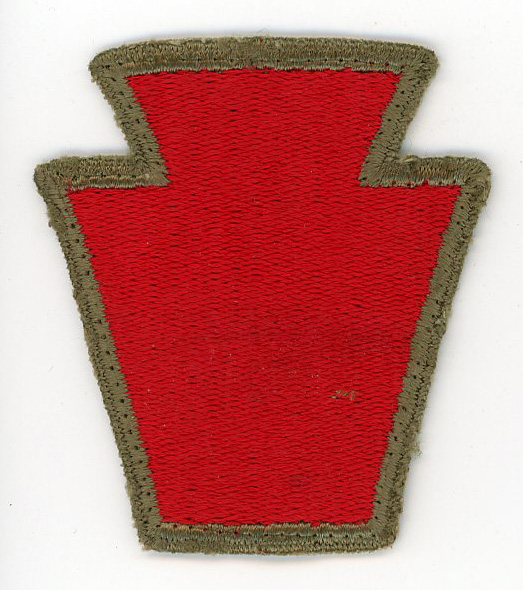
This example of the shoulder sleeve insignia of the 28th Infantry Division dates from the Second World War. The insignia has remained unchanged since its creation in 1918.
____________________
Though he certainly survived the immediacy of his injuries – at least, going by historical records and news articles – he passed away from an altogether different cause: While undergoing rehabilitation at United States Army General Hospital Number 2, at Fort McHenry, Baltimore, he passed on from meningitis The date was the 5th of February, in the year 1919.
Four days later, he was buried at Har Nebo Cemetery, in Philadelphia. (Lot 2, Grave 1599).
News articles about Sgt. Clair’s military experiences appeared in a variety of newspapers. These include the Philadelphia Inquirer (8/10/18, 2/8/19, and 9/4/19), Evening Public Ledger (8/22/18, 12/1/19, and 10/16/20), and Patterson Morning Call (as in Patterson, New Jersey) (9/4/18). Curiously though, the mostly lengthy, revealing, and poignant account of his story – ‘”I Have Not Paid Too High a Price’, Says Sightless Sergeant Clair'” – authored by Margaret M. Lukes – appeared in The Argus (published in Albany, New York, between 1865 and 1921) on December 1, 1918. (Lukes’ article was found via Thomas M. Tryniski’s Fulton History website.)
__________
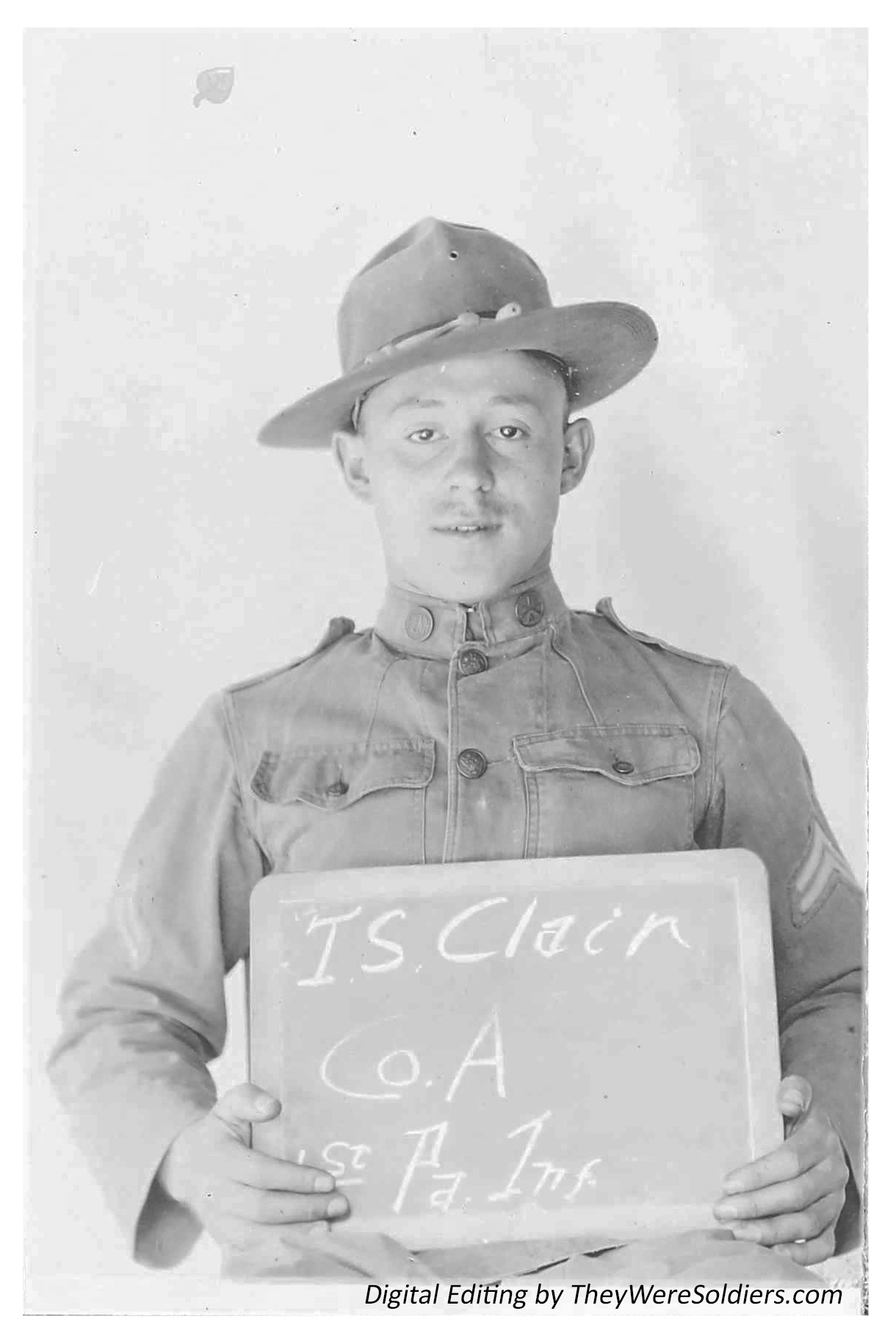
Akin to photographic portraits of other soldiers within Pennsylvania World War I Veterans Service and Compensation Files (via Ancestry.com) here’s Corporal (not yet Sergeant!) Clair’s photo.
__________
This news article appeared in either the The Philadelphia Inquirer or The Philadelphia Bulletin. Its specific date is unknown; probably late 1918.
IRVING SIDNEY CLAIR
After having erroneously reported Sergeant Clair as having returned to duty, the War Department today listed him as wounded severely. Sergeant Clair, who was the first Philadelphia boy to be blinded in the war, is at present in this country. He was sent here to convalesce and has recovered so rapidly that he is expected today at his home, 3230 Berks Street. The young sergeant was studying law at the University of Pennsylvania before the war and despite his blindness expects to continue his course.
Clair was reported missing on July 15. A letter received from him by his mother, Mrs. Minnie Clair, 3230 Berks Street, dated August 4, states that he is wounded and that he is in a base hospital.
__________
Here’s Margaret M. Lukes’ lengthy December 1, 1918 story from The Argus. The image has been digitally edited to display its three illustration’s separately.
“I Have Not Paid Too High a Price” – Says Sightless Sergeant Clair
 THE night the newspapers blazed forth the lines “Berlin Sends Deputies to Conclude Allied Armistice Terms” Sergeant Irving Sidney Clair, of the 109th Infantry, sat in the dining room of his home in Philadelphia with his arm around his little sister. To be exact he was running his fingers through her thick golden hair, aglint in the light of the lamp. There was a general conversation, feverish, light-hearted going on. Then suddenly it stopped. Sentences half finished faded into the air.
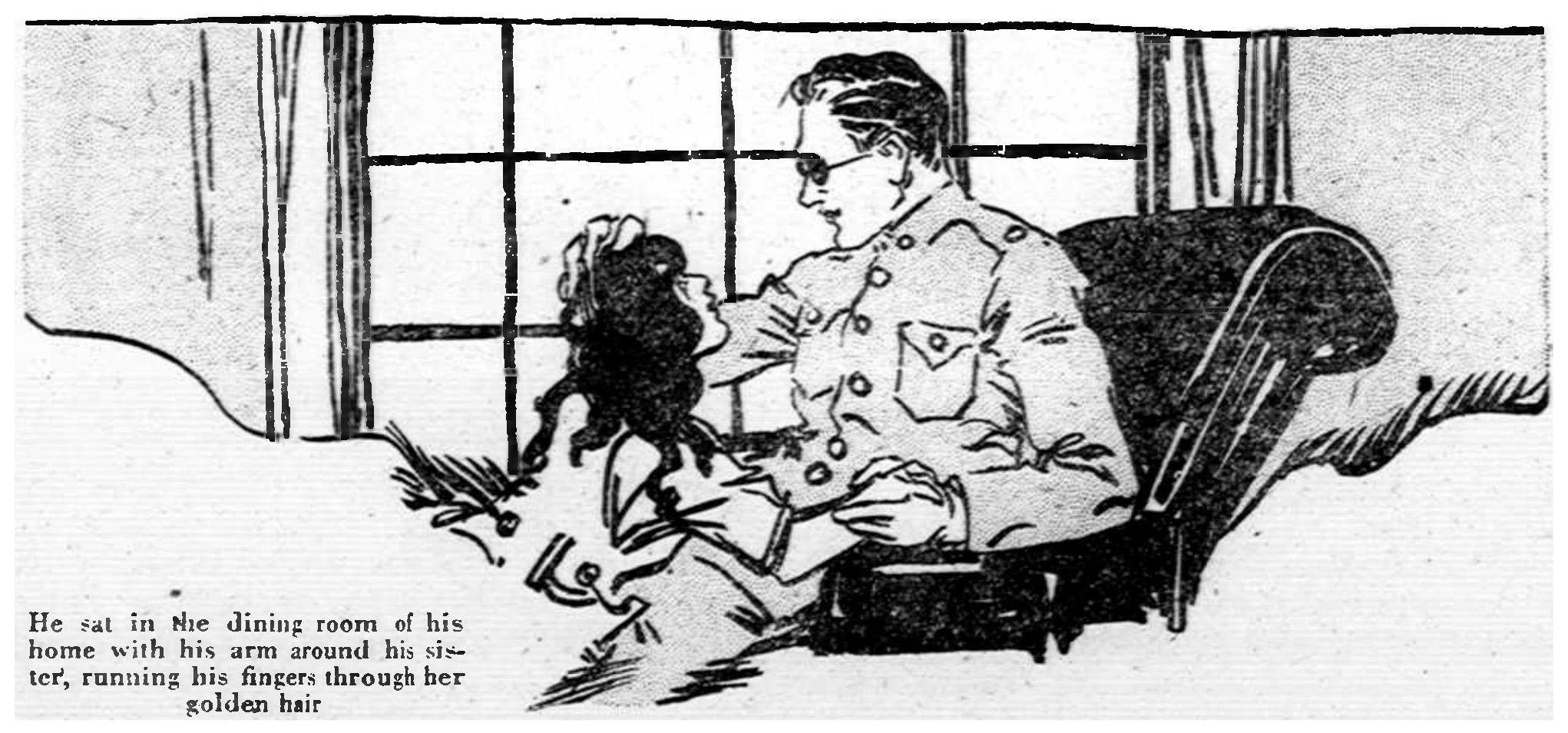
“Why, let me feel it,” a strong voice in the other side of the table was saying. “I’ll bit it’s twice as long as when I went away.” And we sat there in silence, watching the strong, vigorous hand of the soldier slowly make his way through the shining hair of the beloved little sister, in whose name he had made out his life insurance.
If there were stray tears hastily flicked away in that room that minute, why then they did no harm. White bandages tightly bound around a man’s eyes are merciful trappings for those who come for the first lime to wring the hand of a boy who gave his eyes for his country. In a minute the room was ringing with laughter and college day reminiscences again. And Sergeant Clair, two years ago a boy of twenty-two entering his third year law and that night home from the war totally blind, will never nnow there were those about him who laughed through a mist of tears.
Or if he does know we are never going to be aware of it.
“I Am Going to Win”
With all the world standing on the threshold of a peace where men will be forever safe from the mad burst of shells that maim, with America herself in the main unbroken, Sergeant Clair, who gave the gift that all the indemnities of the earth cannot pay back, smiles cheerfully. Eyes are no longer the windows of the soul. Tile spirit of a man never shone more vividly than from that splendid sunburned face gleaming bronze against the while gauze.
“I have not paid too high a price,” was the way he explained things.
Sergeant Clair will never see again, but he is content. This young man who gave his eyes to America is more. Sitting there, with strong eager hands unlike the hands of the blind because they lately belonged to a boy who was winning medals for athletics in school, this youth outlined a program of stupendous courage that can well serve as a flaming banner for all the men who must march down the ways of life paying the price of victory as they so.
“I am going to win out,” he said. “Eyes do not count; legs and arms do not count. It’s the man inside that matters. Eyes do not count. Why, I can see with my memory. You won’t believe that.
“Well, I wouldn’t have believed it if you said it to me five months ago. Then I looked at blindness as a seeing man looks at it. Now it is different. I look at it as a blind man looks at it. And I know blindness to the blind isn’t the crushing thing or the handicap it appears to the outsider.
“I am going to be a lawyer, as I had always planned to be. The Government will pay for my schooling. I am going to try to make good because I believe making good depends on the determination in a man. It’s up to the stuff inside of you.”
Strictly speaking, Clair gave his eyes in the cause of world democracy. But in the fine human vernacular of the trenches he gave his eyes for a pal. The cane which the Republican committee of his ward presented him has in letters of gold, “Blinded in the Second Battle of the Marne, July 14.” All America knows now it was on July 14 the 109th massed itself near the banks of the Maine, waiting to hurl back what proved to be the last offensive of the Crown Prince of Germany. On the 15th the Germans crossed the Marne and the Americans attacked and pushed them back. On the 14th, Bastille Day, the bombardment began and men went mad, targets for the first time of the most terrific artillery fire the world had ever known.
That tells part of the story. As for the rest:
Blinded Helping Comrade
A boy named Shortall was hit. That was what he called out. “I’m hit.” Through the whizz and the bang of shells Sergeant Clair heard. Out through the rain of death he scooted to try to give first aid. Just as he was bending down to cut away Shortall’s puttees with his trench knife a shell exploded in his face. Clair was shot high in the air. When he came down he was on his back. It was at that moment, 5 o’clock on a sunlit afternoon, Clair discovered he could no longer see.
__________
I don’t think the shell’s explosion was anywhere near as visually simple and – for lack of a better word, “clean”, as depicted in this accompanying sketch, but, w e l l… I suppose this is how such things were depicted by the standards of the news media in 1918. Then again, perhaps there is something to be said in favor of obfuscation.

__________
Here’s Cpl. Shortall’s Abstract of Military Service, listing the date on which he was wounded as about July 15, 1918…

…followed by his Veteran’s Compensation Application.

Born on February 7, 1891, Ralph F. Shortall passed away at the young age of 52 on March 5, 1943. He is buried at the Philadelphia National Cemetery.
__________
There are eight totally blind soldiers back home in America. Clair is one of them. Together with some twenty other partially war blind they are stationed at Base Hospital No. 7, the Government’s experimental hospital for the blind in Baltimore. Sergeant Clair goes home to Philadelphia every other week-end on furlough. It was on the second trip home I went to talk to the blind soldier.
Science can make artificial arms for men., she can make legs, but there never have been discovered eyes with which a man can see. There have been men in this war who have said they would rather die over there in France than come home blind.
Knowing all this, then, it was not easy to undertake to talk to a man whose war fate had been what is universally considered the supreme sacrifice. There is a service flag hanging in the front window of the home where young Clair lives with his mother, Mrs. S. Clair, who is a widow; Arthur, and Harry his brothers, and Miriam, the little twelve-year-old sister he has always been peculiarly attached to. I have seen many service flags, but this was more poignantly different than them all. Back of the little square through the window and in the light I could see a boy with his eyes swathed in bandages, and I knew he would never see again. There were boys all around him, some in sailor suits, some in khaki, and there was his mother back of his chair. And there was no one in the room who was not laughing at a joke the lad with bound eyes was telling.
Inside in the luxurious living room which showed so plainly how many of the good things of life had always been Clair’s, that was the first swift impression you formed of him. He is a boy with a natural ability to make others laugh. Yet the theme of this young man’s life ran far deeper.
It was Reuben, a student at the University of Pennsylvania and one of the boy’s best friends, who made me realize what despair blindness could have brought into the life of Clair if ambition had not been tempered with the quality that made him throw ambition to the winds when war was declared.
Pictures of Memory
“He was a chap who hitched his wagon to a star,” Reuben told me. “At eighteen with most boys it is here one day and some place else tomorrow, as far as definite aims are concerned. But it wasn’t that way with Clair. He knew what he wanted, law. He dreamed it and lived it. A boy can’t help knowing when he has the power to sway the crowd, and that is what Clair has. At high school they always singled him out to be spokesman for his class, and it seems he was forever at the head of things.
“Is,” as many of the boys affectionately call the wounded soldier, was a member of the class of 1910 at Central High, where he achieved laurels in sports as well as in studies. Later be won a scholarship.
Tire scholarship entitled him to a full course of law at the Temple University. He was entering his third year when America declared war on Germany. Then it was Clair stripped the dreams out of his life. With the vanguard of the country’s young manhood he was off to a training camp. Because he had unlisted at the time of the trouble at the border, “Is” was automatically a member of the old Pennsylvania First Regiment, and he went to Camp Hancock, in Augusta, with the others. Last May, with the rest of the Twenty-eighth or Iron Division, Clair sailed for France a corporal in Company A, 109th Infantry.
I! was July 13 when the five fleets of motortrucks brought the 109th into fighting position at Conde-en Brie and St. Agnan. Then came July 14.
Clair does not mind talking about that day. It was after most of the boys had drifted out he came into the dining room, played with his little sister’s hair, teased her about her little beau, Martin, and between times talked of the things that had come into his life in France.
I have told how Sergeant Clair’s sight was destroyed as he bent over a young corporal to try to ease his wounds. The boy picks up the narrative here and tells a story that illustrates another matchless friendship that flowered in the muddy trenches of France.
“What happened to me after I found myself on my back?” he continued. “Why Barrett ran like lightning to me. Who is Barrett? Why it seems funny for any one around here not to know. He is William Barrett, a boy from Bristol, who went to the border with the old First when I did. Then we went to Hancock together, then to France and to the Marne. Barrett was my best pat all the way through.
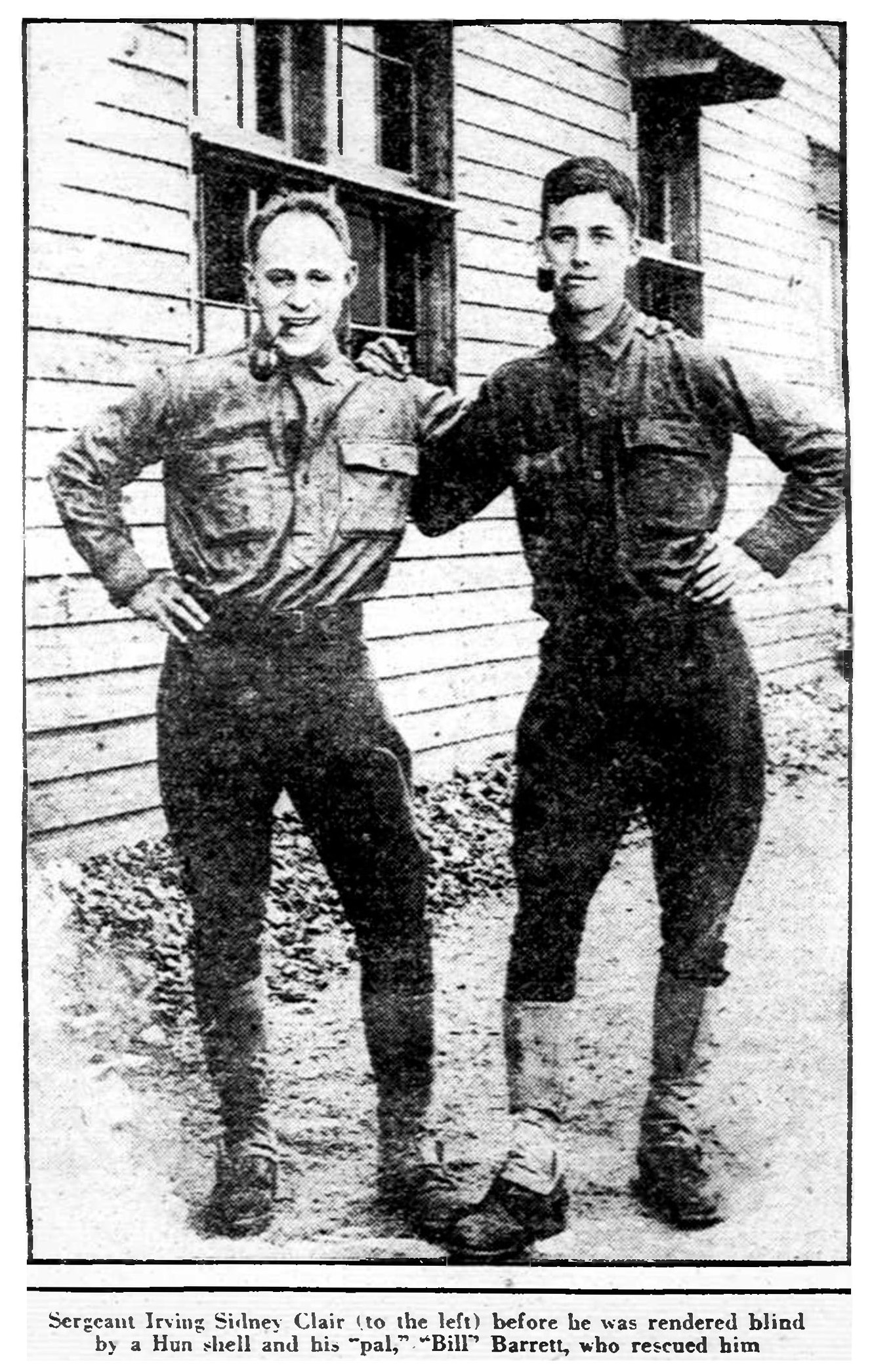
“The shells were bursting all around, but Barrett lifted me up quickly. He put my arm around his shoulder and we walked back together that way. We thought we were going to the dressing station. But we found they all had been moved back on account of the heavy artillery fire. But the ambulances were beginning to come up for the wounded.
“Barrett put me down on a stretcher beside Shortall, the boy I tried to help, and the two of us lay there for three quarters of an hour with shells sweeping over us. That was the worst part of it all. The shells were corning, and we were helpless.
“Were you in pain?” one of the boys asked.
“No.” was the answer. “I was more worried about Ralph Shortall than anything else. He was groaning so and in such pain. They had to take his right leg off later on.”
“Didn’t you groan too?”
“Well, I really wasn’t in much pain,” answered “Is,” “and I guess I didn’t have anything to groan about. I couldn’t see, of course, but it wasn’t until I got back to the States I knew I would always be blind.
“Barrett went right back to the firing line after he left us. In thirty-minutes he was severely wounded himself. I believe they had to take off an arm and possibly a leg. I am worried about Barrett. I don’t know where he is.”
__________
Here’s William Barrett: Specifically, his photographic portrait, from his Pennsylvania Veteran’s Compensation File.

William Barrett’s Abstract of Military Service, confirming that he was wounded on July 15, 1918…
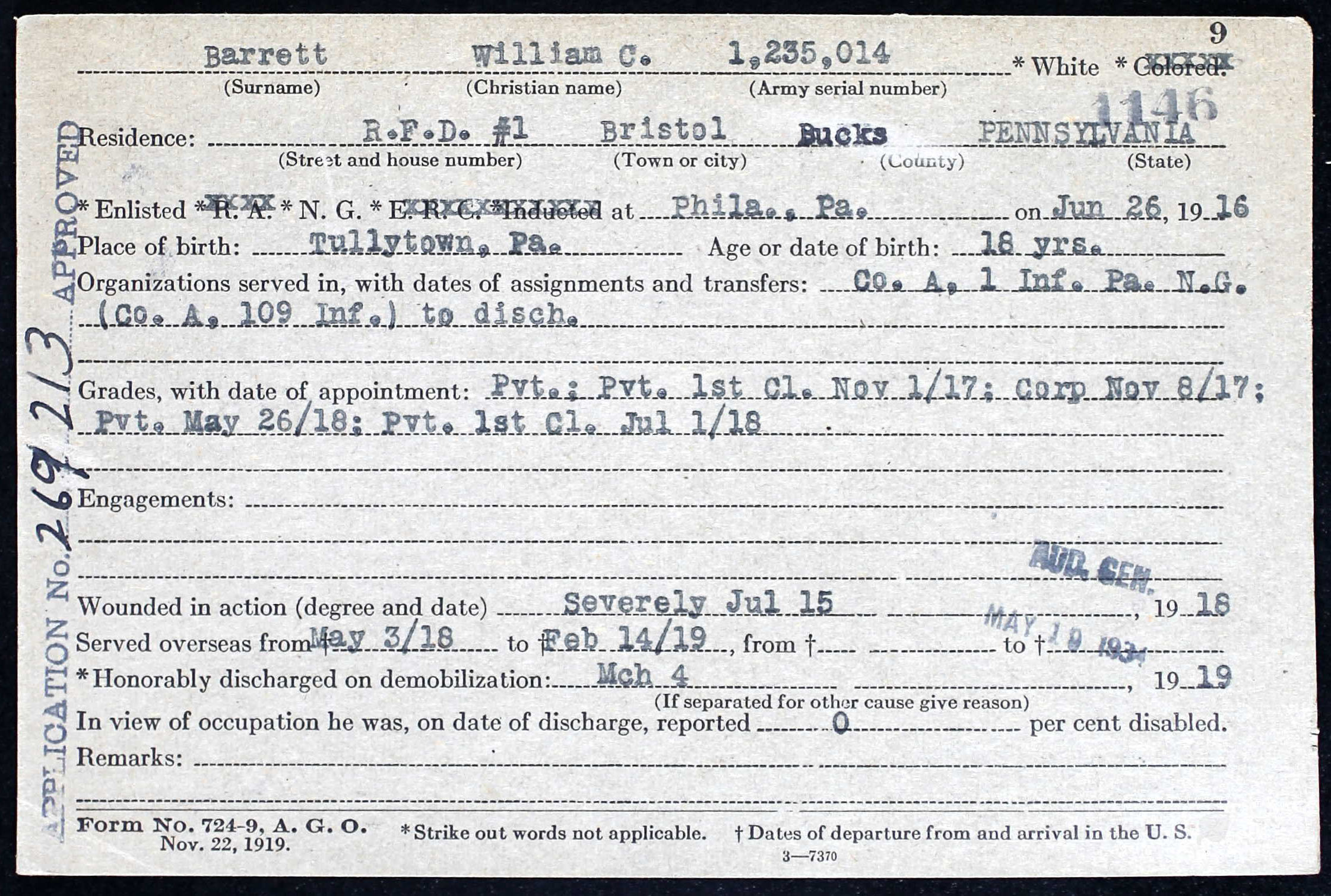
…and, his Veteran’s Compensation Application.

William Cresswell Barrett passed away on July 13, 1966, in Lebanon, Pa.
__________
In the course of his conversation young Clair spoke of the beauty of Grande Fontaine, the little headquarters town in that particular part of the Marne battlefield.
“There was a wonderful big fountain there in the middle of the town – that’s how it got its name. I used to love to watch it sparkle in the sunshine.”
Over and over again he repealed the words, “I can see with my memory.” What farewell pictures there must be stored in the mind of this splendid boy.
In those last days of sunshine there was the Marne, little blue stream of destiny, sparkling down through its green banks. There was the Eiffel Tower, miles away in Paris, that could be seen in the vast lovely distance of the sky on a clear day. There were the warm poppies and the little wild flowers of France spread like delicately colored tapestry in graceful profusion over the hills. There were the sunsets and the nights with their stars that came to blot out the devastation of the day.
But if there are pictures stored away against the day when hunger for the beauty of the world might gnaw at his heart, the boy who gave his eyes for the great intangible cause does not say. If there are things locked in his heart the world is not going to know about them.
Young Clair’s attitude toward blindness worries his mother sometimes.
“I think sometimes he does not tell how he really feels for fear it will make me worry,” she says. “When I went lo Baltimore to see him that first time I did not know I could stand to set my boy blind. He was such a wonderful son. Then I did see him at last. Then he told me how he felt. And, oh, I was so glad to have him back, to touch him and be near him. Pretty soon he wanted to talk-about the business, which he was very much interested in since his father died. Then we sat there together and talked things over. Suddenly I discovered I had forgotten he was blind. You can’t know what that feeling meant to me. I knew my same boy was back again in spite of anything that had happened. I knew he could go on living his life as he had planned.
“Colonel Bordley, in charge of the base hospital there, told me there was no hope for his eyes. They are going to operate on his left eye. Of course I do not know what that means. I am not going to give up hope, though. But down there, although they cannot say he will see again, they say wonderful things about what my boy is going to be able to do without seeing.”
Clair is the only professional man out of the eight who are totally blind back in this country. It is natural his case should provoke unusual interest, his progress in the studies for the blind is already said to be marvelous. Mrs. Clair produced a little letter her son had written on the typewriter, learning without his eyes in the few short weeks he has been in America the touch system to such a degree of proficiency that there were only two misplaced letters on the entire page. At the hospital, an estate turned over to the Government by Mrs. T. Harrison Garrett, of Baltimore, there are regular classes held all day, with intervals for gymnasium and swimming. Clair divides his time between the Braille, which is learning to read” by the raised letter method, and typewriting.
From a Mother’s Letter
There was a sentence in Sergeant Clair’s letter to his mother which seemed to stretch its significance beyond the little typewritten page.
“If you want to meet me, all right.” he wrote, “but you know that I can get home alone in case you can’t make it.” That is the spirit of Irving Sidney Clair, blinded in the second battle of the Marne. He can get along. The Government allots to him $100 a month for the duration of his life. It is not too much to say Clair is not going to need his pension. The dreams and surgings that whispered to him back in the days when the war was mercifully hidden in the future will come true. This boy, who gave his eyes in order that the rest of us might go on seeing, shall not die with his song unsung. We shall hear from him later on – Clair, the lawyer who won with his brains.
_____
Probably dating from late 1918 or very early 1919, this news article was (as above) probably published in the The Philadelphia Inquirer or The Philadelphia Bulletin.
Although he lost his sight in a battle in France, Sergeant Irving Sidney Clair, of Company A, 109th Infantry, will continue the study of law, which he had been pursuing at Temple University previous to his enlistment.
He is twenty-four years of age, a son of Mrs. Minnie Clair, 3230 Berks Street, and is in a hospital for blinded soldiers in Baltimore.
His courage and his devotion to his duty as a non-commissioned officer were displayed when he risked his life to bind the wound of a fallen comrade. As the sergeant bent down to ease the pain of the wounded man a shell dropped before him and, exploding, blinded him.
_____
Here’s Sergeant Clair’s War Service Record, as completed by his mother in June of 1919…

_____
…and, his Matzeva, at Har Nebo Cemetery, in Philadelphia, Pennsylvania.

____________________
MY BELOVED SON
AND OUR DEAR
BROTHER
SGT. IRVING S.
CLAIR
Co. A. 109TH. U.S. INF
BLINDED IN THE 2ND
BATTLE OF THE MARNE
JULY 15TH, 1918.
DIED
FEBRUARY 5TH, 1919
AGED 25 YEARS
ת׳ נ׳ צ׳ ב׳ ה׳
