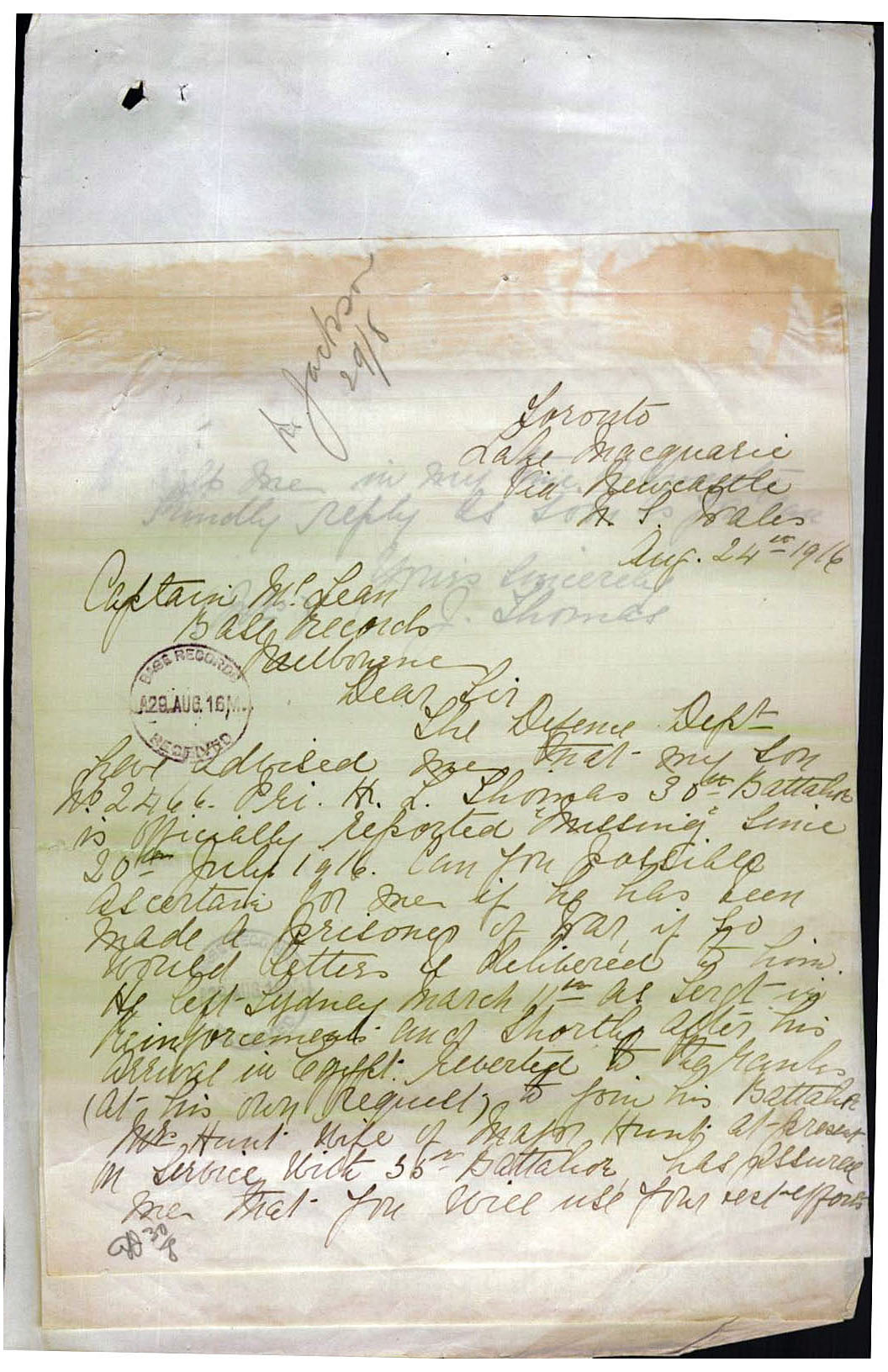
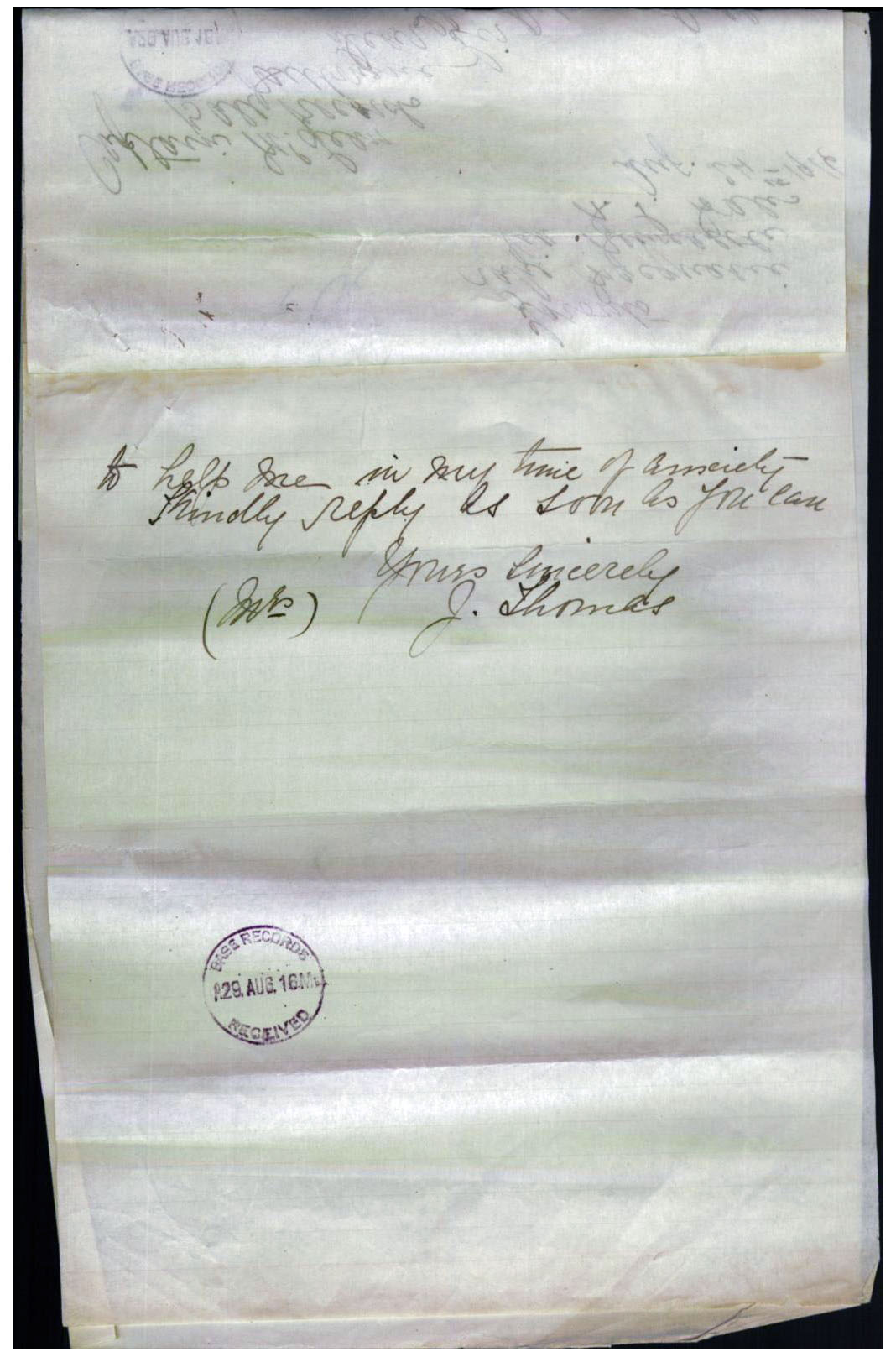
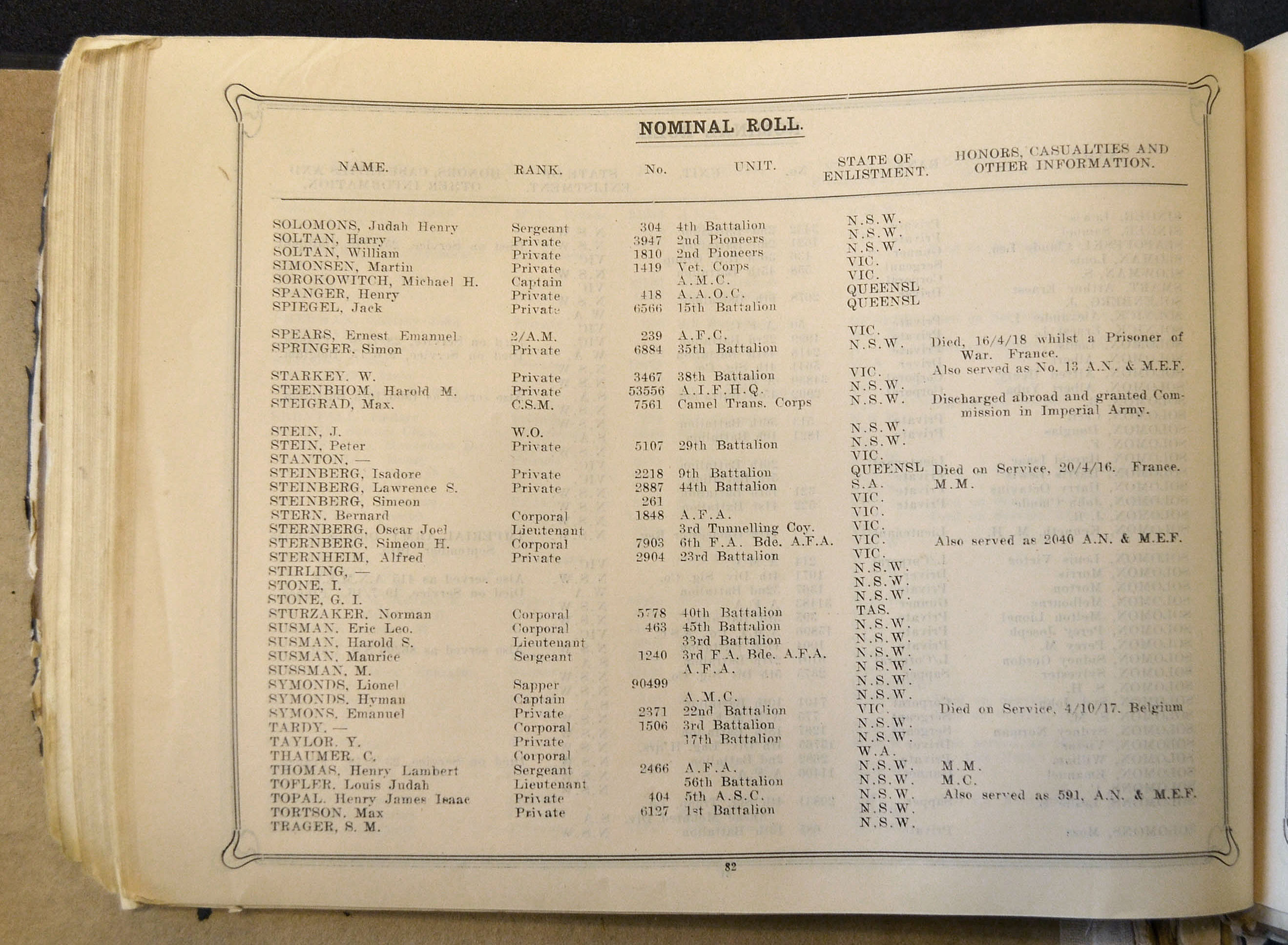
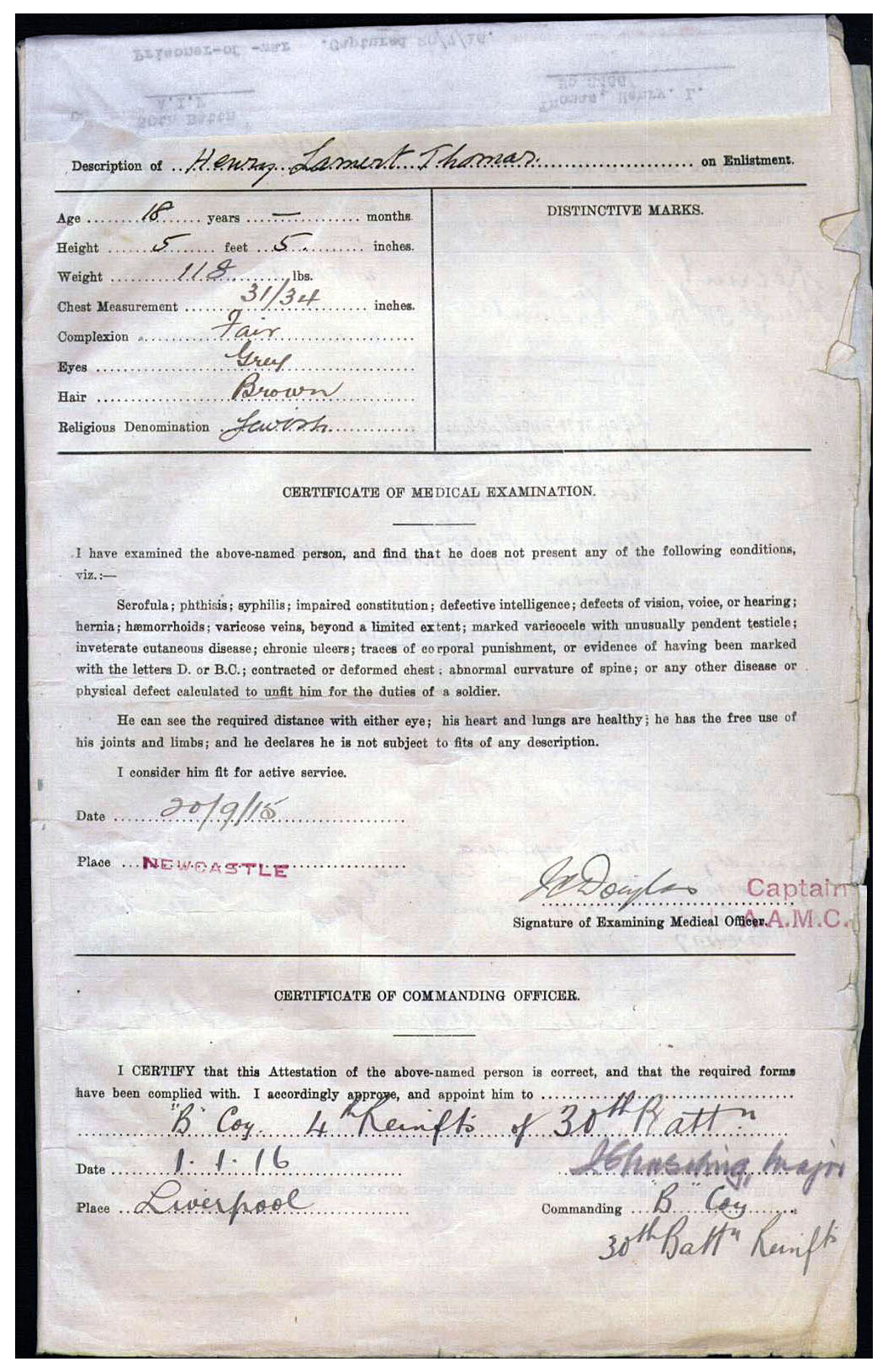
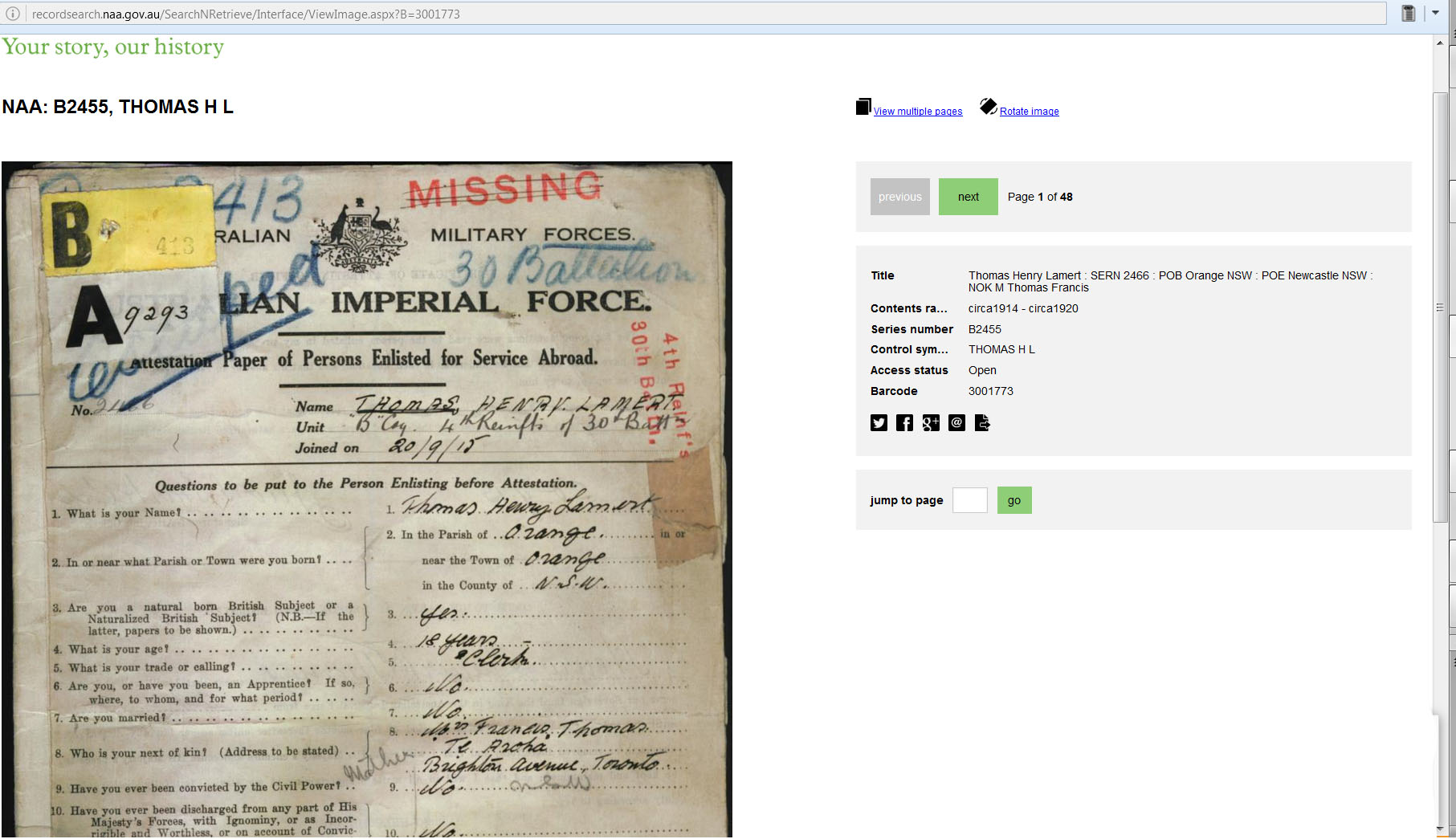
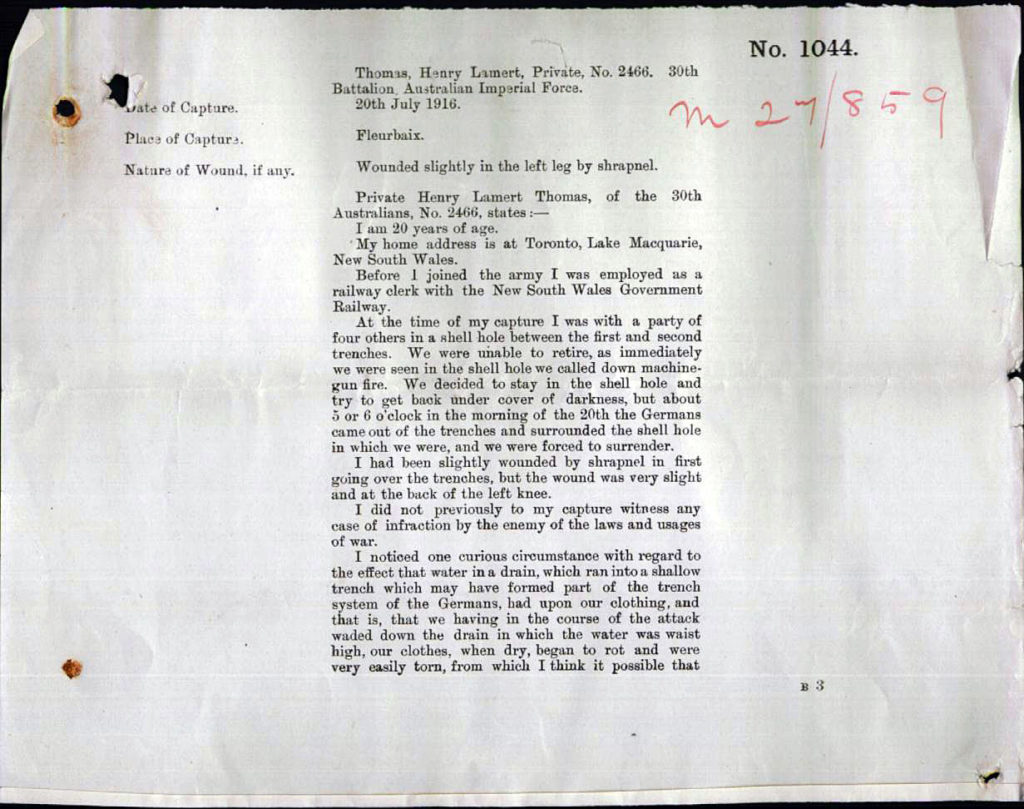
This post presents the transcript of the post-escape interview of Private Thomas by R.C. Swaine, which occurred in London on November 28, 1917. The image below is the “first” of the 14 such images comprising the scanned interview transcript:
 ____________________
The transcription follows below. I have included maps (Google maps, that is) showing the location of places mentioned within the text.
____________________
Thomas, Henry Lamert, Private, No. 2466. 30th Battalion Australian Imperial Forces.
20th July 1916
Fleurbaix.
Wounded slightly in the left leg by shrapnel.
Private Henry Lamert Thomas, of the 30th Australians, No. 2466, states: –
I am 20 years of age.
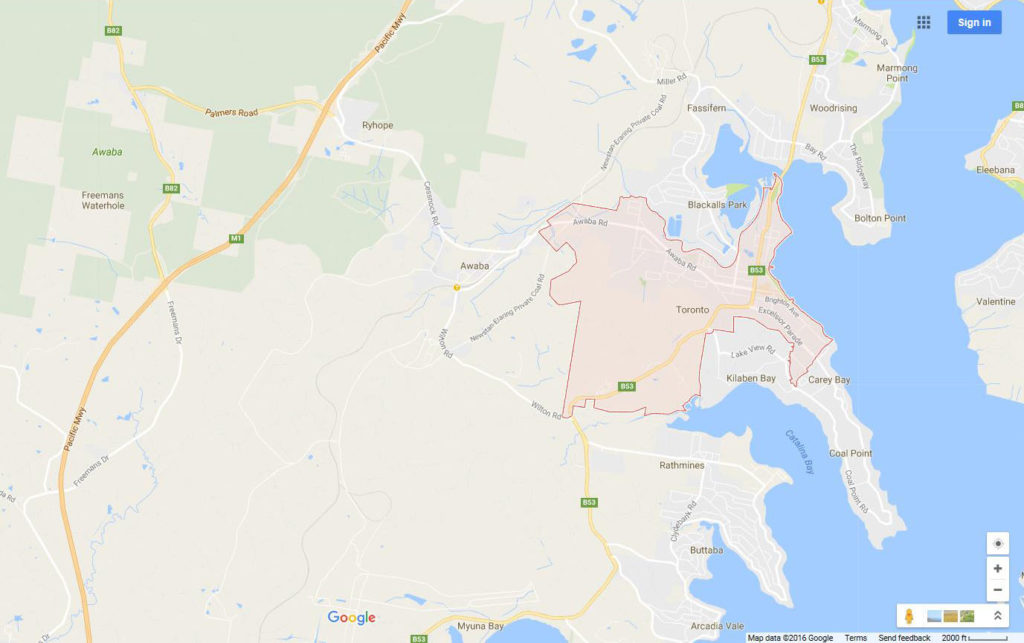
My home address is at Toronto, Lake Macquarie, New South Wales.
____________________
 New South Wales and the southeastern coast of Australia, showing the locations of Sydney and Newcastle.
 Newcastle, and the suburb of Toronto, the latter situated near Lake Macquarie.
 A closer view of Toronto.
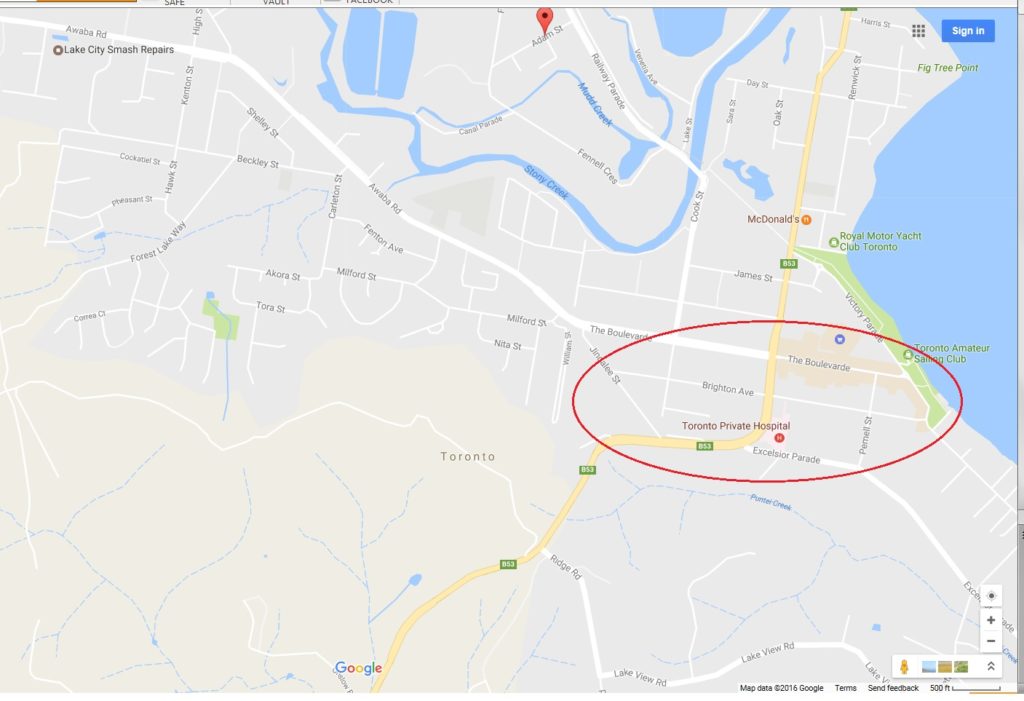 Toronto, in the lower left portion of the map, with Brighton Avenue, where Private Thomas’ home was located at “Te Aroha”.
____________________
Before I joined the army I was employed as a railway clerk with the New South Wales Government Railway.
At the time of my capture I was with a party of four others in a shell hole between the first and second trenches. We were unable to retire, as immediately we were seen in the shell hole we called down machine-gun fire. We decided to stay in the shell hole and try to get back under cover of darkness, but about 5 or 6 o’clock in the morning of the 20th the Germans came out of the trenches and surrounded the shell hole in which we were, and we were forced to surrender.
I had been slightly wounded by shrapnel in first going over the trenches, but the wound was very slight and at the back of the left knee.
I did not previously to my capture witness any case of infraction by the enemy of the laws and usages of war.
I noticed one curious circumstance with regard to the effect that water in a drain, which ran into a shallow trench which may have formed part of the trench system of the Germans, had upon our clothing, and that is, that we having in the course of the attack waded down the drain in which the water was waist high, our clothes, when dry, began to rot and were very easily torn, from which I think it possible that something may have been turned into the water, as I do not think that ordinary water would have had that effect on our clothes.
After being captured I was brought into the German trenches, and with a party of three others taken down a communication trench on to a road, where we joined up with a party of 20 or 30 other men of the 8th Australian Brigade. This party was then marched back to Loos, and from there to Lille, which I think we must have reached about midday.
At Loos our papers were taken from us, including our pay-books, but these were afterwards handed back to us.
____________________
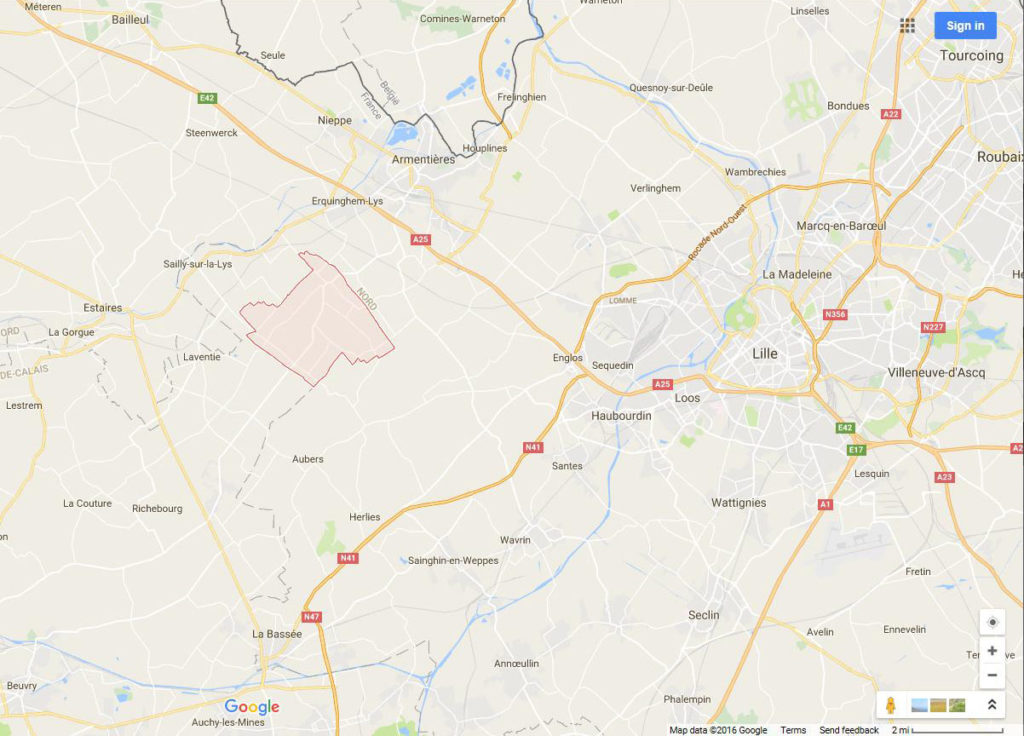 Relative locations of Fleurbaix, Lille, and Villeneuve-d’Ascq.
 A closer view of Fleurbaix.
____________________
At Lille the men who had served in any special branch were separated from the others and a couple of men from each battalion were put with them, and they were sent, I believe, to Douai.
The officers also were separated from us at Lille and put in another quarter.
Our money was changed into German money, but beyond these two instances I have nothing much to say of our stay in Lille. The rate of exchange appeared to be about 25 francs for 20 marks, which, I understand, was the rate which the Germans imposed on occupied territory.
We were taken to a building, which, I think, was an old French prisoner, and were kept there for two days, that is, until the evening of Saturday, the 22nd July.
I had not reported that I was wounded, so was not taken to any field dressing station, nor was I detained in hospital in France or Belgium before being sent to Germany.
As soon as we got to the prison, we were served out with some soup – at least, I think they called it soup. I should not like to say what it was made of; I should think it was made of turnips, perhaps. About 6 o’clock that night we had another bowl of soup and half a loaf of bread. The loaf would be rather smaller than the usual English Army loaf. It was a round shape and cut in half. It was the regulation war bread.
We were sent upstairs to a room in which there were some straw mattresses on the floor and on the tables. There were not enough for all the men; some of them were lucky, and got one. I was one of the unlucky ones who did not, but I shared a mattress with other men. We managed this by putting two mattresses together on which two men lay lengthwise, and I slept across their feet. We had no provision whatever made for our comfort at Lille except the straw mattresses in the room. We were given no blankets and no means of washing except the tap in the yard, but there were no buckets or basins which we could use for washing. I was very lucky in having a cake of “Lifeboy’ soap in my pack, which I had received in a parcel from home. I had put this in my pack just before going over the top, and I was very glad to have it with me, as it is impossible to buy soap in Germany.
On the evening of the 22nd we were marched to the Lille railway station. We were put into ordinary goods wagons with wooden benches across the wagon, and the doors were then closed and we were started off on our journey to Dulmen.
____________________
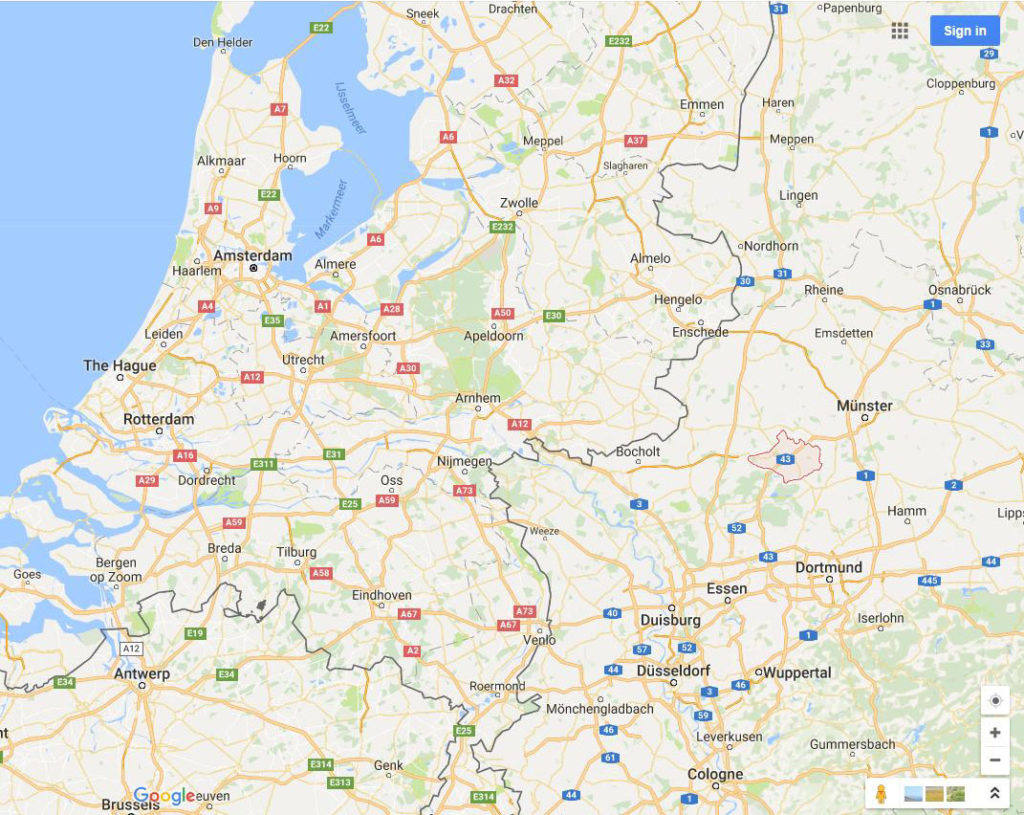 Dulmen, Germany (highlighted), in relation to Munster, Dortmund, and Essen.
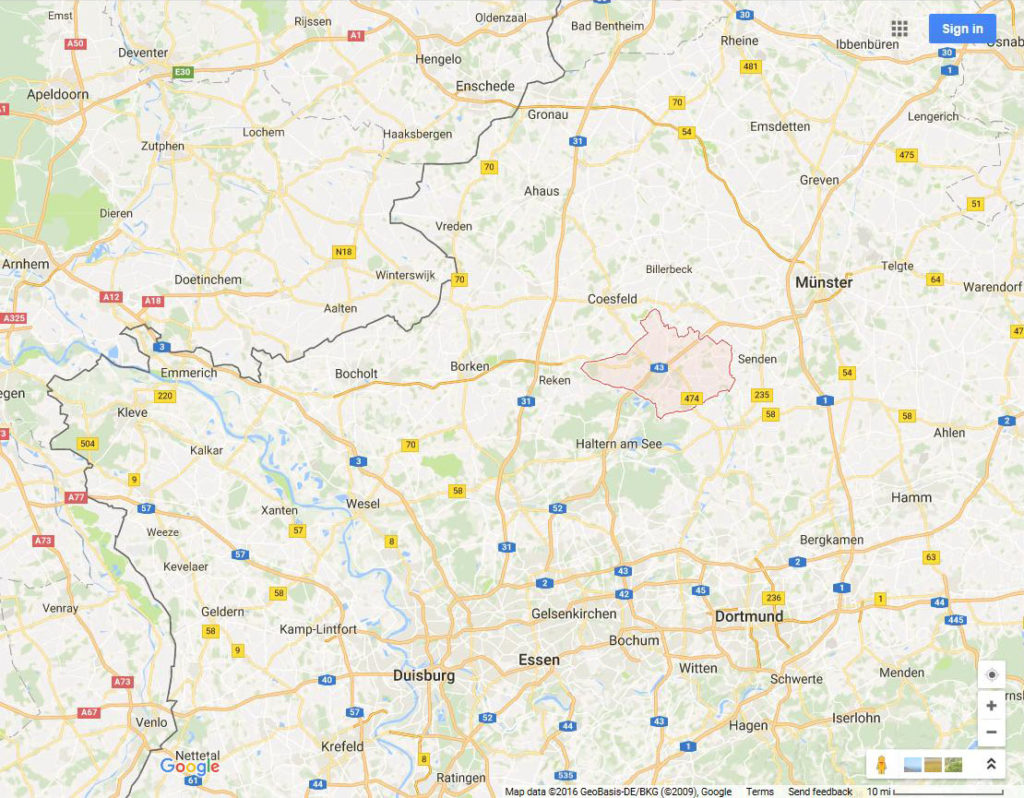 A closer view of Dulmen in relation to Munster.
 Dulmen.
____________________
No special ration was served for the journey. We had had while in prison the usual half load of bread each day, bowl of coffee (substitute) in the morning and another in the evening, and the same old soup.
We reached Dulmen at 6 o’clock on Monday morning, having, therefore, been 36 hours in the train.
The only food which we had on the journey was one ladleful each of thick barley soup and one cup of coffee per man. As far as I remember, we got the soup on the German frontier. Those who had any bread left brought it with them on the journey. I myself was unwell and unable to eat my bread, which I gave to another man.
There was no provision whatever for lavatory accommodation in the wagons. During the daytime, at halts on the line and in sidings, we were given the option of leaving the wagons, but at night-time we were not allowed to do so. I was suffering from an attack of diarrhea at the time, and at night was considerably inconvenienced by the lack of accommodation, but I do not think that any of the other men were suffering in this way. At night the wagon was locked and there were no guards in it, so we were unable to ask them to make any provision for us.
There was a lamp in each wagon with a sort of wax light in it, which we managed to light. We were left to ourselves until about midday on Sunday, the 23rd, when two armed military guards were put into our wagon. The door of the wagon was then slid open and the bar laid across the opening, and we were able to get some fresh air. We had had various stops at stations and sidings and were allowed to get out of the trucks. The military guard did not interfere with us in any way. They allowed us to smoke. There were no wounded men in our party; they had been sent to hospitals, and I saw nothing of the German Red Cross on the journey.
I arrived at Dulmen on the 24th July and remained there until the 4th September 1916.
I cannot say how many prisoners there were at Dulmen. The number was continually changing. New prisoners would come in and others were sent out with working parties.
Dulmen is a big camp. There are three lagers. I was in No. 3. There were other nationalities in No. 3 lager, including British Colonial troops, French and Russians.
I was never in the hospital at this camp. When I first got to the camp I reported “sick,” but I did not mention my wound. The doctor saw me and gave me some medicine and told me not to eat too much. I looked at him and was absolutely speechless and could not say a word. He did not appear to intend his advice to be taken as a joke. About a couple of days after I reached the camp I was all right again.
I do not know the names of the commandant or the second in command at the camp, nor those of the officers commanding the separate lagers.
The chief complaint which the prisoners had to make against officers in command of this camp was that we did not receive sufficient food. I do not know what was the cause of this nor who was responsible for it.
At Dulman we had warm shower-baths on arrival and our clothes were fumigated. Somehow or other (I do not know how) I managed to pick up some vermin, and on reporting this my clothes were again fumigated and I had a warm shower-bath.
We were also picked out by companies and sent about once a fortnight to have a warm shower-bath.
Dulmen is in a moorland district, with sandy soil and no vegetation except heather. Just beyond the camp the ground is swampy, but where the camp is situated it is dry.
We were lodged in wooden huts. I believe I am right in saying that these have double walls of wood, with wooden roofs and tarred paper on them, and wooden floors raised about a food off the ground, the huts being built on wooden piles, so that there was an air space under the flooring. Each hut, being a large one, was divided into two divisions called “A” and “B”. In one corner of each division of the hut was a small room, called the “N.C.O.’s Room,” which held eight men. The other divisions held 54 oR 64 men each.
Our beds were of cocoanut matting suspended on a frame like hammocks. They were made of a sort of wool. We were also served with a pillow and a towel to each man and a bowl and spoon for our meals.
Each division of the hut had a large stove in the centre. There was a washhouse at the end of each block of huts, with a trough with taps over. The sanitary arrangements were good.
I do not know what was done in No. 2 Camp, but in No. 1 the prisoners were employed in construction work in connection with the camp, and with ordinary camp fatigues. In No. 3 Camp we used to be sent out about once a fortnight on camp fatigues. We did not receive any pay for this work. There was some mention of the men in No. 1 being paid 30 pfennigs a day, but I do not know whether this was a fact.
I was not asked to make munitions nor, so far as I know, were any of the prisoners.
We had a bread issue every day, about 4 p.m., of a tenth of a loaf. This would be the ordinary camp loaf, which was a rather big one, but I do not know the weight of it. The loaves issued in both Dulmen and Munster camps are of the same size. In the morning, at six o’clock, about twice a week, we received what we used to call “sandstorm” because it was like the fine dust of the Egyptian Desert. I believe that this was really bone dust. We came to the conclusion that it must be this. This was made into a sort of soup. It was like a very thin porridge. We got the usual old ladleful of this stuff. Alternate days we had a ladleful of coffee or cocoa substitute. When we had the bone dust we did not get either coffee or cocoa. I really do not know what this stuff was unless it was bone dust. It was not made of oatmeal or anything like it, but we thought it was a terrible mixture. It had no smell and very little taste. Dinner was served at 1 p.m. This consisted chiefly of cabbage and water, or turnips and water, or mangolds and water. It may have been hot when it was served out, but when we got it it was just warm.
Towards the end of August we occasionally got some potatoes. Until then we had none. The only trace we saw of potatoes up till then were pealings at the bottom of the soup. At the end of August, just before we left the camp, potatoes were served out boiled in their jackets, four or six per man.
We made several complaints about the condition of the food, that there was not enough of it and that it was of bad quality, but only on one occasion was any notice taken of this, when sometime in August we got an additional ration of a dixey of soup, half full, for 250 men. This would not have been sufficient to give any appreciable quantity to each of the 250 men, so we drew lots for it and out hut (8B) were the winners, so that we had enough for a ladleful per man.
At one time the men in No. 1 Camp, who were older prisoners receiving parcels and getting better soup, used to bring us over a half dixey of soup which they did not want themselves, but after this had gone on for about two weeks it was stopped. This incident makes me think that it was not entirely due to shortage of food in Germany that we were kept on such short rations.
The men in No 1 Camp were given much better food than we were.
At six o’clock we had another meal. Generally this was a soup with barley or rye. Occasionally we had a tinned black pudding. This was in a tin about the size of a 2-lb. preserved fruit tin, and one tin was served out to ten men. When we got the black pudding we used to have a ladleful of so-called “tea” served out to us. I have been in Ceylon, and know what tea is there, and I do not think that the tea came from Ceylon. It may have been the same stuff as we were able to buy afterwards, and which the Germans called “Cumberland Tea”. It is like a tea leaf, and dry, but much bigger, and would break if held in the fingers. It is a leaf of some sort, but I do not think a tea leaf. Every Friday night we had one fish each – raw. It may have been herring, but I do not think it was. This was salted. We had no means of cooking them in the guts, and if we wanted to eat them we had to have them raw. If we had no opportunity of cooking them over wood fires which we were able to make when we were on fatigue, or of smoking them, then we used to eat them raw. We occasionally got cheese. It was funny sort of stuff, with caraway seeds in it. It was soft and crumbly, and we dug it out with a spoon. Its taste was that of a very strange cheese not in the best of condition, but the caraway seeds helped us to eat it.
Each Sunday and Wednesday morning we received a dessertspoonful of jam each. It had a queer taste, and I thought it was like bad tomato. We had no sugar, no butter, no milk, and no fruit except that we sometimes had dried fruit in the soup.
What I have said about the food might make it appear that there was plenty of it and some variety, but it was really starvation rations, and it was a common thing for men to faint on parade from general weakness, and on getting out of bed in the morning we often had a faint dizzy feeling.
I cannot say whether I myself actually lost weight (although I became very weak), as I had no opportunity of weighing myself, but I saw men who came into the camp strong and healthy-looking fading away and getting as weak as kittens.
There was a canteen in Camps Nos. 1 and 3; in fact, there were three canteens in No. 3, which was a much bigger camp than the others. I do not know whether or not there was one in No. 2. We were able to get tins of sardines, “Queen Alexandra” brand, from Norway, price 1 mark per tin. These tins held about 16 very small sardines, and they also sold them in half sizes holding eight sardines. These cost 60 pfennigs. We could also buy what they called “honey” and jam. That was all that we could buy in the food line. Honey was put in cardboard boxes and was sold for 50 pfennigs for about half a pint. The jam was the same as we had served with our rations. Very small glass jars of this cost about 40 pfennigs. We could also get cups of coffee at 10 pfennigs. We were also able to get razors, knives, pencils, writing-paper, scissors, note-books, cigarettes (a packet of 10 for 20 pfennigs and a packet of 20 (J.O.B. brand) for 40 pfennigs. We were able to buy playing cards, the German pack, in which there are no cards below the seven.
I had no parcels during the time that I was at Dulmen. I do not know in what state parcels received there by other men arrived.
At Dulmen I was wearing my tunic, which was in good condition; my breeches, which were much torn at the knees; my puttees, which were in fair condition; and military boots. I had no overcoat, and the only article of my equipment which I was able to keep was my water bottle. Our tin helmets were taken from us at Dulmen and we were served out with prisoners of war caps – a sort of forage cap. We did not get these caps, however, until nearly a month after we came to Dulmen, and as our helmets had been taken from us we had to go about bareheaded. The German excuse was that they did not have these caps. We were promised them as soon as the supply came in. As we were Australians and had just come over from Egypt, this did not trouble us much. The only clothing besides the caps which the Germans served out to us was a flannelette shirt each. We asked for underpants and singlets, but again they told us that they had none in stock. We received no overcoats.
The only facility we had for exercise in this camp was walking about the camp. There were no outdoor games of any sort. The only indoor amusement was playing cards and draughts on a board which we made ourselves, using squares of cardboard to represent the draughtsmen. Smoking was allowed both in and out of the huts, and it was not stopped while I was in the camp.
There was no epidemic while I was in the camp.
I was never in the camp hospital.
In Lager I a religious service was held every Sunday. I do not know what form the service took as I was never at it. We were only given an opportunity of attending on one occasion, and then we did not wish to go. I believe it was conducted by a Frenchman, but I do not know much about it.
I got neither letters nor parcels at Dulmen. The system of issuing parcels seemed to me to be a good one. The parcels were brought from the railway station to the parcels office and a list was made of the names of men to whom they were addressed. Each parcel was numbered and a ticket was made out and a duplicate of this given to the man to whom the parcel had been sent. He then went to the counter in the parcels office, presented his ticket and his identification ticket containing his name, regiment, number, &c. If this tallied with the address as given on the parcel, he was handed over the parcel. The parcel was then opened on the counter in the presence of the man to whom it had been sent. I do not know anything about letters, but can only speak as to the parcels. Onions were not allowed and were taken out of the parcels. Lemonade powders were taken out and sent to the hospitals, or, at all events, it was said they were sent to the hospitals. Paper was not allowed, nor were newspapers. I do not know about books.
There was a library in No. 1 Camp, but whether this had been formed out of books sent in parcels or whether the books had been sent out in bulk, I do not know.
We were allowed to write one postcard per week and two letters per month. We were not allowed to write to any relief committee asking for parcels. On the Sunday after we got to Dulmen, that is, on the 30th July, some of us wrote to the Red Cross asking that parcels might be sent out to us, and letting them know that we were in the camp. To the best of my belief these postcards got through. On the following Sunday, the 6th August, the men wrote to various organisations asking for parcels, but the postcards were returned to us with a polite notification that we were not allowed to write to any relief committee asking for parcels to be sent to us.
Apart from the question of food I have no serious complaints to make of our treatment at Dulmen. It was very hard for us, however, to get to No. 1 Camp, where the English prisoners had food.
I do not know of any case of cruelty in this camp. I heard rumours of ill-treatment, but saw no instances of it, and I do not know how far, if at all, the rumours were well founded so far as No. 3 Lager was concerned. We were simply brought to the camp and left to our own devices.
There was a difference in the treatment of nationalities. In the first place, a Russian was worse treated than those of any nationality. If an Englishman was convicted of an offence he always received a heavier punishment than a Frenchman. It is a well-known fact that in the camps the Frenchmen received the best jobs. The poor Russians were worse off than the others. They get practically no food from outside sources, which gives the Germans an ascendancy over them. It is a serious matter for a Russian to get 14 days’ cells on bread and water, because, having had no parcels and having been living entirely on the German rations, he has not the same strength to stand this punishment as an Englishman.
Regulations were posted stating what we might not do in the camp. I do not know that there was anything to inform us what we might do! There was a list of offences headed “Martial Law” in German, French, Russian and English. Nearly everything on the list was said to be punishable by death. I do not know that attempting to escape appeared on it. It stated in these regulations what was meant by our “superiors”. They were officers, N.C.O.s and men of the German army appointed as our guard, and other men appointed by the Germans in charge of the prisoners. Some of the regulations were to the effect that if you laid hands on a superior it was punishable with death. One of the regulations is that you are bound under penalties to report any conspiracy against the superior. There was also a punishment for taking part in the conspiracy. We treated these regulations as more or less of a joke, as they dealt with matters which occurred every day in Germany. As a matter of fact, I have seen acts of violence committed on sentries which were not punishable by death, and I know, of course, that men are assisted to escape and there has been no punishment for conspiracy. The sentence in Germany depends upon the man who tries your case, except for escape, for which the usual penalty is 14 days; but although the punishment for the actual escape is 14 days’ imprisonment, they always manage to add on another seven days for some such offence as removing marks from the uniform, cutting the wires, or being in possession of a map of the country or a compass.
The principal punishment was confinement on bread and water. I did not see any other punishment administered, except what we called “sticky” or “stilly-stand,” which consisted in keeping a man or body of men, sometimes as many as a whole company, standing to attention for a period which might be some hours in length. This punishment might be administered for men being late on parade, absenting themselves from parade, or failing to salute an officer. The principal cause of this punishment being administered was failure to salute the German sergeant-major (Feldwebel), who used to walk about up and down the lines expecting to be saluted, and as the English declined to do so there was always trouble for them.
Neither the American Ambassador nor any representative of his visited us at Dulmen.
I noticed no improvement while at Dulmen in the treatment of prisoners.
The huts and accommodation and the sanitary arrangements at Dulmen are considered very good for Germany. They would be thought fair in England. The huts were watertight, and the system was that of separate huts, and not, as in Munster, rows of buildings surrounding a square.
On the 4th September 1916 a party of 30 prisoners, al Britishers, was sent to Erkrath, a small village about 4 kilometers from Dusseldorf. We went in ordinary 3rd-class corridor carriages, with an armed guard in the corridor. We left Dulmen at 9 a.m. and reached Erkrath at 6 o’clock in the evening. We had no food with us on the journey except part of our bread ration from the night before, and on arriving at Dusseldorf we asked the guard to let us have some food. He lined us up on the platform and came down with a bucket, which we naturally thought contained food, but we afterwards found it was filled with water. We had no trouble with civilians either on this or on any other journey which I made. They came round out of curiosity to look at us, but did not interfere with or harm us in any way and showed no hostility to us. On arrival at Erkrath we were taken to the working barracks, which was a small brick building built especially for us. It was one storey high, with a wooden rook and tarred paper over it. This was the best accommodation I saw in Germany for war prisoners. It had a wooden floor, and was heated by a stove in the middle of the room burning coke, and was lit by electricity. It was well built, and not at all draughty or damp. There was a washhouse and good lavatory accommodation, but no bath.
____________________
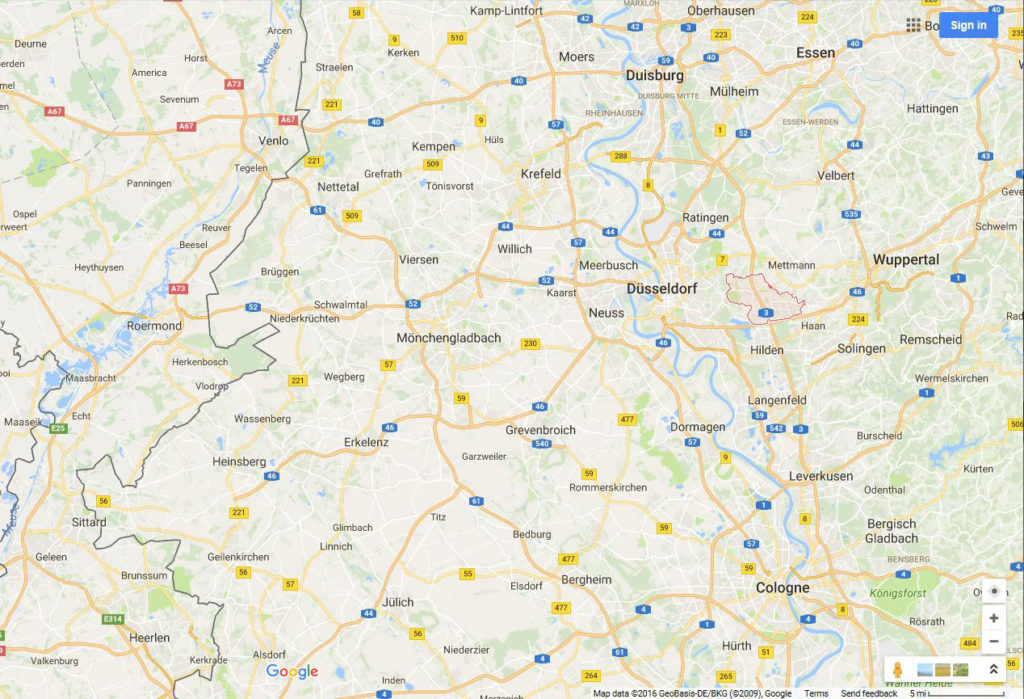 Erkrath, Germany, in relation to Dusseldorf and Wuppertal.
 Erkrath and Dusseldorf
____________________
We had iron bedsteads in two tiers, with straw mattresses on iron laths. We had one sheet and two blankets, a pillow and pillowcases. The beds were very comfortable.
We were employed at Erkrath in what is known as a Chamotte Fabrik. This was a factory for the manufacture of chamotte, which is a mixture of clay, sand, graphite, firebrick and other substances. The process was that the materials were ground in different machines, mixed in the proper proportions and wheeled on barrows to railway trucks. The stuff when loaded was watered to make it moist and prevent it shaking out of the wagons. The factory was alongside the railway line. Our pay for this was 97 pfennigs per day. I do not know the reason why we received this precise amount, but heard someone say there is a regulation which makes it necessary to pay a broken mark only to prisoners. The prisoners at this factory were attached to the Munster Camp, to which I had been transferred, and I understand that this is one of the regulations of that camp. I believe that the chamotte is used in making mouldings for ironwork. We were not required to do any other work there. We worked from 7 a.m. to 7 p.m., with an hour for dinner and two quarter-hours for coffee during the day. The food at Erkrath was good. We were supplied with food by the factory proprietor, one named Frederick or Fritz Lungen. About 6.30 in the morning we were supplied with maize mail with dried figs in it and a slice of bread. At 9 a.m. we were given three slices of bread made into sandwiches with cheese, sausage, bacon or brawn, and coffee. For dinner at 12 noon we had generally vegetables, sausage, or cut-up meat. At 4 o’clock we got two slices of bread made into a sandwich with jam between. This was better than the jam which we had had at Dulmen. About 7.30 p.m. we had a wash, and were provided with tea, which consisted of potatoes, salad, or sometimes fish and potatoes and sometimes very thick maize meal, with occasionally a little stewed apple. We had sugar sprinkled on this. Previous to our going to work art this factory a commando of Frenchmen were sent, but refused to work there. I don’t know why they refused to work, but I have heard that they did not like the look of the factory. They were then sent back to Munster, and we were sent to Erkrath in their place. As far as I can judge, the reason why we had such good food was to keep us in good health and fit for hard work.
We had a canteen at Erkrath where we could buy cigarettes, tobacco, pipes, knives, apples (when we first arrived, but supplies of these soon stopped), brushes, combs, looking-glasses, &c. If we required any other articles such as cigarette lighters, scissors, books such as German grammar books or German dictionaries, we got the sentries to purchase them for us, and this had to be unbeknown to the officials. The prices of the various articles were reasonable, and there seemed to be a good supply. The cigarettes and tobacco were very poor.
We received letters and parcels while I was at Erkrath. The first parcel which I received came about three weeks after I had arrived there. This was the first parcel I had received at all since I was taken prisoner.
The food from England and abroad arrived in very good condition, with the exception of the bread from Switzerland, which at that time was sometimes mouldy. The food which we had from England was practically all tinned stuff, with the exception of such articles as packets of “Quaker” oats, tea and cocoa, and sugar.
At Erkrath we were supplied by the Germans with a greatcoat and two pairs of underpants, and overalls for working in. We also had boots issued to us. These were leather boots with wooden soles, but when the winter set in and it was too cold for leather boots we had wooden clogs served out to us. We were ordered to hand in our leather boots about the end of December 1916 or the beginning of January this year, and we were told that they were to be exchanged for winter boots. When the winter boots were issued to us we found that they were simply wooden clogs. In that part the wooden clog is the best thing to wear in the winter, as it is very much warmer than the leather boot. I think, therefore, it is quite possible that the reason for exchanging the boots for clogs was the real reason.
We had no opportunities of exercise while on this working party, but on Sundays we were allowed to walk round a very small yard round the barracks. On two occasions the whole of the prisoners went for a three or four hours’ march, accompanied by the guard.
Indoors we played cards and draughts. I had a pack of cards sent to me in a parcel, and one of the sentries got us in some draughtsmen. We were supplied with no games by the Germans officially. We were allowed to smoke both indoors and outdoors at the barrack and the factory, and it was never stopped.
There was no epidemic at this camp while I was there.
There was no hospital attached to this camp. If a man was ill, he was taken to the hospital at Dusseldorf Bilk. Private Holmes, of the 56th Battalion A.I.F., who escaped with me from Duisberg-Meidrich, was taken ill with pleurisy. The German doctor, whose name I do not know, saw him, and under his orders he was bandaged by the Gefreiter (corporal) and put to bed. This was on Monday, I think. He became very weak and had to be helped about, leaning on my shoulder. Later on he could not move about at all. He was in this state for three or four days. I spoke several times to the Gefreiter about it, and begged him to send for the doctor to attend to Holmes, but nothing was done until about the Wednesday or Thursday, when the doctor came and saw him, and he was at once removed in a motor car to Dusseldorf Bilk, where he was in such a state that he had to be operated upon immediately without chloroform. I consider that this would have been saved if the doctor had attended to him at once when I asked the Gefreiter to send for him. This happened about three weeks after we had reached the camp, and Holmes remained in hospital until January. I do not know the name of this doctor. He was a civilian, rather an elderly man, and had lost part of one ear – I cannot remember which. This doctor was the same man as I shall remember later on with regard to the incidence of a man cutting his throat at Erkrath. When there I knew his name, but I cannot now remember it.
The Roman Catholics among our party were allowed to attend the Roman Catholic church in the village, but the others of us who were not of that religion had no religious service whatever. We should have been allowed to attend the Catholic services had we wished.
After we first received letters and parcels at Erkrath they came regularly. The sentry was supposed to open our parcels in our presence, but the arrangements were very slack and sometimes we opened them ourselves. Letters had been opened at Munster and were delivered to us open. Nothing was taken out of the parcels. I do not know what was supposed to be prohibited. We were not told anything as to this. On one occasion the whole lot of us opened our parcels and took the contents away before the sentry came in and asked us is we would like to have our parcels censored. This sentry was a very nice chap. His name was Toni Haase, and he was a sniper belonging to the 7th/7th of the Landsturm. It was a regulation at Munster that every tin in the parcels should be opened in the presence of the man to whom it had been sent, but our sentry did not trouble about this. The empty tins were piled in a corner of the yard. They were just left there, and were still there when I left.
The same regulations as at Dulmen applied to the writing of letters.
I have no complaint to make of our general treatment at Erkrath so far as the German authorities are concerned.
We were under a guard consisting of the Gefreiter, whose name was Kollok, but he was afterwards replaced by another two sentries, Haase and Heyder, also of the 7th/7th Landsturm, and they treated us very well. There was no cruelty whatever to any of us.
The work upon which we were engaged was, however, very unhealthy. The clay-crushing machine gave out a lot of dust, and we believed that this was the cause of Holmes’ illness. The sieve also gave out a great deal of dust, as did also the brick-crushing machine, and I believe that this work was bad for the lungs.
We were working in the factory with German civilians and Poles – about 40 or 50 of them in all.
So far as I know, none of the prisoners besides Holmes were affected by the dust, nor do I know of any case where the civilians were made ill from this cause, but, as I said before, I consider that the work was unhealthy.
We had the same regulations at Erkrath posted in the barrack as we did at Dulmen, that is to say, the martial-law notice was posted up on the door.
The interpreter was an old soldier, No. 10101, Private James Kiltie, of the 1st Gordon Highlanders. He was himself a prisoner of war.
While I was there no punishments were awarded.
We used to be visited by the commandant of Munster, and a cavalry captain (Rittmeister) came once a month. We complained on one occasion to the Rittmeister that there were no baths in the barrack, and he said he would attend to it, but nothing was done. We had no visits from the American Ambassador or the representative of any Neutral Power while at Erkrath.
While at Erkrath one of the men became insane and cut his throat. This was Private Ward, of the Scottish Fusiliers. He complained to the civilian doctor whom I have mentioned before of pains in the head, but the doctor simply told him to go to work. The next day he cut his throat with a razor and wounded himself very badly. He was taken to the hospital at Dusseldorf Bilk. He was at Dusseldorf for some time, and then was returned to us as having been cured, he we could see that he was not right in the head, and we complained to the Gefreiter about him. He was then removed and sent to Munster, and we heard afterwards that he had been sent away from Munster. We did not know where, but believe that they have a special asylum camp for prisoners of war, but I do not know whether this is so. I do not suggest that this prisoner became insane on account of his confinement, as I believe that insanity is in the family.
Our treatment throughout the time that we were at Erkrath remained the same. There was no improvement, but, on the other hand, things did not become worse.
Our food towards the end of the time was not quite so good as at first, but this was due, no doubt, to the winter shortage.
I left Erkrath about the 10th February this year.
____________________
 Munster, in relation to Dortmund, Dusseldorf, Essen, and Wuppertal.
____________________
I went alone with one sentry to the prisoners’ camp at Munster, known as Munster I. We went by train in an ordinary carriage, and the sentry treated me quite well on the way and even carried my kit for me.
The reason I was sent away was that it was thought I had not been working well. I had determined not to do so, and had behaved in such a way as to be brought before the doctor frequently and the Fabrik Meister. I told them that my heart was weak and I could not work properly, and as the result I was one day dismissed and told that I was being sent back to Munster.
I have no great opinion of the abilities of the German doctor. One of our men who had never smoked until he got to Erkrath, and then had only smoked about one packet of German cigarettes, was told by the doctor that he was suffering from “smoker’s heart”. On another occasion I was ordered to wheel a large barrow full of white clay. As I did not much fancy the job, I went up to the Fabrik Meister and told him I had hurt my shoulder. The doctor said that I had dislocated it, and I was excused work, and as the result of this I was never put to the work of wheeling a big barrow again.
I left Erkrath about 1 o’clock in the afternoon and reached Munster about 10 o’clock at night. I had no food except two pieces of bread which were given me at Erkrath before I left.
Munster I. Camp is in Westphalia, and I was there from February 1917 until 4th April 1917. The camp is on clay soil and is very muddy. The camp buildings are built around the square, and there is no view from them of the surrounding country, but we could just see the sky. I believe it has now been burnt down. It was a big camp containing a large number of prisoners, the number varying from time to time, and I cannot give an idea of how many there were on an average.
I do not know the name of either the commandant or the second in command. I know nothing about them, and I steered clear of them. I never heard any comments passed on them by the prisoners.
The camp buildings formed one continuous building right around the square. They were built of wood with double walls, and were one storey high with wooden roofs and tarred paper over the top. They were raised above the ground.
The natural lighting of these buildings was very bad. The windows faced inwards to the square, and in some parts of the buildings it was so dark that you could hardly see your way about. The artificial lighting was electric light, but this was insufficient. There were two lights to each hut, and each hut contained about 100 men.
We slept on beds consisting of a wooden frame with cocoanut matting on the top and suspended from the two ends of the frames. On this we had a straw mattress, and I helped myself to one dozen blankets. I went with another man to draw blankets at the magazine, and found that there was no one there, so I helped myself to all that I could carry. These blankets were the same thin kind that we had at Dulmen. I was able to stick to these blankets. I do not remember having a pillow, but I got a towel, bowl and a spoon.
We had two stoves to each hut, burning coal. At that time the stoves were burning day and night, and they kept the place reasonably warm.
The washing facilities were very good. We had a trough with taps, and we were able to go twice a week to a warm shower-bath. I have noticed that the Germans do provide good washing facilities.
The sanitary arrangements at Munster I. were not good. There was only one latrine for the whole camp, which was not sufficient. I do not complain of the actual arrangements, but that they were not adequate.
When I got to Munster I went before the doctor for my heart. He sent me to bed for five days to get it right! At the end of that time I went before him again, and he then marked me A1, which meant that I was fit as I was for hard work. I do not know the name of the doctor, but he was no fool.
After I had been passed as A1 I was employed on ordinary camp fatigues once in five days, for which I received no payment. I do not know of any of the prisoners being employed on any work for which they were paid. No attempt was made to force me to make munitions.
The food was very bad. It did not trouble me, as I was getting parcels, but I saw the mess being served out and I tasted it, and it was the kind of food that, so long as there was anything else to eat in the camp, we would not touch. There were continued grumblings about the food provided for the men who had no parcels.
The parcels from England and abroad arrived in good condition at this camp, including the bread from Switzerland.
We were not supplied with any clothing, as we had the clothing sent out by the Red Cross, and I did not ask for any. I had handed in the clothing supplied to me at Erkrath on leaving there.
At Munster we were given the opportunity of playing football in the camp square. Indoors we had games from the parcels, and we were allowed to smoke indoors and outdoors, and smoking was never stopped except after “lights out”. There was no epidemic while I was at Munster I., nor was I ever in the camp hospital.
We had religious services every Sunday, conducted by a man named Frost, who was in the Durham Light Infantry, and was formerly a schoolmaster. He also conducted the burial services for any man who died. This man (Frost) did everything he could for the prisoners’ comfort, including the running of the Relief Committee, seeing to the parcels, acting as librarian and taking the services; in fact, he was working himself to death looking after the prisoners. He was a private, and was the finest prisoner I met in Germany.
The postal arrangements were that letters came to the camp, were censored, and then handed over to the prisoners. The parcels were opened in the presence of the addressee. Both letters and parcels arrived regularly and in good condition. Parcels were searched for “Black Cat” cigarettes, which were taken out if found. I do not know of anything else being prohibited. Unmarked clothes were taken out and marked with coloured cloth.
The arrangements as to writing were those general as to all the camps.
I have no complaint to make of our general treatment. They left us alone. My own personal method was to avoid having anything to do with the guard, and I found then that there was no trouble, but some men are rather inclined to look for it. I saw no cases of cruelty to British prisoners or those of any other nationality, but we saw men coming in from commandos in a wretched condition. The men to whom I refer were British. I do not know the names of any of them, but I spoke to some of them and they told me that they had had a bad time, and I saw some men there who had been knocked out. I cannot remember any individual cases, but the general impression which I got was that the men had been very badly treated.
There were various nationalities at Munster I. At first the French were better treated than the British prisoners, but after a time, on account of the alleged ill-treatment of German prisoners in France, their privileges were stopped and they were not allowed any form of amusement. Their orchestra was disbanded, and they were not allowed to make their little articles which they were used to work at, such as souvenirs, &c. A notice to this effect was posted up, and also another notice that any infringement of the rules would be treated with the greatest severity.
The “martial law” notice was posted here. The regulations were exactly the same as at Dulmen. I saw no bad effects from punishment in this camp.
On one occasion a person who was said to be an ambassador from one of the Scandinavian countries came to the camp, but he was only shown one hut that had been specially cleaned out for him, and after he had seen this he was taken out of the camp. None of us had an opportunity of speaking to him.
The case of insanity at Erkrath was the only one I saw during my imprisonment.
I noticed no improvement in the condition of things during my detention at Munster I. On the other hand, the treatment of the prisoners was not so good towards the end of my time there as it was at the beginning. The French were, as I said before, worse treated and (possibly because the number of British prisoners was less) we had to work every third day instead of every fifth day, while the regulations as to parcels became very strict. The prisoner to whom the parcel was addressed was not allowed to receive anything from it except the actual foodstuff, that is to say, the wrapped of parcels of tea and the tins in which food was packed were taken away after they had had the contents emptied out of them. I do not know what use was made of the wrappers and tins, but they were permanently kept. This was done at the parcels office.
I left Munster I. on the 4th April 1917, and was sent with a commando to Duisberg Meidrich. Eight Britishers formed the party and we went in an ordinary train with two guards. The journey was not a very long one, and we got no food on the journey, but it was no hardship to be without it as the journey was so short. The guard treated us fairly on the train.
____________________
 Duisberg, Germany.
____________________
Duisberg Meidrich is a suburb of Dusiberg, in Rhineland. The main camp, of which this working camp is a branch, is at Friedrichsfeld. On arrivel there we were marched to the Gesselschaft fur Teerverwertnung (the Tar Distillery Company). From there we were marched to our barracks and shown our quarters. There was a sergeant-major (Feldwebel) in command and two privates as sentries. They did not interfere with us in any way. The barracks were close to the factory. It was a good barrack, and better than that at Erkrath because it was healthier. The building had more space in it, and was very well built of brick, with a glass roof and a concrete floor. It was well lit with electric light except towards the end of my time there, when the roof and bulbs of the electric lamps were painted blue to prevent observation by aircraft which they seemed to be expecting. They are in a holy terror of our aircraft coming over. The machines did come over one night, but went on to Essen. There was a regular panic at Duisberg Meidrich, as the people told us when we saw them the next morning, but I do not know of any bombs being dropped near us.
We had two-tier bunks with wooden laths on which we had a straw mattress, but no blankets. We were supplied with an eiderdown cover, one sheet and a pillow and pillowcases.
The building was heated with coal stoves, of which there were about six, including four cooking stoves.
There was a good lavatory accommodation – a trough with hot and cold-water taps – and in the factory were baths which we could have once a week.
The sanitary arrangements were good.
There were about 13 British prisoners here and about 200 of various other nationalities, French, Russians and Belgians. We kept to a separate corner of the barracks and had no dealings with the other prisoners. We were employed in various ways in this very big factory, all in connection with tar distillery. At first I got 1 mark a day, but I would not work satisfactorily, and I was taken off and put on to punishment work (a “straf” job), which was the best job I struck in Germany, and I stuck to this. I did practically no work. I had to empty seven or eight wagons of naphthaline per day, and each wagon took about seven minutes to empty. For this work I got paid 2 marks per day.
I was not required to make munitions.
The food supplied to us was better than Munster I., but not so good as Erkrath. We had to live on it for the first two months until our parcels began to reach us again, and we struck work three times on account of the badness and insufficiency of the food. This improved towards the end of the time, when the new harvest was in. Working hours were from 6 till 6.
We had coffee at 8 a.m, vegetable soup at 12, mostly turnips; coffee at 4; and soup again at 6, the same as before. We sometimes got a piece of herring between two men, and every Sunday a little piece of meat, a spoonful of jam, and occasionally some of the same sort of cheese as we got at Dulmen, and occasionally a small piece of white cheese. We had a 3-lb. loaf of war bread every four days.
We had a canteen where we could purchase the same things as at Erkrath, with the addition of beer substitute, wine and lemonade. Prices were much the same as at Erkrath.
The food, in parcels from home and abroad, arrived in good condition.
Our clothing was that sent out to us from home, and we were served out with overalls. We did not ask here for any clothing to be issued to us.
There was a yard in which we could play football on Sundays. Indoors we had a gramophone, which we bought through the Feldwebel, and cards. We were not allowed to smoke in the factory, but otherwise could smoke until lights out.
There was no epidemic during my stay. If there was sickness the men were sent to the General Hospital at Duisberg.
The Frenchmen went to mass at a church in the town, but we had no religious services.
We were taken to the cinema the week before I left. This was stated to be a weekly affair. Occasionally we were taken for a walk under guard. At the cinema we were shown war pictures, including pictures of the Kaiser visiting the front, firing of guns and a livery stable on fire. We were also shown comic films.
The postal arrangements here were just the same as at Erkrath. The parcels were opened by the sentry; the tines were taken to a store and opened when wanted in the presence of the sentry. The tins themselves were put in a heap. Cigarette papers were taken out of the parcels. I had six packets of mine taken out. There was nothing else stopped in any case except tooth-paste and insect powder.
The parcels were first censored at Friedrichsfeld.
We were allowed to write the same as at the other camps.
The general treatment at this camp was fair. If you were late in turning out from the barracks, you were “helped along” with the butt of a rifle. I never myself saw a British prisoner hit, but have seen Frenchmen and Russians struck, and I know of one case (Private R.B.S. Morris, of the London Rifle Brigade) who was struck with the butt for knocking off work too early. I do not know the name or regiment of the man who struck him. It was before my time.
We were informed by a sentry that the Feldwebel’s orders were to leave the British and Frenchmen alone, but to put the Russians through it. They acted past their instructions, as the Frenchmen were ill-treated. I have not seen any men permanently injured, but I have seen them knocked out.
The martial-law notice was not posted up here, but a notice was sent from Friedrichsfeld, signed by, I think, Hauptmann Fischer, notifying that the death penalty would be imposed under the “laws of military treachery” if prisoners of war were caught destroying property to prevent economic working. Morris, of the L.R.B., who was in charge of the British prisoners, was ordered to sign this, but he refused to do so. Another document was then sent in practically the same terms, but again he refused to sign it. None of the prisoners, accordingly, signed the notice.
The acts considered offences were the same as at the camps. The punishments were 11 days’ cells in the barracks for smoking in the factory, 14 days for trying to escape, seven days for having a map or compass, and seven days for cutting marks out of our clothes. The cases were tried at Friedrischsfeld and the men imprisoned at Duisberg.
We had no representative of any Neutral Power to visit us here. The treatment was the same the whole time of my stay. We had one sentry, who made things a bit warm for us, but when he left we went back to the old conditions.
I am told that at Friedrichsfeld this working camp is considered one of the best in Germany, and that it has been a good camp from the beginning of the war. At one time it was even better than at present.
I escaped from Dusiberg Meidrich on the 27th October 1917.
I do not myself know anything of an Irish brigade, nor was I ever asked to join one. I heard, however, from some of the older men who were taken prisoners during the retreat from Mons of visits to the camps by Sir Roger Casement, who had asked for volunteers to join the Irish Rebellion. I do not, and do not think I ever did, know the names of the men who told me this. I gathered that Casement had a rather rough reception at some of the camps.
I was never asked to assume German nationality.
I have met Frenchmen who told me that they had been kept at work behind the German lines in France, but I did not talk to them much and know nothing of this except that they told me that there were Britishers with them.
Our parcels were received satisfactorily during the last few months.
I did not come across any British prisoners of war who either assumed German nationality or otherwise gave evidence of German sympathies.
I was working with civilians, and heard their conversation and spoke to them, and from what I heard and they told me, and from my own observation when passing through Dusseldorf and Duisberg, Ruhrort and Erkrath, I have come to the conclusion that things are in a very bad way in Germany. At Duisberg Meidrich civilians told me that the weekly ration was one 3-lb. loaf of war bread, 250 grammes of meat and 7 lbs. of potatoes. Soap is unprocurable, boots scarce, expensive and made of compressed paper soles. Clothing is very expensive. The shops in the towns through which I passed had very little display in the windows. People seemed fed up with the war and spoke strongly of the Crown Prince. They say he is “verruckt,” that is “dotty”.
I did not see many animals, but the working horses seemed in fair condition.
As I was a prisoner of war for 15 months and was moved from camp to camp at intervals of a few months, it is very difficult for me to give a comparative statement of the rations issued to us on dates at intervals of six months, and I can add little to what I have already stated with regard to the food. It was not reduced in quantity during my detention in any particular camp, but as supplies were more abundant after the harvest, we benefited a little from increased rations at those times.
During my detention there was a change for the worse in the type and class of men employed on guard work at the camps. The younger and fittest men were weeded out and sent up to the front, and the guard when I left Duisberg consisted of men physically unfit and old men. The old men were civilians in civilian clothes, with belt and bayonet and rifle. They were between the ages of 50 and 60, and one man who could speak English told me he was 55.
I heard nothing from the guards as to local disturbances over food questions, nor did I hear anything of preventive arrest. I knew that Liebknecht was imprisoned, as reports of his imprisonment were in the papers before I went to Germany, but I did not hear it mentioned in the camps.
I did not hear anything from the guards concerning aged men training in the depot battalions.
__________
I examined the witness, Private Henry Lamert Thomas, yesterday and to-day at 53, Coleman Street, E.C.2.
I consider that this young man is an exceedingly good witness. He had made his statement of the conditions in the two camps and two working camps in which he was detained in great detail, and impressed me with his desire that the information which he was giving and any expressions of his opinion should be accurate and scrupulously fair.
While he has not refrained from expressing his opinion upon any fact of which he was absolutely certain, he has, while mentioning one or two circumstances which he evidently regarded with suspicion, declined to state the inferences which he has drawn from them, as he said he did not think it fair to make statements of what his suspicions were when he had nothing but his own deductions upon which to found them, and these deductions might be wrong.
I think there is no question but that the statements contained an impartial and unprejudiced account of his experiences. He has shown the greatest willingness to do all that he possibly can to assist the Committee by giving information which might be of the slightest use to the men remaining prisoners in Germany; and although he has been examined by numerous authorities since his return to this country, and although he was anxious to get his examination by myself concluded at the earliest possible moment he was careful to say that he must not let his own personal convenience prevent him from giving all the information he could to assist the Committee.
I have no hesitation in saying that I consider Private Henry Lamert Thomas to be a thoroughly reliable witness. He appears to have used every opportunity that he had of observing not only the conditions in the camps, but among the civilian population of Germany, and I regard this witness as being of rather more than ordinary intelligence.
Dated the 28th day of November 1917.
R.C. SWAINE,
53, Coleman Street, London, E.C.2.
Solicitor
__________
I have created a PDF version of this account, available here.