God’s Decree is Unsearchable: One of 12,000 – Thoughts of A German Jewish Soldier in the Great War – II

In my prior post, I described the varied books published in Germany during, after not long after, the First World War, which covered the experiences of German Jewish soldiers through prose – soldiers’ letters and diaries – as well as statistics. 

But, descriptions can go only “so far”. 

This post presents the letter from soldier Martin Feist, of Frankfurt, which appears in Kriegsbriefe – gefallener Deutscher Juden.

____________________

Images of the cover of Kriegsbriefe – gefallener Deutscher Juden, Max Liebermann’s sketch, and Martin’s letter (outlined in red) on pages 19 and 20, are presented below:

The book’s cover.

The title page.
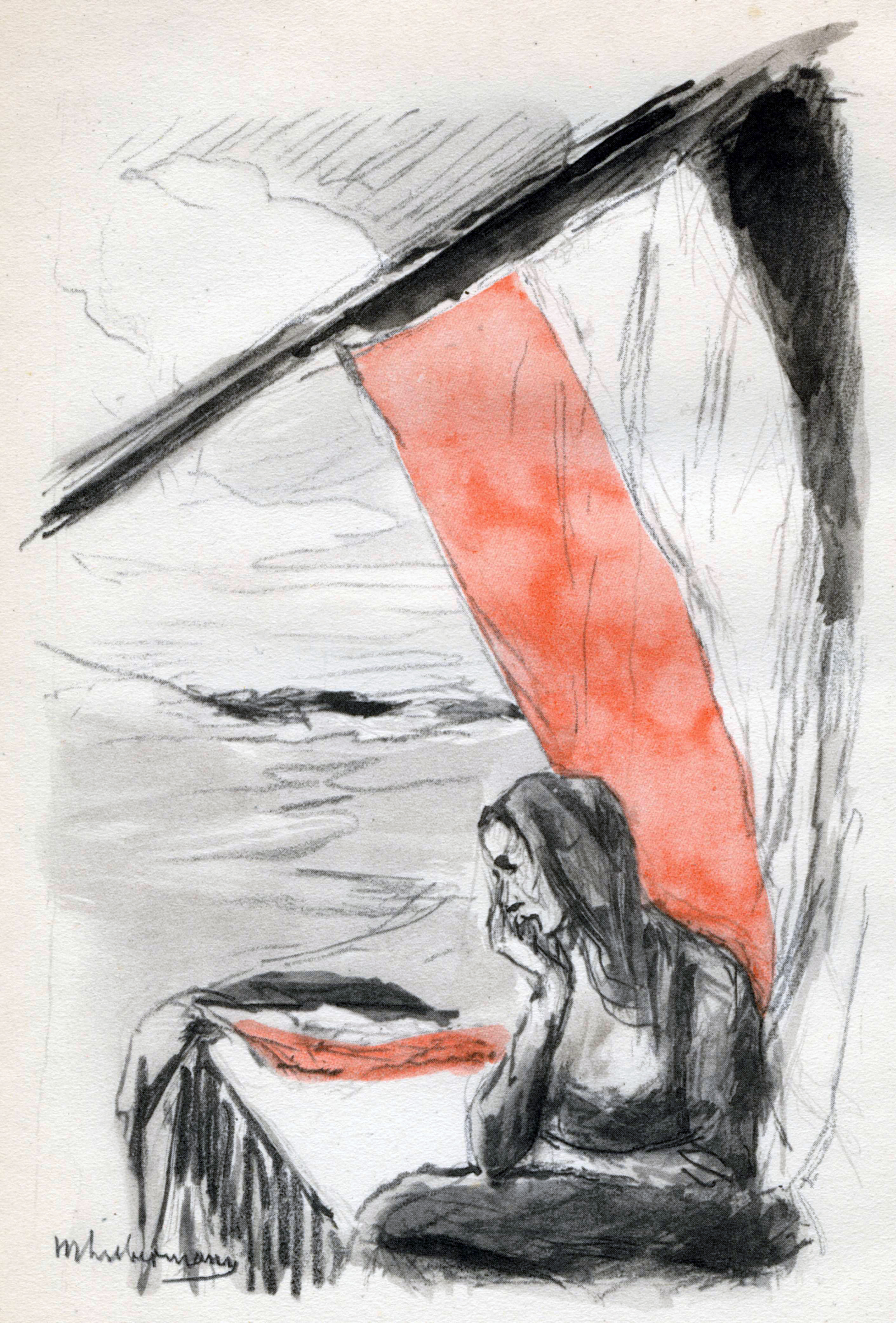
Max Liebermann’s art:  An allegory of mourning.

Excerpt of Martin’s letter, commencing on page 19.  The format of the “header” – comprised of the soldier’s name, rank, and military unit; date and place of birth; date and place of death; date and place where the letter was actually written – is followed (with variations) for the 73 other writings in the book.

Excerpt of Martin’s letter, concluding on page 20.

____________________

Martin’s letter, in German transcription and English translation, is presented below.  (Note the ellipses, indicating sections of the letter which were deleted left unpublished.  More about those in a moment..)

Martin Feist
Gefreiter

Inf. Regt. 81
Geboren: 3.11.1891, Frankfurt / M.
Gefallen: 7.1.1915, Frankreich

Martin Feist
Corporal

81st Infantry Regiment
Born: November 3, 1891, Frankfurt on Main
Fallen: January 7, 1915, France

Im schützengraben bei Andochy, 2.11.14
In a Trench at Andochy, November 2, 1914

     …Ich will in meinem gestrigen Bericht fortfahren.  Die Nacht vom Donnerstag auf Freitag verlief wider Erwarten ruhig.  Der Freitag selbst brachte uns etwas Ruhe, und ermattet von den Strapazen, ruhten wir ermüdet in unseren Gräben.  Der Schabbos begann, und wieder hiess es, leise sich von einem Schützengraben zum anderen wiederholend: “Tornister packen, alles gefechtsbereit, Seitengewehr aufpflanzen.”  Ein Gefühl des Schauerns durchzog mich, als ich auf diese Weise den Befehl ermittelte: “Heute nacht Sturm.”  Stumm lehnte ich mich an die Brüstung des Schützengrabens, scharf nach vorn aus lugend, von wo wir den Feind erwarteten: der volle eben aufgegangene Mond erleichterte die Aufgabe, das hügelige Gelände zu überschauen.  Ich sprach mein Maariw gebet, und dann schweiften meine Gedanken zurück zu Euch meine Lieben.  Ich sah Euch vereint um den Sabbathlichen Tisch, weihevoll und doch besimchoh schel Mizwoh aufgehend.

     …I want to continue in my report of yesterday.  The night, from Thursday to Friday, was calm.  Friday itself brought us some rest, and weary of the hardships, we rested tired in our trench.  Shabbos began, and again it was said, quietly from one trench to the other: “Pack knapsacks, everything ready for battle, plant bayonets [seitengewehr 98].”  A shuddering feeling ran through me when I understood the order: “Night assault.”  Silently I leaned back against the parapet of the trench, leaning forward, from where we expected the enemy: The full moon, which had just risen, facilitated the task of surveying the hilly terrain.  I spoke my Maariv prayer, and then my thoughts wandered back to you my dears.  I saw you gathered together around the Sabbath table, sanctified, and yet sober, mischievous.

Ich dachte an alle Freunde und Verwandte, an ihn vor allen, den teuren Freund, mit dem warmen Herzen und den glühenden Idealen in der Brust…  Fernab von der Heimat traf ihn die Kugel des Feindes und machte seinem jungen Leben ein allzufrühes Ende; nichts blieb mir von ihm zurück als die Erinnerung an die frohen und trüben Tage der Jugend, die wir gemeinsam verbrachten.  Gottes Ratschluss ist unerforschlich.  Und so zogen stundenlang meine Dedanken.  Sie hielten inne, als ich der Entsetzlichkeiten gedachte, die meine Augen geschaut haben.  Ihr Zuhausegebliebenen, was könnt ihr von Glück sagen, dass es Euch erspart blieb, die Schrecken des Krieges zu erfahren…  Möge auch diese Zeit, so gingen meine Gedanken weiter, reinigend hineinfahren in unsere Frankfurter Gassen, möge man verstehen lernen, dass man bisher zuviel danach gefragt, wer reich, wer arm ist.  Weg mit der Anbeter ei des Reichtums, entfernen wir diesen Götzen aus unserem Herzen, und unser Frankfurt wird sehen, dass es noch ein Höheres gibt, und das heisst “Mensch sein”.  Möge dieser Moment ein grosses Geschlecht finden, möge er uns veranlassen, uns selbst zu erziehen, dass wir nach dem Kriege ein Leben mit neuen Begriffen, neuen Vorstellungen beginnen können.

     I thought of all the friends and relatives, of him before all, the dear friend, with a warm heart and glowing ideals in his chest…  Far away from home, the bullet of the enemy struck him, and made of his young life too early an end; nothing remained for me of him but the memory of the joyful and gloomy days of youth that we spent together.   God’s decree is unsearchable.  And so my thoughts went on for hours.  They stopped when I thought of the horrors that my eyes had seen.  Your own home, you can fortunately say was spared to remain, to learn the horrors of the war…  May this time also, my thoughts went on, be a cleansing of our Frankfurter streets; may one understand, that one has asked too much about it so far, of who is rich; who is poor.  Away with the worship of wealth; may we remove these idols from our hearts, and our Frankfurt will see that there is still a higher one, that is to say, “to be human.”  May this great moment find a great lineage; may it lead us to educate ourselves that after the war we can begin to live with new things; can start new ideas.

Der Mond verschwand hinter inzwischen düster aufgezogenen Wolken, meine Blicke verfolgten ihn, wie er sich immer wieder durch die Wolken emporzuarbeiten versuchte.  Still und schwarz wurde es um mich her, da setzte rechts von mir ein heftiges Gewehrfeuer ein, die Kanonen donnerten, Maschinengewehre ratterten unaufhörlich, der Angriff der Franzosen begann.  Der Morgen fand uns als Sieger; aber manch braven Kameraden hatte es das Leben gekostet.

     The moon disappeared meanwhile behind dark clouds; my eyes watched it as it tried to work its way up through the clouds again and again.  There was about me stillness and blackness; violent rifle fire set in on my right, the cannons thundered, machine guns rattled incessantly, the attack of the French began.  The morning found us as victor; but had cost the lives of many good comrades.  

Den Samstag verbrachten wir in Ruhe.  Ich machte abends Hawdoloh mit altem Kaffee aus meiner Feldflasche, einer alten Petroleumfunzel und Zigarre als Besomim, und sang dann für mich allein die Semiraus.  Das Vertrauen zu hakodausch boruchhu begleitet mich von diesem Schabbos in die Woche hinaus, er wird mich behüten und beschützen, und mit seiner Hilfe werden wir uns gesund wiedersehen…

    We spent the Saturday in silence.  In the evening I made a Havdalah with old coffee from my canteen, an old petroleum fuse and a cigar as Besamim, and then sang the Zemirot alone.  The trust to HaKadosh Baruch Hu accompanies me from this Shabbos forth into the week; He will guard and protect me, and with His help we shall be well again…

____________________

Kriegsbriefe – gefallener Deutscher Juden is not the only source of information about Martin. 

Remarkably, the Center for Jewish History possesses the entirety of his correspondence, which (doubly remarkably!) includes the original text of the letter as excerpted in Kriegsbriefe – gefallener Deutscher Juden.  Listed – appropriately enough – as the Martin Feist Collection, the documents, donated by Sonya Benjamin, are described as, “letters [sent] to his family over the course of two years, first as a businessman in Paris and then as a German infantryman in France.” 

The collection is comprised of four sequentially arranged folders, covering 1913, 1914 (January to October), 1914 (November to December), and 1915.  The first folder commences with a descriptive note penned by Sonya in 1991, contaning the following statements, “Martin, as did his 2 brothers, worked for the firm Beer-Sondheimer, both in Paris and in London, whence he returned home to enlist when war broke out in August, 1914.  He stayed in close touch with his five brothers and sister.  He was the second eldest.  Their father had died in 1912.”

“The letters describe an arc of changing attitudes and emotions in the mind of a young German Orthodox Jew, well-educated in an affluent home, as he embraces the lifetstyle of a young businessman in Paris, then adapts to the life of a German infantryman, imbused by the righteousness of his cause, and finally experiences deep sorrow and disillusionment, tempered only by abiding faith.”

Thanks to the CJH’s policy of making the Martin Feist collection freely available in digital format, I was able to locate the letter from Kriegsbriefe – gefallener Deutscher Juden within the “3rd” folder.

The four pages of Martin’s original (typewritten) letter are presented below:
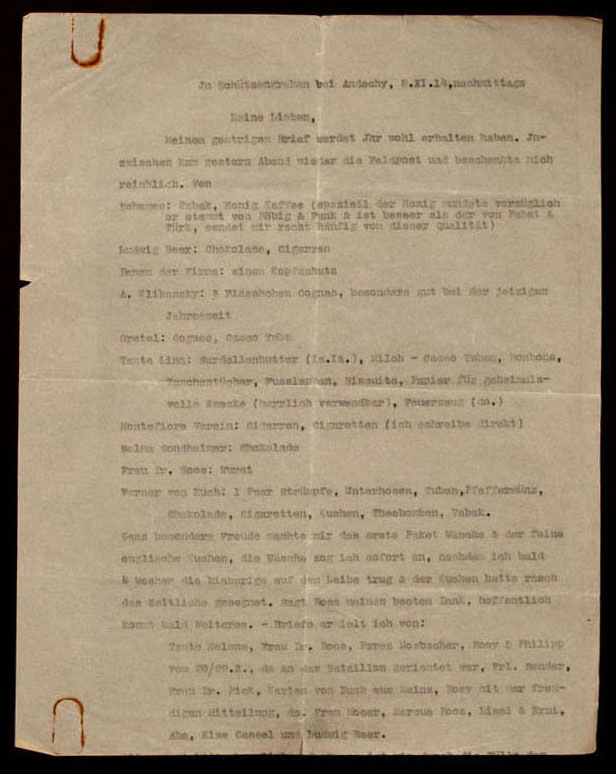
First page.
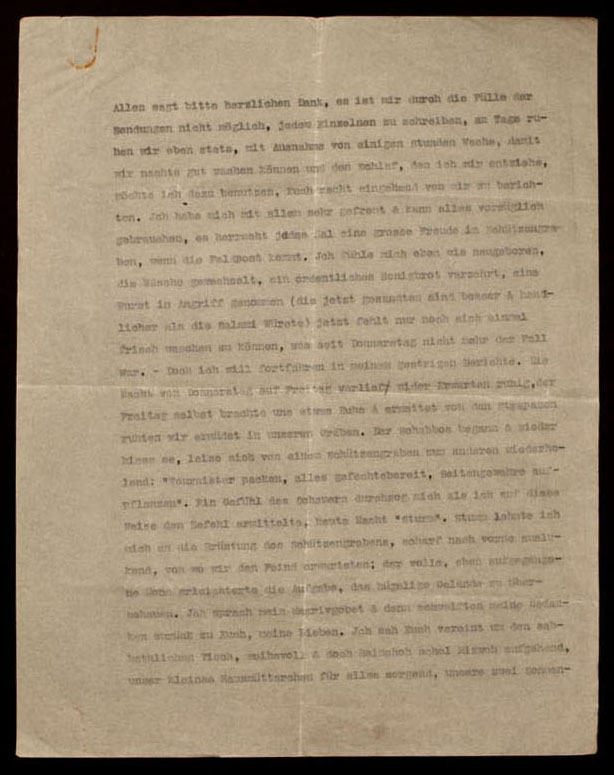
Second page.
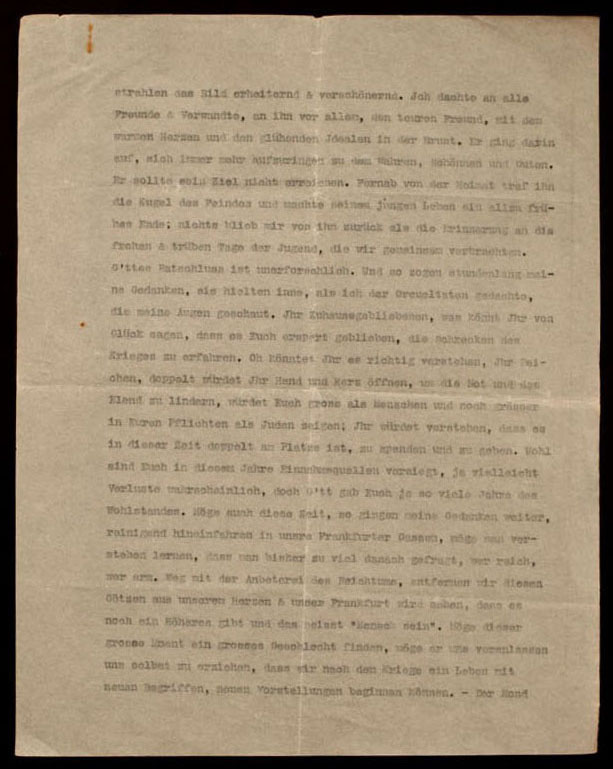
Third page.

Fourth, and final page.

____________________

This “full” version of Martin’s letter is – unsurprisingly – much lengthier than the book version, and in some parts is actually light-hearted.  Amidst all, Martin retained a sense of humor.

More importantly, a careful reading and comparison of the two versions reveals where the editors of Kriegsbriefe – gefallener Deutscher Juden significantly redacted the original text. 

For example in discussing an unidentified friend, the book presents, “I thought of all the friends and relatives, of him before all, the dear friend, with a warm heart and glowing ideals in his chest…  Far away from home, the bullet of the enemy struck him, and made of his young life too early an end; nothing remained for me of him but the memory of the joyful and gloomy days of youth that we spent together.”

Martin’s actual statement is, “I thought of all the friends & relatives, of him before all, the dear friend, with a warm heart and glowing ideals in his chest.  He began to rise more and more to the true, the beautiful and the good.  He should not achieve his goal.  Far away from home, the bullet of the enemy struck him, and made of his young life too early an end; nothing remained for me of him but the memory of the joyful & gloomy days of youth that we spent together.  

Likewise, the book presents, “God’s decree is unsearchable.  And so my thoughts went on for hours.  They stopped when I thought of the horrors that my eyes had seen.“.

In the same place, Martin’s original letter has the following, “God’s decree is unsearchable.  And so my thoughts went on for hours.  They stopped when I thought of the horrible abominations that my eyes had seen.”  

Other differences include the use of the word “and” in place of Martin’s liberal sprinkling of ampersand (“&”) symbols.

____________________

The transcription and my translation are presented below:

Martin Feist
Gefreiter
Inf. Regt. 81
Geboren: 3.11.1891, Frankfurt / M.
Gefallen: 7.1.1915, Frankreich

Martin Feist
Corporal

81st Infantry Regiment
Born: November 3, 1891, Frankfurt on Main
Fallen: January 7, 1915, France

Im Schützengraben bei Andochy, 2.XI.14, nachmittags
In a trench at Andochy, November 2, 1914, in the afternoon

Meine Lieben,
My dear,

      Meinen gestrigen Brief werdet Ihr wohl erhalten haben.  Inzwischen kam gestern Abend wieder die Feldpost und beschenkte mich reichlich.  Von

      You will probably have received my letter [of] yesterday.  In the meantime the field post came yesterday evening and gave me plenty.  From

Schames: Tabak, Honig Kaffee (speziell der Honig mundete vorzüglich er stammt von Röbig & Funk ist besser als der von Pabst & Türk, sendet mir recht häufig von dieser Qualität.)

Schames: Tobacco, honey coffee (especially the exquisite honey coming from Röbig & Funk is better than that of Pabst & Türk; send me this quality quite frequently.)

Ludwig Beer: Chokolade, Cigarren

Ludwig Beer: Chocolate, cigars

Damen der Firma: einem Kopfschutz

Ladies of the Firm: A head guard

A. Klibansky:  3 Fläschchen Cognac, besonders gut bei der jetzigen Jahreszeit.

A. Klibansky: 3 bottles of cognac, especially good at the present season.

Gretel: Cognac, Cacao Tube

Gretel: Cognac, cocoa [butter] tube

Tante Lina: Sardellenbutter (Ia.Ia), Milch – Cacao Tuben, Bonbons, Taschentücher, Fusslappen, Biscuits, Papier für geheimnisvolle Zwecke (herrlich verwendbar), Feuerzeug (do.)

Aunt Lina: Anchovy butter (yes, yes), milk – cocoa [butter] tube, sweets, handkerchiefs, sandals, biscuits, paper for mysterious purposes (gloriously usable), lighter (ditto.)

Montefiore Verein: Cigarren, Cigaretten (ich schreibe direkt)

Montefiore Club: Cigars, Cigarettes (I write directly)

Selma Sondheimer: Chokolade

Selma Sondheimer: Chocolate

Frau Dr. Roos: Wurst

Frau Dr. Roos: Sausage

Ferner von Euch: 1 Paar Strümpfe, Unterhosen, Tuben, Pfeffermünz, Chokolade, Cigaretten, Kuchen, Theebomben, Tabak.

Further from you: 1 pair of stockings, underwear, tubes, peppermint, chocolate, cigarettes, cakes, Theebomben [pre-mixed and packaged tea in jute bags], tobacco.

Ganz besondere Freude machte mir das erste Paket Wäsche & der feine englische Kuchen, die Wäsche zog ich sofort an, nachdem ich bald 4 Wochen die bisherige auf dem Leibe trug & der Kuchen hatte rasch das Zeitliche gesegnet.  Sagt Rosa meinen besten Dank, hoffentlich kommt bald Weiteres.  – Briefe erhielt ich von:

I was particularly delighted with the first package of underwear & the fine English cake; I immediately put on the underwear after I had worn the old one on my body for four weeks & the cake had swiftly blessed the time.  Say my best thanks to Rosa; hopefully coming soon.  –  I received letters from:

Tante Helene, Frau Dr. Roos, Perez Mosbacher, Rosy & Philipp von 20 / 22 X., da an das Bataillon gerichtet war, Frl. Sender, Frau Dr. Pick, Karten von Euch aus Mainz, Rosy mit der freudigen Mitteilung, do. Frau Moser, Marcus Roos, Lisel & Erni, Aba, Else Cassel und Ludwig Beer.

Aunt Helene, Frau Dr. Roos, Perez Mosbacher, Rosy & Philipp of 20 / 22 X., since the battalion was directed; Miss Sender, Frau Dr. Pick, cards from you from Mainz, Rosy with the joyous message, ditto Frau Moser, Marcus Roos, Lisel & Erni, Aba, Else Cassel and Ludwig Beer.

Allen sagt bitte herzlichen Dank, es ist mir durch die Fülle der Sendungen nicht möglich, jedem Einzelnen zu schreiben, am Tage ruhen wir eben stets, mit Ausnahme von eingien Stunden Wache, damit wir nachts gut wachen können und der Schlaf, den ich mir entziehe, möchte ich dazu benutzen, Euch recht eingelhend von mir zu berichten.  Ich habe mich mit allen seht gefreut & kann alles vorzüglich gebrauchen, es herrscht jedes Mal eine grosse Freude im Schützengragen, wenn die Feldpost kommt.  Ich fühle mich eben wie neugeboren, die Wäsche gewechselt, ein ordentliches Honigsbrot verzehrt, eine Wurst in Angriff genommen (die jetzt gesandten sind besser & handlicher als die Salami Würste) jetzt fehlt nur noch sich einmal frisch waschen zu konnen, was seit Donnerstag nicht mehr der Fall war.  – Doch ich will fortfahren in meinem gestrigen Berichte.  Die Nacht vom Donnerstag auf Freitag verlief wider Erwarten ruhig, der Freitag selbst brachte uns etwas Ruhe & ermattet von den Strapazen, ruhten wir ermüdet in unseren Gräben.  Der Schabbos began & wieder hiess es, leise sich von einem Schützengraben zum anderen wiederholend: “Tornister packen, alles gefechtsbereit, Seitengewehr aufpflanzen.”  Ein Gefühl des Schauern durchzog mich als ich auf diese Weise den Befehl ermittelte, heute Nacht “Sturm”.  Stumm lehnte ich mich an die Brüstung des Schützengrabens, scharf nach vorn aus lugend, von wo wir den Feind erwarteten: der volle, eben aufgegangene Mond erleichterte die Aufgabe, das hügelige Gelände zu überschauen.  Ich sprach mein Maariw gebet & dann schweiften meine Gedanken zurück zu Euch, meine Lieben.  Ich sah Euch vereint um den Sabbathlichen Tisch, weihevoll und doch besimchoh schel Mizwoh aufgehend, unner kleines Hausamütterchen für alles sorgend, unsere zwei sonnenstrahlen das Bild erheiternd & verschönernnd.  Ich dachte an alle Freunde & Verwandte, an ihn vor allen, den teuren Freund, mit dem warmen Herzen und den glühenden Idealen in der Brust.  Er ging darin auf, sich immer mehr aufzuringen zu dem Wahren, Schönnen und Guten.  Er sollte sein Ziel nicht erreichen.  Fernab von der Heimat traf ihn die Kugel des Feindes und machte seinem jungen Leben ein allzu frühes Ende; nichts blieb mir von ihm zurück als die Erinnerung an die frohen & trüben Tage der Jugend, die wir gemeinsam verbrachten.  Gottes Ratschluss ist unerforschlich.  Und so zogen stundenlang meine Gedanken, sie hielten inne, als ich der Gräueltaten Entsetzlichkeiten gedachte, die meine Augen geschaut haben.  Ihr Zuhausegebliebenen, was könnt ihr von Glück sagen, dass es Euch erspart geblieben blieb, die Schrecken des Krieges zu erfahren.  Oh könntet Ihr es richtig verstehen, Ihr Reichen, doppelt würdet Ihr Hand uns Kerz öffnen, um die Not und das Elend zu lindern, würdet Euch gross als Menschen und noch grösser in Euren Pflichten als Juden zeigen; Ihr würdet verstehen, dass es in dieser Zeit doppelt am Platze ist, zu spenden und zu geben.  Wohl sind Euch in diesem Jahre Einnah__equellen versiegt, ja vielleicht Verluste wahrscheinlich, doch Gott gag Euch ja so viele Jahre des Wohlstandes.  Möge auch diese Zeit, so gingen meine Gedanken weiter, reinigend hineinfahren in unsere Frankfurter Gassen, möge man verstehen lernen, dass man bisher zu viel danach gefragt, wer reich, wer arm.  Weg mit der Anbeter ei des Reichtums, entfernen wir diesen Götzen aus unserem Herzen, & unser Frankfurt wird sehen, dass es noch ein Höheres gibt und das heisst “Mensch sein”.  Möge dieser grosses Moment ein grosses Geschlecht finden, möge er uns veranlassen, uns selbst zu erziehen, dass wir nach dem Kriege ein Leben mit neuen Begriffen, neuen Vorstellungen beginnen können. – Der Mond verschwand hinter inzwischen düster aufgezogenen Wolken, meine Blicke verfolgten ihn, wie er sich immer wieder durch die Wolken emporzuarbeiten versuchte, still & schwarz wurde es um mich her — da setzte rechts von mir ein heftiges Gewehrfeuer ein, die Kanonen donnerten, Maschinengewehre ratterten unaufhörlich, der Angriff der Franzosen begann.

Please say many thanks to all; it is not possible for me to write to each individual because of the abundance of the parcels; during the day we are always at rest, except for a few hours’ watch, so that we can all keep watch well at night and sleep, which I deprive myself of; I would like to use on the other hand to report to you about me.  I was very pleased with all of them & can use everything excellently; there is always great joy in the trench, when the field post comes.  I feel like a newborn; the underwear changed, a decent honeybread consumed, a sausage taken in attack (those sent now are better & handier than the salami sausages) now the only thing missing is to be able to freshly wash, which since Thursday was no longer the case.  –  But I want to continue in my report of yesterday.  The night, from Thursday to Friday, was calm.  Friday itself brought us some rest, & weary of the hardships, we rested tired in our trench.  Shabbos began, & again it was said, quietly from one trench to the other: “Pack knapsacks, everything ready for battle, plant [seitengewehr 98] bayonets.”  A shuddering feeling ran through me when I understood the order: “Night assault.”  Silently I leaned back against the parapet of the trench, leaning forward, from where we expected the enemy: The full moon, which had just risen, facilitated the task of surveying the hilly terrain.  I spoke my Maariv prayer, & then my thoughts wandered back to you my dears.  I saw you gathered together around the Sabbath table, sanctified, and yet sober, mischievous, a little house-maid caring for everything, our two sun-beams amusing & beautifying the picture.  I thought of all the friends & relatives, of him before all, the dear friend, with a warm heart and glowing ideals in his chest.  He began to rise more and more to the true, the beautiful and the good.  He should not achieve his goal.  Far away from home, the bullet of the enemy struck him, and made of his young life too early an end; nothing remained for me of him but the memory of the joyful & gloomy days of youth that we spent together.   God’s decree is unsearchable.  And so my thoughts went on for hours.  They stopped when I thought of the horrible abominations that my eyes had seen.  Your own home, you can fortunately say was spared to remain, to learn the horrors of the war.  Oh, if you could understand it properly, to open your hand and your heart and would doubly extend, to alleviate need and misery, would show you great as people and even greater in your duties as Jews; you would understand that in this time it is twice the place, to donate and give.  Well in this year your sources of income may fail, yes presumably perhaps losses, but God will give you so many years of prosperity.  May this time also, my thoughts went on, be a cleansing of our Frankfurter streets; may one understand, that one has asked too much about it so far, of who rich, who is poor.  Away with the worship of wealth; may we remove these idols from our hearts, & our Frankfurt will see that there is still a higher one, that is to say, “to be human.”  May this great moment find a great lineage; may it lead us to educate ourselves that after the war we can begin to live with new things; can start new ideas.  –  The moon disappeared meanwhile behind dark clouds; my eyes watched it as it tried to work its way up through the clouds again and again.  There was about me stillness & blackness — violent rifle fire set in on my right, the cannons thundered, machine guns rattled incessantly, the attack of the French began. 

Der Morgen fand uns als Sieger, aber manch braven Kameraden hatte es das Leben gekostet.  Den Samstag verbrachten wir in Ruhe.  Ich machte abends Hawdoloh mit altem Kaffee aus meiner Feldflasche, einer alten Petroleumfunzel und Cigarre als Besomim & sang dann für mich allein die Semiraus.  Das Vertrauen zu Hakodausch boruchhu begleitet mich von diesem Schabbos in die Woche hinaus, er wird mich behüten und beschützen und mit seiner Hilfe werden wir uns gesund wiedersehen. – Mit der Nachricht des ersten lang erschuten Sondheimers habe ich mich ganz besonders, gefreut, ich gratulliere Euch allen, kein jirbu, an grüsst Euch alle

The morning found us as a victor; but had cost the lives of many good comrades.  We spent the Saturday in silence.  In the evening I made Havdalah with old coffee from my canteen, an old petroleum fuse and a cigar as Besamim & then sang the Zemirot alone.  The trust to HaKadosh Baruch Hu accompanies me from this Shabbos forth into the week; He will guard and protect me, and with His help we shall be well again.  –  With the first long news of the Sondheimers I am quite particularly pleased; I congratulate you all, may there be more, greetings to you all.

Euer                                                                                                                               Martin

Viels Grüsse an die Mädchen.

Many greetings to the girls.

Herr Geis möchte gerne Verschiedenes aus meinen Briefen in seiner Zeitung wiedergeben.  Ich gebe ihm hierzu die Erlaubnis.

Mr. Geis would like to present a variety of my letters in his newspaper.  I give him permission to do so.

____________________

The fourth and final folder of the Martin Feist collection includes the telegram notifying Martin’s family of his death:

Martin’s name – like the names of thousands of other German Jewish soldiers who lost their lives in the First World War – can be found in Die Jüdischen Gefallenen Des Deutschen Heeres, Deutschen Marine Und Der Deutschen Schutztruppen 1914-1918 – Ein Gedenkbuch.  There, his name appears on page 211, where are listed – identical to all other entries in the book – his date and place of birth, date of death, the military unit in which he was serving (4th Company of the 81st Infantry Regiment), rank (Gefreiter), and the official casualty list in which his name was reported.
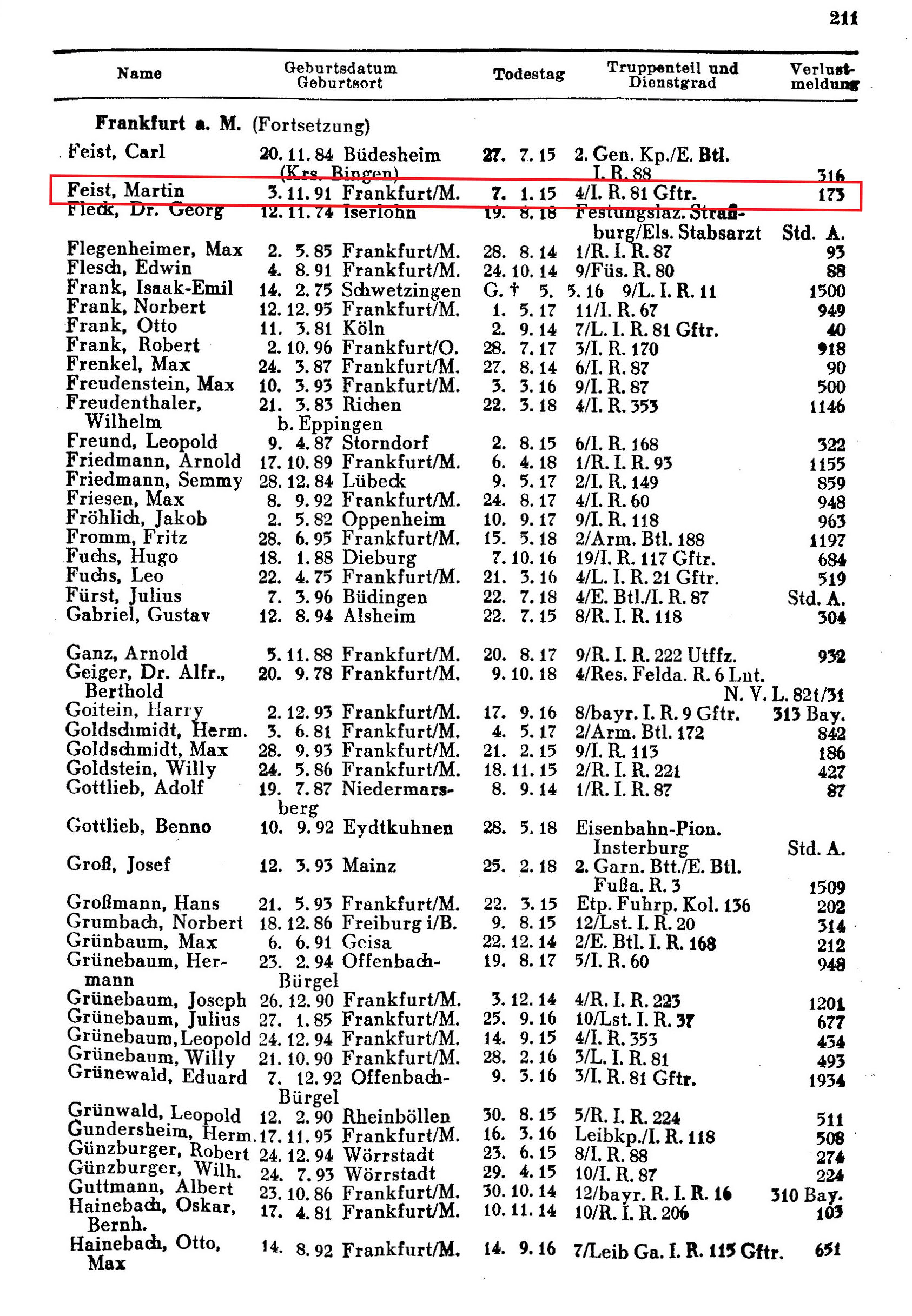
Martin was not the only German Jewish soldier to lose his life on Wednesday, January 7, 1915.  The other German Jewish soldiers who lost their lives that day included:

– .ת. נ. צ. ב. ה –
תהא

נפשו
צרורה
בצרור
החיים

Soldat Julius Asch, 5th Reserve Infantry Regiment, 3rd Battalion, 12th Company
Born in Breslau, April 20, 1897; Resided in Schonlanke

Soldat Siegfried Baendel, 21st Reserve Infantry Regiment, 3rd Battalion, 10th Company
Born in Gleiwitz, August 14, 1882; Resided in Gleiwitz

Soldat Martin Elsbach, 234th Reserve Infantry Regiment, 2nd Battalion, 5th Company
Born in Kassel, June 26, 1891; Resided in Walldorf

Gefreiter Otto Loser, 30th Reserve Infantry Regiment, 2nd Battalion, 7th Company
Born in Dusseldorf, July 3, 1888; Resided in Dusseldorf

Soldat Jakob Marx, 75th Infantry Regiment, 1st Battalion, 3rd Company
Born in Lehmen (Mosel), May 6, 1892; Resided in Gondorf

References

“cacao tube”, at http://www.marichesse.com/article-elle-s-est-collee-les-deux-levres-en-confondant-son-beurre-de-cacao-avec-un-tube-de-colle-forte-118792411.html. 

“Honig mundete”, at https://steinhorster.blogspot.com/2016/02/burgerversammlung-koschale-eeten.html, and,
https://www.opentable.com/solevino-restaurant-and-sommergarten-a-la-provence.

“Theebomben”, at http://www.djk-adler-koenigshof.de/index.php/spielberichte/adlerfreunde/1094-adlerfreunde-besuchten-teekanne-in-duesseldorf

Martin Feist Collection at the Center for Jewish History

Martin Fiest Place of Burial, at FindAGrave

Einer von den 12000, (Illustration by Siegfried Ziegler), Der Schild, December 20, 1935, p. 5

Die Jüdischen Gefallenen Des Deutschen Heeres, Deutschen Marine Und Der Deutschen Schutztruppen 1914-1918 – Ein Gedenkbuch, Reichsbund Jüdischer Frontsoldaten, Forward by Dr. Leo Löwenstein, Berlin, Germany, 1932

Kriegsbriefe – gefallener Deutscher Juden, Reichsbund Jüdischer Frontsoldaten E.V., Berlin, Germany, 1935

And, an acknowledgement

I would like to extend my sincere thanks to my friend (and, Yiddish teacher / composer / choir director) Alexander Botwinik, for his assistance in accessing a copy of Kriegsbriefe – gefallener Deutscher Juden.
God’s Decree is Unsearchable: One of 12,000 – Thoughts of A German Jewish Soldier in the Great War – I

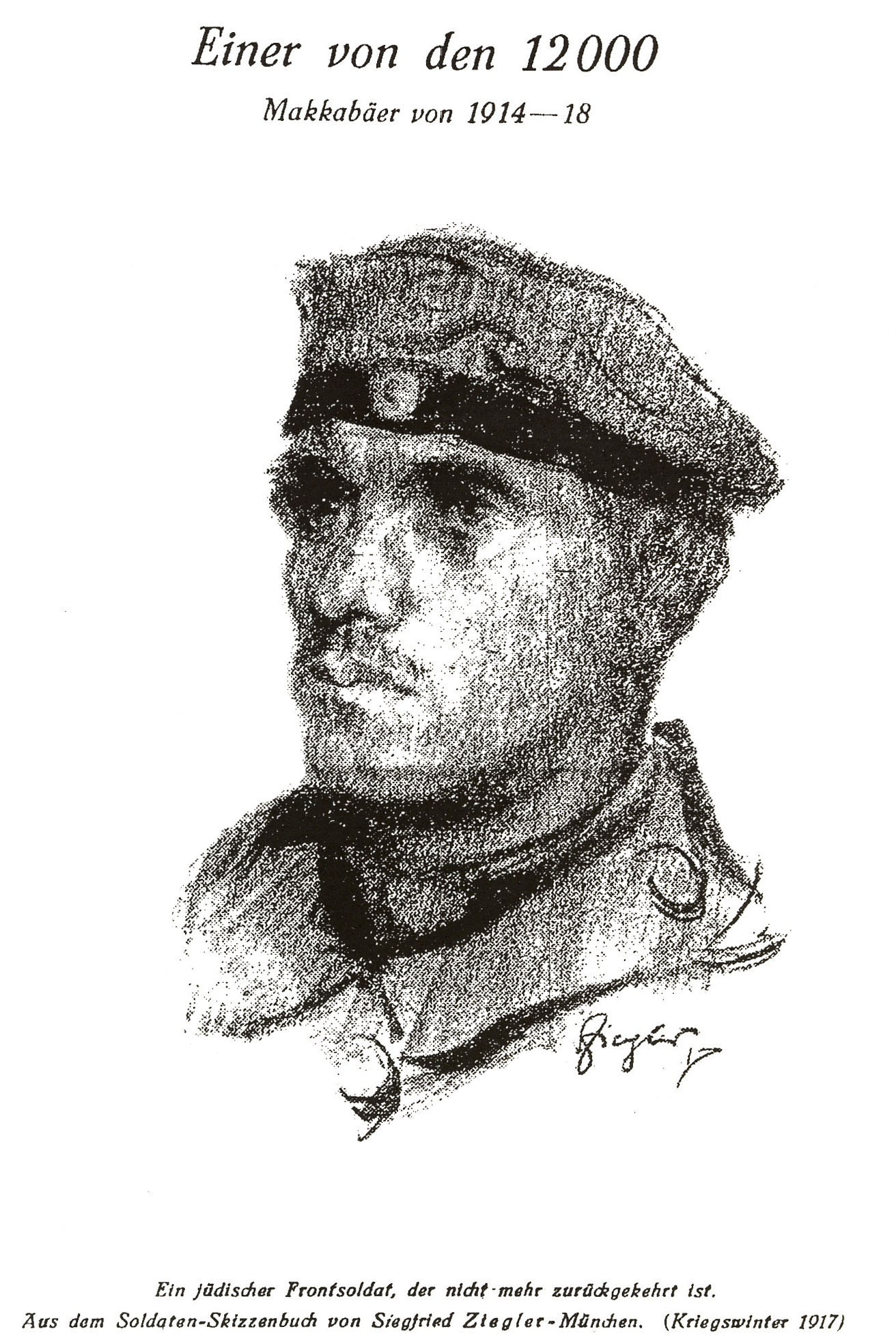
Einer von den 12,000
Makkabäer von 1914-18

Ein jüdischer Frontsoldat, der nicht-mehr zurückgekehrt ist.  Aus dem Soldaten-Skizzenbuch von Siegfried Ziegler – München.
(Kriegswinter 1917).

One of the 12,000
Maccabees from 1914-18

A Jewish front soldier, who has not returned. From the soldier sketchbook by Siegfried Ziegler – Munich.
(War winter 1917).
(From Der Schild, December 20, 1935)

____________________

Whether in the life of nation, the life of a group, or the life of a man, every event – every moment – is remembered in its own manner.  Through unspoken memories; with tales and stories; by anecdotes; in images and visions. 

And, through the written word.

Every era; every historical event, produces a body of writing by those who witnessed or participated in it.  This is especially so of war, which by its nature compels men to communicate their experiences and observations – whether by letters, diaries, or random jottings – to family, friends, and love ones, or simply “the world” at large.  The need may be driven by a sense of personal, moral responsibility to fallen comrades; to retain a spiritual and psychological connection with “home” – a place still at peace; and ultimately, from a realization of the historical imperative to record the nature of the present for the sake of the future.

In terms of the experiences of German Jewish soldiers in the First World War, this was epitomized by the publication of the book Kriegsbriefe – gefallener Deutscher Juden (War Letters of Fallen German Jews) by the Reichsbund Jüdischer Frontsoldaten (RJF, or, Reich Federation of Jewish Front Soldiers) in 1935. 

Whether the book’s publication was prompted by the Enabling Act of March 1933, is unknown.

Kriegsbriefe – gefallener Deutscher Juden is actually one of several books published in Germany from the latter part of World War One, through the 1920s and 30s, covering the experiences, memories, and military service of German Jewish soldiers in the Great War. 

Such works fall within four general categories.   

First, some books, in varying style and format, are composed of biographical profiles of fallen soldiers, in combination with transcribed letters, diary excerpts, and photographs. Exemplified by Kriegsbriefe – gefallener Deutscher Juden, this category includes:

1) Unseren Gefallenen Kameraden – Gedenkbuch für die im Weltkrieg Gefallenen Münchener Juden (Our Fallen Comrades – Memorial Book of the World War for Fallen Jews of Munich), Verlag B. Heller, (B. Heller Publishers) Munich, 1929.

2) Kriegsgedenkbuch der Israelitischen Kultusgemeinde Nürnberg (War Memorial Book of the Jewish Community of Nurnberg), J. Rosenfeld’s Druckerei (J. Rosenfeld Publishers), Nürnberg, 1920.

A second group describes the military service of German Jews, not restricted to men who fell in battle. 

Examples are:

1) Jüdische Flieger im Kriege – ein Blatt der Erinnerung (Jewish Aviators in the War – Pages of Memory), von Dr. Felix A. Theilhaber, Verlag von Louis Lamm, (Louis Lamm Publishers) Berlin, 1919

2) Jüdische Flieger im Weltkriege, Verlag der Schild, (Jewish Aviators in the World War, Shield Publishers) Berlin, 1924 (Dr. Theilhaber’s highly revised version of the above book.)

3) Ein Jahr an der Somme (A Year on the Somme), Feldrabbiner Dr. Martin Salomonski, Druck und Verlag der Königlichen Hofbuchdruckerei Trowitzsch & Sohn, (Printing and Publishing by the Royal Court Book Printing Company, Trowitzsch and Son), Frankfurt a.D., (Frankfurt on the Oder) 1917

4) Die Juden im Weltkriege – Mit besonderer Berücksichtigung der Verhältnisse für Deutschland, (The Jews in the World War – With Special Consideration of the Conditions for Germany) Dr. Felix A. Theilhaber, Welt-Verlag, Berlin, 1916

A third category – actually, epitomized by a single book – Die deutschen Juden als Soldaten im Kriege 1914 / 1918 – Eine statistische Studie (Hilo-Verlag, Berlin, 1922) (The German Jews as Soldiers in War 1914 / 1918 – A Statistical Study) is (as per the title!) statistical in nature.  Author Dr. Jacob Segall used various sources of information to calculate and show the relative percentage of Jews in military service vis-a-vis the German population as a whole, in terms of such criteria as place of residence or branch of service. 

A fourth category is embodied in two books, which present the names of all then-identified Jews, from all branches of the German military, who lost their lives (from all causes) during World War One. The books are:

1) Die Jüdischen Gefallenen des Deutschen Heeres, Deutschen Marine und der Deutschen Schutztruppen 1914-1918 – Ein Gedenkbuch (Reichsbund Jüdischer Frontsoldaten (The Jewish Fallen of the German Army, German Navy and the German Special Troops 1914-1918 – A Memorial Book (Reich Federation of Jewish Front Soldiers, Berlin, 1932).  This book covers the entirety of Germany, and includes nominal biographical information about each of the tens of thousands of serviceman listed within its pages.  (A page of which is presented at the end of this post.)

2) Jüdische Frontsoldaten aus Württemberg und Hohenzollern (Herausgegeben vom Württembergischen Landsverband des Centralvereins deutscher Staatsbürger jüdischen Glaubens (Jewish front soldiers from Wurttemberg and Hohenzollern ((Edited by the Wurttemberg Landsverband of the Central Association of German Citizens of Jewish Faith, Stuttgart, 1926)).  As implied by the title, this book is limited to coverage of Jewish soldiers from the state of Württemberg, and, the region of Hohenzollern. 

The impetus for the creation of these books arose, I suggest, from different, overlapping, yet entirely complementary and understandable motivations:  To validate, if not prove, the patriotism of German Jewry in the eyes of Germany and German society, as a whole.*  To serve as epistolary memorials to fallen soldiers on behalf of their loves ones.  And, from a genuine, sincere, and deep expression of patriotism and love of country – simply for its own sake, on the part of German Jewry.

In terms of recording and commemoration of Jewish military service during World War One, German Jewry seems to have gone to far greater effort, in terms of intellectual effort, and, the total number of works that were eventually created (both wartime and postwar) than Jewish communities of other nations, regardless of whether those nations had been members of the Allies, or, the Central Powers.  Remarkably, unlike the Jewish communities of Germany, Italy, the United Kingdom (specifically England and Australia), no such body of work was ever produced covering American Jewish military service of the First World War, a topic beyond the scope of this post…)

____________________

To the best of my knowledge, there have been no German-to-English translations ofthe above-mentioned German works.  To that end, I’ve created preliminary translations of Unseren Gefallenen Kameraden – Gedenkbuch für die im Weltkrieg Gefallenen Münchener Juden, and, Kriegsgedenkbuch der Israelitischen Kultusgemeinde Nürnberg, which I hope to finalize in the future.

More importantly, I have finished a translation of Kriegsbriefe – gefallener Deutscher Juden, which I hope to make widely available.

____________________

Kriegsbriefe – gefallener Deutscher Juden is comprised of letters and / or diary excerpts from 74 soldiers, and includes 13 poems composed by 8 different authors (4 of those 8 authors being among the 74 soldiers).  The contents are arranged alphabetically (the exception being Soldat Walter Heymann’s letter, which appears first), with the poems being interspersed at relatively even intervals through the text.  Otherwise, there is neither a table of contents nor an index.

The book also includes a color sketch by artist Max Liebermann, showing an allegory of mourning: a woman – the mother of a fallen soldier – a scarf covering her hair, is seated upon the bier of her son, over which is draped the black-white-red tricolor flag of the German Empire, with a larger version of the same flag suspended above.

Some of the passages in Kriegsbriefe – gefallener Deutscher Juden are lengthy; others are brief.  A few are profound, approaching questions of philosophy, religion and theodicy with great power.  Others are relatively straightforward, focusing on the practicalities of life in the trenches or varied combat theatres.  Some letters present vivid – sometimes humorous; sometime appalling – and straightforward depictions of warfare and suffering, in quite startling detail, depth, and clarity.

Each passage is moving in its own way, especially in light of what the future would hold for the families of these soldiers, and the Jewish people as a whole, two decades hence. 

But, it has always been the case that foreknowledge is not given to men or peoples. 

We can only know, what we know now.

____________________

One particular writing of 74 authors stands out:  A letter by Gefreiter Martin Feist, of the 81st Infantry Regiment.  Born in Frankfurt on Main on November 3, 1891, Martin was an Orthodox Jew, and – to the extent possible, as indicated by his letter – did his best to maintain religious observance, and religious faith, in the midst of his experiences as a front-line infantry soldier. 

The excerpt of his letter in Kriegsbriefe – gefallener Deutscher Juden concludes with the text, “Das Vertrauen zu hakodausch boruchhu begleitet mich von diesem Schabbos in die Woche hinaus, er wird mich behüten und beschützen, und mit seiner Hilfe werden wir uns gesund wiedersehen…” [The trust to HaKadosh Baruch Hu accompanies me from this Shabbos forth into the week; He will guard and protect me, and with His help we shall be well again…]

Martin did not survive the war.

He was killed in action almost two months later, on January 7, 1915.

He is buried at the Alter Jüdischer Friedhof (Old Jewish Cemetery) at Frankfurt am Main, Germany. 

____________________

I will present translations of two versions of his letter in my next post.

* This would have rested on the understandable yet fallacious assumption that antisemitism can be refuted by logic and reason.

References

Einer von den 12000, (Illustration by Siegfried Ziegler), Der Schild, December 20, 1935, p. 5, at http://sammlungen.ub.uni-frankfurt.de/cm/periodical/titleinfo/4911661.

Die Jüdischen Gefallenen Des Deutschen Heeres, Deutschen Marine Und Der Deutschen Schutztruppen 1914-1918 – Ein Gedenkbuch, Reichsbund Jüdischer Frontsoldaten, Forward by Dr. Leo Löwenstein, Berlin, Germany, 1932

Kriegsbriefe – gefallener Deutscher Juden, Reichsbund Jüdischer Frontsoldaten E.V., Berlin, Germany, 1935


Soldiers of The Great War: Jewish Military Service in WW I, as Reported in The Jewish Chronicle – “The Action in Heligoland Bight”, September 25, 1914 (Stoker Syd Braham)

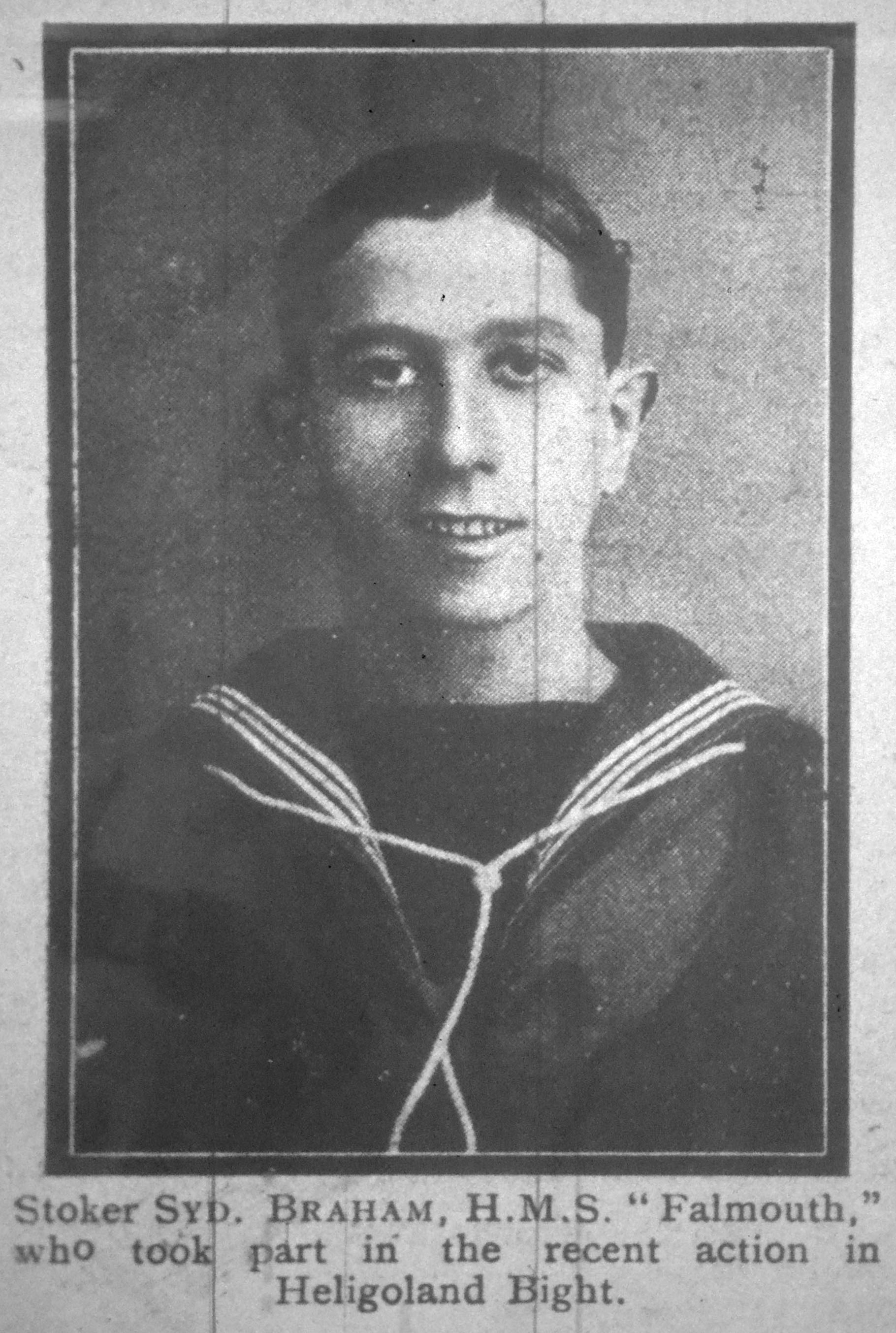
Here is another news item about a Jewish sailor in the Royal Navy: Stoker Syd Braham, of HMS Falmouth. 

The Falmouth, a light cruiser built for the Royal Navy, was launched on September 20, 1910, and commissioned in September of 1911.  She participated in most of the early fleet actions, including the Battles of Heligoland Bight, Dogger Bank, and Jutland, but was only seriously engaged in the latter.  She was torpedoed and sunk off Flamborough Head, Yorkshire, by German submarines on 19 August, 1916, with one fatality.  

A portrait of Stoker Braham was published in the 7 October issue of The Jewish World, and appears below.

____________________

THE ACTION IN HELIGOLAND BIGHT

The Jewish Chronicle

September 25, 1914

Mr. J. Braham, of Sydenham Park Road, sends us an interesting letter he had recently received from his brother, Stoker Syd Braham, H.M.S. “Falmouth”.  In the course of this letter, Stoker Braham writes, “We were in the affair in Heligoland, and might say we were the foremost ship.  We sank two German cruisers and escaped in a burning and sinking condition.  You ought to have been on our ship and heard the shells buzzing over our ‘Tags (ears)’.  We didn’t get hit – not a scratch.  You ought to have seen the ship burning.  You could see the men [the enemy’s apparently] going mad and jumping into the water.  It was a horrible scene.”  “Syd” concludes with a warm greeting to his brother and sister and other relatives.

Reference

HMS Falmouth, at https://en.wikipedia.org/wiki/HMS_Falmouth_(1910).


Soldiers of The Great War: Jewish Military Service in WW I, as Reported in l’Univers Israélite (The Jewish World) – Pour nos combattants et pour nos blessés (For Our Veterans and For Our Wounded), December 11, 1914

After nearly five months, the Great War had steadily and devastatingly taken its toll – alas, how could it not? – on France, and inevitably French Jewry, as well.* 

This, and more, is reflected in the following essay, by J.H. Dreyfuss, Chief Rabbi of Paris, covering sacrifice and hope; healing and solace; patriotism and victory.

This item is available in PDF format, here. 

* For a superb read on this period of The Great War, I highly – very highly – recommend Max Hastings’ superb book Catastrophe 1914: Europe Goes to War.

____________________

Pour nos combattants et pour nos blessés
Pour nos morts et pour leurs parents

PRIÈRE

For Our Veterans and For Our Wounded
To Our Dead and Their Parents

PRAYER

l’Univers Israélite
December 11, 1914

The Jewish World
December 11, 1914

Seigneur, toi à qui appartiennent, comme dit l’Ecriture, “la grandeur, la puissance, la victoire et la majesté, — car, tout, dans le ciel et sur la terre, est à toi ; c’est en ta main que se trouvent force et puissance, c’est ta main qui peut tout grandir èt tout affermir, — Eternel, souverain maître de toutes choses”, daigne étendre ta grâce, ta miséricorde, ta protection efficace sur les nobles et vaillants enfants de la France qui, animés d’une foi ardente et d’une volonté inébranlable, se sont léves pour défendre le sol sacré de la patrie.  Ils ont tout abandonné, parents, épouses, familles, leurs intérêts les plus précieux, tout ce qui donne du prix à la vie, pour n’écouter que la voix du devoir, le devoir qui se résume pour eux, à l’heure présente, dans ce seul mot: vaincre; vaincre en dépit des obstacles, en dépit des épreuves même qui ne pourront entamer ni leur courage indomptable, ni leur patriotique abnégation; vaincre, non pas par orgueil, non pas pour dominer, pour conquérir, mais pour défendre, pour protéger la terre de notre patrimoine héréditaire, pour venger l’injure faite au droit et à la justice.

Lord, to thou that belongs, as the Scripture says, “the size, power, victory and majesty – because, everything, in heaven and on earth, is yours; it is in your hand strength and power, it is your hand that all can grow and all strengthen – Lord, sovereign master of all things, “deign to extend your grace, your mercy, your effective protection of the noble and valiant children of France who, animated by an ardent faith and an unshakable will, rose to defend the sacred soil of the homeland.  They gave up everything, parents, wives, families, their most precious interests, anything that gives value to life, to listen only to the voice of duty, a duty that comes down to them at the present time in the single word: overcome; defeat despite the obstacles, despite the same events that can not begin nor their indomitable courage, nor their patriotic self-sacrifice; overcome, not by pride, not to dominate, to conquer, but to defend, to protect the land of our ancestral heritage, to avenge the insult to law and justice.

Car tu le sais, ô Seigneur, notre cause est juste et droite. Et c’est parce quelle est juste et droite que, d’un bout du pays à l’autre, un même frisson a secoué toutes les poitrines, frisson de révolte, de resolution, de courage et d’espérance; c’est parce qu’elle est juste et droite qu’elle a trouvé un si merveilleux echo, au-delà de nos frontières, dans la conscience de ces peuples amis qui continuent à donner la mesure de leur fidélité héroïque; c’est parce qu’elle est juste et droite que nous avons vu stoïquement partir nos enfants et tous ceux qui nous sont chers, certes, non point sans larmes, mais avec une volonté résolue et réfléchie; enfin, c’est parce que notre cause est juste et droite que nous là confions, sans hésiter, à ta bonté et à ta miséricorde.  Prends-la, Seigneur, sous ton égide toute-puissante, et exauce nos priéres.

As you know, O Lord, our cause is just and right.  And it is because what is just and right that, from one end of the country to another, the same thrill shook every throat, a thrill of revolt, resolution, courage and hope; it is because it is just and right that she has found a wonderful echo beyond our borders, in the consciousness of these peoples friends who continue to give the measure of their heroic fidelity; it is because it is just and right that we have been stoically from our children and all who are dear to us, certainly, not without tears, but with a resolute and thoughtful will; finally, it is because our cause is just and right there we entrust, without hesitation, to your goodness and mercy.  Take this, Lord, in thy omnipotent aegis, and answer our prayers.

Nous te prions, Seigneur, d’un cœur ardent et ému, pour nos maris, pour nos fils, pour nos frères, pour tous ceux qui nous sont chers, et qui, depuis de longues semaines, combattent à côté de leurs frères d’armes, héroïquement, opiniâtrement, insouciants de toutes les fatigues, de toutes les souffrances, de tous les périls, tout leur être tendu vers cette espérance radieuse qui promet le salut et la déliverance.  “Que ta main toute-puissante soutienne leur vaillance et que ta Providence miséricordieuse les couvre de ses ailes protectrices!”

We pray, Lord, with ardent heart and emotion, for our husbands, our sons, our brothers, for all those who are dear to us, and who, for many weeks, fighting alongside their brothers in arms, heroically, obstinately, heedless of all the hardships, all the suffering, all the dangers, their whole being tended towards that radiant hope that promises salvation and deliverance.  “Let thy almighty hand support their valor and thy merciful Providence cover them with its protective wings!”

Nous te prions, Seigneur, en faveur de nos chers et glorieux blessés, qui souffrent de leurs blessures, mais qui souffrent davantage encore de l’impuissance où ils se voient réduits pour un temps, de leur impatience frémissante de reprendre bientot leur place dans les combats. Seigneur, toi qui es le “maître de l’a guérison” viens en aide à leurs souffrances; guéris leurs blessures et calme leurs peines morales; conserve-les à leurs parents, à leurs familles, conserve-les à la France.

We pray, Lord, for our dear and glorious wounded, suffering from injuries, but still more suffering from impotence where they see themselves reduced for a time, their simmering impatience soon to soon resume their place in the fighting.  Lord, you who are the “master of the healing” have come to the aid of their suffering; healed their wounds and calmed their moral sufferings; keeping them to their parents, their families, keeping them in France.

Nous te prions, Seigneur, pour ceux, hélas! qu’il t’a plu de rappeler à toi, pour cette jeunesse, notre espoir, moissonnée au printemps de la vie.  Ah ! pardonne-nous si nous pleurons ; pardonne-nous si nous paraissons nous élever contre les décrets de ta Providence. Non, nous ne voulons pas murmurer; nous voulons “glorifier ton nom” et nous dirons : Puisqu’il t’a plu de nous frapper par des épreuves si cruelles, nous te rendons grâces : d’avoir préparé à ceux que nous pleurons la mort la plus glorieuse, celle qu’on récolte au champ d’honneur. Seigneur, “nous recommandons leur âme pure aux célestes et immortelles félicités que tu réserves, au- helàs de la tombe, aux élus parmi les élus”.

We pray, Lord, for those, alas! it pleased you to remind you, for this youth, our hope, harvested in the spring of life.  Ah! forgive us if we cry; forgive us if we seem to stand against the decrees of your Providence.  No, we do not want to whisper; we “glorify thy name” and we will say: Since you wished to strike us with such cruel blows, we give thanks: we mourn those preparing for the most glorious death,  that is harvested in battle.  Lord, “we commend their pure souls to the heavenly and immortal welcomed you have reserve, over – alas! the grave, elected from among the elected.”

Mais si nous te prions pour ceux qui ne sont plus, nous te prions aussi pour ceux qu’ils laissent après eux; nous te prions pour ces parents, pour ces épouses, pour ces enfants, pour tous ces êtres chers qui les entouraient ici-bas comme d’un réseau de tendresse et de sollicitude. Toi qui es “le consolateur suprême”, daigne consoler les affligés, daigne faire descendre dans leur cœur la résignation, la paix, la sérénité.  Qu’ils se glorifient dans le souvenir des chers disparus! Qu’ils vivent avec leur douce image! Qu’ils s’inspirent de leur exemple et ils seront, eux aussi, vaillants, intrépides, héroïques.

But if we pray for those who are not you any more, we also pray for those they leave behind them; we pray for these parents, these wives, for these children, for all those loved ones around them down here as a network of tenderness and solicitude.  You who are “the supreme comforter,” deign to comfort the afflicted, deign to come down in their heart in resignation, peace, serenity.  They pride themselves in the memory of loved ones!  They live with their sweet image!  They are inspired by their example and they too, will be brave, fearless, heroic.

Nous te prions enfin, Seigneur, avec l’assurance que tu accueillezas les purs hommages de notre foi, de notre foi en ton secours, les témoignages irrécusables de notre piété émue et consciente, avec l’assurance que tu tiendras compte des sacrifices douloureux que nous avons faits pour le salut et la grandeur de la patrie; —nous te prions de faire rayonner bientôt à nos yeux, rayonner dans tout son éclat la victoire, la victoire couronnée par la paix, par le bonheur.

We finally you pray, Lord, with the assurance that you welcome the pure homage of our faith, our faith in thy help, the unimpeachable testimony of our emotional and conscious piety, with the assurance that you will hold account of the painful sacrifices we have made for the salvation and the greatness of the country; – we pray soon to shine victory in all its brilliance, victory in our eyes, victory crowned by peace, by happiness.

“A toi, Seigneur, la délivrance; à nous, ta bénédiction!”  (Ps., 3,9). — Amen

“To you, Lord, grant; to us, your blessing!”  (Ps. 3.9). – Amen

J.-H. DREYFUSS,
Grand-rabbin de Paris

J.H. Dreyfuss,
Chief Rabbi of Paris

Soldiers of The Great War: Jewish Military Service in WW I, as Reported in l’Univers Israélite (The Jewish World) – “Les aumôniers du culte israélite” (Chaplains of the Jewish Faith), November 27, 1914

Paralleling my research in coverage within The Jewish Chronicle of Jewish military service during World War One, I’ve also reviewed the periodical l’Univers Israélite – The Jewish World – concerning the military service of French Jewish soldiers during that time.  Due to the publication schedule of the periodical, as well as the length and format of each issue, the total number of such articles, though many, has turned out to be fewer, and typically of shorter length, than those in the Chronicle.

But, what was published within the l’Univers Israélite was nevertheless as compelling and interesting – sometimes as profound, in its own way – paralleling the nature of what appeared in the Chronicle.  Items of note include biographical profiles of French Jewish soldiers (and inevitably military casualties) – many such items, news from foreign Jewish communities, discourses on religion and politics, and, lengthy descriptions of religious services held by, and among, French Jewish soldiers “in the trenches”.

Among the above, one such item is the following:  Information aimed at the families of servicemen concerning contacting Jewish chaplains assigned to the various French army corps.  Notably, this as the first really “lengthy” concerning French Jewish military service that appeared in l’Univers Israélite, this article did cover actually cover the military experiences of French Jewish soldiers, per se.

____________________

The article is provided in the original French, accompanied by English translation.  (My own translation.)  Further articles from l’Univers Israélite will be presented in the future.  Likewise, translated.  In the meantime, a PDF of this article is available here.

____________________

Les aumôniers du culte israélite

En CAMPAGNE

Chaplains of the Jewish Faith
In Campaign

l’Univers Israélite
November 27, 1914

The Jewish World
November 27, 1914

Tous nos coreligionnaires ne savent pas qu’aux armées en campagne sont attachés des aumôniers des différents cultes et que le culte israélite a droit à un aumônier par corps d’armée. Quelques-uns ne tiennent peut-être pas à le savoir. C’est un tort. Même en laissant de coté, si c’est possible, la question de religion et la question de dignité, une considération de sécurité devrait engager tous les israelites à faire appel, le cas échéant, aux bons offices de l’aumônier du culte dont ils relèvent. L’aumônier, qui marche à l’arrière du corps d’armée, peut se mettre en relation avec les militaires israélites dont il connaît l’existence, les visiter s’il y a lieu dans les ambulances, prendre ou se procurer de leurs nouvelles et communiquer avec leurs familles ; assimilé à un officier sans troupes, il peut se charger de recevoir et de distribuer des colis.

Not all of our coreligionists are aware that chaplains of various religions are attached to armies in the field and that Israelite worship is entitled to chaplains by the army corps.  Some may not be keen to know.  This is wrong.  Even leaving aside, if possible, the question of religion and the question of dignity, a security consideration should engage all Israelites to appeal, if any, to the good offices of the chaplain under whom they worship.  The chaplain, who walks to the rear of the army corps, can relate to the Israelite soldiers which he is aware, visit the place where the ambulances are taken or obtain their news and communicate with their families; compared to a non-troop officer, he may be responsible for receiving and distributing the packages.

Nous croyons donc rendre service aux familles Israélites qui ont quelqu’un des leurs à l’armée en dressant la liste des aumôniers israélites actuellement en fonctions, avec l’indication du corps d’armée auquel ils sont attachés:

We believe as a service to Israelite families who have someone of theirs in the army listing the current functions of Israelite chaplains, with indicating the army corps to which they are attached:

1er corps           MM     Hermann, rabbin de Reims (en congé).
2e corps                        Tchernaïa, rabbin; ministre-officiant d’Enghien.
3e corps                        Nathan Lévy, rabbin de Rouen.
4e corps                        Albert Hertz, rabbin.
5e corps                        Maurice Zeitlin, rabbin.
6e corps                        Joseph Sachs, rabbin de Châlons-sur-Marne.
7e corps                        Paul Haguenauer, grand-rabbin de Besancon.
8e corps                        Julien Weill, rabbin de Paris
(précédemment M. Schumacher, rabbin de Dijon).
9e corps                        Léon Sommer, sous-rabbin, ministre-officiant de Tours.
13e corps                      Marcel Sachs, rabbin à Paris.
15e corps                      Hirschler, ministre-officiant à Marseille.
16e corps                      Joseph Cohen, gran rabbin de Bayonne.
17e corps                      Moïse Poliatscheck, rabbin de Toulouse.
18e corps                      Ernest Ginsburger, grand rabbin de Genève.
20e corps                     Maurice Eisenbeth, rabbin de Sedan.
Place de Toul,             M. Isaac Bloch, grand-rabbin de Nancy.
Place de Verdun,        M. Jules Ruff, rabbin de Verdun.
Place d’Epinal,           M. L. Sèches, grand-rabbin de Lille.

First Corps                          M.M. Hermann, Rabbi of Reims (on leave).
2nd Corps                           Tchernaia, Rabbi; officiating minister of Enghien.
3rd Corps                            Nathan Levy, Rabbi of Rouen.
4th Corps                            Albert Hertz, Rabbi.
5th Corps                            Maurice Zeitlin, Rabbi.
6th Corps                            Joseph Sachs, Rabbi of Chalons-sur-Marne.
7th Corps                            Haguenauer Paul, Chief Rabbi of Besancon.
8th Corps                            Julien Weill, Rabbi of Paris
(formerly Schumacher, Rabbi of Dijon).
9th Corps                            Sommer Leon, Deputy Rabbi, Officiating Minister of Tours.
13th Corps                         Marcel Sachs, Rabbi in Paris.
15th Corps                         Hirschler, Officiating Minister at Marseille.
16th Corps                         Joseph Cohen, Grand Rabbi of Bayonne.
17th Corps                         Poliatscheck Moses, Rabbi of Toulouse.
18th Corps                         Ernest Ginsburger, Chief Rabbi of Geneva.
20th Corps                         Maurice Eisenbeth, Rabbi of Sedan.
Place de Toul                    M.L. Isaac Bloch, Chief Rabbi of Nancy.
Place de Verdun               M.L. Jules Ruff, Rabbi of Verdun.
Place d’Epinal                  M.L. Sèches, Chief Rabbi of Lille.

En écrivant à un aumônier, on libellera l’adresse comme suit:

M. le rabbin (grand-rabbin) X..
Aumônier du culte israélite
Groupe des brancardiers de Corps
…eme corps d’armée

Writing to a chaplain, words are addressed as follows:

Rabbi M. (Chief Rabbi) X…
Chaplain of the Jewish faith
Corps Stretcher Group
…th Army Corps

La première destination à donner à la lettre est le Bureau central militaire à Paris ou la ville qui est le siège du dépôt de la section d’infirmiers du corps d’armee en question (consulter le tableau affiché dans les bureaux de poste).

The first destination to give the letter is the Military Central Bureau in Paris or the city that is the seat of the filing of the nursing section of the corps in question (see the chart displayed in post offices).

On remarquera que les 10e, 11e, 12e, 14e, 19e, et 21e corps d’armée n’ont pas, à notre connaissance, ou n’ont pas encore d’aumônier israélite. Nous reviendrons sur cette lacune et sur quelques autres desiderata dans un prochain où nous étudierons l’organisation du service de l’aumônerie militaire, au point de vue Israélite, et la place faite à notre culte.

Note that the 10th, 11th, 12th, 14th, 19th, and 21th army corps have not, to our knowledge, or do not yet, have Israelite chaplains.  We will return to this absence and upon some other desiderata in the future or we will study the organization of the service of the military chaplaincy, from the Israelite perspective, that has instead made our worship.

Soldiers of The Great War: Jewish Military Service in WW I, as Reported in The Jewish Chronicle – “War and The New Year”, September 25, 1914

The rough juxtaposition of the beginning of the First World War with Rosh Hashana (September 8, 1914) was the impetus for a sermon preached at the Dalston Synagogue (in the Borough of Islington, in North London).  This was reported upon in the Chronicle on September 25.

The duration and nature of World War One – alas, as in any war, really – was the inevitable context for reflection and sermons throughout remainder of the conflict.  Many such pieces appeared in the Chronicle throughout the rest of the war – even into 1919.  The thought behind such writings was directly motivated by or emanated from military aspects of the war itself, or, spurred on events, conditions, and changes – both within the United Kingdom and beyond – that affected the Jewish people, and, the world as a whole.

The same – and much, much more – could be said for items in the Jewish press during the Second World War. 

And, was.  (Hopefully, more of that in future posts.) 

Reverend Wasserzug expressed optimism on two levels:  That the heroism exemplified by the Russian Jewish soldier Osnas (mentioned in a prior Chronicle article) – and other Russian Jewish soldiers like him – would elicit freedom and (seemingly) acceptance for current and future generations of Russian Jews.  And, that the war, “…like a storm [would] cleanse the European air of the moral atmosphere which has infected it.”

Alas, as we now know in hindsight – as was known decades ago – the currents of history would in time proceed towards opposite destinations. 

(The “gap” in the middle of the item, ending with the syllable “sed” (!), is due to poor legibility of the original microfilm from which this item was copied.)

____________________

THE WAR AND THE NEW YEAR

The Jewish Chronicle

September 25, 1914

               Preaching on the first day of Rosh Hashana at the Dalston Synagogue, the Rev. D. Wasserzug dealt with the lessons of the War.  Taking his text from the second chapter of Isaiah I, the preacher pointed out the remarkable parallelism that existed in the political conditions of Judah, under Ahab and Europe in our own time.  Both ages had enjoyed great material prosperity, both were animated by a coarse vain glory, and in the intoxication of their pride both fell under the temptation of forgetting God and ascribing their successes to their own skill and prowess.  And having deposed the God of Righteousness from his throne, they set up in his place a new god, a hideous monster bolstered up by spear and cannon.  Right wars superseded by might, meekness was regarded as weakness, brute force alone was triumphant.  And as in those remote days, so now they _____sed what this exaltation of force led to.  But out of the mad welter of fire and blood and ruin that stormed around them, was there no sign that they might carry with them into the New Year, that might inspire them with hope for the dawning of a brighter and better day for mankind?  In the first place, the truth will be brought home to the hearts of men that the corner stone of their national life is not the sword and cannon, but the worship of God, and the practice of righteousness.  They will now learn with ever growing clearness and force that what is morally wrong, cannot be politically right, and that whatsoever nations violate the laws of righteousness, shall surely be overtaken by shame and remorse.  They will now learn that the truest form of culture is loyalty to God and his precepts.  And the Jewish community too, might draw some hope from the situation, too.  Just as the pistol shot of the retched young Serbian student at Sarajevo fired the train which has exploded in blood and ruin over the whole continent, so the heroism of the young Russian Jewish student – Osnas – may yet, under Providence, herald the dawn of a happier and more liberal era for our Russian brethren.  His bravery, as well as the undoubted enthusiasm of the Russian Jews for their country’s cause, has touched the hearts and impressed the imagination of the Russian people as they have never before been touched and impressed, so that the blood which our brothers were shedding so prodigally for Russia may yet be the seed of a rich and noble harvest of freedom, of which their children may enjoy.  Affection has never been a stronger  spiritual agent than prosperity, and like a storm, this war may yet cleanse the European air of the moral atmosphere which has infected it.

Soldiers of The Great War: Jewish Military Service in WW I, as Reported in The Jewish Chronicle – “An American Souvenir Hunter”, September 25, 1914

The following article from The Jewish Chronicle is of a different sort: An very brief account about conditions in Belgium, by a Private Cohen – first name not given – of the Royal Army Medical Corps.  The incidental allusion to “an American” is notable. 

____________________

AN AMERICAN SOUVENIR HUNTER

The Jewish Chronicle

September 25, 1914

Another soldier in the R.A.M.C. – also named Cohen – who has been captured and has escaped, writing from Shorncliffe Military Hospital, says, “I am footsore with walking in a pair of boots three sizes too big for me but I am in great hopes of going to the front again shortly.  I was in two battles, and the bullets were all round us, as we have been in the firing-line all the time.  I have buried a lot of Englishmen and one German.  Enclosed please find two German souvenirs I took off a dead German’s cap.  I was offered (pound) 1 for them by an American.”

Soldiers of The Great War: Jewish Military Service in WW I, as Reported in The Jewish Chronicle – “Story of an escape”, September 25, 1914 (Private Victor Cohen)

Here is another article about a “Private Cohen” of the Royal Army Medical Corps that also appeared in the 25 September 1914 issue of the Chronicle.  This time, however, said Private Cohen has a first name:  Victor.

It would seem likely that “this” Private Cohen is the very same soldier referred to in the prior article, given that the individual in this account is also reported to have escaped from German captivity.  More than a mere coincidence in reporting, I would suggest.

A review of records in the database of the Commonwealth War Graves Commission fortunately yields no entries for this man, so presumably, he survived the war.

____________________

STORY OF AN ESCAPE

The Jewish Chronicle

September 25, 1914

Private Victor Cohen, of the R.A.M.C., who had been taken prisoner by the Germans and escaped, has written to his parents an account of his experiences.  It was during the retreat from a small village named Augre that Private Cohen was captured.  “I must say,” writes Private Cohen, who is now at Aldershot, “the Germans did not ill-treat us, but gave us food and wine for our wounded.”  He goes on to say, however, that, “they took everything of any value from the villages and that wounded brought in from a house three miles away were found to be without clothes.  They said the Germans had taken all their clothes away and left them out on the field.”  “Six of us,” Private Cohen continues, “meant to escape, and we made up our mind to go separately.  I had made all my plans, but they fell through when I found that the only bridge left up, and which I had to cross, was guarded by Germans.  I then made up my mind to hide in a wood till the Germans retreated, but by the greatest of luck I heard of a Belgian soldier who had escaped from Maubeuge, and was trying to get to Ghent.  When he heard of me, he at once got me a civilian suit, etc., and the two of us started from Douai at night.  We walked from eight o’clock on Monday night till eight the next morning, and passed through the Herman patrols without anybody seeing us.  We arrived in Ghent on Tuesday night, and the English Consul gave me a passport.  …  I interviewed the Consul at Ostend and arrived in England on Wednesday.”  The writer adds that he hopes to leave again shortly.

In the Maelstrom of the Great War: Jewish Civilians in WW I, as Reported in The Jewish Chronicle – “In the Track of the Storm – Pathetic Scenes Among the Jewish Refugees”, September 18, 1914

Certainly; inevitably; naturally, many of the articles published by The Jewish Chronicle during “The Great War” – as well as during the Second World War – focused upon the experiences, travails, challenges, and living conditions of civilians.  Alas, this would seem to have been inevitable, given that the Twentieth Century was the century of “total war”. 

The following article is one such example, and covers the plight of Jewish refugees who had been evacuated from Antwerp, Belgium, at the beginning of the war.  The author focuses upon refugees at Great Alie Street, in Whitechapel, and Soho Street, in Westminster.  At least one refugee was a resident of Lodz, who, while visiting family in Antwerp, was caught up in the storm of war.  Doubtless, the same or similar would have pertained to many other refugees in the context of this article. 

(Like most – if not all – reports carried by the Chronicle, the reporter’s name is not given; he is simply referred to as “our representative”.)

____________________

IN THE TRACK OF THE STORM
PATHETIC SCENES AMONG THE JEWISH REFUGEES

The Jewish Chronicle
September 18, 1914

[Special to the “Jewish Chronicle”]

“Never have I witnessed so much weeping as in the past week.  It has been a veritable vale of tears.”

The words were addressed to a representative of the JEWISH CHRONICLE by the Secretary of the Jews’ Temporary Shelter, and they could easily be believed.  But unless hearts be stone there was cause for years among the visitors and the workers, as well as among the wretched refugees who have fled pell-mell to the shelter for asylum.

It is a motley throng that crowds the building.  They stand in the doorway; they block the staircase; the fill the dining-room; they bear in their appearance and often forlorn state the unmistakable appearance of human flotsam and jetsam, swept hither and thither in the track of the storm.

It is a mixed gathering – most of them young.  Only a few greybeards to be seen here and there, and no schnorrers.  Some of them had offered their last few coins for the food they received, but proffered them, of course, in vain.  Men there are with hundreds of thousands of francs in the bank, and unable to draw more than ten shillings a week.  A number are well dressed; most “receive” with reluctance.

Here a student poring over a book; there a little group watching a game of chess; elsewhere a crowd pressing forward for dinner tickets; or a knot of Russian volunteers, in Belgian uniform – not the advance guard, by the way, of a certain elusive army.  And everywhere the child – the child in arms, the child at the breast, the playing child, the weeping child.  The playing child is delightful.  For it the Kaiser and all his men are a myth.  How merrily it laughs.  But the crying child and the sick child –

Half a dozen mothers are waiting for Dr. Morris – who is generously busy among the refugees – with their little ones in their arms.  A few of the infants are wand and pale and evidently ill.  One of the mothers turns the child over, and glances anxiously at it; and the tears well into her eyes.

A father walks up and down the room to soothe his baby, and a tiny tot of two years at most – his other infant – marches alongside of him, holding the corner of his coat, with a look of stolid determination on its grimy face to hold on till grim death, what would look ludicrous, if the circumstances were not so tragic.  The children!  They sit on the steps.  They walk around your legs.  They cry in their perambulator.  Yes, how did that mother bring that perambulator with her in her precipitate flight from Belgium?  But there is, wedged in the variegated crowd – a wheeled miracle of the exodus.

A young woman sits in the corner with her two children – one at her breast.  Beside her, her mother, with three other grandchildren, and not far off the father and mother of the three other little ones.  All are ill-clad and apparently penniless.  The first-mentioned daughter had come from Lodz on a visit to her mother at Antwerp, and was caught in the fury of the gale.  Her husband? –  Heaven knows where.  Perhaps in the army; but she has had no word from him for eight weeks.

“Why were you driven out?” one asks.

“Driven out?” is the answer, “No; we escaped.”  And then comes the explanation.  The Zeppelins had terrified them.  They had been ordered down to the cellars at the first sound of the air-craft’s approach – damp, dark cellars; and the family had fled in fear.  It is the same story everywhere.

“We had three weeks of Zeppelin terror,” says an intelligent young girl; “we could stand it no longer.”

Round the corner in Monnickendam Rooms, Great Alie Street, another throng is gathered.  Here clothes are given out, and down below dinner is served.  It is a spacious, pleasant room, and the meals are distributed at separate tables, and the cry is – “Women and children first” – not so inappropriate after all, for the people have suffered shipwreck.  One little girls grasps a toy with grim and inflexible tenacity.  Pretty scene!  Most welcome touch.

What wizard is conjuring up the wherewithal to feed this host?  The 4s. per person provided by the Russian Government goes a very short way.  During the last two weeks or so about 1,400 Jewish refugees have flocked to the Shelter, to say nothing of one hundred Christian guests.  The women and children – some one hundred and fifty in number – are lodged at the Shelter.

Three hundred men are housed and fed in the workhouse at Poland Street, given by the authorities at the Local Government Board.  Others are housed with good, kind, if poor, hosts in the East End, who surrender sometimes their own bed to the strangers from over the sea; and for yet others bedrooms are hired.  Between six and seven hundred receive meals at the Shelter, and between three and four hundred more in the Monnickendam Rooms.  And food is plentiful.  Mr. Landes and his friends find, the money from someone and somewhere.

But the tide is still coming inwards.  The Leyland Line picked up 52 Jews at Antwerp a few days ago and brought them here, and no one can place limits to the influx or would; for the Aliens Act, most crazy of structures, collapses at the first serious crisis.

The institution at Poland Street is being got ready for 800 persons and that will relieve the pressure in the East End.  A library of 500 books has been sent there, and a synagogue has been fitted up; and the refugees will be made as comfortable as may be.  But “How Long?” is the cry.  Who can find employment for at least some of these people so that they may resume the independent self-respecting lives that they lived till the swarms of the modern Attila swooped down on Belgium and turned civilisation into a sham and a peaceful land into a shambles?  Meanwhile, Mr. Landes and his colleagues move among this host, bringing succor, and the refugee’s lots is brightened.  But that cry of the children rings insistently in the ear!


Soldiers of The Great War: Jewish Military Service in WW I, as Reported in The Jewish Chronicle – “The Sinking of the Pathfinder”, September 11, 1914 (Stoker William Stern)

The photograph below appeared in the September 9 issue of The Jewish World. 

It commemorates Stoker 1st Class William Stern (K/5331) of the Royal Navy, who was killed in the sinking of HMS Pathfinder on September 5; four days earlier. 

Born in Bishopsgate, London, on July 3, 1891, William was the son of Jacob and Esther.  His name is memorialized on Panel 5 of the Chatham Naval Memorial, in Kent. 

The very brief, two-sentence announcement of his death which is presented below, appeared in the Chronicle on September 11.

As for the Pathfinder…  A plethora of information about the ship, her crew, and her loss can be found on the Internet.  She has the tragic distinction of having been the first ship ever to have been sunk by a motor-powered (self-propelled) torpedo. 

(Based on the Wikipedia entry…)  She was launched in July of 1904 and commissioned in 1905, as the lead ship of the Pathfinder class of scout cruisers.  Struck in a forward magazine by a torpedo fired by the U-Boat U-21 (commanded by Otto Hersing) while off the Firth of Forth, she exploded, and sank within four minutes.  The total number of casualties is reported to have been 250, with eighteen known survivors, including the ship’s captain, Captain Francis Martin-Leake. 

As reported in the Daily Mail on September 8, 2014, a century after the Pathfinder’s sinking, a wreath was placed over the site of her wreck by members of the British Sub-Aqua Club, in the presence of members of the Royal Navy, and, Royal Marines. 

Among those in attendance were members of Stoker Stern’s family, a photograph of whom appears in the Mail’s article.

Note that the caption mentions the Pathfinder as having been sunk by a mine.  This was reported as such due to the Admiralty’s belief – at the time – that surface warships could not be sunk by torpedoes.

____________________

The Sinking of the Pathfinder
JEWISH SAILOR GOES DOWN WITH THE SHIP

The Jewish Chronicle
September 11, 1914

We regret to announce that among the crew of H.M.S. “Pathfinder” who perished when that vessel was mined in the North Sea was a Jew, Stoker William Stern.  Stoker Stern’s relatives reside in Bell Lane, E.

References

U-21 Sinks HMS Pathfinder 5 September 1914, by Martin Gibson.

Tribute to the first ever casualty of the U-Boats: Divers lay wreath on the wreck of HMS Pathfinder 100 years after submarine sent it to the bottom

H.M.S. Pathfinder (1904)