Soldiers of The Great War: Jewish Military Service in WW I, as Reported in The Jewish Chronicle – “Jews in the Black Watch”, September 11, 1914

A commentary and a question, in the form of a very brief article:

“What were they doing?”

____________________

Jews in The Black Watch
“BONNIER LADS AND BRAVER I DON’T WISH TO SEE”

The Jewish Chronicle
September 11, 1914

Somebody asked a question about the Jews – what were they doing?  A Highlander broke in sharply, “Doing?  Well, their duty.  We had three with us, and bonnier lads and braver I don’t wish to see.  They fought just splendid!”

There was a private of the Berkshire Regiment with the Highlanders, and he also had a good word to say of the Jews at the Front.  “We had ten in our company,” he remarked, “all good fighters, and six won’t be seen again.  So don’t say a word against the Jews!”

Soldiers of The Great War: Jewish Military Service in WW I, as Reported in The Jewish Chronicle – “A Jewish Soldier at Mons”, and, “Jewish Wounded in London Hospital”, September 11, 1914 (Gunner Victor Freedman, Private Isaac Levy, and Alfred Springer)

The Chronicle not uncommonly published full letters, or extracts of letters, from servicemen, describing their observations and experiences.  Here is a letter from a Jewish soldier – Private Levy, from Leeds – describing his actions during the retreat of the British Army from Mons.

____________________

A Jewish Soldier at Mons
GALLANTRY IN THE FIELD

The Jewish Chronicle
September 11, 1914

     A letter has been received from Private Levy, of Leeds, who has been serving as a private in the Royal Munster Fusiliers, and who has been invalided from the front.

“I have been sent home from the front very poorly,” he says.  “The fighting was all round Mons.  We were sent up to the firing line to try and save a battery.  When we got there we found that they were nearly all killed or wounded.  Our Irish lads opened fire on the dirty Germans, and you should have seen them fall.  It was like a game of skittles.  But as soon as you knocked them down up came another thousand or so.  We could not make out where they came from.  So all of a sudden our officer gave us the order to charge.  We fixed bayonets and went like fire through them.  You should have seen them run.  We had two companies of ours there against about 3,000 of theirs, and I tell you it was warm.  I was not sorry when night time came, but that was not all.  You see we had no horses to get those guns away, and our chaps would not leave them.  We dragged them ourselves to a place of safety.  As the firing line was  at full swing we had with us an officer of the Hussars.  I think he was next to me, and he had his hand nearly blown off by one of the German shells.  So I and two more fellows picked him up and took him to a place of safety, where he got his wound cared for.  I heard afterwards that he had been sent home, poor fellow.”

____________________

But, this is not the end of the story of Private Levy’s story.

Within the same issue of the Chronicle, an account of his experiences appears with additional detail, described in the context of a visit by the Chief Rabbi, and Reverend S. Levy, to wounded Jewish soldiers at the London Hospital. 

Other Jewish soldiers are mentioned in the article.  They are:

Gunner Victor Freedman, from Edinburgh, of the 52nd Battery, Royal Field Artillery

Private Levy himself – first name revealed as Isaac – who is reported as having been from Rounday Road, in Leeds.

Alfred Springer, Motor Transport, Army Service Corps.

There are no records for these three men in the database of the Commonwealth War Graves Commission, and they are not mentioned as fatalities in the British Jewry Book of Honour, so it appears that fortunately, they survived the war.

In its discussion of Jews serving in the military, the article alludes to the fact that Private Levy was, “…not the only Jew in the “Munsters”.  The Irish lads have two other Hebrew comrades, who bear, however, the unlikely names of Sergeant Jacks and Private Gallagher.  Strange, but true.”  This topic – the enlistment of some Jewish soldiers under ostensibly non-stereotypically “Jewish-sounding”-names – would be addressed by both The Jewish Chronicle and the American Jewish Exponent, and other Jewish newspapers and periodicals, in editorials, commentaries, and articles, through the remainder of the War. 

And, after.

____________________

JEWISH WOUNDED IN THE LONDON HOSPITAL
PERSONAL NARRATIVE

The Jewish Chronicle
September 11, 1914

The Chief Rabbi, accompanied by the Rev. S. Levy, the Visiting Minister, paid a visit on Monday to the wounded soldiers in the London Hospital, and talked with several of the men on their experiences at the front.  The Jewish soldiers in particular were very grateful for this mark of attention paid to them.  Two Jewish soldiers in the hospital are: –

Victor Freedman, 32, Albion Road, Edinburgh, Gunner, 52nd Battery, R.F.A.  Bullet wound in right arm; wounded between Cambrai and Le Cateau; going to convalesce at Lord Lucas, Luton, Bedford.  Anxious to go back to the front after convalescence instead of being kept for home defence.

Isaac Levy, 9, Badminton Street, Roundhay Road, Leeds, Private, Royal Munster Fusiliers.  Invalided, Mons.

The Chief Rabbi paid a further visit to the London Hospital on Tuesday, and together with the Rev. S. Levy conducted an Intercession Service in each of the Hebrew Wards.

A number of Jewish soldiers, writes a representative of the JEWISH CHRONICLE, are known to have been in the London Hospital with the rest of the invalided troops who are being cared for in that wonderful institution.  One of them was Gunner Freedman, of the 52nd Battery, R.F.A., who got a bullet in his arm in the fighting between Cambrai and Le Cateau.  He is now convalescing at Luton, Beds.  Another is Alfred Springer, Motor Transport A.S.C., who was injured whilst engaged in capturing a motor lorry from the enemy at Cambrai.  A third is Isaac Levy, of the Royal Munster Fusiliers.  Levy, too, is recuperating well.  He was taken ill one evening it seems, but continued marching with his regiment – that interminable round of marching, tempered with fighting, which brought the Allies to the environs of Paris, but has now, thank goodness, begun in the opposite direction.  Levy marched about six miles, but his condition grew worse, and he lay down in the road until a hospital wagon picked him up.  It was five and a half hours before this happened.  But that is only a very little incident in an heroic campaign.  The medical description of the illness is “gastritis,” or, as the soldier put it to a JEWISH CHRONICLE representative, “I was nearly poisoned.”

Private Levy, whose progress as an athlete made him one of the favourites of the regiment, is not the only Jew in the “Munsters”.  The Irish lads have two other Hebrew comrades, who bear, however, the unlikely names of Sergeant Jacks and Private Gallagher.  Strange, but true.

Private Levy left them at the front, “hearty and well.”  Indeed, it was Sergt. Jacks, an old chum, who originally put it into Levy’s head to enlist, 10 ½ years ago.  Levy was over in Ireland, and as three years in the Army seemed to him a bit of a holiday and the prospects of seeing foreign lands counted for something, the Jew joined the Irishmen.  He has been to Gibraltar and India, and 6 ½ years ago he returned to civil life and tailoring at Leeds.  Then, as a reservist, he was called back to the colours, was taken by steamer to Havre, and thence to Mons, where he was soon in action.

“It started on the Sunday morning,” he told our representative, “and it lasted on and off till the following Wednesday morning.  Food was rather scares and so was sleep, for we only slept about two hours a night.”

Did you come across any Jewish soldiers in the other British regiments?

“We had not time to see anybody.  It was all fighting and marching.  The marching was tremendous.  We did fifteen miles some days; another day we would do twenty-five.

“I was right up at the firing line; and though I did not get home with the bayonet, I managed to pop off a good many Germans with the rifle.  You could not help it, they came in clusters.

“At one time our regiment was cut off, and Germans came down on us very quickly, but we made a fight of it.  A battery of artillery was surrounded by the enemy.  The horses were killed and the men all accounted for, barring about three or four.  Our boys wanted to take the guns with us and would not leave them at the mercy of the Germans.  So we dragged them ourselves to a place of safety.  It took several hours.  It was a drag, about ten miles, I should think.

“At one time an officer of Hussars joined us in the firing line.  He was next to me.  He had his arm shattered by a German shell, so I and two others picked him up, put him on a stray horse, and took him to a hospital wagon.  We afterwards heard that he had been sent home.”

Private Levy did not witness any atrocities, but he says that he was told of them by the women and children in every town he came to.  The German infantry he dismisses contemptuously as “absolutely tommy-rot – no good at all.”  But the artillery he describes as good, adding, after a moment, “well, there’s so many of them.”  As for the German cavalry, they are “not up to striking pitch – not so clever as ours.”

Like every other man back from the Front, Private Levy is confident that the German troops object very strongly to cold steel.  When they see it, they “rush about the field like wild maniacs, and hold up their hands.”

The Munsters seem to have suffered extremely severely, according to Private Levy’s account.  The roll-call, he says, showed that out of 1,116 men, only 240 were left; while of 33 officers 19 were wounded and missing – all in 4 days fighting.

However, the spirit of the British troops are as buoyant as ever.

“I dare say we’ll have to go back and fight,” said Private Levy.  “We’ll have another go before it is over.  But,” he added, folding his arms, and with a look of absolute certainty on his face, “they can’t stand long.  We have started driving them back.  One big fight and we’ll finish it.  Well, it might go on till Christmas – but that’s the longest.  Everybody thinks so, officers and all.  The Germans are a body of tired and hungry men, and only too pleased to get captured” – with which cheery assurance our representative took farewell of the soldier.


Soldiers of The Great War: Jewish Military Service in WW I, as Reported in The Jewish Chronicle – “Jews Respond”, August 14, 1914

The prior blog post presented an interview with Reverend Michael Adler, concerning military service by British Jewry on the outbreak of the First World War, which appeared in The Jewish Chronicle of 14 August, 1914.

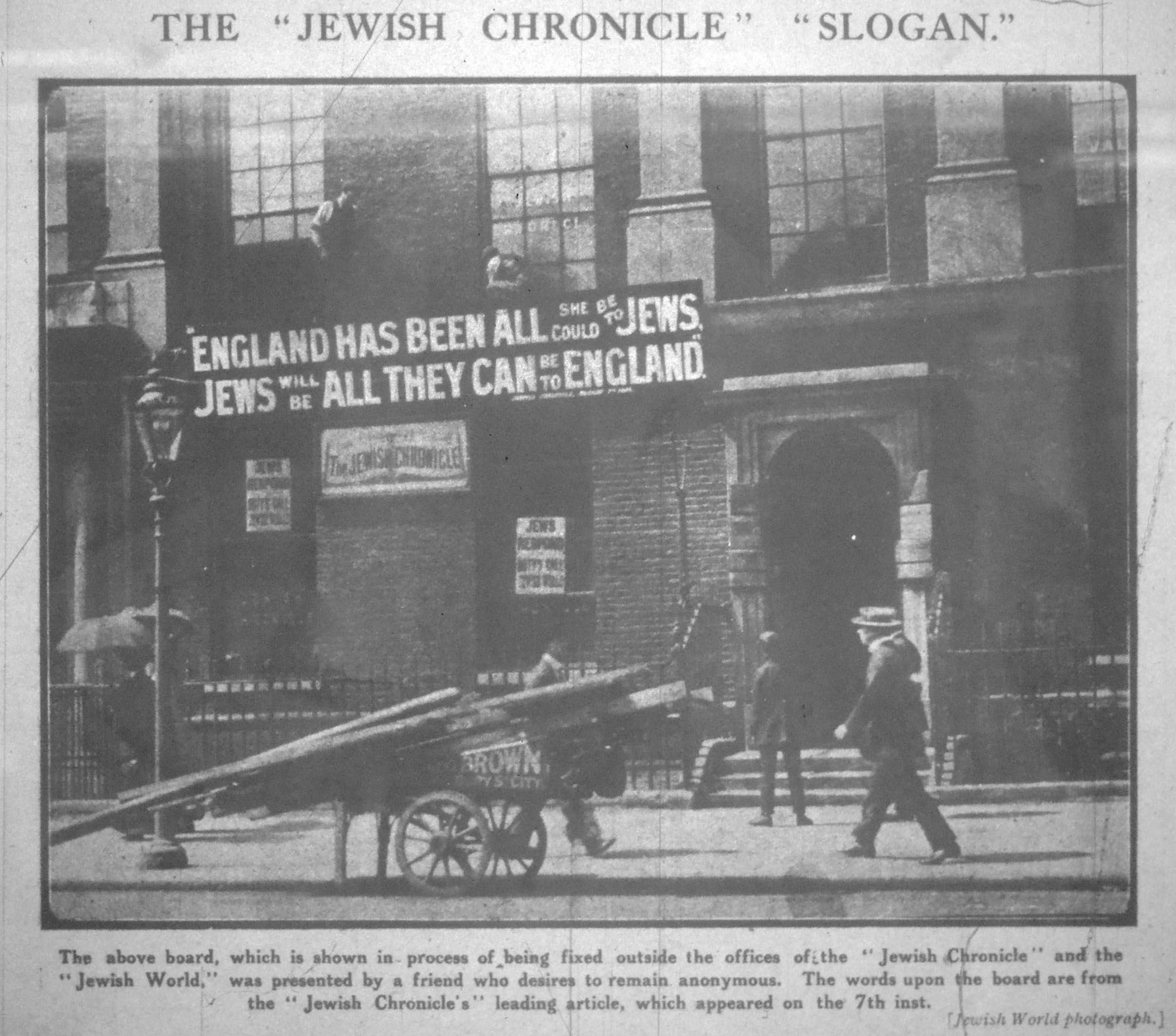
This post presents the lead editorial that appeared in the same issue of the Chronicle, which in spirit, idealism, and patriotism, is very much a companion piece to the above-mentioned article.  This is evident by the quote appearing at the editorial’s end – “England has been all she could be to Jews – Jews will be all they can be to England,” which appeared in the Chronicle on August 7, a few days after Britain’s entry into the war.

As seen in the image below (from the August 19 issue of the Chronicle’s sister publication, The Jewish World), this quote was prominently affixed to the exterior of the Chronicle’s offices by mid-August.

London Jewish Chronicle 1914 08 19Akin to the interview of Reverend Adler, the editorial is available in PDF format via the link at the end of this post.

____________________

Jews Respond

The Jewish Chronicle

August 14, 1914

The free spirit of determination to resist and overcome the enemies of this country, which has been manifested by all classes throughout the land is no small consolation for the affliction of war that has been cast upon it.  The calm, and implacable sentiment which from the highest to the most humble throughout the country has impelled all classes is one of the finest assets of victory that England possesses.  That sentiment, that spirit, Jews of all ranks are sharing to the full.  All thought except a desire to serve this country has been banished from the minds of our people.  The fact that the war is likely to bear, both from the economical and the sentimental standpoint, more heavily upon them than upon any other of the races or peoples that are involved, as must necessarily be the case with a people positioned as are Jews in the world, has not been given a moment’s consideration.  The supreme law of loyalty to the country of which Jews are citizens has over-ridden every other impulse.  When we find that even the Jews in Russia have declared themselves determined to fight with Russia, for Russia’s cause, side by side with those who have for generations been their bitter persecutors, it is no wonder that the Jews of England have thrown themselves into the duties involved by war upon the English citizen with an ardour and an enthusiasm matched perhaps by other classes in the country, but exceeded by none.

At the call of duty a considerable army of Jews from England have responded.  Countless instances of the remarkable sacrifice and self-abnegation involved in this prompt answer are pouring in upon us as we write.  Jewish mothers, who of all creatures on God’s earth have a tender heart for their offspring, have urged their sons – the apple of their eye – to go forth and serve for the King and the country.  Jewish fathers who had fondly pictured for their sons careers of advancement in commerce or profession have set their lips stiff and bid their sons wrench themselves away from the vocations designed for them, and go help to overcome the enemies of England.  In the day of trial, in the stress of battle, these sons of Israel will not be found wanting.  The pluck and the spirit of old these Jews have not lost.  The rely upon God for His protection, and upon their own strong arm for shielding the country which so nobly had sheltered their people.  This spirit is no mere frothy and ebullient martial ardour.  England is face to face with a test and a trial such as she has never been put to, and our sons have leapt gladly to the supreme opportunity of doing their share as English citizens.

Not again has the spirit and sentiment of duty at this anxious time animated only those who have hurried to the colors for active service in the field.  It has seized the whole community.  Everyone, man and woman, is anxious to find some means whereby, if not in the field then at home actively, or at least passively, they may help this country to victory.  The energetic loyal co-operation in a hundred ways which Jews are now undertaking can be judged from such records as we are able to provide in another column.  These do not by any means constitute all.  They are, at most, typical.  Yet they are remarkable.  For Jews are naturally a peace loving people, to whom war is hateful, to who, the shedding of human blood is detestable, who traditionally and historically have magnified peace as an ideal, who turn day by day in their prayers to the city named of Peace.  We Jews are conscious that to day, more than ever, Peace is Jewry’s most faithful ally.  But we see this great country gone forth to a war which was forced upon it by a haughty and intolerable systems of militarism.  We see this country with a clear conscience and clean hands going forth to do battle for freedom, for freedom from an overbearing Empire of “blood and iron”.  We see this country defending with all its vast resources the rights of the smaller nationalities and the existence on earth of the smaller States free from the engulfing greed of the brute force of armaments.  In such a cause we feel we have a cause for which to fight.  In such a cause we feel we have a cause for which to suffer, and to sacrifice, in such a cause it can be no matter for surprise that to a unit we are responding with a spirit worthy of the highest conceptions of our race.  In such an hour it is but natural that we in this country should recollect and be inspired by the thought that, “England has been all she could be to Jews,” and should determine that, “Jews will be all they can be to England.”

The Jewish Chronicle, August 14, 1914: Jews Respond


Soldiers of The Great War: Jewish Military Service in WW I, as Reported in The Jewish Chronicle – “Jews and The War”, August 14, 1914

As part of an effort to learn about Jewish military service in the First World War – “The Great War” as the conflict was known at the time due to its unprecedented, staggering scope and scale – I’ve done extensive research within periodicals published during that era by the Jewish and general press.  This effort has been focused upon locating articles and news items covering Jewish military service, military awards received by Jewish servicemen, the experiences of Jewish civilians in various battlefronts (particularly Eastern Europe), casualty lists, and, more.

The periodicals I’ve researched in this endeavor are many and varied.  Some can be accessed on the Internet, while others – to the best of my knowledge – have not been digitized, existing only as 35mm microfilm (remember film?!…) thus necessitating visits to the libraries or institutions having such resources in their  holdings.

Prominent among the periodicals I’ve researched have been The Jewish Chronicle (London, England), its companion publication The Jewish World, and, The Jewish Exponent (Philadelphia, Pennsylvania).

Both the Chronicle and Exponent are still “going strong” in this year of 2017, over a century after the end of the Great War.

The Chronicle presents an invaluable picture of military service by Jews of the British Empire, presented in the wider context of British Jewry as a whole, set within the even larger scope of news about world Jewry.

The following article – based on an interview with Chaplain Michael Adler – appeared in the August 14 issue of The Jewish Chronicle, ten days after Britain’s entry in the war on August 4.  In tone and spirit, the closing and opening paragraphs are reflective of and consistent with the patriotic ardor and enthusiasm permeating much of Europe – among both the Allies and Central powers – at the war’s very beginning.  Reverend Adler, who passed away in 1944, was also responsible for the creation of the memorial / commemorative volume British Jewry Book of Honour, in 1922.  More information about him can be found at Sarah Hurst’s blog post, A Chaplain in the Trenches.

The article is also available in PDF format via the link at the end of this post.

I hope to present further material relating to the Jewish military experience in WW I from later issues of the Chronicle, and other periodicals, in future posts.

________________________________________

Jews and the War

INTERVIEW FOR THE JEWISH CHRONICLE

WITH THE CHAPLAIN TO THE JEWISH TROOPS (the Rev. M. ADLER)

The Jewish Chronicle

August 14, 1914

THE Jewish manhood is responding with alacrity and enthusiasm to the call of England.  Even the glowing fervor at the time of the Boer War is thrown into eclipse by the ardour that is being shown in these momentous days.  There is not a Jew in this country who cannot tell of friends enlisted, of relatives enrolled in one or other of the British legions, of youthful zeal that will not be denied, of love of the Motherland exquisite in its tenderness, boundless in strength, unsurpassed in all the wonderful annals even of British loyalty and British enthusiasm.

These are early times to estimate the true muster of English Jews in this campaign.  British born and foreign born, rich and poor, have answered with equal swiftness the summons to the colours.  But, if ever the total is ascertained, it will form another unforgettable testimony to the spirit which wise and just government evokes in all the children of the realm.

The Chaplain to the Jewish troops, the Rev. Michael Adler, B.A., who has always thrown himself with enthusiasm into his work, is to-day a sort of human focus for the waves of patriotic eagerness that are sweeping the community, and to him many of the Jews under arms, from Hindustan to Aldershot, look for religious sustenance and moral inspiration.  Mr. Adler is himself a captain in the Territorial Force (London and Eastern Command).  He was at Deal with the Jewish Lads’ Brigade, and was about to go to the Territorial Camp at Wareham when the present storm broke over Europe.  He now holds himself at the disposal of the General Officer commanding, to be attached to any military station where London Territorials are assembled, and will be heading as soon as the latter are at their respective stations – which will be very soon.  It is possible that he will have to arrange for deputy chaplains in various parts of the country – probably in Lancashire and Yorkshire to begin with.

Jewish Lads’ Brigade Enlistments

In conversation with a representative of the JEWISH CHRONICLE, Mr. Adler commented on what he described as the very strong feeling of loyalty among English Jews.  One pointed illustration of this which he gave is the fact that a number of officers and senior boys of the Jewish Lads brigade volunteered for service immediately on the Brigade returning to town last Tuesday week.  Practically all were accepted.

But it is, of course, to the normally constituted forces of the Crown that we have to look for some more adequate representation of the numbers of Jews who are bearing arms in the present crisis, and of the Jewish elements in these.  Mr. Adler gave an interesting account.

Jews in the Navy

“There are,” he said, “a dozen Jewish officers in the Navy.  In regard to the men, the last official return gave the numbers of the Jews at about fifty.  But if you multiply that figure by four or five you will get the more correct number, for I constantly hear of Jews entering themselves as of another creed.  One interesting fact about the Navy is that it contains quite a considerable number of Jewish petty officers, including a warrant officer in the Marines.  There is a Jewish warrant officer – M.M. Bright – who was originally a pupil of the Jews’ Free School, and was, at one time, in the Jewish Lads’ Brigade.  He has been raised to commissioned rank, and it is worth noting that he is one of the ten in the entire Navy recently selected for promotion.  He is now probably on active service.  One Jewish warrant officer, named Pash, is warrant officer of signals on one of the super-Dreadnoughts.  There are a Jewish major and captain of Marines and several Commandants, and others who may be mentioned here are Midshipman Charles Marsden (“St. Vincent”), and Claude Telfer (son of Mr. W.T. Leviansky), and F. Lowy (grandson of the late Dr. A. Lowy), of the Royal Naval Reserve.

“By the way, the medical officer of the Jewish Lads’ Brigade, Dr. L. Mandel, joined the Royal Navy as a doctor the day after the camp broke up.”

Jewish “Regulars”

What about the Jews in the regular army?

“I know of fifty-two Jewish ‘regular’ officers. They include among their number members of the Sassoon, Mocatta, Beddington, Halford, Solomon, Henriques, Sebag Montefiore, Seligman, De Pass, and other well-known Jewish families.  Many of them will be in the Expeditionary Force.

“In regard to Jewish non-commissioned officer and men, the last official return dated October, 1913, put the number as 236.  This figure, however, should be multiplied by three at least to arrive at the true total.

Jews in the Cavalry

“Since March last a system has been instituted at the military recruiting stations of notifying to the chaplain every professing Jew who enlists, and over fifty names have been sent in to me.  In one week alone four Jews joined the 4th Hussars.  There has, indeed, been a great tendency on the part of the Jews to enlist in cavalry regiments – a new feature in Jewish enlistment.

“Of course, in addition, a very large number of Jews in the Reserves have now returned to the Colours, but how many it is impossible to say.

Jewish Guardsmen

Do Jews figure to any extent in the Guards regiments?

“Well, there are Sergt. Instructor J.H. Levey of the Scots Guards; Sergt. M.J. Marks, of the 3rd Coldstreams; Sergt. Lewis, in Coldstreams, and Sergt. Rosenberg, of the 2nd Scots Guards, besides a large number of Jewish privates.

“It may truly be said that there is hardly a regiment in the Regular Army in which Jews are not represented, a number of the recruits of recent date having come from Leeds and Manchester.

“Jews are also represented in the Artillery.  There are, for instance, Sergt.-Major Shapeere and Quartermaster-Sergt. F.J. Wooley, of the Royal Horse Artillery, to say nothing of a number of privates in that branch, as well as in the Royal Field Artillery and Royal Garrison Artillery.  One Jews, a Canadian by birth, is one of the principal gun-layers of his battery.

Rothschilds in the Trenches

“There are seventeen Jewish reserve officers.  And in addition I have ten names of Jewish Special Reserve officers.  One of these, Lieutenant W. Stanford Samuel, 4th King’s Liverpool Regiment, has already written me to say that he has been ordered to the front.  The last official return gave sixty-nine Jewish privates in the Special Reserve.  For that too, must be considerably increased to give the true figure.”

There are, of course, many Jews in the Territorial ranks.

“I have the names of ninety-four officers, with ranks ranging from colonel to second lieutenant.  Among these are the three sons of Mr. Leopold de Rothschild, viz, Mr. Lionel de Rothschild, M.P., Major in the Royal Bucks Yeomanry, and Mr. Evelyn and Mr. Anthony de Rothschild, who are lieutenants in the same regiment.  Among other Jewish Territorial officers are Major F. Goldsmith, M.P. (Suffolk Yeomanry), Col. Claude Beddington (Westmoreland Yeomanry), Lieut. Sir Philip Sassoon, M.P. (Royal East Kent Yeomanry), and Mr. Robert M. Sebag-Montefiore, a captain in the last-cited regiment; other Jewish Yeomanry officers are Major H. Weinberg (City of London Yeomanry), and Lieuts. Reginald and Desmond Tuck (3rd City of London Yeomanry).  The latter are the sons of Sir Adolph Tuck.

“In the Artillery, there are Col. H.D. Behrend; Major E.G. Heilbron, and a number of other officers; and, in the Engineers, Col. De Lara Cohen, on reserve.  Major R.Q. Henriques, and Capts. R.H. Joseph and G.C. Kennard, Col. H.M. Jessel, M.P., is Hon. Commander of the 1st Royal Fusiliers, Major J. Waley Cohen belongs to the 16th Queen’s Westminsters, Major F.D. Samuel to the 3rd Royal Fusiliers, and Major S.S.G. Cohen to the 5th Liverpool Regiment.

Well Known Names

“Among others that may be mentioned are Lieut. Lionel L. Cohen, son of Mr. Leonard Cohen, and Lieut. Leonard G. Montefiore, son of Mr. Claude G. Montefiore.  In the 6th Regiment City of London are five Jewish officers – Capts. G.A. Myer, M.H. Schwersee, and E.L. Phillips, Lieut. H.D. Myer, and Second Lieut. J.E. Lowy (grandson of the late Dr. Lowy).  In the 4th Royal West Kent Regiment are two sons of the late Sir B.L. Cohen – Capt. Sir Herbert Cohen, Bart., and Capt. A.M. Cohen.  In the 7th London Regiment are Capt. C.D. Enoch and Lieut. F.M. Davis (son of Mr. Felix Davis).  In the 16th Queen’s Westminsters, besides Major Alfred Waley Cohen, are Capt. J. Henriques, and Lieut. E.G. Waley (son of Mr. Alfred Waley).  In the 19th County of London there are four Jewish officers – Capt. Edgar J. Davis, and Lieuts. L.J. Davis, J. de Meza, and J. Lumley Frank.

In the Provinces

“The Provinces are further represented by Lieut. Col. S.L. Mandelberg (Manchester), Capt. J.M. Heilbron (Glasgow), Lieut. J.M. Goldberg (6th Welsh Regiment), Lieut. L.G. Harris (7th West Riding), Lieut. J.B. Brunel Cohen, son-in-law of Sir Stuart Samuel, M.P. (5th Liverpool Regiment), and Capt. N.J. Laski (6th Lancashire Fusiliers).

Jewish “Terriers”

What of the Jewish privates in the Territorial ranks?

“As regards the men, it is impossible to estimate the exact total of Jews.  But of London men alone I receive official returns for the last military service of some 400 names, representing practically every unit in the London command.  In the 4th Fusiliers there were 36 Jews, and many of the other regiments had long lists.  In the country, too, there are a very large number of Jewish Terriers.  At the last Territorial camp of the London regiments held on Salisbury plain in August of last year, 90 Jewish officers and men attended parade for service.

“Then there is one specifically Jewish voluntary aid detachment, under the charge of Dr. Myer Dutch, the duty of which is to act as nurses to the Territorial Force.”  An appeal, in this connection, appears in another column.

Volunteers

A great many Jews are volunteering for service in the present emergency.

“I have reason to believe that a very large number of Jews have been accepted.  I have received a number of communications from coreligionists who are anxious to join, whether as officers or privates.  There is also soon to be a great number of Jews in the Colonial contingents.

“In short,” added the Chaplain, in conclusion, “there has been a great outburst of enthusiasm among Jewish young men everywhere.”

It is a tribute to the wisdom of Britain – and the fortitude of a people which, whatever its faults, does not number among them ingratitude to its friends.

The Jewish Chronicle, August 14, 1914: Jews and the War