The World of Soldiers: Images of British Jewish Soldiers in The Jewish World, during the First World War

While the majority of my posts have thus far focused upon Jewish military participation in the Second World War, I want to “step back” – chronologically, and, in in terms of subject matter – and shift attention to Jewish military service in World War One: The “Great War”.  Thus, this post will focus upon the British Jewish newspaper The Jewish World, a companion publication to The Jewish Chronicle

I discovered The Jewish World by chance, in the midst of reviewing The Jewish Chronicle for information about the military service of Jewish soldiers of the British Commonwealth within both world wars. 

As such, the World has proven to be an invaluable resource, albeit not in terms of “information”, but instead, in terms of images.

Founded by George L. Lyon and published in London from 1873 to 1934, The Jewish World, “filled a position of some importance in Anglo-Jewish life, publishing articles by various Zionist leaders, as well as by non-Jewish precursors of Zionism such as Henry Wentworth Monk, and Holman Hunt, the painter.  It was taken over in 1913 by The Jewish Chronicle, with which it was merged in 1934.” 

Though presumably edited at the same London office as the Chronicle, a review of issues of the World published between August, 1914 through late 1918 reveals the latter to have been notably different from the Chronicle in content and format, while both – presumably under the same ownership and editorial control – paralleled one another in terms of their central focus upon Jewish solidarity, unity, and Zionism.  As such, both periodicals covered significant news events (both in the United Kingdom and internationally) effecting individual Jews, or Jewish communities as a whole, with the World sometimes mirroring, to greater or lesser degree, the Chronicle’s coverage of such stories. 

(Digressing, the language of the Wikipedia entry for The Jewish Chronicle is quite revealing in stating that “The JC got a strong opposing voice by The Jewish Guardian, who counterbalanced the dominant Zionist propaganda of the Chronicle”.  Which raises the question: Is it not anti-Zionism that has ever been, and continues with increasing fervor, irrationality, and ferocity, to be the genuine propaganda?)

Anyway…

The differences between the publications, however, are notable – at least, as viewed through a 35mm microfilm reader!

The World featured little to no (well, it seems no…) advertising, and virtually none of the plethora of brief, ostensibly mundane, but nevertheless essential notices and news items – encompassing such topics as religious education, religious ritual, holidays, charity, community service, and philanthropy – vital; central to the ongoing activity of any Jewish community, regardless of its size or location, that was typical of every issue of the Chronicle.  Likewise, though the leading page of the Chronicle during the Great War sometimes carried obituaries and death notices (when I first saw this, I thought it very, very odd: “What, obituaries on a newspaper’s first page?!”), as well as new about “life cycle” events, such items appeared nowhere within in the World

In terms of its coverage of military service of Jews in the armed forces of the British Commonwealth, the Chronicle is invaluable, featuring lists of killed, wounded, and missing, and carrying news items – sometimes, news items in great depth! – about the experiences and observations of soldiers; excerpts of soldiers’ letters from soldiers to family friends; testimonials (sometimes, understandably hagiographic) about fallen soldiers; on rare occasion early in the war, even brief items about military service of Jews in the armies of the Central Powers.  In the World, such lists were absent; such stories relatively few. 

(Regretfully, no American Jewish periodical seems to have covered the military service of American Jews in WW I in such a systematic and comprehensive manner as did the Chronicle for Jews of the British Commonwealth.  But, that may be the subject of another post…) 

In appearance and essence, one might say that – issue per issue – the “density” and sheer quantity of information in the Chronicle far exceeded that of the World, which was reflected in their main content.  The World had a somewhat “lighter”, somewhat literary emphasis, rather than the comprehensive, detailed, and direct news reporting characteristic of the Chronicle.  As such, the World published fiction, with such items manifesting noticeable variations in style, length, literary quality.  A notable theme of such items was the challenge of maintaining Jewish belief and identity over time, individually and collectively, in the face of assimilation, acculturation, and intermarriage (yet not so much anti-Jewish persecution), amidst the unpredictable and increasingly turbulent tides of modernity, a topic penetratingly covered in Todd M. Endelman’s Radical Assimilation in English Jewish History, 1656-1945.  In addition, some of the World’s content was taken from other publications, such as the American Hebrew, The Hebrew Standard, and Jewish Comment.

And one final, striking and singular difference between the Chronicle and the World…  Throughout the Great War, the latter published photographs of Jewish servicemen serving in the United Kingdom’s armed forces. 

Such photographs typically appeared within the two centermost pages of most any randomly selected issue, with the total number of “photos-per-issue” varying greatly from issue to issue.  The photographs were typically grouped thematically.  For example, some issues displayed photographs of soldiers in the Royal Engineers; sailors in the Royal Navy; soldiers in the Levant; members of the Royal Air Force; soldiers recovering from wounds in hospital; members of the French and other Allied Armies (the United States Army, not so much, if at all!); and inevitably, soldiers wounded, killed, and missing in action. 

The quality of the images – as viewed and copied from 35mm microfilm (remember film?!) viewed at the New York Public Library, in the Milstein Microform Reading Room (First Floor, Room 119, to be specific) varies tremendously from issue to issue.  Upon the same page within a randomly viewed issue, some images may be of excellent quality, and others?  Well, not so much. 

This difference in quality of the photographs is probably due to an overlapping set of factors, encompassing: 1) the quality of the original photographic print supplied to the World, 2) the quality of the printed image in the published newspaper, 3) the quality of the microfilmed image taken of the original newspaper, and finally, 4) (here’s a big one…) the reliability and optics of the 35mm microfilm reel-to-reel reader via which these images were viewed. 

Having reviewed issues of the World published during 1914 through 1918, I copied many, many (many) of these images by photographing the projected microfilm image – as displayed on a microfilm reader’s viewing screen – using a 35mm digital SLR.  Well, this was a few years before the NYPL replaced most of the mechanical / optical 35mm film readers with digital 35mm film viewers.  (C’est la vie…)

In cases of soldiers and sailors killed in action, missing, and wounded, I was able to find corroborating information in The Jewish Chronicle, The Commonwealth War Graves Commission, the British Jewry Book of Honour, Australian Jewry’s Book of Honour, and maybe another publication or two.  Or three.  (Or four?)  ((Or five?!)) 

Oh, a small caveat…  While the British Jewry Book of Honour is replete with portraits of soldiers and sailors, I’ve not yet reviewed my copy to see if the photographs in the World’s 1914-1918 issues appeared in the former. 

So.  Below are nine images from the The Jewish World of the early twentieth century, now visible in the twenty-first: “images” evocative of a world that no longer exists; events that have ceased; people who exist only as memories … and most likely, memories of memories. 

For even if the memory of man – and particularly, memories of individual men – is a fleeting thing, the past yet exists, and can never be erased.   

References and Suggested Reading

The Jewish Chronicle, at Wikipedia

The Jewish World, at Jewish Virtual Library

Adler, Michael, Reverend (editor), British Jewry Book of Honour, Caxton Publishing Company, London, England, 1922

Endelman, Todd M., Radical Assimilation in English Jewish History, 1656-1945, Indiana University Press, Bloomington, In., 1990

______________________________

______________________________
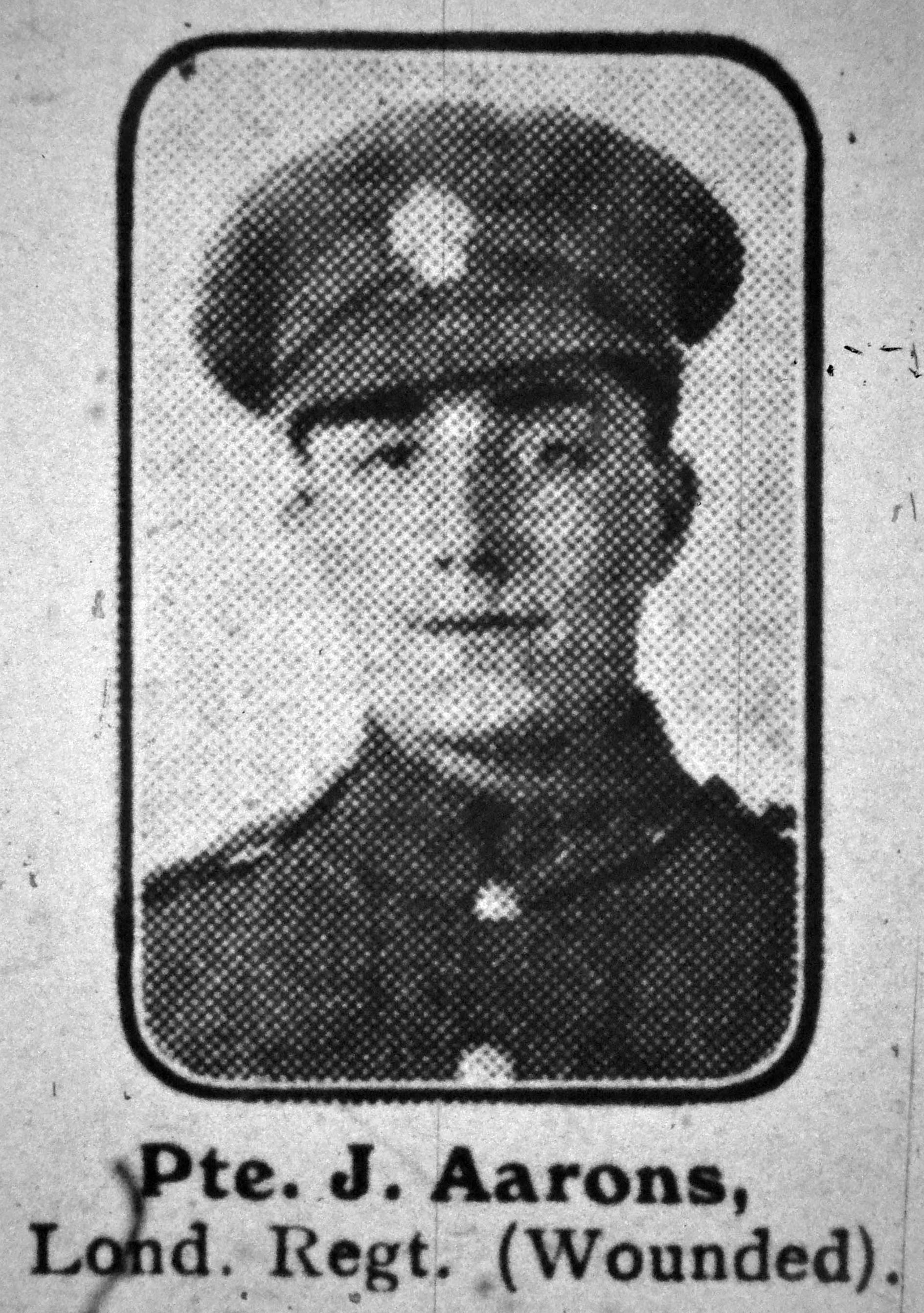
“Pte. J. Aarons, Lond. Regt. (Wounded)”
(The Jewish World, August 22, 1917)

.ת.נ.צ.ב.ה.

Private Joseph Aarons, 233751
He was killed in action of June 15, 1917
Member of London Regiment (Royal Fusiliers), 2nd / 2nd Battalion
Born in 1897
Son of Judah and Sarah Aarons, 5 Bishop’s Road, Cambridge Heath, London
Memorialized at Arras Memorial, Pas de Calais, France – Bay 9
The Jewish Chronicle: Casualty List of July 13, 1917 (incorrectly lists surname as “Aaron”)
British Jewry Book of Honour, page 76 (also lists surname as “Aaron”)

______________________________
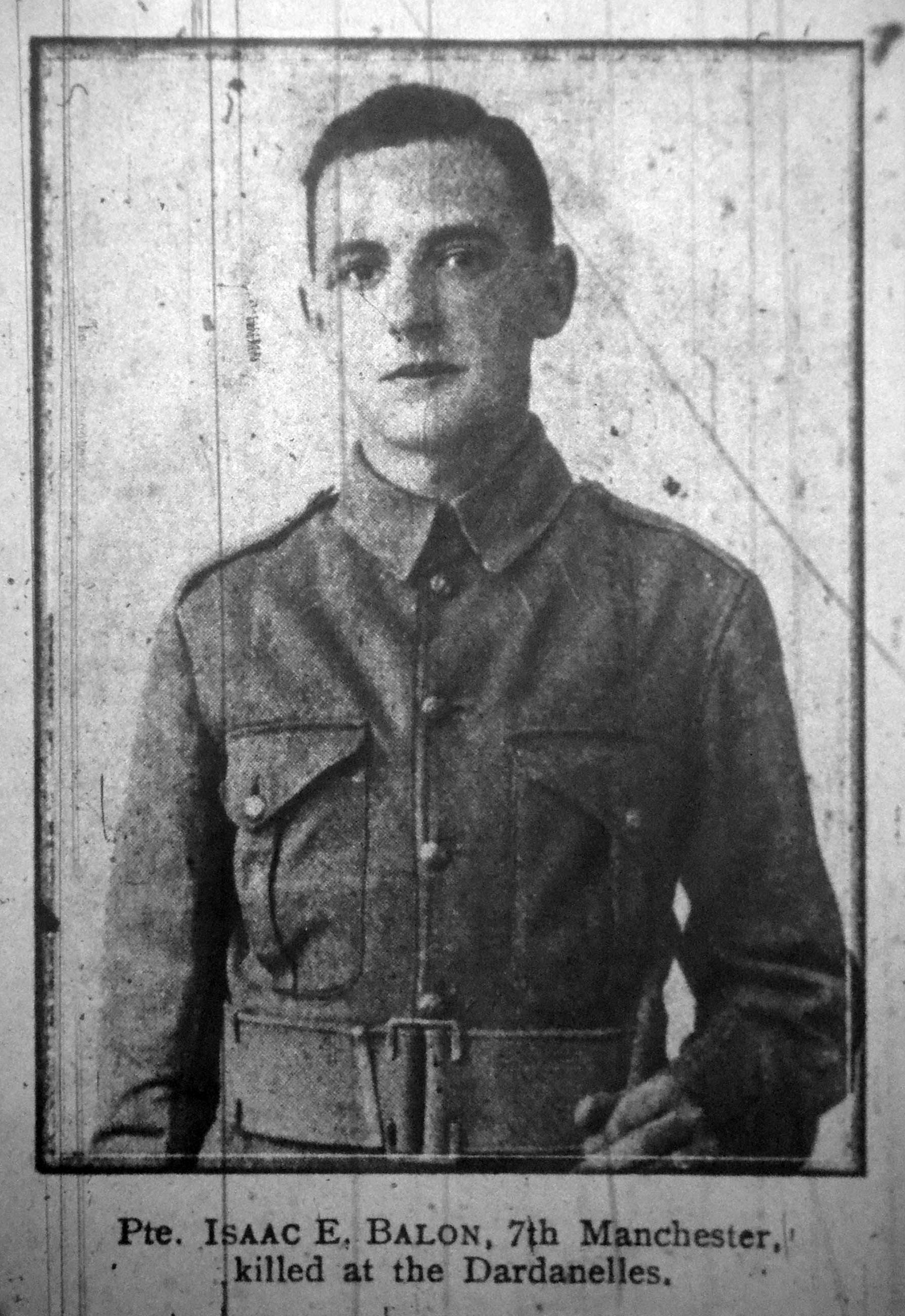
“Pte. Isaac E. Balon, 7th Manchester, killed at the Dardanelles.”
(The Jewish World, July 7, 1915)

.ת.נ.צ.ב.ה.

Private Isaac “Eric” Balon, 2403
He was killed in action on May 29, 1915
Member of Manchester Regiment, 1st / 7th Battalion, E Company
Born 1896
Son of Sophia Balon, 15 Shorncliffe Green, Whitworth Park / 91 Oxford St., Manchester
Buried at Redoubt Cemetery, Helles, Turkey – Sp. Mem. A,93
The Jewish Chronicle: Obituary Section of July 9, 1915 and May 30, 1919
British Jewry Book of Honour, page 78

______________________________

“Pte. L. Da Costa, Middlesex Regt.”
(The Jewish World, August 22, 1917)

.ת.נ.צ.ב.ה.

Private Lewis Da Costa, L/14851
He was killed in Action on August 1, 1917
Member of Middlesex Regiment, 2nd Battalion
Born 1897
Son of Isaac and Rachel Da Costa, 35 Hedson Buildings (and) 73 Walton Buildings, Shoreditch, London, E
Buried at Tyne Cot Cemetery, Zonnebeke, West-Vlaanderen, Belgium – XLVII,B,11
“Deeply Mourned by His Parents & Relatives.  May His Soul Rest in Peace”
The Jewish Chronicle: Casualty List of August 17, 1917
The Jewish Chronicle: Obituary Section of August 17, 1917, and August 2, 1918
British Jewry Book of Honour, page 86

______________________________

“Pvt. David Eckstein, Devonshire Regt., who was killed in action.”
(The Jewish World, January 20, 1915)

.ת.נ.צ.ב.ה.

Private David Eckstein, Z/6943
Killed in action on December 17, 1914
Member of Devonshire Regiment, 1st Battalion
Born 1893
Mother was Eva (Eckstein) Moss (mother), 13 Providence Place, Aldgate, London
Address also 22 Collingwood St., Bethnal Green, London, E
Memorialized at Ypres (Menin Gate) Memorial, Ieper, West-Vlaanderen, Belgium – Panel 21
British Jewry Book of Honour, page 87

______________________________

“Lieut. J.H. Levey has just received commission having risen from the ranks.”
(The Jewish World, October 21, 1914)

This man’s name does not appear in the CWGC database; he presumably survived the war.  His name is also absent from The Jewish Chronicle between August of 1914 and mid-1919.

Of all the many soldiers’ photographic portraits published in wartime issues of The Jewish World, the photo of Lieutenant Levey is among the best – if not the very best – in terms of focus, contrast, and composition, let alone quality of reproduction as a microfilmed image.  

______________________________
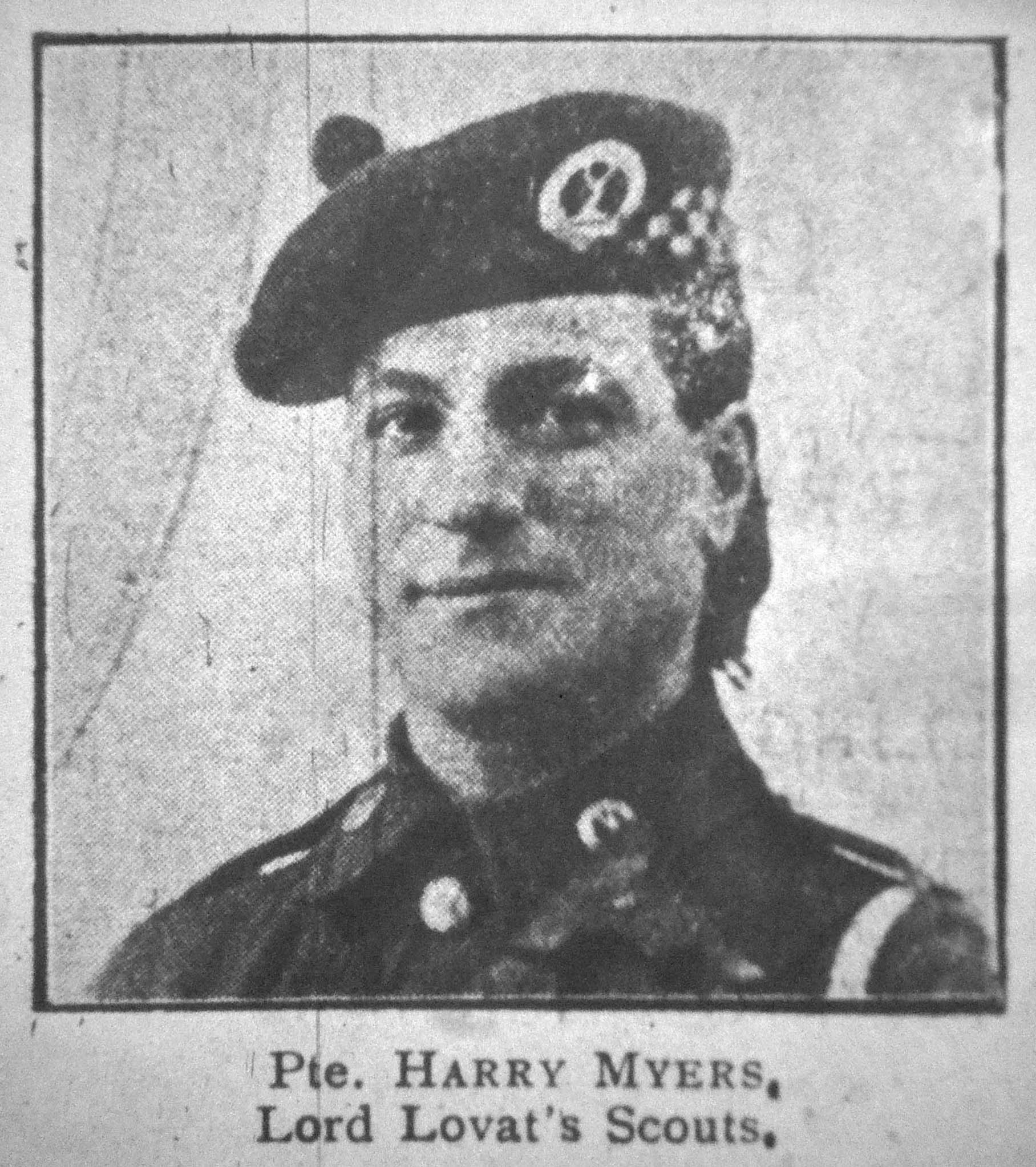
“Pte. Harry Myers, Lord Lovat’s Scotts.”
(The Jewish World, March 8, 1916)

Akin to Lieut. Levey, Pte. Myers’ name does not appear in the CWGC database. 
During the war, The Jewish Chronicle listed the names of eight soldiers surnamed “Myers”, whose first names began with the letters “H…”, of whom four were killed, and four others wounded.  However, none of these eight soldiers were recorded as having been assigned to Lord Lovat’s Scotts.  Perhaps Harry (at least, this Harry Myers) survived the war? 

______________________________

“Seaman Sam Stump, H.M. “New Zealand” Troopship.”
(The Jewish World, April 5, 1916)

Like Lieutenant Levey, and probably like Pte. Myers, Seaman Stump’s name does not appear at the CWGC database.

______________________________
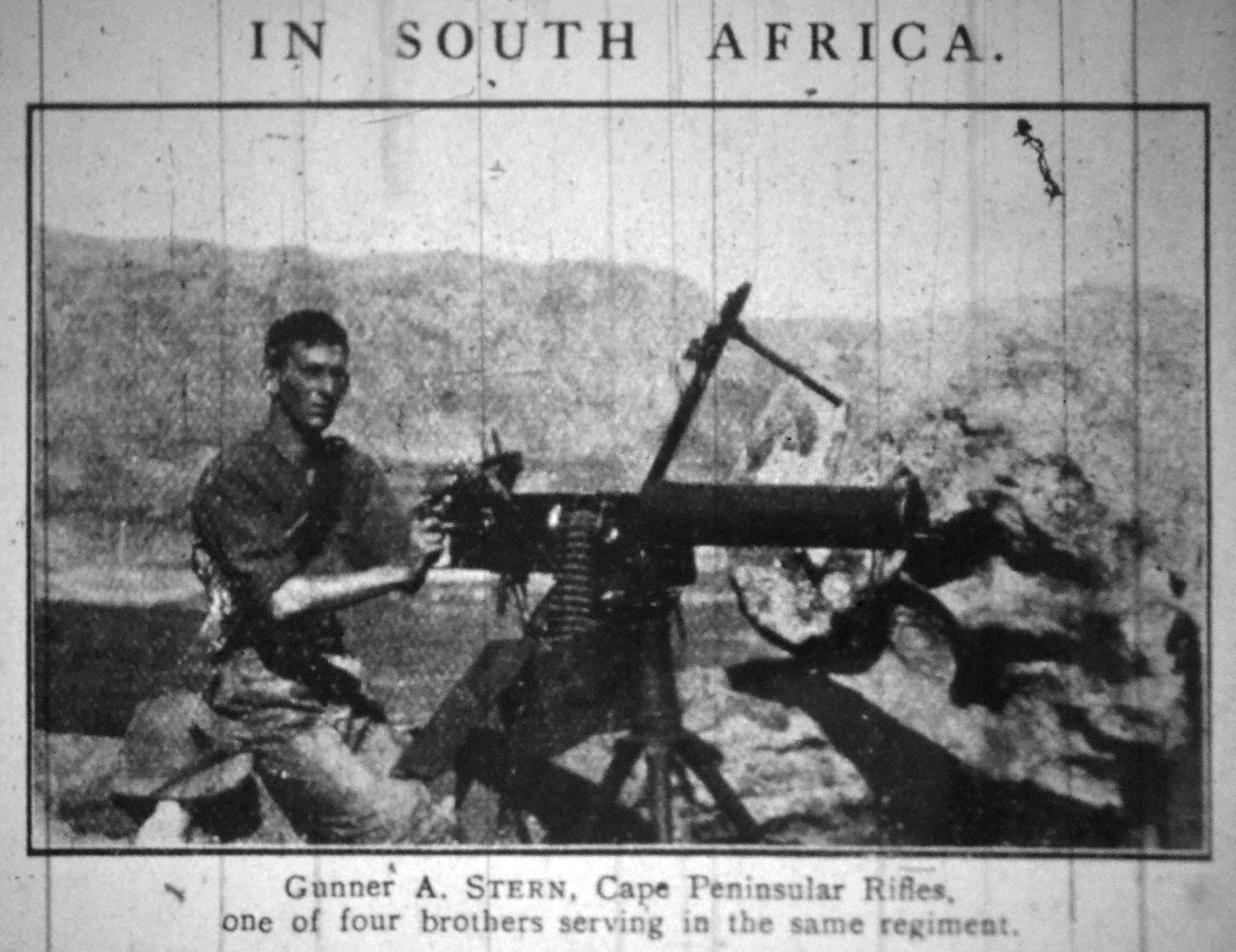
“Gunner A. Stern, Cape Peninsular Rifles, one of four brothers serving in the same regiment.”
(The Jewish World, August 11, 1915)

Gunner Stern, name also absent from the CWGC database, is posed at a Vickers machine gun.

______________________________

“Pte. S. Zimmerman, Ox. & Bucks L.I., Reported Killed.”
(The Jewish World, March 21, 1917)

.ת.נ.צ.ב.ה.

Private Soloman Zimmerman, 14678
Member of Oxford and Bucks Light Infantry, 5th Battalion
Killed in action August 24, 1916
Born 1897
Buried at Delville Wood Cemetery, Longueval, Somme, France – IV,I,5
On matzeva: “God Rest His Soul in Peace”
The Jewish Chronicle: Casualty List of October 13, 1916
British Jewry Book of Honour, page 124

______________________________

The image below show the casualty and award list appearing in The Jewish Chronicle of October 13, 1916, with Private Zimmerman’s name appearing last in the “Killed” section.  (This image is a digitally “cleaned-up” scan of a photocopy.)   
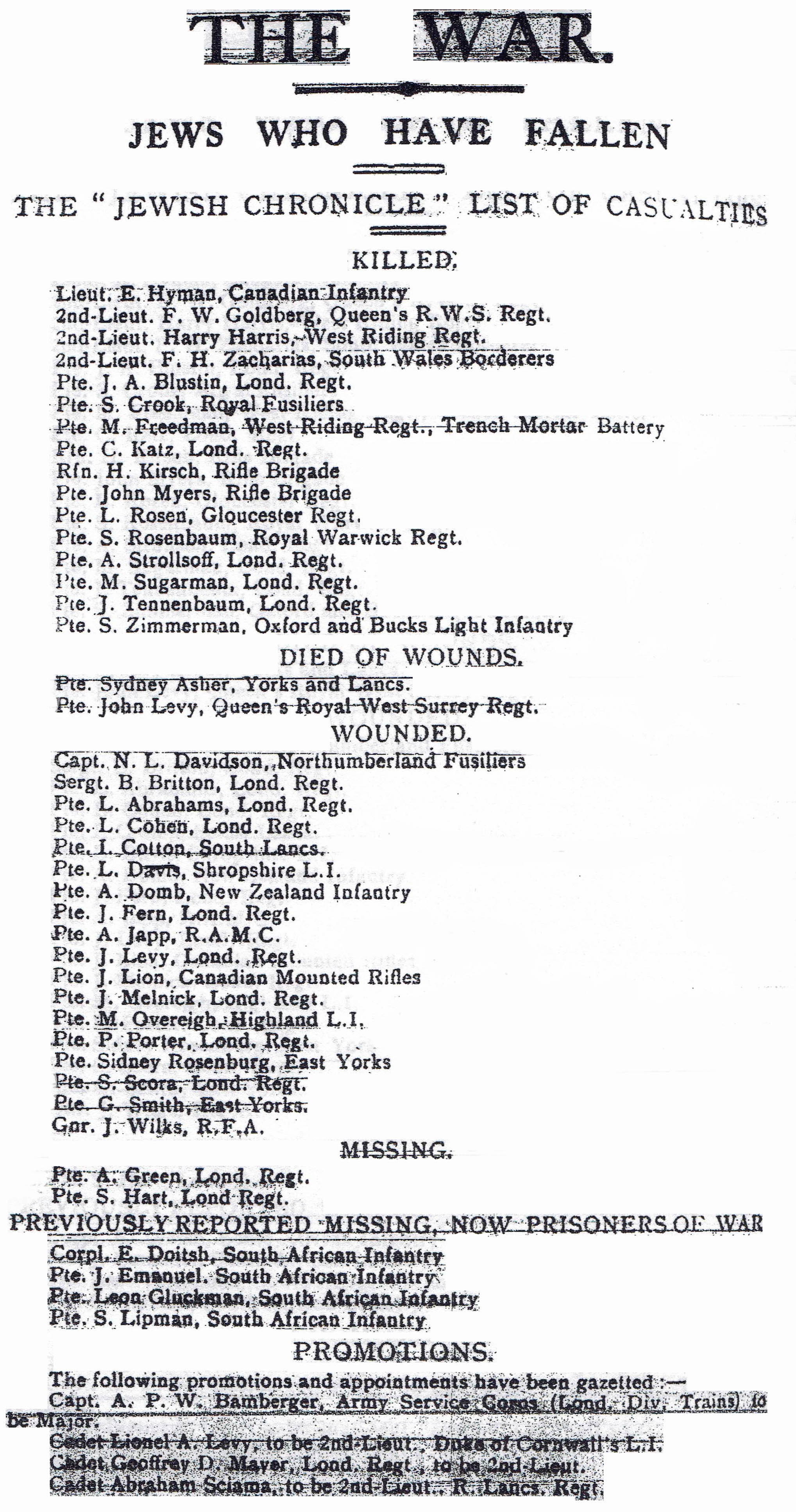
This list, only one of the sad abundance of such lists that were published in the Chronicle from late 1914 through mid-1919, is entirely representative of the presentation of information about casualties and award recipients in that newspaper.  Note that while the soldiers’ surnames are presented in full, the first name is limited to only a first initial.  Military service numbers are absent, though the Chronicle did include soldiers’ numbers commencing in July of 1917, while the names of the regiment (or other major organization to which the soldier was assigned) appeared throughout the war.  Similarly – unfortunately! – there is absolutely no genealogical information: No next of kin; no residential address; no city or town of residence.

Taken as a whole, while this information is invaluable, it can sometimes be extremely challenging (if not impossible) to “disambiguate” – as the word goes – specific individuals.  For example, 39 soldiers by the name of “J. Cohen” appeared in Casualty Lists in the Chronicle between 1914 and 1919. 

Yet, regarding Private Soloman Zimmerman… 

Alas, that he fell for his country. 

Alas, once more, and yet again, that he was not the only member of his family to have so fallen.  Two of his brothers – Joseph and Nathan – were also killed during the war.

Rifleman Joseph Zimmerman, C/6123, a member of the King’s Royal Rifle Corps, 16th Battalion, was killed on April 23, 1917. 

Private Nathan Zimmerman, 42533, a member of the Yorkshire Regiment, 2nd Battalion, was killed on May 8, 1918.

Neither Joseph nor Nathan has a place of burial. 

Joseph is memorialized at the Arras Memorial, at Pas de Calais, France (Bay 7), while Nathan is memorialized at the Tyne Cot Memorial, Zonnebeke, West-Vlaanderen, Belgium (Panel 52 to 54 and 162A).  Unlike Soloman, I do not believe their names appeared in The Jewish Chronicle, though the names, first initial, and service numbers of all three brothers appear on page 124 of Reverend Michael Adler’s British Jewish Book of Honour

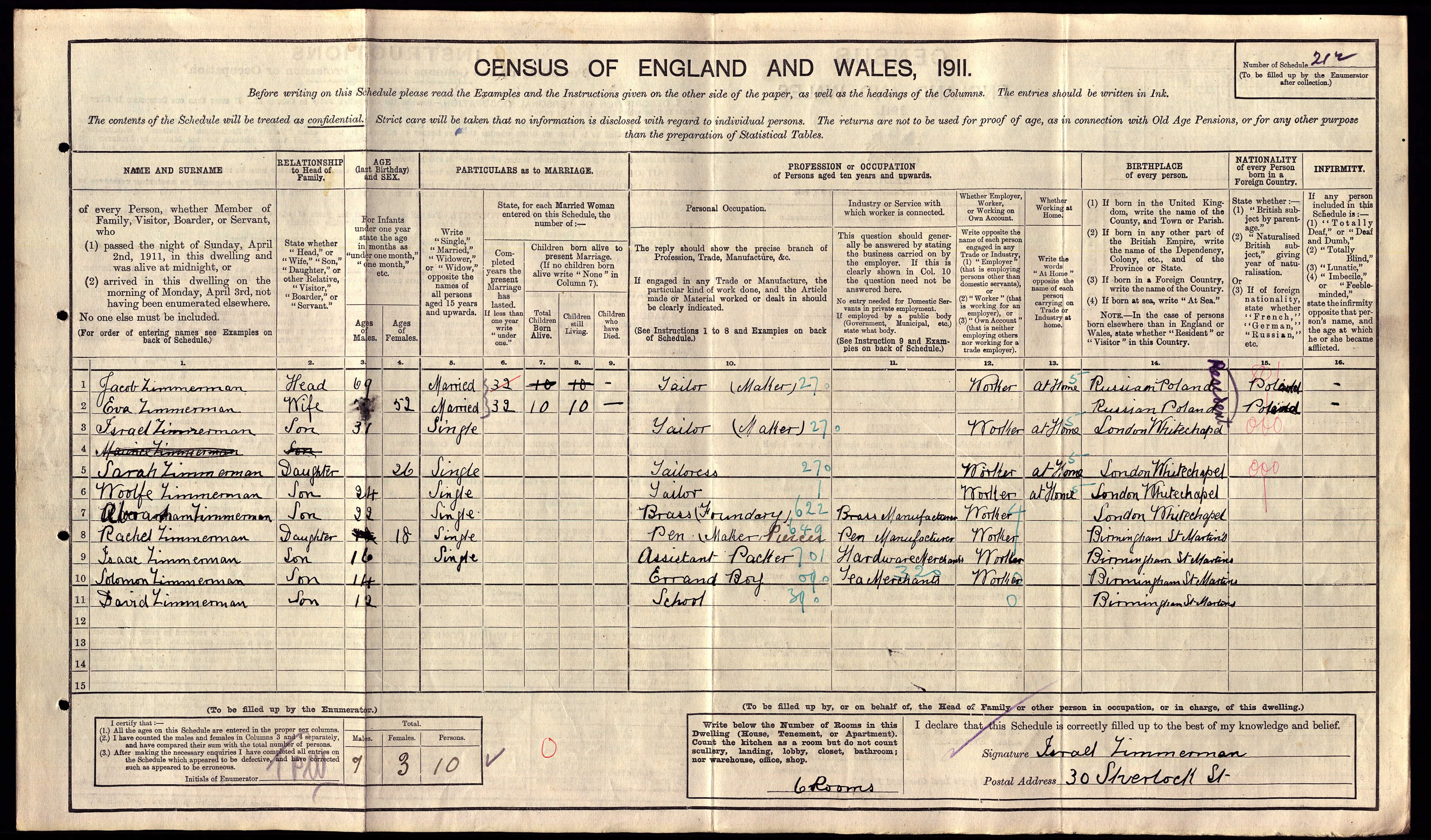
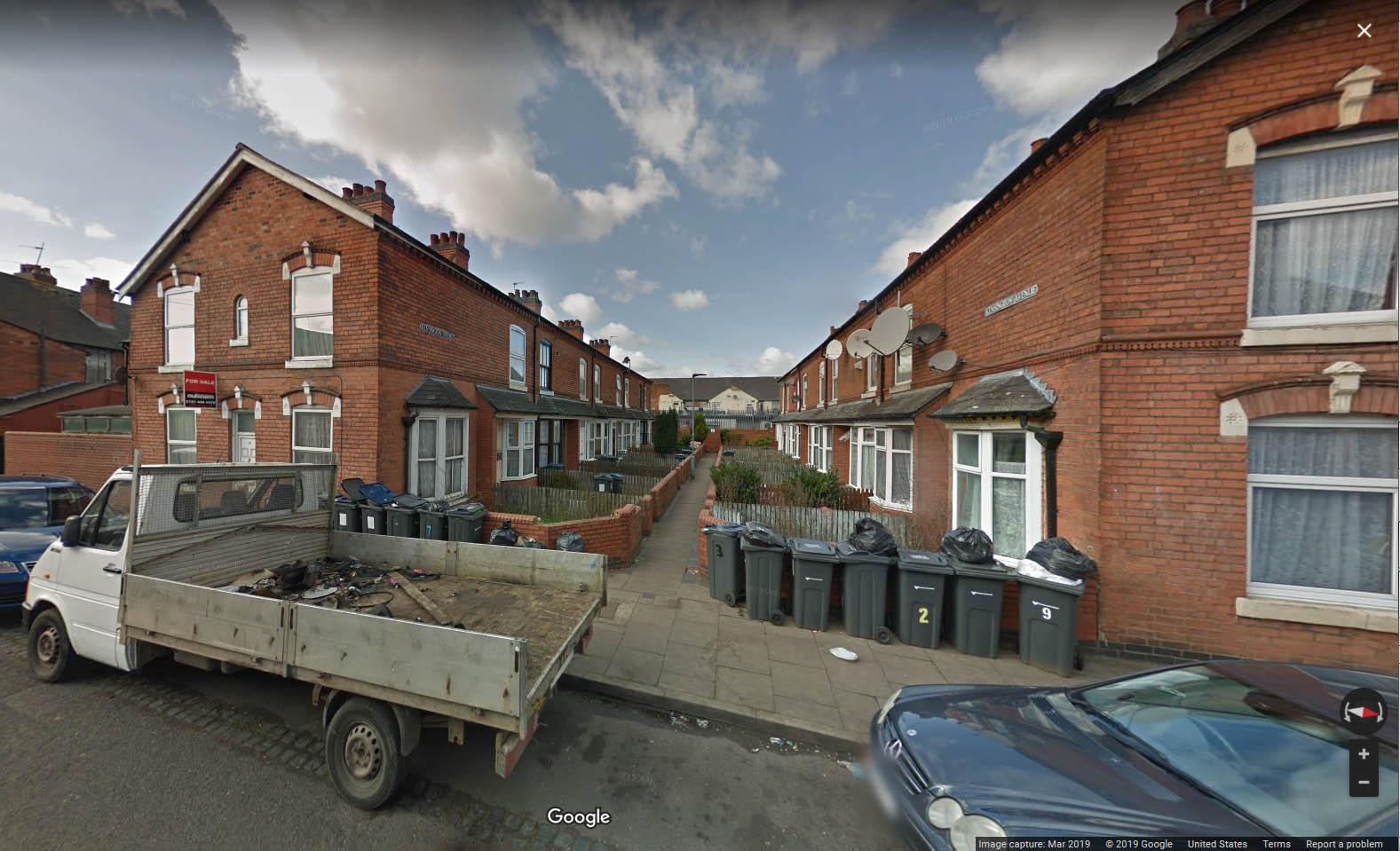
The three Zimmerman brothers were the sons of Jacob (by trade a tailor) and Eva Zimmerman, of 34 Kensington Gardens, Balsall Heath Road, in Birmingham.  According to the 1911 Census of England and Wales – when the family was residing at 30 Sherlock Street in Birmingham – their siblings included Israel, a tailor like his father (born 1880), Maurice (born 1882), Sarah (1885), Woolfe (1887), Abraham (1889), Rachel (1893), and David (1899).  Though Soloman appears in that census, brothers Nathan and Josephs’ names are absent; for Joseph, probably because he had married Florence Moore (noted in his biographical profile at British Jews in the First World War) and likely resided elsewhere.  (In the 1901 Census, Nathan is recorded as residing with his parents, the family then living at 29 Lower Essex Street in Birmingham.)    

You can view the Zimmerman family’s record in the 1911 Census (from Ancestry.com) below:
 
And, you can view Kensington Gardens in Birmingham, as seen in this image captured by the roving digital panopticon (otherwise known as Google Street View) from March of 2019.    
Soldiers of The Great War: Jewish Military Service in WW I, as Reported in The Jewish Chronicle – “The War – An Honour Record…”, September 4, 1914

Shortly after the commencement of hostilities between the Allies and Central Powers, The Jewish Chronicle implemented a policy of compiling and publishing lists of the names of Commonwealth Jewish servicemen engaged in military duty.

The Chronicle indeed implemented this policy – at least in the early part of the war – but due to the unanticipated severity and duration of the conflict, the publication of such “nominal” lists of servicemen was eventually overtaken and superseded by straightforward Casualty Lists, and, lists of servicemen receiving military awards.  For example, Casualty Lists appearing in mid-July through August of 1916 are enormous, reflective of the appalling casualties incurred by the British armed forces during the Somme Campaign, which commenced on July 1 of that year.

I do not know if the “master” list of servicemen alluded to below was ever, actually, presented to the King and Queen by either The Jewish Chronicle, or, other officials or representatives of British Jewry.  However, the impetus to collect and the record names of servicemen eventuated – by 1922 – in the creation and publication of the British Jewry Book of Honour, particularly due to the great efforts of Chaplain to the Forces Reverend Michael Adler.

Akin to British Jewry, post-war memorial and historical compilations of biographical information concerning World War One Jewish war casualties, and Jewish war service, in general, were created in Germany (several such works), Italy, France, Australia and New Zealand.  No such work was ever generated for Austro-Hungarian Jewry, though the publication Dr. Bloch’s Oesterreishische Wochenschrift was extremely diligent in regularly collecting and publishing the names of Austro-Hungarian Jewish soldiers.

Astonishingly, no such monograph was created concerning American Jewish WW I military casualties, and general military service, despite the acquisition of information necessary for such a work, let alone the talent and infrastructure needed for its creation and publication.  Perhaps what was lacking in American Jewry – through the 1920s, 30s, and 40s (by which time the need had probably become “moot”, having overtaken by another, larger war…) was the impetus – the will – to do so.

As to the reason?  Well, that is the subject of conjecture…

Akin to earlier posts, a PDF version of this article is available here.

____________________

THE WAR
AN HONOUR RECORD
TO ALL JEWS WHO ARE SERVING
A TESTIMONY FOR THE KING

The Jewish Chronicle
September 4, 1914

The JEWISH CHRONICLE is desirous of compiling a full list of all Jews in the Empire who are serving during the War.

As soon as a sufficient number of names and addresses reach us, we shall begin the publication of the record and continue it week by week.  All names will be placed in alphabetical order, irrespective of rank.

At the end of the War, when the list is completed, the whole of the names will be printed in a separate form on finest art paper, and a bound copy will be submitted to THE KING for His Majesty’s gracious acceptance.

We shall be glad, therefore, if all who are serving the King or any arm of His Majesty’s Forces will forward it to us at once their names and home addresses, with their status, and regiment or ship and mark the envelope (or post card): –

“Honour Record,” –
“JEWISH CHRONICLE,”
2, Finsbury Square
London, E.C.

Soldiers of The Great War: Jewish Military Service in WW I, as Reported in The Jewish Chronicle – “Jews Respond”, August 14, 1914

The prior blog post presented an interview with Reverend Michael Adler, concerning military service by British Jewry on the outbreak of the First World War, which appeared in The Jewish Chronicle of 14 August, 1914.

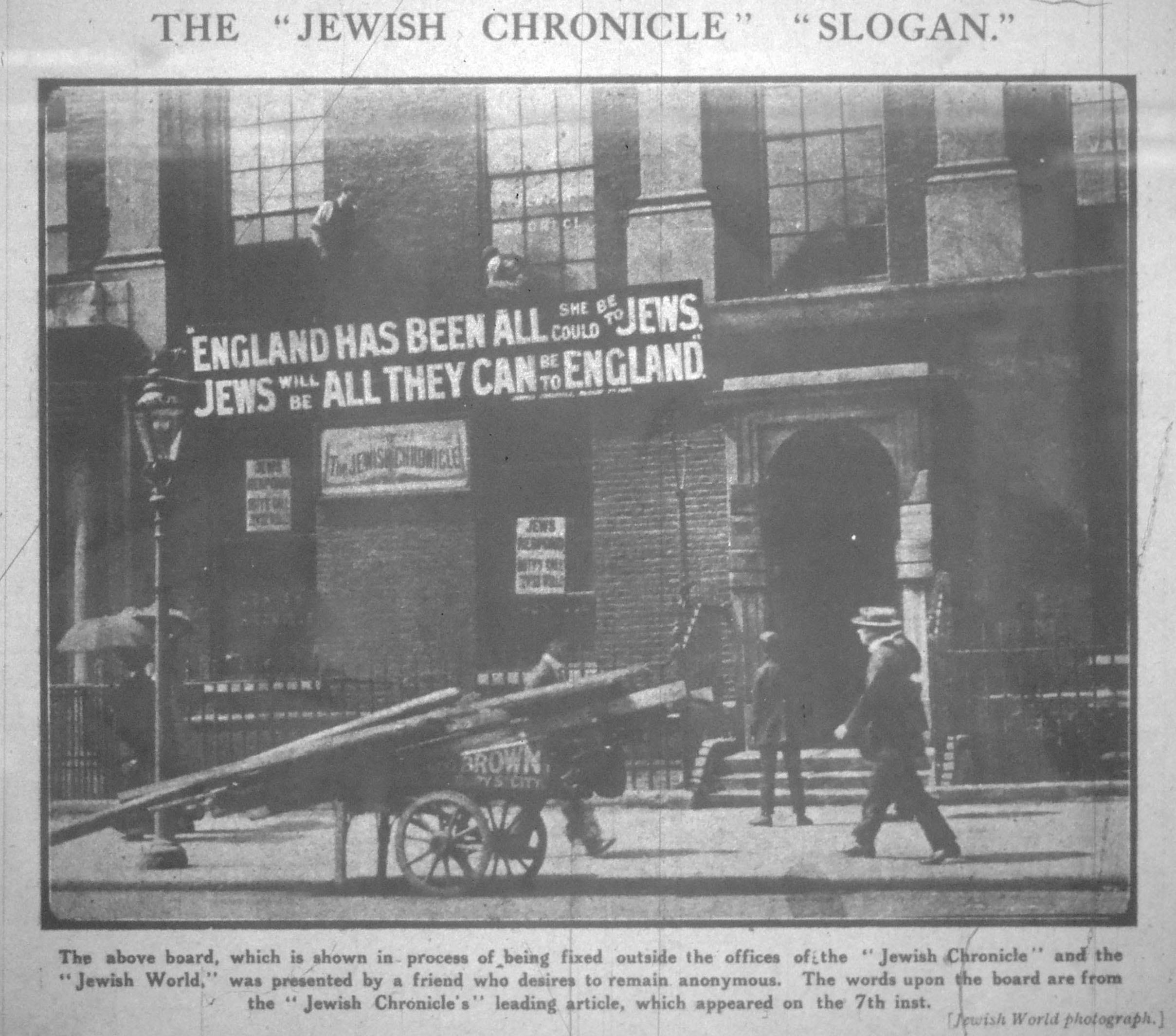
This post presents the lead editorial that appeared in the same issue of the Chronicle, which in spirit, idealism, and patriotism, is very much a companion piece to the above-mentioned article.  This is evident by the quote appearing at the editorial’s end – “England has been all she could be to Jews – Jews will be all they can be to England,” which appeared in the Chronicle on August 7, a few days after Britain’s entry into the war.

As seen in the image below (from the August 19 issue of the Chronicle’s sister publication, The Jewish World), this quote was prominently affixed to the exterior of the Chronicle’s offices by mid-August.

London Jewish Chronicle 1914 08 19Akin to the interview of Reverend Adler, the editorial is available in PDF format via the link at the end of this post.

____________________

Jews Respond

The Jewish Chronicle

August 14, 1914

The free spirit of determination to resist and overcome the enemies of this country, which has been manifested by all classes throughout the land is no small consolation for the affliction of war that has been cast upon it.  The calm, and implacable sentiment which from the highest to the most humble throughout the country has impelled all classes is one of the finest assets of victory that England possesses.  That sentiment, that spirit, Jews of all ranks are sharing to the full.  All thought except a desire to serve this country has been banished from the minds of our people.  The fact that the war is likely to bear, both from the economical and the sentimental standpoint, more heavily upon them than upon any other of the races or peoples that are involved, as must necessarily be the case with a people positioned as are Jews in the world, has not been given a moment’s consideration.  The supreme law of loyalty to the country of which Jews are citizens has over-ridden every other impulse.  When we find that even the Jews in Russia have declared themselves determined to fight with Russia, for Russia’s cause, side by side with those who have for generations been their bitter persecutors, it is no wonder that the Jews of England have thrown themselves into the duties involved by war upon the English citizen with an ardour and an enthusiasm matched perhaps by other classes in the country, but exceeded by none.

At the call of duty a considerable army of Jews from England have responded.  Countless instances of the remarkable sacrifice and self-abnegation involved in this prompt answer are pouring in upon us as we write.  Jewish mothers, who of all creatures on God’s earth have a tender heart for their offspring, have urged their sons – the apple of their eye – to go forth and serve for the King and the country.  Jewish fathers who had fondly pictured for their sons careers of advancement in commerce or profession have set their lips stiff and bid their sons wrench themselves away from the vocations designed for them, and go help to overcome the enemies of England.  In the day of trial, in the stress of battle, these sons of Israel will not be found wanting.  The pluck and the spirit of old these Jews have not lost.  The rely upon God for His protection, and upon their own strong arm for shielding the country which so nobly had sheltered their people.  This spirit is no mere frothy and ebullient martial ardour.  England is face to face with a test and a trial such as she has never been put to, and our sons have leapt gladly to the supreme opportunity of doing their share as English citizens.

Not again has the spirit and sentiment of duty at this anxious time animated only those who have hurried to the colors for active service in the field.  It has seized the whole community.  Everyone, man and woman, is anxious to find some means whereby, if not in the field then at home actively, or at least passively, they may help this country to victory.  The energetic loyal co-operation in a hundred ways which Jews are now undertaking can be judged from such records as we are able to provide in another column.  These do not by any means constitute all.  They are, at most, typical.  Yet they are remarkable.  For Jews are naturally a peace loving people, to whom war is hateful, to who, the shedding of human blood is detestable, who traditionally and historically have magnified peace as an ideal, who turn day by day in their prayers to the city named of Peace.  We Jews are conscious that to day, more than ever, Peace is Jewry’s most faithful ally.  But we see this great country gone forth to a war which was forced upon it by a haughty and intolerable systems of militarism.  We see this country with a clear conscience and clean hands going forth to do battle for freedom, for freedom from an overbearing Empire of “blood and iron”.  We see this country defending with all its vast resources the rights of the smaller nationalities and the existence on earth of the smaller States free from the engulfing greed of the brute force of armaments.  In such a cause we feel we have a cause for which to fight.  In such a cause we feel we have a cause for which to suffer, and to sacrifice, in such a cause it can be no matter for surprise that to a unit we are responding with a spirit worthy of the highest conceptions of our race.  In such an hour it is but natural that we in this country should recollect and be inspired by the thought that, “England has been all she could be to Jews,” and should determine that, “Jews will be all they can be to England.”

The Jewish Chronicle, August 14, 1914: Jews Respond


Soldiers of The Great War: Jewish Military Service in WW I, as Reported in The Jewish Chronicle – “Jews and The War”, August 14, 1914

As part of an effort to learn about Jewish military service in the First World War – “The Great War” as the conflict was known at the time due to its unprecedented, staggering scope and scale – I’ve done extensive research within periodicals published during that era by the Jewish and general press.  This effort has been focused upon locating articles and news items covering Jewish military service, military awards received by Jewish servicemen, the experiences of Jewish civilians in various battlefronts (particularly Eastern Europe), casualty lists, and, more.

The periodicals I’ve researched in this endeavor are many and varied.  Some can be accessed on the Internet, while others – to the best of my knowledge – have not been digitized, existing only as 35mm microfilm (remember film?!…) thus necessitating visits to the libraries or institutions having such resources in their  holdings.

Prominent among the periodicals I’ve researched have been The Jewish Chronicle (London, England), its companion publication The Jewish World, and, The Jewish Exponent (Philadelphia, Pennsylvania).

Both the Chronicle and Exponent are still “going strong” in this year of 2017, over a century after the end of the Great War.

The Chronicle presents an invaluable picture of military service by Jews of the British Empire, presented in the wider context of British Jewry as a whole, set within the even larger scope of news about world Jewry.

The following article – based on an interview with Chaplain Michael Adler – appeared in the August 14 issue of The Jewish Chronicle, ten days after Britain’s entry in the war on August 4.  In tone and spirit, the closing and opening paragraphs are reflective of and consistent with the patriotic ardor and enthusiasm permeating much of Europe – among both the Allies and Central powers – at the war’s very beginning.  Reverend Adler, who passed away in 1944, was also responsible for the creation of the memorial / commemorative volume British Jewry Book of Honour, in 1922.  More information about him can be found at Sarah Hurst’s blog post, A Chaplain in the Trenches.

The article is also available in PDF format via the link at the end of this post.

I hope to present further material relating to the Jewish military experience in WW I from later issues of the Chronicle, and other periodicals, in future posts.

________________________________________

Jews and the War

INTERVIEW FOR THE JEWISH CHRONICLE

WITH THE CHAPLAIN TO THE JEWISH TROOPS (the Rev. M. ADLER)

The Jewish Chronicle

August 14, 1914

THE Jewish manhood is responding with alacrity and enthusiasm to the call of England.  Even the glowing fervor at the time of the Boer War is thrown into eclipse by the ardour that is being shown in these momentous days.  There is not a Jew in this country who cannot tell of friends enlisted, of relatives enrolled in one or other of the British legions, of youthful zeal that will not be denied, of love of the Motherland exquisite in its tenderness, boundless in strength, unsurpassed in all the wonderful annals even of British loyalty and British enthusiasm.

These are early times to estimate the true muster of English Jews in this campaign.  British born and foreign born, rich and poor, have answered with equal swiftness the summons to the colours.  But, if ever the total is ascertained, it will form another unforgettable testimony to the spirit which wise and just government evokes in all the children of the realm.

The Chaplain to the Jewish troops, the Rev. Michael Adler, B.A., who has always thrown himself with enthusiasm into his work, is to-day a sort of human focus for the waves of patriotic eagerness that are sweeping the community, and to him many of the Jews under arms, from Hindustan to Aldershot, look for religious sustenance and moral inspiration.  Mr. Adler is himself a captain in the Territorial Force (London and Eastern Command).  He was at Deal with the Jewish Lads’ Brigade, and was about to go to the Territorial Camp at Wareham when the present storm broke over Europe.  He now holds himself at the disposal of the General Officer commanding, to be attached to any military station where London Territorials are assembled, and will be heading as soon as the latter are at their respective stations – which will be very soon.  It is possible that he will have to arrange for deputy chaplains in various parts of the country – probably in Lancashire and Yorkshire to begin with.

Jewish Lads’ Brigade Enlistments

In conversation with a representative of the JEWISH CHRONICLE, Mr. Adler commented on what he described as the very strong feeling of loyalty among English Jews.  One pointed illustration of this which he gave is the fact that a number of officers and senior boys of the Jewish Lads brigade volunteered for service immediately on the Brigade returning to town last Tuesday week.  Practically all were accepted.

But it is, of course, to the normally constituted forces of the Crown that we have to look for some more adequate representation of the numbers of Jews who are bearing arms in the present crisis, and of the Jewish elements in these.  Mr. Adler gave an interesting account.

Jews in the Navy

“There are,” he said, “a dozen Jewish officers in the Navy.  In regard to the men, the last official return gave the numbers of the Jews at about fifty.  But if you multiply that figure by four or five you will get the more correct number, for I constantly hear of Jews entering themselves as of another creed.  One interesting fact about the Navy is that it contains quite a considerable number of Jewish petty officers, including a warrant officer in the Marines.  There is a Jewish warrant officer – M.M. Bright – who was originally a pupil of the Jews’ Free School, and was, at one time, in the Jewish Lads’ Brigade.  He has been raised to commissioned rank, and it is worth noting that he is one of the ten in the entire Navy recently selected for promotion.  He is now probably on active service.  One Jewish warrant officer, named Pash, is warrant officer of signals on one of the super-Dreadnoughts.  There are a Jewish major and captain of Marines and several Commandants, and others who may be mentioned here are Midshipman Charles Marsden (“St. Vincent”), and Claude Telfer (son of Mr. W.T. Leviansky), and F. Lowy (grandson of the late Dr. A. Lowy), of the Royal Naval Reserve.

“By the way, the medical officer of the Jewish Lads’ Brigade, Dr. L. Mandel, joined the Royal Navy as a doctor the day after the camp broke up.”

Jewish “Regulars”

What about the Jews in the regular army?

“I know of fifty-two Jewish ‘regular’ officers. They include among their number members of the Sassoon, Mocatta, Beddington, Halford, Solomon, Henriques, Sebag Montefiore, Seligman, De Pass, and other well-known Jewish families.  Many of them will be in the Expeditionary Force.

“In regard to Jewish non-commissioned officer and men, the last official return dated October, 1913, put the number as 236.  This figure, however, should be multiplied by three at least to arrive at the true total.

Jews in the Cavalry

“Since March last a system has been instituted at the military recruiting stations of notifying to the chaplain every professing Jew who enlists, and over fifty names have been sent in to me.  In one week alone four Jews joined the 4th Hussars.  There has, indeed, been a great tendency on the part of the Jews to enlist in cavalry regiments – a new feature in Jewish enlistment.

“Of course, in addition, a very large number of Jews in the Reserves have now returned to the Colours, but how many it is impossible to say.

Jewish Guardsmen

Do Jews figure to any extent in the Guards regiments?

“Well, there are Sergt. Instructor J.H. Levey of the Scots Guards; Sergt. M.J. Marks, of the 3rd Coldstreams; Sergt. Lewis, in Coldstreams, and Sergt. Rosenberg, of the 2nd Scots Guards, besides a large number of Jewish privates.

“It may truly be said that there is hardly a regiment in the Regular Army in which Jews are not represented, a number of the recruits of recent date having come from Leeds and Manchester.

“Jews are also represented in the Artillery.  There are, for instance, Sergt.-Major Shapeere and Quartermaster-Sergt. F.J. Wooley, of the Royal Horse Artillery, to say nothing of a number of privates in that branch, as well as in the Royal Field Artillery and Royal Garrison Artillery.  One Jews, a Canadian by birth, is one of the principal gun-layers of his battery.

Rothschilds in the Trenches

“There are seventeen Jewish reserve officers.  And in addition I have ten names of Jewish Special Reserve officers.  One of these, Lieutenant W. Stanford Samuel, 4th King’s Liverpool Regiment, has already written me to say that he has been ordered to the front.  The last official return gave sixty-nine Jewish privates in the Special Reserve.  For that too, must be considerably increased to give the true figure.”

There are, of course, many Jews in the Territorial ranks.

“I have the names of ninety-four officers, with ranks ranging from colonel to second lieutenant.  Among these are the three sons of Mr. Leopold de Rothschild, viz, Mr. Lionel de Rothschild, M.P., Major in the Royal Bucks Yeomanry, and Mr. Evelyn and Mr. Anthony de Rothschild, who are lieutenants in the same regiment.  Among other Jewish Territorial officers are Major F. Goldsmith, M.P. (Suffolk Yeomanry), Col. Claude Beddington (Westmoreland Yeomanry), Lieut. Sir Philip Sassoon, M.P. (Royal East Kent Yeomanry), and Mr. Robert M. Sebag-Montefiore, a captain in the last-cited regiment; other Jewish Yeomanry officers are Major H. Weinberg (City of London Yeomanry), and Lieuts. Reginald and Desmond Tuck (3rd City of London Yeomanry).  The latter are the sons of Sir Adolph Tuck.

“In the Artillery, there are Col. H.D. Behrend; Major E.G. Heilbron, and a number of other officers; and, in the Engineers, Col. De Lara Cohen, on reserve.  Major R.Q. Henriques, and Capts. R.H. Joseph and G.C. Kennard, Col. H.M. Jessel, M.P., is Hon. Commander of the 1st Royal Fusiliers, Major J. Waley Cohen belongs to the 16th Queen’s Westminsters, Major F.D. Samuel to the 3rd Royal Fusiliers, and Major S.S.G. Cohen to the 5th Liverpool Regiment.

Well Known Names

“Among others that may be mentioned are Lieut. Lionel L. Cohen, son of Mr. Leonard Cohen, and Lieut. Leonard G. Montefiore, son of Mr. Claude G. Montefiore.  In the 6th Regiment City of London are five Jewish officers – Capts. G.A. Myer, M.H. Schwersee, and E.L. Phillips, Lieut. H.D. Myer, and Second Lieut. J.E. Lowy (grandson of the late Dr. Lowy).  In the 4th Royal West Kent Regiment are two sons of the late Sir B.L. Cohen – Capt. Sir Herbert Cohen, Bart., and Capt. A.M. Cohen.  In the 7th London Regiment are Capt. C.D. Enoch and Lieut. F.M. Davis (son of Mr. Felix Davis).  In the 16th Queen’s Westminsters, besides Major Alfred Waley Cohen, are Capt. J. Henriques, and Lieut. E.G. Waley (son of Mr. Alfred Waley).  In the 19th County of London there are four Jewish officers – Capt. Edgar J. Davis, and Lieuts. L.J. Davis, J. de Meza, and J. Lumley Frank.

In the Provinces

“The Provinces are further represented by Lieut. Col. S.L. Mandelberg (Manchester), Capt. J.M. Heilbron (Glasgow), Lieut. J.M. Goldberg (6th Welsh Regiment), Lieut. L.G. Harris (7th West Riding), Lieut. J.B. Brunel Cohen, son-in-law of Sir Stuart Samuel, M.P. (5th Liverpool Regiment), and Capt. N.J. Laski (6th Lancashire Fusiliers).

Jewish “Terriers”

What of the Jewish privates in the Territorial ranks?

“As regards the men, it is impossible to estimate the exact total of Jews.  But of London men alone I receive official returns for the last military service of some 400 names, representing practically every unit in the London command.  In the 4th Fusiliers there were 36 Jews, and many of the other regiments had long lists.  In the country, too, there are a very large number of Jewish Terriers.  At the last Territorial camp of the London regiments held on Salisbury plain in August of last year, 90 Jewish officers and men attended parade for service.

“Then there is one specifically Jewish voluntary aid detachment, under the charge of Dr. Myer Dutch, the duty of which is to act as nurses to the Territorial Force.”  An appeal, in this connection, appears in another column.

Volunteers

A great many Jews are volunteering for service in the present emergency.

“I have reason to believe that a very large number of Jews have been accepted.  I have received a number of communications from coreligionists who are anxious to join, whether as officers or privates.  There is also soon to be a great number of Jews in the Colonial contingents.

“In short,” added the Chaplain, in conclusion, “there has been a great outburst of enthusiasm among Jewish young men everywhere.”

It is a tribute to the wisdom of Britain – and the fortitude of a people which, whatever its faults, does not number among them ingratitude to its friends.

The Jewish Chronicle, August 14, 1914: Jews and the War


The Long Way Home: An Australian Jewish POW in World War One – I

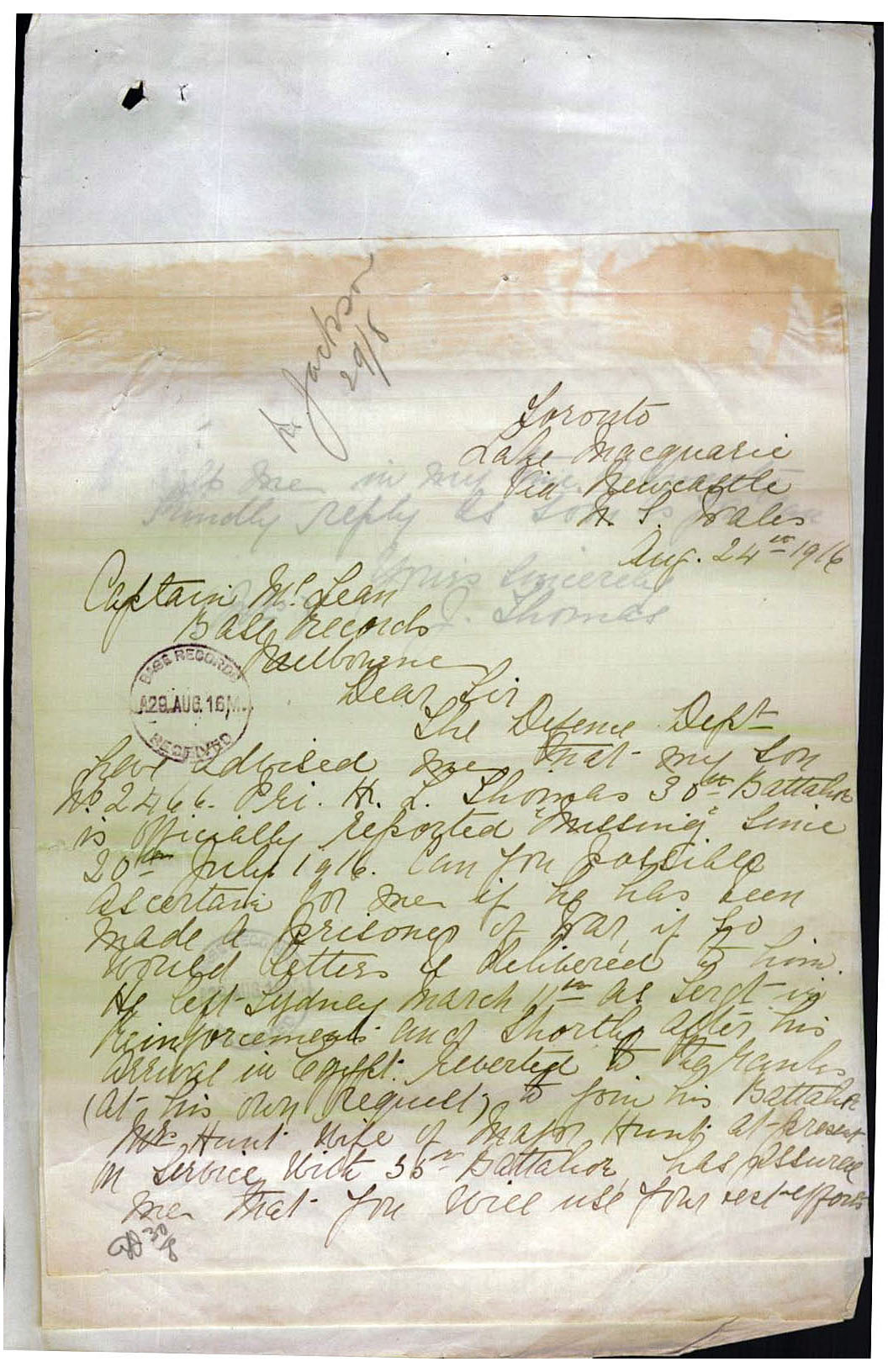
In August of 1916, the mother of a soldier serving in the Australian Army placed pen to paper, and composed the following letter to Captain McLean of the Australian Imperial Forces, concerning her son, Henry Lamert Thomas, a Private in the 30th Battalion, A.I.F.

Toronto
Lake MacQuarie
Via Newcastle
N.S. Wales
Aug. 24th 1916

Captain McLean
Base Records
Melbourne

Dear Sir

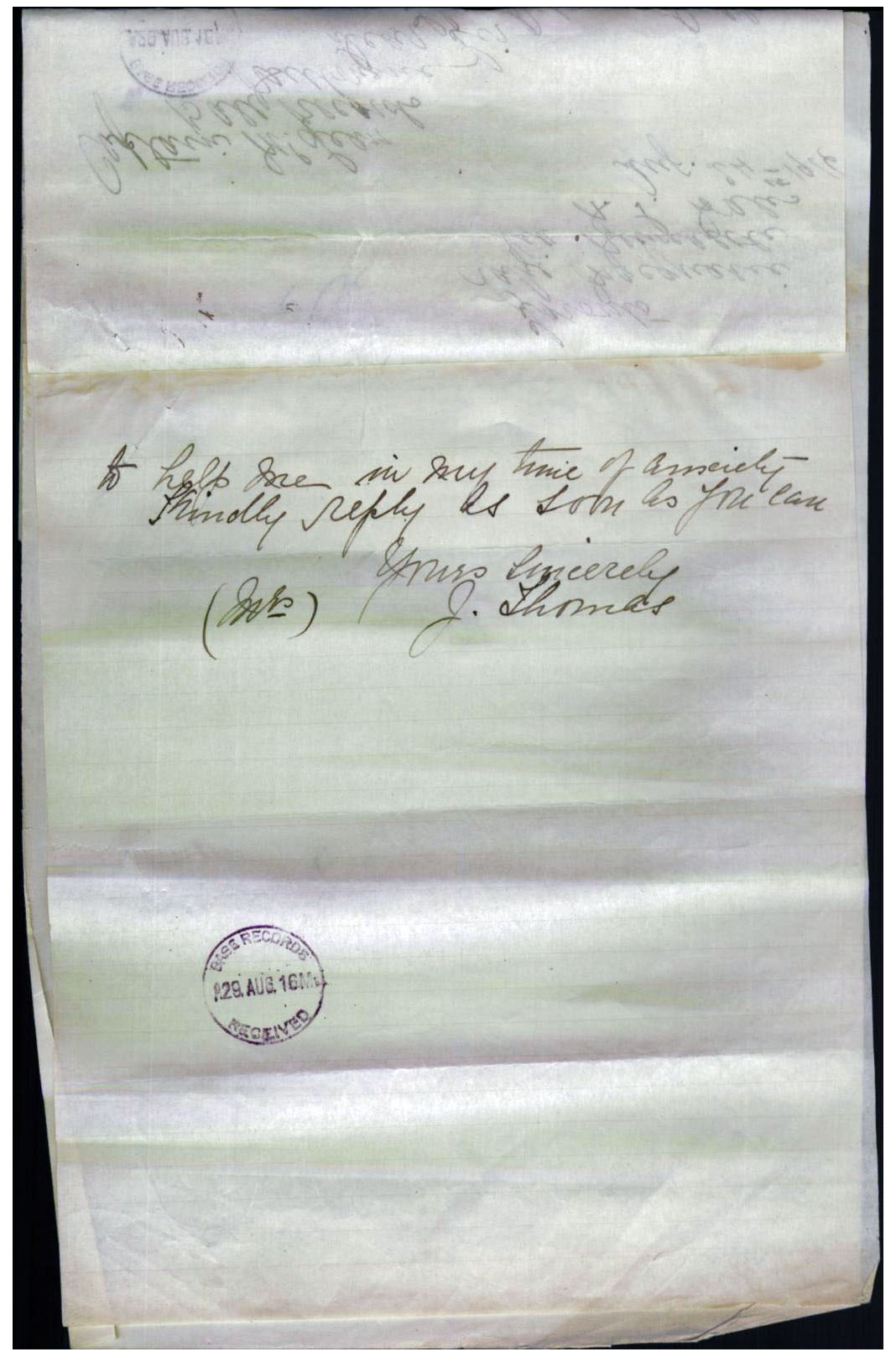
     The Defence Dept have advised me that my son No. 2466 Pri. H.L. Thomas 30th Battalion is officially reported Missing since 20th July 1916.  Can you possibly ascertain for me if he has been made a prisoner of war if so would letters be delivered to him.  He left Sydney March 11th as leading reinforcements and shortly after his arrival in Egypt reverted to the ranks (at his own request) to join his battalion.  Mrs. Hunt wife of Major Hunt at present in service with 35th Battalion has assured me that you will use your best efforts to help me in my time of anxiety.  Kindly reply as soon as you can.

Yours Sincerely
(Mrs.) J. Thomas

thomas-henry-l-7athomas-henry-l-7b____________________

Some three months later, having since learned that – in the midst of the carnage of 1916, her once-missing son was miraculously alive, and a prisoner of the Germans – she again wrote to Captain McLean, this time regarding her son’s receipt of parcels and letters:

Te Aroha
Toronto
Lake MacQuarie
N.S. Wales
Nov. 6th 1916

Captain McLean
Dear Sir

     Could you inform me if the _____ parcels of letters belonging to my son No. 2466 Pfc. H.L. Thomas have been returned to Australia?  He has been a prisoner of war in Germany since July 20th. Parcels or letters have been posted fortnightly since he left Australia March 11th some of which have reached him.  Up to June his address was Sergt – Etampes he left as Sergt [with] the 4th reinforcements 35th Battalion but reverted to the ranks to join his Battalion to go to France where he [was] taken prisoner.

Thanking you
Yours truly
(Mrs.) L.A. Thomas

thomas-henry-l-8____________________

At the time of her second letter, Private Thomas was imprisoned at Erkrath, Germany.  A little less than a year later he would be free, having escaped from German captivity in the company of Private Hector Holmes.  He survived the war, and doubtless, eventually returned to Australia. 

What makes this story notable is the preservation and availability of a remarkably detailed account of the capture and captivity of this Australian Jewish Soldier, which is presented in this post.

Born in New South Wales in 1897, Henry L. Thomas was the son of Mrs. Francis Thomas, who resided at Te Aroha, on Brighton Ave., in Toronto (a suburb of Newcastle in New South Wales), by occupation a railway clerk with the New South Wales Government Railway.   

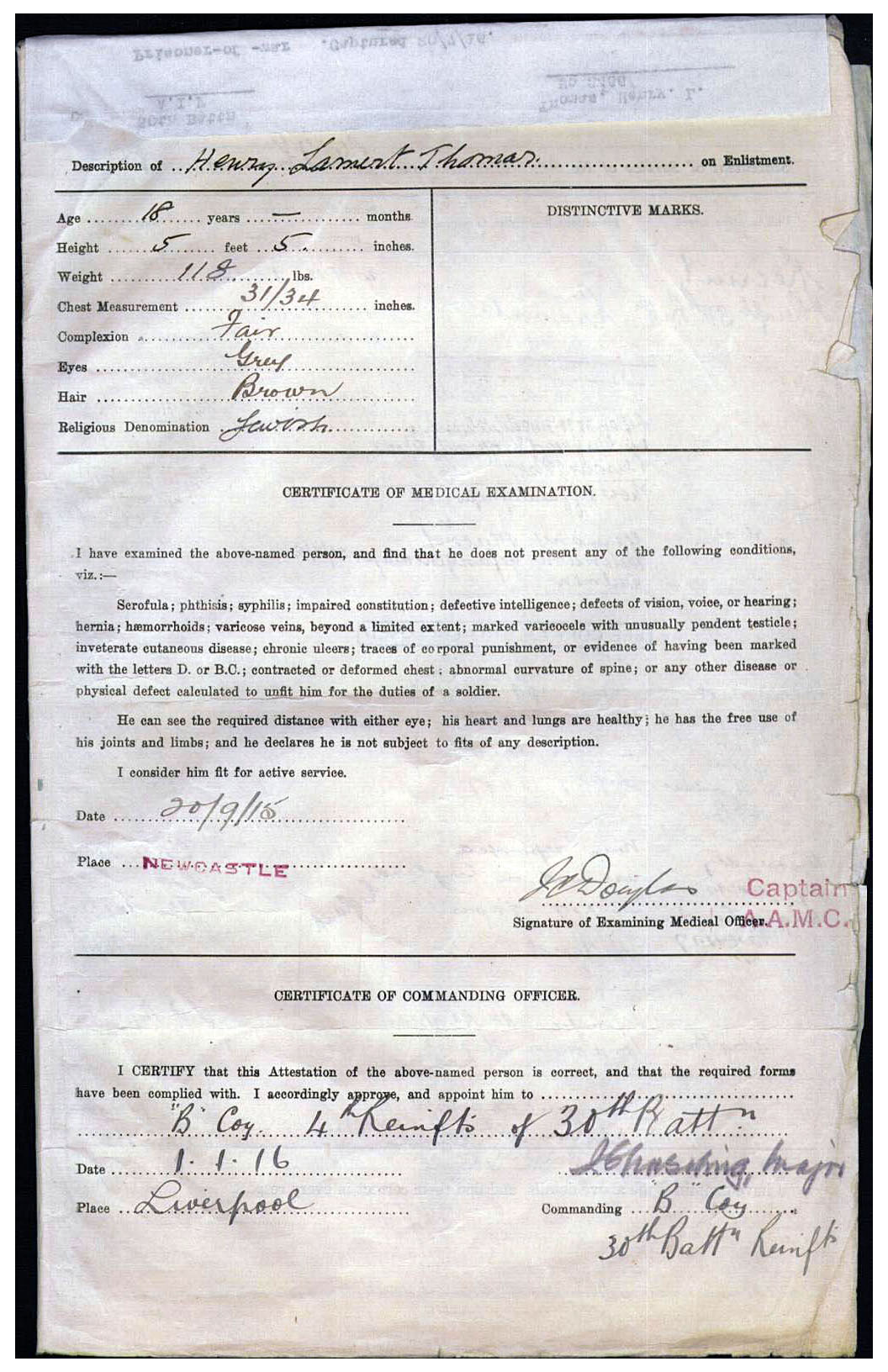
Private Thomas’ Interview is appended to his Attestation Papers, which can be accessed at the website of the National Archives of Australia (“NAA”; http://naa.gov.au/).*  His Attestation Papers are presented below, while a transcript of his interview is presented in my “next” post.

A member of B Company, 30th Battalion, 4th Reinforcements, Australian Imperial forces, Thomas was captured on July 20, 1916, in the midst of the Battle of the Somme, which transpired from July 1 to November 18 of that year. 

According to the Australian War Memorial, “The 30th Battalion was raised as part of the 8th Brigade at Liverpool in New South Wales on 5 August 1915.  Most of its recruits hailed from the Newcastle region and other parts of country New South Wales, but almost an entire company was composed of former RAN ratings from Victoria.

The 8th Brigade joined the newly raised 5th Australian Division in Egypt and proceeded to France, destined for the Western Front, in June 1916.  The 30th Battalion’s first major battle was at Fromelles on 19 July 1916.  It was tasked with providing carrying parties for supplies and ammunition but was soon drawn into the vicious fighting.  Following Fromelles, the battalion was rotated in and out of the front line along with others in the brigade, but played no major offensive role for the rest of the year.”

A prisoner at various locations in Germany, he escaped from German captivity in October of 1917 and eventually returned to Allied control. 

Thomas was sent to or interned at the following locations after his capture:

France

Loos (temporary POW holding facility)                                                  20 July 1916
Lille (temporary POW holding facility)                 20 July 1916 through 22 July 1916

In Transit from France to Germany

By train from Lille to Dulmen, Germany               22 July 1916 through 24 July 1916

Germany

Dulmen (Lager Number 3)                         24 July 1916 through 4 September 1916
Erkrath (near Dusseldorf)                  4 September 1916 through 10 February 1917
Munster (POW Camp Number1)                  10 February 1917 through 4 April 1917
Duisberg Meidrich (Work Commando)           4 April 1917 through 27 October 1917

It is notable that only one month transpired between his escape, and the interview of 1917. 

Of particular interest is the incorporation of the German document used to record biographical information, within Private Thomas’ Attestation Papers.  An intriguing aspect of the document is that it is bilingual – unlike German POW documents during the Second World War – with headings in both English and German. 

     The information recorded in the POW record comprises:

Stammlager / Principal Camp       (or)         Lazarett / Hospital
Datum der Ausfertigung / Date
Zuname / Surname
Vorname / Christian Name
Rang / Rank
Reg. oder Korps / Regiment or Corps
Reg. Nr. / Regiment Number
Komp. / Company
Erkennsungsmarke Nr. / Number of Identification disc
Gefangennahme / Capture
Ort / Place [of capture]
Datum / Date [of capture]
Ob verwundet / Whether wounded
Bezeichnung der Wunde / Description of wound
Geburt / Birth
Ort / Place [of birth]
Datum / Date [of birth]
Heimatort / Home Place [address]
Adresse des nachsten Verwandten / Address of next-of-kin

____________________

The account of Thomas’ capture and captivity, recorded by R.C. Swain in London on November 28, 1917, focuses almost entirely on Thomas’ life as a POW, in terms of life in the POW camps where he was interned, his interactions with fellow POWs and Germans (the latter both in military and civilian capacities), and, living and working conditions in Germany. 

As such, the document does not cover Thomas’ prior experiences as a soldier, and unfortunately, accords tantalizingly little attention to the specific military action in which he was captured, the discussion of which is limited to the first few paragraphs.  Similarly; unfortunately – even more tantalizingly! – it contains no information about his escape, as such. 

(Presumably, such documents do exist – somewhere.  But, where?)

However, nominal information about Pvt. Thomas’ escape does exist, and is present in the Enquiry Bureau Files of the Australian Red Cross Society for Wounded and Missing.  (A copy of this document is also present in Pvt. Thomas’ Attestation Papers.)  There, a document headed “Prisoner of War” and dated November 19, 1917, states:

“My mate and myself have escaped from Germany, we have to remain, 16 days here before going to England, the people are very kind it is like home.  After leaving Germany we left our camp on Friday evening and arrived in Holland Thursday morning.  We are very tired but happy at last.  Extract from post-card written by Hector Holmes 3555 30th Batt dated 3.11.17 from Righs Quarantine, Sittard.  Holland refers to man and Holmes escape together.  Post-card received 17/11/17.”

A later document, dated December 4 and headed “Escaped Prisoner of War”, states:

”Left Duisberg Meiderick 26.10.17 arrived Holland 30.10.17.  –  Left Holland arrived England 21.11.17 – reported at A.I.F. Headquarters to Colonel Griffiths at 6 p.m. 23.11.17 – reported to B. Records [Base Records] 24.11.17.

Information from Man given 29.11.17.”

In civilian life, Private Hector Holmes, 3555, was a farmer from Branxton, New South Wales.  He served in the 56th Battalion, Australian Imperial Force.  Like Private Thomas, he was captured on July 20. 

____________________

In a larger context, Private Thomas was one of the over five hundred Australian Jewish soldiers who were military casualties (killed, wounded, missing, prisoners of war, or injured) in the First World War.  About 470 of these men’s names appear in Reverend Michael Adler’s British Jewry’s Book of Honour, while the names of some 38 are absent from that publication.  The names of these nearly 510 men – as well as of those Australian Jewish servicemen fortunate enough to have experienced the First World War without wounds, injury, or captivity – occupy pages 549 through 566 of Reverend Adler’s book.  There, Private Thomas’ name appears on page 565. 

The names of 144 of “the 470” – in connection with news stories, announcements of military decorations, or casualty notices – appeared in The Jewish Chronicle (London) during WW I. 

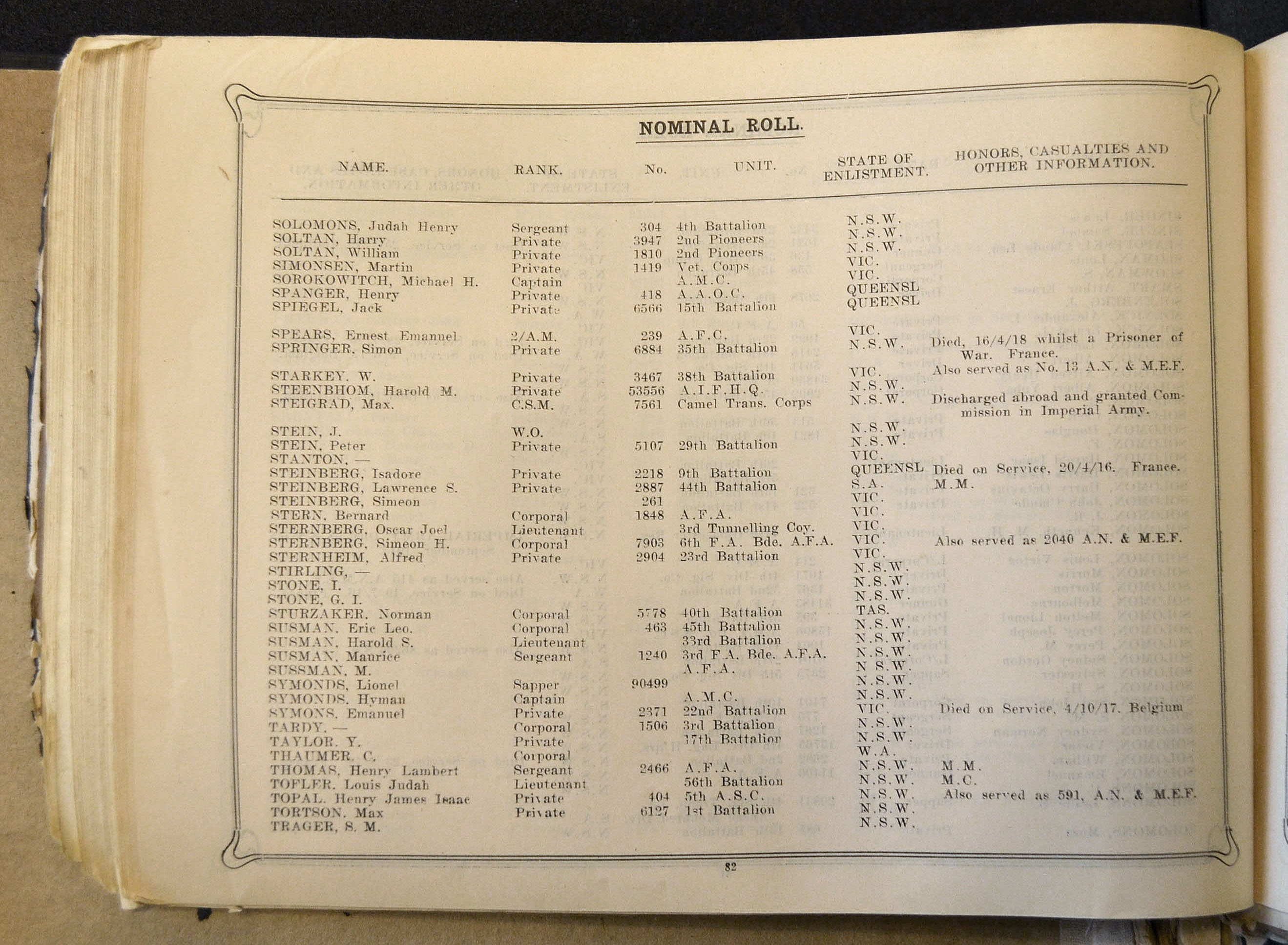
Private Thomas’ name is also listed on page 82 of the Australian Jewry Book of Honour, that publication indicating that he received the Military Medal, and giving his middle name as “Lambert”.   An image of this page appears below:

ajbh-82____________________

The following images comprise the Attestation Papers of Private Thomas.  The physical format of these documents, and the information recorded within them, is representative of Attestation Forms used by the Australian Imperial Forces and other nations of the British Commonwealth, during the First World War.

____________________

thomas-henry-l-1The first page covers the enlistee’s biographical Information.  Notice that the enlistee has been required to sign his name, and record the date of enlistment.

____________________

thomas-henry-l-2The second page covers his physical description, religious affiliation, Certificate of Medical Examination, and Certificate of the Commanding Officer at the station of enlistment.  This page also includes the enlistee’s signature.

____________________

thomas-henry-l-3The same sheet as above, to which has been attached a document showing updates about Private Thomas’ “Missing in Action” and “Prisoner of War” status.

____________________

thomas-henry-l-4Continuing with the same page, Private Thomas’ German POW information sheet (described above) has been attached.

____________________

thomas-henry-l-5And finally, the notice of his escape, with Private Hector Holmes (transcribed above), from German captivity. 

____________________

References

Books

Adler, Michael, British Jewry Book of Honour, Caxton Publishing Company, London, England, 1922.

Banks, Arthur, A Military Atlas of the First World War, Leo Cooper, South Yorkshire, England, 2001

Boas, Harold, Australian Jewry Book of Honour – The Great War, 1914-1918, Lamson Paragon (West Australia), Ltd., Perth, Western Australia, 1923.  (Accessed at the Dorot Jewish Division of the New York Public Library.)

Gilbert, Martin, The Routledge Atlas of the First World War (2nd Edition), Routledge, London, England, 2002

Macdonald, Lynn, Somme, Michael Joseph, London, England, 1985

Attestation Papers

Holmes, Hector, 3555, at web site of National Archives of Australia (http://www.naa.gov.au/). 

Thomas, Henry Lamert, 2466, Private, at web site of National Archives of Australia (http://www.naa.gov.au/). 

Other Sources of Information

Australian Red Cross Society Wounded and Missing Enquiry Bureau Files, 1914-18 War, 1DRL/0428, for 2466 Private Henry Lamert Thomas, 30th Battalion, at https://www.awm.gov.au.

New South Wales Association of Jewish ex Servicemen and Women, Detail, 2001, at (http://www.najex.org.au/)

30th Australian Infantry Battalion, at https://www.awm.gov.au/unit/U51470/

____________________

* As shown in the screen-shots below, the NAA’s search engine is well designed, easy to use, and very intuitive (and aesthetic! – as is the NAA’s website in general), presenting records in easily recognizable and retrievable fashion.  Documents are provided as 120 dpi JPGs, which, though not of the highest resolution, certainly have enough clarity for working purposes, and can be adjusted and enhanced as desired via Photoshop or other relevant software.

naa-1Opening page of the NAA website.  Note the search box in the upper center of the page.

naa-2A boolean search has been made for “Thomas” “2466”, which generates 8 records.  Records that have been digitized are denoted by a stylized “page” icon in the right portion of the screen.

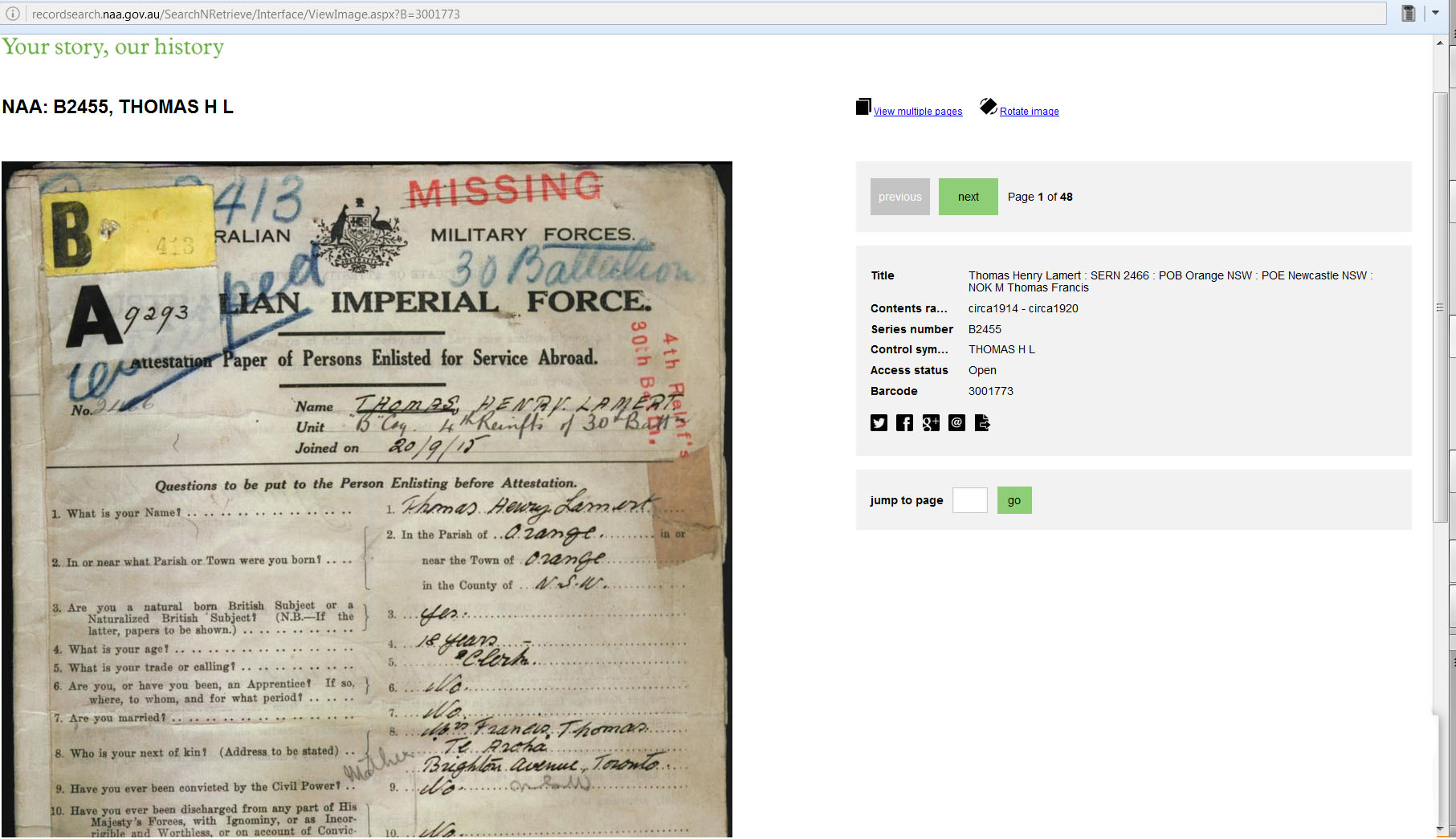
naa-3Upon clicking the pertinent icon, the user is presented with an image of the “first” document in the set of selected records.  Using the gray and green “previous” and “next” buttons, the user can scroll through the entire set of documents in reverse or forward fashion, respectively.  Or, the user can move to a specific page in the set of documents, using the “jump to page” field.

naa-4If desired, the entire set of digitized images can be viewed as a group, and specific images viewed at full size by clicking the relevant icon.

____________________

Though I’m not familiar with the details, the NAA has apparently digitized Attestation Papers for all Australian WW I servicemen, generating an extraordinarily useful resource for those researching military history and genealogy, as well as other fields, such as sociology, economics, immigration, and demography.