A Jew Among the Cossacks: An Account from The Jewish Exponent (Philadelphia) in 1922 – II – The Original Article

Earlier this year, I presented a transcript of a story that was published in The Jewish Exponent (of Philadelphia) in 1922, by Jacob B. Abramowitz, entitled “My Experience as a Jewish Cossack“.  This intriguing tale presents Abramowitz’s (unintentional, involuntary, dramatic, and eventually memorable) service – as a known and identified Jew – in the Cossack forces of General Grigoriy Mikhaylovich Semenov (Григорий Михайлович Семёнов) during the Russian Civil War. 

In the commentary that accompanied Abramowitz’s story, I mentioned that I have been unable to find anything, whatsoever, about him. 

He is and remains an enigma.

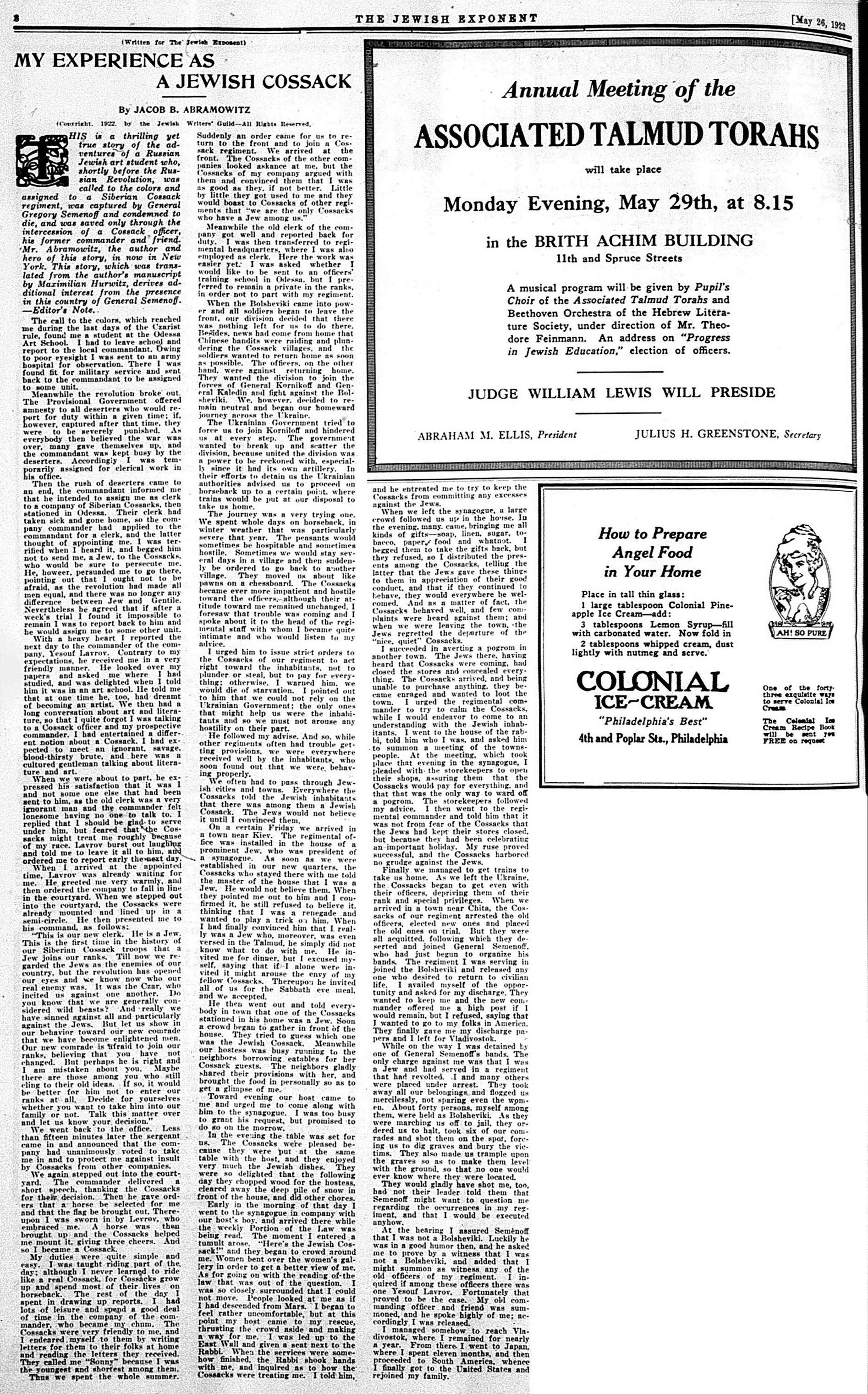
What is not an enigma is the original story, which, copied from a microfilm master of The Jewish Exponent, is shown below. 

It adds nothing new, really, but it does show you the original item, and gives an indication of how articles were presented in the Exponent nearly a century ago.

A Jew Among the Cossacks: An Account from The Jewish Exponent (Philadelphia) in 1922 – I

In the same way that The Jewish Chronicle (London) accorded great attention to Jewish military service during World War One – naturally focusing on Jewish soldiers of the Commonwealth countries – so did The Jewish Exponent (of Philadelphia) report on Jews in the American military during that time.*  However, given that America’s military effort in “The Great War” substantively commenced in 1917, the number of such news items in The Exponent is far fewer – and far less systematically presented – than such items in the Chronicle.

Given the scope, nature, and effects of World War One, with the major military campaigns in the “East” transpiring across the geographic and demographic “center” of European Jewry (Poland and the Ukraine) the Exponent and especially the Chronicle presented detailed and lengthy articles about the activities, experiences, and travails of – and appalling suffering endured by – Jewish civilians living in those regions.  This coverage would continue well into the early 1920s.

The following article is one such item, and a very unusual one, at that:  An account by Jacob Abramowitz, Russian Jewish art student, concerning his military service in a company of Siberian Cossacks, which appeared in the Exponent in 1922.

A web search for information about the author yields a solitary entry: In Volume 19, Issue 1, of the U.S. Government Printing Office Publication of January 1, 1923, of “Catalogue of Copyright Entries: Pamphlets, leaflets, contributions to newspapers or periodicals, etc.; lectures, sermons, addresses for oral delivery; dramatic compositions, maps; motion pictures,” under page 665 – “Books”, appears the listing: “Abramowitz (Jacob B.) My Experiences as a Jewish Cossack, by Jacob B. Abramowitz, tr. by Maximilian Hurwitz. (In Jewish Tribune)”.  Otherwise, he remains an enigma.

The “General Grigory Semyonov” referred to in the story is – according to Wikipedia – Grigoriy Mikhaylovich Semenov (Григорий Михайлович Семёнов).  Born in 1890 in the Transbaikal region of Eastern Siberia, he served as a Cossack Ensign in WW I, where he earned the George Cross in battle against the Germans and Austro-Hungarians. After the Russian Revolution, he fled to Harbin, China.  He left Russian territory by 1921, eventually living in Nagasaki, and then the United States.  He subsequently returned to China, where he was captured by Soviet Military forces in 1945.  Charged with counter-revolutionary activities, he was executed in 1946.  (The information in this Wikipedia entry is derived from the 2009 book White Terror: Cossack Warlords of the Trans-Siberian, by Jamie Bisher.)

According to a biographical note in a short story penned for the February, 1920, issue of The American Hebrew, Maximilian Hurwitz was, “Born in Shati, Russia, in 1887; came to American in 1904, and was educated in the schools of Pittsburgh, Pa.  (University of Pittsburgh, A.B., 1915.)”  He served on the staff of The Jewish News. 

With very great irony, Hurwitz’s story, “Eili, Eili, Lomo Asavtoni?” (“My God, My God, why hast Thou forsaken me?”) – from which I extracted the above biographical data – was itself written to commemorate, “the Jewish martyrs who fell in the recent massacres in Poland and the Ukraine”…

And so, Jacob Abramowitz’s story follows below.  

As to its veracity, I have no idea. 

But, it is an interesting read, with a mild air of Isaac Babel to it…

* This applies even moreso to coverage of Jewish military service in WW II.  More about that – much (much) more, I hope – in the future.

____________________

(Following the format of my prior posts concerning articles from The Jewish Chronicle of 1914, the story can be accessed in PDF format, here.) 

____________________

For more about this period of history, I strongly suggest The Slaughter of the Jews In the Ukraine in 1919, by Elias Heifetz, published in 1921, and, David Vital’s magisterial 1999 book, A People Apart – A Political History of the Jews in Europe, 1789-1939.  More recently, this tragic period of Jewish history – seemingly superseded in Jewish collective memory by geographic and psychological distance, and especially the magnitude of the Shoah only two decades later – was the subject of a Discussion at YIVO – “A Forgotten Genocide: The Pogroms in Ukraine, 1918-1919, and their Impact on Memory and Politics” – on May 16, 2016, with videos of the four presentations available here.

____________________

My Experience as a Jewish Cossack

 The Jewish Exponent

May 26, 1922

By Jacob A. Abramowitz

(Copyright 1922 by the Jewish Writer’s Guild – All Rights Reserved)

This is a thrilling yet true story of the adventures of a Russian Jewish art student who, shortly before the Russian Revolution, was called to the colors and assigned to a Siberian Cossack regiment, was captured by General Gregory Semenoff and condemned to die, and was saved only through the intercession of a Cossack officer, his former commander and friend.  Mr. Abramowitz, the author and hero of this story, which was translated from the author’s manuscript by Maximilian Hurwitz, derives additional interest from the presence in this country of General Semenoff. – Editor’s Note.

The call to colors, which reached me during the last days of the Czarist rule, found me a student at the Odessa Art School.  I had to leave school and report to the local commandant.  Owing to poor eyesight I was sent to an army hospital for observation.  There I was found fit for military service and sent back to the commandant to be assigned to some unit.

Meanwhile the revolution broke out.  The Provisional Government offered amnesty to all deserters who would report for duty within a given time; if, however, captured after that time, they were to be severely punished.  As everybody then believed the war was over, many gave themselves up, and the commandant was kept busy by the deserters.  Accordingly I was temporarily assigned for clerical work in his office.

Then the rush of deserters came to an end, the commandant informed me that he intended to assign me as a clerk to a company of Siberian Cossacks, then stationed in Odessa.  Their clerk had taken sick and gone home, so the company commander had applied to the commandant for a clerk, and the latter thought of appointing me.  I was terrified when I heard of it, and begged him not to send me, a Jew, to the Cossacks, who would be sure to persecute me.  He, however, persuaded me to go there, pointing out that I ought not to be afraid, as the revolution had made all men equal, and there was no longer any difference between Jew and Gentile.  Nevertheless he agreed that if after a week’s trial I found it impossible to remain I was to report back to him and he would assign me to some other unit.

With a heavy heart I reported the next day to the commander of the company, Yesouf Lavrov.  Contrary to my expectations, he received me in a very friendly manner.  He looked over my papers and asked me where I had studied, and was delighted when I told him it was an art school.  He told me that at one time he, too, had dreamt of becoming an artist.  We then had a long conversation about art and literature, so that I quite forgot I was talking to a Cossack officer and my prospective commander.  I had entertained a different notion about a Cossack.  I had expected to meet an ignorant, savage, blood-thirsty brute and here was a cultured gentleman talking about literature and art.

When we were about to part, he expressed his satisfaction that it was I and not some one else that had been sent to him, as the old clerk was a very ignorant man and the commander felt lonesome having no one to talk to.  I replied that I should be glad to serve under him, but feared that the Cossacks might treat me roughly because of my race.  Lavrov burst out laughing and told me to leave it all to him, and ordered me to report early the next day.

When I arrived at the appointed time, Lavrov was already waiting for me.  He greeted me very warmly, and then ordered the company to fall in line in the courtyard.  When we stepped out into the courtyard, the Cossacks were already mounted and lined up in a semi-circle.  He then presented me to his command, as follors:

“This is our new clerk.  He is a Jew.  This is the first time in the history of our Siberian Cossacks troops that a Jew joined our ranks.  Till now, we regarded the Jews as the enemies of our country, but the revolution has opened our eyes and we know now who the real enemy was.  It was the Czar, who incited us against one another.  Do you know that we are generally considered wild beasts?  And really we have sinned against all and particularly against the Jews.  But let us show in our behavior toward our new comrade that we have become enlightened men.  Our new comrade is afraid to join our ranks, believing that you have not changed.  But perhaps he is right and I am mistaken about you.  Maybe there are those among you who still cling to their old ideas.  If so, it would be better off for him not to enter our ranks at all.  Decide for yourselves whether you want to take him into our family or not.  Talk this matter over and let us know your decision.”

We went back to the office.  Less than fifteen minutes later the sergeant came in and announced that the company had unanimously voted to take me in and to protect me against insult by Cossacks from other companies.

We again stepped out into the courtyard.  The commander delivered a short speech, thanking the Cossacks for their decision.  Then he gave orders that a horse be selected for me and that the flag be brought out.  Thereupon I was sworn in by Levrov, who embraced me.  A horse was then brought up and the Cossacks helped me mount it, giving three cheers.  And so I became a Cossack.

My duties were quite simple and easy.  I was taught riding part of the day, although I never learned to ride like a real Cossack, for Cossacks grow up and spend most of their lives on horseback.  The rest of the day I spent in drawing up reports.  I had lots of leisure and spent a good deal of time in the company of the commander, who became my chum.  The Cossacks were very friendly to me, and I endeared myself to them by writing letters for them to their folks at home and reading the letters they received.  The called me “Sonny” because I was the youngest and shortest among them.

Thus we spent the whole summer.  Suddenly an order came for us to report to the front and to join a Cossack regiment.  We arrived at the front.  The Cossacks of the other companies looked askance at me, but the Cossacks of my company argued with them and convinced them that I was as good as they, if not better.  Little by little they got used to me and they would boast to Cossacks of other regiments that “we are the only Cossacks who have a Jew among us.”

Meanwhile the old clerk of the company got well and reported back for duty.  I was then transferred to regimental headquarters, where I was also employed as a clerk.  Here the work was easier yet.  I was asked whether I would like to be sent to an officers training school in Odessa, but I preferred to remain a private in the ranks, in order not to part with my regiment.

When the Bolsheviki came into power and all our soldiers began to leave the front, our division decided that there was nothing left for us to do there.  Besides, news had come from home that Chinese bandits were raiding and plundering the Cossack villages, and the soldiers wanted to return home as soon as possible.  The officers, on the other hand, were against returning home.  They wanted the division to join the forces of General Kornikoff and General Kaledin and fight against the Bolsheviki.  We, however, decided to remain neutral and began our homeward journey across the Ukraine.

The Ukrainian government tried to force us to join Korailoff and hindered us at every step.  The government wanted to break up and scatter the division, because united the division was a power to be reckoned with, especially since it had its own artillery.  In their efforts to detain us the Ukrainian authorities advised us to proceed on horseback up to a certain point, where trains would be put at our disposal to take us home.

The journey was a very trying one.  We spent whole days on horseback, in winter weather that was particularly severe that year.  The peasants would sometimes be hospitable and sometimes hostile.  Sometimes we would stay several days in a village and then suddenly be ordered to go back to another village.  The moved us about like pawns on a chessboard.  The Cossacks became ever more impatient and hostile toward the officers, although their attitude toward me remained unchanged.  I foresaw that trouble was coming and I spoke about it to the head of the regimental staff with whom I became quite intimate and who would listen to my advice.

I urged him to issue strict orders to the Cossacks of our regiment to act right toward the inhabitants, not to plunder or steal, but to pay for everything; otherwise, I warned him, we would die of starvation.  I pointed out to that we could not rely on the Ukrainian Government; the only ones that might help us were the inhabitants and so we must not arouse any hostility on their part.

He followed my advice.  And so, while other regiments often had trouble getting provisions, we were everywhere received well by the inhabitants, who soon found out that we were behaving properly.

We often had to pass through Jewish cities and towns.  Everywhere the Cossacks told the Jewish inhabitants that there was among them a Jewish Cossack.  The Jews would not believe it until I convinced them.

On a certain Friday we arrived in a town near Kiev.  The regimental office was installed in the house of a prominent Jew, who was president of a synagogue.  As soon as we were established in our new quarters, the Cossacks who stayed there with me told the master of the house that I was a Jew.  He would not believe them.  When they pointed me out to him and I confirmed it, he still refused to believe it, thinking that I was a renegade and wanted to play a trick on him.  When I had finally convinced him that I was really a Jew who, moreover, was even versed in the Talmud, he simply did not know what to do with me.  He invited me for dinner, but I excused myself, saying that if I alone were invited it might arouse the envy of my fellow Cossacks.  Thereupon he invited all of us for the Sabbath eve meal, and we accepted.

He then went out and told everyone in town that one of the Cossacks stationed in his home was a Jew.  Soon a crowd began to gather in front of the house.  They tried to guess which one was the Jewish Cossack.  Meanwhile our hostess was busy running to the neighbors borrowing eatables for her Cossack guests.  The neighbors gladly shared their provisions with her, and brought the food in personally so as to get a glimpse of me.

Toward evening our host came to me and urged me to come along with him to the synagogue.  I was too busy to grant his request, but promised to do so on the morrow.

In the evening the table was set for us.  The Cossacks were pleased because they were put at the same table with the host, and they enjoyed very much the Jewish dishes.  They were so delighted that the following day they chopped wood for the hostess, cleared away the deep pile of snow in front of the house, and did other chores.

Early in the morning of that day I went to the synagogue in company with our host’s boy, and arrived there while the weekly Portion of the Law was being read.  The moment I entered a tumult arose.  “Here’s the Jewish Cossack!” and they began to crowd around me.  Women bent over the women’s galley in order to get a better view of me.  As for going on with the reading of the law that was out of the question.  I was so closely surrounded that I could not move.  People looked at me as if I had descended from Mars.  I began to feel rather uncomfortable, but at this point my host came to my rescue, thrusting the crowd aside and making a way for me.  I was led up to the East Wall and given a seat next to the Rabbi.  When the services were somehow finished, the Rabbi shook hands with me, and inquired as to how the Cossacks were treating me.  I told him, and he entreated me to try to keep the Cossacks from committing any excesses against the Jews.

When we left the synagogue, a large crowd followed us up in the house.  In the evening, many came, bringing me all kinds of gifts – soap, linen, sugar, tobacco, paper, food and whatnot.  I begged them to take the gifts back, but they refused, so I distributed the presents among the Cossacks, telling the latter that the Jews gave these things to them in appreciation of their good conduct, and that if they continued to behave, they would everywhere be welcomed.  And as a matter of fact, the Cossacks behaved well, and few complaints were heard against them; and when we were leaving the town, the Jews regretted the departure of the “nice, quiet” Cossacks.

I succeeded in averting a pogrom in another town.  The Jews there, having heard that Cossacks were coming, had closed the stores and concealed everything.  The Cossacks arrived, and being unable to purchase anything, they became enraged and wanted to loot the town.  I urged the regimental commander to try to calm the Cossacks, while I would endeavor to come to an understanding with the Jewish inhabitants.  I went to the house of the rabbi, told him who I was, and asked him to summon a meeting of the townspeople.  At the meeting, which took place that evening in the synagogue, I pleaded with the storekeepers to open their shops, assuring them that the Cossacks would pay for everything, and that that was the only way to ward off a pogrom.  The storekeepers followed my advice.  I then went to the regimental commander and told him that it was not from fear of the Cossacks that the Jews had kept their stores closed, but because they had been celebrating an important holiday.  My ruse proved successful, and the Cossacks harbored no grudge against the Jews.

Finally we managed to get trains to take us home.  As we left the Ukraine, the Cossacks began to get even with their officers, depriving them of their rank and special privileges.  When we arrived in a town near Chita, the Cossacks of our regiment arrested the old officers, elected new ones and placed the old ones on trial.  But they were all acquitted, following which they deserted and joined General Semenoff, who had just begun to organize his bands.  The regiment I was serving in joined the Bolsheviki and released any one who desired to return to civilian life.  I availed myself of the opportunity and asked for my discharge.  They wanted to keep me and the new commander offered me a high post if I would remain, but I refused, saying that I wanted to go to my folks in America.  They finally gave me my discharge papers and I left for Vladivostok.

While on the way I was detained by one of General Semenoff’s bands.  The only charge against me was that I was a Jew and had served in a regiment that had revolted.  I and many others were placed under arrest.  They took away all our belongings and flogged us mercilessly, not sparing even the women.  About forty persons, myself among them, were held as Bolsheviki.  As they were marching us off to jail, they ordered us to halt, took six of our comrades and shot them on the spot, forcing us to dig graves, and bury the victims.  They also made us trample upon the graves, so as to make them level with the ground, so that no one would ever know where they were located.

They would have shot me, too, had not their leader told them that Semenoff might want to question me regarding the occurrences in my regiment, and that I would be executed anyhow.

At the hearing I assured Semenoff that I was not a Bolsheviki.  Luckily he was in a good humour then, and he asked me to prove by a witness that I was not a Bolsheviki, and added that I might summon as witness any of the old officers of my regiment.  I inquired if among these officers there was one Yesouf Lavrov.  Fortunately that proved to be the case.  My old commanding officer and friend was summoned, and he spoke highly of me; accordingly I was released.

I managed somehow to reach Vladivostok, where I remained for nearly a year.  From there I went to Japan, where I spent eleven months, and then proceeded to South America, whence I finally got to the United States and rejoined my family.

Soldiers of The Great War: Jewish Military Service in WW I, as Reported in The Jewish Chronicle – “A Soldier’s Thoughts of Passover”, May 7, 1915

The festival of Pesach, commencing this year on the evening of April 10th (the 14th of Nisan, 5777), is the inspiration for the following post: A remarkable account, from The Jewish Chronicle, of a makeshift, “one-man Seder” held by a British Jewish soldier in the trenches of Flanders, on the evening of March 29, 1915 (the 14th of Nisan, 5675).

Published amidst a variety of war news items – lists of casualties, and, military awards – the anonymous author of this piece composed it in the form of a letter which was sent to a Jewish Chronicle correspondent, who in turn sent that document (perhaps a transcript of it?) to the Chronicle, which published it on May 7, 1915. 

Particularly noticeable is author’s sensitivity, and the clarity and descriptiveness of his writing.  He sets forth thoughts of home against the reality of life in the front lines; the awareness of his solitary and improvised Seder amidst genuine comradeship with his fellow soldiers; and quite remarkably, an openly expressed and idealistic sense of at least some form of Jewish solidarity, even at war. 

Frustratingly; tantalizingly, it has been – and probably will forever be – impossible to identify the author of this letter.  The man’s name and military unit are neither listed nor hinted upon.  He is entirely anonymous.  But, in that anonymity there is the ironic possibility that the account could have been written by most any of the Jewish soldiers serving in the British front lines in 1915. 

Whoever he was, one would hope; it would be nice to think, that he survived the war.

And if he did not, at least we have his words and thoughts. 

A PDF version of the letter is available here.

____________________

A SOLDIER’S THOUGHTS OF PASSOVER
The Jewish Chronicle
May 7, 1915

A correspondent sends us a letter he received from the Front from a Jewish soldier, in the course of which he writes: –

So to-day is “Erev Pesach”.  Somehow to me it seems impossible as I am here on an empty ammunition box, the boys all around me busy in preparation for our journey back to the trenches to-night….  Way back in old England I can just picture many another scene of preparation.  Strange, indeed, for just as the folks at home will be leaving for school and the celebration of Passover’s first two days, I shall be leaving for the trenches also for two days.  Now I am waiting for the mail expected this afternoon, for it should contain my Passover parcel, and somehow I must manage some sort of celebration.  Last mail brought me the first Jewish Chronicle I’ve seen since we landed, and very welcome it was.  Specially interesting is the account of the Rev. Michael Adler’s tour in France, but he has not been anywhere in our neighbourhood.  I’m taking it up to the trenches, not having had time to read it through.  Midnight, Monday.  No mail arrived, more to my disappointment.  Now I shall get no mail until Thursday morning.  At 5:30 p.m. we left our quarters for the trenches, a few miles away, and trudged along the scarred roads, with a glorious full moon and starlit sky overhead.  Our thoughts were far away from Flanders.  I could clearly see the smartly dressed crowd making for school, the lights and chanting of the service seemed quite close, and then – boom!  As a big gun spoke, the star shells shoot up and the rattle of rifle fire grows clearer as we get nearer the firing line, so I came back to earth again.  Never until to-night have I felt really homesick, but then as I thought of the scene at home, the lights and the musical clink of glasses and tableware, then I felt as though I would do anything to be sitting in the seat that I know will be left for me, and to drive away the sorrow of the dear folks that I know my absence will cause them.  But that ‘fit of the blues’ must be shaken off.  About 10 o’clock we reached our destination, fortunately without a single casualty, though we had been under fire part of the way up, and my platoon has been in the dug-outs as reserve to the firing line, and about 100 yards to the rear of it.  This pleased me greatly; it seems more fitting on the night of nights to be here at rest than to be up there firing perhaps at someone who is thinking much as I am – who knows?  As soon as we got settled in this dug-out I managed to get a fire going, and made some cocoa, this, with a biscuit, making my “Seder Night,” and I said the Blessing for Wine over it, and drank a toast to those at home in response to the toast they will certainly drink to me to-night.  So I finished my little Seder and then read some of the Psalms from my soldier’s prayer-book.  We are eleven in this dug-out, and afterwards I talked to the boys of the Passover, seeing in it all wonders I’ve never seen before, and the deeper significance of it came home to me.  They are fine boys, these, gentlemen all, who would share their last crumb with me if I wanted it, and they just sat in silence listening carefully to all I said, and when I had finished dear old Dick said: “It’s alright old man, we understand.”  Just that and no more.  Now they are all asleep, and I write this by candle light to the accompaniment of the “crack, crack” as the bullets hit the bank overhead…  Good night and good Yomtov all, my dear ones, my thoughts are with you all.

References

http://www.chabad.org/calendar/

http://www.hebcal.com/

http://www.themeter.net/pasqua_e.htm


Soldiers of The Great War: Jewish Military Service in WW I, as Reported in l’Univers Israélite (The Jewish World) – Le Séder sur le Front (The Seder at The Front), April 9, 1915

The following item, from l’Univers Israélite, is as moving as it is interesting.

Covering the observance of the “first” Pesach Seder of World War One – occurring on the 15th of Nisan, 5675 (Tuesday, the 30th of March, 1915) – the essay was written by a Jewish chaplain serving in the French Army. 

Each paragraph is introduced with a transliterated Hebrew phrase, and a discussion of that phrase is then used to segue into a discourse on the relationship between various aspects of the Seder night in particular, and Pesach in general, and contemporary military service by Jewish soldiers, touching upon the discomforts and dangers of military life, support of French Jewish troops by the Consistoire, and musings about an eventual, more peaceful future.  

Notably, the fact that this particular Seder was held by and among a group of some forty Jewish soldiers from North Africa, specifically Zouaves and African chasseurs – men from Constantine and Oran – is strongly emphasized. 

This essay is actually the first of several such items published by l’Univers Israélite in the course of World War One, and its presence would be very strongly echoed in other organs of the Jewish press during that conflict (such as The Jewish Chronicle). 

And inevitably, in subsequent military conflicts, as well… 

Le Séder sur le front
The Seder at The Front

l’Univers Israélite
April 9, 1915

The Jewish World
April 9, 1915

Leil chimourim.             Ces mots qui désignent dans la Bible la soirée pascale, pourraient fort bien se traduire par “Nuit de garde”.  Joseph Derenbourg a rapproché cette expression hébraïque de l’arabe samara, qui s’applique aux entretiens nocturnes des arabes du désert lorsque accroupis, le soir, autour du feu, ils devisent des légendes héroïques du passé.

Leil chimourim.                 These words in the Bible meaning Passover evening, could well be translated as “Night Watch”.  Joseph Derenbourg has brought this Hebrew speaking Arabic Samara, which pertains to nocturnal meetings of Arabs in the desert, when squatting around the fire, in the evening, conversing about heroic legends of the past.  

Je pensais à ces explications en donnant, comme on dit, ou comme on devrait dire, en “ordonnant le Séder avec une quarantaine de soldats israélites dans un village à demi détruit, à moins de deux kilomètres de l’ennemi.  C’était à…  Si je pouvais vous dire le nom, vous reconnaîtriez une localité qui sera renommée dans l’histoire de cette guerre, car les zouaves y menèrent une de leurs plus fougueuses attaques.  C’étaient justement des zouaves, survivants de l’épopée, qui étaient réunis ce soir, avec quelques chasseurs d’Afrique et même quelques tirailleurs.  L’assistance, le lieu, le moment, tout cela faisait que jamais le Séder ne parut plus émouvant ni la Hagada plus éloquente.

I thought of giving these explanations, as they say, or as we should say, in “ordering the Seder with forty Jewish soldiers in a half destroyed town, less than two kilometers from the enemy.  It was…  If I could tell you the name, you would recognize the place as being famous in the history of this war, because the Zouaves led one of their most spirited attacks upon it.  These were precisely the Zouaves, survivors of the epic, who gathered tonight, with some African chasseurs and even some sharpshooters.  The assistance, the place, the time, this was all such that the Seder never seemed any more moving or the Haggadah more eloquent.

Ha lahma…                   Après l’office du soir et le Hallel, la table sommaire fut dressée dans la salle délabrée.  L’invitation n’en fût pas moins cordiale: “Voici le pain de misère que nos pères ont mangé en Égypte.  Que celui qui a faim vienne en manger; que celui qui est nécessiteux vienne célébrer la Pâque.  Cette année nous sommes ici, l’année prochaine puissions-nous être dans pays d’Israël!  Cette année nous sommes esclaves, l’année prochaine, nous serons libres !” Jamais appel et souhait ne portèrent aussi bien.

Ha lahma…                         After the evening service and the Hallel, the summary table was drawn up in the dilapidated room.  The invitation did was no less cordial: “This is the bread of affliction that our fathers ate in Egypt.  That the hungry come and eat; that the needy come and celebrate Passover.  This year we are here, next year may we be in the land of Israel!  This year we are slaves, next year we will be free!”  Never call and wish not also doing well.

Ma niçhianna…             Après cette invitation en arméen, le questionnaire…  en arabe.  Suivant un ancien usage conservé en Algérie, la Hagada est traduite dans la langue du pays.  Le Constantinois se sert de l’arabe, l’Oranais de l’Espagnol, l’Algérois du francais…  quand il sait encore.  J’avais demandé au plus jeune des fidèles – classe 14 — de poser les quatre questions traditionnelles; il s’en acquitta en chantant une mélopée en arabe que je ne compris guère.  C’eût été à moi de questionner.

My niçhianna…                  After this invitation to the army, the questionnaire…in Arabic.  Following an ancient custom preserved in Algeria, the Haggadah is translated into the language of the country.  Arabic is used in Constantine, in Oran Spanish, in Algiers French…when he yet knows.  I asked the youngest of the faithful – Classe 14 – to ask the four traditional questions; he acquitted himself singing a chant in Arabic that I hardly understood.  It would have been for me to question.

Abadim hayinou…         Je répondis tout de même.  Oui, nous avons été esclaves en Egypte et ailleurs depuis;  mais Dieu nous a délivrés et cela plus d’une fois.  Aussi fusions-nous tous sages et âgés — et il y avait bien parmi nous quelques ignorants et quelques novices — que nous aurions considéré comme un devoir et un plaisir de faire et de refaire le récit de la sortie d’Egypte.  Volontiers nous aurions prolongé la veillée jusqu’à la pointe du jour, comme jadis les rabbins réunis à Bené Beraq, si nous n’avions craint que la garde vînt nous dire: “Il est temps d’aller se coucher”.  Mais honneur à Ben Zoma, qui a montré par une ingénieuse déduction que la sortie d’Egypte devait être dite la nuit, car le soldat en campagne n’est pas libre dans la journée.

Abadim hayinou…            I answered anyway.  Yes, we were slaves in Egypt and elsewhere since; but God saved and delivered us more than once.  We all emerged wiser and older – and there were many ignorant among us and some novices – we would have considered it a duty and a pleasure to tell and retell the story of the exodus from Egypt.  Gladly we would have prolonged the vigil until daybreak, as the rabbis once gathered in Bene Beraq, if we had feared that the guard would come to say: “It’s time to go to bed.”  But credit to Ben Zoma, who showed by an ingenious deduction that the exodus from Egypt was to be called the night because the soldier in the field is not free in the day.

Barouch Hamaqom…     Il y a quatre sortes de soldats, et de soldats israélites.  Le hakkam, c’est dans le civil l’ouvrier ou l’employé intelligent et dévoué, dans le religieux le croyant sincère et le pratiquant éclairé, dans le militaire, c’est le “poilu”.  Le racha, c’est dans le civil l’oisif ou le raté, dans le religieux, le lâcheur et le “je m’enfichiste”, dans le militaire, c’est l’embusqué.  Le tam, c’est dans le civil, le garçon de bonne volonté qui ne demande qu’à faire mieux, dans le religieux celui qui chante sa paracha comme un perroquet, dans le militaire c’est le “bleu”.  Le quatrième enfin, c’est dans le civil celui qui joue à la guerre, déjà, dans le religieux celui qui épelle le Chema avant de le comprendre, dans le militaire c’est celui qui “entrera dans la carrière”, quand ses ainés n’y seront peutêtre plus…

Baruch Hamaqom…         There are four kinds of soldiers, and of Jewish soldiers.  The hakkam, is the civilian worker or the intelligent and devoted employee; the sincerely religious believer and informed practitioner, in the military, he is the “poilu”.  The racha, is in the idle or missing civilian, the religious, the quitter and “I enfichiste”; in the military, he’s the evader.  The tam, in civilian life, is the boy of good will just waiting to do better, in religion the one who sings the parsha like a parrot; in the military he is the “blue”.  The fourth finally, is the one who plays at civil war, already in religion one that spells the Shema without understanding, in the military he is the one who “will enter the career,” when his elders perhaps there will be more…

Mitchilla…                    Reprenons le fil de la Hagada; rappelons la merveilleuse et émouvante histoire, là descente en Egypte, la chute dans l’esclavage, puis la montée vers la Terre Promise, l’ascension à la liberté.  Ces deux actes du drame, qui les joue aujourd’hui?  Eux et nous.  La tyrannie, la persécution, la cruauté jusqu envers lés enfants, l’orgueil et les défis à la Divinité, c’est eux, et quel commentaire cette partie de la Hagada que le Rapport officiél sur les atrocités allemandes!  A nous les durs labeurs et les corvées pénibles, mais à nous aussi les prodiges et les revirements merveilleux de la fortune, et à nous bientôt la sortie, le passage, la victoire et la libération.  Nous ne demandons que les réparations et non la vengeance.  “Si Dieu nous délivre des Egyptiens et qu’il n’exerce pas de représailles contre eux, dayénou: suffit!”

Mitchilla…                          Take up the thread of the Haggadah; remember the beautiful and moving story, the descent into Egypt, the fall into slavery, then the climb to the Promised Land, the ascent to freedom.  These two acts of the drama, which plays today?  They and us.  Tyranny, persecution, cruelty against children, pride and the challenges to the Divinity, it is they, and any comment on the part of the Haggadah that is the official report on the German atrocities!  To us is hard work and drudgery, but we also wonder and wonderful reversals of fortune, and we will soon exit the passage, the victory and liberation.  We ask for reparations and not revenge. “If God delivered us from the Egyptians and did not engage in reprisals against them, dayenu: enough!”

Bechol dor…                 Ah! qu’il est donc vrai que dans tous les siècles chaque Israélite doit se considérer comme bénéficiant en personne de la déliverance d’Egypte…  C’est pourquoi nous sommes tenus de louer et de célébrer Celui qui nous conduit de la servitude à la liberté, de la douleur à la joie, des ténébres a la lumiére…  Sois béni, Seigneur, qui nous as fait la grâce d’atteindre cette soirée.  Notre Dieu et Dieu nos pères, veuille que nous atteignions ainsi d’autres fêtes et d’autres solennités, qu’elles nous trouvent en paix, heureux du rétablissement de la cité et de la restauration de la foi.  Alors nous chanterons un cantique nouveau pour notre affranchissement et notre libération!”  Combien cette prière nous parut actuelle et comme elle fut sentie ce soir-là!

Bechol dor…                      Ah! it is true that in all ages every Israelite must consider himself personally benefiting from the deliverance from Egypt…  This is why we must praise to Him who led us from bondage to freedom, from pain to joy, from darkness to the light…  Blessed are you, Lord, who hast made us the grace to reach this evening.  Our God and God of our fathers, grant that we reach other festivals and other solemnities, that we are at peace, the happy restoration of the city and the restoration of faith.  Then we will sing a new song for our liberation and our freedom!  “How this prayer seemed to us today and as it was felt that night!

Mais il n’y a pas que la Hagada dans le Séder.  Il y a aussi le repas!  Hélas!  Plats délectables de Pésah, ou êtes-vous?  Cependant nous ne sommes pas entièrement dépourvus, grâce à la prévoyance de nos familles et des œuvres, et nous pouvons contenter Rabban Gamliel, sinon notre estomac!  Voici, à côté du vin cachir de la Maison Hanoui-Lachkar, d’Alger, voici le pain de misère, la maça, épaisse galette algérienne, qui fait concurrence au biscuit de guerre, ou friable crêpe parisienne, envoi du Consistoire.  Voici le maror, du pissenlit cueilli cet après-midi dans un champ parmi les “marmites”.  Nous aurions pu y joindre, a la manière de Hillel, du harocet nature: la boue des tranchées.  Nous avons mieux: nous avons des briques, représentées par les tablettes de chocolat pascal, don délicieux de l’ “Aide fraternelle aux soldats”.

But it’s not just the Haggadah at the Seder.  There is also the meal!  Alas! delectable dishes of Pesach, are you?  However we are not entirely free, thanks to the foresight of our families and works, and we can settle upon Rabban Gamliel, if our stomachs allow!  Here, next to the cache of wine of Maison Hanoui-Lachkar, Algiers, here is the bread of misery, maça, the thick Algerian wafer, which competes with war biscuits or friable Parisian crepes, sent by the Consistoire.  Here is the maror, of dandelions picked this afternoon in a field among the “marmite”.  We could join, as in the manner of Hillel, this kind of harocet: the mud of the trenches.  We have better: we have bricks, represented by the chocolate Easter bars, a delicious gift of the “fraternal help to soldiers.”

Tout en le dégustant, nous faisons la lecture du Numéro de Pâque dé l’Univers israélite, qui n’est pas moins apprécié, je vous assure.  Toute la Hagada y est paraphrasée, depuis là Ha lahma jusqu’au Vaamartem zébah Pésah, et toute la légende pascale, depuis la dixième plaie tournée en vers jusqu’à la dernière actualité transformée en conte.

While enjoying them, we read the Passover number of The Jewish World, which is no less appreciated, I assure you.  The entire Haggadah is paraphrased from Ha lahma until Vaamartem zebah Pesah, and all the pascal story from the tenth plague to the journey until the last news has turned into a story.

La soirée s’achèver par les psaumes, les prières et les poésies de la deuxième partie de la Hagada.  Les allusions au présent leur donnent de l’attrait et il n’est pas jusqu’à l’appel nostalgique de la fin à quoi l’expédition d’Orient ne donne un regain d’actualite: “L’année prochaine à Jérusalem!” Le plus “sioniste” ne peut s’empêcher d’ajouter: “Cette année-ci dans nos foyers!”

The evening will end with psalms, prayers and poems of the second part of the Hagadah.  Allusions to this give them the attraction and this does not measure up to the recent nostalgic appeal that the expedition to the Orient has actually renewed: “Next year in Jerusalem!  The most “Zionist” “cannot help adding: “This year in our homes!”

UN AUMÔNIER ISRAÉLITE
A JEWISH CHAPLAIN

– Transcribed 2016

Reference

Jewish Holiday Festivals in 1915, at JewishGen

Soldiers of The Great War: Jewish Military Service in WW I, as Reported in l’Univers Israélite (The Jewish World) – Le lieutenant Jacques Lévy (Lieutenant Jacques Lévy), February 12, 1915

Only a week about presenting the stories of Lieutenants Aboucaya and Oulman, l’Univers Israélite continued its coverage of Jewish military casualties in the French Army with an article about Sous Lieutenant Jacques Lévy.

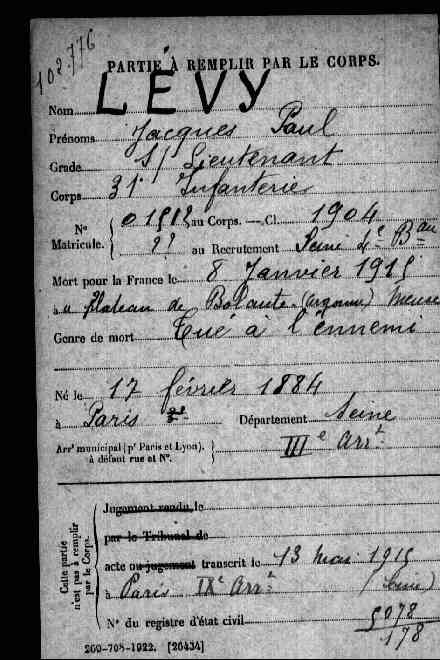
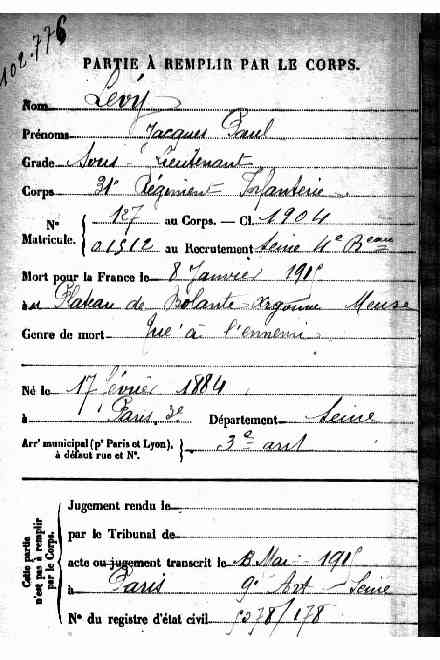
A member of the 31st Infantry Regiment, Lieutenant Levy was killed at the Plateau de Bolante, in the Argonne, on January 8, 1915.  Awarded the Croix de Guerre and Legion of Honour (the latter posthumously), he was the husband of Esther (Zadoc Khan) Levy, and the son of Camille and Blanche (Blum) Levy.  He was born on February 17, 1884, in the 3rd Arrondissement of Paris.

As per the (prior) post covering Lieutenants Aboucaya and Oulman, I’ve included the “Partie à Remplir Par le Corps” cards from the “Mémoire des hommes” website.  Lieutenant Levy’s name appears on page 55 of Les Israelites dans l’Armée Francaise.

The article in l’Univers Israélite is not a biographical profile as such. 

Or even, at all. 

Rather, it’s presentation of a speech given on Sunday, February 7, 1915, in the chapel of rue de la Victoire, by Chief Rabbi J.H. Dreyfuss.  Certainly sincerely meant, it is – perhaps inevitably – far more hagiographical than biographical, giving the reader insight into questions of patriotism within theology; theology with patriotism.

Throughout a war that would last four more long and terrible years, both the l’Univers Israélite and The Jewish Chronicle would be forced by circumstance to present many further stories, often – at least early in the war – in the same tone and manner.   

A PDF of the article is available here. 

____________________

Le lieutenant Jacques Lévy

Lieutenant Jacques Lévy

l’Univers Israélite
February 12, 1915

The Jewish World
February 12, 1915

Chaque jour s’allonge la liste de nos jeunes héros, fauchés à l’aurore de leur carrière et dont la mémoire est déjà entourée de la triple auréole de la vertu, de la vaillance et du martyre.  Nous avons, l’autre jour, cité le lieutenant Aboucaya, le lieutenant Oulman.  Parlerons-nous du lieutenant Jacques Lévy? Les souvenirs qui s’attachent maintenant à lui sont si poignants que nous aurions hésité à y toucher, même d’une plume discrète, si au service qui a été célébré, à sa mémoire, dimanche dernier, dans l’oratoire de la rue de la Victoire, M. le grand-rabbin J.-H. Dreyfuss n’avait retracé sa carrière et évoqué ses vertus.

Every day lengthens the list of our young heroes, broken in the dawn of their careers and whose memory is already surrounded by the triple halo of virtue, bravery and martyrdom.  We, the other day, cited Lieutant Aboucaya, Lieutenant Oulman.  We speak of Lieutenant Jacques Lévy?  The memories that are now attached to him are so poignant that we would hesitate to touch, even a discreet pen, if the service which was celebrated in his memory on Sunday, in the chapel of rue de la Victorie, the Chief Rabbi J.H. Dreyfuss had traced his career and mentioned his virtues.

Voici quelques passages de la touchante allocution de M. le grand-rabbin de Paris.

Here are some passages of the touching speech by the Chief Rabbi of Paris.

“Notre regretté frère Jacques Lévy avait appris de bonne heure à connaître le côté sérieux de l’existence; son adolescence fut mûrie par l’épreuve, et une épreuve cruelle: la perte de son bien-aimé et respecté père.  Il se considéra aussitôt comme appelé par la Providence au plus noble et au plus difficile des devoirs, d’autant plus difficile pour lui qu’il était tout jeune encore: celui d’assumer, en faveur des siens, la responsabilité du chef de famille.  Ce fut là l’idée directrice de toute sa jeunesse: il n’en dévia pas un instant.  Et ici, mes frères, admirez la force peu commune de ce caractère dé jeune homme.  Tous ses goûts le portaient vers les choses intellectuelles; affamé de culture, particulièrement attiré vers les sciences spéculatives, ce qui ne l’empêchait pas, d’ailleurs, de posséder le sentiment exquis de l’art et surtout de la peinture, mais préoccupé, d’autre part comme nous l’avons dit, de ses devoirs de famille, de l’obligation, de compter avec les réalités pratiques de la vie, il eut le courage et la ténacité de mener de front ses études et les soins de son emploi.  Il fut licencié en philosophie en méme temps qu’il achevait son apprentissage commercial.  Comment un caractère d’une telle trempe ne devait-il pas refuser?  Et il réussit en effet.” [réu-sir is probably an error]

“Our late brother Jacques Levy had learned early to know the serious side of life; his adolescence was matured by a test, and a cruel test: the loss of his beloved and respected father.  He immediately looked as called by Providence to the noblest and most difficult of duties, all the more difficult for him as he was still young: to assume, on behalf of his family, the householder’s responsibility.  This was the thrust of his youth: he did not swerve a moment.  And here, my brothers, admire the unusual strength of character this young man.  All tastes were to intellectual things; a hunger for culture, particularly attracted to the speculative sciences, which did not prevent him, however, from possessing an exquisite sense of art and especially painting, but concerned about the other part, as we said his family duties, the obligation, to reckon with the practical realities of life; he had the courage and tenacity to juggle his studies and the care of his employment.  He graduated in philosophy in the same time he completed a commercial apprenticeship.  He graduated in philosophy in same time he completed a commercial apprenticeship.  How should he not refuse a character of such calibre?  And he indeed succeeded.”

L’orateur rappelle avec émotion le marriage qui, il y a moins d’un an, avait uni le défunt à la fille “d’un pasteur qui est cher à nos coreligionnaires, non seulement par son mérite personnel, par son talent, par sa science, par son dévouement à toute épreuve, mais encore parce qu’il est l’époux de la fille du grand pasteur que fut l’inoubliable Zadoc Khan – je dis inoubliable dans le réelle acception du mot, car plus les années s’écoulent, plus son souvenir revit et revivra sans cesse dans toutes les circonstances de la vie de notre communauté.”

He recalled with emotion the marriage, of less than a year, that had united the deceased to the daughter “of a pastor who is dear to our fellow believers, not only by his personal merit, by his talent, by his science, his foolproof dedication, but because he is married to the daughter of that great shepherd who was the unforgettable Zadoc Khan – I say memorable in the real sense of the word, because the more years flow, I remember him and saw live again and again in all circumstances of life in our community.”

“Mais hélas ! sur cette maison à peine édifiée, si pleinement heureuse, a passé également le souffle de la tempête qui a déjà dévasté tant de foyers.

“But unfortunately ! this house built only if completely happy, has also experienced the breath of the storm that has already destroyed so many homes.

“Du même élan irrésistible qui, a l’appel de la patrie, a jeté à nos frontières tous les enfants de la France, le sergent Jacques Lévy quitte sa jeune femme et sa famille, va résolument prendre sa place a coté de ses frères d’armes.  Pour que rien ne manquât a cette nature d’élite, un patriotisme vibrant s’alliait en lui à une haute conscience.  Il prend part aux glorieux exploits de la Marne, se bat comme un brave, de sergent passe adjudant, d’adjudant sous-lieutenant, est cité à l’ordre du jour, et suprême récompense, proposé pour l’etoile de l’honneur.  Mais il tombe blessé et rest ramené du front.  Il aurait assez fait maintenant pour donner la mesure de sa vaillance; mais il veut faire plus que son devoir; il est heureux d’ailleurs et fier des lauriers glorieux qu’il a déjà cueillis…  Apres un court repos qui lui est imposé par sa convalescence, il demande à son colonel de le renvoyer au front.  Ce fut dans l’Argonne; a peine arrivé, il tombe une seconde fois, et helas ! pour ne plus se relever.

“At the same irresistible force, that has the call of his country, threw all the children of France upon our borders, Sergeant Jacques Lévy leaves his young wife and family, and will definitely take his place next to his brothers in arms.  That nothing might be wanting in this elite nature of vibrant patriotism was combined in him to a higher consciousness.  He took part in glorious exploits on the Marne, fights like a brave sergeant is promoted adjutant, and adjutant lieutenant, is quoted on the order of the day, and receives the star of honor for a supreme reward.  But he falls wounded and is brought back from the front to rest.  He would have done enough now to give the measure of his valor; but he wants to do more than his duty; he is also happy and proud of the glorious laurels he has already selected…  After a short rest imposed on him by his convalescence, he asked his colonel to return to the front.  It was in the Argonne; he has just arrived, he falls a second time, and alas! to rise no more. 

…La consolation!  Vous la trouverez dans le souvenir attendri, dans le souvenir béni de celui que n’est plus, vous la trouverez dans ces paroles écrites par lui, pour les siens, avant de retourner au front.  Dans cette page admirable, que j’ai lue et qui m’a remué profondément; l’homme se révèle tout entier.  C’est la page d’un philosophe et d’un croyant tout à la fois, d’un époux tendre, heureux et reconnaissant, d’un fils respectueux et pieux, d’un parent dévoue; c’est aussi la page d’un patriote, la page d’un soldat.  Dans quelques mots brefs, il parle de tout et de tous, de sa foi en l’idéal, éternellement beau et bon, de son culte de la vérité, de la loyauté, du devoir, de Dieu à qui il croit et à qui il rend grâces pour le bonheur des jours passés…  de tous les êtres chers qu’il confie à sa femme, de sa joie à repartir, ne laissant, comme il dit, aucune dette matérielle ni morale, de son amour de la France, de sa ferme confiance dans la victoire.  La dernière parole est une parole de touchante humanité en même temps qu’une parole de consolation.  “Si Dieu, le maître de ma vie, la prend, que tous les êtres chéris que je vais quitter à nouveau gardent, s’ils le peuvent, mon souvenir; mais qu’ils se consolent très vite de ma mort”.

The consolation!  You find it in the tender memory, in the memory of blessed one is not, you will find in these words written by him, for his family before returning to the front.  In this admirable page, I read and it stirred me deeply; man is proven whole.  This is the page of a philosopher and a believer at the same time, a tender husband, happy and grateful, a respectful son and pious, devoted parent; it is also a page of a patriot, a page of a soldier.  In a few brief words, he talks about everything and everybody, his faith in the ideal, eternally beautiful and good, worship of truth, of loyalty, duty, God whom he believes and to which he gives thanks for the good of bygone days…of all the loving things that he told his wife, his joy at leaving, leaving, as he says, no material or moral debt of his love of France, his firm confidence in victory.  The last word is a word of touching humanity along with a word of consolation.  “God, the master of my life, takes all the loved ones that I’ll leave and keep, if they can, my memory; but let them console themselves quickly of my death.”

Soldiers of The Great War: Jewish Military Service in WW I, as Reported in l’Univers Israélite (The Jewish World) – DEUX HÉROS (Two Heroes – Aboucaya and Oulman), February 5, 1915

The following article, from l’Univers Israélite, is the first such item in that periodical that covered – in detail – the lives and military service of Jewish soldiers who died while fighting for France. 

Alas, many more such items would appear l’Univers Israélite prior to November 11, 1918.

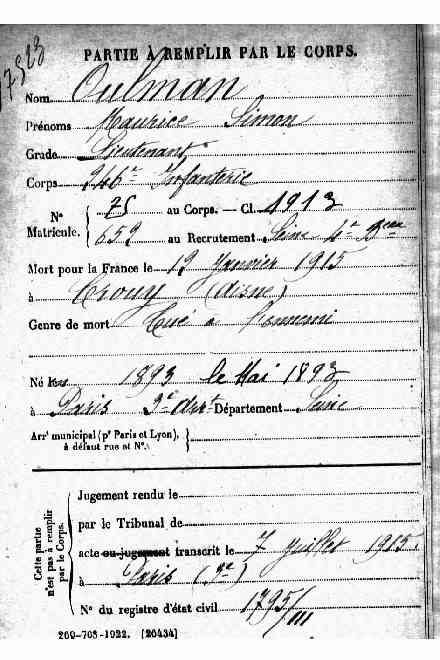
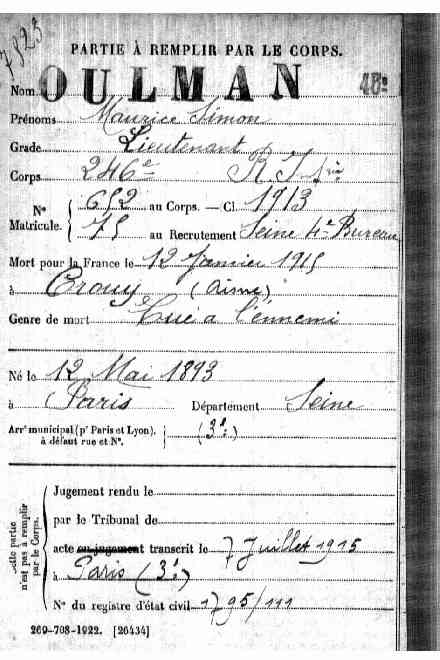
The article covers two Jewish officers:  Lieutenant Maurice Simon Oulman, and, Sous Lieutenant David Robert Aboucaya. 

Lieutenant Oulman, who served in the 246th Infantry Regiment, was killed at Crouy (Aisne), on January 12, 1915.  Born on May 12, 1893, he resided at the 3rd Arrondissement, in Paris.  His name appears on page 67 of Les Israelites dans l’Armée Francaise.

Sous Lieutenant Aboucaya, a member of the 136th Infantry Regiment, was killed near Reims on September 14, 1914.  Born on October 15, 1892, he also resided in Paris; in the 19th Arrondissement.  He received the Legion of Honor (posthumously), and, the Croix de Guerre.  His name appears on page 1 of Les Israelites dans l’Armée Francaise, and, page 184 of Le Livre d’Or du Judaisme Algérien (1914-1918).

A PDF version of this article is available here.

____________________

Along with the text of the article, I’ve included the “Partie à Remplir Par le Corps” cards for both men (from which the above information was obtained) which were found at the French Government’s “Mémoire des hommes” (Memories of the Men) website. 

Very strongly akin to the Commonwealth War Graves Commission’s database, Mémoire des hommes provides biographical records covering French military deaths incurred during World War One and the Second World War, as well as French military action in Indochina, Algeria, Morocco, and Tunisia.  Coverage of the First War World is particularly detailed, encompassing, “more than 1.3 million individuals deceased during the Great War”, 74,000 records concerning men who served in the French Air Force, as well as records for the 1,009 soldiers and civilains who were – as the website says – “…sentenced to death and shot in accordance with military judiciary decision or summarily executed.”  (Think: Paths of Glory).  The website also allows users to search for information about military casualties interred in French military cemeteries.  

The digital records covering both men were obtained as part of a (slightly…somewhat?…much!) larger project involving identifying the names of all Jewish soldiers who were killed while serving in the French military during WW I.  The results of this research have resulted in the identification of nearly 4,600 men.

____________________

DEUX HÉROS
TWO HEROES

l’Univers Israélite
February 5, 1915

The Jewish World
February 5, 1915

Combien sont-ils déjà, les officiers dont une mort héroïque a couronné une carrière courte, mais glorieuse?  Le plus souvent, nous apprenons leur mort par un avis laconique.  Quelquefois nous pouvons connaître des détails qui, en avivant nos regrets, augmentent aussi notre admiration pour ces braves qui unissent la bonté à la vaillance et la douceur à l’héroïsme.

How many are there already, officers whose heroic death capped a short, but glorious, career?  Most often, we learn of their deaths by a terse notice.  Sometimes we can know details which, heightening our regrets, also increase our admiration for these braves uniting kindness the valor and heroism sweetness.

Nous voulons en citer pour aujourd’hui deux exemples, qui nous sont fournis par le lieutenant Aboucaya et le lieutenant Oulman.

We want today to name two examples, which are provided to us by Lieutenant Aboucaya and Lieutenant Oulman.

Le lieutenant Aboucaya
Lieutenant Aboucaya

Nous avons déjà signalé la mort au champ d’honneur du sous-lieutenant de réserve Aboucaya, du 136e d’infanterie, fils de M. Léon Aboucaya, l’industriel connu, membre du Consistoire central.

We have already reported the death in battle of Reserve Second Lieutenant Aboucaya, 136th Infantry, son of Leon Aboucaya, known industrialist, member of the Central Consistory.

Nous avons pu avoir communication d’une bien belle lettre écrite au père du jeune officier par son chef direct, le capitaine Fournier, lui-même grièvement blessé d’une balle à la tête.

We have had communication via a beautiful letter written to the father of the young officer by his immediate superior, Captain Fournier, himself seriously wounded by a bullet to the head.

Le capitaine dit d’abord “toute l’estime que le caractère et le courage” du jeune sous-lieutenant, à l’ “allure décidée et franche”, lui avaient gagnée auprès de ses supérieurs et de ses égaux et qui s’était vite changée en une bonne amitié quand ils avaient reconnu le côté affectueux de sa nature et la cordialité de ses sentiments de famille.

The captain initially said “all the esteem that the character and courage” of the young lieutenant, to the “determined and frank look,” had won him over to his superiors and his equals and that had quickly turned into a good friendship when they recognized the affectionate side of his nature and the warmth of his family feelings.

L’officier était digne de l’homme. “Pendant toute la période des marches en France et en Belgique, malgré la grande chaleur, les étapes très longues, le lieutenant Aboucaya avait tenu à donner l’exemple à ses hommes. Il avait, sac au dos et malgré son peu d’entraînement, supporté ces grandes fatigues du début et donné ainsi la mesure s’un caractère énergique, qui faisait bien augurer de lui pour le combat. Promesse tenue, car à F. ., à St-S… R… (combat de Guise), à Ch…, à S…, enfin, son attitude a été celle d’un chef imposant la confiance à ses homes”.  [Probably error in original a “u’un”.]

The officer was worthy of man.  “Throughout the period of marches in France and Belgium, despite the great heat, the very long intervals, Lieutenant Aboucaya had wanted to set an example to his men.  His backpacking, despite his lack of training, supported these with great fatigue early and given so far as an energetic character, which augured well for him for the fight.  The promise was kept, because at F., at St. S… R… (combat at Guise), at Ch…, at S…, finally, his attitude was that of a leader imbuing confidence in his men.”

A F.., notamment, la section Aboucaya tint vigoureusement une hauteur, de 4 heures du matin à midi, sous un feu infernal d’infanterie et d’artillerie, répondant coup pour coup et fort habilement à l’attaque de l’ennemi. Le lendemain soir, à O…, au moment où le régiment allait faiblir dans une charge à lâ baïonnette, le lieutenant Aboucaya, aux cris de en avant ! en avant ! réussit à arrêter la panique grâce à son attitude énergique.  “Le chef de bataillon et le colonel le félicitèrent d’ailleurs chaudement à la suite de cet acte de courage, qui valait une citation à l’ordre du jour”.

At F…, including Aboucaya’s section vigorously held a height from 4 A.M. to noon under a hellish fire of infantry and artillery, responding blow for blow and very skillfully attacking the enemy.  The next evening at O…, when the regiment’s bayonet charge was weak ing, Lieutenant Aboucaya, chanting forward! forward! managed to avert panic through his energetic attitude.  “The Battalion Commander and Colonel also warmly congratulated him after this act of courage, worthy of an Order of the Day.”

A Ch…, le lieutenant Aboucaya se distingua encore par sa “vaillante attitude pendant les heures de lutte émouvante qui eurent pour théâtre le village en flames”. C’est à S…, qu’à la tête de sa section, soumise à un feu terrible d’artillerie, il tomba, au premier rang, “la où depuis le debut il avait eu à cœur de sa tenir toujours”.

At Ch… Lieutenant Aboucaya was still distinguished for his “courageous attitude during the emotional struggle that took hours to the village theater in flames”.  This is at S…, where at the head of his section, subject to a terrible artillery fire, he fell in the front line, the “where from the beginning he was to keep his heart always.”

J’ai perdu, conclut le capitaine, “un officier ardent et courageux, sur lequel je savais pouvoir compter. Je garderai fidèlement son souvenir; son nom et son image seront encore évoqués souvent dans nos tranchées; plus d’une fois encore, les soldats qui restent de sa section parleront de lui avec le regret du chef qu’ils aimaient pour sa bonté et son entrain”.

I lost, concludes the captain, “an ardent and courageous officer, on whom I knew I could count.  I faithfully keep his memory; his name and image still come up in our trenches; more than once again, the soldiers who remain in his section will discuss him with the head of regret that they loved for his kindness and enthusiasm.”

Cette lettre, si noble et si émouvante que nous aurions voulu la citer tout entière, est un titre de gloire pour celui qui en est l’objet, elle fait honneur aussi à celui qui l’a écrite.

This letter, so noble and so moving that we wanted the whole quote is a claim to fame for the one who is the object, it also does honor to the one who wrote it.

Le lieutenant Oulman
Lieutenant Oulman

Le lieutenant Maurice Oulmàn, dont nous avons annoncé la semaine dernière la mort au champ d’honneur, avait été promu à ce grade le 6 septembre 1914, à la bataille de la Marne, pour son courage, son sang-froid, son énergie, pour l’enthousiasme qu’il avait su inspirer à tous ses soldats, lorsque, ce jour-là, ses chefs, le capitaine et le lieutenant en premier, avaient été frappés mortellement.

Lieutenant Maurice Oulman, whose death in battle we announced last week, had been promoted to the grade on 6 September 1914, at the Battle of the Marne, for his courage, his composure, his energy, for the enthusiasm that had inspired all his soldiers, when on that day, the leaders, the captain and first lieutenant, had been mortally wounded.

Son colonel l’aurait nommé capitaine si Oulman n’avait été trop jeune pour ce grade: il n’avait que vingt-et-un ans.  Malgré sa jeunesse, tous les hommes qu’il avait sous ses ordres l’adoraient comme un père. De fait, il remplissait les fonctions de commandant de compagnie.

His colonel would have appointed him captain but Oulman had been too young for this degree: he was only twenty-one years.  Despite his youth, all the men he had under him loved him like a father.  In fact, he acted as the company commander.

Lorsqu’à la terrible bataille de l’Aisne, son sous-lieutenant tomba, frappé d’une balle au ventre, il s’elança sous le feu meurtrier. En vain, un sergent, blessé à côté de lui, le supplie de ne pas s’exposer; malgré une plaie au pied qui gêne sa marche, il va de l’avant, jusqu’à ce que la mitraille l’abatte. Trois des combattants vont ramasser le corps, pour l’enterrer au cimetière de C…; deux tombent à leur tour.

When at the terrible Battle of the Aisne, his lieutenant fell, struck by a bullet in the stomach, he darted under the murderous fire.  In vain, a sergeant, wounded beside him, begs him not to expose himself; despite a sore foot bothering his walk, he goes ahead until the landslide of shrapnel.  Three fighters will pick up the body, burying him in the cemetery of C…; Both fall in turn.

Il aura l’honneur posthume d’être inscrit à l’ordre du jour, ainsi que, dans sa lettre de condoléances à la famille, le colonel du régiment l’écrit.

He will have the posthumous honor to be included on the Order of the Day and, in his letter of condolences to the family, the colonel of the regiment wrote.

Voici en quels termes émus M. T…, un collègue du défunt, fait son éloge dans une lettre adressée aux parents de la victime:

Here is how Monsieur T… moving words…a deceased colleague, praising him in a letter to the victim’s parents:

“…Je voudrais tant que ma premiere lettre fut pleine de l’affection admiration que j’avais pour votre cher fils dont la mort m’a déchiré.

“… I want as my first letter to be full of the affection and admiration I had for your dear son whose death tore me.

“Nous étions au repos à St-P… quand est venu l’ordre, le 13, vers dix heures du matin, de se porter rapidement à C…, ou les Allemands attaquaient.  Maurice était étendu sur son lit, depuis 8 jours il souffrait un peu du pied gauche…  Mais dés que l’ordre d’alerte et de départ lui parvint, il se leva; se fit refaire par un infirmier un pansement réduit pour pouvoir marcher. “Vous feriez mieux de rester au repos, mon lieutenant”, lui dit l’infirmier. Il ne répondit pas. Avec ce courage calme et réfléchi qui a toujours forcé notre admiration et qui était le secret de son ascendant sur ses 250 hommes, des gens de 30 à 35 et 40 ans, parfois, qui lui obéissaient aveuglément, il prit la tête de la compagnie.

“We were standing at St. P… when came the order, the 13th, about ten in the morning, to stand fast in C… or the Germans would attack.  Maurice was lying on his bed for 8 days suffering a little in his left foot…  But as soon as the order for alert and departure reached him, he stood up; a nurse came by again with a small dressing to walk.  “You better stay at rest, sir,” said the nurse.  He did not answer.  With this calm and thoughtful spirit that has always forced our admiration and that was the secret of his ascendancy over his 250 men, people from 30 to 35 and 40 years, sometimes, who obeyed him blindly, he led the company.

“Il arrive à C…, appuyé sur canne, ayant traversé sans perdre un homme le terrain nu balayé par les feux de l’éperon 132. Là il reçut l’ordre de monter rapidement sur le plateau de P… occuper les tranchées de repli pour soutenir le régiment que les Allemands bousculaient en première ligne. Il fait le cheminement habituel, mais, hélas ! les Allemands tenaient déjà les positions même qu’il allait occuper.

“We arrived at C…, pressed the sticks, passed through without losing a man on the bare ground swept by the fires of spur 132.  There he was ordered to quickly climb the Plateau of P… to occupy the fallback trenches to support the regiment’s as Germans were jostling the frontline.  He made the usual path, but alas! The Germans already held the same position he would occupy.

“Un sous-lieutenant tombe près du lieutenant Oulman. Celui-ci s’avance vers lui, lorsqu’un sergent le prend par le bras: “Mon lieutenant, ne vous montrez pas, nous avons besoin de quelqu’un pour nous commander” … Mais lui se dégage avec fermeté et dit: “Laissez-moi, ne vous occupez pas de cela”. Il n’avait pas fait trois pas qu’il tombait en arrière, sans un cri; une balle lui avait traversé la téte. Toute la compagnie s’arrête, figée par l’atroce nouvelle qui court de rang en rang.

“A second lieutenant dies near Lieutenant Oulman.  He advances towards him, when a sergeant takes him by the arm: “Lieutenant, do not show yourself, we need someone to lead us”…  But he emerges firmly and said, “Leave me, do not mind that.”  He had not taken three steps when he fell back, without a cry; a bullet had passed through his head.  The whole company stopped, frozen by the terrible news that runs from rank to rank.

“Si vous saviez comme ils l’aimaient, leur jeune chef si simple, si brave, si énergique et si pur! Pour les officiers, c’est un peu la Jeanne d’Arc de cette guerre. Et j’ai vu le lendemain encore des hommes pleurer en me contant tout cela. Au reste leur opinion est faite: “Ce petit-là, on l’aurait suivi partout, oh! nous perdons gros! Et personne ne saura nous conduire comme lui”.

“If you knew how they loved, their young leader so simple, so brave, so strong and so pure!  For officers, he’s a little Joan of Arc of the war.  And I saw it again with next men crying telling me all this.  Besides, their opinion is made: “This little one, we would have followed him everywhere, oh! we lose big!  And no one will take us like him.”

“Ils disaient vrai, nul d’entre nous n’a ce sang-froid que rien ne troublait, cette énergie méthodique qui n’était pas de son âge”.

“They were right, none of us has the coolness that nothing disturbed, this methodical energy that was not of his age.”

Le lieutenant Oulman avait 21 ans.

Lieutenant Oulman was 21.
References

Le Livre d’Or du Judaisme Algérien (1914-1918) (Réédité par le Cercle de Généalogie juive, Paris, 2000) [Avec la collaboration de Georges Teboul et de Jean-Pierre Bernard]

Les Israelites dans l’Armée Francaise, Angers, 1921 (Réédité par le Cercle de Généalogie juive, Paris, 2006)

Mémoire des Hommes, at http://www.memoiredeshommes.sga.defense.gouv.fr/en/

Soldiers who Died for France in the First World War, at http://www.memoiredeshommes.sga.defense.gouv.fr/fr/arkotheque/client/mdh/base_morts_pour_la_france_premiere_guerre/index.php?
Soldiers of The Great War: Jewish Military Service in WW I, as Reported in The Jewish Chronicle – “Russian Jews and The War”, October 9, 1914

A brief item from The Jewish Chronicle about Russian Jewry during The Great War.

Short; direct, the article would seem to imply that the attitudes of soldiers, and, actions of civilian authorities at Bielostock, were small signs of the impending; eventual, social and political acceptance of the Jews in Russia. 

Whether one is powerless, or incorrectly believes oneself to be powerless, then any perceived sign of goodwill, even if motivated by simple practicality, can be seen as a harbinger of hope…

____________________

RUSSIAN JEWS AND THE WAR

Christian Soldiers Commend Jews

(FROM OUR CORRESPONDENT)

The Jewish Chronicle
October 9, 1914

PETROGRAD

One of the pleasant features of the War is the good feeling established between Christian and Jewish soldiers in the active army.  The wounded soldiers in the hospitals speak highly of the conduct of their Jewish comrades on the battlefield.  They are also full of praise for the treatment they receive in the military hospitals organized by the Jews.

JEWS PREFERRED

Striking evidence of what the authorities now think of Jewish loyalty has been forthcoming at Bielostock.  Some five hundred and fifty Jews offered their services to the Red Cross for the purpose of assisting in the removal of wounded soldiers to the hospitals.  At the same time seventy Poles also enrolled themselves, but they refused to co-operate with the Jewish contingent.  The authorities thereupon accepted their resignations and refused to dismiss the Jewish volunteers.

Soldiers of The Great War: Jewish Military Service in WW I, as Reported in The Jewish Chronicle – “The Chief Rabbi of France and The Troops at The Front”, October 2, 1914

Throughout the war, both The Jewish Chronicle and l’Univers Israélite, carried articles about religious services conducted by and held for Jewish soldiers, often describing such services in great detail, and in a larger sense, presenting many essays and thought pieces – from highly varied viewpoints, let alone a diversity of writers – about religion in the context of war. 

l’Univers Israélite, in particular, published several lengthy, detailed, and moving items about Jewish religious services – held in or near front-line positions – within 1915.  (I hope to post those items in the future…)

The item below covers a request presented to M. Alfred Levy, Chief Rabbi of France, to arrange religious services for British Jewish soldiers, with and among French Jewish troops.

Rabbi Levy’s reply states, “We have had the misfortune to lose one of them, the Chief Rabbi of Lyons, who fell on the field of battle, shot by an enemy’s bullet.”  Rabbi Levy is almost certainly referring to Aumonier Militaire Abraham Bloch, born in Paris in 1859, who was killed while serving with the “14eme Section d’Infirmieres Militaires; Groupe de Brancardiers Divisionnaire” on August 29, 1914, at Anozel, in the Vosges area. 

Rabbi Bloch posthumously received the Medaille militaire.  The story of his death (as opposed to how he actually died) – as reported and portrayed by the press – had great symbolic impact, and would be covered in l’Univers Israélite on November 27, 1914, and May 21, 1915. 

Information is readily available concerning Rabbi Bloch.  I particularly refer readers to the book Les Juifs de France et la Grande Guerre, by Philippe-E. Landau (CNRS Editions, Paris, 1999), which devotes a full chapter to this story. 

____________________

THE CHIEF RABBI OF FRANCE AND THE TROOPS AT THE FRONT

The Jewish Chronicle
October 2, 1914

The Chaplain recently wrote to the Chief Rabbi of France, M. Alfred Levy, asking him to endeavour to arrange for the English Jewish soldiers to join the French troops at any religious services during the campaign.  He has now received the following reply –

M. Place St. Georges, Paris
18th September, 1914.

DEAR COLLEAGUE – In reply to your letter, I beg to inform you that nearly all the members of the French Rabbinate are serving their country, either as chaplains, or as soldiers.  We have had the misfortune to lose one of them, the Chief Rabbi of Lyons, who fell on the field of battle, shot by an enemy’s bullet.

I gave instructions to all to hold divine service in the field if they can collect a [minyan].  I am unable to see the Minister of War at present, as he is absent from Paris, but I am sure that our chaplains will know how to fulfill their duty, and that the generals to whom they apply will grant the necessary permission, so far as the exigencies of the military service will permit.

With best wishes for _____

Yours very sincerely,

Rev. Michael Adler, B.A., London                                     A. LEVY, Chief Rabbi

Soldiers of The Great War: Jewish Military Service in WW I, as Reported in The Jewish Chronicle – “Proud of Being a Soldier” [Schoenthal Brothers], October 2, 1914

“You always said it was honourable, and it is at such a time at this that everyone respects a soldier or sailor.”

This article from The Jewish Chronicle presenting excerpts from the brothers Schoenthal to their parents, reveals their anticipation and optimism about military service.

Happily, the absence of their names from the Commonwealth War Graves Commission database indicates that both survived the war.

Given the text of Cosman’s letter, it seems evident that his parents shared their son’s letter with the Chronicle.

____________________

PROUD OF BEING A SOLDIER

The Jewish Chronicle
October 2, 1914

Corporal H. Schoenthal, of the 1st Essex Regiment, writing from Vacoas, Mauritius, on August 6th, states that it was only on the preceding day that the Regiment knew that England was very near to war with Germany: “and about half-an-hour ago,” the letter proceeds, “it came through to us officially.  You cannot picture the excitement we are going through.  Our Regiment is in Port Louis Fort, but we have no idea whether we stay here or go to another country.”

“Be of good cheer, the same as I am.”  – In a postscript the Corporal writes that he is looking forward to another medal.

A brother of the Corporal – Private Cosman Schoenthal – writing from camp on August 30th, states that he is under orders to move, but he neither knows where or when he is to go.

“I expect,” he goes on, “to be made either a lance-corporal, or full corporal, as soon as the list arrives from England.  Of course, you must still address me as Private until you hear definitely.”

“Anyhow, our Sergt.-Major told me that in all intents and purposes I am a corporal now, as, when I am made, it will be dated back.  So, with a little luck, I will beat Harry’s rank soon, and he the proud possessor of a medal, too.  A spirit of enthusiasm prevails everywhere, and I am proud to say now that I am a soldier.  You always said it was honourable, and it is at such a time at this that everyone respects a soldier or sailor.  Anyhow, the honour will rebound on to your shoulders for having two sons, who are both proud to be in the Army.”

In a postscript, the writer, says ironically, “It’s a rotten Navy that we have, isn’t it?  A little bit too good for the one that was made in Germany, though – (I hope this will pass the Censor.)”

(Photographs of the brothers will appear in the next Wednesday’s issue of the Jewish World.)

Soldiers of The Great War: Jewish Military Service in WW I, as Reported in l’Univers Israélite (The Jewish World) – Les soldats juifs dans l’armée russe (Jewish Soldiers in the Russian Army), January 15, 1915

Oddly, despite the enormous losses thus far incurred by the French armed forces, the first detailed account of Jewish military service carried by l’Univers Israélite did not cover French Jewish soldiers.  Instead, it concerned the military services of Jews in the army of Imperial Russia, and paralleled The Jewish Chronicle’s coverage of military service of this topic.

This item – published on January 15, 1915 – appears below.

The article is different from similar items in the Chronicle, in that the source of the information is revealed – J. Antokolsky – but no further information about him is presented.  Given the details in the article, perhaps Mr. Antokolsky was a Russian citizen, and therefore had direct access to the Russian media, as well as newspapers issued by the Jewish press – details from which were forwarded to l’Univers Israélite.  Or, perhaps he was living in France and maintained contact with news sources in Russia, or, subscribed to Russian news publications.

In any event, even considering any embellishment to these stories, they do suggest the level of assimilation, acculturation – and ultimately, patriotism – present among the Jews of Russia at this time.

As for the image at the head of this post – from The Jewish World of September 9, 1914? 

Perhaps this man is the “Miller” referred to in the concluding paragraph, who is said to have become an assistant sergeant in the Cossacks…

A PDF version of this item is available here. 

____________________

  Les soldats juifs dans l’armée russe

Jewish Soldiers in the Russian Army

l’Univers Israélite
January 15, 1915

The Jewish World
January 15, 1915

Les préoccupations que nous avons ici ne doivent pas nous empêcher de suivre avec une attention vigilante ce qui se passe en Russie, où le sort de sept millions de juifs se joue en ce moment. Nous nous proposons de revenir, et de revenir sans cesse, sur la question juive en Russie et sut le rôle des juifs dans la guerre actuelle. Nous publierons prochainement une étude statistique sur le nombre des juifs dans l’armée russe. Pour amorcer ce sujet, voici quelques renseignements qu’a bien voulu nous communiquer un de nos lecteurs, M. J. Antokolsky.

The concerns we have here should not prevent us from following with careful attention what is happening in Russia, where the fate of seven million Jews is being played right now.  We intend to come back, and come back constantly, on the Jewish question in Russia and know the role of Jews in the present war.  We will soon publish a statistical study on the number of Jews in the Russian army.  To initiate this, here is some information kindly sent us by one of our readers, Mr. J. Antokolsky.

J’applaudis de tout cœur à votre idée de publier dans le journal que vous dirigez avec tant d’habileté les faits d’armes extraordinaires accomplis par nos frères sur les champs de bataille. Il n’est pas douteux que vos lecteurs ne soient heureux d’apprendre que nos coreligionnaires russes se montrent dignes de leurs camarades en France. Vous me permettrez donc de vous signaler quelques actions d’éclat dont les héros sont nos coreligionnaires russes et dont les journaux russes ont parle avec admiration.

I applaud with whole heart your idea of publishing in the newspaper that you lead so skillfully extraordinary feats performed by our brothers on the battlefield.  There is no doubt that your readers will be pleased to know that our fellow Russians show themselves worthy of their comrades in France.  So allow me to point out some brilliant actions of our heroic fellow Russian coreligionists of whom Russian newspapers speak with admiration.

Aïsik Goutman, en reconnaissance à la tête d’un peloton de cavalerie, a fait preuve d’une grande intelligence et bravoure. Blessé aux deux mains, il continue à diriger le mouvement en avant. Ayant eu son cheval tué sous lui et ne pouvant se relever, il continue à donner des ordres à son peloton et lui indique le chemin à suivre pour éviter l’ennemi. Fait prisonnier et questionné par l’ennemi sur l’emplacement et l’importance de sa troupe, il donne des renseignements volontairement erronés. Profitant du sommeil de son gardien, il s’évade dans la nuit, se cache tout le jour dans les bois, et rejoint son régiment, d’où il est aussitôt transporté à l’Hôpital de Wilna. Il y reçoit la visite de son chef de corps, qui lui apporte deux croix de Saint-Georgés — la plus haute récompense en temps de guerre — et lui dit textuellement “Mon petit frère, toute ma vie je me souviendrai de toi et de ta bravoure, et je te propose pour la troisième croix.”

Aïsik Goutman in reconnaissance at the head of a squad of cavalry, has shown great intelligence and bravery.  Wounded in both hands, he continues to lead the movement forward.  Having had his horse shot out under him and being unable to get up, he continued to give orders to his platoon and shows them the path to follow to avoid the enemy.  Captured and questioned by the enemy on the location and extent of his troop, he gave deliberately misleading information. Taking advantage of his sleeping guard, he escaped into the night, hiding all day in the woods, and joined his regiment, where he was immediately taken to the Hospital of Wilna.  He is visited by his commanding officer, who brings him two Crosses of St. George – the highest award in wartime – and told him verbatim “My little brother, all my life I will remember you and your bravery, and I propose for you the third cross.”

Oswald, jeune soldat de 20 ans, arrache à l’ennemi le premier drapeau, décoré de la croix de Saint-Georges, soigné à l’Hôpital de Wilna.

Oswald, a young soldier of 20 years, snatches the enemy’s first flag, decorated with the Cross of St. George, treated at the Hospital of Vilna.

Elie Archin, pointeur dans une batterie. Toujours à son poste de combat, a pris part à six grandes batailles; décoré de la croix de Saint-Georges pour sa bravoure hors ligne et sa grande intelligence. Son commandant écrit personnellement une lettre au père Archin pour lui marquer combien il est heureux d’avoir sous ses ordres un soldat d’une si grande valeur.

Elie Archin, aimer in a battery.  Always at his post, took part in six major battles; decorated with the Cross of St. George for bravery offline and great intelligence.  His commander personally wrote a letter to Mr. Archin to mark him how happy he is to have under him a soldier of such great value.

Katz, promu au grade de sous-lieutenant sur le champ de bataille (fait tout à fait rare en Russie) pour faits d’armes tout-à-fait exceptionnels. Le journal russe qui rapporte ce fait avec enthousiasme ajoute qu’il est heureux d’annoncer que Katz, en reconnaissance de son grade, a embrassé la religion orthodoxe.  Mais notre héros riposte immédiatement par une lettre au même journal: “Je suis né juif, je reste et mourrai juif.”

Katz, promoted to sub-lieutenant on the battlefield (in fact quite rare in Russia) for feats made entirely exceptional.  The Russian newspaper reported this fact with enthusiasm adding that he was pleased to announce that Katz, in recognition of his rank, embraced the Orthodox religion.  But our hero responded immediately by a letter to the same newspaper: “I was born Jewish, I am and will die a Jew.”

Un jeune écolier de quinze ans et derni quitte la maison sans prévenir ses parents, suit un régiment et combat sur le front héroïquement.  Blessé et fait prisonnier, il est torturé par les Autrichiens, qui veulent obtenir des renseignements sur son regiment; mais le jeune héros ne répond rien.  Il est jeté dans un hangar froid où il reste plusieurs jours sans nourriture; il s’évade et rentre dans son regiment.  Nommé sergent malgré son jeune àge.

A young schoolboy of fifteen and a half leaves home without telling his parents, following a regiment and fighting at the front heroically.  Wounded and taken prisoner, he is tortured by the Austrians, who want to obtain information about his regiment; but the young hero does not answer.  He is thrown into a cold shed where he remained many days without food; he escaped and returned to his regiment.  Named sergeant despite his young age.

Je ne vous parle pas du jeune cosaque Miller (vingt ans), nommé sergent-adjoint, décoré trois fois sur le champ de bataille, car tous les journeaux de Paris et de province ont publié des articles élogieux en son honneur.

I’m not talking about the young Cossack Miller (twenty years), appointed assistant sergeant, decorated three times on the battlefield, because all the newspapers of Paris and the provinces have published favorable articles in his honor.