Soldiers of The Great War: Jewish Military Service in WW I, as Reported in l’Univers Israélite (The Jewish World) – Le lieutenant Jacques Lévy (Lieutenant Jacques Lévy), February 12, 1915

Only a week about presenting the stories of Lieutenants Aboucaya and Oulman, l’Univers Israélite continued its coverage of Jewish military casualties in the French Army with an article about Sous Lieutenant Jacques Lévy.

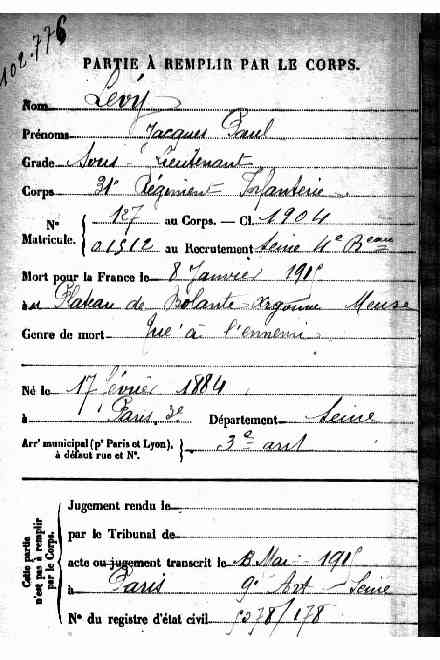
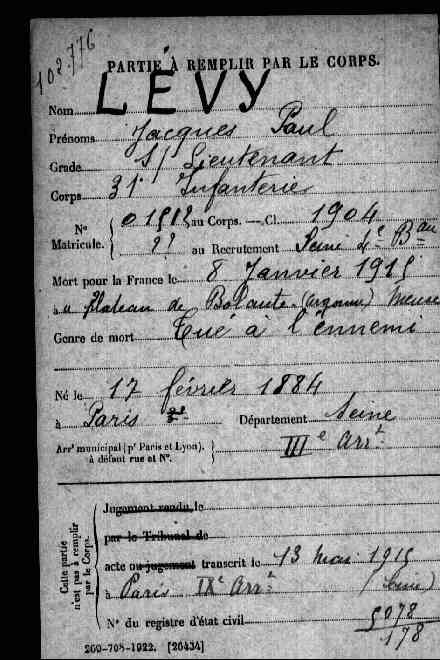
A member of the 31st Infantry Regiment, Lieutenant Levy was killed at the Plateau de Bolante, in the Argonne, on January 8, 1915.  Awarded the Croix de Guerre and Legion of Honour (the latter posthumously), he was the husband of Esther (Zadoc Khan) Levy, and the son of Camille and Blanche (Blum) Levy.  He was born on February 17, 1884, in the 3rd Arrondissement of Paris.

As per the (prior) post covering Lieutenants Aboucaya and Oulman, I’ve included the “Partie à Remplir Par le Corps” cards from the “Mémoire des hommes” website.  Lieutenant Levy’s name appears on page 55 of Les Israelites dans l’Armée Francaise.

The article in l’Univers Israélite is not a biographical profile as such. 

Or even, at all. 

Rather, it’s presentation of a speech given on Sunday, February 7, 1915, in the chapel of rue de la Victoire, by Chief Rabbi J.H. Dreyfuss.  Certainly sincerely meant, it is – perhaps inevitably – far more hagiographical than biographical, giving the reader insight into questions of patriotism within theology; theology with patriotism.

Throughout a war that would last four more long and terrible years, both the l’Univers Israélite and The Jewish Chronicle would be forced by circumstance to present many further stories, often – at least early in the war – in the same tone and manner.   

A PDF of the article is available here. 

____________________

Le lieutenant Jacques Lévy

Lieutenant Jacques Lévy

l’Univers Israélite
February 12, 1915

The Jewish World
February 12, 1915
Chaque jour s’allonge la liste de nos jeunes héros, fauchés à l’aurore de leur carrière et dont la mémoire est déjà entourée de la triple auréole de la vertu, de la vaillance et du martyre.  Nous avons, l’autre jour, cité le lieutenant Aboucaya, le lieutenant Oulman.  Parlerons-nous du lieutenant Jacques Lévy? Les souvenirs qui s’attachent maintenant à lui sont si poignants que nous aurions hésité à y toucher, même d’une plume discrète, si au service qui a été célébré, à sa mémoire, dimanche dernier, dans l’oratoire de la rue de la Victoire, M. le grand-rabbin J.-H. Dreyfuss n’avait retracé sa carrière et évoqué ses vertus.

Every day lengthens the list of our young heroes, broken in the dawn of their careers and whose memory is already surrounded by the triple halo of virtue, bravery and martyrdom.  We, the other day, cited Lieutant Aboucaya, Lieutenant Oulman.  We speak of Lieutenant Jacques Lévy?  The memories that are now attached to him are so poignant that we would hesitate to touch, even a discreet pen, if the service which was celebrated in his memory on Sunday, in the chapel of rue de la Victorie, the Chief Rabbi J.H. Dreyfuss had traced his career and mentioned his virtues.

Voici quelques passages de la touchante allocution de M. le grand-rabbin de Paris.

Here are some passages of the touching speech by the Chief Rabbi of Paris.

“Notre regretté frère Jacques Lévy avait appris de bonne heure à connaître le côté sérieux de l’existence; son adolescence fut mûrie par l’épreuve, et une épreuve cruelle: la perte de son bien-aimé et respecté père.  Il se considéra aussitôt comme appelé par la Providence au plus noble et au plus difficile des devoirs, d’autant plus difficile pour lui qu’il était tout jeune encore: celui d’assumer, en faveur des siens, la responsabilité du chef de famille.  Ce fut là l’idée directrice de toute sa jeunesse: il n’en dévia pas un instant.  Et ici, mes frères, admirez la force peu commune de ce caractère dé jeune homme.  Tous ses goûts le portaient vers les choses intellectuelles; affamé de culture, particulièrement attiré vers les sciences spéculatives, ce qui ne l’empêchait pas, d’ailleurs, de posséder le sentiment exquis de l’art et surtout de la peinture, mais préoccupé, d’autre part comme nous l’avons dit, de ses devoirs de famille, de l’obligation, de compter avec les réalités pratiques de la vie, il eut le courage et la ténacité de mener de front ses études et les soins de son emploi.  Il fut licencié en philosophie en méme temps qu’il achevait son apprentissage commercial.  Comment un caractère d’une telle trempe ne devait-il pas refuser?  Et il réussit en effet.” [réu-sir is probably an error]

“Our late brother Jacques Levy had learned early to know the serious side of life; his adolescence was matured by a test, and a cruel test: the loss of his beloved and respected father.  He immediately looked as called by Providence to the noblest and most difficult of duties, all the more difficult for him as he was still young: to assume, on behalf of his family, the householder’s responsibility.  This was the thrust of his youth: he did not swerve a moment.  And here, my brothers, admire the unusual strength of character this young man.  All tastes were to intellectual things; a hunger for culture, particularly attracted to the speculative sciences, which did not prevent him, however, from possessing an exquisite sense of art and especially painting, but concerned about the other part, as we said his family duties, the obligation, to reckon with the practical realities of life; he had the courage and tenacity to juggle his studies and the care of his employment.  He graduated in philosophy in the same time he completed a commercial apprenticeship.  He graduated in philosophy in same time he completed a commercial apprenticeship.  How should he not refuse a character of such calibre?  And he indeed succeeded.”

L’orateur rappelle avec émotion le marriage qui, il y a moins d’un an, avait uni le défunt à la fille “d’un pasteur qui est cher à nos coreligionnaires, non seulement par son mérite personnel, par son talent, par sa science, par son dévouement à toute épreuve, mais encore parce qu’il est l’époux de la fille du grand pasteur que fut l’inoubliable Zadoc Khan – je dis inoubliable dans le réelle acception du mot, car plus les années s’écoulent, plus son souvenir revit et revivra sans cesse dans toutes les circonstances de la vie de notre communauté.”

He recalled with emotion the marriage, of less than a year, that had united the deceased to the daughter “of a pastor who is dear to our fellow believers, not only by his personal merit, by his talent, by his science, his foolproof dedication, but because he is married to the daughter of that great shepherd who was the unforgettable Zadoc Khan – I say memorable in the real sense of the word, because the more years flow, I remember him and saw live again and again in all circumstances of life in our community.”

“Mais hélas ! sur cette maison à peine édifiée, si pleinement heureuse, a passé également le souffle de la tempête qui a déjà dévasté tant de foyers.

“But unfortunately ! this house built only if completely happy, has also experienced the breath of the storm that has already destroyed so many homes.

“Du même élan irrésistible qui, a l’appel de la patrie, a jeté à nos frontières tous les enfants de la France, le sergent Jacques Lévy quitte sa jeune femme et sa famille, va résolument prendre sa place a coté de ses frères d’armes.  Pour que rien ne manquât a cette nature d’élite, un patriotisme vibrant s’alliait en lui à une haute conscience.  Il prend part aux glorieux exploits de la Marne, se bat comme un brave, de sergent passe adjudant, d’adjudant sous-lieutenant, est cité à l’ordre du jour, et suprême récompense, proposé pour l’etoile de l’honneur.  Mais il tombe blessé et rest ramené du front.  Il aurait assez fait maintenant pour donner la mesure de sa vaillance; mais il veut faire plus que son devoir; il est heureux d’ailleurs et fier des lauriers glorieux qu’il a déjà cueillis…  Apres un court repos qui lui est imposé par sa convalescence, il demande à son colonel de le renvoyer au front.  Ce fut dans l’Argonne; a peine arrivé, il tombe une seconde fois, et helas ! pour ne plus se relever.

“At the same irresistible force, that has the call of his country, threw all the children of France upon our borders, Sergeant Jacques Lévy leaves his young wife and family, and will definitely take his place next to his brothers in arms.  That nothing might be wanting in this elite nature of vibrant patriotism was combined in him to a higher consciousness.  He took part in glorious exploits on the Marne, fights like a brave sergeant is promoted adjutant, and adjutant lieutenant, is quoted on the order of the day, and receives the star of honor for a supreme reward.  But he falls wounded and is brought back from the front to rest.  He would have done enough now to give the measure of his valor; but he wants to do more than his duty; he is also happy and proud of the glorious laurels he has already selected…  After a short rest imposed on him by his convalescence, he asked his colonel to return to the front.  It was in the Argonne; he has just arrived, he falls a second time, and alas! to rise no more. 

…La consolation!  Vous la trouverez dans le souvenir attendri, dans le souvenir béni de celui que n’est plus, vous la trouverez dans ces paroles écrites par lui, pour les siens, avant de retourner au front.  Dans cette page admirable, que j’ai lue et qui m’a remué profondément; l’homme se révèle tout entier.  C’est la page d’un philosophe et d’un croyant tout à la fois, d’un époux tendre, heureux et reconnaissant, d’un fils respectueux et pieux, d’un parent dévoue; c’est aussi la page d’un patriote, la page d’un soldat.  Dans quelques mots brefs, il parle de tout et de tous, de sa foi en l’idéal, éternellement beau et bon, de son culte de la vérité, de la loyauté, du devoir, de Dieu à qui il croit et à qui il rend grâces pour le bonheur des jours passés…  de tous les êtres chers qu’il confie à sa femme, de sa joie à repartir, ne laissant, comme il dit, aucune dette matérielle ni morale, de son amour de la France, de sa ferme confiance dans la victoire.  La dernière parole est une parole de touchante humanité en même temps qu’une parole de consolation.  “Si Dieu, le maître de ma vie, la prend, que tous les êtres chéris que je vais quitter à nouveau gardent, s’ils le peuvent, mon souvenir; mais qu’ils se consolent très vite de ma mort”.

The consolation!  You find it in the tender memory, in the memory of blessed one is not, you will find in these words written by him, for his family before returning to the front.  In this admirable page, I read and it stirred me deeply; man is proven whole.  This is the page of a philosopher and a believer at the same time, a tender husband, happy and grateful, a respectful son and pious, devoted parent; it is also a page of a patriot, a page of a soldier.  In a few brief words, he talks about everything and everybody, his faith in the ideal, eternally beautiful and good, worship of truth, of loyalty, duty, God whom he believes and to which he gives thanks for the good of bygone days…of all the loving things that he told his wife, his joy at leaving, leaving, as he says, no material or moral debt of his love of France, his firm confidence in victory.  The last word is a word of touching humanity along with a word of consolation.  “God, the master of my life, takes all the loved ones that I’ll leave and keep, if they can, my memory; but let them console themselves quickly of my death.”

Soldiers of The Great War: Jewish Military Service in WW I, as Reported in l’Univers Israélite (The Jewish World) – DEUX HÉROS (Two Heroes – Aboucaya and Oulman), February 5, 1915

The following article, from l’Univers Israélite, is the first such item in that periodical that covered – in detail – the lives and military service of Jewish soldiers who died while fighting for France. 

Alas, many more such items would appear l’Univers Israélite prior to November 11, 1918.

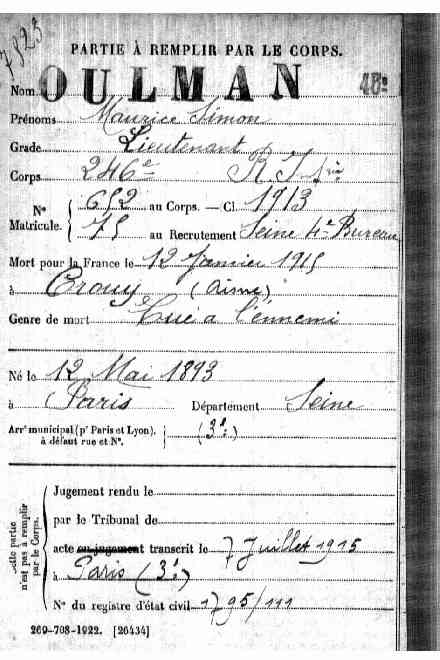
The article covers two Jewish officers:  Lieutenant Maurice Simon Oulman, and, Sous Lieutenant David Robert Aboucaya. 

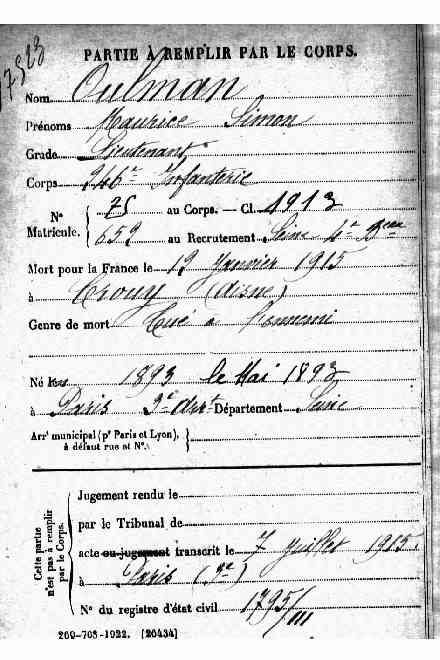
Lieutenant Oulman, who served in the 246th Infantry Regiment, was killed at Crouy (Aisne), on January 12, 1915.  Born on May 12, 1893, he resided at the 3rd Arrondissement, in Paris.  His name appears on page 67 of Les Israelites dans l’Armée Francaise.

Sous Lieutenant Aboucaya, a member of the 136th Infantry Regiment, was killed near Reims on September 14, 1914.  Born on October 15, 1892, he also resided in Paris; in the 19th Arrondissement.  He received the Legion of Honor (posthumously), and, the Croix de Guerre.  His name appears on page 1 of Les Israelites dans l’Armée Francaise, and, page 184 of Le Livre d’Or du Judaisme Algérien (1914-1918).

A PDF version of this article is available here.

____________________

Along with the text of the article, I’ve included the “Partie à Remplir Par le Corps” cards for both men (from which the above information was obtained) which were found at the French Government’s “Mémoire des hommes” (Memories of the Men) website. 

Very strongly akin to the Commonwealth War Graves Commission’s database, Mémoire des hommes provides biographical records covering French military deaths incurred during World War One and the Second World War, as well as French military action in Indochina, Algeria, Morocco, and Tunisia.  Coverage of the First War World is particularly detailed, encompassing, “more than 1.3 million individuals deceased during the Great War”, 74,000 records concerning men who served in the French Air Force, as well as records for the 1,009 soldiers and civilains who were – as the website says – “…sentenced to death and shot in accordance with military judiciary decision or summarily executed.”  (Think: Paths of Glory).  The website also allows users to search for information about military casualties interred in French military cemeteries.  

The digital records covering both men were obtained as part of a (slightly…somewhat?…much!) larger project involving identifying the names of all Jewish soldiers who were killed while serving in the French military during WW I.  The results of this research have resulted in the identification of nearly 4,600 men.

____________________

DEUX HÉROS
TWO HEROES

l’Univers Israélite
February 5, 1915

The Jewish World
February 5, 1915

Combien sont-ils déjà, les officiers dont une mort héroïque a couronné une carrière courte, mais glorieuse?  Le plus souvent, nous apprenons leur mort par un avis laconique.  Quelquefois nous pouvons connaître des détails qui, en avivant nos regrets, augmentent aussi notre admiration pour ces braves qui unissent la bonté à la vaillance et la douceur à l’héroïsme.

How many are there already, officers whose heroic death capped a short, but glorious, career?  Most often, we learn of their deaths by a terse notice.  Sometimes we can know details which, heightening our regrets, also increase our admiration for these braves uniting kindness the valor and heroism sweetness.

Nous voulons en citer pour aujourd’hui deux exemples, qui nous sont fournis par le lieutenant Aboucaya et le lieutenant Oulman.

We want today to name two examples, which are provided to us by Lieutenant Aboucaya and Lieutenant Oulman.

Le lieutenant Aboucaya
Lieutenant Aboucaya

Nous avons déjà signalé la mort au champ d’honneur du sous-lieutenant de réserve Aboucaya, du 136e d’infanterie, fils de M. Léon Aboucaya, l’industriel connu, membre du Consistoire central.

We have already reported the death in battle of Reserve Second Lieutenant Aboucaya, 136th Infantry, son of Leon Aboucaya, known industrialist, member of the Central Consistory.

Nous avons pu avoir communication d’une bien belle lettre écrite au père du jeune officier par son chef direct, le capitaine Fournier, lui-même grièvement blessé d’une balle à la tête.

We have had communication via a beautiful letter written to the father of the young officer by his immediate superior, Captain Fournier, himself seriously wounded by a bullet to the head.

Le capitaine dit d’abord “toute l’estime que le caractère et le courage” du jeune sous-lieutenant, à l’ “allure décidée et franche”, lui avaient gagnée auprès de ses supérieurs et de ses égaux et qui s’était vite changée en une bonne amitié quand ils avaient reconnu le côté affectueux de sa nature et la cordialité de ses sentiments de famille.

The captain initially said “all the esteem that the character and courage” of the young lieutenant, to the “determined and frank look,” had won him over to his superiors and his equals and that had quickly turned into a good friendship when they recognized the affectionate side of his nature and the warmth of his family feelings.

L’officier était digne de l’homme. “Pendant toute la période des marches en France et en Belgique, malgré la grande chaleur, les étapes très longues, le lieutenant Aboucaya avait tenu à donner l’exemple à ses hommes. Il avait, sac au dos et malgré son peu d’entraînement, supporté ces grandes fatigues du début et donné ainsi la mesure s’un caractère énergique, qui faisait bien augurer de lui pour le combat. Promesse tenue, car à F. ., à St-S… R… (combat de Guise), à Ch…, à S…, enfin, son attitude a été celle d’un chef imposant la confiance à ses homes”.  [Probably error in original a “u’un”.]

The officer was worthy of man.  “Throughout the period of marches in France and Belgium, despite the great heat, the very long intervals, Lieutenant Aboucaya had wanted to set an example to his men.  His backpacking, despite his lack of training, supported these with great fatigue early and given so far as an energetic character, which augured well for him for the fight.  The promise was kept, because at F., at St. S… R… (combat at Guise), at Ch…, at S…, finally, his attitude was that of a leader imbuing confidence in his men.”

A F.., notamment, la section Aboucaya tint vigoureusement une hauteur, de 4 heures du matin à midi, sous un feu infernal d’infanterie et d’artillerie, répondant coup pour coup et fort habilement à l’attaque de l’ennemi. Le lendemain soir, à O…, au moment où le régiment allait faiblir dans une charge à lâ baïonnette, le lieutenant Aboucaya, aux cris de en avant ! en avant ! réussit à arrêter la panique grâce à son attitude énergique.  “Le chef de bataillon et le colonel le félicitèrent d’ailleurs chaudement à la suite de cet acte de courage, qui valait une citation à l’ordre du jour”.

At F…, including Aboucaya’s section vigorously held a height from 4 A.M. to noon under a hellish fire of infantry and artillery, responding blow for blow and very skillfully attacking the enemy.  The next evening at O…, when the regiment’s bayonet charge was weak ing, Lieutenant Aboucaya, chanting forward! forward! managed to avert panic through his energetic attitude.  “The Battalion Commander and Colonel also warmly congratulated him after this act of courage, worthy of an Order of the Day.”

A Ch…, le lieutenant Aboucaya se distingua encore par sa “vaillante attitude pendant les heures de lutte émouvante qui eurent pour théâtre le village en flames”. C’est à S…, qu’à la tête de sa section, soumise à un feu terrible d’artillerie, il tomba, au premier rang, “la où depuis le debut il avait eu à cœur de sa tenir toujours”.

At Ch… Lieutenant Aboucaya was still distinguished for his “courageous attitude during the emotional struggle that took hours to the village theater in flames”.  This is at S…, where at the head of his section, subject to a terrible artillery fire, he fell in the front line, the “where from the beginning he was to keep his heart always.”

J’ai perdu, conclut le capitaine, “un officier ardent et courageux, sur lequel je savais pouvoir compter. Je garderai fidèlement son souvenir; son nom et son image seront encore évoqués souvent dans nos tranchées; plus d’une fois encore, les soldats qui restent de sa section parleront de lui avec le regret du chef qu’ils aimaient pour sa bonté et son entrain”.

I lost, concludes the captain, “an ardent and courageous officer, on whom I knew I could count.  I faithfully keep his memory; his name and image still come up in our trenches; more than once again, the soldiers who remain in his section will discuss him with the head of regret that they loved for his kindness and enthusiasm.”

Cette lettre, si noble et si émouvante que nous aurions voulu la citer tout entière, est un titre de gloire pour celui qui en est l’objet, elle fait honneur aussi à celui qui l’a écrite.

This letter, so noble and so moving that we wanted the whole quote is a claim to fame for the one who is the object, it also does honor to the one who wrote it.

Le lieutenant Oulman
Lieutenant Oulman

Le lieutenant Maurice Oulmàn, dont nous avons annoncé la semaine dernière la mort au champ d’honneur, avait été promu à ce grade le 6 septembre 1914, à la bataille de la Marne, pour son courage, son sang-froid, son énergie, pour l’enthousiasme qu’il avait su inspirer à tous ses soldats, lorsque, ce jour-là, ses chefs, le capitaine et le lieutenant en premier, avaient été frappés mortellement.

Lieutenant Maurice Oulman, whose death in battle we announced last week, had been promoted to the grade on 6 September 1914, at the Battle of the Marne, for his courage, his composure, his energy, for the enthusiasm that had inspired all his soldiers, when on that day, the leaders, the captain and first lieutenant, had been mortally wounded.

Son colonel l’aurait nommé capitaine si Oulman n’avait été trop jeune pour ce grade: il n’avait que vingt-et-un ans.  Malgré sa jeunesse, tous les hommes qu’il avait sous ses ordres l’adoraient comme un père. De fait, il remplissait les fonctions de commandant de compagnie.

His colonel would have appointed him captain but Oulman had been too young for this degree: he was only twenty-one years.  Despite his youth, all the men he had under him loved him like a father.  In fact, he acted as the company commander.

Lorsqu’à la terrible bataille de l’Aisne, son sous-lieutenant tomba, frappé d’une balle au ventre, il s’elança sous le feu meurtrier. En vain, un sergent, blessé à côté de lui, le supplie de ne pas s’exposer; malgré une plaie au pied qui gêne sa marche, il va de l’avant, jusqu’à ce que la mitraille l’abatte. Trois des combattants vont ramasser le corps, pour l’enterrer au cimetière de C…; deux tombent à leur tour.

When at the terrible Battle of the Aisne, his lieutenant fell, struck by a bullet in the stomach, he darted under the murderous fire.  In vain, a sergeant, wounded beside him, begs him not to expose himself; despite a sore foot bothering his walk, he goes ahead until the landslide of shrapnel.  Three fighters will pick up the body, burying him in the cemetery of C…; Both fall in turn.

Il aura l’honneur posthume d’être inscrit à l’ordre du jour, ainsi que, dans sa lettre de condoléances à la famille, le colonel du régiment l’écrit.

He will have the posthumous honor to be included on the Order of the Day and, in his letter of condolences to the family, the colonel of the regiment wrote.

Voici en quels termes émus M. T…, un collègue du défunt, fait son éloge dans une lettre adressée aux parents de la victime:

Here is how Monsieur T… moving words…a deceased colleague, praising him in a letter to the victim’s parents:

“…Je voudrais tant que ma premiere lettre fut pleine de l’affection admiration que j’avais pour votre cher fils dont la mort m’a déchiré.

“… I want as my first letter to be full of the affection and admiration I had for your dear son whose death tore me.

“Nous étions au repos à St-P… quand est venu l’ordre, le 13, vers dix heures du matin, de se porter rapidement à C…, ou les Allemands attaquaient.  Maurice était étendu sur son lit, depuis 8 jours il souffrait un peu du pied gauche…  Mais dés que l’ordre d’alerte et de départ lui parvint, il se leva; se fit refaire par un infirmier un pansement réduit pour pouvoir marcher. “Vous feriez mieux de rester au repos, mon lieutenant”, lui dit l’infirmier. Il ne répondit pas. Avec ce courage calme et réfléchi qui a toujours forcé notre admiration et qui était le secret de son ascendant sur ses 250 hommes, des gens de 30 à 35 et 40 ans, parfois, qui lui obéissaient aveuglément, il prit la tête de la compagnie.

“We were standing at St. P… when came the order, the 13th, about ten in the morning, to stand fast in C… or the Germans would attack.  Maurice was lying on his bed for 8 days suffering a little in his left foot…  But as soon as the order for alert and departure reached him, he stood up; a nurse came by again with a small dressing to walk.  “You better stay at rest, sir,” said the nurse.  He did not answer.  With this calm and thoughtful spirit that has always forced our admiration and that was the secret of his ascendancy over his 250 men, people from 30 to 35 and 40 years, sometimes, who obeyed him blindly, he led the company.

“Il arrive à C…, appuyé sur canne, ayant traversé sans perdre un homme le terrain nu balayé par les feux de l’éperon 132. Là il reçut l’ordre de monter rapidement sur le plateau de P… occuper les tranchées de repli pour soutenir le régiment que les Allemands bousculaient en première ligne. Il fait le cheminement habituel, mais, hélas ! les Allemands tenaient déjà les positions même qu’il allait occuper.

“We arrived at C…, pressed the sticks, passed through without losing a man on the bare ground swept by the fires of spur 132.  There he was ordered to quickly climb the Plateau of P… to occupy the fallback trenches to support the regiment’s as Germans were jostling the frontline.  He made the usual path, but alas! The Germans already held the same position he would occupy.

“Un sous-lieutenant tombe près du lieutenant Oulman. Celui-ci s’avance vers lui, lorsqu’un sergent le prend par le bras: “Mon lieutenant, ne vous montrez pas, nous avons besoin de quelqu’un pour nous commander” … Mais lui se dégage avec fermeté et dit: “Laissez-moi, ne vous occupez pas de cela”. Il n’avait pas fait trois pas qu’il tombait en arrière, sans un cri; une balle lui avait traversé la téte. Toute la compagnie s’arrête, figée par l’atroce nouvelle qui court de rang en rang.

“A second lieutenant dies near Lieutenant Oulman.  He advances towards him, when a sergeant takes him by the arm: “Lieutenant, do not show yourself, we need someone to lead us”…  But he emerges firmly and said, “Leave me, do not mind that.”  He had not taken three steps when he fell back, without a cry; a bullet had passed through his head.  The whole company stopped, frozen by the terrible news that runs from rank to rank.

“Si vous saviez comme ils l’aimaient, leur jeune chef si simple, si brave, si énergique et si pur! Pour les officiers, c’est un peu la Jeanne d’Arc de cette guerre. Et j’ai vu le lendemain encore des hommes pleurer en me contant tout cela. Au reste leur opinion est faite: “Ce petit-là, on l’aurait suivi partout, oh! nous perdons gros! Et personne ne saura nous conduire comme lui”.

“If you knew how they loved, their young leader so simple, so brave, so strong and so pure!  For officers, he’s a little Joan of Arc of the war.  And I saw it again with next men crying telling me all this.  Besides, their opinion is made: “This little one, we would have followed him everywhere, oh! we lose big!  And no one will take us like him.”

“Ils disaient vrai, nul d’entre nous n’a ce sang-froid que rien ne troublait, cette énergie méthodique qui n’était pas de son âge”.

“They were right, none of us has the coolness that nothing disturbed, this methodical energy that was not of his age.”

Le lieutenant Oulman avait 21 ans.

Lieutenant Oulman was 21.

References

Le Livre d’Or du Judaisme Algérien (1914-1918) (Réédité par le Cercle de Généalogie juive, Paris, 2000) [Avec la collaboration de Georges Teboul et de Jean-Pierre Bernard]

Les Israelites dans l’Armée Francaise, Angers, 1921 (Réédité par le Cercle de Généalogie juive, Paris, 2006)

Mémoire des Hommes, at http://www.memoiredeshommes.sga.defense.gouv.fr/en/

Soldiers who Died for France in the First World War, at http://www.memoiredeshommes.sga.defense.gouv.fr/fr/arkotheque/client/mdh/base_morts_pour_la_france_premiere_guerre/index.php?