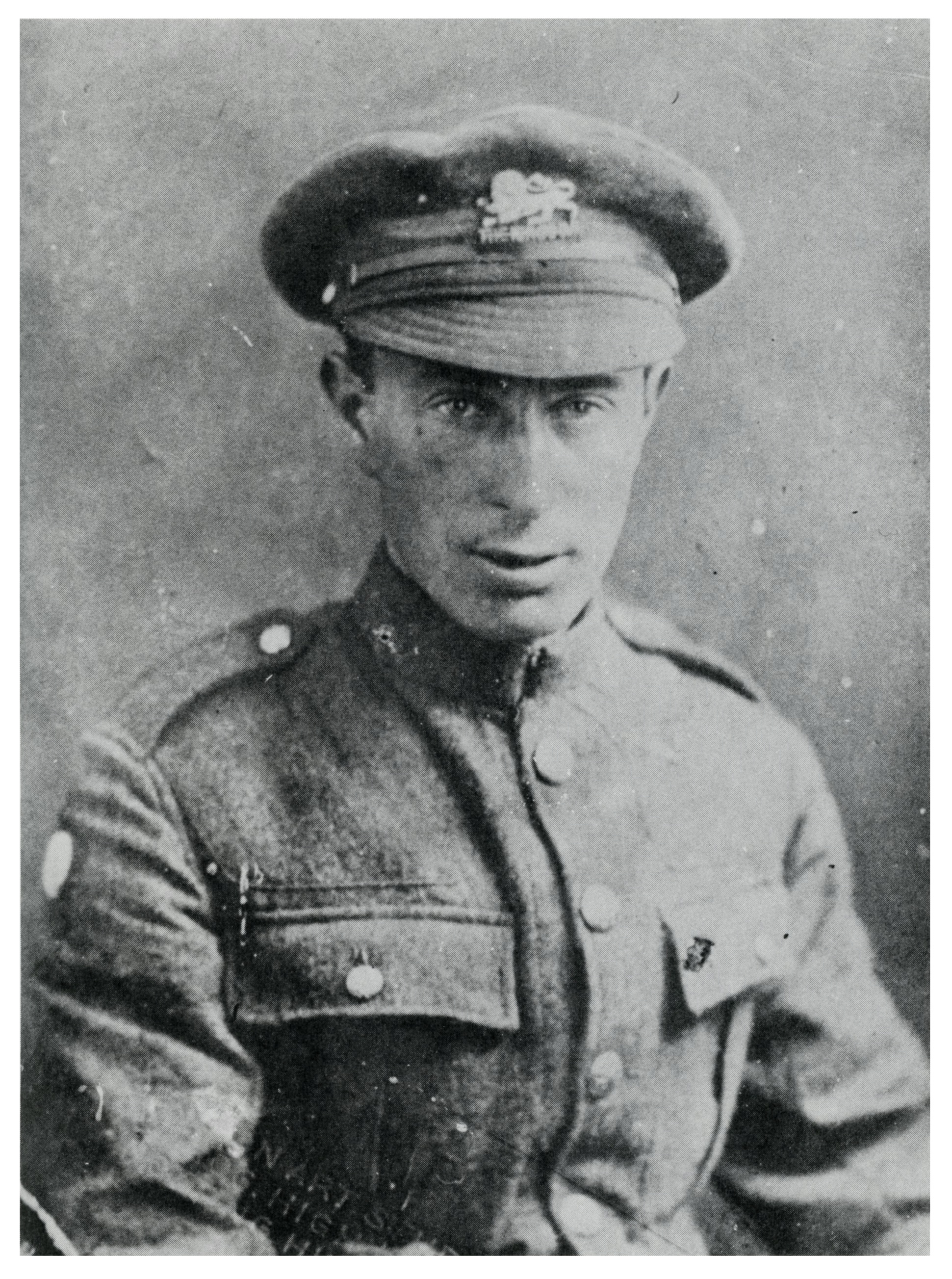
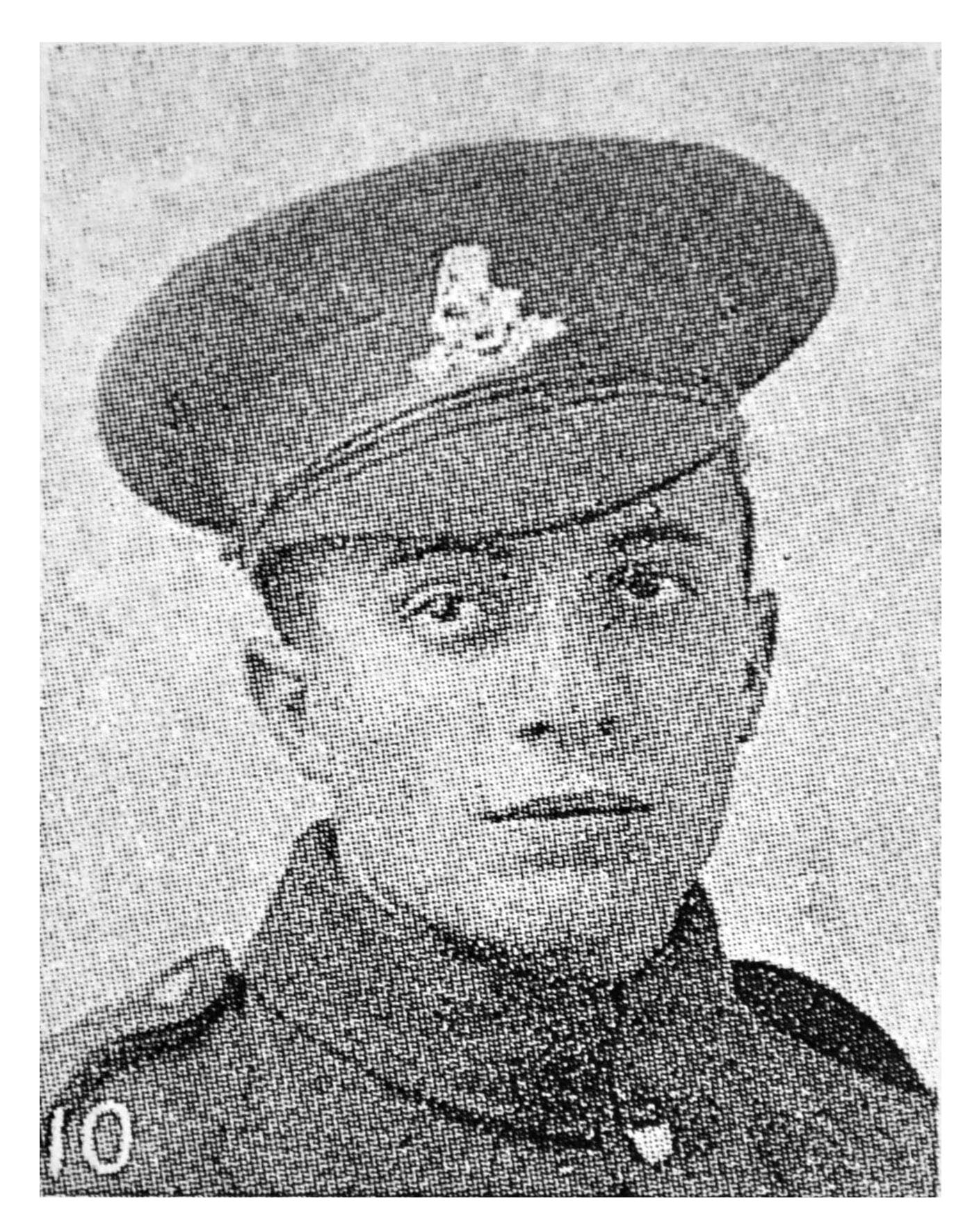
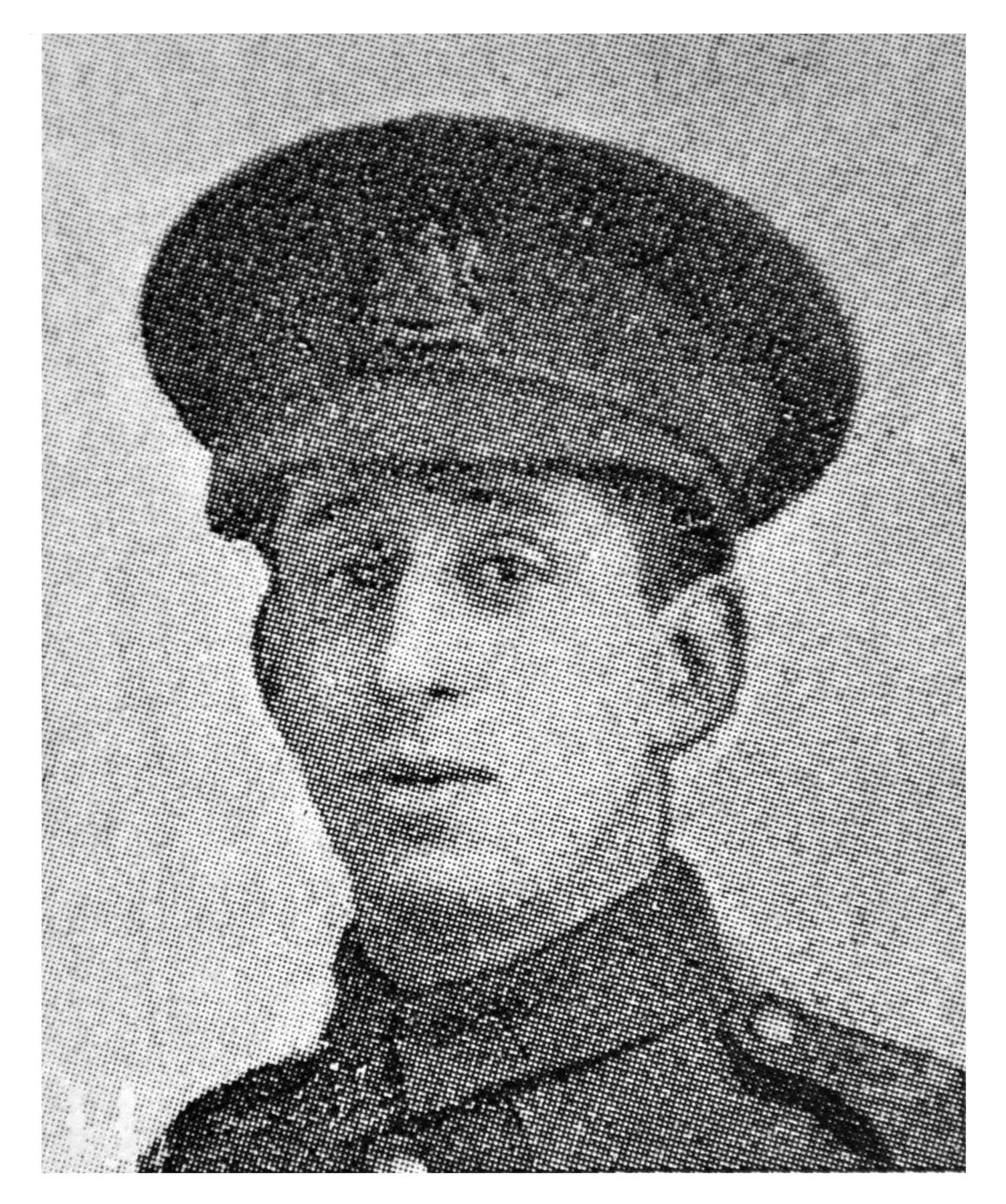
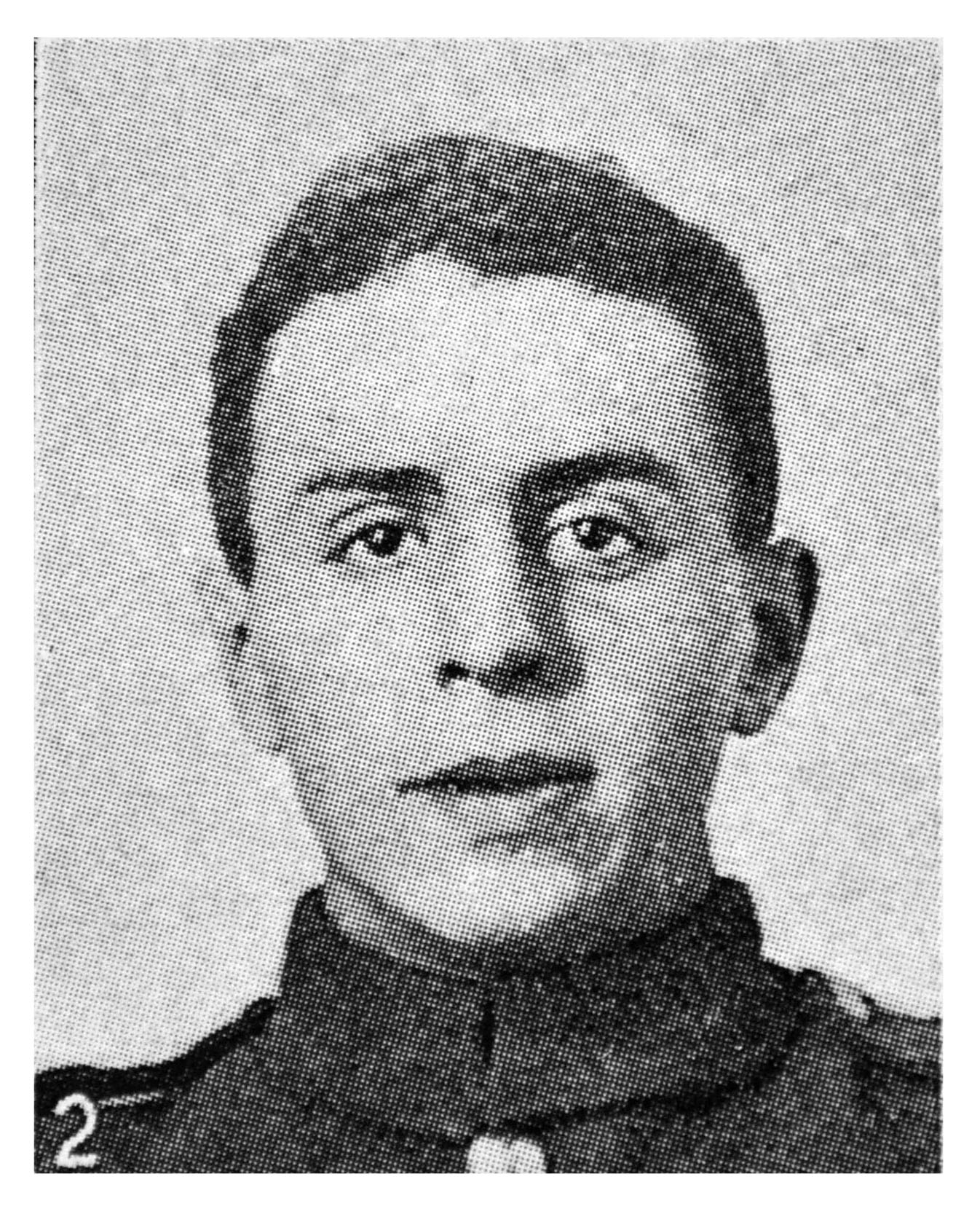
Among records about the military service of American World War One soldiers – at least, records available via Ancestry.com – those for servicemen from the state of Pennsylvania are certainly the most comprehensive. While information about soldiers from all other states, and certainly also Pennsylvania, is recorded on Abstract of Military Service Cards as what might be deemed “stand-alone” documents, Abstract cards for Pennsylvania are incorporated into World War I Veterans Service and Compensation Files, 1917-1919, 1934-1948, which are in turn comprised of multiple documents.
The contents of a Veteran’s Compensation File vary very greatly from soldier to soldier, but can include the following:
1) Veteran’s Compensation Application 2) Abstract of Military Service Card 3) Immediate Report of Casualty Card 4) Casual Officer’s Record Card 5) A.G.O.S.D., A.E.F. Form No. 6 (for recording biographical information, and, transfers and changes) 6) Application for Victory Medal (for Enlisted Men) 7) Pennsylvania War History Commission War Service Record of Soldiers, Sailors, and Marines 8) An “I Am the Next of Kin” information card 9) Newspaper clippings about a soldier’s military service, and / or casualty status (specifically for soldiers from Philadelphia) 10) Details of Death or Burial Card 11) Individual Record of Decorations or Citations
No single Veterans Compensation File comprises each and every of the eleven above-listed types of documents, though the majority at least include a Veteran’s Compensation Application form, Abstract of Military Service Card, Pennsylvania War History Commission War Service Record of Soldiers, Sailors, and Marines, and, newspaper clippings. Among these four categories of items, the Pennsylvania War History Commission War Service Record of Soldiers, Sailors, and Marines is (well, when present) as invaluable as it is remarkable, for many of these Records include a veteran’s description of his combat service in his own handwriting, or, for fallen soldiers, an account of the same by his parents or a sibling.
And, seemingly haven taken the effort to record soldiers’ military service a step farther, the Pennsylvania World War I Veterans Service and Compensation Files also include photographic portraits of soldiers, and less commonly, soldier’s portraits published in newspapers in half-tone format.
These images from a century past – by now sepia toned to a greater or lesser degree; sometimes badly faded – are remarkable, and remarkably evocative, windows upon the past. Some were obviously taken by military photographers prior to a soldier’s deployment overseas; some were clearly taken by professional civilian photographers in studio settings; a very few were probably taken by a soldier’s family or friends using commercially available cameras. As such, the some of the images – especially and curiously those taken by military photographers – capture a facet of soldier’s personality in the way of facial gestures or reactions to the very act of being photographed. Some men are distracted; some have a look of levity; some have a matter-of-fact gaze; some appear to be proud. (Photographs and candid pictures of WW I soldiers can also be found for Alabama and Connecticut soldiers; the former at the Alabama “World War I Gold Star Database”, and the latter at Ancestry.com.)
Regardless, all look much like people “now” in the year 2022: People have not changed.
Since all these documents were scanned at 96 dpi, they’re of adequate resolution for digital enhancement.
So… I’ve created four posts about Jewish Pennsylvanians who were military casualties in the Great War, for whom photographs exist in the state’s World War I Veterans Service and Compensation Files. They cover soldiers whose surnames begin with the letters A though G (“this” post), K through M, P through T, and concluding with a single post covering Lieutenant Edward Benjamin Goward of the 109th Infantry Regiment, 28th Infantry Division, who was killed in action on July 29, 1918.
An additional post includes one photographic portrait (from a newspaper), but more importantly, features transcripts of veteran’s reminiscences from Pennsylvania War History Commission War Service Records of Soldiers, Sailors, and Marines.
Though many men are covered in this set of posts, these records, and the photos therein, represent only a fraction of memory.
But, the past is irreducible:
Even the smallest fraction is memory is still and always, memory.
________________________________________
Abramson, Max, Sgt., 1,252,131 28th Infantry Division, 108th Field Artillery Regiment, D Battery WIA 9/12/18 (“shrapnel wound on right leg”) Mrs. Rose (Stelweck) Abramson (wife), Florence C. and Robert L. (children), 1581 President St., Brooklyn, N.Y. Mrs. Rose (Cohen) Abramson (mother), 1418 North 4th St., Philadelphia, Pa. Born Bucharest, Rumania, 10/20/98 Philadelphia Inquirer 12/15/18
____________________
Atlas, Harry, Pvt., 1,237,340 28th Infantry Division, 109th Infantry Regiment, K Company WIA 7/16/18 (gas; originally reported MIA) Mr. and Mrs. Philip and Anna (Gluckman) Atlas (parents) 467 N. 6th St. / 504 North 8th St., Philadelphia, Pa. Born Philadelphia, Pa., 8/28/96 Occupation: Machinist helper at Baldwin Locomotive Works Philadelphia Inquirer 8/18/18
This half-tone photo of a smiling Pvt. Atlas was published in the Philadelphia Inquirer on August 18, 1918.
Dear Sir:
The reasons this application is so vague, as to the exact dates, may I explain.
After returning from over-seas service, in April 1919, I was re-enlisted in Co. K 50th Infantry and I was immediately mustered out of Co. K 109th Inf. at Camp Dix, New Jersey. No doubt, my records were transferred to this new outfit, but by some odd occurrences, I did not go back. My original discharge was destroyed by fire. I am at present getting my second discharge straightened out in Washington D.C. at present, and I am also requesting a copy of discharge of my enlistment from Co K 109th Inf.
I am enclosing some definite proof as to my identity, by the papers from the Government Bonus which I obtained in January 1925 at Phila. Pa.
Kindly inform me if there is any other way I can assure you that I am the rightful claimant.
Respectfully, Harry Atlas.
____________________
Berkowitz, Jerome, Pvt., 1,236,202 28th Infantry Division, 109th Infantry Regiment, F Company WIA 9/27/18 (slightly wounded in action) WIA 11/10/18 (“gassed”) Mrs. Eva (Markowitz) Berkowitz (wife), Irving Harold (son), 2526 North 33rd St., Philadelphia, Pa. Mrs. Jennie (Weiss) Berkowitz (mother), 2017 S. 9th St., Philadelphia, Pa. Born Philadelphia, Pa., 3/11/92 Philadelphia Inquirer 12/15/18
____________________
Berkowitz, Louis Ralph, Cpl., 1,785,675, at Lorraine, France 79th Infantry Division, 315th Infantry Regiment, L Company KIA 9/28/18 Mr. and Mrs. Albert (6/18/54-12/6/17) and Clara (Landman) (4/8/65-3/7/69) Berkowitz (parents) Albert Clarence, David Edward, Harvey, Henrietta, and Henry Joseph Berkowitz (brothers and sister) 3225 Turner St. / 1739 Berks St., Philadelphia, Pa. Reverend Dr. Henry Berkowitz (uncle) Born Kansas City, Mo., 5/26/91 Occupation: Assistant advertising manager and N. Snellenburg & Co., then, head of advertising at Pennsylvania Knitting Company, then, head of advertising department of Frank & Seder Company Meuse-Argonne American Cemetery, Romagne-sous-Montfaucon, France – Tablets of the Missing Philadelphia Inquirer 11/10/18
This image of Cpl. Berkowitz – probably from the Philadelphia Inquirer – is found in his “World War I Veterans Service and Compensation File”, via Ancestry.com.
____________________
Brody, Henry Harry, Cpl., 1,237,806 28th Infantry Division, 109th Infantry Regiment, M Company Prisoner of War; Gassed; 7/15/18 Camp Rastatt, Langensalza, Germany Mrs. Hannah Brody [Haas] (wife), Marcel and Samuel (5/28/20-1/30/07) (sons), 5751 North Camac St., Philadelphia, Pa. Mr. and Mrs. Maurice (Morris) and Esther Brody (parents), 525 Franklin St. / 3104 Euclid Ave., Philadelphia, Pa. Occupation Cigar Store Clerk Born Philadelphia, Pa., 2/22/95 Died 5/10/30, buried Mount Carmel Cemetery, Philadelphia, Pa. – Section H, Lot 681, Grave 1 New York Times 9/1/18, 1/12/19 Philadelphia Inquirer 1/12/19
____________________
Brooks, Frank, Pvt., 12,132 27th Infantry Division, 108th Infantry Regiment, B Company, 11th Engineers Prisoner of War 11/30/17 Le Quesnoy, France; Camp Duelmen, Germany; Camp Altmann, Germany Mr. Abraham Brooks (father), 5 Erkley St., London, England Also 949 Fox St., New York, N.Y. Born London, 5/24/91 New York Times 12/17/17 Jewish War Veterans Calendar 2017
In this photo published in the 2017 calendar of the Jewish War Veterans of the United States, Pvt. Brooks is standing in the front row, 2nd from right, with a group of fellow captured members of the 11th Engineers. The men’s expressions range from stoic, to defiant, to (?!) jovial.
____________________
Fine, Samuel E., Cpl., 1,238,983 28th Infantry Division, 110th Infantry Regiment, Headquarters Company WIA 7/29/18 (shell fire; “loss of two fingers on left hand”) Mrs. Bessie (Leightstone) Fine (wife), Gilbert and Gordon (sons), 5622 Catharine St., Philadelphia, Pa. Mr. and Mrs. Philip and Grace (Garber) Fine (parents), 5426 Market St., Philadelphia, Pa. Born Philadelphia, Pa., 10/14/97 Occupation: Plumber for U.G.I. Philadelphia Inquirer 10/24/18
____________________
Forkish, Robert Morris, PFC, 1,236,140 28th Infantry Division, 109th Infantry Regiment, E Company WIA 9/12/18 (“gassed & shell shock”) Mrs. Ruth Ann Forkish (wife), Dolores, John E., Mary, Raymond A., and Robert, Jr. (children), 3844 34th St., Mount Rainier, Md. Mr. and Mrs. Isadore and Anna Forkish (parents), 903 Parrish St., Philadelphia, Pa. Born Bucharest, Roumania, 4/23/98
I Robert M. Forkish received complements off of Major Gregory 109th US Inf. 2nd Battalion for Bravery as you would call it. I was then a runner, at Condy. Jen. Brien or Chateau Thierry Bois.
He _____ for communicating all day under a continuous bombardment. This was July 18/918.
Well it was on the 12th of Sept when I got gassed and Shell Shock at Fismes on trying to cross the Vesle River. I was in the Hospital at Clichy France Base 19. I couldn’t see or talk for 2 months after.
I recovered and caught the Flu, and the Spinal Meningitis besides. (Mars St. Parie Le Chatel.)
I still have a whole lot more to write. Robert M. Forkish
____________________
Fox, Nathan, PFC, 1,910,867 82nd Infantry Division, 328th Infantry Regiment, K Company WIA 10/8/18 (gas) Mrs. Celia (Hoffman) Fox (wife), 1603 East Chelten Ave., Philadelphia, Pa. Mr. and Mrs. Gussy and Bettsy (Malamut) Fox (parents), 1422 North 5th Street, Philadelphia, Pa. Born Odessa, Russia, 9/26/96 Other reference(s) list place and date of birth as “Russia, Odessa; 9/26/96”, while Draft Registration Card lists place and date of birth as “Russia, Deraznia; 10/24/95”; Original address (crossed out) on Draft Registration Card is “1327 North 5th St.” Philadelphia Inquirer 12/15/18
____________________
Gell, Abe, Pvt., 2,382,836 5th Infantry Division, 60th Infantry Regiment, C Company KIA 9/25/18 Mr. and Mrs. Jacob and Rachel (Gartell) Gell (parents); Samuel (brother), Blossburg, Pa. Born “Iswan” / “Govna”, Russia, 4/17/87 St. Mihiel American Cemetery, Thiaucourt, France – Plot D, Row 10, Grave 13 Philadelphia Inquirer 10/22/18 The Evening Leader (Corning, N.Y.) 10/25/18
____________________
Glashofer, Philip, Pvt., 1,237,065 28th Infantry Division, 109th Infantry Regiment, I Company KIA 10/10/18 Mr. and Mrs. Charles and Yetta Glashofer (parents), 1119 Germantown Ave., Philadelphia, Pa. Also 4138 Leidy Ave., Philadelphia, Pa. Born Philadelphia, Pa., 9/10/96 Har Nebo Cemetery, Philadelphia, Pa. (Cemetery has no record) Philadelphia Inquirer 1/11/19
Matzeva of Pvt. Glashofer, at Har Nebo Cemetery, Philadelphia.
____________________
Goldberg, Walter, Cpl., 1,238,057 28th Infantry Division, 109th Infantry Regiment, Headquarters Company WIA 7/28/18 Mr. and Mrs. Abraham and Rebecca Goldberg (parents) Cpl. David Goldberg (brother), 731 South 58th St. / 2031 Germantown Ave., Philadelphia, Pa. Born Philadelphia, Pa., 1/27/97 Philadelphia Inquirer 11/7/18
____________________
Goldfus, Louis Samuel, Pvt., 1,235,072 28th Infantry Division, 109th Infantry Regiment, A Company WIA 7/30/18 KIA 10/6/18 Mr. and Mrs. Samuel and Esther (Goldman) Goldfus (parents), 331 Pine St., Philadelphia, Pa. Mr. Charles Kahn (brother in law), 503 Spruce St., Philadelphia, Pa. Pa., Philadelphia, 623 South 3rd St. Born 5/99 Har Nebo Cemetery, Philadelphia, Pa. – Section 1, Grave 96B; Buried 8/14/21 Philadelphia Inquirer 10/23/18, 11/17/18, 11/18/18
____________________
Goldstein, Herman, 2 Lt. 28th Infantry Division, 109th Infantry Regiment, I Company Seriously Wounded in Action 9/29/18 (gunshot wound between 3rd and 4th vertebrae) Mrs. Ida Goldstein (wife), Irwin and Jeanette (son and daughter), 6052 Regent St., Philadelphia, Pa. Mrs. Jennie Goldstein (mother), 2112 Master St., Philadelphia, Pa. Born Philadelphia, Pa., 9/13/93 Philadelphia Inquirer 2/16/19
____________________
Goodman, Harry, Mechanic, 1,235,540 28th Infantry Division, 109th Infantry Regiment, C Company WIA 9/8/18 (“shell shock” / “wounded, transferred to hospital”) Mrs. Pearl (Crotis) Goodman (wife), 5025 North Gransback St., Philadelphia, Pa. Mr. and Mrs. Leopold and Freda (Drisen) Goodman (parents), 1122 Germantown Ave. / 2223 Lambert St., Philadelphia, Pa. Born Philadelphia, Pa., 2/21/96 Occupation: Shipper Philadelphia Inquirer 12/15/18
References
Books
Gumpertz, Sydney G., Capt., The Jewish Legion of Valor – The Story of Jewish Heroes in the Wars of the Republic – And a General History of the Military Exploits of the Jews Through the Ages, Sydney G. Gumpertz, New York, N.Y., 1934, 1941
Gumpertz, Sydney G., Capt., The Jewish Legion of Valor – The Story of Americans of the Jewish Faith Who Distinguished Themselves in the Armed Forces in All the Wars of the Republic – And a General History of the Military Exploits of the Jews Through the Ages, Sydney G. Gumpertz, New York, N.Y., 1934, 1946
Haulsee, William Mitchell; Howe, Frank George; Doyle, Alfred Cyril, Soldiers of the Great War – Memorial Edition: Volume I (Alabama through Maryland), Washington, D.C., Soldiers Record Publishing Association, 1920
Haulsee, William Mitchell; Howe, Frank George; Doyle, Alfred Cyril, Soldiers of the Great War – Memorial Edition: Volume II (Massachusetts through Ohio), Washington, D.C., Soldiers Record Publishing Association, 1920
Haulsee, William Mitchell; Howe, Frank George; Doyle, Alfred Cyril, Soldiers of the Great War – Memorial Edition: Volume III (Oklahoma through Wyoming), Washington, D.C., Soldiers Record Publishing Association, 1920
Book – No Specific Author
The War Record of American Jews – First Report of The Office of War Records, American Jewish Committee, January 1, 1919, The American Jewish Committee, New York, N.Y., 1919
Though vastly more could be said (and, has been said) about Rosenberg’s life and poetry, it was; it is, adequate enough to begin that post with his last poem, penned during the final week of March, 1918: “Through These Pale Cold Days”.
The text follows…
Through these pale cold days What dark faces burn Out of three thousand years, And their wild eyes yearn,
While underneath their brows Like waifs their spirits grope For the pools of Hebron again – For Lebanon’s summer slope.
They leave these blond still days In dust behind their tread They see with living eyes How long they have been dead.
The poem directly expresses Rosenberg’s yearning to return to Eretz Israel, and, serve in a specifically Jewish military unit. As discussed in Joseph Cohen’s Journey to the Trenches, the poet was not at all passive in his hope: He persistently applied for a to transfer to the Judeans, the Jewish volunteer battalions organized by Vladimir Jabotinsky, then serving in Egypt and the Yishuv.
Sometimes, the wishes of men are fulfilled.
And yet sometimes, they are…
The following account is a case in point. Published in the Wilkes-Barre Record on December 17, 1918, it’s the story of the departure for the Jewish Legion, and, eventual military service in Egypt and the Yishuv, of George G. Korson, (by then!) a former reporter for the Record. Korson’s biographical details appear in this document from Ancestry.com, found among records of “US Residents Serving in the British Expeditionary Forces 1917-1919”.
Not actually focusing on military training or military duty as such, the article is primarily Korson’s own story of his departure from England, and equally, a description of the optimism and hope felt by the group of Legion soldiers prior to their departure.
Interestingly, the article makes several mentions of the word “Hatikooh”, a misspelling (or variant of translation?!) of the title of Israel’s national anthem Hatikvah, which was penned in 1878. (Rabbi Avraham Isaac Kook proposed an alternative version of an Israeli national anthem, entitled HaEmunah, “The Faith”. Which, I didn’t know about until creating this post…!)
So, Private Isaac Rosenberg’s dream did not come true.
So, Private George S. Korson’s did.
But, in a sense much larger, both dreams did come true, as some dreams – in their own time; in their own way – eventually do.
______________________________________
______________________________________
ON WAY TO EGYPT
Wilkes-Barre Record December 17, 1918
Former Record Reporter Describes Final Days in England of Jewish Legionnaires
Describing his final days in England before departing with the Jewish Legion for Egypt and the Holy Land George Korson, a former reporter on the Record staff, writes two interesting letters from England. Korson was born in Russia, raised in America, trained for army life in Canada, Wales and England and is now going to Egypt with the hope of eventually remaining in Palestine, as a permanent member of the new Zionist nation. He writes:
Good-bye England; Hello Egypt
“November 11, 1918.
“A few hours more and it’s good-bye England and hello Egypt for me. Final Inspection of our battalion was made by the brigadier-general this morning. Our impression on the old man was a favorable one. We spent many a nerve-wracking hour preparing for this day. ‘As fine a looking lot as I ever saw,’ he pronounced us.
“The inspection took up three hours, the whole of which we stood at attention with rifles and packs on our backs. Packs, I should explain, is another word for equipment, a matter of but ninety-eight pounds, no more.
“Shortly after the inspection, dressed in full marching order, the battalion went out on a ‘practice’ march, the flag of Zion leading us. Twelve miles was the length of the march. The packs were weighty and perspiration flowed freely. But the charm of the English countryside, in a sense unloosened our loads, or was it the music sent up by our band that had this effect? I am sure that our hearts would have been heavier than our packs at the end were it not for the inspiring airs. With the flag of Zion before us and the ‘Hatikooh,’ the battle cry of Israel in the air, who would not go to the bottomest depths of Hades for the cause?
“As the columns of the ‘Modern Macabees’ swung down the country roads and village streets it somehow gave me the feeling that with an army to defend its honor, the first in 2,000 years, Israel was well on its way to the return to the ancient home.
“The battle cries of our ancient warriors were the songs that were sung by us this morning. Villagers crowded the walks, jostling one another in the effort to gain vantage points. The applause and cheers of the spectators revealed to us their opinion of us. No wonder the general said we were as fit a looking lot as he ever saw.
To Do Garrison Duty in Palestine
“The spirit among the Jewish Legionnaires is admirable. In our eagerness to get across, we are unanimous. The disappointment in not being able to see active service on the field of battle is almost universal among us. The fact that we are going to do garrison duty in Palestine is some consolations anyhow.
“The trip to Egypt promises to be an interest one. If we should follow the routes of previous drafts we would pass through France and Italy with stopover privileges in Paris and Rome. The trip will probably take three weeks. I will write upon my arrival.
Farewell Dinner
“November 21, 1918.
“The happiest moments of my life passed last night. The occasion was a farewell dinner given departing Jewish Legionnaires by the British Zionist organization, of which Lord Rothschild is the president. The affair is beyond doubt the best reception tendered the Legion and I can assure you fine receptions have been given it both in American and in England. With the departure of our battalion the last of the Jewish Legion will have left Britain’s shores. Perhaps this is a reason that led the English Jews to sacrifice so much in our behalf.
Conditions in Holy Land
“At any rate the dinner will not be easily forgotten. A representative of the recent British investigation committee to Palestine addressed us. He told us of conditions in the Holy Land. The colonists who at the beginning of the war were driven out of the country by the Turks have returned and are going about their pre-war occupations quite well. Bridges, water works, highways, irrigation, railroad building and other improvements are being made by a British engineer corps for the return of the Jewish people to their ancient homeland. Touching, indeed, was his description of the colonists’ reception of the Jewish Legionnaires. Old men in their praying shawls and women fell to the ground and literally kissed the feet of their deliverers and future defenders. Children fought one another in the efforts to carry part of the soldiers’ equipment. The colonists tried to outdo one another to provide comforts for these Maccabees. Doors were thrown wide open. ‘What is mine is also thine,’ was the common word, the speaker declared.
Inducements to Stay
“The Zionist organizations, he said, is going to offer excellent inducements to the members of the Jewish Legion upon their discharge from the British army. If I were to speak my heart, I hope the inducements are good.
“The speaker also brought us the news that the Zionist organization has deposited with the commanding officer, Col. Miller, the sum of £250 ($1,250) to provide comforts for our battalion on our approaching journey to Egypt.
Flags of Eleven Nations
“The hall was fittingly decorated. The flags of eleven nations, from which the various Jewish Legions present had come, waved through the room. A big camp band enlivened the evening with music, in which the guests occasionally joined.
“Besides the speech of the British committeeman, talks were given by our colonel and officers. The officers are heart and soul in the cause of the Jewish people and last night expressed their willingness to go with their men to Egypt, thence to Palestine,
“The climax of the evening came with the call for the ‘Hatikooh,’ Israel’s ‘Song of Hope’. Most of the Jewish Legionnaires, typical of the Jewish race in the last 2,000 years, were wanderers, born in one country, raised in another and living in a third, etc. Not a few had come from Russia where they had undergone all the hardships and suffering that result from a cruel government. In a word, the gathering was made up of men who had gone through something and consequently whose feelings and emotions were pent up.
Tears Drip on Banquet Table
“At the singing of the ‘Hatikooh,’ all stood at attention. It is unnecessary to state that the nation was sent out with feeling. As the anthem went on one could see tears coming to the eyes of the men, some young, middle-aged, and elderly; some of them hard-hearted business men in civil life. At the conclusion tears were literally dripping on the banquet table. Can you imagine now the spirit of the Jewish Legion?
“Private George Korson, No. 2476
28-40 Batt. R.F. Co. G
“E.E.F., Egypt”
Some References…
Adler, Michael, and Freeman, Max R.G., British Jewry Book of Honour, Caxton Publishing Company, London, England, 1922 (Republished in 2006 by Naval & Military Press, Uckfield, East Sussex)
Cohen, Joseph, Journey to the Trenches – The Life of Isaac Rosenberg, 1890-1918, Basic Books, Inc., New York, N.Y., 1975
Jabotinsky, Wladimir, Die jüdische Legion im Weltkrieg, Jüdischer Verlag, Berlin, 1930
In March of 2001, the Jewish Telegraphic Agency published two articles about a project to comprehensively identify casualties among American Jewish Soldiers of World War One. Coinciding with what was – at the time – my own newly-begun effort to identity casualties among Jewish soldiers of the British Commonwealth for the Great War, these JTA news items inspired me to embark on a similarly-themed project concerning Jewish soldiers of the United States.
By now, I’ve completed much of this project. But, identifying the names of American Jewish WW I military casualties proved to be vastly more daunting (and even more) than my parallel research concerning British (and Australian, Canadian, Irish, New Zealand, Scottish, South African, Welsh, and more…) Jewish WW I soldiers.
The central challenge was also the most obvious: Compilations and lists of Commonwealth Jewish soldiers of World War One already exist, having been collected and / or published during, and after (and some, decades after) the war. The central sources of these names are wartime issues of The Jewish Chronicle, the British Jewry Book of Honour of 1922, and, the Australian Jewry Book of Honour of 1923.
In a similar way, compilations of names of Jewish military casualties in the WW I militaries of France, Germany, and Italy were likewise created and published in the 20s and 30s. (As for the creation of comprehensive lists of the names of Jewish soldiers, fallen or otherwise, in the militaries of Austria-Hungary and Imperial Russia, well, I suppose that history and other factors have rendered such efforts moot, and, irrelevant.)
Comprehensive compilations of the names of fallen and / or decorated American Jewish soldiers were never published, despite the names, biographical records, and veterans’ recollections of these men having been compiled and preserved. The reasons for this retrospective “gap” in Jewish history are alluded to in my prior post about the topic, and I believe had vastly less to do with the availability of scholars or laymen to embark on such a project, challenges in the analysis and interpretation of a mass of historical information, or finally, the simple physical ability to actually publish such works … than with the collective degree of self-confidence and comfort in the self-identity prevalent in the “American Jewish Community” – whether of leaders or laymen – during the 20s and 30s. (Is anything really that different a century later? I wanted to think so, for a time, but I do no longer.)
To be honest, a measure of this information was eventually published. But, this was limited to comparative statistical studies, and, limited to lists of the names of men who received military awards such as the Medal of Honor, Distinguished Service Cross, and Silver Star. The result? This information appeared in both volumes (1934, 1941, and, 1934, 1946) of Sydney G. Gumpertz’s The Jewish Legion of Honor. However, the vastly greater number of men who never received military awards – despite having served; despite having been casualties – never appeared in print.
Well, in time, there was one exception to this: In the early 2000s (I think it was the early 2000s…!) the Center For Jewish History made available online the names of men recorded in this research. (Unfortunately, I didn’t record the URL!) This list was limited to a soldier’s first and last names and middle initial; no other information appeared. I think (? – !) these names were actually those acquired by the American Jewish Committee – Office of Jewish War Records, 1918-1921.
So, even if tantalizingly incomplete, that CJA list served as a solid foundation for further research into this topic. And, I looked into it…
My first effort centered around correlating these names to 1) Names listed in records in “Casualties of the AEF By State – World War One” – “WW I Organization Records Office File” at the United States National Archives, in Records Group RG 407, and, 2) names listed in Haulsee, Howe, and Doyle’s Soldiers of the Great War – Memorial Edition. I then matched these names to published compilations of biographical records for a few specific states (well, those compilations that I could find or that at least exist: for Connecticut, Indiana, Maryland, New York, and Ohio) to find further information about these men.
This research eventually led to Ancestry.com (this isn’t a plug for Ancestry, it’s simply the way things worked out!) which in its “Military” category enables access to scans of “Abstract of Military Service” / “Form No, 724-7, A.G.O.” [A.G.O. = Adjutant General’s Office] cards, which were published or standardized on November 22, 1919. These cards provided a standardized format by which information about a soldier’s military service was recorded. (You can read about them here.)
Data fields in these cards comprise:
Name (Surname and Given Name) Serial / Service Number Race Place and date of enlistment or induction Place of Birth Age (usually) or Date of Birth (much less often) Service Organization(s) with Assignment Dates and Transfers Rank (Grade) with Date of Appointment Engagements Whether Wounded in Action (how badly), Killed in Action, or Died of Wounds / Illness (date listed in each case, including for multiple wounds) Name and address of Next of Kin, or Emergency Contact Overseas Service Dates Discharge / Separation Date and Information Degree of Disability at Discharge
Given the format and content of the information presented in the five above-listed state compilations, I believe the cards were source of information used in the creation of published works covering Connecticut, Indiana, Maryland, New York, and Ohio.
At Ancestry, scans of Abstract cards can be directly accessed for Georgia, New York, Pennsylvania, and Utah, while for other states (such Alabama, Florida, Mississippi, and New Jersey) they can be accessed via websites maintained by those states’ historical or archival agencies.
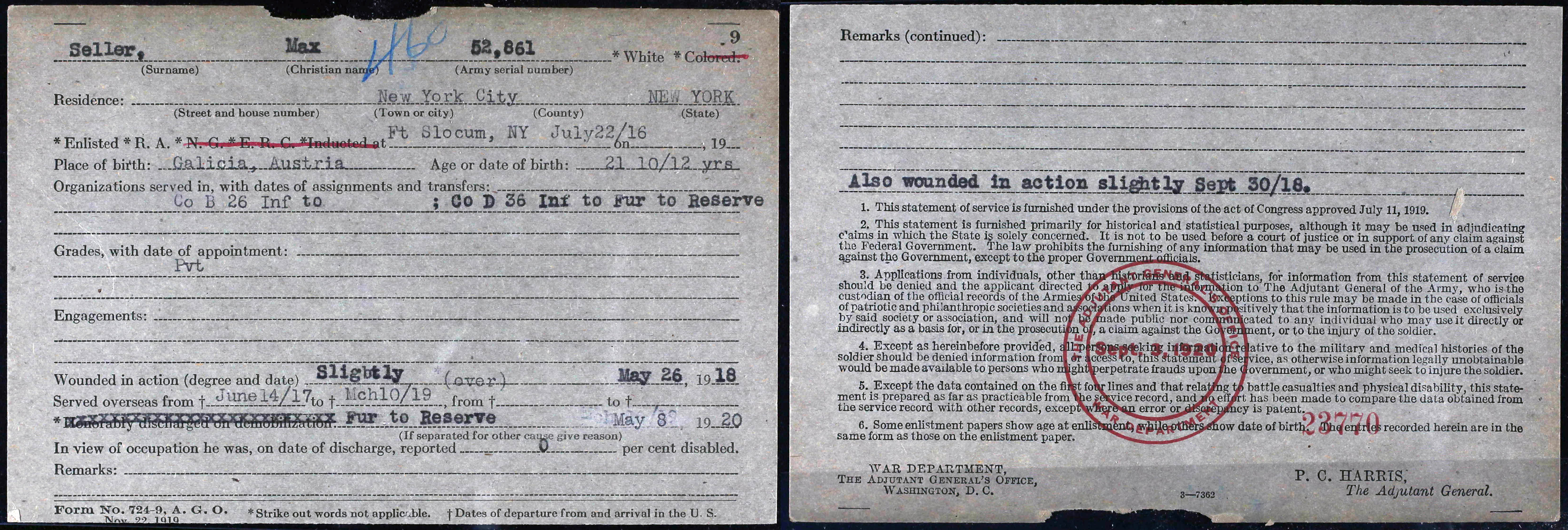
The Abstract Cards for New York and Pennsylvania are particularly interesting, in that they reveal that a soldier’s casualty status was indicated by the color of the card itself. A pale yellow-orange or tan card indicates a soldier who died in service or was killed in action, while information about wounded or injured soldiers is recorded on gray-ish cards.
Paralleling the Abstract Cards are two other primary sources of information, accessible through Ancestry.com and Fold3.com. These are U.S. World War I Draft Registration Cards for 1917 to 1918, and, U.S. Army Transport Service Arriving and Departing Passenger Lists for 1910 to 1939.
Though Draft Registration Cards by nature don’t include information about a soldier’s military service, they’re utterly invaluable in having genealogical information such as place and date of birth, addresses of residence and employment (at least, on the date when the soon-to-be soldier filled out the card), and trade or profession. The ubiquity and number of these cards (How many are there? – I don’t know!), a “strength” as it were, can renders them an ambiguous sources of information: Some information on them, such as place and date of birth, and residential address, doesn’t necessarily correlate to such information recorded on the Abstract Cards. They don’t typically include the names (names) of a soldier’s next of kin. Also, it’s very easy to find multiple cards with the same listed surname and given name, despite being for entirely different men!
More important for this purpose of this project than the Draft Registration Cards – by far – have been the Transport Service Arriving and Departing Passenger Lists, because the information recorded in these records – a soldier’s military unit, his serial number, residential address, and name of next of kin or emergency contact – has direct and immediate relevance to his military service, and, is central in terms of a soldier’s genealogy and ancestry. (That’s “ancestry” with a small “a”.) It’s been this particular set of documents, when used in conjunction with the CJA soldiers’ name list, that has been really instrumental in identifying Jewish soldiers.
Paralleling this effort (lots of parallels here) was a review of four newspapers – The New York Times, The Philadelphia Inquirer, The Jewish Exponent, and The Jewish Chronicle, the latter of which on rare occasion in 1917 and 1918 include information about Jewish casualties in the United States armed forces.
So, here are the URLs for either historical or archival offices of various states, or, direct links to Ancestry.com, that allow search for Abstract Cards: Alabama
“World War I Gold Star Database” (Abstract Cards, Photos, and Documents)
California (Ancestry.com: California State Council of Defense. California War History Committee. Records of Californians Who Served in World War I. (Set 2: World War I soldiers deaths.) 18 boxes. California State Library, Sacramento, California. No Abstract Cards, but instead images of newspaper articles.)
Vermont (Ancestry.com: Transcribed Data from Abstract Cards)
And so, what did I find?
In terms of numbers…
…well, while I’ve made a practice at this blog of not listing total numbers of people in “so-and-so” and “such-and-such” category – that becomes tedious, anyway – a comparison of my data from this research, with information released by the American Jewish Committee’s Office of Jewish War Records, in its Third Report, dated 14 November 1920, is revealing. I’ve found that the OJWR’s estimate of 2,800 Jewish war dead is incorrect, and is an overcount of American Jewish servicemen (Army, Navy, and Marine Corps) who lost their lives during the war. However, the total number of casualties I’ve arrived at – comprising soldiers killed in action or died of wounds or illness, plus wounded and survived, plus prisoners of war, – definitely exceeds that above-mentioned OJWR total.
Of interest are the relative proportions of Jewish soldiers serving in the Army and Marine Corps, in terms of men who were casualties (as defined above) … based on place or birth, in terms of country or geographic area. (Ironic that a historical question from 1918 can be so politically and culturally fraught in 2022!)
Running my numbers through Excel reveals that these proportions are, largest to smallest:
Born in the United States: 43% Born in Belorussia, Russia, and Ukraine (I haven’t disambiguated these records, yet…): 36% Born in Poland: 7% Born in Romania: 5% Born in Lithuania: 4% Born in Austria-Hungary: 3% And, born in England: 2%
Plus … soldiers born in:
Bulgaria (Pvt. Israel Silverman) Canada (several) Cyprus (PFC Moses M. Steinberg) France, Germany (Privates Nathan Greenbaum, Adolph Katz, and Julius Meyer Lyons) Latvia (several) Lithuania (several) Scotland (Pvt. Robert E. Ognall) Sweden (Pvt. Einar Skud) Turkey (Pvt. Raoul Gerson) and the Yishuv (Pvt. Ruben Cohen).
Well, being that people are neither “data” nor “percentages”, one way to view this mass of information is to focus on casualties incurred on a single day of battle; a day which by its symbolism and historical significance reflects the sad irony of the Great War, and in effect, all wars:
The names of Jewish casualties in the United States Army for the same day, killed and wounded, are listed below. Particularly poignant is the story of thirty year old Jesse Steinthal of Manhattan, concerning whom an illustrated article appeared in the New York Tribune exactly two years and one day before he fell in battle. Well, actually, they’re all poignant each in their own way, Jesse Steinthal’s story moreso – for the purposes of this post – simply because of the fortuitous availability of more-than-usual information about him.
Of course, there inevitably were casualties in the German Army that day as well. In that regard, identifying Jewish casualties in the Deutsches Heer for day was quite straightforward: the names of these men are easily identified in Die Jüdischen Gefallenen Des Deutschen Heeres, Deutschen Marine Und Der Deutschen Schutztruppen 1914-1918 – Ein Gedenkbuch.
Among them is Soldat Herman Tichauer, age forty-five.
Among them is Leutenant Alfred Emil Stettiner, age thirty-seven.
Among them is Sergeant Ernest Schild of Duisberg, an aviator in Schlachtstaffel 5, about whom I’ve been unable to find any further information … though there is a discussion at TheAerodrome which would imply that he was a crew member of a Hannover CL.III aircraft. His name doesn’t appear in Casualties of the German Air Service 1914-1920, and, there is no account of the shooting down of a Hannover in The Sky Their Battlefield.
____________________
In any event…
…given the centrality of Abstract cards to this project, some examples of these documents follow below, all for dates other than November 11, 1918, accompanied by information derived from the card, and, other sources. (This follows the format I’ve been using for records about WW II servicemen.) I’ve made a point of illustrating Abstract cards showing different places of birth: Austria, England, Poland, Russia, the United States, Ukraine, and the Yishuv. Also shown are other documents, and, a few photographs.
And so:
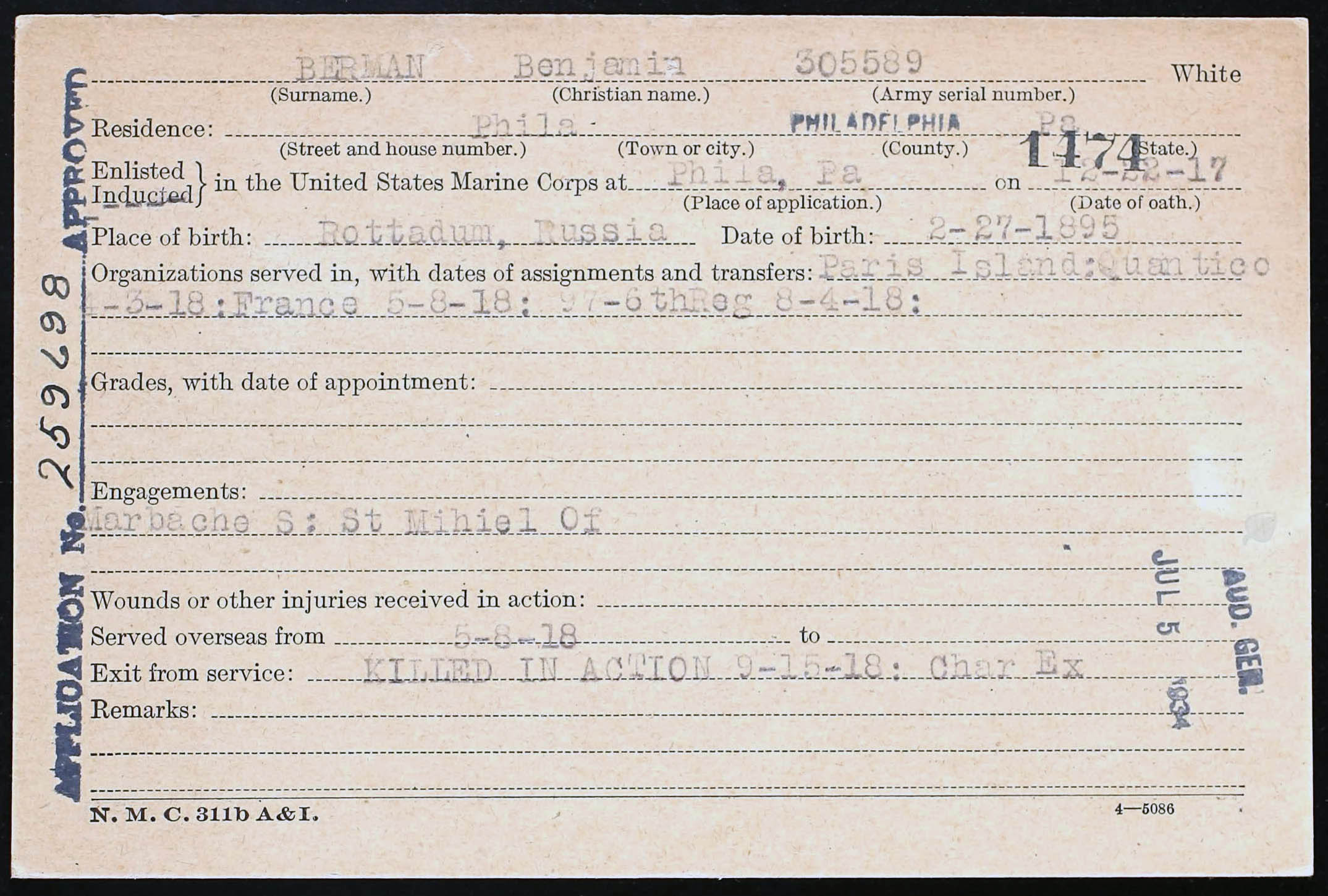
Berman, Benjamin, Pvt., 305,589 Born in Russia: “Rottadum” (?), February 27, 1895 4th Marine Brigade, 6th Marine Regiment, attached to 2nd Infantry Division, US Army Killed in action September 15, 1918, at Chateau Thierry Mr. and Mrs. Jacob and Anna Berman (parents), 548 West Pike St. / 2413 North Hollywood St., Philadelphia, Pa. Tablets of the Missing at Saint Mihiel American Cemetery, Thiaucourt, France Matzeva (symbolic?) at Mount Sharon Cemetery, Springfield, Pa. Philadelphia Inquirer Casualty List – October 12, 1918 Name not in Center for Jewish History list.
_____
Private Berman’s symbolic matzeva.
_____
Sixteen years later: The Veteran’s Compensation Application for Private Berman, completed by Jacob and Anna in March of 1934.
__________
Louis Gottes Bernheimer, 1st Lieutenant, Reconnaissance Pilot Born in the United States: New York, N.Y. – December 5, 1895 United States Army Air Service, 88th Observation Squadron Survived: Awards included Distinguished Service Cross (for actions on August 11, 1918), Silver Star, and Bronze Oak Leaf Cluster Mr. and Mrs. Sydney (3/24/75-2/13/70) and Fannie (“Gattis”) (7/16/69-10/6/38) Bernheimer (parents), Leona C. (sister) (5/2/91-_____), 138 East 72nd Street, New York, N.Y. Yale University Graduate – Class of 1917 Died January 10, 1930, Los Angeles, Ca. Buried at Salem Fields Cemetery, Brooklyn, N.Y. The Jewish Legion of Valor – 255 New York Sun January 14, 1930
BERNHEIMER, LOUIS G. (First Award)
First Lieutenant (Air Service), U.S. Army Pilot, 88th Aero Squadron, Air Service, A.E.F. Date of Action: August 11, 1918
Citation: The Distinguished Service Cross is presented to Louis G. Bernheimer, First Lieutenant (Air Service), U.S. Army, for extraordinary heroism in action near Fismes, France, August 11, 1918. Together with John W. Jordan, Second Lieutenant, 7th Field Artillery; Observer (severely wounded);
Roger Wolcott Hitchcock, Second Lieutenant, Pilot (uninjured) and James S.D. Burns, Second Lieutenant, Observer, 101st Field Artillery (KIA) (control surfaces shot up, but returned);
Philip R. Babcock, First Lieutenant, Pilot (uninjured) and Joseph A. Palmer, Second Lieutenant, Observer, 15th Field Artillery (uninjured)
all attached to the same squadron. Under the protection of three pursuit planes, all carrying a pilot and observer, Lieutenants Bernheimer and Jordan, in charge of a photo plane, carried out successfully a hazardous photographic mission over the enemy’s lines to the River Aisne. The four American ships were attacked by 12 enemy battle planes. [Fokker DVIIs] Lieutenant Bernheimer, by coolly and skillfully maneuvering his ship, and Lieutenant Jordan, by accurate operation of his machine gun, in spite of wounds in the shoulder and leg, aided materially in the victory which came to the American ships, and returned safely with 36 valuable photographs. The pursuit plane operated by Lieutenants Hitchcock and Burns was disabled while these two officers were fighting effectively. Lieutenant Burns was mortally wounded and his body jammed the controls. After a headlong fall of 2,500 meters, Lieutenant Hitchcock succeeded in regaining control of this plane and piloted it back to the airdrome. Lieutenants McClendon and Plummer were shot down and killed after a vigorous combat with five of the enemy planes. Lieutenants Babcock and Palmer, by gallant and skillful fighting, aided in driving off the German planes and were materially responsible for the successful execution of the photographic mission.
General Orders No. 44, W.D., 1919 Birth: New York, NY Home Town: New York, NY Other Award: Distinguished Service Cross w/OLC (WWI)
_____
Members of the 88th Observation Squadron stand before one of their squadron’s French designed and built Salmson2 A.2 reconnaissance planes, in this photo from the flickr photostream of the SDASM (San Diego Air And Space Museum) Archives. In the photo Lt. Bernheimer is four from left in the front row. His observer / gunner on the August 11, 1918 mission, Lt. Jordan, is standing in the plane’s observer’s seat next to twin Lewis guns. Lt. Babcock, one of the pilots in that mission, is second from left in the front row. The names of all the men in the photo are listed here.
_____
Lieutenant Bernheimer died in California on January 10, 1930, at the age of thirty-five. His obituary, which by virtue of its calculated vagueness hints at a very sad conclusion, appeared in The New York Sun four days later. Assuming that he actually was a playwright, none of his writings – if such still exist – can be found at Worldcat, with the exception of an altogether different sort of work, “The trial of Sacco and Vanzetti: A summary of the outstanding testimony”.
LOUIS G. BERNHEIMER The New York Sun January 14, 1930
Private funeral services will be held here for Louis G. Bernheimer, 35 years old, well known author, who died in Los Angeles, Cal., on Friday. During the world war Mr. Bernheimer, a member of the air force, was decorated with the Distinguished Service Cross with oak leaf cluster for bravery in action. He was also made Chevalier, Belgian Order of the Crown, by King Albert.
Mr. Bernheimer was born in this city and when here lived with his parents, Mr. and Mrs. Sidney Bernheimer, at 138 East Seventy-Second Street. He was graduated from Yale in 1917 and entered the first officer’s training camp at Plattsburg. He later joined the air service and went abroad in November, 1917, with the first American air unit. He was commissioned a first lieutenant in January, 1918, and the following month was made flight commander of the Eighty-Eighth Aero Squadron.
Since the war Mr. Bernheimer had devoted most of his time to writing plays. He is survived by his parents and a sister, Miss Leona Bernheimer.
__________
Ruben Cohen, Pvt., 250,447 Born in the Yishuv: Jerusalem – January 8, 1896 United States Army, B Company, 6th Battalion, 20th Engineer Regiment Killed: Died in sinking of USS Tuscania on February 5, 1918 Mr. Allen Cohen (father), 199 Christopher Ave., Brooklyn, N.Y. (Also 186 Henry Street, New York, N.Y.) Tablets of the Missing at Brookwood American Cemetery, Woking, England Soldiers of the Great War – Not Listed Name in Center for Jewish History list
__________
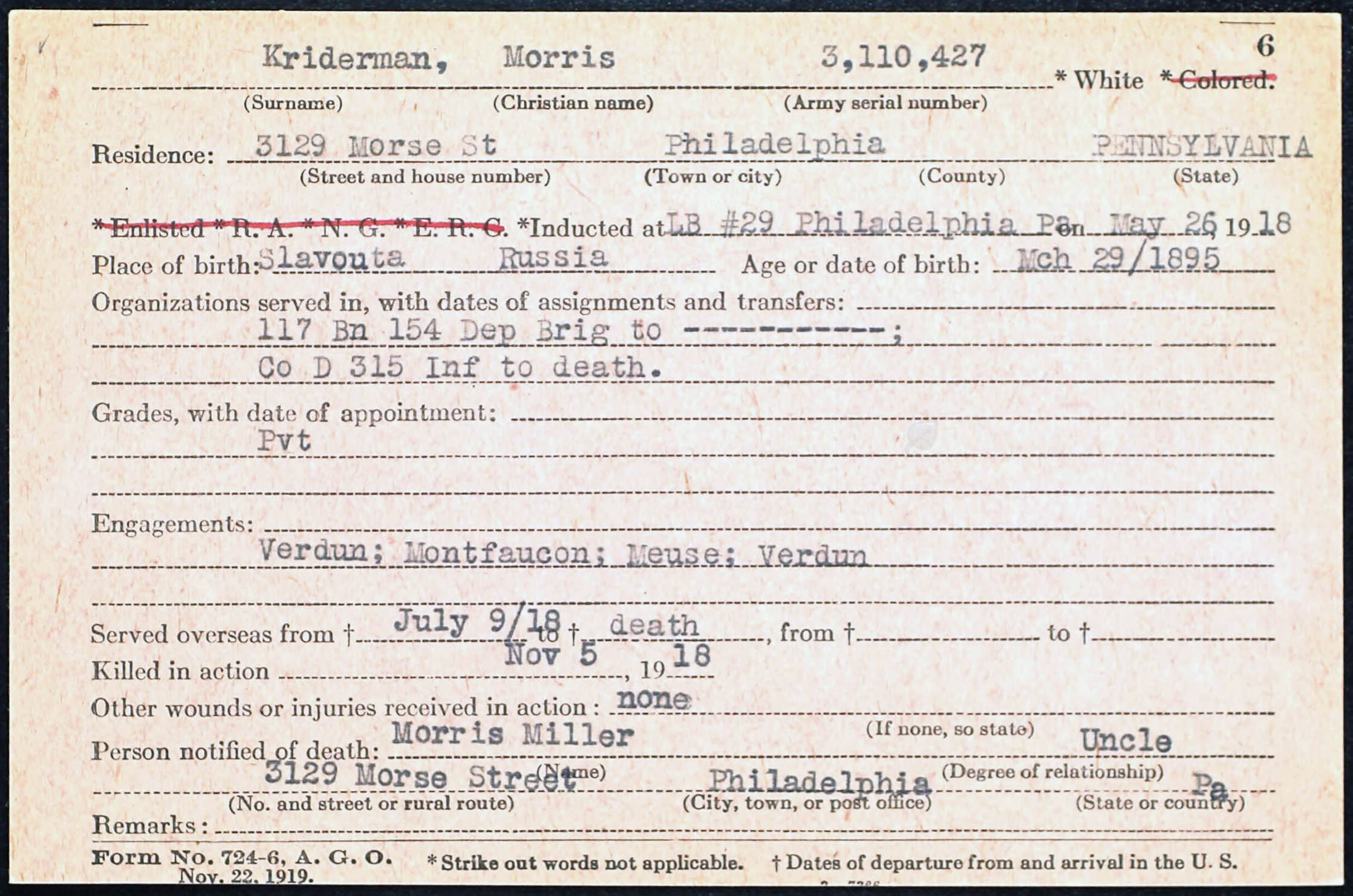
Morris Kriderman, Pvt., 3,110,427 Born in Ukraine: City of Slavuta, Khmelnitskiy district, Western Ukraine – March 29, 1895 (See Slavuta, and, Jews of Ukraine) United States Army, D Company, 315th Infantry Regiment, 79th Infantry Division Killed in Action November 5, 1918 Mr. Morris Miller (uncle), 3129 Morse St., Philadelphia, Pa. Mount Lebanon Cemetery, Collingdale, Pa. – Section I, Lot 3189, Grave 2; Buried September 25, 1921 Philadelphia Inquirer Casualty Lists – December 17, 1918 and January 15, 1919 Soldiers of the Great War, Volume III – 146 Name in Center for Jewish History list
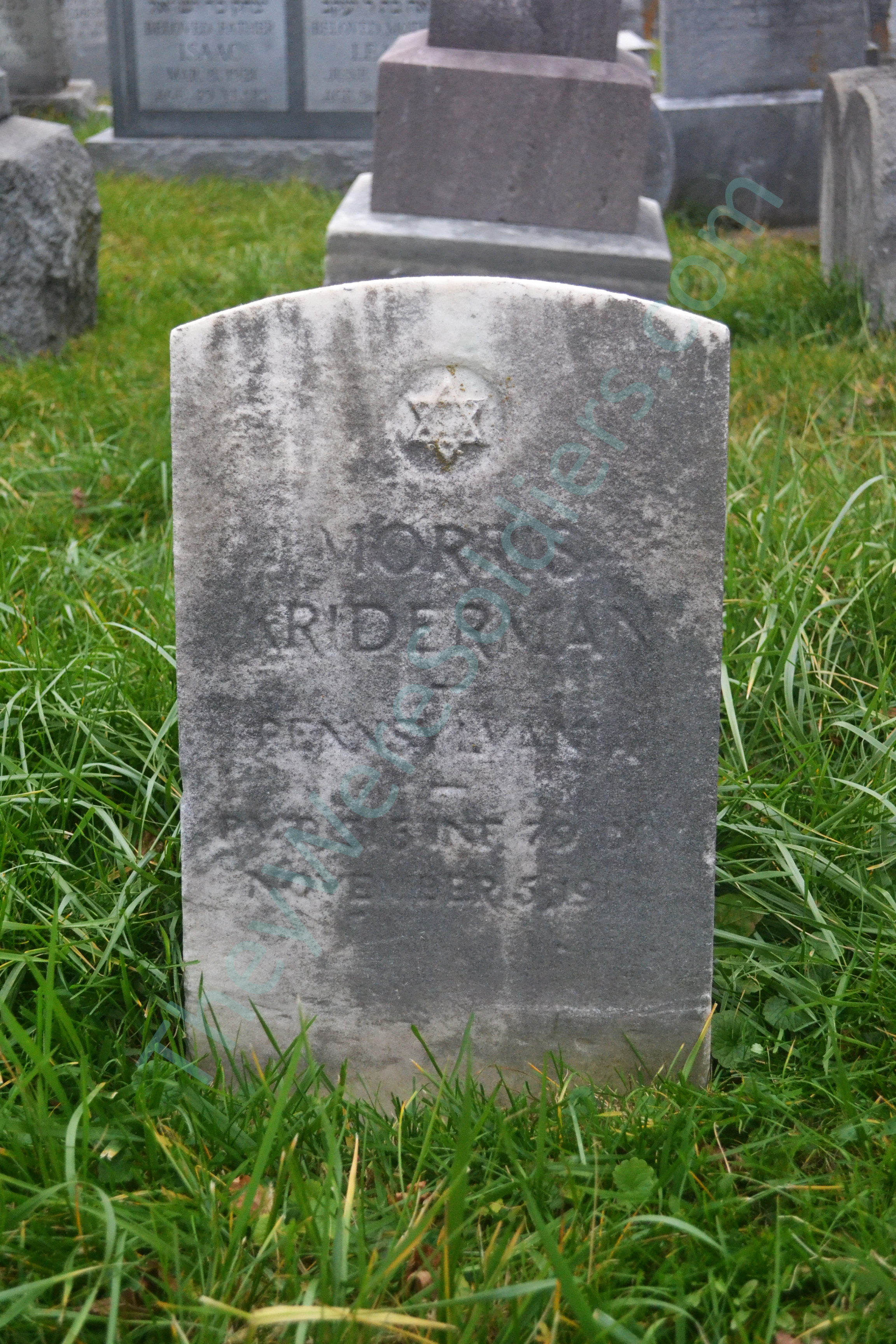
Here is Morris’ matzeva, at Mount Lebanon Cemetery in Collingdale, Pa. He was buried on September 25, 1921. Did his parents or any siblings, probably all still in Ukraine at the time of his death, ever emigrate to the United States and have the chance to visit his grave?
__________
Max Masey, Pvt., 2,337,430 Born in Poland: Bialystok – March 13, 1892 United States Army: K Company, 4th Infantry Regiment, 3rd Infantry Division Survived: Wounded in Action July 15 and October 1, 1918 Mr. Abraham Masey (father), 108 Forsyth St., New York, N.Y.
__________
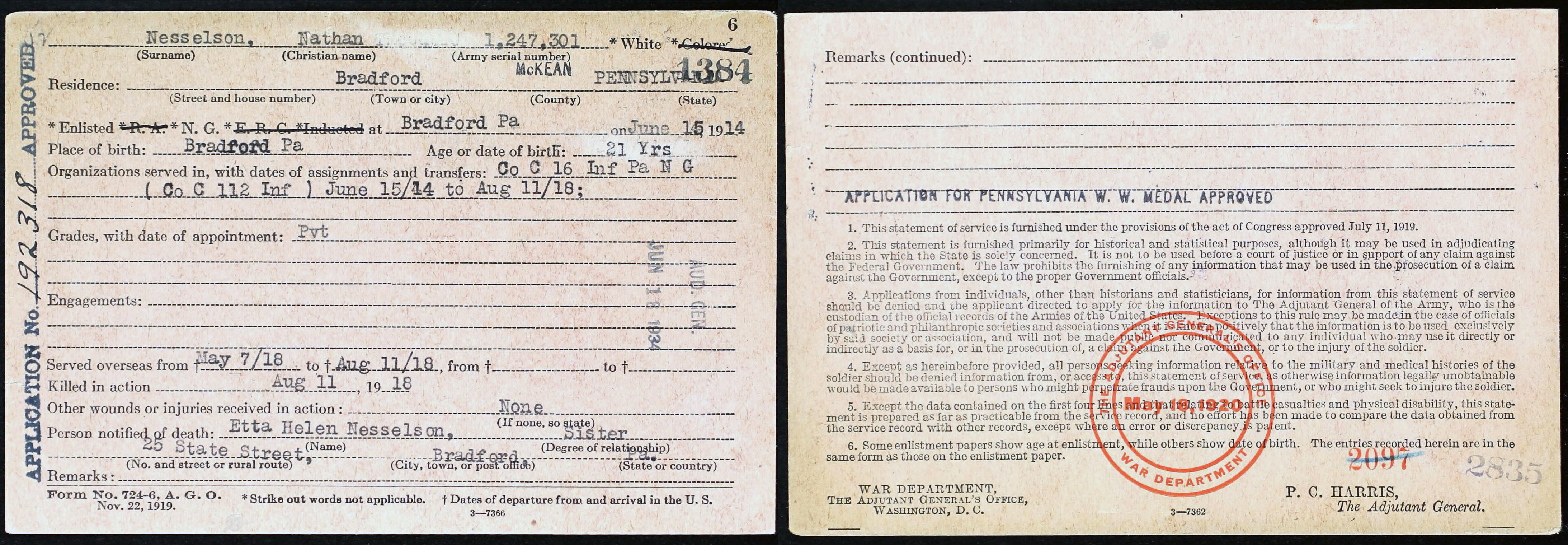
Nathan Theodore Nesselson(Nathan Tobiah; “Nate”), Pvt., 1,247,301 Born in United States: Bradford, Pa. – August 31, 1893 Killed in Action: Distinguished Service Cross for actions on August 11, 1918 C Company, 112th Infantry Regiment, 28th Infantry Division Mr. and Mrs. Max (1854-1942) and Bessie Vada (“Ida”) (1862-5/23/98) Nesselson (parents); Miss Etta Helen Nesselson (sister), 5 State St., Bradford, Pa. Also 72 Kennedy St., Bradford, Pa. Beth Israel Cemetery, Bradford, Pa.; Buried June, 1921 McKean Democrat June 16, 1921 and May 21, 1925 Bradford Era, November 7, 2020: “Kindness of a child leads to friendship letters with soldier”, by Sally Ryan Costick (see photo below) Name in Center for Jewish History list
(Only after I created this post did I realize that these records for Pvt. Nesselson, and Lt. Bernheimer, both pertain to August 11, 1918.)
From DSC Citation: “Private Nesselson repeatedly exposed himself to heavy enemy fire in order to deliver messages from his company to the battalion commander. In the performance of this mission it was necessary for him to cross the Vesle River, which was constantly swept by enemy machine-gun fire. He volunteered to carry a message after others had been killed in the attempt and continued to perform this perilous duty until he was mortally wounded.”
From “Missing Report or Details of Death & Burial” card (see below): “It is not exactly known just where Private Nesselson was killed, but the above named [Pvt. Clayton D. Roche] was present when he ran several messages through a terrific machine gun and artillery barrage from Fismette to battalion headquarters at Fismes on August 11th. To deliver and return with these messages he had to cross the Vesle River, the bridge over which, was covered by enemy machine gun fire and the bullets of snipers. Private Nesselson was aware of this and volunteered to deliver the messages. He made two trips that Private Roche knows of and it is presumed that he was struck by a shell. If anyone in any fighting division deserves a D.S.C. Private Nesselson is entitled to one. All soldiers in this company who were in Fismette that day agree to this.”
__________
Israel Rosenberg, Pvt., 2,337,493 Born in England: London – June 2, 1895 United States Army, Headquarters Company, 4th Infantry Regiment, 7th Infantry Division Survived: Wounded in Action July 27 and October 9, 1918 Mrs. Mary Rosenberg (mother), 941 Simpson St., New York, N.Y.
__________
Max Seller, Pvt., 52,861 Born in Austria: Lemberg (…or, Lviv? (Ukrainian), Lvov?? (Russian), or Lwow??? (Polish)…) – 1896 United States Army: B Company, 26th Infantry Regiment, 1st Infantry Division Survived: Wounded May 26 and September 30, 1918 Mrs. Rose Gluck (sister), 43 West 212th St., New York, N.Y.
____________________
And so, on Armistice Day…
Monday, November 11, 1918
7 Kislev, 5679
.ת.נ.צ.ב.ה.
Tehé Nafshó Tzrurá Bitzrór Haḥayím
May his soul be bound up in the bond of everlasting life.
Killed in Action or Died of Wounds
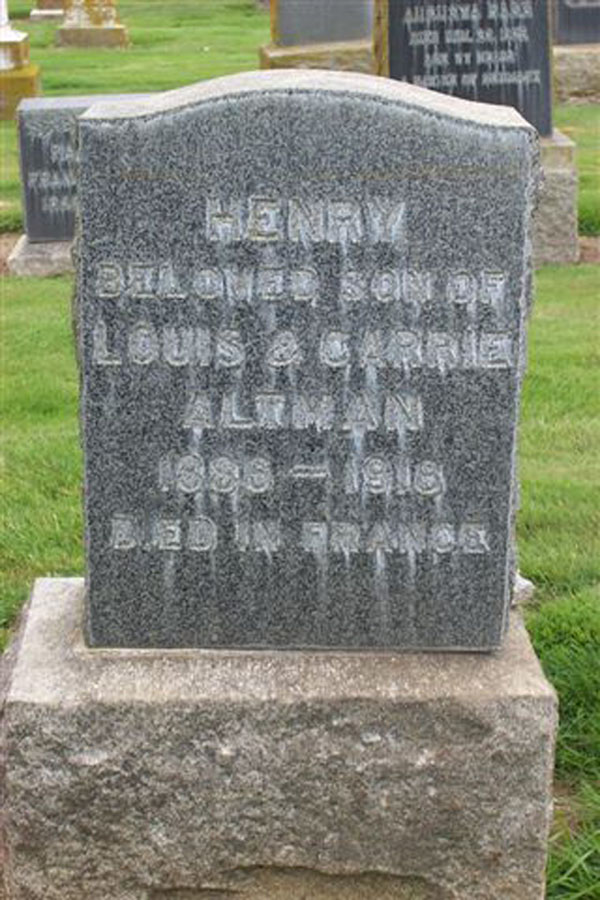
Altman, Henry, Cpl., 2,255,240 4th Infantry Division, 39th Infantry Regiment, Headquarters Company Mr. and Mrs. Louis (6/55-3/22/18) and Catherine (“Carrie”) (Lobel) (3/60-11/15/32) Altman (parents) Emma, Esther, Ira, Joseph, Mark, and Minnie (brothers and sisters) 324 15th Ave., San Francisco, Ca. Born San Francisco, Ca., 8/1/86 Hills of Eternity Memorial Park, Colma, Ca. San Francisco Bulletin 12/31/18 San Francisco Call 12/30/18 San Francisco Examiner 12/31/18 Soldiers of the Great War, Volume I – 139
This image of Cpl. Altman’s simple matzeva is by FindAGrave contributor Diane Reich.
____________________
Bloom, Louis, Cpl., 1,697,870 77th Infantry Division, 305th Infantry Regiment, G Company Mr. and Mrs. Samuel and Mollie (Silverman) (1857-4/7/35) Bloom (parents) Charles, Harry, Oscar, and Sara (brothers and sister) 230 Riverside Drive, New York, N.Y. Born New York, N.Y., 4/15/95 Washington Cemetery, Brooklyn, N.Y. – Cemetery 1, Range 7, Plot 72, Row 1, Grave 2; Buried 3/23/21 Soldiers of the Great War, Volume II – 343
The photographer and nature of the occasion are unknown, but this image fromFindAGrave, by contributor ColtonlThomas, shows Cpl. Bloom.
____________________
Lipsky, Abraham, PFC, 1,025,275 7th Infantry Division, 34th Infantry Regiment, D Company Died of Disease / Died of Disease or Other Causes Mr. and Mrs. David and Katherine Lipsky (parents) Bessie, Esther, Eva, and Lena (sisters) 459 Washington St., Haverhill, Ma. Born Massachusetts, 5/13/98 Place of burial unknown Soldiers of the Great War, Volume II – 35
____________________
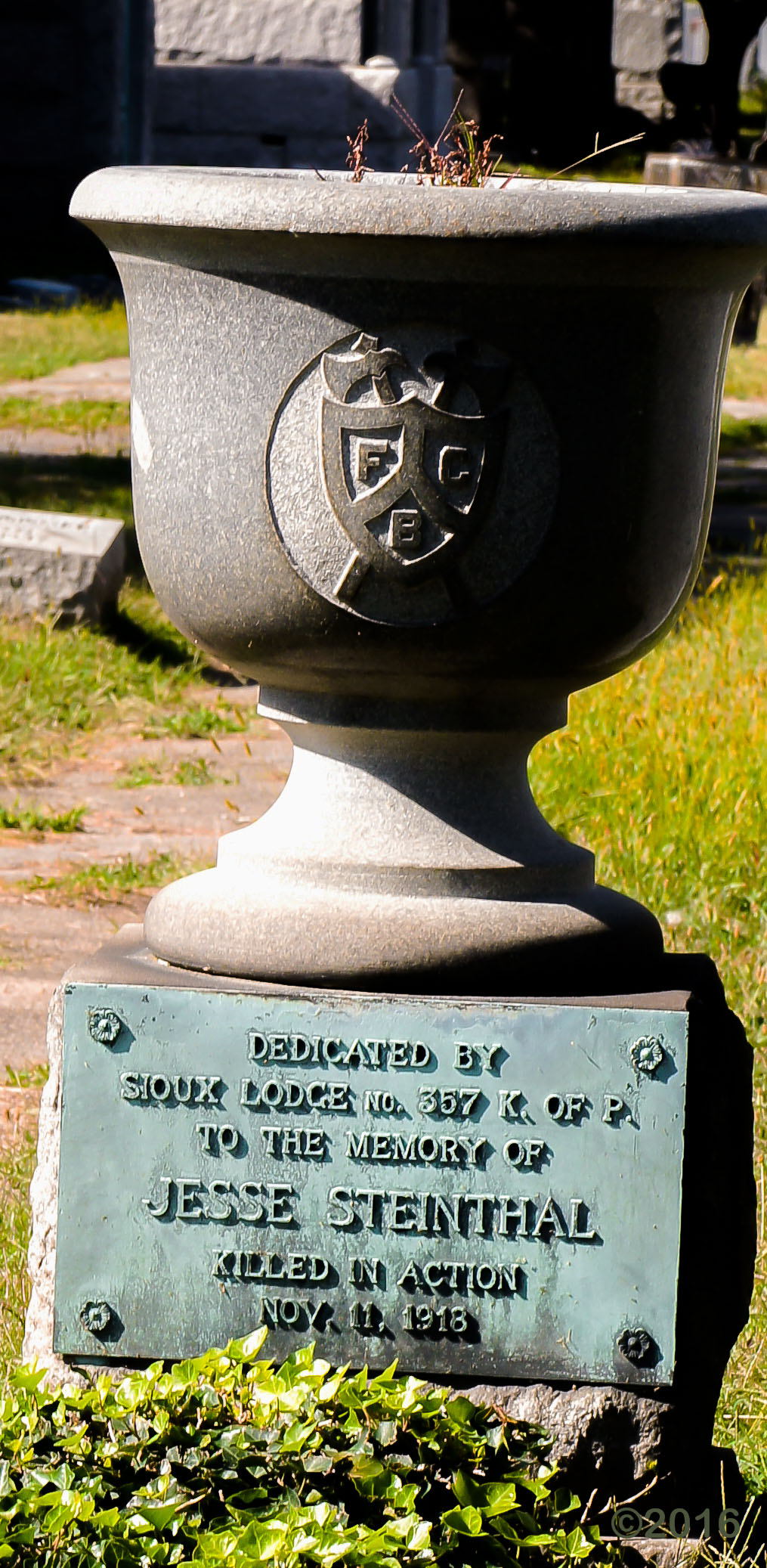
Steinthal, Jesse, Pvt., 3,209,817 81st Infantry Division, 321st Infantry Regiment, K Company Mr. and Mrs. Raphael and Rosalie Steinthal (parents), 697 West End Ave., New York, N.Y. Born New York, N.Y., 2/16/88 Mount Neboh Cemetery, Glendale, N.Y. – Buried 1921 New York Tribune 11/10/16, 12/9/18, 12/8/19 The Argus 12/12/18 Soldiers of the Great War, Volume II – 356
Two years and one day before the last battle: This remarkable sketch of Jesse Steinthal and his business partner A.F. Windeler, manager (butcher) and grocer at of the Volunteer Food Market at 573 8th Avenue in Manhattan, accompanies an article about retail grocers that appeared in the New York Tribune onNovember 10, 1916. (Accessed via FultonHistory.) The “A.F. Windeler” mentioned in the article might be Adolph Francis Windeler, who was born in 1856 and died in California in 1941.
Dated June 5, 1917, this is Jesse’s Draft Registration Card.
The intersection of the past and the present: This Oogle Street View from June of 2019 shows the then (relatively) contemporary appearance of 573 Eighth Avenue in New York City, the location now being the site of five adjacent restaurant / take-out establishments. Perusing the web reveals that as of early 2021, the WOK TO WALK restaurant no longer exists at this location. Given that the adjacent and nearby buildings are all multi-story structures (like the Manhattan Hotel at 273 West 38th Street, and, the building directly behind the cluster of five restaurants, while 573 Eight Avenue is a one or two-story building, it seems (?) that the building which housed Jesse Steinthal’s Volunteer Market was demolished in the century between 1916 and 2019.
What will be here a century from now?
This map shows the location of the above intersection, designated by Oogle’s ironic red pointer.
Jesse Steinthal’s simple matzeva at Mount Neboh Cemetery, and, a memorial plaque in his honor, in images by FindAGrave contributor Athanatos.
SONY DSC
Died of Wounds
Stern, Jacob, Pvt., 1,704,872 77th Infantry Division, 307th Infantry Regiment, B Company Mr. Harry Stern (father), 284 East Second St., New York, N.Y. Also 432 East Houston St., New York, N.Y. Born Kaspar, Hungary, 1888 Oise-Aisne American Cemetery, Seringes-et-Nesles, France – Plot C, Row 4, Grave 19 Soldiers of the Great War, Volume II – 370
____________________
Vogel, William, Jr., Cpl., 45,695 1st Infantry Division, 18th Infantry Regiment, Machine Gun Company DOW Mr. Adolph Vogel (father), 2319 West Taylor St., Chicago, Il. Also 1439 North Clark St., Chicago, Il. Born Chicago, Il., 11/18/86 Place of burial unknown; Buried 7/21 Soldiers of the Great War, Volume I – 284
Wounded in Action
Berger, Simon, Pvt., 2,388,750 5th Infantry Division, 61st Infantry Regiment, M Company Wounded in Action (“shrapnel wound in back of left ear”) Mrs. Rose (Greenspan) Berger (wife), Clara and Faiga (daughters), 2345 North 26th St., Philadelphia, Pa. Mr. and Mrs. Joan and Faiga Berger (parents) and Mr. John G. Berger (brother), 2200 Cantrell St., Philadelphia, Pa. Born “Dombrovan”, Russia, 1/3/92 Philadelphia Inquirer 12/9/18
____________________
Friedman, Abe, Pvt., 2,314,061 28th Infantry Division, 110th Infantry Regiment, C Company Wounded in Action (Seriously wounded previously, on 10/18/18) Mrs. Maxine Friedman (wife), Frances and Morton (daughter and son), 4139 Delevan St., Pittsburgh, Pa. Mrs. Rachel Friedman (mother), 2620 Center Ave., Pittsburgh, Pa. Born “Bashygolie” / “Bashygoin”, Russia, 4/5/92 Philadelphia Inquirer 10/31/18
____________________
Gershawitz, Abraham J., Pvt., 2,674,265 90th Infantry Division, 357th Infantry Regiment, H Company Severely wounded in action Mrs. Rosie Liss (sister), 20 High St., New London, Ct. Also 67 Blackhall St., New London, Ct. Born “Peresaska”, Russia, 1890
____________________
Gershowitz, Sam, Saddler, 2,672,037 78th Infantry Division, 308th Field Artillery Regiment, D Battery Severely wounded in action Mrs. Fannie / Jennie Braverman (sister), 12 Spring St., Montclair, N.J. Also 71 Norfolk St., New York, N.Y. Born “Navelduc”, Russia; 1895
____________________
Hershcovitz, Jacob, Pvt., 1,897,719 82nd Infantry Division, 326th Infantry Regiment, B Company Severely wounded in action; Severely wounded in action previously; approximately 10/10/18 Mr. Samuel Hershcovitz (brother), 144 Forsyth St., New York, N.Y. Mr. Leon Hershcovitz (brother), 63 Poplar St., Jersey City, N.J. Born Romania, 8/23/88 Died 2/7/62
____________________
Kaplan, Barnet, Pvt., 547,873 3rd Infantry Division, 30th Infantry Regiment, K Company Severely wounded in action; Severely wounded in action previously; approximately 7/15/18 Mr. Sam Kaplan (brother), 326 Washington Ave., New York, N.Y. Also 307 Dumont Ave., Brooklyn, N.Y. Born Minsk, Belarus, 3/14/89
____________________
Nadler, Abraham, Pvt., 1,698,221 77th Infantry Division, 305th Infantry Regiment, I Company Severely wounded in action; Severely wounded in action previously; approximately 8/15/18 Mr. David Nadler (cousin), 74 East 99th St., New York, N.Y. Also 457 Powell St., Brooklyn, N.Y. Born Galicia, Austria-Hungary, 1888
____________________
Rabinowitz, Israel S., Pvt., 628,762 58th Coast Artillery Corps, D Battery Severely wounded in action Mr. Abe Salt (brother in law), 347 Bristol St., Brooklyn, N.Y. Also 231 Henry St., New York, N.Y. Born Russia, 1892
Imperial German Army – Deutsches Heer
.ת.נ.צ.ב.ה.
Tehé Nafshó Tzrurá Bitzrór Haḥayím
May his soul be bound up in the bond of everlasting life.
Blumenhein, Artur, Soldat (Pvt.) Fussartillerie Bataillon 124, 3rd Kompagnie Died of wounds Krankenhaus Moabit, Berlin Born 12/28/93, in Berlin Mrs. Anna (Kohn) Blumenhein (mother), Berlin Mrs. Emma (Weiszenberg) Blumenhein (step-mother), Oldenburger Strasze 4, Berlin Judischen Friedhof zu Weissensee, Berlzu, Germany Bis der Krieg uns lehrt, was der Friede bedeutet – 58 Die Jüdischen Gefallenen – 133
____________________
Cohn, Gustav, Gefreiter (L/Cpl.) Infanterie Regiment 352, 2nd Battalion, 7th Kompagnie Missing Born 11/9/96, in Beuthen Resided Beuthen (O.S.) Die Jüdischen Gefallenen – 168
____________________
Eis, Philipp, Soldat (Pvt.) Infanterie Regiment 116, 2nd Battalion, 5th Kompagnie Born 1/9/98, in Frankfurt am Main Resided Frankfurt am Main Die Jüdischen Gefallenen – 210
____________________
Lewin, Richard Nathan, Sergeant Wirtsch. Grp. 29 Mil. Kreisant Wilna. Born 4/13/77, in Dolzig Resided Dolzig, Provinz Posen Die Jüdischen Gefallenen – 378
____________________
Schild, Ernst, Sergeant, Aviator [Flieger] Fliegertruppen des deutschen Kaiserreiches, Schlachtstaffel 5 Born 9/8/87, in Duisberg Resided Duisberg Die Jüdischen Gefallenen – Anhang (Appendix) – 403
____________________
Schwabe, Benno, Gebreiter (L/Cpl.) Infanterie Regiment 171, 1st Battalion, 1st Kompagnie Born 10/7/92, in Wolfenbuttel Resided Gottingen Kriegsgräberstätte in Vladslo (Belgien), Block 9, Grab 1884 Die Jüdischen Gefallenen – 229
____________________
Stern, Louis, Soldat (Pvt.) Bayerisch Reserve Infanterie Regiment 15, 2nd Battalion, 7th Kompagnie Born 6/7/85, in Schwanfeld Resided Schwanfeld Die Jüdischen Gefallenen – 333
____________________
Stettiner, Alfred Emil, Leutnant (2 Lt.) Landwehr Infanterie Regiment 111, 3rd Bataillon, 9th Kompagnie Born 1/18/81 (!), in Stuttgart Resided Stuttgart Jüdischer Friedhof im Pragfriedhof Stuttgart – First World War Memorial Die Jüdischen Gefallenen – 344
____________________
Tichauer, Hermann, Soldat (Pvt.) Armee Korps XVII, Ersatz Pferdedepot Born 7/20/73 (!), in Ptakowitz Mrs. Ernestine Tichauer (wife) Mr. and Mrs. Lobl and Ernestine Tichauer (parents), Jakob and Lina (brother and sister) Resided Lublinitz Die Jüdischen Gefallenen – 277
This image of Soldat Hermann Tichauer appears in his Geni.combiographical profile, maintained by Ronith Rimmel.
Franks, Norman, Bailey, Frank, and Duiven, Rick, Casualties of the German Air Service – 1914-1920, Grub Street, London, 1999
Gumpertz, Sydney G., Capt., The Jewish Legion of Valor – The Story of Jewish Heroes in the Wars of the Republic – And a General History of the Military Exploits of the Jews Through the Ages, Sydney G. Gumpertz, New York, N.Y., 1934, 1941
Gumpertz, Sydney G., Capt., The Jewish Legion of Valor – The Story of Americans of the Jewish Faith Who Distinguished Themselves in the Armed Forces in All the Wars of the Republic – And a General History of the Military Exploits of the Jews Through the Ages, Sydney G. Gumpertz, New York, N.Y., 1934, 1946
Hank, Sabine; Simon, Hermann; Gauding, Daniela, Bis der Krieg uns lehrt, was der Friede bedeutet: das Ehrenfeld für die jüdischen Gefallenen des Weltkrieges auf dem Friedhof der Berliner Jüdischen Gemeinde (“Neue Synagoge Berlin-Centrum Judaicum.”; Militärgeschichtliches Forschungsamt, Schriftenreihe des Centrum Judaicum, Bd. 2.), Hentrich & Hentirch, Teetz, Germany, 2004
Haulsee, William Mitchell; Howe, Frank George; Doyle, Alfred Cyril, Soldiers of the Great War – Memorial Edition: Volume I (Alabama through Maryland), Washington, D.C., Soldiers Record Publishing Association, 1920
Haulsee, William Mitchell; Howe, Frank George; Doyle, Alfred Cyril, Soldiers of the Great War – Memorial Edition: Volume II (Massachusetts through Ohio), Washington, D.C., Soldiers Record Publishing Association, 1920
Haulsee, William Mitchell; Howe, Frank George; Doyle, Alfred Cyril, Soldiers of the Great War – Memorial Edition: Volume III (Oklahoma through Wyoming), Washington, D.C., Soldiers Record Publishing Association, 1920
Henshaw, Trevor, The Sky Their Battlefield – Air Fighting and The Complete List of Allied Air Casulties from Enemy Action in the First War, Grub Street, London, 1995
Sinclair, James J., Captain (Compiler), Final Report of the U.S. Military Mission on American Prisoners of War, U.S. Military Mission, Berlin, Germany, August 10th, 1919
Die Jüdischen Gefallenen Des Deutschen Heeres, Deutschen Marine Und Der Deutschen Schutztruppen 1914-1918 – Ein Gedenkbuch, Reichsbund Jüdischer Frontsoldaten, Forward by Dr. Leo Löwenstein, Berlin, Germany, 1932
The War Record of American Jews – First Report of The Office of War Records, American Jewish Committee, January 1, 1919, The American Jewish Committee, New York, N.Y., 1919
Officers and Enlisted Men of the United States Naval Service Who Died During the World War, From April 6, 1917 to November 11, 1918, Government Printing Office, Washington, D.C., 1920
The American Jewish Year Book, Jewish Publication Society of America, Philadelphia, Pa.
Connecticut: Connecticut Service Records – Men and Women in the Armed Forces of the United States During the World War 1917-1920 (In Three Volumes), Office of the Adjutant General, Hartford, Ct. Volume I: pp. 1-1152 (Andover – Hartford) Volume II: pp. 1153-2336 (Hartford – Plainfield) Volume III: pp. 2337-3017 (Plainfield – Woodstock)
North Dakota: Roster of the Men and Women Who Served in the Army or Naval Service (including the Marine Corps) of the United States of its Allies from the State of North Dakota in the World War, 1917-1918, Vol. I-IV. Bismarck, ND, USA: Bismarck Tribune Co., 1931
New York – Rochester and Monroe Counties: World War Service Record Rochester and Monroe County, N.Y. (In Two Volumes), The City of Rochester, N.Y., 1924 Volume I: Those Who Died for Us Volume II: Those Who Went Forth to Serve
Records Group 407 “Casualties of the AEF By State – World War One” – “WW I Organization Records Office File”, Stack 370, Row 25, Compartment 7, Shelf 5 – Entry 10 (UD)
Newspapers
The Jewish Chronicle The Jewish Exponent The New York Times The Philadelphia Inquirer
Some time during the last week of March in the year 1918 – the specific date will remain unknown – Isaac Rosenberg, a Private in the British Army serving in the King’s Own Royal Lancaster Regiment – penned the following poem:
Through These Pale Cold Days
Through these pale cold days What dark faces burn Out of three thousand years, And their wild eyes yearn,
While underneath their brows Like waifs their spirits grope For the pools of Hebron again – For Lebanon’s summer slope.
They leave these blond still days In dust behind their tread They see with living eyes How long they have been dead.
(From The Collected Works of Isaac Rosenberg, page 91)
__________
Photographic portrait of Private Isaac Rosenberg, Regimental Number 22311, probably taken in September, 1917, from Joseph Cohen’s Journey to The Trenches.
__________
Born in Bristol on November 25, 1890, Rosenberg was a painter and poet in civilian life. Despite his pacifistic nature – attributable to his familial upbringing as much as his independent personality – both of which dispositions gave him a disinclination to military life, Rosenberg enlisted in the British Army in October of 1915. His primary motivations were simple: Enervating uncertainty about making a livelihood, whether through the arts or most any other vocation, and more fundamentally, a matter-of-fact sense of resignation in terms of the tenor of the times. Perhaps he felt that military service, even if he was largely unamendable to it physically, psychologically, or intellectually, would provide his life with structure and direction unavailable to him otherwise. Even if this was in a time of war.
Rosenberg was killed in action on the first day of April in 1918, not long after he composed “Through These Pale Cold Days”, a poem which expressed his frustrated yearning to return to Eretz Israel, and, serve in a Jewish military unit, this last desire reflected by his persistent and unsuccessful application to transfer to the Judeans, the Jewish volunteer battalions organized by Vladimir Jabotinsky and then serving in Egypt and the Yishuv.
His death came eleven days after the commencement of the great German offensive otherwise known as Operation Michael, which was (Wikipedia speaking here), “…launched from the Hindenburg Line, in the vicinity of Saint-Quentin, France. Its goal was to break through the Allied (Entente) lines and advance in a north-westerly direction to seize the Channel Ports, which supplied the British Expeditionary Force (BEF) and to drive the BEF into the sea. … The offensive ended at Villers-Bretonneux, to the east of the Allied communications centre at Amiens, where the Allies managed to halt the German advance; the German Army had suffered many casualties and was unable to maintain supplies to the advancing troops.”
Rosenberg’s final battle was described by Tulane University faculty member Joseph Cohen, in his 1975 book Journey to the Trenches, as follows:
“The First King’s Own Regiment, still in the reverse trenches, moved quickly to the forward area, at one point suffering heavy casualties in terrain exposed to the enemy’s cross-fire. Twenty-four hours later the Germans had overrun the front line, and the First King’s Own Regiment along with other adjacent units found themselves back in the reserve trenches, which became the new front lines. Throughout that Saturday and Sunday, March 30-31, they stubbornly resisted the German advance. When the attack eased on Sunday, the few survivors in Rosenberg’s company were ordered to the rear. In the early morning hours of Monday, April 1, All Fools’ Day, the Company made its way back under cover of darkness. The men had not gone more than two hundred yards when a runner caught up with them. The attack had been renewed and every man was needed. Since they had earned their brief respite from the fighting they were not ordered to return, but asked to volunteer. No one had to go back. Among the few who did was Rosenberg.
“Certainly he knew what the odds were against his surviving that fateful hour. He did not have to volunteer, but made the decision to go back as in 1915 he had made the decision to enlist. He returned, and within an hour of reaching the battle area, somewhere close to the French Village of Fampoux, Isaac Rosenberg was killed in close combat. He was twenty-seven.”
This account parallels the Wikipedia entry for Rosenberg, which states, “Having just finished a night patrol, he was killed on the night of 1 April 1918 with another ten KORL soldiers; there is a dispute as to whether his death occurred at the hands of a sniper or in close combat. In either case, he died in a town called Fampoux, north-east of Arras. He was first buried in a mass grave, but in 1926 the unidentified remains of the six KORL soldiers were individually re-interred at Bailleul Road East Cemetery, Plot V, Saint-Laurent-Blangy, Pas de Calais, France. Rosenberg’s gravestone is marked with his name and the words, “Buried near this spot”, as well as – “Artist and Poet”.”
But, what of March 21, 1918, the opening date of the final German offensive in the west?
When I embarked on researching British Commonwealth Jewish military casualties of the Great War, based on information in The Jewish Chronicle and records accessible via the Commonwealth War Graves Commission, I soon noticed a relatively high number of records for soldiers killed in action on July 1, 1916, the opening of the Somme Offensive, of which I’d previously known only anecdotally. In the same way, the CWGC database revealed a cluster of records for the fallen on March 21, 1918, of which – prior to that time being focused on the Second World War – I’d previously known, well, also-nothing-at-all. That date, I soon learned, was the opening day of Operation Michael, which, “…had been costly for the Germans, who had suffered c. 40,000 casualties, slightly more than they inflicted on the BEF,” something paralleling, in terms of overall magnitude (though the specifics were different) the terrible events on the opening day of the Somme Offensive.
And so, akin to the post about the Somme battle, here are presented biographical records and photographs (where available) of Jewish military casualties on this March day, a little over a century and four years ago.
The names of 37 men are listed.
Of the 37, thirty-three lost their lives in battle, one of whom, Pte. Max Rapaport, born in Rumania, was serving in the South African Infantry. A 34th (L/Cpl. Moss Emanuel – died possibly? probably? – not in battle, similar to the 35th (Pte. Barnett Schwartz) who served in the Yishuv. Schwartz seems to have no actual grave, being commemorated at the Jerusalem Memorial.
Notably, the 36th man was an American: Air Mechanic Samuel Walter Arnheim, serial 152812. From West End Avenue in New York City, he was a flying instructor in the Royal Flying Corps, and was killed in a aviation accident at the School of Aerial Gunnery at Camp Hicks, in Texas, though the specifics of that incident are unknown. His death received extensive coverage in the both the general and Jewish press, having been reported on in at least six newspapers.
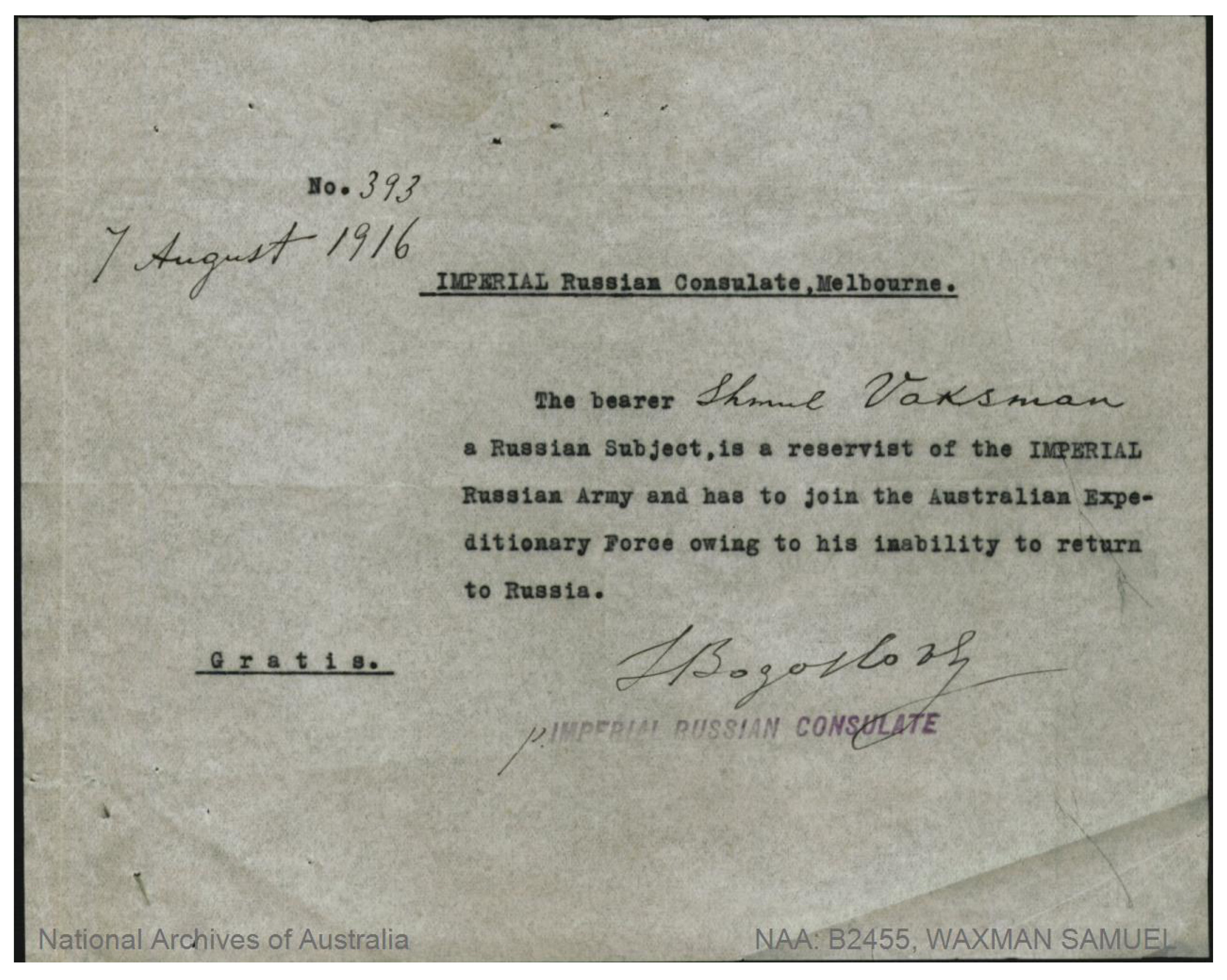
As for the “37th”, Pte. Samuel Waxman? Wounded, he survived the day and the war. A member of the 24th Battalion in the Australian Imperial Forces, he was born in Warsaw, and his Attestation Papers (accessed via the National Archives of Australia) reveal that as a Russian subject (however the word “subject” was then defined!) he was obligated to serve in the AIF, due to his obvious inability to return to Russia and serve in that country’s army.
It’s notable that the names of nearly half of the 37 – fourteen – never appeared in The Jewish Chronicle, while the names of 12 of those 14 soldiers are likewise absent from the British Jewry Book of Honour.
And, awfully reflective of the awful and overwhelming nature of the Offensive’s opening day, only four of the aforementioned 33 have places of burial.
But alas, there was more, and is more: The Wikipedia entry for the Offensive alludes to German losses for the opening day exceeding those of the British. This is sadly reflected in the number of German Jewish soldiers lost in battle this day: 52. Their names, military units, dates and places of birth and residence, and places of burial (where known) are listed below, though only Leutnant Erich Heilbrunn’s entry includes a photo.
As per the post about the Somme Offensive, to place the events of this day in a clearer context, I’ve included links to a variety of websites, and, some videos.
Kaiserschlacht: The German Spring Offensive, at Anglo Historian (March 21, 2018)
______________________________
Thursday, March 21, 1918 – 8 Nisan, 5678
.ת.נ.צ.ב.ה.
Tehé Nafshó Tzrurá Bitzrór Haḥayím
May his soul be bound up in the bond of everlasting life.
Killed in Action or Died of Wounds
Barnett, Samuel, Pvt., 204305 London Regiment (Royal Fusiliers), 1st Battalion (Attached to 2nd/4th Battalion) Mr. and Mrs. Elias and Polly Barnett (parents), 240 Mile End Road, London Also 9 Gordon Road, Stoke Newington, London, N Born 1898 Pozieres Memorial, Somme, France – Panel 85 (CWGC lists mother’s name as Polly; did father remarry? If not, mother was actually Miriam (Belasco) Barnett.) British Jewry Book of Honour – 79, 462
____________________
Bensusan, Harry, Rifleman, O/461 Rifle Brigade, 9th Battalion Mr. and Mrs. Henry and Adelaide Bensusan (parents), David, Isaac, Joseph, Reuben, Rosetta, Solomon (brothers and sister) 8 Hutchinson Ave., Aldgate Born Spitalfields, Middlesex, 1899 Pozieres Memorial, Somme, France – Panels 81 to 84 British Jewry Book of Honour – Not Listed
____________________
Bernstein, Jacob, Pvt., 29444 West Yorkshire Regiment (Prince of Wales’ Own), 10th Battalion Mr. and Mrs. Hyman and Leah Bernstein (parents), 53 Roseville Road, Leeds, 8 Born Leeds, 1897 Arras Memorial, Pas de Calais, France – Bay 4 British Jewry Book of Honour – photo section 128 (not listed elsewhere in book)
____________________
Inscription on matzeva: In loving memory of Jack – Mourned by his mother – Brothers and sisters
Cohen, Jacob, Pvt., 262663 Manchester Regiment, 2nd/6th Battalion Mr. and Mrs. Wolf and Esther Cohen (parents), Israel, Reuben, Lilly, Minnie, and Victor (brothers and sisters) 31 Exchange St., Cheetham, Manchester Born Manchester, 1894 Assevillers New British Cemetery, Somme, France – VI,D,10 The Jewish Chronicle 4/26/18 (incorrectly lists serial as 252263) British Jewry Book of Honour – 84, 364; photo section 238
____________________
Cohen, Oscar, Pvt., G22470 The Buffs (East Kent Regiment), 7th Battalion Mr. Philip Cohen (father), 47 West Green Road, London, N15 Born Whitechapel, London, 7/2/98 Pozieres Memorial, Somme, France – Panel 16 The Jewish Chronicle 7/26/18 British Jewry Book of Honour – 85, 238; photo section 229
____________________
Fiddler, Michael, Rifleman, S/35069 Rifle Brigade, 16th Battalion Mr. and Mrs. Davis and Rachael Fiddler (parents), Benjamin, Blumah, Jacob, Lazarus, Samuel, and Sophy (brothers and sisters) 103 Slater St., Brick Lane, London, E Born St. Thomas, Bethnal Green, 1899 Pozieres Memorial, Somme, France – Panels 81 to 84 The Jewish Chronicle 3/21/19 British Jewry Book of Honour – 88, 383 (incorrectly lists surname as “Fidler”)
____________________
Fraser, Hyman, Sgt., 202360 The King’s (Liverpool) Regiment, 11th Battalion, C Company Mrs. Minnie (Shock) Fraser (wife), 17 Bannerman St., Edgehill, Liverpool Pozieres Memorial, Somme, France – Panels 21 to 23 The Jewish Chronicle 5/10/18 British Jewry Book of Honour – 89, 288
____________________
Freedman, Mark, Pvt., 203869 Northumberland Fusiliers, 22nd (Tyneside Scottish) Battalion Mrs. Betty Freedman (wife), 25 Grove St., Commercial Road, London Mr. and Mrs. Morris and Annie Freedman (parents), 40 Merchant St., London, E Born 1891 Arras Memorial, Pas de Calais, France – Bays 2-3 The Jewish Chronicle 5/24/18 British Jewry Book of Honour – 90, 242 (Lists name as “Freedman, D.M.” (p. 90) and “Freedman, W.” (p. 242)); photo section 225
____________________
Goldberg, Edward (“Eddie”), Pvt., 85316 The King’s (Liverpool Regiment), 1st Battalion Mr. and Mrs. Abraham and Hannah Goldberg (parents), Joseph and Rachel (brother and sister) 185 Brunswick Buildings, Goulston St., Aldgate, London, E Born Whitechapel, London, 1896 Arras Memorial, Pas de Calais, France – Bay 3 The Jewish Chronicle 5/17/18 The Jewish Chronicle (Obituary section) 4/26/18 British Jewry Book of Honour – 91, 288
____________________
Goldstone, Leonard, L/Cpl., 44748 (Formerly 3320, London Regiment) Royal Irish Rifles, 12th Battalion Mr. and Mrs. Alfred A. and Millie Goldstone (parents), 130 King St., Great Yarmouth, Norfolk Born Great Yarmouth, Norfolk Pozieres Memorial, Somme, France – Panels 74 to 76 British Jewry Book of Honour – 378
____________________
Harris, Henry, Pvt., 18268 Royal Irish Regiment, 2nd Battalion Mr. and Mrs. John and Sarah Harris (parents), 18 (38?) Wilkes St., Spitalfields, London, E Born 1889 Pozieres Memorial, Somme, France – Panels 30 and 31 The Jewish Chronicle 3/28/19 British Jewry Book of Honour – 95, 305
____________________
Inscription on matzeva: Deeply mourned by brother – Sisters and relatives
Himmelstein, Harry, Pvt., 203842 London Regiment (Royal Fusiliers), 2nd/2nd Battalion Mr. and Mrs. Simon and Liba Himmelstein (parents), Fanny, Rosa, and Solomon (sisters and brother) 94 Grove St., Commercial Road, Stepney, London, SE (E1?) Born Whitechapel, London, 1899 (Or…born in Poland…) Chauny Communal Cemetery, British Extension, Aisne, France – 3,F,11 The Jewish Chronicle 5/3/18 British Jewry Book of Honour – 96, 472, 473
____________________
Jacobson, Samuel, Pvt., 51685 The King’s (Liverpool Regiment), 19th Battalion Mr. and Mrs. Isaac and Yetta Jacobson (parents), Bertrice, Harry, Kate, Marks, Milly, Myer, Reuben, and Soloman (sisters and brothers) 39 Great Orford St., Liverpool Born Liverpool, Lancashire, 1897 Pozieres Memorial, Somme, France – Panels 21 to 23 British Jewry Book of Honour – Not Listed
____________________
Kutchinsky, Alec, Rifleman, R/32227 King’s Royal Rifle Corps, 9th Battalion Mr. and Mrs. Michael and Rosie Kutchinsky (parents) Dawn, Esther, Isaac, Judah, and Rachel (sisters and brothers), 48 Anthony St., London, E Born St. George in the East, Whitechapel, London, 1894 Pozieres Memorial, Somme, France – Panels 61 to 64 The Jewish Chronicle 3/28/19 British Jewry Book of Honour – 101, 360; photo section 132
____________________
Levi, Frederick Joseph, 2nd Lieutenant Lincolnshire Regiment, 1st Battalion (Attached to 2nd/5th Battalion) Mr. and Mrs. Mark and Bloom Levi (parents), Ada, Cissie, Lillie, and Manuel (sisters and brother) 116 Pershore Road, Edgbaston, Birmingham Born Edgbaston, Birmingham, 1895 Arras Memorial, Pas de Calais, France – Bays 3 and 4 The Jewish Chronicle 4/19/18, 1/3/19 (Issue of4/19/18 lists name as “Levi, F.I.”) The Jewish Chronicle (Obituary section) 12/20/18 British Jewry Book of Honour – 72, 293; photo section 45
An image of the matzeva of Frederick Joseph’s father Mark, by FindAGrave Contributor Hockley Lass, is shown below. Note that their son, who is commemorated at the Arras Memorial, is memorialized by engraved text.
IN LOVING MEMORY OF MAURICE ALBERT LEVI, SON OF MARK AND BLOOM LEVI, DIED MARCH 6TH 1919, AGED 26. ALSO OF THEIR SON FREDERIC JOSEPH LEVI, WHO WAS KILLED IN ACTION IN FRANCE MARCH 21ST 1918, AGED 23. MAY THEIR SOULS REST IN PEACE
____________________
Levi, Reuben, Pvt., 40139 Royal Scots Fusiliers, 6th/7th Battalion Mr. and Mrs. Marks (6/3/67-8/13) and Leah (Lazarus) (died 10/7/34) Levi (parents), Sarah (“Sadie”) (1900-1973) (sister) 75 Green Road, Leeds Born Leeds, Yorkshire, 1895 Arras Memorial, Pas de Calais, France – Bay 5 British Jewry Book of Honour – Not Listed
Marks Levi’s naturalization form of September 2, 1912, from the Sargent Family Tree (by Jacqueline Sargent), at Ancestry.com, appears below. Note that Reuben’s name (he was then 17) is recorded on the Certificate of Naturalization to an Alien sheet.
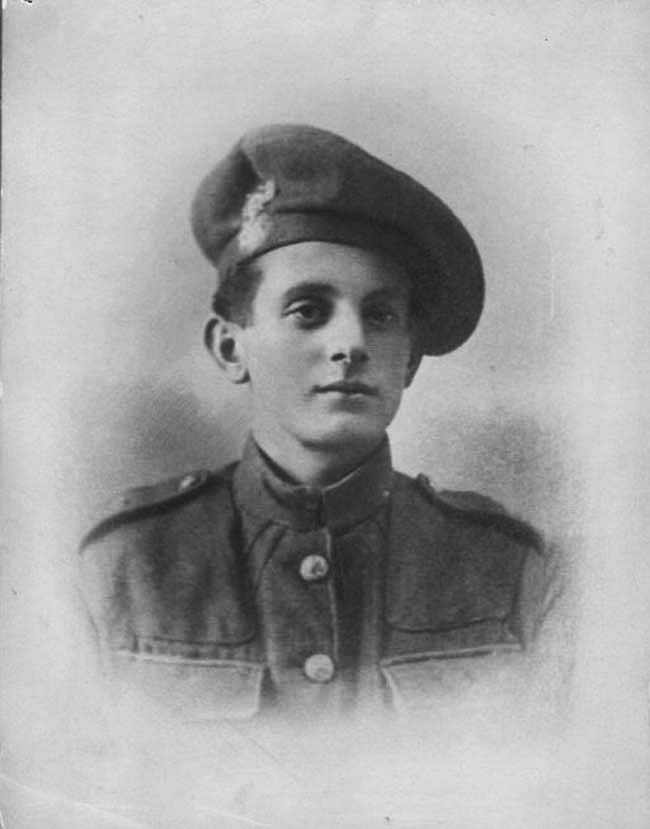
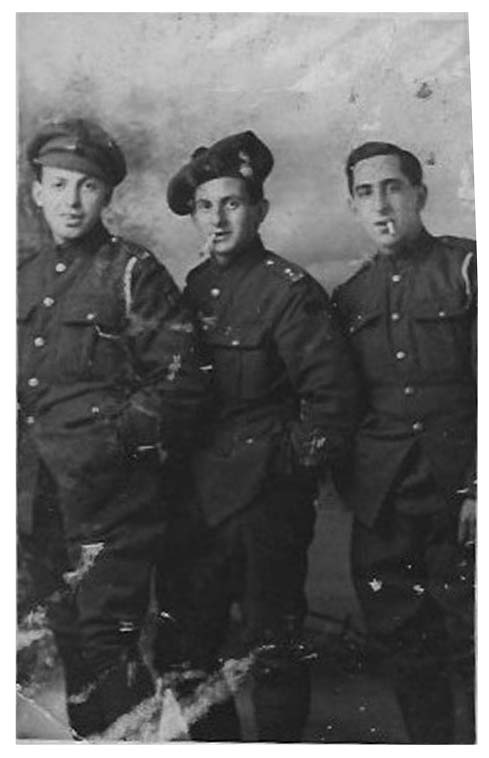
The following three images of Reuben (he’s the center figure in the group picture) are also displayed at the Sargent Family Tree page.
Also among Sargent Family Tree documents is this Official notification of Reuben’s death, dated January 25, 1919. Though he has no known grave, the document reveals that his body must have been recovered and identified by the German military.
____________________
Levy, Henry, Pvt., 31092 York and Lancaster Regiment, 2nd Battalion Mr. and Mrs. William and Sarah Levy (parents), Florence, Jacob, Joseph, Julius, and Samuel (sister and brothers) 67 Frederick St., South Shields Born South Shields, Durham, 1889 Arras Memorial, Pas de Calais, France – Bay 8 British Jewry Book of Honour – Not Listed
____________________
Marks, David, Cpl., 41016 Royal Dublin Fusiliers, 1st Battalion (Formerly Royal Field Artillery) Mr. and Mrs. Labovitch (“Jacob”) and Rachel Marks (parents), Fanny, Harris, Israel, and Lazarus (sister and brothers) 9 Herdford Place, Meadwood Road, Leeds Born Yorkshire, England, 1883 Pozieres Memorial, Somme, France – Panels 79 and 80 British Jewry Book of Honour – Not Listed
____________________
Meltzer, Solomon, Pvt., 64462 (Transferred to Labour Corps, 108th Labour Company; serial changed to 11484) The Loyal North Lancashire Regiment, 3rd/5th Battalion Mr. and Mrs. D. and L. Metlzer (parents), 15 Hewitt St., Hightown, Manchester Born St. Peters, Bradford, West Yorkshire Faubourg d’Amiens Cemetery, Arras, Pas de Calais, France – VII,B,32 The Jewish Chronicle 4/12/18 British Jewry Book of Honour – 108, 442; photo section 58
Solomon’s matzeva appears in this image by FindAGrave Contributor PearLady
____________________
Mosely, Arthur, Pvt., 275217 London Regiment (Royal Fusiliers), 3rd Battalion Mr. and Mrs. Simon and Ann Moseley (parents) Frances, John, Joseph, and Louis (sister and brothers), 68 Lincoln St., E3, Bow, London Born Mile End, London, 1897 Pozieres Memorial, Somme, France – Panel 85 The Jewish Chronicle 3/28/19 The Jewish Chronicle (Obituary section) 3/28/19 British Jewry Book of Honour – 109, 480, 481 (British Jewry Book of Honour – lists surname as “Moseley”, and “Mosely”, but CWGC lists surname as “Mosely”. 1901 Census lists surname as “Moseley”)
____________________
Nyman, Maurice, Rifleman, R35759 King’s Royal Rifle Corps, 1st Battalion Mr. and Mrs. Jacob and Leah Nyman (parents), Harry, Hyman, Philip, and Sidney (brothers), 3 Cable St., Whitechapel East, London Born Whitechapel, London, 1898 Arras Memorial, Pas de Calais, France – Bay 7 British Jewry Book of Honour – Not Listed
____________________
Rapaport, Max, Pvt., 13190 South African Infantry, 2nd Regiment Mr. and Mrs. Sulim and Hinda Rapaport (parents), Str Hagi, Vasluiu, Rumania Born Rumania, 1889 Pozieres Memorial, Somme, France – Panels 95-98 British Jewry Book of Honour – Not Listed
____________________
Rosenberg, Abraham, Pvt., 34958 Machine Gun Corps, 51st Battalion Mrs. Dora Rosenberg (mother), 92 Grafton St. / 3 Stamford St., Leeds Born London Arras Memorial, Pas de Calais, France The Jewish Chronicle 5/10/18 (TJC lists name as “Rosenberg, H.”) British Jewry Book of Honour – 114, 395
____________________
Rosenberg, Lewis, L/Cpl., 233855 London Regiment (Royal Fusiliers), 2nd Battalion Mr. and Mrs. Israel and Edith Rosenberg (parents) Harry, Hetty, Hyman, Leah, and Sammy (brothers and sisters) 220 St. George’s St., E (or) 21 The Highway, London Born Wapping, London, 1898 Chauny Communal Cemetery, British Extension, Aisne, France – Sp. Mem. C; 2,F,1 The Jewish Chronicle 5/3/18 British Jewry Book of Honour – 114, 483, 484
____________________
Rottstein, Harry, Cpl., 203390 Durham Light Infantry, 2nd Battalion Mr. and Mrs. Reuben and Ada Rottstein (parents) Abraham, Anne, Clara, Isaac, Joseph, Rebecca, and Rose (brothers and sisters) 8 Rich St., Limehouse, St. Georges, North Somerset Born Mile End, London, 1892 Arras Memorial, Pas de Calais, France – Bay 8 British Jewry Book of Honour – Not Listed
____________________
Rubenstein, Hyman, Pvt., 235283 East Lancashire Regiment, 2nd/4th Battalion Mr. and Mrs. Mark Leon and Rose Rubenstein (parents) Blanche, Fanny, Hyman, Jack, Pearl, Ray, and Sarah (sisters and brothers), 153B Kensington, Liverpool Born Leeds, Yorkshire, 1898 Pozieres Memorial, Somme, France – Panel 42 and 43 The Jewish Chronicle 4/26/18 (Incorrectly lists surname as “Rubinstein”) British Jewry Book of Honour – 115, 321
____________________
Schratsky, Phillip, Rifleman, R/22366 King’s Royal Rifle Corps, 7th Battalion Mr. and Mrs. Jack (John) and Mary (Minnie) Schratsky (parents), Benjamin, Dinah, Freeman, Isaac, Kate, Leah, Sarah, and Solomon (brothers and sisters) 6 Duval St., Spitalfields, London Born Whitechapel, London, 5/30/94 Pozieres Memorial, Somme, France – Panels 61 to 64 British Jewry Book of Honour – Not Listed
____________________
Segelman, Powell, Cpl., 44518 Sherwood Foresters (Notts and Derby Regiment), 16th Battalion Mrs. Mary Segelman (mother), Annie Cohen, Dora Levinson, Ellis, Hetty Baker, and Max (sisters and brothers) 113 Victor St., Lincolnshire, Grimsby Born Kovno (Kaunas), Lithuania, 1892 Pozieres Memorial, Somme, France – Panels 52 to 54 The Jewish Chronicle 5/3/18 (Mentions that he served as “Grimsby”) British Jewry Book of Honour – 117, 340
____________________
Smullen, Abraham, Pvt., 33847 Manchester Regiment, 16th Battalion Mr. and Mrs. Lewis and Ethel Smullen (parents), Hyman, Rachel, and Sarah (brother and sisters), 89 Stock St., Manchester Born Belfast, Ireland, 1896 Pozieres Memorial, Somme, France – Panels 64 to 67 British Jewry Book of Honour – 119, 368
____________________
Solomons, Frank, L/Cpl., R/23189 King’s Royal Rifle Corps, 9th Battalion Mr. Simon Solomons (father), 7 Frostie Place (12 Frostie Mansions), Whitechapel, E, London, England Born Stepney, Middlesex Pozieres Memorial, Somme, France – Panels 61 to 64 The Jewish Chronicle 5/3/18 British Jewry Book of Honour – 119, 362
____________________
Williams, Nathan, Pvt., 141430 Machine Gun Corps, 58th Company Wounded (gassed) Mr. and Mrs. Louis and Rachel Williams (parents), Annie, Florry, Isaac, Ivy, Jacob, Leah, Morris, and Sarah (sisters and brothers) 172 Green St., Bethnal Green, London, E Born Bethnal Green, London, 1898 Pozieres Memorial, Somme, France – Panels 90 to 93 The Jewish Chronicle 5/3/18, 3/28/19 (Chronicle lists name as “N.A. Williams”, and serial as 225727) British Jewry Book of Honour – 123, 396
____________________
Yarmovsky, Jacob, Pvt., 31879 West Yorkshire Regiment (Prince of Wales’ Own), 1st Battalion Mr. and Mrs. Eli (“Hillel”) (1868-10/2/34) and Sophia (“Zifaie”) (1870-3/8/38) Yarmovsky (parents) Elizbaeth Julia (“Lizzie”), Jacob Philip, Leah, Louis, Max, and Sarah Rebecca (sisters and brothers) 20 Henbury St., Benson St., Leeds Born Leeds, Yorkshire, 1897 Arras Memorial, Pas de Calais, France – Bay 4 British Jewry Book of Honour – Not Listed
____________________
Zimmerman, Naheim, Pvt., 267774 Sherwood Foresters (Notts and Derby Regiment), 2nd/7th Battalion Mr. and Mrs. Morris and Flora Zimmerman (parents), Aaron, Annie, Barnett, Beatrice, Ephraim, Harriet, Israel, Leah, and Leon (brothers and sisters) 184 High St., Shadwell, London, E Arras Memorial, Pas de Calais, France – Bay 7 The Jewish Chronicle 5/31/18 British Jewry Book of Honour – 123, 341
Died Non Battle
Emanuel, Moss, L/Cpl., 41460 Royal Inniskilling Fusiliers, 2nd Battalion Died non-battle Mrs. Lilly (Weinrabe) Emanuel (wife) Mr. and Mrs. Emanuel (5/1/54-7/31) and Elizabeth “Lizzie” (Lazarus) (1854-1/21) Emanuel (parents) 48 Brighton Road, Stoke Newington, London Also 126 Maybury Road, Woking, Surrey Born Whitechapel, London, 1886 Pozieres Memorial, Somme, France – Panels 38 to 40 The Jewish Chronicle 6/14/18, 9/27/18, 10/4/18 The Jewish Chronicle (Obituary section) 9/27/18, 10/4/18, 3/21/19 British Jewry Book of Honour – 88, 317 The Sun – 3/26/18
____________________
In Egypt or The Yishuv
Schwartz, Barnett, Pvt., 51283 Imperial Camel Corps Mr. and Mrs. Jacob and Kate Schwartz (parents), Abraham, Esther, Leah, Nathan, Samuel, and Sarah (brothers and sisters) 289 Oxford St., Stepney, London, E Born Mile End, London, 1894 Jerusalem Memorial, Jerusalem, Israel – Panel 7 The Jewish Chronicle 3/28/19 British Jewry Book of Honour – 117; photo section 26
An American Jew in the Royal Flying Corps
Arnheim, Samuel Walter, Cadet, 152812 Royal Flying Corps Killed in flying accident at School of Aerial Gunnery, Camp Hicks, Texas, United States Enlisted in Royal Flying Corps in July of 1917; sent to Texas as flying instructor. Graduate of Yale University Mr. and Mrs. Marks and Fannie (Frances?) (Lewald) Arnheim (parents), 246 West End Ave., New York, N.Y., United States Mrs. Milton F. Untermeyer (sister) Born New York, N.Y., 4/21/89 Jesherun New Burial Ground (Beth Shalom Fields?), Brooklyn, N.Y. – Plot 670, B; Buried 3/26/18 (Services led by Reverend Dr. Stephen S. Wise) Occupation: Manufacturer of Clothing, US Army & Navy Officers’ Uniforms The Jewish Chronicle 6/7/18 The Jewish Chronicle (Obituary section) 5/3/18, 3/21/19 British Jewry Book of Honour – Not Listed The Daily Standard Union (Brooklyn) – 3/22/18 The Independent Republican – 4/5/18 New York Herald – 3/22/18, 3/26/18 New York Tribune – 7/9/17, 3/26/18
Wounded in Action
Waxman, Samuel, Pvt., 5905 Australian Imperial Forces, 24th Battalion Mr. Lazar Waxman (father), Warsaw, Poland Also Rothdown St., Carlton, Victoria, Australia Born Warsaw, Poland, 1896 Attestation Papers list civilian trade as “Salesman” British Jewry Book of Honour – 565
This statement of August 7, 1916, by the Consulate of Imperial Russia, in Melbourne, communicates Samuel Waxman’s obligation to serve in the Australian Expeditionary Forces in lieu of his inability to serve in the Russian army.
________________________________________
________________________________________
Germany
Imperial German Army – Deutsches Heer
German Tactics For 1918 Spring Offensive – THE GREAT WAR Special, at The Great War (March 12, 2018)
Kaiserschlacht – German Spring Offensive 1918 – THE GREAT WAR Week 191, at The Great War (March 22, 2018)
Operation Michael Runs Out Of Breath – THE GREAT WAR Week 193, at The Great War (April 5, 2018)
______________________________
.ת.נ.צ.ב.ה.
Tehé Nafshó Tzrurá Bitzrór Haḥayím
May his soul be bound up in the bond of everlasting life.
Bachrach, Leopold, Soldat / Kanonier Fussartillerie Bataillon 90, 2nd Kompagnie Born 11/15/99, in Muhlhausen Resided in Muhlhausen (Thur.) Kriegsgräberstätte in St.Quentin (Frankreich), Block 3, Grab 704 Die Jüdischen Gefallenen – 289
____________________
Bauer, Julius, Leutnant Infanterie Regiment 185, 1st Battalion, 2nd Kompagnie Born 1/7/83, in Frankenthal Resided in Mannheim Kriegsgräberstätte in Rancourt (Frankreich), Block 3, Grab 697 Die Jüdischen Gefallenen – 281
____________________
Benger, Samuel, Soldat Infanterie Regiment 184, 2nd Battalion, 7th Kompagnie Born 1/20/96, in Tworog Resided in Breslau Die Jüdischen Gefallenen – 177
____________________
Berdass, Artur, Soldat Reserve Infanterie Regiment 242, 1st Battalion, 2nd Kompagnie Born 4/23/92, in Trebnitz Resided in Chemnitz Die Jüdischen Gefallenen – 188
____________________
Bernstein, Harry, Vizefeldwebel Infanterie Regiment 92, 3rd Bataillon, 9th Kompagnie Born 2/22/96, in Altenburg Resided in Berlin Kriegsgräberstätte in Neuville-St.Vaast (Frankreich), Block 16, Grab 1264 Die Jüdischen Gefallenen – 132
____________________
Blumenthal, Walter, Unteroffizier Fusilier Regiment 39, 1st Battalion, 4th Kompagnie Bor 8/8/91, in Hamm Resided in Hamm Kriegsgräberstätte in St.Quentin (Frankreich), Block 6, Grab 212 Die Jüdischen Gefallenen – 236
____________________
Bud, Rudolf, Soldat Infanterie Regiment 77, 1st Battalion, 3rd Kompagnie Born 3/24/93, in Berlin Resided in Berlin Die Jüdischen Gefallenen – 134
____________________
Cahn, Michael, Soldat / Grenadier Garde Reserve Regiment 1, 2nd Battalion, 6th Kompagnie Born 8/30/87, in Mainz Resided in Hamburg Kriegsgräberstätte in Neuville-St.Vaast (Frankreich), Block 17, Grab 1110 Die Jüdischen Gefallenen – 370
____________________
Fabisch, Georg, Soldat Infanterie Regiment 25, 2nd Battalion, 8th Kompagnie Born 2/11/90, in Tangermunde Resided in Tangermunde Kriegsgräberstätte in Maissemy (Frankreich), Block 5, Grab 1656 Die Jüdischen Gefallenen – 345
____________________
Feibel, Sally, Soldat / Jäger Reserve Jäger Bataillon 2, 1st Kompagnie Born 6/20/94, in Gr. Lichtenau Resided in Danzig Kriegsgräberstätte in Neuville-St.Vaast (Frankreich), Block 8, Grab 481 Die Jüdischen Gefallenen – 191
____________________
Forsch, Richard, Soldat Reserve Infanterie Regiment 60, 2nd Battalion, 5th Kompagnie Born 11/24/97, in Teschenmoschel Resided in Teschenmoschel Die Jüdischen Gefallenen – 346
____________________
Frankel, Hugo, Soldat Infanterie Division XXXIV, Sturm Kompagnie Missing Born 5/10/95, in Barnsdorf Resided in Barnsdorf Die Jüdischen Gefallenen – 127
____________________
Frankenthal, Sally, Soldat Infanterie Regiment 453, 1st Battalion, 4th Kompagnie Born 7/8/91, in Altenlotheim Resided in Altenlotheim Die Jüdischen Gefallenen – 122
____________________
Glaser, Ernst, Soldat / Reservist Reserve Infanterie Regiment 233, 3rd Battalion, 12th Kompagnie Born 4/17/90, in Lubzin / Pom. Resided in Stettin Kriegsgräberstätte in Neuville-St.Vaast (Frankreich), Block 21, Grab 695 Die Jüdischen Gefallenen – 340
____________________
Guggenheim, Erwin, Vize-Wachtmeister Feldartillerie Regiment 14, 1st Battalion, 3rd Kompagnie Born 12/9/94, in Gailingen Resided in Gailingen Die Jüdischen Gefallenen – 221
____________________
Haarburger, Hans, Soldat / Jäger Jäger Bataillon 9, 4th Kompagnie Born 9/22/97, in Hamburg Resided in Hamburg Kriegsgräberstätte in Viry-Noureuil (Frankreich), Block 5, Grab 135 GVDK says 3/26/18 Die Jüdischen Gefallenen – 371
____________________
Hammerstein, Wilhelm, Soldat Fusilier Regiment 73, 3rd Battalion, 10th Kompagnie Born 3/15/88, in Berlin Resided in Berlin Die Jüdischen Gefallenen – 141
____________________
Heilbrunn, Erich, Leutnant, Eiserne Kreuz 2 Klasse, Entschliessung des Konigs Ludwig von Bayern (Iron Cross 2nd Class, Resolution of King Ludwig of Bavaria) Bayerisch Infanterie Regiment 10, 2nd Battalion, 8th Kompagnie Born 7/22/90, in Nordhausen Resided in Nurnberg Kriegsgräberstätte in Neuville-St. Vaast (Frankreich), Block 11, Grab 707 Freudenthal, p. 83-84 Ingolstädter Gesichter: 750 Jahre Juden in Ingolstadt – 257 Die Jüdischen Gefallenen – 305
Though the photographer’s full identity is not listed, this image of Leutnant Erich Heilbrunn’s matzeva in Neuville-St. Vaast appears in this image by “Simon“, from “Webmatters – Visiting Battlefields of the First World War”.
____________________
Itzig, Franz, Soldat Infanterie Regiment 132, 1st Battalion, 3rd Kompagnie Born 1/2/96, in Berlin Resided in Berlin Die Jüdischen Gefallenen – 144
____________________
Koppel, Franz, Leutnant Landwehr Infanterie Regiment 150, 3rd Battalion, 10th Kompagnie Born 6/4/87, in Hamburg Resided in Hamburg “Koppel, Franz has not yet been transferred to a military cemetery set up by the Volksbund or could not be recovered as part of our reburial work. According to the information available to us, his grave is currently still in the following location: not recorded”
[Koppel, Franz wurde noch nicht auf einen vom Volksbund errichteten Soldatenfriedhof überführt oder konnte im Rahmen unserer Umbettungsarbeiten nicht geborgen werden. Nach den uns vorliegenden Informationen befindet sich sein Grab derzeit noch an folgendem Ort: nicht verzeichnet.] Die Jüdischen Gefallenen – 372
____________________
Korbchen, Hans, Soldat Reserve Infanterie Regiment 262, , Maschinen-Gewehr Kompagnie 3 Born 4/20/93, in Geldern Resided in Berlin Die Jüdischen Gefallenen – 147
____________________
Lachmann, David, Soldat Reserve Infanterie Regiment 232, 2nd Battalion, 8th Kompagnie Born 2/20/84, in Grabow Resided in Berlin Die Jüdischen Gefallenen – 147
____________________
Laumann, David, Gefreiter Infanterie Regiment 150, 1st Battalion, 1st Kompagnier Born 3/1/88, in Dollstaedt Resided in Pr. Eylau Die Jüdischen Gefallenen – 317
____________________
Levy, Joseph Isaac, Sanitats Gefreiter Fussartillerie Regiment 90, 1st Battalion, 4th Kompagnie Born 2/6/98, in Hamburg Resided in Altona Kriegsgräberstätte in Neuville-St.Vaast (Frankreich), Block 18, Grab 1154 Die Jüdischen Gefallenen – 123
____________________
Lewin, Michaelis, Soldat Infanterie Regiment 79, 3rd Battalion, 12th Kompagnie Born 6/25/91, in Posen, Thuringia Resided in Posen “No burial report could be found for the dead man in the available documents. However, since the French graves service carried out reburials from the surrounding places to collective cemeteries in the 1920s, he could have been buried as an “unknown” in the comrade’s grave at the war cemetery in Neuville-St.Vaast (France) prepared by the Volksbund.” [Für den Toten konnte in den vorliegenden Unterlagen keine Grabmeldung ermittelt werden. Da der französische Gräberdienst jedoch in den 20er Jahren Umbettungen aus den umliegenden Orten jeweils auf Sammelfriedhöfe durchführte, könnte er auf der vom Volksbund hergerichteten Kriegsgräberstätte in Neuville-St.Vaast (Frankreich) als “Unbekannter” im Kameradengrab bestattet worden sein.]
Die Jüdischen Gefallenen – 382
____________________
Lewysohn, Jakob Jaques, Soldat Reserve Infanterie Regiment 60, 1st Battalion, 2nd Kompagnie Born 6/30/76, in Berlin Resided in Berlin Die Jüdischen Gefallenen – 150
____________________
Lichtenstein, Leo, Offizier Stellvertreter Infanterie Regiment 426, 3rd Battalion, 11th Kompagnie Born 1/17/83, in Danzig Resided in Berlin Kriegsgräberstätte in St.Quentin (Frankreich), Block 8, Grab 365 Die Jüdischen Gefallenen – 151
____________________
Liffmann, Hugo, Unteroffizier Infanterie Regiment 49, 3rd Bataillon, 9th Kompagnie Born 2/27/90, in Odenkirchen Resided in Munchen-Gladbach Die Jüdischen Gefallenen – 294
____________________
Lindenheim, Bruno, Unteroffizier Feldartillerie Regiment 76, 1st Battalion, 4th Kompagnie Born 8/22/97, in Mannheim Resided in Mannheim Kriegsgräberstätte in Neuville-St.Vaast (Frankreich), Block 15, Grab 378 GVDK says 3/22/18 Die Jüdischen Gefallenen – 282
____________________
Maier, Ernst, Gefreiter Reserve Fussartillerie Regiment 3, 2nd Battalion, 6th Kompagnie Born 10/1/95, in Frankfurt am Main Resided in Frankfurt am Main Die Jüdischen Gefallenen – Nachtrag (Addendum) 2 – 427
____________________
Michels, Josef Georg, Soldat Reserve Infanterie Regiment 230, 3rd Bataillon, 9th Kompagnie Born 4/3/84, in Korlin Resided in Berlin Die Jüdischen Gefallenen – 154
____________________
Moritz, Edwin, Soldat Infanterie Regiment 459, 2nd Battalion, 8th Kompagnie Born 11/4/97, in Langenselbold Resided in Langenselbold Die Jüdischen Gefallenen – 270
____________________
Moses, Hugo, Soldat Infanterie Regiment 184, 1st Battalion, 1st Kompagnie Born 10/2/98, in Gr. Strehlitz Resided in Munster (Westf.) Die Jüdischen Gefallenen – 294
____________________
Nassauer, Salli, Soldat Feldartillerie Regiment 10, 1st Battalion, 3rd Kompagnie Born 7/31/89, in Wehen Resided in Hamm.-Munden Die Jüdischen Gefallenen – 238
____________________
Nathan, Simon, Soldat / Landsturmmann Reserve Infanterie Regiment 219, 3rd Battalion, 11th Kompagnie Born 10/16/77, in Czarnikau Resided in Castrop Kriegsgräberstätte in Viry-Noureuil (Frankreich), Block 5, Grab 81 Die Jüdischen Gefallenen – 188
____________________
Neumann, Max, Soldat Reserve Infanterie Regiment 233, , Maschinen-Gewehr Kompagnie 3 Born 11/24/98, in Leipzig-Reudnitz Resided in Berlin Die Jüdischen Gefallenen – 156
____________________
Oppenheimer, Hermann, Soldat Bayerisch Infanterie Regiment 10, 3rd Battalion, 11th Kompagnie At St. Leger Born 7/3/93, in Treuchtlingen Resided in Treuchtlingen Kriegsgräberstätte in St.Laurent-Blangy (Frankreich), Kameradengrab Ingolstädter Gesichter: 750 Jahre Juden in Ingolstadt – 257 (lists date as 8/21/18) Die Jüdischen Gefallenen – 349
____________________
Ottenheimer, Max, Soldat Garde Reserve Regiment 1, 3rd Battalion, 10th Kompagnie Born 4/17/97, in Gemmingen Resided in Gemmingen Die Jüdischen Gefallenen – 224
____________________
Parieser, Hermann, Soldat / Musketier Reserve Infanterie Regiment 38, 3rd Battalion, 12th Kompagnie Born 10/4/97, in Russ (Krs. Heydekrug) Resided in Konigsberg (Pr.) Kriegsgräberstätte in Billy-Berclau (Frankreich), Block 4, Grab 46 Die Jüdischen Gefallenen – 264
____________________
Phillippsohn, Oscar, Gefreiter Infanterie Regiment 162, 2nd Battalion, 6th Kompagnie Born 7/31/96, in Hamburg Resided in Hamburg Die Jüdischen Gefallenen – 374
____________________
Reiss, Norbert, Unteroffizier Bayerisch Infanterie Regiment 24, 1st Battalion, 3rd Kompagnie Born 1/26/78, in Oberwaldbehrungen Resided in Neustadt (Saale) Kriegsgräberstätte in St.Quentin (Frankreich), Kameradengrab Die Jüdischen Gefallenen – 299
____________________
Rosenbusch, Berthold, Soldat Infanterie Regiment 453, 2nd Battalion, 7th Kompagnie Born 5/29/97, in Grunsfeld Resided in Grunsfeld (i. Baden) Die Jüdischen Gefallenen – 232
____________________
Rothenberg, Max, Soldat Fussartillerie Bataillon 158, 2nd Kompagnie Born 2/19/90, in Schlochau Resided in Berlin Die Jüdischen Gefallenen – 159
____________________
Salinger, Siegfried Fritz, Vizefeldwebel Lehr Infanterie Regiment, 3rd Battalion, 10th Kompagnie Born 12/16/94, in Marienburg Resided in Berlin Kriegsgräberstätte in Neuville-St.Vaast (Frankreich), Block 19, Grab 836 Die Jüdischen Gefallenen – 160
____________________
Schonfeld, Hans, Soldat Infanterie Regiment 453, 1st Battalion, 1st Kompagnie Born 11/24/92, in Sangerhausen Resided in Koblenz Die Jüdischen Gefallenen – 259
____________________
Seligmann, Jakob, Soldat, Musketier Infanterie Regiment 147, 2nd Battalion, 6th Kompagnie Born 6/2/98, in Emden Resided in Emden (Ostfr.) Kriegsgräberstätte in St.Quentin (Frankreich), Block 13, Grab 149 Die Jüdischen Gefallenen – 203
____________________
Simon, Siegfried, Soldat, Pionier Pionier Kompagnie 100 Born 7/5/95, in Hamburg Resided in Hamburg Kriegsgräberstätte in St.Quentin (Frankreich), Block 6, Grab 77 Die Jüdischen Gefallenen – 375
____________________
Sprinz, Otto, Assistant Arzt Bayerische Ersatz Infanterie Regiment 3, 2 Bataillon, Stab Kompagnie Born 12/21/91, in Burghaslach Resided in Wurzburg Kriegsgräberstätte in Maissemy (Frankreich), Kameradengrab; bei Nauroy Ingolstädter Gesichter: 750 Jahre Juden in Ingolstadt – 258 Die Jüdischen Gefallenen – 364
____________________
Weigert, Hans, Soldat, Kanonier Fussartillerie Bataillon 50, 3rd Kompagnie Born 5/11/99, in Berlin Resided in Berlin Kriegsgräberstätte in Maissemy (Frankreich), Block 1, Grab 871 Die Jüdischen Gefallenen – 165
____________________
Wertheim, Eugen, Soldat Infanterie Regiment 117, 2nd Battalion, 7th Kompagnie Born 5/2/86, in Offenbach Resided in Offenbach (Main) Die Jüdischen Gefallenen – 310
____________________
Wittstock, Erich, Gefreiter Born 2/8/97, in Berlin Resided in Berlin Kriegsgräberstätte in Neuville-St.Vaast (Frankreich), Block 13, Grab 394 JGD lists rank as “Soldat”; Rank here from Volksbund.de. Die Jüdischen Gefallenen – Anhang (Appendix) – 400
____________________
Wolf, Julius, Gefreiter Garde Regiment 123, 2nd Battalion, 5th Kompagnie Born 5/5/82, in Sennfeld Resided in Heilbronn Kriegsgräberstätte in Maissemy (Frankreich), Block 1, Grab 2159 Die Jüdischen Gefallenen – 241
References
Books (…Author Listed…)
Adler, Michael, and Freeman, Max R.G., British Jewry Book of Honour, Caxton Publishing Company, London, England, 1922 (Republished in 2006 by Naval & Military Press, Uckfield, East Sussex)
Cohen, Joseph, Journey to the Trenches – The Life of Isaac Rosenberg, 1890-1918, Basic Books, Inc., New York, N.Y., 1975
A Book (…No Specific Author…) …
Die Jüdischen Gefallenen Des Deutschen Heeres, Deutschen Marine Und Der Deutschen Schutztruppen 1914-1918 – Ein Gedenkbuch, Reichsbund Jüdischer Frontsoldaten, Forward by Dr. Leo Löwenstein, Berlin, Germany, 1932
Some years ago, in very much “another life”, I worked for a firm specializing in the indexing and abstracting of the contents of academic journals. Time passed. Then, I received a promotion to a newly created position, where I was tasked with editing a product providing bibliometric information for academic journals in the sciences and humanities.
I initially (- initially -) assumed that I’d be charged with responsibilities as novel as they were complex, and, be involved with interactions with customers and co-workers that – even if sometimes naturally challenging – would be a source of accomplishment. Well, that was true, but it turned out to be only partially the case. “Things” were different – far, far (did I say “far”?!) different – than what I’d assumed prior to accepting the position.
Suffice to say (but it really doesn’t suffice!) that, consistent with the nature of cubicle land, what I imagined would’ve been a steppingstone to greater levels of accomplishment turned out to be the ironic and complete opposite: Rather than being plunged into the stereotypical challenge of contending with an overwhelming, near-impossible-to-complete workload, for many months I encountered the complete opposite: I had very little to do. Sometimes, I had nothing to do.
In retrospect, my sojourn in bibliometric-world could’ve (could still?) provided raw material for cartoons in The New Yorker, episodes of The Office, or, the Amazon Prime animated series Laugh Along With Franz! (As in Kafka.)
So, I was showered with a myriad of lemons. (Paraphrasing the overused expression.)
And what do you do when you have little or nothing to do? I made lemonade. Allegorical lemonade, that is. (As goes the overused expression.)
It was starting at roughly the same time – the early 2000s – that historical information in government repositories, heretofore previously accessible only through “on site” visits or direct correspondence with archivists, was becoming freely available in digitized form through the Internet.
And so, one quiet morning, I discovered the website of the American Battle Monuments Commission. And so, one sluggish afternoon, I discovered the website of the Commonwealth War Graves Commission (CWGC). And so, one empty day, I came upon an idea: I’d use these and other websites to identify and obtain biographical information and historical records about Jewish servicemen who served in the Second World War, and, access information about other topics, most (but not all) in the realm of military history. The result years later has been the many posts – more to come! – “here”, at TheyWereSoldiers.
Though at that time I wasn’t focused on Jewish military service in World War One, I thought – in a perfunctory sort of way, simply because the information was “there” and immediately accessible – it’d be worthwhile to obtain records about Jewish soldiers who served in that war, as well. I had the vague idea that some day, somehow, I’d do something with this information, far beyond simply acquiring it.
Time passed. I decided to assemble these records and create a record of Jewish servicemen in the Allied forces in Great War, focusing on men who were casualties (killed, wounded, and missing), prisoners of war, or those who – whether casualties or not – were involved in incidents or actions that could be tied to a specific calendar date, in terms of awards and honors for military service. Having already done this for French Jewish Soldiers, German Jewish soldiers, and Italian Jewish soldiers, this entailed a focus on Jews in the armed forces of the British Commonwealth and the United States, the subject of blog posts here and here.
The primary source of information I used in this research was The Jewish Chronicle, which was accessed as 35mm microfilm (remember microfilm?) at the New York Public Library, where it was reviewed at the Library’s Dorot Jewish Division, and, in the Library’s Milstein Microform Reading Room, using mechanical (remember mechanical?) microfilm viewing machines (remember machines?!), by which I made a myriad of paper (remember paper!?) photocopies of casualty lists, news articles, editorials, letters, and some items completely unrelated to the war. In this, I reviewed all issues of the Chronicle published from early August, 1914 through mid-1919, by which late date very brief casualty lists … actually, nominal confirmation of soldiers’ killed in action status … on rare occasion appeared in that newspaper.
The Former World: The New York Public Library, 12:30 P.M., Friday, August 26, in the year 2011.
____________________
Then, I correlated the names of soldiers listed as killed or missing, in the casualty lists carried in the Chronicle, to records in the CWGC database. These names were in turn matched to names in the British Jewry Book of Honour, the Australian Jewry Book of Honour (also accessed at the Dorot Jewish Section – their copy’s holding up pretty well, considering that in 2023 it’s a century years old!), The Sky Their Battlefield, Serving Their Country – Wartime Memories of Scottish Jews, and, other references, the ultimate goal being to tie together this information as much as possible.
____________________
Here’s the title page of Dorot’s copy of the Australian Jewry Book of Honour. Fraying around the edges, bull still intact.
____________________
If this resulting assemblage of information can be viewed as comprising as database, then the “primary key” consists of multiple data fields: a serviceman’s surname, his given name, his serial number, and (where relevant) the calendar date on which an incident occurred.
The result? Many names; many calendar dates; many serial numbers; numerous military honours; a plethora of bravery; an incalculable degree of sadness and tragedy; a continuous sense of irony.
This process wasn’t straightforward; quite the contrary.
It’s my understanding that Chronicle’s Casualty Lists, which present an adventure in ambiguity (albeit ambiguity that can be solved with effort) are based on information provided to the newspaper by Reverend Michael Adler, about whom you can read more at the Jewish Museum of London, and (naturally) Wikipedia.
Simply put, the content of the Chronicle’s lists is simple: Whether a soldier was killed, wounded, missing, a POW, or only temporarily missing, they merely comprise a soldier’s surname, the first initial (and only that letter!) of his given name, his rank, and, the name of his Regiment. Absolutely no other information appears, though commencing with the issue of July 27, 1917, the Chronicle did include a soldier’s serial number. (Did British officers have serial numbers? I don’t know. It doesn’t seem that way.)
The time lag between the appearance of a soldier’s name in the Chronicle, versus the calendar date on which he became actually became casualty, shows enormous variation. The names of some soldiers appeared in the newspaper as little as two weeks after they became casualties, while for others, months, a year, or more would transpire until the appearance of their names.
This limited amount of information sometimes made correlating a soldier’s name to CWGC records challenging, obviously a moot point for soldiers who were wounded and survived the war, for whom by definition there are no CWGC records.
In any event, the presentation of names in the Chronicle provides an interesting contrast with casualty information as available in the American news media, an example of which – published in The New York Times on November 18, 1918 – is shown below.
Note that a soldier’s full name, rank, degree of casualty status, next of kin, and residential address are fully given, or, made nominally available. However, unlike British Commonwealth soldiers, the serviceman’s serial number and military organization are not listed. Also, note that the casualty list as published in the Times encompasses the entire United States, probably because of the newspaper’s scope, prominence, and (not just physical) “size”. Though during the Second World War editors and publishers of newspapers were instructed by the War Department to limit publication of casualty information to include only casualties who resided in the immediate geographic area of a newspaper’s coverage, this seems not to have been so – for the American media – during the Great War.
(Not that I activelyor actually read the Times. I haven’t done so in years. I just use it as a source historical information.)
And so, my “list” of WW I Commonwealth Jewish soldiers is largely done.
_____
Well. There are days in the history of men and nations that have particular historical significance, whether in terms of war and conflict, demographic and economic impact, cultural and social impact and legacy, the mood of a nation and people – whether of optimism or pessimism; ultimately, expressing the spirit and mood of an age. Such a day was the 1st of July in the year 1916, which marked the opening day of the Battle of the Somme (or, the “Somme Offensive”) during which the British Army suffered, “57,470 casualties … including 19,240 killed … the worst in the history of the British Army.” (From Wikipedia; see sources in list of references.)
As a symbol and example of the military service of British Jewish soldiers in the Great War, and, the significance of the Somme Offensive in general, the names and biographical information for the British Jewish soldiers fallen on July 1, 1916 (forty that I know of) are listed below. Also shown are scans of photocopies of relevant casualty lists.
One of the forty men, Rifleman Aubrey Fraser, wounded and captured on the first day of the offensive, died eight days later in the Cologne Military Hospital, Germany. Another soldier, Sergeant Leonard Nathan, severely wounded and captured, is listed as well. Born in 1888, he died at the age of 73 in 1961. He received the Military Medal.
Of the forty men, six were officers, reflective of the extremely high toll of British officers during the offensive.
Twenty-one of the forty men have no known graves, and are commemorated at the Thiepval Memorial.
Three of the forty were wounded prior to the opening day of the Somme Offensive. They were:
Rifleman Harry Goldstein – Wounded in February, 2015 Private Morris Althansen – Wounded in April, 2015 Corporal Ernest Isaac Ramus – Wounded in December of 1914, and, February of 1915
Five of the forty appear not to have been listed in the British Jewry Book of Honour. They are:
Rifleman Harry Goldstein (same man as above) Rifleman Harold W. Marsh Private Charles Rittenberg Private David Rosenbloom Rifleman Moses Schwartzburg
Among the many families that lost multiple sons during the Great War was that of Samuel and Sarah Gerber of Manchester, whose son L/Cpl. Eli Gerber was lost during the first day on the Somme. Only a little over a month earlier, on May 26 or 27, Eli’s brother “Solomon” (actually, Joe Solomon), serial 3266, a Private in the Argyll and Sutherland Highlanders (1st/8th Battalion, D Company), was killed in action. He rests at the Aubigny Communal Cemetery Extension, in Pas de Calais, France. The Gerbers were survived by seven other children: Ada, Dora, Esther, Hyman, Gertie, Jacob, and Jane.
Where available in the British Jewry Book of Honour, my list is accompanied by photographic portraits of soldiers.
But, there’s more…
The list is followed by the names of thirty-two other Jewish soldiers fallen on the same day, two in the French Army – the Armée de Terre – and thirty in the Imperial German Army – the Deutsches Heer.I have no idea if any of the German soldiers men fell in combat with British forces during the Somme Offensive. Well, given this number of men, I would suppose some did.
To better describe the historical context of this day, I’ve included links to numerous videos, while my bibliography lists a variety of websites.
_________________________
_________________________
Well, in the lives of nations as much as individual men, irony abounds.
On a major note, the first day of the Somme Offensive, the first day of July in the year 1916, was the 30th day of the month Sivan in the year 5676. That day was Saturday.
That day was Shabbat.
On a minor note, I commenced work on this post, and several other similarly-themed other posts about Jewish military casualties during the Great War (on the opening day of the German Offensive of March 21, 1918; among soldiers in the United States Army on Armistice Day, November 11, 1918; illustrating photographs of WW I soldiers from the state of Pennsylvania, and more) on the morning of February 24, 2022. I hope this doesn’t turn out to have been a case of synchronicity.
Whether in July of 1914, or the year 2023, knowledge of the future is unavailable to men. In this, there is ironic comfort. In this, there will always be the unexpected.
So, in the spirit of the old proverb (supposedly Turkish in origin, but probably universal in concept), “Measure a thousand times, and cut once.”
Is the past calling the future back?
_________________________
_________________________
From the Routledge Atlas of the First World War, this general diagram of the Somme battlefield shows the successive locations of the German front line from the commencement of the offensive in July, through late November.
This accompanying map from the Routledge Atlas provides an example of the layout and relative location of British and German trenches on the Somme. Interestingly, the Atlas’ editors have depicted trench systems located in the far northwest corner of the battlefield – which appears in the very upper left-hand corner of the above map – rather than the “center” (as it were) of the battlefield, near Montauban, Maurepas, or Longueval.
____________________
Videos
What Most People Get Wrong About the Battle of the Somme (Alan Wakefield), at Imperial War Museum (June 23, 2021)
____________________
How Many Died During The First Day Of The Somme?, at Timeline – World history Documentaries (July 10, 2021)
__________
England
There are many striking photographs of British soldiers during the Battle of the Somme, whether in preparation for the offensive, advancing towards German trenches, or after combat, with the latter category particularly including images that are evocative and haunting. However, the picture below, taken by Lieutenant Ernest Brooks and entitled “British sentry going up to his post near Beaumont Hamel. July 1916,” is especially notable – in photographic terms, that is! – in clarity, composition, and contrast. The picture really shines on levels symbolic and emotional, because of the soldier’s anonymity (his position, posture, and, backlighting by the sun, combine to make him unrecognizable), and, on a visual level at least (certainly other soldiers would have been nearby, but they don’t appear in the image), his solitude.
Though the photo in its original form is Imperial War Museum Photo Q 729, the colorized version of the image shown here, from WarHistoryOnLine, is by Marina Amaral.
_____
Casualty List published in The Jewish Chronicle on July 14, 1916
Killed: William Berson (see more below), Jack Cohen, Michael I. Freeman
Missing: Eli Gerber, Joseph Josephs, Wilfrid A. Kohn
News item about Raymond Litten; see more below…
__________
Casualty List published in The Jewish Chronicle on July 21, 1916
Killed: Michael G. Klean
Missing: Barnet Griew, Harold W. Marsh, Joseph D. Wiener, Aubrey Fraser (about whom see news item below…)
__________
Casualty List published in The Jewish Chronicle on July 28, 1916
Killed: Percival (“Percy”) Braham, Abraham Hansell, Harry Zodickson, and Aubrey Fraser (about whom see news item below…)
Missing: Joseph Tobias
__________
Casuyalty List published in The Jewish Chronicle on August 11, 1916
Killed: John Cohen, Lewis Levy
News item about Leonard Nathan; see more below…
__________
________________________________________
________________________________________
The Fallen
Saturday, July 1, 1916 – Shabbat, 30 Sivan, 5676
.ת.נ.צ.ב.ה.
Tehé Nafshó Tzrurá Bitzrór Haḥayím
May his soul be bound up in the bond of everlasting life.
Killed in Action or Died of Wounds
Abrahams, Stanley, Rifleman, 2278 (British Jewry Book of Honour lists serial as 2268) London Regiment (Queen’s Westminster Rifles), 1st/6th Battalion Mr. and Mrs. Joseph and Caroline Abrahams (parents), Donald (brother), 1 Riffel House, Riffel Road, Cricklewood, London, NW Born Willesden, London, 1889 Thiepval Memorial, Somme, France – Pier and Face 13C The Jewish Chronicle (Obituary section) 7/14/16 British Jewry Book of Honour – 77, 461
____________________
Althansen, Morris, Pvt., 3629 King’s Own (Royal Lancaster Regiment), 1st Battalion, D Company (Wounded previously; gassed ~ 4/21/15) Mr. and Mrs. Jacob and Millie (“Milly”) (Tropp) Althansen (parents), 47 Tower St., Mare St., Hackney, London Also 28 Darnley Road, Hackney, London, NE Born St. Georges in the East, Middlesex, London, 1896 Occupation: Laborer Thiepval Memorial, Somme, France – Pier and Face 5D and 12B The Jewish Chronicle 5/21/15, 7/28/16, 3/2/17 (TJC 5/21/15 lists name as “Althausen, M.”, and status as wounded (“gas poisoning”), TJC 7/28/16 lists name as “Althusen, M.” and status as wounded, TJC 3/2/17 lists name as “Althusen, M.” and status as missing) British Jewry Book of Honour – 77, 239; photo section 116, 151
The below correspondence, concerning an inquiry about Pvt. Althansen’s well-being by B.N. Michelson of the United Synagogue, on behalf of the soldier’s mother Millie, was found at Ancestry.com, within “UK, British Army World War I Service Records, 1914-1920”.
United Synagogue SAILROR’S AND SOLDIER’S DEPENDENTS COMMITTEE Beth Hamedrash and Jewish Institute
Dear Sir
Re Pte M. Althansen 3629 M.G.S. 1st King’s Own
May I enquire on behalf of Mrs Althansen, 52 Devonshire Rd. whether anything is known of her son above. She has not heard from some considerable time.
Yours faithfully B.N. Michelson
__________
52 Devonshire Rd. Hackney, N.E. 2/8/16
R.L. 3629
Sir
The Rev B.N. Michelson kindly wrote for the enquirant as to my son’s state of health on the 27th ult. You sent A.F.B. 104-85 numbered to above in answer. I have since received letters which I addressed to my son. The envelopes of which I am sending you herewith. I should be glad if you can give me any further information & where I may now address him.
Yours faithfully, Milly Althansen
This portrait of Pvt. Althansen appears in the photographic section of the British Jewry Book of Honour. Though the image as published in the book is diminutive in size (quite typical of other portraits in the monograph) it’s nonetheless of excellent quality.
____________________
Berson, William, Pvt., 18156 Essex Regiment, 13th Battalion, D Company Mr. and Mrs. Myer and Rachel Berson (parents), Albert, Annie, Bernard, Eva, Lizzie, and Mathew (brothers and sisters) 77 North Street, Leeds Born Yorkshire, Leeds, 1885 Cabaret-Rouge British Cemetery, Souchez, Pas de Calais, France – II,C,15 The Jewish Chronicle 7/14/16, 7/21/16 British Jewry Book of Honour – 80, 337; photo section 308
This image of Pvt. Berson’s matzeva is by FindAGrave contributor M.H. Barksdale.
On July 21, twenty days after Pvt. Berson’s death, the following tribute and news item about the soldier appeared in The Jewish Chronicle:
With reference to the death of Private A. Berson, who, as reported in our issue of the 14th inst., has been killed in action, Mr. T. Gerald Morton, the manager, at the performance on Friday at the Stratford Empire, read to the audience the following letter, which had been received from the Captain of a Company of the Essex Regiment: –
I should like to stand on the stage of the Stratford Empire and tell the people of it. Pte. Berson joined up at Stratford as anyone else, just one of the crowd. In civilian life I believe he was assistant manager at the Empire. As an infantryman in our ‘D’ Company he was a nuisance; he could not soldier somehow. He was far too sensible, too much of a gentleman to commit crime, but it was just that ‘something’ which prevented him becoming a smart soldier. When he was attached to a Trench Mortar Battery we felt somewhat relieved. He took a fancy to his new work and an interest in it – the change suited him. The night of our little ‘show’ his Battery Commander called for a volunteer. Berson was the first, arguing that as his regiment was going over the top he wished to be in it, and thought it only right that he should! He was ordered to work his gun for a certain time at ‘A,’ then move to position ‘B’. He did work his gun; he moved – but when they found him it was as a corpse, the gun in his arms, and his body covering it. His was the last body I visited to identity, and as I looked at his poor dear face and reviewed his association with ‘D’ Company, I thanked God for the example of courage and devotion to duty of the Jew.
____________________
Braham, Percival (“Percy”), Pvt., 21941 The King’s (Liverpool Regiment), 20th Battalion Mr. and Mrs. Sampson (1868-6/17/37) and Annie / Hannah (Neiman) (1868-4/5/20) Braham (parents) Ida, May, and Sydney (1905-3/58) (sisters and brother) 31 Madeline St., Liverpool, England Born Toxteth Park, Lancashire, 10/98 Thiepval Memorial, Somme, France – Pier and Face 1D, 8B, and 8C The Jewish Chronicle 7/28/16 British Jewry Book of Honour – 82, 286
Private Braham’s mother Annie’s matzeva, as seen in this Ancestry.com image from David Wilson, includes a tribute to her son, who – like so many men killed in this battle; so very many men killed during the Great War – has no grave.
Also In Affectionate Remembrance OF HER SON PERCY, WHO WAS KILLED IN ACTION 1ST JULY 1916 AGED 17 YEARS.
____________________
Cohen, Benjamin, Pvt., 26196 Manchester Regiment, 21st Battalion Mr. and Mrs. Reuben and Yetta Cohen (parents), Bella, Jacob, and Miriam (sisters and brother) 146 Broughton St., Cheetham, Manchester Born Manchester, Lancashire, 1898 Thiepval Memorial, Somme, France – Pier and Face 13A and 14C British Jewry Book of Honour – 83, 364
____________________
Cohen, Jack, Pvt., 17176 The King’s (Liverpool Regiment), 18th Battalion, D Company Mr. Simon Cohen (father), 109 Paddington, Liverpool Born Middlesex, London, 1894 Danzig Alley British Cemetery, Mametz, Somme, France – VIII,U,7 The Jewish Chronicle 7/14/16 The Jewish Chronicle (Memorial notices) 9/1/16 British Jewry Book of Honour – 84, 287
The image of Pvt. Cohen’s tombstone is by FindAGrave contributor Richard Andrew Roberts.
____________________
Cohen, John, Rifleman, 5467 Rifle Brigade, 1st Battalion Mrs. Annie Cohen (mother) Isaac, Rebecca, Reuben, and Solomon (brothers and sister), 86 Boundary St., Shoreditch, NE, London Thiepval Memorial, Somme, France – Pier and Face 16B and 16C The Jewish Chronicle 8/11/16 British Jewry Book of Honour – 84,382
____________________
Davis, Harry, Company Sergeant Major, 4827 East Yorkshire Regiment, 1st Battalion Mrs. Kate Davis (wife) (died 5/6/08), Lilian Madeline Davis (daughter) (born 7/20/07) Esther Elizabeth Benjamin (guardian), 6 St. Gabriel’s Place, Cricklewood, London Mr. and Mrs. Charles and Kate Davis (parents), S.M. Benjamin and Lillie Davis (sisters), 12 Soho St., Soho Square, London, NW Also 6 St. Gabriel Road, London, NW Born 1877 Gordon Dump Cemetery, Ovillers-la-Boisselle, Somme, France – X,B,5 The Jewish Chronicle 8/25/16 The Jewish Chronicle (Obituary section) 8/11/16 British Jewry Book of Honour – 83, 302
____________________
Inscription on matzeva: Far from home he is laid to rest – What God ordains is for the best
Freeman, Michael Isaac, Pvt., 15579 Highland Light Infantry, 17th Battalion Mr. and Mrs. Abraham Simon (1847-1907) and Rhoda Yetta (Summ) (1854-1937) Freeman (parents) Alexander, Eli (Ellis), Harry, Joseph, and Louis C. (brothers) 51 (or # 7 ?) Avoca St., Belfast, Ireland Born Latvia, 1881 Bouzincourt Communal Cemetery Extension, Somme, France – II,B,7 The Jewish Chronicle 7/14/16 The Jewish Chronicle (Obituary section) 6/27/19 British Jewry Book of Honour – 90, 375; photo section 164
____________________
Gerber, Eli, L/Cpl., 18620 Lancashire Fusiliers, 19th Battalion, D Company Mr. and Mrs. Samuel (1861-1919) and Sarah (3/16/68-1/43) Gerber (parents) Pvt. Joe Solomon Gerber (brother), Ada, Dora, Esther, Hyman, Gertie, Jacob, and Jane Gerber (sisters and brothers) 16 Whitfield St., Cheetham, Manchester Born Prestwich, 4/91 Thiepval Memorial, Somme, France – Pier and Face 3C and 3D The Jewish Chronicle 7/14/16, 2/15/18 British Jewry Book of Honour – 91, 308; photo section 244
FindAGrave contributor Bob the Greenacre Cat took this photo of the matzeva of Samuel Gerber, L/Cpl. Gerber’s father. The English-language text engraved on the lower part of the matzeva appears below the photo…
In Loving Memory of SAMUEL GERBER WHO DIED NOV 16TH1919 AGED 60 YEARS DEEPLY MOURNED BY HIS SORROWING WIFE & CHILDREN ALSO L CPL ELI GERBER KILLED IN ACTION IN FRANCE JULY 1ST 1916 AGED 25 YEARS ALSO PTE SOLOMON GERBER DIED OF WOUNDS IN FRANCE MAY 26TH 1916 AGED 24 YEARS
A member of D Company, 1st/18th Battalion, Argyll and Sutherland Highlanders, Pvt. Joe Solomon Gerber (3266), born in 1894, is buried at the Aubigny Communal Cemetery Extension, Pas de Calais, France (I,C,39). His name appeared in a casualty list published in The Jewish Chronicle on June 23, 1916, and can be found on pages 91 and 379 of the British Jewry Book of Honour. Though his father’s matzeva lists his date of death as May 26, 1916, the Commonwealth War Graves Commission lists the date as May 27.
As can be seen above, Samuel died just over one year after the war’s end.
____________________
Gilbert, Sidney, L/Cpl., 4421 London Regiment (Royal Fusiliers), 2nd Battalion Mrs. Annie Gilbert (mother), Pvt. Louis Gilbert (serial 3596) (brother), 7 High St., Stepney, E, London / 46 Crispin St., Spitalfields, London Also 21 Hawking St., London, E Gommecourt British Cemetery No. 2, Hebuterne, Pas de Calais, France – III,G,3 The Jewish Chronicle 8/4/16 British Jewry Book of Honour – 91, 469; photo section 262
____________________
Goldstein, Harry, Pvt., 5107 Rifle Brigade, 2nd Battalion (Wounded in Action previously; approximately 2/19/15) Mr. and Mrs. John B. and Helen Poke (uncle and aunt) Born Spitalfields, Middlesex Thiepval Memorial, Somme, France – Pier and Face 16B and 16C The Jewish Chronicle 3/19/15 British Jewry Book of Honour – Not Listed
____________________
Gordon, Myer, Rifleman, 301364 (serial also 2520) London Regiment (London Rifle Brigade), 1st/5th Battalion Mr. and Mrs. Abraham Lazarus and Judith Gordon (parents), 16 Marine Ave., Westcliff-on-Sea, Essex Albert, Cecil, Francis, Minnie, and Moss (brothers and sisters), 186 Dalston Lane, London, NE Born Shoreditch, London, 1897 Thiepval Memorial, Somme, France – Pier and Face 9D The Jewish Chronicle 2/22/18 British Jewry Book of Honour – 93, 469
Myer Gordon’s name appears in “UK, Naturalisation Certificates and Declarations, 1870-1916” at Ancestry.com, where (at the age of four months, on June 22, 1898), it was recorded by his father, Abraham Lazarus, along with the names of his brothers Albert and Moses (“Moss”?), and sister Minnie (“Minna”).
____________________
Griew, Barnet, Rifleman, 300863 (serial also listed as #1398) London Regiment (London Rifle Brigade), 1st/5th Battalion Mr. and Mrs. Solomon and Rebecca Griew (parents) (surname was originally “Grenvitsky” or “Grewvitsky”) Alice, David, Fanny, Harry, Joseph, and Maurice (sisters and brothers) 171 Amherst Road, London, N Born St. John at Hackney, London, 1897 Thiepval Memorial, Somme, France – Pier and Face 9D The Jewish Chronicle 7/21/16, 2/22/18 British Jewry Book of Honour – 94, 469
An excellent portrait of Rifleman Griew, by FindAGrave Contributor Nancy Wright.
____________________
Hansell, Abraham, Pvt., 9444 Manchester Regiment, 17th Battalion Mr. and Mrs. Mark (1864-6/29) and Paulina (born 1866) Hansell (parents) Esther and Joseph (sister and brother), Fanny, Jacob, and Rachel (half-sisters and half-brother) 27 Brunswick St., Cheetham, Manchester Born Manchester, Lancashire, 1895 Thiepval Memorial, Somme, France – Pier and Face 13A and 14C The Jewish Chronicle 7/28/16 British Jewry Book of Honour – 94,365
____________________
Hart, Cecil Lyon, Captain Duke of Wellington’s (West Riding Regiment), 3rd Battalion Mr. and Mrs. Moss Alexander and Marguerite Hart (parents), Reni Victoria and Netta Adelaide Hart (sisters) 12 Alexandra Mansions, London, NW Born Kimberly, South Africa, 1889 Sucrerie Military Cemetery, Colincamp, Somme, France – I,H,10 The Jewish Chronicle (Obituary section) 7/7/16, 7/5/18, 7/4/19 British Jewry Book of Honour – 71, 176; photo section 362
Like the above portrait of Pvt. Althansen, this image of Capt. Hart is also from the British Jewry Book of Honour.
This image of Capt. Hart’s matzeva, which also appears in the British Jewry Book of Honour (albeit there of lesser photographic quality than “this” web image) is from Capt. Hart’s biographical profile at British Jews in the First World War.
____________________
Hart, Samuel, Rifleman, 300116 (serial previously #9521) London Regiment (London Rifle Brigade), 1st/5th Battalion Mr. and Mrs. Emanuel and Matilda Hart (parents), Elizabeth Marion, Joseph, Myer, and Rebecca (sisters and brothers) 19 Anson Road, Cricklewood, London, NW2 Born Hackney, London, 1895 Thiepval Memorial, Somme, France – Pier and Face 9D British Jewry Book of Honour – 95, 471; photo section 293
Also in the British Jewry Book of Honour is this portrait of Rifleman Hart.
____________________
Isaacs, Alexander, Pvt., 5835 London Regiment (London Scottish), 1st/14th Battalion Mr. Lewis Isaacs (father), 34 Tottenham Court, London, W Born London Thiepval Memorial, Somme, France – Pier and Face 9C and 13C The Jewish Chronicle 2/22/18 British Jewry Book of Honour – 94, 473
____________________
Josephs, Joseph (Avraham Yosef ben David), 2nd Lieutenant London Regiment (The Rangers), 1st/12th Battalion Mr. and Mrs. David and Sabina Josephs (parents), 206 Willesden Lane, NW, London Address also 72 Highbury New Park, London, N Born 1897 Gommecourt British Cemetery No. 2, Hebuterne, Pas de Calais, France – I,C,4 The Jewish Chronicle 7/14/16, 6/29/17 British Jewry Book of Honour – 72, 459
Lt. Josephs’ portrait at FindAGrave, uploaded by Contributor Nancy Wright, is Imperial War Museum photo IWM HU 116509…
While at the Commonwealth War Graves Commission, Lt. Josephs’ name appears as entry 44, with the notation, “For particulars of layout inscription etcetera see schedule PC.”…
…and at the bottom of the form appear the instructions:
NOTE TO CONTRACTOR: – An inscription in Hebrew characters is to be engraved on this Stone (No. 54.) execution of this Stone should therefore not be proceeded with until an Inspector of the Commission visits your works when he will provide you with the necessary Layout and Inscription and the manner in which the Inscription is to be set out.
Moving over a century forward, two images of Lt. Josephs’ matzeva, taken by his great niece Lola Fraser, appear at British Jews in the First World War. Notice the phrase, “BELIEVED TO BE” engraved at the top of the stone.
This first image is an overall view of the stone…
…while a close-up of the above-mentioned Hebrew inscription appears below.
The first line is Josephs’ Hebrew name, Avraham Yosef ben David, while the lower line isה’ נתן וה’ לקח, יהי שם ה’ מבורך, the English-language translation being, “The Lord giveth, the Lord taketh away, blessed be the name of the Lord”, taken from Job 1:21, another translation being, “The Lord gave and the Lord took; may the name of the Lord be blessed.” (Special thanks to Ari Dale for the translation! – Thanks, Ari!)
Though tombstones provided by the Commonwealth War Graves Commission conform to strict requirements of size, design, composition and color, and, the amount (total number of characters) of text engraved on the stone, it is notable that the CWGC does provide allowance for textual characters other than English, an example paralleling that of Lt. Josephs’ being the matzeva of WW II Canadian Sergeant Samuel Moses Hurwitz.
____________________
Inscription on matzeva: In loving memory – Of our dear Michael
Klean, Michael Graham, 2nd Lieutenant Northumberland Fusiliers, 16th Battalion Mr. and Mrs. Simeon and Lenora (“Leonora”?) Klean (parents), 26 Hatton Garden, London, EC Elsie and Bluebell (sisters), 8 Golder’s Green Crescent, Golder’s Green, London, NW Born Middlesex, London, 1878 Lonsdale Cemetery, Authuile, Somme, France – IV,T,1 The Jewish Chronicle 7/21/16, 7/28/16 The Jewish Chronicle (Obituary section) 7/21/16 British Jewry Book of Honour – 72, 241; photo section 42
____________________
Kohn, Wilfrid Arthur, 2nd Lieutenant East Lancashire Regiment, 11th Battalion Mr. and Mrs. Arthur and Rose C. Kohn (parents), Madelene D. Cohn (sister), 79 Queen’s Gate, South Kensington, London, SW Born Kensington, London, 1892 Euston Road Cemetery, Colincamps, Somme, France – I,D,13 The Jewish Chronicle 7/14/16 British Jewry Book of Honour – 72, 320
____________________
Lapinski, Albert, Pvt., 16400 (served as “Lappin”) Royal Fusiliers, 20th Battalion Mr. and Mrs. David (1863-5/22/33) and Rebecca (Grossmith) (1866-4/16) Lapinski (parents) 18 Osbaldeston Road, Stoke Newington / 44 Colvestone Crescent, Dalston, London, NE Esther, Jacob, Leah, and Pearl (sisters and brother) Born Middlesex, London, 1897 Danzig Alley British Cemetery, Mametz, Somme, France – VIII,T,1 (Crucifix on matzeva) The Jewish Chronicle 8/4/16 The Jewish Chronicle (Obituary section) 8/11/16 British Jewry Book of Honour – 101, 237; photo section 122
____________________
Lazarus, Raphael (Ralph), Pvt., 5851 Lincolnshire Regiment, 2nd Battalion Mrs. Maggie May (Clifford) “Margaret” Lazarus (wife) (9/87-1947), Miriam and Mildred “Millie” Marie (daughters) Mr. and Mrs. Lasser (1944-11/27/12) and Rose (Trauslitier) (1859-10/18/32) Lazarus (parents), Hannah, Harry, Joseph, Joshua, Moses, and Rebecca (sisters and brothers) Born Whitechapel, Middlesex, 3/83 Thiepval Memorial, Somme, France – Pier and Face 1C British Jewry Book of Honour – 293 (Not specifically listed in British Jewry Book of Honour – Roll of Honour)
____________________
Levy, Harold, L/Cpl., 12086 Devonshire Regiment, 9th Battalion Mrs. Elsie Levy (mother), 1 Gwy Cliffe Cottages, Oakleigh Road, Whetstone, London Born London Devonshire Cemetery, Mametz, Somme, France – B,1 The Jewish Chronicle 11/17/16 British Jewry Book of Honour – 104, 294; photo section 270
L/Cpl. Levy is buried immediately alongside six comrades, as seen in the below FindAGrave image by chris(tine) eaton. Of this group of seven soldiers, six – all killed during the first day of the Somme Offensive – are from the Devonshire Regiment.
Inscription on matzeva: Nobly he answered – His duty’s call
Levy, Lewis, Pvt., 18418 Hampshire Regiment, 1st Battalion Mrs. Sarah (Springer) Levy (wife), Henry and Evie (children), 104 Eric St., Mile End Road, London Mr. and Mrs. Henry (11/28/44-11/5/21) and Mary Ann Eva / Eve (Griffin) (1850-3/11) Levy (parents) Rebecca (sister), 132 Bridge St., Bow, London, E3 Born Bethnal Green, London, 1892 Bertrancourt Military Cemetery, Somme, France – Plot I, Row G, Grave 13 The Jewish Chronicle 8/11/16 The Jewish Chronicle (Obituary section) 7/14/16 British Jewry Book of Honour – 104, 329
Akin to other soldiers listed in this post, Pvt. Levy has no grave. His name and memory are commemorated on the matzeva of his father Henry, as seen in this Ancestry.com photo at the “Marquis French Family Tree”, by RCTreeby.
Also LEWIS, DEARLY BELOVED SON OF HENRY AND THE LATE EVE LEVY, WHO WAS KILLED IN THE BATTLE OF THE SOMME 1ST JULY 1916 AGED 23. שָׁלוֹם ____________________
Inscription on matzeva: All you had hoped for – All you had you gave – To save mankind
Litten, Raymond, Captain Royal Berkshire Regiment, 6th Battalion, B Company “He was killed in action … at the head of his Company (‘B’) within the first hour, in the first wave of the attack.” Mr. and Mrs. Tobias Raphael and Frances Litten (parents), Adelaide D., Edith Miranda, Hilda, Maude, and Violet (sisters) 21 Pembridge Villas, Notting Hill, London, W Born Kensington, London, 8/83 Carnoy Military Cemetery, Somme, France – Q,19 The Jewish Chronicle (biography) 7/14/16 The Jewish Chronicle (Obituary section) 7/7/16 British Jewry Book of Honour – 73, 343
He was Killed In Action on the 1st.July 1916, (First Day of The Battle of The Somme) Aged 32, at the head of his Company (‘B’) within the first hour, in the first wave of the attack. Seven brother officers of the 6th.Btn. died this day with six buried in a row together in Carnoy cemetery, the seventh is commemorated on the Thiepval Memorial to the missing.
From The Jewish Chronicle:
Capt. Raymond Litten, of the Royal Berkshire Regiment, who was killed in action on July 1st, was the only son of the late Mr. Tobias Raphael Litten and of Mrs. Litten, of 21, Pembridge Villas. Capt. Litten was born in August, 1883, and was educated at the City of London School. He joined the Inns of Court Officers Training Corps on August 3rd, 1914, and received his commission six weeks later. He went in the front in July, 1915, and was enrolled a Freeman of the City of London on December 15th last. He was a member of the Stock Exchange. A photograph of Capt. Litten is printed in the current issue of the Jewish World.
Lt. that of like Josephs’, Captai Litten’s portrait at FindAGrave, uploaded by Contributor laurinlaurinespie, is an Imperial War Museum photo, in this case IWM HU 124199…
…while this portrait of Capt. Litten is c/o FindAGrave Contributor Jofen
And so, here is an image of his matzeva, by FindAGrave Contributor Jofen
____________________
Marcus, Dudley Harold, Rifleman, 470364 (British Jewry Book of Honour lists serial as 2216) London Regiment (The Rangers), 12th Battalion Mr. and Mrs. Julius (4/2/44-6/30/13) and Ida Selma (Koppel) (3/3/53-8/14/03) Marcus (parents) Emily Walter, Evelyn J., Gladys F., and Rudolph B. Marcus (sisters and brother) 76 Melrose Ave., Cricklewood, London, NW Born Hampstead, London, 4/95 Gommecourt British Cemetery No. 2, Hebuterne, Pas de Calais, France – I,A,21 The Jewish Chronicle 5/11/17 The Jewish Chronicle (Obituary section) 5/18/17 British Jewry Book of Honour – 107, 480
____________________
Marsh, Harold William, Rifleman, 30162 London Regiment (London Rifle Brigade), 1st/5th Battalion Mr. and Mrs. Elijah (12/2/73-11/8/51) and Emily Harriett (Cusack) (born 4/9/73) Marsh (parents), Bertram G. and Thomas L. Marsh (brothers) 6 Woodland Road, Loughton, Essex Born Dalston, London, 1898 Thiepval Memorial, France – Pier and Face 9D The Jewish Chronicle 7/21/16 The Jewish Chronicle (Obituary section) 3/28/19 British Jewry Book of Honour – Not Listed (Baptised 9/25/98 at Dalston, St. Mark, England) The Jewish Chronicle lists name as “Marsh, H.W.”, and serial as 2505, while CWGC lists secondary serial as 3505
____________________
Polakoff, Jacob, Rifleman, S/15089 Rifle Brigade, 2nd Battalion Mr. and Mrs. Morris and Leah Polakoff (parents), Esther, Gershon, Herman, Marks, and Samuel (sister and brothers) 41 Osbaldeston Road, Stoke Newington, London, N Born 1894 Thiepval Memorial, Somme, France – Pier and Face 16B and 16C The Jewish Chronicle 10/19/17 British Jewry Book of Honour – 112, 361; photo section 63
The following documents, at from “UK, British Army World War I Service Records, 1914-1920” at Ancestry.com, pertain to his mother’s inquiry about the disposition of her son’s possessions (a silver cigarette case, a pipe with gold rim, a tobacco pouch, an illuminated wrist-watch, and a bone knife), which I would think were gifts from his family. No information would ever be forthcoming about these items, but then again, perhaps no information could ever be forthcoming, for his body was never identified.
The following articles were with Rfn. J. Polakoff when he was killed, but have not yet been received: –
Silver cigarette case. Briar pipe with gold rim. Tobacco pouch. Illuminated wrist-watch, And bone knife.
Yours Truly L Polakoff
Replied no further effects 4-12-17
__________
J. Polakoff S/15089 Rfn. 2nd Batt R B
1 pipe 1 5 photo’s 1 regulation Ca[p?]
____________________
Ramus, Ernest Isaac, Cpl., 1599 London Regiment (Queen Victoria’s Rifles), 1st/9th Battalion (Seriously wounded previously; approximately 12/29/14) (Wounded previously; approximately 2/19/15) Mr. and Mrs. Jacob Alfred (12/27/58-3/47) and Esther (Bloomfield) (3/62-6/36) Ramus (parents) Arthur N., Elizabeth Leah, Norman J., Sidney A., and Stanley L. Ramus (brothers and sister) 23 Park Drive, Harrogate, North Yorkshire Born Hendon, Middlesex, 7/91 Thiepval Memorial, Somme, France – Pier and Face 9C The Jewish Chronicle 3/19/15, 7/21/16 The Jewish Chronicle (Obituary section) 7/28/16 British Jewry Book of Honour – 113, 484
____________________
Rittenberg, Charles, Pvt., 5791 Machine Gun Corps, 107th Company Mrs. Edith (Connor) Rittenberg (wife), Charles Jr. (son; born 1909) 19 Guthrie St., Upper Baker St., Liverpool Jacob and Harriet Rittenberg (parents), Clara and Leah (sisters) Born West Derby, Liverpool, Lancashire, 1886 Thiepval Memorial, Somme, France – Pier and Face 5C and 12C British Jewry Book of Honour – (Married 7/4/09 at Church of Saint Philip)
____________________
Rosenberg, Harry, Pvt., 10640 Duke of Wellington’s (West Riding Regiment), 2nd Battalion Mr. and Mrs. Barnett Louis and Jane Ross (parents), 18 Preston St., Roundhay Road, Leeds Also 13 Lovell Road, Leeds Born Yorkshire, 1897 Thiepval Memorial, France – Pier and Face 6A and 6B The Jewish Chronicle 6/8/17 British Jewry Book of Honour – 114, 325 Served as “Ross, Harry”. Listed in British Jewry Book of Honour – and The Jewish Chronicle as “Ross, H.”
____________________
Rosenbloom, David, Pvt., 19263 Welch Regiment, 9th Battalion Mrs. Leah (Rosenbloom) Goldenberg (mother), 7 St. Jame’s Churchyard, Bristol Born 1895 Thiepval Memorial, Somme, France – Pier and Face 7A and 10A British Jewry Book of Honour – Not Listed
____________________
Inscription on matzeva: Sadly missed – By his dear mother – Brother, sisters – And all relatives
Rosenthal, Maurice, Pvt., 27547 Lancashire Fusiliers, 15th Battalion, C Company Mr. and Mrs. Simon (1857-1899 or 1901) and Betsy (born 1860) Rosenthal (parents), Jacob, Jane, Kate, Mathilda, Sarah, and Yetta (brother and sisters) 41 Exchange St., Manchester Born Manchester, Lancashire, 1889 Connaught Cemetery, Thiepval, Somme, France – II,G,9 The Jewish Chronicle 1/12/17 British Jewry Book of Honour – 115, 309
FindAGrave Contributor “geoffrey gillon” took this photo of Pvt. Rosenthal’s matzeva.
____________________
Schwartzburg, Moses, Rifleman, 471204 London Regiment (The Rangers), 1st/12th Battalion Mrs. Louisa (Holliday) Schwartzburg (wife; married 7/26/14), Maurice Leon (son) (born 1/14/15) 57 Rawstone St., St. John’s, Clerkenwell EC, London Mrs. Charlotte Schwartzburg (mother), Joseph (brother) Born Clerkenwell, London, 1890 Thiepval Memorial, Somme, France – Pier and Face 9C British Jewry Book of Honour – Not Listed
____________________
Telfer, Henry Adam, Lieutenant King’s Own Yorkshire Light Infantry, 9th Battalion (attached to 64th Trench Mortar Battery) Mr. and Mrs. William Telfer and Catherine (“Florrie”) Leviansky (parents), 90 & 91 Queen St., London Lt. Claude William Telfer (brother), 16 Belsize Park, London, NW25 Born 1893 Gordon Dump Cemetery, Ovillers-la-Boisselle, Somme, France – II,N,9 The Jewish Chronicle (Obituary section) 7/14/16 British Jewry Book of Honour – 75, 346; photo section 44
____________________
Inscription on matzeva: The Lord gave the Lord hath taken – Blessed be – The name of the Lord
Tobias, Joseph, Rifleman, B/397 Rifle Brigade, 1st Battalion Father Isaac; Mr. and Mrs. Morris and Rebecca Cohen (step-parents), Benjamin (step-brother), Hyman (brother) 6 Elsie House, Philip St. (Backchurch Lane East), Commercial Road, London, E Born Liverpool, Lancashire, 1896 Redan Ridge Cemetery No. 1, Beaumont-Hamel, Somme, France – A,18 The Jewish Chronicle 7/28/16, 2/15/18 British Jewry Book of Honour – 121, 387; photo section 164
____________________
Weiner, Joseph Davis, Rifleman, 301649 (or 2538) London Regiment (London Rifle Brigade), 1st/5th Battalion Mr. and Mrs. Davis (1865-6/27) and Jane (1867-6/28) Weiner (parents) Abraham, Barbara, Bertha, Sybil / Sarah (brother and sisters) 25 Spital Square, London, E Born London, 1899 Thiepval Memorial, Somme, France – Pier and Face 9D The Jewish Chronicle 7/21/16, 2/28/19 British Jewry Book of Honour – 123, 489
____________________
Zodickson, Harry, Pvt., 11057 The King’s (Liverpool) Regiment, 18th Battalion 11 Southampton St., Firtzroy Square, London, W Mrs. Hyman Zodickson (father), Abram, Charles, Louis, Max, Moses, Myer, Sammy, and Sarah (brothers and sisters) Born Russia, 1896 Danzig Alley British Cemetery, Mametz, Somme, France – IV,S,8 The Jewish Chronicle 7/28/16 British Jewry Book of Honour – 124, 291
Prisoner of War: Died of Wounds
Fraser, Aubrey, Rifleman, 2818 London Regiment (London Rifle Brigade), 5th Battalion Prisoner of War; Died of wounds 7/9/16 at Cologne Military Hospital, Germany Mr. and Mrs. Israel (9/26/69-12/26/41) and Fanny (Featherman) (6/14/71-1/19/46) Fraser (parents) 1-4 Argyll Place, Regent St., London, W1 Beatrice, Edna, Joseph, and Joshua (sisters and brothers) 96 Maide Vale, London, W Born Manchester, Lancashire, 1898 Deutz Jewish Cemetery, Cologne, Germany – Grave 1660 The Jewish Chronicle 7/21/16, 7/28/16 The Jewish Chronicle (Obituary section) 7/28/16, 7/4/19 British Jewry Book of Honour – 89, 468
The following news item, about Pvt. Fraser’s death in Germany as a wounded prisoner of war, appeared in The Jewish Chronicle on July 28, 1916. Though I cannot cite specifics (as I type this blog post!), I believe that the Chronicle, at least in the early part of the Great War, did on occasion publish transcripts of communications from Jewish religious leaders in Germany, and, brief articles touching upon Jewish life in that country.
THE LATE RIFLEMAN AUBREY FRASER TOUCHING LETTER FROM A GERMAN RABBINER.
Rifleman Aubrey Fraser (the second son of Mr. I. Fraser, member of the Board of Management of the St. John’s Wood Synagogue, and Mrs. Fraser) who was reported wounded and missing in our last issue died from the effects of his wounds on July 9th.
Mr. Fraser has received the following letter, in German, from Rabbi Dr. Ludwig Rosenthal, of Cologne.
Dear Sir, – It is my sad duty to inform you that your son Aubrey, of the London Rifle Brigade, who was brought here severely wounded and taken to the hospital succumbed to his wounds on the 9th July. I was with him at the time of his death, 2 a.m., and the last conscious words of your dying son were of his father and mother. A religious service was held in the hospital, after which he was interned in the Jewish cemetery. Full military honours were accorded him. May God comfort you and endow you with strength to submit to the words recited by me at the burial: “The Lord gave and the Lord hath taken away; Blessed be the name of the Lord.”
Prisoner of War: Severely Wounded; Survived
Information about Commonwealth and French Jewish prisoners of war of the First World War in German captivity (not Jewish POWs from the Central Powers in Allied captivity!) is scanty, but does exist. One such soldier was Sergeant Leonard Nathan, who was awarded the Military Medal, probably and specifically for his actions during the Somme Battle. Very badly wounded, missing, and later determined to have been captured, Sgt. Nathan survived, to return to his family.
Nathan, Leonard, Sgt., 390263, Military Medal Queen Victoria’s Rifles Prisoner of War Seriously wounded in action: “Gunshot wound face, cranium, ear, blind eye”. Mr. and Mrs. Frederick (4/29/58-9/33) and Sarah (Jacobs) Nathan (born 1964 (parents), 73 Fountain Road, Edgbaston, Birmingham Reuben and Violet (brother and sister); Sergeant Major M. Nathan (uncle) Born Warwickshire, Birmingham, 9/20/88; Died March, 1961, Warwickshire, Birmingham The Jewish Chronicle 8/11/16 British Jewry Book of Honour – Not Listed
Though Sgt. Nathan’s name didn’t appear in any casualty list published in the Chronicle, that newspaper did publish this news item on August 11, 1916:
“Mr. and Mrs. F. Nathan, of Edgbaston, Birmingham, have just heard from their son, Sergt. Leonard Nathan, Q.V.R.s. He has been missing since July 1st. He was badly wounded and a prisoner of war in a German Hospital, where he is being well treated and doing well. Sergt. Nathan has received a note from the Divisional General complimenting him in his work with his machine gun team and informing him that he was awarded the Military Medal for his distinguished conduct. He went out with the attackers into the German lines and fought his gun until it was put out of action when he found a Lewis gun and worked that for three quarters of an hour until he was wounded and captured. We are indebted to Sergt.-Major M. Nathan, the boy’s uncle, for the interesting information.”
The following Fold3.com documents, in Sgt. Nathan’s Pension Ledger, attest to the grievous nature of his wounds. His injuries comprised a gunshot wound to the face, cranium, and ear, and blindness in one eye. On December 7, 1922, at the age of 34, he was categorized as being 70% disabled, and awarded 24 1/3 (weekly?) for the rest of his life, commencing retroactive to January 29, 1919.
While the Great War ended for Sgt. Nathan on July 1, 1916, his own war never really ended.
____________________
From the British Jewry Book of Honour (page 116 in the Photographs Section, to be specific!), this image is entitled “On active Service: Rev. Michael Adler, S.C.F., and group, Rouen, May 19, 1915”. Particularly relevant for this post is the fact that the image includes two soldiers mentioned above.
In the back row, Sergeant Leonard Nathan, MM, is fourth from left.
In the middle row, Pvt. Morris Althausen is eighth from left.
The men’s names are listed below the photo.
Back Row
Schweitzer, S., Driver, Army Service Corps Levy, L., Pvt., Manchester Regiment, 2nd Battalion Spero, J., Pvt., Army Service Corps Nathan, L., Sgt., Military Medal, Queen Victoria’s Rifles Hepstone, J., Pvt. – Killed in Action (Actually, Pvt. Julius Epstein, 11508, King’s Own Royal Lancaster Regiment, 1st Battalion (Gassed ~ 4/21/15; died of effects of gas 6/7/15, Commemorated at Ypres (Menin Gate) Memorial, Ieper, West-Vlaanderen, Belgium – Panel 12 (The Jewish Chronicle 5/21/15, 5/28/15, 6/25/15)) Abrahams, J., Pvt., Indian Veterinary Corps Goldman, A., Pvt., West Riding Regiment, 2nd Battalion Cohen, D., Rifleman, London Regiment, 12th Battalion Carlish, A., Pvt., Army Service Corps
Middle Row
Hershman, J., Driver, Army Service Corps Lessman, S., Pvt., London Regiment, 3rd Battalion Spicker, F., Pvt., Army Service Corps Friedlander, R., Pvt., London Regiment, 7th Battalion Needle, M., Pvt., Army Service Corps Goodman, R., Pvt., Royal Army Medical Corps Gavson, M., Pvt., Army Service Corps Althausen (incorrectly listed as “Althusen”), M., King’s Own Royal Lancaster Regiment, 1st Battalion, KIA Levy, M., Pvt., Army Service Corps Lyons, B., L/Cpl., West Yorks Regiment, 1st Battalion
Front Row
Blush, L., Pvt., Army Service Corps Bernstock, J.H., Pvt., London Regiment, 4th Battalion Harris, J., Sgt., Cyclist Corps Polack, M.M., Sgt., Army Service Corps Adler, Michael, Reverend, Senior Chaplain to the Forces Joseph, M., Capt., Indian Pay Corps Salmon, B., Pvt., Army Service Corps Simmons, R., Pvt., Royal Army Medical Corps Goldstuck, N., Pvt., Royal Army Medical Corps Constad, H., Pvt., Army Service Corps
________________________________________
________________________________________
France
French Army – Armée de Terre
From the April 14, 1916 issue of l’Univers Israelite, this image shows a group of Jewish Zouaves at Verdun.
____________________
Note that Caporal Heller served in the Foreign Legion, and Soldat Rigal, though not listed in Les Israelites dans l’Armée Française, was born in Warsaw.
.ת.נ.צ.ב.ה.
Tehé Nafshó Tzrurá Bitzrór Haḥayím
Heller, Marcel, Caporal, 19595 Infanterie, 219eme Regiment d’Infanterie Killed by the enemy (Tué a l’ennemi) at Foucaucourt, Somme Born 8/7/84, 9eme Arrondissement, Paris, France Les Israelites dans l’Armée Française – 42
____________________
Rigal, Schoel, Soldat de 2eme Classe, 23787 Infanterie, Légion étrangère, Regiment de Marche de la Legion Etranger (“En subsistance au 22eme Regiment d’Infanterie”) Killed by the enemy (Tué a l’ennemi) at l’Eclusier, Somme Born 6/1/94, Varsovie (Warsaw), Pologne Les Israelites dans l’Armée Française – Not Listed
A list of Jewish military casualties in the Imperial Germany Army on July 1, 1916, follows below.
The names of 30 men, all of whom presumably were killed in action or died of wounds, are listed, while a 31st, Hauptmann (Captain) Alfred Rosenfelder, died in Germany under unexplained circumstances – it s e e m s (?) that he was murdered. Though I don’t know the identity of the German military units assigned to or serving along the Somme front, I’m certain that – by virtue of the sheer number of men listed – at least some of the 30 must have fallen in combat with British forces on this opening day of the Somme Offensive.
But first, a video at Mc C’s YouTube Channel: The Germans on the Somme. As captioned, “The Germans saw with interest the success of the British film “The Battle of the Somme” by Malins (the most watched film until Star Wars was released) and the value of propaganda, so decided to make their own version, it was never as successful and very unknown, but nonetheless very interesting.”
.ת.נ.צ.ב.ה.
Tehé Nafshó Tzrurá Bitzrór Haḥayím
Adler, Hermann, Soldat Reserve Infanterie Regiment 17, 2nd Battalion, 5th Kompagnie Declared legally dead Born 6/1/80, in Rhina Resided in Kreuznach Die Jüdischen Gefallenen – 267
____________________
Barth, Ludwig, Gefreiter Infanterie Regiment 60, 1st Battalion, 4th Kompagnie Born 3/14/93, in Flehingen Resided in Frankfurt am Main Die Jüdischen Gefallenen – 209
____________________
Bernheim, Wilhelm, Soldat Reserve Infanterie Regiment 111, Maschinen-Gewehr Scharfschutzen Truppe Missing Born 3/9/88, in Wangen Resided in Wangen (Baden) Kriegsgräberstätte in Rancourt (Frankreich), Block 5, Grab 239 Die Jüdischen Gefallenen – 355
____________________
Bielschowsky, Adolf, Gefreiter, Schutze Reserve Infanterie Regiment 202, 1st Battalion, 3rd Kompagnie Born 1/12/94, in Berlin Resided in Berlin Die Jüdischen Gefallenen – 132
____________________
Bock, Arthur, Soldat Infanterie Regiment 167, 1st Battalion, 4th Kompagnie Born 3/7/94, in Neubrandenburg Resided in Berlin Die Jüdischen Gefallenen – 133
____________________
Courant, Ernst, Vizefeldwebel Reserve Infanterie Regiment 91, 2nd Battalion, 6th Kompagnie Born 11/30/91, in Glatz Resided in Berlin Kriegsgräberstätte in Neuville-St.Vaast (Frankreich), Block 12, Grab 1114 Die Jüdischen Gefallenen – 136
____________________
Ellenstein, Bernhard, Leutnant, Eiserne Kreuz 2 Klasse, Eiserne Kreuz 1 Klasse, Bayerisch Militarverdienstorden 4 Klasse mit Schwerten (Iron Cross 2nd Class, Iron Cross 1st Class, Bavarian Military Order of Merit 4th Class with Swords) Bayerisch Reserve Infanterie Regiment 6, 2nd Battalion, 7th Kompagnie Mametz-Montauban, Somme, France Mr. and Mrs. Siegfried and Rosa Ellenstein (parents), Nurnberg, Germany Born 1/8/87, in Wixhausen Resided in Nurnberg Kriegsgräberstätte in Fricourt (Frankreich), Kameradengrab Freudenthal, p. 49-50 Die Jüdischen Gefallenen – 304
____________________
Faber, Moritz, Soldat, Musketier Infanterie Regiment 69, 1st Battalion, 4th Kompagnie Born 5/16/76, in Mertloch Resided in Philippsburg Kriegsgräberstätte in Achiet-le-Petit (Frankreich), Grab 313 Die Jüdischen Gefallenen – 315
____________________
Grunebaum, Isidor, Soldat Bayerisch Reserve Infanterie Regiment 8, 1st Battalion, 4th Kompagnie Born 6/29/92, in Diedelsheim Resided in Aschaffenburg Die Jüdischen Gefallenen – 124
____________________
Jesse, Fritz, Soldat Reserve Infanterie Regiment 99, 1st Battalion, 2nd Kompagnie Born 9/17/87, in Warburg Resided in Warburg Die Jüdischen Gefallenen – 355
____________________
Kahn, Moritz, Soldat Reserve Infanterie Regiment 110, 2nd Battalion, 6th Kompagnie Born 12/26/84, in Kulsheim Resided in Kulsheim Die Jüdischen Gefallenen – 268
____________________
Kaufmann, Nathan, Soldat Reserve Infanterie Regiment 109, 3rd Bataillon, 9th Kompagnie Born 1/13/81, in Baiertal Resided in Mannheim Die Jüdischen Gefallenen – 282
____________________
Kochmann, Alwin, Soldat Reserve Infanterie Regiment 201, , Maschinen-Gewehr Kompagnie Born 2/11/87, in Munster Resided in Berlin Die Jüdischen Gefallenen – 146
____________________
Korbchen, Ludwig, Soldat Reserve Infanterie Regiment 90, 2nd Battalion, 6th Kompagnie Born 4/24/91, in Bremen Resided in Bremen Die Jüdischen Gefallenen – 176
____________________
Kuhl, Alfred, Soldat Bayerisch Reserve Infanterie Regiment 13, 1st Battalion, 1st Kompagnie At Mylsk, Russia Born 3/1/96, in Unsleben Resided in Schopfloch Ingolstädter Gesichter: 750 Jahre Juden in Ingolstadt – 257 Die Jüdischen Gefallenen – 332
____________________
Laband, Manfred, Soldat Fuhrpark Kolonne 233 Born 10/28/90, in Myslowitz Resided in Hindenburg Die Jüdischen Gefallenen – 245
____________________
Levy, Eugen, Soldat Reserve Infanterie Regiment 111, 1st Battalion, 1st Kompagnie Born 9/30/88, in Albersweiler Resided in Albersweiler Die Jüdischen Gefallenen – 120
____________________
Loebmann, Max, Gefreiter Pionier Bataillon 6, 3rd Kompagnie Maurepas, France Born 9/24/84, in Hindenburg Resided in Antonienhutte Kriegsgräberstätte in Rancourt (Frankreich), Kameradengrab (?) Die Jüdischen Gefallenen – 124
____________________
Marx, Bernhard, Soldat Reserve Infanterie Regiment 109, 3rd Battalion, 11th Kompagnie Born 8/30/79, in Schriesheim Resided in Karlsruhe (Baden) Die Jüdischen Gefallenen – 253
____________________
Moses, David, Soldat Reserve Infanterie Regiment 111, 1st Battalion, 4th Kompagnie Born 8/16/76, in Kirchen Resided in Kirchen (Baden) Die Jüdischen Gefallenen – 257
____________________
Nehab, Julian, Soldat Reserve Infanterie Regiment 52, 2nd Battalion, 5th Kompagnie Declared legally dead Born 1/31/86, in Berlin Resided in Berlin Die Jüdischen Gefallenen – 155
____________________
Neuhaus, Martin, Soldat Infanterie Regiment 82, 2nd Battalion, 6th Kompagnie Born 2/2/90, in Bremke / Gottingen Resided in Gottingen Die Jüdischen Gefallenen – 229
____________________
Picard, Wilhelm, Vizefeldwebel Reserve Infanterie Regiment 111, 1st Battalion, 1st Kompagnie Born 5/6/86, in Wangen Resided in Konstanz Die Jüdischen Gefallenen – 265
____________________
Simoni, Martin, Soldat, Reservist Bayerisch Reserve Infanterie Regiment 6, 2nd Battalion, 6th Kompagnie Mametz-Montauban, Somme, France Declared legally dead Born 8/19/99, in Stettin Resided in Stettin Kriegsgräberstätte in Fricourt (Frankreich), Kameradengrab Die Jüdischen Gefallenen – 341
____________________
Stern, Benjamin, Soldat Reserve Infanterie Regiment 109, 3rd Battalion, 11th Kompagnie Born 3/27/81, in Gissigheim Resided in Konigheim Die Jüdischen Gefallenen – 262
____________________
Ullmann, Alfred, Vizefeldwebel Fussartillerie Batterie 471 Born 10/31/91, in Strassburg Resided in Strassburg, Elsass-Lothringen Kriegsgräberstätte in Pontfaverger (Frankreich), Block 1, Grab 13 (?) GVDK says 7/3/16; Gefreiter Die Jüdischen Gefallenen – 393
____________________
Walter, Siegfried, Soldat Reserve Infanterie Regiment 109, 3rd Battalion, 11th Kompagnie Declared legally dead Born 5/23/96, in Schwegenheim Resided in Walldorf (Baden) Die Jüdischen Gefallenen – 354
____________________
Warschauer, Ernst, Sanitats Unteroffizier Garde Infanterie Regiment 6, 3rd Bataillon, 9th Kompagnie Born 11/17/93, in Berlin Resided in Berlin Kriegsgräberstätte in Romagne-sous-les-Cotes (Frankreich), Block 1, Grab 179 Die Jüdischen Gefallenen – 165
____________________
Weil, Friedrich, Soldat Infanterie Regiment 169, 1st Battalion, 3rd Kompagnie Born 6/27/95, in Steinsfurt (Baden) Resided in Steinsfurt (Baden) Die Jüdischen Gefallenen – 339
____________________
Weiss, Fritz, Unteroffizier Reserve Infanterie Regiment 111, 2nd Battalion, 6th Kompagnie Born 8/21/95, in Mannheim Resided in Mannheim Die Jüdischen Gefallenen – 283
____________________
Murdered? – No further information available
Rosenfelder, Albert, Hauptmann Bayerische Infanterie Regiment 21, Ersatz Bataillon 1 Murdered: Shot in the head while en route home from military exercise at Hainburg (near Furth), Germany Born 9/9/64 (!), in Furth Resided in Furth (i. Bay.) Gavish and Groschel, Over the Front, Summer, 2001 Die Jüdischen Gefallenen – 221
____________________
____________________
Finally, to conclude, here are two videos about the Somme battlefield, as it appeared in 2016 and 2018, respectively.
Also at Mc C’s You Tube Channel: The Somme then and now… 1916 – 2016, uploaded to YouTube on August 1, 2016, one hundred years and one month after the opening day of the offensive. As captioned: “After watching the film many times, over many years, I wanted to find these locations and stand in their foot prints and re-film. Some locations were easy to find, some took much research and some I haven’t yet been able to locate, but all the ones in this documentary are within yards to feet of where they filmed originally, none are guesses or just possibilities. I hope you enjoy watching and it helps you to understand please leave comments this is worth more to me than earning money I ask for nothing but love remarks.”
Adler, Michael, and Freeman, Max R.G., British Jewry Book of Honour, Caxton Publishing Company, London, England, 1922 (Republished in 2006 by Naval & Military Press, Uckfield, East Sussex)
Boas, Harold (Hon Lt. – Compiler), Australian Jewry Book of Honour – The Great War 1914-1918, Perth, Western Australia, 1923 (Covers New Zealand)
Gilbert, Martin, The Routledge Atlas of the First World War (second edition), Routledge, London, England, 2002
Henshaw, Trevor, The Sky Their Battlefield – Air Fighting and The Complete List of Allied Air Casualties from Enemy Action in the First War, Grub Street, London, 1995
Macdonald, Lyn, Somme, Michael Joseph, London, England, 1983
Middlebrook, Martin, First Day on The Somme – 1 July 1916, W.W. Norton & Company, Inc., New York, N.Y., 1972
Richards, Frank (DCM, MM), Old Soldiers Never Die, Berkley Publishing Corporation, New York, N.Y., 1966 (Berkley paperback edition book number S1191; specifically see pages 118-140, for chapters: “The Somme: Capture of High Wood”, and, “Trenches in High Wood”)
Books (…No Specific Author…)
Die Jüdischen Gefallenen Des Deutschen Heeres, Deutschen Marine Und Der Deutschen Schutztruppen 1914-1918 – Ein Gedenkbuch, Reichsbund Jüdischer Frontsoldaten, Forward by Dr. Leo Löwenstein, Berlin, Germany, 1932
Les Israelites dans l’Armée Française (Israelites [Jews] in the French Army), Angers, 1921 – Avant-Propos de la Deuxième Épreuve [Forward to the Second Edition], Albert Manuel, Paris, Juillet, 1921 – (Réédité par le Cercle de Généalogie juive [Reissued by the Circle for Jewish Genealogy], Paris, 2000)
Serving Their Country – Wartime Memories of Scottish Jews, Glasgow Jewish Representative Council, Scottish Jewish Archives Centre, Glasgow, Scotland, November, 2001 (c/o Harvey L. Kaplan, Glasgow, Scotland)
Other References
Lists of [South African] Jews Who Served in the Forces in the First World War 1914/18 List of [South African] Jews Who Lost Their Lives in the First World War 1914/18 (Both lists c/o Dr. R. Musiker, Johannesburg, South Africa)
NAJEX Detail, June, 2001
Australian War Memorial File “25 171/12”
Casualty Figures – as listed at Wikipedia – from:
Edmonds, J. E. (1993) [1932]. Military Operations France and Belgium, 1916: Sir Douglas Haig’s Command to the 1st July: Battle of the Somme. History of the Great War Based on Official Documents by Direction of the Historical Section of the Committee of Imperial Defence. Vol. I (Imperial War Museum & Battery Press ed.). London: Macmillan. ISBN 0-89839-185-7.
Prior, R.; Wilson, T. (2005), The Somme, Yale University Press. ISBN 0-300-10694-7.
[Dating back to 2016, “this” post – about French World War One Sous-Lieutenant André Fraenckel – is one of my earlier efforts pertaining to the military service of Jews in the “Great War”. The initial version of the post pertaining solely to the French Army, it’s now been updated to include the names of German Jewish soldiers who were also killed in action on March 4, 1915 – the day … over a century and six years ago … when Fraenckel himself fell in battle. The names of these nine men, all found in the 1932 book Die Jüdischen Gefallenen Des Deutschen Heeres, Deutschen Marine Und Der Deutschen Schutztruppen 1914-1918 – Ein Gedenkbuch, appear towards the “end” of the post. Note that the oldest of these soldiers, Soldat (“Wehrmann”) Gottlieb Schwarz, was fourty-four years old.
In the meantime, a variety of posts are in the “pipeline” for eventual (!) appearance here at TheyWereSoldiers, and at my two brother blogs,ThePastPresentedandWordsEnvisioned.]
A week after l’Univers Israélite – in its issue of April 9, 1915 – presented a moving account of a Pesach Seder held among Sephardic soldiers, the periodical published an account covering the military career, death, and family background of a fallen officer: Sous-Lieutenant André Fraenckel.
Born in Elbeuf in June of 1893, Andre was the only son of Mr. and Mrs. Paul Fraenckel, his father having been President of the Chamber of Commerce of Elbeuf, and, vice president of the religious association of Elbeuf.
The article presents an account of his nonchalant attitude after having been wounded in January, and, an extract from a letter Andre wrote to either his parents, or, the editor of l’Univers. The article continues with a transcript of a letter written to Andre’s parents by a Captain Vital (first name not given), Company Commander of a Battalion of Chasseurs, which details about Andre’s death, and, information about Andre’s family.
As with prior – and hopefully future – blog posts concerning Jewish World War One Casualties in the French army, I have included “Partie À Remplir Par Le Corps” cards from the Morts pour la France de la Première Guerre mondiale (Died for France in the First World War) database.
__________________
Sur la mort d’un héros
On the Death of a Hero
l’Univers Israélite April 16, 1915
The Jewish World April 16, 1915
A la mémoire du sous-lieutenant André Fraenckel tombé en Champagne, le 4 Mars 1915
In memory of Second Lieutenant Andre Fraenckel fallen in Champagne, March 4, 1915
Il nous était revenu an début de janvier, la téte emmaillottée de linges blancs, blessé pour la deuxième fois. “Ce n’est rien, disait-il, une balle morte”. Une citation à l’ordre de l’armée disait ce qu’il passait sous silence: là blessure reçue en organisant, debout sous le feu, un saillant enlevé par ses chasseurs.
He had returned year early at the beginning of January, head swathed in white cloths, wounded for the second time. “It is nothing, he said, a dead ball.” A quote from an order of the Army and he was silent: The wound was received by organizing a defensive position under fire; a salient removed by his chasseurs.
Il décrivait la vie là-bas, dans une forêt de l’Argonne: au flanc d’un ravin, la tranchée; sur le versant opposé, la tranchée allemande; entre les deux une vallée fauchée par les balles. Il parlait avec enthousiasme de ses chefs et de ses homes; ces belles amitiés d’officiers en campagne, auxquelles la présence de la mort et l’éloignement de tous les intérêts du monde imposent tant de confiance et de profondeur, devaient plaire à cette âme loyale et absolue.
He described life there, in a forest of the Argonne: the side of a ravine, the trench; on the opposite slope, the German trench; a valley between the two swathed by bullets. He spoke with enthusiasm of his leaders and their homes; these beautiful friendships of officers on campaign, which the presence of death and the removal of all worldly interests require so much confidence and depth, should please this loyal and absolute soul.
Il avait presque la nostalgie du front, tant les préoccupations de ceux qui ne se battaient pas lui paraissaient mesquines.
He was almost nostalgic at the front, so that the concerns of those who did not fight to him seemed petty.
“Il ne faut pas croire, disait-il, que notre vie soit triste ou effrayante. Je me rappelle un soir où l’on nous a prévenus que nous aurions à attaquer le lendemain matin. C’etait la pente du ràvin a descendre, en tête de nos hommes, sous le feu des mitrailleuses allemandes. Nous avons passé la nuit à fumer des cigarettes. L’air était très calme, le ciel tout plein d’étoiles. Nous n’avions aucune tristesse, aucune arrière-pensée. Nous savions que nous allions mourir de la plus belle des morts, et la certitude de mourir est un sentiment très doux qùi ne laisse de place pour aucune crainte. Avant le matin, l’attaque fut décommandée: nous l’avons tous regrette.”
“Do not believe,” he said, “that our life is sad or frightening. I remember one evening when we were warned that we would have to attack the next morning. It was the slope of the lower ravine, our forward men, under the fire of German machine guns. We spent the night smoking cigarettes. The air was calm, the whole sky full of stars. We had no sadness, no ulterior motive. We knew we were going to die the most beautiful of deaths, and the certainty of death is a very sweet feeling that leaves no room for fear. Before the morning, the attack was called off: we all regretted it.”
Il devait retrouver, hélas! l’occasion attendue de ce sacrifice. Quelques semaines après son départ ses lettres cessèrent d’arriver. Un jour son capitaine écrivit qu’il était blessé, puis grièvement blessé, et le lendemain vint celle belle lettre d’un admirable chef:
He should find, alas, the expected time of this sacrifice. A few weeks after leaving his letters stopped coming. One day his captain wrote that he was hurt, and hurt badly, and next came the beautiful letter of an admirable leader.
Le 19 mars 1915
On March 19, 1915
Monsieur,
Sir
Je ne veux laisser à aucun autre la douloureuse mission de vous révéler la triste vérité. La peine que j’ai éprouvée moi-méme m’a fait différer de vous écrire, pensant bien que l’absence de lettres quotidiennes vous préparerait un peu a l’idée d’un malheur. Vous excuse-rez aussi les mensonges de mes dernières lettres destinées uniquement à amortir le choc un peu brutal de la cruelle vérité. Voire fils Andre est tombé en héros, à la tête de sa troupe, le 4 mars dernier, frappé d’une balle au cœur, sans une plainte, sans avoir souffert aussi, comme le témoignait le calme de ses traits. C’est la belle mort du soldat qui l’a fauché dans un élan superbe, dont une citation à l’ordre de l’armée consacrera le souvenir.
I will leave no other painful passion to reveal the sad truth. The trouble I have proven my same made me defer to write to you, thinking that the absence of daily letters to you prepares little to you the idea of a misfortune. You also excuse the lies of my last letters, intended only to soften the somewhat brutal shock of the cruel truth. Your son Andre became a hero at the head of his troops, last March 4, struck by a bullet in the heart, without a complaint, without suffering too, as evidenced by the calm of his features. This is the beautiful death of the soldier who broke into a superb momentum, including a citation in army dispatches consecrating his memory.
Permetez-moi, Monsieur, de m’associer à votre douleur paternelle, en tant que chef et en tant qu’ami. La vie de campagne créé des liens indissolubles, et je m’étais très sincèrement attaché a ce jeune homme si vivant et si vibrant qu’était votre enfant. L’ardeur qu’il mettait en tout, il l’a manifestée dans cette attaque de tranchée pour la prise de laquelle il a donné sa vie. Avec vous je pleure la nature généreuse et la belle âme d’officier qui en était en lui.
Allow me, Sir, to associate myself with your father’s pain, as leader and as a friend. Country living created indissoluble bonds, and I was sincerely attached to this young man, so alive and vibrant was your child. The passion he put into everything he manifested in this trench attack the decision for which he gave his life. With you I cry generously for the beautiful soul of the officer that was within him.
Que la beauté de cette mort soit pour vous une atténuation à votre peine. C’est du sang jeune, abondamment répandu, que sortira notre régénération. J’aurais voulu pouvoir donner le mien pour épargner sa vie: la balle est folle et ne choisit pas.
May the beauty of this death be for you an attenuation to your sentence. It is the young blood, fully given, that will release our regeneration. I wish I could give mine to save his life: the bullet is crazy and does not choose.
Je me hâte de répondre à une question que je devine.” Le corps de votre fils, mis en bière, repose dans le petit cimetière de….., côte à côte avec ceux de ses compagnons d’armes. Lorsque le bataillon a défilé devant lui, pour la dernière fois, beaucoup ont fait serment de le venger.
I hasten to answer a question I guess. “The body of your son, placed in a coffin, is buried in the small cemetery of …, side by side with those of his fellow soldiers. When the battalion parades before him, for the last time, many have sworn to avenge him.
Pardonnez-moi encore, Monsieur, de vous porter un coup si cruel. J’ai préféré vous annoncer moi-même la pénible nouvelle, sans recourir à la voie administrative. Je m’incline respectueusement devant votre douleur paternelle et je vous prie d’accepter l’expression de mes plus sincères et mes plus profondes condoléances.
Forgive me again, sir, for dealing you a blow so cruel. I preferred to tell you the painful news myself, without resort to administrative means. I respectfully bow to your father’s pain and I beg you to accept the expression of my profound and deepest condolences.
Signé: Capitaine Vital, commandant la… compagnie du… bataillon de chasseurs à pied
Signed Captain Vital Commandant of the … Company of the … battalion of chasseurs à pied
On a su depuis, par une lettre d’un de ses camarades, que tout, autre que lui eût pu être sauvé. Dès le début de l’attaque, il avait été blessé à la tête par un éclat d’obus. Il aurait dû aller se faire panser. Mais c’était une conscience qui ne marchandait pas avec elle-même. En toute chose il ne comprenait que le don total de soi. Souvent, silencieux, il nous écoutait discuter autour de lui; puis brusquement, de sa voix jeune et un peu bourrue, il donnait son avis : c’était ton-jours le plus généreux. Pour tôus ceux qu’il aimait, pour toutes les causes qui lui paraissaient justes, etait toujours prêt à s’offrir tout entire.
We have since learned, by a letter from one of his comrades, of everything else that could have been done to save him. From the beginning of the attack, he had been wounded in the head by shrapnel. He should have gotten [the wound] dressed. But he had a consciousness that had not bargained with itself. In everything, he did not understand the total gift of self. Often silent, he listened to us talk about him; then suddenly, in his little young and gruff voice, he gave his opinion: it was the most in the most generous tone. For all those he loved, for all cases which he considered fair, was always ready to offer himself whole.
C’est un privilège de ceux qui meurent à vingt ans d’avoir conservé jusqu’au bout cette belle foi joyeuse dans la vie: c’est un de leurs privilèges aussi de demeurer éternellement jeunes dans la mémoire de ceux qui les ont aimés. Ce beau jeune home, ardent et vibrant, bien pris dans son uniforme bleu foncé, restera, pour tous ceux qui l’ont connu, un souvenir lumineux et sans tache, et, à la tristesse de l’avoir perdu se mêlera toujours pour les siens la douceur de conserver de lui une image si fraîche et si pure.
It is a privilege of those who die at twenty to have been preserved through this beautiful joyful faith in life: it’s one of their privileges as to remain young forever in the memory of those who loved them. This beautiful young man, ardent and vibrant, well caught in his dark blue uniform, will remain, for all those who knew him, a bright and spotless memory, and the sadness of losing him will always mingle with his gentleness to keep him pictured so fresh and pure.
Pour moi, je le verrai toujours vivant et fort, courant à la tête de ses chasseurs, dans un élan superbe, sur ce coin de la terre de Champagne pour lequel il a donné son sang, avec sur le visage l’expression que donnent une volonté héroique et cette certitude de mourir que ne laisse de place pour aucune crainte.
For me, I see him still alive and strong, running at the head of his fighters with a superb momentum, on this corner of the land of Champagne for which he gave his blood, with his face in an expression that gives heroic determination in the certainty of death that leaves no room for fear.
E. (Dépéche de Rouen)
E. (Disptach from Rouen)
André Fraenckel était le fils unique de M. Paul Fraenckel, président de la Chambre de Commerce d’Elbeuf et vice-président de l’Association cultuelle d’Elbeuf, et de Mme Paul Fraenckel. Il avait fait sa premierè année de service à Rouen au 74e d’infanterie. Il achevait la seconde année comme élève officier dans un bataillon de chasseurs à pied lorsque la guerre éclata.
André Fraenckel was the only son of Paul Fraenckel and Mrs. Paul Fraenckel, President of the Chamber of Commerce of Elbeuf and vice president of the religious association of Elbeuf. He had his first year of service at Rouen in the 74th Infantry. He finished the second year as a student officer in a battalion of Chasseurs when war broke out.
Il ne tarda pas à se distinguer par sa conduite au feu, qui lui valut une citation à l’ordre du jour de l’armée; il revint deux fois blessé. Il était parti il y a quelques semaines pour reprendre son poste sur un point du front où la lutte était particulièrement active.
He will soon be distinguished by his conduct against fire, which earned him a citation in the orders of the army. He returned twice wounded. He had been there a few weeks to resume his position on the point of the front where the fight was particularly active.
Toute la ville d’Elbeuf, où le jeune André Fraenckel comptait autant de sympathies que parmi ses camarades de bataillon, s’est associée à la douleur d’une famille justement considérée et qui, venue d’Alsace après 1870, paie de la vie d’un fils unique la reprise du pays natal toujours regretted. The whole town of Elbeuf, where the young André Fraenckel had many sympathies among his battalion comrades, is associated with the pain of a family and it is rightly considered that, from Alsace after 1870, it is regretted that the homeland is always paid with the life of an only son.
M. Marc Bernheim, président de l’Association cultuelle du canton d’Elbeuf nous a écrit pour nous dire, en son nom et au nom de tous ses coreligionnaires d’Elbeuf et de la région, la part sincère qu’ils prennent au cruel deuil qui vient de frapper la famille Fraenckel. Nous nous associons de tout coeur à ces condoléances.
Mr. Marc Bernheim, president of the religious association of the canton of Elbeuf wrote to us saying, in his name and on behalf of all his coreligionists of Elbeuf and the region, they take cruel mourning that has struck the Fraenckel family with a sincere hand. We join wholeheartedly in these condolences.
__________________
Andre was not the only Jewish soldier to lose his life on Thursday, March 4, 1915 (18 Adar, 5675).
Some other names include:
French Army
– .ת. נ. צ. ב. ה –
תהא נפשו צרורה בצרור החיים
Sous-Lieutenant Leon Eugene Bauer; 41ème Bataillon de Chasseurs a Pied At La Chapelotte, in Cher Born at Le Havre, on June 19, 1893 Mentioned in l’Univers Israélite on September 10, 1915 Les Israelites dans l’Armée Française – 8
Sergent Major Armand Levy; 170ème Regiment d’Infanterie At Hurlus, in Marne Les Israelites dans l’Armée Française – 53 (“Partie À Remplir Par Le Corps” card could not be found or identified at the Morts pour la France de la Première Guerre mondiale (Died for France in the First World War) database, at Mémoire des Hommes (Memories of the Men) website.)
Soldier (Soldat) Max Levy; 149ème Regiment d’Infanterie Died of wounds at a Temporary Hospital, at Hay-les-Mines, in Pas-de-Calais Born at Alsace-Lorraine, on August 10, 1876 Les Israelites dans l’Armée Française – 56
Sous-Lieutenant Henri Leon Rothschild; 370ème Regiment d’Infanterie At Neuville-Saint-Vaast, in Pas-de-Calais; Missing in action [“Porté disparu”] Born at 9ème Arrondissement of Paris, on September 15, 1887 Les Israelites dans l’Armée Française – 72
Sergent Robert See; 313ème Regiment d’Infanterie At Vauquois, in Meuse Born at Colmar, in Alsace-Lorraine, on January 19, 1878 Les Israelites dans l’Armée Française – 77
Lieutenant André Wahl; 18ème Bataillon de Chasseurs (André’s own Battalion) Died of wounds, at Fortin de Mesnil les Hurlus, in Marne Born at Doaui, in Nord, on February 23, 1884 Mentioned in l’Univers Israélite on March 17, 1916 (Les Israelites dans l’Armée Française – 85
German Army
– .ת. נ. צ. ב. ה –
תהא נפשו צרורה בצרור החיים
Bergmann, Ismar Isaak, Soldat 5 Kompanie, 2 Bataillon, 17 Infanterie Regiment Born 8/5/90, Karlsruhe (Bad.) Resided in Zalesie bei Schildberg Casualty Message (Verlustmeldung) 274 Die Jüdischen Gefallenen Des Deutschen Heeres, Deutschen Marine Und Der Deutschen Schutztruppen – 252
Cohen, Felix, Soldat 2 Kompanie, 1 Bataillon, 23 Feldartillerie Regiment Born 12/1/94, Koln Resided in Koln Casualty Message (Verlustmeldung) 239 Die Jüdischen Gefallenen Des Deutschen Heeres, Deutschen Marine Und Der Deutschen Schutztruppen – 260
Heim, Joseph, Soldat 7 Kompanie, 2 Bataillon, 142 Infanterie Regiment Born 3/14/87, Mullheim (Bad.) Resided in Mullheim Casualty Message (Verlustmeldung) 222 Die Jüdischen Gefallenen Des Deutschen Heeres, Deutschen Marine Und Der Deutschen Schutztruppen – 290 Missing
Jacob, Salo, Soldat 5 Kompanie, 2 Bataillon, 49 Reserve Infanterie Regiment Born 11/21/81, Breslau Resided in Breslau Casualty Message (Verlustmeldung) 228 Die Jüdischen Gefallenen Des Deutschen Heeres, Deutschen Marine Und Der Deutschen Schutztruppen – 179
Levy, Sally Samuel, Soldat 11 Kompanie, 3 Bataillon, 29 Reserve Infanterie Regiment Born 8/28/81, Julich Resided in Gr. Boslar Casualty Message (Verlustmeldung) 474 Die Jüdischen Gefallenen Des Deutschen Heeres, Deutschen Marine Und Der Deutschen Schutztruppen – 251
Meyer, Hermann, Gefreiter 4 Kompanie, 1 Bataillon, 5 Landwehr Ersatz Regiment Born 4/15/78, Berlin Resided in Fordon Casualty Message (Verlustmeldung) 1861 Die Jüdischen Gefallenen Des Deutschen Heeres, Deutschen Marine Und Der Deutschen Schutztruppen – 153 Declared legally dead
Orgler, Loeble, Soldat 5 Kompanie, 2 Bataillon, 59 Reserve Infanterie Regiment Born 6/13/93, Kattowitz Resided in Myslowitz Casualty Message (Verlustmeldung) 217 Die Jüdischen Gefallenen Des Deutschen Heeres, Deutschen Marine Und Der Deutschen Schutztruppen – 255
Schwarz, Gottlieb, Soldat (Wehrmann) 1 Kompanie, 1 Bataillon, 60 Landwehr Infanterie Regiment Born 12/20/76 (? – !), Illingen (Saar) Resided in Illingen Casualty Message (Verlustmeldung) 177 Place of burial: Kriegsgräberstätte in Lagarde (Frankreich), Grab 19 Die Jüdischen Gefallenen Des Deutschen Heeres, Deutschen Marine Und Der Deutschen Schutztruppen – 250
Wollheim, Georg, Soldat 8 Kompanie, 2 Bataillon, 63 Infanterie Regiment Born 1/6/93, Koschmin, Provinz Posen Resided in Sehmiegel Casualty Message (Verlustmeldung) 178 Die Jüdischen Gefallenen Des Deutschen Heeres, Deutschen Marine Und Der Deutschen Schutztruppen – 380
References
Les Israelites dans l’Armée Française (Israelites [Jews] in the French Army), Angers, 1921 – Avant-Propos de la Deuxième Épreuve [Forward to the Second Edition], Albert Manuel, Paris, Juillet, 1921 – (Réédité par le Cercle de Généalogie juive [Reissued by the Circle for Jewish Genealogy], Paris, 2006
Die Jüdischen Gefallenen Des Deutschen Heeres, Deutschen Marine Und Der Deutschen Schutztruppen 1914-1918 – Ein Gedenkbuch, Reichsbund Jüdischer Frontsoldaten, Forward by Dr. Leo Löwenstein, Berlin, Germany, 1932
Created 2016; Updated April 23, 2017 & March 25, 2021
This post focuses on the same topic, but its focus shifts to the late 1930s through the mid-40s.
By this time, a second variation on a theme of The War Record of American Jews had emerged. This appeared within the two editions of The Jewish Legion of Valor, which were authored and privately published by Sydney G. Gumpertz, who was awarded the Medal of Honor for his actions on September 26, 1918, while a First Sergeant in E Company, 132nd Infantry Regiment, 33rd Infantry Division.
The first edition of his book was published in 1936 and reissued in 1941. The book was evidently republished in 1944 (albeit the year does not appear in the title page), for my copy includes a large section about Jewish soldiers in the American military in the Second World War. The 1946 “second” edition has the same cover as the first, albeit the content naturally differs from the initial edition.
Here’s the cover (1946 edition)…
…and, the title page (1941 edition).
And, here’s a portrait of Sydney Gumpertz. I don’t know if his rank of Captain reflects service in the Reserves, or a symbolic, honorary rank. In any event, Sydney’s Medal of Honor is readily visible around his collar.
Here’s the book’s table of contents…
If one can sometimes learn more about a thing from its absence than its presence., then this is solidly so for both editions of The Jewish Legion of Valor. If you examine the above two images, you’ll notice something most revealing:
In the first edition (498 pages), there’s absolutely no mention of the military service of Jews in the armed forces of Imperial Germany and Austria-Hungary, while information about the service of Jews in the armed forces of America’s WW I Allies is limited to France, England, and Australia, to a total of five pages.
As for the service of Jews in the armies of Canada, Italy, Imperial Russia, New Zealand, and South Africa? That, remains entirely unmentioned.
In terms of the first book’s contents, it commences with sections about Jewish military service in the American military, leading up to the Great War. This is followed, within pages 153 through 360, by an account of the military service of Jews in the United States’ armed forces during that conflict. Then, after a general overview of the military, sociological, and psychological aspects of combat in WW I, the reader is presented with statistics from the The War Record of American Jews about Jewish service in the American military. These data are interspersed with accounts of and citations for the actions of Medal of Honor Winners Sergeant William Sawelson (killed in action on October 26, 1918), author Gumpertz, and First Sergeant Benjamin Kaufman, who, like Gumpertz, survived the war. This is followed by a brief section about recipients of the Navy Cross.
Material on the military service of individual Jewish soldiers – citations – is found on pages 248 through 328. Here the reader finds an alphabetized list of soldiers who were awarded the Distinguished Service Cross, Distinguished Service Medal, and Soldier’s Medal, each name being accompanied by the soldier’s rank, military unit date of incident(s), and in some cases, the name of the soldier’s next of kin and residential address.
Within this section, one of challenges of Jewish genealogical reseach (or any genealogical research, for that matter) arises: The inclusion of some names in this section seems to be based on the “sound” or ethnic characterization of the soldier’s surname, a criterion that – taken in isolation – can be quite unreliable. (Like that for Captain Carl Frederick Falkenberg in the British Jewry Book of Honour.) So, not all of the men listed therein (like Corporal Henry Emil Zax) are Jews.
The latter portion of both editions of The Jewish Legion of Honor is devoted to American Jews in the (then) current war: The Second World War. This section is comprised of very brief citations about the military service of Jews in all branches of the United States’ military – Army ground forces, Army Air Force, Coast Guard, Marine Corps, and Navy – albeit the actual source of the citations is not listed.
This section is invaluable through the inclusion photographic portraits for a few of these men, images which I’ve not seen elsewhere.
The names of all the men so “pictured” are listed below, with biographical information for each man whose portrait appears in the book(s).
As far as the actual images go, I’ve included some from each edition. These show (first edition) Sol Bauer, David Senft, and Sidney Slotoroff, and (second edition) J. Gene Hochfelder and David Spatz. The pictures are accompanied by a few of my “own” illustrations, obtained from other sources.
And, so…
1 Lt. Sol Bauer, 0-1169857, United States Army, Artillery Observer 90th Infantry Division, 344th Field Artillery Battalion Killed in action March 16, 1945, while flying as observer in L-4H piloted by 1 Lt. Jack Hester – also killed (shot down by Luftwaffe aircraft over Halsenbach, Germany) Born in New Jersey, 1/31/19 Mr. Ben Bauer (father), 525 Elizabeth Ave., Newark, N.J. Casualty List 4/10/45 Mount Lebanon Cemetery, Iselin, N.J. American Jews in World War II – p 226
__________
T/Sgt. Martin J. Caine, 32422574, United States Army Air Force, Aerial Gunner, 15th Air Force, 485th Bomb Group, 831st Bomb Squadron Wounded in action June 28, 1944 Pilot: Lt. Volney Wiggins Born 1920 Mrs. R. Shirley Laufer (mother), 158-18 Riverside Drive (also 50 Riverside Drive), New York, N.Y. Casualty Lists 8/9/44, 2/20/45 American Jews in World War II – p 287 This Is How It Was: 485th Bomb Group (Heavy) Unit History, by Sam Schneider – p 313
1 Lt. Morton A. Dubelier, United States Army Air Force, Co-Pilot 9th Air Force, 322nd Bomb Group, 451st Bomb Squadron Severely injured when aircraft crash-landed at base during training mission on evening of 5/25/44 (B-26C 42-107586, “The Nude Prune IV”, (or, “The Nude Prude IV”?) “SS* N”, Piloted by Colonel Frederick E. Fair) Born 1920 Mr. Morris Dubelier (father), 137-60 71st Ave., Kew Gardens, Flushing, L.I., N.Y. Long Island Star Journal 9/2/42, 9/5/42, 7/20/44 American Jews in World War II – p 299
Lt. JG Jacques Rodney Eisner, 0-98230, United States Navy Killed in sinking of USS San Francisco on November 13, 1942 Born Red Bank, New Jersey, 7/25/18 Mr. and Mrs. Sigmund and Bertha (Weis) Eisner (parents), Gerald and J. Lester (brothers), 84 West Front St., Red Bank, N.J. Tablets of the Missing at Manila American Cemetery, Manila, Philippines The American Hebrew – December 25, 1942 American Jews in World War II – p 231
Sgt. Jerome Goshin, 32861279, United States Army Air Force 8th Air Force, 100th Bomb Group, 349th Bomb Squadron Born 1924 From New York, N.Y. American Jews in World War II – Not Listed
1 Lt. Maxwell H. Levy, 0-694388, United States Army Air Force, Navigator 15th Air Force, 301st Bomb Group, 32nd Bomb Squadron Name in Missing Air Crew Report 6175 as witness to loss of B-17F 42-30106, piloted by 2 Lt. Hugh H. McGee, Jr. (9 crew members – 2 survivors), on 6/27/44 From New York, N.Y. American Jews in World War II – Not Listed
S/Sgt. Myron R. Mendel, 12154701, United States Army Air Force, Radio Operator 8th Air Force, 303rd Bomb Group, 359th Bomb Squadron 65 E. 96th St., New York, N.Y. American Jews in World War II – p 391
__________
Lt. David V. Senft, 0-104694, United States Navy, F4F Wildcat Fighter Pilot Naval Fighter Squadron VF-71 Survived sinking of USS WASP on 9/15/42 Born 1920 Mr. and Mrs. Albert A. and Annette Senft (parents), 23 West End Ave., New York, N.Y. The Knickerbocker News – 10/28/42 “Wasp Blew Up Like Keg of Dynamite, Naval Pilot Reveals in Graphic Account” (as told to Gerald Frank, INS) American Jews in World War II – Not Listed
__________
1 Lt. Sidney Slotoroff, 0-659194, United States Army Air Force 12th Air Force, 60th Troop Carrier Group, 12th Troop Carrier Squadron Killed in action 7/13/43, while piloting C-47 41-18418 “61 / M” (4 crew – no survivors) Born New York, N.Y., 9/8/14 Mrs. Sidney Slotoroff (wife), 425 East 72nd St., New York, N.Y. Mr. Irving J. Slotoroff (father?) Sicily-Rome American Cemetery, Nettuno, Italy – Plot J, Row 8, Grave 44 Casualty List 10/5/43 American Jews in World War II – p 447
The above picture of Lieutenant Slotoroff, as an Aviation Cadet at Kelly Field, is from the United States National Archives collection “Photographic Prints of Air Cadets and Officers, Air Crew, and Notables in the History of Aviation (NARA RG 18-PU)”. You can read more about this collection at my brother blog, The Past Presented, in the post Five Pilots in December – Photographic Portraits of American Fighter Pilots Who Lost Their Lives at Pearl Harbor.
The below picture is from The Jewish Legion of Valor.
__________
The Zuckerman brothers: Major Seymour Zuckerman, USMC Capt. Jeremiah W. Zuckerman, United States Army Air Force PFC Aaron L. Zuckerman, US Army
Finally, in the table of contents, a section headed “Registry” (on page xiii) presents the names of soldiers and an associated page number. However (!) – examining this section reveals that several of the given page numbers are incorrect, while information about Jewish WW II military service is absent. (Where’s an editor when you need one?!)
________________________________________
Moving ahead five years, here’s the title page of the 1946 edition, which is accompanied by Sydney’s dedicatory signature of December, 1947, to Jewish War Veterans Post #72 of Brooklyn (does it exist seventy-three years later? – I doubt it) on the opposing page. Note that the layout of the title page is identical to that of the first edition.
Here’s the second edition’s table of contents. It’s only two pages long.
In this edition, the section about Jewish military service in World War One is repeated from the first edition, but while the names of WW I citation awardees listed in the first edition are present, the text accompanying their names is missing. Thus, this part of the book is much shorter.
This is reflective of the book’s publication a year after the Second World War’s end, for over half of this edition’s contents are “now” devoted to Jewish military service in that just-ended war. Akin to the first volume, this section is comprised of citations of varying length about soldiers from all branches of the military, and includes high-quality photographic portraits (again, that I’ve not seen elsewhere) of some of these servicemen.
And, as in the first edition, the names of these men (so photographed) are listed below. Also (as I did above), I’ve included biographical information for them, as well as some photographs, from my own records.
T/Sgt. Martin L. Caine, United States Army Air Force (once again)
Lt. Jacques Rodney Eisner (once again)
1 Lt. Hirschel L. Gutman, 0-743238, United States Army Air Force, Bomber Pilot 8th Air Force, 93rd Bomb Group, 328th Bomb Squadron Killed 4/20/44 while piloting B-24D 42-63972 (“The Flying Cock II”, “GO &* E”) No Missing Air Crew Report Born Bristol, Tn., 5/1/15 Mrs. Herman Hecht (mother), 708 Euclid Ave., Bristol, Va. Temple Israel Cemetery, Wakefield, Ma. War Department News Release 5/27/44 The Jewish Advocate 7/20/44 American Jews in World War II – p 163
Sgt. Abram R. Gennet, United States Army 30th Infantry Division, 120th Infantry Regiment
__________
1 Lt. J. Gene Hochfelder, 0-24259, United States Marine Corps 5th Marine Division Silver Star for action on Iwo Jima on 2/22/45 Mr. Jack Hochfelder (father), 29 Woodmere Boulevard, Woodmere, N.Y. The Wave – Rockaway Beach, N.Y. 8/19/43 The Nassau Daily Review-Star 6/9/43, 8/13/45 American Jews in World War II – p 346
__________
1 Lt. Lee Jaffe, United States Army 67th Anti-Aircraft Artillery Battalion
Capt. Mortimer K. Karten, 0-1283441, United States Army Wounded on Okinawa 5/11/45 Born New York, N.Y., 12/18/15 Mr. Samuel A. Karten (father), 400 West End Ave., New York, N.Y. Casualty List 6/25/45 American Jews in World War II – p 357
Major Clarence Levin, 0-247523, United States Army 1st Infantry Division, 7th Field Artillery Battalion Killed in action 1/31/43 Born Lewiston, Me., 11/30/06 447 Beacon St., Boston, Ma. North African American Cemetery, Carthage, Tunisia – Plot D, Row 15, Grave 5 Chicago Jewish Chronicle 5/21/43 American Jews in World War II – p 169
__________
2 Lt. Stanley S. Spatz, 0-2058031, United States Army Air Force, Navigator 20th Air Force, 498th Bomb Group, 875th Bomb Squadron Died 5/5/45 during loss of B-29 42-63416 (“T square 46”) piloted by 1 Lt. Stephen E. Davis (11 crew – 4 survivors). Survived ditching, but not rescued. Incident covered in Missing Air Crew Report 14366. Mr. Samuel Spatz (father), 1416 Granada Place, Far Rockaway, N.Y. Mr. David L. Sverdlik (uncle) Tablets of the Missing at Honolulu Memorial, Honolulu, Hawaii Casualty List 6/23/45 The Wave – Rockaway Beach, N.Y. 10/1/42
Long Island Daily Press 6/23/45 New York Times – Obituary Page Memorial Section – 5/5/46 American Jews in World War II – p 451
The below picture is from The Jewish Legion of Valor.
The document below is a “Record of Casualty” sheet pertaining to Lt. Spatz’s Killed in Action status, one of 78 such records for Jewish casualties in the 20th Air Force compiled by Major David I. Cedarbaum.
Throughout and especially after (decades after, in some cases…*) the Second World War, the “In Memoriam” section of the New York Times obituary page included messages in honor of fallen soldiers. This brief note, by Lt. Spatz’s uncle David L. Sverdlik, comprising six lines from Rudyard Kipling’s 1897 poem Recessional, appeared in the Times on May 5, 1946, one year after his nephew’s death.
__________
PFC David Leigh Spector, 31309002, United States Army 75th Infantry Division, 289th Infantry Regiment, Headquarters Company (?) Killed in action 4/25/45, at Arnsburg, Germany Born in Jamaica Plains, N.Y., 5/2/24 Arlington National Cemetery, Arlington, Va. – Section 13, Grave 516 American Jews in World War II – p 181
2 Lt. Raymond Zussman, 0-1014997, United States Army, Recipient of Medal of Honor 756th Tank Battalion Killed in action 9/21/44 Born in Hamtramack, Michigan, 7/23/17 Mr. Nathan Zussman (father), 2913 Sturtevant Ave., Detroit, Mi. Abraham, Betty, and David (brothers and sister), Donald Shea (friend) Machpelah Cemetery, Ferndale, Mi. – Section 6, Lot 17, Grave 298D; Buried 6/6/48 The Jewish News (Detroit) 6/15/45 Aufbau 7/27/45 The Jewish Veteran November-December, 1983 American Jews in World War II – p 198
*For Second Lieutenant Stanley Alan Hecker – a co-pilot killed in the crash of a B-26 Marauder bomber in Tampa Bay on September 2, 1942, his parents – Benjamin and Ruth (Berek) Hecker of 62 West 174th Street in the Washington Heights section of Manhattan – would place a notice in the Times’ “In Memoriam” section on every anniversary of that date, for the thirty-two years from 1943 through 1975.
Readings, References, Writings and What-Not
Books
Adler, Michael, and Freeman, Max R.G., British Jewry Book of Honour, Caxton Publishing Company, London, England, 1922 (Republished in 2006 by Naval & Military Press, Uckfield, East Sussex)
Dublin, Louis I., and Kohs, Samuel C., American Jews in World War II – The Story of 550,000 Fighters for Freedom, The Dial Press, New York, N.Y., 1947
Gumpertz, Sydney G., Capt., The Jewish Legion of Valor – The Story of Jewish Heroes in the Wars of the Republic – And a General History of the Military Exploits of the Jews Through the Ages, Sydney G. Gumpertz, New York, N.Y., 1934, 1941
Gumpertz, Sydney G., Capt., The Jewish Legion of Valor – The Story of Americans of the Jewish Faith Who Distinguished Themselves in the Armed Forces in All the Wars of the Republic – And a General History of the Military Exploits of the Jews Through the Ages, Sydney G. Gumpertz, New York, N.Y., 1934, 1946
The Universal Jewish Encyclopedia, New York, N.Y., 1942
Websites
Guide to the Records of the American Jewish Committee – Office of Jewish War Records, undated, 1918-1921, 1962, processed by David Solomon, at Center for Jewish History
My prior post, Measures of Valor: American Jewish Military Service in World War One – Part One, focused on the absence of a substantive historical record of the military service of American Jews during the First World War, with a specific eye towards the creation of the American Jewish Committee’s 1919 pamphlet, The War Record of American Jews. I also mused about the reasons why – unlike in Europe – no substantive book (or, books) covering the military service of American Jewish soldiers in WW I was ever created.
And, this post?
It’s an illustration (in words and images) of how The War Record of American Jews was presented in the Jewish press; in this case, in The Jewish Exponent of February 28, 1919, through which the “core” of the AJC’s pamphlet was brought before the public in newspaper format.
And, to a lesser extent, this post is an exploration of the pamphlet’s actual content.
To that end, the entirety of the Exponent’s text is presented below, the “original” in Times New Roman font and my own comments in Arial font. The original item being nearly one and a half pages long, it’s pretty substantial even by the size of the newsprint font used in 1919, and undisputably gargantuan by the standards of newspapers now, in 2020.
The names of all 128 soldiers listed in the AJC pamphlet – all of whom were cited in official correspondence, or, who received military awards associated with such citations – appear in the Exponent’s article. However, the Exponent’s editors left out out the few lengthy sections of descriptive text that variously appear in The War Record of American Jews, for example for DSC winner Abraham Krotoshinsky of “The Lost Battalion“, and some other soldiers. Otherwise, for this post, I’ve added commentary, images, links, and – where needed – corrections. My own comments are taken from information I’ve accumulated in an endeavor to identify all American Jewish military casualties of WW I, which I mentioned in the previous post.
Oh… Be prepared for a measure of scrolling. (Just sayin’.)
Next post? The War Record of American Jews, in the “next” war – the Second World War.
________________________________________
American Jews Have Glorious War Record
The Jewish Exponent February 28, 1919
REMARKABLE DATA ISSUED BY AMERICAN JEWISH COMMITTEE
[FIRST REPORT OF OFFICE OF WAR RECORDS, AMERICAN JEWISH COMMITTEE]
That the Jews of America have contributed more than their proportionate quota to the armed forces of the United States in the war is shown in the official “War Record of American Jews”, which has just been issued by the American Jewish Committee, through its Office of War Records, at 31 Union Square, New York City.
The outstanding facts developed by the course of the inquiry to date may be summarized as follows:
(1) The total number of individual records collected to December 31, 1918, is well in excess of 100,000. Many of these records have been forwarded directly from the camps and trenches by the soldiers themselves. Others have been sent in by their friends and relatives, by agents of the Jewish Welfare Board at the camps, or by local branches of the Board. The great bulk of the material, however, has been obtained through the unstinted co-operation of the Rabbis of the country and through the leading Jewish organizations, national, fraternal, and local.
(2) Of the 100,000 records at hand about 80,000 have been tabulated and classified. The exact figures as to the distributions of these men, according to the branches of the service, rank, states and cities of origin, etc., will be found in the appended tables. Briefly, they show that of the 80,000 men whose records have been tabulated, about 69,000 are in the Army, 8800 in the Navy, 1700 in the Marine Corps.
Of the 69,000 Army records, 12,458 are known to be in the infantry, 4,751 in the Artillery, 4,438 in the Medical Corps, 2,866 in the Signal and Aviation Corps, 1,373 in the Engineer Corps, 877 in the Cavalry, 735 in Ordnance, and 1,472 in other branches. Men whose branches of service are as yet unknown, but the greatest majority of whom will probably be found in the Infantry, number 29,969.
As the rank, there are so far recorded 5,162 Jewish commissioned officers in the Army, of whom 24 are Colonels, 202 Majors, 782 Captains and 4,007 Lieutenants. In the Navy there are 206 commissioned officers, including one Rear Admiral, and in the Marine Corps 40 Commissioned Officers, including one Brigadier-General.
As to States and Cities of origin: – The largest centers of Jewish population have, of course, supplied the greatest number of Jews in the service. New York State and city, have supplied more than one-third, the total for the state being 26,866, of which 22,210 are from New York City. Pennsylvania follows with 9,643 of which 7,098 are from Philadelphia. Illinois is credited with 3,459, of which 2,670 are from Chicago, and Massachusetts with 3,377, of which 830 are from Boston. Other states will be found pro-rated accordingly. The class “States not known” comprises 15,685 of which probably ___ty per cent will ultimately be traceable to New York.
As the full significance of these figures may be grasped only in their relation to certain questions that are, of necessity, uppermost in the minds of those interested in this subject it may be well to present the information developed so far in the course of the inquiry directly in the form of questions and answers – it being understood, however, that as these figures are not final any deductions drawn from them must also lack finality.
Number and Percentage of the Jews
in the Army and Navy of the
United States
The best available evidence indicates that there are from 150,000 to 200,000 Jews in the Service, or from four to five per cent of the total forces of the United States, which at this date number approximately four million.
These estimates are based upon two independent calculations which tend strongly to confirm one another. One is a study of the Casualty Lists. The total number of casualties in the American Expeditionary Forces to November 1, 1918, was 64,157. The total number of Jewish casualties noted to that date was 2,502 or 3.9 per cent of the total. If the Jewish casualties are not excessive and there is no reason to assume that they are (at least for the earlier period of American participation; the later fighting in which the 77th, Camp Upton Division, was engaged, will probably raise the proportions, this would indicate that the Jews constitute about four per cent of the Army and Marine Corps. As these two arms of the service at present number about 3,700,000 men this would make the total of Jewish soldiers and Marines about 145,000; and as the same ratio probably applies to the Navy, its present personnel of 500,000 would furnish approximately 20,000 Jews. The total for all branches of the services would therefore, by this method of calculation, approximate 165,000.
The other possible method of estimating the total is based upon observations made in the process of collecting the records of the Marine Corps. It may be assumed as axiomatic that in order to secure entirely complete lists of the Jews in the service it will be necessary to combine a search of the official records at Washington together with the collection of extra official records from purely Jewish sources. In practice it has been found possible to make this thorough search in only one office in Washington, that of the Adjutant and Inspector of the Marine Corps. By comparing the results obtained by the use of both methods of search it was found that the unofficial methods of search would have furnished only 532 names, while the official search furnished 1,172 names or approximately twice as many. As the 80,000 names at present classified were practically all obtained from unofficial sources, this would indicate that we have at present only one-third of the total of all Jews now in the service. On the basis of this estimate the aggregate should be nearly 250,000. It is obvious, however, that this is an over-estimate, due to the fact that the Marine Corps is not a typical corps, concentrated for training purposes in large cantonments, where they can easily be checked up and reported by agents of the Jewish Welfare Board or by the local Jewish papers, as in most camps. In other words, the unofficial method of search is somewhat more defective in the case of the Marines than in most branches of the service. But even if a full discount of twenty or twenty-five per cent be written off for this one factor there would remain an approximate total of 200,000 Jews in the service, according to this estimate. It is probably safe to infer, therefore, that the final figures will be found somewhere between the minimum of 150,000 indicated by the first method of calculation, and the maximum of 200,00 indicated by the second method.
Percentage of Jews in the Service
The entire Jewish population of the country, according to the latest estimates, is about three per cent of the total population. The Jews in the military and naval forces of the United States , however, constitute from four to five per cent. On the face of these figures it would seem that the Jews of America have contributed more than their share to the armed strength of the United States. There is reason to believe, however, that the final figures, when available, will demonstrate that the Jewish contribution has been ever greater than this. It is well known that the selective service system has operated more effectively in the North and East than in the South and West, and in the urban than in the rural districts – that is, in the large centres of population, which happen also to be the centres of Jewish population. Moreover, the number of industrial exemptions has been greatest in agriculture, mining and the metal industries, where the Jews are least extensively employed. It has therefore developed, as an unavoidable and incidental feature of the draft system, that the Jewish elements of the population have perhaps been drawn upon more heavily, in proportion to their numbers, than any other elements.
But the principal reason for the high percentage of Jews in the armed service rests elsewhere. It is to be found in the remarkable number of Jewish volunteers. The evidence as to this is definite and conclusive. The great majority of the records in our files state the exact ages of the men reported. By actual count is has been ascertained that of all the men whose ages were known fully ten per cent were well outside the draft ages at the time that the count was made – before the registration of September 12. If, in addition to this number there be added the 10,536 sailors and marines who are all volunteers, the total of such volunteers at present recorded rises to more than twenty per cent of the total in our files. Should this ratio represent fairly the proportion of Jewish volunteers in all the arms of the service, and at present there is no reason to believe otherwise – this would indicated that there are from 30,000 to 40,000 Jewish volunteers in the service today. In other words, the normal Jewish quota of three per cent, seems to have been contributed through the draft, and the excess to have been supplied by volunteers.
Jewish Soldiers Distributed Among the
Combatant and Non-Combatant
Branches of the Service
Although distinctions of this nature have become, in the organization of modern warfare, almost meaningless, and are therefore not to be over-emphasized, certain comparisons that have been noted in this connection are so striking as to compel instant attention.
According to the latest official figures available as to the strength of the army as a whole and of each of its component branches, the total strength was, in November, 1918, about 3,700,000, of which Infantry, Artillery, Cavalry, Engineers and Signal Aviation branches together constituted 60 per cent, and the other branches, such as Ordnance, Quartermaster, etc., constituted 40 per cent. But among the 80,000 army records in our possession the distribution among the first named branches is fully 72 per cent, or 12 per cent greater than in the entire army. The infantry branch constitutes 26.6 per cent of the entire army, while of the Jewish total it constitutes 51.7 per cent. Artillery is 14 per cent of the U.S. Army, 10 per cent of the Jewish total. In Cavalry the rate for the entire army is 2 per cent, for the Jews only 1 per cent. The Engineer Corps constitute 11 per cent of the army strength, and but 3 per cent among the Jewish records. The Signal and Aviation Corps represent 7 per cent of the United States total, and 6 per cent of the Jewish total. The Medical Corps is 8 per cent of the army total, 9 per cent of the Jewish total. The Quartermaster Corps is 6.2 per cent of the army total, 5.1 per cent of the Jewish total. Ordnance is 1.7 per cent of the army total, 1.5 per cent of the Jewish total.
If, therefore, such distributions are still held valid it may be said truthfully that the relative proportion of Jews in the combatant branches is far greater than in the non-combatant branches.
If additional evidence as to this point is desired it may be found in a comparative study of two branches of the service differing so widely in their functions as the Quartermaster Corps and the Marine Corps. In view of the fact that the Quartermaster Corps is essentially the business organization of the army, and that the Jewish recruits, as a class, undoubtedly possess greater business training and greater capacity for organization than their non-Jewish comrades, it may reasonably have been expected that this branch of the service would possess a far higher percentage of Jews than all other branches. The evidence at hand, however, points definitely to the contrary. While the personnel in the Q.M.C. constitutes 6.2 per cent of the army as a whole, it constitutes only 5.1 per cent of the Jewish total.
The Marine Corps, on the other hand, is essentially a fighting organization. Every man in this corps is a volunteer, enlisted with the full knowledge that the corps would be sent wherever the fighting was thickest. Now of the 60,000 Marine Corps records examined to date about 1,700, or three per cent, proved to be Jewish, while probably an additional 200 were Jewish, but not definitely traceable by our methods. And of these 1,700 Jewish Marines, fully thirty per cent joined immediately after June 5, the day when it was published to the world that the Marines were the American “shock troops” at Chateau-Thierry.
Total Number and Percentage of Jewish Casualties
At this writing the official casualty lists are still far from complete, and it is therefore impossible to state, with any assurance of accuracy, the total number of Jewish casualties. A reasonable conservative estimate, however, would place the total deaths from all causes at about 2,500 (of which about 1,500 were killed in action or died of wounds) and the total number of all Jewish casualties of every description at about 10,000.
The total number recorded to November, 1918, is 2,502 or 3.9 per cent of the total in the Army and Marine Corps. Of these 451 were killed in action and 142 died from wounds, 96 died from disease, 73 died from accidents and other causes. The total number of deaths is 882, or 4.1 per cent of the total in the American Expeditionary Forces. The total number of wounded is 1,397, or 3.8 per cent of the American forces.
Honor and Citations
The report of citations for gallantry in action, and of other honors and decorations, are too belated to provide sufficient data for the purpose of the present report. It is known, however, that the number of Jewish soldiers who have received American and French decorations is considerable. It was the 77th (Upton) Division – largely Jewish – that was in the thick of the fighting at Argonne Forest and it was practically a Jewish battalion – belonging to the famous 308th – that distinguished itself for extraordinary valor in the Argonne. The list of all citations will therefore be prepared for publication as soon as sufficient information with respect to these honors shall be available. In the meantime the following tentative list of official citations noted to date, although manifestly incomplete, will serve to give an idea of the valor of the Jewish soldiers in action.
Adler, Julius O., Major, 306th Infantry. – “During the relief on the night of August 11-12, 1918, the 2nd Battalion, 306th Infantry, suddenly came under heavy shell fire of the enemy and the companies were ordered to dig in. This officer showed coolness, special devotion, and care of his men, calmly walking up and down in front of the men, preventing panic, and indicating to individual men where best to seek shelter, and preventing bunching and grouping. During this critical time this officer gave little thought to personal danger, and his action undoubtedly reduced the number of casualties suffered by the battalion.”
Aperstein, Sam, Company D, 302nd Engineers. – Cited November 3, 1918, for gallant and meritorious conduct in the course of bridge building operations across the Vesle north of Villesavoye, while exposed to heavy shell fire for a period of three and one half hours.
Aronson, Joe, United States Marines. – Aworded Croix de Guerre, after having suffered a leg wound in the fighting around Chateau Thierry.
Asher, David L., 103rd Infantry. – Cited for bravery.
Baer, Clarence A., of Detroit, Mich. – First American to receive medal of the Raconaisance France.
Baer, Sanford, Lietenant, of Murphyboro, Ill. – Awarded the Croix de Guerre for bravery in action. The award was made in the hospital.
Bemonwski, Joseph G., 104th Infantry. – Cited for Bravery.
Benjamin, William, Sergeant of Portland, Oregon. – Awarded Distinguished Service Cross for extraordinary heroism in action at Chateau Diable, near Fiammes, on August 27.
Berg, Joseph, Company G, 167th Infantry. – Distinguished Service Medal for extraordinary heroism in action near Croix Rouge Farm, northeast of Chateau Thierry, on July 27.
Bergman, Axel H., First Class Private, Company E, 302nd Engineers. – Cited November 3, 1918, for gallant and meritorious conduct in the course of bridge building operations across the Vesle north of Villesavoye, while exposed to heavy shell fire for a period of three and one half hours.
Bergstein, Alfred N., First Lieutenant, Medical Corps, 18th Infantry. – For extraordinary heroism in action near Exermont, France October 8, 1918. Under heavy shell fire, Lieut. Bergstein cared for the wounded, although he had been severely wounded and was suffering great pain. He refused to be evacuated until all the wounded had been treated. Home address, Samuel Bergstein, 624 Minersville Street, Pottsville, Pa.
Bergman, Raymond, Second Lieutenant, 306th Infantry. – “Throughout the advance through the Argonne Forest made by G and E companies, 306th Infantry, under intense enemy artillery and machine-gun fire, this officer displayed extraordinary courage and devotion to duty.”
Bernheimer, Louis G., First Lieutenant, Air Service, pilot, 88th Aero Squadron. “For the following act of extraordinary heroism in action near Tailley, France, November 2, 1918: Lieutenant Bernheimer and First Lieutenant Ralph P. Bagby, observer, on their own initiative went on a reconnaissance mission, flying fifteen kilometers behind the German lines, securing valuable information on the condition of the bridges across the Meuse River and enemy activity in the back areas and harassing enemy troops.” Home address, Sidney Bernheimer, father, 138 East Seventy-second Street, New York City.”
Bernstein, Isidore H., 5 West 111th Street, New York City, 104th Infantry. – Entire regiment cited.
Block, Raymond A., Newark, New Jersey, 104th Infantry – Entire regiment cited.
Block, Samuel M., Private, Company A, 102nd Infantry. – Distinguished Service Cross for extraordinary heroism in action at Marcheville, France, September 26, 1918. After several other runners had failed, Private Block volunteered and was successful in carrying a message through an intense machine-gun and artillery barrage.
Blohm, John, Sergeant, Company B, 305th Infantry. “On September was a member of a patrol operating in daylight out of St. Thibaut across the Vesle River to Bazoches, which patrol, having accomplished its mission, was returning to our lines. Due to heavy fire the patrol had taken refuge in shell holes. Sergeant Blohm saw Corporal Catalina, Co. C, 305th Infantry, a member of this patrol, dragging himself through the grass toward the river and bleeding profusely from a wound in the back. Sergeant Blohm left his cover, carried the wounded Corporal to shelter behind a tree near the river bank, and there bound his wounds. He then slipped into the river and with the assistance of the boughs of a tree fallen from the opposite bank drew Catalina after him to the south side of the river. He then carried him across the open some 200 yards to our outpost line. During this action the enemy fire had been continuous, both rifle and machine-gun.
Blomberg, Henry S., First Lieutenant, 127th Infantry. – Distinguished Service Cross for extraordinary heroism in action near Juvigny north of Soissons, France, August 30, 1918.
Bloomberg, Louis, 2426 East 59th Street, Cleveland, Ohio. Cited for bravery in the Battle of the Marne.
Blum, Harvey H., Sergeant, 37 MM Cannon Platoon, Headquarters Co., 307th Infantry. – “During the advance in the Argonne Forest, from September 25 to October 16, 1918, was continually with the advance line despite the fact that the several sections of his platoon periodically relieved one another, and on several occasions he did display great bravery and coolness under fire.”
______________________________
Brown, Henry, Lieutenant, of Detroit, Mich. – Won distinction in the service in different ways. In his service under fire he was repeatedly cited for bravery. He died in France, October 29, twelve days before the end of the war.
A Second Lieutenant in K Company, 118th Infantry Regiment, 30th Infantry Division, he was actually killed in action on 11 October. The son of Charles H. (3/11/59-11/6/90) and Pauline (Robinson) Brown (later Rose) (3/10/66-5/23/46) and brother of Edith, of 115 West Euclid Ave., Detroit, he was born in that city on January 7, 1888. Henry is buried at the Somme American Cemetery, in Bony, France, at Plot A, Row 28, Grave 12. A memorial cenotaph was erected in his memory at Woodmere Cemetery, Detroit. His name appears on page 73, Volume 2, of Soldiers of the Great War.
Cohen, Simon L. Bloch, Sergeant, Philadelphia, Pa., Company B, 1st Prov. M.G. Battalion. – Decorated while in hospital with Croix de Guerre by Marshall Foch.
You can read Simon’s sad story at Amy B. Cohen’s Brotmanblog, in Amy’s nicely researched 2014 post Simon L.B. Cohen 1898-1934: A Story about the Horrors of War. His portrait below appeared in The Jewish Exponent on July 26, 1918, and is one of the only two portraits of Jewish soldiers to have appeared in that publication during the war, the other having been of pursuit pilot (fighter pilot, in today’s parlance) Jacques M. Swaab, whose story is summarized below.
Cohn, Eugene S., Captain, 364th Infantry. – For extraordinary heroism in action near Exmorieux Farm, France, October 2, 1918. “After being painfully wounded by shrapnel, Captain Cohn refused to go to the rear and remained on duty with his company in the front line without medical attention for 34 hours.” Home address, Mrs. Morthena R. Cohn, wife, R.F.D. No. 6, Seattle, Wash.
Cohn, Louis Henry, of Brooklyn, Artillery. – Twice decorated for especial bravery in the battle on Ourecq, July 20 to 25.
Davies, Joseph J., of Bridgeport, Conn. – Cited for bravery during the battle of the Marne. Also awarded the Croix de Guerre shortly before he was wounded.
Davis, Ezra, 103rd Infantry. – Cited for bravery.
Dreben, Sam, El Paso, Tex. – Awarded Distinguished Service Cross.
Feder, Walter J., 878 Hutchins Avenue, Cincinnati. – Decorated with Medal of Valor for extreme bravery.
Fells, Isidor. – Decorated with the Distinguished Service Medal for bravery.
Flexner, Simon, New York, Major, Medical Corps, Officer of the Legion of Merit.
Fulda, Walter J., Sergeant, of San Francisco. – Awarded the Distinguished Service Medal for maintaining field kitchen service intact under heavy bombardment, his unit being the only one to serve a hot meal to the men of his division on October 3 last.
Gerrig, Jacob., 101st Infantry. – Cited for bravery.
______________________________
Gerstein, Louis (Azriel Leyb ben Meir HaCohane), 286 Walnut Avenue, Roxbury, Mass. – Killed in action September 6, 1918. Previously decorated for valor displayed in action in carrying a wounded comrade out of the firing zone on August 27. Member of Company E, 307th Infantrry.
Born in Russia in 1895, Louis was a Private (serial number 1,680,770) in E Company, 307th Infantry Regiment, 77th Infantry Division, and the son of M. Gerstein of 103 Bedford Street in Boston. He was buried – on June 14, 1921 – in Beth Joseph Cemetery #1, at Woburn, Massachusetts (Section 1, Left, Grave 6). This above image of his matzeva is by FindAGrave contributor Joan F. Byington. His name does not appear in Soldiers of the Great War.
Thanks to Avi, here is the Hebew text on the matzeva, followed by an English translation:
פנ תנצבה
יפה נוף בחור נחמד עזריאל ליב בר מאיר הכהן במעשיו התגבר בנעריו כי זך וישר מעשהו אך הה פתאום אבדה תקוה הזרי[ח] עזרנו באבו קטפהו המות ביום כט אלול תרעה נקבר ה סיון תרפא
The top two letter acronym stands for “Here is buried”
The second line (with priestly hands in the middle) is an acronym for “May his soul be bound in the bundle of life”. (Based on I Samuel 25:29)
The English translation?
“Handsome in appearance, a pleasant fellow Azriel Leyb son of Meir the Kohen In his deeds he excelled in his youth, for pure and upright were his actions. But woe! Suddenly hope was lost! (As) our helper shone, he was cut in his prime by death on the 29th of Elul 5675 Buried the 5th of Sivan 5681
The composer of the epitaph had a flair for Hebrew poetry.
Elul having only 29 days, Louis fell in battle the day before Rosh Hashana. The 6th of Sivan being Shavuot, his burial was the day before Shavuot.
______________________________
Gilbert, Max. – Awarded Distinguished Service Cross. – “At great personal danger while under heavy fire carried a wounded fellow soldier to shelter and administered first aid, thereby saving his life.”
Girier, Morris, 101st Infantry. – Cited for bravery.
Gold, Benjamin, First Sergeant, Company D, 306th Infantry. – On September 7, 1918 while his company was holding a position in the front line, during intense shelling by the enemy, this soldier exhibited high courage, initiative and coolness by taking charge of, controlling and helping care for the wounded, directing them to points of safety, without regard to his own personal danger, until he himself was severely wounded. Cited November 18, 1918.
Goldberg, David A., 103rd Infantry. – Cited for bravery.
Goldstein, Julius, Sergeant, of Philadelphia, Company E, 307th Infantry. – “At Chateau Drable, near Fismes, on August 27, 1918 displayed unusual coolness and great bravery in the face of terrific enemy machine-gun fire. A party from Company E had become lost in the woods and he took out a patrol of four men and led it through the enemy’s lines under terrific fire at all times, found the party, and brought it back to safety around the flank of the enemy’s position.”
Goldstone, Max, Sergeant, Headquarters Company, 397th Infantry. – “For running a line, to Grand Pre in the darkest of nights, through unknown territory under heavy artillery and machine-gun fire. When temporarily stopped by the darkness he stayed with the end of the line and completed it at dawn.” Date, October 15, 1918.
Grossman, A.A., Lieutenant, attached to the 62nd Batallion, Machine Gun Corps. – Won British Military Cross for gallantry and devotion to duty while serving in the fighting at Cambrai.
Hahn, Frederick, Second Lieutenant, Field Artillery. – “Near Cantigny, May 28-30, he unhesitatingly went into heavy shell fire to supervise the repairs of telephone lines and to act as runner when the further maintenance of the wires became an impossibility.” Cited September 6, 1918.
Heineman, Julie, of San Francisco. – Decorated with the Queen Elizabeth Medal by King Albert of Belgium for her work on behalf of French wounded and blind.
Herscovits, Isie J., Color Sergeant, San Francisco. – Cited for valor.
Hirsch, Isaac C., Company E, 306th Infantry. – “On August 27, 1918, voluntarily acted as stretcher bearer, showed great heroism, determination and courage by carrying wounded in an area which was swept by shell, machine-gun and rifle fire.” Cited November 16, 1918.
Hoffman, Edward A., Company H, 306th Infantry. – “Being on duty as observer, remained at his post during violent shell fire on the night of August 27-28, 1918, thus showing great courage and determination.” Cited November 16, 1918.
______________________________
Joseph, S.C., Lieutenant of the Sea Patrol. – Awarded Distinguished Flying Cross for downing eight enemy aircraft.
Now, this is interesting…
Here’s where the AJC made a flat-out error.
Lieutenant S.C. Joseph – Solomon Clifford Joseph – was not a member of the United States Army Air Service, for he was British, and served in Number 210 Squadron of the Royal Air Force. The son of Morris and Jenny Solomon of 14 Spradwell Road in Birmingham, he was an aerial “ace”, attaining 13 aerial victories against the Deutsche Luftstreitkräfte, the air arm of Imperial Germany, two of which were Albatross D.V and five of which were Fokker D.VII fighters.
The following article, from The Jewish Chronicle of September 27, 1918, notes his receipt of the Distinguished Flying Cross.
MILITARY HONOURS
Distinguished Flying Cross
Lieut. S.C. Joseph (Sea Patrol)
A gallant pilot who has accounted for eight enemy aircraft within the past four months. On many occasions the enemy was numerically superior to Lieut. Joseph’s patrol, but this did not prevent his attaining success.
Kaplan, Jacob, Sergeant, Stokes Mortar Platoon, Headquarters Co., 307th Infantry. – “On October 9, 1918, during the advance in the Argonne Forest, crawled out in advance of the front line to within 100 yards of an enemy machine-gun post, under heavy fire, to observe the effects of our Stokes fire, and did succeed in directing fire so as to cause the enemy machine gunners to withdraw.”
Kauffman, Abraham – “He refused to leave his gun after he had lost a finger during the enemy encounter at Cantigny, May 28, but continued to perform his duty until so severely wounded as to be unable to assist in serving his piece.”
Kessler, Jacob – Cited for bravery in action.
Klick, Albert W., 108th Infantry. – Cited for bravery.
Klosenberg, Samuel, 1560 Southern Boulevard, New York, N.Y. Awarded Distinguished Service Cross.
King, Edward J., 101st Infantry. – Cited for bravery.
Koppel, Harry, of Revere, Mass. – Commended by Secretary Daniels for bravery displayed is rescuing men overboard at sea.
______________________________
Krotoshinky, Abraham. – “Distinguished Service Cross for extraordinary heroism in action in Argonne Forest on October 6. He was on liaison duty with a battalion of the 308th Infantry, which was surrounded by the enemy north of the Forest de la Boironne in Argonne Forest. After patrols and runners had been repeatedly shot down while attempting to carry back word of the battalion’s position and condition, he volunteered for the mission and successfully accomplished it.” Home address, 7 Ritter Place, Bronx, New York City.
This photograph of Private Krotoshinsky appeared in the 1942 edition of The Universal Jewish Encyclopedia, within a section covering Jews in the military. Upon the edge of his left-hand uniform pocket, his DSC is the farthest “left” of the four medals in the image.
____________________
Here’s Abraham’s Draft Registration Card, from Ancestry.com (also available through Fold3.com).
____________________
And, here’s Abraham’s New York State Abstract of Military Service card, available, as above, through Ancestry.com and Fold3.com.
____________________
Here’s a transcript of Abraham’s DSC citation, transmitted from the General Headquarters of the A.E.F., dated November 28, 1918: “Private Abraham Krotoshinsky, Company K, 307 Infantry (AS number 1,706,855) For extraordinary heroim in action in Argonne Forest, France, 6 October 1918. Private Krotoshinsky was on liaison duty with a battalion of the 308 Infantry which was surrounded by the enemy North of the Foret De La Buinonne in Argonne Forest. After patrols and runners had been repeatedly shot down while attempting to carry back word of the Battalion’s position and condition, Private Krotoshinsky volunteered for the mission and successfully accomplished it. Home address: M. Newman, 811 Ritter Place, Bronx, New York City.”
Private Krotoshinsky’s DFC citation was published in The War Record of American Jews, where it’s followed by a transcript of a lengthy New York Times editorial of December 19, 1918, entitled “The Private From the Bronx”.
The military action for which Private Krotoshinky was awarded the DSC – communicating the location and status of the “Lost Battalion” (in reality, two companies of the 306th Machine Gun Battalion, one company of the 307th Infantry Regiment, and six companies of the 308th Infantry Regiment and to American troops, all components of the 77th Infantry Division) to American forces, thus eventuating in the relief and rescue of the “Battalion’s” survivors – was the subject of a 2001 television movie in which Ricky Schroder played the role of Major Charles W. Whittlesey, and Private Krotoshinsky was played by Arthur Kremer. Unsurprisingly and perhaps inevitably – typical to a greater or lesser degree of all “war films” – the movie has a number of historical discrepancies, which are delineated here. Still, I find it rather remarkable that in 2001 a television film was simply made – “period” – about a battle and war with which the overwhelming majority of viewers would have had little to no familiarity.
Even more remarkable is the 1919 70-minute-long silent film production of The Lost Battalion (yes, the same title as the 2001 film) the cast of which included numerous participants of the actual battle, who – well! – played themselves. Thus, Major Whittlesey was played by (then) Colonel Whittlesey, and Private Krotoshinsky was played by – uh – himself. You can read a number of comments about the film, here.
More importantly, you can view the film on YouTube, below.
Private (by then, very much civilian) Krotoshinsky appears – I think – at the 58 minute mark, and most definitely at 4:16, 1:01:15, and 1:05:15.
Other information about the military service and postwar life of Abraham Krotoshinky, which included an effort at aliyah to the Yishuv (from which he’d eventually return to the United States with his wife Abigail and daughters Anna and Judith) is readily available in print and digital format, and might appear in a future blog post.
______________________________
Lederman, Harold P., Second Lieutenant, 30th Infantry, Kansas City, Mo. – Awarded Croix de Guerre for valor at Chetaeu-Thierry.
Leonie, Max, Gardner, Mass., 104th Infantry – Awarded war cross.
Levine, George A., 102nd Machine Gun Battalion. – Cited for bravery.
Levingson, Abe, Private, Company G, 107th Infantry. – Distinguished Service Medal for extraordinary heroism in action near Croix Rouge Farm, northeast of Chateau-Thierry, on July 27.
Levy, Alcan, New York city, 104th Infantry. – Entire regiment cited
Levy, Leon C., Birmingham, Ala. – Awarded Distinguished Service Cross for valor in action at Soissons.
Lewine, Archie. – Awarded Croix de Guerre for extraordinary conscientiousness and remarkable sang froid in performance of his duties during a long and violent gas bombardment.
Lieberman, Nathan, Corporal, Company C., 131st Infantry. – Distinguished Service Cross for extraordinary heroism in action at Chipilly Ridge on August 9. He displayed unusual gallantry in rushing a machine-gun nest whose fire was checking the advance. With the assistance of a man in his squad he put the machine-gun out of action and took four prisoners. Home address, 1426 Birchwood Avenue, Chicago, Ill.
Liner, Irving, Sergeant Major, 308th Infantry. – Awarded Distinguished Service Cross for valor in action.
Linsky, William. – Awarded the Distinguished Service Cross.
Lipsett, Joseph D., 103rd Infantry. – Cited for bravery.
Lipsie, Leo. – Received Croix de Guerre and Distinguished Service Cross.
______________________________
Paralleling the British Jewry Book of Honour’s discrepancy concerning Captain Carl Frederick Falkenberg (mis-spelled as “Falkenburg”) of the Royal Flying Corps, three similar observations can be made for The War Record of American Jews, one example being the entry for Major Kenneth P. Littauer, about whom genealogical information is available through Fold3.com and FindAGrave.
Littauer, K.P., Major, Air Service. – Awarded Distinguished Service Cross for repeated acts of heroism in action near Conflans, on September 14, and near Doulcon, on October 30. He volunteered on a mission to protect a photographic plane for another squadron on September 14 and continued toward the objective at Conflans after three other protecting planes had failed to start. In an encounter with five enemy planes he completely protected the photographic plane by skillful maneuvering, although his observer was wounded and his machine seriously damaged. Home address, Alfred Littauer, father, 100th Street and Fifth Avenue, New York City.
Manzer, Roy, Lieutenant. – Awarded cross for downing eight hostile aircraft. “Lieutenant Manzer was carrying out a solitary patrol when he observed a two-seater below him. He dived, opening fire, at the same time, and when he had followed the enemy down to a height of 1,000 feet drove it to land outside the airdrome. On his return to our lines he attacked a hostile kite balloon, which, upon reaching earth, burst into flames. Lieutenant Manzer has in addition to these recent victories, downed seven other enemy machines.”
______________________________
Marcus, Herman, of New York. – Cited for bravery in rescuing a drowning child in French port.
Marks, Ben, dispatch rider. – Awarded Cross of Merit by the King of Italy for conspicuous bravery in the Italian theatre of war. Last year the Croix de Guerre with star, was awarded him for gallant and meritorious services on the western front.
Mayer, George B., of Cleveland, O. – An ambulance driver. – Cited in division orders of the French army and awarded the Croix de Guerre with silver star for coolness and bravery on numerous occasions.
Mindheim, Edward N. – An infantryman of New York. Awarded a Distinguished Service Cross for bravery at Chateau-Thierry.
Morton, Samuel J., Sergeant, 132nd Infantry, Prairie Division. – Awarded the Croix de Guerre for bravery.
Moskowitz, Daniel, Company F, 108th Infantry. – “Distinguished Service Cross for extraordinary heroism in action near Ronssoy on September 28. He exhibited exceptional bravery by leaving shelter and going into an open field under heavy machine-gun and shell fire to rescue wounded soldiers.” Home address, 411 Sixteenth Street, Brooklyn.
Muhr, Allen Henry, of Philadelphia. – Awarded War Cross for distinguished service with the American Field Ambulance around Moronvilliers, in Champaigne, northeast of Rheims.
Neuman, Ralph. – Awarded Croix de Guerre for distinguished service and bravery while driving an ambulance.
Rosenfeld, Merrill, First Lieutenant, deceased, 115th Infantry. – “Distinguished War Service Cross for extraordinary heroism in action near Verdun. During the various offensives of this regiment in the vicinity of the Meuse River, he displayed the greatest bravery and coolness. He met his death while leading a group that silenced an enemy machine-gun menacing his right flank.” Home address, 2221 Eutaw Place, Baltimore, Md.
Rosenfield, Harry H., Corporal. – Commended for splendid bravery and coolness. Met his death while keeping telephone lines in continual repair under constant shell fire.
This entry for this man in The War Record of American Jews is ambiguous. I’ve not identified a “Corporal Harry H. Rosenfield”, but there was (?) a Private Harry Rosenfield (146,529) who, while serving in the Headquarters Company, 151st Field Artillery Regiment, 42nd Infantry Division, was killed in action on August 9, 1918. The son of Louis and Sophia Rosenfield, his family resided at 616 James Ave., in Minneapolis. His name appears in Volume 1 of Soldiers of the Great War. His place of burial is unknown.
Sharf, Jacob, 82 Malden Street, Everett, Mass., 104th Infantry. – Killed in action March 17, 1918. Entire regiment cited.
______________________________
Shaw, Benedict, New York City, New York, 104th Infantry. – Entire regiment cited.
______________________________
Shefrin, William [Sergeant; 1,701,301] Cook, deceased, Company C, 306th Infantry. – “Distinguished Service Cross for extraordinary heroism in action in the Ravine de L’Homme Mort, near Vauxcere, between the vesle and the Aisne Rivers, September 5, 1918. After both of his feet had been blown off by a bursting shell, Cook Shefrin, although mortally wounded, coolly directed the work of rescuing and saving the other wounded men of the kitchen detachment who had been wounded when his transport was struck.” Cited November 12, 1918.” Home address: 210 Seventeenth Street, Brooklyn, N.Y.
Here is Cook Shefrin’s Abstract Military Service Card (both sides)…
…and here is his photographic portrait, from Soldiers of The Great War (his name appearing on page 345 of Volume 2), by FindAGrave contributor Eric Baker.
The following three images of Cook Shefrin’s matzeva are by FindAGrave contributor S. Daino.
Cook Shefrin’s Abstract card reveals that he had already been wounded – on August 19 – less than a month before his death in combat on September 5, 1918.
Born in New York City on July 4, 1888, he was the son of Naton Shefrin, his family residing at 210 17th Street in Brooklyn. He is buried at the Shifrin Family Plot at Mount Lebanon Cemetery, Glendale, N.Y. (Block U, Section 3, Line 1, Grave 8, in the Shefrin Family Plot)
______________________________
Sidler, Isadore, 101st Infantry. – Cited for bravery.
Silnutzer, Mayer, Corporal, of Philadelphia. – Decorated for bravery by General Pershing. “He was commanding a machine-gun crew in a dangerous position, and it was his gallant conduct which inspired his men to remain at their post. He was wounded in action on July 16, but recovered in the hospital at Viehy, France.”
______________________________
Silverberg, Morris, Private, Company G, 108th Infantry. – “Distinguished Service Cross for extraordinary heroism in action near Ronssoy on September 29. Private Silverberg, a stretcher bearer, displayed extreme courage by repeatedly leaving shelter and advancing over an area swept by machine-gun and shell fire to rescue wounded comrades. Hearing that his company commander had been wounded he voluntarily went forward alone, and upon finding that his officer had been killed brought back his body.” Home address, 800 East Ninety-Ninth Street, New York City.
This portrait of Private Silverberg appears in the 1942 edition of The Universal Jewish Encyclopedia.
Private Silverberg (2,671,459) was wounded on November 6, five days before the war’s end, but survived. Residing at 309 East 99th Street in Manhattan, he was born in Warsaw in 1896.
Simon, Louis C., Jr., Second Lieutenant, 147th Aero Squadron of Columbus, Ohio. – Cited for extraordinary heroism in action in the region of Hadonville Les Lochausse, on September 18.
Solomon, David, Sergeant, Company F, 302nd Engineers. – “Cited for gallant conduct in reentering the Ravin Profund, Argonne Forest, in front of the advance elements of our division and in the face of machine-gun and sniper’s fire, to search for Private Seaman, who was found to be missing from the detachment after a skirmish for enemy snipers a few minutes previously. This occurred on September 26, 1918.”
______________________________
Solomon, Nathan, Corporal, 6th Machine Gun Battalion, Marine Corps. – Cited for valor in Battle of the Marne. Killed in action, October 11, 1918.
Born in New York on June 3, 1895, Corporal Solomon, son of Abraham, resided at 1875 Dean Street in Brooklyn. He is buried at Washington Cemetery, in Brooklyn.
______________________________
Sorrow, Louis, Corporal, Company B, 307th Field Signal Battalion. – “Distinguished Service Cross for extraordinary heroism in action near Fleville, between October 13 and 21. After being on duty continuously for thirty-six hours on October 13 he volunteered to repair telephone lines which had been cut by shell fire. Under extremely heavy bombardment he worked all night repairing breaks to lines and thereby making possible constant communication with one of the advanced regiments. On October 21, after one of his helpers had been killed by shell fire, he continued on alone and repaired the telephone lines, displaying unusual bravery and devotion to duty.” Home address: 835 Beck Street, New York.
Spiegel, Frederick. – Awarded War Cross for bravery in the first Piave drive.
Stein, Samuel A., 913 North Marshall Street, Philadelphia, Pa., 104th Infantry. – Entire regiment cited.
Stein, William. – Cited for bravery in action.
Stern, Arthur M., 57 West Eighty-sixth Street, New York. – Awarded the Croix de Guerre for rescuing many wounded during a severe barrage, fire and gas attack.
Stomersky, Isaac, Private, Company B, 306th Infantry. – “On September 6, 1918, while his battalion was advancing to the attack through heavy barrage of high explosives and gas shells, this soldier showed exceptional bravery and devotion to duty as company runner by voluntarily running from place to place in the line, relaying orders and maintaining liaison. He was invariably the first to respond when a runner was needed or when a volunteer was called for to carry a message to the company in front, all of which was beyond his regular duty. During this time he showed the utmost bravery and total disregard to his own personal danger.” – Cited November 16, 1918.
Swaab, Jacques M., Lieutenant, of New York. – “On September 12, while flying over the battle lines, engaged a German Fokker in combat and dropped it, defeated, to earth. Finding himself approached by a squadron of enemy planes, engaged the first, which met its fate when it fell burning as a result of his gunfire, and then took on one more of these German airships and succeeded in destroying that too, before returning.”
One of the 122 World War One aerial aces of the United States (individuals who specifically served in American – as opposed to British or French – aviation units), Jacques Michael Swaab attained ten confirmed aerial victories against the Germans while assigned to the 22nd Aero Squadron. Akin to Private Abraham Krotoshinsky, information is readily available about him in both digital and print formats, such that “this” post only glancingly scratches the surface – very lightly, at that! – of his story. However, as a general account of his military experiences, here’s his wartime story by Major Falk Harmel, which appeared in the October, 1938 issue of The Jewish Veteran:
A Jewish World War Ace Introducing Capt. Jacques M. Swaab
In our series of articles on great Jewish military figures we have not dealt with any airmen. This article, reprinted from ‘Post-Scripts,’ which is published by Washington Post No. 58, of which the author is adjutant, introduces us to one of the greatest American wartime aces.
One of the leading “Aces” in American war-time aviation was Captain Jacques M. Swaab, a native of Philadelphia, where he was born on April 21, 1894.
Now in this case the term “Ace,” while retaining the same meaning of superiority as in a card game, was applied during the War to aviators who shot down in aerial combat five or more enemy airplanes. Captain Swaab just doubled the minimum number and ranked sixth among the American “Aces.”
He enlisted in the Aviation Section, Signal Corps, on June 11, 1917 just a year after he graduated from the University of Pennsylvania, where he took a commercial course. During the War, men enlisting for service as flyers were required to go to a ground school for an approximately two months’ course in various subjects with which a flying officer was required to be familiar, and then follow this up with the flying training; so Captain Swaab was sent to the Ohio State University at Columbus, Ohio, for his ground schooling, and graduated in August. He was then sent to Wilbur Wright Field, near Dayton, Ohio, for his flying training. He passed the required test for the flying rating of “Reserve Military Aviator,” and was commissioned a first lieutenant on November 26, 1917. Shortly thereafter he was assigned to duty as Assistant Supply Officer with the 801st Repair Squadron and ordered to France, where he arrived during the latter part of December.
Early in March, 1918, he was transferred to the 3rd Aviation Instruction Center at Issoudun, France, for advanced flying instruction. After completing his training there, he became a test pilot, and in that capacity did remarkable work as a tester of airplanes and as an exhibition flyer. In June, 1918, he was sent to Furbara, Italy, for aerial gunnery training, and on September 1st he joined the 22nd Pursuit Squadron of the 2nd Pursuit Group, which was operating at the front in France. He became deputy flight commander and later flight commander in that Squadron. When the Armistice was signed he was not only the highest ranking “Ace” of the 22nd Squadron, but also of the 2nd Pursuit Group. (A Group consists of three or more squadrons).
Captain Swaab was considered a cool, courageous and able pilot. One officer said of him: “His record of ten German planes in the 65 hours he flew over the lines is probably unexcelled in either the American or Allied Armies.” The Commanding Officer of the 2nd Pursuit Group stated: “Captain Swaab’s career has shown an utter disregard of his own life whenever he could enter in combat with an enemy plane or help a comrade who was hard pressed.”
Captain Swaab, who was promoted to that rank on March 2, 1919, was recommended both for the Medal of Honor and the Distinguished Service Cross for having accomplished the remarkable record of destroying in combat ten enemy planes in a series of six engagements from September 8 to October 31, 1918. These six engagements are summarized below, as follows:
Captain Swaab, on September 8, 1918, exhibited astonishing and consummate gallantry beyond the call of duty in destroying officially three enemy planes while lost in the rear of the German lines from Metz to LaBresse (Vosges). The last of the three he destroyed while wounded and in a fainting condition.
Despite the harrying experience during his second flight over enemy territory, Captain Swaab returned to his duty to participate in the Meuse-Argonne offensive, during which he was consistently loyal and successful in his missions, and in at least one instance he saved the life of a comrade by shooting an enemy plane down from a position favorable for the latter to shoot down the American plane.
On September 8th, Captain Swaab was a member of a voluntary patrol starting from the Toul airdrome to sweep the enemy positions above the region of Pont-a-Mousson. The day was not propitious for a clear view of the territory, and between Pont-a-Mousson and Metz the patrol was split and the various members returned to the airdrome with the exception of Captain Swaab who, for the time losing his bearings owing to his unfamiliarity with the terrain, turned East and went well into the enemy lines and prepared to land at an airdrome in the vicinity of Morhange.
As he was about to descend he observed a German plane rising from the ground. Quickly realizing his predicament, he attacked the enemy and shot down the craft in flames.
Hotly pursued by “flaming onions,” low-angle and anti-aircraft fire, and machine gun bullets, he headed westward, having maneuvered a clear passage. Ten enemy Fokkers appeared in pursuit. Captain Swaab attacked them without further ado, shot one down in flames and received wounds in the top of his head from three machine gun bullets during his flight.
In a fainting condition he continued the attack, with the result that another of the enemy went down out of control. At this stage both of his machine guns became jammed, and he escaped the remaining enemy planes by diving into a cloud bank, coming out some moments later and crashing on a mountainside near LaBresse (Vosges).
Still suffering from his wounds and from injuries sustained in the crash, Captain Swaab resumed active duty at Belrain (Meuse) on September 28th, and in a “dog fight” in the region between Montfaucon and Verdun engaged 12 enemy Fokkers and 3 Rumplers with his eight comrades. In the course of this encounter he was about to go into combat with a picked enemy Pursuit pilot when he observed another of the adversaries pursuing 2nd Lieut. Clinton Jones. With an utter disregard of his own predicament he gave chase to this Fokker plane and, in spite of the fact that two other enemy flyers were firing upon him, he forced Lieut. Jones’ pursuer to withdraw and he then proceeded to destroy it.
On October 23, 1918 in the region of Thenergues, Captain Swaab gave chase to a Fokker which had destroyed one of the American balloons. He brought this plane down in flames. While returning to the American lines from this victorious combat, he attacked an enemy Rumpler plane and, although he was pursued from above by a formation of 12 Fokkers, he succeeded in wounding or killing the observer and destroying the observation plane by causing it to fall out of control, prior to escaping the avenging pursuit of the 12 Fokkers.
On October 27th, Captain Swaab attacked a formation of 7 enemy planes (Fokkers) with 2nd Lt. Clinton Jones and, after having destroyed one of the enemy with Lieut. Jones, he dove to engage an enemy D.F.W. biplane. Despite the fact that he was pursued by another German formation of 9 Fokkers, and with his windshield shattered by machine gun fire, he continued the attack until he had destroyed the enemy D.F.W., which crashed to the ground in a vertical nose dive.
On October 29th, Captain Swaab’s patrol of five was attacked by 8 enemy Fokkers, near Bantheville. Lieut. Beane, leading the patrol, dived into their midst with Captain Swaab and shot down one of the Fokkers, following the defeated enemy pilot to within 50 meters of the ground over enemy soil.
On October 31st, in the region of Triaucourt, Captain Swaab left his patrol, after signaling, in order to attack a fast enemy L.V.G. biplane which was reconnoitering the American lines between the Argonne forest and Verdun. Although forced to follow it for more than 20 miles, climbing from 2,000 to 3,300 meters and being continually exposed to the fire of the enemy observed, he persisted in forcing the issue until his own machine gun caused the enemy plane to explode in mid-air, thus bringing his official victories up to ten.
By General Orders of the War Department, dated 1920, Captain Swaab was awarded the Distinguished Service Cross, the citation therefor covering the aerial combats of September 28th and October 27th, mentioned above.
Here are the two New York State Abstract cards covering Lieutenant Swaab’s military service, photoshopped into a single image.
Jacques M. Swaab before he was Lieutenant Swaab: His graduation portrait from The Record – the undergraduate student yearbook of the University of Pennsylvania – for the class of 1916…
…and somewhat later – after the war? – a portrait of Lieutenant Swaab fromWorld War One Delco.
Here’s a list of Lieutenant Swaab’s confirmed aerial victories, from his biographical profile at TheAerodrome. Listed are the date, time of day, and type of enemy plane. While Lieutenant Swaab piloted SPAD XIII aircraft on all these missions, the serial number of the specific SPAD he piloted is known only for the mission of 23 October: S7640.
1 – 08 Sep 1918 – 1235-1305 – Two-seater, at Cirey-Saarburg 2 – 08 Sep 1918 – 1235-1305 – Fokker D.VII, at Cirey-Saarburg 3 – 08 Sep 1918 – 1235-1305 – Fokker D.VII, at Cirey-Saarburg 4 – 28 Sep 1918 – 0840 – Fokker D.VII, at Ivoiry 5 – 23 Oct 1918 – 1140 – Fokker D.VII, at Thernogues 6 – 23 Oct 1918 – 1210 – Rumpler C, at Thernogues 7 – 27 Oct 1918 – 1540 – Fokker D.VII, at Sommerance 8 – 27 Oct 1918 – 1540 – DFW C, at Champiegneulle 9 – 29 Oct 1918 – 1620 – Fokker D.VII, at Aincreville 10 – 31 Oct 1918 – 1555 – LVG C, east of Verdun
Lt. Swaab’s victories of September 28 and October 29 were shared with Lieutenant James Dudley Beane (six victories; killed in action on October 30), and his DFW victory of October 27 with Lieutenant Clinton L. Jones, Jr., (eight victories) who survived the war.
Notably, various sources relate that the Fokker D.VII shot down by Lieutenant Swaab on 23 October was probably piloted by German 26-victory ace Leutnant Max Näther, who – by that date – had already attained 23 victories against Allied balloons (very dangerous targets; always heavily defended) and aircraft. Näther claimed three more aerial victories on October 29. He died on January 8, 1919.
The painting below by aviation artist Iain Wylie, which appears on the cover of Jon Guttman’s SPAD XII / XIII Aces of World War 1 (Aircraft of the Aces) (Osprey Publishing), depicts Swaab’s victory over Näther, Note that Lieutenant Swaab’s SPAD bears the nickname “Mayer”, after his father.
The caption: “On 23 October 1918, 1 Lt. Jacques Michael Swaab of the 22nd Aero Squadron was conducting a patrol of the front when he spotted a burning Allied balloon. Breaking formation to give chase to the Fokker D VII that had just set the blimp alight, he finally brought his quarry down in flames behind German lines near Thenorgues. His opponent was Leutnant Max Nather of Jagdstaffel 62, who miraculously survived uninjured and added the balloon to his eventual wartime total of 26 victories. While trying to rejoin his formation, Swaab encountered a Rumpler two-seater and shot it down as well, taking his tally to six. The American was flying Kellner-built SPAD XIII S7640, which bore the number “7” and the legend MAYER II under the cockpit, the latter being applied in honour of his father. Swaab’s final score of ten kills made him the “Shooting Star” of the 22nd Aero Squadron.”
You can view a painting, by Ronny Bar, of Max Näther’s Fokker D.VII at Wingut Wings. Being that the artwork is copyrighted (oh, well…) I’m linking to it here, rather than copying the image into this post. You can see Max Näther in this image (at far left) with fellow Jasta 62 pilots Hans Joachim Hagen and (possibly) Karl Gerster.
This other image from World War One Delco shows of one of Jacques’ later SPADs: In this case, serial number S.18869, nicknamed “MAYER III”. The 22nd Aero Squadron’s “shooting star” emblem is surrounded by 10 Balkenkreuz symbols, denoting his aerial victories.
______________________________
Digressing (well, just a little) listed below are the names of four other American Jewish aviators who, as pursuit pilots (when did the specific phrase “fighter pilot” enter the world’s lexicon? – I don’t know!), were casualties during World War One. Two were SPAD XIII pilots, and two (in Royal Air Force service) were S.E.5a pilots.
Brody, Alton Alexander, 1 Lt., United States Army Air Service, 13th Pursuit Squadron Prisoner of War / Wounded in Action 9/14/18 Combat (with Fokker DVIIs?) at 8:05 A.M.; Shot down by Leutnant Günther von Büren of Jasta 18 while flying SPAD XIII 15145, “12” Interned at Camp Landshut, Karlsrushe, Germany Born New York, N.Y., 6/27/96 Student at New York University Mr. and Mrs. Joseph M. and Rose (Wimpie) Brody (parents) Mrs. Antoinette (Brody) Marcus (sister) Mr. Philip M. Brody (brother) 62 West 92nd St., New York, N.Y. Mrs. Gloria Ann Dworetz (wife), 22 East 89th St., New York, N.Y. Casualty List 10/23/18 The Evening Telegram (New York) 10/22/18 New York Herald 10/16/18 New York Times 10/16/18, 9/5/30 (marriage), 9/6/40, 9/8/40 (father’s obituary), 10/6/46 (wedding) The Sky Their Battlefield, pp. 465, 541 Final Report of the U.S. Military Mission on American Prisoners of War – August 10, 1919 – p 58 (Address listed as “6 West 32nd St.”)
The below article about Lt. Brody, found at Fulton History, is from the New York Evening Telegram of October 22, 1918. A transcript follows.
Old Newspapers
Lt. Brody Held Prisoner in Hun Camp at Karlsruhe
New York Aviator Reported Missing Several Days Ago, Located – Enlisted When College Student
WROTE HOW SHELL BROKE UP SPEECH
Lieutenant Alton Alexander Brody, Thirteenth Aero Squadron, was making a speech before a crowd of American aviators in a little town in France when a German shell fell and stopped the party.
“Oh, dear, it was awfully disconcerting, especially for my speech,” wrote the Lieutenant to Mr. and Mrs. J.M. Brody, of the Brunswick Hotel, at Madison Avenue and Eighty-Sixth Street. That was the last heard of him until he was reported missing in action is the casualty list a few days ago.
In to-day’s list of American prisoners in German prison camp Lieutenant Brody’s name appears again. According to the list he is a prisoner at Karlsruhe.
The New York aviator in his last letter to his mother and father wrote that Lieutenant Charles Biddle, of Philadelphia, was his commanding offider. Brody was taking a course in applied science at New York University when he enlisted in the air service. He has been overseas more than a year.
__________
Rosenbleet, Aaron Maurice, Lt., Royal Air Force, No. 84 Squadron Prisoner of War 11/10/18 Offensive patrol; left 2:25 P.M.; Shot down west of Marienburg; seen landing under control Flying S.E.5a F5515 Born Russia, 12/1/96 Mr. Harry Rosenbleet (father), 72 Royalston Ave., North, Minneapolis, Mn. The Sky Their Battlefield, pp. 455, 564
Simon, Herbert Jerome, 1 Lt., United States Army Air Service, 13th Pursuit Squadron Killed accidentally 11/14/18 at Louilly, Meuse, France, while flying SPAD XIII Born San Francisco, Ca., 10/8/95 Mr. and Mrs. Henry and Bertha R. (Limon) Simon (parents), 3020 (3007?) Jackson St., San Francisco, Ca. Bertram, Godfrey I., J. Sydney, and E.H. Simon (brothers) Mrs. A. Friedlander and Mrs. Eola (sp?) Berg (sisters) Buried at San Francisco National Cemetery, San Francisco, Ca.Berkeley Gazette 12/11/18 New York Times 12/29/18 San Diego Union 12/15/18 San Francisco Call 12/11/18 San Francisco Chronicle 12/11/18 “The Great War: A Pictorial History of the 1914-1919 Fight for Freedom” gives date as 10/14/18 Other sources give date as 11/14/18
Winkler, Moses Harry, Lt., Royal Air Force, No. 56 Squadron Prisoner of War 10/21/18 Low bombing patrol; last seen out of control 12 miles east of Le Cateau at 3:00 P.M., while flying S.E.5a F5463 Interned at Camp Villingen, Karlsrushe, Germany Born Meridian, Ms., 1/12/96 119 South 12th St., Baton Rouge, La. (11-12-39) / Box 114, Meridian, Ms. Casualty List 11/27/18 Final Report of the U.S. Military Mission on American Prisoners of War – August 10, 1919 – p 584 (gives name as “Moses”) The Sky Their Battlefield, p. 441, 572 British Jewry Book of Honour, p. 536
______________________________
Teitelbaum, Bernard, Private, Sanitary Detachment, 306th Infantry,. – “This soldier, with extraordinary heroism and devotion to duty, continued to give first aid to five wounded men under severe shell fire of shrapnel and high explosives, to the utter disregard of his own personal danger, until he was himself hit by shrapnel and severely wounded. At the time he was attached to the Third and Fourth Platoons, Company D, 306th Infantry, holding a position in the front line.” Cited November 16, 1918.
Toelken, Julius W., Second Lieutenant, 104th Infantry. – “Distinguished Service Cross for extraordinary heroism in action near Douresches, France, July 20, 1918. When the advance of his platoon was checked by enemy machine-gun fire Lieutenant Toelken crawled forward alone to a position from which he could fire, and killed three of the machine-gun crew, after which, with his platoon, he captured the gun and turned it on the foe.” Home address, 145 Union Street, Springfield, Mass. Cited November 12, 1918.
Weichmann, Walter, 103rd Infantry. – Cited for bravery.
Westzenberg, George, Sergeant, of the Medical Detachment, Company A, 2nd Anti-Aircraft Machine Gun Battalion. – Cited for bravery in action at Neuvilly. “He voluntarily ran through enemy shell-fire to aid two soldiers who had been wounded. He found one dead but administered anaesthetics to the living and remained with him till an ambulance came to the scene”
Wetzler, Albert E., 101st Infantry. – Cited for bravery.
Wise, Henry E., Lieutenant, an American Red Cross canteen officer, of Long Branch, N.J. – Cited a second time for the French Red Cross.
______________________________
Wise, Sol., Lieutenant, of Cincinnati. – Was awarded the Croix de Guerre for sending down a Boche flyer on August 11.
Zion, Peter P., Lieutenant, of New York City. – Awarded the Distinguished Service Cross and recommended for promotion to captain. “Though his arm was badly slashed by a German sword bayonet, he refused to go to a dressing station, but remained in command of his platoon until the day’s objective had been obtained.”
In conclusion, it has become apparent from the information now available that the record of Jewish War Service, when fully developed, will demonstrate incontestably that the Jews of America have contributed their full quota to the winning of the war, and a generous margin beyond their quota; that they have enlisted cheerfully, fought gallantly and died bravely for the United States. Those who knew the quality of Jewish loyalty needed no proof of this. They knew that the qualities which had enabled the Jew to survive through the centuries – his capacity to endure, without breaking, prolonged and intense nerve strain; his qualities of initiative, his elasticity of mind, his capacity for organization, and above all, his idealism – would enable him to fit himself successfully into a democratic army fighting for world democracy. In this they have not been disappointed. But to communicate this knowledge to the outside world it becomes necessary to establish the known facts on the soundest possible foundations. This the present record promises to accomplish.
______________________________
______________________________
Next, The War Record of American Jews during the “next” war: The Second World War.
Readings, References, Writings and What-Not
Books
Adler, Michael, and Freeman, Max R.G., British Jewry Book of Honour, Caxton Publishing Company, London, England, 1922 (Republished in 2006 by Naval & Military Press, Uckfield, East Sussex)
Franks, Norman, Bailey, Frank, and Duiven, Rick, Casualties of the German Air Service – 1914-1920, Grub Street, London, 1999
Haulsee, William Mitchell; Howe, Frank George; Doyle, Alfred Cyril, Soldiers of the Great War – Memorial Edition: Volume I (Alabama through Maryland), Washington, D.C., Soldiers Record Publishing Association, 1920
Haulsee, William Mitchell; Howe, Frank George; Doyle, Alfred Cyril, Soldiers of the Great War – Memorial Edition: Volume II (Massachusetts through Ohio), Washington, D.C., Soldiers Record Publishing Association, 1920
Haulsee, William Mitchell; Howe, Frank George; Doyle, Alfred Cyril, Soldiers of the Great War – Memorial Edition: Volume III (Oklahoma through Wyoming), Washington, D.C., Soldiers Record Publishing Association, 1920
Henshaw, Trevor, The Sky Their Battlefield – Air Fighting and The Complete List of Allied Air Casulties from Enemy Action in the First War, Grub Street, London, 1995
Harmel, Folk, A Jewish World War Ace, The Jewish Veteran, October, 1938, p. 13
Other Publications
The Universal Jewish Encyclopedia, New York, N.Y., 1942
Websites
Guide to the Records of the American Jewish Committee – Office of Jewish War Records, undated, 1918-1921, 1962, processed by David Solomon, at Center for Jewish History
Simon L. Bloch Cohen (“A Story about the Horrors of War”), at Brotman Blog
SPAD S.XIII “15” (“MAYER III”) Number S.18869 of 22nd Aero Squadron, assigned to Lieutenant Jacques M. Swaab, France, Winter of 1918-19, from Gary L. Smith Collection, at 1000 Aircraft Photos.com
Max Näther’s Fokker D.VII (OAW) 6441 / 18, of Jasta 62, by Ronny Bar, at Wingnut Wings
This post – “Measures of Valor: American Jewish Military Service in World War One – Part One” – is the first of three discussions focusing upon the military service of American Jews in the First World War. Ironically, however, matters of fact are often best understood through the lens of fiction, which not uncommonly lends insight into the character of men and the spirit of an age. So, let’s begin with a passage from Saul Bellow’s 1973 novel Humboldt’s Gift, describing the writer “Von Humboldt Fleisher”, who was loosely modeled after the poet, essayist, short story writer, and editor Delmore Schwartz , whose extremely creative yet sadly turbulent life, spanning the mid-part of the twentieth centry, ended all too early.
“…He said that history was a nightmare during which he was trying to get a good night’s rest. … When he spoke of wealth he was in a position to compare Roman luxus with American Protestant riches. He generally got around to the Jews – Joyce’s silk-hatted Jews outside the Bourse.”
“His father, a Jewish Hungarian immigrant, had ridden with Pershing’s cavalry in Chihuahua, chasing Pancho Villa in a Mexico of whores and horses (very different from my own father, a small gallant person who shunned such things). His old man had plunged into America.”
This depiction of Fleisher, mentioned in the Tikvah Fund Podcast of April 3, 2019, “Daniel Gordis (in a conversation with Jonathan Silver on the Rift Between American and Israeli Jews” (specifically at 13:20-13:57), sheds light upon an intriguing void within the annals of American Jewish history. That is, why, in the decades immediately following the First World War’s end, was no comprehensive, detailed, and substantive account of the military service of American Jews during that just-ended conflict created, published, and distributed?
Well, okay… That question’s a bit of a “set-up”, for a nominal account of the World War One military service of American Jews was created, and, was made available to the public.
This was in 1919, only one year after the war’s end.
This publication took the form of the 50-page-long pamphlet The War Record of American Jews – The First Report of War Records of the American Jewish Committee. However, this work, which merely scratched the surface of a topic vast, was mightily dwarfed in length and content by several publications – books, actually – covering the Great War military service of the Jews of Australia, England, France, Italy, New Zealand (and Germany, albeit not Austria-Hungary) which were published in those countries from the 1920s through the 1930s.
Information about the genesis of The War Record of American Jews is available in the “Guide to the Records of the American Jewish Committee – Office of Jewish War Records, undated, 1918-1921, 1962”, a finding aid of the American Jewish Historical Society (at the Center for Jewish History in New York). The text below, about the pamphlet’s creation, is summarized from this document.
There, in a “Historical Note”, it’s reported that, “At the 11th Annual Meeting of the American Jewish Committee (AJC) on 11 November 1917, … members discussed “The matter of collecting complete and accurate statistics of Jews in the military and naval service of the United States…” and resolved that “…the Bureau of Statistics be directed to make every effort to secure data of this character.” This effort was set to be placed under the direction of Julian Leavitt.
This enterprise was reflective of the “longstanding concern of Jewish leadership” to record and publicize accounts of Jewish participation in the armed forces of the United States. This had already resulted in three prior studies:
1) The American Jew as Patriot, Soldier and Citizen, by Simon Wolf (1895), which covered Jewish military service in the United States from the American Revolution through the Civil War;
2) A “Preliminary List of Jews Serving in the Spanish American War”, in the American Jewish Year Book for 5661 (1900-01);
3) “Jews in the United States Army and Navy”, also in the American Jewish Year Book; in the year 5677 (1916-17)).
At the AJC’s 12th Annual Meeting in mid-November of 1918, the organization’s Executive Committee reported that during its meeting of nearly a year before (in mid-December of 1917) the Committee’s bureau of statistics was directed to undertake the task of data collection about American Jewish WW I military service, with American Jewish organizations being contacted for assistance in this task. The work resulted, within the AJC’s Twelfth Annual Report for the year 1918 (issued in 1919), in the creation of the The War Record of American Jews – First Report of the Office of Jewish War Records (OJWR), which was issued on January 1, 1919.
The 13th Annual Report of the AJC contained the Second Report of the OJWR, which was dated 19 October 1919. The number of records collected pertaining to individual servicemen had by then reached 175,000, of which 150,000 were unduplicated from the first effort. Quoting from the Report: “… The present figures tend to strongly confirm the estimate…that the Jews of America have probably contributed, numerically, from thirty-three to fifty per cent more than their quota.”
And, of particular interest (for this purpose of this post!), is this startling statement [My italics.] “The Second Report estimated that if funds were available to complete the full project, the results of which when published, it would comprise three volumes of text and analysis and 12-15 volumes of individual war records.”
“The names and service data of individual Jewish servicemen were obtained from various sources: the JWB (Jewish Welfare Board); national Jewish organizations; local congregations, fraternal organizations, labor unions, and Zionist organizations; newspaper reports; information solicited from servicemen, their families and relatives; and War Department and Draft Board lists.”
“In addition to the collection of basic service data on Jews in the military from these sources, the OJWR sent out 16,000 detailed questionnaires to Jews whom it believed had served as Commissioned Officers and to servicemen, both Officer and the Ranks, or their next of kin, whom it believed had been wounded or killed, and/or were cited for honors. As of the date of the Second Report, 5000 replies had been received.”
The 14th Annual Report of the AJC contained the Third Report of the OJWR, dated 14 November 1920. This edition of Third Report anticipated the publication of a Fourth and final report, “now in preparation.”
“The Third Report increased the total number of Jews who had served from 200,000 to 225,000. The Report also confirmed a 4 per cent Jewish participation in military service in comparison to the 3 per cent Jewish population of the U.S., and a volunteer rate of 20 per cent, “…unexcelled, as far as known, by any other element of the American population.” The OJWR estimated that approximately 2,800 Jews had died in service.”
________________________________________
Here’s an article about the Third Report of the OJWR, as it appeared in The Jewish Exponent on February 18, 1921. A transcript follows…
LATEST FIGURES UPON THE RECORD OF AMERICAN JEWS IN THE WAR
From all present indications the record of Jewish service in the war appears to have been remarkable in these respects:
1. The total number of Jews in the service during the war may be conservatively estimated on the basis of available evidence, at from 200,000 to 225,000.
2. Proportionately, although they constituted but three per cent of the total population of the United States, they appear to have contributed more than four per cent of the armed forces of the United States which, on Armistice Day, numbered 4,800,000.
3. The volunteer spirit appears to have been the principal factor in the contribution. According to the best evidence there were nearly 40,000 Jewish volunteers in the service, or practically twenty per cent of the total Jewish contingent. This is a record unexcelled, as far as now known, by any other element of the American population.
4. The record of honors conferred upon Jewish soldiers for valor in action is notable. No less than 1100 citations for valor are on file in the office of Jewish War Records. Of these 723 were conferred by the American command, 287 by the French, 33 by the British and 46 by various other allied commands. Of the most valued Congressional Medical of Honor – of which only 78 have been conferred to date – at least three were awarded to Jewish soldiers. The Distinguished Service Cross is worn by at least 150 American Jews, the rare French Medaille Militaire by four American Jews and the Croix de Guerre by 174 Jews in the A.E.F.
5. There were nearly 10,000 Jewish commissioned officers in the several branches of the service. In the army there were more than 100 colonels and lieutenant colonels, more than 500 majors, 1500 captains and over 6000 lieutenants. In the navy there were over 900 Jewish commissioned officers, the highest rank reached being that of rear admiral. In the Marine Corps there were over 100 Jewish commissioned officers, including one brigadier general.
6. The total of Jewish casualties, according to the latest estimates, was from 13,000 to 14,000, including about 2800 who made the supreme sacrifice.
________________________________________
But, there would be no further reports, for the OJWR closed on 31 July 1921, Leavitt having remained director throughout its existence. Whether a “paper trail” concerning the creation of The War Record of American Jews, and the eventual abandonment of the project, still exists (let alone if such documents can be accessed now in 2020) is unknown.
In any event, what happened?
I don’t know. But, I can offer conjecture…
As discussed by Harold Brackman in his recent Algemeiner essay, Dreyfus’ Long Shadow for American Jews, literary and social antisemitism became increasingly explicit and open within the United States through the 1920s. And, if politics and culture reflect and reinforce one another – as they’ve done in the past; as they do in today 2020; as they always shall – this was doubtless true a century ago: during the decade immediately following the First World War
In relation to the above, it’s worth nothing that on September 25, 1919, less than a year after the war ended, President Woodrow Wilson presented his Final Address in Support of the League of Nations (mentioned in the Tikvah-Fund podcast at 5:30 to 6:00). Therein, he stated, “I find, moreover, that there is an organized propaganda against the League of Nations and against the treaty proceeding from exactly the same sources that the organized propaganda proceeded from which threatened this country here and there with disloyalty, and I want to say – I cannot say too often – any man who carries a hyphen about with him carries a dagger that he is ready to plunge into the vitals of this Republic whenever he gets ready.”
And: “If I can catch any man with a hyphen in this great contest I will know that I have got an enemy of the Republic.”
So, amidst overlapping currents of openly expressed antisemitism, and the natural desire of the Jews of the United States – like any community of newly arrived and nauralized immigrants, let alone their descendants – to become fully Americanized, perhaps it was felt better in senses both individual and collective not to call attention to oneself “as a Jew” – as a member of a distinct and collective people, even in the most genuinely patriotic context – instead defining and viewing one’s identity solely in religious and individualistic terms, and even then, solely within the larger context of American history and society.
As discussed in the podcast, this mindset could be viewed as an illustration of different concepts of Jewish identity manifested by the Jews of the United States (let alone, in a historical sense, any diaspora community) versus a setting where Jews would be politically autonomous. Such, as the pre-1948 Yishuv, and, the post-May 1948 nation state of Israel. There, by virtue of a “return” to active political, social, and military autonomy, even if that autonomy has often been ambiguous and uncertain, the ethos was different. The reason being, that the re-emergence of active Jewish nationalism (well, it never really went away) and the re-establishment of the state of Israel confronted the Jewish people with the implications of returning to and acting within history, with all the challenges, complexities, and compromises – let alone sorrows and joys – implicit to nationhood.
(Certainly these categories of thought and identity can painted in very broad and many-hued strokes. There has always been enormous variation in political, ideological, and religious opinion among the Jewish people, whether in Israel, the United States, or elsewhere. Alas, “geography” alone – being a little euphemistic, there – has never been a guarantee of common sense, political wisdom, ethics, or a grasp of history, as explained here, here, and especially in Daniel Gordis’ Times of Israel Essay of March 23, “We will guard and protect you’: Our forgotten promise to Israel“. In any event, I think Gordis and Silver’s discussion of this topic offers a profound grasp of how history is perceived and acted upon – knowingly and unknowingly; by decision and default – by groups and individuals alike.)
In sum, America offered – ostensibly, in theory, and typically in reality (whether that reality emerged from indifference, calculation, or a place of uneasy compromise between the two) a refuge from history.
So with that refuge from history, came a release from history. Not, of course, American history, but Jewish history.
Well, maybe. Well, thus far. Or, to paraphrase an adage about military conflict, “You may not be interested in history, but history may be interested in you.” Put it another way (here once again fiction illuminates fact!): As science-fiction writer Philip K. Dick explained in his short story, “We Can Remember It For You Wholesale”, “…an illusion, no matter how convincing, remained nothing more than an illusion. At least objectively. But subjectively, quite the opposite, entirely.”
(And there I’ll leave the matter.)
For a greater understanding of the complexities this subject, you might want to read Are We One? – Jewish Identity in the United States and Israel, by Dr. Jerold S. Auerbach (Rutgers University Press, 2001), Assimilation and Its Discontents (1995) by the late Barry M. Rubin, and, America, Its Jews, and The Rise of Nazism, by Dr. Gulie Ne’eman Arad (Indiana University Press, 2000). The latter places the events discussed in David S. Wyman’s well-known The Abandonment of the Jews in a deeper, clearer, and disconcerting historical context. Particularly interesting in Dr. Arad’s book is the chapter “Hard Times in the Golden Medine – The Jewish Question in the American Context”, which covers American Jewry during the the decade in question for “this” post: the 20s and 30s. On a different nore, for a candid sociological picture of Jews of the United States – neither lachrymose nor indulging in Spielbergian hagiography – I suggest Charles S. Liebman’sThe Ambivalent American Jew – Politics, Religion, and Family in American Jewish Life, the observations of which, though published in 1973, remain as valid in 2020 as they did forty-seven years ago.
So, returning to our subject… In the context of the 1920s, by the time the American Jewish Committee had amassed sufficient information to create one or more (and probably several) volumes about the military service of American Jews during the just-ended conflict, it would not be surprising if the motivation, desire, and confidence to pursue the project had simply evaporated. The only publication that emerged from the AJC’s well-intended efforts was entirely incommensurate with the scope of the military service of American Jews during that conflict, let alone the range of historical memory and archival information that awaited collection, contemplation, analysis, and presentation.
And there, the effort ended.
In any event… Two decades later after the Great War’s end, the absence of comprehensive information about the WW I military service of American Jews was discussed in the April 2, 1943 issue of Pittsburgh’s Jewish Criterion. This appeared in a brief article which presented the thoughts of Dr. Joshua Bloch, chief librarian of the Jewish Division (now the Dorot Jewish Division) of The New York Public Library. Dr. Bloch’s comments about the absence of an account of Jewish military participation in the First World War were elicited in the context discussing the imperative of chronicling Jewish military service in the Second World War, which – for the United States – had commenced two and a half years previously.
A transcript of the Criterion’s article appears below this image; the italics are my own.
Jewish Record in Last War Never Revealed, Charge
NEW YORK – Dr. Joshua Bloch, head of the Jewish Department of the New York Public Library and noted authority in the field of Jewish research, charges in the Congress Weekly that “The Jews of America, acting in good faith, placed in the custody of the American Jewish Committee the records of their patriotism during the first World War,” but that the, “full record of American Jewish participation has not been made public.”
“Whether the appalling manner in which this undertaking was bungled is due to bureaucratic arrogance or inefficiency or to a well-known theory of the Jewish self-effacement and the negation of our historic identity,” he declares, the Committee has never released a complete record of the contribution made by 150,000 Jews to the winning of the last conflict.”
Pointing out that “the American Jews were required to provide the required funds, a total close to $150,000,” Dr. Bloch asks the fate of the records, of which he says, “it is rumored that a good many are no longer in existence.” [In this he seems to have been fortunately incorrect, though he may have not known so at the time.]
The article concludes, “Fated to share in another world-wide ordeal of mankind, at the greatest cost to out people, we now again face the task of assembling the records of our service and sacrifice, not alone to satisfy our sense of pride and dignity, but to preserve a moral historic claim with which our future welfare is closely bound up. The undertaking of a quarter of a century ago should serve as an example of pitfalls to be avoided. Obviously the organizations and the people connected with the American Jewish Committee and agencies under its control can no longer be entrusted with an enterprise which proved to be far beyond their capacity or sense of responsibility. It is high time that new and more responsive persons be brought in to this and similar public activities.”
________________________________________
Well, what about The War Record of American Jews? As mentioned in the Center for Jewish History’s finding aid, “The First Report documented the creation of 100,000 records of individuals identified as Jews and estimated that a total of 150,000 to 200,000 Jews had served in the American armed forces,” and noted that, “the percentage of Jews serving in the military exceeded their percentage of the U.S. population, especially in the combat arms.” Book director Julian Leavitt concluded that “The Jews of America have contributed their full quota to the winning of the war, and a generous margin beyond their quota; that they have enlisted cheerfully, fought gallantly and died bravely for the United States.”
In terms of content, the book is divided into three major sections.
The first section (pages 7 through 15), a, “Report on the Collection of Jewish War Records,” presents the numbers of Jews serving in different branches of the military, a comparison of the number of Jews in the military against the overall Jewish population in the United States, and the distribution of Jews in combatant and non-combatant branches of the armed forces, concluding with the numbers – as then definitively known, and as estimated – of Jewish military casualties.
The second section (pages 15 through 29) is a, “…tentative list of official citations noted to date, although manifestly incomplete, [which] will serve to give an idea of the valor of Jewish soldiers in action.” Notably, the book states, “The list of all citations will therefore be prepared for publication as soon as sufficient information with respect to these honors shall be available.” However, the book neither presents the criteria by which these soldiers were selected, nor does it specify the award(s) for which the soldiers received citations. (More about these men, below.)
Finally, the third section of the book (pages 30 through 50) – the Appendix – is a “Note on Methods of Search”, actually a, “Reprint of an article “The Collection of Jewish War Statistics,” from the American Jewish Year Book 5679 (1918-19).” Obviously rather “dry” and not amendable for publication in a newspaper (!), this section includes eight tables presenting the actual counts of Jews serving in all branches of the military, by such criteria as state and city of residence, within branches of service in the army, and – for officers – by rank in the Army, Navy, and Marine Corps. The final table lists the “Ratio of Jewish Casualties to Total Casualties with the American Expeditionary Forces Recorded to November 1, 1918.
That’s lots of data.
So, some thoughts and questions.
The AJC’s pamphlet is an important starting point, but it seems that the whole endeavor was undergirded by the need – a need so deeply internalized that its presence may have been simply taken a priori for granted – to validate and legitimize the “place” of American Jews within the larger context of American society, rather than the simple, nominal motivation to record, preserve, and present official history and personal memory. So, while thirty of the book’s fifty pages are devoted to the presentation and discussion of statistics, only 15 pages actually comprise – in abbreviated form; in perfunctory form – information about the soldiers themselves, as people; as individuals; as men.This manner of chronicling Jewish military service, and thereby refuting animosity against Jews and validating Jewish citizenship and patriotism – through statistics; through objective fact – similarly appeared in the context of documenting (during World War One and after) the military service of German Jews, and manifested itself in reporting about American Jewish military service twenty years later, during the Second World War. But, however historically worthwhile and well intended, I can’t help be reminded of Maurice Samuel’s observation in The Gentleman and The Jew, to the effect that, “The argument was sound in theory, but rather shaky in practical application. It neglected, first, to ask whether anti-Semites would look when Jews pointed.”
Anyway, for the AJC’s researchers, compilers, and editors, what was book’s intended audience? The Jews of the United States, with the book being a historical record and symbol of collective pride and self-assurance? Or nebulously, American society “in general” – however viewed and imagined; however aspired to; however viewed with a combination of respect, devotion, and patriotism, let alone trepidation, fear, and awe – with the book being a literary form of social propitiation, during a time of ambivalence and uncertainty?
The answer, probably, was both.
Anyway…
Though I’ve primarily focused on the Jewish military experience during the Second World War (and still do), I’ve also been attempting to identify American Jewish military casualties of WW I (killed, wounded, and POWs). Inspiration for this project has arisen from many sources, in particular some news items published by the Jewish Telegraphic Agency in the early 2000s.
This project has proven to be a little challenging, primarily because there’s no single, pre-existing source of such information that can be entered (albeit with lots of digitizing and / or typing!) into a database, unlike Les Israelites dans l’Armée Française (for WW I French Jewish military casualties), or Die Jüdischen Gefallenen Des Deutschen Heeres, Deutschen Marine Und Der Deutschen Schutztruppen 1914-1918 – Ein Gedenkbuch (for German Jewish military casualties in the same war), where the information – a lot of it – is already “there”.
So, I’ve investigated a wide variety of digital, textual, and microfilm records from the years of WW I, which sometimes contradict one another.
Perhaps in time I’ll finish the work. At the same time, I wouldn’t be surprised if upon the yet-unknown date of the project’s completion, “that” world will differ greatly from the world today, in 2020.
The way things are going, it probably will. But, that’s the subject of a different sort of essay.
So, anyway…
…for now, here’s a random “sample” of the information I’ve acquired in this endeavor: A list of American Jewish soldiers who were casualties on the 12th of October in the year 1918 (or, 6 Cheshvan 5679).
Of the men listed below, two, Pvt. Samuel Goldstein and 2 Lt. David Hochstein, were never found. Perhaps they’re among the 1,673 unknowns buried at American Battle Monuments Commission Cemeteries in Europe. The number of unknowns at each such cemetery, derived from downloading and analyzing records from the ABMC website, is listed below:
Bereznitzki, Benjamin, PFC, 1,900,127 82nd Infantry Division, 325th Infantry Regiment, M Company Mr. Julius Miller (friend), 126 Charles St., Fitchburg, Ma. 61 B Valley St., Lawrence, Ma. Born Grodno, Russia, 4/24/90 Vocation: Junkman (self-employed), Lawrence, Ma. Meuse-Argonne American Cemetery, Romagne-sous-Montfaucon, France – Plot D, Row 29, Grave 2
________________________________________
Blick, David, Pvt., 1,281,849 29th Infantry Division, 114th Infantry Regiment, K Company Wounded 10/12/18; died of Wounds 10/21/18 Mr. Samuel Blick (father), 549 Livingston St., Elizabeth, N.J. Miss Lillian Blick (sister), 1056 Elizabeth Ave., Elizabeth, N.J. Born Odessa, Russia, 1894 Oheb Shalom Cemetery, Hillside, N.J. – Buried 7/17/21
Cohen, Samuel, Cpl., 1,278,184 29th Infantry Division, 113th Infantry Regiment, D Company Mrs. Lena Cohen (mother), 207 16th Ave., Newark, N.J. 232 Seymour Ave., Newark, N.J. Born Newark, N.J., 1899 Place of burial unknown
Cohn, Oscar, Pvt., 368,930 29th Infantry Division, 114th Infantry Regiment, K Company Mrs. Regina Cohen (mother), 210 West 109th St., New York, N.Y. 403 Avenue C, West Brooklyn, N.Y. Mrs. Theresa Doctor, Mrs. Jennie Galluber, Mrs. Martha Pincus, Joseph, and Walter (sisters and brothers) Born New York, N.Y., 4/13/96 Brooklyn Eagle 8/28/21 Union Field Cemetery, Ridgewood, N.Y. – Buried 8/28/21
Eisenberg, David, Pvt., 482,350 4th Infantry Division, 39th Infantry Regiment, B Company Died of Wounds Mrs. Rose Eisenberg (mother), 3147 Carlisle Place, Chicago, Il. Meuse-Argonne American Cemetery, Romagne-sous-Montfaucon, France – Plot C, Row 45, Grave 12
________________________________________
Felbel, Frank J., 2 Lt. 1st Infantry Division, 28th Infantry Regiment, I Company Mr. Jacob Felbel (father), 216 W. 89th St., New York, N.Y. Born New York, N.Y., 12/29/89 Meuse-Argonne American Cemetery, Romagne-sous-Montfaucon, France – Plot A, Row 42, Grave 36
Feldberg, Harry, PFC, 2,672,238 82nd Infantry Division, 325th Infantry Regiment, B Company Mr. Isadore Feldberg (brother), 345 Georgia Ave., Brooklyn, N.Y. 21 East 117th St. / 105 Henry St., New York, N.Y. Born Kiev, Russia, 2/15/91 Vocation: Salesman, Bird-Ston Dress Co., 114 E. Broadway, New York, N.Y. Meuse-Argonne American Cemetery, Romagne-sous-Montfaucon, France – Plot B, Row 19, Grave 30
Frank, Max, Pvt., 366,741 29th Infantry Division, 114th Infantry Regiment, M Company Mrs. Pauline Frank (mother), 109 Cole St., Jersey City, N.J. 23 Arch St., New Haven, Ct. Born New York, N.Y., 6/21/93 Vocation: Building Clerk, Sperry & Barnes, New Haven, Ct. North Arlington Jewish Cemetery, North Arlington, N.J.
Gerson, Raoul, Pvt., 52,801 1st Infantry Division, 26th Infantry Regiment, B Company Died of Wounds Mr. Milton T. Levy (friend), 233 Broadway, New York, N.Y. Born Constantinople, Turkey, 1893 Meuse-Argonne American Cemetery, Romagne-sous-Montfaucon, France – Plot A, Row 34, Grave 31
Goldstein, Hyman, Pvt., 369,024 29th Infantry Division, 114th Infantry Regiment, B Company Mr. Samuel Goldstein (father), 663 Fox St., New York, N.Y. Born N.Y., New York, 1893 Place of burial unknown
Goldstein, Ray D., Pvt., 962,305 United States Army Air Service – General Sup. Depot Fairfield, Oh., 678th Aero Squadron Died of Illness Mr. and Mrs. Benjamin and Leah J. [1874-1921] Goldstein (parents), 2205 Atlantic Ave., Atlantic City, N.J. Born Pemberton, N.J., 10/10/95 Vocation: Clerk (Auto Supplies), Reliable Auto Tire Supply Co., Atlantic City, N.J. Rodef Sholom Cemetery, Cardiff, N.J.
Goldstein, Samuel, Pvt., 1,280,559 29th Infantry Division, 114th Infantry Regiment, E Company Mrs. Esther Goldstein (mother), 1102 Heck Ave., Asbury Park, N.J. 19 Prospect St., West Grove, N.J. Born Russia, 4/10/96 Meuse-Argonne American Cemetery, Romagne-sous-Montfaucon, France – Tablets of the Missing
________________________________________
Hochstein, David, 2 Lt. 5th Infantry Division, 60th Infantry Regiment, E Company Mrs. Helene Hochstein (mother), 421 Joseph Ave., Rochester, N.Y. Born Rochester, N.Y., 2/16/92 Meuse-Argonne American Cemetery, Romagne-sous-Montfaucon, France – Tablets of the Missing
A vast amount of information is available concerning the life and legacy of David Hochstein, a virtuoso violinist of immense talent and promise. The best start might be the David Hochstein Memorial Music School, which was created in his honor and memory.
________________________________________
Kaplan, Zorach, Pvt., 368,834 29th Infantry Division, 114th Infantry Regiment, D Company Mr. Morris Resnick (brother in law), 724 Bedford Ave., Brooklyn, N.Y. 232 South 1st St., Brooklyn, N.Y. Born Minsk, Russia, 3/15/93 Vocation: Tailor, New York City Other reference(s) give first name as “Zorak” or “Zorch”, while he wrote the name “Zorach” on his Draft Registration Card Place of burial unknown
Kaufman, Reuben, PFC, 1,280,355 29th Infantry Division, 114th Infantry Regiment, D Company Mr. Max Kaufman (father), 20 Oxford St., Paterson, N.J. Born West Hartley Pool, England, 1898 Meuse-Argonne American Cemetery, Romagne-sous-Montfaucon, France – Plot D, Row 13, Grave 29
________________________________________
Krinsky, Louis (Aharon Lev ben Eliyahu), Pvt., 367,710 29th Infantry Division, 114th Infantry Regiment, E Company (Also slightly wounded 9/17/18) Mrs. Anna Krinsky (mother), 214 Levonia Ave., Brooklyn, N.Y. 678 Westchester Ave., New York, N.Y. Born Prusnia, Krona, Russia, 7/15/90 Vocation: Tailor, Joseph Lunz, 31 East 32nd St., New York, N.Y. Mount Judah Cemetery, Ridgewood, N.Y. – Map 383, Section 2, Block 12, Gate 5, Path R18, Grave 38 (Horodetz & Antip. Society)
Photographs of matzeva by FindAGrave contributor FOIA
________________________________________
Levin, Morris, Pvt., 368,377 29th Infantry Division, 114th Infantry Regiment, E Company (Also slightly wounded 9/16/18) Mrs. May Levin (mother), 321 Vernon Ave., Brooklyn, N.Y. Born Korne, Russia, 1888 Place of burial unknown
Levine, Philip, Cpl. 17th Infantry Division, 83rd Infantry Regiment, A Company Died of illness in Brooklyn, N.Y. Place of burial unknown
Lewis, Morse, Sgt., 749,132 3rd Infantry Division, E Company, 3rd Supply Train Mrs. Ida Newmark (mother), 105 Waumbeck St., Roxbury, Ma. 1 Lt. Bernhard Shalit (cousin), 105 Waumbeck St., Roxbury, Ma. Born 3/2/96 Meuse-Argonne American Cemetery, Romagne-sous-Montfaucon, France – Plot H, Row 2, Grave 8
Lewis, Moses, Pvt., 368,105 29th Infantry Division, 114th Infantry Regiment, D Company Miss Ida Lewis (sister), 860 East 161st St., New York, N.Y. Born New York, N.Y.,10/31/93 Vocation: Superintendent, Central Tuppee, 28 South William St., New York, N.Y. Meuse-Argonne American Cemetery, Romagne-sous-Montfaucon, France – Plot F, Row 10, Grave 1
Linet, William, Pvt., 4,155,165 88th Infantry Division, 350th Infantry Regiment, G Company Died of illness Mrs. Rose Linet (mother), 753 DeKalb Ave., Brooklyn, N.Y. Born Odessa, Russia, 12/20/95 Place of burial unknown
Markowitz, Samuel, Pvt., 2,428,764 33rd Infantry Division, 132nd Infantry Regiment, M Company Mrs. Sarah Markowitz (mother), 5608 Quincy Ave., Cleveland, Oh. Born “Koono Komo”, Russia, 1892 Place of burial unknown
Mestezky, Josel, PFC, 1,897,750 82nd Infantry Division, 325th Infantry Regiment, B Company Mrs. Josel Mestezky (wife), 619 Porter St., Philadelphia, Pa. Born Kosna, Russia, 1892 Meuse-Argonne American Cemetery, Romagne-sous-Montfaucon, France – Plot B, Row 15, Grave 39 (ABMC incorrectly lists surname as “Nestezsky”)
________________________________________
Milhiser, Harry Joseph, Pvt., 1,290,873 29th Infantry Division, 112th Machine-Gun Battalion, A Company Mr. and Mrs. Joseph W. [10/17/56-5/24/31] and Rachel [6/22/53-9/28/28] Milhiser (parents), 1632 North Appleton St., Baltimore, Md. Carrie, Edna, and Max (sisters and brother) Born Millersburg, Pa., 6/7/86 Hebrew Friendship Cemetery, Baltimore, Md.
Photograph of matzeva by FindAGrave contributor Michelle
________________________________________
Nedlin, Max, Pvt., 482,769 7th Infantry Division, 55th Infantry Regiment, Machine-Gun Company Mr. Morris Nedlin (brother), 1068 South Trumbull Ave., Chicago, Il. Born Vilna, Russia, 4/26/91 Vocation: Tailor (unemployed) Waldheim Jewish Cemetery, Chicago, Il.
Pariser, Harry, Cpl., 1,707,038 77th Infantry Division, 307th Infantry Regiment, L Company Mr. Abraham N. Pariser (brother), 51 Chambers St., New York, N.Y. 1827 Clinton Ave., New York, N.Y. Born New York, N.Y., 1892 Mount Hebron Cemetery, Flushing, N.Y. – Block 1, Section C, Lot 7 & 8, Grave 11
Robenovitz, Benjamin Alberts “Ben”, PFC, 1,978,350 33rd Infantry Division, 130th Infantry Regiment, M Company Killed in action at Boise de Chaume, France Mr. and Mrs. Eli and Bessie (Alberts) Robenovitz (parents), 2725 East Washington St., Indianapolis, In. Brevort Hotel, Indianapolis, In. Born “Hussi” (?), Romania, 5/20/92 Vocation: Salesman, L. Strauss and Company, 33 West Washington St., Indianapolis, In. Congregation Esras Achem Cenetery, Marion County, In.
Rosen, Israel, Pvt., 367,913 29th Infantry Division, 114th Infantry Regiment, B Company Mr. William Rosen (father), 770 East 165th St., New York, N.Y. 1072 Union Place, Bronx, N.Y. Born Odessa, Russia, 1892 Place of burial unknown
Rosenberg, Sam, PFC, 1,709,354 77th Infantry Division, 308th Infantry Regiment, H Company Died of Wounds Mrs. Rose Rosenberg (mother), 88 Rivington St., New York, N.Y. Born New York, N.Y., 2/26/95 Vocation: Clothes Dealer (with father), 88 Rivington St., New York, N.Y. Possibly buried at Washington Cemetery, Brooklyn, N.Y.
Straus, Raymond, Pvt., 368,062 29th Infantry Division, 114th Infantry Regiment, B Company Mrs. Rebecca Straus (mother), 1908 Crotona Ave., New York, N.Y. Born Samsonville, Vt., 11/4/95 Vocation: Clerk, New York, N.Y. Meuse-Argonne American Cemetery, Romagne-sous-Montfaucon, France – Plot H, Row 4, Grave 13
Swerdloff, Benjamin P., Pvt. 152nd Depot Brigade, 40th Company Died of illness 45 Norway Park, Buffalo, N.Y. Place of burial unknown
Wiener, Harry, PFC, 369,620 29th Infantry Division, 116th Infantry Regiment, D Company Died of illness Mr. Leo Frederick (uncle), 23 East 26th St., New York, N.Y. 650 Cleveland St., Brooklyn, N.Y. Born Galicia, Austria, Galicia, 1/15/92 Vocation: Cutter, L. Friederich, 23 East 26th St., New York, N.Y. Union Field Cemetery, Ridgewood, Queens, N.Y.
Zalkin, Harry, Cpl. Quartermaster Corps, Florida, Camp Johnston, Mt. Student Co. 1 Died of illness 36 Broadway, Marlborough Hotel, New York, N.Y. Montefiore Cemetery, Springfield Gardens, N.Y. – Gate 347/N, Block 16, Row 006L, Grave 3 – Society Louis Damaszek Lodge, Inc.; Buried 10/16/18
________________________________________
Wounded in Action
Brody, Jacob, PFC, 366,994 29th Infantry Division, 114th Infantry Regiment, L Company Severely Wounded in Action Mrs. Jennie Brody (mother), 402 Ferry St., New Haven, Ct. Born New Haven, Ct., 5/28/92 Vocation: Butcher, Harry Brody, 3239 Poplar St., New Haven, Ct.
Cohen, Tobias B., Pvt., 368,058 29th Infantry Division, 114th Infantry Regiment, C Company Slightly Wounded in Action Mrs. Katie Cohen (wife), 457 East 124th St., New York, N.Y. Mr. Charley Cohen (brother), 560 Mark St., New York, N.Y. Born Warsaw, Poland, 8/20/89 Machinist (unemployed)
Ghelberg, Abraham, Pvt., 368,044 29th Infantry Division, 114th Infantry Regiment, B Company Severely Wounded in Action Mr. Isaac Berger (uncle), 232 South 2nd St., Brooklyn, N.Y. 1525 Washington Ave., New York, N.Y. Born “Yose”, Romania, 1/1/94 Vocation: Clerk, Samuel Gang, 1498 1st Ave., New York, N.Y.
Ginsberg, Joseph Abraham, PFC, 3,106,656 79th Infantry Division, 313th Infantry Regiment, D Company Severely Wounded in Action Mr. Morris Ginsberg (father), Queenstown, Queen Anne’s County, Md. Vocation: Merchant, Morris Ginsberg, (Queenstown?), Md. Born Baltimore, Md., 8/15/91
Hockman, Jacob, Pvt., 368,074 29th Infantry Division, 114th Infantry Regiment, B Company Slightly Wounded in Action Mrs. Esther Hockman (mother), 1054 Simpson St., New York, N.Y. Born Warsaw, Poland, 1891
Kaufman, Woolf, PFC, 366,388 29th Infantry Division, 114th Infantry Regiment, M Company Wounded in action (degree undetermined) Miss Jennie Kaufman (sister), 21 Bradley St., New Haven, Ct. Born Urovichi, Minsky Goderni, Russia,7/15/91 Vocation: Hebrew Teacher, Jewish Board of Education, 16 Bradley St., New Haven, Ct.
Moskowitz, Morris, Pvt., 368,833 29th Infantry Division, 114th Infantry Regiment, E Company Severely Wounded in Action Mrs. Fannie Moskowitz (mother), 146 South 2nd St., Brooklyn, N.Y. Born “Yassy” (probably meaning Jassy or Iassy) Romania, 6/2/92 Vocation: Salesman, New York, N.Y.
Rothenberg, Irving Nathan, Pvt., 2,337,734 3rd Infantry Division, 4th Infantry Regiment, Machine-Gun Company Severely Wounded in Action Mrs. Rose Oppenheimer (mother), 2 West 89th St., New York, N.Y. Born Leavenworth, Ks., 11/4/90 Vocation: Wholesaler (cheese) (self employed), 189 Franklin St., New York, N.Y.
Rothman, David, Pvt., 2,672,427 27th Infantry Division, 107th Infantry Regiment, I Company Wounded (Degree Undetermined) Miss Eva Rothman (sister), 63 East 104th St., New York, N.Y. 51 East 108th St., New York, N.Y. Born Odessa, Russia, 1891
Sokoloff, Irving, Pvt., 3,197,058 33rd Infantry Division, 131st Infantry Regiment, A Company Severely Wounded in Action Mrs. Martha Sokoloff (mother), 545 Lancaster St., Brooklyn, N.Y. 388 Bradford St., Brooklyn, N.Y. Born Minsk, Russia, 8/5/95 Vocation: Manager, Mr. Leselbauer, 747 Sutter Ave., New York, N.Y.
Stair, David, Pvt., 2,671,489 82nd Infantry Division, 326th Infantry Regiment, L Company Wounded (Degree Undetermined) Mrs. Mollie Epstein (sister), 909 Beck St., New York, N.Y. 12 West 121st St., New York, N.Y. Born Kiev, Russia, 8/5/91 Vocation: Salesman, Ames Brothers, 630 Fifth Ave., New York, N.Y.
Wasserman, Charles, First Sergeant, 3,356,383 4th Infantry Division, 39th Infantry Regiment, Headquarters Company Slightly wounded in action Mrs. Fanny Wasserman (mother), 214 Johnson St., Dayton, Oh. Born Dayton, Oh., @ 1891
Weinberg, Louis, Pvt., 1,390,291 33rd Infantry Division, 132nd Infantry Regiment, L Company Slightly wounded in action Mrs. Mollie Gordon (sister), 2008 Fairmont Ave., Baltimore, Md. 1914 East Fayette St., Baltimore, Md. Born Russia, @ 1896
These are military casualties (killed in action or died of wounds) among Jewish soldiers who served in other armies, on the same date…
British Army
Alexander, Alec, Pvt., 61316, Middlesex Regiment, 4th Battalion Mr. and Mrs. Israel and Amelia Alexander (parents), 237 Brunswick Buildings, Hailstone St., Aldgate, London, E, England Born 1900 The Jewish Chronicle 1/3/19, 2/28/19 (2/28/19 lists serial as “18531”) British Jewish Book of Honour – 77 Romeries Communal Cemetery Extension, Nord, France – III,C,10
Marks, Leonard George, Pvt., G/26028, Royal Sussex Regiment, 17th Battalion Mr. and Mrs. Simon and Henrietta Marks (parents), 38 Grainger St., Newcastle-on-Tyne, England (also) Hazelhurst, Akenside Terrace, Newcastle-on-Tyne, England Born 1894 The Jewish Chronicle 11/29/18 The Jewish Chronicle (Obituary Section) 10/25/18 British Jewish Book of Honour – 107 Ration Farm Military Cemetery, La Chapelle-d’Armentieres, Nord, France – VIII,A,31
Mendelssohn, Max, Gunner, 172375, Royal Horse Artillery, 18th Brigade Ammunition (parents) 5 Causeway Side, Edinburgh, Scotland Born 1897 Veterinary Surgeon British Jewish Book of Honour – 108 Jerusalem War Cemetery, Jerusalem, Israel – J,S,14
Nathan, Charles, Pvt., 254176, London Regiment (Royal Fusiliers), 1st/1st Battalion Mr. and Mrs. Isidore and Sarah Nathan (parents), 57 Jane St., London, E, England Pvt. Joe Nathan (brother) Born 1895 British Jewish Book of Honour – 110 Terlincthun British Cemetery, Wimille, Pas de Calais, France – V,D,33
Stibbe, Mark, Pvt., 39396, Northumberland Fusiliers, 2nd Battalion, C Company Mr. and Mrs. David and Leah Stibbe (parents), 5 Cleveland Grove, Mile End, London, E, England The Jewish Chronicle 11/8/18 British Jewish Book of Honour – 120 Highland Cemetery, Le Cateau, Nord, France – X,C,7
Trachtenberg, Mendel Isidore, L/Cpl., J/2716, Royal Fusiliers, 39th Battalion (Jewish Legion) Died of malaria Mrs. Jennie Pauline (Luxenberg) Trachtenberg (wife), 2 Somali Road, London, NW2, England Mr. and Mrs. Isidore Mendel and Eva Trachtenberg (parents) Henry and Max (brothers), 139 Fordwych Road, Cricklewood, London, England Born 1882 The Jewish Chronicle 10/25/18, 12/20/18 (lists serial number as J/4716) The Jewish Chronicle (Obituary Section) 10/25/18 New York Times 12/28/18 British Jewish Book of Honour – 121 Jerusalem War Cemetery, Jerusalem, Israel – JS,13
Wallach, Maurice, Pvt., 54211, West Yorkshire Regiment (Prince of Wales’ Own), 1st/6th Battalion (parents) 6 Church Crescent, South Hackney, London, England 5 Holme’s Ave., London, E, England Born 1899 The Jewish Chronicle 12/13/18 (lists surname as “Wallack”) British Jewish Book of Honour – 122 Vis-en-Artois British Cemetery, Haucourt, Pas de Calais, France – Panel 4
French Army (Armée de Terre)
Benaim, Lucien Abraham, Soldat de 2eme Classe Zouaves, 16eme Bataillon Territorial de Zouaves Died after contracting illness in the army [Suité d’une maladie contractée dans l’armée] – l’Hopital Temporaire No. 9, Salonique, Grece Born Inkermann, Oran, Algerie, 11/21/91 Place of burial unknown Les Israelites dans l’Armée Française (Israelites [Jews] in the French Army) – pp. 9, 11 Le Livre d’Or du Judaisme Algérien (The Gold Book of Algerian Jewry) – 201
Karsenty, Maurice, Conducteur de 2eme Classe Service Automobile, 8eme Escadron du Train Disease contracted on duty [Maladie contractée en service commandé] – l’Hopital Complimentaire No. 38, Beauvais, Oise Born Marseilles, Bouches-du-Rhone, France, 4/7/96 Place of burial unknown Les Israelites dans l’Armée Française (Israelites [Jews] in the French Army) – Not Listed
Nathan, Isaac, Soldat de 2eme Classe 173eme Regiment d’Infanterie Killed by the enemy [Tué a l’ennemi] – Bellecourt Foste Soloncourt, Aisne Born Tlemcen, Oran, Algerie, 8/15/97 Necropole Nationale “Saint-Quentin”, Saint-Quentin, Aisne, France – Tombe Individuelle, No. 3467 Les Israelites dans l’Armée Française (Israelites [Jews] in the French Army) – Not Listed
German Army (Deutsches Heer)
Alexander, Kurt, Pvt. [Soldat] Reserve Infanterie Regiment 269, 3rd Battalion, 11th Kompagnie From Ortsleburg, Germany Born Bartenstein, Germany, 9/23/98 Casualty Message (Verlustmeldung) 1358 Die Jüdischen Gefallenen Des Deutschen Heeres, Deutschen Marine Und Der Deutschen Schutztruppen 1914-1918 – Ein Gedenkbuch – 312 Place of burial unknown
Beyer, Rudolf, Pvt. [Soldat], Musketier Infanterie Regiment 163, Ersatz Bataillon , Garnison Kompagnie From Hamburg, Germany Born Lissa, Germany, 10/3/97 Casualty Message (Verlustmeldung) 1315 Die Jüdischen Gefallenen Des Deutschen Heeres, Deutschen Marine Und Der Deutschen Schutztruppen 1914-1918 – Ein Gedenkbuch – 369 Kriegsgräberstätte in Hamburg-Ohlsdorf-Jüdischer Friedhof (Bundesrepublik Deutschland), Block B, Reihe 12, Grab 203
Blum, Hans, Pvt. (Wartime Volunteer) [Kriegsfreiwilliger] Died of wounds at Reserve-Lazarett Mariendorf, Berlin Mr. and Mrs. Hermann and Johanna (Unger) Blum (parents), Ritterstrasze 4/5, Berlin, Germany Born 3/21/97 Die Jüdischen Gefallenen Des Deutschen Heeres, Deutschen Marine Und Der Deutschen Schutztruppen 1914-1918 – Ein Gedenkbuch – Not Listed Judischen Friedhof zu Weissensee, Berlzu, Germany
Blumenthal, Heinrich, Cpl. [Unteroffizier] Infanterie Regiment 137, Ersatz Bataillon, Genesungheim Kompagnie From Berlin, Germany Born Dt. Krone, Germany, 7/27/96 Casualty Message (Verlustmeldung) 1293 Die Jüdischen Gefallenen Des Deutschen Heeres, Deutschen Marine Und Der Deutschen Schutztruppen 1914-1918 – Ein Gedenkbuch – 133 Place of burial unknown
Kaufmann, Benjamin-Jonas, Pvt. [Soldat] Arm. Ersatz Bataillon VIII / 46, 3rd Kompagnie From Frechem (b. Koln), Germany Born French, Germany, 8/30/75 Casualty Message (Verlustmeldung) 1371 Die Jüdischen Gefallenen Des Deutschen Heeres, Deutschen Marine Und Der Deutschen Schutztruppen 1914-1918 – Ein Gedenkbuch – 217 Place of burial unknown
Ludwig, Siegfried, L/Cpl. [Gerfriter] Infanterie Regiment 442, 3rd Battalion, 11th Kompagnie From Muhlhausen (Els.), Elsass-Lothringen, Germany Born Themar, Germany, 6/17/79 Casualty Message (Verlustmeldung) 1441 Die Jüdischen Gefallenen Des Deutschen Heeres, Deutschen Marine Und Der Deutschen Schutztruppen 1914-1918 – Ein Gedenkbuch – 390 Place of burial unknown
Magnuss, Albert, L/Cpl. [Gerfriter] Fusilier Regiment 40, 3rd Bataillon, 9th Kompagnie From Mannheim, Germany Born Berlin, Germany, 3/28/86 Casualty Message (Verlustmeldung) 1332 Die Jüdischen Gefallenen Des Deutschen Heeres, Deutschen Marine Und Der Deutschen Schutztruppen 1914-1918 – Ein Gedenkbuch – 282 Place of burial unknown
Marburg, Robert, 2 Lt. [Leutnant], Fliegertruppen des deutschen Kaiserreiches, Aviator (Balloon Service) [Ballon-Service], Ballon Zug 1 At Capelle From Frankfurt / Main, Germany Born Frankfurt / Main, Germany, 6/10/81 Casualty Message (Verlustmeldung) 1310 Die Jüdischen Gefallenen Des Deutschen Heeres, Deutschen Marine Und Der Deutschen Schutztruppen 1914-1918 – Ein Gedenkbuch Nachtrag (Addendum) 2 – 427 Casualties of the German Air Service – pp. 97, 315 Place of burial unknown
Meyerheim, Fritz, L/Cpl. [Gerfriter], Fliegertruppen des deutschen Kaiserreiches, Aviator (Balloon Service) [Ballon-Service], Ballon Zug 50 DOW, Reserve-Lazarett Charlottenburg, Berlin Mr. and Mrs. Bernhard and Betti (Davidsohn) Meyerheim (parents), Uhlandstrasze 194, Berlin, Germany From Frankfurt a.O., Germany Born Massow, Germany, 11/16/86 Casualty Message (Verlustmeldung) 1307 Die Jüdischen Gefallenen Des Deutschen Heeres, Deutschen Marine Und Der Deutschen Schutztruppen 1914-1918 – Ein Gedenkbuch – 217 Casualties of the German Air Service – pp. 102, 315 Judischen Friedhof zu Weissensee, Berlzu, Germany
Simon, Adolf, Sergent Major Lieutenant (Warrant Officer) [Feldwebel Leutnant] Reserve Feldartillerie Regiment 68, 2nd Battalion, 6th Kompagnie From Berlin, Germany Born Striegau, Germany, 12/16/96 Casualty Message (Verlustmeldung) 1440 Die Jüdischen Gefallenen Des Deutschen Heeres, Deutschen Marine Und Der Deutschen Schutztruppen 1914-1918 – Ein Gedenkbuch Nachtrag (Addendum) 1 – 423 Place of burial unknown
Wollenberg, Adolf, Dr., 1 Lt. (Medical Staff Officer) [Oberstabsarzt], Festungs Hilflazarett V Konigsberg From Konigsberg (Pr.), Germany Born Riesenburg, Germany, 6/30/61 Casualty Message (Verlustmeldung) N.V.L. 117 / 31 Die Jüdischen Gefallenen Des Deutschen Heeres, Deutschen Marine Und Der Deutschen Schutztruppen 1914-1918 – Ein Gedenkbuch – 264 Place of burial unknown
________________________________________
In my next two posts, you’ll be able to read the Jewish Exponent’s version of The War Record of American Jews as it appeared in February of 1919, and, as it was incorporated within the two editions of WW I Medal of Honor winner Sydney Gumpertz’s privately published The Jewish Legion of Valor in the late 1930s and early 1940s.
Note: Regarding the military service of the Jews of England, Reverend Michael Adler’s the British Jewry Book of Honour (1922), while a monumental achievement and utterly central to the study of the military service of Jews of England and the British Commonwealth during the Great War, isn’t – for each and every name recorded within its pages – completely reliable. An example? In the section listing the names of Jews who served in the Royal Flying Corps / Royal Air Force, one finds on page 535 an entry for Captain Carl Frederick Falkenberg (mis-spelled as “Falkenburg”), a 17 victory “ace” in the Royal Flying Corps. Like some biographical entries in The War Record of American Jews of 1919, this was in error. More about this in the next two posts…
Readings, References, Writings and What-Not
Books
Adler, Michael, and Freeman, Max R.G., British Jewry Book of Honour, Caxton Publishing Company, London, England, 1922 (Republished in 2006 by Naval & Military Press, Uckfield, East Sussex)
Arad, Gulie Ne’eman, America, Its Jews, and The Rise of Nazism, Indiana University Press, Bloomington, In., 2000
Auerbach, Jerald S., Are We One? – Jewish Identity in the United States and Israel, Rutgers University Press, New Brunswick, N.J., 2001
Bellow, Saul, Humboldt’s Gift, The Viking Press, New York, N.Y, 1973
Franks, Norman; Bailey, Frank; Duiven, Rick, Casualties of the German Air Service – 1914-1920, Grub Street, London, England, 1999
Liebman, Charles S., The Ambivalent American Jew – Politics, Religion, and Family in American Jewish Life, The Jewish Publication Society of America, Philadelphia, Pa., 1973
Michael, Robert, A Concise History of American Antisemitism, Rowan & Littlefield Publishers, Inc., Lanham, Md., 2005
Rubin, Barry, Assimilation and Its Discontents, Random House, New York, N.Y., 1997
Samuel, Maurice, The Gentleman and The Jew, Alfred A. Knopf, New York, N.Y., 1950
Die Jüdischen Gefallenen Des Deutschen Heeres, Deutschen Marine Und Der Deutschen Schutztruppen 1914-1918 – Ein Gedenkbuch, Reichsbund Jüdischer Frontsoldaten, Forward by Dr. Leo Löwenstein, Berlin, Germany, 1932
Les Israelites dans l’Armée Française (Israelites [Jews] in the French Army), Angers, 1921 – Avant-Propos de la Deuxième Épreuve [Forward to the Second Edition], Albert Manuel, Paris, Juillet, 1921 – (Réédité par le Cercle de Généalogie juive [Reissued by the Circle for Jewish Genealogy], Paris, 2000)
Le Livre d’or du Judaïsme Algérien (1914-1918) (The Gold Book of Algerian Jewry (1914-1918), 1919 – Pubication du Comiée Algérien d’Études Sociales 1er fascicule septembre 1919 ((Réédité par le Cercle de Généalogie juive [Reissued by the Circle for Jewish Genealogy], Paris, 2000) – Avec la collaboration de Georges Teboul et de Jean-Pierre Bernard.
Daniel Gordis, on the Rift Between American and Israeli Jews, Tikvah Fund podcast, April 3, 2019
Periodicals
Dick, Philip K., “We Can Remember It For You Wholesale”, The Magazine of Fantasy and Science Fiction, April, 1966 (The story was, quite flimsily, the basis for the 1990 film Total Recall, which featured Arnold Schwarzenegger in the lead role, as well as its 2012 Colin Farrell remake.)
The Universal Jewish Encyclopedia, New York, N.Y., 1942
Websites
Guide to the Records of the American Jewish Committee – Office of Jewish War Records, undated, 1918-1921, 1962, processed by David Solomon, at Center for Jewish History
President Woodrow Wilson – Final Address in Support of the League of Nations, at American Rhetoric
Case in point? The item below, published in The New York Times on the 22nd of August, 1915. Ostensibly a news item about the military service of Jewish soldiers in the German, a cursory glance and closer reading reveal the “article” – for lack of a better word – to be curiously different from the typical article carried in the Times, let alone most any newspaper.
Though the “article” includes a title – “War Pictured by Jewish Soldiers” – and subtitle – “Some of the Many in the German and Austrian Armies Tell of Thrilling or Amusing Adventures” – the absence of a byline, date of composition or publication, and name of originating news agency (Associated Press or United Press International) suggests that this article may not have been an “article” at all. Rather, given the item’s publication nearly two years before America’s declaration of war against Imperial Germany on April 6, 1917, perhaps – perhaps? – it was created by a branch of the German Government as a form of propaganda. As such, the intent, through a variety of accounts covering the integration and military service of Jews in both the Western and Eastern war zones, may have been to present American readers with a mental image Germany as an enlightened and tolerant nation. Thus, the article would have served as a counterweight to Allied propaganda.
In any event, there are some interesting facets to the article, which I’ve embedded within the text, in the form of “this” – Arial font, while the original text is in “this” – Times New Roman font.
By the way, the article was discovered purely by chance, while reviewing the Times on 35mm microfilm.
(Remember microfilm?)
________________________________________
WAR PICTURED BY JEWISH SOLDIERS Some of the Many in the German and Austrian Armies Tell of Thrilling or Amusing Adventures
The New York Times August 22, 1915
In the huge armies arrayed by Germany and Austria-Hungary against their foes Jews are well represented both among officers and soldiers, and many of them are listed among the winners of the coveted Iron Cross and other rewards for bravery in the field. A collection of letters written by German and Austrian Jews at the front, which has just appeared in Berlin, paints the life of these men in thrilling and vivid fashion. The letter writers tell relatives and friends at home of tragic moments of battle, of amusing experiences during hours of relaxation, of religious services held while shells screamed through the air, of cheery evening spent with coreligionists in France or Poland who forget for the time being that their guests were invaders of their native soil. Throughout the book there are countless little touches, bits of reflective phrase, that bring clearly before the reader how war reacts on the minds of those waging it.
________________________________________
I’ve not yet identified this collection of letters (several such books were published after the war, but the date of publication would, by definition, have been in 1915.
________________________________________
One of the most interesting letters of all is from Private Werner of the 104th Infantry, describing the death of his brother Walter in a fight in Belgium. He writes:
In the morning we were taken over the Meuse and lay in reserve until darkness fell. About eight in the evening we received the order to advance. Under fearful artillery fire my company advanced toward the village, already entirely in flames (for our artillery had done some preliminary work). The village shone blood-red against the horizon.
While we lay in the corner of some bushes for a moment, Walter and I happened to find ourselves kneeling side by side by the flag. Both of us had the same thought. We caught hold of the flag with one hand, clasped our other hands, and in silence swore once again to be faithful to the flag and to ourselves.
“Forward!” We advanced at full speed. Rifle bullets whistled about us, shrapnel shrieked and burst in the air. We kept beside each other, shouting encouraging words, each thinking of the other, seeking not to lose him in the storm of battle. ***
When we had about reached the village the enemy had already withdrawn and begun an attack from the flank. Now came the order: “Left, march!” We were under the best of cover, but now we had to plunge into the worst hell of bullets. Many a man hesitated, but when we saw our officers rush on, Walter and I jumped up and ran forward.
We charged for five minutes with fixed bayonets. I heard Walter call to me. While I was answering, a bullet struck my forearm. It was only a glancing wound, but a second shot struck my upper arm and threw me to the ground.
Next afternoon the company officers sent me Walter’s pocket-book and diary, with the news that my good brother had just been buried. After the battle he had set out to find me and had been shot dead. Death has robbed me of my best comrade. ***
________________________________________
The brothers referred to were the Heidenheims. Werner survived the war, while his fallen brother was Unteroffizier Walter. From Chemnitz, Walter Heidenheim was born on May 31, 1889, and was a member of 3rd Company, 2nd Battalion, 104th Infantry Regiment. Killed in action on August 23, 1914, he is buried at the Kriegsgräberstätte in Vladslo (Belgium), in Block 7, Grave 2293.
________________________________________
A very different picture if painted by another soldier, who describes how the town of Kolomea, in South Galicia, turned out to welcome the Austrian troops passing through on their way to fight the Russians. He says:
You should have seen how the Jewish families, who constitute the majority of the population here, had put all their eatables and drinkables on long tables right in the middle of the street in order to regale the soldiers marching through. Everywhere stood women and children in their Sunday best, cutting pieces of cake and bread, while the men brought barrels and jugs full of water from the houses.
It was a strange sight to see a group of elderly Jews, in their silken caftans, sleeves rolled up, standing around a barrel, one of them hacking ice into small bits, others cutting sugar. An old and worthy Jew with a white beard was in the meantime stirring the refreshing lemonade with a long spoon. It was easy to see that all these people, of the better business element every one of them, would have given everything they owned most willingly to relieve the tired soldiers.
From a side alley an old Jewish woman appeared with a dish full of roasted apples; she, too, wished to give her share. At one table there was an especially gay time. Young Jewish girls stood by it in their best street garments, making small packages, each containing two pieces of bread (such gigantic war chunks!) spread with butter, two pickles, a piece of cake, and ten cigarettes. I saw one heap of about _____ of these packages, and still they were making more and bringing more supplies.
“Walter C. of Cologne” tells in a letter to his parents how he won the Iron Cross in Northern France. After describing days of desperate fighting, on one of which he lay for an hour under a dead horse, unable to extricate himself, he writes:
In the evening it was learned that one-fourth of our company was missing. I believed there could be nothing worse than that day, but there was worse ahead.
We pursued the enemy, who had received strong reinforcements. Then began a tremendous struggle that lasted seven days – 40,000 French against 30,000 Germans.
The worst was on the 7th of the month (September, 1914). All day we had lain under frightful shell fire, perfectly helpless because our artillery could not get the range of the enemy. At 7 in the evening my Captain got orders to send a patrol to the top of a hill, which was literally covered all over with bursting shells, from where the enemy’s position could be described.
“Eight volunteers step forward!”
I stepped forward. Nobody else did. The Captain clasped my hand.
I crawl back to our artillery, which im- _____ succeeded in getting to the top of the hill, but there I was discovered and subjected to fire that absolutely beggars description.
A fragment of a shell about as bit as a fist smashed my helmet; a piece of shrapnel tore my knapsack to pieces; another the cartridge box on my left side. In the meantime I quietly observed the enemy’s position through my field glass and noted it on a map.
I crawl back to our artillery which immediately turns its fire in that direction. Exactly seven minutes later the French guns are silenced. Once more I crawl back up the hill. Every French gun has been overturned. The gunners are dead.
A French battalion comes along to save the pieces. After a prearranged signal (white light-bullets, which I fire into the air) our artillery gives them a round. More than half the battalion fall dead or wounded, the other runs off in a panic, and for that day there are no more Frenchmen to be seen.
Next morning 200 dead and wounded are found, 82 torn by shells. I receive the Iron Cross.
________________________________________
Jewish soldiers in the German army who lost their lives on September 7, 1914, include…
…however, though the 1932 book Die Jüdischen Gefallenen Des Deutschen Heeres, Deutschen Marine Und Der Deutschen Schutztruppen 1914-1918 – Ein Gedenkbuch (from which these name were extracted) lists the military units to which these soldiers were assigned, the specific geographic locations where the casualties occurred are not given. Thus, I don’t know if any of these men, all members of infantry regiments, were actually assigned to “Walter C’s” company, and were thus among the casualties referred to in his letter.
________________________________________
An interesting human touch is that in a letter written home from near Rheims by another winner of the Iron Cross. “Enclosed I send you the Iron Cross,” he says – and then, on the same line: “No, I have decided otherwise. I will wear it.”
Another, a non-commissioned officer of artillery, begs his “dear old folks” at home to send him frequently “little packages of chocolate, bonbons, sausage, and other edibles.”
“You have no idea how much we need such things,” he adds.
“I was so glad to get your letter that I lighted a candle under my tent in order to read it, though this is strictly forbidden,” writes Lieutenant Alfred Kraus of the Austrian Army to a friend. “We know what hay or straw looks like only from hearsay,” he adds further along in the same latter, “and, as for the mud, we have to wade through it knee-high.”
The writer bewails the hard fate that sent him to be mired in Serbia as one of the guardians of the Austrian lines of communication instead of letting him take part in real battles against the Russians. But from a note attached to the letter – one of the most light-hearted of the lot – we learn that the Lieutenant not only got his wish to see a real fight but was killed in Bosnia.
“It was my sad duty to lay him in his grave,” says the writer of the note.
Another soldier tells of attending a religious service “in the midst of thundering cannon and pouring rain. Yet I think we were all as devout as if we had been at home,” he remarks. Another, also describing his devotions in the field, tells how all present thought of their homes until the tears came to their eyes.
“No, no, we must not have such thoughts!” he goes on. “We must stay strong. We grit out teeth together.” And then:
The services are over. Before the church, laughing sunshine welcomes us. Once more we are soldiers, laughing like the sunlight, chattering, telling each other stories. Four Jews with Iron Crosses among us. They tell of many Jewish comrades who also have it, but could not come to the services.
Whew, how the shells whistle!
One letter is from the son of the widow Levi, in the district of Cassel, in Germany, whose six sons are fighting. When she lent it and another to the compiler of this book of soldiers’ letters she wrote: “Herewith are two letters from my son, but for God’s sake return them to me, as I am a very poor widow and the letters of my sons are my only fortune.” Writing from Russian Poland, one of the six tried to cheer up his “dear, good little mother” thus:
Judging from all your letters, you cannot get over the fact that you have six sons in the field. To be sure, it is no trifle for a woman of 70 to see all her sons, her only hope, her only support, in the field. But, dear, good mother, do not let your heart get too heavy in this manner. Remember how often God has stood by you in the direst days – do you think He would abandon you now? No; I don’t believe he would.
Think of your joy when we all come back victorious; think of all the things we’ll have to tell you! Why, we could write whole books about our adventures! It must be a joy and honor to you that we are all fighting for the fatherland.
One moonlight night Martin Feist of Frankfurt, private in an infantry regiment, leaning against the front of his trench in France, let his thoughts travel to his relatives and friends, especially to one comrade killed a short time before by a French bullet. In a letter he sets down these nocturnal meditations in the following poignant lines:
I got thinking of all my friends and relatives, and above all of him, the faithful one, with the warm heart and the glowing ideals. His aim was to fight ever higher toward truth, beauty, and goodness.
He was fated not to reach his goal; far from his home the bullet of the foe struck him down and brought him to an untimely end. Nothing of him remains to me but the memory of the happy and troubled days of our youth which we spent together. God’s ways are inscrutable.
Thus ran my thoughts for hours. They stopped when I thought of the awful sights on which my eyes have gazed. You stay-at-homes, you cannot be too grateful for the good fortune that has spared you from the horrors of war. Oh, you rich people, if you but knew what they are, you would open with your hands and hearts to relieve suffering and misery, you would show yourselves great as men, greater in your duties as Jews. You would understand that it is doubly right in these times to spend and give. Sources of revenue, to be sure, are cut off this year; perhaps you have suffered losses – yet God gave you so many years of prosperity!
On my thoughts ran: May these times tend to cleanse us in Frankfurt; may we learn to understand that heretofore we have thought too much of who was rich, who poor.
Away with the worship of wealth! Let us thrust that idol from our hearts, and our Frankfurt will see that there is something higher than riches. It is this: To be human!
Then came the rattle of rifle fire, the thunder of cannon. The thoughtful man from Frankfurt was compelled to do his share in warding off the enemy.
________________________________________
Coincidentally or not, my prior blog posts, “God’s Decree is Unsearchable: One of 12,000 – Thoughts of A German Jewish Soldier in the Great War”, Part I and Part II, present Martin Feist’s letter in the original German, and my own (with a little help from Google Translate) English-language translation of the two letters. Given that Martin tragically was killed in action on January 7, 1915, it’s notable (and presumably intentional) that this article makes no reference to his death in combat.
________________________________________
Another writer tells how, in a French village, he and his comrades were ordered suddenly to round up all the inhabitants who had not fled and imprison them until further orders in the village schoolhouse. Some indignantly protested, and it took all the young soldier’s slender stock of French – he alone among the Germans knew a bit of that language – to persuade them that resistance was useless. Finally all were cooped up in the schoolhouse and then began a torrent of requests from the indignant prisoners. The soldier writes:
They had a thousand desires, and every time that one or another of the villagers left the schoolhouse, the sentinel had to report it, so that I might ask each what he wanted.
This one wished to feed his cattle; another to milk her cows in order to have milk for her little children; some required more bedding, others had forgotten plates, knives, forks, etc. And each time one was allowed to go to his home one of the guards had to go along with a fixed bayonet.
Things were not easy for the interpreter. He managed to find out what most of the villagers wanted, but when the members of one family excitedly informed him that they had a rabbit stew cooking at their home and wanted to go back to ear it before it was burned he was helpless.
They repeated it over and over again. Finally he understood. Off went the family to their rabbit stew – accompanied by a German soldier with fixed bayonet.
“You sleep at night fully clothed, boots on, and electric lamp clasped at your breast, your revolver by your side,” writes a soldier from somewhere in Russia, adding, “but I soon got accustomed to it.”
________________________________________
The following passage describes the interaction of a Jewish soldier with a Jewish family in Olkusz, a city in southern Poland. You can view contemporary images pertaining to the history of the Jews of Olkusz – alas, primarily of the city’s Jewish cemetery – at Virtual Shtetl, and, learn about the fate of the city’s Jews during the Shoah at the the Zchor memorial web page, “We Remember Jewish Olkusz!“
Notably – I wasn’t aware of this until creating this post – a quarter-century later, Olkusz was the setting of a well-known photographic image from the Shoah: That of Rabbi and dayan (religious judge) Mosze Ben Icchak Hagerman being tormented by German soldiers in the town’s market on June or July 31, 1940. You can view the image and a related photo (via Yad Vashem, reproduced below) at the blog of Marie-Pierre and Didier Long, under the title “Le Kiddoush Ashem dans l’histoire” (“Kiddush Hashem in History”)
The text accompanying the photographs states:
Rabbin Moshe Hagerman, ZAL, le Rabbi et dayan (juge rabbinique) de Olkusz en Pologne. Il a été amené le 31 juin 1940 sur la place centrale de la ville pour y être exécuté. Avant d’être tué, il a demandé qu’on le laisse réciter le Kadish pour ses frères assassinés. Les soldats allemands ont ri en le laissant faire et l’ont tué. Des 4097 juifs d’Olkuz listés par les nazis on pense que 250 ont survécu.
Translation?
Rabbi Moshe Hagerman, Z”L, Rabbi and dayan (rabbinical judge) of Olkusz in Poland. He was brought on June 31, 1940 to the central square of the city to be executed. Before he was killed, he asked to be allowed to recite the Kadish for his murdered brothers. The German soldiers laughed at him and let him do it. Of the 4,097 Jews in Olkuz listed by the Nazis, 250 are believed to have survived.
_______________________________________
Another, also in Russia, writes amusedly of what occurred after he stopped a wagon driven by a Russian peasant and bought two geese:
The news ran like wildfire along our column. “A. has cabbaged two geese!” In a few minutes I heard my First Lieutenant riding up at a gallop. Thirty yards away he called out: “Where are the birds?” I held them up before him by the feet, and he joyfully asked to be the third in our party. I and our “Wachtmeister,” [a non-commissioned officer] were the other two.
At the next stop we found a Jew and had the geese killed according to ritual. When we marched into Olkusz, our destination, quarters were prepared for me by order of the First Lieutenant, and I was commissioned to look after roasting the geese.
Soon I found a good Jewish family, who were pleased to find that I also was a Jew; and when I said that seven others would also be there, we at once formed a friendly alliance.
But, my God, what a kitchen it was! – parlor, living room, bedroom, tailor shop, kitchen, all in one. One other room with a bed was rented. I soon cleaned up things on the hearth, which was no easy matter, as the family consisted of fourteen persons; the youngest was five months old, and so upward to 21 years old. The wife had the reputation of being an excellent cook.
Dinner was set for nine. We got together punctually – eight non-commissioned officers, five privates, and the First Lieutenant. The rented room was cleared out and table put in it, grandly decorated.
Our First Lieutenant was quite flabbergasted when he saw me getting up all this splendor and went from one fit of astonishment to another. He could find no words to express himself; simply muttered, “Ah! Ah!” and wagged his head. He contributed thirty bottles of beer to the festivities; the “Wachtmeister” ten.
Everything went beautifully and we were all in the best of spirits. The side dishes were salted potatoes, covered with hot goose-fat and some pickles.
In short, it was a good peace dinner in the midst of the most violent warfare in the enemy’s country, for, almost three miles from our dining place, a patrol of Cossacks had been beaten off only the day before.
“Yesterday my acetylene lamp went out, so I am finishing this letter today,” writes another soldier from “Skodnicki Dune near Lodz.” Another observes: “Having no pen or ink, I had to write my letter with a pencil, for which please pardon me. Moreover, I have no table, but must use the ground for one.”
Hugo Henle, non-commissioned officer in a Landwehr Regiment, observes: “I have repeatedly found that one must not underestimate the Russians, especially when it comes to digging themselves in.”
Turning again to the Western Front, we have this exciting narrative of a soldier’s adventures at Souain in France:
________________________________________
I don’t know if “exciting” is the proper word for the awful events described below. A variety of other adjectives would have vastly greater relevancy, but, well, I’m presenting the article verbatim.
________________________________________
God be thanked, I am still alive and uninjured,while many, many of our men, especially those who were near me during yesterday’s attack, are dead or wounded. ***
The tale is really too awful to tell; how I alone escaped alive and unhurt is incomprehensible to me.
It was 10 o’clock in the morning and the company was being paid. I had as usual taken the money which the men send home, when suddenly the French attacked us amid terrific artillery and rifle fire.
I darted back along the trench to my post, snatched my rifle and put my other rifle in its place. We could not stay long where we were crouching, but edged away more to the left, where there was better cover. Ten minutes later we had to move toward the right again to where we had been before in order to shoot at the French, who were advancing.
At the same moment a hail of shells and shrapnel burst upon us. I was hurled to the ground by the air pressure and buried by the earth falling upon me until only my head remained above. I was in this awful position for an hour while shells burst roundabout me, wounding several men. I yelled to soldiers, who camp up and tried to dig me out, to get away and think of their own safety.
When they finally dug me out I felt and touched myself all over; no damage. The only sufferers were my spectacles, which I was carrying in my pocket; one of the glasses was broken.
But what a spectacle there was around me! I shall never forget it! Everywhere they are saying that this day was the most terrible of all experienced by the regiment since the war began.
References
Die Jüdischen Gefallenen Des Deutschen Heeres, Deutschen Marine Und Der Deutschen Schutztruppen 1914-1918 – Ein Gedenkbuch, Reichsbund Jüdischer Frontsoldaten, Forward by Dr. Leo Löwenstein, Berlin, Germany, 1932