Stories from a Vanished Empire: Dr. Bloch’s Öesterreishische Wochenschrift

Then, one evening, he sat in a train travelling westward
and felt as if he was not making this journey of his own free will.
Things had turned out as they always had in his life,
as indeed much that is important does in the lives of others,
who are deceived by the more noisy and deliberate nature of their activities
into believing that an element of self-determination governs their decisions and transactions.
However, they forget that over and above their own brisk exertions lies the hand of fate.

(Joseph Roth, Flight Without End, 1927)

______________________________
_______________
______________________________

If a tree falls in a forest, does anyone hear it?

And if the forest should fall, will it be remembered?

The Great War ended over one hundred years ago, though its political, cultural, and perhaps even theological impact (the latter in a secular guise) have persisted to the present, and doubtless will continue – even if in muted and unrecognized form – into the future.  Typical of transformative civilizational events, the war has inspired and generated an incalculably expansive body of literature – fiction; personal memoirs; poetry; unpublished manuscripts and personal correspondence; historical studies; archival records – the volume of which is an indirect measure of the scope of its effects.

Such for “the world” in general, and as much for the Jewish people as well.  As described by David Vital in his magisterial overview of European Jewish history A People Part – A Political History of the Jews in Europe, 1789-1939, during an era of confident if not exuberant nationalistic feeling among both the Allied and Axis powers, the war provided the opportunity for the Jews of Europe and the United States (even to some extent among the Jews of Imperial Russia) to manifest – no more or less than other peoples – sincerely felt feelings of patriotism undergirded by an ethos of acculturation and assimilation.

Regardless and perhaps in spite of the war’s outcome, in terms of trauma and human suffering, what’s particularly notable about the postwar era is the profusion of compilations of historical information concerning Jewish military service, created by individuals, Jewish communities, and organizations of Jewish veterans, within countries that comprised both the Allies and Central Powers.  Among the Allies, such compilations covered military service by Jews in the British Commonwealth (the content of which overlapped onto a monograph about the military service of Jews in both Australia and New Zealand), Bulgaria, France, Italy, and Serbia.  No such works were created about the military service of the Jews of the United States (I rectified that astonishing absence a few years ago; see here and here), or, to the best of my knowledge, Belgium, Greece, Romania, and Russia.

Of the four countries that comprised the Central Powers (the Austro-Hungarian Empire, Bulgaria, Germany, and the Ottoman Empire) parallel books about Jewish military service were limited to Bulgaria and Germany.

And in this, we find a forest of memory that is fallen and long-forgotten: That of the Empire of Austria-Hungary, the multi-national state formed from an alliance between those two nations that was formed in 1867 and survived until the 31st of October, 1918.  According to Martin Gilbert’s Atlas of Jewish History, the Jewish military contribution in the Austro-Hungarian Empire – 320,000 in service, with 40,000 dead – far exceeded that of Imperial Germany, or, that of the British Commonwealth, France, and the United States combined.  Military service and casualties among the Jews of the Empire were second in gravity only to the terrible military toll incurred by the Jews of Imperial Russia, from whom of the 650,000 in military service, 100,000 lost their lives.    

And with this; and in spite of this; and probably because of this: the Empire’s dissolution, and I’d think its social and cultural effects on the Jews of the newly autonomous Austria, and, Hungary; the nominal fact that the Empire no longer existed, no compilation (to the best of my knowledge) about the military service of Austro-Hungarian Jewry was ever created, or would be created.  The following video places this in perspective…

Jewish Soldiers in the Austro-Hungarian Army (August 30, 2013), at Centropa Cinema

But, even in 2023 and beyond, there might be a way to created such a record.  It would be approximate.  It would be incomplete.  It would be open-ended.  But, a nominal record of Jewish military service in the Austro-Hungarian Empire it would nonetheless be.  This would be via the newspaper Dr. Bloch’s Oesterreichische Wochenschrift, created (as implied by the title!) by Rabbi Joseph Samuel Bloch. 

As part of the Digital Collection (Digitale Sammlungen) of Goethe University of Frankfurt am Main, this newspaper, “…was originally founded with the intention of using an offensive organ to put the enemies of the Jews in their place.” “The newspaper, under its editor of many years, was primarily directed against the influential, openly anti-Semitic Christian-social movement around Karl Lueger.  Another focus of the “Österreichische Wochenschrift”, which became the official organ of the Viennese religious community soon after its founding, was the often very sharp criticism of Zionism, whose colonization plans the orthodox scholar Bloch supported in principle, but whose leaders he accused of domestic political misconduct in the implementation accused of their program.”  Published weekly between 1884 and 1920, the periodical is available through the University’s Judaica Section under the Compact Memory heading, here, the University’s holdings encompassing the years 1891 (Volume 8 – January 2, 1891) through 1920 (Volume 37 – February 20, 1920).

Fortunately, I had the time to create such a record.  Or, more aptly phrased, I made the time to create such a record.  As described in my post about identifying Jewish military casualties of the First World War, during the early 2000s, while in the corporate world, I encountered a situation that was – by all stereotypical standards of “cubicle-land” – entirely unexpected.  Rather then being utterly deluged with work, I found myself in the opposite situation: For many months, I simply had nothing to do.  And so, while perusing the Internet for websites pertaining to Jewish and military history, I discovered Goethe University’s Digital Collection, and there, along with Aufbau, Dr. Bloch’s Oesterreichische Wochenschrift.  Realizing that the opportunity would not again arise, I reviewed each and every issue of the newspaper published between August, 1914, and December, 1918, in an effort to identify all (seriously!) news items, articles, essays, and other items published during that time interval pertaining to Jewish military service in the Austro-Hungarian Empire, as well as in Germany, or even the armed forces of the Allies. 

In this endeavor, I discovered over such 3,500 items.  A year-by-year tabulation follows below:   

1914: 353
1915: 1162
1916: 822
1917: 812
1918: 420
Total: 3,569

______________________________
_______________
______________________________

But what about Rabbi Joseph Bloch the person; himself?  The Wikipedia record for Rabbi Bloch, largely based on the 1901-1906 entry in The Jewish Encyclopedia, provides an overview of his family background, early life, rabbinical positions, and subsequent career in journalism and politics – the latter geographically centered in Vienna – particularly in terms of his defense of Austrian Jews against antisemitism.  However, this account makes only a brief reference to Dr. Bloch’s Oesterreichische Wochenschrift. 

Robert Wistrich’s 1986 Jewish History article “Zionism and Its Religious Critics in fine-de-siècle Vienna”, provides a wider overview of the creation of the Rabbi’s newspaper, his initially positive, then ambiguous, and ultimately (ironically!) negative attitude towards political Zionism.  The latter seems seems to have sprung from the theological unacceptability of human and thus purely secular – versus Divine and Messianic – efforts to recreate a Jewish nation-state, and quite astonishingly, for one who had so confidently and successfully defended the Jews against antisemitic calumnies, fear about the potential social and political repercussions of Zionism upon the Jews of Austria, and perhaps by implication (?) Europe and beyond.  As noted by Dr. Wistrich, “For Rabbi Bloch, the Jews had to defend their ethno-religious interests while remaining a supranational, mediating element within the multi-national State, but they should on no account be defined as a separate political nation.”  In terms of the clash between Rabbi Bloch and Theodore Herzl, specifically as presented in Dr. Wistrich’s paper, in light of political developments in Israel in 2023, Dr. Bloch was prescient about the implications of “defining Jewry as a secular political nation”.  For more about this deeply fraught topic, you might want to read Israel Eldad’s The Jewish Revolution – Jewish Statehood, and, David Vital’s The Origins of Zionism.     

And so, from Dr. Wistrich’s article…

The Galician-born Rabbi Joseph Samuel Bloch, perhaps the foremost defender of Jewish rights in the Austrian Reichsrat at the end of the 19th century, in his own maverick way reflected this Orthodox world-view while combining it with a pugnacious political militancy and astute sense of public relations.  Bloch came from the Austrian provinces to the Viennese industrial suburb of Florisdorf at the end of 1870s and from the outset challenged the social and political philosophy of the Viennese liberal establishment.  He won popularity among working-class Gentiles by lecturing to them about the advanced social doctrines in the Hebrew Bible and respect among traditional Jews by his vigorous defense of the Talmud.  Above all, he became a popular Jewish hero and parliamentary candidate through his vitriolic onslaught on the Catholic anti-Semite, Canon August Rohling, whose scurrilous Talmudjude had left the official Viennese Jewish leadership, both lay and religious, floundering in impotent silence and embarrassment. 

Like many other Orthodox Galician Jews, Rabbi Bloch aligned himself politically with the Polish Club in the Austrian parliament and with Count Taafe’s [Eduard Taaffe, 11th Viscount Taaffe] conservative ruling coalition.  A Habsburg dynastic patriot, he constantly warned the Austrian Jews to remain neutral in the nationalities’ conflict and on no account to identify themselves with German, Czech, Magyar or any other form of national chauvinism.  At the same time, militant Jewish self-defense was necessary to counteract the threat of organized political anti-Semitism – a point in which Bloch differed from other Orthodox rabbis as well as from most liberal establishment Jews.  Indeed, in his aggressively political stance and with his proud, self-assertive Jewish ethnic consciousness, Rabbi Bloch in the early 1880s seemed closer to the students of Kadimah than any other prominent Jewish public figure in Austria.  The journal which he founded – the Oesterreichische Wochenschrift – for all its conservative, Austrian dynastic loyalism, was also infused with a Jewish national spirit that seemed radical and even populist at the time.  Not surprisingly, Rabbi Bloch was a guest of honor in December 1884 at the Maccabean dinner held by Kadimah students, though significantly he warned against misinterpreting the message of the Maccabees in a nationalistic, warlike spirit.  But he shared with the early Zionists the same consciousness of the common fate of the Jews, the same determination to fight against apostasy and self-hatred within Jewish ranks, the same rejection of assimilation and reassertion of Jewish honor and self-respect.

Yet Rabbi Bloch’s attitude to the political Zionism which emerged in the 1890s was clearly ambiguous.  He had always been sympathetic, like Spitzer and Güdemann, to the moderated, practical colonization efforts of the Hovevei Zion.  In 1896 he had even encouraged Herzl’s first efforts to publicize his Zionist ideas and introduced him to the Austrian finance minister, Leon Ritter von Bilinski, a Catholic of Jewish origin and a leading member of the Polish Club.  Like Bilinski, Bloch had been impressed by Herzl’s magnetic personality and by his vision and political insight, but remained highly skeptical about his nationalist ideology and its long-term implications for Jewry.  He had been pleasantly surprised (like the Chief Rabbi of Vienna, Moritz Güdemann) that a witty feuilletonist and literary editor of the Neue Freie Presse should suddenly become passionately interested in Jewish affairs.  At a private reading of what would later become known as Der Judenstaat, Rabbi Bloch had moreover liked its literary style and was relieved that there was no mention of Palestine as the future location of the Jewish State.

When Herzl subsequently evoked the historic Jewish claim to Palestine, Bloch’s reaction was, however, sharply disapproving.  Recalling the disastrous episode of the “false messiah,” Shabbetai Zevi, Rabbi Bloch advised Herzl of the history of the Holy Land and its exposed geo-political position.  He also lent to Herzl two addresses on the Talmud given by Dr. Jellinek [Rabbi Adolf Jellinek] nearly thirty years earlier, which reflected the prophetic supra-national spirit of Judaism and which warned against attempts to rebuild the Temple.  He even recounted to Herzl the historic encounter of 1882 in Vienna between Jellinek and Leo Pinsker.  Only this time he sided with the recently deceased liberal rabbi, despite the fact that Jellinek had been his bête noire for many years and had helped to block his appointment to the Chair of Hebrew Antiquities at the University of Vienna.  Rabbi Bloch explained to Herzl that though residence in the land was considered a great virtue in the Talmud, Judaism forbade a mass return to Palestine and a restoration of the Jewish State before the advent of the Messiah. 

Bloch, like his close friend and ally, Rabbi Moritz Güdemann, favored a philanthropic Zionism along the lines of the agricultural settlements encouraged by Sir Moses Montefiore, Baron Maurice de Hirsch and Baron Edmond de Rothschild.  But he objected to Herzl’s insistence on defining Jewry as a secular political nation, holding the view that this would undoubtedly endanger the status of Jews in Austria at a time of rampant anti-Semitic propaganda calling for their disenfranchisement.  For his part, Herzl was arrogantly dismissive of Bloch’s “medieval, theological tussle with the anti-Semites,” which to his mind suffered from all the familiar illusions of Jewish self-defense activity.  When Herzl founded Die Welt, a rival journal to Dr. Bloch’s well-established Wochenschrift, relations deteriorated still further.  By the turn of the century, Bloch’s weekly was publishing articles sharply critical of Herzl’s Regierungs-Zionismus, his reliance on high diplomacy, and his ignorance of Jewish history and of the Jewish masses in Russia and Galicia.  The official line of the weekly was to support a practical emigration policy that included Palestine as one of its goals but to reject the diplomatic “Kunststücken” and utopian fantasies behind the idea of the Jewish State. 

After Herzl’s death in 1904, the Austrian Zionists began to engage more openly in Landespolitik and the rivalry between them and the Austrian Israelite Union – which Rabbi Bloch had done so much to found in 1886 – grew more intense.  Bloch resented Zionist politicking in Austrian parliamentary elections, though he chose to see the election of four Jewish national deputies to the Reichsrat in 1907 as a victory for his own credo of vigorous Jewish political representation.  For Rabbi Bloch, the Jews had to defend their ethno-religious interests while remaining a supranational, mediating element within the multi-national State, but they should on no account be defined as a separate political nation. 

Bloch’s antipathy to political Zionism appears to have grown with the years.  According to one source – though the authenticity of the claim has been challenged – he received some 250 negative written opinions on Herzlian Zionism from prominent Orthodox rabbis in the period between 1897 and 1913.  The successes of the Zionist movement after 1917 in the sphere of international diplomacy did not diminish his conviction that political Zionism was a great danger to the Jews, that it was playing with fire and would only serve to inflame anti-Semitism.  Indeed, in a letter to his namesake, Rabbi Chaim Bloch, shortly before his death at the end of 1923, he urged the latter to work for the creation of an “anti-nationalist movement within Jewry” to contain the threat posed by political Zionism. 

Here’s the front page of Dr. Bloch’s Oesterreichische Wochenschrift for the issue of July 7, 1916, symbolically chosen for this post because of the connotation of that date with the opening week of the Battle of the Somme.  (Not that there’s anything about that battle in this issue!)  There’s no need to display the first page of any other issue of the paper published during the Great War, because the cover design was identical from year to year to year throughout that time interval.

______________________________
_______________
______________________________

“Rabbi Joseph Samuel Bloch – born in Dukla 20.11.1850”

This postcard image of Rabbi Bloch from KehilaLinks at JewishGen is described by Jeffrey Alexander and Philip Ross as being one of ten postcards published by Sztetl Dukla in 2015 showing portraits of Jews from Dukla.  Taken from period photographs, the postcards’ line drawings were created by Krakow artist Wojciech Gryszkiewicz, with postcard design by Judith Stola.  

Here’s the original photograph upon which the Sztetl Dukla postcard is based.  From the Wikipedia record for Rabbi Bloch, the image, by an unknown photographer, is described as being from Erinnerungen aus meinem Leben (Vienna & Leipzig: R. Löwit, 1922) by Dr. Joseph S. Bloch”.  

As for Dukla, the small town is described by Alexander and Ross at JewishGen as being, “…located in the southern part of Poland, at latitude 49° 34´, longitude 21° 41´.  Although the town began in Poland, it was part of Galicia (an Imperial Province of the Austrian Empire) from 1776 to 1919.  Today the town of Dukla is found in Poland’s Supcarpathian Volvodeship [province], within the powiat [county or district] of Krosno and is part of the gmina [municipality or commune] of Dukla consisting of the Dukla town and villages surrounding it.  At the end of the 2020 calendar year, the town of Dukla had a population 2,005 people.”

______________________________
_______________
______________________________

As noted above, my survey of Dr. Bloch’s Oesterreichische Wochenschrift for news items, articles, essays, and other items about Jewish military service in the Austro-Hungarian armed forces identified over such 3,500 items published from August of 1914 through November of 1918.  Being that the translation of these items would be an effort gargantuan – far more in terms of time than effort – my records for these items are limited to their titles, and, bibliographical information about the issue in which they were published.  So continuing with the theme of the opening of the Battle of the Somme in July of 1916, here are relevant news items for that month, listed under the date of publication.  The front-page news item is in boldface.

July 7, 1916 (Issue 27)

Human Race’s Latest Rifts – By Privy Councilor Ed. King in Bonn – II
War Decorations of Jewish Officers and Soldiers
Award of a Jewish MP
The False Russian Reports (Approved by the War Press Office.)
Doubly Heroic
Medical Officer Tobias Weinstock
Silver Medal First Class for Bravery
More Awards
The Heir to the Field House of Worship
Good and Blood
Jewish Families in the Field
Awards of Jewish Warriors with the Iron Cross
Field Post Letters
Pesach in Tschita and Pjetchanska (see below…)
Internment of an Austrian Inventor in England
Prof. Adolf Frank, Founder of the Potash Industry, Died
Vienna Official Gazette of June 21

July 14, 1916 (Issue 28)

Celtic-Aryan “Cultural Work” – On the Second Air Bombardment of Karlsruhe on June 22, 1916
War Decorations of Jewish Officers and Soldiers
The Father with Three Sons
The Grossman Family
Appointment of a Field Rabbi
Jewish Families in the Field
More Awards
Jewish Baggage Ahead! – An Episode from the Battles before Luek
Honor of a Fallen War Volunteer
Awards of Jewish Warriors with the Iron Cross
The Blood Sacrifices of the Russian Jews
Heroic Death of a Jewish-Polish Legionary
Honored after Death
Fallen Before the Enemy

July 21, 1916 (Issue 29)

A Reminder for the Heern Prosecutor
War Decorations of Jewish Officers and Soldiers
Colonel v. Racy About the Jewish Soldiers
More Awards
Fallen in the Field of Honor
Warfare Awards
Red Cross Awards
Promotion
Commendatory Recognitions
Heroic Death
List of Officers and Men Buried in Vienna from May 15 to July
Honored after Death
Fallen Before the Enemy
Remedy Against Profiteering Traders in Old Times
Awards of Jewish Warriors with the Iron Cross
A Letter from Dr. Gaster

July 28, 1916 (Issue 30)

The “Plutocracy” as the Cause of the World War (A Revelation of the “Reichspost”) – II
War Decorations of Jewish Officers and Soldiers
High Distinction of a Field Rabbi
Jewish Families in the Field
Lieutenant Emmerich Biro
Awarded the Silver Medal for Bravery
Recent Award
More Awards
Fallen in the Field of Honor
Red Cross Award
The Father of Seven Sons
Imperial Gift
Honored after Death
Well Deserved Recognition
Awards of Jewish Warriors with the Iron Cross
Fallen Jewish Heroes in the Jewish Cemetery of Ungvar
A Jew on the Merchant Submersible “Deutschland”
Gobineau and Chamberlain
Cultural Work in the East
Secretary of State Helfferich in a Jewish Cheder School
A Tour of the Chief Rabbi in Strassburg
Women as Funeral Orators

______________________________
_______________
______________________________

Here are four random news items from Dr. Bloch’s Oesterreichische Wochenschrift, one for 1915 and 1916, and two for 1917.  They’re presented such that the English-language translation appears first, followed by a verbatim transcript of the article in German (in blue), then an image of the article as it appeared in the newspaper, concluding with an image of the entire page in which the news item appeared.  I’ve also included three sort-of-randomly-chosen images – two individual pictures and a group photo – of Jewish soldiers in the Austro-Hungarian military, to lend a visual “flavor” to the text.

______________________________
_______________
______________________________

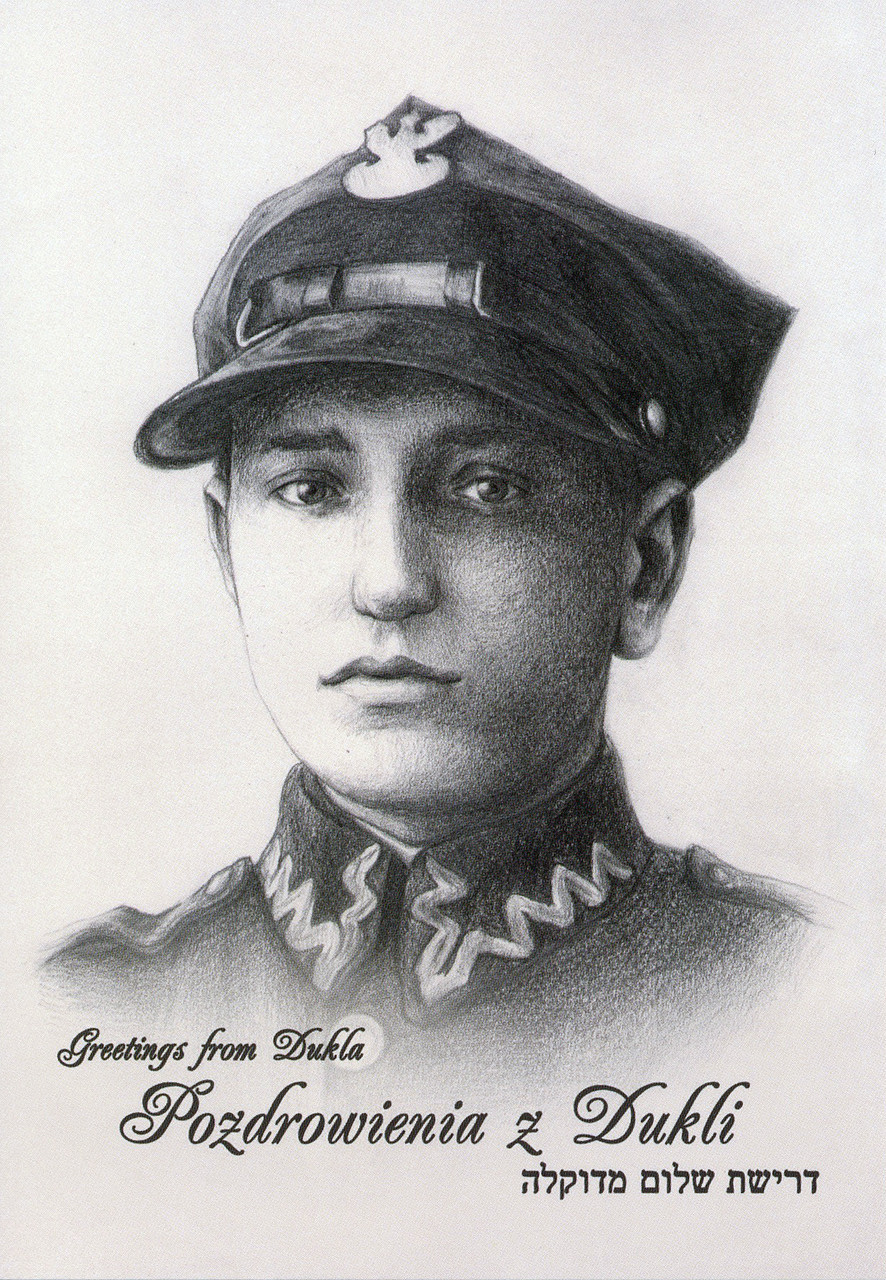
Just a photograph: A Jewish soldier in the Austro-Hungarian army:

“Maximilian Rosenbluth, soldier and baker of Dukla.” 

Also from KehilaLinks at JewishGen; like the portrait of Rabbi Bloch, this image is one of Sztetl Dukla’s 2015 ten postcard set by Wojciech Gryszkiewicz and Judith Stola.
______________________________
_______________
______________________________

Year 1915

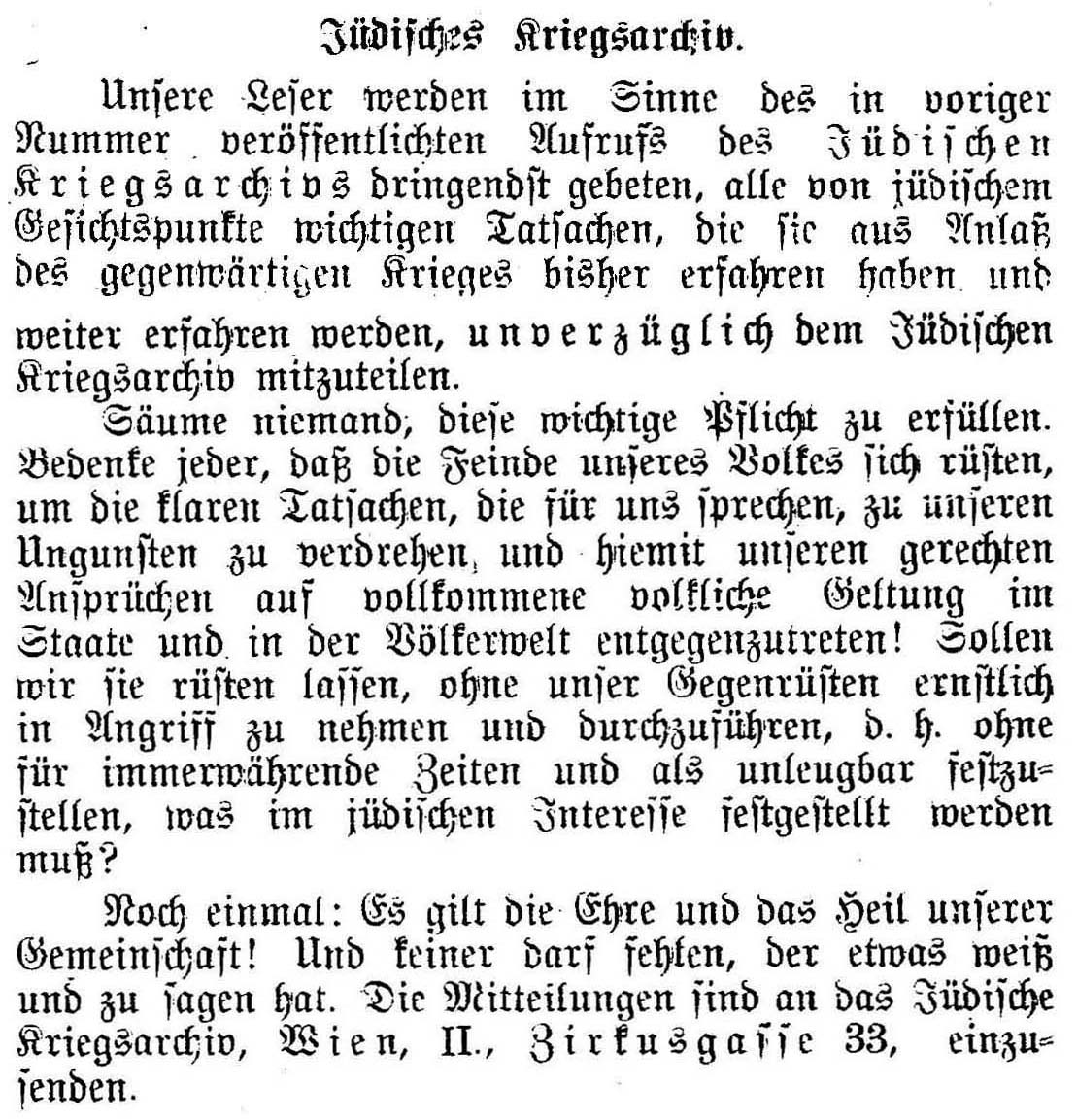
This article, from 1915, follows a theme seen in The Jewish Chronicle during the same time-frame: The plan to create a historical record of Jewish military service.  Perhaps less out of innate pride and the natural need to record the historical experience of the Jews per se, than the anticipated need to refute antisemitic calumny in the future.  This assumes, of course, that antisemitism – Jewhatred – can be refuted by facts, logic, and reason.  

Jewish War Archive
January 29, 1915
Issue Number 5, Page 85 (Issue page 9)

Our readers are urged, in the sense of the publication of the Jewish War Archive, published in the previous issue, to inform the Jewish War Archive without delay of all facts of Jewish legitimacy, which they have so far experienced and will continue to experience on the occasion of the present war.

Do not frustrate fulfilling this important duty.  Remember everyone that the enemies of our people are preparing themselves to turn the clear facts that speak for us to our detriment, and thus to oppose our just claims to perfect national validity in the state and in the peoples!  Shall we equip them without seriously attacking and executing our countermeasures, without establishing for everlasting times and as undeniable what needs to be established in the Jewish interest?

Once upon a time: the honor and the salvation of our community are important!  And no one may fail, who knows something and has something to say.  The notifications are to be sent to the Jewish War Archive, Vienna, II., Zirkusgasse 33.

Judisches Kriegsarchiv

Unsere Leser werden im Sinne des in voriger Nummer veröffentlichen Aufrufs des Jüdischen Kriegsarchivs dringendst gebeten, alle von jüdischen Gestchtspunkte wichtigen Tatsachen, die sie aus Anlass des gegenwärtigen Krieges bisher erfahren haben und weiter erfahren werden, unverzüglich dem Jüdischen Kriegsarchiv mitzuteilen.

Säume niemand, diese wichtige Pflicht zu erfüllen.  Bedenke jeder, dass die Feinde unseres Volkes sich rüsten, um die klaren Tatsachen, die für uns sprechen, zu unseren Ungunsten zu verbrehen, und hiemit unseren gerechten Ansprüchen auf vollkommene volkliche Geltung im Staate und in der Völkerwelt entgegenzutreten!  Sollen wir sie rüsten lassen, ohne unser Gegenrüsten ernstlich in Angriff zu nehmen und durchzuführen, d.h. ohne für immerwährende Zeiten und als unleugbar festzustellen, was im jüdischen Interesse festgestellt warden muss?

Noch einmal: Es gilt die Ehre und das Heil unserer Gemeinschaft!  Und keiner darf fehten, der etwas weiss und zu sagen hat.  Die Mitteilungen sind an das Jüdische Kriegsarchiv, Wien, II., Zirkusgasse 33, einzusenden.
______________________________
_______________
______________________________

Year 1916

This article is fascinating, moving, and inspiring.  It’s a transcript of a letter sent to a family somewhere in Austria-Hungary by their son, then somewhere in the vicinity of “Tschita” (Chita), a city in south central Russia east of Lake Baikal.  The writer describes having attended the second Pesach Seder of 1916, in the temple in Chita, a central clue identifying the city being mention of Ingodinskaya Street, on which the schul was (still is) located.  There are absolutely no specifics in the letter about the author.  But, comments in the text strongly suggest that he was a prisoner of war in Russian captivity, the most obvious being that his attendance at the Seder with three companions occurred while under guard of a bayonet-wielding Russian soldier, the latter who it seems remained at a penal house – with a number of other Russian guards? – while the writer and his companions attended the Seder, in the schul.  

As you can see in the images below, the schul is very much still standing on Ingodinskaya Street, albeit it hasn’t been a schul for many decades.

Pesach in Tschita and Pjetchanska
July 7, 1916
Issue Number 27, Page 451 (Issue page 7)

Pjetchanska, Wednesday, June 19.
April (Pesach), 2nd day, evening.

Dear parents and sister!

Despite many difficulties to be overcome, I can confidently apply the words of the Haggadah to yesterday: Chassal Siddur Pesach Kehilchosan…

Yesterday, on the 1st day of Passover, I was in the big temple in Tschita at the valley prayer [?] and had lunch in the Talmud Torah building, later in the afternoon also had tea there and was here again in the evening.

The city is 7 kilometers from here; despite the fact that it had snowed quite heavily just yesterday, during the night and throughout the day the snow and wind made themselves unpleasantly felt, I am extremely satisfied with yesterday.

The impressions I gathered yesterday will probably stay alive for a long time and I won’t soon forget the valley prayer [?] in the Tschita temple.

Three men and the Russian guard, who followed with rifle and fixed bayonet, counting our four, we walked about 1 1/4 hours at a rather brisk pace through the snowy forest, in which for the time being no footsteps were to be seen, to the town.  We soon came to the wheeled path, where it was easier, and it wasn’t long before we saw the building of the big penal house, in front of which many guards were standing.

In the east lane, which leads from the road into the city, in Ingodinskaya, so named after the river Ingoda that flows past here, there is also the large, whitewashed temple with a broad dome that can be seen from afar.  Some stairs lead from the foundation, which has a certain height, to the entrance.  The temple itself is quite high and although it now only has a women’s gallery, it seemed to me higher than the temple in Bucharest, also a bit bigger.  Very simple painting, everything in white (also inside), the light floods through large, wide windows.  Nevertheless, in honor of the day, the temple was electrically lit and all the bulbs were lit.  Quite a few prisoners with posts and a large native audience had appeared, but they did not fill the great temple; in passing I noticed tuxedos and tailcoats, many wide silk thongs, few top hats.

The valley prayer [?] was performed by a religious leader Schlesinger, who, according to today’s newspaper, received the Anne’s Order [Order of Saint Anna] in his capacity as a member of the supervisory board of the Russian State Bank of Tschita.  I also exchanged two words with Rabbi Herr Lewin, maybe he will write to you again…

I came back a little tired, but with a lifted feeling that I had walked through the snow to the “valley”.

Here, too, Passover was celebrated according to the regulations under the supervision of a Hungarian-Jewish doctor, who performed the Musaf prayer in the local prayer room today.

On the first night of the Seder, I sang part of the Seder…

Via Auction.ru, this undated postcard shows the Chita Synagogue. 
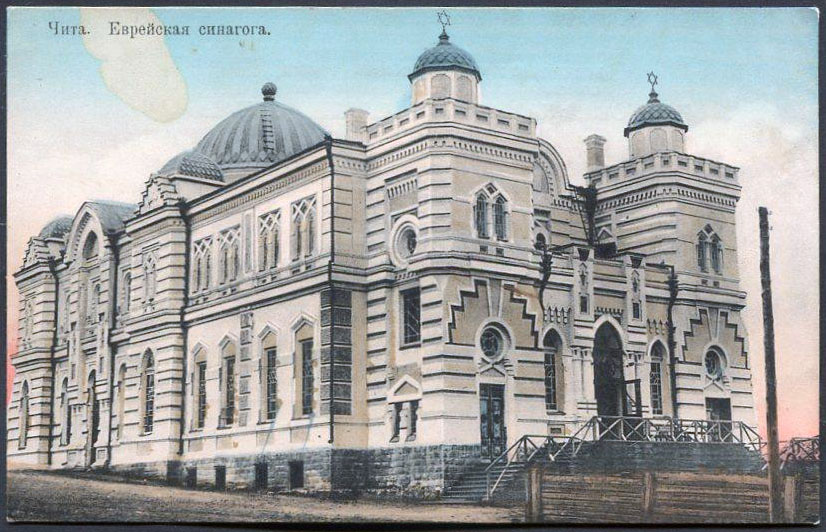
As does this image, from Stephanie Comfort’s flickr photostream.  

Taken by E. Kutysheva on March 6, 2018, this image (“Чита Синагога – Русский Здание синагоги в Чите – 2018 03“) gives a contemporary view of the Chita Synagogue.  Though intact, the building no longer serves as a center of Jewish life.  The “broad dome” noted by the unknown prisoner – the central cupola – no longer exists, and, the Mogen David(s) that surmounted each of the smaller cupolas have vanished.    

This Yandex map shows the building’s location on Ingodinskaya Street…

…while at a smaller scale, this Oogle map shows the general geography of Chita.  Note the Ingoda River (as mentioned in our unknown POW’s letter) that winds adjacent to and within the southern part of the city, and, Lake Kenon on the city’s western edge.

The city is directly east of the southern part of Lake Baikal…

…and directly north of Mongolia.  (By over 125 miles.)

Pessach in Tschita und Pjetschanska

Pjetschanska, Mittwoch, 6./19.  April (Pessach), 2. Tag abends.

Vielgeliebte Eltern und Schwester!

Trotzdem viele Schwierigkeiten zu überwinden waren, kann ich getrost die Worte der Hagadah auf den gestrigen Tag anwenden: e chassal siddur pessach Kehilchosan…

Gestern, am 1. Pessachtage, war ich im grossen Tempel in Tschita beim Talgebet und habe im Talmud-thoragebäude zu Mittag gegessen, später nachmittags dort auch Tee genommen und war gegen Abend wieder hier.

Die Stadt ist 7 Kilometer von hier entfernt; trotzdem es gerade gestern ziemlich stark geschneit hatte, in der nacht und den ganzen Tag über Schnee und Wind sich fortgesetzt unangenehm fühlbar machten, bin ich mit dem gestrigen Tage überaus zufrieden.

Die gestern gesammelten Eindrücke werden wohl lange Zeit lebendig bleiben und ich werde das Talgebet im Tschitatempel nicht so bald vergessen.

Drei Mann und den russischen Posten, der mit Gewehr und aufgepflantzem Bajonett folgte, miteingerechnet, unserer vier, gingen wir ungefähr 1 ¼ Stunden in ziemlich lebhaftem Tempo durch den verschneiten Wald, in dem vorerst keine Fussstapfen wahrzunehmen waren, nach der Stadt.  Wir kamen bald auf den fahrbaren Weg, wo es leichter ging, und es dauerte nicht lange, da sahen wir schon das Gebäude des grossen Strafhauses, vor dem viele Wachen standen.

In der estern Gasse, die vom Wege in die Stadt führt, in der Ingodinskaya, nach dem hier vorbeifliessenden Fluss Ingoda so genannt, steht auch der grosse, ganz weiss getünchte Tempel mit einer breiten, weithin sichtbaren Kuppel.  Einige Treppen führen vom Fundament, das eine gewisse Höhe hat, zum Eingang.  Der Tempel selbst ist ziemlich hoch und trotzdem er jetzt nur eine Frauengalerie hat, schien er mir höher als der Tempel in Bukarest, auch etwas grösser.  Sehr einsache Malerie, alles in Weiss gehalten (auch drinnen), das Licht fluter durch grosse, breite Fenster.  Trotzdem war der Tempel zu Ehren des tages elektrisch beleuchtet und alle Birnen waren entzündet.  Recht viele Gefangene mit Posten und zahlreiches einheimisches Publikum waren erschienen, doch füllten sie nicht den grossen Tempel; im Vorbeigehen bemerkte ich Smokings und Fracks, viele breite Seidentalessim, wenige Zylinder.

Das Talgebet verrichtete ein Kultusvorsteher Schlesinger, der laut heutiger Zeitung den Annernorden in seiner Eigenschaft als Aufsichtsrat der russischen Staatsbank von Tschita erhalten hat.  Mit dem Rabbiner Herrn Lewin habe ich auch zwei Worte gewechselt, vielleicht schreibt er Dir noch…

Etwas müde zwar, aber mit gehobenem Gefühl, durch Schnee zum „Tal“ gegangen zu sein, kam ich züruck.

Auch hier wurde unter Oberaussicht eines ungat.-jüdischen Arztes, der heute das Mussaphgebet im hiesigen Betlokal verrichtet hat, vorschriftsmässig Pessach gefiert.

Am ersten Sederabend sang ich einen Teil des Seders vor…

______________________________
_______________
______________________________

Just a photograph: Yiddish and Hebrew poet, essayist, and writer Uri Zvi Greenberg (alternative: Uri Tsevi Grinberg; Hebrew: אורי צבי גרינברג), during his service in the Austro-Hungarian army.  (Photo from Zeev Galili’s Blog, Logic in Madness (היגיון בשיגעון), within his April 20, 2009 post Uri Zvi Greenberg – the poet who predicted the Holocaust (אורי צבי גרינברג – המשורר שחזה את השואה).)  

The Great War has long been recognized as having a significant and enduring impact upon twentieth century poetry and literature, a legacy that persists to this day.  A poet whose verse is stunning in its power, visual symbolism, moral clarity, and eventual political and religious urgency, Uri Greenberg arrived in the Yishuv in December of 1923, by which time he’d become a supporter of Zionism as the only path for the survival of the Jews of Europe.  Perhaps his vision about the future of European Jewry is best embodied in his poem “In malkhes fun tseylem” (In the Kingdom of the Cross), “his last great Yiddish work before he emigrated to Palestine and channeled his burgeoning poetic energies into the writing of Hebrew poetry.”

The following excerpt from Glenda Abramson’s article in the Fall, 2010, issue of Shofar, “The Wound of Memory – Uri Zvi Greenberg’s ‘From the Book of the Wars of the Gentiles’”, describes Greenberg’s war experiences in terms of their being an impetus for (but by no means the sole influence upon) the development of his subsequent literary oeuvre:  

In 1914 Greenberg was conscripted into the Imperial army, and after a brutal period of basic training in Hungary he was sent to the even more brutal frontline trenches on the Serbian border.  Although a bookish and sensitive young man apparently unsuited for war service, Greenberg participated in all the battles fought in Serbia until the fall of Belgrade and distinguished himself in the field, although the experience scarred him for the remainder of his life.  In his first book, published in 1915 with the title Ergits oif felder (Somewhere in the fields), he writes, “The world is a great graveyard and you—nothing but shadows, eternally afflicted on the isle of death.”

In the winter of 1914 on the Serbian front Greenberg fought in the Battle of Cer on the River Sava in which about 25,000 Austro-Hungarian officers and men were killed and wounded, and around 4,500 were captured.  The weather was bad, rain and mud adding to the armies’ difficulties.  In this campaign, between Austria, Germany, and Bulgaria on the one side and Serbia on the other, the Austrians crossed the river under fire from the Serbs, who strongly and effectively resisted, in order to reach Belgrade.  The number of casualties was high during the river crossing, and when the forces reached the opposite bank they launched an attack on the enemy trenches, which were encircled with barbed wire.  Greenberg was one of the few survivors of those who were ordered to mount the wire to reach the Serbian trenches.  The Imperial army lost the battle.  Greenberg saw his dead comrades hanging upside down on the wire, a sight that left a profound and lasting impression on him.

Or, as described at YIVO: “Summarily drafted in 1915, Grinberg experienced the horrors of warfare in which many of his fellow soldiers died or were severely wounded.  The fording of the Save River, in particular, etched itself in his memory, and was to reappear obsessively in poems he would write throughout his life.  Exposed to enemy fire while crossing the river, Grinberg suddenly found himself alone and disoriented in a Serbian post on the other side of the river.  All his fellow attackers were hanging lifeless, heads down and boots pointing up, on the electrified wire, while all the defenders were probably killed by a hand grenade.  Then the moon shone from the clearing autumnal sky, casting its silvery light on the well-worn metal cleats of the upturned boots of the soldiers.  The poet was mesmerized by the eerie effulgence, which he was never to forget.  The image would later inspire the title of his first Hebrew book: Emah gedolah ve-yareaḥ (Great Terror and Moon; 1925).  What he saw then – a heap of cadavers illuminated by moonlight – amounted to a horrendous negative epiphany: an indifferent God incorporated in dead and mutilated human flesh.  This proved to be one of the sources of Grinberg’s modernistic vision.  Still, when Bikeles-Shpitser published Grinberg’s first poetry collection, Ergets oyf felder (Somewhere in the Fields; 1915) he included in it, without violating the unified tonality of the slight booklet, both the war poems the poet had penned when still safe in his parents’ home and those he sent from the battlefield.”

You can gain more insight into the life and poetry of Uri Tzvi Greenberg at the blog of Israel Medad – long-time resident of Shiloh, Samaria, Israel – MyRightWord.  

______________________________
_______________
______________________________

Year 1917 – I

Published in the newspaper’s correspondence section, this letter, by Corporal Alfred Ellinger, and, Einjahr Freiwilliger (One-Year Volunteer) Konrad Heim on behalf of their comrades, focuses on the social, communal, intellectual, and spiritual challenges facing Jewish soldiers in the Austro-Hungarian military, the correspondents implying that in such matters, Jewish soldiers have essentially been left to themselves.  This is juxtaposed against support received Gentile soldiers, and, Jewish soldiers in the German military, the latter whose needs are met by Jewish organizations in that country.  The letter concludes by imploring the leaders of the Jewish community in Vienna, and, Jewish organizations in that city and beyond, to assist their sons at the Front.  

Open letter to the leaders of the Austrian Jewry in Vienna.
November 9, 1917
Issue Number 43, Page 708 (Issue page 8)

From the front we address these lines publicly to the leaders of Judaism in Austria.  The largest Jewish community in Austria is in Vienna; the heads and leaders of this community are therefore also the leaders of all Austrian Jewry and have repeatedly publicly acknowledged themselves as such.  The venerable President of Vienna’s Israelite religious community is also President of the Israelite Alliance and the Austrian Association of Communities.  We Jewish soldiers at the front must turn to him and his colleagues with our specifically Jewish needs.

The Jewish soldiers at the front have other interests that stem from Judaism in addition to those shared with all their comrades.  Judaism means to us one of the few spiritual values through which one feels a constant connection to one’s homeland; it is a refuge for us in the hours of despair and mental depression.  The war has deepened our interest in everything Jewish, and we want to know how things are with Judaism at home.  The lively interest of the Jewish soldiers at the front for Jewish things found only insufficient satisfaction.  Why don’t you take care of such matters?  The Lord’s administration does not have the task and duty of satisfying all such needs.  The Christian soldier is well supplied with religious and national literature through the efforts and achievements of non-governmental organizations.  Why does Judaism not think of bestowing the same kindness and care on its sons in the field?  A German prayer book for the field, for example, which, if written with understanding, satisfies the sensibilities of the educated, would be an urgent need and should be sent to every soldier from home free of charge.

Magazines are too rare an article at the front, and Jewish works and books are almost impossible to find.  And yet (with all recognition of the difficulty of realizing it) every man should have at least one Jewish newspaper or magazine at his disposal.  A concise field edition of the history of the Jewish people up to the present would be most welcome.

Our comrades of Jewish faith in the German army are much better cared for and cared for by Jewish organizations in Germany.  They receive a lot of reading material with Jewish content and their own commemorative publications of an instructive nature for every Jewish holiday.

We are at the front and initially fighting for Kaiser and fatherland.  But we also fight for the honor of Judaism at the same time.  The Jewish leaders in Vienna should seriously consider this.  As we faithfully do our duty in need and death at the front, we also fight for the honor of the Jewish name.  Does Austrian Jewry feel no obligations towards their sons at the front?  We hereby want the leaders of Viennese Jewry to accept these serious duties, the presidents and heads of both the community and the Alliance, as well as other organizations, of these serious duties.  Should it then be said that Jews only fulfill those duties which are enforced by force, but neglect moral duties?

No!  We hope that our public appeal will not go unheeded.

Alfred Ellinger, Corporal
Konrad Heim, One-Year Volunteer
on behalf of 40 Non-Commissioned Officers and
One-Year Volunteers

Offenes Schreiben an die Führer der österreichischen Judenschaft in Wien.

Von der Front aus Wenden wir uns mit diesen Zeilen öffentlich an die Führer des Judentums in Oesterreich.  Die grösste jüdische Gemeinde Oeterreichs ist in Wien; die Vorsteher und Leiter dieser Gemeinde sind darum auch die Führer des österreichischen Gesamtjudemtums und haben sich wiederholt öffentlich als solche bekannt.  Der ehrwürdige Präsident der Wiener israelitischen Kultusgemeinde ist auch Präsident der Israelitischen Allianz und des Oesterreichischen Gemeindebundes.  Un ihn und an seine Kollegen müssen wir jüdischen Soldaten an der Front uns mit den spezifisch jüdischen Bedürfnissen, wenden.

Die jüdischen Soldaten an der Front haben neben den mit allen Kameraden geteilten noch andere, aus dem Judentum entspringende Interessen.  Das Judentum bedeutet uns eines der wenigen geistigen Werte, durch die man sich fortwährend mit der Heimat verbunden fühlt; es ist uns eine Zuflucht in Studen der Verweiflung und seelischer Depression.  Der Krieg hat unser Interesse für alles Jüdische vertieft, und wir wollen wissen, wie es mit dem Judentum in der Heimat bestellt ist.  Das lebhafte Interesse der jüdischen Frontsoldaten für jüdische Dinge findet aber nur ungenügende Befriedigung.  Warum sorgt man nicth für solche Belange?  Die Herresverwaltung hat nicht die Aufgabe und die Pflicht, alle solche Bedürfnisse zu befriedigen.  Der christliche Soldat wird mit religiöser und nationaler Literatur reichlich versehen, und zwar durch Bemühungen und Leistungen nichtstaaatlicher Organisationen.  Warum denkt das Judentum nicth daran, seinen Söhnen im Felde die gleiche Wohltat und Sorgfalt zuzuwenden?  Ein deutches Gebetbuch fürs Feld zum Beispiel, das, verständnisvoll abgefasst, das Empfinden des Gebildeten befriedigt, wäre ein dringendes Bedürfnis und sollte jedem Soldaten von der Heimet aus unentgeltlich geliefert werden.

Zeitschriften sind ein zu seltener Artikel an der Front, jüdische Werke und Bücher so gut wie gar nicht zu finden.  Und doch müsste (bel aller Anerkennung der Schwierigkeit der Verwirklichung) jedem Mann mindestens eine jüdsiche Zeitung oder Zeitschrift zur Verfügung stehen.  Eine kurzgesasste Feldausgabe der Geschichte des jüdischen Volkes bis zur Gegenwart wäre hochwillkommen.

Unsere Kameraden jüdischen Glabens in der deutschen Armee werden von jüdischen Organisationen in Deutschland ungleich besser bedacht und versorgt.  Diese erhalten viel Lektüre jüdischen Inhaltes und eigene Festschriftchen lehrreicher Natur zu jedem jüdischen Feiertage.

Wir stehen an der Front und kämpfen zunächst allerdings für Kaiser und Vaterland.  Allein wir kämpfen auch gleichzeitig für die Ehre des Judentums.  Das sollten die jüdischen Führer in Wien doch ernstlich bedenken.  Indem wir treu in Not und Tod an der Front unsere Pflicht ersüllen, kämpfen wir auch für die Ehre des jüdischen Namens.  Empfindet das österreichische Judentum gegenüber seinen Söhnen an der Front gas keins Pflichten?  An diese ernsten Pflichten wollen wir hiemit öffentlich die Führer des Wiener Judentums, die Herren Präsidenten und Vorsteher, sowohl der Gemeinde als auch der Allianz, sowie anderer Organisationen ernstlich gemahnt haben.  Sollte es denn heissen, dass Juden nur soche Pflichten erfüllen, die durch Gewalt erzwungen werden, die moralischen Pflichten aber vernachlässigen?

Neine!  Wir hoffen, dass dieser unser öffentlicher Appell nicht ungehört verhallen wird.

Alfred Ellinger, Korporal
Konrad Heim, Einj.-Freiw.
im Namen von 40 Unteroffizieren und
Einjährig-Freiwilligen

______________________________
_______________
______________________________

Just a photograph: “Postcard featuring Jewish soldiers in the Austro-Hungarian army, ca. 1914-1918”.  From the Blavatnik Archive, the postcard is described as being 9 by 14 inches, but (!) I think that’s an error, the correct unit probably being centimeters.  The reverse side of the postcard is absent of any information.

Of those men who survived the war, what became of them by 1927?

And 1937?

Were any still alive in 1947?  

______________________________
_______________
______________________________

Year 1917 – II

Paralleling The Jewish Chronicle, and, l’Univers Israélite, throughout the war, Dr. Bloch’s Oesterreichische Wochenschrift regularly published lists of the names of Jewish servicemen who had received military awards, such compilations including the soldier’s rank, civilian occupation, town or city of residence, and, the name or title of the award he’d received.  As a sad and inevitable parallel to these award lists, the newspaper published lists of casualties, albeit absent of the specific date and location when he was killed, missing or wounded.  In either case, I don’t know the source of the information utilized by the Wochenschrift in this endeavor: Perhaps the names were collected by a central organization of the Austrian Jewish community.

An example follow below: A list of fifty Jewish officers and soldiers in the 307th Honved Infantry Regiment who received military awards.

Fifty Jewish Heroes of the No. 307 Honved Infantry Regiment.
January 26, 1917
Issue Number 4, Pages 53-55 (Issue pages 5-7)

In the Honved Infantry Regiment No. _____, which had been in existence since June 1915 and was first under the command of Colonel Julius Parsche, then under that of Lieutenant Colonel Paul Bozo, and which, according to the official Höser reports, was particularly distinguished in the Toporoutz battles, such as “Egyenlöseg” reports that the named officers and members of the squad received the highest awards, partly for brave and self-sacrificing behavior in front of the enemy, partly for excellent and particularly dutiful service:

Fünfzig jüdische helden des Honvedinfanterie-regiments Nr. 307.

Bei dem seit Juni 1915 bestehenden und zuerst unter dem Kommando des Obersten Julius Parsche, dann unter demjenigen des Oberstleutnants Paul Bozo kämpfenden und in den Toporoutzer Kämpfen auch laut den amtlichen Höser-Berichten sich besonders ausgezeichneten Honved-Infanterieregiment Nr. _____ haben, wie „Egyenlöseg“ berichtet, die nachkenannten Offiziere und dem Mannschaftspande angehörnden Personen teils für tapferes und aufopferundsvolles Verhalten vor dem Feinde, teils für vorzügliche und besonders pflichttreue Dienste Allerhöchste Auszeichnungen erhalten:

Names as listed in article…

Lebovics, Heinrich, Oberleutnant d.R. (1)
Erdös, Wilhelm, Chefstellvertreter (2)
Wurm, Nikolaus, Reserve Leutnant (3)
Müller, Arpad, Landsturm-Oberleutnant (4)
Merö, Bernhard, Mitchef, Oberleutnant d.R. (5)
Steiner, Edgar, Oberleutnant d.R. (6)
Strancz, Isidor, Reserveleutnant (7)
König, Armin (8)
Rosza, Rudolf, Einjährig-Freiwilliger (9)
Halasz, Andor, Dr., Regimentarzt (10)
Töröf, Heinrich, Dr., Assistenzarzt (11)
Fleischl, Josef, Reserveleutnant (12)
Kuttner, M.L., Landsturm-Fähnrich (13)
Levac, Karl, Landsturm-Veterinärarzt (14)
Keppich, Alfred, Rechnungsunteroffizier 1. Klasse (15)
Fischer, Arthur (16)
Deak, Ludwig (17)
Reich, Armin, Landsturm-Fähnrich (18)
Witrael, Wilhelm, Rechnungsunteroffizier 1. Klasse (19)
Wolf, Desider, Rechnungsunteroffizier 1. Klasse (20)
Pick, Emerich, Sanitätsfähnrich d.R. (21)
Marton, Alexander, Rechnungsunteroffizier 1. Klasse (22)
Kalman, Arthur, Feldwebel (23)
Fleischmann, Ignatz, Rechnungsunteroffizier 1. Klasse (24)
Nathan, Moritz, Rechnungsunteroffizier 2. Klasse (25)
Rosenzweig, Julius, Feldwebel (26)
Elkan, Paul, Rechnungsunteroffizier 1. Klasse (27)
Fülöp, Aler. (28)
Holczmann, Max, Landsturm-Oberleutnant (29)
Fessler, Adolf (30)
Farago, Nikolaus, Fähnrich (31)
Rona, Bela, Fähnrich (32)
Löwy, Friedrich, Feldwebel (33)
Neumann, Bernhard, Fähnrich (34)
Steiner, Josef, Leutnant (35)
Stern, Adolf, Zugsführer (36)
Hecht, Josef (37)
Horn, Adolf (38)
Laszlo, Adolf, Reserveleutnant (39)
Ringwald, Arthur, Zugsführer (40)
Stern, Julous, Landsturm Fähnrich (41)
Szel, Ladislaus, Fähnrich (42)
Spitzer, Moriz, Zugsführer (43)
Schwarz, Franz, Feldwebel (44)
Stein, Heinrich, Oberrechnungsführer 1. Klasse (45)
Aigner, Ludwig, Fähnrich (46)
Schneider, Isidor, Zugsführer (47)
Raab, Wilhelm (48)
Leipnik, Alexander, Einj.-Freiw.-Fähnrich (49)
Weiner, Jakob (50)

Listed alphabetically…

Aigner, Ludwig, Fähnrich (46)
Deak, Ludwig (17)
Elkan, Paul, Rechnungsunteroffizier 1. Klasse (27)
Erdös, Wilhelm, Chefstellvertreter (2)
Farago, Nikolaus, Fähnrich (31)
Fessler, Adolf (30)
Fischer, Arthur (16)
Fleischl, Josef, Reserveleutnant (12)
Fleischmann, Ignatz, Rechnungsunteroffizier 1. Klasse (24)
Fülöp, Aler. (28)
Halasz, Andor, Dr., Regimentarzt (10)
Hecht, Josef (37)
Holczmann, Max, Landsturm-Oberleutnant (29)
Horn, Adolf (38)
Kalman, Arthur, Feldwebel (23)
Keppich, Alfred, Rechnungsunteroffizier 1. Klasse (15)
König, Armin (8)
Kuttner, M.L., Landsturm-Fähnrich (13)
Laszlo, Adolf, Reserveleutnant (39)
Lebovics, Heinrich, Oberleutnant d.R. (1)
Leipnik, Alexander, Einj.-Freiw.-Fähnrich (49)
Levac, Karl, Landsturm-Veterinärarzt (14)
Löwy, Friedrich, Feldwebel (33)
Marton, Alexander, Rechnungsunteroffizier 1. Klasse (22)
Merö, Bernhard, Mitchef, Oberleutnant d.R. (5)
Müller, Arpad, Landsturm-Oberleutnant (4)
Nathan, Moritz, Rechnungsunteroffizier 2. Klasse (25)
Neumann, Bernhard, Fähnrich (34)
Pick, Emerich, Sanitätsfähnrich d.R. (21)
Raab, Wilhelm (48)
Reich, Armin, Landsturm-Fähnrich (18)
Ringwald, Arthur, Zugsführer (40)
Rona, Bela, Fähnrich (32)
Rosenzweig, Julius, Feldwebel (26)
Rosza, Rudolf, Einjährig-Freiwilliger (9)
Schneider, Isidor, Zugsführer (47)
Schwarz, Franz, Feldwebel (44)
Spitzer, Moriz, Zugsführer (43)
Stein, Heinrich, Oberrechnungsführer 1. Klasse (45)
Steiner, Edgar, Obertleutnant d.R. (6)
Steiner, Josef, Leutnant (35)
Stern, Adolf, Zugsführer (36)
Stern, Julous, Landsturm Fähnrich (41)
Strancz, Isidor, Reserveleutnant (7)
Szel, Ladislaus, Fähnrich (42)
Töröf, Heinrich, Dr., Assistenzarzt (11)
Weiner, Jakob (50)
Witrael, Wilhelm, Rechnungsunteroffizier 1. Klasse (19)
Wolf, Desider, Rechnungsunteroffizier 1. Klasse (20)
Wurm, Nikolaus, Reserve Leutnant (3)

______________________________
_______________
______________________________

More to follow from Dr. Bloch’s Oesterreichische Wochenschrift

… Jewish in the Allied Armed Forces

… Jewish Aviators in the K.u.K. Luftfahrtruppen (Kaiserliche und Königliche Luftfahrtruppen)

… Jewish Life Beyond the Great War

______________________________
_______________
______________________________

And even more…

Austria-Hungary, at…

… Wikipedia

… Britannica

… Habsburg monarchy

fine-de-siècle, at…

… Wikipedia

Austro-Hungarian Army, at…

… Wikipedia

… Austrian Philately (John Dixon-Nuttall)

… The World of the Habsburgs (“Jewish soldiers in the Austro-Hungarian army”)

… Jewish Artifact Education (Rabbi Binyamin Yablok’s Virtual Jewish Museum)

… Israeli Ministry of Defense (Jewish Combatant Collection)

Joseph Samuel Bloch, at…

… Wikipedia

… Geni.com

… Encyclopedia.com

… Britannica.com

… Jewish Encyclopedia (Eisenberg, Das Geistige Wien, s.v.; derived from a publication now in the public domain: Singer, Isidore; et al., eds. (1901–1906). The Jewish Encyclopedia. New York: Funk & Wagnalls.)

… Center for Jewish History

… National Library of Israel

… YIVO

Uri Tzvi Greenberg…

Abramson, Glenda, “The Wound of Memory – Uri Zvi Greenberg’s ‘From the Book of the Wars of the Gentiles’”, Shofar: An Interdisciplinary Journal of Jewish Studies, V 29, N 1, Fall, 2010, pp. 1-21

Galili, Zeev, Uri Zvi Greenberg – The Poet who Predicted the Holocaust (אורי צבי גרינברג – המשורר שחזה את השואה), at “Logic in Madness” (Zeev Galili’s blog (היגיון בשיגעון -הטור המקוון של זאב גלילי))

(From Zeev Galili’s blog: “Reporter at “Yediot Ahronoth” – chief reporter at the news desk, chief of reporters, editorial center and acting editor-in-chief.  A columnist in the “Mekor Rishon” newspaper.  Teaches in academia (communication, philosophy), effective writing instructor in dozens of businesses, government offices and public institutions, author of children’s books, shadow writer – all former.”)

Weingrad, Michael, “An Unknown Yiddish Masterpiece That Anticipated the Holocaust – Written in 1923, ‘In the Crucifix Kingdom’ depicts Europe as a Jewish wasteland.  Why has no one read it?”, at Mosaic.com,
April 15, 2015

… at YIVO Encyclopedia

Chita, Russia, at…

… Wikipedia (Chita, Zabaykalsky Krai)

… ru.Wikipedia

… Britannica.com

Chita Oblast, at…

… Wikipedia

Jews of Chita, at…

… JewishGen (email by Naomi Fatouros – September 21, 1998)

… Jewish Telegraphic Agency (“Jewish Population of Chita Drops 75 Percent in Decade” – July 10, 1931)

Otherwise, …

Eldad, Israel, The Jewish Revolution – Jewish Statehood, Shengold Publishers, Inc., New York, N.Y., 1971

Gilbert, Martin, Atlas of Jewish History, Dorset Press, 1984

Roth, Joseph, Flight Without End, J.M. Dent & Sons Ltd., London, England, 1984

Vital, David, The Origins of Zionism, Oxford University Press, Oxford, England, 1980

Wistrich, Robert, Zionism and Its Religious Critics in fine-de-siècle Vienna, Jewish History, V 10, N 1, Spring, 1986, pp. 93-111

A Woman of Valor, A Woman of Jerusalem – III: Annie Edith Landau’s Recollections of the Evelina de Rothschild School, in The Jerusalem Post – July 3, 1941

Twenty-six years after The Jewish Chronicle published two articles about Miss Annie Edith Landau, found and Headmistress of the Evelina de Rothschild School in Jerusalem, The Palestine Post (today, The Jerusalem Post) published an article that is both a reminiscence and an observation:  Miss Landau, in 1941 sixty-eight years old, presents her recollections of life in that city during the First World War, and, muses about living conditions in the Yishuv during the “Great War” in comparison with those of contemporary times – the early 1940s – less than two years after the September, 1939 advent of the twentieth century’s second global war. 

The article closes on a small note of irony:  Whereas the Chronicle’s articles of 1915 spoke of supplies sent to the Yishuv from beyond, the Post’s 1941 article notes that Miss Landau is sending a parcel in the opposite direction: to England.

Annie Edith Landau passed away three and a half years later, and is buried in Jerusalem.

The article…

MISS LANDAU REMEMBERS WHEN PALESTINE WAS BESIEGED

The Palestine Post
July 3, 1941

“During the last war Palestine was only a ‘pauper colony.’  Who would have dreamed of the changes which have come about since then,” muses Miss Annie Landau, head mistress of the Evelina de Rothschild School.

Miss Landau came to Jerusalem from England 42 years ago.  During the War of 1914-18 she was the last British subject to be exiled from Palestine to Egypt.  However, this war sees the tables reversed.  Last week she received a family of evacuees from Cyprus.  One of them turned out to be a five months old baby and there was some ado about arranging a crib to welcome the little guest.  As Miss Landau talks, five year old Mary from Famagusta sits on the floor, learning to spin a new top.

It is a far cry from the last war when Miss Landau left, for Egypt on the last orange boat from Jaffa and taught school in mud huts for several years.  There was no bath tub available, so they fetched her the silver bath of a khedive, which was the one sign of luxury in the desert.

In those days, there was no thought of air raid shelters in Palestine.  Who would waste a bomb on the place?  But there were other hardships to be endured.  To trade in gold was forbidden; and yet merchants would not accept paper money.  And so there was practically no bread in the towns.  Miss Landau remembers purchasing flour in the villages with illegal gold and baking bread in the cellar.

There were practically no Jewish agricultural settlements and the shortage of vegetables and dairy products was acute.  “We never saw a potato,” added Miss Landau.

Waiting for Letters

Those who complain about the slow mails may be comforted by the fact that the mails were as slow and sometimes slower.  In those days, there was an added difficulty.  Even after the mails arrived, they could not be landed at the Jaffa port if the sea was rough.  Miss Landau remembers queues reaching from the Citadel to beyond Jaffa Gate on the days when a mail boat had arrived.

At the beginning of the last War; the Evelina de Rothschild School had 700 pupils and 23 teachers.  Although the staff was depleted when the foreign teachers were ordered to leave, the school continued to function throughout the war.

After Allenby marched into Jerusalem, “we literally sat on the steps of the Consulate in Egypt waiting for permission to return,” relates Miss Landau.  Meanwhile, she wired friends in China and received money to buy supplies.  She scoured the Cairo markets for food, cottons, and leather.  Six weeks later she received permission to return.  Together with sacks of toasted bread and other necessities, she came back to Jerusalem.

Escorted by a platoon of soldiers, Miss Landau combed Jerusalem for her pupils.  She found 500 and it was later revealed that the others had succumbed to hunger or disease.  The black-boards were ferreted out from the homes of those who had stolen them, although they had no idea what to do with their “booty.”  Several hundred desks had been kindly rescued by some priests.

And so, with the desks back in their places; the pupils behind the desks; and the black-boards on the wall, school began again.

Yes, the tables are reversed.  The days when one brought supplies to Palestine seem far-away; Miss Landau has just been sending a parcel to England.  And little Mary from Famagusta sits on the floor, spinning her new top.

D.K.B. -A.


A Woman of Valor, A Woman of Jerusalem – II: Annie Edith Landau and the Evelina de Rothschild School, in The Jewish Chronicle – September 24, 1915

Almost one month after The Jewish Chronicle published extracts of an interview with Miss Annie Edith Landau, Headmistress of the Evelina de Rothschild School in Jerusalem, in its issue of August 27, 1915, the newspaper printed a very (very!) lengthy follow-up article of a very different nature:  A transcript of her wide-ranging speech, given in Camperdown House, Aldgate, on Sunday, September 19, 1915, to the Anglo-Jewish Association.  This was four months after she’d been forced to depart Jerusalem for Alexandria, in light of Ahmed Djemal Pasha’s decrees concerning “Jewish enemy aliens” in the Yishuv.  

In her speech, Miss Landau speaks of several things. 

She begins with her longing to return to and live in Jerusalem in particular and the Yishuv in general, and segues to a discussion of the the economic challenges faced by Jewish refugees living in Alexandria.  However, most of her talk is devoted to practical challenges of life in the Yishuv under rule of the Ottoman Empire, such as the availability of foodstuffs, and, in terms of religious practice and communal solidarity.  Particularly fascinating (at once disturbing, frightening, humorous, perplexing, and intriguing) are accounts of her interactions with Turkish officials, such as the Governor of Jaffa, Zeki Bey, the nobleman who was Commandant of Palestine when the war broke out and who resigned his commission owing to conscientious scruples, who she deemed an “Ohev” Yisroel.  And, as the subject of discussion in the Chronicle’s article of August 27, “the mighty Djemal Pasha himself”. 

Overall, her speech is peppered with substantive vignettes, anecdotes, the consistent tone of which is characterized by profound sense of pride.

She would return to Jerusalem a little over two years after the publication of this article, and remain there for the remainder of her life.  

Here’s the article…

______________________________

JERUSALEM AND THE WAR

BY MISS ANNIE E. LANDAU

The Jewish Chronicle
September 24, 1915

______________________________

Painting of Annie Edith Landau, from “Yad Ben Zvi To Honor Annie Landau With Exhibit”, by Gil Tanenbaum, at Jewish Business News, June 5, 2014.

______________________________

When asked if I would come here to-day, the day after Kippur, to tell you something of the work of the Evelina de Rothschild School in Jerusalem, in order to bring home to you what the school means to Jerusalem, to say a few words on life in the Holy City during the past year, I gladly assented, because, besides wishing to awaken your interest in our Jerusalem school, I thought that my speaking would help us both a little in the present period of storm and stress and responsibility.  For me, the unburdening of my heart would help me to bear the terrible pain of exile which has been my share for more than three months now.  And you – I thought you would be strengthened in heart by hearing as it were, a message of love and hope and trust from the Holy City, towards which our thoughts so often turned during yesterday’s prayers.  Jerushalayim, ir hakodesh, the place, which despite wordly trouble and distress, to-day, as of yore, calls forth the jubilant soul, victory portrayed for us, to cite the tiniest portion of our Yom Kippur prayers in our beautiful Marc Kohen.

Here in London I have my mother, my sisters and brothers, dear relatives, and kind friends who are all more than good to me, but I sometimes think the longing for Jerusalem is more than I can bear.  I stayed in Alexandria two long months when its climate was at its worst, hoping from hour to hour, from day to day, that the march of events would let us return at once.  Erez Avotenu, “the land of our fathers” – sisters and brothers in Israel – does the phrase not thrill you with a pain exquisite in its intensity?  Does it not bring a lump into your throat and the smarting tears to your eyes as it does my own?  Does it not make each one of you wish to put out pleading hands to God in Heaven as I have done every day since I left it with the sobbing prayer, “Oh God for how long is this?” “Oh God let me go back!”  Erez Avotenu: “the land of our fathers” – each part of it with its own peculiar charm, the rugged strength of Judea, which makes one understand the unbending character of the people it brought forth, the springtime waving fields of corn and wonderfully beautiful flowers breathing sentiment as they gleam in the softly smiling “Yam Kinneret,” the Sea of Galilee.  “Happy the eye that saw all these things,” we may say of the land of our forefathers even to day, and were I never able to go back – which God forbid – the influence of them could never leave me.  You want to hear about this war year in Jerusalem.  Even before Turkey had actually entered into the great war, the blight of it all had fallen on us in Palestine.  As soon as war was declared in Europe the banks could no more do any business; they could no longer pay out their cleints who had large current accounts and, of course, the Jewish bank could no longer stand by the Colonies which, with their vineyards, orange, almond and olive groves, were steadily working towards success.  In Jerusalem, which, with its 60,000 Jewish inhabitants of a total population of 120,000, with its crowded Yeshboth, its eager Jewish schools, its modern Jewish hospitals and Jewish scientific laboratories, is – despite the absence of industries proper, and despite its overwhelming numbers of people dependent on charity – the hub of all Jewish movement in Palestine, the stoppage of help from abroad made things very bad.  As drafts in European banks could no more be changed, numbers of really bekoved people receiving monthly remittances from their children abroad were reduced to

A DESPAIRING STATE OF WANT.

When I came down to Alexandria I brought with me a whole bundle of cheques, each for sums of money not more than 5 [pounds] on English banks which I had cashed for old men and women who, after vainly trying to exchange them in the town at even 50 per cent loss, came up to the school to me with the pledges of the devotion of distant sons and daughters in their trembling old hands as worthless paper, they had been told.  The very old ones could not understand the situation.  “Nemmit net fer ungut,” they pleaded with me – “sir sannem doch immer gezohlt geworren”.  What was clear to them, however, was that butcher and baker and grocer could only give short credit, and that the fellaha from whom they bought their greenstuff and eggs much have cash down.  I had a pretty hard economic nut to crack myself at the time.  The banks were giving us 1 [pound] per week in gold, no paper was current them, and I had hundreds of children and a resident staff to feed, but I had fair stores of necessities to fall back upon, and I had credit, which, however, I had no means of extending to others.  Faithful friends, however, came forward and I managed to send the old folks all away with the full 25 francs for the [pound] tied up securely in a corner of their handkerchiefs, and their parting, “May you live long for the Mitzvah: you have earned the world to come and healthy years,” was real music to my ears.  I accounted myself the happiest or mortals to have earned the handshake of these good old people – shabby and world-worn though they were.

Sometimes a letter handed in at the gate would precede the coming of someone – for my Soudanese doorkeeper is a formidable person – and the manipulation of my name, owning to the Babel of tongues used in Jerusalem made me the object of much innocent chaff on the part of my friends at times.  “Hageveret Miss Lander,” Mademoiselle Miss Lando, Mr. and Mrs. Landau, and Hamelka Shevo (Queen of Sheba) some of the envelopes I cherish say.  This last needs the explanation that our school has had as its temporary home some four years the Abyssinian Palace.  I am glad to say that except in two cases, though the cheques were well over a year old, the Alexandria Bank had no trouble in collecting them, and these two have lately been met since I came to London.  During September and October the

ECONOMIC SITUATION BECAME WORSE.

The Government mobilised its forces and had to requisition from the shopkeepers in the town and from the colonists on the land for the upkeep of the soldiery, and the Government could not pay for its requisitions.  In spite of it all, we Palestinians had felt that the war had not touched us really as it had our fellow-creatures in Europe, and there is an Arabic sentence which says that if the whole foot of misery is planted on the world, not more than its heel will have touched Jerusalem.  The then Commandant of Palestine, with his headquarters in Jerusalem, Colonel Zeki Bey, was not alone a charming but a resourceful and helpful man.  We were all jubilating one November day as an order had been given for demobilisation and the troops were being drawn off – when lo, like a thunderbolt it came – our dread expectancy of months – Turkey had been dragged in at last and the Great War had us in its cruel grip in real earnest.  The colonists had to give up their horses, their carts, their oxen and cows, their labourers, and – sorest wound perhaps of all – their irrigation pipes which conducted the water to the orange groves.  In Jerusalem every cab-horse was taken and all enemy property was confiscated to be used for military purposes.  The Evelina property was one exception.  Very soon Palestine was like a corked-up bottle.  There was no means of getting in foodstuffs and other commodities.  Every day necessaries went up fearfully in price – it was a real catastrophe to even the richest Effendi with the Oriental’s sweet tooth to have to pay 40 piastres for a rottel of sugar – close on seven shillings for six pounds of the commodity.  Soon there was no rice, no coffee, no sugar at all in the town.  Pins, needles, buttons, cotton, brooms, matches, soft goods, in fact everything which we get from abroad were not to be had.  There was a quantity of petroleum in the country which rose to an enormous price – from ten francs to sixty piasters a box – through unscrupulous speculators.  The municipality seized it and sold it for twelve francs per box, and in very small quantities, to the poor, when in turn the military authorities seized it from the municipality.  When I left Jerusalem most people were burning candles.  For Pesach the Sephardim were allowed to buy seventy boxes, and the Ashkenazim, much more numerous, of course, 250 boxes of petroleum for their respective communities, and it was a curious sight to watch the lines of thousands of people with little cans and bottles waiting their turn to be served at the stores opened for the purpose.  No-one would willingly have a dark Seder night; you had to have a ticket showing how many people you housed, and according to this number you were allowed to buy a certain quantity.  As no Russian white flour was coming in, we were glad to eat bread made of native dark flour.  We were never without it – there is sufficient corn and barley in the country, as so exporting could be done – but bread went up in price, increasing the sufferings of the poor.

AMERICA CAME TO OUR AID SPLENDIDLY.

and has never relaxed its efforts on behalf of the poor.   Palestine will never forget the coming of Mr. Louis Levine, the Secretary of the Federated Jewish Charities of Baltimore, who accompanied the American collier “Vulcan,” which brought 900 tonnes of provisions, collected entirely by Jewish Americans for the needy of Palestine.  55 per cent of which provisions went to the Jewish, 15 per cent to the Christian, and 30 per cent to the Moslem populations.  It is, however, natural that the relief from America could not cope with the situation – which meant keeping the country on charity for an indefinite period.  The Anglo-Palestine Bank had tried to help its clients by issuing registered cheques, but the man in the street had to lose 25 per cent when negotiating them – money-changers and some cute tradespeople got them thus cheaply and paid their debt in the Bank at the full value.  Thus once more it was the bekoved men of very small income that suffered.  Then came the Government decree declaring the Anglo-Palestine registered cheques worthless and ordering all holders of such, on pain of severe punishment for non-compliance with the decree, to deliver them up to the Government, which would get them cashed for the people.  Not a single cheque was forthcoming.  We were all looking forward to the early vegetable and fruit season – a big water-melon and a couple of loaves of bread will feed a whole family for a day – when, to heighten our misery the locust plague descended on us.  I shudder now when I recall how day was turned into night by its advent; such a visitation was beyond human remembrance in Jerusalem.  The locusts flew over us first without descending and laid their eggs, the real danger, around Jaffa and in the colonies.  Efforts were made by the Government to cope with the plague, but to no effect; and soon, when the young locusts could hop, but not fly, which is the fatal time for vegetation, you could see them moving solidly, like a closely packed army, across the fields, and when they left a field it was as bare as the back of your hand.  Nothing was spared; we had hoped for the olive trees, they are bitter, and locusts do not like bitter things.  They feasted first on the tender, sweet almond trees, the peaches, the vines, the vegetables and melons, but soon what had been grey-green olive trees were swaying their skeleton limbs; not in the wind, but from the weight of thousands of our unwelcome, clinging visitors.  They settled in Jerusalem; we found them in our beds, on our tables, down our necks, and you would be startled by the person to whom you were talking, making a grab at you, taking off an locust or two which you hadn’t noticed!  We bowed our heads in prayer at this one blow, we knew not what more we could do;

FOR MONTHS WE HAD BEEN FASTING TWICE A WEEK.

little children of five insisted on doing so; we had said Ovinu Malkenu twice daily all these months ago; the tense tones of the Shofar rang out morning after morning; it seemed at time as though we must be heard on High, and we went through our daily duties quietly, hopefully.  You will have noticed that I have harped on the economic distress.  I should like to say that most of the time it was only economic distress to which we Jews of Palestine were subjected.  There have been reports that the Jews of belligerent nationality were ill-treated.  That was not so, with the exception of one very short period – the end of December and during January – and the brunt of it fell on Jaffa.  Jerusalem felt it but a little.  Naturally, in a country like Turkey, much depends on the individual character of those in command.  Thus there was the Governor of Jaffa, who humiliated the Jews where he could, “son of a dog,” being his way of addressing a Jew; while Zeki Bey, the nobleman who was Commandant of Palestine when the war broke out and who resigned his commission owing to conscientious scruples, is a true Ohev Yisroel; and the Dictator in Palestine and Syria, the mighty Djemal Pasha himself, one of the three men who rule Turkey’s destiny since a few years ago, is a kind and well-meaning man at heart, though Judaism in general, and Zionism in particular, have been mischievously misrepresented to him, causing him to judge us harshly at times.  He told me, however, that Turkey’s action in allowing belligerent Jewish subjects to become Ottoman was a concession to the Jew.  The non-Jew in like case was interned.  To prove to me that he was not unfriendly to Jews he told me that a few years ago he was the patron of a big ball given in Constantinople in aid of the funds of the Jewish Hospital there, and a very large sum was collected, three times the amount collected at a ball the same week given by the Heir to the Throne in aid to the Red Crescent.  I took the opportunity during this conversation to ask him to allow the Jews who were employed on railroad making to observe our Sabbath.  He knitted his brows and said it was war time.  “I know, Excellence, but these men are not in the fighting line – let them work longer hours on other days if it must be – but for us Jews it is a dreadful thing to desecrate the Sabbath – it belongs to God.”  “But surely the Haham Bashi can give them a dispensation?”  “No, Excellency; no Hashem Bashi can stand between the Jew and his God.”  “What would you do it I commanded you to break the Sabbath?”  “I couldn’t obey you, Excellency.”  “But what if I’d have to order you to be shot for disobedience; you are under martial law.”  The scrutinizing eyes were on me.  “Well, then, you’d have to have me shot – no Jew may think of his life if he is asked to desecrate the Sabbath through malice aforethought,”  I asserted calmly.  He laughed and then sighed, and said, “How you love your religion,” and abruptly left the room.  On his return we got up to go, and I anxiously said, “What about the Sabbath, Excellency; will you not give the order that the Jews may keep it?”  “It is already given,” he said, kindly.  He loved to question me on Judaism and on Jews, and he was fond of teasing me by saying gruff things of them.

“YOUR JEWS ARE UNSUPPORTABLE – THEY MUST BE EXTERMINATED”

– he once called to me before a whole assembly after some cock and bull story about the Colonies had been told him.  “No, Excellency,” I retorted as I came up to him – “no one can do that – read your Bible and you will see that Jacob wrestled all night with the genius of Esau – that was the foreshadowing of our fate; we are Jacob, and the part of the world which is unkind to us is that genius of Esau.  When morning broke Jacob was lame – but not exterminated.  “You comprenez, Excellence” – meaning “do you catch on?”  It was at the mercy this man, the supreme power in Palestine since Turkey joined in the war, that I left the Evelina School, at the end of last May.  It was he who had, owing the good offices of dear friends, chief among them Mr. Henry M. Morgenthau, the American Ambassador at Constantinople, allowed me to stay in Jerusalem last December, though when giving me the permission he told me quietly that I was suffering from three maladies; being English, being a Jewess and, to cop it off the head of an Anglo-Jewish School.  Not very encouraging this, but I was hopeful because he had been so very obdurate at first in all intercession on my behalf.  I meant to make a good fight to stay for on my staying depended the welfare of nearly 700 children and a big staff.  If I had gone then the school would have shared the fate of all other enemy institutions and even Ottoman Jewish ones – it would have closed down – and what it would have meant you can imagine, if 700 children were left to roam about the streets filled with soldiers.  Any risk to me personally could not possibly outweigh what was at stake.  “Let her become ottomen,” he wired from Damascus, his then headquarters.  “No,” was my answer.  “After the war,” he temporised.  I could not promise anything, and was going to feel pretty helpless when he decided to make Jerusalem his headquarters prior to the Suez Canal Expedition.  One of his first acts on arrival was to come to the school, and since then he has been our firm friend.  He

COULD NOT WITHSTAND THE LITTLE CHILDREN

who unfortunately caught his hands and played with the huge sword dangling at his side.  In our Baby Room an amusing episode took place: he asked a four year old kidlet if she knew who he was.  I had to translate.  The first two years at school are all Hebrew.  “Bite-aat Yohdaat mi hadoun hagadol haze.”  (Do you know who this great man is, my child?)  “Ken gevirti.”  (“Yes, my lady”) the baby answered in the stately Hebrew phrasing.  “Adoni Gamal Hagadol.”  Consternation was writ large on the faces of all the Hebrew-speaking grown-ups present.  I shook in my shoes and, turning the colour of a beetroot, almost lost my presence of mind in the desire to laugh.  How should I translate to this man before whom all Palestine and Syria trembled?  The child had unconsciously repeated – probably having heard it from a big brother that morning – the pun that was being made on the name of our Excellency.  Djemal means in Turkish “The Beautiful”.  The initial which in Turkish s spoken sofly is rendered hard in Hebrew, giving us “gamal,” which means “Camel,” and as there were two Djemal Pashas in Jerusalem then – the second being City Commandant and inferior in station to the other – the other Hebrew youth had at once styled the two men “Gamal Hagadol and Djemal Hakatan.”  I had not heard the bon mot yet – it was but the day after his arrival – and I certainly wasn’t going to translate to his Excellency that our little girl, eyeing him with wide open gaze, was saying, “Yes, my Lord is a Big Camel.”  The situation was saved by our Sudanese porter bringing Turkish coffee – the tiny cup of which is a polite intimation to visitors that you give them permission to leave.  I stepped quickly forward to present His Excellency’s cup – an attention which brought me a lovely bit of sweetstuff next’ day – and the situation was saved, for by the time I had taken the cup from the tray and was back with it he hadn’t waited for an answer but was going round helping to do stick-laying and letting the babies kiss his hand and put it to their foreheads, the Oriental reverent greeting.  “I shall

NEVER ALLOW YOUR SCHOOL TO BE ANNIHILATED,”

he said to me afterwards.  “Would to Allah we had more like it!”  It was these words of a Turkish gentleman – and I have found that the Turk is a clean enemy and keeps his given word – which, when my friends thought it best for me to go amongst my own in Egypt, allowed me to leave Jerusalem at last with a tranquil conscience.  Last winter’s tormenting possibility no longer existed, and though I went very reluctantly, I knew my going would no more be fatal to the school.  I have regular news that the school goes on exactly as it always has done – no one interferes with it.  Only its head is absent and all are kind enough to say they miss me.  “Come back, you’re wanted here,” they write.  “Rumour has it that you are back here; are you?” one letter says.  Form what I have already said you will understand that the Evelina School played an important part from its regular school work.  The American consul once wired to Constantinople that if the Evelina School were closed it would create a panic in the town.  It was a centre of hope for the whole Jewish population; the hundreds of children going quietly to this enemy school day after day unmolested was an antidote for the fear which caught many people when institution after institution was forcibly closed.  Anxious men and women crowding in to ask for advice were helped by the bright optimism which was in the atmosphere here.  You learn to smile, however heavy your heart may be when you know that your pupils and your staff take their cue from your expression when you answer their morning greeting them as they troop past you to their classrooms.  I want to awaken your interest in this Jerusalem school of ours with its nearly 700 children of Jerusalem’s poorest, 700 children who are taught free, among whom we gave 57,963 fresh meals during the past school year.  We are only an elementary school – something like one of your schools down here – only the pupils are taught in Hebrew and in English, and Arabic they all know, of course.  I am quite candid about the fact that we do not aim so much at instruction as we do at education; we don’t aim at turning out university candidates, but we do want our girls to

GROW UP AS GOOD, TRUE JEWISH WOMEN,

and, I say it brazenly and unashamed, we bring them up as – I caught the fitting expression yesterday from our preacher at the Dalston Station – I say we bring them up in what so many people stigmatize as fossilized Judaism.  I say, thank God for this fossilization which teaches allegiance to and not alienation from the faith that has kept us alive through forty centuries, and I thank God that our dear President here has always approved of, and has always stood by, me in my endeavour in this direction.  What I ought to have here to-day is a series of cinematography films to show you what goes on in the Evelina School day in, day out, of the school year.  These pictures would remain with you as no words of mine can.  The changing films would lead you from our dental surgery on the ground floor – fitted up from money procured at our needlework exhibition we had here a couple of years ago, together with the Bezolel Art School – to our eye clinic, in which an average of one hundred and eighty children last year received daily treatment by the nurses provided us free by the American Daughters of Zion, who thus treat sixteen schools in Jerusalem, under a clever oculist.  You would be shown our sick-room, with its wide sofas having fevered little forms, children taken ill with the Jerusalem form of malaria while in school, and whom we cannot send home with their temperature over 103.  We give them a vinegar wash down and a hot cup of tea, and very often they are back in class in a couple of hours.  The whole of our six hundred and sixty-nine children were vaccinated in this room by our visiting school doctor last year, when we feared an outbreak of small-pox, and it is in this room that you would see the rows of children after school clutching a Raphael Tuck and Son’s picture in their hands as backsheesh for the swallowing of the bitter quinine pill which is their prescribed prophylactic treatment against malaria.  This is a room of many uses, and here after school hours the hygiene and first aid and care of infants and invalids’ lessons are given to the older girls – these are in English.  Our picture screen would not be empty for a minute and would next show you the great workroom with its wage-earning ex-class girls, bent over Sepher mantles and Aran-hakodesh curtains all on order.  You might like to watch the set over there making their own clothes of those of their mothers and sisters.  The picture-films of the classrooms would keep many of you there for the whole lessons.  The curriculum is carried out in an equal number of Hebrew and English lessons, except in the Infant School, which for the first two years is all in Hebrew.  How they would charm you – the object lessons or bread, from the ear of corn to the dinner-table – all illustrated by beautiful black-board drawings and specimens and all in pure beautiful Hebrew.  The tots from four to six will show you their free brushwork pages of Seder-tables and Ruth’s yellow wheat and yellow ripe oranges in the green grove, of Rishon-le-Zion or Petach Tikvah.  In our top class you would see a film showing a delighted tourist – an English-Jewish minister – listening to our girls explaining, in Hebrew, again, of course, a knotty point in the Kizur Shulchan Aruch, and I can tell you that on leaving that room I heard him mutter, “By Jove, they’re stunners.”  Among the refugees from Belgium here in London are four Evelina girls, whom Mr. Hermann Landau discovered at the Shelter, and to whom Mr. and Mrs. Arthur E. Franklin have given a home.  Those girls are fair specimens of what the Evelina girls are, they are

EQUALLY AT EASE IN HEBREW AND ENGLISH,

and they are children of whom any school in London could be proud.  It would do your hearts good to hear some of our elder girls speak on Thursday afternoon, when we close till Sunday, as only our workrooms are open on Friday half the day.  We always talk about the Sedra of the coming Shabbos, as girls do not go to Synagogue in Jerusalem, and I have never seen a visitor untouched by the sight of these hundreds of children trooping down in twos to the singing of a march song of the top classes, after a prayer honouring the Sabbath is said followed by my “Shabat Shalom,” and the seven hundred throats answer “Shabat Shalom umvorach”.  But another set of pictures is on the screen – this time rather sad ones.  You see the dining-room, and it is here that you will note on how little our Jerusalem children can exist.  See the crowded long tables bare even of a tablecloth, each child with its plate of soup and a slice of bread – a very thin slice since the war began because we have so many more to feed – there two kiddies eating from one plate, an orphan is sharing her meal with a girl who has a father and therefore cannot go on the list.  “What’s that voice over there?” a monitress is scolding.  “Ha yalda ra meoud hi lo chavetza birchotz hayadayim vehi lo lakachat et hamori – is her excited answer to my query as to what is wrong.  The girl has not washed her hands as all have to do.  No girl goes home; those who do not get the mean from school bring it; she has not taken the piece of bread cut ready for the blessing.  We turn away sadly when we have investigated.  The little one is rebellious.  Why should she wash her hands and make “Hamozi”; she has nothing to eat; she gets no free dinner; she, too, has a father; he has been ill and can earn nothing, but he exists and our regulations are hard, necessary, so as our means are inadequate.  Yet another scene there, in the dining room, is that showing the teacher on duty called in to arbitrate.  Sivya has sold to Tamar for a halfpenny her prize for being never absent, never late, for a month, fallen to her share our of fifty girls for a raffle; the smell of the soup is so good and she is so hungry, and when the transaction is completed and the soup monitress has the plate ready for delivery, the enormity of it breaks on Sivya and she cries, “No.  I’ll go without; give me back my

NEVER ABSENT, NEVER LATE, PRIZE.

Tamar won’t give it up – teacher must decide.  And yet another film shows you the crowds of mothers on an Admissions Day begging for those free dinner which for many of the children are the only meal in twenty-four hours.  “Hat Rachmonus – acht putzelech kinder – nit fer Aich gedacht – gebt a ‘biel’ warmes – wos is – ain kind mehr – sie verd net a ‘sach’ essen.”  Brothers and sisters present here to-day, do you blame me for having had to plead guilty, when I recently stood before my Committee, to having given more meals than I ought to have done?  Would every one of you not have acted in like manner if you had gone once as I did into the Infant Room after Purim this year – we’d had half a week’s holiday for Tanith Esther – your Purim and ours, we keep Shushan Purim to find the teacher – little more than a child herself – weeping, and the cluster of children all around her pinching their cheeks in Oriental fashion and swaying in grief.  “What is it?”  “Adonai Yerachem,” the teacher sobbingly says, and I hear in dismay that little Sol – sunny was her name and sunny her nature – a little bright Sephardite, is dead, dead of hunger-typhus.  The child had been away with ordinary Jerusalem fever.  Chadachat is ke krank, our Ashkenazi mothers say, and we had been short-staffed during this year, and the teachers have had less time for visiting the homes of the children and so no one knew that little Sol’s whole family were starving and our bright little girl had given up the effort to live.  And what have I had to do within the past three weeks?  Send orders to Jerusalem, cut down children’s food one third and send off one third work-girls.  I dare not think of the result of this, but I’ve had to do it.  Ah, I must cut my coat according to my cloth I’ve been told.  Ah, good people, I do not appeal to you to-day to give us money, God knows you are hard pressed enough to help in so many other quarters, but I do hope that when this war is over you will help us to feed our little children.  Do not think your smallest contribution will not help.  It will.  Each five shillings yearly to the Anglo-Jewish Association will feed a child for close to two months.  I would appeal to the children of England to create Children’s Leagues all over the British Empire for an Evelina School Free Dinners Fund, with child secretaries, who will forward their collections to the JEWISH CHRONICLE, which will send them to us.  Sisters and Brothers, – as I stood giddy and faint in the surf-boat off Jaffa, waiting anxiously for the cruel Jaffa Commandant to decide whether he would let the American Consul go on board with me – a kind friend who had formed one of the party accompanying me from Jerusalem seeing my distress called over to me, “Hinne lo yonum velo Yishan Shomer Israel” – behold he sulmbereth not nor sleepeth the Guardian of Israel.  And I found strength to answer from an anguished heart – Im Eshkacheth Jerushalayim tisbrach  yemini.”  Brothers and sisters in Israel, let not this phrase sung so sadly for the first time in our first exile from our country sound meaningless in your ears.  “If I forget thee, O Jerusalem, may my right hand forget its cunning.”

Miss Landau added to her paper a reference to some hospital work she had been able to do in Jerusalem.  She had, she said, been unable to comply with the request of the Red Crescent to assist in the curing of wounded Turkish soldiers, giving as her reason her unwillingness to get Turks well again in order to fight against her country.  She was then asked to give her services to a hospital for soldiers suffering from contagious diseases, being told that she would thus be protecting her own people.  She complied and from January 26th to May 27th this Red Crescent Hospital was under her organisation.  She arranged a new kosher kitchen and they had a complete hospital for Jewish patients and nurses.  They were able to save ten Russian girls from expulsion by taking them in the hospital as nurses, as also nine Armenian and several Jewish men.

______________________________

The above paper was read at a meeting held at Camperdown House, Aldgate, last Sunday [September 19, 1915 – Sunday], when Mr. CLAUDE G. MONTEFIORE presided over a large gathering.  Prior to calling on Miss Landau,

The CHAIRMAN briefly outlined the educational and political work of the Association and expressed the hope that Miss Landau’s account of the system at the Evelina School would, by showing the methods adopted by the Association, make it appear a worthy object of the support of Jewish residents in East London.

At the conclusion of Miss Landau’s paper,

The CHIEF RABBI, in moving a vote to the lecturer, said he wished to pay a tribute to the personality of Miss Landau.  The work she had described could not have been done except by a personality.  The Association was very fortunate in having Miss Landau, who was an Esheth Chayil, and a host in herself.  There had been many teachers sent to the East, but a good number had only succeeded in separating the children from their parents, causing the young ones to look upon themselves as superiors.  In the East it was not a question between Orthodox Judaism and advanced Judaism, but between no Judaism at all and the orthodox form of religion.  In Miss Landau they had a personality, a valorous woman, who was at the same time in thorough sympathy with the children and their training in the ancient forms of the Jewish faith.

Miss LANDAU briefly replied.

The HAHAM proposed a vote of thanks to the Chairman.  He said the he considered the meeting as exceeding in importance any of the public meetings he had had the honour of addressing in East London, for they were now facing the grave problem of the future of their people.  It was significant in the highest manner that they had Mr. Montefiore presiding there that day.  He had stood by Miss Landau, as she had explained, in her carrying on of their faith in the ancient manner, and they had to recognise his broadmindedness, his deep sympathy and keen understanding of the sentiments of their people in the East.  Miss Landau had been doing what they considered to be Zionist work, and he ventured to think that Mr. Montefiore himself could not be impervious to the impression which the paper must have made on every one of them and to the fact that in educating the children of the Holy Land they were laying the foundation-stone of the re-establishment of the Jewish people in the land of their fathers.  When their Chairman, in describing the educational work of the Association, had told them that there were not yet County Council Schools in the East, he (Dr. Gaster) had ventured, sotto voce, to say “happily,” because they did not wish their children in the East to be brought up according to the hide-bound rules that governed what might be the necessary education of the children in the West.  The circumstances were quite different in the East, and only one who, like Miss Landau, lived there and knew the people, what they wanted and what was necessary for them, could give the children so fruitful an education as she had given them – fruitful because it was not an English education but a Jewish education.

In responding Mr. MONTEFIORE appealed for new annual subscribers to the Association, and hoped the function would result in increased interest being taken in its work.  He referred to the assistance the British Government had at all times given them both in their educational and political work.

A goodly number of those present became members of the Association.

Some things to keep you busy, distracted, and intrigued…

Annie Edith Landau, at...

… Wikipedia

… Jewish Women’s Archive

… A Fine Principle (no author), The Jerusalem Post, October 2, 2009

Anson, Daphne, “How The Headmistress Entered The Harem: A Vignette From Ottoman Palestine”, Daphne Anson Blog, August 16, 2011

Schor, Laura S., The Best School in Jerusalem: Annie Landau’s School for Girls 1900-1960 (Worldcat)

Montagu, Judy, Miss Landau, Educator Extraordinary – “’The Best School in Jerusalem’ Tells the Fascinating Story of the Evelina de Rothschild School” (Book Review of The Best School in Jerusalem: Annie Landau’s School for Girls 1900-1960, by Laura S. Schor), The Jerusalem Post, June 12, 2014 

Ungar-Sargon, Batya, “The Jerusalem School That Turned Superstitious Jews Into Proper Brits – A new exhibit and book recall the Evelina de Rothschild School, which taught Jewish girls punctuality, self-reliance – and English”, Tablet Magazine, July 1, 2014

Djemal Pasha (Ahmed Djemal … احمد جمال پاشا … Ahmet Cemâl Paşa), at…

… Wikipedia

… International Encyclopedia of the First World War

Evelina de Rothschild School, at…

… Wikipedia

… Projects Jerusalem Foundation

Dr. Laura S. Schor, historian of Evelina de Rothschild School, at…

… Hunter College

A Woman of Valor, A Woman of Jerusalem – I: Annie Edith Landau and the Evelina de Rothschild School, in The Jewish Chronicle – August 27, 1915

If you look for one thing, you can often find another.

Case in point, two articles published in The Jewish Chronicle in late 1915 about Annie Edith Landau, founder and headmistress of the Evelina de Rothschild School in Jerusalem. 

I discovered these articles during a survey – at the New York Public Library – of issues of the Chronicle published between August, 1914 and May, 1919*, for articles pertaining to the military service of Jewish soldiers in the armed forces of the British Commonwealth.**

____________________

This portrait of Annie Edith Landau is from the article “‘Miss Landau,’ educator extraordinary ‘The Best School in Jerusalem’ tells the fascinating story of the Evelina de Rothschild School”, by Judy Montagu, at The Jerusalem Post, June 12, 2014.  (Photo from “School” magazine, credited to Jerusalem Municipality.)

____________________

The Chronicle inevitably published innumerable news items pertaining to the war – from casualty lists; to announcements of military awards; to brief accounts, vignettes, and extracts from soldiers’ correspondence about their military experiences; to essays and opinion pieces – throughout the conflict’s civilizationally transformative and traumatic five year interval.  But naturally, the preponderance of items published in the Chronicle during this time – as for all times – comprised articles only peripherally related (equally, entirely “un”-related!) to the war, these typically being items about the impact of social, cultural, technological, economic, and ideological changes upon the Jews of England.  (And not just England.)  Items about community affairs.  Items about Jews in countries and lands beyond the geographic and political boundaries of the Commonwealth.  Items about the dissolving effects of modernity upon ties between generations, and equally, within the same generation.  Items about relationships between men and women, an issue that far predated the “revolution(s)” of the 1960s, and, the contemporary effects of the technological oxymoron otherwise known as “social media”.  And, items about education. 

In effect and reality, items about “life”.

In terms of Annie Edith Landau, two news items appeared in the Chronicle in late August and early September of 1915, and are naturally centered upon her position as founder and Headmistress of the Evelina de Rothschild School. 

In the first article, the anonymous (!) reporter / interviewer focused upon several aspects of her life and work.  These include the practical economic effects of the war on life in the Yishuv, the combined political and social impact of the war upon the land’s Jewish inhabitants, many of whom (up to 12,000) were forced to take refuge in Alexandria upon the conquest of the area by the Ottoman Empire, Miss Landau’s interactions with Ahmed Djemal Pasha (احمد جمال پاشا, or, Ahmet Cemâl Paşa) “one of the three Pashas who ruled the Ottoman Empire” during the First World War, and, her encounter with soldiers of the Zion Mule Corps in Egypt.

In terms of family history, Miss Landau was the daughter of Marcus (Mordechai) Israel (5/27/37-4/1/13) and Chaya (Clara / Caroline) (Kohn) (10/18/53-1/17/23) Landau, of Whitechapel, London, England.  Born on March 20, 1873, she was one of thirteen siblings.  She passed away in Jerusalem on January 23, 1945.  

______________________________

Uploaded by Steve C. Morris and Wendy Landau to the Marcus Landau biography at Ancestry.com, this image, taken in 1902 at the family’s home in Highbury, London, shows:

Rear, left to right: Mick, Violet, Isaak, Abe, Dora, Sidney, and Annie

Front, left to right: Dave, Elise, Len, grandfather Marcus and grandmother Chaya, and Birdie

In front: Joe and Doogie

______________________________

Miss Landau’s encounter with Djemal Pasha is particularly dramatic (and vividly described) in light of his near-automatic, ideological animosity to Zionism, which Miss Landau suggested was attributable to German influence.  Eventually, after having been given the option (well … as best as one can tell from the article, at least on an informal, conversational level!) like all “Jewish enemy aliens”, of remaining in the Yishuv on the condition that she accept Ottoman citizenship, she refused to renounce her identity, and was left with no alternative but to leave for Alexandria.  This occurred in May of 1915, “…after a personal farewell from Djemal some hours before,” upon which, as indicated in the Chronicle’s article of September 24 of the same year, Ella Schwartzstein remained in Jerusalem as acting headmistress of the Evelina School. 

In Alexandria, Miss Landau worked with the Anglo-Egyptian authorities to provide schooling and social services for hundreds of refugee children from Palestine and Syria.  There she would remain until General Edmund Allenby’s capture of Jerusalem in December of 1917, upon which she would be the first woman to return to the city.  In the intervening time the Evelina School had been closed by Turkish authorities.  When she insisted, military governor of Jerusalem Ronald Storrs, returned the school building to Anglo-Jewish Association.

In light of Djemal Pasha’s biography – specifically as described at Wikipedia – and in terms of his actions as governor of Syria and role in the genocide of the Armenian people in the Ottoman Empire – the following comments (by the unknown Jewish Chronicle reporter, and, Miss Landau herself) are rather incongruous, in light of statements like this, “Vos juifs sont insupportable,” [Your Jews are unbearable,”] said the Pasha to her one day.  “Il faut les exterminer.”  [“They must be exterminated.”]  

In regard to these more than unnerving assertions, Miss Landau suggested that, “…this title [“The Tiger,” which popular terror had conferred upon him] was earned, but … he is just a good natured very patriotic Turkish official, haunted by an anti-Zionist obsession,” and, according to the Chronicle’s reporter, “…she describes [him] as a thoroughly kind man, attached to his family, and particularly susceptible to children’s influence.”  Perhaps (perhaps; conjecture here…) these words can be attributed to naivete; a lack of solid information about contemporary events, or, Miss Landau’s sense that – in terms of being a British citizen and Jewish woman – her physical safety at the time was extremely precarious, and dependent equally on discretion and dissimilation. 

Djemal’s subsequent fate is described in Wikipedia: “Together with his secretary, Djemal was assassinated on 21 July 1922 by Armenian Revolutionary Federation members Stepan Dzaghigian, Artashes Gevorgyan, and Petros Ter Poghosyan, as part of Operation Nemesis, a global plan by Armenians to track down and assassinate all surviving perpetrators of the Armenian genocide.  Djemal’s remains were brought to Erzurum and buried there.

* Hey, equally 1939 through 1946, for World War Two.

**That was my original plan.  It grew a little exponentially over time!

And so, the article:

______________________________

Palestine in War Time

INTERVIEW FOR THE JEWISH CHRONICLE
WITH MISS ANNIE LANDAU

The Jewish Chronicle
August 27, 1915

THE Holy Land, as our readers know, has felt the effects of the war seriously.  The story of Palestine in war time is a tale of sheer misery, unredeemed even by much heroism, though enlivened at times by a certain squalid absurdity born of Turkish arbitrariness and inconsistency.  Society in this country is a frail and composite structure, and at the first rude touch of adversity it tends to fall to pieces.  When, as in the present instance, Nature, too, takes a hand in the game, the desolation is complete.

One of those who have seen the great overthrow at close quarters is Miss Annie E. Landau, the able headmistress of the Evelina de Rothschild School at Jerusalem.  The news of the outbreak of war came to the city last year the day after Tisha b’Ab, a day too late for the fitness of things.  The headmistress was just getting ready to go into the wilderness – for a holiday.  A holiday in Jerusalem, by the way, is no light matter.  It is not an affair of a taxicab and a railway ticket.  One has to carry a complete household to one’s destination; and as the camel is only a very limited sort of pantechnicon, Miss Landau had to requisition seven such animals for the purpose.  When she finally sets out on her journey she can exclaim:  Omnia mea mecum porto!

It was when in the midst of these summer preparations that news was brought to Miss Landau that war was near.  She was advised to draw some money from the Bank for her school.  She did so.  Five minutes after, the bank closed.

____________________

“Girls in Evelina de Rothschild School in Jerusalem sing for the High Commissioner Wauchope.  Ms. Annie Landau, principal of the school, is sitting on the right.” – Posted by Wendy Landau on June 28, 2013, to biographical profile of Annie Edith (Hannah Judith) Landau, at Ancestry.com.

____________________

ECONOMIC RESULTS

“There was great excitement when the war came,” said Miss Landau to a representative of the JEWISH CHRONICLE.  “But the Turkish authorities were quite sure that their country would not be drawn into the trouble.  We had a splendid Commandant there at the time – Zeki Bey.  He held that Turkey should keep clear of the war; and when his country became involved in the struggle he resigned his commission.”

What was the economic result of the war?

“Everything at once very expensive.  There never was any fear of a massacre.  What frightened the people was the possibility of starvation.  Apart from the relief ship that was sent, food ceased to be brought in, and petroleum imports also stopped.  There has never, however, been any utter dearth of bread – the dark native variety – though the price is very dear.  And as the export of grain is impossible the supply, at any rate, is assured.”

What are the main causes of the distress?

“First, the falling away of charitable contributions.  Russia’s Chalcka has completely stopped, and Germany’s has largely declined.  Together with this came the rise in prices and very serious locust visitation.  This has cleared the country of fruit and vegetables – even the olives, which are not usually to the locust’s taste.  The locusts have eaten up the land, with the fortunate exception of the grain which has matured too far for the palates.  They have invaded the houses in Jerusalem.  They turned day into night, so huge were the swarms of them.  It has been, in fact, just like Bible times.”

The Yemenites have a practical way of dealing with them?

“Yes; they eat them – or rather, those of them which have a dark brown on their chests.  It sounds curious, but the [chai] is really there.

DISASTER TO THE COLONIES

And the colonies?

“They simply could not go on, for the reason that the banks could not continue to help them.  One very severe blow was the requisitioning of their carts and horses, and many of their workmen.  One day a German General came and inspected them; and soon after their water pipes were taken away.  That was the worst stroke of all.  Many of the Colonists have left, and a number are in Alexandria.  To put the matter briefly, and quoting one of the most prominent Zionist refugees in Alexandria, the colonies are ruined.  If England or France took possession of the country they could revive in a few years.  But if the present hostile regime should continue, then they are lost.  My informant in Alexandria was of opinion that the work of forty years has been undone.”

Miss Landau traced the events which followed the entry of Turkey into war.  In the early December of last year a decree was issued that male enemy aliens of military age were to be interned at Damascus or Unfa [sic]; while the women and girls and boys under eighteen could leave the country.  A few weeks later it was decided that Jews could Ottomanise themselves, and all who refused were to leave forthwith.  December 17th was “Black Thursday”.  One that day the Kaimakam of Jaffa in conjunction with the Governor of Jaffa, expelled many Jews from the city – mainly Russians.  Jewelry was torn from the women.  Anybody in the streets upon whom the police could lay hands was seized.  And in the general confusion parents became separated from their children.  Even now there are children in Alexandria whose mothers remained at Jaffa.  Needless to say, the suffering consequent on these measures was painful in the extreme.  “Black Thursday,” in very truth!

THE REFUGEES OF ALEXANDRIA

Has the population materially declined? Miss Landau was asked.

“Not more than 12,000 Jews have left the country.  Six thousand of these are in Alexandria – four thousand in the encampments, who are supported entirely by the Jewish Relief Committee and the Government, and two thousand living in the town supporting themselves or supported partly by the aid of the Relief Committee.  Others have gone to Russia or America.  Another three hundred arrived more recently; and before I left news came that a further one thousand were expected.  A number of Zionists, too, have been expelled [from] the country.  The English Government has been very kind, and has allowed money and food to be brought into Palestine, chiefly from America.  But most of the money is ear-marked for relatives and institutions, and I cannot say what it has made any material impression upon the poverty.  The authorities in Alexandria, too, are increasingly kind to the needy Jewish refugees, receiving in this task the help of the Relief Committee.  Owing to the demands of the large number of troops the accommodation is limited, and the Government has experienced great difficulty in this respect.  Their efforts, and particularly the hygienic arrangements made for the refugees are deserving of the utmost praise; and I may mention that Mr. Hornblower, of the Ministry of the Interior, has been indefatigable in the work.

The entry of Turkey into the war, of course brought a large number of Turkish soldiery into Palestine.  Every soldier that went on the expedition to Egypt passed through Jerusalem.  But Miss Landau states that the men behaved exceedingly well.  There was nothing in the nature of looting, and what roguery occurred was on the part of the local police who blackmailed the old Russian folk to their hearts’ content.

“It was very sad to see old men and women of eighty and ninety driven to the station,” said Miss Landau.  “One night fifty-two aged women, all over seventy, were locked up, amid very unpleasant conditions.  We managed to get their positions ameliorated, and soon got them free together.

DJEMAL PASHA’S HOSTILITY TO ZIONISM.

For much of its more recent experiences Jerusalem is indebted to Djemal Pasha, who reached the city in January last.  A most disquieting reputation had preceded him.  This can be summed up in the sobriquet “The Tiger,” which popular terror had conferred upon him.  Up to a certain point this title was earned, but to Miss Landau he is just a good natured very patriotic Turkish official, haunted by an anti-Zionist obsession.

“When he came,” she told the JEWISH CHRONICLE representative, “he at once made it clear that he was opposed to Zionism.  He ordered all their representatives, for instance, to come to Jerusalem, and thirty of them were sent into the interior, among them Mr. Yellin.  In a week they were all back again.  Then he ordered a strict investigation of Zionist institutions, and declared that he would not allow Jews to settle in Palestine – unless they became Turkish subjects.  If necessary, Mesopotamia was open to them.  He showed me a large Zionist flag, which he had confiscated, and asserted that he would not permit Palestine to be turned into a second Macedonia.”

In fact Djemal really is obsessed by Zionism.  Once he called upon Miss Landau to explain what Zionists wanted, though he received her explanation with a genteelly disguised skepticism.  Miss Landau believes that certain German officials have influenced the Turkish officials against the movement; but Djemal himself she describes as a thoroughly kind man, attached to his family, and particularly susceptible to children’s influence.

DJEMAL PROTECTS THE EVELINA SCHOOL.

He has certainly been very considerate to Miss Landau herself, and especially to her school, though something of the habitual vacillation was at first apparent in the latter respect.  At the outset, after much communication between Jerusalem and Constantinope, and largely owing to the intercession of the American Amabssador, Mr. Morgenthau, to whose influence and unceasing help the concessions to the school must be ascribed, Djemal Pasha agreed to allow Miss Landau to stay as an Englishwoman.  Two days after this permission was granted Djemal announced that he was about to visit the school; and from the time of that visit has been a steady friend, both to the institution and its Headmistress.  When he left, in command of the Suez Canal expedition, Miss Landau was greatly worried by the local police – so much so that she sent a letter after Djemal by special messenger appealing for his protection.  The letter reached the Commander while still in the desert – he was on his way home.  The response was immediate and thorough.  The police were ordered into prison, and narrowly escaped hanging from some neighbouring tree.  It was all that Miss Landau could do to extricate her persecutors from the pit into which they had deservedly fallen.  But it showed that Djemal Pasha meant what he said when he promised to protect the school and its head teacher.

“Vos juifs sont insupportable,” said the Pasha to Miss Landau one day.  “Il faut les exterminer.”  But that was only his grim raillery.  At heart he was not unfriendly to the Jews – always, of course, excepting the Zionists!

Last May he communicated to Miss Landau the decision of the Government that all Jewish enemy aliens must either become Ottoman subjects or leave.  He suggested that Miss Landau should become a Turk.  “Would you change your nationality,” she asked him, “in similar circumstances?”  “No,” was the reply.  “I would leave the country.  “Then if I must do the same, well then I must,” said the teacher.

The American consul suggested that she should go to Alexandria and work among the refugees there.  No boats were sailing from Jaffa.  But in the dead of the following night a Greek cargo boat was putting out from (censored).  This vessel Miss Landau boarded, after a personal farewell from Djemal some hours before.  The poor folk of Jerusalem were sore of heart, and the official class had begged her to change her mind – in vain.

THE ZION MULE CORPS.

In Egypt she came across a number of the Zion Mule Corps, and spoke to several of the wounded men.  They were keen on returning to the front.  Col. Patterson’s men, she was told, had done marvels.  They were “splendid.”

Since leaving Jerusalem, Miss Landau has heard, from time to time, of her school.  As recently as June last she was informed that all was going well.  The staff is still there.  The old curriculum is maintained.  After all has not the Headmistress been away before on six months leave?

Miss Landau’s object, at the moment, is to organise a school for the refugee children in Alexandria, and it is to consult her upon the project that the Anglo-Jewish Association has brought her to London.  During her absence Mr. Jack Mosseri, of Cairo, who has done so much educational work [with] the Jews of Egypt, is putting up a temporary school for her; and it is hoped that she may soon get to work within its walls.

But it is in the Elevina de Rothschild School at Jerusalem that her heart lies, and that the tide of events may quickly bear her thither is not only her own dearest wish but the hope of all who have followed her admirable career and her truly healing work in the sad, if holy, city.

A list of references to keep you busy, distracted, and otherwise preoccupied…

Annie Edith Landau, at...

… Wikipedia

… Jewish Women’s Archive

… A Fine Principle (no author), The Jerusalem Post, October 2, 2009

Tanenbaum, Gil, “Yad Ben Zvi to Honor Annie Landau With Exhibit”, Jewish Business News, June 5, 2014

Anson, Daphne, “How The Headmistress Entered The Harem: A Vignette From Ottoman Palestine”, Daphne Anson Blog, August 16, 2011

Evelina de Rothschild School, at…

… Wikipedia

… Projects Jerusalem Foundation

… The Best School in Jerusalem: Annie Landau’s School for Girls 1900-1960, by Laura S. Schor (Worldcat)

Montagu, Judy, Miss Landau, Educator Extraordinary – “’The Best School in Jerusalem’ Tells the Fascinating Story of the Evelina de Rothschild School” (Book Review of The Best School in Jerusalem: Annie Landau’s School for Girls 1900-1960, by Laura S. Schor), The Jerusalem Post, June 12, 2014 

Ungar-Sargon, Batya, “The Jerusalem School That Turned Superstitious Jews Into Proper Brits – A new exhibit and book recall the Evelina de Rothschild School, which taught Jewish girls punctuality, self-reliance – and English”, Tablet Magazine, July 1, 2014

Dr. Laura S. Schor, historian of Evelina de Rothschild School, at…

… Hunter College

The Turkish Expulsion of the Yishuv’s Jews, at…

… MyRightWord, Feb. 22, 2022

Djemal Pasha (Ahmed Djemal … احمد جمال پاشا … Ahmet Cemâl Paşa), at…

… Wikipedia

… Assassination of Djemal Pasha, at Milwaukee Armenians

… International Encyclopedia of the First World War

Berli, Martin, The Zionist Leaders’ Fear – Perception of, Comparison With, and Reactions to the Armenian Genocide, Journal of Levantine Studies, V 5, N 2, Winter 2015, pp. 87-111

 Digitized Documents at Hamburgisches Welt-Wirtschafts-Archiv (HWWA) 

The Words They Left Behind: American Jewish Soldiers in The Great War – A Century of Brief Memories

Photographs can enliven words.

And sometimes, whether in symbolism or reality, words can illuminate photographs.  

Such is the case in “this” post.  Continuing with – ahh, but perhaps not concluding! – my writings covering the military service of American Jewish soldiers in the First World War (through a general overview of the military service of American Jewish soldiers during that conflict, in three parts: here, here, and here; via photographic portraits of American Jewish WW I soldiers from the state of Pennsylvania who were military casualties (here, here, and here); and, by biographical profiles of American Jewish soldiers who were military casualties on November 11, 1918), this post presents documents found in Ancestry.com’s collection “Pennsylvania, U.S., World War I Veterans Service and Compensation Files, 1917-1919, 1934-1948”.  In terms of depth, detail, and variety of documents, the Pennsylvania collection is by far the richest – ranked by state – of Ancestry’s collections covering the WW I service of American soldiers. 

Along with wartime photographic portraits of soldiers, the most interesting documents in the Pennsylvania collection are “Veterans Compensation Applications” and “War Service Records”. 

The reason being?  These documents were completed by veterans themselves, or, in the all-too-inevitable instances where a soldier never returned, by friends or family members. 

In terms of the former, information in these records comprise a soldier’s own, freshly remembered accounts of his wartime service (in his own handwriting!), which recount his service in abbreviated, varying, but always revealing fashion.  And, for the purposes of a blog in this is year of 2022 (!), they typically include errors of spelling in terms of geography, which have lent an interesting challenge to writing this post.  (!!)  In any event, given that well-nigh unto a century has transpired since these documents were written, however brief, they may be the only records of military service personally left by these veterans.

In terms of the latter, the information in these documents is typically all-too-terse, albeit there are exceptions, exemplified by Veterans Compensation Files for Sergeant Irving Sydney Clair and First Lieutenant Edward Benjamin Goward.   

And so, this post is comprised of accounts from Veterans Compensation Applications and / or  War Service Records for ten soldiers.  Of these ten, eight survived the war.  They were:

Private Jacob Burstein – Wounded in Action
Sergeant Joseph Leopold – Slightly Wounded in Action
Private Charles Levin – Wounded in Action
Private Samuel Polingher – Shell-Shock
Private Jacob Rubinstein – Wounded in Action
Private Daniel Stein – Wounded in Action
Private Samuel Weiner – Wounded in Action
Private George Winokur – Slightly Wounded in Action

For these men, I’ve transcribed – a verbatimly as possible – their written accounts, while (where possible) clarifying spelling mistakes for geographic features and city names.  I find that of Private Polingher particularly moving and inspiring, for refreshingly, in a matter-of-fact and entirely unapologetic way, he mentions, “Arrived Luneville Sept. 15th. where all the Jewish boys celebrated Yom Kippur and on our arrival we were met the branch reformed Jews”.  But really, all the accounts are interesting.  

The two men who did not return were:

Private Aaron Caplan – Died of Wounds

The second sheet of Private Caplan’s Veterans Compensation Application includes correspondence, in Polish, with the Chairman of the Board of that city’s Jewish Religious Community, Izrael-Boruch Liberman, and, the city’s mayor, J. Piaskowski.  

Private Harry Ellman – Died of Wounds

Private Ellman’s mother signed her name to his Veteran’s Compensation Application in Yiddish.

And so, a century after they were written, some brief writing from the past return to the present.  Will there be other wars, from which will arise future Veterans Compensation Forms?  I don’t know.  (Who does?) 

Perhaps it is better that the future is unknown to us.  (Perhaps.)  

***  *** ***  *** ***  *** ***  *** ***  *** ***  *** ****

Burstein, Jacob, Pvt., 3,106,468
79th Infantry Division, 316th Infantry Regiment, E Company
Wounded in Action (gassed) 9/28/18
Mrs. Florence (Cantor) Burstein (wife), Charlotte Joyce and Lenore Debra (daughters), 6114 Ellsworth St., Philadelphia, Pa.
Mr. and Mrs. Joshua (“Shaya”) and Frida Riba (Ben) Burstein (parents); Mrs. Lena Levy (sister), 4068 Lancaster Ave., Philadelphia, Pa.
Born Riga, Lativa, 11/24/94
Philadelphia Inquirer 11/15/18

Arrived in Camp Meade Md. May 26th 1918. 

Left Camp Meade for overseas about July the 6th 1918. 

Left New York harbor for France July the 9th, arrived in Brest France July the 18th. 

We sailed on the S.S. Agamemnon, which was called before the war Kaiser Wilhelm the II.  We stood in Brest for about 4 or 5 days. 

After traveling in box cars from Brest for about four or five days and nights we landed in Vause.  It is a small town located about twenty kilometers from Dijon.

From Vause we hiked over to a little village Cussey it is about 5 kilometers from the town mentioned above.  We were training there until the later part of August. 

From there we left for the Front.  Before we got to the front we were under fire many times. 

September the 26th 1918 my Division the 79th took part in starting of that big drive in the Argonne Forest.  I was a platoon runner in my company.  September the 28th 1918 I was gassed. 

I was transferred from one hospital to another for several times until I landed in base 53 it was a gas hospital and it was located in Congres. 

After I left the Hospital, I was sent around to several camps until finally I was classified in class B2, which it meant from 3 to 6 months behind the lines, which at the mean time I was guarding German prisoners. 

After the Armistice was signed November the 11th 1918 they never returned me to my original outfit.  I was guarding the German prisoners until December outside of Bordeaux. 

And I sailed for the U.S. on the S.S. Chicago with a Casual Company.  Arrived in the U.S. Jan. 24 – 1919 and was discharged Feb. 8th 1919.

____________________

Caplan, Aaron, Pvt., 3,174,043
4th Infantry Division, 58th Infantry Regiment, F Company
Died of Wounds 11/16/18
Previously Wounded – on 10/1/18
Mr. and Mrs. Chaim and Ruchla Caplan (parents), 26 Krakowska, Augustow, Poland
Mr. Perrine Caplan (uncle), 5723 Hobart St., Pittsburgh, Pa.
Mr. Charles Caplan (brother), 410 East Murphy Ave., Connellsville, Pa.
Born “Kalwari”, Poland / Russia, 8/16/94
Beth Hamedrash Hagodol – Beth Jacob Cemetery, McKees Rocks, Pa. – Section C, Row 2, Lot 54

podpisu Przewodniczacego Zarzadu gminy wyznaniowej zydowskiej
August p. Izraela-Borucha Libermana, niniejszem stwierdzam.
Miasto Augustow, dnia 30 kwietnia 1935 roku
P.o. Burmistrza

The signature of the Chairman of the Board of the Jewish Religious Community
Augustow, p. Izrael-Boruch Liberman, I hereby affirm.
The city of Augustow, on April 30, 1935
After. The Mayor

Wlasnorecznosc podpisu p.o.Burmistrza m.Augustowa J.Piaskowskiego, oraz autentycznosc odcisnietej pieczeci urzedowej stwierdzam. –
Miaso Augustow, dnia 30 maja 1935 roku

I certify the ownership of the signature of the Mayor of Augustow J. Piaskowski, and the authenticity of the imprinted official seal. –
The city of Augustow, on May 30, 1935

Stwierdza sie niniejszem wlasnorecznose podpisa Starosty Stefania Ejchlera oraz autentycznose odeisnietej pieczeci urzedowej Starosty. Powiatowy g. Augustowa 13 maja 1935

It is stated hereby self-signed by the Starosty Stefania Ejchlera and an authentic stamp issued by the Starosty of the County of Augustow 13 May 1935

____________________

Ellman, Harry (Tsvi bar Yitzhak ha Kohen), Pvt., 1,830,815
80th Infantry Division, 320th Infantry Regiment, I Company
Died of Wounds 10/2/18
Mr. and Mrs. Isadore and Dora (Sternberg) Ellman (parents), 97 Taranilor St., Soroca, Bassarabia, Rouamnia
809 Anaheim St., Philadelphia, Pa.
Born “Loblien” (?), Russia, 12/5/94
Beth Abraham Cemetery, Pittsburgh, Pa. – Section 2, Row 19, Plot 4

Harry’s mother’s name appears on the form in Hebrew, with the direct translation being “Dora Helman”, despite the English-language spelling being “Elman” or “Ellman”.  Adding a silent “hey” at the end of a name was not uncommon.  (Translation by Naomi Cohen.  Thanks, Naomi!)  

This image of Harry’s matzeva is by FindAGrave Contributor Richard Boyer.  As immediately revealed by the carving of a pair of hands with opposing fingers paired as “Vs”., let alone by Harry’s Hebrew name – Tsvi bar Yitzhak ha Kohen – Harry was a Kohen: A descendant of Aaron, brother of Moshe Rabbeinu.  

____________________

Leopold, Joseph, Sgt., 1,239,347
28th Infantry Division, 110th Infantry Regiment, A Company
Slightly Wounded in Action 9/28/18
Mrs. Leah (Finkelstein) Leopold (wife), 420 West Susquehana Ave., Philadelphia, Pa.
Mr. and Mrs. Benjamin and Fannie (Rittenberg) Leopold (parents), 2408 South 2nd St. / 1120 S. 2nd St. / 2533 South Philip St., Philadelphia, Pa.
(Philadelphia Inquirer lists address as “1127 S. 2nd St.”)
Born Philadelphia, Pa., 12/19/93
Philadelphia Inquirer 12/18/18

Engagements – 5th German offensive from July 14 to July 27th, 1918.  Advance on the Ourcq & Vesle river July 28 to Sept., 1918 inc.  Meuse Argonne offensive from Sept 26th to Oct. 9-18. 
Slightly wounded Sept. 28th 1918
(This was taken from discharge)

These two news articles and the accompanying photo, presumably from either The Philadelphia Inquirer or Philadelphia Bulletin, are also in Sergeant Leopold’s Veteran’s Compensation File.

Sergeant Leopold, son of Mr. and Mrs. Benjamin Leopold, 2408 South Second Street, was wounded on the third day of the big Allied drive from the Marne, when he and an officer of the 110th Infantry went out scouting into No Man’s Land.  He received his wounds trying to save his superior officer, who was also struck down by bullets.  Leopold is now recovering in a base hospital in France.

***

On the third day of the big Allied drive from the Marne, a lieutenant and a sergeant of the old Third Regiment, N.G.P. [National Guard of Pennsylvania]., now the 110th Infantry, went out into No Man’s Land on a scouting expedition facing a rain of machine-gun bullets.

Both were carried back wounded, the “non-com” sustaining his injury in a heroic attempt to rescue his superior officer.

The hero is Sergeant Joseph Leopold, 1120 South Second Street.  He is now recuperating in a base hospital and expects to be sound again within a few weeks.
In a letter to his parents, Benjamin and Fannie Leopold, 2408 South Second Street, he describes his thrilling experiences.

____________________

Levin, Charles, Pvt., 554,314
26th Infantry Division, 103rd Field Artillery Regiment, F Battery
Wounded in Action 7/18/18 (“high explosive in leg”)
Wounded in Action  10/7/18 (“gassed”)
3206 West 8th St., Los Angeles, Ca.
Mr. and Mrs. Harris and Yetta (Meltzer) Levin (parents), 317 Chestnut St., Pottstown, Pa.
Born Rochester, N.Y., 2/24/99
Philadelphia Inquirer 12/22/18

I have lossed my discharge – some years back so am putting down dates from memory –

When I enlisted in Pottstown I gave a false age saying I was 21 yrs old on July 6th 1917 –  Did so because I was afraid they wouldn’t take me or that I’d have to get my Parents consent which I didn’t want to do at the time –

____________________

Polingher, Samuel, Pvt., 2,667,070
37th Infantry Division, 146th Infantry Regiment, A Company
Shell-Shock (date not specified)
Mr. Mabel Polingher (wife), 3322 Pennsylvania Ave., NW, Washington, D.C.
Mr. and Mrs. Benzin and Fege (“Fannie”) Polingher (parents), Hyman Polingher (brother)
Born Romania 8/26/97; Died 5/11/65

Private Samuel Polingher

Leaving Philadelphia April 26, and arriving at Camp Lee Virginia the same day. 

The next day I start in training for a soldier live to prepare myself to fight the Germans, and I got along fairly. 

Leaving Camp Lee June 19 – 1918 – arrived at Hoboken, N.Y. [sic] June 13 –

Leaving Hoboken June 15 – arrived at Brest June 22 

Leaving Brest June 24 

Lodged one night at Brest in the Historical Napalion [sic] barracks. 

Leaving Brest June 25 – arrived at Bormount June 29 

Hiked 15 kilors to Somary Court where we were trained until July 23th

Leaving July 23 – arrived at Rambersvill July 24 –

Leaving Rambersvill July 26 on trucks we rode the whole night we pasted the town named Bacarat [Baccarat] and got off in the woods  It was raining the whole night and we began to realize what prospect we have for our future days, there is no doubt that we were all disgusted and I thought myself the only thing we must have is rations and this was the first time that I had to pitch a pup tent. 

My partner was a good little fellow and of course he helped me and it didn’t take us long and we had a swell home we got some branches of Pine trees and we laied down on the ground in order to make our bed soft and comfortable  My partner and I went to sleep and it started to rain good and hard we heard lots of shooting but we were very tired and we fell asleep and about 10:30 our corporal came and gave us an alarm  Boys get up and make your packes  Of course no candles were allowed to be lit and just think it was dark and raining, but still I heard my corporal shouting boys we are going over the top and we didn’t know where we were going, but he said we are going out on the road with our packes and start to hike in the darkness that night to a town with the name Bartichomp at 3 o’clock that morning

There were a group of our men from each company to learn how to throw hand granades  [grenades]  We stood there 2 days and we left for a village named Vacavill where we were four days around the out skirts of Vacovill then we left for the front line trenches 

And we came to the trenches at two o’clock at night arriving at the front line trenches August 5th fighting as much as our Americans boys could of done 

We left the trenches August 10th arrived at Indian village and at Bacarot Aug. 11th

Leaving Bacarot Aug. 15th arrive at Vacavill Aug. 16

Leaving Vacavill Aug 17th arrived in the wood of Vacavill and then left for St. Marrice  Arrived Aug. 30th

We stood in the support line trenches leaving St. Marrice Sept. 15

Arrived Luneville Sept. 15th. where all the Jewish boys celebrated Yom Kippur and on our arrival we were met the branch reformed Jews

Leaving Lunveille Sept. 16 arrived Barzing Sept. 17

Leaving Barzing Sept. 17

Arrived Bacarot Sept. 18 where we got on the train and arrived at Haironvill [Haironville] Sept. 19 and left Sept. 20

We got on the trucks which was driven by Chinese drivers  We pasted through the town named Ba-ladut and got of in town named Jubnvill. 

Arrived at the Orgonde [Argonne] Forest at night Sept. 22 –

Leaving the forest Sept. 26 and also made a nice big steak and a cup of coffee before we started the big drive. 

We started our great offensive against the Prussian guards which put up a strong resistance. 

Arrived at the front line trenches at six o’clock in the morning and began to go over the top  We reached our first objective the town Mont Foucan [Montfaucon] Hill Number 304 and then we reached our second objective  the formers dead Mans Hill No. 305 and we were released by the 32 Div.

Leaving Sept. 30 arrived at Ricicort [Récicourt] Oct. 1 leaving Oct. 3 

Arrived at Ja_ Oct. 4 and leaving Oct. 4th. 

I have much more to write but I think it will take up to much space so I came to a close.

By Private Samuel Polingher

____________________

Rubinstein, Jacob, Pvt., 1,785,617
79th Infantry Division, 315th Infantry Regiment, Machine Gun Company
Slightly Wounded in Action 9/29/18 (“gassed”)
Mrs. Dora (Borden) Rubinstein (wife), Rose, Evelyn, and Eugin (daughters and son), 4301 Atlantic Ave., Wildwood, N.J.
Mr. and Mrs. Wolf (“William W.”) and Anna Rubinstein (parents), 2103 N. 31st St., Philadelphia, Pa.
Born “Tcherkass”, Kiev, 1896
Philadelphia Inquirer 12/1718

Have been gassed, it happened this way. 

One dreary rainy night, being packeted in a little street between Mountfocan [Montfaucon] and the Hun, Frits finally got my number, a gas shell hit a man (standing in front of me) who fell right on me and I inhaled the perfume 

Have been in about 25 Hospitals, Convalessense, Replacement Camps  Have made good use of the French 8 horses or 40 men box cars.

Our Co. has been stationed in the following villages Shattelonot, Haronvill [Arronville?], Dombasel [Dombasle-sur-Meurthe?]

After the Armistice I found my Co. in Etray, then we hiked to Shomont Sur oir [Chaumont-sur-Loire], had a 120 mile hike with stops in about 50 villages, then settle in Remacourt a big Base Hospital center

Then a five day trip to Verton a little, rest and homeward bound to St. Nazier [Saint-Nazaire]

There we stayed 4 days and moved 8 times

Have been categorized and sterilized, and undergone inspections of all descriptions.

But one little incident that I’ll never forget.

That was in St. Agnion [Saint-Agnan] a Replacement Camp where they worked Christmas and New Years

One rainy day on detail as usual, the Commanding Officer some Major past us by and made the following remark

“I don’t see why the Government raised your wages at that time when 50c a day is too much for you.” But he is excused.  This prohibition wasn’t in force in France.

____________________

Stein, Daniel, Pvt., 1,237,695
28th Infantry Division, 109th Infantry Regiment, L Company
Wounded in Action 7/15/18
1006 East 12th St., Chester, Pa.
Mr. and Mrs. Nathan and Clara (Brodman) Stein (parents)
Mrs. Max Rubin (aunt), 215 Christian St., Philadelphia, Pa.
Born Philadelphia, Pa., 6/9/98
Enlisted in 1917 without informing parents.
Pennsylvania Veterans Compensation Application: “Veteran’s service credited to New York and has failed to furnish proof of Pennsylvania residence.”
Philadelphia Inquirer 8/30/18

This half-tone photo of Pvt. Stein (certainly taken before he was Private Stein!) was published in the Philadelphia Inquirer on August 30, 1918.  

In order to make my service record clearer, I’ll elaborate my service.

Co. L., 13th Inf. Is the original organization I joined in 1917.  Around the beginning of 1918, we were reorganized and called the 28th Div., hence Co. L., 109th Inf.

July 15th, I was wounded; July 18th I became a prisoner-of-war; until Dec. 7th when all of us were released and brought to Vichy, France.

A few weeks later we were organized into Casualty Companies at St. Agnan, France; and as a member of Co. I – 1st Bn – 143 D.B. I came home and was discharged at Camp Dix, N.J.

Daniel Stein

____________________

Wiener, Samuel, Pvt., 1,240,238
28th Infantry Division, 110th Infantry Regiment, M Company
Wounded in Action 8/25/18
2547 West Division St., Chicago, Il.
Mr. and Mrs. Alexander and Ida (Glick) Wiener (parents), 932 N. 2nd St., Philadelphia, Pa.
Born “Rovno” (?), Russia, 7/18/96
Occupation: Employee of Dupont in Wilmington, De.
Philadelphia Inquirer 10/6/18, 12/21/18

Begun July 21 at Phila., 3rd Pa. Inf. Armory ‘till 8/10
Camp Taylor 69th Market Sts ‘till Sept. 10th
Camp Hancock, Ga. Sept. 15, 1917 until April 24th
Arrived Camp Merritt April 27th 1918
Sailed for France May 2nd.
Arrived at Liverpool England May 16th 1916
Went to France May 17th.
Arrived at Cailais [Calais] France same day.

Philadelphia Inquirer
October 6, 1918, or, December 21, 1918

The Americanization of young “Sammy” Weiner, which began just nine years ago when he reached the United States an emigrant boy from Russia, passed through the final stages on the fields of France in July and August.  As a member of the 110th Infantry he went unscathed through the seering [sic] blasts of German fire along the Marne in July and participated in the stirring pursuit of the boche from the Ourcq to the Vesle.  The 110th reached the Vesle on August 6 and the next day Private Wiener wrote a brief letter to his mother, Mrs. Ida Weiner, 832 North Second Street.

The weeks passed after that with no news until last Saturday an ominous looking telegram came from Washington.  Mrs. Weiner does not read English and she turned the telegram over to her daughter.  It stated: –

“We regret to inform you that Private Samuel Weiner has been missing in action since August 26.”

Mrs. Weiner came to this country from Russia some years after her son landed here, yet she, too, has absorbed the spirit of the American mother.  Her daughter translated the flow of Jewish [Yiddish] from her lips: –

“Sammy loves his new country, and I love it and I have given him willingly.  But if he is missing I feel sure that he will turn up all right.”

Private Weiner is 22 years old.  He enlisted in the old Third Regiment, in July, 1917, and went with it to camp Hancock where it was transformed into the 110th Infantry and he was assigned to Company M.  He came home in his soldier suit on a short furlough just before the regiment sailed overseas last May, and it was a question who was the more proud, the mother at the sight of her stalwart son in khaki or the lad himself in the new uniform just issued to him with the crossed rifles on his collar and the jaunty overseas cap.

Wiener was down at the Du Pont plant in Wilmington, Delaware, making powder for the Allies when this country entered the war.  He stayed on the job for a month or more and then came home.

“I guess I’ll have to go shoot some of the stuff I have been making at the Germans,” he explained to his mother, and went down to the recruiting office and signed up in the Third Regiment.  He was mustered in out at Bywood [a neighborhood in Upper Darby, a suburb of Philadelphia adjacent to the western edge of the city of Philadelphia], and was out of the awkward squad and full-fledged soldier before the regiment _____ for its final training. 

____________________

Winokur, George, Pvt., 1,900,879
82nd Infantry Division, 326th Infantry Regiment, B Company
Slightly Wounded in Action (“gassed”) 10/13/18
435 Segal St., Philadelphia, Pa.
Mr. and Mrs. Max and Sarah (Tonkonoff) Winokur (parents), 1821 S. 5th St., Philadelphia, Pa.
Born New York, N.Y., 12/21/94
Philadelphia Inquirer 12/25/18 (Philadelphia Inquirer lists surname as “Minokur”, and lists date as 10/13/18)

I went in France April 28, 1918 and I was in the Toul Front on July.  And also in the Champaine [Champagne] Battle and I got gassed in the Arrogone [Argonne] Forrest. 

I had my gas mask on for 6 hours in a shell hole and my gun was broke from shrapnel and I was taken to a field dressing station & then sent to a base hospital. 

I came back with the _____ Ship and it took eleven days & I went over in six days with the Marratannia.  [Mauretania] I am now well & in the best of health.

George Winokur
1821 So 5th St.
Phila. Pa.


A Century of Soldiers: A Jewish Infantry Officer in the United States Army in World War One: First Lieutenant Edward Benjamin Goward of the 28th Infantry Division

In a prior post, I told the story of Sergeant Irving Sydney Clair, who, while serving in the United States 28th “Keystone” Infantry Division, was badly wounded in mid-July of 1918.  Though completely blinded, he survived the war, only ironically to pass on from illness in early 1919, in the United States.  Unlike many other Jewish WW I soldiers profiled at this blog, his story could be related here in “full” – at least, compared to that of other Jewish WW I military casualties – principally by virtue of a lengthy news article that appeared in the New York (Albany, to be specific) newspaper The Argus in December of 1918, as secondarily via articles in newspapers serving southeastern Pennsylvania.  

I related Sergeant Clair’s story in the context of a series of blog posts  covering the military service of American Jewish soldiers during the First World War.  These comprise a general overview of the military service of American Jewish soldiers during that conflict, through coverage of this in the general and Jewish news media (in three parts – here, here, and here); via photographic portraits of American Jewish WW I soldiers from the state of Pennsylvania who were military casualties (here, here, and here); and, by means of biographical profiles of American Jewish soldiers who were military casualties on Armistice Day; November 11, 1918. 

Another Jewish soldier whose life and military service can be recounted in detail (at least, relative detail) was like Sergeant Clair also a Philadelphian:  He was First Lieutenant Edward Benjamin Goward, Company Commander of M Company, 110th Infantry Regiment, 28th Infantry Division.  The son of George and Mary (Astro) Goward, 1616 North Marshall St., Philadelphia, Pa., he was born in that city on September 15, 1894.  A graduate of the University of Pennsylvania (class of 1916), he’d previously served on the Mexican border.  

____________________

Shoulder sleeve insignia of the 28th Infantry Division.  Though this specific patch dates from the Second World War, the insignia has remained unchanged since the design’s creation in 1918.  


____________________

On July 29, 1918, while leading his troops, Lieutenant Goward was mortally wounded by a sniper.  His second-in-command, Lieutenant Thomas B.W. Fales (also a Philadelphian) immediately came to his aid, but Lt. Fales, as well, was shot – also mortally wounded – by the same sniper.  Seeing the plight of the two officers, Sergeant Howard L. Barnes in turn went to help, but he, too, was shot.  Fortunately, Sergeant Barnes survived his wounds.  He passed away at the age of 71, in the year 1954: In another time, and, within terms real and symbolic, an entirely different United States.  

Lieutenant Goward was buried at Montefiore Cemetery, in Jenkintown, Pennsylvania, on January 18, 1922 (Section E, Lot 1, Grave 3)  (Lieutenant Fales rests at the Oise-Aisne American Cemetery, at Seringes-et-Nesles, France.)  News articles about him appeared in the Evening Public Ledger (9/6/18 and 5/15/19), and Philadelphia Inquirer (9/7/18, 10/27/18, and 1/19/22).  Curiously, his name is absent from Haulsey, Howe, and Doyle’s 1920 Soldiers of the Great War – Memorial Edition.  

This posts presents transcripts of news articles about Lieutenants Goward and Fales in chronological order. 

I’d initially hesitated in presenting this sad story in its full detail, but, realizing that it’s better to have a story told, than forgotten, it fully follows below…

____________________

Here’s Lieutenant (at the time, Sergeant) Goward’s portrait from his Pennsylvania WW I Veterans Compensation File.

____________________

7 City Soldiers Dead and 7 Hurt
Five Army Lieutenants From This Section Among Casualties

Evening Public Ledger and The Evening Telegraph
Friday, September 6, 1918

Seven more Philadelphians have been added to the heroes from this city who have given their lives for the country on the battlefields of France.

The death of two Philadelphia Lieutenants – Edward B. Goward and Thomas B. Fales – are reported unofficially in a letter written by a soldier in France.  The reports are confirmed by an officer who has returned here from France and is now in this city.

Lieutenant Goward was killed while acting commander of Company M, 109th Infantry, formerly the First Pennsylvania, and Lieutenant Fales was second in command.  Both men were reported wounded on July 30 last, but the official casualty lists from Washington have as yet made no mention of their names.

The author of the letter, Supply Sergeant Charles McFadden, 2nd, also asserts in his latest letter that the Old First was virtually wiped out – that of twelve infantry companies hardly enough men were left to make up one company. 

“When this letter reaches you, the State of Pennsylvania will be in mourning,” he wrote.

Sketches of Heroes

Lieutenant Thomas B. Fales, widely known cricketer and a nephew of John Wanamaker, fell at the head of his company, according to an official report received here today.  He is said to have been shot six times, once through the lungs and five times through the abdomen.

The report of his death is contained in a letter received here by Charles McFadden, Jr., 4032 Walnut Street, from his son, Charles McFadden, 3rd, a supply sergeant of Company M, 109th Infantry.  The report of his death and that of Lieutenant Goward is confirmed by Lieutenant William Stephenson, 1449 Cayuga Street, of Company I, who is now in this city to act as an instructor.

Lieutenant Fales, who is the son of the late Mrs. Mary W. Fales, 4407 Spruce Street, was cited for valor on the battlefield during the defense of the Marne about the middle of July.

Lieutenant Fales was thirty-two years old and a graduate of the University of Pennsylvania.  Before enlisting he was a member of the firm of Fales & Dutcher.

He was reported wounded on July 30; his family received word to that effect from letters written here by members of his company.  They were unable to confirm the report in Washington.  Neither his name nor that of Lieutenant Goward has appeared in the official casualty list.

Lieutenant Edward B. Goward, 1618 North Marshall Street, was a newspaper man of this city before he enlisted in the service.  Information to the effect that he was killed is contained in the letters received by Mr. McFadden from his son.  Writing of the death of Lieutenant Goward, Sergeant McFadden said:

“He was put in command of our company, with Lieutenant Fales, a pal of mine from the officers’ training school, as second in command.  After two days of fighting through the woods, we had to advance down a hill, across a small river and up another hill, all in the open.

“The boche were entrenched around the edge of a wood, with a bunch of machine guns and he gave us h___, we took the woods, but in doing so Lieutenants Goward and Fales were killed.

“Goward was hit once in each shoulder and a couple of times in the stomach.  If his name is published in the papers, tell dad to call up his father and tell him that Eddie died at the head of his men and that his men would have gone through h___ for him.

“He was considered one of the bravest men in the regiment and had a very rosy future before him.  He is buried where he fell, on the side of a hill near Courmant.

“Our American graves are marked with a small wooden cross, with the soldier’s identification tag tacked on it.  Fales was killed and buried near the same place.”

Lieutenant Goward was reported wounded in action on July 30 in a former letter received from Sergeant McFadden.  The War Department has no confirmation of the report of Lieutenant Goward having been wounded.

The last letter received from the lieutenant by his mother, Mrs. Mary Goward, said he had been acting as forward observing officer “in a busy sector,” but had been relieved and was then in the rear.  This was before the time fixed by Sergeant McFadden as the day when he was killed.

____________________

Sons of State Disregarded All Hazards to Crush Foe

French Commander Lauds Pennsylvanians for Remarkable Record Made After Reaching Vesle River

Evening Public Ledger – Philadelphia
Thursday, May 15, 1919

Thomas W. Fales, a Philadelphia boy and lieutenant in M Company, 109th Infantry, gave up his life in the fighting at Courmont, on July 29.  His commander, Lieutenant Edward B. Goward, went forward forty yards to reconnoiter and was hit in the head by a sniper’s bullet.  Lieutenant Fales crawled out to his rescue.  A German bullet hit him in the head.  Sergeant Howard L. Barnes, seeing the plight of his two superiors, crawled out to rescue them, but met a similar fate.

Sergeant Walter Miller was more fortunate in the rescue work and reached the trio without getting hit.  Lieutenants Fales and Goward refused assistance and ordered Miller to carry Sergeant Barnes to the rear.  He obeyed the command.  Fales and Goward died before their company reached them.

____________________

Philadelphia Inquirer
September 7, 1918 or October 27, 1918

The death in action of Second Lieutenant Goward, Company M, 109th Infantry, has finally been confirmed by the War Department.

The confirmation shatters the unyielding hope which possessed the young officer’s mother, Mrs. Mary Goward, 1616 North Marshall Street, from the first report that he had been killed.

Lieutenant Goward died at the head of his platoon in an attack on a machine gun nest in a woods south of the Curcq River on July 29.

To his comrades he was known as an heroic officer and soldier with a personal disregard of self and a supreme contempt for German bullets.

He and Lieutenant Thomas G.W. Fales, led the charge which cleared out the machine gun nest.  Lieutenant Fales, too, fell on that eventful day, and the War Department has as yet given no information to his parents at 4407 Spruce Street.

Both men had come unscathed through the terrific fighting south of the Marne River when M Company of the 109th Infantry, was cut off and almost annihilated.  Lieutenant Fales at that time won a citation for the way in which he rallied a few survivors and took them back to the regiment.  Lieutenant Goward was serving as a sergeant in the headquarters company at the time, he having not yet received his commission, which was won at the Third Officers’ Training Camp at Fort Hancock.  After July 15 he was assigned to M Company under Lieutenant Fales.

Lieutenant Goward was a graduate of the University of Pennsylvania, where he won the Latin prize, and enlisted in the old First Regiment of the National Guard at the outbreak of the war.  The War Department confirmation of his death, said tersely: –

“We regret to inform you that Lieutenant E.G. Goward, infantry, was killed in action, July 19.”

____________________

LIEUT. THOMAS FALES KILLED IN FRANCE

Man Who Met Death of a Hero in France Engaged to Marry Miss Ethel Badgley

Word was received today by Rev. and Mrs. J.T. Badgley that Lieut. Thomas B.W. Fales, of Philadelphia, who was engaged to marry their daughter, Ethel, has been killed in action in France on July 30, in the fiercest of fighting. He was shot six times, once through the lungs and five times through the abdomen. Word came through a letter written by Miss Badgley at the Fales home in Philadelphia.

Lieutenant Fales and another young officer of Co. M., 109th Infantry, who also was killed, were leading a charge against the Germans when they made the supreme sacrifice.

Information of their death was received from comrades and later confirmed by a letter from Lieut. Wilson Stephenson, of Co. M, of Philadelphia. The names of the two dead officer have not yet been listed with the official casualties, but a number of letters have been received by relatives telling of their deaths together with some of the details, leaving no doubt of the truth.

One of the comrades of the two men in writing about their death spoke of their bravery and declared that the regiment had almost been wiped out – that of the twelve companies hardly enough men had been left to make on full company. Lieutenant Fales was officially reported as wounded a week ago, but later this was officially denied.

Lieutenant Fales was thirty-two years old and was a nephew of John Wanamaker. He was a graduate of the University of Pennsylvania and at one time was widely known as a cricket player. He also was a fullback on the soccer teams in 196 and 1917.

At almost the beginning of the Allied drive in July along the Marne, he was mentioned in the despatches for his gallantry in leading a party of men out of a desperate situation when they got too far advanced. The regiment of which Lieutenant Fales was a member was in the thickest of the fight and is said to have been the means of turning the ride in a fierce fight in which the Germans were pushing the Allies.

Miss Badgley and Lieutenant Fales met in Philadelphia about three years ago at the wedding of the latter’s brother and their acquaintanceship later ripened into love and about a year ago their engagement was announced.

____________________

Here’s Lieutenant Goward’s War Service Record, as completed by his mother in June of 1919…

Enlisted as Private
During summer of 1916 located at El Paso Texas
Discharged October 1916.
Called back to service March 1917.  Guard duty in vicinity of Harrisburg.
Camp Hancock September 1917 until April 1918.
Camp Upton from April 26th, 1918 until May 2nd, 1918.
France from May 1918 until his death in action July 29th 1918.
July 1916 Corporal
March 1917 Sergeant
Top Sergeant December 1917
Second Lieutenant, July 1918
First Lieutenant, end of July
Acting Captain of Co. M. 109th

Lieut. Goward was killed in action July 29th, 1918, while leading Co. M. of 109th.  The details may be obtained from the accompanying newspaper account.  He is buried in a cemetery at Courmont, France.

____________________

The matzevot of Lieutenant Goward and his mother, at Montefiore Cemetery, Philadelphia, Pa…

…and, the title page of The Record – the Class Yearbook for the University of Pennsylvania – for the class of 1916…  

…within which, an entry for Edward Goward appears on page 49…  

…while here’s his portrait.

____________________

This portrait of Thomas B.W. Fales as a civilian – his University of Pennsylvania graduation portrait, as well? – is via FindAGrave contributor Robert Sage…  

…while this picture of his tombstone, at the Oise-Aisne American Cemetery and Memorial, in Picardie, France, is via Linkert.  

____________________

According to the May 15, 1919, issue of the Philadelphia Evening Public Ledger – Philadelphia, “Sergeant Howard L. Barnes, seeing the plight of his two superiors, crawled out to rescue them, but met a similar fate.”  But, this sentence is quite ambiguous and open to different interpretations, for it does not specify what his “fate” actually was.  Was Sergeant Barnes killed?  Did he survive?  If so, how badly wounded was he?

Documents in his Veteran’s Compensation File reveal the answer:  Sergeant Howard Logan Barnes, although badly wounded by a sniper, did survive the war.  Though this “Immediate Report of Death” (a one-page form not uncommonly found among documents pertaining to soldiers who were killed in action, or died of wounds) indicates that he died some time between July 28 and 31, 1918…

…another very brief document (not illustrated in this post; it’s as physically small as it is brief) simply states that he was wounded in the right elbow and right thigh.  

Sergeant Barnes’ survival is further and solidly attested to by this Abstract of Military Service which, though it lists a very incorrect date when he was wounded (not October 26!), verifies his survival.  

And finally, we have a Soldiers’ and Sailors’ Honor Roll record completed by the Sergeant’s mother in March of 1919, in which information about the July incident is absent.   

And last, a quick check of FindAGrave reveals that Howard Barnes – born in Wayne County, Pa., on April 15, 1894, passed away in that locale on November 17, 1954, at the age of 71.  He’s buried at Fairview Memorial Park, in Lackawanna County.  

A Century of Soldiers: A Jewish Infantryman in the United States Army in World War One, and, After: Sergeant Irving Sydney Clair of the 28th Infantry Division

In several prior posts, I’ve presented an overview of the military service of American Jewish soldiers during the First World War, through a general overview of the military service of American Jewish soldiers during that conflict and coverage of this in the general and Jewish news media (in three parts – here, here, and here); via photographic portraits of American Jewish WW I soldiers from the state of Pennsylvania who were military casualties (here, here, and here); and, by biographical profiles of American Jewish soldiers who were military casualties on Armistice Day; November 11, 1918.  Each of the men so presented merits the story of his life to be told in completeness, but, through the inevitably of time’s erasure of human memory – sometimes abrupt, sometimes gentle – and the gradual loss of personal memorabilia and historical records (let alone for the sake of physical brevity – in a format like “this”!) this simply isn’t possible: We have to go with what we have.  We have to go with the information available to us. 

Yet, for two particular soldiers, a fuller story can be told, by virtue of numerous, or, lengthy and substantive, news items.  One such soldier, whose story is related here, is Sergeant Irving Sydney Clair (serial number 1,235,015), while the other – to be presented in a subsequent post – is Lieutenant Benjamin Goward.  

Born in Philadelphia, Pennsylvania, on the 1st of January in the year 1894, Sgt. Clair was the son of Samuel and Minnie (Friedman) Clair, the family residing at 4800 Walnut Street, though another place of residence having been 3230 Berks Street, in Philadelphia. 

Assigned to A Company, 109th Infantry Regiment, 28th “Keystone” Infantry Division, Sergeant Clair was severely wounded in action on July 15, 1918, while coming to the aid of a wounded comrade, Corporal Ralph Ferdinand Shortall. 

____________________

This example of the shoulder sleeve insignia of the 28th Infantry Division dates from the Second World War.  The insignia has remained unchanged since its creation in 1918. 

____________________

Though he certainly survived the immediacy of his injuries – at least, going by historical records and news articles – he passed away from an altogether different cause: While undergoing rehabilitation at United States Army General Hospital Number 2, at Fort McHenry, Baltimore, he passed on from meningitis  The date was the 5th of February, in the year 1919.  

Four days later, he was buried at Har Nebo Cemetery, in Philadelphia.  (Lot 2, Grave 1599).  

News articles about Sgt. Clair’s military experiences appeared in a variety of newspapers.  These include the Philadelphia Inquirer (8/10/18, 2/8/19, and 9/4/19), Evening Public Ledger (8/22/18, 12/1/19, and 10/16/20), and Patterson Morning Call (as in Patterson, New Jersey) (9/4/18).  Curiously though, the mostly lengthy, revealing, and poignant account of his story – ‘”I Have Not Paid Too High a Price’, Says Sightless Sergeant Clair'” – authored by Margaret M. Lukes – appeared in The Argus (published in Albany, New York, between 1865 and 1921) on December 1, 1918.  (Lukes’ article was found via Thomas M. Tryniski’s Fulton History website.)

__________

Akin to photographic portraits of other soldiers within Pennsylvania World War I Veterans Service and Compensation Files (via Ancestry.com) here’s Corporal (not yet Sergeant!) Clair’s photo.

__________

This news article appeared in either the The Philadelphia Inquirer or The Philadelphia Bulletin.  Its specific date is unknown; probably late 1918.

IRVING SIDNEY CLAIR

After having erroneously reported Sergeant Clair as having returned to duty, the War Department today listed him as wounded severely.  Sergeant Clair, who was the first Philadelphia boy to be blinded in the war, is at present in this country.  He was sent here to convalesce and has recovered so rapidly that he is expected today at his home, 3230 Berks Street.  The young sergeant was studying law at the University of Pennsylvania before the war and despite his blindness expects to continue his course.

Clair was reported missing on July 15.  A letter received from him by his mother, Mrs. Minnie Clair, 3230 Berks Street, dated August 4, states that he is wounded and that he is in a base hospital.

__________

Here’s Margaret M. Lukes’ lengthy December 1, 1918 story from The Argus.  The image has been digitally edited to display its three illustration’s separately.

“I Have Not Paid Too High a Price” – Says Sightless Sergeant Clair

THE night the newspapers blazed forth the lines “Berlin Sends Deputies to Conclude Allied Armistice Terms” Sergeant Irving Sidney Clair, of the 109th Infantry, sat in the dining room of his home in Philadelphia with his arm around his little sister.  To be exact he was running his fingers through her thick golden hair, aglint in the light of the lamp.  There was a general conversation, feverish, light-hearted going on.  Then suddenly it stopped.  Sentences half finished faded into the air.

“Why, let me feel it,” a strong voice in the other side of the table was saying.  “I’ll bit it’s twice as long as when I went away.”  And we sat there in silence, watching the strong, vigorous hand of the soldier slowly make his way through the shining hair of the beloved little sister, in whose name he had made out his life insurance.

If there were stray tears hastily flicked away in that room that minute, why then they did no harm.  White bandages tightly bound around a man’s eyes are merciful trappings for those who come for the first lime to wring the hand of a boy who gave his eyes for his country.  In a minute the room was ringing with laughter and college day reminiscences again.  And Sergeant Clair, two years ago a boy of twenty-two entering his third year law and that night home from the war totally blind, will never nnow there were those about him who laughed through a mist of tears.

Or if he does know we are never going to be aware of it.

“I Am Going to Win”

With all the world standing on the threshold of a peace where men will be forever safe from the mad burst of shells that maim, with America herself in the main unbroken, Sergeant Clair, who gave the gift that all the indemnities of the earth cannot pay back, smiles cheerfully.  Eyes are no longer the windows of the soul.  Tile spirit of a man never shone more vividly than from that splendid sunburned face gleaming bronze against the while gauze.

“I have not paid too high a price,” was the way he explained things.

Sergeant Clair will never see again, but he is content.  This young man who gave his eyes to America is more.  Sitting there, with strong eager hands unlike the hands of the blind because they lately belonged to a boy who was winning medals for athletics in school, this youth outlined a program of stupendous courage that can well serve as a flaming banner for all the men who must march down the ways of life paying the price of victory as they so.

“I am going to win out,” he said.  “Eyes do not count; legs and arms do not count.  It’s the man inside that matters.  Eyes do not count.  Why, I can see with my memory.  You won’t believe that.

“Well, I wouldn’t have believed it if you said it to me five months ago.  Then I looked at blindness as a seeing man looks at it.  Now it is different.  I look at it as a blind man looks at it.  And I know blindness to the blind isn’t the crushing thing or the handicap it appears to the outsider.

“I am going to be a lawyer, as I had always planned to be.  The Government will pay for my schooling.  I am going to try to make good because I believe making good depends on the determination in a man.  It’s up to the stuff inside of you.”

Strictly speaking, Clair gave his eyes in the cause of world democracy.  But in the fine human vernacular of the trenches he gave his eyes for a pal.  The cane which the Republican committee of his ward presented him has in letters of gold, “Blinded in the Second Battle of the Marne, July 14.”  All America knows now it was on July 14 the 109th massed itself near the banks of the Maine, waiting to hurl back what proved to be the last offensive of the Crown Prince of Germany.  On the 15th the Germans crossed the Marne and the Americans attacked and pushed them back.  On the 14th, Bastille Day, the bombardment began and men went mad, targets for the first time of the most terrific artillery fire the world had ever known.

That tells part of the story.  As for the rest:

Blinded Helping Comrade

A boy named Shortall was hit.  That was what he called out.  “I’m hit.”  Through the whizz and the bang of shells Sergeant Clair heard.  Out through the rain of death he scooted to try to give first aid.  Just as he was bending down to cut away Shortall’s puttees with his trench knife a shell exploded in his face.  Clair was shot high in the air.  When he came down he was on his back.  It was at that moment, 5 o’clock on a sunlit afternoon, Clair discovered he could no longer see.

__________

I don’t think the shell’s explosion was anywhere near as visually simple and – for lack of a better word, “clean”, as depicted in this accompanying sketch, but, w e l l…  I suppose this is how such things were depicted by the standards of the news media in 1918.  Then again, perhaps there is something to be said in favor of obfuscation.  

__________

Here’s Cpl. Shortall’s Abstract of Military Service, listing the date on which he was wounded as about July 15, 1918…

…followed by his Veteran’s Compensation Application.

Born on February 7, 1891, Ralph F. Shortall passed away at the young age of 52 on March 5, 1943.  He is buried at the Philadelphia National Cemetery.  

__________

There are eight totally blind soldiers back home in America.  Clair is one of them.  Together with some twenty other partially war blind they are stationed at Base Hospital No. 7, the Government’s experimental hospital for the blind in Baltimore.  Sergeant Clair goes home to Philadelphia every other week-end on furlough.  It was on the second trip home I went to talk to the blind soldier.

Science can make artificial arms for men., she can make legs, but there never have been discovered eyes with which a man can see.  There have been men in this war who have said they would rather die over there in France than come home blind.

Knowing all this, then, it was not easy to undertake to talk to a man whose war fate had been what is universally considered the supreme sacrifice.  There is a service flag hanging in the front window of the home where young Clair lives with his mother, Mrs. S. Clair, who is a widow; Arthur, and Harry his brothers, and Miriam, the little twelve-year-old sister he has always been peculiarly attached to.  I have seen many service flags, but this was more poignantly different than them all.  Back of the little square through the window and in the light I could see a boy with his eyes swathed in bandages, and I knew he would never see again.  There were boys all around him, some in sailor suits, some in khaki, and there was his mother back of his chair.  And there was no one in the room who was not laughing at a joke the lad with bound eyes was telling.

Inside in the luxurious living room which showed so plainly how many of the good things of life had always been Clair’s, that was the first swift impression you formed of him.  He is a boy with a natural ability to make others laugh.  Yet the theme of this young man’s life ran far deeper.

It was Reuben, a student at the University of Pennsylvania and one of the boy’s best friends, who made me realize what despair blindness could have brought into the life of Clair if ambition had not been tempered with the quality that made him throw ambition to the winds when war was declared.

Pictures of Memory

“He was a chap who hitched his wagon to a star,” Reuben told me.  “At eighteen with most boys it is here one day and some place else tomorrow, as far as definite aims are concerned.  But it wasn’t that way with Clair.  He knew what he wanted, law.  He dreamed it and lived it.  A boy can’t help knowing when he has the power to sway the crowd, and that is what Clair has.  At high school they always singled him out to be spokesman for his class, and it seems he was forever at the head of things.

“Is,” as many of the boys affectionately call the wounded soldier, was a member of the class of 1910 at Central High, where he achieved laurels in sports as well as in studies.  Later be won a scholarship.

Tire scholarship entitled him to a full course of law at the Temple University.  He was entering his third year when America declared war on Germany.  Then it was Clair stripped the dreams out of his life.  With the vanguard of the country’s young manhood he was off to a training camp.  Because he had unlisted at the time of the trouble at the border, “Is” was automatically a member of the old Pennsylvania First Regiment, and he went to Camp Hancock, in Augusta, with the others.  Last May, with the rest of the Twenty-eighth or Iron Division, Clair sailed for France a corporal in Company A, 109th Infantry.

I! was July 13 when the five fleets of motortrucks brought the 109th into fighting position at Conde-en Brie and St. Agnan.  Then came July 14.

Clair does not mind talking about that day.  It was after most of the boys had drifted out he came into the dining room, played with his little sister’s hair, teased her about her little beau, Martin, and between times talked of the things that had come into his life in France.

I have told how Sergeant Clair’s sight was destroyed as he bent over a young corporal to try to ease his wounds.  The boy picks up the narrative here and tells a story that illustrates another matchless friendship that flowered in the muddy trenches of France.

“What happened to me after I found myself on my back?” he continued.  “Why Barrett ran like lightning to me.  Who is Barrett?  Why it seems funny for any one around here not to know.  He is William Barrett, a boy from Bristol, who went to the border with the old First when I did.  Then we went to Hancock together, then to France and to the Marne.  Barrett was my best pat all the way through.

“The shells were bursting all around, but Barrett lifted me up quickly.  He put my arm around his shoulder and we walked back together that way.  We thought we were going to the dressing station.  But we found they all had been moved back on account of the heavy artillery fire.  But the ambulances were beginning to come up for the wounded.

“Barrett put me down on a stretcher beside Shortall, the boy I tried to help, and the two of us lay there for three quarters of an hour with shells sweeping over us.  That was the worst part of it all.  The shells were corning, and we were helpless.

“Were you in pain?” one of the boys asked.

“No.” was the answer.  “I was more worried about Ralph Shortall than anything else.  He was groaning so and in such pain.  They had to take his right leg off later on.”

“Didn’t you groan too?”

“Well, I really wasn’t in much pain,” answered “Is,” “and I guess I didn’t have anything to groan about.  I couldn’t see, of course, but it wasn’t until I got back to the States I knew I would always be blind.

“Barrett went right back to the firing line after he left us.  In thirty-minutes he was severely wounded himself.  I believe they had to take off an arm and possibly a leg.  I am worried about Barrett.  I don’t know where he is.”

__________

Here’s William Barrett: Specifically, his photographic portrait, from his Pennsylvania Veteran’s Compensation File.

William Barrett’s Abstract of Military Service, confirming that he was wounded on July 15, 1918…

…and, his Veteran’s Compensation Application.

William Cresswell Barrett passed away on July 13, 1966, in Lebanon, Pa.

__________

In the course of his conversation young Clair spoke of the beauty of Grande Fontaine, the little headquarters town in that particular part of the Marne battlefield.

“There was a wonderful big fountain there in the middle of the town – that’s how it got its name.  I used to love to watch it sparkle in the sunshine.”

Over and over again he repealed the words, “I can see with my memory.”  What farewell pictures there must be stored in the mind of this splendid boy.

In those last days of sunshine there was the Marne, little blue stream of destiny, sparkling down through its green banks.  There was the Eiffel Tower, miles away in Paris, that could be seen in the vast lovely distance of the sky on a clear day.  There were the warm poppies and the little wild flowers of France spread like delicately colored tapestry in graceful profusion over the hills.  There were the sunsets and the nights with their stars that came to blot out the devastation of the day.

But if there are pictures stored away against the day when hunger for the beauty of the world might gnaw at his heart, the boy who gave his eyes for the great intangible cause does not say.  If there are things locked in his heart the world is not going to know about them.

Young Clair’s attitude toward blindness worries his mother sometimes.

“I think sometimes he does not tell how he really feels for fear it will make me worry,” she says.  “When I went lo Baltimore to see him that first time I did not know I could stand to set my boy blind.  He was such a wonderful son.  Then I did see him at last.  Then he told me how he felt.  And, oh, I was so glad to have him back, to touch him and be near him.  Pretty soon he wanted to talk-about the business, which he was very much interested in since his father died.  Then we sat there together and talked things over.  Suddenly I discovered I had forgotten he was blind.  You can’t know what that feeling meant to me.  I knew my same boy was back again in spite of anything that had happened.  I knew he could go on living his life as he had planned.

“Colonel Bordley, in charge of the base hospital there, told me there was no hope for his eyes.  They are going to operate on his left eye.  Of course I do not know what that means.  I am not going to give up hope, though.  But down there, although they cannot say he will see again, they say wonderful things about what my boy is going to be able to do without seeing.”

Clair is the only professional man out of the eight who are totally blind back in this country.  It is natural his case should provoke unusual interest, his progress in the studies for the blind is already said to be marvelous.  Mrs. Clair produced a little letter her son had written on the typewriter, learning without his eyes in the few short weeks he has been in America the touch system to such a degree of proficiency that there were only two misplaced letters on the entire page.  At the hospital, an estate turned over to the Government by Mrs. T. Harrison Garrett, of Baltimore, there are regular classes held all day, with intervals for gymnasium and swimming.  Clair divides his time between the Braille, which is learning to read” by the raised letter method, and typewriting.

From a Mother’s Letter

There was a sentence in Sergeant Clair’s letter to his mother which seemed to stretch its significance beyond the little typewritten page.

“If you want to meet me, all right.” he wrote, “but you know that I can get home alone in case you can’t make it.”  That is the spirit of Irving Sidney Clair, blinded in the second battle of the Marne.  He can get along.  The Government allots to him $100 a month for the duration of his life.  It is not too much to say Clair is not going to need his pension.  The dreams and surgings that whispered to him back in the days when the war was mercifully hidden in the future will come true.  This boy, who gave his eyes in order that the rest of us might go on seeing, shall not die with his song unsung.  We shall hear from him later on – Clair, the lawyer who won with his brains.

_____

Probably dating from late 1918 or very early 1919, this news article was (as above) probably published in the The Philadelphia Inquirer or The Philadelphia Bulletin.

Although he lost his sight in a battle in France, Sergeant Irving Sidney Clair, of Company A, 109th Infantry, will continue the study of law, which he had been pursuing at Temple University previous to his enlistment.

He is twenty-four years of age, a son of Mrs. Minnie Clair, 3230 Berks Street, and is in a hospital for blinded soldiers in Baltimore.

His courage and his devotion to his duty as a non-commissioned officer were displayed when he risked his life to bind the wound of a fallen comrade.  As the sergeant bent down to ease the pain of the wounded man a shell dropped before him and, exploding, blinded him.

_____

Here’s Sergeant Clair’s War Service Record, as completed by his mother in June of 1919…

_____

…and, his Matzeva, at Har Nebo Cemetery, in Philadelphia, Pennsylvania.

____________________

MY BELOVED SON
AND OUR DEAR
BROTHER
SGT. IRVING S.
CLAIR
Co. A. 109TH. U.S. INF
BLINDED IN THE 2ND
BATTLE OF THE MARNE
JULY 15TH, 1918.
DIED
FEBRUARY 5TH, 1919
AGED 25 YEARS
ת׳ נ׳ צ׳ ב׳ ה׳

The Long Journey: A Russian-Jewish Soldier in the Midst of the Great War, and Beyond

A number of my posts have focused on the military service of Jews in the army of Imperial Russia during the First World War.  These directly pertain to a soldier’s military experience per se, whether as reported in contemporary news articles, or on one occasion, in a work of fiction.  In the context of the former, this post – presenting a news item about a certain Joseph Baru, a Jewish veteran of the Army of Imperial Russia – published in The New York Times in late 1918 – is a little different. 

Though briefly touching upon Baru’s military service, which apparently encompassed the seven (seven? – gad!) years between 1911 and 1918, the anonymously-authored article is much more noteworthy for its description of life in German-occupied Ukraine, and subsequently, the economic and social chaos prevailing in Russia subsequent to the treaty of Brest-Litovsk, Russia’s withdrawal from military participation in the Great War, and finally, the Russian Civil War.  In all these, especially living conditions under German military occupation, I’m strongly reminded of S. Ansky’s riveting chronicle of Jewish life in the Pale of Settlement during the Great War, The Enemy At His Pleasure.

Four and one hundred years have passed since this article’s publication.  As to the subsequent life and fate of Joseph Baru and his family, I have no idea. 

But, at least they survived.

ROBBED BY GERMAN INVADERS IN UKRAINE
Young Russian Merchant and Soldier Arrives Here with Wife, Baby, and Only $3.

The New York Times
October 31, 1918

AN ATLANTIC PORT, Oct. 30. – After passing through all kinds of dangers since the war began, Joseph Baru, 28 years old, a flour merchant, arrived today on a freighter from Murmansk on the northern coast of Russia, with his wife, Beula, 18 years old, and their baby.  Baru said that he was in business in New York and went to Russia to visit his relatives, in the Summer of 1911.  When the military officials heard he was in Kiev they ordered him to do his service in the army, which was three years.  Just as the time expired the big war began, and the young man had to go with the army.

“I was wounded four times,” he said, “in fighting at various points along the eastern front, including Toltchin, Wolynska and Vedla.”

During his stay at Vladimir Joseph Baru amassed 200,000 rubles in business.  When the Germans came into Ukraine, he said that they took away all the flour, grain, and other produce from the merchants and gave them promissory notes in exchange which were practically worthless.  When he arrived today he had only $3 in the world to support himself and his family.

The Germans did not appear to have any real money, he said.  They robbed the people in the Cities of Kiev, Orsho, and Gomel, in the Ukraine, of all their foodstuffs and left them penniless.  In addition, they treated the people like slaves, and men were hanged in Kiev on the slightest pretext.  Not to uncover the head and bow with deep humility when spoken to by a German officer, to answer back when cursed, and not being quick in giving up one’s store of grain or wheat meant death.  He saw 150 Russians hanged one morning at Kiev, Baru said.

The refugees who fled to Archangel had to pay heavy fees to the officials, German and Bolsheviki, to get safely away, and when he left Murmansk three weeks ago the living conditions were almost unbearable.  Bread cost $10, sugar 500, and tobacco 1200 a pound.  The Bolsheviki had seized everything.  But conditions changed for the better in every way seven weeks ago when the English troops entered the city and took charge of all the stores of foodstuffs that were piled 100 or more feet high around the harbor.

During his stay in Russia Joseph Baru said he served under three regimes, the late Czar Nicholas, the Germans, and the Bolsheviki.  He managed to keep 7,000 rubles, but it was taken from him by German officials before he got away from the Ukraine.  When the family landed today the baby saw fresh milk for the first time in two months.  Baru and his wife and baby will stop with the Hebrew Sheltering and Immigrant Aid Society, 225 East Broadway, New York, until he can make plans to go into some business and communicate with his relatives in this country.

Here’s Ansky’s Book…

The Enemy At His Pleasure – A Journey Through the Jewish Pale of Settlement During World War I, by S. Ansky (Shloyme Zanvl Rappoport), Henry Holt and Company (Metropolitan Books), New York, N.Y., 2002

A Century of Soldiers: Images of Jewish Infantrymen in the United States Army, World War One (Surnames P through T)

This is the third (of four) posts presenting photographs and biographical records of American Jewish soldiers from the state of Pennsylvania who served in the First World War.  The images displayed here were found in Veterans Service and Compensation Files for Pennsylvania WW I veterans, were were accessed via Ancestry.com.  The images are accompanied by biographical information about these soldiers, from a variety of sources.

This post covers men whose surnames began with the letters P through T, the first post having encompassed men whose last names began with the letters A through G.  The Second post shows images of men whose surnames begin with the letters K through M. 

________________________________________

Polin, Herbert, Pvt., 1,235,292
28th Infantry Division, 109th Infantry Regiment, B Company
WIA 7/15/18 (gunshot wound right thigh)
Mrs. Ida (Probinsky) Polin (wife), 3213 Snyder Ave., Brooklyn, N.Y.
Mr. and Mrs. Abraham and Bessie (Nepomnu) Polin (parents), 1602 S. 8th St., Philadelphia, Pa.
Born Harrisburg, Pa., 7/4/96
Philadelphia Inquirer 11/23/18

____________________

Polin, Jack, Pvt., 1,256,401
28th Infantry Division, 107th Machine Gun Battalion, A Company
Slightly WIA 10/1/18 (“shrapnel”)
(Deserted ~ 12/14/18!)
Mr. and Mrs. Louis and Jennie Polin (parents), 340 Winton St. / 2322 West Columbia Ave., Philadelphia, Pa.
Born Kiev, Russia, 4/21/97

____________________

Robbins, Moe, Pvt., 1,235,347
28th Infantry Division, 109th Infantry Regiment, B Company
WIA approximately 7/16/18 (gas; initially reported MIA)
Mrs. Mary (McKeever) Robbins (wife), Lorraine and Theodore (daughter and son)
5213 Arlington St., Philadelphia, Pa.
Mr. and Mrs. Myer and Theresa (Goodstein) Robbins (parents); Miss Mazie Robbins (sister)
3821 N. 16th St. / 3213 Oxford St., Philadelphia, Pa.
Born Philadelphia, Pa., 5/2/95
Occupation: Tire salesman
Philadelphia Inquirer 9/5/18

____________________

Roberts, Leon, Pvt., 1,252,751
28th Infantry Division, 108th Field Artillery Regiment, F Battery
KIA 9/7/18
Mr. and Mrs. Bernard (died 4/19/40) and Minnie (Jacobs) (3/29/71-11/30/25) Roberts (parents)
2044 East Fletcher St., Philadelphia, Pa.
Charles, Gustav, and Hattie (brothers and sister)
Born Philadelphia, Pa., 4/23/94
Montefiore Cemetery, Jenkintown, Pa. – Section C, Lot 1, Grave 1; Buried 7/14/21
Philadelphia Inquirer 10/12/18

Pvt. Roberts’ matzevot, at Montefiore Cemetery, in Jenkintown, Pa.

____________________

Rose, Mathew Louis, Sgt., 1,251,933
28th Infantry Division, 108th Field Artillery Regiment, C Battery
WIA 8/25/18 (high explosive in back / struck in hip by shrapnel)
Mr. and Mrs. Abraham and Bessie (Wolphe) Rose (parents), Harry (brother), 420 N. 9th St., Philadelphia, Pa.
Also 4818 North Franklin St., Philadelphia, Pa.
Born Philadelphia, Pa., 1/18/92
Philadelphia Inquirer 10/2/18

____________________

Sandrow, Harry, Pvt., 3,110,731
79th Infantry Division, 315th Infantry Regiment, I Company
KIA 11/9/18
Mr. and Mrs. Michael and Sarah S. Sandrow (parents), 3911 Germantown Ave., Philadelphia, Pa.
Born Ansonia, Ct., 1/28/95
Ivy Hill Cemetery, Philadelphia, Pa.
Philadelphia Inquirer 12/12/18, 12/13/18

____________________

Seltzer, Joseph, Pvt., 1,239,440
28th Infantry Division, 110th Infantry Regiment, A Company
KIA 10/1/18
Mrs. Leona Seltzer (wife), 312 League St., Philadelphia, Pa.
Mr. and Mrs. Julius and Anna (Waterman) Seltzer (parents)
2547 or 2548 or 2647 (?) South 10th St., Philadelphia, Pa.
Abstract lists parents’ address as “2647”
Another address: Mr. Passen, at 1221 South 2nd St., Philadelphia, Pa.
Born Moscow, Russia, 1900
Occupation: Hardwood finisher
Served in National Guard for six years
Meuse-Argonne American Cemetery, Romagne-sous-Montfaucon, France – Plot B, Row 45, Grave 26
Philadelphia Inquirer 3/1/19

____________________

Senecoff, Abe, PFC, 1,238,466
28th Infantry Division, 109th Infantry Regiment, Machine Gun Company
WIA 7/30/18 (gassed and shell shock)
Mrs. Sara (Selsky) Senecoff (wife), Max (son), 2440 South Beulah St., Philadelphia, Pa.
Mr. and Mrs. Jacob and Ida Senecoff (parents), Pvt. Emanuel Senecoff (brother), 2435 South Franklin St., Philadelphia, Pa.
Born Philadelphia, Pa., 5/15/93

____________________

Shapiro, Israel, Pvt., 1,237,202
28th Infantry Division, 109th Infantry Regiment, I Company
Slightly wounded in action 7/30/18
Wounded in action 9/27/18
Mrs. Lena (Ginsburg) Shapiro (wife), Lester (son), 4251 N. Marshall St., Philadelphia, Pa.
Mrs. Sarah Shapiro (mother), 542 Pike St. / 1242 Brown St., Philadelphia, Pa.
Born Philadelphia, Pa., 9/22/97
Philadelphia Inquirer 11/2/18

____________________

Silnutzer, Meyer, Pvt., 1,235,685
28th Infantry Division, 109th Infantry Regiment, C Company
WIA 7/15/18 (“shrapnel” – right foot) / (“wouned by shrapnel in right foot”)
Mrs. Anna (Skibinsky) Silnutzer (wife), Aaron and Ruth (children), 2700 South 16th St., Philadelphia, Pa.
Mr. and Mrs. Nathan and Sarah (Horn) Silnutzer (parents), 2113 Master St., Philadelphia, Pa.
Born Barshed, Russia, 6/7/98
Philadelphia Inquirer 11/14/18, 12/18/18

____________________

Simons, Henry, Pvt., 1,237,957
28th Infantry Division, 109th Infantry Regiment, M Company
POW / WIA 7/15/18 (“gassed”; “fracture of right ulna”); POW at Camp Langensalza, Germany
Mrs. Bertha H. (Haas) Simons (wife), Helen and Ruth (daughters)
Mr. and Mrs. Samuel and Minnie (Hirsch) Simons (parents); Jacob Simons (brother), 2212 West Harold St., Philadelphia, Pa.
Born Philadelphia, Pa., 11/16/95
Died 11/11/31, Philadelphia, Pa.
New York Times 9/1/18
Philadelphia Inquirer 8/18/18, 8/22/18

____________________

Tarr, Isadore, Pvt., 1,240,783
28th Infantry Division, 110th Infantry Regiment, G Company
WIA 7/30/18 (Slightly wounded) (“left thigh”)
Mrs. Fannie (Byer) Tarr (wife), Evelyn and Rhoda (daughters), 2 Stanle Court, Atlantic City, N.J.
Mr. and Mrs. Nathan and Esther (Ostroff) Tarr (parents), 1718 13th St., Altoona, Pa.
Born Poland (“State of German Poland”), 9/8/96
Philadelphia Inquirer 10/24/18

References

Books

Gumpertz, Sydney G., Capt., The Jewish Legion of Valor – The Story of Jewish Heroes in the Wars of the Republic – And a General History of the Military Exploits of the Jews Through the Ages, Sydney G. Gumpertz, New York, N.Y., 1934, 1941

Gumpertz, Sydney G., Capt., The Jewish Legion of Valor – The Story of Americans of the Jewish Faith Who Distinguished Themselves in the Armed Forces in All the Wars of the Republic – And a General History of the Military Exploits of the Jews Through the Ages, Sydney G. Gumpertz, New York, N.Y., 1934, 1946

Haulsee, William Mitchell; Howe, Frank George; Doyle, Alfred Cyril, Soldiers of the Great War – Memorial Edition: Volume I (Alabama through Maryland), Washington, D.C., Soldiers Record Publishing Association, 1920

Haulsee, William Mitchell; Howe, Frank George; Doyle, Alfred Cyril, Soldiers of the Great War – Memorial Edition: Volume II (Massachusetts through Ohio), Washington, D.C., Soldiers Record Publishing Association, 1920

Haulsee, William Mitchell; Howe, Frank George; Doyle, Alfred Cyril, Soldiers of the Great War – Memorial Edition: Volume III (Oklahoma through Wyoming), Washington, D.C., Soldiers Record Publishing Association, 1920

Book – No Specific Author

The War Record of American Jews – First Report of The Office of War Records, American Jewish Committee, January 1, 1919, The American Jewish Committee, New York, N.Y., 1919

A Century of Soldiers: Images of Jewish Infantrymen in the United States Army, World War One (Surnames K through M)

This is the second post (of four) presenting photographs and biographical records of American Jewish soldiers from the state of Pennsylvania who served in the First World War.  The images displayed here were found in Veterans Service and Compensation Files for Pennsylvania WW I veterans, were were accessed via Ancestry.com.  The images are accompanied by biographical information about these soldiers, from a variety of sources.

This post covers men whose surnames began with the letters K through M, the first post having encompassed men whose last names began with the letters A through G.  The next post, of course, will show men whose surnames begin with the letters P through T.  (No U, V, W, X, Y, or Z.)

________________________________________

Kalman, George, Pvt., 1,235,261
28th Infantry Division, 109th Infantry Regiment, B Company
WIA 9/6/18 (gas)
Mrs. Belle (Kratzok) Kalman (wife), Franklin and Hamilton (children), 2011 North 54th St., Philadelphia, Pa.
Mr. and Mrs. Wolf (“William”) and Jennie (Wolfe) Kalman (parents), 312 Manton St., Philadelphia, Pa.
Born Philadelphia, Pa., 10/10/92
Philadelphia Inquirer 11/29/18

____________________

Kirschner, William, Pvt., 1,235,903
28th Infantry Division, 109th Infantry Regiment, D Company
WIA 7/29/18 (His own account in Veterans Compensation Application lists sole injury as “Back injury early 1919”)
Mrs. Rebecca (Katz) Kirschner (wife); Bernard (son), 42 Fabyan St., Dorchsester, Ma.
Mr. and Mrs. Barnard and Yettie Kirschner (parents), 604 Spruce St., Philadelphia, Pa.
Born Philadelphia, Pa., 12/95
Philadelphia Inquirer 10/23/18

____________________

Knable, George, Cpl., 1,236,163
28th Infantry Division, 109th Infantry Regiment, E Company
WIA 9/6/18 (“gunshot wound” / “shrapnel & gas”)
Born Philadelphia, Pa., 12/13/99 – Died 7/25/86
Occupation: Machinist
Mrs. Lillian (Clayman) Knable (wife); Albert, Florence, Harold and Samuel (children), 2732 West Girard Ave., Philadelphia, Pa.
Mr. and Mrs. Morris (4/30/75-6/11/57) and Annie (Krongold) (1875-10/24/41) Knable (parents)
Abraham, Ethel, Florina, Harry, James, Louis, Mary, Max, Percy, Robert, Theodore (brothers and sisters)
1405 N. 13th St., Philadelphia, Pa.
Philadelphia Inquirer 12/13/18

____________________

Kramer, Lewis, Pvt., 1,236,396
28th Infantry Division, 109th Infantry Regiment, F Company
WIA 9/4/18 (gunshot wound right & left thighs)
Mrs. Irene (Friedman) Kramer (wife), 117 South Illinois Ave., Atlantic City, N.J.
Mr. and Mrs. Benjamin and Fanny (Segal) Kramer (parents), 737 West Oxford St., Philadelphia, Pa.
Born Philadelphia, Pa., 9/17/98
Philadelphia Inquirer 11/25/18

____________________

Lipschutz, Samuel, Pvt., 1,236,888
28th Infantry Division, 109th Infantry Regiment, H Company
WIA 9/4/18 (gunshot left ankle)
Mrs. Lillian (Schaff) Lipschutz (wife), Alice, Howard, and Norton (daughter and sons), 5249 North Franklin St., Philadelphia, Pa.
Mr. and Mrs. Jacob and Anna (Miller) Lipschutz (parents); Mary (sister), 838 Ritter St., Philadelphia, Pa.
Born Philadelphia, Pa., 11/6/97
Occupation: Polisher, Frankford Arsenal
Philadelphia Inquirer 10/15/18

____________________

Manasse, Maurice (Moshe bar Efraim), Pvt., 1,238,656, Silver Star, at Montblainville, France
28th Infantry Division, 109th Infantry Regiment, Sanitary Detachment
Seriously wounded in action 9/28/18 (“shrapnel right thigh”)
Mrs. Clara (Poplak) Manasse (wife) (Klara Bat Mordechay) (7/25/84-1/6/74), 1604 West Susqueahana Ave., Philadelphia, Pa.
Mrs. Margot Manasse (sister), 116 N. 9th St. / 709 Poplar St., Philadelphia, Pa.
Born Arnhem, Holland, 8/23/82 – Died 10/14/71; Buried at Mount Sinai Cemetery, Philadelphia, Pa.
Philadelphia Inquirer 3/4/19

____________________

Mildenberg, Abraham, 1st Sgt., 1,237,501
28th Infantry Division, 109th Infantry Regiment, L Company
POW / WIA 7/15/18 (shrapnel wound right leg); POW at Stralkowo / Strakowe, Posen, Germany
Mrs. Nellie J. Mildenberg (wife), 816 South 47th St., Apt. # 12, c/o Mrs. Mary Tracey, Philadelphia, Pa.
Mr. and Mrs. Meyer “Michael” (7/14/60-12/10/38) and Johanna (Levy) (10/13/58-4/13/13) Mildenberg (parents)
Harry, Michael, and Millie (brothers and sister), 2430 N. 20th St., Philadelphia, Pa.
Born New York, N.Y., 10/17/89
Died 12/54
Enlisted in 1915; Corporal on Mexican border; Commissioned 2nd Lt. 4/19/18
Jewish Exponent 8/16/18
New York Times 9/18/18
Philadelphia Inquirer 8/9/18, 9/17/18 or 9/18/18, 1/1/19

On July 15, 1918, the Philadelphia Inquirer published this photo of Sergeant Mildenberg.  

____________________

Miller, Abraham, Pvt., 1,236,757
28th Infantry Division, 109th Infantry Regiment, H Company
Wounded in Action 9/6/18 (“shot in the right chest and right hand with machine gun bullet”)
Mrs. Ray (Weinstein) Miller (wife); Leon (son), 186 Dauphin St., Philadelphia, Pa.
Mr. and Mrs. Peretz (“Philip”) and Pearl (Stogo) Miller (parents), 1014 Winton St., Philadelphia, Pa.
Born Chicago, Il., 4/7/93
Philadelphia Inquirer 12/14/18

____________________

Musicant, Jacob, Sgt., 1,236,963
28th Infantry Division, 109th Infantry Regiment, H Company
WIA 8/12/18 (mustard gas)
Mrs. Rose (Mechanic) Musicant (wife), Adele, Myrna, Sandra, and Sidney (children), 728 West Norris St., Philadelphia, Pa.
Mr. and Mrs. Max and Etta (Rabinowitz (“Robbins”)) Musicant (parents), 962 N. 6th St. / 994 West 7th St. / 919 Sartain St., Philadelphia, Pa.
Born Philadelphia, Pa., 10/25/92
Served on Mexican border
Philadelphia Inquirer 11/24/18

References

Books

Gumpertz, Sydney G., Capt., The Jewish Legion of Valor – The Story of Jewish Heroes in the Wars of the Republic – And a General History of the Military Exploits of the Jews Through the Ages, Sydney G. Gumpertz, New York, N.Y., 1934, 1941

Gumpertz, Sydney G., Capt., The Jewish Legion of Valor – The Story of Americans of the Jewish Faith Who Distinguished Themselves in the Armed Forces in All the Wars of the Republic – And a General History of the Military Exploits of the Jews Through the Ages, Sydney G. Gumpertz, New York, N.Y., 1934, 1946

Haulsee, William Mitchell; Howe, Frank George; Doyle, Alfred Cyril, Soldiers of the Great War – Memorial Edition: Volume I (Alabama through Maryland), Washington, D.C., Soldiers Record Publishing Association, 1920

Haulsee, William Mitchell; Howe, Frank George; Doyle, Alfred Cyril, Soldiers of the Great War – Memorial Edition: Volume II (Massachusetts through Ohio), Washington, D.C., Soldiers Record Publishing Association, 1920

Haulsee, William Mitchell; Howe, Frank George; Doyle, Alfred Cyril, Soldiers of the Great War – Memorial Edition: Volume III (Oklahoma through Wyoming), Washington, D.C., Soldiers Record Publishing Association, 1920

Book (No Specific Author)

The War Record of American Jews – First Report of The Office of War Records, American Jewish Committee, January 1, 1919, The American Jewish Committee, New York, N.Y., 1919