Soldiers of Judea V: Military Service of Soldiers from the Yishuv in the British 8th Army – The Palestine Post, May 12, 1942 – “The Flying Fifth”

Perhaps symbolically (and not coincidentally!) Ted Lurie’s fifth and final article about Yishuv troops in the Eighth Army was entitled “The Flying Fifth”; it’s subject, the 5th Water Tank Company of the Royal Army Service Corps.  This company was one of nine companies comprised of troops from the Yishuv, albeit Lurie specifically mentions only one other: the 6th.  Like other military units mentioned in this series, the company’s location is not specified, though it is revealed to the reader that the unit was stationed somewhere close to the Mediterranean Sea, near the 738th Artisan Works Company.

Though tasked with a responsibility nowhere near as dramatic and dangerous as that of armor  or infantry – especially for cinema and the popular press – the task of military units such as the 5th W.T.C. was nonetheless absolutely essential to Allied victory.  At least two soldiers from the Yishuv were killed while serving in the unit.  They were:

– .ת. נ. צ. ב. ה –

תהא
נפשו
צרורה
בצרור
החיים

Driver Heinrich Eduard Freud, PAL/988, killed in action on May 10, 1942, commemorated on Column 74 of the Alamein Memorial

…and…

Driver Nochum Undi Hochman, PAL/1129, killed in action on August 7, 1942, buried at collective grave XXXIII, D, 23-26, at the El Alamein War Cemetery

____________________

And so, this is the last of Ted Lurie’s five 1942 Palestine Post articles about Jewish soldiers from the Yishuv in North Africa. 

In future posts, I hope to present lists of the names of Jewish Brigade soldiers who received military awards, as well as men who were killed or wounded in action.

________________________________________
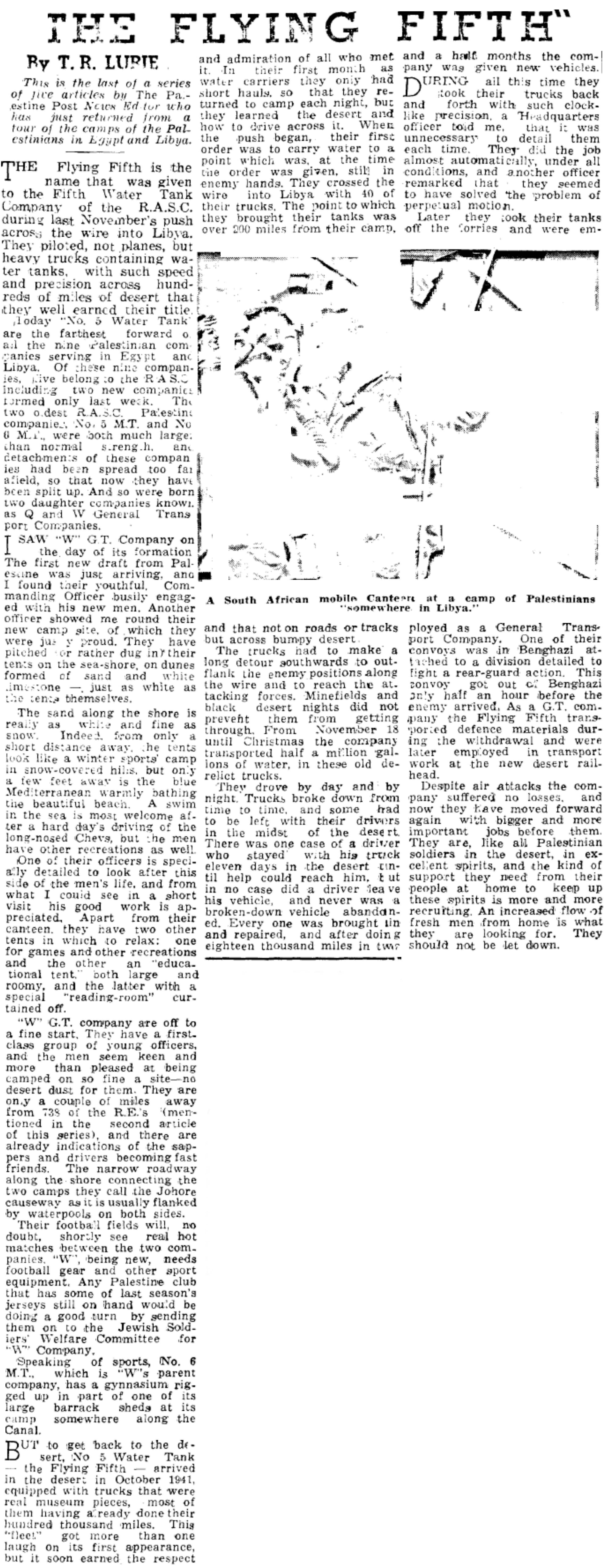
THE FLYING FIFTH
By T.R. LURIE
The Jerusalem Post
May 12, 1942

This is the last of a series of five articles by The Palestine Post News Editor who has just returned from a tour of the camps of the Palestinians in Egypt and Libya.

THE Flying Fifth is the name that was given to the Fifth Water Tank Company of the R.A.S.C. during last November’s push across the wire into Libya.  They piloted, not planes, but heavy trucks containing water tanks, with such speed and precision across hundreds of miles of desert that they well earned their title.

Today “No. 5 Water Tank” are the farthest forward of all the nine Palestinian companies serving in Egypt and Libya.  Of these nine companies, five belong to the R.A.S.C., including two new companies formed only last week.  The two oldest R.A.S.C. Palestinian companies, No. 5 M.T. and No. 6 M.T., were both much larger than normal strength, and detachments of these companies have been spread too far afield, so that they now have been split up.  And so were born two daughter companies known as Q and W General Transport Companies.

I SAW “W” G.T. Company on the day of its formation.  The first new draft from Palestine was just arriving, and I found their youthful Commanding Officer busily engaged with his new men.  Another officer showed me round their new camp site, of which they were justly proud.  They have pitched or rather dug in their tents on the sea-shore, on dunes formed of sand and white limestone – just as white as the tents themselves.

The sand along the shore is really as white and fine as snow.  Indeed, from only a short distance away, the tents look like a winter sports’ camp in snow-covered hills, but only a few feet away is the blue Mediterranean warmly bathing the beautiful beach.  A swim in the sea is most welcome after a hard day’s driving of the long-nosed Chevs [Chevys], but the men have other recreations as well.

One of their officers is specially detailed to look after this side of the men’s life, and from what I could see in a short visit his good work is appreciated.  Apart from their canteen, they have two other tents in which to relax: one for games and other recreations and the other an “educational tent,” both large and roomy, and the latter with a special “reading-room” curtained off.

“W” G.T. company are off to a fine start.  The have a first-class group of young officer, and the men seem keen and more than pleased at being camped on so fine a site – no desert dust for them.  They are only a couple of miles away from 738 of the R.E.s, and there are already indications of the sappers and driver becoming fast friends.  The narrow roadway along the shore connecting the two camps they call the Johore causeway as it is usually flanked by waterpools on both sides.

Their football fields will, no doubt, shortly see really hot matches between the two companies. “W”, being new, needs football gear and other sport equipment.  Any Palestine club that has some of last season’s jerseys still on hand would be doing a good turn by sending them on to the Jewish Soldier’s Welfare Committee for “W” Company.

Speaking of sports, No. 6 M.T., which is “W’s” parent company, has a gymnasium rigged up in part of one of its large barrack sheds at its camp somewhere along the Canal.

BUT to get back to the desert, No. 5 Water Tank – the Flying Fifth – arrived in the desert in October, 1941, equipped with trucks that were real museum pieces, most of them having already done their hundred thousand miles.  This “fleet” got more than one laugh on its first appearance, but it soon earned the respect and admiration of all who met them.  In their first month as water carriers they only had short hauls, so that they returned to camp each night, but they learned the desert and how to drive across it.  When the push began, their first order was to carry water to a point which was, at the time the order was given, still in enemy hands.  They crossed the wire into Libya with 40 of their trucks.  The point to which they brought their tanks was over 200 miles from their camp, and that not on roads or tracks buy across bumpy desert.

The trucks had to make a long detour southwards to outflank the enemy positions along the wire and to reach the attacking forces.  Minefields and black desert nights did not prevent them from getting through.  From November 18 until Christmas the company transported half a million gallons of water, in these old derelict trucks.

They drove by day and by night.  Trucks broke down from time to time, and some had to be left with their drivers in the midst of the desert.  There was one case of a driver who stayed with his truck eleven days in the desert until help could reach him, but in no case did a driver leave his vehicle, and never was a broken-down vehicle abandoned.  Every one was brought in and repaired, and after doing eighteen thousand miles in two and a half months the company was given new vehicles.

DURING all this time they took their trucks back and forth with such clock-like precision, a Headquarters officer told me, that it was unnecessary to detail them each time.  They did the job almost automatically, under all conditions, and another officer remarked that they seemed to have solved the problem of perpetual motion.

Later they took their tanks off the lorries and were employed as a General Transport Company.  One of their convoys was in Benghazi attached to a division detailed to fight a rea-guard action.  This convoy got out of Benghazi only half an hour before the enemy arrived.  As a G.T. company the Flying Fifth transported defence materials during the withdrawal and were later employed in transport work at the new desert railhead.

Despite air attacks the company suffered no losses, and now they have moved forward again with bigger and more important jobs before them.  They are, like all Palestinian soldiers in the desert, in excellent spirits, and the kind of support they need from their people at home to keep up these spirits is more and more recruiting.  An increased flow of fresh men from home is what they are looking for.  They should not be let down.

Soldiers of Judea IV: Military Service of Soldiers from the Yishuv in the British 8th Army – The Palestine Post, May 11, 1942 – “The A.T.S. Are Doing Well”

On May 11, the Post published Ted Lurie’s article about women from the Yishuv in the Auxiliary Territorial Service.  Like other articles in his series, the location of their military unit is not revealed, but it is revealed that they were stationed within relatively close travel distance of Cairo and the Canal Zone.  Unlike the women profiled in the Parade issue of February 12, 1944, the soldiers in camp visited by Lurie were not drivers as such (though he alludes to this), instead serving in an Ordnance stores and Accounting Department.

________________________________________

The A.T.S. ARE DOING WELL
By T.R. LURIE
The Palestine Post
May 11, 1942

This is the fourth of a series of articles by The Palestine Post News Editor who has just returned from a tour of the camps of the Palestinians in Egypt and Libya.

PALESTINIAN women of the Auxiliary Territorial Service who got into uniform only six weeks ago are at work on important jobs in Egypt, and have already won high praise from the Colonels in command of the Ordnance Depos to which they are attached.

They are still digging-in their new homes which they are rapidly converting from bare barrack rooms to attractive, home-like hutments.  I visited two of the three camps occupied by the first contingent of ATS to arrive from Palestine in Egypt and found them both to be surprisingly comfortable.

The women live in large sheds fixed more like dormitories than like barracks.  They have proper spring beds and small bed-tables which they themselves are curtaining.  The sappers who had the job of converting these barracks into women’s quarters outdid themselves in ingenuity.  In one they provided a special hairdressing saloon.  They built shower rooms with specially low showers (hot and cold) so that the women can shower without getting their hair wet.

BUT all these comforts do not mean that the ATS are soft.  They are doing mens’ jobs, whether as ordinance clerks, storewomen or drivers – and not just drivers of small cars, for they are already driving three-ton lorries.  At one Ordnance Vehicle depot, the Colonel told me that the ATS were already handling the “flow,” that is, driving new vehicles around the huge depot from their arrival through the various inspections, equipping and greasing stages to their final issue.

More Women Volunteers

Although busy fixing up their living quarters and comforts, the girls are chiefly occupied with their work, which they have taken to with an enthusiasm that has aroused comment everywhere.  The only “crime” reported by one Commanding Officer was that of two ATS who went to work when the doctor said they should have gone sick.

I happened to visit one camp during an inspection by the D.D.O.S. [Deputy Director of Ordnance Services], who was, of course, very pleased to find the girls so keen.  He spoke of the importance of their work and their efficiency, and stressed the need for more and more Auxiliaries, as indeed did all the officers.  Their reputation is traveling fast, and one looks forward to this vanguard of ATS being followed by thousands more to replace more and more men.  Men are thus relieved for other jobs, without the work suffering at all.  If anything there will be greater efficiency, as there will no longer be any danger of trained personnel being taken away from these jobs at the base to be sent up to the front.

CAIRO, which today sees more varied womens’ uniforms than probably any other city in the world, has already noticed the ATS.  While their khaki may not be as colorful as the Navy blue of the WRENS or the tan and brown of the South-African women or the Air-Force blue of the WAFFS, still their new forage caps, which I saw them wear yesterday in place of the peaked hats they wear on duty, give them an air of perky smartness.

In Cairo and the Canal Zone two homes for ATS are being opened where girls of leave will be able to stay.  Mrs. Edwin Samuel has just spent about a fortnight in Egypt, making arrangements for these clubs, and, she told me, plans are well advanced.  The houses have been chosen and architects and interior decorators are at work.

Social Life

The PATS’ social life is, however, not confined to visits to town during off hours, for in the camps themselves the officers are paying special attention to recreation and cultural activities.  English, Hebrew, and Arabic lessons are being arranged in one camp, where it is also planned to start a mixed choir.  The A.T.S. are permitted to entertain men friends in their own canteen at certain hours.  Their canteens have, of course, got pianos, radios and all sorts of indoor games, and are large, spacious, attractive and comfortable recreation halls.

Friday evenings are most attractive of all at the A.T.S. camps, and at one I visited I was told that the non-Jewish officers and N.C.O.s take part in the candle-lighting service together with the Jewish girls.

Quiet Efficiency

The ATS have, no doubt, made an excellent impression in the short time since their arrival.  Such remarks as “highly intelligent” and “extremely capable” are the only comments I could hear from officers as well as from the N.C.O.s in charge of the various Departments in which the girls are employed.  These Corporals and Sergeants, old soldiers and Ordnance men who had the job of introducing the girls to the bookkeeping and officer work at which they are replacing men, were enthusiastic about the alacrity with which their pupils caught on.

I saw the women a work, a few score among hundreds of men in gigantic Ordnance stores and Accounting Departments.  They were already very much at home doing their work on their own and were being entrusted with complete responsibility like veterans.  At work, there is the same informal atmosphere of a civilian officer.  The Auxiliaries sit at their long tables handling index cards and army forms with quiet efficiency, and, in some places, they are even permitted to smoke at work.

Outside the “office,” there is just enough of heel-clicking and drill to remind them that they’re in the Army.  They parade in the morning and afternoon to march to work and back again and they march to Mess as well.  All in all, it’s a soldier’s life they lead.

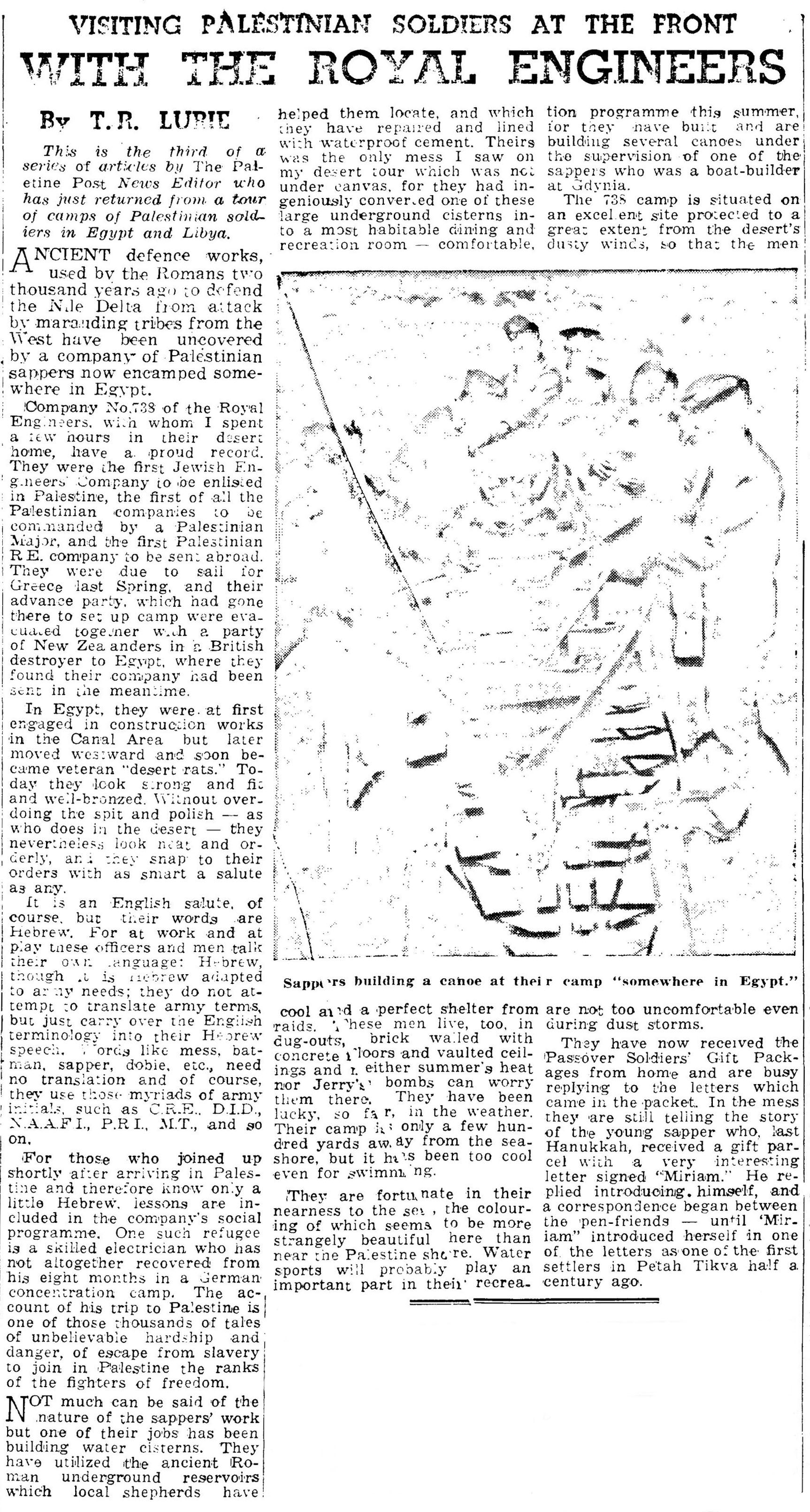
Soldiers of Judea III: Military Service of Soldiers from the Yishuv in the British 8th Army – The Palestine Post, May 10, 1942 – “With the Royal Engineers”

The first two of Ted Lurie’s articles about the military service of soldiers from the Yishuv having appeared on Thursday and Friday (May 7 and 8), 1942, the next article was published on May 10, Sunday.  (A break for Shabbat on May 9!)  Note that Lurie begins right off in mentioning the designation of the unit involved: 738th Artisan Works Company.  However, the unit’s location is described in only the most general terms: near the Mediterranean Sea, at a site protected from desert winds.     

________________________________________

VISITING PALESTINIAN SOLDIERS AT THE FRONT
WITH THE ROYAL ENGINEERS
By T.R. LURIE
The Palestine Post
May 10, 1942

This is the third of a series of articles by the Palestine Post News Editor who has just returned from a tour of camps of Palestinian soldiers in Egypt and Libya.

ANCIENT defence works, used by the Romans two thousand years ago to defend the Nile Delta from attack by marauding tribes from the West have been uncovered by a company of Palestinian sappers now encamped somewhere in Egypt.

Company No. 738 of the Royal Engineers, with whom I spent a few hours in their desert home, have a proud record.  They were the first Jewish Engineers Company to be enlisted in Palestine, the first of all the Palestinian companies to be commanded by a Palestinian Major, and the first Palestinian R.E. company to be sent abroad.  They were due to sail for Greece last Spring, and their advance party, which had gone there to set up camp were evacuated together with a party of New Zealanders in a British destroyer to Egypt, where they found their company had been sent in the meantime.

In Egypt, they were at first engaged in construction works in the Canal Area, but later moved westward and soon became veteran “desert rats”.  Today they look strong and fit and well-bronzed.  Without overdoing the spit and polish – as who does in the desert – they nevertheless look neat and orderly, and they snap to their orders with as smart a salute as any.

It is an English salute, of course, but their words are Hebrew.  For at work and at play these officers and men talk their own language: Hebrew, though it is Hebrew adapted to army needs; they do not attempt to translate army terms, but just carry over the English terminology into their Hebrew speech.  Words like mess, batman, sapper, dobie, etc., need no translation and of course, they use those myriads of army initials, such as C.R.E., D.I.D., N.A.A.F.I., P.R.I., M.T., and so on.  

____________________

Explanation of the above acronyms…

C.R.E. – Corps of Royal Engineers
D.I.D. – Detail Issue Depot (A facility built for storing and distributing basic supplies.)
N.A.A.F.I. – Navy, Army, and Air Force Institutes
P.R.I. – President of the Regimental Institute
M.T. – Mechanical Transport

____________________

For those who joined up shortly after arriving in Palestine and therefore know only a little Hebrew, lessons are included in the company’s social programme.  One such refugee is a skilled electrician who has not altogether recovered from his eight months in a German concentration camp.  The account of his trip to Palestine is one of those thousands of tales of unbelievable hardship and danger, of escape from slavery to join in Palestine the ranks of the fighters of freedom.

NOT much can be said of the nature of the sapper’s work but one of their jobs has been building water cisterns.  They have utilized the ancient Roman underground reservoirs which local shepherds have helped them locate, and which they have repaired and lined with waterproof cement.  Theirs was the only mess I saw on my desert tour which was not under canvas, for they had ingeniously converted one of these large underground cisterns into most habitable dining and recreation room – comfortable, cool and a perfect shelter from raids.  These men live, too, in dug-outs, brick walled with concrete floors and vaulted ceilings and neither summer’s heat not Jerry’s bombs can worry them there.  They have been lucky, so far, in the weather.  They camp is only a few hundred yards away from the seashore, but it has been too cool even for swimming.

They are fortunate in their nearness to the sea, the colouring of which seems to be more strangely beautiful here than near the Palestine shore.  Water sports will probably play an important part in their recreation programme this summer, for they have built and are building several canoes under the supervision of one of the sappers who was a boat-builder at Gdynia.

The 738 camp is situated on an excellent site protected to a great extent from the desert’s dusty winds, so that the men are not too uncomfortable even during dust storms.

They have now received the Passover Soldiers’ Gift Packages from home and are busy replying to the letters which came in the packer.  In the mess they are still telling the story of the young sapper who, last Hanukkah, received a gift parcel with a very interesting letter signed “Miriam”.  He replied introducing himself, and a correspondence began between the pen-friends – until ‘Miriam’ introduced herself in one of the letters as one of the first settlers in Petah Tikva half a century ago.

Soldiers of Judea II: Military Service of Soldiers from the Yishuv in the British 8th Army – The Palestine Post, May 8, 1942 – “Pioneers in the Desert”

On Friday, May 8, 1942, The Palestine Post published the second of Ted Lurie’s reports about the military service of troops from the Yishuv in the British Eighth Army.  This news item focused on the three Pioneer Companies of the Royal Army Service Corps (two Jewish and one Arab) serving in Libya and Egypt, respectively.  Immediately apparent is that Lurie’s reporting is based on encounters and interviews with the soldiers serving in these units, this involving travel of approximately 1,000 miles west from the Yishuv, along the Mediterranean coast of Africa.  As you can see in the image below, Lurie’s article was accompanied by two photos, but these are barely visible in the digital version of the article.

________________________________________

PIONEERS IN THE DESERT
By T.R. LURIE
The Palestine Post
May 8, 1942

This is the second of a series of articles by The Palestine Post News Editor who has just returned from a tour of camps of Palestinian Soldiers in Egypt and Libya.

PALESTINIANS are Pioneers with Gen. Ritchie’s Eighth Army in the Western Desert.  Three Companies of the Auxiliary Military Pioneer Corps, two Jewish Companies and one Arab, are encamped and doing important jobs – the first two in Libya and the third in Egypt.

Two of them are working at different point along the Eighth Army’s vital supply lines, while one, number 601, is in the Tobruk area.  In the record-breaking construction of the new desert railway by New Zealand engineers these Palestinian Pioneers played an important part.

The Tobruk Company is now a Jewish unit but when originally formed as the first Palestinian Company to be enlisted it was a mixed Company.  They are the men who served in France and later were in the Battle of Britain, after having been armed during their last days in France.  Their overseas service won them high praise, as has already been noted in these columns, and now they are carrying on the reputation earned for Palestinians in Tobruk by the Jewish transport companies of the R.A.S.C. who served with the Australians during the 1941 siege.

A Year in the Desert

I did not visit 601 at Tobruk, but I travelled almost 1,000 miles to see the other two: 600 (Jewish) and 610 (Arab).  The first has been in the desert almost a year, starting in Egypt and by stages moving up to more forward positions until now they are on the other side of the wire.  Their exact location in Cyrenaica [eastern coastal region of Libya] can, of course, not be disclosed, but I found them – a pin point on the map already diligently working at a dozen different tasks although they were still in the process of digging in.

They had a few days before broken camp near an old railhead site in Western Egypt and had moved forward to this point somewhere between Capuzzo [Fort Capuzzo] and Bardia.  A detachment of Greek troops has been attached to the company here.  The pioneers’ jobs range from sorting mail at the Field Post Office, digging pits for telegraph poles to working on munitions dumps, and many other jobs which an army has do along its lines of communications.

I saw the men – those who were not out in detachments at work some distance from the camp – at lunch-time messing in the open near the cook-house.  They had just received the Passover gift parcels sent by the Jewish Soldiers Welfare Committee and were of course delighted to have them at their new camp, which more than made up for their late arrival.  Some of the men had been home on leave for Passover and were still talking about it at mess that day while others described the thrill they had experienced by the surprise visit of Mr. M. Shertok [Moshe Chertok] who had come to their camp at their old site to spend the Passover Feast (Seder) with them.

Men from the Patria

I spoke in English to a husky Sergeant who was only a beginner at Hebrew because he had come to Palestine in the Patria from Austria only a short time before enlisting.  There are several men from Patria and Tiger Hill and other refugee ships in this company together with boys born in Jerusalem and other towns, and farmers from Herzlia and other villages.  Many of them are skilled artisans and craftsmen, and their only ambition is to do work for which they are well qualified as an Artisan Works Company in the Res. or a Works Services Company of the R.A.S.C.

The food is good and plentiful, and even Tubby, the fat boy, (20 stone if he’s a pound) cannot complain on that score.  The men all live under canvas, some in small “bivys,” others in large dug-in sand-bagged tents, as they have not yet had time to build proper dug-outs.

IT was not easy to find 610 Company.  We started at Mersa Matruh, travelled a couple of hours west on the coastal road and then turned off south on a desert track. Tracks soon disappeared in the brush and we made the rest of the journey guided only by maps and compass bearings.  We bounced over thick desert shrubs for another couple of hours until we found our pin-point: 610 A.M.P.C.

An Arab Unit

This Company includes some of the Arab soldiers who had joined 601 on its formation as a mixed company and had been transferred to 610 when the former was reconstituted as a Jewish unit.  The two had been in France and some had later been in a Commando at Abyssinia.  Theirs is the only Arab Company serving outside Palestine, and they have been in Egypt about six months.

Most of the men are from Jaffa, but nevertheless they take to the desert “not too badly,” in the words of one of their officers.  The boys from the towns are even better, this officer said, then the native desert dwellers themselves.  They are in good spirits and on the least occasion – such as an ordinary pay day – they will hold a celebration and dance the debka, using bivy tent-poles for swords.  They too receive comforts from Palestine: sports gear, indoor games, newspapers, etc.

Although the men speak only a little English, their officers manage to make themselves understood.  One of the officers – then with the Buffs Regiment – was in Palestine in 1936 and later, in 1940, was a training officer for Palestinian recruits at Sarafand.

The men themselves are keen on firearms, I was told, especially Lewis and Breda guns.  Nothing gives them more of a kick than a chance to fire their machine-guns at enemy planes.  A couple of hits scored on one raider were identified as coming from their gun when the machine crash-landed later.  These men were hard to find in the Egyptian desert – being so well dug in – but they were, tawny and grinning, doing their bit.

Soldiers of Judea I: Military Service of Soldiers from the Yishuv in the British 8th Army – The Palestine Post, May 7, 1942 – “So This Is The Western Desert”

Given the implications – of geography, politics, and ultimately, sheer physical survival (also see…– of the Battle for North Africa for the Jews of the Yishuv (and not just the Yishuv), it’s not at all surprising that The Palestine Post (and, I’m certain, Hebrew language newspapers of the Yishuv) accorded attention to the military service of the Jews of the Yishuv in the armed forces of the British Commonwealth in general, and, in the context of the North African Campaign in particular. 

Certainly this was the focus of attention geographically beyond the Yishuv, as exemplified in 1944 by La Tribune Juive, but not so much in the American Jewish press.

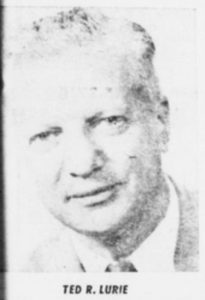
A notable example of this occurred in mid-1942, when The Palestine Post published five articles about this topic, all authored by correspondent “T.R. Lurie”: Ted R. Lurie.

A native of New York, Lurie settled in “palestine” shortly after graduating from Cornell University in 1930.  In 1932, after briefly working in a collective farm settlement, he began work at The Palestine Post.  During World War II he served as the Post’s military correspondent with Allied forces in the Western Desert. 

Active in the Haganah commencing in 1933, in 1947 he organized and directed its underground English-language broadcasts, and in 1948, on the eve of Israel’s War of survival and liberation, served as its public relations officer.  Throughout this time he continued to serve in various editorial capacities with the The Palestine Post, continuing after 1948 when the newspaper was renamed The Jerusalem Post.  In 1955 he was named acting editor, replacing the paper’s founder and editor Gershon Agron, who was elected Mayor of Jerusalem.  He became editor-in-chief on Mr. Agron’s death in 1959, founding the newspaper’s Weekly Overseas Edition that same year.

Ted Lurie also served as Associated Press Jerusalem correspondent and as Israel news correspondent for the Central News Agency, the News Chronicle of London and the Columbia Broadcasting System.  In recent years he broadcast Israeli news four times a week on radio station WEVD in New York.  He was also a former editor of the Hebrew daily Zmanim, a co-founder of the Israel Journalists Association and ITIM (Israel News Agency), a member of the Israel Committee of the international Press institute, a former president of the YMHA Association and chairman of the Jerusalem branch of the Israel-Japan Society.

Ted R. Lurie died in Tokyo on June 1, 1974.  He is buried in Har HaMenuchot Cemetery, Jerusalem, Israel.  (The above information was compiled from articles in the Jewish Floridian, December 6, 1968; Jewish Telegraphic Agency, June 3, 1974; Jerusalem Post, June and June 7, 1974.) 

Pictures of Mr. Lurie are elusive; here’s the only one I found: It was published in the Jewish Floridian on December 6, 1968.

Published between May 7 and 11, 1942, each of Lurie’s articles focused on a different aspect of the service of Jewish soldiers in the Western Desert, specifically at Company-level military units whose duties – transportation, water supply (pretty important in a desert!), and engineering – while neither dramatic nor given to bold headlines, were absolutely essential to the actual conduct of offensive as well as defensive combat operations.  Interestingly, though these articles were obviously published even as the war was ongoing, Lurie recorded and the Post published the actual numerical designations of some of these units, which I assume occurred with the assent of military censors. 

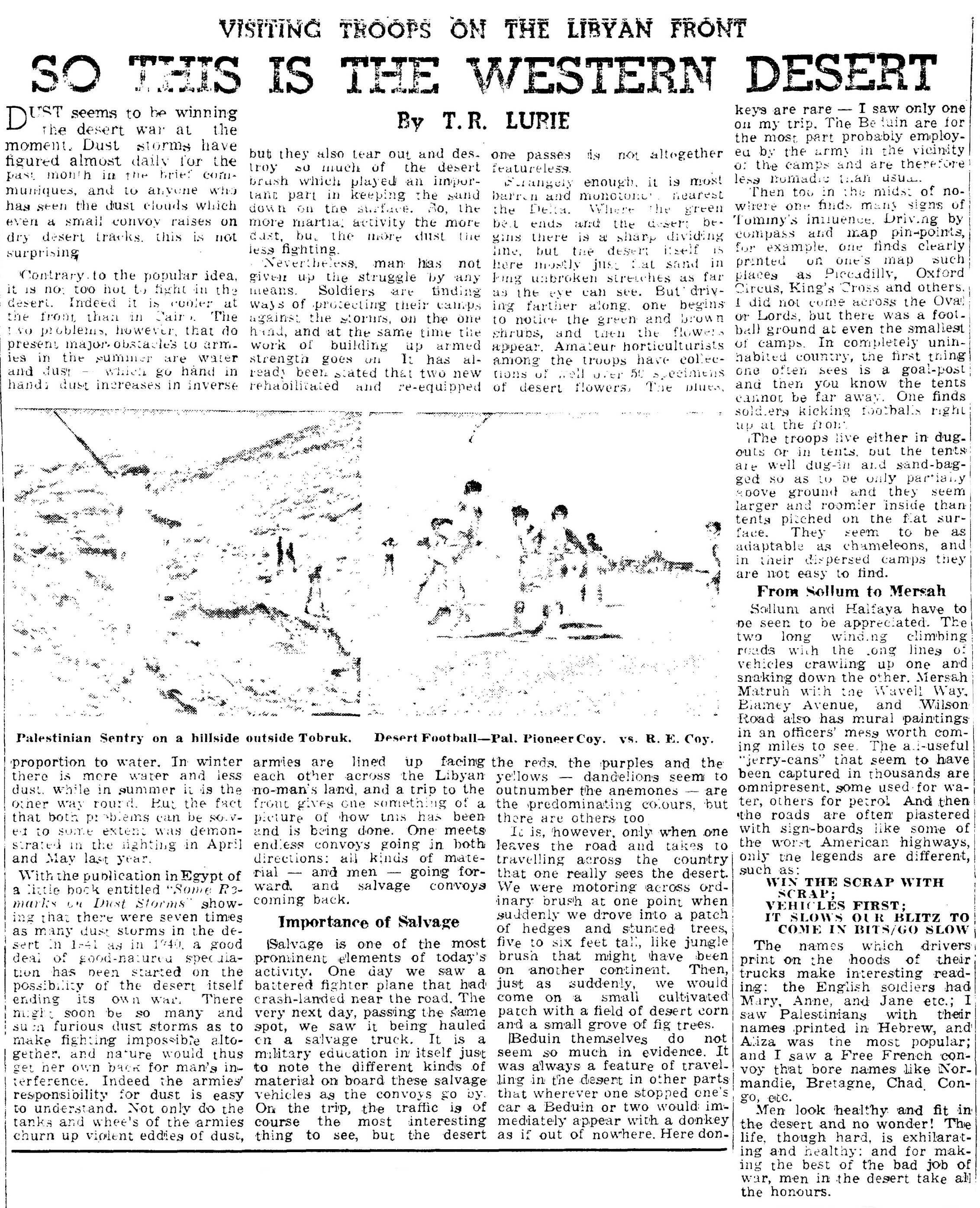
So…  “This” and the next four posts will present Lurie’s five articles in chronological order, and will include an image of the article itself (found via the National Library of Israel) and – well, given the poor legibility of the text in the images – a full transcript of the article.  Though each article s accompanied by a photograph, unfortunately, the quality of these images in electronic format is very poor.  (Oh, well.)    

____________________

To place this series of articles in a winder context, here’s a diagrammatic map of the war in North Africa, published in Lukasz Hirsowicz’s 1966 The Third Reich and the Arab East.  Very cleverly designed, the map shows geographic boundaries, the locations of principal cities, routes and destinations of naval convoys, air activity, and above all, the timing and furthest geographic extent of Allied and Axis military offensives in Libya and Egypt.  The closest approach of Axis forces to Cairo, the Suez Canal, and the Yishuv – during the battle of El Alamein – was attained on July 1, 1942, after which offensive momentum finally and completely (but not without cosr) switched to the Allies.  

____________________

This “first” post, pertaining to Lurie’s article of May 7, 1942 (a Thursday), provides an introduction and overview to the series.

Subsequent posts will cover Lurie’s articles about…

Pioneers (Friday, May 8, 1942)
Engineers (Sunday, May 10, 1942)
A.T.S. (Auxiliary Transport Service) (Jewish women soldiers) (Monday, May 11, 1942)
Water Transportation and Supply (Tuesday, May 12, 1942)

VISITING TROOPS ON THE LIBYAN FRONT
SO THIS IS THE WESTERN DESERT
By T.R. LURIE
The Palestine Post
May 7, 1942

DUST seems to be winning the desert was at the moment.  Durst storms have figured almost daily for the past month in the brief communiques, and to anyone who has seen the dust clouds which even a small convoy raises on desert tracks, this is not surprising.

Contrary to the popular idea, it is not too hot to fight in the desert.  Indeed it is cooler at the front than in Cairo.  The two problems, however, that do present major obstacles to combat in the summer are water and dust – which go hand in hand; dust increases in inverse proportion to water.  In winter there is more water and less dust, while in summer it is the other way round.  But the fact that both problems can be solved to some extent was demonstrated in the fighting in April and May last year.

With the publication in Egypt of a little book entitled Some Remarks on Dust Storms showing that there were seven times as many dust storms in the desert in 1941 as in 1940, a good deal of good-natured speculation has been started on the possibility of the desert itself ending its own war.  There might soon be so many and such furious dust storms as to make fighting impossible altogether, and nature would thus get her own back for man’s interference.  Indeed the army’s responsibility for dust is easy to understand.  Not only to the tanks and wheels of the armies churn up violent eddies of dust, but they also tear out and destroy so much of the desert brush which played an important part in keeping the sand down on the surface.  So, the more martial activity the more dust, but, the more dust the less fighting.

Nevertheless, man has not given up the struggle by any means.  Soldiers are finding ways of protecting their camps against the dust storms, on the one hand, and at the same time the work of building up armed strength goes up.  It has already been stated that two new rehabilitated and re-equipped armies are lined up facing each other across he Libyan no-man’s land, and a trip to the front gives one something of a picture of how this has been and is being done.  One meets endless convoys going in both directions; all kinds of material – and men – going forward and salvage convoys coming back.

Importance of Salvage

Salvage is one of the most prominent elements of today’s activity.  One day we saw a battered fighter plane that had crash-landed near the road.  The very next day, passing the same spot, we saw it being hauled on a salvage truck.  It is just a military education in itself just to note the different kinds of material on board these salvage vehicles as the convoys go by.  On the trip, the traffic is of course the most interesting thing to see, but the desert one passes is not altogether featureless.

Strangely enough, it is most barren and monotonous nearest the Delta.  Where the green belt ends and the desert begins there is a sharp dividing line, but the desert itself is here mostly just flat sand in long unbroken stretches as far as the eye can see.  But driving farther along one begins to notice the green and brown shrubs, and then the flowers appear.  Amateur horticulturists among the troops have collections of well over 50 specimens of desert flowers.  The blues, the reds, the purples and the yellows – dandelions seem to outnumber the anemones – are the predominating colours, but there are others too.

It is, however, only when one leaves the road and takes to travelling across the country that one really sees the desert.  We were motoring across ordinary brush at one point, when suddenly we drove into a patch of hedges and stunted trees, five to six feet tall, like jungle brush that might have been on another continent.  Then, just as suddenly, we would come on a small cultivated patch with a field of desert corn and a small grove of fig trees.

Beduin themselves do not seem so much in evidence.  It was always a feature of travelling in the desert in other parts that wherever one stopped one’s car a Beduin or two would immediately appear with a donkey as if out of nowhere.  Here donkeys are rare – I saw only one on my trip.  The Beduin are for the most part probably employed by the army in the vicinity of the camps and are therefore less nomadic than usual.

Then too in the midst of nowhere one finds many signs of Tommy’s influence.  Driving by compass and map pin-points, for example, one finds clearly printed on one’s map such places as Piccadilly, Oxford Circus, King’s Cross and others.  I did not come across the House of Lords, but there as a football ground at even the smallest of camps.  In completely uninhabited country, the first thing one often sees is a goal-post and then you know the tents cannot be far away.  One finds soldiers kicking footballs right up at the front.

The troops live either in dugouts or in tents, but the tents are well dug-in and sand-bagged so as to be only partially above ground and they seem larger and roomier inside than tents pitched on the flat surface.  They seem to be as adjustable as chameleons, and in their dispersed camps they are not easy to find.

From Sollum to Mersah

Sollum and Halfaya have to be seen to be appreciated.  The two long winding climbing roads with the long lines of vehicles crawling up one and snaking down the other, Mersah Matruh with the Wavell Way, Blamey Avenue, and Wilson Road also has mural paintings in an officers’ mess worth coming miles to see.  The all-useful “jerry-cans” that seem to have been captured in thousands are omnipresent, some used for water, others for petrol.  And then the roads are often plastered with sign-boards like some of the worst American highways, only the legends are different, such as:

WIN THE SCRAP WITH SCRAP;
VEHICLES FIRST;
IT SLOWS OUR BLITZ TO COME IN BITS / GO SLOW

The names which drivers print on the board of their trucks make interesting reading: the English soldiers had Mary, Anne, and Jane, etc.; I saw Palestinians with their names printed in Hebrew, and Aliza was the most popular; and I saw a Free French convoy that bore names like Normandie, Bretagne, Chad, Congo, etc.

Men look healthy and fit in the desert, and no wonder!  The life, though hard, is exhilarating and healthy; and for making the best of the bad job of war, men in the desert take all the honours.

References and Readings

Hirsowicz, Lukasz, The Third Reich and the Arab East (translated from the Polish)Routledge & K. Paul, London, England, 1966

Jackson, William G.F., The Battle for North Africa 1940-43, Mason / Charter, New York, N.Y., 1975