The first two of Ted Lurie’s articles about the military service of soldiers from the Yishuv having appeared on Thursday and Friday (May 7 and 8), 1942, the next article was published on May 10, Sunday. (A break for Shabbat on May 9!) Note that Lurie begins right off in mentioning the designation of the unit involved: 738th Artisan Works Company. However, the unit’s location is described in only the most general terms: near the Mediterranean Sea, at a site protected from desert winds.
________________________________________
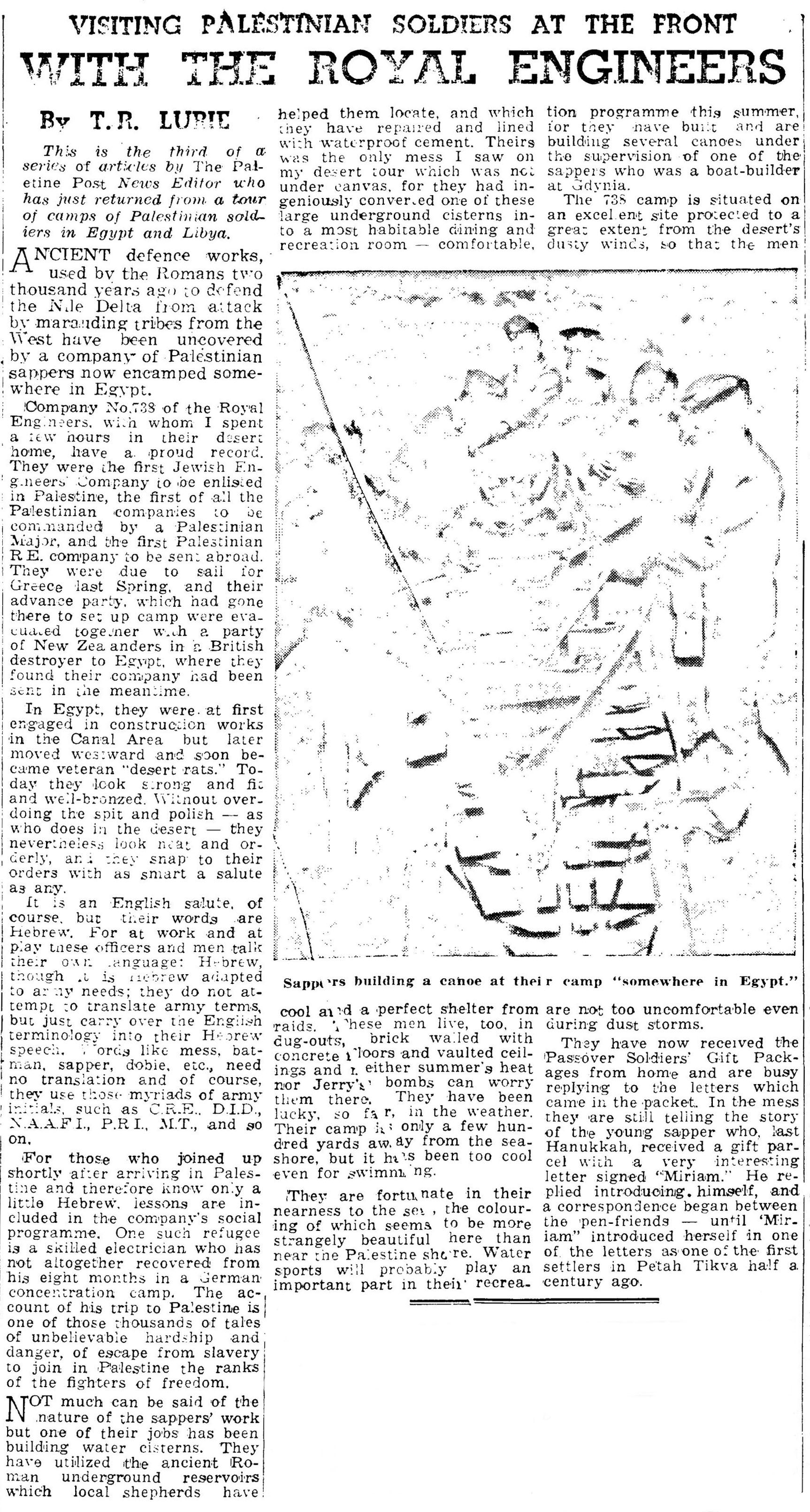
VISITING PALESTINIAN SOLDIERS AT THE FRONT
WITH THE ROYAL ENGINEERS
By T.R. LURIE
The Palestine Post
May 10, 1942
This is the third of a series of articles by the Palestine Post News Editor who has just returned from a tour of camps of Palestinian soldiers in Egypt and Libya.
ANCIENT defence works, used by the Romans two thousand years ago to defend the Nile Delta from attack by marauding tribes from the West have been uncovered by a company of Palestinian sappers now encamped somewhere in Egypt.
Company No. 738 of the Royal Engineers, with whom I spent a few hours in their desert home, have a proud record. They were the first Jewish Engineers Company to be enlisted in Palestine, the first of all the Palestinian companies to be commanded by a Palestinian Major, and the first Palestinian R.E. company to be sent abroad. They were due to sail for Greece last Spring, and their advance party, which had gone there to set up camp were evacuated together with a party of New Zealanders in a British destroyer to Egypt, where they found their company had been sent in the meantime.
In Egypt, they were at first engaged in construction works in the Canal Area, but later moved westward and soon became veteran “desert rats”. Today they look strong and fit and well-bronzed. Without overdoing the spit and polish – as who does in the desert – they nevertheless look neat and orderly, and they snap to their orders with as smart a salute as any.
It is an English salute, of course, but their words are Hebrew. For at work and at play these officers and men talk their own language: Hebrew, though it is Hebrew adapted to army needs; they do not attempt to translate army terms, but just carry over the English terminology into their Hebrew speech. Words like mess, batman, sapper, dobie, etc., need no translation and of course, they use those myriads of army initials, such as C.R.E., D.I.D., N.A.A.F.I., P.R.I., M.T., and so on.
____________________
Explanation of the above acronyms…
C.R.E. – Corps of Royal Engineers
D.I.D. – Detail Issue Depot (A facility built for storing and distributing basic supplies.)
N.A.A.F.I. – Navy, Army, and Air Force Institutes
P.R.I. – President of the Regimental Institute
M.T. – Mechanical Transport
____________________
For those who joined up shortly after arriving in Palestine and therefore know only a little Hebrew, lessons are included in the company’s social programme. One such refugee is a skilled electrician who has not altogether recovered from his eight months in a German concentration camp. The account of his trip to Palestine is one of those thousands of tales of unbelievable hardship and danger, of escape from slavery to join in Palestine the ranks of the fighters of freedom.
NOT much can be said of the nature of the sapper’s work but one of their jobs has been building water cisterns. They have utilized the ancient Roman underground reservoirs which local shepherds have helped them locate, and which they have repaired and lined with waterproof cement. Theirs was the only mess I saw on my desert tour which was not under canvas, for they had ingeniously converted one of these large underground cisterns into most habitable dining and recreation room – comfortable, cool and a perfect shelter from raids. These men live, too, in dug-outs, brick walled with concrete floors and vaulted ceilings and neither summer’s heat not Jerry’s bombs can worry them there. They have been lucky, so far, in the weather. They camp is only a few hundred yards away from the seashore, but it has been too cool even for swimming.
They are fortunate in their nearness to the sea, the colouring of which seems to be more strangely beautiful here than near the Palestine shore. Water sports will probably play an important part in their recreation programme this summer, for they have built and are building several canoes under the supervision of one of the sappers who was a boat-builder at Gdynia.
The 738 camp is situated on an excellent site protected to a great extent from the desert’s dusty winds, so that the men are not too uncomfortable even during dust storms.
They have now received the Passover Soldiers’ Gift Packages from home and are busy replying to the letters which came in the packer. In the mess they are still telling the story of the young sapper who, last Hanukkah, received a gift parcel with a very interesting letter signed “Miriam”. He replied introducing himself, and a correspondence began between the pen-friends – until ‘Miriam’ introduced herself in one of the letters as one of the first settlers in Petah Tikva half a century ago.