The Four-Year-Mission: First Lieutenant Bernard R.J. Barab, Missing in Action on November 26, 1944 – Fate Resolved in 1950

(For some time, I haven’t posted anything “here” at TheyWereSoldiers, or at my other two blogs, WordsEnvisioned and ThePastPresented.  This reflects my tendency to release posts on a variety of topics simultaneously, rather than – one, by one, by one – incrementally.  So, there’s much in my queue, which I hope to complete and release in the (relatively?!?) near future.  

In the meantime, here’s a very brief post.  (Well, brief for me, for I tend to write lengthily, blasphemous by the standards of the year 2022!) 

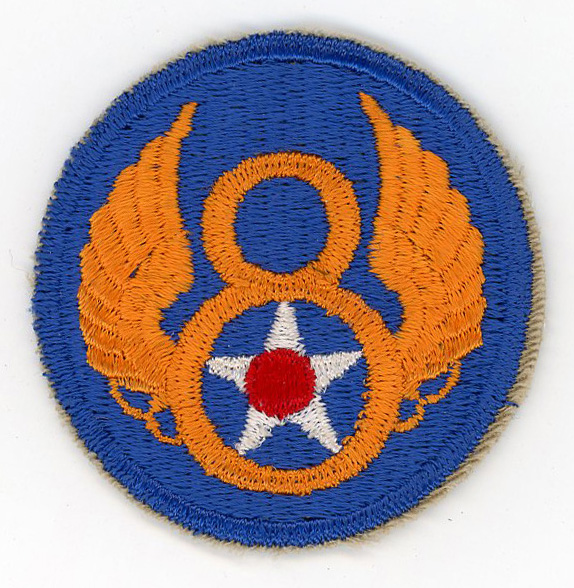
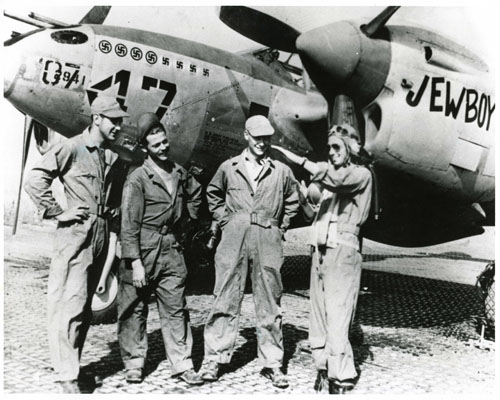
The post is inspired by the reminiscences of William S. Lyons, who vividly recalled witnessing the loss of two fellow 357th Fighter Squadron pilots in a mid-air collision during a fighter escort mission to Misburg, Germany, on November 26, 1944.  They were 1 Lt. Bernard R.J. Barab and 2 Lt. Charles W. Kelley.  Barab was killed as a result of the collision and Kelley was murdered one day after being captured.  I was able to present nominal information about Barab and Kelley in the latter post, but now – after having dug deep and deeper into my files – I’m able to recount Barab’s life in a fuller, way, showing the “man” as well as the “pilot”.

This comes by the way of a series of newspaper articles which (I think…?) were published in The Press of Atlantic City during and after WW II.  The images of these articles, displayed and transcripted below, were made from paper photocopies (not PDFs!) of the articles, which were provided to me by the Atlantic City Free Public Library in the 1990s.  Yeah, I have had these articles for a long time!

The articles are presented chronologically, commencing with Barab’s 1942 assignment as an Aviation Cadet at Maxwell Field in, through the resolution of his fate eight years later, in 1950.  Through these stories, aspects of his life and family are revealed that naturally would not – by definition or relevancy – be apparent in the historical records of the 357th Fighter Squadron:  His enlistment in the Army Air Force three weeks after the attack on Pearl Harbor, his participation in basketball at Atlantic City High School, and of particular note, his assignment as a flight instructor – rather than combat duty – at Napier Field upon receiving his wings.  Which, I think, would suggest excellent flying skills.

Though the articles mention his having shot down a “jet” in October of 1944, I believe this is incorrect, for USAF Study 85 credits him with a single aerial victory – on November 26, 1944; probably an Me 109 or FW 190 – the latter as accurately mentioned in the articles.  Though I don’t have the records of the 357th FS before me, perhaps the downing of an Me-262 in reality involved participation in aerial combat where a jet was downed by another 357th pilot.  If so, perhaps on that occasion he served as a wingman to the pilot who actually attained the victory.

The final article, from February of 1950, reflects information in Luftgaukommando Report J 2624, which lists the crash location of Lt. Barab’s Mustang, OS * A, as being in a swamp five kilometers north of Darfeld, Germany.  The physical difficulty of actually retrieving P-51D 44-13574, which was submerged to a depth of fifteen feet, was the probable cause of the several-years-delay in resolving Lt. Barab’s fate. 

But, resolved his fate was, and he is buried at the American Cemetery at Neuville-en-Condroz, Belgium.  According to the American Battle Monuments Commission, Lt. Barab was awarded the Air Medal and one Oak Leaf Cluster (no mention of the Purple Heart?) so he probably flew approximately ten combat missions.

______________________________

Perrin, Barab Taking Pilot Courses In South

April 20, 1942

Maxwell Field, Alabama – Among the thousands of aviation cadets now taking pre-flight courses at the huge Air Corps Replacement Training Center (Air Crew) at Maxwell Field, Alabama, are two from Atlantic City, New Jersey, as follows:  John Pershing Perrin of 21 N. Vermont Ave. and Bernard Ralph James Barab of 2 South States Ave.

Cadet Perrin is the son of Mr. and Mrs. John Louis Perrin.  He is a former student at Rutgers University.

Cadet Barab is the son of Mr. and Mrs. Samuel Barab, and prior to his appointment as a cadet in the U.S. Army Air Corps was a student at Ursinus College.

When these cadets finish the course at Maxwell Field, they will be sent to one of the many  primary flying schools in the Southeast Air Corps Training Center to begin the first phase of their pilot training.

______________________________

Lts. Barab, Perrin, Get Their Wings

January 20, 1943

Sgt. Samuel Barab and Mrs. Barab have just returned from Napier Field, Dothan, Ala., where they went to see their son, Lt. Bernard James Barab, graduate from the first class in 1943, get his “wings.”  Lt. John Perrin, of Ventor City, was in the same class.

Lt. Barab is a graduate of the local high school where he starred as a basketball player, being member of the champion five that made athletic history in the Glenn Falls, N.Y. game.  When the war broke out he was a sophomore in Ursinus College.  He quit his academic studies to enlist in the Army Air Corps in New York City.  Subsequently he received his training in Augusta, Ga., and in Alabama where he qualified to operate pursuit and fighter planes.  He received his commission on Jan. 14.

______________________________
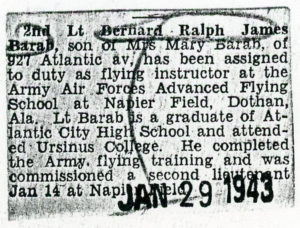
January 29, 1943

2nd Lt. Bernard Ralph James Barab, son of Mrs. Mary Barab, of 927 Atlantic Ave., has been assigned to duty as flying instructor at that Army Air Forces Advanced Flying School at Napier Field, Nothan, Ala.  Lt. Barab is a graduate of Atlantic City High School and attended Ursinus College.  He completed the Army flying training and was commissioned a second lieutenant Jan 14 at Napier Field.

______________________________

April 4, 1943

2nd Lt. Barney Barab, son of Police Sgt. and Mrs. Samuel Barab, has returned to his duties following a brief furlough with his parents.

Lt. Barab, a graduate of Atlantic City High School, is a flying instructor in the Army Air Corps, and is stationed at Napier Field, Dothan, Ala.  He was a sophomore in Ursinus College, when he joined the Air Corps 14 months ago.

______________________________

Lt. Barab Flies Home To Visit Mother

July 31, 1943

Lt. Bernard Barab paid a surprise visit to his mother, Mrs. Mary Barab, 927 Atlantic Ave., yesterday flying to Atlantic City from Napier Field, Ala., where he is an instructor in advanced combat flying for the Army Air Forces.

He has a 24-hour leave before the start of a new class at Napier Field and will return today, reporting for duty on Sunday.  He covered the ___-mile trip in six hours.

Lt. Barab was graduated from Atlantic City High School and attended Ursinus College for two years before enlisting in the armed forces.  He received his training at Maxwell Field, Ala.  He is remembered as an outstanding basketball star at Atlantic High.

______________________________

Lt. Barab Wins Promotion

August 28, 1943

The promotion of 2nd Lt. Bernard R.J. Barab, 927 Atlantic Ave., this city to first lieutenant was announced last night by the War Department at Washington.  Lt. Barab was in a list of 17 New Jersey officers to be advanced in rank.

He is the son of Police Sgt. Sam Barab.  He graduated from the Atlantic City High School and attended Ursinus College.

______________________________

September 10, 1944

Lt. Bernard Barab, son of Sgt. Samuel and Mrs. Mary Barab of this city recently completed an orientation course overseas prior to going in combat.  He was a member of the Atlantic City Beach Patrol prior to entering the service.

______________________________

Lt. Barab Downs Nazi Plane in Big Air Battle

November 27, 1944

Lt. Bernard R.J. Barab, former Atlantic City lifeguard and Atlantic City High School basketball star, brought down his first German plane yesterday during an air battle over Misburg, Germany, according to an Associated Press dispatch.

At least 122 German fighters were shot down in the battle, one of the biggest between the Luftwaffe and the U.S. Eighth Air Force.

Lt. Barab is the son of Police Lt. Samuel Barab, of 127 Ocean Ave., who will retire Dec. 16 after 21 years on the Atlantic City Police Force, and of Mrs. Mary Barab, of 2 S. Bartram Ave.,

He enlisted in the Air Forces on Dec. 28, 1941, after graduating from Atlantic City High School and attending Pennington Prep and Ursinus College.  He was commissioned on Jan., 14, 1943, and served as an instructor for 18 months, going overseas last August.

In letters to relatives here, he said that he had been over Berlin several times and had been through several “buzz-bomb” attacks.

______________________________

Barab Listed As Missing Over Germany

Seven From This Area Reported As Wounded

December 30, 1944

First Lt. Bernard R.J. Barab, son of Police Lt. Samuel and Mrs. Mary Barab, was reported as missing in action in notification from the War Department received here yesterday.

The former Atlantic City life-guard and Atlantic City High School basketball star was listed as “missing in action” over Germany since Nov. 26, the same date on which he brought down his first Nazi plane in a tremendous air battle over Misburg.

*****

The battle over Misburg in which Lt. Barab is presumed to be missing was one of the largest between the Luftwaffe and the U.S. Eighth Air Force, costing the Germans 122 planes.

Lt. Barab graduated from Atlantic City High School and attended Pennington Prep and Ursinus College.  He enlisted in the Army Air Forces on De., 28, 1941, and was commissioned on Jan. 14, 1943.  He served as an instructor for 18 months before going overseas in August of this year.

His father recently retired after 21 years on the Atlantic City police force.  His mother resides at 2 S. Bartram Ave

______________________________

Barab, Stuebgen Officially Dead

Confirmation Received By Resort Relatives

October 27, 1945

Relatives here were notified officially yesterday of the deaths in action of two Atlantic City soldiers, both of whom had been reported by the War Department as having been missing in action.

The parents of 1st Lt. Bernard R.J. Barab, son of retired Police Lt. Samuel Barab, 127 Ocean Ave., and Mrs. Mary Barab, 2 Bartram Ave., received word that their son was “officially dead”.

Lt. Barab, a Mustang fighter pilot, had been reported lost in Nov. 1944, while on a mission in the area between Muenster and the Rhineland, Germany.  On the same day he brought down his first Nazi plane during a tremendous air battle over Misburg.

Lt. Barab was graduated from the Atlantic City High School and attended Pennington Preparatory School and Ursinus College.  He enlisted in the Air Forces Dec. 28, 1943, and was commissioned on Jan. 14, 1943.  He served as an instructor for 18 months before going overseas.

His mother, father, two sisters, Eileen and Thelma, survive.

______________________________

Solemn High Mass For Lt. Barab Tomorrow

November 15, 1945

Solemn high requiem mass will be celebrated at 8 A.M. tomorrow, in Holy Spirit Church, for the late 1st Lt. Bernard R.J. Barab, resort airman who was reported as missing in action over Germany on Nov. 26, 1944, the same date on which he brought down his first Nazi plane in a tremendous air battle over Misburg.

Word arrived in this city on Oct. 19 from the War Department that Lt. Barab was officially dead.  Prior to that time, his parents, retired Lt. of Police Samuel Barab, 127 Ocean Ave., and Mrs. Mary Barab, of 2 Bartram Ave., had held out hopes for his ultimate safety.

His mother, father, and two sisters, Eileen and Thelma, survive.

Lt. Barab was graduated from the Atlantic City High School and attended Pennington Preparatory School and Ursinus College.  He enlisted in the Air Forces Dec. 28, 1941, and was commissioned on Jan. 14, 1943.  He served as an instructor for 18 months before going overseas, and was credited as being one of the few American airmen to down a Nazi jet plane.

______________________________

Lt. Barab’s Body Found

February 25, 1950

Word has just been received here that definite identification has been made of the body of First Lt. Bernard R.J. Barab, reported missing in action over Munster, Nov. 26, 1944, his father, retired police lieutenant Samuel Barab, 127 Ocean Ave., revealed last night.

Lt. Barab, well know throughout this area as an outstanding athlete particularly in basketball, was reported officially dead by the War Department in October, 1945.

Identification of the Atlantic City airman was confirmed in a letter from the Office of the Quartermaster General Department of [the] Army, Washington, D.C., this month, Mr. Barab said.  Four identification tags, articles of clothing and a parachute, all bearing Lt. Barab’s name, were in August, 1949, found near a metal plate bearing the serial number of the plane he was flying at the time he was reported missing, the Army letter reported.  The scene is near Darfeld, Germany.  Final verification was sent to Mr. Barab a few days ago.

Mr. Barab granted permission for interment in the U.S. Military Cemetery, Neuville-en-Condroz, near Liege, Belgium.

Bagged Jet Over Germany

One month before his last mission, Lt. Barab shot down a German jet plane.  He was one of the first American airmen credited with bringing down a German jet plane.  (November 26, 1944, the same day he was reported missing, Lt. Barab brought down his first Nazi plane in an air battle over Misburg in which at least 122 German fighters were shot down.)

In 1946, a group of former school chums organized the Lt. Bernard J. Barab Post, 4209, American Legion.  To perpetuate the memory of the former shore basketball player, widely known here as “Bubby,” the Post annually awards a “most valuable player” trophy to an Atlantic City High School player selected by a secret committee composed of sportsmen, officials and former players.  A replica of the main trophy, which remains in the high school with the name of the player inscribed each year, is presented to the player himself.

Mr. Barab presented the colors to the Post named in his son’s honor.  A ladies’ auxiliary recently was formed, also.

Reference (just one reference)

USAF Credits for the Destruction of Enemy Aircraft, World War II, Albert F. Simpson Historical Research Center, Air University, Office of Air Force History, Headquarters, USAF, 1978.

After the Battle:  1 Lt. Bernard R.J. Barab and 2 Lt. Charles W. Kelley – November 26, 1944 (…from an interview with William S. Lyons…)


The pilot who was lost that comes to mind…it was a shock, in a way…was this fellow Kelley, who was in the next bed to mine in the sleeping quarters.  He had only been there three or four days.  He was the one who was in the mid-air collision at Hanover, with another fellow named Barab from further down in the bunk.  It was just a shock, because he came, and he was gone.  A nice fellow.  A happy-go-lucky fellow.  His presence was just so ephemeral.  That’s what struck me about it. 

__________

The first aerial victory I was involved in was on a very mixed up day.  That was over Hanover on November 26, 1944.  I wasn’t with Moroney that day, I was flying with Fred Haviland. 

There was a mid-air accident that day.  Barney Barab and Bill Kelley flew into each other.  They went right into each other directly, apparently, and I saw it an instant later.  It was as if they both had turned to confetti, and it was all coming down.  Red and silver confetti.  Red and silver confetti.  Just fell from the sky slowly, like small bits of paper.  I mean there were pieces too, but it I remember “confetti”.  The central mass was confetti! 

…William S. Lyons, December, 1990

____________________

Sometimes, it helps to look back. 

Case in point?  “Revenge of the Tiger“, my post about the experiences of 1 Lt. William S. Lyons, who served as a fighter pilot in the 357th Fighter Squadron of the 355th Fighter Group during the Second World War.  Given that “Revenge of the Tiger” has thus far received – and continues to receive?! – more “hits” than most other posts at TheyWereSoldiers, I thought it worthwhile to review the post, to see what new and untapped information might emerge from Bill’s story.

And so, yes … I found something.     

The post includes several audio excerpts of an interview I conducted with Bill, one of which pertains to Bill’s memory of two fellow pilots who were lost in a mid-air-collision during the 355th Fighter Group’s escort mission on November 26, 1944: 1 Lt. Bernard R.J. Barab and 2 Lt. Charles W. Kelley. 

Bill’s account can be found between 25:45 and 26:35 in the audio clip below.  (This audio file is certainly still present in the original blog post, but I’m repeating it “here” in this new post, to save you the effort of searching for it.)

So.  Here are two images from the Missing Air Crew Report for Lt. Barab, one page of which comprises a detailed, vivid report by Captain Fred R. Haviland, Jr. about the pilots’ collision.  

Here’s a transcript of Fred Haviland’s account…

On 26 November 1944, I was leading Custard Yellow Flight out of Germany at 25,000 feet.  Custard Yellow 2 called and asked that we lose some altitude as his engine was exceedingly rough at that altitude.  I started a descent of about 700 feet per minute.  Lieutenant KELLEY, flying Yellow 4 evidently did not hear this plan on the radio, and was left somewhat behind by Yellow 1, 2, and 3.

When we were about 20,000 feet, Lieutenant KELLEY dove down to catch up and picked up greater speed than we had.  In order to dissipate this speed, Lieutenant KELLEY started fish-tailing and sliding from side to side in a series of mild wing-overs.  We were heading 275 degrees and the sun was at about 10 o’clock, slightly high to us.  It is my opinion that the sun blinded Lieutenant KELLEY and kept him from seeing his element leader, Lieutenant BARAB.  I was watching Lieutenant KELLEY’S maneuvers and saw him coming quite close to Lieutenant BARAB.  I yelled for Lieutenant BARAB to break left, but he was too late and Lieutenant KELLEY collided with Lieutenant BARAB, who apparently never saw Lieutenant KELLEY.  Lieutenant KELLEY’S ship hit the other one from right and below.

The collision severed Lieutenant BARAB’S right wing at the guns and tore the right-hand horizontal stabilizer off.  Lieutenant KELLEY’S left wing came off at the root and the entire tail section was broken off at the star.  Both ships started uncontrollable spins.  I should hesitate however, to state that either or both of these men were killed as they could have bailed out without my seeing them.

The time of this incident was 1330, 26 November 1944, in the vicinity of Munster and Rheine, Germany.

FRED R. HAVILAND, JR.,
Captain, Air Corps.

…and here’s a scan from Bill’s flight log, covering missions from November 9 through November 29.  Note Bill’s comment about the November 26 mission: 

FIRST DOG-FIGHT!  SHOT DOWN ONE ME-109!! – ROUGH ENGINE ON WAY OUT
MID-AIR COLLISION BY BARAB & KELLY, ESCORT TO HANNOVER.

I learned from Bill that neither Barab nor Kelley survived, this information being quickly corroborated (and now readily available) from numerous sources, among these FindAGrave, the ABMC database, and, LittleFriends. 

Biographical information about these pilots follows below…

1 Lt. Bernard R.J. Barab, 0-796643, Air Medal, 1 Oak Leaf Cluster, Purple Heart
Mr. and Mrs. Samuel and Mary (Curran) Barab (parents), Thelma and Eileen (sisters), 2 South Bartram Ave. / 927 Atlantic Ave. / 127 Ocean Ave., Atlantic City, N.J.
Mr. Richard L. Barab (cousin)
Ardennes American Cemetery, Neupre, Belgium – Plot C, Row 6, Grave 52

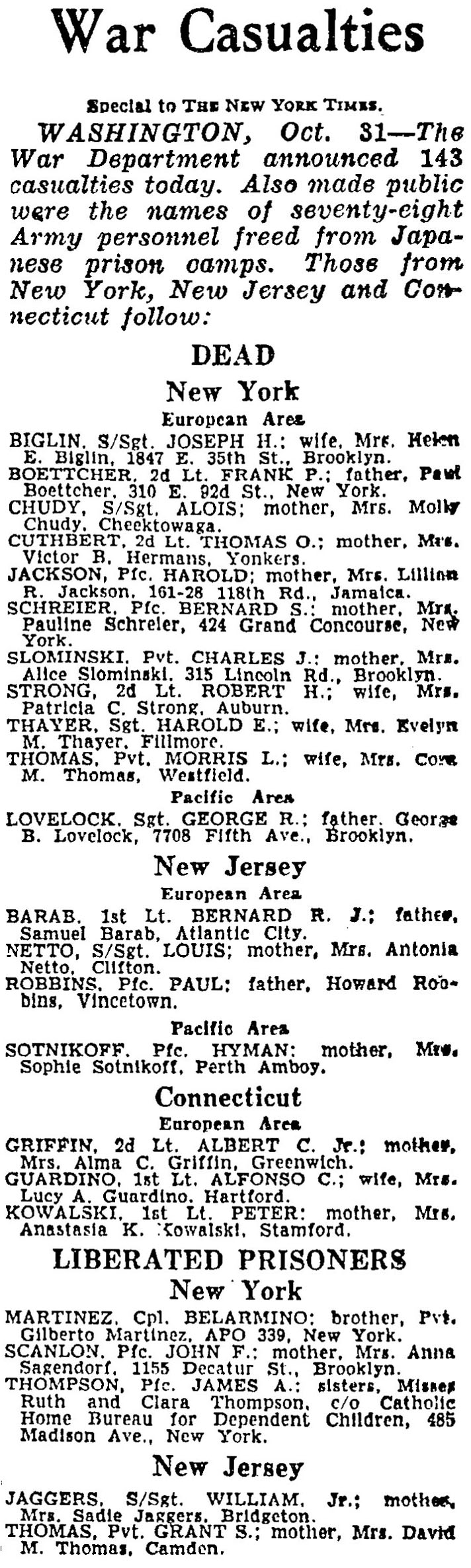
Bernard Barab’s name appeared in a Casualty List issued by the War Department on October 31, 1945.   The New York Times published the list on November 1, limiting the names to servicemen from New York, New Jersey, and Connecticut.  Barab’s name appears under “New Jersey – European Area”.

2 Lt. Charles W. Kelley, 0-826462 (presumably received Purple Heart; other awards unknown)
Born August 2, 1919
Probably from Hyattsville, Md.
Mrs. Helen Hawk (daughter) (Information from biographical profile at Registry of National WW II Memorial)
Mount Bethel United Methodist Church Cemetery, Crimora, Virginia

Barab and Kelley were among the seven 8th Air Force P-51 pilots lost that day, from whom number there emerged two survivors:  Richard L. Barrett and Jack T. Gaston. 

Specifics about all seven P-51 losses are listed below:       

55th Fighter Group
38th Fighter Squadron

Coward, Huey Raye, 1 Lt. – Killed in Action
P-51D 44-15022, “CG * J”
MACR 10540 – Luftgaukommando Report J 2502

55th Fighter Group
338th Fighter Squadron

Barrett, Richard I., 1 Lt. – Survived (Prisoner of War at Stalag Luft III)
P-51D 44-14167 “CL * U” / “Purple Shaft”
MACR 10538 – Luftgaukommando Reports J 2496 and KU 3371

339th Fighter Group
504th Fighter Squadron

Van Cleave, Ely Neal, 1 Lt. – Killed in Action
P-51D 44-13938 “5Q * S”
MACR 10545 – Luftgaukommando Report J 2504

339th Fighter Group
505th Fighter Squadron

Stiles, Bert, 1 Lt. – Killed in Action (see also Wikipedia)
P-51D 44-14113 “6N * X” / “Tar Heel!”
MACR 10546 – Luftgaukommando Reports J 2503 and J 2505

355th Fighter Group
357th Fighter Squadron

Barab, Bernard R.J., 1 Lt. – Killed in action
P-51D 44-13574 “OS * A”
MACR 11079 – Luftgaukommando Report J 2624

355th Fighter Group
357th Fighter Squadron

Kelley, Charles W., 2 Lt. – Killed in action
P-51B 42-106910 “OS * M”
MACR 10886 – No Luftgaukommando Report

364th Fighter Group
383rd Fighter Squadron

Gaston, Jack T., 1 Lt. – Survived (Prisoner of War)
P-51D 44-13707 “N2 * E” / “Lady Dorothy IV”
MACR 10478 – Luftgaukommando Report J 2493

____________________

But…  Was this the story’s end? 

Something this incident just “seemed a little “off”.  As intimated by Captain Haviland, given that the collision occurred at about 20,000 feet, further observation was impossible, and he suggested, “I should hesitate however, to state that either or both of these men were killed as they could have bailed out without my seeing them.”

Could either or both of these men have escaped their falling aircraft?  

Perhaps more could be found in the Luftgaukommando Reports, which are incorporated within National Archives Records Group 242.  The original documents themselves are now available in digital format via NARA, while there’s also a chronological list of Luftgaukommando Reports, but I don’t know if that’s yet been digitized.  Using these two resources, I was able to identify relevant Luftguakommando Reports, and correlate these to specific planes and pilots, as listed above.

But.  The Luftgaukommando Reports for Barab and Kelley (were there any?) presented a quandary:  Neither the mens’ names nor the serial numbers of their P-51s appear in the chronological list of Luftgaukommando Reports, and, translations of any relevant reports are not included within MACRs 10886 and 11079.  Still, with a bit of persistence (actually, a whole lot of persistence) I was able to locate the Luftgaukommando Report which I am certain pertains to Bernard Barab and P-51D 44-13574: OS * A:  It’s report J 2624.  

Though Lt. Barab’s name is nowhere present in the document – he’s simply referred to as “1 unbekannter Toter” – every other aspect of the report is consistent with the loss of his plane.  Specifically, this comprises the date, time, number of airmen, circumstance of the aircraft’s loss (the “key” being a mid-air collision), and the observation that the aircraft possessed four Hamilton Standard propellers.   You can view the document below, along with translations of some parts of the text.  

__________

__________

__________


Art der Bodenberührung:
(Aufschlagbrand, Explosion in der Luft, Notlandung usw.)
Explosion beim Aufschlag

Bruch in Prozenten:
99%

Art der Erbeutung:
(Flak, Tagjager, Nachtjager, ohne erkennbare Kampfeinwirkung)
Zusammenstoss mit anderem Feindflugzeug

Sind Einschüsse erkennbar und welcher Art:
Nicht erkennbar

Wer ist Zeuge für die Art der Erbeutung:
Bauer Rockel

_ _ _ _ _

Type of ground contact:
(Impact fire, air explosion, forced landing, etc.)
Explosion on impact

Fracture / breakage [destruction?] in percent:
99%

Type of capture:
(Flak, day fighter, night fighter, without recognizable combat influence)
Collision with another enemy aircraft

Are bullets recognizable and of what type:
Not visible

Who is the witness for this type of capture:
Farmer Rockel

__________

(Identification of casualty)
Tote, insgesamt 1 Mann wahrscheinlich
Nicht feststellbar, da Flugzeugführer unter der Maschine liegt.

(Identification of casualty)
Dead, probably a total of 1 man
[Identification] not detectable because the pilot is lying under the machine.

__________

__________

Nachmeldung ueber den bruch einer feindmaschine am 26.11 tagesangriff verkehrsanlagen raum Hamm – Bielefeld – Osnabrueck.

Late report about the breakage [destruction] of an enemy machine on the November 26th, daytime attack on traffic [rail? – transportation?] systems in the Hamm – Bielefeld – Osnabrueck area.

______________________________

For an unknown reason, reference to the loss of Lt. Barab’s P-51 was made in Luftgaukommando Report KU 3351, which covers the loss of Low Pressure Lulu, B-17G 43-37646 of the 833rd Bomb Squadron, 486th Bomb Group, on November 21, 1944.  Eight of the bomber’s nine crew members survived, the sole fatality having been the bomber’s pilot, 2 Lt. Howard I. Glashoff, Jr.   Note that KU 3351 incorporates reference to Reports J 2465 (1 Lt. Leland M. Stoudt), J 2466 (1 Lt. Boyd O. Jackson), and a KE Report for a Halifax lost on December 6 (KE 10054 – aircraft NP695 of No. 432 Squadron RCAF, piloted by F/O G.H. Speirs).  

The location is listed as “4 km. nördl. Darfeld Bauerschaft Rockel, i/Westf.”, [4 km north of Darfeld…] while the status of the pilot – thus explaining Lt. Barab’s years-long postwar MIA status – is listed as “nicht feststellbar, da Flugzeugfuhrer unter dem Flugzeug ca. 5 m im Sumpf liegt.”  [“Cannot be determined because the pilot is about 5 meters under the swamp in the aircraft.”]

So, based on report J 2624, and the references in KU 3351, this map shows the probable location where Lt. Barab’s Mustang fell to earth.  

____________________

According to a newspaper article published in Atlantic City in the late 1940s, Lt. Barab was only and eventually identified by the end of that decade, I think through the serial number of his parachute.  If he even survived the mid-air collision to begin with, he was – sadly – unable to escape from OS * A as it fell four miles through the late November sky.    

But, what of Lt. Kelley?

Astonishingly, he survived the collision. 

Remarkably, he was able to successfully escape from the broken wreck of his Mustang, and, parachute to earth uninjured. 

Tragically, he did not survive to be taken to a prisoner of war camp; to be liberated in April or May of 1945; to eventually return to the United States; to be reunited with his wife and daughter.  For, as documented in detail at Aircrew Remembered – specifically at the blog appropriately entitled post “Archive Report: US Forces – 1941-1945 – 26.11.1944 357th Fighter Squadron P-51B Mustang 42-106910, 2nd Lt. Charles W. Kelley” – he was murdered on November 27, 1944, a day after he fell to earth.

Since the account at Aircrew Remembered represents original work based on contributions from a number of references and researchers, and is also right-click / copy-protected (!), I can’t and won’t “copy & paste” the text “here”, at this post.  For full details, refer to the link above.  However, here’s a summary of the account…

From early March through early May of 1947, six German nationals were tried before a Military Court at Osnabrück on ten separate charges.  Four of these individuals were accused of aiding former SA Standartenführer Fritz Bollenrath (who committed suicide on December 5, 1945, shortly after being arrested) in the killing of “Kelly” (Kelley).  The four were former Luftwaffe Stabsfeldwebel Heinz Stellpflug, former Luftwaffe Feldwebel and clerk August Hackethal, former Luftwaffe Major Karl Henkelhausen, and, former Luftwaffe Major Walter Klöpzig.  

The specific events between Lt. Kelley’s downing and his murder will probably never be known.  But, according to the Aircrew Remembered account, on November 27, Bollenrath arrived by auto at the Commandant’s Office (at the Rheine airfield, in Westphalia province?) with an Allied airman (presumably Kelley), upon which he stated that the prisoner must be shot.  After a drink of schnapps, the trio of Bollenrath, Hackethal, and Stellpflug then drove to a nearby wood (the Muniwald), and stopped their vehicle, which Kelley was made to exit.  Stellpflug, under Bollenrath’s orders, fired one shot at Kelley (which apparently missed) and then Bollenrath fired a further two shots, both of which struck and apparently killed the defenseless prisoner.  However, despite Bollenrath’s orders, Hackethal refused to shoot the pilot.  

Stellpflug, found guilty for participating in the the murder of RAF Wireless Operator / Air Gunner Sgt. Gilbert J. Harris (one of the two initial survivors of Lancaster I LM213 of No. 12 Squadron, shot down January 16, 1945), was executed on September 5, 1947.  Klöpzig was eventually released for lack of evidence, while Schmitt and Henkelhausen were found not guilty.  

Though I cannot state so definitively (not having access to his Individual Deceased Personnel File), it seems that no Luftgaukommando Report exists pertaining to Lt. Kelley and his P-51B. 

Or…?  Perhaps the document was indeed created, and still exists, but like Report J 2624 for Lt. Barab – does not actually list the pilot’s name, which would make the Report’s identification, whether via digital or physical searches, a lengthy and challenging process. 

Or…?  Perhaps, given Lt. Kelley’s murder, the document was either destroyed, or, never compiled in the first place.  

And, although Fritz Bollenrath escaped the justice of men, there is another kind of Justice, one that is entirely inescapable.  

References

Aircrew Remembered

Vitz Archive: Allied Victims of Axis Murders

Archive Report: US Forces – 1941-1945 – 26.11.1944 357th Fighter Squadron P-51B Mustang 42-106910, 2nd Lt. Charles W. Kelley

Archive Report: Axis Forces 1914-1918 1935-1945 – Standartenführer Fritz Bollenrath

Chorley, W.R., Royal Air Force Bomber Command Losses of the Second World War – 1944, Midland Publishing, Hinckley, England, 1997