Soldiers from New York: Jewish Soldiers in The New York Times, in World War Two: Edmond J. Arbib – July 12, 1945 [Updated post…  “New and Improved!”]

[This post first appeared on April 30, 2017.  Now in 2022, five years later, it’s been updated.  In its original form the post only covered Army Air Force ferry pilot Captain Edmond J. Arbib, notice of whose death in a domestic training flight on July 12, 1945, appeared in The New York Times the following July 18.  The post now covers incidents involving four other Jewish servicemen on that same July Thursday, part of a larger (lengthier) project of updating and expanding my other posts covering American Jewish WW II casualties reported upon in The Times.]  

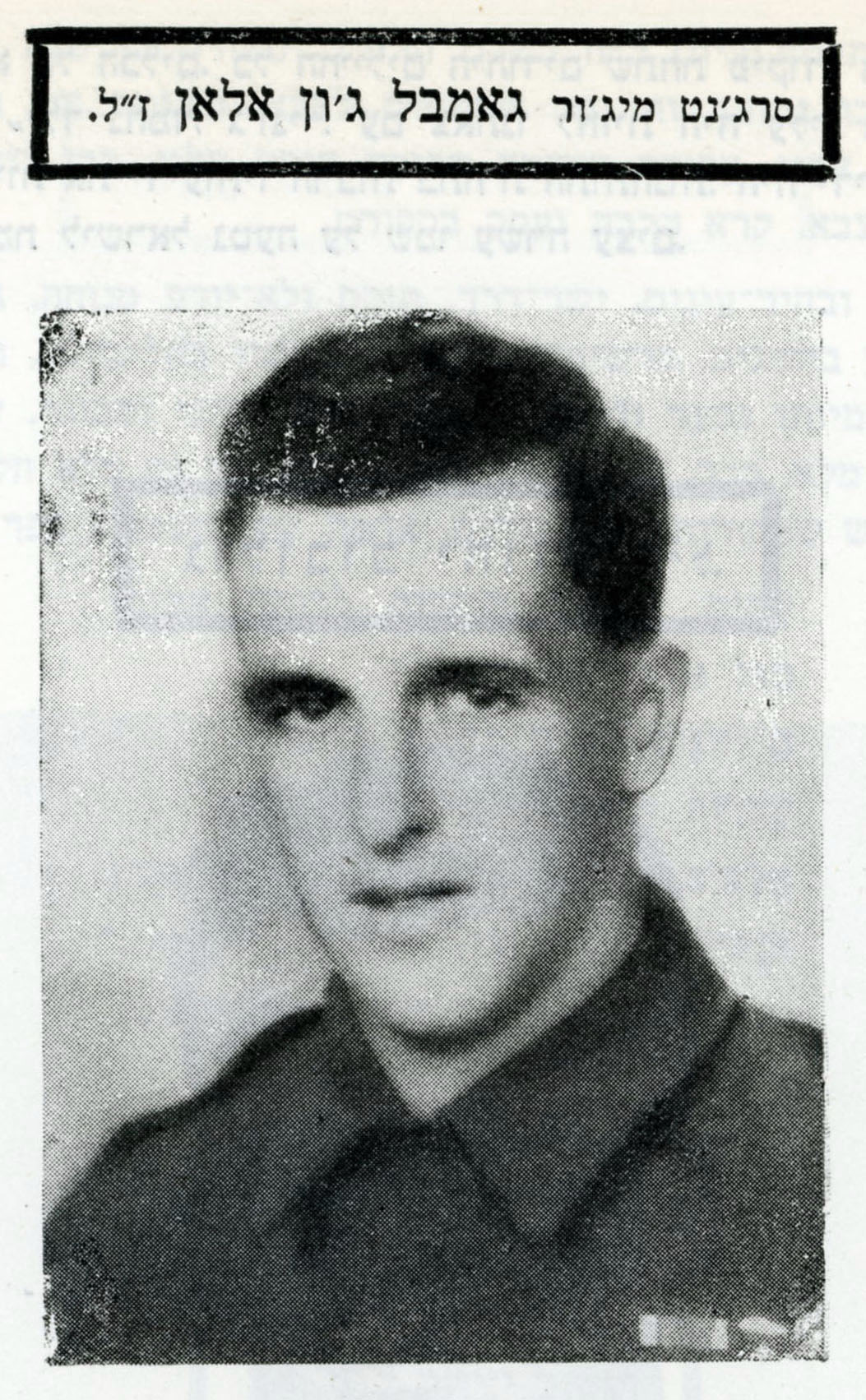
Even if “the war” in Europe had by the second week of May, 1945, ended, the war still continued:  One airman was lost during a training flight in the European Theater, and two others in the Pacific Theater.  The fourth Jewish soldier, Gunner Solomon Rosen, from Essex, England, having survived for three and a half years as a prisoner of the Japanese, died in Borneo.

Further details about these four men appear below…

On Thursday, July 12, 1945 / 3 Av 5705

– .ת.נ.צ.ב.ה. –

Tehé Nafshó Tzrurá Bitzrór Haḥayím

May his soul be bound up in the bond of everlasting life.

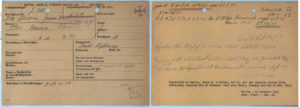
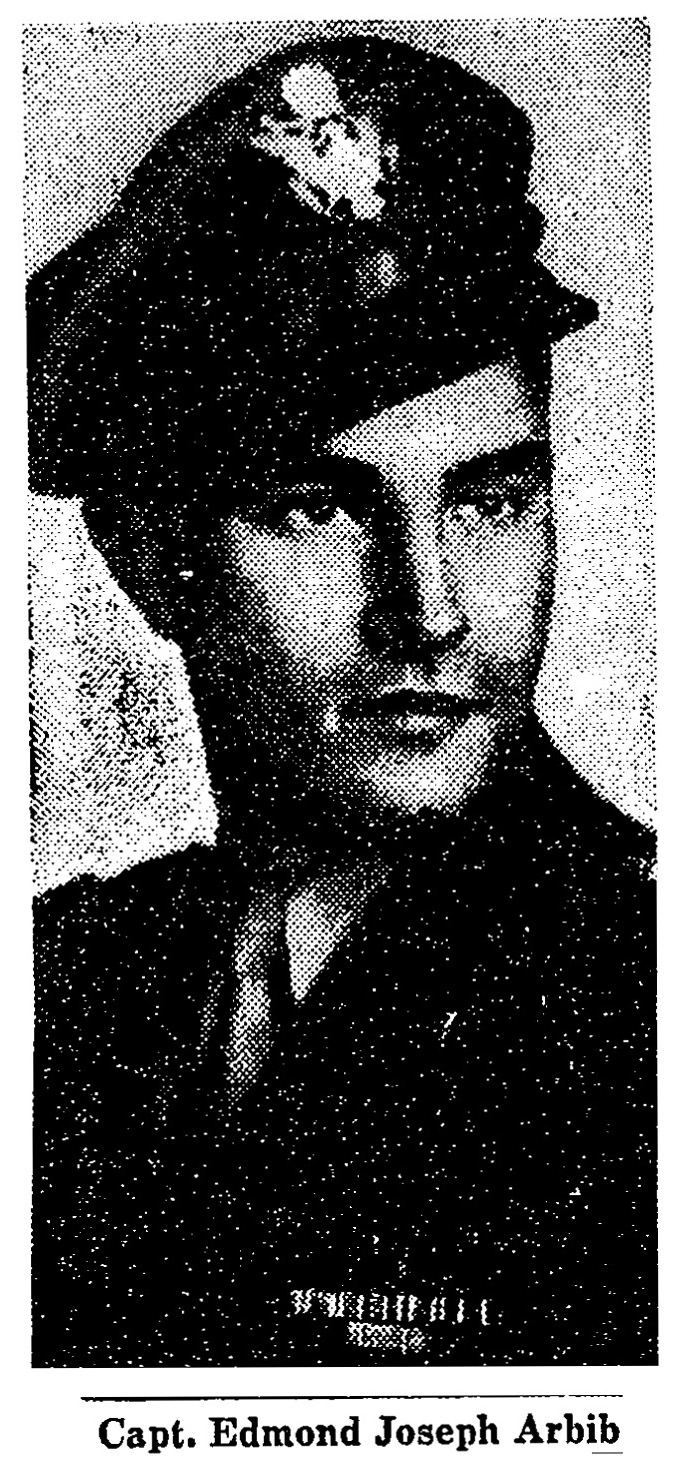

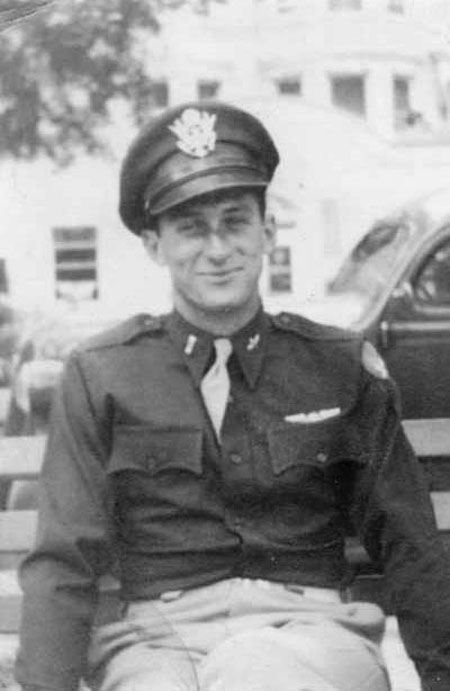
Notice about the death of Army Air Force Ferry Pilot Captain Edmond J. Arbib was published in the Times on July 16 and 18, with his obituary appearing on the latter date.

Captain Arbib, a member of the 5th Ferry Group of the Air Transport Command, lost his life while piloting Douglas A-26C Invader 44-35799.  With 1 Lt. John W. Thomas (of Craighead County, Arkansas) as a pilot-rated passenger, his aircraft took off on a demonstration training flight from Love Field, in Dallas, Texas, and crashed northwest of Grand Prairie.

____________________

Veteran Air Force Pilot is Killed in Texas Crash

Capt. Edmond Joseph Arbib, Army Air Forces, 27-year-old veteran ferry pilot, was killed at Love Field, Tex., when his airplane crashed last Thursday, the War Department has informed his family here.  Descended from Jonas N. Phillips, an American Revolutionary soldier, and from Henry Marchant, a signer of the Articles of Confederation, Captain Arbib was born in New York, the son of Mr. and Mrs. Rene S. Arbib [Rene Simon Arbib; 4/11/90-7/21/47], his father being a native of Cairo, Egypt, and his mother the former Miss Sylvia Phillips.

He enlisted in September, 1941, as a private in the ground forces of the AAF.  In October, 1942, he received his wings.  Captain Arbib ferried planes to every war theatre and served in the China-Burma-India theatre for nine months, making eighty-eight round trips over the Himalayan “hump”.

He held the Distinguished Flying Cross with three bronze stars, the Air Medal with two Oak Leaf Clusters and a Presidential Wing Citation.

Surviving are his widow, Mrs. Harriet Brodie Arbib; his parents and a sister, Mrs. Harold Bartos.

Amidst advertisements for women’s clothing, Southern Comfort, and Gene Krupa (in an “air-conditioned” setting, no less – well, we are talking 1946 after all) Captain Arbib’s obituary appeared on page 13 of the Times.


____________________

Born on January 23, 1918, Edmond was buried at the Beth Olam Cemetery, in Cypress Hills, Ridgewood, Queens.  Note that his obituary calls attention to his descent from Jonas Phillips (1736-1803) and Harry Marchant. 

____________________

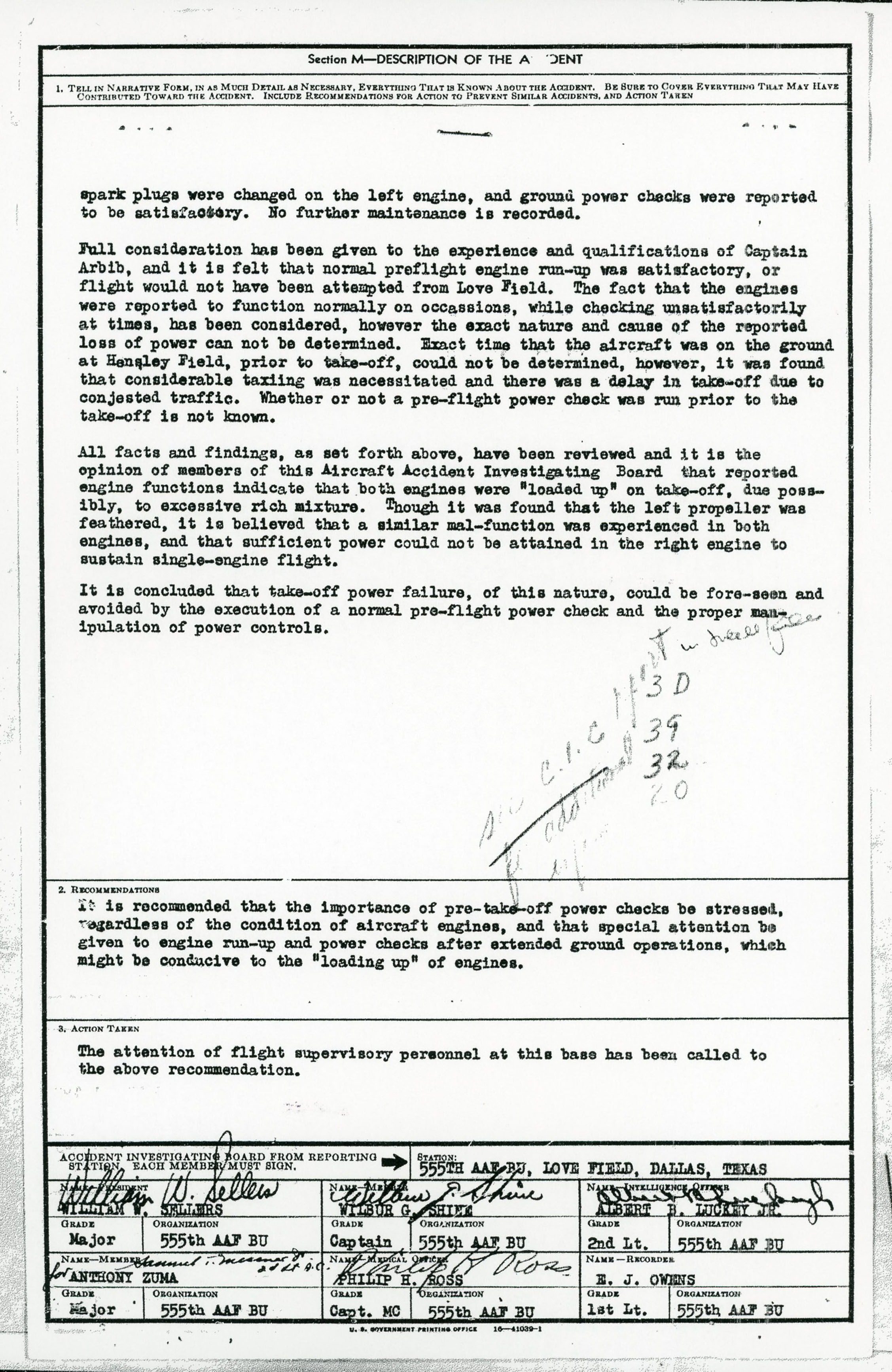
Here are images of the Army Air Forces Accident Report (46-7-12-5) covering the loss of A-26C 44-35799. 

This is the report’s first page, which includes nominal information about the incident: date, time, and location, and, background flight experience of the crew members.

__________

Here’s the bulk of the Report’s text.  Though it was determined by accident investigators that the port engine was feathered and not operating and insufficient power could be attained in the starboard engine to maintain flight, at the time of the crash, the specific cause of these mechanical problems couldn’t be established with certainty. 

A normal take-off was reported to have been made at Love Field, and a landing was executed several minutes later at Hensley Field.  ***  Members of the aircraft maintenance crew, who were standing by near the take-off runway, report that they observed black smoke emitting from both engines during the take-off run.  The crewmen also reported that it appeared that both engines were “sputtering, sound like they were loaded up”, and not developing full power.  As the aircraft passed them, the left engine is said to have been shaking violently, and acceleration seemed inadequate for normal take-off.  ***  As smoke was still emitting from the engines, the left engine appeared to “cut out”.  *** 

Inspection of the wreckage revealed that the left propeller was in full feathered position. 

Full consideration has been given to the experience and qualifications of Captain Arbib, and it is felt that normal preflight engine run-up was satisfactory, or flight would not have been attempted from Love Field.  The fact that the engines were reported to function normally on occasions, while checking unsatisfactorily at times, has been considered, however the exact nature and cause of the reported loss of power can not be determined.  Exact time that the aircraft was on the ground at Hensley Field, prior to take-off, could not be determined, however it was found that considerable taxiing was necessitated and there was a delay in take-off due to congested traffic.  Whether or not a pre-flight power check was run prior to the take-off is not known.

All facts and findings, as set forth above, have been reviewed and it is the opinion of members of this Aircraft Accident Investigating Board that reported engine functions indicate that both engines were “loaded up” on take-off, due possibly to excessive rich mixture.  Though it was found that the left propeller was feathered, it is believed that a similar malfunction was experienced in both engines, and that sufficient power could not be attained in the right engine to sustain single-engine flight.

It is concluded that take-off power failure, of this nature, could be fore-seen and avoided by the execution of a normal pre-flight power check and the proper manipulation of power controls.

It is recommended that the importance of pre-take-off power checks be stressed, regardless of the condition of aircraft engines, and that special attention be given to engine run-up and power checks after extended ground operations, which might be conducive to “loading up” of engines.

________

The Report also includes this letter to the Post Safety Officer, which goes into detail about Captain Arbib’s experience an proficiency, concluding that, “Captain Arbib’s ability as a pilot and his flying record was considered above average by the undersigned.

16 July 1945

TO: Flying Safety Officer, Post

FROM: Flight Training Office

SUBJECT: Captain E.J. Arbib, information concerning

1.     Captain Edmond J. Arbib was assigned to Transition on personnel memorandum number 148 – 23 June, 1945, as a pursuit A-26 instructor.

2.     The above mentioned pilot was given an instructor’s flight check ride in B-25 ship and was found highly satisfactory.  This pilot had one thousand (1000) hours first pilot time – five hundred (500) hours of which was in C-46s, one hundred hours in B-25s, one hundred (100) hours in B-24s, eighty (80) hours in P-38s, and two hundred and twenty (220) hours single engine pursuit.  Subject Officer was formerly a check pilot on B-24 type aircraft at Romulus, Michigan and held a white instrument card with two hundred and fifty (250) hours instrument time.  Pilot was not involved in any accident due to pilot error.

3.     Captain Arbib was given an original A-26 check at this Station on 13 May, 1945.  After the original check, Captain Arbib spent twelve (12) hours on A-26s under the supervision of the Pursuit Flight Commander.  This time consisted of extensive single engine work, both on take-offs and landings – practically all landings were completed under the supervision of an A-26 instructor or the Flight Commander.

4.     Captain Arbib’s ability as a pilot and his flying record was considered above average by the undersigned.

/s/ A.E. Probst
A.E. Probst
1st Lt., AC
Pursuit Flight Commander

A TRUE COPY
Wilbur G. Shine
WILBUR G. SHINE

Captain, Air Corps

____________________

United States Army Air Force

12th Air Force

Though the war in Europe had ended, Army Air Force training missions continued regardless.  On July 12, during a simulated dive-bombing mission of an airdrome at Augsburg, and, a simulated strafing mission of buildings at the Ammersee (Ammer Lake), First Lieutenant Fred B. Schwartz (0-2057031) was killed when his P-47D Thunderbolt fighter, aircraft 42-26718 (squadron identification letter “C” or “O“) struck the surface of the Ammersee and sank.  The incident was reported in Missing Air Crew Report 14953.  

A member of the 522nd Fighter Squadron, 27th Fighter Group, 12th Air Force, Lt. Schwartz, born on May 6, 1924 in McKeesport, Pa., and was the son of John and Lillian (Gelb) (10/13/93 – 1/3/83) Schwartz of 628 Petty Street.  His sister was Velma Feldman, who in 1945 resided at 1629 Cal. Avenue, in the White Oak section.  

His name appearing on page 550 of Volume II of American Jews in World War II, Lt. Schwartz had been awarded the Air Medal and two Oak Leaf Clusters, suggesting that he’d flown over 10 combat missions prior to the war’s end.  He is buried at the Luxembourg American Cemetery at Plot H, Row 4, Grave 47.  

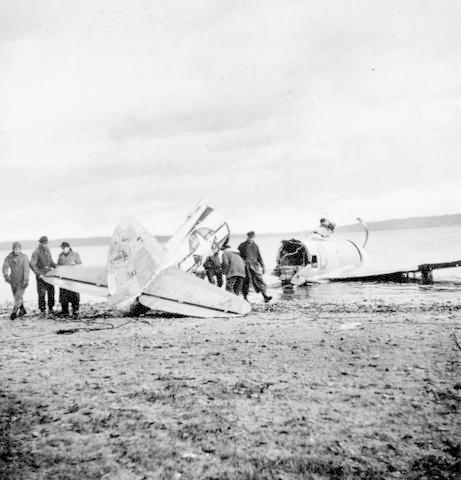
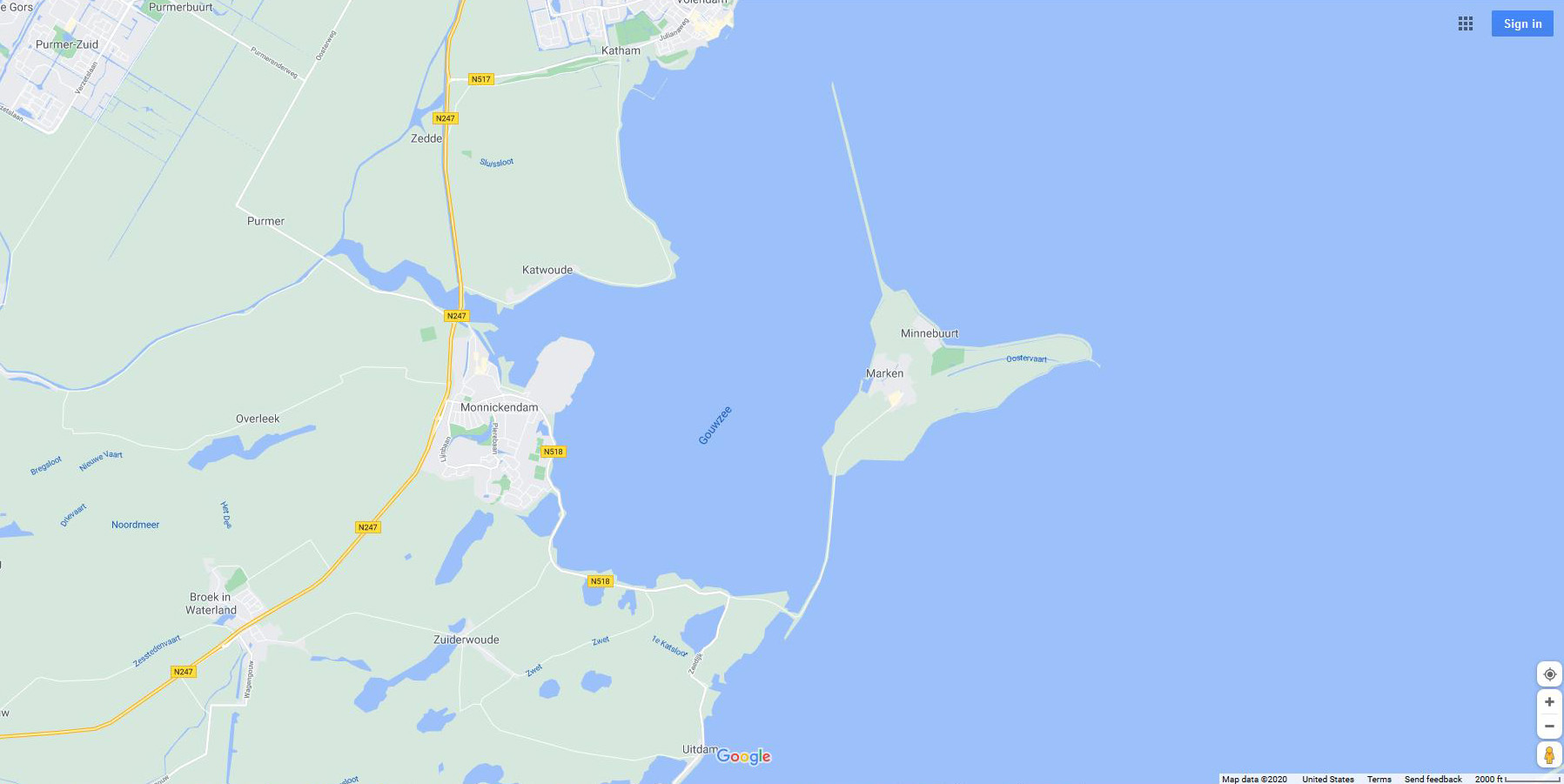
As well as in MACR 14953, information about this incident can be found at Aviation Safety Net, and, the 12 O’Clock High Forum.  The story of the plane’s loss and eventual recovery and salvage was reported upon by Gerald Modlinger in the Augsburger Allgemeine on April 16, 2009 and June 5, 2010, though as of now – 12 years later, in 2022 – those two articles, the latter including a picture of the salvaged P-47, are behind paywalls.  (Oh, well.)  But – ! – when I first researched this story some years ago, these articles were still openly available and I was able to copy and translate them.  So, they appear below, accompanied by an air photo of the Ammersee.  

________

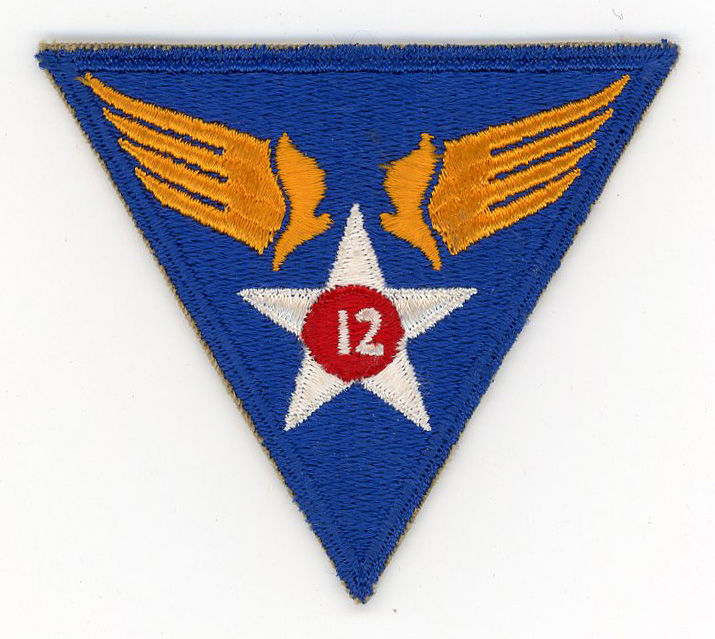
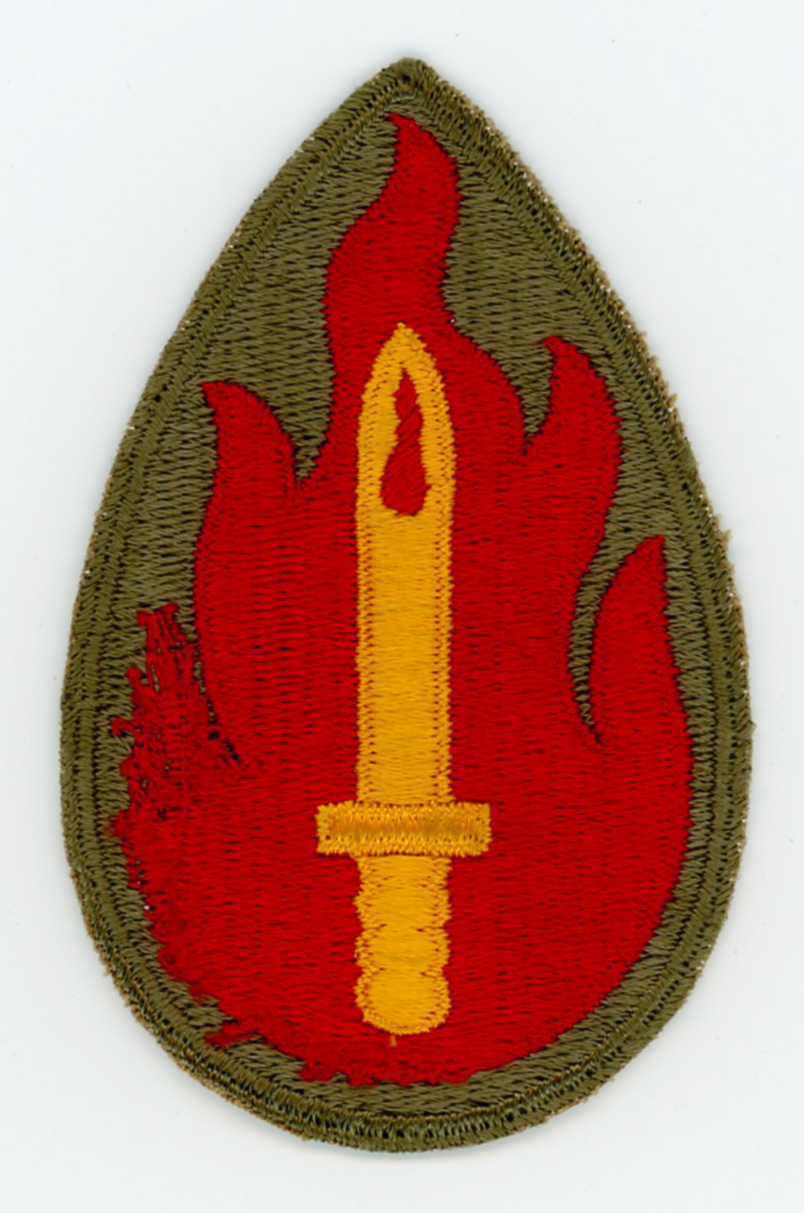
Here’s the shoulder-patch of the 12th Air Force…

…while this image of the emblem of the 522nd Fighter Squadron is from Popular Patch.com.

Here are two representative depictions by illustrator Chris Davey of 522nd Fighter Squadron Thunderbolts, as seen in Jonathan Bernstein’s P-47 Thunderbolt Units of the Twelfth Air Force.  A single letter on the mid-fuselage serves as a plane-in-squadron identifier on these otherwise simply marked aircraft.  

This painting is of P-47D 42-26444, “Candie Jr.“, “E“, flown by Lt. Robert Hosler, in December of 1944…

…while this painting shows P-47D 44-20856 “BETTY III“, “O“, of 1 Lt. Robert Jones, as the aircraft appeared in early April of 1945.  

________

Pilot Rests in Cemetery in Luxembourg (“Pilot-ruht-auf-Friedhof-in-Luxemberg”)

When a quiet solitude had entered Lake Ammersee in November, a lonely watercraft was sailing on the lake.  An American explorer was viewing sonar for an aircraft that crashed shortly after the end of the war.

Gerald Modlinger
April 16, 2009

Diessen – When a quiet solitude on Lake Ammersee arrived in November, a lonely watercraft was on the lake.  An American explorer was viewing sonar for a plane that crashed shortly after the end of the war, and especially for the pilot who was killed.  Aerospace researcher Josef Köttner from Diessen has now researched that the pilot who he has been looking for has been resting in a US military cemetery in Luxembourg for decades.

Bob Collings, director of the company, emailed last November when he told how moving it was when members of the family were given certainty about the mortal remains of their fathers and grandfathers who had been killed in the war.  The search campaign on the Ammersee also returned to a request from the descendants of the missing US soldier.  At the same time, the courthouse also issued the necessary permits for the exploration.

In order to clarify the fate of the pilots killed in the crash of the P-47 Thunderbolt on July 12, 1945, however, the elaborate search action would obviously not have been necessary.  After an Internet investigation and a request from the US Air Force, 79-year-old Köttner is clear about the incident and the fate of the killed pilot.

The crashed P-47 Thunderbolt was piloted by Fred B. Schwartz, a member of the US Air Force’s 522th Fighter Squadron.  This unit was stationed in Sandhofen near Mannheim in the summer of 1945.  From the accident report and the reports of pilots of other combat aircraft it is clear that on 12 July 1945 at 9:40 am, four P-47 Thunderbolt machines from Sandhofen flew to a practice site on an airfield south of Augsburg and then aimed at a row of houses on the Ammersee as targets.  At about 11 o’clock an airplane’s propeller tips came into contact with the surface of the water.  The pilot had misjudged the situation.  The plane pulled up again, then fell to the water on the south-east of Lake Ammersee and sank after a few seconds without the pilot leaving the aircraft.  The remaining three P-47s still circled around the crash site for some time and then returned to their base.

Meanwhile, a boat had arrived at the crash site, but at that time the plane had already sunk in the water, at a point where the lake is about 45 meters deep.  A buoy was installed as a marker.

Afterwards a company from Regensburg was assigned to recover the wreckage of the aircraft.  There is nothing else to read in the accident report.  On an American website, on which the overseas soldiers’ residences are listed, Köttner finally found himself in search of the fallen Lieutenant Fred B. Schwartz.  The pilot, who came from Pennsylvania, found his final place of rest at the military cemetery in Luxembourg.

In the meantime, nothing has been known about the findings gained during the days-long search on the Ammersee.  “We are also surprised that we have not heard anything at all,” said Wolfgang Müller, the courthouse’s spokesman yesterday regarding the Lieutenant.  Furthermore, the employees of the water authority would be interested in the findings of the Americans about the conditions on the bottom of the lake.

Without giving any details, Bob Collings and Bob Mester had told the search company Underwater Admiralty Sciences (UAS) about the wreckage of cars, boats and craters their sonar had encountered.  Whether or not they found the plane they were looking for, remained open.

__________

The P-47 Was Already Salvaged in 1952 (“Die P-47 wurde schon 1952 zerlegt”)

Gerald Modlinger
June 5, 2010

Diessen – The aircraft search by an American company one and a half years ago at the Ammersee was probably not only with regard to the unfortunate pilot, but also with regard to his aircraft from the start without certainty.  The underwater archaeologist Lino von Gartzen from Berg reports in the magazine Flugzeugclassic that the airplane wanted by the Americans already 1952 from the Ammersee had been salvaged.  Previously, Lachen avocational researcher Josef Köttner had already shown that the pilot who had been killed on July 12, 1945, has been lresting in an American military cemetery in Luxembourg for decades.

This picture shows the salvage of the P-47 Thunderbolt near St. Alban in the spring of 1952.  The American search team arrived 56 years too late to find it still.

Photo: 1952 Ludwigshain / Collection of Gartzen

This Wikimedia Commons image of the Ammersee is by Carsten Steger.

Aerial image of the Ammersee (view from the south)

The fact that there are probably no more aircraft in the southern Bavarian lakes today is mainly due to Ludwiging, a native of Inning, who reported on Gartzen in October 2009 in Flugzeugclassic.

Ludwigshain (1920-2009) had been trained in the Second World War by the Navy in Norway as a salvage dredger.  One needed such people among other things, in order to be able to lift airplanes, which were sunk by saboteurs in the harbor.  His knowledge remained useful to Hain after the end of the war.  With a partner he began to retrieve aircraft which had fallen into the Bavarian lakes.  When he had fished the lakes largely empty, he went to Lake Constance, where he died in the spring of 2009.

All metal was strongly sought in the 1950s

It is today the high antiquity of historical aircraft wrecks that arouses the interest in them, making after the Second World War the scarcity, especially in metals, of aircraft wrecks to worthwhile companies.  It was only in the early 1960s that such [wrecks] became gradually uninteresting, as the price of scrap metal fell sharply.

In southern Bavaria, Hain with his partner Schuster, among other things [found] a British Lancaster, a B-17, a Bf-109 and two P-47 Thunderbolts, besides various vehicles, boats, a mini-U-boat and heavy bridge parts, writes Gartzen, after a conversation he had had with Hain shortly before his death.

The eye-witnesses did not agree on the type of aircraft

Ludwigshain found one of the two American P-47 Thunderbolt machines taken from the Ammersee in the spring of 1952.  The Landsberger Tagblatt had already been mentioned by Rolf Haunz in November 2008 for this aircraft.  The Kaufbeurer spent his childhood in Diessen and was a witness to the spectacular flight of aircraft in front of St. Alban.  Haunz said at the time that it must have been a P-47.  However, other people who saw children as the plane was landed could not confirm this with certainty.

According to Gartzen, “99.99 per cent” of Ludwigshafen’s photographs made it clear that in 1952 the P-47, which was sought again a year and a half ago, was taken from the Ammersee.  The serial number was exactly what the Americans were looking for.  The cockpit of the P 47 was closed, indicating that the aircraft pilot could not leave his machine.  In addition, the time of the salvage coincided with the identification of missing pilot Fred B. Schwartz in April 1952.

After the plane was pulled ashore, it was disassembled.  The parts were transported by truck and train.  Crashed airplanes were a real treasure in the 1950s: Gartzen knows of a case in which such an aircraft produced 25,000 marks. “That was the value of a family home.”

____________________

United States Army Air Force

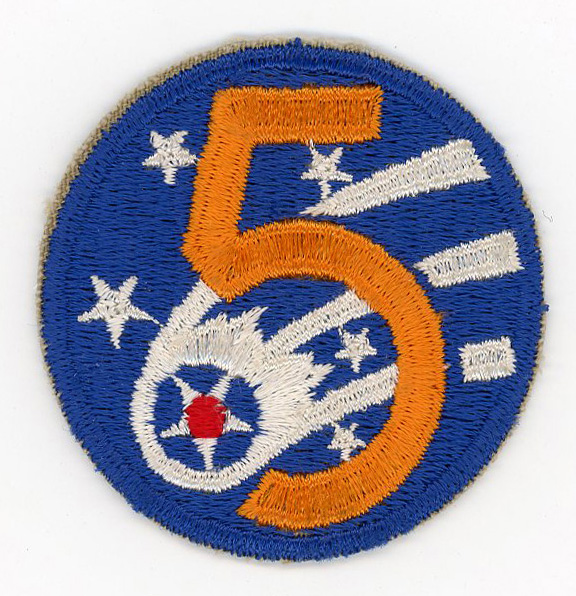
5th Air Force

Though combat missions had ended for the Army Air Force in the European Theater, they would continue without respite in the Pacific for four more months.

On one such mission, – to destroy oil storage tanks at Toshien, Taiwan (formerly Formosa) – B-24M Liberator 44-50390 “Becomin’ Back” of the 528th Bomb Squadron, 380th Bomb Group, piloted by Major Kenneth E. Dyson, was struck by three or four bursts of 90mm anti-aircraft fire.  Of the plane’s 11 crew members, there would be six survivors.  Second Lieutenant Eugene Stark (0-2024001), the bombardier, would not be among them.  He was seen to bail out by T/Sgt. Edward Treesh, the flight engineer, but was not seen afterwards.  The plane’s loss is described in MACR 14921.        

The son Martin and Julia (10/27/98-7/21/90) Stark, of 950 Aldus Street in New York City, Lt. Stark would be the recipient of the Air Medal, 1 Oak Leaf Cluster, and Purple Heart, indicating that he’d completed between five and ten combat missions.  His name appeared in official casualty lists on August 8 and October 3, 1945, and can be found on page 453 of Volume II of American Jews in World War II.  

The plane’s crew consisted of:

Dyson, Kenneth E., Major – Pilot (Killed – Not recovered)
Muchow, Robert Leonard, 2 Lt. – Co-Pilot (Rescued)

Flanagan, Michael J., Jr., 1 Lt. – Navigator (Killed – Buried at sea)
Stark, Eugene, 2 Lt., Bombardier (Killed – Not recovered)
Bongiorno, Thomas G., F/O – H2X Navigator (Killed – Not recovered)
Treesh, Edward Oren, T/Sgt. – Flight Engineer (Rescued)
Nagel, Lawrence J., T/Sgt. – Radio Operator (Rescued)
Latta, William E., S/Sgt. – Gunner (Rescued)
Heffington, James C., S/Sgt. – Gunner (Killed – Not recovered)
Wood, Albert W., S/Sgt. – Gunner (Rescued)
Dalton, Maurice G., S/Sgt. – Gunner (Rescued)

__________

This image of the 528th Bomb Squadron insignia is from the MASH Online military clothing and insignia store.  

__________

The Missing Air Crew Report for the plane’s loss includes detailed eyewitness statements by all six survivors – 2 Lt. Muchow, S/Sgt. Latta, T/Sgt. Treesh, S/Sgt. Dalton, T/Sgt. Nagel, and S/Sgt. Wood – of which S/Sgt. Dalton’s is by far the longest and most detailed.  Notably, the only survivor from the front of the plane was Lt. Muchow.  The last of the survivors to be rescued, he was picked up from the sea by a Martin PBM Mariner.  Here’s his account of the loss of “Becomin’ Back“:

528TH BOMBARDMENT SQUADRON (H) AAF
APO # 321

19 JULY 1945.

EYEWITNESS DESCRIPTION OF CRASH

On July 12, 1945, we were on a mission to Toshien, Formosa to knock out some oil storage tanks in the northeast corner of the town.  We were lead ship of the second squadron.  Instead of making the planned bomb run, Major Dyson asked the H2X Operator for a direct heading to the target from that position which we later found out to be north of the prescribed bomb run and directly over a battery of 90mm anti-aircraft guns.  After starting on the bomb run I could see a solid barrage of ack-ack about a mile in front of us and at out altitude.  It appeared at the time that our evasive action was insufficient an then we were hit. 

I remember only one burst close in on the left side of the plane.  This burst shattered the pilot’s window, injured Major Dyson, shot out the auto-pilot and burst the hydraulic lines in front of my feet.  I immediately called the engineer and asked him to check the leaking gas.  I then asked Major Dyson how bad he was hit.  I could see he had superficial cuts about the face and he added that his left arm or side was hit.  The blast had blown off his earphones and mike and he was very dazed.  I was dazed enough that the one burst is all I recall, later I found out we received three or four. 

I switched to “D” Channel and tried to contact the submarine, to no avail.  I finally switched to “B” Channel and contacted a fighter plane who in turn gave me the sub’s position.  I looked back then and the leaking gas in the bomb-bay looked like a solid sheet of rain.  The fumes had penetrated the plane and we were all affected to a certain degree.  We had the side windows open up front so were lucky in that respect. 

I asked Sgt. Wood to get me the navigator and when I finally made him look my way he just laughed in my face.  H was like a drunk from the gas fumes and so too, were the others on the flight deck.  This, helped account for the dazed reactions of all of us. 

All this time Major Dyson just sat with a dazed expression on his face, said nothing, and flew the ship by instinct, I thought, than from realization, of the situation.  Or ordered us to bail but we were too close inshore and continued to the submarine.  Several times I took the ship and turned it back toward the sub when Major Dyson turned back toward Formosa.

The ship was running okay from the recordings of the instruments and our main worry was losing an engine.  We were headed toward the sub and loosing altitude at about three hundred (300) feet per minute.  We were hit while at about 13,000 feet.  The first man bailed out at about 10,000 feet and I bailed out at about 8,500 feet.  I was the last man to leave the ship.  Before Lt. Flanagan bailed out he told me he was going.  I asked if all had bailed and ‘chutes opened and he said they had.  I left soon after he did and thought Major Dyson would follow me.  After my ‘chute opened I saw the ship just before it hit the water.  It had apparently lost an engine and gone in on a wing.  The men on the sub said it started burning before hitting the water, then blew up. 

The following was taken from the Log of the U.S.S. Cabrilla (SS-288), the submarine that picked us up. 
July 12
1140, received word that plane was going to be ditched. 
1145, sighted seven ‘chutes in the air.
1210, picked up Dalton, M.G.
1212, picked up Wood, A.W.
1302, picked up Flanagan, M.J.
1331, picked up Treesh, E.O.
1400, picked up Latta, W.E.
1404, picked up Nagel, L.J.
1422, picked up Muchow, R.L.
1640, buried Lt. Flanagan, M.J. at sea, Goron Bi, Formosa, baring 036 T, distance fifteen (15) miles

Robert L. Muchow

ROBERT L. MUCHOW,
2nd Lt., Air Corps,
Co-Pilot, 528th Bomb Sq.
380th Bomb Gp (H).

__________

This image of the nose art of Becomin’ Back can be found at the website of the 380th Bomb Group (the “Flying Circus“), in the historical profile of B-24M 44-50390.

__________

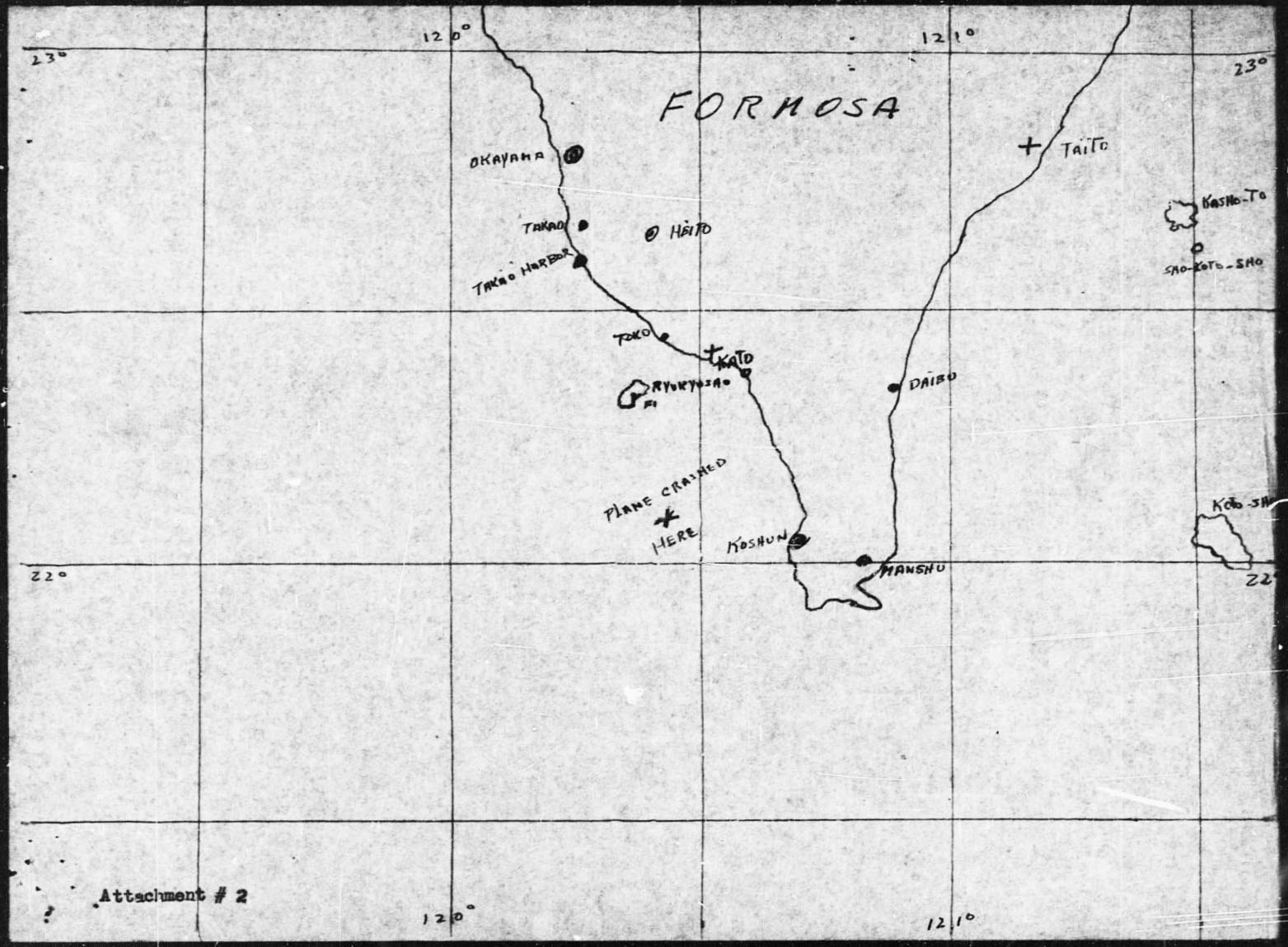
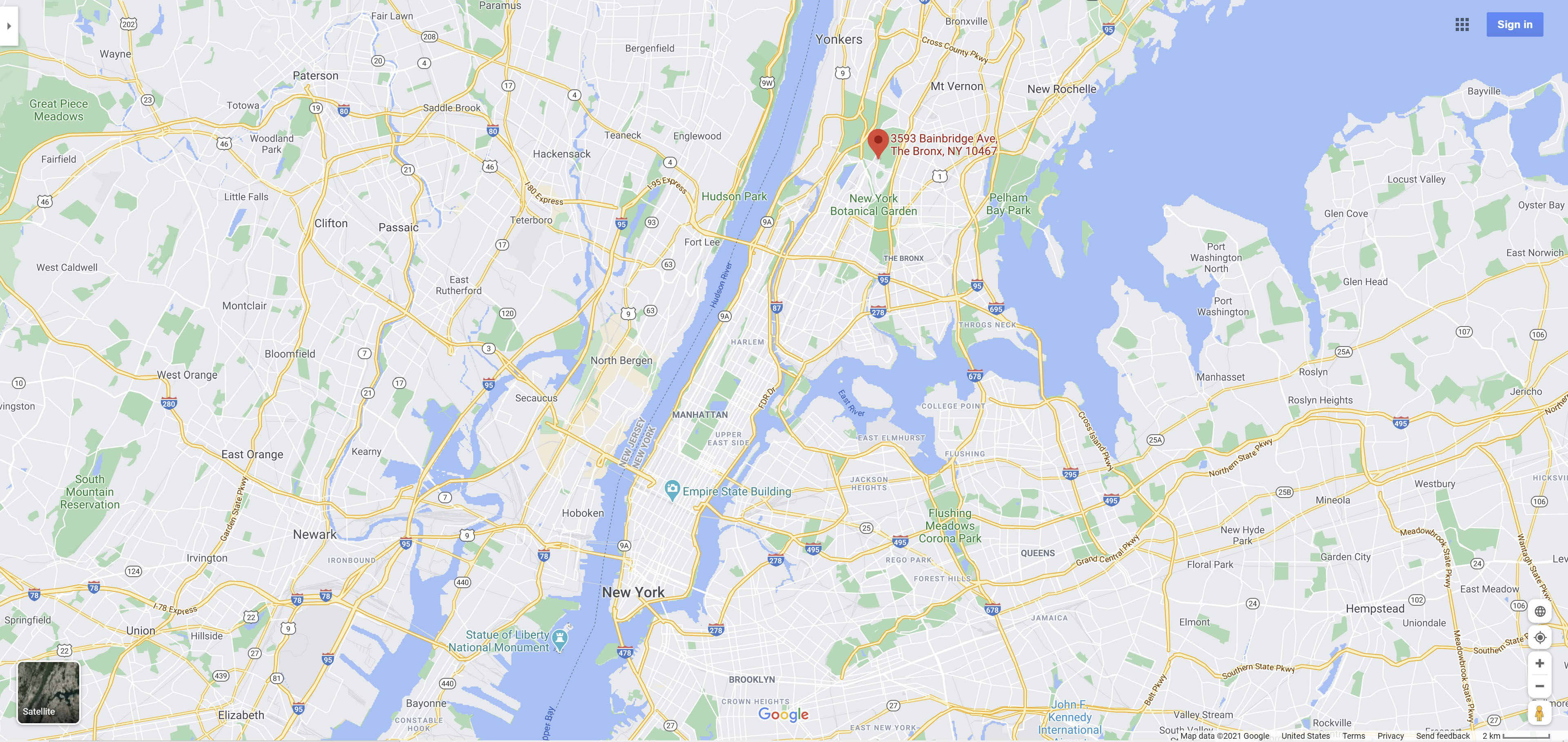
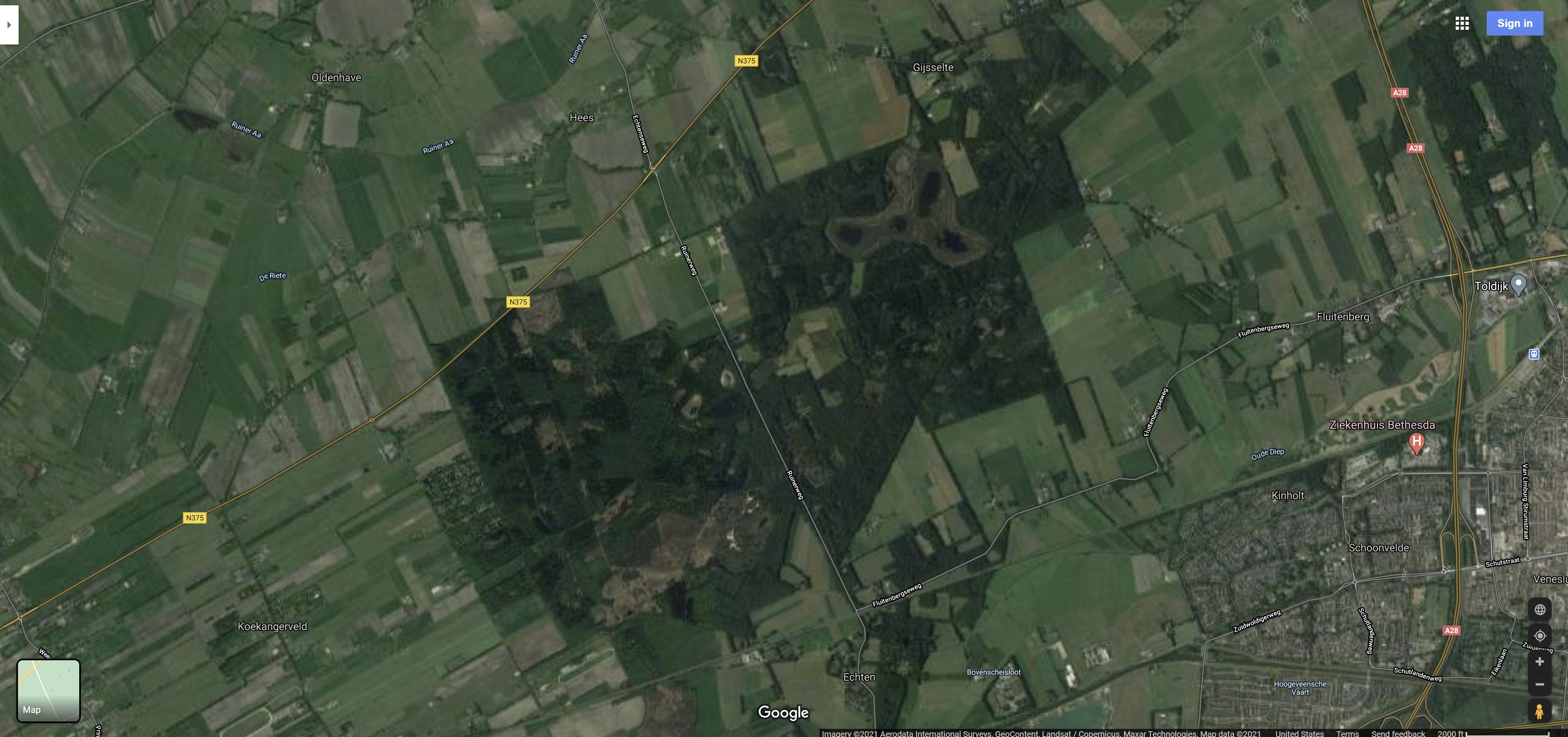
Here’s the 1945 map from MACR 14921 showing the approximate location of the loss of Becomin’ Back

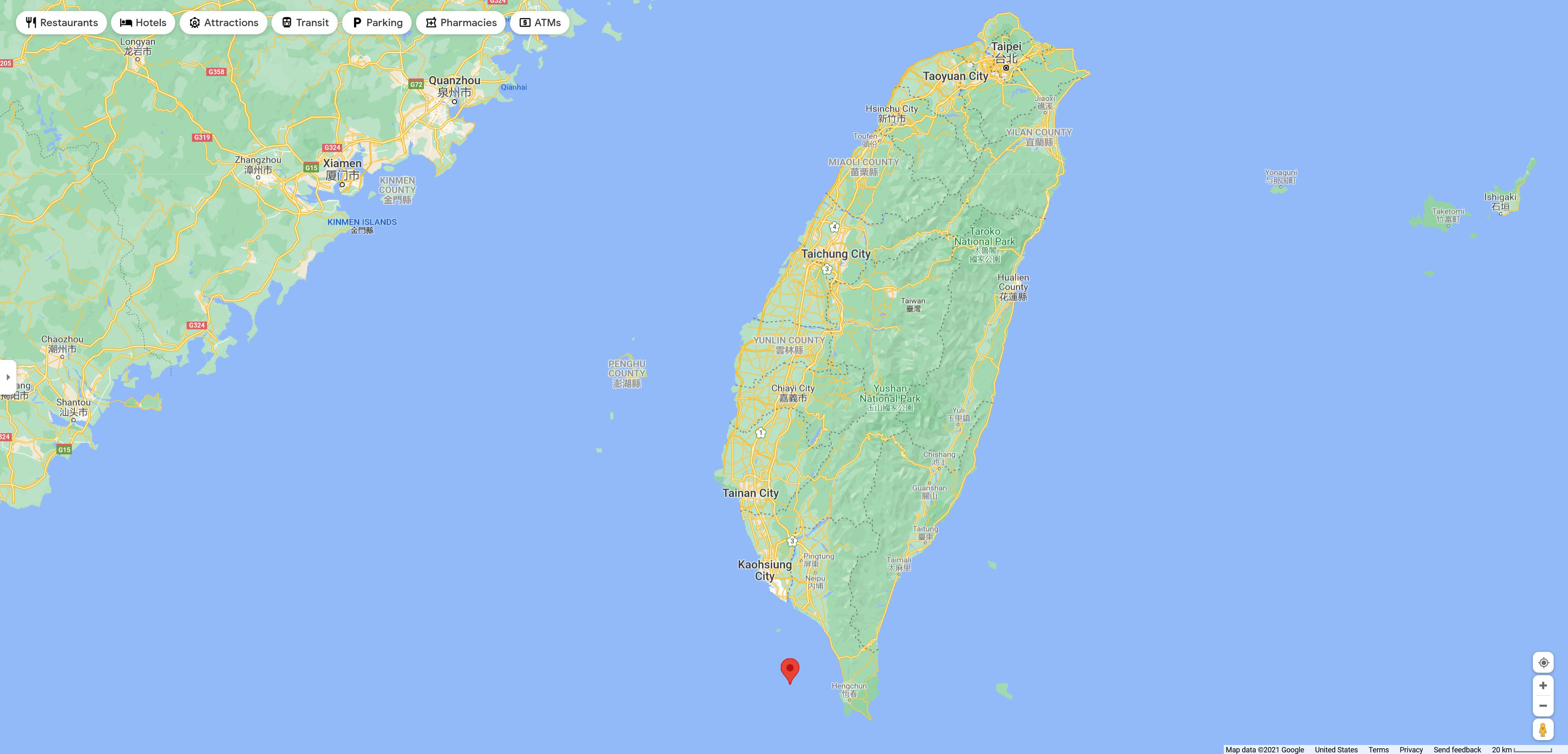
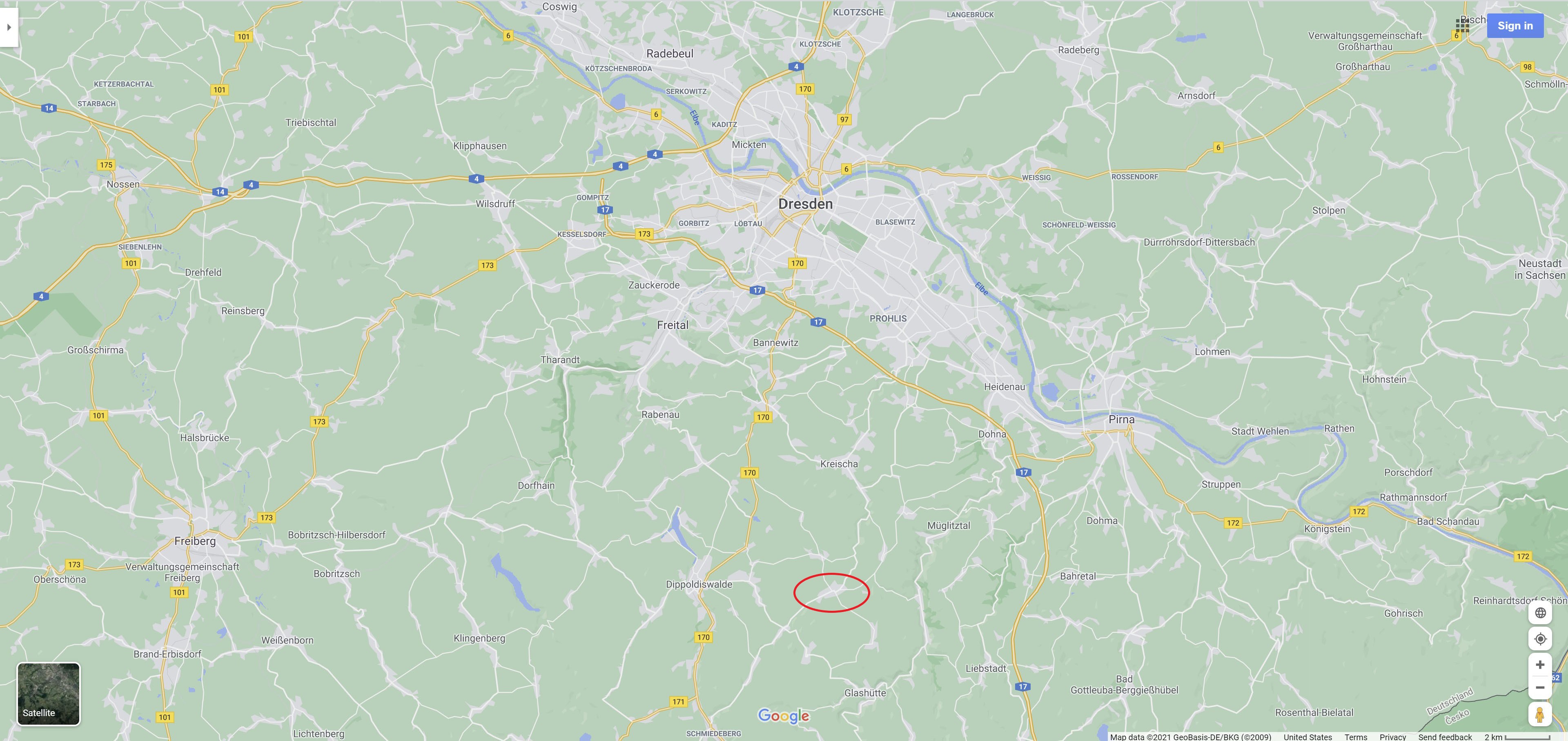
…while here’s a 2021 Oogle Map showing the crash location, based on longitude and latitude coordinates as listed in the MACR.

____________________

United States Army Air Force

20th Air Force

During the early evening hours of July 12, 1945, the 20th Air Force’s 16th Bomb Group incurred its first combat loss.  This happened during the start of a night mission to “Kawasaki”, the name probably meaning the city of Kawasaki, in Kanagawa Prefecture, Japan.  At approximately 1935 to 1940 hours K (kilo)* time, not long after taking off from Guam, three of the four engines of the 16th Bomb Squadron B-29 42-63603 ran away, and, the engines’ propellers could not be feathered. 

As the aircraft descended rapidly from 4,500 feet, aircraft commander Lt. Milford Berry ordered his crew to bail out.  Though it will never be known if Lt. Berry himself escaped the descending plane, all other crew members in the B-29’s forward section left the airplane.  

In the rear crew compartment, all crew members left their bomber with the exception of right blister gunner S/Sgt. Harold I. Schaeffer and tail gunner Sgt. Philip Tripp.  

Of the eight men known to have parachuted from their B-29, only three survived: pilot 2 Lt. James Trivette, Jr., bombardier 1 Lt. Rex E. Werring, Jr., and left blister gunner Sgt. Clarence N. Nelson.  Four of the other five crewmen were never found.  However, Sgt. Tripp’s body was recovered; he is buried at Forest Dale Cemetery in Malden, Massachusetts.    

Among the crew members of 42-63603 was Sergeant Morton Finkelstein (32977132) the bomber’s flight engineer.  Born in a placed called Brooklyn on June 22, 1925, he was the son of Edward E. (1/30/01-5/21/83) and Rose (Lubchansky) (1900-1/24/85) Finkelstein, their family residing at 32 Joralemon Street. 

His name appeared in casualty lists published on August 15, 1945 and April 21, 1946, and can be found on page 309 of American Jews in World War II, where he is recorded as having received the Air Medal and Purple Heart.  Like the other four missing crew members, his name can be found in the Tablets of the Missing at the Honolulu Memorial.  

(Kilo Time Zone is often used in aviation and the military as another name for UTC +10.  Kilo Time Zone is also commonly used at sea between longitudes 142.5° East and 157.5° East.)

__________

This image of Sgt. Finkelstein, at the archives of the National Museum of the Pacific War, at Fredericksburg, Texas, was uploaded to FindAGrave by Chris McDougal.  

__________

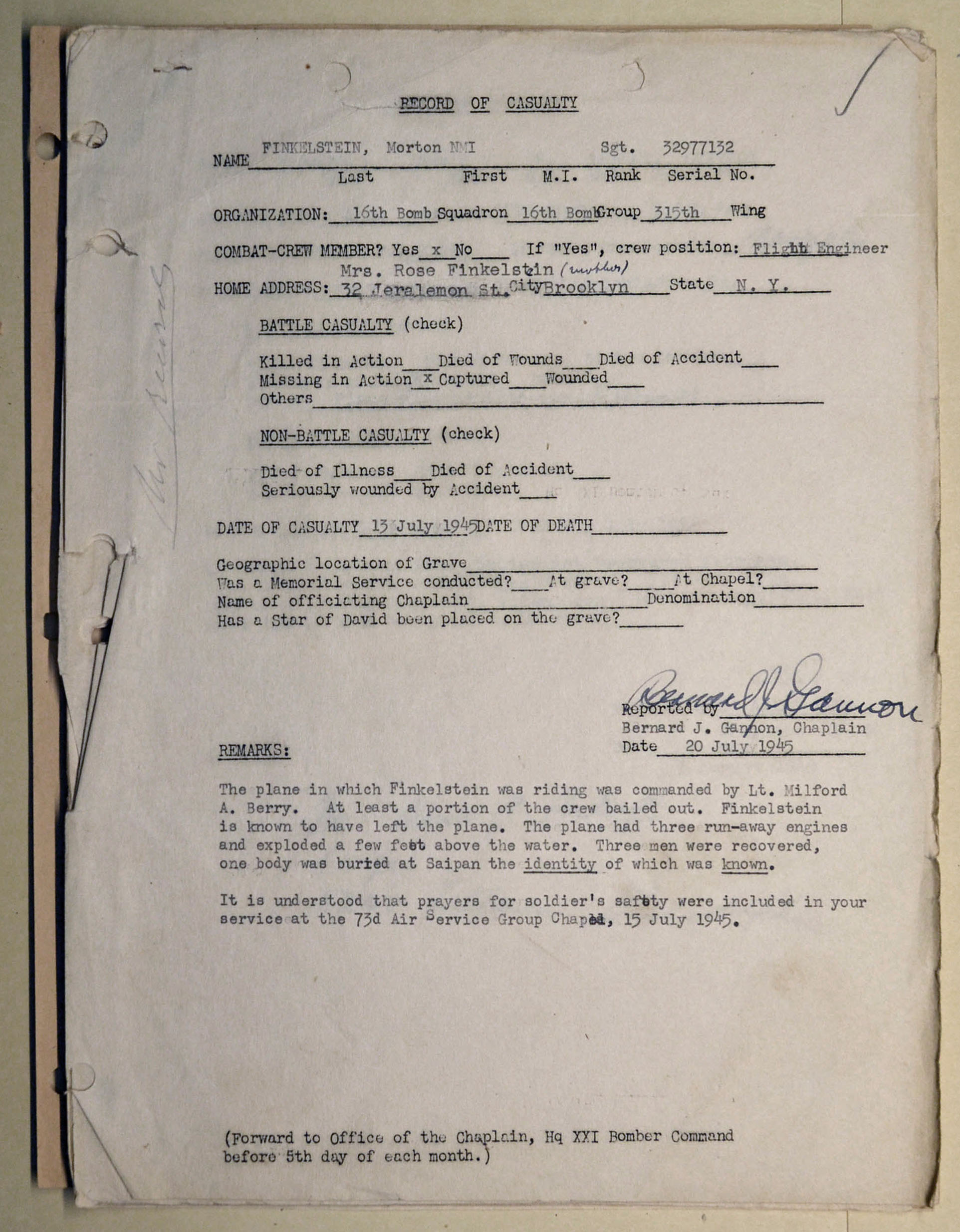
Here’s the Record of Casualty for Sergeant Finkelstein, completed by Chaplain Bernard J. Gannon and provided to Major David I. Cedarbaum.  This document is from the Honor Roll in the Cedarbaum Files (Folder 5) at the American Jewish Historical Society.  

As stated in the Record of Casualty:

“The plane in which Finkelstein was riding was commanded by Lt. Milford A. Berry.  At least a portion of the crew bailed out.  Finkelstein is known to have left the plane.  The plane had three run-away engines and exploded a few feet above the water.  Three men were recovered, one body [Sgt. Tripp] was buried at Saipan the identity of which was known.

It is understood that prayers for soldier’s safety were included in your service at the 73rd Air Service Group Chapel, 15 July 1945.”

__________

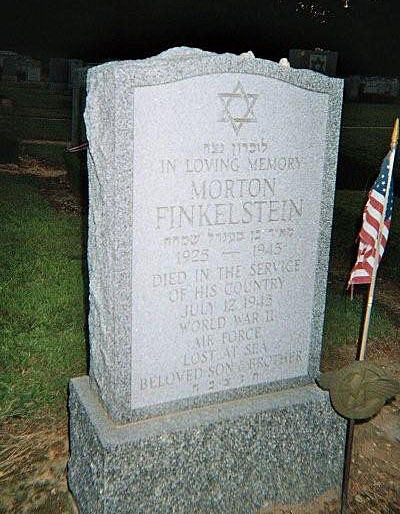
A symbolic matzeva for Sgt. Finkelstein appears in this image by FindAGrave contributor Mary Lehman.  It’s located at Mount Golda Cemetery in South Huntington, New York.

__________

The crew of 42-63603:

Berry, Milford Audrain, 1 Lt. – Aircraft Commander (Last seen in aircraft)
Trivette, James, Jr., 2 Lt. – Pilot (Rescued)

Rollins, K. Warren, 1 Lt. – Navigator (Last seen bailing out)
Werring, Rex E., Jr., 1 Lt. – Bombardier (Rescued)
Ameringer, Irving W., 2 Lt. (Last seen bailing out)
Finkelstein, Morton, Sgt. – Flight Engineer (Last seen bailing out)
Lynch, Robert E., Sgt.  (Last seen bailing out)
Schaeffer, Harold I., S/Sgt. – Gunner (Right Blister) (Last seen in aircraft)
Nelson, Clarence N., Sgt. – Gunner (Left Blister) (Rescued)
Tripp, Philip Gregory, Sgt. – Gunner (Tail) (Killed (see Cederbaum report)

__________

A flying, bomb-carrying, world-spanning hippo is the central motif of the insignia of the 16th Bomb Squadron, in this image from Pinterest, uploaded by Nikolaos Paliousis.  

__________

Here’s a partial transcript of post-war “fill-in” Missing Air Crew Report 15373, which covers the loss of 42-63603:

Time and position of bailout: 1934K, 12 July 1945, approximately 80 miles north of western tip of Orote Peninsula, Guam.  Coordinates:  14-36 N, 114-25 E.

The aircraft acted properly during take-off (1940 K) and climb.  After leveling off at 6,200 feet, RPMs were reduced but No. 1 engine remained at 2400.  The Airplane Commander reduced the RPMs of No. 1 engine to 2000 with the feathering button.  Almost immediately however it increased and went wild.  The Airplane Commander hit the feathering button but it had no effect, so he pulled the throttle back, told the Bombardier to salvo the bombs and headed for Guam.  On the turn, No. 3 engine started building up and again the feathering button was ineffective.  The Airplane Commander gave the order to prepare to ditch.  Almost immediately, No. 4 engine ran away and the order to bail out was given.  The altitude was about 4500 feet, and the aircraft was dropping at about 1000 feet per minute.  The Pilot took over the plane was the Airplane Commander fastened his parachute and one-man life raft.  The Pilot rang the alarm bell and called the left scanner and tail gunner on the interphone. 

The airplane commander attempted to transmit on VHF channel, but it appeared to be dead.  He then switched to Channel A.  Bombardier reported that Pilot was not getting out on this channel.  Also, no word has been received of receipt of any message by any aircraft or ground station.

Bail out:

Exit through forward bomb bay:

The Navigator and Radio Operator went out first (order unknown), and their chutes were seen to open by the Bombardier who was third out.  The Radio Operator hesitated but left sometime between the time the Bombardier and Pilot bailed out.  The Pilot was next out and saw one chute open just before he left the airplane.  With the exception of the Airplane Commander, the front of the airplane was clear when he left, and the altimeter indicated 500 feet.  No difficulty was experienced in leaving the hatch.  The Bombardier and Pilot put their hands along the edge of the bulkhead door and dove out in one motion.

Exit through rear bomb bay:

The Right Scanner had been briefed to bail out first and was fully geared and ready to go.  The Left Scanner motioned him out but he (Right Scanner) “looked blank”.  The Left Scanner then asked him to step aside so he (Left Scanner) could go out, thinking that by so doing the Right Scanner might gain confidence.  The Right Scanner stepped aside, still mute, and the Left Scanner dove out the pressure bulkhead door.  The Right Scanner was never seen to leave the airplane. 

Altitude and time for Bail Out:

Between 1500 feet and 500 feet.  Time interval approximately 1 ½ minutes between first and last man.

Like some other MACRs for B-29 crews whose members were rescued after parachuting over, or ditching in, the Pacific Ocean, the document accords much attention to the many factors involving aircrew survival, in terms of bailout procedure, safely parachuting, use of a one-man life raft (in terms of deployment, inflation, and how-to-actually-successfully-get-into-the-raft in the first place), physical and psychological factors involved in survival at sea, and, attracting the attention of searching vessels and aircraft.

What’s notable about the bailout from 42-63603 is that this occurred at about 7:40 at night (civilian time).  Given that sunset in the Kilo Time Zone on July 12, 1945 would have occurred at 8:30 P.M., the crew would have had less than an hour of light before the arrival of total darkness.  At sea; alone.

__________

Akin to the Oogle map illustrating the loss location of Becomin’ Back, this map shows the loss location of B-29 42-63603.

__________

This cutaway image from Boeing’s B-29 Maintenance and Familiarization Manuel (HS1006A-HS1006D) shows the interior arrangement of a B-29’s forward crew compartment.  The location of the flight engineer’s station, on the right side of the compartment, is directly behind the co-pilot. 

This panoramic 360-degree-view, at 360Cities, gives a high resolution, clear view of the B-29’s front crew compartment.  Upon going to the link you’ll arrive at a view of the interior of a B-29’s forward crew compartment, facing forward.  Rotate the view 90 degrees to the right (use the right arrow), and you’ll see the flight engineer’s station with it’s small myriad of dials and switches, as well as throttle leavers.  

__________

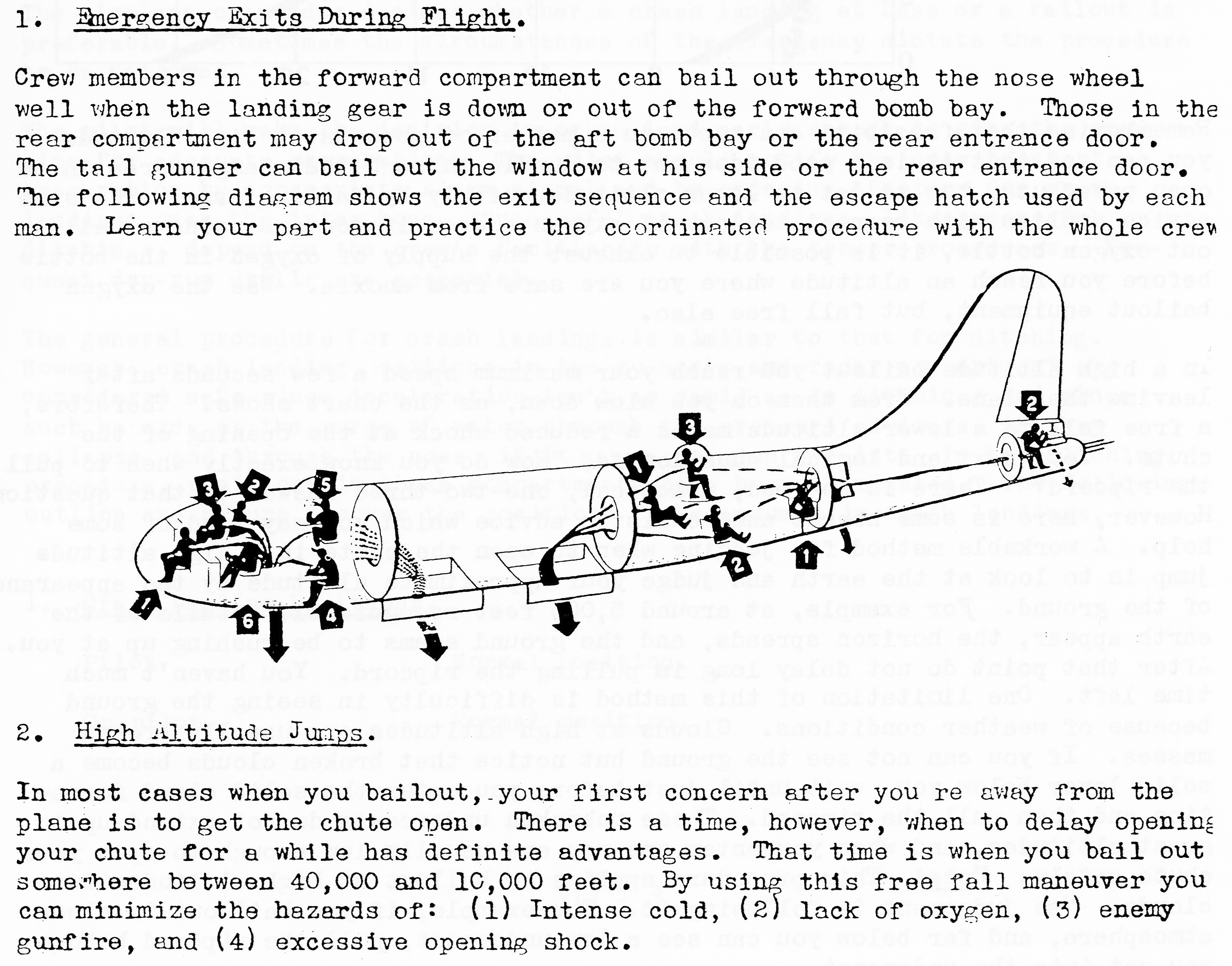
The following diagram, from the XXI Bomber Command Combat Crew Manual, specifically Section XII – “Emergency Procedures” – depicts the sequence by which the members of a Superfortress crew were to bail out of their bomber during an in-flight emergency.  

In the nose, the bailout sequence was: 1) bombardier, 2) flight engineer, 3) co-pilot, 4) navigator, 5) radio operator, and 6, pilot.  Escape could be made through a hatch in the cockpit floor situated directly above the nose wheel (by definition, necessitating that the nose wheel be lowered), or, through the bomb bay, the latter option requiring that the crew compartment to be depressurized so that the bomb bay could be accessed through a circular hatch.

____________________

British Army

Died while Prisoner of War

The fact that four of the five servicemen mentioned in this post were aviators, all members of the United States Army Air Force, is a coincidence of the timing of July 12, 1945.  The war in Europe had ended on May 8 (or May 9, in the former Soviet Union), and combat, as such, was now only occurring in the Pacific Theater.  Along with Captain Arbib, Lieutenants Schwartz and Stark, and Sgt. Finkelstein, the fifth (known) Jewish soldier who was a casualty on July 12 was – as mentioned in the “intro” to this post – a member of the British Army.  Probably captured during the fall of Java on March 12 1942, he was Gunner Solomon Rosen (1827101).

Born in 1914, he was the husband of Henrietta Rosen, of Heathway, Dagenham, Essex, and the son of Sam and Annie.  A member of the 78th Battery, 35th Light Anti-Aircraft Regiment, he arrived in Singapore aboard the ship Nishi Maru on September 14, 1942, and then in Kuching, Borneo, aboard the Hiteru Maru on October 9 of the same year. 

It was there that he died, in tragic irony only a little over one month before the end of the Second World War.  Then again, more than a few POWs of the Japanese succumbed to illness, starvation, mistreatment, or appallingly worse, through and even after the last day of hostilities in the Pacific Theater of War.  (Such, as…)  

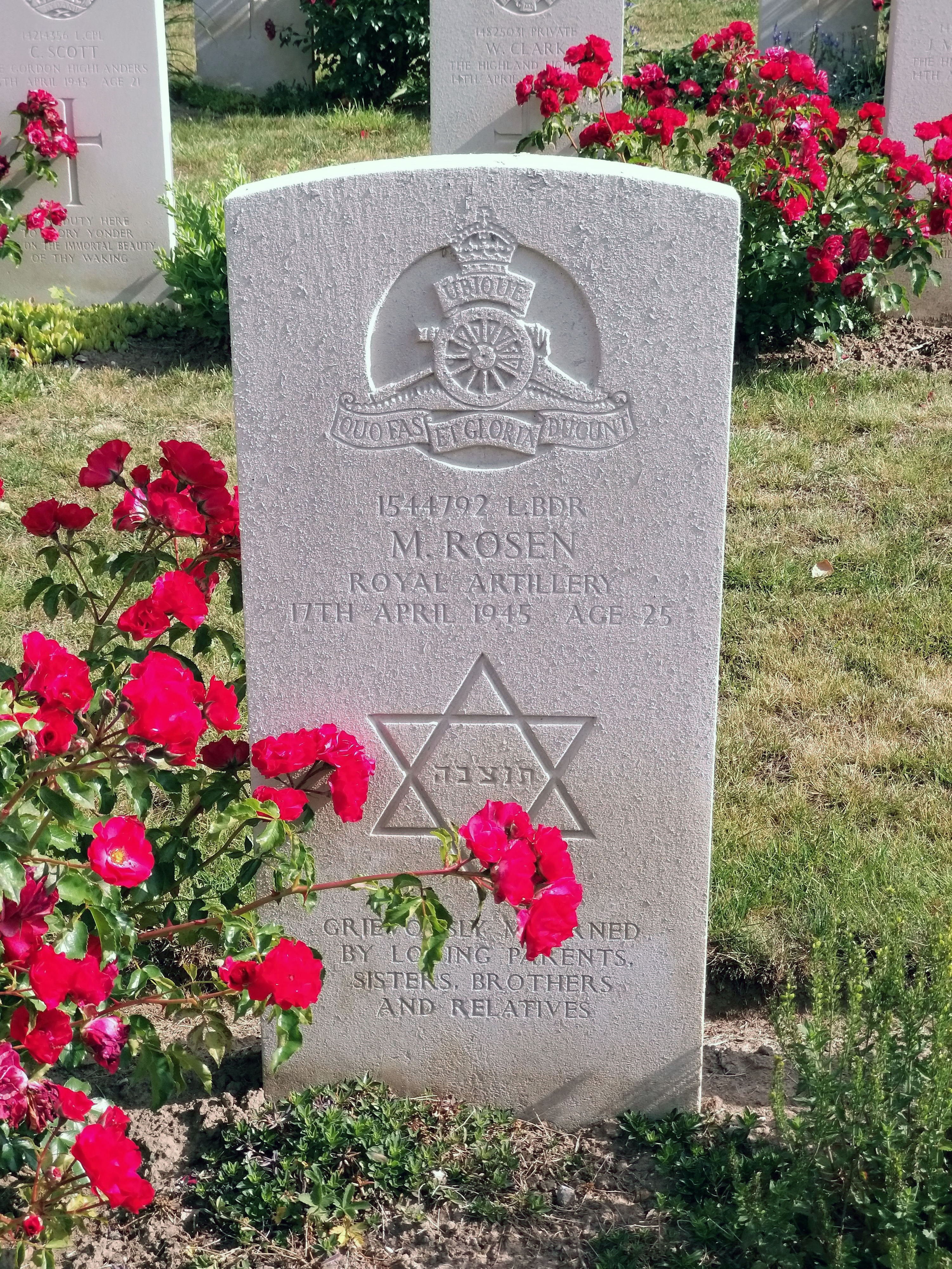
Gunner Rosen, whose name appears on page 148 of Volume I of Henry Morris’ We Will Remember Them, is buried at the Labuan War Cemetery, in Malaysia; Plot N,C,6.  His name appears in the Roll of Honor – Java Index.  

Gunner Rosen’s matzeva, with the Hebrew abbreviation .ת.נ.צ.ב.ה. (Tehé Nafshó Tzrurá Bitzrór Haḥayím – May his soul be bound up in the bond of life) inside the Magen David, appears in this photo by FindAGrave contributor GulfportBob.

References

Bernstein, Jonathan, P-47 Thunderbolt Units of the Twelfth Air Force, Osprey Publishing, Long Island City, New York, N.Y., 2012

Dublin, Louis I., and Kohs, Samuel C., American Jews in World War II – The Story of 550,000 Fighters for Freedom, The Dial Press, New York, N.Y., 1947.

Mireles, Anthony J., Fatal Army Air Forces Aviation Accidents in the United States, 1941-1945 – Volume 3: August 1944 – December 1945, McFarland & Company Inc., Publishers, Jefferson, N.C., 2006

Morris, Henry, Edited by Gerald Smith, We Will Remember Them – A Record of the Jews Who Died in the Armed Forces of the Crown 1939 – 1945, Brassey’s, United Kingdom, London, 1989

Rust, Kenn C., Twelfth Air Force Story, Historical Aviation Album, Temple City, Ca., 1975

No Specific Author Listed

XXI Bomber Command Combat Crew Manual, A.P.O. 234, May, 1945 (reprint obtained via EBay)

Jonas Phillips (wikipedia), at https://en.wikipedia.org/wiki/Jonas_Phillips

Soldiers from New York: Jewish Soldiers in The New York Times, in World War Two: May 4, 1945 – United States Navy – Naval Aviator Saul Chernoff

My prior posts about Jewish military casualties on May 4, 1945, have covered men who served in army ground forces, the United States Army Air Force, United States Marine Corps, and United States Navy.  However, I’ve retained one last name; one last identity; one last biography … for this “last” post.  The reason being, the sheer abundance of information about the man in question: Lt. (jg) Saul “Sonny” Chernoff of the United States Navy.

There are some vague parallels with the fate of 2 Lt. Wallace Franklin Kaufman, whose “story” has been the basis for this group of posts: 

Kaufman was shot down on May 4, 1945, and survived as a POW of the Japanese, until he was murdered on the following May 24 – three weeks later.  

Chernoff, too, was shot down (during aerial combat with Japanese fighters) on the same May 4, an event depicted – below – on the cover Edward M. Young’s F4U Corsair vs. Ki-84 “Frank” Pacific Theater 1945After rescue, Lt. (jg) Chernoff resumed flying combat missions. 

One June 2, 1945 – almost one month later – he was shot down (again) during aerial combat with Japanese fighters (again). 

Sadly, that time he did not survive. 

A chronicle of the events of both days from the Spring of 1945 follows below.  But first, some biographical information:

Born in Los Angeles on January 11, 1923, Saul Chernoff – his given name was originally “Saule” – was the son of Morris (9/2/90-2/4/70) and Sima (Gorelick) (1/15/93-6/11/50) Chernoff (parents), and brother of Lillian.  The family lived at 456 North Gardner Street, in Hollywood, California.  

Married, Saul’s wife was Georgette Dorothy (Kamm) Chernoff, who resided at (or originally hailed from) 139 Main Street, in Northport, Long Island, N.Y.  Another relative may (?) have been A Mr. B. Oxhorn, who resided at 854 South Harvard Boulevard, in Los Angeles.

________________________________________

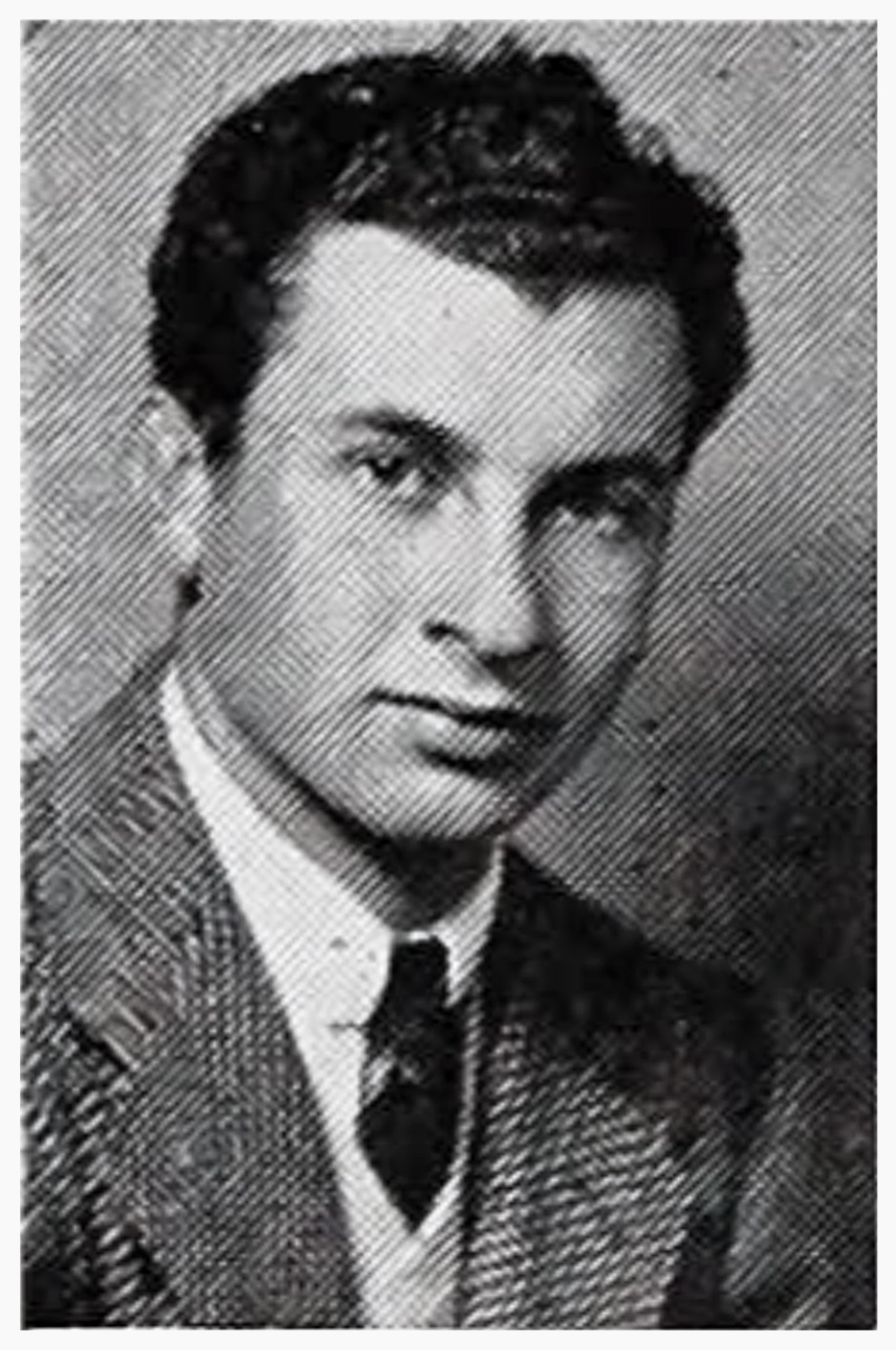
This is the only good photograph I’ve thus far been able to locate of him.  From Ancestry.com (like everything else…but I digress), this is Saul’s graduation portrait from the Hollywood High School Class of 1940 Yearbook.  

________________________________________

Completely unlike Major Milton Joel, other than a very (very (v e r y)) brief funeral notice in the Los Angeles Times in 1949, substantive information about Saul’s pre-war wife, and military training, is thus far unavailable to me.  (That is, assuming it’s survived some-unknown-where across a span of nearly eight decades.)  Thus, I’ll “jump” directly to his service as a fighter pilot in Navy fighter Squadron VBF-85, alias the “Sky Pirates”.  

The squadron emblem of VBF-85, portraying a sword-wielding one-eyed pirate holding the reins of a descending lightning bolt, set against a murkily moonlit, starry night-time sky, appears in several variations.  This version, also manufactured in cloth form during WW II for use as a jacket patch, is mentioned at VBF-85 as having been used as a decal actually placed about the Squadron’s F4Us, at least relatively early during the Squadron’s combat service.

________________________________________

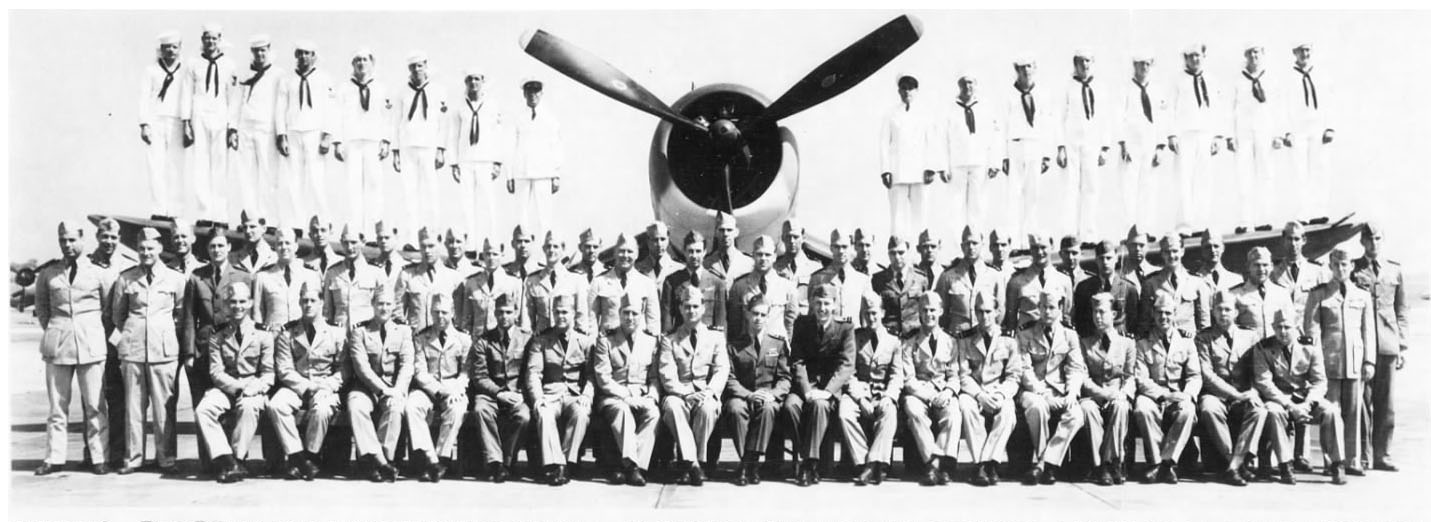
Probably (?…) taken in December of 1944, this image, from the War History of VF-85 (via Fold3), shows the squadron’s officers and enlisted men posed in front of an F4U.  Names of personnel, left to right, are listed below. 

Front Row (Sitting)

Ens. Bean, Roy N.
Ens. Hatfield, Elvin H.
Ens. Siddall, Frank S.
Ens. Edwin, Norman L.
Ens. Kirkham, Charles N.
Ens. Noel, Richard L.
Lt. Cdr. Gilmour
Lt. Cdr. Ford, Warren W.
Lt. Cdr. Roberts
Lt. Tilton, Eugene B.
Ens. Lawhon, David W.
Ens. Dunn, John C.
Ens. Bloomfield, Robert A.
Ens. Solomon, Leonard E.
Ens. Egolf, James O.
Lt. Irgens, Donald L.
Lt. (jg) Lamphar
Ens. Huber, Joseph A.

Second Row

Lt. (jg) Blair, George M.
Lt. (jg) Robbins, Joe D.
Ens. Moos, Kennard “A.”
Lt. (jg) Edwards, (William H.?)
Ens. Moore, John H.
Ens. Meltebeke, Raymond L.
Lt. (jg) Callan, Allie W.
Lt. (jg) Nichols, James B.
Lt. Wollum, Donald G.
Ens. Chernoff, Saul
Ens. Shinn, William G.
Ens. Marr, William H.
Ens. Clark, John G.
Lt. (jg) Sovanski, Lawrence
Ens. McCraken, Billie R.
Ens. Fuog, Howard W.
Ens. Yirrell, Francis
Lt. Goodnow, Robert G.
Ens. Loeffler, John D.

Third Row

Lt. (jg) Webster, Bayard
Lt. Fuller, Roy A.
Ens. Kling, Nelson P.
Ens. Kennedy, Harold R.
Ens. Pierce, James W.
Lt. Vickery, Arthur E.
Ens. Bruening, Floyd W.
Lt. (jg) Black, James B.
Lt. (jg) Horne, Hugh R. or Joseph S.
Lt. (jg) Whitney, Robert C.
Lt. (jg) Horne, Hugh R. or Joseph S.
Ens. McPhee, Duncan C.
Ens. Harrington, Henry M.
Ens. Clarke, William “R.”
Ens. Meyers, Donald E.
Ens. Fitzgerald, Louis A.
Lt. (jg) Spring
Lt. (jg) DeMott, Richard W.
Ens. Sabin, Donald G.

Enlisted Men on Wing

Schmidt
Goessling
ART 1C Curry, Roland H.
AMM 2C Thompson, Claud W.
AMM 1C Stransky, Lloyd J.
AMM 2C Kusmer, Erwin L.
AEM 1C Lewis, Frank H.
AM 1C Callahan, William J., Jr.
ACMM Young, Kenneth D.
ACRM Wright, Wilbur T.
Y 1C Hager, Franklin T.
AMMP 1C Brackett, William A.
AMM 3C Keegan, Joseph J.
PR 2C Kinner, Wilbert K.
AOM 3C Tanner, Charles L.
AOM 1C Richardson, William L.
ACOM Klein, Irving

____________________

Friday, May 4, 1945

(22 Iyyar 5705)

I first learned “about” Lt. (jg) Chernoff by happenstance, while reviewing Casualty Files pertaining to Allied aviator POWs of the Japanese, as well as Navy War Diaries, at the National Archives in College Park – a few (some? several?!) years back.  Within records for VF-85 / VBF-85, I discovered the squadron’s Aircraft Action Report that was filed for a Combat Air Patrol mission near Okinawa on May 4, 1945, during which the squadron shot down thirteen Japanese aircraft for the loss of two F4Us.

The squadron’s victories comprised:

Five “Type 93 twin-float advanced trainers“: The Yokosuka K5Y intermediate trainer / floatplane (九三式中間練習機), which went by the Allied reporting name of “Willow”.  Though a biplane, the K5Y was still a viable kamikaze weapon, as attested to by the destruction of the USS Callaghan on July 28, 1945, the last Allied ship to be sunk by a kamikaze attack.    

Three “Petes“: The Mitsubishi F1M reconnaissance floatplane (零式水上観測機), otherwise known to Allied pilots by the reporting name “Pete”.

Five “Zeke 52s“: The well-known Mitsubishi A6M (零式艦上戦闘機) carrier fighter, otherwise known – and very well known – as the “Zero”.  (Still known in 2021 and beyond? – That’s another topic entirely.)

These aerial victories were credited as follows:

Lieutenant Lawrence Sovanski: Two Petes
Lieutenant Jack Sidney Jacobs: Two Petes
Lieutenants Sovanski and Jacobs (shared): One Pete
Ensign W.R. Green: Two Petes
Ensign M.M. (Marvin M.?) Fogarty: One Pete
Lt. (jg) David W. Lawhon: Two Zeke 52s
Lt. (jg) Saul Chernoff: Three Zeke 52s.  (Which, may well not have been Zeke 52s after all, as will be revealed below…)

The Squadron’s Aircraft Action Report, prepared by ACI Lt. J.E. Curby, is so well written, flowing so well as a historical and “action” document, that it would be redundant for me to summarize it.  So instead, a transcript of the Report immediately follows this composite image of the Report’s first two pages:

Comparative performance of own and enemy aircraft:

The type 93 trainers could not evade the Corsair.  Speed no more than 150 knots.  Very little protection.

Pete was more maneuverable than Corsairs, but easily overtaken by Corsair.  Could turn inside Corsair.

Zeke-52 could not dive away from Corsair.  Apparently had very little armor for wing tanks since they burned readily.

Twelve VF-85 fighters were sent out on patrol C.A.P. north of Okinawa to intercept any Japanese planes coming from Kyushu.  The planes were vectored out at 0842 to a large bogey.  The engagement which followed was the first for the day fighters of VF-85.

The engagement was divided into two parts.  One third of the planes led by Lieut. J.S. Jacobs, USNR, engaged type 93 seaplane intermediate trainers and “Petes” while the other two thirds fought with Zeke52s.

The Petes and trainers were contacted about seven miles north of Iheya Jima.  The trainers were armed with bombs, but none were observed on the Petes.  The Japanese were apparently on a suicide mission against shipping targets in the Okinawa area.

Lieut. Jacobs saw one of our destroyers under attack by a “Nick”, and as he turned in to attack, the Hick dove into the destroyer before he had an opportunity to fire.  He then observed, with his wingman, Ensign W.R. Green, USNR, about eight seaplanes low on the water.  Lieut. Jacobs immediately attacked, and splashed a twin float seaplane.  He later identified this plane to be a type 93 seaplane intermediate trainer.  Lieut. Jacobs then sighted another one heading for a destroyer and he got a 45 [degree] deflection shot.  It burst into flames but continued into the destroyer.

During this time Ensign Green obtained hits with a full deflection shot on another trainer which began to burn and landed on the water.  Lieut. Jacobs then strafed it and was followed by Lieut. Lawrence Sovanski, USNR, who caused it to explode.

Ensign Green then got on the tail of a Pete and splashed him with a short burst.  A few seconds later he was on the tail of another Pete which he splashed in short order.

Lieut. Sovanski, with his wingman, Ensign M.M. Fogarty, USNR, had also been busy attacking the trainers as soon as they were sighted.  Lieut. Sovanski made on pass at a trainer and scored hits, but failed to splash him.  He then spotted the plane wounded by Ensign Green and Lieut. Jacobs and exploded it.  Just then another Bogey of about eight planes was sighted.  Lieut. Sovanski pulled up and made a stern approach on a 93 trainer.  He burned it with a short burst and it exploded.  He then followed another one but had to hold his fire while another Corsair passed out of his sights; however, a second or two later he opened up and the trainer exploded.

Ensign Fogarty, meanwhile, made a flat side, full deflection run on a Pete.  It burned, hit the water and exploded.

During this entire melee there were fighters from the Yorktown attacking these groups of bogies.

While the above engagement was in progress, Lt. (jg) J.D. Robbins’ (USN) division was engaging some 12 – 16 planes, Zeke-52s, fifteen miles north of the other encounter.  This group was tallyhoed at 17,000 feet.  The flight had been at 22,000 feet.  Unfortunately, the 20mm cannon in three planes in Lt. (jg) Robbins’ division froze up and they were forced to retire from the engagement.  Lt. (jg) Saul Chernoff, USNR, and Lt. (jg) F.S. Siddall were both shot down at this time.  They were both rescued and are in good shape. 

Lt. (jg) Chernoff’s plane was the only one which had all guns operating.  He soon learned that there were two groups of Zekes, the first one consisting of 16-20 planes and the second also consisting of 16-20 planes.  His story is best told in his own words.  (It should be mentioned that he had no intimation that his fellow pilots were having difficulties with their guns, and had left the scene of battle.)

____________________

Continuing with the Aircraft Action Report, here is a transcript of Lt. (jg) Chernoff’s account of the engagement, which appears in the Action Report as a typewritten document:

OKINAWA – Angels 20

4 May 1945

At approximately 0845 we were vectored out on a heading of 030 degrees.  No speed was given and when a request for information was asked, a report was given that the bogey was 40 miles at angels 15.  We went on vector for about ten minutes when Ensign E.L. MYERS, USNR, my wingman, spotted the bogeys behind us and above.  I immediately gave him the lead and followed. 

About a mile from the bogey which appeared to be a large group of Zekes in two formations, Ensign MYERS pressed home his attack.  I don’t believe he saw the second formation as he made his attack on the first group.  I saw he would be in a bad way from the second group, so made an attack on them.  It was a low side attack, coming from underneath.  I don’t believe they saw me as no evasive action was taken.  I gave a short burst to the lead plane and his port wing came off and he spun in.  Still coming up, I gave a short burst to the second plane and he blew up.  I skidded to one side and came down in another run on two more planes.  They started evasive action, making a hard turn to port.  I fired about three bursts and the second man and he, also, blew up.  I closed on the first but couldn’t turn inside of him.  At that time I looked behind and saw three Zekes on my tail so immediately did a split “S”.  Going down I was hit and my engine was smoking very badly and oil completely covered the windshield.  My oil pressure started dropping and then my prop governor went out.  Using my throttle, my R.P.M.s went as high as 5000, and when I cut it off it still read about 3500.  I was followed down to about angels ten by one Zeke who then broke off and left, climbing back up. 

I made several radio transmissions and tuned on my IFF to emergency.  Two fighters from VF-85 drew alongside me and I then made a water landing.  I couldn’t determine the direction of the waves so made a landing between them.  I put my flaps down and held off until my airspeed indicator read 60 kts.  There was quite a jar but I didn’t receive any injury.  My life raft, which I had loosened in the air, fell to the bottom and I couldn’t get it out, so jumped into the water with just my Mae West.  Both planes did a marvelous job of directing L.C.S.-11 to my position which was about 4 ½ miles south-east of Yuron Shima.  They were relieved by another flight of four planes from VBF-85.  After two and a half hours I was picked up.

My mistakes:

1. I forgot to jettison my belly tank.
2. Landed cross wind.
3. Let raft fall to bilge.
4. Jumped into water before inflating Mae West.

S. CHERNOFF

____________________

The Aircraft Action Report does not include a parallel statement concerning the shooting down and survival of Lt. (jg) Siddall.  In any event, Siddall was flying F4U-1D 82746, and Chernoff F4U-1D 82542.  

____________________

This Oogle map shows the approximate location – indicated by Oogle’s emblematic red pointer – where VF-85 intercepted the Japanese attacking force, based on latitude and longitude coordinates listed in the Aircraft Action Report.  The location can be seen to have been approximately 50 miles east of Radar Picket Station 4.  

____________________

But, wait, there’s more…!

Though Lt. (jg) Lawhon and Lt. (jg) Chernoff claimed two and three Zeke 52s, respectively, there is a high probability that this was a case of misidentification, for the Japanese fighters may have been Nakajima Ki-84 Hayates of the 60th Shinbu-Tai (60th Special Attack [kamikaze] Unit (Dai 60 Shinbu-tai / (第六十振武隊).  This clarification comes from Edward M. Young’s F4U Corsair vs. Ki-84 “Frank” Pacific Theater 1945, where it is stated:

On May 4, Maj. Michiaki Tojo, commanding the 103rd Hikō Sentai, led a formation of Hayates from his own unit and the 102nd Hikō Sentai that were charged with escorting a mixed Special Attack airplane formation consisting of Ki-27 “Nates,” Ki-43 “Oscars,” Ki-84 “Franks” and two Ki-45 “Nicks” (Type 2 Two-seat Fighters) to Okinawa.  More “Oscars” from the 65th Hikō Sentai also participated in the mission. 

That same morning VF-85 sent up three divisions on CAP north of Okinawa.  Flying at 20,000ft, Ens. E.L. Myers, wingman to Lt. (jg) Saul Chernoff, saw a formation of what he identified as 12-16 “Zekes,” and Chernoff ordered him to take the lead.  The other members of the division found that the 20mm cannon in their F4U-1Cs had frozen and had to break off the attack.  Chernoff continued, seeing that the Japanese aircraft were in two formations, one higher and one lower.  He decided to attack the higher formation on his own in order to protect Ens. Myers, even though he would be attacking from below.  Another division of VF-85 was climbing rapidly to help.  Chernoff came in on what he identified as a formation of “Zekes” and opened fire with his cannon, knocking the port wing off one airplane.  He fired on a second, which blew up under his fire, then came down to make a run on two more fighters, firing three bursts at one that blew up (these may well have been “Franks,” as the 60th Shinbu-Tai lost three that day and the escort force lost eight). 

As he tried, and failed, to follow the second fighter through a turn, Chernoff noticed three “Zekes” coming down on him from above.  Maj. Tojo had been watching the Special Attack airplanes targeting what he thought was a group of US Navy cruisers and destroyers when he saw two Corsairs come into view below him, one behind the other.  They were firing on the Special Attack airplanes, and apparently did not see him.  The second Corsair, apparently flown by Lt. (jg) F.S. Siddell [sic], came within range and Tojo immediately opened fire and sent it down smoking.  Chernoff did not see Tojo closing behind him, the Ki-84 pilot opening fire and hitting the Corsair’s engine, which began to smoke badly and covered the windscreen with oil.  Chernoff did a split-S to escape, but his Corsair was finished.  Major Tojo was not sure how badly he had damaged the two Corsairs, but wisely did not follow them down.  Chernoff and Siddell were badly hit, but both made water landings and were rescued.  With an experienced pilot at the controls and an altitude advantage, the Hayate had shot down two Corsairs in under a minute. 

____________________

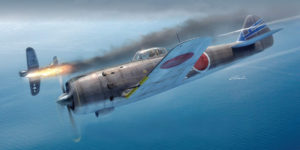
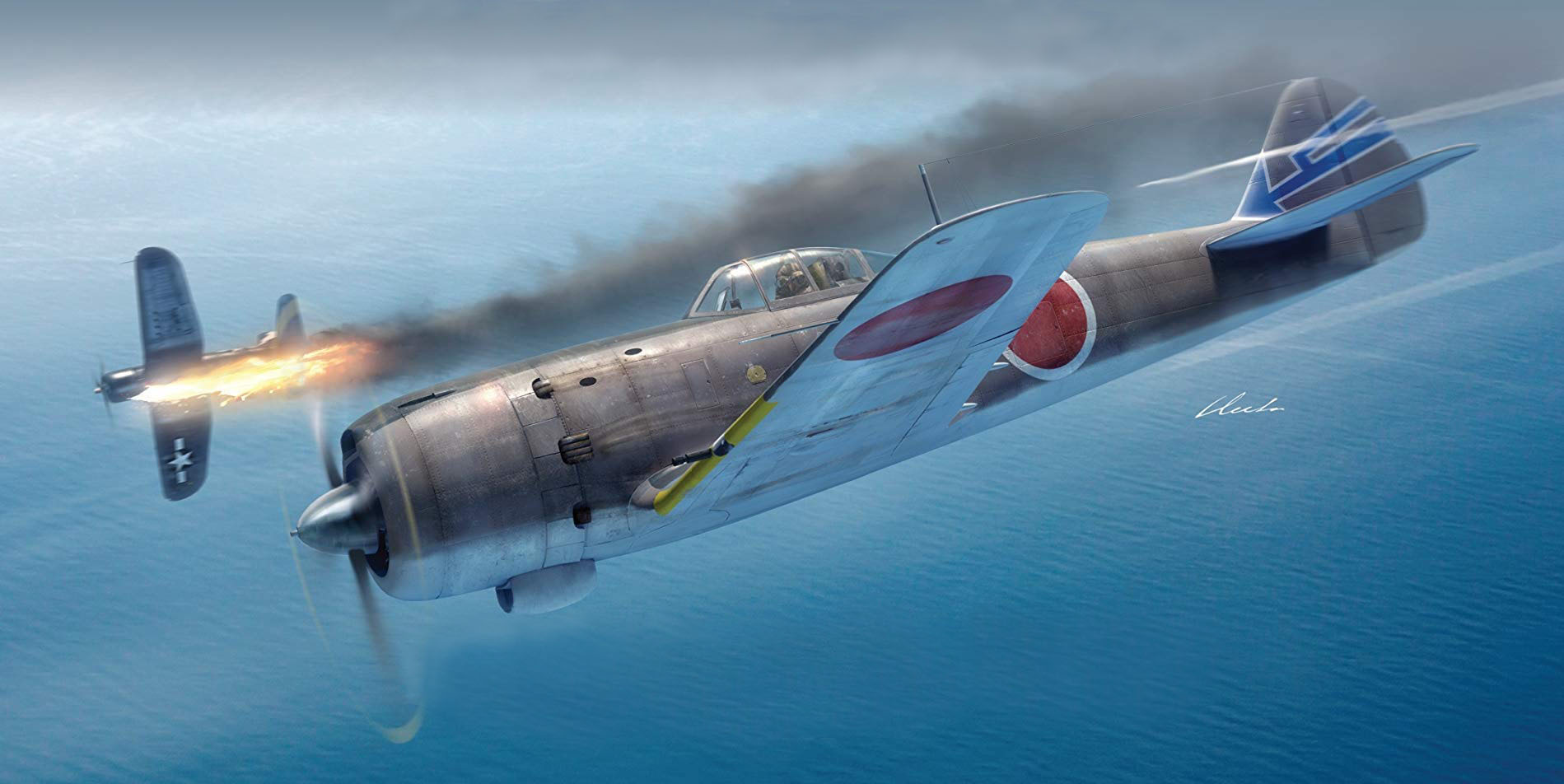
This brief moment in time has been imagined and depicted in a painting by aviation artist Gareth Hector.  Mr. Hector’s composition forms the “bottom half” of his dual cover montage for Mr. Young’s book, issued in 2016 by Osprey Publishing, one of the (thus far) 122 books comprising Osprey’s Duel series.  The cover of Mr. Young’s book, viewable at 96 dpi resolution c/o Mr. Bezos.  

Mr. Hector’s painting depicts Saul – moments after having previously downed three Ki-84s (not Zeke 52s) – diving away in his burning Corsair after having been attacked by Major Michiaki Tojo.  Clearly shown on Saul’s F4U are the white lightning-bolt wing and tail markings of VF-85.  

The caption parallels the excerpt quoted above:  “On May 4, 1945, Maj. Michiaki Tojo, commander of the 103rd Hikō Sentai, led a formation of 30 Ki-84s from the 101st, 102nd and 103rd Hikō Sentai as escorts for a mixed formation of Special Attack airplanes sent to attack US Navy vessels off Okinawa.  The Ki-84s had to zigzag above the slower bomb-laden kamikaze.  Near the island of Iheya Shima, northwest of Okinawa, the formation spotted several American ships and the Special Attack airplanes began their final dives.  Flying above and monitoring the attack, Maj. Tojo suddenly saw two F4U Corsairs below him, intent on intercepting the Special Attack formation.  One Corsair turned to the right and came into firing range.  Apparently unseen, Maj. Tojo opened fire and sent the F4U down smoking.  The leading Corsair, probably flown by Lt. Saul Chernoff of VF-85, also turned to the right and failed to notice the Ki-84s above until Maj. Tojo was in a position to open fire, hitting Chernoff’s engine.  The naval aviator dove away, with his Corsair smoking badly, and successfully ditched.  Chernoff was rescued, only to be killed subsequently on June 2, 1945 when VF-85 clashed with the N1K2-J “Georges” of the 343rd Kokutai over Kyushu.  (Cover artwork by Gareth Hector)”

(Given the way that Mr. Hector’s has depicted this aerial engagement in such a vivid, detailed, well-imagined yet entirely realistic manner, and his composition’s fortunate availability at very high resolution, I took his work one [small] step “beyond” (- quite intentional pun -) and – rather than simply nominally include it within “this” post – retouched it using Photoshop to remove the “upper” half of the montage and eliminate text from this “lower” half, simplifying the scene and giving it a little bit more “oomph”. )

You can view fourteen examples of Mr. Hector’s work at his website, Gareth Hector Military Art, while fifty books featuring his cover illustrations can be viewed here, at Osprey Publishing.  His work is characterized by a visual perspective that captures action at – or just before – its height, a use of lighting and illumination that have an optimum balance, and, an near photographic attention to detail.

____________________

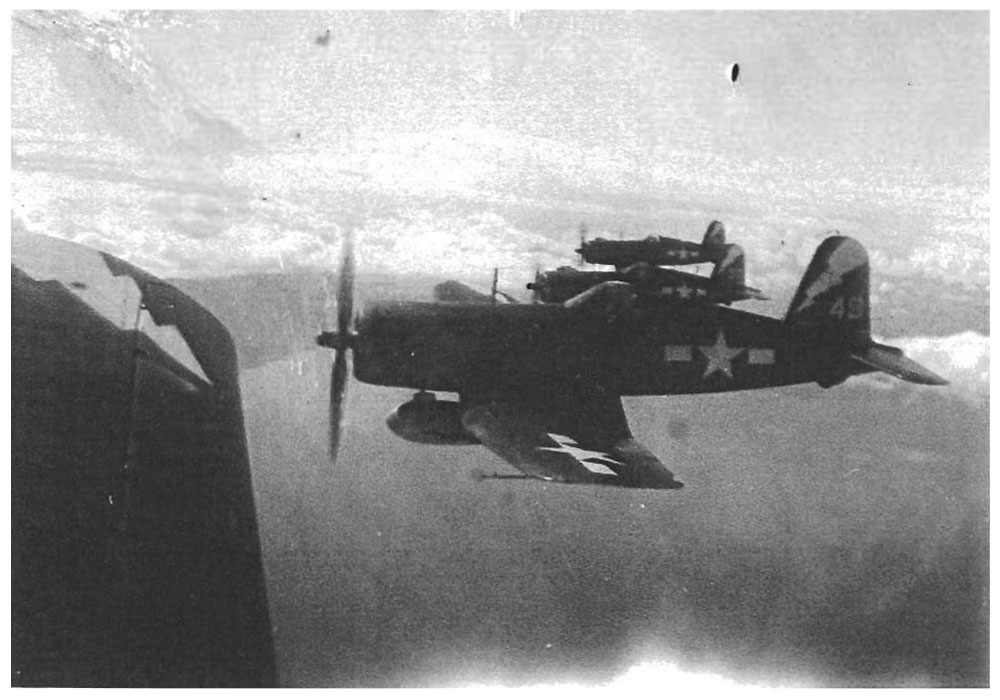
From VBF-85, this photo shows three (plus a wingtip) F4Us, probably in the vicinity of Hawaii, marked with the squadron’s emblematic white lightning bolt on tail and wingtip…  

…while this illustration, by Don Greer (via WarWall) appearing on the cover of Jim Sullivan’s F4U Corsair in Action, provides a much clearer view of VF-85’s / VBF-85’s squadron markings.  Though individual plane-in-squadron numbers are painted on the tail and cowling, unfortunately, these are not recorded in Aircraft Action Reports.  Note that the aircraft carries the Sky Pirates squadron insignia below the cockpit; this insignia reportedly appeared on the squadron’s Corsairs less frequently as the war progressed.  

________________________________________

________________________________________

Almost one month later, on Saturday, June 2, 1945 (22 Sivan 5705), Lt. (jg) Chernoff was no longer among the living.    

– .ת. נ. צ. ב. ה –
תהא נפשו צרורה בצרור החיים

What happened?

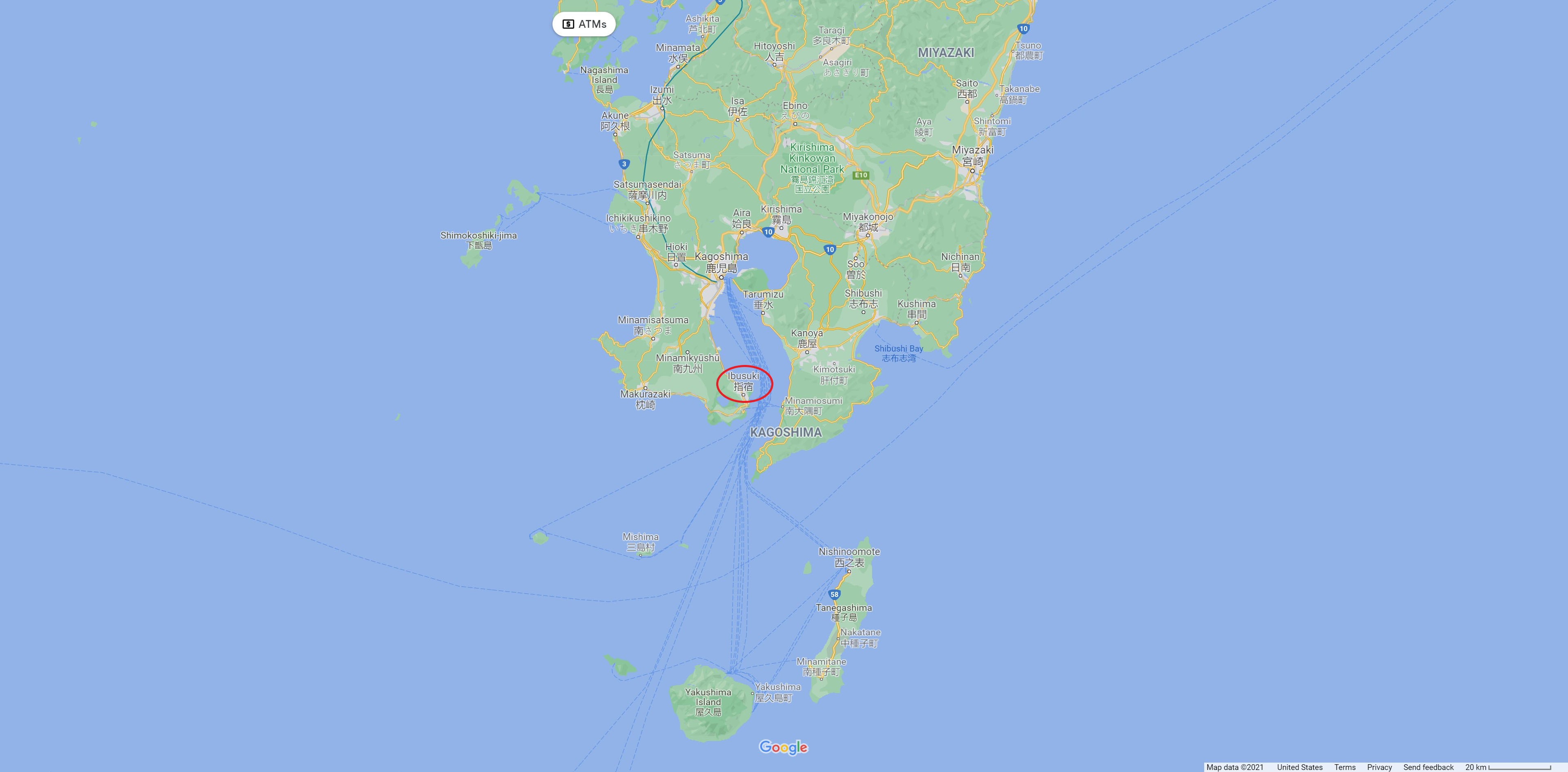
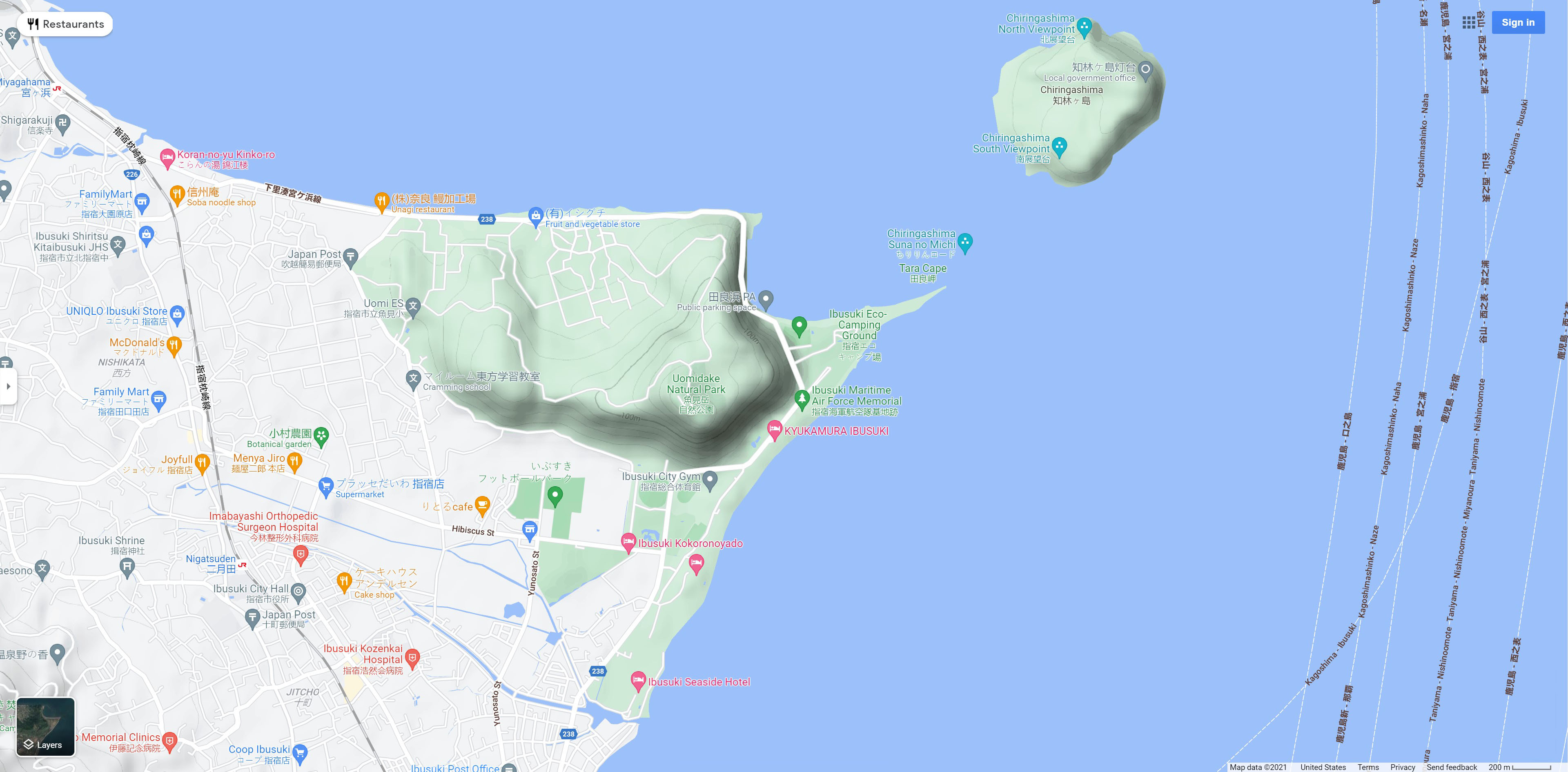
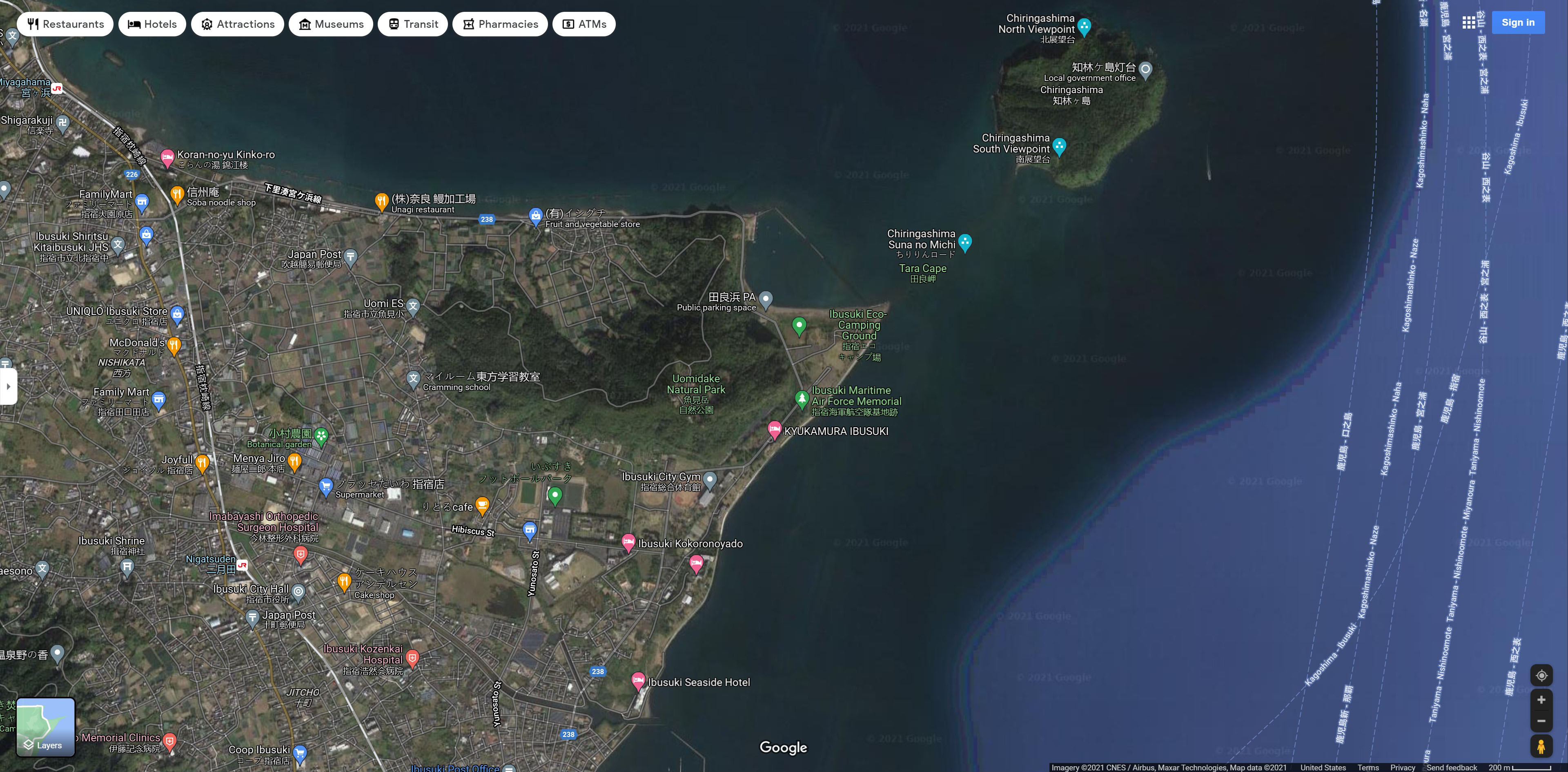
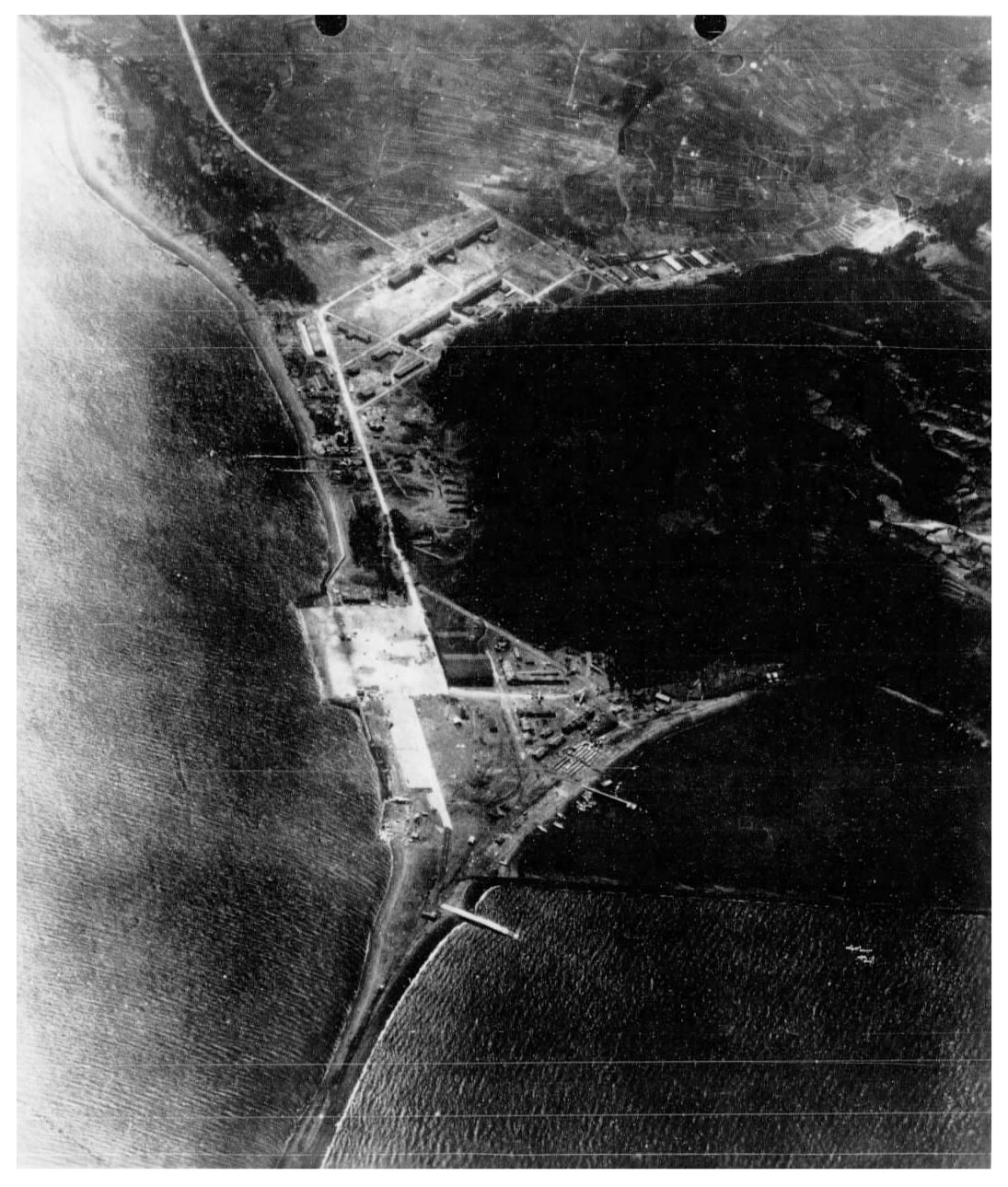
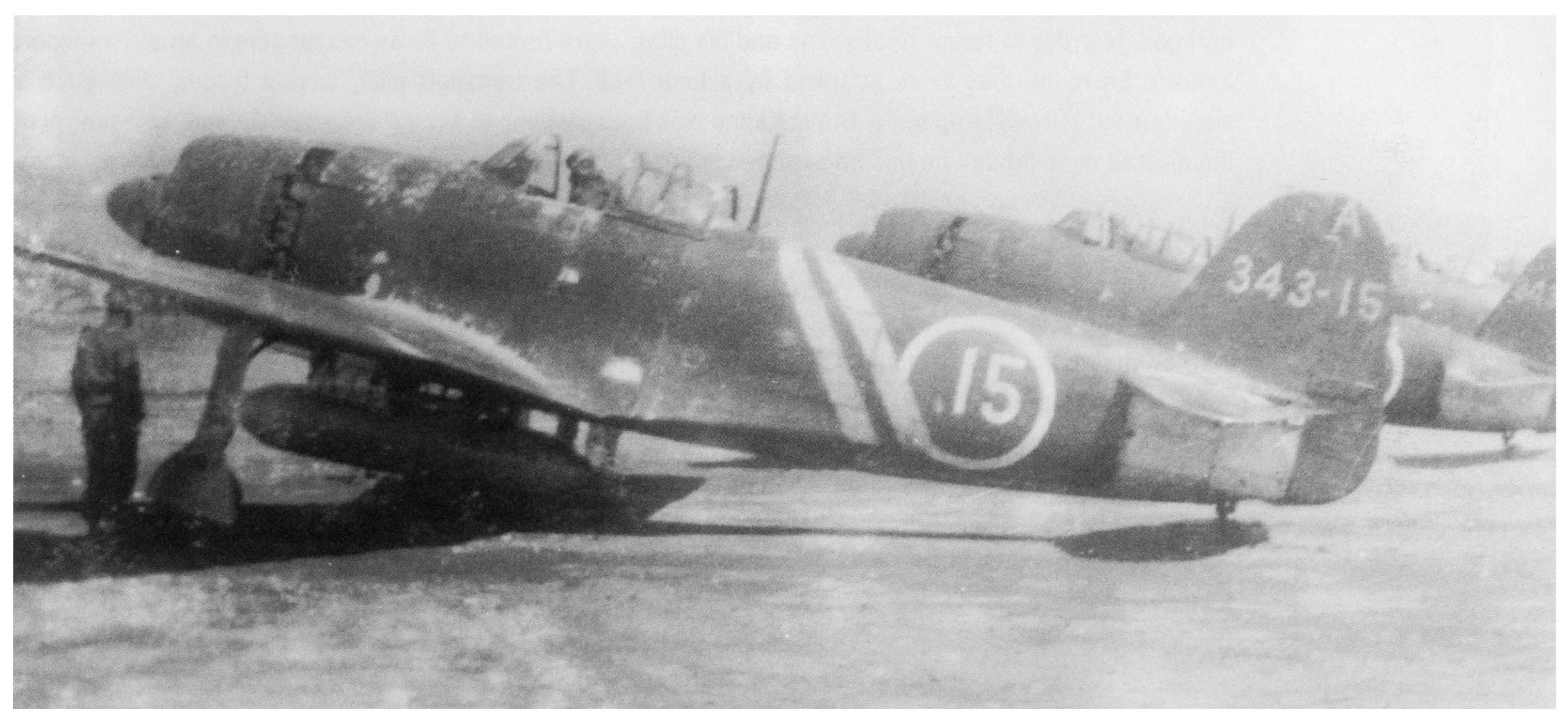
…thirty-two Corsairs from VF-85 / VBF-85 were tasked with a fighter sweep mission to the Chiran, then Kagoshima, and finally, Izumi airfields on the island of Kyushu.  Prior to returning to the Shangri-La and while rendezvousing over Kagoshima Bay (Kagoshima-wan; 鹿児島湾), a radio request was received to provide high cover for an air-sea rescue operation for three downed F6F Hellcat pilots (two from the USS Ticonderoga and one from USS Yorktown) who’d ditched in the bay.  As the Corsairs orbited the area in the vicinity of the Ibusuki Seaplane Base, they were attacked from above by what was estimated to have been 20 to 30 (actually 23) Japanese fighter planes.  The planes were described as a mixture of Franks [Nakajima Ki-84 Hayate; キ84 疾風, “Gale“], Jacks [Mitsubishi J2M Raiden; 雷電, “Lightning Bolt], Oscars [Nakajima Ki-43 Hayabusa; 隼, “Peregrine falcon” / “Army Type 1 Fighter” 一式戦闘機], and Tojos [Nakajima Ki-44 Shoki; 鍾馗, “Devil Queller”], and even the Judy [Yokosuka D4Y Suisei; 彗星, “Comet” dive-bomber], but in reality the only enemy aircraft encountered by VF-85 / VBF-85 were all N1K2-J Shiden-Kai (紫電改 – “Violet Lightning – Modified”) fighters of the elite 343rd Naval Air Group, which was commanded by Captain Minoru Genda.  The 343rd was comprised of (this quote is from Wikipedia, but okay, it’s valid), “…the best surviving ace fighter pilots the Imperial Navy had at the time.”  

The result?  Well, as aptly stated in the opening paragraph of the Shangri-La War History, “2 June was the one disastrous day for the squadron.”  VF-85’s prior encounters with Japanese warplanes were limited to kamikaze aircraft, as recounted above for the mission of May 4, 1945.

By day’s end, VF 85 / VBF 85 suffered one pilot killed on take-off at the mission’s start, two pilots killed outright in combat, three pilots who ditched (two after their aircraft had been damaged by anti-aircraft fire and / or enemy aircraft; one from lack of fuel) but did not survive to be rescued.  Two pilots managed to return to the Shangri-La in damaged Corsairs, of which one aircraft may (?) have been junked.

The 343rd Naval Air Group lost two pilots in the battle.

As for the three Hellcat pilots floating in Kagoshima Bay?  They were all rescued, as was the complete crew of a seaplane that was lost early in the air-sea rescue effort.

Of VF 85 / VBF 85’s losses, Lt. (jg) Saul Chernoff was the second pilot to have been killed:  He was shot down – “jumped” – outright, at the start of the 343rd Naval Air Group’s attack, after breaking away from his Section Leader in order go to independently attack a Shiden fighter, an action which was noted (though Chernoff’s name isn’t mentioned, the implication is obvious) in VF-85 / VBF-85’s Aircraft Action Report.

The above summary is a distillation of information in documents filed by VF-85 / VBF-85, VH-3 and VPB-13 (the two squadrons involved in the air-sea rescue for the three downed Hellcat pilots), the Shangri-La, histories of VBF-85 and VF-85 published at the war’s end, and, Henry Sakaida and Koji Takaki’s history of the 343rd Naval Air Group, Genda’s Blade, published in 2003.  

The information in these sources is as interesting as much as it is well-written.  Rather than “pick and choose” snippets from these documents, the text is presented below in full…  (Gadzooks.  Veritably, again there I go making another really long post!)  My additional commentary appears inside brackets, italicized, in maroon font.  [Just like this.]

______________________________

First, I’ll begin at the “end”, with post-mission comments by the Air Group Commander, in the USS Shangri-La War Diary – Report of Air Operations Against Kyushu:

Comments of Air Group Commander

Fighter Sweep Over Kyushu

Pilots must learn to stay together. In our first real fighter sweep the desire to kill as many Japs as possible caused new pilots to become dispersed. They knew better and admitted it later. Unfortunately there doesn’t seem to be any way of learning this lesson except by experience.

The Japs still have some first class pilots and airplanes. Prior to these sweeps this group had encountered only Kamikaze pilots who offered no real opposition. This, plus rumors that the Jap air force was definitely low on good pilots, gave us an erroneous appreciation of the situation such that we were greatly surprised in our encounter. The Japs flew tight formations, executed well-timed coordinated attacks and retained an initial altitude advantage. Their initial attack was made through high overcast at 22,000 feet indicating apparent radar control. Some of the planes out dived Corsairs at well over 400 knots IAS and were able to make tight turns in those dives.

____________________

Second, from the Shangri-La War History:

2 June was the one disastrous day for the squadron. A fighter sweep was ordered against airfields on Kyushu. The weather was worse than terrible and added to that the nearest field was over 300 miles away. It was necessary to fly on instruments a good deal of the time to the target and over an hour on the return trip.

The sweep first attacked Izumi airfield where Lieut. L. Sovanski, USNR, Lt. (jg) N.L. Edwin, USNR, both had their planes damaged by flak. The next sweep attacked Chiran airfield, however, in both cases few aircraft were observed. In the meantime, two pilots from the Yorktown were downed in Kagoshima Wan. Comdr. W.W. Ford, USN, took charge of aiding them. A Coronado attempted to land near one of the pilots, but on landing damaged its propeller rendered the plane useless. Another Coronado orbited the area. A Dumbo (PBM) finally arrived and rescued the downed pilots and also the crew of the Coronado.

During this time the high cover for the downed pilots was jumped by Franks, Jacks, Oscars and Judys, [a statement to this effect is repeated in further documents] all first line planes piloted by experienced pilots.  [Though the Ki-43 Hayabusa would serve throughout the duration of the war, by 1945 it had been superseded in performance, armament, and other features by later Japanese fighters, such as the Ki-84 Hayate.]  Lt. (jg) W.R. Clarke, USNR, shot down one Jack and one Oscar, and Lieut. G.M. Blair, USNR, damaged a Jack. However, the enemy took heavy tool on our fighters. Lieut. R.A. Fuller, USNR, was shot down by antiaircraft fire over Ibusuki auxiliary seaplane base. Lt. (jg) Saul Chernoff, USNR, was shot down by an enemy plane. The planes of Lt. W. Atkinson, USNR, and Lt. (jg) H.R. Kennedy, USNR, were so badly damaged that they had to make forced water landings. Lt. (jg) C.N. Kirkham, USNR, orbited Lt. (jg) Kennedy in the hope of effecting his rescue and remained with him until he, too, was forced to make a water landing due to lack of fuel. All three pilots were in their rafts, but due to the foul weather none of the pilots were recovered. Lt. (jg) C.N. Kirkham, USNR, has been recommended for the Navy Cross for his heroism.

In addition, two other planes were so badly damaged they had to be jettisoned and one plane was forced to ditch near a destroyer due to lack of gasoline.

____________________

Lieutenant (jg) Saul Chernoff was shot down in the attack over Ibusuki. Lieutenant Wallace Atkinson, Jr. – struck by Japanese fire in the same encounter – crashed with his plane near Kuchino Shima. Flak bursts off the Ibusuki seaplane base sent Lieutenant Roy A. Fuller into the sea.

Two other pilots who failed to return had managed to survive the dynamic air battle but were lost enroute to the ship. When Lieutenant (jg) Harold R. Kennedy was unable to keep his plane in flight because of previously sustained damaged, Lieutenant (jg) Charles N. Kirkham – while orbiting the position where his comrade had fallen – ran out of gas and landed in the water. Neither was recovered.

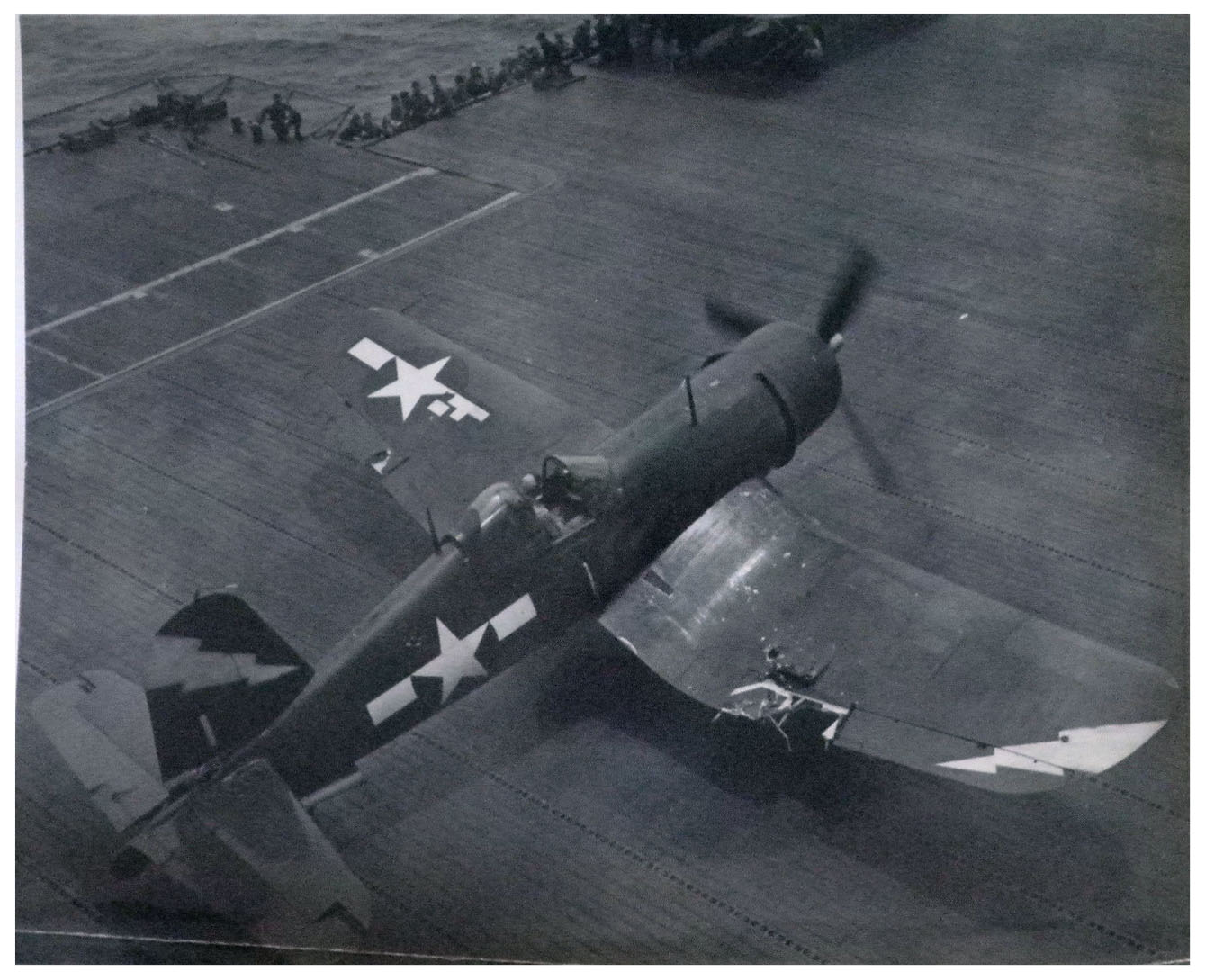
In addition, there were two plane losses without personnel casualties. One pilot was picked up when his fighter was forced down at sea by fuel exhaustion. Another managed to fly his F4U back to the carrier for a landing despite severe damage by enemy fire, but the plane was cannibalized and jettisoned over the side.

The squadrons of Air Group 85 took a great deal more than they gave that day. Against the quick surprise blows of the Japanese, their own retaliatory punches seemed vainly ineffectual. For the gallant fight which they waged and the heavy casualties which they suffered they extorted a disproportionate toll of two planes downed, one probably destroyed and one damaged.

____________________

Third, from the History of Bomber Fighting Squadron Eighty-Five:

Black Saturday for Fighting Squadron EIGHTY-FIVE. The day started out with a 0500 CAP, Irgens’ and Whitney’s divisions. At 0600, CAG Sherrill led a fighter sweep on Kyushu airfields. The weather was extremely bad – the worst we had ever operated in – and the nearest field was over 300 miles from the force.

The hop got off to a bad start when “Bill” Marr, VBF, went in on take off. He was lost when he tried to swim to a destroyer that was picking him up. “Bill” Clarke took off and filled in GAG’s division.

The strike group consisted of 32 planes and the divisions were led by Comdr. Cherrill, Comdr. Ford, Lieut. Comdr. Hubert, Lieuts. Fuller, Sovanski, Blair, Callan and Jacobs.  [That’s eight sections; I guess 4 planes per section?]  The sweep went in over the coast of Kyushu at about 9,000 feet. The first attack was on Chiran Airfield, a partial attack in which only three divisions participated. A rendezvous was made and the group headed for Kagoshima and Izumi Fields in Northern Kyushu. Again another partial attack was made on Izumi, most of the divisions maintaining their altitude to carry out the flight instructions of getting the Jap planes that might be in the air.

At Kagoshima Field, a flak barrage damaged the planes of Larry Sovanski and “Red” Edwin. A retirement was made from this field to Kagoshima Wan, where two Yorktown pilots were in the water. Lieut. Comdr. Ford took charge of aiding them, establishing contact with the Dumbo planes.

The five remaining divisions were orbiting at about 8,000 feet. Fuller’s division was ordered to join the Captain to assist in the rescue – one Dumbo had crashed on landing and a second one was expected to arrive. In letting down, Fuller led his division in an attack against Ibusuki Auxiliary Seaplane Base. He was hit by anti-aircraft fire and crashed.

The four divisions remaining as top cover were then jumped by a group of some 20-30 Japs flying Franks, Jacks, Oscars and Tojos. [Similar to earlier statement.]  The enemy attack was unobserved until it was pressed home.  Sovanski, Callan, Kennedy, Edwin and Atkinson were hit in this attack and Chernoff was shot down. Kennedy was thought to have been wounded.

In the melee which followed, “Bill” Clarke shot down one “Jack” and one “Oscar” and George Blair damaged one “Frank”, Sovanski’s and Callan’s divisions retired as soon as possible and headed for the base. On the way, Kennedy made a rough water landing, but got into his raft. Kirkham stayed with Kennedy and attempted to effect a rescue. He remained until he ran out of gas and then landed beside Kennedy.

The rest of the group retired, about one and one half hours of the flight, back being on instruments. Atkinson lost all oil pressure and was forced to make a water landing. Toenges landed in the water beside a destroyer of the screen when he ran out of gas, and was immediately recovered. Kennedy, Kirkham and Atkinson were not recovered because of a storm which came up that afternoon. Sovanski’s tail hook ‘snapped on landing and Fitzgerald, who followed him aboard, made a two turn ground loop on the deck without getting a barrier.

____________________

Fourth, the Aircraft Action Report of VF-85 / VBF-85.  But (!) a caveat (!!):

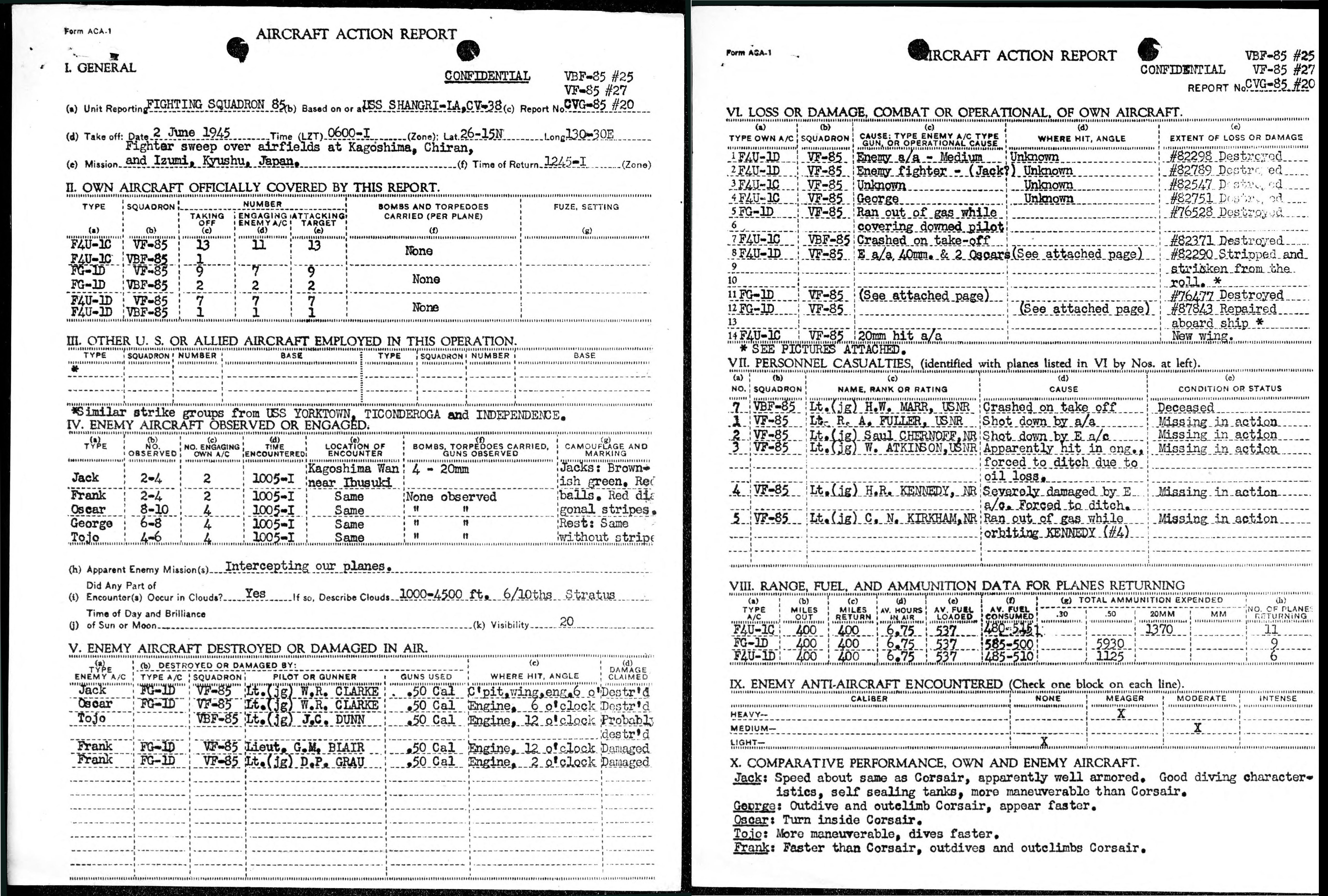
Well, though I couldn’t find the Aircraft Action Report for VF-85 and VBF-85 at Fold3.com despite searches using a variety of key-words and time-frames (gee why am I not surprised?) I w a s able to find the Report in Japan’s National Diet Library Digital Collections, where it’s titled “Aircraft Action Report No. VF85#27 VBF85#25 CVG85#20 1945/06/02 : Report No. 2-d(64): USS Shangri La, USSBS Index Section 7“., under the “Level” 文書名:Records of the U.S. Strategic Bombing Survey = 米国戦略爆撃調査団文書 ; Entry 55, Security-Classified Carrier-Based Navy and Marine Corps Aircraft Action Reports, 1944-1945. 

And so, here is a composite image of the Report’s first two pages:

[Note the following statement at the bottom of the second sheet:]

COMPARATIVE PERFORMANCE, OWN AND ENEMY AIRCRAFT.

Jack: Speed about same as Corsair, apparently well armored. Good diving characteristics, self sealing tanks, more maneuverable than Corsair.
George: Outdive and outclimb Corsair, appear faster.
Oscar: Turn inside Corsair.
Tojo: More maneuverable, dives faster.
Frank: Faster than Corsair, outdives and outclimbs Corsair.

[Despite mention of the Jack, Oscar, Tojo, and Frank, the only Japanese fighter encountered by VF-85 / VBF-85 on this mission was the N1K2-J Shiden-Kai (Allied code name “George”).  Though – at first glance – a striking example of misidentification, the assumption that other types of Japanese fighters had been encountered does makes sense, given the context and nature of the aerial engagement.  The main and common characteristics of these Japanese warplanes was that they were radial-engine, single-seat, low-wing monoplanes, having (except the Jack) a 360-degree-vision pilot’s canopy.  Thus, given the element of complete surprise incurred by VF-85 / VBF-85, the intensity of the aerial battle, and the fact that the Navy pilots were up against Japanese pilots of equal or greater combat experience, an error in identification was not at all surprising.]   

So, here’s the subsequent and substantial text of the report:

Aircraft Action Report – 2 June 1945

After a delightful breakfast of baked beans, well done toast, grape fruit juice and scrambled eggs, [interesting, how the Report starts with mention of breakfast, and ends with mention of lunch – see below!] 29 fighter pilots from VF-85, 2 fighter pilots from VBF-85 and CAG-85 took off at 0600-I from the U.S.S. SHANGRI-LA, for a fighter sweep against airfields on Southern Kyushu. The sweep was under the leadership of CAG-85, Commander W.A. SHERRILL, U.S.N. The Fighting Squadron was led by Lt. Cdr. W.W. FORD U.S.N. Each plane carried two 150 gallon Universal wing tanks.

The sweep started off badly. Lt. (jg) W.H. MARR, A1, USNR., in one of the first planes to take off, crashed on take-off. He was able to get out of the plane and obtain a life raft, but just as he was about to be picked up by the guard destroyer he disappeared under the surface and was not seen again.

At the time of the launching the ship was approximately 400 miles from the farthest field to be attacked. The weather to Kyushu was poor with a ceiling varying from 300 to 400 feet and visibility from 50 feet to two miles. During most of the trip it was necessary to fly on instruments. A cold front was encountered on the way. The weather over the target areas was better than on the trip up, overcast 3000 to 4000 feet, visibility good.

The group hit Chiran airfield at about 0800, strafing planes in the revetments, many of which were believed to be dummies. Damage was not assessable. No planes were seen to burn. Moderate heavy and medium antiaircraft fire was encountered. Evasive action was taken and none of our planes were damaged. The heavy antiaircraft fire was accurate in altitude but not in deflection.

The group then effected a rendezvous south of Kyushu and proceeded to Kagoshima airfield. Some planes were observed around the perimeter of the field but attack was not made as the targets did not seem worth while.

Izumi airfield was the next target. The group orbited the field several times. Moderate medium antiaircraft fire was encountered, one of our planes being hit. One half the group searched the field and one division strafed the only plane observed on the field, a twin engined job. It did not burn but was seriously damaged. Empty three-sided huts near the runways were observed, indicating their use for covering aircraft.

While returning at about 0900 toward Kagoshima, a request was received to orbit two downed pilots in Kagoshima Wan. One was northeast of Ibusuki auxiliary seaplane base and one southeast of the same base. Commander SHERRILL and his division orbited the pilot in the northeast position and Lt. Cdr. FORD and Lt. Cdr. T.R. HUBERT, USN and their divisions orbited the pilot in the southeast position.

The weather began closing in and in a short while the ceiling was between 300 to 400 feet and visibility poor. The remainder of the fighters wore orbiting at approximately 8000 feet below a second overcast. There was another overcast at about 18000 feet.

Lieutenant R.A. FULLER, A1, USNR, and his division wore over Ibusuki auxiliary seaplane base when he observed some Emilies [Kawashini H8K seaplane] on the water. He was at about 4500 feet going about 180 knots. He asked for permission to strafe but was told to join in orbiting the downed pilots. He pushed over and after a very short time in his dive very accurate medium antiaircraft fire came up and hit him. He crashed in the bay. The rest of his division pulled out of the dive and acted as cover for the orbiting planes.

At approximately 0920 two PB2Ys arrived, one of which made a landing in Kagoshima Wan to rescue the downed pilot [Koeller] in the southeast position. He tore off his port wing float and lost his port outboard propeller upon landing, and was unable to take off. A second PB2Y orbited over the same area. Finally, at about 0930 a Dumbo PBM landed successfully and picked up the pilot and the crew of the PB2Y. Enemy planes were reported over the orbiting aircraft. Commander SHERRILL and his division climbed to 4500 feet, then to 8000 feet. Zekes and Tojos attacked from about 10000 feet from 12 o’clock high, then fell back to 6 o’clock and established section weaves. None were hit.

Three Tojos made a run from 2 o’clock on CAG who was on the starboard side. His wingman, Lt. (jg) J.C. DUNN, Al, USNR., turned into the Tojos and got a good burst head on. The Tojo smoked and some flame was seen coming from the engine wall. He dove into the clouds and was not observed again. Five or six other planes made section runs on CAG’s division but caused no damage. After each pass the enemy joined up for another pass.

At about this time Jap pilots in Franks, Oscars, Tojos and Jacks, [again] approximately between 20 to 30 in all, began attacking from 16,000 foot.

Unfortunately, after the first attack several of our planes split up and had a hot time of it. The Japs were most aggressive and were experienced pilots. They made section passes and attacked only when they had the tactical advantage. However the Japs would not attack when they saw our planes in a defensive weave, even though they had altitude advantage and numerical superiority. Four Franks jumped Lieut. G.M. BLAIR’s division in an overhead pass. His division was at 8000 feet and the Japs attacked from about 14,000 feet, just below the overcasts. One Frank made a head-on pass on Lieut. BLAIR and pressed home its attack. Lieut. BLAIR finally had to break away to avoid colliding with him. Lieut. BLAIR scored some hits but did not seriously damage it. Lt. (jg) Saul CHERNOFF, Al, USNR., flying on Lieut. BLAIR broke off dive [sic] after a Jap. He was apparently jumped from above and was last seen burning and spinning through the overcast at about 4500 feet.

Lieut. BLAIR then tried to get some six or seven other planes to form a Lufbery circle and climb. After gaining about a thousand feet he discovered they had left him. He and his wingman then joined another division.

Lieut. CALLAN’s division was also attacked at this time by four Georges or Franks. Three of the planes in his division were damaged, one seriously, that of Lt. (jg) H.R. KENNEDY, Al, USNR., who subsequently was forced to make a water landing on his way home. Lt. (jg) C.N. KIRKHAM, Al, USNR., flew with him and remained, orbiting him in foul weather and was also forced to ditch when he ran out of gasoline. Neither has been recovered.

Lieut. L. SOVANSKI, Al, USNR., and his division were also jumped by several fighters. His plane was severely damaged (see picture). He was able to make it back to the ship, but with only 10 gallons of gas left at the time of landing aboard.

Lt. (jg) W.R. CLARKE, Al, USNR., after having become separated from CAG’s division after having first been jumped, found an Oscar below him. The Oscar was crossing in front of him. Lt. (jg) CLARKE turned after him and fired from 900 to 1000 feet. The Oscar made a shallow wing-over and then began to climb. Lt. (jg) CLARKE stayed on his tail and continued firing. Part of the Oscar’s cowling came off and it started down. It began burning and went through the overcast out of control enveloped in flames.

Lt. (jg) CLARKE then joined up on Lt. (jg) R.L. MELTEBEKE, Al, USNR., and Lt. (jg) H.W. FUOG, Al, USNR. They were at 4500 feet and observed a Jack about 500 feet above them. Lt. (jg) MELTEBEKE and Lt. (jg) FUOG made a head on attack, but did not damage the Jack. However, Lt. (jg) CLARKE, weaving, got on its tail and had no difficulty in catching it. He scored hits in the engine, cockpit and wing roots. The plane smoked and then burned and was in a radical angle of dive, out of control going through the overcast a short distance above the mountains when last soon. The pilot was seen to parachute.

About this time, 1100, the PBM was able to take off using JATO with its passengers. Lt. Cdr. FORD and the rest of the planes orbiting the Dumbo headed for home. After they had been on course about ten minutes the PB2Y which had remained in the vicinity called for help. Lt. Cdr. FORD turned back and when near the PB2Y was to _____ it had found refuge in the clouds and was safe.

After having stayed over Kyushu for more than an hour and a half longer than planned, the planes headed for home. The weather was terrible, necessitating instrument flying for over an hour. Ceiling was practically zero and visibility zero during this time. Lt. (jg) W. ATKINSON, Al, USNR, was forced to ditch due to loss at-oil pressure, the cause of which is unknown. Lt. (jg) R.F. TOENGES, Al, USNR., ditched near a picket destroyer when he had but 12 gallons of gas left. He had expended an abnormal amount of gas due to the buffeting of his two belly tanks, forcing him to use an excess power setting to maintain formation.

Finally the group returned to the ship after six and three quarter hours in the air in time for a hearty lunch of broth and crackers.  [Hmmm…  I just don’t know.  I think steak, potatoes, and pie would have been richly deserved.]

Lessons learned:

(1) Don’t orbit airfields when a/a is known to be present.
(2) Don’t leave your section leader to become a hero. [This is an obvious reference to Lt. (jg) Chernoff.]
(3) Don’t be taken in by decoys so as to be easy meat for a/a or enemy fighters.
(4) Don’t try to cover without obtaining sufficient altitude to prevent being jumped from above.
(5) If outnumbered or at an altitude disadvantage, immediately start defensive weave.  Japs apparently will not attack.

XIII. MATERIAL DATA.

Two Universal Wing Tanks on ono plane buffeted seriously, causing need for higher power settings. Gas consumption was thereby increased to such an extent that the plane was forced to ditch. Neither tank could be jettisoned.

Although every piece of radio equipment in plane Bureau Number 32290 was hit by 20mm fragments, it continued to operate satisfactorily.

REPORT PREPARED BY:
J. E. CURBY, Lieut. USNR. A.C.I.
APPROVED BY:
W.W. FORD, Lt. Cdr. USN, 6-8-45

____________________

Fifth, excerpts from Chapter 15 (“We learned some lessons today”) of Genda’s Blade, which covers the 343rd’s encounter with VF-85 / VBF-85.  The chapter incorporates excerpts and information from the Aircraft Action Report, as well as reminiscences from surviving Japanese and American pilots.  For brevity (me brief? – !) I’m limiting this excerpt to text pertaining to the Japanese side of the air battle:

… Capt Genda received word that a large group of enemy carrier aircraft had been spotted en route, heading for the southern tip of Kyushu where the Kamikaze airfields were located.

*****

Capt Genda was fully aware of the attacks on Chiran and Kagoshima, but he was not in a hurry to counterattack. “The enemy had overwhelming strength” he wrote in his memoir. “Formations of about 30 aircraft would come in, one after another, within a short interval.  It would not have been effective to have brought our squadron of only 20 or 30 aircraft in front of such large enemy waves, even though the Shiden-Kai group was the cream of the Naval fighter force.  If we hit the first enemy group, we would be surrounded and slaughtered by other groups that would follow in succession.  Therefore, I thought it would be advantageous for us to attack the enemy’s tail end group.  Upon departure following the raid, its formation would be disorderly and its pilots would be in a mood to hurry home.  It would take much more time for the preceding groups to come back to aid the tail end group being attacked by our fighters.”

At 08.45 hrs, Capt Genda decided to put his plan into action.  Lt. Keijiro Hayashi, newly appointed squadron leader of Squadron 407, was ordered to take charge of the interception.  His unit contributed eight fighters.  Flying under his leadership were Lt. Ryoichi Yamada of Squadron 701 with eight aircraft, and Lt. Masaji Matsumura from Squadron 301 with five aircraft.

Lt. Hayashi was a very capable leader and a veteran of the air battles at Balikpapan, Borneo.  A graduate of the Naval Academy, he was a classmate of S301’s Lt. Naoshi Kanno.  Capt Genda was favorably impressed with the new squadron leader.  Hayashi had been an ensign assigned as a navigator to the carrier Akagi when he crossed paths with the CO who was a staff officer of the 1st Fleet Hayashi later commanded S602 at Balikpapan, Borneo, before being transferred along with ten of his men to the 343 Kokutai in mid-May.  He was brought in to replace Lt. Yoshishige Hayashi who was killed in action against B-29s on 21 April.

Twenty-one Shiden-Kais took off at 08.45 hrs. Eight aircraft from Hayashi’s S407 and another two-division group were led by Lt. Ryoichi Yamada from Squadron 701.  A top cover flight of five aircraft was commanded by Lt. Matsumura.  It was airborne within minutes, with a mix of aircraft drawn from all three squadrons.

“It took about 30 to 45 minutes for our Shiden-Kais to reach the southern tip of Kyushu” wrote Genda. “During that time they reached an altitude of 6,000 to 7,000 meters.  I wanted our pilots to be in a good position when encountering the enemy aircraft.  This was ideal though we could not always do it like that every time, as I wanted.”

*****

Twenty-one Shiden-Kais finally arrived over Kanoya at an altitude of almost 6,100 m at 09.55 hrs local time.   he weather was fair and visibility was good.  The sky was virtually cloudless and there were no enemy aircraft to be seen as they approached Kagoshima Bay.  With no fear of being jumped from above, Lt. Hayashi wondered where the Americans had gone.  Suddenly, he saw them far below; 16 gull-winged aircraft heading south to the right of their direction of flight.

Lt. Hayashi, leading Squadrons 407 and 701, dived on the orbiting Corsairs of Cdr Sherrill’s group.  He worried that their excessive diving speed would cause them to overshoot their prey and negate the element of surprise.  But the Corsairs scattered as Hayashi’s formation came screaming down from twelve o’clock high, with a 2,000 ft altitude advantage.

“For a few minutes, we maintained discipline and organization, but soon there were sections and singles all over the sky,” recalled Blair. “My transmitter was out so I could not give any directions.  My wingman, John Moore, stayed right with me, but Chernoff, a substitute section leader, went off on his own to be a hero and was shot down.  [Interesting; almost a quote from the Action Report.]  Moore and I started for altitude and were immediately looking ahead on a Frank (?) section.  We both fired a short burst and at the last second, I broke under the leader, sure he was going to hit me.  I heard his engine as he passed overhead!  The Japs really knew the game.  They’d make section runs about four at a time, leaving eight or 12 above us as cover, and all of them would re-form after each pass.”

“It was a complete surprise attack,” recalled Genda. “The enemy aircraft had no means to cope with it.  Most of them were unable to enter into an ordinary dogfight.  Our Shiden-Kais glued themselves to the enemy’s tails or dived at them and destroyed one after another.  Enemy fighters flamed, wings flew off, and spiraled down…”

*****

The Shiden-Kais of Squadron 301, on cover duty, descended upon a group of eight Corsairs led by LCdrs Ford and Hubert. They were orbiting a downed pilot in the southeast position.  The Japanese believed that these Corsairs were not aware of the other group’s situation.  Genda wrote later. “If they had been alerted and joined in the combat the situation might have changed.  The 301st division rushed into the new group of eight Corsairs.  The fight was as one-sided as the first one.  Five of the eight were shot down.”

*****

On the credit side, Fighting Squadron 85 put in claims for two destroyed, one probable, and two damaged.  The day’s high scorer was Lt(jg) William R. Clarke with two victories, followed by Lt(jg) John C. Dunn with a probable, with a damaged each to Lt. George M. Blair and Lt(jg) Donald P. Grau.

On the Japanese side, two pilots failed to return – CPOs Eiji Mikami from Squadron 301 and Jiro Funakoshi of Squadron 701 [shot down by Lt. (jg) William R. Clarke].  So wild was this encounter, the 343 Kokutai claimed 18 victories, with Lt. Hayashi’s men claiming 13!  [18 victories?!  Not really; not at all.  Overclaiming – not at all uncommon in aerial warfare – in this instance, by a factor of 6.]

*****

During the year 2000, locals in Kagoshima Prefecture were cultivating land in the vicinity of Kanoya and found an aircraft machine gun.  They dug further and discovered a name chop (family seal) inscribed with the name “Mikami.”  Name chops are used by the Japanese to imprint the family seal on documents and letters.  This further confirms that Lt(jg) William R. Clarke hit CPO Jiro Funakoshi, who parachuted into the sea.  His bleached bones were found along the shores of Takeshima and his identity was confirmed by the name written on his life jacket.  He had no relatives and died alone.

____________________

Sixth and Seventh, here are documents pertaining to the rescue of one of the three downed F6F Hellcat pilots, Ensign Roy G. Kueller:

From the War Diary of VH-3:

RESCUE SQUADRON THREE
FLEET POST OFFICE
SAN FRANCISCO, CALIFORNIA

RESCUE OF TWELVE SURVIVORS – 2 June 1945

On 2 June 1945, Lieutenant DORTON and his crew in PBM-5, F-5, departed Kerama Retto at 0545 and were waiting to rendezvous with VF 20 miles east of Suwanose Shima in the northern Ryukyus when they intercepted a report of a fighter pilot down in Kagoshima Bay, southern Kyushu. They proceeded without VF cover and enroute heard a search plane give an ETA of 15 minutes at the position of the survivors.

Enroute, he intercepted a further message that the search plane in attempting this rescue had been damaged due to rough water and subsequently overturned. However, he continued into the bay and landed in 4-5 foot swells and into a 20-knot south wind a half mile off the enemy beach. He encountered anti-aircraft fire from shore batteries while both airborne and waterborne, but succeeded in taxing to the location of the downed personnel. With the original downed fighter pilot and the entire crew of the sunken search plane aboard, he made a rough water JATO take-off and returned safely to base.

The VF pilot was Ensign Roy G. KOELLER, of VBF-9 based aboard the U.S.S. YORKTOWN. He was hit in the right wing and engine by AA while strafing parked aircraft on Kanoya East airfield. He headed south and ditched at 0830 in the middle of the bay. He made a no-flap landing, hitting hard, and lost his raft before he could inflate it. About 20 minutes later, an orbiting VF dropped a wing tank and he clung to that until rescued.

The PB2Y, having intercepted the report of the VP pilot down, had landed in the middle of the bay at 1015. One large swell threw the plane into the air, the left wing dropped and the plane came down, losing the port float, and the port outboard propellor. The plane capsized 10 minutes later while taxing and the crew took to rafts being picked up 25 minutes later. Survivors were…

Lieutenant G.W. HEAD
Lieutenant (j.g.) H.S. MILLER
Ensign R. STRAUS
BAILEY, E.R., AMM2C
BRISLAUN, H.A., AMM3C
COTTELL, C.R., ARM2C
NURNBERG, C.W., AOM3C
WILLIAMS, C.E., ARM1C
JOHNSON, R.F., ARM2C
MYERS, D.N., AMM2C
…and…
COLLINS, C.H., AOM2C

R. P. WATERS, Jr.,
R. P. WATERS, Jr.,
Lieutenant Commander, A, U.S.N.R.,
Air Intelligence Officer.

__________

From the War History of VP-13 / VPB-13:

On 2 June while on a routine patrol along the southern coast of Kyushu, Lieut. George P. Yonkers, USN, and Lieut. George Head, USNR, intercepted radio voice transmissions from fighter pilots off the U.S.S. YORKTOWN who were returning to their ship after a strike in Kyushu. The conversations indicated that they were circling a downed pilot and calling for Dumbo assistance.

Lieut. Yonkers answered the call and learned that two fighter pilots were downed in Kagoshima Wan, a large bay approximately five miles wide and 18 miles long, located at the southern tip of Kyushu. The two PBYs were 30 minutes from the position and informed the fighters that they would lend assistance. When the Coronados arrived on the scene the YORKTOWN pilots informed them that the closest Dumbo plane was 40 minutes away, that they were very low on gas and could remain over the area for approximately 20 minutes more. An added complication was that the area was reported to be heavily fortified. Antiaircraft positions and enemy fighter fields were nearby and without the then existing cover of 35 fighters, rescue would be quite difficult. The downed flier was drifting toward the shore and action had to be taken then or never.

From the air, conditions looked favorable for a landing and at 1000I a decision was made to attempt to get the ladened plane down, rescue the pilot and get off the water without JATO assistance. Two dye markers gave the position of one of the fighter pilots and the 2Ys were informed that another was down 10 miles up the bay. Lieut. Head made an approach and touched the water at 31-17N 130-45E. Tide and wind were in opposite directions and the surface was choppy. Upon contact the plane bounced into the air and stalled out on the left wing. The left wing-tip float and No. 1 propeller were torn off and the fuselage buckled amidships but crew members were at ditching stations and no one was injured. There were 1900 gallons of gasoline aboard the plane. The bombs had been jettisoned.

Meantime, Lieut. Yonkers was circling the area to assure himself that the landing was successful and then intended to go on up the bay and make a landing near the other pilot.

Shortly after the landing a Dumbo PBM from VH-3 arrived on the scene and was given a complete picture of the situation by Lieut. Yonkers and the carrier pilots. In the water below Lieut. Head and his crew had abandoned the plane. Seven men were in a Mk 7 life raft, three were clinging to its side. WILLIAMS, C.E., ARM1C, swam to the side of the fighter pilot and was giving what assistance he could.

The light-weight, JATO equipped air-sea rescue plane circled close to shore, and benefitting from the PB2Y’s experience, landed in less choppy water.

Above the floating raft, gas-nervous fighter pilots wheeled in a protective circle and finally headed in the direction of their carrier hoping to have enough fuel to make a landing. Finally the PB2Y-5 was the only protection the stricken men and their rescuers had. As the last fighter faded into the clouds, enemy shore batteries lost their timidity and opened up.

Just in time the PBM’s engines roared, and four charges of JATO rocketed them into the air with the downed fighter pilot and the eleven man crew of the patrol bomber aboard. They were saved just 22 minutes after their plane had been abandoned. As the rescue plane made its getaway, Lieut. Yonkers made two bombing and strafing runs on the damaged plane leaving it in a sinking condition. When last seen the hull was sinking rapidly with its classified equipment, in from 80 to 100 fathoms of water.

____________________

The Toll

Here is a list of the six VF-85 / VBF-85 pilots killed on June 2, as well as information about Lieutenants Sovanski and Toenges (who returned to the Shangri-La in damaged planes), and, the three F6F pilots who were rescued.  Upon correlating aircraft Bureau Numbers and pilot names between those listed in the Aircraft Action Report, those associated with a set of twenty photos of two damaged Corsairs (see below…), and, Bureau Numbers and pilot names as listed at Aviation Archeology, there are discrepancies for the Corsairs flown by Atkinson, Kennedy, and Sovanski.  

Killed

Atkinson, Wallace Payne, Jr., Lt., 0-157866 – Enemy aircraft damage over Ibusuki seaplane base (affected oil pressure); forced to ditch near Kuchino Shima; Not recovered
VF-85 F4U-1D 82547 or 82751

Chernoff
, Saul, Lt. (jg), 0-347306 – Enemy aircraft over Ibusuki seaplane base

VBF-85 F4U-1D 82789

Fuller, Roy Arthur, Lt., 0-106132 – Anti-aircraft over Ibusuki seaplane base

VBF-85 F4U-1D 82298
WW II Memorial

Kennedy, Harold Ray, Lt. (jg), 0-337469 – Enemy aircraft damage (possibly wounded); forced to ditch near Kyushu en-route to Shangri-La; Not recovered

VBF-85 FG-1D 76540 or 82751

Kirkham, Charles Noble, Lt. (jg), 0-347317 – Ran out of fuel while orbiting Kennedy; ditched nearby; Not recovered

VBF-85 FG-1D 76528
WSU Magazine
WW II Memorial

Marr, William Howard, Lt. (jg), 0-338032 – Crashed into sea (spun in) on take-off from USS Shangri-La; drowned.  Pilot seen to get out of plane and into life raft.  Left life raft on approach of destroyer, but disappeared underwater about thirty-five feet from raft in an apparent attempt to swim to destroyer.

VF-85 F4U-1D 82371

Returned in Damaged Planes

Edwin, Norman Leon, Lt. (jg)
VBF-85 FG-1D 87843 (Listed in Aviation Archeology as having been lost 6/8/45 at Kyushu – a typo?)

Sovanski, Lawrence, Lt., 0-121394 – Damaged by anti-aircraft and enemy aircraft; landed aboard carrier and aircraft jettisoned; Recovered
VF-85 F4U-1D Listed in Aviation Archeology as 82547, but probably 82290. 
Born 9/8/15 – Died 3/16/00

Toenges, Robert Frederick, Lt. (jg), 0-337588 – Ran out of fuel en route back to carrier (high fuel consumption due to weather, and could not drop tanks); ditched; Recovered
VBF-85 FG-1D 76477
Born 11/22/23 – Died 11/3/06

Rescued

Head, G.W., Ensign (and 10 crew members) VPB-13, PB2Y-3 7132

Kueller, Roy G., Ensign, VBF-9 (USS Yorktown (CV-10)), F6F-5 78145

Scott, Frank Vaughn, Jr., Lt., VF-87 (USS Ticonderoga (CV-14)), F6F-5P 72853

Hershey, Merle Murray, Lt., VBF-87 (USS Ticonderoga (CV-14)) F6F-5 78633

____________________

One that made it back: Lieutenant Lawrence Sovanski’s damaged F4U-1D, aircraft number “1“, Bureau Number 82290, has just landed on the Shangri-La.  This picture, via VF-85, is from “… VBF-85 XO “Tex” O’Neill’s diary, thanks to his son Kevin O’Neill, and captioned, “Larry Sovanski brings Bernie’s plane back from Kyushu.  You should have seen the other side.”  The plane was subsequently jettisoned.  

OLYMPUS DIGITAL CAMERA

__________

Also found in “Aircraft Action Report No. VF85#27 VBF85#25 CVG85#20 1945/06/02 : Report No. 2-d(64): USS Shangri La, USSBS Index Section 7“, here are four of the above-mentioned twenty 8 1/2″ x 11” images showing battle damage to two Shangri-La Corsairs after the mission: Aircraft F4U-1 87843 (“Repaired aboard ship.”) and 82290 (“Stripped and stricken from the roll.”). 

The Aircraft Action Report describes the damage to these two plane as comprising:

87843: “Left flap, 1 1/2 foot hole in left aileron, hits by a/a in oil tank.  Knocked out entire right aileron.”

__________

82290: “.50 caliber holes in fuselage, 40mm in root of wing panel, right outboard flap damaged by shrapnel, 1×1/2 foot hole in left aileron by 20mm, HE, below rudder, shrapnel in fuselage, propeller, and cowling.”

____________________

This series of Oogle Maps shows the scene of the action:

This map shows the southern tip of Kyushu, where Ibusuki (designated by the blue oval) in situated on the Satsuma Peninsula, in Kagoshima prefecture.

____________________

Oogling in for a closer view of the Satsuma Peninsula, here’s a topographic / geographic map of the location of the seaplane base, which is now the site of the Ibusuki Naval Air Base Memorial (指宿海軍基地記念館).  Chiringashima Island lies to the northeast.  

____________________

This is an air photo view of the above map, at the same scale.  In 2021, lots of restaurants and places to stay.

____________________

This photo, taken on May 12, 1945, shows Ibusuki Seaplane Base looking north-northeast.  This picture, discovered on EBay, is from a lot of four original photos (no longer available by 12/15/21 – I guess they were sold!) of bombing target photos of Japan, covering Kure Harbor and the Ibusuki Seaplane Base.  Note the Uomidake Cliffs to the left of the base and its access road, and Chiringashima Island to the northeast, which – in this 1945 view and still today, is connected to the mainland – specifically, the Tara Peninsula – by a stretch of sand, which may be known as (I don’t know Japanese, so this text is phonetic and simply taken from Oogle) the “Chiringashima Suna no Michi.”  

____________________

This image of the Ibusuki Seaplane Base, looking southwest, is from Report of Air Operations Against Kyushu Airfields, and was photographed on March 18, 1945. 

____________________

This painting by aviation artist T. Toshino, appearing as “box art” for the Hasegawa Corporation’s 1/32 plastic model kit of the Kawashini N1K2-J fighter, is a striking representation of this excellent fighter plane.  Toshino’s art appropriately depicts – for the purposes of this post – an aircraft of the 343rd Naval Air Group (note the “343” on the rudder), with the dual yellow stripes denoting a plane flown by a “commander”; this plane is depicted a little differently in Donald Thorpe’s book covering the camouflage markings of Japanese naval aircraft.  You can read much more about the floatplane-derived Shiden fighter at Arawasi – Wild Eagles, and (of course) Wikipedia.   

__________

And, from Sakaida and Takaki’s Genda’s Blade, here’s an image of the r e a l white 15.  Caption: “Shiden-Kai 343-A-15 at Matsuyama Airfield on 10 April 1945 just before Squadron 301 departed for its new base at Kanoya.  Lt. Naoshi Kanno frequently flew this aircraft.  As with other units, pilots of the 343 Kokutai flew aircraft on an availability basis.  Poor-quality fuel caused maintenance problems, making the assignment of individual aircraft to units impossible.  However, aircraft marked such as this were reserved for flight leaders.”  (Photo from K. Osuo)

__________

From Genda’s Blade, here are color profiles (by Shigeru Nohara and Thomas Tullis) depicting N1K2-Js of each of the 343rd Kokutai’s three squadrons, designated by Roman letters painted at the top of the aircraft’s rudders as “A” (301st Hikotai), “B” (407th Hikotai), and “C” and 701st (Hikotai), respectively. 

__________

__________

Japanese Losses

Chief Petty Officer Eiji Mikami – Squadron 301
Chief Petty Officer Jiro Funakoshi – Squadron 701 (shot down by Lt. (jg) William R. Clarke)

____________________

____________________

I have no further specifics about Lt. (jg) Saul Chernoff.  Perhaps he crashed at sea, just off the Ibusuki Seaplane Base; perhaps somewhere on the Satsuma Peninsula.  To the best of my knowledge, he was never a POW.  Even if he had been captured, his chance of survival to the war’s end, even during these closing three months of the Pacific War, in the context of the fate of Allied fliers captured by the Japanese, would only have been about 1 in 2.  

Lt. (jg) Chernoff was buried at Hollywood Forever Cemetery / Beth Olam Cemetery,  in Hollywood, California, on January 16, 1949.  (Section 18, Lot 718, Grave G).   His burial announcement appeared in the Los Angeles Times on the same date. 

Saul Chernoff’s name appears on page 288 of American Jews in World War II, where he is listed as having been awarded the Distinguished Flying Cross, Air Medal, and Purple Heart.  His name also appears in both volumes of the 1946 publication Combat Connected Naval Casualties of World War II.  In Volume I, his name appears on page 99 as being “Missing in Action or During Operational War Missions”, while in Volume II, his name can be found on page 12, where he is listed as “Reported in California as Missing”.  

____________________

____________________

And, another pilot…

In VF-85’s Aircraft Action Report for the mission of May 4, 1945, the name of pilot “Lieut. J.S. Jacobs” makes an appearance.  This man was Jack Sidney Jacobs (0-157472).  Born in Massillon, Ohio, on January 6, 1920, he was the son of Meyer and Eva Jacobs, and the brother of Gwendolyn and Leslie.  His family lived at 6820 Crandon Ave., In Chicago, Illinois. 

Like many American Jewish WW II servicemen – like innumerable other American Jewish WW II servicemen; as alluded to very frequently at this blog – his name never appeared in the 1947 book American Jews in World War Two.

The article below, by Jonah Meadows at patch.com, is apparently the only information about Jack Jacobs present on the Internet.  (Well, at least aside from genealogical information at Ancestry.com.)  Interestingly, note the statement, “One his most harrowing experiences was flying through a typhoon.  Twenty-two people were lost during that mission, including his best friend who was shot down.”  While obviously on no mission did VF-85 lose anywhere near that number of planes and pilots, given the nominal mention of a “typhoon”, the implication of the loss of many planes, and consequently many planes participating in the mission, this comment may actually be a reference – however inaccurately remembered and/or recorded – to the mission of June 2, 1945, which VF-85 / VBF-85 commenced with 31 aircraft.  

Jack Jacobs, U.S. Navy Veteran of World War II, Honoree

Jack was a student at DePaul University and was participating in the Civilian Pilots Training Program and had completed 30 hours of flight time.  The day after Pearl Harbor, Jack joined the U.S. Navy.  After completing psychological testing and physical training at the University of Chicago, Jack was one of Chicago’s Own, a group of seventy enlistees sent to a base in New Orleans for training and then to Jacksonville, Florida.  He was not immediately shipped overseas.  Jack was initially stationed in Pensacola as a flight instructor, training not only American pilots but even members of Britain’s Royal Air Force.  In March of 1945, Jack was sent to the Pacific with Air Group 85.  He was a Lieutenant Senior flying CV-38 [sic] otherwise known as Corsairs, and was a fighter pilot assigned to the Shangri-La, an SS [sic] Class aircraft carrier.  His group provided combat air patrols for 3 destroyers and Jack made 179 carrier landings.  During his service, Jack earned the Distinguished Flying Cross and five Air Medals.  One his most harrowing experiences was flying through a typhoon.  Twenty-two people were lost during that mission [error], including his best friend who was shot down.  Another time, he was returning to the Shangri-la and had only 6 or 7 gallons of fuel left but he was ordered to hold at 10,000 feet as enemy pilots had been spotted in the area.  He was then instructed to hold at 12,000 feet.  Then advised to hold at 30,000 feet.  While temperatures near the carrier’s deck surface were in the 70s, at 30,000 feet temps drop to 30 degrees below freezing.  He was wearing his nylon jumpsuit and began to experience the effects of hypothermia, he started to lose control of his plane but was able to communicate the emergency and his need to land immediately.  The fleet turned around – a protocol that was unheard of – he was able to land in practically making a vertical drop to the carrier deck.  Air Group 85 was part of the massive preparations for an invasion of Japan.  The Shangri-la was only 80 miles away from Hiroshima when the atomic bomb was dropped.  Naval personnel aboard the carrier were only told about a “device the army had.”

____________________

____________________

Here Are Some Books

Dublin, Louis I., and Kohs, Samuel C., American Jews in World War II – The Story of 550,000 Fighters for Freedom, The Dial Press, New York, N.Y., 1947

Green, William, Famous Fighters of the Second World War, Hanover House, N.Y., 1958 (Kawashini Shiden pp. 111-116)

Green, William, Famous Fighters of the Second World War – Volume II, Doubleday and Company, Inc., Garden City, N.Y., 1969 (Chance Vought Corsair pp. 79-92; Nakajima Hayate pp. 125-132)

Sakaida, Henry, and Takaki, Koji, Genda’s Blade – Japan’s Squadron of Aces 343 Kokutai, Classic Publications, Surrey, England, 2003 

Thorpe, Donald W., Japanese Army Air Force Camouflage and Markings – World War II, Aero Publishers, Inc., Fallbrook, Ca., 1968

Young, Edward M. (Illustrated by Gareth Hector), F4U Corsair vs. Ki-84 “Frank” Pacific Theater 1945, Osprey Publishing, Oxford, England, 2016 

Specific Reference Works – No Author Listed

Combat Connected Naval Casualties, World War II, by States, United States Navy Department Office of Information, U.S. Government Printing Office, Washington, D.C., 1946

Nakajima Ki-84, Profile Books Limited, Windsor, Berkshire, England, 1982

History of Bomber Fighting Squadron Eighty-Five, at VBF85.com

Fighting Squadron Eighty-Five – May 15, 1944 – September 25, 1945, at VBF85.com

VBF-85 Cruise Book, at VBF85.com

List of Imperial Japanese Army air-to-surface special attack units, at Wikipedia

Aircraft Action Reports, Reports of Air Operations, War Diaries, and War Histories – at Fold3.com

VF-85 Aircraft Action Report (Target Combat Air Patrol over Okinawa) – 4 May 1945

VF-85 / VBF-85 Aircraft Action Report (Fighter Sweep over Airfields at Kagoshima, Chiran, and Izumi, Kyushu, Japan) – 2 June 1945

USS Shangri-La Report of Air Operations against Kyushu, Japan

USS Shangri-La War Diary – Report of Air Operations Against Kyushu

VH-3 War Diary

USS Shangri-La War History

War History, VP 13, 12 7 41–10 1 44 & War History, VPB 13, 10 1 44–12 21 45

A Spitfire in April – 2 Lt. Ernest Willy Rosenstein [Follow-up…]

You never quite know when a question will be answered.

Case in point:  Lieutenant Ernest Willy Rosenstein, a South African Spitfire pilot in No. 185 (and earlier No. 242) Squadron, Royal Air Force, and the only child of German nine-victory World War One ace Leutnant d.R. Willy Rosenstein.  Killed in action in north central Italy almost a month prior to the the Second World War’s end, two aspects of his final combat mission, described in my 2018 post Soldiers from New York: A Spitfire in April – Ernest Willy Rosenstein – II, have remained a mystery.

Where was he shot down? 

Where did his Spitfire fall to earth?

Part of this uncertainty arose from a letter received some years ago from the Air Historical Branch of the Ministry of Defence (Lacon House Theobald’s Road) concerning Ernest Willy’s last mission:

“Our records show that Lieutenant Rosenstein was the pilot of Spitfire MH892 which was on an air operation (dive bombing) of a methane gas plant at Fontana at about 1100 hours on the day in question.  His aircraft was seen to crash just west of the target.  

“Lieutenant Rosenstein was badly injured on the crash and he died in the local hospital a few hours later.  He was originally buried in a local cemetery, but after the war he was buried in a British Military Plot in a cemetery in Milan.

“Eyewitnesses stated that Lieutenant Rosenstein made a last-minute attempt to bail out, but apparently he was too low for his parachute to deploy properly.”

Where was (where is) Fontana?  I couldn’t find it on a map, whether print or digital.  

Similarly, the Squadron Summary of Events for No. 185 Squadron for the April 2 mission notes:  “Six Spitfires led by P/O L. Liversidge attacked METHANE Gas Plant at P.973903.  Bombed Compressor filling station scoring one direct hit and two near misses.  Compressor building was severely damaged.  Twenty-five strafing runs were made and numerous strikes were scored.  One aircraft piloted by Lt. E.W. Rosenstein burst into flame at the beginning of its bombing dive and dived straight into the ground and exploded.  No parachute was seen and no flak was observed.” 

Where was (where is) “Fontana”? 

Where was (what is) “P.973903”?  Is this even on a map?

So now in 2021, three years after the initial posts about Lt. Rosenstein, I’ve found – or more accurately, I’ve received – the answers to these questions.  They arrived from researcher Rolland Swank, who was also instrumental in providing me with information pertaining to Corporal Jack Bartman, a member of the United States Air Force who was murdered after being captured near the Tyrolean Alps, on April 20, 1945. 

Thanks again, Rolland!

____________________

Here are the two communications I received from Rolland concerning Ernest Willy Rosenstein’s last mission.  Within this information lies the “key” to the mystery:  There was (is) no village of “Fontane“, but there most certainly was (is) a village of “Fontana“. 

Regarding the crash site for Ernest Willy Rosenstein.  The co-ordinates given in the squadron records is P.973903. This is a location in the North Italy Zone.  An explanation for the mapping system is here

The full co-ordinates would be vP973903 (North Italy Zone).  This translates to 44° 50′ 15” N, 10° 10′ 00” E.

On Google maps it is here.

You can see on the map that “Fontane” is just to the North East.

Another clue to the location of the crash is to look a where he was first buried.  Here is the link to information about his grave.

If you click on the “Concentration (1)” tab (link also here) – and look at the “Previously Buried at” column, you will see he was first buried in the Civil Cemetery Noceto.  Noceto is a town located about a mile or so south of the crash site.

__________

The echodelta.net website for map locations can be off somewhat as to exact locations.  They note (because of the math they use) sometimes locations can be off by 150 to 1000 meters.  However, you can look at the actual maps that they were using in Italy at the time.  Here is such a map with the grid system.  It shows Fontane in the lower right corner.

It looks like vP973903 is actually a located about where the Via Emila and Str. Nuova (named on Google maps) intersect.  Thus we should move the Red Google indicator 50 or so meters down and the 50 meters to the left.  The map shows two “star” symbols on either side of Str. Nuova.  A star symbol indicates a “Mill”.  [Thus, finally, an answer:  The location of vP973903 is in the village of Molinetto.]

__________

And so, using the places names, geographic coordinates, and maps provided by Rolland, I’ve been able to identify the probable location where Ernest’s fighter, Spitfire IX MH892, fell to earth.  Using a combination of Oogle Map Views, Earth Views, and Street Views, this is illustrated below.    

____________________

However, rather than fully recapitulate Ernest Willy’s life story “here” (the original post “A Spitfire in April – II” can be found here), here are a few images and excerpts from that original post, to place “this” post in a clearer context.

____________________

A formal portrait of Ernest Willy in his officer’s uniform.

.ת.נ.צ.ב.ה.

Tehé Nafshó Tzrurá Bitzrór Haḥayím

May his soul be bound up in the bond of everlasting life.

____________________

Ernest Willy, seated in the cockpit of Naomes II, a Spitfire IX which he flew while assigned to No. 242 squadron RAF.  The aircraft carried the squadron code “LE * P”, buts its serial number is unknown.  Based on information in Ernest Willy’s Pilot’s Log Book and other sources, the image can be dated to July through mid-August of 1944.

____________________

The insignia of Number 185 Squadron, Royal Air Force

Ara Fejn Hu” is Maltese to the effect of “Look where it is” or “See where he is

____________________

Ernest Willy’s matzeva at the Milan War Cemetery in Italy (plot location V, A, 5) photographed by FindaGrave contributor and76.

____________________

These two images, both via the National Archives, show No. 185 Squadron’s Summary of Events, and Operations Record Book (respectively) for 2 April, 1945.

“Six Spitfires led by P/O L. Liversidge attacked METHANE Gas Plant at P.973903.  Bombed Compressor filling Station scoring one direct hit and two near misses.  Compressor building was severely damaged.  Twenty-five strafing runs were made and numerous strikes were scored.  One aircraft piloted by Lt. E.W. Rosenstein burst into flame at the beginning of its bombing dive and dived straight into the ground and exploded.  No parachute was seen and no flak was observed.”

Air Ministry Squadron Operations Records

“Six Spitfires led by P/O L. Liversidge attacked METHANE Gas Plant at P.973903.  Bombed Compressor filling station scoring one direct hit and two near misses.  Compressor building was severely damaged.  Twenty-five strafing runs were made and numerous strikes were scored.  One aircraft piloted by Lt. E.W. Rosenstein burst into flame at the beginning of its bombing dive and dived straight into the ground and exploded.  No parachute was seen and no flak was observed.” 

Air Ministry Squadron Operations Records

____________________

Here’s a small-scale Oogle Map showing Parma and Fidenza, with the position of Fontane circled in blue and Molinetto in red.  

____________________

By way of comparison, here’s the United States Army Map Service 1944 (second edition) 1:50,000 map (Sheet 73-IV) of Fidenza, with the area of interest in the lower right corner.  Though Fontane is labeled, Molinetto is not.  

As mentioned by Roland, “The echodelta.net website for map locations can be off somewhat as to exact locations.  They note (because of the math they use) sometimes locations can be off by 150 to 1000 meters.  However, you can look at the actual maps that they were using in Italy at the time.  Here is such a map with the grid system.  It shows Fontane in the lower right corner.”

____________________

Moving in closer.  Fontane is circled in blue, and the location of Molinetto in red.  The six-pointed-star at Molinetto represents a (grain?) mill.

____________________

Here’s an Oogle map view of the same general area, showing the locations of Fontane and Molinetto, in blue and red respectively. 

____________________

An Oogle Earth view of Fontane…  

____________________

…and, an Oogle map showing the location of Molinetto.

____________________

An Oogle Earth view of Molinetto…

____________________

…and Oogling in for a even closer view of Molinetto.

____________________

Now, we move from aerial views to earthbound views. 

This Oogle Street (highway?!) view looks west-northwest along Via Emilia (SS9), just before reaching the village of Molinetto.  Beyond and behind the six Mulmix grain siloes (and therefore not visible in the image) lies the Molino Testi home goods store, at 77 Via Emilia.  

____________________

Having just driven past (virtually, that is) the six siloes and the Molino Testi store (both to the “right” of this image), we reach the Vini-Salumi Formaggi / Pasta Fresca (“Wines-Salami Cheeses / Fresh Pasta”) store, the one-story brick building in the center of this image.  Though this particular screen-shot dates to 2020, recent (2021) Oogle Street views reveal that this building is vacant, and, completely absent of any signs of ownership.  Albeit, it’s still private property.  

____________________

Going a little farther along Via Emilia, here’s a closer 2020 view of the Vini-Salumi Formaggi / Pasta Fresca store.

____________________

We are now within Molinetto and on Str. Nuova, which is oriented north-northeast.  In the center of this image, the Oogle Street View camera looks into a gravel access road or driveway between two apartment buildings.  Looking closely, it can be seen that this access road leads to (and ends) directly at the rear of the former Vini-Salumi Formaggi.  (Oogle Street and map views reveal that Str. Nuova cannot be reached by Via Emilia due to a fence at the intersection of these two roads.)  

____________________

If you continue along Str. Nuova, you soon reach – just before coming to railroad tracks connecting Parma and Fidenza (and beyond) – Via Mulino Nuova, a short dead-end street oriented east-southeast.  Looking south-southwest from Via Mulino Nuova presents a view directly across a patch of farmland to the rear of the former Vini-Salumi Formaggi, which is in the very center of this image. 

______________________________

And so…  In light of Rolland’s observations, and, air photo and street views available through Oogle, the most probable location for the crash of Ernest Willy’s Spitfire is in the vicinity of the one-story building – the former Vini-Salumi Formaggi – at the intersection of Via Emilia and Str. Nuova.  If anything remains of the aircraft, it probably by now inaccessibly rests at a depth of several meters. 

But, even if just a small remnant of an era which is gradually being forgotten, I would think it still exists. 

Like, I hope – at least for now – memory of the pilot who flew it.  

______________________________

Acknowledgement

Thanks for your help, Rolland!

References

Matzeva of Ernest Willy Rosenstein (at FindAGrave)

Casualty List in South African Jewish Times

No. 185 Squadron, RAF – history (motto (Maltese): Ara fejn hu – “Look where it is”) (at Wikipedia)

No. 185 Squadron, RAF – emblem (at RAF Heraldry Trust)

Brent, Winston, 85 Years of South African Air Force – 1920-2005, Freeworld Publications, Inc., Nelspruit, South Africa, 2005

Martin, Henry J., and Orpen, Neil, South African Forces, World War II. Vol. 6, Eagles Victorious: The Operations of the South African Forces Over the Mediterranean and Europe, in Italy, the Balkans and the Aegean, and from Gibraltar and West Africa, Purnell, Cape Town, South Africa, 1977

South African Jews in World War Two, Eagle Press, South African Jewish Board of Deputies, Johannesburg, South Africa, 1950

Soldiers from New York: Jewish Soldiers in The New York Times, in World War Two: A Soldier from Germany – PFC Harry Kaufman (April 17, 1945)

Among the ninety-odd obituaries for Jewish servicemen published in The New York Times during the Second World War, were three for Jewish soldiers born in Germany.  Whether these servicemen were selected for news coverage specifically because of that ancestry – or – this number by chance approximated the relative proportion of German-born Jews in the American armed forces – or – whether the Times’ reporting about these men was influenced by other publications, such as Aufbau – or? – whether this was attributable to social connections with the families of these soldiers on the part of the Times’ staff (which was evidently the case for Army Air Force Captain William Hays Davidow) is unknown.  

In any event, thus far in this project I’ve presented the story of T/4 Alexander H. Hersh, who was killed in action in the European Theater on January 21, 1945. 

In the future, I hope to present information about Berlin-born 2 Lt. Alfred Kupferschmidt, who, as a member of the 116th Reconnaissance Squadron, 101st Cavalry Group, was killed by artillery fire on February 25, 1945, and reported upon in the Times the following May 6.  Like many of the soldiers profiled in this series of posts, Kupferschmidt’s name never appeared in American Jews in World War II

But, until then, here’s a “third” German-born Jewish soldier:  Private First Class Harry Kaufman, 32817804.  Born in Bielefeld in 1925, he was the son of Sally and Elsie Kaufman, his family residing at 3593 Bainbridge Avenue in the Bronx.  A member of the 254th Infantry Regiment of the 63rd Infantry Division, his name appeared in a Casualty List published on May 10, 1945.  He was the subject of (brief) news stories in the Times on May 23, the Daily News on May 17, and Aufbau on May 4.  His name appears on page 359 of American Jews in World War II.  A recipient of the Purple Heart, he is buried at the Lorraine American Cemetery at Saint Avold France, in Grave 32 Row 16, Plot D.  

Here is his very brief obituary, as it appeared in the Times:

Refugee in U.S. in 1936 Is Casualty in Germany

Pfc. Harry Kaufman was killed in action in Germany on April 17, according to word received by his parents, Mr. and Mrs. Sol Kaufman, of 3593 Bainbridge Avenue, the Bronx.

He came to this country in 1936 from Germany with his parents and tried to enlist in the armed forces in 1942, but was not accepted.  He was a student at the Bronx High School of Science when drafted in February, 1943.

Private Kaufman was injured while a paratrooper.  He later was transferred to the infantry. 

Here’s Private Kaufman’s portrait, as published in the Times.  

Here’s the first page of Aufbau’s May 4 issue.  The headlines are self-explanatory even if one doesn’t know German!

And, here’s the paper’s last page, on which appeared information about military awards, military accomplishments, and inevitably, casualties.  The practice of publishing such news items specifically on te final page of every issue page was established in the newspaper as early as 1944.  In this instance, the news article about Harry Kaufman appears in the upper left corner.  

Once again, Harry Kaufman’s portrait.  This is the same image which appeared in the Times, albeit the latter published only a cropped version of the photo.  Here, Harry’s glider infantry shoulder patch is visible on his left shoulder, indicating that this picture was taken before his assignment to the 63rd Infantry Division.  

Here’s a better view of the shoulder insignia of the glider infantry…  

…and here’s the shoulder patch – an original from WW II – of the United States Army’s 63rd Infantry Division.

A transcript and translation of Aufbau’s very brief news item about Harry Kaufman’s death in battle….

Für die Freiheit gefallen
Pfc. Harry Kaufman

ist am 18. April in Alter von 20 Jahren “irgendwo in Deutschland” gefallen.  Er wurde in Bielefeld geboren und kam 1936 mit seinen Eltern nach New York.  Ende Februar 1943 wurde er in die Armee eingezogen und im November 1944 nach Uebersee geschickt.  Er gehörte der 7th Army an.

Fallen for Freedom
Pfc. Harry Kaufman

fell “somewhere in Germany” on April 18th at the age of 20.  He was born in Bielefeld and came to New York with his parents in 1936.  At the end of February 1943 he was drafted into the army and sent overseas in November 1944.  He was a member of the 7th Army.

__________

This Oogle map of the New York metropolitan area shows the location of the Kaufman family’s residence at 3593 Bainbridge Avenue in the Bronx…

…and, here’s a larger scale Oogle map of the same area.  

__________

Harry Kaufman’s matzeva at the Lorraine American Cemetery, photographed by FindAGrave researcher Thomas Welsch.

Some other Jewish military casualties on Tuesday, April 17, 1945 (Yom Shishi, 5 Iyar, 5705) include…

– .ת. נ. צ. ב. ה –

תהא
נפשו
צרורה
בצרור
החיים

United States Army (Ground Forces)

Butler, Manfred, PFC, 42136245, BSM, Purple Heart (Italy)
10th Mountain Division, 87th Mountain Infantry Regiment
Born in Germany, in 1926
Mrs. Natalie J. Butler (mother), 863 Hunts Point Ave., New York, N.Y.
Florence American Cemetery, Via Cassia, Italy – Plot F, Row 14, Grave 25
Aufbau 11/9/45
American Jews in World War II – Not listed

Cohn, Irving, PFC, 32272686, BSM, Purple Heart (at Ie Shima, Okinawa)
77th Infantry Division, 307th Infantry Regiment, I Company
Born 5/22/10
Mrs. Mary Cohn (mother), Evelyn (sister), 825 Gerard Ave., Bronx, N.Y.
Mount Hebron Cemetery, Corona, N.Y.
American Jews in World War II – 293

Goltman, David Monroe, PFC, 42126851, Purple Heart
97th Infantry Division, 303rd Infantry Regiment
Born Brooklyn, N.Y, 1/24/26
Mr. and Mrs. Charles and Jeanette Goltman (parents), 1675 54th St., Brooklyn, N.Y.

Cemetery location unknown – buried 1/7/49
Casualty Lists 5/9/45, 6/8/45
The New York Times (Obituary Section) 1/6/49
American Jews in World War II – 329

Hayek, Teddy K., PFC, 32681062, Purple Heart
30th Infantry Division, 117th Infantry Regiment, Medical Corps
Mr. Albert K. Hayek (brother), 239 West 103rd St., New York, N.Y.
(also) 4 W. 109th St., New York, N.Y.
Long Island National Cemetery, Farmingdale, N.Y. – Section H, Grave 9586
Casualty Lists 5/14/45, 5/28/45
American Jews in World War II – 342

____________________

Kiel, David (David Bar Yosef), PFC, 32863120, Purple Heart, 1 Oak Leaf Cluster
34th Infantry Division, 168th Infantry Regiment, K Company (Signal Corps)
Wounded previously, approximately on 1/15/44 and 7/9/44
Mr. Joseph Kiel (father), PFC Bernard Kiel, and, Hyman Kiel (brothers), 37-07 61st St., Woodside, N.Y.
Born New York, N.Y., 9/18/24
Mount Hebron Cemetery, Flushing, N.Y. – Society T.D. Young Men, Block 50, Reference 2, Section A-C, Line 7, Grave 39
Casualty Lists 2/15/44, 9/9/44, 5/12/45
Long Island Star Journal 6/13/45
American Jews in World War II – 361

A pensive mood: Private Kiel’s portrait, as it appeared in the Long Island Star Journal on June 13, 1945…  

…which accompanied the following news item:

Killed in Italy

Private First Class David Kiel was killed in Italy, his parents, Mr. and Mrs. Joseph Kiel of 37-07 61st St., Woodside, have been informed by the War Department.  He was extending a communications line to a forward position when he was fatally wounded by bomb fragments, his father and mother were told.  He has been buried in Italy.  His brother, Bernard, is a private first class in the Army in New Guinea.  Another brother is a seaman, 2/C, at the Sampson Naval Training Center.

__________

David’s matzeva at Mount Hebron Cemetery, photographed by FindAGrave researcher Ronzoni.

PFC David Kiel’s story continued, at least indirectly, at least for a time, at least (and at most) for a few years beyond 1945:  In 1949, Jewish War Veterans Post named in his memory was established in Woodside.  The following three news articles, from the (good ‘ole!) Daily News, and, Long Island Star Journal, report on this event:

JWV to Install
Daily News (New York)
March 13, 1949

Joseph Newman, commander, heads a staff of officers to be installed tonight by the David Kiel Jewish War Veterans Post of Woodside.  The installation will be held in Paprin’s restaurant, 60-21 Roosevelt Ave., Woodside, Queens.

__________

Long Island Star Journal
March 1, 1949

Organizing New Jewish War Veterans Post in Woodside

Four Woodsiders go over plans for the David Kiel Jewish Veterans Post of Woodside institution ceremony, to be held March 13 in Paprin’s restaurant, Woodside.  They are (seated, left to right) Raymond Newman of 59-16 Woodside Avenue, chairman, and Philip Paprin, the restaurant owner, and (standing, left to right) Henry Rosenblatt, Queens J.W.V. Musical Director, and, Rabbi Yehudah Pehkin of the Woodside Jewish Center.  The program includes a dinner and installation of officers.

__________

DAVID KIEL POST TO SEAT OFFICERS
Long Island Star Journal
March 10, 1949

The David Kiel Jewish War Veterans Post will be formally instituted Sunday night in Paprin’s restaurant, 60-21 Roosevelt avenue, Woodside.  Joseph Newman of 59-16 Woodside avenue, Woodside, commander, and other officers will be installed.

They include Bernard Kiel and Jordan Rolnick, vice-commanders; Arthur Schulman, quartermaster; Isadore Kamen, adjutant; Harold Morrison, officer-of-the-day; Dr. Arthur Gordon, surgeon; Milton Hong, chaplain; Wallace Green, officer of the guard; Joseph Zarchy, historian; Joseph Honig, patriotic instructor; Arthur Zarchy, service officer, and Stanley Ganz, Max Schaffer and William Bell, trustees.

Raymond Newman is the arrangements committee chairman.  Dancing will follow the installation.

It would seem that by now, the year 2021, the David Kiel Jewish War Veterans Post no longer exists: Searching the very phrase “David Kiel Jewish War Veterans Post” in DuckDuckGo, and that o t h e r search engine – y’know, that one in Menlo Park? – yields parallel results:  “No results found for “David Kiel Jewish War Veterans Post””, and, “It looks like there aren’t many great matches for your search,” respectively.  This should not be too surprising, given the passage of time and the fragility of human memory, let alone the enormous sociological, demographic, and technological changes that have transpired in the United States, and the rapidly atrophying “West” in general, since the late 1940s. 

If such forces have affected the Western world in general, so are they similarly affecting the Jews of the United States.  As for the future of the Jews in the United States?  About that I make no predictions, other than to say that while history never repeats itself congruently, there is a similarity in patterns of thought and behavior across time and space, for human nature remains unchanged.  And so, the following two essays – by Joel Kotkin and Caroline Glick, despite all their likely ideological differences! – deserve equal contemplation. 

And in time, not just contemplation.

Why American Jews are Looking to Israel

The Threats American Jewry Refuses to Face

____________________

Klein, Jerome R. (Yosef Bar Yakov Klein), Pvt., 13179290
Died Non-Battle
Born 1924
Mr. and Mrs. Jacob E. (7/1/92-5/6/69) and Minnie (1/12/99-8/14/89) Klein (parents), Philadelphia, Pa.
Montefiore Cemetery, Jenkintown, Pa. – Section 4, Lot 353, Grave 1; Date of burial unknown
American Jews in World War II – Not listed

Here’s the Klein family plot at Montefiore Cemetery in Jenkintown, Pennsylvania.  Jerome’s resting place is at the left.  

Jerome Klein’s matzeva.  Information concerning the specific military unit to which he was assigned is unavailable.  Given that he’s categorized as having “Died Non-Battle”, I believe his military service was limited to the United States.

____________________

Krieger, Morris J., PFC, 35517750, BSM, Purple Heart (at Mount Serra, Tuscany, Italy)
10th Mountain Division, 87th Mountain Infantry Regiment, F Company
Born 1917
Mrs. Emilie Krieger (wife); Charles Krieger (son; YOB 1942), William J. Krieger (brother); Mrs. Sadie Thomas and Mrs. Mary Winston (sisters), 110 Hill St., Bay City, Mi.
Florence American Cemetery, Florence, Italy – Plot B, Row 6, Grave 5
Cleveland Press & Plain Dealer – 5/23/45
American Jews in World War II – 492

____________________

London, Maurice (Moshe Bar Benyamin), PFC, 33786461, Purple Heart (Germany)
283rd Field Artillery Regiment, A Battery
Born 10/18/19, Philadelphia, Pa.
Mrs. Norma London (wife); “Ganelle” / “Janella”?) (daughter), 3209 W. Dauphin St., Philadelphia, Pa.
Benjamin London (father); Billie and Lena (sisters)
Mount Sharon Cemetery, Springfield, Pa. – Section L, Lot 450, Grave 2; Buried 9/26/48
The Jewish Exponent 5/18/45, 6/8/45, 10/1/48
The Philadelphia Inquirer 5/12/45, 9/24/48
Philadelphia Record 5/12/45, 5/28/45
American Jews in World War II – 537

Private Maurice London’s matzeva.  Examination of the upper part of the column reveals that a photographic portrait set in a ceramic mount may once have been attached to it, in the custom of many matzevot from the 20s through the 40s.  That picture has been lost in the decades since the late 1940s.  

____________________

Paul, Solomon, PFC, 33053838, BSM, Purple Heart
77th Infantry Division, 307th Infantry Regiment
Born 4/25/20
Mr. and Mrs. Louis and Rose Paul (parents), 2732 North Front St., Philadelphia, Pa.
Honolulu Memorial, Honolulu, Hawaii – Plot E-170; Buried 1/3/49
Philadelphia Inquirer 6/11/45
Philadelphia Bulletin and Philadelphia Record – 6/12/45
American Jews in World War II – 452

Penso, Stanley, PFC, 42183678, Purple Heart (Germany)
Born 1926 (?)
Mrs. Ray Penso (mother), 1460 Grand Concourse, New York, N.Y.
City College of New York Class of 1947
Cemetery location unknown
Casualty List 5/19/45
American Jews in World War II – 404

____________________

Sapperstein, Melvin S., Pvt., 36978192, Purple Heart
91st Infantry Division, 361st Infantry Regiment, I Company
Born Detroit, Michigan, 8/7/20
Mrs. Theodora (Alpert) Sapperstein (wife), 2923 Monterey St., Detroit, Mi.
Mr. Sol Sapperstein (father); Eileen (sister), 2923 Monterey, Detroit, Mi.
Machpelah Cemetery, Ferndale, Mi. – Section 6, Lot 36, Grave 413D; Buried 11/28/48
Casualty List 5/22/45
The Jewish News (Detroit) 6/15/45, 11/26/48
Baltimore Jewish Times 4/27/45
American Jews in World War II – 195

Announcement of a memorial service for Private Sapperstein, published in The Jewish News on June 15, 1945.  

Private Sapperstein’s matzeva, as photographed by FindAGrave contributor KChaffeeB.  His name appears atop the stone in Hebrew characters, but the text cannot be resolved due to the angle of the image.      

____________________

Schwartzman, Henry, Pvt., 32899677, Silver Star, Purple Heart
14th Armored Division, 48thy Armored Tank Battalion
Mrs. Sylvia Schwartzman (wife), 1559 40th St., Brooklyn, N.Y.
Tablets of the Missing at Lorraine American Cemetery, St. Avold, France
Casualty List 5/31/45
American Jews in World War II – 436

Unger, Irwin M. (Ezriel Mordechai Ben Yehuda Tzvi), PFC, 42064656, Silver Star, Purple Heart (Germany)
8th Armored Division, 49th Armored Infantry Battalion, A Company
Born 1926
Mr. and Mrs. Joseph (Juda) [1892-3/13/41] and Molly M. (Gottesman) [1897-2/17/77] Unger (parents), 133 Clarke Place, New York, N.Y.
Baron Hirsch Cemetery, Staten Island, N.Y. – First Nadworner Sick Benevolent Association (matezva is missing)
Casualty List 5/18/45
American Jews in World War II – 463

United States Army Air Force

First Lieutenant Nathaniel Norman Shane

– Murdered while Prisoner of War –

On the 17th of April, 1945, First Lieutenant Nathaniel Norman Shane (0-781687), a co-pilot in the 327th Bomb Squadron, 92nd Bomb Group, 8th Air Force, was one of three airmen – from a crew of eight – who were able to parachute from their B-17G Flying Fortress (43-39110, UX * E, otherwise known as Naughty Nancy), after their aircraft was struck by another 327th Bomb Squadron B-17G (44-8903, the un-nicknamed UX * G) in a mid-air collision during a mission to Dresden, Germany.

Missing Air Crew Report 14053, for Naughty Nancy, reveals that the plane’s other two survivors were the pilot, 1 Lt. John W. Paul., Jr., of Dundalk, Maryland, and tail gunner, S/Sgt. Peter B. Taylor, of Worcester, Massachusetts.  Of the eight crew members aboard UX * G, covered in MACR 14052, there were two survivors:  Pilot 1 Lt. Arthur H. Heuther, and co-pilot 2 Lt. Frank K. Jones.

Shane landed uninjured in the vicinity of the German town of Reinhardtsgrimma*, south of Dresden, and was soon captured by a member of the SS named “KIRSTEN”. 

As angry civilians arrived on the scene, Shane was murdered:  He was shot several times by Kirsten.

As documented in Shane’s Individual Deceased Personnel File (IDPF) – in the context of the discovery and identification of Shane’s body in 1948 – “The [Parish] Preacher [“Hinke”, who reported the shooting] evidently seemed to know more than he was willing to talk about.” 

A review of documents in Shane’s IDPF, and, NARA Records Group 153 (Records of the Office of the Judge Advocate General), shows that the case was not investigated beyond the context of recovering Shane’s body.  The limiting factor, of course, was the Cold War (the first Cold War?!):  Correspondence in 2017 with the German Central Office of the National Judicial Authorities for the Investigation of National Socialist Crimes revealed that the, “…events and persons described … are unknown or unidentifiable.  This, et. al., is due to the fact that both Reinhardtsgrimma and Dippoldiswalde are located in Saxony and thus lay in the Soviet occupation zone or the GDR, for which the central office was not responsible due to the German division until 1989/90.”

As recorded in Shane’s IDPF, the last information about Kirsten – first name unknown – was that as of February, 1948, the former member of the SS was jailed in the town of Dippoldiswalde. 

Beyond that, there is nothing.

Shane’s body was in time returned to the United States.  He was buried at King Solomon Memorial Park, in Clifton, New Jersey (Section Lebanon, Block 66, Grave 43) on April 23, 1950.

Having flown 27 missions, Nathaniel Shane received the Purple Heart, Air Medal, and three Oak Leaf Clusters.  Born on June 6, 1922, in Manhattan, he was married, his wife Beatrice residing at 1231 Boynton Avenue, in the Bronx.  His parents, Harry A. and Sadie Shane, and his brother, Sidney, lived at 810 Hunts Point Avenue, (also) in the Bronx.

While Lt. Shane’s name appeared in a Casualty List published on May 22, 1945, his name – like the names of many American Jewish WW II military casualties – is absent from American Jews in World War II, as attested to by many prior posts at this blog. 

Strangely, while the National WW II Memorial hosts an Honoree page for Lieutenant Shane created by his brother, with the statement, “AIR CORPS PILOT.  HE WAS KILLED ON APRIL 17, 1945 IN A RAID OVER DRESDEN, GERMANY. RECEIVED THE HONORABLE SERVICE LAPEL BUTTON, EUROPEAN-AFRICAN-MIDDLE EASTERN CAMPAIGN MEDAL WITH 1 BRONZE STAR, AND THE WWII VICTORY MEDAL,” (accompanied by the above photo of the Lieutenant), Nathaniel Shane’s name is absent from that website’s National Archives Registry.  (I’ve encountered this discrepancy with other record searches at the National WW II Memorial website.)

Akin to the post about Corporal Jack Bartman, I hope to create a separate post about Nathaniel Shane’s story in the future. 

“…a former municipality in the district of Weisseritzkreis in Saxony in Germany located near Dresden. On 2 January 2008, it merged into the town Glashütte.

This Oogle map image shows Reinhardtsgrimma in relation to Dresden. 

…and, Oogling on in, here’s a map of the town at a larger scale. 

Soviet Union

Red Army
U.S.S.R. (C.C.C.Р.), Red Army [РККА (Рабоче-крестьянская Красная армия)]

Altman, Boris Shlemovich – Guards Senior Sergeant [Альтман, Борис Шлемович – Гвардии Старший Сержант]
385th Guards Heavy Self-Propelled Artillery Regiment
Telephone Operator [Телефонист]
Born 1924; Tetievskiy Raion

Beloshevskiy, David Borisovich – Junior Lieutenant [Белошевский, Давид Борисович – Младший Лейтенант]

6th Guards Tank Corps, 51st Guards Tank Brigade
Tank Commander [Командир Танка]
Born 1922; city of Serdobsk
Memorial Book of Jewish Soldiers Who Died in Battles Against Nazism – 1941-1945 – Volume I – 126

Dekhtyar Iosif Markovich – Lieutenant [Дехтяр, Иосиф Маркович – Лейтенант]
Battery Commander – Self-Propelled Guns [Командир Батареи – Самоходной Установки] – SU-76 [СУ-76]
Armored and Mechanized Troops, 1221st Self-Propelled Artillery Regiment, 1st Belorussian Front
Born 1919, city of Korosten, Zhytomyr Oblast, Ukraine

Gimelfarb / Gimelford, Nikolay Naumovich – Guards Sergeant Major [Гимельфарб / Гимельфорд, Николай Наумович – Гвардии Старшина]
Cannon Commander – Self-Propelled Gun [Командир Орудия – Самоходной Установки] – ISU-122 [ИСУ-122]
367th Guards Self-Propelled Artillery Regiment, 31st Tank Corps
Born 1925; city of Moscow

Greys, Grigoriy Danilovich – Guards Junior Lieutenant [Грейс, Григорий Данилович – Гвардии Младший Лейтенант]
54th Guards Tank Brigade
Tank Commander [Командир Танка]
Born 1911; Kushchenskiy Raion, Rostov Oblast
Memorial Book of Jewish Soldiers Who Died in Battles Against Nazism – 1941-1945 – Volume VIII – 206

Perelman, Lev Solomonovich – Private [Перельман, Лев Соломонович – Красноармеец]
Machine-Gunner [Автоматчик]
240th Rifle Division
Born 1923; city of Nezhin
Memorial Book of Jewish Soldiers Who Died in Battles Against Nazism – 1941-1945 – Volume VIII – 401

Sunik
, Abram Shaevich – Junior Lieutenant [Суник, Абрам Шаевич – Младший Лейтенант]

175th Tank Brigade
Tank Commander [Командир Танка]
Born 1921; city of Tashkent
Memorial Book of Jewish Soldiers Who Died in Battles Against Nazism – 1941-1945 – Volume III – pp. 395, 423

Tsimkin / Tsinkin Aleksandr Yakovlevich, Guards Sergeant [Цимкин / Цинкин, Александр Яковлевич – Гвардии Сержант]
Gun Charger (Заряжающий)
51st Guards Tank Brigade
At Ette, Germany
Born 1910; city of Mari, Turkmen SSR

England

“FROST, WITH A GESTURE STAYS THE WAVES THAT DANCE.”

Warrant Officer II Class John Gamble was one of the 37 members of the Jewish Brigade who were killed during the time in which the unit was engaged in combat with German forces.  Biographical information, his portrait, and his story as presented in Jacob Lifshitz’s The Book of the Jewish Brigade: The History of the Jewish Brigade Fighting and Rescuing [in] the Diaspora – the latter transcribed as Hebrew, with English translation – are presented below…  

Gamble, John Allan, WO 2C, 938393, Battery Sergeant-Major
England, Royal Artillery
200th Field Regiment, Palestine Regiment, Jewish Brigade Group
Mrs. Joan Gamble (wife), Kingsbury, Middlesex, England
Mr. and Mrs. Graham and Caroline Susan Gamble (parents)
Born 1918
Forli War Cemetery, Vecchiazzano, Forli, Italy – VI,C,23
We Will Remember Them – A Record of the Jews Who Died in the Armed Forces of the Crown 1939 – 1945, Volume I – 244
The Book of the Jewish Brigade – 249

סרגינט מיגיור גאמבל ג’ון אלאן ז”ל.

Sergeant Major John Allan Gamble of blessed memory.

נפצע ומת מפצעיו ביום 17 באפריל 1945 בתאונת-דרכים באיטליה.

He was injured in a car accident in Italy on April 17, 1945 and died of his injuries.

סוללת התותחנים שלו נסעה לחזית ,וג’ון ,שרכב על אופנוע ,שימש כמפקח-התנועה.  מכוניות השיירה העלו גלי אבק גדולים לאורך הדרך ,שסינוורו את העינים והאופנוע שלו התנגש עם מכונית-משא גדולה והוא נפצע קשה בברכיו ובשוקיו ומת מפצעיו .נקבר בבית-הקברות הצבאי (Forli)  בעיר פורלי.

His artillery battery drove to the front, and John, riding a motorcycle, served as traffic inspector.  The convoy cars raised large waves of dust along the road, which dazzled his eyes and his motorcycle collided with a large truck and he was badly injured in his knees and calves and died of his wounds.  He was buried in the military cemetery in the town of Forli.

בן כ”ז במותו  .נוצרי יליד אנגליה  .נתחנד בבית-ספר ברונט שבמאנספילד  .ספורטאי נלהב ,ייצג את בית-ספרו בתחרויות קרירט וכדור רגל והיה חבר פעיל במשד כמה בקלוב חובבי הקריקמ בוודהאוז ;שחייו וצולל מובהק  .עסק לפני התגייסותו בהנהלת-חשבונות  .גשוי  .התגייס לצבא עם פרוץ המלחמה וצורף לחיל התותחנים  .עד שנת 1943 שימש כמדריך בשיעורי-תותחנות בדרום וולס ובאירלנד ,אחר כך נשלח לצפון-אפריקה ושירת במחנה השמיני  .אתר עבר לאיטליה והצמיין באומץ-לב בפעולות בפיזה וזבה על בך באות-ההצטיינות “עלי אשל” ביום 24 באוגוסט 1944  .ושוב הצטיין באומץ-לב זוכה להיוכר בהודעה צבאית ביום 11 בינואר 1945  .כשהחי”ל נכנס לחזית ,צורף אלאן לחיל התותחנים שבחי”ל.

He was 27 years old at the time of his death.  A Christian born in England.  He became an enthusiastic athlete at the Brunt School in Mansfield. He joined the army when the war broke out and joined the artillery.  Until 1943 he served as an artillery instructor in South Wales and Ireland, then was sent to North Africa and served in the camp “Ali Eshel” on August 24, 1944.  And again he excelled in courage.  He was recognized in a military announcement on January 11, 1945.

This phot of Warrant Officer II Class’ Gamble’s matzeva is by FindAGrave researcher bbmir (no longer active), who apparently took images of many tombstones at the Forli War Cemetery.  

____________________

Gordon, Stanley Edward, Lt., 331196
Royal Fusiliers (City of London Regiment)
Mr. A. Gordon (father), “Aloha”, King__on (?) Lane, Southwick, England
(also) 86 Great Tischfield St., London, England
Becklingen War Cemetery, Borkel, Kreis Becklingen, Germany – 3,B,16
Jewish Chronicle 5/18/45
We Will Remember Them – A Record of the Jews Who Died in the Armed Forces of the Crown 1939 – 1945, Volume I – 96

____________________

“GRIEVOUSLY MOURNED BY LOVING PARENTS, SISTERS, BROTHERS AND RELATIVES.”

Rosen, Michael, Lance Bombardier, 1544792
Royal Artillery, 71st Anti-Tank Regiment
Mr. and Mrs. Morris and Leah Rosen (parents), Sheffield, England
Born 1920
Hanover War Cemetery, Germany – 7,F,12
We Will Remember Them – A Record of the Jews Who Died in the Armed Forces of the Crown 1939 – 1945, Volume I 148

This image of Lance Bombardier Rosen’s matzeva is by FindAGrave researcher pfo.  Akin to the photo of Warrant Officer II Class Gamble’s tombstone, this image reveals the powerfully simple standardized design of tombstones in Commonwealth War Graves Commission cemeteries, where commemorative inscriptions always appear below the religious symbol engraved in the stone’s center.  

France

Bouaziz, Isaac, at Meknes, Morocco
France (Maroc), Armée de Terre, 16eme GA FTA Alger
From Fez, Morocco
Born 10/21/21
Died of illness (Maladie)

Golberg, Salomon, at Baden-Baden, Germany
France, Armée de Terre, 19eme Bataillon de Chasseurs à Pied
From Paris, France
Born 2/16/24
Died of wounds (Des suites des Blessures)

Perez, Moise, at Kehl [sic], Germany
France (Maroc), 101eme Genie
Born Marrakech, Morocco, 1919
Killed in combat (Tue au combat)

Poland

(Operation Bautzen-Elba, and, Operation Brand-Berlin)

Fajfer, Leon, Pvt. (Germany, Brandenburg, Karlshof (Operation Brand-Berlin))
Polish People’s Army, 7th Infantry Regiment
Mr. Daniel Fajfer (father)
Born 1919
JMCPAWW2 I – 19

Frenkiel, Maksymilian, Pvt. (Germany, Altreetz (Operation Brand Berlin))
Poland, Polish People’s Army, 5th Infantry Regiment
Mr. Baruch Frenkiel (father)
Born Kuchary, Poland, 1918
JMCPAWW2 I – 22

Gondowicz, Henryk, Pvt. (Operation Pomeranian Wall)
Polish People’s Army
JMCPAWW2 I – 25

Grynblat, Jakub, Sergeant Major (Germany, Altreetz (Operation Brand Berlin))
Polish People’s Army, 5th Infantry Regiment
Mr. Chaim Grynblat (father)
Born Warsaw, Mazowieckie, Poland; 1917
JMCPAWW2 I – 26

Klugman, Oskar, Pvt. (Poland-Germany, Oder River (Operation Brand Berlin))
Polish People’s Army, 2nd Light Artillery Regiment
Mr. Henryk Klugman (father)
Born Warsaw, Mazowieckie, Poland; 1917
JMCPAWW2 I – 37

Kniazanski
, Maks, First Sergeant (Germany, Altwriezen (Operation Brand Berlin))

Polish People’s Army
Born 1925
JMCPAWW2 I – 37

Lampert, Leon, Lance Corporal, 27094 (Rhede, Germany; Canadian Hospital No. 6 at Ootmarsum, Netherlands)
1 Polska Dywizja Pancerna, 10 Pulk Dragonow
Poland, Polish Army West
Born Czernin d. Pieszew, Poland; 2/4/19
Jonkerbos War Cemetery, Gelderland, Netherlands – Plot V, Row A, Grave 3; Initially buried in Cemetery “Kuiperberg”, Ootmarsum, Netherlands
JMCPAWW2 II – 118

Landau, Antoni, Pvt. (Germany, Brandenburg, Neurüdnitz (Operation Brand Berlin))
Polish People’s Army, 6th Infantry Regiment
Mr. Natan Landau (father)
Born Tyczyn, Podkarpackie, Poland, 1905
JMCPAWW2 I – 43

Majner, Tadeusz, Cpl. (Germany, Brandenburg, Bad Freienwalde (Operation Brand Berlin))
Polish People’s Army, 4th Infantry Regiment
Mr. Leon Majner (father)
Born Warsaw, Mazowieckie, Poland; 1912
JMCPAWW2 I – 47

Nadryczny, Beniamin, Pvt. (Germany, Brandenburg, Bad Freienwalde (Operation Brand Berlin))
Poland, Polish People’s Army, 4th Infantry Regiment
Mr. Shlomo Nadryczny (father)
Born Tulicze (d. Kobryn), Poland, 1920
JMCPAWW2 I – 51

Panas, Wladyslaw, Pvt. (German-Polish border, Niesse (Operation Bautzen Elba))
Polish People’s Army, 37th Infantry Regiment
Mr. Daniel Panas (father)
Born 1908
JMCPAWW2 I – 53

Perelberg, Izaak, Cpl. (Germany, Brandenburg, Bad Freienwalde (Operation Brand Berlin))
Poland, Polish People’s Army, 1st Howitzer Regiment
Mr. Ben-Zion Perelberg (father)
Gorn Hrubieszow, Lubelskie, Poland; 1922
JMCPAWW2 I – 53

Rajchel, Jozef, Cpl. (Germany, Brandenburg, Neuwustrow (Operation Brand Berlin))
Lithuania, Polish People’s Army, 5th Infantry Regiment
Mr. Izrael Rajchel (father)
Born Braslaw (d. Vilna), Lithuania; 1915
JMCPAWW2 I – 56

Roza, Izrael, WO (Germany, Konigsreetz (Operation Brand Berlin))
Poland, Polish People’s Army, 4th Infantry Regiment
Mr. Icek Roza (father)
Born Lochow (d. Wegrow) [Mazowieckie?], Poland, 1916
JMCPAWW2 I – 59

Rozenbaum, Chaim, Pvt. (Germany, Saxony, Lodenau (Operation Bautzen Elba))
Polish People’s Army, 33rd Infantry Regiment
Mr. Izrael Rozenbaum (father)
Born 1924
JMCPAWW2 I – 58

Szafran, Chil, Pvt. (Germany, Saxony, Lodenau (Operation Bautzen Elba))
Polish People’s Army, 33rd Infantry Regiment
Mr. Mojzesz Szafran (father)
Born 1903
JMCPAWW2 I – 65

Szwarc, Roman, Cpl. (Germany, Klemzow (Operation Brand Berlin))
Poland, Polish People’s Army, 13th Infantry Regiment
Mr. Jozef Szwarc (father)
Born Wygnanka (d. Lublin), Poland, 1916
JMCPAWW2 I – 69

Trostenman, Zelik, Pvt. (Germany, Altreetz (Operation Brand Berlin))
Poland, Polish People’s Army, 5th Infantry Regiment
Mr. Lejb Trostenman (father)
Born Wolomin, Mazowieckie, Poland, 1908
JMCPAWW2 I – 71

Prisoners of War

United States Army

Glassoff, Isadore, Pvt., 31028697, Field Artillery, Purple Heart
6th Armored Division, 212th Field Artillery Battalion, Service Battery
Born in Massachusetts, 9/14/14; Died 2/21/78
Prisoner of War; POW camp (if any…) unknown
Mr. and Mrs. Hyman and Ida Glassoff (parents), Joseph (brother), 143 Cottage St., Everett, Ma.
Casualty List (Liberated POW) 6/21/45
American Jews in World War II – 160

____________________

United States Army Air Force

8th Air Force
78th Fighter Group
82nd Fighter Squadron

While a number of my prior posts have either focused on, profiled, or mentioned in passing Jewish aviators who served as fighter pilots in the WW I United States Army Air Service (like Jacques M. Swaab), United States Army Air Force, United States Navy, United States Marine Corps, and Royal Air Force, the 17th of April in 1945 was somewhat unusual in this respect.  That day, two Jewish fighter pilots – assigned to the same Air Force – the England-based 8th Air Force; members of the same Fighter Group – the 78th; members of the same Fighter Squadron – the 82nd; flying the same type of aircraft – the P-51D Mustang; were lost during a bomber escort and strafing mission to the Dresden area.  The Parallels continue.  Both were immediately captured (one was injured) and both survived the war’s closing weeks (well, the war obviously continued in the Pacific Theater!) to eventually return to the United States.

On another, more abstract level, documentation about these two pilots has its own curious parallel:  The Missing Air Crew Reports (MACRs) covering their loss in combat were filed sequentially, and their portraits can be found in the same official Army Air Force Photograph, image 72440AC (A12409).  

Who were they?  Second Lieutenant Alvin Mordecai Rosenberg (MACR 13940) and First Lieutenant Allen Abraham Rosenblum (MACR 13939).  

____________________

Lt. Rosenberg, 0-830084, parachuted from his P-51D 44-72357 (the probably un-nicknamed MX * D) at a point southwest of Adorf and north-northeast of Selb, Germany, due to an engine fire (and possible coolant leak) of unknown origin.  Though nothing is known about his experiences as a POW, he would eventually return to his home state of New York.  Born on January 6, 1924, he was the son of Raphael and Estelle, the family living at 2261 64th Street, in Brooklyn.  He received the Air Medal, three Oak Leaf Clusters, and Purple Heart, though it’s not known if the latter award was specifically granted for the April 17 mission.  His name appeared in the Brooklyn Eagle on July 25, 1941 (yes, 1941, not 1944), and in a War Department Casualty List of May 18, 1945.  And, his name also appears on page 416 of American Jews in World War II.  

Here’s a very high resolution scan of his portrait, from Army Air Force Photo 72440AC (A12409)…

…and, here’s a transcript of the Missing Aircrew Report pertaining to his loss:

S T A T E M E N T

I was flying Surtax Yellow leader when Surtax leader went down on an airdrome to destroy a jet that had just landed.  My wingman couldn’t get his left combat tank off, so I didn’t take my flight down.  Surtax spare, Lt. Rosenberg, was flying #5 in Yellow flight.  He called that something had popped out the right side of his cowling.  He had not been hit by flak.  I told him to open his coolant and oil shutters wide, which he did, and to pick up a heading of 270 degrees, which he failed to do.  He kept steering about 180 degrees and called in about 3 minutes later that he had returned his shutters to automatic because the plane seemed to be OK.  I told him again to steer about 280 or 290 degrees, which he did, and told him to open his shutters again, which he did.  By this time, I was flying fairly close formation with him, so I could observe the right side of his plane.  A thin steady stream of white smoke was coming out of the exhaust stacks, which became increasingly worse after about 4 or 5 minutes.  He said it was going to quit and wanted to know if we were in friendly territory.  I told him to prime like mad, and the smoke stopped temporarily.  I told him to try to keep it going for at least 7 minutes, because we were still in enemy territory.  Every time the smoke started, I would yell at him to prime, and the smoke would stop.  About 3 minutes from the time it got bad, however, the engine quit altogether and flames emanated from around the exhaust stacks.  He immediately released the canopy and bailed successfully.  The plane crashed and exploded, and he landed about 100 yards from a house.  Two people came out to him, and he seemed to be OK, for he stood and waved to us.  Lt. Childs, my element leader, buzzed them a couple of times, so his description of the people with Lt. Rosenberg follows.  Lt. Rosenberg’s exact position is not known, but his approximate position is in the vicinity of Adorf, just south of Plauen.

IVAN H. KEATLEY 0-665815
Captain, Air Corps.

I was flying Surtax Yellow 3.  After Lt. Rosenberg bailed out, I saw him land safely in an open field and saw him met by two German men.  One appeared to have on an olive drab uniform, the other was wearing civilian clothes.  As I passed over, he waved that he was OK.  The second time I passed over he was standing in a small village, which I believe was Adorf.

JOHN C. CHILDS 0-2005853
1st Lt., Air Corps

I certify I have interrogated every pilot in the vicinity of Adorf, where Lt. Rosenberg became MIA, and that all available information is incorporated in the statements above.

ERWIN C. BOETTCHER
Captain, Air Corps
Intelligence Officer

Here’s by the map accompanying the MACR.  Not too precise, but it does the job.  

I’ve been unable to trace information about Lt. Rosenberg further.  

____________________

The day was rather more eventful for Lieutenant Rosenblum.  During a strafing attack against the Kralupy Airdrome, north-northwest of Prague and just east of the Vltava River, where his formation position was that of “Surtax Red Leader”, his left drop tank (which he couldn’t jettison) and propeller struck the ground, even as his Mustang (P-51D 44-72367, the probably un-nicknamed “MX * C”) became the focus of German antiaircraft fire.  After a brief farewell radio message, he attempted to belly-land his plane, but the aircraft tumbled, and – as anti-aircraft fire continued – it cartwheeled, tearing off the right wing.  Though no sign of life was seen by an observing pilot (Lt. Klassen) once the hurtling Mustang stopped moving, Lt. Rosenblum emerged from the wreck quite alive, his only injury a broken arm.  As revealed in an Atlanta Constitution article of October 30, 1945 (see below), he was interned at Stalag 18C, in Markt Pongau, Austria, and like Lt. Rosenberg, in time returned to the United States.  

Serial number 0-678943, he completed 56 missions, and received the Air Medal and two Oak Leaf Clusters, at least based on information in American Jews in World War II, where his name appears on page 89.  Given his injury and total number of missions flown, it seems that he should have received the Purple Heart and eleven Oak Leaf Clusters…  

Lt. Rosenblum’s parents were Nathan (Nuchum) Beryl and Freda (Bain) Rosenblum, of 127 Peachtree Street, in Anderson, South Carolina, while his sister Sarah was married to Sergeant David D. Danneman (himself a POW, as described below), from 771 Washington Street, in Atlanta.  Born in Orangeburg, South Carolina, on April 26, 1923, he passed away on October 12, 1986, and is buried at  Forest Lawn Memorial Cemetery, in Lilburn, Georgia.  Along with American Jews in World War II, his name appeared in an official Casualty List on May 17, 1945, the Southern Israelite on November 2, 1945, and the Atlanta Constitution on March 9, 1945.  This latter article follows below…  

Lt. Allen Rosenblum In Air Convoy to Berlin

Lt. Allen A. Rosenblum, whose sister, Mrs. David Danneman, lives at 771 Washington Street, S.W., was one of 900 fighter pilots convoying 1,000 Eighth Air Force Fortresses in a recent devastating attack on the heart of Berlin.

Flying a P-51 Mustang, Lt. Rosenblum was in the air more than five and a half hours on the Berlin mission.  His group, which went down to strafe an airfield at Luneburg and trains in other parts of western Germany, left 15 Nazi planes burning on the field and damaged 11 others, in addition to several locomotives and oil cars which were destroyed.

____________________

Here’s a very high resolution scan of Lt. Rosenblum’s portrait, from Army Air Force Photo 72440AC (A12409)…

…and, here’s a transcript of the Missing Aircrew Report pertaining to his loss:

STATEMENTS OF EYEWITNESSES

We were flying in Surtax Red flight, led by Lt. Rosenblum, on a bomber escort to Dresden.  After the target, we flew south into Czechoslovakia and hit the deck to strafe an airdrome north of Prague.  Surtax Red leader tried to drop his tanks, but his left one would not come off.  One the run toward the field, while on the deck, Lt. Schneider called him, but he never did get it off.  As we neared the field, on the deck, flak began to come at us.  I saw it was being concentrated on Red leader.  We were line abreast and I saw Rosenblum’s prop and tank hit the ground before reaching the field as he was hugging the ground to get under the flak.  We believe he also hit his prop again on the field.  He then said, “I’ve got to belly in here, so long fellows.”  We passed him just as he was bellying in and did not get another look at the aircraft. 

EDWIN O. SCHNEIDER  0-713584
1st Lt., Air Corps.

HARRY L. ROE JR 0-830318
2nd Lt., Air Corps.

__________

I was Cargo (83rd Fighter Squadron) Yellow leader on bomber escort In the Dresden area when Nuthouse reported jets in the area.  I took my Section south of target to investigate some Bogies which turned out to be Surtax White and Red flights.  They were positioning themselves to strafe an airdrome, so I circled to observe results.  As Surtax Red Flight went over the drome, I saw one aircraft lagging behind and going very slow, and at that time Surtax Red leader called and said, “I’ve got to belly in here, so long fellows.”  He cleared the west edge of the airfield, but hit something with his left wing just as he bellied in, which spun the aircraft around and tore off his right wing as he cart-wheeled.  From the time he reached the edge of the field until after the aircraft came to a stop, I observed hits on and all around his aircraft from small caliber arms.  The aircraft did not burn, and no one got out as I circled. 

PETER W. KLASSEN 0-708695
1st Lt., Air Corps

I certify that I have interrogated every pilot in the area of Kralupy Airdrome at the time Lt. Rosenblum became MIA.  All available information is Incorporated in the statements of the above. 

ERRIN C. BOETTCHER
Captain, Air Corps
Intelligence Officer.

Here’s by the map accompanying the MACR.  Like that for Lt. Rosenberg, not too detailed, but close enough, considering the conditions (combat conditions, that is!) under which observations were made. 

Given the nearly eight decades that have transpired since the events in question, I thought it would be interesting to identify the actual location and current appearance of the Krapuly Airfield.  This was not difficult, for the website Vrtulníky v Česku (Helicopters in the Czech Republic) has substantial information (at “Kralupy nad Vltavou Kralup“) chronologically arranged, about the airfield’s history from 1913 through 1955, of course in Czech.  This includes the statement;

“16.4.1945 nálet stíhačů od 78th FG a 339th FG, 8th USAAF z Velké Británie.

Jako první byly zničeny čtyři stroje He 177.  Pozoroval jsem vzdušný kolotoč z výšiny nad Minicemi, nad kterými dokončovaly některé stroje otáčky a vracely se zpět ke kralupskému letišti.  V krátké době zůstaly z pýchy německého letectva na zemi jen hořící trosky.  Po osmi průletech spojeneckých stíhačů byl celý prostor letiště zničen.  Proti útočícím Mustangům nezasáhli Němci ani ze země, ani ze vzduchu. Zdroj.

Přímý účastník útoku na kralupské letiště Leutenant J.W. Gokey od 503rd FS, 339th FG, 8th USAAF z Velké Británie vzpomíná: “V oblasti, kam jsem směřoval, jsem spatřil několik letadel 78th FG, útočících na letiště u Kralup.  Zapojili jsme se také krátce do boje.  Plocha byla špatně přístupná a již na ni hořelo 30 nebo 35 transportních Ju 52.  Zaměřili jsme se na vybavení letiště a zničili několik baráků na severu hlavní dráhy. Pro nedostatek paliva jsme prostor brzy opustili.  Ze země nešla žádná palba, ale viděl jsem dva palposty flaku, které pravděpodobně zničila již 78th FG ..”

Approximate translation?

On April 16, 1945 raid [by] fighters from the 78th FG and 339th FG, 8th USAAF from Great Britain.

The He 177 aircraft were the first to be destroyed.  In a short time, out of the pride of the German Air Force, only burning debris remained on the ground.  After eight flights by Allied fighters, the entire area of the airport was destroyed.  The Germans did not intervene against the attacking Mustangs either from the ground or from the air.

A direct participant in the attack on Kralupy Airport, Lieutenant J.W. Gokey from the 503rd FS, 339th FG, 8th USAAF from Great Britain recalls: “In the area where I was heading, I saw several 78th FG aircraft attacking the airport near Kralupy.  We also participated briefly.  The area was difficult to access and 30 or 35 Ju-52 transports [had] already burned.  We focused on airport equipment and destroyed several barracks in the north of the main runway.  Two flak outposts were probably destroyed by the 78th FG.”

Interestingly, given that Kralupy nad Vltavou Kralup has no information about an attack against the Kralupy Airfield on April 17 – and I don’t think the 78th Fighter Group would have conducted a strafing attack against the same distant enemy airfield on two consecutive days – I wonder if the above statement about a mission on April 16, actually refers to the 78th’s mission of April 17.  (I think it may!)  In any event, here are three images of an April strafing attack against the Kralupy airfield from the same web page.  (The source of the photos is not listed.)

In the image below, a P-51 is visible banking to the left, in the upper right corner.  

But, what about the airfield’s specific location?  Kralupy nad Vltavou Kralup displays air photos of the area, taken in 1946 and 1953, which show the field in relation to nearby geographic features, as well as the wreckage of Luftwaffe aircraft (I think Siebel 204s) that after the war were dumped in nearby quarries, or, pushed into wooded areas bordering the field.  This photo, taken in 1953, shows the locations of four of these aeronautical junk piles – denoted by red ovals – at the periphery of the field.  

Using this information and these photos in conjunction with the map in MACR 13939, I’ve created the following series of Oogle maps which – as you move “down” this page – reveal, at successively larger scales and therefore in greater detail, contemporary views of the airfield’s location.  In each case, the airfield site is denoted by a red circle.    

First, the airfield in relation to the city of Prague:  A teeny-tiny red circle on this small-scale map.

Oogling on in, the airfield in relation to Veltrusy, and, Karlupy nad Vltavou (“Kralupy on the Vltava River”).  

Oogling even closer…

Here’s a 2021 Landsat view of the area above.  You can see that much of the terrain once occupied by the airfield is now taken up by buildings.  

A map view again, but closer…

…followed by another Landsat image at the same scale as above.  Note that probably more than half of the area once occupied by the airfield is now taken up by industrial development.  

Finally, in this 3-D Oogle image of the airfield site (looking west-northwest) the extent of postwar construction is very clear.  Also noticeable at the lower center right is one of the forested areas that existed back in 1945.  Perhaps some aircraft wrecks – even including the remnants of P-51D 44-72367? – still lie there, deeply buried, awaiting discovery?

____________________

But, what of the two lost Mustangs?  The fate of the P-51s is clearly described in the MACRs:  Lieutenant Rosenberg’s plane crashed and exploded not far from where he landed by parachute, while Lieutenant Rosenblum’s aircraft broke apart when he crash-landed on the airfield.  Given the time-frame of the planes’ losses, there are no Luftgaukommando Reports pertaining to them.  End of that story.    

As for the markings of the two aircraft, information comes from Garry Fry’s Eagles of Duxford, which lists the squadron codes assigned to the planes as MX * C for Lt. Rosenblum’s, and MX * D for Lt. Rosenberg’s.  Though Eagles does not indicate if the planes carried nicknames or nose art, this possibility is not entirely precluded, for – given the fact that the pertinent MACRs don’t even record the P-51’s squadron codes in the first place! – if the planes had been nicknamed, this information may simply have never been preserved.

Regardless, the following two images, from Peter Randall’s Little Friends website, give a very good representation of the presumable appearance of the two fighters: Natural metal finish, red rudders, “swept” black and white checkerboard nose trimmed in red surrounding the front half of the aircraft’s nose, and squadron codes painted in black (or, insignia blue?) trimmed with red. 

First, P-51D 44-63246:  This particular image was, “Taken in Duxford, England by Maj. Atlee G. (Pappy) Manthos while operations officer with the 78th Fighter Group following the end of hostilities in Europe.  The pilot of this 82nd FS P-51D was Lt. John C. Childs of Hot Springs, Arkansas.”

Second, P-51D 44-15745: “Lt. Walter E Bourque.  Detroit, Mi.  82nd Fighter Squadron.  P-51D 44-15745 MX-T.”  This photo also appears as image UPL26433 via the American Air Museum in England.

__________

But then, there’s this…  Lt. Rosenblum, seated in the cockpit of unidentified P-51D Rosey THE Riveter.  Unfortunately (!), specific identification of this plane is impossible, since the plane’s individual aircraft code letter – painted on the aft fuselage – does not appear in the image.  Otherwise, the shade of the Rosey THE Riveter logo and MX squadron code letters – both dark, with lighter outline – appear to be identical.  Interestingly, rather than a K-14 gyroscopic gunsight, the plane is equipped with a (N-9?) reflector gunsight

Unfortunately, the source of this image – the very title of the book in which I discovered it – escapes me for the moment (!), but I think the picture appeared in a book about the history of the Jews in the South.  In any event, the image is credited to Raymond and Sandra Lee Rosenblum.  [Update 8/14/21: The image is from the 2002 book A Portion of the People – Three Hundred Years of Southern Jewish Life, and is from the collection of Raymond and Sandra Lee Rosenblum.]  

__________

But, there’s more, and even earlier, to Lt. Rosenblum’s story.  April 17, 1945 was not the only day on which he did not – immediately – return to his base. 

On September 18, 1944, he bellied in east of Brussels in P-47D 43-25300 (“MX * I”, nickname: B Hope).  As described by Garry Fry in a letter to Rudy Kenis of De Panne, Belgium, of October 31, 1986,

Dear Rudy,

This P-47 43-25300 was successfully belly-landed on Sept. 18, 44…  The pilot was 1 Lt. Allen A. Rosenblum, 82 F.S., who was not hurt and he returned to England and resumed his duties.  The reason for the crash is that he ran out of gasoline on the way home. 

Photographs of the wreck of MX * I can be viewed here, while a summary of the day’s events, from the 82nd Fighter Squadron History, follows:  

2 October 1944

September 18.  17 Planes on fighter bomber mission of Flak positions in Holland.  In Rotterdam 1530 hrs.  Out Amsterdam 1709 hrs.  Take off 1435 hrs.  Down at 1740 hrs.  Bombing poor to good results on flak positions and barges.  30 Plus trucks in convoy strafed on highway between Brest and Vianen, 18 destroyed and 11 damaged.  Heavy accurate light and heavy flak from Rotterdam and flak barges west of the city.  2 Cat. AC and 1 Cat. A flak damage.  Lt. R.C. Snyder MIA, hit by flak and bellied in SW of Rotterdam and heard to say he was O.K. after landing.  [P-47D 42-75551, MX * M, MACR 9001] Pilots were Capt. May, Lts. Lamb, Bolgert, Coss, Shope, Rosenblum, Mattern, Nelson, Brown, Snyder, Boeckman, Croy, Sharp, Miller, Bosworth, Eggleston, and Keatley. 

Finally and perhaps most importantly, some comments about Allen A. Rosenblum as a “person”, from letters to Rudy Kenis in late 2012 by Allen’s son Michael.   

28 October 2012

Hi, Rudy – I have a picture of my dad in a plane with the MX * I marking, but not certain that was his plane.  I also have a photo of dad in a plane marked “Rosey the Riveter”.  He was shot down twice, but I only have information on his second crash in Poland (see attached).  It is possible that his first crash was in Belgium – he was able to make it back to Allied lines safely.  After his second crash, he was a POW until the end of the war (2-3 weeks) – fortunate.  Please let me know if you find out anything about the Belgium crash.  Dad never spoke much about his war efforts – doing so gave him nightmares for weeks afterwards.  I recently learned some of these details through contacts on the P-47 pilot website.

Many thanks

__________

4 November 2012

Hi, Rudy – Many thanks for the email.  I think Dad’s earlier crash because of low fuel matches what I know of his war efforts.  Here is a picture of Dad in his Rosey the Riveter (MX) aircraft.  [See above.]  Hope this helps.

……….

Forgot to mention that you words about my father are very kind.  He would have been very pleased to have heard them.  Dad almost never spoke about his time in the war.  Doing so would cause him to have nightmares for weeks afterward.  We would have called it PTSD.  It is amazing to me to find that there are efforts of others honoring efforts of pilots like Dad.  Many thanks.

____________________

Lieutenant Rosenblum’s brother-in-law, Sergeant David Daniel Danneman (34261537) served as a togglier in the 547th Bomb Squadron of the 384th Bomb Group.  His plane, B-17F 42-29870 (JD * U, otherwise known as BIG MOOSE)  piloted by 1 Lt. Giles F. Kauffman, was shot down on October 14, 1943.  Its loss is covered in MACR 1038 and Luftgaukommando Report KU 296 (which, being a very early “low numbered” Luftgaukommando Report, is missing from NARA Records Group 242), the entire crew of ten surviving.  

Born on August 1, 1918 in Anderson County, South Carolina, he was the son of Aaron and Jenny (Jacobovitz) Danneman.  His wife Sarah resided at 771 Washington Street in Atlanta, Georgia.    

David Danneman passed away at the young age of 49 on December 25, 1967.  His name appeared in a Casualty List released on June 15, 1945, and on page 87 of American Jews in World War II, where he is recorded as having received the Purple Heart.  His commemorative page at the National World War II Memorial can be found here.  

As mentioned above, on October 30, 1945, The Atlanta Constitution published a lengthy article (by Katherine Barnwell) about the experiences of Lt. Rosenblum and Sergeant Danneman, in the context of a postwar reunion of the two men.  Like many newspaper articles of the era, the account, which includes an excellent photo of the brothers-in-law and Sergeant Danneman’s wife Sarah, is particularly valuable in presenting information unavailable in military records.  A transcript follows:

Brothers-in-Law Meet Here; Held as POW 50 Miles Apart
STORY-BOOK-ENDING

It was a joyous reunion at 771 Washington street yesterday for two Atlanta brothers-in-law who met here for the first time in many months after being prisoners of war – 50 miles apart – in Germany.

It was an equally happy occasion for Mrs. Sarah Danneman, who was present at the meeting between her brother, Lt. Allen A. Rosenblum, and her husband, S/Sgt, David D. Danneman.  Both men served in the Eighth Air Force in England, and both were shot down in missions over Nazi territory.

It was, in fact, a story-book ending for all concerned, as the smiles which all three wore yesterday amply proved.  Danneman received his discharge about a week ago, and Rosenblum expects to become a civilian again around the first of December.

Danneman spent the longer period in a German prison – 19 months, though “it seemed much longer.”  He was sent overseas in April, 1942, and received his training at an RAF school in Kirkham, England.

NOSE GUNNER ON “FORT”

A nose gunner on a Flying Fortress, he was shot down on his third mission, over Schweinfurt, Germany, Oct. 14, 1943.  His plane was hit by antiaircraft flak, and he parachuted 28,000 feet to safety.

“That mission,” Danneman explained proudly, “caused the war to end six months earlier than it would have otherwise.  Although we lost 60 bombers, we destroyed the largest ball bearing factory in Germany.”

Danneman was taken to Krems, Austria, where he was imprisoned at Stalag 17B.  He remained there until April of this year when all prisoners there were forced marched to Braunau, Austria, Hitler’s birthplace.  He was liberated by the Third Army last May 2.

Like other American prisoners in Germany, he received little food except “wormy soup, a few potatoes, and some black bread.”  He himself received only one beating from guards, but he witnessed the torture of hundreds of Jewish prisoners who were “more dead than alive.”

HOMEMADE RADIOS

“We had hundreds of ‘bugs’ (homemade radios) in the camp,” Danneman said.  “We would swap cigarettes sent us by the Red Cross to French workers for radio parts, so that we could keep up with the progress of the war.”

But Danneman did not know that his wife’s husband, Lt. Allen Rosenblum was overseas, much less that he was a prisoner only 50 miles away later in the war.

Rosenblum went overseas in July, 1944, and completed 56 missions before being shot down.  He was attached to the 78th Fighter Group of the Eight Air Force and he was credited with destroying four German planes and damaging two others.

It was in April 1945, when he was strafing an air field in the Sudetenland that his plane was hit by antiaircraft fire.  He made a crash landing in a clump of trees, and suffered head wounds and a broken arm.

Taken prisoner immediately, he was sent to Stalag 18-C in Austria.  Although he was in prison only about three weeks before he was liberated, he lost 30 pounds during that time.

“BETTER OFF THAN MOST”

“But I was better off than most,” he admitted.  “I saw guys by the road so hungry that they were eating leaves from the trees – and grass too.”

Meanwhile, Mrs. Danneman here in Atlanta did mot merely wait idly for the return of her husband and brother.  Besides holding down a full-time job, she worked three nights a week as a nurse’s aid, and most other nights as a USO hostess.  She amassed more than 2,000 hours in USO work.

Both Danneman and Rosenblum were much-decorated for their Army service.  Rosenblum wears the Distinguished Flying Cross, the Air Medal, wight eight oak leaf clusters, the Purple Heart, Good Conduct medal, and the presidential unit citation.  Danneman received the Purple Heart last Friday, and the Air Medal and Good Conduct medal are on the way.

“Good conduct was sort of forced on me,” Danneman laughed, “since German guards were watching me for nearly two years.”

Wounded in Action

United States Army (Ground Forces)

Abramson, Harry, Pvt., 33939323, Purple Heart (Italy, Bologna)
Born 1919
Mrs. Eva Abramson (mother), 707 S. 4th St., Philadelphia, Pa.
The Jewish Exponent 5/18/45
Philadelphia Record 5/10/45
American Jews in World War II – 508

Cooper, Sidney, Sgt., 13077767, Purple Heart (at Ie Shima, Okinawa)
Born Philadelphia, Pa., 1/31/20
Mrs. Anne Cooper (wife); Gail Eileen and Marsha Sharon (daughters), 2500 N. Marston St. / 523 Snyder Ave., Philadelphia, Pa.
Mr. and Mrs. Benjamin and Florence Cooperman (parents), 2711 South 9th St., Philadelphia, Pa.
The Jewish Exponent 6/8/45
Philadelphia Inquirer and Philadelphia Record 5/29/45
American Jews in World War II – 516

Kaitz, Aaron A., Pvt., 33815875, Purple Heart (Germany)
Born 1926
Mr. and Mrs. Abraham H. and Anna C. Kaitz (parents), 1316 South Street, Philadelphia, Pa.
Jewish Exponent 5/18/45
Philadelphia Inquirer and Philadelphia Record 5/9/45
American Jews in World War II – 530

United States Marine Corps

Polotnick, Harry, Sgt., 810771, Purple Heart
6th Marine Division, 29th Marine Regiment, 3rd Battalion, G Company
Born 10/4/23; Died 3/27/91
Saint Louis, Mo. (next of kin unknown)
American Jews in World War II – 215

Other Incidents…

…United States Army Air Force

Rescued with fellow crew members after ditching in the Pacific…

Greenfogel, Maurice “Mo” (Moshe Bar Mordechay HaCohen), Sgt., 32874753, Passenger
5th Air Force, 2nd Emergency Rescue Squadron
No Missing Air Crew Report, Aircraft C-47B 43-47995, Pilot 1 Lt. Robert L. Rohlfing, 12 crew and passengersall personnel survived; Rescued 4/18/45 at 2130 by Hospital Ship USS Maetsuycker
Born 10/23/24, Brooklyn, N.Y.; Died 6/4/17
Mr. and Mrs. Max and Gussie Greenfogel (parents), Albert and Evelyn (brother and sister), Brooklyn, N.Y.
American Jews in World War II – Not listed

The pilot of a B-17 Flying Fortress, who witnessed the loss of another B-17…

Rabinowitz, Eugene, 1 Lt., 0-831796 (Bomber Pilot)
8th Air Force, 305th Bomb Group, 366th Bomb Squadron
In MACR 14172, witness to loss of B-17G 43-38085 (“KY * L”, “Towering Titan”), pilot by 2 Lt. Brainerd E. Harris, 8 crew – no survivors
Probably from Brooklyn, N.Y.
Opelika-Auburn News – 9/15/20
American Jews in World War II – Not listed

Soviet Air Force
Military Air Forces – VVS (Военно-воздушные cилы России – ВВС)

Missing during combat mission on April 17 – 18, 1945.  Actual fate unknown.  

Shapiro, Mikhail Solomonovich – Junior Sergeant [Шапиро, Михаил Соломонович – Младший Сержант]
1st Guards Aviation Corps, 16th Guards Bombardment Aviation Regiment (By June of 1945, at Military Post 15539 “V”)
Aerial Gunner – Radio Operator [Воздушный Стрелок-Радист]
Aircraft: Probably… Il-4 [Ил-4]
Born 1926; city of Kiev
Mr. Galina Mikhaylovna (Moiseevna?) Shapiro (mother), Labzik Street, Uichi Building, Block 36, Tashkent, Uzbekistan

References

Dublin, Louis I., and Kohs, Samuel C., American Jews in World War II – The Story of 550,000 Fighters for Freedom, The Dial Press, New York, N.Y., 1947

Freeman, Roger A., The Mighty Eighth – A History of the U.S. 8th Army Air Force, Doubleday and Company, Inc., New York, N.Y., 1970

Freeman, Roger A., Camouflage & Markings – United States Army Air Force, 1937-1945 [“North American P-51 & F-6 Mustang U.S.A.A.F., E.T.O. & M.T.O., 1942-1945”], Ducimus Books Limited, London, England, 1974

Fry, Garry L., Eagles of Duxford: The 78th Fighter Group in World War II, Phalanx Publishers, St. Paul, Mn., 1992

Lifshitz, Jacob (יעקב, ליפשיץ), The Book of the Jewish Brigade: The History of the Jewish Brigade Fighting and Rescuing [in] the Diaspora (Sefer ha-Brigadah ha-Yehudit: ḳorot ha-ḥaṭivah ha-Yehudit ha-loḥemet ṿeha-matsilah et hagolah ((גולהה קורות החטיבה היהודית הלוחמת והמצילה אתספר הבריגדה היהודית)), Shim’oni (שמעוני), Tel-Aviv, 1950

Maryanovskiy, M.F., Pivovarova, N.A., Sobol, I.S. (editors), Memorial Book of Jewish Soldiers Who Died in Battles Against Nazism – 1941-1945 – Volume I [Surnames beginning with А (A), Б (B), В (V), Г (G), Д (D), Е (E), Ж (Zh), З (Z), И (I)], Union of Jewish War Invalids and Veterans, Moscow, Russian Federation, 1994

Maryanovskiy, M.F., Pivovarova, N.A., Sobol, I.S. (editors), Memorial Book of Jewish Soldiers Who Died in Battles Against Nazism – 1941-1945 – Volume III [Surnames beginning with О (O), П (P), Р (R), С (S)], Union of Jewish War Invalids and Veterans, Moscow, Russian Federation, 1996

Maryanovskiy, M.F., Pivovarova, N.A., Sobol, I.S. (editors), Memorial Book of Jewish Soldiers Who Died in Battles Against Nazism – 1941-1945 – Volume VIII [Surnames beginning with all letters of the alphabet], Union of Jewish War Invalids and Veterans, Moscow, Russian Federation, 2005

Meirtchak, Benjamin, Jewish Military Casualties in the Polish Armies in World War II: I – Jewish Soldiers and Officers of the Polish People’s Army Killed and Missing in Action 1943-1945 [“JMCPAWW2 I”], World Federation of Jewish Fighters Partisans and Camp Inmates: Association of Jewish War Veterans of the Polish Armies in Israel, Tel Aviv, Israel, 1994

Meirtchak, Benjamin, Jewish Military Casualties in the Polish Armies in World War II: II – Jewish Military Casualties in September 1939 Campaign – Jewish Military Casualties in the Polish Armed Forces in Exile Soldiers and Officers of the Polish People’s Army Killed and Missing in Action 1943-1945 [“JMCPAWW2 II”], World Federation of Jewish Fighters Partisans and Camp Inmates: Association of Jewish War Veterans of the Polish Armies in Israel, Tel Aviv, Israel, 1995

Morris, Henry, Edited by Gerald Smith, We Will Remember Them – A Record of the Jews Who Died in the Armed Forces of the Crown 1939 – 1945, Volume I, Brassey’s, United Kingdom, London, 1989

Rosengarten, Theodore and Rosengarten, Dale, A Portion of the People – Three Hundred Years of Southern Jewish Life, University of South Carolina Press, Columbia, S.C., 2002

No Author

Duxford Diary, 1942-1945, W. Heffer & Sons (printer), Cambridge, England, 1945

A Missing Man: Major Milton Joel, Fighter Pilot, 38th Fighter Squadron, 55th Fighter Group, 8th Air Force: XII – The Names of Others: Jewish Military Casualties on November 29, 1943

The Names of Others…

Having focused so closely on Monday, November 29, 1943 – in terms of the loss of Major Milton Joel during the encounter of the 38th Fighter Squadron (55th Fighter Group), with the Luftwaffe over the Netherlands – “this” post is a follow-up to the events of that day:  Here – paralleling much the same “template” as my ongoing series of posts (about 30, thus far) focusing on Jewish soldiers in The New York Times – are brief accounts about some other Jewish airmen and soldiers lost or involved in combat on that Monday in November.  

________________________________________

But first, “something completely different”.  Well, somewhat different.  Well, at least kind’a different…  An “artifact” direct from November of 1943: The cover of that month’s issue Astounding Science Fiction, featuring art by William Timmins, illustrating the story “Recoil” by George O. Smith.

You can view similar – let alone unsimilar – images, and many more at my brother blog, WordsEnvisioned.  

Now, back to the topic at hand…

________________________________________

Some other Jewish military casualties on Monday, November 29, 1943 (2 Kislev 5704) include…

– .ת. נ. צ. ב. ה –

תהא
נפשו
צרורה
בצרור
החיים

United States Army (Ground Forces)

Bernstein, Samuel M., Cpl., 33034466 (in Ireland)
314th Ordnance Maintenance Company
Mr. William Bernstein (father), 807 Carson St., Pittsburgh, Pa.
Born Pittsburgh, Pa., 10/29/16
Jewish Criterion (Pittsburgh) 9/7/45
Cambridge American Cemetery, Cambridge, England – Plot F, Row 5, Grave 4
American Jews in World War II – 511

Fine, Benjamin, Pvt., 33100225, Purple Heart (at Venefro, Italy)

179th Infantry Regiment, 45th Infantry Division
Mr. and Mrs. Abe and Goldy Fine (parents), 705 Washington Blvd., Williamsport, Pa.
Born Grodek Molodetzna, Russia, 8/30/13
Place of Burial unknown

American Jews in World War II – 520

Horwich, Irving I., 2 Lt., 0-1307017, Purple Heart (at Mount Pantano, Italy)

A Company, 168th Infantry Regiment, 34th Infantry Division
Graduate of University of Notre Dame
Mr. and Mrs. Phillip and Anna Horwich (parents) ((or, Mrs. David Goldstein (mother?)), 805 West Marion St., Elkhart, In.
Mrs. Adeline Levine (sister), Elkhart, In.
Born 6/12/13
Hebrew Orthodox Cemetery, Mishawaka, In.
Jewish Post (Indianapolis) 12/31/43
The American Hebrew 3/10/44
American Jews in World War II – 123

United States Army Air Force
8th Air Force

Gladstone, Stanley, 2 Lt., 0-750137, Bombardier, Air Medal, Purple Heart
338th Bomb Squadron, 96th Bomb Group
B-17G 42-37811, Pilot: 2 Lt. Herbert O. Meuli, 10 crewmen – no survivors
MACR 1391
Mrs. Yetta Gladstone (mother), 3822 Surf Ave., Brooklyn, N.Y.
Aviation Cadet Jasin J. Gladstone (brother)
Tablets of the Missing at Cambridge American Cemetery, Cambridge, England
Casualty List 1/1/44
Brooklyn Eagle 12/31/43
American Jews in World War II – 321

____________________

“I would love to go over seas again just for the purpose of finding those graves.  I will do all I can to help.  Thanking you for having interested in my crew.  I still worship the lot of them and I would to God that their bodies are found.” – Edgar E. Schooley, summer, 1945

Gorn, Lion A., S/Sgt., 32411565, Gunner (Right Waist), Air Medal, Purple Heart, 4 missions
525th Bomb Squadron, 379th Bomb Group
B-17F 42-29787, “FR * E”, “”Wilder Nell” II”, Pilot: 2 Lt. Charles H. LeFevre, 10 crewmen – one survivor: S/Sgt. Edgar E. Schooley, Jr, Tail Gunner
MACR 1332
Mrs. Janice L. Gorn (wife), 255 East 176th St., New York, N.Y.
Mr. and Mrs. Nathan [?-10/50] and Fannie Rebecca (Widoff) [8/29/92-10/64] Gorn (parents)
Mildred E. Gorn (sister)
Name commemorated at Tablets of the Missing at Netherlands American Cemetery, Margraten, Holland
Casualty Lists 1/1/44, 12/24/45
P.M. (…the newspaper P.M., that is…) 11/2/46
American Jews in World War II – 331

Based on comments by Fold3 contributor patootie63, the image below, Army Air Force photo A-71044AC (A-11535) captioned, “A crew of the 379th Bomb Group poses beside B-17 Flying Fortress “Wilder Nell II” at an 8th Air Force base in England, 11 November 1943,” presumably shows Lt. LeFevre’s crew posed before the nose of their simply nicknamed bomber. 

Though (except in one case – see below!) names cannot be attached to faces on an individual cases, assuming that this is the LeFevre crew, then the men would be:

Le Fevre, Charles H., 2 Lt. – Pilot (rear, far left)
Miller, John R., 2 Lt., Co-Pilot (rear, second from left)
Spurgiasz, Jan, T/Sgt. – Navigator
Valsecchi, Alfred, 2 Lt. – Bombardier (rear, third from left)
Mulligan, James C., T/Sgt. – Flight Engineer
Dixon, Leonard, T/Sgt. – Radio Operator
Hunter, Robert W., S/Sgt. – Gunner (Ball Turret)
Laird, Wesley W., S/Sgt. – Gunner (Right Waist)
Schooley, Edgar E.. S/Sgt. – Gunner (Tail) (probably front row, far left)
…and Sgt. Lion A. Gorn
…of whom the only survivor would be S/Sgt. Schooley.

S/Sgt. Schooley’s postwar account of the loss of the crew of Wilder Nell II, in the Individual Casualty Questionnaires in Missing Air Crew Report 1332, recounts that the aircraft was damaged by both flak and fighters, with Lt. LeFevre giving orders to ditch while the aircraft was still over land.  With the exception of Lieutenants LeFevre and Miller, the entire crew – standard for B-17 ditching procedure – was soon gathered in the aircraft’s radio room. 

A particularly poignant and haunting aspect of Sgt. Schooley’s account is his mention that Sergeants Schooley, Gorn and radio operator Hunter said “good-bye” to one another just before the the plane struck the sea, with Sgt. Dixon remaining in his seat (transmitting the plane’s position?) even as the plane struck the water.

When the plane impacted, the bottom of the radio room burst open, and “Everything happened so fast that nobody could think very much.  I was just tossed by some one.”  Sergeants Laird and Mulligan were probably pinned in the sinking plane, while Sgt. Gorn – who stood up just after the B-17 first struck the water (there were typically two impacts when an aircraft ditched, the first moderate in force and the second almost always far more severe) – was thrown forward, and did not survive the ditching.  Dixon, Miller, Spurgiasz, and Valsecchi managed to escape the sinking plane.  Sadly, though Lt. LeFevre survived the ditching, he became jammed in the co-pilot’s side (right side) window as he attempted to escape the sinking Wilder Nell II.  In Sergeant Schooley’s words, “I know he was stuck in the window because I tried to get to him to help, but the sea was too rough.  If you will look up the weather on that day, you will know better than I can write.”

Then, “Dixon, Valsecchi and Spurgiasz were hanging on an uninflated dinghy in the water.  About 100 ft behind me.  Dixon saw me and spoke my name.  Then an Me-109 came down and opened up his guns and then I passed out from the cold”.

 As described at ZZAirWar, Wilder Nell II ditched one mile off the Dutch coast, near Petten.

While Sgt. Schooley attributed the deaths of those men who had survived the ditching to a strafing Me-109, ZZAirWar suggests a different explanation: machine gun fire from a coastal gun emplacement:  “A German officer came running towards the machine gun nest and stopped the shooting [this was a heavy defended coast line, part of the anti-invasion Atlantic Wall].  “Schooley floated unconscious against a wave breaker and was dragged onto the beach.  Also Lefevre and Valsecchi washed ashore that day.”

“They were all three brought to the nearest hospital, which was the German Navy Hospital in village Heiloo (‘Hialo’ and ‘Halio’ writes Schooley).  This was the to us well known Dutch Mental Hospital ‘St. Willibrordus’, of which the Germans had confiscated a large part and made it their Kriegsmarine Lazeret.  Lefevre and Valsecchi were dead and later buried in Heiloo on the General Cemetery.  Schooley regained consciousness after 4 days.”

Finally (but there seems not to have been a “finally”…) the following is a transcript of a handwritten letter that Sgt. Schooley included along with his crewman’s completed Individual Casualty Questionnaires:

Dear Sir:

While in the German Hospital at Hialo [actually, Heiloo] Holland, the German people would not tell me any thing.

When I got well and was sent to Amsterdam they told me that they had a body or two.  Then they showed me the name of a man and it was Valsecchi 2nd Lt.  Then they told me that he was buried some where in Holland, and that Somebody else was there also but they couldn’t describe him to me and he had no identification.  That is all I know.

I would love to go over seas again just for the purpose of finding those graves.  I will do all I can to help.  Thanking you for having interested in my crew.  I still worship the lot of them and I would to God that their bodies are found.

Mr. Edgar E. Schooley, Jr.

Edgar Schooley died on March 12, 2015.  His obituary can be found at Legacy.com, where appears his portrait (below).  And so, in the above crew photo of Wilder Nell II, he appears to be in the front row, at far left.  


Lion Gorn’s wife Janice – Dr. Janice L. Gorn, affiliated with New York University – never remarried.  Born March 23, 1915, she died on December 18, 2002.  The Honoree Page for her husband can be found at the website of the National WW II Memorial: “Arrived in England in October.  Forty three bombing kills.  He and eight others on B-17 were killed on the way home over North Sea.  Tail gunner was rescued and imprisoned until end of war.  There were no fighter escorts at the time.”

____________________

Though Army Air Force navigator Second Lieutenant Ralph Victor Guinzberg, Jr. (0-797311), was killed in action on the 29th of November, as a member of the 334th Bomb Squadron of the 95th Bomb Group, he had participated in two particularly significant combat missions prior to that dat, during neither of which was he injured.  Born in 1916, he was a 1938 graduate of the University of Wisconsin.  His family resided at 485 Fifth Avenue in Manhattan, while his uncle Frederick lived in Chappaqua, N.Y.

The photo below was published in The Daily Argus (Mount Vernon) on August 27, 1943 (via FultonHistory)

The “first” of the two incidents was a mission to Kassel, Germany, on July 30, 1943, during which his aircraft, B-17F 42-30192 “OE * Y“, “Jutzi“, was struck by flak while about 10 miles from Knocke, Holland, knocking out the hydraulic and oxygen systems, and disabling three engines.  Control of the bomber being temporarily lost, Lt. Jutzi ordered the crew to bail out.  The plane’s four gunners and radio operator did so, but the radio operator and tail gunner did not survive.  Realizing that the plane could be kept under control, Lt. Jutzi countermanded his bailout order, and ditched Jutzi six miles from Dover.  Injured by flak during the mission, Lt. Guinzberg saved the life of S/Sgt. Harold R. Knotts, after the latter had been knocked unconscious during the ditching.

Lt. Jutzi, his three fellow officers and the flight engineer were rescued.  Thus, a total of eight men eventually survived the mission, the incident being covered in MACR 217.

The crew roster for the mission comprised:   

Robert B. Jutzi, Pilot (POW 9/16/43 while piloting Terry and the Pirates, 42-30276)
Robert D. Patterson, Co-Pilot (Completed 25 missions)
Wilbur W. Collins, Navigator (POW 9/16/43 aboard Terry and the Pirates, 42-30276, with Lt. Jutzi)
Harold R. Knotts, Flight Engineer (POW 11/29/43 aboard Blondie III)

Parachuted:  

T/Sgt. Robert Randall, Radio Operator (KIA)
S/Sgt. Warren W. Wylie, Left Waist Gunner (POW)
S/Sgt. Philbert A. Comeau, Right Waist Gunner (POW)
S/Sgt. Leland M. Bernhardt, Ball Turret Gunner (POW)
S/Sgt. Harold W. Jordan, Tail Gunner (KIA)

The mission eventuated in Lt. Guinzberg’s receipt of a Commendation, the text of which appears below, in this article from the New Castle Tribune of August 27, 1943.

LT. GUINZBURG DECORATED FOR HEROIC ACTION

Lt. Ralph V. Guinzburg, Jr. Awarded Purple Heart and Air Medal

SAVED FELLOW FLYER

Although Wounded When His fortress Was Shot Down, He Rescued Engineer

Lt. Ralph Victor Guinzburg. Jr., 27, of New York City and Chappaqua has been awarded the Purple Heart and the Air Medal and has been recommended for the Silver Star for saving a fellow flyer although himself wounded when his B-17 was shot down over the British channel late in July.

According to word received by Lt. Guinzburg’s family, the Fortress was hit by anti-aircraft shells as it headed home from a mission over the continent.

The last entry in the plane’s log, which was kept by Lt. Guinzburg, navigator, was “Ack-ack inaccurate, low and to the left.”  A few minutes later the Fortress was struck three times, with Lt. Guinzburg receiving shrapnel wounds in the ankle.  Five of the crew bailed out as the B-17 began to lose altitude at the rate of 1000 feet a minute.  Lt. Guinzburg and three other officers remained in the plane, trying to get it back to the coast of England.

Seven miles from the British coast, the Fortress crashed into the sea.  One man was knocked unconscious and Lt. Guinzburg was thrown violently against the roof of the ship.  He suffered a deep cut on the forehead but remained conscious.  As the Fortress began to sink, he remained inside to push the unconscious man through the hatch, while the others helped from the outside.

The plane’s automatically inflated life-rafts were already floating on the water as the plane went down.  Carrying their unconscious comrade between them, the three men swam to the rafts and were shortly rescued.

Lt. Guinzburg attended the Fieldstone School in Westchester and is a graduate of Wisconsin University.  Before his overseas assignment, he was on anti-submarine patrol here.  He is the son of Mr. and Mrs. Ralph Guinzburg.

Complete citation of Lt. Ralph Victor Guinzburg, Jr.

Through the Commanding Officer:

“1. As a result of enemy anti- aircraft fire on a mission over Germany on July 30. 1943, the airplane on which you were the navigator was seriously damaged.  Three engines, the oxygen system, and the hydraulic system were rendered unopperative.  After making a forced landing in the open sea, the plane began to sink rapidly.  Observing, when about to leave the aircraft, that the aerial engineer was missing you searched and found him in the radio room.  He was unconscious, his foot pinned by equipment.  You brought him through the plane safely into the dinghy.  For a few minutes you were securely in the dinghy when the stabilizer of the sinking aircraft brushed by causing another member of the crew to jump into the water.  Though physically weakened by injuries, you, with unfailing determination, paddled to him and helped him to climb into the boat.  You are commended for extraordinary courage.

“2. A copy of this commendation will be filed in your official file and made a part of your next efficiency report.”

ALFRED A. KESSLER. Jr.
Colonel Air Corps, Commanding.

“1. I desire to add my commendation to the above for your extreme coolness and courage in your action during the damaging of your airplane.

“You have been an inspiration to the entire command.”

JOHN K. GERHEART
Colonel Air Corps, Commanding.

“1. Your actions under duress reflect the spirit which we like to consider symbolic of Americanism.

“2. My heartiest congratulations.”

DAVID T. MACKNIGHT
Major Air Corps, Commanding.

Likewise, the story was reported upon in the New York City-based German refugee newspaper Aufbau, on September 24, 1943, in an unsigned article that oddly was in English, not German. (? – !)  

More Medals for Guinzberg

The navigator of a Flying Fortress returning home from a bombing mission over Europe made an entry in the plane’s log.  “Ack-ack inaccurate,” he wrote, “low and to the left.”  It was the last sentence in that log.  A few minutes later the Fortress was struck three times.  The navigator suffered a shrapnel wound in the ankle.  Five of the crew bailed out as the plane began to lose altitude at the rate of 1,000 feet a minute.  The navigator and three officers remained in the plane.  They tried to get the B-17 back to the English coast.

Seven miles from the coast of Britain the Fortress crashed.  It plunged into the sea, and in the rush of its downward flight one man was knocked unconscious and the navigator was hurled violently against the roof of the ship.  There was a deep cut on his forehead, but he was still conscious.

The Fortress was beginning to sink.  The navigator stayed inside.  He did not leave until he had helped push the unconscious man through the hatch, while the third man helped from the outside.

By this time the plane’s automatically inflated life-rafts were already floating on the water.  Carrying their unconscious comrade between them, the three men swam to the rafts and were shortly rescued.

The navigator who stayed in that sinking Fortress to save a fellow-officer is a 27-year old New Yorker named Lt. Ralph Victor Guinzberg.  He has been awarded the Purple Heart and was recommended for the Silver Star for his heroism on that mission.  The incident took place in July.

Lt. Guinzberg, who holds the Air Medal for an earlier exploit, is the nephew of Ralph Guinzberg of the Jewish Welfare Board’s Greater New York Committee.  He is the grandson of Mrs. Henrietta Kleinert Guinzberg, of Westchester, who founded the Red Cross Chapter of Westchester more than a quarter of a century ago.

Lt. Guinzberg attended the Fieldston School in Westchester and is a graduate of Wisconsin University.

__________

On September 7, 1943, Lt. Guinzberg was wounded in the leg by flak while flying aboard B-17F 42-30233 (“QW * X”, “Rhapsody in Flak”) with the 412th Bomb Squadron, during a mission to Watten, France.  (By definition there’s no MACR for this incident.)  The plane was piloted by Lt. Edmund L. Barraclough.  The image below, dated September 24, 1943 (coincidentally the same date as the above Aufbau article) shows his receipt of an award (I’m not sure which).  Note that he’s using a cane to support himself.  

__________

Lt. Guinzberg’s last mission:  The incident is covered in MACR 1560 (extremely poor reproduction by Fold3…) and recorded in the very “early” Luftgaukommando Report KU 462 (probably destroyed or lost, as it never became part of NARA’s holdings).  

He was killed during the Bremen mission while aboard B-17F 42-6039 (“BG * H“, “Blondie III“) piloted by 1 Lt. Leslie B. Palmer.  The bomber was last seen in the vicinity of Bremen, losing speed but under control, but there were no specific witnesses to Blondie III’s loss, or at least none whose names appeared in MACR 1560. 

Postwar Casualty Questionnaires revealed that shortly after Lt. Guinzberg informed the crew, via intercom, that their plane had entered Germany territory, it (and presumably, other 95th Bomb Group B-17s) was attacked by Me-109s.  Immediately after, Lt. Guinzberg was killed by enemy fire – the crew’s sole casualty – and the plane sustained such damage that they was forced to parachute.  All did so successfully, with the crew landing and being captured in the vicinity of Oldenburg.  According to David Osborne’s “B-17 Master Log”, the aircraft crashed at Aumhle Bosel, four miles southeast of Friesoythe.  Blondie III was the only 95th Bomb Group aircraft lost that day.     

Lt. Guinzberg received the Air Medal, 4 Oak Leaf Cluster, Soldier’s Medal, and Purple Heart.  He completed between 14 and 17 missions.  He is buried at the Ardennes American Cemetery, at Neupre, Belgium.  (Plot B, Row 25, Grave 2)

Lt. Ralph Guiznberg’s name appears in the following sources:

War Department Casualty Lists 10/10/43, 1/1/44
The Daily Argus (Mount Vernon) 8/27/43, 2/9/44, 1/17/45
New Castle Tribune (N.Y.) 8/27/43
Aufbau 9/24/43
American Jews in World War II – 338

________________________________________

Weider, Norman L., 1 Lt., 0-795530, Co-Pilot, Air Medal, 2 Oak Leaf Clusters, Purple Heart, 15 missions
548th Bomb Squadron, 385th Bomb Group
B-17G 42-37874, WHO DAT – DING BAT”, Pilot: 1 Lt. William Lawrence Swope, 10 crewmen – no survivors; MACR 1532
Born 12/24/19
Mrs. May Weider (mother), 107-55 123rd St., Richmond Hill, N.Y.
2 Lt. Arthur Weider (brother)
Tablets of the Missing at Cambridge American Cemetery, Cambridge, England
Casualty List 1/1/44
Brooklyn Eagle 12/31/43
Long Island Daily Press 1/16/43, 12/31/43
The Record (Richmond Hill) 11/4/43
American Jews in World War II– 466

According to The Record (Richmond Hill) 11/4/43, wounded by flak on Munster raid, in “week prior to 11/4/43” – probably 10/10/43

The photo below was published in the Long Island Daily Press on January, 16, 1943.  Caption?  “The war has brought these youths together at Moody Field, Tx.  The boys – on their way to commissions as second lieutenants in the Air Force – are, left to right, Gerard T. Soper of 152-50 129th Street, Ozone Park; Norman L. Weider of 107-55 123rd Street, Richmond Hill, and Henry L. Timmermans of 50-24 214th Street, Bayside.”  A review of various databases (WW II Memorial, NARA, Fold3, etc.) reveals that Soper and Timmerman – assuming they eventually served in combat – survived the war, and were never POWs.

A little over a month before the November 29 mission, Lt. Swope’s crew posed in front of B-17F 42-30094 “Belle of the Blue” at Great Ashfield, Suffolk, England, for a photo that would become Army Air Force image C-59116AC / A9135.  Caption?:  “1st Lt. W.L. Swope’s crew of the 548th Squadron of the 385th Bomb Group based in England, standing by their B-17 Flying Fortress.  22 October 1943.”  

The four officers in the front row have been identified by Fold3 researcher Patootie63 as:

Far Left: 2 Lt. Robert Charles H. Prolow, navigator
2nd from left: Lt. Weider
3rd from left: Lt. Swope
Far right: 2 Lt. Douglas H. Baker, bombardier

The six crew members in the rear, albeit without names correlated to faces, are probably:

T/Sgt. Stanley Robinson – Flight Engineer
S/Sgt. Richard E. Street – Radio Operator
S/Sgt. James W. Harbison – Gunner (Ball Turret)
S/Sgt. Francis J. Magner – Gunner (Tail)
S/Sgt. Earl R. Robinson – Gunner (Left Waist)
S/Sgt. Elmer J. Congdon – Gunner (Right Waist)

Nearly one month later, the December 31, 1943, issue of the Brooklyn Eagle, in its daily back page column “With Our Fighters”, reported that Norman and his brother Arthur spent Thanksgiving together at Great Ashfield.  The brief news item closes with Arthur’s hope that, “But he [Norman] was positive he’d get back home, and I’m pretty confident myself that he’s safe somewhere.”

Old Newspapers
Old Newspapers

BROTHER MET WEIDER BEFORE LAST FLIGHT

Second Lt. Arthur Weider, a navigator in the ferry command, delivered a B-17 to Scotland last November.  While there he visited his brother, 1st Lt. Norman L. Weider, a pilot and flight commander in the A.A.F. at an air base near London.

They spent the 24th and 25th together and then Arthur returned home.  On November 29 Norman went on his 15th mission and didn’t return.

“I phoned him long distance on the 27th,” Arthur said today – he’s home for a few days.  “At that time he was out on the Bremen raid.  The next day was a raid on Berlin and since that date he has been listed as missing.

“But he was positive he’d get back home, and I’m pretty confident myself that he’s safe somewhere.”

The 24-year-old pilot enlisted the day Germany declared war on the United States and has been in England since last August.

The Weiders live at 107-55 123rd St., Richmond Hill.

____________________

The below image of Lt. Weider, contributed by researcher “Anonymous“, is from his FindAGrave biographical profile.  The original source of the clipping is unknown, but given its halftone printing, it’s probably from a newspaper.  

____________________

As reported in Missing Air Crew Report 1532, three witnesses reported seeing WHO DAT – DING BAT drop out of the 385th Bomb Group’s formation over the Zuider Zee, with Lt. Swope or S/Sgt. Street radioing that the aircraft had only 30 minutes of fuel remaining and they would try to reach England.  Last observed descending into clouds near “Tessel” (Texel) Island, Holland, the plane was never seen again. 

Sixteen days later, on December 15, police at Whit Stable, Kent County, England, discovered the bodies of two men on the Whit Stable Bay mud flats.  S/Sgt. Congdon, the plane’s right waist gunner, was found within one of the bomber’s two 5-man life-rafts, while 200 yards away was found the body of 2 Lt. Prolow, the plane’s navigator.  According to the Squadron Flight Surgeon, indirectly quoted in MACR 1532, both men had survived until approximately December 14.  

Lt. Prolow is buried at the Cambridge American Cemetery in Coton, England, while S/Sgt. Congdon is buried at Beaverdale Memorial Park, in New Haven, Ct.  Notably, the date on both men’s tombstones is actually November 29, the date when WHO DAT – DING BAT was actually lost, suggesting a discrepancy in records, or, an error in the account as presented in the Missing Air Crew Report.  

England

AC 2C Charles Goldberg and Gunner Abraham Yudkin

Died or Murdered While Prisoners of War

While researching records in Henry Morris’ We Will Remember Them – A Record of the Jews Who Died in the Armed Forces of the Crown 1939 – 1945, I came across the name of Gunner Abraham Yudkin, who served in the Royal Artillery and who the Commonwealth War Graves Commission records as having been killed on November 29, 1943.  Further research at the CWGC database for that calendar date yields a record for Aircraftman Second Class Charles Goldberg, whose name is absent from Morris’ book.  As well, neither man’s name ever appeared in any wartime issue of The Jewish Chronicle.  Biographical information about the men follows…  

Goldberg, Charles, AC 2C, 1061437, Royal Air Force Volunteer Reserve
Mrs. Shirley Goldberg (wife), Leeds, Yorkshire, England
Mr. and Mrs. Louis and Cissie Goldberg (parents)
Singapore Memorial, Singapore – Column 429
We Will Remember Them – Not Listed

Yudkin, Abraham, Gunner, 1819219, England, Royal Artillery
2nd Light Anti-Aircraft Regiment, 48th Battery
Born 1914
Mrs. Frances Yudkin (wife), Hackney, London, England
Mr. and Mrs. Sam and Anne Yudkin (parents)
Singapore Memorial, Singapore – Column 34
We Will Remember Them – An Addendum – 23

The date of “November 29, 1943” and commonality of the Singapore Memorial somehow seemed to link the two, and a web search (the mens’ serial numbers were the “key” here) revealed their story:  They were both prisoners of war of the Japanese, and among the 548 British and Dutch POWs aboard the Japanese army cargo ship SS Suez Maru.  I don’t know when they were captured, but given the place of their commemoration – the Singapore Memorial – perhaps they were taken captive on or about February 15, 1942, during the fall of Singapore. 

As for the Suez Maru?  On November 29, 1943, the Surabaya-bound ship was sunk by a torpedo attack from the submarine USS Bonefish, while 50 miles northeast of Kangean Island, north of Bali.  Whether Goldberg and Yudkin (let alone any of the other 547 POWs, on a specific name basis) survived the vessel’s immediate sinking, or not, will never be known among men.  But in any event, what transpired soon after has become known as the “Suez Maru Massacre”, and in some ways parallels and is representative of the horrors that befell American POWs aboard what are now known as the “Hell Ships” later in the war.   

As described by Jan Lettens at WreckSiteSuez Maru Massacre, “Unbeknown to the submariners [of the USS Bonefish], Suez Maru had on board 415 British and 133 Dutch POWs.  69 Japanese were killed in action.

“Escorting Japanese minesweeper W-12 rescued some 200 Japanese and Korean survivors.  Only after the war, the fate of the POWs was revealed: Kawano Usumu, commander of W-12 had instructed his gunners to kill all (200 – 250) survivors.

“At 14:15, the massacre began; the Japanese fired with their machine guns from a distance of 50 meters and continued until the sea around turned red with blood.  More than 2 hours later, at 16:30, the W-12 moved away from the scene, having carefully verified that all were killed.”

Notes (2/24/19):

1. The W-12 was torpedoed and sunk on April 6th, 1945 by submarine USS Besugo (SS-321).

2.  After the completion of the Japanese War Crimes Trials, no further action was taken to indict Kawano Usumu, Commander of Minesweeper W-12, for the killing of Allied Prisoners of War, neither Lt. Koshio for carrying out the orders on the Suez Maru.

Here’s a full list of the British and Dutch POWs aboard the Suez Maru.

__________

Lasky, Isaac, Pvt., 7368048, Royal Army Medical Corps
Born 1918
Mr. and Mrs. Abram and Lily Lasky (parents), Sheffield, England
Tel-el-Kebir War Memorial Cemetery, Egypt – 4,E,3
We Will Remember Them – 116

South Africa

Levin, Sam, Pvt., 187618, South African Medical Corps, Technical Service Corps
(wife), at 161 Jules St., Belgravia, Johannesburg, South Africa
Alamein Memorial, Egypt – Column 146
South African Jewish Times 1/15/43, 9/7/45
South African Jews in World War Two – xii
Previously MIA, @ 1/1/43 – Presumably escaped from captivity, or, evaded capture

From the Yishuv

Babahikian, Setrack Haji, Driver, PAL/31428, Royal Army Service Corps
Heliopolis War Cemetery, Heliopolis, Cairo, Egypt – 5,P,13
We Will Remember Them – An Addendum – 42

Prisoners of War

United States Army Air Force

8th Air Force

Breslau, Morton David, 2 Lt., 0-673470, Navigator
548th Bomb Squadron, 385th Bomb Group
POW, Stalag Luft I, North Compound I
B-17F 42-30204, “GX * H”, “Gremlin’s Buggy”, Pilot: 1 Lt. Richard Yoder, 10 crewmen – 5 survivors; MACR 1581, Luftgaukommando Report KU 465
Born July 22, 1916
Mrs. Bertha Breslau (mother), 2503 (2305?) University Ave., New York, N.Y.
Casualty Lists 1/7/44, 2/5/44
Returned POW List 6/16/45
Syracuse Herald-Journal 10/5/43
American Jews in World War II – Not Listed

________________________________________

While my prior series of posts, concerning Major Milton Joel, focused on P-38 Lightning losses incurred by the 8th Air Force on November 29, 1943, the 8th Air Force actually lost a total of 16 fighters (seven P-38Hs and nine P-47Ds) that day.  From this group of pilots there were seven survivors, among whom was Second Lieutenant Charles K. Hecht, Jr. (0-795955), a member of the 358th Fighter Squadron of the 355th Fighter Group.  Flying P-47D 42-8631 (the un-nicknamed “YF * U“), he crash-landed in Holland and was captured, spending the rest of the war in Stalag Luft I (Barth), specifically in the POW camp’s South Compound.  He was awarded the Air Medal and one Oak Leaf Cluster.  Born on September 20, 1918, he was the son of Charles K. Hecht, Sr., and Sadie (Berg) Hecht), and resided at 1202 Cedar Avenue, in Columbus Georgia.  He passed away on July 18, 2001.  

Some years ago – specifically, in 1994 – I had the good fortune of interviewing Mr. Hecht about his wartime experiences.  His words provide an interesting counterpoint to those of William S. Lyons, who served in the 357th Fighter Squadron of the 355th.  You can listen to Mr. Hecht’s recollections and comments below, a “breakdown” of the topics discussed being listed below the sound-bar. 

0:00 – 1:54: Entering the United States Army Air Force, from being an enlisted man in the Army ground forces. 
1:55 – 2:46: Pilot training.
2:46 – 3:50: Becoming a fighter pilot, and, being assigned to the 355th Fighter Group.

__________

3:51 – 5:18: The death of his brother, Major Morris Hecht, commander of 67th Fighter Squadron, 347th Fighter Group, 13th Air Force.  The two news items below, from November 5, 1943 about Major Hecht’s death, and, from January 28, 1944, about Charles’ MIA status, are from The Southern Israelite.  

Major Morris “Mike” Hecht , 0-427727
Killed August 19, 1943 in crash of P-39K 42-4373 (structural failure of wing) – No MACR
Tablets of the Missing at Manila American Cemetery, Manila, Philippines

__________

5:18 – 6:17: Service in the 358th Fighter Squadron; movement to England aboard HMS Queen Elizabeth.  (At 5:40: “A cabin for two, and fourteen of us in it.”)
6:17 – 6:57: Arrival and experiences in England.
6:57 – 7:25: Thoughts about implications of being captured and identified as a Jew.  (He didn’t think about it!)
7:25 – 8:30: Flying the P-47; flying combat missions. 
8:30 – 10:30: Mission of November 29, 1943; possibly having shot down an “Me-210” (9:36).  (Given the service history of the Me-210, the aircraft encountered was almost certainly an Me-410.)
10:30 – 11:40: Crash-landing in Holland.  His wingman was probably 2 Lt. Richard Peery in 42-22484 (“YF * L“), who also survived.  
11:40 – 12:23: Being captured.
12:23 – 13:05: During his interrogation, was there a focus upon his being a Jew? – (Answer: No.)
13:05 – 13:30: Arriving at Stalag Luft I (Barth).  Comments about Captain Mozart Kaufman (494th FS, 48th FG, 9th AF). 

__________

13:30 – 14:02: POWs remembered from Barth:

“Willie Yee” from Hawaii: 2 Lt. Wilbert Y.K. Yee, 0-735224, Bombardier, 546th Bomb Squadron, 384th Bomb Group, 8th Air Force, B-17F, 42-24507, Pilot: 2 Lt. James E. Armstrong, “JD * B”, “Yankee Raider”,  MACR 772

“Wally Moses” (?) (Probably “Mo” Moses, from Vidalia, Ga.)

Other members of 358th Fighter Squadron remembered from Barth

“Kossack”Capt. Walter H. Kossack (POW 11/7/43, P-47D 42-8477, “YF * X”, MACR 1282)

“Roach”: (2 Lt. William E. Roach (POW 11/7/43, P-47D 42-22490, “YF * U”, “Beetle” (In Luftwaffe service as “7 + 9), MACR 1281)

“Carver”: 1 Lt. Harold I. Carver (POW 3/16/44, P-51B 43-6527, “YF * J”, “Indiana Clipper”, MACR 3391)

__________

14:02 – 14:35: Activities at Barth.
14:36 – 15:10: Segregation of Jewish POWs.
15:10 – 15:47: Liberation.
15:47 – 15:55: Did he keep a diary?
16:10 – 17:08: Return to United States and home at Columbus, Georgia.
17:10 – 17:26: Other aspects of his interrogation.
17:26 – 17:55: Memories of other Jewish aviators.
17:55 – 18:10: Service In Air Force Reserve.
18:11 – 18:40: Return visit to Steeple Morden in early 1990s.

__________

18:40 – 19:26: Other Jewish POWs remembered from Barth:

Capt. Leon Bernard Margolian, 0-420749, Fighter Pilot, 65th FS, 57th FG, 12th Air Force, POW 12/10/42, Shot down during dogfight with Me-109s at “Marble Arch” (near Ra’s Lanuf – a town on the Gulf of Sidra), Libya, while piloting P-40F (“Tiger Lil“, “5 * 4”?).  Wounded during the incident.  

The image below, a portrait of Captain Margolian from his POW diary, was sketched by “Smedley“.  A review of various databases and websites reveals that “Smedley” was in all probability Captain Arthur A. Smedley, Jr., of either the 96th Fighter Squadron or Headquarters Squadron of the 82nd Fighter Group.  He was captured on January 30, 1943.    

This image, also from Captain Margolian’s diary, shows a sketch of “Tiger Lil” – “5 * 4“.  The artwork is by “Llewellyn“, who was probably Captain Raymond A. Llewellyn, of the 66th Fighter Squadron, 57th Fighter Group, captured on November 1, 1943.  

And, Captain Margolian’s POW “mug shot”…

_____

2 Lt. Milton Plattner, 0-736650, Navigator, 20th Bomb Squadron, 2nd Bomb Group, 15th Air Force, POW 12/19/43, B-17F 42-5427, Pilot: 2 Lt. John C. Williams, MACR 1530, 10 crew members – 8 survivors; Luftgaukommando Report ME 572

The video below, from Andy Kapeller’s YouTube channel Andrea ́s-living-history-hautnah, entitled “2017 Weerberg Nurpensalm“, shows the remnants of 42-5427 as they appeared four years ago (and probably still do today?).  The video description is:  “Wandern am Weerberg zur Alpe Obernurpens. Wrackteile an der Absturzstelle des amerikanischen Bombers B-17F Flying-Fortress (Nr. 42-5427) der 2nd Bomb Group, 20th Bomb Squadron der 15th USAAF aus Amendola (Italien) kommend, welche am 19.Dezember 1943 um ca. 12 Uhr dort zerschellte.”

Translation?  “Hiking on the Weerberg to the Alpe Obernurpens.  Wreckage at the crash site of the American B-17F Flying Fortress bomber (No. 42-5427) of the 2nd Bomb Group, 20th Bomb Squadron of the 15th USAAF, coming from Amendola (Italy), which crashed there on December 19, 1943 at around 12 noon.” 

Though most of the debris is unrecognizable, from 2:50 to 3:00, Mr. Kapeller’s camera focuses upon an intact remnant of the plane:  A cylindrical ring with protrusions.  This object is an exhaust manifold assembly from one of the bomber’s four Wright Cyclone engines.  A clearer view of the varied designs of exhaust manifolds for a B-17’s engines (notice that the design of the manifold differs depending upon the location – positions “one” through “four” – of the plane’s engines) appears in the illustration below, from the Illustrated Parts Breakdown for the B-17G (USAF TO 1B-17G-4).

_____

2 Lt. Arthur A. “Red” Carmel, 0-668893, Bombardier, 407th Bomb Squadron, 92nd Bomb Group, 8th Air Force, 11/16/43, B-17F 42-29996, “PY * R“, “Flagship“, Pilot: 2 Lt. Joseph F. Thornton, MACR 1384, 10 crew members – all survived; Luftgaukommando Report KU 429

_____

2 Lt. Milton Julius Caplan, 0-683250, Navigator, 511th Bomb Squadron, 351st Bomb Group, 8th Air Force, 1/30/44, B-17G 42-3509, “DS * Z“, “Crystal Ball“, Pilot: 1 Lt. Charles E. Robertson, “DS * Z”, “Crystal Ball”, MACR 2262, 10 crew members – 9 survivors; Luftgaukommando Report KU 771

_____

2 Lt. Isaac Sackman Marx, 0-735623, Bomber Pilot, 578th Bomb Squadron, 392nd Bomb Group, 8th Air Force, 11/13/43, B-24H 42-7483, “R-“, “Big Dog”, MACR 1553, 10 crew members – all survived; Luftgaukommando Report KU 414

__________

9th Air Force: A B-26 Returned – Two Crewmen Did Not

Among the over 16,000 Missing Air Crew Reports filed for WW II-era USAAF combat or operational losses at least 235 for aircraft which were not actually lost, and either returned to their own base of origin, or, returned to “other” air bases in England, Western Europe, the Mediterranean Theater, the Pacific, or Asia.  MACRs in such circumstances – all for multi-place aircraft, typically bombersand in one case each, a P-61 and C-47 – generally pertain to incidents during which one or more aviators parachuted from their aircraft due to their immediate (very immediate!) perception and belief that the plane was about to crash, battle damage, loss of control by pilots, (very) sudden mechanical failure or fire, severe injury or wounds, bad weather, or, some some combination of these factors.

One such incident is epitomized in MACR 16096, a high-numbered post-war “fill-in” MACR pertaining to an incident that occurred on November 29, 1943.  This involved to Martin B-26B Marauder 41-31679 – “Itsy Bitsy” / “FW * K” – of the 556th Bomb Squadron of the 387th Bomb Group, piloted by Major Walter J. Ives.  (The MACR lists two serials for the aircraft: 41-31679 and 41-31697, but the correct number is the former, as 41-31697 was “Duck Butt” / “TQ * R.)   Two of the plane’s crewmen, co-pilot 1 Lt. Jess A. Watson, and flight engineer S/Sgt. Curtis L. Christley bailed out over the English Channel (at 50-14 N, 00-40 E; a little over half-way between Eastbourne, England and Dieppe, France – see the Oogle map below) when the bomber’s controls became frozen by ice and the plane appeared to go out of control.  However, Major Ives managed to regain control of the plane, to land at an RAF Spitfire base with his four other crewmen.  After refueling, he flew back to the 387th’s base at Chipping Ongar.

Lt. Watson and S/Sgt. Christley were never seen again.

MACR 16096 covers the incident in detail, and includes statements by T/Sgt. Andrew Smerek, the radio operator, and S/Sgt. Martin S. Cohen, the bomber’s tail gunner.  These statements, both written nearly two years after the incident, convey the nature of the event in vivid and frightening clarity.

__________

Here’s S/Sgt. Cohen’s statement:

3831 Pennsgrove Street
Philadelphia 4, Pa.
September 5, 1945

N.W. Reed, Major, Air Corps
Chief, Notification Section
Personal Affairs Branch
AC/AS-1

Dear Major Reed:

This is in reply to your letter of August 31, AFPPA-8-JH, concerning Staff Sergeant Curtis L. Christley, 33154439.  As you had stated, I was the tail gunner of the air crew of which Sergeant Christley was engineer on November 29, 1943.  According to your request the following is a report to the best of my knowledge of the circumstances concerning the mission:

We were flying lead ship for the group piloted by Major Walter Ives.  The weather was very bad that day.  As I remember many of us remarked that it was much too bad for flying.  However, we took off, anyway.

We flew over a rather wide part of the Channel.  As it was later estimated, about twenty miles from the French coast we received a recall from Wing.  When we turned around I sat by the waist windows.  The pilot tried to climb through the overcast which was very thick.  When we reached approximately 16,000 feet (This was the approximate height at the time of the incident estimated upon our return.) the plane iced up and went out of control.  I did not have my head-set on, so I could not say what conversation followed.  However, I noticed the bomb-bay doors opening, and the bombs were salvoed.

My parachute was in back of me and upon seeing this I turned around to get it.  When I looked forward again someone was standing on the catwalk, whom I later found out to have been our navigator.  By this time we were about 10,000 feet, and the ship seemed to be under control.  We were under the overcast as I could see the Channel.

Between the time that we were given the word to return and the time of the incident, the remainder of the ships in our group had left us.  About a half hour later I went up front and found out that Lt. Watson, our acting co-pilot and Sgt. Christley, the engineer, had bailed out.  This was done while my back was turned looking for my parachute, so that I did not see them jump.

As we neared the English coast two Spitfires, which were flying around, motioned for us to follow them, and we landed at their base.  Major Ives called our field and reported the incident.  Then we gassed up and left for our home field.

I would appreciate your advising me of any information concerning Lt. Watson and Sgt. Christley.  I trust that this account will be of some help.

Sincerely,
Martin S. Cohen

__________

And, here’s T/Sgt. Smerek’s statement:

Sept. 9, 1945
In Regard to AFPPA-8-JH

Dear Sirs: –

A few days ago I received a letter in regard to a mission in which I participated on Nov 29, 1943, and asking me to give information about S/Sgt. Curtis L. Christley, who was engineer gunner on the same plane.  It’s been a long time and I don’t remember very clearly just what happened.  But here it is – as much as I remember.

We were flying lead ship in a formation of 18 planes.  Major Ives was the pilot and my regular pilot Lt. Jesse Watson was flying as co-pilot because they were breaking him in as flight leader.  Christley was the engineer and the other members of the crew were Lt. Neal bombardier; Lt. Arthur Newett navigator and Sgt. Martin Cohen as tail gunner.

We hit some bad weather over the Channel and it kept getting worse.  We kept on climbing to get over the bad stuff and then I got the message over the radio that we were recalled back to our base.  I called Maj Ives on interphone and he acknowledged.  He gave the message to the rest of the formation and we started back.  There was plenty of ice on the windows at this time and I noticed the altimeter as being over 15,000 ft.  Then Maj Ives yelled over the inter phone to bail out.  At that time I noticed the bomb bay doors opening and the bombs being salvoed.  Lt Watson pulled his co pilot seat back and all in the same motion went through the radio room and jumped out the bomb bay.  Sgt. Christley watched him go by and promptly put his chute on and followed him out.

I was busy sending out an S.O.S. and giving Lt. Neal a hand in fastening his individual dinghy to his ‘chute harness.  Lt Newett sat on the door between the radio room and the bomb bay and wasn’t sure whether he wanted to go or not.  At about that time Lt. Neal was motioned up front by the pilot and Maj Ives evidently had the plane under control again for no one else left the plane.  It all happened just that quickly.  When I noticed the altimeter again it read 700 feet.

I immediately contacted Air Sea Rescue and sent my message in the clear telling them that two men had bailed out and giving them the approximate position which I received from the navigator.  I kept in constant contact with them until we landed at some base – which incidentally they directed us to.

That’s just about all that happened.  I saw Christley and Watson go and I wasn’t too eager to go until I had to!  I was questioned about this same matter when I was in France last November.  I hope I have managed to help you in some small way.  I never did hear anything about either one of the men and was hoping to hear that they were prisoners of war.  I’d be glad to hear from you if you decide on anything definite.

Respectfully
Andy Smerek

 __________

The photo below (discovered via Pinterest, and then flickr) shows Captain Thomas H. Wakeman, Jr., and his crew standing before B-26B Marauder “Lil Grim Reaper” (or, “Underground Farmer“) / “KX * K” (42-31640) of the 387th Bomb Group’s 558th Bomb Squadron.  The plane was lost in an accident on June 8, 1944.

The men are:

Captain Wakeman  
2nd Lt. William N. Schreiber – Co-Pilot
1st Lt. Kenneth A. Omstead – Navigator / Bombardier
S/Sgt. Ferdinand P. Brabner, Jr. – Flight Engineer / Gunner
S/Sgt. Paul M. Tarrant – Radio Operator / Gunner
Martin S. Cohen – Tail Gunner (At the time, listed as a PFC)

Born on June 7, 1922, S/Sgt. Martin S. Cohen (13098524) survived the war.  He as awarded the Air Medal, 11 Oak Leaf Clusters (thus implying between fifty-five and sixty missions), and Purple Heart. 

The son of Harry T. Cohen, he was born on June 7, 1922, and lived 3831 Pennsgrove Street in Philadelphia.  During the war, his name appeared in both the Philadelphia Inquirer and Philadelphia Record, on November 18, 1943.  His name can also be found on page 516 of American Jews in World War II.  He passed away on February 4, 2006.  

References

Dublin, Louis I., and Kohs, Samuel C., American Jews in World War II – The Story of 550,000 Fighters for Freedom, The Dial Press, New York, N.Y., 1947

Morris, Henry, Edited by Gerald Smith, We Will Remember Them – A Record of the Jews Who Died in the Armed Forces of the Crown 1939 – 1945, Brassey’s, United Kingdom, London, 1989

Morris, Henry, Edited by Hilary Halter, We Will Remember Them – A Record of the Jews Who Died in the Armed Forces of the Crown 1939 – 1945 – An Addendum, AJEX, United Kingdom, London, 1994

South African Jews in World War Two, Eagle Press, South African Jewish Board of Deputies, Johannesburg, South Africa, 1950

A Missing Man: Major Milton Joel, Fighter Pilot, 38th Fighter Squadron, 55th Fighter Group, 8th Air Force: XI – References

References

Books

Bell, Dana, Air Force Colors Volume I – 1926-1942, Squadron / Signal Publications, Carrollton, Tx., 1979

Dublin, Louis I., and Kohs, Samuel C., American Jews in World War II – The Story of 550,000 Fighters for Freedom, The Dial Press, New York, N.Y., 1947

Freeman, Roger A., The Mighty Eighth – Units, Men and Machines (A History of the U.S. 8th Army Air Force), Doubleday and Company, Inc., Garden City, N.Y., 1970

Freeman, Roger A., Camouflage and Markings – United States Army Air Force 1937-1945, Ducimus Books Limited, London, England, 1974

Gabel, Christopher R., The U.S. Army GHQ Maneuvers of 1941, Center of Military History, Washington, D.C., 1992

Green, William, Famous Fighters of the Second World War, Hanover House, New York, N.Y., 1958.

Kinzey, Bert, P-38 Lightning in detail & scale: P-38 Lightning Part 1 – XP-38 through P-38H, Squadron/Signal Publications, Carrollton, Tx., 1998

Kinzey, Bert, P-38 Lightning in detail & scale: P-38 Lightning Part 2 – P-38J through P-38M, Squadron/Signal Publications, Carrollton, Tx., 1998

Littlefield, Robert M., Double Nickel, Double Trouble, Robert M. Littlefield, Fallbrook, Ca., 1993

Maloney, Edward T., Lockheed P-38 “Lightning”, Aero Publishers, Inc., Fallbrook, Ca., 1968

Maurer, Maurer, Air Force Combat Units of World War II, Office of Air Force History, Washington, D.C., 1983

Maurer, Maurer, Combat Squadrons of the Air Force World War II, Albert F. Simpson Historical Research Center and Office of Air Force History, Headquarters, USAF, 1982

Prien, Jochen, and Rodeike, Peter, Jagdgeschwader 1 und 11 : Einsatz in der Reichsverteidigung von 1939 bis 1945. Teil 1. 1939-1943 [Jagdgeschwader 1 and 11: Used in the Defense of the Reich from 1939 to 1945.  Part 1.  1939-1943], Struve Printers, Eutin, Germany, 1994 (ISBN 3923457219 / 9783923457212; OCLC 832557295)

Prien, Jochen, and Rodeike, Peter, Jagdgeschwader 1 und 11 : Einsatz in der Reichsverteidigung von 1939 bis 1945 / Teil 2. 1944 [Jagdgeschwader 1 and 11: Used in the Defense of the Reich from 1939 to 1945. Part 2.  1944] Struve Printers, Eutin, Germany, 1994 (ISBN 3923457243 / 9783923457243; OCLC 644774281)

Shenahan, Anthony, Lockheed P-38 Lightning – A Pictorial History, Historian Publishers, John W. Caler Publications, Sun Valley, Ca., 1968

Stanaway, John, Peter Three Eight – The Pilot’s Story, Pictorial Histories Publishing Company, Missoula, Mt., 1986

Books – No Author

USAF Credits for the Destruction of Enemy Aircraft, World War II – USAF Historical Study No. 85, Albert F. Simpson Historical Research Center, Air University, Office of Air Force History, Headquarters USAF, 1978

Pilot’s Manual for Lockheed P-38 Lightning, Aviation Publications, Appleton, Wi. (undated)

Journals and Magazines

Anderson, Carroll R., The Ghost Sentai, Wings, February, 1978 (V 8 N 1)

Bodie, Warren M., SKYBOLT Part I – The Story of Lockheed’s P-38 Lightning, Airpower, March, 1976 (V 6 N 2)

Bodie, Warren M., SKYBOLT Part II – Lockheed Builds a Fighter, Kelsey Flys It, and Hap Arnold Sees That It Gets Into Production, Wings, April, 1976 (V 6 N 2)

Bodie, Warren M., SKYBOLT Part III – A New Radical Departure in Single-Sear Fighters, Lockheed’s P-38 Was Not Only a Classic Design, But the Only One of Its Type to Achieve Mass Production!, Airpower, May, 1976 (V 6 N 3)

Bodie, Warren M., SKYBOLT Part IV – Lockheed Overextends Itself; The YP-38 Encounters the Compressibility Phenomenon; The British Renege on A Contract; The Lightning Obtains Heavy Armament at the 11th Hour and Its Operational Debut is Delayed by Nearly a Year!, Wings, August, 1976 (V6 N4)

Bodie, Warren M., SKYBOLT Part V, Airpower, September, 1976 (V 6 N 5)

Bodie, Warren M., SKYBOLT Part VI – The P-38 Lightning Flies the Atlantic En Masse, The First Fighter Ever To Do So, And a New Combat Career Begins!, Airpower, November, 1976 (V 6 N 6)

Bodie, Warren M., SKYBOLT Part VII – The Lightning in Combat… North Africa, Wings, December, 1976 (V6 N 6)

Bodie, Warren M., SKYBOLT Part VIII – War Over the Mediterranean … Fighting Compressibility and the Germans!, Airpower, May, 1977 (V 7 N 3)

Bodie, Warren M., SKYBOLT Part IX – Long Range Escort Photo-Recon Plane, Dive-Bomber, The Lockheed P-38 Has Become A Triple-Threat Over the Mediterranean, Airpower, July, 1977 (V 7 N 4)

Bodie, Warren M., SKYBOLT Part X – Dueling the Luftwaffe Over Fortress Europe, Wings, October, 1977 (V 7 N 5)

Bodie, Warren M., SKYBOLT Part XI – The Cataclysmic End in Europe and the Debut of the Long Ranging Lockheed P-38 Js and Ls, Airpower, March, 1978 (V 8 N 2)

Bodie, Warren M., SKYBOLT Conclusion of the P-38 Story – The Lightning Rages Over the Pacific, Wings, August, 1978 (v 8 N 4)

Bodie, Warren M., Double or Nothing – The Story of the P-38 Chain Lightning’s Bigger Brothers – XP-49 and the XP-58 Chain Lightning!, Wings, June, 1980 (V 10 N 3)

Bodie, Warren M., Tame Lighting, Wings, April, 1990 (V 20 N 2)

Boylan, Richard L., The Search for a Long Range Escort Plane 1919-1945, Military Affairs, V 30, N 2, Summer, 1966

Frey, Royal D., General Kepner’s One and Only Goof, Kings Cliffe Remembered, Spring, 1992 (V 10 N 1)

Joel, Joseph, and Berman, Myron, My Recollections and Experiences of Richmond, Virginia, 1884-1892, The Virginia Magazine of History and Biography, July, 1979 (V 87 N 3)

Olmstead, Merle C., Incident at Ludham, American Aviation Historical Society Journal, Fall, 1973, pp. 177-180.

Microfilm

38th Fighter Squadron History (through June, 1944) AFHRA Microfilm Roll AO 136 (frames 1724 to end of reel)

Websites

P-38 Lightning

Der Gabelschwanz Teufel – Assessing the Lockheed L-38 Lightning (Technical Report APA – TR – 2010 – 1201), by Carlo Kopp (Air Power Australia), at ausairpower.net

Why the P-38 Flunked in Europe, by Robert F. Dorr, at HistoryNet (From Aviation History, May, 2014)

The P-51 Mustang Historical Narrative, American Fighter Drop Tanks, and Air Superiority over Nazi Germany
(Articles by Trent Telenko at Chicago Boyz)

History Friday – MacArthur’s Fighter Drop Tanks (July 12, 2013)

History Friday: Deconstructing the P-51 Mustang Historical Narrative (September 27, 2013)

History Friday – Revisiting the P-51 Mustang Historical Narrative (December 16, 2016)

Big Week, Day 5, Feb. 24, 1944, Plus 75 Years (February 24, 2019)

A Thumbnail History of the American Fighter Drop Tank 1923-2000 (April 7, 2019)

How Air Superiority Over Nazi Germany was Really Won (September 1, 2019)

27th Fighter Squadron, 38th Fighter Squadron, and 55th Fighter Group

Little Friends (8th Air Force Fighter Groups), at littlefriends
27th Fighter Squadron, at USAF History
38th Reconnaissance Squadron (USAF), at USAF History
55th Fighter Group, at 55th.org
Nuthampstead Airfield Museum, at Station 131
Nuthampstead Airfield, at Wikipedia
H.M.T. (R.M.S.) Orion, at Wikipedia

P-38 Losses on November 29, 1943

Aircrew Remembered Kracker Luftwaffe Archive

1942 USAAF Serial Numbers (42-57213 to 42-70685) (Joe Baugher)

Biographies

Albino, Albert A., at Traces of War
Friedlich, Elaine (Ebenstein), at Geni
Friedlich, Allan L., Jr., at Geni
Friedlich, Allan L. (obituary), at EuropePMC
Hascall, John S., at MTU
Kepner, William E., Major General, at Wikipedia
Suiter, Fleming W., at Aviation Archeology

Other

The CAA Helps America Prepare for World War II (by Theresa L. Kraus, FAA Historian), at FAA.Gov

People

Bettie J. Jacobs (Cousin; Lived with Milton’s parents during war; Irving Joel was her half-brother.  Both grew up in Joel home after their mother died. Martha Goodman is her daughter)
Leonard Kamsky (Friend from Richmond, knew Milton from childhood)
Ida J. Kaplan
Dr. Robert Leve (nephew of Lt. Morris Leve)
Sara F. Markham (contacted via Leonard Kamsky, her friend; best friend of Elaine Friedlich)
Maurice L. Strause, Jr. (friend from University of Virginia)
Harold J. Winston (Milton’s first cousin)
Robert W. Wood (38th Fighter Squadron Communications Officer)

And, last but hardly least, a certain visitor to this blog whose insights, observations, and speculations have contributed very greatly to the quality of this story.  In a word, “Thanks!”

A Missing Man: Major Milton Joel, Fighter Pilot, 38th Fighter Squadron, 55th Fighter Group, 8th Air Force: X – Fragments of Memory

Part X: Fragments of Memory

The annals of military aviation – at least in terms of popular culture – by definition and nature tend to focus on aerial combat; victories and losses; interactions with the air arms of allied and enemy nations; survival in the face of daunting odds – and the inexplicable vagaries of fate; the technology of flying and aerial combat; camouflage, unit insignia, and “nose art”; living conditions experienced at remote military bases; interactions with comrades from different regions and cultures; interactions with civilians in foreign lands.

It seems that relatively less attention is accorded to human nature: Personal histories, personalities, and perhaps a flyer’s perspective on the very nature and purpose of his military service.  Perhaps this is only natural, for we’re talking about a period in a man’s life in a physical setting hardly conducive (!) to deep thought, and contemplation – but then again, not altogether alien to such feelings either.  However, I would think that for most men, introspection typically comes later: years, if not decades, after one’s military service.

With that perspective in mind, and in spite of virtually all of Milton’s personal correspondence having been destroyed decades ago; with relatively little of his military documentation surviving, it is still possible to form a general “picture” of him as a “person” as much as a pilot, based upon recollections of friends and family. 

These follow below:

Memories of Milton Joel: Virginia

From Maurice L. Strause, Jr., Milton’s friend from the University of Virginia: “(Milton) came to the University of Virginia as a freshman in my senior year.  I knew him to be bright and well spoken, but he did not, in retrospect, seem a fighter pilot type.  He was pudgy in those days as were most of us, since out $30.00 per month for meals bought mostly bread and potatoes.  It was as about as deep as the depression got.”

“I recall that he was an only child – and the apple of his parent’s eyes.  He was a child of their old age – at least that is how it seemed to me.  I was four or five years older than he and his parents were considerably older than mine.”

From Sara F. Markham, best friend of Milton’s wife Elaine: “I met Milton Joel when I was about fourteen.  He and my brother (who was skipper of a sub chaser in World War II) were dear friends and often spent weekends on the Piankatank River at the Joel’s summer cottage in their youth.  Often, too, my parents and I were there.  Though Leonard knew Milton from childhood (they grew up in the same neighborhood), I became part of “their crowd” when our interest in the opposite sex prevailed.  I grew up in a small town twenty-three miles away.”

Memories of Milton’s wife, Elaine (Ebenstein) Joel

Sara F. Markham, “Elaine [later Friedlich] was my best friend in the world and the one person, perhaps, who deserved to share her life with Milton.” 

Milton’s cousin Bettie J. Jacobs recollected that Milton and Elaine (from New York City) met in San Francisco.  She was, “Beautiful, charming, blonde, thin, regal.  Unfortunately, prior to Elaine’s death from cancer, she destroyed Milton’s letters to her, which probably would have shed a little more insight into this unusual and unbelievably brave man.” 

Milton’s Personality

Leonard Kamsky, a childhood friend of Milton and his Milton’s cousin Harold Winston, and who later served in the 8th Air Force: “My most memorable vacation as a teenager was with Milton on the Piankatank River near the Chesapeake Bay.  He went off to University of Virginia while I stayed at the University of Richmond.  Milton had the strongest personality of anyone of my early acquaintance, in the sense of being a real leader and doer.  At the same time he was the nicest guy you would ever meet.  I pretty much lost track of Milton when he went into the service, training as a fighter pilot.  I have to admit I envied him that glamorous life.  I went into the Air Force (Air Corps at that time) as a lowly ground GI, thanks to flat feet and eye glasses.”

Leonard served in the VIII Fighter Command, where he, “…received reports on all the Squadrons at that time.”  He served, “…under General Kepner who, I understood, was a great admirer of Milton as a pilot.  I contacted Milton immediately [upon my arriving in England] and a few days later [Sunday, November 28, 1943] when he came to Command HQ.” 

“That evening, after taking care of his affairs, he came to stay with my English family, John and Nance Russell and their 2 children.  I shall never forget how he got on with the Russells – just great, smoking our pipes.  John had an especially aromatic tobacco which he shared with us.  But, I was almost an aside.  Milton had this fantastic ability at repartee and they had become the best of friends in no time.  John was head of an engineering firm that, unknown to me then, was producing the units for the artificial harbour used on D-Day on the Normandy coast.  They loved Milton and, as you may know, kept in touch with his parents in Richmond long after the war.”

A Question of Motivation

According to Harold Winston, Milton, “Talked about becoming a pilot, in high school.  He did not wish to follow in the jewelry business.”  This is corroborated by Bettie J. Jacobs, who recalls that Milton, “…joined the service because he wanted to fly; he didn’t necessarily want a military career.”  [His V-mail letter of September 3, 1943, to his parents suggests otherwise.]

Maurice L. Strause, Jr., and Leonard Kamsky expressed the same thought concerning Milton’s identity as a Jew, in the context of his military service. 

In Mr. Strause’s words, “…neither Milton or I, or Morton Marks Jr., a member of our same Reform Congregation and a winner of the D.S.C ever thought of ourselves in the context of “Jewish Warriors”.  We were just American citizens fighting for our country and whether we were in one theatre or the other was luck of the draw.”

And, Mr. Kamsky’s thoughts, “The bottom line is that Milton was a wonderful human being, highly intelligent and devoted to duty.  I don’t buy that he was trying to prove anything in the way of being over-daring as a kind of off-set to being Jewish.  He did what he did because it was the right thing to do.  He was a great leader of men.  He had the bad luck of flying a plane so badly designed that no amount of skill could be of much use.”

[As discussed in the prior post, I respectfully disagree with Mr. Kamsky’s characterization of the P-38 Lightning.  And, as revealed by a letter below, there may be more depth to the intersection between Milton’s identity as a Jew, and his military service, than was superficially apparent…]

Milton Joel as a Leader of Men

“Major Joel sure is a swell guy.  He could just give us orders & not bother to consult us but he’s not like that.  Whenever anything comes up, he calls a meeting of the officers & asks our opinion & really wants us to tell him if we disagree with what he says.  There aren’t many squadron commanders like him & all the boys are all for him & would do anything for him.”

The above comment is an excerpt from a letter penned by 2 Lt. Morris Leve on February 29, 1943, to his parents, Benjamin and Eva (Zisk) Leve, who lived at 1420 Cortelyou Road in Brooklyn, New York.  At the time, Lt. Leve was stationed at Paine Field, Washington with the 38th Fighter Squadron. 

This photo shows Lt. Leve at Nuthampstead, wearing a B3 sheepskin flying jacket.  (Picture via Morris Leve’s nephew, Robert Leve.)

Here’s a contemporary (2014) Oogle Street view of 1420 Cortelyou Road, where the latter intersects with Marlborough Road.

This is Justin O’s photograph of the storefront of King’s County Wines, which now occupies 1420’s Cortelyou Road’s first floor.    

Lieutenant Leve was killed in action on January 31, 1944, during a fighter sweep to Venlo and Arnheim, Holland, while flying P-38J 42-67768 on his thirtieth mission.  The plane’s loss is covered in MACR 2110 and Luftgaukommando Report AV 641/44.  

He had been flying as element leader to 1 Lt. Leroy V. Hokinson, Jr., seen below at Williams Field in 1943, in photo (UPL 19574) from The American Air Museum in Britain.  The pair were shot down by FW-190s, probably of Jagdgeschwader 1.  Lt. Hokinson, on his sixth mission, shot down two of these enemy planes and then parachuted to safety from his Lightning, P-38J 42-67813 (MACR 2107).  He evaded capture and returned to American forces on September 11 of that year, after journeying in a very (very (very!)) roundabout way through various locations in the Netherlands, Belgium, and Luxembourg.

You can read Lt. Hokinson’s brief account of his experiences in Escape and Evasion Report 1938, while his post-return Encounter Report of January 31, 1944 (from the 55th Fighter Group website) follows:

I was flying Swindle White 4 on Lt. Leve’s wing after we had been separated from the rest of the group in a fight near the vicinity of Venlo.  Returning to our base at deck level, we were bounced by seven FW190’s from above at 7 o’clock near Eindhoven, Holland.  Lt. Leve and I broke into them at about the same time, I cutting inside.  As the Jerries passed over us and made a sharp turn back, we set up two Luftberries about a thousand yards apart.  Lt. Leve became engaged with four FW190’s and I with three.  They were making diving passes at us and we were turning with flaps to increase deflection.  Lt. Leve made about a turn and a half when I observed that he was on fire in the cockpit.  I straightened out of my turn and headed after the 190 that was firing on him, but I was too late to help him for he was already headed for the deck blazing all over.  I yelled for him to pull up and bail out but I don’t believe he heard me.  Meanwhile, closing to about 100 yards of the FW190, I opened up at about 10 degrees deflection and observed strikes immediately.  Closing in closer and still firing I saw the E/A begin to pour out smoke.  Then he broke and headed down and crashed.  I therefor (sic) claim this FW190 destroyed.

At the same time the above E/A crashed I broke, as another was on my tail firing.  As I continued a tight turn to the left, I saw Lt. Leve’s plane hit the ground and explode and smoke coming up from the 190 behind some trees.  Another 190 was coming in in a shallow diving turn at 11 o’clock.  I rolled out once more and began a head-on attack – both of us firing like mad.  I observed strikes on his wing roots and cowling.  Then he broke and headed along the deck smoking, apparently out of control.  This 190 must have hit my gas line, for my left engine was on fire.  Deciding to get out, I pushed the throttle full forward and pulled straight up.  190’s were following me all the way and they blew off my left wing tip and were hitting the cockpit right behind me.  At about 2000 ft. I was slowed down to about 150 A S [air speed] and let go the canopy.  The Jerries stopped firing as I bailed out and landed safely.  Later I was informed by the French that the second plane I had hit also crashed a few miles away.  I therefore claim two (2) FW190’s destroyed as a result of the above combat.

Traces of War has a contemporary view of the crash site of Morris Leve’s P-38, which is located in the municipality of Neunen.

The May 5, 2010 video “2009-12 The Steiner brothers (USA) in Nuenen (The Netherlands)” at Lokale Omroep Nuenen’s YouTube channel, presents the recollections of civilians who witnessed the loss of Lt. Leve and 38th FS pilot 1 Lt. DeLorn L. Steiner.  The video is from the YouTube channel Lokale Omroep Neunen.  

The video below, dating from August 18, 2011 – at the YouTube channel of Jacques Braakenburg) – appropriately entitled “The nephew of Morris Leve, the pilot who was killed in Nuenen,” shows Lt. Leve’s nephew Robert (son of Morris’ brother Sol) visiting the crash site of his uncle’s P-38.  Unfortunately, the names of the gentlemen accompanying Robert are not listed.

Luftgaukommando Report AV 641/44, pertaining to Lt. Leve and Lt. Steiner, is shown below.  (Note that this document is of the same layout and informational format as that used to record information about Lieutenants Gilbride and Hascall.)

Born on September 25, 1921, Morris was buried at New Montefiore Cemetery, in West Babylon, N.Y., on December 5, 1948.  His name appears on page 376 of American Jews in World War 2.

Here’s Morris’ matzeva, bearing his Hebrew name Moshe Bar Baruch, at Montefiore Cemetery, in a photograph by FindAGrave contributor RealistState.  Note the image of the P-38 Lightning engraved at the upper left of the stone. 

A P-38 is similarly engraved on Lt. Steiner’s tombstone.

Morris’ correspondence with his parents yields fascinating and moving insight into his experiences in England.  His letters (Vmails, actually) touch upon such subjects as attending Rosh Hashonah services with Major Joel, his “personal” P-38, and particularly his relationship with a British Jewish family, the Kosmins, who resided at Denmark Hill in London.  Her are some excerpts.

Rosh Hashanah services in Cambridge…

9/30/43 (Thursday)

Dear Mom & Pop,

Everything is still going along well & I’m feeling fine.  I finally received a letter from you dated Sept. 10 & sure was glad to hear that everything is O.K.  We’re all happy cause today was payday.  Sure was funny being paid in English pounds.  Will have a chance to spend it when I go to London again next week.  I went to services [Rosh Hashanah] in Cambridge last night [September 29, Wednesday] with the Major & met some swell people.  Should get some good dinner invitations etc. out of it.  A home cooked meal really will be a treat. 

His “personal” P-38H, the “Flatbush Flash”…

10/15/43

Dear Mom & Pop,

Am feeling fine & having a lot of fun.  I can tell you a little about what’s going on now.  I have my own plane which I’ve named the “Flatbush Flash”.  I have the name painted on the side of my plane & will send you some pictures soon.  I also have my own crew chief & armorer.  They’re all good men & work hard to keep the plane in shape.  I can’t tell you yet about what I’m doing but you’ll be reading about us, I’m sure.  Please don’t worry about me & take care of yourselves.  Regards to Sol, Henrietta, & family.

Meeting the Kosmin family and their daughter Sheila…

October 19, 1943

Dear Mom & Pop,

I just got back from another 48 hour pass which I spent in London.  Had a wonderful time.  I met a cute little girl who surprisingly enough turned out to be Jewish.  Her name is Sheila Kosmin.  I spent one evening at her home & really had a feast.  Her mom gave me the best meal I’ve had since I left the States.  Her folks insisted I spend the night there & I even got my breakfast in bed.  I’m going back there a week from Friday on my next pass.  Mrs. Kosmin promised to make “gefilte fish” & fried chicken.  They’re all swell people & I’m sure lucky I met them.  Give my best to Sol, Henrietta & all.

Hospitality at the Kosmins…

11/12/43

Dear Mom & Pop,

I wrote you about the packages so I’ll tell you about my pass in this letter.  As I told you, I spent most of the time with the Kosmin family.  I had two wonderful delicious dinners & went out both evenings with Sheila Kosmin, the 18 year old daughter I told you about.  I stayed at their house both nights & had breakfast in bed both mornings.  I really enjoyed myself very much the whole time.  They’re all very nice to me & go to a lot of trouble for me.  I’ll give you their address, & you can write them if you like.

The Kosmins resided in Brixton at 175 Denmark Hill. 

Here’s a March, 2019 Oogle Street view of that address, where is presently situated a four-story apartment or condominium.  I have no idea if this is the building in which the Kosmin family actually resided, or if – as evident from the architectural style of the buildings on the opposite side of the street – it was constructed after the war.  But, it is the correct address. 

It’s my understanding that postwar, Sheila Kosmin considered a trip to the United States to meet Morris’ parents in Brooklyn.  However, that journey never took place.

________________________________________

This last recollection about Major Joel is of a different sort:  It’s a letter by Captain Robert W. Wood, the 38th Fighter Squadron’s Executive Officer and member of the Squadron since its formation.  Captain Wood signed the “lead” page of each the four MACRs covering the squadron’s losses (Lieutenants Albino, Carroll, Garvin, and Major Joel) of November 29, 1943.  

Written on January 2, 1947, a year and a half after the Second World War ended and over four years since Milton’s death, it was composed in reply to an inquiry by Milton’s father Joseph concerning the nature of his son’s death in particular, and his military career in general. Robert Wood’s thoughts are compassionate and enlightening; inspiring and comforting.  Paralleling this, his letter – composed while the events of the war were still relatively fresh in memory; just over three years since Major Joel’s death, is in some respects – how else to phrase it? – quite disillusioning, especially so if the “Greatest Generation” (I’m using the quotes intentionally) is only perceived through the lenses of romanticism and nostalgia, rather than an appreciation of the often disconcerting reality of human nature.

____________________

The text of Mr. Wood’s letter follows, with images of the actual text below.  This is followed by a brief discussion, where I discuss his lines of text, and of equal importance, what I believe lies “between the lines”.

Dear Mr. Joel:

Your thoughtful letter reached us just today, and I’d be a very small person indeed to put off the answer to that. 

You know from Elaine that to me Milton was rather more than a Squadron Commander, he was a fine example of a true American – above all he was a man.  Have you ever read any Western Stories?  The heroes are always strong, silent, extremely courageous men – none of those fictional characters ever excelled “The Major” in clear thinking or in a determination to make truth and righteousness triumph.  No story hero ever displayed the courage that your son did – that’s not so much blarney, I feel it is absolutely true.  I’ve thought that my personal affection for “Gummy” had made his deeds more outstanding than they really were, but time and a greater knowledge of what others did have assured me that if anything I underrated his accomplishments.

His leadership and superb control of his emotions were outstanding – even though there were those who still slurringly referred to him as a Jew.  These people never bothered the “The Major”.  In fact he seemed glad of the chance to show them that his was a bigger soul than theirs.  Here’s a little story about that that will show you what I mean.  Upon arriving at our station in England Major Joel informed the Engineering Officer that the crew chief he wanted was a Technical Sgt. who I’ll just call “Shorty”.  To this everyone objected and several of us asked “Gum” why he had insisted on a crew chief who had openly stated that he disliked the Major – in fact all Jews.  “The Major” replied, “He’s as good if not the best crew chief in the Squadron, isn’t he?”  Since this was actually so there was no further arguing that matter and your son proved to us all the truth of his claim that he didn’t care what one of his men thought of him personally as long as they did their job.  Shorty crewed (by crewed I mean he took care of the airplane on the ground to make sure it was in fine mechanical condition) the Major’s airplane for 1 ½ months and during that time Shorty didn’t say anything for or against the Squadron Commander – yet, when Major Joel failed to return on that day in November 1943 Shorty broke down and cried and very nearly became a mental case.  For Shorty had learned that Major Joel was above all petty likes and dislikes and that his courage and devotion to duty were unexcelled.  That story may seem small to you but to me that’s just a typical example from the many such deeds of your son that placed him head and shoulders above the ordinary.

Mr. Joel you’ve asked me a question that I nor any one else can tell you much about.  I was not there and neither were any of the heroes of the 55th Group, but I can give you my opinion of Milton’s disappearance.  The day’s mission was a bomber escort to Bremen, Germany, and Maj. Joel was flying as Group Leader which meant that he had under his direction his own plus two other squadrons.  By following his instructions “Gum” led the Group to the meeting point with the bombers just as large numbers of enemy fighters were attacking.  The job of protecting the bombers looked pretty hopeless, but Joel called the bombers to tell them help had come and their answer was, “Thank God!”  Gum then instructed the other squadrons of the deployment for attack.  At this point a Captain in another squadron, later made a Lt. Col. and quite a hero decided that it was time to go home as the fight looked tough, so he assumed command of the Group (later told that Joel lost contact with the other two squadrons) and with the 338th and 343rd Squadrons returned to England.  That noble deed was what a General like Patton would have had a man shot for, but our Group made him a brilliant and heroic pilot – what a lie!  From this point Gum drove on to assist the bombers with his 16 ship Squadron, but engine trouble or cowardice caused 8 of his own Squadron’s planes to turn back.  Milton and his wingman (2 planes) dove into the attack with Capt. Ayers and a wingman about 300 yards behind.  This was the last that was seen of those two planes as all planes came under severe attack from the enemy.  Joel’s wingman was Lt. James Garvin and he was reported killed in action on that day.  Capt. Ayers kept fighting his way forward but could never catch sight of Joel, and was finally forced to turn and fight his way out of the area.  The 38th Squadron lost four of the 8 ships that had courage at their controls that day. – The Capt. who deserted with 2 squadrons with his story of saving the Group, came home and no one killed him.  Mr. Joel, believe me, murder was a very attractive thought to me at that time.  But he was allowed to go on doing heroic deeds of this nature.  I can’t remember how many times he saved his squadron after that, but on Jan. 31, 1944 he saved the day in the same manner – our Squadron lost 6 brave boys that day.  And so on.  The Air Corps refused to let me fly, for to them I was too old, therefore I never have had the right to anymore than think these things.

That in my opinion is actually what happened.  I also had an idea Gum was active in the Underground, for he had information that he told me he dare not divulge that day before the mission.  However, there should no longer be any doubt about the War Dept.’s notification.  I wish I could tell you more, but there is none to tell.

There was no braver, more heroic soldier in this war than your son.  His example of unselfish devotion to an ideal will always be a great inspiration and the ultimate goal for me.  His wonderful insight into problems both large and small, and his superb, calculated thinking were in small measure passed on to me – for that I’ll be eternally grateful.  The World would be a wonderful place if all men were of your son’s caliber.  I can only thank god for the opportunity even though short that he granted me with “Gummy”.

Best wishes to you, Mrs. Joel and Elaine.  Don’t think I’d not like to come to Richmond to see you swell people.  Do you remember our unlucky fishing trip in Washington?  Gee, I wished you could catch a big salmon.

Sincerely,
Bob Wood

P.S. Am enclosing some pictures that you may not have copies of.

Okay, here’s the actual letter:

____________________

Some comments…

In the letter’s second paragraph, Robert Wood (by 1947, no longer a Captain) describes Milton’s character as a soldier and leader of men, generally in terms of his interaction with members of his squadron, and specifically in the context of being a Jew.

In his third paragraph, Wood directly addresses what appears to have been Joseph Joel’s obvious and central question:  What, actually, happened to his son on November 29, 1943? 

Albeit sincere, frank, and well-meaning in his intention of informing Milton’s parents of what transpired that day, some parts of his account – particularly about Milton contacting the B-17s and eliciting a reply of “Thank God!” from them – are incorrect, for none of the 55th Fighter Group’s three squadrons actually made contact with the bombers on that mission. And, I most seriously doubt that a communication of this nature would ever have been transmitted from a bomber formation to its fighter escort.    

As for Mr. Wood’s explanation of specifically why the 38th Fighter Squadron had been reduced to nearly half strength (“…engine trouble or cowardice…”) by the time it was intercepted by III./JG I?  I addressed the former topic – the performance of the P-38 in the context of its (perceived) suitability for use by the Eighth Air Force – in the post A Battle in The Air, by means of excerpts from Bert Kinzey’s two Detail & Scale books about the P-38, and, Dr. Carlo Kopp’s analysis of the P-38 at Air Power Australia.  

In terms of the latter topic – using the term “cowardice” to characterize the pilots who left the 38th’s formation and returned to Nuthampstead “early” – a review of the biographies of those seven pilots based on information at the 55th Fighter Group website shows the following, from which the reader can arrive at a contrary judgement.  (Well, John Stanaway’s 1986 book Peter Three Eight: The Pilot’s Story does include a very pointed statement specifically about this topic.)

Lead Section

(Lead Flight)

2 Lt. Ernest R. Marcy – Element Leader (Engine Trouble)
19 missions
Returned early three times (twice from engine trouble and once from losing a drop tank)
April 1944 – Temporary Duty at Goxhill
9/7/44 – Transferred to Headquarters and Headquarters Squadron VIII Fighter Command
Survived War (Final rank 1 Lt.)

2 Lt. Robert F. Maloney – Wingman to Marcy (Unknown)
Remained in Squadron
Promoted to Captain by January 1945
2.5 victories (air)
Survived War (Final rank Capt.)

(Second Flight)

2 Lt. William K. Birch – Element Leader – Engine Trouble
10 missions
December 1943 – Promoted to 1 Lt.
12/16/43 – Killed in Action (not directly due to enemy action – probably oxygen problems and / or vertigo) in P-38H 42-67077 (Capt. Jerry Ayers’ “Mountain Ayers” / “CG * Q”)
Buried at Holy Cross Cemetery, Culver City, Ca.

High Section

(Lead Flight)

Capt. James H. Hancock – Element Leader (Engine Trouble)
2 victories (air)
3/15/44 – Crashed on take-off in P-38J 42-67811 (“CG * H”).  Aircraft flipped on back and totaled by fire.  Crash caused by failure of one engine.  Uninjured.
Promoted to Major
Became commanding officer of 38th Fighter Squadron; Ended tour by 7/16/44
Survived War (Final rank Major)

2 Lt. Edward F. Peters – Wingman to Hancock (Engine Trouble)
Shot down 1/5/44 in P-38J 42-67650 (MACR 1746)
Survived as Prisoner of war at Stalag Luft I

(Second Flight)

1 Lt. Morris Leve – Element Leader (Blew Inner Cooler)
KIA 1/31/44 (see above and below)

F/O David D. Fisher – Wingman to Leve (Escort for Leve)
22 missions
December, 1943 – Promoted to 2 Lt.
KIA 1/31/44 (see below)

Another point: There is no evidence that Major Joel had any association with the Underground, the possibility of which was – in any event – a moot point by day’s end on November 29, 1943.    

____________________

However, there are aspects of Robert Wood’s account that are correct.  Lt. Garvin was killed in action (perhaps Mr. Wood learned this through the International Red Cross, or, the War Department); Capt. Ayers did attempt to provide cover to Major Joel (and Lt. Carroll, not Lt. Garvin) until forced to break off upon further attacks by III./JG 1; the 38th Fighter Squadron did lose a total of four planes that day.      

And, within Mr. Wood’s account of the November 29 mission, stands an event (or, a “non-event”?) that seems to be consistent with the mission as it actually transpired. 

First, the relevant text from Mr. Wood’s letter:  

At this point a Captain in another squadron, later made a Lt. Col. and quite a hero decided that it was time to go home as the fight looked tough, so he assumed command of the Group (later told that Joel lost contact with the other two squadrons) and with the 338th and 343rd Squadrons returned to England. 

First, compare the above statement with the following excerpt from Captain Franklin’s statement in the Missing Air Crew Report (MACR 1429) for Major Joel:

The main body of the group was proceeding toward home when Major Joel was heard calling for help from far behind us.  Lt. Gilbride and I turned back to help but it took several minutes for us to reach the fight. 

Second, consider this account in the Missing Air Crew Report (MACR 1272) pertaining to Capt. Franklin’s wingman, Lt. Gilbride.  (I’ve broken the text into paragraphs for easier comprehension.):

At approximately 1210 hours, I reported many bandits approaching from below at 3 o’clock; this was about in the target area. 

Colonel James had started a right turn to meet the enemy aircraft when we met about 16 enemy aircraft head-on at about 29 to 30,000 feet.  The main body of the Group went into a right Lufberry Circle for approximately two complete turns.  Colonel James was [not] leading the Group at or from this time, as he was having engine trouble and was below us. 

My second element disappeared about this time as Lieutenant Bauer was having trouble losing his belly tanks.  Lieutenant Gilbride stayed with me in an excellent manner, calling in enemy aircraft calmly and doing a good job of covering.   The main Group stayed in their Lufberry but I would break out momentarily from time to time to get my wing out of the sun so that I could see if another attack was imminent.

About this time, after two complete turns, the main Group started home and I, thinking that the Group Commander had resumed the lead, followed along.  As we left the area there were several people calling for help from far behind.  The main Group continued on away until we were at least seven miles from this fight.

Just as I had almost decided to go back and help the boys calling repeatedly, the Group started a turn and appeared to be going back but instead made a tight 360 degree turn and went away from the fight again.  I could see the fight behind us as the Group made the turn and I broke out – Lt. Gilbride and I went back to help.

Third, this statement by Lt. Erickson, one of the three 38th Fighter Squadron pilots who were saved through the combined efforts of Captain Franklin and Lt. Gilbride:

Captain Ayers called for help and Captain Franklin and Lt. Gilbride of the 343rd came back. 

Fourth and last, a summation of this phase of the 38th’s engagement with the Luftwaffe, from the post A Battle in the Air:  

Captain Franklin reported that at 1210 (probably an error, the time likely having been 1410) “many bandits” were approaching from a lower altitude in the “target area”.  At that point, Group Commander Col. Frank B. James started a turn to meet the German planes.  The “main body of the group” (whether by this Capt. Franklin meant the 343rd alone, or, the 343rd and 338th both, is unspecified) then went into a right Lufbery Circle.

Though Captain Franklin had by this time lost his second element, Lt. Gilbride remained with him in an “excellent manner”.  The main “group” remained in the Lufbery Circle, but Captain Franklin and Lt. Gilbride would “break out” from time to time to see if another attack was imminent.

After two complete turns, the “group” started back to England. 

Captain Franklin and Lt. Gilbride followed, assuming that Colonel James was leading.  However, the Colonel was not: Captain Franklin specifically mentions that from this moment on, Colonel James was no longer leading the group (intriguingly, he does not specify who was…), which is consistent with the 338th’s Mission Report of the Colonel having returned to England alone. 

Captain Franklin reported that as the main body of planes headed back to Nuthampstead, pilots were heard, calling for help from “far behind us,” specifically noting Major Joel’s voice.  Later, Lt. Erickson, in his own Encounter Report, mentioned that Captain Ayers was also radioing for help.  

The rest of “group” continued on its way. 

Then, “Just as I had almost decided to go back and help the boys calling repeatedly, the Group started a turn and appeared to be going back but instead made a tight 360 degree turn and went away from the fight again.  I could see the fight behind us as the Group made the turn and I broke out – Lt. Gilbride and I went back to help.”

It took Franklin and Gilbride “several minutes” to reach the fight. 

As the pair neared the 38th Fighter Squadron’s P-38s, they saw, “five P-38’s engaged and each had from one to three ME 109s on its tail.  Just before we went into the fight one P-38 rolled over and went down with its left engine leaving a very long and very heavy trail of black smoke and with a 109 directly behind.”  (They had witnessed the fall of either Lt. Carroll or Lt. Albino.)

Franklin and Gilbride flew directly into the midst of the gaggle, the surprised German pilots rolling and climbing away from the P-38s. 

Summing up?  The group went into a Lufbery, made two complete turns, headed back to England, and then started a third turn as if returning to aid the 38th Fighter Squadron.  But, the turn continued for a full 360 degrees.  Then – quoting Captain Franklin – the group “went away from the fight again” – by which time the 38th’s engagement with III./JG 1 was visible in the distance. 

Then, Captain Franklin and Lt. Gilbride left the safety of the group to go to the aid of their comrades, from which Lt. Gilbride did not return.   

____________________

I’ll not comment about Bob Wood’s characterization of the person leading the 55th Fighter Group’s “other squadron” (squadrons?) that day – whether in terms of his actions, or, his eventual “place” in the 55th Fighter Group, other than to say that while problems with the 38th Fighter Squadron’s (and 55th Fighter Group’s) P-38’s undeniably contributed to the Group’s debacle, I think leadership was an equal factor.  

For if the sudden, “last moment” arrival of only two pilots saved the remnants of the 38th Fighter Squadron – after that squadron had already been intercepted by the Luftwaffe – then a question arises:  What might have happened had the 38th’s brother squadrons gone back to help when calls for assistance had first been radioed?  

As an astute reader of this series of posts has suggested, Major Joel died, probably thinking; probably assuming; certainly hoping (while Lieutenants Albino, Garvin, and Gilbride died too), that his squadron would receive support when needed.  But, that was not to be.

____________________

Bob Wood mentioned the 55th Fighter Group’s mission of January 31, 1944.  Here, it is notable that the 38th Fighter Squadron’ Mission Report for that day (presented in full below) recounts a scenario which parallels that of November 29, 1943:  The “main body” of the 55th Fighter Group (this is perhaps deliberately ambiguous – does this mean the 338th and 343rd Fighter Squadrons both? – it seems to; neither squadron incurred losses that day) going into a Lufbery circle, with the 38th Fighter Squadron engaging the enemy alone, and then being numerically overwhelmed by Me 109s attacking from “all angles and altitudes”. 

38th Fighter Squadron losses on January 31, 1944, comprised:

Killed in Action

1 Lt. David D. Fisher, P-38J 42-67757, “CG * C”, MACR 2106 (mentioned just above)
1 Lt. Morris Leve, P-38J 42-67768, MACR 2110, Luftgaukommando Report AV 641/44 (see above)
2 Lt. Martin B. Miller, P-38J 42-67221, MACR 2108
1 Lt. Delorn L. Steiner, P-38J 42-67711, MACR 2105, Luftgaukommando Report AV 641/44

Survived

2 Lt. Leon M. Patterson, P-38J 42-67301, “CG * Z”, MACR 2109 (Prisoner of War)
1 Lt. Leroy V. Hokinson, Jr., P-38J 42-67813, MACR 2107 (Evaded – see above)

____________________

So, here’s the verbatim text of Major Mark Shipman’s Encounter Report for the 31 January mission, which chronicles the 38th Fighter Squadron’s engagement with the Luftwaffe (I think JG 1 again; this time around its Second Gruppe) that day in great detail.  Note particularly the German tactic of combining the advantages of the greater high-altitude performance of the Me 109G versus the P-38H, and simply the use of altitude per se, in combating the 38th Fighter Squadron.  Paralleling this is Major Shipman’s most (* ahem *) vivid (!) description of losing all visibility as canopy froze internally when he rapidly descended from 10,000 to 2,000 feet.  While the problem with cockpit heating in early versions of the P-38 has often been remarked upon in popular and technical histories of the P-38, these three sentences make something abstract very real!  (The italics are my own.)

I was leading Swindle White Flight in the vicinity of Venlo when 15 smoke trails were sighted at approximately 30,000 ft. or 12,000 ft. above us. At the time we had about 48 P-38’s with us, but all we could do was to start spiralling up to their altitude.  With this action, the E/A, later proved to be Me109’s, started losing altitude slightly, but at all times keeping their forces above our own, usually with about 3 to 4,000 ft to spare.  As we gained altitude they also went up, until some 15 minutes later we were at about 30,000 ft. with some eight, and with the corresponding difference in altitude between us and the E/A.  During this time the Me109’s kept making passes at us when the opportunity was present, but with each pass they would zoom back up to their original altitude.  Never at any time did they send down more than 5 at one time, so that during the entire engagement there were always E/A above us.  All had rounded wing tips and were painted a shiny silver color.

As stated, during the whole engagement the E/A stayed above us even though we did try to get to their altitude.  At one time, about ten minutes after we sighted them, one E/A made a bounce on a P38 so I started after him, closing to about 600 yards.  At that time he half-rolled, and since I was still intent on trying to get above the rest of the E/A I did not follow him down.  I did not see any strikes on him, but when last sighted he seemed to be somewhat out of control.  As stated, I make no claims pending assessment of the combat films.

At this time it was evident that all we were doing was running ourselves out of gas, so I called and told everyone to start home.  I tried to get an eight ship section together, but with all the confusion it was not successful.

About that time, when there were then only seven of us left in the area, I looked back and saw eight E/A behind us, four coming in from the right, and five above us so I called and told everyone to hit the deck from our altitude of approximately 18,000 ft.  Obviously it was hopeless for us to try to fight our way out with them so down we went with full power.  At about 10,000 ft. I got a violent buffet in the ship and had to pull back on the throttle.  Then, as we got lower the entire canopy started to ice up from the inside.  At around 2000 ft. it got so bad that I absolutely couldn’t see where I was going so all I could do was to level off by the altimeter.  After some hectic five minutes of wiping with my gloves I managed to get most of the ice off, at least enough that I could see where we were going; so we went on down to the deck and started home.  There was a heavy haze layer at two thousand feet which helped to conceal our position from E/A and so far as I could tell none of those in the engagement area tried to follow us down.  At the time when I called to hit the deck the eight E/A in back of us had their backs turned, trying to get around the circle and chase us and the five above us were too high to see us once we started for the deck.  As for the four on the right I couldn’t be sure, but I can’t believe an attempt was made to follow us down.

Obviously, the tactics of the E/A were to keep us in there with their limited number of aircraft, try to get the group scattered and then bring in a fresh force.  In this attempt they succeeded indeed for when I last looked back there were certainly a lot more E/A than there were to begin with.  All the ships were painted with the same colors, and were piloted by a smart bunch of Jerries.

____________________

Finally, here’s an excerpt from the Squadron’s Mission Report for that day; a reproduction of which follows:

Mission: Landfall Onerflakee at 1456 at 22,000 feet, Nelvo at 1615 at 22,000 feet.  Out Ostend area at 1625 deck to 18,000 feet.  Group of P-47’s sighted at 2 o’clock flying northwest near Asten at 1512.  Two squadrons of P-47’s observed enroute to bombing target at coast by Captain Hancock returning shortly before rest of Group.  Made port turn at Venlo.  Main body of group flattened out and formed a luftberry, Major Shipman led the 38th up into the enemy aircraft, Major Shipman finding himself out numbered by enemy aircraft, gave the order to return on the deck.  Some of the squadron returned with the main body of the group, others followed Major Shipman order.  Landfall out vicinity Ostend at 1625, deck to 18,000.  (Flight Plan Attached).

Action: On southern leg of triangle contrails first sighted approaching high in the distance from 10 o’clock.  After making port turn at Venlo these were identified as 13 ME 109’s flying in flights of four.  Group started turning and climbing to meet attacks, but enemy aircraft went up with them until latter were at an altitude of 32,000 feet.  As main body of group flattened out and formed a luftberry, Major Shipman led the 38th up into the enemy aircraft.  In the ensuing engagements, the tactics of the Hun were to send down sleepers to break up the friendly formation, and the reason was soon evident.  At approximately 1545, 30 plus additional ME 109’s attacked from all angles and altitudes. 

The Mission Report:

________________________________________

As I mentioned in prior posts, of Milton’s writing, only a single V-mail letter and a few diary entries have survived, for Elaine destroyed her first husband’s letters before she passed away in 1981.  Perhaps likewise for Milton’s military papers?  His pilot’s flight record survived the war and was given to his parents, but whatever became of that document and the small myriad of other records associated with his military service is unknown. 

But, something else has remained:  Two letters that Milton sent to the Richmond Times-Dispatch while still a teenager; a few years before he entered the military.

This letter, from May 12, 1939, written six months after Kristallnacht, concerns the admittance of refugees to the United States, specifically within the criteria of American law according to the Immigration Act of 1917.  In the latter part of the letter, Milton specifically focuses on refugee physicians, obviously as this pertains to German Jews.  Though the word “Jew” does not appear in his letter, his concerns and focus are obvious.  

At 19 years of age, here is no question that Milton Joel was cognizant of what was confronting the Jewish people.

The Founding Refugees

Editor of The Times-Dispatch:

Sir, – Recently you published a letter regarding refugees seeking haven within our shores.  That letter expressed a type of sentiment which I believe warrants some serious criticism.  Following much the same illogical course as do the opinions and propaganda of such questionable patriots as Senator “Bunkum Bill” Reynolds and his vigilantes, the writer suggests that we should lock our nations’ gates to all foreign refugees.

Our republic’s very foundations were built by refugees.  As many as eight of the signers of the Declaration of Independence were men in that category and many other of the signers were the sons or more distant descendants of those who had come here to escape religious or political persecution in other lands.  Many greater heads than mine have contended that the success and perseverance of our democracy and the concepts of liberty and freedom, which prevail in it, can be attributed to the fact that the great mass of our citizens grew out of an ancestry which knew an opposite sort of life. 

The most often quoted argument of the antialienists, is that we have enough of our own public charges without importing more.  On the surface this is a logical argument; however, a look at section three of the Immigration Act of 1917 will refute it.  This section provides that “persons likely to become a public charge,” in order to receive a visa, must furnish appropriate evidence that he will have sufficient assurance that he will not become a public charge.”  The applicant must show that either he has sufficient funds to be self sustaining or furnish an affidavit by which a sponsor takes complete responsibility of his not becoming a “public charge.”  The sponsor, in addition, must himself prove that he is financially able to accept that responsibility.  The above applies to all immigrants, save those from nations in this hemisphere, and professors and ministers of a religious faith, who desire to enter the country for the sole purpose of carrying on such vocations. 

In a recent 12-page pamphlet, sent to all physicians, among other things the senator from North Carolina makes an attempt to show that the medical profession is being seriously threatened by an exaggerated influx of refugee doctors.  It is, however, an established fact that rural United States has a crying need for medical men.  Rural districts in this country have ample room for more physicians than the demigods of Europe can chase out.

Moreover, to top off the whole matter, our nation has had a negative immigration since 1932, wherein there were more people leaving our shores permanently, than entering.  The United States has nothing to lose and everything to gain by humanely offering shelter to minds and bodies which are strong enough to be feared by Europe’s authoritarian states. 

MILTON JOEL

____________________

This letter, from December 8, 1939, of a much lighter and perhaps paranormal (!) sort, reveals something a little extra-ordinary: Milton’s curiosity about extrasensory perception, or at least its possibility.  Co-authored with fellow University of Richmond Psychology Club officer Austin Griggs, this communication to the Times-Dispatch was itself inspired by a letter by Richmond resident Gaston Lichtenstein, Richmond resident and “researcher, writer, and historian”, whose interests focused on Southern history (his father presumably having served in the Confederate military), and, the history of the Jews of Richmond. 

For E.S.P. Please R.S.V.P.

Editor of The Times-Dispatch:

Sir, – Gaston Lichtenstein’s recent letter interested us considerably.  This matter of extrasensory perception has been frequently discussed by our Psychology Club hero at the university, and our laboratory has even conducted elementary experiments in this parapsychological field.

Perhaps we might be able to cooperate with Mr. Lichtenstein in testing his psychical powers or those of any whom he might recommend, in order that we might come to some conclusion as to the reality of this mystical phenomenon.  We possess the standard parapsychological equipment, and feel that the experiments should prove Interesting to Mr. Lichtenstein or any of his friends.

While we are not ready to admit the absolute plausibility of Rhine’s [Joseph Banks Rhine] theory, and therefore hold some doubt as to the scientific merits of the cases sighted by Mr. Lichtenstein and most others whom we have contacted to date, we stand ready to be convinced and therefore can promise to be unbiased in our testing of any interested party.

AUSTIN GRIGGS
MILTON JOEL
Executive Officers, University Richmond Psychology Club, Box 17, University of Richmond

________________________________________

Many names have been mentioned in this series of posts.  But, in terms of the mission of November 29, 1943, the most notable is obviously that of Captain Rufus Clarence Franklin, Jr..  Though (fortunately?!) I’ll never have to adjudicate military awards, it seems that he more than deserved at last some kind of recognition – a Silver Star? – for leaving the formation of the 343rd Fighter Squadron with Lt. Gilbride (who was killed for his bravery) and turning back to go to the aid of the beleaguered pilots of the 38th Fighter Squadron.  But, in the context of the events of that mission, such recognition would have been impossible: Two Silver Stars in one Fighter Group, for the same mission?  Given the circumstances of what actually transpired on November 29, such an award would inevitably have required an explanatory citation which in turn could have been the impetus for a complete and honest explanation of the day’s events.  Perhaps it was better just to move on.  

Thus for Captain Franklin’s participation in the events of the 29th of November. 

He would be promoted from Captain to Major in February of 1944.  On the 23rd of that month, after having been a member of the 343rd Fighter Squadron since February 1, 1943, he would be transferred to the 79th Fighter Squadron of the 20th Fighter Group, where I believe he spent the remainder of the war.  Postwar, he remained in the Army Air Force and in turn the United States Air Force, ultimately being promoted to Colonel by 1955.      

Given his skill as a fighter pilot, physical bravery, sense of responsibility (so amply demonstrated on November 29), I find this to have been very strange.  He would by early 1944 – and probably earlier – have become invaluable as a pilot and leader of men.  Which begs the question: Why would a person of such skill, embodying such qualities, be transferred out of his squadron, given that he’d probably by this time become solidly integrated into the unit, and, doubtless knowledgeable of the strengths and weaknesses of his fellow pilots, let alone the squadron’s operations and activities as a military unit?

I can only offer conjecture:  Could Captain Franklin’s departure from his squadron have been because, and not in spite, of his obvious value as a combat pilot, let alone – and this I think may be critical – the singular independence of thought, action and leadership he demonstrated on the 29th of November?  The answer, perhaps, could be best addressed in terms of fiction, for fiction has its own way of elucidating fact. 

Some images of Rufus C. Franklin, Jr., appear below.

When other men went in one direction, he went in another:  He looked back to where help was needed, and gave that help.

____________________

Rufus C. Franklin, Jr., as a Flying Cadet, from the American Air Museum in Britain.


____________________

–   Rufus C. Franklin, Jr., probably as a Lieutenant or Captain, in the cockpit of a P-38G or H Lightning.  The plane is identifiable as such by its canopy configuration, most obviously the pane of armored glass mounted below the windshield.  In Lightnings from the “J” version on, the canopy was redesigned to incorporate armored glass as the central, forward window.  (This image also from the American Air Museum in Britain.)


____________________

–  The Captain has become a Major: Rufus C. Franklin, Jr., serving in the 79th Fighter Squadron, 20th Fighter Group, in front of his P-38J 42-68037 “Strictly Stella’s Baby” / “MC * F”.  The aircraft was presumably named after Major Franklin’s wife (or girlfriend or fiancee?): Stella.  (American Air Museum in Britain photo UPL24002.)

____________________

–  Standing before his F-86 Sabre Jet, Colonel Rufus C. Franklin, Jr., and Airman 1st Class Juxor Carr, possibly photographed when Franklin commanded the 4520th Combat Group Training Wing.  (Photo UPL 23998 from American Air Museum in Britain)

____________________

Born in 1921, Colonel Rufus Clarence Franklin, Jr., passed away at the very young age of 48 in July of 1969.  He is buried at Del City, Oklahoma.  During the war and especially (especially!) after he received nowhere near the attention of some other pilots (and another pilot) he served with, but that is “in the way of the world”.  Then again, there have always been other scales in which the deeds of men are measured.  And, remembered. 

The memory of man is ever fickle and fleeting, but there are other forms of memory, that even if silent, are permanent.

________________________________________

Sometimes, the nature and outcome of a man’s life – and the impact he leaves upon those around him – makes sense only in retrospect: after the fact.  Sometimes life confronts us with situations that on the human scale; that on any honest scale – whether intuitive or intellectual; whether in terms of morality and justice – are by any understanding simply unfair; simply not right; simply unamendable to reason. 

For some situations and events, we can only have questions, and for some questions, we can only answer in silence.  But perhaps in its own way, that silence provides its own answer.  Well, one would hope so.

When I learned about Major Joel’s story, I could not but be be struck by the inherent unfairness of the tale: A husband and wife, at a point in their lives when children no longer seemed a possibility, were blessed with a son who would be their sole progeny.  Their son grew into a man of great potential, in terms of intellect and leadership; courage and promise. 

And, then their son was taken from them.

And then, their son would never have a place of burial.

And here, I am reminded of the tale of Rabbi Meir (one of the Rabbinic sages who lived during the time of the compilation of the Mishnah) and his wife Beruriah, from the Midrash Proverbs 37 (76-29).  To quote the Jewish Encyclopedia, “This story, which has found a home in all modern literatures, can be traced to no earlier source than the Yalḳuṭ [13th century]. (Prov. 964, quotation from a Midrash).”

The tale follows:

The most touching and most famous story about the piety,
wisdom and courage of Beruriah describes the death of her two beloved sons.
One Sabbath while Rabbi Meir was in the Beth Hamidrosh,
sudden sickness struck their children and they passed away before anything could be done for them.

Beruriah covered them up in the bedroom and did not say a word to anyone.
After nightfall Rabbi Meir returned from the House of Learning and asked for his sons.

Casually, Beruriah remarked that they had gone out.

She calmly prepared the Havdalah, the cup of wine, the light and the spices.
She also distracted him while she prepared and served the Melaveh Malkah,
the evening meal with which a Jew accompanies the departing “Sabbath Queen.”
Then, after Rabbi Meir had finished eating,
Beruriah asked him for an answer to the following problem:

“Tell me, my husband, what shall I do?
Some time ago something was left with me for safe-keeping.
Now the owner has returned to claim it.
Must I return it?”

“That is a very strange question indeed.
How can you doubt the right of the owner to claim what belongs to him?”
Rabbi Meir exclaimed in astonishment.

“Well, I did not want to return it without letting you know of it,” replied Beruriah.

She then led her husband into the bedroom where their two sons lay in their eternal sleep.
She removed the bedcovers from their still bodies.
Rabbi Meir, seeing his beloved sons, and realizing that they had passed away, burst out into bitter weeping.

“My dear husband,” Beruriah gently reminded him.
“Didn’t you yourself say a moment ago that the owner has the right to claim his property?
G‑d gave and has taken away; blessed be the name of G‑d.”

Milton Joel was one of the several hundred Jews who served as fighter pilots in the aerial arms of every one of the major (and some “minor”) Allied combatant nations in the Second World War.  May this account this account stand for all of them:  All who were killed or missing in action, and all who survived.  Those who are known, and those who are unknown.

________________________________________

Having come to the end – for now – of the story of Major Milton Joel, there are many other subjects I hope to address here, at TheyWereSoldiers.  But (? – !) for the time being, I plan to return to my other blogs – WordsEnvisioned, ThePastPresented, and TheVisibleWorld – to bring you images, imaginations, investigations – and a thought or two (or three or more?) – of another nature. 

Next: Part XI – References (No pictures, just lots of citations and links.)

A Missing Man: Major Milton Joel, Fighter Pilot, 38th Fighter Squadron, 55th Fighter Group, 8th Air Force: IX – The Major, Still Missing  [Updated Post! – February 5, 2021]

[This post, originally created on January 24, 2021, has been updated: New stuff here includes: 1) A photo and map of the area encompassing the Dutch cities of Meppel and Hoogeveen, and, the nearby Dwingelderveld National Park and Holtingerveld Nature Reserve (both northwest of Hoogeveen) and boswachterij Ruinen (forest district of Ruinen) – all in the province of Drenthe.  I think (I cannot prove, but I think…) that one of these three areas is the likely locality where Major Milton Joel and the “flying wolf” crashed when shot down by pursuing Me-109Gs of III./JG 1; 2) Aerial images of the Dwingelderveld National Park and Holtingerveld Nature Reserve; 3) A little more information about the first American Jewish aviator captured by the Germans in WW II, 2 Lt. Irving Biers; and, 4) Mention of Pilot Officer Julius V. Silverston (79220), probably the first Jewish Commonwealth aviator to have been taken captive by the Germans during that war.]

Part IX: The Major, Still Missing

The Missing, Mentioned

On Monday, the 29th of November, 1943, the 8th Air Force lost seven P-38 Lightnings during a bomber escort mission to Bremen, Germany.

The pilots of these aircraft and the serial numbers of their planes (all P-38Hs) were:

77th Fighter Squadron, 20th Fighter Group

2 Lt. John Sherman Hascall – 42-67016, “LC * O

38th Fighter Squadron, 55th Fighter Group

2 Lt. Albert Anthony Albino – 42-67051, “Spirit of Aberdeen
2 Lt. John Joseph Carroll – 42-67090, “FOB Detroit
2 Lt. James Michael Garvin – 42-67046
Major Milton Joel – 42-67020, “GA * A“, “flying wolf

338th Fighter Squadron, 55th Fighter Group

2 Lt. Fleming William Suiter – 42-67069

343rd Fighter Squadron, 55th Fighter Group

2 Lt. James William Gilbride – 42-67097

Of these seven men, only two would return at the war’s end, both of whom survived as prisoners of war in Stalag Luft I, at Barth, Germany: Lieutenants Carroll and Suiter.  Of the five who did not survive, four – Albino, Garvin, Gilbride, and Hascall (Gilbride and Hascall not survived parachuting from their planes) – would eventually be found, to eventually be buried in the United States, or in the case of Hascall, at the Netherlands American Cemetery and Memorial, in Margraten, Holland.  You can read more about these men at this post, which covers the Army’s postwar effort to ascertain their fates, which in the case of Albino took over three decades: His remains were only recovered conclusively identified, and buried in 1978.

The fifth “MIA” – Major Joel – though definitely killed in action, has never been found.  His probable fate is the subject of this post.

But, first … (!) … to continue with a feature of the prior posts in this story, here is an Oogle Map showing the general area where the 55th Fighter Group’s encounter with the Luftwaffe took place: the northern part of the Netherlands.  The map shows the following:  1) The 55th Fighter Group’s intended and probable course into Germany (ironically, the 55th never actually reached Germany!), 2) The crash locations, as much as they can be pinpointed on this ultra-small-scale digital map, of all the above-listed pilots, except for a) Lt. Garvin (more about him below), and b) Major Joel. 2) The crash locations of three Me-109G-6s of the Seventh Staffel of Jagdgeschwader 1, lost (directly or indirectly) as a result of III./JG 1’s engagement with the 55th Fighter Group’s Lightnings on November 29, 3) The serial numbers of the lost P-38s and the three above-mentioned Me-109G-6s.  Information about the three 7./JG 1 losses, and the crash locations of Lieutenants Carroll and Gilbride comes from Part 2 of Teunis Schuurman’s WW II – Research by PATS blog.]

As before, maps symbols and colors indicate the following:

Bright blue line extending west to east across the Netherlands to a point near the Dutch-German border indicates the approximate or intended course of the 55th Fighter Group for a rendezvous with 8th Air Force bombers.

Black triangle shows the approximate area where the Luftwaffe initially assumed it would intercept the 55th Fighter Group’s P-38s, as explained in the book Jagdgeschwader 1 und 11: Einsatz in der Reichsverteidigung von 1939 bis 1945 (Jagdgeschwader 1 and 11: Used in the Defense of the Reich from 1939 to 1945).

Blue ovals with names adjacent indicate the last reported or assumed location of P-38 losses, based on information in Missing Air Crew Reports.

Red ovals with names adjacent indicate the actual locations where the P-38s were lost.  Notice that there’s no blue oval for Lt. Hascall, because his P-38 was last sighted over the North Sea, at a point “west” of (to the left of) this map view, and Lieutenant Garvin, Major Joel’s wingman, because he definitely crashed at Hondschoote, France (again, well “off the map”).  More information will be presented about Lt. Garvin’s fate in subsequent posts.    

The location of Major Joel’s loss remains unknown.  Some sources suggest the crash location was Marken Island in the Markermeer, indicated by a yellow oval. 

In subsequent posts, I’ll discuss why I believe this location is incorrect. 

Black ovals with names adjacent indicate the loss locations of three Me-109G-6s of 7/JG 1.  (More about this below.)

________________________________________

Let’s start with a summary of the events of the mission, about which you can read in much more detail in the posts A Monday in November, A Battle in The Air, and, The Missing of November.

A Mission Summarized

The events of VIII Fighter Command Mission FO-192, the 55th Fighter Group’s bomber escort mission to Bremen are discussed in detail in the posts listed above, so here is a summary of the events of that day:

The 55th Fighter Group departs for Germany…

The 55th Fighter Group, comprised of three squadrons (38th, 338th, and 343rd) totaling forty-two planes, accompanied by ten Lightnings from the 20th Fighter Group, departs Nuthampstead, England, to escort B-17 Flying Fortress bombers on a mission to Bremen, Germany.  The 38th Fighter Squadron, led by Major Joel, leads, followed by the 338th and lastly 343rd Fighter Squadrons.

The 38th and 338th Fighter Squadrons are depleted by over half their strength…

Though the force begins the mission with a total of fifty-two fighters, the strength of both the 38th and 338th Squadrons is soon depleted as aircraft from both squadrons (and at least two fighters from the 343rd) return to England.  The 38th is diminished to a strength nine planes, the 338th to eight, and the 343rd at least to twelve.

The three squadrons enter Dutch airspace, intending to meet and escort the bomber force into Northern Germany.  Major Joel, now in command of eight P-38s, starts to reform his Squadron into two flights of four aircraft.

The Luftwaffe intercepts the 38th and 338th Fighter Squadrons…

Here, events take a turn for the worse:  The Luftwaffe intercepts the 38th and 338th Fighter Squadrons, the former bearing the brunt of the attack.

At a location probably over the Dutch city of Borger (about halfway between the cities of Assen and Emmen) the 38th and 338th Fighter Squadrons are intercepted by Me-109G-6 fighter of III./JG 1, a Luftwaffe Gruppen (Group) / Jagdgeschwader (Fighter Wing) based at Volkel.  The attack commences at approximately 1415 local time.  The 38th is attacked from a higher altitude, both out of the east – “out of the sun” – and from the rear.

The 38th Fighter Squadron confronts the attack…

Major Joel orders a right “break” into the German attack.  A moment later, 1 Lt. Wilton E. Wyche calls a left break as more German fighters approaching from behind.  Whatever semblance of a formation that had been formed a moment before is mostly disrupted: Major Joel and his wingman, Lt. James M. Garvin are separated, and Lt. Wyche spins out of the formation, recovering below.   

From the moment of the German attack, Major Joel, Capt. Jerry Ayers, and possibly other pilots make repeated calls for help from the 338th and 343rd Fighter Squadrons.

Major Joel and Lt. John J. Carroll “form-up” as element leader and wingman.  They are followed and given cover by Captain Jerry Ayers, who is forced to break away after he himself comes under attack, during which Ayers shoots down the leader of a pair of Me-109s attacking Major Joel and Lt. Carroll.

Major Joel and Lieutenant Carroll fly in a westerly direction…

Major Joel and Lt. Carroll fly west.  They cover each other from attack by German fighter by going into a defensive aerial maneuver known as the Thach Weave.  

After their first “weave” pass-by, Lt. Carroll witnesses a P-38, aflame in one engine, trailing smoke and with part of its tail shot away, fall to earth.  In a letter published in Double Nickel, Double Trouble in 1993, he surmises that plane’s pilot to have been either Lt. Albino or Lt. Garvin.  He is proven to have been correct:  The pilot was Lt. Albino in the Spirit of Aberdeen.  With tremendous forces, the aircraft crashes into railroad tracks at the train station in Hoogeveen, Holland, to such a depth that it is only, finally excavated in 1978.

At the crest of their third “weave” pass-by, Lt. Carroll witnesses – at a point where Major Joel’s P-38 should appear in mid-air – a Lightning “seemingly to disintegrate”.  

A moment later, Lt. Carroll comes under attack.  His right engine burning and his instrument panel damaged, the plane is still controllable.  He rolls over and goes into a vertical dive to escape pursuing Me-109s.  Recovering below, he sets course for England using his magnetic compass.  But, the damage is too severe: he is forced to parachute from his plane, FOB Detroit, south of Meppel, and is captured very soon after landing.     

Meanwhile, in the 343rd Fighter Squadron…

From the vantage point of the 343rd Fighter Squadron, Captain Rufus C. Franklin, Jr., (temporarily assigned from the 79th Fighter Squadron, 20th Fighter Group) notes that many enemy planes are seen to be approaching from a lower altitude in the “target area”.  Group Commander Colonel Frank B. James starts a turn to meet the German planes, but then, the group (the nature of the “group” is unspecified) instead goes into a Lufbery Circle.

Captain Franklin and his Wingman, Lt. James M. Gilbride, occasionally “break out” from the “group” to see if another attack is imminent, with the “group” continuing in the Lufbery.

After two full 360-degree turns, the “group” heads back to England.  Colonel James, no longer leading, returns to England alone.   

As the “group” heads west, and later reported later by Captain Franklin and Lt. Erickson, Major Joel and Capt. Jerry Ayers are heard radioing for help.

When Captain Franklin and Lt. Gilbride are almost at the point of independently going back to help the beleaguered pilots of the 38th Fighter Squadron, the “group” of P-38s starts another turn, as if heading back to go to the aid of the 38th Fighter Squadron.  But, the turn continues: The group again heads away from its brother squadron, the 38th’s engagement with the Me-109Gs of III./JG 1 still visible in the distance.

Capt. Franklin and Lt. Gilbride leave the 343rd and go to the aid of the 38th Fighter Squadron.  “I could see the fight behind us as the Group made the turn and I broke out – Lt. Gilbride and I went back to help.”  Their action saves the lives of three 38th Fighter Squadron pilots, and almost (but alas, not) a fourth.  

After a flight of several minutes, element leader Captain Franklin and his wingman Lt. Gilbride reach the remnants of the 38th Fighter Squadron.  They see five P-38s, each with one to three Me-109s on its tail.  Just before they enter the gaggle of planes they witness a P-38 roll over and go down, its left engine burning, leaving a very heavy trail of black smoke, with an Me-109 directly behind.  They have just witnessed the fall of Lt. Albino in the Spirit of Aberdeen, or, Lt. Carroll diving away in FOB Detroit.  

The surprised German pilots roll and climb away from the two P-38s.  Then, the four surviving 38th Fighter Squadron Lightnings head back to England, while Capt. Franklin and Lt. Gilbride make a 180-degree turn to join them.

Lieutenant Garvin vanishes…

One of the 38th Fighter Squadron P-38s “runs away” from the little group, its pilot then unidentified.  He will turn out to have been Lt. Garvin, Major Joel’s wingman.

Lieutenant Gilbride is shot down…

The remaining five P-38s are closely followed by several pilots of III./JG 1, who at first attempt to lure the Lightnings into turning back and attacking.  The American pilots refuse to take the “bait”, until the Me-109s finally pull up abreast of Captain Franklin, and Lieutenants Erickson and Gilbride, who “break” into the Messerschmitts.  Captain Franklin loses an engine, but maintains control of his plane and stays with the other P-38s.  After the P-38s have completed their turn, Lt. Gilbride vanishes somewhere over the area between Meppel and Hoogeveen.  Uninjured, he escapes from his Lightning, but is killed when his parachute fails. 

During the brief engagement, Captain Thomas E. Beaird, Jr., and Lt. Robert E. Erickson fire at and observe hits on two of the pursuing Me-109s, with the implication and possibility (albeit without any confirmation) that the German pilots were injured or killed by strikes on or near their canopies, their planes thus having been destroyed.  However, under the circumstances, the eventual results of these two attacks cannot be confirmed, and neither pilot is credited with an aerial victory.  

Captain Franklin and the three surviving 38th Fighter Squadron P-38s are pursued by Me-109s to the Dutch Coast.  

Able to restart his engine and still pursued by Me-109s, Captain Franklin is rejoined by Lt. Erickson, the pair remaining abreast with the enemy planes following.  The German fighters remain behind the P-38s until just beyond the Dutch coast.  Then, they leave.

The four P-38s – Captains Franklin, Ayers, and Beaird, and Lt. Erickson – return to Nuthampstead. 

The mission is over.

________________________________________

So, what of Major Joel?

Major Joel remains the only Lightning pilot still missing from the mission of November 29, 1943.  He has not been seen since – first – Captain Jerry Ayers attempted to provide him cover from the attacking Me-109s of III./JG 1, and – second – when Lt. John Carroll fleetingly witnessed what was presumably the “flying wolf’s” destruction (shortly after Lt. Albino was shot down) after he and the Major had, unknowingly, at the time, flown over the northern part of the city of Hoogeveen.

Currently, four websites – “ZZ Air War”, “Back to Normandy”, the “Dutch Air War Study Group 1939-1945”, and Joe Baugher’s USAF Serials – have information pertaining to the probable crash location of Major Joel’s P-38.  The first three are centered on the Ijsselmeer, in the northern and central section of the former Zuiderzee, and the latter on the Markermeer, in the southern section of what had been the Zuiderzee.  

ZZ Air War has the following comment concerning Major Joel’s P-38: “Post war a P-38 Lightning wreck was recovered in the Lake near the Northeast-Polder dyke  Aircraft was not identified and no human remains were found, but it could have been Major Joel’s aircraft, based on elimination, the crash position of the other P-38s in the area (Meppel) and the description of the dogfight.”  

Back to Normandy parallels the above: “At the date of 29-11-1943, time: 1400, the aircraft type P-38 has been lost.  The location of the plane was found at: Ijsselmeer.  The unit of crew and plane is: 55FG/38FS.  First flyer rank: Maj., name: M. Joel.  The plane belonged to the Allied forces.” 

The record for P-38H 42-67020 at the Dutch Air War Studygroup (Studiegroep Luchtoorlog 1939-1945) based on Verliesregister 1939-1945 (page 86), and a Casualty Report in SGLO Bulletin 218/16-17 states: “Damaged in combat with German fighters.  Crashed Ijsselmeer.” 

The main “take-away” of these three records is that this unidentified P-38 is considered to have been Major Joel’s plane through a process of elimination, the crash site locations of all other P-38s lost on November 29, 1943 having already been established. 

The ijsselmeer is shown in the Oogle map below:

Joe Baugher’s website has a record stating that Major Joel’s Lightning fell at “Ijsselmeer Marken near Island” in the Markermeer, which is in the southern part of what was the Zuiderzee.  The Major’s loss is attributed to Obergefreiter Wilhelm Krauter of 7./JG 1, possibly based on details about Krauter at the Kracker Luftwaffe Archive, where among his seven listed victories is recorded, “His 2nd [victory], a P-38 S of Ijsselmeer on 29 November, 1943.”  As explained elsewhere, I don’t believe this is correct.  Krauter probably pursued, fired at, and thus mistakenly believed he shot down Lt. James Garvin as the latter flew west-southwest towards France.  As explained below, the “flying wolf” was almost certainly nowhere near Marken Island when it was shot down.  

In any event, the most definitive way to verify the identity of the Marken Island Lightning (if that aircraft actually was a P-38) would be via ordnance or engine serial numbers, this be dependent on accessing these components in the first place.  The question being, does anything, anywhere, in any condition, still exist of the wreckage of that supposed Lighting after nearly eight decades?  Well…  Probably not.  

Marken Island is shown in the Oogle map below:

What do German records state?  (Well, do they even state anything at all?)

The Luftgaukommando Reports listed in the Memorandum of May 2, 1949, pertaining to the search for Lt. Albino (the Memorandum is part of Major Joel’s Individual Deceased Personnel File) are the following:

Lt. Carroll: J 302: No location given
Lt. Garvin: J 338 / AV 513/44: Handschoote – Pas de Calais
Lt. Gilbride: AV 414/44: Meppel – Hoogeveen Raiload, near Koekange
Lt. Hascall: J 304 / AV 414/44: Wanneparveen (Oberuezel)
Lt. Suiter: J 305: No location given
Lightning Plane: J 307: Holland (pilot’s name not listed)

Oddly, only the Luftgaukommando Reports for Lieutenants Gilbride and Hascall appear in NARA’s chronological list of Luftgaukommando Reports.  The list of these documents, part of Records Group 242, is chronologically arranged and spans late 1942 through March of 1945.  A section of the list, encompassing reports filed for American planes lost from November 28 through November 30, appears below. 

As you can see, Luftgaukommando Reports J 302, J 305, J 307, and J 338 are entirely absent (? – !) from the list, and, there’s absolutely no information about 8th Air Force P-47 losses that day.  Another inconsistency:  Luftgaukommando Report AV 414/44 and 424/44 is listed for Gilbride and Hascall, but AV 424/44 is not mentioned in the 1949 Memorandum. 

So, here’s the NARA list:

To verify if a Luftgaukommando Report was even filed for Major Joel in the first place, the answers might – at first – be assumed be found among the Luftgaukommando Reports in NARA’s Records Group 242. 

But, there are two problems with that.  One big, and the other bigger. 

The big problem?  NARA’s holdings of Luftgaukommando Reports are incomplete.  From my research at NARA, I recall that most / all the “low-numbered” J reports, from the supposed “J-1” through roughly J-500-ish range are missing.  Perhaps these documents were lost or destroyed during the war, or if they survived, never became part of NARA’s holdings.

The bigger problem?  NARA is presently closed to researchers.  (Oh, well.)   

Another explanation:  Major Joel crashed in neither the Ijsselmeer nor the Markermeer, but upon the mainland of Holland, where plane and pilot remain today, at a point unknown.

By following and considering the course of the 55th Fighter Group’s engagement with III./JG 1, a different explanation emerges to explain why Major Joel has never been found.

First, from the perspectives of both the 38th Fighter Squadron, and Captain Franklin and Lt. Gilbride of the 343rd Fighter Squadron, the air battle eventually proceeded in a generally westerly direction, passing west from Borger to Hoogeveen and Meppel, with Captains Franklin, Ayers, Beaird, and Lt. Erickson eventually heading back to England by flying west over the Ijsselmeer.

Second, among the six P-38s that were shot down, four were lost, sequentially, one after another, along the same westward direction.  The “timing” of the losses of the other two P-38s – flown Lt. Hascall and Lt. Suiter – is unknown.  

The four P-38s were shot down in the order listed below:

1st: Lt. Albino (In the northern part of the city of Hoogeveen.)

2nd: Major Joel (Disintegrated and / or vanished in mid-air.)

3rd: Lt. Carroll (Near the farm community of Zwartewatersklooster, just outside of Zwartsluis.)

4th: Lt. Gilbride (In Koekange near the Emsweg; formerly the municipality of De Wijk.  The aircraft crashed in the Oosterboer – location Binnenweg.)

The three III./JG 1 Me-109Gs lost in the engagement with the P-38s, those of Oberfeldwebel Hermann Brackhagen, Oberleutnant Heinrich Klöpper, and Oberfahnrich Manfred Spork – whether from combat or bad weather – all crashed further west than Carroll and Gilbride: in an area about 4 miles west-southwest of Meppel, between the Zwarte Meer and the Weeribben-Wieden National Park.  

The crash locations of these American and German aircraft are shown below:

Third, John Carroll’s postwar account of the battle in Double Nickel, Double Trouble was remarkably accurate despite the passage of fifty years.  His recollection of the loss of Lt. Albino, one engine aflame and falling to earth, matched accounts of Lt. Albino’s loss as viewed by civilians in Hoogeveen.  And so, given that John Carroll’s recollection of Lt. Albino’s loss was valid, then just as much for his last sight of the “flying wolf”:  “At the crest of my turn I glanced across the projected pattern and observed what should be Joel’s A/C seemingly to disintegrate.” 

But, what could possibly have caused an aircraft as large as a P-38, a twin-engine aircraft with a wingspan of over fifty feet and a length of nearly forty, to disintegrate in mid-air?  I think the answer is simple, and lies in the very armament of the G-6/U4 version of the Messerschmitt Me-109. 

As presented in the Wikipedia entry covering “Messerschmitt Bf 109 variants“, “The G-6/U4 variant was armed with a 30 mm (1.18 in) MK 108 cannon mounted as a Motorkanone firing through the propeller hub instead of the 20 mm MG 151/20.”  The MK 108 cannon fired a 330 gram (total weight) high-explosive shell “(a “self-destroying tracer (“M-Shell” or “Mine-Shell”)” of such great power that four or five hits could destroy a B-17 [Flying Fortress] or B-24 [Liberator], while one shell alone could, in theory, destroy a fighter plane.  (The information about the M-Shell comes from Wikipedia and Luft46 entries for the MK 108 / Rheinmetall Borsig MK 108 30mm cannon.  The original reference is unknown.)

And then, “flying wolf”, whether intact or otherwise, fell to earth from an altitude of approximately thirty thousand feet.  But, where did it land?

The fact that the plane was downed after Lt. Albino’s loss; while the Major and Lt. Carroll were in the midst of their third Thach Weave, and just before Lt. Carroll came under attack and dove vertically to escape his pursuers, places the general location of Major Joel’s loss somewhere between the locations where the Spirit of Aberdeen and FOB Detroit crashed.

So, correlating time and space yields a location somewhere between the Hoogeveen railroad station (Albino) and Zwartewatersklooster, southwest of Meppel (Carroll).

But, why was nothing ever reported by Dutch civilians or the German military? 

Air photos and map views reveal that most of the land surrounding Hoogeveen and Meppel is used for agricultural purposes, and thus devoid of native tree growth and, with (I think?) relatively flat topography.   If the “flying wolf” or any aircraft had fallen upon this sort of terrain, certainly its wreckage would have been recognized.  If not immediately, then very soon after.

But, this area of Holland is characterized not only by agricultural use, and, cities and smaller towns.  Near Hoogeveen and Meppel are the Dwingelderveld National Park and Holtingerveld Nature Reserve (both northwest of Hoogeveen) and the boswachterij Ruinen (forest district of Ruinen) – all in the province of Drenthe – and to the west of Meppel lies the Werribben-Wieden National Park, in the province of Overijssel.    

____________________

This Apple Map image from Duck-Duck-Go shows Meppel (bottom left) and Hoogeveen (lower right), with the Holtingerveld Nature Reserve and Dwingelderveld National Park at left and right in the upper center, respectively, with the boswachterij Ruinen just west of Hoogeveen.  Note that the nature reserve and national park appear as darker shades of green, agricultural land in medium and lighter shades of green, and Meppel and Hoogeveen in kind-of-gray(ish).  

Here’s a street view of the above map.  Parks and nature reserves appear in medium green, while agricultural land land is in pale greenish-tan. 

____________________

This Oogle Earth image shows the Holtingerveld Nature Reserve…

Here’s the same Ooglicious image, without the distraction of labels. 

____________________

…and this Oogle Earth image shows the Dwingelderveld National Park.

Here’s the same Ooglish Earthish image, again sans labels.  

____________________

Though the exact heading that Major Joel and Lt. Carroll had taken will forever remain unknown, I believe – I can’t prove, but I think – the most likely scenario was that the Major’s P-38 was shot down over the boswachterij Ruinen (forest district of Ruinen), which (?) takes its name from a village by that name situated northwest of Hoogeveen. 

(Albeit it’s also possible that Major Joel crashed into either the Dwingelderveld National Park or Holtingerveld Nature Reserve.)

In any case, Map Carta, Oogle Earth, and other imagery reveal the boswachterij Ruinen to be (from what I can tell!) a mixture of forest and heathlands.  

Here’s a closer Oogle Earth view of the boswachterij Ruinen, with geographic features labeled:

The same view as above, sans labels:

From the YouTube channel of Ria Kroes, this video (from 2012) gives an informative view of scenery and nature in the boswachterij Ruinen.  It’s as nicely symbolic as it is ironic that the video concludes with a view of the sky…

Video caption:

Dutch: 
Title: “stilte en vogels boswachterij ruinen

Description: “Verre reizen zijn mooi, maar ook in eigen land is veel meer te beleven dan wel eens gedacht wordt.  Op zomaar een zaterdag wandelden we in de zon en tussen de vogelgeluiden door de boswachterij ruinen in echten, drenthe.  We volgden dit keer een deel van het familiepad en de groene route.”

English translation:
Title: Silence and birds in the boswachterij ruinen.  
Description: Long journeys are beautiful, but there is much more to experience in your own country than is sometimes thought.  On just any Saturday we walked in the sun between bird songs through the forest district of Ruinen in Echten – Drenthe.  [Echten, Hoogeveen, Assen, and Borger are all located in the province of Drenthe.]  This time we followed part of the family path and the green route.”

From Map Carta, this image shows the boswachterij ruinen in relation to Hoogeveen.  Immediately obvious is the size of the area, approximately the same as that of Hoogeveen itself.  

Summarizing, these are the two scenarios for Major Joel’s disappearance:

1) The “flying wolf” actually did crash in the east-central part of the Ijsselmeer, or, on Marken Island.

2) The aircraft crashed somewhere in an uninhabited in the vicinity of Hoogeveen, the most likely locality – given the loss of Lt. Albino moments before and Lt. Carroll shortly after – in the boswachterij Ruinen.  If this is so, perhaps the “flying wolf” impacted as deeply as Lt. Albino’s Spirit of Aberdeen (which even in 1943 was already at a depth of six meters), albeit in forest, heath, or swamp.  As described at natuurgebieden/ruinen, “Tot ruim zeventig jaar geleden was de omgeving van Ruinen ‘woest en ledig’. Onontgonnen en vaak ontoegankelijk land met veen, zand en uitgestrekte heidevelden.”  Or: “Until more than seventy years ago, the area around Ruinen was ‘wild and empty’.  Undeveloped and often inaccessible land with peat, sand and extensive heathlands.”  

And so, akin to the proverbial question, “If a tree falls in a forest and nobody hears it, does it make a sound?”:  “If a P-38 falls from an overcast sky and there is no-one to witness its plunge to earth, where has it fallen?  Has it fallen?”  

One last question…Did Major Joel escape from the “flying wolf” and parachute to earth?

I don’t believe so.  I’ve come across no indications that Major Joel was taken prisoner.

Major Joel’s IDPF has no documents pertaining to this possibility except for the query in his father’s letter of October 3, 1946.  He was never reported as having been interned in any POW camp.  There are no Case Files in Records of the Judge Advocate General’s Office (National Archives Records Group 153) about him.  There is no record of him in the Luftgaukommando Report name index, or, the chronological loss list of Luftgaukommando Reports.  The only other possibility in terms of Luftgaukommando Reports would be a J-Report in the low 300-range for any hypothetical unknown flier – an “unbekannter Flieger” – but as mentioned above, J-Reports in that numerical range don’t even exist in NARA’s holdings.

Paralleling that scenario, there was by this time – late 1943 – nothing altogether unprecedented in the capture and internment as POWs of Jewish aviators from the United States Army Air Force, let alone the French Armée de l’Air or British Commonwealth Air Forces, by the German military.  (As for the fate of Jewish POWs from the armed forces of Poland or the Soviet Union, let alone the Axis treatment of Soviet POWs “in general”?  Well, in comparison with German treatment of POWS of the Western Allies, Germany’s war in the “East” was enormously different in ideology, intent, and scope than that waged against the “West”.)

Specifically, the first Jewish aviator captured by the Germans in the Second World War was Lieutenant Jean Israël, an observer in GR II / 33 Savoie of the Armée de l’Air.  A crewman in a Potez 637-A3 piloted by Adjutant Guerin, his aircraft was shot down on May 22, 1940, with the all three crewmen parachuting to safety.  Born in 1913, Israël spent five years as a POW in Oflag IVD (Elsterhorst), postwar becoming a Colonel in the French Air Force and a chief pilot of Air Algérie.  He was specifically mentioned by Antoine de Saint Exupery in the book Flight to Arras.  You can view the cover of a paperback edition here.

____________________

Prior to November 29, 1943, about 140 American and over 30 Commonwealth Jewish aviators had been captured by the Germans, most having been imprisoned at Stalag Luft I, Stalag Luft III, or Stalag XVIIB.  (Many more would follow.) 

In the British Commonwealth Air Forces, Pilot Officer Julius V. Silverston (79220), an air gunner in No. 61 Squadron Royal Air Force, was captured during a night mission to Stettin on the evening of September 5-6, 1940, and imprisoned at Stalag Luft III.  His entire crew of four, in Hampden I P4350 (piloted by F/ Lt. J.D. Haskins) survived with him.  Mentioned in The Jewish Chronicle on September 27 of that year, his father was Bertram Silverstone, of Manor Road, in Edgbaston, Birmingham.  I believe he was the first Jewish Commonwealth aviator to have been taken captive by the Germans during WW II.   

In terms of the United States Army Air Force, the first Jewish aviator to have been captured by the Germans was 2 Lt. Irving Biers, a co-pilot in the 83rd Bomb Squadron of the 12th (“Earthquakers”) Bomb Group, taken prisoner in North Africa on September 1, 1942.  In the image below, published in Life Magazine on May 31, 1943, Lt. Biers is second from right at the bottom of the photo, wearing both moustache and gloves.  

The caption beneath the photo reads:

“Captured American fliers pose for a snapshot in a prison camp somewhere in Gemany.  Second Lieut. A.L. Graham Jr. of the Air Forces, who was shot down over Europe on Nov. 9, 1942, sent this picture to his mother, Mrs. Pearl Graham of Floyd, Va., stitched to the inside of a letter.  Graham sits third from left with his back against a building.  His letter, dated January 19, follows: ‘Dear Mother, Just a few lines to let you know I am well and getting along fine.  Attached to this letter is a picture of a group of us Americans taken outside of our barracks.  I am learning to ice skate on an ice-skating rink we have fixed up inside our compound.  Ice skating, attending a few lectures, and sleeping, just about dominated our time here in camp.  Mama, is my allotment still coming in every month?  If so, how much do I have in the bank now?  You can send a food parcel every three weeks; send such things as oatmeal, cocoa, chocolate bars, tinned meat and stuff to make puddings.  In clothing parcel send me a pair of pants, shirt, socks, undershirts and shorts, toothpaste and brush.  Contact the post office and they will give you information on sending parcels. Love, A.L. Graham Jr, 2nd Lt. U.S.A.A.F.’  As officer-prisoners, Lieut. Graham and companions cannot be required to work under international law.”

(2 Lt. Andrew L. Graham, Jr. (0-726152) was the bombardier of B-17F 41-24491 of the 423rd Bomb Squadron, 306th Bomb Group.)

The image below shows biographical entries for Lt. Biers and his pilot, Captain Hubert P. Croteau, in Arnold A. Wright’s 1993 book Behind The Wire – Stalag Luft III South Compound.  This creation of this massive book is a story unto itself, for it is a transcription of over 2,190 biographical entries of POWs compiled by 2 Lt. Ewell Ross McCright during his imprisonment in Stalag Luft III.  McCright’s endeavor – suggested to him by Lt. Col. Albert P. Clark, Jr. – was of great help in compiling and preserving military records, and simultaneously, of psychological and spiritual benefit in providing him with a long-term project combining intense intellectual focus and physical activity, an endeavor which revived his wounded spirit after the trauma of being shot down and losing of all but two of his nine fellow crew members.  

The biographical entries in the Wright / McCright book, while succinct, comprise information of both military and genealogical nature, oftimes with brief comments about the circumstances of the POW’s capture, injuries, mistreatment upon capture (if that occurred), and statements about other POWs, casualties, or war crimes.  The vast majority of the entries conclude with a line pertaining to the POW’s marital status (of course, the majority of these men were single), military awards, date of birth, and finally, a single letter indicating the man’s religion, indicated by the letters “P”, “C”, and, “H” or “J”.  Like some other Jewish POWs listed in this book, Lt. Biers (who disposed of his dog-tags after landing by parachute in the Egyptian desert, as recorded at Roland Rakow’s Story – An Update), reported his religion as “P”.

You can read more about the loss of the Croteau crew, covered in MACR 16228, at Camp 59 Survivors.  


And, the cover of Arnold Wright’s book…

(2 Lt. McCright (0-727112) was the bombardier of B-17F 41-24567 (“PU * J” / “Beats Me“) of the 360th Bomb Squadron, 303rd Bomb Group, lost on January 23, 1943.   The plane’s pilot was 1 Lt. Joseph E. Haas.  The plane’s loss is covered in MACR 15571.)

____________________

Prior to November 29, the highest ranking Jewish aviator captured by the Germans was Captain Leon B. Margolian of the 65th Fighter Squadron, 57th Fighter Group, who was shot down near Marble Arch, Libya, during a dogfight with Me-109s on December 10, 1942. 

Captain Leon B. Margolian in his POW identification photograph. (c/o Leon B. Margolian)

____________________

On November 29, 1943, two American Jewish aviators (2 Lt. Morton David Breslau of the 548th Bomb Squadron, 385th Bomb Group, from B-17 Gremlin’s Buggy / GX * H, (B-17F 42-30204, piloted by 1 Lt. Richard Yoder; MACR 1581), and 2 Lt. Charles K. Hecht, Jr., of the 358th Fighter Squadron, 355th Fighter Group, who piloted Thunderbolt YF * U (P-47D 42-8631; MACR 1284) would be captured as well.  The photo below shows Lieutenant Hecht seated in a razorback Thunderbolt at Steeple Morden.  (c/o Charles K. Hecht, Jr.)

____________________

The primary difference between Major Joel and these men would have been his rank, level of command, and therefore his awareness of information associated with this position and its responsibilities.  Certainly German military intelligence would by late 1943 have been aware through publicly available information – no more and no less than for any other American or British Commonwealth aviator – of his civilian and military biography, a topic that has been covered in many popular accounts of the experiences of USAAF aviators captured by the Germans.

On the other hand, an entirely hypothetical scenario – in which Major Joel had been captured but did not survive – would not necessarily have precluded his name from actually appearing in a Luftgaukommando Report.  Based on an examination of many (many) Luftgaukommando Reports, and the Missing Air Crew Reports (well, except for post-war “fill in” MACRs), in instances where war crimes were committed against captured American airmen by German civilians or military personnel, the names of those airmen still appear (with some exceptions…) in relevant Luftgaukommando reports.  Albeit, in such cases there is little to no (or euphemistic, at best…) information about their actual fates. 

But again, there is no evidence that Major Joel survived to be captured.  There is nothing indicating that he fell – fell allegorically; fell symbolically; fell literally – into German captivity. 

He fell instead I believe, with his aircraft, entirely unseen by men.

________________________________________

A Star of Silver

By mid-1944, Major Joel had received the Silver Star, the citation for which follows:
      
“For gallantry in action, while leading a Squadron of P-38 aircraft as support for bombers on a mission over Germany, 29 November 1943.  Before reaching the point of rendezvous, seven planes of his unit were forced to turn back due to mechanical failures, thus reducing the strength of his unit to nine planes.  While reorganizing his unit, it was attacked by a superior number of hostile fighters.  Major Joel quickly reformed his Squadron and engaged the enemy in a violent aerial battle.  Because of a fast diminishing fuel supply, the group leader gave the signal to withdraw.  As the group headed for base, the enemy continued to press vicious assaults on the tail aircraft.  With disregard for his own safety, Major Joel attacked the enemy head-on, thus giving the other members of his unit time to withdraw.  When last seen he was still engaged in combat with the enemy.  The gallantry, aggressive fighting spirit and devotion to duty displayed by Major Joel reflect highest credit upon himself and the Armed Forces of the United States.”

Well, the text of the citation is inspiring. 

For a wife and parents whose husband and son was then “Missing In Action”, the award doubtless provided some measure of compensation, however small, when weighed amidst the impact of their loss – as shown in Joseph Joel’s letter of October 3, 1946.  But, it is my belief that – however well-written; however well-intended – the account presented in the citation, while not entirely false, is hardly entirely true. 

The central problem with the citation arises from the statement about the 55th Fighter Group’s “fast diminishing fuel supply”, in light of the actions of Captain Rufus Franklin and Lieutenant James Gilbride.  Rather than return to Nuthampstead in the (relative) safety of the 343rd (and 338th?) Squadron, the pair – alone; knowingly; intentionally, at Captain Franklin’s initiative – left the 343rd Fighter Squadron, flew east as an isolated pair for several minutes, and broke up III./JG 1’s attack upon the P-38s of Ayers, Beaird, and Erickson, and Garvin.  During their return to England these pilots (excepting Garvin, who left the group, and Gilbride, who was shot down) flew west at maximum speed in an effort to escape  the pursuing Me-109s. 

It’s difficult to believe they would – and could – possibly have attempted any of these actions, given the speed, distance, and fuel consumption involved, had their fuel supply already been “fast-diminishing” before they left the main body of the 55th Fighter Group. 

And…  As mentioned by Captain Franklin – both Major Joel and Captain Ayers had been making radio calls for help from the 338th and 343rd throughout the German attack, until Capt. Franklin’s “arrival” with Lt. Gilbride.

And also… In Captain Franklin’s statements in the relevant Missing Air Crew Reports, there is absolutely no mention of a lack of fuel.

And as well…  The citation gives the impression that Major Joel deliberately remained behind as the 55th Fighter Group headed towards England, flying directly into the face of the enemy to give the “group” time to escape.  Well, certainly he, Lt. Garvin, and other pilots attempted to break into the attacking Me-109s, but this took place in the midst of reforming the greatly outnumbered 38th, rather than with the intention of making a proverbial “last stand”.

Perhaps the intent of the citation had far (far) more to do with symbolism than reality.  Maybe it was a way to bestow a last honor on a pilot, officer, and military leader who General Kepner respected; to provide a measure of solace to that pilot’s anxious wife and parents; perhaps it was intended (and in this, it would have been but one example of many) as a symbol of inspiration and recognition of fighting spirit by the VIII Fighter Command during a time of great challenge and growth.     

So, here’s a copy of Major Joel’s Silver Star citation, as part of the text of the War Department’s April 1948 letter to his father.

And, here’s a news item about the Major’s Silver Star award (as reported in the Richmond Times-Dispatch?).

Missing Pilot Wins Silver Star Medal

For courageous and inspiring conduct in air combat over Europe, the Army today announced the award of the Silver Star medal to Maj. William Joel, of 153 S. Rodeo Dr., Beverly Hills.

Major Joel, who is reported missing in action, was cited for “gallantry, aggressive fighting spirit and devotion to duty” in protecting a depleted squadron of P-38 fighters savagely attacked over Germany Nov. 29 last year, according to Associated Press dispatches.  “Because of a fast diminishing fuel supply,” the citation continued, “the group leader gave the signal to withdraw.

As the group headed for base, the enemy continued to press vicious assaults on the tail aircraft and with disregard for his own safety, he attacked the enemy head on.  When last seen Major Joel was still engaged in combat.


Next: Part X – Fragments of Memory

A Missing Man: Major Milton Joel, Fighter Pilot, 38th Fighter Squadron, 55th Fighter Group, 8th Air Force: VIII – A Postwar Search: The Missing of November [Updated Post! – January 14, 2021]

[This post, created on December 1, 2020, has been updated: Lots of new stuff here.  Specifically, the post now includes: 1) An area map that provides a more accurate and clearer representation of the nature of the 55th Fighter Group’s encounter with the Luftwaffe on November 29, 1943, and 2) New biographical information about Lieutenants Albino, Garvin, and Gilbride, 3) New Oogle maps that more accurately pinpoint the locations where Lieutenants Carroll, Garvin, and Gilbride were lost.  Specific information about Lt. Garvin’s is from his IDPF, which I recently received from the U.S. Army Human Resources Command.  Where necessary, many parts of this post have been corrected, updated, clarified, and otherwise fixified. 

This post is really, really (did I say really?) long.  Scroll on down for a look…!]

Part VIII: A Postwar Search: The Missing of November

Seven 8th Air Force P-38s were lost on the mission of November 29.  These aircraft were piloted by Lieutenants Albino, Carroll, Gavrin, Gilbride, Hascall, Suiter, and, Major Joel. 

Information about the fates of Lieutenants Garvin, Gilbride, and Hascall probably reached their families by the end of 1944, if not months earlier.  Lieutenants Carroll and Suiter, who survived their “shoot-downs” to be captured, spent the remainder of the war as POWs at Stalag Luft I, in Barth, Germany.  And, at least for official purposes, the deaths of Lieutenant Albino and Major Joel were confirmed in the context of Public Law 490.

The fate of these lost pilots is described in detail below, based on information in Missing Air Crew Reports, and to an equal if not greater extent, from the following sources:

12 O’Clock High Forum (Index Item 45307)
Studiegroep Luchtoorlog 1939-1945 (SGLO)
Aircrew Remembered Kracker Luftwaffe Archive (Luftwaffe Victories by Name and Date for November 29, 1943)
Station 131
ZZ Air War

…these two (no longer accessible…?) links…

Army Air Forces Forum (Message 92115)
P088 EZBoard

…and various other websites, like FindAGrave.com…  

…plus (for Lieutenant Carroll) Robert Littlefield’s book Double Nickel, Double Trouble.

Lastly and most importantly, some of these accounts include information from Luftgaukommando Reports, and (for Lieutenants Albino, Garvin, and Gilbride, as well as Major Joel) documents in their Individual Deceased Personnel Files.  (I received a copy of Lieutenant Garvin’s IDPF from the Army a couple of weeks ago.)

First, once again for reference, is my revised Oogle Map of the area where the 55th Fighter Group’s encounter with the Luftwaffe took place.  Updates to this map from its initial version include the following: 1) The crash locations of three Me-109G-6s of the Seventh Staffel of Jagdgeschwader 1, lost (directly or indirectly) as a result of III./JG 1’s engagement with the 55th Fighter Group’s Lightnings, 2) An adjustment to the easternmost “leg” of the 55th Fighter Group’s intended course into Germany (ironically, the 55th never entered Germany!), 3) The crash locations, as much as they can be pinpointed on this ultra-small-scale digital map, of 38th Fighter Squadron pilots Lieutenants Carroll and Gilbride, 4) The serial numbers of the lost P-38s and the three above-mentioned Me-109G-6s.  Information about the three 7./JG 1 losses, and the crash locations of Lieutenants Carroll and Gilbride comes from Part 2 of Teunis Schuurman’s WW II – Research by PATS blog.]

Maps symbols and colors indicate the following:

Bright blue line extending west to east across the Netherlands to a point near the Dutch-German border indicates the approximate or intended course of the 55th Fighter Group for a rendezvous with 8th Air Force bombers.

Black triangle shows the approximate area where the Luftwaffe initially assumed it would intercept the 55th Fighter Group’s P-38s, as explained in the book Jagdgeschwader 1 und 11: Einsatz in der Reichsverteidigung von 1939 bis 1945 (Jagdgeschwader 1 and 11: Used in the Defense of the Reich from 1939 to 1945).

Blue ovals with names adjacent indicate the last reported or assumed location of P-38 losses, based on information in Missing Air Crew Reports.

Red ovals with names adjacent indicate the actual locations where the P-38s were lost.  Notice that there’s no blue oval for Lt. Hascall, because his P-38 was last sighted over the North Sea, at a point “west” of (to the left of) this map view, and Lieutenant Garvin, Major Joel’s wingman, because he definitely crashed at Hondschoote, France (again, well “off the map”).  More information will be presented about Lt. Garvin’s fate in subsequent posts.    

The location of Major Joel’s loss remains unknown.  Some sources suggest the crash location was Marken Island in the Markermeer, indicated by a yellow oval. 

In subsequent posts, I’ll discuss why I believe this location is incorrect. 

Black ovals with names adjacent indicate the loss locations of three Me-109G-6s of 7/JG 1.  (More about this below.)

________________________________________

As I researched the events of this day, something soon became apparent: The disparity between the last reported locations of Lieutenants Albino, Carroll, and Suiter as described in the Missing Air Crew Reports, and the actual (general) locations where their aircraft crashed.  Major Joel and Lieutenant Garvin were reported to have been lost in the same general location as those three lieutenants.  Major Joel’s wingman is now known, with certainty, to have crashed in France.  As for the Major himself?  The most likely location of where the “flying wolf” fell to earth will be a topic of discussion in the next post.    

Albino, Carroll, and Gilbride’s planes crashed approximately 65 miles west-southwest of their last reported position as reported in their MACRs (over Saterland, Germany), while Suiter’s aircraft was downed 43 miles west-southwest of his last sighting (northeast of Ter Apel, Netherlands). 

These inconsistencies can be partly attributed to the intensity, speed, confusion, and stress of the engagement between the aircraft of JG 1 and the P-38s.  But, I think the primary factor was the weather: As attested to in American and German records, the continent was completely overcast above 25,000 feet throughout this area, rendering it impossible for the American pilots to know their locations with a great degree of accuracy.  The locations of the victory claims lby the German pilots, though not precisely corresponding to the specific locations of the lost P-38s, are more accurate, all being in the Netherlands, north and west of Hoogeveen.

________________________________________

To start, Lieutenants Garvin, Gilbride, and Hascall.

________________________________________

2 Lt. James Michael Garvin, P-38H 42-67046, MACR 1427

Photo of James M. Garvin from Double Nickel, Double Trouble

Here’s Lt. Garvin’s WW II Draft Registration Card.  What is immediately apparent is Lieutenant Garvin’s age:  Born in 1915, at the age of 28 he was even older than Major Joel, and likewise – probably – most of the pilots he served with.

The “first” version of this post described my (then) uncertainty about what befell Lieutenant Garvin, specifically in terms of the location where his plane actually crashed.  The MACR indicates that his last position – like that of Major Joel, and Lieutenants Albino and Carroll – was near Saterland, Germany, as shown in the “big” map above, while comments at the 12 O’Clock High Forum suggest a variety of other locations.  As I originally wrote:

Though I have no definitive information thus far about Lt. Garvin’s crash site, some web references suggest that his plane fell to earth somewhere in the vicinity of the Leda Canal, east of the city of Leer, Germany.  (That I seriously doubt.)  But, in any event, here’s an Oogle map of the area east of Leer.

My skepticism about the Leda Canal being the area where Lt. Garvin crashed arises from English-language translations of the Luftgaukommando Report (AV 513/44) in which appears Lt. Garvin’s name.  These documents suggest something very different: Lt. Garvin’s crash location is listed as Handschoote (Nord, France), which is nearly 200 miles southwest of the cities of Meppel and Hoogeveen, in Holland!  If accurate, this would mean that after the engagement with Me-109s of III/JG1, Lt. Garvin managed to fly over 190 miles in the general direction of England.  Would this have been possible?  I don’t know.  Well, Captain Franklin did suggest that as he and Lt. Gilbride came to the aid of the 38th Fighter Squadron, an unidentified 38th FS P-38 flew away from the other American fighters.

Note that the succession of documents list “Garvin’s” initials as “V.M.” and gives the cause of the crash as a “collision” (with what?), but gives no definitive answer to the International Red Cross’ request for verification of the identity of the missing pilot.

A check of the Commonwealth War Graves Commission database reveals that no Commonwealth airman with the surname “Garvin” was killed on this date.  So, this “Garvin” must indeed be Lt. Garvin of the 38th Fighter Squadron.  If and when I receive Lt. Garvin’s IDPF and resolve this puzzle, I hope to update this post.

And, here’s the update…

In early December, I was fortunate to have received from the U.S. Army Human Resources Command a digital copy of Lieutenant Garvin’s Individual Deceased Personnel File (IDPF).  And so, the mystery is solved: In an effort to return to England, Lieutenant Garvin made a remarkable flight of nearly 200 miles, alone, roughly paralleling the coasts of the Netherlands and Belgium, only to crash in France.

First, two sets of German documents from his IDPF. 

Though intended to record information about POWs (note the word “Gefangenenlager” in the upper left corner, as well as data fields for a variety of biographical details), these cards instead cover – in very sparse and enigmatic detail – information about Lt. Garvin’s death.  The upper set lists the location (Hondschoote), incorrectly recording the date as December 1, with Garvin having been a “Flg” (flieger (flyer)) and lists his place of burial.  The lower set lists the aircraft type as a “Masch. Lightning” (machine Lightning), and includes a note referring to Luftgaukommando Report AV 513/44. 

Both cards include English-language translations (in pencil) of the original German, obviously written post-war. 

So, it turns out that Luftgaukommando Report AV 513/44 – below – was absolutely correct.  “V.M. Garvin” was indeed “J.M. Garvin”.  This explains the ambiguity and confusion in the three documents comprising Luftgaukommando Report A.V. 513/44, which are transcribed below: 

A.V. 513/44

Airfield command A 40/XI
Air-force garrison battalion XI Neumuenster

Personal Casualty Report No. 5 – Period: 11/29/ to 12/1/43 – Distributor: As usual.

On 11/29/43 crashed by collision at Handschoote [sic] – Pas de Calais

GARWIN V.M.                                                               Grave N. 165
Roster 16/79-83

Distributor: As usual.

Date 12/8/43
/s/ Schwach
____________________

A.V. 513/44
Geneva 5/2/44

International Red Cross
Central Agency for POWs
Serv. USA – MS / cjw – DUS 1460

TO:

O.K.W. – Army information bureau Berlin W.30

In your telegram from 3/6/44 No. 1635 and in your additional roster from 2/25/44 you reported to us the death of Lt. U.M. GARWIN
Otherwise you report to us in your roster of dead men No. 20 from 3/16/44 the death of V.M. GARWIN.

Washington could not establish which flier is concerned by this report, and we request you to go into this statement and if possible to report further informations which can help to his identification.
Thanking you in advance for your endeavours, we are, Yours sincerely

/s/ illegible
International Red Cross
Central Agency for POWs.

Refr. VIII A.V. 513/44
Fair copy, 9/13/44

International Red Cross Geneva.
Reference; Your letter from 5/2/44    Serv. USA MS /ojw – DUS 1460
Subject: American flier killed in action.
It is possible that it concerns the same man in the case of Ltn. GARVIN U.M. killed in action on 11/29/43 and GARWIN V.M.  Further information can’t be made unfortunately.

/s/ illegible

____________________

A.V. 513/44

Base Commander A 5/XI
Place command Neumuenster
Local command

Neumuenster, 8/12/44

Reference: Your letter from 7/31/33 No. A.V. 513/44
Subject: American flier killed in action – GARWIN V.M.

O.K.W. – Information bureau for war casualties and prisoners of war – Saalfeld / Saale

Further informations can’t be given from here.  Probably it concerns the same dead man in the case of Ltn. GARWIN U.M., killed in action on 11/29/43.

/s/ illegible

Capt. and officer for special duties.

Refr. VIII A.V. 513/44
COPY
Fair Copy, 7/31/44

Airfield command A 40/XI Neumeunster.

Reference: Your casualty report No. 5 from 11/29/43 to 12/1/43
Subject: American flier killed in action – GARWIN V.M.

Because Washington could not identify the above mentioned man it is requested for further informations.  Besides there is another report from the R.d.L. about Ltv. GARVIN U.M., killed in action on 11/29/43.  Perhaps it concerns here the same man.  A request from the International Red Cross is at hand.
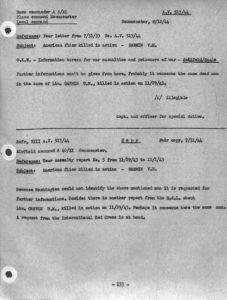
____________________

So, the central question:  What happened to Lieutenant Garvin?  A definitive answer will forever remain unknown, but a reasonable conjecture can still be made.

To start, a statement – filed by the Communications Officer of the 55th Fighter Group – accompanies the reports by Captains Ayers and Franklin in MACR 1427.  This document is a record of radio communication between a pilot with radio call sign “Swindle 48”, immediately followed by a similar call from “Swindle 38” (surmised to have been one and the same person) with “Rockcreek”, the radio call sign of the 55th Fighter Group.  Note that: 1) The call was repeated and appears to have been clearly and coherently spoken, suggesting (?) that the pilot was uninjured, and 2) There is no acknowledgement of Rockcreek’s transmission actually having been received by Swindle 38 / 48. 

A transcript of the Receivers Log follows:

Extract from VHF Ground Receivers Log of November 29, 1843:

     To Rockcreek From Swindle 48:  Request homing, 1-2-3-4-5 Over
     To Swindle 48 From Rockcreek:  Steer 332, Over
     To Rockcreek From Swindle 38:  Request Homing, etc.

     The Homing Station log also shows the transmission of another “steer” of 340 [degrees] to Swindle 48.  However, an acknowledgement of the receipt of either of these transmissions by Swindle 48 does not appear.  It will be noted that immediately following the communication Swindle 38 initiated his call for “Homing”.  It is possible that Swindle 38 had called previously and the call was mistaken to be Swindle 48. 

____________________

Here are some maps based on the transcript of the radio communication.

Map1 ) Using my handy-dandy 360-degree Staedtler protractor (not manufactured in the United States – but, I digress…!), and by setting Nuthampstead as a point of origin with “0” degrees at due east, I created this Oogle map showing steer plots of 332 and 340 degrees to Nuthampstead, from continental Europe.  Projecting these plots southeast towards continental Europe shows that both intersect the Belgian coast:  The first near Nieuwpoort, and the latter north of Bruges.  Note the time for “332” is 15:17, while no time is recorded for “340”.  Assuming that “340” was transmitted first and “332” later (for which there is no certainty) suggests that the transmissions are directed towards an aircraft flying along the Belgian and French coastline and travelling southwest.  (This map does not address the question of magnetic declination.)

Map 2) This Oogle map shows a straight-line course between Hoogeveen in the Netherlands and Hondschoote in France, which I think would approximate the direction of flight taken by Lt. Garvin.  The steer plots broadcast by Rockcreek to Swindle 38 / 48 can be seen to intersect the projected flight path in Belgium. 

Map 3) Hondschoote, in relation to Dunkirk.
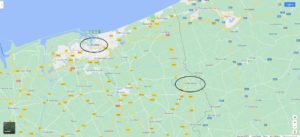
Map 4) Hondschoote, in relation to Lt. Garvin’s place of burial at Saint Omer.  He was interred in an isolated grave (Grave 165) at the Longuenesse (Saint Omer) Souvenir Cemetery, where are interred nearly 3,400 Commonwealth war dead from the Great War.  

Thus for James Michael Garvin, fighter pilot.

More importantly, what of James Michael Garvin, the man?

In partial answer, here are his mother’s letters in his IDPF:

Marcus, Iowa
Aug. 1, 1944

Personal Effects Bureau,
Kansas City, Quartermaster Depot,
Kansas City, Mo.

Dear Sirs:

Eight months ago, on Nov. 29. 1943 my son 2nd Lt. James M. Garvin A.C. 0-740164 was killed over Europe and to date, we have had no word about his personal effects except that they would be sent home from your depot.

His address was:
2nd Lieut. James M. Garvin A/C. 0-740164
38th Fighter Squadron
55th Fighter Group
A.P.O. 637

I am his mother, the beneficiary of his will and government insurance, and as he was unmarried, I will be the legal recipient of his personal belongings.

Any information you can give will be appreciated, and I hope for arrival of his things in the near future.

Thank you.

Respectfully,
Mrs. Eliza A. Garvin
Marcus Iowa – Nov 29 – 1944

Mr. A.S. Smith
Administrative Asst. Army Effects Bureau
Kansas City.

Dear Sir,

I am enclosing my administrative papers in response our son’s personal effects as you requested.  Please return same as when you are thru with them.  He was not married – therefore no widow or children.  And I am his beneficiary according to his Will.  Also I had Power of Attorney until his death.  Thank you for your efforts in locating his things.  We were anxious about them – as we know he has several souvenirs – also had rec’d several Xmas boxes a few days before his last flight – and his personal clothing were of the best – “his graduation things”  from Phoenix Ariz.  His father – Michael A. Garvin is still living here at home.

Mrs. Eliza A. Garvin
Marcus
Iowa
Box 475
In the context of the past century – and even today in 2021 – James M. Garvin was a child born quite late in the lives of his parents, Eliza and Michael Garvin.  They were 44 and 52, respectively, during the year of his 1915 birth.  They died in 1951 and 1947. 

Lieutenant Garvin is buried at Holy Name Cemetery, in Marcus, Iowa

This was his seventh mission.

________________________________________

2 Lt. James William Gilbride (bailed out – did not survive), P-38H 42-67097, MACR 1272

Photo of James Gilbride from Double Nickel, Double Trouble

Here’s Lieutenant Gilbride’s Draft Registration Card.
Here’s the cover page of the composite Luftgaukommando Report (number AV 414/44) for Lieutenants Gilbride and Hascall (see more about Hascall below). 
As you can see from the below image, the document is actually a single 11″ x 17″ sheet having twenty information fields, with two binder holes in the center.  Since Lieutenants Gilbride and Hascall did not survive, many of the information fields remain blank by default.

According to his biographical profile at FindAGrave, and confirmed in the Lutfgaukommando Report and IDPF, Lt. Gilbride managed to escape from his fighter, but his parachute failed.  

Here’s the German form reporting his death, which when searching NARA’s database is “pulled up” with the digitized images of Luftgaukommando Report AV 414/44.
The following correspondence, among the many pages in Lt. Gilbride’s lengthy IDPF, add a dimension to this story (and so very many other stories like it) wholly different from topics like tactics and technology; aerial victory claims (Lt. Gilbride didn’t have any – he simply did his duty); camouflage and markings; serial numbers; mission schedules.  (Albeit those facets of history are – well, yes – essential.) 

The words within these letters represent a side and consequence of war that, while not necessarily “making it into the history books” – in terms of that hackneyed expression – quietly persists, in its own way, as an echo that over times becomes inaudible.  But hopefully, never silent.

The following three documents are communications between Lt. Gilbride’s mother, and Mr. H. Solt, mayor of De Wijk, Holland.  Note that the letters appearing below are not Mrs. Gilbride’s original correspondence.  Instead, they’re English-language transcripts of letters received by Mayor Solt, which were incorporated into Lt. Gilbride’s DPF. 

This is Mrs. Gilbride’s letter of September 20, 1945.

“You can be of great help to all of us here at home, his wife, daughter, father and myself by letting us know any detail however small that you can get about him.  The burial information has not as yet been verified by our armed forces.  We lost a brave and wonderful dear one.  It might be that I don’t want to believe he is really dead and that is why my heart is telling me to sift all information.” 
Afschrift.

MRS. WILLIAM GILBRIDE
308 North Central Avenue
Chicago 44, Illinois U.S.A.
Sept. 20, 1945.

Mayor:
Koekange, Providence Drente, Holland.

Your Honor:

I have received a letter from my government telling me that my son, Lt. James Gilbride was buried in your town.  Lt. Gilbride was an American Army Fighter Pilot on a P-38, serial number 0-740-168.  He was last seen over the Netherlands, November 29th, 1943.  He was alone at the time having left his group to go to the aid of some comrades.  The German Government through the International Red Cross reported that he was shot down.  The report came through now that his remains were interred at Koekange, Providence Drente, Holland.  You can be of great help to all of us here at home, his wife, daughter, father and myself by letting us know any detail however small that you can get about him.  The burial information has not as yet been verified by our armed forces.  We lost a brave and wonderful dear one.  It might be that I don’t want to believe he is really dead and that is why my heart is telling me to sift all information.  Would I be asking too much of you to check this information for us?  Now that hostilities have ceased I feel that there will be no harm done in asking for information.  And we will all be grateful and indebted to you for anything that is done.  Enclosed is a picture of my son.  Could a mistake be possible and he [be] ill somewhere in your town?  Thank you for any kindness.

Yours truly.
(Mrs. William L. Gilbride.)

Voor eensluidend afschrift
De Secretaris van de Wijk

____________________

Here’s Mayor Slot’s reply of October 22, 1945.

Note the statement, “Eye-witnesses declared, that he left his group to go to the aid of some of his comrades.”  Thus, it would seem that civilian observers of the November 29 air battle witnessed Captain Franklin and Lt. Gilbride’s attempt to aid the 38th Fighter Squadron.  The distance of Lt. Gilbride’s body from his crashed P-38 – 6 kilometers (over 3.5 miles) when found by members of the Dutch Air-raid Precautions Service – suggests that he bailed out from his aircraft (an event not actually witnessed by his element leader, Captain Franklin) from an appreciable altitude.  

GEMEENTE DE WIJK (D.)

AFSCHRIFT.                                               DE WIJK (D), 22nd. October 1945.

No. 637
Antwoord op brief van
Onderwerp:

Mrs. William. L. Gilbride.
308 North Central Avenue
Chicago               Illinois. U.S.A.

Dear Mrs. Gilbride,

I received yours of the 20th. of September, and, of course, I am quite willing to tell you all I know about your son.

On the 29th. of November 1943 an American Fighter plane was shot down during an air-fight.  The pilot was your son, Lt. Gilbride.  He fell down near the railway at Koekange in de Wijk, about 6 kilometers from his plane.  When the men of the Air-raid Precautions Service arrived, he had already died.  His body was not damaged and the men present at the spot immediately recognized him from the picture enclosed in your above letter.  His mark of recognition contained the following inscription:

James W. Gilbride, 0-740-168 T 42/43/0 Ventura (California).

On the 30th. of November 1943 he was buried on the general cemetery at Koekange.

His possessions were seized by the Air-raid Precautions Service, but later overtaken by the Germans.

Mr. Hendriks, Commander of the Air-raid Precautions Service helped many allied pilots to flee from the Germans.  Unfortunately it was too late for your son, as he had already died.  Eye-witnesses declared, that he left his group to go to the aid of some of his comrades.

A committee has collected money to erect a monument on his grave, but the American Government intends to re-inter all soldiers, killed on central cemeteries so that the erecting of a monument has been postponed for the time being.  I suppose I am allowed to keep the picture, that I can hand it to Mr. Hendriks, who rendered assistance at  the time.

I console with you on the grievous loss of your dear son, one of the many, that offered up their life for the freedom of our country too.

Let us hope, that his sacrifice has not been in vain and that this terrible war has been the last one.

On the birthday of our Queen, the 31st of August, a service in commemoration of the heroes who fell in the battle for freedom was held near the grave of your son.

Many inhabitants were present.  When playing the national hymns a wreath was laid on the grave.  The service made a deep impression on the people.

I hope that knowing this, you will have a better remembrance of your dear son.

Yours truly
signed H. Slot.
Mayor of de Wikj
Drenthe – Holland.

Voor eensluidend afschrift,
De secretaris van de Wijk,

____________________

And, Mrs. Gilbride’s reply of November 26, 1945 to Mayor Slot.

“Day after day and always our hearts were heavy not knowing whether he was cold, hungry or tormented.  He was glad to do his duty and if it were God’s will that he should die we were willing to accept that too.  The thing that haunted us was not knowing what had happened to him.  Your letter is something that we will always treasure and cherish.” 

AFSCHRIFT.         MRS. WILLIAM GILBRIDE

308 No. Central Avenue
Chicago44, Illinois, U.S.A.
November 26, 1945.

Mayor of de Wijk.
Drenthe – Holland.

Dear Sir,

There are no words to express our thanks and gratitude to you and the others of Drenthe for the kindness and care shown our son the late Lt. James Gilbride.  Since he was reported missing, we have not only grieved but constantly wondered and worried as to his fate, what he suffered and into whose hands he fell.  Day after day and always our hearts were heavy not knowing whether he was cold, hungry or tormented.  He was glad to do his duty and if it were God’s will that he should die we were willing to accept that too.  The thing that haunted us was not knowing what had happened to him.  Your letter is something that we will always treasure and cherish.  God has heard our prayers.  In His mercy He let our son’s death be swift and merciful.  He was watching over him even in death, for it was God who directed him to fall in your town where good and kind people laid him to rest.  It touched us deeply to know that a monument was to be erected on his grave, that the service in memory of the war heroes, held on your Queen’s birthday, was held near the grave and a wreath placed there.  I am sending our War Department a photographic copy of your letter.  It is his father’s wish and mine that he might be left to rest in peace right there.  This, of course rests with our War Department and as to whether your Queen would grant him that privilege and care for his grave.  Do let Mr. Hendriks keep the picture.  I know how busy you must be so I am going to ask if Mr. Hendriks could arrange to have a couple of snaps  taken of the burial place and grave.  Am enclosing three dollars to cover the expense.  Have sent four packages with food and sweets.  Will be sending more and clothing too.  I know that nothing we do can repay what has been done.  If there is anything that we can do please do not hesitate to ask us.  Our son has been decorated for having gone back at different times to help his comrades.  My husband’s maternal grandparents came from Utrech, in Holland.  I put two American Flags in one of the boxes to be placed on the grave.  My husband and I are going to try and visit the grave in the future.  Again accept our thanks.

Sincerely yours,
signed. Bess Marie Gilbride.

Voor eensluidend afschrift,
de Secretaris van de Wijk,

____________________

If Lt. Gilbride has been remembered at all, this has probably been in association with his assigned P-38H, aircraft 42-67053, “CY * L“, the name of which – “Vivacious Vera” – was inspired by his wife’s own name. 

The plane’s history was recorded on its port gun-bay access door (salvaged after its crash-landing on December 13, 1943 – seen link below), and states:

“This part of door cover retrieved from wreckage of P-38H 42-67053 with the squadron letters  CYL.  Flown first at Lockheed Liverpool Air Depot by C.H. Wilson, chief Test Pilot, Lockheed, 9-15-43.  1st ship to arrive at this field, 9-21-43.  1st person to fly plane on this field, Col. Frank B. James, 9-22-43.  Originally assigned to Lt. Gilbride 10-10-43, who was missing in action 11-29-43.  Ship was named after his wife.  Reassigned to Lt. Goudelock 12-12-43.

“Lucky Ship”

Lt. Hiner returned safely from Zuyder Zee on single enine, distance 250 miles.
Lt. Stanton returned safely from Ruhr Valley on single engine, distance 250 miles.
Lt. Goudelock returned from Kiel on single engine, distance 375 miles 12-13-43, and crashed in village of Ludham, due to lack of gas.  He was not seriously injured.

Ship completed 18 missions inclusive.

Well, the name and nose art are memorable, the latter I would think inspired by a pin-up by or in the style of Alberto Vargas. (Well, I’ve not yet been able to identify any work by Vargas that actually resembles this painting!)
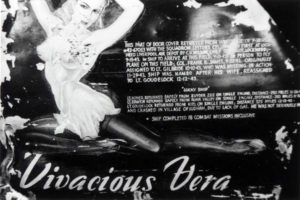
Much more importantly, and perhaps inevitably – given the “way of the world” – forgotten over the past near-eight decades was the fact that the real “Vera”, Lt. Gilbride’s wife, was much more than simply a nickname on an aircraft. 

Found within Lt. Gilbride’s IDPF, two of her letters, and one letter of her mother, appear below.

__________

This letter was typed on “SkyMail” stationary, back when when air-mail was still a “thing”, and physical letters were equally a taken-for-granted “thing”.  Sent to the Army Effects Bureau in Kansas City, Vera E. Gilbride requests the property of her late husband.

Route 1, Box 203-B
Ventura, California

September 12, 1944

A.L. Smith, Administrative Assistant
Army Effects Bureau
Kansas City Quartermaster Depot
601 Hardesty Avenue
Kansas City 1, Missouri

No. 92228 D

Dear Mr. Smith

     I am in receipt of your letter of September 9, 1944.

     Will you please send me the personal property of my husband, Lieutenant James W. Gilbride to the above address.

     I am Lieutenant Gilbride’s legal widow.

Sincerely,
Mrs. Vera E. Gilbride

__________

This letter, penned by Vera’s mother over a year later – Mrs. Mortime Lyman Eddy (her actual name was Laurel Nelson Etta Edy) – was also addressed to the Army Effects Bureau.  The impetus for her communication with the army was the family’s receipt of Lt. Gilbride’s wedding and signet rings which, remarkably and hauntingly, were received by the family exactly two years and one day after Lt. Gilbride’s death.  Note that the family’s receipt of the Lieutenant’s rings has caused far more consternation and confusion than it did comfort:  Other than having earlier been notified of the Lieutenant’s death, per se, it seems that absolutely no further information was received during the intervening two years.  The letter concludes with Mrs. Eddy’s frank expression of worry about her daughter’s well-being.

Rt. 1 Bx 203-B
Ventura, Calif.
Nov. 30, 1945

War Department
Army Effects Bureau
Kansas City Quartermaster Depot
601 Hardesty Avenue
Kansas City 1, Missouri

Dear Sirs:

     A package consisting of a wedding ring and a signet ring, received today, personal effects belonging to 2nd Lt. James W. Gilbride, 0-740168.  Two years ago yesterday, Nov. 29, 1943, he was shot down, presumably.  We have never received any authentic word, other than missing, then dead.  Could you give me any direct information about his body, or direct me to some one that does know?  He had these rings on, that we do know, for it was a pledge.  Now we know the body was found, and evidently by friendly people, otherwise the rings would have been taken off.  Was he alive when found and took to a hospital?  My daughter is ill [and] if she could get something definite she could no doubt pull her self out of this – I’m terribly worried about her.  This is our first attempt to try and find out something about him.  Please tell us where the rings came from and has he been alive for a long time since going down?

Yours very truly
s/ Mrs M.L. Eddy.

__________

Some time during the subsequent two and a half years, Vera Gilbride remarried, to become Vera E. Gilbride Olson: She symbolically retained Lt. Gilbride’s surname.  In this letter, she notifies the Army of her request to have Lt. Gilbride buried at an American military cemetery.

March 3, 1947

The Quartermaster General
     Attention: Memorial Division

Gentlemen:

     I, Mrs Vera E. Gilbride Olson, widow of the late Lt. James W. Gilbride SN 0-740168 have remarried.  My current address is Vera E. Olson, Rte 1 Box 376, Ventura, Calif.  It is my request that the remains be left in an American Cemetery over-seas.

     If I am not the authorized person will you please inform me that has been done so I will be able to tell the deceased minor daughter.

Very truly yours
Mrs. Vera E. Olson

The above is only a small portion of the correspondence within the IDPF for Lt. Gilbride, the majority of which pertains to the local of his final place of burial:  Whether at an ABMC cemetery in Europe or the United States, and in case of the latter, where specifically within the United States.  Sadly, the correspondence strongly suggests little to no communication, if not a near-complete lack of  interaction, between Lt. Gilbride’s parents and their daughter-in-law.

Time passed.  

After the construction of the National WW II Memorial and the creation of its associated website and database, Vera Etta Eddy Gilbride Olson created two Memorial pages in her late husband’s honor.  You can view them here and hereOne of the Memorial pages includes mention of the couple’s daughter having been born six weeks after her father was killed in action.

Born on November 28, 1916, Vera Olson died on November 1, 2004.  She, her parents, and her siblings are buried at Ivy Lawn Memorial Park in Ventura, California.     

The original version of this post displayed an Oogle map of the area between Hoogeveen and Meppel, albeit with no specifics about where Lt. Gilbride and his P-38 fell to earth.  The caption was:  “This Oogle map shows the general location where Lt. Gilbride and his plane fell to earth:  In the vicinity of De Wijk and Koekange, near the railroad line connecting Meppel and Hoogeveen.”

This revised map, based on information at Teunis Schuurman’s WW II – Research by PATS blog, shows the location where Lieutenant Gilbride’s body was found: “He was found in Koekange near the Emsweg (former Municipality De Wijk).  The aircraft did crash in the Oosterboer – location Binnenweg – (nowadays new housing).”

Born in 1917, James William Gilbride, whose parents resided in Chicago, is buried at Camp Butler National Cemetery, in Springfield, Il. (Plot C, Grave 128) 

This was his tenth mission.

____________________

2 Lt. John Sherman Hascall, P-38H 42-67016, MACR 1424

20th Fighter Group, 77th Fighter Squadron

(“Spare”, with 2 Lt. Robert D. Frakes)

Photo of Lieutenant Hascall, from the Michigan Technological University Website

Lieutenant Hascall’s Draft Registration Card…

Lt. Hascall was able to escape from his damaged P-38 and deploy his parachute successfully.  Sadly, he had the awful misfortune of descending into the Schutsloterswidje, a small lake west of Meppel (shown in the Oogle map below).  Ironically an accomplished athlete and excellent swimmer, he was unable to extricate himself from his parachute and was pulled underwater.  Despite the concerted efforts of rescuers and a local physician, he did not survive.

Here is the German form reporting Lieutenant Hascall’s death, this document being associated (via searching NARA’s database) with Luftgaukommando Report AV 414/44. 
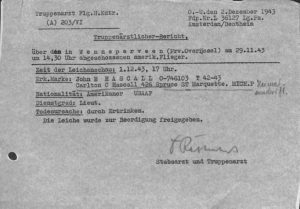
An Oogle map view of Schutsloterswidje…
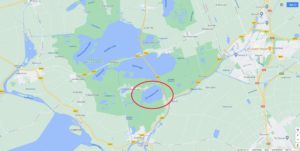
Here’s a low-resolution view of the Schutsloterwijde (looking south), by Marco van Middelkoop, from AeroPhotoStock, an image bank for aerial photos of the Netherlands.  You can view a (much) higher resolution image here.  

Caption: “Schutsloterwijde, De Wieden, Nederland, 6 juni 2015.  De Wieden vormt samen met de Weerribben het Nationaal Park Weerribben-Wieden, dit park is het grootste aaneengesloten laagveenmoeras van Noordwest-Europa.  Het landschap is vooral ontstaan door vervening en rietteelt. De plassen zijn ontstaan doordat bij het opbaggeren van turf de trekgaten, waaruit de turf werd gebaggerd, te breed werden en de ribben waar de turf op werd gedroogd te smal.  Tijdens de stormen van 17767 en 1825 werden de ribben weggeslagen en ontstonden onder andere de Beulakerwijde en Belterwijde.”

Translation:  “Schutsloterwijde, De Wieden, The Netherlands, June 6, 2015.  The Wieden, together with the Weerribben, form the Weerribben-Wieden National Park, this park is the largest continuous peat bog in northwestern Europe.  The landscape was mainly created by dying and reed cultivation.  The puddles were created because during the dredging of peat, the draft holes from which the peat was dredged became too wide and the ribs on which the peat was dried too narrow. During the storms of 17767 and 1825 the ribs were knocked away and the Beulakerwijde and Belterwijde, among others, were created.”

Lt. Hascall is buried at the Netherlands American Cemetery and Memorial (Plot H, Row 8, Grave 9), in Margraten, the Netherlands.  His story and life are recounted at The Last Flight of John Hascall, at Michigan Technological University Magazine. 

Lt. Hascall’s record at the ABMC website indicates that he was the recipient of one military award – the Purple Heart – implying that he flew less than five combat missions. 

________________________________________

Two survivors: Lieutenants Carroll and Suiter

2 Lt. John Joseph Carroll (38th Fighter Squadron), MACR 1431

“Lt. Albert A. Albino of Aberdeen, Wash., and Lt. John J. Carroll [right] of Detroit, Mich., both members of the 38th Fighter Squadron stationed at Nuthampstead, England, discuss the map of a future target in the squadron pilot room.” (Army Air Force Photo B1 79830AC / A14145 1A)

Photo of John J. Carroll, from Double Nickel, Double Trouble
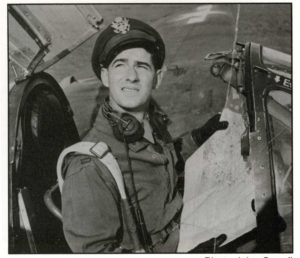
John Carroll’s POW identification photograph, also from Double Nickel, Double Trouble.  He was imprisoned in the North Compound of Stalag Luft I.
Here is John Carroll’s (no longer a Lieutenant when he wrote this!) account of the November 29 mission, from Double Nickel, Double Trouble.  He titled his story: “The Saga of ‘A’ Flight, Lost November 29, 1943.” 

“This tabulate returns to the days of yesteryear when 20/20 vision was quite normal, coordination was automatic, briefings were at uncompassionate hours, each time respects were paid to “Festung Europe”; there were numerous more of them than there were of us.  Such was the circumstance, November 29th, 1943.

“I was flying wing to our C.O., Major Milton Joel, when our flight was cut off by a gaggle of Me-109s and the group was headed away from us in a westerly direction.  Joel and I went into the “weave formation”, which theoretically would protect one another’s tail.  Directly after our first pass-by I caught a glimpse of a P-38 headed down trailing smoke and minus a section of tail (Albino or Garvin?).  Following our third pass-by it became obvious that “the weave” does not perform without flaw.  At the crest of my turn I glanced across the projected pattern and observed what should be Joel’s A/C seemingly to disintegrate. 

“Almost immediately thereafter, I felt an instant yaw to starboard and noted the engine on fire, plexiglass everywhere, and the instrument panel badly damaged.  I kicked rudder into the yaw and opened the port engine to the firewall, at the same time putting the nose straight down and headed for a cloud layer.  On breaking out at the base of the layer, and utilizing it for top cover, I took a heading for England on the magnetic, which was still operable.  After approximately 5 or 10 minutes, with the cross feed off (the prop would not completely feather), I determined the fire was getting out of hand.  I realized I could not make the island without either exploding or crashing into the North Sea, which at that time of year had little in common with the Caribbean! 

“When bailing out of a P-38 one must render considerable delicacy, lest one desire a speedy trip to eternal reward – or damnation as the case may be.  At this point I found that the canopy release handle would not perform its assigned task.  By raising the seat and using my head as a battering ram and with the aid of a reasonable slipstream I was able to dislodge the obnoxious piece of equipment.  I then lowered the port wing, trimmed the A/C into a 45 degree climb, cut the engine, and climbed out onto the wing holding on to the corner of the canopy.  At almost the peak of stall, I let go and missed the tail by about a foot.  This was most fortunate, as going out feet first rather than on one’s belly, the counter-weight could proffer a rather serious problem. 

“Now here is the period in which the individual obtains a morbid curiosity as to whether the chute is going to open.  As a result of this dilemma I counted to ten, per instructions, faster than normal beings count to two.  Upon reading this one may justly surmise as to its workability!  May the Lord bless and keep all chute packers, past and present! 

“The landing, if one may call it that, was on the roof of a barn-like building in Holland somewhere west of Meppel.  Ignominiously the chute collapsed sending me on a Disney-like ride down the roof and ending, not unlike a ski-jump, on to some form of machinery.  This display of dexterity lost me the use of my right leg for some months to come.  It was also at this time that I came to realize that I had been wounded in the right hand and shoulder.  Curiously, I felt neither until this time. 

“The Wermacht arrived, having followed the chute down…  One would have thought thay had caught John Dillinger rather than saintly John Carroll.  “Luft gangster, Chicago, Roosevelt terror-flieger!” they greeted, plus a few chosen obscenities, which at this time I understood to a minor degree.  (However, upon my release I was quite able to return curse for curse in fluent Kraut.)

“I was ultimately taken to Leewarden, Amsterdam, Dulag Luft, and finally to Stalg Luft I, Barth, Germany, in North Compound I, under Col. Byerly.  I served as entertainment officer due to my background in broadcasting and the theater.  This was a task of reasonable importance to the facilities at hand, and the substantial emphasis placed on morale.  It even obtained a field promotion for me but I would be most remiss if credit for fortitude, versatility, and camaraderie to my compatriots were not acknowledged. 

This revised map, based on information at Teunis Schuurman’s WW II – Research by PATS blog, shows the general location where Lieutenant Carroll’s plane – FOB Detroit – crashed: “…near the tiny farm community Zwartewatersklooster – just outside Zwartsluis.”

Born in 1919, John J. Carroll, Sr., died on June 11, 2003.  He is buried next to his wife Catherine at Greenwood Cemetery, East Tawas, Michigan

The mission of 29 November was his ninth.

________________________________________

2 Lt. Fleming W. Suiter (343rd Fighter Squadron), MACR 1273

These news items about Lt. Suiter can be viewed at his FindAGrave biographical profile, where they have been provided by contributors Carl and Arthur Allen Moore III.

Along with Lt. Carroll, Lt. Suiter was the other survivor among the six 55th Fighter Group pilots shot down this day.  Captured, he spent the remainder of the war as a POW the South Compound of Stalag Luft I. This was his seventh mission. 

Remaining in the Army Air Force, he was – ironically – (how very inadequate a word) killed on military service in the United States nearly one year after the end of the Second World War:  On August 10, 1946, his P-47N Thunderbolt (44-88653, of the 63rd Fighter Squadron, 56th Fighter Group, based at Selfridge Field, Michigan) crashed west of Antrim, New Hampshire. 

An Oogle map view of Meppel, Holland, where Lt. Suiter came to earth. 

The November 29 mission was his seventh.  

Lt. Suiter is buried at Rome Proctorville Cemetery, in Proctorville, Ohio.  

________________________________________

The View from 1947: A search in Germany

At 1945’s end, Lieutenant Albino and Major Joel were still missing – albeit declared dead – their final fates unknown.  In this regard, Major Joel’s Individual Deceased Personnel File includes a detailed report concerning the search for Lieutenant Albino, completed by T/4 John W. Johnson of the Army Graves Registration Command.  The presence of this document in Major Joel’s IDPF is unsurprising, given that the circumstances under which both men vanished were in effect and reality parallel. 

It is surprising that Major Joel’s name remains unmentioned in T/4 Johnson’s report, or was not the subject of an independent report.  But, anyway…

In his effort to trace Lt. Albino’s fate, T/4 Johnson surveyed the German city of Oldenburg, and towns and villages to its south to southwest, in light of the Lieutenant’s last reported location in the Missing Air Crew Report.  (The localities were Ahlhorn, Beverbruch, Cloppenburg, Edewecht, Falkenburg, Garrel, Molbergen, Nikolausdorf, and Petersfeld.)  His conclusion, based on communication with public officials and clergy in those localities – that the Lieutenant did not crash in that vicinity – was entirely correct.  But, the reason for its veracity would remain unknown until 1978, when Lt. Albino and his plane finally were confirmed to have fallen into the Dutch town of Hoogeveen, well to the southwest of those German towns and cities.  

Here’s T/4 Johnson’s report.

ROTHWESTEN DETACHMENT
FIRST FIELD COMMAND
AMERICAN GRAVES REGISTRATION COMMAND
APO 171, US ARMY

13 December 1947

NARRATIVE REPORT OF
INVESTIGATION

I was dispatched on 23 October 1947 from this headquarters to Oldenburg, Germany (K-54/R-30) to investigate AGRC Case # 8632 pertaining to 2/Lt Albert A. Albino who was pilot of a P-38 and according to Operational Instructions # 41 was last sighted southwest by west of Oldenburg, Germany.  Lt Albino failed to return from a bomber escort mission to Bremen, Germany.  The date that the above mentioned flyer was last sighted near Oldenburg was 29 November 1943.  The cause of death is not mentioned in MACR # 1428.

I first went to the administration office in Oldenburg to check their records.  This office is in charge of the cemetery in Oldenburg and also has records of all Allied deceased in the county of Oldenburg.  At this office I received a statement (see Incl # 1) that according to a notice left by the 611th QM GR Co., seventy deceased of American nationality who were buried in the Military section of the New Cemetery in Oldenburg were disinterred and evacuated to an unknown destination.

It was also stated that according to the records (see Incl. # 2) held by this office 2/Lt Albert A. Albino who died on 29 November 1943 was not buried in the Oldenburg Cemetery.

Edewecht, Germany (K54/R10) is about four (4) miles southwest by west of Oldenburg.  I received a statement (see Incl. # 3) from the administration office of the community of Edewecht which covers all the surrounding villages in that vicinity.  The statement reveals that they have no records pertaining to plane crashes.  No one in this small town had any knowledge of any plane crashes so I then went to the county office in Cloppenburg, Germany (K53/R27) which is about 20 miles southwest by west of Oldenburg.

At the county office in Cloppenburg I received the only records they had (see Incl # 4) about American and English plane crashes.

There are two statements (see Incl’s # 5 and 6) received on 8 October 1947, and 9 October 1947 while I was investigating another case which mentioned a fighter plane which crashed in the village of Nutteln.  The date of this plane crash is not the same as that of the plane crash in question.

At Ahlhorn, Germany (K53/W37) which is about 12 miles south of Oldenburg, I received a statement at the Police headquarters (see Incl. #7).  The Police state that they have no records of any plane crashes, that all crashes were reported to the German Air Base in Ahlborn, and that the former Burgermeister may be able to give some information pertaining to plane crashes in this area.

Upon contacting Hans Roennen the former Burgermeister, I received a statement (see Incl. # 8) to the effect that all planes crashed in the vicinity and all deceased who were killed there in plane crashes were taken care of by the German soldiers of the Air Base in Ahlhorn, therefore there were no records kept by him.

I next went to the cemetery in Ahlhorn and contacted the cemetery caretaker.  I received a statement (see Incl. # 9) that all Allied deceased were evacuated in July 1946 by a British Unit and that when an American team came there for American deceased they had discovered that two American deceased were removed by mistake probably by the British unit.

I learned while conducting this investigation that ninety (90) American deceased were buried in the New Cemetery at Bad Zwischenehn, Germany (K54/R10).

I first went to a Parson Bultermann in Bad Zwischenahn who kept the burial books in which all deceased were entered who were buried in the local cemetery.  The Parson was not at home but I received a statement from his wife (see Incl. # 10) that no 2/Lt Albert A. Albino was entered in their burial books and one of the deceased buried in the cemetery in Bad Zwischenahn.

I next went to the community director’s office in the above mentioned city and received a statement (see Incl. # 11) that the name of Albert A. Albino 2/Lt does not appear on their records.  I also received a copy from this office of a list of all Allied deceased who were buried in the local cemetery (see Incl. # 12).  The notice of disinterment which was left by the 3048th QM GR Co who disinterred and evacuated the ninety American deceased in April and May of 1946 (see Incl. # 13) was also received.

At the town of Molbergen, Germany (K 53/W71) which is 25 miles southwest of Oldenburg I received a statement (see Incl # 14) from the community director that no American planes crashed there.  Only one plane crashed which was a Canadian fighter plane.

At Garrel, Germany (K53/W18) which is 18 miles southwest of Oldenburg I received a statement from the former Burgermeister (see Incl. # 15) which gave information on four, 4 engine bombers that crashed in four near-by villages.  He further states that all fighter planes that crashed in the community were those of German origin.  I then proceeded to check two nearby villages that were mentioned in the statement above to determine whether an American fighter plane could have crashed in their areas.

Petersfeld was mentioned in the statement of the former Burgermeister of Garrel as the place where one 4-engine bomber had crashed.  The community office of Varelbusch, Germany (K53/W71) is in charge of Petersfeld which is mostly swamp land.  I received a statement from this office (see Incl. # 16) that all plane crashes were taken care of by the German Air Base of Ahlhorn and the deceased taken to Gloppenburg.

I then went to the Catholic Priest of Varelbusch who is in charge of the local cemetery.  The statement received from the Priest (see Incl. # 17) states that there was no cemetery there during the war and that all deceased were buried in Cloppenburg.

At Falkenburg, Germany which is in the nearby vicinity of Garrel I received a statement (see Incl # 18) from a farmer who was the only one there who knew of a plane crash in the spring of 1943.  This crash was a 4 engine American bomber and was all taken care of by German soldiers and the deceased and wreckage were taken to Cloppenburg.

At Beverbruch which is also in the vicinity of Garrel I received a statement from a farmer about another 4-engine bomber (see Incl # 19) which was also taken care of by the German Air Base of Ahlhorn.  He had no knowledge of any fighter plane crashes.

I next-contacted a nearby farmer of the same village who stated (see Incl. # 20) that he only had knowledge of one plane crash which was of that mentioned in the statement above (Incl. # 19).

I then went to the town of Nikolausdorf which is also in the community of Garrel and contacted the Alderman who is in charge there.  The statement I received from him (see Incl # 21) mentions three 4 engine bombers that crashed in the nearby vicinity which I already have received statements concerning.

CONCLUSION:  It can be concluded that after investigating Oldenburg and community and all towns and villages south and southwest by west of Oldenburg down to Cloppenburg that the fighter-plane in question did not crash in the vicinity where it was last sighted as mentioned in Operational Instructions # 41.

/s/t/ JOHN W. JOHNSON
T/4 RA-20120960
Investigator

________________________________________

Time Moves On: A Postwar Memorandum

It is now 1949.  Two years have passed since T/4 Johnson’s investigation into Lieutenant Albino’s fate.  Major Joel’s IDPF now contains a memorandum to the Casualty Section of the Adjutant General’s Office dated May 2, 19494, which – by combining and reviewing information from: 1) Missing Air Crew Reports, 2) a German list of American Dead reported on April 1, 1944, 3) a tabulation of VIII Fighter Command P-38 pilots lost in combat lost on November 29, 1943, and 4) what is obviously a set of Luftgaukommando Reports (though the term isn’t used in this Memorandum) for VIII Fighter Command P-38 pilots lost that day – arrives at the unavoidable conclusion that, given the information in these records and the passage of five and a half years, no further hope could possibly held for the survival of either the Lieutenant or Major.

Here’s the Memorandum:

AG 704 DEAD (2 May 49)                    McG/sap/1B737/1263

2 May 1949

MEMORANDUM TO:      Officer in Charge, Casualty Section
Personnel Actions Branch, AGO

SUBJECT:                          Report of Death 

The following named officers, members of the 38th Fighter Squadron, 55th Fighter Group, were reported missing in action since 29 November 1943, over Germany, while in flying pay status, by a radio message from USSOS, London to WAR, dated 4 December 1943, casualty message number 339065-S:

Maj – Milton Joel              – 0416308
2nd Lt – Albert A. Albino – 0743300

Missing air crew report number 1429, dated 1 December 1943, currently on file in the Office of the Quartermaster General, reports that Major Joel was the pilot and sole occupant of a P-38 type aircraft, number 42-67020, of the 38th Fighter Squadron, 55th Fighter Group, which departed its base on 29 November 1943, on an escort mission to Bremen, Germany.  The report further states that Major Joel was last seen flying with his wingman, Lieutenant Garvin, “SW by W of Oldenburg”, at 1410 hours, that he was believed lost as the result of enemy aircraft, and that the weather conditions at the time wore “CAVU Above An Overcast.”  Captain Jerry H. Ayers, 0659441, is shown as the person who last sighted Major Joel.

A statement by Captain Ayers, attached to the missing air crew report is as follows:

“We were on a B-17 escort mission to Bremen, Germany, when at 14:10, just prior to our R.V. point we were jumped by Hot Bandits.

“Major Joel was leading the first section of the Squadron composed of eight ships.  Lt Wyche was leading the other Flight in the lead section.

Capt Hancock was leading the second section and I had the other flight.  Due to abortive aircraft Major Joel had lost his second element also Lt Wyche had lost his.  Capt Hancock and his wing-man returned.  My second element had returned and we were trying to rejoin into two fair ship flights.  Then we were successively bounced by units from a group of about 40 enemy aircraft from one or two o’clock, out of the sun.  We turned right into the attack and were engaged for some time.  At the time of the first break was the last time that I saw Major Joel and his wingman, Lt Garvin, that I could recognize them.”

Another statement attached to the missing air crew report submitted by Captain R. C. Franklin, Jr., which reveals further information concerning the disappearance of Major Joel, reads as follows:

On 29 November 1943, my wingman, Lt J.W. Gilbride, and myself participated in an engagement in which Major Joel, C.O. of the 38th Fighter Squadron, and his wingman, Lt Garvin, were lost and possibly this statement may shed some light on their disappearance.

The main body of the group was proceeding toward home when Major Joel was heard calling for help from far behind us.  Lt Gilbride and I turned back to help but it took several minutes for us to reach the fight.  As we drew near we could see five P-38s engaged and each had from one to three ME 109s on its tail.  Just before we went into the fight one P-38 rolled over and went down with its left engine leaving a very long and very heavy trail of black smoke and with a 109 behind.  As my wingman and I flew into the middle of the engagement the E/A were surprised into rolling away from the ships they wore attacking and we were all able to take a heading for home.  At this time there were four P-38s left besides my wingman and myself.  As we started home we were followed by E/A and we tried to outrun them.   One of the four P-38s ran away from the rest and disappeared.  The five of us remaining were eventually caught by the E/A and engaged again.

After we saw the one P-38 go down smoking I did not again recognize Major Joel’s voice on the radio.  The five of us that were later engaged by the pursuing E/A were, Capt Ayers, Capt Beaird, Lt Erickson, Lt Gilbride, and myself.  On this attack I lost one engine that had been going bad and when I recovered the only other P-38 visible in the area was piloted by Lt Erickson.  We came out together.

In view of the circumstances it is my personal opinion that the P-38 we saw shot down was piloted by Major Joel and the one that ran away from us was piloted by Lt Garvin, who did not return.”

Missing Air Crew Report number 1428, dated 1 December 1943, on file in the Office of the Quartermaster General, reports that Second Lieutenant Albert A. Albino, 0743300, was the pilot and solo occupant of a P-38 type aircraft, number 42-67051, of the 38th Fighter Squadron, 55th Fighter Group, which departed its base on 29 November 1943 on an escort mission to Bremen, Germany.  Captain Thomas E. Beaird, Jr., 0427117, is reported as the person who last sighted Lieutenant Albino at 1410 hours, southwest by west of Oldenburg.  Lieutenant Albino’s ship is believed to have been lost as a result of enemy aircraft and the weather conditions at the time were reported as “CAVU Above an Overcast”.

Attached to the report is the following statement of Captain Thomas E. Beaird, Jr:

Our flight was slightly trailing the other three flights going to the rendezvous.  Our flight leader had to fall out and called to me to take over.  I acknowledge and called the flight to step up the mercury as I was going to catch up.  At this time Lt Albino was 2nd in the flight, approximately 3 ship lengths behind me and approximately 4 ship lengths in front of Lt Peters.  We were in the same relative position, but had closed considerably on the leading flights, when someone called, “Bogies coming down at three o’clock, get rid of your tanks”.  I turned to the right dropped my tanks and looked to see if Lt Albino and Peters had gotten rid of theirs.  This was the last time I was able to locate Lt Peters or Albino as almost immediately we were bounced from approximately 8 o’clock and the lead flights from I think, about 1 o’clock.

After we tangled there seemed to be nothing but individual ships that joined up to make flights as best they could.”

A statement by Second Lieutenant Edward P. Peters, also attached to the missing air crew report, is as follows:

I was flying #2 position in a flight lead by Capt Hancock.  Capt Hancock started a turn to the right, leaving because of engine trouble, and as we were deep in enemy territory I started with him, however, he called and said I should turn back to accompany group.  I started to return but by this time I had fallen way back, out of formation and as I increased manifold pressure my left engine cut out at 24” HG-.  I continued trying to catch up and ahead of me about ½ a mile was Lt Albino and ahead of him was Capt Beaird.  He, Lt Albino, was quite a distance behind Capt Beaird and I followed for about 4 or 5 minutes.  At this time the group was bounced and the order give to drop ‘babies’.  I looked behind and directly below saw six E/A which I called in.  I looked above and behind and saw one E/A diving at me from about 7 o’clock.  I broke into him and he fired at me as he passed over top.  I looked for the group but as I could only see their contrails, and duo to the one faulty engine, I turned and came back alone.

It is possible that the E/A which attacked me or the six below could have continued on their way and caught Lt Albino as he was straggling.”

German List of American Dead #22, dated 1 April 1944 at Saalfeld / Saale, Germany contains the following entry:

58 – USA – UNKNOWN – Flier – Machine – Shot down – Place of burial
Lightning – 29 November 1943 – not yet reported
1430 hours Holland

Letter of inquiry, AG 704 (24 Jun 44), dated 24 June 1944, was dispatched from the Adjutant General’s Office to the Commanding General, United States Forces, European Theater of Operations, requesting that the names of all “Lightning” pilots who became missing in action in that Theater on 29 November 1943 be reported to this office.  In reply, a 2nd Indorsement, dated 15 July 1944, from Hq. USSTAF, was received which reported the names of seven “Lightning” pilots who were missing in action on 29 November 1943.  The time and place that these officers were last seen as reported by this 2nd Indorsement, and their present status are shown below:

Name – ASN – Grade
Time – Place Last Seen – Present Status

Hascall, John S. – 0746103 – 2d Lt
1315 – over mid-Channel – KIA

Albino, Albert A. – 0743300 – 2d Lt
1410 – SW by W of Oldenburg – PDD

Garvin, James M. – 0740164 – 2d Lt
1410 – SW by W of Oldenburg – KIA

Carroll, John J. – 0743313 – 2d Lt
1410 – SW by W of Oldenburg – POW-EUS

Joel, Milton – 0416308 – Maj
1410 – SW by W of Oldenburg – PDD

Gilbride, James W. – 0740168 – 2d Lt
1440 – 10-15 Mi. W of Meppel – KIA

Suiter, Fleming W. – 0743383 – 2d Lt
1300 – near Heede, Germany – POW-EUS

Following the cessation of hostilities in the European Area, a number of official German records were captured, and are currently on file in this office.  Although these records are incomplete, they, nevertheless, have assisted materially in solving the status of a number of persons previously reported missing in action.  Reports currently on hand pertaining to the disposition of persons listed above are as follows:

Reports J 304 and AV 414/44 pertains to the downing of Lt Hascall at Wanneparveen (Oberuezel) on 29 November 1943, with cause of death listed as ‘drowned’ and interment on 3 Docember 1943 at Wanneparveen Cemetery, grave No, 1, west side, middle section.

Reports J 338 and AV 513/44, pertain to the downing of Lt Garvin on 29 November 1943, crashed by collision at Handschoote – Pas de Calais, listed as dead and interred in Grave No. 165.

Report No. AV 414/44 pertains to the downing of Lt Gilbride, on 29 November 1943 at 1345 hours, at Railroad Meppel – Hoogeveen, near Koekange, death caused by fracture of skull and cervical vertebra.  He was interred on 1 December 1943 at Koekange Cemetey, (Drente) in grave No. 33, Row 2.

Report No. J 305, pertains to the capture of Lt Suiter as the result of the downing of a Lightning plane on 29 November 1943.

Report No. J 302, pertains to the capture of Lt Carroll on 29 November 1943 as result of the doming of a Lightning plane.

Report No. J 307 pertains to the downing of a Lightning plane at 1430 hours in Holland, pilot listed as dead, identification unknown.

The foregoing facts show that seven P-38 Lightning fighter pilots were reported missing in action on a raid to Bremen, Germany, on 29 November 1943.  Due to many abortive planes from the original group, several individual planes formed new flights and several were unable to join up and became stragglers.  Just prior to reaching the rendezvous point, the flight was jumped by a superior number of enemy aircraft.  It was at this time that Lieutenant Albino was last seen by any of the surviving pilots, and none have furnished any definite concrete information as to whether or not he was actually shot down at this time.  However, in view of his failure to return and the complete absence of any word from or of him since, it is reasonable to assume that he was shot down at this time, especially since he was straggling along and made an easy target.  On the return flight shortly after leaving the target area, Major Joel was heard over the radio to have called for help.  Two pilots, Captain Franklin and Lieutenant Gilbride, returned and observed five P-38’s engaged in combat with the enemy and each P-38 had from one to three enemy planes on its tail.  Just before they entered the combat area, one P-38 rolled over and went down with its left engine leaving a very long and very heavy trail of black smoke, pursued by an enemy plane.  Following the loss of this plane, the voice of Major Joel was no longer heard over the radio, and it was the opinion of Captain Franklin that this plane was piloted by Major Joel.  However, the exact location of this action, whether over Germany or Holland, is not stated.  All of the other missing pilots from this mission, with the exception of subject personnel, arc accounted for in the available captured German records.  No doubt, can exist, that the unknown dead recorded is either Major Joel or Lieutenant Albino.  Nevertheless, in view of the events leading up to the disappearance of subject persons, and the accuracy of the available German records, no hope can be entertained for the survival of subject persons.  No doubt, the information which would accurately describe the place and fate of each of subject persons is contained in enemy records which were destroyed or lost during the confusion and turmoil of final days of the war.

It is recommended, therefore, that pursuant to the provisions of Section 9, Missing Persons Act, the foregoing information be accepted as an official report of death, and that a casualty report be initiated stating that subject personnel, listed in paragraph 1 above, were killed in action on 29 November 1943 in the European Area, while in flying pay status.  The systemat will be processed in accordance with Paragraph 2b, Operations Bulletin 35, 1945.  The casualty report and official report of death will include the following statement:

Finding of Death has been issued previously under Section 5, Public Law 490, 7 March 1942, as amended, showing presumed date of death as 3 September 1945.  This “Report of Death” based on information received since that date, is issued in accordance with Section 9 of said Act and its effect on prior payments and settlements is as provided in Section 9.

Station and place of death:  European Theater.

JOHN J. McGUIRE                                                        CONCUR:
Investigator

T.J. COLLUM
Major, AGD
OIC, Determination Unit

APPROVED:  Recommended action will be taken

BY ORDER OF THE ACTING SECRETARY OF.THE ARMY:

SYLVIO L. BOUSQUIN
Lt Col, AGD
OIC, Casualty Section
Personnel Actions Branch, AGO

Copy Furnished: Central Files
AG 201 and OQMG 293 file of each individual named in par 1.

________________________________________

2 Lt. Albert Anthony Albino, P-38H 42-67051, MACR 1428

And so, based on a combination of Public Law 490, under which a Finding of Death had been issued in September of 1945, and Section 9 of the Missing Persons Act, Major Joel and Lieutenant Albino were officially determined to have been killed on the 29th of November, 1943.

The mystery of Lt. Albino’s fate would be definitively solved twenty-nine years later:

But first, some photographs.

Here’s a very pre-war photograph of Albert Albino before he became Lieutenant Albert A. Albino.  From The Nine Pound Hammer – the blog of Lt. Albino’s nephew Bob Rini – the image shows his uncle hitchhiking between Aberdeen and Los Angeles during the late 30s or early 40s.

Interestingly, documents in Lt. Albino’s IDPF reveal that his original surname was Guarascio.  Born in Sunnyside, Utah, in April of 1919, his parents (mother Catherina and father John) divorced, Catherina then marrying Frank Albino in Washington state.  Albert Anthony would use his stepfather’s surname from that time forward.
Lieutenant Albino’s Draft Registration Card.
This image from Mr. Rini’s blog shows his uncle by P-38F 43-2050, probably at Paine Field.  This aircraft, assigned to the 331st Fighter Squadron of the 329th Fighter Group, was lost due to engine failure on November 26, 1943, 10 miles northwest of Whidbey Island, Washington; pilot 2 Lt. Walter F. Alberty parachuted to safety.  Lt. Alberty was killed in action seven months later, when his plane was shot down by an FW-190. 

This photo, taken by Sergeant Robert T. Sand, appears in Double Nickel, Double Trouble, and shows 38th Fighter Squadron ground crew members conversing with Lt. Albino (wearing Mae West and sunglasses) in front of his personal P-38 (“Spirit of Aberdeen”) as he describes a just-completed combat mission. 
Regarding Lt. Albino, note this entry (see above) in the German List of American Dead in the 1949 Memorandum:

58 – USA – UNKNOWN – Flier
Machine: Lightning
Shot down: 29 November 1943, 1430 hours, Holland
Place of burial: not yet reported

According to Albert Albino’s FindAGrave biographical profile and Traces Of War, his plane crashed at city of Hoogeveen, Holland, at a point adjacent to the station building of the town’s railroad station.  Unlike the close attention typically accorded to Allied aircraft losses by the Germans, no efforts were made to investigate the crash site and identify the pilot, due to the depth of the crater from the plane’s impact, and (according to an article by Lydia Tuijnman) the Germans’ greater priority of returning the railroad station to operation to continue the deportation and murder of Dutch Jews.

Well, that’s the summary of the story.  Here’s more…

__________

As mentioned in the post A Battle in the Air, the Missing Air Crew Reports for Major Joel and 2 Lt. James W. Gilbride include statements by Captain Rufus C. Franklin, Jr. of the 343rd Fighter Squadron concerning a P-38 that was seen falling into the undercast, with its left engine burning, leaving a long trail of black smoke, and part of its tail shot away.  This was seen just as the Captain and 2 Lt. Gilbride reached the 38th FS Lightnings that were under attack by Me 109s of III/JG 1. 

John J. Carroll’s postwar account in Double Nickel, Double Trouble similarly describes his sight of this burning P-38 as it fell to earth.  

So…  I took another look at the very (!) lengthy (196 page) IPDF for 2 Lt. Gilbride, and was startled to find documents that – by identifying this plane – “pull together” and greatly clarify the sequence of events in the outnumbered 38th Fighter Squadron’s engagement with Me 109s of III/JG 1.

They’re by: 1) the Burgomeister of Hoogeveen (J. Tjalma), and 2) the station-master of Hoogeveen and his son (A. and S.G. Schippers) and pertain to the then-unidentified P-38 that crashed adjacent to the Hoogeveen railroad station on November 29. 

Two brief but key passages directly correlate to the accounts of Captain Franklin and Lt. Carroll. 

First, Tjalma’s statement, “…a plane crashed in flames…”.  Second, Schippers’ statement, “The plane caught fire and crashed.”

Though unknown at the time (we’re talking 1948), the plane was eventually – as mentioned above; as explained much more fully below – proven to have been 2 Lt. Albert A. Albino’s Spirit of Aberdeen.  It could not have been Major Joel’s “flying wolf”; it could not have been 2 Lt. Carroll’s FOB Detroit; it could not have been 2 Lt. Garvin’s 42-67046.

These three documents appear below, each accompanied by a transcription.   

__________

Holland Special Case # 241

COMMUNITY OF HOOGEVEEN

S T A T E M E N T

     The Burgomaster of the Community of Hoogeveen declares that on 29 November 1943 at about 14.10 hours, during an air-battle above the community of Hoogeveen, a plane crashed in flames and came down on the second platform of the railroad station of the Netherlands Railroads at Hoogeveen.  The plane, probably an American one, went completely into the ground, while the parts still above the ground caught on fire.

     It is believe that two (2) crew members were killed with the plane.

Hoogeveen, 25 March 1948.
The afore-mentioned Burgomaster,
/s/t/ J. Tjalma

__________

(Netherlands Railroad Seal)

Holland Special Case # 241
Hoogeveen, 14 April 1948

S T A T E M E N T

     I, the undersigned, A. Schippers, formar station-chief at Hoogeveen, declare that, on 29 November 1943 at 14.15 hours, a plane, probably an American two-motored P38, Lockheed Lightning, crashed on the second track of the station at Hoogeveen.

     The plane belonged to a great formation of planes, which got into a fight and which planes were flying in the direction of Germany.  This formation consisted of more than 500 planes.  The plane caught fire and crashed.  Mentioned plane made a hole in the ground of about six (6) meters depth, which hole was immediately filled with water.

     German occupation authorities took immediate action concerning this incident.  They took all the small parts of the plane and threw them in the hole and at nightfall they already filled the hole for reconstruction of the railroad track.

_____

     It is believed that only one person was in the plane, however, other eye-witnesses believed to have seen two persons.

     One civilian who has never been identified, was killed at the station by the crashing plane and dragged into the hole and is still in the hole.

(Netherlands Railroad Seal)

/s/ A. Schippers.
Station, Hoogeveen

Hoogeveen, 14 April 1948

     I, the undersigned, S.G. Schippers, declare that the above statement of my father is correct in all details except that the water mentioned in the fourth paragraph of above statement, did not come out of the ground but was pumped by the fire brigade.

     Further that it is not sure that the civilian, mentioned in the last paragraph, was killed.  A hat of a civilian was found near the crash and therefore many people believed that somebody was killed.

Hengelo, 14 April 1948.
/s/ S.G. Schippers
Plein 1918 # 10
Hengelo (0)
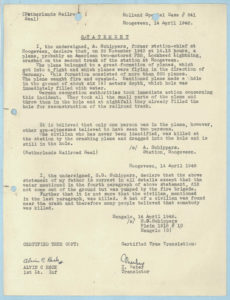
__________

Holland Special Case # 241
19 April 1948.

N A R R A T I V E

     Investigations were conducted in Hoogeveen, Holland, for information on a reported plane crash in that community.  Plane reported to have crashed near a railroad track, date and nationality unknown.

     The following information was obtained concerning a crash from the Town Hall, the former Stationmaster, Mr. A. Schippers, and from S.P. Schippers, son of the Stationmaster, both of whom were eye-witnesses to the crash:

     A fighter plane, believed to be of American nationality (P38 – Lockheed Lightning) crashed on 29 November 1943 on the second track of the railroad station about 10 yards from the stationhouse.  The plane was completely buried in the ground for a depth of about 6 meters.  The plane had been flying in a formation of about 500 bombers when it lost control and came to the ground.  It burned without exploding until the fire was extinguished by a fire brigade.  The German occupation authorities took immediate control of the incident and by nightfall reconstruction of the important railroad was already begun.  All pieces of the plane were reburied on the spot. _____

     It is believed that one civilian in the station at the time of the crash was killed and is buried with the plane – however, the only evidence supporting this is the fact that a civilian hat was found near the wreckage.  Attempts to find the owner of the hat failed so it was presumed that an unidentified civilian was killed as a result of the crash.

Paul Chatelain
PAUL CHATELAIN
US DAC A-441433
Investigator

__________

From Lt. Albino’s IDPF, here’s a letter pertaining to the discovery, recovery, and definitive identification of his remains.  This document was written by Gerrie Zwanenburg, Identification and Recovery Officer of the Royal Netherlands Air Force on March 9, 1978.  The document is transcribed below.  Two sentences have been redacted out of respect for Lt. Albino, albeit not at all changing the elements of his story.
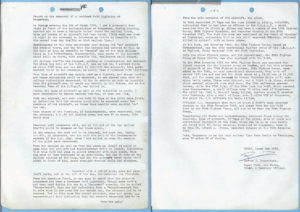
Report on the recovery of a Lockheed P-38 Lightning at Hoogeveen.

On Sunday, morning the 5th of March 1978, I got a phone call that right in front of the railway station at Hoogeveen, during digging, carried out to make a footpath tunnel under the railway lines, bits and pieces of an aircraft had been found.  (This work was done at night in the week-end to intervene as little as possible with the normal busy day traffic on that railway line.)

Eyewitnesses at the time remembered that during WW2 “an” aircraft had crashed there, and too that the Germans had ordered to fill up the hole as soon as possible to “repair” one of the main railway lines in the Netherlands.  Consequently, main parts of the aircraft could still be there, with possible too, explosives still aboard.

All railway traffic was stopped, pending an investigation and recovery for which the help of the R.N.A.F. was called in.  I arrived there at about 1300 hrs, and was able to identify the aircraft, from part-numbers found on the wreckage, as having been a Lockheed P-38 Lightning

This type of aircraft was mainly used as a fighter, and though hardly any heavy explosives could be expected, it was agreed upon with the railway authorities concerned, to try to recover as much as possible from the aircraft now, to avoid any trouble in the future.  And so the Recovery Team of the R.N.A.F. was called in.

Taking the type of aircraft as well as the situation in count, I gave permission to resume railway traffic, if over one line. 

Work was started, and very soon both ID Tags of the pilot were found, an indication that his remains could also be expected among the wreckage of his aircraft, as those tags usually were carried “on” the man.

Soon pieces of the fuselage, if disintegrated, were recovered, with the armament, 4 X .50 cal machine guns, and one 20 mm cannon, with their ammo __________

Recovery work proceeded well, and at the end of the day railway traffic could be resumed on two lines again.

In the evening the work had to be stopped, but next day, Monday the 6th, it proceeded, now too with the help of the Grave Service experts of the R.N. Army, whom I had called in when the remains of the pilot were recovered.

From the remains as well as from the wreckage itself it could be seen that the aircraft had disintegrated fully on impact, indicating that this P-38 had gone in almost straight with high speed.  This was more or less confirmed by an eyewitness, who was on duty at the railway station at the time, and saw the aircraft crash about 10-15 yards in front of him, going straight through rails and sleepers.  [“Sleeper” is a British english term for railroad tie.]

__________ Together with a lot of ammo, guns and aircraft parts, and on the end of the day, the recovery was finished.

From the wreckage found, it was easy to proof that the aircraft concerned had been a Lockheed P-38 Lightning.  Though some P-38s had been used during the war in a “two-seat” version, the so called “Droop-Snoot”, this one had definitely been a “single-seater”.  For to make room in the nose for the second man, the armament had to be removed.  Yet in this case the normal armament, guns and canon, was recovered.  All this indicating that the remains recovered had to be from the sole occupant of the aircraft, the pilot.

On both recovered ID Tags was the name Albert A. Albino, 0-743300, indicating that he had been an officer in the U.S.A.A.F.  A check revealed that Lt. Albert A. Albino had been a member of the 55th Fighter Group, 38th Fighter Squadron, and reported missing on the 29th November 1943.  Too that his name was mentioned on the “Wall of Missing” at Cambridge, indicating that he was still reported “Missing.  Believed killed in action”, with no known grave.

At the time, end November 1943, the 55th Fighter Group, based at Nuthampstead, was the only operational fighter group of the U.S.A.A.F. in England, fully equipped with the P-38 Lightning.

Only one other fighter group, not yet operational, the 20th Fighter Group at Kings Cliffe, was also equipped with the P-38.

On the 29th November 1943 the 55th Fighter Group was assigned for target support for the heavies going to Bremen, and for this mission 10 aircraft of the 77th Fighter Squadron, 20th Fighter Group, were added to the 55th, to gain operational experience.  They took off around 1300 hrs and crossed the Dutch coast at + 13.50 hrs at 31,000 feet, and the group was bounced by German fighters while still carrying belly tanks.  These were dropped, and a fight took place, during which several aircraft were shot down.  The 55th suffering several losses, while the 77th F.Sq. of the 20th lost one P-38, which crashed near Wanneperveen, a small village some 15 miles west of Hoogeveen.  The pilot Lt. John S. Hascall being killed.  Another aircraft crashed near Koekange, also a small village, some 5 miles WSW of Hoogeveen, the pilot Lt. J.M. Gilbride too being killed.

Official U.S. Documents show that at least 6 P-38s were reported missing on the 29th November 1943, and apart from the one P-38 lost by the 20th Fighter Group, all had to be from the 55th Fighter Group.

Considering all facts and circumstances, evidence found during the recovery, type of aircraft, ID Tags of the pilot, date of crash and operational equipment at the time, there can be in my view hardly any doubt that the human remains, recovered at Hoogeveen, have to be from Lt. Albert A. Albino, reported missing on the 29th November 1943.

Note.  Hoogeveen is on the main railway line from Zwolle to Groningen, some 20 miles NE of Zwolle.

ZEIST, March 9th 1978.
Gerrie J. Zwanenburg.
Royal Neth. Air Force.
Ident. & Recovery Officer.

The discovery of Lieutenant Albino and Spirit of Aberdeen was reported in the Dutch newspapers Het Vrije Volk and Nieuwsblad van het Nooden in March of 1978. 

Here the article from Het Vrije Volk, followed by its translation:

OUD VLIEGTUIGWRAK STREMT TREINVERKEER IN DRENTE

Het Vrije Volk
March 6, 1978

MEPPEL – Het treinverkeer tussen Meppel en Hoogeveen is gisteren lange tijd gestremd geweest na de vondst van een Amerikaans vliegtuigwrak op het station Hoogeveen, tussen het tweede en derde perron.  Omdat men bang was dat er nog bommen in het vliegtuig zouden zitten, werd het treinverkeer stilgelegd.  Reizigers werden met bussen vervoerd.

Bij graafwerkzaamheden voor de aanleg van een tunnel stuitte men zaterdagnacht op de wrakstukken.  Het gaat om een Lockheed Lightning eenpersoonsjachtvliegtuig, dat in november 1943 bij een luchtgevecht boven Zuidwolde op de spoorbaan stortte.  Wegens geldgebrek werd het wrak vlak na de oorlog niet opgeruimd.

Aan de hand van het identiteitsplaatje is de omgekomen Amerikaanse oorlogsvlieger gisteren geïdentificeerd.  Zijn naam wordt pas vrijgegeven als de familie in Amerika is gewaarschuwd.  De oorlogsgravendienst heeft zich over de stoffelijke resten ontfermd.

Onderzoek door de mijnoprui-mingsdienst wees gisteren uit, dat het vliegtuigwrak geen bommen bevatte, maar wel enkele mitrailleurs, granaten en een 20 mm kanon.

Onderschrift: Onder leiding van personeel van de luchtmacht-identificatiedienst worden de resten van het Amerikaanse toestel doorzocht.
OLD AIRPLANE WRECK BLOCKS TRAIN TRAFFIC IN DRENTE

The Free People
March 6, 1978

MEPPEL – The train traffic between Meppel and Hoogeveen was obstructed for a long time yesterday after the discovery of an American plane wreck at Hoogeveen station, between the second and third platforms.  Because it was feared that there would still be bombs in the plane, the train traffic was stoppeds.  Travelers were transported by buses.

During excavation work for the construction of a tunnel, the wreckage was found on Saturday night.  [March 4, 1978]  It is a Lockheed Lightning one-man fighter plane, which crashed into the railway in November 1943 during an air battle over Zuidwolde.  Due to a lack of money, the wreck was not cleaned up shortly after the war.

The killed American war flyer was identified yesterday on the basis of an identity disc.  His name is not [being] released until the family in America is notified.  The war graves service took care of the remains.

Investigation by the mine clearance service revealed yesterday that the plane wreckage did not contain bombs, but some machine guns, shells and a 20 mm cannon.

Caption: The remains of the American aircraft are searched under the direction of personnel from the Air Force identification service.

And, the article from Nieuwsblad van het Nooden:

Resten verongelukte piloot geborgen

Geen bommen in wrak onder spoor van Hoogeveen
Resten verongelukte piloot geborgen

Nieuwsblad van het Nooden
editie Stad Groningen en Haren

Maandag
March 6, 1978

(Van een onzer correspondenten)

Onder de spoorbaan bij het station in Hoogeveen zijn gisteren de stoffelijke resten gevonden van de piloot van een Amerikaanse Lockheed Lightning, die op een novembermiddag in 1943 na een luchtgevecht boven Zuidwolde met een Duits vliegtuig neerstortte.

Deoorlogsgravendienst heeft de vlieger aan de hand van gevonden inden-titeitsplaatjes geïdentificeerd, maar wil de naam pas vrij geven nadat de familie in Amerika is ingelicht.

Zaterdagnacht stootte een graafmachine, waarmee een voetgangerstunneltje onder spoorbaan wordt gegraven, op de resten van het neergestorte vliegtuig.  Omdat men vreesde dat er nog explosieven in het wrak zouden zitten, werd het werk gestaakt en werd besloten het treinverkeer tussen Hoogeveen en Meppel stil te leggen.  Mensen van de Mijnopruimingsdienst vonden gistermorgen in het wrak een granaat, een mitrailleur en een 20 mm-kanon.  Tegen half drie kon het treinverkeer over één baan weer rijden, en aan het begin van de avond liepen de treinen tussen Hoogeveen en Meppel weer normaal.  In de komende dagen wil men proberen het wrak te bergen.

Vlak na de oorlog werd al geprobeerd het vliegtuigwrak onder de spoorbaan weg te halen, maar vanwege de kosten zag men daar van af.  In 1972 werden bij het graven van een tunneltje onder een der spoorbanen metaalresten ontdekt.  Omdat men toen aannam dat de rest van het vliegtuig diep in de veenachtige bodem zou zijn gezonken, werd toen niet verder gegraven.

In november 1943 stortte het vliegtuig net buiten de overkapping van het station op de rils.  Het station vloog daarbij in brand.  Het gat dat in de spoorbaan was geslagen werd gedicht door de Duitsers en de rails werden hersteld.  De bezetters wilden dat de treinen weer zo snel mogelijk konden rijden; onder meer voor de jodentransporten naar Westerbork.

Foto links: Met een graafmachine werden de wrakstukken onder de spoorbaan weggehaald.

Foto rechts; de resten van het vliegtuig, bommen waren er niet bij.

Remains of crashed pilot recovered

No bombs In Wreckage Under Tracks of Hoogeveen
Remains of Crashed Pilot Recovered

Newspaper of the North
City Edition of Groningen and Haren

Monday
March 6, 1978

(From one of our correspondents)

Yesterday the remains of the pilot of an American Lockheed Lightning, who crashed with a German plane on a November afternoon in 1943 after a dogfight above Zuidwolde, were found under the railway at the station in Hoogeveen.

The War Graves Service has identified the pilot on the basis of identifying tags found, but will only release the name after informing the family in America.

On Saturday night, an excavator, with which a pedestrian tunnel is being dug under a railway track, hit the remains of the crashed plane.  Because it was feared that there would still be explosives in the wreckage, the work was stopped and it was decided to stop the train traffic between Hoogeveen and Meppel.  Yesterday morning people of the Mine Clearing Service found a canon shell, a machine gun and a 20 mm cannon in the wreckage.  By half past two train traffic could run on one lane again, and at the beginning of the evening the trains between Hoogeveen and Meppel were running normally again.  In the coming days they want to try to salvage the wreck.

Shortly after the war, attempts were made to remove the plane wreckage from under the railway, but because of the costs they decided not to do so.  In 1972, metal remains were discovered during the digging of a tunnel under one of the railways.  Because it was then assumed that the rest of the aircraft would have sunk deep into the peaty bottom, digging was not continued.

In November 1943 the plane crashed on the rails just outside the canopy of the station.  The station caught fire.  The hole that had been made in the track was closed by the Germans and the rails were repaired.  The occupiers wanted the trains to run as fast as possible again; including for the Jewish transport to Westerbork.

Photo left: The wreckage was removed from under the railway with an excavator.
Photo right: The remains of the plane, bombs were not there.

From August through September of 1979, American newspapers published an Associated Press news article by Robert H. Reid describing the Army’s search for and identification of WW II MIAs, briefly mentioning the discovery and identification Lt. Albino.  The following is a transcript of the article as it appeared in the The Journal – News Insight of Rockland County, N.Y., on August 30, 1979, forty-one years and a different country (and world) ago.

Missing in Action for 34 years

FRANKFURT, West Germany (AP) — Thirty-four years after the guns fell silent, the U S Army is still looking for remains of some of the 19,500 American soldiers missing in action in Europe during World War 11

Most will remain lost forever in the shallow graves where they fell in France, West Germany, Belgium, Holland or elsewhere in Western Europe and in North Africa.

The Army ended its large scale search for World War II MIAs a decade ago, but from time to time, construction workers, farmers and souvenir hunters unearth remains of young GIs, some still wearing their dog tag or clutching their weapons.

Eleven bodies of Americans killed in World War II have been found in Europe since December 1977, the Army says Morticians can identify only four of them.

The task of recovering, identifying and disposing of the remains falls to the Memorial Affairs Activity, 40-member unit of soldiers and civilians which serves as the Army’s funeral home in Europe

If remains can be identified, they are buried in military cemeteries in Europe or shipped to the United States, according to the wishes of the family.  Those who cannot be identified are buried in American cemeteries in Europe under tombstones reading, “Known Only to God.”  “We take a seven-man firing squad and six pallbearers and conduct full military honors for them, said John Rogers Jr., a former funeral director from Frankfort, Ky., who serves as the unit’s chief mortician

“They practice under my supervision prior to each funeral,” he added, “so the service will be dignified.”  The unit’s next funeral is set for Sept 10 at the Ardennes Cemetery in Belgium for Sgt. James Becker of Texas, who crashed with his bomber in northern Germany in 1944. 

A farmer unearthed the remains in a peat bog in January 1977, Rogers said.  The body of the slender, 20-year-old sergeant was wrapped in a parachute, and his high school ring and watch were found in the grave.  The Army-issue watch had stopped at 1:19. 

“We were lucky with the Becker case,” said Rogers “But identification can be difficult.  It’s not like the Vietnam War, where every bit of information on the individual went into a computer after someone became missing.”

Discoveries are often made by construction crews, and the remains of young American infantrymen aviators and lank crewmen become grim reminder of an era when Europe was not prosperous and peaceful. 

“We found one near the train station in Hoogeveen, Holland.”  Rogers said “They were building an underground pedestrian tunnel when they found fragments of an aircraft.”

Inside the single-seat fighter was the body of 2nd Lt Albert Albino, missing since 1939 German occupation forces had bulldozed over the crash site presumably so the railroad tracks could be repaired as soon as possible.

Not all searches find remains

“I took a graves registration team and scuba diver to Omaha Beach last June after a French diver said he saw some Sherman tanks with their hatches down submerged in the water,” Rogers said

“We spent four days searching but couldn’t find them.  The French Navy promised to search the area with sonar equipment, if they find them, we’ll go back.”

Last November a West German told U S officials in France he knew of a mass grave of 17 or 18 American paratroopers near Saales, France.  The German, who was not identified, said that as a young soldier he had seen the American prisoners marched off into the woods by Nazi SS troops.  The Nazis emerged later without their prisoners

A team from the Frankfurt unit searched the area but were unable to find the grave site.  The German said the area had changed too much over the years, Rogers said.

Rogers and his team use medical and dental records and old battlefield reports to try to identify the remains.  The painstaking process can lake months and is often futile.

“Sometimes we know they are Americans simply by the fact that they are carrying American equipment,” he said.

For the families of the victims, the discoveries can bring back the pain the years have tried to erase – or ease the ache.  “Last September, we found one under the street in Metz, France said Rogers.  “We recovered his dog tags, made the identification and shipped the body home to the widow.  They said she had never remarried and now could accept that her husband was dead.”

An Oogle map of Hoogeveen.
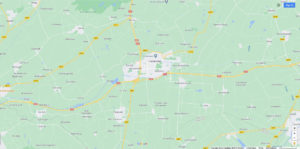
A map view of the city at a larger scale, with the crash site denoted by a red oval.
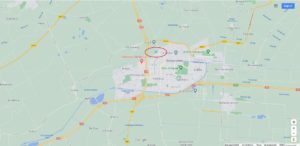
From Oogle Map View to Oogle Street View: This is a 2009 view of the entrance to the Hoogeveen train station.  The arched metal structure in the center of the image is the entrance to the underground walkway connecting opposite sides of the passenger platform, mentioned in Gerrie Zwanenburg’s 1978 report.  It was during the construction of this tunnel that Lt. Albino’s remains and parts of Spirit of Aberdeen were found.

A 2020 view of the Hoogeveen train station from the platform opposite that shown in the above image.  The pedestrian tunnel (and an elevator?) are in the center of the image.  Though I don’t know for certain, it seems from the above documents that Spririt of Aberdeen impacted either at the present site of the pedestrian tunnel, or, directly into the railroad tracks adjacent to the present-day platform, in line with the tunnel. 

Part of a propeller blade from Spirit of Aberdeen was saved after the plane’s 1978 excavation and identification, and incorporated into a monument – situated near the entrance to the passenger tunne – commemorating Lt. Albino.  The monument and explanatory placard can be viewed at Traces Of War. 

From the Hoogeveen Commemoration and Memorial Facebook page, here’s an image of the shattered propeller blade, set in its rusted mount, which gives testimony to the devastating force of the plane’s impact.  The photo was presumably taken on, or more likely before, the Facebook page date of March 16, 2016. 

Text on the page states:

Herdenken, we hebben het er maar moeilijk mee.  We zetten een steen en een tekst erop, zonder dat de inhoud klopt met wat er is gebeurd.  We maken naamplaten, afgaand op indrukken van enkelingen, en hebben niet vooraf kennis gekoppeld, zodat we mensen vergeten.  Of we plaatsen een vierde gedenkteken in Hoogeveen waar Albert Albino op wordt herdacht, zonder ook maar iets erbij te vermelden van al die andere mensen die in verband met ons station om het leven zijn gekomen.  De gemeente onthult alles, zonder de vraag van voorgaand en getoetst onderzoek …

The English translation reveals that the message is one of pride in memorializing Lt. Albino, yet ambivalence about the (then) lack of attention to the wartime deaths of Dutch civilians at Hoogeveen station.  Thus: 

Remember, we have a hard time with it.  We put a stone and a text on it, without the content being consistent with what happened.  We make name plates, based on impressions of individuals, and have not linked knowledge beforehand, so that we forget people.  Or we place a fourth memorial in Hoogeveen on which Albert Albino is commemorated, without mentioning anything about all those other people who died in connection with our station.  The municipality reveals everything, without asking for previous and tested research …

As the following accounts show, whether the propeller blade still exists at the station, or exists anywhere “period”, is uncertain:  It seems (?) that the propeller blade was stolen in 2015, as reported in this article from May 21 of that year, by Serge Vinkenvleugel.

Oorlogsmonument bij station Hoogeveen gestolen

HOOGEVEEN – De propeller van het in 1943 neergestorte vliegtuig bij station Hoogeveen is verdwenen.  De vernieling en diefstal van het oorlogsmonument werd dinsdagochtend ontdekt.

Geschreven door serge vinkenvleugel

Wie er verantwoordelijk is voor de diefstal is niet bekend.  Er is nog geen aangifte gedaan door de gemeente, de eigenaar van het monument.  Op de sokkel liggen nog een paar bouten waarmee het propellerblad vastzat.

Monument van vliegtuigwrak
Het monument is gemaakt van een propellerblad van het op 29 november 1943 neergestorte Lockheed p-38 Lightning vliegtuig van vliegenier Albert A. Albino.  Het staat op de plek waar het vliegtuig 70 jaar geleden is neergestort.  De Amerikaanse jager stortte neer na een luchtgevecht met een Duits vliegtuig.

Pas in 1978 geborgen
Omdat het vliegtuig tussen de rails was neergestort, werden het wrak en de piloot niet meteen geborgen.  De Duitsers gooiden de krater van de inslag dicht en herstelden snel de rails.  De spoorlijn was voor hen van belang voor het transporteren van joden naar doorgangskamp Westerbork.  Pas in 1978, bij de bouw van een tunnel onder station Hoogeveen, kwamen de stoffelijke resten van de piloot en de wrakstukken van het toestel naar boven.

Monument is particulier initiatief
Initiatiefnemer van het monument is de Hoogevener Bé Thalen.  Thalen was eigenaar van het propellerblad van het vliegtuig.  Hij kreeg het wrakstuk in 2002 in bezit na een faillissementsverkoop op vliegveld Hoogeveen.  Daarvoor maakte de propeller jarenlang omzwervingen door Hoogeveen, stond in schuurtjes en heeft zelfs nog als reclameobject gediend.  Thalen heeft de restauratie van het propellerblad en de plaatsing van het monument zelf betaald.

Trommelslager ook verdwenen
Het is de tweede verdwijning van een monument in korte tijd in Hoogeveen.  In april verdween ook de trommelslager, het beeld voor de Grote Kerk in het centrum.

Translation:

War Memorial Stolen from Hoogeveen Station

HOOGEVEEN – The propeller of the aircraft that crashed in 1943 near Hoogeveen station has disappeared.  The destruction and theft of the war memorial was discovered Tuesday morning.

Written by Serge Vinkenvleugel

It is not known who is responsible for the theft.  No declaration has yet been made by the municipality, the owner of the monument.  On the plinth are a few bolts with which the propeller blade was attached.

Monument to plane wreckage
The memorial is made from a propeller blade of the Lockheed P-38 Lightning aircraft belonging to aviator Albert A. Albino, which crashed on November 29, 1943.  It stands on the spot where the plane crashed 70 years ago.  The American fighter crashed after a dogfight with a German plane.

Only salvaged in 1978
Because the plane had crashed between the rails, the wreckage and the pilot were not immediately recovered.  The Germans closed the crater of the impact and quickly repaired the rails.  The railway was important to them for transporting Jews to the Westerbork transit camp.  Only in 1978, during the construction of a tunnel under Hoogeveen station, did the remains of the pilot and the wreckage of the aircraft surface.

Monument is private initiative
Initiator of the monument is the Hoogevener Bé Thalen.  Thalen owned the aircraft’s propeller blade.  He acquired the wreckage in 2002 after a bankruptcy sale at Hoogeveen airport.  Before that, the propeller wandered through Hoogeveen for years, stood in sheds and even served as an advertising object.  Thalen paid for the restoration of the propeller blade and the placement of the monument himself.

Drummer also disappeared
It is the second disappearance of a monument in Hoogeveen in a short time.  In April, “the drummer”, the statue in front of the Grote Kerk in the center, also disappeared.

As of 2019, a monument to Lt. Albino still exists, but with a difference:

This article by Lydia Tuijnman from May of that year shows the official Army Air Force photo of Lieutenants Albino and Carroll (B1 79830AC / A14145 1A):  “Lt. Albert A. Albino [left] of Aberdeen, Wash., and Lt. John J. Carroll of Detroit, Mich., both members of the 38th Fighter Squadron stationed at Nuthampstead, England, discuss the map of a future target in the squadron pilot room.”

The article is acompanied by Gerrit Boxem’s photo of the monument, on which is mounted a propeller.  But, something is very (very) “off” about this:  The propeller is entirely intact; entirely undamaged; entirely unbent.  The chances of this, gven the physical circumstances of the Sprit of Aberdeen’s loss, would be miniscule, at best.

Well, according to Traces Of War, there’s now a memorial plaque at the Hoogeveen station commemorating “staff members of the Dutch Railways, Soldiers and Citizens’ Victims” at that locality, Lt. Albino among them.    

In 1978, at the request of his brother, Lt. Albino’s remains were returned to the United States for burial, upon which he was interred at Mount Calvary Cemetery, in Portland (Section W, Plot 653) that October.  I suppose his engraved name still exists on the Tablets of the Missing at the Cambridge American Cemetery and Memorial, in Cambridgeshire, England, like that of Major Joel. 

The mission of November 29 was his eighth.

Next: Part IX – The Major – Still Missing
A Missing Man: Major Milton Joel, Fighter Pilot, 38th Fighter Squadron, 55th Fighter Group, 8th Air Force: VII – A Battle in The Air [Updated post! – January 14, 2021]

[This post, created on November 20, 2020 and updated on December 1, has been updated yet again.  The post now includes: 1) An area map and formation diagrams that provide a more accurate and clearer representation of the nature of the 55th Fighter Group’s encounter with the Luftwaffe on November 29, 1943, and 2) Specific information about what befell three pilots of 7./JG 1, one of the four Luftwaffe Gruppen that intercepted the 55th.  Where necessary, other parts of the account have been corrected, updated, or otherwise fixified.  Scroll on down for a look…!]
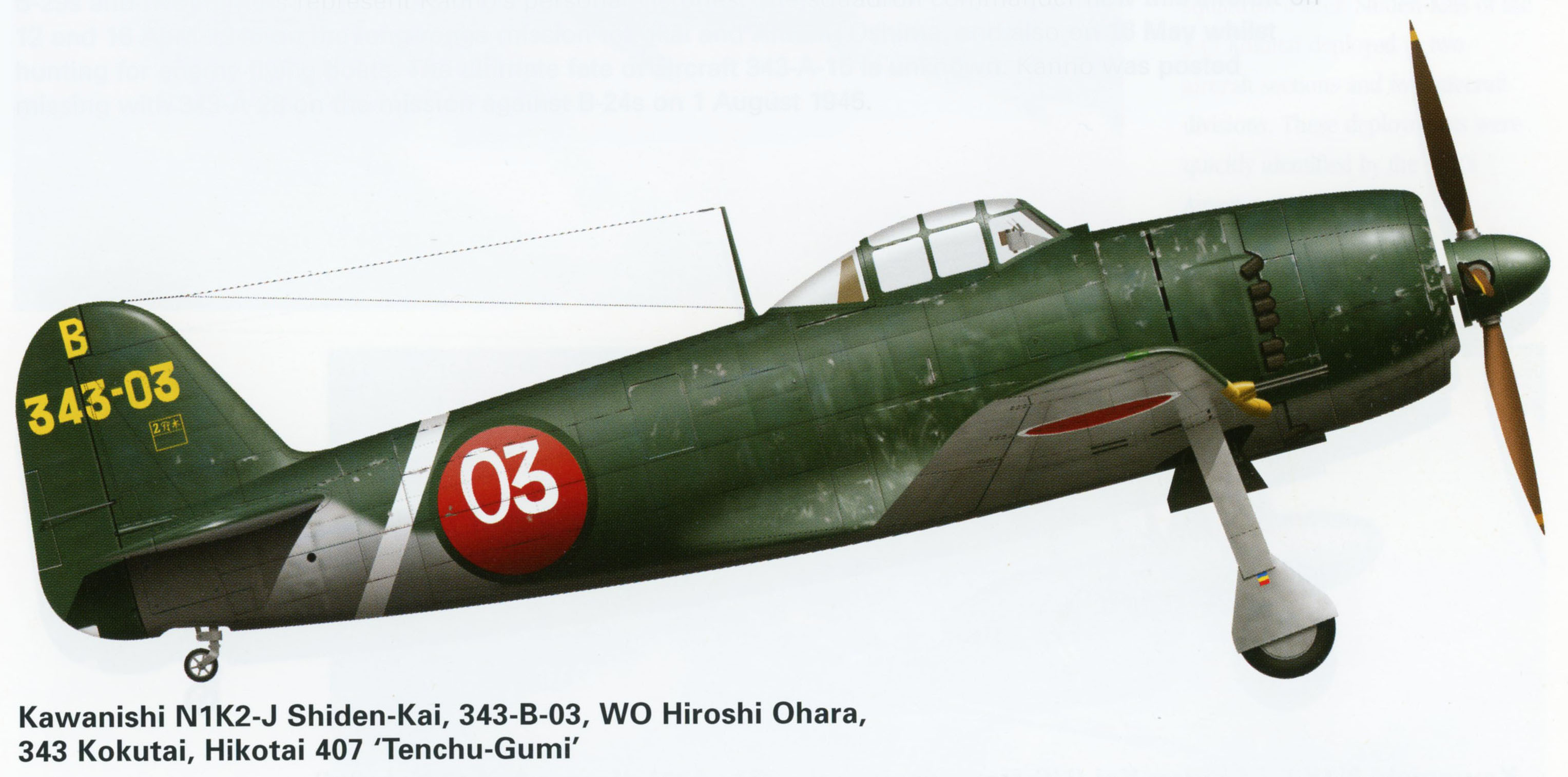
Part VII: A Battle in The Air

What befell the 38th Fighter Squadron and 55th Fighter Group on the mission of November 29, 1943? 

For this question, there is an answer.

What happened to Major Joel on that date? 

For this question, there is conjecture. 

And, for both questions, the best approach lies in understanding the day’s events through information in Squadron Mission Reports, and, Missing Air Crew Reports.  By correlating and arranging information from these two sets of documents, it’s possible to create a chronology – that does not exist within any single document – of the Lightning pilots’ encounter with the Luftwaffe, which is presented, below.  On reading it, you might want to refer to the post covering the account of the 55th Fighter Group’s bomber escort mission of November 29, 1943.  

But first, a digression about the performance of the P-38 Lightning…

Why? 

This comes by way of postwar recollections of Major Joel from three people who either knew him “in person” or indirectly: two family friends, and, a relative:

From Sara F. Markham, the best friend of Milton’s wife Elaine (Ebenstein) Joel…

“I want to thank you for all the material you sent, especially the MACR report.  All these years later [writing in 1990s], I still find it disquieting to read this sort of thing.  Funny, the report I had from the Joels at the time … and from Elaine Friedlich (Elaine’s surname after she remarried) was that Milton, heading back from his mission, saw one of his Lightnings being strafed by two German fighters and he turned back to help that plane.”

From Milton’s friend, Arthur Kamsky…

“He had the bad luck of flying a plane so badly designed that no amount of skill could be of much use.”

From Bettie J. Jacob, Milton’s cousin…

Milton lived and breathed as a fighter pilot. …  We were told after he was declared missing in action that most of the planes in the squadrons broke ranks and fled the scene when the nearly 100 German planes attacked.  There were only four planes left to fight, and one of the pilots states he saw Milton get hit.  He felt that Milton was killed outright, as he felt Milton could have bailed out otherwise.  No trace of Milton was ever found.”

A central “take-away” from the above comments, especially in light of the events of the 29th of November, is the number of P-38s that aborted the mission.  This raises a question about the P-38’s very quality as a fighter plane in general, and its use in the European Theater of War – specifically as a bomber escort fighter by the Eighth Air Force – in particular. 

To address this issue, fitting answers can be found in Bert Kinzey’s two Detail & Scale volumes on the aircraft (both published in 1998), which summarize the design, technical development, and combat use of the Lighting.  The most relevant comments from these books are given below, with the most pertinent passages italicized:

Part 1: XP-38 Through P-38H

“In England, General Ira Eaker did not want fighters escorting his bombers, and they were left with little to do.  Within a few short months, the 1st, 14th, and 82nd Fighter Groups were sent to North Africa to support the Allied forces battling Rommel’s Afrika Corps.  The 78th Fighter Group arrived in England in January 1943, but it too was sent to North Africa, mostly to replace combat losses in the first three groups.  Initial fighting in North Africa was against some of the best pilots and equipment in the Luftwaffe, and the unseasoned Lightning pilots initially suffered heavy losses as they gained valuable experience in combat.  Finally, they began to turn the tide and provide an excellent account of themselves.  Later, the 1st, 14th, and 82nd Fighter Groups would be relocated near Foggia in southern Italy and reassigned as part of the Fifteenth Air Force when the Allies moved from Sicily on to the Italian mainland.

“Back in England, it became evident that the USAAF was losing bombers at an unacceptable rate.  Early P-47 Thunderbolts simply did not have the range to escort the B-17s and B-24s all the way to their targets and back.  As a result, the Luftwaffe’s fighter pilots simply waited until the Thunderbolts had to turn back to their bases, then they attacked the unescorted bombers with devastating results.

“In October 1943, the 55th Fighter Group became the first Lightning unit to enter combat with the Eighth Air Force.  The 20th, 364th, and 479th Fighter Groups were also assigned to the Eighth Air Force while flying Lightnings, and in the Ninth Air Force, the 474th, 367th and 370th Fighter Groups flew P-38s.  At the height of its deployment to the ETO, thirty fighter squadrons and twelve reconnaissance squadrons flew Lightnings at one time or another.

“In England, the Lightning proved to be a very capable aircraft, and in the hands of a skilled pilot, it was as good or better than the Luftwaffe fighters it encountered.  But it was also plagued with mechanical difficulties.  The cockpit heating and defrosting were inadequate on early versions, and there were digestive problems with the engines at high altitudes.  It has been argued by other authors that this was due to the cold damp European weather conditions, but temperatures and humidity are generally the same around the world at altitudes greater than 25,000 feet where these problems occurred.  In the Pacific, Lightnings established a great record for reliability regardless of altitude and temperature.  Based on all the facts, it is evident that the poor quality British fuels were to blame, because they proved unsuitable for use in turbo-supercharged inline engines.  Power-plants with two-speed, two-stage, mechanical superchargers, and even radial engines with turbo-superchargers did not have the same ingestive problems with the British fuels, but the combination of an inline engine and a turbo-supercharger always did.  To correct the problem in Europe, Kelly Johnson proposed replacing the turbo-supercharged Allisons with Merlins and mechanical supercharging.  While this undoubtedly would have resulted in a fighter of superior performance, the Merlins were considered more valuable for other fighters.”

Perhaps Mr. Kinsey’s comments were addressing the following statement, which appears in Roger Freeman’s 1970 The Mighty Eighth.

“The P-38, supposedly a proven fighter, had been dogged with mechanical failure on these first missions.  The extremely low temperatures encountered at altitudes above 20,000 ft was the primary cause of the engine trouble.  At -50° lubricating oil became sluggish and the sudden application of full power, particularly in a climb, could cause piston rod bearings to break up with dire consequences.  Above 22,000 ft the Allison engines would also begin to throw oil, in fact, oil consumption rose from an average 1 to 2 quarts an hour at lower altitudes, to 4 to 8 above 22,000 ft.  This reduced engine life to average 80 odd hours – almost half normal operating time at lower altitudes.  Turbo-supercharger regulators also gave trouble, eventually traced to moisture from the vapour trail, gathering behind the engine exhaust stubs, getting into the balance lines and freezing.  The vapour trails were also a tactical handicap for they marked the passage of a Lightning through the upper air by distinctive twin trails, that could be discerned up to 4 miles away.  Whereas Luftwaffe pilots could not distinguish between the single trails made by Spitfires or Thunderbolts, or their own 109s and 190s, they were able to recognise Lightning formations in this way.”

Part 2: P-38J Through P-38M

“… the Lightnings did a good job in Europe, and because of their distinctive design, they were easily distinguishable from other aircraft.  This feature made them excellent escorts, because gunners in the bombers could easily tell them from the enemy fighters.  On June 6, 1944, when the invasion of France began, P-38s were assigned to provide air protection over the fleet and beaches, so that the sailors on the ships and the soldiers on the ground could quickly recognize them as friendly.

“Once Jimmy Doolittle relieved Ira Eaker as commander of the Eighth Air Force, he openly stated his desire that all fighter groups transition to the P-51 Mustang.  The P-51B, C, and D versions of the Mustang were equipped with a Packard Merlin engine with a two-stage, two-speed supercharger that did not have a problem with British fuels.  These Mustangs also offered the necessary range capabilities to escort the bombers to targets that only the P-38 could reach previously.  At war’s end, only the 56th Fighter Group was still flying P-47 Thunderbolts in the Eighth Air Force, and no P-38s remained.  In the Ninth Air Force, only the 474th Fighter Group was still flying Lightnings on VE day.

“In the Pacific, it was a completely different story.  General George Kenney demanded more and more P-38s at the exclusion of all other fighters, much as General Doolittle did with the P-51 in the 8th Air Force.  The Lightning, with its significant range capabilities, was ideally suited as a land-based fighter throughout the Pacific from Australia to the Aleutians.  Its heavy firepower could knock down a Japanese aircraft in a matter of a few seconds, and as a result, the P-38 scored more aerial victories in the Pacific than any other USAAF fighter.  Using high grade American fuels, its performance and reliability were exceptional.”

Want to learn more about the P-38 in combat in the European Theater of War?  For a deeper technical and historical analysis of the Lightning in combat, with particular coverage of the aircraft’s unappreciated service as a bomber escort fighter in the 8th Air Force – with particular attention to the plane’s service in the 55th and 20th Fighter Groups, much more than can be presented “here” – I very (very!) highly recommended Dr. Carlo Kopp’s Der Gabelschwanz Teufel – Assessing the Lockheed P-38 Lightning, at Air Power Australia.  (Technical Report APA-TR-2010-1201.)

________________________________________

And so, to return to the mission…

[Updates to this map from its initial version include the following: 1) The crash locations of three Me-109G-6s of the Seventh Staffel of Jagdgeschwader 1, lost (directly or indirectly) as a result of III./JG 1’s engagement with the 55th Fighter Group’s Lightnings, 2) An adjustment to the easternmost “leg” of the 55th Fighter Group’s intended course into Germany (the 55th Fighter Group never actually entered Germany), 3) The crash locations, as much as they can be pinpointed on this ultra-small-scale digital map, of 38th Fighter Squadron pilots Lieutenants Carroll and Gilbride, 4) The serial numbers of the lost P-38s and the three above-mentioned Me-109G-6s.  Information about the three 7./JG 1 losses, and the crash locations of Lieutenants Carroll and Gilbride, comes from Part 2 of Teunis Schuurman’s WW II – Research by PATS blog.]

Maps symbols and colors indicate the following:

Bright blue line extending west to east across the Netherlands to a point near the Dutch-German border indicates the approximate or intended course of the 55th Fighter Group for a rendezvous with 8th Air Force bombers.

Black triangle shows the approximate area where the Luftwaffe initially assumed it would intercept the 55th Fighter Group’s P-38s, as explained in the book Jagdgeschwader 1 und 11: Einsatz in der Reichsverteidigung von 1939 bis 1945 (Jagdgeschwader 1 and 11: Used in the Defense of the Reich from 1939 to 1945).

Blue ovals with names adjacent indicate the last reported or assumed location of P-38 losses, based on information in Missing Air Crew Reports.

Red ovals with names adjacent indicate the actual locations where the P-38s were lost.  Notice that there’s no blue oval for Lt. Hascall, because his P-38 was last sighted over the North Sea, at a point “west” of (to the left of) this map view, and Lieutenant Garvin, Major Joel’s wingman, because he definitely crashed at Hondschoote, France (again, well “off the map”).  More information will be presented about Lt. Garvin’s fate in subsequent posts.    

The location of Major Joel’s loss remains unknown.  Some sources suggest the crash location was Marken Island in the Markermeer, indicated by a yellow oval. 

In subsequent posts, I’ll discuss why I believe this location is incorrect. 

Black ovals with names adjacent indicate the loss locations of three Me-109G-6s of 7./JG 1.  (More about this below.)

________________________________________

To return to the story…

Let’s start with the central points from the records of the 38th and 338th Fighter Squadrons, and to a much lesser extent, the 343rd squadron history, for the November 29 mission:

38th Fighter Squadron…

1) The 38th Fighter Squadron was depleted to a little over half its strength – from sixteen to nine aircraft – by the time it was intercepted by Me-109s.  The seven planes that left the squadron returned to Nuthampstead between 1344 and 1549;
2) The squadron was attacked head-on, from a higher altitude, by over forty enemy aircraft: a ratio of over four to one;
3) Interception by German fighters commenced at 1410, with the Squadron being engaged in combat through 1440 – at least a half-hour. 
4) Major Joel was reportedly shot down at @ 1440.  (Oddly, this is contradicted by Lt. Wyche’s account, which suggests that the Major was shot down at 14:15.);
5) There is no evidence – at least, nothing was recorded – to the effect that the 38th was ever able to rendezvous with the B-17s it had been assigned to escort;
6) The continent was overcast at 27,000 feet. 

338th Fighter Squadron…

1) The 338th, comprised of fourteen aircraft, departed Nuthampstead after the 38th, at 1259 hours;
2) The squadron was depleted from fourteen aircraft to eight by the time it was intercepted, thus substantially reducing its strength;
3) Like the 38th, the 338th was intercepted by a large number of German fighters (in this case, over 30).  The enemy planes attacked the squadron – flying at 31,500 feet – head-on, from the slightly higher altitude of 32,000 feet;
4) The 338th lost contact with the other “squadron” (squadrons?) of the 55th during combat with German fighters;
5) The squadron was unable to rendezvous with the B-17s it was assigned to escort;
6) A significant observation:  “Enemy attack seemed definitely intended as interception of our squadron and other E/A were observed in distance to each side and above.”  And, this, “One P-38 observed by several members of squadron going into overcast shortly after initial engagement apparently out of control.”;
7) Weather conditions ranged from half to nearly complete cloud cover over the English Channel, to complete overcast over the continent. 

343rd Fighter Squadron (what is known…)

1) This squadron was unable to rendezvous with the B-17s;
2) The squadron was outnumbered by enemy planes. 

All records combined: A chronological summary of the 55th Fighter Group’s mission of November 29, 1943…

Departure from England…

The 38th Fighter Squadron departed Nuthampstead first, followed by the 338th Fighter Squadron, and lastly the 343rd Fighter Squadron.  The horizontal and vertical “spacing” between the three squadrons, and locations of the the squadrons relative to one another aren’t known, but the squadrons eventually arrived over continental Europe: specifically Northern Holland, in an area bounded by the cities of Groningen, Emmen, Zwolle, and Leeuwarden.

The 38th and 338th Fighter Squadrons are depleted by over half their strength…

Between 1344 and 1549, seven planes of the 38th returned to Nuthampstead. 

Between 1351 and 1425, six 338th aircraft also returned.

As for the 343rd, based on Capt. Franklin’s statement in MACR 1272 (pertaining to his wingman, 2 Lt. James W. Gilbride), the Captain’s second element – comprising an unidentified pilot accompanied by 2 Lt. Harold M. Bauer – returned to England, diminishing the 343rd from fourteen to twelve aircraft. 

In sum, though the 55th Fighter Group began this mission with 42 aircraft, by the time it was intercepted by German fighters, it had been diminished to 27 planes, or somewhat over 60% of its original strength, primarily – as far as is known – among the 38th and 338th Fighter Squadrons.  This assumes that only two P-38s returned from the 343rd.  This number does not include the 55th Fighter Group’s spares, or, Second Lieutenants John S. Hascall, Robert D. Frakes, and eight other pilots of the 77th Fighter Squadron (20th Fighter Group), the ten of whom tacked on to the 55th as spares for operational experience.  It’s unknown if any of the latter eight 77th FS P-38s returned to England early.

The Luftwaffe intercepts the 38th and 338th Fighter Squadrons.  This possibly (possibly) occurred over Borger, in the Netherlands (about halfway between Assen and Emmen, at the middle of the right leg of the “triangle” mapped above) based on a P-38 victory claimed by Oberleutnant Erich Buchholz of 9./JG 1 at 15:15.  Thus, the vicinity of Borger may have marked the farthest “reach” of the 55th Fighter Group on this mission.  

The 38th Fighter Squadron was intercepted by Me-109s between 1410 and 1415. 

The 338th was similarly intercepted by Me-109s.  The specific time of this event is not given, but is it known that the squadron was over the continent by 1347.  So, the 338th’s interception occurred not long after, and probably at the same time as that of the 38th.  As the 338th Mission report observed, “Enemy attack seemed definitely intended as interception of our squadron.” 

The German fighters (Me-109Gs) attacked both squadrons head-on from a higher altitude, and in a general sense from the east: out of the sun.  However, it’s notable that in the MACR for Lt. Albino, Capt. Thomas E. Beaird states that the German planes also attacked from “8 o’clock”.  This would indicate a simultaneous attack – at least, against the 38th – from both front and rear.

The depleted and outnumbered 38th and 338th were engaged in combat with the Me-109s from this time on, with the 338th reportedly losing contact with the other “squadron” (the 38th, or, the 38th and 343rd both?) during the engagement. 

Major Joel and his wingman (Lt. Garvin), and Lieutenants Wyche and Carroll break into the attack…

By this time, it appears that Major Joel was attempting to reform his nine remaining planes into two flights.  Then, at the moment of III./JG1’s attack (14:15) from the 38th’s three o’clock position, the Major ordered a “break” into the Germans’ bounce, the Major and Lieutenant Garvin making a 90-degree turn to the right.  They were followed by an element led by Lt. Wilton E. Wyche and his wingman, Lt. John J. Carroll, who were at first situated 300 yards to the right of Joel and Garvin.  As the flight turned, Lt. Wyche wound up to the left of the Major and his wingman.  Then – alone, after losing sight of Joel, Garvin, and Carroll – Wyche saw six Me-109s coming into attack from their rear (7 o’clock) position.  He called a left break, but entered an accelerated stall and spun out of the ad-hoc formation, recovering below.

(Wikipedia’s definition of an aerial combat “break”?  “Spotting an attacker approaching from behind, the defender will usually break. The maneuver consists of turning sharply across the attacker’s flight path, to increase AOT (angle off tail). The defender is exposed to the attacker’s guns for only a brief instant (snapshot). The maneuver works well because the slower moving defender has a smaller turn radius and bigger angular velocity, and a target with a high crossing speed (where the bearing to the target is changing rapidly) is very difficult to shoot. This can also help to force the attacker to overshoot, which may not be true had the turn been made away from the attacker’s flight path.”)

Captain Ayers has a last glimpse of Major Joel and Lt. Carroll, and then shoots down an attacking Me-109…

From a different vantage point, Captain Jerry Ayers reported that as his own flight followed Major Joel and Lt. Carroll in an effort to provide cover for them, his flight’s planes were, “bounced by units from a group of about 40 enemy aircraft from one or two o’clock out of the sun,” and he broke into the attack to engage the German planes.  As stated in the MACR, “At the time of the first break was the last time that I saw Major Joel and his wingman, Lt. Garvin, that I could recognize them.” 

This was the last moment when Lieutenant Garvin was witnessed with any certainty.

While defending the two P-38s, Captain Ayers shot down the leader of a pair of Me-109s which attempted to attack the Major and Lt. Carroll from their two to three o’clock position.  As he closed from 350 to 250 yards and fired from approximately 90 to 45 degrees deflection, the German fighter caught fire and went into a spiral out of control, witnessed by Ayers’ wingman, Capt. Thomas E. Beaird, Jr.  This was the only victory officially credited to the 55h Fighter Group that day, the other having gone to Captain Chester A. Patterson of the 338th Fighter Squadron.  

Ayers was forced to break off his attack because of four Me-109s approaching from behind, thus losing sight of Major Joel.

Major Joel and Lieutenant Carroll form up and attempt to rejoin the rest of the 55th Fighter Group…

As Lt. Carroll wrote after the war, Joel, Garvin, and Wyche were “cut off by a gaggle of Me-109s and the group was headed away from us in a westerly direction”.  Separated from other 38th Fighter Squadron planes, Major Joel and Lieutenant Carroll presumably flew west, gong into a defensive maneuver dubbed the “weave formation”.  This refers to the Thach Weave, a nice explanation of which van be viewed in the video (below) from Brian Young’s YouTube channel, which pertains to the use of the Thach Weave by F4F Wildcats in defense against Mitsubishi Zeros.

https://www.youtube.com/watch?v=K8vJzlcAHEI

Lt. Carroll witnesses the loss of Lt. Albino…

After the first weave maneuver “pass by”, Lt. Carroll witnessed a P-38 – pilot unknown; he surmised Lieutenant Albino or Garvin – descending, trailing smoke, “minus a section of tail”.  (As I discovered while researching this battle, Lt. Carroll was correct in his assumption: The burning P-38 was Lt. Albino’s Spirit of Aberdeen.  Based upon the location where the Spirit of Aberdeen crashed, this event definitely occurred directly over the city of Hoogeveen, evidence for this being presented in the next post.

The last sight of Major Joel…

At the crest of his third turn in their “weave”, at a point between Hoogeveen and the farm community of Zwartewatersklooster, Lt. Carroll witnessed a P-38 at a point in space where Major Joel’s “flying wolf” was to have been expected, “seemingly to disintegrate”.  

A moment later, Lt. Carroll came under attack.  His right engine aflame and instrument panel damaged, he rolled his badly damaged plane over, went into a vertical dive, and, recovering below, took a heading for England using his still operating magnetic compass.

Captain Rufus Franklin and his wingman, Lt. James Gilbride, as a team break formation from their Squadron (the 343rd) to go to the aid of the outnumbered remnants of 38th Fighter Squadron.  They arrive just in time to disrupt the attack of III.JG/ 1, saving the lives of at least three (and almost four) 38th Fighter Squadron pilots…

Captain Rufus C. Franklin of the 343rd Fighter Squadron reported in detail about the loss of both Lt. Gilbride and Major Joel.  (The following account is a composite from his statements in the MACRs for Major Joel and Lt. Gilbride.)

Captain Franklin reported that at 1210 (probably an error, the time likely having been 1410) “many bandits” were approaching from a lower altitude in the “target area”.  At that point, Group Commander Col. Frank B. James started a turn to meet the German planes.  The “main body of the group” (whether by this Capt. Franklin meant the 343rd alone, or, the 343rd and 338th both, is unspecified) then went into a right Lufbery Circle.  

Though Captain Franklin had by this time lost his second element, Lt. Gilbride remained with him in an “excellent manner”.  The main “group” remained in the Lufbery Circle, but Captain Franklin and Lt. Gilbride would “break out” from time to time to see if another attack was imminent.

After two complete turns, the “group” started back to England. 

Captain Franklin and Lt. Gilbride followed, assuming that Colonel James was leading.  However, the Colonel was not: Captain Franklin specifically mentions that from this moment on, Colonel James was no longer leading the group, which is consistent with the 338th’s Mission Report of the Colonel having returned to England alone. 

Captain Franklin reported that as the main body of planes headed back to Nuthampstead, pilots were heard, calling for help from “far behind us,” specifically including Major Joel.  Later, Lt. Erickson, in his own Encounter Report, mentioned that Captain Ayers was also radioing for help.  

The rest of “group” continued on its way. 

Then, “Just as I had almost decided to go back and help the boys calling repeatedly, the Group started a turn and appeared to be going back but instead made a tight 360 degree turn and went away from the fight again.  I could see the fight behind us as the Group made the turn and I broke out – Lt. Gilbride and I went back to help.”

It took Franklin and Gilbride “several minutes” to reach the fight. 

As the pair neared the 38th Fighter Squadron’s P-38s, they saw, “five P-38’s engaged and each had from one to three ME 109s on its tail.  Just before we went into the fight one P-38 rolled over and went down with its left engine leaving a very long and very heavy trail of black smoke and with a 109 directly behind.”  (They had witnessed the fall of either Lt. Carroll or Lt. Albino.)

Franklin and Gilbride flew directly into the midst of the gaggle, the surprised German pilots rolling and climbing away from the P-38s. 

The four surviving P-38s headed back to England, even as Franklin and Gilbride made a 180-degree turn to join them.

Then, a (then) unidentified 38th FS P-38 “ran away” from the other Lightnings.  The other three P-38s, along with Capt. Franklin, and Lt. Gilbride, were given chase by five Me-109s as the little group of American planes headed west.  As will be seen in the next post, the P-38 that pulled away was piloted by Lieutenant Garvin, Major Joel’s wingman.

Lieutenant Gilbride is shot down…

The P-38s attempted to outrun their pursuers, but could not. 

Captain Franklin’s left turbosupercharger stopped working and his port engine began to lose oil, and, two of the other P-38s weren’t fast enough to pull away from the German planes.  The five Me-109s closed upon Franklin and Gilbride to a distance of 800 yards while remaining to the side and above, with one particular Me-109 alternately latching onto the tail of the element leader and his wingman, moving laterally between the two, approaching to with 400 yards of each. 

Eventually, all five Me-109s moved up abreast of Franklin, Lt. Erickson and Lt. Gilbride, and then turned into the American planes.  These three P-38s then broke into the Luftwaffe fighters. 

As Captain Franklin made a 100-degree turn into the German planes, his port engine quit.  By the time he completed the turn, Lt. Gilbride had vanished.  As will become evident in the next post, this happened over De Wijk and Koekange, in the Netherlands.

During this running battle, Captain Thomas E. Beaird, Jr., and Lt. Robert E. Erickson fire at and observe hits on two of the pursuing Me-109s, with the implication and possibility (albeit without any confirmation) that the pilots were injured or killed, and the enemy planes thus destroyed by strikes on or near their canopies…

As reported by Captain Beaird, “I looked over my left shoulder and saw one ME 109 right on the tail of the P-38 to my left and behind.  I called for Major Joel’s wingman [Lt. Garvin] to break (I thought I had joined Major Joel’s flight).  I broke left to meet the ME 109 head on.  The P-38 ahead of me to my left also broke left.  The ME 109 dove for the clouds.  I continued in a left turn to take up my original heading and came out almost directly behind a ME 109 with one P-38 off to my right.  I started closing on the ME 109 that seemed to be in a very steep climb for that altitude.  I fired one fair burst; saw a flash on his canopy and observed him pull his nose straight up hang on his prop and then spin under my left wing.  I turned to the left to clear my tail, looked back and saw him spin into the overcast.  I believe this plane was destroyed by my strikes on the canopy.”

And, as recounted by Lt. Erickson, “Captain Ayers and myself were two of five P-38’s at the rear of the group.  We observed three enemy aircraft catching us from the rear.  At this time I was at 33,000 feet.  Captain Ayers called for help and Captain Franklin and Lt. Gilbride of the 343rd came back.  At this time one enemy aircraft came behind Captain Franklin and two behind me.  We broke left, I completed my turn and came down on the second ME 109 and fired observing hits on wings and near canopy.  These two immediately rolled and dove for the clouds.”

Unsurprisingly given the circumstances, there were no witnesses to the results of these two attacks, and the two accounts did not eventuate in officially credited victories for either pilot.  USAF Study 85 gives Captain Beaird credit for one victory on February 5, 1944, and there are no official victories for Lt. Erickson.  

Captain Franklin, Lieutenant Gilbride, and three surviving 38th Fighter Squadron P-38s are pursued by Me-109s to the Dutch Coast.  The four surviving P-38s return to Nuthampstead…

Fortunately able to restart his engine and still pursued by Me-109s, Captain Franklin was rejoined by Lt. Erickson, the pair remaining abreast with the enemy planes following.  The German fighters remained behind the P-38s until just beyond the Dutch coast.  Then, they left.

Captain Franklin’s conjecture about the fate of Major Joel, and Lieutenants Gilbride and Garvin…

Captain Franklin surmised that Lt. Gilbride had been shot down by the particular “bait” Me-109 that followed himself and the lieutenant and moved laterally back and forth between them.  (He put the time at 1240 hours, but I believe this to have been in error, probably having been 1440 or later.)  The three surviving 38th FS P-38s which Captain Franklin and Lt. Gilbride aided returned, the two pilots besides Erickson having been Captains Ayers and Beaird.  (Lt. Erickson’s Encounter Report places the altitude of this pursuit as between 31,000 and 35,000 feet.) 

At the time the MACR was filed, the pilot of the P-38 that “ran away” remained unknown, as did the pilot of the plane that was seen burning and descending into the undercast.  However, Captain Franklin did note that, “After we saw the one P-38 go down smoking I did not again recognize Major Joel’s voice on the radio.  In view of the circumstances it is my personal opinion that the P-38 we saw shot down was piloted by Major Joel and the one that ran away from us was piloted by Lt. Garvin.”  Captain Franklin was wrong about the burning plane having been Major Joel’s “flying wolf”, but this error was understandable given the circumstances.  As mentioned above, the burning was P-38H was either Lt. Albino’s 42-67051 or Lt. Carroll’s 42-67090.  However, the Captain’s other assumption was correct: The P-38 that “ran away” was piloted by Lt. Garvin.  

________________________________________

Taken as a whole, the one certainty that emerges from these Reports is a sense of uncertainty:  Due to the nature of this aerial engagement – in terms of its suddenness, the great disparity in the number of P-38s versus Me-109s, the speed of the opposing fighters, the solid undercast, the inability to distinguish one P-38 from another amidst a series of fleeting combats (“…five P-38’s engaged and each had from one to three ME 109’s on its tail…”) let alone the impossibility of visually identifying and following each and every P-38 through the duration of the battle – whether the plane crashed to earth or returned to England – the fate of each and every missing plane and pilot was, at least when these accounts were compiled, uncertain. 

But, with information available now, a clearer picture can be seen of events that occurred in the Dutch sky nearly eighty years ago.  Some aspects of this “picture are presented above, and others will be presented later.

________________________________________

Such is the American perspective of the engagement.  But, every battle has two (and sometimes more) sides, one of which is – by definition – that of the enemy.  In this sense, an account of the Luftwaffe’s perspective of this aerial engagement can be found in Part 1 of the book Jagdgeschwader 1 und 11: Einsatz in der Reichsverteidigung von 1939 bis 1945.

But to start, here’s an illustration:  This is a Messerschmitt 109 of III./JG 1 during the time period in question: late 1943.  The fighter is “white 20”, the aircraft of Hauptmann (American equivalent of Captain) Friedrich Eberle, who commanded the Gruppe from October 9, 1943 through April 27, 1944.  This image is actually box art for the Eduard model company’s 1/48 “Bf 109G-6 late series”, kit number 82111, by Shigeo Koike.

Notably, Koike’s painting shows a damaged P-38H of the 338th Fighter Squadron (squadron letters “CL”) in the background.  (A minor quibble about the otherwise dramatic painting: Propeller spinners were painted red for 15th Air Force (Mediterranean Theater) P-38s, not those of the 8th Air Force.)  As such, unlike plastic model “box art” which typically is visually arresting yet neither specific in time or place, the juxtaposition of a 338th Fighter Squadron Lightning and this particular Bf 109G is historically valid, and reflects two possible dates: November 13, 1943 – when the 338th lost six P-38s (three pilots survived as POWs), or December 22, 1943 – when the 338th lost two planes (neither pilot survived).

So here’s the book’s account (original German text) of the 55th Fighter Group’s interception by fighters of III./JG 1: 

Bereits drei Tage später, am 29. November, erfolgte ein weiterer schwerer Tagesangriff auf Bremen; an diesem Tage waren 360 B-17 der 1 und 3 BD eingesetzt, die von 352 Begleit Jägern geschützt wurden.  Das schlechte Wetter sorgte allerdings einmal mehr dafür, dass nur 154 Viermotorige ihr Zielgebiet überhaupt fanden, wo die rund 450 t verstreut abgeworfener Bomben kaum Schaden anzurichten vermochten.

Die deutsche Abwehr erfolgte durch den Einsatz von zehn Jagdgruppen sowie Teilen eines Zerstörergeschwaders und des Erprobungskommando [EKdo.] 25; die JG 1 und 11 waren wiederum mit allen sechs Gruppen zur Abwehr der Viermotorigen eingesetzt.

Nachdem der Einflug der Viermotorigen beizeiten erfasst worden war, erfolgte gegen 13.40 Uhr bei allen Gruppen der Alarmstart, nach dem sie an die feindlichen Verbände herangeführt wurden 3).  Als erste bekam offenbar die III./JG 1 Feindberührung; sie wurde auf den amerikanischen Jagdschutz angesetzt und stieg nach dem Sammeln in nördlicher Richtung, wo sie um 14.00 Uhr auf die 38 Lightnings der 55 FG stiess.  Über dem Westrand des Ijsselmeeres kam es daraufhin zu einer erbitterten Kurbelei, in die bald auch einige P-47 sowie auf deutscher Seite Teile der II./JG 3 eingriffen.  In der Meldung der III./JG 1 hiess es dazu:

“Üm 14.00 ühr bekam die Gruppe Feindberührung in 9000 m mit 20 – 30 Lightnings im Dreieck Groningen / Leeuwarden / Meppel (genaue Angabe nicht möglich, da geschlossene Wolkendecke).  Ende des Luftkampfes über Zuidersee.  Die ausfliegende Spitze wurde vermutlich noch weiter in Richtung West durch eigene Kette unter Führung von Oberleutnant [Olt.] Klöpper verfolgt.” 1)

Acht Abschüsse meldete die III./JG 1 anschliessend 2), erlitt dabei jedoch selbst mit drei Gefallenen, die alle der 7. Staffel angehörten, empfindliche Verluste: Alle drei Messerschmitts der Führungskette mit Oberleutnant [Olt]. Heinrich Klöpper, dem Kapitän der 7./JG 1, seinem Rottenflieger Oberfähnrich [Ofhr.] Manfred Spork und Oberfeldwebel [Ofw.] Hermann Brackhagen stürzten bei der Rückkehr von diesem Einsatz ab – dazu noch einmal aus der Meldung der III./JG 1:

“Vermutliche Todesursache aller drei Flugzeugführer:  Herausfallen aus niedriger Wolkenuntergrenze bzw. ausgedehnten Schauern infolge unkontrollierbaren Flugzustandes beim Durchgehen durch dicke Dunstschicht und Wolken ab 8.000 m.  Diese Annahme wird erhärtet durch Aufschlag aller drei Flugzeuge mit grosser Geschwindigkeit und Durchdringen tief in den Boden.  Flugzeug Oberfahnrich [Ofhr.] Spork aufgeschlagen in Rückenlage in FN 4/1.” 3)

Rund 50 Minuten nach dem Alarmstart kam es bei den anderen Gruppen über dem Raum nördlich Meppen zur Feindberührung mit mehreren grossen Boeing-Pulks und ihrem Begleitschutz.  Dabei konnte die II./JG 1, die mit zwölf Fw 190 und zwei Bf 109 sowie 26 Bf 109 der II./JG 27 im Einsatz war 4), zwei B-17 ab- und eine weitere herausschiessen; dem gegenüber standen zwei Gefallene – …

Die Stabsstaffel und alle drei Gruppen des JG 11 trafen über dem Oldenburgischen Land auf die Viermotorigen; der amerikanische Jagdschutz verwickelte die deutschen Jäger in heftige Kurbeleien und verhinderte dadurch, dass sich die Guppen des JG 11 geschlossen an die Viermots heranmachen konnten.  So gelangen am Ende nur zwei Viermot-Abschüsse sowie der Abschuss von zwei P-47, während das Geschwader selbst drei Gefallene und zwei Verwundete sowie fünf Totalverluste verzeichnen musste.  …

…and, in English translation, my comments appearing in parenthesis “[…]”:

Just three days later, on November 29, another heavy day attack on Bremen took place; that day, 360 B-17s of the 1st and 3rd Bombardment Divisions were deployed, protected by 352 accompanying fighters.  However, the bad weather once again ensured that only 154 four-engines (heavy bombers) found their target area at all, where the approximately 450 tons of bombs scattered could hardly do any damage.

The German defense was carried out through the use of ten hunting groups and parts of a destroyer squadron and Erprobungskommando [EKdo.] (EKdo: “special-purpose unit tasked with the testing of new aircraft and weaponry under operational conditions”) 25; JG 1 and 11 were again used with all six groups to defend against the four-engines.

After the arrival of the four-engines had been recorded in good time, all groups started the alarm at around 13:40 hours, after which they were introduced to the enemy units.  III./JG 1 apparently got the first enemy contact; it was put on the American fighter protection and after collecting, it rose in a northerly direction, where at 14:00 hours it came across the 38 Lightnings of the 55th Fighter Group.  As a result, there was a bitter dogfight over the western edge of the Ijsselmeer, which soon involved some P-47s and parts of II./JG 3 on the German side.  In the report of III./JG 1 it said:

“At 14:00 hours the group got into enemy contact at 9000 m with 20 – 30 Lightnings in the Groningen / Leeuwarden / Meppel triangle (exact information not possible, because of closed cloud cover).  The aerial battle ended over the Zuider Zee.  The outgoing tip was presumably pursued further west by an outgoing chain [kette] under the command of Oberleutnant [Olt.] Klopper.” 1)

III./JG 1 subsequently reported eight kills 2), but suffered significant losses with even three fallen, who all belonged to the 7th Staffel:  All three Messerschmitts in the leading chain [kette] with Oberleutant [Olt.] Heinrich Klopper, the Captain of 7./JG 1, his wingman Oberfahnrich [Ofhr.] Manfred Spork and

III./JG 1 subsequently reported eight kills, but suffered significant losses with even three fallen, who all belonged to the 7th Staffel:  All three Messerschmitts … crashed on return from this mission – again from the report of III./JG 1:

“Probable cause of death of all three pilots: Falling out of a lower cloud base or extended showers due to uncontrollable flight conditions when passing through thick haze and clouds from 8,000 m.  This assumption is confirmed by the impact of all three planes at high speed and penetration deep into the ground.  …

[Ofw.] Hermann Brackhagen crashed on return from this mission – again from the report of III./JG 1:

“Probable cause of death of all three pilots: Falling out of a lower cloud base or extended showers due to uncontrollable flight conditions when passing through thick haze and clouds from 8,000 m.  This assumption is confirmed by the impact of all three planes at high speed and penetration deep into the ground.  The aircraft of Oberfahnrich [Ofhr.] Spork crashed upside down in FN 4/1.” 3)

Around 50 minutes after the alarm started, the other groups above the area north of Meppen came into contact with several large Boeing groups and their escort protection.  II./JG 1, which was in use with twelve Fw 190s and two Bf 109s and 26 Bf 109s of II./JG 27, shot down two B-17s and once more, there were two fallen – …

I./JG 1 had meanwhile reached the four-engines above the area south-west of Bremen; two kills were then faced with four losses – …

The headquarters staffel and all three groups of JG 11 met the four-engines above the Oldenburg region; the American fighter protection involved the German fighters in violent dogfights and thereby prevented the groups of JG 11 from being able to approach the four-motors.  In the end, there were only two four-engine and two P-47s kills and, while the squadron itself had three dead and two wounded and five total losses.  …

Data in Jagdgeschwader 1 und 11: Einsatz in der Reichsverteidigung von 1939 bis 1945 reveals that in combat with VIII Fighter Command fighters and B-17s on November 29, 1943, JG 1 and JG 11 incurred the following losses:

JG 1

7 pilots killed; 3 wounded

Aircraft recorded as 100% losses:
FW-190 A-4 – two (both in aerial combat)
FW-190 A-6 – four (all in aerial combat)
Bf-109 G-6 – three (weather)

JG 11

3 pilots killed; 2 wounded

Aircraft recorded as 100% losses:
FW-190 A-5/Y-4 – one (aerial combat)
Bf-109 G-5 – one (belly landing)
Bf-109 G5/U-2 – one (aerial combat)
Bf-109 G-6 – one (aerial combat)

The following is a list of the enemy pilots who claimed victories against Eighth Air Force P-38s on this day.  This information is derived (also) from Jagdgeschwader 1 und 11: Einsatz in der Reichsverteidigung von 1939 bis 1945, the Luftwaffe Victories by Name and Date database at Aircrew Remembered, and, 12 O’clock High Forum record number 45307, and, another document – which I copied some years ago, but which now seems to be unavailable (the title escapes me!) – which includes the clock (local) time at which the aerial victory occurred. 

Each record comprises (first line): the name of the pilot, his rank, Staffel and Jagdgeschwader, and (second line), the location (place name, alpha-numeric Luftwaffe jagdtrapez map coordinates, altitude in meters) of his claimed victory, and local time of day.

Brett, _____ – Unteroffizier – III./JG 1
JK-9.1 (Netherlands – unknown location) / 9000m – 16:30

Buchholz, Erich – Obertleutnant – 9./JG 1
EO-3.4 / 9000m – Borger SW Oldenburg (Germany) – 15:15

Holz, Klaus – Feldwebel – 9./JG 1
FN-2.8 / 9500-10000m – Meppen-Ommen (37-mile straight-line distance somewhere between Germany and Netherlands) – 14:30

Klöpper, Heinrich – Oberleutnant – 7./JG 1
FN-4.5 – Hasselt [sic] S. Meppen (somewhere between Germany and Netherlands) – 14:15

Krauter, Wilhelm – Obergefreiter – 7./JG 1
GL-1.9 / 8500m – S. Ijsselmeer 135 heading (Netherlands) – 14:35

Lindenschmid, Albert – Fahnenjunker-Feldwebel – 9./JG 1
FN-7.6 / 10000m – Balkbrug-Zwolle (Netherlands) – 14:30

Miksch, Alfred – Feldwebel – 8./JG 1
FN-3.6 / 8600m – Smilde-Beilen (Netherlands) – 14:15

Münster, Leopold  – Leutnant – 5./JG 3
1) FN-1.9 / 9000m – Giethoom-Ommen (Netherlands) – 14:28
2) GN-6.5 / 9000m   – Nijverdal-Raalte (Netherlands) – 14:30

Some comments:

Numbers and geography…

The eight pilots listed above reported aerial victories as having occurred over the following countries / locations:

Netherlands: Six
Germany: One
Somewhere between Germany and Netherlands: Two

Seven Eighth Air Force P-38s were actually lost on November 29, not nine as claimed.  Of the seven, six (Albino, Carroll, Gilbride, Hascall, Joel, and Suiter) were actually shot down in aerial combat.  The loss of the seventh – 42-67046 piloted by Lt. Garvin – occurred in France, but this was not directly due to enemy action.  You can read more about Lt. Garvin in the post The Missing of November.

Altitude..

All victories occurred at altitudes between 8500 and 10000 meters (roughly 28,000 to 31,000 feet), which is of a notably lower altitude than that given in the 38th’s and 338th’s Mission Reports. 

“Where?”

The Oogle map below, based on information in from Part 2 of Teunis Schuurman’s WW II – Research by PATS blog, shows the approximate crash locations of the the three pilots reportedly lost while descending in bad weather.  All flying Me-109G-6 aircraft, they were Oberfeldwebel Hermann Brackhagen (“white 5” – 510285; crash location unverified), Oberleutnant Klöpper (in “white 1” – 410106), and Oberfahnrich Manfred Spork (“white 3” – 510930).  

A Double Ambiguity: Victories and Losses…

Typical of the nature of chronicles of aerial combat, there are both notable similarities and perplexing differences in American and German accounts of aerial combat between P-38 Lightnings and Me-109s on November 29, 1943.

First, Hauptmann Eberle attributed the loss of the three above-mentioned pilots to weather; specifically, descent through “extended showers due to uncontrollable flight conditions”.  Perhaps this was thought so based on information available to Eberle at the time.  In this interpretation, a relevant question would be: “Why would an experienced pilot like Klöpper lead two other pilots through undercast without knowing where the cloud base was?  A sensible answer would be:  Perhaps one or more of the group were running out of fuel, and needed to get under the clouds as quickly as possible to find a place to land.”  

There is an alternative possibility, based on the post-battle accounts of Beaird and Erickson, and information at WW II – Research by PATS:  Aerial combat. 

The following statement concerns the crash of Klöpper’s Me-109G: “According to Mr. Van Benthem, the aircraft was shot and caught fire at a fairly low altitude, after which it fell down with the nose downwards straight from the sky.  “He fell down perpendicularly, and not in a gliding flight.”  And similarly for Spork, “Plane was on fire while it crashed, pilot in cockpit was burned.”  This would suggest that the loss of these two pilots may indeed; may actually, have been attributable to the defensive attacks of Captain Beaird and Lt. Erickson.  Albeit, given the fleeting nature and speed of the engagement, it would have been impossible for them to fully observe the eventual results of their strikes on the two Me-109s.  

Second, Captain Ayer’s credited aerial victory occurred relatively “early” (as it were) in the course of this brief battle, certainly before the loss of Brackhegen (?), Klöpper, and Spork, who crashed relatively close to one another.  Jagdgeschwader 1 und 11: Einsatz in der Reichsverteidigung von 1939 bis 1945 attributes the other Me-109 losses of JG 1 that day to combat with P-47s and B-17s, with JG 11 losing two Me-109s in combat with American planes (not P-38s) at locations quite some distance from Hoogeveen and Meppel.  So, it is difficult to correlate the probable location of Captain Ayers’ confirmed victory with that of the three aforementioned pilots.  

Next: Part VIII – A Postwar Search – The Missing of November