Soldiers from New York: Jewish Soldiers in The New York Times, in World War Two: PFC Montrose (“Monte”) M. Brenner – April 22, 1945

PFC Montrose M. (“Monty”) Brenner, a member of the 17th Infantry Regiment, 7th Infantry Division, was killed in action at Okinawa on April 22, 1945.  The son of Nathan and Ida Brenner, he was the brother of Seymour Brenner and Pauline (Brenner) Speckler.  His obituary accompanied a Casualty List published in the Times on August 16, 1945.  He was awarded the Silver Star and Purple Heart. 

Pfc. Monte M. Brenner, 21-year-old son of Mr. and Mrs. Nathan Brenner of 1555 East Ninth Street, Brooklyn, was killed on Okinawa Island on April 22, according to word received here.

He served with Army Ordnance at Aberdeen Proving Grounds, and after being transferred to the Pacific Theatre was stationed on New Caledonia.  He took part in the invasion of Leyte and was a member of the Seventeenth Infantry Regiment, Seventh Division, during the landings on Okinawa.

He attended New York University before entering the Army.

____________________

PFC Brenner was buried at Mount Hebron Cemetery, in Flushing, on February 4, 1949.  His grave location is Werenczanker Bukowin Society, Block 45, Reference 4, Section H/I, Line 6, Grave 8/6.

____________________

Some other Jewish military casualties on Sunday, April 22, 1945, include…

Killed in Action
– .ת.נ.צ.ב.ה. –

Bernstein, Melvin, PFC, 17078056, Purple Heart
United States Army, 10th Mountain Division, 87th Mountain Infantry Regiment, G Company
Mr. Harry Z. Bernstein (father), 2515 Country Club Ave., Omaha, Ne.
Born 1922
Florence American Cemetery, Florence, Italy – Plot E, Row 5, Grave 31
American Jews in World War II – 220

Bretholtz, Sidney, Pvt., 42033699, Purple Heart
United States Army, 85th Infantry Division, 337th Infantry Regiment
Mr. Leon Bretholtz (father), PFC Jack Bretholtz (brother), 2395 Morris Ave., Bronx, N.Y.
Place of burial unknown
Casualty List 5/15/45
American Jews in World War II – 283

Brownstein, Melvin I., Pvt., 32623022, Purple Heart
United States Army, 9th Armored Division, 89th Cavalry Reconnaissance Squadron, Mechanized
Mr. Max Brownstein (father), Mr. Bob Brownstein (cousin), 990 Aldus St., New York, N.Y.
Place of burial unknown
Casualty List 5/31/45
American Jews in World War II – 285

Ezra
, Joseph, Pvt., 32964854, Silver Star, Purple Heart

United States Army, 10th Mountain Division, 20th Armored Infantry Battalion
Mrs. Anne Ezra (wife), 77-79 Division Ave., Bronx, N.Y.
Mount Hebron Cemetery, Flushing, N.Y. – Life & Charity Society, Inc. Section, Block 109, Reference 20, Line PP-4, Grave 1 (Buried 8/17/48)
Casualty List 5/31/45
American Jews in World War II – 304

Weiner, George A., 2 Lt., 0-2007276, Silver Star, Bronze Star Medal, Purple Heart
United States Army, 96th Infantry Division, 383rd Infantry Regiment
Mrs. Norma B. Weiner (wife), 3300 Lake Shore Drive, Apt. 9E, Chicago, Il.
Student at Northwestern University
Tablets of the Missing at Honolulu Memorial, Honolulu, Hawaii
Casualty List 6/4/45
American Jews in World War II – 120

Welgus, Morton, PFC, 39339990, Bronze Star Medal, Purple Heart
United States Army, 27th Infantry Division, 105th Infantry Regiment
Mrs. Pauline Welgus (mother), 151 North Ainsworth St., Portland, Or.
Born 8/7/25
Honolulu Memorial, Honolulu, Hawaii – Plot O-346; Buried 3/9/49
American Jews in World War II – 507

Wounded in Action

Levenson, Harold, Pvt., Purple Heart; Wounded on Okinawa
United States Army
Mrs. Fannie Levenson (mother), Pvt. Roy L. Levenson (brother), 275 Merton Road, Detroit, Mi.
Born Indianapolis, In., 1924
Student at University of Michigan
The Jewish News (Detroit) 6/8/45
American Jews in World War II – 193

Reference

Dublin, Louis I., and Kohs, Samuel C., American Jews in World War II – The Story of 550,000 Fighters for Freedom, The Dial Press, New York, N.Y., 1947

Soldiers from New York: Jewish Soldiers in The New York Times, in World War Two: Private Alfred A. Berg – December 23, 1944

An obituary for Private Alfred A. Berg, an Army infantryman, accompanied a Casualty List published in The Times on February 22, 1945.

Born on August 31, 1923, he was a member of the 89th Cavalry Reconnaissance Squadron (Mechanized), of the 9th Armored Division, Private Berg was killed in action on December 23, 1944.  He was buried at Riverside Cemetery, in Rochelle Park, New Jersey, on July 27, 1948.  (Family Section 11, Map 325, Block I, Section 33, Plot 27, Grave 1.)

__________

Veteran of D-Day Landings is Killed in Luxembourg

One of the first to hit the Normandy beaches on D-day, Pvt. Alfred A. Berg, who did reconnaissance work in the mechanized cavalry, was killed in December in the unsuccessful German counterattack in Luxembourg, the War Department has notified his family here.

Private Berg, who was 21 years old, saw active service in all the major engagements leading up to the German break-through.  He never had much time to write his family of all his experiences because, as he explained in one of his letters, “I’m always in the foxholes.”

Born in this city, he was graduated from De Witt Clinton High School in 1941.  He was active in sports and was a member of the school’s swimming team.  He attended Pennsylvania State College before enlisting in the Army on June 25, 1943.  After five and a half month’s training at Fort Reilly, Kan., he was sent to England.

The Purple Heart was awarded to him posthumously.

Surviving are his father and stepmother, Mr. and Mrs. William Berg of 639 West End Avenue; a brother, Lieut. Russell Berg, now serving with the First Army in Belgium, and a stepbrother, Pfc. Laurence Curtis, who is stationed in Spokane, Wash. 

__________

An image of the location of his parents’ residence, at 639 West End Avenue (from apartments.com) is shown below:

__________

Some other Jewish military casualties on Saturday, December 23, 1944 include the following…

Killed in Action
– .ת.נ.צ.ב.ה. –

Chodash, Joseph, Pvt., 42088672
United States Army, 87th Infantry Division, 345th Infantry Regiment, A Company, Purple Heart
Mr. Harry Chodash (father), 177 Broadway, Bayonne, N.J.; Joseph H. Chodash (nephew)
Born 12/21/15
United Hebrew Cemetery, Staten Island, N.Y.
American Jews in World War II – 229

Goldberger, Edward L., Cpl., 32797851
United States Army, 1st Infantry Division, 26th Infantry Regiment, Silver Star, Purple Heart (Matzeva gives date of 12/22/44)
Mr. Albert Goldberger (father), 1511 Sheridan Ave., New York, N.Y.; Edward and Stella (uncle and aunt)
Born 12/5/24
Riverside Cemetery, Rochelle Park, N.J. – Section Temple Beth Elohim, Map 129, Block G, Section 20, Plot 19, Grave 8; Buried 11/10/47
American Jews in World War II – 325

Hene
, Julius A., Capt., 0-477319, Purple Heart

United States Army, 106th Infantry Division, 422nd Infantry Regiment
Mrs. Bianka J. Hene (wife), 15 West 106th St., New York, N.Y.
Born 1909; Graduate of Cornell University
POW ~ 12/16/44; Interned at Stalag 12A (Limburg an der Lahn); Killed when stray bombs struck prisoners’ barracks during RAF bombing of adjacent rail yard
Netherlands American Cemetery, Margraten, Holland – Plot F, Row 17, Grave 25
Casualty List 3/13/45; American Jews in World War II – 343

Klores
, Daniel N., PFC, 12022507, Purple Heart

United States Army, 101st Airborne Division, 501st Parachute Infantry Regiment,
Mrs. Molly Klores (mother), 3109 Brighton 7th St., Brooklyn, N.Y.
Born 3/29/18
Mount Judah Cemetery, Cypress Hills, N.Y. – Section 1, Block S, Grave 138, Path R07, Charles Weinstein Society – Buried 11/29/48
Casualty List 3/9/45
American Jews in World War II – 364

Posner
, Norman F., Pvt., 42057685, Purple Heart

United States Army, 3rd Armored Division, 36th Armored Infantry Regiment
Mr. Jacob Posner (father), Box 721 / 940 North Hill St., Oceanside, Ca. // 5151 North 4th St., St. Petersburg, Fl.
Born Brooklyn, N.Y., 1925
Netherlands American Cemetery, Margraten, Holland – Plot I, Row 11, Grave 6
American Jews in World War II – not listed

Prosnick
, Leonard, 2 Lt., 0-1032549, Purple Heart

United States Army, 106th Infantry Division, 106th Reconnaissance Troops
Mrs. Gladys Alene (Scott) Prosnick (wife) and Sherrylynn Prosnick (daughter) Born 9/24/44 (Murfreesboro, Tennessee?)
Mrs. Selma Fogel (mother), 117 South 55th St., Philadelphia, Pa.
Netherlands American Cemetery, Margraten, Holland – Plot H, Row 8, Grave 5
Born Philadelphia, Pa., 6/6/21
American Jews in World War II – 544

Saltzman
, Solomon, Pvt., 42004657, Purple Heart

United States Army, 10th Armored Division, 420th Armored Field Artillery Battalion
Mrs. Ida Saltzman (mother), 700 Avenue A, Bayonne, N.J.
Born 1926
Henri-Chapelle American Cemetery, Henri-Chapelle, Belgium – Plot H, Row 1, Grave 69
Casualty List 3/6/45
American Jews in World War II – 252

Died in other circumstance…

Feinberg, Sydney Charles, Capt., 0-482585
United States Army
Mrs. Nettie Feinberg (wife), Jimmy (son), New York, N.Y.; Mrs. Sadie Feinberg (mother); Dorothy and Melvin (brother and sister)
Graduate of Columbia University
Died in New York State
Place of burial unknown
American Jews in World War II – 305

Prisoners of War

Goldberg, Sheldon A., Pvt., 20218182, Purple Heart
United States Army, 3rd Infantry Division, 15th Infantry Regiment
POW at Reslaz Magdeburgh
Mrs. Gloria L. Goldberg (wife), 678 Linwood St., Brooklyn, N.Y.
Casualty List 6/5/45
American Jews in World War II – 325

Levy, Milton, PFC, 32874904
United States Army, 28th Infantry Division, 109th Infantry Regiment
POW at Stalag 3A (Luckenwalde)
Mrs. Lena Levy (mother), 1945 64th St., Brooklyn, N.Y.
Casualty Lists 4/19/45 and 5/23/45
American Jews in World War II – Not listed

Semel, Jason W., Sgt., 32352898
United States Army, 101st Airborne Division, 401st Glider Infantry Regiment
Location of POW Camp unknown
Mr. and Mrs. Milton and Anna Semel (parents), 305 Ocean Parkway, Brooklyn, N.Y.
Born N.Y., 4/21/20
Casualty List 6/21/45
American Jews in World War II – Not listed

Skoler, David, 1 Lt., 0-1292948
United States Army, 84th Infantry Division, 333rd Infantry Regiment
POW at Oflag 13B (Hammelburg)
Mrs. Gertrude Skoler (mother), 115 Quincy St., Quincy, Ma.
Casualty List 6/12/45
American Jews in World War II – Not listed

Weitman, Morris, PFC, 12219182, Purple Heart
United States Army, 82nd Airborne Division, 325th Glider Infantry Regiment
POW at Stalag 12A (Limburg an der Lahn)
Mr. Jacob Weitman (father), 212 East Seventh St., New York, N.Y.
Casualty List 6/20/45
American Jews in World War II – 471

Zimberg, Bernard, Pvt., 32204882
United States Army, 101st Airborne Division, 401st Glider Infantry Regiment
POW at Stalag 4B Muhlberg
Mrs. Bessie Zimberg (mother), 1448 57th St. / 5701 15th Ave., Brooklyn, N.Y.
Born 1914
Casualty List 7/19/45
American Jews in World War II – Not listed

Wounded in Action

Fogel, Edward, PFC, 13008356, Purple Heart (in Germany)
United States Army
Mr. George Fogel (father), 1289 East Chelten Ave., Philadelphia, Pa.
Born Pa., 1922
Philadelphia Record 1/11/45
American Jews in World War II – 521

Savran
, Bernard, PFC, 13054181, Purple Heart (in Germany)

Mrs. Fannie Savran (mother), 3122 West Clifford St., Philadelphia, Pa.
Born Pa., 1919
Philadelphia Record 2/18/45
American Jews in World War II – 549

Simon
, Henry I., PFC, 33588283, Purple Heart (in France)

United States Army
House Sergeant George Simon (father) [policeman], 5030 F St., Philadelphia, Pa.
Born Pa.; 1923
The Jewish Exponent 4/20/45
Philadelphia Record 1/30/45
American Jews in World War II – 522

Weisman
, Edward, Pvt., 33806816, Purple Heart (in France)

United States Army
Mrs. Edith Weisman (wife), 1608 S. 7th St., Philadelphia, Pa.
Born Pa.; 1914
The Jewish Exponent 2/9/45, 2/23/45
Philadelphia Record 1/28/45
American Jews in World War II – 559

Reference

Dublin, Louis I., and Kohs, Samuel C., American Jews in World War II – The Story of 550,000 Fighters for Freedom, The Dial Press, New York, N.Y., 1947.


Soldiers from New York: Jewish Soldiers in The New York Times, in World War Two

Throughout the Second World War, The New York Times, like other American newspapers, published official Casualty Lists issued by the War (Army) and Navy Departments.  These documents followed the same format for both military branches, presenting a serviceman’s surname, first name and middle initial, military rank, and the name and address (whether residential, or place of employment) of the person – usually his next-of-kin – designated to be contacted if he were to become a casualty. 

The names which appeared in these lists were only supplied to the news media after notifications had already been sent to their next of kin.  Generally, roughly through the summer of 1944, the name of a casualty would appear in a Casualty List approximately one month after the actual date on which he was wounded, declared missing, or known to have been killed in action.  In many cases,a serviceman’s name might appear on multiple Casualty Lists.  For example, a soldier might be reported missing in action, then confirmed as a POW, and finally – at the war’s end – liberated from a POW camp.  In such a case, his name could appear on three Casualty Lists, each pertaining to verification of these successive changes in his status.  

A notable difference between Army and Navy Casualty Lists was the Army’s policy of listing casualties by the theater of military operations.  Such designations included Africa, Asia, the Central Pacific, Europe, the Mediterranean, North America (during the Aleutian campaign), and the Southwest Pacific, the theater varying with the progression of the war.  However, Navy Casualty Lists did not present mens’ names by combat theater.

As issued to the press, Casualty Lists encompassed military casualties from all (then 48) states, as well as the Territories of Alaska and Hawaii.  Accordingly, very early in the war, the War and Navy Departments instituted a policy such that newspapers should only publish lists of casualties pertaining to the geographic area of their established news coverage.  For example, a newspaper in Saint Louis would not publish names of casualties from Denver or New Orleans; a newspaper in Phoenix would not publish names of servicemen from Nashville or Beaumont; a paper in Denver would not publish names from Lexington or Duluth.

Like other newspapers, such too was the case for The New York Times.  In a general – and very reliable – sense, casualty lists in the Times encompassed the five Boroughs of New York (Brooklyn, Manhattan, Queens, Staten Island, and the Bronx), Nassau and Suffolk Counties; the metropolitan areas of northern New Jersey; and, southwestern Connecticut. 

The lengthiest list, which occupied most of two successive pages, was published on March 29, 1945, based on a nationwide Casualty List that listed the names of 14,443 soldiers and 221 sailors.  This list is shown below. 

The last Second World War Casualty List carried by the Times, published on June 9, 1946 and illustrated below, was issued by the Navy, and comprised the names of five sailors from New York and two from Connecticut.

Though – at the moment of creating this blog post – the pertinent reference is not immediately at hand, Casualty Lists covering the above-mentioned areas of New York, New Jersey, and Connecticut probably encompass an unusually large proportion of the 407,316 American military casualties incurred during the war, due to the density and distribution of the American population in the 1940s.

__________

There is much more that can be said about this topic, which may be discussed in a future blog post.  Or, posts.

__________

And so we arrive at an accidental intersection:  Between The New York Times, Jewish military history, and Jewish genealogy.

Related to its publication of Casualty Lists and its reporting of New York Metropolitan area news, the Times published – with a frequency that sadly; inevitably increased as the war progressed – full and often detailed obituaries of military personnel who lost their lives in combat, or, in non-combat related military service.  Though obituaries of servicemen would on occasion be published as “stand alone” items in the main section of the paper, they were much more often published within Casualty Lists. 

Such obituaries typically included a serviceman’s photographic portrait, whether as a professional studio image, or, a snapshot taken in a more casual setting.  Depending on the media and format in which you view back issues of the Times – 35mm microfilm, or PDFs – these images vary greatly in quality.  This is due to the quality of the original photograph supplied to the Times, and, the technical limitations then inherent to printing photographs in newspapers.  Digital images and 35mm microfilm have unique advantages and disadvantages, depending on the physical nature of these formats themselves, the equipment used to view them, and, equipment and material used to copy and reproduce digital or print (physical) images from them.

Such obituaries were published well into 1946, the “last” such item, for Second Lieutenant Burton H. Roth – a navigator in the 600th Bomb Squadron of 8th Air Force’s 398th Bomb Group, whose B-17 bomber was shot down over Germany on April 10, 1945 – appearing on April 25, 1946.

The criterion – or criteria – the Times used in selecting soldiers who were so covered is unknown.  Perhaps some soldiers were chosen at random.  Perhaps others had connections – professional; academic; familial – with the Times; perhaps some were members of established and prominent New York area families.  (Well, not all seem to have been…) 

In any event, what becomes readily apparent upon surveying the Times is at first startling, and then – after a moment’s contemplation – entirely unsurprising:  Given the population distribution of American Jewry in the 1940s, many, many of these obituaries pertain to Jewish servicemen in the Army ground forces, Army Air Force, Navy, and Marine Corps.  As such, these news items provide a moving and illuminating sociological “window” upon Jews of the New York metropolitan area in particular, and Jewish military service in general, in the 1940s.

__________

There are ironies in the lives of nations; there are many ironies in the lives of peoples; ironies abound in the lives of men.   

An irony about the appearance of so many obituaries for Jewish servicemen in the Times’ during the Second Wold War is that these news items were published – through a confluence of genealogy, geography, and history – in a periodical whose publisher adhered to a system of belief – classical Reform Judaism – that negated the concept of Jewish peoplehood, and which in terms of the historical legacy of the Times, animated the nature of his newspaper’s reporting of the Shoah.

A vast amount of research and insight – much ink and innumerable pixels – has been generated about this topic.  Probably the most outstanding such work is Laurel Leff’s Buried By The Times (prefigured by her American Jewish History article “A Tragic “Fight in the Family”: The New York Times, Reform Judaism and the Holocaust in 2000″).  However, the attitude of the Times was obvious to some even as the Second World War was occurring, for it merited scathing coverage in the Labor League for Palestine / Jewish Frontier Association’s publication The Jewish Frontier, through William Cohen’s February, 1942 article “The Strange Case of the New York Times”.

In light of this mindset, the abundance of Jewish military casualties whose obituaries appeared in the pages of the Times may have been perceived by the newspaper’s staff as a simple coincidence, at best.  In all likelihood, however, it probably was not perceived – intellectually or emotionally – at all. 

Then again…  Then again… 

Why did the Times, between 1942 and 1951, accord at least 36 news items – including on occasion front-page coverage – to the life, death, and legacy of one specific Jewish serviceman – Army Air Force Sergeant Meyer Levin?   

Could this have been because the life and example of Sgt. Levin – at a time when much of American Jewry, even and especially among the most assimilated Jews, perhaps uncertain of the viability of their status as Americans – was viewed as validation of their own patriotism, and a harbinger of their eventual – postwar – acceptance? 

Could this have been because the Sergeant’s military service, though he lost his life in the Pacific Theater of War, was perceived as an indirect symbol of Jewish resistance against Germany?

Perhaps both reasons; perhaps more. 

Perhaps this, as suggested by Gulie Ne’eman Arad in America, Its Jews, and The Rise of Nazism:  “The Americanization experience played a more powerful role in determining American Jewry’s response to the atrocities in Europe than the events themselves, and it is to their American context that American Jews resonated and responded most readily.  Their need and desire to conform to their environment were more powerful than other factors, and, once established, the patterns of the behavior that resulted could not be breached until after the apocalypse.”

Much more could be written about this topic; perhaps I’ll do so in the future. 

But for now, I hope to bring you posts about Jewish military casualties who were reported upon in The New York Times.

References

Books

Arad, Gulie Ne’eman, America, Its Jews, and The Rise of Nazism, Indiana University Press, Bloomington, In., 2000.

Leff, Laurel, Buried by the Times: The Holocaust and America’s Most Important Newspaper, Cambridge University Press, New York, N.Y., 2005

Journal Articles

Leff, Laurel, A Tragic “Fight in the Family”: The New York Times, Reform Judaism and the Holocaust, American Jewish History, V 88, N 1, March, 2000, pp. 3-51.

Other Articles

Cohen, William, The Strange Case of The New York Times, Jewish Frontier, V 9, N 2, February, 1942, pp. 8-11.

Grodzensky, Shlomo, United Front Against Zionism, Jewish Frontier, V X, N 1, January, 1943, pp. 8-10.

Tifft, Susan E. and Jones, Alex S., The Family – How Being Jewish Shaped the Dynasty That Runs the Times, The New Yorker, April 19, 1999, pp. 44-52

Other References

DeBruyne, Nese F. and Leland, Anne, American War and Military Operations Casualties (Congressional Research Service Publication 7-5700 / RL 32492), at https://fas.org/sgp/crs/natsec/RL32492.pdf

World War II Casualties (Wikipedia), at https://en.wikipedia.org/wiki/World_War_II_casualties#cite_note-ConResRep_AWuMOC_2010-298

Soldiers of The Great War: Jewish Military Service in WW I, as Reported in l’Univers Israélite (The Jewish World) – Le lieutenant Jacques Lévy (Lieutenant Jacques Lévy), February 12, 1915

Only a week about presenting the stories of Lieutenants Aboucaya and Oulman, l’Univers Israélite continued its coverage of Jewish military casualties in the French Army with an article about Sous Lieutenant Jacques Lévy.

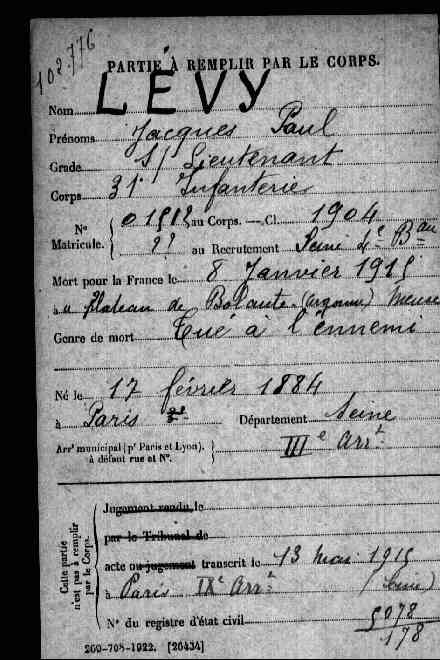
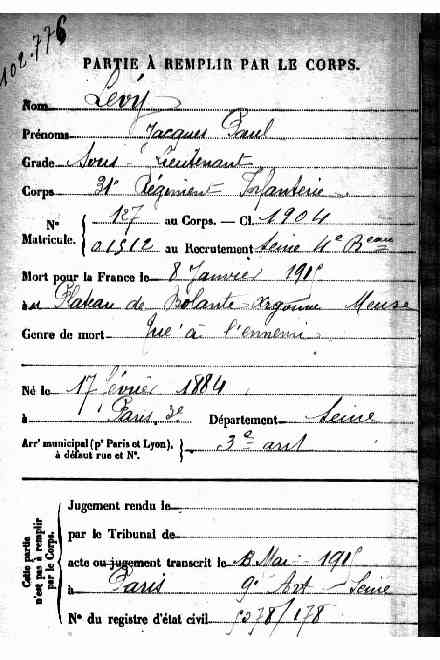
A member of the 31st Infantry Regiment, Lieutenant Levy was killed at the Plateau de Bolante, in the Argonne, on January 8, 1915.  Awarded the Croix de Guerre and Legion of Honour (the latter posthumously), he was the husband of Esther (Zadoc Khan) Levy, and the son of Camille and Blanche (Blum) Levy.  He was born on February 17, 1884, in the 3rd Arrondissement of Paris.

As per the (prior) post covering Lieutenants Aboucaya and Oulman, I’ve included the “Partie à Remplir Par le Corps” cards from the “Mémoire des hommes” website.  Lieutenant Levy’s name appears on page 55 of Les Israelites dans l’Armée Francaise.

The article in l’Univers Israélite is not a biographical profile as such. 

Or even, at all. 

Rather, it’s presentation of a speech given on Sunday, February 7, 1915, in the chapel of rue de la Victoire, by Chief Rabbi J.H. Dreyfuss.  Certainly sincerely meant, it is – perhaps inevitably – far more hagiographical than biographical, giving the reader insight into questions of patriotism within theology; theology with patriotism.

Throughout a war that would last four more long and terrible years, both the l’Univers Israélite and The Jewish Chronicle would be forced by circumstance to present many further stories, often – at least early in the war – in the same tone and manner.   

A PDF of the article is available here. 

____________________

Le lieutenant Jacques Lévy

Lieutenant Jacques Lévy

l’Univers Israélite
February 12, 1915

The Jewish World
February 12, 1915

Chaque jour s’allonge la liste de nos jeunes héros, fauchés à l’aurore de leur carrière et dont la mémoire est déjà entourée de la triple auréole de la vertu, de la vaillance et du martyre.  Nous avons, l’autre jour, cité le lieutenant Aboucaya, le lieutenant Oulman.  Parlerons-nous du lieutenant Jacques Lévy? Les souvenirs qui s’attachent maintenant à lui sont si poignants que nous aurions hésité à y toucher, même d’une plume discrète, si au service qui a été célébré, à sa mémoire, dimanche dernier, dans l’oratoire de la rue de la Victoire, M. le grand-rabbin J.-H. Dreyfuss n’avait retracé sa carrière et évoqué ses vertus.

Every day lengthens the list of our young heroes, broken in the dawn of their careers and whose memory is already surrounded by the triple halo of virtue, bravery and martyrdom.  We, the other day, cited Lieutant Aboucaya, Lieutenant Oulman.  We speak of Lieutenant Jacques Lévy?  The memories that are now attached to him are so poignant that we would hesitate to touch, even a discreet pen, if the service which was celebrated in his memory on Sunday, in the chapel of rue de la Victorie, the Chief Rabbi J.H. Dreyfuss had traced his career and mentioned his virtues.

Voici quelques passages de la touchante allocution de M. le grand-rabbin de Paris.

Here are some passages of the touching speech by the Chief Rabbi of Paris.

“Notre regretté frère Jacques Lévy avait appris de bonne heure à connaître le côté sérieux de l’existence; son adolescence fut mûrie par l’épreuve, et une épreuve cruelle: la perte de son bien-aimé et respecté père.  Il se considéra aussitôt comme appelé par la Providence au plus noble et au plus difficile des devoirs, d’autant plus difficile pour lui qu’il était tout jeune encore: celui d’assumer, en faveur des siens, la responsabilité du chef de famille.  Ce fut là l’idée directrice de toute sa jeunesse: il n’en dévia pas un instant.  Et ici, mes frères, admirez la force peu commune de ce caractère dé jeune homme.  Tous ses goûts le portaient vers les choses intellectuelles; affamé de culture, particulièrement attiré vers les sciences spéculatives, ce qui ne l’empêchait pas, d’ailleurs, de posséder le sentiment exquis de l’art et surtout de la peinture, mais préoccupé, d’autre part comme nous l’avons dit, de ses devoirs de famille, de l’obligation, de compter avec les réalités pratiques de la vie, il eut le courage et la ténacité de mener de front ses études et les soins de son emploi.  Il fut licencié en philosophie en méme temps qu’il achevait son apprentissage commercial.  Comment un caractère d’une telle trempe ne devait-il pas refuser?  Et il réussit en effet.” [réu-sir is probably an error]

“Our late brother Jacques Levy had learned early to know the serious side of life; his adolescence was matured by a test, and a cruel test: the loss of his beloved and respected father.  He immediately looked as called by Providence to the noblest and most difficult of duties, all the more difficult for him as he was still young: to assume, on behalf of his family, the householder’s responsibility.  This was the thrust of his youth: he did not swerve a moment.  And here, my brothers, admire the unusual strength of character this young man.  All tastes were to intellectual things; a hunger for culture, particularly attracted to the speculative sciences, which did not prevent him, however, from possessing an exquisite sense of art and especially painting, but concerned about the other part, as we said his family duties, the obligation, to reckon with the practical realities of life; he had the courage and tenacity to juggle his studies and the care of his employment.  He graduated in philosophy in the same time he completed a commercial apprenticeship.  He graduated in philosophy in same time he completed a commercial apprenticeship.  How should he not refuse a character of such calibre?  And he indeed succeeded.”

L’orateur rappelle avec émotion le marriage qui, il y a moins d’un an, avait uni le défunt à la fille “d’un pasteur qui est cher à nos coreligionnaires, non seulement par son mérite personnel, par son talent, par sa science, par son dévouement à toute épreuve, mais encore parce qu’il est l’époux de la fille du grand pasteur que fut l’inoubliable Zadoc Khan – je dis inoubliable dans le réelle acception du mot, car plus les années s’écoulent, plus son souvenir revit et revivra sans cesse dans toutes les circonstances de la vie de notre communauté.”

He recalled with emotion the marriage, of less than a year, that had united the deceased to the daughter “of a pastor who is dear to our fellow believers, not only by his personal merit, by his talent, by his science, his foolproof dedication, but because he is married to the daughter of that great shepherd who was the unforgettable Zadoc Khan – I say memorable in the real sense of the word, because the more years flow, I remember him and saw live again and again in all circumstances of life in our community.”

“Mais hélas ! sur cette maison à peine édifiée, si pleinement heureuse, a passé également le souffle de la tempête qui a déjà dévasté tant de foyers.

“But unfortunately ! this house built only if completely happy, has also experienced the breath of the storm that has already destroyed so many homes.

“Du même élan irrésistible qui, a l’appel de la patrie, a jeté à nos frontières tous les enfants de la France, le sergent Jacques Lévy quitte sa jeune femme et sa famille, va résolument prendre sa place a coté de ses frères d’armes.  Pour que rien ne manquât a cette nature d’élite, un patriotisme vibrant s’alliait en lui à une haute conscience.  Il prend part aux glorieux exploits de la Marne, se bat comme un brave, de sergent passe adjudant, d’adjudant sous-lieutenant, est cité à l’ordre du jour, et suprême récompense, proposé pour l’etoile de l’honneur.  Mais il tombe blessé et rest ramené du front.  Il aurait assez fait maintenant pour donner la mesure de sa vaillance; mais il veut faire plus que son devoir; il est heureux d’ailleurs et fier des lauriers glorieux qu’il a déjà cueillis…  Apres un court repos qui lui est imposé par sa convalescence, il demande à son colonel de le renvoyer au front.  Ce fut dans l’Argonne; a peine arrivé, il tombe une seconde fois, et helas ! pour ne plus se relever.

“At the same irresistible force, that has the call of his country, threw all the children of France upon our borders, Sergeant Jacques Lévy leaves his young wife and family, and will definitely take his place next to his brothers in arms.  That nothing might be wanting in this elite nature of vibrant patriotism was combined in him to a higher consciousness.  He took part in glorious exploits on the Marne, fights like a brave sergeant is promoted adjutant, and adjutant lieutenant, is quoted on the order of the day, and receives the star of honor for a supreme reward.  But he falls wounded and is brought back from the front to rest.  He would have done enough now to give the measure of his valor; but he wants to do more than his duty; he is also happy and proud of the glorious laurels he has already selected…  After a short rest imposed on him by his convalescence, he asked his colonel to return to the front.  It was in the Argonne; he has just arrived, he falls a second time, and alas! to rise no more. 

…La consolation!  Vous la trouverez dans le souvenir attendri, dans le souvenir béni de celui que n’est plus, vous la trouverez dans ces paroles écrites par lui, pour les siens, avant de retourner au front.  Dans cette page admirable, que j’ai lue et qui m’a remué profondément; l’homme se révèle tout entier.  C’est la page d’un philosophe et d’un croyant tout à la fois, d’un époux tendre, heureux et reconnaissant, d’un fils respectueux et pieux, d’un parent dévoue; c’est aussi la page d’un patriote, la page d’un soldat.  Dans quelques mots brefs, il parle de tout et de tous, de sa foi en l’idéal, éternellement beau et bon, de son culte de la vérité, de la loyauté, du devoir, de Dieu à qui il croit et à qui il rend grâces pour le bonheur des jours passés…  de tous les êtres chers qu’il confie à sa femme, de sa joie à repartir, ne laissant, comme il dit, aucune dette matérielle ni morale, de son amour de la France, de sa ferme confiance dans la victoire.  La dernière parole est une parole de touchante humanité en même temps qu’une parole de consolation.  “Si Dieu, le maître de ma vie, la prend, que tous les êtres chéris que je vais quitter à nouveau gardent, s’ils le peuvent, mon souvenir; mais qu’ils se consolent très vite de ma mort”.

The consolation!  You find it in the tender memory, in the memory of blessed one is not, you will find in these words written by him, for his family before returning to the front.  In this admirable page, I read and it stirred me deeply; man is proven whole.  This is the page of a philosopher and a believer at the same time, a tender husband, happy and grateful, a respectful son and pious, devoted parent; it is also a page of a patriot, a page of a soldier.  In a few brief words, he talks about everything and everybody, his faith in the ideal, eternally beautiful and good, worship of truth, of loyalty, duty, God whom he believes and to which he gives thanks for the good of bygone days…of all the loving things that he told his wife, his joy at leaving, leaving, as he says, no material or moral debt of his love of France, his firm confidence in victory.  The last word is a word of touching humanity along with a word of consolation.  “God, the master of my life, takes all the loved ones that I’ll leave and keep, if they can, my memory; but let them console themselves quickly of my death.”

Soldiers of The Great War: Jewish Military Service in WW I, as Reported in l’Univers Israélite (The Jewish World) – DEUX HÉROS (Two Heroes – Aboucaya and Oulman), February 5, 1915

The following article, from l’Univers Israélite, is the first such item in that periodical that covered – in detail – the lives and military service of Jewish soldiers who died while fighting for France. 

Alas, many more such items would appear l’Univers Israélite prior to November 11, 1918.

The article covers two Jewish officers:  Lieutenant Maurice Simon Oulman, and, Sous Lieutenant David Robert Aboucaya. 

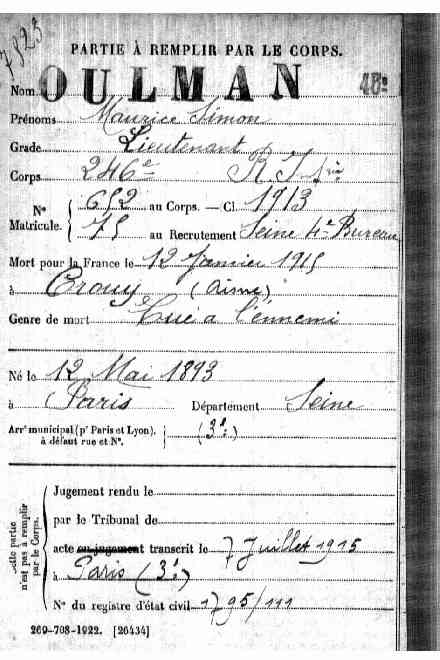
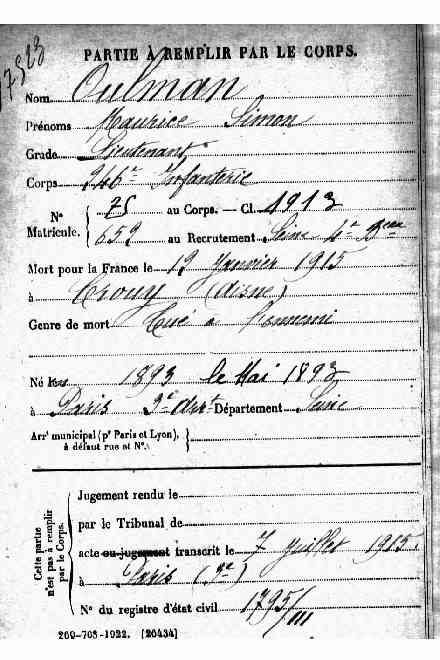
Lieutenant Oulman, who served in the 246th Infantry Regiment, was killed at Crouy (Aisne), on January 12, 1915.  Born on May 12, 1893, he resided at the 3rd Arrondissement, in Paris.  His name appears on page 67 of Les Israelites dans l’Armée Francaise.

Sous Lieutenant Aboucaya, a member of the 136th Infantry Regiment, was killed near Reims on September 14, 1914.  Born on October 15, 1892, he also resided in Paris; in the 19th Arrondissement.  He received the Legion of Honor (posthumously), and, the Croix de Guerre.  His name appears on page 1 of Les Israelites dans l’Armée Francaise, and, page 184 of Le Livre d’Or du Judaisme Algérien (1914-1918).

A PDF version of this article is available here.

____________________

Along with the text of the article, I’ve included the “Partie à Remplir Par le Corps” cards for both men (from which the above information was obtained) which were found at the French Government’s “Mémoire des hommes” (Memories of the Men) website. 

Very strongly akin to the Commonwealth War Graves Commission’s database, Mémoire des hommes provides biographical records covering French military deaths incurred during World War One and the Second World War, as well as French military action in Indochina, Algeria, Morocco, and Tunisia.  Coverage of the First War World is particularly detailed, encompassing, “more than 1.3 million individuals deceased during the Great War”, 74,000 records concerning men who served in the French Air Force, as well as records for the 1,009 soldiers and civilains who were – as the website says – “…sentenced to death and shot in accordance with military judiciary decision or summarily executed.”  (Think: Paths of Glory).  The website also allows users to search for information about military casualties interred in French military cemeteries.  

The digital records covering both men were obtained as part of a (slightly…somewhat?…much!) larger project involving identifying the names of all Jewish soldiers who were killed while serving in the French military during WW I.  The results of this research have resulted in the identification of nearly 4,600 men.

____________________

DEUX HÉROS
TWO HEROES

l’Univers Israélite
February 5, 1915

The Jewish World
February 5, 1915

Combien sont-ils déjà, les officiers dont une mort héroïque a couronné une carrière courte, mais glorieuse?  Le plus souvent, nous apprenons leur mort par un avis laconique.  Quelquefois nous pouvons connaître des détails qui, en avivant nos regrets, augmentent aussi notre admiration pour ces braves qui unissent la bonté à la vaillance et la douceur à l’héroïsme.

How many are there already, officers whose heroic death capped a short, but glorious, career?  Most often, we learn of their deaths by a terse notice.  Sometimes we can know details which, heightening our regrets, also increase our admiration for these braves uniting kindness the valor and heroism sweetness.

Nous voulons en citer pour aujourd’hui deux exemples, qui nous sont fournis par le lieutenant Aboucaya et le lieutenant Oulman.

We want today to name two examples, which are provided to us by Lieutenant Aboucaya and Lieutenant Oulman.

Le lieutenant Aboucaya
Lieutenant Aboucaya

Nous avons déjà signalé la mort au champ d’honneur du sous-lieutenant de réserve Aboucaya, du 136e d’infanterie, fils de M. Léon Aboucaya, l’industriel connu, membre du Consistoire central.

We have already reported the death in battle of Reserve Second Lieutenant Aboucaya, 136th Infantry, son of Leon Aboucaya, known industrialist, member of the Central Consistory.

Nous avons pu avoir communication d’une bien belle lettre écrite au père du jeune officier par son chef direct, le capitaine Fournier, lui-même grièvement blessé d’une balle à la tête.

We have had communication via a beautiful letter written to the father of the young officer by his immediate superior, Captain Fournier, himself seriously wounded by a bullet to the head.

Le capitaine dit d’abord “toute l’estime que le caractère et le courage” du jeune sous-lieutenant, à l’ “allure décidée et franche”, lui avaient gagnée auprès de ses supérieurs et de ses égaux et qui s’était vite changée en une bonne amitié quand ils avaient reconnu le côté affectueux de sa nature et la cordialité de ses sentiments de famille.

The captain initially said “all the esteem that the character and courage” of the young lieutenant, to the “determined and frank look,” had won him over to his superiors and his equals and that had quickly turned into a good friendship when they recognized the affectionate side of his nature and the warmth of his family feelings.

L’officier était digne de l’homme. “Pendant toute la période des marches en France et en Belgique, malgré la grande chaleur, les étapes très longues, le lieutenant Aboucaya avait tenu à donner l’exemple à ses hommes. Il avait, sac au dos et malgré son peu d’entraînement, supporté ces grandes fatigues du début et donné ainsi la mesure s’un caractère énergique, qui faisait bien augurer de lui pour le combat. Promesse tenue, car à F. ., à St-S… R… (combat de Guise), à Ch…, à S…, enfin, son attitude a été celle d’un chef imposant la confiance à ses homes”.  [Probably error in original a “u’un”.]

The officer was worthy of man.  “Throughout the period of marches in France and Belgium, despite the great heat, the very long intervals, Lieutenant Aboucaya had wanted to set an example to his men.  His backpacking, despite his lack of training, supported these with great fatigue early and given so far as an energetic character, which augured well for him for the fight.  The promise was kept, because at F., at St. S… R… (combat at Guise), at Ch…, at S…, finally, his attitude was that of a leader imbuing confidence in his men.”

A F.., notamment, la section Aboucaya tint vigoureusement une hauteur, de 4 heures du matin à midi, sous un feu infernal d’infanterie et d’artillerie, répondant coup pour coup et fort habilement à l’attaque de l’ennemi. Le lendemain soir, à O…, au moment où le régiment allait faiblir dans une charge à lâ baïonnette, le lieutenant Aboucaya, aux cris de en avant ! en avant ! réussit à arrêter la panique grâce à son attitude énergique.  “Le chef de bataillon et le colonel le félicitèrent d’ailleurs chaudement à la suite de cet acte de courage, qui valait une citation à l’ordre du jour”.

At F…, including Aboucaya’s section vigorously held a height from 4 A.M. to noon under a hellish fire of infantry and artillery, responding blow for blow and very skillfully attacking the enemy.  The next evening at O…, when the regiment’s bayonet charge was weak ing, Lieutenant Aboucaya, chanting forward! forward! managed to avert panic through his energetic attitude.  “The Battalion Commander and Colonel also warmly congratulated him after this act of courage, worthy of an Order of the Day.”

A Ch…, le lieutenant Aboucaya se distingua encore par sa “vaillante attitude pendant les heures de lutte émouvante qui eurent pour théâtre le village en flames”. C’est à S…, qu’à la tête de sa section, soumise à un feu terrible d’artillerie, il tomba, au premier rang, “la où depuis le debut il avait eu à cœur de sa tenir toujours”.

At Ch… Lieutenant Aboucaya was still distinguished for his “courageous attitude during the emotional struggle that took hours to the village theater in flames”.  This is at S…, where at the head of his section, subject to a terrible artillery fire, he fell in the front line, the “where from the beginning he was to keep his heart always.”

J’ai perdu, conclut le capitaine, “un officier ardent et courageux, sur lequel je savais pouvoir compter. Je garderai fidèlement son souvenir; son nom et son image seront encore évoqués souvent dans nos tranchées; plus d’une fois encore, les soldats qui restent de sa section parleront de lui avec le regret du chef qu’ils aimaient pour sa bonté et son entrain”.

I lost, concludes the captain, “an ardent and courageous officer, on whom I knew I could count.  I faithfully keep his memory; his name and image still come up in our trenches; more than once again, the soldiers who remain in his section will discuss him with the head of regret that they loved for his kindness and enthusiasm.”

Cette lettre, si noble et si émouvante que nous aurions voulu la citer tout entière, est un titre de gloire pour celui qui en est l’objet, elle fait honneur aussi à celui qui l’a écrite.

This letter, so noble and so moving that we wanted the whole quote is a claim to fame for the one who is the object, it also does honor to the one who wrote it.

Le lieutenant Oulman
Lieutenant Oulman

Le lieutenant Maurice Oulmàn, dont nous avons annoncé la semaine dernière la mort au champ d’honneur, avait été promu à ce grade le 6 septembre 1914, à la bataille de la Marne, pour son courage, son sang-froid, son énergie, pour l’enthousiasme qu’il avait su inspirer à tous ses soldats, lorsque, ce jour-là, ses chefs, le capitaine et le lieutenant en premier, avaient été frappés mortellement.

Lieutenant Maurice Oulman, whose death in battle we announced last week, had been promoted to the grade on 6 September 1914, at the Battle of the Marne, for his courage, his composure, his energy, for the enthusiasm that had inspired all his soldiers, when on that day, the leaders, the captain and first lieutenant, had been mortally wounded.

Son colonel l’aurait nommé capitaine si Oulman n’avait été trop jeune pour ce grade: il n’avait que vingt-et-un ans.  Malgré sa jeunesse, tous les hommes qu’il avait sous ses ordres l’adoraient comme un père. De fait, il remplissait les fonctions de commandant de compagnie.

His colonel would have appointed him captain but Oulman had been too young for this degree: he was only twenty-one years.  Despite his youth, all the men he had under him loved him like a father.  In fact, he acted as the company commander.

Lorsqu’à la terrible bataille de l’Aisne, son sous-lieutenant tomba, frappé d’une balle au ventre, il s’elança sous le feu meurtrier. En vain, un sergent, blessé à côté de lui, le supplie de ne pas s’exposer; malgré une plaie au pied qui gêne sa marche, il va de l’avant, jusqu’à ce que la mitraille l’abatte. Trois des combattants vont ramasser le corps, pour l’enterrer au cimetière de C…; deux tombent à leur tour.

When at the terrible Battle of the Aisne, his lieutenant fell, struck by a bullet in the stomach, he darted under the murderous fire.  In vain, a sergeant, wounded beside him, begs him not to expose himself; despite a sore foot bothering his walk, he goes ahead until the landslide of shrapnel.  Three fighters will pick up the body, burying him in the cemetery of C…; Both fall in turn.

Il aura l’honneur posthume d’être inscrit à l’ordre du jour, ainsi que, dans sa lettre de condoléances à la famille, le colonel du régiment l’écrit.

He will have the posthumous honor to be included on the Order of the Day and, in his letter of condolences to the family, the colonel of the regiment wrote.

Voici en quels termes émus M. T…, un collègue du défunt, fait son éloge dans une lettre adressée aux parents de la victime:

Here is how Monsieur T… moving words…a deceased colleague, praising him in a letter to the victim’s parents:

“…Je voudrais tant que ma premiere lettre fut pleine de l’affection admiration que j’avais pour votre cher fils dont la mort m’a déchiré.

“… I want as my first letter to be full of the affection and admiration I had for your dear son whose death tore me.

“Nous étions au repos à St-P… quand est venu l’ordre, le 13, vers dix heures du matin, de se porter rapidement à C…, ou les Allemands attaquaient.  Maurice était étendu sur son lit, depuis 8 jours il souffrait un peu du pied gauche…  Mais dés que l’ordre d’alerte et de départ lui parvint, il se leva; se fit refaire par un infirmier un pansement réduit pour pouvoir marcher. “Vous feriez mieux de rester au repos, mon lieutenant”, lui dit l’infirmier. Il ne répondit pas. Avec ce courage calme et réfléchi qui a toujours forcé notre admiration et qui était le secret de son ascendant sur ses 250 hommes, des gens de 30 à 35 et 40 ans, parfois, qui lui obéissaient aveuglément, il prit la tête de la compagnie.

“We were standing at St. P… when came the order, the 13th, about ten in the morning, to stand fast in C… or the Germans would attack.  Maurice was lying on his bed for 8 days suffering a little in his left foot…  But as soon as the order for alert and departure reached him, he stood up; a nurse came by again with a small dressing to walk.  “You better stay at rest, sir,” said the nurse.  He did not answer.  With this calm and thoughtful spirit that has always forced our admiration and that was the secret of his ascendancy over his 250 men, people from 30 to 35 and 40 years, sometimes, who obeyed him blindly, he led the company.

“Il arrive à C…, appuyé sur canne, ayant traversé sans perdre un homme le terrain nu balayé par les feux de l’éperon 132. Là il reçut l’ordre de monter rapidement sur le plateau de P… occuper les tranchées de repli pour soutenir le régiment que les Allemands bousculaient en première ligne. Il fait le cheminement habituel, mais, hélas ! les Allemands tenaient déjà les positions même qu’il allait occuper.

“We arrived at C…, pressed the sticks, passed through without losing a man on the bare ground swept by the fires of spur 132.  There he was ordered to quickly climb the Plateau of P… to occupy the fallback trenches to support the regiment’s as Germans were jostling the frontline.  He made the usual path, but alas! The Germans already held the same position he would occupy.

“Un sous-lieutenant tombe près du lieutenant Oulman. Celui-ci s’avance vers lui, lorsqu’un sergent le prend par le bras: “Mon lieutenant, ne vous montrez pas, nous avons besoin de quelqu’un pour nous commander” … Mais lui se dégage avec fermeté et dit: “Laissez-moi, ne vous occupez pas de cela”. Il n’avait pas fait trois pas qu’il tombait en arrière, sans un cri; une balle lui avait traversé la téte. Toute la compagnie s’arrête, figée par l’atroce nouvelle qui court de rang en rang.

“A second lieutenant dies near Lieutenant Oulman.  He advances towards him, when a sergeant takes him by the arm: “Lieutenant, do not show yourself, we need someone to lead us”…  But he emerges firmly and said, “Leave me, do not mind that.”  He had not taken three steps when he fell back, without a cry; a bullet had passed through his head.  The whole company stopped, frozen by the terrible news that runs from rank to rank.

“Si vous saviez comme ils l’aimaient, leur jeune chef si simple, si brave, si énergique et si pur! Pour les officiers, c’est un peu la Jeanne d’Arc de cette guerre. Et j’ai vu le lendemain encore des hommes pleurer en me contant tout cela. Au reste leur opinion est faite: “Ce petit-là, on l’aurait suivi partout, oh! nous perdons gros! Et personne ne saura nous conduire comme lui”.

“If you knew how they loved, their young leader so simple, so brave, so strong and so pure!  For officers, he’s a little Joan of Arc of the war.  And I saw it again with next men crying telling me all this.  Besides, their opinion is made: “This little one, we would have followed him everywhere, oh! we lose big!  And no one will take us like him.”

“Ils disaient vrai, nul d’entre nous n’a ce sang-froid que rien ne troublait, cette énergie méthodique qui n’était pas de son âge”.

“They were right, none of us has the coolness that nothing disturbed, this methodical energy that was not of his age.”

Le lieutenant Oulman avait 21 ans.

Lieutenant Oulman was 21.

References

Le Livre d’Or du Judaisme Algérien (1914-1918) (Réédité par le Cercle de Généalogie juive, Paris, 2000) [Avec la collaboration de Georges Teboul et de Jean-Pierre Bernard]

Les Israelites dans l’Armée Francaise, Angers, 1921 (Réédité par le Cercle de Généalogie juive, Paris, 2006)

Mémoire des Hommes, at http://www.memoiredeshommes.sga.defense.gouv.fr/en/

Soldiers who Died for France in the First World War, at http://www.memoiredeshommes.sga.defense.gouv.fr/fr/arkotheque/client/mdh/base_morts_pour_la_france_premiere_guerre/index.php?

God’s Decree is Unsearchable: One of 12,000 – Thoughts of A German Jewish Soldier in the Great War – II

In my prior post, I described the varied books published in Germany during, after not long after, the First World War, which covered the experiences of German Jewish soldiers through prose – soldiers’ letters and diaries – as well as statistics. 

But, descriptions can go only “so far”. 

This post presents the letter from soldier Martin Feist, of Frankfurt, which appears in Kriegsbriefe – gefallener Deutscher Juden.

____________________

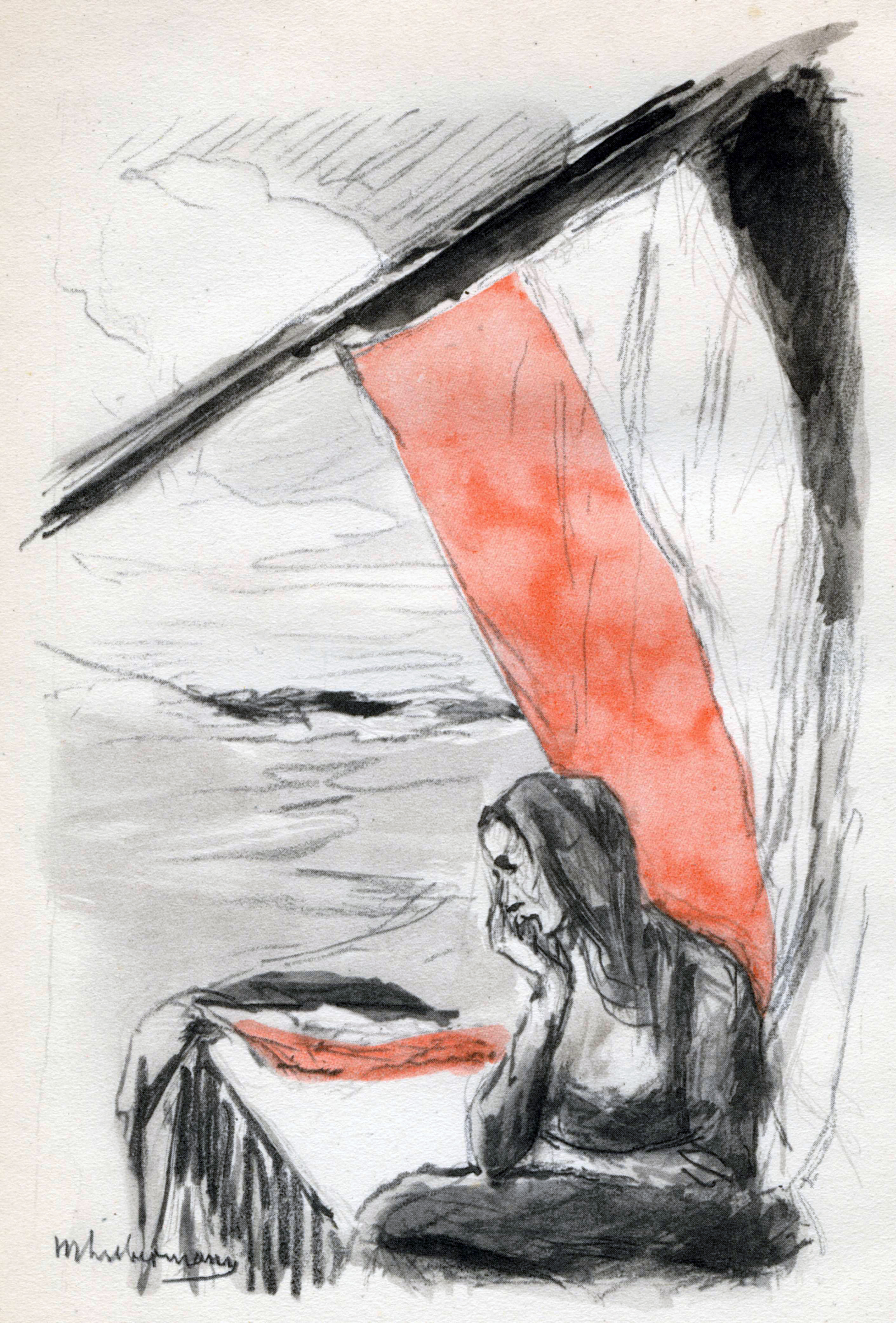
Images of the cover of Kriegsbriefe – gefallener Deutscher Juden, Max Liebermann’s sketch, and Martin’s letter (outlined in red) on pages 19 and 20, are presented below:

The book’s cover.

The title page.

Max Liebermann’s art:  An allegory of mourning.
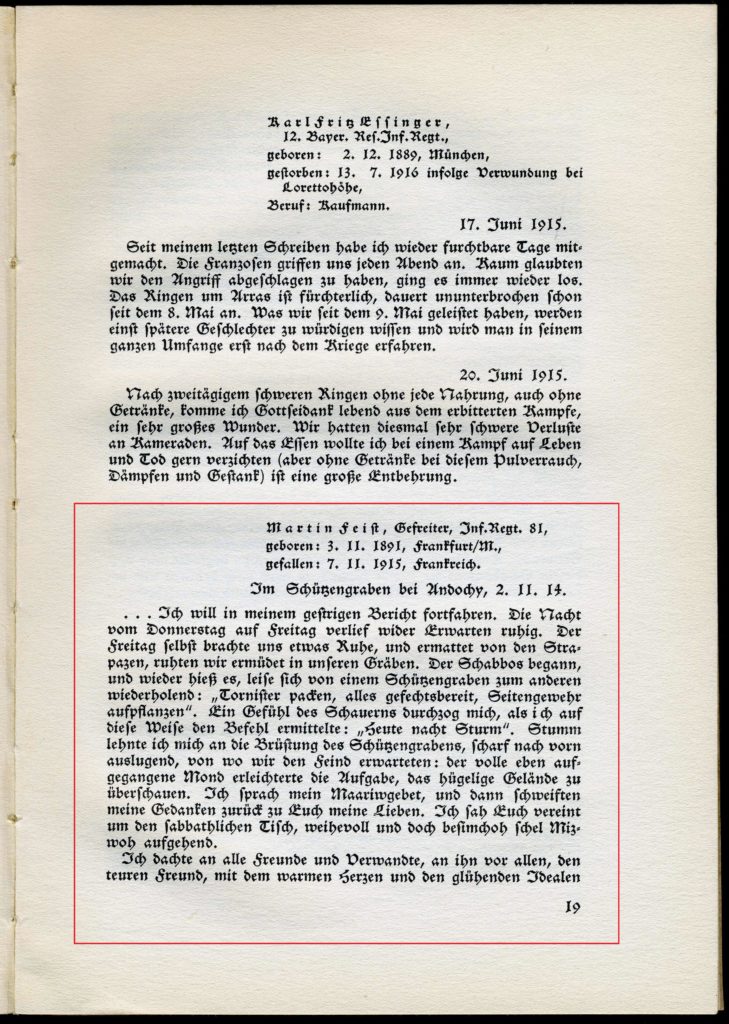
Excerpt of Martin’s letter, commencing on page 19.  The format of the “header” – comprised of the soldier’s name, rank, and military unit; date and place of birth; date and place of death; date and place where the letter was actually written – is followed (with variations) for the 73 other writings in the book.
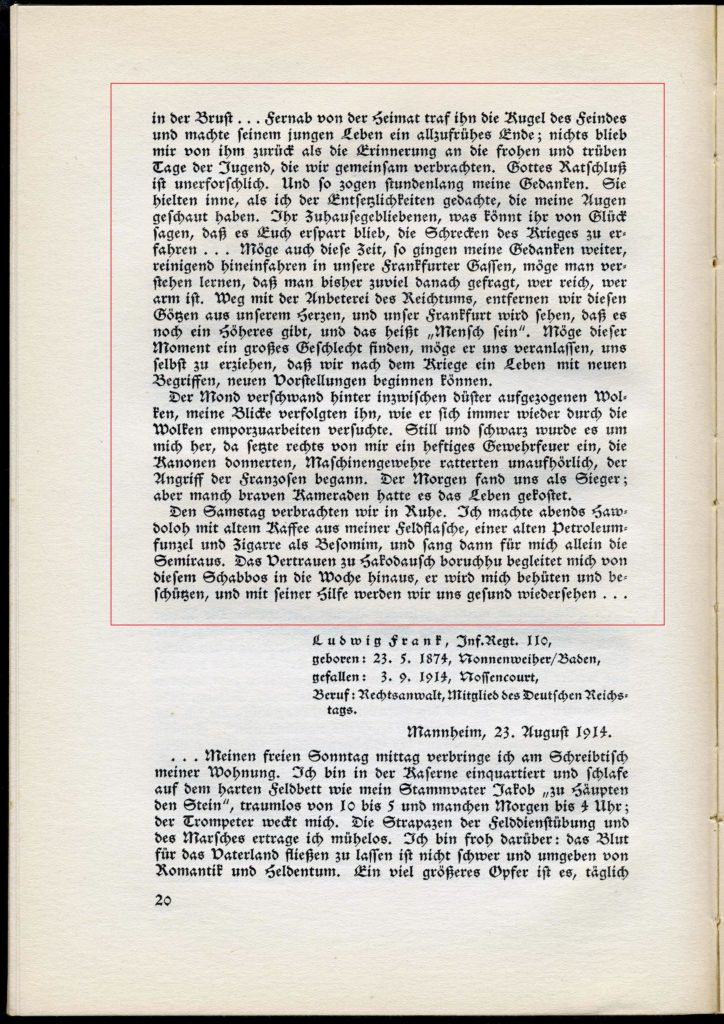
Excerpt of Martin’s letter, concluding on page 20.

____________________

Martin’s letter, in German transcription and English translation, is presented below.  (Note the ellipses, indicating sections of the letter which were deleted left unpublished.  More about those in a moment..)

Martin Feist
Gefreiter

Inf. Regt. 81
Geboren: 3.11.1891, Frankfurt / M.
Gefallen: 7.1.1915, Frankreich

Martin Feist
Corporal

81st Infantry Regiment
Born: November 3, 1891, Frankfurt on Main
Fallen: January 7, 1915, France

Im schützengraben bei Andochy, 2.11.14
In a Trench at Andochy, November 2, 1914

     …Ich will in meinem gestrigen Bericht fortfahren.  Die Nacht vom Donnerstag auf Freitag verlief wider Erwarten ruhig.  Der Freitag selbst brachte uns etwas Ruhe, und ermattet von den Strapazen, ruhten wir ermüdet in unseren Gräben.  Der Schabbos begann, und wieder hiess es, leise sich von einem Schützengraben zum anderen wiederholend: “Tornister packen, alles gefechtsbereit, Seitengewehr aufpflanzen.”  Ein Gefühl des Schauerns durchzog mich, als ich auf diese Weise den Befehl ermittelte: “Heute nacht Sturm.”  Stumm lehnte ich mich an die Brüstung des Schützengrabens, scharf nach vorn aus lugend, von wo wir den Feind erwarteten: der volle eben aufgegangene Mond erleichterte die Aufgabe, das hügelige Gelände zu überschauen.  Ich sprach mein Maariw gebet, und dann schweiften meine Gedanken zurück zu Euch meine Lieben.  Ich sah Euch vereint um den Sabbathlichen Tisch, weihevoll und doch besimchoh schel Mizwoh aufgehend.

     …I want to continue in my report of yesterday.  The night, from Thursday to Friday, was calm.  Friday itself brought us some rest, and weary of the hardships, we rested tired in our trench.  Shabbos began, and again it was said, quietly from one trench to the other: “Pack knapsacks, everything ready for battle, plant bayonets [seitengewehr 98].”  A shuddering feeling ran through me when I understood the order: “Night assault.”  Silently I leaned back against the parapet of the trench, leaning forward, from where we expected the enemy: The full moon, which had just risen, facilitated the task of surveying the hilly terrain.  I spoke my Maariv prayer, and then my thoughts wandered back to you my dears.  I saw you gathered together around the Sabbath table, sanctified, and yet sober, mischievous.

Ich dachte an alle Freunde und Verwandte, an ihn vor allen, den teuren Freund, mit dem warmen Herzen und den glühenden Idealen in der Brust…  Fernab von der Heimat traf ihn die Kugel des Feindes und machte seinem jungen Leben ein allzufrühes Ende; nichts blieb mir von ihm zurück als die Erinnerung an die frohen und trüben Tage der Jugend, die wir gemeinsam verbrachten.  Gottes Ratschluss ist unerforschlich.  Und so zogen stundenlang meine Dedanken.  Sie hielten inne, als ich der Entsetzlichkeiten gedachte, die meine Augen geschaut haben.  Ihr Zuhausegebliebenen, was könnt ihr von Glück sagen, dass es Euch erspart blieb, die Schrecken des Krieges zu erfahren…  Möge auch diese Zeit, so gingen meine Gedanken weiter, reinigend hineinfahren in unsere Frankfurter Gassen, möge man verstehen lernen, dass man bisher zuviel danach gefragt, wer reich, wer arm ist.  Weg mit der Anbeter ei des Reichtums, entfernen wir diesen Götzen aus unserem Herzen, und unser Frankfurt wird sehen, dass es noch ein Höheres gibt, und das heisst “Mensch sein”.  Möge dieser Moment ein grosses Geschlecht finden, möge er uns veranlassen, uns selbst zu erziehen, dass wir nach dem Kriege ein Leben mit neuen Begriffen, neuen Vorstellungen beginnen können.

     I thought of all the friends and relatives, of him before all, the dear friend, with a warm heart and glowing ideals in his chest…  Far away from home, the bullet of the enemy struck him, and made of his young life too early an end; nothing remained for me of him but the memory of the joyful and gloomy days of youth that we spent together.   God’s decree is unsearchable.  And so my thoughts went on for hours.  They stopped when I thought of the horrors that my eyes had seen.  Your own home, you can fortunately say was spared to remain, to learn the horrors of the war…  May this time also, my thoughts went on, be a cleansing of our Frankfurter streets; may one understand, that one has asked too much about it so far, of who is rich; who is poor.  Away with the worship of wealth; may we remove these idols from our hearts, and our Frankfurt will see that there is still a higher one, that is to say, “to be human.”  May this great moment find a great lineage; may it lead us to educate ourselves that after the war we can begin to live with new things; can start new ideas.

Der Mond verschwand hinter inzwischen düster aufgezogenen Wolken, meine Blicke verfolgten ihn, wie er sich immer wieder durch die Wolken emporzuarbeiten versuchte.  Still und schwarz wurde es um mich her, da setzte rechts von mir ein heftiges Gewehrfeuer ein, die Kanonen donnerten, Maschinengewehre ratterten unaufhörlich, der Angriff der Franzosen begann.  Der Morgen fand uns als Sieger; aber manch braven Kameraden hatte es das Leben gekostet.

     The moon disappeared meanwhile behind dark clouds; my eyes watched it as it tried to work its way up through the clouds again and again.  There was about me stillness and blackness; violent rifle fire set in on my right, the cannons thundered, machine guns rattled incessantly, the attack of the French began.  The morning found us as victor; but had cost the lives of many good comrades.  

Den Samstag verbrachten wir in Ruhe.  Ich machte abends Hawdoloh mit altem Kaffee aus meiner Feldflasche, einer alten Petroleumfunzel und Zigarre als Besomim, und sang dann für mich allein die Semiraus.  Das Vertrauen zu hakodausch boruchhu begleitet mich von diesem Schabbos in die Woche hinaus, er wird mich behüten und beschützen, und mit seiner Hilfe werden wir uns gesund wiedersehen…

    We spent the Saturday in silence.  In the evening I made a Havdalah with old coffee from my canteen, an old petroleum fuse and a cigar as Besamim, and then sang the Zemirot alone.  The trust to HaKadosh Baruch Hu accompanies me from this Shabbos forth into the week; He will guard and protect me, and with His help we shall be well again…

____________________

Kriegsbriefe – gefallener Deutscher Juden is not the only source of information about Martin. 

Remarkably, the Center for Jewish History possesses the entirety of his correspondence, which (doubly remarkably!) includes the original text of the letter as excerpted in Kriegsbriefe – gefallener Deutscher Juden.  Listed – appropriately enough – as the Martin Feist Collection, the documents, donated by Sonya Benjamin, are described as, “letters [sent] to his family over the course of two years, first as a businessman in Paris and then as a German infantryman in France.” 

The collection is comprised of four sequentially arranged folders, covering 1913, 1914 (January to October), 1914 (November to December), and 1915.  The first folder commences with a descriptive note penned by Sonya in 1991, contaning the following statements, “Martin, as did his 2 brothers, worked for the firm Beer-Sondheimer, both in Paris and in London, whence he returned home to enlist when war broke out in August, 1914.  He stayed in close touch with his five brothers and sister.  He was the second eldest.  Their father had died in 1912.”

“The letters describe an arc of changing attitudes and emotions in the mind of a young German Orthodox Jew, well-educated in an affluent home, as he embraces the lifetstyle of a young businessman in Paris, then adapts to the life of a German infantryman, imbused by the righteousness of his cause, and finally experiences deep sorrow and disillusionment, tempered only by abiding faith.”

Thanks to the CJH’s policy of making the Martin Feist collection freely available in digital format, I was able to locate the letter from Kriegsbriefe – gefallener Deutscher Juden within the “3rd” folder.

The four pages of Martin’s original (typewritten) letter are presented below:
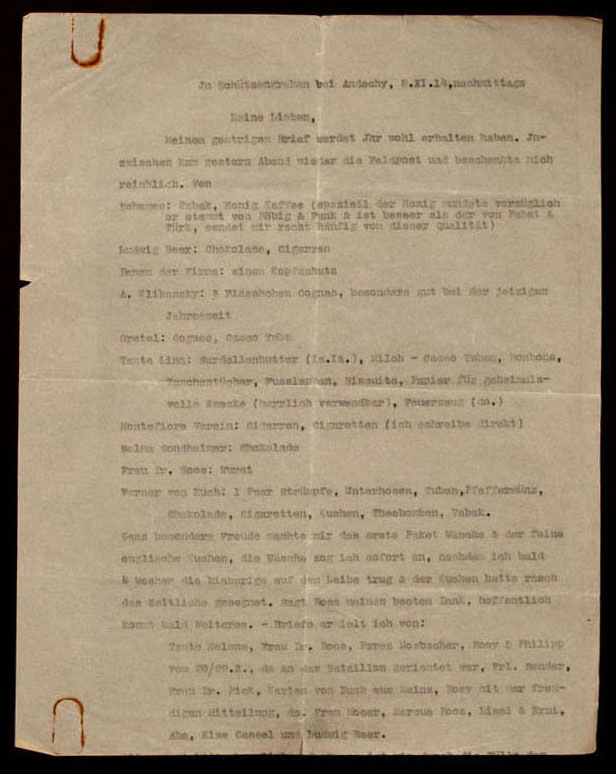
First page.
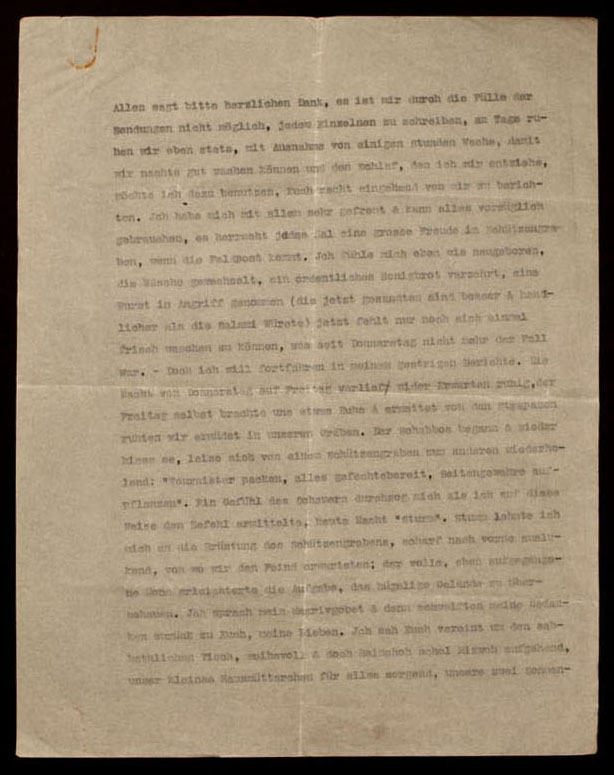
Second page.
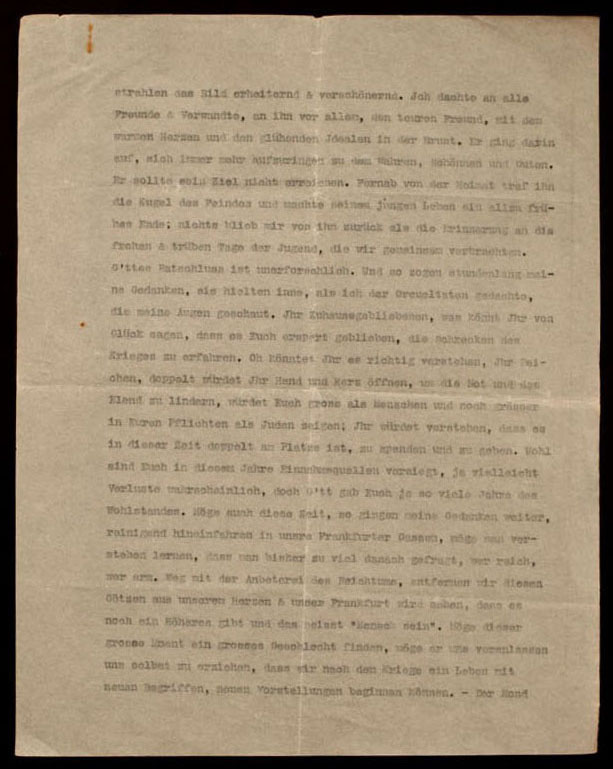
Third page.

Fourth, and final page.

____________________

This “full” version of Martin’s letter is – unsurprisingly – much lengthier than the book version, and in some parts is actually light-hearted.  Amidst all, Martin retained a sense of humor.

More importantly, a careful reading and comparison of the two versions reveals where the editors of Kriegsbriefe – gefallener Deutscher Juden significantly redacted the original text. 

For example in discussing an unidentified friend, the book presents, “I thought of all the friends and relatives, of him before all, the dear friend, with a warm heart and glowing ideals in his chest…  Far away from home, the bullet of the enemy struck him, and made of his young life too early an end; nothing remained for me of him but the memory of the joyful and gloomy days of youth that we spent together.”

Martin’s actual statement is, “I thought of all the friends & relatives, of him before all, the dear friend, with a warm heart and glowing ideals in his chest.  He began to rise more and more to the true, the beautiful and the good.  He should not achieve his goal.  Far away from home, the bullet of the enemy struck him, and made of his young life too early an end; nothing remained for me of him but the memory of the joyful & gloomy days of youth that we spent together.  

Likewise, the book presents, “God’s decree is unsearchable.  And so my thoughts went on for hours.  They stopped when I thought of the horrors that my eyes had seen.“.

In the same place, Martin’s original letter has the following, “God’s decree is unsearchable.  And so my thoughts went on for hours.  They stopped when I thought of the horrible abominations that my eyes had seen.”  

Other differences include the use of the word “and” in place of Martin’s liberal sprinkling of ampersand (“&”) symbols.

____________________

The transcription and my translation are presented below:

Martin Feist
Gefreiter
Inf. Regt. 81
Geboren: 3.11.1891, Frankfurt / M.
Gefallen: 7.1.1915, Frankreich

Martin Feist
Corporal

81st Infantry Regiment
Born: November 3, 1891, Frankfurt on Main
Fallen: January 7, 1915, France

Im Schützengraben bei Andochy, 2.XI.14, nachmittags
In a trench at Andochy, November 2, 1914, in the afternoon

Meine Lieben,
My dear,

      Meinen gestrigen Brief werdet Ihr wohl erhalten haben.  Inzwischen kam gestern Abend wieder die Feldpost und beschenkte mich reichlich.  Von

      You will probably have received my letter [of] yesterday.  In the meantime the field post came yesterday evening and gave me plenty.  From

Schames: Tabak, Honig Kaffee (speziell der Honig mundete vorzüglich er stammt von Röbig & Funk ist besser als der von Pabst & Türk, sendet mir recht häufig von dieser Qualität.)

Schames: Tobacco, honey coffee (especially the exquisite honey coming from Röbig & Funk is better than that of Pabst & Türk; send me this quality quite frequently.)

Ludwig Beer: Chokolade, Cigarren

Ludwig Beer: Chocolate, cigars

Damen der Firma: einem Kopfschutz

Ladies of the Firm: A head guard

A. Klibansky:  3 Fläschchen Cognac, besonders gut bei der jetzigen Jahreszeit.

A. Klibansky: 3 bottles of cognac, especially good at the present season.

Gretel: Cognac, Cacao Tube

Gretel: Cognac, cocoa [butter] tube

Tante Lina: Sardellenbutter (Ia.Ia), Milch – Cacao Tuben, Bonbons, Taschentücher, Fusslappen, Biscuits, Papier für geheimnisvolle Zwecke (herrlich verwendbar), Feuerzeug (do.)

Aunt Lina: Anchovy butter (yes, yes), milk – cocoa [butter] tube, sweets, handkerchiefs, sandals, biscuits, paper for mysterious purposes (gloriously usable), lighter (ditto.)

Montefiore Verein: Cigarren, Cigaretten (ich schreibe direkt)

Montefiore Club: Cigars, Cigarettes (I write directly)

Selma Sondheimer: Chokolade

Selma Sondheimer: Chocolate

Frau Dr. Roos: Wurst

Frau Dr. Roos: Sausage

Ferner von Euch: 1 Paar Strümpfe, Unterhosen, Tuben, Pfeffermünz, Chokolade, Cigaretten, Kuchen, Theebomben, Tabak.

Further from you: 1 pair of stockings, underwear, tubes, peppermint, chocolate, cigarettes, cakes, Theebomben [pre-mixed and packaged tea in jute bags], tobacco.

Ganz besondere Freude machte mir das erste Paket Wäsche & der feine englische Kuchen, die Wäsche zog ich sofort an, nachdem ich bald 4 Wochen die bisherige auf dem Leibe trug & der Kuchen hatte rasch das Zeitliche gesegnet.  Sagt Rosa meinen besten Dank, hoffentlich kommt bald Weiteres.  – Briefe erhielt ich von:

I was particularly delighted with the first package of underwear & the fine English cake; I immediately put on the underwear after I had worn the old one on my body for four weeks & the cake had swiftly blessed the time.  Say my best thanks to Rosa; hopefully coming soon.  –  I received letters from:

Tante Helene, Frau Dr. Roos, Perez Mosbacher, Rosy & Philipp von 20 / 22 X., da an das Bataillon gerichtet war, Frl. Sender, Frau Dr. Pick, Karten von Euch aus Mainz, Rosy mit der freudigen Mitteilung, do. Frau Moser, Marcus Roos, Lisel & Erni, Aba, Else Cassel und Ludwig Beer.

Aunt Helene, Frau Dr. Roos, Perez Mosbacher, Rosy & Philipp of 20 / 22 X., since the battalion was directed; Miss Sender, Frau Dr. Pick, cards from you from Mainz, Rosy with the joyous message, ditto Frau Moser, Marcus Roos, Lisel & Erni, Aba, Else Cassel and Ludwig Beer.

Allen sagt bitte herzlichen Dank, es ist mir durch die Fülle der Sendungen nicht möglich, jedem Einzelnen zu schreiben, am Tage ruhen wir eben stets, mit Ausnahme von eingien Stunden Wache, damit wir nachts gut wachen können und der Schlaf, den ich mir entziehe, möchte ich dazu benutzen, Euch recht eingelhend von mir zu berichten.  Ich habe mich mit allen seht gefreut & kann alles vorzüglich gebrauchen, es herrscht jedes Mal eine grosse Freude im Schützengragen, wenn die Feldpost kommt.  Ich fühle mich eben wie neugeboren, die Wäsche gewechselt, ein ordentliches Honigsbrot verzehrt, eine Wurst in Angriff genommen (die jetzt gesandten sind besser & handlicher als die Salami Würste) jetzt fehlt nur noch sich einmal frisch waschen zu konnen, was seit Donnerstag nicht mehr der Fall war.  – Doch ich will fortfahren in meinem gestrigen Berichte.  Die Nacht vom Donnerstag auf Freitag verlief wider Erwarten ruhig, der Freitag selbst brachte uns etwas Ruhe & ermattet von den Strapazen, ruhten wir ermüdet in unseren Gräben.  Der Schabbos began & wieder hiess es, leise sich von einem Schützengraben zum anderen wiederholend: “Tornister packen, alles gefechtsbereit, Seitengewehr aufpflanzen.”  Ein Gefühl des Schauern durchzog mich als ich auf diese Weise den Befehl ermittelte, heute Nacht “Sturm”.  Stumm lehnte ich mich an die Brüstung des Schützengrabens, scharf nach vorn aus lugend, von wo wir den Feind erwarteten: der volle, eben aufgegangene Mond erleichterte die Aufgabe, das hügelige Gelände zu überschauen.  Ich sprach mein Maariw gebet & dann schweiften meine Gedanken zurück zu Euch, meine Lieben.  Ich sah Euch vereint um den Sabbathlichen Tisch, weihevoll und doch besimchoh schel Mizwoh aufgehend, unner kleines Hausamütterchen für alles sorgend, unsere zwei sonnenstrahlen das Bild erheiternd & verschönernnd.  Ich dachte an alle Freunde & Verwandte, an ihn vor allen, den teuren Freund, mit dem warmen Herzen und den glühenden Idealen in der Brust.  Er ging darin auf, sich immer mehr aufzuringen zu dem Wahren, Schönnen und Guten.  Er sollte sein Ziel nicht erreichen.  Fernab von der Heimat traf ihn die Kugel des Feindes und machte seinem jungen Leben ein allzu frühes Ende; nichts blieb mir von ihm zurück als die Erinnerung an die frohen & trüben Tage der Jugend, die wir gemeinsam verbrachten.  Gottes Ratschluss ist unerforschlich.  Und so zogen stundenlang meine Gedanken, sie hielten inne, als ich der Gräueltaten Entsetzlichkeiten gedachte, die meine Augen geschaut haben.  Ihr Zuhausegebliebenen, was könnt ihr von Glück sagen, dass es Euch erspart geblieben blieb, die Schrecken des Krieges zu erfahren.  Oh könntet Ihr es richtig verstehen, Ihr Reichen, doppelt würdet Ihr Hand uns Kerz öffnen, um die Not und das Elend zu lindern, würdet Euch gross als Menschen und noch grösser in Euren Pflichten als Juden zeigen; Ihr würdet verstehen, dass es in dieser Zeit doppelt am Platze ist, zu spenden und zu geben.  Wohl sind Euch in diesem Jahre Einnah__equellen versiegt, ja vielleicht Verluste wahrscheinlich, doch Gott gag Euch ja so viele Jahre des Wohlstandes.  Möge auch diese Zeit, so gingen meine Gedanken weiter, reinigend hineinfahren in unsere Frankfurter Gassen, möge man verstehen lernen, dass man bisher zu viel danach gefragt, wer reich, wer arm.  Weg mit der Anbeter ei des Reichtums, entfernen wir diesen Götzen aus unserem Herzen, & unser Frankfurt wird sehen, dass es noch ein Höheres gibt und das heisst “Mensch sein”.  Möge dieser grosses Moment ein grosses Geschlecht finden, möge er uns veranlassen, uns selbst zu erziehen, dass wir nach dem Kriege ein Leben mit neuen Begriffen, neuen Vorstellungen beginnen können. – Der Mond verschwand hinter inzwischen düster aufgezogenen Wolken, meine Blicke verfolgten ihn, wie er sich immer wieder durch die Wolken emporzuarbeiten versuchte, still & schwarz wurde es um mich her — da setzte rechts von mir ein heftiges Gewehrfeuer ein, die Kanonen donnerten, Maschinengewehre ratterten unaufhörlich, der Angriff der Franzosen begann.

Please say many thanks to all; it is not possible for me to write to each individual because of the abundance of the parcels; during the day we are always at rest, except for a few hours’ watch, so that we can all keep watch well at night and sleep, which I deprive myself of; I would like to use on the other hand to report to you about me.  I was very pleased with all of them & can use everything excellently; there is always great joy in the trench, when the field post comes.  I feel like a newborn; the underwear changed, a decent honeybread consumed, a sausage taken in attack (those sent now are better & handier than the salami sausages) now the only thing missing is to be able to freshly wash, which since Thursday was no longer the case.  –  But I want to continue in my report of yesterday.  The night, from Thursday to Friday, was calm.  Friday itself brought us some rest, & weary of the hardships, we rested tired in our trench.  Shabbos began, & again it was said, quietly from one trench to the other: “Pack knapsacks, everything ready for battle, plant [seitengewehr 98] bayonets.”  A shuddering feeling ran through me when I understood the order: “Night assault.”  Silently I leaned back against the parapet of the trench, leaning forward, from where we expected the enemy: The full moon, which had just risen, facilitated the task of surveying the hilly terrain.  I spoke my Maariv prayer, & then my thoughts wandered back to you my dears.  I saw you gathered together around the Sabbath table, sanctified, and yet sober, mischievous, a little house-maid caring for everything, our two sun-beams amusing & beautifying the picture.  I thought of all the friends & relatives, of him before all, the dear friend, with a warm heart and glowing ideals in his chest.  He began to rise more and more to the true, the beautiful and the good.  He should not achieve his goal.  Far away from home, the bullet of the enemy struck him, and made of his young life too early an end; nothing remained for me of him but the memory of the joyful & gloomy days of youth that we spent together.   God’s decree is unsearchable.  And so my thoughts went on for hours.  They stopped when I thought of the horrible abominations that my eyes had seen.  Your own home, you can fortunately say was spared to remain, to learn the horrors of the war.  Oh, if you could understand it properly, to open your hand and your heart and would doubly extend, to alleviate need and misery, would show you great as people and even greater in your duties as Jews; you would understand that in this time it is twice the place, to donate and give.  Well in this year your sources of income may fail, yes presumably perhaps losses, but God will give you so many years of prosperity.  May this time also, my thoughts went on, be a cleansing of our Frankfurter streets; may one understand, that one has asked too much about it so far, of who rich, who is poor.  Away with the worship of wealth; may we remove these idols from our hearts, & our Frankfurt will see that there is still a higher one, that is to say, “to be human.”  May this great moment find a great lineage; may it lead us to educate ourselves that after the war we can begin to live with new things; can start new ideas.  –  The moon disappeared meanwhile behind dark clouds; my eyes watched it as it tried to work its way up through the clouds again and again.  There was about me stillness & blackness — violent rifle fire set in on my right, the cannons thundered, machine guns rattled incessantly, the attack of the French began. 

Der Morgen fand uns als Sieger, aber manch braven Kameraden hatte es das Leben gekostet.  Den Samstag verbrachten wir in Ruhe.  Ich machte abends Hawdoloh mit altem Kaffee aus meiner Feldflasche, einer alten Petroleumfunzel und Cigarre als Besomim & sang dann für mich allein die Semiraus.  Das Vertrauen zu Hakodausch boruchhu begleitet mich von diesem Schabbos in die Woche hinaus, er wird mich behüten und beschützen und mit seiner Hilfe werden wir uns gesund wiedersehen. – Mit der Nachricht des ersten lang erschuten Sondheimers habe ich mich ganz besonders, gefreut, ich gratulliere Euch allen, kein jirbu, an grüsst Euch alle

The morning found us as a victor; but had cost the lives of many good comrades.  We spent the Saturday in silence.  In the evening I made Havdalah with old coffee from my canteen, an old petroleum fuse and a cigar as Besamim & then sang the Zemirot alone.  The trust to HaKadosh Baruch Hu accompanies me from this Shabbos forth into the week; He will guard and protect me, and with His help we shall be well again.  –  With the first long news of the Sondheimers I am quite particularly pleased; I congratulate you all, may there be more, greetings to you all.

Euer                                                                                                                               Martin

Viels Grüsse an die Mädchen.

Many greetings to the girls.

Herr Geis möchte gerne Verschiedenes aus meinen Briefen in seiner Zeitung wiedergeben.  Ich gebe ihm hierzu die Erlaubnis.

Mr. Geis would like to present a variety of my letters in his newspaper.  I give him permission to do so.

____________________

The fourth and final folder of the Martin Feist collection includes the telegram notifying Martin’s family of his death:

Martin’s name – like the names of thousands of other German Jewish soldiers who lost their lives in the First World War – can be found in Die Jüdischen Gefallenen Des Deutschen Heeres, Deutschen Marine Und Der Deutschen Schutztruppen 1914-1918 – Ein Gedenkbuch.  There, his name appears on page 211, where are listed – identical to all other entries in the book – his date and place of birth, date of death, the military unit in which he was serving (4th Company of the 81st Infantry Regiment), rank (Gefreiter), and the official casualty list in which his name was reported.
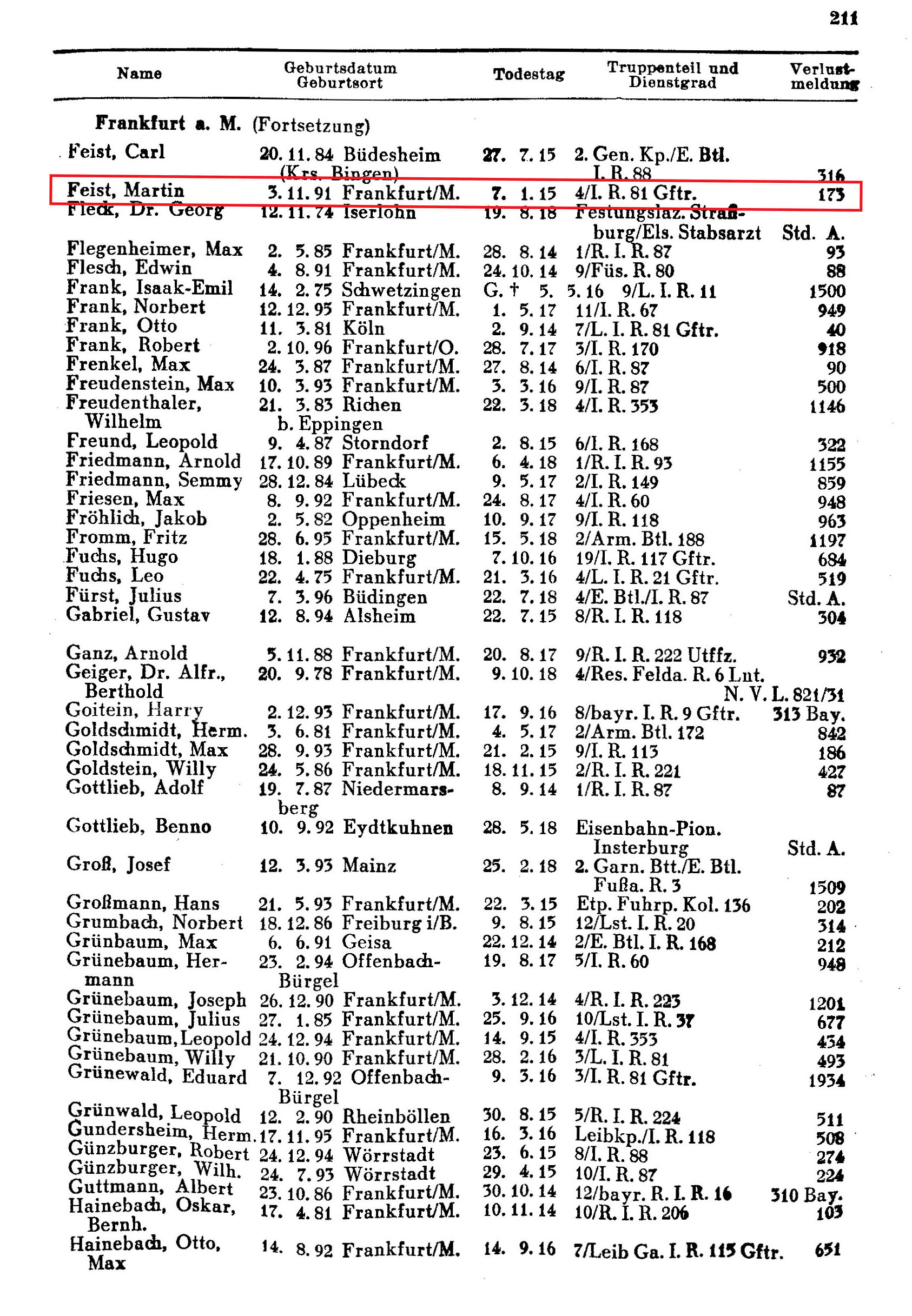
Martin was not the only German Jewish soldier to lose his life on Wednesday, January 7, 1915.  The other German Jewish soldiers who lost their lives that day included:

– .ת. נ. צ. ב. ה –
תהא

נפשו
צרורה
בצרור
החיים

Soldat Julius Asch, 5th Reserve Infantry Regiment, 3rd Battalion, 12th Company
Born in Breslau, April 20, 1897; Resided in Schonlanke

Soldat Siegfried Baendel, 21st Reserve Infantry Regiment, 3rd Battalion, 10th Company
Born in Gleiwitz, August 14, 1882; Resided in Gleiwitz

Soldat Martin Elsbach, 234th Reserve Infantry Regiment, 2nd Battalion, 5th Company
Born in Kassel, June 26, 1891; Resided in Walldorf

Gefreiter Otto Loser, 30th Reserve Infantry Regiment, 2nd Battalion, 7th Company
Born in Dusseldorf, July 3, 1888; Resided in Dusseldorf

Soldat Jakob Marx, 75th Infantry Regiment, 1st Battalion, 3rd Company
Born in Lehmen (Mosel), May 6, 1892; Resided in Gondorf

References

“cacao tube”, at http://www.marichesse.com/article-elle-s-est-collee-les-deux-levres-en-confondant-son-beurre-de-cacao-avec-un-tube-de-colle-forte-118792411.html. 

“Honig mundete”, at https://steinhorster.blogspot.com/2016/02/burgerversammlung-koschale-eeten.html, and,
https://www.opentable.com/solevino-restaurant-and-sommergarten-a-la-provence.

“Theebomben”, at http://www.djk-adler-koenigshof.de/index.php/spielberichte/adlerfreunde/1094-adlerfreunde-besuchten-teekanne-in-duesseldorf

Martin Feist Collection at the Center for Jewish History

Martin Fiest Place of Burial, at FindAGrave

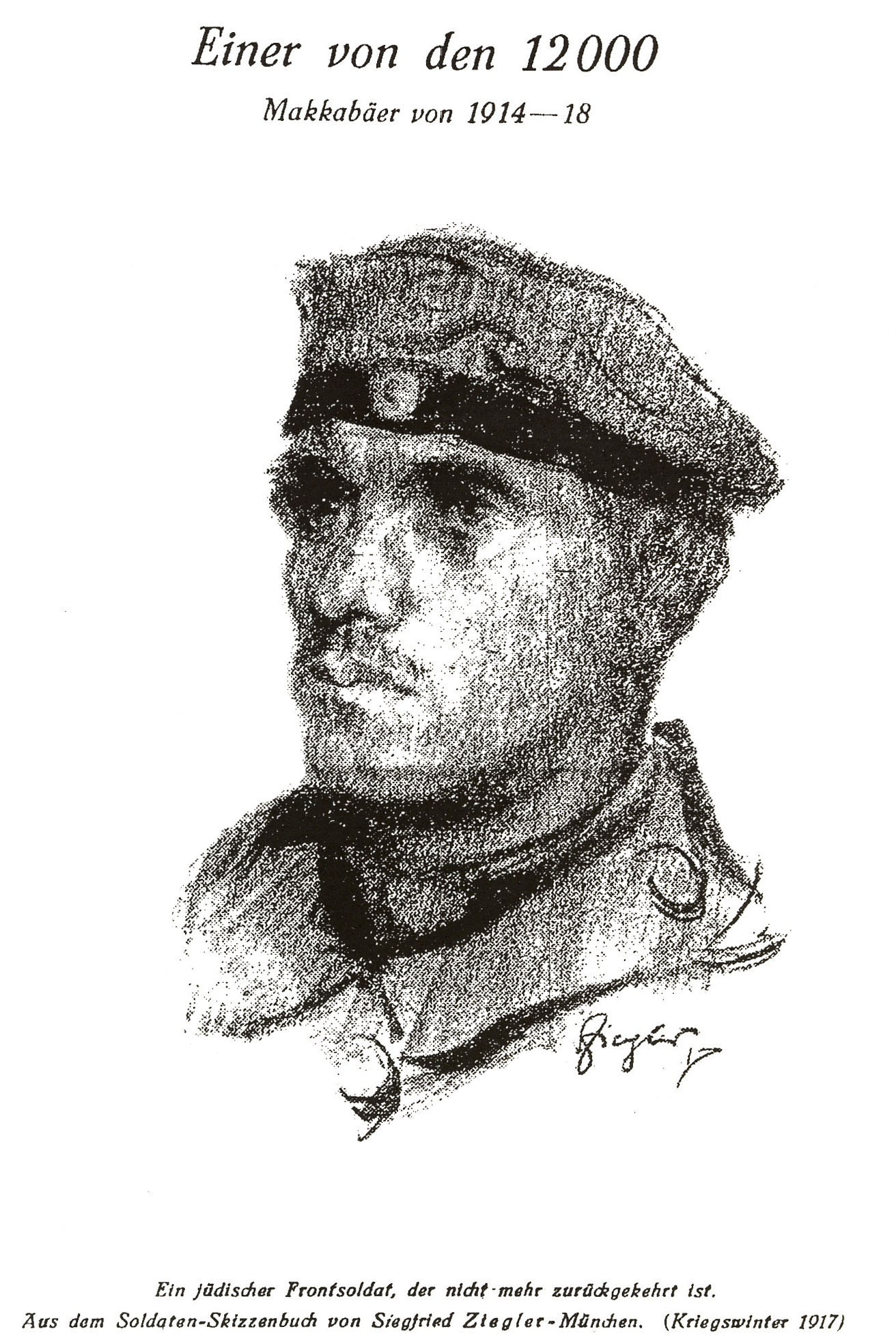
Einer von den 12000, (Illustration by Siegfried Ziegler), Der Schild, December 20, 1935, p. 5

Die Jüdischen Gefallenen Des Deutschen Heeres, Deutschen Marine Und Der Deutschen Schutztruppen 1914-1918 – Ein Gedenkbuch, Reichsbund Jüdischer Frontsoldaten, Forward by Dr. Leo Löwenstein, Berlin, Germany, 1932

Kriegsbriefe – gefallener Deutscher Juden, Reichsbund Jüdischer Frontsoldaten E.V., Berlin, Germany, 1935

And, an acknowledgement

I would like to extend my sincere thanks to my friend (and, Yiddish teacher / composer / choir director) Alexander Botwinik, for his assistance in accessing a copy of Kriegsbriefe – gefallener Deutscher Juden.
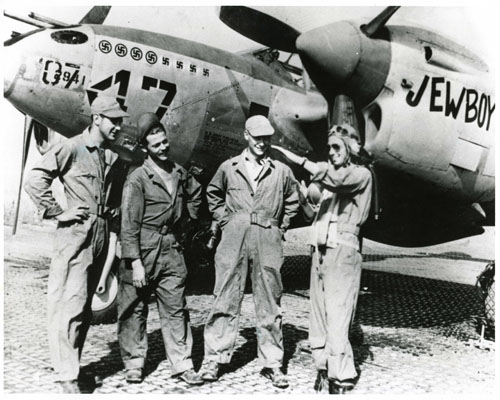
God’s Decree is Unsearchable: One of 12,000 – Thoughts of A German Jewish Soldier in the Great War – I

Einer von den 12,000
Makkabäer von 1914-18

Ein jüdischer Frontsoldat, der nicht-mehr zurückgekehrt ist.  Aus dem Soldaten-Skizzenbuch von Siegfried Ziegler – München.
(Kriegswinter 1917).

One of the 12,000
Maccabees from 1914-18

A Jewish front soldier, who has not returned. From the soldier sketchbook by Siegfried Ziegler – Munich.
(War winter 1917).
(From Der Schild, December 20, 1935)

____________________

Whether in the life of nation, the life of a group, or the life of a man, every event – every moment – is remembered in its own manner.  Through unspoken memories; with tales and stories; by anecdotes; in images and visions. 

And, through the written word.

Every era; every historical event, produces a body of writing by those who witnessed or participated in it.  This is especially so of war, which by its nature compels men to communicate their experiences and observations – whether by letters, diaries, or random jottings – to family, friends, and love ones, or simply “the world” at large.  The need may be driven by a sense of personal, moral responsibility to fallen comrades; to retain a spiritual and psychological connection with “home” – a place still at peace; and ultimately, from a realization of the historical imperative to record the nature of the present for the sake of the future.

In terms of the experiences of German Jewish soldiers in the First World War, this was epitomized by the publication of the book Kriegsbriefe – gefallener Deutscher Juden (War Letters of Fallen German Jews) by the Reichsbund Jüdischer Frontsoldaten (RJF, or, Reich Federation of Jewish Front Soldiers) in 1935. 

Whether the book’s publication was prompted by the Enabling Act of March 1933, is unknown.

Kriegsbriefe – gefallener Deutscher Juden is actually one of several books published in Germany from the latter part of World War One, through the 1920s and 30s, covering the experiences, memories, and military service of German Jewish soldiers in the Great War. 

Such works fall within four general categories.   

First, some books, in varying style and format, are composed of biographical profiles of fallen soldiers, in combination with transcribed letters, diary excerpts, and photographs. Exemplified by Kriegsbriefe – gefallener Deutscher Juden, this category includes:

1) Unseren Gefallenen Kameraden – Gedenkbuch für die im Weltkrieg Gefallenen Münchener Juden (Our Fallen Comrades – Memorial Book of the World War for Fallen Jews of Munich), Verlag B. Heller, (B. Heller Publishers) Munich, 1929.

2) Kriegsgedenkbuch der Israelitischen Kultusgemeinde Nürnberg (War Memorial Book of the Jewish Community of Nurnberg), J. Rosenfeld’s Druckerei (J. Rosenfeld Publishers), Nürnberg, 1920.

A second group describes the military service of German Jews, not restricted to men who fell in battle. 

Examples are:

1) Jüdische Flieger im Kriege – ein Blatt der Erinnerung (Jewish Aviators in the War – Pages of Memory), von Dr. Felix A. Theilhaber, Verlag von Louis Lamm, (Louis Lamm Publishers) Berlin, 1919

2) Jüdische Flieger im Weltkriege, Verlag der Schild, (Jewish Aviators in the World War, Shield Publishers) Berlin, 1924 (Dr. Theilhaber’s highly revised version of the above book.)

3) Ein Jahr an der Somme (A Year on the Somme), Feldrabbiner Dr. Martin Salomonski, Druck und Verlag der Königlichen Hofbuchdruckerei Trowitzsch & Sohn, (Printing and Publishing by the Royal Court Book Printing Company, Trowitzsch and Son), Frankfurt a.D., (Frankfurt on the Oder) 1917

4) Die Juden im Weltkriege – Mit besonderer Berücksichtigung der Verhältnisse für Deutschland, (The Jews in the World War – With Special Consideration of the Conditions for Germany) Dr. Felix A. Theilhaber, Welt-Verlag, Berlin, 1916

A third category – actually, epitomized by a single book – Die deutschen Juden als Soldaten im Kriege 1914 / 1918 – Eine statistische Studie (Hilo-Verlag, Berlin, 1922) (The German Jews as Soldiers in War 1914 / 1918 – A Statistical Study) is (as per the title!) statistical in nature.  Author Dr. Jacob Segall used various sources of information to calculate and show the relative percentage of Jews in military service vis-a-vis the German population as a whole, in terms of such criteria as place of residence or branch of service. 

A fourth category is embodied in two books, which present the names of all then-identified Jews, from all branches of the German military, who lost their lives (from all causes) during World War One. The books are:

1) Die Jüdischen Gefallenen des Deutschen Heeres, Deutschen Marine und der Deutschen Schutztruppen 1914-1918 – Ein Gedenkbuch (Reichsbund Jüdischer Frontsoldaten (The Jewish Fallen of the German Army, German Navy and the German Special Troops 1914-1918 – A Memorial Book (Reich Federation of Jewish Front Soldiers, Berlin, 1932).  This book covers the entirety of Germany, and includes nominal biographical information about each of the tens of thousands of serviceman listed within its pages.  (A page of which is presented at the end of this post.)

2) Jüdische Frontsoldaten aus Württemberg und Hohenzollern (Herausgegeben vom Württembergischen Landsverband des Centralvereins deutscher Staatsbürger jüdischen Glaubens (Jewish front soldiers from Wurttemberg and Hohenzollern ((Edited by the Wurttemberg Landsverband of the Central Association of German Citizens of Jewish Faith, Stuttgart, 1926)).  As implied by the title, this book is limited to coverage of Jewish soldiers from the state of Württemberg, and, the region of Hohenzollern. 

The impetus for the creation of these books arose, I suggest, from different, overlapping, yet entirely complementary and understandable motivations:  To validate, if not prove, the patriotism of German Jewry in the eyes of Germany and German society, as a whole.*  To serve as epistolary memorials to fallen soldiers on behalf of their loves ones.  And, from a genuine, sincere, and deep expression of patriotism and love of country – simply for its own sake, on the part of German Jewry.

In terms of recording and commemoration of Jewish military service during World War One, German Jewry seems to have gone to far greater effort, in terms of intellectual effort, and, the total number of works that were eventually created (both wartime and postwar) than Jewish communities of other nations, regardless of whether those nations had been members of the Allies, or, the Central Powers.  Remarkably, unlike the Jewish communities of Germany, Italy, the United Kingdom (specifically England and Australia), no such body of work was ever produced covering American Jewish military service of the First World War, a topic beyond the scope of this post…)

____________________

To the best of my knowledge, there have been no German-to-English translations ofthe above-mentioned German works.  To that end, I’ve created preliminary translations of Unseren Gefallenen Kameraden – Gedenkbuch für die im Weltkrieg Gefallenen Münchener Juden, and, Kriegsgedenkbuch der Israelitischen Kultusgemeinde Nürnberg, which I hope to finalize in the future.

More importantly, I have finished a translation of Kriegsbriefe – gefallener Deutscher Juden, which I hope to make widely available.

____________________

Kriegsbriefe – gefallener Deutscher Juden is comprised of letters and / or diary excerpts from 74 soldiers, and includes 13 poems composed by 8 different authors (4 of those 8 authors being among the 74 soldiers).  The contents are arranged alphabetically (the exception being Soldat Walter Heymann’s letter, which appears first), with the poems being interspersed at relatively even intervals through the text.  Otherwise, there is neither a table of contents nor an index.

The book also includes a color sketch by artist Max Liebermann, showing an allegory of mourning: a woman – the mother of a fallen soldier – a scarf covering her hair, is seated upon the bier of her son, over which is draped the black-white-red tricolor flag of the German Empire, with a larger version of the same flag suspended above.

Some of the passages in Kriegsbriefe – gefallener Deutscher Juden are lengthy; others are brief.  A few are profound, approaching questions of philosophy, religion and theodicy with great power.  Others are relatively straightforward, focusing on the practicalities of life in the trenches or varied combat theatres.  Some letters present vivid – sometimes humorous; sometime appalling – and straightforward depictions of warfare and suffering, in quite startling detail, depth, and clarity.

Each passage is moving in its own way, especially in light of what the future would hold for the families of these soldiers, and the Jewish people as a whole, two decades hence. 

But, it has always been the case that foreknowledge is not given to men or peoples. 

We can only know, what we know now.

____________________

One particular writing of 74 authors stands out:  A letter by Gefreiter Martin Feist, of the 81st Infantry Regiment.  Born in Frankfurt on Main on November 3, 1891, Martin was an Orthodox Jew, and – to the extent possible, as indicated by his letter – did his best to maintain religious observance, and religious faith, in the midst of his experiences as a front-line infantry soldier. 

The excerpt of his letter in Kriegsbriefe – gefallener Deutscher Juden concludes with the text, “Das Vertrauen zu hakodausch boruchhu begleitet mich von diesem Schabbos in die Woche hinaus, er wird mich behüten und beschützen, und mit seiner Hilfe werden wir uns gesund wiedersehen…” [The trust to HaKadosh Baruch Hu accompanies me from this Shabbos forth into the week; He will guard and protect me, and with His help we shall be well again…]

Martin did not survive the war.

He was killed in action almost two months later, on January 7, 1915.

He is buried at the Alter Jüdischer Friedhof (Old Jewish Cemetery) at Frankfurt am Main, Germany. 

____________________

I will present translations of two versions of his letter in my next post.

* This would have rested on the understandable yet fallacious assumption that antisemitism can be refuted by logic and reason.

References

Einer von den 12000, (Illustration by Siegfried Ziegler), Der Schild, December 20, 1935, p. 5, at http://sammlungen.ub.uni-frankfurt.de/cm/periodical/titleinfo/4911661.

Die Jüdischen Gefallenen Des Deutschen Heeres, Deutschen Marine Und Der Deutschen Schutztruppen 1914-1918 – Ein Gedenkbuch, Reichsbund Jüdischer Frontsoldaten, Forward by Dr. Leo Löwenstein, Berlin, Germany, 1932

Kriegsbriefe – gefallener Deutscher Juden, Reichsbund Jüdischer Frontsoldaten E.V., Berlin, Germany, 1935


Soldiers of The Great War: Jewish Military Service in WW I, as Reported in The Jewish Chronicle – “The Action in Heligoland Bight”, September 25, 1914 (Stoker Syd Braham)

Here is another news item about a Jewish sailor in the Royal Navy: Stoker Syd Braham, of HMS Falmouth. 

The Falmouth, a light cruiser built for the Royal Navy, was launched on September 20, 1910, and commissioned in September of 1911.  She participated in most of the early fleet actions, including the Battles of Heligoland Bight, Dogger Bank, and Jutland, but was only seriously engaged in the latter.  She was torpedoed and sunk off Flamborough Head, Yorkshire, by German submarines on 19 August, 1916, with one fatality.  

A portrait of Stoker Braham was published in the 7 October issue of The Jewish World, and appears below.

____________________

THE ACTION IN HELIGOLAND BIGHT

The Jewish Chronicle

September 25, 1914

Mr. J. Braham, of Sydenham Park Road, sends us an interesting letter he had recently received from his brother, Stoker Syd Braham, H.M.S. “Falmouth”.  In the course of this letter, Stoker Braham writes, “We were in the affair in Heligoland, and might say we were the foremost ship.  We sank two German cruisers and escaped in a burning and sinking condition.  You ought to have been on our ship and heard the shells buzzing over our ‘Tags (ears)’.  We didn’t get hit – not a scratch.  You ought to have seen the ship burning.  You could see the men [the enemy’s apparently] going mad and jumping into the water.  It was a horrible scene.”  “Syd” concludes with a warm greeting to his brother and sister and other relatives.

Reference

HMS Falmouth, at https://en.wikipedia.org/wiki/HMS_Falmouth_(1910).


Soldiers of the Erinpura – VI: The Fallen – Merchant Navy and Indian Merchant Navy Sailors

The Erinpura’s Crew

Commanded by Captain R.V. Cotter, sixty members of the Erinpura’s crew were lost in the sinking:  Fifty-five members of the Indian Merchant Navy, and, five members of the Merchant Navy.

The fifty-five Indian Merchant Navy personnel comprised such ratings as Baker, Boy, Butler, Cook, Donkeyman (an engine room rating who attended to the Donkey boiler), Fireman, General Servant, Oiler, Pantryman, Scullion (lowest job level in Merchant Navy), Seaman, Serang (skipper of a small boat), Topass (sanitary hygeine), and Trimmer (stoker).

Genealogical information is present for twenty-one of the fifty-five men, while ages are given for fifty-four.

Of the twenty-one, sixteen were married, all residing in Goa, a state along the southwestern coast of India.  Ten of the twenty-one were from South Goa, one of the two districts of Goa, the other being (as shown in the map below) North Goa.

Southern India

goa-india-regionalGoa

goa-indiaThe Districts of Goa

administrative_map_of_goaThe twenty-one are listed as having been from:

Agramoda (Agarwada?), Goa (North Goa) – 1 man

Assolna, Goa // Assolna / Assoulua, South Goa – 3 men

Baga, South Goa – 1 man

Carosetta / Carsetty, South Goa – 2 men

Cavelsin (Cavelossim?), Carmone, Goa (South Goa) – 1 man

Chinchin, South Goa – 1 man

Dharmpur, South Goa – 1 man

Jeewado, South Goa – 1 man

Karsetti, South Goa – 1 man

Kolsewada (Kolsewadi?), Goa – 1 man

Mapuca, Goa (North Goa) – 1 man

Navelim, South Goa – 1 man

Nobai, Saipe (Saipem?), Goa (North Goa) – 1 man

Quepen, Laldamwadi, Goa / Quepen, Servia, Goa (Quepem, South Goa) – 2 men

Sukalda, South Goa – 1 man

Wado, South Goa – 1 man

At age sixty-three, the oldest crewman of the fifty-five was Francis F. D’Souza (General Servant), while the youngest was Main Mazhar (Boy), who was nineteen.  The average age of the twenty-one was thirty-nine, probably reflective of career service in the Indian Merchant Navy.

All these men are commemorated at the Bombay / Chittagong 1939-1945 War Memorial.  The Bombay 1939-1945 Memorial Roll of Honour is, “held at the Indian Sailor’s Home, Bombay,” and lists the names of 6,467 WW II casualties.  This total comprises, “over 400 sailors of the former Indian Navy and over 6,000 sailors of the former Indian Merchant Navy who were lost at sea during the war years.”

The Merchant Navy casualties comprised the ship’s First and Third Radio Officers (Ernest W. Erbach – age forty-nine, and Brian Rostron Marsden – age twenty-one), two Junior Engineering Officers (Charles McGill and Ernest Richard Smith), and Carpenter Tham Yout.  These five men are commemorated at the Tower Hill Memorial (Panel 48) in London.  Akin to the members of the Indian Merchant Navy, genealogical information is almost completely absent for them.  However, the father of First Radio Officer Ernest William Erbach is listed as Philip Cort.

Ten Other Casualties – Circumstances Unknown

Searching the CWGC database for deaths on May 1, 1943, in the Mediterranean and European Theaters yields records for nine other men.  Two were Pioneer Corps soldiers from Swaziland, and eight were members of the British Army.  Though it is unknown if there were passengers on the Erinpura or British Trust, or lost in some other circumstance, I have appended their names to the list of Erinpura crew casualties.

The Swaziland soldiers were Privates Shamile Lulane and Msomane Tabede, both of whom are memorialized at the Swaziland 1938-1945 War Memorial, in Bethany, Swaziland.

The British soldiers, all of whose names are commemorated at the Brookwood Memorial in Surrey, England, are:

Pioneer Corps

Warrant Officer 2nd Class Albert E. Clayton, from Shropshire

Serjeant William Nicol

Lieutenant Percey G. Tredwell, from Hampshire

Serjeant Colin Wilde, from Jersey (Channel Islands)

Royal Army Medical Corps

Private Alfred E. Perrett, from Lymington, Hampshire

Corps of Military Police

Corporal William R. Gillett, from Buckinghamshire

Serjeant John Mills, from Liverpool

Indian Merchant Navy, and Merchant Navy, Casualties on the Erinpura

Soldiers of the Erinpura – V: The Fallen – Basotho Soldiers

The majority of troops aboard the Erinpura were members of the Basotho people, an ethnic group of the Bantu people who primarily live in South Africa, and to a lesser extent in the countries of Lesotho and Botswana, and, the South African state of Swaziland. 

The men were members of the African Pioneer Corps H.C.T. (High Commission Territories) and were assigned to the 1919th and 1927th Basuto Companies.  One soldier (Private Malefetsane Manuel Mohale, AS/6946) – going by his CWGC record – was a member of the 1924th Basuto Company.

botswana-lesotho-swaziland_edited-1Lesotho

lesothoBotswana

botswanaSwaziland

swazilandThe CWGC database shows casualty records for 303 members of the 1919th Company, and, 320 members of the 1927th Company.

While genealogical information exists for forty per-cent of the Jewish casualties and one-third of the Erinpura’s crewmen (see below), such information is present for only a sole individual among the Basotho casualties:  Private T. Japheta, AS/9273, born in 1901.  He is buried at the Benghazi War Cemetery, in Benghazi.  The CWGC database lists his father as Bupoe Machaba, but no other information is given in terms of his age or the location of his home.

In terms of military service, the overwhelming number of Basotho soldiers were Privates and Corporals.  The remainder comprised twenty-one sergeants and one warrant-officer.  One man – Jan Poulo (AS/12128) of the 1919th, listed in the CWGC database as a Captain, which information may be incorrect.

With the exception of Private Japheta, all the Basotho soldiers are commemorated at the Lesotho Memorial, which is located in Makoayane Square, in the center of Maseru, the capital of Lesotho.

Soldiers of the 1919th Basuto Company

A Soldier of the 1924th Basuto Company

Soldiers of the 1927th Basuto Company