The Reconstruction of Memory: Soldiers of Aufbau – Jews of The Yishuv at War

While the previous post – about Aufbau’s coverage of Jewish WW II military service – focused on general aspects of the creation of an autonomous Jewish fighting force – “this” post moves to the particular: Aufbau’s reporting on the contribution of the Jews of the Yishuv to the Allied war effort.

The primary topic covered by Aufbau in this context was the contribution of Yishuv Jewry to Britain’s armed forces, in the effort to halt the advance of the Afrika Korps, with the majority of articles of this nature having been published prior to England’s victory in the second battle of El Alamein, during late October – early November of 1942. 

Later articles are varied in their subject matter, with some pertaining to the participation of Jewish soldiers in religious services. 

Date Title
9/39 IZL – The Jewish National Army
10/39 Palestine’s Jewish Army – 50,000 Men Could be Put Under Arms
2/40 Most Destructive Units – Sidney S. Schiff uber die “Legion of Judea”  (“Most Destructive Units – Sidney S. Shiff on the “Legion of Judea””)
4/40 Training in Palästina (“Training in Palestine”) (Photo)
5/40 Fur Palästina und England! (“For Palestine and England!”) (Photo)
1240 Jüdische Scharfschutzen werden in Palästina ausgebildet (“Jewish Snipers are Trained in Palestine”) (Photo)
1/41 Neue Rekrutierungen in Palästina  (“New Recruits in Palestine”)
2/41 Cavalry in Palestine
5/41 Jüdisches Volk in Waffen – 135,000 Frauen und Manner zur Verteldigung Palästinas bereit  (“Jewish people in arms – 135,000 women and men ready for the defense of Palestine”)
5/41 Neue Truppen nach Palästina  (“New Troops to Palestine”)
7/41 Zum kampf fur Unabhangigkeit und Freiheit – Jüdische Soldaten der palästinenischen Armee auf einem Uebungsmarsch (“The fight for independence and freedom – Jewish soldiers of the Palestinian army on a training march”) (Photo)
8/41 Palästinas Jüden in Waffen (“Palestine’s Jews at Arms”) (Photo)
10/41 2 Palästina-Kongingent in Formierung  (“2 Palestine Contingents in Formation”)
12/41 Helden in Libyien – Palästinensische Truppen in entscheidenden Gefechten  (“Heroes in Libya – Palestinian troops in decisive battles”)
12/41 Judische Soldaten marschieren – Wahrend der in Palastina Mitte Oktober abgehaltenen Rekrutierungswoche haben judische Soldaten im Atadion von Tel-Aviv eine Parade abgehalten (“Jewish soldiers march – During the recruitment week held in Palestine in mid-October, Jewish soldiers held a parade in Tel Aviv Atadion”) (Photo)
6/42 Aufbruch zur Front: Taglich rucken neue jüdische Einheiten ins Feld (“Departure to the front: New Jewish units move into the field daily”) (Photo)
6/42 Unter der weiss-blauen Fahne auf der Wacht an der palästinenischen Kuste (“Under the white-blue flag on guard on the Palestinian coast”) (Photo)
8/42 Die WAACS in Erez Israel heissen PATS ((“The WAACS [Women’s Auxiliary Army Corps] in the Land of Israel are called PATS [Palestine Auxiliary Territorial Service]”) (Photo)
8/42 Palastinas erstes Regiment  (“Palestine’s First Regiment”)
8/42 In Schatten des Migdal David – Jüdische Soldaten des palästinenischen Buffs-Regiment trainieren zum Kampf gegen Rommel.  Von 584,000 Juden in Palästina dienen 47,000 Männer und Frauen in der Landesverteidigung  (“In Shadow of the Tower of David – Jewish soldiers of the Palestinian Buffs Regiment train to fight Rommel.  Of 584,000 Jews in Palestine, 47,000 men and women serve in the national defense”) (Photo)
9/42 Jüdisch-palästinensische Soldaten in New York (“Jewish Palestinian Soldiers in New York”) [Bonah, Lighter, Buttermilk, Black] (Photo)
11/42 Jüdische Freiwillige vom Buff-Regiment im Angriff (“Jewish volunteers from the Buff Regiment on the attack”) (Photo)
11/42 Palästinensische Schützen: Blaue Bohnen für Rommel (“Palestinian shooters: Blue beans for Rommel”) (Photo)
11/42 Das Palästina-Regiment wird ausgerustet  (“The Palestine Regiment is being organized”)
1/43 Die jüdische Frau marschiert – Mitglieder der PATS bei einer Demonstration durch die Strassen Tel Avivs (“The Jewish woman march – Members of the PATS in a demonstration through the streets of Tel Aviv”) (Photo)
9/43 Palästinensische Matrosen, die als Freiwillige in der englischen Navy dienen, tanzen in ihrer Freizeit eine Horrah (“Palestinian sailors serving as volunteers in the English Navy dance a hora in their free time”) (Photo)
9/43 Jewish Girls as Ambulance Drivers
12/43 Die jüdische Frau kampft mit – In einer Minenfabrik in Palästina helfen bei der Herstellung und Fullung von Landminen (“The Jewish woman is fighting – In a mine factory in Palestine help in the manufacture and filling of land mines”) (Photo)
1/44 Palästina Bataillone nach Europa  (“Palestinian Battalions to Europe”)
1/44 Jüdische WAAF in Palästina – Ein Mitglied der WAAF mit der hebraischen Achselklappe “Erez Israel” (“Jewish WAAF in Palestine – A member of the WAAF with the Hebrew epaulet “Erez Israel”) [Photo: British Combine] (Photo)
6/44 May We Present – Mrs. Jenny Blumenfeld – Who Tells of Palestine’s Women at War
9/44 Palästina-Truppen in England  (“Palestine Troops in England”)
3/45 Drei Freunde in Palästina (“Three friends in Palestine”) [Heart, Popper, Salm] (Photo)

Beyond these articles, there is much published literature on the subject of the contribution of the Yishuv – in terms of military manpower, production of war material, scientific research, and economic and support – to the Allied war effort.    

A notable wartime publication in this regard is Pierre van Paassen’s 1943 The Forgotten Ally (published by the Dial Press in 1943).  One particular chapter of this book – “The Best-Kept Secret of the War” – covers this topic in an illuminating and (even in 2017…) and surprisingly relevant fashion. 

The chapters of van Paassen’s book are:

Author’s Preface (5-6)
Chapter I – There Are No More Prophets! (9-48)
Chapter II – Prelude to Palestine’s Liberation (49-104)
Chapter III – Britain’s Role in Palestine (105-174)
Chapter IV – The Best-Kept Secret of the War (175-236)
Chapter V – Imperialism’s Reward (237-303)
Chapter VI – The Solution (304-343)

____________________

The image below shows the front cover of the 1943 (first) edition of The Forgotten Ally…

____________________

…and, here is the back cover, with van Paassen’s portrait.

____________________

Another book, Israel Cohen’s short but substantive 1942 Britain’s Nameless Ally (published by W.H. Allen & Co., Ltd., Publishers, of London) presents information about the contribution of Yishuv Jewry to the Allied war effort in a more detailed and stylistically different fashion than van Paassen.  Statistics about the numbers of Yishuv volunteers serving in the Allied military (particularly Britain’s military) are interspersed and accompanied by quotations of and comments by notable figures in Allied military, political, and news circles.  By definition – by – timing (this book was released in 1942, after all) coverage of Jewish military service (in Chapter III, “At The Battle-Fronts”) is limited to military activity in the Western Desert, at Tobruk, in Eritrea, at Keren, in Greece, in Syria, and also in the Auxiliary Territorial Service, while attention is also accorded to Jewish military service in the Czech armed forces.   

As a nice touch, the book includes 10 photographs showing military and industrial activity in the wartime Yishuv, and, a frontpiece image of Haifa.     

The book’s chapters are:

Chapter I – The Jewish People’s Offer (1-9)
Chapter II – The Rallying of Jewish Volunteers (10-17)
Chapter III – At the Battle-Fronts (18-28)
Chapter IV – The Economic Contributions (29-34)
Chapter V – Scientific and Technical Contributions (35-37)
Chapter VI – The Government and the Jewish Offer (38-46)
Appeal by the Jewish Agency Executive (47)

____________________

A beautiful view of Haifa, the leading image in Britain’s Nameless Ally.

____________________

Jewish Settlement Police, and Jewish military personnel (in training).

____________________

Of the ten photographs in Britain’s Nameless Ally, six pertain to manufacturing activity in a wartime context.  The two illustrations below are representative of these images.

____________________

In contemporary terms, Yoav Gelber’s Jewish Palestinian Volunteering in the British Army During the Second World War (published by Yad Itzhak Ben-Zvi Publications, Jerusalem) is an essential – probably “the” essential – work on this topic.  The work is comprised of four volumes, one of which (Jewish Volunteers in British Units) has been of tremendous help in my posts concerning female ATS volunteers, and, soldiers of the 462nd General Transport Company lost in the sinking of the HMS Erinpura.  Unfortunately (!) the volumes have not yet been translated into English…   

The volumes are:

Volume I – Volunteering and its Role in Zionist Policy 1939-1942, 1979
Volume II – The Struggle for a Jewish Army, 1981
Volume III – The Standard Bearers, 1983
Volume IV – Jewish Volunteers in British Units, 1984

____________________

Another relevant publication (just discovered on worldcat.org, but not yet read!) is Anat Granit-Hacohen’s Hebrew Women Join the Forces: Jewish Women From Palestine in the British Forces During the Second World War.  Translated by Ora Cummings, the book was published by Vallentine Mitchell in 2017. 

The above sources are in German, English, and Hebrew.  But, there is another publication which covered Jewish WW II military service, albeit in Yiddish: That is Eynikayt, the official newspaper of the Soviet Union’s Jewish Anti-Fascist Committee. 

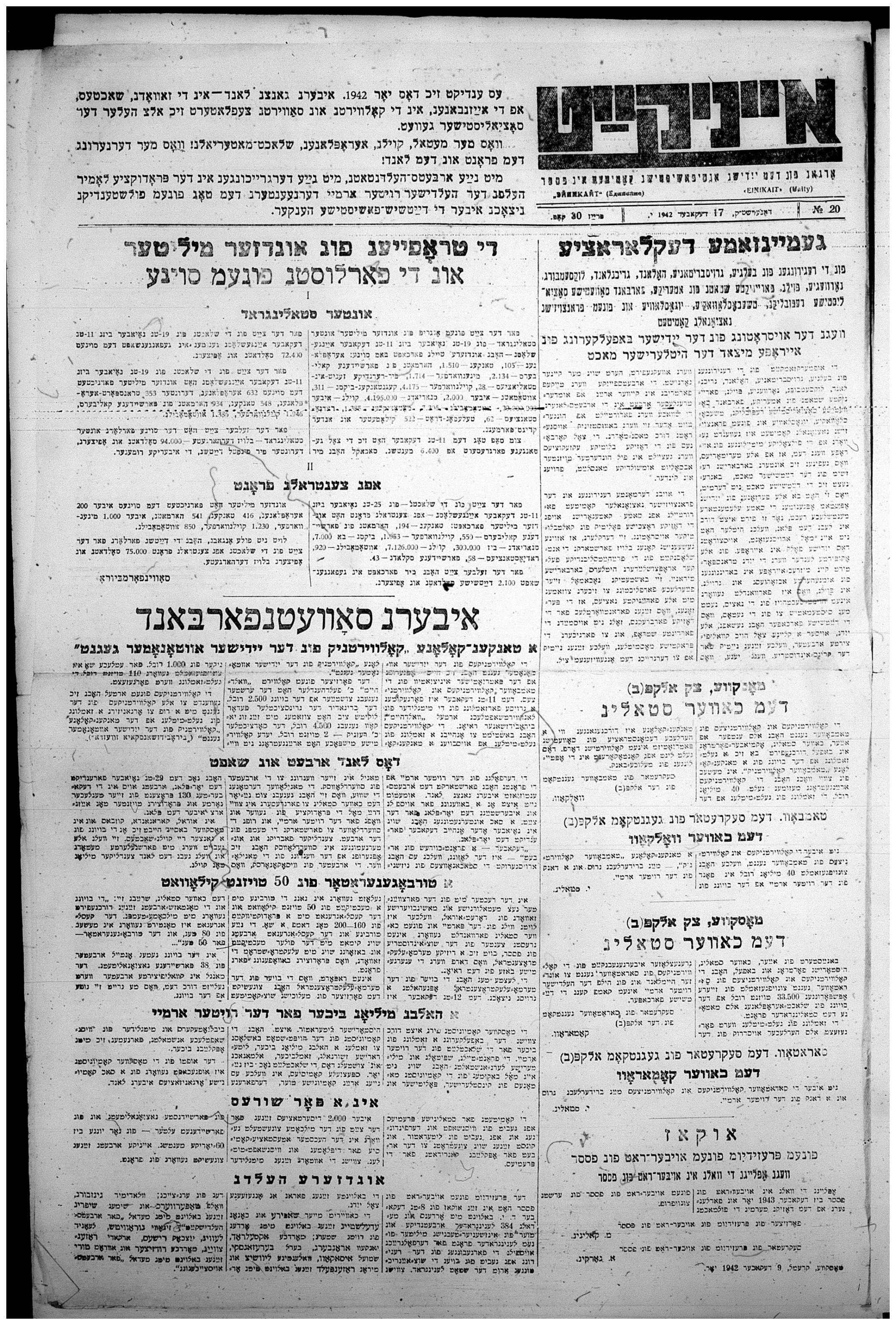
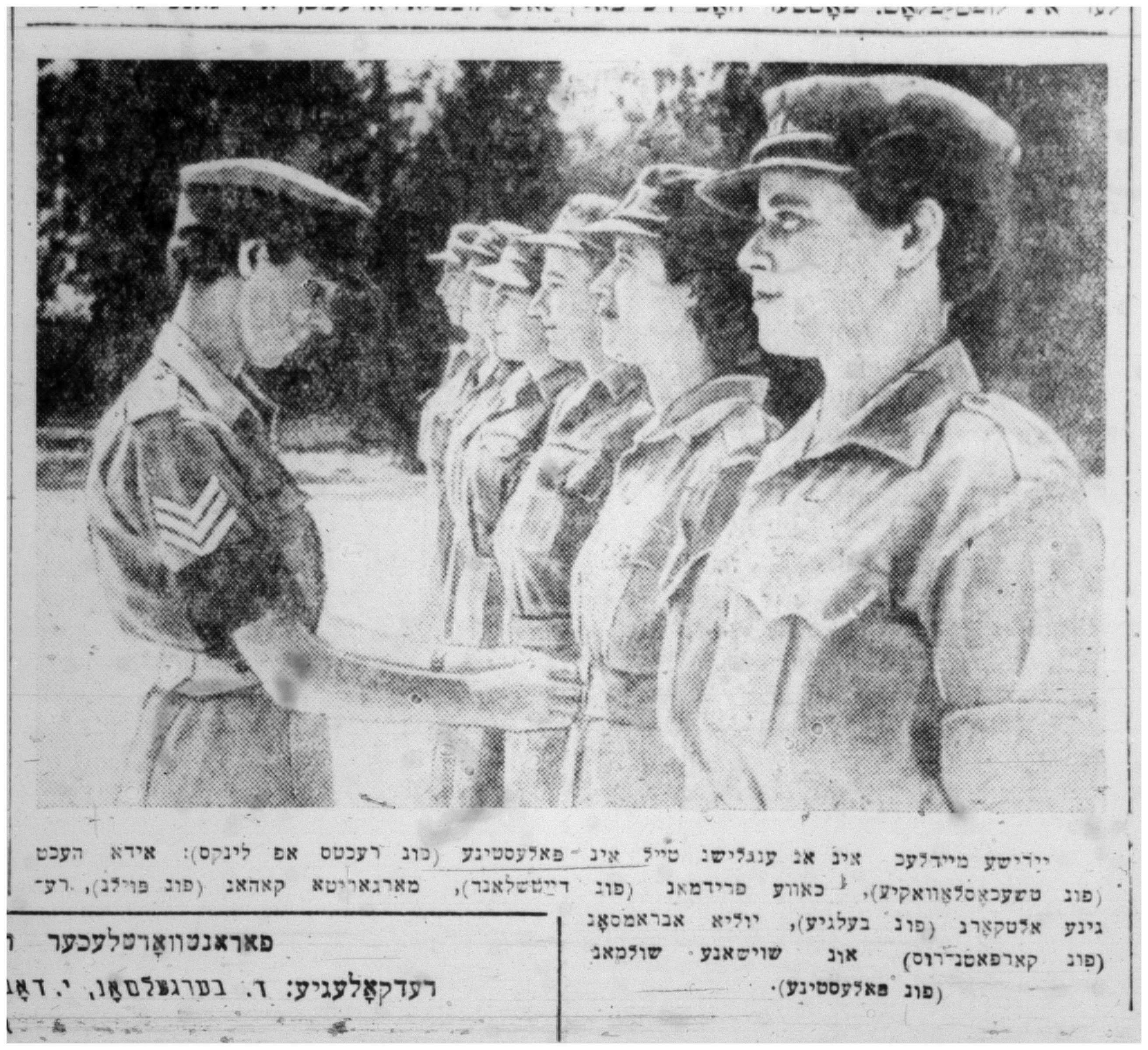
In its twentieth issue, published on December 17, 1942, the paper included two photographs relating to military service of Yishuv Jewry.  One picture shows Jewish soldiers in the British army during training near Libya.  The other shows a group of women soldiers under inspection by their sergeant.  This latter image is remarkable in presenting the full names of these female soldiers, along with their places of birth or national origin.  Unfortunately – ! – neither the photographer nor the official source are listed for either image. 

____________________

Eynikayt, December 17, 1942:  Page 1.

____________________

Eynikayt, December 17, 1942:  Page 4.

____________________

“Jewish youths in the British army, not far from Libya, perfect their military skills in order to be deployed soon against the Fascists.”

____________________

“Jewish girls in a British regiment in Palestine (right to left): Ida Hecht (from Czechoslovakia), Khave Friedman (from Germany), Margarita Kahan (from Poland), Regina Altkorn (from Belgium), Yulia Abramson (from Carpathian Ruthenia) and Shoshana Shulman (from Palestine)”

____________________

Future posts will cover other aspects of Aufbau’s reporting on Jewish WW II military service.

The Reconstruction of Memory: Soldiers of Aufbau – The Struggle for A Jewish Army

In my prior post, “Aufbau: The Reconstruction of Memory”, I described the German anti-Nazi WW II Exile Newspaper Aufbau (“Construction”) in terms of its coverage of Jewish military service during the Second World War.  The newspaper reported upon the military service of Jewish soldiers in detail – often great detail – yet that coverage was set within the wider context of the political, psychological, social, and moral impetus for the creation of a Jewish fighting organization – a Jewish fighting organization with at least some degree of political and military autonomy.
Discussions of and news articles about this subject were manifested in many different ways.

Some items took the form of reports about the participation of Jewish soldiers in the armed forces of the varied Allied powers; a series of four articles in January and February of 1944, under the heading “1.5 Million Jews are Fighting”, covering facets of the totality of Jewish military service in the Allied armed forces; reports on Jews in the Maquis; descriptions of the reactions and opinions (both pro and con) of political leaders and the news media regarding the creation of a Jewish fighting force, and finally, commencing in September, 1944 and most prominently appearing after the war’s end – in August and September of 1945 – a series of articles about the Jewish Brigade Group.

This post presents the titles of 139 such items in Aufbau, as well as their month of their publication.  I’ve translated some, which I hope to bring you in a future post. 

Or, more accurately, posts!

Month and Year Title
9/39 IZL – The Jewish National Army
10/39 Palestine’s Jewish Army – 50,000 Men Could be Put Under Arms
10/39 Jüdische Freiwillige  (“Jewish Volunteers”)
1/40 35% Jüden in der Polnischen Legion  (“35% Jews in the Polish Legion”)
1/40 Deutschjüdische Freiwillige in der Fremdenlegion  (“German Jewish Volunteers in the Foreign Legion”)
1/40 Jüdische M.G.-Kompagnien gegen Hitler  (“Jewish machine gun company against Hitler)
2/40 Most Destructive Units – Sidney S. Schiff uber die “Legion of Judea”  (“Most Destructive Units – Sidney S. Shiff on the “Legion of Judea””)
2/40 Belgien nimmt keine ausländischen Freiwilligen  (“Belgium does not take foreign volunteers”)
5/40 Jüden an der Westfront – Pessachtage in der Maginotlinie  (“Jews on the western front – Pesach days in the Maginot Line”)
6/40 Für die Alliierten und eine jüdische Armee  (“For the Allies and a Jewish Army”)
6/40 Eine jüdische ARMEE?  (“A Jewish ARMY?”)
9/40 Die Plane für eine jüdische Armee  (“The Plan for a Jewish Army”)
10/40 A Jewish Army Throughout the World
11/40 Our Soldiers, If We Would Only Take Them
11/40 Zur Frage der jüdischen Armee  (“On the Question of the Jewish Army”)
11/40 London Sees Jewish Army Soon
1/41 Glänzende Kämpfer – Ein Lob der Refugee-Pioniere in England  (“Shining Fighters – A Praise to the Refugee Pioneers in England”)
1/41 Neue Rekrutierungen in Palästina  (“New Recruits in Palestine”)
1/41 1400 Refugee-Aerzte im britischen Kriegsdienst  (“1400 Refugee Physicians in the British War Service)
1/41 Die jüdische Armee – Englische Bereitschaft zu ihrer Aufstellung  (“The Jewish Army – English Readiness for their Formation”)
2/41 Jewish Army
2/41 Cavalry in Palestine
3/41 Jüdische Truppen in Aktion – Sie Schlagen die Italiener – Blau-Weiss neben dem Union Jack (Der erste authentische Bericht)  (“Jewish troops in action – They beat the Italians – Blue-and-white next to the Union Jack (The first authentic report)”)
3/41 Wir kämpfen in Griechenland  (“We are Fighting in Greece”)
3/41 Jüdische Armee – Jüdische Republik  (“Jewish Army – Jewish Republic”)
3/41 Jüden im Griechenkrieg  (“Jews in the Greek War”)
4/41 England rekrutiert im Ausland  (“England Recruited Abroad”)
4/41 Die Frage der jüdischen Armee  (“The Question of the Jewish Army”)
5/41 Jüdisches Volk in Waffen – 135,000 Frauen und Manner zur Verteldigung Palästinas bereit  (“Jewish people in arms – 135,000 women and men ready for the defense of Palestine”)
5/41 Neue Truppen nach Palästina  (“New Troops to Palestine”)
5/41 Doch noch eine jüdsiche Armee?  (“But another Jewish army?”)
7/41 For a Jewish Army
8/41 The World Respects a Maccabaen
10/41 2 Palästina-Kongingent in Formierung  (“2 Palestinian Contingents in Formation”)
10/41 Jewish Youth Enlist – Die Frage einer jüdischen Armee  (“Jewish Youth Enlist – The question of a Jewish army”)
10/41 Der unbekannte jüdische Soldat  (“The Unknown Jewish Soldier”)
11/41 Why a Jewish Army?
11/41 Die jüdische Armee – der Beginn einer jüdischen Politik? (Hannah Arendt)  (“The Jewish army – the beginning of a Jewish policy?”)
11/41 Jüdsiches Kadetten – Fliegerkorps in Ottawa aufgestellt  (“Jewish Cadets – Flying Corps Established in Ottawa”)
11/41 Refugees und Soldaten – Zornige Reden auf der Inter-American Jewish Conference  (“Refugees and Soldiers – Angry speeches at the Inter-American Jewish Conference”)
12/41 Helden in Libyien – Palästinensische Truppen in entscheidenden Gefechten  (“Heroes in Libya – Palestinian troops in decisive battles”)
12/41 Refugees in the British Army – A Visit to a Pioneer Camp
12/41 England and the Jewish Army
12/41 Jüdische Armee wieder aktuell  (“The Jewish army is again up to date”)
1/42 5,000 Refugees im Pionierkorps  (“5,000 Refugees in the Pioneer Corps”)
1/42 Eine jüdische Armee?  (“A Jewish Army?”)
1/42 Unknown Soldiers
1/42 Kontroverse uber die jüdische Armee – Die Reaktion auf den Leitertikel der “New York Times”  (“Controversy over the Jewish Army – The Reaction to the Leadership of the “New York Times””)
2/42 Der Kampf um die Jüdische Armee  (“The Struggle for the Jewish Army”)
3/42 Wer Ist Das “Committee for a Jewish Army”?  (“Who is the “Committee for a Jewish Army”?)
3/42 Zur Verteidigung des “Committee for a Jewish Army”  (“To Defend the “Committee for a Jewish Army”)
3/42 With the J.A.F. in Far Rockaway, L.I. – Girl About Town (Ruth Karpf)
3/42 Regierungs-Pläne zur Schaffung von Freiheits-Legionen – Drei Nationen – eine Meinung  (“Government plans to create freedom legions – Three nations – an opinion”)
5/42 Die New Yorker Zionisten-Konferenz lasst die Frage der jüdischen Armee ungelost  (“The New York Zionist Conference leaves the question of the Jewish army unresolved”)
5/42 70,000 Ex-Aliens Help Britain – Immigrant Soldiers Fighting Abroad
5/42 The Jewish Army Nevertheless
6/42 Last Call for a Jewish Army – An Appeal to “Aufbau” by Pierre Van Paassen
7/42 England immer noch gegen eine jüdische Armee; England lehnt weiterhin eine jüdische Armee ab  (“England still opposed a Jewish army; England continues to reject a Jewish army”)
7/42 The Fighting Jew – By H.I. Phillips
7/42 Die Tragödie des “Unbekannten Soldaten” (Nahum Goldmann)  (“The Tragedy of the “Unknown Soldier””)
8/42 Inadequate Solution – Statement to “Aufbau” by Stephen S. Wise
8/42 HALFWAY MEETS OUR DEMANDS… – Statement to “Aufbau” by DAVID WERTHEIM
8/42 Besuch aus Tobruk – Polnisch-jüdische Soldaten auf Urlaub in New York  (“Visit from Tobruk – Polish Jewish soldiers on vacation in New York”)
8/42 Palastinas erstes Regiment  (“Palestine’s First Regiment”)
9/42 Ein Kampfer fur die Jüdische Armee  (“A camphor for the Jewish army”)
10/42 Immigrantinnen in Uniform – National Security Women’s Corps grundet ein “Allied Unit”  (“Immigrants in Uniform – National Security Women’s Corps is an “Allied Unit””)
11/42 Das Palästina-Regiment wird ausgerustet  (“The Palestine Regiment is being organized”)
11/42 In Vorderster Front  (“In the Front”)
12/42 Grant Me 200,000 Jewish Boys
12/42 England weiter gegen Jüdische Armee  (“England continued against the Jewish army”)
12/42 Luncheon of the Committee for a Jewish Army
1/43 Pionierkompagnie aus Deutschen und Oesterreichern in Afrika  (“Pioneer company from Germans and Austrians in Africa”)
1/43 President Roosevelt ueber das oesterreichische Bataillon  (“President Roosevelt on the Austrian battalion”)
1/43 Jan Christian Smuts für die Jüdische Armee  (“Jan Christian Smuts for the Jewish Army”)
2/43 Battle Song for a Jewish Bombardier – Lawrence Upton
3/43 We Will Never Die
4/43 Kopf Hoch, Kamerad! – Das Epos der deutschen und österreichischen Antifaschisten in der britischen Armee – Ein jüdischer Boxmeister in Uniform  (“Head high, comrade! – The epic of the German and Austrian anti-fascists in the British army – A Jewish boxing master in uniform”)
6/43 The War and the Jew (book review)
6/43 Jüdische Kommandos trainieren  (“Training Jewish Commanders”)
8/43 Jüdisches Regiment auf Malta  (“Jewish Regiment in Malta”)
8/43 Unbekannte Helden – Jüdsiche Kampfer unter der Trikolore – Englische Uniformen, deutsche Waffen, und ein Gedanke: ran an den Feind! (“Unknown heroes – Jewish fighters under the tricolor – English uniforms, German weapons, and a thought: ran to the enemy!”)
8/43 In deutschen Uniformen (“In German Uniforms”)
8/43 Guns in the Middle East
9/43 Jewish Girls as Ambulance Drivers
10/43 Rosch-Haschonoh-Feiern in der Armee – In allen Ländern un an allen Fronten werden Gottesdienste abgehalten  (“Rosh Hashanah Celebrations in the Army – Worship services are held in all countries on all fronts”)
11/43 Nachricht über den Tod eines Pioniers in Nordafrika  (“Message about the death of a pioneer in North Africa”)
12/43 Guerillas unter jüdischer Flagge – Fünftausen Kämpfer  (“Guerrillas among the Jewish flag – fifty-five fighters”)
1/7/44 Palästina Bataillone nach Europa  (“Palestinian Battalions to Europe”)
1/44 1.5 Millionen Jüden kampfen mit – 500,000 aus U.S.A. – 34% aller wehrpflichtigen Immigranten in Waffen  (“1.5 Million Jews are Fighting – 500,000 from U.S.A. – 34% of all Conscientious Immigrants at Arms”)
1/44 1.5 Millionen Jüden kampfen mit – II. Die jüdischen Generale in der russischen Armee  (“1.5 Million Jews are Fighing – The Jewish Generals in the Russian Army”)
1/44 1.5 Millionen Jüden kampfen mit – III. 8000 Fleiger in der Royal Air Force  (“1.5 Million Jews are Fighting – 8,000 Fliers in the Royal Air Force”)
2/44 1.5 Millionen Jüden kampfen mit – IV. Jüden in der Kanadischen Armee  (“1.5 Million Jews are Fighting – IV. Jews in the Canadian army”)
2/44 Jüdische Helfer-Kommandos für Europa  (“Jewish helpers for Europe”)
2/44 Tod nur mi der Waffe in der Hand – Eine Proklamation jüdsicher Guerillas  (“Death only with the weapon in hand – A proclamation of Jewish guerrillas”)
3/44 Jüdische Armee neu gefordert – Nahum Goldmann berichtet zur Lage des jüdischen Volkes  (“Jewish army demanded again – Nahum Goldmann reports on the situation of the Jewish people”)
5/44 The Greatest Seder I Ever Witnessed – Cpt. Wilfred C. Hulse
6/44 Polnisch-jüdische Soldaten kampfen in Italien  (“Polish Jewish soldiers are fighting in Italy”)
6/44 May We Present – Mrs. Jenny Blumenfeld – Who Tells of Palestine’s Women at War  (“May We Present – Mrs. Jenny Blumenfeld – Who Tells of Palestine’s Women at War”)
6/44 Die “unbekannte Division” singt – In Tobruk gegründet – Erstes Auftreten in Neapel  (“The “unknown division” sings – Founded in Tobruk – First appearance in Naples”)
9/44 Palästina-Truppen in England  (“Palestinian Troops in England”)
9/44 Jüdische Brigade fur Europa  (“Jewish Brigade for Europe”)
9/44 Rosch Haschonoh an allen Fronten  (“Rosh Hashanah on all Fronts”)
9/44 Bataillone unter dem Davidsstern – Premier Smuts ernennt die Offiziere  (“Battalions under the Star of David – Premier Smuts appoints the Officers”)
10/44 Von der Armee zur Brigade – Eine kleine Erfüllung, aber immerhin eine Erfüllung  (“From the army to the brigade – A small fulfillment, but still a fulfillment”)
10/44 Soldaten-Jom Kippur in Deutschland  (“Soldiers’ – Yom Kippur in Germany”)
10/44 Jüdische Brigade als Besatzung  (“Jewish Brigade as a Crew”)
10/44 Der Kommandant der Jüdischen Brigade  (“The Commander of the Jewish Brigade”)
11/44 British Jewry Welcomes Jewish Brigade Group
11/44 Jewish Agency wirbt für die Jewish brigade – Auch Maquis-Leute bewerben sich  (“Jewish Agency promotes the Jewish brigade – Maquis people also apply”)
11/44 Arabische Brigade versus Jüdische Brigade  (“Arab Brigade versus Jewish Brigade”)
11/44 Jüdischer Brigadier befehligte griechische Guerillas  (“The Jewish Brigadier commanded Greek guerrillas”)
11/44 Südafrikanische Offiziere für die Jüdische Brigade  (“South African officers for the Jewish Brigade”)
12/44 Gestern Refugees – heute Soldaten – Ruhmestaten von Immigranten in der americanischen Armee (Backenheimer, Bruner, Frank, Goetz, Katz, Liebenstein, Monash, Schleimer, Stern)  (“Yesterday, Refugees – Today Soldiers – Glory of Immigrants in the American Army)”
1/45 Die jüdische brigade ist kampfbereit  (“The Jewish Brigade is ready for battle”)
3/45 General Benjamin fordert verstärkte Rekrutierung – Noch 23 andere Palästina-Formationen – Ausbildung der Jüdischen Brigade in Aegypten  (“General Benjamin calls for more recruitment – Still 23 other Palestinian formations – Training of the Jewish Brigade in Egypt”)
3/45 Die neue jüdische Brigade eingesetzt – Der erste Bericht über die Feuertaufe der Brigade – General Clarks Willkomensgruss – Kundgebung der Jewish Agency und des National Council  (“The new Jewish brigade set up – The first report on the firing brigade of the brigade – General Clarks Willkomensgruss – Rally of the Jewish Agency and the National Council”)
4/45 Von Rheydt bis Iwo Jima – Pessach an der Front  (“From Rheydt to Iwo Jima – Passover at the front”)
4/45 10,000 Jungens brauchen uns (Ein Aufruf, der Alle angeht:) – ‘Aufbau’ und ‘Our Boys Club’ starten eine Sonder-Aktion fur die “Judische Brigade”  (“10,000 boys need us (a call to everyone) – ‘Construction’ and ‘Our Boys Club’ are launching a special action for the “Jewish Brigade””)
4/45 Soldaten feiern Pessach auf dem Indischen Ozean  (“Soldiers celebrate Passover on the Indian Ocean”)
4/45 Fahnenweihe der “Jewish Brigade”  (“Flagship of the Jewish Brigade”)
4/45 Jüdische brigade kampft gegen Nazis  (“Jewish Brigade is Fighting the Nazis”)
5/45 Mit der “Jüdischen Brigade” an der Front  (“With the “Jewish Brigade” at the front”)
5/145 Die jüdische Flagge weht über Dachau  (“The Jewish flag is blowing over Dachau”)
6/45 Mit der “Jüdischen Brigade” nach Oesterreich  (“With the “Jewish Brigade” to Austria”)
8/45 Jüdische Brigade Nach Belgien  (“Jewish Brigade to Belgium”)
8/45 Jüdische Brigade als Palästina-Garnison – Vorher vermutlich Teil der Besatzungstruppe in Deutschland  (“Jewish Brigade as a Palestine garrison – Formerly part of the occupation group in Germany”)
8/45 Die “Dachauer” kommen zurück – Erlebnisse eines jüdischen Soldaten in Bayern und Oesterreich (Pfc. Hans Lichtwitz)  (“The “Dachauer” come back – Experiences of a Jewish soldier in Bavaria and Austria”)
8/45 Teile der Jüdischen Briagde nach Holland  (“Parts of the Jewish Briagde to Holland”)
9/45 Notschrei britischer Refugee-Soldaten  (“Emergency cry of British Refugee soldiers”)
9/45 Ruckkehr der Kriegsveteranen nach Palästina  (“Return of war veterans to Palestine”)
9/45 Der Jüde als Soldat – Bemerkungen zu Ralph Nunbergs Buch “The Fighting Jew”  (“The Jew as a Soldier – Remarks on Ralph Nunberg’s book “The Fighting Jew””)
9/45 Jüdische Brigade begleitet Palästina-Reisende  (“Jewish brigade accompanies Palestine travelers”)
9/45 Our Boys from the Jewish Brigade Write to Aufbau – Following are excerpts from dozens of letters which Aufbu received from Palestinian soldiers serving with the Jewish brigade
9/45 Ein Tag mit der Jüdischen Brigade – Als Besatzung in der belgischen Stadt Tournai  (“A day with the Jewish Brigade – As a crew in the Belgian town of Tournai”)
10/45 Blau-Weis-Marsch durch Deutschland (Pfc. Hans Lichtwitz)  (“Blue-Weis-Marsch through Germany”)
11/45 Von der jüdischen Brigade  (“From the Jewish Brigade”)
11/45 The Oath of the Jewish Brigade
11/45 Weltverband jüdischer Kriegsveteranen  (“World Association of Jewish War Veterans”)
2/46 Preisausschreiben für jüdische Soldaten  (“Price List for Jewish Soldiers”)


Infantry Against Tanks: A German Jewish Soldier at Cambrai, November, 1917

Stories and depictions of World War One combat, composed both during and after the “Great War”, are abundantly available in print and on the web. 

A fascinating source of such accounts – but even moreso a source particularly; poignantly ironic – is the newspaper Der Schild, which was published by the association of German-Jewish war veterans, the “Reichsbundes Jüdischer Frontsoldaten”, from January of 1922 through late 1938, the latter date paralleling the disbandment of the RjF.  Der Schild is available as 35mm microfilm at the Dorot Jewish Division of the New York Public Library, and in digital format through Goethe University Frankfurt am Main.  

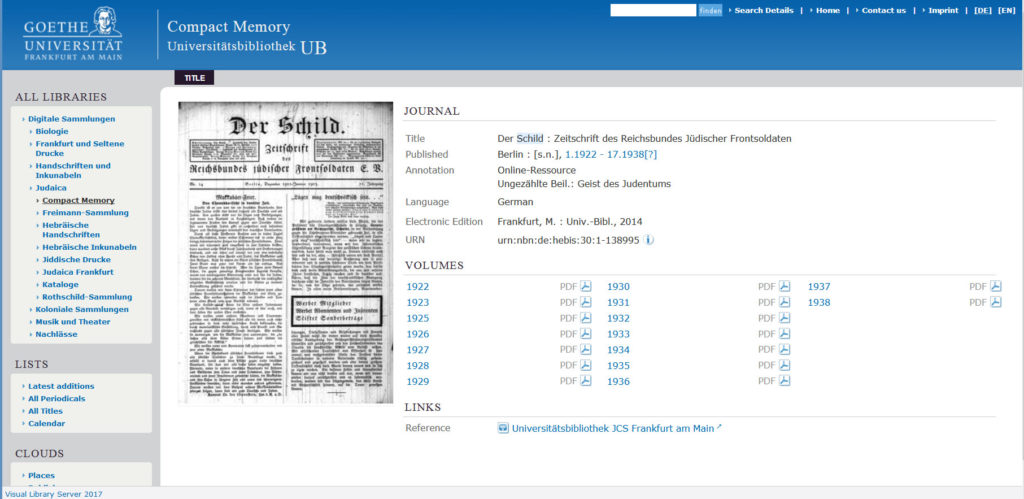
The screen-shot below shows the Goethe University’s catalog entry for Der Schild, which allows for immediate and direct access of the library’s holdings of the newspaper.  All years of the publication, with the exception of 1924, are available; all as PDFs. 
Of equal (greater?!) importance, accessing digital holdings is as simple as it is intuitive (and easy, too!)  In effect and intent, this is a very well designed website!  This is shown through this screen-shot, presenting holdings of Der Schild for 1933. 
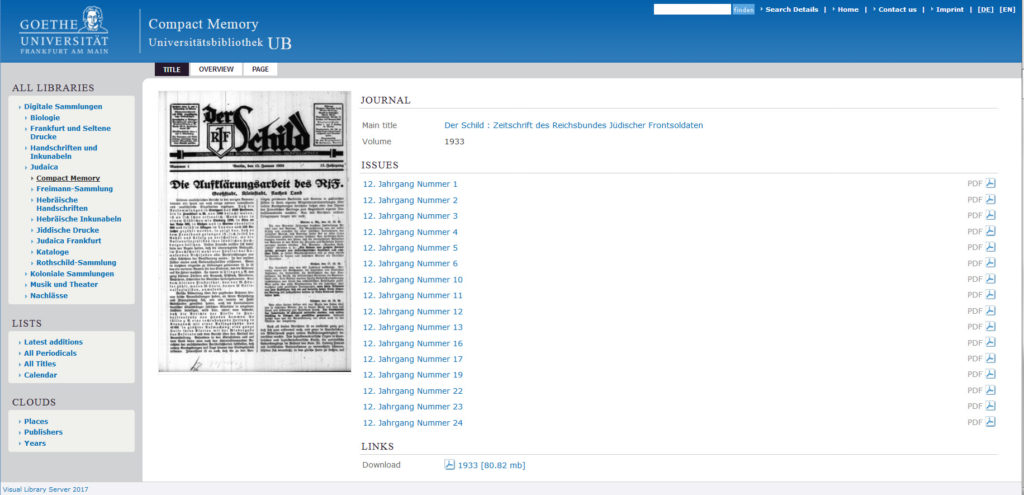
The total digitized holdings of Der Schild in the Goethe University’s collection comprise approximately 530 issues.  “Gaps” do exist, with 1922 comprising only four issues (9, 10, 13, and 14) and 1923 comprising three issues (14, 15, and 17).  However, holdings for all years commencing with 1925 are – I believe – complete, through the final issue (number 44, published November 4, 1938).

Not unexpectedly, Der Schild’s content shed’s fascinating and retrospectively haunting light on Jewish life in Germany during the 1920s and 1930s; on Jewish genealogy; on the military service of German Jews (not only in the First World War but the Franco-Prussian War as well), often focusing on Jewish religious services at “the Front”, rather than “combat”, per se (see the issue of April 3, 1936, with its cover article “Pesach vor Verdun”); on occasion about Jewish military service in the Allied nations during “The Great War”(1); on Jewish history, literature, and religion; on Jewish life and Jewish news outside of Germany.

There is much to be explored.

While reviewing Der Schild at the New York Public Library, I discovered a front-page article – published less than a year before the newspaper’s final issue – which was particularly striking both in its content and prominence:  An account of an infantry battle against British tanks, at Cambrai, France, in November of 1917.  Certainly Der Schild carried innumerable articles – lengthy and brief – about the military service of German Jews, but these items were not always so boldly displayed as one might assume.  The prominence of this article prompted curiosity and in turn, an attempt at translation.  Which, is presented below.

Unlike the letter of Martin Feist, Carl Anker’s article neither carries nor imparts any deep spiritual insights or moral messages. 

It is simply an utterly direct story about a battle now almost a century gone by.
Erinnerungen an die
Tankschlacht bei Cambrai

Memories of the
Tank Battle at Cambrai

Der Schild
December 10, 1937

Unser Kam. Carl Anker, Hamburg, überlässt uns freundlicherweise seine interessanten Erinnerungen aus der grossen Durchbruchs-Schlacht bei Cambrai 1917 nach seinen Kriegstagebuch-Aufzeichnungen.

Our comrade, Carl Anker, of Hamburg, kindly leaves his interesting memoirs from the great breakthrough battle at Cambrai in 1917 according to the notes in his war diary.
In der Nacht vom 16 zum 17 November kamen wir, die 8. Komp. I.R. 84, von Noyelles nach vorne auf Wache.  Ich hatte einen Unteroffizier-Posten, also mit 6 Mann eine Wache für mich.  Um 8 Uhr abends kamen wir an, um 1 Uhr zog ich mit meinen 6 Mann nach __rne in die Feldwache.  Drei Löcher, jedes für 2 Mann, in Abständen von ca. 30-40 Schritt, nahmen uns auf.  Ich, als Wachthabender, hatte beständig von Loch zu Loch zu patrouillieren; dieses Vergnügen dauerte bis früh um 7 ½ Uhr.  Dann wurde es so hell, dass man von hinten Uebersicht über das gesamte Gelände hatte, und wir zogen uns auf ein anderes grösseres Loch, das “Gruppennest” ca. 20 Schritte weiter hinten zurück und blieben dort von früh um 7 ½ bis abends 6 Uhr: – dann wurde es wieder so dunkel, dass die Posten besetzt werden mussten.  Vom Greppennest wurde durch einen Mann Posten gestanden; von hier aus ging auch ein Verbindungsgraben nach hinten, – ca. 600 m zur Feldwache -, wo ein tiefer Unterstand mit dem Wachthabenden und der Ablösung lag.  Von abends 6 Uhr lagen wir wieder vorne auf Posten,

In the night of the 16th to 17th of November we arrived, the 8th Company, 84th Infantry Regiment, forward on guard from Noyelles.  I had a non-commissioned officer’s station, with 6 men on guard duty for me.  We arrived at eight o’clock in the evening; at 1 o’clock I went with my 6 men to the field guard.  Three holes, each for two men, in intervals of about 30-40 paces, were taken by us.  I, [keeping watch], had to patrol constantly from hole to hole; this pleasure lasted until early in the morning at 7:30 hours.  Then it was so bright, that we had an overview of the whole terrain from behind, and we moved to another larger hole, the “group nest” about 20 paces farther back, and stayed there from early morning at 7: 30 to 6 o’clock in the evening: – then it was again so dark again, that the posts had to be occupied.  A man stood post by the group nest; from here a connecting trench also went to the rear – about 600 meters to the field guard -, where there was a deep dugout with the guard and the detachment.  From the evening at 6 o’clock we were again located at the post,

ca. 49 Schritte vom englischen Graben entfernt.

about 49 steps from the English trench.

Nach Einsetzen der Dunkelheit erhielten wir Verpflegung.  Um 1 Uhr Nachts kam unsere Ablösung von der Feldwache, nachdem wir also 24 Stunden vorne gewesen.

After darkness we received food.  At 1 o’clock in the evening, our detachment came from the field guard, after we had been at the front for 24 hours.

Zwei mal 7 Stunden hintereinander auf Posten, ohne Bewegung, lautlos, in denkbar nächster Nähe des Gegners, am Tage ein Lager auf hartem Brett, in freier Luft, nur ein Stück Wellblech gegen Regen über dem Körper!  Nicht rauchen, tagsüber der Qualm, nachts der Feuerschein!

Two times seven hours in a row, without a movement, silently, in the immediate vicinity of the enemy, in the day camping on a hard plank, in the open air, only a piece of corrugated iron over the body against the rain!  Do not smoke, smoke during the day, the fire at night!

In der nacht vom 17. zum 18. wurde ich also abgelöst, kam kurz nach 1 Uhr in der Feldwache an und konnte bis früh um 6 Uhr schlafen.  Da wurde alles alarmiert.  Eine Gewaltspatrouille kam zur Durchführung.  Lt. Hegermann, Lt. Störzel, am Tage vorher befordert, und noch einige andere Offiziere leiteten die Sache.  Artillerie, Minen- und Granatwerfer riegelten das betreffende englische Grabenstück ab, die Patrouille drang vor, sprengte den Draht und brachte einen Vizefeldwebel und 6 Mann als Gefangene zurück.  Wir selbst verloren Lt. Störzel als Toten und mehrere Verwundete.  Der Gegner erwiderte unser Feuer sehr lebhaft, und auf einmal kam von vorne der Befehl: “Verstärkung nach vorne, der Feind macht einen Gegenangriff.”  Ich musste mit meinen 6 Mann vor, stürmte los, traf aber unterwegs schon die zurückkehrende Patrouille mit den Gefangenen – die Verstärkung sei nicht mehr nötig.  Also wieder zurück.  Hpt. Soltau verhörte die Gefangenen, die bald nach hinten abgeschoben wurden, und nach einer weiteren Stunde Alarmbereitschaft hatten wir den Tag über wieder Ruhe.

In the night of the 17th to the 18th, I was relieved, came to the field guard shortly after one o’clock, and could sleep until early at 6 o’clock.  Everything was alerted.  A violent patrol came to pass.  Lt. Hegermann, Lt. Störzel, who had been summoned the day before, and still a few other officers lead the affair.  Artillery, mines, and mortars cordoned off the English trench, the patrol pushed forward, pulled the wire, and returned with a non-commissioned-officer and six men as prisoners.  We ourselves lost Lt. Störzel (2) as dead and several wounded.  The enemy repulsed our fire very vigorously, and suddenly the command came from the front: “Reinforcements forward, the enemy is making a counter-attack.”  I had to go forward with my 6 men, storm, but on the way I met the returning patrol with the prisoners – the reinforcement was no longer necessary.  So back again.  Soltau interrogated the prisoners, who were soon shuffled off to the rear, and after a further hour on high alert, we had the rest of the day.

In der Nacht vom 18. zum 19. November musste ich um 1 Uhr nach vorne zur Ablösung.  Die Nacht war ruhig, es fiel fast kein Schuss.  Am 19. früh 9 Uhr, während wir im Gruppennest standen, bemerkte ich 2 Engländer an ihrem Drahtverhau.  Am hellen Tage gingen sie aufrecht herum – für uns unfassbar.  Ich beobachtete sie eine Zeitlang und vertrieb sie dann durch ein paar Schüsse.

In the night from the 18th to the 19th of November, I had to move forward at 1 am.  The night was quiet, there were almost no shots.  On the morning of the 19th, at nine o’clock, while we were standing at the group nest, I noticed two Englishmen at their wire entanglement.  In the bright of the day they walked upright – for us incomprehensible.  I watched them for a time, and then drove a few shots through them.

Mittags um 12 Ich war unruhig geworden, verliess mich nicht auf meinen Posten, sondern passte selbst auf und sah wieder 5 Mann am Draht herumlaufen.  Ob sie die von unserer Patrouille gesprengte Lücke besichtigen oder ausbessern wollten oder was sonst, ich wusste es nicht.  Ich alarmierte meine Leute, und wir gaben eine ruhig gezielte Salve ab, worauf sie verschwanden.  Ich meldete den Vorfall sofort nach hinten.

At 12 o’clock I was restless, did not leave my post, but took care of myself and saw another five men running around the wire.  Whether they wanted to see or repair the gap exploded by our patrol, or what else, I did not know.  I alerted my people, and we gave a quiet salvo, whereupon they disappeared.  I immediately reported back the incident.

Um 6 Uhr abends am 19. zogen wir wieder auf Posten.  Bald kam der Feldwachhabende, Vizef. Sörensen und meldete mir, hinten sei alles

At 6 o’clock in the evening on the 19th, we moved back to the post.  Soon came the field guard on duty, Senior NCO Sörensen (3), and told me, that everything behind was

in allerhöchster Alarmbereitschaft.

in very high alertness.

Beobachtungen und die Aussagen der Gefangenen liessen vermuten, dass für den kommenden Morgen ein grosser Angriff bevorstände.  Die Gräben seien voll, alle Reserven seien herangezogen, auch alle höheren Stäbe etc. seien weit nach vorne geschoben.  Dabei gab er mir gleich Instruktion, bei einem Infanterie-Angriff unbedingt zu halten, bei Artillerie-Feuer mich langsam zurückzuziehen.  Na, dachte ich, denn man los!  Aber die Nacht auf den 20. verlief wieder absolut ruhig.  Um 1 Uhr wurde ich abgelöst und fand die Feldwache dicht an dicht besetzt.  Hptm. Christiansen, der unsere Kompagnie übernehmen sollte, Lt. Simon und viele Leute hatten jeden Winkel dicht besetzt.  So gut es ging, hockte ich mich mit meinen Leuten irgwendo hin zum Schlafen.

Observations and the statements of the prisoners suggested that a major attack would take place on the coming morning.  The trenches were full, all the reserves were drawn up, and all the higher staff, etc., were pushed far forward.  At the same time, he gave me the instruction, to hold on to an infantry attack, to retire slowly with artillery fire.  Well, I thought, because you go!  But the night on the 20th proceeded perfectly quiet again.  At 1 o’clock I was relieved and found the field guard closely packed.  Captain Christiansen, who was to take over our company, Lt. Simon, and many people had crowded [into] each corner.  As best I could, I crouched with my people to sleep.

Am 20. früh 6 Uhr alles raus, gefechtsbereit, Handgranaten, Munition, etc. …

On the morning of the 20th at 6 o’clock everything went out, ready at hand, hand grenades, ammunition, etc. …

Ich arbeitete Schützenstände aus, damit für den Fall eines Angriffs jeder Mann Licht- und Schussfeld habe.  Es blieb alles ruhig.  Um 7 Uhr hiess es, die Alarmbereitschaft sei zu Ende, die Leute könnon zur Ruhe gehen.  Ich sprach mit Vizef. Sörensen, na, nun sei es hell, und es sei nichts mehr zu befürchten, es sei wieder mal blinder Alarm gewesen.  Da, mitten im Satze – das werde ich wohl nie vergessen – wie ein einziger dauernder riesiger Blitzschlag in allernächster Nähe ein schlagartiger Angriff riesiger Artilleriemassen.  Alle Schüsse sausten über uns hinweg, gingen in unsere vorderste Linie und weiter nach hinten zu unseren Reserven und zur Artillerie.  Ich sah nach hinten.  Es war, als sei Weltuntergang, ein furchtbares Krachen und Sausen; der ganze Horizont war, trotzdem es schon hell war, blutig rot von den platzenden Granaten, berstenden Schrapnells.  Im Nu wurde durch diesen schlagartigen Angriff hinten alles zusammengeschossen, – es feuerte eine Unzahl Geschütze gleichzeitig und so andauernd, wie ich nie vorher gehört.  “Aha,” sagt Sörensen, “das ist die Vergeltung.”  “Nein,” sage ich, “das ist viel mehr, das ist der Angriff!”

I worked at gunnery stations, so that in the event of an attack every man had light and a shooting area.  Everything remained quiet.  At 7 o’clock it was said that the alert was over; the people could go to rest. I spoke with Senior NCO Sörensen, well, now it was bright, and there was nothing to fear, it was once again a blind alarm.  There, in the middle of the sentence – I shall never forget – like a single giant lightning bolt in the immediate vicinity, a sudden strike of giant artillery.  All the shots rushed over us, went into our front-most line, and farther back to our reserves and artillery.  I looked back.  It was as if there was an end of the world, a terrible crash and a whirl; the whole horizon was still bright, blood-red from the exploding shells, bursting shrapnel.  In an instant, this sudden attack brought everything back to the ground, firing an immense number of guns at the same time, as I never heard before.  “Ah,” said Sörensen, “that is the retribution.”  “No,” I say, “that is much more, that’s the attack!”

Unsere Leute waren von selbst alle heraus und auf ihren Ständen.  Das riesige, nicht zu überbietende Trommelfeuer hielt an; aber auf uns, die wir so weit vorne lagen, fiel nicht ein Schuss.  Plötzlich liefen von vorn auf uns Leute zu.  Unsere M.G.’s setzten mit rasender Schnelligkeit ein.  “Halt, halt!”, brüllte ich, “das sind ja unsere!”  Unsere Wachtposten von vorne kamen an, Sörensen stoppte unser M.G.-Feuer und die Leute kamen richtig zu uns in den Graben.

Our people were by themselves all out and on their [firing] stands.  The huge barrage [drum-fire], which was not to be surpassed, continued; but not a shot fell on us, who were so far ahead.  Suddenly people came running towards us.  Our machine guns set in with rapid speed.  “Stop, stop!” I yelled, “these are ours!”  Our guard posts came from the front, Sörensen stopped our machine gun fire and the people came to us right into the trench.

Wir standen und warteten.  Nichts als das andauernde ungeheure, fürchterliche Bombardement nach hinten.  Ich bereitete mich auf mein Ende vor; denn dass nach dieser kolossalen Vorbereitung ein gewaltiger Stoss erfolgen würde, war mir gewiss.  Die 3 Jahre Krieg zogen blitzschnell in Gedanken vorbei, – na, und dann stand ich da: schussbereit, totbereit.  Alles war ruhige.  Entschlossenheit, kalte Vernunft, zielbewusste Energie.

We stood and waited.  Nothing but the protracted, tremendous, terrible bombardment to the rear.  I prepared myself for my end; because after this colossal preparation, a tremendous blow would take place, I was certain.  The three years of war passed quickly, and then I stood there, ready to shoot, ready to kill.  Everything was quiet.  Determination, cold reason, purposeful energy.

Das Feuer liess nicht nach, es lag dauernd in unerhörter Stärke hinter uns.  Der Engländer musste hunderte Geschütze aufgefahren haben, die ohne Pause das entsetzlichste Trommerlfeuer unterhielten.

The fire did not stop; it was always behind us, in unheard of strength.  The Englishman had had to take hundreds of guns, which kept the most terrible barrage fire [drum fire] without pause.

Da tauchte vor uns aus Nebel und Rauch etwas Dunkles auf.

Then darkness, fog and smoke appeared in front of us.

Ich sah etwas Grosses Schwarzes.  “Das ist ein Tank” sagt Sörensen so ruhig wie nur was.  Wahrhaftig, jetzt erkenne ich es auch.  Langsam aber sicher schiebt sich das Ungeheuer feuernd und krachend auf uns zu, entsetzlich wie ein unabwendbares Verhängnis.  Unempfindlich gegen Kugeln und Handgranaten, ist es nur durch Artillerie-Volltreffer zu vernichten.  Es kommt näher, vielleicht 50 Schritt noch!  Ueber uns, ganz, ganz niedrig, kreisen die Flieger und bestreichen uns mit M.G.  Hilfe von hinten ist ausgeschlossen -: durch solch ein Sperr- und Vernichtungsfeuer kommt kein Hund lebendig!

I saw something large and black.  “This is a tank,” says Sörensen as quiet as that.  Now I also truly recognize it.  Slowly but surely, the monster is firing and crashing toward us, terrible as an inevitable doom.  Immune to bullets and hand grenades, it is only to be destroyed by artillery hits.  It comes closer, maybe no more than 50 paces!  Above us, all, very low, airplanes circle and spread machine gun fire.  Help from behind is impossible -: by such a block and destructive fire no dog comes [out] alive!
Da, jetzt endlich ist es Zeit!  In dichten Massen schreiten aufrecht hinter dem Tank, der sie völlig schützt, die Engländer.  Aber der geht an uns vorbei, mehr nach links, er geht geradezu seitlich an uns vorbei, so dass wir die Massen dahinter flankierend fassen können.  Natürlich, der Tank geht parallel mit unserem Graben direkt auf unsere Hauptstellung zu.

There, now finally it’s time!  In dense masses, the British are standing upright behind the tank, which protects them completely.  But it goes past us, more to the left; it goes to the side of us, so that the masses behind it can be flanked.  Of course, the tank goes directly to our main position parallel to our trench.

Nun, wir schossen, so lange wir Munition hatten.  Bald war der Tank links an uns voruber, die englische Infanterie also vor uns.  Gruppenweise kamen sie auf uns zu.  Ich nahm mir einen ihrer Führer, der sie mit der Hand auf uns zu dirigierte, aufs Korn.  Hinter uns lag noch immer das furchtbare Artilleriefeuer, von dem wir glücklicherweise garnichts abbekamen; rechts zog sich der Graben nach unserem Gruppennest.  Langsam rückten wir alle in dieser Richtung vor, immer im Graben entlang und feuernd.  Neben mir schrien Verwundete auf.  Wir bekamen jetzt starkes Infanteriefeuer.  Ich liege auf dem Grabenrand, ziele und schiesse dauernd; da fällt neben mir Sörensen herab; Schuss in die Schädeldecke.  Kein Ton, kein Laut.  Er wird blau im Gesicht, das Haar raucht vom warmen Blut.  Nun denke ich, einer nach dem anderen, heraus kommt hier keiner.

Well, we shot as long as we had ammunition.  Soon the tank was on our left; the English infantry before us.  They came to use in groups.  I took [killed] one of their leaders, who directed them to us with his hand.  Behind us still lay the terrific artillery-fire, which we were fortunate not to mention; to the right, the trench moved to our group nest.  Slowly we all advanced in this direction, always along the trench and firing.  Beside me, the wounded cried.  We are now given strong infantry fire.  I am lying on the edge of the ditch, aiming and shooting; Sörensen falls next to me; shot in the cranium. No sound, no sound.  He becomes blue in the face; the hair fumes of the warm blood.  Now I think, one by one, no one comes out here.

Bald hatten wir

Soon we had

keine Munition mehr.

no more ammunition.

Vor uns links bewegte sich der Tank vorwärts und ihm nach die Massen des Gegners; hinten lag dauernd das unheimliche Trommelfeuer, vor uns kam der Gegner in Gruppen heran.  Wir zogen uns nach rechts, also nach vorne zu, weiter.  So kamen wir bis fast ans Gruppennest.  Auch hier bereits alles voll vom Gegner.  Unsere Munition war ja verschossen.  Da, ein Ruck – und ein leichter Schmerz an der rechten Schulter…

In front of us, on the left, the tank moved forward, and after him the masses of the enemy; in the rear was the eerie barrage [drum] fire, before us the enemy came in groups.  We moved to the right, so forward.  So we came almost to the group nest.  Here too, everything is full of the enemy.  Our ammunition was gone.  There, a jerk – and a slight pain on the right shoulder …

In unserem Löchern sassen Gruppen des Gegners, die uns mit der Pistole in der Hand den Weg in ihren Graben wiesen…

There were groups of our opponents in our holes, who pointed at us with their pistols in their hands…

*

Ein anderer Kamerad, Dr. Caspary, Stettin, hat die Tankschlacht bei Cambrai beim Inf. Regt. 50 mitgemacht (S. Regt. Gesch. S. 280).  Er geriet mit seinen Leuten in die Gewalt der Engländer und wurde in einem der bekannten “Nester” gefangen gehalten, die eine Spezialität der Engländer waren.  Kam. Dr. Casparys Plan, mit den Seinen weider Verbindung aufzunehmen, gelang – wie er selbst berichtet – vornehmlich durch die Kaltblütigkeit eines seiner Krankenträger.  Zwar war die Situation mehr als schwierig, allein um so schöner der Erfolg, als er ausser der Befreiung noch die Gefangennahme von 3 englischen Offizieren, 46 Mann und 2 Maschinen-Gewehren einbrachte.

Another comrade, Dr. Caspary, Stettin, participated in the tank battles at Cambrai at the 50th Infantry Regiment.  He fell into the hands of the British with his men, and was imprisoned in one of the well-known “nests”, which were a specialty of the English.  Comrade Dr. Caspary’s plan to connect with his two partners was, as he himself reports, chiefly due to the cold-bloodedness of one of his patients.  The situation was more than difficult, but it was all the more successful when, besides the deliverance, he brought in as prisoners three English officers, 46 men, and two machine guns.

______________________________

I’ve been unable to find any record “Carl Anker” – or even an approximation of his name – in Yad Vashem’s Central Database of Shoah Victims Names.  This would suggest, though not definitively confirm, that he was able to escape Nazi Germany and perhaps German-Occupied Europe, “in time”.  To where, and when, is unknown.   

What happened to him after 1937? 

Notes

(1) See the issue of June 24, 1938, which includes coverage of the Evian Conference (as did three issues in July), and – on the first page – an illustrated article about the commemoration of a memorial to French Jewish soldiers fallen at the Battle or Verdun. 

(2) “Lt. Storzel” was probably Leutnant Georg Storzel, who is listed as having been killed on November 18, 1917.  He is buried at Kriegsgräberstätte in Neuville-St.Vaast (France), Block 1 Grab 516.

(3) “Sorensen” was probably Offiziersstellvertreter Friedrich Sørensen.  He was born in Haderslav, Denmark, on October 25, 1889.

These men were identified from reference works (listed below) available at denstorekrig1914-1918

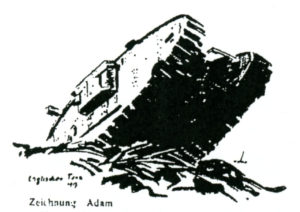
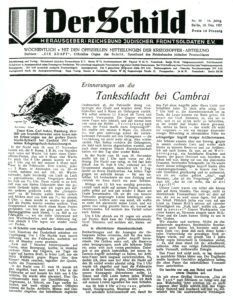
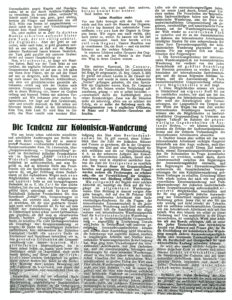
The three images of displayed above are scans of photocopies made at the Dorot Jewish Division of the NYPL, Photoshop-“ed” for clarity.  Ironically, the quality of these images – derived from a physical media: paper, from a plain ‘ole microfilm photocopier – is better than that of the PDF available via the Goethe University’s Website.  Notably, the article is appropriately headed with a sketch of a British Mark I tank  (drawn by “Adam Zeichnung” and…simply and aptly labeled as “Englisher Tank ’17”) advancing over the lip of a trench.

Some other German Jewish military casualties on March 20, 1917 include…

– .ת. נ. צ. ב. ה

Hagedorn, Josef, Soldat, Garde-Schutz Bataillon 2
Born in Padberg 6/28/97 / Resided in Giershagen
Casualty Message (Verlustmeldung) 820
Die Jüdischen Gefallenen des Deutschen Heeres, Deutschen Marine und der Deutschen Schutztruppen 1914-1918 – Ein Gedenkbuch – page 314

Rosenthal, Isak, Soldat, Garde Regiment 11, Bataillon 3, Kompagnie 9
Born in Beuthen (O.S.) 1/7/88 / Resided in Bitschin / Gleiwitz
Casualty Message (Verlustmeldung) 814
Die Jüdischen Gefallenen des Deutschen Heeres, Deutschen Marine und der Deutschen Schutztruppen 1914-1918 – Ein Gedenkbuch – page 169

Simmenauer (first name unknown), Soldat, Garde Regiment 11, Bataillon 3, Kompagnie 9
Born in Breslau 8/4/95 / Resided in Halle / S.
Casualty Message (Verlustmeldung) 814
Die Jüdischen Gefallenen des Deutschen Heeres, Deutschen Marine und der Deutschen Schutztruppen 1914-1918 – Ein Gedenkbuch – page 182

Westheimer, Heinrich, Soldat (Landsturmrekrut), Reserve Infanterie Regiment 263, Bataillon 3, Kompagnie 10
Born in Grosseicholzheim 2/19/81 / Resided in Grosseicholzheim
Kriegsgräberstätte in Neuville-St.Vaast (Frankreich), Block 9, Grab 315
Casualty Message (Verlustmeldung) 851
Die Jüdischen Gefallenen des Deutschen Heeres, Deutschen Marine und der Deutschen Schutztruppen 1914-1918 – Ein Gedenkbuch – page 230

References

Books

Banks, Arthur, A Military Atlas of the First World War, Leo Cooper (Pen & Sword Books), Barnsley, South Yorkshire, England, 2001.

Chamberlain, Peter, and Ellis, Chris, Pictorial History of Tanks of the World 1915-1945, Galahad, Books, Harrisburg, Pa., 1972.

Die Jüdischen Gefallenen Des Deutschen Heeres, Deutschen Marine Und Der Deutschen Schutztruppen 1914-1918 – Ein Gedenkbuch, Reichsbund Jüdischer Frontsoldaten, Forward by Dr. Leo Löwenstein, Berlin, Germany, 1932

Erindringsboger tyske regimenter Udgivet under medvirken af Rigsarkivet – Infanterie-haefte 11 – Infanterie-Regiment von Manstein (Schleswigsches) Nr. 84, Oldenburg i.O/Berlin, 1922 / Dansk udgave: Jørgen Flinthom – 2016 (“Memorial Books of German Regiments, Published under the auspices of the National Archives – Infantry – Record Book 11 – Manstein 84th Infantry Regiment“) (denstorekrig1914-1918.dk/wp-content/uploads/2016/12/IR-84-kampkalender-udvidet.pdf) (at Den Store Krig 1914-1918)

Geschichte des Infanterie-Regiments von Manstein (Schleswigsches) Nr. 84, 1914-1918, in Einzeldarstellungen von Frontkämpfern, Band III – herausgegben von Hülsemann, Oberstleutnant a.D., im felde Hauptmann und Komp.-Chef. 6./84 und Fuhrer des II. Bataillons / Revideret udgave: Jørgen Flinthom – 2011 (“History of the Manstein 84th Infantry Regiment, 1914-1918, Volume 3“) (at Den Store Krig 1914-1918)

Geschichte des Infanterie-Regiments von Manstein (Schleswigsches) Nr. 84, 1914-1918, in Einzeldarstellungen von Frontkämpfern, Band IV – herausgegben von Hülsemann, Oberstleutnant a.D., im felde Hauptmann und Komp.-Chef. 6./84 und Fuhrer des II. Bataillons / Revideret udgave: Jørgen Flinthom – 2011 (“History of the Manstein 84th Infantry Regiment, 1914-1918, Volume 4“) (at den Store Krig 1914-1918)

Sønderyjske Soldatengrave 1914-1918 – Sorteret efter efternavn (“Soldiers’ Graves 1914-1918 – Sorted by Surname“) (at Den Store Krig 1914-1918)

Web

Bund jüdischer Soldaten (Home Page – dead link as of 2025)

Bund jüdischer Soldaten (YouTube Channel)

Den Store Krig 1914-1918 (“Danes in the German Army – 1914-1918”)

Der Schild (digital version) (at Goethe University Frankfurt website)

German War Graves (at Volksbund.de)

Reichsbund jüdischer Frontsoldaten (at Wikipedia)

Vaterländischer Bund jüdischer Frontsoldaten (Patriotic Union of Jewish Front-Line Soldiers”) 

Yav Vashem – Central Database of Shoah Victim’s Names (at Yad Vashem)
God’s Decree is Unsearchable: One of 12,000 – Thoughts of A German Jewish Soldier in the Great War – II

In my prior post, I described the varied books published in Germany during, after not long after, the First World War, which covered the experiences of German Jewish soldiers through prose – soldiers’ letters and diaries – as well as statistics. 

But, descriptions can go only “so far”. 

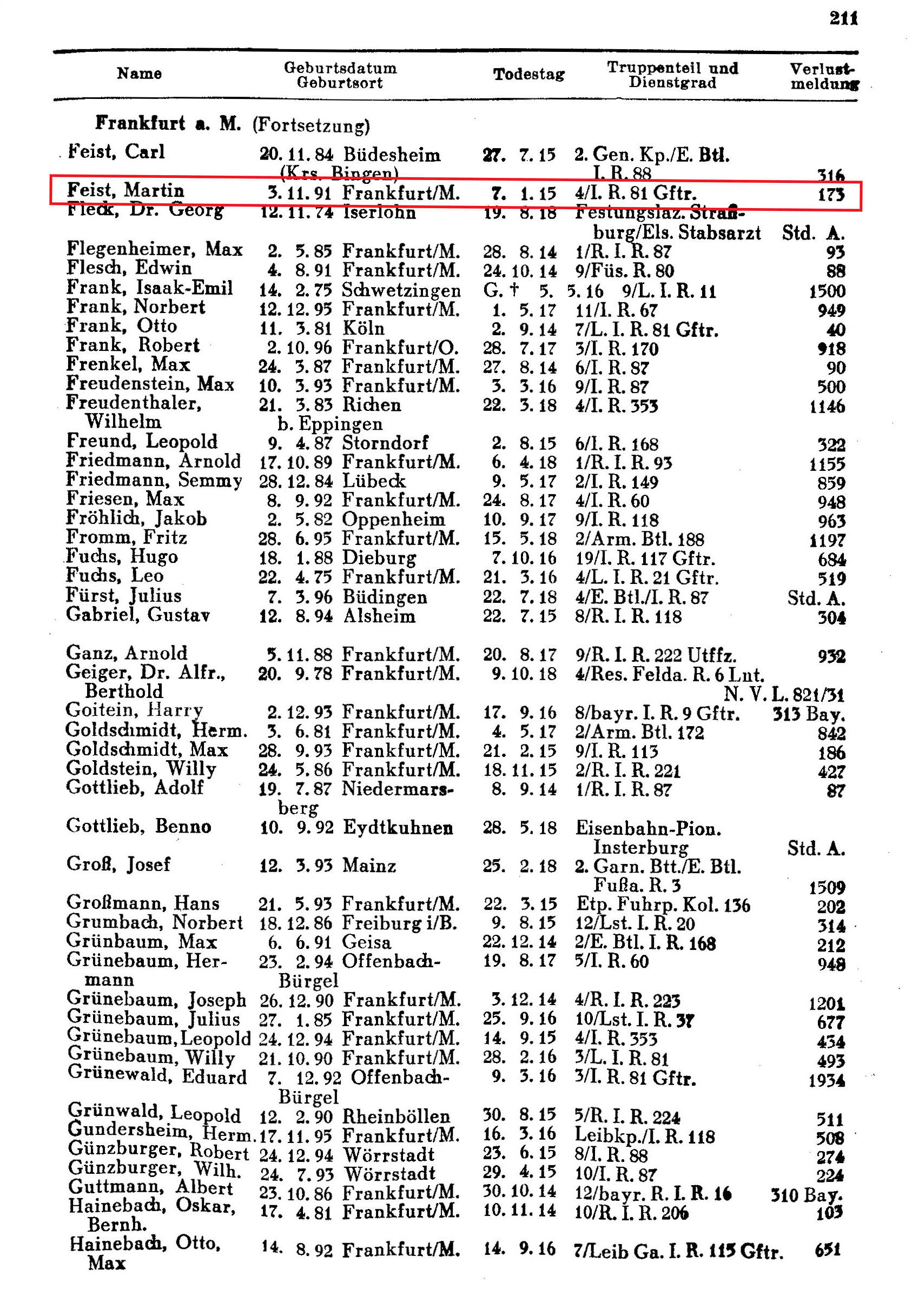
This post presents the letter from soldier Martin Feist, of Frankfurt, which appears in Kriegsbriefe – gefallener Deutscher Juden.

____________________

Images of the cover of Kriegsbriefe – gefallener Deutscher Juden, Max Liebermann’s sketch, and Martin’s letter (outlined in red) on pages 19 and 20, are presented below:

The book’s cover.

The title page.

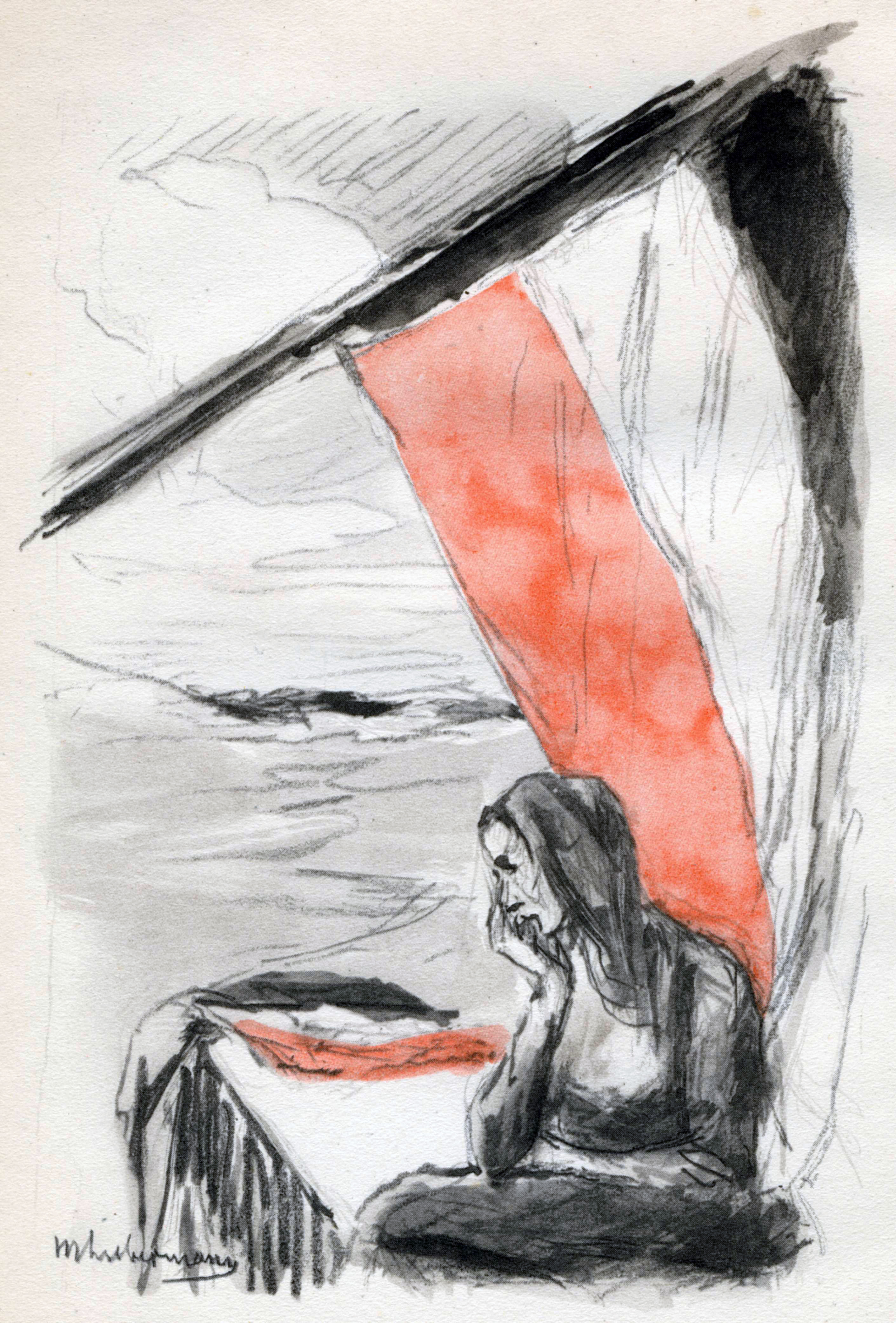
Max Liebermann’s art:  An allegory of mourning.

Excerpt of Martin’s letter, commencing on page 19.  The format of the “header” – comprised of the soldier’s name, rank, and military unit; date and place of birth; date and place of death; date and place where the letter was actually written – is followed (with variations) for the 73 other writings in the book.

Excerpt of Martin’s letter, concluding on page 20.

____________________

Martin’s letter, in German transcription and English translation, is presented below.  (Note the ellipses, indicating sections of the letter which were deleted left unpublished.  More about those in a moment..)

Martin Feist
Gefreiter

Inf. Regt. 81
Geboren: 3.11.1891, Frankfurt / M.
Gefallen: 7.1.1915, Frankreich

Martin Feist
Corporal

81st Infantry Regiment
Born: November 3, 1891, Frankfurt on Main
Fallen: January 7, 1915, France

Im schützengraben bei Andochy, 2.11.14
In a Trench at Andochy, November 2, 1914

     …Ich will in meinem gestrigen Bericht fortfahren.  Die Nacht vom Donnerstag auf Freitag verlief wider Erwarten ruhig.  Der Freitag selbst brachte uns etwas Ruhe, und ermattet von den Strapazen, ruhten wir ermüdet in unseren Gräben.  Der Schabbos begann, und wieder hiess es, leise sich von einem Schützengraben zum anderen wiederholend: “Tornister packen, alles gefechtsbereit, Seitengewehr aufpflanzen.”  Ein Gefühl des Schauerns durchzog mich, als ich auf diese Weise den Befehl ermittelte: “Heute nacht Sturm.”  Stumm lehnte ich mich an die Brüstung des Schützengrabens, scharf nach vorn aus lugend, von wo wir den Feind erwarteten: der volle eben aufgegangene Mond erleichterte die Aufgabe, das hügelige Gelände zu überschauen.  Ich sprach mein Maariw gebet, und dann schweiften meine Gedanken zurück zu Euch meine Lieben.  Ich sah Euch vereint um den Sabbathlichen Tisch, weihevoll und doch besimchoh schel Mizwoh aufgehend.

     …I want to continue in my report of yesterday.  The night, from Thursday to Friday, was calm.  Friday itself brought us some rest, and weary of the hardships, we rested tired in our trench.  Shabbos began, and again it was said, quietly from one trench to the other: “Pack knapsacks, everything ready for battle, plant bayonets [seitengewehr 98].”  A shuddering feeling ran through me when I understood the order: “Night assault.”  Silently I leaned back against the parapet of the trench, leaning forward, from where we expected the enemy: The full moon, which had just risen, facilitated the task of surveying the hilly terrain.  I spoke my Maariv prayer, and then my thoughts wandered back to you my dears.  I saw you gathered together around the Sabbath table, sanctified, and yet sober, mischievous.

Ich dachte an alle Freunde und Verwandte, an ihn vor allen, den teuren Freund, mit dem warmen Herzen und den glühenden Idealen in der Brust…  Fernab von der Heimat traf ihn die Kugel des Feindes und machte seinem jungen Leben ein allzufrühes Ende; nichts blieb mir von ihm zurück als die Erinnerung an die frohen und trüben Tage der Jugend, die wir gemeinsam verbrachten.  Gottes Ratschluss ist unerforschlich.  Und so zogen stundenlang meine Dedanken.  Sie hielten inne, als ich der Entsetzlichkeiten gedachte, die meine Augen geschaut haben.  Ihr Zuhausegebliebenen, was könnt ihr von Glück sagen, dass es Euch erspart blieb, die Schrecken des Krieges zu erfahren…  Möge auch diese Zeit, so gingen meine Gedanken weiter, reinigend hineinfahren in unsere Frankfurter Gassen, möge man verstehen lernen, dass man bisher zuviel danach gefragt, wer reich, wer arm ist.  Weg mit der Anbeter ei des Reichtums, entfernen wir diesen Götzen aus unserem Herzen, und unser Frankfurt wird sehen, dass es noch ein Höheres gibt, und das heisst “Mensch sein”.  Möge dieser Moment ein grosses Geschlecht finden, möge er uns veranlassen, uns selbst zu erziehen, dass wir nach dem Kriege ein Leben mit neuen Begriffen, neuen Vorstellungen beginnen können.

     I thought of all the friends and relatives, of him before all, the dear friend, with a warm heart and glowing ideals in his chest…  Far away from home, the bullet of the enemy struck him, and made of his young life too early an end; nothing remained for me of him but the memory of the joyful and gloomy days of youth that we spent together.   God’s decree is unsearchable.  And so my thoughts went on for hours.  They stopped when I thought of the horrors that my eyes had seen.  Your own home, you can fortunately say was spared to remain, to learn the horrors of the war…  May this time also, my thoughts went on, be a cleansing of our Frankfurter streets; may one understand, that one has asked too much about it so far, of who is rich; who is poor.  Away with the worship of wealth; may we remove these idols from our hearts, and our Frankfurt will see that there is still a higher one, that is to say, “to be human.”  May this great moment find a great lineage; may it lead us to educate ourselves that after the war we can begin to live with new things; can start new ideas.

Der Mond verschwand hinter inzwischen düster aufgezogenen Wolken, meine Blicke verfolgten ihn, wie er sich immer wieder durch die Wolken emporzuarbeiten versuchte.  Still und schwarz wurde es um mich her, da setzte rechts von mir ein heftiges Gewehrfeuer ein, die Kanonen donnerten, Maschinengewehre ratterten unaufhörlich, der Angriff der Franzosen begann.  Der Morgen fand uns als Sieger; aber manch braven Kameraden hatte es das Leben gekostet.

     The moon disappeared meanwhile behind dark clouds; my eyes watched it as it tried to work its way up through the clouds again and again.  There was about me stillness and blackness; violent rifle fire set in on my right, the cannons thundered, machine guns rattled incessantly, the attack of the French began.  The morning found us as victor; but had cost the lives of many good comrades.  

Den Samstag verbrachten wir in Ruhe.  Ich machte abends Hawdoloh mit altem Kaffee aus meiner Feldflasche, einer alten Petroleumfunzel und Zigarre als Besomim, und sang dann für mich allein die Semiraus.  Das Vertrauen zu hakodausch boruchhu begleitet mich von diesem Schabbos in die Woche hinaus, er wird mich behüten und beschützen, und mit seiner Hilfe werden wir uns gesund wiedersehen…

    We spent the Saturday in silence.  In the evening I made a Havdalah with old coffee from my canteen, an old petroleum fuse and a cigar as Besamim, and then sang the Zemirot alone.  The trust to HaKadosh Baruch Hu accompanies me from this Shabbos forth into the week; He will guard and protect me, and with His help we shall be well again…

____________________

Kriegsbriefe – gefallener Deutscher Juden is not the only source of information about Martin. 

Remarkably, the Center for Jewish History possesses the entirety of his correspondence, which (doubly remarkably!) includes the original text of the letter as excerpted in Kriegsbriefe – gefallener Deutscher Juden.  Listed – appropriately enough – as the Martin Feist Collection, the documents, donated by Sonya Benjamin, are described as, “letters [sent] to his family over the course of two years, first as a businessman in Paris and then as a German infantryman in France.” 

The collection is comprised of four sequentially arranged folders, covering 1913, 1914 (January to October), 1914 (November to December), and 1915.  The first folder commences with a descriptive note penned by Sonya in 1991, contaning the following statements, “Martin, as did his 2 brothers, worked for the firm Beer-Sondheimer, both in Paris and in London, whence he returned home to enlist when war broke out in August, 1914.  He stayed in close touch with his five brothers and sister.  He was the second eldest.  Their father had died in 1912.”

“The letters describe an arc of changing attitudes and emotions in the mind of a young German Orthodox Jew, well-educated in an affluent home, as he embraces the lifetstyle of a young businessman in Paris, then adapts to the life of a German infantryman, imbused by the righteousness of his cause, and finally experiences deep sorrow and disillusionment, tempered only by abiding faith.”

Thanks to the CJH’s policy of making the Martin Feist collection freely available in digital format, I was able to locate the letter from Kriegsbriefe – gefallener Deutscher Juden within the “3rd” folder.

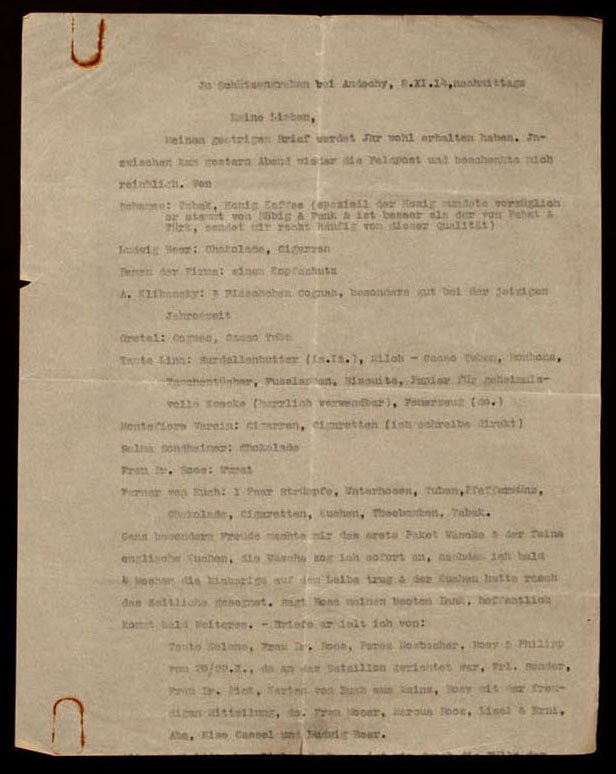
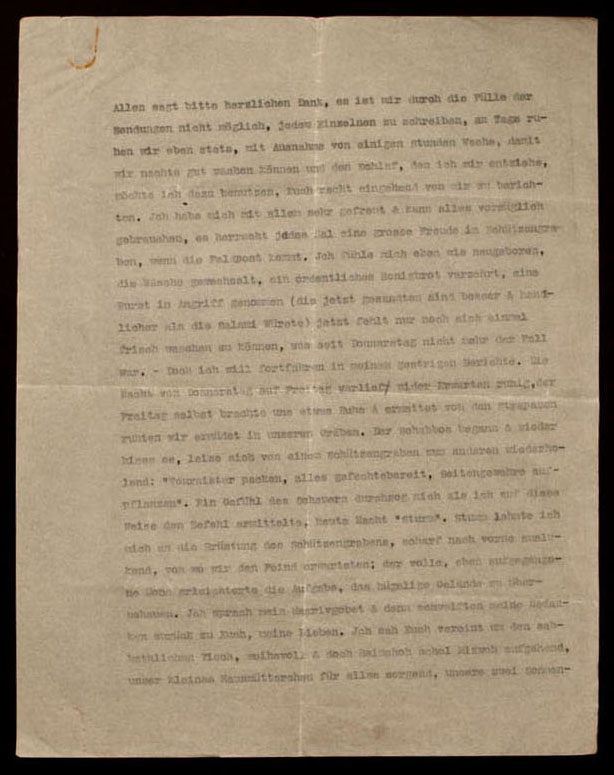
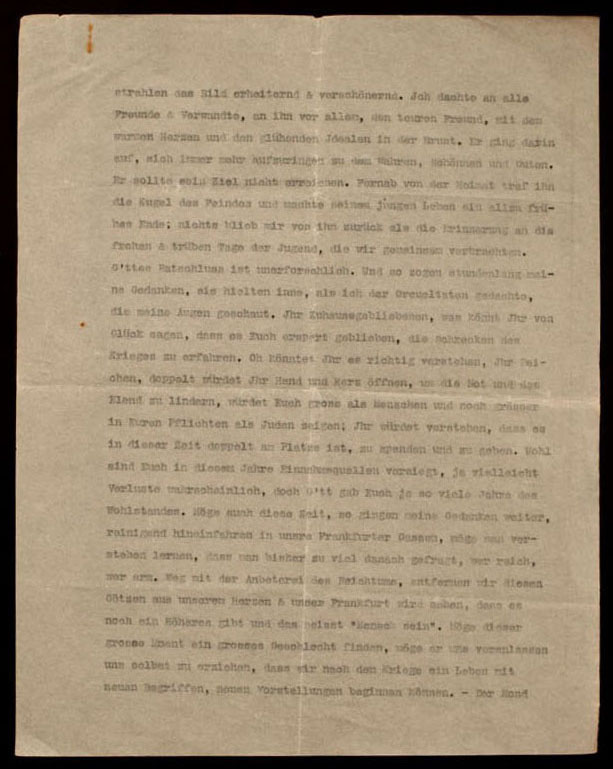
The four pages of Martin’s original (typewritten) letter are presented below:

First page.

Second page.

Third page.

Fourth, and final page.

____________________

This “full” version of Martin’s letter is – unsurprisingly – much lengthier than the book version, and in some parts is actually light-hearted.  Amidst all, Martin retained a sense of humor.

More importantly, a careful reading and comparison of the two versions reveals where the editors of Kriegsbriefe – gefallener Deutscher Juden significantly redacted the original text. 

For example in discussing an unidentified friend, the book presents, “I thought of all the friends and relatives, of him before all, the dear friend, with a warm heart and glowing ideals in his chest…  Far away from home, the bullet of the enemy struck him, and made of his young life too early an end; nothing remained for me of him but the memory of the joyful and gloomy days of youth that we spent together.”

Martin’s actual statement is, “I thought of all the friends & relatives, of him before all, the dear friend, with a warm heart and glowing ideals in his chest.  He began to rise more and more to the true, the beautiful and the good.  He should not achieve his goal Far away from home, the bullet of the enemy struck him, and made of his young life too early an end; nothing remained for me of him but the memory of the joyful & gloomy days of youth that we spent together.  

Likewise, the book presents, “God’s decree is unsearchable.  And so my thoughts went on for hours.  They stopped when I thought of the horrors that my eyes had seen.“.

In the same place, Martin’s original letter has the following, “God’s decree is unsearchable.  And so my thoughts went on for hours.  They stopped when I thought of the horrible abominations that my eyes had seen.”  

Other differences include the use of the word “and” in place of Martin’s liberal sprinkling of ampersand (“&”) symbols.

____________________

The transcription and my translation are presented below:

Martin Feist
Gefreiter
Inf. Regt. 81
Geboren: 3.11.1891, Frankfurt / M.
Gefallen: 7.1.1915, Frankreich

Martin Feist
Corporal

81st Infantry Regiment
Born: November 3, 1891, Frankfurt on Main
Fallen: January 7, 1915, France

Im Schützengraben bei Andochy, 2.XI.14, nachmittags
In a trench at Andochy, November 2, 1914, in the afternoon

Meine Lieben,
My dear,

      Meinen gestrigen Brief werdet Ihr wohl erhalten haben.  Inzwischen kam gestern Abend wieder die Feldpost und beschenkte mich reichlich.  Von

      You will probably have received my letter [of] yesterday.  In the meantime the field post came yesterday evening and gave me plenty.  From

Schames: Tabak, Honig Kaffee (speziell der Honig mundete vorzüglich er stammt von Röbig & Funk ist besser als der von Pabst & Türk, sendet mir recht häufig von dieser Qualität.)

Schames: Tobacco, honey coffee (especially the exquisite honey coming from Röbig & Funk is better than that of Pabst & Türk; send me this quality quite frequently.)

Ludwig Beer: Chokolade, Cigarren

Ludwig Beer: Chocolate, cigars

Damen der Firma: einem Kopfschutz

Ladies of the Firm: A head guard

A. Klibansky:  3 Fläschchen Cognac, besonders gut bei der jetzigen Jahreszeit.

A. Klibansky: 3 bottles of cognac, especially good at the present season.

Gretel: Cognac, Cacao Tube

Gretel: Cognac, cocoa [butter] tube

Tante Lina: Sardellenbutter (Ia.Ia), Milch – Cacao Tuben, Bonbons, Taschentücher, Fusslappen, Biscuits, Papier für geheimnisvolle Zwecke (herrlich verwendbar), Feuerzeug (do.)

Aunt Lina: Anchovy butter (yes, yes), milk – cocoa [butter] tube, sweets, handkerchiefs, sandals, biscuits, paper for mysterious purposes (gloriously usable), lighter (ditto.)

Montefiore Verein: Cigarren, Cigaretten (ich schreibe direkt)

Montefiore Club: Cigars, Cigarettes (I write directly)

Selma Sondheimer: Chokolade

Selma Sondheimer: Chocolate

Frau Dr. Roos: Wurst

Frau Dr. Roos: Sausage

Ferner von Euch: 1 Paar Strümpfe, Unterhosen, Tuben, Pfeffermünz, Chokolade, Cigaretten, Kuchen, Theebomben, Tabak.

Further from you: 1 pair of stockings, underwear, tubes, peppermint, chocolate, cigarettes, cakes, Theebomben [pre-mixed and packaged tea in jute bags], tobacco.

Ganz besondere Freude machte mir das erste Paket Wäsche & der feine englische Kuchen, die Wäsche zog ich sofort an, nachdem ich bald 4 Wochen die bisherige auf dem Leibe trug & der Kuchen hatte rasch das Zeitliche gesegnet.  Sagt Rosa meinen besten Dank, hoffentlich kommt bald Weiteres.  – Briefe erhielt ich von:

I was particularly delighted with the first package of underwear & the fine English cake; I immediately put on the underwear after I had worn the old one on my body for four weeks & the cake had swiftly blessed the time.  Say my best thanks to Rosa; hopefully coming soon.  –  I received letters from:

Tante Helene, Frau Dr. Roos, Perez Mosbacher, Rosy & Philipp von 20 / 22 X., da an das Bataillon gerichtet war, Frl. Sender, Frau Dr. Pick, Karten von Euch aus Mainz, Rosy mit der freudigen Mitteilung, do. Frau Moser, Marcus Roos, Lisel & Erni, Aba, Else Cassel und Ludwig Beer.

Aunt Helene, Frau Dr. Roos, Perez Mosbacher, Rosy & Philipp of 20 / 22 X., since the battalion was directed; Miss Sender, Frau Dr. Pick, cards from you from Mainz, Rosy with the joyous message, ditto Frau Moser, Marcus Roos, Lisel & Erni, Aba, Else Cassel and Ludwig Beer.

Allen sagt bitte herzlichen Dank, es ist mir durch die Fülle der Sendungen nicht möglich, jedem Einzelnen zu schreiben, am Tage ruhen wir eben stets, mit Ausnahme von eingien Stunden Wache, damit wir nachts gut wachen können und der Schlaf, den ich mir entziehe, möchte ich dazu benutzen, Euch recht eingelhend von mir zu berichten.  Ich habe mich mit allen seht gefreut & kann alles vorzüglich gebrauchen, es herrscht jedes Mal eine grosse Freude im Schützengragen, wenn die Feldpost kommt.  Ich fühle mich eben wie neugeboren, die Wäsche gewechselt, ein ordentliches Honigsbrot verzehrt, eine Wurst in Angriff genommen (die jetzt gesandten sind besser & handlicher als die Salami Würste) jetzt fehlt nur noch sich einmal frisch waschen zu konnen, was seit Donnerstag nicht mehr der Fall war.  – Doch ich will fortfahren in meinem gestrigen Berichte.  Die Nacht vom Donnerstag auf Freitag verlief wider Erwarten ruhig, der Freitag selbst brachte uns etwas Ruhe & ermattet von den Strapazen, ruhten wir ermüdet in unseren Gräben.  Der Schabbos began & wieder hiess es, leise sich von einem Schützengraben zum anderen wiederholend: “Tornister packen, alles gefechtsbereit, Seitengewehr aufpflanzen.”  Ein Gefühl des Schauern durchzog mich als ich auf diese Weise den Befehl ermittelte, heute Nacht “Sturm”.  Stumm lehnte ich mich an die Brüstung des Schützengrabens, scharf nach vorn aus lugend, von wo wir den Feind erwarteten: der volle, eben aufgegangene Mond erleichterte die Aufgabe, das hügelige Gelände zu überschauen.  Ich sprach mein Maariw gebet & dann schweiften meine Gedanken zurück zu Euch, meine Lieben.  Ich sah Euch vereint um den Sabbathlichen Tisch, weihevoll und doch besimchoh schel Mizwoh aufgehend, unner kleines Hausamütterchen für alles sorgend, unsere zwei sonnenstrahlen das Bild erheiternd & verschönernnd.  Ich dachte an alle Freunde & Verwandte, an ihn vor allen, den teuren Freund, mit dem warmen Herzen und den glühenden Idealen in der Brust.  Er ging darin auf, sich immer mehr aufzuringen zu dem Wahren, Schönnen und Guten.  Er sollte sein Ziel nicht erreichen.  Fernab von der Heimat traf ihn die Kugel des Feindes und machte seinem jungen Leben ein allzu frühes Ende; nichts blieb mir von ihm zurück als die Erinnerung an die frohen & trüben Tage der Jugend, die wir gemeinsam verbrachten.  Gottes Ratschluss ist unerforschlich.  Und so zogen stundenlang meine Gedanken, sie hielten inne, als ich der Gräueltaten Entsetzlichkeiten gedachte, die meine Augen geschaut haben.  Ihr Zuhausegebliebenen, was könnt ihr von Glück sagen, dass es Euch erspart geblieben blieb, die Schrecken des Krieges zu erfahren.  Oh könntet Ihr es richtig verstehen, Ihr Reichen, doppelt würdet Ihr Hand uns Kerz öffnen, um die Not und das Elend zu lindern, würdet Euch gross als Menschen und noch grösser in Euren Pflichten als Juden zeigen; Ihr würdet verstehen, dass es in dieser Zeit doppelt am Platze ist, zu spenden und zu geben.  Wohl sind Euch in diesem Jahre Einnah__equellen versiegt, ja vielleicht Verluste wahrscheinlich, doch Gott gag Euch ja so viele Jahre des Wohlstandes.  Möge auch diese Zeit, so gingen meine Gedanken weiter, reinigend hineinfahren in unsere Frankfurter Gassen, möge man verstehen lernen, dass man bisher zu viel danach gefragt, wer reich, wer arm.  Weg mit der Anbeter ei des Reichtums, entfernen wir diesen Götzen aus unserem Herzen, & unser Frankfurt wird sehen, dass es noch ein Höheres gibt und das heisst “Mensch sein”.  Möge dieser grosses Moment ein grosses Geschlecht finden, möge er uns veranlassen, uns selbst zu erziehen, dass wir nach dem Kriege ein Leben mit neuen Begriffen, neuen Vorstellungen beginnen können. – Der Mond verschwand hinter inzwischen düster aufgezogenen Wolken, meine Blicke verfolgten ihn, wie er sich immer wieder durch die Wolken emporzuarbeiten versuchte, still & schwarz wurde es um mich her — da setzte rechts von mir ein heftiges Gewehrfeuer ein, die Kanonen donnerten, Maschinengewehre ratterten unaufhörlich, der Angriff der Franzosen begann.

Please say many thanks to all; it is not possible for me to write to each individual because of the abundance of the parcels; during the day we are always at rest, except for a few hours’ watch, so that we can all keep watch well at night and sleep, which I deprive myself of; I would like to use on the other hand to report to you about me.  I was very pleased with all of them & can use everything excellently; there is always great joy in the trench, when the field post comes.  I feel like a newborn; the underwear changed, a decent honeybread consumed, a sausage taken in attack (those sent now are better & handier than the salami sausages) now the only thing missing is to be able to freshly wash, which since Thursday was no longer the case.  –  But I want to continue in my report of yesterday.  The night, from Thursday to Friday, was calm.  Friday itself brought us some rest, & weary of the hardships, we rested tired in our trench.  Shabbos began, & again it was said, quietly from one trench to the other: “Pack knapsacks, everything ready for battle, plant [seitengewehr 98] bayonets.”  A shuddering feeling ran through me when I understood the order: “Night assault.”  Silently I leaned back against the parapet of the trench, leaning forward, from where we expected the enemy: The full moon, which had just risen, facilitated the task of surveying the hilly terrain.  I spoke my Maariv prayer, & then my thoughts wandered back to you my dears.  I saw you gathered together around the Sabbath table, sanctified, and yet sober, mischievous, a little house-maid caring for everything, our two sun-beams amusing & beautifying the picture.  I thought of all the friends & relatives, of him before all, the dear friend, with a warm heart and glowing ideals in his chest.  He began to rise more and more to the true, the beautiful and the good.  He should not achieve his goal.  Far away from home, the bullet of the enemy struck him, and made of his young life too early an end; nothing remained for me of him but the memory of the joyful & gloomy days of youth that we spent together.   God’s decree is unsearchable.  And so my thoughts went on for hours.  They stopped when I thought of the horrible abominations that my eyes had seen.  Your own home, you can fortunately say was spared to remain, to learn the horrors of the war.  Oh, if you could understand it properly, to open your hand and your heart and would doubly extend, to alleviate need and misery, would show you great as people and even greater in your duties as Jews; you would understand that in this time it is twice the place, to donate and give.  Well in this year your sources of income may fail, yes presumably perhaps losses, but God will give you so many years of prosperity.  May this time also, my thoughts went on, be a cleansing of our Frankfurter streets; may one understand, that one has asked too much about it so far, of who rich, who is poor.  Away with the worship of wealth; may we remove these idols from our hearts, & our Frankfurt will see that there is still a higher one, that is to say, “to be human.”  May this great moment find a great lineage; may it lead us to educate ourselves that after the war we can begin to live with new things; can start new ideas.  –  The moon disappeared meanwhile behind dark clouds; my eyes watched it as it tried to work its way up through the clouds again and again.  There was about me stillness & blackness — violent rifle fire set in on my right, the cannons thundered, machine guns rattled incessantly, the attack of the French began. 

Der Morgen fand uns als Sieger, aber manch braven Kameraden hatte es das Leben gekostet.  Den Samstag verbrachten wir in Ruhe.  Ich machte abends Hawdoloh mit altem Kaffee aus meiner Feldflasche, einer alten Petroleumfunzel und Cigarre als Besomim & sang dann für mich allein die Semiraus.  Das Vertrauen zu Hakodausch boruchhu begleitet mich von diesem Schabbos in die Woche hinaus, er wird mich behüten und beschützen und mit seiner Hilfe werden wir uns gesund wiedersehen. – Mit der Nachricht des ersten lang erschuten Sondheimers habe ich mich ganz besonders, gefreut, ich gratulliere Euch allen, kein jirbu, an grüsst Euch alle

The morning found us as a victor; but had cost the lives of many good comrades.  We spent the Saturday in silence.  In the evening I made Havdalah with old coffee from my canteen, an old petroleum fuse and a cigar as Besamim & then sang the Zemirot alone.  The trust to HaKadosh Baruch Hu accompanies me from this Shabbos forth into the week; He will guard and protect me, and with His help we shall be well again.  –  With the first long news of the Sondheimers I am quite particularly pleased; I congratulate you all, may there be more, greetings to you all.

Euer                                                                                                                               Martin

Viels Grüsse an die Mädchen.

Many greetings to the girls.

Herr Geis möchte gerne Verschiedenes aus meinen Briefen in seiner Zeitung wiedergeben.  Ich gebe ihm hierzu die Erlaubnis.

Mr. Geis would like to present a variety of my letters in his newspaper.  I give him permission to do so.

____________________

The fourth and final folder of the Martin Feist collection includes the telegram notifying Martin’s family of his death:

Martin’s name – like the names of thousands of other German Jewish soldiers who lost their lives in the First World War – can be found in Die Jüdischen Gefallenen Des Deutschen Heeres, Deutschen Marine Und Der Deutschen Schutztruppen 1914-1918 – Ein Gedenkbuch.  There, his name appears on page 211, where are listed – identical to all other entries in the book – his date and place of birth, date of death, the military unit in which he was serving (4th Company of the 81st Infantry Regiment), rank (Gefreiter), and the official casualty list in which his name was reported.

Martin was not the only German Jewish soldier to lose his life on Wednesday, January 7, 1915.  The other German Jewish soldiers who lost their lives that day included:

– .ת. נ. צ. ב. ה
תהא

נפשו
צרורה
בצרור
החיים

Soldat Julius Asch, 5th Reserve Infantry Regiment, 3rd Battalion, 12th Company
Born in Breslau, April 20, 1897; Resided in Schonlanke

Soldat Siegfried Baendel, 21st Reserve Infantry Regiment, 3rd Battalion, 10th Company
Born in Gleiwitz, August 14, 1882; Resided in Gleiwitz

Soldat Martin Elsbach, 234th Reserve Infantry Regiment, 2nd Battalion, 5th Company
Born in Kassel, June 26, 1891; Resided in Walldorf

Gefreiter Otto Loser, 30th Reserve Infantry Regiment, 2nd Battalion, 7th Company
Born in Dusseldorf, July 3, 1888; Resided in Dusseldorf

Soldat Jakob Marx, 75th Infantry Regiment, 1st Battalion, 3rd Company
Born in Lehmen (Mosel), May 6, 1892; Resided in Gondorf

References

“cacao tube”, at http://www.marichesse.com/article-elle-s-est-collee-les-deux-levres-en-confondant-son-beurre-de-cacao-avec-un-tube-de-colle-forte-118792411.html

“Honig mundete”, at https://steinhorster.blogspot.com/2016/02/burgerversammlung-koschale-eeten.html, and,
https://www.opentable.com/solevino-restaurant-and-sommergarten-a-la-provence.

“Theebomben”, at http://www.djk-adler-koenigshof.de/index.php/spielberichte/adlerfreunde/1094-adlerfreunde-besuchten-teekanne-in-duesseldorf

Martin Feist Collection at the Center for Jewish History

Martin Fiest Place of Burial, at FindAGrave

Einer von den 12000, (Illustration by Siegfried Ziegler), Der Schild, December 20, 1935, p. 5

Die Jüdischen Gefallenen Des Deutschen Heeres, Deutschen Marine Und Der Deutschen Schutztruppen 1914-1918 – Ein Gedenkbuch, Reichsbund Jüdischer Frontsoldaten, Forward by Dr. Leo Löwenstein, Berlin, Germany, 1932

Kriegsbriefe – gefallener Deutscher Juden, Reichsbund Jüdischer Frontsoldaten E.V., Berlin, Germany, 1935

And, an acknowledgement

I would like to extend my sincere thanks to my friend (and, Yiddish teacher / composer / choir director) Alexander Botwinik, for his assistance in accessing a copy of Kriegsbriefe – gefallener Deutscher Juden.

God’s Decree is Unsearchable: One of 12,000 – Thoughts of A German Jewish Soldier in the Great War – I

Einer von den 12,000
Makkabäer von 1914-18

Ein jüdischer Frontsoldat, der nicht-mehr zurückgekehrt ist.  Aus dem Soldaten-Skizzenbuch von Siegfried Ziegler – München.
(Kriegswinter 1917).

One of the 12,000
Maccabees from 1914-18

A Jewish front soldier, who has not returned. From the soldier sketchbook by Siegfried Ziegler – Munich.
(War winter 1917).
(From Der Schild, December 20, 1935)

____________________

Whether in the life of nation, the life of a group, or the life of a man, every event – every moment – is remembered in its own manner.  Through unspoken memories; with tales and stories; by anecdotes; in images and visions. 

And, through the written word.

Every era; every historical event, produces a body of writing by those who witnessed or participated in it.  This is especially so of war, which by its nature compels men to communicate their experiences and observations – whether by letters, diaries, or random jottings – to family, friends, and love ones, or simply “the world” at large.  The need may be driven by a sense of personal, moral responsibility to fallen comrades; to retain a spiritual and psychological connection with “home” – a place still at peace; and ultimately, from a realization of the historical imperative to record the nature of the present for the sake of the future.

In terms of the experiences of German Jewish soldiers in the First World War, this was epitomized by the publication of the book Kriegsbriefe – gefallener Deutscher Juden (War Letters of Fallen German Jews) by the Reichsbund Jüdischer Frontsoldaten (RJF, or, Reich Federation of Jewish Front Soldiers) in 1935. 

Whether the book’s publication was prompted by the Enabling Act of March 1933, is unknown.

Kriegsbriefe – gefallener Deutscher Juden is actually one of several books published in Germany from the latter part of World War One, through the 1920s and 30s, covering the experiences, memories, and military service of German Jewish soldiers in the Great War. 

Such works fall within four general categories.   

First, some books, in varying style and format, are composed of biographical profiles of fallen soldiers, in combination with transcribed letters, diary excerpts, and photographs. Exemplified by Kriegsbriefe – gefallener Deutscher Juden, this category includes:

1) Unseren Gefallenen Kameraden – Gedenkbuch für die im Weltkrieg Gefallenen Münchener Juden (Our Fallen Comrades – Memorial Book of the World War for Fallen Jews of Munich), Verlag B. Heller, (B. Heller Publishers) Munich, 1929.

2) Kriegsgedenkbuch der Israelitischen Kultusgemeinde Nürnberg (War Memorial Book of the Jewish Community of Nurnberg), J. Rosenfeld’s Druckerei (J. Rosenfeld Publishers), Nürnberg, 1920.

A second group describes the military service of German Jews, not restricted to men who fell in battle. 

Examples are:

1) Jüdische Flieger im Kriege – ein Blatt der Erinnerung (Jewish Aviators in the War – Pages of Memory), von Dr. Felix A. Theilhaber, Verlag von Louis Lamm, (Louis Lamm Publishers) Berlin, 1919

2) Jüdische Flieger im Weltkriege, Verlag der Schild, (Jewish Aviators in the World War, Shield Publishers) Berlin, 1924 (Dr. Theilhaber’s highly revised version of the above book.)

3) Ein Jahr an der Somme (A Year on the Somme), Feldrabbiner Dr. Martin Salomonski, Druck und Verlag der Königlichen Hofbuchdruckerei Trowitzsch & Sohn, (Printing and Publishing by the Royal Court Book Printing Company, Trowitzsch and Son), Frankfurt a.D., (Frankfurt on the Oder) 1917

4) Die Juden im Weltkriege – Mit besonderer Berücksichtigung der Verhältnisse für Deutschland, (The Jews in the World War – With Special Consideration of the Conditions for Germany) Dr. Felix A. Theilhaber, Welt-Verlag, Berlin, 1916

A third category – actually, epitomized by a single book – Die deutschen Juden als Soldaten im Kriege 1914 / 1918 – Eine statistische Studie (Hilo-Verlag, Berlin, 1922) (The German Jews as Soldiers in War 1914 / 1918 – A Statistical Study) is (as per the title!) statistical in nature.  Author Dr. Jacob Segall used various sources of information to calculate and show the relative percentage of Jews in military service vis-a-vis the German population as a whole, in terms of such criteria as place of residence or branch of service. 

A fourth category is embodied in two books, which present the names of all then-identified Jews, from all branches of the German military, who lost their lives (from all causes) during World War One. The books are:

1) Die Jüdischen Gefallenen des Deutschen Heeres, Deutschen Marine und der Deutschen Schutztruppen 1914-1918 – Ein Gedenkbuch (Reichsbund Jüdischer Frontsoldaten (The Jewish Fallen of the German Army, German Navy and the German Special Troops 1914-1918 – A Memorial Book (Reich Federation of Jewish Front Soldiers, Berlin, 1932).  This book covers the entirety of Germany, and includes nominal biographical information about each of the tens of thousands of serviceman listed within its pages.  (A page of which is presented at the end of this post.)

2) Jüdische Frontsoldaten aus Württemberg und Hohenzollern (Herausgegeben vom Württembergischen Landsverband des Centralvereins deutscher Staatsbürger jüdischen Glaubens (Jewish front soldiers from Wurttemberg and Hohenzollern ((Edited by the Wurttemberg Landsverband of the Central Association of German Citizens of Jewish Faith, Stuttgart, 1926))As implied by the title, this book is limited to coverage of Jewish soldiers from the state of Württemberg, and, the region of Hohenzollern. 

The impetus for the creation of these books arose, I suggest, from different, overlapping, yet entirely complementary and understandable motivations:  To validate, if not prove, the patriotism of German Jewry in the eyes of Germany and German society, as a whole.*  To serve as epistolary memorials to fallen soldiers on behalf of their loves ones.  And, from a genuine, sincere, and deep expression of patriotism and love of country – simply for its own sake, on the part of German Jewry.

In terms of recording and commemoration of Jewish military service during World War One, German Jewry seems to have gone to far greater effort, in terms of intellectual effort, and, the total number of works that were eventually created (both wartime and postwar) than Jewish communities of other nations, regardless of whether those nations had been members of the Allies, or, the Central Powers.  Remarkably, unlike the Jewish communities of Germany, Italy, the United Kingdom (specifically England and Australia), no such body of work was ever produced covering American Jewish military service of the First World War, a topic beyond the scope of this post…)

____________________

To the best of my knowledge, there have been no German-to-English translations ofthe above-mentioned German works.  To that end, I’ve created preliminary translations of Unseren Gefallenen Kameraden – Gedenkbuch für die im Weltkrieg Gefallenen Münchener Juden, and, Kriegsgedenkbuch der Israelitischen Kultusgemeinde Nürnberg, which I hope to finalize in the future.

More importantly, I have finished a translation of Kriegsbriefe – gefallener Deutscher Juden, which I hope to make widely available.

____________________

Kriegsbriefe – gefallener Deutscher Juden is comprised of letters and / or diary excerpts from 74 soldiers, and includes 13 poems composed by 8 different authors (4 of those 8 authors being among the 74 soldiers).  The contents are arranged alphabetically (the exception being Soldat Walter Heymann’s letter, which appears first), with the poems being interspersed at relatively even intervals through the text.  Otherwise, there is neither a table of contents nor an index.

The book also includes a color sketch by artist Max Liebermann, showing an allegory of mourning: a woman – the mother of a fallen soldier – a scarf covering her hair, is seated upon the bier of her son, over which is draped the black-white-red tricolor flag of the German Empire, with a larger version of the same flag suspended above.

Some of the passages in Kriegsbriefe – gefallener Deutscher Juden are lengthy; others are brief.  A few are profound, approaching questions of philosophy, religion and theodicy with great power.  Others are relatively straightforward, focusing on the practicalities of life in the trenches or varied combat theatres.  Some letters present vivid – sometimes humorous; sometime appalling – and straightforward depictions of warfare and suffering, in quite startling detail, depth, and clarity.

Each passage is moving in its own way, especially in light of what the future would hold for the families of these soldiers, and the Jewish people as a whole, two decades hence. 

But, it has always been the case that foreknowledge is not given to men or peoples. 

We can only know, what we know now.

____________________

One particular writing of 74 authors stands out:  A letter by Gefreiter Martin Feist, of the 81st Infantry Regiment.  Born in Frankfurt on Main on November 3, 1891, Martin was an Orthodox Jew, and – to the extent possible, as indicated by his letter – did his best to maintain religious observance, and religious faith, in the midst of his experiences as a front-line infantry soldier. 

The excerpt of his letter in Kriegsbriefe – gefallener Deutscher Juden concludes with the text, “Das Vertrauen zu hakodausch boruchhu begleitet mich von diesem Schabbos in die Woche hinaus, er wird mich behüten und beschützen, und mit seiner Hilfe werden wir uns gesund wiedersehen…” [The trust to HaKadosh Baruch Hu accompanies me from this Shabbos forth into the week; He will guard and protect me, and with His help we shall be well again…]

Martin did not survive the war.

He was killed in action almost two months later, on January 7, 1915.

He is buried at the Alter Jüdischer Friedhof (Old Jewish Cemetery) at Frankfurt am Main, Germany. 

____________________

I will present translations of two versions of his letter in my next post.

* This would have rested on the understandable yet fallacious assumption that antisemitism can be refuted by logic and reason.

References

Einer von den 12000, (Illustration by Siegfried Ziegler), Der Schild, December 20, 1935, p. 5, at http://sammlungen.ub.uni-frankfurt.de/cm/periodical/titleinfo/4911661.

Die Jüdischen Gefallenen Des Deutschen Heeres, Deutschen Marine Und Der Deutschen Schutztruppen 1914-1918 – Ein Gedenkbuch, Reichsbund Jüdischer Frontsoldaten, Forward by Dr. Leo Löwenstein, Berlin, Germany, 1932

Kriegsbriefe – gefallener Deutscher Juden, Reichsbund Jüdischer Frontsoldaten E.V., Berlin, Germany, 1935