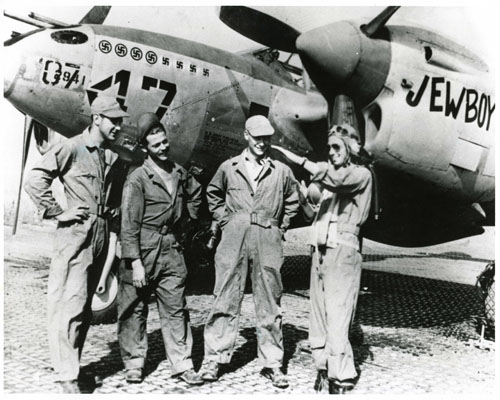
“…the anonymity of war is as terrible and profound
as that of chessmen tumbled into a box when the game is over.”
~~~~~~~~~~~~~~~~~~~~~~~~~~~~~~~~~~~~~~~~~
Time moves forward, inexorably. With it, the memory of the past flows along paths that sometimes meet, sometimes diverge. On one – the course typical of men and nations – lies forgetfulness. On the other, the memory of historical events may continue, but will be softened, if not altered, if not irrevocably distorted, by the shifting winds of politics, ideology, and sometimes the exuberant tides of irrationality that unexpectedly break upon – and even emerge from within – all civilizations. And thus, whether by one man or many, the centrality, impact, and memory of historical events having the greatest and most transformative impact for any given generation, will not be so (can memory ever be so?) for later generations. Regardless of an event’s magnitude, intensity, impact, or power.
But, regardless of the fallibility of human memory and entirely independent of man himself, facts remain, irremovably cemented into the fabric of time.
Certainly and obviously central to the twentieth century, and having indirect influence upon the events of this 21st century, have been the “Great War” and the Second World War, which some historians have considered to be the opening and closing phases of a single, much larger historical interval. Inevitably, both of these awful conflicts have given rise to an incalculably vast body of literature, both fiction and non-fiction. Naturally, many of these works were produced by veterans of these conflicts, either in the years immediately following their military service, or, several decades later, when they were better able to reflect upon the past as they entered retirement, by which time they’d gained perspective on their experiences, the memories of which were no longer as jagged or emotionally impactful as in their youth.
I’ve read many books of this nature, as I’m sure you have also.
They vary in quality as much as all men vary: in perceptiveness, literary skill, recollection of facts, sentimentality, honesty, candor, and tact. In that regard, below, quite randomly listed, are the titles of books penned by (and in a few cases about) Jewish aviators who served in the Allied air forces in the Second World War, some of whom I’ve mentioned or alluded to in prior posts. I take for granted that an equal and perhaps greater number of titles covering the experiences of Jewish servicemen in the ground and naval forces could be found (I know of a few), but that’s beyond the scope of this post.
In terms of this list of titles, immediately apparent is the fact that some were privately published, some released by vanity presses, and others by mainstream, well-established publishers. (Notably, in light of the enormous technological and logistical changes in the nature of book publishing over the past few decades, the less-than-stellar reputation once accorded to vanity presses I think is truly no longer (un)merited.)
Prisoners of War…
…In Europe
A Measure of Life, privately published, 2002
By Herman Lewis Cranman, (Herschel Eliezer Kranman), 1 Lt., 0-692478, Bombardier/Navigator, 34 missions
512th Bomb Squadron, 376th Bomb Group, 15th Air Force
Shot down July 14, 1944 in B-24H 41-28920, piloted by 1 Lt. James H. White, 11 crew members … 10 survivors
Plane-in-Squadron identification 33 / D // Nickname “Big Marge”
Missing Air Crew Report # 6958, Luftgaukommando Report ME 1791
POW at Stalag Luft 3 (Sagan) and Stalag 7A (Moosburg)
Born Savannah, Georgia, March 14, 1924 – Died April 2, 2017
Mr. and Mrs. Philip (7/20/03-1/23/95) and Jeanne (Litman) (3/7/04-9/13/78) Cranman (parents)
406 East 50th St., Savannah, Ga.
Name not listed in American Jews in World War II
Goldfish – Silver Boot – The Story of a World War II Prisoner of War, Fortis Publishers, 2010
By Harvey Stanley Horn, F/O, T-131675, Navigator, 5 missions
772nd Bomb Squadron, 463rd Bomb Group, 15th Air Force
POW 3/20/34, Stalag 13D (Nuremberg)
Born Brooklyn, N.Y., 12/15/13
Mr. and Mrs. Louis and Esther Horn (parents), 1218 41st St., Brooklyn, N.Y.
Also 82-15 Britton Ave., Elmhurst, N.Y.
Casualty List 4/26/45
Aircraft B-17G 44-6377, piloted by 1 Lt. John H., Lincoln, 10 crew members – all survived
Aircraft nickname “Pretty Baby’s Boys”
Missing Air Crew Report 13050
Name not listed in American Jews in World War II
Also see interview at The West Point Center for Oral History
The Eleventh Passenger, Vantage Press, 1996
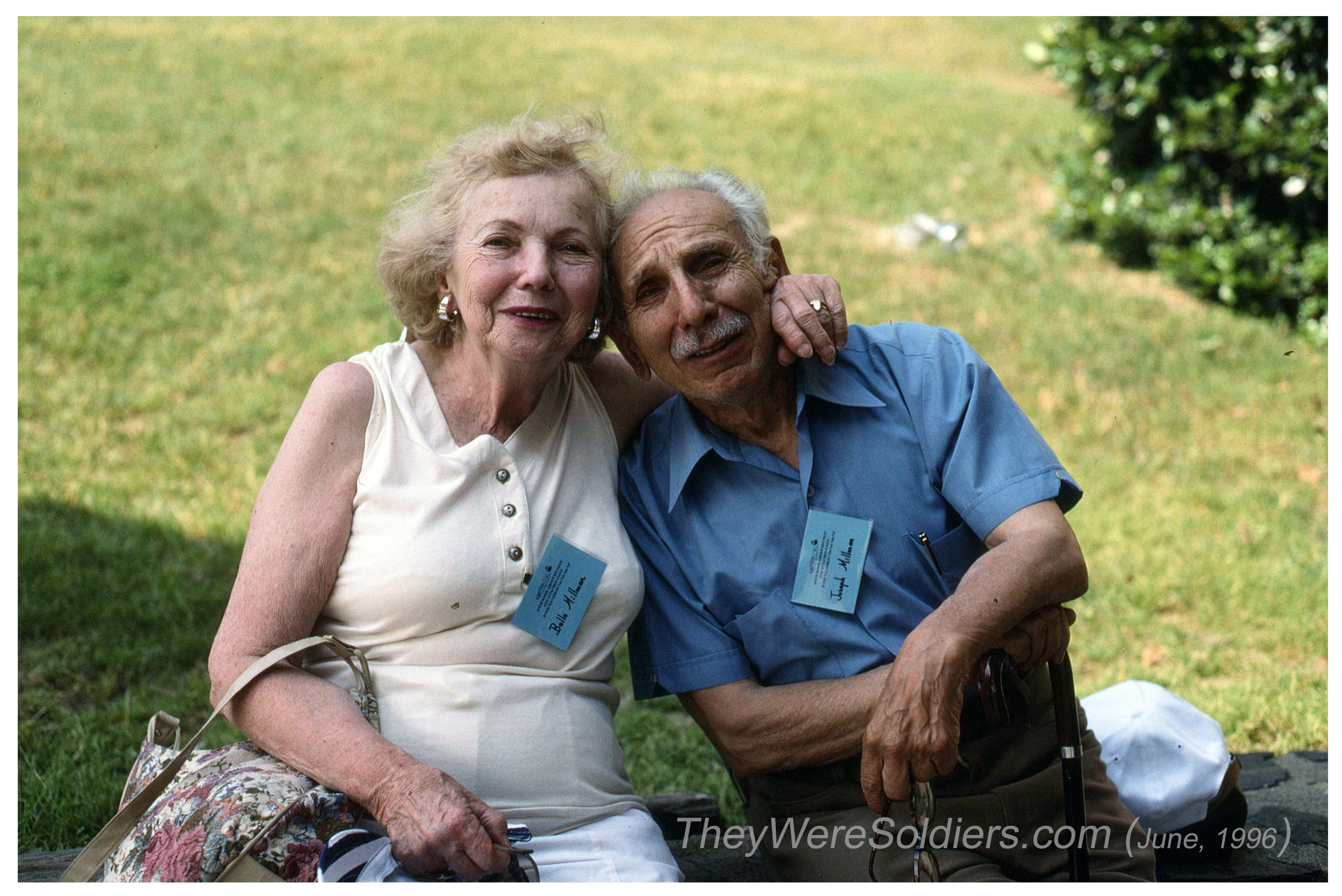
By Joseph Millman, Sgt., 32222070, Ball Turret Gunner, Purple Heart, 2 missions
747th Bomb Squadron, 456th Bomb Group, 15th Air Force
Shot down February 17, 1944
Severely wounded; repatriated on SS Gripsholm in February, of 1945
POW at Stalag 9C (Bad Sulza)
Born in Poland, January 12, 1920
Mr. and Mrs. Jacob and Rose “Reizel” Millman (parents), 1164 47th St., Brooklyn, N.Y.
Rhea, Reva, and Libby (sisters)
Name appeared in Casualty Lists on 4/22/44, 6/8/44, and 2/16/45; also in P.M. Daily 2/16/45
Aircraft: B-24H 42-52286, nickname “The Little Joker”
Piloted by 2 Lt. Harry W. Bessler; ten crew members – four survivors
Loss covered in Missing Air Crew Reports 3078 and 6330
… and Luftgaukommando Report ME 878
Name does not appear in American Jews in World War II (Like for so many other men…)
Joe Millman and his wife Bella, during the reunion of the 456th Bomb Group in June of 1996. (My photo.)
Joe’s dog tag, in Luftgaukommando Report ME 878, via NARA.com

Herb P. Flyboy – The Journey from World War II Pilot to German POW, privately published, 2005
By Herbert Irwin Pearlman, 1 Lt., 0-824859, Bomber Pilot, Air Medal, three Oak Leaf Cluster, 26 missions
526th Bomb Squadron, 379th Bomb Group, 8th Air Force
Prisoner of War February 9, 1945
Born Bronx, N.Y., February 22, 1922
Mr. Albert N. Pearlman (father), 3236 Tibbett Ave., New York, N.Y.
Casualty List (Liberated POWs) June 13, 1945
Pilot of B-17G 44-6119, “LF * A”, “White Lightning”
Aircraft loss covered in MACR 12337 and Luftgaukommando Report KU 3677
Name found on page 403 of American Jews in World War II
Maxwell Field Class 44-C; assigned to 526th Bomb Squadron 10/28/44
His Silver Wings – I Came of Age during World War II, June R. Ehrlich, Vantage Press, 1993 (Paul Ehrlich) Paul was the pilot of B-24J 42-50675 “X7 * F” / “Bold Venture III“, of the 788th Bomb Squadron, 466th Bomb Group, which crash-landed (itself) in England on December 25, 1944. The entire crew survived, the incident being covered in MACR 11256. This incident is the subject of the following video…
My Private War – Liberated Body, Captive Mind: A World War II POW’s Journey, Norman Bussel, Pegasus Books, 2008
Sitting It Out : a World War II POW Memoir, David K. Westheimer, Rice University Press, 1992
Fighter Pilot – Aleutians to Normandy to Stalag Luft I, Mozart Kaufman, M & A Kaufman Publishers, 1993
Where There’s A Will, There’s A Way (…And Where There’s A Way, There’s a Wayburne!), Ellis Wayburne (mentioned here), privately printed in October, 1995
Story of Jerome Jacobs – 364th Fighter Squadron Pilot, at ToFlyandFight.com
From Records Group 242 in the National Archives, here’s a (actually, the) only record … other than Missing Air Crew Report 8797; there’s no Luftgaukommando Report covering the loss of Pappy’s Answer, his P-51B … attesting to Lt. Jacobs’ being a POW: It nominally documents his captivity in Oflag 64 in Altenburg, and Stalag 9A in Spangenberg. As he related to me in an interview back in the 1990s, as a result of the chaos attendant to his capture during the Battle of Arnhem, and, his rapid transport from a front-line German hospital to various POW camps, he was never, actually, interrogated.

…In Japan
They Can’t Take That Away From Me, Ralph M. Rentz, with Peter Hrisko, Michigan State University Press, 2003
Hi Ma, I’m Home, Irving S. Newman, privately printed, 1945
Back From the Living Dead – The Infamous Death March and 33 Months in a Japanese Prison, Major Bert Bank, privately published, 1945
Escape and Evasion!
Against The Wind, Cyril Rofe, Hodder & Stoughton, 1956
The Dark Side of the Sky – The Story of a Jewish Airman in Nazi Germany, Leo Cooper, 1998 (Harry Levy)
And Otherwise…
Terror in the Starboard Seat – 41 Trips Aboard a Mosquito – A True Story of 418 Squadron, Dave McIntosh, Stoddan, 1980 (Sid Seid)
The Invisible Battlefield?, Horace S. Turrell (at one time available on the ‘net but-alas-not-any-more), 1996
Combat Bombardier, Leonard Herman and Rob Morris, Xlibris, 2007
The Cold Blue Sky, Jack Novey, Howell Press, 1997
Navigating the Course – A Man’s Place in His Time, David Fanshel, Valley Meadow Press, 2010
Navigating the Course – All to the Good, David Fanshel, Valley Meadow Press, 2013
Jewboy vs The Luftwaffe, Philip M. Goldstein, privately published (Blurb), 2015
Of War and Weddings, Jerry Yellin, Sunstar Publishing Ltd., 1995
IMSHI – A Fighter Pilot’s Letters to His Mother, Messrs. W.H. Allen & Co. Ltd., April, 1943 (Captain Ernest Mitchelson Mason)
Heroes are Fools – Diary of a World War II Airman, Murray M. Crawcour, Gefen, 1989
In the Lion’s Mouth – Diary of a World War II Flyer, Robert N. Adlen, Emis Publishing Company, 1985 (Captain David Gandin)
Hiroshima & Nagasaki Revisited, Jacob Beser, Global Press, 1988
Fiction
The Prisoners of Combine D, Len Giovannitti
Von Ryan’s Express, David K. Westheimer
Song of the Young Sentry, David K. Westheimer
Face of a Hero, Louis Falstein (start here…)
~~~~~~~~~~~~~~~~~~~~~~~~~~~~~~~~~~~~~~~~~
Within this genre, one of the best such works I’ve read, published some now forty-four years ago, is Elmer S. Bendiner’s The Fall of Fortresses, which was released by G.P. Putnam’s Sons in mid-1980. (And now readily available on EBay, ABE Books, etc., and maybe even your local library!)
A B-17 Flying Fortress navigator in the 8th Air Force, Bendiner’s combat tour occurred during 1943, and ended with the completion of his (and most of his crew’s) 25th and last sortie during the 8th’s mission to Bremen, Germany, on November 29 1943. As such, his experiences as a combat aviator in the USAAF paralleled the time period during which the 8th Air Force was, in terms of attrition and losses on a proportional basis, engaged in its most intense struggle against the Luftwaffe.
Though divided into chapters (15 of them), the fifteen have no headings or titles, and likewise aren’t subdivided into larger sections. Essentially, the book is a continuously flowing block of text, only nominally broken by chapter numbers.
But, on a more subtle level, as you read Bendiner’s book it soon becomes apparent that there actually is a structure to the text. First and sensibly, it’s chronologically arranged. Second and in a very (very) general sense, the chapters alternate in emphasis, one chapter pertaining to the experiences and interactions of Bendiner and his crew during different missions or situations (sometimes on a very personal level), followed by a chapter covering theoretical and doctrinal aspects of strategic bombing in the USAAF and RAF, or to a lesser extent, military strategy and geopolitics. The book really shines in a purely literary sense in Bendiner’s appropriate and measured use of metaphor and similie, “like” (!) in the quote that opens this blog post (!) which is reflective of his pre- and post-war background as an editor and news reporter, and, postwar authorship of three prior non-fiction books in the field of history.
A member of the 527th Bomb Squadron of the 379th Bomb Group and assigned to the crew of 2 Lt. Bohn E. Fawkes, Jr., Elmer Stanley Bendiner (ASN 0-797240) was born in Scottsdale, Pa., on February 11, 1916, and thus was in his late 20s during his combat tour. He was born to Wilhelm “William” and Lillian (Schwartz) Bendiner, his parents eventually moving from Pennsylvania to 2664 Grand Concourse, which is located in the New York borough known as the Bronx. (You’ve heard of the Bronx?!) His brothers and sister were Bertram, Evelyn, Lawrence, Marvin and Milton. Thus far, oddly, I’ve only found one reference to him in a wartime newspaper: In the Brooklyn Eagle, on December 6, 1944, over a year after he completed his combat tour. (This article will be presented in a future post.) I attribute this to Bendiner having worked at the Eagle from 1939 to 1940.
Mr. Bendiner passed away on September 16, 2001. I do not know his place of burial.
Like innumerable other American Jews who served in the United States’ armed forces in the Second World War – who were military casualties, and (or) decorated for military service – Elmer Bendiner’s name is quite absent from the 1947 Dial Press two-book publication American Jews in World War Two, perhaps reflective – in his case – of the fact that the National Jewish Welfare Board, in its quest to compile biographical information about Jews in the military, never contacted his family to begin with. (Likewise, flight engineer Sgt. Lawrence Harris Reedman’s name is also absent from this compilation.) This is indirectly reflected in The Fall of Fortresses, by the complete absence of such questions as the implications of being a Jewish POW in German captivity, or, how being a Jew affected (or truly did not at all affect) a servicemen’s relationships with his comrades. From reading the lines, and more importantly reading “between the lines”, there was a genuine sense of solidarity among and between Tondelayo’s crew members, with the author maintaining friendships with at least some of these men – particularly pilot Bohn Fawkes – into the 1980s.
However, Bendiner’s quietude about being a Jew through most of the book powerfully belies the deep significance of his identity and heritage, which though subdued is not absent. Near the book’s end he adeptly and skillfully weaves this into a disillusioning and deflating realization – concerning (well, at least in late 1943; I don’t know about later) – the tenuousness of his assumption about being perceived and accepted as an American aviator (let alone an American, per se?) who has endured much and survived all, versus simply being seen as a Jew. And with this, tangentially, the true nature of the German enemy he has been fighting comes into focus. The literary effect is not maintained for long, but the effect is extremely powerful. Interestingly, none of the book’s reviewers, regardless of their true and fulsome praise and admiration of The Fall of Fortresses, seemed to have picked up on this.
~~~~~~~~~~~~~~~~~~~~~~~~~~~~~~~~~~~~~~~~~
Here’s the 8th Air Force uniform (shoulder) insignia (from my collection)

This is the emblem of the 527th Bomb Squadron (from Rolyat Military Collectibles)

~~~~~~~~~~~~~~~~~~~~~~~~~~~~~~~~~~~~~~~~~
“This” post presents the full text of four book reviews of The Fall of Fortresses which appeared coincident with the book’s 1980 publication. Two are from The New York Times (when it was still an actual newspaper; it’s not been a newspaper for some years), one from The Washington Post (before it became the Bezos Daily Bugle), one from Time magazine (before it vanished into deserved irrelevancy), and, one from the Yonkers New York Herald Statesman. These are preceded by Mr. Bendiner’s biography, as published in Contemporary Authors in 1980.
~~~~~~~~~~~~~~~~~~~~~~~~~~~~~~~~~~~~~~~~~
The next two posts will present excerpts from The Fall of Fortresses pertaining to two remarkable experiences of Elmer Bendiner and his crew. These will focus on events recounted in the book: 1) The inadvertent bail-out of two gunners during a combat mission on July 30, 1943 (both survived as POWs), when their aircraft was struck by several 20mm cannon shells fired from attacking Me-109 and FW-190s, which miraculously failed to explode … thus, Tondelayo and her crew survived, and 2), The ditching in the English Channel of Tondelayo on September 6, 1943, from which, through a combination of superb piloting skill and extraordinary luck, the entire crew survived. This will be followed by another post, relating to Bendiner’s account of his dramatic but anti-climactic final mission of November 29, 1943, and – upon the realization that his combat tour was over – the impact and implications of a conversation which ensued with the 527th’s Public Relations officer.
~~~~~~~~~~~~~~~~~~~~~~~~~~~~~~~~~~~~~~~~~
Lt. Elmer Bendiner stands before the nose of his crew’s Flying Fortress Tondelayo (B-17F 42-29896, squadron identification marking “FO * V“), with nose art painted by Cpl. J.D. Hicks. The nose art and nickname were inspired by the femme fatale played by Hedy Lamarr in Richard Thorpe’s 1942 film White Cargo. (Photo from Silvertail Books.)

Here’s the trailer of White Cargo, from The Old Hollywood Times. You can view the full movie at ok.ru.
~~~~~~~~~~~~~~~~~~~~~~~~~~~~~~~~~~~~~~~~~
Elmer Bendiner in 1980 in a photo by Paul Viani, from the book jacket.
(My own worn-out copy, but hey, it gives you an idea!)

~~~~~~~~~~~~~~~~~~~~~~~~~~~~~~~~~~~~~~~~~
And herewith, a biography, and five book reviews…
Elmer Bendiner’s biography, from the 1980 edition of Contemporary Authors. He was 64 years old at the time.
PERSONAL: Born February 11, 1916, in Pittsburgh, Pa.; son of William (a businessman) and Lillian (Schwartz) Bendiner; married Esther Shapiro (an editorial assistant), October 4, 1941; children: Winnie (Mr. Paul G. Viani), Jessica. Education: Attended City College (now City College of the City University of New York), 1932-35. Politics: “Defies neat categorizing.” Religion: “Defies neat categorizing.” Home: 11 Park Ave., Tarrytown, N.Y. 10591. Agent: Theron Raines, 475 Fifth Ave., New York, N.Y. 10016.
CAREER: Newark Ledger, Newark, N.J., reporter, 1938-39; Brooklyn Daily Eagle, Brooklyn, N.Y., reporter, 1939-40; Flying Age, New York City, managing editor, 1945-46; Esquire, New York City, non-fiction editor, 1946-48; National Guardian, New York City, associate editor, 1948-58; Science and Medicine Publishing Co., New York City, editor, 1958-68; World Wide Medical News Service, New York City, editor, 1969-72; Hospital Practice, New York City, contributing editor, 1972 – Military service: U.S. Army Air Forces, navigator on B-17 bomber, 1941-45; served in Europe; became first lieutenant; received Distinguished Flying Cross, Air Medal with three oak leaf clusters, and Purple Heart Medal. Member: Authors Guild, Authors League of America.
WRITINGS: The Bowery Man, Nelson, 1962; A Time for Angels: The Tragicomic History of the League of Nations, Knopf, 1975; The Virgin Diplomats, Knopf, 1976; The Fall of Fortresses, Putnam, 1980.
Work anthologized in Man Alone, edited by Eric Josephson and Mary Josephson, Dell, 1962. Also author of documentary film script, “Uptown.” Contributor to Esquire, New York Times Magazine, Nation, and Strand. Editor of Log of Navigation, 1944-45.
WORK IN PROGRESS: A history of Spain in the tenth century, “when Arabs and Jews collaborated in a cultural adventure that prefigured the Renaissance.”
SIDELIGHTS: In a New York Times review of The Fall of Fortresses, Elmer Bendiner’s history of American air battles during World War II, Christopher Lehmann-Haupt writes: “It is remarkable how [Bendiner] manages to combine in a single, nearly poetic, tone of voice, a view that combines the big picture with the personal one – how his narrative seamlessly encompasses the anecdotal and the historical, the strategic and the tactical, the thrill and the horror.” Lehmann-Haupt concludes that The Fall of Fortresses is a “shining accomplishment.”
Bendiner told CA: “I look upon my work as journalism, uninhibited by an exclusive preoccupation with the contemporary. If a story provides a clue to the grandeur and/or absurdity of our lives it seems newsworthy to me even though it occurred a thousand years ago. Hence, I see a certain consistency in exploring the lives of homeless men on the Bowery, the performance of diplomats between the world wars, the efforts of 18th century Americans to seduce the rulers of Europe, the strange splendors of Spain a thousand years ago, or the work of doctors and nurses in the Arctic, in India, Japan, or Tanzania.”
Bendiner’s work has taken him to Europe, Central and South America, East Africa, Bangladesh, Thailand, New Guinea, the Philippines, Israel, Japan, and Canada.
BIOGRAPHICAL/CRITICAL SOURCES: New York Times, May 9, 1980.
~~~~~~~~~~~~~~~~~~~~~~~~~~~~~~~~~~~~~~~~~
From The New York Times Book Review, May 25, 1980…
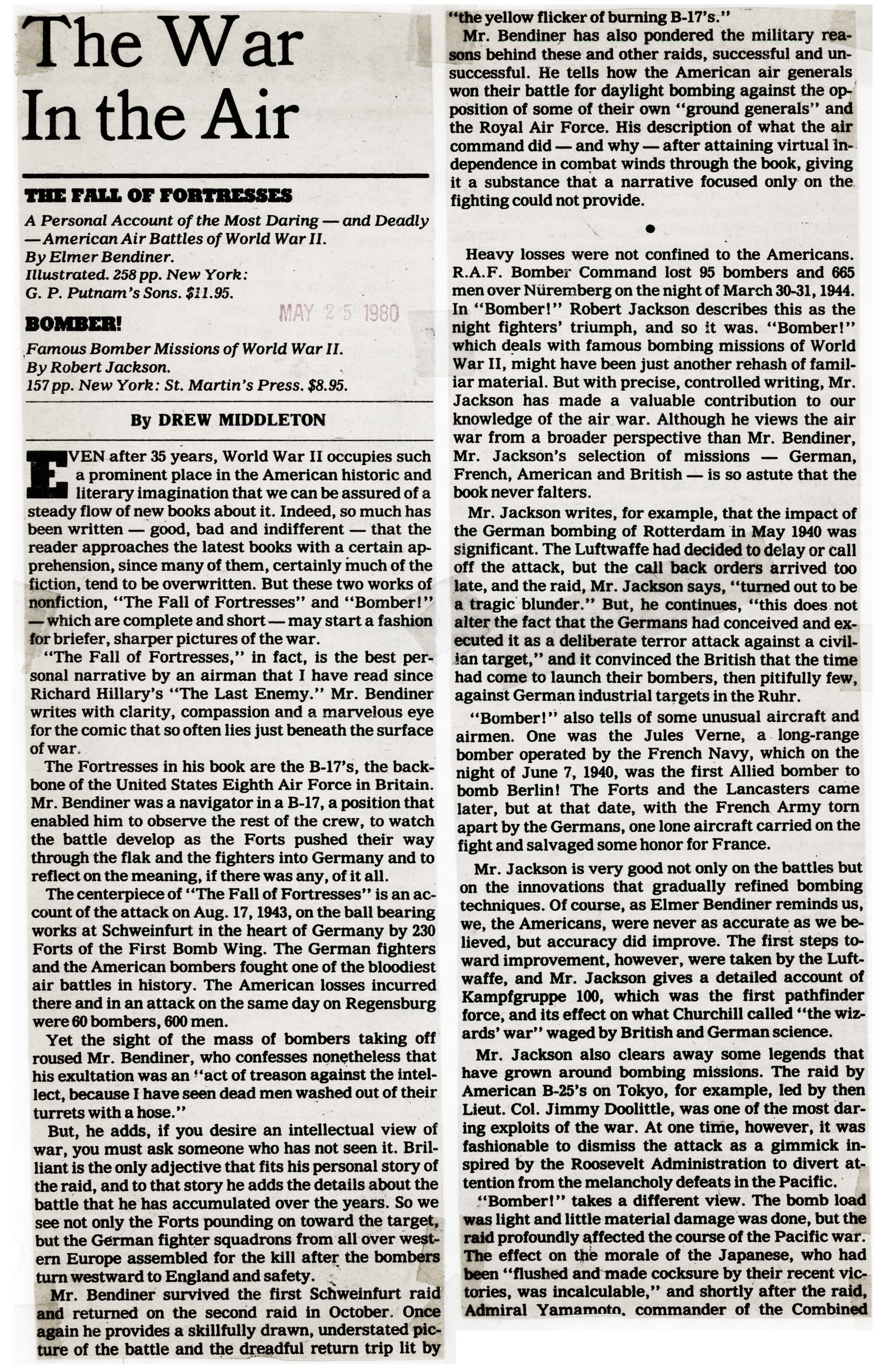
The War In the Air
THE FALL OF FORTRESSES
A Personal Account of the Most Daring – and Deadly – American Air Battles of World War II.
By Elmer Bendiner.
Illustrated. 258pp. New York:
G.P. Putnam’s Sons. $11.95.
BOMBER!
Famous Bomber Missions of World War II.
By Robert Jackson.
157pp. New York: St. Martin’s Press. $8.95.
By DREW MIDDLETON
EVEN after 35 years, World War II occupies such a prominent place in the American historic and literary imagination that we can be assured of a steady flow of new books about it. Indeed, so much has been written – good, bad and indifferent – that the reader approaches the latest books with a certain apprehension, since many of them, certainly much of the fiction, tend to be overwritten. But these two works of nonfiction, “The Fall of Fortresses” and “Bomber!” – which are complete and short – may start a fashion for briefer, sharper pictures of the war.
“The Fall of Fortresses,” in fact, is the best personal narrative by an airman that I have read since Richard Hillary’s “The Last Enemy.” Mr. Bendiner writes with clarity, compassion and a marvelous eye for the comic that so often lies just beneath the surface of war.
The Fortresses in his book are the B-17’s, the backbone of the United States Eighth Air Force in Britain. Mr. Bendiner was a navigator in a B-17, a position that enabled him to observe the rest of the crew, to watch the battle develop as the Forts pushed their way through the flak and the fighters into Germany and to reflect on the meaning, if there was any, of it all.
The centerpiece of “The Fall of Fortresses” is an account of the attack on Aug. 17, 1943, on the ball bearing works at Schweinfurt in the heart of Germany by 230 Forts of the First Bomb Wing. The German fighters and the American bombers fought one of the bloodiest air battles in history. The American losses incurred there and in an attack on the same day on Regensburg were 60 bombers, 600 men.
Yet the sight of the mass of bombers taking off roused Mr. Bendiner, who confesses nonetheless that his exultation was an “act of treason against the intellect, because I have seen dead men washed out of their turrets with a hose.”
But, he adds, if you desire an intellectual view of war, you must ask someone who has not seen it. Brilliant is the only adjective that fits his personal story of the raid, and to that story he adds the details about the battle that he has accumulated over the years. So we see not only the Forts pounding on toward the target, but the German fighter squadrons from all over western Europe assembled for the kill after the bombers turn westward to England and safety.
Mr. Bendiner survived the first Schweinfurt raid and returned on the second raid in October. Once again he provides a skillfully drawn, understated picture of the battle and the dreadful return trip lit by ‘the yellow flicker of burning B-17s.
Mr. Bendiner has also pondered the military reasons behind these and other raids, successful and unsuccessful. He tells how the American air generals won their battle for daylight bombing against the opposition of some of their own “ground generals” and the Royal Air Force. His description of what the air command did – and why – after attaining virtual Independence in combat winds through the book, giving it a substance that a narrative focused only on the fighting could not provide.
***
Heavy losses were not confined to the Americans. R.A.F. Bomber Command lost 95 bombers and 665 men over Nuremberg on the night of March 30-31, 1944. In “Bomber!” Robert Jackson describes this as the night fighters’ triumph, and so it was. “Bomber!” which deals with famous bombing missions of World War II, might have been just another rehash of familiar material. But with precise, controlled writing, Mr. Jackson has made a valuable contribution to our knowledge of the air war. Although he views the air war from a broader perspective than Mr. Bendiner, Mr. Jackson’s selection of missions – German, French, American and British – is so astute that the book never falters.
Mr. Jackson writes, for example, that the impact of the German bombing of Rotterdam in May 1940 was significant. The Luftwaffe had decided to delay or call off the attack, but the call back orders arrived too late, and the raid, Mr. Jackson says, “turned out to be a tragic blunder.” But, he continues, “this does not alter the fact that the Germans had conceived and executed it as a deliberate terror attack against a civilian target,” and it convinced the British that the time had come to launch their bombers, then pitifully few, against German industrial targets in the Ruhr.
“Bomber!” also tells of some unusual aircraft and airmen. One was the Jules Verne, a long-range bomber operated by the French Navy, which on the night of June 7, 1940, was the first Allied bomber to bomb Berlin! The Forts and the Lancasters came later, but at that date, with the French Army torn apart by the Germans, one lone aircraft carried on the fight and salvaged some honor for France.
Mr. Jackson is very good not only on the battles but on the innovations that gradually refined bombing techniques. Of course, as Elmer Bendiner reminds us, we, the Americans, were never as accurate as we believed, but accuracy did improve. The first steps toward improvement, however, were taken by the Luftwaffe, and Mr. Jackson gives a detailed account of Kampfgruppe 100, which was the first pathfinder force, and its effect on what Churchill called “the wizards’ war’’ waged by British and German science.
Mr. Jackson also clears away some legends that have grown around bombing missions. The raid by American B-25s on Tokyo, for example, led by then Lieut. Col. Jimmy Doolittle, was one of the most daring exploits of the war. At one time, however, it was fashionable to dismiss the attack as a gimmick inspired by the Roosevelt Administration to divert attention from the melancholy defeats in the Pacific.
“Bomber!” takes a different view. The bomb load was light and little material damage was done, but the raid profoundly affected the course of the Pacific war. The effect on the morale of the Japanese, who had been “flushed and made cocksure by their recent victories, was incalculable,” and shortly after the raid, Admiral Yamamotn, commander of the Combined Fleet, launched his ambitious plan to take Midway and bring the Americans to battle. He brought them to battle, all right, and the Japanese were decisively defeated. Jimmy Doolittle and his men left their mark on the war.
~~~~~~~~~~~~~~~~~~~~~~~~~~~~~~~~~~~~~~~~~
From Time magazine, May 12, 1980…
After the Bombs
The Fall of Fortresses. By Elmer Bendiner. 258 pages. Putnam. $11.95.
The final oddity of World War II is that its survivors are still writing their memoirs. Why should some have waited so long? Perhaps the unique quality of that war was that its participants absorbed their experience like so many time-delayed capsules: some to be released while the war was in progress; others, only now, 35 years after the event. Elmer Bendiner, who flew as a navigator on the Flying Fortresses of the Eighth Air Force, offers no explanation for his delay. If he is obliged to confess to blanks in his memory, he makes use of logs, records and previous histories to tell us what it was like to take part in the two great raids against the ball-bearing factories at Schweinfurt. “If one wants an intellectual view of war one must ask someone who has not seen it,” he writes. He means, in his elegant book, to see the war plain, without heroics; his level, quiet tone of voice has an appropriately elegiac quality.
In 1943, when young Bendiner guided his B-17 to England, the Americans had yet to demonstrate that their plan for daylight precision bombing of German military and industrial targets would prove effective. He and his fellow airmen had no idea that their commanders had decided to accept a loss of 30 of every 100 airplanes flown in such missions. The truth was brought home early enough: within the first two months of operations, Bendiner’s group had lost three-quarters of its original crews. From the perspective of late middle age, Bendiner thinks less well of death than he did then. At the time, aerial combat was for him “a frenzy in which I heaved and sweated but could not stop because, shamefully, my guts loved what my head hated.” For precisely this reason, we send the young to war. “A hard day’s work,” Bendiner writes, “exploding something into nothing… Our superiors were pleased with us because we had dropped 422 tons of bombs and, according to the reconnaissance photos, only 333.4 tons had been wasted on homes, streets, public parks, zoos, department stores and air-raid shelters. This passed for precision.”
Empty Shells: By Aug. 17, the day of the first Schweinfurt raid, Bendiner well understood what air warfare entailed. His pilot, having aborted three missions due to “faults” in the engines, had been replaced. On a raid over Kassel, his crew had lost both waist gunners: their oxygen cut off, they had succumbed to illusions of disaster and jumped from the plane. On this same excursion, eleven explosive shells pierced the fuel tank of Bendiner’s Fortress. Only decades later did he discover why his plane was not instantly destroyed: ten of the shells had been empty and the eleventh contained a paper on which was written, in Czech: “This is all we can do for you now.” The assault on Schweinfurt, however, promised to be more than routine. The crews were assured that this “first fully strategic air mission of the war” would bring about Hitler’s collapse. To distract the Luftwaffe from the 230 Fortresses moving toward Schweinfurt, a diversionary force would be sent first against Regensburg. Of course, nothing worked as planned. The great raid, which cost the Americans 60 bombers and 600 men, failed to eliminate Germany’s capacity to produce ball bearings.
“And did we win or lose?” Bendiner asks. The occasion provided no immediate answer. Nor was one forthcoming two months later when, after losing his plane in the English Channel, Bendiner returned with another armada to do the same thing again with identical results: another 60 combers, another 600 men lost. The Schweinfurt raids did not shorten the war oy a day. They did, however, provoke from Bendiner one of the war’s most haunting images: that of a homeward route marked by a “trail of torches” – the only sign of animation on a darkened Continent was the yellow flicker of burning B-17s.
In time, Bendiner concluded that his commanders knew very well the raids could not end the war; their purpose was, at whatever cost in lives and airplanes, to prove forever the efficacy of air power. If that is so, Bendiner writes, “then Schweinfurt’s ghosts must ride with those of the Light Brigade at Balaklava – brave soldiery forever charging to their deaths in. gallant absurdity.”
PETER S. PRESCOTT
~~~~~~~~~~~~~~~~~~~~~~~~~~~~~~~~~~~~~~~~~
From The New York Times, May 9, 1980…
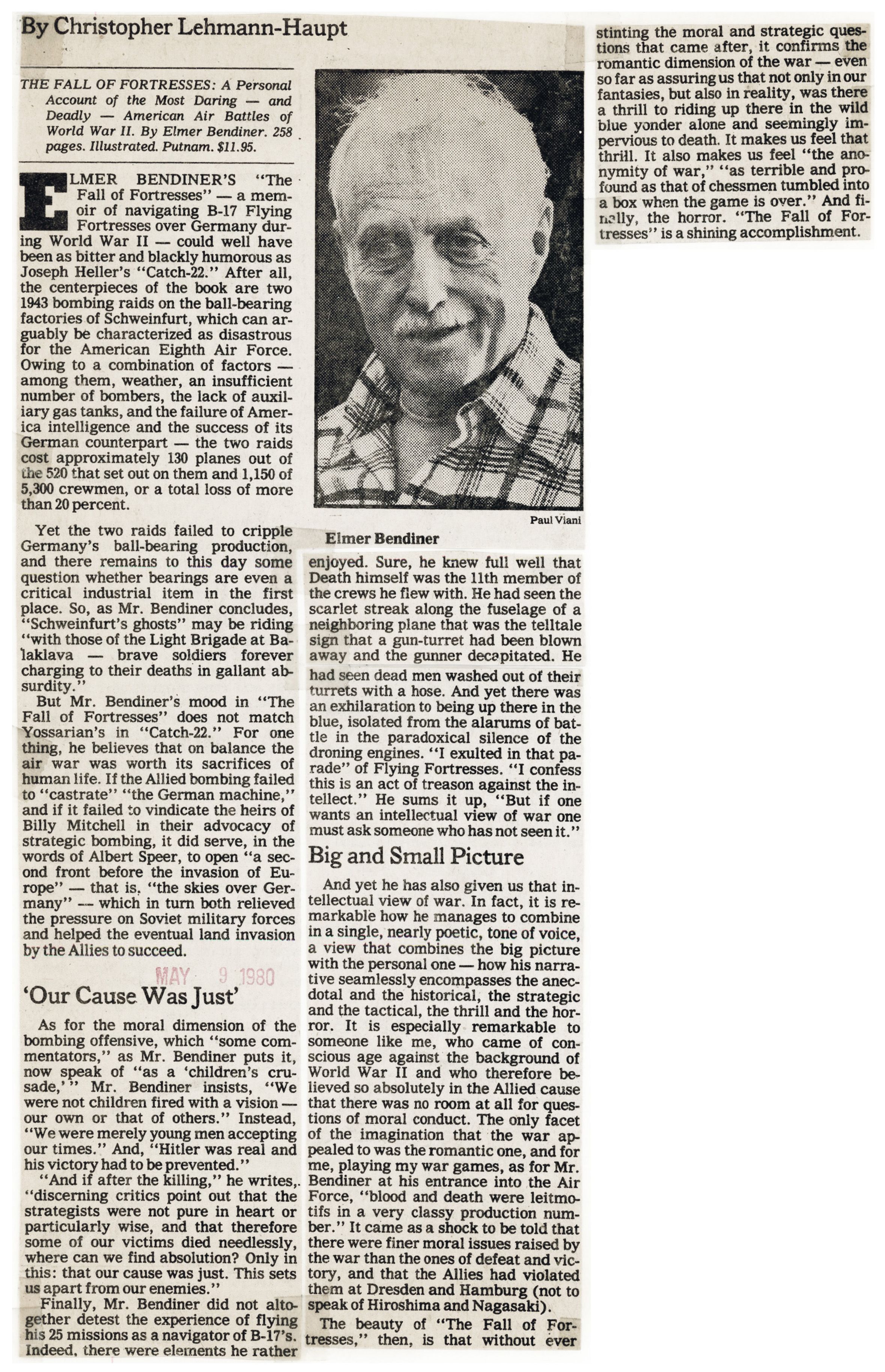
Book Reviews
By Christopher Lehmann-Haupt
THE FALL OF FORTRESSES: A Personal Account of the Most Daring – and Deadly – American Air Battles of World War II. By Elmer Bendiner. 258 pages. Illustrated. Putnam. $11.95.
ELMER BENDINER’S “The Fall of Fortresses” – a memoir of navigating B-17 Flying Fortresses over Germany during World War II – could well have been as bitter and blackly humorous as Joseph Heller’s “Catch-22.” After all, the centerpieces of the book are two 1943 bombing raids on the ball-bearing factories of Schweinfurt, which can arguably be characterized as disastrous for the American Eighth Air Force. Owing to a combination of factors – among them, weather, an insufficient number of bombers, the lack of auxiliary gas tanks, and the failure of America intelligence and the success of its German counterpart – the two raids cost approximately 130 planes out of the 520 that set out on them and 1,150 of 5,300 crewmen, or a total loss of more than 20 percent.
Yet the two raids failed to cripple Germany’s ball-bearing production, and there remains to this day some question whether bearings are even a critical industrial item in the first place. So, as Mr. Bendiner concludes, “Schweinfurt’s ghosts” may be riding “with those of the Light Brigade at Balaklava – brave soldiers forever charging to their deaths in gallant absurdity.”
But Mr. Bendiner’s mood in “The Fall of Fortresses” does not match Yossarian’s in “Catch-22.” For one thing, he believes that on balance the air war was worth its sacrifices of human life. If the Allied bombing failed to “castrate” “the German machine,” and if it failed to vindicate the heirs of Billy Mitchell in their advocacy of strategic bombing, it did serve, in the words of Albert Speer, to open “a second front before the invasion of Europe” – that is, “the skies over Germany” – which in turn both relieved the pressure on Soviet military forces and helped the eventual land invasion by the Allies to succeed.
‘Our Cause Was Just’’
As for the moral dimension of the bombing offensive, which “some commentators,” as Mr. Bendiner puts it, now speak of “as a ‘children’s crusade,’ “ Mr. Bendiner insists, “We were not children fired with a vision – our own or that of others.” Instead, “We were merely young men accepting our times.” And, “Hitler was real and his victory had to be prevented.’’
“And if after the killing,” he writes, “discerning critics point out that the strategists were not pure in heart or particularly wise, and that therefore some of our victims died needlessly, where can we find absolution? Only in this: that our cause was just. This sets us apart from our enemies.’’
Finally, Mr. Bendiner did not altogether detest the experience of flying his 25 missions as a navigator of B-17s. Indeed, there were elements he rather enjoyed. Sure, he knew full well that Death himself was the 11th member of the crews he flew with. He had seen the scarlet streak along the fuselage of a neighboring plane that was the telltale sign that a gun-turret had been blown away and the gunner decapitated. He had seen dead men washed out of their turrets with a hose. And yet there was an exhilaration to being up there in the blue, isolated from the alarums of battle in the paradoxical silence of the droning engines. “I exulted in that parade” of Flying Fortresses. “I confess this is an act of treason against the intellect.” He sums it up, “But if one wants an intellectual view of war one must ask someone who has not seen it.”
Big and Small Picture
And yet he has also given us that intellectual view of war. In fact, it is remarkable how he manages to combine in a single, nearly poetic, tone of voice, a view that combines the big picture with the personal one – how his narrative seamlessly encompasses the anecdotal and the historical, the strategic and the tactical, the thrill and the horror. It is especially remarkable to someone like me, who came of conscious age against the background of World War II and who therefore believed so absolutely in the Allied cause that there was no room at all for questions of moral conduct. The only facet of the imagination that the war appealed to was the romantic one, and for me, playing my war games, as for Mr. Bendiner at his entrance into the Air Force, “blood and death were leitmotifs in a very classy production number.” It came as a shock to be told that there were finer moral issues raised by the war than the ones of defeat and victory, and that the Allies had violated them at Dresden and Hamburg (not to speak of Hiroshima and Nagasaki).
The beauty of “The Fall of Fortresses,” then, is that without ever stinting the moral and strategic questions that came after, it confirms the romantic dimension of the war – even so far as assuring us that not only in our fantasies, but also in reality, was there a thrill to riding up there in the wild blue yonder alone and seemingly impervious to death. It makes us feel that thrill. It also makes us feel “the anonymity of war,” “as terrible and profound as that of chessmen tumbled into a box when the game is over.” And finally, the horror. “The Fall of Fortresses” is a shining accomplishment.
~~~~~~~~~~~~~~~~~~~~~~~~~~~~~~~~~~~~~~~~~
From The Washington Post, June 29, 1980…
Fall of the ‘Flying Coffin’
The Brief Campaign of The Bomber Tondelayo
THE FALL OF FORTRESSES.
By Elmer Bendiner.
(Putnam. 298 pp. $11.95)
By Stephen I. Petranek
Somewhere on the bottom of the English Channel, “wreathed in weeds,” the corroded, silted-in hulk of 34,000 pounds of a B-17F bomber named Tondelayo remains, a sepulcher vibrating and pulsing in the memory of the only navigator she ever knew, “Benny,” the last to leave her before she slipped beneath an angry sea on a September afternoon in 1943. JijL .
To Elmer Bendiner, tagged Benny by the crew, Tondelayo seems a not-yet-finally buried reminder of his own anger about having endured, perhaps needlessly, some of the most horrifying aerial battles of World War II, battles which the author, more than three decades later, found it necessary to reassess, question and in some ways condemn as misguided at best. There is also the guilt and wonder of having enjoyed death as an 11th crew member on his missions, the shame of knowing that bombs were acidentally dropped on allies and children and the never erasable memories of bodies and planes suddenly ripped to fragments.
Although Tondelayo did not survive the mandatory 25 missions required of her crew members before they could retire from combat, she did rather well for a sitting duck, seemingly parked in the skies over Europe at a modest 150 mph as Messerschmitts and Focke-Wulf-190s flying 400 mph spit 20 mm explosive shells through her skin time after time, mission after mission. Tondelayo finally fell prey not only to German fire but to the myth, not tested before World War II, that hundreds of strategic bombers flying in close disciplined formation were not only Flying Fortresses themselves, but a collective fortress capable of their own defense without constant fighter support,
Bendiner joined a mixed bag of nine other crew members in the belly of a bomber the Germans had called, in a slightly earlier version, a “flying coffin,” a bucket of rivets that even skilled Royal Air Force pilots had nicknamed a “flying target.”
But like other warriors at other times, this sensitive, charming, caring, even humble man named Bendiner got high on the close proximity of death in the flying coffin. “With death visible and audible, creating a taste in my mouth and a flatus in my belly, I was undeniably alive in battle… This was not the war of boredom and vermin we had read about in the tales of our fathers’ agony. This was a frenzy in which I heaved and sweated but could not stop because, shamefully, my guts loved what my head hated… I exulted in that parade of Fortresses forming for battle. I confess this as an act of treason against the intellect, because I have seen dead men washed out of their turrets with a hose. But if one wants an intellectual view of war one must ask someone who has not seen it.”
To some extent Bendiner would insist that survival in a bomber with an accepted casualty rate of 30 percent on some missions was luck. But except for Tondelayo’s first pilot, who, until he was removed from his position, tended to panic in bad circumstances, the crew seemed to be a balanced blend of the guts, outward casualness and determination necessary to survive.
Bendiner does not remember every crew member of Tondelayo, although the detail of his recollections of what mattered and his research into American and German records of his missions was as thorough as conceivably necessary. There was a bombardier who had washed out of pilot school and whose response to war was often repressed rage; a radio operator with “style” who was “the soul of urbanity”; a quietly expert copilot whose closeness to the Fortress was almost symbiotic, and a “street-wise Ulysses” tail-gunner.
There was, too, the luck that Bendiner thanked heaven for: 11 explosive 20 mm shells that didn’t explode were dug out of Tondelayo’s wing gas tank by intelligence experts who found inside one shell a note, written in Czech, that translated as, “This is all we can do for you now.”
There was also the luck of being in the right place at the right time. It was all too frequent that the plane next to Tondelayo was dismembered, sent spinning in wildly gyrating pieces to the earth, her last moments dutifully recorded in Bendiner’s log. “In the morning I had been over Germany watching Tondelayo’s sister plane through my port window. Along the fuselage to the tail ran a scarlet streak. It had taken me a moment to understand that there was no top turret and that the fuselage was painted with the blood of a gunner who manned it before it was blown away.”
The touchstone of the account of Tondelayo and her navigator is the two massive daylight assaults of Flying Fortresses launched on Schweinfurt, Germany, in August and October of 1943, assaults which war planners and politically motivated generals, concerned about demands that all bombers be sent against the Japanese, had determined would neatly end the war within a year by wiping out the Reich’s major ball-bearing plants. Without ball bearings, they too simply determined, German props could not spin and tank treads roll. Bendiner indicates, based on military reports, that the idea may first have been suggested by the Swedish minister’s son-in-law at a Washington cocktail party on Dec. 20, 1942. Albert Speer, interestingly enough, said years later that the damage the Reich suffered at Schweinfurt was in part offset by ball bearings produced in Sweden.
Either assault might have seriously undermined the German effort, had they been followed up within weeks by other bombing raids. But the horrifying losses of the American forces in the raids so devastated the fleet that follow-ups were impossible. At one point Bendiner notes that he never returned from any mission without at least, at the very least, some flak holes in the aircraft. He unintentionally seems to suggest that navigators might have been superfluous on the flights home from the targets. Returning bombers could simply follow the fires of shot-down fortresses: “All across Germany, Holland and Belgium the terrible landscape of burning planes unrolled beneath us. It seemed that we were littering Europe with our dead…”
In the first raid the losses were: “60 aircraft, 552 men missing, 21 brought back wounded, 8 brought back dead, 17 returned planes inoperable, many others heavily damaged.”
In the second assault on Schweinfurt in October, only three or four of the 18 planes in Bendiner’s bomber group returned to base the night of the raid. “Of 291 crews that crossed the Channel, 29 were lost before they reached the target, another 31 fell on the way home – 60 in all, 600 men missing out of a force of less than 3,000.”
The people who were running this European precision-bombing show were in many cases disciples of the court-martialed martyr Billy Mitchell who had insisted that such strategic, rather than troop-support, bombing would decide wars in the future. Bendiner tries desperately to find credence for strategic bombing, such as the Schweinfurt raids, and notes in a strange rationale that the missions, even if not directly successful as bombing raids, tied up so many Germans they created a second front – in the air – which kept the Germans from overrunning the Russians. But he is a lot less than certain:
“We were sent on a hazardous mission to destroy in a single day an objective that was Vulnerable only to repeated assaults for which we had not the strength. Those objectives could not wait for the arrival of more bombers, of the promised Mustangs, of belly tanks [which would have allowed fighters to escort bombers into Germany itself, because we had to dramatize the importance of air power in the European Theater for the benefit of the public and the Navy.
“If that is a fair reading of our commander’s thought processes, then Schweinfurt’s ghosts must ride with those of the Light Brigade at Balaklava – brave soldiers forever charging to their deaths in gallant absurdity.”
The reviewer is deputy editor of The Washington Post Magazine.
~~~~~~~~~~~~~~~~~~~~~~~~~~~~~~~~~~~~~~~~~
From the Yonkers New York Herald-Statesman, October 26, 1980…
Book reflects war memories
By PHYLLIS RIFFEL
Total strangers have called long distance to talk with author Elmer Bendiner of Tarrytown about his memoir of World War II. And it’s not because they also flew on the Flying Fortresses of the Eighth Air Force – some are infantrymen, others have never been in the service and some were born after the war.
“I guess it’s gone home to a lot of people,” said the 64-year-old former navigator. “War is a powerful seducer.” He contends that everyone fights his own war, in his own way, but there is a common denominator in the devasting experience of any war. “The book stirs up a lot of memories.”
“The Fall of Fortresses,” published by Putnam in May, is a personal recollection of the events leading up to two raids on ball-bearing factories in Scbweinfurt, Germany, in 1943. Some 130 airplanes of the 520 that were sent on the fateful missions were lost and 1,150 of the 5,300 crewmen killed in the attempt to demonstrate the validity of daylight precision bombing as a means of bringing the war to a quick end.
Bendiner has blended bis own feelings about the war – then and now – with the actual details of the two raids on Schweinfurt and others of the 25 missions he flew in a vivid first-person account. He talks of how he came to be a navigator, his interaction with members of the crew, his impressions of wartime England, in a manner that makes the reader feel as though the action in the 258-page book took place only yesterday.
A natural question is why did he wait 35 years to write this sensitive, thoughtful chronicle of a young man thrust into war? And wasn’t it-difficult to recall all the factors and emotions that marked his life in those days, even for one with a skilled memory?
After Bendiner completed his missions – for which he received the Purple Heart, the Distinguished Flying Cross and the Air Medal with three oak-leaf clusters – the native of Pennsylvania was assigned to be a navigation instructor in Ireland. He had a leave in the United States before his next assignment.
It was on the long sea voyage home to see his wife, Esther, and his new-born first child, that Bendiner wrote a novel based on his experiences. “‘I was never satisfied with it,” he said, and the manuscript was put on the shelf.’’ He kept his navigator’s log, which contained many personal asides as well as the official records of action and flight on ‘Tondelayo,” the B-17 he flew over Germany in.
Together with the expressive letters he wrote to his wife during that era, which she retained, these documents formed the nucleus of material for the book.
The catalyst lor writing the volume actually was an idea for another book which be proposed to an agent. “I wanted to write an historical book about the year 1800 – it’s a fascinating year in American history,” he said. The contact liked the idea but asked Bendiner If he could come up with something a little closer to modem tinges. He said, “I knew then that at last I was going to do this,” (the “Fail of Fortresses”).
It took a couple of years to put everything down on paper as Bendiner, a free-lance writer for the last 10 years worked on the memoir in conjunction with other projects. He visited with bis co-pilot four or five times and rehashed past events, and Interviewed retired Gen Mo Preston, commanding officer of his squadron, to check out bis impressions of what transpired at the base at Kimbolton, England. Preston was a colonel in 1943 and Bendiner knew him by rank alone, and the CO only knew biro by his number back then.
Candid about the thrill inherent in warfare and the anonymity of battle, in his book Bendiner ponders the motivation of the military commanders in World War II and the loss of life – both military and civilian – in the struggle for victory.
In the 1970s Bendiner was based in Switzerland to establish and edit an international news service for a string of medical newspapers. While living abroad for four years, he also wrote a history of the League of Nations, titled “A Time for Angels.” He and his wife traveled from Africa to the Arctic and from Bangladesh to Budapest with numerous stops between. When in Germany, he acknowledges he had an “uncomfortable feeling when I would see Germans my age. I wondered what they were doing during the war”
Chosen as a Book-of-the-Month alternate, by two aviation book clubs and being published in England shortly, the “The Fall of Fortresses” Is not just an exercise in which one man puts together bis thoughts on the ramifications of war on bis own life. Rather it describes an era in history in broad terms meshed with personal reflections.
Upon their return to the United States, the Bendiners settled in Woodstock, N.Y., where he wrote a book on the diplomacy of the American Revolution – “The Virgin Diplomats” – prior to his current book. The couple moved to Tarrytown three years ago and find it convenient to New York City and enjoy the historical nature of the area.
A slight, wiry man with piercing blue eyes, Bendiner said he is writing a story of how Arabs and Jews together enlightened the otherwise sombre middle ages from their comer in Spain and Portugal.” In his study, which has a sweeping view of the Palisades, he also continues work on the biographical history of medicine. Mrs. Bendiner works with her husband in the typing and editing chores.
Raised in a small Appalachian town in a family whose members either had an ambition to write or assumed that they probably would in any case,” Bendiner describes his achievements in college as mediocre. He left in his senior year to work as a reporter on newspapers, in and around New York, until 1940 when he was employed by an agency seeking to rescue Jewish refugees from Germany. In 1941, shortly after his marriage, Pearl Harbor was attacked and he enlisted, confident that he would be drafted in due time anyway.
In the period since his days In the Air Force, Bendiner has been a magazine managing editor, a political writer for the National Guardian, and a book reviewer and author. It is fortunate for the reading public that his account of air battles in World War II managed to surface in the midst of all his other endeavors.
PHYLLIS RIFFEL is Lifestyles Editor of The Daily News, Tarrytown.
Oh, yes… References, references, references!
Here’s the Book
Bendiner, Elmer S., The Fall of Fortresses, G.P. Putnam’s Sons, New York, N.Y., 1980
Here’s another book!
Contemporary Authors, Volumes 89-92, Gales Research Company, Detroit, Mi., 1980
And otherwise?
Gabrielle Bendiner-Viani (daughter of photographer Paul Viani), at…