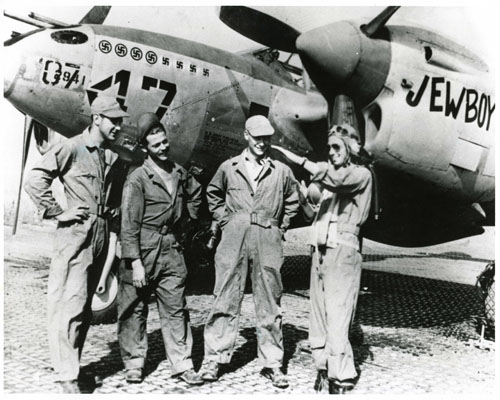
The lives of men are remembered in different ways.
Men can be remembered by their families and descendants; men can be remembered by friends; men are sometimes remembered by chance acquaintances on a “random walk” through life. Some men are remembered through their achievements, and others – regardless of success or failure – by what they attempted to achieve.
Men can also be remembered directly: Through images: paintings, photographs, and (presently) pixels. Through the written word: Through diaries, letters, correspondence, the random odd jotting, and (presently, perhaps permanently, email); usually in words of their own – in words sent.
On occasions rarer, they are remembered indirectly, through in the words of others – in words received.
The subject of this post, World War Two Army Air Force Staff Sergeant Szymon A. Friedman, a resident of Jamaica, New York, was one such man. On his final combat mission – from which only a single member of his crew returned – he carried a letter which, surviving him, had an unusual destiny.
____________________
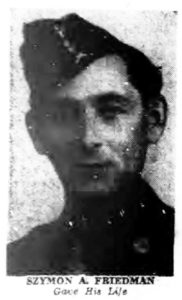
A portrait (not the best, but it’ll do) of S/Sgt. Szymon A. Friedman, in a front-page article relating news of his death in combat, published in the Long Island Daily Press, October 28, 1944. (Found via Thomas N. Tryniski’s Fulton History website.)
____________________
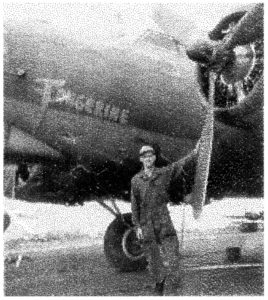
An aerial gunner (a left waist gunner, specifically) in a B-17 Flying Fortress of the 360th Bomb Squadron of the 8th Air Force’s 303rd “Hell’s Angel’s” Bomb Group, Szymon’s aircraft, B-17G 42-107048 (Tangerine, bearing the squadron code PU * M) was shot down by anti-aircraft fire during a mission to a German airdrome at Cambrai / Epinoy, France on June 12, 1944, the Hell’s Angel’s 178th combat mission. The image below, from the American Air Museum in Britain, shows “a” B-17G nicknamed Tangerine, one of several 8th Air Force B-17s so named. Thus, I don’t know if this image is specifically Tangerine of the 360th Bomb Squadron.
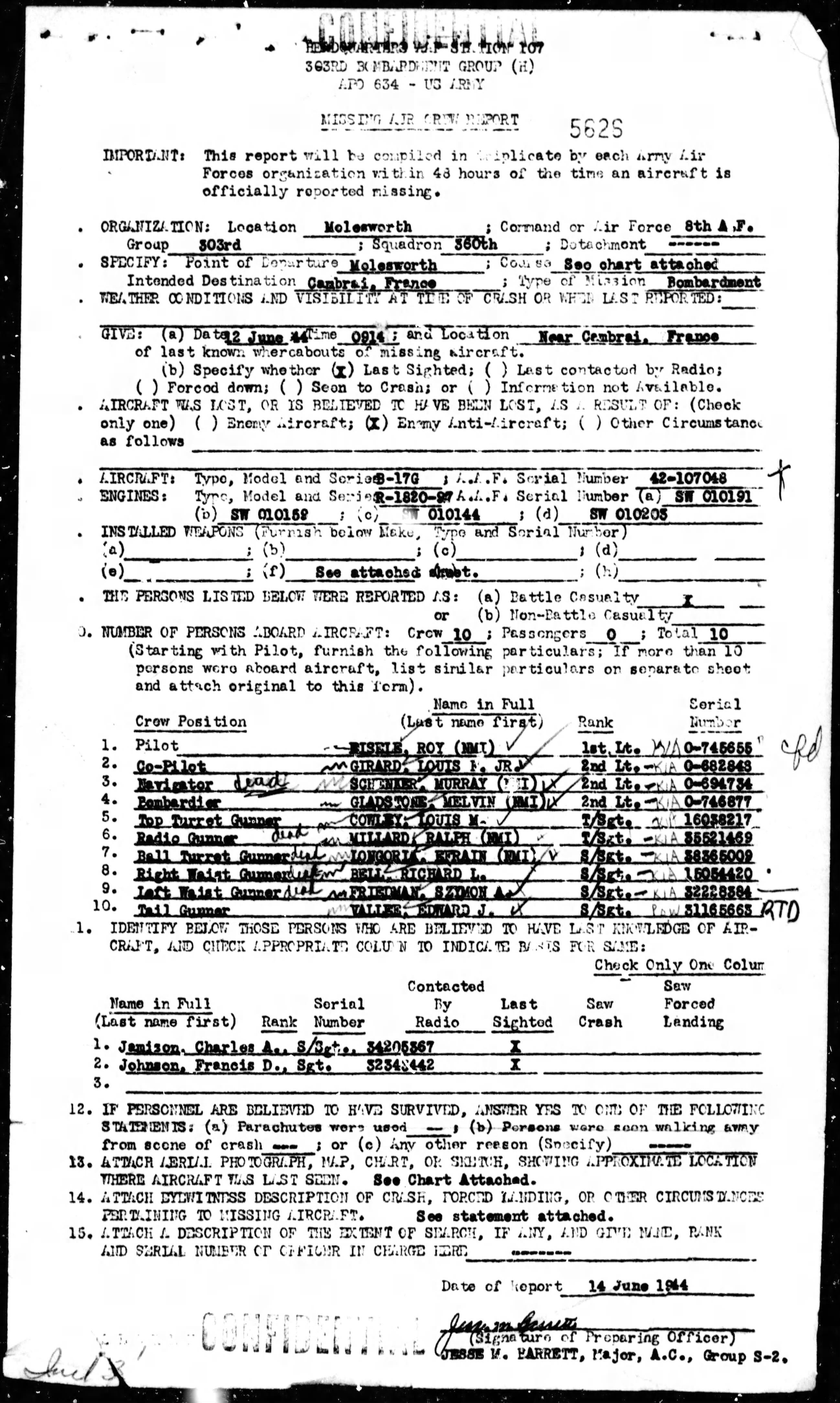
 Tangerine’s loss, covered in Missing Air Crew Report 5626, was recounted through the combined eyewitness statement of S/Sgt. Charles A. Jamison and Sgt. Francis D. Johnson, flight engineer and tail gunner of Lucky Linda (42-97853), who reported:
On the mission to Cambrai, France, on 12 June 1944, we were the crew of A/C 42-97853 which was flying in #6 position in the high element in the formation. The missing A/C was #2 in the same element. We were in the high group in the 41st “A” Combat Wing. About a minute before bombs away which was 0915 hours, a burst of flak hit the missing A/C between #2 engine and fuselage. Then another burst hit directly in the bomb bay. The entire A/C burst into flames, and it nosed down sharply. The A/C then broke in half near the bomb bay. The left wing came off. We followed it down to about 1000 feet and then lost it. We saw no parachutes come out.
Though Jamison and Johnson did not witness the escape of any crewmen from the falling B-17, there was indeed a proverbial “sole survivor”: S/Sgt. Edward J. Vallee, the plane’s tail gunner, was blown out of the disintegrating aircraft and parachuted to safety. Captured, he spent the remainder of the war as a POW at Stalag 7A, Moosburg, Germany.
______________________________
The three images below are from the Missing Air Crew Report for Tangerine. The first page lists the plane’s crew members and identifying information about the plane, while the latter two sheets, completed by S/Sgt. Vallee after the war’s end and his return from German captivity, indicate – given the nature of his survival from the falling plane – the little he knew about the fate of the aircraft and crew members.

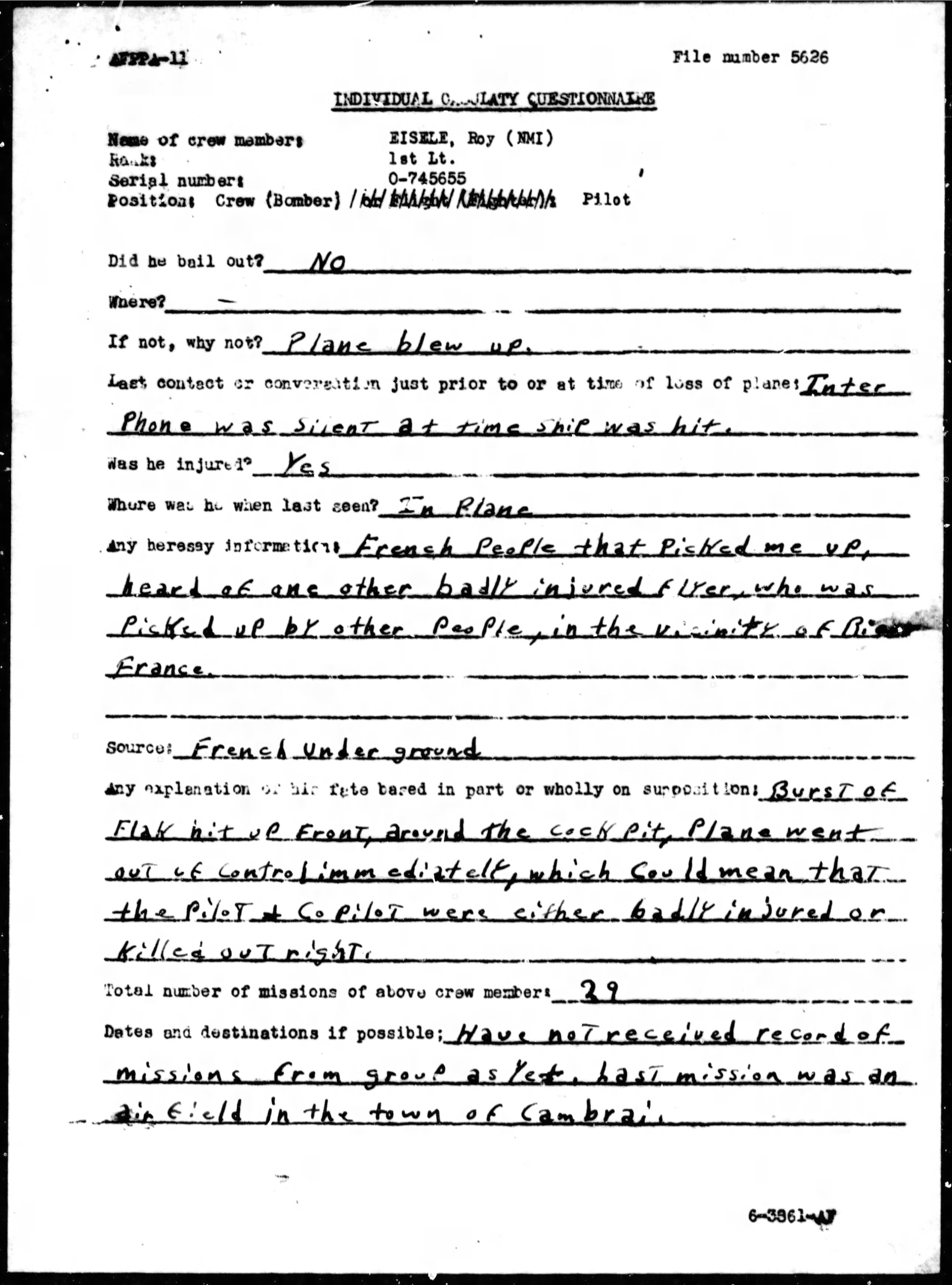 ______________________________
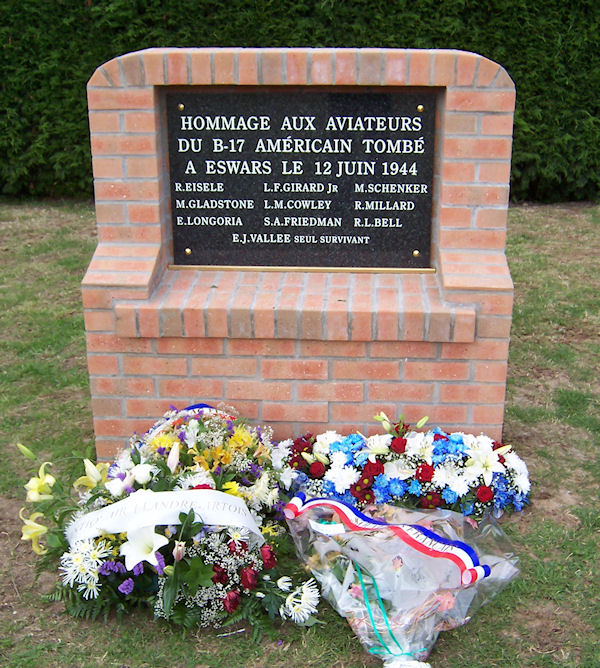
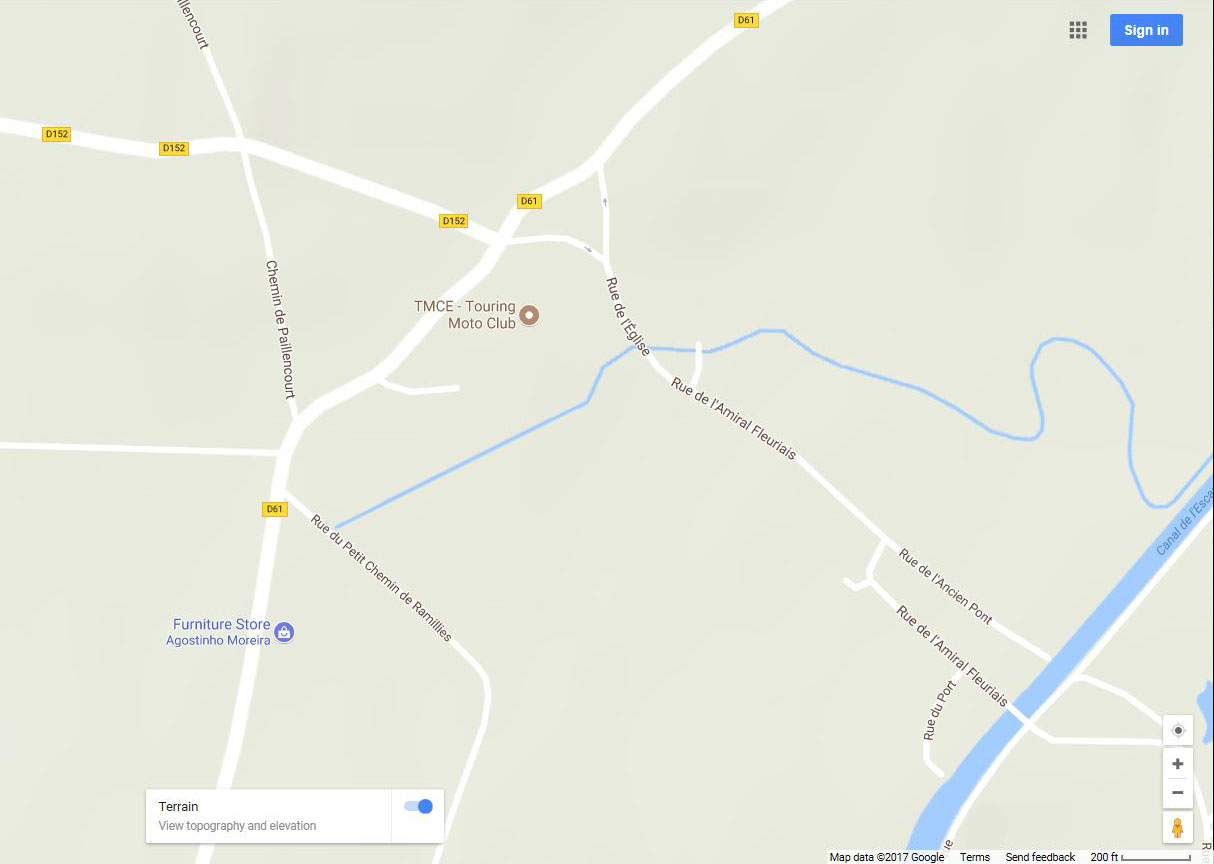
Though not exact, the location given for Tangerine’s loss in the Missing Air Crew Report was accurate enough. The aircraft fell to earth a little over two miles northeast of the center of Cambrai, in the vicinity of the commune of Eswars (Nord Department), on the north back of the River Scheldt. There, along Rue de l’Amiral Fleuriais stands a memorial commemorating the nine fallen airmen, also mentioning S/Sgt. Vallee. An image of the monument, by FindAGrave contributor Timothe Loock, appears below:
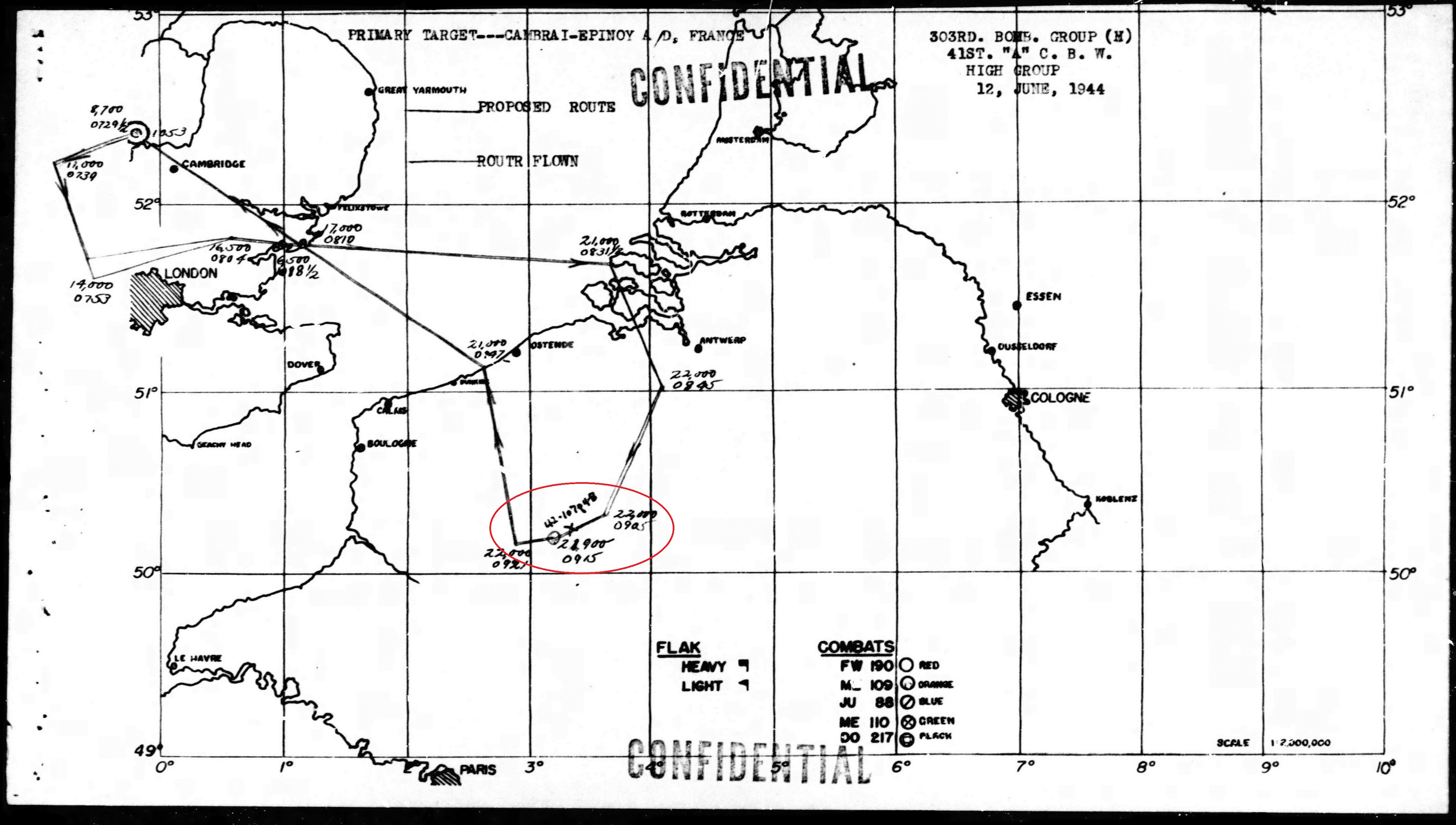
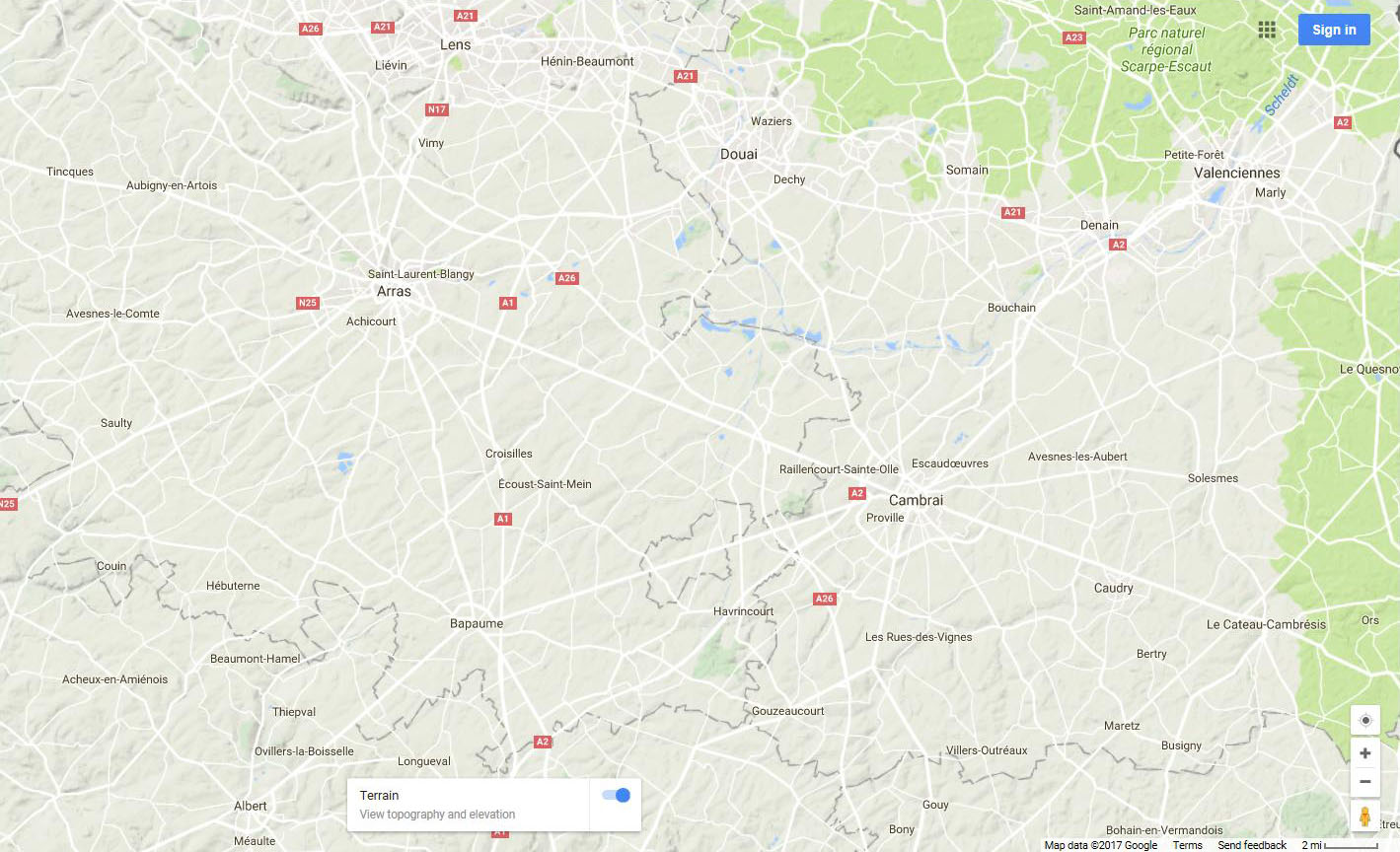
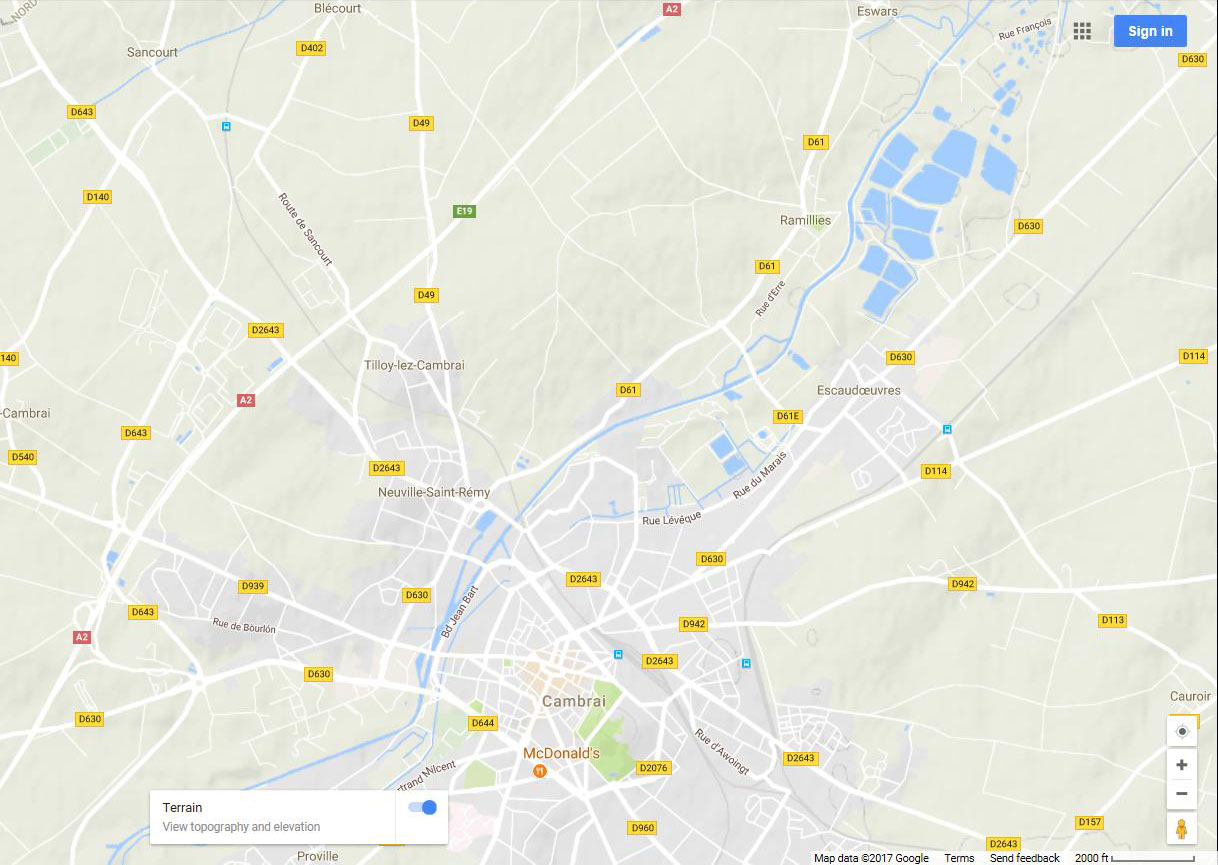
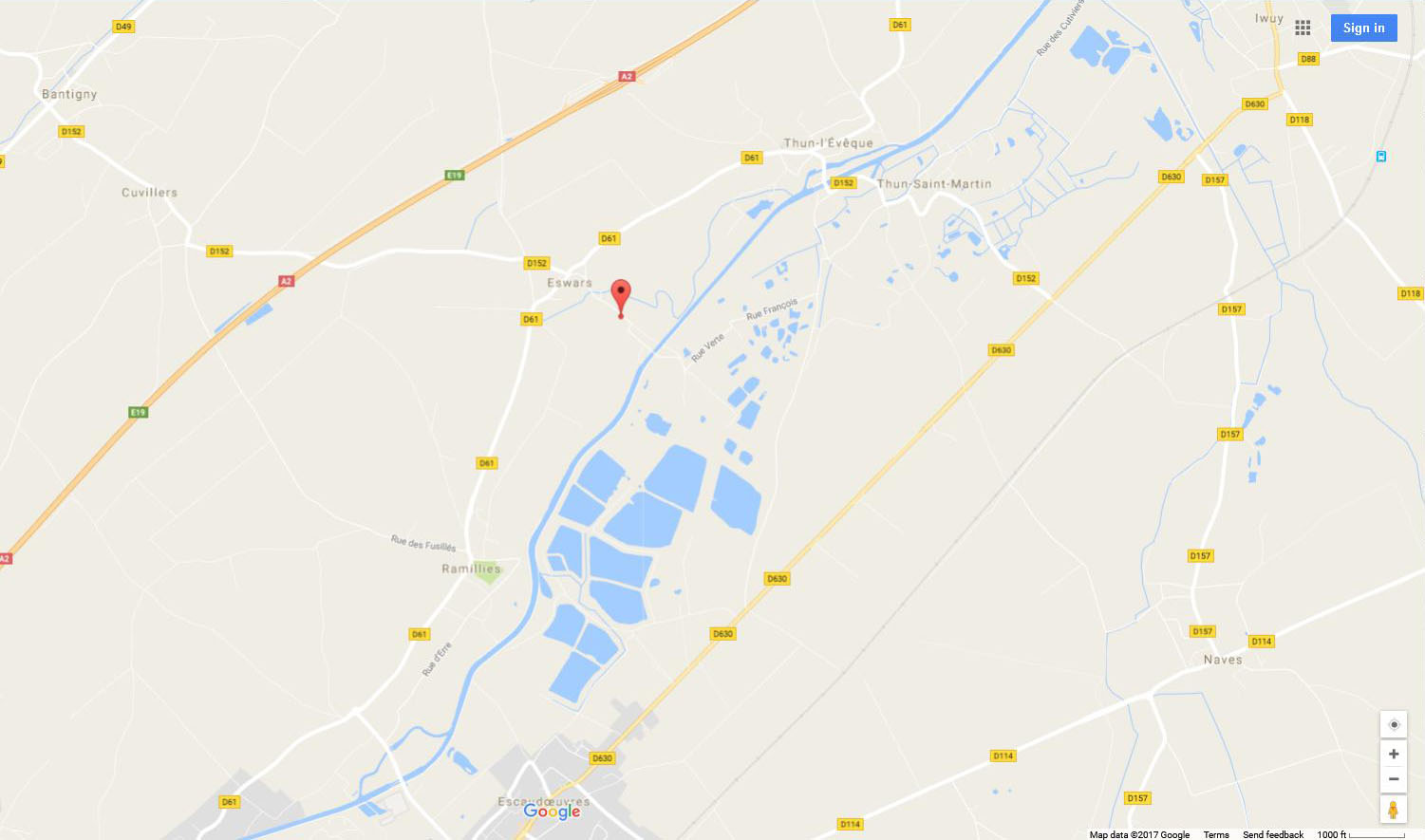
The first map below, from the Missing Air Crew Report, shows the position of Tangerine’s loss as reported by fellow airmen in the 360th Bomb Squadron. The four subsequent images are Google Maps, at successively larger scales, showing the location where Tangerine fell to earth.
 Images (copyrighted) of the memorial are on display at Aérostèles, while the loss of Tangerine is covered by Daniel Carville at France Crashes.
The names, wartime next-of-kin, and places of burial of Tangerine’s ten crewmen are listed below. (The information is derived from MACR 5626, the Eisele and DeWall crew history pages at the 303rd (Hell’s Angels) Bomb Group, the American Battle Monuments Commission, FindAGrave, and Fold3.) Notably, seven of the nine airmen are buried at the Normandy American Cemetery, in Saint Laurent-sur-Mer, France.
The men are:
Pilot: 1 Lt. Roy Eisele
Mrs. Beatrice M. Eisele (wife), 3870 Budlong Avenue, Los Angeles, Ca.
Normandy American Cemetery, St. Laurent-sur-Mer, France – Plot B, Row 2, Grave 24
Distinguished Flying Cross, Air Medal, 3 Oak Leaf Clusters, Purple Heart – 30 credited missions
Co-Pilot: 2 Lt. Louis F. Girard, Jr.
Mr. Louis F. Girard, Sr. (father), Harrisville, W.V.
Normandy American Cemetery, St. Laurent-sur-Mer, France – Plot A, Row 18, Grave 38
Distinguished Flying Cross, Air Medal, 3 Oak Leaf Clusters, Purple Heart – 30 credited missions
Navigator: 2 Lt. Murray Schenker
Mr. Benjamin Schenker (father), 1890 Crotona Parkway, Brooklyn, N.Y.
Normandy American Cemetery, St. Laurent-sur-Mer, France – Plot A, Row 19, Grave 44
Distinguished Flying Cross, Air Medal, 3 Oak Leaf Clusters, Purple Heart – 30 credited missions
Bombardier: 2 Lt. Melvin Gladstone
Mr. Maurice Gladstone (father), 108 Elm St., McHenry, Il.
Normandy American Cemetery, St. Laurent-sur-Mer, France – Plot B, Row 15, Grave 36
Distinguished Flying Cross, Air Medal, 3 Oak Leaf Clusters, Purple Heart – 28 credited missions
Flight Engineer: T/Sgt. Louis M. Cowley
Mr. Louis B. and June Cowley (parents), c/o Oak Park Fire Department, Oak Park, Il.
Born June 3, 1921
Forest Home Cemetery, Forest Park, Il.
29 credited missions
Radio Operator: T/Sgt. Ralph Millard
Mrs. Anna Millard Green (mother), Route Number Three, Hudson, Oh.
Normandy American Cemetery, St. Laurent-sur-Mer, France – Plot B, Row 9, Grave 24
Distinguished Flying Cross, Air Medal, 3 Oak Leaf Clusters, Purple Heart – 29 credited missions
Ball Turret Gunner: S/Sgt. Efrain Longoria
Mrs. Natalia Longoria (mother), 204 Chapoy St., Del Rio, Tx.
816 Coke St., Corpus Christi, Tx. (via Fold 3)
Born March 12, 1924 (via Fold 3)
Fort Sam Houston National Cemetery, San Antonio, Tx. – Section R, Grave 212 –
29 credited missions
Gunner (Right Waist): S/Sgt. Richard L. Bell
Mrs. Martha J. Bell (mother), Pemberton, Oh.
Normandy American Cemetery, St. Laurent-sur-Mer, France – Plot D, Row 16, Grave 41
Air Medal, 2 Oak Leaf Clusters, Purple Heart
23 credited missions
Tail Gunner: S/Sgt. Edward J. Vallee (Sole Survivor)
Mrs. Louise Vallee (mother), 456 Crescent St., Brockton, Ma.
…and…
Gunner (Left Waist): Staff Sergeant Szymon A. Friedman, 32228384
Mr. Saul Friedman (brother), 85-18 150th St., Jamaica, L.I., N.Y.
Mrs. Sara Becker (sister); Mr. Morris Friedman (brother)
Born Krakow, Poland, 1907
Normandy American Cemetery, St. Laurent-sur-Mer, France – Plot B, Row 12, Grave 40
Distinguished Flying Cross, Air Medal, 3 Oak Leaf Clusters, Purple Heart
27 credited missions
Strikingly, akin to the crew of 38th Bomb Group B-25J Mitchell 43-36201 (described in the post covering Sgt. Ralph Gans) Tangerine’s crew included three Jewish aviators. Aside from S/Sgt. Friedman, they were Lt. Schenker, the navigator, and Lt. Gladstone, the bombardier. Their names appear on pages 429 and 100, respectively, of American Jews in WW II, while Szymon’s name is on page 316.
______________________________
But, it was not only in the Missing Air Crew Report that Tangerine’s loss was recorded. As was typical for United States and British Commonwealth aircraft and airmen lost on combat missions over German-occupied Europe, German investigators examined the wreckage of Tangerine, identified the bomber’s crew, and compiled technical information about the aircraft, paying specific attention to the plane’s markings, engines, propellers, armament, and radio equipment, eventually incorporating this information into a Luftgaukommando Report: Luftgaukommando Report KU 2187.
(For further information about and examples of Luftgaukommando Reports, see posts Through Enemy Eyes; A B-24 Liberator, Up Close and Personal; Captive Technology: German Photographs of Electronic Equipment in a Downed B-24 Liberator; at my brother Blog, ThePastPresented.)
In this process, German investigators discovered a document which became the subject of special attention: A V-Mail letter sent to S/Sgt. Friedman from his brother Saul, in Jamaica, New York. Though by mid-1944 V-mail was altogether unremarkable – having long since become a ubiquitous, well-publicized, and near-mundane format for communication with American servicemen, of which Axis intelligence services were certainly well aware, something about this V-mail was entirely different:
It was not written in English. It was written in Yiddish.
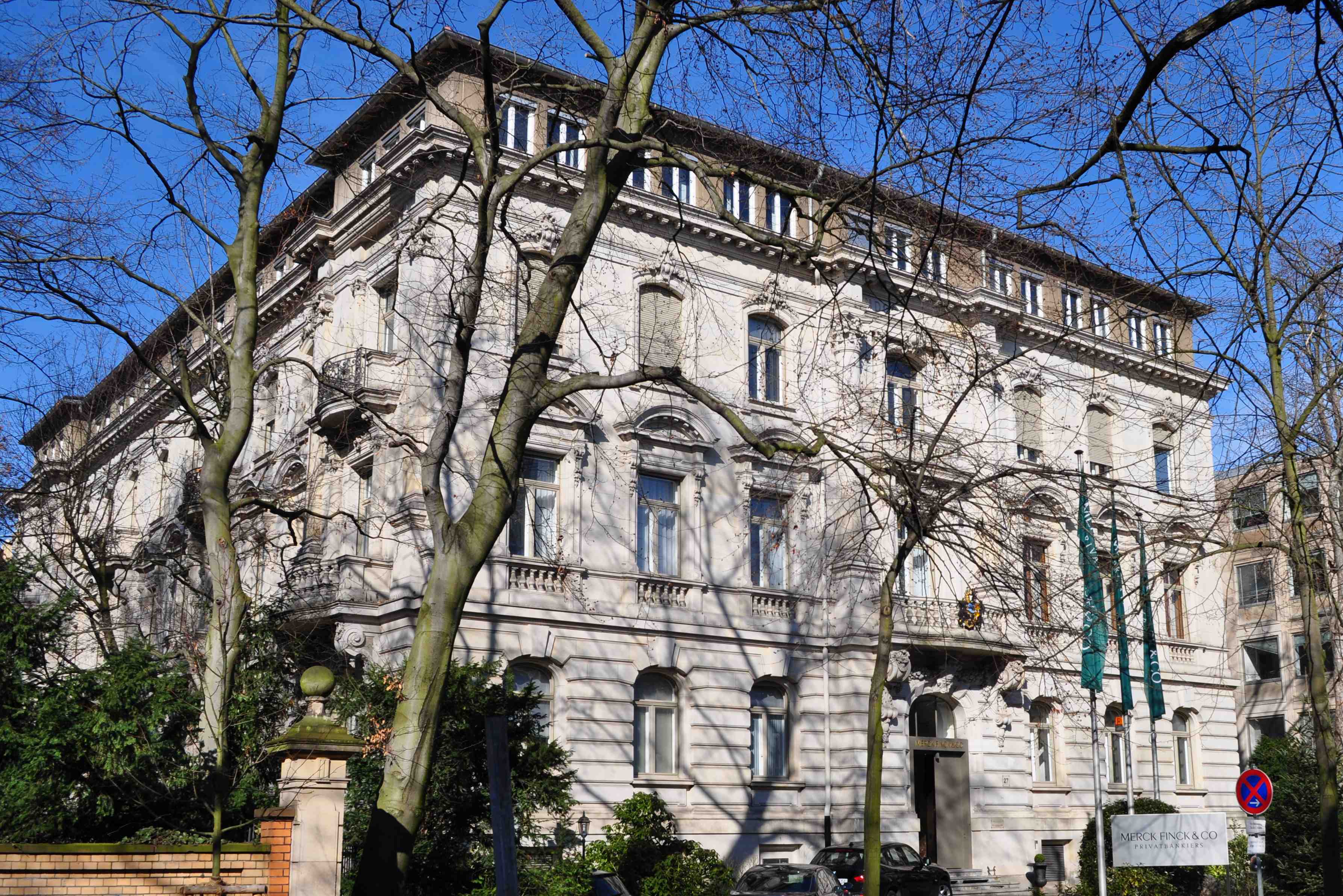
The letter was sent to Section “IV.3 (S)” at the Headquarters of the “Gestapo Staatspolizeistelle” – the Gestapo – at Lindenstrasse 27 in Frankfurt (Frankfurt am Main), seen below as photographed in 2008 by Wikimedia contributor Karsten 11), within an envelope addressed to a certain “Walter Schmitt”.
 And, here is the envelope…
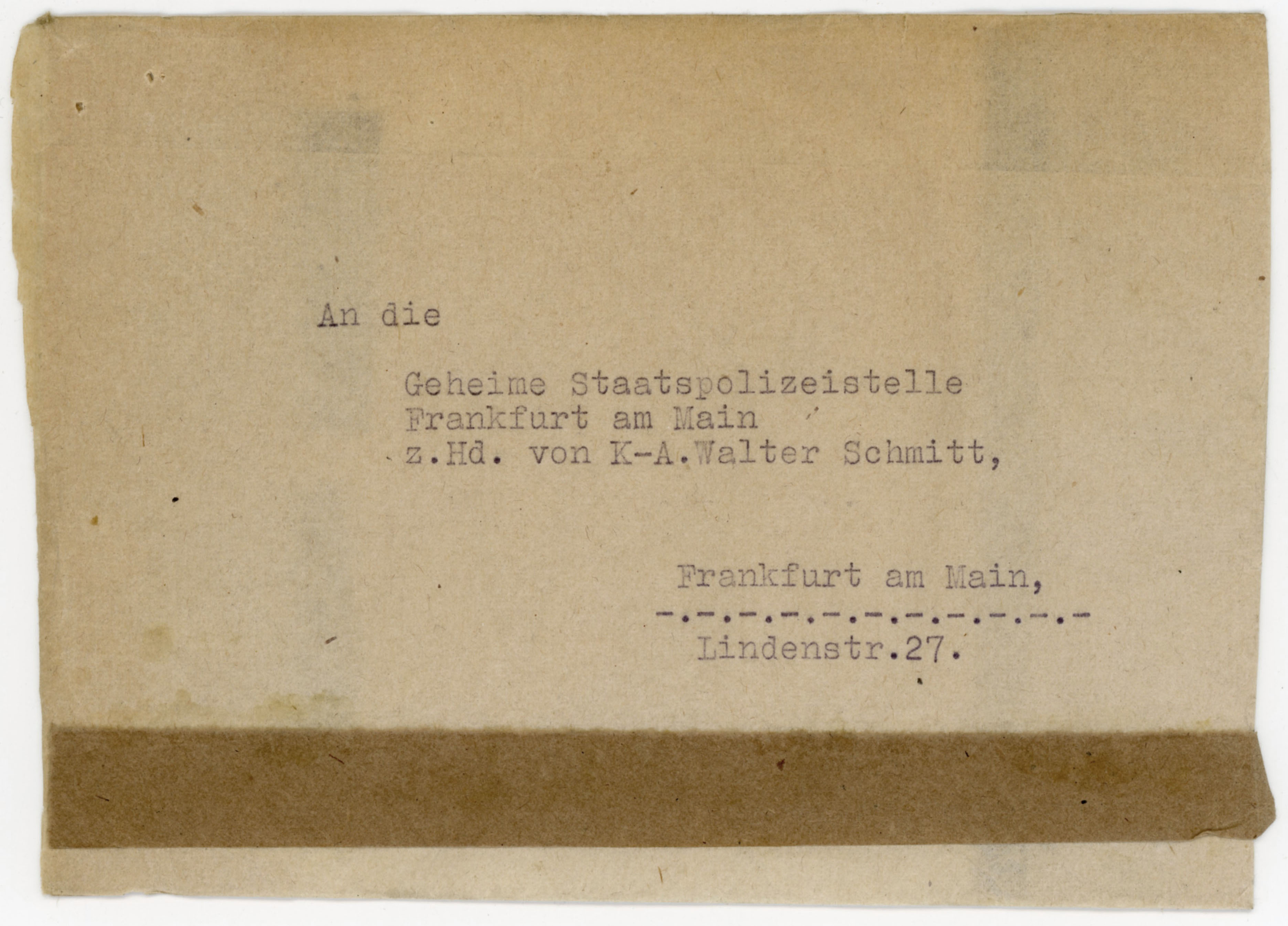 The address – transcribed and translated – follows:
An die
Geheime Staatspolizeistelle
Frankfurt am Main
z. Hd. von K-A. Walter Schmitt,
Frankfurt am Main,
Lindenstr. 27.
To the
Secret State Police
Frankfurt am Main
Attn. of K-A. Walter Schmitt,
Frankfurt am Main,
Lindenstrasse 27.
The V-mail letter was accompanied by a note to the Gestapo, in handwritten and typed text.
And, here is the note…
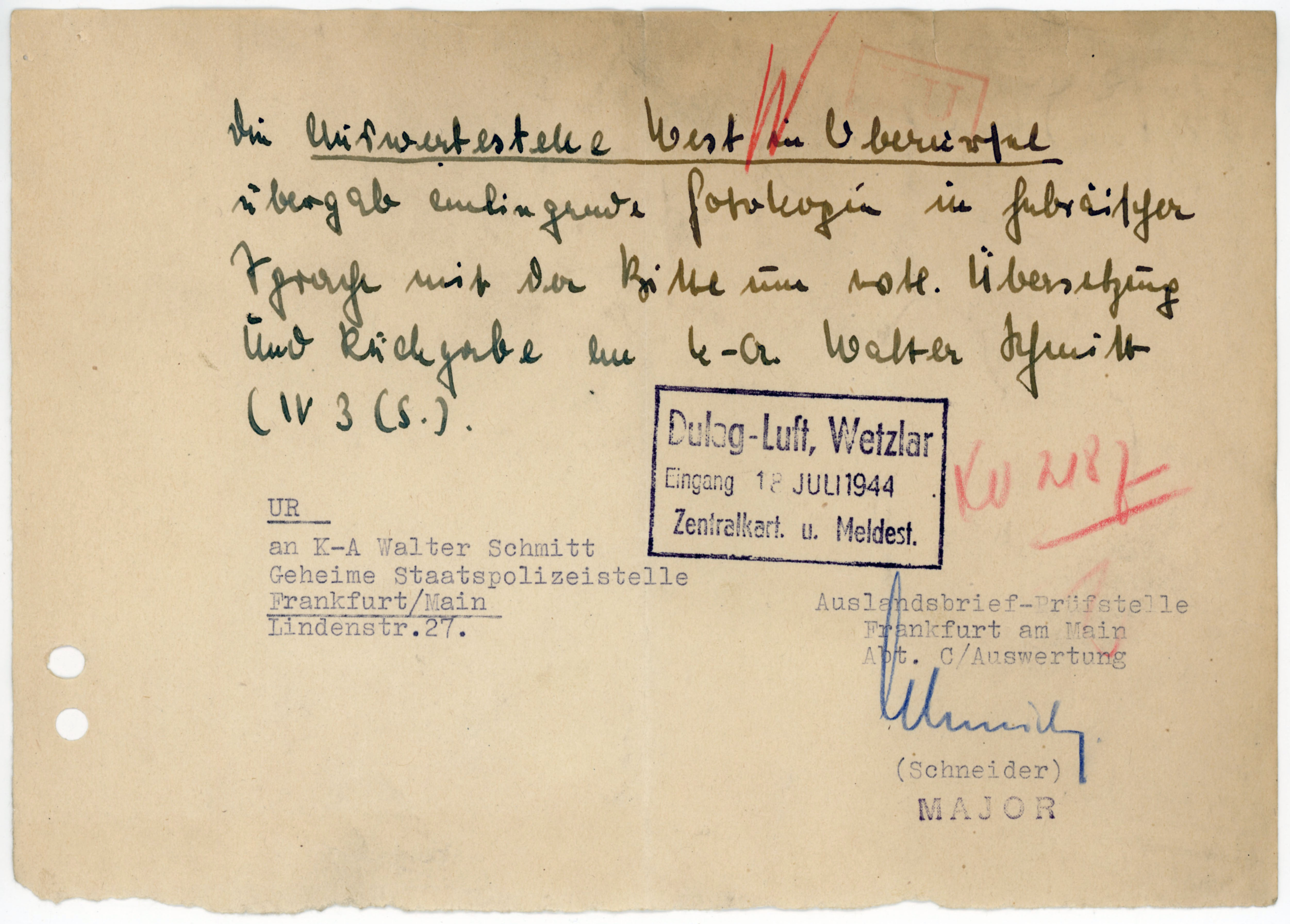 The text – transcribed and (partially!) translated – follows:
Im auswertestelle West in Oberursel übergab __________ fotokopie in hebräischer sprache mit der _____ ___ ___ übersetzung ünd aüch gabe an K-A Walter Schmitt
(IV 3 (S.)).
UR
An K-A Walter Schmitt
Geheime Staatspolizeistelle
Frankfurt / Main
Lindenstr. 27.
Auslandsbrief – Prüfstelle
Frankfurt am Main
Abt(eilung) C / Auswertung
In the evaluation office West in Oberursel handed over __________ photocopy in Hebrew language with the _____ ___ ___ translation and apprenticeship [sic] to K-A Walter Schmitt
(IV 3 (S.)).
UR
To K-A Walter Schmitt
Secret State Police
Frankfurt / Main
Lindenstrasse 27.
Foreign Letter – Testing Center
Frankfurt am Main
Department C / Evaluation
Notice that the handwritten text ends with the abbreviation “IV 3 (S.)” Based on Yad Vashem’s description of the Frankfurt am Main Gestapo, “IV 3 (S.)” probably designated one of the sub-departments of the three main Departments of the Frankfurt am Main Gestapo, Department IV pertaining to “Interrogation of and action against opponents of the regime”.
______________________________
And, so…
Here’s the very subject of “this” post: Saul’s V-Mail letter, written in Jamaica, New York, on June 1, 1944, only 12 days before Szymon’s final mission…
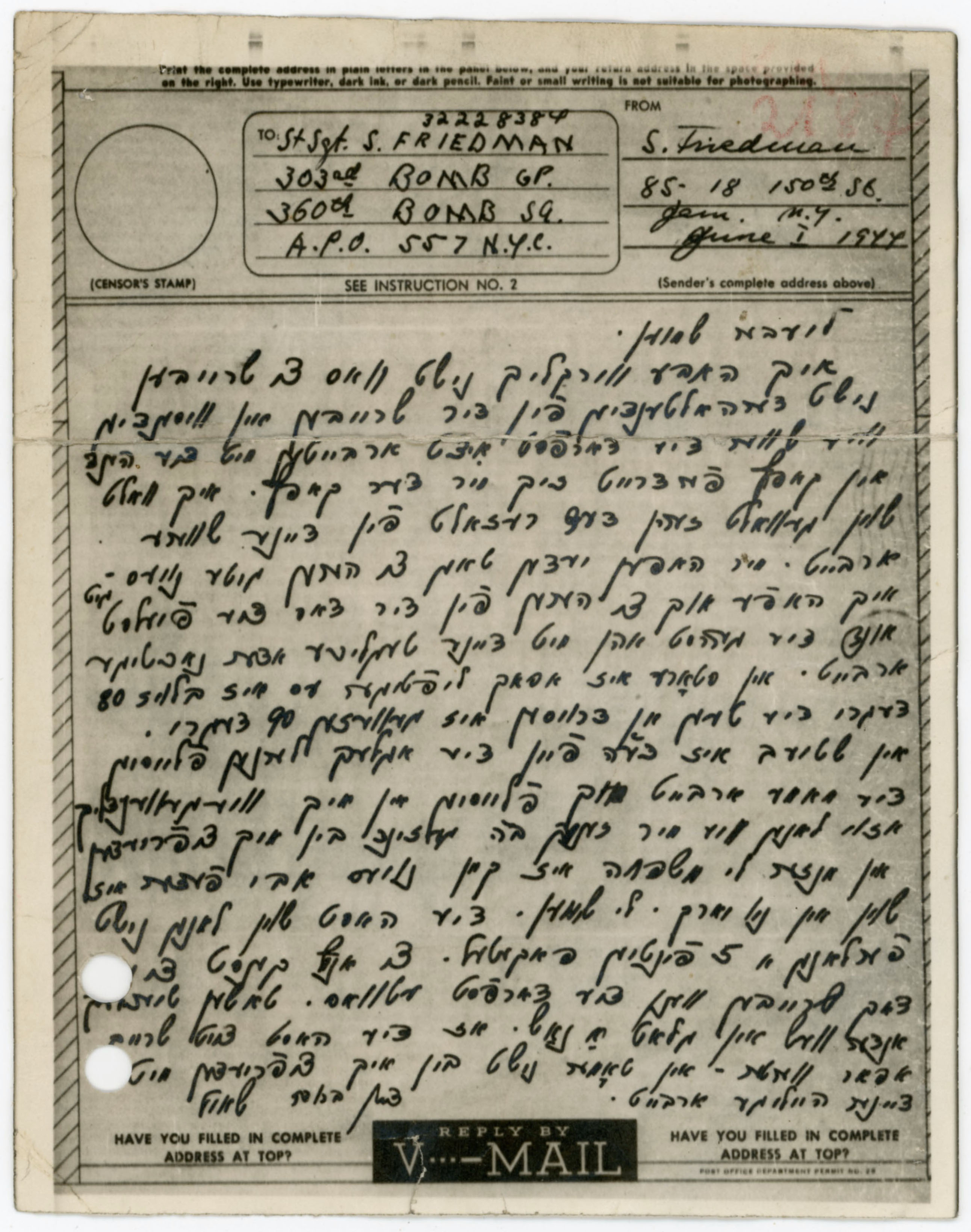 Typical of V-Mail letters, the address of the recipient includes his military unit and APO (Army Post Office) number, but no geographic address. The sender’s address – the address of the Friedman family – is, however, given in full. Note that German investigators wrote the Luftgaukommando Report number (2187) on the letter (in faint red, in the letter’s upper-right corner) a standard practice for captured documents in Luftgaukommando Reports.
______________________________
By the very nature of war, to glean intelligence about Allied force dispositions, technical developments, military morale, and civilian (domestic) economic and social conditions, German investigators translated and scrutinized documents – whether technical manuals, or correspondence – obtained from Allied casualties and POWs. Saul’s letter to Szymon was processed accordingly, albeit with a striking difference: Rather than a simple and direct evaluation of the text by German investigators already fluent in English, this letter needed to be translated from Yiddish to German.
And, here is the Yiddish-to-German translation of the letter, produced at the Gestapo Headquarters. (Note that it was composed as a single block of text.):
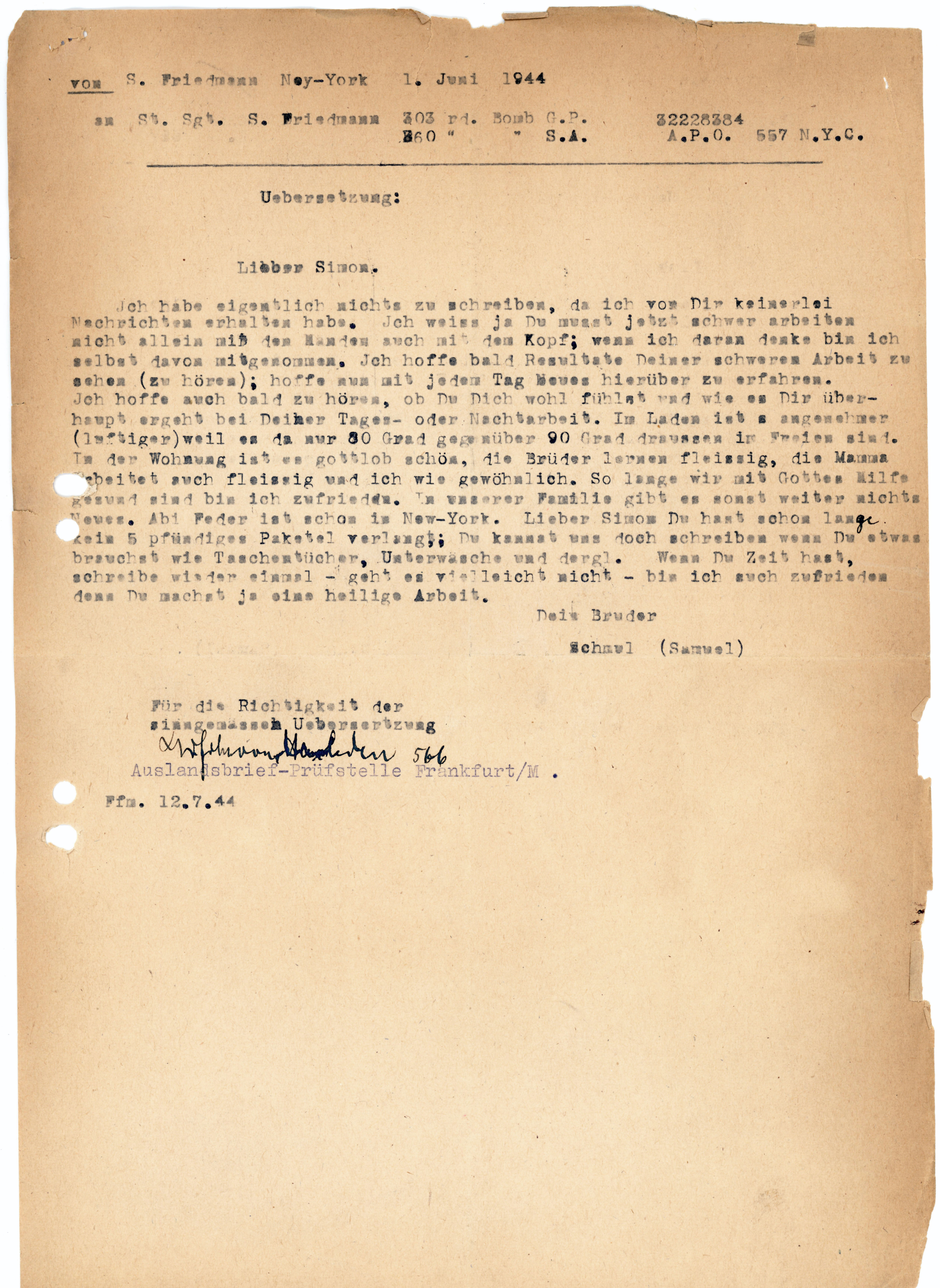 Here is a transcription of the German text…
Uebersetzung:
Lieber Simon.
Ich habe eigentlich nichte zu schreiben, da ich von Dir keinerlei Nachrichten erhalten habe. Ich weiss ja Du musst jetzt schwer arbeiten nicht allein mit den Handen auch mit dem Kopf; wenn ich daran denke bin ich selbzt davon mitgenommen. Ich hoffe bald Resultate Deiner schweren Arbeit zu schon (zu horen); hoffe num mit jeden Tag Neues hieruber zu erfahren. Ich hoffe auch bald zu horen, ob Du Dich wohl fuhlat und wie es Dir uberhaupt ergeht bei Deiner Tages – oder Nachtarbeit. Im laden ist a angenehmer (luftiger) weil es da nur 80 Grad gege nuber 90 Grad draussen im Freien sind. In der Wohnung ist es gottlob schon, die Bruder lernen fleissig, die Mamma arbeitet auch fleissig und ice wie gewohnlich. So lange wir mit Gottes Milfe gezund sind bin ich zufrieden. Im unserer Familie gibt es sonst waiter nichts Neues. Abi Feder ist schom in New-York. Lieber Simon Du hast schon lange kein 5 pfundiges Paketel verlangt; Du kannst uns doch schreiben wenn Du etwas brauchst wie Taschentucher, Unterwasche und dergl. Wenn Du Zeit hast, schreibe wieder einmal – geht es vielleicht nicht – bin ich such zufriedes donn Du nachat ja eine heilige Arbeit.
Dein Bruder
Schmul (Samuel)
Fur die Richtigkeit der
sinngemassen Uebersertzung
Auslandsbrief-Prufstelle Frankfurt / M
Ffm. 12.7.44
And, here is an English-language translation of the German:
Actually I have nothing to write, because I have not received any news from you. I know you have to work hard now, not only with your hands, but also with your head; when I think about it, I myself have been taken away. I hope soon to hear the results of your hard work; (I) hope to hear new things about it every day. I also hope to hear soon, if you feel well and how you feel at all during your day or night work. In the store (it) is more pleasant (breezy) because (it is) only 80 degrees compared to 90 degrees outside in the open air. In the apartment it is beautiful, the brothers are busy learning, Mother is also diligent and I work as usual. As long as we are energized with God’s help, I am satisfied. Otherwise there is nothing new in our family. Abi Feder is already in New York. Dear Simon you have not demanded a 5-pound parcel for a long time; you can write us if you need something like handkerchiefs, underwear and the like. If you have time, write again – if possible – I’m also satisfied because you’re (pursuing) sacred work.
Your brother
Schmul (Samuel)
______________________________
And below, you can read the English-language translation of Saul’s letter, comprising three paragraphs, conforming to the three-paragraph format of the letter.
Dear Shimon,
I really have nothing to write. I have not received a letter from you and I know how hard you need to work now both with your hand and head, and it turns your head around. I want already hope to see the result of your hard work. We’ll all dance when we hear the good news I hope to hear from you from the field (?) and about your daily or nightly work.
And the weather is a lot cooler. It is only 80 degrees today and outside it was 90 degrees. At home, with God’s help it is well. The boys learn diligently mother works diligently also and I [unclear] so long that [unclear] with God’s help, health, I am satisfied and our dear family has no news but uncle [Abi Feder] is already in New York.
Dear Shimon, you have already not long ago received a 5 pound package. If you can write when you have something. [unclear] other wash (laundry) and have a snack (?). When you have time write some words when it is possible, and if not, I will be satisfied with your holy work.
Your brother
Shaul
______________________________
There remains a singular question – which by now is probably unanswerable:
Who was the translator?
None of the correspondence to the Gestapo mentions or alludes to that unknown person. Neither their name nor their initials are given, the acronym “FFm” at the bottom of the German translation simply standing for “Frankfurt am Main”. The only “clue” – a clue so vague as to be more of a supposition than a clue, as such – is that the person was bilingual in Yiddish and German, and fluently so.
Had they been a citizen of Germany? Were they from Poland? Czechoslovakia? Elsewhere in Europe? A scholar? A tradesman? A man? A woman? Had they had – prior to the advent of the Third Reich – a position of leadership in the Jewish community of Frankfurt am Main, or elsewhere in Germany?
Under what kind combination of force, intimidation, compulsion, desperation, and inevitability – whether real or perceived; likely real and perceived – were they at Linzerstrasse 27 in July of 1944?
Did they survive the war?
The answers are unknown.
Known, is that of the ten men who departed Molesworth, England, aboard Tangerine on the morning of June 12, 1944, only one – S/Sgt. Edward J. Vallee – eventually returned.
S/Sgt. Szymon A. Friedman’s name would appear in the Brooklyn Eagle on August 5, 1944; the Long Island Daily Press on July 8, August 5, August 31, and October 28; The New York Times on October 29; finally the Long Island Star-Journal – in a comprehensive list commemorating war dead from Queens, New York – on June 27, 1946. Then, it would come before the public no more.
Like most of his fellow crew members, he is buried in Normandy.
Who was he?
Born in Krakow, Poland in 1907, and arriving in the United States in 1939, at the age of 37 Szymon Friedman was strikingly older than the typical Second World War combat aviator. A very brief account of his life appeared in this new item in the Long Island Daily Press on July 8, 1944, which reported him as missing in action:
Jamaica Polish Refugee Missing
8 Soldiers and Sailors Wounded
A Polish youth who fled to Jamaica when Hitler overran his country is missing in action over Normandy, where he was fighting with the Yanks, his brother reported today upon receipt of a telegram from the War Department.
Sergeant Friedman is 37, and came to this country in 1939. Three years later he was inducted and went to England as a member of a bomber ground crew.
Nine months ago he began to fly but kept the secret from his brother so as not to worry him.
He holds the Air Medal with three clusters.
The Friedmans have a sister Mrs. Sara Becker, who was living in Krakow when they last heard from her, and another brother, Morris, in Calgary, Ontario.
And then, on October 28, the Long Island Daily Press revealed news of his fate. German authorities had evidently reported the fate of Tangerine’s crew’s to the International Red Cross, which then provided this information to American authorities.
FIVE TIMES DECORATED, FLIER DEAD
A Jamaica aerial gunner who held the Distinguished Flying Cross and Air Medal with thee Oak Leaf Clusters is one of 17 Central Queens and Nassau men listed by the War Department today as killed in action.
Sergeant Friedman, aerial gunner on a Flying Fortress, was reported missing in June. Although the place of his death was not disclosed, his family believes he was on a mission over Cambrai, France.
The 37-year-old flier, who had the Distinguished Flying Cross and the Air Medal with three Oak Leaf Clusters, had come to this country from Europe five years ago. He first went overseas in November, 1942.
Before enlisting, he made his home with his brother Saul, a Queens resident for 15 years, and worked in his brother’s grocery store.
As for the unknown translator, so for Szymon: Questions arise for which answers are unknown.
Through what combination of luck and wisdom did he manage to escape Poland – perhaps even after the German invasion of that country – and arrive in the United States during the terrible year of 1939? What befell his sister, Sara Becker? (A search of Yad Vashem’s Central Database of Shoah Victim’s Names yields no record for a woman residing in Krakow, by that name.) What became of Saul?
Above all, did Szymon leave a written record of his own – a diary; letters; random musings – describing his motivation to become an aerial gunner, when he could have remained a ground crew member in vastly greater relative safety?
As some men are remembered through their own writings, and other men are remembered through what others have written about them, the lives of men “in general” – most men, really – are “written” in another fashion: Through their deeds and actions, however great or small. And even if those deeds have passed into history and beyond the memory of man, they will always have existed, regardless.
______________________________
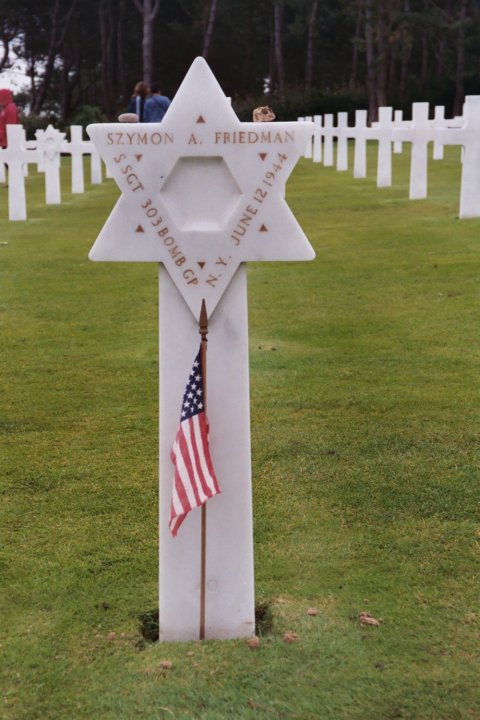
Simon’s matzeva at the Normandy American Cemetery and can be seen in this image by 303rd Bomb Group volunteer photographer Margaret Keeting.
 ______________________________
Crew Photographs
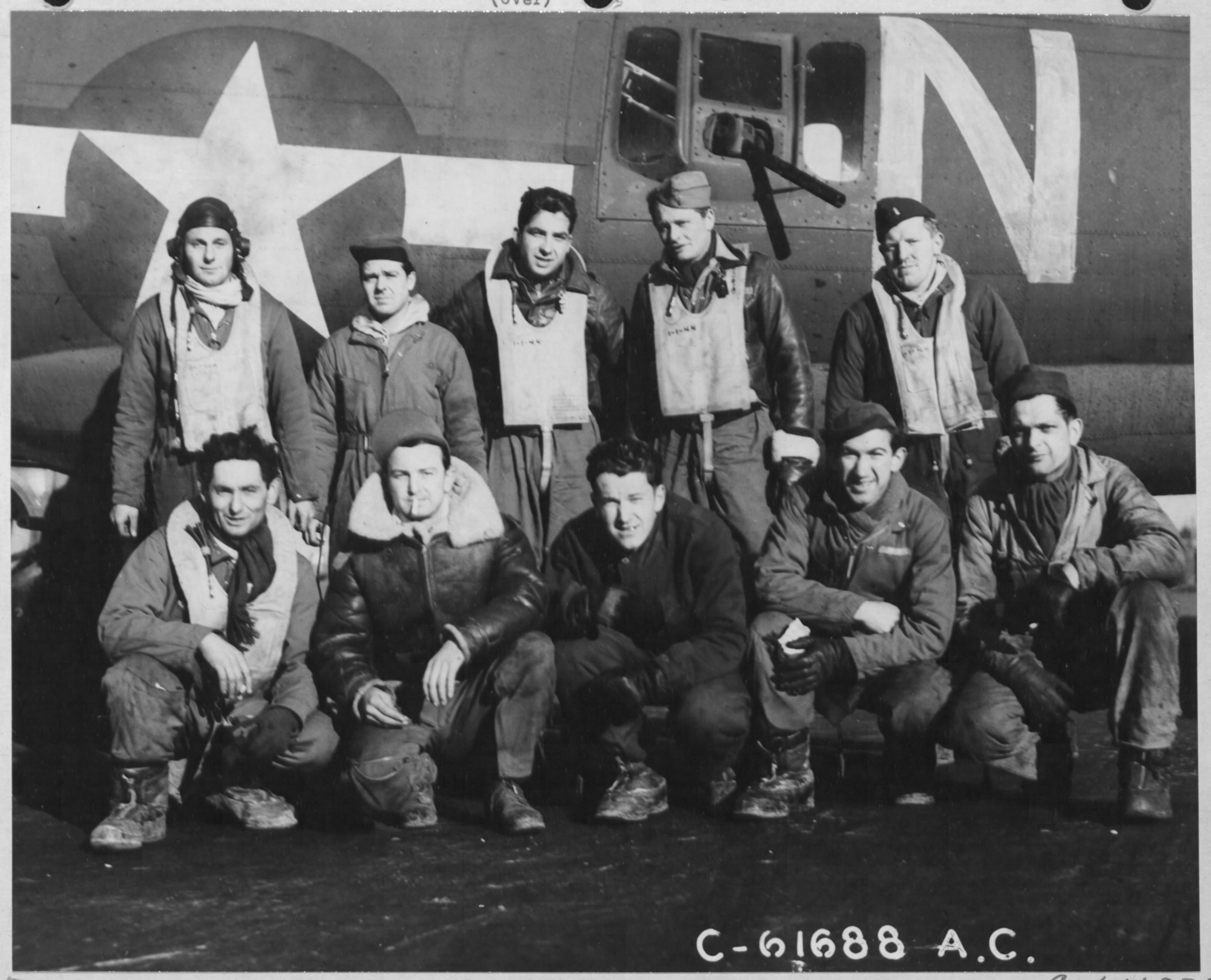
S/Sgt. Friedman appears in this Army Air Force photograph (C-61688AC / A10211) of the crew of Lt. Hershel R. DeWall, taken on March 2, 1944. Having previously flown two missions with the crew of 2 Lt. Benajah G. Burkitt (killed in a mid-air collision with all his crew on January 5, 1944), he was subsequently assigned to the DeWall crew, which itself was comprised of airmen from other 360th Bomb Squadron crews, before flying with Roy Eisele’s crew.
Left to right, the men are:
Front Row
S/Sgt. Szymon A. Friedman (Gunner – Waist)
S/Sgt. Arthur B. Ayers (Ball Turret Gunner)
S/Sgt. Lawrence C. Pierson (Togglier)
S/Sgt. Harry V. Hosso (Right Waist Gunner (POW))
T/Sgt. Alphonse B. Serwa (Flight Engineer)
Rear Row
S/Sgt. Paul J. Davis (Tail Gunner)
Sgt. Charles J. Bonn (Radio Operator (POW))
2 Lt. John M. Chapman (Co-Pilot)
1 Lt. Hershel R. DeWall (Pilot)
1 Lt. Sylvester J. Becker (Navigator)
 ______________________________
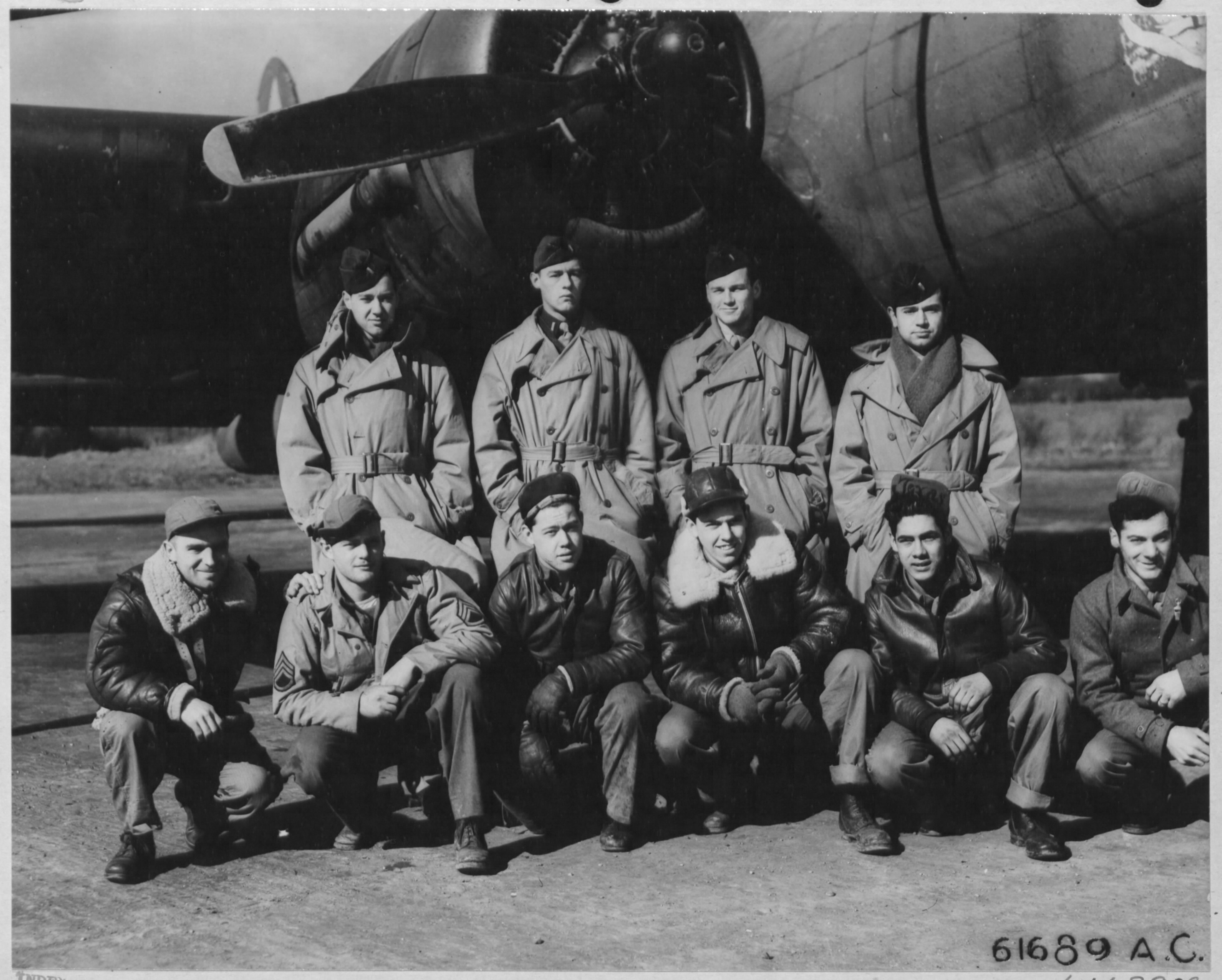
Army Air Force photo 61689AC / A10212, taken March 4, 1944, shows members of 1 Lt. Roy Eisele’s crew, who were assigned to the 360th Bomb Squadron on February 25, 1944. Of the men in the photo, two – T/Sgt. Joseph A. Czerwonka, who did not fly on the June 12 mission to Cambrai, and tail gunner S/Sgt. Vallee – would survive the war:
The men are, from left to right:
Front Row:
T/Sgt. Louis M. Cowley (Flight Engineer)
Sgt. Efrain Longoria (Ball Turret Gunner)
S/Sgt. Richard L. Bell (Right Waist Gunner)
T/Sgt. Joseph A. Czerwonka (Safely completed first tour of missions; Volunteered for a second tour and flew 59 missions by March 10, 1945)
S/Sgt. Edward J. Vallee (Tail Gunner; Sole Survivor of June 12, 1944 mission)
S/Sgt. Ralph Millard (Radio Operator)
Rear Row:
1 Lt. Roy Eisele (Pilot)
2 Lt. Louis F. Girard, Jr. (Co-Pilot)
2 Lt. Murray Schenker (Navigator)
2 Lt. Melvin Gladstone (Bombardier)
 References
Photograph and Biographies Crew of Roy Eisele
(303rd Bomb Group (Hell’s Angels) website)
Photograph and Biographies Crew of Hershel R. DeWall
(303rd Bomb Group (Hell’s Angels) website)
Luftgaukommando Report KU 2187: United States National Archives, College Park, Maryland, (in) Records Group 242, Shelf Location 190 / 14 / 9-12 / 1-5 ( Entry 1022)
B-17G 42-107048 – History and Nickname (American Air Museum)
Photograph of B-17G 42-107048 (American Air Museum)
303rd Bomb Group Mission Number 178 (303rd Bomb Group (Hell’s Angels) Website)
Monument to Tangerine (Aerosteles)
Luftgaukommando Reports
My “brother” blog, covering military history, technology, and related topics (The Past Presented)
Through Enemy Eyes: A Downed P-51 Mustang in a German Luftgaukommando Report (Luftgaukommando Report about a crashed P-51D Mustang fighter plane)
A B-24 Liberator, Up Close and Personal: German Photographs of a Downed B-24 in Holland (Luftgaukommando Report with numerous photographs of a crash-landed B-24 Liberator, covered in two blog posts)
Captive Technology: German Photographs of Electronic Equipment in a Downed Special Operations Squadron B-24 Liberator
(Luftgaukommando Report with numerous photographs of a crashed Special Operations B-24 Liberator, covered in three blog posts)
Acknowledgements
I want to express my deep appreciation for Yiddish-to-English translation to Avi and Sender.
This is also a holy work – an archive of fallen soldiers, stunningly comprehensive and lovingly curated. Thank you, Michael Moskow.
______________________________
And, thank you, Ari Dale!
What a marvellous project! I am a great-nephew of Szymon Friedman, and our family has photos and stories about Szymon and his extended family.
Szymon was motivated to fight when his sister, Sara Becker, and Sara’s daughter, Marilke, were taken by the Nazis. Both women perished in the Warsaw Ghetto; Marilke was just 12 years old. My late brother and a first cousin were named for Szymon; my daughter and a second cousin were named for Marilke.
Michael Moskow, please contact me at the e-mail address I have provided.