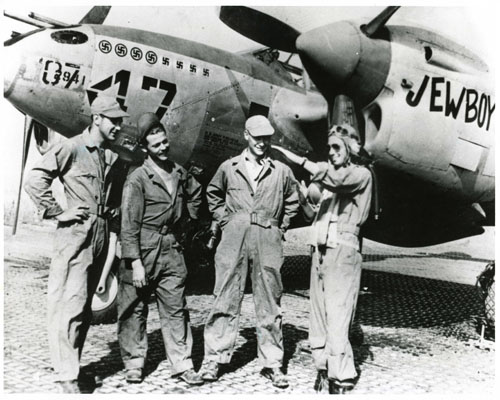
Given the implications – of geography, politics, and ultimately, sheer physical survival (also see…) – of the Battle for North Africa for the Jews of the Yishuv (and not just the Yishuv), it’s not at all surprising that The Palestine Post (and, I’m certain, Hebrew language newspapers of the Yishuv) accorded attention to the military service of the Jews of the Yishuv in the armed forces of the British Commonwealth in general, and, in the context of the North African Campaign in particular.
Certainly this was the focus of attention geographically beyond the Yishuv, as exemplified in 1944 by La Tribune Juive, but not so much in the American Jewish press.
A notable example of this occurred in mid-1942, when The Palestine Post published five articles about this topic, all authored by correspondent “T.R. Lurie”: Ted R. Lurie.
A native of New York, Lurie settled in “palestine” shortly after graduating from Cornell University in 1930. In 1932, after briefly working in a collective farm settlement, he began work at The Palestine Post. During World War II he served as the Post’s military correspondent with Allied forces in the Western Desert.
Active in the Haganah commencing in 1933, in 1947 he organized and directed its underground English-language broadcasts, and in 1948, on the eve of Israel’s War of survival and liberation, served as its public relations officer. Throughout this time he continued to serve in various editorial capacities with the The Palestine Post, continuing after 1948 when the newspaper was renamed The Jerusalem Post. In 1955 he was named acting editor, replacing the paper’s founder and editor Gershon Agron, who was elected Mayor of Jerusalem. He became editor-in-chief on Mr. Agron’s death in 1959, founding the newspaper’s Weekly Overseas Edition that same year.
Ted Lurie also served as Associated Press Jerusalem correspondent and as Israel news correspondent for the Central News Agency, the News Chronicle of London and the Columbia Broadcasting System. In recent years he broadcast Israeli news four times a week on radio station WEVD in New York. He was also a former editor of the Hebrew daily Zmanim, a co-founder of the Israel Journalists Association and ITIM (Israel News Agency), a member of the Israel Committee of the international Press institute, a former president of the YMHA Association and chairman of the Jerusalem branch of the Israel-Japan Society.
Ted R. Lurie died in Tokyo on June 1, 1974. He is buried in Har HaMenuchot Cemetery, Jerusalem, Israel. (The above information was compiled from articles in the Jewish Floridian, December 6, 1968; Jewish Telegraphic Agency, June 3, 1974; Jerusalem Post, June and June 7, 1974.)
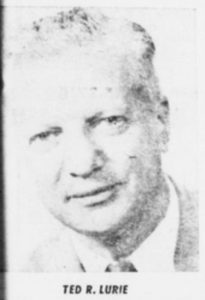
Pictures of Mr. Lurie are elusive; here’s the only one I found: It was published in the Jewish Floridian on December 6, 1968.
Published between May 7 and 11, 1942, each of Lurie’s articles focused on a different aspect of the service of Jewish soldiers in the Western Desert, specifically at Company-level military units whose duties – transportation, water supply (pretty important in a desert!), and engineering – while neither dramatic nor given to bold headlines, were absolutely essential to the actual conduct of offensive as well as defensive combat operations. Interestingly, though these articles were obviously published even as the war was ongoing, Lurie recorded and the Post published the actual numerical designations of some of these units, which I assume occurred with the assent of military censors.
So… “This” and the next four posts will present Lurie’s five articles in chronological order, and will include an image of the article itself (found via the National Library of Israel) and – well, given the poor legibility of the text in the images – a full transcript of the article. Though each article s accompanied by a photograph, unfortunately, the quality of these images in electronic format is very poor. (Oh, well.)
____________________
To place this series of articles in a winder context, here’s a diagrammatic map of the war in North Africa, published in Lukasz Hirsowicz’s 1966 The Third Reich and the Arab East. Very cleverly designed, the map shows geographic boundaries, the locations of principal cities, routes and destinations of naval convoys, air activity, and above all, the timing and furthest geographic extent of Allied and Axis military offensives in Libya and Egypt. The closest approach of Axis forces to Cairo, the Suez Canal, and the Yishuv – during the battle of El Alamein – was attained on July 1, 1942, after which offensive momentum finally and completely (but not without cosr) switched to the Allies.

____________________
This “first” post, pertaining to Lurie’s article of May 7, 1942 (a Thursday), provides an introduction and overview to the series.
Subsequent posts will cover Lurie’s articles about…
Pioneers (Friday, May 8, 1942)
Engineers (Sunday, May 10, 1942)
A.T.S. (Auxiliary Transport Service) (Jewish women soldiers) (Monday, May 11, 1942)
Water Transportation and Supply (Tuesday, May 12, 1942)
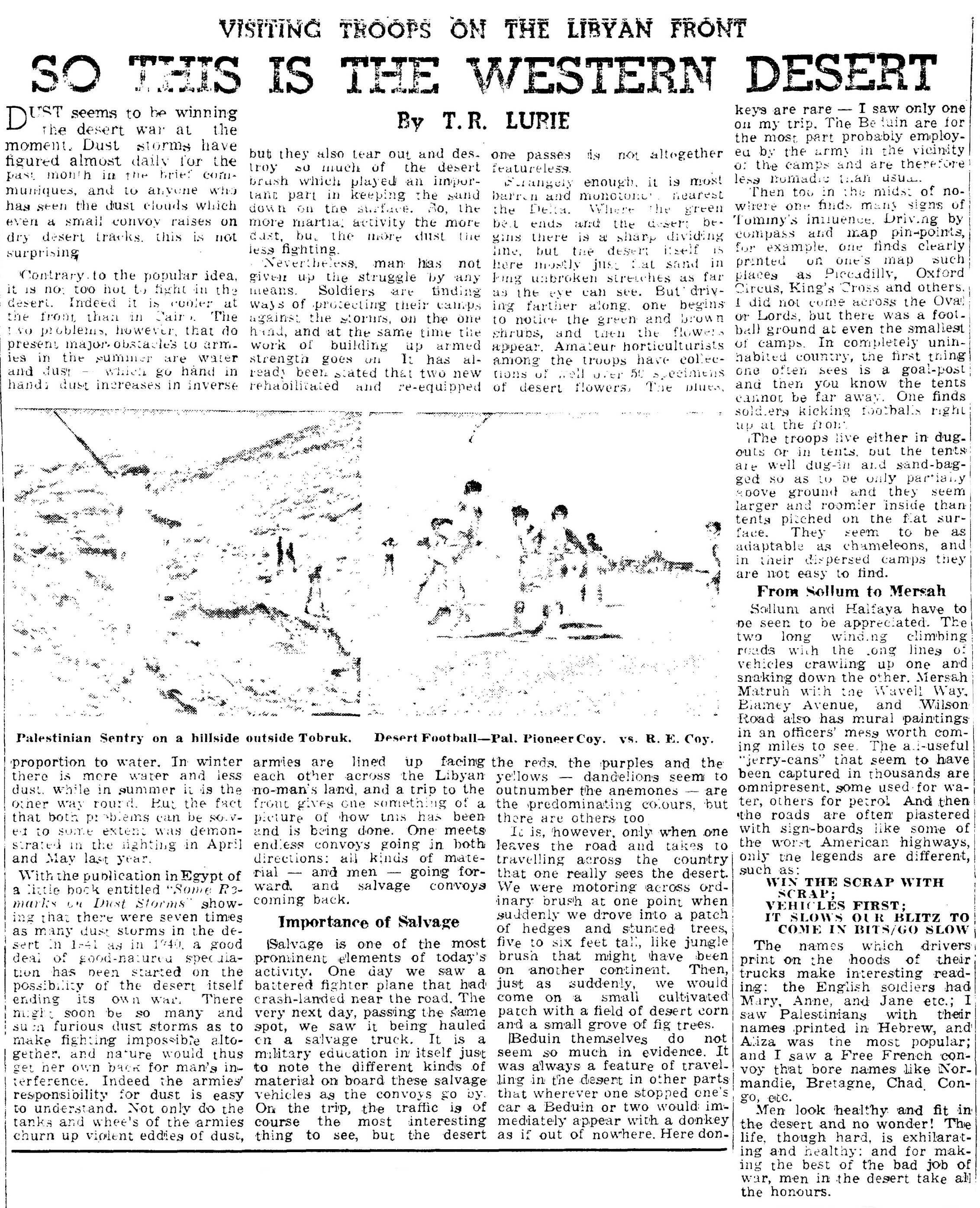
VISITING TROOPS ON THE LIBYAN FRONT
SO THIS IS THE WESTERN DESERT
By T.R. LURIE
The Palestine Post
May 7, 1942
DUST seems to be winning the desert was at the moment. Durst storms have figured almost daily for the past month in the brief communiques, and to anyone who has seen the dust clouds which even a small convoy raises on desert tracks, this is not surprising.
Contrary to the popular idea, it is not too hot to fight in the desert. Indeed it is cooler at the front than in Cairo. The two problems, however, that do present major obstacles to combat in the summer are water and dust – which go hand in hand; dust increases in inverse proportion to water. In winter there is more water and less dust, while in summer it is the other way round. But the fact that both problems can be solved to some extent was demonstrated in the fighting in April and May last year.
With the publication in Egypt of a little book entitled Some Remarks on Dust Storms showing that there were seven times as many dust storms in the desert in 1941 as in 1940, a good deal of good-natured speculation has been started on the possibility of the desert itself ending its own war. There might soon be so many and such furious dust storms as to make fighting impossible altogether, and nature would thus get her own back for man’s interference. Indeed the army’s responsibility for dust is easy to understand. Not only to the tanks and wheels of the armies churn up violent eddies of dust, but they also tear out and destroy so much of the desert brush which played an important part in keeping the sand down on the surface. So, the more martial activity the more dust, but, the more dust the less fighting.
Nevertheless, man has not given up the struggle by any means. Soldiers are finding ways of protecting their camps against the dust storms, on the one hand, and at the same time the work of building up armed strength goes up. It has already been stated that two new rehabilitated and re-equipped armies are lined up facing each other across he Libyan no-man’s land, and a trip to the front gives one something of a picture of how this has been and is being done. One meets endless convoys going in both directions; all kinds of material – and men – going forward and salvage convoys coming back.
Importance of Salvage
Salvage is one of the most prominent elements of today’s activity. One day we saw a battered fighter plane that had crash-landed near the road. The very next day, passing the same spot, we saw it being hauled on a salvage truck. It is just a military education in itself just to note the different kinds of material on board these salvage vehicles as the convoys go by. On the trip, the traffic is of course the most interesting thing to see, but the desert one passes is not altogether featureless.
Strangely enough, it is most barren and monotonous nearest the Delta. Where the green belt ends and the desert begins there is a sharp dividing line, but the desert itself is here mostly just flat sand in long unbroken stretches as far as the eye can see. But driving farther along one begins to notice the green and brown shrubs, and then the flowers appear. Amateur horticulturists among the troops have collections of well over 50 specimens of desert flowers. The blues, the reds, the purples and the yellows – dandelions seem to outnumber the anemones – are the predominating colours, but there are others too.
It is, however, only when one leaves the road and takes to travelling across the country that one really sees the desert. We were motoring across ordinary brush at one point, when suddenly we drove into a patch of hedges and stunted trees, five to six feet tall, like jungle brush that might have been on another continent. Then, just as suddenly, we would come on a small cultivated patch with a field of desert corn and a small grove of fig trees.
Beduin themselves do not seem so much in evidence. It was always a feature of travelling in the desert in other parts that wherever one stopped one’s car a Beduin or two would immediately appear with a donkey as if out of nowhere. Here donkeys are rare – I saw only one on my trip. The Beduin are for the most part probably employed by the army in the vicinity of the camps and are therefore less nomadic than usual.
Then too in the midst of nowhere one finds many signs of Tommy’s influence. Driving by compass and map pin-points, for example, one finds clearly printed on one’s map such places as Piccadilly, Oxford Circus, King’s Cross and others. I did not come across the House of Lords, but there as a football ground at even the smallest of camps. In completely uninhabited country, the first thing one often sees is a goal-post and then you know the tents cannot be far away. One finds soldiers kicking footballs right up at the front.
The troops live either in dugouts or in tents, but the tents are well dug-in and sand-bagged so as to be only partially above ground and they seem larger and roomier inside than tents pitched on the flat surface. They seem to be as adjustable as chameleons, and in their dispersed camps they are not easy to find.
From Sollum to Mersah
Sollum and Halfaya have to be seen to be appreciated. The two long winding climbing roads with the long lines of vehicles crawling up one and snaking down the other, Mersah Matruh with the Wavell Way, Blamey Avenue, and Wilson Road also has mural paintings in an officers’ mess worth coming miles to see. The all-useful “jerry-cans” that seem to have been captured in thousands are omnipresent, some used for water, others for petrol. And then the roads are often plastered with sign-boards like some of the worst American highways, only the legends are different, such as:
WIN THE SCRAP WITH SCRAP;
VEHICLES FIRST;
IT SLOWS OUR BLITZ TO COME IN BITS / GO SLOW
The names which drivers print on the board of their trucks make interesting reading: the English soldiers had Mary, Anne, and Jane, etc.; I saw Palestinians with their names printed in Hebrew, and Aliza was the most popular; and I saw a Free French convoy that bore names like Normandie, Bretagne, Chad, Congo, etc.
Men look healthy and fit in the desert, and no wonder! The life, though hard, is exhilarating and healthy; and for making the best of the bad job of war, men in the desert take all the honours.
References and Readings
Hirsowicz, Lukasz, The Third Reich and the Arab East (translated from the Polish), Routledge & K. Paul, London, England, 1966
Jackson, William G.F., The Battle for North Africa 1940-43, Mason / Charter, New York, N.Y., 1975