A Missing Man: Major Milton Joel, Fighter Pilot, 38th Fighter Squadron, 55th Fighter Group, 8th Air Force: V – A Monday in November: Major Joel’s Last Mission [Updated Post! – January 14, 2021]

[This post, created on November 20, 2020, has been updated.  The post now includes: 1) An area map and formation diagrams that provide a more accurate and clearer representation of the nature of the 55th Fighter Group’s encounter with the Luftwaffe on November 29, 1943, and 2) An additional photograph of Lieutenant John S. Hascall.  Where necessary, other parts of the account have been corrected.  Scroll on down for a look…!]

A Monday in November: Major Joel’s Last Mission

On the 29th of November, 1943, the VIII Fighter Command was tasked with escorting heavy bombers to Bremen, Germany. 

As described by Roger Freeman in The Mighty Eighth, “…the 55th Group again set forth to Bremen, with elements of the 20th Group bringing up the rear.  Just after crossing the Dutch coast at 31,000 ft, Me109s of III J.G.1 pounced on the Lightnings in a surprise attack evidently designed to entice the Americans into releasing their drop tanks prematurely.  Another seven P-38s failed to return to base although three of the enemy were definitely shot down.”

By day’s end, the 8th Air Force lost 16 fighters (7 P-38Hs and 9 P-47Ds), and 13 B-17s (7 Fs and 8 Gs). 

Losses of aircraft by Groups were:

Bombers

94th Bomb Group: 1
95th Bomb Group: 1
96th Bomb Group: 4
303rd Bomb Group: 2
379th Bomb Group: 2
385th Bomb Group: 2
388th Bomb Group: 1

Of the 130 men aboard these 13 aircraft, there would be 54 survivors. 

Fighters

20th Fighter Group: 1
55th Fighter Group: 6
56th Fighter Group: 1
355th Fighter Group: 3
356th Fighter Group: 5

Of the 7 P-38 losses, two men – both members of the 55th Fighter Group – survived.  They were:

2 Lt. John J. Carroll
and
2 Lt. Fleming W. Suiter

Of the 9 P-47D losses, 5 men survived…

2 Lt. Charles K. Hecht, Jr., 355th Fighter Group, 358th Fighter Squadron, Aircraft 42-8631, YF * U (MACR 1284)
2 Lt. Richard Peery, 355th Fighter Group, 358th Fighter Squadron, Aircraft 42-22484, YF * L (MACR 1285)
1 Lt. Warren H. Beach, 356th Fighter Group, 359th Fighter Squadron, Aircraft 42-8601 (MACR 1451)
2 Lt. John D. Hull, 356th Fighter Group, 359th Fighter Squadron, Aircraft 42-8598 (MACR 1452)
and
2 Lt. Julius B. Ashbridge, 356th Fighter Group, 360th Fighter Squadron, Aircraft 42-8502, PI * W, “Hell’s Angel” (MACR 1436)

…and 4 were killed in action:

2 Lt. Alfred J. Del Negro, 355th Fighter Group, 354th Fighter Squadron, Aircraft 42-7996, WR * D (MACR 1286)
2 Lt. Johnnie F. Martin, 356th Fighter Group, 361st Fighter Squadron, Aircraft 42-8692, QI * Q (MACR 1543)
1 Lt. Allan M. Metzger, 356th Fighter Group, 361st Fighter Squadron, Aircraft 42-8509, QI * O (MACR 1453)
2 Lt. Frederick C. Windmayer, 56th Fighter Group, 63rd Fighter Squadron, Aircraft 42-7893, UN * F (MACR 1278)

Balanced against these fighter losses were VII Fighter Command claims of 13.5 German aircraft destroyed, with P-47s achieving 11.5 victories, and P-38s 2. 

Aerial victories were confirmed as follows:

P-38s

55th Fighter Group

38th Fighter Squadron: 1 Victory
338th Fighter Squadron: 1 Victory

P-47s

56th Fighter Group

61st Fighter Squadron: 3 Victories
62nd Fighter Squadron: 1.5 Victories
63rd Fighter Squadron: 1 Victory

355th Fighter Group

358th Fighter Squadron: 1 Victory

356th Fighter Group

359th Fighter Squadron: 3 Victories
360th Fighter Squadron: 1 Victory
361st Fighter Squadron: 1 Victory

And so…

…akin to the prior post – covering Major Joel’s previous combat missions – this post includes:

1) 38th Fighter Squadron Pilot’s Personal Encounter Reports for pilots who engaged in combat with German fighters on this mission
2) Mission Reports filed by the 38th and 388th Fighter Squadrons (…is there one for the 343rd? – I don’t know…)
3) Names of all 55th Fighter Group pilots assigned to the mission (derived from the 38th’s and 338th’s Mission Reports, and for the 343rd, the Squadron History Summary.  This is supplemented by information from the 55th Fighter Group website
4) Missing Air Crew Reports covering the 20th and 55th Fighter Group pilots lost that day.  This includes the “first” page for every such MACR, and an Oogle map showing the area where their aircraft are known (or assumed) to have crashed, based on a variety of references. 

________________________________________

Given the great length (gadzooks…) and complexity (double gadzooks…) of this series of posts, perhaps it’s best to start with an illustration visually summarizing Eighth Fighter Command P-38 losses on the mission, in the form of a diagram superimposed on an Oogle map – below – of northwestern Europe.  This map will appear in subsequent posts.

[Updates to this map from its initial version include the following: 1) The crash locations of three Me-109G-6s of the Seventh Staffel of Jagdgeschwader 1, lost (directly or indirectly) as a result of III./JG 1’s engagement with the 55th Fighter Group’s Lightnings, 2) An adjustment to the easternmost “leg” of the 55th Fighter Group’s intended course into Germany (ironically, the 55th never actually reached Germany!), 3) The crash locations, as much as they can be pinpointed on an ultra-small-scale digital map, of 38th Fighter Squadron pilots Lieutenants Carroll and Gilbride, 4) The serial numbers of the lost P-38s and the three above-mentioned Me-109G-6s.  Information about the three 7./JG 1 losses, and the crash locations of Lieutenants Carroll and Gilbride comes from Part 2 of Teunis Schuurman’s WW II – Research by PATS blog.]

Maps symbols and colors indicate the following:

Bright blue line extending west to east across the Netherlands to a point near the Dutch-German border indicates the approximate or intended course of the 55th Fighter Group for a rendezvous with 8th Air Force bombers.

Black triangle shows the approximate area where the Luftwaffe initially assumed it would intercept the 55th Fighter Group’s P-38s, as explained in the book Jagdgeschwader 1 und 11: Einsatz in der Reichsverteidigung von 1939 bis 1945 (Jagdgeschwader 1 and 11: Used in the Defense of the Reich from 1939 to 1945).

Blue ovals with names adjacent indicate the last reported or assumed location of P-38 losses, based on information in Missing Air Crew Reports.

Red ovals with names adjacent indicate the actual locations where the P-38s were lost.  Notice that there’s no blue oval for Lt. Hascall, because his P-38 was last sighted over the North Sea, at a point “west” of (to the left of) this map view, and Lieutenant Garvin, Major Joel’s wingman, because he definitely crashed at Hondschoote, France (again, well “off the map”).  More information will be presented about Lt. Garvin’s fate in subsequent posts.    

The location of Major Joel’s loss remains unknown.  Some sources suggest the crash location was Marken Island in the Markermeer, indicated by a yellow oval. 

In subsequent posts, I’ll discuss why I believe this location is incorrect. 

Black ovals with names adjacent indicate the loss locations of three Me-109G-6s of 7/JG 1.

[And…  Here’s the “original” map”….]

We begin with the 38th Fighter Squadron’s Mission Report.

November 29, 1943

Mission Report – 38th Fighter Squadron


Extract from Mission Report

Changes in scheduled flights occurred as follows:

There were seven early returns: Maloney landed at 1344 at Torp [sic] Abbots.  Lt. Fisher landed at 1_15 [not legible in microfilm] at home, escort, Lt. Leve landed at home at 1 _15 [not legible in microfilm], blew an inner cooler.  Capt. Hancock landed at 1___ [not legible in microfilm] at home due to engine trouble.  Lt. Birch landed at 1535 at Earlscombe due to engine trouble.  Lt. Peters landed at 1549 at home, engine trouble.  Lt. Marcy landed at 1625 at home due to engine trouble. 

Mission: Over base at 1309.  Proceeded on planned course with landfall in North of  _____ergen [not legible in microfilm], 1350.  Group proceeded along line of Lemmer, Noordwolde, and Grolloo.  Prior to reaching vicinity of Aschendorf, 7 P-38’s had aborted.  Flight plan attached).

Action:  At 1410 group bounced by 40 plus ME 109’s attacking from head-on and above.  At the same time an additional 40 plus E/A were seen below our formation at 27,000.  Several flights of E/A passed through our formation before a majority of our aircraft dropped their belly tanks.  These E/A continued their attacks, very aggressively in elements of 2 and flights of 4 for approximately 15 to 20 minutes.  It was during the early part of this engagement that Lts. Carroll and Albino were lost. 

Action Contd: At approximately 1439 an element led by Capt. Ayers of the 38th being free of E/A attempted to join an element led by Major Joel a considerable distance ahead.  Before this was accomplished additional E/A attacked Capt. Ayers and he was forced to engage.  This is the last time at which Major Joel was seen.  E/A attacks were made all the way to the Dutch coast, but were not pressed home.

Squadron Formation – 38th Fighter Squadron

The “first” version of this post presented diagrams of what I assumed (?!) was the 38th Fighter Squadron’s formation during the November 29 mission.  These were based on a document from the history of the 38th’s brother squadron – the 338th – showing a plan view of the organization of the 338th, by Flights, during the Bremen mission.   But, on reflection and intuition, I began to wonder about this:  Could the “layout” of the 338th’s formation in its squadron history have simply reflected nothing more than (* ahem *) the size and format of the original 8 1/2″ x 10″ document itself, rather than the actual formation used in combat?

So, I took another “look”.  I discovered “8th Air Force Tactical Development, August, 1942 – May, 1945”, at Archive.org.  And within, I discovered the diagram below, which presents the structure of 8th Air Force Fighter Group formations during late 1943 through early 1944:]

So…  Using the upper and central diagrams as references, here are two (brand new) diagrams showing: 1) the formation of the 38th Fighter Squadron at the start of the November 29 mission, and, 2) immediately before the squadron was intercepted by III/JG 1.  The diagrams are purely diagrammatic, and as such are intended to represent the composition of each of the squadron’s four flights and the location of its planes relative to one another, rather than (obviously!) the scale of the actual distances between each plane; between each of its fours flight; between its two sections.    

And (of course!) the direction of flight (this day, east-northeast) is towards the top of your screen or tablet.       

In both diagrams, the name of each pilot is correlated to his position within the formation. 

This “first” diagram shows the formation as planned; as it would – in theory – have been arranged before its interception by III./JG 1.  Those seven planes that returned to Nuthampstead early are indicated by relevant text (i.e. “Engine Trouble”), while the four pilots lost that day – Major Joel, and Lieutenants Albino, Carroll, and Garvin – are denoted in red, with the serials of their P-38s adjacent.   

This “second” diagram shows … well … what was left of the 38th by the time it came under attack by enemy planes: There are nine aircraft remaining.  Note that: 1) The outermost flights of both the Lead and High Sections are gone, 2) The innermost flights of the High Section remain intact, 3) The relative locations of the remaining two Elements from both Flights in the Lead Section suggest a spur-of-the-moment creation of two “improvised” Flights.  Which, as we will see, is what Major Joel was attempting to do at the moment his squadron came under attack.

Unfortunately, the names of the Dutch towns or cities which served as landmarks for the route of the 38th (and its brother squadrons?) towards Bremen are not fully legible in the microfilm copy of the 38th’s Mission Report, but I believe these locations were – as one moves from west to east – Lemmer, Noordwolde, and Grolloo.  Doubly unfortunately, the 38th’s Flight Plan for the mission is absent from the microfilmed squadron history. 

By comparing the 38th Fighter Squadron’s Mission Report with that of the 338th (below), it seems (?) that the 38th – having departed Nuthampstead at 1230 hours, was the 55th Fighter Group’s lead squadron, for the 338th departed later at 1259 hours, with that squadron’s mission report specifically stating that it was the “center” squadron of the 55th formation.  As for the 343rd?  I don’t know, but it was thus probably the rear-most squadron.

The most striking aspects of the mission are:

1) The squadron was depleted to a little over half its strength – from sixteen to nine aircraft – by the time it was intercepted by Me-109s.  The 338th experienced a parallel decrease in its fighting power.
2) The sheer number of enemy fighters – certainly over forty – attacking head-on, from a higher altitude: a ratio of over four to one;
3) The intensity and duration of the squadron’s combat with German fighters, interception having commenced at 1410, with Major Joel presumably being shot down at @ 1440.  Thus, the Squadron was engaged in combat for at least a half-hour by the time Major Joel was shot down – and this was before the loss of the Group’s other P-38s;
4) There is no evidence – at least, nothing recorded – that the 38th was actually able to rendezvous with the B-17s that the 55th Fighter Group had been assigned to escort;
5) (This will come in later…) There was an overcast at 27,000 feet, corroborated in Missing Air Crew Reports for the Group’s losses. 

Pilot’s Personal Encounter Report – Captain Jerry H. Ayers

Transcript of Pilot’s Personal Encounter Report – Captain Jerry H. Ayers

Two ME 109’s were attacking two P-38’s from three o’clock in front of me.  My wingman and I started to close in and knock them off but they did not press home their attack.  Instead they flew straight through behind those airplanes and in front of us. 

I turned left with them and picked a four radii lead on the lead ME 109.  I held this lead and fired from 90 degrees deflection to 45 degrees.  The range was about 250 yards. 

I was forced to break off my attack and was unable to observe any results because of four ME 109’s coming down on us from behind.  We continued our turn to the left and we turned into this attack which was broken off before we were in firing range. 

Lt. Erickson, my wingman later stated that he saw the airplane going down in a slight spin in flames and trailing thick black smoke, so I concluded that this aircraft was destroyed by my attack. 

The ME 109’s were painted with a mottled brown camouflage and had what appeared to be a large red ball painted at the rear of the fuselage where the Luftwaffe cross usually appears.

Pilot’s Personal Encounter Report – Captain Thomas E. Beaird, Jr.

Transcript of Pilot’s Personal Encounter Report – Captain Thomas E. Beaird, Jr.

On the second bounce going into the target, I lost the rest of my flight and tacked onto the nearest semblance of a flight I could find.  We ended up with five ships and made three bounces on ME 109’s attacking two P-38’s below us, then we were bounced by five ME 109’s from above.  When we got out of that skirmish, in which I did not get to fire nor did not see anyone go down, I found myself way behind the rest of the P-38’s.  I pushed everything to the fire wall and after about ten minutes caught four P-38’s flying very loosely.  I joined them and had just throttled back when somebody started telling the bunch, who were very high in the back, that there were a number of enemy fighters catching from 6 o’clock.  We poured everything to our ships (were at 34,000) and somebody told us they were still gaining. 

At this time I saw five ME 109’s about our same level over my right shoulder.  I looked over my left shoulder and saw one ME 109 right on the tail of the P-38 to my left and behind.  I called for Major Joel’s wingman [Lt. Garvin] to break (I thought I had joined Major Joel’s flight).  I broke left to meet the ME 109 head on.  The P-38 ahead of me to my left also broke left.  The ME 109 dove for the clouds.  I continued in a left turn to take up my original heading and came out almost directly behind a ME 109 with one P-38 off to my right.  I started closing on the ME 109 that seemed to be in a very steep climb for that altitude.  I fired one fair burst; saw a flash on his canopy and observed him pull his nose straight up hang on his prop and then spin under my left wing.  I turned to the left to clear my tail, looked back and saw him spin into the overcast.  I believe this plane was destroyed by my strikes on the canopy.

Pilot’s Personal Encounter Report – 2 Lt. Robert E. Erickson (1)

Transcript of Pilot’s Personal Encounter Report – 2 Lt. Robert E. Erickson (1)

I was flying wing man to Captain Ayers, who was leading Swindle Red Flight.  After engaging with enemy aircraft and completing three 360 degree orbits, we started for home.  Captain Ayers and myself were two of five P-38’s at the rear of the group.  We observed three enemy aircraft catching us from the rear.  At this time I was at 33,000 feet.  Captain Ayers called for help and Captain Franklin and Lt. Gilbride of the 343rd came back.  At this time one enemy aircraft came behind Captain Franklin and two behind me.  We broke left, I completed my turn and came down on the second ME 109 and fired observing hits on wings and near canopy.  These two immediately rolled and dove for the clouds.  Captain Franklin had to feather his engine in the middle of his break and Lt. Gilbride presumably was shot down.  I then broke off my attack as the ME 109’s dove and flew back to cover Captain Franklin who was then on one engine.  At this time four more enemy aircraft were tailing me so Captain Franklin unfeathered his engine and got as much power as he could out of it and we came home together.  The enemy aircraft dropped off either because of fuel shortage or we outran them.  This action took place between 31,000 and 35,000 feet. 

Pilot’s Personal Encounter Report – 2 Lt. Robert E. Erickson (2)

Transcript of Pilot’s Personal Encounter Report – 2 Lt. Robert E. Erickson (2)

I was flying wing man to Captain Ayers on escort mission over Bremen on November 29.  We were engaged with several enemy aircraft, when Captain Ayers observed two ME 109’s attacking two P-38’s from the rear.  We dived at them from the sun from above and slightly to the starboard of enemy aircraft.  Captain Ayers fired at the leading enemy aircraft from about 350 yards closing to 200 yards from about 50 to 75 degrees deflection.  We then broke off and climbed slightly to the left as we broke.  I noticed enemy aircraft burning with heavy black smoke and going down in a big spiral apparently out of control.  In my opinion this airplane was destroyed.  These aircraft were painted with a brown camouflage.

Here’s the 338th Fighter Squadron’s Mission Report.  Note that the third page lists the names of pilots on the mission, while the fourth page is a diagram of the squadron formation.

Mission Report – 338th Fighter Squadron

English Coast out 5 miles No. of Southwold, 1322 at 20,000 ft.  In enemy coast 1347 at 31,500.  Flew at 31,500 to Hude where interception was made on squadron by 30+ ME 109’s from about 32,000 ft. at 12 o’clock.  Turned to engage E/A and flew weaving course to Dutch Coast.  Landfall out Ijmuiden 28,000 ft.  Landfall in English Coast 31,000 at South End located selves by Thames Estuary and flew direct to base.

30+ ME 109’S from above at 12 o’clock on squadron which was flying as center of group and slightly in front.  At enemy attack dropped belly tanks and broke into them.  At this time squadron had been reduced to two four ship flights by abortions.  Made two 90   turns while taking evasive action to combat E/A.  White flight was being followed by 3 / 4 E/A who broke up flight.  Leader descending into overcast.  No. 2 man was not seen after this point – No. 3 and 4 broke No. 3 with E/A on his tail No. 4 with engine trouble.  No. 1 man of second flight Capt. Patterson, dove on E/A and shot it down and off tail of White 3/.  Red flight and No. 3 man of White flight flew together to Dutch Coast where were joined by No. 4 man of white flight, Lt. Turner, Colonel James, White leader flew through overcast to coast and across channel alone.  These five aircraft were under constant but inaggressive attacks by E/A to the coast.  Initial enemy attack occurred in vicinity of Heede and E/A was shot down about four N. of Emmen.  Lost contact with other squadron of group during action with E/A.  Never contacted bombers.  Enemy attack seemed definitely intended as interception of out squadron and other E/A were observed in distance to each side an above.  One P-38 observed by several members of squadron going into overcast shortly after initial engagement apparently out of control. 

Some observations…

1) The 338th, comprised of 14 aircraft, departed Nuthampstead at 1259 hours, after the 38th;
2) Like the 38th, the squadron of fourteen planes was depleted by six by the time it was intercepted, thus substantially reducing its strength;
3) Akin to the 38th, the squadron was intercepted by a much larger number of German fighters (in this case, over 30).  Again paralleling the 38th’s experience, the enemy planes attacked the squadron – at 31,500 feet – head-on from a slightly higher altitude (32,000 feet);
4) The 338th lost contact with the other “squadron” (squadrons?) of the 55th during combat with German fighters;
5) The squadron was unable to make contact with the B-17s it was assigned to escort;
6) A significant observation:  “Enemy attack seemed definitely intended as interception of our squadron and other E/A were observed in distance to each side and above.  One P-38 observed by several members of squadron going into overcast shortly after initial engagement apparently out of control.”;
7) Weather conditions ranged from half to nearly complete cloud cover over the English Channel, to complete overcast over the continent. 

–

Transcript of Squadron Formation – 338th Fighter Squadron

White Flight

James, Frank B., Col. (Group Commanding Officer)
Suiter, Fleming W., 2 Lt.
Marsiglia, Joseph P., Capt.              
Turner, William G., 2 Lt.

Red Flight

Busching, Richard W., Major
Turner, Lloyd, 2 Lt.
Patterson, Chet A., 2 Lt.
Garlock, Karl H., 2 Lt.

Yellow Flight

Jones, Charles O., Capt.
Anderson, Newell, F/O
Tibbetts, Wesley M., 1 Lt.
Burns, William H, 2 Lt.

Spares

Brown, Robert W, 2 Lt.
Dempsey, Peter, 2 Lt.

Squadron History – 343rd Fighter Squadron

Regarding the 343rd Fighter Squadron, information presently available to me – presented below – is limited to the brief account in the squadron’s historical record, rather than an actual Mission Report.
1) This squadron was unable to rendezvous with the 8th Air Force B-17s;
2) The squadron was outnumbered by enemy planes. 


Transcript of Squadron History – 343rd Fighter Squadron

On Nov. 29th, Capt. Malmstedt led the Squadron, the mission again being bomber escort to Bremen.  R/V was not made with the big ships, but engagement with E/A was pressed as the squadron reached the scheduled point.  Superiority of numbers was again in favor of the enemy and while our pilots distinguished themselves, the show was exceedingly rough.  During the prolonged engagement, 2nd Lt. James Gilbride was lost to enemy action and none of our pilots observed his disappearance.  Beside Capt. Malmstedt, pilots on the mission were: Capts. Franklin, Giller, Ryan, 1st Lts. Hoeper, Barnett, 2nd Lts. Bauer, Birtciel, De Young, Fluty, Gilbride, Stanton, Stephenson and Brown.

The pilot’s names of the 343rd’s fourteen pilots on this mission are listed below, following the sequence of names as listed in the squadron history.  This is apparently based on rank, and would almost certainly not represent the organization of the squadron’s four flights.  (For example, 2 Lt. James W. Gilbride was wingman to Capt. Rufus C. Franklin, but these mens’ names aren’t adjacent in the list.)

Pilots Participating in Mission – 343rd Fighter Squadron

(Full names Derived from Biographical Profiles at 55th Fighter Group)

Malmstedt, Roland M., Capt. (Led Squadron) (Killed in flying accident in P-38H 42-67076 on 12/2/43)
Franklin, Rufus C., Jr., Capt.
Giller, Edward B., Capt. (To Lt. Col. 4/29/45)
Ryan, Eugene E., Capt. (To Major)
Hoeper, Paul E., 1 Lt. (To Major)
Barnett, John, 1 Lt. (KIA 1/5/44)
Bauer, Harold M., 2 Lt. (To 1 Lt.)
Birtciel, Frank E., 2 Lt. (To Capt. 12/44)
De Young, Arthur A., 2 Lt. (To Capt.)
Fluty, Joseph M., 2 Lt. (To 1 Lt.) (Killed 3/8/44 in P-38J 42-67751)
Gilbride, James W., 2 Lt. (To 1 Lt.) (KIA on this mission … see below)
Stanton, Richard C., 2 Lt. (To Capt.)
Stephenson, Franklin A., 2 Lt. (To Capt.)
Brown, Robert D., 2 Lt. (To Capt.)

And, ten “spares” from the 77th Fighter Squadron of the 20th Fighter Group

The IDPF (Individual Deceased Personnel File) for 2 Lt. Lieutenant Albert A. Albino includes correspondence by Gerrie J. Zwanenburg (of the Royal Netherlands Air Force) from March of 1978, pertaining to the discovery and identification of Lt. Albino’s remains.  This communication notes that ten pilots of the 77th Fighter Squadron accompanied the 55th Fighter Group on this mission, “to gain operational experience.”  Though the mens’ names are not listed in Zwanenburg’s communication, the identities of two are definitely known, because one of these pilots – John Hascall; see below – was missing that day, and thus his loss was recorded in a MACR.

Frakes, Robert D., 2 Lt., 0-746075
Hascall
, John S., 2 Lt., 0-746103

Those Who Did Not Return

20th Fighter Group, 77th Fighter Squadron

2 Lt. John Sherman Hascall, P-38H 42-67016, “LC * O“, MACR 1424

55th Fighter Group, 38th Fighter Squadron

2 Lt. Albert Anthony Albino, P-38H 42-67051, “Spirit of Aberdeen“, MACR 1428
2 Lt. James Michael Garvin, P-38H 42-67046, MACR 1427
Major Milton Joel, P-38H 42-67020, “CG * A“, “flying wolf”, MACR 1429

55th Fighter Group, 343rd Fighter Squadron

2 Lt. James William Gilbride (Bailed out – did not survive), P-38H 42-67097, MACR 1272

Those Who (Eventually) Returned

55th Fighter Group, 38th Fighter Squadron

2 Lt. John Joseph Carroll (Prisoner of War), P-38H 42-67090, “FOB Detroit“, MACR 1431

55th Fighter Group, 338th Fighter Squadron

2 Lt. Fleming William Suiter (Prisoner of War), P-38H 42-67069, MACR 1273

This section presents images from Missing Air Crew Reports for the 20th and 55th Fighter Group pilots lost on this mission.  The MACRs are presented by Group and squadron, and then alphabetically by pilot’s surnames. 

Detailed information about the fates of Lieutenats Albino, Carroll, Gilbride, Suiter, incomplete information about Lieutenant Garvin, and finally, speculation about what may have happened to Major Joel can be found in the post A Postwar Search: The Missing of November.

Note that the first page of every MACR for a 38th Fighter Squadron pilots bears the signature of Captain Robert W. Wood – at first the squadron’s Communications Officer and later its Executive Officer – from whom more will be heard in the upcoming post Fragments of Memory.

______________________________

2 Lt. John S. Hascall (77th Fighter Squadron, 20th Fighter Group), MACR 1424
(“Spare”, with 2 Lt. Robert D. Frakes)

Here’s a picture of Lieutenant Hascall, from the Michigan Technological University Website. 

Update to this post: As you can see, the above image is actually cropped from this photo, below, found at the Pilot’s Gallery of the 20th Fighter Group website.  This photo was evidently taken for publicity or group history purposes, as the Pilot’s Gallery includes an image of at least one other pilot (also garbed in flight suit and helmet; also wearing a Mae West and parachute) posed on the same P-38.   

Transcript of Certificate – 2 Lt. Robert D. Frakes

On November 29, 1943, I took off for a mission as a spare with Lt. Hascall on my wing, also a spare.  We had instructions to join any squadron needing a spare.  After many abortions we were the last spare in the group and I fell in on the wing of the second element in the 343rd Squaron.  We were about midway over the channel with a solid overcast below at 25,000 feet.  I did not see the opening in the 343rd Squadron when Lt. Hascall waved me over.  I do not remember whose flight he joined, if any because I did not see any other abortions.  My position then was on the front starboard flight and he was flying to the rear port flight.  At that time his plane was functioning perfectly.

Transcript of Certificate – 1 Lt. Francis W. Barkley, Intelligence Officer (Detached)

On 29 November 1943 due to the number of planes lost on mission none could be positively identified as Lt. Hascall.  However, in compilation of interrogations by Group Intelligence it is though that Lt. Hascall may have gone down in the vicinity East of Aschendorf, Germany where the group was first bounced.  Several ships were seen spinning down in this area.  No definite knowledge as to identity of these but it is thought that Lt. Hascall got that far along the route as nothing points to his being lost before this.

______________________________

2 Lt. Albert Anthony Albino (38th Fighter Squadron, 55th Fighter Group), MACR 1428

This photo, taken by Sergeant Robert T. Sand, appears in Double Nickel, Double Trouble, and shows 38th Fighter Squadron ground crew members conversing with Lt. Albino (wearing Mae West and sunglasses) in front of his personal P-38 (“Spirit of Aberdeen”) as he describes a just-completed combat mission. 

The map below shows what was believed to have been the location where Lieutenants Albino, Carroll, Garvin, and Major Joel were last seen: Over Germany, west of Oldenburg, and specifically west of the intersection of the Leda and Kusten Canals, at the location designated by the blue X.  Scanned at the National Archives from MACR 1429, this map is included in the Missing Air Crew Report for each of these four pilots.  Note that cartographic reference features primarily comprise canals and rivers, rather than cities. 

Transcript of Eyewitness Account – Capt. Thomas E. Beaird, Jr.

Our flight was slightly trailing the other three flights going to the rendezvous.  Our flight leader had to fall out and called to me to take over.  I acknowledged and called the flight to step up the mercury as I was going to catch up.  At this time Lt. Albino was 2nd in the flight, approximately 3 ship lengths behind me and approximately 4 ship lengths in front of Lt. Peters.  We were in the same relative position but had closed considerably on the leading flights, when someone called, “Bogies coming down at three o’clock, get rid of your tanks”.  I turned to the right dropped my tanks and looked to see if Lt. Albino and Peters had gotten rid of theirs.  This was the last time I was able to locate Lt. Peters or Albino as almost immediately we were bounced from approximately 8 o’clock and the lead flights from, I think, about 1 o’clock.

After we tangled there seemed to be nothing but individual ships that joined up to make flights as best they could.

Transcript of Eyewitness Account – 2 Lt. Edward F. Peters

I was flying #2 position in a flight lead by Capt. Hancock.  Capt. Hancock started a turn to the right, leaving because of engine trouble, and as we were deep in enemy territory I started with him, however, he called and said I should turn back to accompany group.  I started to return but by this time I had fallen way back, out of formation and as I increased manifold pressure my left engine cut out at 24” HG.  I continued trying to catch up and ahead of me about ½ a mile was Lt. Albino and ahead of him was Capt. Beaird.  He, Lt. Albino, was quite a distance behind Capt. Beaird and I followed for about 4 or 5 minutes.  At this time the group was bounced and the order given to drop “babies”.  [i.e., “jettison drop tanks”]  I looked behind and directly below saw six E/A which I called in.  I looked above and behind and saw one E/A diving at me from about 7 O’clock.  I broke into him and he fired at me as he passed over top.  I looked for the group but as I could only see their contrails, and due to the one faulty engine, I turned and came back alone.

It is possible that the E/A which attacked me or the six below could have continued on their way and caught Lt. Albino as he was straggling.

______________________________

2 Lt. James M. Garvin – Major Joel’s wingman – (38th Fighter Squadron, 55th Fighter Group), MACR 1427

Photo of James Garvin from Double Nickel, Double Trouble

Transcript of Eyewitness Account – Capt. Rufus C. Franklin

On 29 November 1943, my wingman, Lt. J.W. Gilbride, and myself participated in an engagement in which Major Joel, C.O. of the 38th Fighter Squadron, and his wingman, Lt. Garvin, were lost and possibly this statement may shed some light on their disappearance.

The main body of the group was proceeding toward home when Major Joel was heard calling for help from far behind us.  Lt. Gilbride and I turned back to help but it took several minutes for us to reach the fight.  As we drew near we could see five P-38’s engaged and each had from one to three ME 109’s on its tail.  Just before we went into the fight one P-38 rolled over and went down with its left engine leaving a very long and very heavy trail of black smoke and with a 109 directly behind.  As my wingman and I flew into the middle of the engagement the E/A were surprised into rolling away from the ships they were attacking and we were all able to take a heading for home.  At this time there were four P-38’s left besides my wingman and myself.  As we started home we were followed by E/A and we tried to outrun them.  One of the four P-38’s ran away from the rest and disappeared.  The five of us remaining were eventually caught by the E/A and engaged again. 

After we saw the one P-38 go down smoking I did not again recognize Major Joel’s voice on the radio.  The five of us that were later engaged by the pursuing E/A were, Capt. Ayers, Capt. Beaird, Lt. Erickson, Lt. Gilbride, and myself.  On this attack I lost one engine that had been going bad and when I recovered the only other P-38 visible in the area was piloted by Lt. Erickson.  We came out together.

In view of the circumstances it is my personal opinion that the P-83 we saw shot down was piloted by Major Joel and the one that ran away from us was piloted by Lt. Garvin, who did not return.

Transcript of Eyewitness Account – Capt. Jerry H. Ayers

We were on a B-17 escort mission to Bremen, Germany, when at 14:10, just prior to our R.V. point, we were jumped by Hot Bandits.

Major Joel was leading the first section of the squadron composed of eight ships.  Lt. Wyche was leading the other Flight in the lead section.

Capt. Hancock was leading the second section and I had the other flight.  Due to abortive aircraft Major Joel had lost his second element also Lt. Wyche had lost his.  Capt. Hancock and his wingman returned.  My second element had returned and we were trying to rejoin into two four ship flights.  When we were successively bounced by units from a group of about 40 enemy aircraft from one or two o’clock out of the sun.  We turned right into the attack and were engaged for some time.  At the time of the first break was the last time that I saw Major Joel and his wingman, Lt. Garvin, that I could recognize them.

______________________________

2 Lt. John J. Carroll (38th Fighter Squadron, 55th Fighter Group), MACR 1431

Portrait of John J. Carroll, from Double Nickel, Double Trouble

John Carroll’s POW identification photograph, from Double Nickel, Double Trouble.  He spent the remainder of the war in Stalag Luft I (North Compound), at Barth, Germany.

Transcript of Eyewitness Account – 1 Lt. Wilton E. Wyche

At 14:15 we were attacked by E/A out of the sun at 3 o’clock.  Major Joel, leading, with Lieut. Garvin as wingman and my position with Lt. Carroll as my wingman was about 300 yards to the right.  A right turn of about 90_ was made and through this I crossed under Major Joel’s element and stopped turning on the left side of the Major’s element.

About six E/A were turning into us from 7 o’clock, and after calling Major Joel to break left, I started a left turn.  After turning about 90 (degrees), I tightened my turn too much and my airplane snapped and started to spin.  This was the last I saw of Lieut. Carroll or Major Joel and his wingman. 

______________________________

Major Milton Joel (38th Fighter Squadron, 55th Fighter Group), MACR 1429

The eyewitness accounts pertaining to Major Joel’s loss are signed by Captains Jerry H. Ayers and Rufus C. Franklin, Jr., the latter of the 343rd Fighter Squadron.

Transcript of Eyewitness Account – Capt. Rufus C. Franklin
(Identical to account concerning 2 Lt. James M. Garvin)

____________________

This is the file card bearing Major Joel’s name, from the master name index for Missing Air Crew Reports in National Archives Records Group 92. 

Major Joel’s file card is entirely typical of such cards in the MACR master name index, bearing no information other than his name, serial number, and pertinent MACR number.   For those men for whom MACRs were never actually filed – and there are cards for many, many such men in the master name index – the data field in the upper right corner is entirely blank or simply says “No MACR”.  

____________________

On 29 November 1943, my wingman, Lt. J.W. Gilbride, and myself participated in an engagement in which Major Joel, C.O. of the 38th Fighter Squadron, and his wingman, Lt. Garvin, were lost and possibly this statement may shed some light on their disappearance.

The main body of the group was proceeding toward home when Major Joel was heard calling for help from far behind us.  Lt. Gilbride and I turned back to help but it took several minutes for us to reach the fight.  As we drew near we could see five P-38’s engaged and each had from one to three ME 109’s on its tail.  Just before we went into the fight one P-38 rolled over and went down with its left engine leaving a very long and very heavy trail of black smoke and with a 109 directly behind.  As my wingman and I flew into the middle of the engagement the E/A were surprised into rolling away from the ships they were attacking and we were all able to take a heading for home.  At this time there were four P-38’s left besides my wingman and myself.  As we started home we were followed by E/A and we tried to outrun them.  One of the four P-38’s ran away from the rest and disappeared.  The five of us remaining were eventually caught by the E/A and engaged again.

After we saw the one P-38 go down smoking I did not again recognize Major Joel’s voice on the radio.  The five of us that were later engaged by the pursuing E/A were, Capt. Ayers, Capt. Beaird, Lt. Erickson, Lt. Gilbride, and myself.  On this attack I lost one engine that had been going bad and when I recovered the only other P-38 visible in the area was piloted by Lt. Erickson.  We came out together.

In view of the circumstances it is my personal opinion that the P-83 we saw shot down was piloted by Major Joel and the one that ran away from us was piloted by Lt. Garvin, who did not return.

Transcript of Eyewitness Account – Capt. Jerry H. Ayers
(Identical to account concerning 2 Lt. James M. Garvin)

We were on a B-17 escort mission to Bremen, Germany, when at 14:10, just prior to our R.V. point we were jumped by Hot Bandits.

Major Joel was leading the first section of the Squadron composed of eight ships.  Lt. Wyche was leading the other Flight in the lead section.

Capt. Hancock was leading the second section and I had the other flight.  Due to abortive Aircraft Major Joel had lost his second element also Lt. Wyche had lost his.  Capt. Hancock and his wing man returned.  My second element had returned and we were trying to rejoin into two four ship flights.  When we were successively bounced by units from a group of about 40 enemy aircraft from one or two o’clock, out of the sun.  We turned right into the attack and were engaged for some time.  At the time of the first break was the last time that I saw Major Joel and his wingman, Lt. Garvin, that I could recognize them.

_____________________________

2 Lt. James W. Gilbride (338th Fighter Squadron, 55th Fighter Group), MACR 1272

Photo of James Gilbride from Double Nickel, Double Trouble

Transcript of Eyewitness Account – Capt. Rufus C. Franklin

On the mission of November 29, 1943, target – Bremen, I was leading Whiteman Yellow Flight composed of Lieutenants James W. Gilbride, Harold Bauer and an unidentified spare, flying numbers 2, 3 and 4 respectively.

At approximately 1210 hours, I reported many bandits approaching from below at 3 o’clock; this was about in the target area.  Colonel James had started a right turn to meet the enemy aircraft when we met about 16 enemy aircraft head-on at about 29 to 30,000 feet.  The main body of the Group went into a right Lufberry Circle for approximately two complete turns.  Colonel James was [not] leading the Group at or from this time, as he was having engine trouble and was below us.  My second element disappeared about this time as Lieutenant Bauer was having trouble losing his belly tanks.  Lieutenant Gilbride stayed with me in an excellent manner, calling in enemy aircraft calmly and doing a good job of covering.  The main Group stayed in their Lufberry but I would break out momentarily from time to time to get my wing out of the sun so that I could see if another attack was imminent.

About this time, after two complete turns, the main Group started home and I, thinking that the Group Commander had resumed the lead, followed along.  As we left the area there were several people calling for help from far behind.  The main Group continued on away until we were at least seven miles from this fight.

Just as I had almost decided to go back and help the boys calling repeatedly, the Group started a turn and appeared to be going back but instead made a tight 360 degree turn and went away from the fight again.  I could see the fight behind us as the Group made the turn and I broke out – Lt. Gilbride and I went back to help.

As we drew near we saw one P-38 go down smoking very heavily and probably on fire.  We could see 4 other P-38s in a dog-fight in a small area, each with 1 to 3 ME 109s on his tail.  Lt. Gilbride and I drove right into the middle of the fight and the enemy aircraft were so surprised that they pulled away from the ships they were chasing and began to climb again.  The 4 P-38s we had helped started for home while Lt. Gilbride and I were making a 180 degree turn to try to go with them.  One P-38 ran away from us, 2 were well in front and 1 was straggling.  Five ME 109s out to one side and about a mile back were chasing us.  The straggling P-38 was caught by Gilbride and I and we joined line abreast about 175 yards apart.  The straggler was Lt. Erickson of the 38th Fighter Squadron.

At this point my left turbo went bad and the engine began to lose all of its oil.  We tried to outrun the pursuing 109s but the other 2 38s weren’t fast enough and mine was only putting out 30 inches manifold pressure on the left engine.  The enemy aircraft closed down slowly to about 800 yards behind, 700 yards to the side and 1000 feet above.  Suddenly one of 109s slid away from his flight and with his superior altitude closed down to 400 yards behind me, I was middle ship of the three.  Lt. Gilbride started to break back into him but I told him to sit tight as that was just what the Jerries wanted.  The enemy aircraft sat within range for about a minute, not firing, and then moved over on Gilbride’s tail.  I edged over toward Gilbride and the enemy aircraft changed back to my tail.  The enemy aircraft made the change 4 times.  I was determined not to fall for their bait and forced myself and the other two to continue straight ahead. 

Finally the other 4 enemy aircraft moved up abreast of Lt. Erickson, on my left, and started into us.  I called “break”, and the three of us turned into them.  At this point my left engine quit, I feathered, continued my break about 100 degrees and then turned back toward home.  Lt. Gilbride was behind as my engine quit but when I regained control and looked he was not there.  I continued and 1 P-38 appeared behind me with 4 109s behind him.  They were all closing me very rapidly, so I unfeathered the left engine, intending to use it until it caught fire.  The P-38 pulled along side, pilot Erickson, and the enemy aircraft were approximately 500 yards back. 

Erickson and I stayed abreast for about 2 minutes with the enemy aircraft following.  I took a look around the area and when I looked back the enemy aircraft were no longer following.  I eased off the left engine and Erickson and I came home.  The enemy aircraft had followed us just past the Dutch coast.

Lt. Gilbride disappeared at approximately 1240 hours about 12 miles east of Keppel.  The one ME 109 that had been trying to bait us had half rolled when the three of us broke into the four and it is possible that Gilbride followed him and got into trouble.  The other four followed the two of us so it is impossible to say how many Lt. Gilbride became engaged with later, if such be the case.  Neither Erickson nor I heard Gilbride say anything over the radio about trouble and we had maintained good radio contact until that time.

We later identified three of the four P-38 pilots who had helped us as Captain Ayers, Captain Beaird and Lieutenant Erickson, all of the 38th Fighter Squadron.  The fourth man’s name has not been ascertained, nor has the name of the man who was shot down.

______________________________

2 Lt. Fleming W. Suiter (343rd Fighter Squadron, 55th Fighter Group), MACR 1273

Transcript of Eyewitness Account – Capt. Chet A. Patterson

I was flying lead position in second flight at the time we were approximately 10 miles north of Emmen, Holland, when we met 4 head on attack of 30 plus Enemy Aircraft.  I turned right to engage the enemy, and then saw four friendly aircraft behind and below, being attacked.  The friendly aircraft which I identified as flown by 2nd Lt. Fleming W. Suiter, 0-713363, appeared to be shot down as he went down through the overcast.  This was the last I saw of Lt. Suiter.

Next: Part VI – The Missing Years

A Missing Man: Major Milton Joel, Fighter Pilot, 38th Fighter Squadron, 55th Fighter Group, 8th Air Force: IV (1) – Autumn Over Europe

Autumn Over Europe

If a tale is most directly told in the “first person”, what better way to present the nature of aerial combat in the P-38 Lightning over Europe, than in the words of Major Joel himself?

To that end, this post presents the following information and documents:

1) A list of Major Joel’s combat missions;

2) His accounts of aerial engagements with the Luftwaffe – recorded in documents known as “Pilot’s Personal Encounter Reports” – specifically for missions on November 3, 5, and 13, of 1943; 

3) Encounter Reports filed by other 38th Fighter Squadron pilots on those same dates;

4) “Mission Reports” (albeit not specifically entitled as such) filed by the 38th Fighter Squadron for the above missions (well, such Reports were recorded for all missions, even the most uneventful), encompassing the names of pilots on the mission, the nature and destination of the mission, a summary of events during the mission, and finally, the planned organization of the squadron in terms of the arrangement of its aircraft.

Speaking of the latter…  The 38th Fighter Squadron, akin to its brother squadrons (and I suppose in a general sense, other VIII Fighter Command squadrons?), organized its aircraft in units dubbed “elements” and “flights”, comprised of two and four aircraft, respectively, with a flight consisting of two elements.  For organizational and communication purposes, the flights were designated by colors, with the lead flight being “white”, followed (sequentially) by “red”, “yellow”, “blue”, and “purple”.  (These terms did not mean that the aircraft were physically marked or painted in these colors!)  As such, Major Joel generally lead the 38th Fighter Squadron as flight leader of “white” flight.

For the three missions during which Major Joel engaged in combat with German aircraft, copies of all relevant squadron Mission Report, and Encounter Reports filed by participating pilots are included.

Due to the poor legibility of the these documents (at least as 16mm microfilm) Encounter and Mission Reports are here presented as reproductions of the originals.  These were created using a 50s-era manual typewriter (remember those?) which fortuitously had same font as that of the original Reports: Times New Roman.  So…  As such, these recreated Reports – scroll below – are identical in format and layout to the originals. 

The main text of these Reports is presented here, as well.

Major Joel’s Combat Missions

The 55th Fighter Group’s first mission took place on October 15, 1943.  This was a fighter sweep of Dutch coastal islands, the first of the nineteen missions that Major Joel would fly until his death nearly a month and a half later.  One of these missions (October 16) was a practice mission, and another (October 30) was recalled by the mission Controller – and thus aborted for the entire 55th Fighter Group – after take-off.  Major Joel’s other missions comprised six fighter sweeps, and, three escorts of medium bombers (B-26s Marauders), the remainder having been fighter escorts of B-17s and B-24s

During this time Major Joel was credited with destroying 2 ½ German planes, damaging 3, and probably destroying 2. 

A list of the Major’s missions appears below.  While this compilation is primarily based on the historical records of the 38th Fighter Squadron, it’s supplemented by information in Major Joel’s biographical profile at the 55th Fighter Group, and, information about the 55th Fighter Group via the American Air Museum in Britain. 

Each entry includes the date of the mission, the 8th Fighter Command’s alpha-numeric designation of the mission, and the type and / or destination of the mission.  The names of Major Joel’s wingmen and the names of the other two pilots in his flight’s second element are also listed, along with the “color” designation of Major Joel’s flight. 

On those missions where Major Joel destroyed or damaged German aircraft, the number and types of the enemy warplanes are also listed.  Reviewing this list reveals that with one exception, he flew with the same wingman no more than twice.  The exception?  2 Lt. James M. Garvin, who was also killed on November 29, the third occasion on which the Major and Lt. Garvin flew as element leader and wingman.

And so, Major Joel’s missions…

1) October 15, 1943 – VIII Fighter Command Mission FO-157 or FO-158
Fighter Sweep – Dutch Islands
(Squadron organization was not recorded.)

2) October 16, 1943
Practice Bomber Escort – England (Orfordness and Great Yarmouth)
(Joel & F/O David D. Fisher; Capt. Joseph Myers & 2 Lt. Willard A. Kreft)
(White Leader)

3) October 16, 1943 – VIII Fighter Command Mission FO-159
Fighter Sweep – Netherlands (Amsterdam)
Red Leader
(Joel & 2 Lt. Richard W. Forsblad; Capt. James H. Hancock & 2 Lt. Hugh E. Gillette)

4) October 17, 1943 – VIII Fighter Command Mission FO-161
Fighter Sweep – Northern France / Dutch Islands
White Leader
(Joel & 2 Lt. James M. Garvin; Hancock & 2 Lt. Ernest R. Marcy)

5) October 18, 1943 – VIII Fighter Command Mission FO-162
Fighter Sweep – Dutch Islands
(Mission profile changed by Controller from Withdrawal Cover to Fighter Sweep)
Red Leader
(Joel & 2 Lt. Edward F. Peters; Hancock & Marcy)

6) October 19, 1943
Fighter Sweep – France (Amiens Area)
White Leader
(Joel & Capt. Thomas Beaird; Myers & 2 Lt. Paul Fisher, Jr.)

7) October 20, 1943 – VIII Fighter Command Mission FO-163
Withdrawal Fighter Escort – Netherlands (Duren / Schouwen)
Yellow Leader
(Joel & 2 Lt. William K. Birch; 1 Lt. Gerald F. Leinweber & 1 Lt. Wilton E. Wyche)

8) October 22, 1943 – VIII Fighter Command Mission FO-165
Medium Bomber (B-26) Escort – France (Cambrai)
White Leader
(Joel & 2 Lt. John J. Carroll; Leinweber & Wyche)

9) October 24, 1943 – VIII Fighter Command Mission FO-166
Fighter Escort – France (Saint-Andre-de-l’Eure)
White Leader
(Joel & Forsblad; Leinweber & Wyche)

10) October 30, 1943
Fighter Escort (Mission Aborted – “Mission was recalled soon after take off.”)
Yellow Leader
(Joel & 2 Lt. Clair W. Des Voignes; Leinweber & Wyche)

11) November 3, 1943 – VIII Fighter Command Mission FO-168
Fighter Escort – Germany (Wilhelmshaven)
White Leader
(Joel & Kreft; Hancock & 2 Lt. Robert E. Erickson)
One FW-190 destroyed – half-credit shared with Lt. Kreft (Westerholt-Wittmund)
Two FW-190s damaged (north of Wilhelmshaven)

12) November 5, 1943 – VIII Fighter Command Mission FO-170
Fighter Escort – Germany (Gelsenkirchen)
White Leader
(Joel & Carroll; Myers & Forsblad)
One Me-109 destroyed (west of Arnheim)

13) November 7, 1943 – VIII Fighter Command Mission FO-173 (?)
Medium Bomber (B-26) Close Support – Belgium (Ostend) / France (Saint Omer)
Yellow Leader
(Joel & Kreft; Capt. Jerry H. Ayers & Erickson)

14) November 7, 1943 – VIII Fighter Command Mission FO-173 (?)
Fighter Sweep – France (Lille)
White Leader
(Joel & 2 Lt. Gerald Brown; Myers & 2 Lt. Allen R. Peters)

15) November 10, 1943 – VIII Fighter Command Mission FO-175
Medium Bomber (B-26) Escort – France (Montdidier Airdrome)
White Leader
(Joel & Garvin; Ayers & 2 Lt. John A. Stacker)

16) November 11, 1943 – VIII Fighter Command Mission FO-177
Fighter Escort – Germany (Munster)
White Leader
(Joel & Des Voignes; Leinweber & Wyche)

17) November 13, 1943 – VIII Fighter Command Mission FO-180
Fighter Escort – Germany (Bremen)
Yellow Leader
(Joel & Stacker; Leinweber & Wyche)
One Ju-88 destroyed (Bremen)
One Ju-88 probable (Bremen)
One Me-109 probable (Bremen)
One Me-109 damaged (shared with Lt. Stacker) (Bremen)

18) November 26, 1943 – VIII Fighter Command Mission FO-191
Fighter Escort – Germany (Bremen)
White Leader
(Joel & 2 Lt. Robert F. Maloney; Beaird & Des Voignes)

19) November 29, 1943 – VIII Fighter Command Mission FO-192
Fighter Escort – Germany (Bremen)
White Leader
(Joel & Garvin; Marcy & Maloney)

________________________________________

This image, from World War Photos, shows Major Joel’s P-38 before it actually became his P-38:  Note that the plane lacks the 38th Fighter Squadron’s “CG” squadron code on its tail boom, and bears a hastily chalked “20” (probably based on the last two digits of its serial number) on its port rudder.  This suggests that the image was taken prior to or immediately upon its actual delivery to the Army Air Force.  Unfortunately, the source of the image isn’t given.

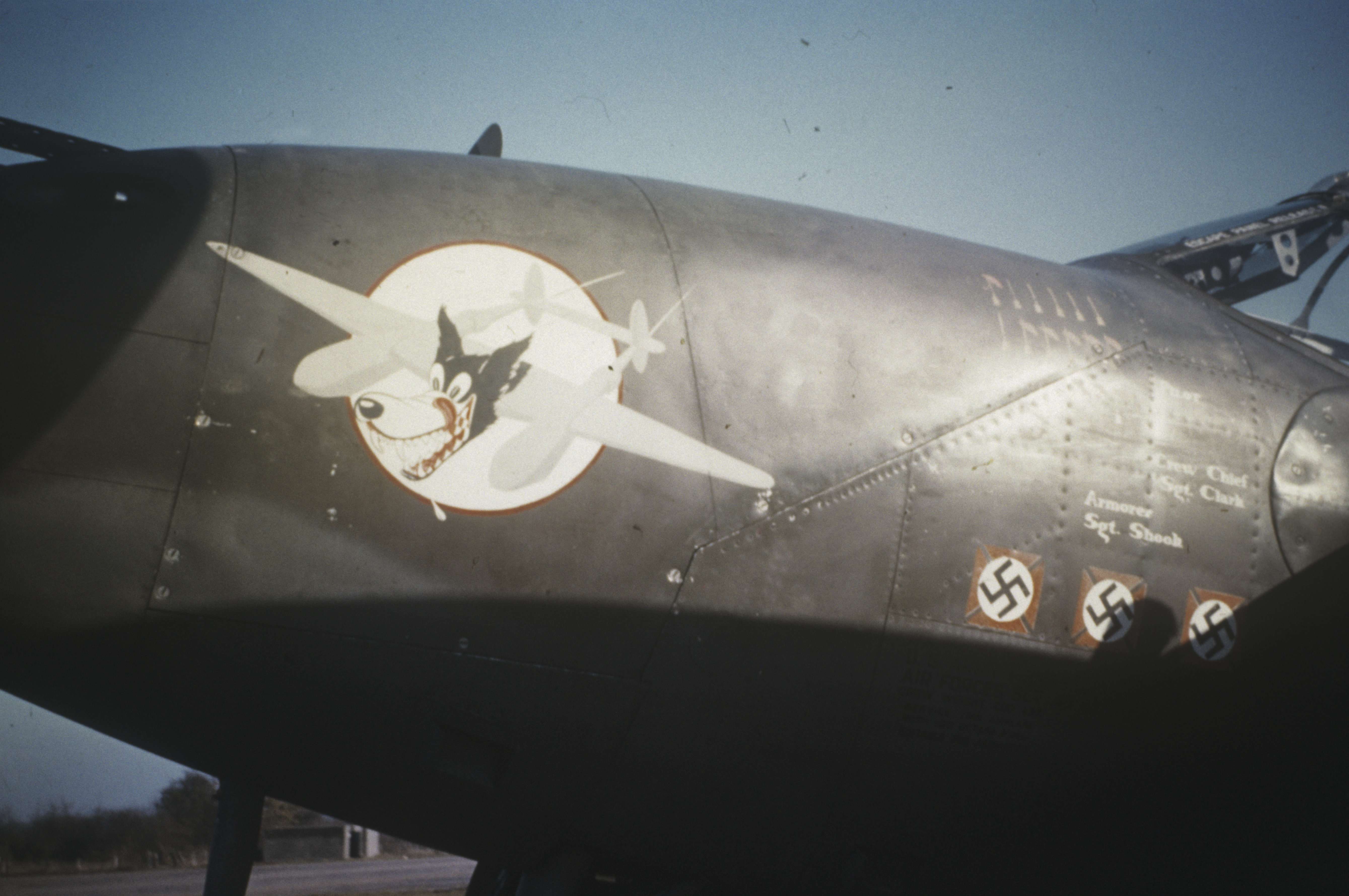
In the image below (Roger Freeman photo FRE 5514 via the American Air Museum in Britain) P-38H 42-67020 has now been assigned to Major Joel, and has become his un-nicknamed “flying wolf”.

The plane’s nose art, which has very much of a Walt Disney look, was – like most (all?) of the 38th Fighter Squadron’s P-38 nose-art – painted by Sergeant Robert T. Sand, who, seemingly having an ample supply of Kodachrome film (remember film?), created an invaluable photographic record of the English countryside, villages, and towns near Nuthampstead, as well as 55th Fighter Group aircraft and personnel.  Other examples of his artistic skill include – in the prior post – Jerry Ayers’ “Mountain Ayers” and Major Mark Shipman’s “Skylark IV”, and in a future posts, Lt. Albert A. Albino’s “Spirit of Aberdeen”.

“Sergeant Robert T. Sand, a pipe-smoking member of ground crew of the 55th Fighter Group, wearing an apron for carrying hand tools.  Handwritten on slide:”1-32″”

As for Major Joel’s aircraft, Sergeant Sand completed the insignia about 18 November, eleven days before Major Joel was shot down.  Paralleling the central mystery of what actually happened to Major Joel, there lies a minor mystery: The specific “identity” – the squadron identification letter – of the flying wolf.  Unfortunately, typical of the great majority of MACRs for 8th Air Force fighter losses (the 355th Fighter Group being a notable exception), MACRs for 55th Fighter Group planes did not record specific aircraft squadron letters.  Similarly, while the Squadron’s Mission Reports list the full names and serial numbers of pilots and their “positions” in squadron formations, both aircraft identification letters and aircraft serial numbers are absent from these documents.  

Another view of the flying wolf in a photograph by Sgt. Sand.  42-67020, with engines running, prepares for take-off with other 38th Fighter Squadron P-38s.  This photograph appears in Robert Littlefield’s Double Nickel, Double Trouble.

Here’s the Air Force Historical record card for Major Joel’s P-38.  The aircraft, at a 1943 cost of nearly $99,000 (nearly 1.5 million in 2020 dollars (to put it another way, 1/52 the cost of an F-35A Lighting II)), was delivered to the Air Force in Newark, N.J., on July 30, 1943. 

Before we go to Mission and Encounter Reports, here are two brief films from Critical Past pertaining to the 38th Fighter Squadron’s first combat mission, the films also including views of P-38s of the 338th Fighter Squadron. 

This video, clip: 65675030628, is entitled “P-38 aircraft of the U.S. 55th Fighter Group at Nuthampstead Airfield, England”.

Though a description of the film is available at Critical Past, here’s a much more detailed breakdown of the scenes in the film:

0:04 – 0:08: General view of 55th Fighter Group P-38s
0:08 – 0:12: General view of 38th FS P-38s being prepared for a mission.

0:13 – 0:28: Close-up of a P-38.  Ground crewman loads parachute and dinghy in cockpit, another attends to .50 machine guns, another closes canopy, another examines engine plumbing and buttons up access panels.
0:28 – 0:34: An armorer cleans the barrel of the P-38’s 20mm cannon.
0:34 – 0:36: Finishing touches on the P-38.
0:36 – 1:12: Group Commander Colonel Frank James briefs 38th Fighter Squadron pilots prior to the mission.  This scene was filmed from two different angles.  The first view, from the “side” at 0:44 to 1:01, shows the entire group of pilots with P-38H “C” in the background.  The “second”, from the “front” at 1:01 to 1:13, shows Colonel James at left, and fourteen pilots who are facing the camera directly.

In the “first” view – a screen-grab of which at 0:48 appearing below – there’s something interesting about the bare-headed pilot standing third from right (the only pilot not wearing a flight helmet, and, one of the two pilots in the group who is not wearing a leather jacket).  Allowing for the screen-shot’s distorted perspective and very low resolution, notice that this man’s shoulder insignia appears round-ish – like a Major’s oak-leaf viewed from a distance.  More importantly, he seems to be relatively short in stature.  Given Milton Joel’s military rank and physical description – he was five feet six; his nickname “Gum” or Gummy” – this person may indeed be the Major himself.

In total, 21 (?) pilots are visible besides Colonel James, and, the man who appears to be Major Joel.  Though it would be challenging to correlate “names to faces” 77 years later (as if anyone would be remembered by now!), the ten other 38th Fighter Squadron pilots definitely are: 

Capt. Mark K. Shipman
1 Lt. Jerry H. Ayers
1 Lt. James H. Hancock
1 Lt. Joseph Myers
1 Lt. Gerald F. Leinweber
1 Lt. Morris Leve
1 Lt. Wilton E. Wyche
2 Lt. Gerald Brown
2 Lt. Hugh E. Gillette (replaced on the mission by 2 Lt. Allen R. Peters)
2 Lt. Delorn L. Steiner
…along with…
Lt. Colonel Jack S. Jenkins

…thus, the other pilots are presumably members of the 338th or 343rd Fighter Squadrons, or the 20th Fighter Group.

Other scenes show:

1:13 – 1:20: A pilot (probably Lt. Colonel Jenkins) climbs into Texas Ranger. 
1:20 – 1:22: The “business end” of Texas Ranger.
1:23 – 1:26: Lt. Colonel Jenkins fires up Texas Ranger’s engines. 
1:27 – 1:32: P-38H CG * O taxies out.
1:33 – 1:44: Texas Ranger taxies out.

This second film sequentially follows the first film, entitled “P-38 planes fly over B-17 planes in European Theatre of Operations” (clip: 65675030629).


The film shows the following:

0:04 – 0:35: P-38s taxi to take-off.  (Lt. Jerry Ayers’ P-38H 42-67077 CG * Q (Mountain Ayers) and Lt. Stanley Richardson’s 338th Fighter Squadron P-38H 42-67057 CL * X (Miss Mona)).
0:36 – 0:45: 38th FS P-38s take off
0:46 – 1:06: 338th Fighter Squadron P-38s take off
1:07 – 1:19: 38th FS P-38s take off (Jerry Ayers in CG * Q)
1:20 – 1:43: 55th FG P-38s overfly Nuthampstead as flights of four (or three)
1:44 – 3:00: 55th FG P-38s as viewed from 91st Bomb Group B-17s
3:00 – 3:12: P-38s return to Nuthampstead
3:13 – 3:24: P-38s land (CL * P at 3:23)
3:24 – 3:33: While landing, P-38 releases 165 gallon tank (3:28-3:29), which almost strikes his wingman.  (Verily: “Whoops.”)
3:34 – 3:40 – A 338th Fighter Squadron P-38 lands (CL * O)

And so, here are accounts for the missions of November 3, 5, and 13, of 1943.

November 3, 1943

From Roger Freeman’s The Mighty Eighth

Two days later the three squadrons of the 55th, despatched from Nuthampstead, were accompanied by eight aircraft of the 20th Group all being flown by 79th Ftr. Sqdn. pilots.  Not long after take-off some Lightnings experienced mechanical troubles and were forced to abort, leaving 47 to climb up through the overcast towards their rendezvous with Liberators bound for Munster.  These became separated in the bad visibility, and 50° temperature at 25,000 ft caused further aircraft to turn back with engine trouble.  At the rendezvous point they found no sign of the bombers and only one squadron, the 38th, finally contacted them – near the target at about the same time as a strong force of Me109s and rocket-carrying Do217s launched an attack.  Outnumbered, perhaps three to one, the sixteen remaining Lightnings led by Major Milton Joel set about breaking up the enemy attacks.  Most combats were inconclusive as pilots did not let themselves be drawn away from the bombers.  Even so, claims of 5-3-4 were made on return to Nuthampstead, for no loss to the 55th.  Their escort value was also evinced by only three of the B-24s failing to return from the mission.

One FW-190 destroyed – half-credit shared with Lt. Kreft (Westerholt-Wittmund)

Two FW-190s damaged (north of Wilhelmshaven)


Mission Report

Extract from Mission Report

Mission: Landfall out at 1200 and landfall over Dutch Coast at 1245 at altitude of 29,000 feet.  R/V with bombers Task Force made at 1245.  38th Squadron was on the starboard side, conducting 1st box of task force over target, bombs away in about 8 minutes later than scheduled.  Escort was at 26,000 feet.  Bombers escorted back out to coast, landfall over England north of Norwich at 1415.  (Flight plan attached.) 

Action: On making landfall about 10 E/A seen at about Sneek, about 7,000 feet below, shortly afterwards 3 E/A observed about 3 miles behind coming in from 5 o’clock but did not press attack.  In nearing target area, 13 to 20 E/A type FW 190 observed below climbing in spirals.  5 minutes later a series of fighters in groups seen below and a flight of P-38’s seen to go down after them.  Over target area 5 FW 190’s approached formation from 2 o’clock and 2000 feet below, Major Joel broke into them and fired at about a 600 yard range, one A/C half rolled and was last seen my Capt. Myers disappearing through the overcast in vertical rolls, time about 1310.  About same time Capt. Myers and Lt. Brown at 25,000 feet observed formation of five FW 190’s in “V” formation attacking bombers from 4 o’clock and some 2000 feet below.  Capt. Myers and Lt. Brown attacked and E/A broke 3 to the left and 2 to the right.  Lt. Brown attacked group of 2 and Capt. Myers attacked group of 3 giving a 2 second burst dead astern at range of 100 yards.  Lt. Brown fired 60 rounds at 100 yards range result unobserved.  On returning to target area 4 or 5 FW 190’s were seen on the tail of 1 P-38 behind the bomber formation.  Major Joel dove down to intercept E/A which broke and Major Joel fired at one, damage unobserved, the next minute he observed in his rear view mirror an FW 190 behind in flames.  Major Joel and Lt. Kreft met with 4 FW 190’s well above and approaching from 6 o’clock, the E/A pulled up and away when pulled into.  Light flak inaccurate for altitude and behind flights encountered just after landfall over coast also meager and inaccurate flak encountered over target area. 

Pilot’s Personal Encounter Report – Major Milton Joel

Transcript of Pilot’s Personal Encounter Report – Major Milton Joel

As we were about to leave the bombers, I, leading Swindle White Flight, heard a call for help giving position as behind rear box of bombers.  As we reached the rear box we saw a single P-38 in a steep dive being closely followed by four or five FW190’s.  At about 17,000, the P-38 pulled up and started turning with the enemy aircraft.  We dove in to help.  As we started in, my second element saw enemy aircraft turning and firing at the single P-38, break off and dive away.  I pulled up thinking the P-38 would join in, but he did not.  I made a climbing turn to 22,000 feet, leveled off, and began a shallow left turn to orient myself.  We were then attacked by enemy aircraft from 10 o’clock out of the sun.  I turned into him in a tight chandelle and fired as he closed almost head on.  At the time the enemy aircraft was in a diving right turn.  Enemy aircraft passed close enough for me to see oil streaming out of his cowling, which was painted red.  Enemy aircraft passed just below me.  Using my rear-vision mirror to see my wing man, I saw the plane crossing my path, behind Lt. Kreft, at 90 degrees in flames and disintegrating.  When the enemy aircraft appeared in my mirror, there seemed to be an explosion, and the enemy aircraft seemed to stop in mid-air.  As there were other enemy aircraft in the area, I did not try to watch him farther.

Pilot’s Personal Encounter Report

Major Milton Joel and Captain Jerry H. Ayers

Transcript of Pilot’s Personal Encounter Report

Major Milton Joel and Capt. Jerry H. Ayers

A formation of 5 FW-190’s approached bomber from 2 o’clock flying parallel to course at about 2000 feet below us.  I began a parallel dive toward them from astern.  Two FW 190’s pulled off into half rolls to right and one to left leaving two who started gentle turn.  I fired from behind with about 10 degrees deflection, range about 500 yards and closed seeing what I believed to be strikes.  Before I could close within good range, one of them half rolled and the one I was firing at pulled up and did what appeared to be vertical rolls at the ground.  I pulled up to rejoin bombers.  Capt. Ayers states ship spun through clouds.

I saw Major Joel’s flight engage some FW 190’s below me, 1000 or 1500 feet.  After completing a 260 degree turn, I looked behind and below me and saw a FW 190 spinning down and smoke was coming from the cowling.  I saw the FW 190 spin through the overcast.

Pilot’s Personal Encounter Report

2 Lt. Robert W. Forsblad

Transcript of Pilot’s Personal Encounter Report – 2 Lt. Robert W. Forsblad

When Major Joel started his attack on the E/A, I turned inside of him getting on his right wing well forward in a line abreast position.  I saw Major Joel open fire at about 400 yard range, I was then trying to take a lead on the same E/A.  The E/A went into a dive, I followed for about a second after Major Joel broke off the attack.  I saw black smoke come from the E/A’s engine.  I then broke off and got back in formation.

November 5, 1943

From Roger Freeman’s The Mighty Eighth

The Lightnings were not always so fortunate in combat.  In another, two days later, the 55th was assigned to escort Marauders bombing Melun airfield in France.  Here Focke-Wulfs slipped out of the cloud and attacked elements of the 20th Group that had gone along.  One Lightning was severely damaged, the pilot baling out over the Channel and another failed to return to base, its fate unknown.

One Me-109 destroyed (west of Arnheim, Holland)

Mission Report

Extract from Mission Report

Mission:  After crossing Dutch Coast, Bombers sighted 10 miles North East at 1316.  Bombers were late.  Orbited to meet bombers.  R/V 1346/25,000 as planned.  Flights 1 and 2 covered forward part of formation, Flights 3 and 4 covered rear of formation.  They escorted the bombers all the way to and from the target. 

Action: Three ME 190’s in midst of bomber formation at time of R/V, one pass made at them and they left.  A few fighters seen to right of formation as going over target.  Five minutes after leaving target, 3 ME 109’s came in on straggler at 12,000 feet.  Major Joel’s flight went down to help.  By this time the B-24 exploded and rolled over, one parachute seen.  Turned into attackers at least 5 times helping stragglers out to coast.  Two ME 109’s and 1 FW 190 attacked B-24’s in area of Arnhem.  Major Joel fired at one and No. 4 man saw smoke pour out and No. 2 man saw a parachute bloom.  Three FW 109’s seen at about 14,000 making attack from 3 o’clock position area of Arnhem.  Capt. Myers opened fire, numerous hits especially 3 direct 20 MM blasted large holes in side of one.  Pilot bailed out and plane went down in flames.  In same engagement, Lt. Forsblad damaged an ME 109.  At R/V time, 12 to 15 e/a were observed above bomber formation took off when turned into.  Another 4 ME 109’s driven off just after passing over target.  Beyond target about 15 FW 190’s with rocket guns observed above the bombers and about 3 twin-engined ships, DO 217’s with rockets behind at 1500 yards.  Capt. Myers scored hits on one DO 217 and it was seen going down with left engine on fire, seen by Lt. Wyche.  Lt. Steiner fired at another DO 217 at close range but did not observe results.  Between Wintersvijk and Doetinchem about 3 Squadrons of FW 190’s came up behind the bombers.  Capt. Shipman bounced one and observed hits and smoke.  Two others attacked by Capt. Shipman and Lt. Des Voignes, one seen by Capt. Ayers to have large pieces falling off and in flames, the other blew up.  All combat 20,000 to 25,000 feet.  Attacks were constant but not aggressive towards fighters.  Near the coast, in area of Rotterdam, Lt. Leinweber and flight attacked five e/a from dead astern.  Engine of one e/a exploded with considerable smoke and large flames.  Flak very heavy over target, accurate for altitude.  No tracers. 

Pilot’s Personal Encounter Report

Major Milton Joel and 2 Lt. James M. Garvin

Transcript of Pilot’s Personal Encounter Report

Major Milton Joel and 2 Lt. James M. Garvin

Flying parallel and behind #2 bomber box at 26,000 ft. when I saw 2 stragglers about to be attacked by three 190’s.  Stragglers were behind first two boxes about 2 miles at 18,000 ft, approximately.  We were just in front of stragglers.  E/A were about to make a diving head on pass from 2 o’clock on the bombers.  I attempted to head them off by making a diving right turn firing at the lead 109 at about 400 yards or more at about 15-20 degrees deflection, trying to close from behind.  Two E/A did a rudder roll downward into a vertical dive as I opened fire.  Before I closed much beyond 300 yards, the leader went into a vertical dive and I could no longer hold my lead and head nearly reached compressibility, I pulled up and over the bombers.  E/A got no closer than 1000  yards to bombers.  My wing man Lt. Forsblad claims seeing heavy black smoke come from E/A though I saw no results while firing.  Lt. Garvin in cover flight above saw parachute break out below us.

At the time of Major Joel’s encounter with a 109, I was above and behind the two straggling bombers about 2,000 ft.  Shortly after, 1/2 to 1 minutes, of the approximate time of encounter, I saw a parachute about 2,000 ft. below these two stragglers.  This chute was in about a 10 o’clock position to me, and would have been about a 2 o’clock position to the two bombers.  No E/A were seen. 

The following article, by Philadelphia Inquirer correspondent Paul W. Ramsey, appeared in that newspaper on November 29, 1943 – ironically, the very day on which Major Joel and Lt. Garvin were killed.  (The article was found at FultonHistory.)

Old Newspapers

Transcript of Article…

Lightning Fighters
Squadron of 16 Has Battle-Filled Hour Protecting Bombers on Muenster Raid

By Paul W. Ramsey
Inquirer War Correspondent
The Philadelphia Inquirer
November 29, 1943

AN AMERICAN FIGHTER BASE, SOMEWHERE IN ENGLAND
(Delayed)

THE squadron of Lightning Fighters roared along high over Germany.  It was Friday, Nov. 5, a rare, sunny day and the job was to escort Liberators over Muenster and bring them home

Leading the squadron was a Richmond, Va., boy – 23-year-old Major Milton Joel, a slightly pudgy, good-natured and very capable pilot and officer.  His young wife and some of his closer friends call him Gummy.

As the squadron of fast, twin-engined fighters neared the rendezvous point where Lightnings were to take over the escort task from the single-engined Thunderbolts, the pilots scanned the sales anxiously for the other squadrons which should have joined up much earlier.

They could see for many miles in all directions but there was no sign of the other Lightnings.  Gummy led his men on toward the rendezvous.  When one of his pilots suddenly called over radio phones, “There are our big friends at 11 o’clock,” Joel knew his 16 Lightnings would have to do the escort job alone – 16 Lightnings to protect more than 300 Liberators!

His squadron, with one exception, had had less than a month of combat experience.  The job ahead was a large order.

Splits Squadron

Joel split up his squadron and led his own section of eight planes forward to protect the leading “box” of heavy bombers.  The Liberators were strung out for miles.  They looked like great flocks of birds when first seen, but grew larger rapidly as the Lightnings sped toward them.

As Joel took up his position over the forward box his second section, commanded by Captain Mark Shipment [Captain Mark K. Shipman], a carrot-haired veteran of the African campaign, dropped behind to cover the rear formation.

German fighters showed up at once and so began a furious running fight which lasted nearly a full hour.  The 16 Lightnings raced up and down the skies, now over the formation, now darting far below to protect stragglers, now racing to the sides to fight off flank attacks. 

The long-range Lightnings dropped their belly tanks when the first enemy craft appeared.  Joel’s section was cruising along, protecting the forward box, when one of his pilots called out:

“Three bandits at 12 o’clock attacking the lead formation.”

Always Fight in Teams

American fighter pilots always fight in teams.  Joel had eight planes in his section.  Now he must further divide his forces.  He could, with prudence, take only four of his eight planes into the attack at once because top cover must be maintained.

Leading his second flight of four planes was Captain James H. Hancock, of Sebring, Fla.  So when Joel called over radio phone, “Joel to Hancock, I’m going down,” Hancock knew what to do.

From an altitude of five miles Joel led his four Lightnings forward in a fast, gradual dive at three Messerschmitt-109s which were attacking the toad formation head-on.

As soon as the 109s saw the Lightnings the rolled on their backs and dived away right through the middle of the formation.  The bombers blazed away at the Germans as they streaked down.

Quickly Joel took his four planes back up over the formation and rejoined Hancock’s flight.  But almost immediately they spotted a flight of Germans attacking two straggling Liberators which had dropped four miles back of the front box and 3000 feet below.

Disperse Germans

Joel’s flight dove immediately to the stragglers’ rescue and quickly dispersed the Germans, who apparently have orders to attack bombers an often as possible while generally avoiding action with our fighters.

Once more Joel led his men back up to their position over the rear of the front box of Liberators.  They had hardly gotten back there when a third straggler, which had fallen farther behind than the other two, was attacked by three 109s from dead astern.

Major Joel took his four planes down at grant speed but it looked like a lost race from the beginning.  The three 109s were coming in on the tall of the lone Liberator with machine-guns and cannon blazing.

The Liberator returned the fire until the very last.  Her guns were still firing – and the Lightnings were within 5000 yards – when the big bomber suddenly exploded and spun down in earth.  Joel and his men did not see any parachutes open.  It was the only bomber lost to enemy fighters.  [Possibly B-24H 42-7490, EC * U-, “Big Ass Bird”, of the 578th Bomb Squadron, 392nd Bomb Group, piloted by 1 Lt. Douglas R. Steinmetz.  There were no survivors.]

Stricken Fortress Appears

Then an odd thing happened.  A stricken Flying Fortress which apparently had started out with other B-17s on the Gelsenkirschen raid that day flew over, trying to reach the protection of the Liberator formation.  The Fortress was obviously crippled and losing altitude.

By this time the Liberators had dropped their bombs on the Muenster railway yards – but the Lightning pilots bad no opportunity to observe results – and were on the long haul home.  The lone Fortress was 12,000 feet below the first box and about 10 miles to rear.

Hardly had the Lightning pilots spotted the big bomber when three ME-109s, which were flying high, saw it too and went for it.

Leaving Hancock’s four planes to cover the B-24s, Major Joel took his four down.  They had been flying about 20,000 feet and it looked like a toss-up whether the Lightnings or the 109s would get to the crippled B-17 first. 

Major Joel flipped on his back and went down in a screaming dive with his wingman close beside him.  Following them came Captain Joseph Myers, 24, of Canton, O., and his wingman.

Closing in Fast

The three 109s were closing in fast, approaching the Fortress from the port quarter and flying in a line astern.  It looked like the Germans would get there first, so Major Joel led his men down at terrific speed, hoping to scare them away before they had lined up their shots.

Captain Myers gave his plane all it would take.  At 20,000 feet he saw the Messerschmitts turning into the Fortress.  At 17,000 feet when going nearly 600 miles an hour in an almost vertical dive, so fast that his ship was buffeting and shaking, the German plane second in line came Into Myers’ sights

At that moment the German was beginning a left turn Into the Fortress.  Myers kept the German In his sights. 

Now Myers was still diving almost vertically and at speed far beyond the margin of safety.  When he had closed to 300 yards the German was at the middle of his 90-degree turn, which meant he was “standing” on his left wing.  At that precise moment Myers pressed the triggers of his machine-gun and cannon.

Cannon Shells Hit

It was a shot in a thousand, but he hit the German squarely and more than once.  There were three distinct flash-blasts as three cannon shells hit – the first struck the ceiling, the second hit the pilot’s compartment, literally blowing the pilot out of the plane, the third blew most of the plane’s tail off.

The other two 109s fled.  Myers and Joel and the other two fliers then saw that the B-17 was still flying and apparently had not been hit by any of the 109s.

They climbed sharply back up then and Joel was just about to lead them over to check on the main formation when they saw four Germans going for straggling Liberators which were cruising several thousand feet below and to the rear of the main formation.

As the four Lightnings swooped down the four Nazis were making a turn in toward the bombers.  Two of the Germans flicked over and dived away but the other two continued their turn.

Major Joel fired a long burst at German Number Two, who did a rudder roll and went down, in flames.  Shortly afterwards one or the Lightning pilots saw a parachute come out of the diving, blazing plane. 

Rout Six Planes

Back up for altitude went the Lightnings again and this time they drove off a flight of six enemy planes which was attacking the formation from left front.

By this time more Germans were attacking the stragglers.  This time Joel and his flight maintained top cover while Hancock took his men down.  Hancock’s flight had made several attacks on Focke-Wulfs and Messerschmitts but the enemy always broke and fled before his approach. 

As his flight dove to aid the straggling bombers, four more enemy planes dove out of the sun.  Hancock saw them coming in time to turn his flight into them.  They broke and fled.  Then the four Lightnings proceeded to chase off Germans who were after crippled bombers.

By this lime the running fights had been on nearly an hour and the bombers were nearing the coast.  The other eight Lightnings had been just as busy as Joel’s section.  But that’s another story.

November 13, 1943

From Roger Freeman’s The Mighty Eighth

The 13th was certainly an unlucky day for the 55th.  In typical English November weather, damp and overcast, forty-eight P-38s set out to escort bombers on the target leg of a mission to Bremen; one turned back before the enemy coast was crossed and two more aborted later.  At 26,000 ft over Germany pilots shivered in bitterly cold cockpits; flying conditions were unusually bad, and the probability of mechanical troubles at that temperature did not help.  Again outnumbered, the 55th was heavily engaged near the target as it strove to defend the bombers, for which it paid dearly.  Seven P-38s fell, five to enemy fighters and the others to unknown causes; it was suspected that engine troubles might have made some of the P-38s lost easy prey for enemy fighters.  Sixteen returned with battle damage: one, pitted with over a hundred small calibre bullet holes and ripped from five cannon shell bursts, came back on one engine.  The Group had sustained grievous losses, but there was some consolation to be found in the protection they had afforded the bombers which, after all, was their object.  Worse was to follow.

One Ju-88 destroyed (Bremen)
One Ju-88 probable (Bremen)
One Me-109 probable (Bremen)
One Me-109 damaged (shared with Lt. Stacker) (Bremen)

Mission Report

Extract from Mission Report

Mission: Over English Coast at 1049.  Landfall over Dutch Coast at 1110 at 20,000 feet.  Bombers first observed at 1127 at 24,500 feet on vector 150, 30 miles NW of target, fighters at that time 3 o’clock position 20 miles away, joined bomber formation 10 miles NW of target.  Over target at 1130 at about 27,000 feet, tanks dropped at R.V.  Out over Dutch Coast at 1330.  One flight escorted bombers over channel leaving them around 1245.  13 A/C landed at home at 1350. 

Action: One flight returned ahead of the bombers without incident until they reached Dutch Coast in area of Amsterdam-Ijmiuden, where intense flak was encountered, all four ships of the flight were hit with varying degrees of damage, but returned to base, one piloted by Lt. Col. Jenkins crash landed at Debden.

E/A apparently arrived at the same time as our fighter escort in target area.  A group of JU-88’s were observed towards the rear of the bombers, Major Joel closed in from the rear, fired just as JU 88 discharged his rockets.  Major Joel closed to about 100 yards and saw both engines on fire as JU 88 broke, climbing out he observed a group of ME-109’s at side of bombers, and with wing man, Lt. Stacker attacked one ME-109 then pulled into the sun, observed 3 JU-88’s in strength at the tail of B-17’s, Major Joel and his wingman attacked the last of the JU-88’s, as he fired he looked back and saw his wingman, also intent on E/A, being attacked by a twin-engine A/C, presumably JU-88 or possibly ME-410.  Major Joel called wingman to break, the P-38 turned over and spun down smoking.  Major Joel believes he saw parachute open.  Major was then out of ammunition and streaked for home being pursued for some ten minutes by a ME-109 who he was able to outrun.  Blue Flight reports E/A all over the sky in the sun in front of the bombers.  Just after target, one FW-190 at 3 o’clock to the bombers driven off, flight moved back to B-24’s at 24,000 feet.  Attacked FW-190, were in turn attacked by the E/A, broke and rejoined the bombers and observed about 15 E/A under bombers.  These E/A were kept below the bombers by repeated bounces.  Just after target Red Flight No. 3, Lt. Brown, had out engine knocked out by E/A.  They were diving from 29,000 feet at JU-8 at about 25,000 feet, and as they were attacked another JU-88 came in on Red leaders tail, he was in turn attacked by Lt. Brown, element leader, who saw him smoking.  Flight turned up to left.  During this attack an ME-109 had dived out on Lt. Brown after attacking him from the rear breaking off at about 50 yards, attaining numerous bursts.  Capt. Myers shot this E/A down in flames.  Lt. Brown returned from target area on one engine.  One other P-38 engine feathered joined formation.  There was a B-17 straggler at about 19,000 feet.  Lt. Brown and the other crippled P-38 joined in with this bomber and Capt. Myers escorted the 3 A/C from the target area to the coast.  On the way out there were continuous attacks for about ten minutes from 8 ME-109’s.

They made alternating attacks on the B-17 and on the two damaged P-38’s.  Capt. Myers maneuvered behind the E/A and kept chasing them off by repeated passes, until the Dutch Coast and then escorted Lt. Brown home.  Lt. Maloney separated from his Red flight at R/V due to inability to drop belly tanks, and in individual encounters, before joining an element from yellow flight shot down one FW 190 and damaged one other FW 190.  It is estimated that there were a total of 300 E/A involved in the encounters, they were extremely aggressive towards fighters.  Among the types observed were ME-109’s, FW-190’s, Do-217’s, JU-88’s, and ME-210’s, these later ships appeared to be exceptionally maneuverable and may be an ME-410.

Weather: Scattered to broken cumulus clouds over the channel.  7 to 8/10th cloud cover at target and cirrostratus at 20,000 feet over target.  R/T was good.

Claims: 1 JU-88 destroyed – Major Joel, 1 JU-88 probably destroyed, 1 ME 109 damaged, shared with Lt. Stacker, and 1 ME-109 damaged.  1 FW-190 damaged – Capt. Beaird.  1 ME-109 destroyed – Capt. Myers, and 1 JU-88 probably destroyed – Capt. Myers.  1 JU-88 damaged – Lt. Brown.  1 FW-190 destroyed and 1 FW-190 damaged – Lt. Maloney.

Pilot’s Personal Encounter Report – Major Milton Joel

Transcript of Pilot’s Personal Encounter Report – Major Milton Joel

I was leading the second section of Swindle Squadron as Swindle Yellow Leader, when we crossed the top of the bombers just prior to reaching the target.  About _____ thousand feet above the top of the second box of bombers, vapor trails were very heavy.  As we crossed on the port side, on which side we were supposed to pro- vide close support, I saw my second flight, led by Captain Myers, being attacked by many ME 109’s.  He was about 500 feet below.  As he went down to turn into the attack, I went over to cover him and saw about 8 ME 109’s coming down on us from 2 o’clock.  I turned into the attack and the 190’s seemed to overshoot us.  However, one ME 109 approached me on the same level from 5 o’clock.  I took about 15 degrees deflection and followed him, firing all of the time as he passed.  I believe that Lt. Stacker, who was flying on my wing, and firing also.  I saw strikes, smoke, and flame.  The E/A seemed to fall over on one wing and go into a dive.  I broke immediately upward. 

In the course of the engagement my second element became separated.  I then noted a twin-engined aircraft coming down from above, closing in on the rear of the middle box of B-17’s, turning in behind them.  I held my fire until I had closed within 300 yards, and fired from dead astern.  I saw two great flashes of flame and pieces flying off, and what appeared to be the JU 88, now smoking, heavily, did a very slow half turn and began to spin to the right. 

I broke upward and saw some ME 190’s coming down on us from two o’clock.  I turned into them and fired a deflection shot from about 300 yards at 10 degrees, at the last plane as he passed, noting strikes, but no further results. 

I then realized that I had lost my second element and found myself and my wingman toward the rear of the bombers.  We started to head across the bombers path to the forward section of the formation in an attempt to join up with someone, when I noted three twin-engined fighters coming down from above on the tail of the bomber formation to attack.  All three of them appeared to be carrying rockets.  I looked around, and I saw nothing above.  I decided to attack the last one, and closed in to about 250 yards.  Began firing and noted strikes on engine and rudder. 

I then looked in my rear vision mirror and saw a twin-engine fighter coming down from 7 o’clock and about half a mile away, apparently intent on attacking my wingman.  I called to him several times, telling him to break, but he apparently didn’t hear.  I wanted him to break first in order to get the enemy aircraft between him and myself.  As he did not break, I pulled up to the left in a Chandelle, hoping he would follow me.  The JU 88 that we had been firing at by this time had broken to the left and headed down in a steep dive, smoke and flames coming from one engine.  Lt. Stacker apparently tried to follow the first EA down further, because when I got to the top of my Chandelle, I saw that he had not followed me, but was in a dive with a twin-engine fighter closing on his tail.  Still calling to him to break, I turned to try to close on the twin-engine fighter.  At that moment Lt. Stacker pulled up, turning to the left at the same time.  At the same time I was able to pull my turn tighter and close within 300 yards of the twin-engine fighter.  I fired with about ten degree deflection, but my guns fired only about five or ten rounds and stopped.  I saw Lt. Stacker’s airplane turn over on its back at the top of his climb, smoke coming out from both engines with pieces falling off.  A large black object came out of the cockpit, which I assumed was the pilot. 

I looked behind me and saw five 190’s about to attack me from out of the sun.  I gave it full throttle and broke downward in an attempt to run away and join up with the other ships in the area.  The ME 109’s seemed to be closing on me so pulling about 55 inches I pulled upward in a very steep climb, and after about 5,000 feet they seemed to give up as they were falling back all the time. 

Before I could join any other P-38’s, I noticed one ME 109 coming out of the sun (this was at 30,000 feet from about 5 o’clock about 500 yards behind me).  With throttle full open and my nose slightly down, I finally managed to out-distance him after about 10 minutes.  I lost 5,000 feet, and the ME 109 had closed within range of me, and at one time managed to get a it on my propeller with 20 MM.  I finally lost him flying straight and level at 26,000 feet, pulling 60 inches, and indicating 300 miles per hour.  Each time that the E/A fired I skidded the plane violently and corckscrewed.  I could not do anything else as I was out of ammunition, and was afraid that if I turned into him, I wouldn’t have enough gas to get back home, even if I did evade him. 

I joined six P-38’s at the Dutch Coast.  Upon landing I found that I had had stoppages in two machine guns and also in the cannon.  My right prop had been pierced by a 20 MM shell about one-half the distance from tip to hub. 

Missing Air Crew Report for 2 Lt. John A. Stacker

The centrality of Missing Air Crew Reports (MACRs) in chronicling combat losses in the Army Air Force of WW II, and their secondary use in genealogy, have been evident since these documents were declassified in the mid-1980s.  They’re available in digital format via Fold3 at varying degrees of quality.  It’s unfortunate that the original paper documents – as such – have not been scanned and made available to the public, in the way that equally valuable archival records of other countries (such as Australia – the National Archives of Australia; such as England – the Commonwealth War Graves Commission; such as others) have been made freely available to the public at relatively high levels of resolution.

During a visit to NARA some time ago (in the era before the great COVID Coup of 2020) I was able to scan the MACR (# 1438) for Lt. Stacker.  As such, an image of Major Joel’s original account of his wingman’s loss appears below. 

Transcript of Missing Air Crew Report for 2 Lt. John A. Stacker

My wingman and I had already become separated from the other elements of the flight in previous encounters, and had fallen back towards the rear of the last box of bombers.  I observed three JU 88’s coming in for an attack on the rear of the bombers.

My wingman and I attacked the last JU 88 of the three.  As I closed in and fired, I chanced to look back and saw a twin-engine fighter coming in from 5 o’clock about half a mile away.  I called to Lieutenant Stacker, my wingman, telling him to break first with the idea that I could then break and possibly get behind the E/A.  My wingman was apparently intent on pressing home his attack on the E/A which had winged over with engine smoking. 

I must have called him about five times without result.  Meanwhile, the E/A was closing.  I made a definite break to the left and up, hoping my wingman would follow.  At the top of my break, I saw the E/A on my wingman’s tail at about 300 yards and firing.  I pulled my turn short to close in on the E/A, and at that time my wingman apparently saw him for he pulled straight up.  The E/A pulled up inside.  I closed to three or four hundred yards of the E/A and tried to fire.  I got only a few rounds out when my guns stopped.  My wingman at that time had pulled up steeply.  I saw pieces fly off the aircraft.  He rolled on his back with both engines smoking, and I saw some dark object leave the cockpit.  I was then attacked by four ME 109’s from behind and had to break.  Later, while still pursued by E/A, I looked back and saw what could have been a parachute or a burst of white smoke.

You can read about photographs in MACRs, and more, at my brother blog ThePastPresented, within the post The Missing Photos – Five Among the Missing.

This photograph, date and location, from the J Cook Photo Collection & Archives (image UPL29593), at the American Air Museum in Britain, shows Lt. Stacker (full name John Arthur Stacker) seated in the cockpit of a P-38.  He appears to be performing a ground test of his oxygen mask.  Text with the photo states, “Best friend of Col Bud Anderson 357th FG ace”.   

Alas, Lt. Stacker did not survive what was his fourth combat mission.  Flying P-38H 42-67059, his aircraft crashed at Klein-Mimmelage, Germany. He is buried at the Ardennes American Cemetery and Memorial at Neuville-en-Condroz, Belgium

Here are two articles from the Richmond Times-Dispatch reporting on Major Joel’s experiences on November 13, as published in that newspaper on the 14th. 

A transcript of the article…

Major Joel Reports Running Into Heavy German Opposition

The first of the returning flyers from a United States attack on Northern Germany today reported they had run into the heaviest of recent German fighter opposition, according to an Associated Press dispatch.  The contingent of airmen included a Richmonder who distinguished himself.

“The Germans had hundreds of fighters in the sky,” said Major Milton Joel, of 5 Greenway Lane, Richmond, a pilot of one of the escorting Lightning fighters.

“They had everything from ME-109s to JU-88s, and all the JU-88s were firing rocket shells,” he said.  “Wherever you turned there was an enemy plane at your side.  That’s how I got shots at so many.”

He was credited with one destroyed, two probables and one damaged.

And, another article, also published on November 14.

A transcript of the article…

Richmonder Blasts Nazis Over Bremen

Major Joel Leads Lightning Squadron

Major Milton Joel, 23-year-old Richmond leader of a Lighting squadron, was credited in an Associated Press dispatch with destroying a JU-88 and probably destroying another, as well as a ME-109, in yesterday’s raid on Bremen by the United States Eighth Air Force.

“The Germans had hundreds of fighters in the sky,” the dispatched quoted the major, who was among the first of the fliers to return to London from the raid.

“They had everything from ME-109s to JU-88s and all the JU-88s were firing rocket shells,” he said.  “Wherever you turned, there was an enemy plane at your side.  That’s how I got shots at so many.”

Yesterday’s attack on the great German industrial and shipping port results in the biggest American loss since the great daylight raid on Schweinfurt, October 14.  Nine fighters and 15 heavy bombers were lost in yesterday’s attack.

Major Joel, one of the contingent of airmen to distinguish themselves yesterday has been a pilot since 1939, having completed the pilot’s course at Richmond University, where he graduated with a B.S. degree.  He also attended the University of Virginia.  Major Joel received his second lieutenant’s commission in May, 1941, and his major’s commission and appointment in commander of a fighter squadron in October, 1942.

Before going overseas, Major Joel was stationed at Pendleton Field, Oreg., where he had the distinction of being the youngest major.

Major Joel is the only child of Mr. and Mrs. Joseph Joel, of Greenway Lane.

This article about the November 13 mission appeared in the Burlington Free Press on December 10.  Captain Eugene E. Ryan, referred to in the last paragraph, served in the 343rd Fighter Squadron.  According to USAF Credits for the Destruction of Enemy Aircraft, World War II, he was credited with one aerial victory for the mission.

Bombers Do Escort Duty For Fighter Planes
Usual Procedure Reversed After Raid on Bremen
By FRANKLIN BANKER

AT A U.S. FIGHTER BASE IN ENGLAND, Nov. 23.  (By Mail)  (AP) – It’s the job of American fighter planes to escort bombers to their targets – but sometimes it works in reverse.

Suck an incident was described by Lt. Col. Jack S. Jenkins of Levelland, Tex., who led a group of P-38 fighters escorting Flying Fortresses and Liberators during a raid on Bremen.

The twin – engined Lightnings, running into plenty of German fighter opposition on the Nov. 13 mission, had a tough day.  Several got back on one engine.  A number of others were shot down over Germany.

Two Lightnings with one engine shot out had Fortresses to thank for escorting them home.  Without their normal speed they would have been easy targets for German fighters.  The Lightnings were piloted by Lts. Peter Dempsey of Tacoma, Wash., and Fleming W. Suiter of Chesapeake, Ohio.

Stuck Close To B-17s

“They just stuck close to some B-17’s, who protected them all the way home,” said Col. Jenkins.  “The Fortresses did a good job bringing them around rain-clouds and showers.

“When a B-17 straggles, we help it.  When a fighter plane is knocked out of formation, the B-17s help it.  We work closely together.

“When a fighter pilot sees one of those big, queenly B-17s go down in flames, it gives him a terrific desire to get in there and do his job.”

The fighter pilots also must be quick at assisting fellow fighters.

Heroic Action

During another part of the aerial battle, Dempsey and Lt. Gerald Brown of East Ashland St., Phoenix, Ariz., were saved from German fighters by Capt. Joseph Myers of Canton, Ohio, a P-38 pilot.  One of Brown’s engines was shot out and his plane was peppered with bullet holes.

“Capt. Myers did a heroic thing,” said Jenkins, air executive officer of this base.  “He tucked them (Dempsey and Brown) in close together and shepherded them away from the target.  He probably warded off 20 fighter attacks in all.  Joe shot down an Me 109 which would have gotten Brown in another second or so.

“I don’t know how he ever got them out of there.  I recommended him for a decoration.”

Jenkins, whose Lightning was named the “Texas Ranger”, went to the defense of Lt. Morris Leve of 1,420 Cortelyou road, Brooklyn, N.Y., but wound up with Leve helping him out.

A Long Way Home

Heading back over the English Channel on one good engine, Jenkins ran into a 140 miles-an-hour headwind.  It took him an hour and a half to fly what normally would have taken 20 minutes.  Running low on gas and with his hydraulic brake system shot up, he had to make a belly landing at an away-from-base airfield.

During the homeward trip, the crippled P-38s of Jenkins and Capt. Jerry H. Avers of Haley, Tenn, were escorted by two Lightning pilots.

One of the day’s high “scorers” at this base was Capt. Eugene E. Ryan of Box 502, Darien, Conn., formerly of Lake Ave., Greenwich, Conn.  It was the first raid on which he got a good shot at enemy planes.  He destroyed two of them. 

Next: Part IV (2) – Autumn Over Europe – The “Flying Wolf” Identified


A Missing Man: Major Milton Joel, Fighter Pilot, 38th Fighter Squadron, 55th Fighter Group, 8th Air Force: I – A Fate Unknown

A Fate Unknown

War, whether in terms of international politics, economics, strategy, tactics, or the actual conduct of military campaigns, is by nature a collage of uncertainties.  However, there is another uncertainty inherent to war: one that can occur within the immediacy of battle, or, persist after (sometimes, long after) a conflict has actually ended, and the attention of men and nations has moved on. 

That uncertainty revolves around the fate of those who have not returned:

The missing.

Ever since the long-forgotten advent of organized human conflict, it has been inevitable that the fate of each and every soldier who fails to return from battle cannot be resolved with certainty.  This can be attributable to a number of factors: The physical setting of a battle; the circumstances – specifically, the nature of the weapons, ordnance, craft, or vehicles – by which a soldier has become a casualty and “missing”; the geographic remoteness of a clash with the enemy; the loss of military records, or, the inability to actually record the history of a battle in the first place; the faulty and fleeting memory of witnesses to a soldier’s fate, or, the not infrequent absence of such witnesses – whether immediate or long surviving – to begin with; a society’s desire – from the combined effects of psychological and spiritual exhaustion, economic prosperity, and simple apathy – to put the memory of the past to rest. *

All these factors – and more – in varying combination and degree, can stand in the way of definitively establishing the ultimate fate of a missing soldier. 

In terms of the historical memory of the American public, the central conflict in terms of collective memory – though that memory is steadily withering in the face of time, cultural change, and the oxymoron of “information technology” – during recent decades has been the Second World War.  Perhaps the collective memory of that war among the other Allied nations that participated in the conflict is undergoing a parallel transformation – albeit for factors unique to those societies. 

In terms of American servicemen Missing in Action (MIA) from the Second World War, Wikipedia’s entry states, “As of October 9, 2020, according to the U.S. Department of Defense POW/MIA Accounting Agency, there were still 72,562 U.S. servicemen and civilians still unaccounted for from World War II.”  State by state lists of the names of these men can be found at the Defense POW/MIA Accounting Agency.

Though I don’t have precise figures at the moment, a significant proportion of these missing servicemen is, I think, comprised of naval personnel and aviators who were lost at sea, the chances of their physical recovery and identification probably being miniscule.  Other MIAs, however – army ground forces personnel as well as aviators – lost, or presumed to have been lost among the islands of the Pacific, Continental Europe, and perhaps other theatres of war, may in time still be found. 

One such man was Major Milton Joel of Richmond, Virginia.  A P-38 Lightning fighter pilot and squadron commander in the United States Army Air Force – specifically the English-based 8th Air Force – he was lost during aerial combat with the German Luftwaffe during a bomber escort mission over northern Europe on Monday, November 29, 1943. 

He was one of some 750 Jews who served as fighter pilots during the Second World War.  Roughly 500 of these men were Americans – primarily in the United States Army Air Force, and secondarily in the Navy and Marine Corps – while some 250 others served in the air arms of other Allied nations.  Since these numbers are mainly based upon documents pertaining to casualties, per se, there were doubtless others whose names are unknown.  

________________________________________

Major Joel has never been found.  

This series of posts presents his story.

________________________________________

Milton Joel as a Lieutenant or Captain, during his service with the 27th Fighter Squadron of the 1st Fighter Group.

____________________

A Lockheed P-38 Lighting (Same aircraft in both pictures.)

The aircraft illustrated in this pair of photos (P-38H 42-67079) was not Major Joel’s “personal” fighter plane.  Rather, these are excellent representative images, in that they very clearly display the P-38’s twin-engine / twin-boom / twin-tail / central fuselage pod / in-line-engine configuration, the design of which was a remarkably successful blend of function, performance, and dare I say? (yes, absolutely I say!) aesthetics. 

The black & white picture is from the P-38 Lightning History at TheWorldWars, while the color photo is a postcard (remember those?) that was manufactured some decades back by “John Fry Productions” of San Diego, California, the actual card having been printed by MCA Color Graphics of Kansas City.  The postcard’s very simple caption states “LOCKHEED P-38H “Lightning” (Lockheed Photo)”, thus verifying the origin of the image. 

On close examination of the pictures, you can see that the pictures display the P-38 from slightly different angles.  The relative position of the mountain (in the black and white image, you cans see that it’s receded behind the plane) shows that upper (color) image was taken first, followed by the black & white photo.

The absence of any unit insignia on this aircraft – implying that it had not yet been transferred to the Army Air Force – and the mountainous terrain over which the plane’s flying, suggest that the photographs were taken during a post-manufacture test / publicity flight over southern California.  The light-colored (red) surround to the national insignia verifies that the pair of images were taken between late June and mid-August of 1943.

P-38H 42-67079 would eventually be assigned to the 338th Fighter Squadron of the 55th Fighter Group, where it would bear the squadron code “CL * T” of the 338th Fighter Squadron, coincidentally a brother squadron of the 55th Fighter Group’s 38th Fighter Squadron, the latter having been commanded by Major Joel.  Given the absence of a Missing Air Crew Report, or, Accident Report for “CL * T”, the warplane presumably survived its combat missions, probably having eventually been salvaged for parts, or scrapped.  Its components – aluminum and steel; pleixglass and bakelite; and more – perhaps in a small way eventually became became part of the postwar world. 

And, even if the memory of that “world” and the era before it is now vanishing, we can still remember it.  At least, for a little while.

____________________ ____________________

*And now, as we’re experiencing in the “West” during the early decades of the twenty-first century, an antinomian, secularized religious frenzy, paralleling the millennarian social unrest that persisted in central and western Europe from the eleventh through the sixteenth centuries, as described in great depth and tremendous insight by Norman Cohn in The Pursuit of the Millennium.  The ultimate outcome of this phenomenon (it’s far more than a mere phenomenon!) – partially arising from the intellectual, social, and physical detachment from “reality” of much of the atrophying Wests’s secularized, credentialed, “professional” classes – is thus far unknown.

Well, for the moment. 

Now, that could be the subject of interesting post!  But, since that topic continues to be addressed elsewhere, back to the subject at hand…

Next: Part II – From Proskurov to Richmond