Chronicles From World War One: Jewish Civilians in Eastern Europe: “The Russo-Jewish War Victims” – The Jewish Chronicle, February 11, 1916

Through 1914 and 1915 (and beyond…) the Jewish Chronicle and Jewish Exponent closely focused news coverage upon the experiences, travails, and suffering of Eastern European Jewry, in the context of the social dislocation and suffering engendered by the military and political leadership of Russia, and to a lesser extent, the military forces of the Central Powers.  This took the form of relatively brief news items, and, lengthy analyses and editorials.  The commonality of this material being, that these were direct, relatively (well, in the context of a century ago!) “real-time” news reports, closely linked in time and space to the events at hand.

On Friday, February 11, 1916, the Chronicle published a lengthy news item that approached the tragedy of the Jews of Eastern Europe from another context: The newspaper reported on a meeting that took place in Whitechapel, London, a few days earlier (on Sunday, February 6, to be specific) at the Pavilion Theatre.  There, significant figures in British Jewry spoke before attendees – largely from the East End of London – in an effort to exhort them to make charitable donations in support of their suffering brethren, the majority of those in attendance doubtless having immediate family in the East, and thus having a direct and urgent connection to the issue at hand.

Those present at the gathering included (comments quoted from Wikipedia, thus there might be some oversimplification as well as ideological bias here…):

Elkan Nathan Adler – “English author, lawyer, historian, and collector of Jewish books and manuscripts.”  “Adler was extremely active in English-Jewish communal affairs, especially in education, and was an ardent Zionist; he was an early member of the Hovevei Zion in England. Per his will, his personal archives are now at the library of the Jewish Theological Seminary of America

Joseph Herman Hertz – “British Rabbi and biblical scholar.  He held the position of Chief Rabbi of the United Kingdom from 1913 until his death in 1946, in a period encompassing both world wars and the Holocaust”

Louis Samuel Montagu, 2nd Baron Swaythling- “prominent member of the British Jewish community, a financier, and a political activist”

Claude Joseph Goldsmid Montefiore – “founding president of the World Union for Progressive Judaism, a scholar of the Hebrew Bible, rabbinic literature and New Testament. He was a significant figure in the contexts of modern Jewish religious thought, Jewish-Christian relations, and Anglo-Jewish socio-politics, and educator. Montefiore was President of the Anglo-Jewish Association and an influential anti-Zionist leader, who co-founded the anti-Zionist League of British Jews in 1917″

Nahum Sokolow (Nahum ben Joseph Samuel) Sokolow – “Zionist leader, author, translator, and a pioneer of Hebrew journalism”

And – as you can read below – the meeting was opened with Baron Swaythling’s reading of a letter from Leopold de Rothschild (“British banker, thoroughbred race horse breeder, and a member of the prominent Rothschild family“.

Though I have little familiarity with significant figures in the history of British Jewry, I think it notable that the six men above span a spectrum of opinion regarding Jewish nationalism and Zionism, from Montefiore (by whom and especially about appeared many opinion pieces in the Chronicle throughout the Great War) on one end to Adler and Sokolow on the other.  As to the attitude of the other figures mentioned, I do not know if they were indifferent, noncommittal, or simply silent.

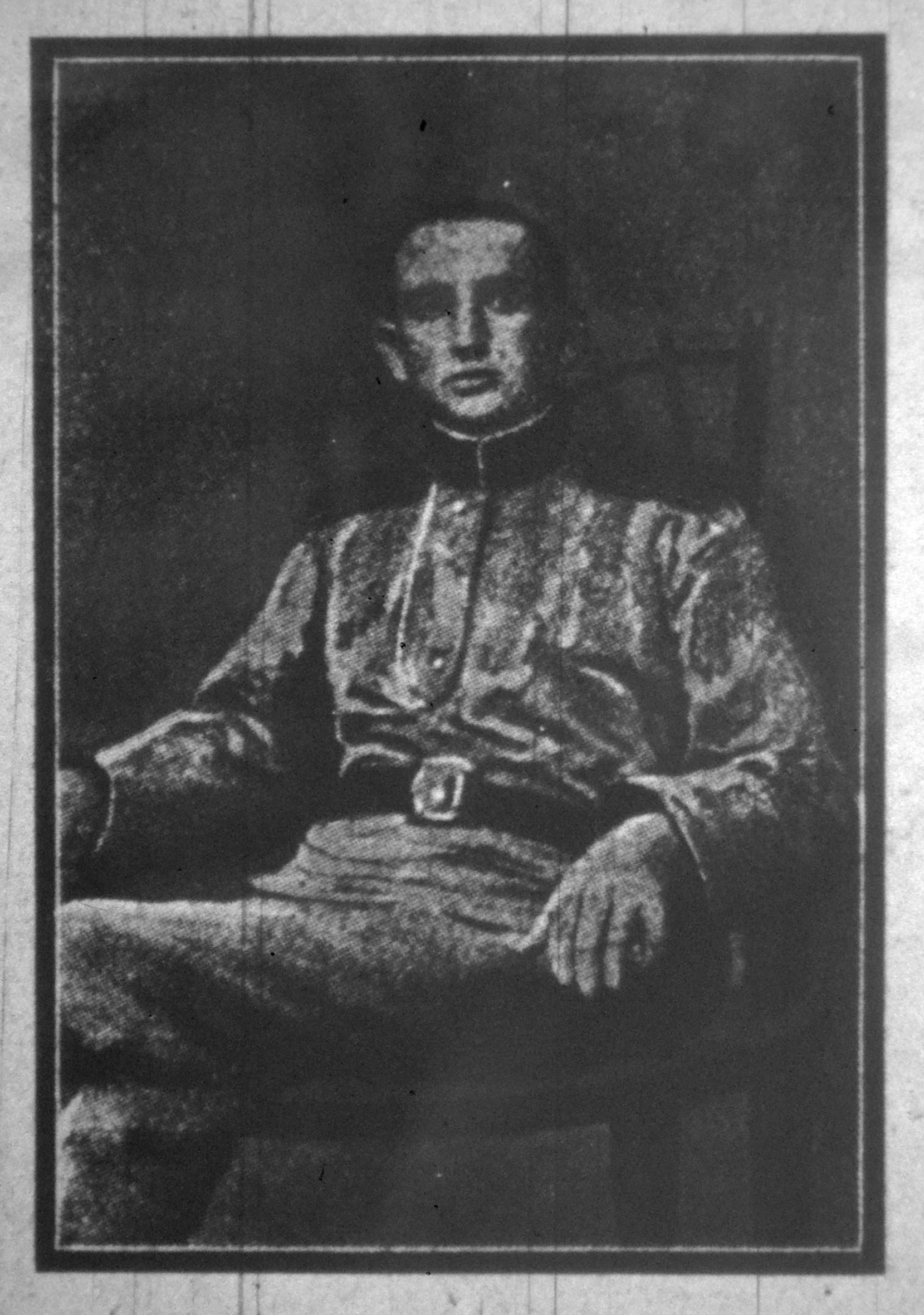
Notably, the article was one of the very few times that The Jewish Chronicle (as opposed to The Jewish World) published a photograph in association with an article.  The image – you can view it below – shows a young boy seated between an elderly man covered in blankets, to his left, and a woman – his grandmother? – his mother? – on his right.  Both the boy and woman (a basket before her – the family’s only remaining possessions?) have their attention focused directly on the photographer, while a woman and young girl (a mother and daughter?) are seated in the background.

Is he the same boy who appeared in the photograph that was published in The Jewish World on October 27, 1915?

There’s no way of knowing, and certainly one hundred and three years later in 2019, no way of ever knowing.

There are numerous statements in this post that bear deep consideration and contemplation, and if attention was accorded to all, “this” introduction would be lengthier than the article itself.  So…  Perhaps the most telling comment, appropriately reserved by the Chronicle’s anonymous reporter for the article’s conclusion, was that of Nahum Sokolow, who stated, “If there were two parties in Jewry to-day, it would be those who had given and those who had not, those who worshipped the Jewish God and those who bowed down to the golden calf; the party of Moses and the party of Korach.  They had to choose between God and Baal.  The party of God would accept the resolution.” 

________________________________________

“Seven million Jews – a population exceeding that of Belgium by one million, have borne the brunt of the war…  True all the peoples of this area suffered the ravage and pillage by the war, but in no degree comparable to the suffering of the Jews…  Hundreds of thousands were driven from their homes on a day’s notice, the more fortunate being packed and shipped as freight – the old, the sick and insane, men, women and children, shuttled from one province to another, side-tracked for days without food or help of any kind – and the less fortunate being driven into the woods and swamps to die of starvation.  Jewish towns were sacked and burned wantonly.  Hundreds of Jews were carried off as hostages into Germany, Austria, and Russia…  These Jews, unlike the Belgians, have no England to fly to.”

THE RUSSO-JEWISH WAR-VICTIMS
MEETING IN THE EAST END
THE DUTY OF ANGLO-JEWRY
The Jewish Chronicle

February 11, 1916

A large gathering crowded all parts of the Pavilion Theatre, Whitechapel, on Sunday afternoon. 

Pavilion Theatre, 191-193 Whitechapel Road, London, England)

The meeting was held in connection with the fund that is being raised for the benefit of the Jewish sufferers in the Russian and Polish war zone.

Lord SWAYTHLING, Treasurer of the fund, who presided, read the following letter from Mr. Leopold de Rothschild, the President: –

DEAR LORD SWAYTHLING,

I shall be very grateful if you will kindly express to the meeting on Sunday next my great regret that I do not feel able to attend, since after a week of work in the City, a rest seems necessary for me.  There are two things in connection with our fund for the relief of the Jewish sufferers by the war to which I should like to refer.  The one is the manner in which the people of the East End have supported it.  It is not the first time that I have had reason to admire their splendid sympathy and their generousity when their feelings had been touched by the misfortunes of their coreligionists in other lands.  I should like also to pay my tribute of gratitude to what our colonies have done.  All will agree that they have responded nobly.

With best wishes for a successful meeting in so good and urgent a cause.

I remain,
Yours very truly,
LEOPOLD DE ROTHSCHILD

Leopold De Rothschild

The CHAIRMAN said he would like to associate himself with that expression of gratitude, not only to the East End of London but to the Provinces and Colonies for the magnificent way in which they had responded to the appeal made by the Committee.  That meeting was intended not solely and only for the East End of London, but was intended also as an appeal to the West, North and South, the Provinces and the Empire.  One of the objects of the gathering was to call attention to the close union between the Fund for the Relief of the Jewish Victims of War in Russia and the Central London Committee for the Relief of the Polish Jews.  From that day onward all official receipts from the combined Committee would either bear the signature of himself or of Mt. Otto Schiff, and would contain a portrait of their President, Mr. Leopold de Rothschild.  Specimens of these receipts were to be obtained at that meeting, and they would be a guarantee that the money would be properly applied.  He had received during that week two letters from Baron Gunzburg, President of the Petrograd Committee which acted as the distributing agents in Russia.  In the first letter he wrote that the Russian Government in certain large districts where there were a large proportion of Jewish refugees were providing kosher meat for the benefit of all classes so that the Jews could partake of the food provided freely.  In the second letter the Baron reported that in certain large districts the Government had not been able to provide sufficient food, and the Petrograd Committee had had to relinquish some of their cherished schemes for the permanent benefit of the Jewish refugees in order to meet their immediate wants in the shape of food.  This was a pity, because the Committee in London were hoping that more permanent relief might be given.  But this fact could only spur them on to renew their efforts to first meet the immediate needs and provide them large funds for permanent assistance.  His late father used to tell him – he did not know whether he had Rabbinical authority for it – that one of the great objects of the Day of Atonement was that every Jew and Jewess during the day suffered the pangs of hunger and were therefore made more sympathetic towards those who were really hungry on more than one day of the year.  In this case, judging from all the letters received by those who had correspondents with Russia, they knew that their coreligionists there were hungering and were also suffering from another form of physical pang, that of cold.  The Jewish refugees were ill-fed, ill-clothed, and were compelled to find shelter where they could.  He appealed to them to continue and increase their efforts on behalf of their poor brethren.  (Cheers.)

The CHIEF RABBI said that that was the second time he had spoken to that hall and the fourth occasion that he had been called upon to address a large meeting called for the purpose of helping their suffering brethren in the war zone.  He felt, however, that the honour of British Jewry was at stake, and it was for him to convince them and the larger audience that would be reached through the newspapers that there was a sacred duty confronting them and that very much more must still be done if they were to discharge their obligations to their suffering brethren.  To realise what British Jewry should do he invited them to glance for a moment at the manner in which the Jewry in the United States had faced and grappled with this problem.  When fifteen months ago, a few weeks after the outbreak of the war, tales of distress in the Polish provinces reached America various private attempts at relief were made.  These were started all over the country, usually from the poorest classes and gradually a sum amounting to about £ 300,000 was collected in the United States for the benefit of the sufferers in the war zone.  Some months ago the leaders of American Jewry realised that a sum like £ 300,000 from a population of three million Jews was hopelessly inadequate.  They felt that the fund would never grow as it ought to grow, and that moneys commensurate with the evil would not be collected unless the wealthy classes could be interested in the movement.  A new committee was organised, and it was decided to hold a general mass meeting for this cause towards the middle of December.  Only a few days before his death Dr. Solomon Schechter was asked either to be present at the meeting or to send a message.  He (the Chief Rabbi) wished to quote one or two sentences from the message from this appeal from the grave sent to the meeting by that great scholar.  He spoke of the sacrifices that the poor had made, and went on to ask: –
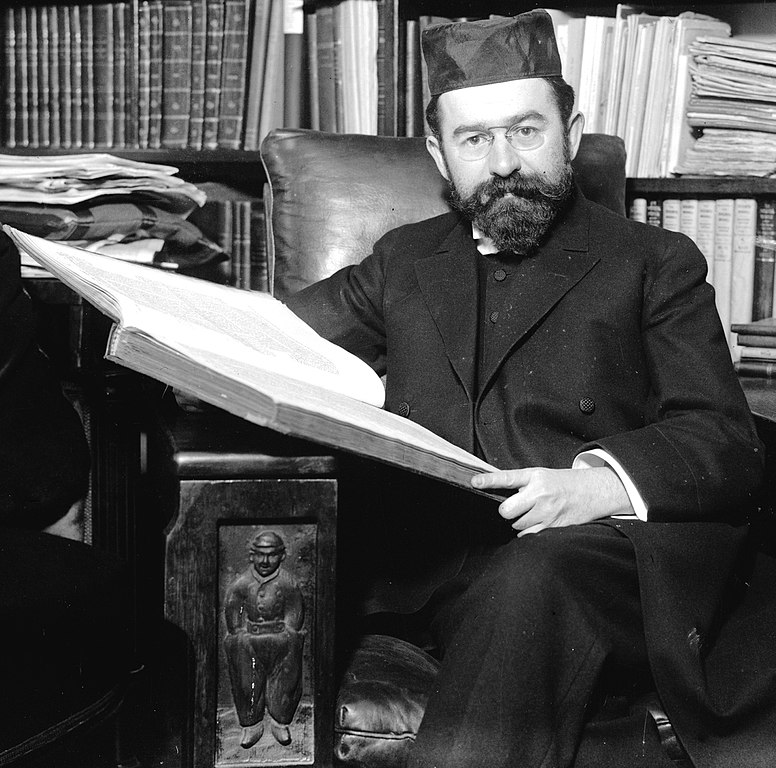
Rabbi Joseph Herman Hertz in 1913

Unfortunately this cannot be said of our better situated classes whom the Lord has blessed with wealth and with all the good things of this world.  Many, it is true, have made smaller or larger contributions, but none, almost, has responded in the way hoped for, considering the fortunes this class commands, on the one hand, and, on the other hand, the terrible dimensions of this disaster.  It is not for me to pass judgement upon my people, but I cannot refrain from remarking that it would seem to me that we have not realised the greatness of the disaster, which has overwhelmed our people, nor have we comprehended the full extent of our duty.

This was absolutely true.  Only the relatives of those suffering in the war zone had realised what was happening there, and when this new committee appealed to the large Jewish public and to the non-Jewish public and acquainted them with the facts the response was encouraging.  At the meeting to which he had referred, in the course of one evening no less than £ 160,000 was collected.  The meeting determined that during 1916 the sum of £ 1,000,000 should be New York’s contribution towards the amelioration of that vast ocean of suffering.  (Cheers.)  The effect of that meeting was educational.  Tens of thousands of Jews and non-Jews heard of what was going on.  Speeches were delivered by the Bishop of New York, United States Senators, Presidents of Universities – and these addresses opened the eyes of the Jewish and non-Jewish public.  The Chief Rabbi went on to say: This is not a political meeting.  Nothing is further from the objects of this gathering.  We know THERE ARE TWO RUSSIAS.

There is the Russia of the future, the Russia of democracy, the Russia of freedom, and everything that is good and noble in Russia belongs to that class.  That Russia is heart and soul with us and with the suffering Jews in this ordeal, in this martyrdom.  Thus recently at Petrograd a non-Jewish Committee was formed, with Count Tolstoi, ex-Mayor of Petrograd, as President, to help the suffering Jews in this war zone.  But it is criminal to hide the fact that there is, unfortunately, besides this Russia of Tolstoi, the Russia of Ivan the Terrible, and a great deal of the woes in the war zone are attributable to this dying Russia.  Proceeding, the Chief Rabbi cited a passage, quoted at the New York meeting by Senator W.J. Stone: –

Seven million Jews – a population exceeding that of Belgium by one million, have borne the brunt of the war…  True all the peoples of this area suffered the ravage and pillage by the war, but in no degree comparable to the suffering of the Jews…  Hundreds of thousands were driven from their homes on a day’s notice, the more fortunate being packed and shipped as freight – the old, the sick and insane, men, women and children, shuttled from one province to another, side-tracked for days without food or help of any kind – and the less fortunate being driven into the woods and swamps to die of starvation.  Jewish towns were sacked and burned wantonly.  Hundreds of Jews were carried off as hostages into Germany, Austria, and Russia…  These Jews, unlike the Belgians, have no England to fly to.

The only England to which they could appeal was their charitable hearts. (Cheers.)  The American newspapers published lists of promises of weekly and monthly contributions ranging from 10 cents to 1,000 dollars.  He had before insisted on the necessity of the relief being of a continuous character.  It was no use saving a man from starvation in October and allowing him to starve again in January or February.  The Chief Rabbi then referred to the institution of a Jewish Relief Day in the United States, and read President Wilson’s proclamation relating thereto.  The American papers, continued Dr. Hertz, had not yet come to hand showing what response had been made to the appeal to the President.  They had read only one cable, which revealed the fact that £ 400,000 was collected in one day, among the Jews and non-Jews of New York City alone.  (Cheers.)  After describing what had been done in England, and the response made especially by the provinces and the colonies, the Chief Rabbi repeated his view that nothing less than £ 500,000 should be the response of British Jewry to the appeal.  He pointed out that not hundreds of thousands but millions were dependent on the Petrograd Committee for every crust of beard they ate.  The Petrograd community, numbering only between 15,000 and 20,000 Jews, had collected £ 100,000 for local help and had contributed a similar sum for general relief.  If Petrograd could do this, how much more should be done by London and the other Jewish communities in Great and Greater Britain.  He urged them all nobly to discharge their duty.  (Cheers.)

MR. HERMAN LANDAU pointed out that the contributions of British Jewry did not amount to 10s a head, which was not a great sacrifice in view of so much misery and suffering.  He made the interesting confessions that since the war he had not bought s single new article of clothing but had devoted the money he would have spent to the refugees.  He appealed for general self-denial.  They hoped to be able to send Baron Guznburg 75,000 roubles weekly.  He stated that the Central Committee had paid £ 3,000 for the refugees from Palestine and a further £ 2,500 had gone for the same purpose.  Some support had also been extended to the Yeshiva at Mir, which had received the pupils of other Yeshiboth.  He urged that on the coming festival of Purim generous gifts should be made to the fund.

MR. CLAUDE G. MONTEFIORE moved the following resolution: –

Claude J.G. Montefiore (from PaintingStar.com)

That in view of the ever-increasing distress of the Jewish population in the Russian and Polish war zone, this meeting pledges itself to make every sacrifice to enable the existing organisations to carry on its relief work.

He said that it might seem wrong to spur the willing horse, but the need was imperative.  He referred to the united character of that meeting, at which every section of the community was represented.  The distress they were endeavouring to meet was of appalling magnitude, appalling in its quantity and degree.  The resources the refugees might have had at first were becoming exhausted, and more and more claims were being made on the relief fund.  The charity of the Russian Jews has its limits, and the spread of the war zone added to the distress.  He was glad to think that some help had been given by the Russian Government, but it was nevertheless a fact that the Government was not giving to the Jews in the same proportion as to other refugees, and therefore distress among the Jews was greater.  He stated emphatically, that every penny contributed would go straight to Russia.

MR. LEONARD L. COHEN seconded the resolution, and referred to the fact that three-quarters of the refugees were in need of clothing, and those who were familiar with a Russian winter would know what that meant.  Mr. Elkan Adler had gone to Petrograd to see the way in which the money was being administered, and he had no doubt he would bring back a satisfactory report.  He regarded the representative character of that meeting as a very happy augury for the future.

Elkan Nathan Adler (from geni.com)

M. NAHUM SOKOLOW, who was enthusiastically received, supported the resolution in an eloquent speech in Yiddish. 
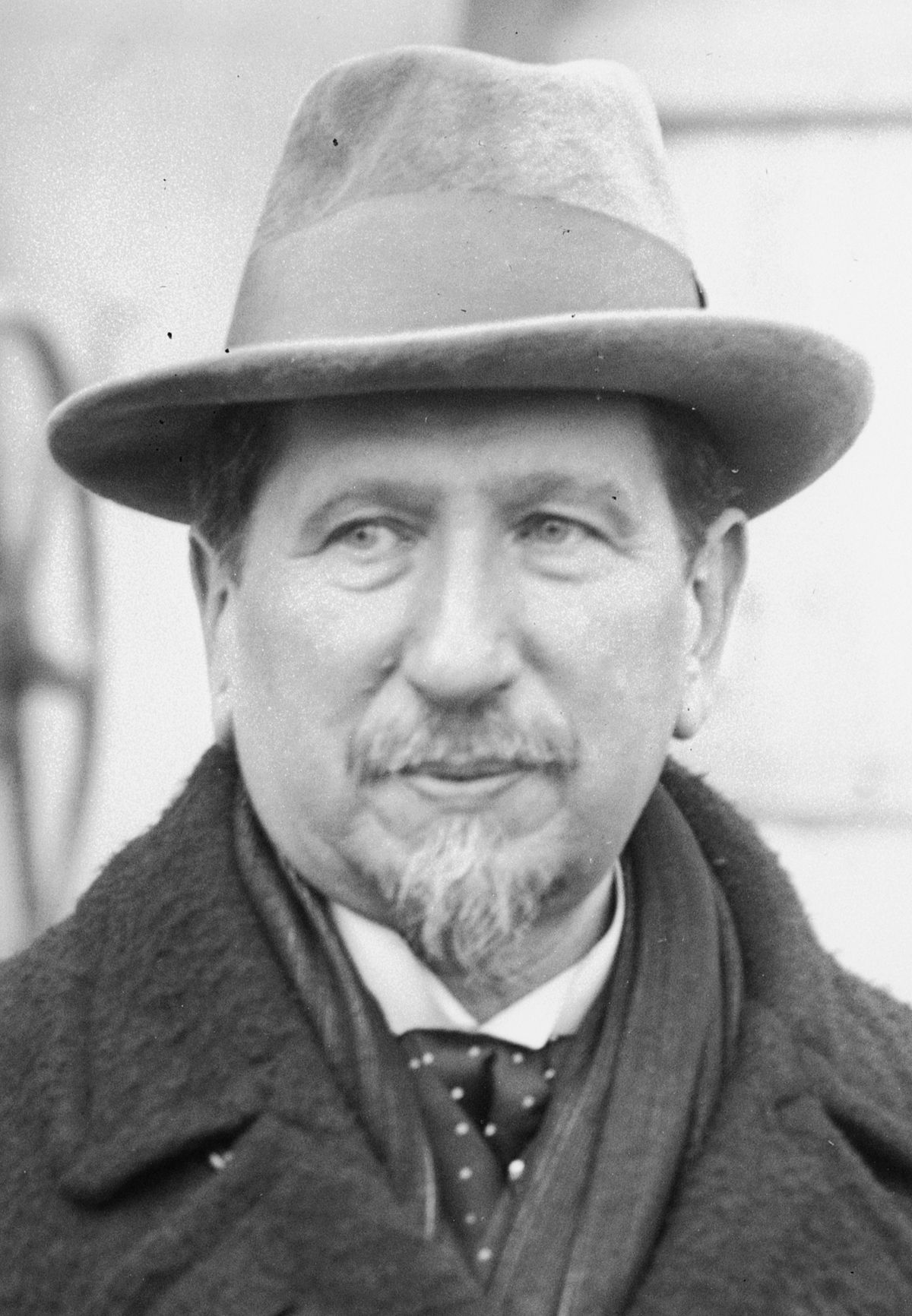
Nahum Sokolow

He said that it was a bitter thing to have to appeal for his fellow-Russian Jews who did not want to be dependent on “the gifts of flesh and blood.”  But it really was not charity they were asked to give, but an insurance premium for the future of Judaism.  The Russian Jews were the depositories of the spiritual and intellectual treasures, of the traditions of the Jewish people, and that gave them a right to ask for help in the time of their need.  He compared the present crisis with the expulsion from Spain.  The horrors of 1492 were but child’s play when set besides the sufferings of the Russian Jews.  He gave a vivid description of the varied character of the relief work that was being conducted, not only for the purpose of satisfying the material needs of the refugees but also for maintaining their commercial life.  He pointed out that the artisans were easier to help than the students and those who followed intellectual pursuits.  The great danger they had to avoid was that of pauperization, and the relief in a good many cases was afforded in the shape of loans rather than of gifts.  The crisis had united all parties.  The East was working with the West.  If there were two parties in Jewry to-day, it would be those who had given and those who had not, those who worshipped the Jewish God and those who bowed down to the golden calf; the party of Moses and the party of Korach.  They had to choose between God and Baal.  The party of God would accept the resolution.  (Loud Cheers.)

The resolution was carried unanimously.

On the motion of Mr. H.G. LOUSADA, seconded by Dayan FELDMAN, a vote of thanks was passed to the colonies and provinces for their help, and a vote of thanks to the Chairman was passed on the motion of Dayan CHAIKIN, seconded by Dayan HILLMAN. 

References

– People –

Adler, Elkan N., at Wikipedia

de Rothschild, Leopold, at Wikipedia

Hertz, Joseph Herman, Chief Rabbi, at Wikipedia

Montagu, Louis S., 2nd Baron Swaything, at Wikipedia

Montefiore, Claude G., at Wikipedia

Montefiore, Claude G., at PaintingStar

Sokolow, Nahum ben Joseph Samuel, at Wikipedia

– Places –

Pavilion Theatre in Whitechapel, at Wikipedia
Chronicles From World War One: Jewish Civilians in Eastern Europe: “Loyalty of Jews in War Lands Unshaken” – Boston Traveler, 1915

By the summer of 1915, with the Great War having raged through and beyond Europe for well-nigh a year, news about the military service of Jewish soldiers and naval personnel had become a regular feature in Jewish (and not only Jewish) periodicals published among some of the major combatant nations of both the Allies and Central Powers.

In The Jewish Chronicle, this generally took the form of brief vignettes about the experiences and observations of individual servicemen, along with – albeit much less frequently – analysis and commentary about Jewish military service in the armed forces of the British Commonwealth, as a whole.  The Jewish Exponent (of Philadelphia) seems to have alluded to or actually published news items of a similar nature (derived from material in The Chronicle?), with of course – after all, this was 1915, two years before the United States’ direct involvement in military operations – relatively little about Jewish military service in America’s armed forces.  Which news content would inevitably change, come 1917…

What the Chronicle and Exponent did have in common was reporting on the travails and suffering of the Jews of Eastern Europe – then, the location of the demographic core of the Jewish people – amidst the ebb and flow of the armies of the Central Powers (well – primarily, Germany) and Allies (primarily – well, Russia).  Probably due to the military centrality and geographic setting of England vis-a-vis the war, new items of this nature seems to have been vastly more common in the Chronicle than the Exponent, albeit the latter did (as you can read in previous posts…) cover this topic, with great prominence.

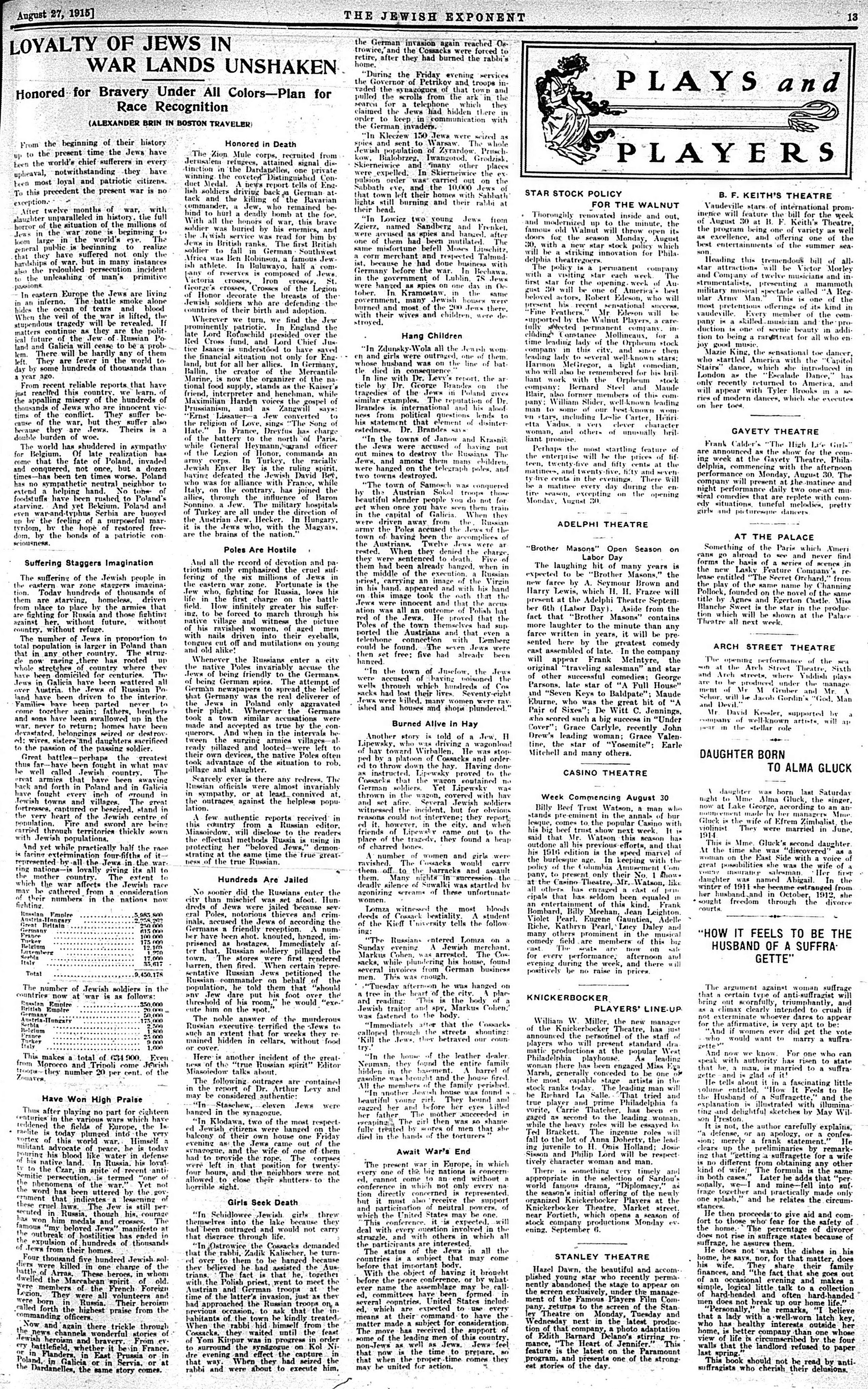
In the summer of 1915, the themes of these two subjects – the military participation of Jews in the militaries of both the Allies and Central Powers, and the fate of Jewish civilians in Eastern Europe – were fused into a single, lengthy article by Alexander Brin (at the time a reporter for The Jewish Advocate, of which he became editor in August of 1918), in The Boston Traveler, under the title “Loyalty of Jews in War Lands Unshaken”.  Republished by The Jewish Exponent on August 27, Brin’s article – fascinating; compelling; infuriating – devotes its first half to a broad survey of worldwide Jewish military service, and its latter half to a summary (illustrated by specific incidents) of the brutalities – brutalities chaotic; brutalities calculated; brutalities intentional – endured by the Jews of Poland, through the accidental intersection of German opportunism, Polish hostility, and the ideology of the civilian and military leadership of Imperial Russia.

Of particular note – especially in light of my prior post The World at War, The Jews in War: Jewish Military Service in World War One, which includes a statistical overview of the approximate number of Jewish servicemen, and Jewish military casualties (fatalities) in the Great War – is Brin’s presentation of the number of Jewish soldiers in the belligerent nations.  Being that his article was published in 1915 and reflective of data available up to that point in time, a comparison with numbers in Dr. Martin Gilbert’s 1976 Atlas of Jewish History (previously published in the Committee for a Jewish Army’s 1943 book The Fighting Jew) is illuminating.  The numbers are doubly ironic, for in 1915, as much as in 1918 (as observed by David Vital) the countries in which served the greatest number of Jewish soldiers were not England, France, or Germany, but instead Imperial Russia, and, Austria-Hungary. 

Three decades later, the irony continued – as irony often does:  In the Second World War, the country in which served the greatest number of Jewish soldiers was the Soviet Union.

So.  Below…  You can view an image of Brin’s article, as it appeared in the Exponent.  (The resolution is 395 dpi, for those so curious.) 

So, further below…  You can read a full transcript of the article.  I’ve inserted comments [such as:comment...”] where appropriate, to elaborate on and clarify points raised in the article. 

________________________________________

“Great battles – perhaps the greatest thus far – have been fought in what may be well called Jewish country.  The great armies that have been swaying back and forth in Poland and in Galicia have fought every inch of ground in Jewish towns and villages.  The great fortresses, captured or besieged, stand in the very heart of the Jewish centre of population.  Fire and sword are being carried through territories thickly sown with Jewish populations.

“And yet while practically half the race is facing extermination four-fifths of it – represented by all the Jews in the warring nations – is loyally giving its all to the mother country.”

LOYALTY OF JEWS IN WAR LANDS UNSHAKEN
Honored for Bravery Under All Colors – Plan for Race Recognition
The Jewish Exponent
August 27, 1915
(Alexander Brin, in Boston Traveler)

From the beginning of their history up to the present time the Jews have been the world’s chief sufferers in every upheaval, notwithstanding they have been most loyal and patriotic citizens.  To this precedent the present war is no exception.

After twelve months of war, with slaughter unparalleled in history, the full horror of the war zone is beginning to loom large in the world’s eye.  The general public is beginning to realize that they have suffered not only the hardships of war, but in many instances also the redoubled persecution incident to the unleashing of man’s primitive passions.

In eastern Europe the Jews are living in an inferno.  The battle smoke alone hides the ocean of tears and blood.  When the veil of war is lifted, the stupendous tragedy will be revealed.  If matters continue as they are the political future of the Jew of Russian Poland and Galicia will cease to be a problem.  There will be hardly any of them left.  There are fewer in the world today by some hundreds of thousands than a year ago.

From reliable reports that have just reached this country, we learn, of the appalling misery of the hundreds of thousands of Jews who are innocent victims of the conflict.  They suffer because of the war, but they suffer also because they are Jews.  Theirs is a double burden of woe.

The world has shuddered in sympathy for Belgium.  Of late realization has come that the fate of Poland, invaded and conquered, but once, but a dozen times – has been ten times worse.  Poland has no sympathetic natural neighbor to extend a helping hand.  No tons of foodstuffs have been rushed to Poland’s starving.  And yet Belgium, Poland and even war-and-typhus Serbia are buoyed up by the feeling of a purposeful martyrdom, by the hope of restored freedom, by the bonds of a patriotic consciousness.

Suffering Staggers Imagination

The suffering of the Jewish people in the eastern war zone staggers imagination.  Today hundreds of thousands of them are starving, homeless, driven from place to place by the armies that are fighting for Russia and those fighting against her, without future, without country, without refuge.

The number of Jews in proportion to total population is larger in Poland than that in any other country.  The struggle now raging there has rooted up whole stretches of country where they have been domiciled for centuries.  The Jews in Galicia have been scattered all over Austria, the Jews of Russian Poland have been driven to the interior.  Families have been parted never to come together again; fathers, brothers and sons have been swallowed up in the war, never to return; homes have been devastated, belongings seized or destroyed; wives, sisters and daughters sacrificed to the passions of the passing soldier.

Great battles – perhaps the greatest thus far – have been fought in what may be well called Jewish country.  The great armies that have been swaying back and forth in Poland and in Galicia have fought every inch of ground in Jewish towns and villages.  The great fortresses, captured or besieged, stand in the very heart of the Jewish centre of population.  Fire an sword are being carried through territories thickly sown with Jewish populations.

And yet while practically half the race is facing extermination four-fifths of it – represented by all the Jews in the warring nations – is loyally giving its all to the mother country.  The extent to which the war affects the Jewish race may be gathered from a consideration of their numbers in the nations now fighting.

Russian Empire – 3,983,800
Austria Hungary – 2,758,202
Great Britain – 250,000
Germany – 615,000
France – 100,000
Turkey – 175,000
Belgium – 12,100
Luxembourg – 1,970
Serbia – 17,000
Italy – 33,617

Total – 9,450,178

The number of Jewish soldiers in the countries now at war is as follows:

Russian Empire – 350,000
British Empire – 20,000
Germany – 50,000
Austria-Hungary – 175,000
Serbia – 2,500
Belgium – 1,800
France – 25,000
Turkey – 9,000
Italy – 1,000

This makes a total of 634,900.  Even from Morocco and Tripoli come Jewish troops – they number 20 per cent of the Zouaves.

Have Won High Praise

They after playing no part for eighteen centuries in the various wars which have reddened the fields of Europe, the Israelite is today plunged into the very vortex of this world war.  Himself a militant advocate of peace, he is today pouring his blood like water in defense of his native land.  In Russia, his loyalty to the Czar, in spite of recent anti-Semitic persecution, is termed “one of the phenomena of the war”.  Yet not the word has been uttered by the government that indicates a loosening of these cruel laws.  The Jew is still persecuted in Russia, though his courage has won him medals and crosses.  The famous “my beloved Jews” manifesto at the outbreak of hostilities has ended in the expulsion of hundreds of thousands of Jews from their homes.

Four thousand five hundred Jewish soldiers were killed in one charge of the battle of Arras.  These heroes, in whom dwelled the Maccabean spirit of old, were members of the French Foreign Legion.  They were all volunteers and were born in Russia.  Their heroism called forth the highest praise from the commanding officers.

Now and again there trickle through the news channels wonderful stories of Jewish heroism and bravery.  From every battlefield, whether it be in France, or in Flanders, in East Prussia or in Poland, in Galicia or in Serbia, or at the Dardanelles, the same story comes.

Honored in Death

The Zion Mule Corps, recruited from Jerusalem refugees, attained signal distinction in the Dardanelles, one private winning the coveted Distinguished Conduct Medal.  A news report tells of English soldiers driving back a German attack and the killing of the Bavarian commander, a Jew, who remained behind to hurl a deadly bomb at the foe.  With all the honors of war, this brave soldier was buried by his enemies, and the Jewish service was read for him by Jews in British ranks.  [This is correct.  Alexander Brin is referring to a news item that appeared in The Jewish Chronicle on July 2, 1915, only two months before the publication of his essay.  Entitled, “German Jewish Officer Bayonted,” the text follows:

In the course of a letter from Squadron Sergt.-Major V. Rathbone, King Edward’s Horse, to his brother, Mr. M. Rathbone, the former writes: – “I was up and down the trenches for twenty-four hours, with one hour’s rest.  We captured a German officer, Lieut. Max Seller, of a Bavarian Cavalry Regiment.  He and about fifty men were attacking us with hand bombs and the officer was bayoneted on the parapet.  I helped to bury him with our own casualties.  He was a Jew so I had the service altered by the Chaplain.  Possibly his people might be glad to know, and if you asked the JEWISH CHRONICLE and the Jewish World to mention it they might learn of it.  He was a plucky chap and our fellows could not help expressing admiration at his effort to bomb us.”

Who was Max Seller?

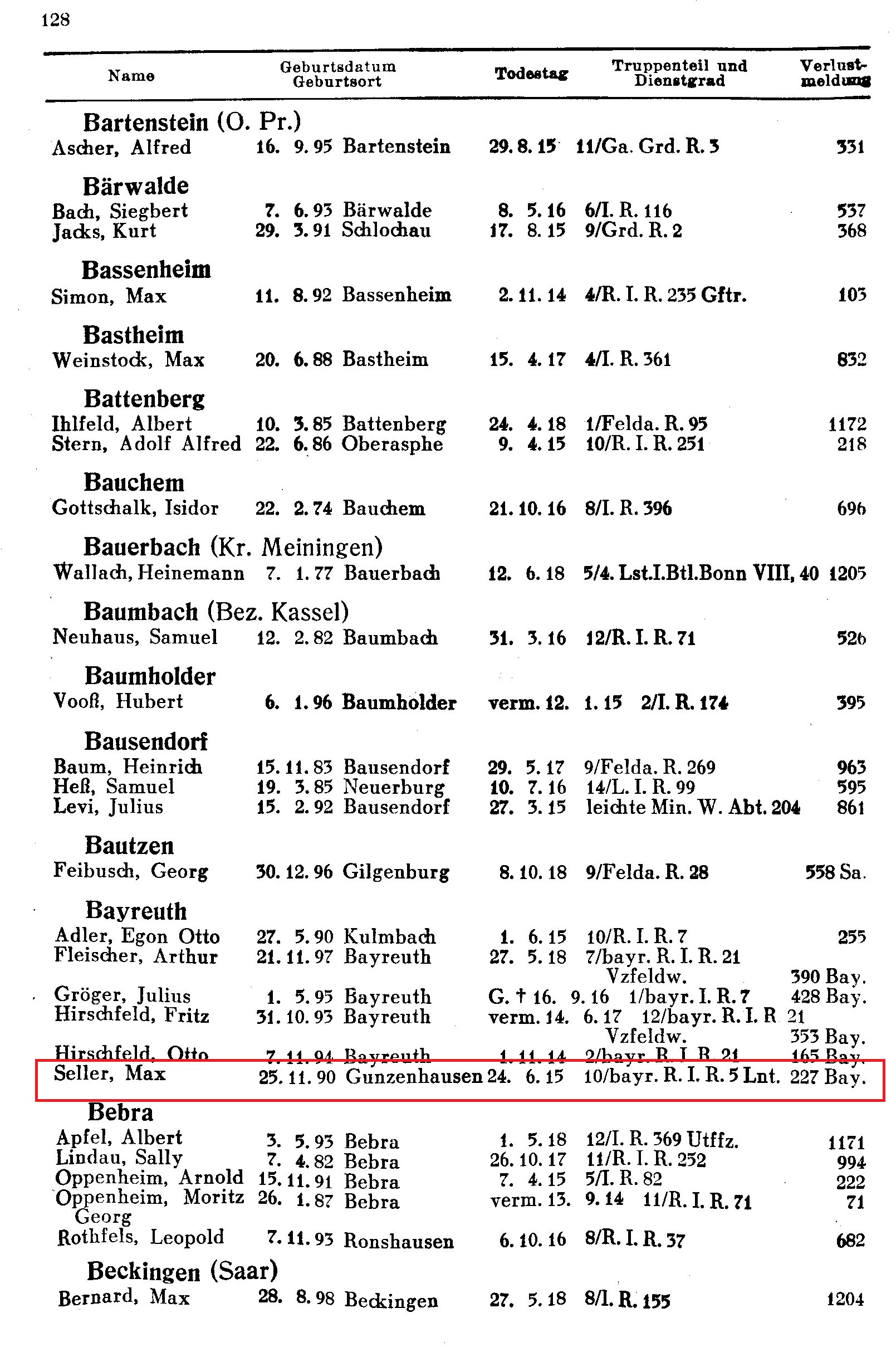
Born in Gunzenhausen, Bayreuth, Germany, on November 25, 1890, he was the son of Martha Seller.  An Unteroffizier in the 7th Bavarian Reserve Infantry Regiment, he was wounded on September 3, 1914.  Promoted to the rank of Leutnant der Reserve (equivalent to Reserve Second Lieutenant?), he was eventually assigned to the 10th Company, 3rd Battalion, of the 5th Bavarian Reserve Infantry Regiment, where he was a Zugfuhrer (Squad Leader).  Twenty-four years old, he was killed – as described in Sergeant-Major Rathbone’s account – on June 24, 1915.  Max Seller is buried in the British Military Cemetery “Hyde Park Corner” at Ploegsteert (Belgium), at Block 1, Row B, Grave 21.

______________________________

Max was one of six Jewish war dead from Bayreuth, as seen in this page from Die Jüdischen Gefallenen Des Deutschen Heeres, Deutschen Marine Und Der Deutschen Schutztruppen 1914-1918 – Ein Gedenkbuch:

______________________________

This document, from the Commonwealth War Graves Commission, is a record of Lt. Seller’s burial.  Note the specific mention of a “Jewish Memorial”…

______________________________

…however, until this past decade, Max’s matzeva bore no religious symbol.  As described by Stephen Daisley in The Jewish Chronicle in October of 2017, in “Retelling the Tale of a Plucky Chap“, this symbolic anonymity was rectified in 2016:  This occurred through he efforts of German historian Robin Schäfer, who worked in concert with the German ambassador to Belgium, and, the CWGC.  Thus, the matzeva now bears a Magen David. 

Stephen Dailsey’s article recounts The Lieutenant’s story in detail, relating biographical information about his family and their subsequent fate, and includes a photograph of Sergeant-Major Rathbone.

You can view Lt. Seller’s matzeva as it appeared in April, 2013, in the photo essay Vanishing Point: Stumbling through Ploegsteert, at the blog of photographer Nick. J. StoneMr. Stone’s photo essay includes images of three records pertaining to Max Seller’s military service, as well as genealogical information (some the latter of which has been incorporated into “this” blog post).  You can see in the image that Max Seller’s matzeva (visible at the front right) simply listed his name, military unit, and date of death. 

Well, unlike so many millions killed in the Great War, he has a place of burial. 

At least there was that.

Stepping back, several news stories of this nature – about Jewish soldiers in opposing armies who became military casualties at the hands of one another – appeared in the Chronicle and Exponent early in the Great War (not so much if at all, later), the setting for such tales typically being the Eastern War Zone.  As such, a solidly verified account of this nature from the Western War Zone was unusual.  Such stories, regardless of their veracity, reflected the implications, complexities and possible tragedies – in terms of the conflict between universalism and peoplehood – inherent to, resulting from, and perhaps inevitable with Jewish political emancipation, and its attendant service in the military forces of opposing nations.  Max Seller’s story still bears resonance, and in the context of the ongoing history of the Jewish people, will continue to do so.  (But, I digress.  Back Alexander Brin’s article….)

The first British soldier to fall in German Southwest Africa was Ben Robinson, a famous Jewish athlete.  [Brin is probably referring to Private Benjamin Rabinson, Serial Number 189.  From Buluwayo, a member of the 1st Battalion, Rhodesia Regiment, he was killed in action on February 7, 1915.  His name appeared in The Jewish Chronicle on March 19 and April 23 of that year, with (as was typical) absolutely no information about his next of kin or place of residence, as well as on page 113 of British Jewry Book of Honour.  He is buried at the Swakopmund Municipal Cemetery, in Namibia.]  In Buluwayo, half a company of reserves is composed of Jews.  Victoria Crosses, Iron Crosses, St. George’s Crosses, Crosses of the Legion of Honor decorate the breasts of the Jewish soldiers who are defending the countries of their birth and adoption.

Wherever we turn, we find the Jew prominently patriotic.  In England the late Lord Rothschild presided over the Red Cross fund, and Lord Chief Justice Isaacs is understood to have saved the financial situation not only for England, but for all her allies.  In Germany, Ballin, the creator of the Mercantile Marine, is now the organizer of the national food supply, stands as the Kaiser’s friend, interpreter and henchman, while Maximilian Harden voices the gospel of Prussianism, and as Zangwill says: “Ernst Lissauer – a Jew converted to the religion of Love, sings “The Song of Hate”.  In France, Dreyfus has charge of the battery to the north of Paris, while General Heymann, grand officer of the Legion of Honor, commands an army corps.  In Turkey, the racially Jewish Enver Bey [Enver Pasha; Ismail Enver Pasha], is the ruling spirit, having defeated the Jewish David Bey, who was for alliance with France, while Italy, on the contrary, has joined the allies, through the influence of Baron Sonnino, a Jew.  The military hospitals of Turkey are all under the direction of the Austrian Jew, Hecker.  In Hungary, it is the Jews who, with the Magyars, are the brains of the nation.

An error on Brin’s part!…  The Wikipedia entry for Enver Bey notes the following:  “Enver was born in Constantinople (Istanbul) on 22 November 1881. Enver’s father, Ahmed (c. 1860–1947), was a Gagauz Turk either a bridge-keeper in Monastir or a small town public prosecutor in the Balkans and his mother Ayşe, an Albanian.  His uncle was Halil Pasha (later Kut). Enver had two younger brothers, Nuri and Mehmed Kamil, and two younger sisters, Hasene and Mediha.  He was the brother in law of Lieutenant Colonel Ömer Nâzım.   He studied for different degrees in military schools in the empire and ultimately graduated from the Harp Akademisi with distinction in 1903.  He became a major general in 1906.  He was sent to the Third Army, which was stationed in Salonica.  During his service in the city, he became a member of the Committee of Union and Progress (CUP).”

Poles are Hostile

And all the record of devotion and patriotism only emphasized the cruel suffering of the six millions of Jews in the eastern war zone.   Fortunate is the Jew who, fighting for Russia, loses his life in the first charge on the battlefield.  How infinitely greater his suffering, to be forced to march through his native village and witness the picture of his ravished women, of aged men with nails driven into their eyeballs, tongues cut off and mutilations on young and old alike.

Whenever the Russians enter a city the native Poles invariably accuse the Jews of being friendly to the Germans, of being German spies.  The attempt of German newspapers to spread the belief that Germany was the real deliverer of the Jews in Poland only aggravated their plight.  Whenever the Germans took a town similar accusations were made and accepted as true by the conquerors.  And when in the intervals between the surging armies villages – already pillaged and looted – were left to their own devices, the native Poles often took advantage of the situation to rob, pillage and slaughter.

Scarcely ever is there any redress.  The Russian officials were almost invariably in sympathy, or at least connived at, the outrages against the helpless population.

A few authentic reports received in this country from a Russian editor, Miasoiedow, will disclose to the readers the effectual methods Russia is using in protecting her “beloved Jews,” demonstrating at the same time the true greatness of the true Russian.

Hundreds are Jailed

No sooner did the Russians enter the city than mischief was set afoot.  Hundreds of Jews were jailed because several Poles, notorious thieves and criminals, accused the Jews of according the Germans a friendly reception.  A number have been shot, knouted, hanged, imprisoned as hostages.  Immediately after that, Russian soldiery pillaged the town.  The stores were first rendered barren, then fired.  When certain representative Russian Jews petitioned the Russian commander on behalf of the population, he told them that “should any Jew dare set foot over the threshold of his room,” he would “execute him on the spot.”

The noble answer of the murderous Russian executive terrified the Jews to such an extent that for weeks they remained hidden in cellars, without food or cover.

Here is another incident of the greatness of the “true Russian spirit”.  Editor Miasoiedow talks about.

The following outrages are contained in the report of Dr. Arthur Levy and may be considered authentic:

“In Staschew, eleven Jews were hanged in the synagogue.

“In Klodawa, two of the most respected Jewish citizens were hanged on the balcony of their own house one Friday evening as the Jews came out of the synagogue, and the wife of one of them had to provide the rope.  The corpses were left in that position for twenty-four hours, and the neighbors were not allowed to close their shutters to the horrible sight.

Girls Seek Death

“In Schidlowee Jewish girls threw themselves into the lake because they had been outraged and would not carry that disgrace through life.

“In Ostrowice the Cossacks demanded that the rabbi, Zadik Kalischer, be turned over to them to be hanged because they believed he had assisted the Austrians.  The fact is that he, together with the Polish priest, went to meet the Austrian and German troops at the time of the latter’s invasion, just as they had approached the Russian troops on a previous occasion, to ask that the inhabitants of the town be kindly treated.  When the rabbi hid himself from the Cossacks, they waited until the feast of Yom Kippur was in progress in order to surround the synagogue on Kol Nidre evening and effect the capture in that way.  When they had seized the rabbi and were about to execute him, the German invasion again reached Ostrowice, and the Cossacks were forced to retire, after they had burned the rabbi’s home.

“During the Friday evening services the Governor of Petrikov and troops invaded the synagogues of the town and pulled the scrolls from the ark in the search for a telephone which they claimed the Jews had hidden there in order to keep in communication with the German invaders.

“In Kleczew 150 Jews were seized as spies and sent to Warsaw.  The whole Jewish population of Zyrardow, Prutshkow, Bialobrzeg, Iwangorod, Grodzisk, Skierneiwice and many other places were expelled.  In Skierneiwice the expulsion order was carried out on the Sabbath eve, and the 10,000 Jews of the town left their homes with Sabbath lights still burning and the rabbi at their head.

“In Lowicz two young Jews from Zgierz, named Sandberg and Frenkel, were accused as spies and hanged, after one of them had been mutilated.  The same misfortune befell Moses Lipschitz, a corn merchant and respected Talmudist, because he had done business with Germany before the war.  In Bechawa, in the government of Lublin, 78 Jews were hanged as spies on one day in October.  In Kramostaw, in the same government, many Jewish houses were burned and most of the 200 Jews there, with their wives and children, were destroyed.

Hang Children

“In Zdunsky-Wola all the Jewish women and girls were outraged, one of them, whose husband was on the line of battle, died in consequence.”

In line with Dr. Levy’s report, the article by Dr. George Brandes on the tragedies of the Jews in Poland gives similar examples.  The reputation of Dr. Brandes is international and his aloofness from political questions lends to his statement that element of disinterestedness.  Dr. Brandes says:

“In the towns of Janow and Krasnik the Jews were accused of having put out mines to destroy the Russians.  The Jews, and among them many children, were hanged on the telegraph poles, and two towns destroyed.

“The town of Samosch was conquered by the Austrian Sokol troops, those beautiful slender people you do not forget when once you have seen them train in the capital of Galicia.  When they were driven away from the Russian army the Poles accused the Jews of the town of having been the accomplices of the Austrians.  Twelve Jews were arrested.  When they denied the charge, they were sentenced to death.  Five of them had already been hanged, when in the middle of the execution, a Russian priest, carrying an image of the Virgin in his hand, appeared and with his hand on this image took the oath that the Jews were innocent and that the accusation was all an outcome of Polish hatred of the Jews.  He proved that the Poles of the town  themselves had supported the Austrians and that even a telephone connection with Lemberg could be found.  The seven Jews were then set free; five had already been hanged.

“In the town of Jusefow, the Jews were accused of having poisoned the wells through which hundreds of Cossacks had lost their lives.  Seventy-eight Jew s were killed, many women were ravished and houses and shops plundered.”

Burned Alive in Hay

Another story is told of a Jew, H. Lipewsky, who was driving a wagonload of hay toward Wirhallen.  He was stopped by a plaotton of Cossacks and ordered to throw down the hay.  Having done as instructed, Lipewsky proved to the Cossacks that the wagon contained no German soldiers.  Yet Lipewsky was thrown in the wagon, covered with hay and set afire.  Several Jewish soldiers witnessed the incident, but for obvious reasons could not intervene; they reported it, however, in the city, and when friends of Lipewsky came out to the place of the tragedy, they found a heap of charred bones.

A number of women and girls were ravished.  The Cossacks would carry them off to the barracks and assault them.  Many nights in succession the deadly silence of Suwalki was startled by agonizing screams of these unfortunate women.

Lomza witnessed the most bloody deeds of Cossack bestiality.  A student of the Kieff Uiversity tells the following:

“The Russians entered Lomza on a Sunday evening.  A Jewish merchant, Markus Cohen, was arrested.  The Cossacks, while plundering his house, found several invoices from German business men.  This was enough.

“Tuesday afternoon he was hanged on a tree in the heart of the city.  A placard reading: “This is the body of a Jewish traitor and spy, Markus Cohen,” was fastened to the body.

“Immediately after that the Cossacks galloped through the streets shouting: ‘Kill the Jews, they betrayed our country.’

“In the house of the leather dealer, Neuman, they found the entire family hidden in the basement.  A barrel of gasoline was brought and the house fired.  All the members of the family perished.

“In another Jewish house was found a beautiful young girl.  The bound and gagged her and before her eyes killed her father.  The mother succeeded in escaping.  The girl was then so shamefully treated by scores of men that she died in the hands of the torturers.”

Await War’s End

The present war in Europe, in which every one of the big nations is concerned, cannot come to an end without a conference in which not only every nation directly concerned is represented, but it must also receive the support and participation of neutral powers, of which the United States may be one.

This conference, it is expected, will deal with every question involved in the struggle, and with others in which all the participants are interested.

The status of the Jews in all the countries is a subject that may come before that important body.

With the object of having it brought before the peace conference, or by whatever name the assemblage may be called, committees have been formed in several countries, United States included, which are expected to use every means at their command to have the matter made a subject for consideration.  The move has received the support of some of the leading men of the country, non-Jews as well as Jews.  Jews feel that now is the time to prepare, so that when the proper time comes they may be united for action. 

References

Websites

Enver Bey – Biography at Wikipedia

Alexander Brin Dead at 87 – News article at archive of Jewish Telegraphic Agency

Leutnant der Reserve Max Seller – Grave Record at Commonwealth War Graves Commission

Retelling the Tale of a Plucky Chap, by Stephen Daisley – The Jewish Chronicle, October 17, 2017

Benjamin Rabinson (“B. Rabinson”) – Grave Record at Commonwealth War Graves Commission

The Jewish Advocate (History of publication) – at Wikipedia

Nick J. Stone’s photographs – at Flickr

Invisible Works – Nick J. Stone’s photography blog

Books

Adler, Michael, British Jewry Book of Honour, Caxton Publishing Company, London, England, 1922

Die Jüdischen Gefallenen Des Deutschen Heeres, Deutschen Marine Und Der Deutschen Schutztruppen 1914-1918 – Ein Gedenkbuch, Reichsbund Jüdischer Frontsoldaten, Forward by Dr. Leo Löwenstein, Berlin, Germany, 1932

Chronicles From World War One: Jewish Civilians in Eastern Europe: “If It Be True … A Terrible Indictment Against Russia” – The Jewish Chronicle, July 30, 1915

By August of 1915, slightly over a year had transpired since the Great War’s beginning.  The war’s unprecedented effects, awareness of which had by now become apparent to all observers,  would continue through the subsequent three years.  (And, beyond.)

By this time – as evidenced through examples of news items and investigative reports in the Jewish and general news media – information about the dire situation and appalling treatment of Jewish civilians in the Eastern War Zone, particularly in Poland, amidst the advance and retreat of armies of the Central Powers and Allies (well, the latter specifically being Imperial Russia), had become readily available.  By August, 1915, evidence of this – vastly more than mere anecdote and rumor – had reached such a level of pervasiveness, depth, and consistency that on August 13 The Jewish Chronicle published the editorial, “If It Be True… A Terrible Indictment Against Russia”, which was simultaneously news analysis, an opinion piece, and a tempered voice of alarm and outrage.

The editorial was authored by “Mentor”, under whose name innumerable essays, musings, and thought pieces – often focused upon Jewish Nationalism – were published in the Chronicle during and after the Great War.  I’m not familiar enough with the history of The Jewish Chronicle to know if “Mentor” was a moniker for the newspaper’s publisher or chief editor, a pen-name under which the writings of multiple individuals appeared under ostensible authorship of one person.  Or even, if “Mentor” was a member of the Jewish community not actually on the staff of the Chronicle.  Given the consistency of both Mentor’s wonderful literary style, and the consistent themes and opinions of his essays and editorials, I think the most likely simplest explanation is the simplest: Mentor was one person.

In any event, Mentor’s essay concerning the treatment of Jewish civilians by the Russian Army is careful and tempered; analytical and measured; powerful and impassioned.  Notably, he doesn’t actually address the issue at hand until well (well!) into the body of his essay, devoting his first four paragraphs, in tones almost abstract and academic, to concerns about the very propriety of expressing thoughts that might be construed as being even remotely critical of any aspect of the war’s conduct.  This is expressed in light of the mood of the British public, the necessity of not impinging upon relations between Britain and Russia under the imperative of maintaining the Triple Alliance, and possible (though unarticulated) fears about the perception of the “loyalty” of British Jewry, as perceived via criticisms of an ally of Britain – Czarist Russia – expressed in the Chronicle

The predicament being, how does one criticize his country’s ally, when that ally, through policies emanating from the highest positions in its civilian and military leadership, is treating one’s people – to use the apt word – “abhorrently?”  Specifically, “What has to be said here about Russia, about an Ally of this country, must be confessed to be singularly abhorrent reading, the more abhorrent because Russia is the country’s Ally.  For my part, however, I cannot believe that a clear statement of the matter to which I feel it incumbent to draw public attention, such as will be attempted, is in the remotest sense traitorous, for it is written in loyalty to truth.  I cannot believe the British Government, allied though it be to the Government of Russia, will so deem it.  Loyalty to truth, the denunciation of infamies, even when committed by the friends and allies of this country, cannot be disloyalty to England – the fount of honor, the palladium of freedom.”

In the central part of his essay, Mentor presents the reader with accounts of the Russian military’s forced deportation of Jews from Galicia and Bukovina – who astonishingly included Jewish soldiers of the Russian army who’d been recuperating from their wounds, let alone children and the aged.  This is followed by accounts of the immediate reaction to these events and policies by members of the affected Jewish communities, and, subsequently, by “prominent” members of Russian Jewry (named not indicated), the latter of which eventuated in the orders for deportation being annulled, albeit conditionally.

In the essay’s concluding paragraphs, Mentor focuses upon the origin of the Russian government’s policies vis-a-vis Jews, and other subject nationalities, imputing that the former arises (and has arisen…) through the influence of “German anti-Semites and German anti-Semitism,” seemingly casting greater responsibility for these events indirectly on Germany, rather than directly on Russia. 

He then concludes his thoughts with the same focus – and the same concerns – with which the essay began:  Upon the concept of Loyalty.  (Capital “L” loyalty, that is.)  For if loyalty there be, it can neither be one-sided, nor unreciprocated.

________________________________________

________________________________________

“They were not soldiers on the battlefield in the conventional meaning of the term, but they were true soldiers on life’s battlefield, fighting an unequal contest against overwhelming odds.  And they refused their liberty, their freedom, their lives, their homes, because these could be gained only by a demeaning condition; they preferred exile to a dishonoring pact “inconsistent with the dignity of Judaism”.” 

“IF IT BE TRUE…”
A Terrible Indictment Against Russia
The Jewish Exponent
August 13, 1915

“Mentor,” in The Jewish Chronicle
(Reprinted from The Jewish Chronicle of July 30, 1915)

IT IS a commonplace of the world-struggle which in a few days will have been raging for a whole year that the sufferings caused by the war have fallen more heavily upon Jews than upon any other section of the population involved.  Perhaps, however, the very hardest measure that has been dealt out to the Jews has not been the direct effects of battle.  The hardest measure has been the persistent suspicion that has been leveled at them on all hands.  The hardest measure has been that Jews who, as a people, have the fault, if such could really be deemed a fault, of being abnormally loyal, even loyal to excess, have been pilloried as treason-mongers.  That there are black sheep in every flock, and that there are Jews who will stoop to treasonable practices must necessarily be in a body so distinguished for loyalty as are our people.

It is the way of nature to produce abnormalities.  But the loyalty of Jews to the land of which they are citizens has been proved in a thousand fires.  That loyalty cannot be purchased nor suppressed.  It is the way of the Jew, a part of his being, the very essence of his psychology.  The loyalty of the Jew is not confined to material considerations.  His history is in itself a demonstration of his loyalty to great principles and to the greatest of all – to Truth.  For his métier has been, and is, to be a passive if not an active witness of Truth before all the world.  For that he has suffered, for that he suffers, and for that he will suffer till the end of the variegated chapter which he is contributing to the history of mankind.

What I am about to say may possibly be deemed by some, mostly of the shallow and the unthinking, to be in some way disloyal when measured by their notions of patriotism.  Patriotism, especially in the stress and storm of wartime, however, takes unto itself remarkable contortions.  Men and women – of both sexes – lose even their average balance of intellect as soon as the war drum begins to throb.  Their anxiety to prove their patriotism – who prove what ought never to be in question? – impels them to the most extraordinary devices for satisfying this aspiration, so that they come to mistake for patriotism what is mere hysteria.  We are at war with the German nation, and, according to some of these unbalanced souls, the mere fact that we are at war with that people is proof that every individual of them is devoid of every scarp and vestige of qualities that are virtues and has become endowed with every quality which is vicious and evil.  Equally because in the political whirligig England has become allied to certain Powers, the people of those countries possess, according to these hysterical patriots, all the virtues.  It never crosses the mind of these people that these very allies could have ever been at enmity with England – as Russia was very recently, as France was for generations – at enmity and subjected to the same unreasoning prejudice of this worthless sort of self-styled patriot.  This “cockeyed” patriotism helps not even a little bit, it hinders greatly.  This patriotism runs mad and will never win a war.  The “Hymn of Hate” has been a deterrent to German in the prosecution of her campaign as lack of munitions is said to have been to the Allied Powers.

Wars are matters of great moment, requiring the true patriot to cultivate a broad outlook and wide purview.  The belligerent nation, the citizens of which indulge in petty scrapping worthy of garrulous washerwomen, is handicapped in carrying on vast operations of great pith and moment.  Patriotism – true patriotism – neither gags nor blinds.  Patriotism – true patriotism – is no enemy of the truth.  If we see clearly the virtues which exist in our enemies and the vices in our friends, we are all the better equipped for carrying on such a struggle as that in which we are now engaged.  I may be denounced as unpatriotic because of what I am about to say of Russia and the Russian Government.  Some, more hysteric and unbalanced than others, will perhaps seek to pillory me as traitorous.  But loyalty to truth is the first call upon the true patriot.  To suppress all record of infamies because they are charged against the country’s friends is as disloyal to truth as would be the disseminating of false accusations against them.  What has to be said here about Russia, about an Ally of this country, must be confessed to be singularly abhorrent reading, the more abhorrent because Russia is the country’s Ally.  For my part, however, I cannot believe that a clear statement of the matter to which I feel it incumbent to draw public attention, such as will be attempted, is in the remotest sense traitorous, for it is written in loyalty to truth.  I cannot believe the British Government, allied though it be to the Government of Russia, will so deem it.  Loyalty to truth, the denunciation of infamies, even when committed by the friends and allies of this country, cannot be disloyalty to England – the fount of honor, the palladium of freedom.

Almost from the beginning of the war, stories have come to hand of Russian cruelties toward our people.  The Pope, in the course of a newspaper interview, recently rather more than hinted at them.  Reference to some that had been told to us here, were mentioned in this column a few weeks ago.  The source from which most of them that have reached this country were derived has, however, necessarily demanded extreme caution, if it has not imposed some suspicion.  It has been difficult, as was explained, to disentangle the false from the true, to measure aright what was fact and what was exaggeration.  It was difficult, too, to determine how much was more than – and in heaven’s name it was enough! – the necessities of military operations – the dire demands of the war, and how much was cruelty practiced upon our people under the guise of military necessity.  For the most part, the inclination has naturally been to give to the Russian Government as an ally of this country the benefit of the doubt, and in view of the general situation not to say a word upon such material as came to hand that would be embarrassing to an ally fighting side by side with England.  But there are limits.  And the limit is reached when silence involves traitorousness to truth.  Facts which have been detailed to the present writer by friends in whose impartiality and veracity he could have nothing but perfect confidence, are backed up and confirmed to a large extent by an official document, an Order of the Day, issued by the Russian Government.  This Order seems to have been promulgated in March last.  It decreed nothing less than the expulsion of all Jews from the military zones in Galicia, Bukovina and Poland.  The excuse for this terrible determination was an easy one to find ready to hand.  It was the alleged disloyalty of the Jewish population.  That allegation, needless to say, could have been based at most upon the treason of a few individuals.  But the Russian Government, bettering Burke, indicted a whole nation.  The decree, too, was directed not at any locality, or at any general section of the population.  It was a decree against Jews as Jews.

And now we have the result.  Some two hundred thousand Jews who had been living in the confines of Kovno, Kurland and Suwalki were exiled by the Russian authorities, so that, in the technical language employed, those districts might be “evacuated of Jews.”  Our unfortunate brethren upon whom this decree fell were compelled to obey it by a short notice, varying from eight hours to thirty at the most.  In that time two hundred thousand people had to leave their homes, their possessions, their all, and face – they knew now what!  What followed requires the pen of Dante adequately to narrate.  Not one Jewish soul of all this vast population was allowed to remain, so that towns which had contained a large proportion of Jewish inhabitants were deserted.  Aged men, little children, women – even those hourly expecting to become mothers – some clutching to their breasts their newborn babes; people insane, cripples, the blind; those who were sick unto death – there was no exemption for any.  The decree, it must be admitted, had at least the merit of impartiality.  For not only were the families of soldiers fighting at the front doomed by it, but soldiers who had received permission for furlough in their native towns, and soldiers, whose bleeding wounds were still unhealed, the Jewish nurses who attended them in the local hospitals, and even the Jewish military doctors – all had to go into exile.  Even the rage and fury of battle respects the Red Cross.  Sheltered beneath that symbol are the wounded in war, and those who are attendant upon the soldiers who have fallen.  But this decree tore away Jews whose condition entitled them to safety as if shielded by the sacred sign from the terrors of belligerency, and it sent them with their brothers and sisters into exile.  No wonder we read that the poor people were maddened unto despair; that they turned and destroyed their goods and chattels, their household goods or generations, preferring to leave behind them the ruin of their property rather than it should fall into the hands of the despoilers.

It were futile to attempt to describe with anything like competences what this horrible decree meant to the two hundred thousand poor Jews upon whom it fell.  But the Order for their expulsion was not the end by any means of the horrors which awaited them.  For the conveyance of these people from their homes to some far distant Eastern province, there were provided some twenty-six “extra trains,” as they were called.  Each of these “trains” consisted of from forty to seventy wagons into which were huddled pell-mell this population of misery.  The poor people had been able to take with them only a few of the most necessary of their possessions, and there in these “trains” they were crowded together – men, women and children of all kinds “well-to-do people and professional beggars,” as my correspondent puts it, “sound persons and infectious patients, all of them thrown together in this living load.”  None of them knew whither they were going.  With exquisite regard for the sufferings of their exiled passengers, the slow moving “trains” were not allowed to stop at stations where food could be supplied to the poor wretches.  The “trains” could stop only at a distance of at least one kilometer from any station.  But the poor stricken people who were carted away in these “trains” were perhaps not much worse off than the thousands upon thousands for whom the “trains” had no accommodation, but who had to leave none the less.  In every sort of conveyance for which, of course, extortionate prices were demanded, these people rumbled away along the roads; or footsore and weary they tramped along outside the forbidden war zone.  Like an avalanche of human misery, they came into towns already filled with populations in which poverty ruled.  Cellars, barns, outhouses – every nook and cranny was filled with this exiled population.  Even the synagogues were turned into doss-houses.  These destitutes had to beg for sheer life; they could, however, appeal only to the charity of the pauperism into which they were driven.  But above all they were forced to galling personal grief.  For in the suddenness of the exile to which they were compelled, families became separated.  Wives and their husbands, brothers and sisters, and little children were parted from their mothers.  Some were sent here, others were sent there, with regard to nothing save the capacity of the “extra trains,” or the availability of other means for conveyance all was subservient to the one idea that the war-zone districts must be evacuated of Jews.  To such an extent did this misery of missed relatives occur, that special inquiry offices had to be established at several points outside the war zones by Jews for the purpose of recovering lost persons.  What life was like upon the “extra trains” can as little be imagined as described.  In at least one case the “extra train” was not allowed by the local authorities to go into the station for which it was destined.  The consequence was that the poor people, still huddled in these wagons, were compelled to return hundreds upon hundreds of miles.  They were not allowed to remain; they went sent back to their destination!  Thus they were hunted backwards and forwards for five weeks.  Twenty-eight of the poor passengers became insane through their sufferings; typhus broke out in the “extra train”’ and death – cruel, lingering death – was the only mercy that is seemed to the harassed victims would be shown them by a fate against which they were powerless.  Let me break off for a moment here to remind the reader that this is a mere bald recitation of human suffering in Europe – it is not an imagined picture of the doomed in hell.  Nor was it suffering inflicted by an invading army upon enemies.  The victims were not belligerents.  They were civilian citizens of Russia herself – save those who were Russia’s soldiers, some bearing the wounds and the hurts of Russia’s combat.

Now, let us see what sort of disloyalty reigned in the breasts of these hunted and harassed Jews.  The boldest and bravest of men could well have been cowed into submission, into yielding up well-nigh every principle that honor, loyalty and courage demanded, after having suffered as these people had suffered.  But, notwithstanding everything, we find them possessed of a spirit which in the circumstances it would be difficult to discover among average men and women.  Listen to this!  After the “evacuation” had taken place, several Jewish organizations made urgent representations to the Russian Ministers in behalf of the expelled Jews.  Deputations of prominent Jews waited upon the ministers, and at last, after some days had elapsed and the exile had been effected, a promise was given that the whole measure was to be annulled.  To be annulled!  As if the mischief could be undone!  However, if it meant anything, it meant that the poor people could go back to their homes, back to the ruins of them that they would find, and there on their native soil begin again their hard, bitter lives.  It thus meant release from exile for them.  But the Military General Governor into whose hands the decree of annulment seems to have been placed, declared that the return of Jews to their homes could be sanctioned only on condition that they gave to the military authorities hostages from the ranks of their rabbis and the influential and better off among them.  He added that the population was to understand that, in case there was the smallest treason discovered on the part of any Jews, the hostages would be hanged.  The deputation to whom this information was conveyed in turn communicated it to the Jewish exiles.  These met together to discuss what they should do.  The conferred for three days, and then these “traitorous Jews,” these despised exiles, these men and women who had suffered every horror, who had faced every indignity, who had borne every insult and all the pains and penalties of this wicked murderous evacuation – these men and women came to this decision: that “we reject the government’s proposal because of the condition under which alone they will grant it, for it is not consistent with the dignity of Judaism!”

These then were the sort of “traitors” that the Russian Government hunted and hounded in its “evacuation”.  This was the sort of spirit that filled these people.  They were not soldiers on the battlefield in the conventional meaning of the term, but they were true soldiers on life’s battlefield, fighting an unequal contest against overwhelming odds.  And they refused their liberty, their freedom, their lives, their homes, because these could be gained only by a demeaning condition; they preferred exile to a dishonoring pact “inconsistent with the dignity of Judaism”.  One almost feels something of gratitude to the Russian Government for having been the means of showing the sort of stuff of which the people to whom they dare thus to persecute are made.  To the terrors of war we have become so inured that many will read the story of this “evacuation” of Jews from the war zone, it is difficult to believe, without a shudder, but it may be with but a passing shudder.  They will relegate it to the grim and awful catalogue of the terrors of war time.  But the information which comes from Russia shows that this wholesale baiting of Jews is likely to go on.  Already there are fears that the Jews in the other districts are likely to be deported, and meetings have been held both in Petrograd and the provinces in view of the threatened danger.  There again the fine spirit of our people has become manifested.  They have refused to purchase their liberty under any such degrading conditions as giving hostages for their good behavior.  It is said, too, that side by side with this threatened fresh exile – and this exile, recollect, means deportation for perhaps hundreds of miles – there are rumors which seems at least to have some solid basis, that from high quarters there has been issued an order for the collection of anti-Semitic material against Jewish soldiers.  We know what that means, and we know, too, that every untoward incident in which any individual Jews may become involved will be employed to the full to the hurt of Jews in general.

The sole responsibility of Russia and the Russian Government for their conduct towards Jews and other subject nationalities has been more than once contested in this column.  The influence of German anti-Semites and German anti-Semitism has been an element which could not be overlooked.  There is nothing that has occurred to shake the opinion that the root of the trouble of the Jews in Russia is to be found in Germany.  This awful narrative may be taken, therefore, as the full fruit of that country’s influence in Russia.  It will not tend to tire any who read it, of the task which this country has undertaken because it is told of one of this country’s allies.  It will, it is hoped, make men see all the clearer the necessity for ridding Russia from German influence, in the hope that thereby the conditions for our people, and others in Russia, who are subjects of the Czar, may be bettered.  Germany’s responsibility, great or small, however, does not excuse nor palliate the wickedness, the infernal, devilish wickedness of such doing as were involved in the “evacuation” of Jews in the war zones and which have here been set down.  Is the story untrue?  Then, the Russian Government has the means of denying its truth and of giving proof of its incorrectness.  If it be true, then loyalty to truth which nothing ought to depose as the highest duty, demands that the facts shall be known even though Russia is an Ally of this country.  It is as necessary as if forgive the bare suggestion – these horrors were the work of the Government of England itself.  For if the alliance between Russia and England imposes upon English citizens an obligation towards Russia, surely that same alliance imposes upon Russia a like obligation to England.  Deeds such as those narrated must be painful and disgusting to the liberty-loving Englishman.  They must prejudice the cause of the allies by influencing the opinion of neutral lands.  They must be painful and disgusting beyond words to England, which stands before the world as the protector of humanity, the shielder of the weak, the avenger of the outraged.

The obligation is, of course, upon us here in England, upon all the subjects of the King, to do nothing to shake in the least firmness of the alliance between this country and Russia.  We English Jews, not only out of loyalty to the country we love, but because we believe that the highest Jewish interests, too, lie in that direction, are anxious above all things to uphold, support and strengthen that alliance, so that England may triumph in the war she is waging.  In deference to that feeling, we have been willing, if not to forget, at least to forgive Russia’s past towards our people, to utter not a word in respect to their civil and political wrongs pending the war; to be content with the hope and the belief that the end of the war will begin the end of disabilities which they have borne.  But this loyalty to the alliance between England and Russia, this loyalty to the allies cannot be one-sided, and must not be abused by Russia.  To persecute Jews as Jews have been persecuted by the decree of “evacuation” from the war zones, to expect that this foul deed can be effected and that Jews – in England – can be dumb and utter not a word because of Anglo-Russian relations, is an abuse of the principles underlying the alliance.  It cannot be an element in any alliance into which a freedom-loving country such as England would enter.

Thus perhaps after all, the gravest charges against her involved in this “evacuation” crime is that Russia by her acts against our people has herself been disloyal to the Triple Alliance.  Writing as I do in England as an English born citizen of this beloved country, the aspect of the matter naturally appeals to me as it affects England only.  Yet let us not forget that the third element in the Triple Alliance is the fair country of France wedded to the high ideal of “Liberty, Equality, Fraternity”.  Her sons, like England’s, are bleeding upon the battlefield in defense of these high ideals which England and France hold in common.  While they are dying for the undying cause of those ideals Russia, by her treatment of her Jewish subjects, is trampling those ideals in the very dust.

References and Suggested Readings

Lohr, Eric, The Russian Army and the Jews: Mass Deportation, Hostages, and Violence during World War I, Russian Review, V 60 N 3, July, 2001, pp. 404-419 (JSTOR)

1914-1918 Online: International Encyclopedia of the First World War, Lists the following references, in Dr. Semion Goldin’s* essay, “Antisemitism and Pogroms in the Military (Russian Empire)“:

Anonymous: Iz chernoi knigi russkogo evreistva. Materialy dlia istorii voiny 1914 – 1915 godov (From the black book of the Russian Jewry.  Materials for the history of war 1914-1915), in: Evreiskaia starina 10, 1918, pp. 195-296

Gessen, I.V. (ed.): Dokumenty o presledovaniach evreev (Documents on persecutions of the Jews), in: Arkhiv russkoi revoliutsii XIX, 1928, pp. 245-284

Holquist, Peter: The role of personality in the first (1914-1915) Russian occupation of Galicia and Bukovina, in: Dekel-Chen, Jonathan L. (ed.): Anti-Jewish Violence. Rethinking the Pogrom in East European History, Bloomington 2010: Indiana University Press, pp. 52-73

Lowe, Heinz-Dietrich: The Tsars and the Jews. Reform, Reaction, and Anti-Semitism in Imperial Russia, 1772-1917, Chur 1992: Harwood Academic Publishers

Sanborn, Joshua A.: The Genesis of Russian Warlordism. Violence and Governance during the First World War and the Civil War, in: Contemporary European History 19/3, 2010, pp. 195-213.

* The Leonid Nevzlin Research Center for Russian and East-European Jewry, The Chais Center for Jewish Studies in Russian, The Hebrew University

Chronicles From World War One: Jewish Civilians in Russia: “The War and The Jews of Russia” – The Outlook, 1915

Through early 1915 at least four articles had appeared in two English-language Jewish periodicals (The Jewish Chronicle, and, The Jewish Exponent) concerning the ordeal of Jewish civilians situated in the eastern war zone, with the “last” of these four news items – entitled “Russian Accusations Against The Jews” – having been published in the Chronicle on April 16, 1915.  Curiously, on the same day, The Jewish Exponent of Philadelphia reprinted a lengthy news item, originally published in The Outlook, which focused on Russian Jewry from an altogether different perspective:  That of military service of the Jews of Russia, in the Army of Russia – in terms of Russian Jewry’s self-perception, and, the perception of Russian Jewry among varying levels of the country’s political and military leadership.

The article was penned by a certain George Kennan, but not that (!) George Kennan: Not “George F. Kennan”, American diplomat and historian, perhaps more well known as an “advocate of a policy of containment of Soviet expansion during the Cold War” (quote from Wikipedia), who under the pseudonym “X” (though his real identity was known at the time!) penned the article “The Sources of Soviet Conduct” in the July, 1947 issue of Foreign Affairs

Rather, the article was written by “George Kennan” (no middle initial), who was George F. Kennan’s cousin, twice-removed.

Born on February 16, 1845 (oddly sharing the same birthday as his cousin, albeit the latter having been born in 1904), the elder Kennan was a journalist and war correspondent, who was first (at the age of 12) employed at the Cleveland and Toledo Railroad Company, then by the Russian-American Telegraph Company, and finally in 1878, by the Associated Press.  A world traveler and war correspondent of eclectic interests, he accorded much of his intellectual and literary effort to the people, politics, and history of Russia, with a particular focus on the native peoples of Siberia, and, political conditions in Russia as a whole.  Though not an advocate of Russian autocracy (he was banned from the country in 1901), he nonetheless opposed Bolshevism and was a critic of the October Revolution.

________________________________________

George Kennan in 1885 (image from his biography at Wikipedia)

________________________________________

Kennan’s article opens with a quote from a speech by Deputy Naftali Markovich Fridman of the Duma of August 8, 1914, ardently proclaiming the support of Russian Jewry for the Russian war effort, and then presents various accounts of the bravery and heroism of Russian Jewish soldiers.  These are contrasted with the responses and perceptions – some changed; some not – of Russian Jews, by Russian political and military leaders, within the context of this early phase of the Great War.  A specific example is that of Cornet* Novikoff, concerning the death in battle of Hussar Meyer Lovinski (from Belaya Tserkov?), versus that of General Dumbadze, whose actions vis-a-vis Jews might be deemed, well … more than mercurial. 

In this manner, Kennan seems to suggest that, at the country’s highest levels of leadership, military and political leaders were simply taking cues or “pointers” from the Czar, and acting accordingly.  

While some of Kennan’s accounts convey a tone of measured, tentative optimism, his observations convey a deep sense of skepticism, if not pessimism, about the eventuality of full legal, political, and social acceptance of Russian Jewry by the country’s leaders.  This is exemplified in the final paragraphs of his article, which focus upon the story of Jewish military pilot Evgeniy Rostislavovich Shpitsberg…

________________________________________

THE WAR AND THE JEWS OF RUSSIA
BY GEORGE KENNAN

Reprinted from The Outlook

April 16, 1915

In the historic “war session” of the Russian Duma, August 8, 1914, when the representatives of the various nationalities and political parties of Russia were given an opportunity to express their feelings with regard to the government and the war, Deputy Friedman, from the Province of Kovno, spoke in behalf of the Russian Jews as follows:

“Members of the Imperial Duma: Upon me has been conferred the high honor of giving expression at this historic moment to the feelings that inspire the Jewish people.  In the great spiritual uplift which has come to the nation the Jews fully participate, and they will go to the field of battle shoulder to shoulder with the other nationalities of the Empire.  Although we Jews have long suffered, and are still suffering from grievous civil disabilities, we feel, nevertheless, that we are Russian citizens and faithful sons of our Fatherland.  Nothing will ever alienate us from our country, nor separate us from the land to which for so many centuries we have been attached.  In defending Russia against foreign invasion we are actuated not only by a sense of duty, but by a feeling of profound devotion.  In this hour of trial and in obedience to the summons from the throne, we Russian Jews will take our stand under the Russian banner and repulse the enemy with all our strength.  The Jewish people will do their duty to the end.”  (Storms of applause and cries of “Bravo!” from the Right, the Centre, and the Left.)

________________________________________

Naftali Markovich Fridman (image from Wikimedia Commons)

________________________________________

Five months have passed since deputy Friedman expressed the devotion of the Russian Jews to their country and government that they would “go to the field of battle shoulder to shoulder with the other nationalities of the Empire.”  Has that devotion been shown in deeds, and has that promise been faithfully kept?

The Jews’ Magnanimity

If anything stands out clearly on the pages of recent Russian history it is the magnanimity and patriotism of the Jews.  Denied many of the rights of citizenship, forced to live in a great national ghetto, restricted in the learned professions, limited to a small quota of students in the universities and schools, crowded into cities within the Pale and expelled from cities without the Pale, insulted constantly by the reactionary press, accused of “ritual murder” in the courts, and beaten to death by pogrom rioters in the streets, the unfortunate Jews would seem to have little reason for loyalty or patriotic feeling; and yet, since the war began, they have subordinated personal resentment to a higher sense of duty, and, for the sake of “the Fatherland,” have done all that the most ardent patriots could to do support the monarch who has oppressed them and to defend the State that has discriminated against them.

Soon after the war began the Jews in Petrograd, Moscow, Odessa, and many other Russian cities began to hold meetings in their synagogues to pray for the health and safety of the Czar, and for the success of the Russian armies in the field.  At the same time hundreds of young Jews in the universities and higher technical schools who were not liable to conscription volunteered for active service and were sent to the front.  Even Jews who were awaiting trial on political charges, or who were already suffering imprisonment for political offenses, offered to enlist as volunteers, and promised that, if they should still be alive at the end of the war, they would give themselves up for trial or go back to prison and serve out the unexpired term of their sentences.  “We cannot bear,” they said in their petition, “to sit idle in prison cells while our comrades are fighting for their country and ours.”  (Russkoe Bogatstvo, September 14, 1914, p. 316).

Acknowledgement of Jewish Patriotism

As the war proceeded, and the Czar began to go back and forth through Russia on his way to and from the front, Jewish delegations in all the larger towns where he stopped came to him with plates of bread and salt (the Russian emblem of hospitality and goodwill) and presented him with addresses breathing the most ardent spirit of Jewish loyalty and patriotism.  In one such address they said:

“It gives us no great happiness to know that our brothers and sons are shedding their blood for the sake of their monarch, for the honor of the country that is so dear to them, and for the cause of right and justice with which your Imperial Majesty’s name will forever be gloriously associated.  We beg you, O Gossudar, to receive this assurance of loyalty from your faithful subjects who are followers of the Mosaic Law.”

In places which the Czar did not visit or in which he did not stop, the Jews went with patriotic addresses to the highest local representatives of the Church or the State and this they did even in towns where at the hands of Church or State they had suffered most injustice.  If there be in all Russia a city where the Jews, might, naturally record the Russians with enmity and the Government with resentment, it is the city of Kishineff – the scene of the bloodiest anti-Jewish pogrom that has ever blackened the history of the Empire.  But even in Kishineff the Jews hastened to show that their consciousness of civic duty was stronger than their sense of injustice.  They could not get access to the Czar, so they went with bread, salt and assurances of loyalty to the Archbishop Platon, the local representative of the Holy Orthodox Church.  The high ecclesiastical dignitary received them with as much courtesy as could have been expected, and said, in reply to their patriotic address:

“The Jews are completely united with us and they have proved their loyalty.  I am personally aware of the fact that they have contributed large sums to the Red Cross and other organizations for the relief of our wounded.  Their devotion to the country is beyond question.”

Addresses of Loyalty

In almost every city and large town in Russia delegations of Jews have called on the civil or ecclesiastical authorities and presented addresses confirming or repeating the assurances of loyalty given on their behalf by Deputy Friedman in the Duma.

“But,” it may be said, “it is easy enough to pray in the synagogues and makes professions of loyalty in patriotic addresses.  Have the Russian Jews done anything else?”

If the Russian newspapers are to be believed, they certainly have.  A recent number of the Petrograd Retch contained an article on this subject in which the writer said:

“This fact (that the Jews have actively participated in the war) does not admit of the slightest doubt.  Not only have they made enormous pecuniary contributions, but as soldiers they have shown miraculous courage on the field of battle, and many of them have received military decorations.  Such behavior on their part, however, is not to be regarded as especially meritorious.  It is only the performance of a sacred duty to their country, and Russian Jews could not act otherwise.”

The same paper publishes also an article commenting upon the fact that in the lists of killed and wounded telegraphed from the front there are Russian names, Polish names, Tartar names, and Armenian names, but not a single name that can be recognized as Jewish.  The paper explains, however, that the absence of Jewish names is due to racial discrimination.  “Only casualties to officers are reported by telegraph, and no Jew is permitted to become an officer.  If deaths and injuries of private soldiers were telegraphed, the lists would be thickly sprinkled with Jewish names.  The Jews share in the work of the nation on the battlefield as well as at home.  Wherever national help is needed there they participate with contributions and work.”

Valor in Battle

But even racial discrimination fails to exclude Jewish names wholly from the newspapers.  They may not become officers, but the Russian generals who command them insist that they shall have crosses of honor for gallantry in action, and then their names are telegraphed and published.  The highest military decoration that is given in Russia is the Cross of St. George, which corresponds with the Iron Cross of Germany and the Victoria Cross of Great Britain.  Every few weeks a common Jewish soldier distinguishes himself so greatly that he is awarded this coveted honor, and not long ago a Jew won two of these decorations in a single week.  The latest case that has come to my attention is that of Mendel Gluckman, who received the Cross of St. George about a month ago for a whole series of daring exploits under the walls of Przemysl.  (Petrograd Retch, November 22, 1914.)

Moscow and Petrograd newspapers publish many letters from Russian officers describing the bravery of Jewish soldiers in action.

In a letter Cornet Novikof, of a Hussar regiment, writes:

“Meyer Lowinski, born in the village of White Church, died a hero’s death on the 26th of August, near the forest of Laschchova.  Disregarding a heavy fire, he rode constantly in advance, reconnoitering coolly the enemy’s dispositions.  But a bullet hurled the gallant soul from his saddle, and he died heroically for his country, his Czar, and his people.  One the following day we recovered his body and turned it over to the Jews in Lashchova, who buried it with all honors in the Jewish graveyard.  May the kingdom of heaven receive my dear Lovinski – unforgettable comrade and fellow soldier!”

Gallantry of a Jew in Action

In this last letter two things are particularly noticeable: first, the tribute of a Russian to the coolness and gallantry of a Jew in action; and, second, the affection of a Russian for a Jew in an environment of danger and death.  Cornet Novikof seems wholly to forget that the dead man was an alien and unbeliever, and evidently hopes to meet his, “dear, unforgettable comrade and fellow soldier in the kingdom of heaven.”

But it is not only Russian lieutenants and cornets who speak well of the Jew.  The Russkyia Yedomosti, of Moscow, published recently a letter from the well-known philanthropist, N.A. Shakhof, pleading for justice to the Jew, and closing with the words: “One wants to believe that better days will come for Russia’s stepson, and that he will be in future not the stepson but the real son of the Fatherland for which he is shedding his blood.”  A Russian general at the front read these lines a week or two later, and was so moved by them that he wrote an open letter to Mr. Shakhof over the signature “A General in Active Service,” in which he said:

“It is impossible to read your admirable letter – and especially the part of it that refers to the Jews – without a feeling of approval and sympathy.  The great and warm heart of the Russian people, like gold in the furnace, is only now showing its worth.  Less and less frequently are heard expressions of intolerance and hatred, and more and more apparent becomes the virtues that lie in the depths of the Russian soul.  I profoundly believe that a multitude of our people, whose consciences and Christian feelings have not been smothered by hatred, and whose common sense has not been eclipsed by prejudice, will join heartily in your hope that the Jews may soon become the real son, and not the stepson of the Fatherland for which he is shedding his blood.”

If the Russian Jew is thus regarded by generals in active service, if archbishops declare that his “devotion to the country is beyond question,” if Russian commanders in the field of recommend him for the Cross of St. George, and if his Russian leaders in battle refer to him when he is dead as their “dear son and unforgettable comrade and fellow soldier,” and hope to meet him in the “kingdom of heaven,” who are his haters and persecutors?

Recognition Expected

When Germany declared war against Russia and the so-called “alien” nationalities of the Empire united with the “true Russians” in support of the Czar and his Government, it was confidently believed by everybody that the Jews in particular would receive some reward for their loyalty, or at least some recognition of their patriotic devotion to the State.  It did not seem reasonable to suppose that when they contributed liberally to war funds, volunteered for military service, prayed for the Czar in their synagogues, and fought for him in the field, that they would not be relieved from some of their disabilities, even if they were not granted all the rights of Russian citizenship.

This general belief that something would be done for the Jews was strengthened by the change in the Czar’s attitude toward the Poles.  They, too, had been persecuted and oppressed, but to them was given the promise of a brighter future.  To the Poles the Grand Duke Nicholas said:

“The hour has come for the realization of your fathers’ and your grandfathers’ dreams.  Russia meets you with an open heart and with the outstretched hand of a brother.  Under the sceptre of the Russian Czar, Poland, with freedom of religion, language, and local administration, shall be reborn.”

General Dumbadze, in whose province the Czar’s Crimean winter palace is situated, has always been a fanatical Jew hater, and had banished from the territory under his jurisdiction even the Jewish soldiers of a Russian regiment stationed there.  When, however, it seemed likely that the Czar would show the Jews favor, General Dumbadze immediately changed front, and not only attended services in the synagogue of Alshta, where he happened at the time to be, but assured the Jews that “he desired their happiness; that he hoped they would come to him with all their needs, and that he would try hard to meet them halfway.”

A Change of Front

Advocate Shmakof, who was one of the most bitter and unrelenting prosecutors of the Jew Beilis in the Kieff “ritual murder” trial, soon followed General Dumbadze’s example, and declared that racial hatred and the persecution of aliens in Russia were “things of the past.”

General Rennenkampf, before he went to the front, attended services in a Jewish synagogue, and even such representatives of the “Black Hundreds” as Purishkevitch, Orlof and Markof deprecated the further continuance of racial discord, and declared that all parties and nationalities should “get together and shake hands.”

It soon became apparent, however, that these advocates of peace and goodwill had turned their coats too hastily.  Thinking that the Czar must necessarily show some favor to the nationality that had given him such rounds of loyalty and patriotism, they quickly adjusted themselves to the expected change in his Jewish policy.  When Jews began to come to him with symbols of goodwill and assurances of loyalty, as they did in Petrograd, Grodno, Lublin, and other Russian towns, he might very naturally have said to them:

“The storm of war is causing more suffering to you than to Russians generally because most of your people live near the German frontier.  Poland and the Western provinces of the Pale are now the scene of conflict, and tens of thousands of Jews are being driven, in desperate condition, from their homes.  In view of this fact and of the patriotic loyalty that you have shown, I shall devote particular attention to your needs, and shall change or modify as far as possible the laws and administrative regulations that bear most heavily upon your race.”

The significance of the coldness and reticence with which the Czar received the Jewish delegations was first noticed by such monarchical and nationalistic journals as the Russian Zemstchina.  Taking his attitude as a guide – or, as we should colloquially say, a “pointer”, these papers soon resumed the anti-Jewish agitation which they had temporarily suspended.  Then all the bureaucratic officials, from the Minister of Public Instruction and the provincial Governors to the chiefs of police and the censors, took their cue from the monarchical press and “the spheres,” and proceeded to enforce the laws relating to the Jews with even more than ante-bellum strictness and severity.  Take for example, the field of education.

Vacancies in the Universities

Inasmuch as many young Russian students volunteered for military service, leaving vacancies in the universities, it might reasonably be supposed that the government would allow these vacancies to be filled, at least in exceptional years, by Jewish applicants for admission, even though the Jewish quota (three per cent) might already be full.  The Minister of Public Instruction, however, would not listen to such a suggestion.  In the early part of October, 1914, the Governing Council of the Petrograd University asked the minister to sanction the admission to that institution of twenty-five young Jews, who had been graduated with gold medals from the gymnasia of Petrograd and Wilna, but who had failed to get into the University for the reason that they had not drawn lucky numbers in the admissions lottery.  The petition was not denied on the ground that the Czar, in 1908, ordered strict observance of the rules relating to the admission of Jews.  The Council then asked the Minister to sanction the admission of eighteen fully qualified Russian Jews who had been forced out of German and Austrian universities by the war.  This petition was also denied and for the same reason.

In November the City Council of Marianpol begged the Minister of Public Instruction to allow the children of Jewish soldiers who had gone to the war to enter the Marianpol public schools.  The petition was denied, as were many more from other Russian towns.

Back to the Pale!

In almost every other field of Russian social life the treatment of the Jews since the war began has been equally harsh, cruel and barbarous.  Late in November, 1914, the Minister of Justice, M. Shcheglovitch, refused to confirm the election of twenty-four Jewish lawyers as members of the Petrograd Bar Association.  They were duly qualified and the association wanted them; but the Minister vetoed their election on racial and religious grounds.

If Jews are worthy of acceptance as soldiers, their sisters would seem to be worthy of acceptance as hospital nurses; but Governors of provinces and officials of the Red Cross do not allow them to serve, even when they have been chosen by the Union of Russian Zemtsvos for its own war hospitals.  But admittance to some of these hospitals is denied even to wounded Jewish solders brought back from the front.  Drs. Kucherof and Pustnykof refused to take them into the hospital at Taganrog, and a protest against such actions was made to the Medical Society of the Don.

The regulations of the Government with regard to residence outside of the Pale of Settlement are enforced against the Jews now almost as strictly as they were a year ago.  From Petrograd, Kursk and many other Russian towns Jews are being expelled just as they were in 1913.  The civil authorities of late years have been giving to certain privileged Jews permits to reside anywhere in the Empire, but have not included in such permits personal descriptions of the bearers.  The lack of such descriptions – for which the authorities themselves are responsible – is now made the ground for sending such Jews back to the Pale of Settlement.  The fact that the Pale has been ravaged and desolated by war makes no difference.  If a Jew belongs in the Pale, to the Pale he must go, no matter whether he can live and support himself there or not.

“Is This Just?”

In July, 1914, a young Russian Jew was studying electrical engineering in Switzerland.  When the war broke out it was not easy for him to get back to Russia, so he went to Paris, enlisted in the French army, and was assigned to the electrical corps in the field.  A month or six weeks later, he was so severely wounded as to be incapacitated for further duty.  When he was discharged from the hospital the French authorities, in recognition of his meritorious service, gave him four hundred francs for his traveling expenses, and he returned by way of Sweden and Finland, to Russia.  As soon as he reached Petrograd he was ordered out of the city because, as a Jew, he had no right of residence there.  He showed his wounds, explained that he had been fighting with the French, and was finally allowed to remain two weeks.  At the end of that term he went to the authorities and asked for the traveling expense allowance which was made at that time to destitute Russian refugees driven out of Germany and Austria by the war.  The authorities informed him that his application was too late; it should have been made as soon as he arrived.  He had been living in Petrograd two weeks, and, as he had thus become a resident, he must get back to the Pale of Settlement, where he belonged, as best he could.  Whether he ever did get back or not I don’t know.  This is all of his story that was given in the Novoe Vremya.  Even that anti-Semitic journal was shocked by it, and published it under the headline “Is This Just?”

I have space only for one more illustration of the Czar’s attitude towards loyal Jews who have prayed for him, fought for him and died for him.

On the 19th of last October, the Petrograd Retch published the following obituary notice showing censor’s excisions:

“News has reached Petrograd that the young (censor’s excision) Eugene R. Shpitzberg has perished in the field of military operations.  The deceased was twenty-four years of age.  He was born in one of the towns of the Baltic provinces, and after his graduation from one of the privileged schools in Petrograd he went to France.”

(Censor’s excision.)

“Toward the end of April, this year, E.R. Shpitzberg returned to Petrograd.”

(Censor’s excision.)

“Afterwards the deceased visited Riga and other towns in the Baltic provinces.”

(Censor’s excision.)

“About the middle of July, E.R. Shpitzberg made preparations to go to the United States of America.”

(Censor’s excision.)

“Perished in the Field of Operations”

I regret my inability to fill all of the blanks in this extraordinary obituary notice; but I can partly fill some of them.  Eugene Shpitzberg, as his name shows, was a Jew.  Finding it impossible to get higher education at home, on account of the university regulations and Mr. Kasso’s lottery admission device, he went to Paris.  There he became interested in aviation and learned to fly.  In April last he returned to Russia, and visited his birthplace, in one of the Baltic provinces.  His conduct in Petrograd and at home was evidently regarded with disapproval by the censor, but why I do not know.  Perhaps he saved somebody’s life in the Baltic provinces, and was given a reception by the Petrograd Aviation Society.  Such incidents would be creditable to a Jew, and of course the censor would cut them out.  In July he decided to go to the United States of America – for the reason, perhaps, that we have no Czar here to regulate Jews.  Before he could carry this intention into effect, however, the war broke out and he volunteered for military service.  The censor would not allow the Retch to explain just how he “perished in the field of military operations”, but I happen to know, from another source, that he was killed in an aeroplane while making a military reconnaissance near Sandomir, on the frontier of Austria (“Annals of the War” Petrograd, No. 10, November 7, 1914).  The censor of the Retch would not permit this fact to be stated.

________________________________________

Pilot Evgeniy Rostislavovich Shpitsberg (Летчик Евгений Ростиславович Шпицберг) (image from RU.Wikipedia)

________________________________________

What kind of a heart can it be that excludes wounded Jewish soldiers from hospitals; rejects the services of Jewish nurses and sister of mercy; drives into the Pale disabled Jews who have been fighting for Russia in France; excludes from the public schools the children of army surgeons who wear two crosses of honor for gallantry on the field of battle; and finally denies to a dead Jewish aviator even the poor boon of a friendly death notice in the newspaper of the country for which he has given his life?

The oligarchy that governs Russia would like to have the world believe that the ill treatment of the Jews in that country is due to invincible popular prejudice and hatred.  But it is not the people who are to blame.

So far as the Czar is concerned, he has received from the Russian Jews, since the war began, as loyal and faithful service as any ruler could desire.

References and Suggested Readings

Hofmeister, Alexis, “A war of letters – What do we read in soldiers’ Letters of Russian Jews from the Great War?” (“Une guerre de lettres. Que disent les lettres de soldats juifs de Russie écrites pendant la Grande Guerre?”), Revue des études slaves, LXXXVII-2, 2016

George Kennan, biography at Wikipedia

Evgeniy Rostislavovich Shpitsberg, biography at Ru.Wikipedia

*Cornet: A Rank in cavalry equal to that of a Second Lieutenant. 

Chronicles From World War One: Jewish Civilians in Eastern Europe

Here are three articles from The Jewish Chronicle of early 1915 covering the treatment of Jewish civilians in Poland, by troops of German and Austria, and, Russia. 

Particularly notable is the aforementioned coverage of the expulsion of residents in Grodziak (part of Prussia commencing in 1793, and known as Grätz between 1887 and 1918), which is located in Western Poland.   

In time, and as a policy of the Russian Army, events of this nature would be repeated and vastly exceeded in scope and scale – in effect and intent, as mass deportations – as war progressed through 1915 and 1916, with dire impact upon the Jews of Eastern Europe.  

The relative brevity of these three articles (presumably there are others that I missed in my survey of the Chronicle, such as that of December of 1914 reporting upon the exile of families from Grodziak) would be in marked contrast to far (far) lengthier reportage that would appear in the Chronicle, Jewish Exponent, and other publications, as the war progressed.        

________________________________________

________________________________________

THE ATROCITIES IN POLAND
[FROM OUR CORRESPONDENT]
PETROGRAD

January 1, 1915

At Mishinetz (Lomza), the German invaders sacked all Jewish shops, and forced our coreligionists to destroy the Russian trenches.  On the return of the Russians the Poles denounced the Jews, all of whom, numbering 300 families, were exiled in the course of a few hours to Lomza and Ostrolenka.  Carrying Scrolls of the Law, they marched out and spent the night in the rain chanting Psalms.  The Governor, having been convinced of the innocence of the Jews, subsequently obtained a permit from the Military Commander authorising their return, but in the meantime the townlet was burnt.  Similarly owing to the Polish denunciations, the Jewish communities of Skernewitz, Kozennitzi, Novoalexandria, Iren, Mstchlov, Khortzeli, and Gniashov, were also expelled.  The number of exiles at Skernewitz alone amounted to 6,000.  The Polish mob looted the Jewish houses there despite the appeals of the Priests.  The marches of the exiled Jews were not free from molestation.  In many localities they were attacked and beaten.  Perhaps the most tragic case is the fact that the 1,500 families exiled from Grodziak (as I reported last week) included 300, whose heads were all at the Front fighting for their country.  “Go to Palestine, you Beilis,” was the cry of the Poles to the Jews.

At Raigorod, the Russians ordered the Jews to proclaim a “Cherem” against anyone who attempted to cut the telegraph.  The Germans then invaded the town and pillaged all Jewish shops.  During a subsequent battle, the synagogue and many houses were burnt, and the community had to escape to Bielostok.

The Polish Jewish townlet Politchno was burnt by the Germans.  The Austrians in their retreat also burnt the Jewish townlets Viskoa and Turobin (in Galicia).

At Lutomirsk, a bomb exploded during the battle, and destroyed a Jewish house, killing three Jews and wounding thirteen.

Owing to the battle at Lodz and the wholesale slaughter of many citizens by bullets, 10,000 people, including all the heads of the Jewish community, marched to Warsaw.  The mob again attempted to pillage Jewish houses during the bombardment, but the riot was suppressed.  During the fighting the Jews shared all their food with the Russian soldiers.

At Kalish, the Germans shot a Jewish baker and his three sons for failing to show lights in his windows.

At Izbitz (Lublib), Austrian soldiers killed a Jewish family named Ziberman (consisting of five persons), because it would not allow them to dishonor one of the daughters.

________________________________________

RUSSIAN TROOPS TAKE JEWISH PRISONERS

March 12, 1915

The Commander of the fortress of Novogeorgievsk has issued a secret order to the troops to take Jewish hostages on all placed occupied by them in view of the statements in the German Press, describing the Jewish attitude towards the invaders as friendly on account of the Russian oppression.  At the same time the troops were ordered to notify the Jewish population that any discovery of assistance given by it to the Germans would result in the execution of the hostages.

________________________________________

RUSSIAN ACCUSATIONS AGAINST THE JEWS
ALLEGED SPIES

[FROM OUR CORRESPONDENT]
PETROGRAD

April 16, 1915

The military organ, the Russky Invalide, has printed a grave charge against the Jews.  The paper stated that before the war, the German Government intentionally impoverished the Jews of Posen and East Prussia, and subsequently subsidised them to settle in large numbers in Russian Poland in order to act as spies.  The paper charged the Jews with treachery and expressed the opinion that after the war among the military reforms will figure the necessity of clearing the hostile elements from the frontier.  Other anti-Semitic organs, including the Novoye Vremya, have naturally seized the opportunity of reproducing the charges and commenting upon them.

The Poles have charged the Jews of Seini (Suwalk) with obtaining the first information of the arrival of the Germans and with buying the property stolen by the invaders from the citizens.  In reality, the local synagogue was seized by the Germans and converted into a hospital, many Jews of military age there transported to Prussia, and much of the property of our brethren was confiscated.  The Jewish townlets, Grozda, Busk and Stabin, were partially destroyed during the invasion.

The tendency to see in every Jew a spy has led to the detention in a Polish townlet of Jews reciting their prayers.  The soldiers thought that they were communicating with the enemy through a wireless telephone.  The General in command, however, ordered their release.

Reference

Grodzisk Wielkopolski (Grätz), at Wikipedia

Chronicles From the East: Eastern European Jews – Soldiers and Civilians – in the First World War – An Overview

My prior two posts, “The World at War, The Jews in War: Jewish Military Service in World War One, in David Vital’s “A People Apart”“, and, “Images From the East: Russian Jewish Soldiers of the First World War, in “The Jewish World”“, focused upon the experiences of Jewish soldiers in the First World War. 

The former post centers upon a passage from D. David Vital’s book A People Apart, which presents a sociological and historical overview of the participation of Jews in the armed forces of the Allies and Central Powers from 1914 to 1918. 

The latter post is a little different: It displays a few of images published in the periodical The Jewish World (brother publication of The Jewish Chronicle) from 1914 through 1916, showing Jewish soldiers who served in the Army of Imperial Russia. 

Given the tremendous number of Jewish soldiers who served in the Army of Imperial Russia during the First World War, as well as the demographic and historical centrality of Eastern European Jewry in the history of the Jewish people, these pictures directly resonate with observations about Jewish WW I military service expressed in Dr. Vital’s book.  As a lengthy follow-up to this topic, I plan to bring you more information about this subject in future posts. 

This will be in the form of transcripts of a news items, letters-to-the-editor, essays, and investigative reports published in WW I-era issues of The Jewish Chronicle and The Jewish World, l’Univers israélite from France, and The Jewish Exponent of Philadelphia, which – like The Jewish Chronicle – is still very much in publication over a century after the end of The Great War.

How did I find these items? 

Well, the second-best answer is … very, very (very!)* slowly.

The best (and lengthier) answer is by reviewing all issues of the above periodicals published between late 1914 and early 1919.  While the four publications are available as 35mm microfilm at the New York Public Library, I believe that only l’Univers israélite, published between 1849 and 1939, is available in digital format: via the Bibliothèque nationale de France.

The above-mentioned review was an effort to find news items directly covering, pertaining to, or even tangentially addressing military service by Jews in World War One.  Of which, from late 1914 through early 1919, there were, alas, inevitably many such items.

The near goal?  To identify and transcribe such items, simply for their own sake. 

The far goal?  As part of an effort to corroborate records about Jews who were military casualties and award recipients in the Allied armed forces, whose names appear in commemorative volumes about Jewish WW I military service (typically published in the 1920s; no such study was ever created concerning the military service of American Jews…), and of greater importance, to simply identify soldiers whose names never appeared in such books, in the first place.

Among the many, many (many!) such news items I discovered in this endeavor are a select few about:

1) Russian Jews – Soldiers and Civilians – and the Russian War Effort

2) Jewish Civilians in Eastern Europe – The experiences of Jewish civilians in Eastern Europe, as the tides of war carried the opposing armies of the Central Powers and Allies (specifically Imperial Russia) hither and yon; from west to east; from east to west; unpredictably; chaotically; often with appalling and tragic effect, through and across the world’s then demographic center of Jewish population;

3) Russian-Born Jews in England, and Military Service in the Allied Armed Forces –The controversy within English Jewry the about the military service of Jewish immigrants from Russia resident in England in the Allied armies, and thus indirectly in support of Russia, the country from which they sought refuge;

4) Thoughts and Observations – “Why are the Jews Fighting Germany?”, and, a subtle segue into Zionism.

5) Stories from the War – Non-Fiction (?), and Fiction – Two tales: One, a story about Jewish soldiers in a Russian military unit, in terms of the Jewish soldiers’ relationships with each other, and equally, their Russian officers and fellow soldiers.   Another, a brief tale about an encounter between Cossack troops and an impoverished Jewish woman in Poland.

Importantly, these news items weren’t categorized as such in the original publications.  Rather, it was only after reviewing these items and pondering their content, that I realized they could be set within the five above general areas, which are based on my own judgement.

So.  Here are these items, arranged as per the above categories, listed by periodical name, date of publication, and item title.  Unless otherwise specified, all these items are from The Jewish Chronicle.  I hope to bring them to you as full-text in the reasonably near future.

Jewish Civilians in Eastern Europe

January 1, 1915 – The Atrocities in Poland
March 12, 1915 – Russian Troops Take Jewish Prisoners
April 16, 1915 – Russian Accusations Against The Jews

The Jewish Exponent
– February 19, 1915 – The Tragedy of Israel in Poland (by Herman Bernstein)

The Jewish Exponent – April 16, 1915 – The War and The Jews of Russia (by George Kennan)
The Jewish Exponent – August 13, 1915 – If It Be True…  A Terrible Indictment Against Russia
The Jewish Exponent – August 27, 1915 – Loyalty of Jews in War Lands Unshaken (by Alexander Brin)
The Jewish World – October 27, 1915 – A Roadside Scene in Russia (Photograph)
February 11, 1916 – The Russo-Jewish War Victims – (Photograph: “Driven Out”)
The Jewish Exponent – November 3, 1916 – How Russian Jews Suffered in War

The Jewish Exponent – March 4, 1921 – Tragic Plight of the Ukrainian Jews

Russian-Born Jews in England and Military Service in the Allied Armed Forces

July 7, 1916 – Russian Jews in Leeds
July 21, 1916 – The Plea of the Russian Jew (Letter from S. Paul)
November 17, 1916 – Russian Jews Appeal
November 17, 1916 – Russian-Born Jews and Military Service – Attestation in England

February 2, 1917 – Russians in the British Army – Attestation in Egypt

Thoughts and Observations

June 4, 1915 – Why the Jews are Fighting Germany

September 22, 1916 – From a Russian-Born Jew – Neo-Nationalism and Jewish Rights (3)

Russian Jews – Soldiers and Civilians – and the Russian War Effort

September 11, 1914 – Freedom for the Russian Jew
October 9, 1914 – Russian Jews and The War – Christian Soldiers Commend Jews
October 16, 1914 – Russian Jews and The War (Pardiztal)
October 16, 1914 – Russian Jews Daring Exploits (Miller)
October 23, 1914 – Russo-Jewish Bravery
November 27, 1914 – Tribute to Jewish Loyalty in Russia
December 25, 1914 – Russo-Jewish Loyalty – More Distinctions (Yoffin, Korman, Umansky, Zeitlin, Chutz, others)

January 1, 1915 – More Jewish Bravery in Russia (Kane, Marslialek, Tziz, Shuler, Dushansky)
January 1, 1915 – Russian Archbishop Kisses Jewish Hero
January 1, 1915 – Jewish Collections for Russian Soldiers
l’Univers israélite – January 1, 1915 – Les soldats juifs dans I’armee russe
January 8, 1915 – Young Jewish Heroes in Russia (Reichelson, Sharfinowitch, Gelfenstein, others)
January 22, 1915 – More Russo-Jewish Distinctions at the Front (Goldberg, Goldner, Kaplan, Yapolski, others)
January 29, 1915 – The Russian Army and The Jews (Holtzman, Itke, Schuster)
February 5, 1915 – Further Jewish Distinctions in Russia (Glickman, Grusenberg, Gunzburg, Rivkin, Treistman)
February 12, 1915 – Growing List of Russo-Jewish Heroes
February 19, 1915 – Russian Jews and the War
February 26, 1915 – Russian Jews and the War – Declaration in The Duma
February 26, 1915 – Another Striking List of Russian Jewish Heroes
March 12, 1915 – Large Russo-Jewish Honours List
March 19, 1915 – More Russo-Jewish Distinctions (Alexander, Kaplan, Olshwanger)
March 26, 1915 – Russo-Jewish Distinctions (Koffman, Markovitch, Shlionsky)
April 9, 1915 – Russo-Jewish War Honours (Annie X, Abramovitch)
April 16, 1915 – Russian Jews and The War
April 30, 1915 – Russo-Jewish Distinctions In The War (Markovitch, Lev Israel, Leipuner)
May 14, 1915 – Heavy List of Russo-Jewish War Honours
The Jewish Exponent – May 21, 1915 – Three Hundred Russian Jews Decorated
The Jewish Exponent – June 11, 1915 – A Jewish Girl in the Ranks
September 3, 1915 – Russo-Jewish Prisoners of War in Germany
September 3, 1915 – Five Hundred Russo-Jewish Heroes
December 24, 1915 – More Distinctions for Russo-Jewish Soldiers (Dubovitzky, Frenkel, Maltinsky, Rubinstein)

February 4, 1916 – General Kuropatkin and Jewish Soldiers
l’Univers israélite – February 4, 1916 – Les Juifs russes et la guerre
February 11, 1916 – A Russian Jewish Heroine (Madame Bernstein)
March 31, 1916 – Russian Rabbis Exempted From Service
April 21, 1916 – A Russian Commander of Jewish Soldiers
July 21, 1916 – Jews and Field Work in Russia

The Jewish Exponent – May 18, 1917 – Jewish Soldiers in the Russian Army
July 27, 1917 – A Jewish Legion Formed in Russia
l’Univers israélite – November 23, 1917 – Les Volontaires juifs russes

Stories from the War, Non-Fiction (?), and Fiction

The Jewish World – October 11, 1916 – The Cossack in a New Light
The Jewish World –June 23, 1915 – Reinforcements (Samuel Roth)

*Very?  Yes, very!

Images From the East: Russian Jewish Soldiers of the First World War, in “The Jewish World”

My post, The World of Soldiers: Images of British Jewish Soldiers in The Jewish World, during the First World War, presents examples of images of soldiers of the British Commonwealth during the First World War that appeared in The Jewish World, a sister publication of The Jewish Chronicle.  Though the overwhelming majority of such photographs in the World were of members of Commonwealth Forces, a small but significant number were of other subjects, notably and naturally Jewish soldiers in the armed forces of other Allied nations.  First in number among these pictures are images of French Jewish soldiers, while a second, tiny, but notable few are of Jewish soldiers in the army of Imperial Russia.

Six of these photos are shown below.

Significantly, this small group of images date from the early stages of the war; from autumn of 1914 through 1915, with the “last” picture – of prisoner of war Samuel Mlaver – dating from March of 1916.  Like most other pictures in the World, these images are captioned; also like most other pictures in the World, neither the photographer’s name nor the source of the image – whether personal or official – is listed.

Though “at six” this sample is rather tiny (!), it seems that the pictures – except for that of the Russian and Turkish border guards – are formal, studio portraits.  (Well, this was decades before Brownie cameras and Kodachrome, and a century before the portable electronic panopticons otherwise “smart”-phones.)  Perhaps these portraits were provided to the World by family members of these soldiers, who were then citizens of or recently emigrated to England; England; maybe by correspondents of the Chronicle, World, or other news publications or organizations, then stationed in Saint Petersburg.

Like the portraits in The World of Soldiers, I created these images at the New York Public Library, by taking digital SLR photos of 35mm microfilm copies of the World, as viewed through the display screens of reel-to-reel microfilm readers.  The quality of the pictures was then enhanced through Photoshopificationology.  (Just kidding: Adobe Photoshop.)

The presence of this very small number of images reflects the much larger attention of The Jewish Chronicle, The Jewish World, The Jewish Exponent (Philadelphia, PA), and l’Univers Israelit, towards the experiences of Russian Jewish soldiers, and Eastern European Jewry – particularly that of Poland and Russia – during the Great War.  Appearing in these publications especially from from late 1914 through 1916, such topics as the experiences of Jewish soldiers in the armed forces of Imperial Russia; the fate and suffering of Jewish civilians in Poland amidst the ebb and flow of the German and (especially) Russian armies; the military service of recent Jewish immigrants of Russian origin in England, were the topics of not infrequent focus and discussion.  Sometimes briefly; sometimes in very great length and detail.

I hope to bring you the full text of these news items (well, those that I’ve discovered) in future posts.   

In any event, in the way that “the map is not the territory”; a musical score is not sound; light is not vision, more than the photos as simple images, what about these five men, as people?

Aside from Jacob Dubov (killed in battle), the subsequent life and fate, as it were – to paraphrase Vasiliy S. Grossman – of Bogdanoff, Mlaver, Persitz, and Williamovsky, is unknown. 

Did they survive the Great War? 

Did they leave Russia during the chaos between 1917 and the consolidation of Soviet power? 

Did they remain in the Soviet Union? 

Probably in their forties or fifties by June 22, 1941, did they and their families survive the Second World War? 

And afterwards…?

All, unknown. 

So, on to the photos…

September 9, 1914

September 16, 1914: “On the frontier between Turkish and Russian territory.  Both soldiers on guard are Jews.”

______________________________

February 17, 1915: “A portrait of the Russian Jewish Volunteer, Bogdanoff, who had been awarded the Order of St. George for bravery.”

______________________________

April 28, 1915: “S.R. Persitz, who has been awarded a Military Order for bravery.”

______________________________

May 5, 1915: Russo-Jewish Hero: “Jacob Dubov, who received a Russian order for bravery, was killed on the field of battle.”

______________________________

June 2, 1915: Head Doctor: “Samuel Williamovsky, who has attained the highest doctor’s rank in the Russian Field Hospitals.”

______________________________

March 8, 1916: “Samuel Mlaver, Russian prisoner of war in Wittenberg.


Soldiers of The Great War: Jewish Military Service in WW I, as Reported in The Jewish Chronicle – “Osnas the Hero” – A Battle Pictured

Previous posts presented two articles from The Jewish Chronicle of 1914 (“Osnas the Hero“, from September 11, and “War and The New Year”, from September 25) mentioning the award of the Cross of Saint George to a soldier surnamed “Osnas”, who was identified as a medical student from Vilna. 

According to “Osnas the Hero”, Osnas had been, “…invalided and is in hospital suffering from severe wounds received in saving the colours of his regiment in the last extremity during the terrible fighting in East Prussia.  His commander telegraphed a special request to the doctors to ‘do everything that was possible to save the life of Osnas, the hero.’”

Well…  Who, actually, was “Osnas”? 

His identity – thus far, at least based on extensive web searches – remains an enigma.  His given name – “Leo” – has been found at only source (This Day…In Jewish History) under the entry, “1914:  During World War I, “on the Eastern Front, the first award of the Cross of St George, the equivalent of the Victoria Cross in Britain,” went to Leo Osnas, a Jewish soldier, “for exceptional bravery on the field of battle.” 

Unfortunately, no bibliographic reference is associated with this item.

Other references repeat, with elaboration and variation, Osnas’ story as presented in the two articles from the Chronicle.
    
For example, the 1916 book The People Who Run – Being The Tragedy of the Refugees in Russia, by Violetta Thurstan, in a chapter devoted to the suffering and experiences Jewish refugees in Eastern Europe during the First World War, states, “Very sad cases of distress come before the Jewish Committee from time to time.  There was a family in Kazan, living in one little room, who had been extremely wealthy and had lost everything they had.  They had been living in Poland and had been ordered by the military authorities to quit the town at once as the Germans were rapidly advancing.  They managed to lay their hands on three thousand roubles, and as they possessed two large barges, they decided to sail down the river to Kiev, bringing as much furniture with them as the barges would carry.  But a Jewish festival was due just then, and they foolishly decided to wait till it was over.  The Russian military authorities, finding they had not started when they were told to, got hold of the idea that they had German sympathies and were waiting till the German troops entered the town to give them information.  Their barges and money were confiscated and they were turned penniless out of the town, and are now living in miserable poverty in Kazan.  But in spite of unfortunate incidents like this, which must occur during any war, a new respect between the Russians and the Jews is steadily growing, and it is hoped that the old prejudices will disappear.  The heroic action of one young Jewish medical student at the front has done a very great deal to raise the status of Jews throughout the whole of Russia.  In the middle of a fierce battle near Goldap [a town in northeastern Poland, located on the Goldapa River], the Russian standard-bearer was bayoneted by a German soldier and the flag captured.  Young Osnas, a Jewish medical student from Vilna, seeing his chance, sprang forward, killed the German soldier and seized the flag, though he was entirely surrounded for a few moments by the enemy striving to recapture it once more.  Osnas, although severely wounded, managed to hold it until reinforcements came up.   For the heroic courage he showed the Emperor himself decorated him with the St. George’s Cross, the highest reward for courage a Russian soldier can obtain.  May it be a happy omen for the future.

Marr Murray’s The Russian Advance (1914), in a chapter covering fighting in East Prussia, presents Osnas’ story in this manner, “It was during this period of the engagement that one of the most significant events – so far as Russia is concerned – of the whole war occurred.  A Russian battalion was in the midst of a veritable inferno.  The Germans were determined to hold an important position at all costs.  The Russians were equally determined to capture it.  On both sides the carnage had been terrible.  At last, with a desperate rush, the Russians succeeded in getting to grips with the Germans.  Indescribable hand-to-hand fighting ensued.  In the midst of the melee a German bayoneted the Russian Standard-bearer and seized the flag.  Emboldened by this emblem of victory the Germans renewed their efforts and dashed to the assistance of their comrade.  But before they could reach him a young Russian had sprung forward, killed him and recaptured the flag.  With a howl of disappointment the Germans attacked him.  For a moment he seemed to be doomed.  Germans, were all round him struggling for the possession of the flag.  Then there came a deep-throated roar, a sudden rush, and the Germans were hurled back.  The Russians had captured the position and saved their flag.

The youth who had held it against such odds was afterwards discovered severely wounded.  He proved to be a young Jewish medical student from Vilna, named Osnas.  He was at once hailed on all sides as a hero, and on being invalided back to Petrograd the Commander himself gave orders that every care was to be taken to save the life of “Osnas the hero.”  Subsequently he received the military cross of St. George, the Russian V.C., from the hands of the Tzar himself.

The significance of the incident does not lie in the bravery of Osnas, but in the fact that he was a Jew.  His action, which has made him a popular hero throughout the Russian Empire, has done more to improve the position of the Jews than any event in the whole course of their history in Russia.  It has made the nation realise that a Jew can be a worthy son of Russia.”

The story – to a brief albeit similar effect – appeared in the Reform Advocate of September 12, 1914:

London, England, Sept. 4 – A Petrograd (St. Petersburg) dispatch to the Central News says that a Jewish medical student of Vilna, named Osnas, received the military cross of Saint George for saving the colors of his regiment in the last extremity during the terrible fighting in East Prussia.

Osnas was badly wounded and his commander telegraphed the doctors to do everything possible to save the life of “Osnas the Hero”.

The report of Osnas’ bravery was not limited to the Jewish Press.  For example, The Los Angeles Herald of September 22, 1914, carried the following item:

Jew Decorated for Saving Colors of Russian Regiment – LONDON, Sept. 22 – A Petrograd dispatch to the Central News says a Jewish medical student of Vilna, named Osnas, received the military cross of Saint George for saving the colors of his regiment in the last extremity during the terrible fighting in East Prussia.

Osnas was badly wounded and his commander telegraphed the doctors to do everything possible to save the life of “Osnas the Hero”.

In contemporary times, Sir Martin Gilbert presented this account about Osnas in his book The First World War:

The hopes of minorities could be raised in unusual ways.  On the Eastern Front the first award of the Cross of St George, the equivalent of the Victoria Cross in Britain, awarded by the Tsar for exceptional bravery on the field of battle, went to a Jewish soldier, Leo Osnas.  According to a British newspaper, the Yorkshire Herald, by his bravery in action Osnas ‘has won freedom for the Jews in Russia; he has gained for his race the right to become officers in the Russian army and navy, hitherto denied them, and he has so delighted the Russian government that it has since proclaimed that henceforth Jews in the Empire shall enjoy the full rights of citizenship.’  Commented the newspaper: ‘Surely no man’s winning of the “V.C.” ever resulted in such magnificent results for a subject people as this!’  In fact, the Jews of Russia did not receive full citizenship during the war; nor did they escape repeated violent attacks on them by Russian townsmen and villagers looking for scapegoats for Russia’s military setbacks.

____________________

Perhaps more information about Osnas will can eventually be found, but for now, his life and story  – both pre-war and post-war – remain a mystery.

This is ironic, because one image of Osnas does exist.  It shows him as he appeared, or, as he is imagined to have appeared. 

The image is in the form of a painting created by British cartoonist Alfred Pearse (1855-1933), which was reproduced as a picture postcard published by War Photogravure Publications of London.  The painting depicts Osnas wounded, in the midst of battle – an embodiment of courage, determination, and fury – retrieving the Russian flag from German troops.  He is situated in the center of the image, while enemy soldiers surround him, and cavalry, obscured by clouds of dust, observe the scene from behind.

The painting appeared in The Jewish Chronicle’s sister publication, The Jewish World, in late 1914 or early 1915.

Well, it’s an interesting image. (Historically.)

It’s a compelling image.  (Doubtlessly.) 

And, it’s an especially dramatic image.  (Admittedly.) 

But, pondering that no actual photographic portrait of Osnas appeared in the press or – as yet – seems to exist, a question arises:  Is this Osnas as he actually appeared, or Osnas as Pearse imagined him?

Regardless, what became of Osnas after 1914?

References

Gilbert, Martin, The First World War: A Complete History, Rosetta Books, New York, N.Y., 2014

Reform Advocate, September 12, 1914

The Los Angeles Herald, September 22, 1914, “Jew Decorated for Saving Colors of Russian Regiment”

This Day…In Jewish History, at http://jewish1191.rssing.com/chan-15120684/all_p17.html

Cross of Saint George, at https://en.wikipedia.org/wiki/Cross_of_St._George

Jewish Militaria Catalog Part I (Fishburn Books), at http://www.fishburnbooks.com/catalogs/JewishMilitaryPart1_1.pdf

Alfred Pearse (biography), at https://en.wikipedia.org/wiki/Alfred_Pearse

Soldiers of The Great War: Jewish Military Service in WW I, as Reported in The Jewish Chronicle – “Osnas the Hero”, September 11, 1914

“The Jewish Volunteer Katz” was not the only Russian Jewish soldier mentioned in the September 11 issue of the Chronicle.  Within the same issue, the following article mentioned a soldier surnamed “Osnas”, from Vilna, who received the Military Cross of Saint George.

For most reports in the Chronicle about Jews serving in the Russian armed forces during the First World War, little information would be (or, more likely could be) presented, beyond the soldier’s surname and the military award he received.  This item is an exception, listing the soldier’s – Osnas’ – profession and city of residence.

As for the opening sentence: “The war will change many things in Russia,…” who – at the end of 1914 – could possibly have imagined what the next four years, let alone the subsequent seventy-two, would entail? 

____________________

“OSNAS, THE HERO.”
RUSSIAN JEW SAVED THE COLOURS

The Jewish Chronicle
September 11, 1914

The war will change many things in Russia, and the changes will probably include improvements in the position of the Jews, whose bravery and exploits at the front are attracting attention.  A Jewish medical student from Vilna, named Osnas, has just received the Military Cross of St. George.  He has been invalided and is in hospital suffering from severe wounds received in saving the colours of his regiment in the last extremity during the terrible fighting in East Prussia.  His commander telegraphed a special request to the doctors to “do everything that was possible to save the life of Osnas, the hero.” – Central News, Petrograd

A Jew Among the Cossacks: An Account from The Jewish Exponent (Philadelphia) in 1922 – II – The Original Article

Earlier this year, I presented a transcript of a story that was published in The Jewish Exponent (of Philadelphia) in 1922, by Jacob B. Abramowitz, entitled “My Experience as a Jewish Cossack“.  This intriguing tale presents Abramowitz’s (unintentional, involuntary, dramatic, and eventually memorable) service – as a known and identified Jew – in the Cossack forces of General Grigoriy Mikhaylovich Semenov (Григорий Михайлович Семёнов) during the Russian Civil War

In the commentary that accompanied Abramowitz’s story, I mentioned that I have been unable to find anything, whatsoever, about him. 

He is and remains an enigma.

What is not an enigma is the original story, which, copied from a microfilm master of The Jewish Exponent, is shown below. 

It adds nothing new, really, but it does show you the original item, and gives an indication of how articles were presented in the Exponent nearly a century ago.